Learning Objectives
1. Classifyfats according to their chemical
composition.
2. Distinguish between saturated and unsaturated,
monounsaturated and polyunsaturated, cis and
trans, and omega-3 and omega-6 fatty acids.
3. Describe the digestion, absorption, transportation,
and storage of fat.
4. Explain the metabolism of fat, including
mobilization, transportation, uptake, activation,
translocation, and oxidation.
5. Explain ketosis and the effect it may have on
training
3.
Learning Objectives, con’t
6.Describe how the body uses fat to fuel
exercise.
7. State fat recommendations for athletes and
calculate the amount of fat needed daily.
8. Identify sources of dietary fat.
9. Assess an athlete’s dietary fat intake.
10. Evaluate fat-related dietary supplements.
4.
Introduction to Fats
The word fat has many different meanings
Important source of energy at rest and during
low-intensity exercise
Most concentrated source of energy (9 kcal/g)
Fats are distinguished by their chemistry
Certain fats in food and in the blood are
associated with cardiovascular disease
5.
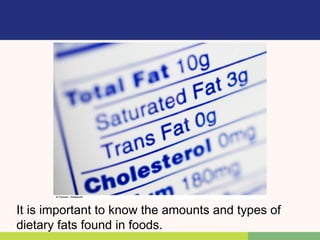
It is importantto know the amounts and types of
dietary fats found in foods.
6.
Fatty Acids
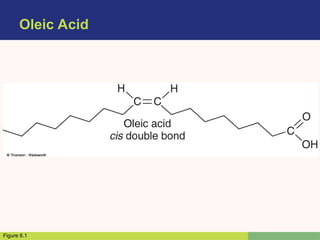
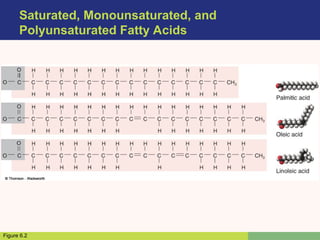
Chainsof carbon and hydrogen
Chain length varies from 4 to 24 carbons (even
numbers only)
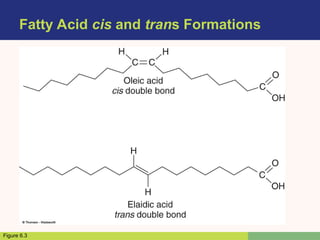
Double bonds are a distinguishing factor
Double bond formation is a distinguishing factor
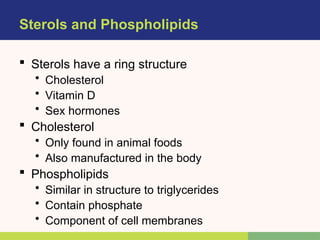
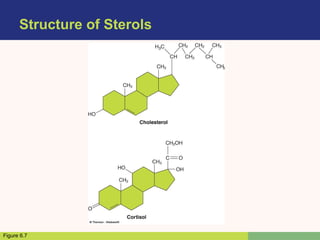
Sterols and Phospholipids
Sterols have a ring structure
• Cholesterol
• Vitamin D
• Sex hormones
Cholesterol
• Only found in animal foods
• Also manufactured in the body
Phospholipids
• Similar in structure to triglycerides
• Contain phosphate
• Component of cell membranes
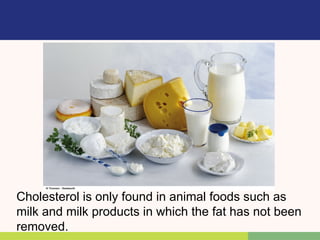
Cholesterol is onlyfound in animal foods such as
milk and milk products in which the fat has not been
removed.
17.
Fats and Performanceand Health
From a performance perspective
• Fat provides energy at rest and during low-
intensity exercise
• Released from storage in adipose tissue
• Released from storage in muscle
• The original source from food (e.g. saturated vs.
unsaturated) is not important
18.
Fats and Performanceand Health
From a health perspective
• Intake of certain fats may reduce heart disease
risk
• Omega-3 fatty acids
• Intake of certain fats may increase heart disease
risk
• Saturated fatty acids
• Dietary cholesterol (in some people)
Athletes must balance both perspectives
19.
Digestion of Fats
Small intestine
• Pancreatic lipase
• Di- and monoglycerides
Gastric emptying rate
Satiety
20.
Transportation of Fats
Fatty acids are released into blood via the portal
vein
Blood fatty acid concentration is increased for
several hours
Cellular triglyceride absorption
• Adipose and muscle cells are important storage
sites
• Lipoprotein lipase (LPL) stimulates the release of
fatty acids from the triglycerides
21.
Fat Storage
Lipoproteinlipase activity is stimulated by insulin
Fatty acids are re-assembled in adipose and
muscle cells
• Subcutaneous and visceral fat
• Slow-twitch skeletal muscle, heart muscle
Advantages
• 9 kcal/g (twice that of CHO or protein)
22.
Ketosis
Ketone bodies
•Acetoacetate
• Beta-hydroxybutyrate
• Acetone
Normal metabolic pathway
~2 to 6% of body’s energy needs after overnight fast
Pathway is sometimes emphasized
• Starvation state
• Low CHO intake
• Impaired CHO metabolism (diabetes)
• Dangerous, can result in ketoacidosis
23.
Ketosis, con’t
LowCHO intake/ starvation
• Ketones are source of energy for brain
• Muscle glycogen depleted
• Loss of some skeletal muscle
• Weight (fat) loss
Not likely to be beneficial for athletic
performance
24.
Fats as anEnergy Source During Exercise
Use of fat during exercise
• Advantages
• Abundant in food supply
• Energy dense
• Substantial storage in adipose tissue
• Produces large amount of ATP
• Disadvantages
• Takes time to transport and metabolize
• Requires oxygen
25.
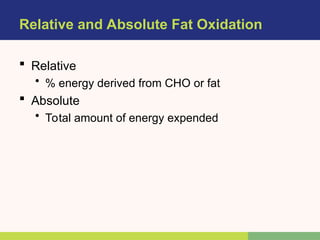
Relative and AbsoluteFat Oxidation
Relative
• % energy derived from CHO or fat
Absolute
• Total amount of energy expended
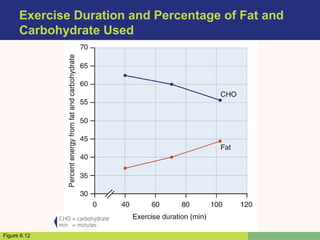
Do You Haveto Burn Fat to Lose Fat?
Low-intensity exercise (“fat-burning zone”)
• RER is lower than during high-intensity exercise
• % energy derived from fat is high
• Total amount of energy expended is lower
Not necessary to burn fat during exercise to lose
body fat
Total energy expended is more important than %
expended from fat
31.
Effects of Trainingon Fat Usage
General adaptations
• Fatty acids are more easily mobilized from
adipocytes
• Uptake of fatty acids into muscle cells is
enhanced
• Number and size of mitochondria are increased
32.
High-fat Diets -Fat loading
Endurance performance not likely to improve
Intensity of exercise would be too low to be
competitive
33.
Effect of Caffeineon Fat Usage
Dose: 5 to 6 mg/kg body weight
Does not increase fat mobilization
Central nervous system stimulant
• Increases sense of awareness
• Decreases perceived effort
May be banned substance
Normal use not likely to exceed threshold
Caffeine is addictive and has side effects
34.
Carnitine Dietary Supplements
Found in food and synthesized from lysine
Deficiencies are rare
Supplement dose: 2 to 4 g/day
Supplements seem to be safe at such dosages
Little evidence of effectiveness
Fat Recommendations forAthletes
General considerations
• Total energy (kcal) need
• Macronutrient balance
• Higher CHO/protein intake typically means lower
fat intake
• Severe restriction of fat intake not recommended
• Often expressed as a % of total energy intake
• 20 to 35% total caloric intake
• May be expressed on g/kg body weight basis
• ~1.0 g/kg daily
• May need to be as high as 3.0 g/kg
(ultraendurance athletes)
37.
Fat Recommendations forAthletes
Adjusting fat intake to achieve energy deficits
• Reducing body fat may result in improved
performance
• Fat intake is typically reduced since reductions to
CHO or protein intakes may be detrimental to
performance
• Athletes may consume a short-term, low fat diet
to achieve body composition goals
38.
Fat Recommendations forAthletes
Effects of an inadequate fat intake on training,
performance, and health
• Inadequate replenishment of intramuscular fat
stores
• Inability to manufacture sex-related hormones
• Decline in high-density lipoprotein cholesterol
(HDL-C)
• Inadequate fat-soluble vitamin intakes
39.
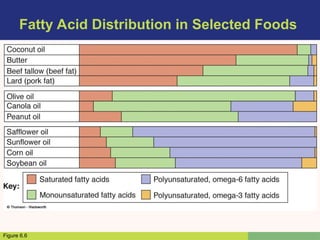
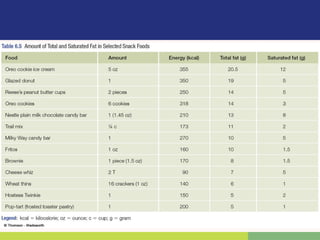
Amounts andtypes of fats in food
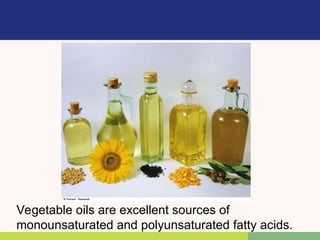
• Predominantly monounsaturated
• Olive, canola, and peanut oils
• Some safflower oils
• Avocado
• Nuts
Translating Fat Recommendations to
Food Choices
40.
Amounts andtypes of fats in food
• Predominantly polyunsaturated
• Corn, soy, and flaxseed oils
• Some safflower oils
• Liquid and soft (tub) margarines
• Mayonnaise and some salad dressings
• Sunflower, pumpkin, and flax seeds
Translating Fat Recommendations to
Food Choices
41.
Amounts andtypes of fats in food
• Predominately or some saturated
• Bacon grease and lard
• Hard (stick) margarine
• Butter, cream
• Coconut oil
Translating Fat Recommendations to
Food Choices
42.
Fat substitutes
•Often made from CHO sources
• Such products may not have fewer kcal than
original product
• Olestra (Olean®) is not absorbed
• Not a weight loss panacea
Translating Fat Recommendations to
Food Choices
43.
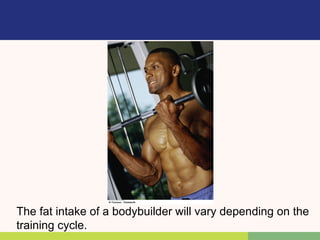
The fat intakeof a bodybuilder will vary depending on the
training cycle.
Summary Concepts
Preciseterminology is important to prevent
confusion when discussing fat-related issues.
Fats must be considered in several contexts,
including the effect they may have on
performance and health.
Fats are an important source of energy at rest
and during low-intensity exercise.
Fat absorption, digestion, transportation, and
metabolism are slow and complicated when
compared to carbohydrate.
55.
Summary Concepts, con’t
For athletes in training, the need to balance
carbohydrate, protein, and fat intakes results in
a diet that is typically lower in fat than that of the
general population.
Fats contain more kilocalories per gram than
carbohydrates, protein, and alcohol and are
easily stored in adipose tissue as a future
energy source.
Fats in foods contribute to their good taste and it
is easy to consume excess fats and kilocalories.
Editor's Notes
#4 Introductory concepts
1. The word fat has many different meanings
2. Important source of energy at rest and during low-intensity exercise
3. Most concentrated source of energy (9 kcal/g)
4. Fats are distinguished by their chemistry
5. Certain fats in the food and in blood are associated with cardiovascular disease
#6 A. Fatty acids
1. Chains of carbon and hydrogen
2. Chain length varies from 4 to 24 carbons (even numbers only)
3. Double bonds are a distinguishing factor
a. Saturated fatty acids
b. Unsaturated fatty acids (16 to 22 carbons)
1. Monounsaturated
2. Polyunsaturated
4. Double bond formation is a distinguishing factor
a. Unsaturated fatty acids
1. cis formation
2. trans formation
5. Fatty acid series is a distinguishing factor
a. Polyunsaturated fatty acids
1. Omega-3
2. Omega-6
3. Omega-9
#7 Fatty acids
1. Chains of carbon and hydrogen
2. Chain length varies from 4 to 24 carbons (even numbers only)
#8 Double bonds are a distinguishing factor
a. Saturated fatty acids
b. Unsaturated fatty acids (16 to 22 carbons)
1. Monounsaturated
2. Polyunsaturated
#10 Double bond formation is a distinguishing factor
a. Unsaturated fatty acids
1. cis formation
2. trans formation
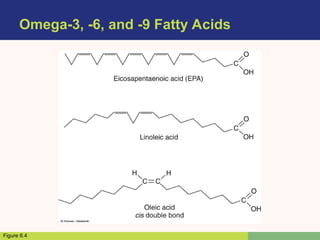
#11 Fatty acid series is a distinguishing factor
a. Polyunsaturated fatty acids
1. Omega-3
2. Omega-6
3. Omega-9
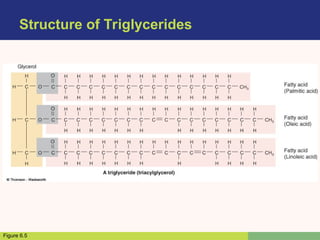
#12 Triglycerides in foods
1. 95% of all fats in food
2. Three fatty acids attached to one glycerol
a. Glycerol is a sugar alcohol
b. The 3 fatty acids are typically different
c. Usually one type of fatty acid is predominant
1. Saturated (e.g. coconut oil, animal fats)
2. Monounsaturated (e.g. olive and canola oils)
3. Polyunsaturated (e.g. safflower and corn oils)
3. Triacylglycerol is the scientific term
a. Triglyceride is typically used in consumer health
4. Two fatty acids are essential fatty acids
a. Linoleic acid
b. Alpha-linolenic acid
#14 Sterols and phospholipids in foods
1. Sterols have a ring structure
a. Cholesterol
b. Vitamin D
c. Sex hormones
2. Cholesterol
a. Only found in animal foods
b. Also manufactured in the body
3. Phospholipids
a. Similar in structure to triglycerides
b. Contain phosphate
c. Component of cell membranes
#17 Fats and their influence on performance and health
1. From a performance perspective
a. Fat provides energy at rest and during low-intensity exercise
1. Released from storage in adipose tissue
2. Released from storage in muscle
b. The original source from food (e.g. saturated vs. unsaturated) is not important
2. From a health perspective
a. Intake of certain fats may reduce heart disease risk
1. Omega-3 fatty acids
b. Intake of certain fats may increase heart disease risk
1. Saturated fatty acids
2. Dietary cholesterol (in some people)
3. Athletes must balance both perspectives
#18 Fats and their influence on performance and health
1. From a performance perspective
a. Fat provides energy at rest and during low-intensity exercise
1. Released from storage in adipose tissue
2. Released from storage in muscle
b. The original source from food (e.g. saturated vs. unsaturated) is not important
2. From a health perspective
a. Intake of certain fats may reduce heart disease risk
1. Omega-3 fatty acids
b. Intake of certain fats may increase heart disease risk
1. Saturated fatty acids
2. Dietary cholesterol (in some people)
3. Athletes must balance both perspectives
#19 Digestion, absorption and transportation of fats
A. Digestion of fats
1. Small intestine
a. Pancreatic lipase
b. Di- and monoglycerides
2. Gastric emptying rate
3. Satiety
B. Absorption of fats
1. Enter mucosal cells via passive diffusion
2. Majority are re-assembled into triglycerides
a. 16 or 18 carbon fatty acids
b. Incorporated into chylomicrons (lipoprotein)
3. 4 to 10 carbon fatty acids pass through mucosal cells unchanged
#20 Transportation of fats
1. Triglycerides are slowly released into lymph
2. Other fatty acids are released into blood via the portal vein
3. Blood fatty acid concentration is increased for several hours
4. Cellular triglyceride absorption
a. Adipose and muscle cells are important storage sites
b. Lipoprotein lipase (LPL) stimulates the release of fatty acids from the triglycerides
#21 Fat storage
1. Lipoprotein lipase activity is stimulated by insulin
2. Fatty acids are re-assembled in adipose and muscle cells
a. Subcutaneous and visceral fat
b. Slow-twitch skeletal muscle, heart muscle
3. Advantages
a. 9 kcal/g (twice that of CHO or protein)
b. Anhydrous
#22 Ketosis
a. Ketone bodies
1. acetoacetate
2. Beta-hydroxybutyrate
3. Acetone
b. Normal metabolic pathway
c. ~2 to 6% of body’s energy needs after overnight fast
d. Pathway is sometimes emphasized
1. Starvation state
2. Low CHO intake
3. Impaired CHO metabolism (diabetes)
a. Dangerous, can result in ketoacidosis
e. Low CHO intake/ starvation
1. Ketones are source of energy for brain
2. Muscle glycogen depleted
3. Loss of some skeletal muscle
4. Weight (fat) loss
f. Not likely to be beneficial for athletic performance
#23 Ketosis
a. Ketone bodies
1. acetoacetate
2. Beta-hydroxybutyrate
3. Acetone
b. Normal metabolic pathway
c. ~2 to 6% of body’s energy needs after overnight fast
d. Pathway is sometimes emphasized
1. Starvation state
2. Low CHO intake
3. Impaired CHO metabolism (diabetes)
a. Dangerous, can result in ketoacidosis
e. Low CHO intake/ starvation
1. Ketones are source of energy for brain
2. Muscle glycogen depleted
3. Loss of some skeletal muscle
4. Weight (fat) loss
f. Not likely to be beneficial for athletic performance
#24 Fats as a source of energy during exercise
A. Use of fat during exercise
1. Advantages
a. Abundant in food supply
b. Energy dense
c. Substantial storage in adipose tissue
d. Produces large amount of ATP
2. Disadvantages
a. Takes time to transport and metabolize
b. Requires oxygen
#25 Relative and absolute fat oxidation
1. Relative vs. absolute
a. Relative: % energy derived from CHO or fat
b. Absolute: Total amount of energy expended
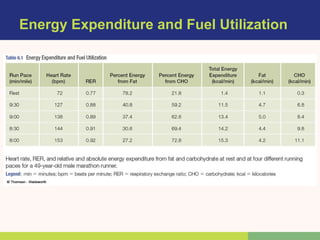
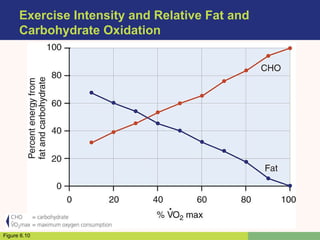
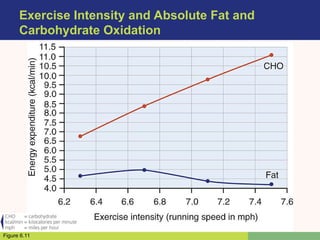
#26 Fat oxidation during exercise
a. At rest
1. % energy from fat is high
2. Total energy expenditure is low
b. Moderate intensity exercise (compared to rest)
1. % energy from fat decreases
2. % energy from CHO increases
3. Total energy expenditure increases substantially
a. kcal from CHO increases
b. kcal from fat increases
c. Increasing exercise intensity (compared to moderate)
1. % energy from fat decreases
2. % energy from CHO increases
3. Total energy expenditure from fat and CHO increases
4. Maximum point of fat oxidation
a. % energy from fat decreases
b. Total energy expenditure from fat decreases
c. Lactate production inhibits fat mobilization
d. Blood circulation to adipose tissue decreases
#27 Fat oxidation during exercise
a. At rest
1. % energy from fat is high
2. Total energy expenditure is low
b. Moderate intensity exercise (compared to rest)
1. % energy from fat decreases
2. % energy from CHO increases
3. Total energy expenditure increases substantially
a. kcal from CHO increases
b. kcal from fat increases
c. Increasing exercise intensity (compared to moderate)
1. % energy from fat decreases
2. % energy from CHO increases
3. Total energy expenditure from fat and CHO increases
4. Maximum point of fat oxidation
a. % energy from fat decreases
b. Total energy expenditure from fat decreases
c. Lactate production inhibits fat mobilization
d. Blood circulation to adipose tissue decreases
#28 Fat oxidation during exercise
a. At rest
1. % energy from fat is high
2. Total energy expenditure is low
b. Moderate intensity exercise (compared to rest)
1. % energy from fat decreases
2. % energy from CHO increases
3. Total energy expenditure increases substantially
a. kcal from CHO increases
b. kcal from fat increases
c. Increasing exercise intensity (compared to moderate)
1. % energy from fat decreases
2. % energy from CHO increases
3. Total energy expenditure from fat and CHO increases
4. Maximum point of fat oxidation
a. % energy from fat decreases
b. Total energy expenditure from fat decreases
c. Lactate production inhibits fat mobilization
d. Blood circulation to adipose tissue decreases
#29 Fat oxidation during prolonged steady-state exercise
1. CHO stores (glycogen) decline
2. % energy from CHO decreases
3. % energy from fat increases gradually
#30 Do you have to burn fat to lose fat?
a. Low-intensity exercise (“fat-burning zone”)
1. RER is lower then during high-intensity exercise
2. % energy derived from fat is high
3. Total amount of energy expended is lower
b. Not necessary to burn fat during exercise to lose body fat
c. Total energy expended is more important than % expended from fat
#31 Effects of training on fat usage
1. General adaptations
a. Fatty acids are more easily mobilized from adipocytes
b. Uptake of fatty acids into muscle cells is enhanced
c. Number and size of mitochondria are increased
2. High-fat diets/Fat loading
a. Endurance performance not likely to improve
b. Intensity of exercise would be too low to be competitive
#33 Effect of caffeine on fat usage
a. Dose: 5 to 6 mg/kg body weight
b. Does not increase fat mobilization
c. Central nervous system stimulant
1. Increases sense of awareness
2. Decreases perceived effort
d. May be banned substance
1. Normal use not likely to exceed threshold
e. Caffeine is addictive and has side effects
#34 Fat-related dietary supplements
1. Carnitine
a. Found in food and synthesized from lysine
b. Deficiencies are rare
c. Supplement dose: 2 to 4 g/day
d. Supplements seem to be safe at such dosages
e. Little evidence of effectiveness
2. Medium-chain triglycerides
a. Not effective for improving endurance performance
b. May impair performance in some cases
#35 Fat-related dietary supplements
1. Carnitine
a. Found in food and synthesized from lysine
b. Deficiencies are rare
c. Supplement dose: 2 to 4 g/day
d. Supplements seem to be safe at such dosages
e. Little evidence of effectiveness
2. Medium-chain triglycerides
a. Not effective for improving endurance performance
b. May impair performance in some cases
#36 Fat recommendations for athletes
A. General considerations
1. Total energy (kcal) need
2. Macronutrient balance
a. Higher CHO/protein intake typically means lower fat intake
b. Severe restriction of fat intake not recommended
3. Often expressed as a % of total energy intake
a. 20 to 35% total caloric intake
4. May be expressed on g/kg body weight basis
a. ~1.0 g/kg daily
b. May need to be as high as 3.0 g/kg (ultraendurance athletes)
B. Adjusting fat intake to achieve energy deficits
1. Reducing body fat may result in improved performance
2. Fat intake is typically reduced since reductions to CHO or protein intakes may be detrimental to performance
3. Athletes may consume a short-term, low fat diet to achieve body composition goals
C. Acute and chronic fat and energy deficits
1. Acute
a. “Making weight”
2. Chronic
a. Maintaining a low % body fat
b. Fat phobia
D. Effects of an inadequate fat intake on training, performance, and health
1. Inadequate replenishment of intramuscular fat stores
2. Inability to manufacture sex-related hormones
3. Decline in high-density lipoprotein cholesterol (HDL-C)
4. Inadequate fat-soluble vitamin intakes
#37 Fat recommendations for athletes
A. General considerations
1. Total energy (kcal) need
2. Macronutrient balance
a. Higher CHO/protein intake typically means lower fat intake
b. Severe restriction of fat intake not recommended
3. Often expressed as a % of total energy intake
a. 20 to 35% total caloric intake
4. May be expressed on g/kg body weight basis
a. ~1.0 g/kg daily
b. May need to be as high as 3.0 g/kg (ultraendurance athletes)
B. Adjusting fat intake to achieve energy deficits
1. Reducing body fat may result in improved performance
2. Fat intake is typically reduced since reductions to CHO or protein intakes may be detrimental to performance
3. Athletes may consume a short-term, low fat diet to achieve body composition goals
C. Acute and chronic fat and energy deficits
1. Acute
a. “Making weight”
2. Chronic
a. Maintaining a low % body fat
b. Fat phobia
D. Effects of an inadequate fat intake on training, performance, and health
1. Inadequate replenishment of intramuscular fat stores
2. Inability to manufacture sex-related hormones
3. Decline in high-density lipoprotein cholesterol (HDL-C)
4. Inadequate fat-soluble vitamin intakes
#38 Fat recommendations for athletes
A. General considerations
1. Total energy (kcal) need
2. Macronutrient balance
a. Higher CHO/protein intake typically means lower fat intake
b. Severe restriction of fat intake not recommended
3. Often expressed as a % of total energy intake
a. 20 to 35% total caloric intake
4. May be expressed on g/kg body weight basis
a. ~1.0 g/kg daily
b. May need to be as high as 3.0 g/kg (ultraendurance athletes)
B. Adjusting fat intake to achieve energy deficits
1. Reducing body fat may result in improved performance
2. Fat intake is typically reduced since reductions to CHO or protein intakes may be detrimental to performance
3. Athletes may consume a short-term, low fat diet to achieve body composition goals
C. Acute and chronic fat and energy deficits
1. Acute
a. “Making weight”
2. Chronic
a. Maintaining a low % body fat
b. Fat phobia
D. Effects of an inadequate fat intake on training, performance, and health
1. Inadequate replenishment of intramuscular fat stores
2. Inability to manufacture sex-related hormones
3. Decline in high-density lipoprotein cholesterol (HDL-C)
4. Inadequate fat-soluble vitamin intakes
#39 Translating daily fat recommendations to food choices
A. Amounts and types of fats in food
1. Predominantly monounsaturated
a. Olive, canola, and peanut oils
b. Some safflower oils
c. Avocado
d. Nuts
2. Predominantly polyunsaturated
a. Corn, soy, and flaxseed oils
b. Some safflower oils
c. Liquid and soft (tub) margarines
d. Mayonnaise and some salad dressings
e. Sunflower, pumpkin, and flax seeds
3. Predominately or some saturated
a. Bacon grease and lard
b. Hard (stick) margarine
c. Butter, cream
d. Coconut oil
B. Fat and the typical American diet
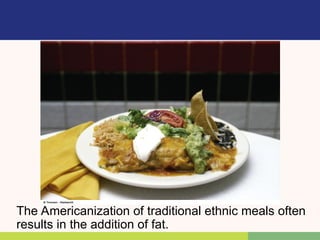
1. Traditional American diet tends to be high in fat
2. Traditional ethnic diets tend to be lower in fat
3. Traditional American diet tends to be too high in fat and too low in CHO for athletes
C. Ways to modify the typical American diet
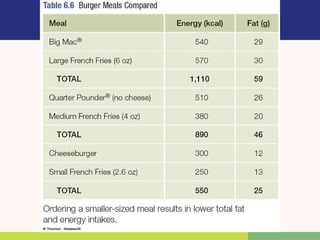
1. Reduce portion size
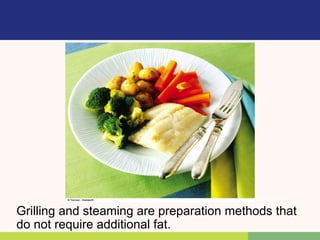
2. Prepare foods with less fat
3. Add less fat to foods
4. Be aware of “hidden fats”
5. Consume lower-fat cuts of meat or poultry and low-fat or nonfat dairy products
6. Choose lower-fat versions of high-fat processed foods
D. Fat substitutes and fat blockers
1. Fat substitutes
a. Often made from CHO sources
b. Such products may not have fewer kcal than original product
c. Olestra (Olean®) is not absorbed
d. Not a weight loss panacea
2. Fat blockers
a. Chitosan
b. Similar to cellulose
c. Binds with fat in intestine and blocks fat absorption
d. Some side effects
e. Not effective as an aid to weight loss
#40 Translating daily fat recommendations to food choices
A. Amounts and types of fats in food
1. Predominantly monounsaturated
a. Olive, canola, and peanut oils
b. Some safflower oils
c. Avocado
d. Nuts
2. Predominantly polyunsaturated
a. Corn, soy, and flaxseed oils
b. Some safflower oils
c. Liquid and soft (tub) margarines
d. Mayonnaise and some salad dressings
e. Sunflower, pumpkin, and flax seeds
3. Predominately or some saturated
a. Bacon grease and lard
b. Hard (stick) margarine
c. Butter, cream
d. Coconut oil
B. Fat and the typical American diet
1. Traditional American diet tends to be high in fat
2. Traditional ethnic diets tend to be lower in fat
3. Traditional American diet tends to be too high in fat and too low in CHO for athletes
C. Ways to modify the typical American diet
1. Reduce portion size
2. Prepare foods with less fat
3. Add less fat to foods
4. Be aware of “hidden fats”
5. Consume lower-fat cuts of meat or poultry and low-fat or nonfat dairy products
6. Choose lower-fat versions of high-fat processed foods
D. Fat substitutes and fat blockers
1. Fat substitutes
a. Often made from CHO sources
b. Such products may not have fewer kcal than original product
c. Olestra (Olean®) is not absorbed
d. Not a weight loss panacea
2. Fat blockers
a. Chitosan
b. Similar to cellulose
c. Binds with fat in intestine and blocks fat absorption
d. Some side effects
e. Not effective as an aid to weight loss
#41 Translating daily fat recommendations to food choices
A. Amounts and types of fats in food
1. Predominantly monounsaturated
a. Olive, canola, and peanut oils
b. Some safflower oils
c. Avocado
d. Nuts
2. Predominantly polyunsaturated
a. Corn, soy, and flaxseed oils
b. Some safflower oils
c. Liquid and soft (tub) margarines
d. Mayonnaise and some salad dressings
e. Sunflower, pumpkin, and flax seeds
3. Predominately or some saturated
a. Bacon grease and lard
b. Hard (stick) margarine
c. Butter, cream
d. Coconut oil
B. Fat and the typical American diet
1. Traditional American diet tends to be high in fat
2. Traditional ethnic diets tend to be lower in fat
3. Traditional American diet tends to be too high in fat and too low in CHO for athletes
C. Ways to modify the typical American diet
1. Reduce portion size
2. Prepare foods with less fat
3. Add less fat to foods
4. Be aware of “hidden fats”
5. Consume lower-fat cuts of meat or poultry and low-fat or nonfat dairy products
6. Choose lower-fat versions of high-fat processed foods
D. Fat substitutes and fat blockers
1. Fat substitutes
a. Often made from CHO sources
b. Such products may not have fewer kcal than original product
c. Olestra (Olean®) is not absorbed
d. Not a weight loss panacea
2. Fat blockers
a. Chitosan
b. Similar to cellulose
c. Binds with fat in intestine and blocks fat absorption
d. Some side effects
e. Not effective as an aid to weight loss
#42 Translating daily fat recommendations to food choices
A. Amounts and types of fats in food
1. Predominantly monounsaturated
a. Olive, canola, and peanut oils
b. Some safflower oils
c. Avocado
d. Nuts
2. Predominantly polyunsaturated
a. Corn, soy, and flaxseed oils
b. Some safflower oils
c. Liquid and soft (tub) margarines
d. Mayonnaise and some salad dressings
e. Sunflower, pumpkin, and flax seeds
3. Predominately or some saturated
a. Bacon grease and lard
b. Hard (stick) margarine
c. Butter, cream
d. Coconut oil
B. Fat and the typical American diet
1. Traditional American diet tends to be high in fat
2. Traditional ethnic diets tend to be lower in fat
3. Traditional American diet tends to be too high in fat and too low in CHO for athletes
C. Ways to modify the typical American diet
1. Reduce portion size
2. Prepare foods with less fat
3. Add less fat to foods
4. Be aware of “hidden fats”
5. Consume lower-fat cuts of meat or poultry and low-fat or nonfat dairy products
6. Choose lower-fat versions of high-fat processed foods
D. Fat substitutes and fat blockers
1. Fat substitutes
a. Often made from CHO sources
b. Such products may not have fewer kcal than original product
c. Olestra (Olean®) is not absorbed
d. Not a weight loss panacea
2. Fat blockers
a. Chitosan
b. Similar to cellulose
c. Binds with fat in intestine and blocks fat absorption
d. Some side effects
e. Not effective as an aid to weight loss
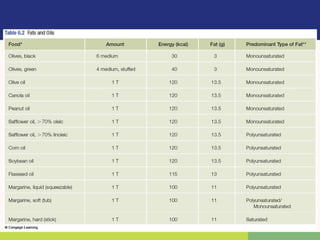
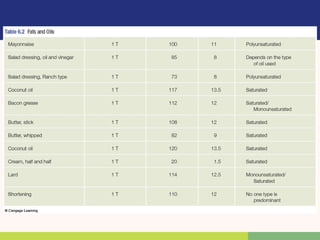
#44 Examples of foods that are 100 percent, or nearly 100 percent fat and the predominant type of fat they contain.
Legend: kcal 5 kilocalorie; g 5 gram; T 5 Tablespoon; oz 5 ounce
*All foods listed are either 100% fat or nearly 100% (contain , 1 g of protein and carbohydrate).
**When two fats are listed, both are found in approximately equal amounts.
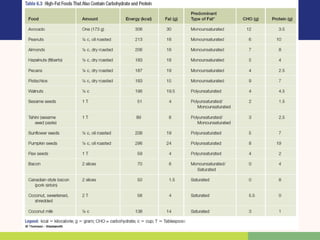
#45 Examples of foods that are 100 percent, or nearly 100 percent fat and the predominant type of fat they contain.
Legend: kcal 5 kilocalorie; g 5 gram; T 5 Tablespoon; oz 5 ounce
*All foods listed are either 100% fat or nearly 100% (contain , 1 g of protein and carbohydrate).
**When two fats are listed, both are found in approximately equal amounts.