High Performance Networking
      -- Increasing performance in GB applications


                       M. Tim Jones
                       Emulex Corp.


1
Agenda
    !   Networking Architecture
    !   Sockets Programming Introduction
        –   API, Clients, Servers, Symmetry
    !   Where’s the Problem?
    !   Enhancing Performance
        –   Application Layer Enhancements
        –   TCP/IP Stack Selection
        –   TCP/IP Stack Configuration
        –   TCP/IP Stack Modifications
        –   Specialized Hardware
        –   Other Methods
    !   ~Q&A
2
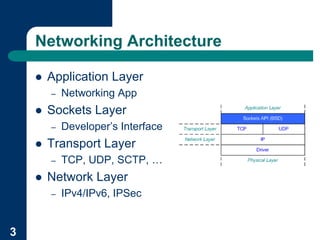
Networking Architecture

    !   Application Layer
        –   Networking App
    !   Sockets Layer
        –   Developer’s Interface
    !   Transport Layer
        –   TCP, UDP, SCTP, …
    !   Network Layer
        –   IPv4/IPv6, IPSec


3
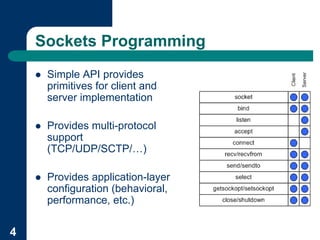
Sockets Programming
    !   Simple API provides
        primitives for client and
        server implementation

    !   Provides multi-protocol
        support
        (TCP/UDP/SCTP/…)

    !   Provides application-layer
        configuration (behavioral,
        performance, etc.)


4
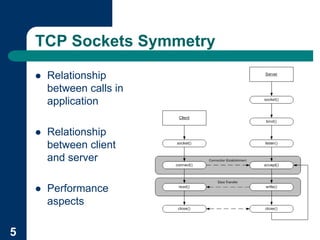
TCP Sockets Symmetry

    !   Relationship
        between calls in
        application

    !   Relationship
        between client
        and server

    !   Performance
        aspects

5
Enhancing Performance


              Where’s the
              Problem?


6
Where’s the problem?

    !   Data Movement
        –   Buffer Copies
    !   Data Manipulation (Touching the data)
        –   Validation, Checksums, Encryption, Decryption.
    !   Resource Management
        –   Locks, Cache, Connection contexts
    !   Protocol Overhead
        –   Fragmentation, Reassembly, Flow Control,
            Congestion Control
        –   1Hz for 1bps (Intel Rule)

7
Enhancing Performance


              Application Layer
              Enhancements


8
Application Layer Enhancements

    !   Nagle
    !   Bandwidth Delay Product
    !   Read/Write calls
    !   Control and Data Connections
    !   Select API Function
    !   Network Striping (Multiple Connections)
    !   TCP vs. UDP


9
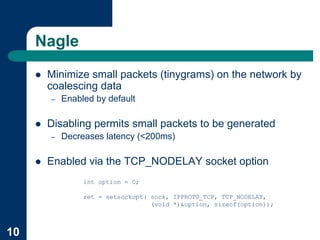
Nagle
     !   Minimize small packets (tinygrams) on the network by
         coalescing data
         –   Enabled by default

     !   Disabling permits small packets to be generated
         –   Decreases latency (<200ms)

     !   Enabled via the TCP_NODELAY socket option
                  int option = 0;

                  ret = setsockopt( sock, IPPROTO_TCP, TCP_NODELAY,
                                    (void *)&option, sizeof(option));


10
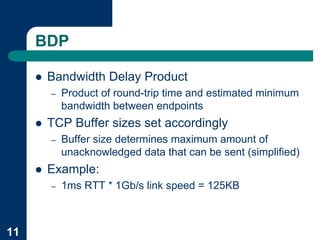
BDP

     !   Bandwidth Delay Product
         –   Product of round-trip time and estimated minimum
             bandwidth between endpoints
     !   TCP Buffer sizes set accordingly
         –   Buffer size determines maximum amount of
             unacknowledged data that can be sent (simplified)
     !   Example:
         –   1ms RTT * 1Gb/s link speed = 125KB


11
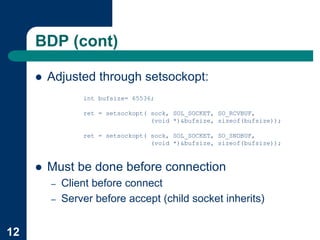
BDP (cont)

     !   Adjusted through setsockopt:
                 int bufsize= 65536;

                 ret = setsockopt( sock, SOL_SOCKET, SO_RCVBUF,
                                   (void *)&bufsize, sizeof(bufsize));

                 ret = setsockopt( sock, SOL_SOCKET, SO_SNDBUF,
                                   (void *)&bufsize, sizeof(bufsize));


     !   Must be done before connection
         –   Client before connect
         –   Server before accept (child socket inherits)


12
BDP (cont)

     !   64K windows not large enough for LFN or
         High-Speed Networks.

     !   To support RFC1323, window scale option
         provided (shift base socket buffer size)
         –   Supports up to 1GB window


13
Read/Write calls

     !   Write as much data / Read as much data as
         possible per call
         –   Reduction in kernel context switches
         –   Minimize the number of buffer copies (write)
         –   Keeps advertised window open (read)


     !   If data is packet oriented (header + data),
         peeking the header and then reading the total
         size can sometimes be beneficial
         –   Can help in message framing

14
Control/Data

     !   Provide separate connections for control and
         data
         –   Control connection used solely for
             command/response
         –   Data connection used for bulk data transfer
         –   Characteristics of connections different


     !   Successful with File Transfer Protocol (FTP)
         –   Telnet-like connection for control
         –   Data connection for bulk data
15
Avoiding select

     !   select commonly induces poor performance
         –   Kernel mods
         –   Sam?


     !   Alternatives?
         –   Event Callbacks (if available)
         –   Stack modifications


16
Network Striping

     !   Open multiple connections and stripe data over
         them
         –   Improves bandwidth utilization
         –   Reduces latency
         –   Operates on un-optimized sockets (small windows,
             etc.)


     !   PSockets at University of Illinois


17
TCP vs. UDP

     !   To avoid computational complexity of TCP, use
         raw UDP?

     !   Rarely beneficial (from my experience)
         –   TCP includes complexity for a reason
         –   Can work for very simple protocols (idempotent
             packet transfer)
              !   Common broadcast / multicast


18
Enhancing Performance


               TCP/IP
               Stack Selection


19
TCP/IP Stack Selection

     !   RFC Compliance         !   Timer Implementation
         –   Standards…
         –   RFC1323
                                !   Resource Management
         –   RFC2001


     !   Zero-Copy APIs         !   Reconfigurability


     !   Event Registration /   !   Commented-Source
         Socket Callbacks
                                !   ANVL


20
Enhancing Performance


               TCP/IP
               Stack Configuration


21
TCP/IP Stack Configuration

     !   Compile-time reconfiguration
         –   Disable unnecessary functionality
     !   Tune resource availability
     !   Avoid memory heaps
         –   Resource queues as an alternative
     !   Scenario-Specific Configuration
         –   Direct-routes
              !   No PMTU Discovery
              !   No Routing Decisions


22
Jumbo Frames

     !   Goal: Largest link MTU not exceeding Path MTU

     !   Increased MTU means more payload per segment
         –   Typical 1500 MTU typically means 1448 MSS (payload)
         –   Typical jumbo frame is 9000 MTU


     !   Path MTU Discovery (RFC 1191)
         –   Used only for indirect routes


     !   MSS Negotiation (during three-way handshake)

23
Jumbo Frames (cont)

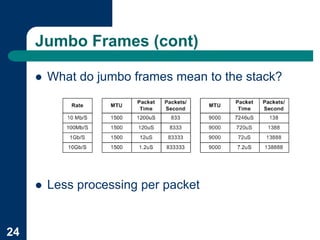
     !   What do jumbo frames mean to the stack?


     !   Less processing per packet


24
Enhancing Performance


               TCP/IP
               Stack Modifications


25
TCP/IP Stack Modifications

     !   Two types of modifications
         –   TCP Friendly
              !   Changes that interoperate with unmodified stacks


         –   Non-friendly
              !   Changes that require symmetric changes (ECN, etc.)


     !   We’ll focus here on some TCP-friendly
         changes


26
TCP/IP Stack Modifications

     !   Delayed Ack Removal
     !   Minimizing Acks
     !   Slow-Start
     !   Scalable TCP (RFC-2581)


27
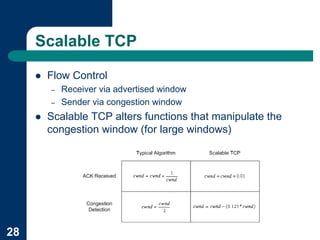
Scalable TCP

     !   Flow Control
         –   Receiver via advertised window
         –   Sender via congestion window
     !   Scalable TCP alters functions that manipulate the
         congestion window (for large windows)


28
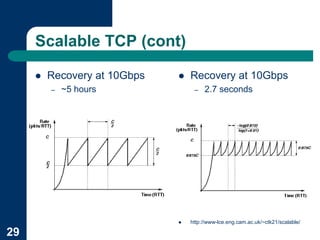
Scalable TCP (cont)

     !   Recovery at 10Gbps   !   Recovery at 10Gbps
         –   ~5 hours              –   2.7 seconds


                              !   http://www-lce.eng.cam.ac.uk/~ctk21/scalable/

29
Enhancing Performance


               Specialized Hardware


30
Specialized Hardware

     !   TCP Offload Engines (TOE)
         –   Partial Offload NIC
         –   Full Offload NIC
         –   Protocol Acceleration

     !   TOE Chips

     !   Encryption/Decryption Chips
         –   IPSec


31
Enhancing Performance


               Other Methods


32
Other Methods

     !   Stream Control Transmission Protocol (SCTP)
         –   RFC-2960
         –   Associations
         –   Multi-homing
         –   Framing
         –   Unordered Delivery

     !   Real-Time Transport Protocol (RTP)
         –   RFC-1889
         –   UDP-based
         –   RTP Control Protocol (RTCP)
         –   QoS handled separately (using protocols such as RSVP)

33
Other Methods

     !   Remote DMA Protocol (RDMA) + DDP
         –   Eliminates copies between kernel and application
         –   Explicit buffer definition
         –   Good use of resources

         –   Can be used by TCP, SCTP, others

         –   Not yet a ratified IETF spec


34
Future
     !   Socket Instrumentation (network-aware applications)
         –   getsockopt()
              !   RTT
              !   Utilized Bandwidth
         –   Socket Buffer Tuning

     !   Automatic configuration (network-aware operating
         systems)
         –   Tune individual socket performance
         –   Tune stack performance
              !   Number of connections, available resources, available BW


     !   Better tools (monitoring and analysis)
35
Enhancing Performance

     !   Final Questions


36

High perf-networking

  • 1.
    High Performance Networking -- Increasing performance in GB applications M. Tim Jones Emulex Corp. 1
  • 2.
    Agenda ! Networking Architecture ! Sockets Programming Introduction – API, Clients, Servers, Symmetry ! Where’s the Problem? ! Enhancing Performance – Application Layer Enhancements – TCP/IP Stack Selection – TCP/IP Stack Configuration – TCP/IP Stack Modifications – Specialized Hardware – Other Methods ! ~Q&A 2
  • 3.
    Networking Architecture ! Application Layer – Networking App ! Sockets Layer – Developer’s Interface ! Transport Layer – TCP, UDP, SCTP, … ! Network Layer – IPv4/IPv6, IPSec 3
  • 4.
    Sockets Programming ! Simple API provides primitives for client and server implementation ! Provides multi-protocol support (TCP/UDP/SCTP/…) ! Provides application-layer configuration (behavioral, performance, etc.) 4
  • 5.
    TCP Sockets Symmetry ! Relationship between calls in application ! Relationship between client and server ! Performance aspects 5
  • 6.
    Enhancing Performance Where’s the Problem? 6
  • 7.
    Where’s the problem? ! Data Movement – Buffer Copies ! Data Manipulation (Touching the data) – Validation, Checksums, Encryption, Decryption. ! Resource Management – Locks, Cache, Connection contexts ! Protocol Overhead – Fragmentation, Reassembly, Flow Control, Congestion Control – 1Hz for 1bps (Intel Rule) 7
  • 8.
    Enhancing Performance Application Layer Enhancements 8
  • 9.
    Application Layer Enhancements ! Nagle ! Bandwidth Delay Product ! Read/Write calls ! Control and Data Connections ! Select API Function ! Network Striping (Multiple Connections) ! TCP vs. UDP 9
  • 10.
    Nagle ! Minimize small packets (tinygrams) on the network by coalescing data – Enabled by default ! Disabling permits small packets to be generated – Decreases latency (<200ms) ! Enabled via the TCP_NODELAY socket option int option = 0; ret = setsockopt( sock, IPPROTO_TCP, TCP_NODELAY, (void *)&option, sizeof(option)); 10
  • 11.
    BDP ! Bandwidth Delay Product – Product of round-trip time and estimated minimum bandwidth between endpoints ! TCP Buffer sizes set accordingly – Buffer size determines maximum amount of unacknowledged data that can be sent (simplified) ! Example: – 1ms RTT * 1Gb/s link speed = 125KB 11
  • 12.
    BDP (cont) ! Adjusted through setsockopt: int bufsize= 65536; ret = setsockopt( sock, SOL_SOCKET, SO_RCVBUF, (void *)&bufsize, sizeof(bufsize)); ret = setsockopt( sock, SOL_SOCKET, SO_SNDBUF, (void *)&bufsize, sizeof(bufsize)); ! Must be done before connection – Client before connect – Server before accept (child socket inherits) 12
  • 13.
    BDP (cont) ! 64K windows not large enough for LFN or High-Speed Networks. ! To support RFC1323, window scale option provided (shift base socket buffer size) – Supports up to 1GB window 13
  • 14.
    Read/Write calls ! Write as much data / Read as much data as possible per call – Reduction in kernel context switches – Minimize the number of buffer copies (write) – Keeps advertised window open (read) ! If data is packet oriented (header + data), peeking the header and then reading the total size can sometimes be beneficial – Can help in message framing 14
  • 15.
    Control/Data ! Provide separate connections for control and data – Control connection used solely for command/response – Data connection used for bulk data transfer – Characteristics of connections different ! Successful with File Transfer Protocol (FTP) – Telnet-like connection for control – Data connection for bulk data 15
  • 16.
    Avoiding select ! select commonly induces poor performance – Kernel mods – Sam? ! Alternatives? – Event Callbacks (if available) – Stack modifications 16
  • 17.
    Network Striping ! Open multiple connections and stripe data over them – Improves bandwidth utilization – Reduces latency – Operates on un-optimized sockets (small windows, etc.) ! PSockets at University of Illinois 17
  • 18.
    TCP vs. UDP ! To avoid computational complexity of TCP, use raw UDP? ! Rarely beneficial (from my experience) – TCP includes complexity for a reason – Can work for very simple protocols (idempotent packet transfer) ! Common broadcast / multicast 18
  • 19.
    Enhancing Performance TCP/IP Stack Selection 19
  • 20.
    TCP/IP Stack Selection ! RFC Compliance ! Timer Implementation – Standards… – RFC1323 ! Resource Management – RFC2001 ! Zero-Copy APIs ! Reconfigurability ! Event Registration / ! Commented-Source Socket Callbacks ! ANVL 20
  • 21.
    Enhancing Performance TCP/IP Stack Configuration 21
  • 22.
    TCP/IP Stack Configuration ! Compile-time reconfiguration – Disable unnecessary functionality ! Tune resource availability ! Avoid memory heaps – Resource queues as an alternative ! Scenario-Specific Configuration – Direct-routes ! No PMTU Discovery ! No Routing Decisions 22
  • 23.
    Jumbo Frames ! Goal: Largest link MTU not exceeding Path MTU ! Increased MTU means more payload per segment – Typical 1500 MTU typically means 1448 MSS (payload) – Typical jumbo frame is 9000 MTU ! Path MTU Discovery (RFC 1191) – Used only for indirect routes ! MSS Negotiation (during three-way handshake) 23
  • 24.
    Jumbo Frames (cont) ! What do jumbo frames mean to the stack? ! Less processing per packet 24
  • 25.
    Enhancing Performance TCP/IP Stack Modifications 25
  • 26.
    TCP/IP Stack Modifications ! Two types of modifications – TCP Friendly ! Changes that interoperate with unmodified stacks – Non-friendly ! Changes that require symmetric changes (ECN, etc.) ! We’ll focus here on some TCP-friendly changes 26
  • 27.
    TCP/IP Stack Modifications ! Delayed Ack Removal ! Minimizing Acks ! Slow-Start ! Scalable TCP (RFC-2581) 27
  • 28.
    Scalable TCP ! Flow Control – Receiver via advertised window – Sender via congestion window ! Scalable TCP alters functions that manipulate the congestion window (for large windows) 28
  • 29.
    Scalable TCP (cont) ! Recovery at 10Gbps ! Recovery at 10Gbps – ~5 hours – 2.7 seconds ! http://www-lce.eng.cam.ac.uk/~ctk21/scalable/ 29
  • 30.
    Enhancing Performance Specialized Hardware 30
  • 31.
    Specialized Hardware ! TCP Offload Engines (TOE) – Partial Offload NIC – Full Offload NIC – Protocol Acceleration ! TOE Chips ! Encryption/Decryption Chips – IPSec 31
  • 32.
    Enhancing Performance Other Methods 32
  • 33.
    Other Methods ! Stream Control Transmission Protocol (SCTP) – RFC-2960 – Associations – Multi-homing – Framing – Unordered Delivery ! Real-Time Transport Protocol (RTP) – RFC-1889 – UDP-based – RTP Control Protocol (RTCP) – QoS handled separately (using protocols such as RSVP) 33
  • 34.
    Other Methods ! Remote DMA Protocol (RDMA) + DDP – Eliminates copies between kernel and application – Explicit buffer definition – Good use of resources – Can be used by TCP, SCTP, others – Not yet a ratified IETF spec 34
  • 35.
    Future ! Socket Instrumentation (network-aware applications) – getsockopt() ! RTT ! Utilized Bandwidth – Socket Buffer Tuning ! Automatic configuration (network-aware operating systems) – Tune individual socket performance – Tune stack performance ! Number of connections, available resources, available BW ! Better tools (monitoring and analysis) 35
  • 36.
    Enhancing Performance ! Final Questions 36