FPGA badge hack:
Linux on RISC-V
Drew Fustini
drew@oshpark.com
Twitter: @pdp7
Slides: https://github.com/pdp7/talks/blob/master/berlin-riscv.pdf
Berlin Hack ‘n Tell (2020-01-28)
●
When you write a program in the Arduino IDE,
it is compiled into instructions for the
microcontroller to execute.
●
How does the compiler know what instructions
the chip understands?
– defined by the Instruction Set Architecture
– The ISA is a standard, a set of rules that define
the tasks the processor can perform.
– Examples: x86 (Intel/AMD) and ARM
●
Both are proprietary and need commercial licensing
●
RISC-V: Free and Open RISC Instruction Set
Arch
– “new instruction set architecture (ISA) that was
originally designed to support computer architecture
research and education and is now set to become a
standard open architecture for industry”
●
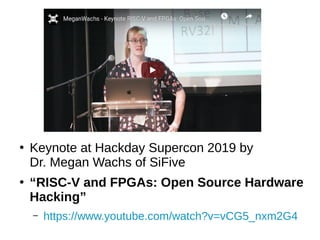
Keynote at Hackday Supercon 2019 by
Dr. Megan Wachs of SiFive
●
“RISC-V and FPGAs: Open Source Hardware
Hacking”
– https://www.youtube.com/watch?v=vCG5_nxm2G4
●
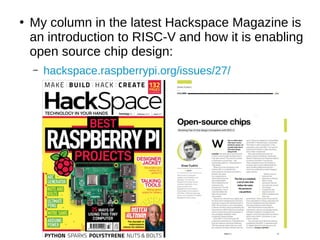
My column in the latest Hackspace Magazine is
an introduction to RISC-V and how it is enabling
open source chip design:
– hackspace.raspberrypi.org/issues/27/
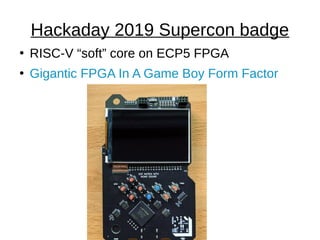
Hackaday 2019 Supercon badge
●
RISC-V “soft” core on ECP5 FPGA
●
Gigantic FPGA In A Game Boy Form Factor
●
Hackspace Magazine column about how about
open source FPGA tools developed by
Claire Wolf (oe1cxw), David Shah and others
have made FPGAs more accessible than ever
before to makers and hackers:
– hackspace.raspberrypi.org/issues/26/
Open Source and FPGAs
●
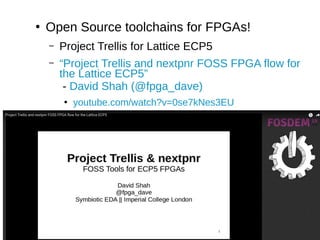
Open Source toolchains for FPGAs!
– Project Trellis for Lattice ECP5
– “Project Trellis and nextpnr FOSS FPGA flow for
the Lattice ECP5”
- David Shah (@fpga_dave)
●
youtube.com/watch?v=0se7kNes3EU
●
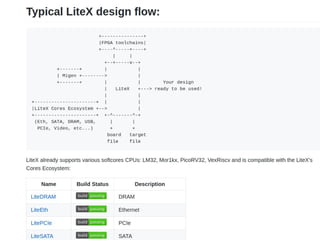
LiteX used to build cores, create SoCs and full
FPGA designs.
●
LiteX is based on Migen
●
Migen lets you do FPGA design in Python!
●
https://github.com/enjoy-digital/litex
Linux on LiteX-VexRiscv
●
VexRiscv: 32-bit Linux Capable RISC-V CPU
●
SoC built using VexRiscv core and LiteX
moduels like LiteDRAM, LiteEth, LiteSDCard, ...
– github.com/litex-hub/linux-on-litex-vexriscv
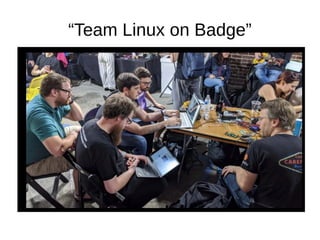
“Team Linux on Badge”
●
Blog post: Hackaday Supercon badge boots Linux
using SDRAM cartridge
– https://blog.oshpark.com/2019/12/20/boot-linux-on-this-
hackaday-supercon-badge-with-this-sdram-cartridge/
●
Michael Welling (@QwertyEmedded), Tim Ansell
(@mithro), Sean Cross (@xobs), Jacob Creedon
(@jacobcreedon)
●
First attempt: use the built-in 16MB SRAM…
no luck :(
– (though xobs now might have a way to do it)
“Team Linux on Badge”
●
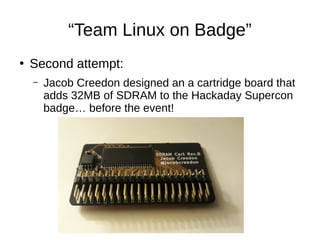
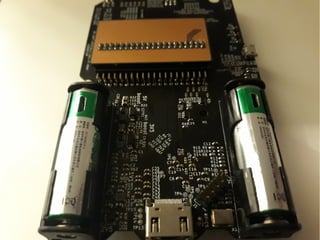
Second attempt:
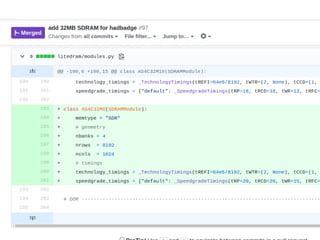
– Jacob Creedon designed an a cartridge board that
adds 32MB of SDRAM to the Hackaday Supercon
badge… before the event!
“Team Linux on Badge”
●
Second attempt:
– Jacob Creedon designed an a cartridge board that
adds 32MB of SDRAM to the Hackaday Supercon
badge… before the event!
●
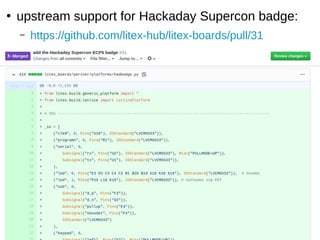
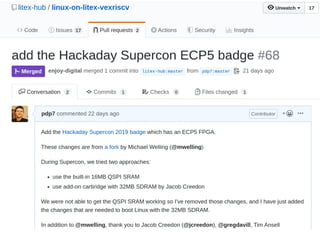
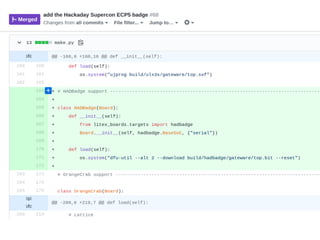
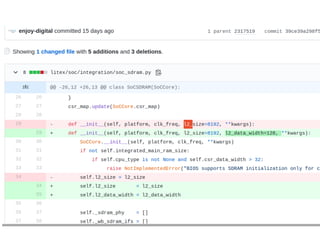
upstream support for Hackaday Supercon badge:
– https://github.com/litex-hub/litex-boards/pull/31
●
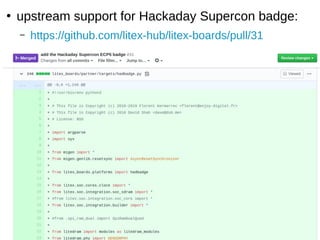
upstream support for Hackaday Supercon badge:
– https://github.com/litex-hub/litex-boards/pull/31
●
upstream support for Hackaday Supercon badge:
– https://github.com/litex-hub/litex-boards/pull/31
●
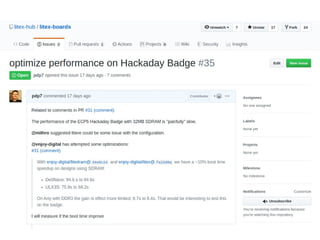
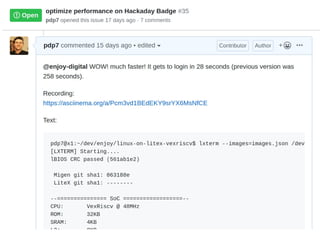
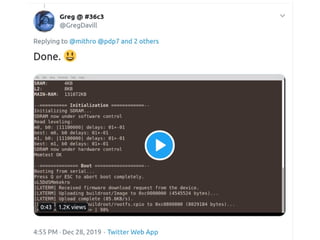
Opened GitHub issue:
– optimize performance on Hackaday Badge #35
●
https://github.com/litex-hub/litex-boards/issues/35
●
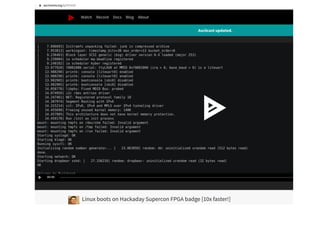
Now 10x faster!
– https://asciinema.org/a/Pcm3vd1BEdEKY9srYX6Ms
NfCE
– Thanks to enjoy-digital
Slides:
ttps://github.com/pdp7/talks/blob/master/berlin-riscv.pdf
Drew Fustini
drew@oshpark.com
@pdp7 / @oshpark
This work is licensed under a Creative Commons
Attribution-ShareAlike 4.0 International License.
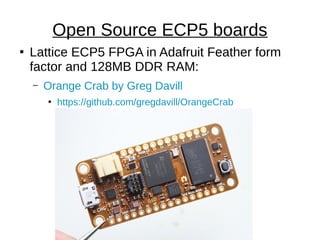
●
Lattice ECP5 FPGA in Adafruit Feather form
factor and 128MB DDR RAM:
– Orange Crab by Greg Davill
●
https://github.com/gregdavill/OrangeCrab
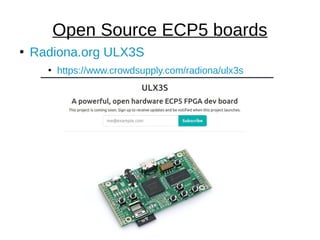
Open Source ECP5 boards
●
Radiona.org ULX3S
●
https://www.crowdsupply.com/radiona/ulx3s
Open Source ECP5 boards

FPGA Badge Hack: Linux on RISC-V

  • 1.
    FPGA badge hack: Linuxon RISC-V Drew Fustini drew@oshpark.com Twitter: @pdp7 Slides: https://github.com/pdp7/talks/blob/master/berlin-riscv.pdf Berlin Hack ‘n Tell (2020-01-28)
  • 2.
    ● When you writea program in the Arduino IDE, it is compiled into instructions for the microcontroller to execute. ● How does the compiler know what instructions the chip understands? – defined by the Instruction Set Architecture – The ISA is a standard, a set of rules that define the tasks the processor can perform. – Examples: x86 (Intel/AMD) and ARM ● Both are proprietary and need commercial licensing
  • 3.
    ● RISC-V: Free andOpen RISC Instruction Set Arch – “new instruction set architecture (ISA) that was originally designed to support computer architecture research and education and is now set to become a standard open architecture for industry”
  • 4.
    ● Keynote at HackdaySupercon 2019 by Dr. Megan Wachs of SiFive ● “RISC-V and FPGAs: Open Source Hardware Hacking” – https://www.youtube.com/watch?v=vCG5_nxm2G4
  • 5.
    ● My column inthe latest Hackspace Magazine is an introduction to RISC-V and how it is enabling open source chip design: – hackspace.raspberrypi.org/issues/27/
  • 6.
    Hackaday 2019 Superconbadge ● RISC-V “soft” core on ECP5 FPGA ● Gigantic FPGA In A Game Boy Form Factor
  • 8.
    ● Hackspace Magazine columnabout how about open source FPGA tools developed by Claire Wolf (oe1cxw), David Shah and others have made FPGAs more accessible than ever before to makers and hackers: – hackspace.raspberrypi.org/issues/26/ Open Source and FPGAs
  • 9.
    ● Open Source toolchainsfor FPGAs! – Project Trellis for Lattice ECP5 – “Project Trellis and nextpnr FOSS FPGA flow for the Lattice ECP5” - David Shah (@fpga_dave) ● youtube.com/watch?v=0se7kNes3EU
  • 10.
    ● LiteX used tobuild cores, create SoCs and full FPGA designs. ● LiteX is based on Migen ● Migen lets you do FPGA design in Python! ● https://github.com/enjoy-digital/litex
  • 12.
    Linux on LiteX-VexRiscv ● VexRiscv:32-bit Linux Capable RISC-V CPU ● SoC built using VexRiscv core and LiteX moduels like LiteDRAM, LiteEth, LiteSDCard, ... – github.com/litex-hub/linux-on-litex-vexriscv
  • 13.
  • 14.
    “Team Linux onBadge” ● Blog post: Hackaday Supercon badge boots Linux using SDRAM cartridge – https://blog.oshpark.com/2019/12/20/boot-linux-on-this- hackaday-supercon-badge-with-this-sdram-cartridge/ ● Michael Welling (@QwertyEmedded), Tim Ansell (@mithro), Sean Cross (@xobs), Jacob Creedon (@jacobcreedon) ● First attempt: use the built-in 16MB SRAM… no luck :( – (though xobs now might have a way to do it)
  • 15.
    “Team Linux onBadge” ● Second attempt: – Jacob Creedon designed an a cartridge board that adds 32MB of SDRAM to the Hackaday Supercon badge… before the event!
  • 16.
    “Team Linux onBadge” ● Second attempt: – Jacob Creedon designed an a cartridge board that adds 32MB of SDRAM to the Hackaday Supercon badge… before the event!
  • 18.
    ● upstream support forHackaday Supercon badge: – https://github.com/litex-hub/litex-boards/pull/31
  • 19.
    ● upstream support forHackaday Supercon badge: – https://github.com/litex-hub/litex-boards/pull/31
  • 20.
    ● upstream support forHackaday Supercon badge: – https://github.com/litex-hub/litex-boards/pull/31
  • 25.
    ● Opened GitHub issue: –optimize performance on Hackaday Badge #35 ● https://github.com/litex-hub/litex-boards/issues/35 ● Now 10x faster! – https://asciinema.org/a/Pcm3vd1BEdEKY9srYX6Ms NfCE – Thanks to enjoy-digital
  • 31.
    Slides: ttps://github.com/pdp7/talks/blob/master/berlin-riscv.pdf Drew Fustini drew@oshpark.com @pdp7 /@oshpark This work is licensed under a Creative Commons Attribution-ShareAlike 4.0 International License.
  • 32.
    ● Lattice ECP5 FPGAin Adafruit Feather form factor and 128MB DDR RAM: – Orange Crab by Greg Davill ● https://github.com/gregdavill/OrangeCrab Open Source ECP5 boards
  • 34.