Linux Commands


   Prepared By Santosh Sharma
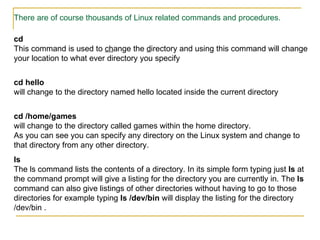
There are of course thousands of Linux related commands and procedures.

cd
This command is used to change the directory and using this command will change
your location to what ever directory you specify


cd hello
will change to the directory named hello located inside the current directory


cd /home/games
will change to the directory called games within the home directory.
As you can see you can specify any directory on the Linux system and change to
that directory from any other directory.
ls
The ls command lists the contents of a directory. In its simple form typing just ls at
the command prompt will give a listing for the directory you are currently in. The ls
command can also give listings of other directories without having to go to those
directories for example typing ls /dev/bin will display the listing for the directory
/dev/bin .
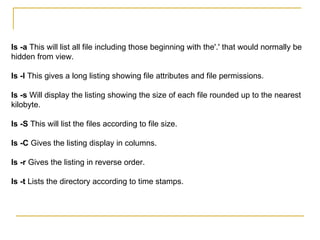
ls -a This will list all file including those beginning with the'.' that would normally be
hidden from view.

ls -l This gives a long listing showing file attributes and file permissions.

ls -s Will display the listing showing the size of each file rounded up to the nearest
kilobyte.

ls -S This will list the files according to file size.

ls -C Gives the listing display in columns.

ls -r Gives the listing in reverse order.

ls -t Lists the directory according to time stamps.
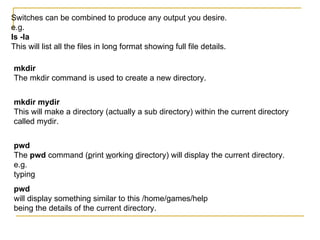
Switches can be combined to produce any output you desire.
e.g.
ls -la
This will list all the files in long format showing full file details.

mkdir
The mkdir command is used to create a new directory.


mkdir mydir
This will make a directory (actually a sub directory) within the current directory
called mydir.


pwd
The pwd command (print working directory) will display the current directory.
e.g.
typing
pwd
will display something similar to this /home/games/help
being the details of the current directory.
rm
The rm command is used to delete files.
rm myfile
This will delete the file called mydir. You can include a path to delete a file in
another directory for example rm /home/hello/goodbye.htm will delete the file
named goodbye.htm in the directory /home/hello/.


Some of the common switches for the rm command are

rm -i this operates the rm command in interactive mode meaning it will prompt you
before deleting a file. This gives you a second chance to say no do not delete the
file or yes delete the file. Remember Linux is merciless and once something is
deleted it is gone for good so the -i flag (switch) is a good one to get into the habit
of using.
rmdir
The rmdir command is used to delete a directory.


rmdir mydir
This will delete the directory (actually a sub directory) called mydir.

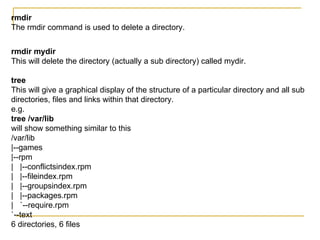
tree
This will give a graphical display of the structure of a particular directory and all sub
directories, files and links within that directory.
e.g.
tree /var/lib
will show something similar to this
/var/lib
|--games
|--rpm
| |--conflictsindex.rpm
| |--fileindex.rpm
| |--groupsindex.rpm
| |--packages.rpm
| `--require.rpm
`--text
6 directories, 6 files
cp
The cp command copies files. You can copy a file in within the current directory or
you can copy files to another directory.
cp myfile.html /home/help/mynewname.html
This will copy the file called myfile.html in the current directory to the directory /home/
help/ and call it mynewname.html.
imply put the cp command has the format of
cp file1 file2 With file1 being the name (including the path if needed) of the file being
copied and file2 is the name (including the path if needed) of the new file being
created.
Remember with the cp command the original file remains in place.

find
The find command is used to find files and or folders within a Linux
system.
To find a file using the find command you type
find /usr/bin -name filename
this will search inside the /usr/bin directory (and any sub directories within
the /usr/bin directory) for the file named filename. To search the entire filing
system including any mounted drives use
find / -name filename
and the find command will search every file system beginning in the root
directory.
more
This command allows you too scroll through a file one screen at a time
allowing you to more easily read the files contents. Some files are very big
and using this command allows you to view the contents of large files
more efficiently. To go forward one screen use the space bar and to go
back one screen use the B key
more filename


less
This command allows you to scroll through a file a page at a time. The
less command is very similar to the more command only it is more
advanced and has more features associated with it.
less filename

vi
The vi command is actually a text editor that comes as standard with most
Linux packages.
ps
The ps (process status) will by default only show the processes that you
as a user have started. However Linux is always running background
tasks so you may want to use some of the common switches associated
with the ps such as ps au to display the processes running for all users
and in the user format hence we get to see every process that is running
on the system.
When a process is started it is given among other things a PID number
that is unique to it. This PID number can be seen by using the ps
command or top command. By knowing a Process ID number you may
opt to kill the process if you choose.

kill
The kill command is used to kill a process by using the associated PID
(Process ID) number
e.g.
kill 381
This will kill the process with the PID of 381. Be careful using the kill
command because it is easy to accidently kill an important process.

Linux commands

  • 1.
    Linux Commands Prepared By Santosh Sharma
  • 2.
    There are ofcourse thousands of Linux related commands and procedures. cd This command is used to change the directory and using this command will change your location to what ever directory you specify cd hello will change to the directory named hello located inside the current directory cd /home/games will change to the directory called games within the home directory. As you can see you can specify any directory on the Linux system and change to that directory from any other directory. ls The ls command lists the contents of a directory. In its simple form typing just ls at the command prompt will give a listing for the directory you are currently in. The ls command can also give listings of other directories without having to go to those directories for example typing ls /dev/bin will display the listing for the directory /dev/bin .
  • 3.
    ls -a Thiswill list all file including those beginning with the'.' that would normally be hidden from view. ls -l This gives a long listing showing file attributes and file permissions. ls -s Will display the listing showing the size of each file rounded up to the nearest kilobyte. ls -S This will list the files according to file size. ls -C Gives the listing display in columns. ls -r Gives the listing in reverse order. ls -t Lists the directory according to time stamps.
  • 4.
    Switches can becombined to produce any output you desire. e.g. ls -la This will list all the files in long format showing full file details. mkdir The mkdir command is used to create a new directory. mkdir mydir This will make a directory (actually a sub directory) within the current directory called mydir. pwd The pwd command (print working directory) will display the current directory. e.g. typing pwd will display something similar to this /home/games/help being the details of the current directory.
  • 5.
    rm The rm commandis used to delete files. rm myfile This will delete the file called mydir. You can include a path to delete a file in another directory for example rm /home/hello/goodbye.htm will delete the file named goodbye.htm in the directory /home/hello/. Some of the common switches for the rm command are rm -i this operates the rm command in interactive mode meaning it will prompt you before deleting a file. This gives you a second chance to say no do not delete the file or yes delete the file. Remember Linux is merciless and once something is deleted it is gone for good so the -i flag (switch) is a good one to get into the habit of using.
  • 6.
    rmdir The rmdir commandis used to delete a directory. rmdir mydir This will delete the directory (actually a sub directory) called mydir. tree This will give a graphical display of the structure of a particular directory and all sub directories, files and links within that directory. e.g. tree /var/lib will show something similar to this /var/lib |--games |--rpm | |--conflictsindex.rpm | |--fileindex.rpm | |--groupsindex.rpm | |--packages.rpm | `--require.rpm `--text 6 directories, 6 files
  • 7.
    cp The cp commandcopies files. You can copy a file in within the current directory or you can copy files to another directory. cp myfile.html /home/help/mynewname.html This will copy the file called myfile.html in the current directory to the directory /home/ help/ and call it mynewname.html. imply put the cp command has the format of cp file1 file2 With file1 being the name (including the path if needed) of the file being copied and file2 is the name (including the path if needed) of the new file being created. Remember with the cp command the original file remains in place. find The find command is used to find files and or folders within a Linux system. To find a file using the find command you type find /usr/bin -name filename this will search inside the /usr/bin directory (and any sub directories within the /usr/bin directory) for the file named filename. To search the entire filing system including any mounted drives use find / -name filename and the find command will search every file system beginning in the root directory.
  • 8.
    more This command allowsyou too scroll through a file one screen at a time allowing you to more easily read the files contents. Some files are very big and using this command allows you to view the contents of large files more efficiently. To go forward one screen use the space bar and to go back one screen use the B key more filename less This command allows you to scroll through a file a page at a time. The less command is very similar to the more command only it is more advanced and has more features associated with it. less filename vi The vi command is actually a text editor that comes as standard with most Linux packages.
  • 9.
    ps The ps (processstatus) will by default only show the processes that you as a user have started. However Linux is always running background tasks so you may want to use some of the common switches associated with the ps such as ps au to display the processes running for all users and in the user format hence we get to see every process that is running on the system. When a process is started it is given among other things a PID number that is unique to it. This PID number can be seen by using the ps command or top command. By knowing a Process ID number you may opt to kill the process if you choose. kill The kill command is used to kill a process by using the associated PID (Process ID) number e.g. kill 381 This will kill the process with the PID of 381. Be careful using the kill command because it is easy to accidently kill an important process.