Linking Knowledge with Action for
    Sustainable Development:
     History Lessons for MP7?
(for selective use, if at all, after May 10…)

                William C. Clark
   Professor of International Science, Public
       Policy and Human Development
              Harvard University
Learning from History?
• Extensive experience around the world in efforts to
  link knowledge with action in agriculture, but also
  health, conservation, regional development…
   – 20 years ago, agriculture in the lead… Today, not.
   – What lessons from experience might be useful for MP7?
• Perspectives from an international research
  collaborative on common themes, best practices
   –   Initiative on Science and Technology for Sustainability
   –   Academy of Sciences of the Developing World (TWAS)
   –   US National Academy of Sciences (NAS)
   –   Sustainability Science Program (Harvard University)
Our findings so far…
Our studies revealed many different barriers
   that have inhibited effective mobilization of
   science to support development action, and
   many different pathways to overcome them
Four stand out as potentially relevant to MP7:
  1. Entanglement of knowledge with power
  2. Misconceptions regarding the relationship
     between basic research and problem solving
  3. Fragmentation of the knowledge system
  4. Inflexibility in a world of complexity & surprise
1) Entanglement of
             knowledge with power
• Diagnosis (Why is there a problem?):
   – Most science can be pursued with little thought for its
     relationship to power, but when knowledge influences
     decisions, knowledge is power
   – With knowledge and power inseparably entangled, the
     real question is whose interests science will actually – and
     appear to – serve?
      • Farmers? States? Business? Researchers? Donors?
   – Those who feel their interests have not been taken
     seriously by research are unlikely to accept its findings
Entanglement of knowledge, power
• Prescription (What needs to change?)
  – Definition of problem solving goals, setting of
    research agendas, and evaluation of progress
    must be done through processes that are inclusive
    of, transparent to, those with stakes in outcomes.
• Implementation challenges to MP7
  – Broadening the stakeholder dialog on agendas beyond
    CGIAR and donors (farmers [including women, urban],
    private sector, universities?)
  – Clarify end vs means: Food security? Sustainable
    agriculture / environmental services? Climate change?
2) Misconceptions: Basic research vs
          problem solving
• Diagnosis (Why is there a problem?)
   – Most science based programs continue to act as though
     basic research produces general knowledge that can then
     be “piped” or “extended” into solutions in specific field
     contexts…
   – But evidence shows that such “panaceas” fail (much) more
     often than they succeed
• Prescription (What needs to change?)
   – Need for a more historically informed model of the
     relationship between basic research and practical problem
     solving in the real world…
Quadrant Model of Scientific Research

                         Considerations of use?
   Research                No                     Yes
   inspired by…
                       “Soaking and        Pure applied
                 No      poking”             research
Quest for                                    (Edison)
fundamental
understanding?          Pure basic         Use-inspired
                 Yes research (Bohr)      basic research
                                            (Pasteur)

                                       (redrawn from Stokes, 1997)
Knowledge System for Linking Research with Action
                                              Improved
  Improved                                    policy and
understanding                                technology


 Pure basic         Use-inspired           Purely applied
  research         basic research              R&D


   Existing     Comparative advantage of       Existing
understanding            MP7?                 policy and
                                             technology


                                           (redrawn from Stokes, 1997)
Misconceiving Use-inspired research:
 Implementation challenges to MP7?
• Make creative work on fostering innovation in “Pasteur’s
  Quadrant” central to the MP7 concept
   – Get over worrying about an exclusive focus on “global public goods”
• Manage a creative tension between the
   – The “Bohrs” (ESPP?) who risk falling in love with the most exciting basic
     research (eg. climate change, genomics), and
   – The “Edisons” (NARS?) who risk falling in love with creating particular
     solutions for particular places (eg C sequestation by Sumatran oil palm)
• Adopt dual evaluation of MP7’s work on a continuing basis
   – Publication / citation counts, etc. to reward fundamental advances in
     understanding as certified by researchers… PLUS
   – Outcome mapping (RBM) to reward specific solutions as certified by
     users at multiple scales and sectors (farmers to national negotiators)
3) Fragmentation
     (system is less than sum of its parts)
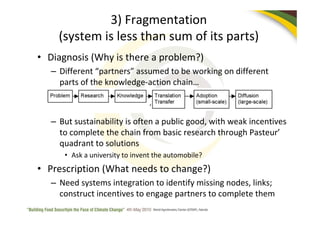
• Diagnosis (Why is there a problem?)
   – Different “partners” assumed to be working on different
     parts of the knowledge-action chain…


   – But sustainability is often a public good, with weak incentives
     to complete the chain from basic research through Pasteur’
     quadrant to solutions
      • Ask a university to invent the automobile?
• Prescription (What needs to change?)
   – Need systems integration to identify missing nodes, links;
     construct incentives to engage partners to complete them
Fragmentation:
 Implementation challenges for MP7?
• Become the systems perspective on the
  problem (?) and what is needed for its solution
  (not just its understanding)
• Apply a supply chain perspective to identify the
  full range of tasks that need to be done; and to
• Identify, engage and where necessary nurture
  the partners who can best address them
  – Farmers, Private sector, university, civil society?
4) Inflexibility
    (static systems, dynamic challenges)
• Diagnosis (Why is there a problem?)
   – Problems change faster than research programs
       • Problems really complex, poorly understood
       • Hard-wiring presumed causes, solutions into program names
   – Research programs focus on improving knowledge in the “lab,” not
     practice in the field
   – Complacent attitude toward innovation (underinvestment)
   – Incentives to hide failures rather than learn from them
• Process prescription (What needs to change?)
   – Recognize that systems for advancing research / knowledge are not
     the same as systems for advancing learning, innovation, adaptation
   – To promote the latter, programs need greater ability to take smart
     risks, survive failure, adapt to surprise
   – This means roviding “safe spaces” that encourage innovators to
     experiment, fail, but be protected from hostile takeovers
Inflexibility:
  Implementation challenges for MP7
• What’s in a name?
   – “CLIMATE CHANGE, agriculture and food security” vs
     “Building FOOD SECURITY in the face of climate change”?
• Where is the MP7’s comparative advantage in
  contributing to the adaptive management of food
  security in a (climate) changing world?
   – Designing monitoring/ evaluation systems of vulnerability?
• Get agreement with donors on the optimal failure
  rate for the innovative projects that a successful
  MP7 will need to foster.
   – Its not ‘zero’…
Summary Challenges for
 Linking knowledge with action in MP7
1. Entanglement of knowledge with power
   - Broaden the stakeholder dialog on MP7 goals beyond CGIAR and donors
         (farmers [including women, urban], private sector, universities?)
   - Clarify end vs means: Food security? Sustainable agriculture /
         environmental services? Climate change?
2. Misconceptions regarding use-inspired research
   - MP7 to produce knowledge or to foster innovation?
   - If the latter, how to evaluate progress?
3. Fragmentation of the knowledge system
   - What is the full “supply chain” of contributions to achieve MP7’s goal?
   - Which partners does MP7 need to do what parts of the job?
4. Inflexibility in a world of complexity & surprise
   - Agreeing on a target rate of failure in MP7 R&D
   - How to foster adaptive management, risk taking?
Further Information
• Keep up to date with work on knowledge for sustainability
  through the virtual Forum on Science and Innovation for
  Sustainability
   – www.sustainabilityscience.org
• Publish research results in the new Sustainability Science
  section of the Proceedings of the National Academy of
  Sciences of the US (articles immediately available free on line
  in >100 developing countries)
   – www.pnas.org/site/misc/sustainability.shtml
• Apply to spend a year with the Sustainability Science Fellows
  Program at Harvard
   – www.cid.harvard.edu/sustsci/index.html
• Let me and my colleagues know of your reactions, ideas
   – William_Clark@harvard.edu
Selected Publications
•   Cash, David, William C. Clark, Frank Alcock, Nancy Dickson, Noelle Eckley, David Guston, Jill
    Jäger, and Ronald Mitchell. 2003. Knowledge systems for sustainable development.
    Proceedings of the National Academy of Sciences 100(14): 8086-8091.
•   van Kerkhoff, Lorrae and Louis Lebel. 2006. Linking knowledge and action for sustainable
    development. Annual Review of Environment and Resources 31:1–33.
•   Mitchell, RB., WC Clark, DW Cash. 2006. Information and influence. (In) Global Environmental
    Assessments: Information and Influence. RB Mitchell, WC Clark, DW Cash, and NM. Dickson,
    eds. Cambridge: MIT Press.
•   Clark, W and L Holliday, 2006. Linking Knowledge with Action for Sustainable Development:
    The Role of Program Management. Washington, D.C.: National Academies Press.
•   McNie, EC. 2007. Reconciling the supply of scientific information with user demands: An
    analysis of the problem and review of the literature. Environmental Science and Policy 10(1):
    17-38.
•   Kristjanson, P., R Reid, N Dickson, W Clark, D Romney, R Puskur, S MacMillan, D Grace. 2009.
    Linking International Agricultural Research Knowledge with Action for Sustainable
    Development. PNAS 106: 5047-52.
•   Reid, R., D. Nkedianye, et al. 2009. Evolution of models to support community and policy
    action with science. PNAS (www.pnas.orgcgidoi10.1073pnas.0900313106)
•   Clark, W.C., N.A. Szlezak, S. Moon, B.R. Bloom, G.T. Keusch, C. Michaud, DT. Jamison, J.
    Frenk, and WL. Kilama. “The GlobalHealth System: Institutions in a Time of Transition.”
    Acting in Time Initiative Working Paper. Harvard Kennedy School. Cambridge, MA: Harvard
    University. March 2010. (Available athttp://www.cid.harvard.edu/sustsci/index.html)

Linking Knowledge with Action for Sustainable Development - William C. Clark

  • 1.
    Linking Knowledge withAction for Sustainable Development: History Lessons for MP7? (for selective use, if at all, after May 10…) William C. Clark Professor of International Science, Public Policy and Human Development Harvard University
  • 2.
    Learning from History? •Extensive experience around the world in efforts to link knowledge with action in agriculture, but also health, conservation, regional development… – 20 years ago, agriculture in the lead… Today, not. – What lessons from experience might be useful for MP7? • Perspectives from an international research collaborative on common themes, best practices – Initiative on Science and Technology for Sustainability – Academy of Sciences of the Developing World (TWAS) – US National Academy of Sciences (NAS) – Sustainability Science Program (Harvard University)
  • 3.
    Our findings sofar… Our studies revealed many different barriers that have inhibited effective mobilization of science to support development action, and many different pathways to overcome them Four stand out as potentially relevant to MP7: 1. Entanglement of knowledge with power 2. Misconceptions regarding the relationship between basic research and problem solving 3. Fragmentation of the knowledge system 4. Inflexibility in a world of complexity & surprise
  • 4.
    1) Entanglement of knowledge with power • Diagnosis (Why is there a problem?): – Most science can be pursued with little thought for its relationship to power, but when knowledge influences decisions, knowledge is power – With knowledge and power inseparably entangled, the real question is whose interests science will actually – and appear to – serve? • Farmers? States? Business? Researchers? Donors? – Those who feel their interests have not been taken seriously by research are unlikely to accept its findings
  • 5.
    Entanglement of knowledge,power • Prescription (What needs to change?) – Definition of problem solving goals, setting of research agendas, and evaluation of progress must be done through processes that are inclusive of, transparent to, those with stakes in outcomes. • Implementation challenges to MP7 – Broadening the stakeholder dialog on agendas beyond CGIAR and donors (farmers [including women, urban], private sector, universities?) – Clarify end vs means: Food security? Sustainable agriculture / environmental services? Climate change?
  • 6.
    2) Misconceptions: Basicresearch vs problem solving • Diagnosis (Why is there a problem?) – Most science based programs continue to act as though basic research produces general knowledge that can then be “piped” or “extended” into solutions in specific field contexts… – But evidence shows that such “panaceas” fail (much) more often than they succeed • Prescription (What needs to change?) – Need for a more historically informed model of the relationship between basic research and practical problem solving in the real world…
  • 7.
    Quadrant Model ofScientific Research Considerations of use? Research No Yes inspired by… “Soaking and Pure applied No poking” research Quest for (Edison) fundamental understanding? Pure basic Use-inspired Yes research (Bohr) basic research (Pasteur) (redrawn from Stokes, 1997)
  • 8.
    Knowledge System forLinking Research with Action Improved Improved policy and understanding technology Pure basic Use-inspired Purely applied research basic research R&D Existing Comparative advantage of Existing understanding MP7? policy and technology (redrawn from Stokes, 1997)
  • 9.
    Misconceiving Use-inspired research: Implementation challenges to MP7? • Make creative work on fostering innovation in “Pasteur’s Quadrant” central to the MP7 concept – Get over worrying about an exclusive focus on “global public goods” • Manage a creative tension between the – The “Bohrs” (ESPP?) who risk falling in love with the most exciting basic research (eg. climate change, genomics), and – The “Edisons” (NARS?) who risk falling in love with creating particular solutions for particular places (eg C sequestation by Sumatran oil palm) • Adopt dual evaluation of MP7’s work on a continuing basis – Publication / citation counts, etc. to reward fundamental advances in understanding as certified by researchers… PLUS – Outcome mapping (RBM) to reward specific solutions as certified by users at multiple scales and sectors (farmers to national negotiators)
  • 10.
    3) Fragmentation (system is less than sum of its parts) • Diagnosis (Why is there a problem?) – Different “partners” assumed to be working on different parts of the knowledge-action chain… – But sustainability is often a public good, with weak incentives to complete the chain from basic research through Pasteur’ quadrant to solutions • Ask a university to invent the automobile? • Prescription (What needs to change?) – Need systems integration to identify missing nodes, links; construct incentives to engage partners to complete them
  • 11.
    Fragmentation: Implementation challengesfor MP7? • Become the systems perspective on the problem (?) and what is needed for its solution (not just its understanding) • Apply a supply chain perspective to identify the full range of tasks that need to be done; and to • Identify, engage and where necessary nurture the partners who can best address them – Farmers, Private sector, university, civil society?
  • 12.
    4) Inflexibility (static systems, dynamic challenges) • Diagnosis (Why is there a problem?) – Problems change faster than research programs • Problems really complex, poorly understood • Hard-wiring presumed causes, solutions into program names – Research programs focus on improving knowledge in the “lab,” not practice in the field – Complacent attitude toward innovation (underinvestment) – Incentives to hide failures rather than learn from them • Process prescription (What needs to change?) – Recognize that systems for advancing research / knowledge are not the same as systems for advancing learning, innovation, adaptation – To promote the latter, programs need greater ability to take smart risks, survive failure, adapt to surprise – This means roviding “safe spaces” that encourage innovators to experiment, fail, but be protected from hostile takeovers
  • 13.
    Inflexibility: Implementationchallenges for MP7 • What’s in a name? – “CLIMATE CHANGE, agriculture and food security” vs “Building FOOD SECURITY in the face of climate change”? • Where is the MP7’s comparative advantage in contributing to the adaptive management of food security in a (climate) changing world? – Designing monitoring/ evaluation systems of vulnerability? • Get agreement with donors on the optimal failure rate for the innovative projects that a successful MP7 will need to foster. – Its not ‘zero’…
  • 14.
    Summary Challenges for Linking knowledge with action in MP7 1. Entanglement of knowledge with power - Broaden the stakeholder dialog on MP7 goals beyond CGIAR and donors (farmers [including women, urban], private sector, universities?) - Clarify end vs means: Food security? Sustainable agriculture / environmental services? Climate change? 2. Misconceptions regarding use-inspired research - MP7 to produce knowledge or to foster innovation? - If the latter, how to evaluate progress? 3. Fragmentation of the knowledge system - What is the full “supply chain” of contributions to achieve MP7’s goal? - Which partners does MP7 need to do what parts of the job? 4. Inflexibility in a world of complexity & surprise - Agreeing on a target rate of failure in MP7 R&D - How to foster adaptive management, risk taking?
  • 15.
    Further Information • Keepup to date with work on knowledge for sustainability through the virtual Forum on Science and Innovation for Sustainability – www.sustainabilityscience.org • Publish research results in the new Sustainability Science section of the Proceedings of the National Academy of Sciences of the US (articles immediately available free on line in >100 developing countries) – www.pnas.org/site/misc/sustainability.shtml • Apply to spend a year with the Sustainability Science Fellows Program at Harvard – www.cid.harvard.edu/sustsci/index.html • Let me and my colleagues know of your reactions, ideas – William_Clark@harvard.edu
  • 16.
    Selected Publications • Cash, David, William C. Clark, Frank Alcock, Nancy Dickson, Noelle Eckley, David Guston, Jill Jäger, and Ronald Mitchell. 2003. Knowledge systems for sustainable development. Proceedings of the National Academy of Sciences 100(14): 8086-8091. • van Kerkhoff, Lorrae and Louis Lebel. 2006. Linking knowledge and action for sustainable development. Annual Review of Environment and Resources 31:1–33. • Mitchell, RB., WC Clark, DW Cash. 2006. Information and influence. (In) Global Environmental Assessments: Information and Influence. RB Mitchell, WC Clark, DW Cash, and NM. Dickson, eds. Cambridge: MIT Press. • Clark, W and L Holliday, 2006. Linking Knowledge with Action for Sustainable Development: The Role of Program Management. Washington, D.C.: National Academies Press. • McNie, EC. 2007. Reconciling the supply of scientific information with user demands: An analysis of the problem and review of the literature. Environmental Science and Policy 10(1): 17-38. • Kristjanson, P., R Reid, N Dickson, W Clark, D Romney, R Puskur, S MacMillan, D Grace. 2009. Linking International Agricultural Research Knowledge with Action for Sustainable Development. PNAS 106: 5047-52. • Reid, R., D. Nkedianye, et al. 2009. Evolution of models to support community and policy action with science. PNAS (www.pnas.orgcgidoi10.1073pnas.0900313106) • Clark, W.C., N.A. Szlezak, S. Moon, B.R. Bloom, G.T. Keusch, C. Michaud, DT. Jamison, J. Frenk, and WL. Kilama. “The GlobalHealth System: Institutions in a Time of Transition.” Acting in Time Initiative Working Paper. Harvard Kennedy School. Cambridge, MA: Harvard University. March 2010. (Available athttp://www.cid.harvard.edu/sustsci/index.html)