Technische Universität Darmstadt
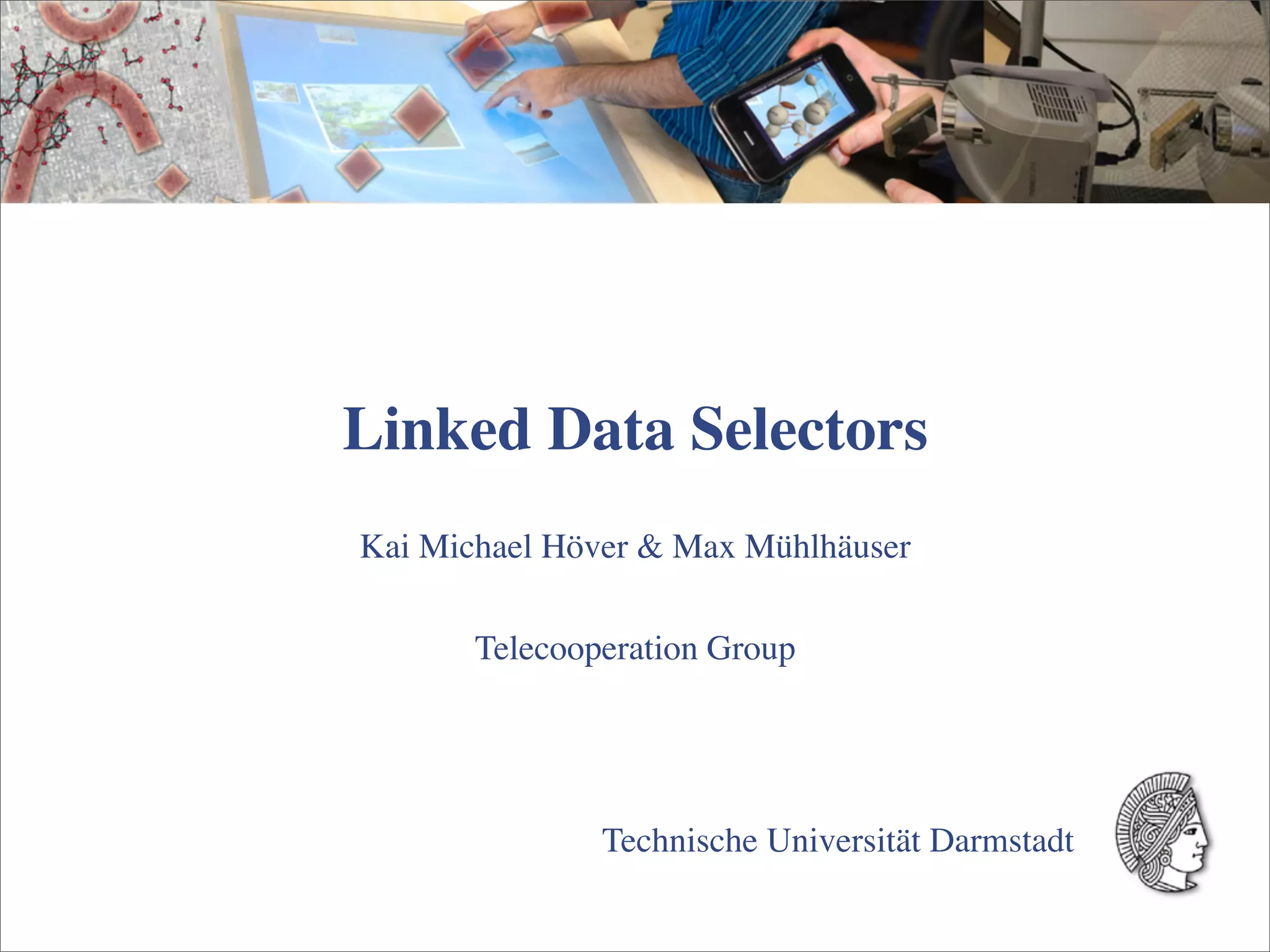
Linked Data Selectors
Kai Michael Höver & Max Mühlhäuser
Telecooperation Group
Telecooperation
OUTLINE
• Context and motivation
• LDS ontology design
• Usage examples
2
Telecooperation
Ecosystem definition
3
"ecosystem,	
  the	
  complex	
  of	
  living	
  organisms,	
  their	
  
physical	
  environment,	
  and	
  all	
  their	
  interrela7onships	
  
in	
  a	
  par7cular	
  unit	
  of	
  space."	
  [Enyclopedia	
  Britannica]
Telecooperation
(E-)Learning Ecosystem
4
"ecosystem,	
  the	
  complex	
  of	
  living	
  organisms,	
  their	
  
(physical)	
  environment,	
  and	
  all	
  their	
  interrela7onships	
  
in	
  a	
  par7cular	
  unit	
  of	
  space."
organisms	
  may	
  be:
-­‐	
  educators
-­‐	
  students
-­‐	
  friends
-­‐	
  family	
  rela7ves
-­‐	
  ...
Telecooperation
(E-)Learning Ecosystem
5
"ecosystem,	
  the	
  complex	
  of	
  living	
  organisms,	
  their	
  
(physical)	
  environment,	
  and	
  all	
  their	
  interrela7onships	
  
in	
  a	
  par7cular	
  unit	
  of	
  space."	
  
(physical/e-­‐)	
  learning	
  environment	
  
contains	
  informa7on	
  resources	
  such	
  as
-­‐	
  slides
-­‐	
  lecture	
  recordings
-­‐	
  documents
-­‐	
  forum	
  discussions
-­‐	
  Web	
  documents
-­‐	
  ...
Telecooperation
(E-)Learning Ecosystem
6
"ecosystem,	
  the	
  complex	
  of	
  living	
  organisms,	
  their	
  
(physical)	
  environment,	
  and	
  all	
  their	
  interrela7onships	
  
in	
  a	
  par7cular	
  unit	
  of	
  space."	
  
learning	
  space	
  where	
  learning	
  and	
  teaching	
  take	
  place
-­‐	
  physical
-­‐	
  lecture	
  hall
-­‐	
  lab
-­‐	
  café
-­‐	
  in	
  the	
  park
-­‐	
  electronical/virtual
-­‐	
  LMS
-­‐	
  discussion	
  forums
-­‐	
  blogs
-­‐	
  OSNs
-­‐	
  MOOCs
-­‐	
  ...
Telecooperation
(E-)Learning Ecosystem
7
"ecosystem,	
  the	
  complex	
  of	
  living	
  organisms,	
  their	
  
(physical)	
  environment,	
  and	
  all	
  their	
  interrela7onships	
  
in	
  a	
  par7cular	
  unit	
  of	
  space."	
  
interrela7onships	
  between
-­‐	
  people	
  (social	
  networks)
-­‐	
  people	
  and	
  informa7on	
  resources	
  (author,	
  usage,	
  etc.)
-­‐	
  informa7on	
  resources	
  (seman7c	
  rela7ons)
Telecooperation
(E-)Learning Ecosystem
8
"ecosystem,	
  the	
  complex	
  of	
  living	
  organisms,	
  their	
  
(physical)	
  environment,	
  and	
  all	
  their	
  interrela7onships	
  
and	
  interac7ons	
  in	
  a	
  par7cular	
  unit	
  of	
  space."	
  
I‘d	
  add	
  interac7ons	
  between
-­‐	
  people	
  (social	
  interac7ons)
-­‐	
  people	
  and	
  informa7on	
  resources	
  (how	
  people	
  interact	
  
with	
  learning	
  resources)
Telecoopera7on
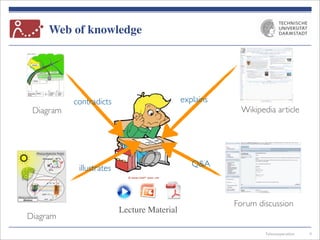
Web of knowledge
9
Diagram
contradicts
Diagram
illustrates
Wikipedia article
explains
Forum discussion
Q&A
Lecture Material
Telecooperation
The importance of anchoring annotations
•Annotation types [Agosti2007]:
•annotations as metadata: add information about the annotated information
•annotations as content: augment with additional content (add notes to an educational
resource for explaining or clarifying)
•annotations as dialogue acts: communication acts like a request or a discourse
• "Both annotations and annotated objects need to be uniquely identified" [Agosti2007]
• Anchored discussions within a specific content are more directed
and "to-the-point" [Pol2006]
• The majority of students use well-specified anchors like underlines or circles on paper
[Marshall2002]
10
Agosti, M., & Ferro, N. (2007). A formal model of annotations of digital content. ACM Trans. Inf. Syst., 26(1), 3:1-3:57
Marshall, C. C., & Brush, A. J. B. (2002). From personal to shared annotations. In CHI '02: CHI '02 extended abstracts on human factors in computing systems (pp. 812-813). ACM
Pol, J., Admiraal, W., & Simons, P. R. J. (2006). The affordance of anchored discussion for the collaborative processing of academic texts. International Journal of Computer-
Supported Collaborative Learning, 1(3), 339-357
Telecooperation
Missing relations in learning ecosystems
•Problem:
• Interrelationships are not (always) explicit
• even in integrated learning environments (LMS)
•many tools (CMS, forum, blogs, etc.), but separated on tool and
content level
• especially not in distributed environments
•e.g., lecture recording & discussion forum
•Why is it a problem?
•many media breaks
•missing awareness of existing learning resources
•preservation and (re-)access of parts of a learning ecosystem is
difficult
11
Telecooperation
Implications of the Web for learning
• The WorldWideWeb was a proposal for a Hypertext project
• Change from linear to non-linear;
from a chain of knowledge to a web of knowledge
• The early Hypertext designs of the "founding trinitiy of
hypertext" (Bush, Engelbart, Nelson) already had a focus on learning:
• Bush's Memory Extender: "A Memex is a device in which an individual store all his
books, records, and communications, and which is mechanized so that it may be
consulted with exceeding speed and flexibility. It is an enlarged supplement to his
memory" [Bush1945]
•Nelson's ELF: "Let suggest that such a system [..] could have great potential for
education
12
http://www.w3.org/Proposal.html
http://www.w3.org/History/1989/proposal.html
Telecooperation
Links & Learning
•"A fundamental condition for learning is the engagement with
information: making connections, setting interrelations, and
meaningful arranging of information. Doing so, information can be
better remembered if they are associated, and connections can be
created with existing knowledge." [Iske2002]
13
Iske,	
  S.	
  (2002).	
  Vernetztes	
  Wissen	
  :	
  Hypertext-­‐Strategien	
  im	
  Internet.	
  Wilhelm	
  Bertelsmann	
  Verlag.
Telecooperation
Web & Semantic Web
•The Web allows making connections
•The Semantic Web add semantic information
• Linked Data provides best practices to publish and connect data
across the Web
14
So	
  what's	
  missing	
  then?!	
  :-­‐)
Telecooperation
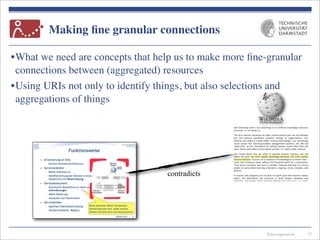
Making fine granular connections
•What we need are concepts that help us to make more fine-granular
connections between (aggregated) resources
•Using URIs not only to identify things, but also selections and
aggregations of things
15
contradicts
Telecooperation
Related Work
•Temporal fragments
•W3C Media Fragments (temporal parts of audio-visual materials on the Web)
•Textual selections
•XPath
•W3C POWDER (Protocol for Web Description Resources)
•Provide descriptions of (group of) online resources
•Data repositories
•SQL
•SPARQL
16
-­‐	
  specialized	
  to	
  specific	
  media	
  type
-­‐	
  XPath:	
  No	
  names	
  (URIs)	
  for	
  things
-­‐	
  don't	
  use	
  URIs	
  for	
  results
-­‐	
  cannot	
  be	
  dereferenced
Grouping	
  of	
  URIs	
  but	
  no	
  
selec7ons	
  of	
  parts
Telecooperation
Approach: Linked Data Selectors
Ontology
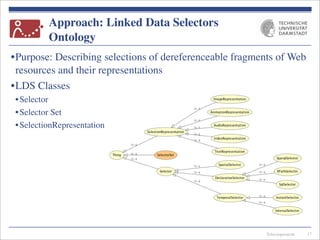
•Purpose: Describing selections of dereferenceable fragments of Web
resources and their representations
•LDS Classes
•Selector
•Selector Set
•SelectionRepresentation
17
Telecooperation
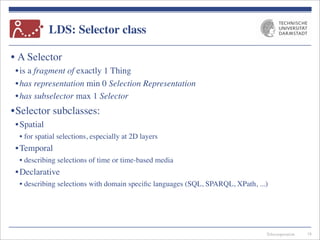
LDS: Selector class
• A Selector
•is a fragment of exactly 1 Thing
•has representation min 0 Selection Representation
•has subselector max 1 Selector
•Selector subclasses:
•Spatial
• for spatial selections, especially at 2D layers
•Temporal
• describing selections of time or time-based media
•Declarative
• describing selections with domain specific languages (SQL, SPARQL, XPath, ...)
18
Telecooperation
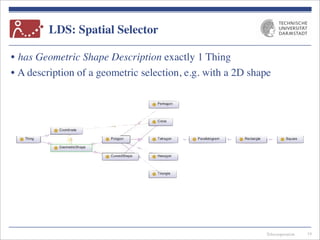
LDS: Spatial Selector
• has Geometric Shape Description exactly 1 Thing
• A description of a geometric selection, e.g. with a 2D shape
19
Telecooperation
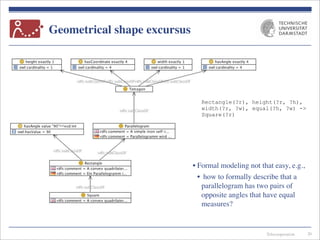
Geometrical shape excursus
20
• Formal modeling not that easy, e.g.,
• how to formally describe that a
parallelogram has two pairs of
opposite angles that have equal
measures?
Rectangle(?r), height(?r, ?h),
width(?r, ?w), equal(?h, ?w) ->
Square(?r)
Telecooperation
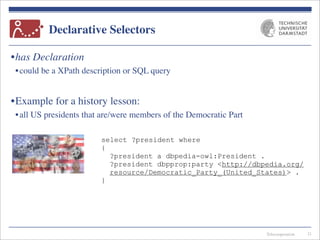
Declarative Selectors
•has Declaration
•could be a XPath description or SQL query
•Example for a history lesson:
•all US presidents that are/were members of the Democratic Part
21
select ?president where
{
?president a dbpedia-owl:President .
?president dbpprop:party <http://dbpedia.org/
resource/Democratic_Party_(United_States)> .
}
Telecooperation
Temporal selectors
• A selector for time-based media like audio and video
• has Temporal Description exactly 1 Thing
• Could be used in combination with time-based descriptions, like
Time Ontology for Synchronous Media or W3C OWL-Time
22
Telecooperation
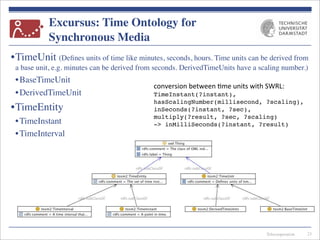
Excursus: Time Ontology for
Synchronous Media
•TimeUnit (Defines units of time like minutes, seconds, hours. Time units can be derived from
a base unit, e.g. minutes can be derived from seconds. DerivedTimeUnits have a scaling number.)
•BaseTimeUnit
•DerivedTimeUnit
•TimeEntity
•TimeInstant
•TimeInterval
23
conversion	
  between	
  7me	
  units	
  with	
  SWRL:
TimeInstant(?instant),
hasScalingNumber(millisecond, ?scaling),
inSeconds(?instant, ?sec),
multiply(?result, ?sec, ?scaling)
-> inMilliSeconds(?instant, ?result)
Telecooperation
Selector set
•A Selector Set
• is used for grouping selectors in order to speak about more than one selector
• Usually, a set of selectors consists of 2 or more Selectors, but may be also refer to
a Resource Set for grouping resources (W3C POWDER)
• has Selector some Thing or has Selector min 2 Selector
24
Telecooperation
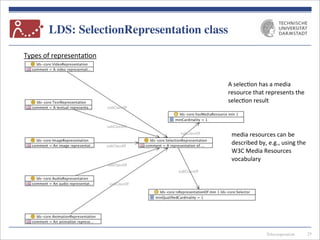
LDS: SelectionRepresentation class
25
Types	
  of	
  representa7on
A	
  selec7on	
  has	
  a	
  media	
  
resource	
  that	
  represents	
  the	
  
selec7on	
  result
media	
  resources	
  can	
  be	
  
described	
  by,	
  e.g.,	
  using	
  the	
  
W3C	
  Media	
  Resources	
  
vocabulary
Telecooperation
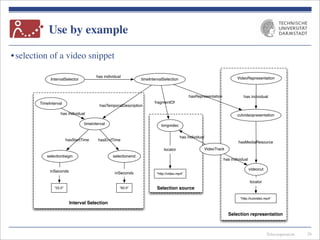
Use by example
•selection of a video snippet
26
timeinterval
selectionbegin
hasStartTime
timeIntervalSelection
cutvideopresentation
hasRepresentation
TimeInterval
has individual
hasTemporalDescription
selectionend
IntervalSelector
has individual
videocut
hasMediaResource
VideoTrack
has individual
VideoRepresentation
has individual
hasEndTime
longvideo
fragmentOf
has individual
"23.0"
"http://cutvideo.mp4"
inSeconds
"83.0"
inSeconds
locator
"http://video.mp4"
locator
Interval Selection
Selection source
Selection representation
Telecooperation
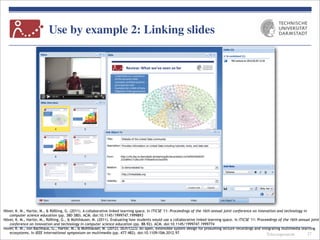
Use by example 2: Linking slides
27
Höver, K. M., Hartle, M., & Rößling, G. (2011). A collaborative linked learning space. In ITiCSE '11: Proceedings of the 16th annual joint conference on innovation and technology in
computer science education (pp. 380-380). ACM. doi:10.1145/1999747.1999893
Höver, K. M., Hartle, M., Rößling, G., & Mühlhäuser, M. (2011). Evaluating how students would use a collaborative linked learning space. In ITiCSE '11: Proceedings of the 16th annual joint
conference on innovation and technology in computer science education (pp. 88-92). ACM. doi:10.1145/1999747.1999774
Höver, K. M., von Bachhaus, G., Hartle, M., & Mühlhäuser, M. (2012). DLH/CLLS: An open, extensible system design for prosuming lecture recordings and integrating multimedia learning
ecosystems. In IEEE international symposium on multimedia (pp. 477-482). doi:10.1109/ISM.2012.97
Telecooperation
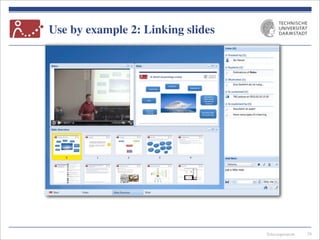
Use by example 2: Linking slides
28
Telecooperation
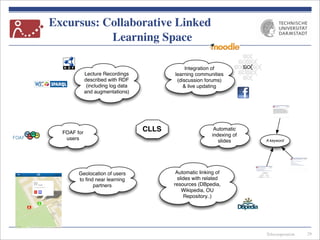
Excursus: Collaborative Linked


 Learning Space
29
CLLS
Lecture Recordings
described with RDF
(including log data
and augmentations)
Automatic
indexing of
slides
Automatic linking of
slides with related
resources (DBpedia,
Wikipedia, OU
Repository..)
FOAF for
users
Geolocation of users
to find near learning
partners
Integration of
learning communities
(discussion forums)
& live updatingSPARQL
A keyword
Telecooperation
Use by example 2: Linking slides
• link a set of slides with a paragraph of a website
30
#303slides
:hasDeclaration
SparqlSelector
has individual
:fragmentOf
Sparql Endpoint
"SELECT ?slide WHERE
{ ?slide a #Slide . ?slide
dc:subject '303 URI'.}"
#booksection
#explains
XPathSelector
has individual:hasDeclaration :fragmentOf
"http://linkeddatabook.com/
editions/1.0/""/HTML/BODY/P[59]"
Slides paragraph
#parrepresentation
:hasRepresentation
TextRepresentation
has individual
#textresource
:hasMediaResource
Telecooperation
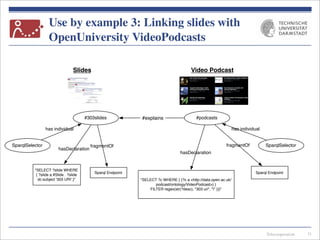
Use by example 3: Linking slides with
OpenUniversity VideoPodcasts
31
#303slides
hasDeclaration
SparqlSelector
has individual
fragmentOf
Sparql Endpoint
"SELECT ?slide WHERE
{ ?slide a #Slide . ?slide
dc:subject '303 URI'.}"
#podcasts#explains
SparqlSelector
has individual
hasDeclaration
fragmentOf
Sparql Endpoint
"SELECT ?c WHERE { {?c a <http://data.open.ac.uk/
podcast/ontology/VideoPodcast>} }
FILTER regex(str(?desc), "303 uri", "i" )}}"
Slides Video Podcast
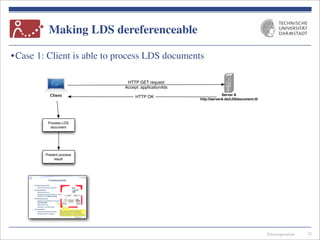
•Case 1: Client is able to process LDS documents
Telecooperation
Making LDS dereferenceable
32
Client Server A
http://serverA.de/LDSdocument.ttl
HTTP GET request
Accept: application/lds
HTTP OK
Process LDS
document
Present process
result
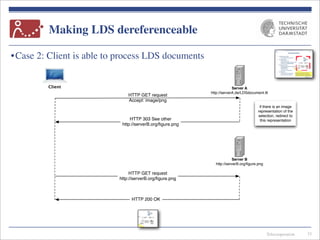
Telecooperation
Making LDS dereferenceable
•Case 2: Client is able to process LDS documents
33
Client Server A
http://serverA.de/LDSdocument.ttl
HTTP GET request
Accept: image/png
HTTP 303 See other
http://serverB.org/figure.png
if there is an image
representation of the
selection, redirect to
this representation
HTTP GET request
http://serverB.org/figure.png
HTTP 200 OK
Server B
http://serverB.org/figure.png
Telecooperation
LDS meeting LD principles
1. Use URIs as names for things
- Selections can be referenced by URIs
2. Use HTTP URIs, so that people can look up those names
- LDS URIs can be dereferenced using, e.g., 303 URIs
3. When someone looks up a URI, provide useful information, using
the standards (RDF, SPARQL)
- LDS URIs provide information about the selection type and source
4. Include links to other URIs, so that they can discover more things
- LDS documents can include links to the original source of a selection as well as
several representations of a selection
34
Telecooperation
Summary & future work
•We have suggested an ontology for giving selections of things individual
names (URIs)
• description of selections (include grouping and chaining)
• description of selection results
•Helping both educators and students to link things that are related
35
•Future work:
• automatic creation of representations
• integration of authentication, especially for
declarative selectors (Omnivoke Authentication
ontology)
• integration of LDS with W3C POWDER?
• user studies; visualization
• describing the dereferencing process of LDS
(content negotiation, 303 URIs)
Telecooperation
Thank you for listening
36
Ques8ons?	
  
Sugges8ons	
  for	
  improvement?	
  :-­‐)

Linked Data Selectors

  • 1.
    Technische Universität Darmstadt LinkedData Selectors Kai Michael Höver & Max Mühlhäuser Telecooperation Group
  • 2.
    Telecooperation OUTLINE • Context andmotivation • LDS ontology design • Usage examples 2
  • 3.
    Telecooperation Ecosystem definition 3 "ecosystem,  the  complex  of  living  organisms,  their   physical  environment,  and  all  their  interrela7onships   in  a  par7cular  unit  of  space."  [Enyclopedia  Britannica]
  • 4.
    Telecooperation (E-)Learning Ecosystem 4 "ecosystem,  the  complex  of  living  organisms,  their   (physical)  environment,  and  all  their  interrela7onships   in  a  par7cular  unit  of  space." organisms  may  be: -­‐  educators -­‐  students -­‐  friends -­‐  family  rela7ves -­‐  ...
  • 5.
    Telecooperation (E-)Learning Ecosystem 5 "ecosystem,  the  complex  of  living  organisms,  their   (physical)  environment,  and  all  their  interrela7onships   in  a  par7cular  unit  of  space."   (physical/e-­‐)  learning  environment   contains  informa7on  resources  such  as -­‐  slides -­‐  lecture  recordings -­‐  documents -­‐  forum  discussions -­‐  Web  documents -­‐  ...
  • 6.
    Telecooperation (E-)Learning Ecosystem 6 "ecosystem,  the  complex  of  living  organisms,  their   (physical)  environment,  and  all  their  interrela7onships   in  a  par7cular  unit  of  space."   learning  space  where  learning  and  teaching  take  place -­‐  physical -­‐  lecture  hall -­‐  lab -­‐  café -­‐  in  the  park -­‐  electronical/virtual -­‐  LMS -­‐  discussion  forums -­‐  blogs -­‐  OSNs -­‐  MOOCs -­‐  ...
  • 7.
    Telecooperation (E-)Learning Ecosystem 7 "ecosystem,  the  complex  of  living  organisms,  their   (physical)  environment,  and  all  their  interrela7onships   in  a  par7cular  unit  of  space."   interrela7onships  between -­‐  people  (social  networks) -­‐  people  and  informa7on  resources  (author,  usage,  etc.) -­‐  informa7on  resources  (seman7c  rela7ons)
  • 8.
    Telecooperation (E-)Learning Ecosystem 8 "ecosystem,  the  complex  of  living  organisms,  their   (physical)  environment,  and  all  their  interrela7onships   and  interac7ons  in  a  par7cular  unit  of  space."   I‘d  add  interac7ons  between -­‐  people  (social  interac7ons) -­‐  people  and  informa7on  resources  (how  people  interact   with  learning  resources)
  • 9.
  • 10.
    Telecooperation The importance ofanchoring annotations •Annotation types [Agosti2007]: •annotations as metadata: add information about the annotated information •annotations as content: augment with additional content (add notes to an educational resource for explaining or clarifying) •annotations as dialogue acts: communication acts like a request or a discourse • "Both annotations and annotated objects need to be uniquely identified" [Agosti2007] • Anchored discussions within a specific content are more directed and "to-the-point" [Pol2006] • The majority of students use well-specified anchors like underlines or circles on paper [Marshall2002] 10 Agosti, M., & Ferro, N. (2007). A formal model of annotations of digital content. ACM Trans. Inf. Syst., 26(1), 3:1-3:57 Marshall, C. C., & Brush, A. J. B. (2002). From personal to shared annotations. In CHI '02: CHI '02 extended abstracts on human factors in computing systems (pp. 812-813). ACM Pol, J., Admiraal, W., & Simons, P. R. J. (2006). The affordance of anchored discussion for the collaborative processing of academic texts. International Journal of Computer- Supported Collaborative Learning, 1(3), 339-357
  • 11.
    Telecooperation Missing relations inlearning ecosystems •Problem: • Interrelationships are not (always) explicit • even in integrated learning environments (LMS) •many tools (CMS, forum, blogs, etc.), but separated on tool and content level • especially not in distributed environments •e.g., lecture recording & discussion forum •Why is it a problem? •many media breaks •missing awareness of existing learning resources •preservation and (re-)access of parts of a learning ecosystem is difficult 11
  • 12.
    Telecooperation Implications of theWeb for learning • The WorldWideWeb was a proposal for a Hypertext project • Change from linear to non-linear; from a chain of knowledge to a web of knowledge • The early Hypertext designs of the "founding trinitiy of hypertext" (Bush, Engelbart, Nelson) already had a focus on learning: • Bush's Memory Extender: "A Memex is a device in which an individual store all his books, records, and communications, and which is mechanized so that it may be consulted with exceeding speed and flexibility. It is an enlarged supplement to his memory" [Bush1945] •Nelson's ELF: "Let suggest that such a system [..] could have great potential for education 12 http://www.w3.org/Proposal.html http://www.w3.org/History/1989/proposal.html
  • 13.
    Telecooperation Links & Learning •"Afundamental condition for learning is the engagement with information: making connections, setting interrelations, and meaningful arranging of information. Doing so, information can be better remembered if they are associated, and connections can be created with existing knowledge." [Iske2002] 13 Iske,  S.  (2002).  Vernetztes  Wissen  :  Hypertext-­‐Strategien  im  Internet.  Wilhelm  Bertelsmann  Verlag.
  • 14.
    Telecooperation Web & SemanticWeb •The Web allows making connections •The Semantic Web add semantic information • Linked Data provides best practices to publish and connect data across the Web 14 So  what's  missing  then?!  :-­‐)
  • 15.
    Telecooperation Making fine granularconnections •What we need are concepts that help us to make more fine-granular connections between (aggregated) resources •Using URIs not only to identify things, but also selections and aggregations of things 15 contradicts
  • 16.
    Telecooperation Related Work •Temporal fragments •W3CMedia Fragments (temporal parts of audio-visual materials on the Web) •Textual selections •XPath •W3C POWDER (Protocol for Web Description Resources) •Provide descriptions of (group of) online resources •Data repositories •SQL •SPARQL 16 -­‐  specialized  to  specific  media  type -­‐  XPath:  No  names  (URIs)  for  things -­‐  don't  use  URIs  for  results -­‐  cannot  be  dereferenced Grouping  of  URIs  but  no   selec7ons  of  parts
  • 17.
    Telecooperation Approach: Linked DataSelectors Ontology •Purpose: Describing selections of dereferenceable fragments of Web resources and their representations •LDS Classes •Selector •Selector Set •SelectionRepresentation 17
  • 18.
    Telecooperation LDS: Selector class •A Selector •is a fragment of exactly 1 Thing •has representation min 0 Selection Representation •has subselector max 1 Selector •Selector subclasses: •Spatial • for spatial selections, especially at 2D layers •Temporal • describing selections of time or time-based media •Declarative • describing selections with domain specific languages (SQL, SPARQL, XPath, ...) 18
  • 19.
    Telecooperation LDS: Spatial Selector •has Geometric Shape Description exactly 1 Thing • A description of a geometric selection, e.g. with a 2D shape 19
  • 20.
    Telecooperation Geometrical shape excursus 20 •Formal modeling not that easy, e.g., • how to formally describe that a parallelogram has two pairs of opposite angles that have equal measures? Rectangle(?r), height(?r, ?h), width(?r, ?w), equal(?h, ?w) -> Square(?r)
  • 21.
    Telecooperation Declarative Selectors •has Declaration •couldbe a XPath description or SQL query •Example for a history lesson: •all US presidents that are/were members of the Democratic Part 21 select ?president where { ?president a dbpedia-owl:President . ?president dbpprop:party <http://dbpedia.org/ resource/Democratic_Party_(United_States)> . }
  • 22.
    Telecooperation Temporal selectors • Aselector for time-based media like audio and video • has Temporal Description exactly 1 Thing • Could be used in combination with time-based descriptions, like Time Ontology for Synchronous Media or W3C OWL-Time 22
  • 23.
    Telecooperation Excursus: Time Ontologyfor Synchronous Media •TimeUnit (Defines units of time like minutes, seconds, hours. Time units can be derived from a base unit, e.g. minutes can be derived from seconds. DerivedTimeUnits have a scaling number.) •BaseTimeUnit •DerivedTimeUnit •TimeEntity •TimeInstant •TimeInterval 23 conversion  between  7me  units  with  SWRL: TimeInstant(?instant), hasScalingNumber(millisecond, ?scaling), inSeconds(?instant, ?sec), multiply(?result, ?sec, ?scaling) -> inMilliSeconds(?instant, ?result)
  • 24.
    Telecooperation Selector set •A SelectorSet • is used for grouping selectors in order to speak about more than one selector • Usually, a set of selectors consists of 2 or more Selectors, but may be also refer to a Resource Set for grouping resources (W3C POWDER) • has Selector some Thing or has Selector min 2 Selector 24
  • 25.
    Telecooperation LDS: SelectionRepresentation class 25 Types  of  representa7on A  selec7on  has  a  media   resource  that  represents  the   selec7on  result media  resources  can  be   described  by,  e.g.,  using  the   W3C  Media  Resources   vocabulary
  • 26.
    Telecooperation Use by example •selectionof a video snippet 26 timeinterval selectionbegin hasStartTime timeIntervalSelection cutvideopresentation hasRepresentation TimeInterval has individual hasTemporalDescription selectionend IntervalSelector has individual videocut hasMediaResource VideoTrack has individual VideoRepresentation has individual hasEndTime longvideo fragmentOf has individual "23.0" "http://cutvideo.mp4" inSeconds "83.0" inSeconds locator "http://video.mp4" locator Interval Selection Selection source Selection representation
  • 27.
    Telecooperation Use by example2: Linking slides 27 Höver, K. M., Hartle, M., & Rößling, G. (2011). A collaborative linked learning space. In ITiCSE '11: Proceedings of the 16th annual joint conference on innovation and technology in computer science education (pp. 380-380). ACM. doi:10.1145/1999747.1999893 Höver, K. M., Hartle, M., Rößling, G., & Mühlhäuser, M. (2011). Evaluating how students would use a collaborative linked learning space. In ITiCSE '11: Proceedings of the 16th annual joint conference on innovation and technology in computer science education (pp. 88-92). ACM. doi:10.1145/1999747.1999774 Höver, K. M., von Bachhaus, G., Hartle, M., & Mühlhäuser, M. (2012). DLH/CLLS: An open, extensible system design for prosuming lecture recordings and integrating multimedia learning ecosystems. In IEEE international symposium on multimedia (pp. 477-482). doi:10.1109/ISM.2012.97
  • 28.
    Telecooperation Use by example2: Linking slides 28
  • 29.
    Telecooperation Excursus: Collaborative Linked Learning Space 29 CLLS Lecture Recordings described with RDF (including log data and augmentations) Automatic indexing of slides Automatic linking of slides with related resources (DBpedia, Wikipedia, OU Repository..) FOAF for users Geolocation of users to find near learning partners Integration of learning communities (discussion forums) & live updatingSPARQL A keyword
  • 30.
    Telecooperation Use by example2: Linking slides • link a set of slides with a paragraph of a website 30 #303slides :hasDeclaration SparqlSelector has individual :fragmentOf Sparql Endpoint "SELECT ?slide WHERE { ?slide a #Slide . ?slide dc:subject '303 URI'.}" #booksection #explains XPathSelector has individual:hasDeclaration :fragmentOf "http://linkeddatabook.com/ editions/1.0/""/HTML/BODY/P[59]" Slides paragraph #parrepresentation :hasRepresentation TextRepresentation has individual #textresource :hasMediaResource
  • 31.
    Telecooperation Use by example3: Linking slides with OpenUniversity VideoPodcasts 31 #303slides hasDeclaration SparqlSelector has individual fragmentOf Sparql Endpoint "SELECT ?slide WHERE { ?slide a #Slide . ?slide dc:subject '303 URI'.}" #podcasts#explains SparqlSelector has individual hasDeclaration fragmentOf Sparql Endpoint "SELECT ?c WHERE { {?c a <http://data.open.ac.uk/ podcast/ontology/VideoPodcast>} } FILTER regex(str(?desc), "303 uri", "i" )}}" Slides Video Podcast
  • 32.
    •Case 1: Clientis able to process LDS documents Telecooperation Making LDS dereferenceable 32 Client Server A http://serverA.de/LDSdocument.ttl HTTP GET request Accept: application/lds HTTP OK Process LDS document Present process result
  • 33.
    Telecooperation Making LDS dereferenceable •Case2: Client is able to process LDS documents 33 Client Server A http://serverA.de/LDSdocument.ttl HTTP GET request Accept: image/png HTTP 303 See other http://serverB.org/figure.png if there is an image representation of the selection, redirect to this representation HTTP GET request http://serverB.org/figure.png HTTP 200 OK Server B http://serverB.org/figure.png
  • 34.
    Telecooperation LDS meeting LDprinciples 1. Use URIs as names for things - Selections can be referenced by URIs 2. Use HTTP URIs, so that people can look up those names - LDS URIs can be dereferenced using, e.g., 303 URIs 3. When someone looks up a URI, provide useful information, using the standards (RDF, SPARQL) - LDS URIs provide information about the selection type and source 4. Include links to other URIs, so that they can discover more things - LDS documents can include links to the original source of a selection as well as several representations of a selection 34
  • 35.
    Telecooperation Summary & futurework •We have suggested an ontology for giving selections of things individual names (URIs) • description of selections (include grouping and chaining) • description of selection results •Helping both educators and students to link things that are related 35 •Future work: • automatic creation of representations • integration of authentication, especially for declarative selectors (Omnivoke Authentication ontology) • integration of LDS with W3C POWDER? • user studies; visualization • describing the dereferencing process of LDS (content negotiation, 303 URIs)
  • 36.
    Telecooperation Thank you forlistening 36 Ques8ons?   Sugges8ons  for  improvement?  :-­‐)