LINGUISTICS
Definitions by different linguists
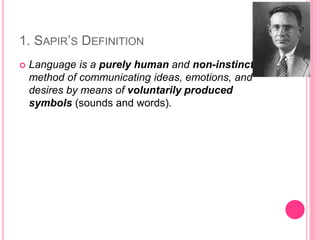
1. SAPIR’S DEFINITION
 Language is a purely human and non-instinctive
method of communicating ideas, emotions, and
desires by means of voluntarily produced
symbols (sounds and words).
DEFECTS IN SAPIR’S DEFINITION
 Whether language is purely human and non-
instinctive is open to doubt and question to many
linguists.
 There is much that is communicated by language
which is not covered by any of the terms i.e. ‘ideas’,
‘emotion’ and ‘desire’ and ‘idea’ in particular is
inherently imprecise.
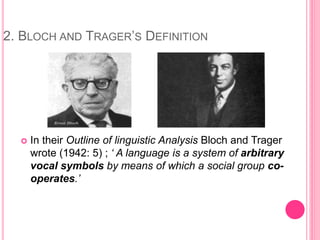
2. BLOCH AND TRAGER’S DEFINITION
 In their Outline of linguistic Analysis Bloch and Trager
wrote (1942: 5) ; ‘ A language is a system of arbitrary
vocal symbols by means of which a social group co-
operates.’
DEFECTS
 It makes no appeal to the communicative function
of language. Instead it puts all the emphasis upon
the social function of language. Therefore it takes a
narrower view of the role that language plays in the
society.
 The definition brings in the property of arbitrariness
which is not found in Sapir’s definition and explicitly
restricts language to spoken language( ignoring the
importance of written language).
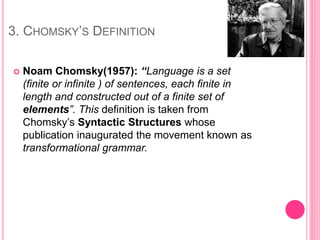
3. CHOMSKY’S DEFINITION
 Noam Chomsky(1957): “Language is a set
(finite or infinite ) of sentences, each finite in
length and constructed out of a finite set of
elements”. This definition is taken from
Chomsky’s Syntactic Structures whose
publication inaugurated the movement known as
transformational grammar.
DEFECTS
 It says nothing about the communicative function.
 It says nothing about the symbolic nature of the
elements or sequences of them.
 It focus only on structural properties of language
and says nothing about the functional properties of
language.
CONCLUSION
 The mentioned discussed definitions of language
serve to introduce some of the properties of
language like arbitrariness and structure-
dependence.
 Thank you

Linguistics

  • 1.
  • 2.
    1. SAPIR’S DEFINITION Language is a purely human and non-instinctive method of communicating ideas, emotions, and desires by means of voluntarily produced symbols (sounds and words).
  • 3.
    DEFECTS IN SAPIR’SDEFINITION  Whether language is purely human and non- instinctive is open to doubt and question to many linguists.  There is much that is communicated by language which is not covered by any of the terms i.e. ‘ideas’, ‘emotion’ and ‘desire’ and ‘idea’ in particular is inherently imprecise.
  • 4.
    2. BLOCH ANDTRAGER’S DEFINITION  In their Outline of linguistic Analysis Bloch and Trager wrote (1942: 5) ; ‘ A language is a system of arbitrary vocal symbols by means of which a social group co- operates.’
  • 5.
    DEFECTS  It makesno appeal to the communicative function of language. Instead it puts all the emphasis upon the social function of language. Therefore it takes a narrower view of the role that language plays in the society.  The definition brings in the property of arbitrariness which is not found in Sapir’s definition and explicitly restricts language to spoken language( ignoring the importance of written language).
  • 6.
    3. CHOMSKY’S DEFINITION Noam Chomsky(1957): “Language is a set (finite or infinite ) of sentences, each finite in length and constructed out of a finite set of elements”. This definition is taken from Chomsky’s Syntactic Structures whose publication inaugurated the movement known as transformational grammar.
  • 7.
    DEFECTS  It saysnothing about the communicative function.  It says nothing about the symbolic nature of the elements or sequences of them.  It focus only on structural properties of language and says nothing about the functional properties of language.
  • 8.
    CONCLUSION  The mentioneddiscussed definitions of language serve to introduce some of the properties of language like arbitrariness and structure- dependence.
  • 9.