Universidad Nacional Experimental
“Francisco de Miranda”
Área: Ciencias de la Educación
Programa: Educación Mención Inglés
U.C. Lingüística General
Prof. Cristina Chirino
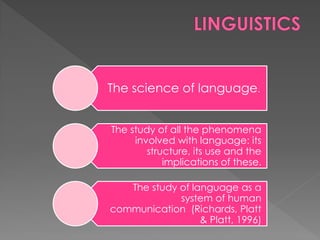
The science of language.
The study of all the phenomena
involved with language: its
structure, its use and the
implications of these.
The study of language as a
system of human
communication (Richards, Platt
& Platt, 1996)
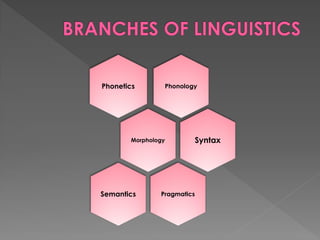
PhonologyPhonetics
Morphology Syntax
PragmaticsSemantics
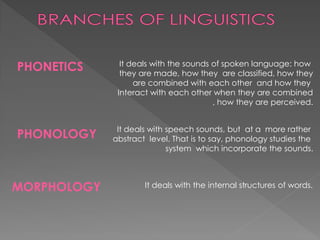
PHONETICS It deals with the sounds of spoken language: how
they are made, how they are classified, how they
are combined with each other and how they
Interact with each other when they are combined
, how they are perceived.
PHONOLOGY
It deals with speech sounds, but at a more rather
abstract level. That is to say, phonology studies the
system which incorporate the sounds.
MORPHOLOGY It deals with the internal structures of words.
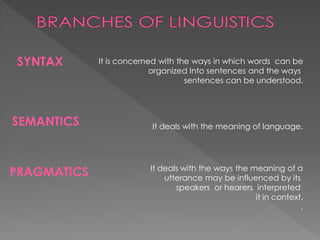
SYNTAX It is concerned with the ways in which words can be
organized Into sentences and the ways
sentences can be understood.
SEMANTICS It deals with the meaning of language.
PRAGMATICS It deals with the ways the meaning of a
utterance may be influenced by its
speakers or hearers interpreted
it in context.
.
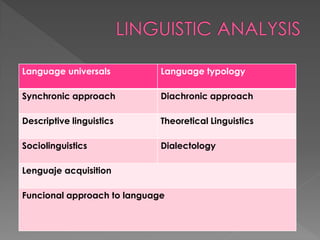
Language universals Language typology
Synchronic approach Diachronic approach
Descriptive linguistics Theoretical Linguistics
Sociolinguistics Dialectology
Lenguaje acquisition
Funcional approach to language
 Is linguistics a science?
Do you think linguistics is
important to be studied by
language trainees?

Linguistics

  • 1.
    Universidad Nacional Experimental “Franciscode Miranda” Área: Ciencias de la Educación Programa: Educación Mención Inglés U.C. Lingüística General Prof. Cristina Chirino
  • 2.
    The science oflanguage. The study of all the phenomena involved with language: its structure, its use and the implications of these. The study of language as a system of human communication (Richards, Platt & Platt, 1996)
  • 3.
  • 4.
    PHONETICS It dealswith the sounds of spoken language: how they are made, how they are classified, how they are combined with each other and how they Interact with each other when they are combined , how they are perceived. PHONOLOGY It deals with speech sounds, but at a more rather abstract level. That is to say, phonology studies the system which incorporate the sounds. MORPHOLOGY It deals with the internal structures of words.
  • 5.
    SYNTAX It isconcerned with the ways in which words can be organized Into sentences and the ways sentences can be understood. SEMANTICS It deals with the meaning of language. PRAGMATICS It deals with the ways the meaning of a utterance may be influenced by its speakers or hearers interpreted it in context. .
  • 6.
    Language universals Languagetypology Synchronic approach Diachronic approach Descriptive linguistics Theoretical Linguistics Sociolinguistics Dialectology Lenguaje acquisition Funcional approach to language
  • 7.
     Is linguisticsa science? Do you think linguistics is important to be studied by language trainees?