PREPARED bY:- Shankar Jaydeep Rajubhai 
Subject:- Communication Skills 
Subject Code:-210002 
Guided By:- Manoj Vaghasiya 
City:- Junagadh
Basic Of Communication 
1 Defination and Process of 
Communication 
2 Kinesics 
3 Paralinguistics 
4 Proxemics 
5 Chronemics
Defination and Process Of 
Communication 
The sharing of meaningful information 
between two or more people with the goal 
of the receiver understanding the sender's 
intended message. In business, the 
effectiveness of a company's internal and 
external communication process is often 
very important to its overall success.
Kinesics 
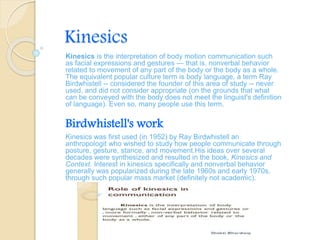
Kinesics is the interpretation of body motion communication such 
as facial expressions and gestures — that is, nonverbal behavior 
related to movement of any part of the body or the body as a whole. 
The equivalent popular culture term is body language, a term Ray 
Birdwhistell -- considered the founder of this area of study -- never 
used, and did not consider appropriate (on the grounds that what 
can be conveyed with the body does not meet the linguist's definition 
of language). Even so, many people use this term. 
Birdwhistell's work 
Kinesics was first used (in 1952) by Ray Birdwhistell an 
anthropologit who wished to study how people communicate through 
posture, gesture, stance, and movement.His ideas over several 
decades were synthesized and resulted in the book, Kinesics and 
Context. Interest in kinesics specifically and nonverbal behavior 
generally was popularized during the late 1960s and early 1970s, 
through such popular mass market (definitely not academic).
Paralinguistics 
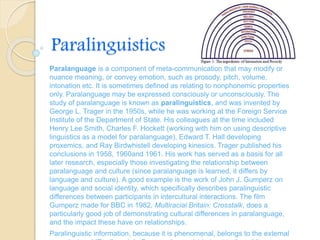
Paralanguage is a component of meta-communication that may modify or 
nuance meaning, or convey emotion, such as prosody, pitch, volume, 
intonation etc. It is sometimes defined as relating to nonphonemic properties 
only. Paralanguage may be expressed consciously or unconsciously. The 
study of paralanguage is known as paralinguistics, and was invented by 
George L. Trager in the 1950s, while he was working at the Foreign Service 
Institute of the Department of State. His colleagues at the time included 
Henry Lee Smith, Charles F. Hockett (working with him on using descriptive 
linguistics as a model for paralanguage), Edward T. Hall developing 
proxemics, and Ray Birdwhistell developing kinesics. Trager published his 
conclusions in 1958, 1960and 1961. His work has served as a basis for all 
later research, especially those investigating the relationship between 
paralanguage and culture (since paralanguage is learned, it differs by 
language and culture). A good example is the work of John J. Gumperz on 
language and social identity, which specifically describes paralinguistic 
differences between participants in intercultural interactions. The film 
Gumperz made for BBC in 1982, Multiracial Britain: Crosstalk, does a 
particularly good job of demonstrating cultural differences in paralanguage, 
and the impact these have on relationships. 
Paralinguistic information, because it is phenomenal, belongs to the external 
speech signal (Ferdinand de Saussure's parole) but not to the arbitrary
Proxemics 
Proxemics is a one of several subcategories of the study of nonverbal 
communication. Prominent other subcategories include haptics (touch), 
kinesics (body movement), vocalics (paralanguage), and chronemics 
(structure of time).Proxemics can be defined as "the interrelated 
observations and theories of man's use of space as a specialized 
elaboration of culture". Edward T. Hall, the cultural anthropologist who 
coined the term in 1963, emphasized the impact of proxemic behavior 
(the use of space) on interpersonal communication. Hall believed that 
the value in studying proxemics comes from its applicability in 
evaluating not only the way people interact with others in daily life, but 
also "the organization of space in [their] houses and buildings, and 
ultimately the layout of [their] towns. 
In animals, Swiss zoologist Heini Hediger had distinguished between 
flight distance (run boundary), critical distance (attack boundary), 
personal distance (distance separating members of non-contact 
species, as a pair of swans), and social distance (intraspecies 
communication distance). Hall reasoned that, with very few exceptions, 
flight distance and critical distance have been eliminated in human 
reactions, and thus interviewed hundreds of people to determine 
modified criteria for human interactions.

communication skill

  • 1.
    PREPARED bY:- ShankarJaydeep Rajubhai Subject:- Communication Skills Subject Code:-210002 Guided By:- Manoj Vaghasiya City:- Junagadh
  • 2.
    Basic Of Communication 1 Defination and Process of Communication 2 Kinesics 3 Paralinguistics 4 Proxemics 5 Chronemics
  • 3.
    Defination and ProcessOf Communication The sharing of meaningful information between two or more people with the goal of the receiver understanding the sender's intended message. In business, the effectiveness of a company's internal and external communication process is often very important to its overall success.
  • 4.
    Kinesics Kinesics isthe interpretation of body motion communication such as facial expressions and gestures — that is, nonverbal behavior related to movement of any part of the body or the body as a whole. The equivalent popular culture term is body language, a term Ray Birdwhistell -- considered the founder of this area of study -- never used, and did not consider appropriate (on the grounds that what can be conveyed with the body does not meet the linguist's definition of language). Even so, many people use this term. Birdwhistell's work Kinesics was first used (in 1952) by Ray Birdwhistell an anthropologit who wished to study how people communicate through posture, gesture, stance, and movement.His ideas over several decades were synthesized and resulted in the book, Kinesics and Context. Interest in kinesics specifically and nonverbal behavior generally was popularized during the late 1960s and early 1970s, through such popular mass market (definitely not academic).
  • 5.
    Paralinguistics Paralanguage isa component of meta-communication that may modify or nuance meaning, or convey emotion, such as prosody, pitch, volume, intonation etc. It is sometimes defined as relating to nonphonemic properties only. Paralanguage may be expressed consciously or unconsciously. The study of paralanguage is known as paralinguistics, and was invented by George L. Trager in the 1950s, while he was working at the Foreign Service Institute of the Department of State. His colleagues at the time included Henry Lee Smith, Charles F. Hockett (working with him on using descriptive linguistics as a model for paralanguage), Edward T. Hall developing proxemics, and Ray Birdwhistell developing kinesics. Trager published his conclusions in 1958, 1960and 1961. His work has served as a basis for all later research, especially those investigating the relationship between paralanguage and culture (since paralanguage is learned, it differs by language and culture). A good example is the work of John J. Gumperz on language and social identity, which specifically describes paralinguistic differences between participants in intercultural interactions. The film Gumperz made for BBC in 1982, Multiracial Britain: Crosstalk, does a particularly good job of demonstrating cultural differences in paralanguage, and the impact these have on relationships. Paralinguistic information, because it is phenomenal, belongs to the external speech signal (Ferdinand de Saussure's parole) but not to the arbitrary
  • 6.
    Proxemics Proxemics isa one of several subcategories of the study of nonverbal communication. Prominent other subcategories include haptics (touch), kinesics (body movement), vocalics (paralanguage), and chronemics (structure of time).Proxemics can be defined as "the interrelated observations and theories of man's use of space as a specialized elaboration of culture". Edward T. Hall, the cultural anthropologist who coined the term in 1963, emphasized the impact of proxemic behavior (the use of space) on interpersonal communication. Hall believed that the value in studying proxemics comes from its applicability in evaluating not only the way people interact with others in daily life, but also "the organization of space in [their] houses and buildings, and ultimately the layout of [their] towns. In animals, Swiss zoologist Heini Hediger had distinguished between flight distance (run boundary), critical distance (attack boundary), personal distance (distance separating members of non-contact species, as a pair of swans), and social distance (intraspecies communication distance). Hall reasoned that, with very few exceptions, flight distance and critical distance have been eliminated in human reactions, and thus interviewed hundreds of people to determine modified criteria for human interactions.