Lecture 5
Graphical Method
Operation
Research
Objective
By the end of this class, we will be able to:
 Analyze Graphical Solution of Linear Programming
Models
 Recognize Graphical Representation of LP Models
 Explore Graphical Representation of Constraints
 Learn about Utilization of Feasible Solution Area
 Understand Corner Point Property
 Analyze Graphical Solutions
 Explore LP Characteristics
What is an Optimal Solution?
 Minimum or maximum value of an objective
function is the optimal solution
Optimal Solution
Now, question is…
How do we solve a linear programming problem?
There are different ways to solve these problems.
The problems having two variables can be solved
graphically.
Graphical solution is possible with two ‘decision variables’ (may be with three) in a linear programming
model
Graphical Solution - Linear Programming Models
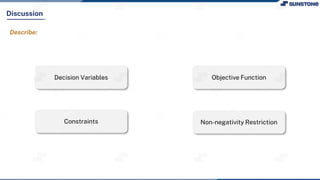
Discussion
Decision Variables Objective Function
Constraints Non-negativity Restriction
Describe:
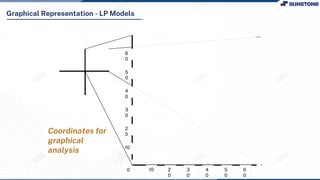
Graphical Representation - LP Models
Coordinates for
graphical
analysis 10
2
0
3
0
4
0
5
0
6
0
10 2
0
3
0
4
0
5
0
6
0
0
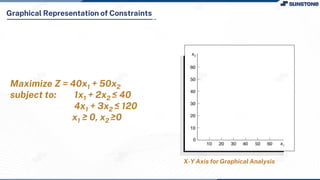
Graphical Representation of Constraints
X-Y Axis for Graphical Analysis
Maximize Z = 40x1 + 50x2
subject to: 1x1 + 2x2 ≤ 40
4x1 + 3x2 ≤ 120
x1 ≥ 0, x2 ≥0
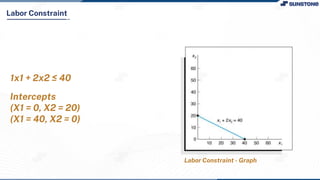
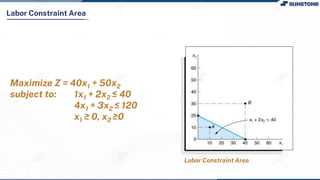
Labor Constraint
1x1 + 2x2 ≤ 40
Intercepts
(X1 = 0, X2 = 20)
(X1 = 40, X2 = 0)
Labor Constraint - Graph
Labor Constraint Area
Maximize Z = 40x1 + 50x2
subject to: 1x1 + 2x2 ≤ 40
4x1 + 3x2 ≤ 120
x1 ≥ 0, x2 ≥0
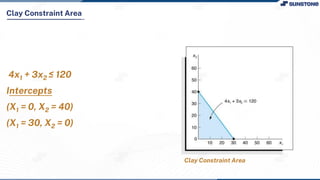
Clay Constraint Area
4x1 + 3x2 ≤ 120
Intercepts
(X1 = 0, X2 = 40)
(X1 = 30, X2 = 0)
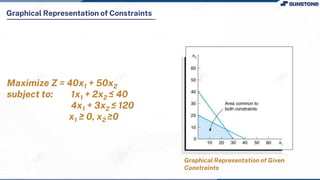
Graphical Representation of Constraints
Graphical Representation of Given
Constraints
Maximize Z = 40x1 + 50x2
subject to: 1x1 + 2x2 ≤ 40
4x1 + 3x2 ≤ 120
x1 ≥ 0, x2 ≥0
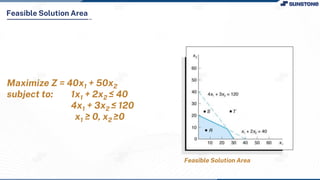
Feasible Solution Area
Maximize Z = 40x1 + 50x2
subject to: 1x1 + 2x2 ≤ 40
4x1 + 3x2 ≤ 120
x1 ≥ 0, x2 ≥0
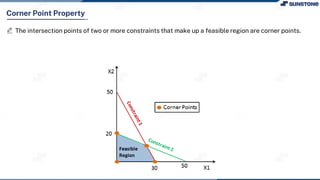
Corner Point Property
The intersection points of two or more constraints that make up a feasible region are corner points.
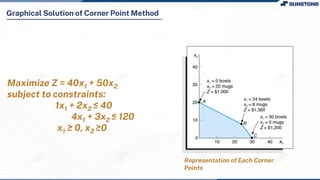
Graphical Solution of Corner Point Method
Representation of Each Corner
Points
Maximize Z = 40x1 + 50x2
subject to constraints:
1x1 + 2x2 ≤ 40
4x1 + 3x2 ≤ 120
x1 ≥ 0, x2 ≥0
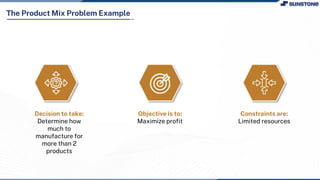
The Product Mix Problem Example
Decision to take:
Determine how
much to
manufacture for
more than 2
products
Objective is to:
Maximize profit
Constraints are:
Limited resources
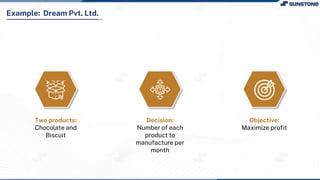
Example: Dream Pvt. Ltd.
Two products:
Chocolate and
Biscuit
Decision:
Number of each
product to
manufacture per
month
Objective:
Maximize profit
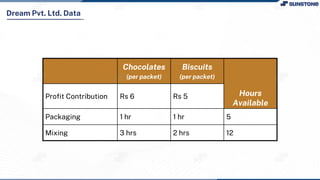
Dream Pvt. Ltd. Data
Chocolates
(per packet)
Biscuits
(per packet)
Hours
Available
Profit Contribution Rs 6 Rs 5
Packaging 1 hr 1 hr 5
Mixing 3 hrs 2 hrs 12
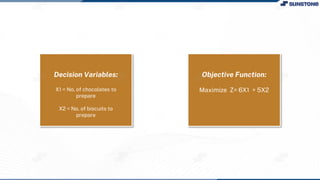
Decision Variables:
X1 = No. of chocolates to
prepare
X2 = No. of biscuits to
prepare
Objective Function:
Maximize Z= 6X1 + 5X2
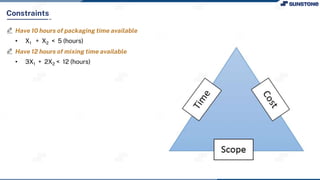
Constraints
Have 10 hours of packaging time available
• X1 + X2 < 5 (hours)
Have 12 hours of mixing time available
• 3X1 + 2X2 < 12 (hours)
Non-negativity
Negative number of chocolate or biscuit cannot be prepared
• X1 > 0
• X1 > 0
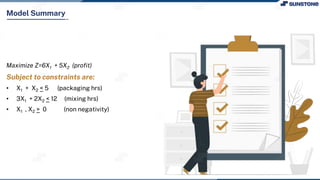
Model Summary
Maximize Z=6X1 + 5X2 (profit)
Subject to constraints are:
• X1 + X2 < 5 (packaging hrs)
• 3X1 + 2X2 < 12 (mixing hrs)
• X1 , X2 > 0 (non negativity)
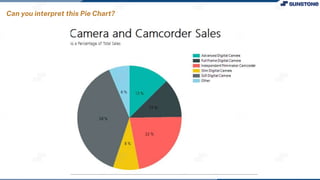
Can you interpret this Pie Chart?
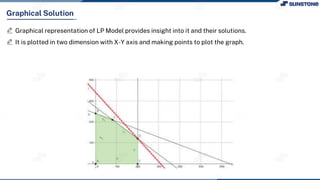
Graphical Solution
Graphical representation of LP Model provides insight into it and their solutions.
It is plotted in two dimension with X-Y axis and making points to plot the graph.
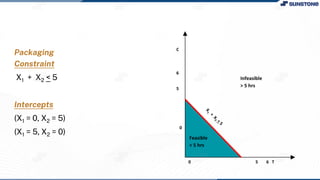
Packaging
Constraint
X1 + X2 < 5
Intercepts
(X1 = 0, X2 = 5)
(X1 = 5, X2 = 0)
0 5 6 T
C
6
5
0
Feasible
< 5 hrs
Infeasible
> 5 hrs
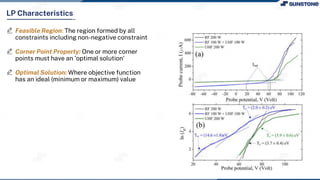
LP Characteristics
Feasible Region: The region formed by all
constraints including non-negative constraint
Corner Point Property: One or more corner
points must have an ‘optimal solution’
Optimal Solution: Where objective function
has an ideal (minimum or maximum) value
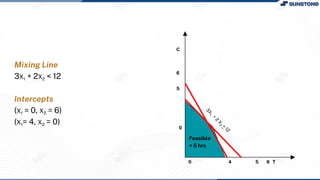
Mixing Line
3X1 + 2X2 < 12
Intercepts
(X1 = 0, X2 = 6)
(X1= 4, X2 = 0)
0 4 5 6 T
C
6
5
0
Feasible
< 5 hrs
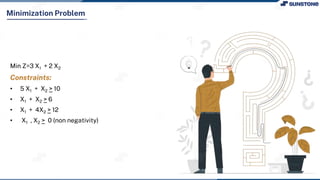
Minimization Problem
Min Z=3 X1 + 2 X2
Constraints:
• 5 X1 + X2 > 10
• X1 + X2 > 6
• X1 + 4X2 > 12
• X1 , X2 > 0 (non negativity)
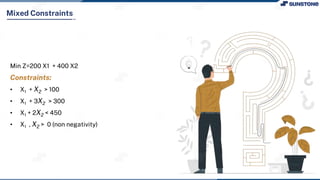
Mixed Constraints
Min Z=200 X1 + 400 X2
Constraints:
• X1 + X2 > 100
• X1 + 3X2 > 300
• X1 + 2X2 < 450
• X1 , X2 > 0 (non negativity)
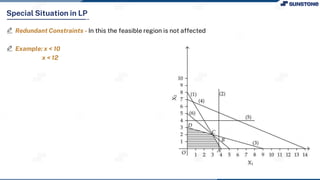
Special Situation in Linear Programming
Redundant Constraints - In this the feasible region is not affected
Example: x < 10
x < 12
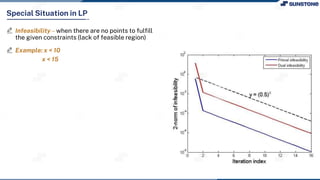
Special Situation in LP
Infeasibility – when there are no points to fulfill
the given constraints (lack of feasible region)
Example: x < 10
x < 15
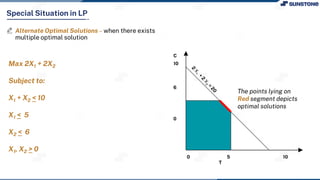
Special Situation in LP
Alternate Optimal Solutions – when there exists
multiple optimal solution
Max 2X1 + 2X2
Subject to:
X1 + X2 < 10
X1 < 5
X2 < 6
X1, X2 > 0
0 5 10
T
C
10
6
0
The points lying on
Red segment depicts
optimal solutions
Special Situation in LP
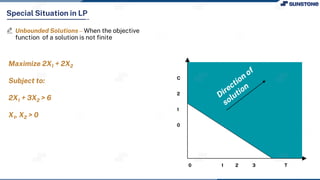
Unbounded Solutions – When the objective
function of a solution is not finite
Maximize 2X1 + 2X2
Subject to:
2X1 + 3X2 > 6
X1, X2 > 0
0 1 2 3 T
C
2
1
0
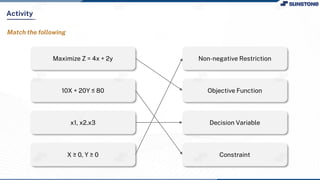
Activity
Maximize Z = 4x + 2y
Match the following
10X + 20Y ≤ 80
x1, x2.x3
X ≥ 0, Y ≥ 0
Non-negative Restriction
Objective Function
Decision Variable
Constraint
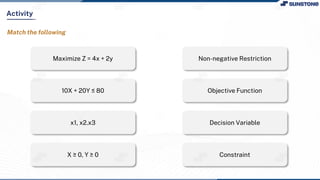
Maximize Z = 4x + 2y
Match the following
10X + 20Y ≤ 80
x1, x2.x3
X ≥ 0, Y ≥ 0
Non-negative Restriction
Objective Function
Decision Variable
Constraint
Activity
240591lecture_5_graphical_solution-1688128227959.pptx

240591lecture_5_graphical_solution-1688128227959.pptx

  • 1.
  • 2.
    Objective By the endof this class, we will be able to:  Analyze Graphical Solution of Linear Programming Models  Recognize Graphical Representation of LP Models  Explore Graphical Representation of Constraints  Learn about Utilization of Feasible Solution Area  Understand Corner Point Property  Analyze Graphical Solutions  Explore LP Characteristics
  • 3.
    What is anOptimal Solution?
  • 4.
     Minimum ormaximum value of an objective function is the optimal solution Optimal Solution
  • 5.
    Now, question is… Howdo we solve a linear programming problem?
  • 6.
    There are differentways to solve these problems. The problems having two variables can be solved graphically.
  • 7.
    Graphical solution ispossible with two ‘decision variables’ (may be with three) in a linear programming model Graphical Solution - Linear Programming Models
  • 9.
    Discussion Decision Variables ObjectiveFunction Constraints Non-negativity Restriction Describe:
  • 10.
    Graphical Representation -LP Models Coordinates for graphical analysis 10 2 0 3 0 4 0 5 0 6 0 10 2 0 3 0 4 0 5 0 6 0 0
  • 11.
    Graphical Representation ofConstraints X-Y Axis for Graphical Analysis Maximize Z = 40x1 + 50x2 subject to: 1x1 + 2x2 ≤ 40 4x1 + 3x2 ≤ 120 x1 ≥ 0, x2 ≥0
  • 12.
    Labor Constraint 1x1 +2x2 ≤ 40 Intercepts (X1 = 0, X2 = 20) (X1 = 40, X2 = 0) Labor Constraint - Graph
  • 13.
    Labor Constraint Area LaborConstraint Area Maximize Z = 40x1 + 50x2 subject to: 1x1 + 2x2 ≤ 40 4x1 + 3x2 ≤ 120 x1 ≥ 0, x2 ≥0
  • 14.
    Clay Constraint Area ClayConstraint Area 4x1 + 3x2 ≤ 120 Intercepts (X1 = 0, X2 = 40) (X1 = 30, X2 = 0)
  • 15.
    Graphical Representation ofConstraints Graphical Representation of Given Constraints Maximize Z = 40x1 + 50x2 subject to: 1x1 + 2x2 ≤ 40 4x1 + 3x2 ≤ 120 x1 ≥ 0, x2 ≥0
  • 16.
    Feasible Solution Area FeasibleSolution Area Maximize Z = 40x1 + 50x2 subject to: 1x1 + 2x2 ≤ 40 4x1 + 3x2 ≤ 120 x1 ≥ 0, x2 ≥0
  • 17.
    Corner Point Property Theintersection points of two or more constraints that make up a feasible region are corner points.
  • 18.
    Graphical Solution ofCorner Point Method Representation of Each Corner Points Maximize Z = 40x1 + 50x2 subject to constraints: 1x1 + 2x2 ≤ 40 4x1 + 3x2 ≤ 120 x1 ≥ 0, x2 ≥0
  • 19.
    The Product MixProblem Example Decision to take: Determine how much to manufacture for more than 2 products Objective is to: Maximize profit Constraints are: Limited resources
  • 20.
    Example: Dream Pvt.Ltd. Two products: Chocolate and Biscuit Decision: Number of each product to manufacture per month Objective: Maximize profit
  • 21.
    Dream Pvt. Ltd.Data Chocolates (per packet) Biscuits (per packet) Hours Available Profit Contribution Rs 6 Rs 5 Packaging 1 hr 1 hr 5 Mixing 3 hrs 2 hrs 12
  • 22.
    Decision Variables: X1 =No. of chocolates to prepare X2 = No. of biscuits to prepare Objective Function: Maximize Z= 6X1 + 5X2
  • 23.
    Constraints Have 10 hoursof packaging time available • X1 + X2 < 5 (hours) Have 12 hours of mixing time available • 3X1 + 2X2 < 12 (hours)
  • 24.
    Non-negativity Negative number ofchocolate or biscuit cannot be prepared • X1 > 0 • X1 > 0
  • 25.
    Model Summary Maximize Z=6X1+ 5X2 (profit) Subject to constraints are: • X1 + X2 < 5 (packaging hrs) • 3X1 + 2X2 < 12 (mixing hrs) • X1 , X2 > 0 (non negativity)
  • 26.
    Can you interpretthis Pie Chart?
  • 27.
    Graphical Solution Graphical representationof LP Model provides insight into it and their solutions. It is plotted in two dimension with X-Y axis and making points to plot the graph.
  • 28.
    Packaging Constraint X1 + X2< 5 Intercepts (X1 = 0, X2 = 5) (X1 = 5, X2 = 0) 0 5 6 T C 6 5 0 Feasible < 5 hrs Infeasible > 5 hrs
  • 29.
    LP Characteristics Feasible Region:The region formed by all constraints including non-negative constraint Corner Point Property: One or more corner points must have an ‘optimal solution’ Optimal Solution: Where objective function has an ideal (minimum or maximum) value
  • 30.
    Mixing Line 3X1 +2X2 < 12 Intercepts (X1 = 0, X2 = 6) (X1= 4, X2 = 0) 0 4 5 6 T C 6 5 0 Feasible < 5 hrs
  • 31.
    Minimization Problem Min Z=3X1 + 2 X2 Constraints: • 5 X1 + X2 > 10 • X1 + X2 > 6 • X1 + 4X2 > 12 • X1 , X2 > 0 (non negativity)
  • 32.
    Mixed Constraints Min Z=200X1 + 400 X2 Constraints: • X1 + X2 > 100 • X1 + 3X2 > 300 • X1 + 2X2 < 450 • X1 , X2 > 0 (non negativity)
  • 33.
    Special Situation inLinear Programming
  • 34.
    Redundant Constraints -In this the feasible region is not affected Example: x < 10 x < 12 Special Situation in LP
  • 35.
    Infeasibility – whenthere are no points to fulfill the given constraints (lack of feasible region) Example: x < 10 x < 15 Special Situation in LP
  • 36.
    Alternate Optimal Solutions– when there exists multiple optimal solution Max 2X1 + 2X2 Subject to: X1 + X2 < 10 X1 < 5 X2 < 6 X1, X2 > 0 0 5 10 T C 10 6 0 The points lying on Red segment depicts optimal solutions Special Situation in LP
  • 37.
    Special Situation inLP Unbounded Solutions – When the objective function of a solution is not finite Maximize 2X1 + 2X2 Subject to: 2X1 + 3X2 > 6 X1, X2 > 0 0 1 2 3 T C 2 1 0
  • 38.
    Activity Maximize Z =4x + 2y Match the following 10X + 20Y ≤ 80 x1, x2.x3 X ≥ 0, Y ≥ 0 Non-negative Restriction Objective Function Decision Variable Constraint
  • 39.
    Maximize Z =4x + 2y Match the following 10X + 20Y ≤ 80 x1, x2.x3 X ≥ 0, Y ≥ 0 Non-negative Restriction Objective Function Decision Variable Constraint Activity