
DC GENERATOR
Presented by,
Md. Abdur Rahman
The people’s university of bangladesh
Dept: of CSE
INDEX
• INTRODUCTION TO DC GENERATOR.
• WORKING PRINCIPLE OF DC GENERATOR.
• PARTS OF DC GENERATOR.
• CLASSIFICATION OF DC GENERATOR.
• APPLICATION OF DC GENERATOR.
• CONSTRUCTION OF DC GENERATOR.
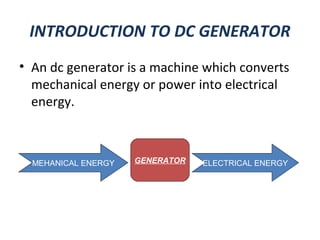
INTRODUCTION TO DC GENERATOR
• An dc generator is a machine which converts
mechanical energy or power into electrical
energy.
GENERATOR ELECTRICAL ENERGYMEHANICAL ENERGY
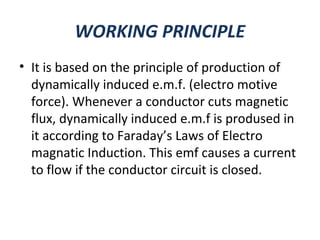
WORKING PRINCIPLE
• It is based on the principle of production of
dynamically induced e.m.f. (electro motive
force). Whenever a conductor cuts magnetic
flux, dynamically induced e.m.f is prodused in
it according to Faraday’s Laws of Electro
magnatic Induction. This emf causes a current
to flow if the conductor circuit is closed.
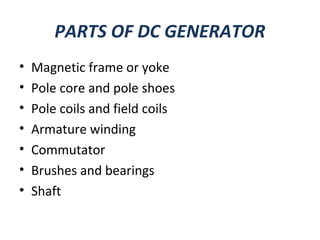
PARTS OF DC GENERATOR
• Magnetic frame or yoke
• Pole core and pole shoes
• Pole coils and field coils
• Armature winding
• Commutator
• Brushes and bearings
• Shaft
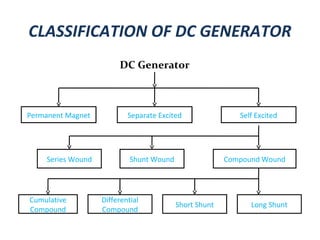
CLASSIFICATION OF DC GENERATOR
Separate Excited Self Excited
Shunt Wound Compound WoundSeries Wound
Cumulative
Compound
Differential
Compound
Short Shunt Long Shunt
Permanent Magnet
DC Generator
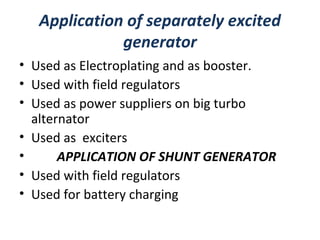
Application of separately excited
generator
• Used as Electroplating and as booster.
• Used with field regulators
• Used as power suppliers on big turbo
alternator
• Used as exciters
• APPLICATION OF SHUNT GENERATOR
• Used with field regulators
• Used for battery charging
APPLICATION OF SERIES GENERATOR
• Used for lightening
• Used as constant current generators
• Used as booster
• APPLICATION OF COMPOUND GENERATOR
• Used as compensator
• Used for ordinary lightning and power
purposes
CONSTRUCTION
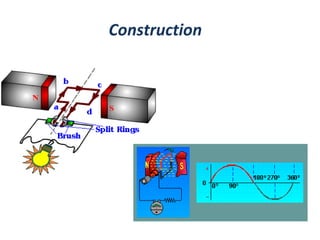
• A single turn rectangular copper coil abcd
moving about its own axis in a magnetic field
provided by either permanent magnets or
electro magnets. The two ends of the coil are
joined to two split rings which are insulated
from each other and from the central
shaft.Two collecting brushes press against the
slip rings.
Construction
THANK YOU
For Watching

Linear Dc generator

  • 1.
    DC GENERATOR Presented by, Md.Abdur Rahman The people’s university of bangladesh Dept: of CSE
  • 2.
    INDEX • INTRODUCTION TODC GENERATOR. • WORKING PRINCIPLE OF DC GENERATOR. • PARTS OF DC GENERATOR. • CLASSIFICATION OF DC GENERATOR. • APPLICATION OF DC GENERATOR. • CONSTRUCTION OF DC GENERATOR.
  • 3.
    INTRODUCTION TO DCGENERATOR • An dc generator is a machine which converts mechanical energy or power into electrical energy. GENERATOR ELECTRICAL ENERGYMEHANICAL ENERGY
  • 4.
    WORKING PRINCIPLE • Itis based on the principle of production of dynamically induced e.m.f. (electro motive force). Whenever a conductor cuts magnetic flux, dynamically induced e.m.f is prodused in it according to Faraday’s Laws of Electro magnatic Induction. This emf causes a current to flow if the conductor circuit is closed.
  • 5.
    PARTS OF DCGENERATOR • Magnetic frame or yoke • Pole core and pole shoes • Pole coils and field coils • Armature winding • Commutator • Brushes and bearings • Shaft
  • 6.
    CLASSIFICATION OF DCGENERATOR Separate Excited Self Excited Shunt Wound Compound WoundSeries Wound Cumulative Compound Differential Compound Short Shunt Long Shunt Permanent Magnet DC Generator
  • 7.
    Application of separatelyexcited generator • Used as Electroplating and as booster. • Used with field regulators • Used as power suppliers on big turbo alternator • Used as exciters • APPLICATION OF SHUNT GENERATOR • Used with field regulators • Used for battery charging
  • 8.
    APPLICATION OF SERIESGENERATOR • Used for lightening • Used as constant current generators • Used as booster • APPLICATION OF COMPOUND GENERATOR • Used as compensator • Used for ordinary lightning and power purposes
  • 9.
    CONSTRUCTION • A singleturn rectangular copper coil abcd moving about its own axis in a magnetic field provided by either permanent magnets or electro magnets. The two ends of the coil are joined to two split rings which are insulated from each other and from the central shaft.Two collecting brushes press against the slip rings.
  • 10.
  • 11.