Distributed Energy Investment as an Alternative to Distribution Upgrades in Rural Areas


Scenarios for Distributed Energy Investment as an Alternative to
Distribution Line Upgrades in Rural Areas
By Iain Sanders, Sustainable Innovative Solutions Limited, and Alister Gardiner, Industrial
Research Limited

Abstract
In this paper, we identify and evaluate various ‘best-case scenarios’ for investing in decentralised
micro-generation from a utility-driven, distribution network perspective. A distribution line experiencing
significant over-capacity from increasing customer demand is used to determine the Net Present
Value (NPV) of five different modular, distributed energy systems: (1) hydroelectric power (HEP) with
diesel genset (DGN) support; (2) wind turbine generation (WTG) with DGN support; (3) photovoltaics
(PVS) with DGN support; (4) solar hot water (SHW) with DGN support; and (5) DGN by itself, as a
reference case.

The study considers the value of distributed energy (DE) in deferring or eliminating distribution line
energy- / capacity-based upgrades. The basic principle applied in this study is that the distributed
generation installed consists of a combination of fuel-based (DGN) generation and intermittent
renewable energy (RE) to ensure that “normal” supply reliability can be delivered at all times,
irrespective of RE availability. Typical RE supply profiles are used to indicate the likely mix of RE and
DGN supply throughout the year on a continuous half-hourly basis. The scale and format of the
particular technologies is not specified, instead these are simply identified as opportunity costs.

As a typical case study involving real “industry” data, the NPV of DE as a line upgrade deferral option
was compared with a “business as usual” scenario for a rural distribution line in the Eastland Networks
Limited (ENL) region of the north island of New Zealand. For the data presented in this report, the
annual energy demand growth rate was exaggerated and extended over a 20-year timeframe to
emphasize the potential contribution that DE could have on the energy / capacity supply mix for
regions of high growth. The net results were almost always in favour of DE line upgrade deferral (as
opposed to a “business as usual” network management arrangement) under the conditions assumed
for this study. No attempt was made to account for any contributions of heat generated by the fuel
based (diesel assumed) generation. Combined Heat and Power (CHP) would add substantial value by
providing additional end use energy from the fuel resource.


Introduction
Over the last nine years, Industrial Research has evaluated a wide range of resource opportunities for
adopting Renewable Distributed Energy (RDE) technologies in New Zealand. The objective has been
to evaluate and demonstrate the techno-economic viability of micro- (less than 100kW capacity), mini-
(between 100kW and 1000kW capacity) and small-scale (between 1MW and 10MW capacity) RDE
systems in New Zealand. In the process specialised tools and methodologies have been developed to
fulfil this purpose. (Unless ‘scale’ is specifically mentioned, the term ‘small’ will refer to anything from
micro-scale to small-scale inclusive).

This research into distributed energy-based systems has been motivated by the promise of more
efficient energy utilisation and the opportunity for capturing local renewable energy resources with
minimal use of additional infrastructure. Specific network benefits are possible through:

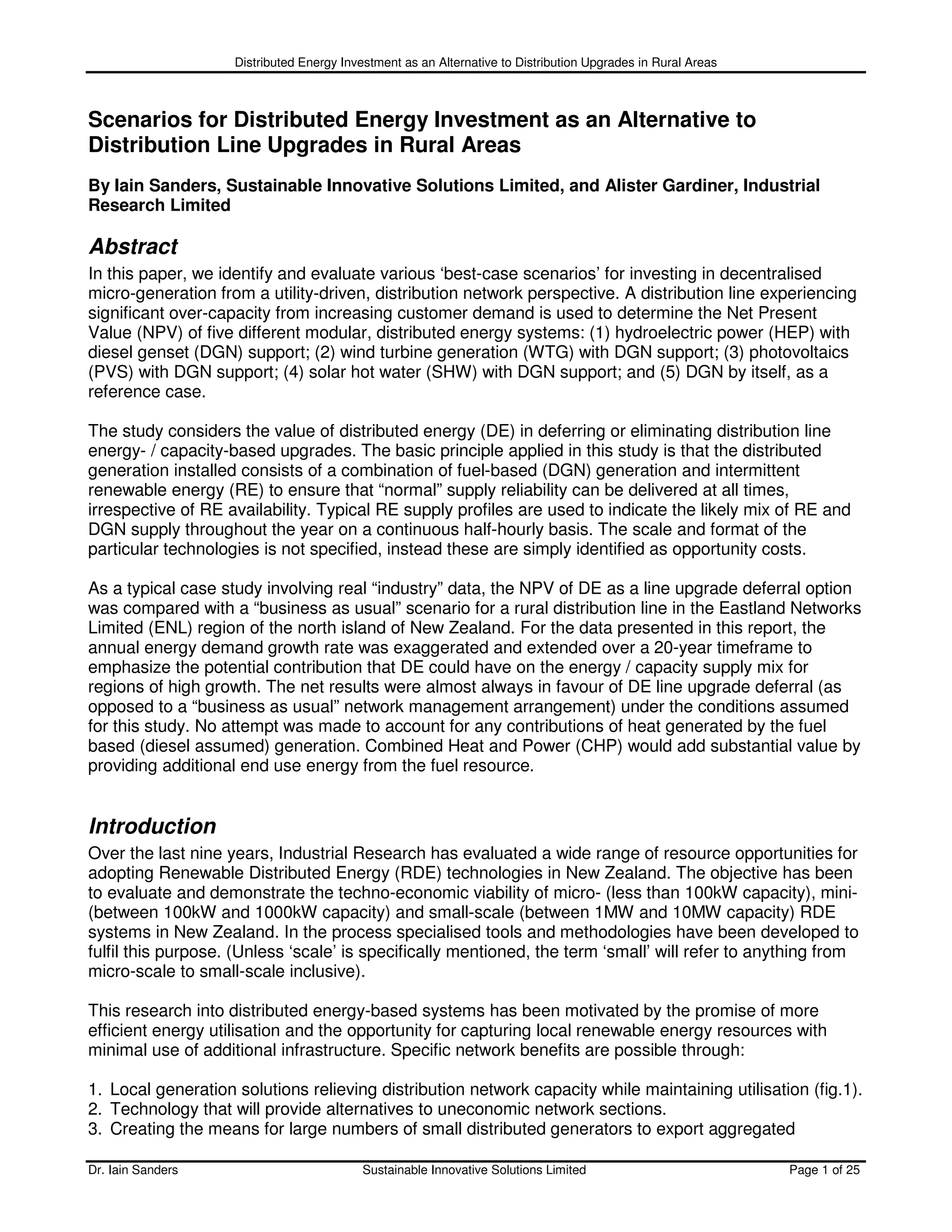
1. Local generation solutions relieving distribution network capacity while maintaining utilisation (fig.1).
2. Technology that will provide alternatives to uneconomic network sections.
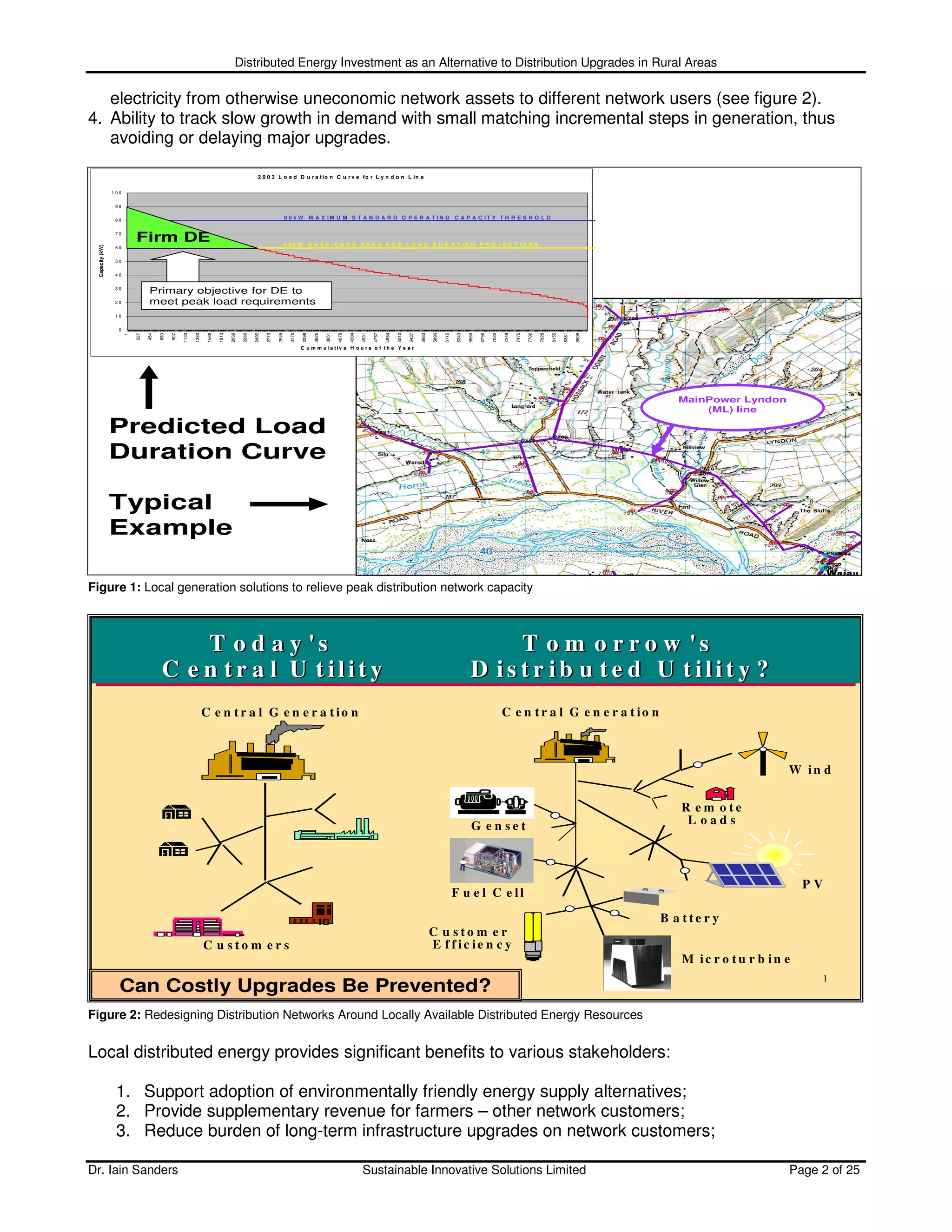
3. Creating the means for large numbers of small distributed generators to export aggregated

Dr. Iain Sanders                           Sustainable Innovative Solutions Limited                           Page 1 of 25
Distributed Energy Investment as an Alternative to Distribution Upgrades in Rural Areas

   electricity from otherwise uneconomic network assets to different network users (see figure 2).
4. Ability to track slow growth in demand with small matching incremental steps in generation, thus
   avoiding or delaying major upgrades.

                                                                                                 2 0 0 3 L o a d D u r a t io n C u r v e fo r L y n d o n L in e

                  100


                   90


                   80
                                                                                                                    8 0 k W M A X IM U M S T A N D A R D O P E R A T IN G C A P A C IT Y T H R E S H O L D

                   70
                            Firm DE                                                                                 6 0 k W B A S E - C A S E U S E D F O R L O A D D U R A T IO N P R O J E C T IO N S
  Capacity (kW)


                   60


                   50


                   40


                   30
                                  Primary objective for DE to
                   20             meet peak load requirements
                   10


                    0
                                                    1133

                                                           1360

                                                                   1586

                                                                          1813

                                                                                 2039

                                                                                        2266

                                                                                               2492

                                                                                                      2719

                                                                                                             2945

                                                                                                                      3172

                                                                                                                             3398

                                                                                                                                    3625

                                                                                                                                           3851

                                                                                                                                                  4078

                                                                                                                                                         4304

                                                                                                                                                                4531

                                                                                                                                                                       4757

                                                                                                                                                                              4984

                                                                                                                                                                                     5210

                                                                                                                                                                                            5437

                                                                                                                                                                                                   5663

                                                                                                                                                                                                          5890

                                                                                                                                                                                                                 6116

                                                                                                                                                                                                                         6343

                                                                                                                                                                                                                                6569

                                                                                                                                                                                                                                       6796

                                                                                                                                                                                                                                              7022

                                                                                                                                                                                                                                                     7249

                                                                                                                                                                                                                                                            7475

                                                                                                                                                                                                                                                                   7702

                                                                                                                                                                                                                                                                          7928

                                                                                                                                                                                                                                                                                 8155

                                                                                                                                                                                                                                                                                        8381

                                                                                                                                                                                                                                                                                               8608
                            227

                                  454

                                        680

                                              907
                        1


                                                                                                                             C u m m u la t iv e H o u r s o f t h e Y e a r


                                                                                                                                                                                                                                                                                                         MainPower Lyndon
                                                                                                                                                                                                                                                                                                             (ML) line

                  Predicted Load
                  Duration Curve

                  Typical
                  Example
                                                                                                                                                                                               What is Line
                                                                                                                                                                                               Upgrade Deferral?
Figure 1: Local generation solutions to relieve peak distribution network capacity


                                             T o d a y 's                                                                                                                                                                             T o m o r r o w 's
                                         C e n tr a l U tility                                                                                                                                                                   D is tr ib u te d U tility ?
                                                                  C e n tr a l G e n e r a tio n                                                                                                                                                     C e n tr a l G e n e r a t io n


                                                                                                                                                                                                                                                                                                                             W in d

                                                                                                                                                                                                                                                                                                         R em o te
                                                                                                                                                                                                                                  G en set                                                                L oads


                                                                                                                                                                                                                                                                                                                                 PV
                                                                                                                                                                                                                        F u e l C e ll
                                                                                                                                                                                                                                                                                                      B a tte r y
                                                                                                                                                                                                          C u sto m er
                                                                  C u sto m ers                                                                                                                           E f f ic ie n c y
                                                                                                                                                                                                                                                                                                          M ic r o tu r b in e
                                                                                                                                                                                                                                                                                                                                  1
                    Can Costly Upgrades Be Prevented?
  © 2 0 0 2 D i s t r i b u te d U t il it y A s s o c i a t e s


Figure 2: Redesigning Distribution Networks Around Locally Available Distributed Energy Resources


Local distributed energy provides significant benefits to various stakeholders:

                   1. Support adoption of environmentally friendly energy supply alternatives;
                   2. Provide supplementary revenue for farmers – other network customers;
                   3. Reduce burden of long-term infrastructure upgrades on network customers;

Dr. Iain Sanders                                                                                                                                                Sustainable Innovative Solutions Limited                                                                                                                     Page 2 of 25
Distributed Energy Investment as an Alternative to Distribution Upgrades in Rural Areas

    4. Reduce risk of failure of overloaded transmission and distribution lines, and potentially
       increase system security;
    5. Promote supply energy-efficiency;
    6. Only invest in what is required using modular distributed energy (DE) technologies; and,
    7. Potentially provide additional revenue / savings for network operators.

Using integrated distributed energy technologies, some technologies may be owned and controlled by
the networks, and some technologies may be owned and controlled by the customers. These potential
network benefits contrast with the more popular view that distributed generation threatens the
traditional electricity supply infrastructure by taking away energy delivery but not alleviating capacity
demands. Note that the network benefits are case specific, and are primarily based on demand growth
scenarios. Previous work by Industrial Research has identified few if any benefits accruing to
distribution networks from distributed generation in regions with static or declining load.

In the main, small-scale technology developers have been preoccupied with reducing the costs of their
own particular product in the high volume micro- / mini-scale embedded generation marketplace.
Unfortunately, no single technology can yet provide the quality of service delivered by the distribution
network, at the distribution network price. For example, a wind generator cannot guarantee firm
capacity, so the network must provide this; and, while a diesel genset can deliver capacity the cost of
energy from a diesel genset is generally too high, so it is relegated to a standby function. This paper
evaluates the ability of combinations of local resources to deliver matching energy and firm capacity to
complement grid based electricity services, and the value accrued from offsetting investment costs
associated with local growth.


Background of Research
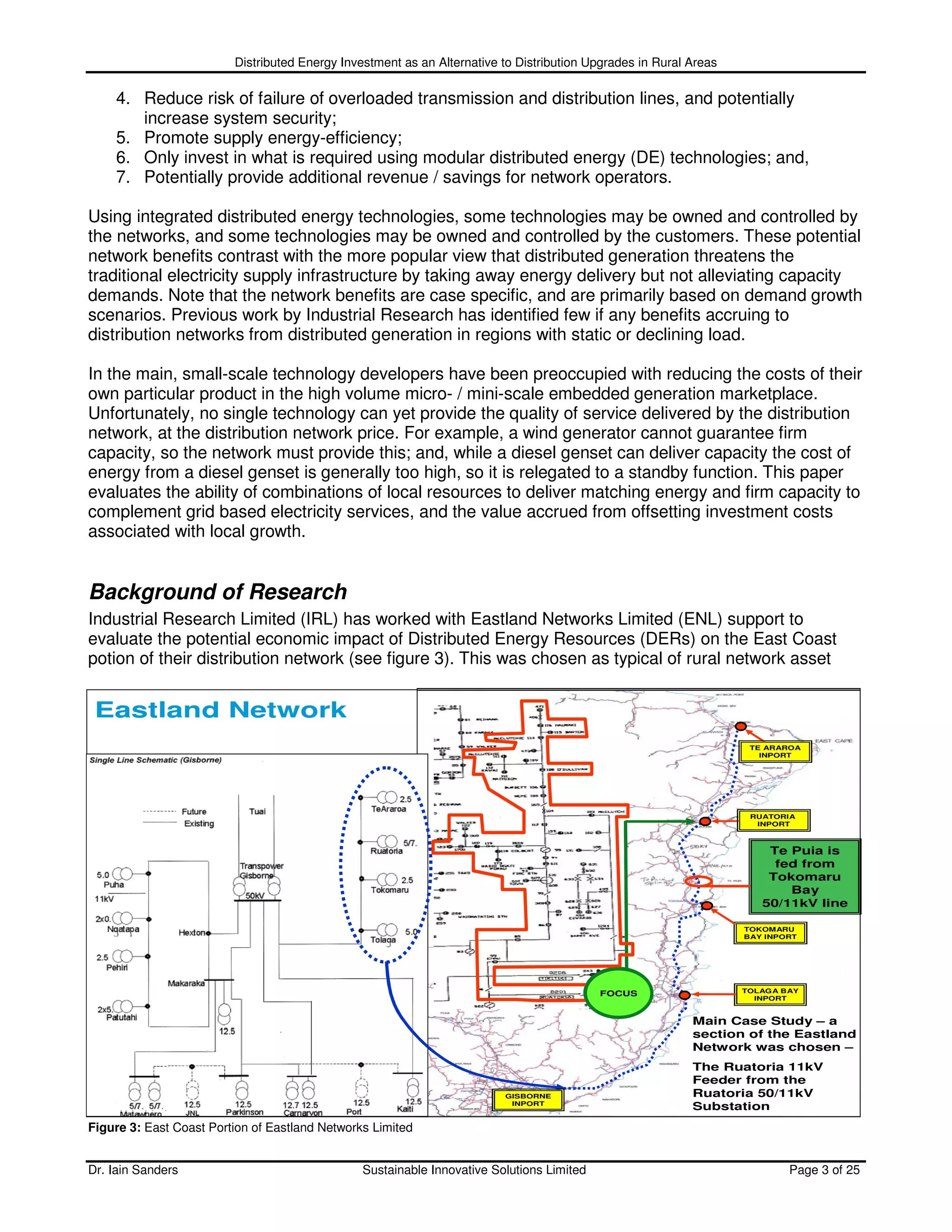
Industrial Research Limited (IRL) has worked with Eastland Networks Limited (ENL) support to
evaluate the potential economic impact of Distributed Energy Resources (DERs) on the East Coast
potion of their distribution network (see figure 3). This was chosen as typical of rural network asset


 Eastland Network
                                                                                                                    TE ARAROA
                                                                                                                      INPORT


                                                                                                                    RUATORIA
                                                                                                                     INPORT


                                                                                                                       Te Puia is
                                                                                                                        fed from
                                                                                                                       Tokomaru
                                                                                                                          Bay
                                                                                                                      50/11kV line

                                                                                                                   TOKOMARU
                                                                                                                   BAY INPORT


                                                                                           FOCUS                   TOLAGA BAY
                                                                                                                     INPORT


                                                                                                           Main Case Study – a
                                                                                                           section of the Eastland
                                                                                                           Network was chosen –
                                                                                                           The Ruatoria 11kV
                                                                                                           Feeder from the
                                                                         GISBORNE                          Ruatoria 50/11kV
                                                                          INPORT
                                                                                                           Substation
Figure 3: East Coast Portion of Eastland Networks Limited


Dr. Iain Sanders                                Sustainable Innovative Solutions Limited                                   Page 3 of 25
Distributed Energy Investment as an Alternative to Distribution Upgrades in Rural Areas

conditions and costs, because of the limited availability of detailed asset valuation. The East Coast
portion of the Eastland Network stretches from Gisborne in the south to Hick’s Bay in the north. A
single 50kV subtransmission line carries electricity from Gisborne up the coast to four substations at: 1.
Tolaga Bay, 2. Tokomaru Bay, 3. Ruatoria, and 4. Te Araroa (see figure 3).

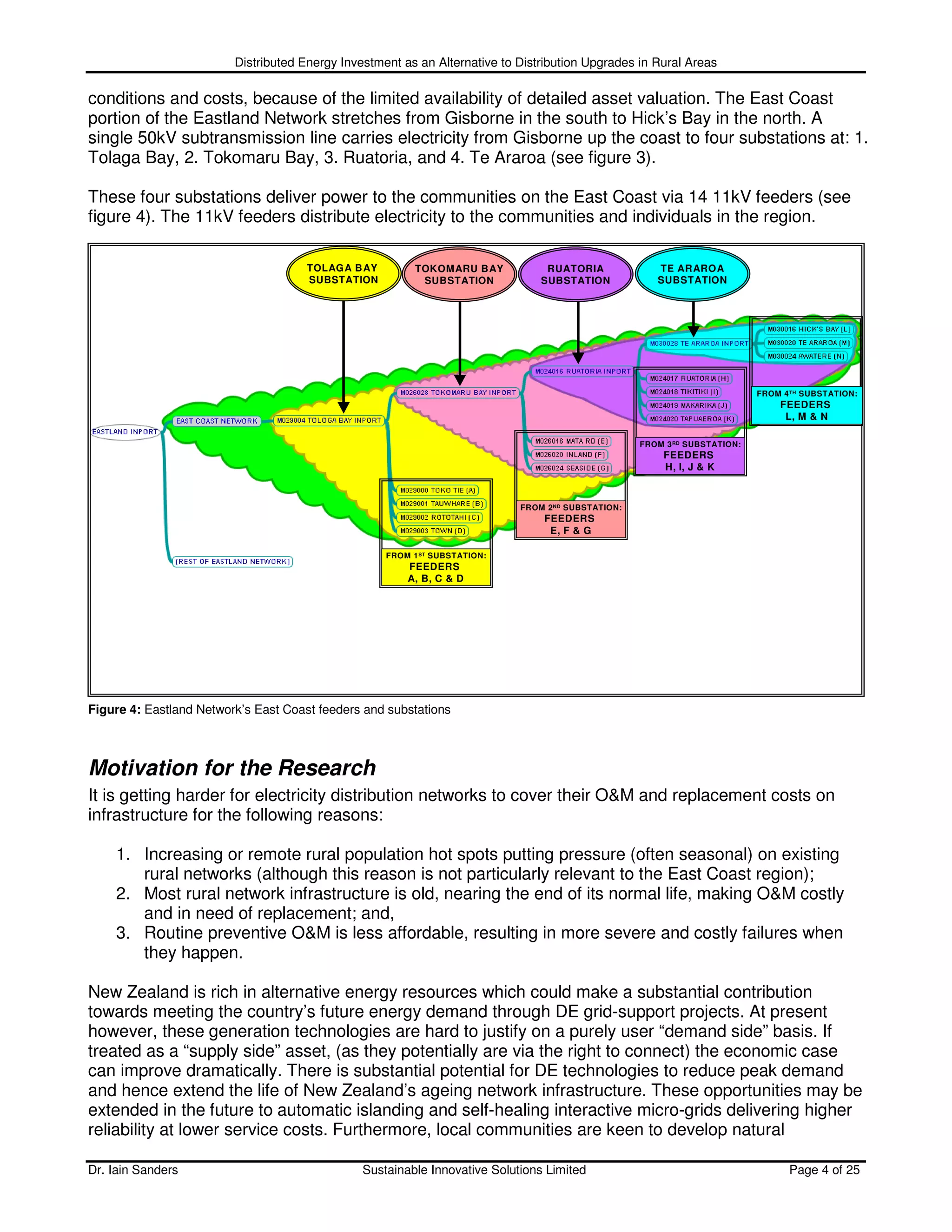
These four substations deliver power to the communities on the East Coast via 14 11kV feeders (see
figure 4). The 11kV feeders distribute electricity to the communities and individuals in the region.

                                      TOLAGA B AY         TOKOMARU BAY           RUATORIA              TE ARAROA
                                      SUBSTATION           SUBSTATION           SUBSTATION             SUBSTATION


                                                                                                                            FROM 4 TH SUBSTATION:
                                                                                                                                FEEDERS
                                                                                                                                 L, M & N

                                                                                                    FROM 3 RD SUBSTATION:
                                                                                                        FEEDERS
                                                                                                        H, I, J & K


                                                                            FROM 2 ND SUBSTATION:
                                                                                FEEDERS
                                                                                 E, F & G

                                                    FROM 1 ST SUBSTATION:
                                                        FEEDERS
                                                        A, B, C & D


Figure 4: Eastland Network’s East Coast feeders and substations


Motivation for the Research
It is getting harder for electricity distribution networks to cover their O&M and replacement costs on
infrastructure for the following reasons:

    1. Increasing or remote rural population hot spots putting pressure (often seasonal) on existing
       rural networks (although this reason is not particularly relevant to the East Coast region);
    2. Most rural network infrastructure is old, nearing the end of its normal life, making O&M costly
       and in need of replacement; and,
    3. Routine preventive O&M is less affordable, resulting in more severe and costly failures when
       they happen.

New Zealand is rich in alternative energy resources which could make a substantial contribution
towards meeting the country’s future energy demand through DE grid-support projects. At present
however, these generation technologies are hard to justify on a purely user “demand side” basis. If
treated as a “supply side” asset, (as they potentially are via the right to connect) the economic case
can improve dramatically. There is substantial potential for DE technologies to reduce peak demand
and hence extend the life of New Zealand’s ageing network infrastructure. These opportunities may be
extended in the future to automatic islanding and self-healing interactive micro-grids delivering higher
reliability at lower service costs. Furthermore, local communities are keen to develop natural

Dr. Iain Sanders                                Sustainable Innovative Solutions Limited                                          Page 4 of 25
Distributed Energy Investment as an Alternative to Distribution Upgrades in Rural Areas

resources for long-term sustainable development or as part of locally-sponsored sustainability
initiatives and programs. Providing that the regulatory and market environment is adapted to recognize
the benefits, these technologies will transform many aspects of network power in the future.


Methodology of the Study
In this study, three load growth scenarios representing a 1.5%, 5% and 10% increase in peak load per
year for 20 years were selected and used to demonstrate the potential value from deferring
infrastructure line upgrades, by using supplementary distributed energy to provide the peak load
shortfall whenever the physical limit of the distribution line was exceeded. The peak load shortfall was
calculated both as a capacity shortfall (in kW) and an energy shortfall requirement (in kWh), so that
the line upgrade deferral value (of investment in network infrastructure capacity to meet the peak load
shortfall) could be measured as a Net Present Value (NPV) marginal distribution capacity cost
(MDCC) in $/kW/year (known as the capacity-valuation method), and as a NPV marginal distribution
energy cost (MDEC) in $/kWh (known as the energy-valuation method).

The peak load capacity / energy shortfall requirement was determined by selecting an appropriate
capacity threshold (i.e. physical upper limit of feeder capacity supply) for the distribution feeder
meeting the demand. In this report, we cover the 10% annual load growth scenario, and show how
distributed energy can be used to reliably meet the capacity / energy shortfall resulting from demand
outstripping the capability of a network feeder to supply all the capacity / energy required.

Capacity / energy shortfalls from surplus demand were addressed by a combination of renewable (in
this case: hydroelectric, wind, photovoltaic and solar hot water) and fuel-driven (in this case diesel)
distributed energy. Ratios of 80%/20%, 50%/50% and 20%/80% RE/DGN were used, and these ratios
represent the proportion of capacity delivered by the RE and DGN components when 100% of the RE
capacity is available. If the peak capacity shortfall is 100kW for example, for a 50%/50% WTG/DGN
system, 50kW of WTG is the maximum capacity contribution from the wind (and the assumed name
plate sizing of the turbine) with the peak capacity shortfall balance of 50kW met by the diesel genset.

The capacity and energy shortfall requirements were calculated on a half-hourly basis over a 20-year
period for each of the load growth scenarios. These figures were converted into monetary values
using the network asset valuation reports to derive an annual financial contribution requirement to
operate, maintain and replace the existing feeder. The annual financial contribution to line upgrade /
replacement was discounted to provide the NPV marginal distribution cost introduced previously.

The total capacity and energy benefit derived from the various combinations of distributed energy (DE)
used, covered: (a) line upgrade deferral using RE and DGN; (b) peak distribution capacity shortfall
(wholesale) energy contributions from RE and DGN; (c) off-peak (wholesale) energy contributions
from RE (don’t want to waste non-peak RE available); (d) transmission peak load reduction at the grid
exit point (GXP) from RE and DGN capacity contributions. These benefits were offset by the capital
and O&M costs (including fuel costs) associated with using different DE combinations, and the loss in
network energy distribution revenue caused by using local DE to meet the demand instead of energy
imported from the GXP. The net benefit / cost was derived from the difference between these amounts,
and the return on investment (ROI) was derived from the ratio of these amounts. The economic
assumptions are summarized below in table 1:
Table 1: Key Economic Assumptions for DE Benefits and Fuel Costs
   Line Upgrade Deferral Value (Capacity-valuation method, MDCC)                      $99.37/kW/Year
   Line Upgrade Deferral Value (Energy-valuation method, MDEC)                        $0.0807/kWh
   GXP Transmission Savings Value                                                     $50.62/kW/Year
   Energy Wholesale Price                                                             $0.1289/kWh
   Energy Distribution Revenue Loss                                                   $0.0687/kWh
   Diesel Fuel Price and Annual Increase Range                                        $1-$3.00/litre, 2-10%/Year increase

Dr. Iain Sanders                               Sustainable Innovative Solutions Limited                            Page 5 of 25
Distributed Energy Investment as an Alternative to Distribution Upgrades in Rural Areas


Ruatoria Feeder Case Study
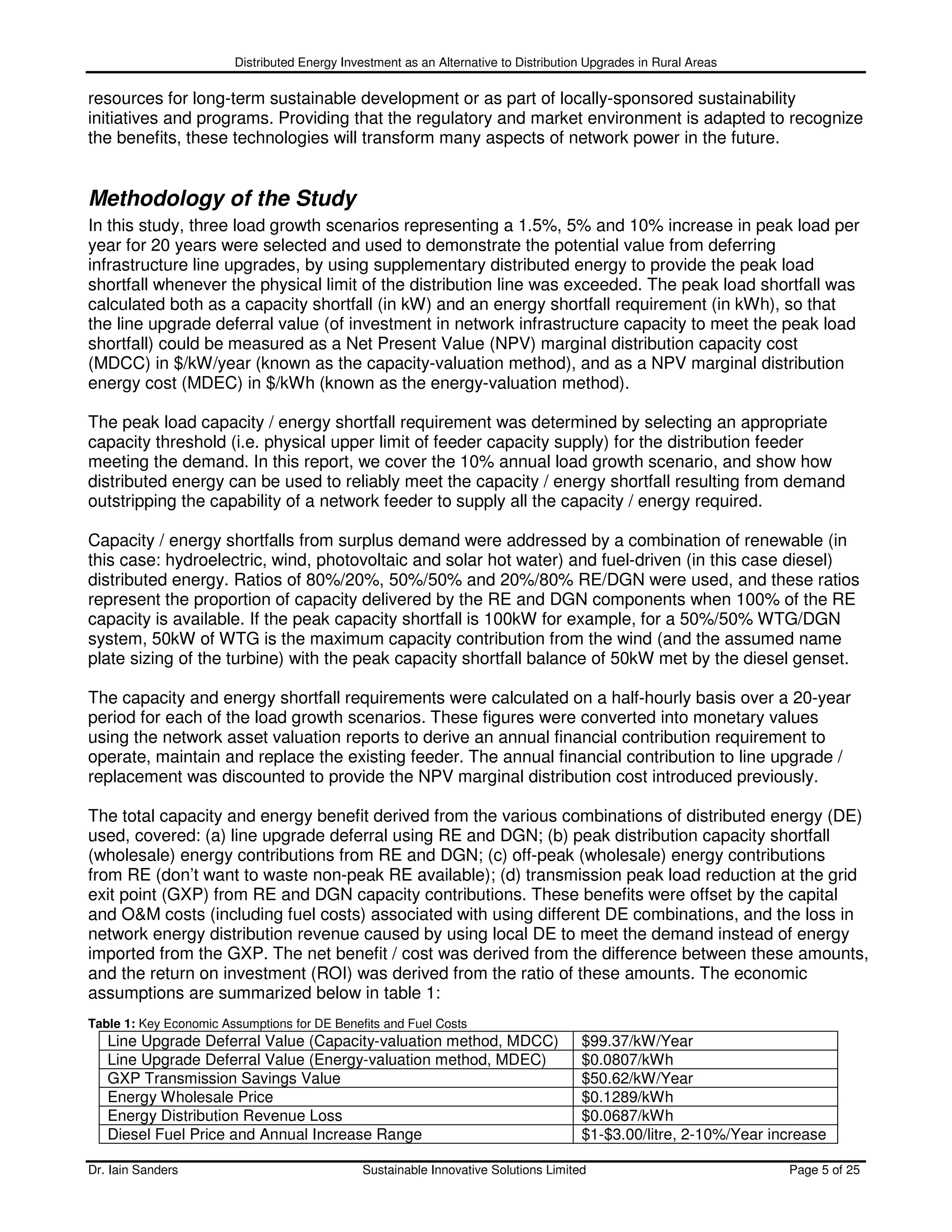
The Ruatoria feeder (see figure 4) on the Ruatoria substation (see figure 3) was selected for this study
(see figure 5). This feeder was selected because it demonstrated an annual increase of peak capacity,
and detailed asset management information along with half-hourly demand information was available.


Figure 5: Ruatoria Feeder Half-hourly Capacity Profiles for 2001-2003


Load Profile History and Projections
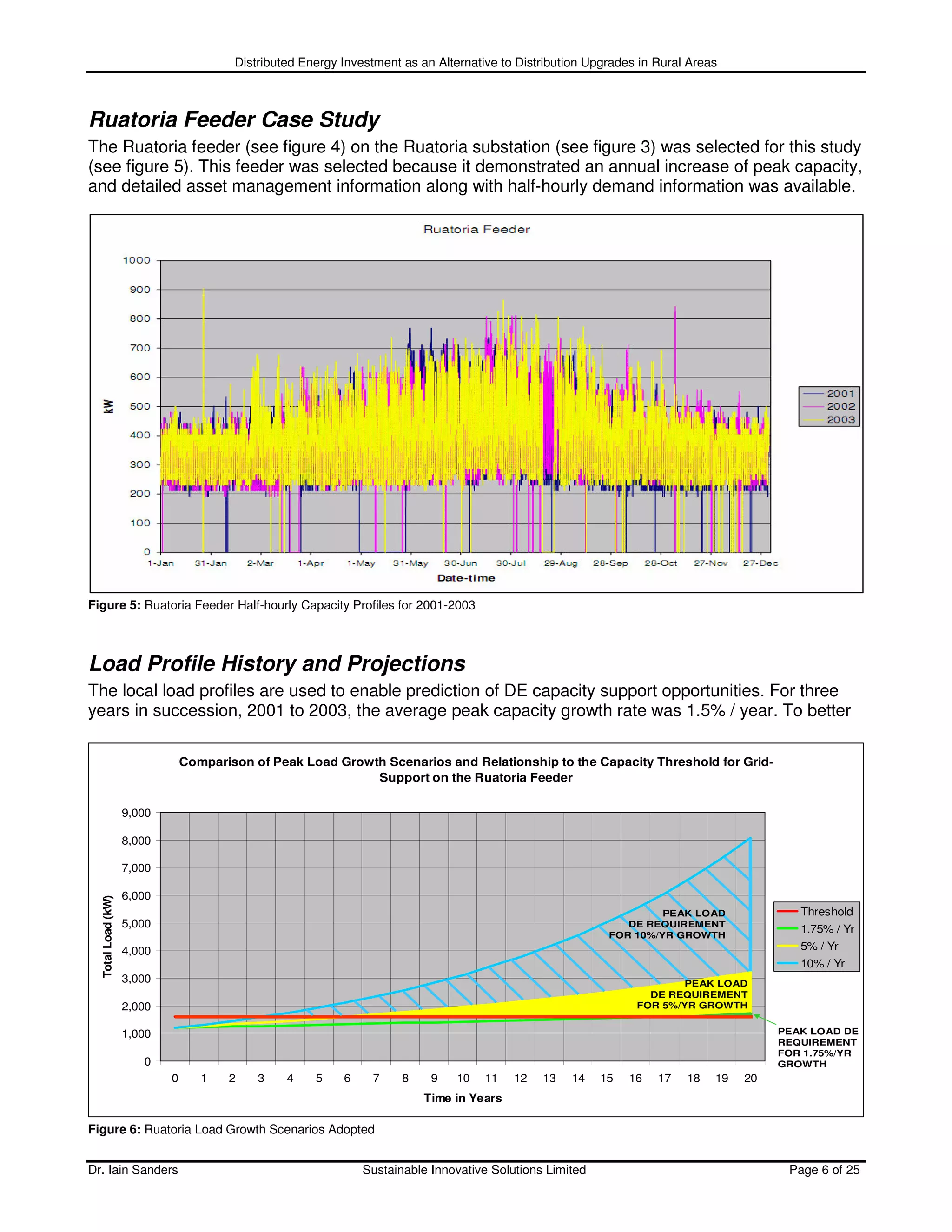
The local load profiles are used to enable prediction of DE capacity support opportunities. For three
years in succession, 2001 to 2003, the average peak capacity growth rate was 1.5% / year. To better

                                Comparison of Peak Load Growth Scenarios and Relationship to the Capacity Threshold for Grid-
                                                             Support on the Ruatoria Feeder

                    9,000

                    8,000

                    7,000

                    6,000
  Total Load (kW)


                                                                                                                    PEAK LOAD              Threshold
                    5,000                                                                                     DE REQUIREMENT
                                                                                                                                           1.75% / Yr
                                                                                                           FOR 10%/YR GROWTH
                    4,000                                                                                                                  5% / Yr
                                                                                                                                           10% / Yr
                    3,000                                                                                               PEAK LOAD
                                                                                                                  DE REQUIREMENT
                    2,000                                                                                       FOR 5%/YR GROWTH


                    1,000                                                                                                               PEAK LOAD DE
                                                                                                                                        REQUIREMENT
                                                                                                                                        FOR 1.75%/YR
                       0                                                                                                                GROWTH
                            0      1   2    3    4    5    6    7     8    9    10   11   12   13   14    15   16   17   18   19   20
                                                                          Time in Years

Figure 6: Ruatoria Load Growth Scenarios Adopted


Dr. Iain Sanders                                               Sustainable Innovative Solutions Limited                                  Page 6 of 25
Distributed Energy Investment as an Alternative to Distribution Upgrades in Rural Areas

illustrate the potential impact of DE on line upgrade deferral for the more general case, growth
projections of: 1.75, 5 and 10% / year were investigated. A peak capacity threshold of 1,600kW was
selected to illustrate the methodology used, although the exact capacity constraints were not identified.
The capacity threshold represents the capacity above which the feeder is overloaded due to voltage
drop, overheating or overloading etc. (see figure 6). We have assumed that the demand profile and
load factor do not change over this growth period. Detailed analysis presented here gives the results
obtained for the 10% load growth scenario to emphasize the potential impacts of DE technologies.


Assessing Costs of Network Upgrades
In order to derive the benefit available from installing DE to meet the peak load requirement when the
threshold capacity of the Ruatoria Feeder is surpassed (1,600kW for the purposes of this case study),
it is necessary to calculate the line upgrade deferral value of the feeder. The line upgrade deferral
value is calculated by combining the direct and indirect annual O&M costs of the feeder with the
hypothetical cost of reinvestment once existing infrastructure is replaced. The following information
has been provided by ENL, based upon ENL network data and ENL assumptions made.
     Direct & Indirect Annual O&M Costs (Derived from ENL Asset
     Management Plan and ENL Asset Accounting Spreadsheets)
        Direct Costs = $935 / km / Year
        Indirect Costs = $66 / Connection / Year
                               FEEDER             Length (km)    No. of Connections         Annual O&M Costs
                   Ruatoria: H. Ruatoria                20.000                   333                $40,678.00

     Estimated cost of reinvestment once existing infrastructure is
     replaced (as assessed by ENL)
        Annual reinvestment cost = {ODRC x 2} / 40 (lifetime)
        ODRC = Optimized Depreciation Replacement Cost
     Total Return = Annual O&M Costs + Annual Reinvestment
                               FEEDER      Reinvestment / Yr.    Annual O&M Costs        Total Annual Required
                   Ruatoria: H. Ruatoria         $33,350            $40,678.00                $74,028.00


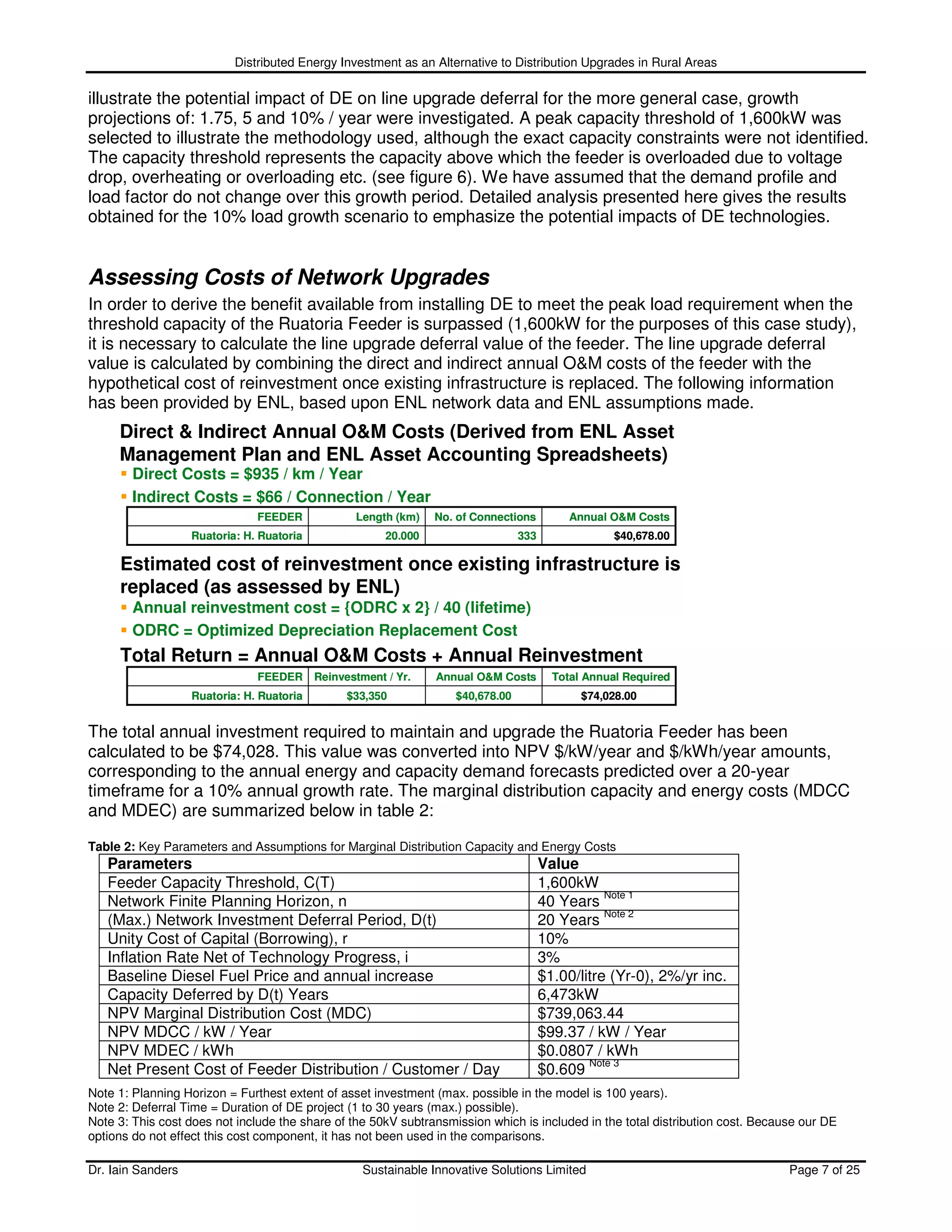
The total annual investment required to maintain and upgrade the Ruatoria Feeder has been
calculated to be $74,028. This value was converted into NPV $/kW/year and $/kWh/year amounts,
corresponding to the annual energy and capacity demand forecasts predicted over a 20-year
timeframe for a 10% annual growth rate. The marginal distribution capacity and energy costs (MDCC
and MDEC) are summarized below in table 2:

Table 2: Key Parameters and Assumptions for Marginal Distribution Capacity and Energy Costs
   Parameters                                                                          Value
   Feeder Capacity Threshold, C(T)                                                     1,600kW
                                                                                                  Note 1
   Network Finite Planning Horizon, n                                                  40 Years
                                                                                                  Note 2
   (Max.) Network Investment Deferral Period, D(t)                                     20 Years
   Unity Cost of Capital (Borrowing), r                                                10%
   Inflation Rate Net of Technology Progress, i                                        3%
   Baseline Diesel Fuel Price and annual increase                                      $1.00/litre (Yr-0), 2%/yr inc.
   Capacity Deferred by D(t) Years                                                     6,473kW
   NPV Marginal Distribution Cost (MDC)                                                $739,063.44
   NPV MDCC / kW / Year                                                                $99.37 / kW / Year
   NPV MDEC / kWh                                                                      $0.0807 / kWh
                                                                                               Note 3
   Net Present Cost of Feeder Distribution / Customer / Day                            $0.609
Note 1: Planning Horizon = Furthest extent of asset investment (max. possible in the model is 100 years).
Note 2: Deferral Time = Duration of DE project (1 to 30 years (max.) possible).
Note 3: This cost does not include the share of the 50kV subtransmission which is included in the total distribution cost. Because our DE
options do not effect this cost component, it has not been used in the comparisons.

Dr. Iain Sanders                                    Sustainable Innovative Solutions Limited                                    Page 7 of 25
Distributed Energy Investment as an Alternative to Distribution Upgrades in Rural Areas


Assessing Costs of Network Upgrades
The values in the list above for the net present value marginal distribution capacity and energy cost
(NPV MDCC and NPV MDEC): $99.37/kW/year and $0.0807/kWh/year, compare reasonably well with
data from other sources and represent the value per unit capacity and energy per year of deferring
distribution network upgrade by a year via reliable DE peak capacity / energy network-support. There
are however, costs to the network from introducing reliable DE, and these will reduce the net benefits
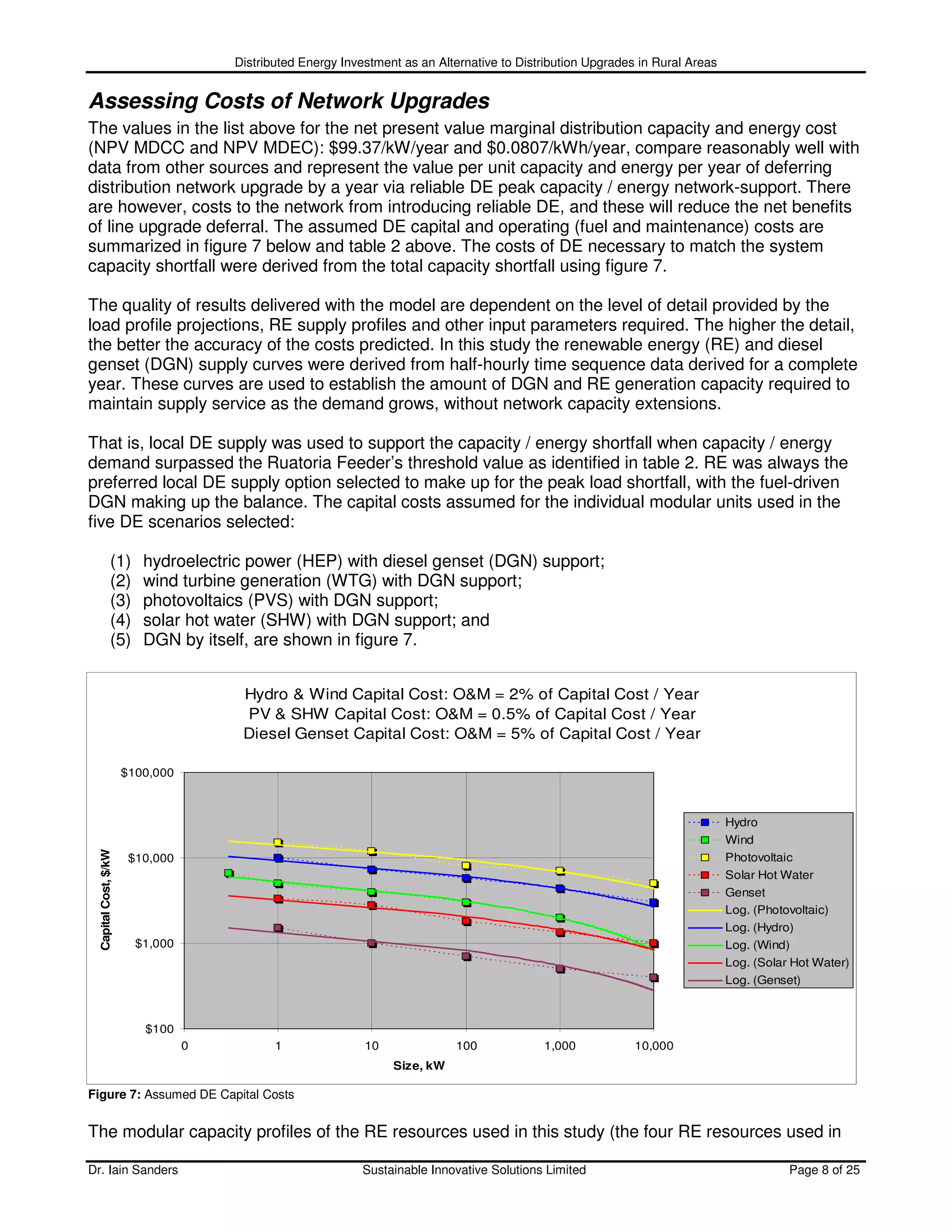
of line upgrade deferral. The assumed DE capital and operating (fuel and maintenance) costs are
summarized in figure 7 below and table 2 above. The costs of DE necessary to match the system
capacity shortfall were derived from the total capacity shortfall using figure 7.

The quality of results delivered with the model are dependent on the level of detail provided by the
load profile projections, RE supply profiles and other input parameters required. The higher the detail,
the better the accuracy of the costs predicted. In this study the renewable energy (RE) and diesel
genset (DGN) supply curves were derived from half-hourly time sequence data derived for a complete
year. These curves are used to establish the amount of DGN and RE generation capacity required to
maintain supply service as the demand grows, without network capacity extensions.

That is, local DE supply was used to support the capacity / energy shortfall when capacity / energy
demand surpassed the Ruatoria Feeder’s threshold value as identified in table 2. RE was always the
preferred local DE supply option selected to make up for the peak load shortfall, with the fuel-driven
DGN making up the balance. The capital costs assumed for the individual modular units used in the
five DE scenarios selected:

                 (1)      hydroelectric power (HEP) with diesel genset (DGN) support;
                 (2)      wind turbine generation (WTG) with DGN support;
                 (3)      photovoltaics (PVS) with DGN support;
                 (4)      solar hot water (SHW) with DGN support; and
                 (5)      DGN by itself, are shown in figure 7.


                                       Hydro & Wind Capital Cost: O&M = 2% of Capital Cost / Year
                                       PV & SHW Capital Cost: O&M = 0.5% of Capital Cost / Year
                                       Diesel Genset Capital Cost: O&M = 5% of Capital Cost / Year

                       $100,000


                                                                                                                                Hydro
                                                                                                                                Wind
  Capital Cost, $/kW


                        $10,000                                                                                                 Photovoltaic
                                                                                                                                Solar Hot Water
                                                                                                                                Genset
                                                                                                                                Log. (Photovoltaic)
                                                                                                                                Log. (Hydro)
                         $1,000                                                                                                 Log. (Wind)
                                                                                                                                Log. (Solar Hot Water)
                                                                                                                                Log. (Genset)


                          $100
                                  0          1               10              100             1,000            10,000
                                                                  Size, kW

Figure 7: Assumed DE Capital Costs


The modular capacity profiles of the RE resources used in this study (the four RE resources used in

Dr. Iain Sanders                                             Sustainable Innovative Solutions Limited                                      Page 8 of 25
Distributed Energy Investment as an Alternative to Distribution Upgrades in Rural Areas

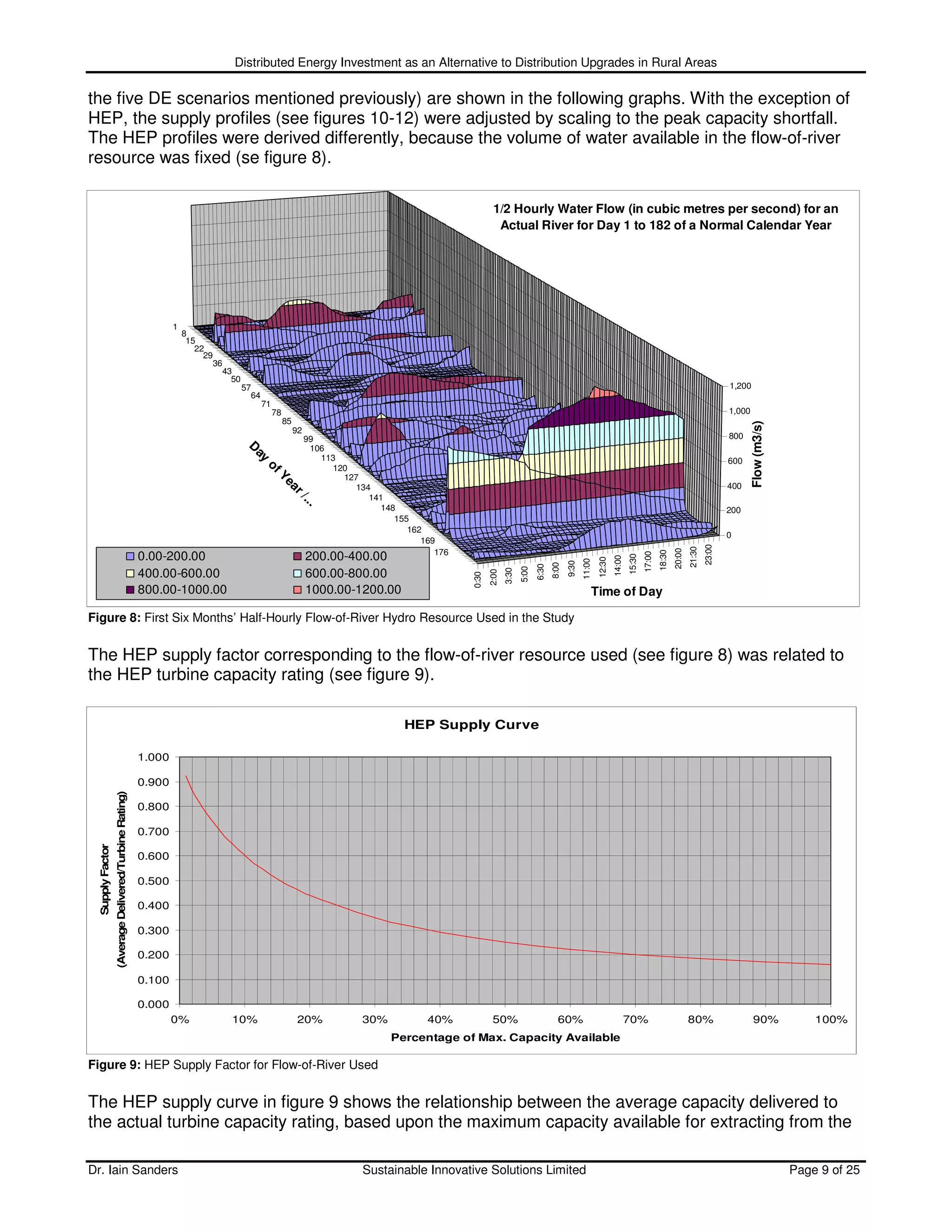
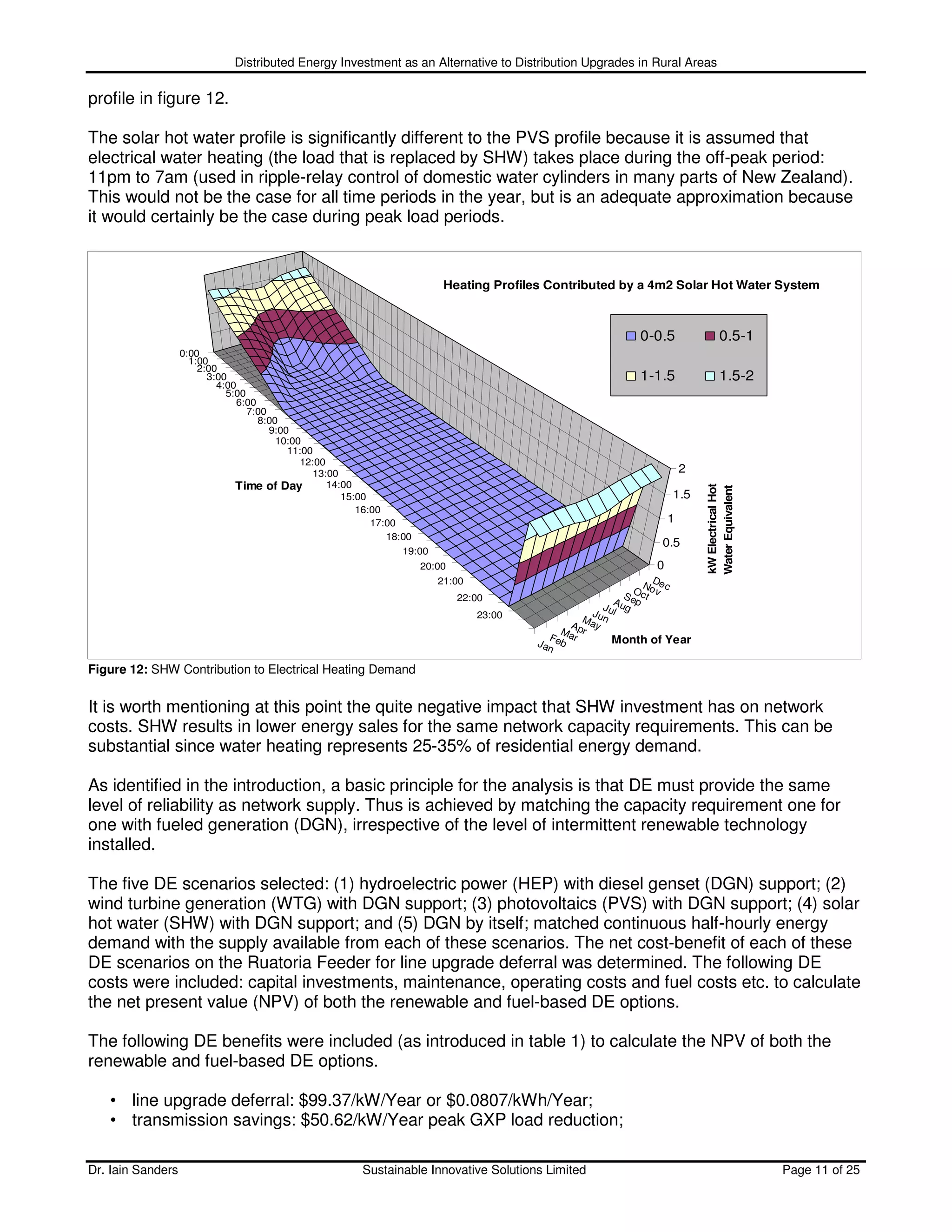
the five DE scenarios mentioned previously) are shown in the following graphs. With the exception of
HEP, the supply profiles (see figures 10-12) were adjusted by scaling to the peak capacity shortfall.
The HEP profiles were derived differently, because the volume of water available in the flow-of-river
resource was fixed (se figure 8).

                                                                                                                                                 1/2 Hourly Water Flow (in cubic metres per second) for an
                                                                                                                                                  Actual River for Day 1 to 182 of a Normal Calendar Year


                                                               1
                                                                   8
                                                                    15
                                                                      22
                                                                        29
                                                                          36
                                                                            43
                                                                              50
                                                                                   57                                                                                                                                                                             1,200
                                                                                     64
                                                                                          71
                                                                                               78                                                                                                                                                                 1,000
                                                                                                    85


                                                                                                                                                                                                                                                                          Flow (m3/s)
                                                                                                         92
                                                                                                      99                                                                                                                                                          800
                                                                                    D
                                                                                        ay                106
                                                                                                            113
                                                                                             of               120
                                                                                                                                                                                                                                                                  600
                                                                                                Ye              127
                                                                                                  ar              134                                                                                                                                             400
                                                                                                     /..             141
                                                                                                         .             148                                                                                                                                        200
                                                                                                                          155
                                                                                                                             162
                                                                                                                                                                                                                                                                  0
                                                                                                                                169


                                                                                                                                                                                                                                                          23:00
                                                                                                                                                                                                                                                  21:30
                                                                                                                                                                                                                                          20:00
                                                                                                                                   176


                                                                                                                                                                                                                                  18:30
                                                       0.00-200.00                                            200.00-400.00


                                                                                                                                                                                                                          17:00
                                                                                                                                                                                                                  15:30
                                                                                                                                                                                                          14:00
                                                                                                                                                                                                  12:30
                                                                                                                                                                                          11:00
                                                                                                                                                                                   9:30
                                                                                                                                                                            8:00
                                                                                                                                                                     6:30
                                                                                                                                                              5:00
                                                                                                                                                       3:30


                                                       400.00-600.00                                          600.00-800.00
                                                                                                                                                2:00
                                                                                                                                         0:30


                                                       800.00-1000.00                                         1000.00-1200.00                                                                 Time of Day

Figure 8: First Six Months’ Half-Hourly Flow-of-River Hydro Resource Used in the Study


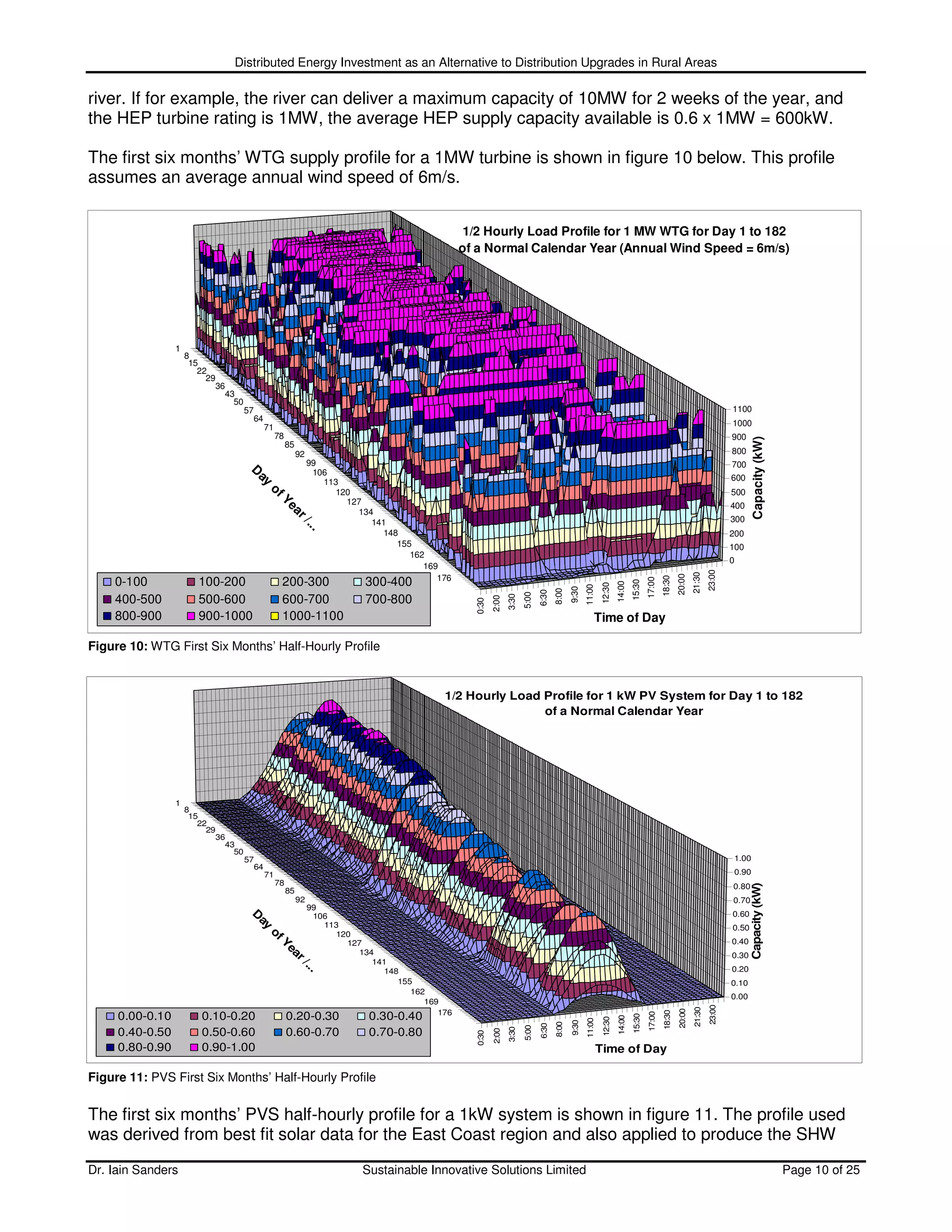
The HEP supply factor corresponding to the flow-of-river resource used (see figure 8) was related to
the HEP turbine capacity rating (see figure 9).

                                                                                                                                HEP Supply Curve

                                                       1.000

                                                       0.900
                  (Average Delivered/Turbine Rating)


                                                       0.800

                                                       0.700
  Supply Factor


                                                       0.600

                                                       0.500

                                                       0.400

                                                       0.300

                                                       0.200

                                                       0.100

                                                       0.000
                                                               0%             10%                        20%          30%         40%            50%                          60%                                 70%                             80%                      90%              100%
                                                                                                                            Percentage of Max. Capacity Available

Figure 9: HEP Supply Factor for Flow-of-River Used


The HEP supply curve in figure 9 shows the relationship between the average capacity delivered to
the actual turbine capacity rating, based upon the maximum capacity available for extracting from the

Dr. Iain Sanders                                                                                                      Sustainable Innovative Solutions Limited                                                                                                                          Page 9 of 25
Distributed Energy Investment as an Alternative to Distribution Upgrades in Rural Areas

river. If for example, the river can deliver a maximum capacity of 10MW for 2 weeks of the year, and
the HEP turbine rating is 1MW, the average HEP supply capacity available is 0.6 x 1MW = 600kW.

The first six months’ WTG supply profile for a 1MW turbine is shown in figure 10 below. This profile
assumes an average annual wind speed of 6m/s.


                                                                                             1/2 Hourly Load Profile for 1 MW WTG for Day 1 to 182
                                                                                            of a Normal Calendar Year (Annual Wind Speed = 6m/s)


                 1
                     8
                      15
                        22
                          29
                            36
                              43
                                50
                                     57                                                                                                                                                                                  1100
                                       64
                                            71                                                                                                                                                                           1000
                                                 78                                                                                                                                                                      900


                                                                                                                                                                                                                                Capacity (kW)
                                                      85
                                                           92                                                                                                                                                            800
                                                          99                                                                                                                                                             700
                                      D
                                          ay                 106
                                                                                                                                                                                                                         600
                                               of              113
                                                                 120                                                                                                                                                     500
                                                  Ye               127
                                                     ar              134
                                                                                                                                                                                                                         400
                                                        / ..            141                                                                                                                                              300
                                                             .
                                                                          148                                                                                                                                            200
                                                                             155                                                                                                                                         100
                                                                                162
                                                                                                                                                                                                                         0
                                                                                   169


                                                                                                                                                                                                                 23:00
                                                                                                                                                                                                         21:30
                                                                                                                                                                                                 20:00
                                                                                      176


                                                                                                                                                                                         18:30
    0-100               100-200                   200-300            300-400


                                                                                                                                                                                 17:00
                                                                                                                                                                         15:30
                                                                                                                                                                 14:00
                                                                                                                                                         12:30
                                                                                                                                                11:00
                                                                                                                                         9:30
                                                                                                                                  8:00
                                                                                                                           6:30
                                                                                                                    5:00
                                                                                                             3:30


    400-500             500-600                   600-700            700-800
                                                                                                      2:00
                                                                                              0:30


    800-900             900-1000                  1000-1100                                                                                         Time of Day

Figure 10: WTG First Six Months’ Half-Hourly Profile


                                                                                       1/2 Hourly Load Profile for 1 kW PV System for Day 1 to 182
                                                                                                       of a Normal Calendar Year


                 1
                     8
                      15
                        22
                          29
                            36
                              43
                                50
                                     57                                                                                                                                                                                  1.00
                                       64
                                            71                                                                                                                                                                           0.90
                                                 78
                                                                                                                                                                                                                                Capacity (kW)


                                                                                                                                                                                                                         0.80
                                                      85
                                                           92                                                                                                                                                            0.70
                                                         99
                                      D                                                                                                                                                                                  0.60
                                          ay                106
                                                              113
                                               of               120
                                                                                                                                                                                                                         0.50
                                                  Y                                                                                                                                                                      0.40
                                                   ea             127
                                                     r/             134                                                                                                                                                  0.30
                                                        ...            141
                                                                         148                                                                                                                                             0.20
                                                                            155                                                                                                                                          0.10
                                                                               162
                                                                                                                                                                                                                         0.00
                                                                                  169
                                                                                                                                                                                                                 23:00
                                                                                                                                                                                                         21:30
                                                                                                                                                                                                 20:00


                                                                                     176
                                                                                                                                                                                         18:30


     0.00-0.10          0.10-0.20                     0.20-0.30      0.30-0.40
                                                                                                                                                                                 17:00
                                                                                                                                                                         15:30
                                                                                                                                                                 14:00
                                                                                                                                                         12:30
                                                                                                                                                11:00
                                                                                                                                         9:30
                                                                                                                                  8:00
                                                                                                                           6:30
                                                                                                                    5:00
                                                                                                             3:30


     0.40-0.50          0.50-0.60                     0.60-0.70      0.70-0.80
                                                                                                      2:00
                                                                                               0:30


     0.80-0.90          0.90-1.00                                                                                                                       Time of Day

Figure 11: PVS First Six Months’ Half-Hourly Profile


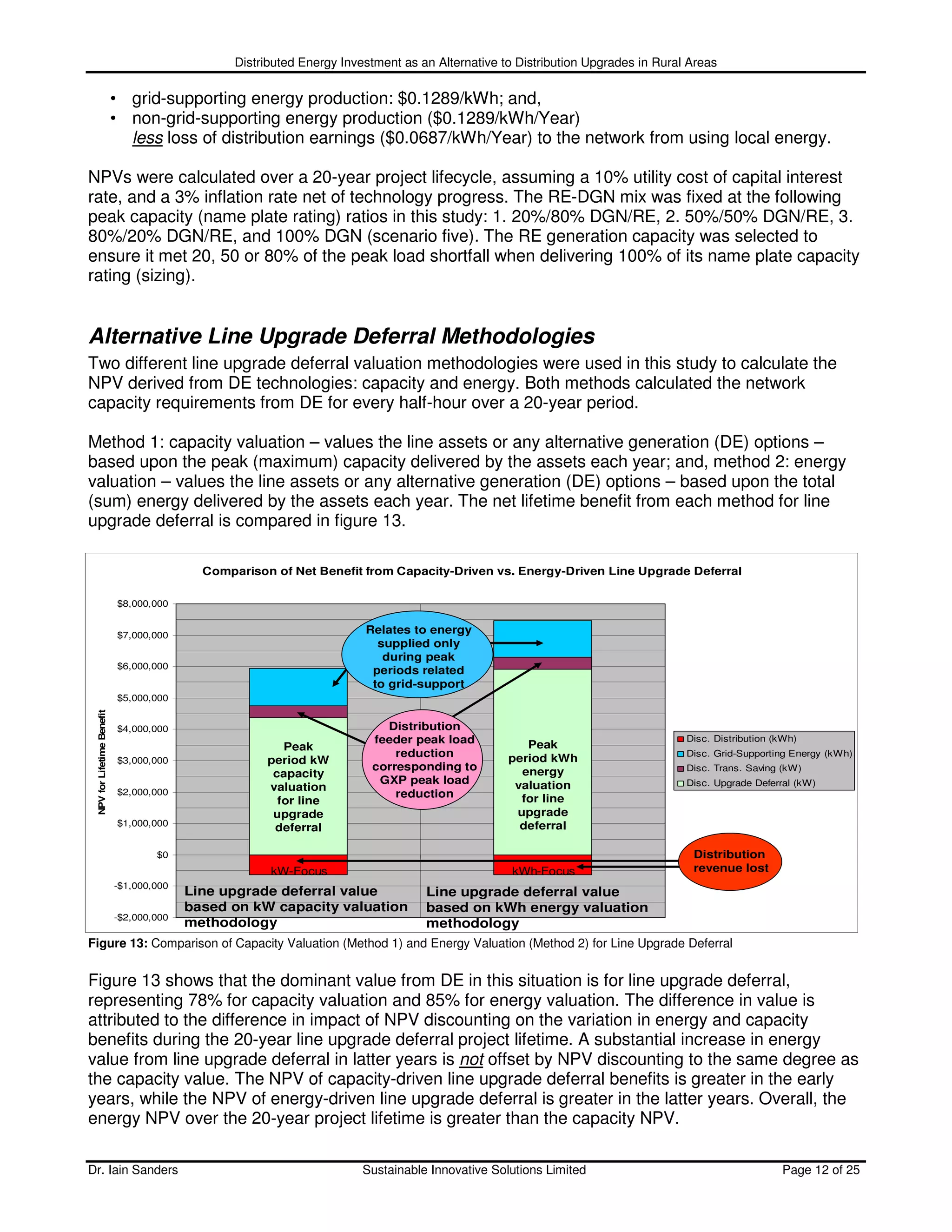
The first six months’ PVS half-hourly profile for a 1kW system is shown in figure 11. The profile used
was derived from best fit solar data for the East Coast region and also applied to produce the SHW
Dr. Iain Sanders                                                    Sustainable Innovative Solutions Limited                                                                                                                                    Page 10 of 25
Distributed Energy Investment as an Alternative to Distribution Upgrades in Rural Areas

profile in figure 12.

The solar hot water profile is significantly different to the PVS profile because it is assumed that
electrical water heating (the load that is replaced by SHW) takes place during the off-peak period:
11pm to 7am (used in ripple-relay control of domestic water cylinders in many parts of New Zealand).
This would not be the case for all time periods in the year, but is an adequate approximation because
it would certainly be the case during peak load periods.


                                                                           Heating Profiles Contributed by a 4m2 Solar Hot Water System


                                                                                                            0-0.5                 0.5-1
                   0:00
                     1:00
                       2:00
                         3:00                                                                               1-1.5                 1.5-2
                           4:00
                             5:00
                               6:00
                                  7:00
                                    8:00
                                       9:00
                                        10:00
                                           11:00
                                             12:00
                                                13:00                                                                  2
                               Time of Day         14:00


                                                                                                                           kW Electrical Hot
                                                                                                                           Water Equivalent
                                                      15:00                                                        1.5
                                                         16:00
                                                            17:00                                                  1
                                                               18:00
                                                                                                                0.5
                                                                  19:00
                                                                     20:00                                     0
                                                                          21:00                                   D
                                                                                                                N ec
                                                                                                              O o
                                                                             22:00                         S e ct v
                                                                                                         A    p
                                                                                                        J ug
                                                                                                     J ul
                                                                                  23:00             M un
                                                                                                  Ap ay
                                                                                                M r
                                                                                             F ar        Month of Year
                                                                                          J an eb

Figure 12: SHW Contribution to Electrical Heating Demand


It is worth mentioning at this point the quite negative impact that SHW investment has on network
costs. SHW results in lower energy sales for the same network capacity requirements. This can be
substantial since water heating represents 25-35% of residential energy demand.

As identified in the introduction, a basic principle for the analysis is that DE must provide the same
level of reliability as network supply. Thus is achieved by matching the capacity requirement one for
one with fueled generation (DGN), irrespective of the level of intermittent renewable technology
installed.

The five DE scenarios selected: (1) hydroelectric power (HEP) with diesel genset (DGN) support; (2)
wind turbine generation (WTG) with DGN support; (3) photovoltaics (PVS) with DGN support; (4) solar
hot water (SHW) with DGN support; and (5) DGN by itself; matched continuous half-hourly energy
demand with the supply available from each of these scenarios. The net cost-benefit of each of these
DE scenarios on the Ruatoria Feeder for line upgrade deferral was determined. The following DE
costs were included: capital investments, maintenance, operating costs and fuel costs etc. to calculate
the net present value (NPV) of both the renewable and fuel-based DE options.

The following DE benefits were included (as introduced in table 1) to calculate the NPV of both the
renewable and fuel-based DE options.

   • line upgrade deferral: $99.37/kW/Year or $0.0807/kWh/Year;
   • transmission savings: $50.62/kW/Year peak GXP load reduction;

Dr. Iain Sanders                                         Sustainable Innovative Solutions Limited                                              Page 11 of 25
Distributed Energy Investment as an Alternative to Distribution Upgrades in Rural Areas

                            • grid-supporting energy production: $0.1289/kWh; and,
                            • non-grid-supporting energy production ($0.1289/kWh/Year)
                              less loss of distribution earnings ($0.0687/kWh/Year) to the network from using local energy.

NPVs were calculated over a 20-year project lifecycle, assuming a 10% utility cost of capital interest
rate, and a 3% inflation rate net of technology progress. The RE-DGN mix was fixed at the following
peak capacity (name plate rating) ratios in this study: 1. 20%/80% DGN/RE, 2. 50%/50% DGN/RE, 3.
80%/20% DGN/RE, and 100% DGN (scenario five). The RE generation capacity was selected to
ensure it met 20, 50 or 80% of the peak load shortfall when delivering 100% of its name plate capacity
rating (sizing).


Alternative Line Upgrade Deferral Methodologies
Two different line upgrade deferral valuation methodologies were used in this study to calculate the
NPV derived from DE technologies: capacity and energy. Both methods calculated the network
capacity requirements from DE for every half-hour over a 20-year period.

Method 1: capacity valuation – values the line assets or any alternative generation (DE) options –
based upon the peak (maximum) capacity delivered by the assets each year; and, method 2: energy
valuation – values the line assets or any alternative generation (DE) options – based upon the total
(sum) energy delivered by the assets each year. The net lifetime benefit from each method for line
upgrade deferral is compared in figure 13.

                                            Comparison of Net Benefit from Capacity-Driven vs. Energy-Driven Line Upgrade Deferral

                            $8,000,000


                            $7,000,000
                                                                        Relates to energy
                                                                          supplied only
                                                                           during peak
                            $6,000,000
                                                                         periods related
                                                                         to grid-support
                            $5,000,000
 NPV for Lifetime Benefit


                            $4,000,000                                     Distribution
                                                                         feeder peak load            Peak
                                                                                                                                  Disc. Distribution (kWh)
                                                         Peak
                                                                             reduction            period kWh                      Disc. Grid-Supporting Energy (kWh)
                            $3,000,000                period kW
                                                                         corresponding to           energy                        Disc. Trans. Saving (kW)
                                                       capacity
                                                                          GXP peak load            valuation                      Disc. Upgrade Deferral (kW)
                            $2,000,000                valuation
                                                                             reduction              for line
                                                        for line
                                                       upgrade                                     upgrade
                            $1,000,000                                                              deferral
                                                       deferral

                                    $0                                                                                             Distribution
                                                       kW-Focus                                    kWh-Focus                       revenue lost
                            -$1,000,000
                                          Line upgrade deferral value              Line upgrade deferral value
                                          based on kW capacity valuation           based on kWh energy valuation
                            -$2,000,000
                                          methodology                              methodology
Figure 13: Comparison of Capacity Valuation (Method 1) and Energy Valuation (Method 2) for Line Upgrade Deferral


Figure 13 shows that the dominant value from DE in this situation is for line upgrade deferral,
representing 78% for capacity valuation and 85% for energy valuation. The difference in value is
attributed to the difference in impact of NPV discounting on the variation in energy and capacity
benefits during the 20-year line upgrade deferral project lifetime. A substantial increase in energy
value from line upgrade deferral in latter years is not offset by NPV discounting to the same degree as
the capacity value. The NPV of capacity-driven line upgrade deferral benefits is greater in the early
years, while the NPV of energy-driven line upgrade deferral is greater in the latter years. Overall, the
energy NPV over the 20-year project lifetime is greater than the capacity NPV.

Dr. Iain Sanders                                                        Sustainable Innovative Solutions Limited                                      Page 12 of 25
Distributed Energy Investment as an Alternative to Distribution Upgrades in Rural Areas


It has been observed that method 1: capacity valuation, is more beneficial to fuel-driven DE systems
with low capital costs (i.e. DGN by itself), and method 2: energy valuation is more beneficial to RE-
driven DE systems with unpredictable delivery of capacity needs. Capacity valuation benefits fuel-
driven DE systems more because energy is only provided to supply capacity needs for peak load
reduction. Peak load reduction may typically involve long narrow (sharp) spikes with little energy
content. This scenario is ideal for network companies operating diesel gensets for only a few hours of
the year. Energy valuation is better for customer-driven renewable energy contributions that cannot be
switched on and off “on tap” like a standby generator. Energy valuation notes and values the
aggregate contribution of individual RE options over the year when capacity-support from a particular
RE technology may vary anywhere between 0 and 100% for different (peak load) time periods.


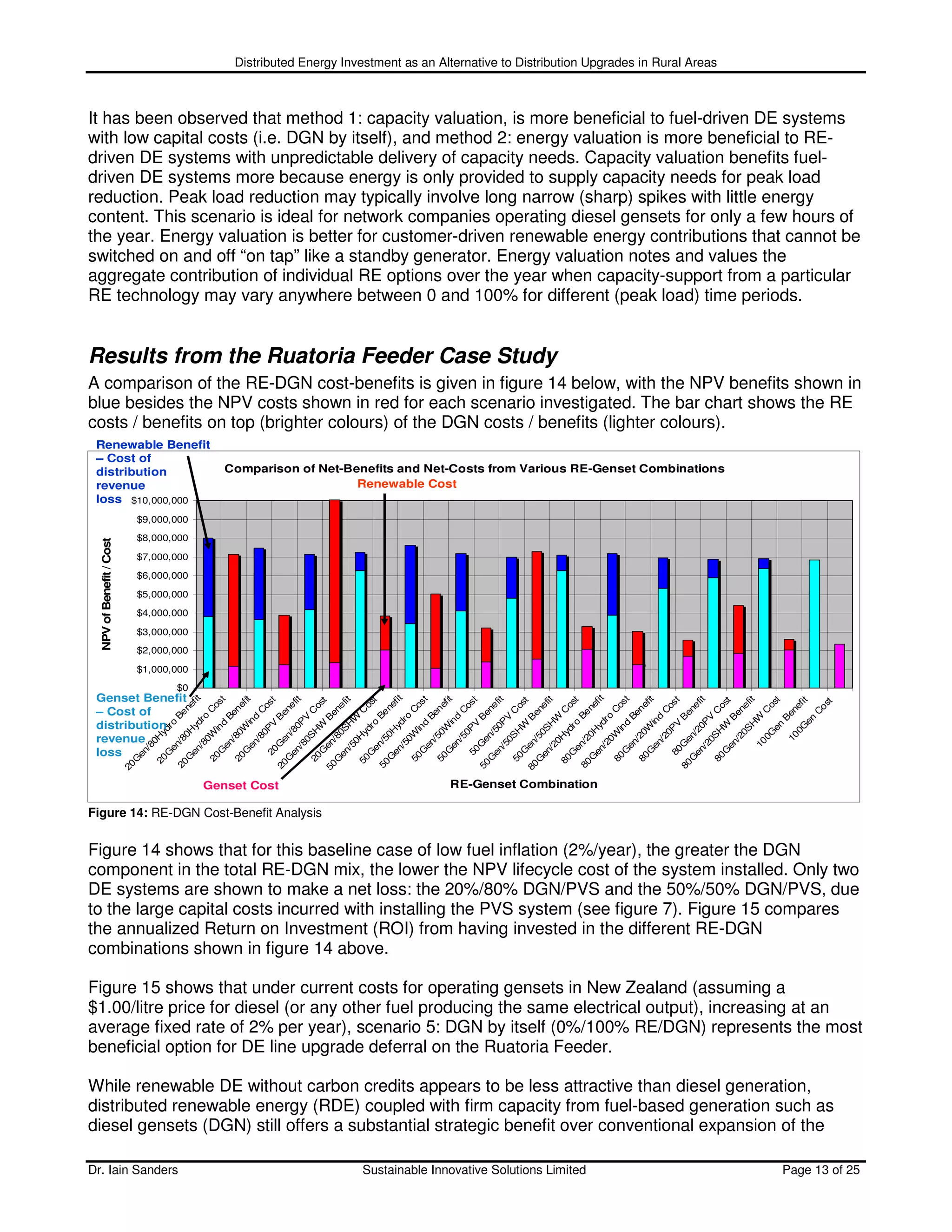
Results from the Ruatoria Feeder Case Study
A comparison of the RE-DGN cost-benefits is given in figure 14 below, with the NPV benefits shown in
blue besides the NPV costs shown in red for each scenario investigated. The bar chart shows the RE
costs / benefits on top (brighter colours) of the DGN costs / benefits (lighter colours).
 Renewable Benefit
 – Cost of
 distribution                                Comparison of Net-Benefits and Net-Costs from Various RE-Genset Combinations
 revenue                                                         Renewable Cost
 loss $10,000,000
                             $9,000,000

                             $8,000,000
  NPV of Benefit / Cost


                             $7,000,000

                             $6,000,000

                             $5,000,000

                             $4,000,000

                             $3,000,000

                             $2,000,000

                             $1,000,000
                                    $0
 Genset Benefit
                                                              it


                                                            fit


                                                            fit
                                                              t

                                                            fit


                                                             it


                                                              t

                                                            fit


                                                             it


                                                              t

                                                            fit


                                                             it
                                                             it


                                                             it


                                                             it
                                                           st


                                                 r o ost


                                                           st


                                                              t


                                                           st


                                                              t


                                                   en it
                                                W ost


                                                             t


                                                W ost


                                                             t
                                                          os


                                                          os


                                                          os


                                                          os


                                                          os
                                                          os
                                                          ef


                                                          ef


                                                          ef


                                                          ef


                                                         os
                                                          ef


                                                          ef


                                                          ef
                                            0H ene


                                            0H ene


                                                          ef
                                                         ne


                                                         ne


                                                         ne
                                             0P Co


                                             0P Co


                                             0P Co


 – Cost of
                                            0H en

                                          0W o C


                                          0W ro C


                                          0W ro C
                                                       en


                                                       en


                                                       en
                                                       en


                                                       en


                                                       en
                                                        C


                                                        C


                                                        C

                                                       en
                                                        C


                                         0S V C


                                                        C


                                                        C
                                                      Be


                                                      Be


                                                      Be
                                                      B


                                                      B


                                                      B
                                                    W


                                         0H W


                                                    W
                                                      d


                                                      d


                                                      d
                                                     B


                                         0S V


                                                     B


                                                     B


                                         0S V
                                                     B


                                                     B


                                                     B


                                                     B
                                                     r


                                                   in


                                                   in


                                                   in


 distribution
                                       /8 0P


                                                   P


                                       /2 0P
                                                 ro

                                                yd


                                                yd


                                                 ro

                                                yd
                                                 H


                                                 H


                                                 H
                                                  d


                                                  d


                                                  d
                                                 V


                                                 V


                                                 V
                                                W


                                               en

                                              0G
                                               W


                                             0W


                                              W
                                              50
                                               in


                                               in


                                               in
                                             0S


                                             0S


                                             0S
                                             yd


                                             yd


                                             yd
                                              8


                                              2
                                             H


                                             H


                                             H


                                           0G
                                  20 /80


                                  80 /20
                                           n/


                                           n/


                                           n/


 revenue


                                          10
                                          H


                                         0H
                                          /8


                                          /8


                                          /5

                                          /5


                                          /5


                                          /2


                                          /2
                                         /8


                                50 n/5


                                80 n/2
                               20 Ge


                               50 Ge


                               80 Ge
                                       80


                                       10
                                       en

                                       en


                                       en


                                       en

                                       en


                                       en


                                       en

                                       en


                                       en
                                       /8


                                       /5


                                       /2
                                       /5
                                      en


                                      /5


                                      /2
                                      e


                                      e


 loss
                                     en


                                     en


                                     en
                                /


                                    20

                                    en


                                    50

                                    en


                                    80

                                    en
                                     G

                                     G


                                     G


                                     G

                                     G


                                     G


                                     G

                                     G


                                     G
                              en


                                    en


                                    en
                                    G


                                    G


                                    G
                                  20


                                  20


                                  50

                                  50


                                  50


                                  80


                                  80
                                   G


                                   G


                                   G
                                  G


                                  G


                                  G
                                 20


                                 50


                                 80
                             G


                                  G


                                  G
                                20
                          20


                               50


                               80


                                          Genset Cost                               RE-Genset Combination

Figure 14: RE-DGN Cost-Benefit Analysis


Figure 14 shows that for this baseline case of low fuel inflation (2%/year), the greater the DGN
component in the total RE-DGN mix, the lower the NPV lifecycle cost of the system installed. Only two
DE systems are shown to make a net loss: the 20%/80% DGN/PVS and the 50%/50% DGN/PVS, due
to the large capital costs incurred with installing the PVS system (see figure 7). Figure 15 compares
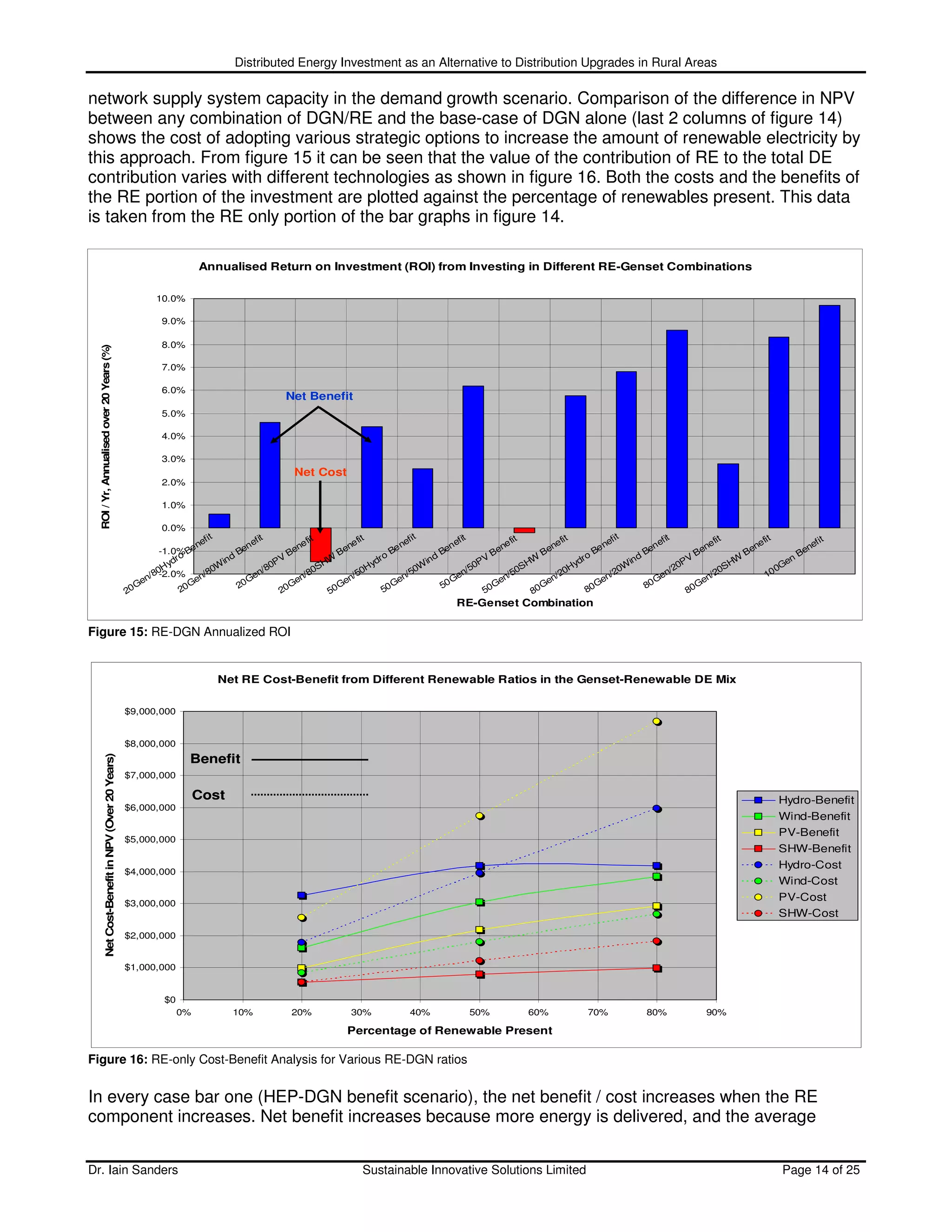
the annualized Return on Investment (ROI) from having invested in the different RE-DGN
combinations shown in figure 14 above.

Figure 15 shows that under current costs for operating gensets in New Zealand (assuming a
$1.00/litre price for diesel (or any other fuel producing the same electrical output), increasing at an
average fixed rate of 2% per year), scenario 5: DGN by itself (0%/100% RE/DGN) represents the most
beneficial option for DE line upgrade deferral on the Ruatoria Feeder.

While renewable DE without carbon credits appears to be less attractive than diesel generation,
distributed renewable energy (RDE) coupled with firm capacity from fuel-based generation such as
diesel gensets (DGN) still offers a substantial strategic benefit over conventional expansion of the

Dr. Iain Sanders                                                     Sustainable Innovative Solutions Limited                           Page 13 of 25
Distributed Energy Investment as an Alternative to Distribution Upgrades in Rural Areas

network supply system capacity in the demand growth scenario. Comparison of the difference in NPV
between any combination of DGN/RE and the base-case of DGN alone (last 2 columns of figure 14)
shows the cost of adopting various strategic options to increase the amount of renewable electricity by
this approach. From figure 15 it can be seen that the value of the contribution of RE to the total DE
contribution varies with different technologies as shown in figure 16. Both the costs and the benefits of
the RE portion of the investment are plotted against the percentage of renewables present. This data
is taken from the RE only portion of the bar graphs in figure 14.

                                                                              Annualised Return on Investment (ROI) from Investing in Different RE-Genset Combinations

                                                                  10.0%

                                                                    9.0%

                                                                    8.0%
  ROI / Yr, Annualised over 20 Years (%)


                                                                    7.0%

                                                                    6.0%
                                                                                                      Net Benefit
                                                                    5.0%

                                                                    4.0%

                                                                    3.0%
                                                                                                        Net Cost
                                                                    2.0%

                                                                    1.0%

                                                                    0.0%
                                                                              fit            fit           fit            fit              fit          fit           fit           fit              fit          fit           fit         fit          fit
                                                                            ne             ne           ne            ne                ne            ne           ne           ne                ne            ne           ne          ne            ne
                                                                  -1.0% Be              Be            Be            Be               Be             Be           Be           Be               Be             Be           Be          Be            Be
                                                                        o                                                          o                                                         o
                                                                     dr             ind            PV          HW               dr              ind           PV          HW              dr              ind           PV          HW            en
                                                                   Hy             W              80          0S               Hy             0W             50          0S              Hy              0W            20          0S            0G
                                                                 80            80             n/          /8              50              /5             n/          /5            20               /2             n/         /2             10
                                                               n/ -2.0% en/                Ge           en             n/              en              Ge          en           n/               en              Ge         en
                                                             Ge          0G             20           0G             Ge              0G              50          0G            Ge              0G              80          0G
                                                          20            2                           2            50               5                            5           80                8                           8
                                                                                                                                                     RE-Genset Combination

Figure 15: RE-DGN Annualized ROI


                                                                                   Net RE Cost-Benefit from Different Renewable Ratios in the Genset-Renewable DE Mix

                                                          $9,000,000


                                                          $8,000,000
                Net Cost-Benefit in NPV (Over 20 Years)


                                                                           Benefit
                                                          $7,000,000

                                                                              Cost                                                                                                                                                             Hydro-Benefit
                                                          $6,000,000
                                                                                                                                                                                                                                               Wind-Benefit
                                                                                                                                                                                                                                               PV-Benefit
                                                          $5,000,000
                                                                                                                                                                                                                                               SHW-Benefit
                                                                                                                                                                                                                                               Hydro-Cost
                                                          $4,000,000
                                                                                                                                                                                                                                               Wind-Cost
                                                                                                                                                                                                                                               PV-Cost
                                                          $3,000,000
                                                                                                                                                                                                                                               SHW-Cost

                                                          $2,000,000


                                                          $1,000,000


                                                                    $0
                                                                         0%            10%              20%             30%             40%              50%             60%              70%             80%              90%

                                                                                                                       Percentage of Renewable Present

Figure 16: RE-only Cost-Benefit Analysis for Various RE-DGN ratios


In every case bar one (HEP-DGN benefit scenario), the net benefit / cost increases when the RE
component increases. Net benefit increases because more energy is delivered, and the average


Dr. Iain Sanders                                                                                                           Sustainable Innovative Solutions Limited                                                                             Page 14 of 25
Distributed Energy Investment as an Alternative to Distribution Upgrades in Rural Areas

capacity supplied is increased. The net cost increases because the size of the HEP, WTG, PVS or
SHW system increases, and the capital cost is directly proportional to the name plate capacity rating
of each RE system. However, overall, the % ROI reduces for a larger investment in renewables
because small scale renewables at present show a lower ROI than diesel gensets. This is the cost
one must pay if wishing to maintain or increase the renewable component of a strategic DG policy.

The HEP-DGN benefit scenario in figure 16 is unusual, in that at about 50%/50% HEP/DGN the return
becomes negative (cost is greater than the benefit). The explanation for this is tied to the HEP supply
factor graph given in figure 9. The larger HEP system in figure 16 has a lower supply factor (see figure
9), implying that less peak capacity is available to match the peak demand required for line upgrade
deferral.

                                                      Net DE [RE+Genset] Cost-Benefit from Different Renewable Ratios in the Genset-Renewable DE Mix

                                            $11,000,000

                                            $10,000,000
                                                           Benefit
  Net Cost-Benefit in NPV (Over 20 Years)


                                             $9,000,000

                                             $8,000,000
                                                           Cost
                                                                                                                                                            Hydro-DE Cost
                                             $7,000,000                                                                                                     Wind-DE Cost
                                                                                                                                                            PV-DE Cost
                                             $6,000,000
                                                                                                                                                            SHW-DE Cost
                                             $5,000,000                                                                                                     Hydro-Benefit
                                                                                                                                                            Wind-Benefit
                                             $4,000,000
                                                                                                                                                            PV-Benefit
                                             $3,000,000                                                                                                     SHW-Benefit

                                             $2,000,000

                                             $1,000,000

                                                    $0
                                                          0%      10%       20%       30%        40%       50%       60%        70%       80%       90%

                                                                                     Percentage of Renewable Present

Figure 17: Combined RE-DGN Cost-Benefit Analysis for Various RE-DGN ratios


The PV scenarios show negative financial benefit for all ratios, as do the SHW scenarios. Only the
wind scenarios show a positive financial benefit for all levels of penetration. The negative SHW benefit
may appear odd. This analysis however, is only for the benefit of avoiding network upgrades. The
energy value to the owner is not included. Hence, because SHW is assumed to offset a controlled
load (electric hot water storage heating) this analysis illustrates a very important outcome: SHW
investment will not reduce the need for network investment in regions of demand growth.

Figure 17 contains the combined RE-DGN cost-benefits derived for the different ratios examined. The
DGN cost / benefit component makes up the balance of the RE results given in figure 16 and has the
effect of smoothing out the NPV change between different percentages of RE in the combined RE-
DGN system.

The NPV of energy delivered for line upgrade deferral (refer to figure 13 for comparison with the
capacity valuation method), transmission savings at the Grid Exit Point (GXP), wholesale energy sold
(providing grid-support) and loss of distribution earnings, were calculated and compared for each year,
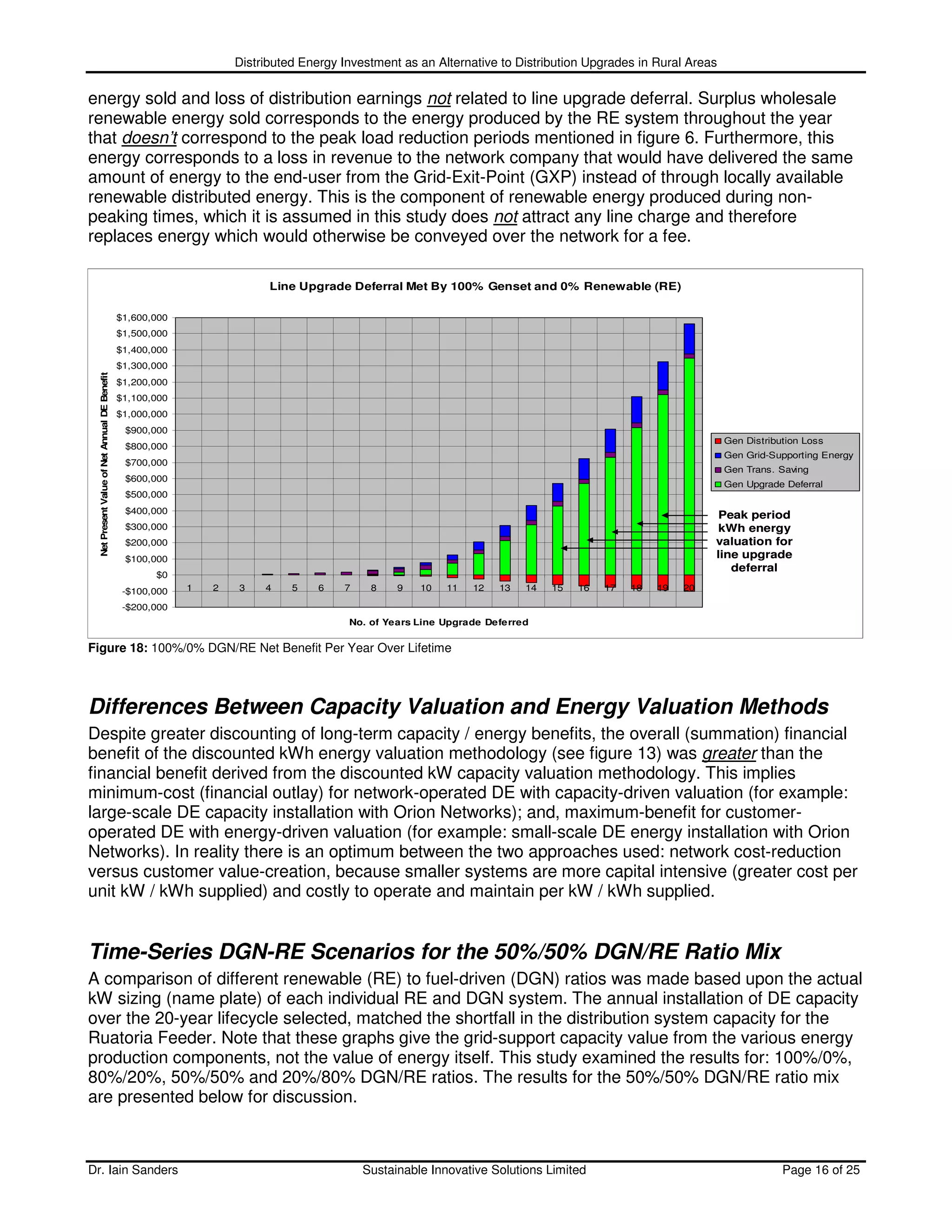
using 100% DGN as the base case (scenario 5). Figure18 shows the NPV energy valuation time-
series for line upgrade deferral for scenario 5: 100%/0% DGN/RE with a 10% / year peak load growth
scenario.

The other DE systems with a RE component: scenarios 1-4, also include a NPV of surplus wholesale

Dr. Iain Sanders                                                                         Sustainable Innovative Solutions Limited                             Page 15 of 25
Distributed Energy Investment as an Alternative to Distribution Upgrades in Rural Areas

energy sold and loss of distribution earnings not related to line upgrade deferral. Surplus wholesale
renewable energy sold corresponds to the energy produced by the RE system throughout the year
that doesn’t correspond to the peak load reduction periods mentioned in figure 6. Furthermore, this
energy corresponds to a loss in revenue to the network company that would have delivered the same
amount of energy to the end-user from the Grid-Exit-Point (GXP) instead of through locally available
renewable distributed energy. This is the component of renewable energy produced during non-
peaking times, which it is assumed in this study does not attract any line charge and therefore
replaces energy which would otherwise be conveyed over the network for a fee.

                                                                          Line Upgrade Deferral Met By 100% Genset and 0% Renewable (RE)

                                               $1,600,000
                                               $1,500,000
                                               $1,400,000
                                               $1,300,000
  Net Present Value of Net Annual DE Benefit


                                               $1,200,000
                                               $1,100,000
                                               $1,000,000
                                                $900,000
                                                                                                                                                              Gen Distribution Loss
                                                $800,000
                                                                                                                                                              Gen Grid-Supporting Energy
                                                $700,000
                                                                                                                                                              Gen Trans. Saving
                                                $600,000
                                                                                                                                                              Gen Upgrade Deferral
                                                $500,000
                                                $400,000
                                                                                                                                                             Peak period
                                                $300,000                                                                                                     kWh energy
                                                $200,000                                                                                                    valuation for
                                                $100,000                                                                                                    line upgrade
                                                                                                                                                               deferral
                                                      $0
                                                -$100,000   1   2   3    4    5    6   7    8    9   10   11   12   13   14   15   16   17   18   19   20

                                                -$200,000
                                                                                        No. of Years Line Upgrade Deferred

Figure 18: 100%/0% DGN/RE Net Benefit Per Year Over Lifetime


Differences Between Capacity Valuation and Energy Valuation Methods
Despite greater discounting of long-term capacity / energy benefits, the overall (summation) financial
benefit of the discounted kWh energy valuation methodology (see figure 13) was greater than the
financial benefit derived from the discounted kW capacity valuation methodology. This implies
minimum-cost (financial outlay) for network-operated DE with capacity-driven valuation (for example:
large-scale DE capacity installation with Orion Networks); and, maximum-benefit for customer-
operated DE with energy-driven valuation (for example: small-scale DE energy installation with Orion
Networks). In reality there is an optimum between the two approaches used: network cost-reduction
versus customer value-creation, because smaller systems are more capital intensive (greater cost per
unit kW / kWh supplied) and costly to operate and maintain per kW / kWh supplied.


Time-Series DGN-RE Scenarios for the 50%/50% DGN/RE Ratio Mix
A comparison of different renewable (RE) to fuel-driven (DGN) ratios was made based upon the actual
kW sizing (name plate) of each individual RE and DGN system. The annual installation of DE capacity
over the 20-year lifecycle selected, matched the shortfall in the distribution system capacity for the
Ruatoria Feeder. Note that these graphs give the grid-support capacity value from the various energy
production components, not the value of energy itself. This study examined the results for: 100%/0%,
80%/20%, 50%/50% and 20%/80% DGN/RE ratios. The results for the 50%/50% DGN/RE ratio mix
are presented below for discussion.


Dr. Iain Sanders                                                                           Sustainable Innovative Solutions Limited                                       Page 16 of 25
Distributed Energy Investment as an Alternative to Distribution Upgrades in Rural Areas


Energy and Capacity Contributions of the 50%/50% DGN/RE Ratio Mix
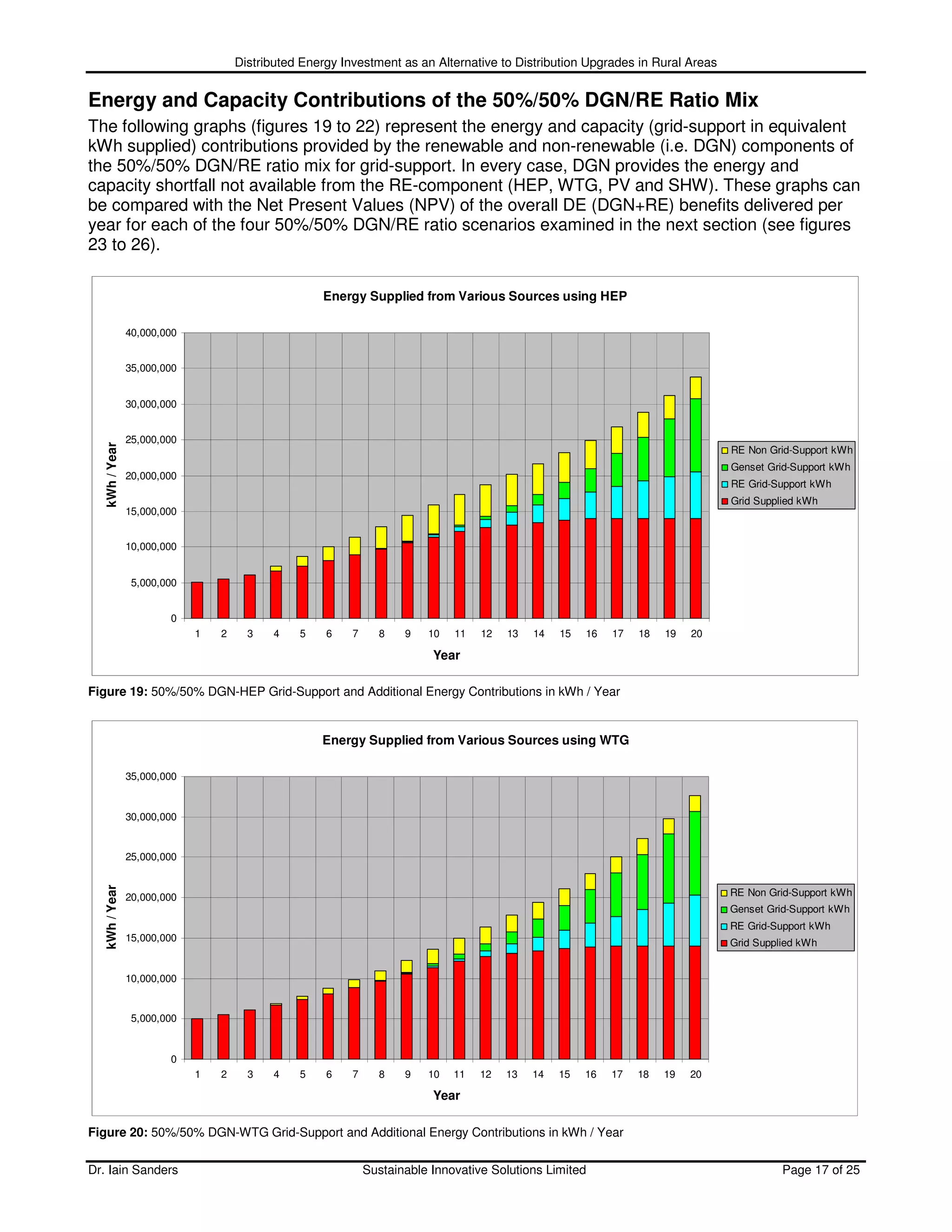
The following graphs (figures 19 to 22) represent the energy and capacity (grid-support in equivalent
kWh supplied) contributions provided by the renewable and non-renewable (i.e. DGN) components of
the 50%/50% DGN/RE ratio mix for grid-support. In every case, DGN provides the energy and
capacity shortfall not available from the RE-component (HEP, WTG, PV and SHW). These graphs can
be compared with the Net Present Values (NPV) of the overall DE (DGN+RE) benefits delivered per
year for each of the four 50%/50% DGN/RE ratio scenarios examined in the next section (see figures
23 to 26).

                                                    Energy Supplied from Various Sources using HEP

                40,000,000


                35,000,000


                30,000,000


                25,000,000
   kWh / Year


                                                                                                                                RE Non Grid-Support kWh
                                                                                                                                Genset Grid-Support kWh
                20,000,000
                                                                                                                                RE Grid-Support kWh
                                                                                                                                Grid Supplied kWh
                15,000,000


                10,000,000


                 5,000,000


                        0
                             1   2     3    4   5    6    7     8    9   10   11   12   13   14   15   16   17   18   19   20

                                                                          Year

Figure 19: 50%/50% DGN-HEP Grid-Support and Additional Energy Contributions in kWh / Year


                                                    Energy Supplied from Various Sources using WTG

                35,000,000


                30,000,000


                25,000,000
   kWh / Year


                20,000,000                                                                                                      RE Non Grid-Support kWh
                                                                                                                                Genset Grid-Support kWh
                                                                                                                                RE Grid-Support kWh
                15,000,000                                                                                                      Grid Supplied kWh


                10,000,000


                 5,000,000


                        0
                             1   2     3    4   5    6    7     8    9   10   11   12   13   14   15   16   17   18   19   20

                                                                          Year

Figure 20: 50%/50% DGN-WTG Grid-Support and Additional Energy Contributions in kWh / Year

Dr. Iain Sanders                                              Sustainable Innovative Solutions Limited                                    Page 17 of 25
Distributed Energy Investment as an Alternative to Distribution Upgrades in Rural Areas

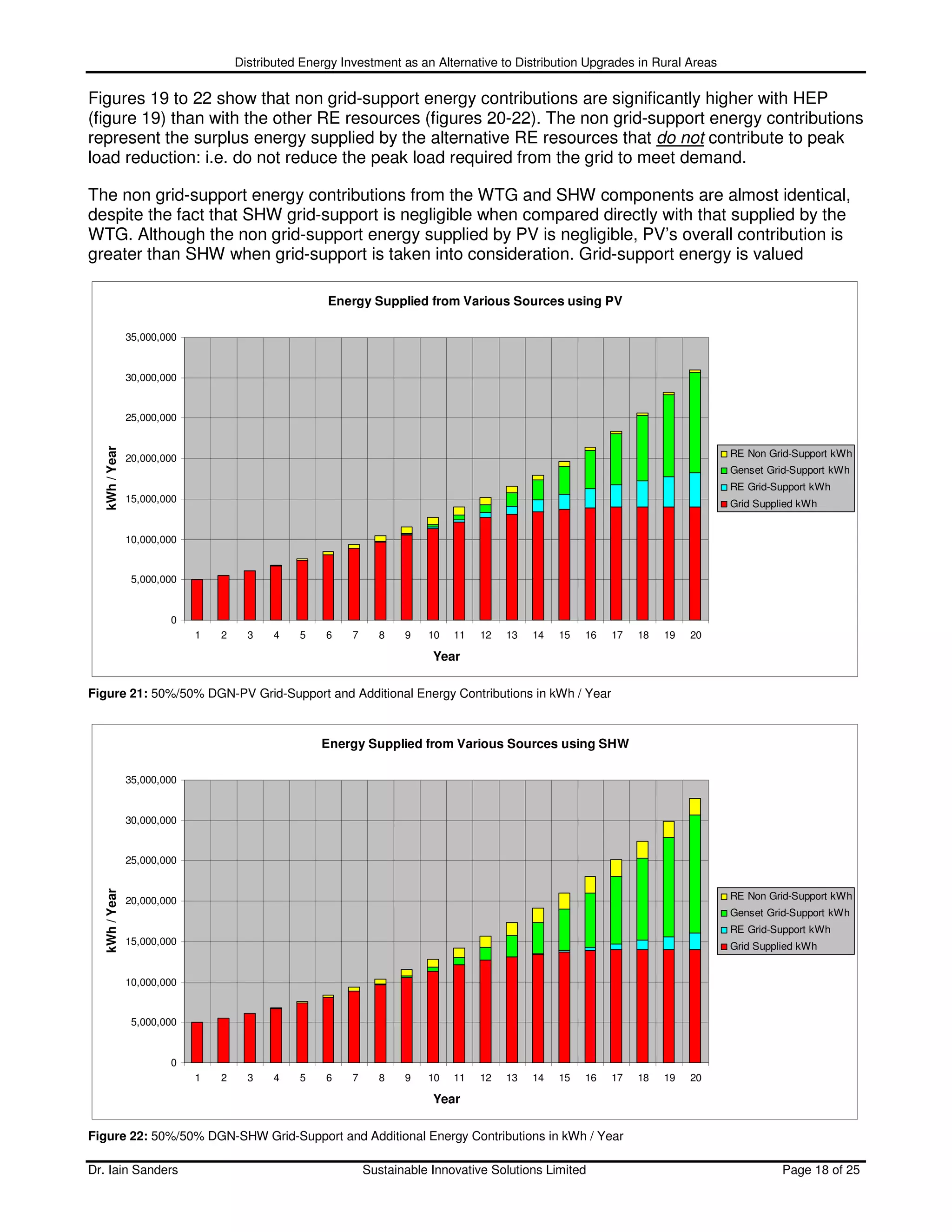
Figures 19 to 22 show that non grid-support energy contributions are significantly higher with HEP
(figure 19) than with the other RE resources (figures 20-22). The non grid-support energy contributions
represent the surplus energy supplied by the alternative RE resources that do not contribute to peak
load reduction: i.e. do not reduce the peak load required from the grid to meet demand.

The non grid-support energy contributions from the WTG and SHW components are almost identical,
despite the fact that SHW grid-support is negligible when compared directly with that supplied by the
WTG. Although the non grid-support energy supplied by PV is negligible, PV’s overall contribution is
greater than SHW when grid-support is taken into consideration. Grid-support energy is valued

                                                     Energy Supplied from Various Sources using PV

                35,000,000


                30,000,000


                25,000,000
   kWh / Year


                20,000,000                                                                                                      RE Non Grid-Support kWh
                                                                                                                                Genset Grid-Support kWh
                                                                                                                                RE Grid-Support kWh
                15,000,000                                                                                                      Grid Supplied kWh


                10,000,000


                 5,000,000


                        0
                             1   2     3    4   5    6    7     8    9   10   11   12   13   14   15   16   17   18   19   20

                                                                          Year

Figure 21: 50%/50% DGN-PV Grid-Support and Additional Energy Contributions in kWh / Year


                                                    Energy Supplied from Various Sources using SHW

                35,000,000


                30,000,000


                25,000,000
   kWh / Year


                20,000,000                                                                                                      RE Non Grid-Support kWh
                                                                                                                                Genset Grid-Support kWh
                                                                                                                                RE Grid-Support kWh
                15,000,000                                                                                                      Grid Supplied kWh


                10,000,000


                 5,000,000


                        0
                             1   2     3    4   5    6    7     8    9   10   11   12   13   14   15   16   17   18   19   20

                                                                          Year

Figure 22: 50%/50% DGN-SHW Grid-Support and Additional Energy Contributions in kWh / Year

Dr. Iain Sanders                                              Sustainable Innovative Solutions Limited                                    Page 18 of 25
Distributed Energy Investment as an Alternative to Distribution Upgrades in Rural Areas

substantially higher than non grid-support energy, as illustrated by comparing the NPV of energy
supplied by PV (figure 25) and SHW (figure 26).

Despite the fact that grid-support and non grid-support energy contributions from PV are less than
those from WTG, there is still a significant contribution from PV, due to the close match between the
solar energy profile supplied and the peak load of the Ruatoria feeder needing to be reduced. The
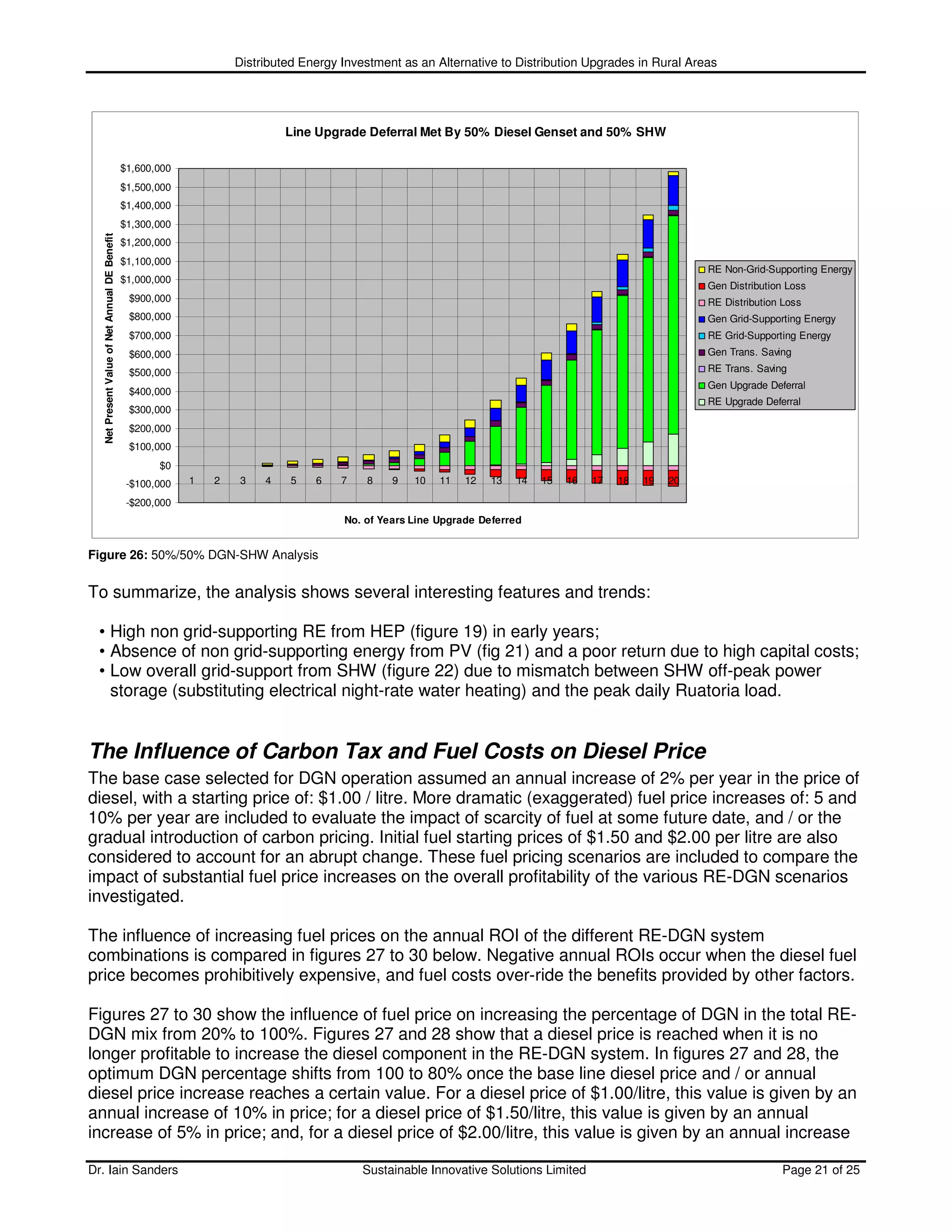
SHW scenario does not support peak load reduction on the Ruatoria feeder, because solar energy is
stored as hot water to substitute electrical heating of water cylinder at night. There is a poor correlation
between the profile for night-rate water heating and the Ruatoria peak load reduction required in the
middle of the day. SHW replaces night-rate water heating and does not offset the daily peak load.


Valuation of the 50%/50% DGN/RE Ratio Mix
A summary of the results obtained for the 50%/50% DGN/RE Ratio are shown in figures 23 to 26.

                                                                             Line Upgrade Deferral Met By 50% Diesel Genset and 50% HEP

                                               $1,600,000
                                               $1,500,000
                                               $1,400,000
                                               $1,300,000
  Net Present Value of Net Annual DE Benefit


                                               $1,200,000
                                               $1,100,000
                                                                                                                                                           RE Non-Grid-Supporting Energy
                                               $1,000,000
                                                                                                                                                           Gen Distribution Loss
                                                $900,000                                                                                                   RE Distribution Loss
                                                $800,000                                                                                                   Gen Grid-Supporting Energy
                                                $700,000                                                                                                   RE Grid-Supporting Energy
                                                $600,000                                                                                                   Gen Trans. Saving

                                                $500,000                                                                                                   RE Trans. Saving
                                                                                                                                                           Gen Upgrade Deferral
                                                $400,000
                                                                                                                                                           RE Upgrade Deferral
                                                $300,000
                                                $200,000
                                                $100,000
                                                      $0
                                                -$100,000   1   2    3   4    5   6    7   8    9   10   11   12   13   14   15   16   17   18   19   20

                                                -$200,000
                                                                                       No. of Years Line Upgrade Deferred


Figure 23: 50%/50% DGN-HEP Analysis

In each scenario, the NPV of the net annual DE benefit remains constant, because the capacity and
energy requirement that has to be met by DE for line upgrade deferral to take place has been defined
as the same for all scenarios. However, as can been seen from figures 23 to 26, the contribution to the
net benefit varies, based upon the year and the RE-DGN mix selected. The only exception to this rule,
is provided by the non grid-supporting RE contributions, as these are surplus to requirement for line
upgrade deferral, and do not cost anymore to produce – unlike diesel fuel which is only used to meet
RE capacity-support shortfalls for line upgrade deferral. HEP provides the most additional non grid-
supporting energy (figure 23), followed by WTG (figure 24), then SHW (figure 26) and finally PV (figure
25). The reason why PV provides so little non grid-supporting energy, is because most of the energy
produced by PV is actually grid-supporting: the PV supply profile closely matches the Ruatoria
demand profile and the periods when peak load reduction is required.

The break down of components contributing to the Net Present Value of the diesel fuel and renewable
energy mix in figures 23 to 26 is as follows: NPV of DE benefits [DGN+RE] = [DGN+RE] line upgrade
deferral providing capacity-support, plus [DGN+RE] grid-supporting energy corresponding to line

Dr. Iain Sanders                                                                           Sustainable Innovative Solutions Limited                                       Page 19 of 25
Distributed Energy Investment as an Alternative to Distribution Upgrades in Rural Areas

upgrade deferral capacity-support periods, plus [RE] non-grid-supporting energy produced outside
line upgrade deferral capacity-support periods, plus [DGN+RE] transmission saving from GXP peak
load reduction from capacity-support, minus [DGN+RE] distribution losses in revenue to the lines
company, from less energy distributed by the lines company to the end-user from the GXP, because
the energy is supplied locally by distributed generation [DGN+RE] instead.


                                                                              Line Upgrade Deferral Met By 50% Genset and 50% WTG DE

                                               $1,800,000
                                               $1,700,000
                                               $1,600,000
                                               $1,500,000
                                               $1,400,000
  Net Present Value of Net Annual DE Benefit


                                               $1,300,000
                                               $1,200,000                                                                                                  RE Non-Grid-Supporting Energy
                                               $1,100,000                                                                                                  Gen Distribution Loss
                                               $1,000,000                                                                                                  RE Distribution Loss
                                                $900,000                                                                                                   Gen Grid-Supporting Energy
                                                $800,000                                                                                                   RE Grid-Supporting Energy
                                                $700,000                                                                                                   Gen Trans. Saving
                                                $600,000                                                                                                   RE Trans. Saving
                                                $500,000                                                                                                   Gen Upgrade Deferral
                                                $400,000                                                                                                   RE Upgrade Deferral
                                                $300,000
                                                $200,000
                                                $100,000
                                                      $0
                                                -$100,000   1   2    3   4    5   6    7   8    9   10   11   12   13   14   15   16   17   18   19   20
                                                -$200,000
                                                                                       No. of Years Line Upgrade Deferred


Figure 24: 50%/50% DGN-WTG Analysis


                                                                              Line Upgrade Deferral Met By 50% Diesel Genset and 50% PV

                                               $1,600,000
                                               $1,500,000
                                               $1,400,000
                                               $1,300,000
  Net Present Value of Net Annual DE Benefit


                                               $1,200,000
                                               $1,100,000
                                                                                                                                                           RE Non-Grid-Supporting Energy
                                               $1,000,000
                                                                                                                                                           Gen Distribution Loss
                                                $900,000                                                                                                   RE Distribution Loss
                                                $800,000                                                                                                   Gen Grid-Supporting Energy
                                                $700,000                                                                                                   RE Grid-Supporting Energy
                                                $600,000                                                                                                   Gen Trans. Saving

                                                $500,000                                                                                                   RE Trans. Saving
                                                                                                                                                           Gen Upgrade Deferral
                                                $400,000
                                                                                                                                                           RE Upgrade Deferral
                                                $300,000
                                                $200,000
                                                $100,000
                                                      $0
                                                -$100,000   1   2    3   4    5   6    7   8    9   10   11   12   13   14   15   16   17   18   19   20

                                                -$200,000
                                                                                       No. of Years Line Upgrade Deferred


Figure 25: 50%/50% DGN-PVS Analysis


Dr. Iain Sanders                                                                           Sustainable Innovative Solutions Limited                                       Page 20 of 25
Distributed Energy Investment as an Alternative to Distribution Upgrades in Rural Areas


                                                                             Line Upgrade Deferral Met By 50% Diesel Genset and 50% SHW

                                               $1,600,000
                                               $1,500,000
                                               $1,400,000
                                               $1,300,000
  Net Present Value of Net Annual DE Benefit


                                               $1,200,000
                                               $1,100,000
                                                                                                                                                           RE Non-Grid-Supporting Energy
                                               $1,000,000
                                                                                                                                                           Gen Distribution Loss
                                                $900,000                                                                                                   RE Distribution Loss
                                                $800,000                                                                                                   Gen Grid-Supporting Energy
                                                $700,000                                                                                                   RE Grid-Supporting Energy
                                                $600,000                                                                                                   Gen Trans. Saving

                                                $500,000                                                                                                   RE Trans. Saving
                                                                                                                                                           Gen Upgrade Deferral
                                                $400,000
                                                                                                                                                           RE Upgrade Deferral
                                                $300,000
                                                $200,000
                                                $100,000
                                                      $0
                                                -$100,000   1   2    3   4    5   6    7   8    9   10   11   12   13   14   15   16   17   18   19   20

                                                -$200,000
                                                                                       No. of Years Line Upgrade Deferred


Figure 26: 50%/50% DGN-SHW Analysis


To summarize, the analysis shows several interesting features and trends:

 • High non grid-supporting RE from HEP (figure 19) in early years;
 • Absence of non grid-supporting energy from PV (fig 21) and a poor return due to high capital costs;
 • Low overall grid-support from SHW (figure 22) due to mismatch between SHW off-peak power
   storage (substituting electrical night-rate water heating) and the peak daily Ruatoria load.


The Influence of Carbon Tax and Fuel Costs on Diesel Price
The base case selected for DGN operation assumed an annual increase of 2% per year in the price of
diesel, with a starting price of: $1.00 / litre. More dramatic (exaggerated) fuel price increases of: 5 and
10% per year are included to evaluate the impact of scarcity of fuel at some future date, and / or the
gradual introduction of carbon pricing. Initial fuel starting prices of $1.50 and $2.00 per litre are also
considered to account for an abrupt change. These fuel pricing scenarios are included to compare the
impact of substantial fuel price increases on the overall profitability of the various RE-DGN scenarios
investigated.

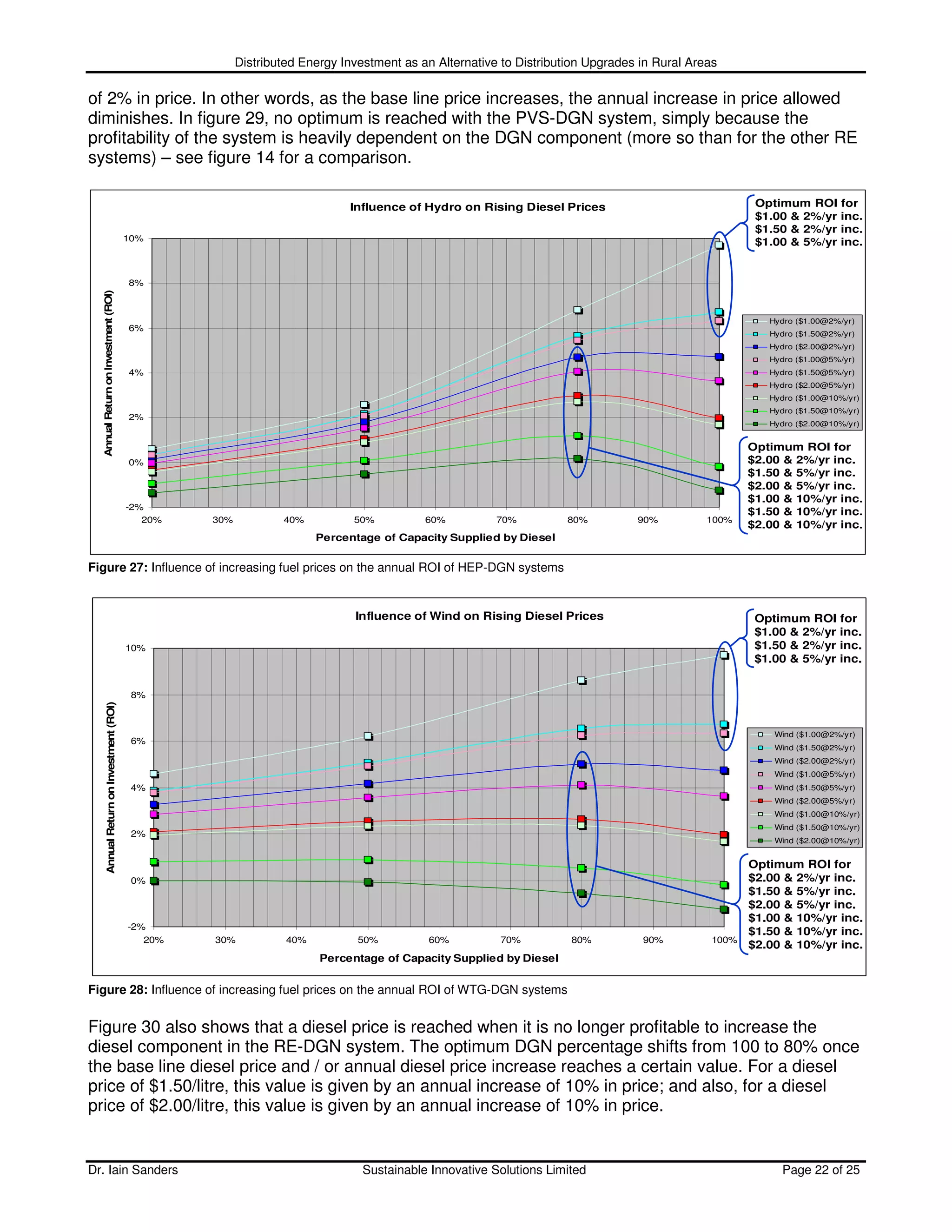
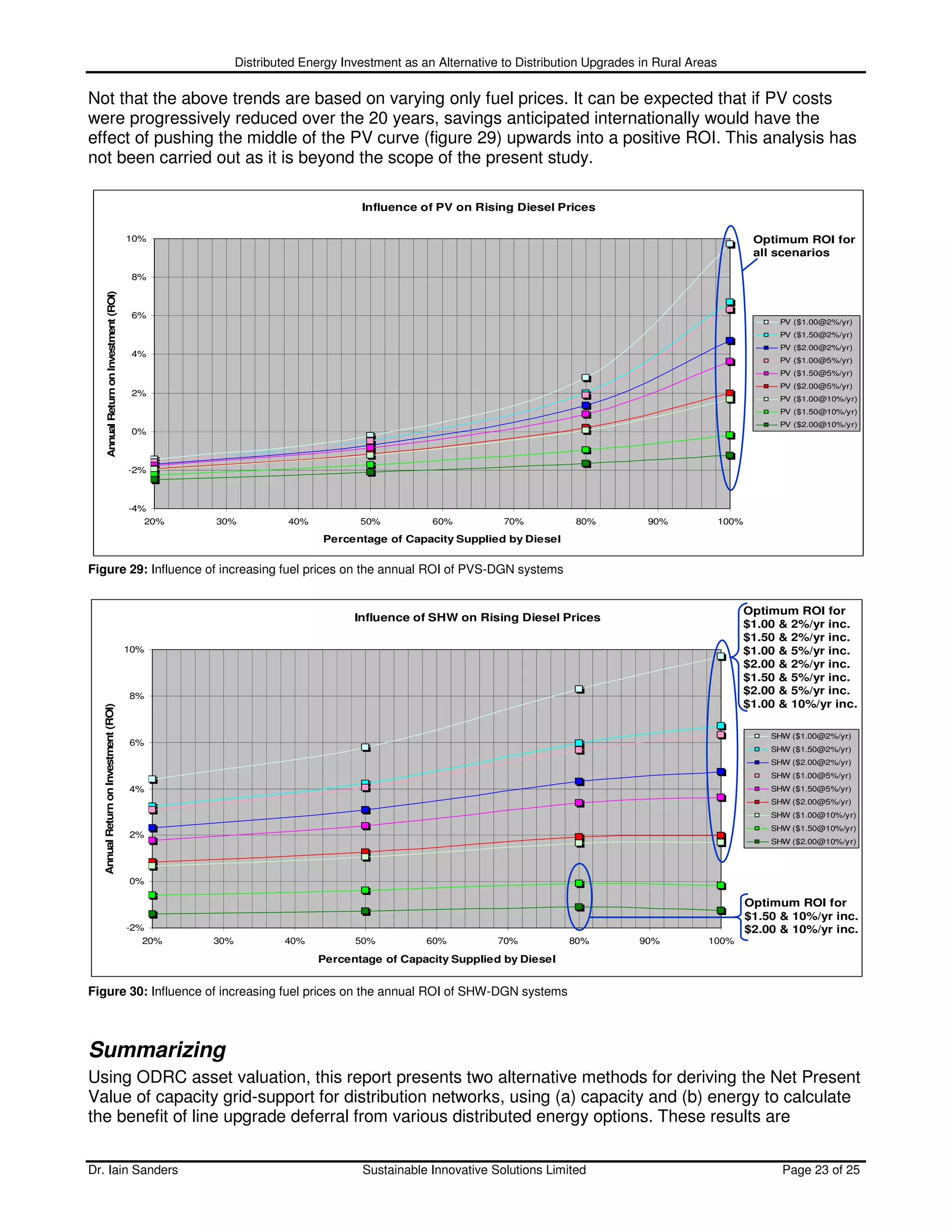
The influence of increasing fuel prices on the annual ROI of the different RE-DGN system
combinations is compared in figures 27 to 30 below. Negative annual ROIs occur when the diesel fuel
price becomes prohibitively expensive, and fuel costs over-ride the benefits provided by other factors.

Figures 27 to 30 show the influence of fuel price on increasing the percentage of DGN in the total RE-
DGN mix from 20% to 100%. Figures 27 and 28 show that a diesel price is reached when it is no
longer profitable to increase the diesel component in the RE-DGN system. In figures 27 and 28, the
optimum DGN percentage shifts from 100 to 80% once the base line diesel price and / or annual
diesel price increase reaches a certain value. For a diesel price of $1.00/litre, this value is given by an
annual increase of 10% in price; for a diesel price of $1.50/litre, this value is given by an annual
increase of 5% in price; and, for a diesel price of $2.00/litre, this value is given by an annual increase

Dr. Iain Sanders                                                                           Sustainable Innovative Solutions Limited                                       Page 21 of 25
Distributed Energy Investment as an Alternative to Distribution Upgrades in Rural Areas

of 2% in price. In other words, as the base line price increases, the annual increase in price allowed
diminishes. In figure 29, no optimum is reached with the PVS-DGN system, simply because the
profitability of the system is heavily dependent on the DGN component (more so than for the other RE
systems) – see figure 14 for a comparison.

                                                                                Influence of Hydro on Rising Diesel Prices                               Optimum ROI      for
                                                                                                                                                         $1.00 & 2%/yr    inc.
                                                                                                                                                         $1.50 & 2%/yr    inc.
                                             10%                                                                                                         $1.00 & 5%/yr    inc.


                                             8%
  Annual Return on Investment (ROI)


                                                                                                                                                           Hydro ($1.00@2%/yr)
                                             6%
                                                                                                                                                           Hydro ($1.50@2%/yr)
                                                                                                                                                           Hydro ($2.00@2%/yr)
                                                                                                                                                           Hydro ($1.00@5%/yr)
                                             4%                                                                                                            Hydro ($1.50@5%/yr)
                                                                                                                                                           Hydro ($2.00@5%/yr)
                                                                                                                                                           Hydro ($1.00@10%/yr)
                                                                                                                                                           Hydro ($1.50@10%/yr)
                                             2%
                                                                                                                                                           Hydro ($2.00@10%/yr)


                                                                                                                                                        Optimum ROI for
                                             0%                                                                                                         $2.00 & 2%/yr inc.
                                                                                                                                                        $1.50 & 5%/yr inc.
                                                                                                                                                        $2.00 & 5%/yr inc.
                                                                                                                                                        $1.00 & 10%/yr inc.
                                             -2%
                                                                                                                                                        $1.50 & 10%/yr inc.
                                                20%   30%           40%          50%          60%          70%          80%         90%          100%
                                                                                                                                                        $2.00 & 10%/yr inc.
                                                                           Percentage of Capacity Supplied by Diesel


Figure 27: Influence of increasing fuel prices on the annual ROI of HEP-DGN systems


                                                                                 Influence of Wind on Rising Diesel Prices                               Optimum ROI for
                                                                                                                                                         $1.00 & 2%/yr inc.
                                             10%                                                                                                         $1.50 & 2%/yr inc.
                                                                                                                                                         $1.00 & 5%/yr inc.


                                              8%
         Annual Return on Investment (ROI)


                                                                                                                                                            Wind ($1.00@2%/yr)
                                              6%
                                                                                                                                                            Wind ($1.50@2%/yr)
                                                                                                                                                            Wind ($2.00@2%/yr)
                                                                                                                                                            Wind ($1.00@5%/yr)
                                              4%                                                                                                            Wind ($1.50@5%/yr)
                                                                                                                                                            Wind ($2.00@5%/yr)
                                                                                                                                                            Wind ($1.00@10%/yr)
                                                                                                                                                            Wind ($1.50@10%/yr)
                                              2%
                                                                                                                                                            Wind ($2.00@10%/yr)


                                                                                                                                                       Optimum ROI for
                                              0%                                                                                                       $2.00 & 2%/yr inc.
                                                                                                                                                       $1.50 & 5%/yr inc.
                                                                                                                                                       $2.00 & 5%/yr inc.
                                                                                                                                                       $1.00 & 10%/yr inc.
                                             -2%
                                                                                                                                                       $1.50 & 10%/yr inc.
                                                20%   30%            40%          50%          60%         70%          80%          90%          100%
                                                                                                                                                       $2.00 & 10%/yr inc.
                                                                           Percentage of Capacity Supplied by Diesel


Figure 28: Influence of increasing fuel prices on the annual ROI of WTG-DGN systems


Figure 30 also shows that a diesel price is reached when it is no longer profitable to increase the
diesel component in the RE-DGN system. The optimum DGN percentage shifts from 100 to 80% once
the base line diesel price and / or annual diesel price increase reaches a certain value. For a diesel
price of $1.50/litre, this value is given by an annual increase of 10% in price; and also, for a diesel
price of $2.00/litre, this value is given by an annual increase of 10% in price.


Dr. Iain Sanders                                                                   Sustainable Innovative Solutions Limited                                  Page 22 of 25
Distributed Energy Investment as an Alternative to Distribution Upgrades in Rural Areas

Not that the above trends are based on varying only fuel prices. It can be expected that if PV costs
were progressively reduced over the 20 years, savings anticipated internationally would have the
effect of pushing the middle of the PV curve (figure 29) upwards into a positive ROI. This analysis has
not been carried out as it is beyond the scope of the present study.

                                                                                  Influence of PV on Rising Diesel Prices

                                             10%                                                                                                              Optimum ROI for
                                                                                                                                                              all scenarios

                                              8%
         Annual Return on Investment (ROI)


                                              6%
                                                                                                                                                                  PV ($1.00@2%/yr)
                                                                                                                                                                  PV ($1.50@2%/yr)
                                                                                                                                                                  PV ($2.00@2%/yr)
                                              4%
                                                                                                                                                                  PV ($1.00@5%/yr)
                                                                                                                                                                  PV ($1.50@5%/yr)
                                                                                                                                                                  PV ($2.00@5%/yr)
                                              2%
                                                                                                                                                                  PV ($1.00@10%/yr)
                                                                                                                                                                  PV ($1.50@10%/yr)
                                                                                                                                                                  PV ($2.00@10%/yr)
                                              0%


                                             -2%


                                             -4%
                                                20%   30%            40%          50%          60%          70%          80%          90%             100%

                                                                           Percentage of Capacity Supplied by Diesel


Figure 29: Influence of increasing fuel prices on the annual ROI of PVS-DGN systems


                                                                                                                                                         Optimum ROI for
                                                                                 Influence of SHW on Rising Diesel Prices
                                                                                                                                                         $1.00 & 2%/yr inc.
                                                                                                                                                         $1.50 & 2%/yr inc.
                                             10%                                                                                                         $1.00 & 5%/yr inc.
                                                                                                                                                         $2.00 & 2%/yr inc.
                                                                                                                                                         $1.50 & 5%/yr inc.
                                             8%
                                                                                                                                                         $2.00 & 5%/yr inc.
                                                                                                                                                         $1.00 & 10%/yr inc.
   Annual Return on Investment (ROI)


                                                                                                                                                                 SHW ($1.00@2%/yr)
                                             6%
                                                                                                                                                                 SHW ($1.50@2%/yr)
                                                                                                                                                                 SHW ($2.00@2%/yr)
                                                                                                                                                                 SHW ($1.00@5%/yr)
                                             4%                                                                                                                  SHW ($1.50@5%/yr)
                                                                                                                                                                 SHW ($2.00@5%/yr)
                                                                                                                                                                 SHW ($1.00@10%/yr)
                                                                                                                                                                 SHW ($1.50@10%/yr)
                                             2%
                                                                                                                                                                 SHW ($2.00@10%/yr)


                                             0%

                                                                                                                                                             Optimum ROI for
                                                                                                                                                             $1.50 & 10%/yr inc.
                                             -2%                                                                                                             $2.00 & 10%/yr inc.
                                                20%   30%            40%         50%          60%          70%          80%          90%         100%

                                                                           Percentage of Capacity Supplied by Diesel


Figure 30: Influence of increasing fuel prices on the annual ROI of SHW-DGN systems


Summarizing
Using ODRC asset valuation, this report presents two alternative methods for deriving the Net Present
Value of capacity grid-support for distribution networks, using (a) capacity and (b) energy to calculate
the benefit of line upgrade deferral from various distributed energy options. These results are


Dr. Iain Sanders                                                                   Sustainable Innovative Solutions Limited                                        Page 23 of 25
Distributed Energy Investment as an Alternative to Distribution Upgrades in Rural Areas

summarized below for the four DE combinations studied: 100%/0%, 80%/20%, 50%/50% and
20%/80% DGN/RE.

Table 3: Capacity-based Line Upgrade Investment Deferral Methodology for Grid Supply-Support
%RE                0% RE (DGN-Only)      20% RE            50% RE             80% RE
Capacity           Max     $        Max      $        Max      $        Max       $
                   MW               MW                MW                MW
DGN+HEP            6.473   $739,051     2.2 $391,995    2.520 $470,418    2.202 $444,703
DGN+WTG            6.473   $739,051   1.242 $165,492    2.438 $281,188    2.916 $333,953
DGN+PV             6.473   $739,051   0.694 $124,050    1.649 $243,390      2.24 $307,870
DGN+SHW            6.473   $739,051   0.604   $25,623   0.805   $30,382   0.837    $31,212

The values in table 3 for capacity-based line upgrade deferral, show the maximum capacity-support
provided (and the NPV associated with providing capacity-support over 20 years) from: (a) diesel
genset by itself (0% RE); (b) the 20% RE component by itself; (c) the 50% RE component by itself;
and, (d) the 80% RE component by itself. The balance of capacity required for scenarios (b) to (d), is
provided by diesel, and is equivalent to the difference between what the diesel genset delivers by itself
in scenario (a), and what the RE component of the total DE mix provides in scenarios (b) to (d).

Table 4: Energy-based Line Upgrade Investment Deferral Methodology for Grid Support-Support
%RE                0% RE (DGN-Only)                   20% RE                         50% RE             80% RE
Energy             Total    $                   Total     $                    Total     $        Total     $
                   MWh                          MWh                            MWh                MWh
DGN+HEP            73,265.4 $739,063            30,987.3 $333,557              35,504.5 $382,461 31,604.5 $343,186
DGN+WTG            73,265.4 $739,063            16,223.2 $169,292              29,046.4 $295,473 34,287.5 $347,788
DGN+PV             73,265.4 $739,063            10,015.0 $108,746              21,682.3 $227,611 28,193.6 $292,370
DGN+SHW            73,265.4 $739,063             5,151.4   $44,758              6,240.1   $53,405  6,427.6   $54,924

The values in table 4 for energy-based line upgrade deferral, show the total energy-support provided
(and the NPV associated with providing energy-support over 20 years) from: (a) diesel genset by itself
(0% RE); (b) the 20% RE component by itself; (c) the 50% RE component by itself; and, (d) the 80%
RE component by itself. The balance of energy required to meet the supply shortfall for scenarios (b)
to (d), is provided by diesel, and is equivalent to the difference between what the diesel genset
delivers by itself in scenario (a), and what the RE component of the total DE mix provides in scenarios
(b) to (d).


Conclusions
Future fuel price volatility and uncertainty with availability of supply and global warming taxation
indicates a preference to at least combine diesel generation with a renewable component to minimize
risk. Some scenarios, e.g. hydro and wind, indicate that the best annual ROI includes a 20-80%
renewable energy component.

This analysis demonstrates that the accumulated benefits of localized distributed energy (kWh) and
capacity (kW) support exceed the costs for the case study developed for Eastland Networks’ Ruatoria
Feeder in the East Coast region. The main analysis was based on a 10% demand growth rate to
accentuate the effects, but lower growth rates exhibit similar trends.

An investment strategy to replace line capacity upgrades with hybrid DE also offers a trade-off
between direct ROI and intermittent renewable energy. Net benefits and costs will vary with differing
stakeholder / user-operator perspectives. It all depends upon who is responsible for the investment
and who benefits from the revenue streams generated. There are at least nine financial options


Dr. Iain Sanders                                Sustainable Innovative Solutions Limited                           Page 24 of 25
Distributed Energy Investment as an Alternative to Distribution Upgrades in Rural Areas

available for operating DE in New Zealand, depending on who the stakeholders are. The nine financial
options (in no particular order) are:

   1.   standalone DE (where no grid is available, or to completely replace the existing grid);
   2.   DE consumer retail energy savings by reducing demand for grid electricity;
   3.   Customer-generator DE (wholesale) energy supply to an energy retailer;
   4.   DE grid-support for a downgraded network segment (e.g. single-phase feeder support for a
        downgraded three-phase feeder);
   5.   DE grid-support to defer network expansion / upgrades;
   6.   DE wholesale energy spot price contributions;
   7.   DE Grid Exit Point (GXP) peak (transmission) demand reduction;
   8.   DE backup / UPS for high-risk power failure applications; and
   9.   DE reduction of distribution losses.

The real challenge however, is finding a way to concentrate the multiple stakeholder benefits for an
option into a single revenue stream for a single stakeholder, so that the DE investment is cost-
effective. This analysis shows that for load growth scenarios, distribution networks could contend for
this position, and should seriously consider a DE investment encouragement strategy, in regions of
high load growth, whether or not they are allowed ownership under market rules.


Moving Forward
This research demonstrates quite clearly that there is an economic opportunity for distribution
networks with capacity constraints and increasing customer demand to investigate DE line upgrade
deferral. We encourage collaborative research and development amongst appropriate distribution
networks with complimentary interests. Furthermore, we recommend that the Electricity Commission
and Transpower work more closely with distribution networks and energy retailers to standardize such
proceedings and establish industrial best practice. Finally, we believe that a regulatory framework
should be developed which encourages a decentralized approach to infrastructure development. At
present the regulatory and market structures support central generation.

Much more detail is available from the analysis than has been presented in this report. Further
implications could be drawn from the case study results or the methodologies could be easily applied
to other case studies. In particular, the uptake of combinations of rooftop PV and storage systems in
the urban and residential environment as an alternative to grid capacity growth could and should be
investigated with urgency. The methodology applied is considered to be robust and thorough, and is
based on ODRC (Optimized Depreciated Replacement Cost) data.


Acknowledgements
This work has been completed with the financial support of the Foundation for Research, Science and
Technology (FRST). Industrial Research is very grateful for the support provided by Eastland
Networks Limited in producing this paper.


Dr. Iain Sanders                            Sustainable Innovative Solutions Limited                           Page 25 of 25

Line Upgrade Deferral Scenarios for Distributed Renewable Energy Resources

  • 1.
    Distributed Energy Investmentas an Alternative to Distribution Upgrades in Rural Areas Scenarios for Distributed Energy Investment as an Alternative to Distribution Line Upgrades in Rural Areas By Iain Sanders, Sustainable Innovative Solutions Limited, and Alister Gardiner, Industrial Research Limited Abstract In this paper, we identify and evaluate various ‘best-case scenarios’ for investing in decentralised micro-generation from a utility-driven, distribution network perspective. A distribution line experiencing significant over-capacity from increasing customer demand is used to determine the Net Present Value (NPV) of five different modular, distributed energy systems: (1) hydroelectric power (HEP) with diesel genset (DGN) support; (2) wind turbine generation (WTG) with DGN support; (3) photovoltaics (PVS) with DGN support; (4) solar hot water (SHW) with DGN support; and (5) DGN by itself, as a reference case. The study considers the value of distributed energy (DE) in deferring or eliminating distribution line energy- / capacity-based upgrades. The basic principle applied in this study is that the distributed generation installed consists of a combination of fuel-based (DGN) generation and intermittent renewable energy (RE) to ensure that “normal” supply reliability can be delivered at all times, irrespective of RE availability. Typical RE supply profiles are used to indicate the likely mix of RE and DGN supply throughout the year on a continuous half-hourly basis. The scale and format of the particular technologies is not specified, instead these are simply identified as opportunity costs. As a typical case study involving real “industry” data, the NPV of DE as a line upgrade deferral option was compared with a “business as usual” scenario for a rural distribution line in the Eastland Networks Limited (ENL) region of the north island of New Zealand. For the data presented in this report, the annual energy demand growth rate was exaggerated and extended over a 20-year timeframe to emphasize the potential contribution that DE could have on the energy / capacity supply mix for regions of high growth. The net results were almost always in favour of DE line upgrade deferral (as opposed to a “business as usual” network management arrangement) under the conditions assumed for this study. No attempt was made to account for any contributions of heat generated by the fuel based (diesel assumed) generation. Combined Heat and Power (CHP) would add substantial value by providing additional end use energy from the fuel resource. Introduction Over the last nine years, Industrial Research has evaluated a wide range of resource opportunities for adopting Renewable Distributed Energy (RDE) technologies in New Zealand. The objective has been to evaluate and demonstrate the techno-economic viability of micro- (less than 100kW capacity), mini- (between 100kW and 1000kW capacity) and small-scale (between 1MW and 10MW capacity) RDE systems in New Zealand. In the process specialised tools and methodologies have been developed to fulfil this purpose. (Unless ‘scale’ is specifically mentioned, the term ‘small’ will refer to anything from micro-scale to small-scale inclusive). This research into distributed energy-based systems has been motivated by the promise of more efficient energy utilisation and the opportunity for capturing local renewable energy resources with minimal use of additional infrastructure. Specific network benefits are possible through: 1. Local generation solutions relieving distribution network capacity while maintaining utilisation (fig.1). 2. Technology that will provide alternatives to uneconomic network sections. 3. Creating the means for large numbers of small distributed generators to export aggregated Dr. Iain Sanders Sustainable Innovative Solutions Limited Page 1 of 25
  • 2.
    Distributed Energy Investmentas an Alternative to Distribution Upgrades in Rural Areas electricity from otherwise uneconomic network assets to different network users (see figure 2). 4. Ability to track slow growth in demand with small matching incremental steps in generation, thus avoiding or delaying major upgrades. 2 0 0 3 L o a d D u r a t io n C u r v e fo r L y n d o n L in e 100 90 80 8 0 k W M A X IM U M S T A N D A R D O P E R A T IN G C A P A C IT Y T H R E S H O L D 70 Firm DE 6 0 k W B A S E - C A S E U S E D F O R L O A D D U R A T IO N P R O J E C T IO N S Capacity (kW) 60 50 40 30 Primary objective for DE to 20 meet peak load requirements 10 0 1133 1360 1586 1813 2039 2266 2492 2719 2945 3172 3398 3625 3851 4078 4304 4531 4757 4984 5210 5437 5663 5890 6116 6343 6569 6796 7022 7249 7475 7702 7928 8155 8381 8608 227 454 680 907 1 C u m m u la t iv e H o u r s o f t h e Y e a r MainPower Lyndon (ML) line Predicted Load Duration Curve Typical Example What is Line Upgrade Deferral? Figure 1: Local generation solutions to relieve peak distribution network capacity T o d a y 's T o m o r r o w 's C e n tr a l U tility D is tr ib u te d U tility ? C e n tr a l G e n e r a tio n C e n tr a l G e n e r a t io n W in d R em o te G en set L oads PV F u e l C e ll B a tte r y C u sto m er C u sto m ers E f f ic ie n c y M ic r o tu r b in e 1 Can Costly Upgrades Be Prevented? © 2 0 0 2 D i s t r i b u te d U t il it y A s s o c i a t e s Figure 2: Redesigning Distribution Networks Around Locally Available Distributed Energy Resources Local distributed energy provides significant benefits to various stakeholders: 1. Support adoption of environmentally friendly energy supply alternatives; 2. Provide supplementary revenue for farmers – other network customers; 3. Reduce burden of long-term infrastructure upgrades on network customers; Dr. Iain Sanders Sustainable Innovative Solutions Limited Page 2 of 25
  • 3.
    Distributed Energy Investmentas an Alternative to Distribution Upgrades in Rural Areas 4. Reduce risk of failure of overloaded transmission and distribution lines, and potentially increase system security; 5. Promote supply energy-efficiency; 6. Only invest in what is required using modular distributed energy (DE) technologies; and, 7. Potentially provide additional revenue / savings for network operators. Using integrated distributed energy technologies, some technologies may be owned and controlled by the networks, and some technologies may be owned and controlled by the customers. These potential network benefits contrast with the more popular view that distributed generation threatens the traditional electricity supply infrastructure by taking away energy delivery but not alleviating capacity demands. Note that the network benefits are case specific, and are primarily based on demand growth scenarios. Previous work by Industrial Research has identified few if any benefits accruing to distribution networks from distributed generation in regions with static or declining load. In the main, small-scale technology developers have been preoccupied with reducing the costs of their own particular product in the high volume micro- / mini-scale embedded generation marketplace. Unfortunately, no single technology can yet provide the quality of service delivered by the distribution network, at the distribution network price. For example, a wind generator cannot guarantee firm capacity, so the network must provide this; and, while a diesel genset can deliver capacity the cost of energy from a diesel genset is generally too high, so it is relegated to a standby function. This paper evaluates the ability of combinations of local resources to deliver matching energy and firm capacity to complement grid based electricity services, and the value accrued from offsetting investment costs associated with local growth. Background of Research Industrial Research Limited (IRL) has worked with Eastland Networks Limited (ENL) support to evaluate the potential economic impact of Distributed Energy Resources (DERs) on the East Coast potion of their distribution network (see figure 3). This was chosen as typical of rural network asset Eastland Network TE ARAROA INPORT RUATORIA INPORT Te Puia is fed from Tokomaru Bay 50/11kV line TOKOMARU BAY INPORT FOCUS TOLAGA BAY INPORT Main Case Study – a section of the Eastland Network was chosen – The Ruatoria 11kV Feeder from the GISBORNE Ruatoria 50/11kV INPORT Substation Figure 3: East Coast Portion of Eastland Networks Limited Dr. Iain Sanders Sustainable Innovative Solutions Limited Page 3 of 25
  • 4.
    Distributed Energy Investmentas an Alternative to Distribution Upgrades in Rural Areas conditions and costs, because of the limited availability of detailed asset valuation. The East Coast portion of the Eastland Network stretches from Gisborne in the south to Hick’s Bay in the north. A single 50kV subtransmission line carries electricity from Gisborne up the coast to four substations at: 1. Tolaga Bay, 2. Tokomaru Bay, 3. Ruatoria, and 4. Te Araroa (see figure 3). These four substations deliver power to the communities on the East Coast via 14 11kV feeders (see figure 4). The 11kV feeders distribute electricity to the communities and individuals in the region. TOLAGA B AY TOKOMARU BAY RUATORIA TE ARAROA SUBSTATION SUBSTATION SUBSTATION SUBSTATION FROM 4 TH SUBSTATION: FEEDERS L, M & N FROM 3 RD SUBSTATION: FEEDERS H, I, J & K FROM 2 ND SUBSTATION: FEEDERS E, F & G FROM 1 ST SUBSTATION: FEEDERS A, B, C & D Figure 4: Eastland Network’s East Coast feeders and substations Motivation for the Research It is getting harder for electricity distribution networks to cover their O&M and replacement costs on infrastructure for the following reasons: 1. Increasing or remote rural population hot spots putting pressure (often seasonal) on existing rural networks (although this reason is not particularly relevant to the East Coast region); 2. Most rural network infrastructure is old, nearing the end of its normal life, making O&M costly and in need of replacement; and, 3. Routine preventive O&M is less affordable, resulting in more severe and costly failures when they happen. New Zealand is rich in alternative energy resources which could make a substantial contribution towards meeting the country’s future energy demand through DE grid-support projects. At present however, these generation technologies are hard to justify on a purely user “demand side” basis. If treated as a “supply side” asset, (as they potentially are via the right to connect) the economic case can improve dramatically. There is substantial potential for DE technologies to reduce peak demand and hence extend the life of New Zealand’s ageing network infrastructure. These opportunities may be extended in the future to automatic islanding and self-healing interactive micro-grids delivering higher reliability at lower service costs. Furthermore, local communities are keen to develop natural Dr. Iain Sanders Sustainable Innovative Solutions Limited Page 4 of 25
  • 5.
    Distributed Energy Investmentas an Alternative to Distribution Upgrades in Rural Areas resources for long-term sustainable development or as part of locally-sponsored sustainability initiatives and programs. Providing that the regulatory and market environment is adapted to recognize the benefits, these technologies will transform many aspects of network power in the future. Methodology of the Study In this study, three load growth scenarios representing a 1.5%, 5% and 10% increase in peak load per year for 20 years were selected and used to demonstrate the potential value from deferring infrastructure line upgrades, by using supplementary distributed energy to provide the peak load shortfall whenever the physical limit of the distribution line was exceeded. The peak load shortfall was calculated both as a capacity shortfall (in kW) and an energy shortfall requirement (in kWh), so that the line upgrade deferral value (of investment in network infrastructure capacity to meet the peak load shortfall) could be measured as a Net Present Value (NPV) marginal distribution capacity cost (MDCC) in $/kW/year (known as the capacity-valuation method), and as a NPV marginal distribution energy cost (MDEC) in $/kWh (known as the energy-valuation method). The peak load capacity / energy shortfall requirement was determined by selecting an appropriate capacity threshold (i.e. physical upper limit of feeder capacity supply) for the distribution feeder meeting the demand. In this report, we cover the 10% annual load growth scenario, and show how distributed energy can be used to reliably meet the capacity / energy shortfall resulting from demand outstripping the capability of a network feeder to supply all the capacity / energy required. Capacity / energy shortfalls from surplus demand were addressed by a combination of renewable (in this case: hydroelectric, wind, photovoltaic and solar hot water) and fuel-driven (in this case diesel) distributed energy. Ratios of 80%/20%, 50%/50% and 20%/80% RE/DGN were used, and these ratios represent the proportion of capacity delivered by the RE and DGN components when 100% of the RE capacity is available. If the peak capacity shortfall is 100kW for example, for a 50%/50% WTG/DGN system, 50kW of WTG is the maximum capacity contribution from the wind (and the assumed name plate sizing of the turbine) with the peak capacity shortfall balance of 50kW met by the diesel genset. The capacity and energy shortfall requirements were calculated on a half-hourly basis over a 20-year period for each of the load growth scenarios. These figures were converted into monetary values using the network asset valuation reports to derive an annual financial contribution requirement to operate, maintain and replace the existing feeder. The annual financial contribution to line upgrade / replacement was discounted to provide the NPV marginal distribution cost introduced previously. The total capacity and energy benefit derived from the various combinations of distributed energy (DE) used, covered: (a) line upgrade deferral using RE and DGN; (b) peak distribution capacity shortfall (wholesale) energy contributions from RE and DGN; (c) off-peak (wholesale) energy contributions from RE (don’t want to waste non-peak RE available); (d) transmission peak load reduction at the grid exit point (GXP) from RE and DGN capacity contributions. These benefits were offset by the capital and O&M costs (including fuel costs) associated with using different DE combinations, and the loss in network energy distribution revenue caused by using local DE to meet the demand instead of energy imported from the GXP. The net benefit / cost was derived from the difference between these amounts, and the return on investment (ROI) was derived from the ratio of these amounts. The economic assumptions are summarized below in table 1: Table 1: Key Economic Assumptions for DE Benefits and Fuel Costs Line Upgrade Deferral Value (Capacity-valuation method, MDCC) $99.37/kW/Year Line Upgrade Deferral Value (Energy-valuation method, MDEC) $0.0807/kWh GXP Transmission Savings Value $50.62/kW/Year Energy Wholesale Price $0.1289/kWh Energy Distribution Revenue Loss $0.0687/kWh Diesel Fuel Price and Annual Increase Range $1-$3.00/litre, 2-10%/Year increase Dr. Iain Sanders Sustainable Innovative Solutions Limited Page 5 of 25
  • 6.
    Distributed Energy Investmentas an Alternative to Distribution Upgrades in Rural Areas Ruatoria Feeder Case Study The Ruatoria feeder (see figure 4) on the Ruatoria substation (see figure 3) was selected for this study (see figure 5). This feeder was selected because it demonstrated an annual increase of peak capacity, and detailed asset management information along with half-hourly demand information was available. Figure 5: Ruatoria Feeder Half-hourly Capacity Profiles for 2001-2003 Load Profile History and Projections The local load profiles are used to enable prediction of DE capacity support opportunities. For three years in succession, 2001 to 2003, the average peak capacity growth rate was 1.5% / year. To better Comparison of Peak Load Growth Scenarios and Relationship to the Capacity Threshold for Grid- Support on the Ruatoria Feeder 9,000 8,000 7,000 6,000 Total Load (kW) PEAK LOAD Threshold 5,000 DE REQUIREMENT 1.75% / Yr FOR 10%/YR GROWTH 4,000 5% / Yr 10% / Yr 3,000 PEAK LOAD DE REQUIREMENT 2,000 FOR 5%/YR GROWTH 1,000 PEAK LOAD DE REQUIREMENT FOR 1.75%/YR 0 GROWTH 0 1 2 3 4 5 6 7 8 9 10 11 12 13 14 15 16 17 18 19 20 Time in Years Figure 6: Ruatoria Load Growth Scenarios Adopted Dr. Iain Sanders Sustainable Innovative Solutions Limited Page 6 of 25
  • 7.
    Distributed Energy Investmentas an Alternative to Distribution Upgrades in Rural Areas illustrate the potential impact of DE on line upgrade deferral for the more general case, growth projections of: 1.75, 5 and 10% / year were investigated. A peak capacity threshold of 1,600kW was selected to illustrate the methodology used, although the exact capacity constraints were not identified. The capacity threshold represents the capacity above which the feeder is overloaded due to voltage drop, overheating or overloading etc. (see figure 6). We have assumed that the demand profile and load factor do not change over this growth period. Detailed analysis presented here gives the results obtained for the 10% load growth scenario to emphasize the potential impacts of DE technologies. Assessing Costs of Network Upgrades In order to derive the benefit available from installing DE to meet the peak load requirement when the threshold capacity of the Ruatoria Feeder is surpassed (1,600kW for the purposes of this case study), it is necessary to calculate the line upgrade deferral value of the feeder. The line upgrade deferral value is calculated by combining the direct and indirect annual O&M costs of the feeder with the hypothetical cost of reinvestment once existing infrastructure is replaced. The following information has been provided by ENL, based upon ENL network data and ENL assumptions made. Direct & Indirect Annual O&M Costs (Derived from ENL Asset Management Plan and ENL Asset Accounting Spreadsheets) Direct Costs = $935 / km / Year Indirect Costs = $66 / Connection / Year FEEDER Length (km) No. of Connections Annual O&M Costs Ruatoria: H. Ruatoria 20.000 333 $40,678.00 Estimated cost of reinvestment once existing infrastructure is replaced (as assessed by ENL) Annual reinvestment cost = {ODRC x 2} / 40 (lifetime) ODRC = Optimized Depreciation Replacement Cost Total Return = Annual O&M Costs + Annual Reinvestment FEEDER Reinvestment / Yr. Annual O&M Costs Total Annual Required Ruatoria: H. Ruatoria $33,350 $40,678.00 $74,028.00 The total annual investment required to maintain and upgrade the Ruatoria Feeder has been calculated to be $74,028. This value was converted into NPV $/kW/year and $/kWh/year amounts, corresponding to the annual energy and capacity demand forecasts predicted over a 20-year timeframe for a 10% annual growth rate. The marginal distribution capacity and energy costs (MDCC and MDEC) are summarized below in table 2: Table 2: Key Parameters and Assumptions for Marginal Distribution Capacity and Energy Costs Parameters Value Feeder Capacity Threshold, C(T) 1,600kW Note 1 Network Finite Planning Horizon, n 40 Years Note 2 (Max.) Network Investment Deferral Period, D(t) 20 Years Unity Cost of Capital (Borrowing), r 10% Inflation Rate Net of Technology Progress, i 3% Baseline Diesel Fuel Price and annual increase $1.00/litre (Yr-0), 2%/yr inc. Capacity Deferred by D(t) Years 6,473kW NPV Marginal Distribution Cost (MDC) $739,063.44 NPV MDCC / kW / Year $99.37 / kW / Year NPV MDEC / kWh $0.0807 / kWh Note 3 Net Present Cost of Feeder Distribution / Customer / Day $0.609 Note 1: Planning Horizon = Furthest extent of asset investment (max. possible in the model is 100 years). Note 2: Deferral Time = Duration of DE project (1 to 30 years (max.) possible). Note 3: This cost does not include the share of the 50kV subtransmission which is included in the total distribution cost. Because our DE options do not effect this cost component, it has not been used in the comparisons. Dr. Iain Sanders Sustainable Innovative Solutions Limited Page 7 of 25
  • 8.
    Distributed Energy Investmentas an Alternative to Distribution Upgrades in Rural Areas Assessing Costs of Network Upgrades The values in the list above for the net present value marginal distribution capacity and energy cost (NPV MDCC and NPV MDEC): $99.37/kW/year and $0.0807/kWh/year, compare reasonably well with data from other sources and represent the value per unit capacity and energy per year of deferring distribution network upgrade by a year via reliable DE peak capacity / energy network-support. There are however, costs to the network from introducing reliable DE, and these will reduce the net benefits of line upgrade deferral. The assumed DE capital and operating (fuel and maintenance) costs are summarized in figure 7 below and table 2 above. The costs of DE necessary to match the system capacity shortfall were derived from the total capacity shortfall using figure 7. The quality of results delivered with the model are dependent on the level of detail provided by the load profile projections, RE supply profiles and other input parameters required. The higher the detail, the better the accuracy of the costs predicted. In this study the renewable energy (RE) and diesel genset (DGN) supply curves were derived from half-hourly time sequence data derived for a complete year. These curves are used to establish the amount of DGN and RE generation capacity required to maintain supply service as the demand grows, without network capacity extensions. That is, local DE supply was used to support the capacity / energy shortfall when capacity / energy demand surpassed the Ruatoria Feeder’s threshold value as identified in table 2. RE was always the preferred local DE supply option selected to make up for the peak load shortfall, with the fuel-driven DGN making up the balance. The capital costs assumed for the individual modular units used in the five DE scenarios selected: (1) hydroelectric power (HEP) with diesel genset (DGN) support; (2) wind turbine generation (WTG) with DGN support; (3) photovoltaics (PVS) with DGN support; (4) solar hot water (SHW) with DGN support; and (5) DGN by itself, are shown in figure 7. Hydro & Wind Capital Cost: O&M = 2% of Capital Cost / Year PV & SHW Capital Cost: O&M = 0.5% of Capital Cost / Year Diesel Genset Capital Cost: O&M = 5% of Capital Cost / Year $100,000 Hydro Wind Capital Cost, $/kW $10,000 Photovoltaic Solar Hot Water Genset Log. (Photovoltaic) Log. (Hydro) $1,000 Log. (Wind) Log. (Solar Hot Water) Log. (Genset) $100 0 1 10 100 1,000 10,000 Size, kW Figure 7: Assumed DE Capital Costs The modular capacity profiles of the RE resources used in this study (the four RE resources used in Dr. Iain Sanders Sustainable Innovative Solutions Limited Page 8 of 25
  • 9.
    Distributed Energy Investmentas an Alternative to Distribution Upgrades in Rural Areas the five DE scenarios mentioned previously) are shown in the following graphs. With the exception of HEP, the supply profiles (see figures 10-12) were adjusted by scaling to the peak capacity shortfall. The HEP profiles were derived differently, because the volume of water available in the flow-of-river resource was fixed (se figure 8). 1/2 Hourly Water Flow (in cubic metres per second) for an Actual River for Day 1 to 182 of a Normal Calendar Year 1 8 15 22 29 36 43 50 57 1,200 64 71 78 1,000 85 Flow (m3/s) 92 99 800 D ay 106 113 of 120 600 Ye 127 ar 134 400 /.. 141 . 148 200 155 162 0 169 23:00 21:30 20:00 176 18:30 0.00-200.00 200.00-400.00 17:00 15:30 14:00 12:30 11:00 9:30 8:00 6:30 5:00 3:30 400.00-600.00 600.00-800.00 2:00 0:30 800.00-1000.00 1000.00-1200.00 Time of Day Figure 8: First Six Months’ Half-Hourly Flow-of-River Hydro Resource Used in the Study The HEP supply factor corresponding to the flow-of-river resource used (see figure 8) was related to the HEP turbine capacity rating (see figure 9). HEP Supply Curve 1.000 0.900 (Average Delivered/Turbine Rating) 0.800 0.700 Supply Factor 0.600 0.500 0.400 0.300 0.200 0.100 0.000 0% 10% 20% 30% 40% 50% 60% 70% 80% 90% 100% Percentage of Max. Capacity Available Figure 9: HEP Supply Factor for Flow-of-River Used The HEP supply curve in figure 9 shows the relationship between the average capacity delivered to the actual turbine capacity rating, based upon the maximum capacity available for extracting from the Dr. Iain Sanders Sustainable Innovative Solutions Limited Page 9 of 25
  • 10.
    Distributed Energy Investmentas an Alternative to Distribution Upgrades in Rural Areas river. If for example, the river can deliver a maximum capacity of 10MW for 2 weeks of the year, and the HEP turbine rating is 1MW, the average HEP supply capacity available is 0.6 x 1MW = 600kW. The first six months’ WTG supply profile for a 1MW turbine is shown in figure 10 below. This profile assumes an average annual wind speed of 6m/s. 1/2 Hourly Load Profile for 1 MW WTG for Day 1 to 182 of a Normal Calendar Year (Annual Wind Speed = 6m/s) 1 8 15 22 29 36 43 50 57 1100 64 71 1000 78 900 Capacity (kW) 85 92 800 99 700 D ay 106 600 of 113 120 500 Ye 127 ar 134 400 / .. 141 300 . 148 200 155 100 162 0 169 23:00 21:30 20:00 176 18:30 0-100 100-200 200-300 300-400 17:00 15:30 14:00 12:30 11:00 9:30 8:00 6:30 5:00 3:30 400-500 500-600 600-700 700-800 2:00 0:30 800-900 900-1000 1000-1100 Time of Day Figure 10: WTG First Six Months’ Half-Hourly Profile 1/2 Hourly Load Profile for 1 kW PV System for Day 1 to 182 of a Normal Calendar Year 1 8 15 22 29 36 43 50 57 1.00 64 71 0.90 78 Capacity (kW) 0.80 85 92 0.70 99 D 0.60 ay 106 113 of 120 0.50 Y 0.40 ea 127 r/ 134 0.30 ... 141 148 0.20 155 0.10 162 0.00 169 23:00 21:30 20:00 176 18:30 0.00-0.10 0.10-0.20 0.20-0.30 0.30-0.40 17:00 15:30 14:00 12:30 11:00 9:30 8:00 6:30 5:00 3:30 0.40-0.50 0.50-0.60 0.60-0.70 0.70-0.80 2:00 0:30 0.80-0.90 0.90-1.00 Time of Day Figure 11: PVS First Six Months’ Half-Hourly Profile The first six months’ PVS half-hourly profile for a 1kW system is shown in figure 11. The profile used was derived from best fit solar data for the East Coast region and also applied to produce the SHW Dr. Iain Sanders Sustainable Innovative Solutions Limited Page 10 of 25
  • 11.
    Distributed Energy Investmentas an Alternative to Distribution Upgrades in Rural Areas profile in figure 12. The solar hot water profile is significantly different to the PVS profile because it is assumed that electrical water heating (the load that is replaced by SHW) takes place during the off-peak period: 11pm to 7am (used in ripple-relay control of domestic water cylinders in many parts of New Zealand). This would not be the case for all time periods in the year, but is an adequate approximation because it would certainly be the case during peak load periods. Heating Profiles Contributed by a 4m2 Solar Hot Water System 0-0.5 0.5-1 0:00 1:00 2:00 3:00 1-1.5 1.5-2 4:00 5:00 6:00 7:00 8:00 9:00 10:00 11:00 12:00 13:00 2 Time of Day 14:00 kW Electrical Hot Water Equivalent 15:00 1.5 16:00 17:00 1 18:00 0.5 19:00 20:00 0 21:00 D N ec O o 22:00 S e ct v A p J ug J ul 23:00 M un Ap ay M r F ar Month of Year J an eb Figure 12: SHW Contribution to Electrical Heating Demand It is worth mentioning at this point the quite negative impact that SHW investment has on network costs. SHW results in lower energy sales for the same network capacity requirements. This can be substantial since water heating represents 25-35% of residential energy demand. As identified in the introduction, a basic principle for the analysis is that DE must provide the same level of reliability as network supply. Thus is achieved by matching the capacity requirement one for one with fueled generation (DGN), irrespective of the level of intermittent renewable technology installed. The five DE scenarios selected: (1) hydroelectric power (HEP) with diesel genset (DGN) support; (2) wind turbine generation (WTG) with DGN support; (3) photovoltaics (PVS) with DGN support; (4) solar hot water (SHW) with DGN support; and (5) DGN by itself; matched continuous half-hourly energy demand with the supply available from each of these scenarios. The net cost-benefit of each of these DE scenarios on the Ruatoria Feeder for line upgrade deferral was determined. The following DE costs were included: capital investments, maintenance, operating costs and fuel costs etc. to calculate the net present value (NPV) of both the renewable and fuel-based DE options. The following DE benefits were included (as introduced in table 1) to calculate the NPV of both the renewable and fuel-based DE options. • line upgrade deferral: $99.37/kW/Year or $0.0807/kWh/Year; • transmission savings: $50.62/kW/Year peak GXP load reduction; Dr. Iain Sanders Sustainable Innovative Solutions Limited Page 11 of 25
  • 12.
    Distributed Energy Investmentas an Alternative to Distribution Upgrades in Rural Areas • grid-supporting energy production: $0.1289/kWh; and, • non-grid-supporting energy production ($0.1289/kWh/Year) less loss of distribution earnings ($0.0687/kWh/Year) to the network from using local energy. NPVs were calculated over a 20-year project lifecycle, assuming a 10% utility cost of capital interest rate, and a 3% inflation rate net of technology progress. The RE-DGN mix was fixed at the following peak capacity (name plate rating) ratios in this study: 1. 20%/80% DGN/RE, 2. 50%/50% DGN/RE, 3. 80%/20% DGN/RE, and 100% DGN (scenario five). The RE generation capacity was selected to ensure it met 20, 50 or 80% of the peak load shortfall when delivering 100% of its name plate capacity rating (sizing). Alternative Line Upgrade Deferral Methodologies Two different line upgrade deferral valuation methodologies were used in this study to calculate the NPV derived from DE technologies: capacity and energy. Both methods calculated the network capacity requirements from DE for every half-hour over a 20-year period. Method 1: capacity valuation – values the line assets or any alternative generation (DE) options – based upon the peak (maximum) capacity delivered by the assets each year; and, method 2: energy valuation – values the line assets or any alternative generation (DE) options – based upon the total (sum) energy delivered by the assets each year. The net lifetime benefit from each method for line upgrade deferral is compared in figure 13. Comparison of Net Benefit from Capacity-Driven vs. Energy-Driven Line Upgrade Deferral $8,000,000 $7,000,000 Relates to energy supplied only during peak $6,000,000 periods related to grid-support $5,000,000 NPV for Lifetime Benefit $4,000,000 Distribution feeder peak load Peak Disc. Distribution (kWh) Peak reduction period kWh Disc. Grid-Supporting Energy (kWh) $3,000,000 period kW corresponding to energy Disc. Trans. Saving (kW) capacity GXP peak load valuation Disc. Upgrade Deferral (kW) $2,000,000 valuation reduction for line for line upgrade upgrade $1,000,000 deferral deferral $0 Distribution kW-Focus kWh-Focus revenue lost -$1,000,000 Line upgrade deferral value Line upgrade deferral value based on kW capacity valuation based on kWh energy valuation -$2,000,000 methodology methodology Figure 13: Comparison of Capacity Valuation (Method 1) and Energy Valuation (Method 2) for Line Upgrade Deferral Figure 13 shows that the dominant value from DE in this situation is for line upgrade deferral, representing 78% for capacity valuation and 85% for energy valuation. The difference in value is attributed to the difference in impact of NPV discounting on the variation in energy and capacity benefits during the 20-year line upgrade deferral project lifetime. A substantial increase in energy value from line upgrade deferral in latter years is not offset by NPV discounting to the same degree as the capacity value. The NPV of capacity-driven line upgrade deferral benefits is greater in the early years, while the NPV of energy-driven line upgrade deferral is greater in the latter years. Overall, the energy NPV over the 20-year project lifetime is greater than the capacity NPV. Dr. Iain Sanders Sustainable Innovative Solutions Limited Page 12 of 25
  • 13.
    Distributed Energy Investmentas an Alternative to Distribution Upgrades in Rural Areas It has been observed that method 1: capacity valuation, is more beneficial to fuel-driven DE systems with low capital costs (i.e. DGN by itself), and method 2: energy valuation is more beneficial to RE- driven DE systems with unpredictable delivery of capacity needs. Capacity valuation benefits fuel- driven DE systems more because energy is only provided to supply capacity needs for peak load reduction. Peak load reduction may typically involve long narrow (sharp) spikes with little energy content. This scenario is ideal for network companies operating diesel gensets for only a few hours of the year. Energy valuation is better for customer-driven renewable energy contributions that cannot be switched on and off “on tap” like a standby generator. Energy valuation notes and values the aggregate contribution of individual RE options over the year when capacity-support from a particular RE technology may vary anywhere between 0 and 100% for different (peak load) time periods. Results from the Ruatoria Feeder Case Study A comparison of the RE-DGN cost-benefits is given in figure 14 below, with the NPV benefits shown in blue besides the NPV costs shown in red for each scenario investigated. The bar chart shows the RE costs / benefits on top (brighter colours) of the DGN costs / benefits (lighter colours). Renewable Benefit – Cost of distribution Comparison of Net-Benefits and Net-Costs from Various RE-Genset Combinations revenue Renewable Cost loss $10,000,000 $9,000,000 $8,000,000 NPV of Benefit / Cost $7,000,000 $6,000,000 $5,000,000 $4,000,000 $3,000,000 $2,000,000 $1,000,000 $0 Genset Benefit it fit fit t fit it t fit it t fit it it it it st r o ost st t st t en it W ost t W ost t os os os os os os ef ef ef ef os ef ef ef 0H ene 0H ene ef ne ne ne 0P Co 0P Co 0P Co – Cost of 0H en 0W o C 0W ro C 0W ro C en en en en en en C C C en C 0S V C C C Be Be Be B B B W 0H W W d d d B 0S V B B 0S V B B B B r in in in distribution /8 0P P /2 0P ro yd yd ro yd H H H d d d V V V W en 0G W 0W W 50 in in in 0S 0S 0S yd yd yd 8 2 H H H 0G 20 /80 80 /20 n/ n/ n/ revenue 10 H 0H /8 /8 /5 /5 /5 /2 /2 /8 50 n/5 80 n/2 20 Ge 50 Ge 80 Ge 80 10 en en en en en en en en en /8 /5 /2 /5 en /5 /2 e e loss en en en / 20 en 50 en 80 en G G G G G G G G G en en en G G G 20 20 50 50 50 80 80 G G G G G G 20 50 80 G G G 20 20 50 80 Genset Cost RE-Genset Combination Figure 14: RE-DGN Cost-Benefit Analysis Figure 14 shows that for this baseline case of low fuel inflation (2%/year), the greater the DGN component in the total RE-DGN mix, the lower the NPV lifecycle cost of the system installed. Only two DE systems are shown to make a net loss: the 20%/80% DGN/PVS and the 50%/50% DGN/PVS, due to the large capital costs incurred with installing the PVS system (see figure 7). Figure 15 compares the annualized Return on Investment (ROI) from having invested in the different RE-DGN combinations shown in figure 14 above. Figure 15 shows that under current costs for operating gensets in New Zealand (assuming a $1.00/litre price for diesel (or any other fuel producing the same electrical output), increasing at an average fixed rate of 2% per year), scenario 5: DGN by itself (0%/100% RE/DGN) represents the most beneficial option for DE line upgrade deferral on the Ruatoria Feeder. While renewable DE without carbon credits appears to be less attractive than diesel generation, distributed renewable energy (RDE) coupled with firm capacity from fuel-based generation such as diesel gensets (DGN) still offers a substantial strategic benefit over conventional expansion of the Dr. Iain Sanders Sustainable Innovative Solutions Limited Page 13 of 25
  • 14.
    Distributed Energy Investmentas an Alternative to Distribution Upgrades in Rural Areas network supply system capacity in the demand growth scenario. Comparison of the difference in NPV between any combination of DGN/RE and the base-case of DGN alone (last 2 columns of figure 14) shows the cost of adopting various strategic options to increase the amount of renewable electricity by this approach. From figure 15 it can be seen that the value of the contribution of RE to the total DE contribution varies with different technologies as shown in figure 16. Both the costs and the benefits of the RE portion of the investment are plotted against the percentage of renewables present. This data is taken from the RE only portion of the bar graphs in figure 14. Annualised Return on Investment (ROI) from Investing in Different RE-Genset Combinations 10.0% 9.0% 8.0% ROI / Yr, Annualised over 20 Years (%) 7.0% 6.0% Net Benefit 5.0% 4.0% 3.0% Net Cost 2.0% 1.0% 0.0% fit fit fit fit fit fit fit fit fit fit fit fit fit ne ne ne ne ne ne ne ne ne ne ne ne ne -1.0% Be Be Be Be Be Be Be Be Be Be Be Be Be o o o dr ind PV HW dr ind PV HW dr ind PV HW en Hy W 80 0S Hy 0W 50 0S Hy 0W 20 0S 0G 80 80 n/ /8 50 /5 n/ /5 20 /2 n/ /2 10 n/ -2.0% en/ Ge en n/ en Ge en n/ en Ge en Ge 0G 20 0G Ge 0G 50 0G Ge 0G 80 0G 20 2 2 50 5 5 80 8 8 RE-Genset Combination Figure 15: RE-DGN Annualized ROI Net RE Cost-Benefit from Different Renewable Ratios in the Genset-Renewable DE Mix $9,000,000 $8,000,000 Net Cost-Benefit in NPV (Over 20 Years) Benefit $7,000,000 Cost Hydro-Benefit $6,000,000 Wind-Benefit PV-Benefit $5,000,000 SHW-Benefit Hydro-Cost $4,000,000 Wind-Cost PV-Cost $3,000,000 SHW-Cost $2,000,000 $1,000,000 $0 0% 10% 20% 30% 40% 50% 60% 70% 80% 90% Percentage of Renewable Present Figure 16: RE-only Cost-Benefit Analysis for Various RE-DGN ratios In every case bar one (HEP-DGN benefit scenario), the net benefit / cost increases when the RE component increases. Net benefit increases because more energy is delivered, and the average Dr. Iain Sanders Sustainable Innovative Solutions Limited Page 14 of 25
  • 15.
    Distributed Energy Investmentas an Alternative to Distribution Upgrades in Rural Areas capacity supplied is increased. The net cost increases because the size of the HEP, WTG, PVS or SHW system increases, and the capital cost is directly proportional to the name plate capacity rating of each RE system. However, overall, the % ROI reduces for a larger investment in renewables because small scale renewables at present show a lower ROI than diesel gensets. This is the cost one must pay if wishing to maintain or increase the renewable component of a strategic DG policy. The HEP-DGN benefit scenario in figure 16 is unusual, in that at about 50%/50% HEP/DGN the return becomes negative (cost is greater than the benefit). The explanation for this is tied to the HEP supply factor graph given in figure 9. The larger HEP system in figure 16 has a lower supply factor (see figure 9), implying that less peak capacity is available to match the peak demand required for line upgrade deferral. Net DE [RE+Genset] Cost-Benefit from Different Renewable Ratios in the Genset-Renewable DE Mix $11,000,000 $10,000,000 Benefit Net Cost-Benefit in NPV (Over 20 Years) $9,000,000 $8,000,000 Cost Hydro-DE Cost $7,000,000 Wind-DE Cost PV-DE Cost $6,000,000 SHW-DE Cost $5,000,000 Hydro-Benefit Wind-Benefit $4,000,000 PV-Benefit $3,000,000 SHW-Benefit $2,000,000 $1,000,000 $0 0% 10% 20% 30% 40% 50% 60% 70% 80% 90% Percentage of Renewable Present Figure 17: Combined RE-DGN Cost-Benefit Analysis for Various RE-DGN ratios The PV scenarios show negative financial benefit for all ratios, as do the SHW scenarios. Only the wind scenarios show a positive financial benefit for all levels of penetration. The negative SHW benefit may appear odd. This analysis however, is only for the benefit of avoiding network upgrades. The energy value to the owner is not included. Hence, because SHW is assumed to offset a controlled load (electric hot water storage heating) this analysis illustrates a very important outcome: SHW investment will not reduce the need for network investment in regions of demand growth. Figure 17 contains the combined RE-DGN cost-benefits derived for the different ratios examined. The DGN cost / benefit component makes up the balance of the RE results given in figure 16 and has the effect of smoothing out the NPV change between different percentages of RE in the combined RE- DGN system. The NPV of energy delivered for line upgrade deferral (refer to figure 13 for comparison with the capacity valuation method), transmission savings at the Grid Exit Point (GXP), wholesale energy sold (providing grid-support) and loss of distribution earnings, were calculated and compared for each year, using 100% DGN as the base case (scenario 5). Figure18 shows the NPV energy valuation time- series for line upgrade deferral for scenario 5: 100%/0% DGN/RE with a 10% / year peak load growth scenario. The other DE systems with a RE component: scenarios 1-4, also include a NPV of surplus wholesale Dr. Iain Sanders Sustainable Innovative Solutions Limited Page 15 of 25
  • 16.
    Distributed Energy Investmentas an Alternative to Distribution Upgrades in Rural Areas energy sold and loss of distribution earnings not related to line upgrade deferral. Surplus wholesale renewable energy sold corresponds to the energy produced by the RE system throughout the year that doesn’t correspond to the peak load reduction periods mentioned in figure 6. Furthermore, this energy corresponds to a loss in revenue to the network company that would have delivered the same amount of energy to the end-user from the Grid-Exit-Point (GXP) instead of through locally available renewable distributed energy. This is the component of renewable energy produced during non- peaking times, which it is assumed in this study does not attract any line charge and therefore replaces energy which would otherwise be conveyed over the network for a fee. Line Upgrade Deferral Met By 100% Genset and 0% Renewable (RE) $1,600,000 $1,500,000 $1,400,000 $1,300,000 Net Present Value of Net Annual DE Benefit $1,200,000 $1,100,000 $1,000,000 $900,000 Gen Distribution Loss $800,000 Gen Grid-Supporting Energy $700,000 Gen Trans. Saving $600,000 Gen Upgrade Deferral $500,000 $400,000 Peak period $300,000 kWh energy $200,000 valuation for $100,000 line upgrade deferral $0 -$100,000 1 2 3 4 5 6 7 8 9 10 11 12 13 14 15 16 17 18 19 20 -$200,000 No. of Years Line Upgrade Deferred Figure 18: 100%/0% DGN/RE Net Benefit Per Year Over Lifetime Differences Between Capacity Valuation and Energy Valuation Methods Despite greater discounting of long-term capacity / energy benefits, the overall (summation) financial benefit of the discounted kWh energy valuation methodology (see figure 13) was greater than the financial benefit derived from the discounted kW capacity valuation methodology. This implies minimum-cost (financial outlay) for network-operated DE with capacity-driven valuation (for example: large-scale DE capacity installation with Orion Networks); and, maximum-benefit for customer- operated DE with energy-driven valuation (for example: small-scale DE energy installation with Orion Networks). In reality there is an optimum between the two approaches used: network cost-reduction versus customer value-creation, because smaller systems are more capital intensive (greater cost per unit kW / kWh supplied) and costly to operate and maintain per kW / kWh supplied. Time-Series DGN-RE Scenarios for the 50%/50% DGN/RE Ratio Mix A comparison of different renewable (RE) to fuel-driven (DGN) ratios was made based upon the actual kW sizing (name plate) of each individual RE and DGN system. The annual installation of DE capacity over the 20-year lifecycle selected, matched the shortfall in the distribution system capacity for the Ruatoria Feeder. Note that these graphs give the grid-support capacity value from the various energy production components, not the value of energy itself. This study examined the results for: 100%/0%, 80%/20%, 50%/50% and 20%/80% DGN/RE ratios. The results for the 50%/50% DGN/RE ratio mix are presented below for discussion. Dr. Iain Sanders Sustainable Innovative Solutions Limited Page 16 of 25
  • 17.
    Distributed Energy Investmentas an Alternative to Distribution Upgrades in Rural Areas Energy and Capacity Contributions of the 50%/50% DGN/RE Ratio Mix The following graphs (figures 19 to 22) represent the energy and capacity (grid-support in equivalent kWh supplied) contributions provided by the renewable and non-renewable (i.e. DGN) components of the 50%/50% DGN/RE ratio mix for grid-support. In every case, DGN provides the energy and capacity shortfall not available from the RE-component (HEP, WTG, PV and SHW). These graphs can be compared with the Net Present Values (NPV) of the overall DE (DGN+RE) benefits delivered per year for each of the four 50%/50% DGN/RE ratio scenarios examined in the next section (see figures 23 to 26). Energy Supplied from Various Sources using HEP 40,000,000 35,000,000 30,000,000 25,000,000 kWh / Year RE Non Grid-Support kWh Genset Grid-Support kWh 20,000,000 RE Grid-Support kWh Grid Supplied kWh 15,000,000 10,000,000 5,000,000 0 1 2 3 4 5 6 7 8 9 10 11 12 13 14 15 16 17 18 19 20 Year Figure 19: 50%/50% DGN-HEP Grid-Support and Additional Energy Contributions in kWh / Year Energy Supplied from Various Sources using WTG 35,000,000 30,000,000 25,000,000 kWh / Year 20,000,000 RE Non Grid-Support kWh Genset Grid-Support kWh RE Grid-Support kWh 15,000,000 Grid Supplied kWh 10,000,000 5,000,000 0 1 2 3 4 5 6 7 8 9 10 11 12 13 14 15 16 17 18 19 20 Year Figure 20: 50%/50% DGN-WTG Grid-Support and Additional Energy Contributions in kWh / Year Dr. Iain Sanders Sustainable Innovative Solutions Limited Page 17 of 25
  • 18.
    Distributed Energy Investmentas an Alternative to Distribution Upgrades in Rural Areas Figures 19 to 22 show that non grid-support energy contributions are significantly higher with HEP (figure 19) than with the other RE resources (figures 20-22). The non grid-support energy contributions represent the surplus energy supplied by the alternative RE resources that do not contribute to peak load reduction: i.e. do not reduce the peak load required from the grid to meet demand. The non grid-support energy contributions from the WTG and SHW components are almost identical, despite the fact that SHW grid-support is negligible when compared directly with that supplied by the WTG. Although the non grid-support energy supplied by PV is negligible, PV’s overall contribution is greater than SHW when grid-support is taken into consideration. Grid-support energy is valued Energy Supplied from Various Sources using PV 35,000,000 30,000,000 25,000,000 kWh / Year 20,000,000 RE Non Grid-Support kWh Genset Grid-Support kWh RE Grid-Support kWh 15,000,000 Grid Supplied kWh 10,000,000 5,000,000 0 1 2 3 4 5 6 7 8 9 10 11 12 13 14 15 16 17 18 19 20 Year Figure 21: 50%/50% DGN-PV Grid-Support and Additional Energy Contributions in kWh / Year Energy Supplied from Various Sources using SHW 35,000,000 30,000,000 25,000,000 kWh / Year 20,000,000 RE Non Grid-Support kWh Genset Grid-Support kWh RE Grid-Support kWh 15,000,000 Grid Supplied kWh 10,000,000 5,000,000 0 1 2 3 4 5 6 7 8 9 10 11 12 13 14 15 16 17 18 19 20 Year Figure 22: 50%/50% DGN-SHW Grid-Support and Additional Energy Contributions in kWh / Year Dr. Iain Sanders Sustainable Innovative Solutions Limited Page 18 of 25
  • 19.
    Distributed Energy Investmentas an Alternative to Distribution Upgrades in Rural Areas substantially higher than non grid-support energy, as illustrated by comparing the NPV of energy supplied by PV (figure 25) and SHW (figure 26). Despite the fact that grid-support and non grid-support energy contributions from PV are less than those from WTG, there is still a significant contribution from PV, due to the close match between the solar energy profile supplied and the peak load of the Ruatoria feeder needing to be reduced. The SHW scenario does not support peak load reduction on the Ruatoria feeder, because solar energy is stored as hot water to substitute electrical heating of water cylinder at night. There is a poor correlation between the profile for night-rate water heating and the Ruatoria peak load reduction required in the middle of the day. SHW replaces night-rate water heating and does not offset the daily peak load. Valuation of the 50%/50% DGN/RE Ratio Mix A summary of the results obtained for the 50%/50% DGN/RE Ratio are shown in figures 23 to 26. Line Upgrade Deferral Met By 50% Diesel Genset and 50% HEP $1,600,000 $1,500,000 $1,400,000 $1,300,000 Net Present Value of Net Annual DE Benefit $1,200,000 $1,100,000 RE Non-Grid-Supporting Energy $1,000,000 Gen Distribution Loss $900,000 RE Distribution Loss $800,000 Gen Grid-Supporting Energy $700,000 RE Grid-Supporting Energy $600,000 Gen Trans. Saving $500,000 RE Trans. Saving Gen Upgrade Deferral $400,000 RE Upgrade Deferral $300,000 $200,000 $100,000 $0 -$100,000 1 2 3 4 5 6 7 8 9 10 11 12 13 14 15 16 17 18 19 20 -$200,000 No. of Years Line Upgrade Deferred Figure 23: 50%/50% DGN-HEP Analysis In each scenario, the NPV of the net annual DE benefit remains constant, because the capacity and energy requirement that has to be met by DE for line upgrade deferral to take place has been defined as the same for all scenarios. However, as can been seen from figures 23 to 26, the contribution to the net benefit varies, based upon the year and the RE-DGN mix selected. The only exception to this rule, is provided by the non grid-supporting RE contributions, as these are surplus to requirement for line upgrade deferral, and do not cost anymore to produce – unlike diesel fuel which is only used to meet RE capacity-support shortfalls for line upgrade deferral. HEP provides the most additional non grid- supporting energy (figure 23), followed by WTG (figure 24), then SHW (figure 26) and finally PV (figure 25). The reason why PV provides so little non grid-supporting energy, is because most of the energy produced by PV is actually grid-supporting: the PV supply profile closely matches the Ruatoria demand profile and the periods when peak load reduction is required. The break down of components contributing to the Net Present Value of the diesel fuel and renewable energy mix in figures 23 to 26 is as follows: NPV of DE benefits [DGN+RE] = [DGN+RE] line upgrade deferral providing capacity-support, plus [DGN+RE] grid-supporting energy corresponding to line Dr. Iain Sanders Sustainable Innovative Solutions Limited Page 19 of 25
  • 20.
    Distributed Energy Investmentas an Alternative to Distribution Upgrades in Rural Areas upgrade deferral capacity-support periods, plus [RE] non-grid-supporting energy produced outside line upgrade deferral capacity-support periods, plus [DGN+RE] transmission saving from GXP peak load reduction from capacity-support, minus [DGN+RE] distribution losses in revenue to the lines company, from less energy distributed by the lines company to the end-user from the GXP, because the energy is supplied locally by distributed generation [DGN+RE] instead. Line Upgrade Deferral Met By 50% Genset and 50% WTG DE $1,800,000 $1,700,000 $1,600,000 $1,500,000 $1,400,000 Net Present Value of Net Annual DE Benefit $1,300,000 $1,200,000 RE Non-Grid-Supporting Energy $1,100,000 Gen Distribution Loss $1,000,000 RE Distribution Loss $900,000 Gen Grid-Supporting Energy $800,000 RE Grid-Supporting Energy $700,000 Gen Trans. Saving $600,000 RE Trans. Saving $500,000 Gen Upgrade Deferral $400,000 RE Upgrade Deferral $300,000 $200,000 $100,000 $0 -$100,000 1 2 3 4 5 6 7 8 9 10 11 12 13 14 15 16 17 18 19 20 -$200,000 No. of Years Line Upgrade Deferred Figure 24: 50%/50% DGN-WTG Analysis Line Upgrade Deferral Met By 50% Diesel Genset and 50% PV $1,600,000 $1,500,000 $1,400,000 $1,300,000 Net Present Value of Net Annual DE Benefit $1,200,000 $1,100,000 RE Non-Grid-Supporting Energy $1,000,000 Gen Distribution Loss $900,000 RE Distribution Loss $800,000 Gen Grid-Supporting Energy $700,000 RE Grid-Supporting Energy $600,000 Gen Trans. Saving $500,000 RE Trans. Saving Gen Upgrade Deferral $400,000 RE Upgrade Deferral $300,000 $200,000 $100,000 $0 -$100,000 1 2 3 4 5 6 7 8 9 10 11 12 13 14 15 16 17 18 19 20 -$200,000 No. of Years Line Upgrade Deferred Figure 25: 50%/50% DGN-PVS Analysis Dr. Iain Sanders Sustainable Innovative Solutions Limited Page 20 of 25
  • 21.
    Distributed Energy Investmentas an Alternative to Distribution Upgrades in Rural Areas Line Upgrade Deferral Met By 50% Diesel Genset and 50% SHW $1,600,000 $1,500,000 $1,400,000 $1,300,000 Net Present Value of Net Annual DE Benefit $1,200,000 $1,100,000 RE Non-Grid-Supporting Energy $1,000,000 Gen Distribution Loss $900,000 RE Distribution Loss $800,000 Gen Grid-Supporting Energy $700,000 RE Grid-Supporting Energy $600,000 Gen Trans. Saving $500,000 RE Trans. Saving Gen Upgrade Deferral $400,000 RE Upgrade Deferral $300,000 $200,000 $100,000 $0 -$100,000 1 2 3 4 5 6 7 8 9 10 11 12 13 14 15 16 17 18 19 20 -$200,000 No. of Years Line Upgrade Deferred Figure 26: 50%/50% DGN-SHW Analysis To summarize, the analysis shows several interesting features and trends: • High non grid-supporting RE from HEP (figure 19) in early years; • Absence of non grid-supporting energy from PV (fig 21) and a poor return due to high capital costs; • Low overall grid-support from SHW (figure 22) due to mismatch between SHW off-peak power storage (substituting electrical night-rate water heating) and the peak daily Ruatoria load. The Influence of Carbon Tax and Fuel Costs on Diesel Price The base case selected for DGN operation assumed an annual increase of 2% per year in the price of diesel, with a starting price of: $1.00 / litre. More dramatic (exaggerated) fuel price increases of: 5 and 10% per year are included to evaluate the impact of scarcity of fuel at some future date, and / or the gradual introduction of carbon pricing. Initial fuel starting prices of $1.50 and $2.00 per litre are also considered to account for an abrupt change. These fuel pricing scenarios are included to compare the impact of substantial fuel price increases on the overall profitability of the various RE-DGN scenarios investigated. The influence of increasing fuel prices on the annual ROI of the different RE-DGN system combinations is compared in figures 27 to 30 below. Negative annual ROIs occur when the diesel fuel price becomes prohibitively expensive, and fuel costs over-ride the benefits provided by other factors. Figures 27 to 30 show the influence of fuel price on increasing the percentage of DGN in the total RE- DGN mix from 20% to 100%. Figures 27 and 28 show that a diesel price is reached when it is no longer profitable to increase the diesel component in the RE-DGN system. In figures 27 and 28, the optimum DGN percentage shifts from 100 to 80% once the base line diesel price and / or annual diesel price increase reaches a certain value. For a diesel price of $1.00/litre, this value is given by an annual increase of 10% in price; for a diesel price of $1.50/litre, this value is given by an annual increase of 5% in price; and, for a diesel price of $2.00/litre, this value is given by an annual increase Dr. Iain Sanders Sustainable Innovative Solutions Limited Page 21 of 25
  • 22.
    Distributed Energy Investmentas an Alternative to Distribution Upgrades in Rural Areas of 2% in price. In other words, as the base line price increases, the annual increase in price allowed diminishes. In figure 29, no optimum is reached with the PVS-DGN system, simply because the profitability of the system is heavily dependent on the DGN component (more so than for the other RE systems) – see figure 14 for a comparison. Influence of Hydro on Rising Diesel Prices Optimum ROI for $1.00 & 2%/yr inc. $1.50 & 2%/yr inc. 10% $1.00 & 5%/yr inc. 8% Annual Return on Investment (ROI) Hydro ($1.00@2%/yr) 6% Hydro ($1.50@2%/yr) Hydro ($2.00@2%/yr) Hydro ($1.00@5%/yr) 4% Hydro ($1.50@5%/yr) Hydro ($2.00@5%/yr) Hydro ($1.00@10%/yr) Hydro ($1.50@10%/yr) 2% Hydro ($2.00@10%/yr) Optimum ROI for 0% $2.00 & 2%/yr inc. $1.50 & 5%/yr inc. $2.00 & 5%/yr inc. $1.00 & 10%/yr inc. -2% $1.50 & 10%/yr inc. 20% 30% 40% 50% 60% 70% 80% 90% 100% $2.00 & 10%/yr inc. Percentage of Capacity Supplied by Diesel Figure 27: Influence of increasing fuel prices on the annual ROI of HEP-DGN systems Influence of Wind on Rising Diesel Prices Optimum ROI for $1.00 & 2%/yr inc. 10% $1.50 & 2%/yr inc. $1.00 & 5%/yr inc. 8% Annual Return on Investment (ROI) Wind ($1.00@2%/yr) 6% Wind ($1.50@2%/yr) Wind ($2.00@2%/yr) Wind ($1.00@5%/yr) 4% Wind ($1.50@5%/yr) Wind ($2.00@5%/yr) Wind ($1.00@10%/yr) Wind ($1.50@10%/yr) 2% Wind ($2.00@10%/yr) Optimum ROI for 0% $2.00 & 2%/yr inc. $1.50 & 5%/yr inc. $2.00 & 5%/yr inc. $1.00 & 10%/yr inc. -2% $1.50 & 10%/yr inc. 20% 30% 40% 50% 60% 70% 80% 90% 100% $2.00 & 10%/yr inc. Percentage of Capacity Supplied by Diesel Figure 28: Influence of increasing fuel prices on the annual ROI of WTG-DGN systems Figure 30 also shows that a diesel price is reached when it is no longer profitable to increase the diesel component in the RE-DGN system. The optimum DGN percentage shifts from 100 to 80% once the base line diesel price and / or annual diesel price increase reaches a certain value. For a diesel price of $1.50/litre, this value is given by an annual increase of 10% in price; and also, for a diesel price of $2.00/litre, this value is given by an annual increase of 10% in price. Dr. Iain Sanders Sustainable Innovative Solutions Limited Page 22 of 25
  • 23.
    Distributed Energy Investmentas an Alternative to Distribution Upgrades in Rural Areas Not that the above trends are based on varying only fuel prices. It can be expected that if PV costs were progressively reduced over the 20 years, savings anticipated internationally would have the effect of pushing the middle of the PV curve (figure 29) upwards into a positive ROI. This analysis has not been carried out as it is beyond the scope of the present study. Influence of PV on Rising Diesel Prices 10% Optimum ROI for all scenarios 8% Annual Return on Investment (ROI) 6% PV ($1.00@2%/yr) PV ($1.50@2%/yr) PV ($2.00@2%/yr) 4% PV ($1.00@5%/yr) PV ($1.50@5%/yr) PV ($2.00@5%/yr) 2% PV ($1.00@10%/yr) PV ($1.50@10%/yr) PV ($2.00@10%/yr) 0% -2% -4% 20% 30% 40% 50% 60% 70% 80% 90% 100% Percentage of Capacity Supplied by Diesel Figure 29: Influence of increasing fuel prices on the annual ROI of PVS-DGN systems Optimum ROI for Influence of SHW on Rising Diesel Prices $1.00 & 2%/yr inc. $1.50 & 2%/yr inc. 10% $1.00 & 5%/yr inc. $2.00 & 2%/yr inc. $1.50 & 5%/yr inc. 8% $2.00 & 5%/yr inc. $1.00 & 10%/yr inc. Annual Return on Investment (ROI) SHW ($1.00@2%/yr) 6% SHW ($1.50@2%/yr) SHW ($2.00@2%/yr) SHW ($1.00@5%/yr) 4% SHW ($1.50@5%/yr) SHW ($2.00@5%/yr) SHW ($1.00@10%/yr) SHW ($1.50@10%/yr) 2% SHW ($2.00@10%/yr) 0% Optimum ROI for $1.50 & 10%/yr inc. -2% $2.00 & 10%/yr inc. 20% 30% 40% 50% 60% 70% 80% 90% 100% Percentage of Capacity Supplied by Diesel Figure 30: Influence of increasing fuel prices on the annual ROI of SHW-DGN systems Summarizing Using ODRC asset valuation, this report presents two alternative methods for deriving the Net Present Value of capacity grid-support for distribution networks, using (a) capacity and (b) energy to calculate the benefit of line upgrade deferral from various distributed energy options. These results are Dr. Iain Sanders Sustainable Innovative Solutions Limited Page 23 of 25
  • 24.
    Distributed Energy Investmentas an Alternative to Distribution Upgrades in Rural Areas summarized below for the four DE combinations studied: 100%/0%, 80%/20%, 50%/50% and 20%/80% DGN/RE. Table 3: Capacity-based Line Upgrade Investment Deferral Methodology for Grid Supply-Support %RE 0% RE (DGN-Only) 20% RE 50% RE 80% RE Capacity Max $ Max $ Max $ Max $ MW MW MW MW DGN+HEP 6.473 $739,051 2.2 $391,995 2.520 $470,418 2.202 $444,703 DGN+WTG 6.473 $739,051 1.242 $165,492 2.438 $281,188 2.916 $333,953 DGN+PV 6.473 $739,051 0.694 $124,050 1.649 $243,390 2.24 $307,870 DGN+SHW 6.473 $739,051 0.604 $25,623 0.805 $30,382 0.837 $31,212 The values in table 3 for capacity-based line upgrade deferral, show the maximum capacity-support provided (and the NPV associated with providing capacity-support over 20 years) from: (a) diesel genset by itself (0% RE); (b) the 20% RE component by itself; (c) the 50% RE component by itself; and, (d) the 80% RE component by itself. The balance of capacity required for scenarios (b) to (d), is provided by diesel, and is equivalent to the difference between what the diesel genset delivers by itself in scenario (a), and what the RE component of the total DE mix provides in scenarios (b) to (d). Table 4: Energy-based Line Upgrade Investment Deferral Methodology for Grid Support-Support %RE 0% RE (DGN-Only) 20% RE 50% RE 80% RE Energy Total $ Total $ Total $ Total $ MWh MWh MWh MWh DGN+HEP 73,265.4 $739,063 30,987.3 $333,557 35,504.5 $382,461 31,604.5 $343,186 DGN+WTG 73,265.4 $739,063 16,223.2 $169,292 29,046.4 $295,473 34,287.5 $347,788 DGN+PV 73,265.4 $739,063 10,015.0 $108,746 21,682.3 $227,611 28,193.6 $292,370 DGN+SHW 73,265.4 $739,063 5,151.4 $44,758 6,240.1 $53,405 6,427.6 $54,924 The values in table 4 for energy-based line upgrade deferral, show the total energy-support provided (and the NPV associated with providing energy-support over 20 years) from: (a) diesel genset by itself (0% RE); (b) the 20% RE component by itself; (c) the 50% RE component by itself; and, (d) the 80% RE component by itself. The balance of energy required to meet the supply shortfall for scenarios (b) to (d), is provided by diesel, and is equivalent to the difference between what the diesel genset delivers by itself in scenario (a), and what the RE component of the total DE mix provides in scenarios (b) to (d). Conclusions Future fuel price volatility and uncertainty with availability of supply and global warming taxation indicates a preference to at least combine diesel generation with a renewable component to minimize risk. Some scenarios, e.g. hydro and wind, indicate that the best annual ROI includes a 20-80% renewable energy component. This analysis demonstrates that the accumulated benefits of localized distributed energy (kWh) and capacity (kW) support exceed the costs for the case study developed for Eastland Networks’ Ruatoria Feeder in the East Coast region. The main analysis was based on a 10% demand growth rate to accentuate the effects, but lower growth rates exhibit similar trends. An investment strategy to replace line capacity upgrades with hybrid DE also offers a trade-off between direct ROI and intermittent renewable energy. Net benefits and costs will vary with differing stakeholder / user-operator perspectives. It all depends upon who is responsible for the investment and who benefits from the revenue streams generated. There are at least nine financial options Dr. Iain Sanders Sustainable Innovative Solutions Limited Page 24 of 25
  • 25.
    Distributed Energy Investmentas an Alternative to Distribution Upgrades in Rural Areas available for operating DE in New Zealand, depending on who the stakeholders are. The nine financial options (in no particular order) are: 1. standalone DE (where no grid is available, or to completely replace the existing grid); 2. DE consumer retail energy savings by reducing demand for grid electricity; 3. Customer-generator DE (wholesale) energy supply to an energy retailer; 4. DE grid-support for a downgraded network segment (e.g. single-phase feeder support for a downgraded three-phase feeder); 5. DE grid-support to defer network expansion / upgrades; 6. DE wholesale energy spot price contributions; 7. DE Grid Exit Point (GXP) peak (transmission) demand reduction; 8. DE backup / UPS for high-risk power failure applications; and 9. DE reduction of distribution losses. The real challenge however, is finding a way to concentrate the multiple stakeholder benefits for an option into a single revenue stream for a single stakeholder, so that the DE investment is cost- effective. This analysis shows that for load growth scenarios, distribution networks could contend for this position, and should seriously consider a DE investment encouragement strategy, in regions of high load growth, whether or not they are allowed ownership under market rules. Moving Forward This research demonstrates quite clearly that there is an economic opportunity for distribution networks with capacity constraints and increasing customer demand to investigate DE line upgrade deferral. We encourage collaborative research and development amongst appropriate distribution networks with complimentary interests. Furthermore, we recommend that the Electricity Commission and Transpower work more closely with distribution networks and energy retailers to standardize such proceedings and establish industrial best practice. Finally, we believe that a regulatory framework should be developed which encourages a decentralized approach to infrastructure development. At present the regulatory and market structures support central generation. Much more detail is available from the analysis than has been presented in this report. Further implications could be drawn from the case study results or the methodologies could be easily applied to other case studies. In particular, the uptake of combinations of rooftop PV and storage systems in the urban and residential environment as an alternative to grid capacity growth could and should be investigated with urgency. The methodology applied is considered to be robust and thorough, and is based on ODRC (Optimized Depreciated Replacement Cost) data. Acknowledgements This work has been completed with the financial support of the Foundation for Research, Science and Technology (FRST). Industrial Research is very grateful for the support provided by Eastland Networks Limited in producing this paper. Dr. Iain Sanders Sustainable Innovative Solutions Limited Page 25 of 25