
Introduction to British
Parliamentary Debate
China Debate Education Network:
British Parliamentary Debate Format
 I. Motions
 II. Procedures
 III. Order of Speeches & Speaker Titles
 IV. Speaker Roles & Responsibilities
 V. Points of Information
 VI. How your debate will be evaluated
Motions
 -- Motions: For & Against
A motion is a statement provided by the Tournament Director that will
become the subject of the debate. A motion is sometimes called a
debate topic, a resolution, or a proposition.
 -- Examples
Examples of Motions
 1. This House believes that College students should have part-time jobs.
 2. The Younger Generation Knows Best.
 3. China should ban tobacco products.
 4. Money is the Most Important Thing in Life.
 5. This House believes thatWomen should earn equal pay for equal work.
 6. It is a Good Thing to Live in a Modern City.
 7. China should institute real estate price tighening in second-tier cities.
 8. Cars do more Harm than Good.
Procedure for Each Debate
 Positions of teams are posted on the “draw.”
 Motions announcement to all teams
 15-30 minutes preparation
 Teams of the same side do not prepare with one another, nor can
they consult their teammates or teachers
 Debate begins
 Timing
Timing
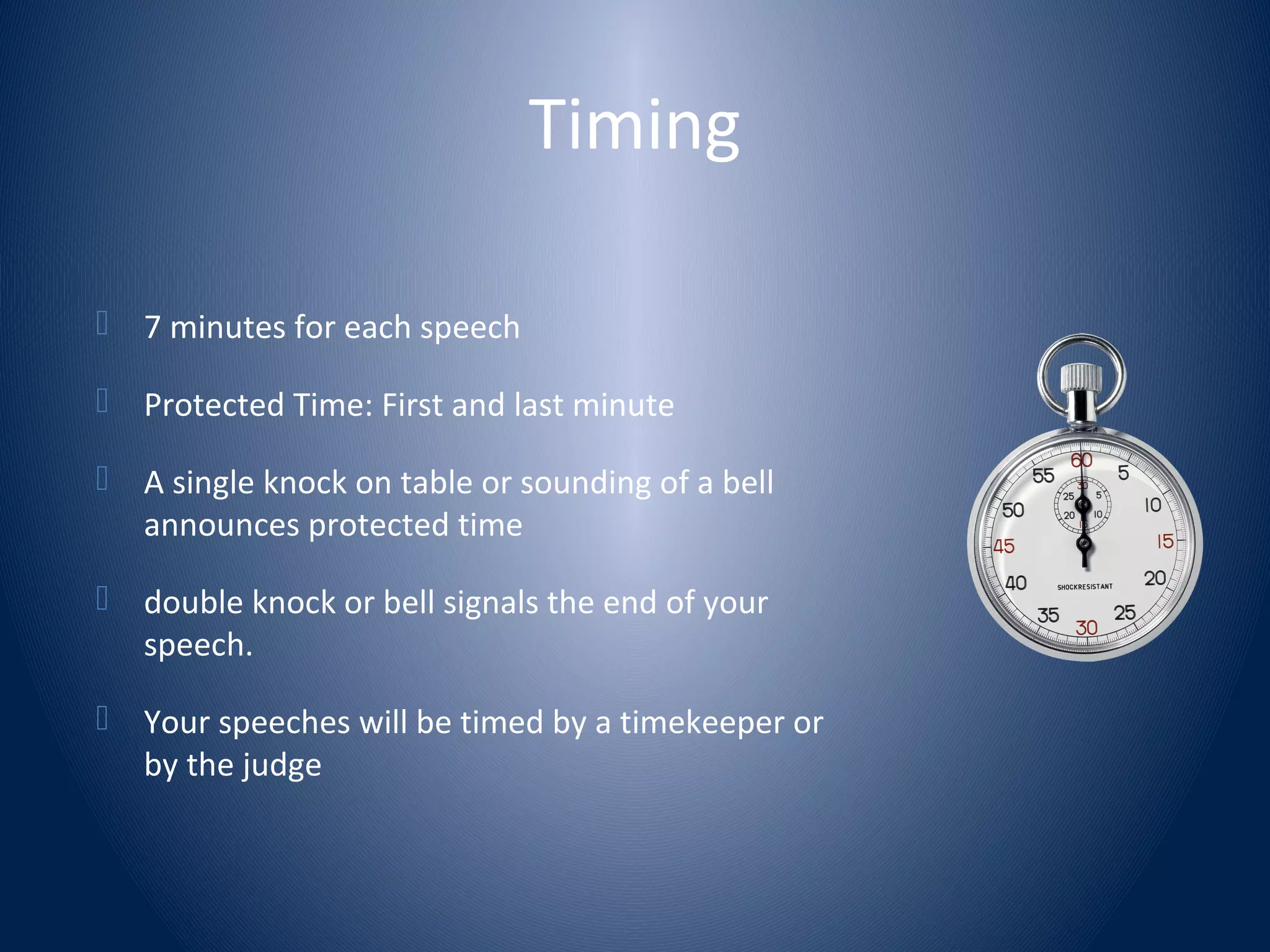
 7 minutes for each speech
 Protected Time: First and last minute
 A single knock on table or sounding of a bell
announces protected time
 double knock or bell signals the end of your
speech.
 Your speeches will be timed by a timekeeper or
by the judge
Four Teams
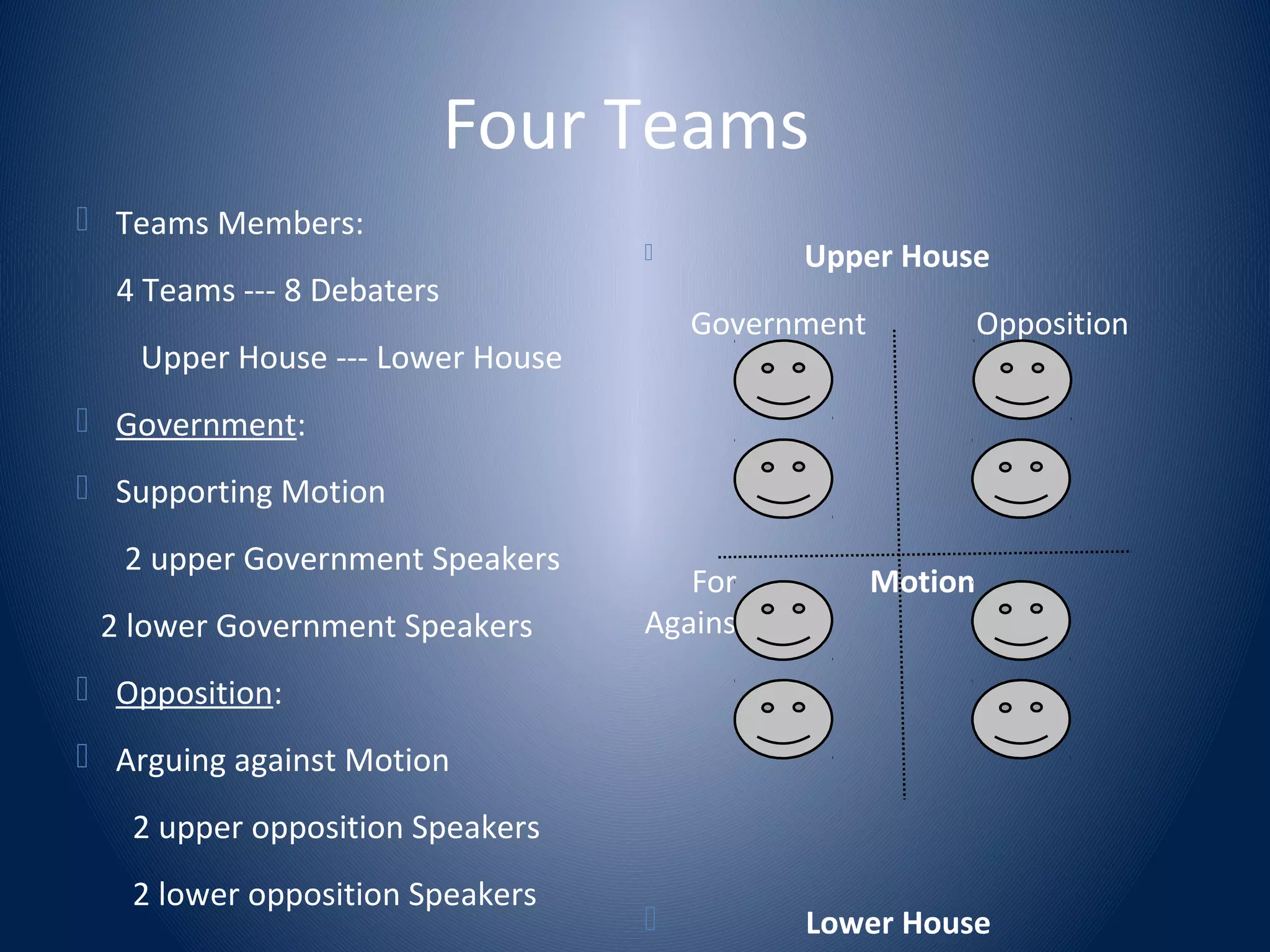
 Teams Members:
4 Teams --- 8 Debaters
Upper House --- Lower House
 Government:
 Supporting Motion
2 upper Government Speakers
2 lower Government Speakers
 Opposition:
 Arguing against Motion
2 upper opposition Speakers
2 lower opposition Speakers
 Upper House
Government Opposition
For Motion
Against
 Lower House
Names of Speakers
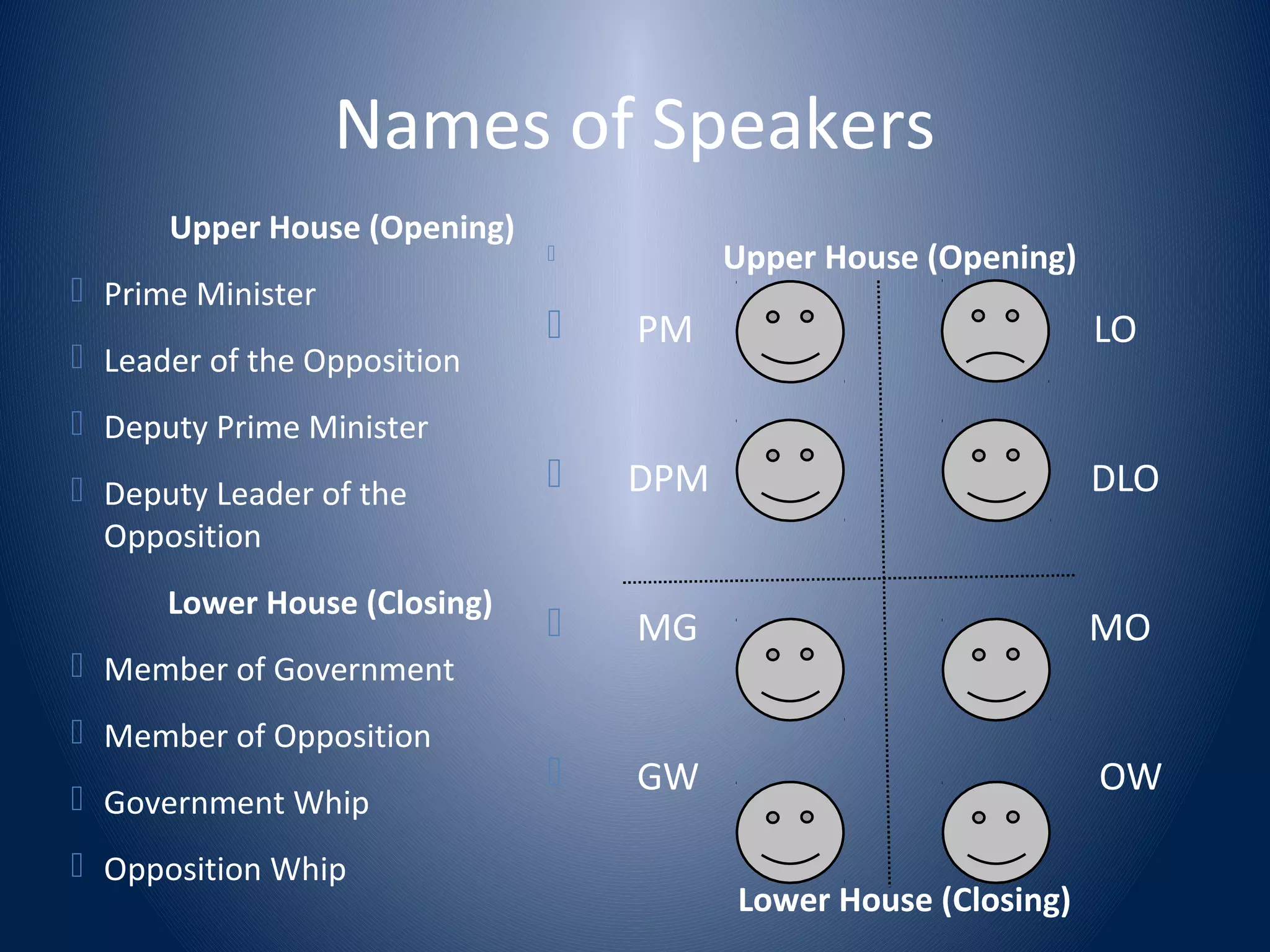
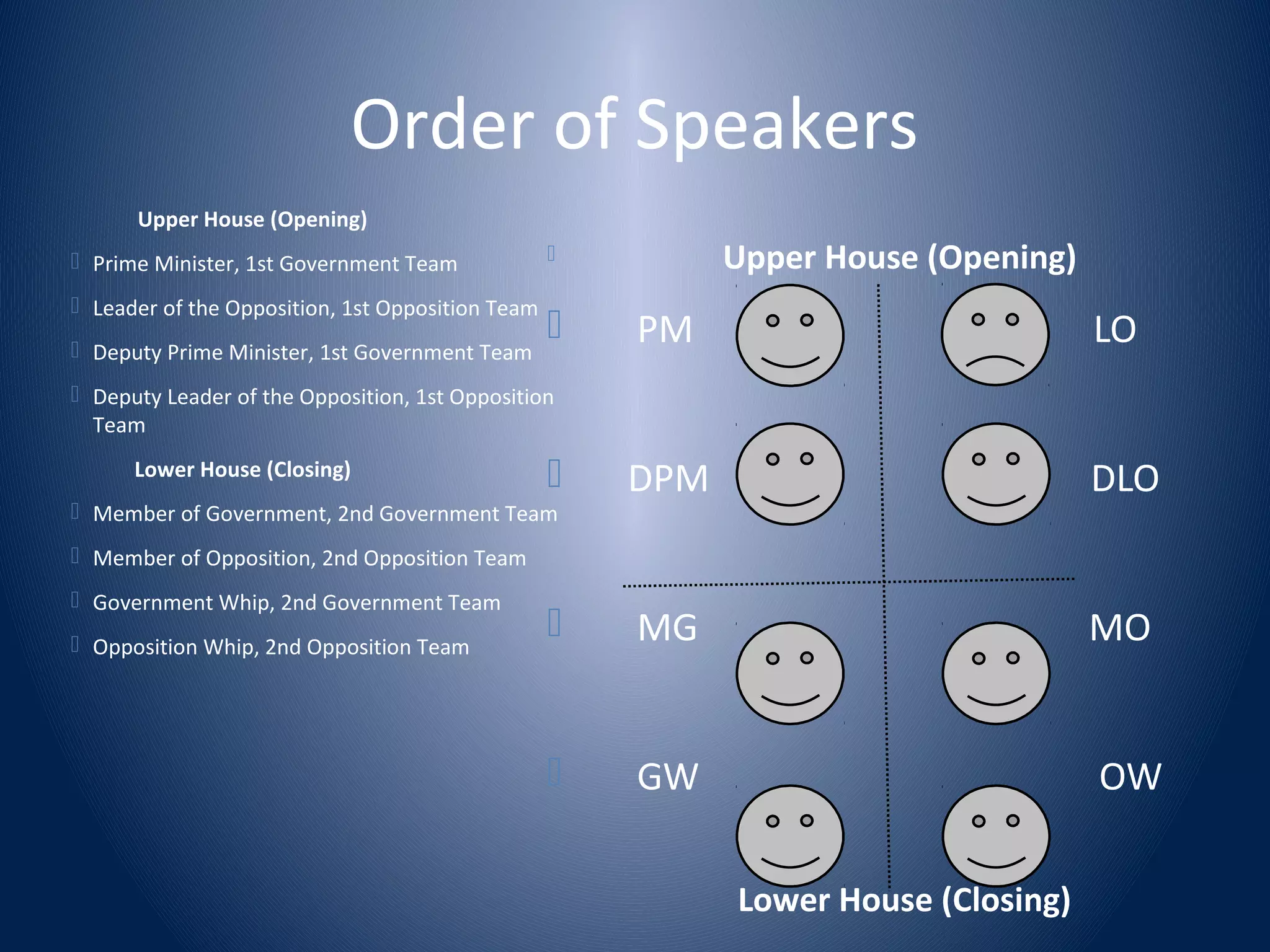
Upper House (Opening)
 Prime Minister
 Leader of the Opposition
 Deputy Prime Minister
 Deputy Leader of the
Opposition
Lower House (Closing)
 Member of Government
 Member of Opposition
 Government Whip
 Opposition Whip
 Upper House (Opening)
 PM LO
 DPM DLO
 MG MO
 GW OW
Lower House (Closing)
Order of Speakers
Upper House (Opening)
 Prime Minister, 1st Government Team
 Leader of the Opposition, 1st Opposition Team
 Deputy Prime Minister, 1st Government Team
 Deputy Leader of the Opposition, 1st Opposition
Team
Lower House (Closing)
 Member of Government, 2nd Government Team
 Member of Opposition, 2nd Opposition Team
 Government Whip, 2nd Government Team
 Opposition Whip, 2nd Opposition Team
 Upper House (Opening)
 PM LO
 DPM DLO
 MG MO
 GW OW
Lower House (Closing)
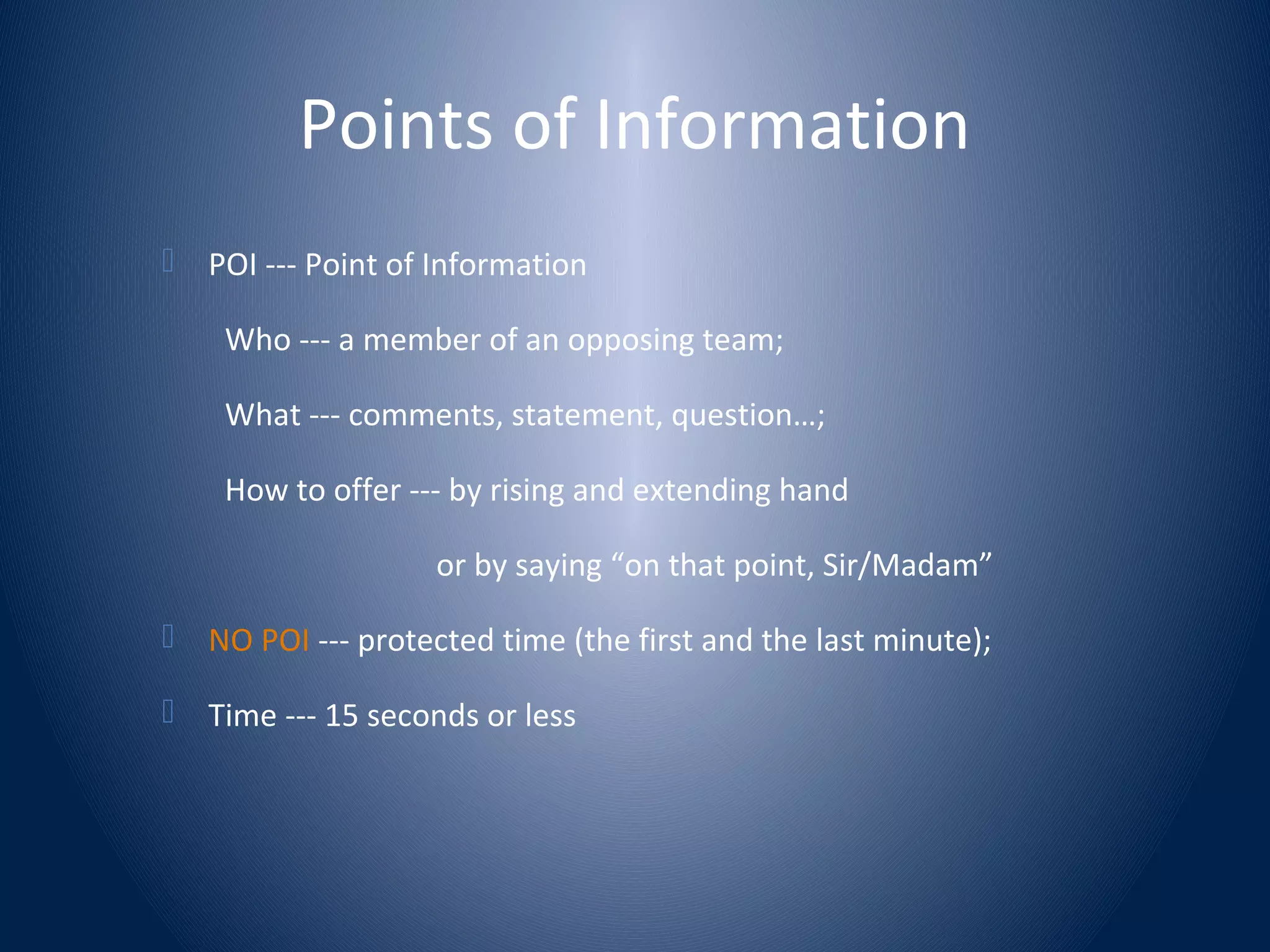
Points of Information
 POI --- Point of Information
Who --- a member of an opposing team;
What --- comments, statement, question…;
How to offer --- by rising and extending hand
or by saying “on that point, Sir/Madam”
 NO POI --- protected time (the first and the last minute);
 Time --- 15 seconds or less
Speaker Roles and Responsibilities
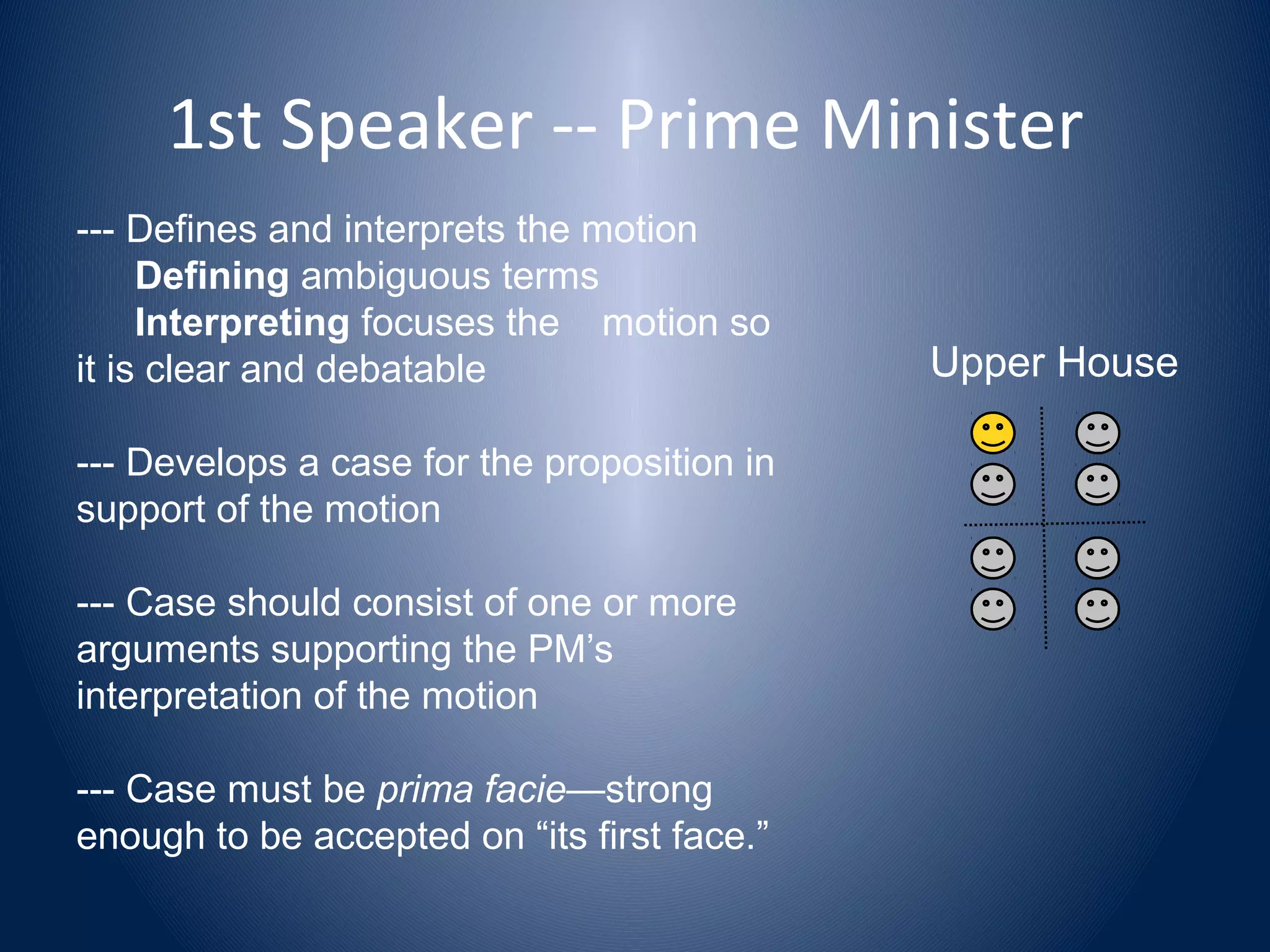
1st Speaker -- Prime Minister
--- Defines and interprets the motion
Defining ambiguous terms
Interpreting focuses the motion so
it is clear and debatable
--- Develops a case for the proposition in
support of the motion
--- Case should consist of one or more
arguments supporting the PM’s
interpretation of the motion
--- Case must be prima facie—strong
enough to be accepted on “its first face.”
Upper House
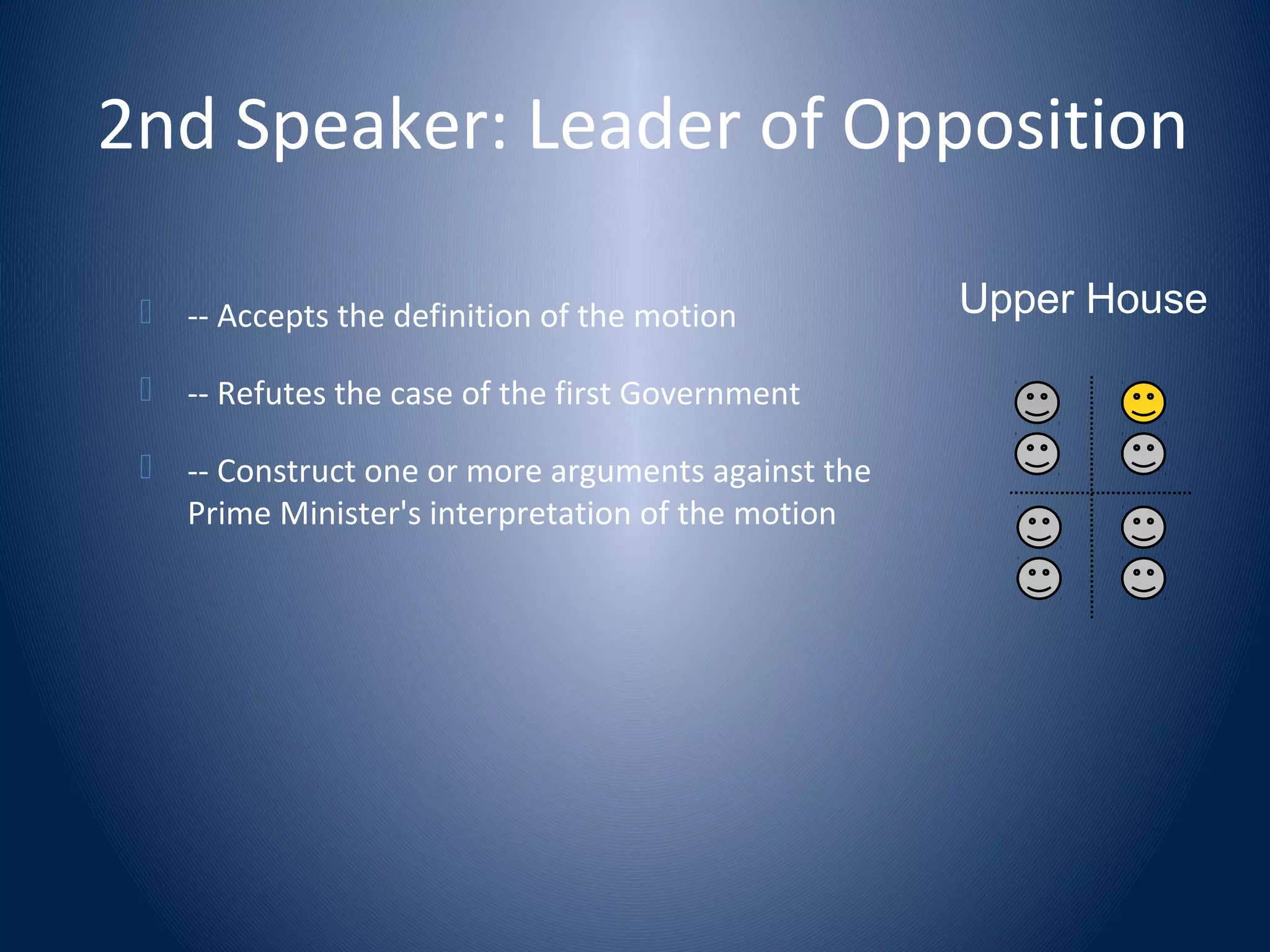
2nd Speaker: Leader of Opposition
 -- Accepts the definition of the motion
 -- Refutes the case of the first Government
 -- Construct one or more arguments against the
Prime Minister's interpretation of the motion
Upper House
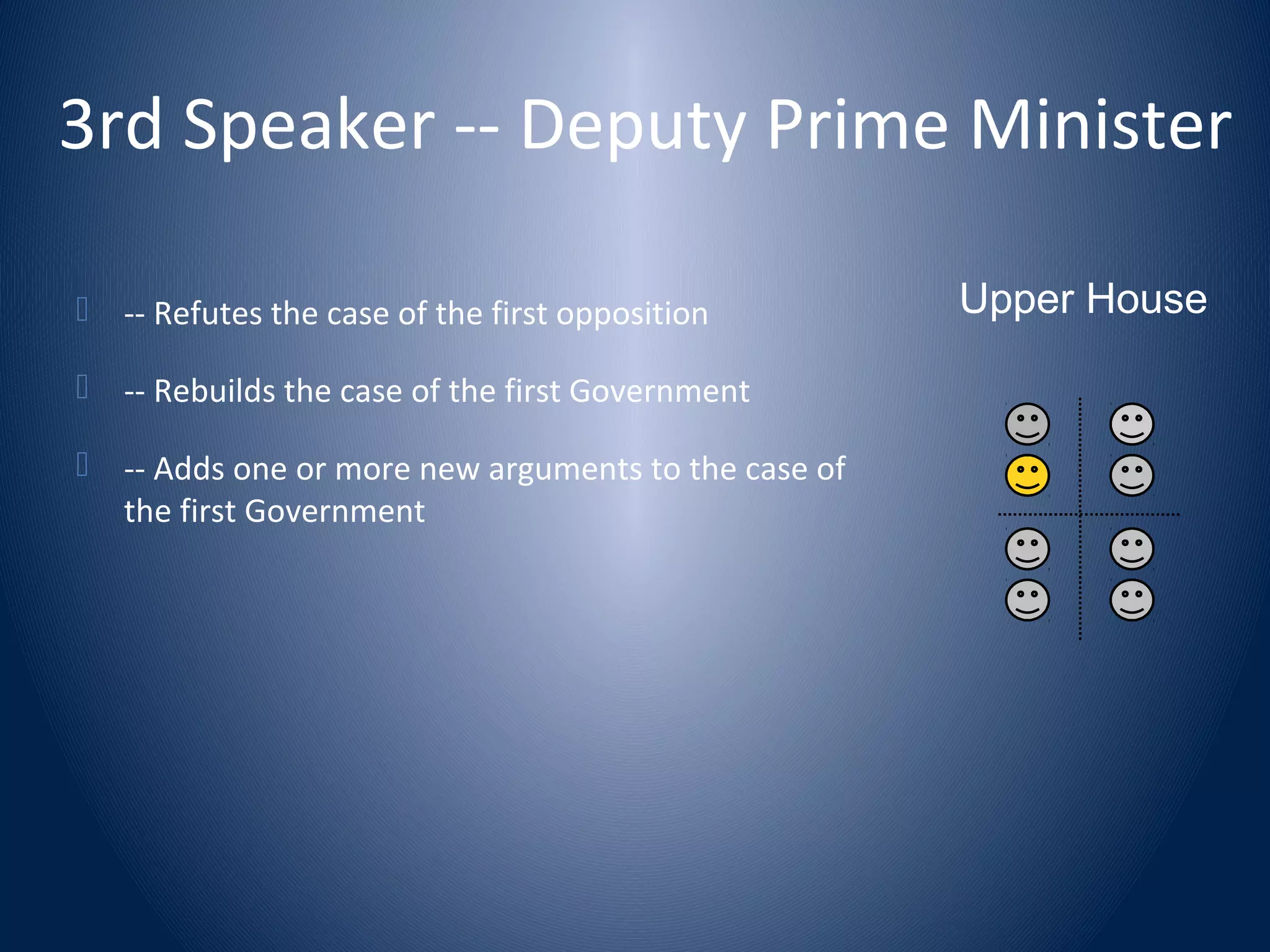
3rd Speaker -- Deputy Prime Minister
 -- Refutes the case of the first opposition
 -- Rebuilds the case of the first Government
 -- Adds one or more new arguments to the case of
the first Government
Upper House
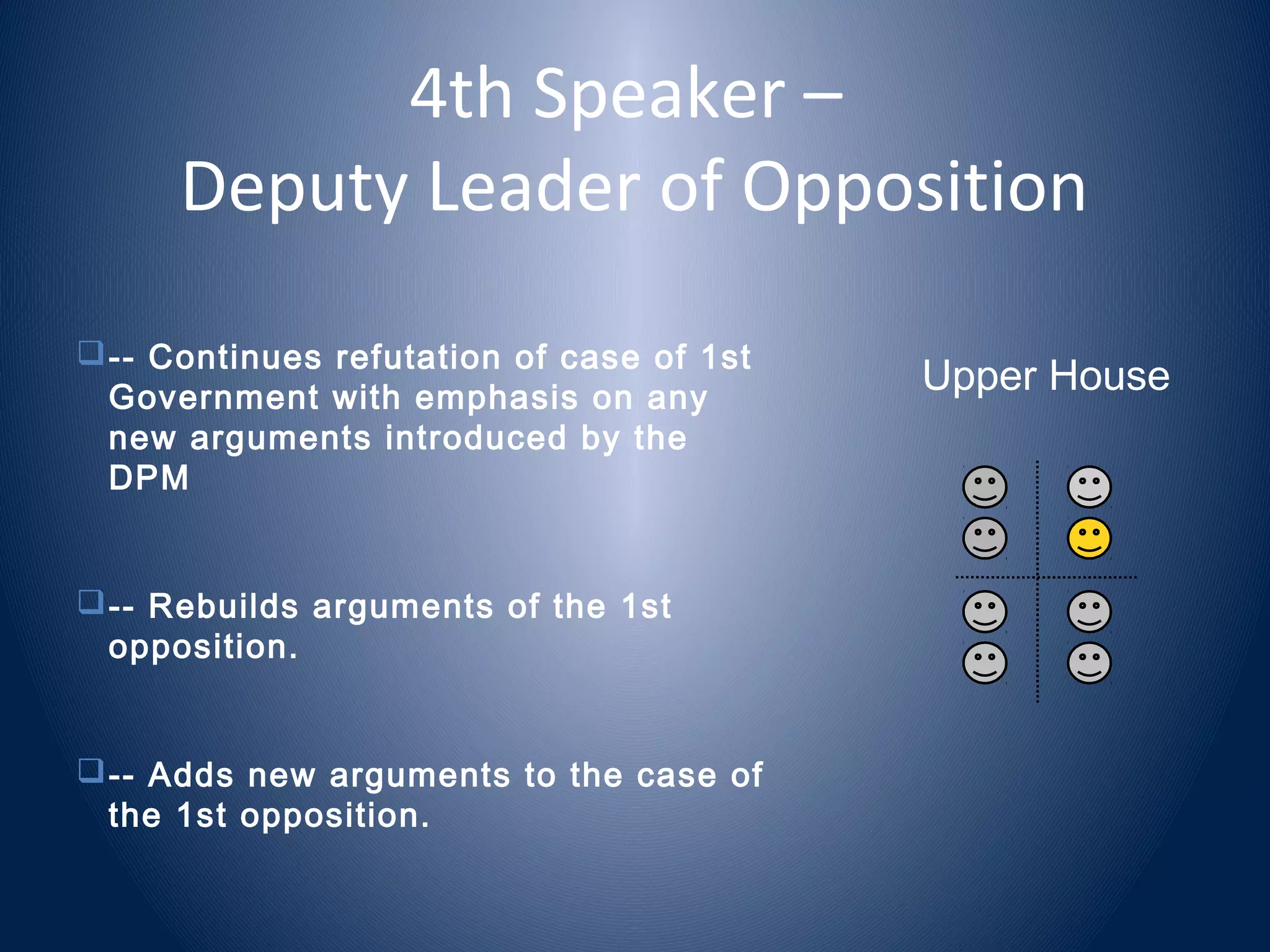
4th Speaker –
Deputy Leader of Opposition
-- Continues refutation of case of 1st
Government with emphasis on any
new arguments introduced by the
DPM
-- Rebuilds arguments of the 1st
opposition.
-- Adds new arguments to the case of
the 1st opposition.
Upper House
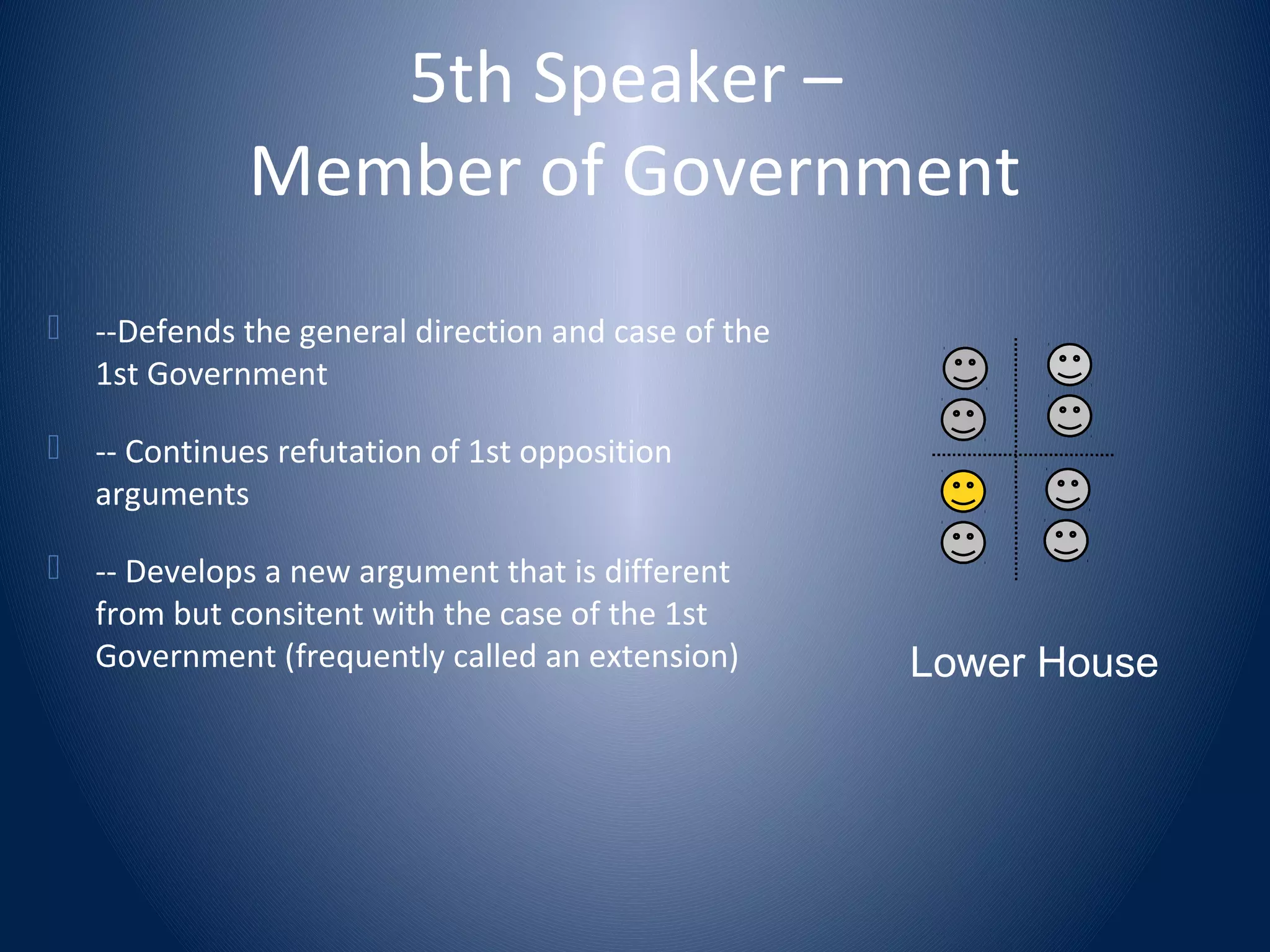
5th Speaker –
Member of Government
 --Defends the general direction and case of the
1st Government
 -- Continues refutation of 1st opposition
arguments
 -- Develops a new argument that is different
from but consitent with the case of the 1st
Government (frequently called an extension) Lower House
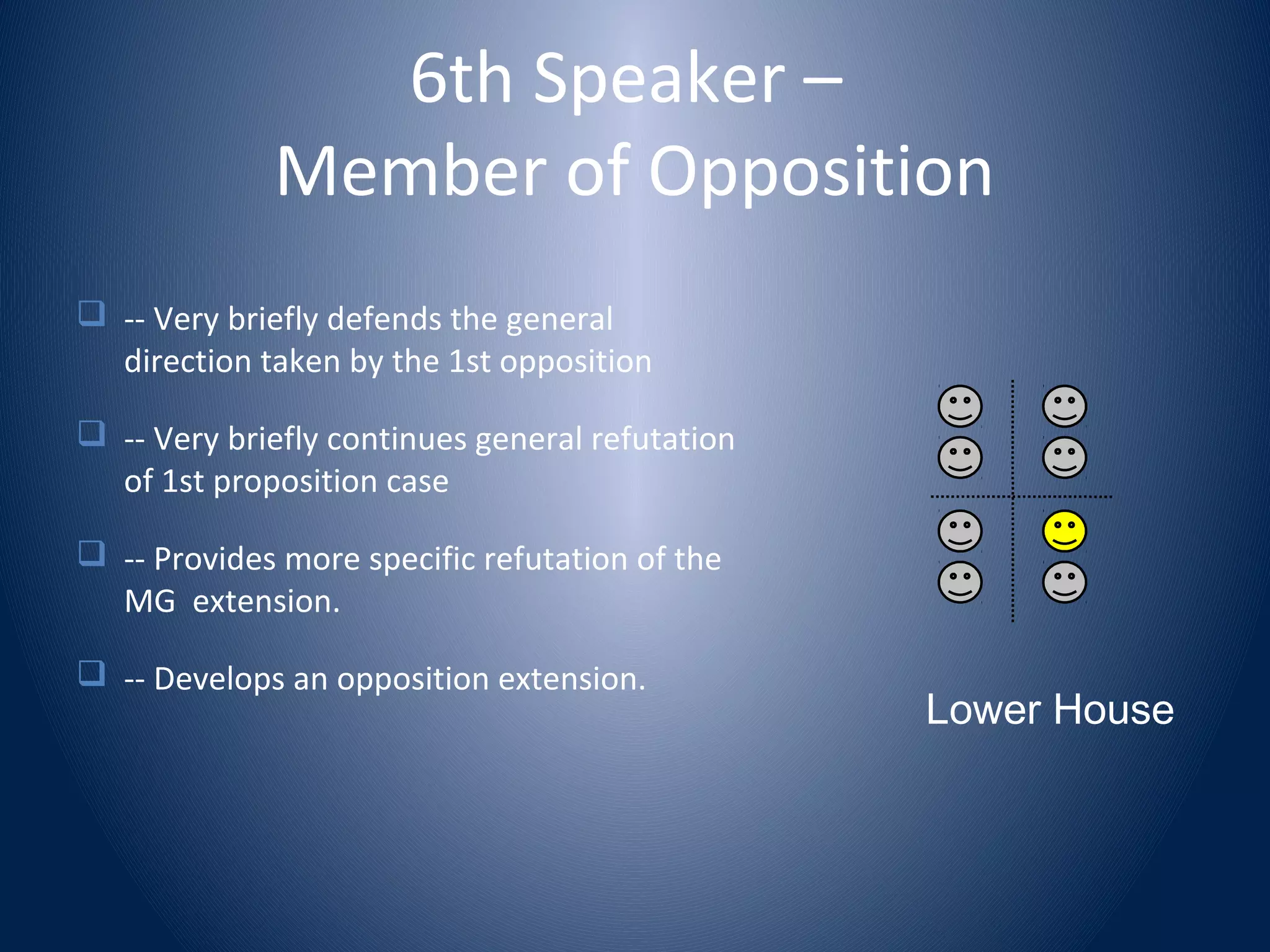
6th Speaker –
Member of Opposition
 -- Very briefly defends the general
direction taken by the 1st opposition
 -- Very briefly continues general refutation
of 1st proposition case
 -- Provides more specific refutation of the
MG extension.
 -- Develops an opposition extension.
Lower House
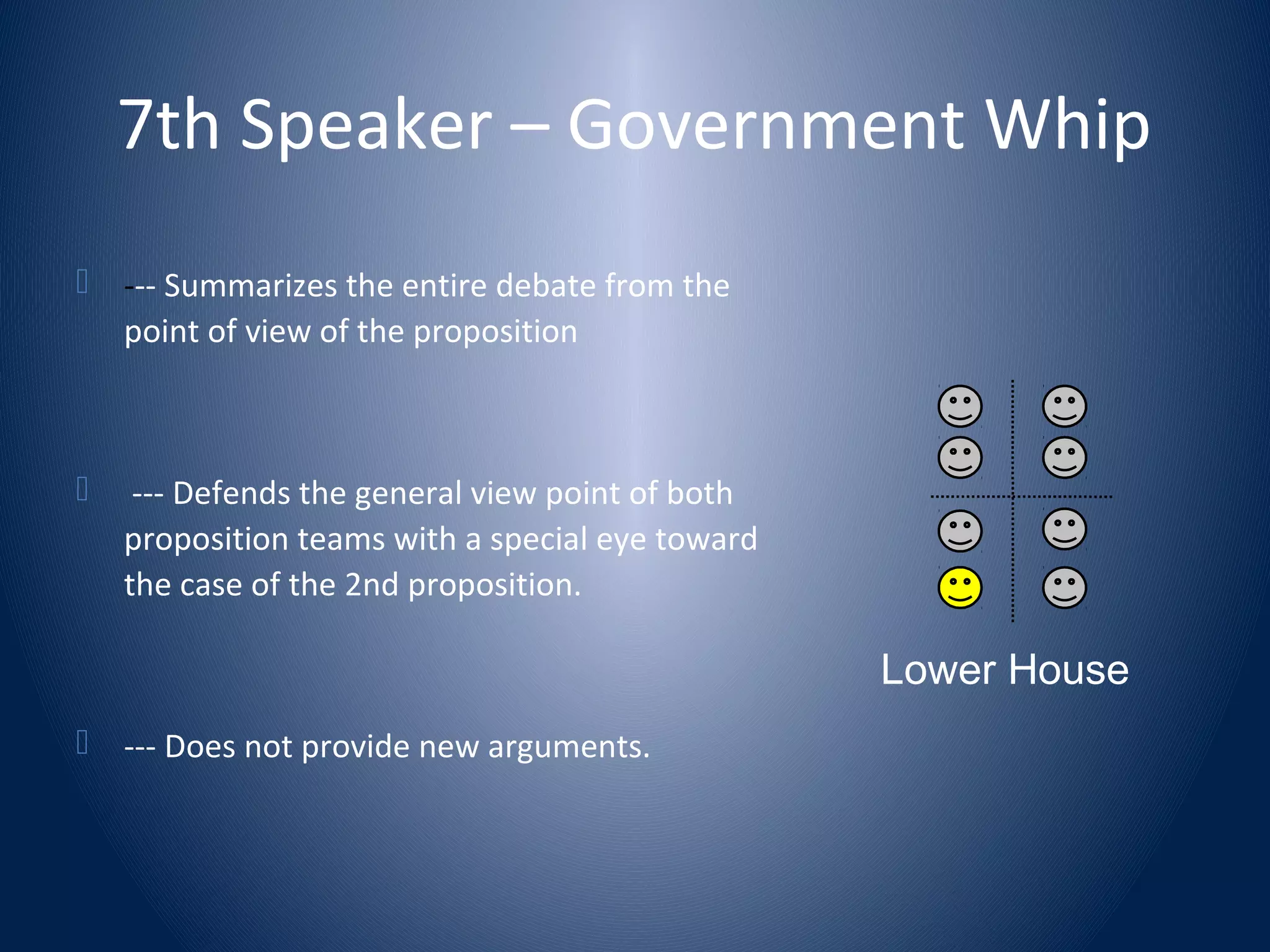
7th Speaker – Government Whip
 --- Summarizes the entire debate from the
point of view of the proposition
 --- Defends the general view point of both
proposition teams with a special eye toward
the case of the 2nd proposition.
 --- Does not provide new arguments.
Lower House
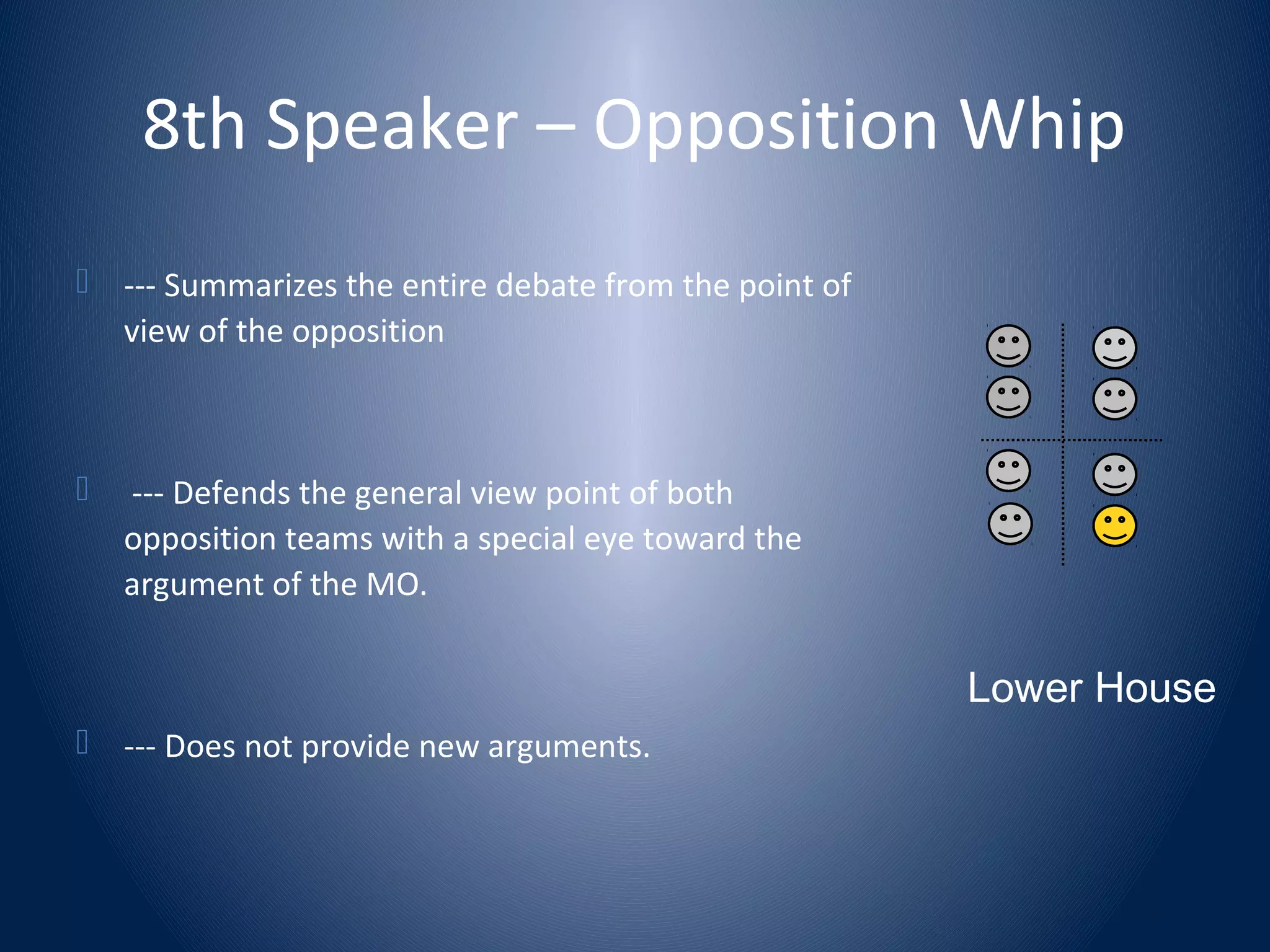
8th Speaker – Opposition Whip
 --- Summarizes the entire debate from the point of
view of the opposition
 --- Defends the general view point of both
opposition teams with a special eye toward the
argument of the MO.
 --- Does not provide new arguments.
Lower House
How You Will Be
Evaluated and Adjudicated
 In general, you will be evaluated on the strength of your
arguments.
 Although your speaking ability influences how adjudicators
respond to your arguments, they still will focus on the
 Usually a panel of adjudicators although sometimes a single one
 An odd number of panel, usually 3 members
 One Chairperson/Speaker (designated by the organizers)
--- This person will introduce and manage the debate
--- This person also announce the result & comment on the
whole debate
THANK YOU!

Introduction to BP debate

  • 1.
    Introduction to British ParliamentaryDebate China Debate Education Network:
  • 2.
    British Parliamentary DebateFormat  I. Motions  II. Procedures  III. Order of Speeches & Speaker Titles  IV. Speaker Roles & Responsibilities  V. Points of Information  VI. How your debate will be evaluated
  • 3.
    Motions  -- Motions:For & Against A motion is a statement provided by the Tournament Director that will become the subject of the debate. A motion is sometimes called a debate topic, a resolution, or a proposition.  -- Examples
  • 4.
    Examples of Motions 1. This House believes that College students should have part-time jobs.  2. The Younger Generation Knows Best.  3. China should ban tobacco products.  4. Money is the Most Important Thing in Life.  5. This House believes thatWomen should earn equal pay for equal work.  6. It is a Good Thing to Live in a Modern City.  7. China should institute real estate price tighening in second-tier cities.  8. Cars do more Harm than Good.
  • 5.
    Procedure for EachDebate  Positions of teams are posted on the “draw.”  Motions announcement to all teams  15-30 minutes preparation  Teams of the same side do not prepare with one another, nor can they consult their teammates or teachers  Debate begins  Timing
  • 6.
    Timing  7 minutesfor each speech  Protected Time: First and last minute  A single knock on table or sounding of a bell announces protected time  double knock or bell signals the end of your speech.  Your speeches will be timed by a timekeeper or by the judge
  • 7.
    Four Teams  TeamsMembers: 4 Teams --- 8 Debaters Upper House --- Lower House  Government:  Supporting Motion 2 upper Government Speakers 2 lower Government Speakers  Opposition:  Arguing against Motion 2 upper opposition Speakers 2 lower opposition Speakers  Upper House Government Opposition For Motion Against  Lower House
  • 8.
    Names of Speakers UpperHouse (Opening)  Prime Minister  Leader of the Opposition  Deputy Prime Minister  Deputy Leader of the Opposition Lower House (Closing)  Member of Government  Member of Opposition  Government Whip  Opposition Whip  Upper House (Opening)  PM LO  DPM DLO  MG MO  GW OW Lower House (Closing)
  • 9.
    Order of Speakers UpperHouse (Opening)  Prime Minister, 1st Government Team  Leader of the Opposition, 1st Opposition Team  Deputy Prime Minister, 1st Government Team  Deputy Leader of the Opposition, 1st Opposition Team Lower House (Closing)  Member of Government, 2nd Government Team  Member of Opposition, 2nd Opposition Team  Government Whip, 2nd Government Team  Opposition Whip, 2nd Opposition Team  Upper House (Opening)  PM LO  DPM DLO  MG MO  GW OW Lower House (Closing)
  • 10.
    Points of Information POI --- Point of Information Who --- a member of an opposing team; What --- comments, statement, question…; How to offer --- by rising and extending hand or by saying “on that point, Sir/Madam”  NO POI --- protected time (the first and the last minute);  Time --- 15 seconds or less
  • 11.
    Speaker Roles andResponsibilities
  • 12.
    1st Speaker --Prime Minister --- Defines and interprets the motion Defining ambiguous terms Interpreting focuses the motion so it is clear and debatable --- Develops a case for the proposition in support of the motion --- Case should consist of one or more arguments supporting the PM’s interpretation of the motion --- Case must be prima facie—strong enough to be accepted on “its first face.” Upper House
  • 13.
    2nd Speaker: Leaderof Opposition  -- Accepts the definition of the motion  -- Refutes the case of the first Government  -- Construct one or more arguments against the Prime Minister's interpretation of the motion Upper House
  • 14.
    3rd Speaker --Deputy Prime Minister  -- Refutes the case of the first opposition  -- Rebuilds the case of the first Government  -- Adds one or more new arguments to the case of the first Government Upper House
  • 15.
    4th Speaker – DeputyLeader of Opposition -- Continues refutation of case of 1st Government with emphasis on any new arguments introduced by the DPM -- Rebuilds arguments of the 1st opposition. -- Adds new arguments to the case of the 1st opposition. Upper House
  • 16.
    5th Speaker – Memberof Government  --Defends the general direction and case of the 1st Government  -- Continues refutation of 1st opposition arguments  -- Develops a new argument that is different from but consitent with the case of the 1st Government (frequently called an extension) Lower House
  • 17.
    6th Speaker – Memberof Opposition  -- Very briefly defends the general direction taken by the 1st opposition  -- Very briefly continues general refutation of 1st proposition case  -- Provides more specific refutation of the MG extension.  -- Develops an opposition extension. Lower House
  • 18.
    7th Speaker –Government Whip  --- Summarizes the entire debate from the point of view of the proposition  --- Defends the general view point of both proposition teams with a special eye toward the case of the 2nd proposition.  --- Does not provide new arguments. Lower House
  • 19.
    8th Speaker –Opposition Whip  --- Summarizes the entire debate from the point of view of the opposition  --- Defends the general view point of both opposition teams with a special eye toward the argument of the MO.  --- Does not provide new arguments. Lower House
  • 20.
    How You WillBe Evaluated and Adjudicated  In general, you will be evaluated on the strength of your arguments.  Although your speaking ability influences how adjudicators respond to your arguments, they still will focus on the  Usually a panel of adjudicators although sometimes a single one  An odd number of panel, usually 3 members  One Chairperson/Speaker (designated by the organizers) --- This person will introduce and manage the debate --- This person also announce the result & comment on the whole debate
  • 21.

Editor's Notes

  • #9 <number>
  • #10 <number>