





SEMINAR
ON
LIMITATIONS OF
CEPHALOMETRICS
www.indiandentalacademy.com
CONTENTS
1.INTRODUCTION
2.REVIEW OF LITRETURE
3.CLASSIFICATION OF CEPHALOMETRIC
ERRORS
4.PROJECTION ERRORS
5.LANDMARK IDENTIFICATION ERRORS
6.LIMITATIONS IN SUPERIMPOSITION
7.LIMITATIONS OF CEPHALOMETRIC
ANALYSIS
www.indiandentalacademy.com
CONTENTS
8) LIMITATIONS OF VERIOUS REFERENCE
PLANES USED IN CEPHALOMETRICS
9) CONCEPTS OF NATURAL HEAD POSITION
AND NATURAL HEAD POSTURE
10) LIMITATIONS OF VARIOUS CEPHALOMETRIC
ANALYSIS COMMONLY USED
11) ADVANTAGES & LIMITATIONS OF DIGITAL
CEPHALOMETRY
12) CONCLUSION AND BIBLOGRPHY
www.indiandentalacademy.com
• Cephalometry, or the measurement of the head, was
developed as an anthropological technique to quantify shape
and size of skull. The discovery of x-rays by Roentgen in
1895 revolutionized medicine and dentistry. About 36 year
later i.e; 1931, traditional cephalometry in two dimensions,
known as roentgenographic cephalometry, was introduced to
the dental profession by Broadbent and has since remained
relatively unchanged.
• Since these early years, cephalograms have been used
widely as a clinical and research tool for the study of
craniofacial growth, development, and treatment.
• However, because of the traditional 2-dimensional
cephalometry, use of this method for deriving clinical
information as a basis for determining treatment plans has
been questioned.
INTRODUCTION
www.indiandentalacademy.com
• The following issues question the validity of 2-
dimenstional cephalometry to derive clinical
information used in treatment planning.
1) A conventional head film is a 2-dimentional
representation of a 3-dimentional object. When 3-
dimentional object is represented in 2-
dimentions,the imaged structures are displaced
vertically and horizontally. The amount of
structural displacement is proportional to the
distance of the structures from the film or
recording plane.
www.indiandentalacademy.com
2) Cephalometric analysis are based on
the right assumption of perfect superim -
position of the right and left sides about
the midsagittal plane.
• Perfect superimposition is observed
infrequently because facial symmetry is
rare and because of the relative image
displacement of the right and left sides.
• These inherent technical limitations do
not produce an accurate assessment of
cranio- facial anomalies and facial
asymmetries. www.indiandentalacademy.com
3) The projection geometry prevent the
ability to acquire accurate dimensional
information aligned in the direction of the
x-ray beam.
4) A significant amount of external errors,
known as radiographic projection error, is
associated with image acquisition. These
errors include size magnification, errors in
patient positioning, and projective
distortion inherent to the film-patient-focus
geometric relationships.
www.indiandentalacademy.com
5) Manual data collection and processing in
cephalometric analysis have been shown to have low
accuracy and precision.
6) Significant error is associated with ambiguity in
locating anatomic landmarks because of the lack of
well-defined anatomic features, outlines, hard edges
and shadows, and variation in patient position. Such
landmark identification errors are considered
major source of cephalometric errors. Despite
these limitations of cephalometry, many
cephalometric analyses have been developed to help
diagnose skeletal malocclusions and Dentofacial
deformities. However, several investigations have
questioned the scientific validity of such analyses.www.indiandentalacademy.com
• Pacini in 1922 – described a rather primitive
method for the standardization of radiograph
imaging of the head. He recommended the
positioning of a subject at a fixed distance of 2
mtr from the x-ray source with a film cassette
fixed to the head with a wrapping of gauze
bandages.
• Hofrath of Germany and Broadbent of the
United states in 1931- published their own
method of obtaining standardized head
radiographs.
REVIEW OF LITRATURE
www.indiandentalacademy.com
• Bjork in 1947 –described errors arising from
differences in projection between two films of the same
individual. He also noted that the difficulties involved in
locating different landmarks varied depending on the
nature of the landmark examined. This was confirmed
by Richardson 1966- who noted that some landmarks
were more reproducible vertically than horizontally and
vice versa.
• In a study by Van Aken in 1963- projection errors
were found to be small but might be of significance in
cephalographs of asymmetrical skulls or in the case of
anatomical landmarks that do not lie in the midsagittal
plane.
REVIEW OF LITRATURE
www.indiandentalacademy.com
• Baumrind and Frantz in 1971- found that repeated
identification of the same landmark on the same
cephalometric image resulted in errors and they also
studied the side effects of uncertain landmark
identification and found these errors were significant
when transmitted to angular & linear measurements.
• Rossmann & Wiley in1970- claimed that
interpretation of radiographic image is dependent on
radiological knowledge, pattern recognition , physical
image quality.
• Bergersen in 1980- studied magnification and
distortion in cephalometric radiography and found
discrepancies between distance measured on the film
and true distances in the object.www.indiandentalacademy.com
CLASSIFICATION OF
CEPHALOMETRIC ERRORS
www.indiandentalacademy.com
Some limitations of cephalometrics According
to Moyers
1) Assumptions
a) Symmetry
b) Occlusal position
c) Orientation on the transmeatal Axis
d) Adequacy of one or two planar projections
2) Fallacies
a) The fallacy of false precision
b) The Fallacy of ignoring the patient
c) The fallacy of super- positioning
d) The fallacy of Using Chronological Age
e) The fallacy of the “ideal”
3) Misuses of cephalometric analyses
www.indiandentalacademy.com
Geometric methods
I) Basic elements : A tracing has some actual
biological information, namely, location of curves
and landmarks. It also contains some non
biological information-artifacts-such as non-
curves and non-points.
A) Curves:
The curved images in the cephalogram are of three
different biological types (i) edge regression (ii)
curves in space (iii) transversals of surfaces.
i) Edges of regression surfaces –the edges of
surfaces are sometime properly shown. The
anterior border of the coronoied process, for
instance, really is a fairly sharp edge.www.indiandentalacademy.com
• But sometime that which we perceive as an
edge of a surface is neither an edge nor a
horizon. For e.g., the line we call the “alveolar
crest” line represents a col, a saddle-shaped
depression in the crest of a mountain ridge.
www.indiandentalacademy.com
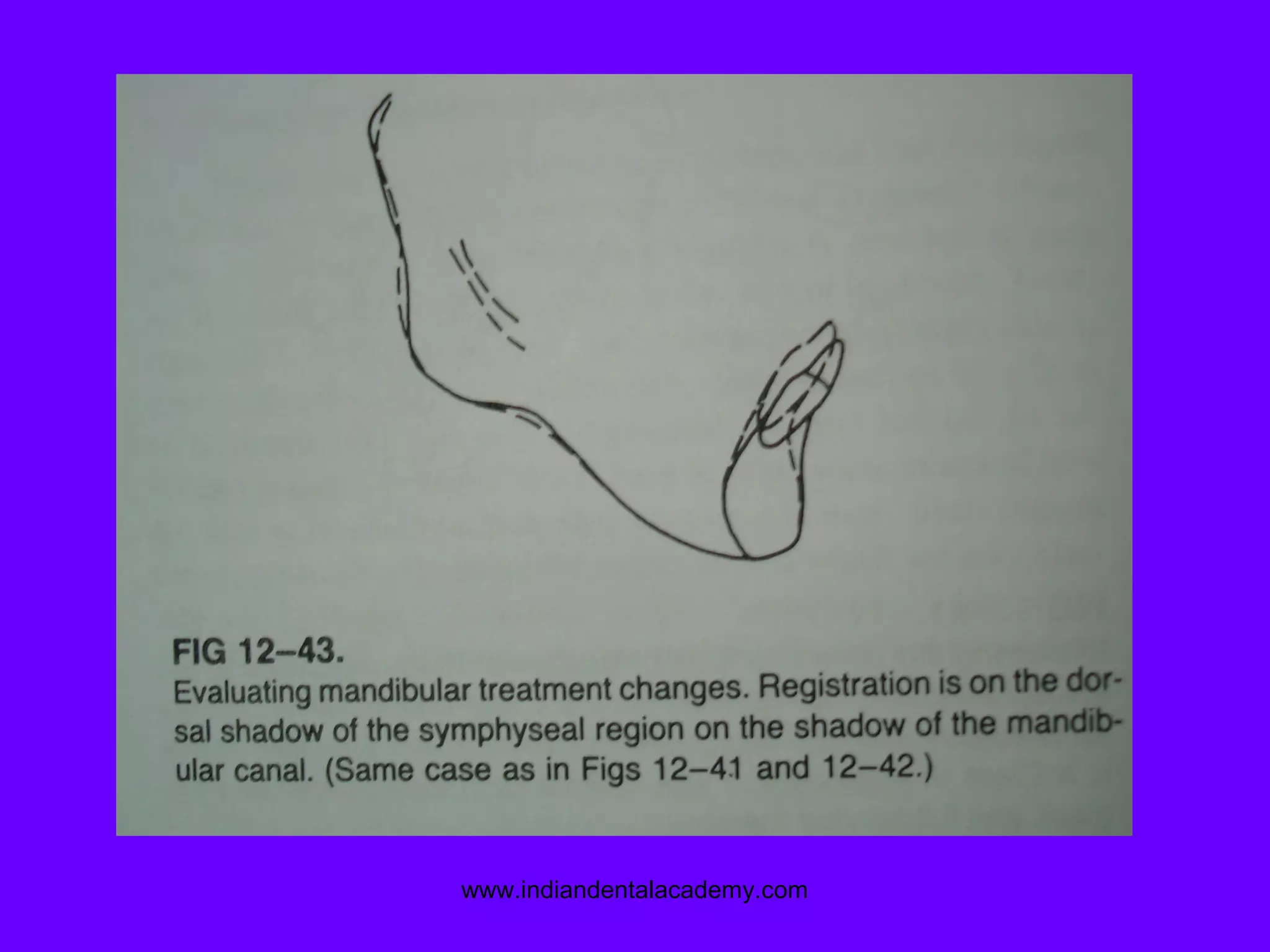
ii) Curves in space
In a cephalogram curves are
seen but are foreshortened and
simplified by flattening; for e.g.
the image of the mandibular
canal in cephalogram and the
resulting image in not realistic.
www.indiandentalacademy.com
iii) Transversals of surfaces:
• Transversals of surfaces are neither
edges nor true anatomic loci but places
where a bone of irregular shape is viewed
most parallel to the central ray. Some
surfaces are nearly parallel to the central
ray and hence appear as a line, a problem
inherent in reducing 3-dimensions in to
two.
www.indiandentalacademy.com
• For e.g. , the radiographic shadow of the
bony orbit in cephalograms and real bony
orbit on a dry skull.
www.indiandentalacademy.com
B) Points& landmarks classified
A landmark is a point serving as a guide
for measurement. Cephalometric
landmarks are of the following kinds;
a) True anatomic point- anatomic points
are really small regions which might be
located on the solid skull even better than
in the cephalogram.
e.g.- ANS, infradentale, cusp tips/ incisal
edges, nasion,
www.indiandentalacademy.com
b) Implants- implants are artificially
inserted radiopaque markers, usually
made of an inert metal. They are not
landmark in the usual sense . They are
private points their position from subject
to subject is not homologous. They may
be located more precisely than
traditional point and provide precise
superpositioning, but they cannot be
used to measure accurately any aspect
of the single form.www.indiandentalacademy.com
c) External points - Are points
characterized by their properties
relative to the entire outline: a) points
which are extrema of curvature, for e.g.
incision superius (Is) (b) points whose
coordinates are largest or smallest of
all points on a specific outline ,for eg
point A, point B, gnathion, condylion.
These points are less precision of
location than true anatomic points.
www.indiandentalacademy.com
d) Intersection of edges of regression as points –
points defined as the intersection of images are
really lines looked at down their length. For e.g.,
articulare (Ar) and PTM are not points at all and
are in no way part of the solid skull. Such points
exist only in projections and are dependent on
subject positioning.
e) Intersection of constructed lines –intersections
of constructed lines are used as points for e.g. :
“gonion” some times is defined as the
intersection of the ramal and mandibular lines.
www.indiandentalacademy.com
C) Lines / planes:
• In reality many of the so called cephalometric
planes are not flat. For e.g., the occlusal plane
drawn in the cephalogram as a straight line
represents a very complicated 3-dimensional
relationship of cusp contacts. Cephalometric lines
usually of the following types:
i) Line joining true anatomic points, for e.g. ,the
palatal line joins the ANS-PNS .
www.indiandentalacademy.com
ii) Anatomic tangent lines:
• Lines through an anatomic point and tangent
to an outline elsewhere. For e.g., the facial line
is defined as joining nasion to pogonion; but
the Pog is just the point of tangency of this line
at the chin.
• Lines formed by double tangents, that is,
lines tangent to a structure, or structures, at
two points. For e.g. , the ramal line usually
touches the mandible both at the posterior
border of the ramus and along the condyle; the
mandiular line touches both near menton and
near gonion. www.indiandentalacademy.com
I) Assumptions
In any method some things must be taken
for granted as a basis for action.
a) Symmetry
• Analysis, particularly in the lateral
projection, is based on presumed skeletal
symmetry.
• All faces have minor asymmetries which
are clinically unimportant, but more serious
imbalances may be obscured by the
method or neglected by the dentist.
• Routine study of the PA projection is a
good antidote. www.indiandentalacademy.com
b) Occlusal position
• Cephalograms must be taken in some occlusal
position. It is conventional to position the
mandible in the usual occlusal position when
taking the cephalograms since this is where the
patient “bites”.
• In malocclusions with an important functional
element this convention may be misleading. One
should study carefully the patient’s mandibular
functional movements prior to recording the
cephalogram. Suspicions noted visually may be
confirmed quantitatively in the cephalogram by
two procedures;
www.indiandentalacademy.com
• Use wax bites of both the usual
occlusal position ( centric occlusion)
and the detruded contact position
(centric relation) to record two lateral
cephalograms. In extreme cases the
patient may wear a diagnostic splint
for several days before the
cephalogram is obtained.
• Use the postural position as well as
an occlusal position for both the
lateral and PA projections.www.indiandentalacademy.com
c) Orientation on the transmeatal Axis
• It is convenient to use ear rods to orient the
patient’s head. The central ray is supposed to
pass along the transmeatal axis. But of course the
external auditory meati are just asymmetric as
any other cephalic structures.
• Special cephalometric procedures have been
designed without ear rods so the central
ray is 90 degrees to the midsagittal plane, but they
are not in common use.
www.indiandentalacademy.com
d) Adequacy of one or two planar
projections:
Almost all routine cephalometric
analysis is done using only the lateral
projection. Much can be learned from
PA , oblique, and basilar views. The
future may bring a practical true 3-
dimensional cephalometric method.
www.indiandentalacademy.com
2) FALLACIES
Any method may involve specific miscalculation,
omissions, blunders, oversights, errors, or
inaccuracies which are not the fault of the method
itself. We speak hear not about such mistakes but
about fallacies: misrepresentations intrinsic to the
method.
a) The fallacy of false precision
If one makes a series of separate cephalograms of
the same head, traces each cephalogram, locate
“A” point , nasion, and “B” point , and measures
the ANB angles, it will be discovered that the
standard error of that measure is greater than
1.5 degrees.
www.indiandentalacademy.com
• Therefore, any decision, such as a
choice of treatment procedure, based on
the value of ANB angle, alone or in
combination with other measurements,
must have a gray area of approximately
+/- 1.5 degrees where the treatment
prescription is ambiguous.
• This problem is compounded when a
clinician compares a case he or she has
traced to standards developed, and
therefore filmed and traced, by another.
www.indiandentalacademy.com
b) The Fallacy of ignoring the patient
• Means are population averages
which have nothing to do with the
specific characteristics of particular
patient. A patient’s measure need not
to be increased by , for e.g., 4mm just
because it differs by 4mm from the
mean.
www.indiandentalacademy.com
•There are many beautiful faces in good
occlusion which have measures far from
the norms. It is not necessary to treat
malocclusion with relation to a fixed
cephalometric goal.
•Rather, cephalomerics should provide a
range of satisfactory treatment goals
which, combined with other information
from dental casts ,case history, and
observation of the patient, make possible
an individualized treatment plan.
www.indiandentalacademy.com
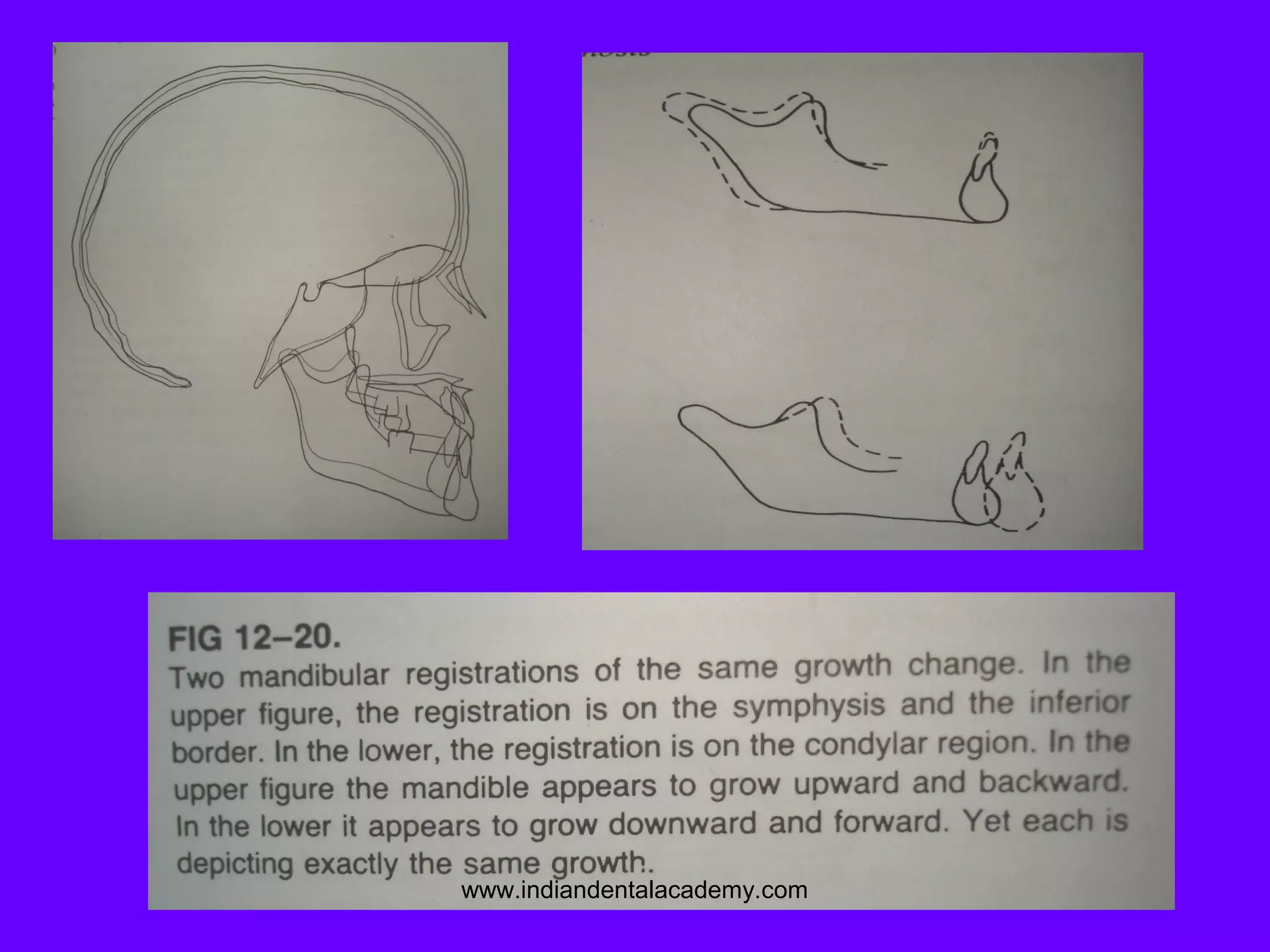
c) The fallacy of super- positioning:
Super positioning , registering of two or
more tracing of an individual on particular
structures ,occasionally helps one to
visualize growth or treatment changes.
• Localized remodeling can be shown by
superposition's nearby. As one moves
away from the registration site the
changes observed are a combination of
summated growth in several regions,
effect of treatment, enhancement of errors
in positioning.
www.indiandentalacademy.com
• For e.g., where registration is in the cranial
base region, the chin seems to have “grown”
downward & forward, but one may as well say
that the condyle has been growing upward & the
chin has been translated away from the articular
fossae. Little growth occurs at the chin itself.
The many changes b/w chin & sella are
summated & directed downward & forward not
by growth but by the artifact of super-
positioning.
• If one superposed on the symphysis, it would
be misleading to speak of upward & backward
growth of the cranial base.
www.indiandentalacademy.com
d) The fallacy of Using Chronological Age
Although it is conventional to use
chronological age (birth age) for
comparisons and reference,
developmental age is a better criterion: it
reduces the variance of sizes, angles and
proportions within age classes. Some
orthodontists take routine radiographs of
the wrist of patients to assign their “
carpal age” an index of bone maturation.
www.indiandentalacademy.com
e) The fallacy of the “ideal”
Practical problems arise when “ ideals”
for skeletal relationships are
oversimplified into numbers inflexibly
and arbitrarily imposed on every patient.
The use of contrived “ideals” as
standards sometimes produces a set of
ipso facto findings by setting up artificial
criteria for abnormality and then
uncovering the incidence and prevalence
of these variations.
www.indiandentalacademy.com
• By definition, abnormal must always
refer to the normal, which can only be
determined from an appropriate
population.
• One cannot discover “abnormality” by
comparison with subjective ideals based
on personal perceptions of facial
esthetics, nor can one label such ideals as
normal.
www.indiandentalacademy.com
3) Misuses of cephalometric analyses
• Even when we protect ourselves from misleading
assumptions or fallacious misconceptions we may err
simply by misuse of any analysis.
a) An analysis is misused if too rigid an application of mean
values is made. The total range and variance are more
practical than the mean itself. Because means are
population averages, they usually are very poor treatment
goals.
• Occasionally means of tooth positions are useful, but only
when the array of skeletal values is close to the means for
sex and age. When skeletal values deviate from the mean,
dentitions must adapt. The clever clinician does not apply
the same mean value to all faces but determines those
adaptation compromises to be made in treatment which
are most suitable to be pleasing and stable.www.indiandentalacademy.com
b) An analysis is misused when it is applied
inappropriately.
• Values derived from 12-year old North American
white boys who sought orthodontic treatment in a
dental school, for e.g. are obviously of little use in
assessing the specific clinical needs of a 6-year
old black girl in practice: there are too many
differences resulting from age, sex, race, etc
• The samples from which many of our most
popular cephalometric analyses were derived
have not been adequately described in the
literature, making it very difficult for the clinician
to know whether or not the analysis is
appropriately useful.www.indiandentalacademy.com
c) An analysis is misused when it is applied in a
way for which it was not intended. Analyses
contrived to visualize treatment goals (e.g. those
of Tweed or Steiner, both designed to depict
goals of treatment )are used improperly when
used for growth studies.
d) Standards derived from cross-sectional
samples, in most instances, cannot properly be
used in lieu of longitudinal data to access
expected growth. For establishing growth
standards, a small serial sample is much better
than cross-sectional sample having the same
number of radiographs.www.indiandentalacademy.com
e) The substitution of a subjectively
derived “ideal” for a statistically
developed population norm
misinforms and misleads.
•“Ideals” represent artificial
constructs of faces one clinician
likes; norms present real values of a
particular group. They cannot be
used interchangeably.
www.indiandentalacademy.com
According to Baumrind and Frantz;
AJO -1971, Head film measurements
like all measurements involve error
which falls into two categories.
• Errors of Projection
• Errors of Identification
www.indiandentalacademy.com
Hatcher recently has reviewed and categorized
source of errors include those caused by
internal and external orientation and those
related to geometry and association.
1) INTERNAL ORIENTATION ERROR :
• This error refers to the 3-dimentional
relationship of the patient relative to the
central x-ray beam or imaging device and
assumes that a minimal error of this type
occurs with a specific and consistent head
position. Because this is not always true, an
internal orientation error is introduced.www.indiandentalacademy.com
2) EXTERNAL ORIENTATION ERROR :
• This error refers to the 3 dimensional spatial
relationship or alignment of the imaging device,
patient stabilizing device, and image recording
device.
• Minimal error is assumed when the x-ray source is
60 inches from the midcephalostat as the central ray
passes through the ear rods and the beam is
horizontal to the horizon and perpendicular to the
film plane.
• The distance from the midcephalostat plane to the
film plane should be known and be consistent
between images. Any deviations from these
assumptions will introduce errors into the final
image. www.indiandentalacademy.com
3) GEOMETRIC ERROR:
•This error primarily refers to the
differential magnification created by
projection distance between the imaging
device, recording device, and a 3-
dimensional object.
For e.g. ; structures farthest from the film
will be magnified more than objects closer
to the film. The error is related to the
divergence of the x-ray beam on its path
from the x-ray source to the recording
device.
www.indiandentalacademy.com
4) Association error:
• This error refers to the difficulty in
identifying a point in two or more
projections acquired from different
points of view. The difficulty in
identifying the identical point on two or
more images is proportional to the
magnitude of change in the angle of
divergence between the projections.
www.indiandentalacademy.com
PROJECTION ERRORS
www.indiandentalacademy.com
Errors of projection
• Results because headfilm is a two
dimensional depiction of a three dimensional
object.
• Since the rays that produce the image are
not parallel and originate from a small
source , headfilms are subject to distortion;
the side nearer the x-ray source is enlarged
more than the side closer to the film.
www.indiandentalacademy.com
• The degree of magnification is determined
by the ratio of the x-ray source-to-object
distance and source to film distance. The
larger the distance from the source being
imaged to the film plane, the greater the
magnification.
• To minimize this effect, the distance from
the x-ray source to the midsagittal plane
of the patient’s head in cephalometric unit
is 60 inches. This ensures that the x-ray
photons are traveling toward the
object/film more parallel to each other,
thus reducing magnification.www.indiandentalacademy.com
• However, there is still magnification of
most of the oral and craniofacial structures
ranging from near zero for objects close to
the film and in the exact center of the x-ray
beam to 24% at regions 60 mm from the ear
rods and beyond. This magnification is not
constant for all of the possible sagittal
radiographic planes of the patient.
www.indiandentalacademy.com
• Those structures located closest to the
film will be magnified less than those located
in the sagittal plane, and those nearest to the
x-ray source will be magnified to the
greatest extent.
• Magnification factors are further affected
by the distance from the film cassette to the
midsagittal plane of the patient, with
magnification increasing as the film is
moved away.
www.indiandentalacademy.com
• To minimize variation in magnification from
patient to patient and to obtain consistent
measurements on the same patient over time,
many orthodontists choose to keep that distance
constant.
• A distance of 15 cm from the midsagittal plane of
the cephalostat to the film cassette is often used.
This fixed distance produces magnification that is
somewhat consistent, with in tolerable limits.
• However many practitioners choose to place the
film cassette as close to the patients head as
possible to achieve maximum sharpness and
reduce magnification of the dental structures.www.indiandentalacademy.com
• Note that because the x-ray beam is diverging, the image
magnification will be less when placing the film at position
(A) than will be the case at position (B).www.indiandentalacademy.com
For eg : if the x-ray beam
enters the patients head
from the right side ,the
image of the right side of
the mandible will be larger
than that of the left side.
Also, a given anatomic
structure, such as the
angle of the right
mandible, will appear
further from objects in the
center of the orofacial
image than will be the
angle of the left mandible.www.indiandentalacademy.com
• Errors due to the projection of the 3-dimensional
object on to a 2-dimensional film have been
studied less extensively.
• Similarly, there has been little analysis of errors
arising from misalignment b/w the different
components of the cephalometric equipments or
misalignment of the patient in the cephalogrpic
system.
• In a study by Van Aken(1963) projection errors
were found to be small but might be of
significance in cephs of asymmetrical skulls or in
the case of anatomical landmarks that do not lie in
the mid-sagittal plane.www.indiandentalacademy.com
• Bergersen-1980- studied magnification and distortion
in cephalometric radiography and found discrepancies
b/w distance measured on the film and true distance in
the object.
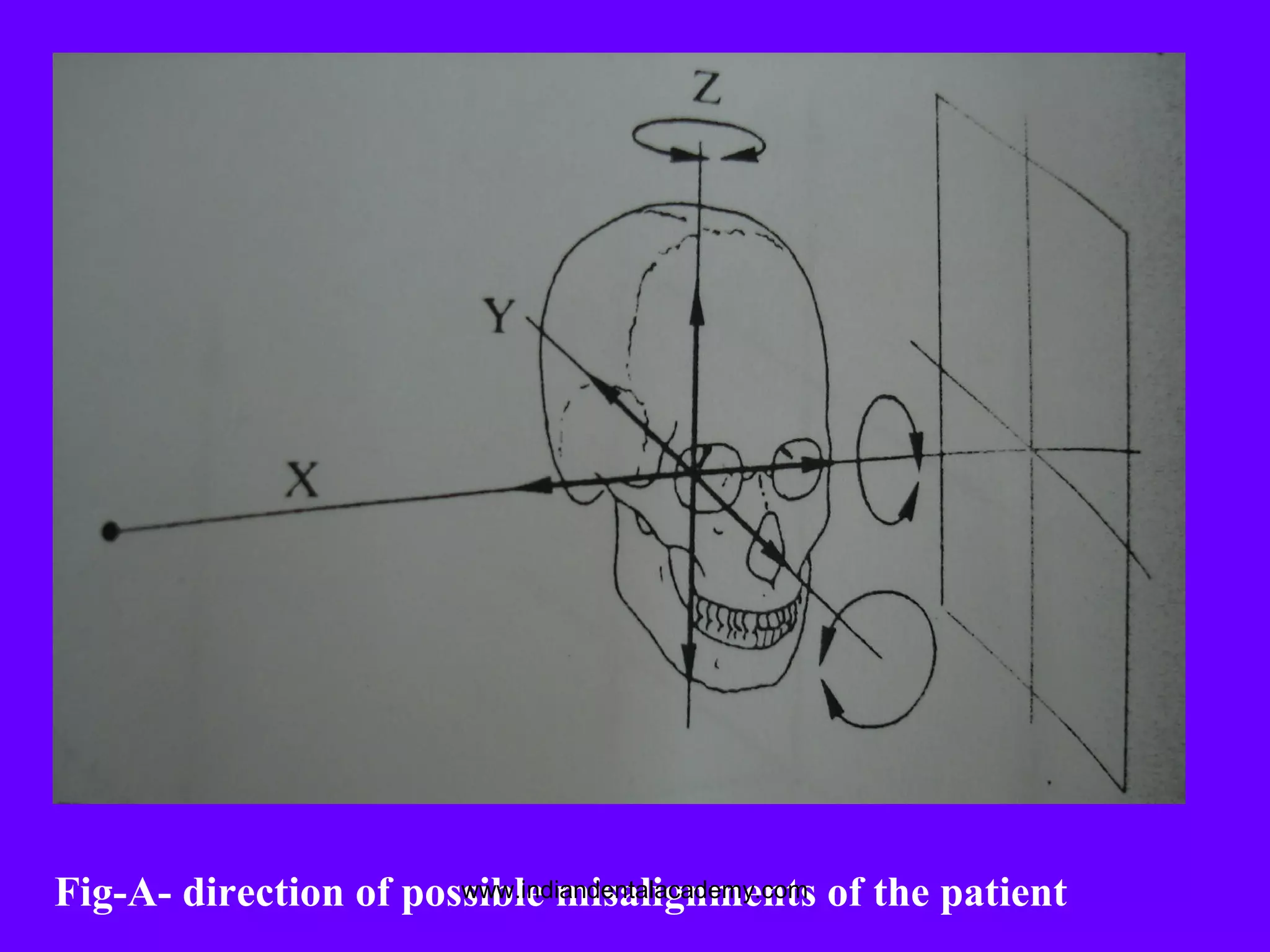
• According to Ahlqvist the relations b/w the different
components of the cephalographic system are
affected by a number of factors.
1.The focal spot, the cephalostat, and the film may be
linearly displaced in relation to each other.
2.The cephalostat and the film may be rotated with
respect to each other.
3.The patient may be linearly displaced and /or
rotated in relation to the cephalographic system.
www.indiandentalacademy.com
Fig-A- direction of possible misalignments of the patientwww.indiandentalacademy.com
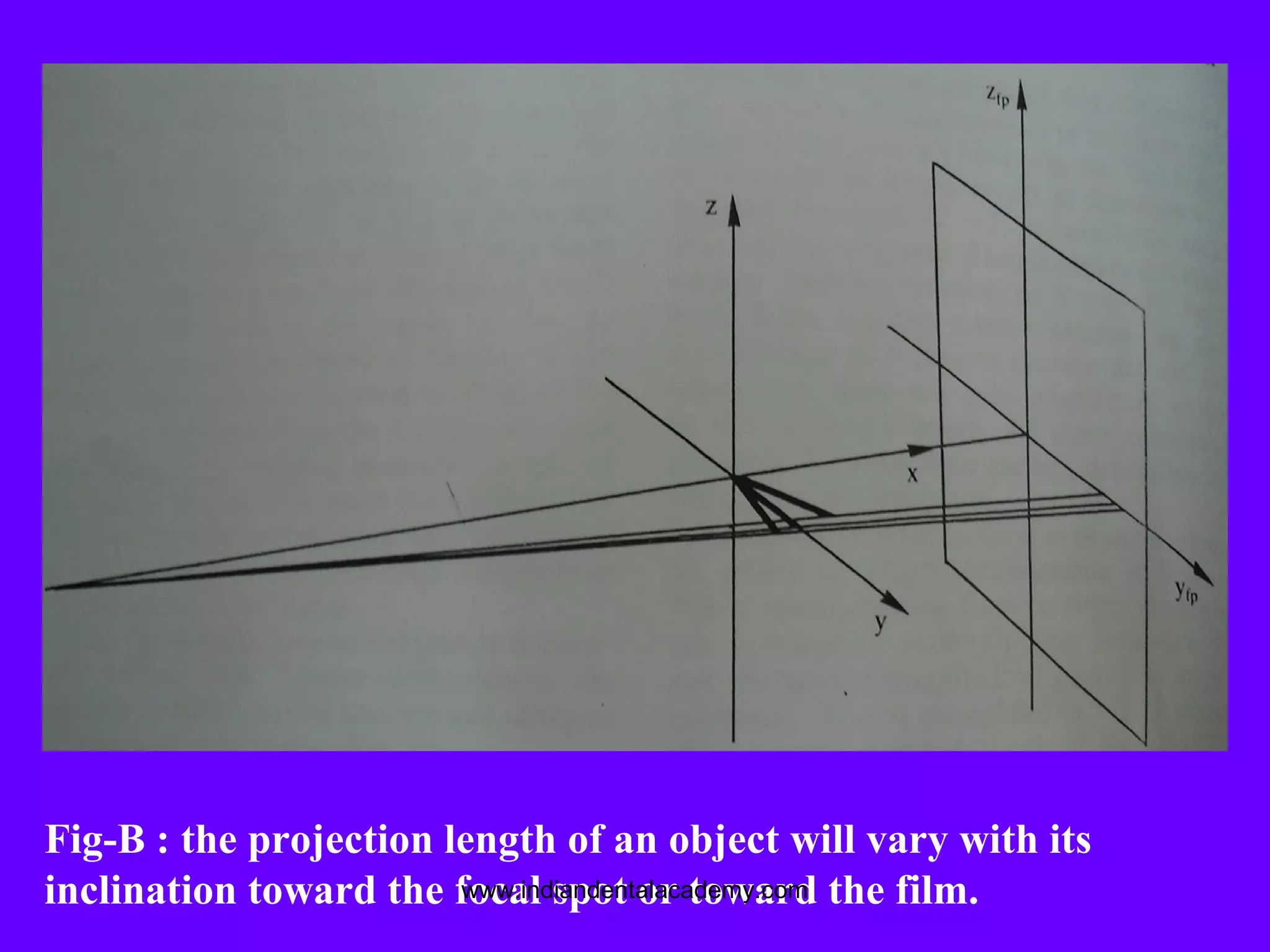
Fig-B : the projection length of an object will vary with its
inclination toward the focal spot or toward the film.www.indiandentalacademy.com
ERROR IN
CEPHALOMETRIC
LANDMARK
IDENTIFICATION
www.indiandentalacademy.com
Error of identification
• Involves the process of identifying
specific landmarks on headfilms.
• To test landmark identification reliability ,
4 instructors and 3 orthodontic residents
were requested to select and plot four high
quality radiographs.
• They were provided with a list of
landmarks and definitions of each and were
asked to identify them using a pencil point
on a clean sheet of acetate paper on the
radiograph. www.indiandentalacademy.com
• The porion, condylion , orbitale and
basion were less readily identified than
some of the other landmarks.
• Condylion was less readily identified
and Gnathion more accurately identified.
• Baumrind and Frantz demonstrated
marked differences in magnitude and
configuration of envelope of error found
among different landmarks. Other factors
that can influence landmark identification
are film density and sharpness.
www.indiandentalacademy.com
•Identification of landmark by seven individuals.
Each circle is the smallest possible circle that would
encompass the landmarks.www.indiandentalacademy.com
Point A revisited – Jacobson- AJO 1980
• Subspinale or point A is a midline point whose
relationship to the anterior teeth in lateral ceph may be
influenced by head position. It is located somewhere b/w
the root apex and the coronal third of the root of the tooth.
• Subspinale is defined anthropologically as “ the deepest
midline point on the premxilla b/w ANS & prosthon.
• Bjork defined it as the “ deepest point on the contour of
the alveolar projection b/w the spinal point and prosthion.
• Because of the difficulty in locating point A, alternate point
have been suggested by Van der Linden i. e point L, which
is located on the anterior surface of the image of the labial
lamella at the region of the apex of the maxillary incisors.
• Jarabak & Fizzel defined a point 2 mm ahead of the root
apex as a redefinition of point A.www.indiandentalacademy.com
Point A revisited – Jacobson- AJO 1980
• Jacobson concluded that Point A cannot be
accurately identified in all cephalometric
radiographs. In instances where this landmark is
not clearly discernible, an alternative means of
estimating the anterior extremity of the maxillary
base is shown.
• A point plotted 3.0 mm. labial to a point between
the upper third and lower two thirds of the long
axis of the root of the maxillary central incisor
was found to be a suitable point (estimated point
A) through which to draw the NAE line and one
which most closely approximates the true NA
plane. www.indiandentalacademy.com
The precision with which any landmark
may be identified depends on a number
of factors.
1. Landmarks lying on a sharp curve or at
the intersection of two curves are
generally easier to identify than points
located on flat or broad curves.
2. Points located in areas of high contrast
are easier to identify than points located
in areas of low contrast .
3. Superimposition of other structures,
including soft tissue over the area of
landmark in question, reduce the ease of
identification.
www.indiandentalacademy.com
4) Precise written definitions of
describing the landmark reduces
the chance of interpretation error.
5) Operator experience is an
important factor since increased
knowledge of anatomy and
familiarity with the radiographic
appearance of the subject reduces
interpretive errors.
www.indiandentalacademy.com
LIMITATIONS OF
SUPERIMPOSITION
www.indiandentalacademy.com
LIMITATIONS OF SUPERIMPOSITION
• Serial radiographic cephalometry has been
used, almost from its inception, to measure
craniofacial growth and treatment changes.
• This gives rise to the question, just how
accurate are cephalometric measurements?
Radiographic cephalometry is only scientific if it
can be measured.
• The validity of cephalometric measurement
therefore is directly dependent on the accuracy of
the method of measurement, which in turn is
limited by the following problems.
www.indiandentalacademy.com
A) Lateral or frontal headfilms taken at
different times, and possibly by different
people, are difficult to reproduce with any
degree of accuracy, whether the head is
steadied in a cephalostat or in the natural
head position.
B) The double images of the bilateral
structures often are not consistently
equally spaced in serial headfilms
because of even minor faulty head
positioning.
www.indiandentalacademy.com
C) Film contrast and density differences
often encountered are the result of lack of
strict quality control.
D) Anatomic or structural landmarks are not
consistently identifiable.
E) Most important limitation of traditional
cephalometric radiographic
measurements is that 3-dimensional
changes are measured in only two
dimensions.
www.indiandentalacademy.com
Limitations of traditional superimposition
methods
• No points or planes in the craniofacial
complex are stable and all move relative
to each other during growth. Orthodontic
analyses, in effect , relates relatively
stable areas as depicted by arbitrarily
selected points or planes to more remote
but less stable landmarks.
www.indiandentalacademy.com
• While the primary errors are biologically
induced , the secondary errors are entirely
mathematically defined, since they are related to
the primary errors.
• Errors in tracing superimposition can be
compounded by the method of superimposition
used in interpreting the findings.
• A study conducted by Ghafari et al
demonstrated differences in interpretation of
facial changes by comparing four traditional
cephalometric methods of superimposition on
the cranial base: best fit on anterior cranial base
anatomy, sella-nasion, registration of point R
with Bolton-nasion planes parallel, and basion-
nasion plane.
www.indiandentalacademy.com
• The results of their study showed differences
among all paired methods to be statistically
significant.
• Growth behavior of an individual as recorded
on a sequential set of roentgenograms has been
shown to differ greatly when studied using
different superimposition methods. Nothing is
known of the growth behavior of the individual
parts in the continuum of the discrete points
studied.
• Because of the inability of conventional
cephalometry to understand curved forms, it is
limited to landmark indices.
www.indiandentalacademy.com
LIMITATIONS OF
CEPHALOMETRIC
ANALYSIS
www.indiandentalacademy.com
1) Most individuals with Dentofacial deformities have
anatomic variations in the location of the cephalometric
landmarks used as a baseline in many analyses, such
as sella, nasion, and orbitale. This often results in
incorrect conclusions from the analysis.
2) The clinician must not base interpretations on
single cephalometric measurements.
3) The clinician must recognize the limitations, as well
as the advantages, of cephalometry and be sure to
integrate measurements with clinical findings.
Limitations of cephalometric analysis
www.indiandentalacademy.com
4) The art of cephalometric interpretation
lies in understanding abnormal findings
and identifying the etiologic factors
behind these cephalometric abnormalities
in patients with dentoskeletal deformities.
5) Although cephalometric analysis forms
an important part of the database for
diagnosis and treatment planning, it
should not take precedence over the
clinical evaluation of the patient.
www.indiandentalacademy.com
Reliability of cephalometric analyses:
• Fundamental to orthodontics is the need
to determine the relationship of the
various skeletal components, particularly
those of the jaws to each other and to the
rest of the cranium in the cranio facial
complex.
• The interpretation of the measurements
continues to be the subject of much
debate. www.indiandentalacademy.com
• Wylie et al compared five analyses in ten
individuals who underwent various surgical
corrections.
• Pre treatment cephalometric radiographs of the
ten patients were selected to illustrate different
Dentofacial deformities , each of which was
corrected with a different surgical procedure.
• The pretreatment cephalometric radiographs
were blindly assessed by one investigator who
used the criteria for each of five popular
analyses.
• The results of the analyses ( diagnoses ) were
then compared to one another and to the actual
surgery performed.
www.indiandentalacademy.com
• The outcome of the study revealed that
performance of the analysis in relation to actual
surgery was generally poor.
• In the case with mandibular advancement there
was 35 % agreement with the surgery performed.
• For maxillary advancement - 20 %
• For maxillary superior positioning 100%
• For maxillary advancement and mandibular
reduction- 20%
• For bimaxillary protrusion – all analyses agreed
that the teeth were protrusive and that the lower
third of the face was too long.
• This illustrates the unreliability of
cephalometric analyses.www.indiandentalacademy.com
For e.g.;
1) In class III malocclusion, 2 analyses
suggested mandibular protrusion, 2
determined that the maxilla was retrognathic,
and one identified the problem as a “short”
maxilla and “forward mandible”.
• In class II, div 2 malocclusion, one analyses
claimed that the skeletal pattern was class I,
3- analyses indicated that class II tendency
was due to maxillary protrusion, and one
noted a short mandible. Only one analyses
would support the decision to surgically
advance the mandible.www.indiandentalacademy.com
LIMITATIONS OF
VERIOUS
REFERENCE PLANES
USED IN
CEPHALOMETRICS
www.indiandentalacademy.com
Reference planes
•A cephalometric evaluation of the craniofacial
complex requires a plane of reference from
which to asses the location of various anatomic
structures. Traditionally two planes have been
used, namely the sella tucica-nasion(SN) plane
and the Frankfort horizontal(FH).
• The SN plane is more suitable for assessment
of changes induced by growth and/or treatment
within the same individual over time. Low
variability in identifying sell turcica and nasion
is an advantage of using this plane , as is the
fact that sell turcica and nasion represent
midsagittal structures.
www.indiandentalacademy.com
• If the goal is to compare a particular individual
to a certain population group (ie; established
norms), use of the SN plane may provide
erroneous information if the inclination of this
plane is either too high or too low.
• A sella turcica positioned to a great extent
superiorly or inferiorly would account for a low or
high inclination of the SN plane, respectively.
• Frankfort horizontal (FH) has also been used
extensively in cephalometry. Despite the difficulty
in locating porion reproducibly, FH has been
advocated to more accurately represent the
clinical impression of jaw position.
www.indiandentalacademy.com
• As an alternative, Legan and Burstone
suggested using a constructed horizontal
(cHP). This is line drawn through nasion
at an angle of 7 degrees to the SN line.
• This constructed horizontal tends to be
parallel to true horizontal. However, in
those cases in which SN is excessively
angulated, even the constructed
horizontal would not approximate true
horizontal, in which case an alternative
reference line must be sought.www.indiandentalacademy.com
• Another approach involves obtaining the
cephalogram with head in the natural head
position. “True horizontal” is drawn perpendicular
to a plumb line on the radiograph. Finally, a
vertical reference line cane be traced passing
through subnasale (SnV) or glabella.
• This approach offers the advantage that natural
head position approximates the position in which
clinical judgments are made.
• Its drawbacks include strict adherence to
technique and difficulty in conducting studies
where cephalograms have been obtained from
various facilities.www.indiandentalacademy.com
www.indiandentalacademy.com
Variability between the optic plane and
Frankfort horizontal:Tremont-AJO-DO;1980
• Frankfort horizontal is commonly
constructed on a lateral cephalogram from
the top of the ear rod to orbitale. Ear rod
positioning and identification of orbitale
present obvious variables with such a
reference plane. The optic plane has been
proposed as a more accurate
representation of Frankfort horizontal.
www.indiandentalacademy.com
• The optic plane was constructed,
as defined by Sassouni, by drawing
the supraorbital plane (a line
tangent to anterior clinoid and the
roof of the orbit), drawing the
infraorbital plane (line tangent to
the inferior of sella turcica and the
floor of the orbit), and then
bisecting the angle formed by their
intersection to obtain the optic
plane. www.indiandentalacademy.com
• The optic plane, was significantly different
from anthropologic Frankfort horizontal.
Also, the optic plane did not vary
significantly less from anthropologic
Frankfort horizontal than from ear rod to
orbitale Frankfort horizontal.
• According to the parameters of this study,
the optic plane is not a more accurate or
reliable method of representing
anthropological Frakfort horizontal on lateral
cephalograms. www.indiandentalacademy.com
• Traditionally, intracranial reference lines have
been used for clinical cephalometric analysis of
malocclusion cases. Several authors have,
however, questioned the validity of intracranial
reference because of their variability to the
horizontal plane, related to the head in natural head
position (NHP).
• The study was undertaken to determine the
reliability of the FH as a cephalometric reference
line. The main alternative to intracranial reference
lines is the nonvariable extracranial horizontal line
(HOR) related to the head in natural head position.
Frankfort horizontal basis for cephalometric
analysis Lundström and Lundström- AJO 1995
www.indiandentalacademy.com
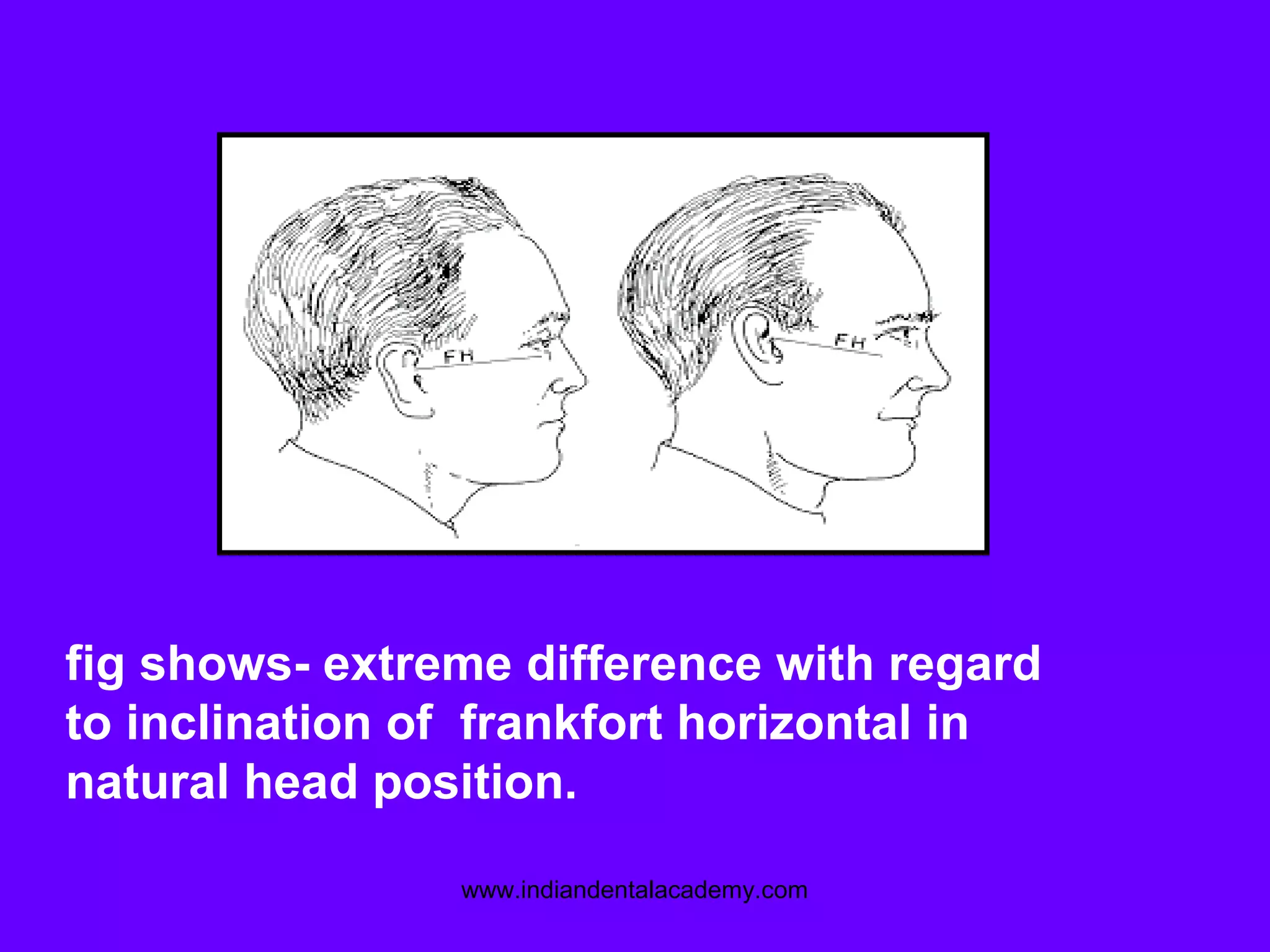
fig shows- extreme difference with regard
to inclination of frankfort horizontal in
natural head position.
www.indiandentalacademy.com
• They concluded that no difference was found
between the variability of the Frankfort horizontal
and the sella-nasion line with regard to the
horizontal plane. The large variation of both
intracranial reference lines, related to NHP, as well
as to NHO, confirms their relative unsuitability as
cephalometric references for clinical purposes.
• Findings indicate that a horizontal line, related to
natural head position, adjusted to natural head
orientation when indicated, presents the most
reliable basis for cephalometric analysis.
www.indiandentalacademy.com
Fig showing- angles b/w horizontal plane and
frankfort horizontal (FH/HOR, negative) and S-N
line (S-N/HOR, positive)www.indiandentalacademy.com
CONCEPTS OF
NATURAL HEAD POSITION
AND NATURAL HEAD POSTURE
www.indiandentalacademy.com
NATURAL HEAD POSITION
• Natural head position is a standardized
and reproducible orientation of the head
in space when one is focusing at a
distant point at eye level.
• German Anthropological society in 1884
– Frankfort Agreement ie, The plane
which passes through the left and right
porion landmarks and the left orbitale, to
achieved uniformity in craniometric
research. www.indiandentalacademy.com
• The Frankfort horizontal is a useful
compromise for studying skulls but not for
orienting natural head position in the living
because the F-H plane located in the living
is normally distributed around a true
extracranial horizontal.
• Nonetheless, orthodontist dealing with
living subjects, rather than inert crania, have
used this Frankfort horizontal faithfully in
cephalometry.
www.indiandentalacademy.com
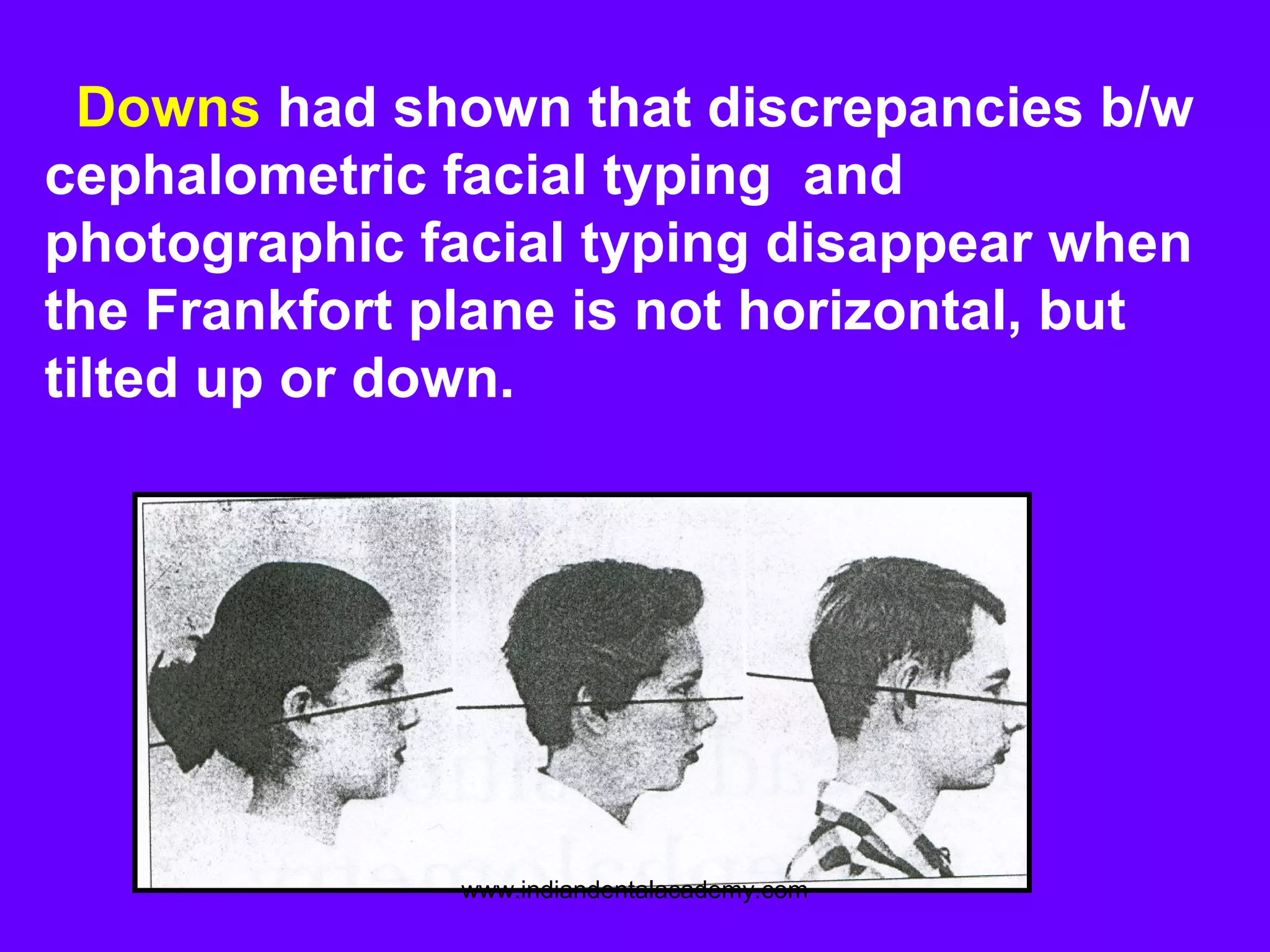
Downs had shown that discrepancies b/w
cephalometric facial typing and
photographic facial typing disappear when
the Frankfort plane is not horizontal, but
tilted up or down.
www.indiandentalacademy.com
• Bjerin and Thurow pointed out that intracranial
landmarks are not stable points in the cranium,
their vertical relationship to each other is therefore
also subjected to biological variation.
fig shows-Two ceph tracings
with similarity in their facial
profiles exhibit marked
difference in the slope of their
skull base( SN line) and in the
FH.
Conventional ceph analyses
utilizing these intracranial
reference lines would show
markedly divergent facial
configuration, rather than the
similarity observed clinically.www.indiandentalacademy.com
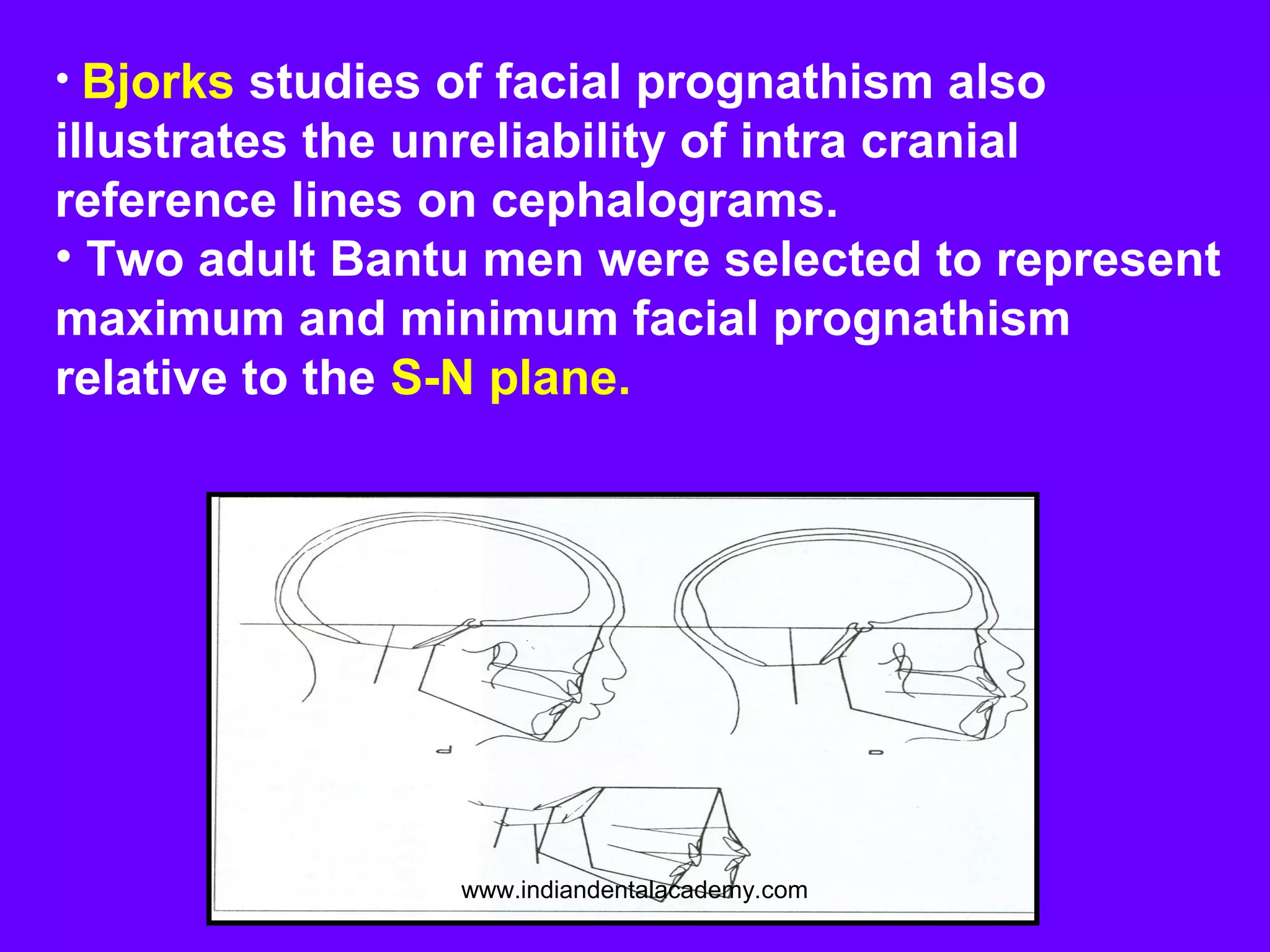
• Bjorks studies of facial prognathism also
illustrates the unreliability of intra cranial
reference lines on cephalograms.
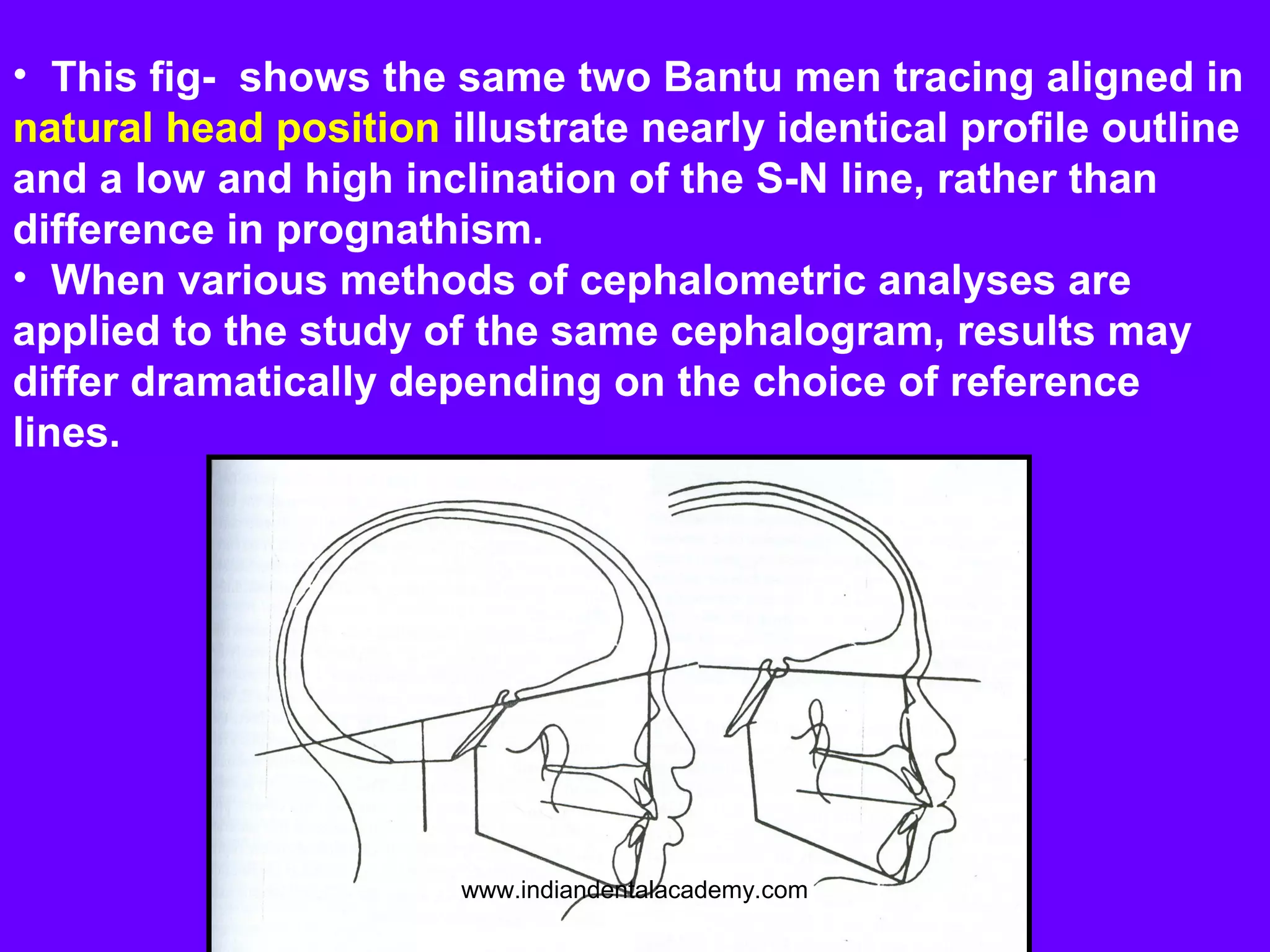
• Two adult Bantu men were selected to represent
maximum and minimum facial prognathism
relative to the S-N plane.
www.indiandentalacademy.com
• This fig- shows the same two Bantu men tracing aligned in
natural head position illustrate nearly identical profile outline
and a low and high inclination of the S-N line, rather than
difference in prognathism.
• When various methods of cephalometric analyses are
applied to the study of the same cephalogram, results may
differ dramatically depending on the choice of reference
lines.
www.indiandentalacademy.com
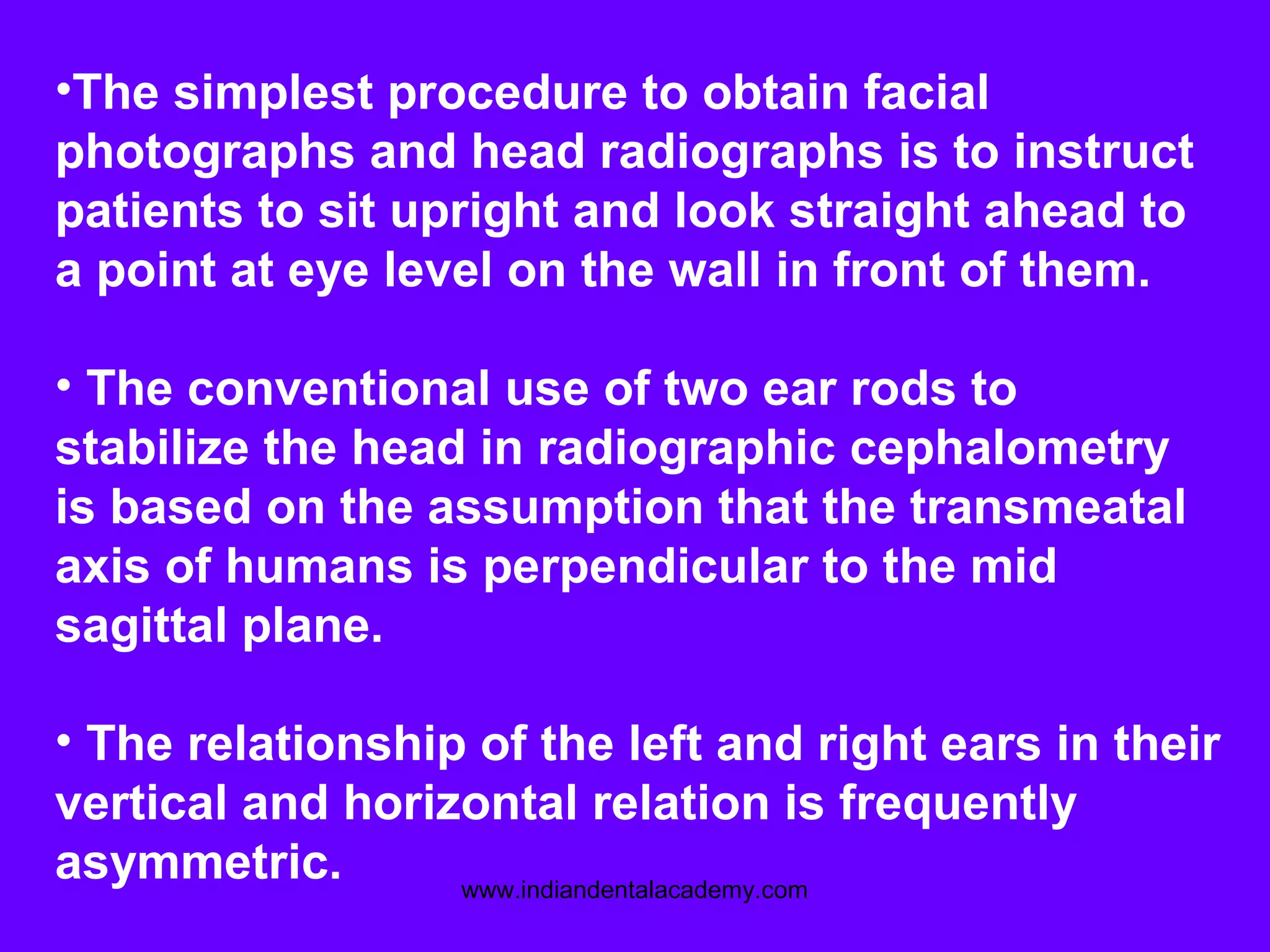
•The simplest procedure to obtain facial
photographs and head radiographs is to instruct
patients to sit upright and look straight ahead to
a point at eye level on the wall in front of them.
• The conventional use of two ear rods to
stabilize the head in radiographic cephalometry
is based on the assumption that the transmeatal
axis of humans is perpendicular to the mid
sagittal plane.
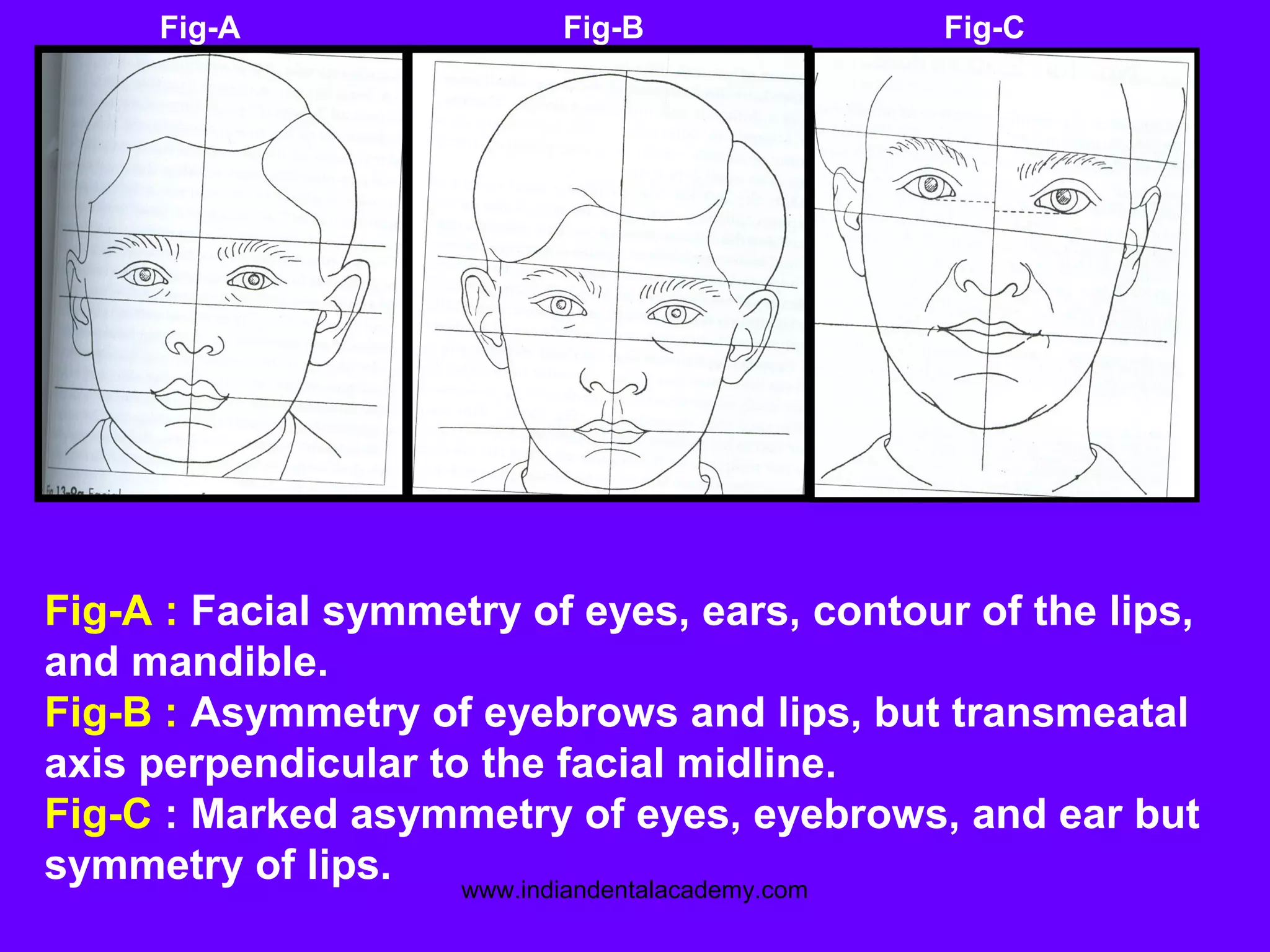
• The relationship of the left and right ears in their
vertical and horizontal relation is frequently
asymmetric. www.indiandentalacademy.com
Fig-A Fig-B Fig-C
Fig-A : Facial symmetry of eyes, ears, contour of the lips,
and mandible.
Fig-B : Asymmetry of eyebrows and lips, but transmeatal
axis perpendicular to the facial midline.
Fig-C : Marked asymmetry of eyes, eyebrows, and ear but
symmetry of lips. www.indiandentalacademy.com
www.indiandentalacademy.com
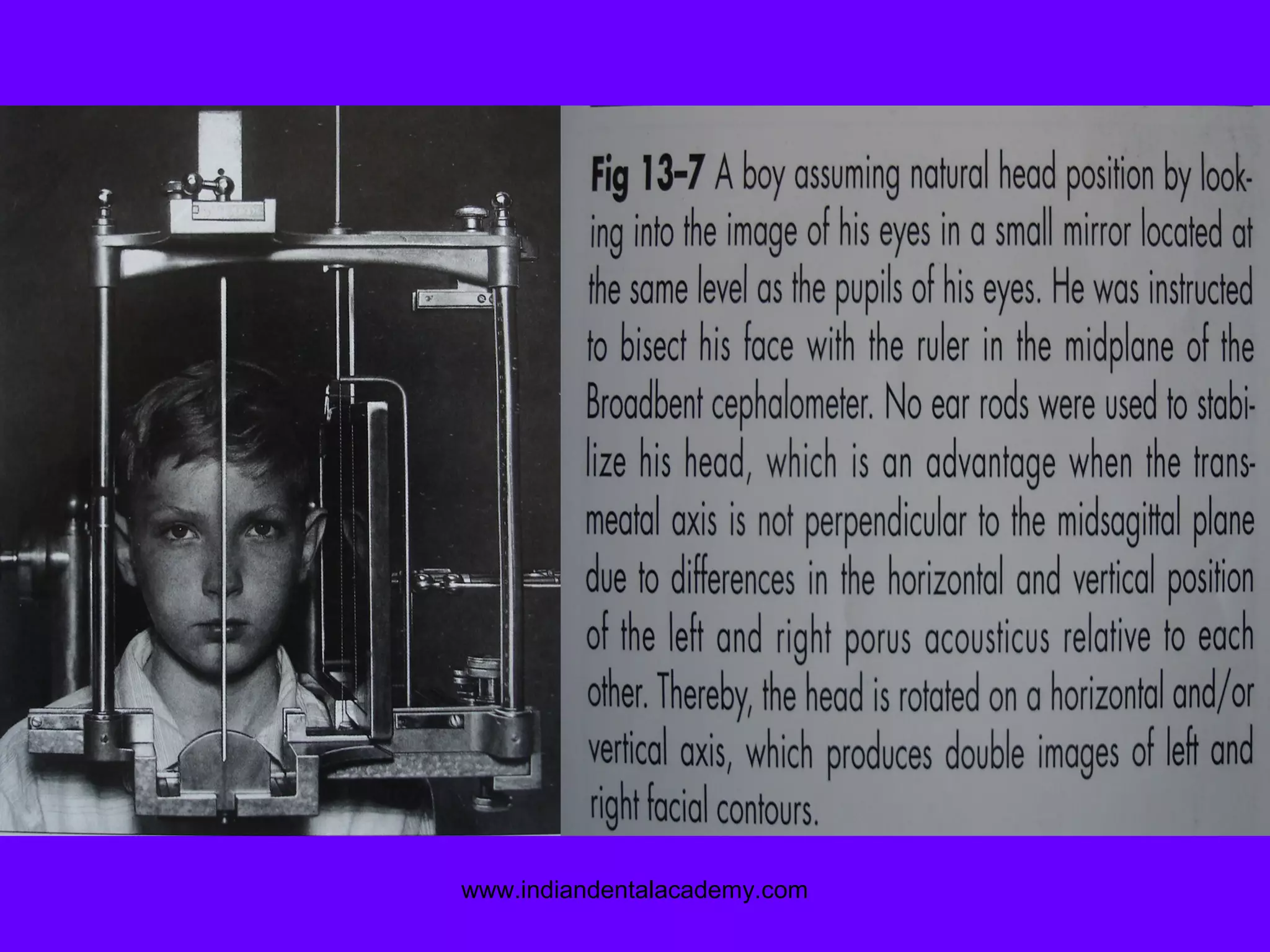
• The insertion of ear rods will obviously
result in vertical and/or horizontal rotation
of the head, which introduces a deficient
and misleading image.
• There by, the attempt to determine facial
asymmetry of a patient generally results in
a compromise rather than as an exact
definition.
• Only the left ear rod should be used in
radiographic cephalometry both for the
lateral and frontal projection.
• The right ear rod should merely be
inserted against any part of the ear.www.indiandentalacademy.com
CONCEPTS OF NATURAL HEAD POSTURE
• In the later part of the 19th century, many
anthropologists believed that the study of cranial
morphology necessitated the orientation of skulls to a
position that approximates the natural head posture of
living beings.
• The concept of natural head posture (NHP) on the
living subject was introduced into the orthodontic
literature in the 1950s by Broca, an anatomist,
described NHP as the position of the head attained
when an individual stands with the visual axis in the
horizontal plane.
• Cooke and Wei defined NHP as the natural,
physiologic position of the head that is assumed when
a relaxed subject looks at a distant reference point.www.indiandentalacademy.com
• Various methods have been devised to obtain
NHP
• MIRROR METHOD by Moorees and Kean.
• SELF BALANCE METHOD by Solow and
Tallgren.
• The term natural head position and head
posture are not interchangeable, one being a
standardized procedure applied to all individuals
for analysis of Dentofacial morphology and the
other i.e.; head posture is an individually
characteristic physiologic posture of the head to
study the relation b/w posture and morphologic
features.
www.indiandentalacademy.com
• Note that only a small mirror should be
used to record natural head position to
force subject to look straight ahead into
the image of their eyes rather than a long
mirror that prevent standardization of head
position.
• A long mirror is needed to accommodate
subjects when recording their postural
position, which is an individual,
nonstandardized head position.
www.indiandentalacademy.com
• The various reference lines still compete
with each other. One system is more or less
as good or poor as any other and none is
completely reliable because each is subject to
large individual variability.
• What can be done to diminish this problem?
The answer is to choose measurements that
are based on different reference planes, in
this way it is hoped to compensate for
pronounced variations in one or the other
reference lines.
www.indiandentalacademy.com
LIMITATIONS OF
VARIOUS
CEPHALOMETRIC
ANALYSIS
COMMONLY USED
www.indiandentalacademy.com
ANB angle as a measure of jaw Dysplasia
• According to Steiner, the SNA reading indicates
whether face protrudes or retrudes bellow the skull.
Although the ANB is a reliable indication of A-P jaw
relationship in most instances, there are many
situations in which this reading cannot be relied on.
• The ANB angle in normal occlusions is generally 2
degrees. Angle greater than this mean value indicate
tendency toward class II jaw disharmonies; smaller
angles (negative readings) reflect class III jaw
discrepancies. While this is an acceptable
generalization, numerous instances exist in which this
does not apply.
www.indiandentalacademy.com
For eg – in fig A lateral ceph tracing of a class II
malocclusion. The ANB angle is 7 degrees, which high and
it is typical for class II type malocclusion.
fig –B; lateral ceph tracing of a normal occlusion in which
the ANB angle also measures 7 degrees.www.indiandentalacademy.com
Cephalometrics for you and me – Steiner –
1953 ;AJO
• Porion and Orbitale are not accurate for our
use as we are not dealing with dry skulls.
• Points S and N are clearly visible in the X- ray
pictures and can be located easily and
accurately.
• Emphasizes that points S and N are located in
the mid sagittal plane of the head and therefore
they are moved a minimum amount whenever
the head deviates from the true profile position
and that the points are located on hard non
yielding tissue. www.indiandentalacademy.com
• The same holds true for a rotation
of the occlusal plane: backward
(counterclockwise) rotation of the
occlusal plane has a decreasing
effect on the ANB angle, though
sagittal basal relationships remain
constant.
www.indiandentalacademy.com
Fig A- normal occlusion with an ANB angle of 2 degrees.
Fig B- denture base are retro- positioned in the
craniofacial complex. This has the effect of reducing the
ANB from 2 degrees to -2 degrees. The relationship of the
jaws to each other remains unchanged.
Fig C- same relationship of the jaws only now both jaws
are positioned forward relative to nasion. This has
increased the ANB angle from 2 degrees to 5 degrees.
www.indiandentalacademy.com
• In fig B- the relation of the jaws to each other is
unchanged, but the jaws are rotated in counterclockwise
direction relative to the S-N plane as compared to fig A.
The rotation had the effect of producing a class III type
jaw relationship. The ANB angle has been reduced from
2 degrees to -5 degrees.
• Fig C- A clockwise rotation of the jaws produce the
opposite effect.( i.e., class II-tape jaw relationship)
www.indiandentalacademy.com
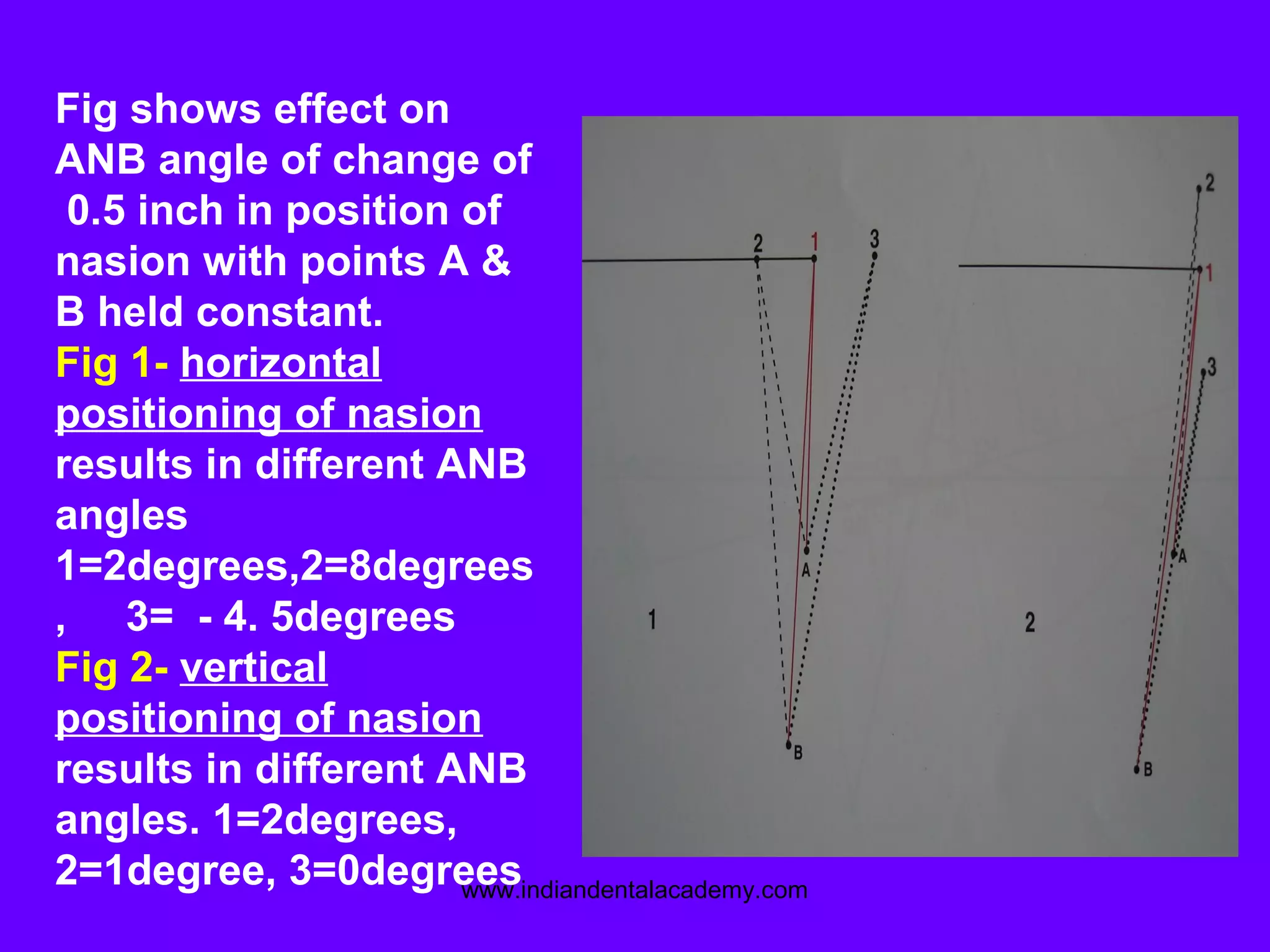
Fig shows effect on
ANB angle of change of
0.5 inch in position of
nasion with points A &
B held constant.
Fig 1- horizontal
positioning of nasion
results in different ANB
angles
1=2degrees,2=8degrees
, 3= - 4. 5degrees
Fig 2- vertical
positioning of nasion
results in different ANB
angles. 1=2degrees,
2=1degree, 3=0degreeswww.indiandentalacademy.com
Shortcomings of ANB angle
• Taylor in 1969 pointed out that ANB angle did not
always indicate true apical base relationship. Varied
horizontal discrepancies of points A and B could
give the same ANB measurement because variation
in the vertical distance from nasion could
compensate for other variation.
• Beatty in 1975 reported that ANB angle is not
always an accurate method of establishing the
actual amount of apical base divergence.
www.indiandentalacademy.com
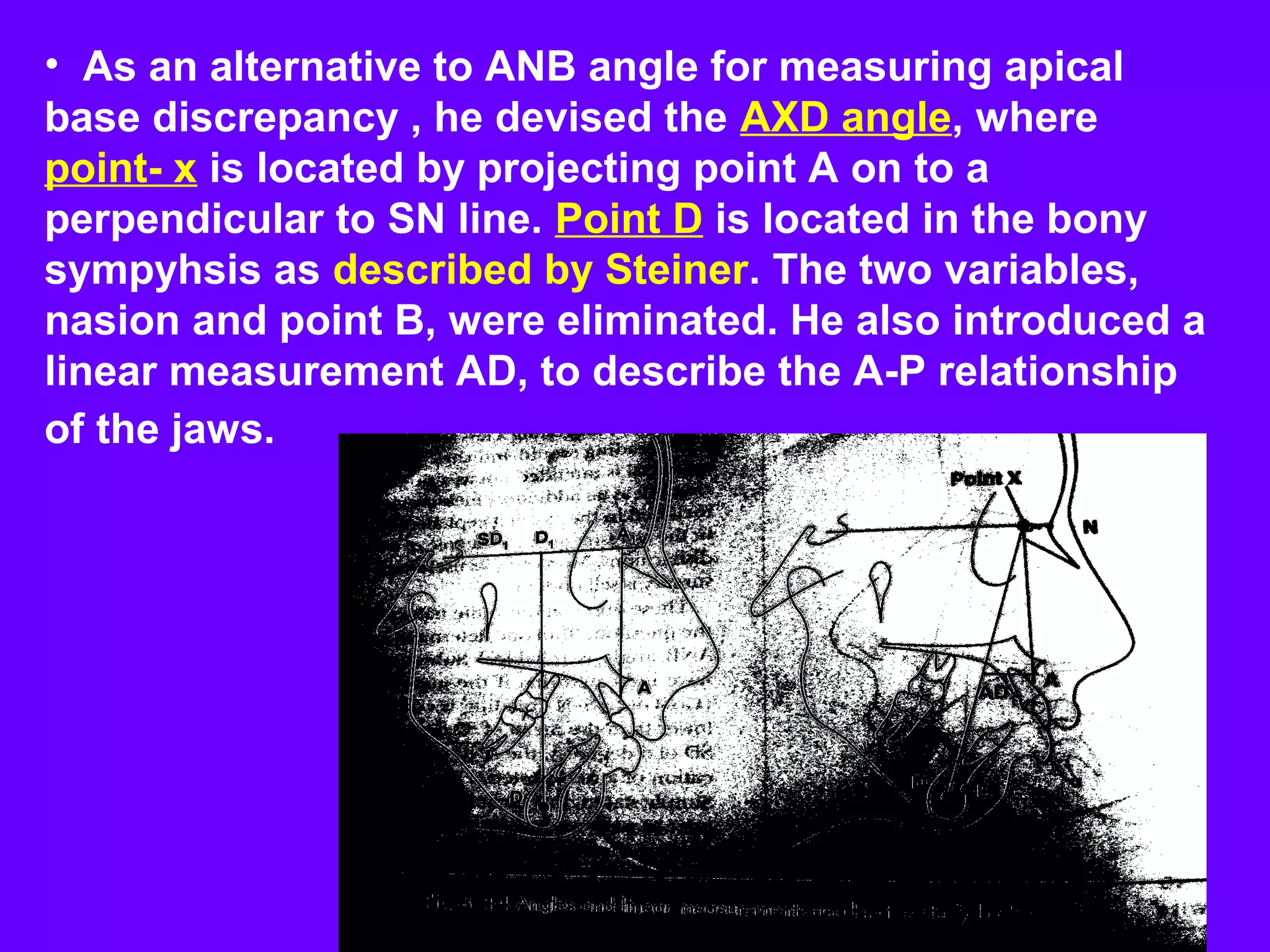
• As an alternative to ANB angle for measuring apical
base discrepancy , he devised the AXD angle, where
point- x is located by projecting point A on to a
perpendicular to SN line. Point D is located in the bony
sympyhsis as described by Steiner. The two variables,
nasion and point B, were eliminated. He also introduced a
linear measurement AD, to describe the A-P relationship
of the jaws.
www.indiandentalacademy.com
• Cross evaluation with different reference
planes is important and can be demonstrated
with the ANB angle.
• If one takes only the ANB angle to measure
the relative position of maxilla and mandible to
each other ,one must realize that any different
horizontal or vertical position of point N and
the location of the points A and B in the
vertical plane will have an influence on the size
of this angle and not on the actual sagittal
relation of the two jaws. (Hussals and Nanda-
1984)
www.indiandentalacademy.com
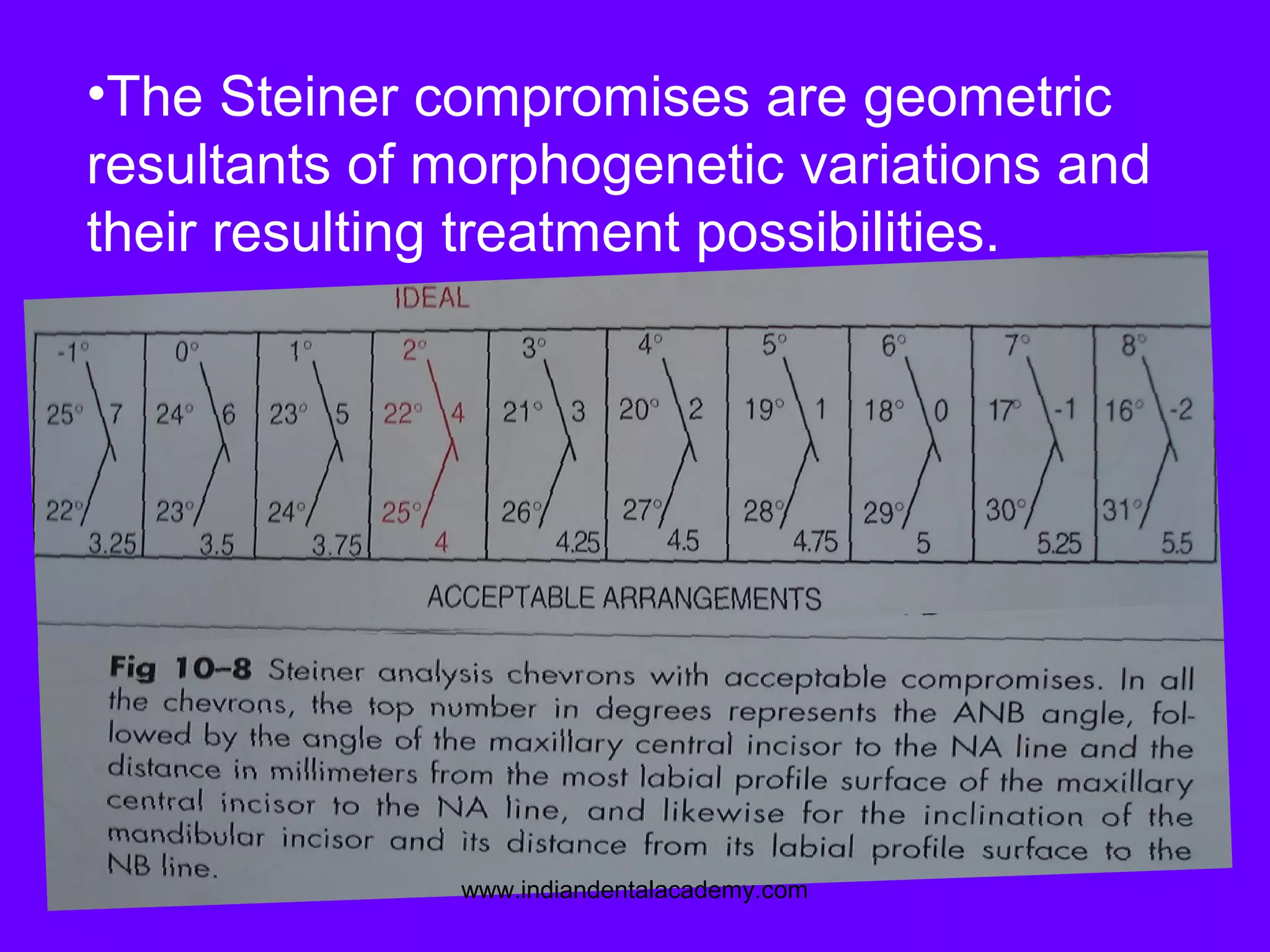
STEINERS ANALYSES
Acceptable compromises:
• Steiner clearly recognized that cephalometric
standards are merely gauges by which to
determine more favorable compromises as a
treatment goal. He developed a chart that reflects
a number of average measurements of normal
Dentofacial relationships.
• Steiner recognized variations in antero
-posterior jaw relations to each other.
• The compromise describes the anticipated axial
inclinations of the maxillary and mandibular
incisors to the NA and NB lines at various ANB
relationships. www.indiandentalacademy.com
•The Steiner compromises are geometric
resultants of morphogenetic variations and
their resulting treatment possibilities.
www.indiandentalacademy.com
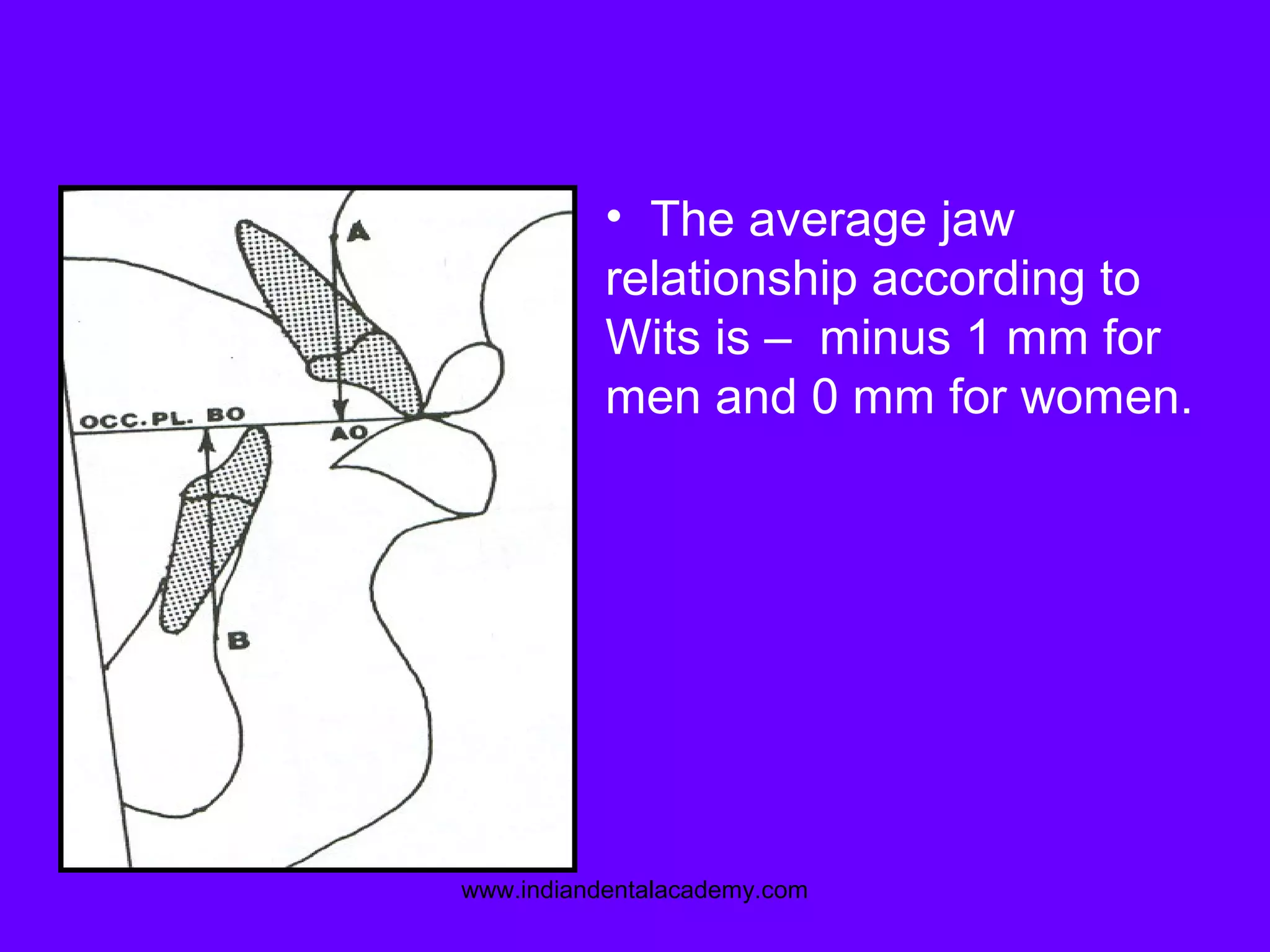
Method of appraisal of jaw disharmony-
Wits
• The Wits appraisal is the extent to which the
jaws are related to each other.
• The occlusal plane is drawn through the
region of the overlapping cusps of the first
premolars and first molars.
• The wits appraisal is done by drawing
perpendicular lines from points A and B to the
functional occlusal plane.
• The distance b/w the points of intersection
AO & BO is measured & it is describes the
maxillary and mandibular relationships.
www.indiandentalacademy.com
• The average jaw
relationship according to
Wits is – minus 1 mm for
men and 0 mm for women.
www.indiandentalacademy.com
Shortcomings of Wits appraisal
However, the wits appraisal relates point A & B to
the functional occlusal plane; this generates 2
major problems.
1) Accurate identification of the occlusal plane is not
always easy or accurately reproducible, especially
in in mixed dention patients or patients with open
bite, sever cant of the occlusal plane, multiple
impactions, missing teeth, skeletal asymmetries, or
steep curve of spee.
2) Any change in the angulation of the functional
occlusal plane, caused by either normal
development of the dentition or orthodontic
intervention, can profoundly influence the Wits
appraisal. www.indiandentalacademy.com
WITS APPRACIAL APPLIED TO CLASS I
AND CLASS II SKELETAL JAW BASES
www.indiandentalacademy.com
A new approach of assessing sagittal
discrepancies; The Beta angle – Chong Baik
and Maria Ververidou –AJO-DO;2004
• Because of lot of limitations in assessing A-P
jaw relation by various analysis like ANB, wits
appraisal. To overcome these limitations they
established new cephalometric measurements
i.e. Beta angle.
•This angle does not depend on any cranial
landmarks or dental occlusion.
•The Beta angle uses 3 skeletal land marks( 1) A
point( 2) B point( 3) the center of the condyle,
found by tracing the head of the condyle and
approximating its centre (point- C).www.indiandentalacademy.com
• Next it require 3-lines; (1)line connecting the
centre of the condyle C with B point ( C-B line).
(2) line connecting A and B points .(3) line from
point A perpendicular to the C-B line.
• Finally, measuring the Beta angle, which is the
angle b/w the last perpendicular line and the A-B
line.
www.indiandentalacademy.com
• It uses 3 points located on the jaws ( 1) A
point( 2) B point( 3) the center of the condyle
(point- C).
• So changes in this angle reflect only changes
with in the jaws. In contrast to ANB angle, the
configuration of the Beta angle gives it the
advantage to remain relatively stable even when
the jaws are rotated, for e.g.; when B point is
rotated backward & downward, then C-B line is
also rotated in the same direction, carrying the
perpendicular from point A with in it. Because A-
B line is also rotating in a same direction, the
Beta angle remains relatively stable.
www.indiandentalacademy.com
B
e
t
a
a
n
g
l
e
Fig shows: Beta angle remains relatively stable
even when jaws are rotated
www.indiandentalacademy.com
• Another advantage of Beta angle is that it can be
used in consecutive comparisons throughout
orthodontic treatment because it reflects true
change of the sagittal relationship of the jaws,
which might be due to growth or orthodontic or
orthognathic intervention.
SHORTCOMING OF BETA ANGLE:
1) Precisely tracing the condyle and locating its
center is not always easy. For that reason, some
clinicians might hesitate to use the Beta angle.
2) To accurately use this angle, the cephalometric
x-rays must be high quality.www.indiandentalacademy.com
•The advantage of locating the center of the head of
the condyle versus the condylion point, as used by
McNamara, is that very precise tracing of the
contour of the condyle is not really necessary. The
clinician can visualize and approximate the centre
with a minimum error in the Beta angle as long as
that point is with in 2 mm of its actual location.
www.indiandentalacademy.com
they concluded that:
1) Previously established measurements for
assessing the sagittal jaw relationship can often
be inaccurate.
2) A new angle, the Beta angle, was developed as
a diagnostic aid to evaluate the sagittal jaw
relationship more consistently.
3)White subjects with a Beta angle b/w 27 degrees
& 35degrees have a class I skeletal pattern; a
Beta angle less than 27 degrees indicates a class
II skeletal pattern, and a Beta angle greater than
34 degrees indicate a class III skeletal pattern.
4) There is no statistically significant difference
b/w mean Beta angle values of males and
females. www.indiandentalacademy.com
A-Po line and cephalometric correction-
Ricketts
• The A-Po line is another method used in
cephalometric analyses to assess the
position of mandibular incisor tooth.
• A range of –2mm to +3mm is considered
a satisfactory incisor position, with + 0.5
mm lower incisor tip to A-Po line being an
idealized position.
• Downs credits Ricketts for suggesting
relating the lower incisor to the profile,
specifically the lower face using A-Po.
www.indiandentalacademy.com
• Cephalometric correction describes a
method to determine mandibular dental
arch crowding or spacing by assessing
mandibular incisor position on a
cephalometric radiograph in concert with
mesiodistal dimensions of mandibular
teeth and mandibular arch circumference.
• The rationale is that by advancing or
retracting the mandibular incisor 1mm will
result in a 2mm gain or a 2 mm reduction
in the available space for mandibular
arch, respectively.
www.indiandentalacademy.com
• Calculations have indicated that tipping the
lower incisor tooth forward by 3 degrees results
in total dental arch length increase of 2.5mm.
• Conversely, retracting the mandibular incisor 3
degrees will encroach on the lower arch length
by 2.5mm.
• Use of the linear measurement lower incisor to
A-Po line alone must be used with caution. This
linear measurement does not take into account
lower incisor angulation, which emphasizes the
risks inherent in using single measurements in
cephalometric diagnosis and treatment planning.
www.indiandentalacademy.com
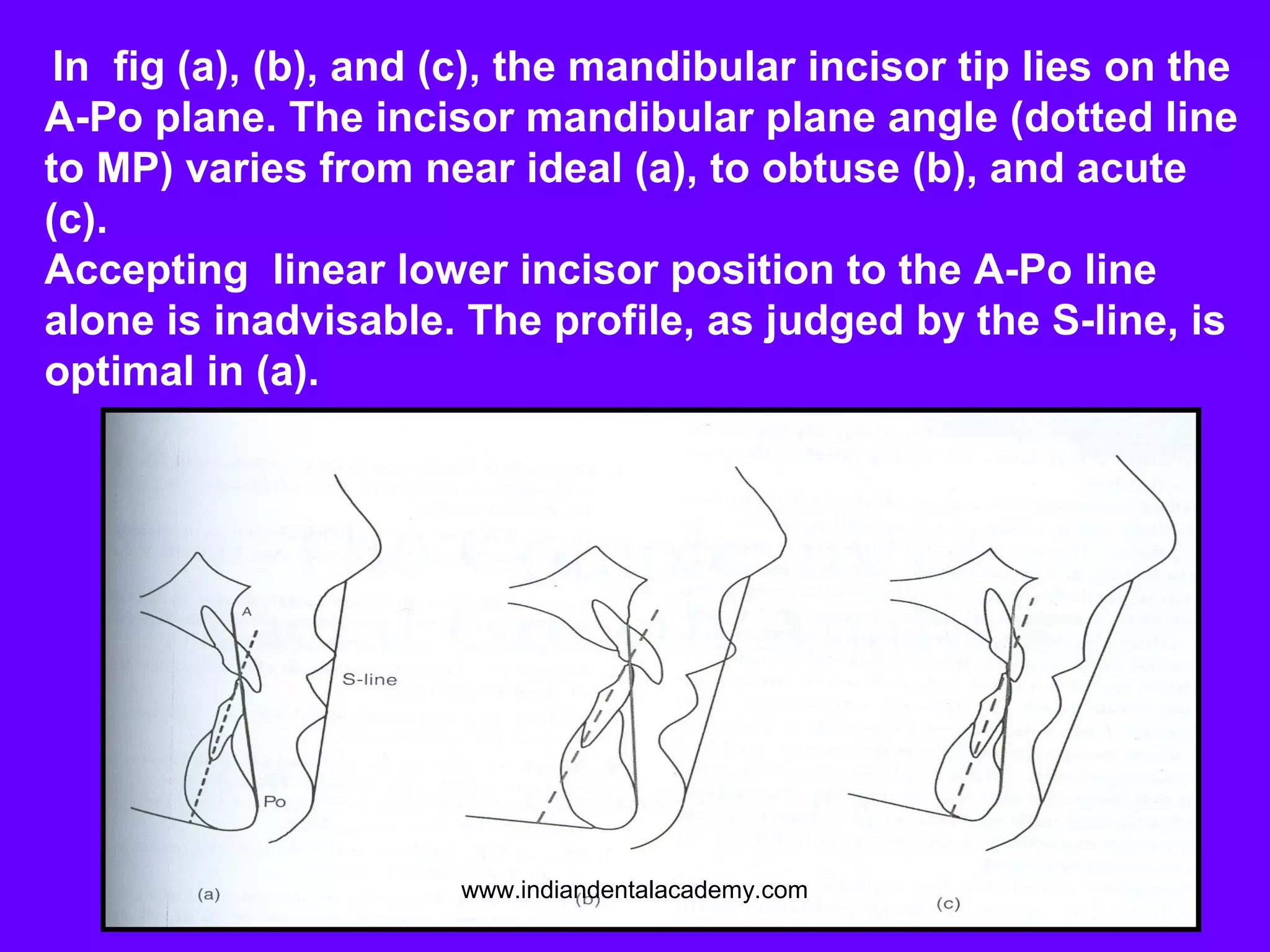
In fig (a), (b), and (c), the mandibular incisor tip lies on the
A-Po plane. The incisor mandibular plane angle (dotted line
to MP) varies from near ideal (a), to obtuse (b), and acute
(c).
Accepting linear lower incisor position to the A-Po line
alone is inadvisable. The profile, as judged by the S-line, is
optimal in (a).
www.indiandentalacademy.com
•Ricketts stresses the significance
of utilizing linear as well as angular
measurements in these
assessment.
• All cephalometric measurements
must be evaluated in concert with
other measurements and must
include clinical and diagnostic
judgment.
www.indiandentalacademy.com
Mc Namara analyses:
• For determining the anteroposterior
relationship to maxilla and mandible , mid
facial length is measured from condylion to
point A. The effective length of the mandible
is measured from condylion to gnathion.
• Birte Melsen suggests that there are
displacements of condyle,pogonion,menton
and point B relative to superimposition on
implants at a study done on annual intervals
between 8.5 yrs and 15.5 yrs of age.
www.indiandentalacademy.com
Soft tissue analyses- Holdaway
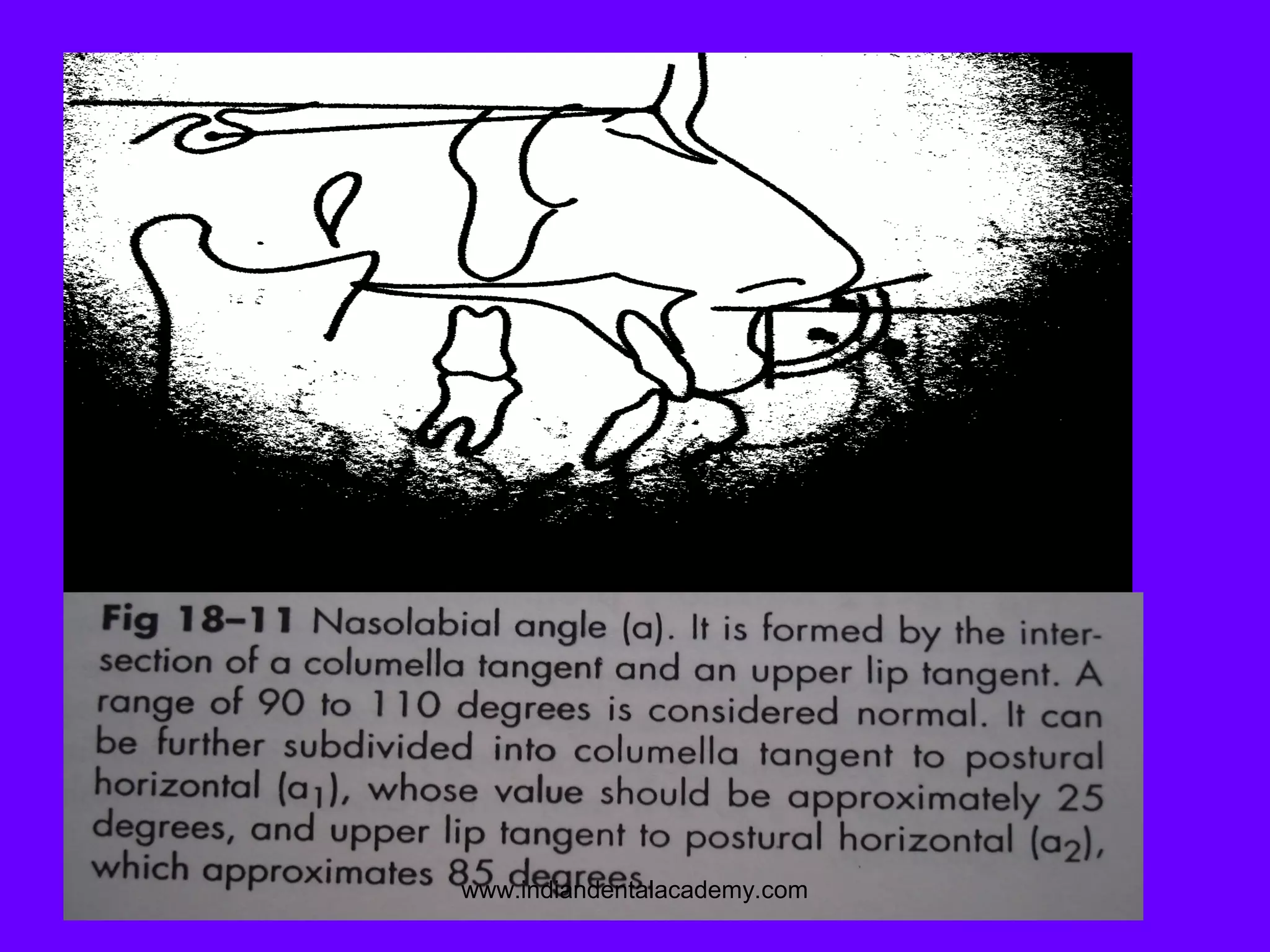
• NASO LABIAL ANGLE – formed by two lines
namely the columella tangent and an upper lip
tangent. Arbitrary value is 90 to 110 degrees.
• Legan and Burstone report a mean value of 102
+/- 4 degrees.
www.indiandentalacademy.com
• Scheidman et al drew a postural horizontal
line through subnasale and further divided the
nasolabial angle into columella tangent to
postural horizontal ( 25 degrees) and upper lip
tangent to postural horizontal ( 85 degrees).
• They argue that each of these angles should
be assessed individually in as much as they
vary independently.
• An apparently normal nasolabial angle may
be oriented in an abnormal fashion, a fact that
would be disclosed if the component angles
were measured individually.
www.indiandentalacademy.com
• E line: (Esthetic plane) Drawn from tip
of nose to soft tissue pogonion.
Normally the upper lip is about 4 mm
behind this reference line while the lower
lip lies about 2 mm behind it.
• Ricketts admits that considerable
variation exists in terms of age and sex.
He therefore advises that adult lips
should be contained with nose – chin lip
line.
www.indiandentalacademy.com
E- LINE ( ESTHETIC PLANE)
www.indiandentalacademy.com
S line:- Steiner line is a line drawn from soft
tissue pogonion to the mid point of the S shaped
curve between sub nasale and nasal tip.
www.indiandentalacademy.com
H line: The harmony line is tangent to the chin
point and the upper lip. The H line angle formed
between this line and the soft tissue nasion –
pogonion line.
The H line angle measures either the degree of
upper lip prominence or the amount of
retrognathism of the soft tissue chin.
www.indiandentalacademy.com
ADVANTAGES
AND
LIMITATION OF
DIGITAL
CEPHALOMETRYwww.indiandentalacademy.com
Introduction
• Digital radiography has been widely accepted
for medicine; however, it was not until the1980s
that first intra- oral sensors were developed for
use in dentistry.
• The introduction of extra- oral digital
radiography was initially delayed due to the high
cost of extra -oral systems. Recently, the
development of cost-effective extra -oral digital
technology, coupled with an increased utilization
of computers in orthodontic practice, has made
direct digital cephalometric imaging valid option.
www.indiandentalacademy.com
• As a result, an increasing number of
conventional film based radiographic units are
being replaced by direct digital machines. Direct
digital images can be acquired through the use
of photostimulable phosphor plates, or charge
coupled device receptors, both of which offer a
number of advantages over film.
• These advantages include instantaneous image
acquisition, reduction of radiation dose,
facilitated image enhancement and archiving,
elimination of technique sensitive developing
process and its associated costs, and facilitated
image sharing.
www.indiandentalacademy.com
Digital imaging
A digital image is a matrix of square
pieces, or picture elements (pixels),
that form a mosaic pattern from which
the original image can be
reconstructed for visual display. An
analog image, such as a radiographic
film, has virtually an infinite number of
elements, with each element
represented by a continuous gray
scale. www.indiandentalacademy.com
• The pixels in a digital image are arranged in a matrix
for e.g., a 512 x 512 pixel matrix will contain 262,144
pixels. If large number of pixels are used to represent an
image, their discrete nature becomes less apparent, i.e.
the spatial resolution of the image improves as the
number of pixels increases.
• Each pixel has a digital value that represents the
intensity of the information recorded by the detector at
the point. Each digital value is represented as binary
number; information is recorded in terms of a series of
ones or zeros. Each one or zero is called a “bit”. In 6-bit
image each pixel will have 64 possible values, ranging
from 0, which represent a black area on the image, to
63, which represents a white area; an 8-bit image each
pixel will have 256 possible values. The quality of an
image depends on both the number of pixels and
number of gray levels which make up the image.www.indiandentalacademy.com
IMAGE ACQUISITION
There are 2 ways to acquire a digital image.
1)Indirect acquisition:
A digital image can be produced by scanning
conventional radiographs using a flatbed scanner
and a transparency adaptor, or by using a
charged coupled device camera instead of the
flatbed scanner. This image can be manipulated
using software packages or be passed on to a
second party via a modem.
www.indiandentalacademy.com
2) Direct digital imaging
There are two systems available, one
produces the image immediately on
the monitor post-exposure and is
therefore called Direct Imaging.
The second has an intermediate
phase, whereby the image is produced
on the monitor following scanning by
laser. This is known as semi-direct
imaging.
www.indiandentalacademy.com
a) Semi-direct image plate systems
• The image plate method involves the use of phosphor
storage plate (psp). This plate stores energy after
exposure to radiation and emits light when scanned by
a laser. The scanner stimulates the phosphor plate and
stores a record of the number of light photons detected.
• Loading of the scanner generally only requires
subdued lighting as the plates are slightly sensitive to
visible light. However, some products are more light
sensitive than others. The lasers used are centered
around the 600-nm band and are usually of the helium-
neon variety.
• Scanners, the size of a bread- maker, can
accommodate multiple image plates at any one time.
The exact numbers varies between manufacturers.
There is a delay while the image is ‘developed’ before it
appears on the monitor.
www.indiandentalacademy.com
• Up to eight bitewing radiographs take about 90
secs and a panoramic image can take
approximately 3 minutes to be scanned. Again,
the scan times do vary between manufacturers.
• Although the plate can store energy for a
number of days, information starts to be lost
within minutes after exposure and it is advised to
scan the plates quite quickly to optimize the
image recovered. To fully remove the latent
image the plate should be exposed to high
intensity light.
www.indiandentalacademy.com
• Image plates are available in
exactly the same sizes as
conventional film and come with
disposable plastic barriers. They
have no wires attached and are
reusable for thousands of
exposures, but do need careful
handling to avoid surface damage.
www.indiandentalacademy.com
b) Direct sensor systems
• The sensor for the radiation image is
usually a Charged Coupled Device [CCD].
It consists of silicon crystals arranged in a
lattice and converts light energy into an
electrical signal.
• This technology is widely used in video
cameras. The sensor cannot store
information and must be connected via fiber
optic wires to the monitor, which can make
the sensor bulky and awkward to use.
www.indiandentalacademy.com
• The greatest advantage of the direct
sensor system is the gain in time. The
image is directly projected onto the
computer screen.
• Originally, the active areas of the
sensors were smaller than conventional
film, which increased the incidence of
‘coning off’ and required repeat
exposures to capture all the desired
information. Recent innovations have
produced sensors approaching or equal
to standard film sizes.www.indiandentalacademy.com
Advantages of digital imaging
1) Image archiving
2) Teleradiology
3) Reduction in radiation exposure to the
patient
4) Image enhancement
5) Automated cephalometric analysis
6) Surgical planning
7) Environmentally friendly
www.indiandentalacademy.com
1) Image archiving
• The storage of cephalometric radiographs is
expensive and requires space and staff-time
that, in theory, could be reduced with the
archiving of digital images.
• In addition, viewing digital images on
display monitors could be more convenient
for the operator than retrieving the original
radiograph.
• Archiving cephalometric radiographs would
be of particular benefit in studying
craniofacial growth or assessing the effect of
treatment, where large number of
radiographs are analyzed.www.indiandentalacademy.com
Several methods can be used to store digital
images, including
i) magnetic storage media- it comes in the form
of magnetic disks or magnetic tape.
ii) Laser or optical disks -have become the
most practical method of storing digital
images.
iii) Optical tape- is a recent development which
uses technology similar to that of optical disks
and has a high capacity and low cost.
www.indiandentalacademy.com
2) Teleradiology
• Teleradiology is the transmission of
radiographic images to distant sites.
It would provide easy access to
radiology facilities in rural or isolated
areas and would also permit the
transfer of images b/w centers which
may improve patient care and aid
research.
www.indiandentalacademy.com
3) Reduction in radiation exposure to the patient
• High quality radiographs are essential for
cephalometry. The aim of high quality
radiographs should not compromise the need for
minimal radiation exposure to the patient.
• Although the radiographic exposure and
potential risk is minimal in dentistry, any
reduction in radiographic exposure to the patient
from cephalometric radiographs would be of
obvious benefit.
• With digital imaging, it may be possible to
reduce patient exposure using recently
introduced techniques in image capture or by
enhancing digital images.www.indiandentalacademy.com
• The most important technological advance to date in
image capture is the introduction of a reusable
photostimulable phosphor plate to replace the
conventional radiographic film.
• A system using this type of plate was first reported by
Sonada et al. and has been gradually introduced into
clinical situations in the last 10 years.
• Using photostimulable phosphorus plates, a digital
image is produced directly from the detected x-ray
without the intermediate step of producing a
conventional radiographic film.
• Kogutt et al. showed that an 85 % reduction in
radiation dose, the diagnostic quality of images was
comparable to conventional radiographs.www.indiandentalacademy.com
4) Image enhancement
• There is potential for improving the diagnostic
quality of digital images by enhancing the images
using various algorithms. Digital images can be
enhanced using algorithms that mathematically
manipulate the gray-level values of the pixels
• Using enhancement algorithms it may be possible
to extract information from radiographs that
previously required further additional radiographic
exposure to the patient.
• However image enhancement is actually the
suppression of information that the operator deems
unnecessary for a particular task, rather than the
addition of further information.www.indiandentalacademy.com
• Images that are of poor quality due to
factors such as incorrect exposure or
blurring could be manipulated and
reformatted thereby avoiding further
exposure.
• So it may be possible to use a faster
film/screen combination, reducing
radiation exposure to the patient, then
enhance the images without
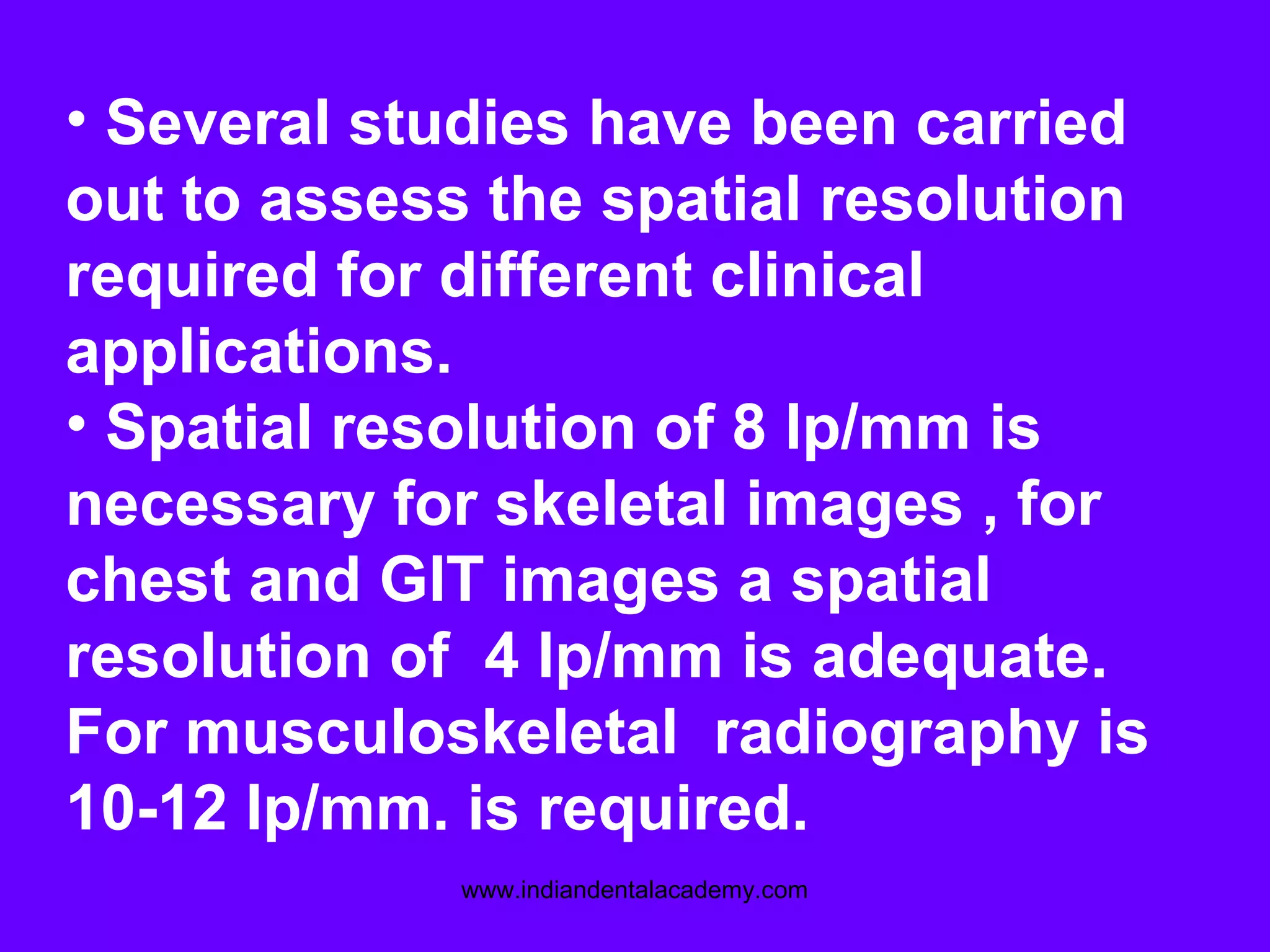
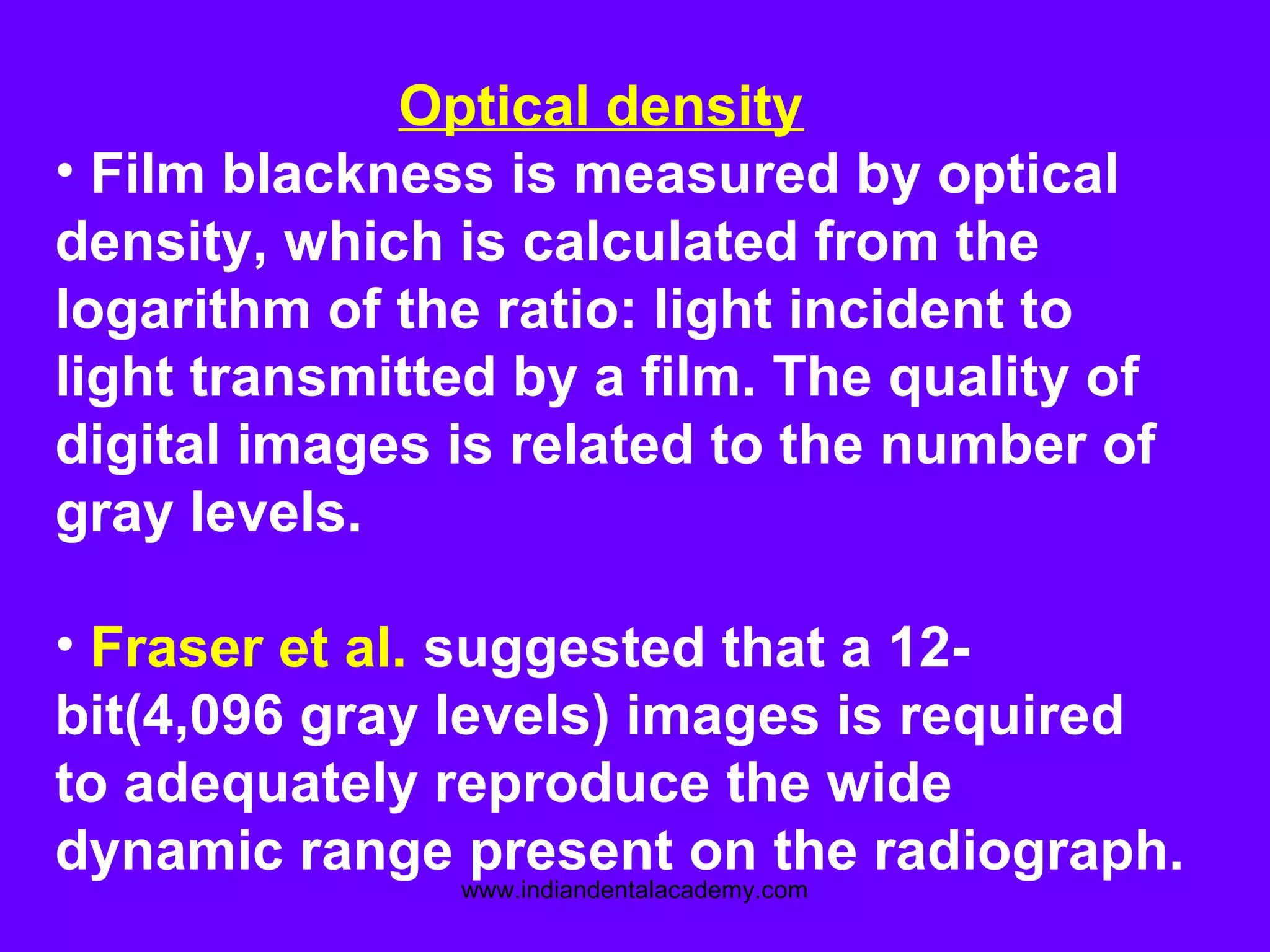
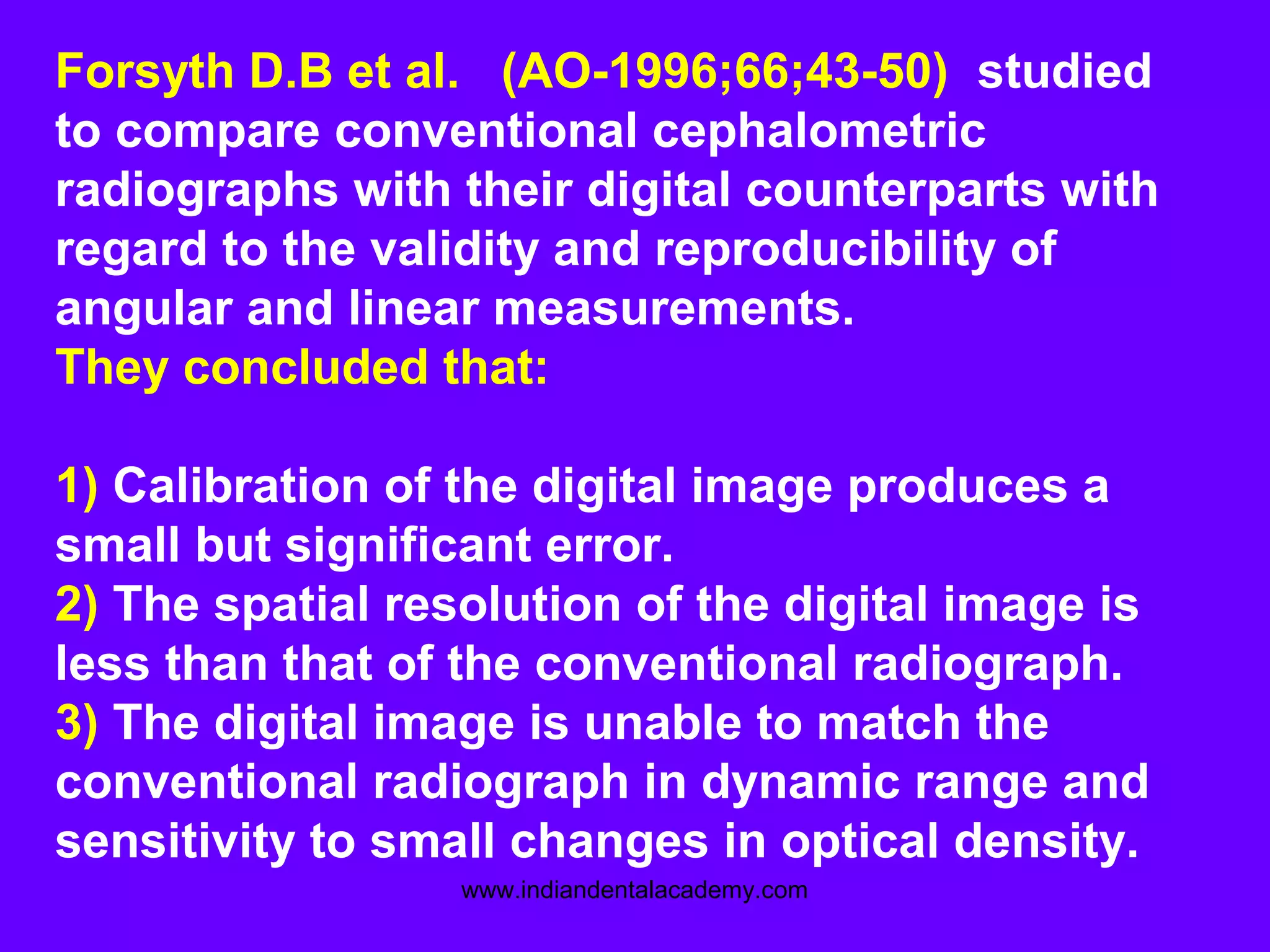
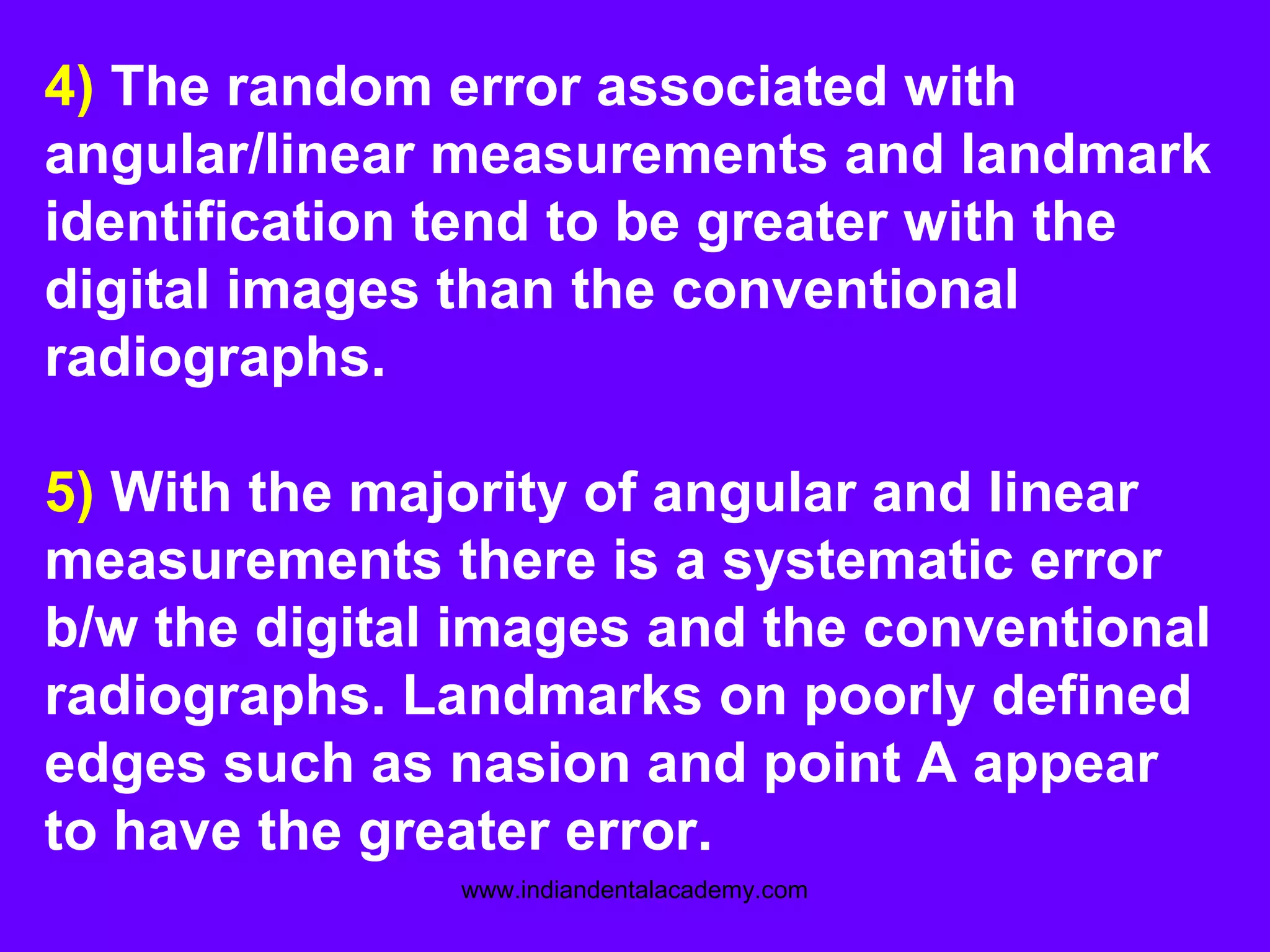
compromising diagnostic quality.
www.indiandentalacademy.com
5) Automated cephalometric analysis
• With the introduction of digital imaging,
automated and semi-automated landmark
identification directly from the digital image has
been investigated.
• This would avoid the need for manual tracing of
cephalometric radiographs and remove operator
subjectivity.
• With regard to cephalometric analysis, several
systems have shown varying degrees of success
in identifying different landmarks.
• The system developed by Parthasarathy et al.
demonstrated a success rate of 83% in
identifying nine cephalometric landmarks on five
cephalometric images.www.indiandentalacademy.com
Landmark identification on digital cephalometric
radiograph:
• When carrying out landmark identification on a
digital image of a cephalometric radiograph,
identified landmarks can be shown on the
displayed image.
• Corresponding angular and linear measure-
ments can also be displayed and then stored
with the image.
• This enables the operator to edit landmarks
that may have been incorrectly placed. It also
permits the operator to review identified
landmarks at a later date and again edit their
positions.
www.indiandentalacademy.com
6) Surgical planning:
• With displayed digital images, cut-and-paste
facilities can be used to move areas of either a
photograph or a cephalometric radiograph
which has been captured as a digital image.
• A system outlined by Sarver et al. produced
profiles on pre -surgical photographs of the
expected result after orthognathic surgery.
• The system was able to move soft tissue, with
the planned hard tissue movement, and to
simultaneously superimpose the cephalometric
radiograph on the photograph.
www.indiandentalacademy.com
7) Environmentally friendly:
• No processing chemicals are used
or disposed of. Both CCD sensors
and the PSP plates are capable of
being reused for many thousands of
exposures.
• They can, however, become
scratched and damaged if not
handled carefully.
www.indiandentalacademy.com
LIMITATIONS OF
DIGITAL
CEPHALOMETRY
www.indiandentalacademy.com
• Digital imaging to truly offer
significant advantages in cephalo-
metry, the image must yield as much
information as is currently available
on radiographic films.
• The properties of conventional film
radiography are difficult to match for
high spatial resolution, wide dynamic
range.
www.indiandentalacademy.com
• The quality of digital image is strongly
dependent on the spatial resolution, the
relationship of the gray level values of the
pixels to the optical density of the
radiograph and image display.
• The number of pixels and gray levels
that are required to produce an image of
acceptable quality will vary depending on
the image itself. Image which contain a
large amount of detail depend more on
the number of pixels rather than number
of gray levels. www.indiandentalacademy.com
Spatial resolution
• Spatial resolution is the ability to record
separate images of small objects that are placed
closely together ; it is measured in line pairs per
mm (lp/mm). The smaller the pixel size, the more
detail in the image and therefore the greater the
resolution. The smallest detail detectable by
human eye is 0.1 by 0.1mm.
• To provide digital images of radiographs with at
least as much information as is available in the
original conventional radiograph, pixels no larger
than 0.1mm are required, giving a spatial
resolution of 5 line-pairs per mm (lp/mm)
www.indiandentalacademy.com
• Several studies have been carried
out to assess the spatial resolution
required for different clinical
applications.
• Spatial resolution of 8 lp/mm is
necessary for skeletal images , for
chest and GIT images a spatial
resolution of 4 lp/mm is adequate.
For musculoskeletal radiography is
10-12 lp/mm. is required.
www.indiandentalacademy.com
Optical density
• Film blackness is measured by optical
density, which is calculated from the
logarithm of the ratio: light incident to
light transmitted by a film. The quality of
digital images is related to the number of
gray levels.
• Fraser et al. suggested that a 12-
bit(4,096 gray levels) images is required
to adequately reproduce the wide
dynamic range present on the radiograph.
www.indiandentalacademy.com
Image display
• With improving technology ,the limitations of
pixel size and the number of gray levels can be
overcome and the limiting factor in the quality
of digital images will be the spatial resolution of
the display monitor, which can be dictated by
the number of raster lines.
• Monitors displaying up to 625 lines are
routinely used for viewing of digital images.
Where image quality is particularly important, a
2,048 – line monitor should be used to give
comparable resolution to a radiographic film.www.indiandentalacademy.com
Forsyth D.B et al. (AO-1996;66;43-50) studied
to compare conventional cephalometric
radiographs with their digital counterparts with
regard to the validity and reproducibility of
angular and linear measurements.
They concluded that:
1) Calibration of the digital image produces a
small but significant error.
2) The spatial resolution of the digital image is
less than that of the conventional radiograph.
3) The digital image is unable to match the
conventional radiograph in dynamic range and
sensitivity to small changes in optical density.
www.indiandentalacademy.com
4) The random error associated with
angular/linear measurements and landmark
identification tend to be greater with the
digital images than the conventional
radiographs.
5) With the majority of angular and linear
measurements there is a systematic error
b/w the digital images and the conventional
radiographs. Landmarks on poorly defined
edges such as nasion and point A appear
to have the greater error.
www.indiandentalacademy.com
MEDICOLEGAL
• Concerns have been raised in the past
about the ability to manipulate the
images for fraudulent purposes.
Manufacturers of software
programmers have installed ‘audit
trails’ which can track down and
recover the original image.
www.indiandentalacademy.com
Conclusion
• Although innumerable limitations exist in the
field of cephalometrics. This is not to suggest
that cephalometry is not a useful measurement
tool for use by clinical orthodontist, it is still a
very significant & effective diagnostic tool.
• A combination of various cephalometric norms
and variables should be compiled to arrive at a
proper diagnosis.
www.indiandentalacademy.com
• The technology is now available to run a practice
almost paper free. It is theoretically possible to
store clinical notes, photographs, radiographs, &
study models on disc, refer or consult on line. The
future of digital imaging could include the testing
& upgrade of X-ray equipments & software online.
• Research is also continuing in to the
development of a credit card sized ‘smart card’,
which could carry a patient’s medical & dental
notes along with their radiographic images.
• It is important that advances in technology are
accepted & the benefits that they produce utilized
in order that clinical practice & patient care
continue to improve.www.indiandentalacademy.com
BIBILOGRAPHY
1) Text book of Radiographic Cephalometry by Alexander
Jacobson.
2) Text book of Orthodontic current principals & tech; 4th
edn, by T.M.Graber & Robert .L. Vanarsadall.
3) Baumrind et al- The reliability of head film measurement
1.landmark identification –AJO;1971;60;2
4) Steiner.C; Cephalometrics for you & me;AJO-1953,39;10
5) Salzmann.J.A ; Limitations of roentgenographic ceph’s;
AJO;1964;50;3
6) Miller.A – Analysis of errors in ceph measurement of 3-
dimensional distance of the maxilla- Ang Ortho-1966;36;2
www.indiandentalacademy.com
7) Richardson .A ; An investigation in to the reproducibility
of some points, planes & lines used in ceph analysis –
AJO;1966;52;9
8) Ahlqvist et al; The effect of projection errors on
cephalometric length measurements-EJO;1986;8;141-148
9) Midtgard. J- et al; Reproducibility of cephalometric
landmark errors of measurements of cephalometric
cranial distances- Ang Ortho;1974;44;56-61
10) McWilliam.J. et al –The effect of image quality on the
identification of ceph landmarks –Ang. Ortho-1978;48;1
11) Jacobson R.;Point A revisited;AJO-DO; 1980;JAN;94-96
12) Tremont T.J. ;An investigation of the variability b/w the
optic plane & frank fort horizontal –AJO-DO ;
1980;Aug;192-200 www.indiandentalacademy.com
13) Houston W.J.- the analysis of errors in orthodontic
measurements- AJO;1983;83;5
14) Hussels.W & Ram Nanda- Analysis of factors affecting
angle ANB –AJO-DO;1984;MAY;411-423
15) Lundstrom A et al- The frankfort horizontal as a basis for
cephalometric analysis-AJO-DO;1995;May;537-540
16)Trpkova B. et al-Cephalometric landmarks identification &
reproducibility ;A meta analysis –AJO-DO ;1997;112;165-70
17) Major. P et al- landmark identification error in P-A ceph
-Ang.Ortho ;1994;64;6
18) Baik & Ververidou – A new approach of assessing sagittal
discrepancies : The Beta angle- AJO-DO;2004;126;100-5www.indiandentalacademy.com
19) Handbook of Orthodontics- 4th
edn; by
Robert E Moyers.
20) Forsyth.D.B et al.– digital imaging of
cephalometric radiography. Part 1:
advantages and limitations of digital
imaging -AO-1996;66;1
21) Forsyth.D.B et al- digital imaging of
cephalometric radiography-part 2: image
quality- AO-1996;66;1
22) Brennan.J –An introduction to digital
radiography in dentistry- Jurnl of Ortho-
2002;29;66-69 www.indiandentalacademy.com
THANKYOU
www.indiandentalacademy.com

Limitations of cephalometrics of ceph

  • 1.
  • 2.
    CONTENTS 1.INTRODUCTION 2.REVIEW OF LITRETURE 3.CLASSIFICATIONOF CEPHALOMETRIC ERRORS 4.PROJECTION ERRORS 5.LANDMARK IDENTIFICATION ERRORS 6.LIMITATIONS IN SUPERIMPOSITION 7.LIMITATIONS OF CEPHALOMETRIC ANALYSIS www.indiandentalacademy.com
  • 3.
    CONTENTS 8) LIMITATIONS OFVERIOUS REFERENCE PLANES USED IN CEPHALOMETRICS 9) CONCEPTS OF NATURAL HEAD POSITION AND NATURAL HEAD POSTURE 10) LIMITATIONS OF VARIOUS CEPHALOMETRIC ANALYSIS COMMONLY USED 11) ADVANTAGES & LIMITATIONS OF DIGITAL CEPHALOMETRY 12) CONCLUSION AND BIBLOGRPHY www.indiandentalacademy.com
  • 4.
    • Cephalometry, orthe measurement of the head, was developed as an anthropological technique to quantify shape and size of skull. The discovery of x-rays by Roentgen in 1895 revolutionized medicine and dentistry. About 36 year later i.e; 1931, traditional cephalometry in two dimensions, known as roentgenographic cephalometry, was introduced to the dental profession by Broadbent and has since remained relatively unchanged. • Since these early years, cephalograms have been used widely as a clinical and research tool for the study of craniofacial growth, development, and treatment. • However, because of the traditional 2-dimensional cephalometry, use of this method for deriving clinical information as a basis for determining treatment plans has been questioned. INTRODUCTION www.indiandentalacademy.com
  • 5.
    • The followingissues question the validity of 2- dimenstional cephalometry to derive clinical information used in treatment planning. 1) A conventional head film is a 2-dimentional representation of a 3-dimentional object. When 3- dimentional object is represented in 2- dimentions,the imaged structures are displaced vertically and horizontally. The amount of structural displacement is proportional to the distance of the structures from the film or recording plane. www.indiandentalacademy.com
  • 6.
    2) Cephalometric analysisare based on the right assumption of perfect superim - position of the right and left sides about the midsagittal plane. • Perfect superimposition is observed infrequently because facial symmetry is rare and because of the relative image displacement of the right and left sides. • These inherent technical limitations do not produce an accurate assessment of cranio- facial anomalies and facial asymmetries. www.indiandentalacademy.com
  • 7.
    3) The projectiongeometry prevent the ability to acquire accurate dimensional information aligned in the direction of the x-ray beam. 4) A significant amount of external errors, known as radiographic projection error, is associated with image acquisition. These errors include size magnification, errors in patient positioning, and projective distortion inherent to the film-patient-focus geometric relationships. www.indiandentalacademy.com
  • 8.
    5) Manual datacollection and processing in cephalometric analysis have been shown to have low accuracy and precision. 6) Significant error is associated with ambiguity in locating anatomic landmarks because of the lack of well-defined anatomic features, outlines, hard edges and shadows, and variation in patient position. Such landmark identification errors are considered major source of cephalometric errors. Despite these limitations of cephalometry, many cephalometric analyses have been developed to help diagnose skeletal malocclusions and Dentofacial deformities. However, several investigations have questioned the scientific validity of such analyses.www.indiandentalacademy.com
  • 9.
    • Pacini in1922 – described a rather primitive method for the standardization of radiograph imaging of the head. He recommended the positioning of a subject at a fixed distance of 2 mtr from the x-ray source with a film cassette fixed to the head with a wrapping of gauze bandages. • Hofrath of Germany and Broadbent of the United states in 1931- published their own method of obtaining standardized head radiographs. REVIEW OF LITRATURE www.indiandentalacademy.com
  • 10.
    • Bjork in1947 –described errors arising from differences in projection between two films of the same individual. He also noted that the difficulties involved in locating different landmarks varied depending on the nature of the landmark examined. This was confirmed by Richardson 1966- who noted that some landmarks were more reproducible vertically than horizontally and vice versa. • In a study by Van Aken in 1963- projection errors were found to be small but might be of significance in cephalographs of asymmetrical skulls or in the case of anatomical landmarks that do not lie in the midsagittal plane. REVIEW OF LITRATURE www.indiandentalacademy.com
  • 11.
    • Baumrind andFrantz in 1971- found that repeated identification of the same landmark on the same cephalometric image resulted in errors and they also studied the side effects of uncertain landmark identification and found these errors were significant when transmitted to angular & linear measurements. • Rossmann & Wiley in1970- claimed that interpretation of radiographic image is dependent on radiological knowledge, pattern recognition , physical image quality. • Bergersen in 1980- studied magnification and distortion in cephalometric radiography and found discrepancies between distance measured on the film and true distances in the object.www.indiandentalacademy.com
  • 12.
  • 13.
    Some limitations ofcephalometrics According to Moyers 1) Assumptions a) Symmetry b) Occlusal position c) Orientation on the transmeatal Axis d) Adequacy of one or two planar projections 2) Fallacies a) The fallacy of false precision b) The Fallacy of ignoring the patient c) The fallacy of super- positioning d) The fallacy of Using Chronological Age e) The fallacy of the “ideal” 3) Misuses of cephalometric analyses www.indiandentalacademy.com
  • 14.
    Geometric methods I) Basicelements : A tracing has some actual biological information, namely, location of curves and landmarks. It also contains some non biological information-artifacts-such as non- curves and non-points. A) Curves: The curved images in the cephalogram are of three different biological types (i) edge regression (ii) curves in space (iii) transversals of surfaces. i) Edges of regression surfaces –the edges of surfaces are sometime properly shown. The anterior border of the coronoied process, for instance, really is a fairly sharp edge.www.indiandentalacademy.com
  • 15.
    • But sometimethat which we perceive as an edge of a surface is neither an edge nor a horizon. For e.g., the line we call the “alveolar crest” line represents a col, a saddle-shaped depression in the crest of a mountain ridge. www.indiandentalacademy.com
  • 16.
    ii) Curves inspace In a cephalogram curves are seen but are foreshortened and simplified by flattening; for e.g. the image of the mandibular canal in cephalogram and the resulting image in not realistic. www.indiandentalacademy.com
  • 17.
    iii) Transversals ofsurfaces: • Transversals of surfaces are neither edges nor true anatomic loci but places where a bone of irregular shape is viewed most parallel to the central ray. Some surfaces are nearly parallel to the central ray and hence appear as a line, a problem inherent in reducing 3-dimensions in to two. www.indiandentalacademy.com
  • 18.
    • For e.g., the radiographic shadow of the bony orbit in cephalograms and real bony orbit on a dry skull. www.indiandentalacademy.com
  • 19.
    B) Points& landmarksclassified A landmark is a point serving as a guide for measurement. Cephalometric landmarks are of the following kinds; a) True anatomic point- anatomic points are really small regions which might be located on the solid skull even better than in the cephalogram. e.g.- ANS, infradentale, cusp tips/ incisal edges, nasion, www.indiandentalacademy.com
  • 20.
    b) Implants- implantsare artificially inserted radiopaque markers, usually made of an inert metal. They are not landmark in the usual sense . They are private points their position from subject to subject is not homologous. They may be located more precisely than traditional point and provide precise superpositioning, but they cannot be used to measure accurately any aspect of the single form.www.indiandentalacademy.com
  • 21.
    c) External points- Are points characterized by their properties relative to the entire outline: a) points which are extrema of curvature, for e.g. incision superius (Is) (b) points whose coordinates are largest or smallest of all points on a specific outline ,for eg point A, point B, gnathion, condylion. These points are less precision of location than true anatomic points. www.indiandentalacademy.com
  • 22.
    d) Intersection ofedges of regression as points – points defined as the intersection of images are really lines looked at down their length. For e.g., articulare (Ar) and PTM are not points at all and are in no way part of the solid skull. Such points exist only in projections and are dependent on subject positioning. e) Intersection of constructed lines –intersections of constructed lines are used as points for e.g. : “gonion” some times is defined as the intersection of the ramal and mandibular lines. www.indiandentalacademy.com
  • 23.
    C) Lines /planes: • In reality many of the so called cephalometric planes are not flat. For e.g., the occlusal plane drawn in the cephalogram as a straight line represents a very complicated 3-dimensional relationship of cusp contacts. Cephalometric lines usually of the following types: i) Line joining true anatomic points, for e.g. ,the palatal line joins the ANS-PNS . www.indiandentalacademy.com
  • 24.
    ii) Anatomic tangentlines: • Lines through an anatomic point and tangent to an outline elsewhere. For e.g., the facial line is defined as joining nasion to pogonion; but the Pog is just the point of tangency of this line at the chin. • Lines formed by double tangents, that is, lines tangent to a structure, or structures, at two points. For e.g. , the ramal line usually touches the mandible both at the posterior border of the ramus and along the condyle; the mandiular line touches both near menton and near gonion. www.indiandentalacademy.com
  • 25.
    I) Assumptions In anymethod some things must be taken for granted as a basis for action. a) Symmetry • Analysis, particularly in the lateral projection, is based on presumed skeletal symmetry. • All faces have minor asymmetries which are clinically unimportant, but more serious imbalances may be obscured by the method or neglected by the dentist. • Routine study of the PA projection is a good antidote. www.indiandentalacademy.com
  • 26.
    b) Occlusal position •Cephalograms must be taken in some occlusal position. It is conventional to position the mandible in the usual occlusal position when taking the cephalograms since this is where the patient “bites”. • In malocclusions with an important functional element this convention may be misleading. One should study carefully the patient’s mandibular functional movements prior to recording the cephalogram. Suspicions noted visually may be confirmed quantitatively in the cephalogram by two procedures; www.indiandentalacademy.com
  • 27.
    • Use waxbites of both the usual occlusal position ( centric occlusion) and the detruded contact position (centric relation) to record two lateral cephalograms. In extreme cases the patient may wear a diagnostic splint for several days before the cephalogram is obtained. • Use the postural position as well as an occlusal position for both the lateral and PA projections.www.indiandentalacademy.com
  • 28.
    c) Orientation onthe transmeatal Axis • It is convenient to use ear rods to orient the patient’s head. The central ray is supposed to pass along the transmeatal axis. But of course the external auditory meati are just asymmetric as any other cephalic structures. • Special cephalometric procedures have been designed without ear rods so the central ray is 90 degrees to the midsagittal plane, but they are not in common use. www.indiandentalacademy.com
  • 29.
    d) Adequacy ofone or two planar projections: Almost all routine cephalometric analysis is done using only the lateral projection. Much can be learned from PA , oblique, and basilar views. The future may bring a practical true 3- dimensional cephalometric method. www.indiandentalacademy.com
  • 30.
    2) FALLACIES Any methodmay involve specific miscalculation, omissions, blunders, oversights, errors, or inaccuracies which are not the fault of the method itself. We speak hear not about such mistakes but about fallacies: misrepresentations intrinsic to the method. a) The fallacy of false precision If one makes a series of separate cephalograms of the same head, traces each cephalogram, locate “A” point , nasion, and “B” point , and measures the ANB angles, it will be discovered that the standard error of that measure is greater than 1.5 degrees. www.indiandentalacademy.com
  • 31.
    • Therefore, anydecision, such as a choice of treatment procedure, based on the value of ANB angle, alone or in combination with other measurements, must have a gray area of approximately +/- 1.5 degrees where the treatment prescription is ambiguous. • This problem is compounded when a clinician compares a case he or she has traced to standards developed, and therefore filmed and traced, by another. www.indiandentalacademy.com
  • 32.
    b) The Fallacyof ignoring the patient • Means are population averages which have nothing to do with the specific characteristics of particular patient. A patient’s measure need not to be increased by , for e.g., 4mm just because it differs by 4mm from the mean. www.indiandentalacademy.com
  • 33.
    •There are manybeautiful faces in good occlusion which have measures far from the norms. It is not necessary to treat malocclusion with relation to a fixed cephalometric goal. •Rather, cephalomerics should provide a range of satisfactory treatment goals which, combined with other information from dental casts ,case history, and observation of the patient, make possible an individualized treatment plan. www.indiandentalacademy.com
  • 34.
    c) The fallacyof super- positioning: Super positioning , registering of two or more tracing of an individual on particular structures ,occasionally helps one to visualize growth or treatment changes. • Localized remodeling can be shown by superposition's nearby. As one moves away from the registration site the changes observed are a combination of summated growth in several regions, effect of treatment, enhancement of errors in positioning. www.indiandentalacademy.com
  • 35.
    • For e.g.,where registration is in the cranial base region, the chin seems to have “grown” downward & forward, but one may as well say that the condyle has been growing upward & the chin has been translated away from the articular fossae. Little growth occurs at the chin itself. The many changes b/w chin & sella are summated & directed downward & forward not by growth but by the artifact of super- positioning. • If one superposed on the symphysis, it would be misleading to speak of upward & backward growth of the cranial base. www.indiandentalacademy.com
  • 36.
  • 37.
  • 38.
    d) The fallacyof Using Chronological Age Although it is conventional to use chronological age (birth age) for comparisons and reference, developmental age is a better criterion: it reduces the variance of sizes, angles and proportions within age classes. Some orthodontists take routine radiographs of the wrist of patients to assign their “ carpal age” an index of bone maturation. www.indiandentalacademy.com
  • 39.
    e) The fallacyof the “ideal” Practical problems arise when “ ideals” for skeletal relationships are oversimplified into numbers inflexibly and arbitrarily imposed on every patient. The use of contrived “ideals” as standards sometimes produces a set of ipso facto findings by setting up artificial criteria for abnormality and then uncovering the incidence and prevalence of these variations. www.indiandentalacademy.com
  • 40.
    • By definition,abnormal must always refer to the normal, which can only be determined from an appropriate population. • One cannot discover “abnormality” by comparison with subjective ideals based on personal perceptions of facial esthetics, nor can one label such ideals as normal. www.indiandentalacademy.com
  • 41.
    3) Misuses ofcephalometric analyses • Even when we protect ourselves from misleading assumptions or fallacious misconceptions we may err simply by misuse of any analysis. a) An analysis is misused if too rigid an application of mean values is made. The total range and variance are more practical than the mean itself. Because means are population averages, they usually are very poor treatment goals. • Occasionally means of tooth positions are useful, but only when the array of skeletal values is close to the means for sex and age. When skeletal values deviate from the mean, dentitions must adapt. The clever clinician does not apply the same mean value to all faces but determines those adaptation compromises to be made in treatment which are most suitable to be pleasing and stable.www.indiandentalacademy.com
  • 42.
    b) An analysisis misused when it is applied inappropriately. • Values derived from 12-year old North American white boys who sought orthodontic treatment in a dental school, for e.g. are obviously of little use in assessing the specific clinical needs of a 6-year old black girl in practice: there are too many differences resulting from age, sex, race, etc • The samples from which many of our most popular cephalometric analyses were derived have not been adequately described in the literature, making it very difficult for the clinician to know whether or not the analysis is appropriately useful.www.indiandentalacademy.com
  • 43.
    c) An analysisis misused when it is applied in a way for which it was not intended. Analyses contrived to visualize treatment goals (e.g. those of Tweed or Steiner, both designed to depict goals of treatment )are used improperly when used for growth studies. d) Standards derived from cross-sectional samples, in most instances, cannot properly be used in lieu of longitudinal data to access expected growth. For establishing growth standards, a small serial sample is much better than cross-sectional sample having the same number of radiographs.www.indiandentalacademy.com
  • 44.
    e) The substitutionof a subjectively derived “ideal” for a statistically developed population norm misinforms and misleads. •“Ideals” represent artificial constructs of faces one clinician likes; norms present real values of a particular group. They cannot be used interchangeably. www.indiandentalacademy.com
  • 45.
    According to Baumrindand Frantz; AJO -1971, Head film measurements like all measurements involve error which falls into two categories. • Errors of Projection • Errors of Identification www.indiandentalacademy.com
  • 46.
    Hatcher recently hasreviewed and categorized source of errors include those caused by internal and external orientation and those related to geometry and association. 1) INTERNAL ORIENTATION ERROR : • This error refers to the 3-dimentional relationship of the patient relative to the central x-ray beam or imaging device and assumes that a minimal error of this type occurs with a specific and consistent head position. Because this is not always true, an internal orientation error is introduced.www.indiandentalacademy.com
  • 47.
    2) EXTERNAL ORIENTATIONERROR : • This error refers to the 3 dimensional spatial relationship or alignment of the imaging device, patient stabilizing device, and image recording device. • Minimal error is assumed when the x-ray source is 60 inches from the midcephalostat as the central ray passes through the ear rods and the beam is horizontal to the horizon and perpendicular to the film plane. • The distance from the midcephalostat plane to the film plane should be known and be consistent between images. Any deviations from these assumptions will introduce errors into the final image. www.indiandentalacademy.com
  • 48.
    3) GEOMETRIC ERROR: •Thiserror primarily refers to the differential magnification created by projection distance between the imaging device, recording device, and a 3- dimensional object. For e.g. ; structures farthest from the film will be magnified more than objects closer to the film. The error is related to the divergence of the x-ray beam on its path from the x-ray source to the recording device. www.indiandentalacademy.com
  • 49.
    4) Association error: •This error refers to the difficulty in identifying a point in two or more projections acquired from different points of view. The difficulty in identifying the identical point on two or more images is proportional to the magnitude of change in the angle of divergence between the projections. www.indiandentalacademy.com
  • 50.
  • 51.
    Errors of projection •Results because headfilm is a two dimensional depiction of a three dimensional object. • Since the rays that produce the image are not parallel and originate from a small source , headfilms are subject to distortion; the side nearer the x-ray source is enlarged more than the side closer to the film. www.indiandentalacademy.com
  • 52.
    • The degreeof magnification is determined by the ratio of the x-ray source-to-object distance and source to film distance. The larger the distance from the source being imaged to the film plane, the greater the magnification. • To minimize this effect, the distance from the x-ray source to the midsagittal plane of the patient’s head in cephalometric unit is 60 inches. This ensures that the x-ray photons are traveling toward the object/film more parallel to each other, thus reducing magnification.www.indiandentalacademy.com
  • 53.
    • However, thereis still magnification of most of the oral and craniofacial structures ranging from near zero for objects close to the film and in the exact center of the x-ray beam to 24% at regions 60 mm from the ear rods and beyond. This magnification is not constant for all of the possible sagittal radiographic planes of the patient. www.indiandentalacademy.com
  • 54.
    • Those structureslocated closest to the film will be magnified less than those located in the sagittal plane, and those nearest to the x-ray source will be magnified to the greatest extent. • Magnification factors are further affected by the distance from the film cassette to the midsagittal plane of the patient, with magnification increasing as the film is moved away. www.indiandentalacademy.com
  • 55.
    • To minimizevariation in magnification from patient to patient and to obtain consistent measurements on the same patient over time, many orthodontists choose to keep that distance constant. • A distance of 15 cm from the midsagittal plane of the cephalostat to the film cassette is often used. This fixed distance produces magnification that is somewhat consistent, with in tolerable limits. • However many practitioners choose to place the film cassette as close to the patients head as possible to achieve maximum sharpness and reduce magnification of the dental structures.www.indiandentalacademy.com
  • 56.
    • Note thatbecause the x-ray beam is diverging, the image magnification will be less when placing the film at position (A) than will be the case at position (B).www.indiandentalacademy.com
  • 57.
    For eg :if the x-ray beam enters the patients head from the right side ,the image of the right side of the mandible will be larger than that of the left side. Also, a given anatomic structure, such as the angle of the right mandible, will appear further from objects in the center of the orofacial image than will be the angle of the left mandible.www.indiandentalacademy.com
  • 58.
    • Errors dueto the projection of the 3-dimensional object on to a 2-dimensional film have been studied less extensively. • Similarly, there has been little analysis of errors arising from misalignment b/w the different components of the cephalometric equipments or misalignment of the patient in the cephalogrpic system. • In a study by Van Aken(1963) projection errors were found to be small but might be of significance in cephs of asymmetrical skulls or in the case of anatomical landmarks that do not lie in the mid-sagittal plane.www.indiandentalacademy.com
  • 59.
    • Bergersen-1980- studiedmagnification and distortion in cephalometric radiography and found discrepancies b/w distance measured on the film and true distance in the object. • According to Ahlqvist the relations b/w the different components of the cephalographic system are affected by a number of factors. 1.The focal spot, the cephalostat, and the film may be linearly displaced in relation to each other. 2.The cephalostat and the film may be rotated with respect to each other. 3.The patient may be linearly displaced and /or rotated in relation to the cephalographic system. www.indiandentalacademy.com
  • 60.
    Fig-A- direction ofpossible misalignments of the patientwww.indiandentalacademy.com
  • 61.
    Fig-B : theprojection length of an object will vary with its inclination toward the focal spot or toward the film.www.indiandentalacademy.com
  • 62.
  • 63.
    Error of identification •Involves the process of identifying specific landmarks on headfilms. • To test landmark identification reliability , 4 instructors and 3 orthodontic residents were requested to select and plot four high quality radiographs. • They were provided with a list of landmarks and definitions of each and were asked to identify them using a pencil point on a clean sheet of acetate paper on the radiograph. www.indiandentalacademy.com
  • 64.
    • The porion,condylion , orbitale and basion were less readily identified than some of the other landmarks. • Condylion was less readily identified and Gnathion more accurately identified. • Baumrind and Frantz demonstrated marked differences in magnitude and configuration of envelope of error found among different landmarks. Other factors that can influence landmark identification are film density and sharpness. www.indiandentalacademy.com
  • 65.
    •Identification of landmarkby seven individuals. Each circle is the smallest possible circle that would encompass the landmarks.www.indiandentalacademy.com
  • 66.
    Point A revisited– Jacobson- AJO 1980 • Subspinale or point A is a midline point whose relationship to the anterior teeth in lateral ceph may be influenced by head position. It is located somewhere b/w the root apex and the coronal third of the root of the tooth. • Subspinale is defined anthropologically as “ the deepest midline point on the premxilla b/w ANS & prosthon. • Bjork defined it as the “ deepest point on the contour of the alveolar projection b/w the spinal point and prosthion. • Because of the difficulty in locating point A, alternate point have been suggested by Van der Linden i. e point L, which is located on the anterior surface of the image of the labial lamella at the region of the apex of the maxillary incisors. • Jarabak & Fizzel defined a point 2 mm ahead of the root apex as a redefinition of point A.www.indiandentalacademy.com
  • 67.
    Point A revisited– Jacobson- AJO 1980 • Jacobson concluded that Point A cannot be accurately identified in all cephalometric radiographs. In instances where this landmark is not clearly discernible, an alternative means of estimating the anterior extremity of the maxillary base is shown. • A point plotted 3.0 mm. labial to a point between the upper third and lower two thirds of the long axis of the root of the maxillary central incisor was found to be a suitable point (estimated point A) through which to draw the NAE line and one which most closely approximates the true NA plane. www.indiandentalacademy.com
  • 68.
    The precision withwhich any landmark may be identified depends on a number of factors. 1. Landmarks lying on a sharp curve or at the intersection of two curves are generally easier to identify than points located on flat or broad curves. 2. Points located in areas of high contrast are easier to identify than points located in areas of low contrast . 3. Superimposition of other structures, including soft tissue over the area of landmark in question, reduce the ease of identification. www.indiandentalacademy.com
  • 69.
    4) Precise writtendefinitions of describing the landmark reduces the chance of interpretation error. 5) Operator experience is an important factor since increased knowledge of anatomy and familiarity with the radiographic appearance of the subject reduces interpretive errors. www.indiandentalacademy.com
  • 70.
  • 71.
    LIMITATIONS OF SUPERIMPOSITION •Serial radiographic cephalometry has been used, almost from its inception, to measure craniofacial growth and treatment changes. • This gives rise to the question, just how accurate are cephalometric measurements? Radiographic cephalometry is only scientific if it can be measured. • The validity of cephalometric measurement therefore is directly dependent on the accuracy of the method of measurement, which in turn is limited by the following problems. www.indiandentalacademy.com
  • 72.
    A) Lateral orfrontal headfilms taken at different times, and possibly by different people, are difficult to reproduce with any degree of accuracy, whether the head is steadied in a cephalostat or in the natural head position. B) The double images of the bilateral structures often are not consistently equally spaced in serial headfilms because of even minor faulty head positioning. www.indiandentalacademy.com
  • 73.
    C) Film contrastand density differences often encountered are the result of lack of strict quality control. D) Anatomic or structural landmarks are not consistently identifiable. E) Most important limitation of traditional cephalometric radiographic measurements is that 3-dimensional changes are measured in only two dimensions. www.indiandentalacademy.com
  • 74.
    Limitations of traditionalsuperimposition methods • No points or planes in the craniofacial complex are stable and all move relative to each other during growth. Orthodontic analyses, in effect , relates relatively stable areas as depicted by arbitrarily selected points or planes to more remote but less stable landmarks. www.indiandentalacademy.com
  • 75.
    • While theprimary errors are biologically induced , the secondary errors are entirely mathematically defined, since they are related to the primary errors. • Errors in tracing superimposition can be compounded by the method of superimposition used in interpreting the findings. • A study conducted by Ghafari et al demonstrated differences in interpretation of facial changes by comparing four traditional cephalometric methods of superimposition on the cranial base: best fit on anterior cranial base anatomy, sella-nasion, registration of point R with Bolton-nasion planes parallel, and basion- nasion plane. www.indiandentalacademy.com
  • 76.
    • The resultsof their study showed differences among all paired methods to be statistically significant. • Growth behavior of an individual as recorded on a sequential set of roentgenograms has been shown to differ greatly when studied using different superimposition methods. Nothing is known of the growth behavior of the individual parts in the continuum of the discrete points studied. • Because of the inability of conventional cephalometry to understand curved forms, it is limited to landmark indices. www.indiandentalacademy.com
  • 77.
  • 78.
    1) Most individualswith Dentofacial deformities have anatomic variations in the location of the cephalometric landmarks used as a baseline in many analyses, such as sella, nasion, and orbitale. This often results in incorrect conclusions from the analysis. 2) The clinician must not base interpretations on single cephalometric measurements. 3) The clinician must recognize the limitations, as well as the advantages, of cephalometry and be sure to integrate measurements with clinical findings. Limitations of cephalometric analysis www.indiandentalacademy.com
  • 79.
    4) The artof cephalometric interpretation lies in understanding abnormal findings and identifying the etiologic factors behind these cephalometric abnormalities in patients with dentoskeletal deformities. 5) Although cephalometric analysis forms an important part of the database for diagnosis and treatment planning, it should not take precedence over the clinical evaluation of the patient. www.indiandentalacademy.com
  • 80.
    Reliability of cephalometricanalyses: • Fundamental to orthodontics is the need to determine the relationship of the various skeletal components, particularly those of the jaws to each other and to the rest of the cranium in the cranio facial complex. • The interpretation of the measurements continues to be the subject of much debate. www.indiandentalacademy.com
  • 81.
    • Wylie etal compared five analyses in ten individuals who underwent various surgical corrections. • Pre treatment cephalometric radiographs of the ten patients were selected to illustrate different Dentofacial deformities , each of which was corrected with a different surgical procedure. • The pretreatment cephalometric radiographs were blindly assessed by one investigator who used the criteria for each of five popular analyses. • The results of the analyses ( diagnoses ) were then compared to one another and to the actual surgery performed. www.indiandentalacademy.com
  • 82.
    • The outcomeof the study revealed that performance of the analysis in relation to actual surgery was generally poor. • In the case with mandibular advancement there was 35 % agreement with the surgery performed. • For maxillary advancement - 20 % • For maxillary superior positioning 100% • For maxillary advancement and mandibular reduction- 20% • For bimaxillary protrusion – all analyses agreed that the teeth were protrusive and that the lower third of the face was too long. • This illustrates the unreliability of cephalometric analyses.www.indiandentalacademy.com
  • 83.
    For e.g.; 1) Inclass III malocclusion, 2 analyses suggested mandibular protrusion, 2 determined that the maxilla was retrognathic, and one identified the problem as a “short” maxilla and “forward mandible”. • In class II, div 2 malocclusion, one analyses claimed that the skeletal pattern was class I, 3- analyses indicated that class II tendency was due to maxillary protrusion, and one noted a short mandible. Only one analyses would support the decision to surgically advance the mandible.www.indiandentalacademy.com
  • 84.
    LIMITATIONS OF VERIOUS REFERENCE PLANES USEDIN CEPHALOMETRICS www.indiandentalacademy.com
  • 85.
    Reference planes •A cephalometricevaluation of the craniofacial complex requires a plane of reference from which to asses the location of various anatomic structures. Traditionally two planes have been used, namely the sella tucica-nasion(SN) plane and the Frankfort horizontal(FH). • The SN plane is more suitable for assessment of changes induced by growth and/or treatment within the same individual over time. Low variability in identifying sell turcica and nasion is an advantage of using this plane , as is the fact that sell turcica and nasion represent midsagittal structures. www.indiandentalacademy.com
  • 86.
    • If thegoal is to compare a particular individual to a certain population group (ie; established norms), use of the SN plane may provide erroneous information if the inclination of this plane is either too high or too low. • A sella turcica positioned to a great extent superiorly or inferiorly would account for a low or high inclination of the SN plane, respectively. • Frankfort horizontal (FH) has also been used extensively in cephalometry. Despite the difficulty in locating porion reproducibly, FH has been advocated to more accurately represent the clinical impression of jaw position. www.indiandentalacademy.com
  • 87.
    • As analternative, Legan and Burstone suggested using a constructed horizontal (cHP). This is line drawn through nasion at an angle of 7 degrees to the SN line. • This constructed horizontal tends to be parallel to true horizontal. However, in those cases in which SN is excessively angulated, even the constructed horizontal would not approximate true horizontal, in which case an alternative reference line must be sought.www.indiandentalacademy.com
  • 88.
    • Another approachinvolves obtaining the cephalogram with head in the natural head position. “True horizontal” is drawn perpendicular to a plumb line on the radiograph. Finally, a vertical reference line cane be traced passing through subnasale (SnV) or glabella. • This approach offers the advantage that natural head position approximates the position in which clinical judgments are made. • Its drawbacks include strict adherence to technique and difficulty in conducting studies where cephalograms have been obtained from various facilities.www.indiandentalacademy.com
  • 89.
  • 90.
    Variability between theoptic plane and Frankfort horizontal:Tremont-AJO-DO;1980 • Frankfort horizontal is commonly constructed on a lateral cephalogram from the top of the ear rod to orbitale. Ear rod positioning and identification of orbitale present obvious variables with such a reference plane. The optic plane has been proposed as a more accurate representation of Frankfort horizontal. www.indiandentalacademy.com
  • 91.
    • The opticplane was constructed, as defined by Sassouni, by drawing the supraorbital plane (a line tangent to anterior clinoid and the roof of the orbit), drawing the infraorbital plane (line tangent to the inferior of sella turcica and the floor of the orbit), and then bisecting the angle formed by their intersection to obtain the optic plane. www.indiandentalacademy.com
  • 92.
    • The opticplane, was significantly different from anthropologic Frankfort horizontal. Also, the optic plane did not vary significantly less from anthropologic Frankfort horizontal than from ear rod to orbitale Frankfort horizontal. • According to the parameters of this study, the optic plane is not a more accurate or reliable method of representing anthropological Frakfort horizontal on lateral cephalograms. www.indiandentalacademy.com
  • 93.
    • Traditionally, intracranialreference lines have been used for clinical cephalometric analysis of malocclusion cases. Several authors have, however, questioned the validity of intracranial reference because of their variability to the horizontal plane, related to the head in natural head position (NHP). • The study was undertaken to determine the reliability of the FH as a cephalometric reference line. The main alternative to intracranial reference lines is the nonvariable extracranial horizontal line (HOR) related to the head in natural head position. Frankfort horizontal basis for cephalometric analysis Lundström and Lundström- AJO 1995 www.indiandentalacademy.com
  • 94.
    fig shows- extremedifference with regard to inclination of frankfort horizontal in natural head position. www.indiandentalacademy.com
  • 95.
    • They concludedthat no difference was found between the variability of the Frankfort horizontal and the sella-nasion line with regard to the horizontal plane. The large variation of both intracranial reference lines, related to NHP, as well as to NHO, confirms their relative unsuitability as cephalometric references for clinical purposes. • Findings indicate that a horizontal line, related to natural head position, adjusted to natural head orientation when indicated, presents the most reliable basis for cephalometric analysis. www.indiandentalacademy.com
  • 96.
    Fig showing- anglesb/w horizontal plane and frankfort horizontal (FH/HOR, negative) and S-N line (S-N/HOR, positive)www.indiandentalacademy.com
  • 97.
    CONCEPTS OF NATURAL HEADPOSITION AND NATURAL HEAD POSTURE www.indiandentalacademy.com
  • 98.
    NATURAL HEAD POSITION •Natural head position is a standardized and reproducible orientation of the head in space when one is focusing at a distant point at eye level. • German Anthropological society in 1884 – Frankfort Agreement ie, The plane which passes through the left and right porion landmarks and the left orbitale, to achieved uniformity in craniometric research. www.indiandentalacademy.com
  • 99.
    • The Frankforthorizontal is a useful compromise for studying skulls but not for orienting natural head position in the living because the F-H plane located in the living is normally distributed around a true extracranial horizontal. • Nonetheless, orthodontist dealing with living subjects, rather than inert crania, have used this Frankfort horizontal faithfully in cephalometry. www.indiandentalacademy.com
  • 100.
    Downs had shownthat discrepancies b/w cephalometric facial typing and photographic facial typing disappear when the Frankfort plane is not horizontal, but tilted up or down. www.indiandentalacademy.com
  • 101.
    • Bjerin andThurow pointed out that intracranial landmarks are not stable points in the cranium, their vertical relationship to each other is therefore also subjected to biological variation. fig shows-Two ceph tracings with similarity in their facial profiles exhibit marked difference in the slope of their skull base( SN line) and in the FH. Conventional ceph analyses utilizing these intracranial reference lines would show markedly divergent facial configuration, rather than the similarity observed clinically.www.indiandentalacademy.com
  • 102.
    • Bjorks studiesof facial prognathism also illustrates the unreliability of intra cranial reference lines on cephalograms. • Two adult Bantu men were selected to represent maximum and minimum facial prognathism relative to the S-N plane. www.indiandentalacademy.com
  • 103.
    • This fig-shows the same two Bantu men tracing aligned in natural head position illustrate nearly identical profile outline and a low and high inclination of the S-N line, rather than difference in prognathism. • When various methods of cephalometric analyses are applied to the study of the same cephalogram, results may differ dramatically depending on the choice of reference lines. www.indiandentalacademy.com
  • 104.
    •The simplest procedureto obtain facial photographs and head radiographs is to instruct patients to sit upright and look straight ahead to a point at eye level on the wall in front of them. • The conventional use of two ear rods to stabilize the head in radiographic cephalometry is based on the assumption that the transmeatal axis of humans is perpendicular to the mid sagittal plane. • The relationship of the left and right ears in their vertical and horizontal relation is frequently asymmetric. www.indiandentalacademy.com
  • 105.
    Fig-A Fig-B Fig-C Fig-A: Facial symmetry of eyes, ears, contour of the lips, and mandible. Fig-B : Asymmetry of eyebrows and lips, but transmeatal axis perpendicular to the facial midline. Fig-C : Marked asymmetry of eyes, eyebrows, and ear but symmetry of lips. www.indiandentalacademy.com
  • 106.
  • 107.
    • The insertionof ear rods will obviously result in vertical and/or horizontal rotation of the head, which introduces a deficient and misleading image. • There by, the attempt to determine facial asymmetry of a patient generally results in a compromise rather than as an exact definition. • Only the left ear rod should be used in radiographic cephalometry both for the lateral and frontal projection. • The right ear rod should merely be inserted against any part of the ear.www.indiandentalacademy.com
  • 108.
    CONCEPTS OF NATURALHEAD POSTURE • In the later part of the 19th century, many anthropologists believed that the study of cranial morphology necessitated the orientation of skulls to a position that approximates the natural head posture of living beings. • The concept of natural head posture (NHP) on the living subject was introduced into the orthodontic literature in the 1950s by Broca, an anatomist, described NHP as the position of the head attained when an individual stands with the visual axis in the horizontal plane. • Cooke and Wei defined NHP as the natural, physiologic position of the head that is assumed when a relaxed subject looks at a distant reference point.www.indiandentalacademy.com
  • 109.
    • Various methodshave been devised to obtain NHP • MIRROR METHOD by Moorees and Kean. • SELF BALANCE METHOD by Solow and Tallgren. • The term natural head position and head posture are not interchangeable, one being a standardized procedure applied to all individuals for analysis of Dentofacial morphology and the other i.e.; head posture is an individually characteristic physiologic posture of the head to study the relation b/w posture and morphologic features. www.indiandentalacademy.com
  • 110.
    • Note thatonly a small mirror should be used to record natural head position to force subject to look straight ahead into the image of their eyes rather than a long mirror that prevent standardization of head position. • A long mirror is needed to accommodate subjects when recording their postural position, which is an individual, nonstandardized head position. www.indiandentalacademy.com
  • 111.
    • The variousreference lines still compete with each other. One system is more or less as good or poor as any other and none is completely reliable because each is subject to large individual variability. • What can be done to diminish this problem? The answer is to choose measurements that are based on different reference planes, in this way it is hoped to compensate for pronounced variations in one or the other reference lines. www.indiandentalacademy.com
  • 112.
  • 113.
    ANB angle asa measure of jaw Dysplasia • According to Steiner, the SNA reading indicates whether face protrudes or retrudes bellow the skull. Although the ANB is a reliable indication of A-P jaw relationship in most instances, there are many situations in which this reading cannot be relied on. • The ANB angle in normal occlusions is generally 2 degrees. Angle greater than this mean value indicate tendency toward class II jaw disharmonies; smaller angles (negative readings) reflect class III jaw discrepancies. While this is an acceptable generalization, numerous instances exist in which this does not apply. www.indiandentalacademy.com
  • 114.
    For eg –in fig A lateral ceph tracing of a class II malocclusion. The ANB angle is 7 degrees, which high and it is typical for class II type malocclusion. fig –B; lateral ceph tracing of a normal occlusion in which the ANB angle also measures 7 degrees.www.indiandentalacademy.com
  • 115.
    Cephalometrics for youand me – Steiner – 1953 ;AJO • Porion and Orbitale are not accurate for our use as we are not dealing with dry skulls. • Points S and N are clearly visible in the X- ray pictures and can be located easily and accurately. • Emphasizes that points S and N are located in the mid sagittal plane of the head and therefore they are moved a minimum amount whenever the head deviates from the true profile position and that the points are located on hard non yielding tissue. www.indiandentalacademy.com
  • 116.
    • The sameholds true for a rotation of the occlusal plane: backward (counterclockwise) rotation of the occlusal plane has a decreasing effect on the ANB angle, though sagittal basal relationships remain constant. www.indiandentalacademy.com
  • 117.
    Fig A- normalocclusion with an ANB angle of 2 degrees. Fig B- denture base are retro- positioned in the craniofacial complex. This has the effect of reducing the ANB from 2 degrees to -2 degrees. The relationship of the jaws to each other remains unchanged. Fig C- same relationship of the jaws only now both jaws are positioned forward relative to nasion. This has increased the ANB angle from 2 degrees to 5 degrees. www.indiandentalacademy.com
  • 118.
    • In figB- the relation of the jaws to each other is unchanged, but the jaws are rotated in counterclockwise direction relative to the S-N plane as compared to fig A. The rotation had the effect of producing a class III type jaw relationship. The ANB angle has been reduced from 2 degrees to -5 degrees. • Fig C- A clockwise rotation of the jaws produce the opposite effect.( i.e., class II-tape jaw relationship) www.indiandentalacademy.com
  • 119.
    Fig shows effecton ANB angle of change of 0.5 inch in position of nasion with points A & B held constant. Fig 1- horizontal positioning of nasion results in different ANB angles 1=2degrees,2=8degrees , 3= - 4. 5degrees Fig 2- vertical positioning of nasion results in different ANB angles. 1=2degrees, 2=1degree, 3=0degreeswww.indiandentalacademy.com
  • 120.
    Shortcomings of ANBangle • Taylor in 1969 pointed out that ANB angle did not always indicate true apical base relationship. Varied horizontal discrepancies of points A and B could give the same ANB measurement because variation in the vertical distance from nasion could compensate for other variation. • Beatty in 1975 reported that ANB angle is not always an accurate method of establishing the actual amount of apical base divergence. www.indiandentalacademy.com
  • 121.
    • As analternative to ANB angle for measuring apical base discrepancy , he devised the AXD angle, where point- x is located by projecting point A on to a perpendicular to SN line. Point D is located in the bony sympyhsis as described by Steiner. The two variables, nasion and point B, were eliminated. He also introduced a linear measurement AD, to describe the A-P relationship of the jaws. www.indiandentalacademy.com
  • 122.
    • Cross evaluationwith different reference planes is important and can be demonstrated with the ANB angle. • If one takes only the ANB angle to measure the relative position of maxilla and mandible to each other ,one must realize that any different horizontal or vertical position of point N and the location of the points A and B in the vertical plane will have an influence on the size of this angle and not on the actual sagittal relation of the two jaws. (Hussals and Nanda- 1984) www.indiandentalacademy.com
  • 123.
    STEINERS ANALYSES Acceptable compromises: •Steiner clearly recognized that cephalometric standards are merely gauges by which to determine more favorable compromises as a treatment goal. He developed a chart that reflects a number of average measurements of normal Dentofacial relationships. • Steiner recognized variations in antero -posterior jaw relations to each other. • The compromise describes the anticipated axial inclinations of the maxillary and mandibular incisors to the NA and NB lines at various ANB relationships. www.indiandentalacademy.com
  • 124.
    •The Steiner compromisesare geometric resultants of morphogenetic variations and their resulting treatment possibilities. www.indiandentalacademy.com
  • 125.
    Method of appraisalof jaw disharmony- Wits • The Wits appraisal is the extent to which the jaws are related to each other. • The occlusal plane is drawn through the region of the overlapping cusps of the first premolars and first molars. • The wits appraisal is done by drawing perpendicular lines from points A and B to the functional occlusal plane. • The distance b/w the points of intersection AO & BO is measured & it is describes the maxillary and mandibular relationships. www.indiandentalacademy.com
  • 126.
    • The averagejaw relationship according to Wits is – minus 1 mm for men and 0 mm for women. www.indiandentalacademy.com
  • 127.
    Shortcomings of Witsappraisal However, the wits appraisal relates point A & B to the functional occlusal plane; this generates 2 major problems. 1) Accurate identification of the occlusal plane is not always easy or accurately reproducible, especially in in mixed dention patients or patients with open bite, sever cant of the occlusal plane, multiple impactions, missing teeth, skeletal asymmetries, or steep curve of spee. 2) Any change in the angulation of the functional occlusal plane, caused by either normal development of the dentition or orthodontic intervention, can profoundly influence the Wits appraisal. www.indiandentalacademy.com
  • 128.
    WITS APPRACIAL APPLIEDTO CLASS I AND CLASS II SKELETAL JAW BASES www.indiandentalacademy.com
  • 129.
    A new approachof assessing sagittal discrepancies; The Beta angle – Chong Baik and Maria Ververidou –AJO-DO;2004 • Because of lot of limitations in assessing A-P jaw relation by various analysis like ANB, wits appraisal. To overcome these limitations they established new cephalometric measurements i.e. Beta angle. •This angle does not depend on any cranial landmarks or dental occlusion. •The Beta angle uses 3 skeletal land marks( 1) A point( 2) B point( 3) the center of the condyle, found by tracing the head of the condyle and approximating its centre (point- C).www.indiandentalacademy.com
  • 130.
    • Next itrequire 3-lines; (1)line connecting the centre of the condyle C with B point ( C-B line). (2) line connecting A and B points .(3) line from point A perpendicular to the C-B line. • Finally, measuring the Beta angle, which is the angle b/w the last perpendicular line and the A-B line. www.indiandentalacademy.com
  • 131.
    • It uses3 points located on the jaws ( 1) A point( 2) B point( 3) the center of the condyle (point- C). • So changes in this angle reflect only changes with in the jaws. In contrast to ANB angle, the configuration of the Beta angle gives it the advantage to remain relatively stable even when the jaws are rotated, for e.g.; when B point is rotated backward & downward, then C-B line is also rotated in the same direction, carrying the perpendicular from point A with in it. Because A- B line is also rotating in a same direction, the Beta angle remains relatively stable. www.indiandentalacademy.com
  • 132.
    B e t a a n g l e Fig shows: Betaangle remains relatively stable even when jaws are rotated www.indiandentalacademy.com
  • 133.
    • Another advantageof Beta angle is that it can be used in consecutive comparisons throughout orthodontic treatment because it reflects true change of the sagittal relationship of the jaws, which might be due to growth or orthodontic or orthognathic intervention. SHORTCOMING OF BETA ANGLE: 1) Precisely tracing the condyle and locating its center is not always easy. For that reason, some clinicians might hesitate to use the Beta angle. 2) To accurately use this angle, the cephalometric x-rays must be high quality.www.indiandentalacademy.com
  • 134.
    •The advantage oflocating the center of the head of the condyle versus the condylion point, as used by McNamara, is that very precise tracing of the contour of the condyle is not really necessary. The clinician can visualize and approximate the centre with a minimum error in the Beta angle as long as that point is with in 2 mm of its actual location. www.indiandentalacademy.com
  • 135.
    they concluded that: 1)Previously established measurements for assessing the sagittal jaw relationship can often be inaccurate. 2) A new angle, the Beta angle, was developed as a diagnostic aid to evaluate the sagittal jaw relationship more consistently. 3)White subjects with a Beta angle b/w 27 degrees & 35degrees have a class I skeletal pattern; a Beta angle less than 27 degrees indicates a class II skeletal pattern, and a Beta angle greater than 34 degrees indicate a class III skeletal pattern. 4) There is no statistically significant difference b/w mean Beta angle values of males and females. www.indiandentalacademy.com
  • 136.
    A-Po line andcephalometric correction- Ricketts • The A-Po line is another method used in cephalometric analyses to assess the position of mandibular incisor tooth. • A range of –2mm to +3mm is considered a satisfactory incisor position, with + 0.5 mm lower incisor tip to A-Po line being an idealized position. • Downs credits Ricketts for suggesting relating the lower incisor to the profile, specifically the lower face using A-Po. www.indiandentalacademy.com
  • 137.
    • Cephalometric correctiondescribes a method to determine mandibular dental arch crowding or spacing by assessing mandibular incisor position on a cephalometric radiograph in concert with mesiodistal dimensions of mandibular teeth and mandibular arch circumference. • The rationale is that by advancing or retracting the mandibular incisor 1mm will result in a 2mm gain or a 2 mm reduction in the available space for mandibular arch, respectively. www.indiandentalacademy.com
  • 138.
    • Calculations haveindicated that tipping the lower incisor tooth forward by 3 degrees results in total dental arch length increase of 2.5mm. • Conversely, retracting the mandibular incisor 3 degrees will encroach on the lower arch length by 2.5mm. • Use of the linear measurement lower incisor to A-Po line alone must be used with caution. This linear measurement does not take into account lower incisor angulation, which emphasizes the risks inherent in using single measurements in cephalometric diagnosis and treatment planning. www.indiandentalacademy.com
  • 139.
    In fig (a),(b), and (c), the mandibular incisor tip lies on the A-Po plane. The incisor mandibular plane angle (dotted line to MP) varies from near ideal (a), to obtuse (b), and acute (c). Accepting linear lower incisor position to the A-Po line alone is inadvisable. The profile, as judged by the S-line, is optimal in (a). www.indiandentalacademy.com
  • 140.
    •Ricketts stresses thesignificance of utilizing linear as well as angular measurements in these assessment. • All cephalometric measurements must be evaluated in concert with other measurements and must include clinical and diagnostic judgment. www.indiandentalacademy.com
  • 141.
    Mc Namara analyses: •For determining the anteroposterior relationship to maxilla and mandible , mid facial length is measured from condylion to point A. The effective length of the mandible is measured from condylion to gnathion. • Birte Melsen suggests that there are displacements of condyle,pogonion,menton and point B relative to superimposition on implants at a study done on annual intervals between 8.5 yrs and 15.5 yrs of age. www.indiandentalacademy.com
  • 142.
    Soft tissue analyses-Holdaway • NASO LABIAL ANGLE – formed by two lines namely the columella tangent and an upper lip tangent. Arbitrary value is 90 to 110 degrees. • Legan and Burstone report a mean value of 102 +/- 4 degrees. www.indiandentalacademy.com
  • 143.
    • Scheidman etal drew a postural horizontal line through subnasale and further divided the nasolabial angle into columella tangent to postural horizontal ( 25 degrees) and upper lip tangent to postural horizontal ( 85 degrees). • They argue that each of these angles should be assessed individually in as much as they vary independently. • An apparently normal nasolabial angle may be oriented in an abnormal fashion, a fact that would be disclosed if the component angles were measured individually. www.indiandentalacademy.com
  • 144.
  • 145.
    • E line:(Esthetic plane) Drawn from tip of nose to soft tissue pogonion. Normally the upper lip is about 4 mm behind this reference line while the lower lip lies about 2 mm behind it. • Ricketts admits that considerable variation exists in terms of age and sex. He therefore advises that adult lips should be contained with nose – chin lip line. www.indiandentalacademy.com
  • 146.
    E- LINE (ESTHETIC PLANE) www.indiandentalacademy.com
  • 147.
    S line:- Steinerline is a line drawn from soft tissue pogonion to the mid point of the S shaped curve between sub nasale and nasal tip. www.indiandentalacademy.com
  • 148.
    H line: Theharmony line is tangent to the chin point and the upper lip. The H line angle formed between this line and the soft tissue nasion – pogonion line. The H line angle measures either the degree of upper lip prominence or the amount of retrognathism of the soft tissue chin. www.indiandentalacademy.com
  • 149.
  • 150.
    Introduction • Digital radiographyhas been widely accepted for medicine; however, it was not until the1980s that first intra- oral sensors were developed for use in dentistry. • The introduction of extra- oral digital radiography was initially delayed due to the high cost of extra -oral systems. Recently, the development of cost-effective extra -oral digital technology, coupled with an increased utilization of computers in orthodontic practice, has made direct digital cephalometric imaging valid option. www.indiandentalacademy.com
  • 151.
    • As aresult, an increasing number of conventional film based radiographic units are being replaced by direct digital machines. Direct digital images can be acquired through the use of photostimulable phosphor plates, or charge coupled device receptors, both of which offer a number of advantages over film. • These advantages include instantaneous image acquisition, reduction of radiation dose, facilitated image enhancement and archiving, elimination of technique sensitive developing process and its associated costs, and facilitated image sharing. www.indiandentalacademy.com
  • 152.
    Digital imaging A digitalimage is a matrix of square pieces, or picture elements (pixels), that form a mosaic pattern from which the original image can be reconstructed for visual display. An analog image, such as a radiographic film, has virtually an infinite number of elements, with each element represented by a continuous gray scale. www.indiandentalacademy.com
  • 153.
    • The pixelsin a digital image are arranged in a matrix for e.g., a 512 x 512 pixel matrix will contain 262,144 pixels. If large number of pixels are used to represent an image, their discrete nature becomes less apparent, i.e. the spatial resolution of the image improves as the number of pixels increases. • Each pixel has a digital value that represents the intensity of the information recorded by the detector at the point. Each digital value is represented as binary number; information is recorded in terms of a series of ones or zeros. Each one or zero is called a “bit”. In 6-bit image each pixel will have 64 possible values, ranging from 0, which represent a black area on the image, to 63, which represents a white area; an 8-bit image each pixel will have 256 possible values. The quality of an image depends on both the number of pixels and number of gray levels which make up the image.www.indiandentalacademy.com
  • 154.
    IMAGE ACQUISITION There are2 ways to acquire a digital image. 1)Indirect acquisition: A digital image can be produced by scanning conventional radiographs using a flatbed scanner and a transparency adaptor, or by using a charged coupled device camera instead of the flatbed scanner. This image can be manipulated using software packages or be passed on to a second party via a modem. www.indiandentalacademy.com
  • 155.
    2) Direct digitalimaging There are two systems available, one produces the image immediately on the monitor post-exposure and is therefore called Direct Imaging. The second has an intermediate phase, whereby the image is produced on the monitor following scanning by laser. This is known as semi-direct imaging. www.indiandentalacademy.com
  • 156.
    a) Semi-direct imageplate systems • The image plate method involves the use of phosphor storage plate (psp). This plate stores energy after exposure to radiation and emits light when scanned by a laser. The scanner stimulates the phosphor plate and stores a record of the number of light photons detected. • Loading of the scanner generally only requires subdued lighting as the plates are slightly sensitive to visible light. However, some products are more light sensitive than others. The lasers used are centered around the 600-nm band and are usually of the helium- neon variety. • Scanners, the size of a bread- maker, can accommodate multiple image plates at any one time. The exact numbers varies between manufacturers. There is a delay while the image is ‘developed’ before it appears on the monitor. www.indiandentalacademy.com
  • 157.
    • Up toeight bitewing radiographs take about 90 secs and a panoramic image can take approximately 3 minutes to be scanned. Again, the scan times do vary between manufacturers. • Although the plate can store energy for a number of days, information starts to be lost within minutes after exposure and it is advised to scan the plates quite quickly to optimize the image recovered. To fully remove the latent image the plate should be exposed to high intensity light. www.indiandentalacademy.com
  • 158.
    • Image platesare available in exactly the same sizes as conventional film and come with disposable plastic barriers. They have no wires attached and are reusable for thousands of exposures, but do need careful handling to avoid surface damage. www.indiandentalacademy.com
  • 159.
    b) Direct sensorsystems • The sensor for the radiation image is usually a Charged Coupled Device [CCD]. It consists of silicon crystals arranged in a lattice and converts light energy into an electrical signal. • This technology is widely used in video cameras. The sensor cannot store information and must be connected via fiber optic wires to the monitor, which can make the sensor bulky and awkward to use. www.indiandentalacademy.com
  • 160.
    • The greatestadvantage of the direct sensor system is the gain in time. The image is directly projected onto the computer screen. • Originally, the active areas of the sensors were smaller than conventional film, which increased the incidence of ‘coning off’ and required repeat exposures to capture all the desired information. Recent innovations have produced sensors approaching or equal to standard film sizes.www.indiandentalacademy.com
  • 161.
    Advantages of digitalimaging 1) Image archiving 2) Teleradiology 3) Reduction in radiation exposure to the patient 4) Image enhancement 5) Automated cephalometric analysis 6) Surgical planning 7) Environmentally friendly www.indiandentalacademy.com
  • 162.
    1) Image archiving •The storage of cephalometric radiographs is expensive and requires space and staff-time that, in theory, could be reduced with the archiving of digital images. • In addition, viewing digital images on display monitors could be more convenient for the operator than retrieving the original radiograph. • Archiving cephalometric radiographs would be of particular benefit in studying craniofacial growth or assessing the effect of treatment, where large number of radiographs are analyzed.www.indiandentalacademy.com
  • 163.
    Several methods canbe used to store digital images, including i) magnetic storage media- it comes in the form of magnetic disks or magnetic tape. ii) Laser or optical disks -have become the most practical method of storing digital images. iii) Optical tape- is a recent development which uses technology similar to that of optical disks and has a high capacity and low cost. www.indiandentalacademy.com
  • 164.
    2) Teleradiology • Teleradiologyis the transmission of radiographic images to distant sites. It would provide easy access to radiology facilities in rural or isolated areas and would also permit the transfer of images b/w centers which may improve patient care and aid research. www.indiandentalacademy.com
  • 165.
    3) Reduction inradiation exposure to the patient • High quality radiographs are essential for cephalometry. The aim of high quality radiographs should not compromise the need for minimal radiation exposure to the patient. • Although the radiographic exposure and potential risk is minimal in dentistry, any reduction in radiographic exposure to the patient from cephalometric radiographs would be of obvious benefit. • With digital imaging, it may be possible to reduce patient exposure using recently introduced techniques in image capture or by enhancing digital images.www.indiandentalacademy.com
  • 166.
    • The mostimportant technological advance to date in image capture is the introduction of a reusable photostimulable phosphor plate to replace the conventional radiographic film. • A system using this type of plate was first reported by Sonada et al. and has been gradually introduced into clinical situations in the last 10 years. • Using photostimulable phosphorus plates, a digital image is produced directly from the detected x-ray without the intermediate step of producing a conventional radiographic film. • Kogutt et al. showed that an 85 % reduction in radiation dose, the diagnostic quality of images was comparable to conventional radiographs.www.indiandentalacademy.com
  • 167.
    4) Image enhancement •There is potential for improving the diagnostic quality of digital images by enhancing the images using various algorithms. Digital images can be enhanced using algorithms that mathematically manipulate the gray-level values of the pixels • Using enhancement algorithms it may be possible to extract information from radiographs that previously required further additional radiographic exposure to the patient. • However image enhancement is actually the suppression of information that the operator deems unnecessary for a particular task, rather than the addition of further information.www.indiandentalacademy.com
  • 168.
    • Images thatare of poor quality due to factors such as incorrect exposure or blurring could be manipulated and reformatted thereby avoiding further exposure. • So it may be possible to use a faster film/screen combination, reducing radiation exposure to the patient, then enhance the images without compromising diagnostic quality. www.indiandentalacademy.com
  • 169.
    5) Automated cephalometricanalysis • With the introduction of digital imaging, automated and semi-automated landmark identification directly from the digital image has been investigated. • This would avoid the need for manual tracing of cephalometric radiographs and remove operator subjectivity. • With regard to cephalometric analysis, several systems have shown varying degrees of success in identifying different landmarks. • The system developed by Parthasarathy et al. demonstrated a success rate of 83% in identifying nine cephalometric landmarks on five cephalometric images.www.indiandentalacademy.com
  • 170.
    Landmark identification ondigital cephalometric radiograph: • When carrying out landmark identification on a digital image of a cephalometric radiograph, identified landmarks can be shown on the displayed image. • Corresponding angular and linear measure- ments can also be displayed and then stored with the image. • This enables the operator to edit landmarks that may have been incorrectly placed. It also permits the operator to review identified landmarks at a later date and again edit their positions. www.indiandentalacademy.com
  • 171.
    6) Surgical planning: •With displayed digital images, cut-and-paste facilities can be used to move areas of either a photograph or a cephalometric radiograph which has been captured as a digital image. • A system outlined by Sarver et al. produced profiles on pre -surgical photographs of the expected result after orthognathic surgery. • The system was able to move soft tissue, with the planned hard tissue movement, and to simultaneously superimpose the cephalometric radiograph on the photograph. www.indiandentalacademy.com
  • 172.
    7) Environmentally friendly: •No processing chemicals are used or disposed of. Both CCD sensors and the PSP plates are capable of being reused for many thousands of exposures. • They can, however, become scratched and damaged if not handled carefully. www.indiandentalacademy.com
  • 173.
  • 174.
    • Digital imagingto truly offer significant advantages in cephalo- metry, the image must yield as much information as is currently available on radiographic films. • The properties of conventional film radiography are difficult to match for high spatial resolution, wide dynamic range. www.indiandentalacademy.com
  • 175.
    • The qualityof digital image is strongly dependent on the spatial resolution, the relationship of the gray level values of the pixels to the optical density of the radiograph and image display. • The number of pixels and gray levels that are required to produce an image of acceptable quality will vary depending on the image itself. Image which contain a large amount of detail depend more on the number of pixels rather than number of gray levels. www.indiandentalacademy.com
  • 176.
    Spatial resolution • Spatialresolution is the ability to record separate images of small objects that are placed closely together ; it is measured in line pairs per mm (lp/mm). The smaller the pixel size, the more detail in the image and therefore the greater the resolution. The smallest detail detectable by human eye is 0.1 by 0.1mm. • To provide digital images of radiographs with at least as much information as is available in the original conventional radiograph, pixels no larger than 0.1mm are required, giving a spatial resolution of 5 line-pairs per mm (lp/mm) www.indiandentalacademy.com
  • 177.
    • Several studieshave been carried out to assess the spatial resolution required for different clinical applications. • Spatial resolution of 8 lp/mm is necessary for skeletal images , for chest and GIT images a spatial resolution of 4 lp/mm is adequate. For musculoskeletal radiography is 10-12 lp/mm. is required. www.indiandentalacademy.com
  • 178.
    Optical density • Filmblackness is measured by optical density, which is calculated from the logarithm of the ratio: light incident to light transmitted by a film. The quality of digital images is related to the number of gray levels. • Fraser et al. suggested that a 12- bit(4,096 gray levels) images is required to adequately reproduce the wide dynamic range present on the radiograph. www.indiandentalacademy.com
  • 179.
    Image display • Withimproving technology ,the limitations of pixel size and the number of gray levels can be overcome and the limiting factor in the quality of digital images will be the spatial resolution of the display monitor, which can be dictated by the number of raster lines. • Monitors displaying up to 625 lines are routinely used for viewing of digital images. Where image quality is particularly important, a 2,048 – line monitor should be used to give comparable resolution to a radiographic film.www.indiandentalacademy.com
  • 180.
    Forsyth D.B etal. (AO-1996;66;43-50) studied to compare conventional cephalometric radiographs with their digital counterparts with regard to the validity and reproducibility of angular and linear measurements. They concluded that: 1) Calibration of the digital image produces a small but significant error. 2) The spatial resolution of the digital image is less than that of the conventional radiograph. 3) The digital image is unable to match the conventional radiograph in dynamic range and sensitivity to small changes in optical density. www.indiandentalacademy.com
  • 181.
    4) The randomerror associated with angular/linear measurements and landmark identification tend to be greater with the digital images than the conventional radiographs. 5) With the majority of angular and linear measurements there is a systematic error b/w the digital images and the conventional radiographs. Landmarks on poorly defined edges such as nasion and point A appear to have the greater error. www.indiandentalacademy.com
  • 182.
    MEDICOLEGAL • Concerns havebeen raised in the past about the ability to manipulate the images for fraudulent purposes. Manufacturers of software programmers have installed ‘audit trails’ which can track down and recover the original image. www.indiandentalacademy.com
  • 183.
    Conclusion • Although innumerablelimitations exist in the field of cephalometrics. This is not to suggest that cephalometry is not a useful measurement tool for use by clinical orthodontist, it is still a very significant & effective diagnostic tool. • A combination of various cephalometric norms and variables should be compiled to arrive at a proper diagnosis. www.indiandentalacademy.com
  • 184.
    • The technologyis now available to run a practice almost paper free. It is theoretically possible to store clinical notes, photographs, radiographs, & study models on disc, refer or consult on line. The future of digital imaging could include the testing & upgrade of X-ray equipments & software online. • Research is also continuing in to the development of a credit card sized ‘smart card’, which could carry a patient’s medical & dental notes along with their radiographic images. • It is important that advances in technology are accepted & the benefits that they produce utilized in order that clinical practice & patient care continue to improve.www.indiandentalacademy.com
  • 185.
    BIBILOGRAPHY 1) Text bookof Radiographic Cephalometry by Alexander Jacobson. 2) Text book of Orthodontic current principals & tech; 4th edn, by T.M.Graber & Robert .L. Vanarsadall. 3) Baumrind et al- The reliability of head film measurement 1.landmark identification –AJO;1971;60;2 4) Steiner.C; Cephalometrics for you & me;AJO-1953,39;10 5) Salzmann.J.A ; Limitations of roentgenographic ceph’s; AJO;1964;50;3 6) Miller.A – Analysis of errors in ceph measurement of 3- dimensional distance of the maxilla- Ang Ortho-1966;36;2 www.indiandentalacademy.com
  • 186.
    7) Richardson .A; An investigation in to the reproducibility of some points, planes & lines used in ceph analysis – AJO;1966;52;9 8) Ahlqvist et al; The effect of projection errors on cephalometric length measurements-EJO;1986;8;141-148 9) Midtgard. J- et al; Reproducibility of cephalometric landmark errors of measurements of cephalometric cranial distances- Ang Ortho;1974;44;56-61 10) McWilliam.J. et al –The effect of image quality on the identification of ceph landmarks –Ang. Ortho-1978;48;1 11) Jacobson R.;Point A revisited;AJO-DO; 1980;JAN;94-96 12) Tremont T.J. ;An investigation of the variability b/w the optic plane & frank fort horizontal –AJO-DO ; 1980;Aug;192-200 www.indiandentalacademy.com
  • 187.
    13) Houston W.J.-the analysis of errors in orthodontic measurements- AJO;1983;83;5 14) Hussels.W & Ram Nanda- Analysis of factors affecting angle ANB –AJO-DO;1984;MAY;411-423 15) Lundstrom A et al- The frankfort horizontal as a basis for cephalometric analysis-AJO-DO;1995;May;537-540 16)Trpkova B. et al-Cephalometric landmarks identification & reproducibility ;A meta analysis –AJO-DO ;1997;112;165-70 17) Major. P et al- landmark identification error in P-A ceph -Ang.Ortho ;1994;64;6 18) Baik & Ververidou – A new approach of assessing sagittal discrepancies : The Beta angle- AJO-DO;2004;126;100-5www.indiandentalacademy.com
  • 188.
    19) Handbook ofOrthodontics- 4th edn; by Robert E Moyers. 20) Forsyth.D.B et al.– digital imaging of cephalometric radiography. Part 1: advantages and limitations of digital imaging -AO-1996;66;1 21) Forsyth.D.B et al- digital imaging of cephalometric radiography-part 2: image quality- AO-1996;66;1 22) Brennan.J –An introduction to digital radiography in dentistry- Jurnl of Ortho- 2002;29;66-69 www.indiandentalacademy.com
  • 189.