Damned if we do and damned
if we don’t …
Lorna Dodd
Liaison Librarian
Human Sciences
University College Dublin,
Belfield, Dublin 4,
Ireland
Lorna.dodd@ucd.ie
How to address sustainability in the delivery
of information literacy components in UCD
Valerie Kendlin
Deputy Head of Academic Services,
Business & Law,
University College Dublin,
Belfield, Dublin 4,
Ireland
Valerie.kendlin@ucd.ie
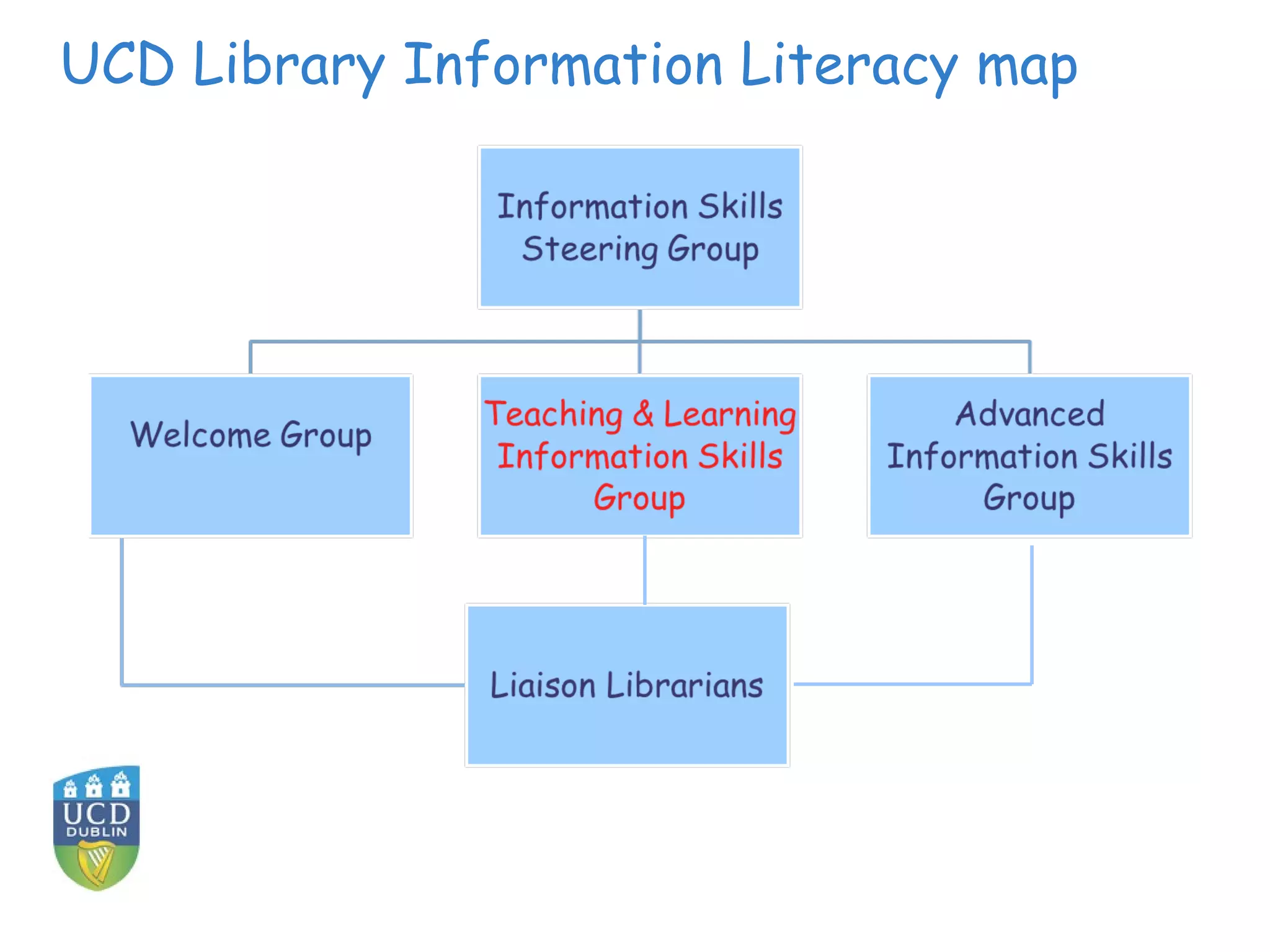
UCD Library Information Literacy map
Outline
• Current approach to information literacy
• Benefits and Challenges
• Suggestions for sustaining delivery into
the future
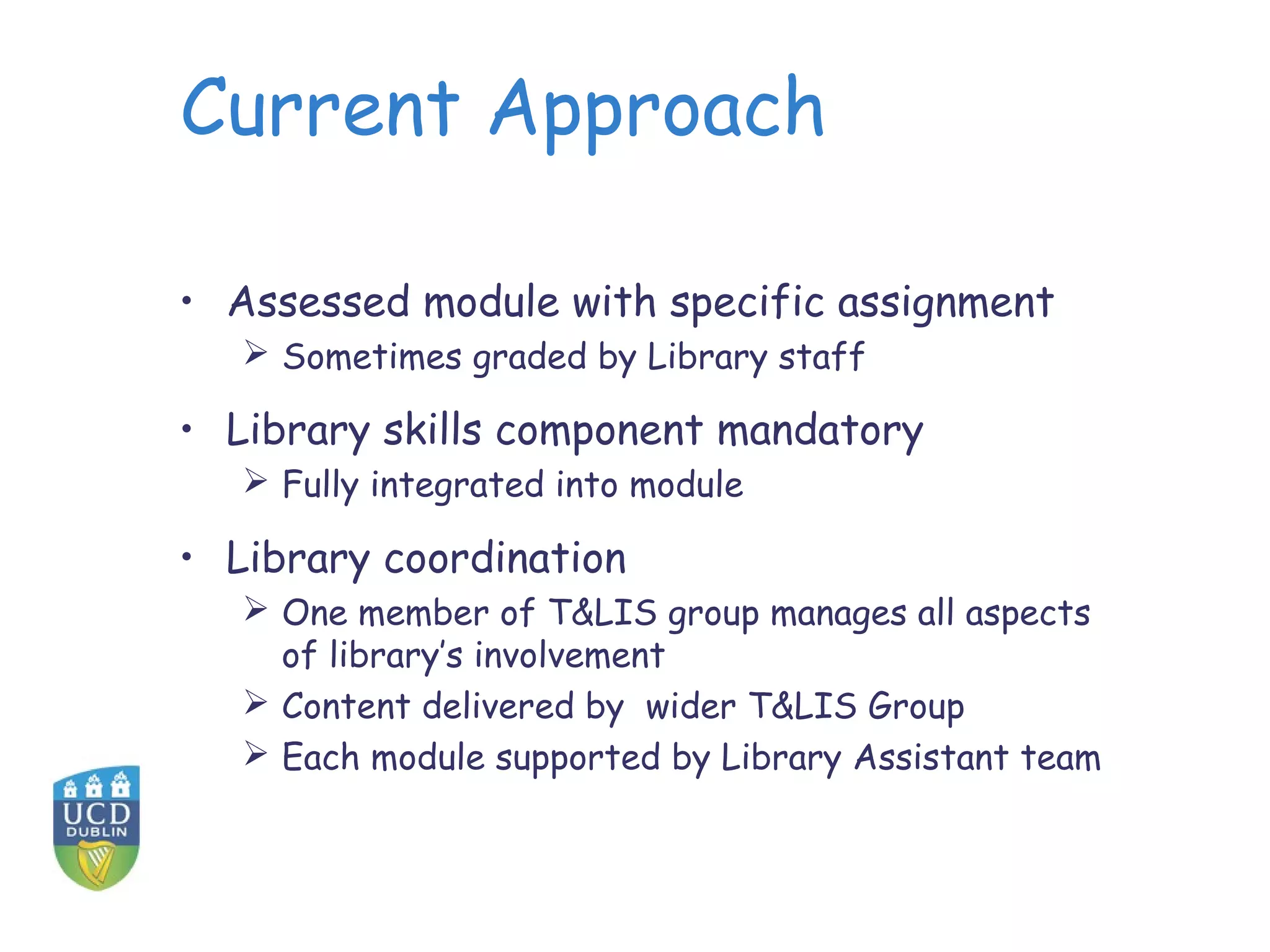
Current Approach
• Assessed module with specific assignment
 Sometimes graded by Library staff
• Library skills component mandatory
 Fully integrated into module
• Library coordination
 One member of T&LIS group manages all aspects
of library’s involvement
 Content delivered by wider T&LIS Group
 Each module supported by Library Assistant team
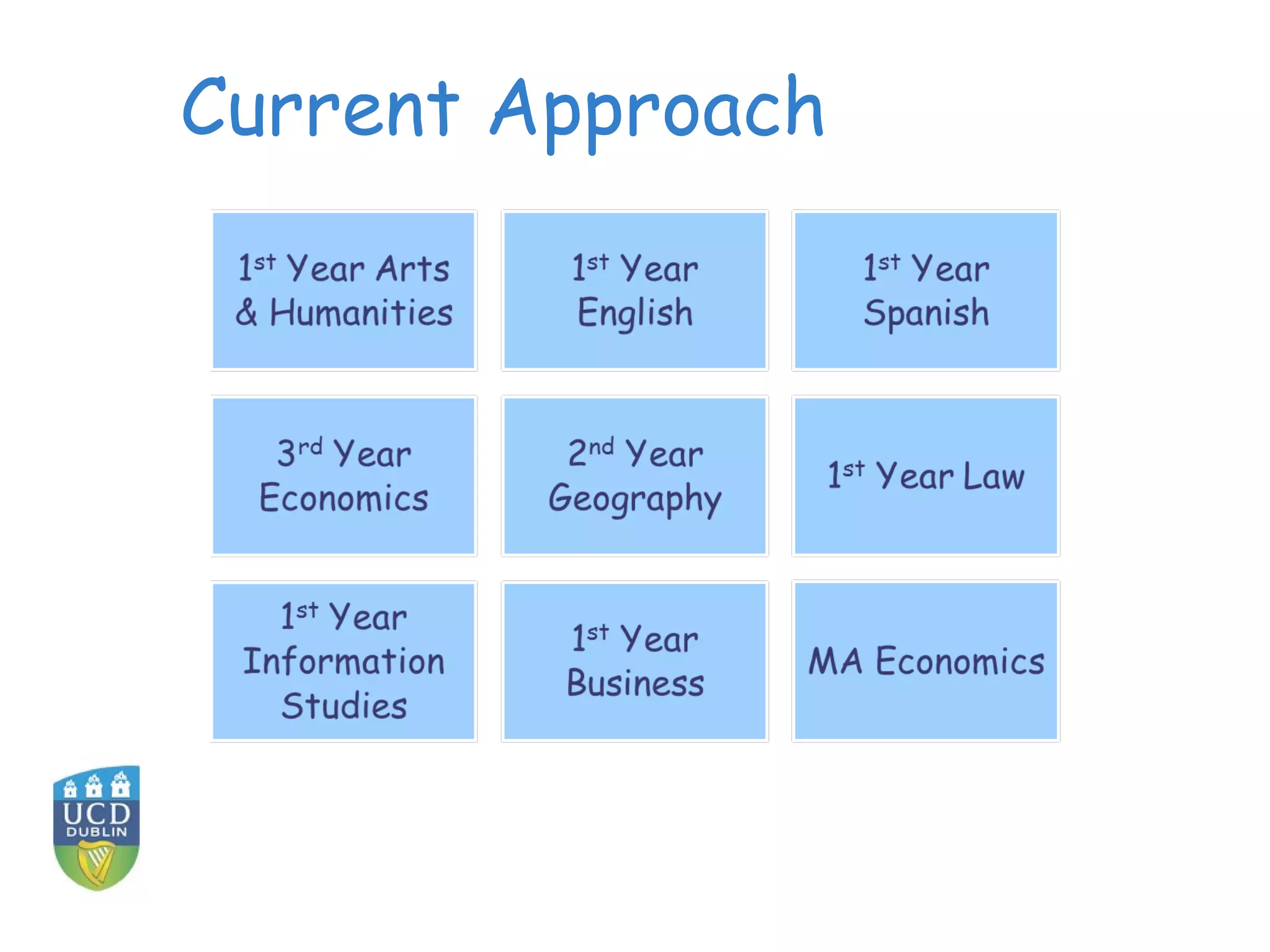
Current Approach
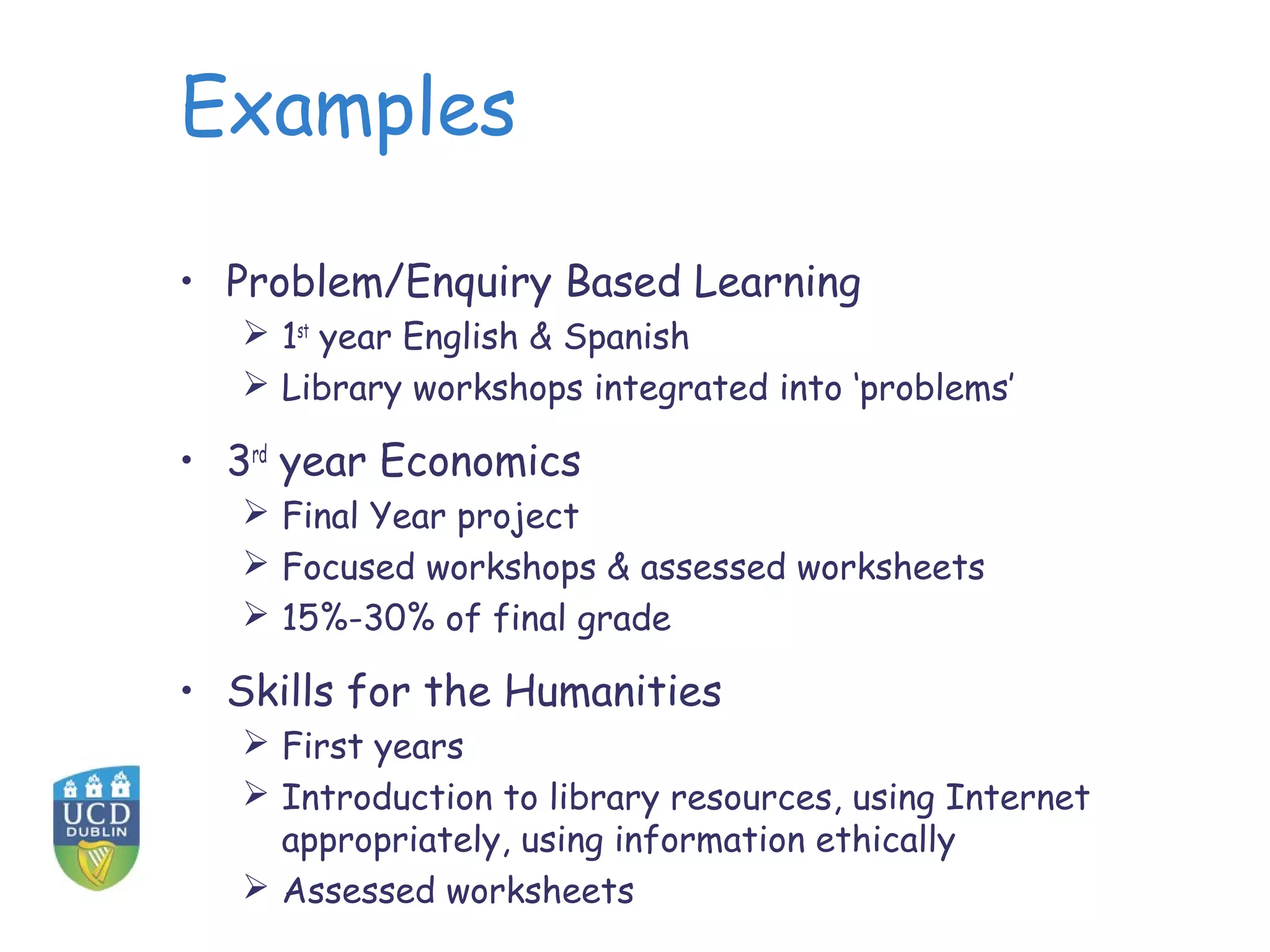
Examples
• Problem/Enquiry Based Learning
 1st
year English & Spanish
 Library workshops integrated into ‘problems’
• 3rd
year Economics
 Final Year project
 Focused workshops & assessed worksheets
 15%-30% of final grade
• Skills for the Humanities
 First years
 Introduction to library resources, using Internet
appropriately, using information ethically
 Assessed worksheets
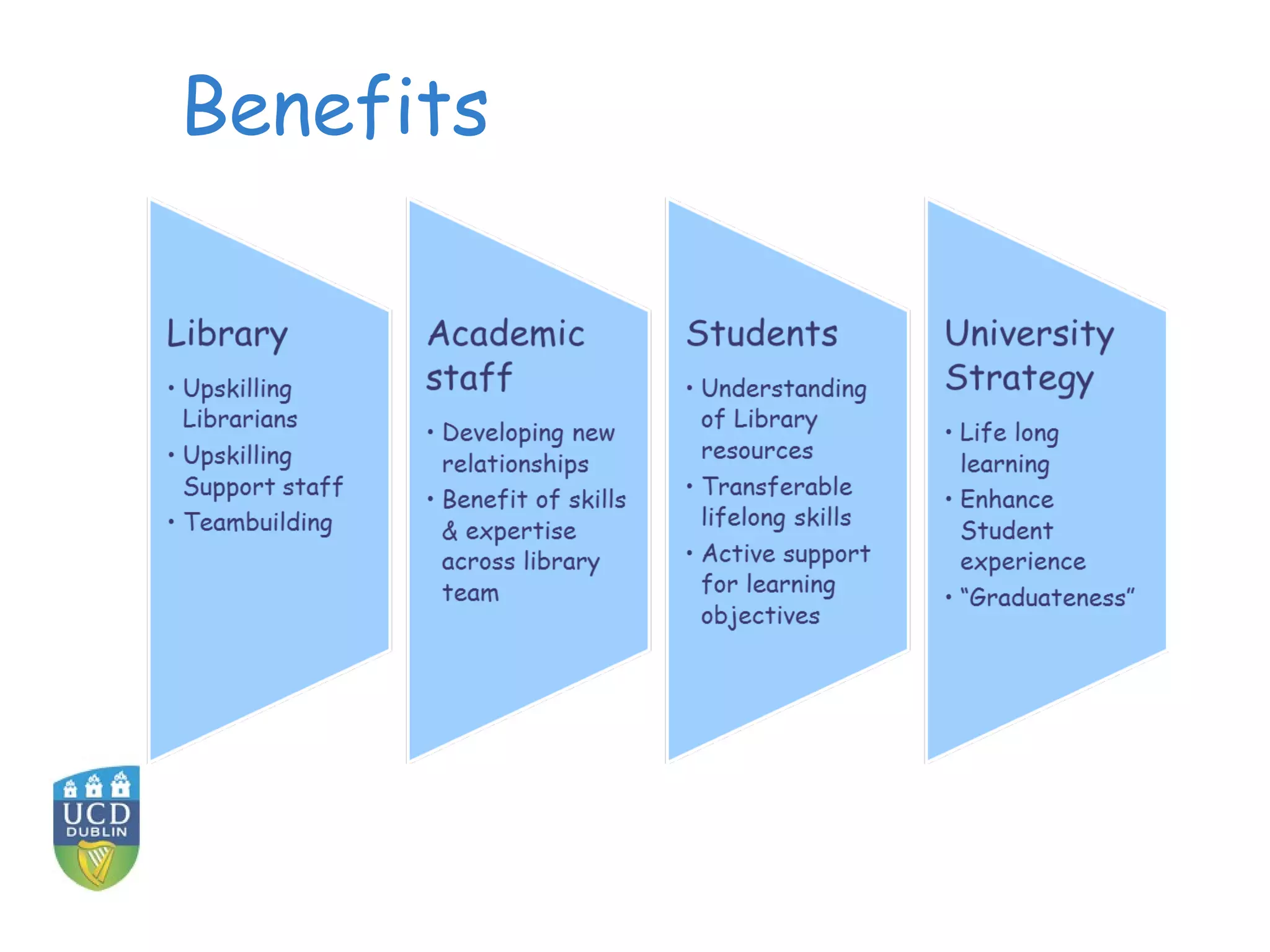
Benefits
“Without close liaison with the library from the earliest stages, EBL in
English simply would not have happened, and our contact with library staff
has definitely improved the module design and delivery.”
Dr. Danielle Clarke, School of English, Drama & Film & former VP for Teaching
& Learning
“…the library’s involvement in the module facilitates the development of the
students as effective learners. The students can then face into further
and ongoing studies with confidence and commitment.“
Dr. Feargal Murphy, VP for Teaching & Learning
“Collaborating with UCD Library staff has enabled a blend of experience
and expertise which would have been otherwise impossible;…”
Dr. Claire McGuinness, School of Information & Library Studies
"Involving the librarian challenges us to ‘think outside the box’ rather than
being driven by content alone resulting in a more dynamic and creative
approach“
Ms. Alison Clancy, School of Nursing, Midwifery & Health Systems
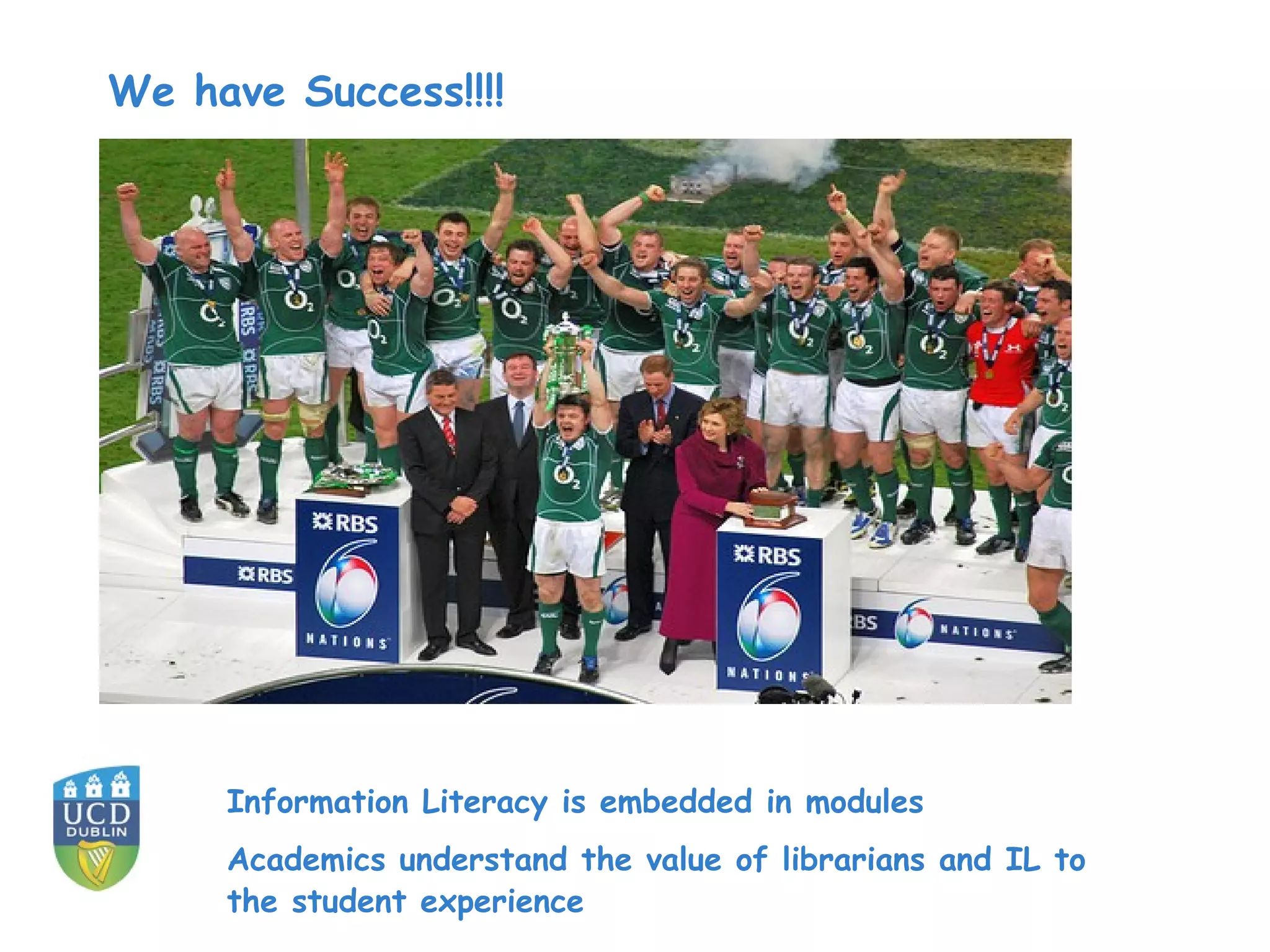
Information Literacy is embedded in modules
Academics understand the value of librarians and IL to
the student experience
We have Success!!!!
But at what price…?
• Average of one extra module each year
• 89% T&LIS information skills delivered by 5 librarians
• Huge administrative work attached to each 50 minute class
• Leading and co-ordinating the work of group almost a full-
time job
• Staff fatigue
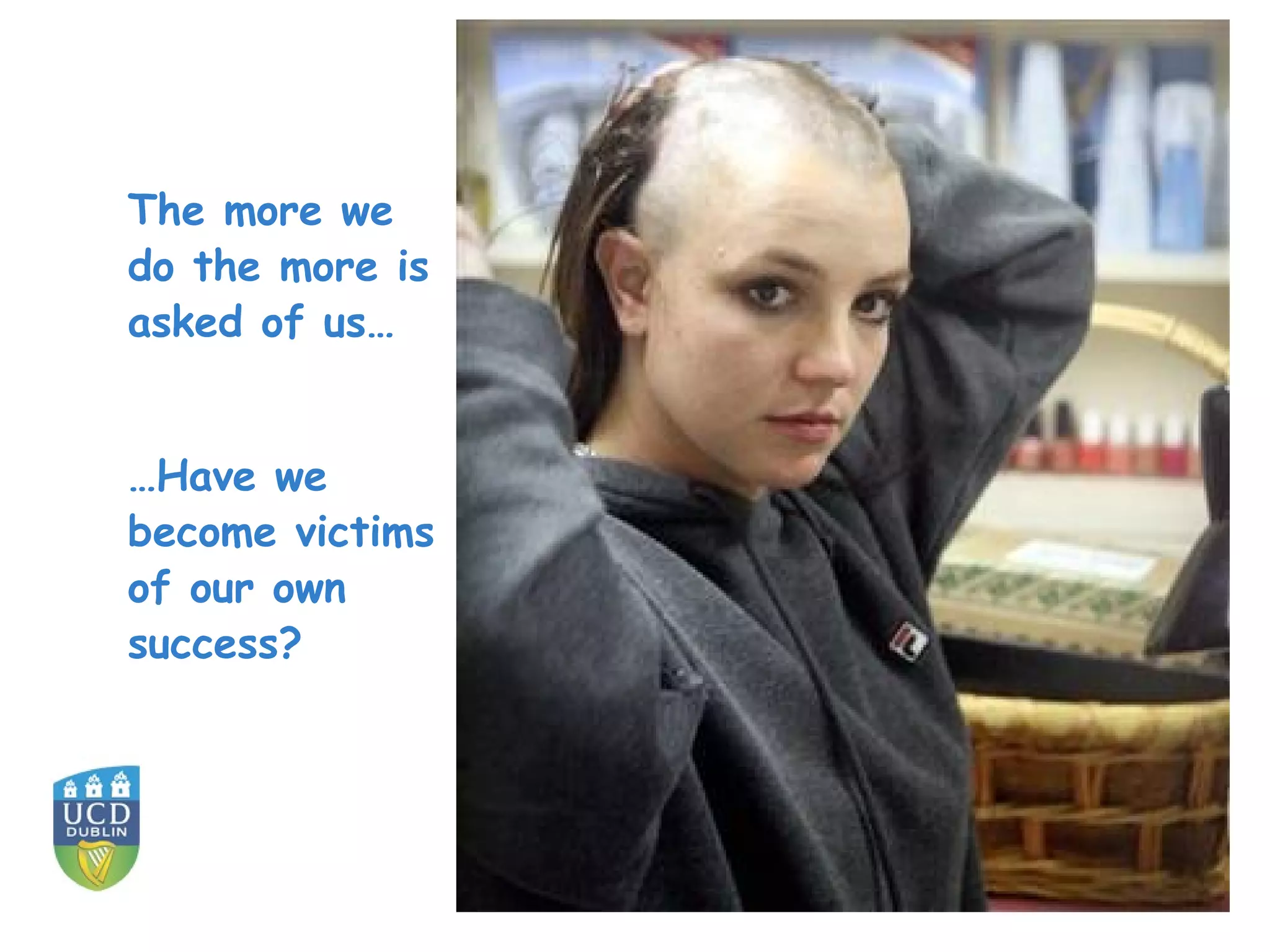
The more we
do the more is
asked of us…
…Have we
become victims
of our own
success?
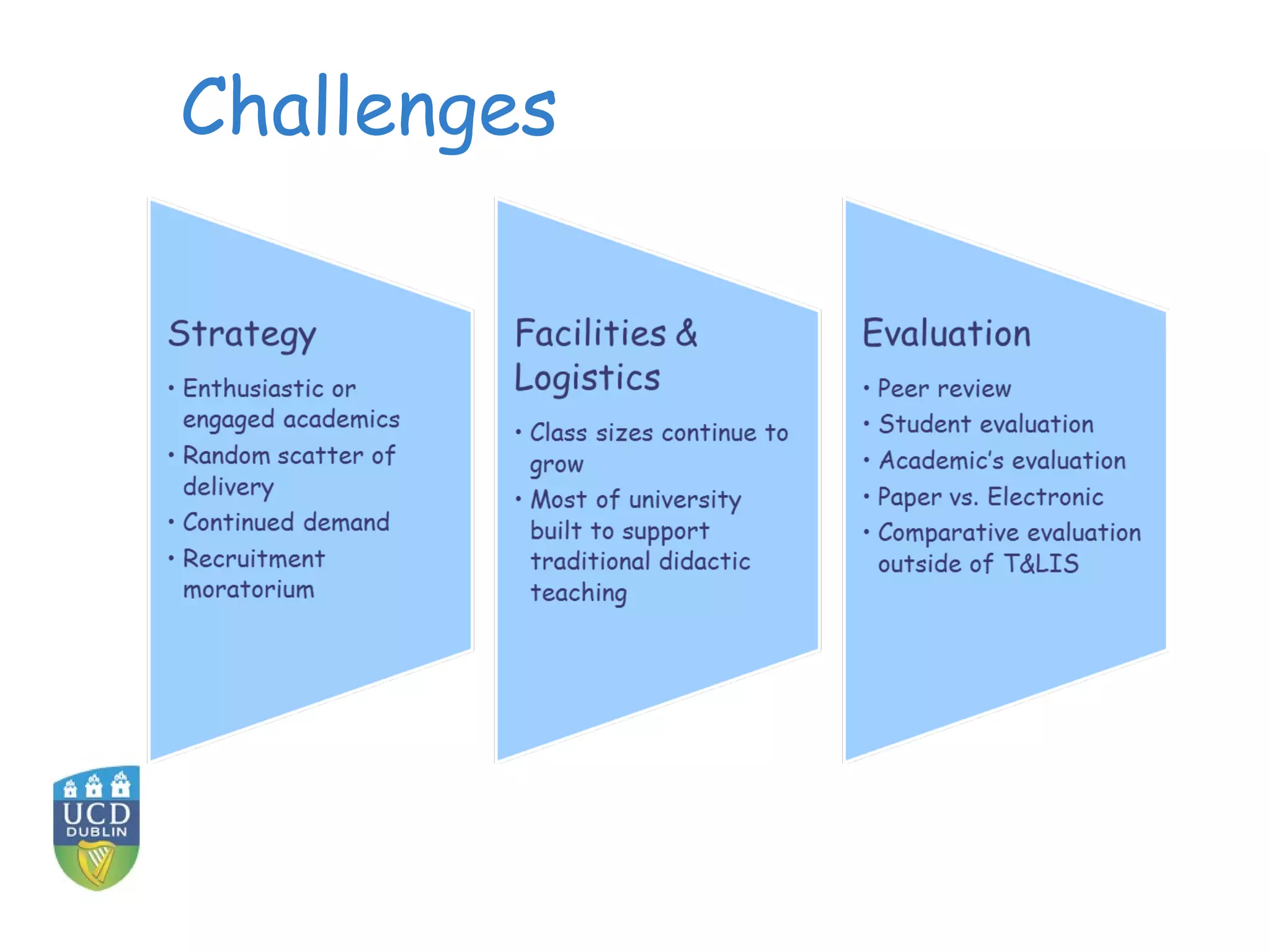
Challenges
If this is unsustainable…..
Where do we go from here?
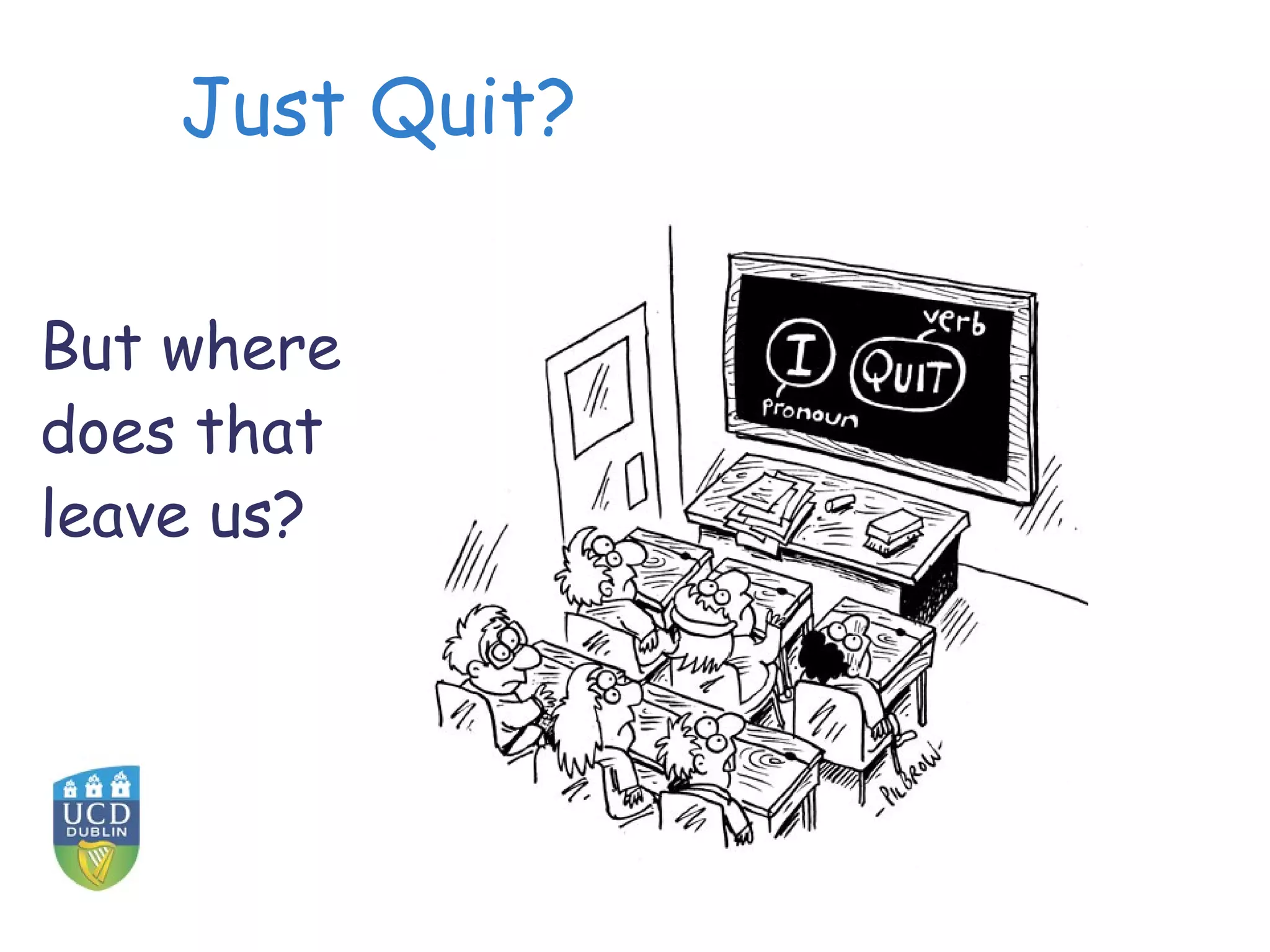
Just Quit?
But where
does that
leave us?
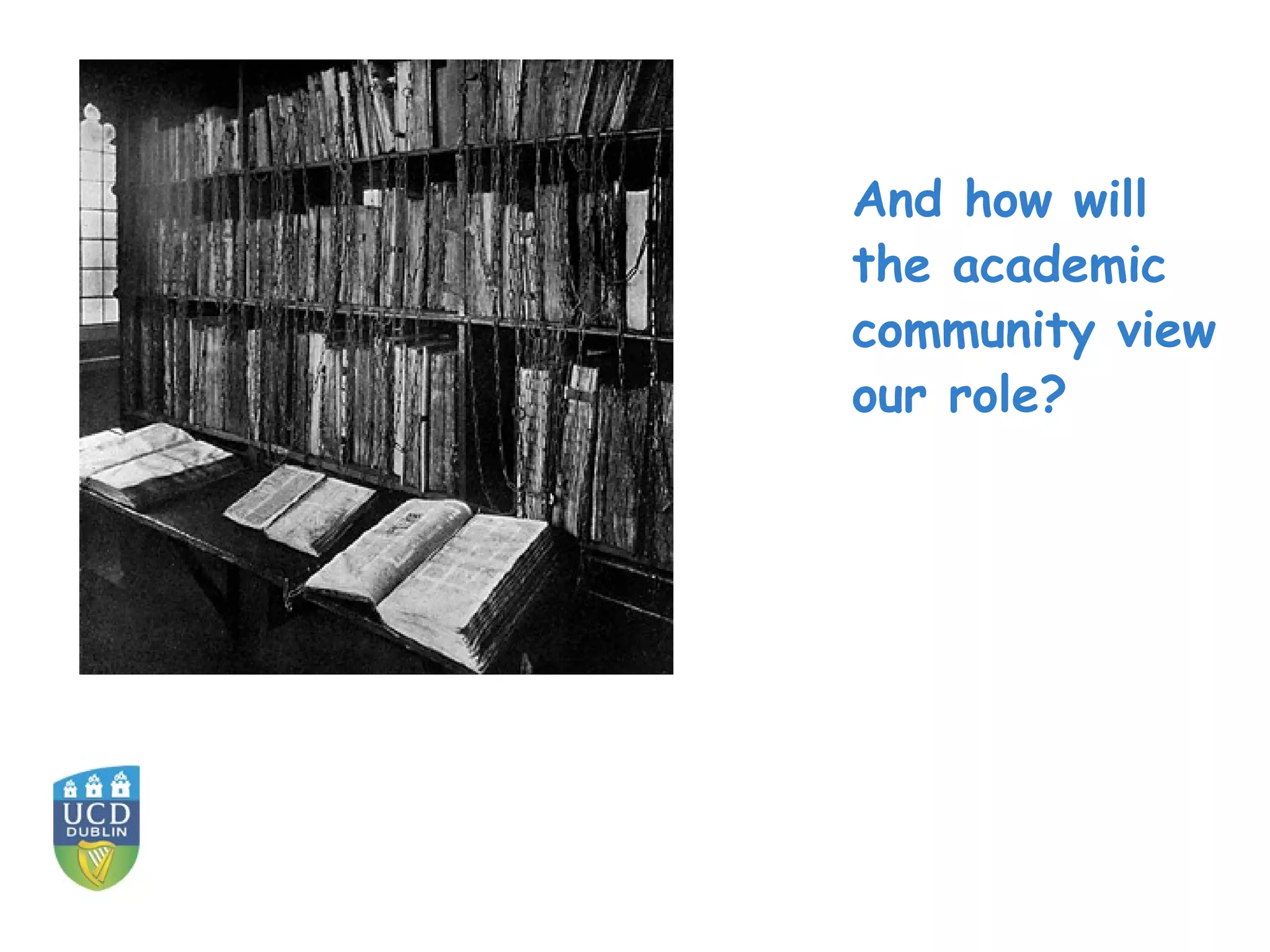
And how will
the academic
community view
our role?
How do we make it sustainable?
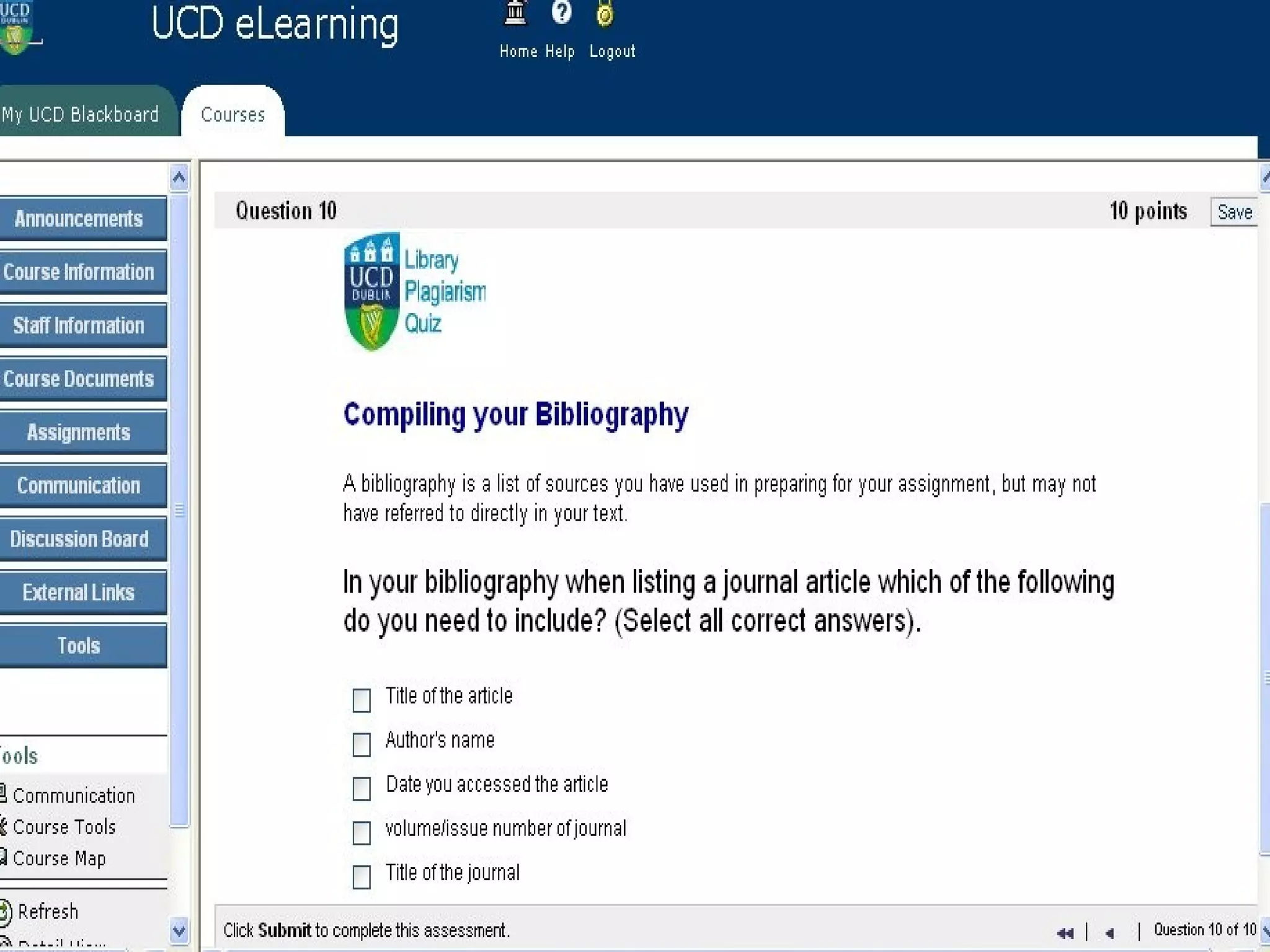
• Online Tutorial - VLE
 Little cost involved
 Plagiarism Tutorial in UCD VLE
 First launched 2008/09
 Technical Skills not required
 Useful for generic skills – which we still deliver
• Online Tutorial – Stand Alone
 Can be very expensive
 Technical expertise required
 May be better for meeting specific needs
• Good complimentary tool
 Blended approach
How do we make it sustainable?
• Flexible teams of staff – Library structure
 Currently Liaison Librarians ‘dedicated to specific
Schools
 Developing new strategic plan
 Utilising the whole team – e.g. experience and skills of
Library assistants
• Programme rather than module approach
 Complexity of organisation i.e. BA
 Look at overlap i.e. Business & Spanish
 Staggered delivery by year/level
 Intervention at point of need
• Maximum no of sessions agreed in advance
 Communication with Schools
The Future?...
The Library at the heart of
learning enterprise
Dammed if we do and dammed if we don't: How to address sustainability in the delivery of information literacy components in UCD

Dammed if we do and dammed if we don't: How to address sustainability in the delivery of information literacy components in UCD

  • 1.
    Damned if wedo and damned if we don’t … Lorna Dodd Liaison Librarian Human Sciences University College Dublin, Belfield, Dublin 4, Ireland Lorna.dodd@ucd.ie How to address sustainability in the delivery of information literacy components in UCD Valerie Kendlin Deputy Head of Academic Services, Business & Law, University College Dublin, Belfield, Dublin 4, Ireland Valerie.kendlin@ucd.ie
  • 2.
  • 3.
    Outline • Current approachto information literacy • Benefits and Challenges • Suggestions for sustaining delivery into the future
  • 5.
    Current Approach • Assessedmodule with specific assignment  Sometimes graded by Library staff • Library skills component mandatory  Fully integrated into module • Library coordination  One member of T&LIS group manages all aspects of library’s involvement  Content delivered by wider T&LIS Group  Each module supported by Library Assistant team
  • 6.
  • 7.
    Examples • Problem/Enquiry BasedLearning  1st year English & Spanish  Library workshops integrated into ‘problems’ • 3rd year Economics  Final Year project  Focused workshops & assessed worksheets  15%-30% of final grade • Skills for the Humanities  First years  Introduction to library resources, using Internet appropriately, using information ethically  Assessed worksheets
  • 8.
  • 9.
    “Without close liaisonwith the library from the earliest stages, EBL in English simply would not have happened, and our contact with library staff has definitely improved the module design and delivery.” Dr. Danielle Clarke, School of English, Drama & Film & former VP for Teaching & Learning “…the library’s involvement in the module facilitates the development of the students as effective learners. The students can then face into further and ongoing studies with confidence and commitment.“ Dr. Feargal Murphy, VP for Teaching & Learning “Collaborating with UCD Library staff has enabled a blend of experience and expertise which would have been otherwise impossible;…” Dr. Claire McGuinness, School of Information & Library Studies "Involving the librarian challenges us to ‘think outside the box’ rather than being driven by content alone resulting in a more dynamic and creative approach“ Ms. Alison Clancy, School of Nursing, Midwifery & Health Systems
  • 10.
    Information Literacy isembedded in modules Academics understand the value of librarians and IL to the student experience We have Success!!!!
  • 11.
    But at whatprice…? • Average of one extra module each year • 89% T&LIS information skills delivered by 5 librarians • Huge administrative work attached to each 50 minute class • Leading and co-ordinating the work of group almost a full- time job • Staff fatigue
  • 12.
    The more we dothe more is asked of us… …Have we become victims of our own success?
  • 13.
  • 14.
    If this isunsustainable….. Where do we go from here?
  • 15.
  • 16.
    And how will theacademic community view our role?
  • 17.
    How do wemake it sustainable? • Online Tutorial - VLE  Little cost involved  Plagiarism Tutorial in UCD VLE  First launched 2008/09  Technical Skills not required  Useful for generic skills – which we still deliver • Online Tutorial – Stand Alone  Can be very expensive  Technical expertise required  May be better for meeting specific needs • Good complimentary tool  Blended approach
  • 18.
    How do wemake it sustainable? • Flexible teams of staff – Library structure  Currently Liaison Librarians ‘dedicated to specific Schools  Developing new strategic plan  Utilising the whole team – e.g. experience and skills of Library assistants • Programme rather than module approach  Complexity of organisation i.e. BA  Look at overlap i.e. Business & Spanish  Staggered delivery by year/level  Intervention at point of need • Maximum no of sessions agreed in advance  Communication with Schools
  • 19.
    The Future?... The Libraryat the heart of learning enterprise

Editor's Notes

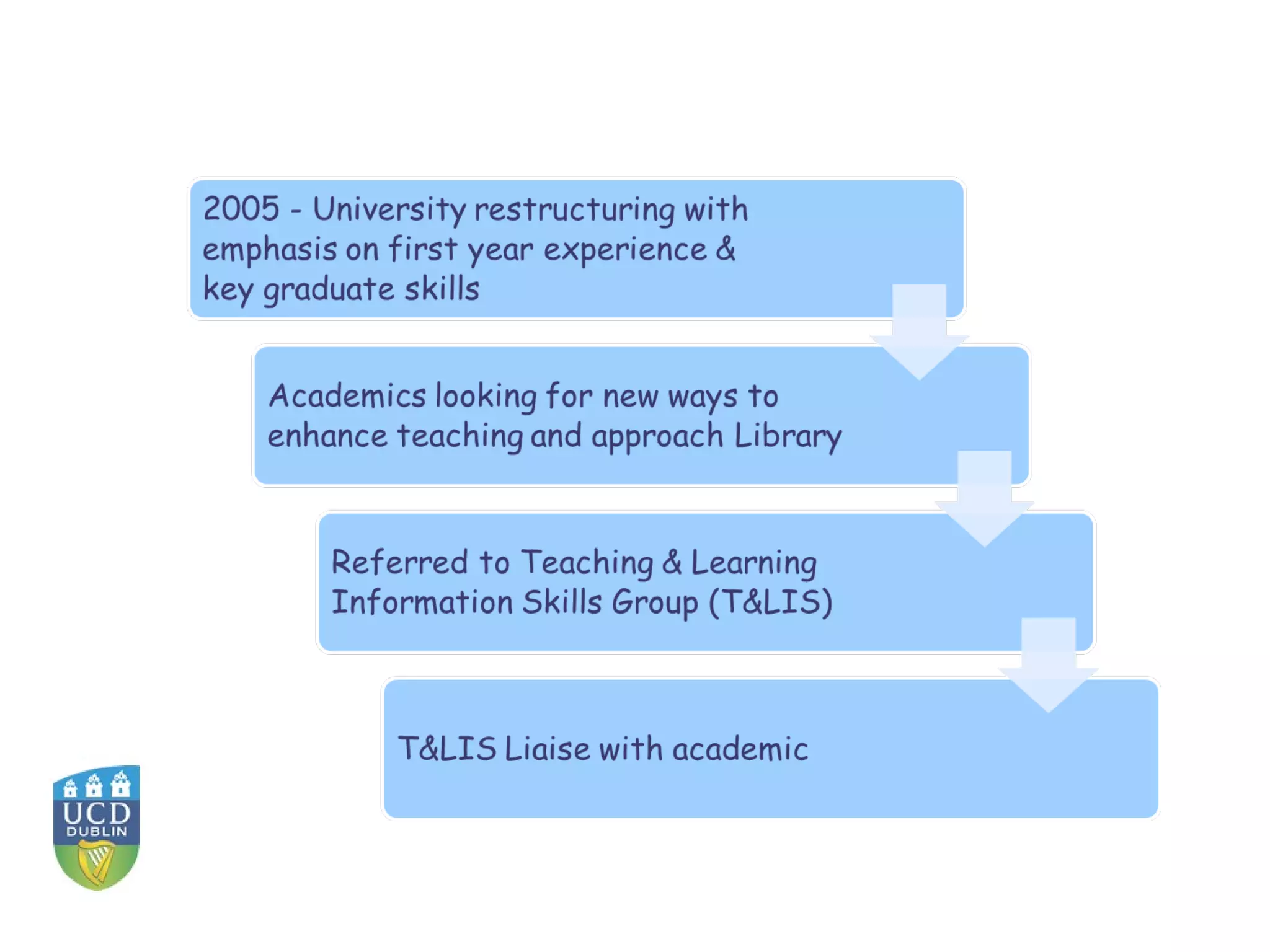
  • #3 Created 2006 - every year workload has increased TLIS Group-Teaching & Learning Info Skills Group comprised of teachintg librarians from across the LL team (several disciplines) and from different units in library
  • #5 Approaches LL, Head of Department – other contact they know. Often have heard what we do in other modules. T&LIS leader & LL will liaise with academic to identify what they need and the best way to go about it. This often happens a bit late i.e. Spanish – so we can be limited in what we can do. However, we always endeavour to support where we can and maintain consistent standards etc.
  • #6 Assessed module and specific assignment – Library skills component mandatory – not optional so students see added value Librarian “co-ordinator” to manage the admin and quality control of library part – library can’t be “weak link” in module! UCD Strategic Objectives – lifelong learning and “graduateness”
  • #7 Assessed module and specific assignment – Library skills component mandatory – not optional so students see added value Librarian “co-ordinator” to manage the admin and quality control of library part – library can’t be “weak link” in module! UCD Strategic Objectives – lifelong learning and “graduateness”
  • #8 PBL – forces academics to use library more, close community in UCD – snowball effect. Led to developing better relationships with each School Comment – would briefly mention the logistics challenges of English and how we mobilised the LLs and the library assistatns so when you picked up Spanish, the system worked Change in module co-ordinator, fewer sessions & worksheets, lower percentage of grade
  • #9 Upskilling of individuals – becoming very familiar with one area eg Plagiarism, Advanced Google etc etc Teambuilding and collegiality – working with other colleagues, building working relationships and working with Library Assistants increases sense of common goals etc Troubleshooting ability/problem solving- can approach
  • #12 Other staff do help but it is minimal due to other commitments/workloads Preparation, worksheets, answer sheets, lesson plans, grading Timetabling, backup, liaising with academics, room booking On top of busy work load, year after year, after year
  • #13 Britney – more success than her wildest dreams – where does it leave you! We could use Man Utd. Most successful financially club in the world which led to American investors becoming interested – Heavily desired by UK clubs to bring Football to a relatively new market - now broke!!!
  • #14 Economic climate looms heavily over all these issues!! Laptop trolley etc. Assessing effectiveness and evaluation “critical friend” difficult to introduce (peer review) no standard evaluation form for all sessions due to staffing (electronic form came a cropper due to Tony’s departure – needs to be reviewed urgently) TLIS do a quick and dirty module evaluation form which works well as a quick snapshot of a module, however and is designed to get the issues around a module’s delivery out of the module co-ordinator’s head while it is still fresh
  • #17 Will we be seen in a very traditional light again? When/if things improve how will we convince academics we are more than a repository for books? Will it make us seem unreliable?
  • #18 View this slide in slide show to see properly!!!! Example of plagiarism tutorial vs. more expensive options. Cannot replace face to face instruction and benefit of meeting friendly librarian. Risk of even less understanding of librarians role if the become less visible
  • #21 If Obama can pass the health care reform bill surely we can overcome this challenge?