



SIMPLE DIGITAL LIBRARIES
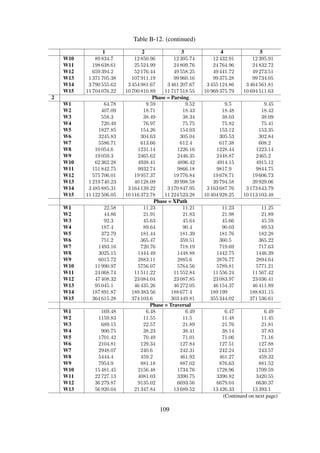
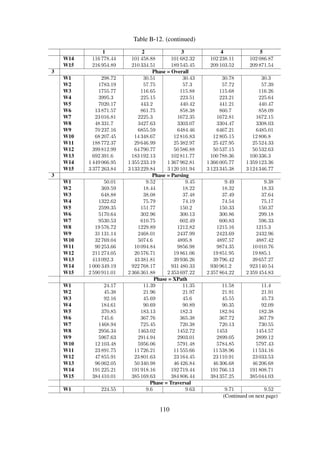
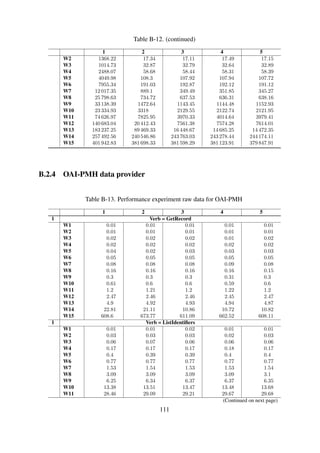
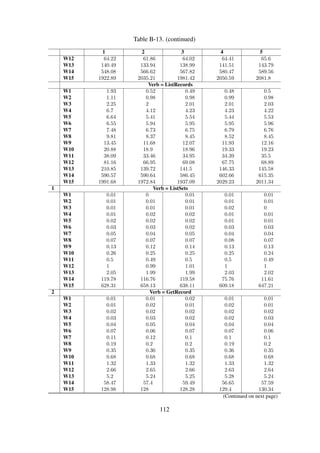
LIGHTON PHIRI
A DISSERTATION SUBMITTED
IN PARTIAL FULFILMENT OF THE
REQUIREMENTS FOR THE DEGREE OF
MASTER OF SCIENCE IN
COMPUTER SCIENCE
DEPARTMENT OF COMPUTER SCIENCE
FACULTY OF SCIENCE
UNIVERSITY OF CAPE TOWN
SUPERVISED BY
HUSSEIN SULEMAN
DECEMBER 2013
This work is licensed under a Creative Commons Attribution 3.0 Unported Licence
Simple Digital Libraries
by
Lighton Phiri
Plagiarism Declaration
I know the meaning of plagiarism and declare that all the work in the document, save for which is
properly acknowledged, is my own.
Lighton Phiri
Friday August 10, 2013
(Date)
**********
Acknowledgements
First of all, I would like to thank my supervisor, Professor Hussein Suleman, for giving me the
opportunity to work with him; and for his encouragement, technical advice and support throughout
my graduate studies. He read carefully early drafts of the manuscript, and his suggestions and
proposed corrections contributed to the final form of this thesis. I am very grateful for this.
In addition, a number of individuals implicitly and explicitly contributed to this thesis in one way
or the other. To these people, I would like to express my sincere thanks. In particular, I would
like to thank Nicholas Wiltshire for facilitating access to the Spatial Archaeology Research Unit
(SARU) Rock Art digital collection; Miles Robinson and Stuart Hammar for basing their “Bonolo”
honours project on the Bleek and Lloyd case study collection; Kaitlyn Crawford, Marco Lawrence
and Joanne Marston for basing their “School of Rock Art” honours project on the SARU Rock
Art archaeological database case study collection; the University of Cape Town Computer Science
Honours class of 2012 for taking part in the developer survey; and especially Kyle Williams for
his willingness to help.
Furthermore, I would like to thank the Centre for Curating the Archive at the University of Cape
Town and the Department of Archeology at the University of Cape Town for making available the
digital collections that were used as case studies. I would also like to thank the Networked Digital
Library of Thesis and Dissertation (NDLTD) for implicitly facilitating access to the dataset used
in performance experiments through their support for open access to scholarship.
Finally, I would like to express my sincere gratitude to my family for their support during my long
stay away from home.
iv
To my parents, and my ’banded’ brothers.
v
Abstract
The design of Digital Library Systems (DLSes) has evolved overtime, both in sophistication and
complexity, to complement the complex nature and sheer size of digital content being curated.
However, there is also a growing demand from content curators, with relatively small-size collec-
tions, for simpler and more manageable tools and services to manage their content. The reasons
for this particular need are driven by the assumption that simplicity and manageability might ulti-
mately translate to lower costs of maintenance of such systems.
This research proposes and advocates for a minimalist and simplistic approach to the overall design
of DLSes. It is hypothesised that Digital Library (DL) tools and services based on such designs
could potentially be easy to use and manage.
A meta-analysis of existing DL and non-DL tools was conducted to aid the derivation of design
principles for simple DLSes. The design principles were then mapped to design decisions applied
to the design of a prototype simple repository. In order to assess the effectiveness of the simple
repository design, two real-world case study collections were implemented based on the design.
In addition, a developer-oriented study was conducted using one of the case study collections
to evaluate the simplicity and ease of use of the prototype system. Furthermore, performance
experiments were conducted to establish the extent to which such a simple design approach would
scale and also establish comparative advantages to existing designs.
In general, the study outlined some possible implications of simplifying DLS design; specifically
the results from the developer-oriented user study indicate that simplicity in the design of the DLS
repository sub-layer does not severely impact the interaction between the service sub-layer and the
repository sub-layer. Furthermore, the scalability experiments indicate that desirable performance
results for small- and medium-sized collections are attainable.
The practical implication of the proposed design approach is two-fold: firstly the minimalistic de-
sign has the potential to be used to design simple and yet easy to use tools with comparable features
to those exhibited by well-established DL tools; and secondly, the principled design approach has
the potential to be applied to the design of non-DL application domains.
vi
Table of Contents
List of Tables . . . . . . . . . . . . . . . . . . . . . . . . . . . . . . . . . . . . . . . . xi
List of Figures . . . . . . . . . . . . . . . . . . . . . . . . . . . . . . . . . . . . . . . . xiii
List of Abbreviations . . . . . . . . . . . . . . . . . . . . . . . . . . . . . . . . . . . . xv
1 Introduction 1
1.1 Motivation . . . . . . . . . . . . . . . . . . . . . . . . . . . . . . . . . . . . . . . 2
1.2 Hypotheses . . . . . . . . . . . . . . . . . . . . . . . . . . . . . . . . . . . . . . 2
1.3 Research questions . . . . . . . . . . . . . . . . . . . . . . . . . . . . . . . . . . 3
1.4 Scope& approach . . . . . . . . . . . . . . . . . . . . . . . . . . . . . . . . . . . 3
1.5 Thesis outline . . . . . . . . . . . . . . . . . . . . . . . . . . . . . . . . . . . . . 4
2 Background 5
2.1 Digital Libraries . . . . . . . . . . . . . . . . . . . . . . . . . . . . . . . . . . . . 5
2.1.1 Definitions . . . . . . . . . . . . . . . . . . . . . . . . . . . . . . . . . . 5
2.1.2 Application domains . . . . . . . . . . . . . . . . . . . . . . . . . . . . . 6
2.1.3 Summary . . . . . . . . . . . . . . . . . . . . . . . . . . . . . . . . . . . 9
2.2 Fundamental concepts . . . . . . . . . . . . . . . . . . . . . . . . . . . . . . . . 9
2.2.1 Identifiers . . . . . . . . . . . . . . . . . . . . . . . . . . . . . . . . . . . 9
2.2.2 Interoperability . . . . . . . . . . . . . . . . . . . . . . . . . . . . . . . . 9
2.2.3 Metadata . . . . . . . . . . . . . . . . . . . . . . . . . . . . . . . . . . . 10
2.2.4 Standards . . . . . . . . . . . . . . . . . . . . . . . . . . . . . . . . . . . 10
2.2.5 Summary . . . . . . . . . . . . . . . . . . . . . . . . . . . . . . . . . . . 11
2.3 Frameworks . . . . . . . . . . . . . . . . . . . . . . . . . . . . . . . . . . . . . . 11
2.3.1 5S framework . . . . . . . . . . . . . . . . . . . . . . . . . . . . . . . . . 11
2.3.2 Kahn& Wilensky framework . . . . . . . . . . . . . . . . . . . . . . . . . 12
2.3.3 DELOS reference model . . . . . . . . . . . . . . . . . . . . . . . . . . . 13
2.3.4 Summary . . . . . . . . . . . . . . . . . . . . . . . . . . . . . . . . . . . 13
2.4 Software platforms . . . . . . . . . . . . . . . . . . . . . . . . . . . . . . . . . . 14
vii
2.4.1 CDS Invenio . . . . . . . . . . . . . . . . . . . . . . . . . . . . . . . . . 14
2.4.2 DSpace . . . . . . . . . . . . . . . . . . . . . . . . . . . . . . . . . . . . 15
2.4.3 EPrints . . . . . . . . . . . . . . . . . . . . . . . . . . . . . . . . . . . . 15
2.4.4 ETD-db . . . . . . . . . . . . . . . . . . . . . . . . . . . . . . . . . . . . 15
2.4.5 Fedora Commons . . . . . . . . . . . . . . . . . . . . . . . . . . . . . . . 16
2.4.6 Greenstone . . . . . . . . . . . . . . . . . . . . . . . . . . . . . . . . . . 16
2.4.7 Omeka . . . . . . . . . . . . . . . . . . . . . . . . . . . . . . . . . . . . 16
2.4.8 Summary . . . . . . . . . . . . . . . . . . . . . . . . . . . . . . . . . . . 17
2.5 Minimalist philosophy . . . . . . . . . . . . . . . . . . . . . . . . . . . . . . . . 17
2.5.1 Dublin Core . . . . . . . . . . . . . . . . . . . . . . . . . . . . . . . . . . 18
2.5.2 Wikis . . . . . . . . . . . . . . . . . . . . . . . . . . . . . . . . . . . . . 18
2.5.3 XML . . . . . . . . . . . . . . . . . . . . . . . . . . . . . . . . . . . . . 19
2.5.4 OAI-PMH . . . . . . . . . . . . . . . . . . . . . . . . . . . . . . . . . . . 19
2.5.5 Project Gutenberg . . . . . . . . . . . . . . . . . . . . . . . . . . . . . . 20
2.5.6 Summary . . . . . . . . . . . . . . . . . . . . . . . . . . . . . . . . . . . 20
2.6 Data storage schemes . . . . . . . . . . . . . . . . . . . . . . . . . . . . . . . . . 20
2.6.1 Relational databases . . . . . . . . . . . . . . . . . . . . . . . . . . . . . 20
2.6.2 NoSQL databases . . . . . . . . . . . . . . . . . . . . . . . . . . . . . . . 21
2.6.3 Filesystems . . . . . . . . . . . . . . . . . . . . . . . . . . . . . . . . . . 22
2.6.4 Summary . . . . . . . . . . . . . . . . . . . . . . . . . . . . . . . . . . . 23
2.7 Design decisions . . . . . . . . . . . . . . . . . . . . . . . . . . . . . . . . . . . 23
2.8 Summary . . . . . . . . . . . . . . . . . . . . . . . . . . . . . . . . . . . . . . . 24
3 Design principles 25
3.1 Research perspective . . . . . . . . . . . . . . . . . . . . . . . . . . . . . . . . . 25
3.1.1 Prior research observations . . . . . . . . . . . . . . . . . . . . . . . . . . 25
3.1.2 Research questions . . . . . . . . . . . . . . . . . . . . . . . . . . . . . . 25
3.1.3 Summary . . . . . . . . . . . . . . . . . . . . . . . . . . . . . . . . . . . 26
3.2 Research methods . . . . . . . . . . . . . . . . . . . . . . . . . . . . . . . . . . . 26
3.2.1 Grounded theory . . . . . . . . . . . . . . . . . . . . . . . . . . . . . . . 26
3.2.2 Analytic hierarchy process . . . . . . . . . . . . . . . . . . . . . . . . . . 27
3.2.3 Summary . . . . . . . . . . . . . . . . . . . . . . . . . . . . . . . . . . . 28
3.3 General approach . . . . . . . . . . . . . . . . . . . . . . . . . . . . . . . . . . . 29
3.3.1 Data collection . . . . . . . . . . . . . . . . . . . . . . . . . . . . . . . . 29
3.3.2 Data analysis . . . . . . . . . . . . . . . . . . . . . . . . . . . . . . . . . 30
viii
3.3.3 Design principles . . . . . . . . . . . . . . . . . . . . . . . . . . . . . . . 31
3.3.4 Summary . . . . . . . . . . . . . . . . . . . . . . . . . . . . . . . . . . . 34
3.4 Summary . . . . . . . . . . . . . . . . . . . . . . . . . . . . . . . . . . . . . . . 35
4 Designing for simplicity 36
4.1 Repository design . . . . . . . . . . . . . . . . . . . . . . . . . . . . . . . . . . . 36
4.1.1 Design decisions . . . . . . . . . . . . . . . . . . . . . . . . . . . . . . . 36
4.1.2 Architecture . . . . . . . . . . . . . . . . . . . . . . . . . . . . . . . . . . 38
4.1.3 Summary . . . . . . . . . . . . . . . . . . . . . . . . . . . . . . . . . . . 39
5 Case studies 42
5.1 Bleek& Lloyd collection . . . . . . . . . . . . . . . . . . . . . . . . . . . . . . . 43
5.1.1 Overview . . . . . . . . . . . . . . . . . . . . . . . . . . . . . . . . . . . 43
5.1.2 Object storage . . . . . . . . . . . . . . . . . . . . . . . . . . . . . . . . 43
5.1.3 DLSes . . . . . . . . . . . . . . . . . . . . . . . . . . . . . . . . . . . . . 45
5.2 SARU archaeological database . . . . . . . . . . . . . . . . . . . . . . . . . . . . 46
5.2.1 Overview . . . . . . . . . . . . . . . . . . . . . . . . . . . . . . . . . . . 46
5.2.2 Object storage . . . . . . . . . . . . . . . . . . . . . . . . . . . . . . . . 47
5.2.3 DLSes . . . . . . . . . . . . . . . . . . . . . . . . . . . . . . . . . . . . . 49
5.3 Summary . . . . . . . . . . . . . . . . . . . . . . . . . . . . . . . . . . . . . . . 49
6 Evaluation 51
6.1 Developer survey . . . . . . . . . . . . . . . . . . . . . . . . . . . . . . . . . . . 52
6.1.1 Target population . . . . . . . . . . . . . . . . . . . . . . . . . . . . . . . 52
6.1.2 Data collection . . . . . . . . . . . . . . . . . . . . . . . . . . . . . . . . 52
6.1.3 Results . . . . . . . . . . . . . . . . . . . . . . . . . . . . . . . . . . . . 52
6.1.4 Discussion . . . . . . . . . . . . . . . . . . . . . . . . . . . . . . . . . . 55
6.1.5 Summary . . . . . . . . . . . . . . . . . . . . . . . . . . . . . . . . . . . 57
6.2 Performance . . . . . . . . . . . . . . . . . . . . . . . . . . . . . . . . . . . . . . 57
6.2.1 Test setup . . . . . . . . . . . . . . . . . . . . . . . . . . . . . . . . . . . 58
6.2.2 Test dataset . . . . . . . . . . . . . . . . . . . . . . . . . . . . . . . . . . 58
6.2.3 Workloads . . . . . . . . . . . . . . . . . . . . . . . . . . . . . . . . . . 59
6.2.4 Benchmarks . . . . . . . . . . . . . . . . . . . . . . . . . . . . . . . . . . 63
6.2.5 Comparisons . . . . . . . . . . . . . . . . . . . . . . . . . . . . . . . . . 81
6.2.6 Summary . . . . . . . . . . . . . . . . . . . . . . . . . . . . . . . . . . . 84
6.3 Summary . . . . . . . . . . . . . . . . . . . . . . . . . . . . . . . . . . . . . . . 84
ix
7 Conclusions 86
7.1 Research questions . . . . . . . . . . . . . . . . . . . . . . . . . . . . . . . . . . 86
7.2 Future work . . . . . . . . . . . . . . . . . . . . . . . . . . . . . . . . . . . . . . 87
7.2.1 Software packaging . . . . . . . . . . . . . . . . . . . . . . . . . . . . . . 88
7.2.2 Version control . . . . . . . . . . . . . . . . . . . . . . . . . . . . . . . . 88
7.2.3 Reference implementation . . . . . . . . . . . . . . . . . . . . . . . . . . 88
A Developer survey 89
A.1 Ethical clearance . . . . . . . . . . . . . . . . . . . . . . . . . . . . . . . . . . . 89
A.2 Survey design . . . . . . . . . . . . . . . . . . . . . . . . . . . . . . . . . . . . . 89
B Experiment raw data 99
B.1 Developer survey . . . . . . . . . . . . . . . . . . . . . . . . . . . . . . . . . . . 99
B.2 Performance benchmarks . . . . . . . . . . . . . . . . . . . . . . . . . . . . . . . 102
B.2.1 Workload . . . . . . . . . . . . . . . . . . . . . . . . . . . . . . . . . . . 102
B.2.2 Ingestion . . . . . . . . . . . . . . . . . . . . . . . . . . . . . . . . . . . 103
B.2.3 Search . . . . . . . . . . . . . . . . . . . . . . . . . . . . . . . . . . . . . 106
B.2.4 OAI-PMH . . . . . . . . . . . . . . . . . . . . . . . . . . . . . . . . . . . 110
B.2.5 Feed . . . . . . . . . . . . . . . . . . . . . . . . . . . . . . . . . . . . . . 114
Bibliography 118
Index 127
x
List of Tables
1-1 Summary of research approach process . . . . . . . . . . . . . . . . . . . . . . . 4
2-1 Summary of key aspects of the 5S framework . . . . . . . . . . . . . . . . . . . . 11
2-2 Feature matrix for some popular DL FLOSS software tools . . . . . . . . . . . . . 17
2-3 Simple unqualified Dublin Core element set . . . . . . . . . . . . . . . . . . . . . 18
2-4 OAI-PMH request verbs . . . . . . . . . . . . . . . . . . . . . . . . . . . . . . . 19
2-5 Data model categories for NoSQL database stores . . . . . . . . . . . . . . . . . . 21
2-6 Comparative matrix for data storage solutions . . . . . . . . . . . . . . . . . . . . 23
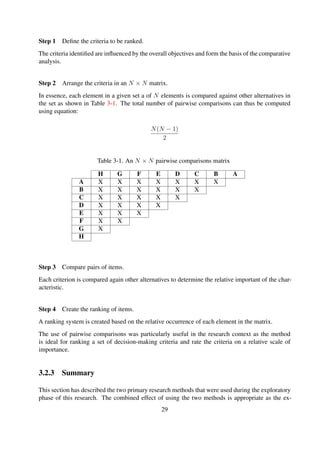
3-1 An N ×N pairwise comparisons matrix . . . . . . . . . . . . . . . . . . . . . . . 28
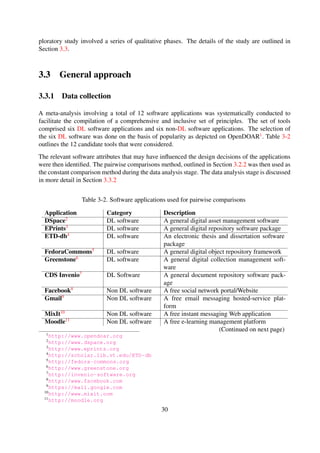
3-2 Software applications used for pairwise comparisons . . . . . . . . . . . . . . . . 29
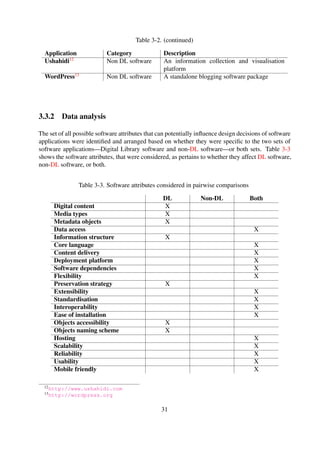
3-3 Software attributes considered in pairwise comparisons . . . . . . . . . . . . . . . 30
3-4 Grounded theory general approach . . . . . . . . . . . . . . . . . . . . . . . . . . 34
4-1 Simple repository persistent object store design decision . . . . . . . . . . . . . . 36
4-2 Simple repository metadata storage design decision . . . . . . . . . . . . . . . . . 37
4-3 Simple repository object naming scheme design decision . . . . . . . . . . . . . . 37
4-4 Simple repository object storage structure design decision . . . . . . . . . . . . . . 37
4-5 Simple repository component composition . . . . . . . . . . . . . . . . . . . . . . 38
5-1 Bleek& Lloyd collection profile . . . . . . . . . . . . . . . . . . . . . . . . . . . 43
5-2 Bleek& Lloyd repository item classification . . . . . . . . . . . . . . . . . . . . . 43
5-3 SARU archaeological database collection profile . . . . . . . . . . . . . . . . . . 47
5-4 SARU repository item classification . . . . . . . . . . . . . . . . . . . . . . . . . 47
6-1 Developer survey target population . . . . . . . . . . . . . . . . . . . . . . . . . . 52
xi
6-2 Performance experiment hardware& software configuration . . . . . . . . . . . . . 58
6-3 Performance experiment dataset profile . . . . . . . . . . . . . . . . . . . . . . . 58
6-4 Experiment workload design for Dataset#1 . . . . . . . . . . . . . . . . . . . . . 59
6-5 Impact of structure on item ingestion performance . . . . . . . . . . . . . . . . . . 64
6-6 Baseline performance benchmarks for full-text search . . . . . . . . . . . . . . . . 65
6-7 Search query time change relative to baseline . . . . . . . . . . . . . . . . . . . . 66
6-8 Baseline performance benchmarks for batch indexing . . . . . . . . . . . . . . . . 71
6-9 Impact of batch size on indexing performance . . . . . . . . . . . . . . . . . . . . 71
6-10 Impact of structure on feed generation . . . . . . . . . . . . . . . . . . . . . . . . 78
B-1 Developer survey raw data for technologies background . . . . . . . . . . . . . . . 99
B-2 Developer survey raw data for DL concepts background . . . . . . . . . . . . . . . 99
B-3 Developer survey raw data for storage usage frequencies . . . . . . . . . . . . . . 100
B-4 Developer survey raw data for storage rankings . . . . . . . . . . . . . . . . . . . 100
B-5 Developer survey raw data for repository structure . . . . . . . . . . . . . . . . . . 100
B-6 Developer survey raw data for data management options . . . . . . . . . . . . . . 101
B-7 Developer survey raw data for programming languages . . . . . . . . . . . . . . . 101
B-8 Developer survey raw data for additional backend tools . . . . . . . . . . . . . . . 101
B-9 Developer survey raw data for programming languages . . . . . . . . . . . . . . . 102
B-10 Performance experiment raw data for dataset models . . . . . . . . . . . . . . . . 102
B-11 Performance experiment raw data for ingestion . . . . . . . . . . . . . . . . . . . 103
B-12 Performance experiment raw data for search . . . . . . . . . . . . . . . . . . . . . 106
B-13 Performance experiment raw data for OAI-PMH . . . . . . . . . . . . . . . . . . . 110
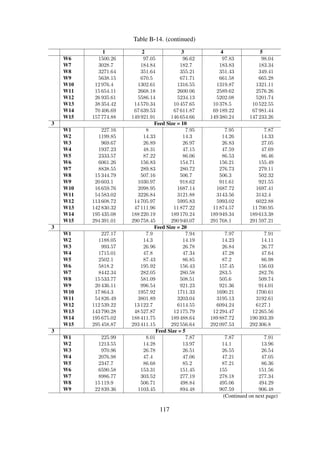
B-14 Performance experiment raw data for feed generator . . . . . . . . . . . . . . . . . 114
xii
List of Figures
1-1 High level architecture of a typical Digital Library System . . . . . . . . . . . . . 1
2-1 Screenshot showing the Copperbelt University institution repository . . . . . . . . 7
2-2 Screenshot showing the digital Bleek& Lloyd collection . . . . . . . . . . . . . . 7
2-3 Screenshot showing the South African NETD portal . . . . . . . . . . . . . . . . . 8
2-4 Screenshot showing the Project Gutenburg free ebooks portal . . . . . . . . . . . . 8
2-5 DL, DLS and DLMS: A three-tier framework . . . . . . . . . . . . . . . . . . . . 14
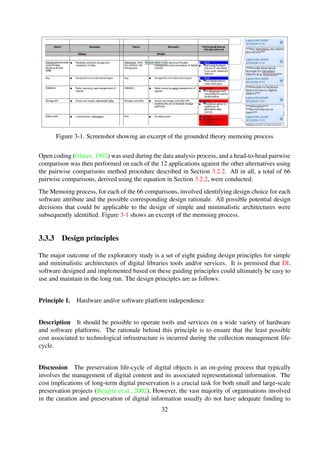
3-1 Screenshot showing an excerpt of the GT memoing process . . . . . . . . . . . . . 31
4-1 Simple repository object structure . . . . . . . . . . . . . . . . . . . . . . . . . . 39
4-2 Simple repository object structure . . . . . . . . . . . . . . . . . . . . . . . . . . 40
4-3 Simple repository container object component structure . . . . . . . . . . . . . . . 41
4-4 Simple repository digital object component structure . . . . . . . . . . . . . . . . 41
5-1 Screenshot showing a sample page from Bleek& Lloyd collection . . . . . . . . . 42
5-2 Collection digital object component structure . . . . . . . . . . . . . . . . . . . . 45
5-3 Screenshot showing a sample rock art from SARU collection . . . . . . . . . . . . 46
5-4 Collection digital object component structure . . . . . . . . . . . . . . . . . . . . 49
6-1 Survey participants’ technological background . . . . . . . . . . . . . . . . . . . . 53
6-2 Survey participants’ background using storage solutions . . . . . . . . . . . . . . . 53
6-3 Survey participants’ knowledge of DL concepts . . . . . . . . . . . . . . . . . . . 54
6-4 Survey participants’ programming languages usage . . . . . . . . . . . . . . . . . 54
6-5 Survey participants’ rankings of storage solutions . . . . . . . . . . . . . . . . . . 55
6-6 Survey participants’ simplicity& understandability ratings . . . . . . . . . . . . . 56
6-7 Survey participants’ ratings of data management approaches . . . . . . . . . . . . 56
6-8 Experiment datasets workload structures . . . . . . . . . . . . . . . . . . . . . . . 60
xiii
6-9 Impact of structure on item ingestion performance . . . . . . . . . . . . . . . . . . 65
6-10 Baseline performance benchmarks for full-text search . . . . . . . . . . . . . . . . 68
6-11 Impact of structure on query performance . . . . . . . . . . . . . . . . . . . . . . 69
6-12 Baseline performance benchmarks for batch indexing . . . . . . . . . . . . . . . . 70
6-13 Impact of batch size on indexing performance . . . . . . . . . . . . . . . . . . . . 72
6-14 Baseline performance benchmarks for OAI-PMH data provider . . . . . . . . . . . 74
6-15 Impact of collection structure on OAI-PMH . . . . . . . . . . . . . . . . . . . . . 75
6-16 Impact of resumptionToken size on OAI-PMH . . . . . . . . . . . . . . . . . . . . 76
6-17 Impact of resumptionToken size& structure on OAI-PMH . . . . . . . . . . . . . . 77
6-18 Impact of feed size on feed generation . . . . . . . . . . . . . . . . . . . . . . . . 79
6-19 Impact of structure on feed generation . . . . . . . . . . . . . . . . . . . . . . . . 80
6-20 Comparison of single item ingestion performance . . . . . . . . . . . . . . . . . . 82
6-21 Comparison of full-text search performance . . . . . . . . . . . . . . . . . . . . . 82
6-22 Comparison of OAI-PMH performance . . . . . . . . . . . . . . . . . . . . . . . 83
6-23 DL aspects performance summary . . . . . . . . . . . . . . . . . . . . . . . . . . 85
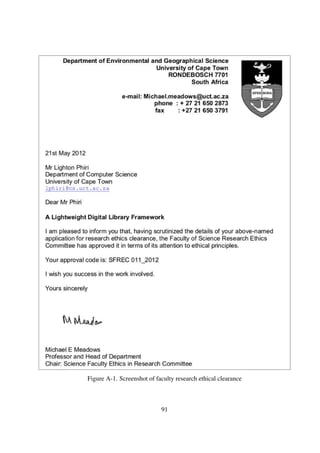
A-1 Screenshot of faculty research ethical clearance . . . . . . . . . . . . . . . . . . . 90
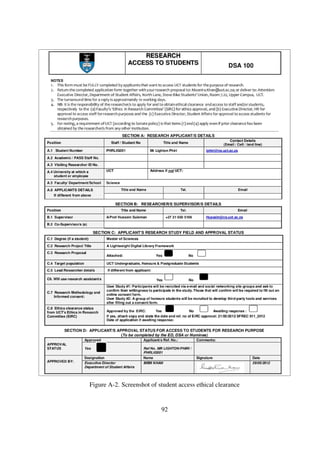
A-2 Screenshot of student access ethical clearance . . . . . . . . . . . . . . . . . . . . 91
A-3 Screenshot showing the survey participation email invitation . . . . . . . . . . . . 92
A-4 Screenshot showing the practical assignment question . . . . . . . . . . . . . . . . 93
A-5 Screenshot showing the online questionnaire (page 1 of 5) . . . . . . . . . . . . . 94
A-4 Screenshot showing the online questionnaire (page 2 of 5) . . . . . . . . . . . . . 95
A-3 Screenshot showing the online questionnaire (page 3 of 5) . . . . . . . . . . . . . 96
A-2 Screenshot showing the online questionnaire (page 4 of 5) . . . . . . . . . . . . . 97
A-1 Screenshot showing the online questionnaire (page 5 of 5) . . . . . . . . . . . . . 98
xiv
List of Abbreviations
5S Streams, Structures, Spaces and Societies.
AHP Analytic Hierarchy Process.
DL Digital Library.
DLMS Digital Library Management System.
DLS Digital Library System.
DOI Digital Object Identifier.
ETD Electronic Thesis and Dissertation.
FLOSS Free/Libre/Open Source Software.
NDLTD Networked Digital Library of Thesis and Disser-
tation.
OAI-PMH Open Archives Initiative Protocol for Metadata
Harvesting.
OASIS Organisation for the Advancement of Structured
Information Standards.
PDF/A PDF/A is an ISO-standardised version of the
Portable Document Format (PDF).
PURL Persistent Uniform Resource Locator.
RAP Repository Access Protocol.
SARU Spatial Archaeology Research Unit.
URI Uniform Resource Identifier.
WWW World Wide Web Technologies.
XML Extensible Markup Language.
xv
Chapter 1
Introduction
The last few decades has seen an overwhelming increase in the amount of digitised and born
digital information. There has also been a growing need for specialised systems tailored to better
handle this digital content. Digital Libraries (DLs) are specifically designed to store, manage and
preserve digital objects over long periods of time. Figure 1-1 illustrates a high-level view of a
typical Digital Library System (DLS) architecture.
OAI-PMH
OpenSearch
SWORD Value-added Services
Browse
Ingestion
Search
Indexing
Bitstream Objects Metadata Objects
Machine Interaction User InteractionObject
Management
Figure 1-1. High level architecture of a typical Digital Library System
1
1.1 Motivation
DLs began as an abstraction layered over databases to provide higher level services
(Arms et al., 1997; Baldonado et al., 1997; Frew et al., 1998) and have evolved, subsequently mak-
ing them complex (Jan´ee and Frew, 2002; Lagoze et al., 2006) and difficult to maintain, extend and
reuse. The difficulties resulting from the complexities of such tools are especially prominent in or-
ganisations and institutions that have limited resources to manage such tools and services. Some
examples of organisations that fall within this category include cultural heritage organisations and
a significant number of other organisations in developing countries found in regions such as Africa
(Suleman, 2008).
The majority of existing platforms are arguably unsuitable for resource-constrained environments
due to the following reasons:
Some organisations do not have sustainable funding models, making it difficult to effectively
manage the preservation life-cycle as most tools are composed of custom and third-party
components that require regular updates.
A number of existing tools require technically-inclined experts to manage them, effectively
raising their management costs.
The majority of modern platforms are bandwidth intensive. However, they sometimes end up
being deployed in regions were Internet bandwidth is unreliable and mostly very expensive,
making it difficult to guarantee widespread accessibility to services offered.
A potential solution to this problem is to explicitly simplify the overall design of DLSes so that
the resulting tools and services are more easily adopted and managed over time. This premise is
drawn from the many successes of the application of minimalism, as discussed in Section 2.5. In
light of that, this research proposes the design of lightweight tools and services, with the potential
to be easily adopted and managed.
1.2 Hypotheses
This research was guided by three working hypotheses that are a direct result of grounding work
previously conducted (Suleman, 2007; Suleman et al., 2010). The three hypotheses are as fol-
lows:
A formal simplistic abstract framework for DLS design can be derived.
A DLS architectural design based on a simple and minimalistic approach could be potentially
easy to adopt and manage over time.
The system performance of tools and services based on simple architectures could be ad-
versely affected.
2
1.3 Research questions
The core of this research was aimed at investigating the feasibility of implementing a DLS based
on simplified architectural designs. In particular, the research was guided by the following research
questions:
Is it feasible to implement a DLS based on simple architectures?
This primary research question was broadly aimed at investigating the viability of simple archi-
tectures. To this end, the following secondary questions were formulated to clarify the research
problem.
i How should simplicity for DLS storage and service architectures be defined?
This research question served as a starting point for the research, and was devised to help
provide scope and boundaries of simplicity for DLS design.
ii What are the potential implications of simplifying DLS—adverse or otherwise?
It was envisaged, from the onset, that simplifying the overall design of a DLS would poten-
tially result in both desirable and undesirable outcomes. This research question was thus
aimed at identifying the implications of simplifying DLS design.
iii What are some of the comparative advantages and disadvantages of simpler architec-
tures to complex ones?
A number of DLS architectures have been proposed over the past two decades, ranging
from those specifically designed to handle complex objects to those with an overall goal
of creating and distributing collection archives (see Section 2.4). This research question
was aimed at identifying some of the advantages and disadvantages of simpler architectures
compared to well-established DL architectures. This includes establishing how well simple
architectures support the scalability collections.
1.4 Scope and approach
Table 1-1 shows a summary of the research process followed to answer the research ques-
tions.
3
Table 1-1. Summary of research approach process
Research Process Procedure
Literature synthesis Preliminary review of existing literature
Research proposal Scoping and formulation of research problem
Exploratory study Derivation of design principles
Repository design Mapping of design principles to design process
Case studies Implementation case study collections
Evaluation Experimentation results and discussion
1.5 Thesis outline
This manuscript is structured as follows:
Chapter 1 serves as an introduction, outlining the motivation, research questions and scope
of the research conducted.
Chapter 2 provides background information and related work relevant to the research con-
ducted.
In Chapter 3 the exploratory study that was systematically conducted to derive a set of design
principles is described, including the details of the principles derived.
Chapter 4 presents a prototype repository whose design decisions are directly mapped to
some design principles outlined in Chapter 3.
Chapter 5 describes two real-world case study implementation designed and implemented
using the repository design outlined in Chapter 4.
The implications of the prototype repository design are outlined in Chapter 6 through: ex-
perimental results from a developer-oriented survey conducted to evaluate the simplicity and
extensibility; and through scalability performance benchmark results of some DLS opera-
tions conducted on datasets of different sizes.
Chapter 7 highlights concluding remarks and recommendations for potential future work.
4
Chapter 2
Background
Research in the field of DLs has been going on for over two decades. The mid 1990s, in partic-
ular, saw the emergence of a number of government funded projects (Griffin, 1998), conferences
(Adam et al., 1995), technical committees (Dublin Core Metadata Element Set, Version 1.1 1999;
Lorist and Meer, 2001) and workshops (Dempsey and Weibel, 1996; Lagoze et al., 1996), specifi-
cally set up to foster formal research in the field of DLs. The rapid technological advances and,
more specifically, Web technologies have resulted in a number of different DLS frameworks, con-
ceptual models, architectural designs and DL software tools. The variation in the designs can
largely be attributed to the different design goals and corresponding specific problems that the
solutions were aimed to address.
This chapter is organised as follows. Section 2.1 presents an overview of DLs, including definitions
and sample application domains; Section 2.2 introduces fundamental key concepts behind DLs;
Section 2.3 is a discussion of pioneering work on some proposed frameworks and reference models
that have been applied to the implementation of DLS; Section 2.4 presents related work through
a discussion of some popular Free/Libre/Open Source Software (FLOSS) tools used for managing
digital collections; Section 2.5 broadly discusses designs whose successes are hinged on simplicity;
Section 2.6 discusses some commonly used storage solutions; and finally Section 2.7 presents two
prominent methods used to capture software design decisions.
2.1 Digital Libraries
2.1.1 Definitions
The field of DLs is a multidisciplinary field that comprises disciplines such as data management,
digital curation, document management, information management, information retrieval and li-
brary sciences. Fox et al. (Fox et al., 1995) outline the varying impressions of DLs from persons
in different disciplines and adopt a pragmatic approach of embracing the different definitions. They
further acknowledge the metaphor of the traditional library as empowering and recognise the im-
portance of knowledge systems that have evolved as a result. Arms (see Arms, 2001, chap. 1)
provides an informal definition by viewing a DL indexDigital Libraries as a well organised, man-
aged network-accessible collection of information—with associated services.
5
In an attempt to overcome the complex nature of DLs, Gonc¸alves et al. (Gonc¸alves et al., 2004) de-
fine a DL, using formal methods, by constructively defining a minimal set of components that make
up a DL. The set-oriented and functional mathematical formal basis of their approach facilitates
the precise definition of each component as functional compositions.
The European Union co-funded DELOS Network of Excellence on DLs working group proposed
a reference model and drafted The DL Manifesto with the aim of setting the foundations and iden-
tifying concepts within the universe of DLs (Candela et al., 2007). The DELOS DL indexDigital
Libraries reference model envisages a DL indexDigital Libraries universe as a complex frame-
work and tool having no logical, conceptual, physical, temporal or personal borders or barriers
on information. A DL indexDigital Libraries is perceived as an evolving organisation that comes
into existence through a series of development steps that bring together all the necessary con-
stituents, each corresponding to three different levels of conceptualisation of the universe of DLs
(Candela et al., 2008). The DELOS DL indexDigital Libraries reference model is discussed in
depth in Section 2.3.3.
2.1.2 Application domains
The use of DLs has become widespread mainly due to the significant technological advances that
have been taking place since the 1990s. The advent of the Internet has particularly influenced this
widespread use. There are various application domains in which DLs are used and researchers
are continuously coming up with innovative ways of increasing the footprint of DL indexDigital
Libraries usage.
Academic institutions are increasingly setting up institutional repositories to facilitate easy access
to research output. DLs play a vital role by ensuring that intellectual output is collected, man-
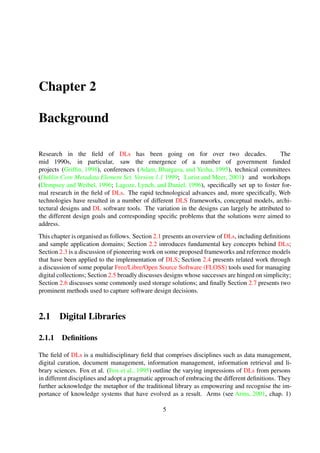
aged, preserved and later accessed efficiently and effectively. Figure 2-1 is an illustration of an
institutional repository system—a full text open access institution repository of the Copperbelt
University1.
Cultural heritage organisations are increasingly digitising historical artifacts in a quest to display
them online to a much wider audience. In light of this, DLSes are being developed to enable easy
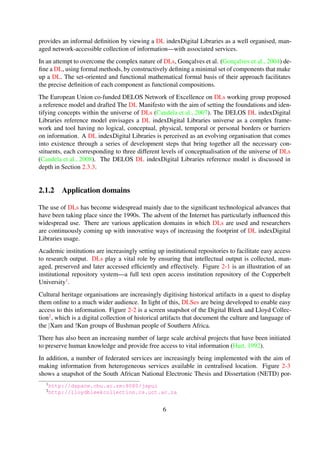
access to this information. Figure 2-2 is a screen snapshot of the Digital Bleek and Lloyd Collec-
tion2, which is a digital collection of historical artifacts that document the culture and language of
the |Xam and !Kun groups of Bushman people of Southern Africa.
There has also been an increasing number of large scale archival projects that have been initiated
to preserve human knowledge and provide free access to vital information (Hart, 1992).
In addition, a number of federated services are increasingly being implemented with the aim of
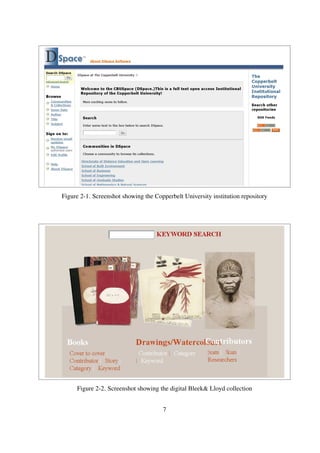
making information from heterogeneous services available in centralised location. Figure 2-3
shows a snapshot of the South African National Electronic Thesis and Dissertation (NETD) por-
tal—a federated service that makes it possible for Electronic Thesis and Dissertations (ETDs) from
various South African universities to be discovered from a central location.
1http://dspace.cbu.ac.zm:8080/jspui
2http://lloydbleekcollection.cs.uct.ac.za
6
Figure 2-1. Screenshot showing the Copperbelt University institution repository
Figure 2-2. Screenshot showing the digital Bleek& Lloyd collection
7
Figure 2-3. Screenshot showing the South African National Electronic Thesis and Dissertation
portal
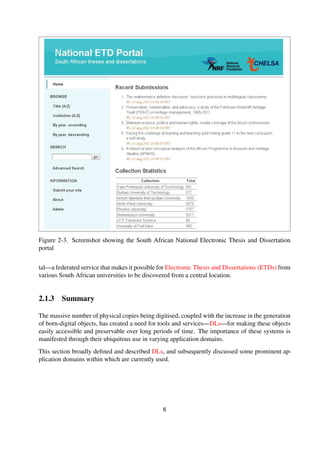
Figure 2-4. Screenshot showing the Project Gutenburg free ebooks portal
8
2.1.3 Summary
The massive number of physical copies being digitised, coupled with the increase in the generation
of born-digital objects, has created a need for tools and services—DLs—for making these objects
easily accessible and preservable over long periods of time. The importance of these systems is
manifested through their ubiquitous use in varying application domains.
This section broadly defined and described DLs, and subsequently discussed some prominent ap-
plication domains within which are currently used.
2.2 Fundamental concepts
2.2.1 Identifiers
An identifier is a name given to an entity for current and future reference. Arms (Arms, 1995)
classifies identifiers as vital building blocks for DL and emphasises their role in ensuring that
individual digital objects are easily identified and changes related to the objects are linked to the
appropriate objects. He also notes that they are also essential for information retrieval and for
providing links between objects.
The importance of identifiers is made evident by the widespread adoption of standardised naming
schemes such as Digital Object Identifiers (DOIs)3 (Paskin, 2005; Paskin, 2010) , Handles Sys-
tem4 and Persistent Uniform Resource Locators (PURLs)5.
Uniform Resource Identifiers (URIs) (Berners-Lee et al., 2005) are considered a suitable naming
scheme for digital objects primarily because they can potentially be resolved through standard
Web protocols; that facilitates interoperability, a feature that is significant in DL whose overall
goal is the widespread dissemination of information.
2.2.2 Interoperability
Interoperability is a system attribute that enables a system to communicate and exchange infor-
mation with other heterogeneous systems in a seamless manner. Interoperability makes it pos-
sible for services, components and systems developed independently to potentially rely on one
another to accomplish certain tasks with the overall goal of having individual components evolve
independently, but be able to call on each other, thus exchanging information, efficiently and con-
veniently (Paepcke et al., 1998). DL interoperability has particularly made it possible for feder-
ated services (Gonc¸alves et al., 2001) to be developed, mainly due to the widespread use of the
Open Archives Initiative Protocol for Metadata Harvesting (OAI-PMH).
There are various protocols that have been developed to facilitate interoperability among heteroge-
neous DLSes. Prominent interoperability protocols include: Z39.50 (Lynch, 1991) a client-server
3http://www.doi.org
4http://www.handle.net
5http://purl.oclc.org
9
protocol used for remote searching; OAI-PMH (Lagoze et al., 2002b), which has been extensively
used for metadata harvesting; and RSS (Winer, 2007), a Web based feed format commonly used
for obtaining updates on Web resources.
Extensible Markup Language (XML) has emerged as the underlying language used to support a
number of these interoperability protocols, largely due to its simplicity and platform indepen-
dence.
2.2.3 Metadata
Metadata is representational information that includes pertinent descriptive annotations necessary
to understand a resource. Arms (Arms et al., 1997) describes different categories of information
as being organised as sets of digital objects—a fundamental unit of the DL architecture—that
are composed of digital material and key-metadata. He defines the key-metadata as information
needed to manage the digital object in a networked environment. The role performed by meta-
data is both implicit and explicit and its functions can be more broadly divided into distinct cat-
egories. A typical digital object normally has administrative metadata for managing the digital
object, descriptive metadata to facilitate the discovery of information, structural metadata for de-
scribing relationships within the digital object and preservation metadata that stores provenance
information. Metadata is made up of elements that are grouped into a standard set, to achieve
a specific purpose, resulting in a metadata schema. There are a number of metadata schemes
that have been developed as standards across various disciplines and they include, among oth-
ers, Dublin Core (Dublin Core Metadata Element Set, Version 1.1 1999), Learning Object Meta-
data (LOM) (Draft Standard for Learning Object Metadata 2002), Metadata Encoding and Trans-
mission Standard (METS)6 and Metadata Object Description Schema (MODS)7. Metadata can
either be embedded within the digital object—as is the case with Portable Document Format (PDF)
and Hypertext Transfer Markup Language (HTML) documents—or stored separately with links to
the resources being described. Metadata in DL is often stored in databases for easy management
and access.
2.2.4 Standards
The fast pace at which technology is moving has spawned different types of application software
tools. This means that the choice of which technology to use in any given instance differs, thus
complicating the process of integrating application software with other heterogeneous software
tools. Standards become particularly useful in such situations because they form the basis for
developing interoperable tools and services. A standard is a specification—a formal statement
of a data format or protocol—that is maintained and endorsed by a recognised standards body
(see Suleman, 2010, chap. 2).
Adopting and adhering to standards has many other added benefits—and Strand et al.
(Strand et al., 1994) observe that applications that are built on standards are more readily scal-
able, interoperable and portable, constituting software quality attributes that are important for the
6http://www.loc.gov/standards/mets
7http://www.loc.gov/standards/mods
10
design, implementation and maintenance of DLs. Standards also play a vital role in facilitating
long term preservation of digital objects by ensuring that documents still become easily accessible
in the future. This is done by ensuring that the standard itself does not change and by making the
standard backwards compatible. Notable use of standards in DL include the use of XML as the un-
derlying format for metadata and OAI-PMH as an interoperability protocol. Digital content is also
stored in well known standards, as is the case with documents that are normally stored in PDF/A
format. The use of standards in DLSes, however, has its own shortcomings; in certain instances,
the use of standards can be a very expensive venture as it may involve a lot of cross-domain effort
(Lorist and Meer, 2001).
2.2.5 Summary
A DLS operates as a specialised type of information system and exhibits certain characteristics
to attain its objects. This section discussed fundamental concepts, associated to DLSes, that help
form the necessary building blocks for implementing DLs.
2.3 Digital Libraries frameworks
A reference model is an abstract framework that provides basic concepts
used to understand the relationships among items in an environment. The
Organisation for the Advancement of Structured Information Standards (OASIS)
(MacKenzie et al., 2006) states that a reference model consists of a minimal set of unifying
concepts, axioms and relationships within a particular problem domain, and is independent of
specific standards, technologies, implementations or other concrete details.
Several DL frameworks (Gonc¸alves et al., 2004; Kahn and Wilensky, 2006) and reference models
(Candela et al., 2007) have addressed specific problems in DLS architectural design and implemen-
tation. A discussion of some prominent reference models now follows.
2.3.1 Streams, Structures, Spaces and Societies
The Streams, Structures, Spaces and Societies (5S) framework is a unified formal theory for DLs.
It is an attempt to define and easily understand the complex nature of DLs in a rigorous manner. The
framework is based on formal definitions, and abstraction of five fundamental concepts—Streams,
Structures, Spaces, Scenarios and Societies (Gonc¸alves et al., 2004). The five concepts, together
with their corresponding definitions and examples, are summarised in Table 2-1.
Table 2-1. Summary of key aspects of the 5S framework
Concept Description Examples
Streams Streams represent a sequence of ele-
ments of an arbitrary type
Text, video, audio, software
(Continued on next page)
11
Table 2-1. (continued)
Concept Description Examples
Structures Structures specify the organisation of
different parts of a whole
Collection, document, meta-
data
Spaces Spaces are sets of objects, with associ-
ated operations, that obey certain con-
stants
User interface, index
Scenarios Scenarios define details for the be-
haviour of services
Service, event, action
Societies Societies represent sets of entities and
the relationships among them
Community, actors, relation-
ships, attributes, operations
In the context of the aims of DLs, Gonc¸alves et al. (Gonc¸alves et al., 2004) outline an association
between 5S and some aims of a DLS, with Streams being aligned with the overall communication
and consumption of information by end users; Structures supporting the organisation of informa-
tion; Spaces dealing with the presentation and access to information in usable and effective ways;
Scenarios providing the necessary support for defining and designing services; and Societies defin-
ing how a DL satisfies the overall information needs of end users.
However, Candela et al. (Candela et al., 2008) state that the 5S framework is very general-purpose
and thus less immediate. The 5S framework is also arguably aimed at formalising the DL aspects,
as opposed to prescribing specific design guidelines.
2.3.2 Kahn and Wilensky framework
This is a generic information system framework for distributed digital object services with digital
objects as the main building blocks. The framework is based on an open architecture that supports
large and distributed digital information services. Kahn and Wilensky (Kahn and Wilensky, 2006)
describe the framework in terms of the fundamental aspects of an open and distributed infrastruc-
ture, and how the basic components in such an infrastructure support storage, accessibility and
management of digital objects.
In addition to a high level conceptual description of such a distributed information sys-
tem, the framework primarily focuses on the network-based aspects of such an infrastructure
(Kahn and Wilensky, 2006). Specifically, an elaborate description of how digital objects should
be accessed via a Repository Access Protocol (RAP) is outlined. The framework also proposes the
use of a handle server infrastructure as a means for mapping registered digital objects.
In essence, the framework merely prescribes conventional methods for the unique identification,
reliable location, and flexible access to digital objects.
12
2.3.3 DELOS reference model
The DELOS Network of Excellence on DLs8 was a European Union co-funded project aimed at
integrating and coordinating research activities in DLs. The DELOS working group published a
manifesto that establishes principles that facilitate the capture of the full spectrum of concepts that
play a role in DLs (Candela et al., 2007). The result of this project was a reference model—the
DELOS DL reference model—comprising to a set of concepts and relationships that collectively
attempt to capture various entities of the DL universe.
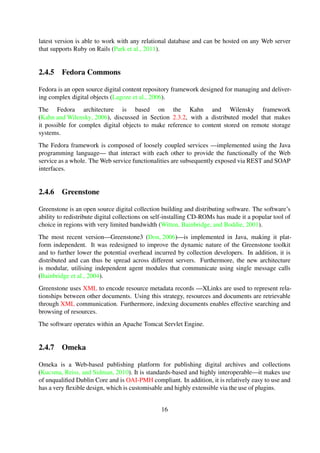
A fundamental part of the DELOS reference model is the DL Manifesto, that presents a DL as a
three-tier framework consisting of a DL, representing an organisation; a DLS, for implementing
DL services; and a Digital Library Management System (DLMS), comprising of tools for admin-
istering the DLS. Figure 2-59 shows the interaction among the three sub-systems.
The reference model further identifies six core concepts that provide a firm foundation for DLs.
These six concepts—Content, User, Functionality, Quality, Policy and Architecture—are enshrined
within the DL and the DLS. All concepts, with the exceptions of the Architecture concept, ap-
pear in the definition of the DL. The Architecture is, however, handled by the DLS definition
(Candela et al., 2008).
The Architecture component, addressed by the DLS, is particularly important in the context of this
research as it represents the mapping of the functionality and content on to the hardware and soft-
ware components. Candela et al. (Candela et al., 2008) attribute the inherent complexity of DLs
and the interoperability challenges across DLs as the two primary reasons for having Architecture
as a core component.
Another important aspect of the reference model, directly related to this research, are the reference
frameworks needed to clarify the DL universe at different levels of abstraction. The three reference
development frameworks are: Reference Model, Reference Architecture, and Concrete Architec-
ture. In the context of architectural design, the Reference Architecture is vital as it provides a
starting point for the development of an architectural design pattern, thus paving the way for an
abstract solution.
2.3.4 Summary
The motivation behind building both the reference models was largely influenced by the need to
understand the complexity inherent in DLs. The idea of designing a DL architecture based on
direct user needs is not taken into account in existing reference models, although the DELOS
Reference Architecture does have a provision for the development of specific architectural design
patterns. The DELOS Reference Architecture is in actual fact considered to be mandatory for the
development of good quality DLSes, and for the integration and reuse of the system components.
8http://www.delos.info
9Permission to reproduce this image was granted by Donatella Castelli
13
Figure 2-5. DL, DLS and DLMS: A three-tier framework
2.4 Software platforms
There are a number of different DL software tools currently available. The ubiquitous availability
of these tools could, in part, be as a result of specialised problems that these solutions are designed
to solve. This section discusses seven prominent DL software platforms.
2.4.1 CDS Invenio
CDS Invenio, formally known as CDSware, is an open source repository software, developed at
CERN10 and originally designed to run the CERN document server11. CDS Invenio provides
an application framework with necessary tools and services for building and managing a DL
(Vesely et al., 2004).
The ingested digital objects’ metadata records are internally converted into a MARC 21 —
MARCXML— representation structure, while the actually fulltext bitstreams are automatically
converted into PDF. This ingested content is subsequently accessed by downstream services via
OAI service providers, email alerts and search engines (Pepe et al., 2005).
The implementation is based on a modular architecture. It is implemented using the Python Pro-
gramming language, runs within an Apache/Python Web application server, and makes use of a
MySQL backend database server for storage of metadata records.
10http://www.cern.ch
11http://cdsweb.cern.ch
14
2.4.2 DSpace
DSpace is an open-source repository software that was specifically designed for storage of digital
research and institutional materials. The architectural design was largely influenced by the need
for materials to be stored and accessed over long periods of time (Tansley et al., 2003b).
The digital object metadata records are encoded using qualified Dublin Core—to facilitate effective
resource description. Digital objects are accessed and managed via application layer services that
support protocols such as OAI-PMH.
DSpace is organised into a three-tier architecture, composed of: an application layer; a business
logic layer; and a storage layer. The storage layer stores digital content within an asset store—a
designated area within the operating system’s filesystem; or can alternatively use a storage resource
broker. The digital objects —bitstreams and corresponding metadata records— are stored within
a relational database management system (Smith et al., 2003; Tansley et al., 2003a). Furthermore
software is implemented using the Java programming languages, and is thus deployed within a
Servlet Engine. However, this architectural design approach arguably makes it difficult to recover
digital objects in the event of a disaster since technical expertise would be required.
2.4.3 EPrints
EPrints is an archival software that designed to create highly configurable Web-based archives.
The initial design of the software can be traced back to a time when there was a need to foster
open access to research publications, and provides a flexible DL platform for building repositories
(Gutteridge, 2002).
Eprints records are represented as data objects that contain metadata. The software’s plugin archi-
tecture enables the flexible design and development of export plugins capable of converting repos-
itory objects into a variety of other formats. This technique effectively makes it possible for the
data objects to be disseminated via different services—such as OAI data provider modules.
EPrints is implemented using Perl, runs within an Apache HTTP server and uses a MySQL
database server backend to store metadata records. However, the actual files in the archive are
stored on the filesystem.
2.4.4 ETD-db
The ETD-db digital repository software for depositing, accessing and managing ETD collec-
tions. The software is more oriented towards helping facilitate the access and management of
ETDs.
The software was initially developed as is a series of Web pages and additional Perl scripts that
interact with a MySQL database backend (ETD-db: Home 2012). However, the latest version—
ETD 2.0—is a Web application, implemented using the Ruby on Rails Web application framework.
This was done in an effort to handle ETD collections more reliably and securely. In addition, the
latest version is able to work with any relational database and can be hosted on any Web server
that supports Ruby on Rails (Park et al., 2011).
15
2.4.5 Fedora Commons
Fedora is an open source digital content repository framework designed for managing and deliver-
ing complex digital objects (Lagoze et al., 2006).
The Fedora architecture is based on the Kahn and Wilensky framework
(Kahn and Wilensky, 2006), discussed in Section 2.3.2, with a distributed model that makes
it possible for complex digital objects to make reference to content stored on remote storage
systems.
The Fedora framework is composed of loosely coupled services —implemented using the Java
programming language— that interact with each other to provide the functionally of the Web
service as a whole. The Web service functionalities are subsequently exposed via REST and SOAP
interfaces.
2.4.6 Greenstone
Greenstone is an open source digital collection building and distributing software. The software’s
ability to redistribute digital collections on self-installing CD-ROMs has made it a popular tool of
choice in regions with very limited bandwidth (Witten et al., 2001).
The most recent version—Greenstone3 (Don, 2006)—is implemented in Java, making it plat-
form independent. It was redesigned to improve the dynamic nature of the Greenstone toolkit
and to further lower the potential overhead incurred by collection developers. In addition, it is
distributed and can thus be spread across different servers. Furthermore, the new architecture
is modular, utilising independent agent modules that communicate using single message calls
(Bainbridge et al., 2004).
Greenstone uses XML to encode resource metadata records —XLinks are used to represent rela-
tionships between other documents. Using this strategy, resources and documents are retrievable
through XML communication. Furthermore, indexing documents enables effective searching and
browsing of resources.
The software operates within an Apache Tomcat Servlet Engine.
2.4.7 Omeka
Omeka is a Web-based publishing platform for publishing digital archives and collections
(Kucsma et al., 2010). It is standards-based and highly interoperable—it makes use of unquali-
fied Dublin Core and is OAI-PMH compliant. In addition, it is relatively easy to use and has a very
flexible design, which is customisable and highly extensible via the use of plugins.
Omeka is implemented using the PHP scripting language and uses MySQL database as a backend
for storage of metadata records. However, the ingested resources—bitstreams— are stored on the
filesystem.
16
2.4.8 Summary
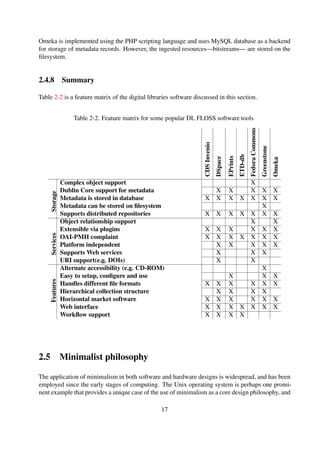
Table 2-2 is a feature matrix of the digital libraries software discussed in this section.
Table 2-2. Feature matrix for some popular DL FLOSS software tools
CDSInvenio
DSpace
EPrints
ETD-db
FedoraCommons
Greenstone
Omeka
Storage
Complex object support X
Dublin Core support for metadata X X X X X
Metadata is stored in database X X X X X X X
Metadata can be stored on filesystem X
Supports distributed repositories X X X X X X X
Object relationship support X X
Services
Extensible via plugins X X X X X X
OAI-PMH complaint X X X X X X X
Platform independent X X X X X
Supports Web services X X X
URI support(e.g. DOIs) X X
Features
Alternate accessibility (e.g. CD-ROM) X
Easy to setup, configure and use X X X
Handles different file formats X X X X X X
Hierarchical collection structure X X X X
Horizontal market software X X X X X X
Web interface X X X X X X X
Workflow support X X X X
2.5 Minimalist philosophy
The application of minimalism in both software and hardware designs is widespread, and has been
employed since the early stages of computing. The Unix operating system is perhaps one promi-
nent example that provides a unique case of the use of minimalism as a core design philosophy, and
Raymond (Raymond, 2004) outlines the benefits, on the Unix platform, of designing for simplicity.
This section discusses relevant architectures that were designed with simplicity in mind.
17
2.5.1 Dublin Core element set
The Dublin Core metadata element set defines a set of 15 resource description properties that are
potentially applicable to a wide range of resources. One of the main goals of the Dublin Core
element set is aimed at keeping the element set as small and simple as possible to facilitate the
creation of resource metadata by non-experts (Hillmann, 2005).
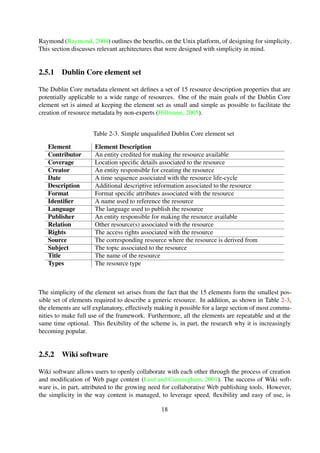
Table 2-3. Simple unqualified Dublin Core element set
Element Element Description
Contributor An entity credited for making the resource available
Coverage Location specific details associated to the resource
Creator An entity responsible for creating the resource
Date A time sequence associated with the resource life-cycle
Description Additional descriptive information associated to the resource
Format Format specific attributes associated with the resource
Identifier A name used to reference the resource
Language The language used to publish the resource
Publisher An entity responsible for making the resource available
Relation Other resource(s) associated with the resource
Rights The access rights associated with the resource
Source The corresponding resource where the resource is derived from
Subject The topic associated to the resource
Title The name of the resource
Types The resource type
The simplicity of the element set arises from the fact that the 15 elements form the smallest pos-
sible set of elements required to describe a generic resource. In addition, as shown in Table 2-3,
the elements are self explanatory, effectively making it possible for a large section of most commu-
nities to make full use of the framework. Furthermore, all the elements are repeatable and at the
same time optional. This flexibility of the scheme is, in part, the research why it is increasingly
becoming popular.
2.5.2 Wiki software
Wiki software allows users to openly collaborate with each other through the process of creation
and modification of Web page content (Leuf and Cunningham, 2001). The success of Wiki soft-
ware is, in part, attributed to the growing need for collaborative Web publishing tools. However, the
simplicity in the way content is managed, to leverage speed, flexibility and easy of use, is arguably
the major contributing factor to their continued success. The strong emphasis on simplicity in the
design of Wikis is evident in Cunningham’s original description: “The simplest online database
that could possibly work” (What is Wiki 1995; Leuf and Cunningham, 2001).
18
2.5.3 Extensible markup language
XML is a self-describing markup language that was specifically designed to transport and store
data. XML provides a hardware- and software-independent mode for carrying information, and
was design for ease of use, implementation and interoperability from the onset. This is in fact
evident from the original design goals that, in part, emphasised for the language to be easy to
create documentations, easy to write programs for processing the documents and straightforwardly
usable over the Internet (Bray et al., 2008).
XML has become one of the most commonly used tool for transmission of data in various applica-
tions due to the following reasons.
Extensibility through the use of custom extensible tags
Interoperability by being usable on a wide variety of hardware and software platforms
Openness through the open and freely available standard
Simplicity of resulting documents, effectively making them readable by machines and hu-
mans
The simplicity of XML particularly makes it an easy and flexible tool to work with, in part, due to
the fact that the XML document syntax is composed of a fairly minimal set of rules. Furthermore,
the basic minimal set of rules can be expanded to grow more complex structures as the need
arises.
2.5.4 OAI protocol for metadata harvesting
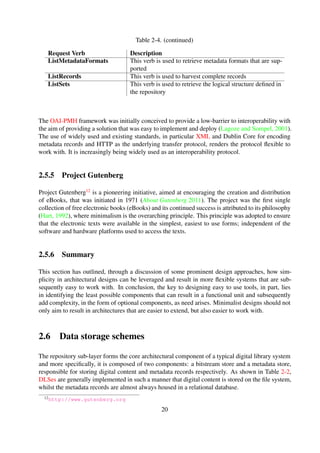
The OAI-PMH is a metadata harvesting interoperability framework (Lagoze et al., 2002b). The
protocol only defines a set of six request verbs, shown in Table 2-4, that data providers need to
implement. Downstream service providers then harvest metadata as a basis for providing value-
added services.
Table 2-4. OAI-PMH request verbs
Request Verb Description
GetRecord This verb facilitates retrieval of individual metadata records
Identify This verb is used for the retrieval of general repository in-
formation
ListIdentifiers This verb is used to harvest partial records in the form of
record headers
ListMetadataFormats This verb is used to retrieve metadata formats that are sup-
ported
ListRecords This verb is used to harvest complete records
ListSets This verb is used to retrieve the logical structure defined in
the repository
19
The OAI-PMH framework was initially conceived to provide a low-barrier to interoperability with
the aim of providing a solution that was easy to implement and deploy (Lagoze and Sompel, 2001).
The use of widely used and existing standards, in particular XML and Dublin Core for encoding
metadata records and HTTP as the underlying transfer protocol, renders the protocol flexible to
work with. It is increasingly being widely used as an interoperability protocol.
2.5.5 Project Gutenberg
Project Gutenberg12 is a pioneering initiative, aimed at encouraging the creation and distribution
of eBooks, that was initiated in 1971 (About Gutenberg 2011). The project was the first single
collection of free electronic books (eBooks) and its continued success is attributed to its philosophy
(Hart, 1992), where minimalism is the overarching principle. This principle was adopted to ensure
that the electronic texts were available in the simplest, easiest to use forms; independent of the
software and hardware platforms used to access the texts.
2.5.6 Summary
This section has outlined, through a discussion of some prominent design approaches, how sim-
plicity in architectural designs can be leveraged and result in more flexible systems that are sub-
sequently easy to work with. In conclusion, the key to designing easy to use tools, in part, lies
in identifying the least possible components that can result in a functional unit and subsequently
add complexity, in the form of optional components, as need arises. Minimalist designs should not
only aim to result in architectures that are easier to extend, but also easier to work with.
2.6 Data storage schemes
The repository sub-layer forms the core architectural component of a typical digital library system
and more specifically, it is composed of two components: a bitstream store and a metadata store,
responsible for storing digital content and metadata records respectively. As shown in Table 2-2,
DLSes are generally implemented in such a manner that digital content is stored on the file system,
whilst the metadata records are almost always housed in a relational database.
This section discusses three prominent data storage solutions that can potentially be integrated
within the repository sub-layer for metadata storage. The focus is to assess their suitability for
integration with DLSes.
2.6.1 Relational databases
Relational databases have stood the test of time, having been around for decades. They have,
until recently, been the preferred choice for data storage. There are a number of reasons
12http://www.gutenberg.org
20
(see Elmasri and Navathe, 2008, chap. 3) why relational databases have proved to be a popular
storage solution, and these include:
The availability of a simple, but effective query language—SQL— capable of retrieving
multifaceted views of data
Support for Data model relationships via table relations
Transaction support through ACID13 properties
Support for data normalisation, thus preventing redundancy
Relational databases are, however, mostly suitable for problem domains that require frequent re-
trieval and update of relatively small quantities of data.
2.6.2 NoSQL databases
The large-scale production of data (Gantz et al., 2008), coupled with the now prevalent Big Data14,
has resulted in a profound need for data storage architectures that are efficient, horizontally scal-
able, and easier to interface with. As a result, NoSQL databases recently emerged as potential
alternatives to relational databases. NoSQL databases are non-relational databases that embrace
schemaless data, are capable of running on clusters, and generally trade off consistency for other
properties such as performance (see Sadalage and Fowler, 2012, chap. 1).
NoSQL database implementations are often categorised based on the manner in which they store
data, and typically fall under the categories described in Table 2-5.
Table 2-5. Data model categories for NoSQL database stores
Data Model Description
Column-Family Stores Data is stored with keys mapped to values grouped into
column families
Document Stores Data is stored in self-describing encoded data structures
Graph Stores Data is stored as entities with corresponding relationships
between entities
Key-Value Stores Hash table with unique keys and corresponding pointer
to blobs
NoSQL databases are highly optimised for retrieve and append operations and, as a result, there
has recently been an increase in the number of applications that are making use of NoSQL
data stores. However, the downside of NoSQL databases is that they cannot simultaneously
guarantee data consistency, availability and partition tolerance; as defined in the CAP theorem
(Gilbert and Lynch, 2002).
13Atomicity, Consistency, Isolation, Durability
14http://www-01.ibm.com/software/data/bigdata
21
2.6.3 Filesystems
File systems are implemented by default in all operating systems, and provide a persistent store
for data. In addition, they provide a means to organise data in a manner that facilitates subsequent
retrieval and update of data.
Native file systems have, in the past, not generally been used as storage layers for enterprise appli-
cations, in part, due to the fact that they do not provide explicit support for transaction management
and fast indexing of data. However, the emergence of clustered environments has resulted in ro-
bust and reliable distributed file system technologies such as Apache Hadoop (Borthakur, 2007)
and Google File System (Ghemawat et al., 2003).
The opportunities presented by traditional file systems, and in particular their simplicity, efficiency
and general ease of customisation make them prime candidates for storage of both digital content
and metadata records. In addition, the use of flat files, and more specifically text files, for storage
of metadata records could further complement and simplify the digital library repository sub-layer.
Incidentally, Raymond (see Raymond, 2004, chap. 5) highlights a number of advantages associ-
ated with using text files, and further emphasises that designing textual protocols ultimately results
in future-proof systems.
In general, there are a number of real-word application whose data storage implementations take
advantage of file systems. Some notable example implementations of both digital libraries specific
tools and general purpose tools are outlined below.
BagIt file packaging format The BagIt File Packaging Format specification (Boyko et al., 2012)
defines a hierarchical file packaging format suitable for exchanging digital content. The BagIt
format is streamlined for disk-based and network-based storage and transfer. The organisation of
bags is centred on making use of file system directories as bags, which at a minimum contain: a
data directory, at least one manifest file that lists data directory contents, and a bagit.txt file that
identifies the directory as a bag.
DokuWiki DokuWiki is a PHP based Wiki engine, mainly aimed at creating documentation,
that is standards compliant and easy to use (Gohr, 2004). The storage architecture of DokuWiki
principally makes use of the filesystem as its data store, with application data files stored in plain
text files. This design strategy ensures that data is accessible even when the server goes down, and
at the same time facilities backup and restore operations through the use of basic server scripts and
FTP/sFTP.
Git Git is a distributed version control system that functions as a general tool for filesystem
directory content tracking, and is designed with a strong focus on speed, efficiency and real-world
usability on large projects (see Chacon, 2009, chap. 1), to attain three core functional requirements
below.
Store generic content
Track content changes in the repository
Facilitate a distributed architecture for the content
22
Git is internally represented as a duplex data structure that is composed of a mutable index for
caching information about the working directory; and an immutable repository. The Git object
storage area is a Directed Acyclic Graph that is composed of four types of objects—blob objects;
tree objects; commit objects; and tag objects (Git for Computer Scientists 2010). In addition, the
repository is implemented as a generic content-addressable filesystem with objects stored in a
simple key-value data store (see Chacon, 2009, chap.9).
Pairtrees for collection storage Pairtree is a file system convention for organising digital object
stores, and has the advantage of making it possible for object specific operations to be performed
by making use of native operating system tools (Kunze et al., 2008).
2.6.4 Summary
There are numerous available data storage options, and it is important to understand the varying
options to fully identify the ones most applicable to specific problem domains. It is generally not
always the case that a definitive storage solution is arrived at, however, a data model that better
matches the kind of data storage and retrieval requirements should be the primary deciding factor.
Table 2-6 is a summarised comparative matrix outlining the three storage solutions discussed in
this section.
It is that it is generally not always necessary to use an intermediate data management infrastructure,
and in some cases, it may in all actuality be desirable not to use one at all; as is the case with the
real world applications described in Section 2.6.3.
Table 2-6. Comparative matrix for data storage solutions
File Systems RDBMS NoSQL
Use Cases Miscellaneous Relational data Large-scale data
Data Format Heterogeneous
data
Structured data Unstructured data
Transaction Sup-
port
Simple Locking ACID compliant CAP theorem sup-
port
Indexing Optional Available Available
Scalability Horizontal; Verti-
cal
Vertical Horizontal
Replication Partial support Explicit support Explicit support
2.7 Design decisions
Software architectures provide an overview of a software system’s components, and the relation-
ships and characteristics that exist between the various components (Lee and Kruchten, 2007). The
23
architectures are initially conceived as a composition of the general design, influenced by a corre-
sponding set of design decisions (Kruchten et al., 2005). The design decisions form a fundamental
part of the architectural design process, by guiding the development of the software product, as
they help ensure that the resulting product conforms to desired functional and non-functional re-
quirements.
There are two prominent methods—design rationale and formalised ontological representation—
used to capture design decisions (Lee and Kruchten, 2007). The design rationale provides a his-
torical record, in form of documentation, of the rationale used to arrived at a particular design
approach (Lee and Lai, 1991), and typically makes use of techniques such as Issue-Based Informa-
tion Systems (IBIS) (Conklin and Yakemovic, 1991) and “Questions, Options and Criteria” (QOC)
(MacLean et al., 1991). The formalised ontological representation method on the other hand makes
use of an ontological model for describing and categorising the architectural design decisions
(Kruchten, 2004).
There are a number of benefits of explicitly capturing and documenting design decisions, the most
significant one being that they help in—ensuring the development of the desired product. In the
case of domain-specific products, they form a crucial role of ensuring that the resulting solution
directly conforms to the solution space it is meant to operate within.
2.8 Summary
This chapter discussed background information that forms the basis for this research. Section 2.1
discussed DLs, through elaborate high level definitions, complemented with examples of varying
application domains within which contemporary DLSes are utilised. Core fundamental concepts
associated to DL were also discussed in 2.2.
Some prominent DL frameworks were presented in Section 2.3, followed by FLOSS DL software
tools in Section 2.4; revealing that the varying frameworks and architectural designs are largely
as a result of the different problems for which solutions were sought. However, there are core
features that are common to most of the proposed solutions. It could thus be argued that existing
solutions may not be be suitable for certain environments, and as such simpler alternative architec-
tural designs may be desirable. A culmination of the argument for utilising simpler architectural
designs manifested in the discussion of prominent designs that used simplicity as the core criterion
in Section 2.5.
In addition, the repository sub-layer was highlighted as the component that forms the core of digital
libraries in Section 2.6, and a further discussing of potential storage solutions that can be used for
the storage of metadata records then followed. Traditional file systems have been identified as
contenders of the more generally accepted relational databases and now common place NoSQL
databases, for the storage of metadata records.
Furthermore, a discussion of two major general approaches followed when arriving at software
design decisions were presented in 2.7.
24
Chapter 3
Design principles
This chapter details the systematic process that was followed in order to derive the guiding princi-
ples that can potentially simplify the design of DL services, effectively making then easier to work
with.
The chapter is organised as follows: Section 3.1 outlines the rationale behind conducting this
exploratory study; Section 3.1.2 introduces and describes the research method that was employed
during this phase of the research; Section 3.3 details the process that was followed to collect and
analyse the data; and finally, Section 3.4 concludes the chapter.
3.1 Research perspective
3.1.1 Prior research observations
In our earlier work linked to this research, some issues that hinder ubiquitous access to informa-
tion and widespread preservation in Africa have been highlighted (Suleman, 2008). A number
of potential solutions to the issues raised have in the recent past also been presented, and take
the form of lightweight systems (Suleman, 2007; Suleman et al., 2010) with simplicity as the key
criterion.
However, the proposed solutions were solely based on specific user requirements. The significance
of prior work stems from the fact that they provided this research with working hypotheses, which
take the form of a set of observable facts, that helped set the stage for the exploratory study.
3.1.2 Research questions
The primary research question for this research, described in Section 1.3, seeks to investigate the
feasibility of implementing DL services that are based on simple architectures. In order to better
understand the simplicity of services, a secondary research question, which was the main driving
factor for the exploratory study, was formulated as outlined below.
How should simplicity for DL storage and service architectures be defined?
25
The overall aim of the exploratory study was two-fold: firstly, it served to guide the overall direc-
tion of the research, and secondly, it was aimed at understanding contemporary DL design in such
a way as to be able to better prescribe an alternative design approach that might result in simpler
DL tools and services.
In order to obtain a reliable and comprehensive understanding of the desired result, a qualitative
study was conducted using a Grounded Theory approach.
3.1.3 Summary
This section has highlighted prior work related to this research that helped set the stage for the
exploratory study. The section also outlined how the exploratory study fits into the overall aims of
the research by outlining the rationale and significance of the study. In the subsequent section, the
research methods used during the exploratory study are discussed.
3.2 Research methods
3.2.1 Grounded theory
Grounded Theory is a research method that provides a technique for developing theory iteratively
from qualitative data. The goal of Grounded Theory is to generate a theory that accounts for a
pattern of behaviour that is relevant for those involved (Glaser, 1978). Grounded Theory attempts
to find the main concern of the participants and how they go about resolving it, through constant
comparison of data at increasing levels of abstraction and has also been described as “a general
pattern for understanding” (Glaser, 1992).
The Grounded Theory method generally revolves around a series of five steps, as outlined be-
low.
Grounded theory process
Step 1 Data collection
This step uses a method appropriate to the research context to elicit information from selected
participants. Typical methods include conducting semi-structured interviews.
Step 2 Data analysis
The data analysis step forms the core of grounded theory and generally involves the use of a
constant comparative method to generate and analyse data.
26
Step 3 Memoing
Memoing, as the name suggests, involves writing theoretical memos to identify relationships be-
tween different patterns of the data.
Step 4 Sorting
The sorting step takes the form of arranging all memos once the data collection becomes saturated.
The outcome of this results in a theory describing how the identified categories relate to the core
category.
Step 5 Theoretical coding
The data collected is divided into segments to identify categories or themes. The categorised data
is then further examined to identify properties common to each of the categories.
Grounded theory was selected as the primary research method for the exploratory study due to the
following reasons:
It is primarily aimed at theory generation, focusing specifically on generating theoretical
ideas, explanations and understanding of the data.
It is useful when trying to gain a fresh perspective of a well-known area.
It has proven to be a successful method for exploring human and social aspects.
It is by far one of the most common/popular analytic technique in qualitative analysis.
It is arguably intuitive.
3.2.2 Analytic hierarchy process
The Analytic Hierarchy Process (AHP) is a theory of measurement through pairwise comparisons
that relies on judgement of experts to derive priority scales (Saaty, 2008). A pairwise comparison
is a problem-solving technique that allows one to determine the the most significant item among
a group of items. The overall process is driven by scales of absolute judgement that represent
how much more an element dominates another with respect to a given attribute. The pairwise
comparison method involves following a series of steps and is outlined in Section 3.2.2.
Pairwise comparisons method
The method of pairwise comparisons ensures that for a given set of elements or alternatives, each
candidate element is matched head to head with the other candidates and is performed by decom-
posing decisions (Saaty, 2008) into the steps outlined below.
27
Step 1 Define the criteria to be ranked.
The criteria identified are influenced by the overall objectives and form the basis of the comparative
analysis.
Step 2 Arrange the criteria in an N ×N matrix.
In essence, each element in a given set a of N elements is compared against other alternatives in
the set as shown in Table 3-1. The total number of pairwise comparisons can thus be computed
using equation:
N(N −1)
2
Table 3-1. An N ×N pairwise comparisons matrix
H G F E D C B A
A X X X X X X X
B X X X X X X
C X X X X X
D X X X X
E X X X
F X X
G X
H
Step 3 Compare pairs of items.
Each criterion is compared again other alternatives to determine the relative important of the char-
acteristic.
Step 4 Create the ranking of items.
A ranking system is created based on the relative occurrence of each element in the matrix.
The use of pairwise comparisons was particularly useful in the research context as the method
is ideal for ranking a set of decision-making criteria and rate the criteria on a relative scale of
importance.
3.2.3 Summary
This section has described the two primary research methods that were used during the exploratory
phase of this research. The combined effect of using the two methods is appropriate as the ex-
28
ploratory study involved a series of qualitative phases. The details of the study are outlined in
Section 3.3.
3.3 General approach
3.3.1 Data collection
A meta-analysis involving a total of 12 software applications was systematically conducted to
facilitate the compilation of a comprehensive and inclusive set of principles. The set of tools
comprised six DL software applications and six non-DL software applications. The selection of
the six DL software was done on the basis of popularity as depicted on OpenDOAR1. Table 3-2
outlines the 12 candidate tools that were considered.
The relevant software attributes that may have influenced the design decisions of the applications
were then identified. The pairwise comparisons method, outlined in Section 3.2.2 was then used as
the constant comparison method during the data analysis stage. The data analysis stage is discussed
in more detail in Section 3.3.2
Table 3-2. Software applications used for pairwise comparisons
Application Category Description
DSpace2 DL software A general digital asset management software
EPrints3 DL software A general digital repository software package
ETD-db4 DL software An electronic thesis and dissertation software
package
FedoraCommons5 DL software A general digital object repository framework
Greenstone6 DL software A general digital collection management soft-
ware
CDS Invenio7 DL Software A general document repository software pack-
age
Facebook8 Non DL software A free social network portal/Website
Gmail9 Non DL software A free email messaging hosted-service plat-
form
MixIt10 Non DL software A free instant messaging Web application
(Continued on next page)
1http://www.opendoar.org
2http://www.dspace.org
3http://www.eprints.org
4http://scholar.lib.vt.edu/ETD-db
5http://fedora-commons.org
6http://www.greenstone.org
7http://invenio-software.org
8http://www.facebook.com
9https://mail.google.com
10http://www.mixit.com
29
Table 3-2. (continued)
Application Category Description
Moodle11 Non DL software A free e-learning management platform
Ushahidi12 Non DL software An information collection and visualisation
platform
WordPress13 Non DL software A standalone blogging software package
3.3.2 Data analysis
The set of all possible software attributes that can potentially influence design decisions of software
applications were identified and arranged based on whether they were specific to the two sets of
software applications—Digital Library software and non-DL software—or both sets. Table 3-3
shows the software attributes, that were considered, as pertains to whether they affect DL software,
non-DL software, or both.
Table 3-3. Software attributes considered in pairwise comparisons
DL Non-DL Both
Digital content X
Media types X
Metadata objects X
Data access X
Information structure X
Core language X
Content delivery X
Deployment platform X
Software dependencies X
Flexibility X
Preservation strategy X
Extensibility X
Standardisation X
Interoperability X
Ease of installation X
Objects accessibility X
Objects naming scheme X
Hosting X
Scalability X
Reliability X
Usability X
(Continued on next page)
11http://moodle.org
12http://www.ushahidi.com
13http://wordpress.org
30
Figure 3-1. Screenshot showing an excerpt of the grounded theory memoing process
Table 3-3. (continued)
DL Non-DL Both
Mobile friendly X
Open coding (Glaser, 1992) was used during the data analysis process, and a head-to-head pairwise
comparison was then performed on each of the 12 applications against the other alternatives using
the pairwise comparisons method procedure described in Section 3.2.2. All in all, a total of 66
pairwise comparisons, derived using the equation in Section 3.2.2, were conducted.
The Memoing process, for each of the 66 comparisons, involved identifying design choice for each
software attribute and the possible corresponding design rationale. All possible potential design
decisions that could be applicable to the design of simple and minimalistic architectures were
subsequently identified. Figure 3-1 shows an excerpt of the memoing process.
3.3.3 Design principles
The major outcome of the exploratory study is a set of eight guiding design principles for simple
and minimalistic architectures of digital libraries tools and/or services. It is premised that DL
software designed and implemented based on these guiding principles could ultimately be easy to
use and maintain in the long run. The design principles are as follows:
Principle 1. Hardware and/or software platform independence
Description It should be possible to operate tools and services on a wide variety of hardware
and software platforms. The rationale behind this principle is to ensure that the least possible
cost associated to technological infrastructure is incurred during the collection management life-
cycle.
31
Discussion The preservation life-cycle of digital objects is an on-going process that typically
involves the management of digital content and its associated representational information. The
cost implications of long-term digital preservation is a crucial task for both small and large-scale
preservation projects (Beagrie et al., 2002). However, the vast majority of organisations involved
in the curation and preservation of digital information usually do not have adequate funding to
support this process. In addition, a number of such organisations, in particular heritage organisa-
tions, do not have sustainable funding models to ensure the on-going process of managing digital
objects.
A reduction in the cost associated to the collection management process could be archived in
various ways including, but not limited to the following:
Designing tools that require minimal technical expertise to manage
Designing tools capable of being run on popular of operating systems
Designing tools capable of being operated on hardware platforms with minimal specifica-
tions
Principle 2. Heterogeneous object, metadata and service integration
Description There should be explicit support for integration of any digital object type, metadata
format or new service.
Discussion The proliferation of both born-digital and digitised information has given rise to var-
ious data formats and a corresponding increase in the number of metadata standards, as discussed
in Section 2.2.3. In addition, there is a growing demand for DL services in order to facilitate
ubiquitous access to information.
Due to the aforementioned, it is imperative that the designed of digital library tools be flexible
enough to accommodate heterogeneous objects, metadata and services. In a nutshell, the design
should be based on a “one size fits all” approach.
Principle 3. Support for community and international standards
Description The design of tools and services should take into account community-based stan-
dards and international standards in order to facilitate interoperability.
Discussion The increase in the amount of digital content generated and made available publicly
has brought about a need to standardise processes in the digital curation workflow. Section 2.2.4
outlines the important role that standards play and also discusses some of the popular DL stan-
dards.
Incorporating standards in the initial stages of the design process would effectively ensure that the
resulting DL services becomes interoperable with other external services. It also makes it easier
for service to be customised.
32
Principle 4. Flexible design to facilitate extensibility
Description The design should be flexible enough to enable end users to adapt the tools and
services to their own needs.
Discussion Digital curation is slowly becoming a ubiquitous process, and DLs are increasingly
being used in a wide array of application domains—example application domains are highlighted
in Section 2.1.2.
The services offered by these different application domains varying and it is imperative that the
overall design be flexible enough to facilitate customisation and extensibility.
Principle 5. Minimalist design approach
Description There should be minimal use of external software components in order to simplify
the overall design. This would arguably result in tools that are easier to manage.
Discussion The design of services should, at a minimum, only be composed of the least number
of components that are required for it to function. Auxiliary external components should be made
optional, making them available only when required.
In addition, mandatory components should be critically analysed to ensure that they make use of
simplest possible solutions and/or technologies.
Principle 6. Simplified preservation process
Description The preservation process should be simplified as much as possible to make it possi-
ble to easily migrate digital content.
Discussion The preservation lifecylce is an on-going process that requires dedicated staff. The
majority of contemporary DL services require technology experts to perform the routine preserva-
tion tasks.
The overall design should thus be made as simple as possible so that novice users are able to
perform the most basic of preservation tasks.
Principle 7. Structured Organisation of Data
Description There should be explicit support for hierarchical logical organisation of informa-
tion.
33
Discussion The majority of data that is curated and made accessible publicly necessitates the
logical organisation of information to facilitate relationships that might exist between different data
views. In addition, data consumers usually visualise information using varying logical views.
The design should thus explicitly support the logical organisation of information, and optionally
make it flexible enough for users to define the desired logical views and structures.
Principle 8. Design for least possible resources
Description There should be support for access to digital collections in environments with re-
source constraints.
Discussion One of the motivating factors, outlined in Section 1.1, behind this research was the
unavailability of DL tools that can effectively operate in resource constrained environments. This
is still a growing need for most environments in developing countries, such as those found in
Africa.
The design of DL services should thus be based on the least possible resources to enable resulting
service operate in environments with limited resources.
3.3.4 Summary
This section discussed the procedure that was followed to derived a set of design guiding principles
that, when employed during the design of digital library services, may potentially result in simpler
services. Grounded Theory was used as the overarching method during the derivation process and
Table 3-4 shows a summary of how the Grounded Theory steps were undertaken.
Table 3-4. Grounded theory general approach
Stage Description
Data Collection A meta-analysis review of 12 software applications was con-
ducted
Data Analysis Pairwise comparisons were used at the constant comparative
method
Memoing Memos were created using a general note taking process
Sorting Arranged conceptual levels based on meta-level of attribute being
investigated
Coding The coding process took place in tandem with the data collection
process and open coding was used
34
3.4 Summary
This chapter discussed the derivation process of a set of design principles applicable for the design
of simple DL services which can easily be operated in resource constrained environments. The
development of applications for resource constrained environments requires careful consideration
and eliciting these requirements during the early stages of the design process may ensure that the
resulting services become tailored for such domains.
In summary, all the design principles were derived with simplicity and minimalism and the key
criterion.
35
Chapter 4
Designing for simplicity
In Chapter 3, a set of design principles, and the systematic approach used to derived them was out-
lined. The derived design principles can be applied during the design of the different components
of a DLS—user interface, repository and service layer.
In this chapter, a prototype generic simple repository design, based on the derived design principles,
is outlined.
4.1 Repository design
4.1.1 Design decisions
In Section 2.7, the significance of software design decisions were outlined; in addition prominent
methods used to capture design decisions were highlighted. The design decisions associated with
the architectural design of the repository sub-layer were arrived by taking into account the princi-
ples derived during the exploratory study (see Chapter 3). Tables 4-1, 4-2, 4-3 and 4-4 outline the
detailed design decisions applied to design the repository.
Table 4-1. Simple repository persistent object store design decision
Element Description
Issues Principles 1, 2, 6 and 8
Decision Store bitstreams on the local operating system filesystem
Assumptions None
Alternatives Store bitstreams as blobs in a database; store bitstreams in the cloud
Rationale Backup and migration tasks associate to repository objects can be
potentially simplified; operating system commands can be used to
perform repository management tasks
Implications None –most conventional tools and services use the same approach
Notes None
36
Table 4-2. Simple repository metadata storage design decision
Element Description
Issues Principles 1, 2, 5, 6 and 8
Decision Native operating system filesystem used for metadata storage
Assumptions None
Alternatives Relational database; NoSQL database; embed metadata into digital
objects
Rationale Storing metadata records in plain text files ensures platform indepen-
dence; complexities introduced by alternative third-party storage so-
lution avoided through the use of native filesystem
Implications No standard method for data access (e.g. SQL); Transaction process
support only available via simple locking; non-availability of com-
plex security mechanisms
Notes None
Table 4-3. Simple repository object naming scheme design decision
Element Description
Issues Principle 5
Decision Use actual object name as unique identifier
Assumptions Native operating systems
Alternatives File hash values; automatically generated identifiers
Rationale Native operating systems ensure file naming uniqueness at directory
level. In addition, it is a relatively simpler way of uniquely identify-
ing objects as object naming control is given to end users, rather than
imposing it on them
Implications Object integrity has a potential to be compromised; objects could
potentially be duplicated by simply renaming them
Notes None
Table 4-4. Simple repository object storage structure design decision
Element Description
Issues Principles 6 and 7
Decision Store bitstreams alongside metadata records –at the same directory
level on the filesystem; filesystem directory to be used as container
structures for repository objects
Assumptions The other sub-layers of the DLS have read, write and execute access
to the repository root node
Alternatives Separate storage locations for bitstreams and metadata records
(Continued on next page)
37
Table 4-4. (continued)
Element Description
Rationale Storing bitstreams and corresponding metadata records alongside
each other could ultimately make potential migration processes eas-
ier; container structures could potentially make it easier to move
repository objects across different platforms
Implications None
Notes None
4.1.2 Architecture
The architectural design is centred around designing a simple repository which at a bare minimum
is capable of facilitating the core features of a DLS—long term preservation and ease of access to
digital objects.
Table 4-5. Simple repository component composition
Component File Type Description
Container Object Directory Structure used to store digital objects
Content Object Regular file Content/bitstreams to be stored in the repos-
itory
Metadata Object Regular file XML-encoded plain text file for storing
metadata records
The repository design is file-based and makes use of a typical native operating system filesystem
as the core infrastructure. Table 4-5 shows the main components that make up the repository
sub-layer, with all the components residing on the filesystem, arranged and organised as normal
operating system files—regular files and/or directories—as shown in Figure 4-1.
As shown in Figure 4-1, a typical DLS repository would be located in an application accessible
base root directory node, and is composed of two types of digital objects—Container Objects
and Content Objects—both of which are created and stored within the repository with companion
Metadata Objects that store representational information associated with the object. Figure 4-2
illustrates how Container and Content objects are stored on a typical filesystem.
Container Objects can be recursively created within the root node as the repository scales, and ex-
hibit an interesting characteristic of a enabling the creation of additional Container Objects within
them. As shown in Figure 4-3, the Metadata Object associated with Container Objects holds infor-
mation that uniquely identifies the object; optionally describe the object in more detail, including
relationships that might exist with other objects within the repository; and a detailed log of objects
contained within it—the manifest.
38
KEY
Bitstream
/usr/local/x
abcd
efgh
ijkl
/usr/local/x/abcd/efgh
/usr/local/x/abcd/efgh.metadata
/usr/local/x/abcd/efgh/ijkl
/usr/local/x/abcd/efgh/ijkl.metadata
Archive Root
Container
Figure 4-1. Simple repository object structure
Content Objects represent digital objects—typically bitstreams—to be stored within the repository.
As shown in Figure 4-4, the representational information stored in the Metadata Objects associated
with Content Objects is similar to that of Container Objects, with the exception of manifest related
information.
4.1.3 Summary
In this chapter, the design of a prototype simple repository sub-layer was outlined through the
mapping of design decisions and principles derived in Chapter 3.
39
REPOSITORY
COLLECTION
FILESYSTEM
MetadataObjects
Figure 4-2. Simple repository object structure
40
CONTAINER OBJECT
METADATA
CONTAINER
Identifier
Descriptive
Metadata
Relationship
Definitions
Manifest
XML Encoded
Operating System
Directory/Folder
Plain Text File
Figure 4-3. Simple repository container object component structure
CONTENT OBJECT
METADATA
BITSTREAM
Identifier
Descriptive
Metadata
Relationship
Definitions
XML Encoded
Bitstream
(e.g. jpeg image)
Plain Text File
Figure 4-4. Simple repository digital object component structure
41
Chapter 5
Case studies
In order to assess the overall effectiveness of the prototype simple repository design described in
Chapter 4, repositories for two real-world case study collections were implemented. This chapter
discusses the two case study implementations.
Figure 5-1. Screenshot showing a sample page from the “Posts and trading” story in the Lucy
Lloyd !Kun notebooks
42
5.1 Bleek and Lloyd collection
5.1.1 Overview
The Bleek and Lloyd collection (Skotnes, 2007) is a 19th century compilation of notebooks and
drawings comprising of linguistic and ethnographic work of Lucy Lloyd and Wilhelm Bleek on the
life of the |Xam and !Kun Bushman people of Southern Africa. In 2003, the Lucy Lloyd Archive
and Research centre at the University of Cape Town embarked on a large scale digitisation project
and all the artifacts are in the process of being scanned and corresponding representation informa-
tion generated. Table 5-1 shows the current composition of the digitised objects and Figure 5-1
shows a sample page from one of the digitised notebooks.
Table 5-1. Bleek& Lloyd collection profile
Collection theme Historical artifacts; museum objects
Media types Digitised
Collection size 6.2GB
Content type image/jpeg
Number of collections 6
Number of objects 18924
5.1.2 Object storage
Table 5-2. Bleek& Lloyd repository item classification
Item Object Type Comments
Notebook Container object Author compilation of books
Book Container object Compilation of digitised pages
Story Content object Content object without bitsreams
Page Content object Digitised page
Table 5-2 shows the object composition of the collection and Figure 5-2 shows the relationships
among the objects.
The metadata objects are encoded using Dublin Core (Dublin Core Metadata Element Set, Version 1.1 1999);
Listings 5-1, 5-2 and 5-3 show sample encoding for Content Objects, “virtual” Content Objects
and Container Objects.
43
Listing 5-1. A digital content metadata file
<?xml version =” 1.0 ” encoding=” utf −8” ?>
<r e s o u r c e xmlns:dcterms =” h t t p : / / p u r l . org / dc / terms / ”>
<d c t e r m s : r e q u i r e s> . . . </ d c t e r m s : r e q u i r e s>
</ r e s o u r c e>
Listing 5-2. A virtual object metadata file
<?xml version =” 1.0 ” encoding=” utf −8” ?>
<r e s o u r c e xmlns:bl =” h t t p : / / l l o y d b l e e k c o l l e c t i o n . uct . ac . za / ”
xmlns:dc=” h t t p : / / p u r l . org / dc / elements / 1 . 1 / ”
xmlns:dcterms =” h t t p : / / p u r l . org / dc / terms / ”>
< d c : i d e n t i f i e r>2</ d c : i d e n t i f i e r>
< d c : t i t l e>Words and s e n t e n c e s</ d c : t i t l e>
<d c t e r m s : c o n t r i b u t o r>Adam K l e i n h a r d t</ d c t e r m s : c o n t r i b u t o r>
<d c : s u b j e c t>Words and s e n t e n c e s</ d c : s u b j e c t>
<bl:keywords>
. . .
</ bl:keywords>
<d c : d e s c r i p t i o n> . . . </ d c : d e s c r i p t i o n>
<bl:comments> . . . </ bl:comments>
<d c t e r m s : c r e a t e d>July 1866</ d c t e r m s : c r e a t e d>
<b l : p a g e s>001−066</ b l : p a g e s>
<d c t e r m s : r e q u i r e s>A1 4 1 00001 . JPG</ d c t e r m s : r e q u i r e s>
. . .
<d c t e r m s : r e q u i r e s>A1 4 1 00066 . JPG</ d c t e r m s : r e q u i r e s>
</ r e s o u r c e>
Listing 5-3. A container object metadata file
<?xml version =” 1.0 ” encoding=” utf −8” ?>
<r e s o u r c e xmlns:dc=” h t t p : / / p u r l . org / dc / elements / 1 . 1 / ”
xmlns:dcterms =” h t t p : / / p u r l . org / dc / terms / ”>
< d c : t i t l e>BC 151 A1 4 001</ d c : t i t l e>
<d c t e r m s : h a s P a r t>A1 4 1 FUCOV . JPG</ d c t e r m s : h a s P a r t>
<d c t e r m s : h a s P a r t>A1 4 1 IFCOV . JPG</ d c t e r m s : h a s P a r t>
<d c t e r m s : h a s P a r t>A1 4 1 00001 . JPG</ d c t e r m s : h a s P a r t>
. . .
<d c t e r m s : h a s P a r t>A1 4 1 INS45 . JPG</ d c t e r m s : h a s P a r t>
<d c t e r m s : h a s P a r t>A1 4 1 IBCOV . JPG</ d c t e r m s : h a s P a r t>
<d c t e r m s : h a s P a r t>A1 4 1 BUCOV . JPG</ d c t e r m s : h a s P a r t>
<d c t e r m s : h a s P a r t>A1 4 1 SPINE . JPG</ d c t e r m s : h a s P a r t>
</ r e s o u r c e>
44
Notebook
Book
Story Page
Figure 5-2. Collection digital object component structure
5.1.3 Digital Library Systems
The Digital Bleek and Lloyd collection
The digital Bleek and Lloyd collection (The Digital Bleek and Lloyd 2007) is an online1 catalogue
that was developed to store and enable access to digitised manuscripts described in Section 5.1.1.
The underlying software was initially designed to enable access to as many people as possible so
usage requirements were minimal—it was not even necessary to use a Web server or database. The
system was designed to be XML-centric, and is based on an implementation strategy that involves
pre-generating scalable hyperlinked XHTML pages using XSLT (Suleman, 2007). However, the
original system was not focused on preservation, extensibility or reusability. In an attempt to take
advantage of these attributes and also simplify the resulting system, a prototype redesigned system
(Phiri and Suleman, 2012) was developed using the repository described in Section 5.1.2 as the
underlying data storage layer.
Bonolo
The Bonolo project—undertaken in 2012—was initiated to investigate a new approach to build-
ing digital repository systems (Hammer and Robinson, 2011). One of the project deliverable is
a prototype generic DLS (Hammer and Robinson, 2011; Phiri et al., 2012) that makes use of the
repository described in Section 5.1.2 as the data storage layer.
1http://lloydbleekcollection.cs.uct.ac.za
45
Figure 5-3. Screenshot showing the Die Mond South plant fossil from the Eastern Cederberg rock
art site
5.2 SARU archaeological database
5.2.1 Overview
The Department of Archaeology2’s Spatial Archaeology Research Unit (SARU) at the University
of Cape Town has been compiling archaeological collections since the early 1950s. These collec-
tions are predominantly in the form of site records and corresponding artifacts within the vicinity
of the sites. Table 5-3 show the composition of collections that have been compiled thus far, and
Figure 5-3 shows an image of a rock art motif from one of the archaeological sites.
Owing to the growing number of collections and a growing need by a number of researchers to ac-
cess this information, an archaeological database was designed in 2005, in part, to produce layers
suitable for integration with Geographic Information Systems. The site records are currently ac-
cessed via a Microsoft Access3 database-based desktop application used to store the digital archive
(Wiltshire, 2011).
2http://web.uct.ac.za/depts/age
3http://office.microsoft.com/en-us/access
46
Listing 5-4. A sample kloof/farm container object metadata file
<?xml version =” 1.0 ” encoding=” utf −8” ?>
<r e s o u r c e xmlns:dc=” h t t p : / / p u r l . org / dc / elements / 1 . 1 / ”
xmlns:dcterms =” h t t p : / / p u r l . org / dc / terms / ”>
< d c : t i t l e>Posen</ d c : t i t l e>
<d c t e r m s : h a s P a r t>POS1</ d c t e r m s : h a s P a r t>
<d c t e r m s : h a s P a r t>POS2</ d c t e r m s : h a s P a r t>
. . .
<d c t e r m s : h a s P a r t>POS11</ d c t e r m s : h a s P a r t>
<d c t e r m s : h a s P a r t>POS12</ d c t e r m s : h a s P a r t>
</ r e s o u r c e>
Table 5-3. SARU archaeological database collection profile
Collection theme Archaeology artifacts; museum objects
Media types Born digital
Collection size 283GB
Content type image/jpeg; image/tiff
Number of collections 110
Number of objects 72333
5.2.2 Object storage
The records from the database were re-organised to conform to the design described in Chapter 4.
Table 5-4 shows the object types identified in the collection and Figure 5-4 is an illustration of the
repository structure and relationships among the objects.
Table 5-4. SARU repository item classification
Item Object Type Comments
Map Sheet Container Object Map sheet code
Farm/Kloof Container Object Farm/Kloof
Site Number Container Object Site number
Project/Recorder Container object Project, recorder or contributor
Artifact Content object Photograph
The metadata records were encoded using a custom tailored metadata scheme, conforming to the
original format of data input forms used by research when conducting field studies. Listings 5-4
and 5-5 show encoding for a sample site record Container object and Content object, respec-
tively.
47
Listing 5-5. A sample site record content object metadata file
<?xml version =” 1.0 ” encoding=”UTF−8” ?>
<s i t e>
<r e c o r d I d>2809</ r e c o r d I d>
<siteNo>POS12</ siteNo>
<mapSheet>
. . .
</ mapSheet>
<localName>Posen 12</ localName>
<commonName>NULL</ commonName>
<p r o j e c t>
. . .
</ p r o j e c t>
<r e c o r d e r>
. . .
</ r e c o r d e r>
<date>2007−04−02 00 :00:00</ date>
<d i r e c t i o n s T o S i t e>NULL</ d i r e c t i o n s T o S i t e>
<plottedOnMap>0</ plottedOnMap>
<commentsOnSite>NULL</ commentsOnSite>
<width>NULL</ width>
<depth>NULL</ depth>
<l e n g t h>NULL</ l e n g t h>
<breadth>NULL</ breadth>
<previousRecordings>NULL</ previousRecordings>
<g p s L a t i t u d e>−34.04872</ g p s L a t i t u d e>
<gpsLongitude>22.27378</ gpsLongitude>
<a l t i t u d e>NULL</ a l t i t u d e>
<time>NULL</ time>
<grading>NULL</ grading>
<f12>NULL</ f12>
<s i t e T y p e>
. . .
</ s i t e T y p e>
<c a t e g o r y>
. . .
</ c a t e g o r y>
<d e s c r i p t i o n>
. . .
</ d e s c r i p t i o n>
<c o n t e n t s>
. . .
</ c o n t e n t s>
</ s i t e>
48
Map Sheet
Kloof
Site
Project
Artifact
RecorderContributor
Figure 5-4. Collection digital object component structure
5.2.3 Digital Library Systems
School of rock art
The School of Rock Art (Crawford et al., 2012) is a Web application that was developed to act as
an archaeology educational tool for elementary school students. The Web application is composed
of three independent modules that all interact with the repository described in this section.
5.3 Summary
This chapter presented two real-world case study collections based on the simple prototype reposi-
tory design outlined in Chapter 4. Furthermore, some DLS implementations that used each of the
case study collections as repository sub-layers were highlighted.
49
In essence, the case studies serve as proof of concept implementations for real-world practi-
cal application of the simple design. In Chapter 6, Section 6.1, a user study, in the form of a
developer-oriented survey that used the Bleek and Lloyd collection as the primary storage layer, is
described.
50
Chapter 6
Evaluation
Evaluation of DLs has been a subject of interest for DL research from the very early stages.
This is evidenced by early initiatives such as the D-Lib Working Group on DL Metrics
(D-Lib Working Group on Digital Library Metrics 1998) that was established in the late 1990s. A
series of related studies have since been conducted with the aim of outlining a systematic and vi-
able way of evaluating the complex, multi-faceted nature of DLs that encompasses content, system
and user-oriented aspects. For instance, the DELOS1 Cluster on Evaluation (Borgman et al., 2002;
DELOS Workshop on the Evaluation of Digital Libraries 2004), which is perhaps the most current
and comprehensive DL evaluation initiative, was initiated with the aim of addressing the different
aspects of DLs evaluation.
The DELOS DL evaluation activities have yielded some significant results; in an attempt to un-
derstand the broad view of DLs, Fuhr et al. (Fuhr et al., 2001) developed a classification and
evaluation scheme using four major dimensions: data/collection, system/technology, users and us-
age, and further produced a MetaLibrary comprising of test-beds to be used in DL evaluation. In
a follow-up paper, Fuhr et al. (Fuhr et al., 2007) proposed a new framework for evaluation of DLs
with detailed guidelines for the evaluation process.
This research proposes simplifying the overall design of DLSes and more specifically designing
for simplicity of management and ease of use the resulting DLSes. The design principles derived
in Chapter 3 were used to design and implement a simple generic repository sub-layer for DLSes.
In Chapter 5 three proof of concept file-based repository implementations are presented to evaluate
the effectiveness of this approach.
A developer survey, outlined in Section 6.1, was conducted to assess the impact of redesigning the
repository sub-layer on extensibility of implementations based on this design.
Furthermore, owing to the fact that repositories have a potential to grow, detailed scalability per-
formance benchmarks were conducted to assess the performance of this design strategy relative to
the sizes of collections; these performance benchmarks are outlined in Section 6.2.
1http://www.delos.info
51
6.1 Developer survey
The developer-oriented user study was conducted to assess the simplicity of file-based repository
implementations and the easy of interaction with such implementations.
6.1.1 Target population
The survey participants were recruited from a total of 34 Computer Science Honours (CSC4000)
students, enrolled for the World Wide Web Technologies (WWW) elective course module at the
University of Cape Town.
The WWW module had a mandatory practical assignment, accounting for 20 % of the overall
assessment, in which the students were required to build generic Web applications, in groups, using
the file-based repository store described in Section 5.1. Screenshots of the online questionnaire are
in the Appendix section2, and show the assignment question. A request for survey participation
was emailed to the class mailing list after the assignment due date, in which 26 out of the 34
students responded, as shown in Table 6-1
Table 6-1. Developer survey target population
Group1
Group2
Group3
Group4
Group5
Group6
Group7
Group8
Group9
Group10
Group11
Group12
Candidates 3 3 3 3 3 2 3 3 3 3 3 2
Respondents 3 3 1 2 2 3 3 1 2 2 1 2
6.1.2 Data collection
A post-experiment survey was conducted in the form of an online questionnaire3, designed using
LimeSurvey4. The questionnaire was aimed at eliciting participants’ experience in working with a
file-based collection.
6.1.3 Results
The survey participants’ background-related information is shown in Figures 6-1, 6-2 and 6-3. The
implementation of the Web services was done using a variety of programming languages, as shown
in Figure 6-4.
2Please see Appendix A.2 for details
3Please see to Appendix A.2 for details
4http://www.limesurvey.org
52
Technologies background
DB apps
DBMS
Web apps
XML
0 5 10 15 20 25
Number of subjects
Technologies
< 1 year 1-3 years 3-6 years > 6 years
Figure 6-1. Survey participants’ background knowledge working with technologies relevant to the
study.
Storage background
Cloud
Database
File
0 5 10 15 20 25
Number of subjects
Storagesolutions
Not at all Rarely Some times Most times
All the time
Figure 6-2. Survey participants’ background working with some selected popular storage solutions.
53
DL concepts background
DLs
Metadata
Preservation
Novice
Expert
Number of subjects
DLconcepts
Figure 6-3. Survey participants’ knowledge of some fundamental DL concepts.
Programming languages usage
C#
Java
Python
HTML5
PHP
JavaScript
0 5 10 15
Number of subjects
Programminglanguages
Figure 6-4. Survey participants programming languages usage during service implementation.
54
Storage ranking order
Rank #3
Rank #2
Rank #1
0 5 10 15 20 25
Number of subjects
Rankingorders
Cloud storage Database storage File storage
Figure 6-5. Survey participants’ rankings of data storage solutions.
The respondents’ views on the simplicity and ease of use of the repository is shown in 6-6; addi-
tionally, their rankings of possible storage solutions for metadata records are shown in Figure 6-5.
Finally, their preferences on the possible solutions to use for data management tasks/operations are
shown in Figure 6-7.
6.1.4 Discussion
The survey results indicate that the target population generally had the necessary skillset required
for this study. The majority of respondents had some form of experience working with Web appli-
cations and associated technologies (see Figure 6-1); the majority of them frequently worked with
Database Management Systems and had some form of experience working with file-based systems
(see Figure 6-2). In addition, all respondents were familiar with fundamental concepts associated
with DLs (see Figure 6-3).
The range of Web services implemented by the target population and the variety of programming
languages used to implement the services is indicative of the flexibility of the repository design.
Furthermore, these results strongly suggest that the repository design did not significantly influence
the choice of service and implementation language. This conclusion is further supported by an
explicit survey question in Figure A-1, which was aimed at eliciting respondents’ views on whether
the repository structure had a direct influence on their programming language(s) of choice, to which
15 % of the participants agreed.
The strong preference of using databases as storage structures, shown in the results from Fig-
ures 6-5 and 6-7 is arguably as a result of the majority of participants’ prior work with databases,
and is best explained by the question that asked participants for reasons prior for their preferred
storage solutions; the responses from some participants who ranked databases first are listed be-
low.
“I understand databases better.”
55
Simplicity
Understandability
Metadata
Structure
Metadata
Structure
0 5 10 15 20 25
Number of subjects
Repositoryaspects
Strongly agree Agree Neutral Disagree
Strongly disagree
Figure 6-6. Survey participants’ simplicity and understandability ratings of repository design.
Operations approach ratings
Copying records
Deleting records
Reading records
Updating records
0 5 10 15 20 25
Number of subjects
Managementoperations
Both File-based Database-based Neither
Figure 6-7. Survey participants’ ratings of data management approaches for DL operations.
56
“Simple to set up and sheer control”
“Easy setup and connection to MySQL database”
“Speed of accessing data, and its free.”
“Ease of data manipulation and relations”
“Easy to query”
“Centralised management, ease of design, availability of support/literature”
“The existing infrastructure for storing and retrieving data”
“Querying a database table to retrieve a record is most useful for data.”
Interestingly, out of the total 12 participants whose preference was databases,the majority identified
themselves as having little background information pertaining to metadata standards, DLs and
digital preservation. It can be argued that their lack of knowledge of these fundamental concepts
could have influenced their subjective views. This is supported by some of their general comments
listed below.
“Had some difficulty working the metadata, despite looking at how to process DC metadata
online, it slowed us down considerably.”
“Good structure although confusing that each page has no metadata of its own(only the
story).”
“The hierarchy was not intuitive therefore took a while to understand however having crossed
that hurdle was fairly easy to process.”
“I guess it was OK but took some getting used to”
6.1.5 Summary
The results from the developer survey showed that developer interaction with resulting systems is
not significantly affected. More importantly, the results indicate that DLS management tasks could
potentially be simplified.
6.2 Performance
A significant architectural change performed to the design and implementation of the simple repos-
itory outlined in Chapter 4 involves changing the way metadata records are stored in the repos-
itory sub-layer of DLSes. More specifically, the proposed solution advocates for the use of a
typical operating system file system for the storage of metadata records, as opposed to the con-
ventional use of a database management system. This design decision is motivated by two key
factors—simplicity and manageability. However, conventional wisdom (Nicola and John, 2003;
Sears et al., 2007) points to the fact that system performance would evidently be adversely affected
for relatively large collections.
57
The remainder of this section outlines the performance experiments conducted to evaluate the
simple repository design. Section 6.2.1 briefly describes the test environment set-up to conduct the
experiments; Section 6.2.2 describes the test dataset and Secton 6.2.3 describes the workloads used
during experimentation. In Section 6.2.4 a series of performance benchmarks are discussed, and a
discussion of performance comparisons with DSpace is then discussed in Section 6.2.5.
6.2.1 Test setup
The experiments were all conducted locally—to isolate network-related hidden factors that could
distort the measurements—on a standalone Intel Pentium (E5200@ 2.50 GHz) with 4 GB of RAM
running Ubuntu 12.04.1 LTS. Apache 2.2.22 Web server and Jetty were used to host module im-
plementations; and ApacheBench 2.3 and Siege 2.70 were used to simulate a single user request,
with five run-averages taken for each aspect request.
Furthermore, in order to isolated computing resource hidden factors such as memory and CPU
usage, the only applications that were set-up and subsequently executed on the machine were those
related to the experiments being conducted. Table 6-2 shows a summary of the configurations that
were used to conduct the experiments.
Table 6-2. Performance experiment hardware and software configuration
Hardware Pentium(R) Dual-Core CPU E5200@ 2.50 GHz
4 GB RAM
Software Apache/2.2.22 (The Apache HTTP Server Project 2012)
ApacheBench 2.3 (Apache HTTP Server Version 2.2 2012)
Apache Solr 4.0 (Apache Solr 2012)
Jetty 8.1.2 (Jetty:// 2012)
Siege 2.70 (Fulmer, 2012)
Ubuntu 12.04.1 LTS (Ubuntu 12.04.2 LTS (Precise Pangolin) 2012)
6.2.2 Test dataset
Table 6-3. Performance experiment dataset profile
Collection theme Dublin Core encoded plain text files
Collection size 8.6 GB
Content type text/xml
Total number of objects 1907000
58
The dataset used for the experiments is a collection of XML records, encoded using simple Dublin
Core, which were harvested from the NDLTD Union Catalog5 using the OAI-PMH 2.0 protocol.
Table 6-3 shows a summary of the dataset profile used for conducting the performance experi-
ments, and the details of the repository and sub-collection structure are shown in Listing 6-1 and
Listing 6-2 respectively.
The OAI-PMH unique setSpec element names, shown in Listing 6-2, for each of the harvested
records were used to create container structures that represent collection names for the resulting
archive.
6.2.3 Workloads
The 1907000 objects in the experiment dataset—summarised in Table 6-3—are aggregate meta-
data records from a total of 131 different institutional repositories from around the world; in ad-
dition the metadata records are encoded in Dublin Core, a metadata scheme which allows for all
elements to be both optional and repeatable. As a result, the structure of the metadata records was
not consistent throughout all the records. A random sampling technique was thus used to generate
linearly increasing workloads, with records randomly selected from the 131 setSpecs.
Table 6-4 shows the 15 workloads initially modelled for use during the performance experimenta-
tion stage. An additional two datasets were then spawned to create experiment datasets with vary-
ing hierarchical structures. Table B-10 shows the profiles for the three dataset workload models,
and Figure 6-8 illustrates the object organisation in one-level, two-level and three-level workload
models.
Table 6-4. Experiment workload design for Dataset#1
W1
W2
W3
W4
W5
W6
W7
W8
W9
W10
W11
W12
W13
W14
W15
Records
100
200
400
800
1600
3200
6400
12800
25600
51200
102400
204800
409600
819200
1638400
Collections
19
25
42
57
67
83
100
112
116
119
127
129
128
131
131
Size [MB]
0.54
1.00
2.00
3.90
7.60
15.00
30.00
60.00
118.00
236.00
471.00
942.00
1945.00
3788.80
7680.00
5http://union.ndltd.org/OAI-PMH
59
NDLTD
OCLC
...
object
...
...
...
...
(a) Dataset#1 structure
NDLTD
OCLC
2010
...
object
...
...
...
(b) Dataset#2 structure
NDLTD
OCLC
2010
z
...
object
...
...
(c) Dataset#3 structure
Figure 6-8. The workload hierarchical structures for the three experiment datasets. The setSpec,
publication date and first character of creator name were used as first-, second- and third-level
container names respectively.
60
Listing 6-1. NDLTD union catalog OAI-PMH Identity verb response
<?xml version =” 1.0 ” encoding=” utf −8” ?>
<OAI−PMH xmlns=” h t t p : / /www. openarchives . org / OAI / 2 . 0 / ”
x m l n s : x s i =” h t t p : / /www. w3 . org /2001/ XMLSchema−i n s t a n c e ”
xsi:schemaLocation =” h t t p : / /www. openarchives . org / OAI / 2 . 0 /
h t t p : / /www. openarchives . org / OAI / 2 . 0 / OAI−PMH. xsd ”>
<responseDate>2012−09−23T10:19:23Z</ responseDate>
<r e q u e s t verb=” I d e n t i f y ”>h t t p : / / union . n d l t d . org / OAI−PMH/</ r e q u e s t>
<I d e n t i f y>
<repositoryName>NDLTD Union Archive of ETD Metadata</ repositoryName>
<baseURL>h t t p : / / union . n d l t d . org / OAI−PMH/</ baseURL>
<p r o t o c o l V e r s i o n>2.0</ p r o t o c o l V e r s i o n>
<adminEmail>hussein@cs . uct . ac . za</ adminEmail>
<e a r l i e s t D a t e s t a m p>2011−09−07T02:15:34Z</ e a r l i e s t D a t e s t a m p>
<deletedRecord>p e r s i s t e n t</ deletedRecord>
<g r a n u l a r i t y>YYYY−MM−DDThh:mm:ssZ</ g r a n u l a r i t y>
<d e s c r i p t i o n>
<e p r i n t s xmlns=” h t t p : / /www. openarchives . org / OAI / 1 . 1 / e p r i n t s ”
x m l n s : x s i =” h t t p : / /www. w3 . org /2001/ XMLSchema−i n s t a n c e ”
xsi:schemaLocation =” h t t p : / /www. openarchives . org / OAI / 1 . 1 / e p r i n t s
h t t p : / /www. openarchives . org / OAI / 1 . 1 / e p r i n t s . xsd ”>
<c o n t e n t>
<URL>h t t p : / / union . n d l t d . org /</URL>
<t e x t>NDLTD Union Archive of ETD Metadata</ t e x t>
</ c o n t e n t>
<metadataPolicy />
<d a t a P o l i c y />
</ e p r i n t s>
</ d e s c r i p t i o n>
</ I d e n t i f y>
</ OAI−PMH>
61
Listing 6-2. NDLTD union catalog OAI-PMH ListSets verb response
<?xml version =” 1.0 ” encoding=” utf −8” ?>
<OAI−PMH xmlns=” h t t p : / /www. openarchives . org / OAI / 2 . 0 / ”
x m l n s : x s i =” h t t p : / /www. w3 . org /2001/ XMLSchema−i n s t a n c e ”
xsi:schemaLocation =” h t t p : / /www. openarchives . org / OAI / 2 . 0 /
h t t p : / /www. openarchives . org / OAI / 2 . 0 / OAI−PMH. xsd ”>
<responseDate>2012−09−24T12:27:59Z</ responseDate>
<r e q u e s t verb=” L i s t S e t s ”>h t t p : / / union . n d l t d . org / OAI−PMH/</ r e q u e s t>
<L i s t S e t s>
<s e t>
<setSpec>UPSALLA</ setSpec>
<setName>DiVA Archive a t Upsalla U n i v e r s i t y</ setName>
</ s e t>
<s e t>
<setSpec>OCLC</ setSpec>
<setName>OCLC</ setName>
</ s e t>
<s e t>
<setSpec>IBICT</ setSpec>
<setName>IBICT B r a z i l i a n ETDs</ setName>
</ s e t>
<s e t>
<setSpec>VTETD</ setSpec>
<setName>Virgina Tech . Theses and D i s s e r t a t i o n</ setName>
</ s e t>
. . .
. . .
. . .
</ L i s t S e t s>
</ OAI−PMH>
62
6.2.4 Benchmarks
A series of performance benchmarks were conducted on some typical DL services, in order to
assess the overall performance of the architecture.
The purpose of the performance experiments was to evaluate the performance and scalability of
collections as the workload—in relation to collection size—was increased. The performance ex-
periments were carried out on the following list of services,—with the exception of indexing—
derived from a transaction log analysis of a production digital library system6—a subject reposi-
tory running EPrints 2.1.1.
Item ingestion
Full-text search
Indexing operations
OAI-PMH data provider
Feed generation
The series of experiments were designed specifically to determine the break-even points at which
performance and scalability drastically degrades. Nielsen’s three important limits for response
times (Nielsen, 1993) were used as a basis for determining desirable response times for varying
workloads.
The detailed descriptions of the experiments conducted on the services/aspects now follows.
Item ingestion
The ingestion process for a typical DLS in part involves importation of metadata associated with the
bitstreams being ingested. The purpose of experiments conducted for this aspect was to determine
the relative ingestion performance of metadata records, in terms of response time, with varying
workload sizes.
Experiment: Item ingestion response time This experiment was aimed at assessing the inges-
tion response time for the 15 workloads.
Methodology A single record was randomly harvested from the OCLC setSpec7, using
datestamp-based selective harvesting (Lagoze et al., 2002b), in order to harvest records that were
created, deleted, or modified after the initial bulk harvesting described in Section 6.2.2. The sec-
ond and third-level container objects were then created in advance, for workloads in which the
container objects in question were not present, to isolate the latency that would result from creat-
ing missing containers. The ingestion process was then simulated through a script that read the
record to be ingested and wrote the contents of the record to each of the 15 workload collections.
The times taken to successfully write the record to disk were then noted.
6http://pubs.cs.uct.ac.za
7The OCLC setSpec was common to all the 15 workloads
63
Results The experiment results are shown in Table 6-5 and Figure 6-9.
Table 6-5. Impact of structure on item ingestion performance
Dataset #1 Dataset #2 Dataset #3Ingestion[ms]
Parsing
Diskwrite
Ingestion[ms]
Parsing
Diskwrite
Ingestion[ms]
Parsing
Diskwrite
W1 4.79 63.14 % 36.86 % 4.15 96.40 % 3.60 % 4.12 96.67 % 3.33 %
W2 5.69 97.76 % 2.24 % 5.09 97.42 % 2.58 % 4.02 96.35 % 3.65 %
W3 2.79 95.69 % 4.31 % 2.87 95.53 % 4.47 % 2.94 95.51 % 4.49 %
W4 2.78 95.67 % 4.33 % 4.08 96.78 % 3.22 % 2.84 95.65 % 4.35 %
W5 2.84 95.42 % 4.58 % 2.86 95.57 % 4.43 % 2.94 95.64 % 4.36 %
W6 2.78 95.68 % 4.32 % 2.90 95.67 % 4.33 % 2.86 95.41 % 4.59 %
W7 3.33 96.10 % 3.90 % 2.81 95.76 % 4.24 % 2.89 94.96 % 5.04 %
W8 2.80 95.59 % 4.41 % 2.80 95.63 % 4.37 % 2.86 94.65 % 5.35 %
W9 2.80 95.71 % 4.29 % 2.86 95.31 % 4.69 % 4.95 56.82 % 43.18 %
W10 2.89 95.54 % 4.46 % 2.79 95.72 % 4.28 % 2.88 95.52 % 4.48 %
W11 2.96 95.33 % 4.67 % 2.81 95.33 % 4.67 % 2.95 95.45 % 4.55 %
W12 3.95 96.26 % 3.74 % 2.96 95.40 % 4.60 % 2.87 95.62 % 4.38 %
W13 2.92 95.27 % 4.73 % 3.13 95.96 % 4.04 % 2.81 95.69 % 4.31 %
W14 2.83 95.45 % 4.55 % 2.85 95.63 % 4.37 % 2.78 95.66 % 4.34 %
W15 2.93 95.38 % 4.62 % 2.95 95.48 % 4.52 % 2.82 95.50 % 4.50 %
Discussion The ingestion response times remain constant irrespective of the workload size. This
is because the only overhead incurred results from disk write IO. It should be noted that this
experiment mimicked an ideal situation where the destination location for the item is known before
hand.
The workload size does not affect the ingestion response time.
Full-text search
The purpose of these experiments was to determine the impact on collection size on query perfor-
mance for indexed and non-indexed collections.
Experiment: Search performance for unindexed collections This experiment was conducted
to determine query performance of non-indexed collections.
64
Item ingestion
2.5
2.6
2.7
2.8
2.9
3.0
100
200
400
800
1.6k
3.2k
6.4k
12.8k
25.6k
51.2k
102.4k
204.8k
409.6k
819.2k
1638.4k
Workload size
Time[ms]
Dataset#1 Dataset#2 Dataset#3
Figure 6-9. The average time, in milliseconds, taken to ingest a single item into an existing collec-
tion.
Methodology The most frequently occurring terms in the workloads were identified and search
requests issued to determine response times. The search module implementation involved travers-
ing collection containers and successively parsing and querying each metadata file in the collection
for the search phrase in question.
Results The mean response times taken to generate search query resultsets are shown in Fig-
ure 6-10. In order to ascertain the overall distribution of the search response times, the time taken
for the various search phases—directory traversal, parsing and XPath querying—was noted; Ta-
ble 6-6 and Figure 6-10 show these times for the 15 workloads.
Table 6-6. Baseline performance benchmarks for full-text search
Time [ms] Traversal Parsing XPath
W1 24.67 16.13 % 38.49 % 45.38 %
W2 47.87 15.40 % 39.05 % 45.54 %
W3 97.38 14.89 % 39.01 % 46.10 %
W4 191.90 14.28 % 39.45 % 46.27 %
W5 386.99 13.82 % 39.39 % 46.79 %
W6 768.35 13.58 % 39.58 % 46.84 %
W7 1531.06 13.55 % 39.37 % 47.08 %
W8 3093.12 13.41 % 39.52 % 47.08 %
W9 6172.22 13.37 % 39.76 % 46.87 %
W10 12487.06 13.66 % 39.72 % 46.63 %
W11 25108.74 14.20 % 39.49 % 46.31 %
W12 49301.45 13.51 % 39.65 % 46.85 %
(Continued on next page)
65
Table 6-6. (continued)
Time [ms] Traversal Parsing XPath
W13 100267.33 14.20 % 39.85 % 45.95 %
W14 7365254.00 1.99 % 95.57 % 2.44 %
W15 18664713.65 5.28 % 92.87 % 1.85 %
Discussion The results in Figure 6-10 indicate an increasing linear correlation between the work-
load size and the query response time. This is largely due to the fact that all metadata records need
to be analysed each time a search query is issued.
In addition, Table 6-6 indicates that a significant amount of time is spent parsing and querying
the records, with each of the tasks accounting for an average of 39 % and 46 % respectively. Fur-
thermore, this occurs before the workload size exceeds 409600, at which point the parsing phase
becomes extremely expensive—accounting for 95 % of the total search query time.
The query response time increases linearly as the workload size is increased and is drastically
affected by larger workloads. The only effective way to get better performance would be to use an
index.
Experiment: Impact of collection structure on search performance This experiment was
conducted to assess the search query response times relative to a collection structure. The results
obtained in Section 6.2.4, derived from a one-level collection structure, were compared with work-
loads of varying levels.
Methodology The search queries issued in Section 6.2.4 were issued to two-level and a three-
level, illustrated in Figure 6-8b and Figure 6-8c respectively, structured workloads. The response
times were noted and compared with those obtained from one-level structured workloads.
Results Table 6-7 shows the change in response times for two-level and three-level workloads
relative to one-level workloads; and Figure 6-11 is a graphical representation of the response times
for the different search query phases.
Table 6-7. Search query time change relative to baseline
∆ Dataset#2 ∆ Dataset#3
Traversal Parsing XPath Traversal Parsing XPath
W1 62.91 % 0.21 % 0.33 % 141.59 % (0.39) % 2.13 %
W2 55.90 % (0.99) % 0.45 % 134.24 % (1.98) % 0.63 %
W3 51.78 % 0.65 % 1.65 % 126.18 % (0.84) % 1.68 %
W4 39.22 % 0.38 % 1.24 % 113.29 % (1.03) % 2.49 %
W5 32.61 % 0.82 % 0.36 % 101.85 % (1.16) % 0.90 %
(Continued on next page)
66
Table 6-7. (continued)
∆ Dataset#2 ∆ Dataset#3
Traversal Parsing XPath Traversal Parsing XPath
W6 22.81 % 0.14 % 0.76 % 83.80 % (1.08) % 2.01 %
W7 16.72 % 1.68 % (0.24) % 133.23 % (0.03) % 0.46 %
W8 11.03 % 0.40 % (0.72) % 59.56 % (0.33) % (0.02) %
W9 6.82 % 0.10 % (0.27) % 48.84 % (0.55) % 0.39 %
W10 7.47 % (0.88) % (0.89) % 42.11 % (0.42) % 0.18 %
W11 0.18 % (0.51) % (0.70) % 38.81 % 0.44 % (0.34) %
W12 9.39 % 1.07 % (0.10) % 62.04 % 2.54 % 0.79 %
W13 8.61 % 0.01 % 0.54 % 137.16 % 1.84 % 2.72 %
W14 (30.37) % (54.99) % 5.10 % 66.06 % (86.83) % 6.78 %
W15 (79.22) % (39.63) % 1.78 % (61.31) % (86.39) % 11.56 %
Discussion There is a significant linear increase in the search query response times before the
workload size goes beyond 409600, with the Parsing and XPath times remaining constant as the
traversal times change.
Indexing operations
The integration of DLSes with indexing services is increasingly becoming common to facilitate
seamless discovery of information through search and browse services. The experiments conducted
for the index evaluation aspect were aimed at benchmarking various indexing operations associated
with digital collections.
The Apache Solr search platform was deployed within a Jetty Servlet engine, and subsequently
integrated with the 15 workloads. The workloads were conveniently set-up as 15 separate Apache
Solr Cores and the following factors were investigated relative to the different workload sizes
described in Section 6.2.3.
Batch indexing of collections
Incremental updates to existing collections
Experiment: Batch collection indexing benchmarks Batch indexing of collections is a com-
mon use-case; for instance, storage and retrieval systems will in certain instances require re-
indexing of content when records have been updated with new values. This experiment was aimed
at benchmarking the batch indexing of varying workloads.
Methodology The Apache Solr Data Import Request Handler (Solr Wiki 2012a) was configured
for all the 15 workload cores to perform full builds. A full data-import command was then issued,
and repeated 5 times, for each of the 15 workload cores. The minimum time taken to perform
successful data-import operations was then recorded.
67
Search (Cumulative)
102
104
106
100
200
400
800
1.6k
3.2k
6.4k
12.8k
25.6k
51.2k
102.4k
204.8k
409.6k
819.2k
1638.4k
Workload size
log10(Time[ms])
Traversal Traversal+Parsing Traversal+Parsing+XPath
Search (Distribution)
100
105
1010
1015
100
200
400
800
1.6k
3.2k
6.4k
12.8k
25.6k
51.2k
102.4k
204.8k
409.6k
819.2k
1638.4k
Workload size
log10(Time[ms])
Traversal Parsing XPath
Figure 6-10. The cumulative times taken for the different search query processing phases—
directory traversal, XML parsing and XPath query times.
Results The batch indexing experiment results are shown in Table 6-8 and Figure 6-12.
Discussion The results strongly indicate that there is a linear relationship between the workload
size and the resulting index size, with an average ratio of 1:2. This is largely as a result of indexing
all the 15 Dublin Core repeatable fields. In addition, all the record fields were stored in the index
when conducting the experiment. In an ideal scenario, only relevant fields would have to be indexed
and stored, significantly reducing the resulting index size.
The indexing operation throughput generally increases with increasing workload, reaching a peak
value of 803 documents/second at workload W9—as shown in Figure 6-12, after which it plum-
mets. This scenario is attributed to the fact that Apache Solr indexing is, in part, dependent on the
size on the index—the index size linearly increases with workload size. Furthermore, the 2 GB
RAM on the graduate becomes inadequate as the workload increases, thus degrading the perfor-
mance.
68
Traversal
Parsing
XPath
102
104
106
102
104
106
102
104
106
100
200
400
800
1.6k
3.2k
6.4k
12.8k
25.6k
51.2k
102.4k
204.8k
409.6k
819.2k
1638.4k
100
200
400
800
1.6k
3.2k
6.4k
12.8k
25.6k
51.2k
102.4k
204.8k
409.6k
819.2k
1638.4k
100
200
400
800
1.6k
3.2k
6.4k
12.8k
25.6k
51.2k
102.4k
204.8k
409.6k
819.2k
1638.4k
Workloadsize
log10(Time [ms])
Dataset#1Dataset#2Dataset#3
Figure6-11.Impactofdirectorystructureonqueryperformance,splitupintothedifferentsearch
phases—traversal,parsingandxpathphases.
69
Index size
100
101
102
103
104
100
200
400
800
1.6k
3.2k
6.4k
12.8k
25.6k
51.2k
102.4k
204.8k
409.6k
819.2k
1638.4k
Workload size
log10(Size[MB])
Corpus size Index size
Time
100
101
102
103
104
100
200
400
800
1.6k
3.2k
6.4k
12.8k
25.6k
51.2k
102.4k
204.8k
409.6k
819.2k
1638.4k
Workload size
log10(Time[s])
Throughput
200
400
600
800
100
200
400
800
1.6k
3.2k
6.4k
12.8k
25.6k
51.2k
102.4k
204.8k
409.6k
819.2k
1638.4k
Workload size
Throughput[doc/s]
Figure 6-12. Indexing operations performance benchmarks results showing the size of the indices
on disk, the time taken to generate the indices, and the indexing process throughput. Notice how
the throughput plummets when the workload goes beyond 25600 documents.
70
Table 6-8. Baseline performance benchmarks for batch indexing
Index [MB] Time [s] Throughput [doc/s]
W1 0.40 1.11 90
W2 0.56 1.47 136
W3 1.10 2.46 163
W4 1.90 4.14 193
W5 3.50 7.19 223
W6 6.40 13.25 242
W7 12.00 14.81 432
W8 24.00 17.89 715
W9 46.00 31.87 803
W10 91.00 204.21 251
W11 179.00 432.12 237
W12 348.00 1331.99 154
W13 962.00 2934.96 140
W14 1433.60 8134.99 101
W15 2662.40 18261.88 90
Experiment: Incremental collection indexing benchmarks This experiment was conducted
to assess the performance of the indexing process, relative to the size of the collection, when
collections are updated with new content.
Methodology A batch of 1000 latest records8 were harvested from the NDLTD portal and added
to existing workload indices using Apache Solr XSLT UpdateRequestHandler (Solr Wiki 2012b).
The number of documents added to the indices was varied between 1, 10, 100 and 1000. In addition,
the changes were only committed to the indices after all records had been added to the index.
Results Table 6-9 and Figure 6-13 show the experiment results.
Table 6-9. Impact of batch size on indexing performance
Batch size
1 10 100 1000
Indexing
Parsing
Indexing
Parsing
Indexing
Parsing
Indexing
Parsing
W1 88.78 % 11.22 % 45.96 % 54.04 % 45.04 % 54.96 % 39.44 % 60.56 %
W2 88.89 % 11.11 % 39.34 % 60.66 % 40.44 % 59.56 % 39.08 % 60.92 %
W3 90.32 % 9.68 % 40.13 % 59.87 % 42.40 % 57.60 % 40.60 % 59.40 %
(Continued on next page)
8OAI-PMH ’from’ parameter was used to harvest records not previously harvested
71
Incremental indexing
101.5
102
102.5
103
103.5
100
200
400
800
1.6k
3.2k
6.4k
12.8k
25.6k
51.2k
102.4k
204.8k
409.6k
819.2k
1638.4k
Workload size
log10(Time[ms])
Batch size=1 Batch size=10 Batch size=100 Batch size=1000
Figure 6-13. Incremental Index documents update operations performance benchmarks.
Table 6-9. (continued)
Batch size
1 10 100 1000
Indexing
Parsing
Indexing
Parsing
Indexing
Parsing
Indexing
Parsing
W4 87.52 % 12.48 % 35.64 % 64.36 % 41.08 % 58.92 % 39.95 % 60.05 %
W5 85.85 % 14.15 % 47.19 % 52.81 % 42.56 % 57.44 % 39.61 % 60.39 %
W6 89.87 % 10.13 % 41.56 % 58.44 % 39.86 % 60.14 % 40.07 % 59.93 %
W7 90.35 % 9.65 % 41.74 % 58.26 % 42.77 % 57.23 % 43.20 % 56.80 %
W8 90.86 % 9.14 % 45.26 % 54.74 % 43.07 % 56.93 % 39.31 % 60.69 %
W9 92.49 % 7.51 % 41.92 % 58.08 % 42.09 % 57.91 % 40.25 % 59.75 %
W10 88.96 % 11.04 % 41.57 % 58.43 % 42.65 % 57.35 % 42.01 % 57.99 %
W11 88.53 % 11.47 % 37.27 % 62.73 % 42.29 % 57.71 % 42.92 % 57.08 %
W12 87.71 % 12.29 % 38.68 % 61.32 % 41.74 % 58.26 % 39.96 % 60.04 %
W13 88.15 % 11.85 % 40.87 % 59.13 % 39.52 % 60.48 % 42.76 % 57.24 %
W14 86.77 % 13.23 % 32.63 % 67.37 % 41.71 % 58.29 % 42.72 % 57.28 %
W15 89.37 % 10.63 % 36.89 % 63.11 % 38.05 % 61.95 % 40.15 % 59.85 %
Discussion The conversion process of records to Apache Solr ingest format takes up a consider-
able amount of time during parsing. In addition, it is significantly faster to schedule commits for
large sets of newer records in contrast to issuing commits after addition of each record, since the
cumulative commit times for individual items in a typical batch are avoided.
72
OAI-PMH data provider
The main objective of experiments associated with this aspect was to determine the performance of
an integrated file-based collection OAI-PMH data provider in relation to the collection size.
The XMLFile Perl data provider module (Suleman, 2002) was used to conduct the experiments.
The module was configured and deployed within a mod perl9 enabled Apache 2.2.22 Web server.
The following factors were considered, relative to the workloads described in Section 6.2.3.
The collection structure
The size of the resumptionToken
Experiment: OAI-PMH data provider baseline benchmarks This experiment was conducted
to derive baseline results for a basic OAI-PMH data provider environment set up.
Methodology The OAI-PMH data provider for each archive was configured with a resumption-
Token of 1000 and the records in each workload arranged in a one-level hierarchical structure, as
shown in Figure 6-8a
The tests performed involved submitting GetRecord, ListIdentifiers, ListRecords, and ListSets re-
quests to each of the individual 15 workloads. Siege was used to to simulate a single user request
with a total of 5 repeated runs for each request; the average response times for each case were then
recorded.
Results The response times for the four OAI-PMH verbs are shown in Figure 6-14.
Discussion The ListRecords and ListIdentifiers verbs are the most expensive of the OAI-PMH
verbs, each taking more than 2 seconds when the workload size goes beyond 400 and 6400 respec-
tively. In contrast, the GetRecord and ListSets verbs only go beyond acceptable limits when the
workload size exceeds 204800 and 819200 respectively.
Experiment: Impact of collection structure The results obtained from the baseline experiment
conducted in Experiment 1 involved the use of a one-level collection structure illustrated in Fig-
ure 6-8a. This experiment was conducted to assess the impact that a multi-level structure would
have on the overall performance of an OAI-PMH data provider whilst varying the workload.
Methodology A three-level collection structure, shown in Figure 6-8c, was used. Siege was
then used to to simulate a single user request with a total of 5 repeated runs for GetRecord, Lis-
tIdentifiers, ListRecords and ListSets verbs; the average response times for each case were then
recorded.
9An Apache/2.x HTTP server embedded Perl interpreter
73
OAI-PMH (Baseline)
10-2
10-1
100
101
102
103
100
200
400
800
1.6k
3.2k
6.4k
12.8k
25.6k
51.2k
102.4k
204.8k
409.6k
819.2k
1638.4k
Workload size
log10(Time[ms])
GetRecord ListIdentifiers ListRecords ListSets
Figure 6-14. OAI-PMH data provider baseline performance benchmarks results for all four request
verbs.
Results Figure 6-15 show results of the impact on performance of collection structure on the
OAI-PMH verbs.
Discussion The difference in response times, of ListIdentifiers and ListRecords verbs, for the
different levels only becomes apparent with relatively larger workloads. This difference is as a
result of the latency incurred during directory traversal, an operation that takes a relatively shorter
time to complete. This is further evidenced by the results from the ListSets verb (see Figure 6-15),
an operation that is significantly dependent on directory traversal.
Experiment: Impact of resumptionToken size The flow control for incomplete list responses
in Experiment 1 was handled based on the recommendations from the guidelines for repository
implementers (Lagoze et al., 2002a). This involved the use of a resumptionToken size of 1000
records. This experiment was conducted to determine the impact of varying the resumptionToken
sizes as the workload increased.
Methodology The resumptionToken sizes were varied between 10, 100 and 1000, whilst con-
ducting ListIdentifiers and ListRecords requests for the first and last list responses. Siege was
used to simulate a single user request with a total of 5 repeated runs for each request; the average
response times for each case were then recorded.
Results The results of the experiment are shown in Figure 6-16 in the form of response times for
ListRecord verb when resumptionToken size is 0 (First list recordset) and when resumptionToken
size is N (Last list recordset); with N representing the last list response.
74
GetRecord
ListIdentifiers
ListRecords
ListSets
10-2
10-1
100
101
102
103
10-2
10-1
100
101
102
103
10-2
10-1
100
101
102
103
10-2
10-1
100
101
102
103
100
200
400
800
1.6k
3.2k
6.4k
12.8k
25.6k
51.2k
102.4k
204.8k
409.6k
819.2k
1638.4k
Workload size
log10(Time[ms])
Dataset#1 Dataset#2 Dataset#3
Figure 6-15. Impact of collection structure on OAI-PMH data provider performance. Note that
with the exception of workloads with less than 1000 documents, ListIdentifiers and ListRecords
are partial incomplete-list responses for the first N=1000 records.
75
First list recordset
Last list recordset (N)
10-1
100
101
102
103
10-1
100
101
102
103
100
200
400
800
1.6k
3.2k
6.4k
12.8k
25.6k
51.2k
102.4k
204.8k
409.6k
819.2k
1638.4k
100
200
400
800
1.6k
3.2k
6.4k
12.8k
25.6k
51.2k
102.4k
204.8k
409.6k
819.2k
1638.4k
Workload size
log10(Time[ms])
Token size=10 Token size=100 Token size=1000
Figure 6-16. Impact of resumptionToken size on OAI-PMH data provider performance. The plots
show the time taken to generate archives’ first partial incomplete list set and the archives’ last list
set.
Discussion The results indicate that harvesting recordsets using a smaller resumptionToken size
is faster than otherwise. In addition, there is not a noticeable change when the resumptionToken
cursor is varied.
Experiment: Impact of resumptionToken size and structure This experiment was conducted
to assess the combined effect of a structured collection and varying resumptionToken sizes.
Methodology The collection structures shown in Figure 6-8 was used and resumptionToken sizes
varied as in the experiment described in Section 6.2.4. Siege was then used to compute response
times for generating incomplete list responses for the ListRecords OAI-PMH verb.
Results Figure 6-17 shows results of the combined effect of hierarchical structure and resump-
tionToken size.
76
First list recordset Last list recordset (N)
10-1
100
101
102
103
10-1
100
101
102
103
10-1
100
101
102
103
Tokensize=10Tokensize=100Tokensize=1000
100
200
400
800
1.6k
3.2k
6.4k
12.8k
25.6k
51.2k
102.4k
204.8k
409.6k
819.2k
1638.4k
100
200
400
800
1.6k
3.2k
6.4k
12.8k
25.6k
51.2k
102.4k
204.8k
409.6k
819.2k
1638.4k
Workload size
log10(Time[ms])
Dataset#1 Dataset#2 Dataset#3
Figure 6-17. Impact of varying resumptionToken sizes and collection structure on the OAI-PMH
Data Provider performance.
77
Discussion The results indicate that it is significantly faster to harvest records from workloads
with fewer hierarchical levels and at the same time smaller resumptionToken sizes. The reason for
this is two-fold: first, the traversal time for workloads with fewer levels is reduced; and secondly,
the time taken to sort records with smaller resumptionToken sizes is faster.
Feed generator
The purpose of this experiment was to determine how the relative size of file-based collections
could potentially impact the performance of an integrated RSS feed generator module.
Experiment: Impact of collection structure This experiment was conducted to investigate the
performance of a file-based RSS module for non-indexed collections.
Methodology The approach used to determine top N latest records took advantage of the operat-
ing system creation and modification timestamps. This approach was used to avoid the overhead
that results from parsing individual records. Each of the 15 workloads were traversed to determine
the response times when generating top N latest records.
This technique was repeated for one-level, two-level and three-level hierarchical structures and
using results from one-level structures as the baseline, the change in response times was noted to
determine the effect of altering the collection structures.
Results Figure 6-18 shows the times taken to generate the top N most recently added records
to each of the 15 workloads. Table 6-10 and Figure 6-19 show the change (∆ Dataset#2 and
∆ Dataset#3) in response times—relative to one-level structured workloads results shown in
Table B-14—for each of the workloads when rearranged into two-level and three-level struc-
tures.
Table 6-10. Impact of structure on feed generation
∆ Dataset#2 ∆ Dataset#3
5 10 20 5 10 20
W1 63.85 % 61.62 % 58.54 % 152.75 % 151.05 % 145.19 %
W2 58.16 % 54.64 % 54.32 % 150.73 % 146.84 % 141.73 %
W3 51.97 % 47.85 % 49.57 % 141.99 % 140.05 % 136.78 %
W4 41.63 % 37.10 % 38.98 % 125.78 % 123.37 % 121.50 %
W5 33.92 % 31.56 % 33.01 % 114.05 % 110.42 % 112.09 %
W6 23.49 % 23.24 % 21.40 % 93.80 % 94.39 % 106.34 %
W7 17.30 % 14.93 % 17.00 % 81.40 % 76.52 % 79.33 %
W8 13.54 % 12.53 % 11.65 % 60.91 % 61.63 % 67.42 %
W9 8.19 % 9.78 % 8.34 % 54.52 % 52.73 % 50.33 %
W10 6.31 % 6.47 % 4.88 % 34.99 % 44.35 % 40.90 %
W11 4.12 % 5.91 % 6.13 % 26.02 % 26.94 % 34.42 %
(Continued on next page)
78
Feed size
101
102
103
104
105
106
100
200
400
800
1.6k
3.2k
6.4k
12.8k
25.6k
51.2k
102.4k
204.8k
409.6k
819.2k
1638.4k
Workload size
log10(Time[ms])
Feed size = 5 Feed size = 10 Feed size = 20
Figure 6-18. Impact of feed size on feed generation performance
Table 6-10. (continued)
∆ Dataset#2 ∆ Dataset#3
5 10 20 5 10 20
W12 3.69 % 4.28 % 4.14 % 55.52 % 64.81 % 57.05 %
W13 9.00 % 8.98 % 9.24 % 101.65 % 94.27 % 100.57 %
W14 (50.45) % (55.47) % (57.92) % 38.85 % 25.31 % 18.00 %
W15 (90.14) % (90.06) % (90.36) % (80.48) % (80.50) % (80.84) %
Discussion The results presented in Figure 6-18 indicate that there is not a noticeable change
in the overall performance when the collection structure is changed. This is primarily due to the
fact that the only significant factor involved during feed generation is the comparison of metadata
file timestamps—an operation which is very efficient. Another significant factor involved in the
feed generation process is directory traversal time, which remains almost constant for varying feed
sizes, since the structure remains unchanged. However, increasing the feed sizes to larger sizes
would result in some noticeable variation, since the time for comparing file timestamps would be
increased significantly.
Table 6-10 and Figure 6-19 show a noticeable change in the response times for two-level and three-
level structured workload collections, relative to one-level structured workloads. This change is as
a result of the increase in the traversal times as the hierarchies are increased.
79
Feedsize=5
Feedsize=10
Feedsize=20
101
102
103
104
105
106
101
102
103
104
105
106
101
102
103
104
105
106
100
200
400
800
1.6k
3.2k
6.4k
12.8k
25.6k
51.2k
102.4k
204.8k
409.6k
819.2k
1638.4k
100
200
400
800
1.6k
3.2k
6.4k
12.8k
25.6k
51.2k
102.4k
204.8k
409.6k
819.2k
1638.4k
100
200
400
800
1.6k
3.2k
6.4k
12.8k
25.6k
51.2k
102.4k
204.8k
409.6k
819.2k
1638.4k
Workloadsize
log10(Time [ms])
Dataset#1Dataset#2Dataset#3
Figure6-19.Impactofstructureonfeedgenerationperformance
80
6.2.5 Comparisons
DL scalability (Misra et al., 2008) and stress-testing (Bainbridge et al., 2009) experiments con-
ducted in the past have mostly been focused on specific aspects of DLSes. However, some compar-
ative studies (Fedora Performance and Scalability Wiki 2012) have been conducted, specifically
aimed at gathering data used to make improvements to tools and services.
The comparative experiments conducted are similar to the work presented by Misra et al.
(Misra et al., 2008). However, as opposed to the ingest-focused benchmarks they conducted, the
results presented in this section involved varying aspects of DLs. In addition, they were specifi-
cally conducted to compare two different approaches—the simple repository design and DSpace
3.1 (DSpace Wiki 2013).
Methodology
A total of 15 DSpace 3.1 instances were set up corresponding to the 15 experiment workloads. The
community and collection hierarchies corresponding to workload name and setSpecs respectively,
in each of the 15 workloads, were then pre-created; this process was necessitated by the fact that
item ingestion within DSpace can only be performed on existing collections.
The following evaluation aspects were then performed on the DSpace instances and subsequently
compared with performance results from workloads ingested into the 15 file-based reposito-
ries.
Item ingestion performance
Search query performance
OAI-PMH data-provider performance
Results
Figure 6-20 is a comparison of the ingest response times for a potential non-indexed file-based
repository and DSpace; Figure 6-22 show OAI-PMH comparisons; and Figure 6-21 show the com-
parison of search query performance between the two approaches.
Discussion
Figure 6-20 shows that the average time taken to ingest a single item using the proposed ap-
proach is significantly more efficient than DSpace. Furthermore, the ingest time generally remains
constant as the workload is increased. The reason for this is that parsing and repository disk
write are the only ingest phases required to ingest an item into the repository, with parsing and
disk writes accounting for 90 % and 10 % of the total ingest time respectively. In contrast, the
DSpace ingest phase comprises of an item-level database write phase (org.dspace.content.Item),
a collection-level database write phase (org.dspace.content.Collection) and an indexing phase
(org.dspace.search.DSIndexer).
81
Item ingestion
101
102
103
100
200
400
800
1.6k
3.2k
6.4k
12.8k
25.6k
51.2k
102.4k
204.8k
409.6k
819.2k
1638.4k
Workload size
log10(Time[ms])
DSpace Simple repository
Figure 6-20. A plot showing a comparison of ingestion performance between the simple repository
and DSpace.
Full text search
102
104
106
100
200
400
800
1.6k
3.2k
6.4k
12.8k
25.6k
51.2k
102.4k
204.8k
409.6k
819.2k
1638.4k
Workload size
log10(Time[ms])
DSpace Simple repository
Figure 6-21. A plot showing a comparison of full-text search performance between the simple
repository and DSpace.
82
ListIdentifiers
ListRecords
ListSets
100
101
102
103
104
105
106
100
101
102
103
104
105
106
100
101
102
103
104
105
106
100
200
400
800
1.6k
3.2k
6.4k
12.8k
25.6k
51.2k
102.4k
204.8k
409.6k
819.2k
1638.4k
100
200
400
800
1.6k
3.2k
6.4k
12.8k
25.6k
51.2k
102.4k
204.8k
409.6k
819.2k
1638.4k
100
200
400
800
1.6k
3.2k
6.4k
12.8k
25.6k
51.2k
102.4k
204.8k
409.6k
819.2k
1638.4k
Workloadsize
log10(Time [ms])
DSpaceSimplerepository
Figure6-22.AplotshowingacomparisonofOAI-PMHperformancebetweenthesimplereposi-
toryandDSpace.
83
Search operations and OAI-PMH data provider operations, shown in Figure 6-21 and Figure 6-22,
are orders of magnitude faster on DSpace in comparison to a file-based store. The response times
on DSpace for these operations are significantly a result of a third-party search service (Apache
Solr) integrated with the application to facilitate fast search. The uneven plots—top and bottom
plots corresponding to DSpace—in Figure 6-22 are as a result of the difference in the structure of
the metadata records from the different collections—the DSpace instances used in the experiments
were configured using an OAI 2.0 data provider that uses a Solr data source by default.
These findings suggest that comparable speeds could be easily attained if the file-based repository
was integrated with a search service. Incidentally, integration of a file-based repository with a
search service was shown to be possible in 6.2.4.
6.2.6 Summary
The results of the performance experiments helped confirm the following:
The proposed simple repository design yields acceptable performance for relatively medium-
sized unindexed collections.
The comparative experiments with DSpace indicate that—comparable performance can be
achieved if the simple repository were to be integrated with a third-party search service.
The majority of operations would be dependent on parsing for unindexed collections.
6.3 Summary
The results from the developer survey (see Section 6.1) have shown that the resulting simple file-
based repository design is easy to work with and could potentially simplify repository management
tasks. Furthermore, the results also indicate that a simple file-based repository design would have
little impact on the extensibility of an application built on top of such a repository design.
The implementation case study collections outlined in Section 5 serve as proof that the proposed
approach is effective; the Bleek and Lloyd case study (see Section 5.1) in particular serves as proof
that system functionalities and features of existing services based on conventional storage solutions
can be replicated using a simple file-based digital object store with little adverse effect.
The scalability performance experiments yielded results that strongly indicate that the performance
would be within generally acceptable limits for medium-sized collections, as evidenced in the
Kiviat plot shown in Figure 6-23. Figure 6-23 also indicates that ingestion performance is signifi-
cantly better than the other services. In addition, the performance degradation for all other services
occurs for collections with larger than 12800 objects. It was further shown that performance degra-
dation of operations such as information discovery and OAI-PMH associated services are largely
as a result of parsing, a problem that can easily be remedied through the use of an index.
Finally, it was shown that the superior performance results from the comparative experiments done
with DSpace are attributed to the external index service—Apache Solr and Lucene—integrated
with DSpace to facilitate fast search. However, it was shown in the indexing experiments (see
84
Index
Ingest
OAI-PMH
Feed
Search
100
102
104
106
log10(Time[ms])
100
200
400
800
1.6k
3.2k
6.4k
12.8k
25.6k
51.2k
102.4k
204.8k
409.6k
819.2k
1638.4k
Figure 6-23. A Kiviat plot showing performance degradation (increase in response times) of eval-
uation aspects—batch indexing, full-text search, OAI-PMH data provider, RSS feed generator and
single item ingestion—relative to increasing workload sizes, with each polar line representing the
15 experiment workloads.
Section 6.2.4) that integration of such an external search service could easily be performed using
the proposed approach.
85
Chapter 7
Conclusions
This research was motivated by the observation that most contemporary DL tools are complex
and thus difficult to manage. The design of simpler and more manageable tools for storage and
management of digital content was subsequently identified as a potential solution. A literature
synthesis of the two-decades long study of DLs suggests that there is now a firm understanding of
the basic underpinning concepts associated with DLSes. This is evident from the varying existing
designs of tools and services specifically tailored to store, manage and preserve digital content.
In Chapter 2, some prominent DL frameworks and software tools were presented to illustrate the
differences in the design approach. Furthermore, the relevant background information was also
presented.
An exploratory study, discussed in Chapter 3, was conducted using Grounded Theory as the over-
arching research method to help derive a set of guiding design principles that would aid the overall
design of simple DLSes. A practical application of the guiding principles, discussed in Chapter 4,
was assessed through the design of a simple repository sub-layer for a typical DLS and the effec-
tiveness of the design subsequently evaluated through the implementation of two real-world case
studies that are discussed in Chapter 5. In addition to assessing the effectiveness of this research
through the case studies implementations, a developer survey (see Section 6.1) was conducted to
assess the simplicity and usefulness of the approach. Finally, a series of performance benchmarks,
discussed in Section 6.2, were conducted to assess the implications of simplifying DLS design
relative to the collection size.
7.1 Research questions
The research questions that were formulated at the onset of this research, as described in Sec-
tion 1.3 were addressed through the exploratory study discussed in Chapter 3; the prototype repos-
itory design described in Chapter 4; the case study implementation presented in Chapter 5; and
through experiments outlined in Chapter 6. In summary, the research questions were resolved as
follows:
86
Is it feasible to implement a DLS based on simple architectures?
The prototype repository design in Chapter 4, together with the real-world case study implemen-
tations discussed in Chapter 5 prove the feasibility of simple designs. This assertion is further
supported by the various Web services that were developed during the developer study described
in Section 6.1.
i How should simplicity for DLS storage and service architectures be defined?
A major outcome, and perhaps a significant contribution of this research revolves around
a principled approach to simple DLS design. This approached offers the advantage of en-
suring that domain and application-specific needs are met. Furthermore, such a principled
design approach could have potential practical application to other applications, other than
DLSes, with distinct domain-specific needs. This outcome was implicitly derived as a direct
manifestation of results from the research questions discussed in Chapter 1.
ii What are the potential implications of simplifying DLS—adverse or otherwise?
The results from the developer survey suggest that the proposed approach does not adversely
impact the overall extensibility of the prototype repository design. This inference is sup-
ported by the varying implementation languages and techniques utilised by the survey partic-
ipants. In addition, only four out of the 12 groups used additional back-end tools to develop
a layered service on top of the simple repository sub-layer used in the survey.
iii What are some of the comparative advantages and disadvantages of simpler architec-
tures to complex ones?
The results from the performance-based experiments indicate that the performance of infor-
mation discovery operations relative to the size of the collection is adversely impacted; the
results show that a collection size exceeding 12800 items results in an response times ex-
ceeding 10 seconds for certain DLS operations. However, owing to the fact that the affected
operations are information discovery related, this shortcoming can be resolved by integrat-
ing the DLS with an indexing service. Interestingly, ingest-related experiments resulted in
superior response times.
7.2 Future work
The objectives of this research were successfully achieved. However, there are still a number of
potential research directions that could be further explored. The following are some potential future
research areas that could be explored to complement the work conducted in this research.
87
7.2.1 Software packaging
A key issue that has been linked to user adoption and overall usability of DL software is the
installation and configuration process associated to such systems (K¨orber and Suleman, 2008).
There have been a number of attempts to implement out-of-the-box systems (Maly et al., 2004;
Installing EPrints 3 via apt (Debian/Ubuntu) 2011). However, these have mostly been specific to
particular operating system platforms. A potential research area could thus involve investigating
how to simplify the packing of DL tools and services.
7.2.2 Version control
The integration of digital object version control could significantly complement the preserva-
tion of resources stored in DLs. This is an area that is already currently being explored
(Item Level Versioning 2012). However, there is still a need to further explore how this important
aspect of DL preservation can be simplified.
7.2.3 Reference implementation
The applicability of the design principles was presented in form of a simple prototype repository
design. However, DLSes are multi-faceted applications and it would be interesting to design and
implement a reference implementation composed of components—user interface and service layer
components—designed using this prescribed design approach. This would further set the stage
to conduct user studies aimed at determining whether simplifying the overall design of DLSes
would have an impact on the way users interact with such systems. In addition, this would make
it possible for desirable aspects of DLs, for instance interoperability, to be evaluated as part of a
complete system. Furthermore, a detailed evaluation of the integration of prominent DLS-specific
standards and protocols with such a reference implementation would prove invaluable.
88
Appendix A
Developer survey
This appendix provides extra information related to the developer user study outlined in Section 6.1.
Ethical clearance related information is outlined in A.1 and questionnaire design related informa-
tion in A.2.
A.1 Ethical clearance
The University of Cape Town has assigned ethics clearance authority to Faculty-level Research
Ethics Committees. In addition, permission to access staff and student target populations, as re-
search participants, is assigned to the Executive Director: Human Resource and the Executive
Director: Student Affairs respectively. In a nutshell, the ethics clearance standard operating proce-
dure ensures that;
Permission to access staff or student populations must be obtained from ED: HR for staff
and ED: Student Affairs for students.
This process is separate from the ethics clearance process.
Ethics clearance must be sought from the Faculty-level Research Ethics Committee in the
Faculty closest to the area of research proposed.
The proposed research may proceed only when both permission to access and ethics clear-
ance have been obtained.
This appendix section provides screenshots of ethical clearance obtained prior to undertaking user
studies. Figure A-1 is a screenshot of permission received from the science faculty to undertake
the user study and Figure A-2 is a screenshot of approval obtained from Student Affairs to use
university students as subjects for the user study.
A.2 Survey design
This appendix section provides auxiliary information related to the developer survey described in
Section 6.1. Figure A-3 is a screenshot of the email sent to the target population inviting them to
89
Figure A-1. Screenshot of faculty research ethical clearance
90
Figure A-2. Screenshot of student access ethical clearance
91
Figure A-3. Screenshot showing the WWW survey participation email invitation
participate in the survey, Figure A-4 is a screenshot of the WWW practical programming assign-
ment assigned to the target population, and Figures A-5, A-4, A-3, A-2 and A-1 are screenshots of
the post-assignment online questionnaire used by survey participants.
92
Figure A-4. Screenshot showing the WWW practical programming assignment question
93
(a)
Figure A-5. Screenshot showing the online LimeSurvey questionnaire (page 1 of 5)94
(b)
Figure A-4. Screenshot showing the online LimeSurvey questionnaire (page 2 of 5)
95
(c)
Figure A-3. Screenshot showing the online LimeSurvey questionnaire (page 3 of 5)
96
(d)
Figure A-2. Screenshot showing the online LimeSurvey questionnaire (page 4 of 5)97
(e)
Figure A-1. Screenshot showing the online LimeSurvey questionnaire (page 5 of 5)
98
Appendix B
Experiment raw data
B.1 Developer Survey results
Table B-1. Developer survey raw data for technologies background
Experience working with DL tools and techniques
<1year
1-3years
3-6years
>6years
[Database Management Systems]
5 19 1 1
[Database-Driven Applications]
13 11 1 1
[Extensible Markup Language]
12 13 1 0
[Web-Based Application Development]
14 10 1 1
Table B-2. Developer survey raw data for DL concepts background
Participants knowledge of DL concepts
Novice
Expert
1 2 3 4 5
[Digital Libraries]
10 11 5 0 0
[Digital Preservation]
11 8 7 0 0
[Metadata Standards]
8 9 8 1 0
99
Table B-3. Developer survey raw data for storage usage frequencies
Storage solutions usage frequencies
Allthetime
Mosttimes
Notatall
Rarely
Sometimes
[Cloud-Based Solutions]
0 0 13 8 5
[Database-Based Solutions]
4 7 5 10
[File-Based Solutions]
6 6 1 5 8
Table B-4. Developer survey raw data for storage rankings
Storage solutions preferences
Cloud
Database
File
[Ranking 1]
8 12 6
[Ranking 2]
5 10 11
[Ranking 3]
13 4 9
Reasons for most prefered solution
Table B-5. Developer survey raw data for repository structure
To what degree do you agree with the following
StrongAgree
Agree
Neutral
Disagree
StrongDisagree
[Easy to move the data]
3 15 6 2 0
[No additional softwar required]
5 13 6 2 0
[Easy to process with program]
5 11 4 5 1
[Easy to understand]
2 10 8 6 0
[XML was easy to process]
6 13 1 5 1
[XML was easy to understand]
(Continued on next page)
100
Table B-5. (continued)
To what degree do you agree with the following
StrongAgree
Agree
Neutral
Disagree
StrongDisagree
4 12 7 3 0
Table B-6. Developer survey raw data for data management options
Solution best suited for data operations
Both
Database
FileStore
Neither
[Copying files]
1 5 19 1
[Deleting metadata records]
6 11 9 0
[Editing metadata records]
6 8 12 0
[Reading metadata records]
5 7 13 1
Table B-7. Developer survey raw data for programming languages
Programming languages used during in assignment
C#
HTML5
Java
JavaScript
PHP
Python
2 11 2 17 15 4
Table B-8. Developer survey raw data for additional backend tools
Additional backend tools used in assignment
Yes
No
11 15
101
Table B-9. Developer survey raw data for programming languages
To what degree do you agree with the following
StrongAgree
Agree
Neutral
Disagree
StrongDisagree
[structure was easy to process]
11 3 7 5 0
[metadata was easy to parse]
16 5 3 2 0
[metadata influenced language]
3 6 11 1 5
B.2 Performance benchmarks results
B.2.1 Workload models
Table B-10. Performance experiment raw data for dataset models
Size 1 2 3 Σ
1
W1 0.53 19 — — 19
W2 0.97 25 — — 25
W3 2 42 — — 42
W4 3.9 57 — — 57
W5 7.6 67 — — 67
W6 15 83 — — 83
W7 30 100 — — 100
W8 60 112 — — 112
W9 118 116 — — 116
W10 236 119 — — 119
W11 471 127 — — 127
W12 942 129 — — 129
W13 1945.6 128 — — 128
W14 3788.8 131 — — 131
W15 7577.6 131 — — 131
2
W1 0.78 19 66 — 85
W2 1.4 25 105 — 130
W3 2.7 42 186 — 228
W4 4.9 57 264 — 321
W5 9.2 67 420 — 487
W6 17 83 551 — 634
W7 33 100 771 — 871
W8 64 112 1071 — 1183
W9 123 116 1314 — 1430
(Continued on next page)
102
Table B-10. (continued)
Size 1 2 3 Σ
W10 243 119 1687 1 1807
W11 481 127 2058 — 2185
W12 957 129 2400 — 2529
W13 1945.6 128 2747 — 2875
W14 3891.2 131 3093 1 3225
W15 7680 131 3457 1 3589
3
W1 1.2 19 66 96 181
W2 2.1 25 105 174 304
W3 4 42 186 331 559
W4 7.2 57 264 585 906
W5 14 67 420 1035 1522
W6 24 83 551 1736 2370
W7 44 100 771 2854 3725
W8 80 112 1071 4499 5682
W9 147 116 1314 6612 8042
W10 277 119 1687 9689 11495
W11 526 127 2059 13335 15521
W12 1016 129 2401 18012 20542
W13 2048 128 2748 23664 26540
W14 3993.6 131 3094 30177 33402
W15 7782.4 131 3460 37357 40948
B.2.2 Ingestion
Table B-11. Performance experiment raw data for ingestion
1 2 3 4 5
1 Phase = Overall
W1 289.64 2.83 10.29 2.76 3.28
W2 53.66 2.79 2.91 14.28 2.8
W3 47.44 2.77 2.77 2.84 2.77
W4 34.32 2.77 2.76 2.79 2.81
W5 27.63 2.79 2.92 2.78 2.87
W6 1418.27 2.76 2.78 2.8 2.76
W7 48.34 4.52 2.9 2.92 2.99
W8 60.58 2.78 2.8 2.76 2.85
W9 76.6 2.78 2.78 2.76 2.86
W10 247.31 2.99 2.84 2.87 2.85
W11 41.79 2.97 3.05 3 2.8
W12 64.93 2.9 5.5 4.53 2.86
W13 52.42 3.04 3.08 2.77 2.77
W14 33 2.81 2.76 2.97 2.77
W15 56.96 2.79 2.81 2.93 3.21
1 Phase = Parsing
W1 242.19 2.67 3.63 2.64 3.16
W2 2.7 2.67 2.78 14.14 2.68
W3 2.71 2.65 2.65 2.72 2.65
(Continued on next page)
103
Table B-11. (continued)
1 2 3 4 5
W4 2.65 2.65 2.64 2.67 2.69
W5 2.66 2.64 2.79 2.66 2.75
W6 2.65 2.64 2.66 2.68 2.64
W7 2.7 4.39 2.78 2.79 2.84
W8 2.68 2.66 2.67 2.64 2.73
W9 2.68 2.66 2.66 2.64 2.74
W10 2.69 2.87 2.72 2.72 2.72
W11 3.04 2.82 2.91 2.85 2.68
W12 2.7 2.77 5.33 4.39 2.71
W13 2.72 2.9 2.92 2.65 2.65
W14 2.67 2.68 2.64 2.84 2.64
W15 2.83 2.66 2.68 2.8 3.06
Phase = Disk Write
W1 47.44 0.16 6.66 0.12 0.12
W2 50.96 0.12 0.14 0.13 0.12
W3 44.73 0.12 0.12 0.12 0.12
W4 31.66 0.12 0.12 0.12 0.12
W5 24.97 0.15 0.13 0.12 0.13
W6 1415.62 0.12 0.12 0.12 0.12
W7 45.64 0.12 0.12 0.14 0.14
W8 57.9 0.12 0.13 0.12 0.13
W9 73.92 0.12 0.12 0.12 0.12
W10 244.61 0.12 0.12 0.14 0.13
W11 38.75 0.15 0.14 0.14 0.13
W12 62.22 0.13 0.18 0.14 0.15
W13 49.7 0.15 0.16 0.12 0.13
W14 30.34 0.13 0.12 0.13 0.13
W15 54.13 0.13 0.13 0.13 0.15
2 Phase = Overall
W1 98.12 2.97 2.94 7.3 3.38
W2 90.01 2.82 11.69 3 2.85
W3 38.52 2.84 2.78 3.02 2.83
W4 75.7 2.77 7.53 3 3.04
W5 43.22 2.77 3.12 2.76 2.8
W6 52.64 2.78 2.75 3.24 2.82
W7 83.54 2.79 2.78 2.84 2.84
W8 52.18 2.79 2.79 2.77 2.85
W9 1652.69 2.79 2.76 2.97 2.9
W10 231.19 2.77 2.8 2.81 2.8
W11 74.39 2.82 2.82 2.78 2.83
W12 84.57 3.09 2.82 2.83 3.09
W13 121.48 4.02 2.92 2.79 2.79
W14 108.62 2.74 2.81 2.96 2.9
W15 77.69 3.14 2.77 3.1 2.8
2 Phase = Parsing
W1 2.7 2.83 2.74 7.17 3.26
W2 2.71 2.7 11.54 2.87 2.72
W3 2.89 2.72 2.66 2.87 2.71
W4 2.77 2.65 7.39 2.86 2.9
W5 2.76 2.65 2.97 2.64 2.68
W6 2.68 2.66 2.64 3.1 2.7
W7 2.67 2.68 2.67 2.72 2.72
(Continued on next page)
104
Table B-11. (continued)
1 2 3 4 5
W8 2.99 2.67 2.67 2.65 2.72
W9 2.64 2.67 2.64 2.79 2.78
W10 2.66 2.65 2.68 2.69 2.68
W11 2.68 2.7 2.65 2.66 2.71
W12 2.97 2.94 2.7 2.7 2.95
W13 2.79 3.89 2.8 2.67 2.67
W14 2.73 2.62 2.69 2.83 2.77
W15 2.66 2.98 2.64 2.97 2.67
Phase = Disk Write
W1 95.42 0.14 0.2 0.14 0.13
W2 87.29 0.12 0.15 0.12 0.13
W3 35.64 0.12 0.13 0.15 0.12
W4 72.93 0.12 0.14 0.14 0.13
W5 40.46 0.12 0.15 0.12 0.12
W6 49.96 0.12 0.12 0.14 0.12
W7 80.88 0.12 0.12 0.12 0.12
W8 49.18 0.12 0.12 0.12 0.13
W9 1650.05 0.12 0.12 0.18 0.12
W10 228.53 0.12 0.12 0.12 0.12
W11 71.71 0.12 0.16 0.12 0.12
W12 81.6 0.15 0.12 0.13 0.14
W13 118.68 0.13 0.13 0.13 0.12
W14 105.88 0.12 0.12 0.13 0.12
W15 75.02 0.15 0.12 0.13 0.13
3 Phase = Overall
W1 100.79 3.03 3.2 7.43 2.83
W2 48.85 6.8 3 2.78 3.51
W3 62.4 2.78 2.81 3.14 3.05
W4 67.49 2.86 2.86 2.86 2.77
W5 32.98 3.03 2.92 2.84 2.96
W6 63.31 2.8 2.8 3.05 2.78
W7 93.01 2.93 2.76 3.07 2.82
W8 62.29 2.85 2.93 2.87 2.79
W9 67.74 2.8 3.03 3 10.96
W10 81.61 3.06 2.79 2.82 2.84
W11 75.08 2.97 2.78 2.86 3.17
W12 108.41 2.76 3 2.98 2.75
W13 358.58 2.77 2.75 2.77 2.94
W14 80.5 2.76 2.82 2.78 2.75
W15 106.17 2.79 2.85 2.85 2.79
3 Phase = Parsing
W1 13.55 2.9 3.05 7.3 2.69
W2 3.24 6.6 2.86 2.66 3.39
W3 2.65 2.65 2.69 2.99 2.91
W4 2.72 2.73 2.74 2.74 2.65
W5 2.7 2.89 2.79 2.72 2.83
W6 2.86 2.67 2.68 2.9 2.65
W7 2.66 2.72 2.64 2.94 2.7
W8 2.66 2.68 2.76 2.73 2.68
W9 2.66 2.68 2.89 2.85 2.82
W10 2.67 2.92 2.67 2.7 2.71
W11 2.7 2.82 2.66 2.74 3.03
(Continued on next page)
105
Table B-11. (continued)
1 2 3 4 5
W12 2.86 2.64 2.86 2.85 2.63
W13 2.78 2.65 2.63 2.65 2.82
W14 2.67 2.64 2.7 2.66 2.63
W15 2.67 2.67 2.73 2.73 2.64
Phase = Disk Write
W1 87.24 0.14 0.14 0.13 0.14
W2 45.61 0.2 0.14 0.12 0.12
W3 59.75 0.12 0.12 0.15 0.14
W4 64.78 0.12 0.12 0.13 0.12
W5 30.28 0.14 0.13 0.12 0.13
W6 60.45 0.13 0.12 0.15 0.12
W7 90.34 0.21 0.12 0.13 0.12
W8 59.64 0.17 0.17 0.15 0.12
W9 65.09 0.12 0.14 0.14 8.14
W10 78.94 0.14 0.12 0.12 0.13
W11 72.39 0.15 0.12 0.12 0.15
W12 105.54 0.12 0.14 0.13 0.12
W13 355.8 0.12 0.12 0.12 0.12
W14 77.83 0.12 0.12 0.12 0.12
W15 103.5 0.12 0.12 0.12 0.14
B.2.3 Search
Table B-12. Performance experiment raw data for search
1 2 3 4 5
1 Phase = Overall
W1 195.18 24.62 24.63 24.64 24.77
W2 282.11 47.93 47.94 47.63 47.99
W3 404.63 97.67 97.15 97.24 97.48
W4 1170.46 191.64 191.56 192.26 192.14
W5 2677.09 387.17 387.27 386.95 386.57
W6 2936.71 768.24 768.21 771.62 765.32
W7 6624.93 1544.51 1524.79 1529.03 1525.89
W8 43226 3072.92 3059.75 3116.66 3123.16
W9 137444.38 6239.22 6154.6 6144.61 6150.45
W10 318844.87 12403.6 12422.68 12710.26 12411.71
W11 780773.27 25409.49 25141.06 25175.92 24708.49
W12 1622021.39 49853.95 49048.52 49161.42 49141.91
W13 3875299.14 104027.86 99129.04 99040.29 98872.15
W14 8933491.31 7335941.65 7416207.84 7350024.06 7358842.46
W15 21932576.11 18306767.28 18408131.83 19536419.13 18407536.35
1 Phase = Parsing
W1 79.75 9.51 9.44 9.47 9.56
W2 147.72 18.79 18.69 18.54 18.77
W3 224.98 38.35 37.76 37.83 38.02
W4 582.86 75.7 75.76 75.73 75.61
W5 1305.56 153.27 152.39 151.77 152.33
W6 1791.52 304.51 304.46 305.47 301.87
(Continued on next page)
106
Table B-12. (continued)
1 2 3 4 5
W7 4407.16 606.79 601.31 602.4 600.66
W8 38438 1216.69 1204.56 1233.3 1234.78
W9 131226.89 2486.87 2447.74 2441.93 2440.03
W10 306332.31 4960.09 4942.19 4976 4961
W11 757748.29 9989.67 9934.02 9890.42 9848.33
W12 1558213.23 19602.24 19520.14 19575.47 19487.99
W13 3721310.45 40668.23 39724.13 39670.54 39775.52
W14 8552306.79 7021045.27 7085465.93 7019735.31 7030185.89
W15 20686750.58 17008969.14 17081428.81 18163715.62 17084730.98
Phase = XPath
W1 21.87 11.12 11.21 11.21 11.23
W2 45.57 21.77 21.85 21.77 21.82
W3 95.19 44.72 44.94 44.9 45.01
W4 185.89 88.64 88.49 89.1 88.96
W5 374.74 181.03 181.19 181.41 180.6
W6 756.94 360.08 359.64 360.86 359.12
W7 1510.18 728.33 716.87 720.85 717.06
W8 2984.49 1444.86 1444.16 1464.8 1470.6
W9 4194.45 2916.37 2884.35 2879.51 2890.78
W10 8128.19 5798.03 5826.67 5850.69 5813.13
W11 15524.59 11644.32 11667.39 11615.07 11588.4
W12 43710.53 23137.13 23082.77 23058 23104.57
W13 79438.77 46074.33 46116.43 46116.66 45968.05
W14 143938.7 179589.99 179913.71 179929.56 179977.18
W15 280066.58 354841.74 353939.2 314975.65 356153.99
Phase = Traversal
W1 93.56 3.99 3.99 3.96 3.98
W2 88.82 7.37 7.41 7.32 7.4
W3 84.47 14.6 14.45 14.51 14.44
W4 401.72 27.3 27.32 27.43 27.57
W5 996.79 52.87 53.68 53.77 53.64
W6 388.25 103.65 104.1 105.29 104.33
W7 707.59 209.4 206.61 205.78 208.17
W8 1803.51 411.36 411.03 418.56 417.78
W9 2023.03 835.97 822.51 823.17 819.63
W10 4384.37 1645.49 1653.81 1883.57 1637.59
W11 7500.4 3775.5 3539.65 3670.43 3271.76
W12 20097.64 7114.59 6445.61 6527.95 6549.34
W13 74549.92 17285.3 13288.48 13253.08 13128.59
W14 237245.82 135306.39 150828.19 150359.2 148679.4
W15 965758.95 942956.4 972763.82 1057727.86 966651.38
2 Phase = Overall
W1 256.83 27.3 27.22 27.21 27.18
W2 1611.77 52.18 51.75 51.94 51.77
W3 1339.74 106.69 105.88 105.45 105.49
W4 1808.64 204.84 204.56 203.99 202.77
W5 3902.07 406.19 406.43 405.94 406.79
W6 6101.84 799.44 792.39 793.53 795.93
W7 10027.94 1575.02 1572.9 1579.31 1569.4
W8 18524.15 3134.83 3136.95 3132.46 3128.85
W9 33029.93 6229.91 6218.97 6202.27 6241.36
W10 89834.7 12850.96 12395.74 12432.91 12395.91
(Continued on next page)
107
Table B-12. (continued)
1 2 3 4 5
W11 198638.61 25524.99 24809.76 24764.96 24832.72
W12 659394.2 52176.44 49558.25 49441.72 49273.51
W13 1371705.38 107911.19 99960.16 99375.28 99734.05
W14 3790555.62 3454981.67 3461207.67 3455124.86 3464561.81
W15 11704076.22 10700810.89 11717518.55 10969375.79 10694511.63
2 Phase = Parsing
W1 64.78 9.59 9.52 9.5 9.45
W2 407.09 18.71 18.43 18.48 18.42
W3 558.3 38.49 38.34 38.03 38.09
W4 720.49 76.97 75.75 75.82 75.41
W5 1827.85 154.26 154.03 153.12 153.35
W6 3245.83 304.63 305.04 305.53 302.84
W7 5586.71 613.66 612.4 617.38 608.2
W8 10054.6 1231.14 1226.16 1228.44 1223.14
W9 19059.3 2465.62 2446.35 2448.87 2465.2
W10 62362.28 4938.41 4896.42 4914.15 4915.12
W11 151842.75 9932.74 9866.18 9817.9 9844.75
W12 575706.01 19957.37 19776.84 19678.71 19606.73
W13 1219740.23 40128.09 39998.58 39794.58 39929.06
W14 3485885.31 3164139.22 3170847.95 3163687.76 3173643.79
W15 11122506.05 10116372.78 11224523.28 10404928.25 10113103.48
Phase = XPath
W1 22.58 11.23 11.21 11.23 11.25
W2 44.86 21.91 21.83 21.98 21.89
W3 92.3 45.63 45.64 45.66 45.59
W4 187.4 89.64 90.4 90.03 89.53
W5 372.79 181.44 181.39 181.76 182.28
W6 751.2 365.47 359.51 360.5 365.22
W7 1493.16 720.76 718.19 719.69 717.63
W8 3025.15 1444.49 1448.88 1442.75 1446.39
W9 6015.72 2883.11 2885.6 2876.77 2894.64
W10 11990.97 5756.07 5764.56 5789.81 5771.21
W11 24068.74 11511.22 11552.84 11556.24 11567.42
W12 47408.32 23084.04 23087.85 23083.97 23036.41
W13 95045.1 46435.26 46272.05 46154.37 46411.89
W14 187891.87 189383.56 188677.4 189199 188831.15
W15 364615.28 374103.6 303449.81 355344.02 371536.61
Phase = Traversal
W1 169.48 6.48 6.49 6.47 6.49
W2 1159.83 11.55 11.5 11.48 11.45
W3 689.15 22.57 21.89 21.76 21.81
W4 900.75 38.23 38.41 38.14 37.83
W5 1701.42 70.49 71.01 71.06 71.16
W6 2104.81 129.34 127.84 127.51 127.88
W7 2948.07 240.6 242.31 242.24 243.57
W8 5444.4 459.2 461.92 461.27 459.32
W9 7954.9 881.18 887.02 876.63 881.52
W10 15481.45 2156.48 1734.76 1728.96 1709.59
W11 22727.13 4081.03 3390.75 3390.82 3420.55
W12 36279.87 9135.02 6693.56 6679.04 6630.37
W13 56920.04 21347.84 13689.52 13426.33 13393.1
W14 116778.44 101458.88 101682.32 102238.11 102086.87
(Continued on next page)
108
Table B-12. (continued)
1 2 3 4 5
W15 216954.89 210334.51 189545.45 209103.52 209871.54
3 Phase = Overall
W1 298.72 30.51 30.43 30.78 30.3
W2 1783.19 57.75 57.3 57.72 57.39
W3 1755.77 116.65 115.88 115.68 116.26
W4 3995.3 225.15 223.51 223.21 225.64
W5 7020.17 443.2 440.42 441.21 440.47
W6 13871.57 861.75 858.38 860.7 858.09
W7 23016.81 2225.3 1672.35 1672.81 1672.15
W8 48331.7 3427.63 3303.07 3304.47 3308.03
W9 70237.16 6855.59 6484.46 6467.21 6485.01
W10 68207.45 14348.67 12816.83 12805.15 12806.8
W11 188772.37 29646.99 25382.97 25427.95 25524.33
W12 399812.99 64790.77 50586.88 50537.15 50532.63
W13 692391.6 183192.13 102811.77 100788.36 100336.3
W14 1449066.95 1355233.19 1367962.81 1366005.77 1359123.36
W15 3377263.84 3133229.84 3120101.94 3123345.38 3124346.77
3 Phase = Parsing
W1 50.01 9.52 9.45 9.49 9.38
W2 369.59 18.44 18.22 18.32 18.33
W3 648.88 38.08 37.48 37.49 37.64
W4 1322.62 75.79 74.19 74.54 75.17
W5 2599.35 151.77 150.2 150.33 150.37
W6 5170.64 302.96 300.13 300.86 299.18
W7 9530.53 610.75 602.49 600.83 596.33
W8 19576.72 1229.89 1212.82 1215.16 1215.3
W9 31131.14 2468.01 2437.99 2423.69 2432.96
W10 32769.04 5074.6 4895.8 4897.57 4887.42
W11 90253.66 10094.84 9856.98 9874.35 10010.76
W12 211274.05 20576.71 19861.06 19851.95 19885.1
W13 413092.3 43381.81 39936.26 39796.42 39657.27
W14 1000349.19 922768.17 931480.33 930961.2 923140.54
W15 2590911.01 2366361.88 2353697.22 2357864.22 2359454.83
Phase = XPath
W1 24.17 11.39 11.35 11.58 11.4
W2 45.38 21.96 21.97 21.91 21.91
W3 92.16 45.69 45.6 45.55 45.73
W4 184.61 90.69 90.89 90.35 92.09
W5 370.85 183.13 182.3 182.94 182.38
W6 745.6 367.76 365.38 367.72 367.79
W7 1468.94 725.45 720.38 720.13 730.55
W8 2956.34 1463.02 1452.72 1453 1454.57
W9 5967.63 2914.94 2903.01 2899.05 2899.12
W10 12103.48 5956.06 5791.48 5784.85 5797.43
W11 23891.75 11726.21 11555.66 11538.96 11534.16
W12 47855.91 23801.63 23164.45 23110.91 23033.53
W13 96062.05 50340.98 46426.84 46306.68 46206.68
W14 191225.21 191918.16 192719.44 191766.13 191808.71
W15 384410.01 385169.63 384806.44 384357.25 385044.03
Phase = Traversal
W1 224.55 9.6 9.63 9.71 9.52
W2 1368.22 17.34 17.11 17.49 17.15
(Continued on next page)
109
Table B-12. (continued)
1 2 3 4 5
W3 1014.73 32.87 32.79 32.64 32.89
W4 2488.07 58.68 58.44 58.31 58.39
W5 4049.98 108.3 107.92 107.94 107.72
W6 7955.34 191.03 192.87 192.12 191.12
W7 12017.35 889.1 349.49 351.85 345.27
W8 25798.63 734.72 637.53 636.31 638.16
W9 33138.39 1472.64 1143.45 1144.48 1152.93
W10 23334.93 3318 2129.55 2122.74 2121.95
W11 74626.97 7825.95 3970.33 4014.64 3979.41
W12 140683.04 20412.43 7561.38 7574.28 7614.01
W13 183237.25 89469.33 16448.67 14685.25 14472.35
W14 257492.56 240546.86 243763.03 243278.44 244174.11
W15 401942.83 381698.33 381598.29 381123.91 379847.91
B.2.4 OAI-PMH data provider
Table B-13. Performance experiment raw data for OAI-PMH
1 2 3 4 5
1 Verb = GetRecord
W1 0.01 0.01 0.01 0.01 0.01
W2 0.01 0.01 0.01 0.01 0.01
W3 0.02 0.02 0.02 0.01 0.02
W4 0.02 0.02 0.02 0.02 0.02
W5 0.04 0.02 0.03 0.03 0.03
W6 0.05 0.05 0.05 0.05 0.05
W7 0.08 0.08 0.08 0.09 0.08
W8 0.16 0.16 0.16 0.16 0.15
W9 0.3 0.3 0.3 0.31 0.3
W10 0.61 0.6 0.6 0.59 0.6
W11 1.2 1.21 1.2 1.22 1.2
W12 2.47 2.46 2.46 2.45 2.47
W13 4.9 4.92 4.93 4.94 4.87
W14 22.81 21.11 10.86 10.72 10.82
W15 608.6 673.77 611.09 662.52 608.11
1 Verb = ListIdentifiers
W1 0.01 0.01 0.02 0.01 0.01
W2 0.03 0.03 0.03 0.02 0.03
W3 0.06 0.07 0.06 0.06 0.06
W4 0.17 0.17 0.17 0.18 0.17
W5 0.4 0.39 0.39 0.4 0.4
W6 0.77 0.77 0.77 0.77 0.77
W7 1.53 1.54 1.53 1.53 1.54
W8 3.09 3.09 3.09 3.09 3.1
W9 6.25 6.34 6.37 6.37 6.35
W10 13.38 13.51 13.47 13.48 13.68
W11 28.46 29.09 29.21 29.67 29.68
W12 64.22 61.86 64.02 64.41 65.6
(Continued on next page)
110
Table B-13. (continued)
1 2 3 4 5
W13 140.49 133.94 138.99 141.51 143.79
W14 548.08 566.62 567.82 580.47 589.56
W15 1922.89 2035.21 1981.42 2050.59 2081.8
Verb = ListRecords
W1 1.93 0.52 0.49 0.48 0.5
W2 1.11 0.98 0.98 0.99 0.98
W3 2.25 2 2.01 2.01 2.03
W4 6.7 4.12 4.23 4.23 4.22
W5 6.64 5.41 5.54 5.44 5.53
W6 6.55 5.94 5.95 5.95 5.96
W7 7.48 6.73 6.75 6.79 6.76
W8 9.81 8.37 8.45 8.52 8.45
W9 13.45 11.68 12.07 11.93 12.16
W10 20.88 18.9 18.96 19.33 19.23
W11 38.09 33.46 34.95 34.39 35.5
W12 81.16 66.95 69.08 67.75 68.89
W13 210.85 139.72 141.5 146.33 145.58
W14 590.57 590.64 586.45 602.66 615.35
W15 1991.68 1972.84 1937.09 2029.23 2011.34
1 Verb = ListSets
W1 0.01 0 0.01 0.01 0.01
W2 0.01 0.01 0.01 0.01 0.01
W3 0.01 0.01 0.01 0.02 0
W4 0.01 0.02 0.02 0.01 0.01
W5 0.02 0.02 0.02 0.01 0.01
W6 0.03 0.03 0.02 0.03 0.03
W7 0.05 0.04 0.05 0.04 0.04
W8 0.07 0.07 0.07 0.08 0.07
W9 0.13 0.12 0.14 0.13 0.13
W10 0.26 0.25 0.25 0.25 0.24
W11 0.5 0.49 0.5 0.5 0.49
W12 1 0.99 1.01 1 1
W13 2.05 1.99 1.99 2.03 2.02
W14 119.78 116.76 119.58 75.76 11.61
W15 628.31 658.13 638.11 609.18 647.21
2 Verb = GetRecord
W1 0.01 0.01 0.02 0.01 0.01
W2 0.01 0.02 0.01 0.02 0.01
W3 0.02 0.02 0.02 0.02 0.02
W4 0.03 0.03 0.02 0.02 0.03
W5 0.04 0.05 0.04 0.04 0.04
W6 0.07 0.06 0.07 0.07 0.06
W7 0.11 0.12 0.1 0.1 0.1
W8 0.19 0.2 0.2 0.19 0.2
W9 0.35 0.36 0.35 0.36 0.35
W10 0.68 0.68 0.68 0.68 0.68
W11 1.32 1.33 1.32 1.33 1.32
W12 2.66 2.65 2.66 2.63 2.64
W13 5.2 5.24 5.25 5.28 5.24
W14 58.47 57.4 59.49 56.65 57.59
W15 128.98 128 128.28 129.4 130.34
2 Verb = ListIdentifiers
(Continued on next page)
111
Table B-13. (continued)
1 2 3 4 5
W1 0.02 0.03 0.02 0.03 0.01
W2 0.03 0.03 0.03 0.04 0.03
W3 0.07 0.07 0.07 0.07 0.07
W4 0.2 0.18 0.19 0.19 0.19
W5 0.41 0.42 0.42 0.42 0.42
W6 0.8 0.8 0.8 0.81 0.81
W7 1.57 1.59 1.59 1.58 1.59
W8 3.16 3.21 3.18 3.24 3.19
W9 6.51 6.47 6.64 6.53 6.64
W10 13.45 13.82 13.68 14.14 13.61
W11 29.37 29.98 29.87 30.2 30.84
W12 64.93 66.66 67.39 67.9 66.02
W13 141.48 142.09 143.05 146.62 146.72
W14 432.59 470.88 435.17 457.24 452.32
W15 973.71 1052.02 1049.53 1193.01 1130.72
Verb = ListRecords
W1 1.94 0.55 0.49 0.49 0.49
W2 2.41 0.99 1 0.99 0.99
W3 3.23 2.01 2.03 2.03 2.03
W4 5.89 4.17 4.25 4.27 4.27
W5 7.95 5.47 5.51 5.51 5.56
W6 9.34 5.99 5.97 5.99 5.99
W7 10.64 6.8 6.81 6.78 6.82
W8 12.03 8.49 8.59 8.62 8.65
W9 18.16 11.97 12.28 12.2 12.29
W10 29.66 19.1 19.63 19.48 19.94
W11 48.69 34.63 36.19 35.24 35.68
W12 90.59 69.82 71.94 72.58 72.27
W13 185.46 147.83 152.61 148.73 156.54
W14 445.35 425.54 428.54 453.39 471.71
W15 1005.01 954.68 977.41 951.68 1060.94
2 Verb = ListSets
W1 0.02 0.01 0.01 0.01 0.01
W2 0.01 0.02 0.01 0.01 0.02
W3 0.02 0.03 0.02 0.01 0.02
W4 0.03 0.02 0.03 0.02 0.03
W5 0.04 0.04 0.04 0.03 0.04
W6 0.06 0.05 0.06 0.04 0.06
W7 0.08 0.08 0.08 0.08 0.08
W8 0.13 0.12 0.12 0.13 0.12
W9 0.21 0.2 0.19 0.2 0.2
W10 0.36 0.34 0.34 0.35 0.35
W11 0.64 0.62 0.62 0.62 0.63
W12 1.2 1.19 1.2 1.19 1.2
W13 2.29 2.28 2.28 2.28 2.29
W14 53.84 54.22 55.45 55.19 53.11
W15 121.05 121.63 125.47 126.05 125.03
3 Verb = GetRecord
W1 0.02 0.02 0.02 0.01 0.01
W2 0.02 0.02 0.02 0.02 0.02
W3 0.03 0.02 0.03 0.03 0.02
W4 0.05 0.04 0.05 0.04 0.04
(Continued on next page)
112
Table B-13. (continued)
1 2 3 4 5
W5 0.07 0.07 0.06 0.08 0.07
W6 0.11 0.11 0.1 0.11 0.11
W7 0.19 0.19 0.19 0.19 0.19
W8 0.32 0.33 0.32 0.31 0.33
W9 0.55 0.54 0.55 0.54 0.54
W10 0.97 0.98 1 0.97 0.99
W11 1.75 1.73 1.77 1.75 1.75
W12 3.18 3.2 3.24 3.23 3.19
W13 6.18 6.16 6.28 6.23 6.2
W14 169.94 168.91 172.72 170.87 169.65
W15 258.1 257.12 257.81 258.33 257.43
3 Verb = ListIdentifiers
W1 0.02 0.03 0.03 0.02 0.02
W2 0.04 0.05 0.04 0.04 0.04
W3 0.09 0.08 0.08 0.09 0.08
W4 0.21 0.22 0.22 0.21 0.22
W5 0.47 0.47 0.47 0.47 0.47
W6 0.89 0.9 0.89 0.9 0.9
W7 1.74 1.75 1.74 1.76 1.75
W8 3.44 3.52 3.47 3.55 3.47
W9 6.9 7.25 6.93 7.33 7.02
W10 14.66 15.93 15.26 15.54 14.23
W11 28.77 32.92 29.26 32.33 30.62
W12 56.51 68.71 58.32 70.74 61.98
W13 141.94 155.22 143.46 157.94 148.13
W14 699.98 704.1 716.51 751.32 736.28
W15 1344.34 1342.29 1422.78 1417.14 1419.45
Verb = ListRecords
W1 1.76 0.55 0.49 0.5 0.49
W2 2.44 0.99 1 1 1.01
W3 3.8 2.02 2.06 2.05 2.05
W4 7.5 4.2 4.3 4.28 4.3
W5 9.68 5.57 5.62 5.57 5.6
W6 13.79 6.06 6.13 6.12 6.08
W7 17.99 6.98 7 7.02 7.06
W8 28.05 8.79 9.01 8.93 9.06
W9 34.68 12.43 13.07 12.66 13.17
W10 35.63 19.43 21.16 19.63 21.2
W11 51.59 33.31 40.13 34.63 39.33
W12 327.16 90.23 79.92 65.78 79.21
W13 345.9 147.23 162.49 149.55 168.86
W14 704.08 708.5 732.86 717.09 707.86
W15 1318.5 1349.22 1395.19 1317.7 1398.06
3 Verb = ListSets
W1 0.02 0.02 0.02 0.01 0.02
W2 0.02 0.03 0.02 0.02 0.03
W3 0.03 0.04 0.04 0.03 0.04
W4 0.06 0.05 0.06 0.06 0.05
W5 0.09 0.1 0.08 0.09 0.09
W6 0.15 0.14 0.14 0.14 0.14
W7 0.24 0.23 0.22 0.23 0.22
W8 0.39 0.35 0.37 0.36 0.36
(Continued on next page)
113
Table B-13. (continued)
1 2 3 4 5
W9 0.58 0.56 0.54 0.56 0.55
W10 0.93 0.89 0.89 0.89 0.9
W11 1.51 1.44 1.4 1.4 1.43
W12 2.37 2.37 2.25 2.24 2.25
W13 3.97 3.89 3.79 3.8 3.79
W14 164.09 163.76 161.98 162.7 163.01
W15 254.31 248.24 248.58 249.03 255.68
B.2.5 RSS feed generator
Table B-14. Performance experiment raw data for feed generator
1 2 3 4 5
1 Feed Size = 10
W1 126.19 3.17 3.18 3.14 3.17
W2 100.62 5.74 5.77 5.88 5.79
W3 43.61 11.13 11.2 11.42 11.14
W4 469.96 21.24 21.53 21.36 21.26
W5 859.29 41.32 41.15 40.88 41.21
W6 313.74 80.74 80.42 79.69 79.77
W7 506.46 159.59 159.67 160.05 158.8
W8 1231.32 312.62 314.24 314.61 309.86
W9 1515.71 616.52 620.69 622.15 617.45
W10 2910.32 1244.34 1228.22 1256.9 1238.55
W11 5870.46 2472.77 2492.03 2493.73 2495.1
W12 14255.93 4968.46 4974.29 4977.62 4931.97
W13 53507.65 11726.26 10422.47 10124.06 10226.86
W14 202099.24 142956.68 161814.93 137669.03 161639.18
W15 1494247.27 1500161.56 1469962.57 1501713.71 1502793.11
1 Feed Size = 20
W1 138.92 3.28 3.19 3.24 3.23
W2 77.42 5.88 5.91 5.89 5.83
W3 27.88 11.24 11.4 11.38 11.32
W4 357.03 21.63 21.56 21.26 21.36
W5 857.77 40.9 41.26 41.06 41.08
W6 240.27 80.14 81.29 80.96 80.29
W7 386.42 160 156.6 155.23 157.66
W8 1236.09 317.64 311.38 315.52 312.75
W9 1529.08 631.74 627.75 614.09 623.03
W10 2900.28 1252.91 1264.38 1242.76 1250.69
W11 5595.65 2483.71 2484.81 2509.3 2485.52
W12 12394.67 5013.73 5046.75 4934.95 5035.25
W13 53528.61 11739.9 10172.96 10220.42 10377.97
W14 201437.4 141490.54 188817.35 157429.21 154816.67
W15 1533403.47 1508059.15 1544971.51 1527422.26 1527359.93
1 Feed Size = 5
W1 127.08 3.13 3.14 3.13 3.12
W2 90.86 5.65 5.65 5.58 5.58
(Continued on next page)
114
Table B-14. (continued)
1 2 3 4 5
W3 26.12 11.09 11.07 10.89 10.92
W4 370.71 20.88 21 20.8 20.9
W5 835.61 40.42 40.21 40.08 40.67
W6 245.09 78.21 78.55 79.97 78.7
W7 443.88 156.23 157.47 156.2 156.46
W8 1154.83 310.35 308.62 311.91 308.9
W9 1402.44 617.23 614.15 618.55 617.05
W10 2769.03 1232.68 1242.59 1232.09 1240.65
W11 5389.49 2492.06 2516.53 2513.12 2499.31
W12 12228.1 5099.98 5143.73 5124.04 5100.76
W13 55919.46 11577.68 10133.54 10169.61 10256.72
W14 196510.51 130006.86 163649.38 148844.43 107346.73
W15 1478308.48 1503564.57 1490593.58 1487541.84 1533537.19
2 Feed Size = 10
W1 138.05 5.1 5.17 5.09 5.09
W2 1194.15 8.93 9.03 8.99 8.9
W3 329.83 16.49 16.71 16.7 16.47
W4 845.71 29.22 29.38 29.43 29.05
W5 897.61 54.42 53.29 54.74 54.04
W6 922.91 99.22 98.55 99.06 98.29
W7 2975.19 183.56 183.73 182.9 183.2
W8 3330.95 350.41 354.7 348.97 354
W9 5535.71 678.75 676.52 686.19 677.62
W10 12093.23 1331.23 1322.53 1304.89 1330.63
W11 15701.47 2732.23 2632.81 2610.13 2566.53
W12 25510.35 5207.1 5169.39 5157.89 5167.89
W13 37315.74 15069.83 10313.14 10439.43 10495.14
W14 70906.46 66104.22 67309.46 66774.96 68797.17
W15 147629.33 148021.99 148232.12 146836.54 150915.87
2 Feed Size = 20
W1 138.03 5.14 5.15 5.1 5.12
W2 1170.02 9.12 8.99 9.1 9.06
W3 193.54 16.93 16.8 16.81 17.27
W4 815.18 29.83 30.04 29.63 29.75
W5 751.61 55.15 53.86 54.48 55.04
W6 1195.29 97.88 96.89 98.78 98.19
W7 3061.58 184.07 185.8 183.24 183.37
W8 3244.91 350.23 349.85 350.29 353.35
W9 5677.03 676.34 671.67 673.3 683.49
W10 11663.83 1310.18 1318.83 1310.02 1316.41
W11 15558.91 2693.88 2595.82 2624.4 2659.85
W12 25323.41 5281.32 5226.35 5221.37 5131.74
W13 36676.55 14745.34 10525.26 10534.32 10635.81
W14 70853.44 66926.09 67810.83 67738.64 67890.5
W15 149104.71 147361 148037.87 147883.4 145550.32
2 Feed Size = 5
W1 138.1 5.12 5.13 5.17 5.1
W2 1170.77 8.96 8.9 8.76 8.9
W3 168.03 16.73 16.57 16.82 16.68
W4 319.12 29.54 30.18 29.59 29.08
W5 918.27 54.1 53.6 53.89 54.54
W6 1500.26 97.05 96.62 97.83 98.04
(Continued on next page)
115
Table B-14. (continued)
1 2 3 4 5
W7 3028.7 184.84 182.7 183.83 183.34
W8 3271.64 351.64 355.21 351.43 349.41
W9 5638.15 670.5 671.71 661.58 665.28
W10 12976.4 1302.61 1316.55 1319.87 1321.11
W11 15654.11 2668.18 2600.06 2589.62 2576.26
W12 26935.61 5586.14 5234.13 5202.08 5201.74
W13 38354.42 14570.34 10457.65 10378.5 10522.55
W14 70406.69 67639.53 67611.87 69189.22 67981.44
W15 157774.88 149921.91 146654.66 149380.24 147233.26
3 Feed Size = 10
W1 227.16 8 7.95 7.95 7.87
W2 1199.85 14.33 14.3 14.26 14.33
W3 969.67 26.89 26.97 26.83 27.05
W4 1937.23 48.31 47.15 47.59 47.69
W5 2333.57 87.22 86.06 86.53 86.46
W6 6061.26 156.83 154.71 156.21 155.49
W7 8838.55 289.83 280.72 276.73 279.11
W8 15344.79 507.16 506.7 506.3 502.32
W9 20603.1 1030.97 918.62 911.61 921.55
W10 16659.76 2098.95 1687.14 1687.72 1697.41
W11 54583.02 3226.84 3121.88 3143.56 3142.4
W12 113608.72 14705.97 5995.83 5993.02 6022.88
W13 142830.32 47111.96 11877.22 11874.57 11700.95
W14 195435.08 188220.19 189170.24 189949.34 189613.38
W15 294391.01 290758.45 290940.07 291768.1 291597.21
3 Feed Size = 20
W1 227.17 7.9 7.94 7.97 7.91
W2 1188.05 14.3 14.19 14.23 14.11
W3 993.57 26.96 26.78 26.84 26.77
W4 1715.01 47.8 47.34 47.28 47.64
W5 2502.1 87.43 86.85 87.2 86.98
W6 5818.2 195.92 156.43 157.45 156.03
W7 8442.34 282.05 280.58 283.5 282.76
W8 15533.77 581.09 508.51 505.6 509.74
W9 20436.11 996.54 921.23 921.36 914.01
W10 17864.3 1957.92 1711.33 1690.21 1700.61
W11 54826.49 3801.89 3203.04 3195.13 3192.61
W12 112539.22 13122.7 6114.55 6094.24 6127.1
W13 143790.28 48527.87 12175.79 12294.47 12265.56
W14 195675.02 188411.75 189488.64 189887.72 190393.39
W15 295458.87 293411.15 292556.64 292097.53 292306.8
3 Feed Size = 5
W1 225.99 8.01 7.87 7.87 7.91
W2 1213.55 14.28 13.97 14.1 13.96
W3 970.96 26.78 26.51 26.55 26.54
W4 2076.98 47.4 47.06 47.21 47.05
W5 2347.7 86.68 85.2 87.21 86.36
W6 6590.58 153.31 151.45 155 151.56
W7 8986.77 303.52 277.19 278.18 277.34
W8 15119.9 506.71 498.84 495.06 494.29
W9 22839.36 1103.45 894.48 907.59 906.48
W10 19261.25 1717.69 1663.01 1644.83 1653.73
(Continued on next page)
116
Table B-14. (continued)
1 2 3 4 5
W11 69834.67 3329.12 3062.89 3119.48 3116.56
W12 130355.51 13818.9 5975.06 6051.15 5986.81
W13 157848.42 49905.28 11637.86 11656.5 11770.42
W14 218520.25 192188.49 191027.72 189745.42 190483.53
W15 328668.65 298260.4 292675.15 291934.93 291187.44
117
Bibliography
About Gutenberg (2011). Project Gutenberg. URL: http://www.gutenberg.org/wiki/
Gutenberg:About (visited on Mar. 31, 2013).
Adam, Nabil R., Bharat K. Bhargava, and Yelena Yesha, eds. (1995). Digital Libraries Current
Issues. Vol. 916. Lecture Notes in Computer Science. Berlin, Heidelberg: Springer-Verlag. DOI:
10.1007/BFb0026845.
Apache HTTP Server Version 2.2 (2012). ab - Apache HTTP server benchmarking tool. The
Apache Software Foundation. URL: http://httpd.apache.org/docs/2.2/programs/ab.
html (visited on Feb. 14, 2012).
Apache Solr (2012). The Apache Software Foundation. URL: http://lucene.apache.org/
solr/ (visited on Dec. 23, 2012).
Arms, William Y. (1995). “Key Concepts in the Architecture of the Digital Library”. In: D-Lib
Magazine. The Magazine of Digital Library Research 1.1. DOI: 10.1045/july95-arms.
Arms, William Y. (2001). “Libraries, Technology, and People”. In: Digital Libraries. Ed. by
William Y. Arms. 2nd. Cambridge, Massachusetts: The MIT Press. Chap. Chapter 1, pp. 1–
20.
Arms, William Y., Christophe Blanchi, and Edward A. Overly (1997). “An Architecture for Infor-
mation in Digital Libraries”. In: D-Lib Magazine. The Magazine of Digital Library Research
3.2. DOI: 10.1045/february97-arms.
Bainbridge, David, Katherine J. Don, George R. Buchanan, Ian H. Witten, Steve Jones, Matt Jones,
and Malcolm I. Barr (2004). “Dynamic Digital Library Construction and Configuration”. In:
Research and Advanced Technology for Digital Libraries. Ed. by Rachel Heery and Liz Lyon.
Springer Berlin / Heidelberg, pp. 1–13. DOI: 10.1007/978-3-540-30230-8_1.
Bainbridge, David, IanH. Witten, Stefan Boddie, and John Thompson (2009). “Stress-Testing
General Purpose Digital Library Software”. In: Research and Advanced Technology for
Digital Libraries. Ed. by Maristella Agosti, Jos´e Borbinha, Sarantos Kapidakis, Chris-
tos Papatheodorou, and Giannis Tsakonas. Springer Berlin Heidelberg, pp. 203–214. DOI:
10.1007/978-3-642-04346-8_21.
118
Baldonado, Michelle, Chen-Chuan K. Chang, Luis Gravano, and Andreas Paepcke (1997). “The
Stanford Digital Library metadata architecture”. In: International Journal on Digital Libraries
1.2, pp. 108–121. DOI: 10.1007/s007990050008.
Beagrie, Neil, Marianne Doerr, Bayerische Staatsbibliothek, Margaret Hedstrom, Maggie Jones,
Anne Kenney, Catherine Lupovici, Kelly Russell, Colin Webb, Deborah Woodyard, Robin
Dale, and Meg Bellinger (2002). Trusted Digital Repositories: Attributes and Responsibilities.
An RLG-OCLC Report. Mountain View, CA: Research Libraries Group. URL: http://www.
oclc.org/resources/research/activities/trustedrep/repositories.pdf (visited on
Sept. 13, 2012).
Berners-Lee, Tim, Roy Fielding, and Larry Masinter (2005). RFC 3986. Uniform Resource Iden-
tifier (URI): Generic Syntax. The Internet Engineering Task Force. URL: http://www.ietf.
org/rfc/rfc3986.txt (visited on Mar. 31, 2013).
Borgman, Christine L, Ingeborg Sølvberg, and L´aszl´o Kov´acs (2002). “Fourth DELOS workshop.
Evaluation of digital libraries: Testbeds, measurements, and metrics”. In: Budapest: Hungarian
Academy of Sciences.
Borthakur, Dhruba (2007). The Hadoop Distributed File System: Architecture and Design. URL:
http://hadoop.apache.org/docs/r0.18.0/hdfs_design.pdf (visited on Oct. 25, 2012).
Boyko, Andy, John A. Kunze, Justin Littman, Liz Madden, and Brian Vargas (2012). The BagIt
File Packaging Format (V0.97). Version 0.97. Internet Engineering Task Force. URL: http://
tools.ietf.org/html/draft-kunze-bagit (visited on Oct. 11, 2012).
Bray, Tim, Jean Paoli, Michel C. Sperberg-McQueen, Eve Maler, and Franc¸ois Yergeau (2008).
Extensible Markup Language (XML) 1.0 (Fifth Edition). W3C Recommendation 26 November
2008. URL: http://www.w3.org/TR/xml (visited on Nov. 19, 2012).
Candela, Leonardo, Donatella Castelli, Pasquale Pagano, Constantino Thanos, Yannis Ioannidis,
Georgia Koutrika, Seamus Ross, Hans-J ¨org Schek, and Heiko Schuldt (2007). “Setting the
Foundations of Digital Libraries. The DELOS Manifesto”. In: D-Lib Magazine. The Magazine
of Digital Library Research 13.3/4. DOI: 10.1045/march2007-castelli.
Candela, Leonardo, Donatella Castelli, Pasquale Pagano, Constantino Thanos, Yannis Ioannidis,
Georgia Koutrika, Seamus Ross, Hans-J¨org Schek, and Heiko Schuldt (2008). The DELOS Dig-
ital Library Reference Model. Foundations for Digital Libraries. Version 0.98. DELOS Net-
work of Excellence on Digital Libraries. URL: http://eprints.port.ac.uk/4104 (visited
on Jan. 9, 2012).
Chacon, Scott (2009). Pro Git. Ed. by Tiffany Taylor. 1st. New York: Apress. URL: http://
git-scm.com/book (visited on Oct. 11, 2012).
Conklin, Jeffrey E. and Burgess K.C. Yakemovic (1991). “A Process-Oriented Ap-
proach to Design Rationale”. In: Human-Computer Interaction 6.3, pp. 357–391. DOI:
10.1207/s15327051hci0603&4_6.
119
Crawford, Kaitlyn, Marco Lawrence, and Joanne Marston (2012). School of Rock Art. Uni-
versity of Cape Town. URL: http://pubs.cs.uct.ac.za/honsproj/cgi-bin/view/2012/
crawford_lawrence_marston.zip/index.html (visited on Feb. 14, 2012).
D-Lib Working Group on Digital Library Metrics (1998). URL: http://www.dlib.org/metrics/
public/index.html (visited on Mar. 30, 2013).
DELOS Workshop on the Evaluation of Digital Libraries (2004). URL: http://dlib.ionio.gr/
wp7/workshop2004.html (visited on Mar. 30, 2013).
Dempsey, Lorcan and Stuart L. Weibel (1996). “The Warwick Metadata Workshop: A Framework
for the Deployment of Resource Description”. In: D-Lib Magazine. The Magazine of Digital
Library Research 2.7/8. DOI: 10.1045/july96-weibel.
Don, Katherine (2006). Greenstone3: A modular digital library. URL: http://www.greenstone.
org/docs/greenstone3/manual.pdf (visited on Apr. 1, 2013).
Draft Standard for Learning Object Metadata (2002). Final Draft Standard. Institute of Electrical
and Electronics Engineers. URL: http://ltsc.ieee.org/wg12/files/LOM_1484_12_1_v1_
Final_Draft.pdf (visited on Sept. 13, 2012).
DSpace Wiki (2013). DSpace 3.x Documentation. DuraSpace. URL: https://wiki.duraspace.
org/display/DSDOC3x/DSpace+3.x+Documentation (visited on Mar. 30, 2013).
Dublin Core Metadata Element Set, Version 1.1 (1999). Dublin Core Metadata Initiative. URL:
http://www.dublincore.org/documents/dces (visited on Jan. 9, 2012).
Elmasri, Ramez and Shamkant B. Navathe (2008). “The Relational Data Model and Relational
Database Constraints”. In: Fundamentals Of Database Systems, 5/E. Ed. by Matt Goldstein. 6th.
Pearson Education Inc. Chap. Chapter 3.
ETD-db: Home (2012). URL: http://scholar.lib.vt.edu/ETD-db/index.shtml (visited on
Oct. 29, 2012).
Fedora Performance and Scalability Wiki (2012). URL: http://fedora.fiz-karlsruhe.de/
docs (visited on Mar. 29, 2013).
Fox, Edward A., Robert M. Akscyn, Richard K. Furuta, and John J. Leggett (1995). “Digital Li-
braries”. In: Communications of the ACM 38.4, pp. 22–28. DOI: 10.1145/205323.205325.
Frew, James, Michael Freeston, Nathan Freitas, Linda Hill, Greg Janee, Kevin Lovette, Robert Nid-
effer, Terence Smith, and Qi Zheng (1998). “The Alexandria Digital Library Architecture”. In:
Research and Advanced Technology for Digital Libraries. Springer Berlin Heidelberg, pp. 61–
73. DOI: 10.1007/3-540-49653-X_5.
Fuhr, Norbert, Preben Hansen, Michael Mabe, Andras Micsik, and Ingeborg Sølvberg (2001). “Dig-
ital Libraries: A Generic Classification and Evaluation Scheme”. In: Research and Advanced
Technology for Digital Libraries. Ed. by Panos Constantopoulos and Ingeborg T. Sølvberg.
Springer Berlin Heidelberg, pp. 187–199. DOI: 10.1007/3-540-44796-2_17.
120
Fuhr, Norbert, Giannis Tsakonas, Trond Aalberg, Maristella Agosti, Preben Hansen, Sarantos
Kapidakis, Claus-Peter Klas, L´aszl´o Kov´acs, Monica Landoni, Andr´as Micsik, Christos Pap-
atheodorou, Carol Peters, and Ingeborg Sølvberg (2007). “Evaluation of digital libraries”. In:
International Journal on Digital Libraries 8.1, pp. 21–38. DOI: 10.1007/s00799-007-0011-z.
Fulmer, Jeff (2012). Siege Home. URL: http://www.joedog.org/siege-home/ (visited on
Dec. 23, 2012).
Gantz, John F., Christopher Chute, Alex Manfrediz, Stephen Minton, David Reinsel, Wolfgang
Schlichting, and Anna Toncheva (2008). The Diverse and Exploding Digital Universe. An Up-
dated Forecast of Worldwide Information Growth Through 2011. URL: http://www.emc.com/
collateral/analyst-reports/diverse-exploding-digital-universe.pdf (visited on
Oct. 27, 2012).
Ghemawat, Sanjay, Howard Gobioff, and Shun-Tak Leung (2003). “The Google File System”. In:
ACM SIGOPS Operating Systems Review 37.5, pp. 29–43. DOI: 10.1145/1165389.945450.
Gilbert, Seth and Nancy Lynch (2002). “Brewer’s Conjecture and the Feasibility of Consistent,
Available, Partition-Tolerant Web Services”. In: ACM SIGACT News 33.2, pp. 51–59. DOI:
10.1145/564585.564601.
Git for Computer Scientists (2010). Tv’s cobweb. URL: http://eagain.net/articles/
git-for-computer-scientists/index.html (visited on Oct. 11, 2012).
Glaser, Barney (1978). Theoretical sensitivity: Advances in the methodology of grounded theory.
Mill Valley, CA: Sociology Press.
Glaser, Barney (1992). Basics of Grounded Theory Analysis. Mill Valley, CA: Sociology Press.
Gohr, Andreas (2004). DokuWiki. It’s better when it’s simpler. URL: https://www.dokuwiki.
org/dokuwiki (visited on Oct. 11, 2012).
Gonc¸alves, Marcos Andr´e, Robert K. France, and Edward A. Fox (2001). “MARIAN : Flexible In-
teroperability for Federated Digital Libraries”. In: Proceedings of the 5th European Conference
on Research and Advanced Technology for Digital Libraries. Ed. by Panos Constantopoulos and
Ingeborg Sølvberg. London, United Kingdom. DOI: 10.1007/3-540-44796-2_16.
Gonc¸alves, Marcos Andr´e, Edward A. Fox, Layne T. Watson, and Neill A. Kipp (2004). “Streams,
Structures, Spaces, Scenarios, Societies (5s): A Formal Model for Digital Libraries”. In: ACM
Transactions on Information Systems 22.2, pp. 270–312. DOI: 10.1145/984321.984325.
Griffin, Stephen M. (1998). “NSF/DARPA/NASA Digital Libraries Initiative”. In: D-Lib Magazine.
The Magazine of Digital Library Research 4.7/8. DOI: 10.1045/july98-griffin.
Gutteridge, Christopher (2002). “GNU EPrints 2 Overview”. In: 11th Panhellenic Academic
Libraries Conference. URL: http://eprints.soton.ac.uk/256840/ (visited on Sept. 13,
2012).
121
Hammer, Stuart and Miles Robinson (2011). Bonolo. University of Cape Town. URL: http://
pubs.cs.uct.ac.za/honsproj/cgi-bin/view/2011/hammar_robinson.zip/Website/
index.html (visited on Feb. 14, 2012).
Hart, Michael (1992). Project Gutenberg. The History and Philosophy of Project Gutenberg.
URL: http://www.gutenberg.org/wiki/Gutenberg:The_History_and_Philosophy_of_
Project_Gutenberg_by_Michael_Hart (visited on Jan. 9, 2012).
Hillmann, Diane (2005). Using Dublin Core. URL: http://dublincore.org/documents/
usageguide (visited on Oct. 31, 2012).
Installing EPrints 3 via apt (Debian/Ubuntu) (2011). URL: http://wiki.eprints.org/w/
Installing_EPrints_3_via_apt_(Debian/Ubuntu) (visited on Mar. 31, 2013).
Item Level Versioning (2012). DSpace 3.x Documentation. URL: https://wiki.duraspace.org/
display/DSDOC3x/Item+Level+Versioning (visited on Mar. 31, 2013).
Jan´ee, Greg and James Frew (2002). “The ADEPT digital library architecture”. In: Proceedings of
the 2nd ACM/IEEE-CS joint conference on Digital libraries. JCDL ’02. New York, NY, USA:
ACM Press, pp. 342–350. DOI: 10.1145/544220.544306.
Jetty:// (2012). Eclipse Foundation. URL: http://www.eclipse.org/jetty/ (visited on Dec. 27,
2012).
Kahn, Robert and Robert Wilensky (2006). “A framework for distributed digital ob-
ject services”. In: International Journal on Digital Libraries 6.2, pp. 115–123. DOI:
10.1007/s00799-005-0128-x.
K¨orber, Nils and Hussein Suleman (2008). “Usability of Digital Repository Software: A Study
of DSpace Installation and Configuration”. In: Digital Libraries: Universal and Ubiquitous Ac-
cess to Information. Ed. by George Buchanan, Masood Masoodian, and SallyJo Cunningham.
Vol. 5362. Springer Berlin Heidelberg, pp. 31–40. DOI: 10.1007/978-3-540-89533-6_4.
Kruchten, Philippe (2004). “An Ontology of Architectural Design Decisions in Software-Intensive
Systems”. In: 2nd Groningen Workshop on Software Variability, pp. 1–8. URL: https://
courses.ece.ubc.ca/˜417/public/Kruchten-2004.pdf (visited on Dec. 14, 2012).
Kruchten, Philippe, Patricia Lago, Hans van Vliet, and Timo Wolf (2005). “Building up and Ex-
ploiting Architectural Knowledge”. In: 5th Working IEEE/IFIP Conference on Software Archi-
tecture. IEEE, pp. 291–292. DOI: 10.1109/WICSA.2005.19.
Kucsma, Jason, Kevin Reiss, and Angela Sidman (2010). “Using Omeka to Build Digital Collec-
tions: The METRO Case Study”. In: D-Lib Magazine. The Magazine of Digital Library Research
16.3/4. DOI: 10.1045/march2010-kucsma.
Kunze, John A., Martin Haye, Erik Herzner, Mark Reyes, and Cory Snavely (2008). Pairtrees for
Object Storage. URL: https://confluence.ucop.edu/display/Curation/PairTree (vis-
ited on Oct. 11, 2012).
122
Lagoze, Carl and Herbert Van de Sompel (2001). “The Open Archives Initiative: Building a Low-
Barrier Interoperability Framework”. In: Proceedings of the 1st ACM/IEEE-CS Joint Conference
on Digital Libraries. New York, USA: ACM Press, pp. 54–62. DOI: 10.1145/379437.379449.
Lagoze, Carl, Clifford A. Lynch, and Ron Daniel (1996). The Warwick Framework. A Container
Architecture for Aggregating Sets of Metadata. Cornell University. HDL: 1813/7248.
Lagoze, Carl, Herbert Van de Sompel, Michael Nelson, and Simeon Warner (2002a). Imple-
mentation Guidelines for the Open Archives Initiative Protocol for Metadata Harvesting.
Guidelines for Repository Implementers. URL: http://www.openarchives.org/OAI/2.0/
guidelines-repository.htm (visited on Dec. 14, 2012).
Lagoze, Carl, Herbert Van de Sompel, Michael Nelson, and Simeon Warner (2002b). The Open
Archives Initiative Protocol for Metadata Harvesting. URL: http://www.openarchives.org/
OAI/openarchivesprotocol.html (visited on Jan. 9, 2012).
Lagoze, Carl, Sandy Payette, Edwin Shin, and Chris Wilper (2006). “Fedora: an architecture
for complex objects and their relationships”. In: International Journal on Digital Libries 6.2,
pp. 124–138. DOI: 10.1007/s00799-005-0130-3.
Lee, Jintae and Kum-Yew Lai (1991). “What’s in Design Rationale?” In: Human-Computer Inter-
action 6.3, pp. 251–280. DOI: 10.1207/s15327051hci0603&4_3.
Lee, Larix and Philippe Kruchten (2007). “Capturing Software Architectural Design Decisions”.
In: Canadian Conference on Electrical and Computer Engineering. IEEE, pp. 686–689. DOI:
10.1109/CCECE.2007.176.
Leuf, Bo and Ward Cunningham (2001). The Wiki way: quick collaboration on the Web. Boston,
MA, USA: Addison-Wesley Longman Publishing Co., Inc.
Lorist, Jeroen H. H. and Kees van der Meer (2001). “Standards for Digital Libraries and Archives:
Digital Longevity”. In: Proceedings of the 1st International Workshop on New Developments in
Digital Libraries: In Conjunction with ICEIS 2001. ICEIS Press, pp. 89–98.
Lynch, Clifford A. (1991). “The Z39.50 Information Retrieval Protocol: An Overview and
Status Report”. In: SIGCOMM Computer Communication Review 21.1, pp. 58–70. DOI:
10.1145/116030.116035.
MacKenzie, Matthew, Ken Laskey, Francis McCabe, Peter F. Brown, Rebekah Metz, and Booz
Allen Hamilton (2006). Reference Model for Service Oriented Architecture 1.0. OASIS Standard,
12 October 2006. Organization for the Advancement of Structured Information Standards. URL:
http://docs.oasis-open.org/soa-rm/v1.0 (visited on Sept. 13, 2012).
MacLean, Allan, Richard Young, Victoria Bellotti, and Thomas Moran (1991). “Questions, Op-
tions, and Criteria: Elements of Design Space Analysis”. In: Human-Computer Interaction 6.3,
pp. 201–250. DOI: 10.1207/s15327051hci0603&4_2.
Maly, Kurt J., Michael L. Nelson, Mohammad Zubair, Ashraf Amrou, S. Kothasama, Lan Wang,
and Richard Luce (2004). “Light-Weight Communal Digital Libraries”. In: Proceedings of the
123
4th ACM/IEEE-CS joint conference on Digital libraries. JCDL ’04. New York, NY, USA: ACM
Press, pp. 237–238. DOI: 10.1145/996350.996403.
Misra, Dharitri, James Seamans, and George R. Thoma (2008). “Testing the scalability of a
DSpace-based archive”. In: Proceedings of the IS&T Archiving, pp. 36–40.
Nicola, Matthias and Jasmi John (2003). “XML Parsing: A Threat to Database Performance”. In:
Proceedings of the twelfth international conference on Information and knowledgemanagement.
CIKM’03. New York, NY, USA: ACM Press, pp. 175–178. DOI: 10.1145/956863.956898.
Nielsen, Jakob (1993). Response Times: The 3 Important Limits. URL: http://www.nngroup.
com/articles/response-times-3-important-limits (visited on Mar. 29, 2013).
Paepcke, Andreas, Chen-chuan K Chang, Terry Winograd, and H´ector Garc´ıa-Molina (1998). “In-
teroperability for Digital Libraries Worldwide”. In: Communications of the ACM 41.4, pp. 33–
42. DOI: 10.1145/273035.273044.
Park, Sung Hee, Paul Mather, Kimberli Weeks, Collin Brittle, Fox Edward A., and McMillan Gail
(2011). “VT ETD-db 2.0: Rewriting the ETD-db System”. In: 14th International Symposium on
Electronic Theses and Dissertations. Cape Town, South Africa. URL: http://dl.cs.uct.ac.
za/conferences/etd2011/papers/etd2011_park.pdf.
Paskin, Norman (2005). “Digital Object Identifiers for scientific data”. In: Data Science Journal 4,
pp. 12–20. DOI: 10.2481/dsj.4.12.
Paskin, Norman (2010). “Digital object identifier (DOI) system”. In: Encyclopedia of library and
information sciences 3, pp. 1586–1592. DOI: 10.1081/E-ELIS3-120044418.
Pepe, Alberto, Thomas Baron, Maja Gracco, Jean-Yves. Le Meur, Nicholas Robinson, Tibor
Simko, and Martin Vesely (2005). “CERN Document Server Software: the integrated digital
library”. In: 9th ICCC International Conference on Electronic Publishing. Ed. by Milena Do-
breva and Jan Engelen. Leuven, Belgium, pp. 297–302. URL: http://cds.cern.ch/record/
853565/.
Phiri, Lighton and Hussein Suleman (2012). “In Search of Simplicity: Redesigning the Dig-
ital Bleek and Lloyd”. In: DESIDOC Journal of Library & Information Technology 32.4,
pp. 306–312. URL: http://publications.drdo.gov.in/ojs/index.php/djlit/article/
view/2524 (visited on Oct. 25, 2012).
Phiri, Lighton, Kyle Williams, Miles Robinson, Stuart Hammar, and Hussein Suleman (2012).
“Bonolo: A General Digital Library System for File-Based Collections”. In: Proceedings of
the 14th International Conference on Asia-Pacific Digital Libraries. Ed. by Hsin-Hsi Chen
and Gobinda Chowdhury. Berlin, Heidelberg: Springer Berlin / Heidelberg, pp. 49–58. DOI:
10.1007/978-3-642-34752-8_6.
Raymond, Erick Steven (2004). “Textuality. The Importance of Being Textual”. In: The Art of
Unix Programming. Ed. by Brian W. Kernighan. 1st. Boston, Massachusetts: Addison-Wesley
Professional. Chap. Chapter 5, pp. 105–111. URL: http://www.faqs.org/docs/artu (visited
on Oct. 17, 2012).
124
Saaty, Thomas L. (2008). “Decision Making with the Analytic Hierarchy Process”. In: Interna-
tional Journal of Services Sciences. DOI: 10.1504/IJSSci.2008.01759.
Sadalage, Pramod J. and Martin Fowler (2012). “Why NoSQL?” In: NoSQL Distilled. A Brief
Guide to the Emerging World of Plyglot Persistence. Ed. by Pramod J. Sadalage and Martin
Fowler. 1st. Boston, Massachusetts: Addison-Wesley Professional. Chap. Chapter 1, pp. 1–12.
Sears, Russell, Catharine van Ingen, and Jim Gray (2007). “To BLOB or Not To BLOB: Large
Object Storage in a Database or a Filesystem?” In: CoRR abs/cs/0701168. arXiv: cs/0701168.
(Visited on Feb. 17, 2012).
Skotnes, Pippa (2007). Claim to the Country - The Archive of Wilhelm Bleek and Lucy Lloyd.
Johannesburg, South Africa: Jacana Media.
Smith, MacKenzie, Mary Barton, Margret Branschofsky, Greg McClellan, Julie Harford Walker,
Mick Bass, Dave Stuve, and Robert Tansley (2003). “DSpace. An Open Source Dynamic Digital
Repository”. In: D-Lib Magazine 9.1. DOI: 10.1045/january2003-smith.
Solr Wiki (2012a). Data Import Request Handler. URL: http://wiki.apache.org/solr/
DataImportHandler (visited on Dec. 25, 2012).
Solr Wiki (2012b). XsltUpdateRequestHandler. URL: http://wiki.apache.org/solr/
XsltUpdateRequestHandler (visited on Feb. 10, 2013).
Strand, Eric J., Rajiv P. Mehta, and Raju Jairam (1994). “Applications Thrive on Open Systems
Standards”. In: StandardView 2.3, pp. 148–154. DOI: 10.1145/202749.202757.
Suleman, Hussein (2002). OAI-PMH2 XMLFile File-based Data Provider. URL: http://
www.dlib.vt.edu/projects/OAI/software/xmlfile/xmlfile.html (visited on Dec. 23,
2012).
Suleman, Hussein (2007). “Digital Libraries Without Databases: The Bleek and Lloyd Collection”.
In: Proceedings of the 11th European Conference on Research and Advanced Technology for
Digital Libraries. Ed. by L´aszl´o Kov´acs, Norbert Fuhr, and Carlo Meghini. Berlin, Heidelberg:
Springer-Verlag, pp. 392–403. DOI: 10.1007/978-3-540-74851-9_33.
Suleman, Hussein (2008). “An African Perspective on Digital Preservation”. In: Proceedings of the
International Workshop on Digital Preservation of Heritage and Research Issues in Archiving
and Retrieval. Kolkata, India.
Suleman, Hussein (2010). “Interoperability in Digital Libraries”. In: E-Publishing and Dig-
ital Libraries: Legal and Organizational Issues. Ed. by Ioannis Iglezakis, Tatiana-Eleni
Synodinou, and Sarantos Kapidakis. IGI Global. Chap. Chapter 2, pp. 31–47. DOI:
10.4018/978-1-60960-031-0.ch002.
Suleman, Hussein, Marc Bowes, Matthew Hirst, and Suraj Subrun (2010). “Hybrid Online-Offline
Digital Collections”. In: Proceedings of the 2010 Annual Research Conference of the South
African Institute of Computer Scientists and Information Technologists. Bela Bela, South Africa:
ACM Press, pp. 421–425. DOI: 10.1145/1899503.1899558.
125
Tansley, Robert, Mick Bass, and MacKenzie Smith (2003a). “DSpace as an open archival
information system: Current status and future directions”. In: Lecture Notes in Com-
puter Science 2769. Ed. by Traugott Koch and Ingeborg Sølvberg, pp. 446–460. DOI:
10.1007/978-3-540-45175-4_41.
Tansley, Robert, Mick Bass, David Stuve, Margret Branschofsky, Daniel Chudnov, Greg Mc-
Clellan, and MacKenzie Smith (2003b). “The DSpace Institutional Digital Repository Sys-
tem: Current Functionality”. In: Proceedings of the 2003 Joint Conference on Digital Li-
braries. Houston, United States: Institute of Electrical and Electronic Engineers, pp. 87–97. DOI:
10.1109/JCDL.2003.1204846.
The Apache HTTP Server Project (2012). The Apache Software Foundation. URL: http://httpd.
apache.org (visited on Mar. 30, 2013).
The Digital Bleek and Lloyd (2007). URL: http://lloydbleekcollection.cs.uct.ac.za/
(visited on Oct. 11, 2012).
Ubuntu 12.04.2 LTS (Precise Pangolin) (2012). URL: http://releases.ubuntu.com/precise/
(visited on Apr. 1, 2013).
Vesely, Martin, Thomas Baron, Jean-Yves Le Meur, and Tibor Simko (2004). “CERN Document
Server: Document Management System for Grey Literature in a Networked Environment”. In:
Publishing Research Quarterly 20 (1), pp. 77–83. DOI: 10.1007/BF02910863.
What is Wiki (1995). URL: http://wiki.org/wiki.cgi?WhatIsWiki (visited on Mar. 30, 2013).
Wiltshire, Nicolas (2011). Spatial analysis of archaeological sites in the Western Cape us-
ing an integrated digital archive. University of Cape Town. URL: http://uctscholar.
uct.ac.za/R/N8XKKNNCY76DM8GQG33X3C8LCDJ7N6MUKFFKAHMT67HVDJN9TT-03715?
func=results-brief (visited on Feb. 14, 2012).
Winer, Dave (2007). RSS Advisory Board. RSS 2.0 Specification. URL: http://www.rssboard.
org/rss-specification (visited on Sept. 10, 2012).
Witten, Ian H., David Bainbridge, and Stefan J. Boddie (2001). “Greenstone: open-source digital
library software with end-user collection building”. In: Online Information Review 25.5, pp. 288–
298. DOI: 10.1108/14684520110410490.
126
Index
A
Analytic hierarchy process, 27
Apache
Apache Server, 58
Apache/2.x, 73
ApacheBench, 58
Solr, 58, 67, 84
Cores, 67
Data Import Handler, 67
B
Bitstream, 15, 20
Bleek and Lloyd, 43, 84
Bleek& Lloyd, 6
Browse, 67
C
CDSware, 14
D
Database, 55
Dataset, 58
DELOS, 6, 51
Design Rationale, 24, 31
Digital Libraries, 5, 6, 9–11, 51
Concepts, 9
Standards, 10
Frameworks, 11
5S, 11
DELOS, 13
Kahn/Wilensky, 12
Interoperability, 9
Metadata, 10
Naming Schemes, 9
DOI, 9
PURL, 9
Software, 14
CDS Invenio, 14
DSpace, 15
EPrints, 15, 63
ETD-db, 15
Fedora-Commons, 16
Greenstone, 16
Omeka, 16
Digital Library System, 6, 51
DSpace, 15, 58, 81, 84
Dublin Core, 15, 18, 20, 57, 59, 68
E
EPrints, 15
ETD, 6
Execution Environment, 58
F
File-based Stores
BagIt, 22
DokuWiki, 22
Git, 23
Pairtree, 23
G
Grounded theory, 26
H
HTML, 10, 20
HTTP, 15
I
Index, 67, 68, 70, 71, 81, 84
Ingestion, 63, 64, 81, 82, 84
Interoperability, 9
J
Java, 16
Jetty, 58, 67
K
Kiviat, 84
Kun, 43
L
LimeSurvey, 52
127
Lucene, 84
M
MARC, 14
Memoing, 27, 31
Meta-analysis, 29
Metadata, 10, 11, 14–16, 18, 20, 22, 55, 57, 59,
63, 65, 66, 79, 84
Schemes
Dublin Core, 10
LOM, 10
METS, 10
MODS, 10
Minimalism, 17
MySQL, 14–16
N
NDLTD, 59
NETD, 6
O
OAI-PMH, 10, 11, 15, 19, 59, 84
Data Provider, 73–76, 84
resumptionToken, 74
Verbs, 19, 73
GetRecord, 73
Identify, 61
ListIdentifiers, 73–75
ListRecords, 73–76
ListSets, 62, 73, 74
Open Coding, 31
OpenDOAR, 29
P
Pairwise comparisons, 27
Parsing, 65–69, 78, 81, 84
PDF, 10, 14
Perl, 15, 73
PHP, 16
Preservation, 32, 33
Python, 14
R
Random Sampling, 59
RDMS, 20
Repository, 52, 55
REST, 16
RSS, 10, 78
S
SARU, 46
Search, 65–69, 81, 82, 84
Servlet, 15
setSpec, 59
Siege, 58, 73, 74
Simplicity, 17–20, 52, 55, 57
SOAP, 16
Software Design Decisions
Design Rationale
IBIS, 24
QOC, 24
Formalised Ontological Representation,
24
Software design decisions, 23
Storage Schemes
File Systems, 22
NoSQL, 21
RDBMS, 20
Survey, 55
U
Ubuntu, 58
Unix, 17
W
Web, 52, 55
Wiki, 18
Workload, 59, 60, 63–68, 70, 71, 73, 74, 78, 79,
81
WWW, 52
X
Xam, 43
XLink, 16
XML, 10, 11, 16, 19, 59, 68
XMLFile, 73
XPath, 65, 67, 68
Z
Z39.50, 9
128

M.Sc Dissertation: Simple Digital Libraries

  • 1.
    SIMPLE DIGITAL LIBRARIES LIGHTONPHIRI A DISSERTATION SUBMITTED IN PARTIAL FULFILMENT OF THE REQUIREMENTS FOR THE DEGREE OF MASTER OF SCIENCE IN COMPUTER SCIENCE DEPARTMENT OF COMPUTER SCIENCE FACULTY OF SCIENCE UNIVERSITY OF CAPE TOWN SUPERVISED BY HUSSEIN SULEMAN DECEMBER 2013
  • 2.
    This work islicensed under a Creative Commons Attribution 3.0 Unported Licence
  • 3.
    Simple Digital Libraries by LightonPhiri Plagiarism Declaration I know the meaning of plagiarism and declare that all the work in the document, save for which is properly acknowledged, is my own. Lighton Phiri Friday August 10, 2013 (Date) **********
  • 4.
    Acknowledgements First of all,I would like to thank my supervisor, Professor Hussein Suleman, for giving me the opportunity to work with him; and for his encouragement, technical advice and support throughout my graduate studies. He read carefully early drafts of the manuscript, and his suggestions and proposed corrections contributed to the final form of this thesis. I am very grateful for this. In addition, a number of individuals implicitly and explicitly contributed to this thesis in one way or the other. To these people, I would like to express my sincere thanks. In particular, I would like to thank Nicholas Wiltshire for facilitating access to the Spatial Archaeology Research Unit (SARU) Rock Art digital collection; Miles Robinson and Stuart Hammar for basing their “Bonolo” honours project on the Bleek and Lloyd case study collection; Kaitlyn Crawford, Marco Lawrence and Joanne Marston for basing their “School of Rock Art” honours project on the SARU Rock Art archaeological database case study collection; the University of Cape Town Computer Science Honours class of 2012 for taking part in the developer survey; and especially Kyle Williams for his willingness to help. Furthermore, I would like to thank the Centre for Curating the Archive at the University of Cape Town and the Department of Archeology at the University of Cape Town for making available the digital collections that were used as case studies. I would also like to thank the Networked Digital Library of Thesis and Dissertation (NDLTD) for implicitly facilitating access to the dataset used in performance experiments through their support for open access to scholarship. Finally, I would like to express my sincere gratitude to my family for their support during my long stay away from home. iv
  • 5.
    To my parents,and my ’banded’ brothers. v
  • 6.
    Abstract The design ofDigital Library Systems (DLSes) has evolved overtime, both in sophistication and complexity, to complement the complex nature and sheer size of digital content being curated. However, there is also a growing demand from content curators, with relatively small-size collec- tions, for simpler and more manageable tools and services to manage their content. The reasons for this particular need are driven by the assumption that simplicity and manageability might ulti- mately translate to lower costs of maintenance of such systems. This research proposes and advocates for a minimalist and simplistic approach to the overall design of DLSes. It is hypothesised that Digital Library (DL) tools and services based on such designs could potentially be easy to use and manage. A meta-analysis of existing DL and non-DL tools was conducted to aid the derivation of design principles for simple DLSes. The design principles were then mapped to design decisions applied to the design of a prototype simple repository. In order to assess the effectiveness of the simple repository design, two real-world case study collections were implemented based on the design. In addition, a developer-oriented study was conducted using one of the case study collections to evaluate the simplicity and ease of use of the prototype system. Furthermore, performance experiments were conducted to establish the extent to which such a simple design approach would scale and also establish comparative advantages to existing designs. In general, the study outlined some possible implications of simplifying DLS design; specifically the results from the developer-oriented user study indicate that simplicity in the design of the DLS repository sub-layer does not severely impact the interaction between the service sub-layer and the repository sub-layer. Furthermore, the scalability experiments indicate that desirable performance results for small- and medium-sized collections are attainable. The practical implication of the proposed design approach is two-fold: firstly the minimalistic de- sign has the potential to be used to design simple and yet easy to use tools with comparable features to those exhibited by well-established DL tools; and secondly, the principled design approach has the potential to be applied to the design of non-DL application domains. vi
  • 7.
    Table of Contents Listof Tables . . . . . . . . . . . . . . . . . . . . . . . . . . . . . . . . . . . . . . . . xi List of Figures . . . . . . . . . . . . . . . . . . . . . . . . . . . . . . . . . . . . . . . . xiii List of Abbreviations . . . . . . . . . . . . . . . . . . . . . . . . . . . . . . . . . . . . xv 1 Introduction 1 1.1 Motivation . . . . . . . . . . . . . . . . . . . . . . . . . . . . . . . . . . . . . . . 2 1.2 Hypotheses . . . . . . . . . . . . . . . . . . . . . . . . . . . . . . . . . . . . . . 2 1.3 Research questions . . . . . . . . . . . . . . . . . . . . . . . . . . . . . . . . . . 3 1.4 Scope& approach . . . . . . . . . . . . . . . . . . . . . . . . . . . . . . . . . . . 3 1.5 Thesis outline . . . . . . . . . . . . . . . . . . . . . . . . . . . . . . . . . . . . . 4 2 Background 5 2.1 Digital Libraries . . . . . . . . . . . . . . . . . . . . . . . . . . . . . . . . . . . . 5 2.1.1 Definitions . . . . . . . . . . . . . . . . . . . . . . . . . . . . . . . . . . 5 2.1.2 Application domains . . . . . . . . . . . . . . . . . . . . . . . . . . . . . 6 2.1.3 Summary . . . . . . . . . . . . . . . . . . . . . . . . . . . . . . . . . . . 9 2.2 Fundamental concepts . . . . . . . . . . . . . . . . . . . . . . . . . . . . . . . . 9 2.2.1 Identifiers . . . . . . . . . . . . . . . . . . . . . . . . . . . . . . . . . . . 9 2.2.2 Interoperability . . . . . . . . . . . . . . . . . . . . . . . . . . . . . . . . 9 2.2.3 Metadata . . . . . . . . . . . . . . . . . . . . . . . . . . . . . . . . . . . 10 2.2.4 Standards . . . . . . . . . . . . . . . . . . . . . . . . . . . . . . . . . . . 10 2.2.5 Summary . . . . . . . . . . . . . . . . . . . . . . . . . . . . . . . . . . . 11 2.3 Frameworks . . . . . . . . . . . . . . . . . . . . . . . . . . . . . . . . . . . . . . 11 2.3.1 5S framework . . . . . . . . . . . . . . . . . . . . . . . . . . . . . . . . . 11 2.3.2 Kahn& Wilensky framework . . . . . . . . . . . . . . . . . . . . . . . . . 12 2.3.3 DELOS reference model . . . . . . . . . . . . . . . . . . . . . . . . . . . 13 2.3.4 Summary . . . . . . . . . . . . . . . . . . . . . . . . . . . . . . . . . . . 13 2.4 Software platforms . . . . . . . . . . . . . . . . . . . . . . . . . . . . . . . . . . 14 vii
  • 8.
    2.4.1 CDS Invenio. . . . . . . . . . . . . . . . . . . . . . . . . . . . . . . . . 14 2.4.2 DSpace . . . . . . . . . . . . . . . . . . . . . . . . . . . . . . . . . . . . 15 2.4.3 EPrints . . . . . . . . . . . . . . . . . . . . . . . . . . . . . . . . . . . . 15 2.4.4 ETD-db . . . . . . . . . . . . . . . . . . . . . . . . . . . . . . . . . . . . 15 2.4.5 Fedora Commons . . . . . . . . . . . . . . . . . . . . . . . . . . . . . . . 16 2.4.6 Greenstone . . . . . . . . . . . . . . . . . . . . . . . . . . . . . . . . . . 16 2.4.7 Omeka . . . . . . . . . . . . . . . . . . . . . . . . . . . . . . . . . . . . 16 2.4.8 Summary . . . . . . . . . . . . . . . . . . . . . . . . . . . . . . . . . . . 17 2.5 Minimalist philosophy . . . . . . . . . . . . . . . . . . . . . . . . . . . . . . . . 17 2.5.1 Dublin Core . . . . . . . . . . . . . . . . . . . . . . . . . . . . . . . . . . 18 2.5.2 Wikis . . . . . . . . . . . . . . . . . . . . . . . . . . . . . . . . . . . . . 18 2.5.3 XML . . . . . . . . . . . . . . . . . . . . . . . . . . . . . . . . . . . . . 19 2.5.4 OAI-PMH . . . . . . . . . . . . . . . . . . . . . . . . . . . . . . . . . . . 19 2.5.5 Project Gutenberg . . . . . . . . . . . . . . . . . . . . . . . . . . . . . . 20 2.5.6 Summary . . . . . . . . . . . . . . . . . . . . . . . . . . . . . . . . . . . 20 2.6 Data storage schemes . . . . . . . . . . . . . . . . . . . . . . . . . . . . . . . . . 20 2.6.1 Relational databases . . . . . . . . . . . . . . . . . . . . . . . . . . . . . 20 2.6.2 NoSQL databases . . . . . . . . . . . . . . . . . . . . . . . . . . . . . . . 21 2.6.3 Filesystems . . . . . . . . . . . . . . . . . . . . . . . . . . . . . . . . . . 22 2.6.4 Summary . . . . . . . . . . . . . . . . . . . . . . . . . . . . . . . . . . . 23 2.7 Design decisions . . . . . . . . . . . . . . . . . . . . . . . . . . . . . . . . . . . 23 2.8 Summary . . . . . . . . . . . . . . . . . . . . . . . . . . . . . . . . . . . . . . . 24 3 Design principles 25 3.1 Research perspective . . . . . . . . . . . . . . . . . . . . . . . . . . . . . . . . . 25 3.1.1 Prior research observations . . . . . . . . . . . . . . . . . . . . . . . . . . 25 3.1.2 Research questions . . . . . . . . . . . . . . . . . . . . . . . . . . . . . . 25 3.1.3 Summary . . . . . . . . . . . . . . . . . . . . . . . . . . . . . . . . . . . 26 3.2 Research methods . . . . . . . . . . . . . . . . . . . . . . . . . . . . . . . . . . . 26 3.2.1 Grounded theory . . . . . . . . . . . . . . . . . . . . . . . . . . . . . . . 26 3.2.2 Analytic hierarchy process . . . . . . . . . . . . . . . . . . . . . . . . . . 27 3.2.3 Summary . . . . . . . . . . . . . . . . . . . . . . . . . . . . . . . . . . . 28 3.3 General approach . . . . . . . . . . . . . . . . . . . . . . . . . . . . . . . . . . . 29 3.3.1 Data collection . . . . . . . . . . . . . . . . . . . . . . . . . . . . . . . . 29 3.3.2 Data analysis . . . . . . . . . . . . . . . . . . . . . . . . . . . . . . . . . 30 viii
  • 9.
    3.3.3 Design principles. . . . . . . . . . . . . . . . . . . . . . . . . . . . . . . 31 3.3.4 Summary . . . . . . . . . . . . . . . . . . . . . . . . . . . . . . . . . . . 34 3.4 Summary . . . . . . . . . . . . . . . . . . . . . . . . . . . . . . . . . . . . . . . 35 4 Designing for simplicity 36 4.1 Repository design . . . . . . . . . . . . . . . . . . . . . . . . . . . . . . . . . . . 36 4.1.1 Design decisions . . . . . . . . . . . . . . . . . . . . . . . . . . . . . . . 36 4.1.2 Architecture . . . . . . . . . . . . . . . . . . . . . . . . . . . . . . . . . . 38 4.1.3 Summary . . . . . . . . . . . . . . . . . . . . . . . . . . . . . . . . . . . 39 5 Case studies 42 5.1 Bleek& Lloyd collection . . . . . . . . . . . . . . . . . . . . . . . . . . . . . . . 43 5.1.1 Overview . . . . . . . . . . . . . . . . . . . . . . . . . . . . . . . . . . . 43 5.1.2 Object storage . . . . . . . . . . . . . . . . . . . . . . . . . . . . . . . . 43 5.1.3 DLSes . . . . . . . . . . . . . . . . . . . . . . . . . . . . . . . . . . . . . 45 5.2 SARU archaeological database . . . . . . . . . . . . . . . . . . . . . . . . . . . . 46 5.2.1 Overview . . . . . . . . . . . . . . . . . . . . . . . . . . . . . . . . . . . 46 5.2.2 Object storage . . . . . . . . . . . . . . . . . . . . . . . . . . . . . . . . 47 5.2.3 DLSes . . . . . . . . . . . . . . . . . . . . . . . . . . . . . . . . . . . . . 49 5.3 Summary . . . . . . . . . . . . . . . . . . . . . . . . . . . . . . . . . . . . . . . 49 6 Evaluation 51 6.1 Developer survey . . . . . . . . . . . . . . . . . . . . . . . . . . . . . . . . . . . 52 6.1.1 Target population . . . . . . . . . . . . . . . . . . . . . . . . . . . . . . . 52 6.1.2 Data collection . . . . . . . . . . . . . . . . . . . . . . . . . . . . . . . . 52 6.1.3 Results . . . . . . . . . . . . . . . . . . . . . . . . . . . . . . . . . . . . 52 6.1.4 Discussion . . . . . . . . . . . . . . . . . . . . . . . . . . . . . . . . . . 55 6.1.5 Summary . . . . . . . . . . . . . . . . . . . . . . . . . . . . . . . . . . . 57 6.2 Performance . . . . . . . . . . . . . . . . . . . . . . . . . . . . . . . . . . . . . . 57 6.2.1 Test setup . . . . . . . . . . . . . . . . . . . . . . . . . . . . . . . . . . . 58 6.2.2 Test dataset . . . . . . . . . . . . . . . . . . . . . . . . . . . . . . . . . . 58 6.2.3 Workloads . . . . . . . . . . . . . . . . . . . . . . . . . . . . . . . . . . 59 6.2.4 Benchmarks . . . . . . . . . . . . . . . . . . . . . . . . . . . . . . . . . . 63 6.2.5 Comparisons . . . . . . . . . . . . . . . . . . . . . . . . . . . . . . . . . 81 6.2.6 Summary . . . . . . . . . . . . . . . . . . . . . . . . . . . . . . . . . . . 84 6.3 Summary . . . . . . . . . . . . . . . . . . . . . . . . . . . . . . . . . . . . . . . 84 ix
  • 10.
    7 Conclusions 86 7.1Research questions . . . . . . . . . . . . . . . . . . . . . . . . . . . . . . . . . . 86 7.2 Future work . . . . . . . . . . . . . . . . . . . . . . . . . . . . . . . . . . . . . . 87 7.2.1 Software packaging . . . . . . . . . . . . . . . . . . . . . . . . . . . . . . 88 7.2.2 Version control . . . . . . . . . . . . . . . . . . . . . . . . . . . . . . . . 88 7.2.3 Reference implementation . . . . . . . . . . . . . . . . . . . . . . . . . . 88 A Developer survey 89 A.1 Ethical clearance . . . . . . . . . . . . . . . . . . . . . . . . . . . . . . . . . . . 89 A.2 Survey design . . . . . . . . . . . . . . . . . . . . . . . . . . . . . . . . . . . . . 89 B Experiment raw data 99 B.1 Developer survey . . . . . . . . . . . . . . . . . . . . . . . . . . . . . . . . . . . 99 B.2 Performance benchmarks . . . . . . . . . . . . . . . . . . . . . . . . . . . . . . . 102 B.2.1 Workload . . . . . . . . . . . . . . . . . . . . . . . . . . . . . . . . . . . 102 B.2.2 Ingestion . . . . . . . . . . . . . . . . . . . . . . . . . . . . . . . . . . . 103 B.2.3 Search . . . . . . . . . . . . . . . . . . . . . . . . . . . . . . . . . . . . . 106 B.2.4 OAI-PMH . . . . . . . . . . . . . . . . . . . . . . . . . . . . . . . . . . . 110 B.2.5 Feed . . . . . . . . . . . . . . . . . . . . . . . . . . . . . . . . . . . . . . 114 Bibliography 118 Index 127 x
  • 11.
    List of Tables 1-1Summary of research approach process . . . . . . . . . . . . . . . . . . . . . . . 4 2-1 Summary of key aspects of the 5S framework . . . . . . . . . . . . . . . . . . . . 11 2-2 Feature matrix for some popular DL FLOSS software tools . . . . . . . . . . . . . 17 2-3 Simple unqualified Dublin Core element set . . . . . . . . . . . . . . . . . . . . . 18 2-4 OAI-PMH request verbs . . . . . . . . . . . . . . . . . . . . . . . . . . . . . . . 19 2-5 Data model categories for NoSQL database stores . . . . . . . . . . . . . . . . . . 21 2-6 Comparative matrix for data storage solutions . . . . . . . . . . . . . . . . . . . . 23 3-1 An N ×N pairwise comparisons matrix . . . . . . . . . . . . . . . . . . . . . . . 28 3-2 Software applications used for pairwise comparisons . . . . . . . . . . . . . . . . 29 3-3 Software attributes considered in pairwise comparisons . . . . . . . . . . . . . . . 30 3-4 Grounded theory general approach . . . . . . . . . . . . . . . . . . . . . . . . . . 34 4-1 Simple repository persistent object store design decision . . . . . . . . . . . . . . 36 4-2 Simple repository metadata storage design decision . . . . . . . . . . . . . . . . . 37 4-3 Simple repository object naming scheme design decision . . . . . . . . . . . . . . 37 4-4 Simple repository object storage structure design decision . . . . . . . . . . . . . . 37 4-5 Simple repository component composition . . . . . . . . . . . . . . . . . . . . . . 38 5-1 Bleek& Lloyd collection profile . . . . . . . . . . . . . . . . . . . . . . . . . . . 43 5-2 Bleek& Lloyd repository item classification . . . . . . . . . . . . . . . . . . . . . 43 5-3 SARU archaeological database collection profile . . . . . . . . . . . . . . . . . . 47 5-4 SARU repository item classification . . . . . . . . . . . . . . . . . . . . . . . . . 47 6-1 Developer survey target population . . . . . . . . . . . . . . . . . . . . . . . . . . 52 xi
  • 12.
    6-2 Performance experimenthardware& software configuration . . . . . . . . . . . . . 58 6-3 Performance experiment dataset profile . . . . . . . . . . . . . . . . . . . . . . . 58 6-4 Experiment workload design for Dataset#1 . . . . . . . . . . . . . . . . . . . . . 59 6-5 Impact of structure on item ingestion performance . . . . . . . . . . . . . . . . . . 64 6-6 Baseline performance benchmarks for full-text search . . . . . . . . . . . . . . . . 65 6-7 Search query time change relative to baseline . . . . . . . . . . . . . . . . . . . . 66 6-8 Baseline performance benchmarks for batch indexing . . . . . . . . . . . . . . . . 71 6-9 Impact of batch size on indexing performance . . . . . . . . . . . . . . . . . . . . 71 6-10 Impact of structure on feed generation . . . . . . . . . . . . . . . . . . . . . . . . 78 B-1 Developer survey raw data for technologies background . . . . . . . . . . . . . . . 99 B-2 Developer survey raw data for DL concepts background . . . . . . . . . . . . . . . 99 B-3 Developer survey raw data for storage usage frequencies . . . . . . . . . . . . . . 100 B-4 Developer survey raw data for storage rankings . . . . . . . . . . . . . . . . . . . 100 B-5 Developer survey raw data for repository structure . . . . . . . . . . . . . . . . . . 100 B-6 Developer survey raw data for data management options . . . . . . . . . . . . . . 101 B-7 Developer survey raw data for programming languages . . . . . . . . . . . . . . . 101 B-8 Developer survey raw data for additional backend tools . . . . . . . . . . . . . . . 101 B-9 Developer survey raw data for programming languages . . . . . . . . . . . . . . . 102 B-10 Performance experiment raw data for dataset models . . . . . . . . . . . . . . . . 102 B-11 Performance experiment raw data for ingestion . . . . . . . . . . . . . . . . . . . 103 B-12 Performance experiment raw data for search . . . . . . . . . . . . . . . . . . . . . 106 B-13 Performance experiment raw data for OAI-PMH . . . . . . . . . . . . . . . . . . . 110 B-14 Performance experiment raw data for feed generator . . . . . . . . . . . . . . . . . 114 xii
  • 13.
    List of Figures 1-1High level architecture of a typical Digital Library System . . . . . . . . . . . . . 1 2-1 Screenshot showing the Copperbelt University institution repository . . . . . . . . 7 2-2 Screenshot showing the digital Bleek& Lloyd collection . . . . . . . . . . . . . . 7 2-3 Screenshot showing the South African NETD portal . . . . . . . . . . . . . . . . . 8 2-4 Screenshot showing the Project Gutenburg free ebooks portal . . . . . . . . . . . . 8 2-5 DL, DLS and DLMS: A three-tier framework . . . . . . . . . . . . . . . . . . . . 14 3-1 Screenshot showing an excerpt of the GT memoing process . . . . . . . . . . . . . 31 4-1 Simple repository object structure . . . . . . . . . . . . . . . . . . . . . . . . . . 39 4-2 Simple repository object structure . . . . . . . . . . . . . . . . . . . . . . . . . . 40 4-3 Simple repository container object component structure . . . . . . . . . . . . . . . 41 4-4 Simple repository digital object component structure . . . . . . . . . . . . . . . . 41 5-1 Screenshot showing a sample page from Bleek& Lloyd collection . . . . . . . . . 42 5-2 Collection digital object component structure . . . . . . . . . . . . . . . . . . . . 45 5-3 Screenshot showing a sample rock art from SARU collection . . . . . . . . . . . . 46 5-4 Collection digital object component structure . . . . . . . . . . . . . . . . . . . . 49 6-1 Survey participants’ technological background . . . . . . . . . . . . . . . . . . . . 53 6-2 Survey participants’ background using storage solutions . . . . . . . . . . . . . . . 53 6-3 Survey participants’ knowledge of DL concepts . . . . . . . . . . . . . . . . . . . 54 6-4 Survey participants’ programming languages usage . . . . . . . . . . . . . . . . . 54 6-5 Survey participants’ rankings of storage solutions . . . . . . . . . . . . . . . . . . 55 6-6 Survey participants’ simplicity& understandability ratings . . . . . . . . . . . . . 56 6-7 Survey participants’ ratings of data management approaches . . . . . . . . . . . . 56 6-8 Experiment datasets workload structures . . . . . . . . . . . . . . . . . . . . . . . 60 xiii
  • 14.
    6-9 Impact ofstructure on item ingestion performance . . . . . . . . . . . . . . . . . . 65 6-10 Baseline performance benchmarks for full-text search . . . . . . . . . . . . . . . . 68 6-11 Impact of structure on query performance . . . . . . . . . . . . . . . . . . . . . . 69 6-12 Baseline performance benchmarks for batch indexing . . . . . . . . . . . . . . . . 70 6-13 Impact of batch size on indexing performance . . . . . . . . . . . . . . . . . . . . 72 6-14 Baseline performance benchmarks for OAI-PMH data provider . . . . . . . . . . . 74 6-15 Impact of collection structure on OAI-PMH . . . . . . . . . . . . . . . . . . . . . 75 6-16 Impact of resumptionToken size on OAI-PMH . . . . . . . . . . . . . . . . . . . . 76 6-17 Impact of resumptionToken size& structure on OAI-PMH . . . . . . . . . . . . . . 77 6-18 Impact of feed size on feed generation . . . . . . . . . . . . . . . . . . . . . . . . 79 6-19 Impact of structure on feed generation . . . . . . . . . . . . . . . . . . . . . . . . 80 6-20 Comparison of single item ingestion performance . . . . . . . . . . . . . . . . . . 82 6-21 Comparison of full-text search performance . . . . . . . . . . . . . . . . . . . . . 82 6-22 Comparison of OAI-PMH performance . . . . . . . . . . . . . . . . . . . . . . . 83 6-23 DL aspects performance summary . . . . . . . . . . . . . . . . . . . . . . . . . . 85 A-1 Screenshot of faculty research ethical clearance . . . . . . . . . . . . . . . . . . . 90 A-2 Screenshot of student access ethical clearance . . . . . . . . . . . . . . . . . . . . 91 A-3 Screenshot showing the survey participation email invitation . . . . . . . . . . . . 92 A-4 Screenshot showing the practical assignment question . . . . . . . . . . . . . . . . 93 A-5 Screenshot showing the online questionnaire (page 1 of 5) . . . . . . . . . . . . . 94 A-4 Screenshot showing the online questionnaire (page 2 of 5) . . . . . . . . . . . . . 95 A-3 Screenshot showing the online questionnaire (page 3 of 5) . . . . . . . . . . . . . 96 A-2 Screenshot showing the online questionnaire (page 4 of 5) . . . . . . . . . . . . . 97 A-1 Screenshot showing the online questionnaire (page 5 of 5) . . . . . . . . . . . . . 98 xiv
  • 15.
    List of Abbreviations 5SStreams, Structures, Spaces and Societies. AHP Analytic Hierarchy Process. DL Digital Library. DLMS Digital Library Management System. DLS Digital Library System. DOI Digital Object Identifier. ETD Electronic Thesis and Dissertation. FLOSS Free/Libre/Open Source Software. NDLTD Networked Digital Library of Thesis and Disser- tation. OAI-PMH Open Archives Initiative Protocol for Metadata Harvesting. OASIS Organisation for the Advancement of Structured Information Standards. PDF/A PDF/A is an ISO-standardised version of the Portable Document Format (PDF). PURL Persistent Uniform Resource Locator. RAP Repository Access Protocol. SARU Spatial Archaeology Research Unit. URI Uniform Resource Identifier. WWW World Wide Web Technologies. XML Extensible Markup Language. xv
  • 16.
    Chapter 1 Introduction The lastfew decades has seen an overwhelming increase in the amount of digitised and born digital information. There has also been a growing need for specialised systems tailored to better handle this digital content. Digital Libraries (DLs) are specifically designed to store, manage and preserve digital objects over long periods of time. Figure 1-1 illustrates a high-level view of a typical Digital Library System (DLS) architecture. OAI-PMH OpenSearch SWORD Value-added Services Browse Ingestion Search Indexing Bitstream Objects Metadata Objects Machine Interaction User InteractionObject Management Figure 1-1. High level architecture of a typical Digital Library System 1
  • 17.
    1.1 Motivation DLs beganas an abstraction layered over databases to provide higher level services (Arms et al., 1997; Baldonado et al., 1997; Frew et al., 1998) and have evolved, subsequently mak- ing them complex (Jan´ee and Frew, 2002; Lagoze et al., 2006) and difficult to maintain, extend and reuse. The difficulties resulting from the complexities of such tools are especially prominent in or- ganisations and institutions that have limited resources to manage such tools and services. Some examples of organisations that fall within this category include cultural heritage organisations and a significant number of other organisations in developing countries found in regions such as Africa (Suleman, 2008). The majority of existing platforms are arguably unsuitable for resource-constrained environments due to the following reasons: Some organisations do not have sustainable funding models, making it difficult to effectively manage the preservation life-cycle as most tools are composed of custom and third-party components that require regular updates. A number of existing tools require technically-inclined experts to manage them, effectively raising their management costs. The majority of modern platforms are bandwidth intensive. However, they sometimes end up being deployed in regions were Internet bandwidth is unreliable and mostly very expensive, making it difficult to guarantee widespread accessibility to services offered. A potential solution to this problem is to explicitly simplify the overall design of DLSes so that the resulting tools and services are more easily adopted and managed over time. This premise is drawn from the many successes of the application of minimalism, as discussed in Section 2.5. In light of that, this research proposes the design of lightweight tools and services, with the potential to be easily adopted and managed. 1.2 Hypotheses This research was guided by three working hypotheses that are a direct result of grounding work previously conducted (Suleman, 2007; Suleman et al., 2010). The three hypotheses are as fol- lows: A formal simplistic abstract framework for DLS design can be derived. A DLS architectural design based on a simple and minimalistic approach could be potentially easy to adopt and manage over time. The system performance of tools and services based on simple architectures could be ad- versely affected. 2
  • 18.
    1.3 Research questions Thecore of this research was aimed at investigating the feasibility of implementing a DLS based on simplified architectural designs. In particular, the research was guided by the following research questions: Is it feasible to implement a DLS based on simple architectures? This primary research question was broadly aimed at investigating the viability of simple archi- tectures. To this end, the following secondary questions were formulated to clarify the research problem. i How should simplicity for DLS storage and service architectures be defined? This research question served as a starting point for the research, and was devised to help provide scope and boundaries of simplicity for DLS design. ii What are the potential implications of simplifying DLS—adverse or otherwise? It was envisaged, from the onset, that simplifying the overall design of a DLS would poten- tially result in both desirable and undesirable outcomes. This research question was thus aimed at identifying the implications of simplifying DLS design. iii What are some of the comparative advantages and disadvantages of simpler architec- tures to complex ones? A number of DLS architectures have been proposed over the past two decades, ranging from those specifically designed to handle complex objects to those with an overall goal of creating and distributing collection archives (see Section 2.4). This research question was aimed at identifying some of the advantages and disadvantages of simpler architectures compared to well-established DL architectures. This includes establishing how well simple architectures support the scalability collections. 1.4 Scope and approach Table 1-1 shows a summary of the research process followed to answer the research ques- tions. 3
  • 19.
    Table 1-1. Summaryof research approach process Research Process Procedure Literature synthesis Preliminary review of existing literature Research proposal Scoping and formulation of research problem Exploratory study Derivation of design principles Repository design Mapping of design principles to design process Case studies Implementation case study collections Evaluation Experimentation results and discussion 1.5 Thesis outline This manuscript is structured as follows: Chapter 1 serves as an introduction, outlining the motivation, research questions and scope of the research conducted. Chapter 2 provides background information and related work relevant to the research con- ducted. In Chapter 3 the exploratory study that was systematically conducted to derive a set of design principles is described, including the details of the principles derived. Chapter 4 presents a prototype repository whose design decisions are directly mapped to some design principles outlined in Chapter 3. Chapter 5 describes two real-world case study implementation designed and implemented using the repository design outlined in Chapter 4. The implications of the prototype repository design are outlined in Chapter 6 through: ex- perimental results from a developer-oriented survey conducted to evaluate the simplicity and extensibility; and through scalability performance benchmark results of some DLS opera- tions conducted on datasets of different sizes. Chapter 7 highlights concluding remarks and recommendations for potential future work. 4
  • 20.
    Chapter 2 Background Research inthe field of DLs has been going on for over two decades. The mid 1990s, in partic- ular, saw the emergence of a number of government funded projects (Griffin, 1998), conferences (Adam et al., 1995), technical committees (Dublin Core Metadata Element Set, Version 1.1 1999; Lorist and Meer, 2001) and workshops (Dempsey and Weibel, 1996; Lagoze et al., 1996), specifi- cally set up to foster formal research in the field of DLs. The rapid technological advances and, more specifically, Web technologies have resulted in a number of different DLS frameworks, con- ceptual models, architectural designs and DL software tools. The variation in the designs can largely be attributed to the different design goals and corresponding specific problems that the solutions were aimed to address. This chapter is organised as follows. Section 2.1 presents an overview of DLs, including definitions and sample application domains; Section 2.2 introduces fundamental key concepts behind DLs; Section 2.3 is a discussion of pioneering work on some proposed frameworks and reference models that have been applied to the implementation of DLS; Section 2.4 presents related work through a discussion of some popular Free/Libre/Open Source Software (FLOSS) tools used for managing digital collections; Section 2.5 broadly discusses designs whose successes are hinged on simplicity; Section 2.6 discusses some commonly used storage solutions; and finally Section 2.7 presents two prominent methods used to capture software design decisions. 2.1 Digital Libraries 2.1.1 Definitions The field of DLs is a multidisciplinary field that comprises disciplines such as data management, digital curation, document management, information management, information retrieval and li- brary sciences. Fox et al. (Fox et al., 1995) outline the varying impressions of DLs from persons in different disciplines and adopt a pragmatic approach of embracing the different definitions. They further acknowledge the metaphor of the traditional library as empowering and recognise the im- portance of knowledge systems that have evolved as a result. Arms (see Arms, 2001, chap. 1) provides an informal definition by viewing a DL indexDigital Libraries as a well organised, man- aged network-accessible collection of information—with associated services. 5
  • 21.
    In an attemptto overcome the complex nature of DLs, Gonc¸alves et al. (Gonc¸alves et al., 2004) de- fine a DL, using formal methods, by constructively defining a minimal set of components that make up a DL. The set-oriented and functional mathematical formal basis of their approach facilitates the precise definition of each component as functional compositions. The European Union co-funded DELOS Network of Excellence on DLs working group proposed a reference model and drafted The DL Manifesto with the aim of setting the foundations and iden- tifying concepts within the universe of DLs (Candela et al., 2007). The DELOS DL indexDigital Libraries reference model envisages a DL indexDigital Libraries universe as a complex frame- work and tool having no logical, conceptual, physical, temporal or personal borders or barriers on information. A DL indexDigital Libraries is perceived as an evolving organisation that comes into existence through a series of development steps that bring together all the necessary con- stituents, each corresponding to three different levels of conceptualisation of the universe of DLs (Candela et al., 2008). The DELOS DL indexDigital Libraries reference model is discussed in depth in Section 2.3.3. 2.1.2 Application domains The use of DLs has become widespread mainly due to the significant technological advances that have been taking place since the 1990s. The advent of the Internet has particularly influenced this widespread use. There are various application domains in which DLs are used and researchers are continuously coming up with innovative ways of increasing the footprint of DL indexDigital Libraries usage. Academic institutions are increasingly setting up institutional repositories to facilitate easy access to research output. DLs play a vital role by ensuring that intellectual output is collected, man- aged, preserved and later accessed efficiently and effectively. Figure 2-1 is an illustration of an institutional repository system—a full text open access institution repository of the Copperbelt University1. Cultural heritage organisations are increasingly digitising historical artifacts in a quest to display them online to a much wider audience. In light of this, DLSes are being developed to enable easy access to this information. Figure 2-2 is a screen snapshot of the Digital Bleek and Lloyd Collec- tion2, which is a digital collection of historical artifacts that document the culture and language of the |Xam and !Kun groups of Bushman people of Southern Africa. There has also been an increasing number of large scale archival projects that have been initiated to preserve human knowledge and provide free access to vital information (Hart, 1992). In addition, a number of federated services are increasingly being implemented with the aim of making information from heterogeneous services available in centralised location. Figure 2-3 shows a snapshot of the South African National Electronic Thesis and Dissertation (NETD) por- tal—a federated service that makes it possible for Electronic Thesis and Dissertations (ETDs) from various South African universities to be discovered from a central location. 1http://dspace.cbu.ac.zm:8080/jspui 2http://lloydbleekcollection.cs.uct.ac.za 6
  • 22.
    Figure 2-1. Screenshotshowing the Copperbelt University institution repository Figure 2-2. Screenshot showing the digital Bleek& Lloyd collection 7
  • 23.
    Figure 2-3. Screenshotshowing the South African National Electronic Thesis and Dissertation portal Figure 2-4. Screenshot showing the Project Gutenburg free ebooks portal 8
  • 24.
    2.1.3 Summary The massivenumber of physical copies being digitised, coupled with the increase in the generation of born-digital objects, has created a need for tools and services—DLs—for making these objects easily accessible and preservable over long periods of time. The importance of these systems is manifested through their ubiquitous use in varying application domains. This section broadly defined and described DLs, and subsequently discussed some prominent ap- plication domains within which are currently used. 2.2 Fundamental concepts 2.2.1 Identifiers An identifier is a name given to an entity for current and future reference. Arms (Arms, 1995) classifies identifiers as vital building blocks for DL and emphasises their role in ensuring that individual digital objects are easily identified and changes related to the objects are linked to the appropriate objects. He also notes that they are also essential for information retrieval and for providing links between objects. The importance of identifiers is made evident by the widespread adoption of standardised naming schemes such as Digital Object Identifiers (DOIs)3 (Paskin, 2005; Paskin, 2010) , Handles Sys- tem4 and Persistent Uniform Resource Locators (PURLs)5. Uniform Resource Identifiers (URIs) (Berners-Lee et al., 2005) are considered a suitable naming scheme for digital objects primarily because they can potentially be resolved through standard Web protocols; that facilitates interoperability, a feature that is significant in DL whose overall goal is the widespread dissemination of information. 2.2.2 Interoperability Interoperability is a system attribute that enables a system to communicate and exchange infor- mation with other heterogeneous systems in a seamless manner. Interoperability makes it pos- sible for services, components and systems developed independently to potentially rely on one another to accomplish certain tasks with the overall goal of having individual components evolve independently, but be able to call on each other, thus exchanging information, efficiently and con- veniently (Paepcke et al., 1998). DL interoperability has particularly made it possible for feder- ated services (Gonc¸alves et al., 2001) to be developed, mainly due to the widespread use of the Open Archives Initiative Protocol for Metadata Harvesting (OAI-PMH). There are various protocols that have been developed to facilitate interoperability among heteroge- neous DLSes. Prominent interoperability protocols include: Z39.50 (Lynch, 1991) a client-server 3http://www.doi.org 4http://www.handle.net 5http://purl.oclc.org 9
  • 25.
    protocol used forremote searching; OAI-PMH (Lagoze et al., 2002b), which has been extensively used for metadata harvesting; and RSS (Winer, 2007), a Web based feed format commonly used for obtaining updates on Web resources. Extensible Markup Language (XML) has emerged as the underlying language used to support a number of these interoperability protocols, largely due to its simplicity and platform indepen- dence. 2.2.3 Metadata Metadata is representational information that includes pertinent descriptive annotations necessary to understand a resource. Arms (Arms et al., 1997) describes different categories of information as being organised as sets of digital objects—a fundamental unit of the DL architecture—that are composed of digital material and key-metadata. He defines the key-metadata as information needed to manage the digital object in a networked environment. The role performed by meta- data is both implicit and explicit and its functions can be more broadly divided into distinct cat- egories. A typical digital object normally has administrative metadata for managing the digital object, descriptive metadata to facilitate the discovery of information, structural metadata for de- scribing relationships within the digital object and preservation metadata that stores provenance information. Metadata is made up of elements that are grouped into a standard set, to achieve a specific purpose, resulting in a metadata schema. There are a number of metadata schemes that have been developed as standards across various disciplines and they include, among oth- ers, Dublin Core (Dublin Core Metadata Element Set, Version 1.1 1999), Learning Object Meta- data (LOM) (Draft Standard for Learning Object Metadata 2002), Metadata Encoding and Trans- mission Standard (METS)6 and Metadata Object Description Schema (MODS)7. Metadata can either be embedded within the digital object—as is the case with Portable Document Format (PDF) and Hypertext Transfer Markup Language (HTML) documents—or stored separately with links to the resources being described. Metadata in DL is often stored in databases for easy management and access. 2.2.4 Standards The fast pace at which technology is moving has spawned different types of application software tools. This means that the choice of which technology to use in any given instance differs, thus complicating the process of integrating application software with other heterogeneous software tools. Standards become particularly useful in such situations because they form the basis for developing interoperable tools and services. A standard is a specification—a formal statement of a data format or protocol—that is maintained and endorsed by a recognised standards body (see Suleman, 2010, chap. 2). Adopting and adhering to standards has many other added benefits—and Strand et al. (Strand et al., 1994) observe that applications that are built on standards are more readily scal- able, interoperable and portable, constituting software quality attributes that are important for the 6http://www.loc.gov/standards/mets 7http://www.loc.gov/standards/mods 10
  • 26.
    design, implementation andmaintenance of DLs. Standards also play a vital role in facilitating long term preservation of digital objects by ensuring that documents still become easily accessible in the future. This is done by ensuring that the standard itself does not change and by making the standard backwards compatible. Notable use of standards in DL include the use of XML as the un- derlying format for metadata and OAI-PMH as an interoperability protocol. Digital content is also stored in well known standards, as is the case with documents that are normally stored in PDF/A format. The use of standards in DLSes, however, has its own shortcomings; in certain instances, the use of standards can be a very expensive venture as it may involve a lot of cross-domain effort (Lorist and Meer, 2001). 2.2.5 Summary A DLS operates as a specialised type of information system and exhibits certain characteristics to attain its objects. This section discussed fundamental concepts, associated to DLSes, that help form the necessary building blocks for implementing DLs. 2.3 Digital Libraries frameworks A reference model is an abstract framework that provides basic concepts used to understand the relationships among items in an environment. The Organisation for the Advancement of Structured Information Standards (OASIS) (MacKenzie et al., 2006) states that a reference model consists of a minimal set of unifying concepts, axioms and relationships within a particular problem domain, and is independent of specific standards, technologies, implementations or other concrete details. Several DL frameworks (Gonc¸alves et al., 2004; Kahn and Wilensky, 2006) and reference models (Candela et al., 2007) have addressed specific problems in DLS architectural design and implemen- tation. A discussion of some prominent reference models now follows. 2.3.1 Streams, Structures, Spaces and Societies The Streams, Structures, Spaces and Societies (5S) framework is a unified formal theory for DLs. It is an attempt to define and easily understand the complex nature of DLs in a rigorous manner. The framework is based on formal definitions, and abstraction of five fundamental concepts—Streams, Structures, Spaces, Scenarios and Societies (Gonc¸alves et al., 2004). The five concepts, together with their corresponding definitions and examples, are summarised in Table 2-1. Table 2-1. Summary of key aspects of the 5S framework Concept Description Examples Streams Streams represent a sequence of ele- ments of an arbitrary type Text, video, audio, software (Continued on next page) 11
  • 27.
    Table 2-1. (continued) ConceptDescription Examples Structures Structures specify the organisation of different parts of a whole Collection, document, meta- data Spaces Spaces are sets of objects, with associ- ated operations, that obey certain con- stants User interface, index Scenarios Scenarios define details for the be- haviour of services Service, event, action Societies Societies represent sets of entities and the relationships among them Community, actors, relation- ships, attributes, operations In the context of the aims of DLs, Gonc¸alves et al. (Gonc¸alves et al., 2004) outline an association between 5S and some aims of a DLS, with Streams being aligned with the overall communication and consumption of information by end users; Structures supporting the organisation of informa- tion; Spaces dealing with the presentation and access to information in usable and effective ways; Scenarios providing the necessary support for defining and designing services; and Societies defin- ing how a DL satisfies the overall information needs of end users. However, Candela et al. (Candela et al., 2008) state that the 5S framework is very general-purpose and thus less immediate. The 5S framework is also arguably aimed at formalising the DL aspects, as opposed to prescribing specific design guidelines. 2.3.2 Kahn and Wilensky framework This is a generic information system framework for distributed digital object services with digital objects as the main building blocks. The framework is based on an open architecture that supports large and distributed digital information services. Kahn and Wilensky (Kahn and Wilensky, 2006) describe the framework in terms of the fundamental aspects of an open and distributed infrastruc- ture, and how the basic components in such an infrastructure support storage, accessibility and management of digital objects. In addition to a high level conceptual description of such a distributed information sys- tem, the framework primarily focuses on the network-based aspects of such an infrastructure (Kahn and Wilensky, 2006). Specifically, an elaborate description of how digital objects should be accessed via a Repository Access Protocol (RAP) is outlined. The framework also proposes the use of a handle server infrastructure as a means for mapping registered digital objects. In essence, the framework merely prescribes conventional methods for the unique identification, reliable location, and flexible access to digital objects. 12
  • 28.
    2.3.3 DELOS referencemodel The DELOS Network of Excellence on DLs8 was a European Union co-funded project aimed at integrating and coordinating research activities in DLs. The DELOS working group published a manifesto that establishes principles that facilitate the capture of the full spectrum of concepts that play a role in DLs (Candela et al., 2007). The result of this project was a reference model—the DELOS DL reference model—comprising to a set of concepts and relationships that collectively attempt to capture various entities of the DL universe. A fundamental part of the DELOS reference model is the DL Manifesto, that presents a DL as a three-tier framework consisting of a DL, representing an organisation; a DLS, for implementing DL services; and a Digital Library Management System (DLMS), comprising of tools for admin- istering the DLS. Figure 2-59 shows the interaction among the three sub-systems. The reference model further identifies six core concepts that provide a firm foundation for DLs. These six concepts—Content, User, Functionality, Quality, Policy and Architecture—are enshrined within the DL and the DLS. All concepts, with the exceptions of the Architecture concept, ap- pear in the definition of the DL. The Architecture is, however, handled by the DLS definition (Candela et al., 2008). The Architecture component, addressed by the DLS, is particularly important in the context of this research as it represents the mapping of the functionality and content on to the hardware and soft- ware components. Candela et al. (Candela et al., 2008) attribute the inherent complexity of DLs and the interoperability challenges across DLs as the two primary reasons for having Architecture as a core component. Another important aspect of the reference model, directly related to this research, are the reference frameworks needed to clarify the DL universe at different levels of abstraction. The three reference development frameworks are: Reference Model, Reference Architecture, and Concrete Architec- ture. In the context of architectural design, the Reference Architecture is vital as it provides a starting point for the development of an architectural design pattern, thus paving the way for an abstract solution. 2.3.4 Summary The motivation behind building both the reference models was largely influenced by the need to understand the complexity inherent in DLs. The idea of designing a DL architecture based on direct user needs is not taken into account in existing reference models, although the DELOS Reference Architecture does have a provision for the development of specific architectural design patterns. The DELOS Reference Architecture is in actual fact considered to be mandatory for the development of good quality DLSes, and for the integration and reuse of the system components. 8http://www.delos.info 9Permission to reproduce this image was granted by Donatella Castelli 13
  • 29.
    Figure 2-5. DL,DLS and DLMS: A three-tier framework 2.4 Software platforms There are a number of different DL software tools currently available. The ubiquitous availability of these tools could, in part, be as a result of specialised problems that these solutions are designed to solve. This section discusses seven prominent DL software platforms. 2.4.1 CDS Invenio CDS Invenio, formally known as CDSware, is an open source repository software, developed at CERN10 and originally designed to run the CERN document server11. CDS Invenio provides an application framework with necessary tools and services for building and managing a DL (Vesely et al., 2004). The ingested digital objects’ metadata records are internally converted into a MARC 21 — MARCXML— representation structure, while the actually fulltext bitstreams are automatically converted into PDF. This ingested content is subsequently accessed by downstream services via OAI service providers, email alerts and search engines (Pepe et al., 2005). The implementation is based on a modular architecture. It is implemented using the Python Pro- gramming language, runs within an Apache/Python Web application server, and makes use of a MySQL backend database server for storage of metadata records. 10http://www.cern.ch 11http://cdsweb.cern.ch 14
  • 30.
    2.4.2 DSpace DSpace isan open-source repository software that was specifically designed for storage of digital research and institutional materials. The architectural design was largely influenced by the need for materials to be stored and accessed over long periods of time (Tansley et al., 2003b). The digital object metadata records are encoded using qualified Dublin Core—to facilitate effective resource description. Digital objects are accessed and managed via application layer services that support protocols such as OAI-PMH. DSpace is organised into a three-tier architecture, composed of: an application layer; a business logic layer; and a storage layer. The storage layer stores digital content within an asset store—a designated area within the operating system’s filesystem; or can alternatively use a storage resource broker. The digital objects —bitstreams and corresponding metadata records— are stored within a relational database management system (Smith et al., 2003; Tansley et al., 2003a). Furthermore software is implemented using the Java programming languages, and is thus deployed within a Servlet Engine. However, this architectural design approach arguably makes it difficult to recover digital objects in the event of a disaster since technical expertise would be required. 2.4.3 EPrints EPrints is an archival software that designed to create highly configurable Web-based archives. The initial design of the software can be traced back to a time when there was a need to foster open access to research publications, and provides a flexible DL platform for building repositories (Gutteridge, 2002). Eprints records are represented as data objects that contain metadata. The software’s plugin archi- tecture enables the flexible design and development of export plugins capable of converting repos- itory objects into a variety of other formats. This technique effectively makes it possible for the data objects to be disseminated via different services—such as OAI data provider modules. EPrints is implemented using Perl, runs within an Apache HTTP server and uses a MySQL database server backend to store metadata records. However, the actual files in the archive are stored on the filesystem. 2.4.4 ETD-db The ETD-db digital repository software for depositing, accessing and managing ETD collec- tions. The software is more oriented towards helping facilitate the access and management of ETDs. The software was initially developed as is a series of Web pages and additional Perl scripts that interact with a MySQL database backend (ETD-db: Home 2012). However, the latest version— ETD 2.0—is a Web application, implemented using the Ruby on Rails Web application framework. This was done in an effort to handle ETD collections more reliably and securely. In addition, the latest version is able to work with any relational database and can be hosted on any Web server that supports Ruby on Rails (Park et al., 2011). 15
  • 31.
    2.4.5 Fedora Commons Fedorais an open source digital content repository framework designed for managing and deliver- ing complex digital objects (Lagoze et al., 2006). The Fedora architecture is based on the Kahn and Wilensky framework (Kahn and Wilensky, 2006), discussed in Section 2.3.2, with a distributed model that makes it possible for complex digital objects to make reference to content stored on remote storage systems. The Fedora framework is composed of loosely coupled services —implemented using the Java programming language— that interact with each other to provide the functionally of the Web service as a whole. The Web service functionalities are subsequently exposed via REST and SOAP interfaces. 2.4.6 Greenstone Greenstone is an open source digital collection building and distributing software. The software’s ability to redistribute digital collections on self-installing CD-ROMs has made it a popular tool of choice in regions with very limited bandwidth (Witten et al., 2001). The most recent version—Greenstone3 (Don, 2006)—is implemented in Java, making it plat- form independent. It was redesigned to improve the dynamic nature of the Greenstone toolkit and to further lower the potential overhead incurred by collection developers. In addition, it is distributed and can thus be spread across different servers. Furthermore, the new architecture is modular, utilising independent agent modules that communicate using single message calls (Bainbridge et al., 2004). Greenstone uses XML to encode resource metadata records —XLinks are used to represent rela- tionships between other documents. Using this strategy, resources and documents are retrievable through XML communication. Furthermore, indexing documents enables effective searching and browsing of resources. The software operates within an Apache Tomcat Servlet Engine. 2.4.7 Omeka Omeka is a Web-based publishing platform for publishing digital archives and collections (Kucsma et al., 2010). It is standards-based and highly interoperable—it makes use of unquali- fied Dublin Core and is OAI-PMH compliant. In addition, it is relatively easy to use and has a very flexible design, which is customisable and highly extensible via the use of plugins. Omeka is implemented using the PHP scripting language and uses MySQL database as a backend for storage of metadata records. However, the ingested resources—bitstreams— are stored on the filesystem. 16
  • 32.
    2.4.8 Summary Table 2-2is a feature matrix of the digital libraries software discussed in this section. Table 2-2. Feature matrix for some popular DL FLOSS software tools CDSInvenio DSpace EPrints ETD-db FedoraCommons Greenstone Omeka Storage Complex object support X Dublin Core support for metadata X X X X X Metadata is stored in database X X X X X X X Metadata can be stored on filesystem X Supports distributed repositories X X X X X X X Object relationship support X X Services Extensible via plugins X X X X X X OAI-PMH complaint X X X X X X X Platform independent X X X X X Supports Web services X X X URI support(e.g. DOIs) X X Features Alternate accessibility (e.g. CD-ROM) X Easy to setup, configure and use X X X Handles different file formats X X X X X X Hierarchical collection structure X X X X Horizontal market software X X X X X X Web interface X X X X X X X Workflow support X X X X 2.5 Minimalist philosophy The application of minimalism in both software and hardware designs is widespread, and has been employed since the early stages of computing. The Unix operating system is perhaps one promi- nent example that provides a unique case of the use of minimalism as a core design philosophy, and Raymond (Raymond, 2004) outlines the benefits, on the Unix platform, of designing for simplicity. This section discusses relevant architectures that were designed with simplicity in mind. 17
  • 33.
    2.5.1 Dublin Coreelement set The Dublin Core metadata element set defines a set of 15 resource description properties that are potentially applicable to a wide range of resources. One of the main goals of the Dublin Core element set is aimed at keeping the element set as small and simple as possible to facilitate the creation of resource metadata by non-experts (Hillmann, 2005). Table 2-3. Simple unqualified Dublin Core element set Element Element Description Contributor An entity credited for making the resource available Coverage Location specific details associated to the resource Creator An entity responsible for creating the resource Date A time sequence associated with the resource life-cycle Description Additional descriptive information associated to the resource Format Format specific attributes associated with the resource Identifier A name used to reference the resource Language The language used to publish the resource Publisher An entity responsible for making the resource available Relation Other resource(s) associated with the resource Rights The access rights associated with the resource Source The corresponding resource where the resource is derived from Subject The topic associated to the resource Title The name of the resource Types The resource type The simplicity of the element set arises from the fact that the 15 elements form the smallest pos- sible set of elements required to describe a generic resource. In addition, as shown in Table 2-3, the elements are self explanatory, effectively making it possible for a large section of most commu- nities to make full use of the framework. Furthermore, all the elements are repeatable and at the same time optional. This flexibility of the scheme is, in part, the research why it is increasingly becoming popular. 2.5.2 Wiki software Wiki software allows users to openly collaborate with each other through the process of creation and modification of Web page content (Leuf and Cunningham, 2001). The success of Wiki soft- ware is, in part, attributed to the growing need for collaborative Web publishing tools. However, the simplicity in the way content is managed, to leverage speed, flexibility and easy of use, is arguably the major contributing factor to their continued success. The strong emphasis on simplicity in the design of Wikis is evident in Cunningham’s original description: “The simplest online database that could possibly work” (What is Wiki 1995; Leuf and Cunningham, 2001). 18
  • 34.
    2.5.3 Extensible markuplanguage XML is a self-describing markup language that was specifically designed to transport and store data. XML provides a hardware- and software-independent mode for carrying information, and was design for ease of use, implementation and interoperability from the onset. This is in fact evident from the original design goals that, in part, emphasised for the language to be easy to create documentations, easy to write programs for processing the documents and straightforwardly usable over the Internet (Bray et al., 2008). XML has become one of the most commonly used tool for transmission of data in various applica- tions due to the following reasons. Extensibility through the use of custom extensible tags Interoperability by being usable on a wide variety of hardware and software platforms Openness through the open and freely available standard Simplicity of resulting documents, effectively making them readable by machines and hu- mans The simplicity of XML particularly makes it an easy and flexible tool to work with, in part, due to the fact that the XML document syntax is composed of a fairly minimal set of rules. Furthermore, the basic minimal set of rules can be expanded to grow more complex structures as the need arises. 2.5.4 OAI protocol for metadata harvesting The OAI-PMH is a metadata harvesting interoperability framework (Lagoze et al., 2002b). The protocol only defines a set of six request verbs, shown in Table 2-4, that data providers need to implement. Downstream service providers then harvest metadata as a basis for providing value- added services. Table 2-4. OAI-PMH request verbs Request Verb Description GetRecord This verb facilitates retrieval of individual metadata records Identify This verb is used for the retrieval of general repository in- formation ListIdentifiers This verb is used to harvest partial records in the form of record headers ListMetadataFormats This verb is used to retrieve metadata formats that are sup- ported ListRecords This verb is used to harvest complete records ListSets This verb is used to retrieve the logical structure defined in the repository 19
  • 35.
    The OAI-PMH frameworkwas initially conceived to provide a low-barrier to interoperability with the aim of providing a solution that was easy to implement and deploy (Lagoze and Sompel, 2001). The use of widely used and existing standards, in particular XML and Dublin Core for encoding metadata records and HTTP as the underlying transfer protocol, renders the protocol flexible to work with. It is increasingly being widely used as an interoperability protocol. 2.5.5 Project Gutenberg Project Gutenberg12 is a pioneering initiative, aimed at encouraging the creation and distribution of eBooks, that was initiated in 1971 (About Gutenberg 2011). The project was the first single collection of free electronic books (eBooks) and its continued success is attributed to its philosophy (Hart, 1992), where minimalism is the overarching principle. This principle was adopted to ensure that the electronic texts were available in the simplest, easiest to use forms; independent of the software and hardware platforms used to access the texts. 2.5.6 Summary This section has outlined, through a discussion of some prominent design approaches, how sim- plicity in architectural designs can be leveraged and result in more flexible systems that are sub- sequently easy to work with. In conclusion, the key to designing easy to use tools, in part, lies in identifying the least possible components that can result in a functional unit and subsequently add complexity, in the form of optional components, as need arises. Minimalist designs should not only aim to result in architectures that are easier to extend, but also easier to work with. 2.6 Data storage schemes The repository sub-layer forms the core architectural component of a typical digital library system and more specifically, it is composed of two components: a bitstream store and a metadata store, responsible for storing digital content and metadata records respectively. As shown in Table 2-2, DLSes are generally implemented in such a manner that digital content is stored on the file system, whilst the metadata records are almost always housed in a relational database. This section discusses three prominent data storage solutions that can potentially be integrated within the repository sub-layer for metadata storage. The focus is to assess their suitability for integration with DLSes. 2.6.1 Relational databases Relational databases have stood the test of time, having been around for decades. They have, until recently, been the preferred choice for data storage. There are a number of reasons 12http://www.gutenberg.org 20
  • 36.
    (see Elmasri andNavathe, 2008, chap. 3) why relational databases have proved to be a popular storage solution, and these include: The availability of a simple, but effective query language—SQL— capable of retrieving multifaceted views of data Support for Data model relationships via table relations Transaction support through ACID13 properties Support for data normalisation, thus preventing redundancy Relational databases are, however, mostly suitable for problem domains that require frequent re- trieval and update of relatively small quantities of data. 2.6.2 NoSQL databases The large-scale production of data (Gantz et al., 2008), coupled with the now prevalent Big Data14, has resulted in a profound need for data storage architectures that are efficient, horizontally scal- able, and easier to interface with. As a result, NoSQL databases recently emerged as potential alternatives to relational databases. NoSQL databases are non-relational databases that embrace schemaless data, are capable of running on clusters, and generally trade off consistency for other properties such as performance (see Sadalage and Fowler, 2012, chap. 1). NoSQL database implementations are often categorised based on the manner in which they store data, and typically fall under the categories described in Table 2-5. Table 2-5. Data model categories for NoSQL database stores Data Model Description Column-Family Stores Data is stored with keys mapped to values grouped into column families Document Stores Data is stored in self-describing encoded data structures Graph Stores Data is stored as entities with corresponding relationships between entities Key-Value Stores Hash table with unique keys and corresponding pointer to blobs NoSQL databases are highly optimised for retrieve and append operations and, as a result, there has recently been an increase in the number of applications that are making use of NoSQL data stores. However, the downside of NoSQL databases is that they cannot simultaneously guarantee data consistency, availability and partition tolerance; as defined in the CAP theorem (Gilbert and Lynch, 2002). 13Atomicity, Consistency, Isolation, Durability 14http://www-01.ibm.com/software/data/bigdata 21
  • 37.
    2.6.3 Filesystems File systemsare implemented by default in all operating systems, and provide a persistent store for data. In addition, they provide a means to organise data in a manner that facilitates subsequent retrieval and update of data. Native file systems have, in the past, not generally been used as storage layers for enterprise appli- cations, in part, due to the fact that they do not provide explicit support for transaction management and fast indexing of data. However, the emergence of clustered environments has resulted in ro- bust and reliable distributed file system technologies such as Apache Hadoop (Borthakur, 2007) and Google File System (Ghemawat et al., 2003). The opportunities presented by traditional file systems, and in particular their simplicity, efficiency and general ease of customisation make them prime candidates for storage of both digital content and metadata records. In addition, the use of flat files, and more specifically text files, for storage of metadata records could further complement and simplify the digital library repository sub-layer. Incidentally, Raymond (see Raymond, 2004, chap. 5) highlights a number of advantages associ- ated with using text files, and further emphasises that designing textual protocols ultimately results in future-proof systems. In general, there are a number of real-word application whose data storage implementations take advantage of file systems. Some notable example implementations of both digital libraries specific tools and general purpose tools are outlined below. BagIt file packaging format The BagIt File Packaging Format specification (Boyko et al., 2012) defines a hierarchical file packaging format suitable for exchanging digital content. The BagIt format is streamlined for disk-based and network-based storage and transfer. The organisation of bags is centred on making use of file system directories as bags, which at a minimum contain: a data directory, at least one manifest file that lists data directory contents, and a bagit.txt file that identifies the directory as a bag. DokuWiki DokuWiki is a PHP based Wiki engine, mainly aimed at creating documentation, that is standards compliant and easy to use (Gohr, 2004). The storage architecture of DokuWiki principally makes use of the filesystem as its data store, with application data files stored in plain text files. This design strategy ensures that data is accessible even when the server goes down, and at the same time facilities backup and restore operations through the use of basic server scripts and FTP/sFTP. Git Git is a distributed version control system that functions as a general tool for filesystem directory content tracking, and is designed with a strong focus on speed, efficiency and real-world usability on large projects (see Chacon, 2009, chap. 1), to attain three core functional requirements below. Store generic content Track content changes in the repository Facilitate a distributed architecture for the content 22
  • 38.
    Git is internallyrepresented as a duplex data structure that is composed of a mutable index for caching information about the working directory; and an immutable repository. The Git object storage area is a Directed Acyclic Graph that is composed of four types of objects—blob objects; tree objects; commit objects; and tag objects (Git for Computer Scientists 2010). In addition, the repository is implemented as a generic content-addressable filesystem with objects stored in a simple key-value data store (see Chacon, 2009, chap.9). Pairtrees for collection storage Pairtree is a file system convention for organising digital object stores, and has the advantage of making it possible for object specific operations to be performed by making use of native operating system tools (Kunze et al., 2008). 2.6.4 Summary There are numerous available data storage options, and it is important to understand the varying options to fully identify the ones most applicable to specific problem domains. It is generally not always the case that a definitive storage solution is arrived at, however, a data model that better matches the kind of data storage and retrieval requirements should be the primary deciding factor. Table 2-6 is a summarised comparative matrix outlining the three storage solutions discussed in this section. It is that it is generally not always necessary to use an intermediate data management infrastructure, and in some cases, it may in all actuality be desirable not to use one at all; as is the case with the real world applications described in Section 2.6.3. Table 2-6. Comparative matrix for data storage solutions File Systems RDBMS NoSQL Use Cases Miscellaneous Relational data Large-scale data Data Format Heterogeneous data Structured data Unstructured data Transaction Sup- port Simple Locking ACID compliant CAP theorem sup- port Indexing Optional Available Available Scalability Horizontal; Verti- cal Vertical Horizontal Replication Partial support Explicit support Explicit support 2.7 Design decisions Software architectures provide an overview of a software system’s components, and the relation- ships and characteristics that exist between the various components (Lee and Kruchten, 2007). The 23
  • 39.
    architectures are initiallyconceived as a composition of the general design, influenced by a corre- sponding set of design decisions (Kruchten et al., 2005). The design decisions form a fundamental part of the architectural design process, by guiding the development of the software product, as they help ensure that the resulting product conforms to desired functional and non-functional re- quirements. There are two prominent methods—design rationale and formalised ontological representation— used to capture design decisions (Lee and Kruchten, 2007). The design rationale provides a his- torical record, in form of documentation, of the rationale used to arrived at a particular design approach (Lee and Lai, 1991), and typically makes use of techniques such as Issue-Based Informa- tion Systems (IBIS) (Conklin and Yakemovic, 1991) and “Questions, Options and Criteria” (QOC) (MacLean et al., 1991). The formalised ontological representation method on the other hand makes use of an ontological model for describing and categorising the architectural design decisions (Kruchten, 2004). There are a number of benefits of explicitly capturing and documenting design decisions, the most significant one being that they help in—ensuring the development of the desired product. In the case of domain-specific products, they form a crucial role of ensuring that the resulting solution directly conforms to the solution space it is meant to operate within. 2.8 Summary This chapter discussed background information that forms the basis for this research. Section 2.1 discussed DLs, through elaborate high level definitions, complemented with examples of varying application domains within which contemporary DLSes are utilised. Core fundamental concepts associated to DL were also discussed in 2.2. Some prominent DL frameworks were presented in Section 2.3, followed by FLOSS DL software tools in Section 2.4; revealing that the varying frameworks and architectural designs are largely as a result of the different problems for which solutions were sought. However, there are core features that are common to most of the proposed solutions. It could thus be argued that existing solutions may not be be suitable for certain environments, and as such simpler alternative architec- tural designs may be desirable. A culmination of the argument for utilising simpler architectural designs manifested in the discussion of prominent designs that used simplicity as the core criterion in Section 2.5. In addition, the repository sub-layer was highlighted as the component that forms the core of digital libraries in Section 2.6, and a further discussing of potential storage solutions that can be used for the storage of metadata records then followed. Traditional file systems have been identified as contenders of the more generally accepted relational databases and now common place NoSQL databases, for the storage of metadata records. Furthermore, a discussion of two major general approaches followed when arriving at software design decisions were presented in 2.7. 24
  • 40.
    Chapter 3 Design principles Thischapter details the systematic process that was followed in order to derive the guiding princi- ples that can potentially simplify the design of DL services, effectively making then easier to work with. The chapter is organised as follows: Section 3.1 outlines the rationale behind conducting this exploratory study; Section 3.1.2 introduces and describes the research method that was employed during this phase of the research; Section 3.3 details the process that was followed to collect and analyse the data; and finally, Section 3.4 concludes the chapter. 3.1 Research perspective 3.1.1 Prior research observations In our earlier work linked to this research, some issues that hinder ubiquitous access to informa- tion and widespread preservation in Africa have been highlighted (Suleman, 2008). A number of potential solutions to the issues raised have in the recent past also been presented, and take the form of lightweight systems (Suleman, 2007; Suleman et al., 2010) with simplicity as the key criterion. However, the proposed solutions were solely based on specific user requirements. The significance of prior work stems from the fact that they provided this research with working hypotheses, which take the form of a set of observable facts, that helped set the stage for the exploratory study. 3.1.2 Research questions The primary research question for this research, described in Section 1.3, seeks to investigate the feasibility of implementing DL services that are based on simple architectures. In order to better understand the simplicity of services, a secondary research question, which was the main driving factor for the exploratory study, was formulated as outlined below. How should simplicity for DL storage and service architectures be defined? 25
  • 41.
    The overall aimof the exploratory study was two-fold: firstly, it served to guide the overall direc- tion of the research, and secondly, it was aimed at understanding contemporary DL design in such a way as to be able to better prescribe an alternative design approach that might result in simpler DL tools and services. In order to obtain a reliable and comprehensive understanding of the desired result, a qualitative study was conducted using a Grounded Theory approach. 3.1.3 Summary This section has highlighted prior work related to this research that helped set the stage for the exploratory study. The section also outlined how the exploratory study fits into the overall aims of the research by outlining the rationale and significance of the study. In the subsequent section, the research methods used during the exploratory study are discussed. 3.2 Research methods 3.2.1 Grounded theory Grounded Theory is a research method that provides a technique for developing theory iteratively from qualitative data. The goal of Grounded Theory is to generate a theory that accounts for a pattern of behaviour that is relevant for those involved (Glaser, 1978). Grounded Theory attempts to find the main concern of the participants and how they go about resolving it, through constant comparison of data at increasing levels of abstraction and has also been described as “a general pattern for understanding” (Glaser, 1992). The Grounded Theory method generally revolves around a series of five steps, as outlined be- low. Grounded theory process Step 1 Data collection This step uses a method appropriate to the research context to elicit information from selected participants. Typical methods include conducting semi-structured interviews. Step 2 Data analysis The data analysis step forms the core of grounded theory and generally involves the use of a constant comparative method to generate and analyse data. 26
  • 42.
    Step 3 Memoing Memoing,as the name suggests, involves writing theoretical memos to identify relationships be- tween different patterns of the data. Step 4 Sorting The sorting step takes the form of arranging all memos once the data collection becomes saturated. The outcome of this results in a theory describing how the identified categories relate to the core category. Step 5 Theoretical coding The data collected is divided into segments to identify categories or themes. The categorised data is then further examined to identify properties common to each of the categories. Grounded theory was selected as the primary research method for the exploratory study due to the following reasons: It is primarily aimed at theory generation, focusing specifically on generating theoretical ideas, explanations and understanding of the data. It is useful when trying to gain a fresh perspective of a well-known area. It has proven to be a successful method for exploring human and social aspects. It is by far one of the most common/popular analytic technique in qualitative analysis. It is arguably intuitive. 3.2.2 Analytic hierarchy process The Analytic Hierarchy Process (AHP) is a theory of measurement through pairwise comparisons that relies on judgement of experts to derive priority scales (Saaty, 2008). A pairwise comparison is a problem-solving technique that allows one to determine the the most significant item among a group of items. The overall process is driven by scales of absolute judgement that represent how much more an element dominates another with respect to a given attribute. The pairwise comparison method involves following a series of steps and is outlined in Section 3.2.2. Pairwise comparisons method The method of pairwise comparisons ensures that for a given set of elements or alternatives, each candidate element is matched head to head with the other candidates and is performed by decom- posing decisions (Saaty, 2008) into the steps outlined below. 27
  • 43.
    Step 1 Definethe criteria to be ranked. The criteria identified are influenced by the overall objectives and form the basis of the comparative analysis. Step 2 Arrange the criteria in an N ×N matrix. In essence, each element in a given set a of N elements is compared against other alternatives in the set as shown in Table 3-1. The total number of pairwise comparisons can thus be computed using equation: N(N −1) 2 Table 3-1. An N ×N pairwise comparisons matrix H G F E D C B A A X X X X X X X B X X X X X X C X X X X X D X X X X E X X X F X X G X H Step 3 Compare pairs of items. Each criterion is compared again other alternatives to determine the relative important of the char- acteristic. Step 4 Create the ranking of items. A ranking system is created based on the relative occurrence of each element in the matrix. The use of pairwise comparisons was particularly useful in the research context as the method is ideal for ranking a set of decision-making criteria and rate the criteria on a relative scale of importance. 3.2.3 Summary This section has described the two primary research methods that were used during the exploratory phase of this research. The combined effect of using the two methods is appropriate as the ex- 28
  • 44.
    ploratory study involveda series of qualitative phases. The details of the study are outlined in Section 3.3. 3.3 General approach 3.3.1 Data collection A meta-analysis involving a total of 12 software applications was systematically conducted to facilitate the compilation of a comprehensive and inclusive set of principles. The set of tools comprised six DL software applications and six non-DL software applications. The selection of the six DL software was done on the basis of popularity as depicted on OpenDOAR1. Table 3-2 outlines the 12 candidate tools that were considered. The relevant software attributes that may have influenced the design decisions of the applications were then identified. The pairwise comparisons method, outlined in Section 3.2.2 was then used as the constant comparison method during the data analysis stage. The data analysis stage is discussed in more detail in Section 3.3.2 Table 3-2. Software applications used for pairwise comparisons Application Category Description DSpace2 DL software A general digital asset management software EPrints3 DL software A general digital repository software package ETD-db4 DL software An electronic thesis and dissertation software package FedoraCommons5 DL software A general digital object repository framework Greenstone6 DL software A general digital collection management soft- ware CDS Invenio7 DL Software A general document repository software pack- age Facebook8 Non DL software A free social network portal/Website Gmail9 Non DL software A free email messaging hosted-service plat- form MixIt10 Non DL software A free instant messaging Web application (Continued on next page) 1http://www.opendoar.org 2http://www.dspace.org 3http://www.eprints.org 4http://scholar.lib.vt.edu/ETD-db 5http://fedora-commons.org 6http://www.greenstone.org 7http://invenio-software.org 8http://www.facebook.com 9https://mail.google.com 10http://www.mixit.com 29
  • 45.
    Table 3-2. (continued) ApplicationCategory Description Moodle11 Non DL software A free e-learning management platform Ushahidi12 Non DL software An information collection and visualisation platform WordPress13 Non DL software A standalone blogging software package 3.3.2 Data analysis The set of all possible software attributes that can potentially influence design decisions of software applications were identified and arranged based on whether they were specific to the two sets of software applications—Digital Library software and non-DL software—or both sets. Table 3-3 shows the software attributes, that were considered, as pertains to whether they affect DL software, non-DL software, or both. Table 3-3. Software attributes considered in pairwise comparisons DL Non-DL Both Digital content X Media types X Metadata objects X Data access X Information structure X Core language X Content delivery X Deployment platform X Software dependencies X Flexibility X Preservation strategy X Extensibility X Standardisation X Interoperability X Ease of installation X Objects accessibility X Objects naming scheme X Hosting X Scalability X Reliability X Usability X (Continued on next page) 11http://moodle.org 12http://www.ushahidi.com 13http://wordpress.org 30
  • 46.
    Figure 3-1. Screenshotshowing an excerpt of the grounded theory memoing process Table 3-3. (continued) DL Non-DL Both Mobile friendly X Open coding (Glaser, 1992) was used during the data analysis process, and a head-to-head pairwise comparison was then performed on each of the 12 applications against the other alternatives using the pairwise comparisons method procedure described in Section 3.2.2. All in all, a total of 66 pairwise comparisons, derived using the equation in Section 3.2.2, were conducted. The Memoing process, for each of the 66 comparisons, involved identifying design choice for each software attribute and the possible corresponding design rationale. All possible potential design decisions that could be applicable to the design of simple and minimalistic architectures were subsequently identified. Figure 3-1 shows an excerpt of the memoing process. 3.3.3 Design principles The major outcome of the exploratory study is a set of eight guiding design principles for simple and minimalistic architectures of digital libraries tools and/or services. It is premised that DL software designed and implemented based on these guiding principles could ultimately be easy to use and maintain in the long run. The design principles are as follows: Principle 1. Hardware and/or software platform independence Description It should be possible to operate tools and services on a wide variety of hardware and software platforms. The rationale behind this principle is to ensure that the least possible cost associated to technological infrastructure is incurred during the collection management life- cycle. 31
  • 47.
    Discussion The preservationlife-cycle of digital objects is an on-going process that typically involves the management of digital content and its associated representational information. The cost implications of long-term digital preservation is a crucial task for both small and large-scale preservation projects (Beagrie et al., 2002). However, the vast majority of organisations involved in the curation and preservation of digital information usually do not have adequate funding to support this process. In addition, a number of such organisations, in particular heritage organisa- tions, do not have sustainable funding models to ensure the on-going process of managing digital objects. A reduction in the cost associated to the collection management process could be archived in various ways including, but not limited to the following: Designing tools that require minimal technical expertise to manage Designing tools capable of being run on popular of operating systems Designing tools capable of being operated on hardware platforms with minimal specifica- tions Principle 2. Heterogeneous object, metadata and service integration Description There should be explicit support for integration of any digital object type, metadata format or new service. Discussion The proliferation of both born-digital and digitised information has given rise to var- ious data formats and a corresponding increase in the number of metadata standards, as discussed in Section 2.2.3. In addition, there is a growing demand for DL services in order to facilitate ubiquitous access to information. Due to the aforementioned, it is imperative that the designed of digital library tools be flexible enough to accommodate heterogeneous objects, metadata and services. In a nutshell, the design should be based on a “one size fits all” approach. Principle 3. Support for community and international standards Description The design of tools and services should take into account community-based stan- dards and international standards in order to facilitate interoperability. Discussion The increase in the amount of digital content generated and made available publicly has brought about a need to standardise processes in the digital curation workflow. Section 2.2.4 outlines the important role that standards play and also discusses some of the popular DL stan- dards. Incorporating standards in the initial stages of the design process would effectively ensure that the resulting DL services becomes interoperable with other external services. It also makes it easier for service to be customised. 32
  • 48.
    Principle 4. Flexibledesign to facilitate extensibility Description The design should be flexible enough to enable end users to adapt the tools and services to their own needs. Discussion Digital curation is slowly becoming a ubiquitous process, and DLs are increasingly being used in a wide array of application domains—example application domains are highlighted in Section 2.1.2. The services offered by these different application domains varying and it is imperative that the overall design be flexible enough to facilitate customisation and extensibility. Principle 5. Minimalist design approach Description There should be minimal use of external software components in order to simplify the overall design. This would arguably result in tools that are easier to manage. Discussion The design of services should, at a minimum, only be composed of the least number of components that are required for it to function. Auxiliary external components should be made optional, making them available only when required. In addition, mandatory components should be critically analysed to ensure that they make use of simplest possible solutions and/or technologies. Principle 6. Simplified preservation process Description The preservation process should be simplified as much as possible to make it possi- ble to easily migrate digital content. Discussion The preservation lifecylce is an on-going process that requires dedicated staff. The majority of contemporary DL services require technology experts to perform the routine preserva- tion tasks. The overall design should thus be made as simple as possible so that novice users are able to perform the most basic of preservation tasks. Principle 7. Structured Organisation of Data Description There should be explicit support for hierarchical logical organisation of informa- tion. 33
  • 49.
    Discussion The majorityof data that is curated and made accessible publicly necessitates the logical organisation of information to facilitate relationships that might exist between different data views. In addition, data consumers usually visualise information using varying logical views. The design should thus explicitly support the logical organisation of information, and optionally make it flexible enough for users to define the desired logical views and structures. Principle 8. Design for least possible resources Description There should be support for access to digital collections in environments with re- source constraints. Discussion One of the motivating factors, outlined in Section 1.1, behind this research was the unavailability of DL tools that can effectively operate in resource constrained environments. This is still a growing need for most environments in developing countries, such as those found in Africa. The design of DL services should thus be based on the least possible resources to enable resulting service operate in environments with limited resources. 3.3.4 Summary This section discussed the procedure that was followed to derived a set of design guiding principles that, when employed during the design of digital library services, may potentially result in simpler services. Grounded Theory was used as the overarching method during the derivation process and Table 3-4 shows a summary of how the Grounded Theory steps were undertaken. Table 3-4. Grounded theory general approach Stage Description Data Collection A meta-analysis review of 12 software applications was con- ducted Data Analysis Pairwise comparisons were used at the constant comparative method Memoing Memos were created using a general note taking process Sorting Arranged conceptual levels based on meta-level of attribute being investigated Coding The coding process took place in tandem with the data collection process and open coding was used 34
  • 50.
    3.4 Summary This chapterdiscussed the derivation process of a set of design principles applicable for the design of simple DL services which can easily be operated in resource constrained environments. The development of applications for resource constrained environments requires careful consideration and eliciting these requirements during the early stages of the design process may ensure that the resulting services become tailored for such domains. In summary, all the design principles were derived with simplicity and minimalism and the key criterion. 35
  • 51.
    Chapter 4 Designing forsimplicity In Chapter 3, a set of design principles, and the systematic approach used to derived them was out- lined. The derived design principles can be applied during the design of the different components of a DLS—user interface, repository and service layer. In this chapter, a prototype generic simple repository design, based on the derived design principles, is outlined. 4.1 Repository design 4.1.1 Design decisions In Section 2.7, the significance of software design decisions were outlined; in addition prominent methods used to capture design decisions were highlighted. The design decisions associated with the architectural design of the repository sub-layer were arrived by taking into account the princi- ples derived during the exploratory study (see Chapter 3). Tables 4-1, 4-2, 4-3 and 4-4 outline the detailed design decisions applied to design the repository. Table 4-1. Simple repository persistent object store design decision Element Description Issues Principles 1, 2, 6 and 8 Decision Store bitstreams on the local operating system filesystem Assumptions None Alternatives Store bitstreams as blobs in a database; store bitstreams in the cloud Rationale Backup and migration tasks associate to repository objects can be potentially simplified; operating system commands can be used to perform repository management tasks Implications None –most conventional tools and services use the same approach Notes None 36
  • 52.
    Table 4-2. Simplerepository metadata storage design decision Element Description Issues Principles 1, 2, 5, 6 and 8 Decision Native operating system filesystem used for metadata storage Assumptions None Alternatives Relational database; NoSQL database; embed metadata into digital objects Rationale Storing metadata records in plain text files ensures platform indepen- dence; complexities introduced by alternative third-party storage so- lution avoided through the use of native filesystem Implications No standard method for data access (e.g. SQL); Transaction process support only available via simple locking; non-availability of com- plex security mechanisms Notes None Table 4-3. Simple repository object naming scheme design decision Element Description Issues Principle 5 Decision Use actual object name as unique identifier Assumptions Native operating systems Alternatives File hash values; automatically generated identifiers Rationale Native operating systems ensure file naming uniqueness at directory level. In addition, it is a relatively simpler way of uniquely identify- ing objects as object naming control is given to end users, rather than imposing it on them Implications Object integrity has a potential to be compromised; objects could potentially be duplicated by simply renaming them Notes None Table 4-4. Simple repository object storage structure design decision Element Description Issues Principles 6 and 7 Decision Store bitstreams alongside metadata records –at the same directory level on the filesystem; filesystem directory to be used as container structures for repository objects Assumptions The other sub-layers of the DLS have read, write and execute access to the repository root node Alternatives Separate storage locations for bitstreams and metadata records (Continued on next page) 37
  • 53.
    Table 4-4. (continued) ElementDescription Rationale Storing bitstreams and corresponding metadata records alongside each other could ultimately make potential migration processes eas- ier; container structures could potentially make it easier to move repository objects across different platforms Implications None Notes None 4.1.2 Architecture The architectural design is centred around designing a simple repository which at a bare minimum is capable of facilitating the core features of a DLS—long term preservation and ease of access to digital objects. Table 4-5. Simple repository component composition Component File Type Description Container Object Directory Structure used to store digital objects Content Object Regular file Content/bitstreams to be stored in the repos- itory Metadata Object Regular file XML-encoded plain text file for storing metadata records The repository design is file-based and makes use of a typical native operating system filesystem as the core infrastructure. Table 4-5 shows the main components that make up the repository sub-layer, with all the components residing on the filesystem, arranged and organised as normal operating system files—regular files and/or directories—as shown in Figure 4-1. As shown in Figure 4-1, a typical DLS repository would be located in an application accessible base root directory node, and is composed of two types of digital objects—Container Objects and Content Objects—both of which are created and stored within the repository with companion Metadata Objects that store representational information associated with the object. Figure 4-2 illustrates how Container and Content objects are stored on a typical filesystem. Container Objects can be recursively created within the root node as the repository scales, and ex- hibit an interesting characteristic of a enabling the creation of additional Container Objects within them. As shown in Figure 4-3, the Metadata Object associated with Container Objects holds infor- mation that uniquely identifies the object; optionally describe the object in more detail, including relationships that might exist with other objects within the repository; and a detailed log of objects contained within it—the manifest. 38
  • 54.
    KEY Bitstream /usr/local/x abcd efgh ijkl /usr/local/x/abcd/efgh /usr/local/x/abcd/efgh.metadata /usr/local/x/abcd/efgh/ijkl /usr/local/x/abcd/efgh/ijkl.metadata Archive Root Container Figure 4-1.Simple repository object structure Content Objects represent digital objects—typically bitstreams—to be stored within the repository. As shown in Figure 4-4, the representational information stored in the Metadata Objects associated with Content Objects is similar to that of Container Objects, with the exception of manifest related information. 4.1.3 Summary In this chapter, the design of a prototype simple repository sub-layer was outlined through the mapping of design decisions and principles derived in Chapter 3. 39
  • 55.
  • 56.
    CONTAINER OBJECT METADATA CONTAINER Identifier Descriptive Metadata Relationship Definitions Manifest XML Encoded OperatingSystem Directory/Folder Plain Text File Figure 4-3. Simple repository container object component structure CONTENT OBJECT METADATA BITSTREAM Identifier Descriptive Metadata Relationship Definitions XML Encoded Bitstream (e.g. jpeg image) Plain Text File Figure 4-4. Simple repository digital object component structure 41
  • 57.
    Chapter 5 Case studies Inorder to assess the overall effectiveness of the prototype simple repository design described in Chapter 4, repositories for two real-world case study collections were implemented. This chapter discusses the two case study implementations. Figure 5-1. Screenshot showing a sample page from the “Posts and trading” story in the Lucy Lloyd !Kun notebooks 42
  • 58.
    5.1 Bleek andLloyd collection 5.1.1 Overview The Bleek and Lloyd collection (Skotnes, 2007) is a 19th century compilation of notebooks and drawings comprising of linguistic and ethnographic work of Lucy Lloyd and Wilhelm Bleek on the life of the |Xam and !Kun Bushman people of Southern Africa. In 2003, the Lucy Lloyd Archive and Research centre at the University of Cape Town embarked on a large scale digitisation project and all the artifacts are in the process of being scanned and corresponding representation informa- tion generated. Table 5-1 shows the current composition of the digitised objects and Figure 5-1 shows a sample page from one of the digitised notebooks. Table 5-1. Bleek& Lloyd collection profile Collection theme Historical artifacts; museum objects Media types Digitised Collection size 6.2GB Content type image/jpeg Number of collections 6 Number of objects 18924 5.1.2 Object storage Table 5-2. Bleek& Lloyd repository item classification Item Object Type Comments Notebook Container object Author compilation of books Book Container object Compilation of digitised pages Story Content object Content object without bitsreams Page Content object Digitised page Table 5-2 shows the object composition of the collection and Figure 5-2 shows the relationships among the objects. The metadata objects are encoded using Dublin Core (Dublin Core Metadata Element Set, Version 1.1 1999); Listings 5-1, 5-2 and 5-3 show sample encoding for Content Objects, “virtual” Content Objects and Container Objects. 43
  • 59.
    Listing 5-1. Adigital content metadata file <?xml version =” 1.0 ” encoding=” utf −8” ?> <r e s o u r c e xmlns:dcterms =” h t t p : / / p u r l . org / dc / terms / ”> <d c t e r m s : r e q u i r e s> . . . </ d c t e r m s : r e q u i r e s> </ r e s o u r c e> Listing 5-2. A virtual object metadata file <?xml version =” 1.0 ” encoding=” utf −8” ?> <r e s o u r c e xmlns:bl =” h t t p : / / l l o y d b l e e k c o l l e c t i o n . uct . ac . za / ” xmlns:dc=” h t t p : / / p u r l . org / dc / elements / 1 . 1 / ” xmlns:dcterms =” h t t p : / / p u r l . org / dc / terms / ”> < d c : i d e n t i f i e r>2</ d c : i d e n t i f i e r> < d c : t i t l e>Words and s e n t e n c e s</ d c : t i t l e> <d c t e r m s : c o n t r i b u t o r>Adam K l e i n h a r d t</ d c t e r m s : c o n t r i b u t o r> <d c : s u b j e c t>Words and s e n t e n c e s</ d c : s u b j e c t> <bl:keywords> . . . </ bl:keywords> <d c : d e s c r i p t i o n> . . . </ d c : d e s c r i p t i o n> <bl:comments> . . . </ bl:comments> <d c t e r m s : c r e a t e d>July 1866</ d c t e r m s : c r e a t e d> <b l : p a g e s>001−066</ b l : p a g e s> <d c t e r m s : r e q u i r e s>A1 4 1 00001 . JPG</ d c t e r m s : r e q u i r e s> . . . <d c t e r m s : r e q u i r e s>A1 4 1 00066 . JPG</ d c t e r m s : r e q u i r e s> </ r e s o u r c e> Listing 5-3. A container object metadata file <?xml version =” 1.0 ” encoding=” utf −8” ?> <r e s o u r c e xmlns:dc=” h t t p : / / p u r l . org / dc / elements / 1 . 1 / ” xmlns:dcterms =” h t t p : / / p u r l . org / dc / terms / ”> < d c : t i t l e>BC 151 A1 4 001</ d c : t i t l e> <d c t e r m s : h a s P a r t>A1 4 1 FUCOV . JPG</ d c t e r m s : h a s P a r t> <d c t e r m s : h a s P a r t>A1 4 1 IFCOV . JPG</ d c t e r m s : h a s P a r t> <d c t e r m s : h a s P a r t>A1 4 1 00001 . JPG</ d c t e r m s : h a s P a r t> . . . <d c t e r m s : h a s P a r t>A1 4 1 INS45 . JPG</ d c t e r m s : h a s P a r t> <d c t e r m s : h a s P a r t>A1 4 1 IBCOV . JPG</ d c t e r m s : h a s P a r t> <d c t e r m s : h a s P a r t>A1 4 1 BUCOV . JPG</ d c t e r m s : h a s P a r t> <d c t e r m s : h a s P a r t>A1 4 1 SPINE . JPG</ d c t e r m s : h a s P a r t> </ r e s o u r c e> 44
  • 60.
    Notebook Book Story Page Figure 5-2.Collection digital object component structure 5.1.3 Digital Library Systems The Digital Bleek and Lloyd collection The digital Bleek and Lloyd collection (The Digital Bleek and Lloyd 2007) is an online1 catalogue that was developed to store and enable access to digitised manuscripts described in Section 5.1.1. The underlying software was initially designed to enable access to as many people as possible so usage requirements were minimal—it was not even necessary to use a Web server or database. The system was designed to be XML-centric, and is based on an implementation strategy that involves pre-generating scalable hyperlinked XHTML pages using XSLT (Suleman, 2007). However, the original system was not focused on preservation, extensibility or reusability. In an attempt to take advantage of these attributes and also simplify the resulting system, a prototype redesigned system (Phiri and Suleman, 2012) was developed using the repository described in Section 5.1.2 as the underlying data storage layer. Bonolo The Bonolo project—undertaken in 2012—was initiated to investigate a new approach to build- ing digital repository systems (Hammer and Robinson, 2011). One of the project deliverable is a prototype generic DLS (Hammer and Robinson, 2011; Phiri et al., 2012) that makes use of the repository described in Section 5.1.2 as the data storage layer. 1http://lloydbleekcollection.cs.uct.ac.za 45
  • 61.
    Figure 5-3. Screenshotshowing the Die Mond South plant fossil from the Eastern Cederberg rock art site 5.2 SARU archaeological database 5.2.1 Overview The Department of Archaeology2’s Spatial Archaeology Research Unit (SARU) at the University of Cape Town has been compiling archaeological collections since the early 1950s. These collec- tions are predominantly in the form of site records and corresponding artifacts within the vicinity of the sites. Table 5-3 show the composition of collections that have been compiled thus far, and Figure 5-3 shows an image of a rock art motif from one of the archaeological sites. Owing to the growing number of collections and a growing need by a number of researchers to ac- cess this information, an archaeological database was designed in 2005, in part, to produce layers suitable for integration with Geographic Information Systems. The site records are currently ac- cessed via a Microsoft Access3 database-based desktop application used to store the digital archive (Wiltshire, 2011). 2http://web.uct.ac.za/depts/age 3http://office.microsoft.com/en-us/access 46
  • 62.
    Listing 5-4. Asample kloof/farm container object metadata file <?xml version =” 1.0 ” encoding=” utf −8” ?> <r e s o u r c e xmlns:dc=” h t t p : / / p u r l . org / dc / elements / 1 . 1 / ” xmlns:dcterms =” h t t p : / / p u r l . org / dc / terms / ”> < d c : t i t l e>Posen</ d c : t i t l e> <d c t e r m s : h a s P a r t>POS1</ d c t e r m s : h a s P a r t> <d c t e r m s : h a s P a r t>POS2</ d c t e r m s : h a s P a r t> . . . <d c t e r m s : h a s P a r t>POS11</ d c t e r m s : h a s P a r t> <d c t e r m s : h a s P a r t>POS12</ d c t e r m s : h a s P a r t> </ r e s o u r c e> Table 5-3. SARU archaeological database collection profile Collection theme Archaeology artifacts; museum objects Media types Born digital Collection size 283GB Content type image/jpeg; image/tiff Number of collections 110 Number of objects 72333 5.2.2 Object storage The records from the database were re-organised to conform to the design described in Chapter 4. Table 5-4 shows the object types identified in the collection and Figure 5-4 is an illustration of the repository structure and relationships among the objects. Table 5-4. SARU repository item classification Item Object Type Comments Map Sheet Container Object Map sheet code Farm/Kloof Container Object Farm/Kloof Site Number Container Object Site number Project/Recorder Container object Project, recorder or contributor Artifact Content object Photograph The metadata records were encoded using a custom tailored metadata scheme, conforming to the original format of data input forms used by research when conducting field studies. Listings 5-4 and 5-5 show encoding for a sample site record Container object and Content object, respec- tively. 47
  • 63.
    Listing 5-5. Asample site record content object metadata file <?xml version =” 1.0 ” encoding=”UTF−8” ?> <s i t e> <r e c o r d I d>2809</ r e c o r d I d> <siteNo>POS12</ siteNo> <mapSheet> . . . </ mapSheet> <localName>Posen 12</ localName> <commonName>NULL</ commonName> <p r o j e c t> . . . </ p r o j e c t> <r e c o r d e r> . . . </ r e c o r d e r> <date>2007−04−02 00 :00:00</ date> <d i r e c t i o n s T o S i t e>NULL</ d i r e c t i o n s T o S i t e> <plottedOnMap>0</ plottedOnMap> <commentsOnSite>NULL</ commentsOnSite> <width>NULL</ width> <depth>NULL</ depth> <l e n g t h>NULL</ l e n g t h> <breadth>NULL</ breadth> <previousRecordings>NULL</ previousRecordings> <g p s L a t i t u d e>−34.04872</ g p s L a t i t u d e> <gpsLongitude>22.27378</ gpsLongitude> <a l t i t u d e>NULL</ a l t i t u d e> <time>NULL</ time> <grading>NULL</ grading> <f12>NULL</ f12> <s i t e T y p e> . . . </ s i t e T y p e> <c a t e g o r y> . . . </ c a t e g o r y> <d e s c r i p t i o n> . . . </ d e s c r i p t i o n> <c o n t e n t s> . . . </ c o n t e n t s> </ s i t e> 48
  • 64.
    Map Sheet Kloof Site Project Artifact RecorderContributor Figure 5-4.Collection digital object component structure 5.2.3 Digital Library Systems School of rock art The School of Rock Art (Crawford et al., 2012) is a Web application that was developed to act as an archaeology educational tool for elementary school students. The Web application is composed of three independent modules that all interact with the repository described in this section. 5.3 Summary This chapter presented two real-world case study collections based on the simple prototype reposi- tory design outlined in Chapter 4. Furthermore, some DLS implementations that used each of the case study collections as repository sub-layers were highlighted. 49
  • 65.
    In essence, thecase studies serve as proof of concept implementations for real-world practi- cal application of the simple design. In Chapter 6, Section 6.1, a user study, in the form of a developer-oriented survey that used the Bleek and Lloyd collection as the primary storage layer, is described. 50
  • 66.
    Chapter 6 Evaluation Evaluation ofDLs has been a subject of interest for DL research from the very early stages. This is evidenced by early initiatives such as the D-Lib Working Group on DL Metrics (D-Lib Working Group on Digital Library Metrics 1998) that was established in the late 1990s. A series of related studies have since been conducted with the aim of outlining a systematic and vi- able way of evaluating the complex, multi-faceted nature of DLs that encompasses content, system and user-oriented aspects. For instance, the DELOS1 Cluster on Evaluation (Borgman et al., 2002; DELOS Workshop on the Evaluation of Digital Libraries 2004), which is perhaps the most current and comprehensive DL evaluation initiative, was initiated with the aim of addressing the different aspects of DLs evaluation. The DELOS DL evaluation activities have yielded some significant results; in an attempt to un- derstand the broad view of DLs, Fuhr et al. (Fuhr et al., 2001) developed a classification and evaluation scheme using four major dimensions: data/collection, system/technology, users and us- age, and further produced a MetaLibrary comprising of test-beds to be used in DL evaluation. In a follow-up paper, Fuhr et al. (Fuhr et al., 2007) proposed a new framework for evaluation of DLs with detailed guidelines for the evaluation process. This research proposes simplifying the overall design of DLSes and more specifically designing for simplicity of management and ease of use the resulting DLSes. The design principles derived in Chapter 3 were used to design and implement a simple generic repository sub-layer for DLSes. In Chapter 5 three proof of concept file-based repository implementations are presented to evaluate the effectiveness of this approach. A developer survey, outlined in Section 6.1, was conducted to assess the impact of redesigning the repository sub-layer on extensibility of implementations based on this design. Furthermore, owing to the fact that repositories have a potential to grow, detailed scalability per- formance benchmarks were conducted to assess the performance of this design strategy relative to the sizes of collections; these performance benchmarks are outlined in Section 6.2. 1http://www.delos.info 51
  • 67.
    6.1 Developer survey Thedeveloper-oriented user study was conducted to assess the simplicity of file-based repository implementations and the easy of interaction with such implementations. 6.1.1 Target population The survey participants were recruited from a total of 34 Computer Science Honours (CSC4000) students, enrolled for the World Wide Web Technologies (WWW) elective course module at the University of Cape Town. The WWW module had a mandatory practical assignment, accounting for 20 % of the overall assessment, in which the students were required to build generic Web applications, in groups, using the file-based repository store described in Section 5.1. Screenshots of the online questionnaire are in the Appendix section2, and show the assignment question. A request for survey participation was emailed to the class mailing list after the assignment due date, in which 26 out of the 34 students responded, as shown in Table 6-1 Table 6-1. Developer survey target population Group1 Group2 Group3 Group4 Group5 Group6 Group7 Group8 Group9 Group10 Group11 Group12 Candidates 3 3 3 3 3 2 3 3 3 3 3 2 Respondents 3 3 1 2 2 3 3 1 2 2 1 2 6.1.2 Data collection A post-experiment survey was conducted in the form of an online questionnaire3, designed using LimeSurvey4. The questionnaire was aimed at eliciting participants’ experience in working with a file-based collection. 6.1.3 Results The survey participants’ background-related information is shown in Figures 6-1, 6-2 and 6-3. The implementation of the Web services was done using a variety of programming languages, as shown in Figure 6-4. 2Please see Appendix A.2 for details 3Please see to Appendix A.2 for details 4http://www.limesurvey.org 52
  • 68.
    Technologies background DB apps DBMS Webapps XML 0 5 10 15 20 25 Number of subjects Technologies < 1 year 1-3 years 3-6 years > 6 years Figure 6-1. Survey participants’ background knowledge working with technologies relevant to the study. Storage background Cloud Database File 0 5 10 15 20 25 Number of subjects Storagesolutions Not at all Rarely Some times Most times All the time Figure 6-2. Survey participants’ background working with some selected popular storage solutions. 53
  • 69.
    DL concepts background DLs Metadata Preservation Novice Expert Numberof subjects DLconcepts Figure 6-3. Survey participants’ knowledge of some fundamental DL concepts. Programming languages usage C# Java Python HTML5 PHP JavaScript 0 5 10 15 Number of subjects Programminglanguages Figure 6-4. Survey participants programming languages usage during service implementation. 54
  • 70.
    Storage ranking order Rank#3 Rank #2 Rank #1 0 5 10 15 20 25 Number of subjects Rankingorders Cloud storage Database storage File storage Figure 6-5. Survey participants’ rankings of data storage solutions. The respondents’ views on the simplicity and ease of use of the repository is shown in 6-6; addi- tionally, their rankings of possible storage solutions for metadata records are shown in Figure 6-5. Finally, their preferences on the possible solutions to use for data management tasks/operations are shown in Figure 6-7. 6.1.4 Discussion The survey results indicate that the target population generally had the necessary skillset required for this study. The majority of respondents had some form of experience working with Web appli- cations and associated technologies (see Figure 6-1); the majority of them frequently worked with Database Management Systems and had some form of experience working with file-based systems (see Figure 6-2). In addition, all respondents were familiar with fundamental concepts associated with DLs (see Figure 6-3). The range of Web services implemented by the target population and the variety of programming languages used to implement the services is indicative of the flexibility of the repository design. Furthermore, these results strongly suggest that the repository design did not significantly influence the choice of service and implementation language. This conclusion is further supported by an explicit survey question in Figure A-1, which was aimed at eliciting respondents’ views on whether the repository structure had a direct influence on their programming language(s) of choice, to which 15 % of the participants agreed. The strong preference of using databases as storage structures, shown in the results from Fig- ures 6-5 and 6-7 is arguably as a result of the majority of participants’ prior work with databases, and is best explained by the question that asked participants for reasons prior for their preferred storage solutions; the responses from some participants who ranked databases first are listed be- low. “I understand databases better.” 55
  • 71.
    Simplicity Understandability Metadata Structure Metadata Structure 0 5 1015 20 25 Number of subjects Repositoryaspects Strongly agree Agree Neutral Disagree Strongly disagree Figure 6-6. Survey participants’ simplicity and understandability ratings of repository design. Operations approach ratings Copying records Deleting records Reading records Updating records 0 5 10 15 20 25 Number of subjects Managementoperations Both File-based Database-based Neither Figure 6-7. Survey participants’ ratings of data management approaches for DL operations. 56
  • 72.
    “Simple to setup and sheer control” “Easy setup and connection to MySQL database” “Speed of accessing data, and its free.” “Ease of data manipulation and relations” “Easy to query” “Centralised management, ease of design, availability of support/literature” “The existing infrastructure for storing and retrieving data” “Querying a database table to retrieve a record is most useful for data.” Interestingly, out of the total 12 participants whose preference was databases,the majority identified themselves as having little background information pertaining to metadata standards, DLs and digital preservation. It can be argued that their lack of knowledge of these fundamental concepts could have influenced their subjective views. This is supported by some of their general comments listed below. “Had some difficulty working the metadata, despite looking at how to process DC metadata online, it slowed us down considerably.” “Good structure although confusing that each page has no metadata of its own(only the story).” “The hierarchy was not intuitive therefore took a while to understand however having crossed that hurdle was fairly easy to process.” “I guess it was OK but took some getting used to” 6.1.5 Summary The results from the developer survey showed that developer interaction with resulting systems is not significantly affected. More importantly, the results indicate that DLS management tasks could potentially be simplified. 6.2 Performance A significant architectural change performed to the design and implementation of the simple repos- itory outlined in Chapter 4 involves changing the way metadata records are stored in the repos- itory sub-layer of DLSes. More specifically, the proposed solution advocates for the use of a typical operating system file system for the storage of metadata records, as opposed to the con- ventional use of a database management system. This design decision is motivated by two key factors—simplicity and manageability. However, conventional wisdom (Nicola and John, 2003; Sears et al., 2007) points to the fact that system performance would evidently be adversely affected for relatively large collections. 57
  • 73.
    The remainder ofthis section outlines the performance experiments conducted to evaluate the simple repository design. Section 6.2.1 briefly describes the test environment set-up to conduct the experiments; Section 6.2.2 describes the test dataset and Secton 6.2.3 describes the workloads used during experimentation. In Section 6.2.4 a series of performance benchmarks are discussed, and a discussion of performance comparisons with DSpace is then discussed in Section 6.2.5. 6.2.1 Test setup The experiments were all conducted locally—to isolate network-related hidden factors that could distort the measurements—on a standalone Intel Pentium (E5200@ 2.50 GHz) with 4 GB of RAM running Ubuntu 12.04.1 LTS. Apache 2.2.22 Web server and Jetty were used to host module im- plementations; and ApacheBench 2.3 and Siege 2.70 were used to simulate a single user request, with five run-averages taken for each aspect request. Furthermore, in order to isolated computing resource hidden factors such as memory and CPU usage, the only applications that were set-up and subsequently executed on the machine were those related to the experiments being conducted. Table 6-2 shows a summary of the configurations that were used to conduct the experiments. Table 6-2. Performance experiment hardware and software configuration Hardware Pentium(R) Dual-Core CPU E5200@ 2.50 GHz 4 GB RAM Software Apache/2.2.22 (The Apache HTTP Server Project 2012) ApacheBench 2.3 (Apache HTTP Server Version 2.2 2012) Apache Solr 4.0 (Apache Solr 2012) Jetty 8.1.2 (Jetty:// 2012) Siege 2.70 (Fulmer, 2012) Ubuntu 12.04.1 LTS (Ubuntu 12.04.2 LTS (Precise Pangolin) 2012) 6.2.2 Test dataset Table 6-3. Performance experiment dataset profile Collection theme Dublin Core encoded plain text files Collection size 8.6 GB Content type text/xml Total number of objects 1907000 58
  • 74.
    The dataset usedfor the experiments is a collection of XML records, encoded using simple Dublin Core, which were harvested from the NDLTD Union Catalog5 using the OAI-PMH 2.0 protocol. Table 6-3 shows a summary of the dataset profile used for conducting the performance experi- ments, and the details of the repository and sub-collection structure are shown in Listing 6-1 and Listing 6-2 respectively. The OAI-PMH unique setSpec element names, shown in Listing 6-2, for each of the harvested records were used to create container structures that represent collection names for the resulting archive. 6.2.3 Workloads The 1907000 objects in the experiment dataset—summarised in Table 6-3—are aggregate meta- data records from a total of 131 different institutional repositories from around the world; in ad- dition the metadata records are encoded in Dublin Core, a metadata scheme which allows for all elements to be both optional and repeatable. As a result, the structure of the metadata records was not consistent throughout all the records. A random sampling technique was thus used to generate linearly increasing workloads, with records randomly selected from the 131 setSpecs. Table 6-4 shows the 15 workloads initially modelled for use during the performance experimenta- tion stage. An additional two datasets were then spawned to create experiment datasets with vary- ing hierarchical structures. Table B-10 shows the profiles for the three dataset workload models, and Figure 6-8 illustrates the object organisation in one-level, two-level and three-level workload models. Table 6-4. Experiment workload design for Dataset#1 W1 W2 W3 W4 W5 W6 W7 W8 W9 W10 W11 W12 W13 W14 W15 Records 100 200 400 800 1600 3200 6400 12800 25600 51200 102400 204800 409600 819200 1638400 Collections 19 25 42 57 67 83 100 112 116 119 127 129 128 131 131 Size [MB] 0.54 1.00 2.00 3.90 7.60 15.00 30.00 60.00 118.00 236.00 471.00 942.00 1945.00 3788.80 7680.00 5http://union.ndltd.org/OAI-PMH 59
  • 75.
    NDLTD OCLC ... object ... ... ... ... (a) Dataset#1 structure NDLTD OCLC 2010 ... object ... ... ... (b)Dataset#2 structure NDLTD OCLC 2010 z ... object ... ... (c) Dataset#3 structure Figure 6-8. The workload hierarchical structures for the three experiment datasets. The setSpec, publication date and first character of creator name were used as first-, second- and third-level container names respectively. 60
  • 76.
    Listing 6-1. NDLTDunion catalog OAI-PMH Identity verb response <?xml version =” 1.0 ” encoding=” utf −8” ?> <OAI−PMH xmlns=” h t t p : / /www. openarchives . org / OAI / 2 . 0 / ” x m l n s : x s i =” h t t p : / /www. w3 . org /2001/ XMLSchema−i n s t a n c e ” xsi:schemaLocation =” h t t p : / /www. openarchives . org / OAI / 2 . 0 / h t t p : / /www. openarchives . org / OAI / 2 . 0 / OAI−PMH. xsd ”> <responseDate>2012−09−23T10:19:23Z</ responseDate> <r e q u e s t verb=” I d e n t i f y ”>h t t p : / / union . n d l t d . org / OAI−PMH/</ r e q u e s t> <I d e n t i f y> <repositoryName>NDLTD Union Archive of ETD Metadata</ repositoryName> <baseURL>h t t p : / / union . n d l t d . org / OAI−PMH/</ baseURL> <p r o t o c o l V e r s i o n>2.0</ p r o t o c o l V e r s i o n> <adminEmail>hussein@cs . uct . ac . za</ adminEmail> <e a r l i e s t D a t e s t a m p>2011−09−07T02:15:34Z</ e a r l i e s t D a t e s t a m p> <deletedRecord>p e r s i s t e n t</ deletedRecord> <g r a n u l a r i t y>YYYY−MM−DDThh:mm:ssZ</ g r a n u l a r i t y> <d e s c r i p t i o n> <e p r i n t s xmlns=” h t t p : / /www. openarchives . org / OAI / 1 . 1 / e p r i n t s ” x m l n s : x s i =” h t t p : / /www. w3 . org /2001/ XMLSchema−i n s t a n c e ” xsi:schemaLocation =” h t t p : / /www. openarchives . org / OAI / 1 . 1 / e p r i n t s h t t p : / /www. openarchives . org / OAI / 1 . 1 / e p r i n t s . xsd ”> <c o n t e n t> <URL>h t t p : / / union . n d l t d . org /</URL> <t e x t>NDLTD Union Archive of ETD Metadata</ t e x t> </ c o n t e n t> <metadataPolicy /> <d a t a P o l i c y /> </ e p r i n t s> </ d e s c r i p t i o n> </ I d e n t i f y> </ OAI−PMH> 61
  • 77.
    Listing 6-2. NDLTDunion catalog OAI-PMH ListSets verb response <?xml version =” 1.0 ” encoding=” utf −8” ?> <OAI−PMH xmlns=” h t t p : / /www. openarchives . org / OAI / 2 . 0 / ” x m l n s : x s i =” h t t p : / /www. w3 . org /2001/ XMLSchema−i n s t a n c e ” xsi:schemaLocation =” h t t p : / /www. openarchives . org / OAI / 2 . 0 / h t t p : / /www. openarchives . org / OAI / 2 . 0 / OAI−PMH. xsd ”> <responseDate>2012−09−24T12:27:59Z</ responseDate> <r e q u e s t verb=” L i s t S e t s ”>h t t p : / / union . n d l t d . org / OAI−PMH/</ r e q u e s t> <L i s t S e t s> <s e t> <setSpec>UPSALLA</ setSpec> <setName>DiVA Archive a t Upsalla U n i v e r s i t y</ setName> </ s e t> <s e t> <setSpec>OCLC</ setSpec> <setName>OCLC</ setName> </ s e t> <s e t> <setSpec>IBICT</ setSpec> <setName>IBICT B r a z i l i a n ETDs</ setName> </ s e t> <s e t> <setSpec>VTETD</ setSpec> <setName>Virgina Tech . Theses and D i s s e r t a t i o n</ setName> </ s e t> . . . . . . . . . </ L i s t S e t s> </ OAI−PMH> 62
  • 78.
    6.2.4 Benchmarks A seriesof performance benchmarks were conducted on some typical DL services, in order to assess the overall performance of the architecture. The purpose of the performance experiments was to evaluate the performance and scalability of collections as the workload—in relation to collection size—was increased. The performance ex- periments were carried out on the following list of services,—with the exception of indexing— derived from a transaction log analysis of a production digital library system6—a subject reposi- tory running EPrints 2.1.1. Item ingestion Full-text search Indexing operations OAI-PMH data provider Feed generation The series of experiments were designed specifically to determine the break-even points at which performance and scalability drastically degrades. Nielsen’s three important limits for response times (Nielsen, 1993) were used as a basis for determining desirable response times for varying workloads. The detailed descriptions of the experiments conducted on the services/aspects now follows. Item ingestion The ingestion process for a typical DLS in part involves importation of metadata associated with the bitstreams being ingested. The purpose of experiments conducted for this aspect was to determine the relative ingestion performance of metadata records, in terms of response time, with varying workload sizes. Experiment: Item ingestion response time This experiment was aimed at assessing the inges- tion response time for the 15 workloads. Methodology A single record was randomly harvested from the OCLC setSpec7, using datestamp-based selective harvesting (Lagoze et al., 2002b), in order to harvest records that were created, deleted, or modified after the initial bulk harvesting described in Section 6.2.2. The sec- ond and third-level container objects were then created in advance, for workloads in which the container objects in question were not present, to isolate the latency that would result from creat- ing missing containers. The ingestion process was then simulated through a script that read the record to be ingested and wrote the contents of the record to each of the 15 workload collections. The times taken to successfully write the record to disk were then noted. 6http://pubs.cs.uct.ac.za 7The OCLC setSpec was common to all the 15 workloads 63
  • 79.
    Results The experimentresults are shown in Table 6-5 and Figure 6-9. Table 6-5. Impact of structure on item ingestion performance Dataset #1 Dataset #2 Dataset #3Ingestion[ms] Parsing Diskwrite Ingestion[ms] Parsing Diskwrite Ingestion[ms] Parsing Diskwrite W1 4.79 63.14 % 36.86 % 4.15 96.40 % 3.60 % 4.12 96.67 % 3.33 % W2 5.69 97.76 % 2.24 % 5.09 97.42 % 2.58 % 4.02 96.35 % 3.65 % W3 2.79 95.69 % 4.31 % 2.87 95.53 % 4.47 % 2.94 95.51 % 4.49 % W4 2.78 95.67 % 4.33 % 4.08 96.78 % 3.22 % 2.84 95.65 % 4.35 % W5 2.84 95.42 % 4.58 % 2.86 95.57 % 4.43 % 2.94 95.64 % 4.36 % W6 2.78 95.68 % 4.32 % 2.90 95.67 % 4.33 % 2.86 95.41 % 4.59 % W7 3.33 96.10 % 3.90 % 2.81 95.76 % 4.24 % 2.89 94.96 % 5.04 % W8 2.80 95.59 % 4.41 % 2.80 95.63 % 4.37 % 2.86 94.65 % 5.35 % W9 2.80 95.71 % 4.29 % 2.86 95.31 % 4.69 % 4.95 56.82 % 43.18 % W10 2.89 95.54 % 4.46 % 2.79 95.72 % 4.28 % 2.88 95.52 % 4.48 % W11 2.96 95.33 % 4.67 % 2.81 95.33 % 4.67 % 2.95 95.45 % 4.55 % W12 3.95 96.26 % 3.74 % 2.96 95.40 % 4.60 % 2.87 95.62 % 4.38 % W13 2.92 95.27 % 4.73 % 3.13 95.96 % 4.04 % 2.81 95.69 % 4.31 % W14 2.83 95.45 % 4.55 % 2.85 95.63 % 4.37 % 2.78 95.66 % 4.34 % W15 2.93 95.38 % 4.62 % 2.95 95.48 % 4.52 % 2.82 95.50 % 4.50 % Discussion The ingestion response times remain constant irrespective of the workload size. This is because the only overhead incurred results from disk write IO. It should be noted that this experiment mimicked an ideal situation where the destination location for the item is known before hand. The workload size does not affect the ingestion response time. Full-text search The purpose of these experiments was to determine the impact on collection size on query perfor- mance for indexed and non-indexed collections. Experiment: Search performance for unindexed collections This experiment was conducted to determine query performance of non-indexed collections. 64
  • 80.
    Item ingestion 2.5 2.6 2.7 2.8 2.9 3.0 100 200 400 800 1.6k 3.2k 6.4k 12.8k 25.6k 51.2k 102.4k 204.8k 409.6k 819.2k 1638.4k Workload size Time[ms] Dataset#1Dataset#2 Dataset#3 Figure 6-9. The average time, in milliseconds, taken to ingest a single item into an existing collec- tion. Methodology The most frequently occurring terms in the workloads were identified and search requests issued to determine response times. The search module implementation involved travers- ing collection containers and successively parsing and querying each metadata file in the collection for the search phrase in question. Results The mean response times taken to generate search query resultsets are shown in Fig- ure 6-10. In order to ascertain the overall distribution of the search response times, the time taken for the various search phases—directory traversal, parsing and XPath querying—was noted; Ta- ble 6-6 and Figure 6-10 show these times for the 15 workloads. Table 6-6. Baseline performance benchmarks for full-text search Time [ms] Traversal Parsing XPath W1 24.67 16.13 % 38.49 % 45.38 % W2 47.87 15.40 % 39.05 % 45.54 % W3 97.38 14.89 % 39.01 % 46.10 % W4 191.90 14.28 % 39.45 % 46.27 % W5 386.99 13.82 % 39.39 % 46.79 % W6 768.35 13.58 % 39.58 % 46.84 % W7 1531.06 13.55 % 39.37 % 47.08 % W8 3093.12 13.41 % 39.52 % 47.08 % W9 6172.22 13.37 % 39.76 % 46.87 % W10 12487.06 13.66 % 39.72 % 46.63 % W11 25108.74 14.20 % 39.49 % 46.31 % W12 49301.45 13.51 % 39.65 % 46.85 % (Continued on next page) 65
  • 81.
    Table 6-6. (continued) Time[ms] Traversal Parsing XPath W13 100267.33 14.20 % 39.85 % 45.95 % W14 7365254.00 1.99 % 95.57 % 2.44 % W15 18664713.65 5.28 % 92.87 % 1.85 % Discussion The results in Figure 6-10 indicate an increasing linear correlation between the work- load size and the query response time. This is largely due to the fact that all metadata records need to be analysed each time a search query is issued. In addition, Table 6-6 indicates that a significant amount of time is spent parsing and querying the records, with each of the tasks accounting for an average of 39 % and 46 % respectively. Fur- thermore, this occurs before the workload size exceeds 409600, at which point the parsing phase becomes extremely expensive—accounting for 95 % of the total search query time. The query response time increases linearly as the workload size is increased and is drastically affected by larger workloads. The only effective way to get better performance would be to use an index. Experiment: Impact of collection structure on search performance This experiment was conducted to assess the search query response times relative to a collection structure. The results obtained in Section 6.2.4, derived from a one-level collection structure, were compared with work- loads of varying levels. Methodology The search queries issued in Section 6.2.4 were issued to two-level and a three- level, illustrated in Figure 6-8b and Figure 6-8c respectively, structured workloads. The response times were noted and compared with those obtained from one-level structured workloads. Results Table 6-7 shows the change in response times for two-level and three-level workloads relative to one-level workloads; and Figure 6-11 is a graphical representation of the response times for the different search query phases. Table 6-7. Search query time change relative to baseline ∆ Dataset#2 ∆ Dataset#3 Traversal Parsing XPath Traversal Parsing XPath W1 62.91 % 0.21 % 0.33 % 141.59 % (0.39) % 2.13 % W2 55.90 % (0.99) % 0.45 % 134.24 % (1.98) % 0.63 % W3 51.78 % 0.65 % 1.65 % 126.18 % (0.84) % 1.68 % W4 39.22 % 0.38 % 1.24 % 113.29 % (1.03) % 2.49 % W5 32.61 % 0.82 % 0.36 % 101.85 % (1.16) % 0.90 % (Continued on next page) 66
  • 82.
    Table 6-7. (continued) ∆Dataset#2 ∆ Dataset#3 Traversal Parsing XPath Traversal Parsing XPath W6 22.81 % 0.14 % 0.76 % 83.80 % (1.08) % 2.01 % W7 16.72 % 1.68 % (0.24) % 133.23 % (0.03) % 0.46 % W8 11.03 % 0.40 % (0.72) % 59.56 % (0.33) % (0.02) % W9 6.82 % 0.10 % (0.27) % 48.84 % (0.55) % 0.39 % W10 7.47 % (0.88) % (0.89) % 42.11 % (0.42) % 0.18 % W11 0.18 % (0.51) % (0.70) % 38.81 % 0.44 % (0.34) % W12 9.39 % 1.07 % (0.10) % 62.04 % 2.54 % 0.79 % W13 8.61 % 0.01 % 0.54 % 137.16 % 1.84 % 2.72 % W14 (30.37) % (54.99) % 5.10 % 66.06 % (86.83) % 6.78 % W15 (79.22) % (39.63) % 1.78 % (61.31) % (86.39) % 11.56 % Discussion There is a significant linear increase in the search query response times before the workload size goes beyond 409600, with the Parsing and XPath times remaining constant as the traversal times change. Indexing operations The integration of DLSes with indexing services is increasingly becoming common to facilitate seamless discovery of information through search and browse services. The experiments conducted for the index evaluation aspect were aimed at benchmarking various indexing operations associated with digital collections. The Apache Solr search platform was deployed within a Jetty Servlet engine, and subsequently integrated with the 15 workloads. The workloads were conveniently set-up as 15 separate Apache Solr Cores and the following factors were investigated relative to the different workload sizes described in Section 6.2.3. Batch indexing of collections Incremental updates to existing collections Experiment: Batch collection indexing benchmarks Batch indexing of collections is a com- mon use-case; for instance, storage and retrieval systems will in certain instances require re- indexing of content when records have been updated with new values. This experiment was aimed at benchmarking the batch indexing of varying workloads. Methodology The Apache Solr Data Import Request Handler (Solr Wiki 2012a) was configured for all the 15 workload cores to perform full builds. A full data-import command was then issued, and repeated 5 times, for each of the 15 workload cores. The minimum time taken to perform successful data-import operations was then recorded. 67
  • 83.
    Search (Cumulative) 102 104 106 100 200 400 800 1.6k 3.2k 6.4k 12.8k 25.6k 51.2k 102.4k 204.8k 409.6k 819.2k 1638.4k Workload size log10(Time[ms]) TraversalTraversal+Parsing Traversal+Parsing+XPath Search (Distribution) 100 105 1010 1015 100 200 400 800 1.6k 3.2k 6.4k 12.8k 25.6k 51.2k 102.4k 204.8k 409.6k 819.2k 1638.4k Workload size log10(Time[ms]) Traversal Parsing XPath Figure 6-10. The cumulative times taken for the different search query processing phases— directory traversal, XML parsing and XPath query times. Results The batch indexing experiment results are shown in Table 6-8 and Figure 6-12. Discussion The results strongly indicate that there is a linear relationship between the workload size and the resulting index size, with an average ratio of 1:2. This is largely as a result of indexing all the 15 Dublin Core repeatable fields. In addition, all the record fields were stored in the index when conducting the experiment. In an ideal scenario, only relevant fields would have to be indexed and stored, significantly reducing the resulting index size. The indexing operation throughput generally increases with increasing workload, reaching a peak value of 803 documents/second at workload W9—as shown in Figure 6-12, after which it plum- mets. This scenario is attributed to the fact that Apache Solr indexing is, in part, dependent on the size on the index—the index size linearly increases with workload size. Furthermore, the 2 GB RAM on the graduate becomes inadequate as the workload increases, thus degrading the perfor- mance. 68
  • 84.
  • 85.
    Index size 100 101 102 103 104 100 200 400 800 1.6k 3.2k 6.4k 12.8k 25.6k 51.2k 102.4k 204.8k 409.6k 819.2k 1638.4k Workload size log10(Size[MB]) Corpussize Index size Time 100 101 102 103 104 100 200 400 800 1.6k 3.2k 6.4k 12.8k 25.6k 51.2k 102.4k 204.8k 409.6k 819.2k 1638.4k Workload size log10(Time[s]) Throughput 200 400 600 800 100 200 400 800 1.6k 3.2k 6.4k 12.8k 25.6k 51.2k 102.4k 204.8k 409.6k 819.2k 1638.4k Workload size Throughput[doc/s] Figure 6-12. Indexing operations performance benchmarks results showing the size of the indices on disk, the time taken to generate the indices, and the indexing process throughput. Notice how the throughput plummets when the workload goes beyond 25600 documents. 70
  • 86.
    Table 6-8. Baselineperformance benchmarks for batch indexing Index [MB] Time [s] Throughput [doc/s] W1 0.40 1.11 90 W2 0.56 1.47 136 W3 1.10 2.46 163 W4 1.90 4.14 193 W5 3.50 7.19 223 W6 6.40 13.25 242 W7 12.00 14.81 432 W8 24.00 17.89 715 W9 46.00 31.87 803 W10 91.00 204.21 251 W11 179.00 432.12 237 W12 348.00 1331.99 154 W13 962.00 2934.96 140 W14 1433.60 8134.99 101 W15 2662.40 18261.88 90 Experiment: Incremental collection indexing benchmarks This experiment was conducted to assess the performance of the indexing process, relative to the size of the collection, when collections are updated with new content. Methodology A batch of 1000 latest records8 were harvested from the NDLTD portal and added to existing workload indices using Apache Solr XSLT UpdateRequestHandler (Solr Wiki 2012b). The number of documents added to the indices was varied between 1, 10, 100 and 1000. In addition, the changes were only committed to the indices after all records had been added to the index. Results Table 6-9 and Figure 6-13 show the experiment results. Table 6-9. Impact of batch size on indexing performance Batch size 1 10 100 1000 Indexing Parsing Indexing Parsing Indexing Parsing Indexing Parsing W1 88.78 % 11.22 % 45.96 % 54.04 % 45.04 % 54.96 % 39.44 % 60.56 % W2 88.89 % 11.11 % 39.34 % 60.66 % 40.44 % 59.56 % 39.08 % 60.92 % W3 90.32 % 9.68 % 40.13 % 59.87 % 42.40 % 57.60 % 40.60 % 59.40 % (Continued on next page) 8OAI-PMH ’from’ parameter was used to harvest records not previously harvested 71
  • 87.
    Incremental indexing 101.5 102 102.5 103 103.5 100 200 400 800 1.6k 3.2k 6.4k 12.8k 25.6k 51.2k 102.4k 204.8k 409.6k 819.2k 1638.4k Workload size log10(Time[ms]) Batchsize=1 Batch size=10 Batch size=100 Batch size=1000 Figure 6-13. Incremental Index documents update operations performance benchmarks. Table 6-9. (continued) Batch size 1 10 100 1000 Indexing Parsing Indexing Parsing Indexing Parsing Indexing Parsing W4 87.52 % 12.48 % 35.64 % 64.36 % 41.08 % 58.92 % 39.95 % 60.05 % W5 85.85 % 14.15 % 47.19 % 52.81 % 42.56 % 57.44 % 39.61 % 60.39 % W6 89.87 % 10.13 % 41.56 % 58.44 % 39.86 % 60.14 % 40.07 % 59.93 % W7 90.35 % 9.65 % 41.74 % 58.26 % 42.77 % 57.23 % 43.20 % 56.80 % W8 90.86 % 9.14 % 45.26 % 54.74 % 43.07 % 56.93 % 39.31 % 60.69 % W9 92.49 % 7.51 % 41.92 % 58.08 % 42.09 % 57.91 % 40.25 % 59.75 % W10 88.96 % 11.04 % 41.57 % 58.43 % 42.65 % 57.35 % 42.01 % 57.99 % W11 88.53 % 11.47 % 37.27 % 62.73 % 42.29 % 57.71 % 42.92 % 57.08 % W12 87.71 % 12.29 % 38.68 % 61.32 % 41.74 % 58.26 % 39.96 % 60.04 % W13 88.15 % 11.85 % 40.87 % 59.13 % 39.52 % 60.48 % 42.76 % 57.24 % W14 86.77 % 13.23 % 32.63 % 67.37 % 41.71 % 58.29 % 42.72 % 57.28 % W15 89.37 % 10.63 % 36.89 % 63.11 % 38.05 % 61.95 % 40.15 % 59.85 % Discussion The conversion process of records to Apache Solr ingest format takes up a consider- able amount of time during parsing. In addition, it is significantly faster to schedule commits for large sets of newer records in contrast to issuing commits after addition of each record, since the cumulative commit times for individual items in a typical batch are avoided. 72
  • 88.
    OAI-PMH data provider Themain objective of experiments associated with this aspect was to determine the performance of an integrated file-based collection OAI-PMH data provider in relation to the collection size. The XMLFile Perl data provider module (Suleman, 2002) was used to conduct the experiments. The module was configured and deployed within a mod perl9 enabled Apache 2.2.22 Web server. The following factors were considered, relative to the workloads described in Section 6.2.3. The collection structure The size of the resumptionToken Experiment: OAI-PMH data provider baseline benchmarks This experiment was conducted to derive baseline results for a basic OAI-PMH data provider environment set up. Methodology The OAI-PMH data provider for each archive was configured with a resumption- Token of 1000 and the records in each workload arranged in a one-level hierarchical structure, as shown in Figure 6-8a The tests performed involved submitting GetRecord, ListIdentifiers, ListRecords, and ListSets re- quests to each of the individual 15 workloads. Siege was used to to simulate a single user request with a total of 5 repeated runs for each request; the average response times for each case were then recorded. Results The response times for the four OAI-PMH verbs are shown in Figure 6-14. Discussion The ListRecords and ListIdentifiers verbs are the most expensive of the OAI-PMH verbs, each taking more than 2 seconds when the workload size goes beyond 400 and 6400 respec- tively. In contrast, the GetRecord and ListSets verbs only go beyond acceptable limits when the workload size exceeds 204800 and 819200 respectively. Experiment: Impact of collection structure The results obtained from the baseline experiment conducted in Experiment 1 involved the use of a one-level collection structure illustrated in Fig- ure 6-8a. This experiment was conducted to assess the impact that a multi-level structure would have on the overall performance of an OAI-PMH data provider whilst varying the workload. Methodology A three-level collection structure, shown in Figure 6-8c, was used. Siege was then used to to simulate a single user request with a total of 5 repeated runs for GetRecord, Lis- tIdentifiers, ListRecords and ListSets verbs; the average response times for each case were then recorded. 9An Apache/2.x HTTP server embedded Perl interpreter 73
  • 89.
    OAI-PMH (Baseline) 10-2 10-1 100 101 102 103 100 200 400 800 1.6k 3.2k 6.4k 12.8k 25.6k 51.2k 102.4k 204.8k 409.6k 819.2k 1638.4k Workload size log10(Time[ms]) GetRecordListIdentifiers ListRecords ListSets Figure 6-14. OAI-PMH data provider baseline performance benchmarks results for all four request verbs. Results Figure 6-15 show results of the impact on performance of collection structure on the OAI-PMH verbs. Discussion The difference in response times, of ListIdentifiers and ListRecords verbs, for the different levels only becomes apparent with relatively larger workloads. This difference is as a result of the latency incurred during directory traversal, an operation that takes a relatively shorter time to complete. This is further evidenced by the results from the ListSets verb (see Figure 6-15), an operation that is significantly dependent on directory traversal. Experiment: Impact of resumptionToken size The flow control for incomplete list responses in Experiment 1 was handled based on the recommendations from the guidelines for repository implementers (Lagoze et al., 2002a). This involved the use of a resumptionToken size of 1000 records. This experiment was conducted to determine the impact of varying the resumptionToken sizes as the workload increased. Methodology The resumptionToken sizes were varied between 10, 100 and 1000, whilst con- ducting ListIdentifiers and ListRecords requests for the first and last list responses. Siege was used to simulate a single user request with a total of 5 repeated runs for each request; the average response times for each case were then recorded. Results The results of the experiment are shown in Figure 6-16 in the form of response times for ListRecord verb when resumptionToken size is 0 (First list recordset) and when resumptionToken size is N (Last list recordset); with N representing the last list response. 74
  • 90.
    GetRecord ListIdentifiers ListRecords ListSets 10-2 10-1 100 101 102 103 10-2 10-1 100 101 102 103 10-2 10-1 100 101 102 103 10-2 10-1 100 101 102 103 100 200 400 800 1.6k 3.2k 6.4k 12.8k 25.6k 51.2k 102.4k 204.8k 409.6k 819.2k 1638.4k Workload size log10(Time[ms]) Dataset#1 Dataset#2Dataset#3 Figure 6-15. Impact of collection structure on OAI-PMH data provider performance. Note that with the exception of workloads with less than 1000 documents, ListIdentifiers and ListRecords are partial incomplete-list responses for the first N=1000 records. 75
  • 91.
    First list recordset Lastlist recordset (N) 10-1 100 101 102 103 10-1 100 101 102 103 100 200 400 800 1.6k 3.2k 6.4k 12.8k 25.6k 51.2k 102.4k 204.8k 409.6k 819.2k 1638.4k 100 200 400 800 1.6k 3.2k 6.4k 12.8k 25.6k 51.2k 102.4k 204.8k 409.6k 819.2k 1638.4k Workload size log10(Time[ms]) Token size=10 Token size=100 Token size=1000 Figure 6-16. Impact of resumptionToken size on OAI-PMH data provider performance. The plots show the time taken to generate archives’ first partial incomplete list set and the archives’ last list set. Discussion The results indicate that harvesting recordsets using a smaller resumptionToken size is faster than otherwise. In addition, there is not a noticeable change when the resumptionToken cursor is varied. Experiment: Impact of resumptionToken size and structure This experiment was conducted to assess the combined effect of a structured collection and varying resumptionToken sizes. Methodology The collection structures shown in Figure 6-8 was used and resumptionToken sizes varied as in the experiment described in Section 6.2.4. Siege was then used to compute response times for generating incomplete list responses for the ListRecords OAI-PMH verb. Results Figure 6-17 shows results of the combined effect of hierarchical structure and resump- tionToken size. 76
  • 92.
    First list recordsetLast list recordset (N) 10-1 100 101 102 103 10-1 100 101 102 103 10-1 100 101 102 103 Tokensize=10Tokensize=100Tokensize=1000 100 200 400 800 1.6k 3.2k 6.4k 12.8k 25.6k 51.2k 102.4k 204.8k 409.6k 819.2k 1638.4k 100 200 400 800 1.6k 3.2k 6.4k 12.8k 25.6k 51.2k 102.4k 204.8k 409.6k 819.2k 1638.4k Workload size log10(Time[ms]) Dataset#1 Dataset#2 Dataset#3 Figure 6-17. Impact of varying resumptionToken sizes and collection structure on the OAI-PMH Data Provider performance. 77
  • 93.
    Discussion The resultsindicate that it is significantly faster to harvest records from workloads with fewer hierarchical levels and at the same time smaller resumptionToken sizes. The reason for this is two-fold: first, the traversal time for workloads with fewer levels is reduced; and secondly, the time taken to sort records with smaller resumptionToken sizes is faster. Feed generator The purpose of this experiment was to determine how the relative size of file-based collections could potentially impact the performance of an integrated RSS feed generator module. Experiment: Impact of collection structure This experiment was conducted to investigate the performance of a file-based RSS module for non-indexed collections. Methodology The approach used to determine top N latest records took advantage of the operat- ing system creation and modification timestamps. This approach was used to avoid the overhead that results from parsing individual records. Each of the 15 workloads were traversed to determine the response times when generating top N latest records. This technique was repeated for one-level, two-level and three-level hierarchical structures and using results from one-level structures as the baseline, the change in response times was noted to determine the effect of altering the collection structures. Results Figure 6-18 shows the times taken to generate the top N most recently added records to each of the 15 workloads. Table 6-10 and Figure 6-19 show the change (∆ Dataset#2 and ∆ Dataset#3) in response times—relative to one-level structured workloads results shown in Table B-14—for each of the workloads when rearranged into two-level and three-level struc- tures. Table 6-10. Impact of structure on feed generation ∆ Dataset#2 ∆ Dataset#3 5 10 20 5 10 20 W1 63.85 % 61.62 % 58.54 % 152.75 % 151.05 % 145.19 % W2 58.16 % 54.64 % 54.32 % 150.73 % 146.84 % 141.73 % W3 51.97 % 47.85 % 49.57 % 141.99 % 140.05 % 136.78 % W4 41.63 % 37.10 % 38.98 % 125.78 % 123.37 % 121.50 % W5 33.92 % 31.56 % 33.01 % 114.05 % 110.42 % 112.09 % W6 23.49 % 23.24 % 21.40 % 93.80 % 94.39 % 106.34 % W7 17.30 % 14.93 % 17.00 % 81.40 % 76.52 % 79.33 % W8 13.54 % 12.53 % 11.65 % 60.91 % 61.63 % 67.42 % W9 8.19 % 9.78 % 8.34 % 54.52 % 52.73 % 50.33 % W10 6.31 % 6.47 % 4.88 % 34.99 % 44.35 % 40.90 % W11 4.12 % 5.91 % 6.13 % 26.02 % 26.94 % 34.42 % (Continued on next page) 78
  • 94.
    Feed size 101 102 103 104 105 106 100 200 400 800 1.6k 3.2k 6.4k 12.8k 25.6k 51.2k 102.4k 204.8k 409.6k 819.2k 1638.4k Workload size log10(Time[ms]) Feedsize = 5 Feed size = 10 Feed size = 20 Figure 6-18. Impact of feed size on feed generation performance Table 6-10. (continued) ∆ Dataset#2 ∆ Dataset#3 5 10 20 5 10 20 W12 3.69 % 4.28 % 4.14 % 55.52 % 64.81 % 57.05 % W13 9.00 % 8.98 % 9.24 % 101.65 % 94.27 % 100.57 % W14 (50.45) % (55.47) % (57.92) % 38.85 % 25.31 % 18.00 % W15 (90.14) % (90.06) % (90.36) % (80.48) % (80.50) % (80.84) % Discussion The results presented in Figure 6-18 indicate that there is not a noticeable change in the overall performance when the collection structure is changed. This is primarily due to the fact that the only significant factor involved during feed generation is the comparison of metadata file timestamps—an operation which is very efficient. Another significant factor involved in the feed generation process is directory traversal time, which remains almost constant for varying feed sizes, since the structure remains unchanged. However, increasing the feed sizes to larger sizes would result in some noticeable variation, since the time for comparing file timestamps would be increased significantly. Table 6-10 and Figure 6-19 show a noticeable change in the response times for two-level and three- level structured workload collections, relative to one-level structured workloads. This change is as a result of the increase in the traversal times as the hierarchies are increased. 79
  • 95.
  • 96.
    6.2.5 Comparisons DL scalability(Misra et al., 2008) and stress-testing (Bainbridge et al., 2009) experiments con- ducted in the past have mostly been focused on specific aspects of DLSes. However, some compar- ative studies (Fedora Performance and Scalability Wiki 2012) have been conducted, specifically aimed at gathering data used to make improvements to tools and services. The comparative experiments conducted are similar to the work presented by Misra et al. (Misra et al., 2008). However, as opposed to the ingest-focused benchmarks they conducted, the results presented in this section involved varying aspects of DLs. In addition, they were specifi- cally conducted to compare two different approaches—the simple repository design and DSpace 3.1 (DSpace Wiki 2013). Methodology A total of 15 DSpace 3.1 instances were set up corresponding to the 15 experiment workloads. The community and collection hierarchies corresponding to workload name and setSpecs respectively, in each of the 15 workloads, were then pre-created; this process was necessitated by the fact that item ingestion within DSpace can only be performed on existing collections. The following evaluation aspects were then performed on the DSpace instances and subsequently compared with performance results from workloads ingested into the 15 file-based reposito- ries. Item ingestion performance Search query performance OAI-PMH data-provider performance Results Figure 6-20 is a comparison of the ingest response times for a potential non-indexed file-based repository and DSpace; Figure 6-22 show OAI-PMH comparisons; and Figure 6-21 show the com- parison of search query performance between the two approaches. Discussion Figure 6-20 shows that the average time taken to ingest a single item using the proposed ap- proach is significantly more efficient than DSpace. Furthermore, the ingest time generally remains constant as the workload is increased. The reason for this is that parsing and repository disk write are the only ingest phases required to ingest an item into the repository, with parsing and disk writes accounting for 90 % and 10 % of the total ingest time respectively. In contrast, the DSpace ingest phase comprises of an item-level database write phase (org.dspace.content.Item), a collection-level database write phase (org.dspace.content.Collection) and an indexing phase (org.dspace.search.DSIndexer). 81
  • 97.
    Item ingestion 101 102 103 100 200 400 800 1.6k 3.2k 6.4k 12.8k 25.6k 51.2k 102.4k 204.8k 409.6k 819.2k 1638.4k Workload size log10(Time[ms]) DSpaceSimple repository Figure 6-20. A plot showing a comparison of ingestion performance between the simple repository and DSpace. Full text search 102 104 106 100 200 400 800 1.6k 3.2k 6.4k 12.8k 25.6k 51.2k 102.4k 204.8k 409.6k 819.2k 1638.4k Workload size log10(Time[ms]) DSpace Simple repository Figure 6-21. A plot showing a comparison of full-text search performance between the simple repository and DSpace. 82
  • 98.
  • 99.
    Search operations andOAI-PMH data provider operations, shown in Figure 6-21 and Figure 6-22, are orders of magnitude faster on DSpace in comparison to a file-based store. The response times on DSpace for these operations are significantly a result of a third-party search service (Apache Solr) integrated with the application to facilitate fast search. The uneven plots—top and bottom plots corresponding to DSpace—in Figure 6-22 are as a result of the difference in the structure of the metadata records from the different collections—the DSpace instances used in the experiments were configured using an OAI 2.0 data provider that uses a Solr data source by default. These findings suggest that comparable speeds could be easily attained if the file-based repository was integrated with a search service. Incidentally, integration of a file-based repository with a search service was shown to be possible in 6.2.4. 6.2.6 Summary The results of the performance experiments helped confirm the following: The proposed simple repository design yields acceptable performance for relatively medium- sized unindexed collections. The comparative experiments with DSpace indicate that—comparable performance can be achieved if the simple repository were to be integrated with a third-party search service. The majority of operations would be dependent on parsing for unindexed collections. 6.3 Summary The results from the developer survey (see Section 6.1) have shown that the resulting simple file- based repository design is easy to work with and could potentially simplify repository management tasks. Furthermore, the results also indicate that a simple file-based repository design would have little impact on the extensibility of an application built on top of such a repository design. The implementation case study collections outlined in Section 5 serve as proof that the proposed approach is effective; the Bleek and Lloyd case study (see Section 5.1) in particular serves as proof that system functionalities and features of existing services based on conventional storage solutions can be replicated using a simple file-based digital object store with little adverse effect. The scalability performance experiments yielded results that strongly indicate that the performance would be within generally acceptable limits for medium-sized collections, as evidenced in the Kiviat plot shown in Figure 6-23. Figure 6-23 also indicates that ingestion performance is signifi- cantly better than the other services. In addition, the performance degradation for all other services occurs for collections with larger than 12800 objects. It was further shown that performance degra- dation of operations such as information discovery and OAI-PMH associated services are largely as a result of parsing, a problem that can easily be remedied through the use of an index. Finally, it was shown that the superior performance results from the comparative experiments done with DSpace are attributed to the external index service—Apache Solr and Lucene—integrated with DSpace to facilitate fast search. However, it was shown in the indexing experiments (see 84
  • 100.
    Index Ingest OAI-PMH Feed Search 100 102 104 106 log10(Time[ms]) 100 200 400 800 1.6k 3.2k 6.4k 12.8k 25.6k 51.2k 102.4k 204.8k 409.6k 819.2k 1638.4k Figure 6-23. AKiviat plot showing performance degradation (increase in response times) of eval- uation aspects—batch indexing, full-text search, OAI-PMH data provider, RSS feed generator and single item ingestion—relative to increasing workload sizes, with each polar line representing the 15 experiment workloads. Section 6.2.4) that integration of such an external search service could easily be performed using the proposed approach. 85
  • 101.
    Chapter 7 Conclusions This researchwas motivated by the observation that most contemporary DL tools are complex and thus difficult to manage. The design of simpler and more manageable tools for storage and management of digital content was subsequently identified as a potential solution. A literature synthesis of the two-decades long study of DLs suggests that there is now a firm understanding of the basic underpinning concepts associated with DLSes. This is evident from the varying existing designs of tools and services specifically tailored to store, manage and preserve digital content. In Chapter 2, some prominent DL frameworks and software tools were presented to illustrate the differences in the design approach. Furthermore, the relevant background information was also presented. An exploratory study, discussed in Chapter 3, was conducted using Grounded Theory as the over- arching research method to help derive a set of guiding design principles that would aid the overall design of simple DLSes. A practical application of the guiding principles, discussed in Chapter 4, was assessed through the design of a simple repository sub-layer for a typical DLS and the effec- tiveness of the design subsequently evaluated through the implementation of two real-world case studies that are discussed in Chapter 5. In addition to assessing the effectiveness of this research through the case studies implementations, a developer survey (see Section 6.1) was conducted to assess the simplicity and usefulness of the approach. Finally, a series of performance benchmarks, discussed in Section 6.2, were conducted to assess the implications of simplifying DLS design relative to the collection size. 7.1 Research questions The research questions that were formulated at the onset of this research, as described in Sec- tion 1.3 were addressed through the exploratory study discussed in Chapter 3; the prototype repos- itory design described in Chapter 4; the case study implementation presented in Chapter 5; and through experiments outlined in Chapter 6. In summary, the research questions were resolved as follows: 86
  • 102.
    Is it feasibleto implement a DLS based on simple architectures? The prototype repository design in Chapter 4, together with the real-world case study implemen- tations discussed in Chapter 5 prove the feasibility of simple designs. This assertion is further supported by the various Web services that were developed during the developer study described in Section 6.1. i How should simplicity for DLS storage and service architectures be defined? A major outcome, and perhaps a significant contribution of this research revolves around a principled approach to simple DLS design. This approached offers the advantage of en- suring that domain and application-specific needs are met. Furthermore, such a principled design approach could have potential practical application to other applications, other than DLSes, with distinct domain-specific needs. This outcome was implicitly derived as a direct manifestation of results from the research questions discussed in Chapter 1. ii What are the potential implications of simplifying DLS—adverse or otherwise? The results from the developer survey suggest that the proposed approach does not adversely impact the overall extensibility of the prototype repository design. This inference is sup- ported by the varying implementation languages and techniques utilised by the survey partic- ipants. In addition, only four out of the 12 groups used additional back-end tools to develop a layered service on top of the simple repository sub-layer used in the survey. iii What are some of the comparative advantages and disadvantages of simpler architec- tures to complex ones? The results from the performance-based experiments indicate that the performance of infor- mation discovery operations relative to the size of the collection is adversely impacted; the results show that a collection size exceeding 12800 items results in an response times ex- ceeding 10 seconds for certain DLS operations. However, owing to the fact that the affected operations are information discovery related, this shortcoming can be resolved by integrat- ing the DLS with an indexing service. Interestingly, ingest-related experiments resulted in superior response times. 7.2 Future work The objectives of this research were successfully achieved. However, there are still a number of potential research directions that could be further explored. The following are some potential future research areas that could be explored to complement the work conducted in this research. 87
  • 103.
    7.2.1 Software packaging Akey issue that has been linked to user adoption and overall usability of DL software is the installation and configuration process associated to such systems (K¨orber and Suleman, 2008). There have been a number of attempts to implement out-of-the-box systems (Maly et al., 2004; Installing EPrints 3 via apt (Debian/Ubuntu) 2011). However, these have mostly been specific to particular operating system platforms. A potential research area could thus involve investigating how to simplify the packing of DL tools and services. 7.2.2 Version control The integration of digital object version control could significantly complement the preserva- tion of resources stored in DLs. This is an area that is already currently being explored (Item Level Versioning 2012). However, there is still a need to further explore how this important aspect of DL preservation can be simplified. 7.2.3 Reference implementation The applicability of the design principles was presented in form of a simple prototype repository design. However, DLSes are multi-faceted applications and it would be interesting to design and implement a reference implementation composed of components—user interface and service layer components—designed using this prescribed design approach. This would further set the stage to conduct user studies aimed at determining whether simplifying the overall design of DLSes would have an impact on the way users interact with such systems. In addition, this would make it possible for desirable aspects of DLs, for instance interoperability, to be evaluated as part of a complete system. Furthermore, a detailed evaluation of the integration of prominent DLS-specific standards and protocols with such a reference implementation would prove invaluable. 88
  • 104.
    Appendix A Developer survey Thisappendix provides extra information related to the developer user study outlined in Section 6.1. Ethical clearance related information is outlined in A.1 and questionnaire design related informa- tion in A.2. A.1 Ethical clearance The University of Cape Town has assigned ethics clearance authority to Faculty-level Research Ethics Committees. In addition, permission to access staff and student target populations, as re- search participants, is assigned to the Executive Director: Human Resource and the Executive Director: Student Affairs respectively. In a nutshell, the ethics clearance standard operating proce- dure ensures that; Permission to access staff or student populations must be obtained from ED: HR for staff and ED: Student Affairs for students. This process is separate from the ethics clearance process. Ethics clearance must be sought from the Faculty-level Research Ethics Committee in the Faculty closest to the area of research proposed. The proposed research may proceed only when both permission to access and ethics clear- ance have been obtained. This appendix section provides screenshots of ethical clearance obtained prior to undertaking user studies. Figure A-1 is a screenshot of permission received from the science faculty to undertake the user study and Figure A-2 is a screenshot of approval obtained from Student Affairs to use university students as subjects for the user study. A.2 Survey design This appendix section provides auxiliary information related to the developer survey described in Section 6.1. Figure A-3 is a screenshot of the email sent to the target population inviting them to 89
  • 105.
    Figure A-1. Screenshotof faculty research ethical clearance 90
  • 106.
    Figure A-2. Screenshotof student access ethical clearance 91
  • 107.
    Figure A-3. Screenshotshowing the WWW survey participation email invitation participate in the survey, Figure A-4 is a screenshot of the WWW practical programming assign- ment assigned to the target population, and Figures A-5, A-4, A-3, A-2 and A-1 are screenshots of the post-assignment online questionnaire used by survey participants. 92
  • 108.
    Figure A-4. Screenshotshowing the WWW practical programming assignment question 93
  • 109.
    (a) Figure A-5. Screenshotshowing the online LimeSurvey questionnaire (page 1 of 5)94
  • 110.
    (b) Figure A-4. Screenshotshowing the online LimeSurvey questionnaire (page 2 of 5) 95
  • 111.
    (c) Figure A-3. Screenshotshowing the online LimeSurvey questionnaire (page 3 of 5) 96
  • 112.
    (d) Figure A-2. Screenshotshowing the online LimeSurvey questionnaire (page 4 of 5)97
  • 113.
    (e) Figure A-1. Screenshotshowing the online LimeSurvey questionnaire (page 5 of 5) 98
  • 114.
    Appendix B Experiment rawdata B.1 Developer Survey results Table B-1. Developer survey raw data for technologies background Experience working with DL tools and techniques <1year 1-3years 3-6years >6years [Database Management Systems] 5 19 1 1 [Database-Driven Applications] 13 11 1 1 [Extensible Markup Language] 12 13 1 0 [Web-Based Application Development] 14 10 1 1 Table B-2. Developer survey raw data for DL concepts background Participants knowledge of DL concepts Novice Expert 1 2 3 4 5 [Digital Libraries] 10 11 5 0 0 [Digital Preservation] 11 8 7 0 0 [Metadata Standards] 8 9 8 1 0 99
  • 115.
    Table B-3. Developersurvey raw data for storage usage frequencies Storage solutions usage frequencies Allthetime Mosttimes Notatall Rarely Sometimes [Cloud-Based Solutions] 0 0 13 8 5 [Database-Based Solutions] 4 7 5 10 [File-Based Solutions] 6 6 1 5 8 Table B-4. Developer survey raw data for storage rankings Storage solutions preferences Cloud Database File [Ranking 1] 8 12 6 [Ranking 2] 5 10 11 [Ranking 3] 13 4 9 Reasons for most prefered solution Table B-5. Developer survey raw data for repository structure To what degree do you agree with the following StrongAgree Agree Neutral Disagree StrongDisagree [Easy to move the data] 3 15 6 2 0 [No additional softwar required] 5 13 6 2 0 [Easy to process with program] 5 11 4 5 1 [Easy to understand] 2 10 8 6 0 [XML was easy to process] 6 13 1 5 1 [XML was easy to understand] (Continued on next page) 100
  • 116.
    Table B-5. (continued) Towhat degree do you agree with the following StrongAgree Agree Neutral Disagree StrongDisagree 4 12 7 3 0 Table B-6. Developer survey raw data for data management options Solution best suited for data operations Both Database FileStore Neither [Copying files] 1 5 19 1 [Deleting metadata records] 6 11 9 0 [Editing metadata records] 6 8 12 0 [Reading metadata records] 5 7 13 1 Table B-7. Developer survey raw data for programming languages Programming languages used during in assignment C# HTML5 Java JavaScript PHP Python 2 11 2 17 15 4 Table B-8. Developer survey raw data for additional backend tools Additional backend tools used in assignment Yes No 11 15 101
  • 117.
    Table B-9. Developersurvey raw data for programming languages To what degree do you agree with the following StrongAgree Agree Neutral Disagree StrongDisagree [structure was easy to process] 11 3 7 5 0 [metadata was easy to parse] 16 5 3 2 0 [metadata influenced language] 3 6 11 1 5 B.2 Performance benchmarks results B.2.1 Workload models Table B-10. Performance experiment raw data for dataset models Size 1 2 3 Σ 1 W1 0.53 19 — — 19 W2 0.97 25 — — 25 W3 2 42 — — 42 W4 3.9 57 — — 57 W5 7.6 67 — — 67 W6 15 83 — — 83 W7 30 100 — — 100 W8 60 112 — — 112 W9 118 116 — — 116 W10 236 119 — — 119 W11 471 127 — — 127 W12 942 129 — — 129 W13 1945.6 128 — — 128 W14 3788.8 131 — — 131 W15 7577.6 131 — — 131 2 W1 0.78 19 66 — 85 W2 1.4 25 105 — 130 W3 2.7 42 186 — 228 W4 4.9 57 264 — 321 W5 9.2 67 420 — 487 W6 17 83 551 — 634 W7 33 100 771 — 871 W8 64 112 1071 — 1183 W9 123 116 1314 — 1430 (Continued on next page) 102
  • 118.
    Table B-10. (continued) Size1 2 3 Σ W10 243 119 1687 1 1807 W11 481 127 2058 — 2185 W12 957 129 2400 — 2529 W13 1945.6 128 2747 — 2875 W14 3891.2 131 3093 1 3225 W15 7680 131 3457 1 3589 3 W1 1.2 19 66 96 181 W2 2.1 25 105 174 304 W3 4 42 186 331 559 W4 7.2 57 264 585 906 W5 14 67 420 1035 1522 W6 24 83 551 1736 2370 W7 44 100 771 2854 3725 W8 80 112 1071 4499 5682 W9 147 116 1314 6612 8042 W10 277 119 1687 9689 11495 W11 526 127 2059 13335 15521 W12 1016 129 2401 18012 20542 W13 2048 128 2748 23664 26540 W14 3993.6 131 3094 30177 33402 W15 7782.4 131 3460 37357 40948 B.2.2 Ingestion Table B-11. Performance experiment raw data for ingestion 1 2 3 4 5 1 Phase = Overall W1 289.64 2.83 10.29 2.76 3.28 W2 53.66 2.79 2.91 14.28 2.8 W3 47.44 2.77 2.77 2.84 2.77 W4 34.32 2.77 2.76 2.79 2.81 W5 27.63 2.79 2.92 2.78 2.87 W6 1418.27 2.76 2.78 2.8 2.76 W7 48.34 4.52 2.9 2.92 2.99 W8 60.58 2.78 2.8 2.76 2.85 W9 76.6 2.78 2.78 2.76 2.86 W10 247.31 2.99 2.84 2.87 2.85 W11 41.79 2.97 3.05 3 2.8 W12 64.93 2.9 5.5 4.53 2.86 W13 52.42 3.04 3.08 2.77 2.77 W14 33 2.81 2.76 2.97 2.77 W15 56.96 2.79 2.81 2.93 3.21 1 Phase = Parsing W1 242.19 2.67 3.63 2.64 3.16 W2 2.7 2.67 2.78 14.14 2.68 W3 2.71 2.65 2.65 2.72 2.65 (Continued on next page) 103
  • 119.
    Table B-11. (continued) 12 3 4 5 W4 2.65 2.65 2.64 2.67 2.69 W5 2.66 2.64 2.79 2.66 2.75 W6 2.65 2.64 2.66 2.68 2.64 W7 2.7 4.39 2.78 2.79 2.84 W8 2.68 2.66 2.67 2.64 2.73 W9 2.68 2.66 2.66 2.64 2.74 W10 2.69 2.87 2.72 2.72 2.72 W11 3.04 2.82 2.91 2.85 2.68 W12 2.7 2.77 5.33 4.39 2.71 W13 2.72 2.9 2.92 2.65 2.65 W14 2.67 2.68 2.64 2.84 2.64 W15 2.83 2.66 2.68 2.8 3.06 Phase = Disk Write W1 47.44 0.16 6.66 0.12 0.12 W2 50.96 0.12 0.14 0.13 0.12 W3 44.73 0.12 0.12 0.12 0.12 W4 31.66 0.12 0.12 0.12 0.12 W5 24.97 0.15 0.13 0.12 0.13 W6 1415.62 0.12 0.12 0.12 0.12 W7 45.64 0.12 0.12 0.14 0.14 W8 57.9 0.12 0.13 0.12 0.13 W9 73.92 0.12 0.12 0.12 0.12 W10 244.61 0.12 0.12 0.14 0.13 W11 38.75 0.15 0.14 0.14 0.13 W12 62.22 0.13 0.18 0.14 0.15 W13 49.7 0.15 0.16 0.12 0.13 W14 30.34 0.13 0.12 0.13 0.13 W15 54.13 0.13 0.13 0.13 0.15 2 Phase = Overall W1 98.12 2.97 2.94 7.3 3.38 W2 90.01 2.82 11.69 3 2.85 W3 38.52 2.84 2.78 3.02 2.83 W4 75.7 2.77 7.53 3 3.04 W5 43.22 2.77 3.12 2.76 2.8 W6 52.64 2.78 2.75 3.24 2.82 W7 83.54 2.79 2.78 2.84 2.84 W8 52.18 2.79 2.79 2.77 2.85 W9 1652.69 2.79 2.76 2.97 2.9 W10 231.19 2.77 2.8 2.81 2.8 W11 74.39 2.82 2.82 2.78 2.83 W12 84.57 3.09 2.82 2.83 3.09 W13 121.48 4.02 2.92 2.79 2.79 W14 108.62 2.74 2.81 2.96 2.9 W15 77.69 3.14 2.77 3.1 2.8 2 Phase = Parsing W1 2.7 2.83 2.74 7.17 3.26 W2 2.71 2.7 11.54 2.87 2.72 W3 2.89 2.72 2.66 2.87 2.71 W4 2.77 2.65 7.39 2.86 2.9 W5 2.76 2.65 2.97 2.64 2.68 W6 2.68 2.66 2.64 3.1 2.7 W7 2.67 2.68 2.67 2.72 2.72 (Continued on next page) 104
  • 120.
    Table B-11. (continued) 12 3 4 5 W8 2.99 2.67 2.67 2.65 2.72 W9 2.64 2.67 2.64 2.79 2.78 W10 2.66 2.65 2.68 2.69 2.68 W11 2.68 2.7 2.65 2.66 2.71 W12 2.97 2.94 2.7 2.7 2.95 W13 2.79 3.89 2.8 2.67 2.67 W14 2.73 2.62 2.69 2.83 2.77 W15 2.66 2.98 2.64 2.97 2.67 Phase = Disk Write W1 95.42 0.14 0.2 0.14 0.13 W2 87.29 0.12 0.15 0.12 0.13 W3 35.64 0.12 0.13 0.15 0.12 W4 72.93 0.12 0.14 0.14 0.13 W5 40.46 0.12 0.15 0.12 0.12 W6 49.96 0.12 0.12 0.14 0.12 W7 80.88 0.12 0.12 0.12 0.12 W8 49.18 0.12 0.12 0.12 0.13 W9 1650.05 0.12 0.12 0.18 0.12 W10 228.53 0.12 0.12 0.12 0.12 W11 71.71 0.12 0.16 0.12 0.12 W12 81.6 0.15 0.12 0.13 0.14 W13 118.68 0.13 0.13 0.13 0.12 W14 105.88 0.12 0.12 0.13 0.12 W15 75.02 0.15 0.12 0.13 0.13 3 Phase = Overall W1 100.79 3.03 3.2 7.43 2.83 W2 48.85 6.8 3 2.78 3.51 W3 62.4 2.78 2.81 3.14 3.05 W4 67.49 2.86 2.86 2.86 2.77 W5 32.98 3.03 2.92 2.84 2.96 W6 63.31 2.8 2.8 3.05 2.78 W7 93.01 2.93 2.76 3.07 2.82 W8 62.29 2.85 2.93 2.87 2.79 W9 67.74 2.8 3.03 3 10.96 W10 81.61 3.06 2.79 2.82 2.84 W11 75.08 2.97 2.78 2.86 3.17 W12 108.41 2.76 3 2.98 2.75 W13 358.58 2.77 2.75 2.77 2.94 W14 80.5 2.76 2.82 2.78 2.75 W15 106.17 2.79 2.85 2.85 2.79 3 Phase = Parsing W1 13.55 2.9 3.05 7.3 2.69 W2 3.24 6.6 2.86 2.66 3.39 W3 2.65 2.65 2.69 2.99 2.91 W4 2.72 2.73 2.74 2.74 2.65 W5 2.7 2.89 2.79 2.72 2.83 W6 2.86 2.67 2.68 2.9 2.65 W7 2.66 2.72 2.64 2.94 2.7 W8 2.66 2.68 2.76 2.73 2.68 W9 2.66 2.68 2.89 2.85 2.82 W10 2.67 2.92 2.67 2.7 2.71 W11 2.7 2.82 2.66 2.74 3.03 (Continued on next page) 105
  • 121.
    Table B-11. (continued) 12 3 4 5 W12 2.86 2.64 2.86 2.85 2.63 W13 2.78 2.65 2.63 2.65 2.82 W14 2.67 2.64 2.7 2.66 2.63 W15 2.67 2.67 2.73 2.73 2.64 Phase = Disk Write W1 87.24 0.14 0.14 0.13 0.14 W2 45.61 0.2 0.14 0.12 0.12 W3 59.75 0.12 0.12 0.15 0.14 W4 64.78 0.12 0.12 0.13 0.12 W5 30.28 0.14 0.13 0.12 0.13 W6 60.45 0.13 0.12 0.15 0.12 W7 90.34 0.21 0.12 0.13 0.12 W8 59.64 0.17 0.17 0.15 0.12 W9 65.09 0.12 0.14 0.14 8.14 W10 78.94 0.14 0.12 0.12 0.13 W11 72.39 0.15 0.12 0.12 0.15 W12 105.54 0.12 0.14 0.13 0.12 W13 355.8 0.12 0.12 0.12 0.12 W14 77.83 0.12 0.12 0.12 0.12 W15 103.5 0.12 0.12 0.12 0.14 B.2.3 Search Table B-12. Performance experiment raw data for search 1 2 3 4 5 1 Phase = Overall W1 195.18 24.62 24.63 24.64 24.77 W2 282.11 47.93 47.94 47.63 47.99 W3 404.63 97.67 97.15 97.24 97.48 W4 1170.46 191.64 191.56 192.26 192.14 W5 2677.09 387.17 387.27 386.95 386.57 W6 2936.71 768.24 768.21 771.62 765.32 W7 6624.93 1544.51 1524.79 1529.03 1525.89 W8 43226 3072.92 3059.75 3116.66 3123.16 W9 137444.38 6239.22 6154.6 6144.61 6150.45 W10 318844.87 12403.6 12422.68 12710.26 12411.71 W11 780773.27 25409.49 25141.06 25175.92 24708.49 W12 1622021.39 49853.95 49048.52 49161.42 49141.91 W13 3875299.14 104027.86 99129.04 99040.29 98872.15 W14 8933491.31 7335941.65 7416207.84 7350024.06 7358842.46 W15 21932576.11 18306767.28 18408131.83 19536419.13 18407536.35 1 Phase = Parsing W1 79.75 9.51 9.44 9.47 9.56 W2 147.72 18.79 18.69 18.54 18.77 W3 224.98 38.35 37.76 37.83 38.02 W4 582.86 75.7 75.76 75.73 75.61 W5 1305.56 153.27 152.39 151.77 152.33 W6 1791.52 304.51 304.46 305.47 301.87 (Continued on next page) 106
  • 122.
    Table B-12. (continued) 12 3 4 5 W7 4407.16 606.79 601.31 602.4 600.66 W8 38438 1216.69 1204.56 1233.3 1234.78 W9 131226.89 2486.87 2447.74 2441.93 2440.03 W10 306332.31 4960.09 4942.19 4976 4961 W11 757748.29 9989.67 9934.02 9890.42 9848.33 W12 1558213.23 19602.24 19520.14 19575.47 19487.99 W13 3721310.45 40668.23 39724.13 39670.54 39775.52 W14 8552306.79 7021045.27 7085465.93 7019735.31 7030185.89 W15 20686750.58 17008969.14 17081428.81 18163715.62 17084730.98 Phase = XPath W1 21.87 11.12 11.21 11.21 11.23 W2 45.57 21.77 21.85 21.77 21.82 W3 95.19 44.72 44.94 44.9 45.01 W4 185.89 88.64 88.49 89.1 88.96 W5 374.74 181.03 181.19 181.41 180.6 W6 756.94 360.08 359.64 360.86 359.12 W7 1510.18 728.33 716.87 720.85 717.06 W8 2984.49 1444.86 1444.16 1464.8 1470.6 W9 4194.45 2916.37 2884.35 2879.51 2890.78 W10 8128.19 5798.03 5826.67 5850.69 5813.13 W11 15524.59 11644.32 11667.39 11615.07 11588.4 W12 43710.53 23137.13 23082.77 23058 23104.57 W13 79438.77 46074.33 46116.43 46116.66 45968.05 W14 143938.7 179589.99 179913.71 179929.56 179977.18 W15 280066.58 354841.74 353939.2 314975.65 356153.99 Phase = Traversal W1 93.56 3.99 3.99 3.96 3.98 W2 88.82 7.37 7.41 7.32 7.4 W3 84.47 14.6 14.45 14.51 14.44 W4 401.72 27.3 27.32 27.43 27.57 W5 996.79 52.87 53.68 53.77 53.64 W6 388.25 103.65 104.1 105.29 104.33 W7 707.59 209.4 206.61 205.78 208.17 W8 1803.51 411.36 411.03 418.56 417.78 W9 2023.03 835.97 822.51 823.17 819.63 W10 4384.37 1645.49 1653.81 1883.57 1637.59 W11 7500.4 3775.5 3539.65 3670.43 3271.76 W12 20097.64 7114.59 6445.61 6527.95 6549.34 W13 74549.92 17285.3 13288.48 13253.08 13128.59 W14 237245.82 135306.39 150828.19 150359.2 148679.4 W15 965758.95 942956.4 972763.82 1057727.86 966651.38 2 Phase = Overall W1 256.83 27.3 27.22 27.21 27.18 W2 1611.77 52.18 51.75 51.94 51.77 W3 1339.74 106.69 105.88 105.45 105.49 W4 1808.64 204.84 204.56 203.99 202.77 W5 3902.07 406.19 406.43 405.94 406.79 W6 6101.84 799.44 792.39 793.53 795.93 W7 10027.94 1575.02 1572.9 1579.31 1569.4 W8 18524.15 3134.83 3136.95 3132.46 3128.85 W9 33029.93 6229.91 6218.97 6202.27 6241.36 W10 89834.7 12850.96 12395.74 12432.91 12395.91 (Continued on next page) 107
  • 123.
    Table B-12. (continued) 12 3 4 5 W11 198638.61 25524.99 24809.76 24764.96 24832.72 W12 659394.2 52176.44 49558.25 49441.72 49273.51 W13 1371705.38 107911.19 99960.16 99375.28 99734.05 W14 3790555.62 3454981.67 3461207.67 3455124.86 3464561.81 W15 11704076.22 10700810.89 11717518.55 10969375.79 10694511.63 2 Phase = Parsing W1 64.78 9.59 9.52 9.5 9.45 W2 407.09 18.71 18.43 18.48 18.42 W3 558.3 38.49 38.34 38.03 38.09 W4 720.49 76.97 75.75 75.82 75.41 W5 1827.85 154.26 154.03 153.12 153.35 W6 3245.83 304.63 305.04 305.53 302.84 W7 5586.71 613.66 612.4 617.38 608.2 W8 10054.6 1231.14 1226.16 1228.44 1223.14 W9 19059.3 2465.62 2446.35 2448.87 2465.2 W10 62362.28 4938.41 4896.42 4914.15 4915.12 W11 151842.75 9932.74 9866.18 9817.9 9844.75 W12 575706.01 19957.37 19776.84 19678.71 19606.73 W13 1219740.23 40128.09 39998.58 39794.58 39929.06 W14 3485885.31 3164139.22 3170847.95 3163687.76 3173643.79 W15 11122506.05 10116372.78 11224523.28 10404928.25 10113103.48 Phase = XPath W1 22.58 11.23 11.21 11.23 11.25 W2 44.86 21.91 21.83 21.98 21.89 W3 92.3 45.63 45.64 45.66 45.59 W4 187.4 89.64 90.4 90.03 89.53 W5 372.79 181.44 181.39 181.76 182.28 W6 751.2 365.47 359.51 360.5 365.22 W7 1493.16 720.76 718.19 719.69 717.63 W8 3025.15 1444.49 1448.88 1442.75 1446.39 W9 6015.72 2883.11 2885.6 2876.77 2894.64 W10 11990.97 5756.07 5764.56 5789.81 5771.21 W11 24068.74 11511.22 11552.84 11556.24 11567.42 W12 47408.32 23084.04 23087.85 23083.97 23036.41 W13 95045.1 46435.26 46272.05 46154.37 46411.89 W14 187891.87 189383.56 188677.4 189199 188831.15 W15 364615.28 374103.6 303449.81 355344.02 371536.61 Phase = Traversal W1 169.48 6.48 6.49 6.47 6.49 W2 1159.83 11.55 11.5 11.48 11.45 W3 689.15 22.57 21.89 21.76 21.81 W4 900.75 38.23 38.41 38.14 37.83 W5 1701.42 70.49 71.01 71.06 71.16 W6 2104.81 129.34 127.84 127.51 127.88 W7 2948.07 240.6 242.31 242.24 243.57 W8 5444.4 459.2 461.92 461.27 459.32 W9 7954.9 881.18 887.02 876.63 881.52 W10 15481.45 2156.48 1734.76 1728.96 1709.59 W11 22727.13 4081.03 3390.75 3390.82 3420.55 W12 36279.87 9135.02 6693.56 6679.04 6630.37 W13 56920.04 21347.84 13689.52 13426.33 13393.1 W14 116778.44 101458.88 101682.32 102238.11 102086.87 (Continued on next page) 108
  • 124.
    Table B-12. (continued) 12 3 4 5 W15 216954.89 210334.51 189545.45 209103.52 209871.54 3 Phase = Overall W1 298.72 30.51 30.43 30.78 30.3 W2 1783.19 57.75 57.3 57.72 57.39 W3 1755.77 116.65 115.88 115.68 116.26 W4 3995.3 225.15 223.51 223.21 225.64 W5 7020.17 443.2 440.42 441.21 440.47 W6 13871.57 861.75 858.38 860.7 858.09 W7 23016.81 2225.3 1672.35 1672.81 1672.15 W8 48331.7 3427.63 3303.07 3304.47 3308.03 W9 70237.16 6855.59 6484.46 6467.21 6485.01 W10 68207.45 14348.67 12816.83 12805.15 12806.8 W11 188772.37 29646.99 25382.97 25427.95 25524.33 W12 399812.99 64790.77 50586.88 50537.15 50532.63 W13 692391.6 183192.13 102811.77 100788.36 100336.3 W14 1449066.95 1355233.19 1367962.81 1366005.77 1359123.36 W15 3377263.84 3133229.84 3120101.94 3123345.38 3124346.77 3 Phase = Parsing W1 50.01 9.52 9.45 9.49 9.38 W2 369.59 18.44 18.22 18.32 18.33 W3 648.88 38.08 37.48 37.49 37.64 W4 1322.62 75.79 74.19 74.54 75.17 W5 2599.35 151.77 150.2 150.33 150.37 W6 5170.64 302.96 300.13 300.86 299.18 W7 9530.53 610.75 602.49 600.83 596.33 W8 19576.72 1229.89 1212.82 1215.16 1215.3 W9 31131.14 2468.01 2437.99 2423.69 2432.96 W10 32769.04 5074.6 4895.8 4897.57 4887.42 W11 90253.66 10094.84 9856.98 9874.35 10010.76 W12 211274.05 20576.71 19861.06 19851.95 19885.1 W13 413092.3 43381.81 39936.26 39796.42 39657.27 W14 1000349.19 922768.17 931480.33 930961.2 923140.54 W15 2590911.01 2366361.88 2353697.22 2357864.22 2359454.83 Phase = XPath W1 24.17 11.39 11.35 11.58 11.4 W2 45.38 21.96 21.97 21.91 21.91 W3 92.16 45.69 45.6 45.55 45.73 W4 184.61 90.69 90.89 90.35 92.09 W5 370.85 183.13 182.3 182.94 182.38 W6 745.6 367.76 365.38 367.72 367.79 W7 1468.94 725.45 720.38 720.13 730.55 W8 2956.34 1463.02 1452.72 1453 1454.57 W9 5967.63 2914.94 2903.01 2899.05 2899.12 W10 12103.48 5956.06 5791.48 5784.85 5797.43 W11 23891.75 11726.21 11555.66 11538.96 11534.16 W12 47855.91 23801.63 23164.45 23110.91 23033.53 W13 96062.05 50340.98 46426.84 46306.68 46206.68 W14 191225.21 191918.16 192719.44 191766.13 191808.71 W15 384410.01 385169.63 384806.44 384357.25 385044.03 Phase = Traversal W1 224.55 9.6 9.63 9.71 9.52 W2 1368.22 17.34 17.11 17.49 17.15 (Continued on next page) 109
  • 125.
    Table B-12. (continued) 12 3 4 5 W3 1014.73 32.87 32.79 32.64 32.89 W4 2488.07 58.68 58.44 58.31 58.39 W5 4049.98 108.3 107.92 107.94 107.72 W6 7955.34 191.03 192.87 192.12 191.12 W7 12017.35 889.1 349.49 351.85 345.27 W8 25798.63 734.72 637.53 636.31 638.16 W9 33138.39 1472.64 1143.45 1144.48 1152.93 W10 23334.93 3318 2129.55 2122.74 2121.95 W11 74626.97 7825.95 3970.33 4014.64 3979.41 W12 140683.04 20412.43 7561.38 7574.28 7614.01 W13 183237.25 89469.33 16448.67 14685.25 14472.35 W14 257492.56 240546.86 243763.03 243278.44 244174.11 W15 401942.83 381698.33 381598.29 381123.91 379847.91 B.2.4 OAI-PMH data provider Table B-13. Performance experiment raw data for OAI-PMH 1 2 3 4 5 1 Verb = GetRecord W1 0.01 0.01 0.01 0.01 0.01 W2 0.01 0.01 0.01 0.01 0.01 W3 0.02 0.02 0.02 0.01 0.02 W4 0.02 0.02 0.02 0.02 0.02 W5 0.04 0.02 0.03 0.03 0.03 W6 0.05 0.05 0.05 0.05 0.05 W7 0.08 0.08 0.08 0.09 0.08 W8 0.16 0.16 0.16 0.16 0.15 W9 0.3 0.3 0.3 0.31 0.3 W10 0.61 0.6 0.6 0.59 0.6 W11 1.2 1.21 1.2 1.22 1.2 W12 2.47 2.46 2.46 2.45 2.47 W13 4.9 4.92 4.93 4.94 4.87 W14 22.81 21.11 10.86 10.72 10.82 W15 608.6 673.77 611.09 662.52 608.11 1 Verb = ListIdentifiers W1 0.01 0.01 0.02 0.01 0.01 W2 0.03 0.03 0.03 0.02 0.03 W3 0.06 0.07 0.06 0.06 0.06 W4 0.17 0.17 0.17 0.18 0.17 W5 0.4 0.39 0.39 0.4 0.4 W6 0.77 0.77 0.77 0.77 0.77 W7 1.53 1.54 1.53 1.53 1.54 W8 3.09 3.09 3.09 3.09 3.1 W9 6.25 6.34 6.37 6.37 6.35 W10 13.38 13.51 13.47 13.48 13.68 W11 28.46 29.09 29.21 29.67 29.68 W12 64.22 61.86 64.02 64.41 65.6 (Continued on next page) 110
  • 126.
    Table B-13. (continued) 12 3 4 5 W13 140.49 133.94 138.99 141.51 143.79 W14 548.08 566.62 567.82 580.47 589.56 W15 1922.89 2035.21 1981.42 2050.59 2081.8 Verb = ListRecords W1 1.93 0.52 0.49 0.48 0.5 W2 1.11 0.98 0.98 0.99 0.98 W3 2.25 2 2.01 2.01 2.03 W4 6.7 4.12 4.23 4.23 4.22 W5 6.64 5.41 5.54 5.44 5.53 W6 6.55 5.94 5.95 5.95 5.96 W7 7.48 6.73 6.75 6.79 6.76 W8 9.81 8.37 8.45 8.52 8.45 W9 13.45 11.68 12.07 11.93 12.16 W10 20.88 18.9 18.96 19.33 19.23 W11 38.09 33.46 34.95 34.39 35.5 W12 81.16 66.95 69.08 67.75 68.89 W13 210.85 139.72 141.5 146.33 145.58 W14 590.57 590.64 586.45 602.66 615.35 W15 1991.68 1972.84 1937.09 2029.23 2011.34 1 Verb = ListSets W1 0.01 0 0.01 0.01 0.01 W2 0.01 0.01 0.01 0.01 0.01 W3 0.01 0.01 0.01 0.02 0 W4 0.01 0.02 0.02 0.01 0.01 W5 0.02 0.02 0.02 0.01 0.01 W6 0.03 0.03 0.02 0.03 0.03 W7 0.05 0.04 0.05 0.04 0.04 W8 0.07 0.07 0.07 0.08 0.07 W9 0.13 0.12 0.14 0.13 0.13 W10 0.26 0.25 0.25 0.25 0.24 W11 0.5 0.49 0.5 0.5 0.49 W12 1 0.99 1.01 1 1 W13 2.05 1.99 1.99 2.03 2.02 W14 119.78 116.76 119.58 75.76 11.61 W15 628.31 658.13 638.11 609.18 647.21 2 Verb = GetRecord W1 0.01 0.01 0.02 0.01 0.01 W2 0.01 0.02 0.01 0.02 0.01 W3 0.02 0.02 0.02 0.02 0.02 W4 0.03 0.03 0.02 0.02 0.03 W5 0.04 0.05 0.04 0.04 0.04 W6 0.07 0.06 0.07 0.07 0.06 W7 0.11 0.12 0.1 0.1 0.1 W8 0.19 0.2 0.2 0.19 0.2 W9 0.35 0.36 0.35 0.36 0.35 W10 0.68 0.68 0.68 0.68 0.68 W11 1.32 1.33 1.32 1.33 1.32 W12 2.66 2.65 2.66 2.63 2.64 W13 5.2 5.24 5.25 5.28 5.24 W14 58.47 57.4 59.49 56.65 57.59 W15 128.98 128 128.28 129.4 130.34 2 Verb = ListIdentifiers (Continued on next page) 111
  • 127.
    Table B-13. (continued) 12 3 4 5 W1 0.02 0.03 0.02 0.03 0.01 W2 0.03 0.03 0.03 0.04 0.03 W3 0.07 0.07 0.07 0.07 0.07 W4 0.2 0.18 0.19 0.19 0.19 W5 0.41 0.42 0.42 0.42 0.42 W6 0.8 0.8 0.8 0.81 0.81 W7 1.57 1.59 1.59 1.58 1.59 W8 3.16 3.21 3.18 3.24 3.19 W9 6.51 6.47 6.64 6.53 6.64 W10 13.45 13.82 13.68 14.14 13.61 W11 29.37 29.98 29.87 30.2 30.84 W12 64.93 66.66 67.39 67.9 66.02 W13 141.48 142.09 143.05 146.62 146.72 W14 432.59 470.88 435.17 457.24 452.32 W15 973.71 1052.02 1049.53 1193.01 1130.72 Verb = ListRecords W1 1.94 0.55 0.49 0.49 0.49 W2 2.41 0.99 1 0.99 0.99 W3 3.23 2.01 2.03 2.03 2.03 W4 5.89 4.17 4.25 4.27 4.27 W5 7.95 5.47 5.51 5.51 5.56 W6 9.34 5.99 5.97 5.99 5.99 W7 10.64 6.8 6.81 6.78 6.82 W8 12.03 8.49 8.59 8.62 8.65 W9 18.16 11.97 12.28 12.2 12.29 W10 29.66 19.1 19.63 19.48 19.94 W11 48.69 34.63 36.19 35.24 35.68 W12 90.59 69.82 71.94 72.58 72.27 W13 185.46 147.83 152.61 148.73 156.54 W14 445.35 425.54 428.54 453.39 471.71 W15 1005.01 954.68 977.41 951.68 1060.94 2 Verb = ListSets W1 0.02 0.01 0.01 0.01 0.01 W2 0.01 0.02 0.01 0.01 0.02 W3 0.02 0.03 0.02 0.01 0.02 W4 0.03 0.02 0.03 0.02 0.03 W5 0.04 0.04 0.04 0.03 0.04 W6 0.06 0.05 0.06 0.04 0.06 W7 0.08 0.08 0.08 0.08 0.08 W8 0.13 0.12 0.12 0.13 0.12 W9 0.21 0.2 0.19 0.2 0.2 W10 0.36 0.34 0.34 0.35 0.35 W11 0.64 0.62 0.62 0.62 0.63 W12 1.2 1.19 1.2 1.19 1.2 W13 2.29 2.28 2.28 2.28 2.29 W14 53.84 54.22 55.45 55.19 53.11 W15 121.05 121.63 125.47 126.05 125.03 3 Verb = GetRecord W1 0.02 0.02 0.02 0.01 0.01 W2 0.02 0.02 0.02 0.02 0.02 W3 0.03 0.02 0.03 0.03 0.02 W4 0.05 0.04 0.05 0.04 0.04 (Continued on next page) 112
  • 128.
    Table B-13. (continued) 12 3 4 5 W5 0.07 0.07 0.06 0.08 0.07 W6 0.11 0.11 0.1 0.11 0.11 W7 0.19 0.19 0.19 0.19 0.19 W8 0.32 0.33 0.32 0.31 0.33 W9 0.55 0.54 0.55 0.54 0.54 W10 0.97 0.98 1 0.97 0.99 W11 1.75 1.73 1.77 1.75 1.75 W12 3.18 3.2 3.24 3.23 3.19 W13 6.18 6.16 6.28 6.23 6.2 W14 169.94 168.91 172.72 170.87 169.65 W15 258.1 257.12 257.81 258.33 257.43 3 Verb = ListIdentifiers W1 0.02 0.03 0.03 0.02 0.02 W2 0.04 0.05 0.04 0.04 0.04 W3 0.09 0.08 0.08 0.09 0.08 W4 0.21 0.22 0.22 0.21 0.22 W5 0.47 0.47 0.47 0.47 0.47 W6 0.89 0.9 0.89 0.9 0.9 W7 1.74 1.75 1.74 1.76 1.75 W8 3.44 3.52 3.47 3.55 3.47 W9 6.9 7.25 6.93 7.33 7.02 W10 14.66 15.93 15.26 15.54 14.23 W11 28.77 32.92 29.26 32.33 30.62 W12 56.51 68.71 58.32 70.74 61.98 W13 141.94 155.22 143.46 157.94 148.13 W14 699.98 704.1 716.51 751.32 736.28 W15 1344.34 1342.29 1422.78 1417.14 1419.45 Verb = ListRecords W1 1.76 0.55 0.49 0.5 0.49 W2 2.44 0.99 1 1 1.01 W3 3.8 2.02 2.06 2.05 2.05 W4 7.5 4.2 4.3 4.28 4.3 W5 9.68 5.57 5.62 5.57 5.6 W6 13.79 6.06 6.13 6.12 6.08 W7 17.99 6.98 7 7.02 7.06 W8 28.05 8.79 9.01 8.93 9.06 W9 34.68 12.43 13.07 12.66 13.17 W10 35.63 19.43 21.16 19.63 21.2 W11 51.59 33.31 40.13 34.63 39.33 W12 327.16 90.23 79.92 65.78 79.21 W13 345.9 147.23 162.49 149.55 168.86 W14 704.08 708.5 732.86 717.09 707.86 W15 1318.5 1349.22 1395.19 1317.7 1398.06 3 Verb = ListSets W1 0.02 0.02 0.02 0.01 0.02 W2 0.02 0.03 0.02 0.02 0.03 W3 0.03 0.04 0.04 0.03 0.04 W4 0.06 0.05 0.06 0.06 0.05 W5 0.09 0.1 0.08 0.09 0.09 W6 0.15 0.14 0.14 0.14 0.14 W7 0.24 0.23 0.22 0.23 0.22 W8 0.39 0.35 0.37 0.36 0.36 (Continued on next page) 113
  • 129.
    Table B-13. (continued) 12 3 4 5 W9 0.58 0.56 0.54 0.56 0.55 W10 0.93 0.89 0.89 0.89 0.9 W11 1.51 1.44 1.4 1.4 1.43 W12 2.37 2.37 2.25 2.24 2.25 W13 3.97 3.89 3.79 3.8 3.79 W14 164.09 163.76 161.98 162.7 163.01 W15 254.31 248.24 248.58 249.03 255.68 B.2.5 RSS feed generator Table B-14. Performance experiment raw data for feed generator 1 2 3 4 5 1 Feed Size = 10 W1 126.19 3.17 3.18 3.14 3.17 W2 100.62 5.74 5.77 5.88 5.79 W3 43.61 11.13 11.2 11.42 11.14 W4 469.96 21.24 21.53 21.36 21.26 W5 859.29 41.32 41.15 40.88 41.21 W6 313.74 80.74 80.42 79.69 79.77 W7 506.46 159.59 159.67 160.05 158.8 W8 1231.32 312.62 314.24 314.61 309.86 W9 1515.71 616.52 620.69 622.15 617.45 W10 2910.32 1244.34 1228.22 1256.9 1238.55 W11 5870.46 2472.77 2492.03 2493.73 2495.1 W12 14255.93 4968.46 4974.29 4977.62 4931.97 W13 53507.65 11726.26 10422.47 10124.06 10226.86 W14 202099.24 142956.68 161814.93 137669.03 161639.18 W15 1494247.27 1500161.56 1469962.57 1501713.71 1502793.11 1 Feed Size = 20 W1 138.92 3.28 3.19 3.24 3.23 W2 77.42 5.88 5.91 5.89 5.83 W3 27.88 11.24 11.4 11.38 11.32 W4 357.03 21.63 21.56 21.26 21.36 W5 857.77 40.9 41.26 41.06 41.08 W6 240.27 80.14 81.29 80.96 80.29 W7 386.42 160 156.6 155.23 157.66 W8 1236.09 317.64 311.38 315.52 312.75 W9 1529.08 631.74 627.75 614.09 623.03 W10 2900.28 1252.91 1264.38 1242.76 1250.69 W11 5595.65 2483.71 2484.81 2509.3 2485.52 W12 12394.67 5013.73 5046.75 4934.95 5035.25 W13 53528.61 11739.9 10172.96 10220.42 10377.97 W14 201437.4 141490.54 188817.35 157429.21 154816.67 W15 1533403.47 1508059.15 1544971.51 1527422.26 1527359.93 1 Feed Size = 5 W1 127.08 3.13 3.14 3.13 3.12 W2 90.86 5.65 5.65 5.58 5.58 (Continued on next page) 114
  • 130.
    Table B-14. (continued) 12 3 4 5 W3 26.12 11.09 11.07 10.89 10.92 W4 370.71 20.88 21 20.8 20.9 W5 835.61 40.42 40.21 40.08 40.67 W6 245.09 78.21 78.55 79.97 78.7 W7 443.88 156.23 157.47 156.2 156.46 W8 1154.83 310.35 308.62 311.91 308.9 W9 1402.44 617.23 614.15 618.55 617.05 W10 2769.03 1232.68 1242.59 1232.09 1240.65 W11 5389.49 2492.06 2516.53 2513.12 2499.31 W12 12228.1 5099.98 5143.73 5124.04 5100.76 W13 55919.46 11577.68 10133.54 10169.61 10256.72 W14 196510.51 130006.86 163649.38 148844.43 107346.73 W15 1478308.48 1503564.57 1490593.58 1487541.84 1533537.19 2 Feed Size = 10 W1 138.05 5.1 5.17 5.09 5.09 W2 1194.15 8.93 9.03 8.99 8.9 W3 329.83 16.49 16.71 16.7 16.47 W4 845.71 29.22 29.38 29.43 29.05 W5 897.61 54.42 53.29 54.74 54.04 W6 922.91 99.22 98.55 99.06 98.29 W7 2975.19 183.56 183.73 182.9 183.2 W8 3330.95 350.41 354.7 348.97 354 W9 5535.71 678.75 676.52 686.19 677.62 W10 12093.23 1331.23 1322.53 1304.89 1330.63 W11 15701.47 2732.23 2632.81 2610.13 2566.53 W12 25510.35 5207.1 5169.39 5157.89 5167.89 W13 37315.74 15069.83 10313.14 10439.43 10495.14 W14 70906.46 66104.22 67309.46 66774.96 68797.17 W15 147629.33 148021.99 148232.12 146836.54 150915.87 2 Feed Size = 20 W1 138.03 5.14 5.15 5.1 5.12 W2 1170.02 9.12 8.99 9.1 9.06 W3 193.54 16.93 16.8 16.81 17.27 W4 815.18 29.83 30.04 29.63 29.75 W5 751.61 55.15 53.86 54.48 55.04 W6 1195.29 97.88 96.89 98.78 98.19 W7 3061.58 184.07 185.8 183.24 183.37 W8 3244.91 350.23 349.85 350.29 353.35 W9 5677.03 676.34 671.67 673.3 683.49 W10 11663.83 1310.18 1318.83 1310.02 1316.41 W11 15558.91 2693.88 2595.82 2624.4 2659.85 W12 25323.41 5281.32 5226.35 5221.37 5131.74 W13 36676.55 14745.34 10525.26 10534.32 10635.81 W14 70853.44 66926.09 67810.83 67738.64 67890.5 W15 149104.71 147361 148037.87 147883.4 145550.32 2 Feed Size = 5 W1 138.1 5.12 5.13 5.17 5.1 W2 1170.77 8.96 8.9 8.76 8.9 W3 168.03 16.73 16.57 16.82 16.68 W4 319.12 29.54 30.18 29.59 29.08 W5 918.27 54.1 53.6 53.89 54.54 W6 1500.26 97.05 96.62 97.83 98.04 (Continued on next page) 115
  • 131.
    Table B-14. (continued) 12 3 4 5 W7 3028.7 184.84 182.7 183.83 183.34 W8 3271.64 351.64 355.21 351.43 349.41 W9 5638.15 670.5 671.71 661.58 665.28 W10 12976.4 1302.61 1316.55 1319.87 1321.11 W11 15654.11 2668.18 2600.06 2589.62 2576.26 W12 26935.61 5586.14 5234.13 5202.08 5201.74 W13 38354.42 14570.34 10457.65 10378.5 10522.55 W14 70406.69 67639.53 67611.87 69189.22 67981.44 W15 157774.88 149921.91 146654.66 149380.24 147233.26 3 Feed Size = 10 W1 227.16 8 7.95 7.95 7.87 W2 1199.85 14.33 14.3 14.26 14.33 W3 969.67 26.89 26.97 26.83 27.05 W4 1937.23 48.31 47.15 47.59 47.69 W5 2333.57 87.22 86.06 86.53 86.46 W6 6061.26 156.83 154.71 156.21 155.49 W7 8838.55 289.83 280.72 276.73 279.11 W8 15344.79 507.16 506.7 506.3 502.32 W9 20603.1 1030.97 918.62 911.61 921.55 W10 16659.76 2098.95 1687.14 1687.72 1697.41 W11 54583.02 3226.84 3121.88 3143.56 3142.4 W12 113608.72 14705.97 5995.83 5993.02 6022.88 W13 142830.32 47111.96 11877.22 11874.57 11700.95 W14 195435.08 188220.19 189170.24 189949.34 189613.38 W15 294391.01 290758.45 290940.07 291768.1 291597.21 3 Feed Size = 20 W1 227.17 7.9 7.94 7.97 7.91 W2 1188.05 14.3 14.19 14.23 14.11 W3 993.57 26.96 26.78 26.84 26.77 W4 1715.01 47.8 47.34 47.28 47.64 W5 2502.1 87.43 86.85 87.2 86.98 W6 5818.2 195.92 156.43 157.45 156.03 W7 8442.34 282.05 280.58 283.5 282.76 W8 15533.77 581.09 508.51 505.6 509.74 W9 20436.11 996.54 921.23 921.36 914.01 W10 17864.3 1957.92 1711.33 1690.21 1700.61 W11 54826.49 3801.89 3203.04 3195.13 3192.61 W12 112539.22 13122.7 6114.55 6094.24 6127.1 W13 143790.28 48527.87 12175.79 12294.47 12265.56 W14 195675.02 188411.75 189488.64 189887.72 190393.39 W15 295458.87 293411.15 292556.64 292097.53 292306.8 3 Feed Size = 5 W1 225.99 8.01 7.87 7.87 7.91 W2 1213.55 14.28 13.97 14.1 13.96 W3 970.96 26.78 26.51 26.55 26.54 W4 2076.98 47.4 47.06 47.21 47.05 W5 2347.7 86.68 85.2 87.21 86.36 W6 6590.58 153.31 151.45 155 151.56 W7 8986.77 303.52 277.19 278.18 277.34 W8 15119.9 506.71 498.84 495.06 494.29 W9 22839.36 1103.45 894.48 907.59 906.48 W10 19261.25 1717.69 1663.01 1644.83 1653.73 (Continued on next page) 116
  • 132.
    Table B-14. (continued) 12 3 4 5 W11 69834.67 3329.12 3062.89 3119.48 3116.56 W12 130355.51 13818.9 5975.06 6051.15 5986.81 W13 157848.42 49905.28 11637.86 11656.5 11770.42 W14 218520.25 192188.49 191027.72 189745.42 190483.53 W15 328668.65 298260.4 292675.15 291934.93 291187.44 117
  • 133.
    Bibliography About Gutenberg (2011).Project Gutenberg. URL: http://www.gutenberg.org/wiki/ Gutenberg:About (visited on Mar. 31, 2013). Adam, Nabil R., Bharat K. Bhargava, and Yelena Yesha, eds. (1995). Digital Libraries Current Issues. Vol. 916. Lecture Notes in Computer Science. Berlin, Heidelberg: Springer-Verlag. DOI: 10.1007/BFb0026845. Apache HTTP Server Version 2.2 (2012). ab - Apache HTTP server benchmarking tool. The Apache Software Foundation. URL: http://httpd.apache.org/docs/2.2/programs/ab. html (visited on Feb. 14, 2012). Apache Solr (2012). The Apache Software Foundation. URL: http://lucene.apache.org/ solr/ (visited on Dec. 23, 2012). Arms, William Y. (1995). “Key Concepts in the Architecture of the Digital Library”. In: D-Lib Magazine. The Magazine of Digital Library Research 1.1. DOI: 10.1045/july95-arms. Arms, William Y. (2001). “Libraries, Technology, and People”. In: Digital Libraries. Ed. by William Y. Arms. 2nd. Cambridge, Massachusetts: The MIT Press. Chap. Chapter 1, pp. 1– 20. Arms, William Y., Christophe Blanchi, and Edward A. Overly (1997). “An Architecture for Infor- mation in Digital Libraries”. In: D-Lib Magazine. The Magazine of Digital Library Research 3.2. DOI: 10.1045/february97-arms. Bainbridge, David, Katherine J. Don, George R. Buchanan, Ian H. Witten, Steve Jones, Matt Jones, and Malcolm I. Barr (2004). “Dynamic Digital Library Construction and Configuration”. In: Research and Advanced Technology for Digital Libraries. Ed. by Rachel Heery and Liz Lyon. Springer Berlin / Heidelberg, pp. 1–13. DOI: 10.1007/978-3-540-30230-8_1. Bainbridge, David, IanH. Witten, Stefan Boddie, and John Thompson (2009). “Stress-Testing General Purpose Digital Library Software”. In: Research and Advanced Technology for Digital Libraries. Ed. by Maristella Agosti, Jos´e Borbinha, Sarantos Kapidakis, Chris- tos Papatheodorou, and Giannis Tsakonas. Springer Berlin Heidelberg, pp. 203–214. DOI: 10.1007/978-3-642-04346-8_21. 118
  • 134.
    Baldonado, Michelle, Chen-ChuanK. Chang, Luis Gravano, and Andreas Paepcke (1997). “The Stanford Digital Library metadata architecture”. In: International Journal on Digital Libraries 1.2, pp. 108–121. DOI: 10.1007/s007990050008. Beagrie, Neil, Marianne Doerr, Bayerische Staatsbibliothek, Margaret Hedstrom, Maggie Jones, Anne Kenney, Catherine Lupovici, Kelly Russell, Colin Webb, Deborah Woodyard, Robin Dale, and Meg Bellinger (2002). Trusted Digital Repositories: Attributes and Responsibilities. An RLG-OCLC Report. Mountain View, CA: Research Libraries Group. URL: http://www. oclc.org/resources/research/activities/trustedrep/repositories.pdf (visited on Sept. 13, 2012). Berners-Lee, Tim, Roy Fielding, and Larry Masinter (2005). RFC 3986. Uniform Resource Iden- tifier (URI): Generic Syntax. The Internet Engineering Task Force. URL: http://www.ietf. org/rfc/rfc3986.txt (visited on Mar. 31, 2013). Borgman, Christine L, Ingeborg Sølvberg, and L´aszl´o Kov´acs (2002). “Fourth DELOS workshop. Evaluation of digital libraries: Testbeds, measurements, and metrics”. In: Budapest: Hungarian Academy of Sciences. Borthakur, Dhruba (2007). The Hadoop Distributed File System: Architecture and Design. URL: http://hadoop.apache.org/docs/r0.18.0/hdfs_design.pdf (visited on Oct. 25, 2012). Boyko, Andy, John A. Kunze, Justin Littman, Liz Madden, and Brian Vargas (2012). The BagIt File Packaging Format (V0.97). Version 0.97. Internet Engineering Task Force. URL: http:// tools.ietf.org/html/draft-kunze-bagit (visited on Oct. 11, 2012). Bray, Tim, Jean Paoli, Michel C. Sperberg-McQueen, Eve Maler, and Franc¸ois Yergeau (2008). Extensible Markup Language (XML) 1.0 (Fifth Edition). W3C Recommendation 26 November 2008. URL: http://www.w3.org/TR/xml (visited on Nov. 19, 2012). Candela, Leonardo, Donatella Castelli, Pasquale Pagano, Constantino Thanos, Yannis Ioannidis, Georgia Koutrika, Seamus Ross, Hans-J ¨org Schek, and Heiko Schuldt (2007). “Setting the Foundations of Digital Libraries. The DELOS Manifesto”. In: D-Lib Magazine. The Magazine of Digital Library Research 13.3/4. DOI: 10.1045/march2007-castelli. Candela, Leonardo, Donatella Castelli, Pasquale Pagano, Constantino Thanos, Yannis Ioannidis, Georgia Koutrika, Seamus Ross, Hans-J¨org Schek, and Heiko Schuldt (2008). The DELOS Dig- ital Library Reference Model. Foundations for Digital Libraries. Version 0.98. DELOS Net- work of Excellence on Digital Libraries. URL: http://eprints.port.ac.uk/4104 (visited on Jan. 9, 2012). Chacon, Scott (2009). Pro Git. Ed. by Tiffany Taylor. 1st. New York: Apress. URL: http:// git-scm.com/book (visited on Oct. 11, 2012). Conklin, Jeffrey E. and Burgess K.C. Yakemovic (1991). “A Process-Oriented Ap- proach to Design Rationale”. In: Human-Computer Interaction 6.3, pp. 357–391. DOI: 10.1207/s15327051hci0603&4_6. 119
  • 135.
    Crawford, Kaitlyn, MarcoLawrence, and Joanne Marston (2012). School of Rock Art. Uni- versity of Cape Town. URL: http://pubs.cs.uct.ac.za/honsproj/cgi-bin/view/2012/ crawford_lawrence_marston.zip/index.html (visited on Feb. 14, 2012). D-Lib Working Group on Digital Library Metrics (1998). URL: http://www.dlib.org/metrics/ public/index.html (visited on Mar. 30, 2013). DELOS Workshop on the Evaluation of Digital Libraries (2004). URL: http://dlib.ionio.gr/ wp7/workshop2004.html (visited on Mar. 30, 2013). Dempsey, Lorcan and Stuart L. Weibel (1996). “The Warwick Metadata Workshop: A Framework for the Deployment of Resource Description”. In: D-Lib Magazine. The Magazine of Digital Library Research 2.7/8. DOI: 10.1045/july96-weibel. Don, Katherine (2006). Greenstone3: A modular digital library. URL: http://www.greenstone. org/docs/greenstone3/manual.pdf (visited on Apr. 1, 2013). Draft Standard for Learning Object Metadata (2002). Final Draft Standard. Institute of Electrical and Electronics Engineers. URL: http://ltsc.ieee.org/wg12/files/LOM_1484_12_1_v1_ Final_Draft.pdf (visited on Sept. 13, 2012). DSpace Wiki (2013). DSpace 3.x Documentation. DuraSpace. URL: https://wiki.duraspace. org/display/DSDOC3x/DSpace+3.x+Documentation (visited on Mar. 30, 2013). Dublin Core Metadata Element Set, Version 1.1 (1999). Dublin Core Metadata Initiative. URL: http://www.dublincore.org/documents/dces (visited on Jan. 9, 2012). Elmasri, Ramez and Shamkant B. Navathe (2008). “The Relational Data Model and Relational Database Constraints”. In: Fundamentals Of Database Systems, 5/E. Ed. by Matt Goldstein. 6th. Pearson Education Inc. Chap. Chapter 3. ETD-db: Home (2012). URL: http://scholar.lib.vt.edu/ETD-db/index.shtml (visited on Oct. 29, 2012). Fedora Performance and Scalability Wiki (2012). URL: http://fedora.fiz-karlsruhe.de/ docs (visited on Mar. 29, 2013). Fox, Edward A., Robert M. Akscyn, Richard K. Furuta, and John J. Leggett (1995). “Digital Li- braries”. In: Communications of the ACM 38.4, pp. 22–28. DOI: 10.1145/205323.205325. Frew, James, Michael Freeston, Nathan Freitas, Linda Hill, Greg Janee, Kevin Lovette, Robert Nid- effer, Terence Smith, and Qi Zheng (1998). “The Alexandria Digital Library Architecture”. In: Research and Advanced Technology for Digital Libraries. Springer Berlin Heidelberg, pp. 61– 73. DOI: 10.1007/3-540-49653-X_5. Fuhr, Norbert, Preben Hansen, Michael Mabe, Andras Micsik, and Ingeborg Sølvberg (2001). “Dig- ital Libraries: A Generic Classification and Evaluation Scheme”. In: Research and Advanced Technology for Digital Libraries. Ed. by Panos Constantopoulos and Ingeborg T. Sølvberg. Springer Berlin Heidelberg, pp. 187–199. DOI: 10.1007/3-540-44796-2_17. 120
  • 136.
    Fuhr, Norbert, GiannisTsakonas, Trond Aalberg, Maristella Agosti, Preben Hansen, Sarantos Kapidakis, Claus-Peter Klas, L´aszl´o Kov´acs, Monica Landoni, Andr´as Micsik, Christos Pap- atheodorou, Carol Peters, and Ingeborg Sølvberg (2007). “Evaluation of digital libraries”. In: International Journal on Digital Libraries 8.1, pp. 21–38. DOI: 10.1007/s00799-007-0011-z. Fulmer, Jeff (2012). Siege Home. URL: http://www.joedog.org/siege-home/ (visited on Dec. 23, 2012). Gantz, John F., Christopher Chute, Alex Manfrediz, Stephen Minton, David Reinsel, Wolfgang Schlichting, and Anna Toncheva (2008). The Diverse and Exploding Digital Universe. An Up- dated Forecast of Worldwide Information Growth Through 2011. URL: http://www.emc.com/ collateral/analyst-reports/diverse-exploding-digital-universe.pdf (visited on Oct. 27, 2012). Ghemawat, Sanjay, Howard Gobioff, and Shun-Tak Leung (2003). “The Google File System”. In: ACM SIGOPS Operating Systems Review 37.5, pp. 29–43. DOI: 10.1145/1165389.945450. Gilbert, Seth and Nancy Lynch (2002). “Brewer’s Conjecture and the Feasibility of Consistent, Available, Partition-Tolerant Web Services”. In: ACM SIGACT News 33.2, pp. 51–59. DOI: 10.1145/564585.564601. Git for Computer Scientists (2010). Tv’s cobweb. URL: http://eagain.net/articles/ git-for-computer-scientists/index.html (visited on Oct. 11, 2012). Glaser, Barney (1978). Theoretical sensitivity: Advances in the methodology of grounded theory. Mill Valley, CA: Sociology Press. Glaser, Barney (1992). Basics of Grounded Theory Analysis. Mill Valley, CA: Sociology Press. Gohr, Andreas (2004). DokuWiki. It’s better when it’s simpler. URL: https://www.dokuwiki. org/dokuwiki (visited on Oct. 11, 2012). Gonc¸alves, Marcos Andr´e, Robert K. France, and Edward A. Fox (2001). “MARIAN : Flexible In- teroperability for Federated Digital Libraries”. In: Proceedings of the 5th European Conference on Research and Advanced Technology for Digital Libraries. Ed. by Panos Constantopoulos and Ingeborg Sølvberg. London, United Kingdom. DOI: 10.1007/3-540-44796-2_16. Gonc¸alves, Marcos Andr´e, Edward A. Fox, Layne T. Watson, and Neill A. Kipp (2004). “Streams, Structures, Spaces, Scenarios, Societies (5s): A Formal Model for Digital Libraries”. In: ACM Transactions on Information Systems 22.2, pp. 270–312. DOI: 10.1145/984321.984325. Griffin, Stephen M. (1998). “NSF/DARPA/NASA Digital Libraries Initiative”. In: D-Lib Magazine. The Magazine of Digital Library Research 4.7/8. DOI: 10.1045/july98-griffin. Gutteridge, Christopher (2002). “GNU EPrints 2 Overview”. In: 11th Panhellenic Academic Libraries Conference. URL: http://eprints.soton.ac.uk/256840/ (visited on Sept. 13, 2012). 121
  • 137.
    Hammer, Stuart andMiles Robinson (2011). Bonolo. University of Cape Town. URL: http:// pubs.cs.uct.ac.za/honsproj/cgi-bin/view/2011/hammar_robinson.zip/Website/ index.html (visited on Feb. 14, 2012). Hart, Michael (1992). Project Gutenberg. The History and Philosophy of Project Gutenberg. URL: http://www.gutenberg.org/wiki/Gutenberg:The_History_and_Philosophy_of_ Project_Gutenberg_by_Michael_Hart (visited on Jan. 9, 2012). Hillmann, Diane (2005). Using Dublin Core. URL: http://dublincore.org/documents/ usageguide (visited on Oct. 31, 2012). Installing EPrints 3 via apt (Debian/Ubuntu) (2011). URL: http://wiki.eprints.org/w/ Installing_EPrints_3_via_apt_(Debian/Ubuntu) (visited on Mar. 31, 2013). Item Level Versioning (2012). DSpace 3.x Documentation. URL: https://wiki.duraspace.org/ display/DSDOC3x/Item+Level+Versioning (visited on Mar. 31, 2013). Jan´ee, Greg and James Frew (2002). “The ADEPT digital library architecture”. In: Proceedings of the 2nd ACM/IEEE-CS joint conference on Digital libraries. JCDL ’02. New York, NY, USA: ACM Press, pp. 342–350. DOI: 10.1145/544220.544306. Jetty:// (2012). Eclipse Foundation. URL: http://www.eclipse.org/jetty/ (visited on Dec. 27, 2012). Kahn, Robert and Robert Wilensky (2006). “A framework for distributed digital ob- ject services”. In: International Journal on Digital Libraries 6.2, pp. 115–123. DOI: 10.1007/s00799-005-0128-x. K¨orber, Nils and Hussein Suleman (2008). “Usability of Digital Repository Software: A Study of DSpace Installation and Configuration”. In: Digital Libraries: Universal and Ubiquitous Ac- cess to Information. Ed. by George Buchanan, Masood Masoodian, and SallyJo Cunningham. Vol. 5362. Springer Berlin Heidelberg, pp. 31–40. DOI: 10.1007/978-3-540-89533-6_4. Kruchten, Philippe (2004). “An Ontology of Architectural Design Decisions in Software-Intensive Systems”. In: 2nd Groningen Workshop on Software Variability, pp. 1–8. URL: https:// courses.ece.ubc.ca/˜417/public/Kruchten-2004.pdf (visited on Dec. 14, 2012). Kruchten, Philippe, Patricia Lago, Hans van Vliet, and Timo Wolf (2005). “Building up and Ex- ploiting Architectural Knowledge”. In: 5th Working IEEE/IFIP Conference on Software Archi- tecture. IEEE, pp. 291–292. DOI: 10.1109/WICSA.2005.19. Kucsma, Jason, Kevin Reiss, and Angela Sidman (2010). “Using Omeka to Build Digital Collec- tions: The METRO Case Study”. In: D-Lib Magazine. The Magazine of Digital Library Research 16.3/4. DOI: 10.1045/march2010-kucsma. Kunze, John A., Martin Haye, Erik Herzner, Mark Reyes, and Cory Snavely (2008). Pairtrees for Object Storage. URL: https://confluence.ucop.edu/display/Curation/PairTree (vis- ited on Oct. 11, 2012). 122
  • 138.
    Lagoze, Carl andHerbert Van de Sompel (2001). “The Open Archives Initiative: Building a Low- Barrier Interoperability Framework”. In: Proceedings of the 1st ACM/IEEE-CS Joint Conference on Digital Libraries. New York, USA: ACM Press, pp. 54–62. DOI: 10.1145/379437.379449. Lagoze, Carl, Clifford A. Lynch, and Ron Daniel (1996). The Warwick Framework. A Container Architecture for Aggregating Sets of Metadata. Cornell University. HDL: 1813/7248. Lagoze, Carl, Herbert Van de Sompel, Michael Nelson, and Simeon Warner (2002a). Imple- mentation Guidelines for the Open Archives Initiative Protocol for Metadata Harvesting. Guidelines for Repository Implementers. URL: http://www.openarchives.org/OAI/2.0/ guidelines-repository.htm (visited on Dec. 14, 2012). Lagoze, Carl, Herbert Van de Sompel, Michael Nelson, and Simeon Warner (2002b). The Open Archives Initiative Protocol for Metadata Harvesting. URL: http://www.openarchives.org/ OAI/openarchivesprotocol.html (visited on Jan. 9, 2012). Lagoze, Carl, Sandy Payette, Edwin Shin, and Chris Wilper (2006). “Fedora: an architecture for complex objects and their relationships”. In: International Journal on Digital Libries 6.2, pp. 124–138. DOI: 10.1007/s00799-005-0130-3. Lee, Jintae and Kum-Yew Lai (1991). “What’s in Design Rationale?” In: Human-Computer Inter- action 6.3, pp. 251–280. DOI: 10.1207/s15327051hci0603&4_3. Lee, Larix and Philippe Kruchten (2007). “Capturing Software Architectural Design Decisions”. In: Canadian Conference on Electrical and Computer Engineering. IEEE, pp. 686–689. DOI: 10.1109/CCECE.2007.176. Leuf, Bo and Ward Cunningham (2001). The Wiki way: quick collaboration on the Web. Boston, MA, USA: Addison-Wesley Longman Publishing Co., Inc. Lorist, Jeroen H. H. and Kees van der Meer (2001). “Standards for Digital Libraries and Archives: Digital Longevity”. In: Proceedings of the 1st International Workshop on New Developments in Digital Libraries: In Conjunction with ICEIS 2001. ICEIS Press, pp. 89–98. Lynch, Clifford A. (1991). “The Z39.50 Information Retrieval Protocol: An Overview and Status Report”. In: SIGCOMM Computer Communication Review 21.1, pp. 58–70. DOI: 10.1145/116030.116035. MacKenzie, Matthew, Ken Laskey, Francis McCabe, Peter F. Brown, Rebekah Metz, and Booz Allen Hamilton (2006). Reference Model for Service Oriented Architecture 1.0. OASIS Standard, 12 October 2006. Organization for the Advancement of Structured Information Standards. URL: http://docs.oasis-open.org/soa-rm/v1.0 (visited on Sept. 13, 2012). MacLean, Allan, Richard Young, Victoria Bellotti, and Thomas Moran (1991). “Questions, Op- tions, and Criteria: Elements of Design Space Analysis”. In: Human-Computer Interaction 6.3, pp. 201–250. DOI: 10.1207/s15327051hci0603&4_2. Maly, Kurt J., Michael L. Nelson, Mohammad Zubair, Ashraf Amrou, S. Kothasama, Lan Wang, and Richard Luce (2004). “Light-Weight Communal Digital Libraries”. In: Proceedings of the 123
  • 139.
    4th ACM/IEEE-CS jointconference on Digital libraries. JCDL ’04. New York, NY, USA: ACM Press, pp. 237–238. DOI: 10.1145/996350.996403. Misra, Dharitri, James Seamans, and George R. Thoma (2008). “Testing the scalability of a DSpace-based archive”. In: Proceedings of the IS&T Archiving, pp. 36–40. Nicola, Matthias and Jasmi John (2003). “XML Parsing: A Threat to Database Performance”. In: Proceedings of the twelfth international conference on Information and knowledgemanagement. CIKM’03. New York, NY, USA: ACM Press, pp. 175–178. DOI: 10.1145/956863.956898. Nielsen, Jakob (1993). Response Times: The 3 Important Limits. URL: http://www.nngroup. com/articles/response-times-3-important-limits (visited on Mar. 29, 2013). Paepcke, Andreas, Chen-chuan K Chang, Terry Winograd, and H´ector Garc´ıa-Molina (1998). “In- teroperability for Digital Libraries Worldwide”. In: Communications of the ACM 41.4, pp. 33– 42. DOI: 10.1145/273035.273044. Park, Sung Hee, Paul Mather, Kimberli Weeks, Collin Brittle, Fox Edward A., and McMillan Gail (2011). “VT ETD-db 2.0: Rewriting the ETD-db System”. In: 14th International Symposium on Electronic Theses and Dissertations. Cape Town, South Africa. URL: http://dl.cs.uct.ac. za/conferences/etd2011/papers/etd2011_park.pdf. Paskin, Norman (2005). “Digital Object Identifiers for scientific data”. In: Data Science Journal 4, pp. 12–20. DOI: 10.2481/dsj.4.12. Paskin, Norman (2010). “Digital object identifier (DOI) system”. In: Encyclopedia of library and information sciences 3, pp. 1586–1592. DOI: 10.1081/E-ELIS3-120044418. Pepe, Alberto, Thomas Baron, Maja Gracco, Jean-Yves. Le Meur, Nicholas Robinson, Tibor Simko, and Martin Vesely (2005). “CERN Document Server Software: the integrated digital library”. In: 9th ICCC International Conference on Electronic Publishing. Ed. by Milena Do- breva and Jan Engelen. Leuven, Belgium, pp. 297–302. URL: http://cds.cern.ch/record/ 853565/. Phiri, Lighton and Hussein Suleman (2012). “In Search of Simplicity: Redesigning the Dig- ital Bleek and Lloyd”. In: DESIDOC Journal of Library & Information Technology 32.4, pp. 306–312. URL: http://publications.drdo.gov.in/ojs/index.php/djlit/article/ view/2524 (visited on Oct. 25, 2012). Phiri, Lighton, Kyle Williams, Miles Robinson, Stuart Hammar, and Hussein Suleman (2012). “Bonolo: A General Digital Library System for File-Based Collections”. In: Proceedings of the 14th International Conference on Asia-Pacific Digital Libraries. Ed. by Hsin-Hsi Chen and Gobinda Chowdhury. Berlin, Heidelberg: Springer Berlin / Heidelberg, pp. 49–58. DOI: 10.1007/978-3-642-34752-8_6. Raymond, Erick Steven (2004). “Textuality. The Importance of Being Textual”. In: The Art of Unix Programming. Ed. by Brian W. Kernighan. 1st. Boston, Massachusetts: Addison-Wesley Professional. Chap. Chapter 5, pp. 105–111. URL: http://www.faqs.org/docs/artu (visited on Oct. 17, 2012). 124
  • 140.
    Saaty, Thomas L.(2008). “Decision Making with the Analytic Hierarchy Process”. In: Interna- tional Journal of Services Sciences. DOI: 10.1504/IJSSci.2008.01759. Sadalage, Pramod J. and Martin Fowler (2012). “Why NoSQL?” In: NoSQL Distilled. A Brief Guide to the Emerging World of Plyglot Persistence. Ed. by Pramod J. Sadalage and Martin Fowler. 1st. Boston, Massachusetts: Addison-Wesley Professional. Chap. Chapter 1, pp. 1–12. Sears, Russell, Catharine van Ingen, and Jim Gray (2007). “To BLOB or Not To BLOB: Large Object Storage in a Database or a Filesystem?” In: CoRR abs/cs/0701168. arXiv: cs/0701168. (Visited on Feb. 17, 2012). Skotnes, Pippa (2007). Claim to the Country - The Archive of Wilhelm Bleek and Lucy Lloyd. Johannesburg, South Africa: Jacana Media. Smith, MacKenzie, Mary Barton, Margret Branschofsky, Greg McClellan, Julie Harford Walker, Mick Bass, Dave Stuve, and Robert Tansley (2003). “DSpace. An Open Source Dynamic Digital Repository”. In: D-Lib Magazine 9.1. DOI: 10.1045/january2003-smith. Solr Wiki (2012a). Data Import Request Handler. URL: http://wiki.apache.org/solr/ DataImportHandler (visited on Dec. 25, 2012). Solr Wiki (2012b). XsltUpdateRequestHandler. URL: http://wiki.apache.org/solr/ XsltUpdateRequestHandler (visited on Feb. 10, 2013). Strand, Eric J., Rajiv P. Mehta, and Raju Jairam (1994). “Applications Thrive on Open Systems Standards”. In: StandardView 2.3, pp. 148–154. DOI: 10.1145/202749.202757. Suleman, Hussein (2002). OAI-PMH2 XMLFile File-based Data Provider. URL: http:// www.dlib.vt.edu/projects/OAI/software/xmlfile/xmlfile.html (visited on Dec. 23, 2012). Suleman, Hussein (2007). “Digital Libraries Without Databases: The Bleek and Lloyd Collection”. In: Proceedings of the 11th European Conference on Research and Advanced Technology for Digital Libraries. Ed. by L´aszl´o Kov´acs, Norbert Fuhr, and Carlo Meghini. Berlin, Heidelberg: Springer-Verlag, pp. 392–403. DOI: 10.1007/978-3-540-74851-9_33. Suleman, Hussein (2008). “An African Perspective on Digital Preservation”. In: Proceedings of the International Workshop on Digital Preservation of Heritage and Research Issues in Archiving and Retrieval. Kolkata, India. Suleman, Hussein (2010). “Interoperability in Digital Libraries”. In: E-Publishing and Dig- ital Libraries: Legal and Organizational Issues. Ed. by Ioannis Iglezakis, Tatiana-Eleni Synodinou, and Sarantos Kapidakis. IGI Global. Chap. Chapter 2, pp. 31–47. DOI: 10.4018/978-1-60960-031-0.ch002. Suleman, Hussein, Marc Bowes, Matthew Hirst, and Suraj Subrun (2010). “Hybrid Online-Offline Digital Collections”. In: Proceedings of the 2010 Annual Research Conference of the South African Institute of Computer Scientists and Information Technologists. Bela Bela, South Africa: ACM Press, pp. 421–425. DOI: 10.1145/1899503.1899558. 125
  • 141.
    Tansley, Robert, MickBass, and MacKenzie Smith (2003a). “DSpace as an open archival information system: Current status and future directions”. In: Lecture Notes in Com- puter Science 2769. Ed. by Traugott Koch and Ingeborg Sølvberg, pp. 446–460. DOI: 10.1007/978-3-540-45175-4_41. Tansley, Robert, Mick Bass, David Stuve, Margret Branschofsky, Daniel Chudnov, Greg Mc- Clellan, and MacKenzie Smith (2003b). “The DSpace Institutional Digital Repository Sys- tem: Current Functionality”. In: Proceedings of the 2003 Joint Conference on Digital Li- braries. Houston, United States: Institute of Electrical and Electronic Engineers, pp. 87–97. DOI: 10.1109/JCDL.2003.1204846. The Apache HTTP Server Project (2012). The Apache Software Foundation. URL: http://httpd. apache.org (visited on Mar. 30, 2013). The Digital Bleek and Lloyd (2007). URL: http://lloydbleekcollection.cs.uct.ac.za/ (visited on Oct. 11, 2012). Ubuntu 12.04.2 LTS (Precise Pangolin) (2012). URL: http://releases.ubuntu.com/precise/ (visited on Apr. 1, 2013). Vesely, Martin, Thomas Baron, Jean-Yves Le Meur, and Tibor Simko (2004). “CERN Document Server: Document Management System for Grey Literature in a Networked Environment”. In: Publishing Research Quarterly 20 (1), pp. 77–83. DOI: 10.1007/BF02910863. What is Wiki (1995). URL: http://wiki.org/wiki.cgi?WhatIsWiki (visited on Mar. 30, 2013). Wiltshire, Nicolas (2011). Spatial analysis of archaeological sites in the Western Cape us- ing an integrated digital archive. University of Cape Town. URL: http://uctscholar. uct.ac.za/R/N8XKKNNCY76DM8GQG33X3C8LCDJ7N6MUKFFKAHMT67HVDJN9TT-03715? func=results-brief (visited on Feb. 14, 2012). Winer, Dave (2007). RSS Advisory Board. RSS 2.0 Specification. URL: http://www.rssboard. org/rss-specification (visited on Sept. 10, 2012). Witten, Ian H., David Bainbridge, and Stefan J. Boddie (2001). “Greenstone: open-source digital library software with end-user collection building”. In: Online Information Review 25.5, pp. 288– 298. DOI: 10.1108/14684520110410490. 126
  • 142.
    Index A Analytic hierarchy process,27 Apache Apache Server, 58 Apache/2.x, 73 ApacheBench, 58 Solr, 58, 67, 84 Cores, 67 Data Import Handler, 67 B Bitstream, 15, 20 Bleek and Lloyd, 43, 84 Bleek& Lloyd, 6 Browse, 67 C CDSware, 14 D Database, 55 Dataset, 58 DELOS, 6, 51 Design Rationale, 24, 31 Digital Libraries, 5, 6, 9–11, 51 Concepts, 9 Standards, 10 Frameworks, 11 5S, 11 DELOS, 13 Kahn/Wilensky, 12 Interoperability, 9 Metadata, 10 Naming Schemes, 9 DOI, 9 PURL, 9 Software, 14 CDS Invenio, 14 DSpace, 15 EPrints, 15, 63 ETD-db, 15 Fedora-Commons, 16 Greenstone, 16 Omeka, 16 Digital Library System, 6, 51 DSpace, 15, 58, 81, 84 Dublin Core, 15, 18, 20, 57, 59, 68 E EPrints, 15 ETD, 6 Execution Environment, 58 F File-based Stores BagIt, 22 DokuWiki, 22 Git, 23 Pairtree, 23 G Grounded theory, 26 H HTML, 10, 20 HTTP, 15 I Index, 67, 68, 70, 71, 81, 84 Ingestion, 63, 64, 81, 82, 84 Interoperability, 9 J Java, 16 Jetty, 58, 67 K Kiviat, 84 Kun, 43 L LimeSurvey, 52 127
  • 143.
    Lucene, 84 M MARC, 14 Memoing,27, 31 Meta-analysis, 29 Metadata, 10, 11, 14–16, 18, 20, 22, 55, 57, 59, 63, 65, 66, 79, 84 Schemes Dublin Core, 10 LOM, 10 METS, 10 MODS, 10 Minimalism, 17 MySQL, 14–16 N NDLTD, 59 NETD, 6 O OAI-PMH, 10, 11, 15, 19, 59, 84 Data Provider, 73–76, 84 resumptionToken, 74 Verbs, 19, 73 GetRecord, 73 Identify, 61 ListIdentifiers, 73–75 ListRecords, 73–76 ListSets, 62, 73, 74 Open Coding, 31 OpenDOAR, 29 P Pairwise comparisons, 27 Parsing, 65–69, 78, 81, 84 PDF, 10, 14 Perl, 15, 73 PHP, 16 Preservation, 32, 33 Python, 14 R Random Sampling, 59 RDMS, 20 Repository, 52, 55 REST, 16 RSS, 10, 78 S SARU, 46 Search, 65–69, 81, 82, 84 Servlet, 15 setSpec, 59 Siege, 58, 73, 74 Simplicity, 17–20, 52, 55, 57 SOAP, 16 Software Design Decisions Design Rationale IBIS, 24 QOC, 24 Formalised Ontological Representation, 24 Software design decisions, 23 Storage Schemes File Systems, 22 NoSQL, 21 RDBMS, 20 Survey, 55 U Ubuntu, 58 Unix, 17 W Web, 52, 55 Wiki, 18 Workload, 59, 60, 63–68, 70, 71, 73, 74, 78, 79, 81 WWW, 52 X Xam, 43 XLink, 16 XML, 10, 11, 16, 19, 59, 68 XMLFile, 73 XPath, 65, 67, 68 Z Z39.50, 9 128