





XSiena: The Content-Based
      Publish/Subscribe System


                            Dissertation
               zur Erlangung des akademischen Grades
                      Doktoringenieur (Dr.-Ing.)


                          vorgelegt an der
                  Technischen Universit¨ t Dresden
                                        a
                       Fakult¨ t Informatik
                              a


                           eingerichtet von

                Dipl.-Ing. Zbigniew Jerzak
               geboren am 31.08.1979 in Zabrze, Polen


Betreuender Hochschullehrer:   Prof. Christof Fetzer, PhD
Referent:                      PD Dr.-Ing. Gero Mühl

Datum der Einreichung:         16. April 2009
Datum der Verteidigung:        28. September 2009
ii
Declaration
Herewith I declare that this submission is my own work and that, to the best
of my knowledge, it contains no material previously published or written by
another person nor material which to a substantial extent has been accepted for
the award of any other degree or diploma of the university or other institute
of higher education, except where due acknowledgment has been made in the
text.

Dresden, September 29, 2009


Zbigniew Jerzak
iv
Preface

Just as packet switched networks constituted a major breakthrough in our
perception of the information exchange in computer networks so have the
decoupling properties of publish/subscribe systems revolutionized the way
we look at networking in the context of large scale distributed systems. The
decoupling of the components of publish/subscribe systems in time, space and
synchronization has created an appealing platform for the asynchronous infor-
mation exchange among anonymous information producers and consumers.
Moreover, the content-based nature of publish/subscribe systems provides a
great degree of flexibility and expressiveness as far as construction of data
flows is considered.
However, a number of challenges and not yet addressed issued still exists in the
area of the publish/subscribe systems. One active area of research is directed
toward the problem of the efficient content delivery in the content-based pub-
lish/subscribe networks. Routing of the information based on the information
itself, instead of the explicit source and destination addresses poses challenges
as far as efficiency and processing times are concerned. Simultaneously, due
to their decoupled nature, publish/subscribe systems introduce new challenges
with respect to issues related to dependability and fail-awareness.
This thesis seeks to advance the field of research in both directions. First it
shows the design and implementation of routing algorithms based on the end-to-
end systems design principle. Proposed routing algorithms obsolete the need to
perform content-based routing within the publish/subscribe network, pushing
this task to the edge of the system. Moreover, this thesis presents a fail-aware
approach towards construction of the content-based publish/subscribe system
along with its application to the creation of the soft state publish/subscribe
system. A soft state publish/subscribe system exposes the self stabilizing
behavior as far as transient timing, link and node failures are concerned. The
result of this thesis is a family of the XSiena content-based publish/subscribe
systems, implementing the proposed concepts and algorithms. The family
of the XSiena content-based publish/subscribe systems has been a subject to
rigorous evaluation, which confirms the claims made in this thesis.


                                       v
vi
Acknowledgments

First of all, I would like to thank my supervisor, Prof. Christof Fetzer, for his
support and advice during the whole duration of my Ph.D. program at the
Dresden University of Technology. I would also like to thank Dr.-Ing. Gero
Mühl for accepting the role of the reviewer of this thesis.

I had the pleasure to be the member of the Systems Engineering group. I would
like to thank my colleagues: Ute, Andrey, Gert, Martin, Torvald, et al.; who
created a friendly and inspiring work environment. I really enjoyed my work
with Robert Fach with whom I have had the pleasure to author two papers and
a book chapter related to this thesis.

I would also like to thank Grzegorz Hry´ for the proof reading of this thesis and
                                       n
his constructive criticism. My work on this thesis has been partially supported
by the Polish Ministry of Science and Higher Education grant number N N516
375034.

Finally, I would like to thank my parents and my wife for their support and
encouragement. Thank you.


                                       vii
viii
Publications

[Jer05] Zbigniew Jerzak. Highly Available Publish/Subscribe. HASE ’05:
     Supplement Proceedings of the Ninth IEEE International Symposium on
     High Assurance Systems Engineering, Heidelberg, Germany, October
     2005, pp. 11–12. IEEE Computer Society.

[JF06] Zbigniew Jerzak and Christof Fetzer. Handling Overload in Pub-
     lish/Subscribe Systems. ICDCSW ’06: Proceedings of the 26th IEEE
     International Conference Workshops on Distributed Computing Systems,
     Lisbon, Portugal, June 2006, pp. 32–37. IEEE Computer Society.

[JF07] Zbigniew Jerzak and Christof Fetzer. Prefix Forwarding for Pub-
     lish/Subscribe. DEBS ’07: Proceedings of the 2007 Inaugural Interna-
     tional Conference on Distributed Event-Based Systems, Toronto, Canada,
     June 2007, pp. 238–249. ACM.

[JFF07] Zbigniew Jerzak, Robert Fach, and Christof Fetzer. Fail-Aware Pub-
     lish/Subscribe. NCA ’07: Proceedings of the Sixth IEEE International
     Symposium on Network Computing and Applications, Cambridge, MA,
     USA, July 2007, pp. 113–125. IEEE Computer Society.

[JF08b] Zbigniew Jerzak and Christof Fetzer. Bloom Filter Based Routing
     for Content-Based Publish/Subscribe. DEBS ’08: Proceedings of the
     Second International Conference on Distributed Event-Based Systems,
     Rome, Italy, July 2008, pp. 71–81. ACM.

[JF08a] Zbigniew Jerzak and Christof Fetzer. BFSiena: a Communication
     Substrate for StreamMine. DEBS ’08: Proceedings of the Second Inter-
     national Conference on Distributed Event-Based Systems, Rome, Italy,
     July 2008, pp. 321–324. ACM.

[FBFJ] Christof Fetzer, Andrey Brito, Robert Fach, and Zbigniew Jerzak.
    StreamMine. To appear in: Alex Buchmann and Annika Hinze, editors,
    Handbook of Research on Advanced Distributed Event-Based Systems,
    Publish/Subscribe and Message Filtering Technologies. IGI Global.


                                    ix
x
Contents

1   Introduction                                                                                                 1
    1.1 Decoupling . . . . . . . . .     .   .   .   .   .   .   .   .   .   .   .   .   .   .   .   .   .   .   2
    1.2 Publish/Subscribe Paradigm       .   .   .   .   .   .   .   .   .   .   .   .   .   .   .   .   .   .   4
    1.3 Contribution . . . . . . . . .   .   .   .   .   .   .   .   .   .   .   .   .   .   .   .   .   .   .   4
    1.4 Outline . . . . . . . . . . .    .   .   .   .   .   .   .   .   .   .   .   .   .   .   .   .   .   .   5

2   Background                                                                                                    9
    2.1 Components . . . . . . . . . . . . . .               .   .   .   .   .   .   .   .   .   .   .   .   .    9
        2.1.1 Applications . . . . . . . . .                 .   .   .   .   .   .   .   .   .   .   .   .   .    9
        2.1.2 Subscribers . . . . . . . . . .                .   .   .   .   .   .   .   .   .   .   .   .   .   10
        2.1.3 Publishers . . . . . . . . . . .               .   .   .   .   .   .   .   .   .   .   .   .   .   11
        2.1.4 Brokers . . . . . . . . . . . .                .   .   .   .   .   .   .   .   .   .   .   .   .   12
    2.2 Messages . . . . . . . . . . . . . . .               .   .   .   .   .   .   .   .   .   .   .   .   .   12
        2.2.1 Filters . . . . . . . . . . . . .              .   .   .   .   .   .   .   .   .   .   .   .   .   12
        2.2.2 Events . . . . . . . . . . . . .               .   .   .   .   .   .   .   .   .   .   .   .   .   13
        2.2.3 Advertisements . . . . . . . .                 .   .   .   .   .   .   .   .   .   .   .   .   .   13
    2.3 Syntax and Semantics . . . . . . . . .               .   .   .   .   .   .   .   .   .   .   .   .   .   15
        2.3.1 Topic-Based . . . . . . . . .                  .   .   .   .   .   .   .   .   .   .   .   .   .   15
        2.3.2 Predicate-Based . . . . . . . .                .   .   .   .   .   .   .   .   .   .   .   .   .   16
        2.3.3 XML-Based . . . . . . . . . .                  .   .   .   .   .   .   .   .   .   .   .   .   .   17
        2.3.4 Other Approaches . . . . . .                   .   .   .   .   .   .   .   .   .   .   .   .   .   18
    2.4 Architectures . . . . . . . . . . . . .              .   .   .   .   .   .   .   .   .   .   .   .   .   19
        2.4.1 Bus . . . . . . . . . . . . . .                .   .   .   .   .   .   .   .   .   .   .   .   .   19
        2.4.2 Hierarchical . . . . . . . . . .               .   .   .   .   .   .   .   .   .   .   .   .   .   20
        2.4.3 Acyclic . . . . . . . . . . . .                .   .   .   .   .   .   .   .   .   .   .   .   .   20
        2.4.4 Cyclic . . . . . . . . . . . . .               .   .   .   .   .   .   .   .   .   .   .   .   .   22
    2.5 Routing . . . . . . . . . . . . . . . .              .   .   .   .   .   .   .   .   .   .   .   .   .   22
        2.5.1 Event Flooding . . . . . . . .                 .   .   .   .   .   .   .   .   .   .   .   .   .   23
        2.5.2 Group-Based Routing . . . .                    .   .   .   .   .   .   .   .   .   .   .   .   .   24
        2.5.3 Simple Routing . . . . . . . .                 .   .   .   .   .   .   .   .   .   .   .   .   .   25
        2.5.4 Identity-Based Routing . . . .                 .   .   .   .   .   .   .   .   .   .   .   .   .   29
        2.5.5 Coverage-Based Routing . . .                   .   .   .   .   .   .   .   .   .   .   .   .   .   33
        2.5.6 Advertisement-Based Routing                    .   .   .   .   .   .   .   .   .   .   .   .   .   40

                                    xi
xii                                                                                      CONTENTS

           2.5.7    Peer-to-Peer Routing . . . . . . . . . . . . . . . . . . 48

3     System Model                                                           53
      3.1 Processes . . . . . . . . . . . . . . . . . . . . . . . . . . . . 53
      3.2 Clocks . . . . . . . . . . . . . . . . . . . . . . . . . . . . . . 54
      3.3 System Architecture . . . . . . . . . . . . . . . . . . . . . . . 56

4     Prefix Forwarding                                                                                       57
      4.1 Outline . . . . . . . . . . . . . .    .   .   .   .   .   .   .   .   .   .   .   .   .   .   .   58
      4.2 Filter Routing . . . . . . . . . . .   .   .   .   .   .   .   .   .   .   .   .   .   .   .   .   59
           4.2.1 Filter Construction . . . .     .   .   .   .   .   .   .   .   .   .   .   .   .   .   .   59
           4.2.2 Routing Tree . . . . . . .      .   .   .   .   .   .   .   .   .   .   .   .   .   .   .   60
      4.3 Event Forwarding . . . . . . . . .     .   .   .   .   .   .   .   .   .   .   .   .   .   .   .   65
           4.3.1 Using Forwarding Tree . .       .   .   .   .   .   .   .   .   .   .   .   .   .   .   .   67
           4.3.2 Forwarding Tree Size . . .      .   .   .   .   .   .   .   .   .   .   .   .   .   .   .   68
      4.4 Consistency Issues . . . . . . . .     .   .   .   .   .   .   .   .   .   .   .   .   .   .   .   69
           4.4.1 Tree Optimizer . . . . . .      .   .   .   .   .   .   .   .   .   .   .   .   .   .   .   70
           4.4.2 Routing Tree Management         .   .   .   .   .   .   .   .   .   .   .   .   .   .   .   71
      4.5 Related Work . . . . . . . . . . .     .   .   .   .   .   .   .   .   .   .   .   .   .   .   .   74

5     Bloom Filter-Based Routing                                                                             77
      5.1 Overview and Motivation . . . . . . . . . .                .   .   .   .   .   .   .   .   .   .   77
      5.2 Bloom Filters . . . . . . . . . . . . . . . .              .   .   .   .   .   .   .   .   .   .   80
          5.2.1 False Positives Probability . . . . .                .   .   .   .   .   .   .   .   .   .   80
          5.2.2 Counting Bloom filters . . . . . . .                  .   .   .   .   .   .   .   .   .   .   81
          5.2.3 Bloom filter implementation . . . .                   .   .   .   .   .   .   .   .   .   .   82
      5.3 Filter Routing . . . . . . . . . . . . . . . .             .   .   .   .   .   .   .   .   .   .   83
          5.3.1 sbsposet . . . . . . . . . . . . . .                 .   .   .   .   .   .   .   .   .   .   84
          5.3.2 sbstree . . . . . . . . . . . . . .                  .   .   .   .   .   .   .   .   .   .   85
      5.4 Event Forwarding . . . . . . . . . . . . . .               .   .   .   .   .   .   .   .   .   .   87
      5.5 Improved Event Forwarding . . . . . . . .                  .   .   .   .   .   .   .   .   .   .   88
      5.6 Parallelization . . . . . . . . . . . . . . . .            .   .   .   .   .   .   .   .   .   .   90
          5.6.1 skiptree . . . . . . . . . . . . . .                 .   .   .   .   .   .   .   .   .   .   91
          5.6.2 Filter routing and event forwarding                  .   .   .   .   .   .   .   .   .   .   93
          5.6.3 Discussion . . . . . . . . . . . . .                 .   .   .   .   .   .   .   .   .   .   95
      5.7 Related Work . . . . . . . . . . . . . . . .               .   .   .   .   .   .   .   .   .   .   95

6     Fail-Awareness                                                                                          97
      6.1 Definition . . . . . . . . . . . . . . . . .            .   .   .   .   .   .   .   .   .   .   .    99
      6.2 The Upper Bound on Transmission Delay                  .   .   .   .   .   .   .   .   .   .   .    99
      6.3 Fail-Aware Publish/Subscribe . . . . . . .             .   .   .   .   .   .   .   .   .   .   .   103
      6.4 Related Work . . . . . . . . . . . . . . .             .   .   .   .   .   .   .   .   .   .   .   105
CONTENTS                                                                                     xiii

7   Soft State                                                                               107
    7.1 Motivation . . . . . . . . . . . . . . . . . . . .   .   .   .   .   .   .   .   .   108
    7.2 Routing State Validity . . . . . . . . . . . . . .   .   .   .   .   .   .   .   .   109
          7.2.1 Validity Time . . . . . . . . . . . . . .    .   .   .   .   .   .   .   .   110
          7.2.2 Validity Interval . . . . . . . . . . . .    .   .   .   .   .   .   .   .   112
          7.2.3 Extending Validity Interval . . . . . . .    .   .   .   .   .   .   .   .   112
          7.2.4 Utilization and Uncertainty . . . . . . .    .   .   .   .   .   .   .   .   114
    7.3 Liveness and Safety . . . . . . . . . . . . . . .    .   .   .   .   .   .   .   .   115
    7.4 Practical Aspects and Implementation . . . . .       .   .   .   .   .   .   .   .   116
          7.4.1 API . . . . . . . . . . . . . . . . . . .    .   .   .   .   .   .   .   .   117
          7.4.2 Unsubscriptions and Unadvertisements         .   .   .   .   .   .   .   .   118
    7.5 Related Work . . . . . . . . . . . . . . . . . .     .   .   .   .   .   .   .   .   119

8   Implementation                                                       121
    8.1 Programming Applications . . . . . . . . . . . . . . . . . . . 121
    8.2 Developer View . . . . . . . . . . . . . . . . . . . . . . . . . 124

9   Evaluation                                                                               127
    9.1 Prefix Forwarding . . . . . . . . . . . . . . . . .       .   .   .   .   .   .   .   129
         9.1.1 Simulation Results . . . . . . . . . . . .        .   .   .   .   .   .   .   132
         9.1.2 Using Real-Life Data . . . . . . . . . . .        .   .   .   .   .   .   .   133
    9.2 Bloom Filter-Based Routing . . . . . . . . . . .         .   .   .   .   .   .   .   140
         9.2.1 Counting sbstree . . . . . . . . . . . .          .   .   .   .   .   .   .   143
         9.2.2 System benchmarks . . . . . . . . . . .           .   .   .   .   .   .   .   144
    9.3 Fail-Awareness . . . . . . . . . . . . . . . . . .       .   .   .   .   .   .   .   148
         9.3.1 Clock Drift . . . . . . . . . . . . . . . .       .   .   .   .   .   .   .   149
         9.3.2 The Upper Bound on Transmission Delay             .   .   .   .   .   .   .   150
         9.3.3 Upper Bound versus NTP . . . . . . . .            .   .   .   .   .   .   .   153
    9.4 Soft State . . . . . . . . . . . . . . . . . . . . .     .   .   .   .   .   .   .   156

10 Conclusions                                                            165
   10.1 Summary . . . . . . . . . . . . . . . . . . . . . . . . . . . . 165
   10.2 Outlook . . . . . . . . . . . . . . . . . . . . . . . . . . . . . 166

Symbols                                                                                      169
xiv   CONTENTS
List of Figures

 1.1    Comparison of communication paradigms . . . . . . . . . . .                                   3

 2.1    Components of the publish/subscribe system . . . . .                      .   .   .   .   .   10
 2.2    Nondeterministic finite state automaton [DF03] . . .                       .   .   .   .   .   19
 2.3    Brokers connected into a bus architecture . . . . . .                     .   .   .   .   .   20
 2.4    Brokers connected into a hierarchical architecture . .                    .   .   .   .   .   21
 2.5    Brokers connected into an acyclic architecture . . . .                    .   .   .   .   .   21
 2.6    Brokers connected into a general cyclic architecture .                    .   .   .   .   .   22
 2.7    Event flooding in a broker overlay . . . . . . . . . .                     .   .   .   .   .   23
 2.8    Group-based routing in a broker overlay . . . . . . .                     .   .   .   .   .   24
 2.9    Event flooding and simple routing strategies . . . . .                     .   .   .   .   .   25
 2.10   Simple routing in a broker overlay . . . . . . . . . .                    .   .   .   .   .   27
 2.11   Identity-based routing strategy . . . . . . . . . . . .                   .   .   .   .   .   29
 2.12   Identity-based routing in a broker overlay . . . . . .                    .   .   .   .   .   31
 2.13   Unsubscription using identity based routing strategy .                    .   .   .   .   .   32
 2.14   Partially ordered set (poset) [CRW01] . . . . . . . .                     .   .   .   .   .   36
 2.15   Poset-derived forest [TK06] . . . . . . . . . . . . .                     .   .   .   .   .   37
 2.16   Forwarding table [CW03] . . . . . . . . . . . . . . .                     .   .   .   .   .   38
 2.17   Perfect and imperfect filter merging . . . . . . . . .                     .   .   .   .   .   38
 2.18   Filter routing using filter merging . . . . . . . . . . .                  .   .   .   .   .   39
 2.19   Advertisement-based routing strategy . . . . . . . .                      .   .   .   .   .   40
 2.20   Advertisement-based routing in a broker overlay . . .                     .   .   .   .   .   43
 2.21   Information dissemination in Scribe [Que08] . . . .                       .   .   .   .   .   50
 2.22   Directed event routing in CAN [RHKS01] . . . . . .                        .   .   .   .   .   51

 3.1    UDP-based ping message processing time . . . . . . . . . . . 54
 3.2    UDP-based ping message latencies (RTT) . . . . . . . . . . . 55
 3.3    Drift rate of the time stamp counter (rdtsc) for three Planet-
        Lab hosts . . . . . . . . . . . . . . . . . . . . . . . . . . . . 55

 4.1    Overview of prefix event forwarding . .        .   .   .   .   .   .   .   .   .   .   .   .   58
 4.2    Routing Tree . . . . . . . . . . . . . .      .   .   .   .   .   .   .   .   .   .   .   .   61
 4.3    Filter splitting along the x axis . . . . .   .   .   .   .   .   .   .   .   .   .   .   .   62
 4.4    Event forwarding using the routing tree       .   .   .   .   .   .   .   .   .   .   .   .   65

                                     xv
xvi                                                           LIST OF FIGURES

      4.5    Updating routing tree between epochs . . . . . . . . . . . . . 72
      4.6    Broker and tree optimizer interaction . . . . . . . . . . . . . . 74

      5.1    Routing of filters . . . . . . . . . . . . . . . . . . . . . . . .       78
      5.2    Forwarding of events . . . . . . . . . . . . . . . . . . . . . .        79
      5.3    False positive probability p as a function of number of ele-
             ments n and the size m of the Bloom filter . . . . . . . . . . .         81
      5.4    The sbsposet storing filters from Table 5.1 . . . . . . . . . .          84
      5.5    The sbstree storing subscriptions from Table 5.1 . . . . . . .          86
      5.6    The counting algorithm variant of the sbstree from Fig-
             ure 5.5 storing filters from Table 5.1 . . . . . . . . . . . . . .       89
      5.7    Speedup of Bloom filter operations using different CUDA devices           91
      5.8    The skiptree containing filters from Table 5.1 . . . . . . . .           92

      6.1    Calculating an upper bound on the transmission delay td(m) =
             d − c. . . . . . . . . . . . . . . . . . . . . . . . . . . . . . . 101
      6.2    Using faster helper message to improve upper bound calculation102
      6.3    An improved upper bound (it is assumed that ρ = 0) . . . . . . 102
      6.4    The components of the propagation delay for a three host network104

      7.1    Subscription propagation issues due to timing relations with
             advertisements . . . . . . . . . . . . . . . . . . . . . . . . .        109
      7.2    Propagation of a subscription using the validity time approach          110
      7.3    Propagation of a filter using the validity interval approach . . .       111
      7.4    Extending validity interval with the upper bound on the propa-
             gation delay . . . . . . . . . . . . . . . . . . . . . . . . . . .      113
      7.5    The overview of the soft state XSiena architecture . . . . . . .        117

      8.1    XSiena broker-related interfaces . . . . . . . . . . . . . . . . 122
      8.2    Packages in the XSiena system . . . . . . . . . . . . . . . . . 124
      8.3    The developer view of the CDispatcher . . . . . . . . . . . 126

      9.1    Routing tree size (number of nodes) . . . . . . . . . . . .     .   .   129
      9.2    Routing tree height . . . . . . . . . . . . . . . . . . . . .   .   .   130
      9.3    Forwarding tree size (number of nodes) . . . . . . . . . .      .   .   131
      9.4    Forwarding tree height . . . . . . . . . . . . . . . . . . .    .   .   131
      9.5    False positives count for different tree optimizer thresholds    .   .   132
      9.6    Tree optimizer updates of the routing tree – 30% threshold      .   .   133
      9.7    Tree optimizer updates of the routing tree – 80% threshold      .   .   134
      9.8    Routing tree layout – set A . . . . . . . . . . . . . . . . .   .   .   136
      9.9    Routing tree layout – set B . . . . . . . . . . . . . . . . .   .   .   136
      9.10   Forwarding tree sizes – set A and set B . . . . . . . . . . .   .   .   137
      9.11   Event forwarding speed . . . . . . . . . . . . . . . . . . .    .   .   138
      9.12   Poset versus routing tree creation time . . . . . . . . . . .   .   .   139
      9.13   Content-based matching using routing tree . . . . . . . . .     .   .   139
LIST OF FIGURES                                                           xvii

  9.14 Filter insertion (routing) time . . . . . . . . . . . . . . . . . . 140
  9.15 Event matching (forwarding) time . . . . . . . . . . . . . . . 141
  9.16 False positives probability . . . . . . . . . . . . . . . . . . . 142
  9.17 Number of predicates matching a single event . . . . . . . . . 144
  9.18 Event forwarding with increasing number of bits set per event 145
  9.19 Event forwarding with constant number of bits set per event . 145
  9.20 Benchmarks setup . . . . . . . . . . . . . . . . . . . . . . . . 146
  9.21 Latency for varying number of brokers . . . . . . . . . . . . . 147
  9.22 Throughput for varying number of brokers . . . . . . . . . . . 147
  9.23 Local throughput for varying distributions . . . . . . . . . . . 148
  9.24 Drift rates of three PlanetLab hosts . . . . . . . . . . . . . . . 150
  9.25 Drift rate of a single PlanetLab host . . . . . . . . . . . . . . 151
  9.26 Optimized boot up of the upper bond – local setup . . . . . . . 152
  9.27 Unoptimized boot up of the upper bond – local setup . . . . . 152
  9.28 Upper bound on transmission delay and processing time . . . 153
  9.29 Upper bound on transmission delay error – local setup . . . . 154
  9.30 Upper bound versus NTP – local setup . . . . . . . . . . . . . 154
  9.31 Upper bound on transmission delay error – global setup . . . . 155
  9.32 Upper bound versus NTP – global setup . . . . . . . . . . . . 155
  9.33 Different network setups for the soft state XSiena experiments 156
  9.34 Filter statistics for the ipeurope setup . . . . . . . . . . . . . . 158
  9.35 Uncertainty-based validity interval extension . . . . . . . . . 159
  9.36 Comparison of uncertainty-based and upper bound-based uti-
       lization . . . . . . . . . . . . . . . . . . . . . . . . . . . . . 160
  9.37 Upper bound-based and real-time-based uncertainty calculation 161
  9.38 Advertisements expiration over time . . . . . . . . . . . . . . 162
  9.39 Total time without advertisement . . . . . . . . . . . . . . . . 163
xviii   LIST OF FIGURES
List of Tables

 2.1   Filters and events in predicate-based semantics . . . . . . . . 17
 2.2   Coverage relation between filters in predicate-based semantics 34
 2.3   Intersection relation between filters in advertisement-based
       semantics . . . . . . . . . . . . . . . . . . . . . . . . . . . . 41

 4.1   Evaluation of filter predicates . . . . . . . . . . . . . . . . . . 60
 4.2   Filter splitting examples . . . . . . . . . . . . . . . . . . . . 62

 5.1   The set of subscriptions used in following examples . . . . . . 83

 9.1   Parameters of the filter and event generation library . . . . . . 128
 9.2   Example filters using the AOL data . . . . . . . . . . . . . . . 135


                                   xix
xx   LIST OF TABLES
Listings

 2.1   An abstract subscriber API . . . . . . . . . . . . .     .   .   .   .   .   .    11
 2.2   An abstract publisher API . . . . . . . . . . . . . .    .   .   .   .   .   .    11
 2.3   An extended publish/subscribe API . . . . . . . . .      .   .   .   .   .   .    14
 2.4   Example XQuery-based filter [DRF04] . . . . . . .         .   .   .   .   .   .    17
 2.5   Example XML event . . . . . . . . . . . . . . . .        .   .   .   .   .   .    18
 2.6   Example routing table API [JF08a] . . . . . . . . .      .   .   .   .   .   .    45
 4.1   Insertion of a new filter into the routing tree . . . .   .   .   .   .   .   .    63
 4.2   Event forwarding – creation of the forwarding tree       .   .   .   .   .   .    67
 4.3   Event forwarding – using the forwarding tree . . .       .   .   .   .   .   .    68
 5.1   Bloom filter extraction during event matching . . .       .   .   .   .   .   .    87
 7.1   The soft state XSiena broker interface. . . . . . . .    .   .   .   .   .   .   118
 7.2   The extended soft state pub/sub broker interface. .      .   .   .   .   .   .   118
 8.1   Latency measuring application . . . . . . . . . . .      .   .   .   .   .   .   123
 8.2   Latency measuring system . . . . . . . . . . . . .       .   .   .   .   .   .   124
 9.1   An extract from the AOL log data . . . . . . . . .       .   .   .   .   .   .   134


                                   xxi
xxii   LISTINGS
Chapter 1

Introduction

Packet switched networks were a major breakthrough in our perception of
the information exchange. Prior to their introduction, scientists were con-
sidering the adoption of the standard telephone systems to the needs of data
transmission. One of the major issues which they were faced with was the
need to amortize the connection setup cost, which could easily be as high as
50% for an intercontinental data exchange. Moreover, a set up connection was
failure-prone as the fixed wiring between the sender and the receiver implied
that the probability of failure was exponentially proportional to the number
of components involved in the forwarding of the data. The above problems
seemed to be the major obstacles which were almost impossible to circum-
vent using the telephone system design approach. It was only until the Paul
Baran at Rand Corporation and Donald Davis at National Physical Laboratory
introduced the new concepts of transitivity [Bar64] and packet that the above
problems could be finally solved.
The idea of the packet assumed that in order to provide fairness and prevent
link monopolization by one of the sources, the data should be split up into
packets. Packets, being small pieces of information, can naturally commute on
the links solving the problem of link sharing. The transitivity concept assumed
that every node which receives a packet, and is not a destination node, tries to
forward this packet using its routing configuration. In order for the transitivity
approach to work another fundamental change had to be made. Instead of
implicit source and destination addresses used by the telephone systems, Paul
Baran suggested using explicit addresses embedded into the meta-data of every
packet. This approach allowed to avoid the connection setup costs, as no
explicit connections needed to be created prior to data transmission. This
approach also created a fault-tolerant network as the reliability of the data
transfer increased with the number of components, providing there was on
average more than one outgoing edge per system node.
The ideas of Paul Baran and Donald Davies were implemented in 1969
with the support of the Advanced Research Projects Agency (ARPA) direc-
tor James Licklider. In 1974 they were further refined by Vinton Cerf and

                                       1
2                                           CHAPTER 1. INTRODUCTION

Robert Kahn [CK74] (for a recent edition see [CK05]) to form the modern
TCP/IP [CDS74] protocol. However, the widespread of the Internet and its
massive growth in recent years has caused the TCP/IP networking to become a
„success disaste” [Jac06]. At the time when TCP/IP was developed the amount
of information being transmitted was low. There existed a few machines and
the IP address space was relatively stable. Moreover, the TCP/IP protocol has
been designed so as to naturally support the point-to-point conversation model,
making broadcast a not feasible approach.
Contemporary communication networks are different from those of over thirty
years ago. The focus is not put on conversation of two entities anymore. Nowa-
days, an N-to-M (or many-to-many) data dissemination model has become
the prevalent type of communication in the Internet. In the N-to-M model,
multiple clients are interested in the same data items. Simultaneously, a single
client collects data from multiple sources. The TCP/IP communication model
has proved not to be well suited for such scenarios. An example might be 2006
Winter Olympics when an NBC router became severely congested by holding
6000 copies of the same video data requested by different clients [Jac06]. This
implies 6000 users making a TCP/IP connection and downloading the same
file. The contemporary networking infrastructures try to overcome such prob-
lems on the global scale [DPW04, Lei07] however, even such solutions are
vulnerable [SK08] due to the their underlying design principles inherited from
the TCP/IP.


1.1     Decoupling
The popularity of the TCP/IP model has changed the domain in which it was
designed to operate. The solutions provided by the TCP/IP are still valid,
however its success introduced new challenges which need to be addressed.
The new challenges include a large amount of users with multiple machines,
each storing large amount of data which needs to be synchronized. Recent
studies have shown that the amount of data we are able to collect and store has
been increasing exponentially [TB00] for the past 20 years. On the other hand,
the prices for the long distance network bandwidth have remained relatively
stable [Gra03, Jac07]. The increasing gap between the amount of information
we are able to store and process and the amount of information we are able
to transmit is leading to the shift towards the Content-Centric Networking
(CCN) [CPB+ 05, Jac06, Jac07].
The CCN paradigm states that users are no longer interested in the data sources,
instead, the data itself has become the focal point. The CCN paradigm changes
the semantics of the data exchange over computer networks. The explicit
addresses put on transmitted data are obsoleted and the data itself is exposed so
as to become the address. Removing explicit source and destination addresses,
Content-Centric Networking effectively decouples the producer and consumer
1.1. DECOUPLING                                                              3


           Figure 1.1: Comparison of communication paradigms


of data.
Decoupling of content producers and consumers is the basic approach towards
construction of asynchronous, distributed systems. Decoupling removes the
dependencies between the communication components reducing the amount of
synchronization needed. The process of decoupling has started with the intro-
duction of the Remote Procedure Calls (RPC) [BN84, TA90, CHY+ 98] which
allowed to partially hide the complexity of explicit network communication
and introduced the notion of synchronization decoupling [YSTH87, Car93].
Synchronization decoupling assumes that data consumers are not blocked
when awaiting for the data to arrive. Moreover, content producers do not block
when waiting for the consumers to receive the content they have created.
The idea of synchronization decoupling has been strengthened by the formal-
ization of the observer design pattern [GHJV95], which allows data consumers
to register their interest directly with producers and become notified about
objects of interest whenever those are created or changed. Simultaneously to
the introduction of synchronization decoupling the concepts of shared virtual
memory [LH89] and tuple spaces [CG89] have been introduced. These new
concepts allowed to decouple participants of the distributed system in terms of
time and space.
Space decoupling allows the content producers and consumers to remain
anonymous to each other. Space decoupling implies that neither content
producers know the identity of the consumers, nor content consumers are
aware of the source of the data.
Time decoupling frees the content producers and consumers from the need
to be active at the same time in order to exchange data. Specifically, content
producers can create data whilst there are no consumers for it. Simultaneously,
consumers can consume data for which producers have already left the system.
4                                           CHAPTER 1. INTRODUCTION

Both space and time decoupling and the concepts behind the tuple spaces
have been subsequently employed in message queuing systems [BHL95] and
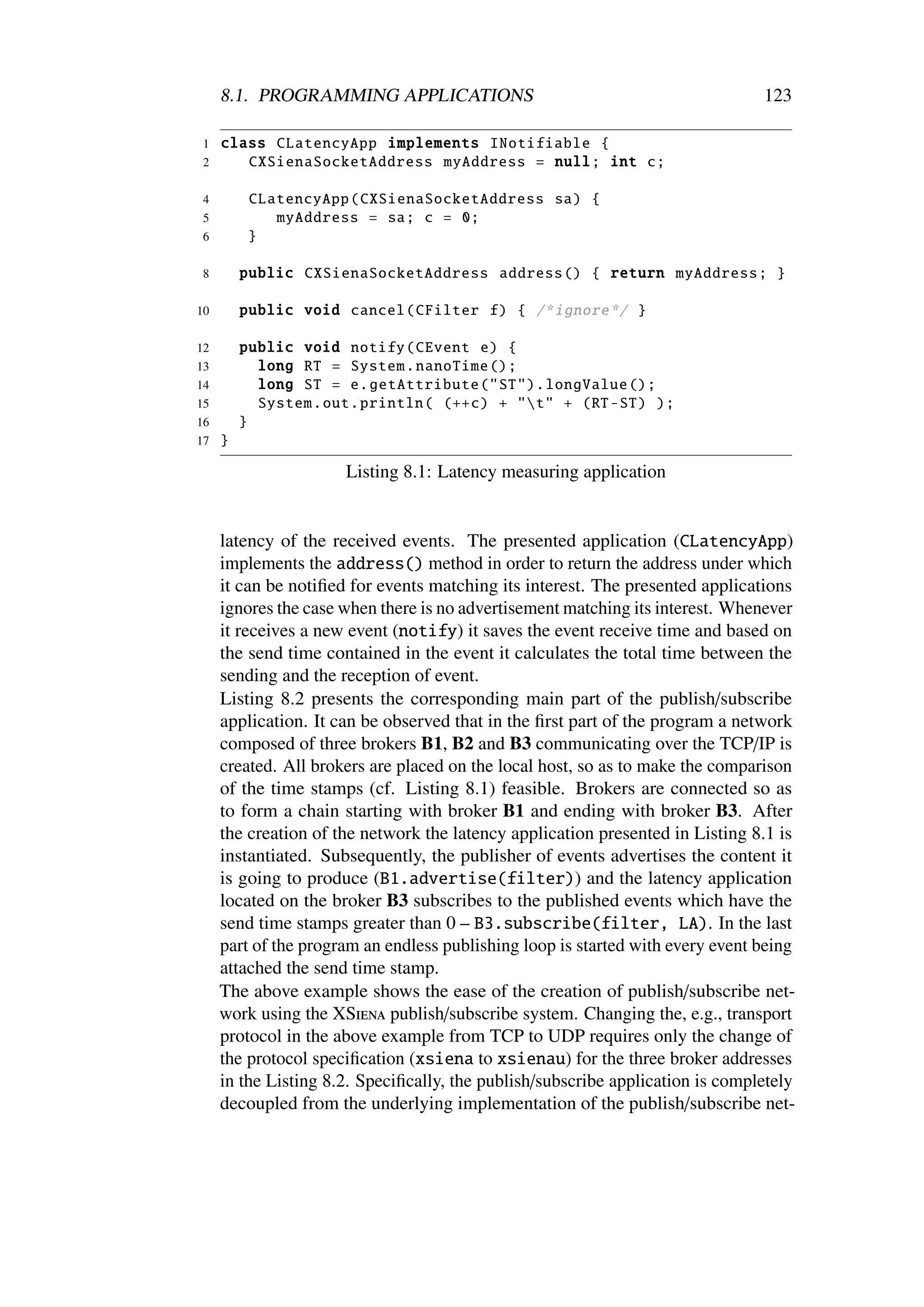
Message Oriented Middleware (MOM) [BCSS99]. Figure 1.1 outlines the
decoupling properties and their adoption in different systems.


1.2     Publish/Subscribe Paradigm
Decoupling in space, time and synchronization has been unified for the first
time in the publish/subscribe paradigm [EFGK03] – see Figure 1.1. Pub-
lish/subscribe paradigm allows for strictly decoupled communication between
publishers (content producers) and subscribers (content consumers).
The first system to adopt the publish/subscribe paradigm was the Informa-
tion Bus [OPSS93]. The Information Bus system, similar in concept to the
generative communication model of tuple spaces, implemented a topic-based
publish/subscribe paradigm. The Information Bus and other topic-based pub-
lish/subscribe systems [SB89, AEM99, SM02, BEG04, BBQ+ 07] provide
self-describing objects combined with anonymous communication. Shortly
after the introduction of the topic-based publish/subscribe systems the increas-
ing need for heterogeneity and expressiveness has lead to the introduction of
the content-based [RW97] and type-based [Eug07] publish/subscribe systems.
The publish/subscribe interaction paradigm naturally implements the con-
cepts behind the Content Centric Networking. The decoupling properties
unified within the publish/subscribe paradigm provide a loosely coupled form
of interaction required in large scale dynamic distributed systems [Que07].
Consequently, the publish/subscribe paradigm has experienced a widespread
adoption in the distributed systems community, becoming an active field of
research. The decoupled communication and resulting reconfigurability and
scalability have given rise to multiple implementations of the publish/sub-
scribe paradigm, which are used by many applications [Jac03, ZSB04, PC05b,
MSSB07, Tar08b] and standards [SM02, Gro04].


1.3     Contribution
In this thesis it is argued that design of the content-based publish/subscribe
systems should follow the principles of the end-to-end argument [SRC84]
in that the content-based matching functionality should be moved from the
content-based network into the publish/subscribe application layer.
The case for the above argument is made by describing the design, implementa-
tion and evaluation of the family of content-based systems called XSiena. The
XSiena publish/subscribe system is the first system to provide a unified solution
to the content-based routing at the edge of the content-based network. The
approach proposed in this thesis substantially differs from the previous work
1.4. OUTLINE                                                                5

in that domain by allowing for semantically unrestricted content-based routing
with the support for decoupling of the content-based network components in
the domains of time, space and synchronization.
The main contributions of this thesis with respect to the development of the
XSiena content-based systems family include:
Prefix-based Forwarding The development and implementation of algorithms
     allowing to abstract the result of the content-based matching at the ap-
     plication level. The result can be subsequently encoded within prefixes
     attached to messages. The prefix is the only part of the message which
     needs to be evaluated by a content-based system for the routing purposes.
     It is also shown how to achieve consistency between routing structures
     in a distributed system.
Bloom filter-based Routing It is shown how to use Bloom filters [Blo70]
     to develop a fixed size digest of a content-based event matching re-
     sult. Bloom filter-based routing, similarly to prefix-based forwarding
     performs the content-based matching only once per message, in the
     application layer. The proposed matching algorithm is linear with the
     number of filters matching a given event, regardless of the total number
     of filters in the system.
Moreover, within this thesis it also shown how to solve practical problems
in the domain of large scale distributed systems using content-based XSiena
system as their communication backbone. These problems are especially
challenging, due to the decoupled nature of the content-based systems:
Fail-Awareness The fail-aware XSiena system presents, based on the Timed
      Asynchronous Distributed System Model [CF99], a practical approach to
      detection of timely message delivery in content-based publish/subscribe
      systems. The detection of timely message delivery is performed without
      the need to introduce expensive clock synchronization mechanisms. To
      the best of our knowledge, the fail-aware XSiena system is the first
      system to offer a lightweight and fully decoupled content-based routing
      substrate which can be used in soft real-time applications.
Soft State It is shown how the fail-aware XSiena system can be success-
      fully used to cope with the timing and causality issues often found in
      large scale distributed systems. Specifically, soft state XSiena system
      demonstrates how to remove hard state from the content-based network,
      allowing it to easily recover from transient links and node failures.


1.4     Outline
The remainder of this thesis is organized as follows: Chapter 2 combines
the presentation of the related work in the area of the content-based systems
6                                           CHAPTER 1. INTRODUCTION

with the introduction of the basic terminology used in this thesis. The discus-
sion focuses on the types of architectures and associated routing strategies
used in content-based publish/subscribe systems along with the semantics and
representation of the information being exchanged.
Chapter 3 (based on [JFF07, JFF08]) presents the system model for the XSiena
family of content-based systems. The system model describes the assumptions
being made about the properties of processes, communication channels and
possible failures. Chapter 3 presents also the semantics of the XSiena family of
content-based systems to form a foundation upon which the following chapters
are built.
Chapter 4 (based on [JFF07]) presents the algorithms which encode the re-
sults of the application-level content-based matching within the prefix trees.
Chapter 4 discusses the benefits of the prefix trees when compared to tra-
ditional content-based publish/subscribe systems and their influence on the
content-based information forwarding. Moreover, the discussion focuses on
the challenges related to the prefix trees, especially regarding the consistency
of the distributed prefix trees in the context of the asynchronous updates.
Chapter 5 (based on [JF08b, JF08a, FBFJ]) presents algorithms allowing to
construct fixed-size digests of the results of the content-based matching. Specif-
ically, chapter 5 addresses the problem of the usage of Bloom-filters as a
compact representation of the results of the content-based matching. Chapter 5
presents also routing algorithms taking advantage of the Bloom filter-based
content representation allowing for significant improvement in the routing
speed.
Chapter 6 (based on [JFF07]) presents the design and implementation of
the fail-aware content-based system. The fail-awareness property allows the
system to calculate an upper bound on the propagation delay of messages.
The upper bound can be used to determine whether a message received at the
destination node is late or not. Chapter 6 argues that the fail-aware extension
to the XSiena content-based system allows to use content-based networks in
lightweight, soft real-time applications.
Chapter 7 applies the results presented in Chapter 6 to construct a soft state
XSiena system. It is shown how the construction of the soft state content-based
network allows to eliminate the need to store hard state in the nodes which
have not created it. Specifically, it is shown how the soft state design allows
the system to cope with the timing issues and transient node and link failures.
Chapter 9 presents the evaluation of the algorithms and architectures presented
in Chapters 4, 5, 6 and 7. Chapter 9 specifically focuses (Chapters 4 and
5) on the micro-benchmarks for the performance of the routing algorithms.
Moreover, results obtained in the PlanetLab [Ros05] environment (Wide Area
Networks), which highlight the specific issues discussed in Chapters 6 and 7
are presented.
Chapter 10 concludes this thesis and provides the outlook for the XSiena family
1.4. OUTLINE                                  7

of content-based publish/subscribe systems.
8   CHAPTER 1. INTRODUCTION
Chapter 2

Background

This chapter presents an overview of recent research activities related to the
publish/subscribe systems. It describes the basic components and concepts
related to the publish/subscribe systems, along with the types and seman-
tics of messages, followed by the description of common publish/subscribe
architectures and corresponding data routing models.
This chapter introduces the basic concepts and terms related to the publish/sub-
scribe systems and content-centric networking so as to provide the necessary
background for the remainder of this thesis. The discussion within this chapter
is not limited to content-based publish/subscribe systems, however it primarily
focuses on the architectures which are relevant to the XSiena system.


2.1     Components
This section discusses the basic publish/subscribe components and their inter-
actions. The component model is to a large extent independent of the specific
variant of the publish/subscribe system.


2.1.1    Applications
The goal of publish/subscribe systems is to allow for a decoupled communi-
cation between the users of the system. In a typical scenario [Pie04, MFP06,
FBFJ], the publish/subscribe system itself is a layer used by other applica-
tions to exchange data – see Figure 2.1. Applications use publish/subscribe
system to both consume and produce (publish) content. Applications consum-
ing content are called subscribers, while applications producing content are
called publishers. Application are not limited to either one or another role
– it is common that a single application plays the role of both publisher and
subscriber.
The content production and consumption is asynchronous in that an applica-
tion can immediately continue the execution after dispatching the data to the

                                       9
10                                           CHAPTER 2. BACKGROUND


          Figure 2.1: Components of the publish/subscribe system

publish/subscribe system. Similarly, for the content consumption, application
is informed about new data via asynchronous upcall from the publish/sub-
scribe layer. The asynchronous content production and consumption allows
the applications to remain decoupled with respect to time – applications can
produce content for which there are no consumers yet. Similarly, applications
consuming data can receive content for which the producing applications have
already left the system or have crashed.
Applications, unless explicitly instrumented, remain anonymous to each other.
This implies that content consumers are not aware about the origin of the con-
tent they receive via the asynchronous upcall. Similarly, the content producers
are not aware of the potential consumers of the content they publish. The
underlying publish/subscribe system transparently connects content producers
and consumers without revealing their identities. The decoupled properties
of the publish/subscribe system imply that most applications are message-
based [EFGK03, Pie04].
The above principles allow publish/subscribe systems to host multiple dis-
tributed application types, including financial services [OPSS93], mobile
computing [Tar08b], real-time systems [Bar07, DXGE07], industrial automa-
tion [Jac03], scientific computation [SL07], content distribution [CLS03] and
many more [ZSB04, PC05b, MSSB07].


2.1.2    Subscribers
Applications willing to receive content play the role of subscribers. A sub-
scribing application usually plays the role of the observer (observer design
pattern [GHJV95]) by implementing an upcall provided by the publish/sub-
scribe layer. The main task of the upcall is to asynchronously deliver messages
matching the interest of the subscriber. Upcalls are usually provided in form
2.1. COMPONENTS                                                                11

1    // subscriber interface
2    interface Subscriber extends Deliverable {
3        void subscribe ( Interest i);
4        void unsubscribe ( Interest i);
5        void notify ( Message m);
6    }

 8   // upcall interface
 9   interface Deliverable {
10       void deliver ( Message m);
11   }

                         Listing 2.1: An abstract subscriber API

1    // publisher interface
2    interface Publisher {
3        void publish ( Message m);
4    }

                         Listing 2.2: An abstract publisher API


     of interfaces or abstract classes – Listing 2.1 shows the Deliverable upcall
     interface.
     In order to be able to receive data every subscribing application must be able to
     express its interest. Application express their interest using a method provided
     by the publish/subscribe layer. Listing 2.1 presents the subscribe method
     which can be used by the application to specify the content of interest. It is
     common for the subscribe method to take the Deliverable upcall interface
     as parameter [CRW01, EFGK03, PEKS07].
     Subscribers are stateful in that they need to manage the interest they use to
     describe the content of interest. Therefore, subscribers not interested in a given
     content anymore can use the unsubscribe method to express the removal
     of their interest – the parameter to the unsubscribe method. Subscribers
     leaving the publish/subscribe system should unsubscribe to all previously
     issued interest.


     2.1.3    Publishers
     Content producers in publish/subscribe systems take the role of publish-
     ers. Similarly to subscribes the content is produced in form of messages,
     which are published into the publish/subscribe layer. Publishers are typically
     lightweight, stateless entities as they usually do not receive any messages
     from the publish/subscribe layer. Listing 2.2 shows a typical publisher inter-
                       ¨
     face [CRW01, M02, PEKS07]. Content, in form of messages, is published
     using the publish method call. Stateless publishers, in contrast to stateful
12                                               CHAPTER 2. BACKGROUND

subscribers, imply cheap departures and arrivals as no additional actions need
to be taken upon occurrence of such event.


2.1.4     Brokers
Brokers form the backbone of the publish/subscribe system. Depending on
the system type and architecture their number and interconnections can vary.
Applications are decoupled from the actual brokers and their structure by the
publisher and subscriber interfaces. The number of brokers can range from
a single one in case of centralized systems [SA97] to multiple in case of dis-
tributed infrastructures [CRW01, Pie04]. Multiple brokers can be arranged
into different architectures, most common being: bus [OPSS93], hierarchi-
                                     ¨
cal [CRW01, CDNF01], acyclic [M02, FJLM05, Tar08b], cyclic [LMJ08] and
peer-to-peer [CDKR02, Pie04, VRKvS06].


2.2      Messages
This section discusses how subscribers express their interest and how publishers
disseminate the content in the publish/subscribe networks. Specifically, in
the remainder of this thesis it is assumed that all communication between the
components of the publish/subscribe system is carried out using messages.


2.2.1     Filters
In order to receive content applications have to express their interest. In
publish/subscribe systems interest is described using filters. A filter f is a
function which evaluated for its argument (content) returns the value of either
true (one) or false (zero):
                                 f : C → {0, 1}                           (2.1)
where C is the domain of the filter function f representing all content for
which f can be evaluated. A filter returning true implies that the content for
which it was evaluated matches the interest of the filter issuer. Zero is returned
otherwise. The exact definition of the matching process depends on the type of
filters and content used in the publish/subscribe system. The specific discussion
regarding the matching process is deferred to the later part of this thesis – see
Section 2.3.
The selectiveness of filter functions is bounded by two extremities: a filter f∅
which never selects any published content and filter f∞ which always selects
all published content. It is worth noting that some publish/subscribe systems,
e.g. [CRW01], do not provide the possibility to express f∞ . Subscriber issuing
multiple filters f1 , f2 , . . . , fn creates a union between the interests described by
the filters: f1 ∪ f2 ∪ . . . ∪ fn .
2.2. MESSAGES                                                                     13

In publish/subscribe systems filters describing the subscriber’s interest are
propagated in form of subscription messages. Subscription messages are
issued by the subscribers using the subscribe method. Subscription messages
encapsulate filters and contain additional implementation specific meta-data.
A subscriber wishing to revoke his interest issues an unsubscription message
using the unsubscribe method (see Section 2.1.2) which contains a filter
describing his disinterest.

2.2.2     Events
Content in publish/subscribe systems is published in form of events. Despite
recent efforts [CABB04, WJLS04, WJL04, FCMB06], in most of the pub-
lish/subscribe systems [CRW01, Pie04, Tar07] filters must match events as
far as syntax and semantics is concerned for the data exchange to take place.
Using Equation 2.1 it can be said that events must form the domain C of the
corresponding filter function f .
The goal of the publish/subscribe backbone is to deliver content to the interested
applications. This implies that subscribers must be notified about events
matching their filters. Event e is delivered (deliver(e, S) = true) to subscriber
S if and only if any of the filters FS = { f1 , . . . , fn } issued by the subscriber S
matches event e:

                  deliver(e, S) = true     ⇔     ∃ f ∈FS : f (e) = 1            (2.2)

In publish/subscribe systems events are propagated in form of publication
messages. Publication messages are issued using the publish method – see
Section 2.1.3.

2.2.3     Advertisements
Advertisements are filters which can be optionally [PEKS07] used by publish-
ers to summarize events they are going to produce in the future. Advertisements
play the role of additional constraints which need to be satisfied in order to
deliver events to the applications. An advertisement a is a function which
evaluated for its argument returns the value of either true (one) or false (zero):

                                   a : C → {0, 1}                               (2.3)

where C is the domain of the advertisement a representing all content for which
a can be evaluated. Similarly to filters, the selectiveness of the advertisement
function is bounded by two extremities: an advertisement a∅ which never
matches any published events and advertisement a∞ which always matches
all published events. Publisher issuing multiple advertisements a1 , a2 , . . . , an
creates a union between the events described by the advertisements: a1 ∪ a2 ∪
. . . ∪ an .
14                                                CHAPTER 2. BACKGROUND

1    // extended publisher interface
2    interface Publisher {
3        void publish ( Event e);
4        void advertise ( Advertisement a);
5        void unadvertise ( Advertisement a);
6    }

 8 // subscriber interface
 9 interface Subscriber extends Deliverable {
10     void subscribe ( Filter f);
11     void unsubscribe ( Filter f);
12     void notify ( Event e);
13 }

15   // upcall interface
16   interface Deliverable {
17       void deliver ( Event e);
18   }

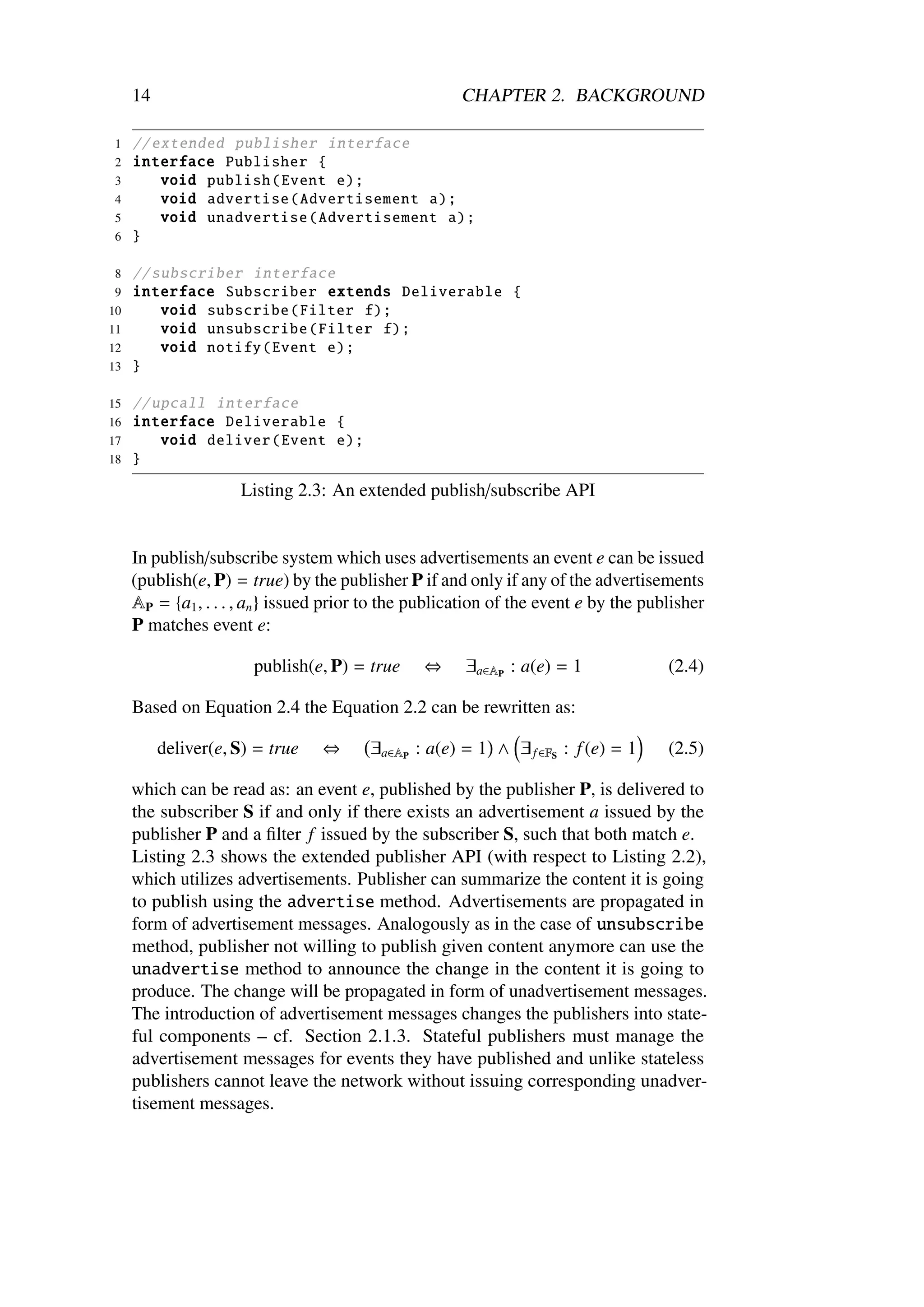
                     Listing 2.3: An extended publish/subscribe API


     In publish/subscribe system which uses advertisements an event e can be issued
     (publish(e, P) = true) by the publisher P if and only if any of the advertisements
     AP = {a1 , . . . , an } issued prior to the publication of the event e by the publisher
     P matches event e:

                       publish(e, P) = true      ⇔     ∃a∈AP : a(e) = 1               (2.4)

     Based on Equation 2.4 the Equation 2.2 can be rewritten as:

          deliver(e, S) = true    ⇔      ∃a∈AP : a(e) = 1 ∧ ∃ f ∈FS : f (e) = 1       (2.5)

     which can be read as: an event e, published by the publisher P, is delivered to
     the subscriber S if and only if there exists an advertisement a issued by the
     publisher P and a filter f issued by the subscriber S, such that both match e.
     Listing 2.3 shows the extended publisher API (with respect to Listing 2.2),
     which utilizes advertisements. Publisher can summarize the content it is going
     to publish using the advertise method. Advertisements are propagated in
     form of advertisement messages. Analogously as in the case of unsubscribe
     method, publisher not willing to publish given content anymore can use the
     unadvertise method to announce the change in the content it is going to
     produce. The change will be propagated in form of unadvertisement messages.
     The introduction of advertisement messages changes the publishers into state-
     ful components – cf. Section 2.1.3. Stateful publishers must manage the
     advertisement messages for events they have published and unlike stateless
     publishers cannot leave the network without issuing corresponding unadver-
     tisement messages.
2.3. SYNTAX AND SEMANTICS                                                    15

2.3        Syntax and Semantics
The actual semantics of events, filters, and advertisements depends on the
specific implementation of the publish/subscribe system. One of the aspects
with the strongest influence on the syntax and semantics of events and fil-
ters in publish/subscribe systems is the type of the publish/subscribe system
itself – whether it is topic-based [OPSS93], content-based [CRW01] or type-
based [Eug07]. Moreover, the type of the broker architecture and the domain
in which the publish/subscribe system should operate determine the semantics
and syntax of messages. This section outlines the most common variants of
the semantics of the publish/subscribe systems.


2.3.1      Topic-Based
Topic-based semantics (also known as subject-based) has its origins in the
group communication systems [Pow96]. It structures the event space by divid-
ing it into flat [OPSS93, CDKR02, BBQ+ 07, MZV07] or hierarchical [BEG04]
topics.
A flat topic structure implies that subscriptions must specify an identifier
describing a given topic [CDKR02]. In most cases such identifier would be
a string literal identifying, e.g., the name of the software package to which
updates user wants to subscribe [MZV07].
Hierarchical topics, on the other hand, naturally represent the tree-like arrange-
ments of nested objects, terms or concepts. An example hierarchical topic
might have the following structure: /Hardware/Memory Structures/Design
Styles/Cache Memories – which would indicate the B.3.2 Cache Mem-
ories term in the ACM Computing Classification System1 . In a topic based
publish/subscribe system, every publication dealing with Cache Memories
would be published under this topic. Publishing under the given topic usu-
ally implies attachment of the topic or its identifier to every publication – for
examples see [CDKR02] or [Que07].
Topic-based semantics, has obvious limitations, especially with respect to the
selectiveness of the topics. A publication matching multiple topics needs to be
published multiple times, which for a broad spectrum of publications might
cause severe link congestions, as multiple copies of the same message need to
be sent over the same link – see also Section 1.
The limitations of the topic-based representation has led to the development of
the content-based filters and events. The following sections present the two
most common content-based semantics: predicate-based and XML-based.

   1
       See: http://www.acm.org/about/class/1998/
16                                                  CHAPTER 2. BACKGROUND

2.3.2    Predicate-Based
Predicate-based semantic is one of the most popular among the content-based
                                          ¨
publish/subscribe systems [CRW01, M02, Pie04, ZSB04, FJLM05, TK06,
CH06, TB07]. The predicate-based semantics states that a filter f is a conjunc-
tion of n predicates:
                             f = {p1 ∧ . . . ∧ pn }                      (2.6)
where predicate pi is a function which evaluates to either true (one) or false
(zero) for a given argument.
In predicate-based semantics, an event e is defined as a set (disjunction) of n
values:
                              e = {v1 ∨ . . . ∨ vn }                     (2.7)
where a value v is an argument to the predicate function p.
Using predicate-based semantics filter f matches event e if and only if:

                    f (e) = 1     ⇔     ∀ pi ∈ f ∃vi ∈e : pi (vi ) = 1     (2.8)

In most predicate-based semantics filters (with notable exception of [CRW01])
are identical to advertisements. Following this convention advertisement a can
be defined as a conjunction of n predicates:

                                a = {p1 ∧ . . . ∧ pn }                     (2.9)

An advertisement a matches event e if and only if:

                    a(e) = 1      ⇔     ∀ pi ∈a ∃vi ∈e : pi (vi ) = 1     (2.10)

A predicate p is usually defined [CRW01, MFP06] as being composed of
attribute name an and attribute constraint ac. Attribute constraint ac itself is
composed of operator op and attribute value av:
                                              
                                              
                             p = an, (op, av)
                                              
                                                                         (2.11)
                                  
                                              
                                               
                                  
                                  
                                              
                                               
                                               
                                               ac

An example predicate p might have the following syntax p = (temp, >, 25).
In general, different content-based publish/subscribe systems use different
possible attribute names and attribute constraints when using predicate-based
message semantics. Those systems vary therefore in terms of expressiveness
and complexity of the content-based filters and events they use.
Similarly to predicates, event values v are defined as attribute name an and
attribute value av pairs:
                                 v = (an, av)                           (2.12)
An example attribute value v matching the above example predicate p =
(temp, >, 25) would have the following syntax v = (temp, 30). It is important to
2.3. SYNTAX AND SEMANTICS                                                   17

                     Filter f         Event e            f (e) = 1
                     {y < 8}          {y = 8}              false
                     {x = ∗}          {x = 7}              true
                     {x > 5}          {x = 7}              true
                     {x > 5}          {x = 7; y = 10}      true
                     {x > 5; y < 8}   {x = 7}              false
                     {x > 5; y < 8}   {x = 7; y = 5}       true

              Table 2.1: Filters and events in predicate-based semantics


    note that attribute names and attribute values used in events must semantically
    match the attribute names and attribute constraints used in filters.
    Table 2.1 shows example filters and events in a predicate-based semantics.
    The notation used in Table 2.1 and throughout the remainder of this thesis
    shorthands the predicate notation for the sake of brevity. Moreover, the con-
    junction between the predicates is implicit and denoted via the semicolon sign.
    Predicate x = ∗ matches every attribute name and attribute value pair where
    attribute name equals x.
    In case of the events, the predicate syntax is omitted and implicit disjunction
    denoted by the semicolon sign is used instead. Table 2.1 illustrates also the
    result of the content-based match between the filter f and event e. The result
    of the content-based match f (e) remains unchanged if advertisements identical
    to filters in Table 2.1 are used instead. The reader is referred to [MFP06] for a
    more thorough overview of most commonly used attribute names and attribute
    constraints types.


    2.3.3    XML-Based
    Another popular content-based semantics is based on the eXtended Markup
    Language (XML) [BPSMY06]. Content-based systems using XML-based
    semantics [SCG01, CF04, DRF04] construct events as XML documents. Such
    systems usually rely on the subset of XPath [DeR99] or XQuery [BFS07]
    query processor syntax in order to specify filters.
1   msg/nitf
2         [head/ pubdata
3            [ @edition .area = "SF"]]

                 Listing 2.4: Example XQuery-based filter [DRF04]

    Listing 2.4 shows an example of the XQuery filter which selects documents
    having a root element nitf with a child element head, which itself contains
18                                             CHAPTER 2. BACKGROUND

     child element pubdata whose attribute @edition.area has the value SF.
     Listing 2.5 shows an example XML document matching the above query.
1    <?xml version ="1.0"?>
2    <! DOCTYPE nitf SYSTEM "nitf -3 -2. dtd">
3    <nitf >
4    <head >
 5       <pubdata type="web" edition .area="SF" />
 6   </head >
 7   <body >
 8       <body. content >
 9           <p>Content !</p>
10       </body. content >
11   </body >
12   </nitf >

                            Listing 2.5: Example XML event

     Due to potentially large size of documents and very high complexity of the
     query expressions the XML-based matching of events and filters is resource
     intensive and there exists substantial body of work which aims at optimizing
     this process, including, but not limited to: XFilter [AF00], XTrie [CFGR02]
     and YFilter [DF03] XML query processors.


     2.3.4    Other Approaches
     Previous sections have presented publish/subscribe message semantics which
     were implicitly stateless. A stateless semantics implies that filters are evaluated
     for each event separately and there exists no dependency between subsequent
     events. Such approach, however, is not always sufficient especially if more
     complex filtering expressions are required.
     One of the first approaches to use complex expressions in content-based pub-
     lish/subscribe systems were patterns introduced in the Siena system [CRW01].
     A pattern in the Siena system is a sequence of filters which are applied to the
     ordered sequence of events.
     A significantly more complex form of filtering expressions was proposed
     in the Cayuga system [DGH+ 06, DGP+ 07], where filters (similarly to the
     YFilter [DF03] approach) are based on nondeterministic finite state automata
     with additional possibility of parametrization and aggregation.
     A sample Cayuga filter might read: For any stock (stk) there is a monotonic
     decrease in price for at least 10 minutes (dur = 10), which starts at the volume
     vol > 10000. The following quote on stk should have a price 5% higher than
     the last seen one (prc > 1.05· minPrc). Figure 2.2 shows the automaton which
     implements the above filter.
2.4. ARCHITECTURES                                                          19


         Figure 2.2: Nondeterministic finite state automaton [DF03]

2.4     Architectures
Previous sections have considered only single components of content-based sys-
tems. Applications (Section 2.1.1) play the roles of publishers (Section 2.1.3)
and subscribers (Section 2.1.2) in order to publish content in form of publica-
tion messages (Section 2.2.2) and subscribe to content using subscription mes-
sages (Section 2.2.1). The fabric which connects the publishers and subscribers
are the brokers (Section 2.1.4), which themselves can be interconnected cre-
ating various architectural patterns. In this section the most popular broker
patterns and their influence on the way the information is being exchanged
in publish/subscribe systems are described. Architectures described in the
following sections are usually constructed as an overlay on top of the physical
connections.


2.4.1    Bus
The bus architecture (see Figure 2.3) was one of the first ones to be proposed in
context of the publish/subscribe systems [OPSS93]. Bus architecture assumes
that all brokers share the same communication medium, implying that all
messages are seen by all brokers. Bus architecture effectively implements
a broadcast system for filters, events, and advertisements. Bus architecture
assumes that brokers are connected so that there exist no cycles in the network.
Bus architecture, although very simple, is simultaneously the most infrequent
used one, as the broadcasting of messages to all brokers implies a very high
overhead on the system and is usually not practical in its straightforward
20                                             CHAPTER 2. BACKGROUND


            Figure 2.3: Brokers connected into a bus architecture

implementation.


2.4.2    Hierarchical
A hierarchical approach proposed in Siena [CRW01] and JEDI [CDNF01]
publish/subscribe systems assumes the existence of broker network connected
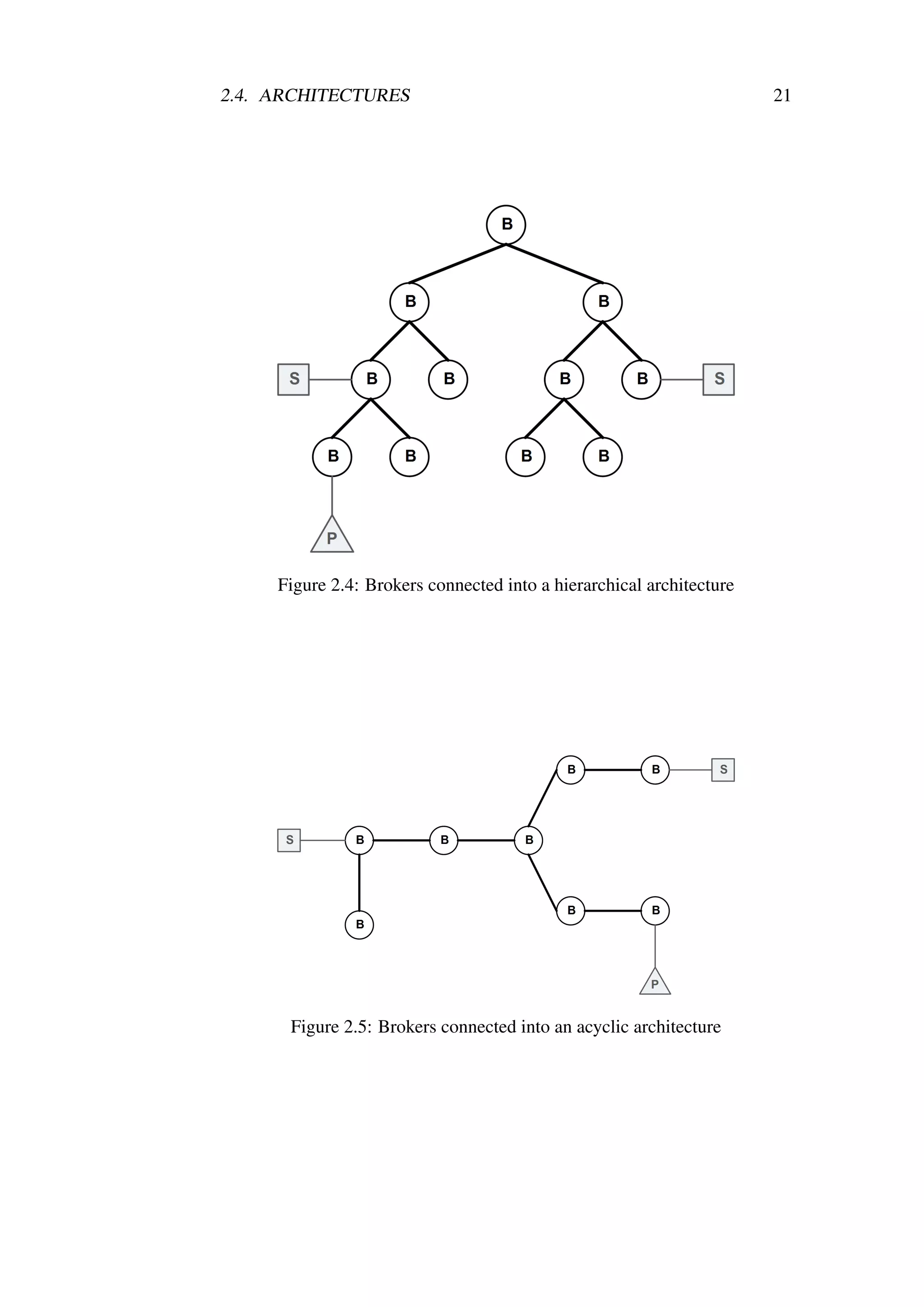
so as to form a k-ary tree – see Figure 2.4. The broker being root of the tree is
responsible for forwarding all traffic from the left-hand side of the tree to the
right-hand side of the tree. Every broker (except for the root) in hierarchical
architecture is connected to k child brokers and one parent broker.
One of the main drawbacks of the hierarchical architecture is the fact that the
higher the given broker is placed in the hierarchy the more load it has to cope
with. This implies that the root node is prone to become overloaded, which is
especially crucial if one considers that it is a single point of failure which can
partition the whole system in two halves.


2.4.3    Acyclic
Acyclic architecture is one of the most commonly used abstraction for build-
                                                            ¨
ing of publish/subscribe systems [OAA+ 00, CRW01, M02, CF04, CMPC04,
FJLM05, Jer05, CP06, BH06, TK06, Eug07, JF08a]. Acyclic architecture
differs from the hierarchical architecture (see Section 2.4.2) in that there is
no explicit hierarchy maintained by the brokers. Specifically, every broker
maintains a list of k peers without a distinct parent node – see Figure 2.5. This,
in turn, implies that there is no root broker which has to handle most of the
traffic. Acyclic architecture is therefore preferred to the hierarchical one, as
the message flow is generally better (more fair) distributed across the nodes.
Acyclic architecture, similarly to the hierarchical architecture, partitions if any
single broker or link fails.
2.4. ARCHITECTURES                                                    21


     Figure 2.4: Brokers connected into a hierarchical architecture


      Figure 2.5: Brokers connected into an acyclic architecture
22                                             CHAPTER 2. BACKGROUND


        Figure 2.6: Brokers connected into a general cyclic architecture

2.4.4     Cyclic
The cyclic architecture (also known as mesh) is the most general interconnec-
tion type for brokers in content-based systems. Cyclic architecture is conceptu-
ally most similar to the abstraction provided by the TCP/IP networking where
most of the nodes can talk directly to most of the other nodes in the system –
see Figure 2.6. Cyclic networks introduce link redundancy, which implies that
link or node failures do not necessarily result in the partitioning of the network,
as alternative routes can be used to reach the same destination. However, the
cyclic architecture also poses challenges as far avoidance of infinite message
loops is concerned. This is especially difficult in publish/subscribe systems,
since brokers are usually aware only of the immediate neighbor nodes – see
Section 1.1.
In general, systems which implicitly or explicitly work at the level of cyclic
architectures [PCM03, LMJ08] dynamically construct a spanning tree, e.g.,
using the reverse path forwarding method [DM78], which prevents the occur-
rence of cycles [PCM03] by reducing the cyclic case to the acyclic one.


2.5      Routing
The goal of the routing is to deliver publication messages produced at the
publishers to the interested subscribers via a network of brokers. This section
discusses the most popular routing strategies used in publish/subscribe systems
and their variants depending on the types and semantics of messages used.
The discussion will focus on the acyclic broker architecture – it is assumed
that in the case of a cyclic architecture an acyclic overlay is constructed
(see Section 2.4.4) – an assumption frequently made in the context of the
publish/subscribe systems [CRW01, MFP06, TK06]. For the discussion of
algorithms dealing with the hierarchical architectures the reader is referred
2.5. ROUTING                                                                   23


                Figure 2.7: Event flooding in a broker overlay


to [CRW01] and [CDNF01].


2.5.1    Event Flooding
                                 ¨
The event flooding strategy [M02] (also known as broadcast) implies that every
event message produced by every publisher is delivered to every subscriber,
and thus effectively to every application. It is then up to the applications to
filter out the events which are of no relevance to them. The event flooding
approach is the simplest routing strategy (it is stateless in that it uses neither
advertisements nor filters) among all routing strategies and can be trivially
implemented in all architectures except the acyclic one.
When event flooding routing strategy is used broker B receiving an event e
forwards it on all its outgoing interfaces with the exception of the interface on
which the event has arrived – see Figures 2.7 and 2.9(a). It can be formally
said that the set of interfaces Ie→ on which event e needs to be forwarded is
given as:
                                Ie→ = IB  {I←e }                          (2.13)

where IB is the set of all interfaces of the broker B and I←e is the interface on
which event e arrived.
Event flooding algorithm, although very simple, is not practical as in large
deployments the cost of delivery of every message to every node, event not
interested in the specific kind of information is prohibitive.
24                                           CHAPTER 2. BACKGROUND


             Figure 2.8: Group-based routing in a broker overlay

2.5.2    Group-Based Routing
Group-based routing [RHKS01, BEG04, Gro04] is an approach which can
be used to limit the flooding of events used in the event flooding routing
scheme. Group-based routing collects all subscribers sharing the same interest
into groups for which multicast techniques are used to disseminate events.
Figure 2.8 shows the group routing strategy in a network of brokers. It can be
observed that publisher P publishes events directly to the broker B4 which is
the head of the group which distributes the event to both interested subscribers
S1 and S2
One of the multicast approaches often considered in context of the group-
based routing is the IP multicast [DC90]. The group based approach has
the advantage (in comparison to the event flooding strategy) of reducing the
number of false positives in the publish/subscribe system. A false positive
occurs when subscriber receives event which is of no interest to him. By
grouping subscribers and delivering related events only to the interested groups
the false positives ratio is reduced to zero.
The group-based approach is however difficult to implement and maintain,
especially in the environments with large number of subscribers. Having a
set of S subscribers group-based approach implies the need to construct 2|S|
groups (the worst case) to satisfy the interests of all subscribers. Moreover,
an algorithm which would try to limit the number of groups by maximizing
they overlap and reducing the number of messages needed is known to be
NP-complete [AGK+ 01].
Therefore several approaches have appeared which try to overcome the above
2.5. ROUTING                                                                    25


               (a) event flooding                   (b) simple routing

           Figure 2.9: Event flooding and simple routing strategies

issue by using either probabilistic methods [EG02] or heuristics for the con-
struction of groups [OAA+ 00, RLW+ 02]. However, most of the recent al-
gorithms substitute the notion of groups with dynamic filtering in overlay
topologies.


2.5.3    Simple Routing
In simple routing (see, e.g., [BCM+ 99]) the propagation of events is restricted
by the propagation of filters. Subscribers issue subscription messages contain-
ing filters which are broadcast into the network of brokers. Upon reception
of a filter f every broker: (1) forwards it on all outgoing interfaces, with the
exception of the interface on which the filter f arrived and (2) stores the filter f
in its routing state. Figure 2.9(b) shows the propagation of the filter f , arriving
at the interface number 1 of the broker B. The simple routing algorithm results
in creation of the filter spanning trees rooted at the subscriber issuing the given
filter.

Filter Routing
In simple routing strategy every broker maintains the routing state associated
with the filters. The routing state in the brokers is usually called the routing
table and contains all filters issued by subscribers which were not unsubscribed.
Figure 2.9(b) illustrates the routing table of the broker B which contains one
entry, stating that the filter f has arrived on the interface number 1 and was
forwarded on the interfaces number 2, 3 and 4. By analogy to the Equation 2.13
one can say that the set of interfaces I f → on which filter f needs to be forwarded
is given as:
                                  I f → = IB  I← f                           (2.14)
where I← f is the interface on which filter f arrived.
26                                            CHAPTER 2. BACKGROUND

Event Forwarding

The routing tables stored in the brokers are used for the forwarding of events.
An event e arriving at the broker B and matching filter f (the exact definition
of the match depends on the semantics used – see, e.g., the Equation 2.8) is
forwarded on the reverse path of the filter f . Figure 2.9(b) shows event e being
forwarded on the interface 1 on which previously a matching filter f arrived.
Formally speaking, it can said that the set of interfaces Ie→ on which event e
has to be forwarded by a given broker B is given as a sum of all interfaces on
which filters matching event e arrived minus the source interface I←e of the
event e:
               Ie→ = I← f | f ∈ FB ∧ f (e) = 1 ∧ I← f I←e                 (2.15)
where FB represents all unsubscribed filters seen by the broker B. FB can be
also seen as a set of all filters stored in the routing table of the broker B.
Intuitively, the Equation 2.15 implies that events are forwarded along the
branches of the filter spanning tree until they reach the subscriber at its root.
The propagation of filters to every broker in the publish/subscribe networks
ensures that there exists at least one broker in the whole publish/subscribe
network which can correlate the interest of subscribers with the events of
the publisher, regardless of the publisher’s location in the publish/subscribe
network.
Figure 2.10 shows the routing of subscription messages and events in the simple
routing scheme. It can be observed that both filters issued by the subscribers
S1 and S2 and disseminated into the whole network – Figure 2.10(a). A
subsequently issued event, matching both filters, is delivered on the reverse
paths of the subscription messages to both subscribers – Figure 2.10(b).


Unsubscribing

Subscribers which are not interested in a given content anymore issue un-
subscription messages to inform the publish/subscribe system about that fact.
The process of the unsubscription of the filter f by the broker B in case of
simple routing consists of two phases: (1) the forwarding of the unsubscription
message containing the filter f and (2) the removal of the filter f from the
routing table of the broker B.
The process of forwarding of the unsubscription message containing the filter
f is identical to that of subscription messages:

                              Iunsub = IB  I← f
                               f→                                        (2.16)

The removal of the filter f from the routing table of the broker B, requires
broker B to be able to determine which filter in its routing table is identical
with the filter f .
2.5. ROUTING                                                27


                         (a) routing of filters


                       (b) forwarding of events

          Figure 2.10: Simple routing in a broker overlay
28                                                       CHAPTER 2. BACKGROUND

The checking if two filters are identical is specific to the assumed filter seman-
tics. A general definition says that two filters f and g are identical if they select
                            ¨
the same sets of events [M02]:
                                 f ≡g        ⇔       E f ≡ Eg                          (2.17)
where E f and Eg are the sets of events selected by filters f and g, respectively.
In the context of the predicate-based semantics it is said that two filters f and
g are identical f ≡ g if and only if:
       f ≡g      ⇔       ∀ p f ∈ f ∃ pg ∈g : p f ≡ pg ∧ ∀ pg ∈g ∃ p f ∈ f : p f ≡ pg   (2.18)
where p f and pg are predicates belonging to filters f and g, respectively. Two
predicates p f and pg are identical p f ≡ pg if and only if:
              p f ≡ pg      ⇔      an f ≡ ang ∧ op f ≡ opg ∧ av f ≡ avg                (2.19)
where an f , op f and av f are attribute name, operator and attribute value of the
filter f – see Section 2.3.2.
The filter g which needs to be removed (using the remove(g) operation) from
the routing table of the broker B upon the reception of the unsubscription
message containing filter f is therefore given as:
                remove(g)          ⇔      g ∈ FB ∧ g ≡ f ∧ I←g ≡ I← f                  (2.20)
where the term I←g ≡ I← f guarantees that in case of multiple filters equal to
filter f stored at the broker B only the one which arrived on the same interface
as the unsubscription message containing filter f (I← f ) is erased.

Dynamic Overlay Management
So far only cases when the set of the interfaces IB of the broker B was stable
have been considered. However in publish/subscribe systems brokers or sub-
scribers often depart and new brokers and subscribers often join the overlay
network. A departure of a broker implies that the interface on which it was
connected to its neighbors is removed. The arrival of a new broker results in a
new interface being added to the set of interfaces I on all of its new neighbors.
When one of the interfaces Ii is removed from the set of interfaces of the
broker B, the routing table of the broker B needs to be updated accordingly.
The update process requires that every filter f , stored in the routing table of
the broker B, which arrived on the removed interface Ii is usubscribed (and
therefore removed – see Equations 2.16 and 2.20) from the routing table of the
broker B.
The addition of a new interface Ii requires the broker B to propagate all filters
in its routing table on the new interface:
                                  ∀ f ∈FB : I f → ← Ii                                 (2.21)
2.5. ROUTING                                                                    29


        (a) advertisement and subscription        (b) event forwarding
            routing

                   Figure 2.11: Identity-based routing strategy

2.5.4     Identity-Based Routing
Using Equation 2.18 the routing of filters can be optimized in that identical
filters are not propagated on the same interface. Such routing strategy is called
                             ¨
identity-based routing [M02, MFP06]. The basic idea of the identity-based
routing relies on the fact that identical filters forwarded on the same interface
are idempotent with respect to the routing tables of the downstream brokers.
Figure 2.11(a) shows the process of the routing of two filters f 1 and f 2. Filter
 f 1 was the first one to arrive at the broker B and since it was the first filter to
be seen by B it was forwarded on all outgoing interfaces. Subsequent arrival
of the filter f 2 identical to f 1 ( f 1 ≡ f 2) results in filter f 2 being propagated
only on the interface 1 as this is the only interface on which the identical filter
 f 1 was not forwarded yet. It can be observed that identity-based routing has
prevented the propagation of the filter f 2 on two interfaces: 3 and 4. It is also
worth noting that the third filter f 3 identical to f 1 and f 2 ( f 1 ≡ f 2 ≡ f 3)
arriving at interface 4 or 3 will not be propagated further by the broker B at all,
as there is no interface on broker B which would not have either the filter f 1
or f 2 already propagated on it. Such filter would only be stored in the routing
table of the broker B.

Filter Routing
It can be formally said that in identity-based routing filter f arriving at broker
B is propagated on all interfaces with the exception of its source interface I← f
and interfaces on which filters identical to f were already propagated:

                  I f → = IB  I← f     Ig→   | g ∈ FB ∧ g ≡ f              (2.22)

where Ig→ is a set of all interfaces on which filter g was forwarded.
A filter f received by the broker B is dropped (using the drop( f ) operation) if
and only if a filter g identical to f was previously delivered to the broker B on
30                                             CHAPTER 2. BACKGROUND

the same interface on which filter f arrived:
                  drop( f )    ⇔   ∃g∈FB : g ≡ f ∧ I←g ≡ I← f              (2.23)
A filter f being dropped is neither forwarded nor stored in the routing table of
the broker B.

Event Forwarding
Figure 2.11(b) illustrates the process of event forwarding when identity-based
routing is used. It can be observed that event e which matches filter f 1 (and
thus filter f 2 as well, since f 1 ≡ f 2) is forwarded on the reverse path of
both matching filters. Therefore, one can conclude that the event forwarding
process when the identity-based routing strategy is used is identical with the
one presented in Equation 2.15.
Figure 2.12 shows the process of identity-based routing in a broker overlay.
It can be observed that subscribers S1 and S2 subscribe using two identical
filters – Figure 2.12(a). Therefore, the propagation of the filter issued by the
subscriber S1 (first filter) reaches all brokers in the publish/subscribe network.
The subsequent filter issued by the S2 is propagated only on the directed paths
not traversed by the identical filter previously issued by the subscriber S1.
The propagation of events (Figure 2.12(b)) is analogous to that of the simple
routing – see Figure 2.10(b).

Unsubscribing
The process of unsubscribing a filter is more complex than in the case of simple
routing. One needs to consider that the propagation of the filter f 2 on interfaces
3 and 4 (see Figure 2.11(a)) was prevented by the previous propagation of the
filter f 1 on those interfaces. However, upon the unsubscription of the filter f 1,
filter f 2 should be propagated on the interfaces 3 and 4.
Therefore, the process of the unsubscription of a given filter f performed by
the broker B consists of three phases: (1) propagation of the unsubscription
message containing the filter f , (2) propagation of the subscription messages
containing filters identical to f which were not propagated due to the presence
of f and (3) removal of f from the routing table of the broker B.
The propagation of the unsubscription message containing the filter f is per-
formed for a set of interfaces containing all interfaces on which identical filters
arriving from the same source interface were forwarded:
                Iunsub = Ig→
                 f→            |   g ∈ FB ∧ g ≡ f ∧ I←g ≡ I← f             (2.24)
The propagation of the subscription messages containing filters identical to f
which were not propagated due to the presence of f requires the broker B to
remove all filters equal to the unsubscribed filter f from its routing table:
                remove(g)      ⇔    g ∈ FB ∧ g ≡ f ∧ I←g     I← f          (2.25)
2.5. ROUTING                                                      31


                           (a) routing of filters


                         (b) forwarding of events

        Figure 2.12: Identity-based routing in a broker overlay
32                                                 CHAPTER 2. BACKGROUND


      Figure 2.13: Unsubscription using identity based routing strategy


and resubscribe the removed filters again. Filters need to be removed from the
routing table of the broker B in order not to get dropped at the resubscription
attempt – see Equation 2.23.
As an example let us consider the Figure 2.13, which shows broker B after
four subscription messages with identical filters f 1, f 2, f 3 and f 4 ( f 1 ≡ f 2 ≡
 f 3 ≡ f 4) have been received. Through inspection of the routing table it can be
concluded that the filter f 1 was subscribed to as the first one, subsequently filter
 f 2 was subscribed with filters f 3 and f 4 subscribed to as the last ones. The
second routing table shows the state of the broker B after the unsubscription
message for the filter f 1 arrived at the interface 1. It can be observed that filter
 f 1 was removed from the broker’s B routing table. Subsequently, filters f 2,
 f 3 and f 4 were resubscribed to by the broker B. The filter f 2 was the first one
to be resubscribed to, followed by the filters f 3 and f 4. It is worth noting that
the order of the filter resubscription is irrelevant.


Dynamic Overlay Management

When one of the interfaces Ii is removed from the set of interfaces of the broker
B, the routing table of the broker B needs to be updated accordingly – every
filter f stored in the routing table of the broker B which arrived on the removed
interface Ii needs to be usubscribed (see Equations 2.24 and 2.25) from the
routing table of the broker B.
The addition of a new interface Ii requires the broker B to propagate all filters
in its routing table on the new interface, under the assumption that no filter
identical to the one to be propagated on the interface Ii has already been
propagated on the added interface Ii :


              ∀ f ∈FB forward( f ) = Ii ⇔   g∈FB   : g ≡ f ∧ Ii ∈ Ig→        (2.26)
2.5. ROUTING                                                                       33

2.5.5    Coverage-Based Routing
                                                   ¨
Many existing publish/subscribe systems [M02, BCV03, CRW04, LHJ05,
TK06, BFG07, BBQV07, JF08a, LMJ08] use the notion of coverage to op-
timize the routing of subscription messages. Coverage (first introduced in
context of publish/subscribe systems in [CRW01]) is a binary relation between
filters. Intuitively, it can be said that filter f covers filter g ( f g) if filter f
matches the superset of events matched by the filter g:

                                 f     g       ⇔           E f ⊇ Eg             (2.27)

According to the above definition if filter f is identical to filter g, than filter f
covers filter g and vice versa:

                            f ≡g           ⇒       f        g∧ f      g         (2.28)

The coverage relation is:

    • reflexive: g      f always holds

    • antisymmetric: f          g∧ f       g ⇒ f ≡g

    • transitive: h    g∧g           f ⇒ h             f

However, the coverage relation is not total (∃ f,g : f        g∧ f     g), which
implies that coverage relation creates a partial order for all filters.
Coverage relation is often used in the predicate-based semantics – however, ge-
ometrical applications are also common [RLW+ 02, WQV+ 04, BFG07]. Using
predicate-based semantics one can say that filter f covers filter g if and only if:

                       f    g        ⇔     ∀ p f ∈ f ∃ pg ∈g : p f        pg    (2.29)

which can be read as: for every predicate p f in covering filter f there exists a
predicate pg in covered filter g such that predicate p f covers pg . Predicate p f
covers predicate pg if and only if:

                      pf    pg       ⇔         an f ≡ ang ∧ ac f          acg   (2.30)

The exact semantics of the attribute constraint coverage (ac f acg ) depend
on the operators and values used for the specific implementation. The reader
is referred to [MFP06] for an overview of simple attribute constraints and
their coverage relations. Intuitively, an attribute constraint ac f covers attribute
constraint acg if attribute constraint ac f selects a superset of attribute values
selected by attribute constraint acg .
Table 2.2 illustrates example coverage relations in predicate-based semantics
(cf. Table 2.1) between two filters f and g.
34                                               CHAPTER 2. BACKGROUND

                Filter f          Filter g           f    g   f       g
                {y < 8}           {y < 8}             true     true
                {x > 5}           {y > 5}            false    false
                {x > 5}           {x > 8}             true    false
                {x > 5}           {x > 8; y > 5}      true    false
                {x > 5; y > 5}    {x > 8}            false    false
                {x    5}          {x > 8}             true    false
                {x    5}          {x = 5}            false    false
                {x > 5}           {x < 8}            false    false
                {x ≥ 5}           {x > 5}             true    false

  Table 2.2: Coverage relation between filters in predicate-based semantics

Filter Routing
Following the intuition behind the coverage relation of two filters, it can be
stated (similarly as in the case of filter identity) that the propagation of a filter g
on the interface I is not necessary if there exists filter f previously propagated
on the interface I, which covers g. Filter f selects a superset of events selected
by filter g (see Equation 2.27) and therefore the propagation of filter g will not
influence the behavior of the downstream brokers in any way.
The usage of coverage to limit the propagation of filters allows to reduce the
load on both the network and the brokers in the publish/subscribe system. It
can be formally said that in coverage-based routing a filter f arriving at the
broker B on interface I← f is propagated on all interfaces with the exception
of its source interface and interfaces on which filters covering filter f were
already propagated:

         forward( f ) = IB  I← f      Ig→    | g ∈ FB ∧ g       f           (2.31)

A filter f received by the broker B is dropped (neither forwarded nor stored in
the routing table of the broker B) if and only if a filter g covering filter f was
previously delivered to the broker B on the same interface on which filter f
arrived:
                  drop( f ) ⇔ ∃g∈FB : g f ∧ I←g ≡ I← f                     (2.32)

Event Forwarding
Event forwarding in coverage-based routing is similar to that of the identity-
based routing – see Section 2.5.4. Formally speaking, the set of interfaces on
which event e has to be forwarded by a given broker B is given as a sum of all
2.5. ROUTING                                                                      35

interfaces on which filters matching event e arrived minus the source interface
I←e of the event e:

               Ie→ = I← f      |       f ∈ FB ∧ f (e) = 1 ∧ I← f       I←e     (2.33)

The process of the coverage-based routing in a broker overlay is identical with
the one demonstrated in the Figure 2.12. The only difference is that instead
of strict filter identity between the filters issued by the subscriber S1 and S2 a
coverage relation will now suffice.

Unsubscribing
Similarly as in the case of the identity-based routing the process of the un-
subscription of a given filter f performed by the broker B consists of three
phases: (1) propagation of the unsubscription message containing the filter f ,
(2) propagation of the subscription messages containing filters covered by the
filter f which were not propagated due to the presence of f and (3) removal of
 f from the routing table of the broker B.
The propagation of the unsubscription message containing filter f is performed
for a set of interfaces on which identical filters arriving from the same source
interface were forwarded:

                Iunsub = Ig→
                 f→                |    g ∈ FB ∧ g ≡ f ∧ I←g ≡ I← f            (2.34)

The propagation of the subscription messages containing filters covered by
 f which were not propagated due to the presence of f requires the broker B
to remove all filters covered by the unsubscribed filter f from the broker B’s
routing table:

                remove(g)          ⇔      g ∈ FB ∧ g         f ∧ I←g   I← f    (2.35)

and resubscribe the removed filters again. Filters need to be removed from the
routing table of the broker B in order not to get dropped at the resubscription
attempt – see Equation 2.32.

Dynamic Overlay Management
The removal of the interface Ii from the routing table of the broker B results in
every filter f stored in the routing table of the broker B which arrived on the
removed interface Ii being usubscribed – see Equations 2.34 and 2.35.
The addition of a new interface Ii results in the propagation of all filters in the
routing table of the broker B on the new interface. The filters are propagated
stepwise, under the assumption that no filter covering the one to be currently
propagated on the interface Ii has already been propagated there:

              ∀ f ∈FB forward( f ) = Ii ⇔        g∈FB   :g      f ∧ Ii ∈ Ig→   (2.36)
36                                              CHAPTER 2. BACKGROUND


              Figure 2.14: Partially ordered set (poset) [CRW01]


Routing Table Implementations

Coverage-based routing algorithms imply that the implementation of the rout-
ing tables can exploit the coverage relation in order to increase the speed of
event forwarding, especially in comparison to naive approaches. The first
such design of the routing table was proposed in the context of the Siena
system [CRW01].
The Siena routing table is called poset – a name derived from the partial order
property of the coverage relation. Poset contains all filters which arrive at the
broker and are not dropped – cf. Equation 2.32. In poset filters are arranged
according to their coverage relation – the most general filters, i.e., not covered
by any other filter, are placed as the root of the structure. Figure 2.14 shows a
poset structure holding eleven filters ( f 1, . . . , f 11). Each filter is denoted its
name and the interface number on which it arrived. It can be observed that
the most general filter with attribute name x ({x = ∗}) which arrived on the
interface 1 ( f 1/1) covers a more specific filter {x < 8} which arrived on the
interface 2 ( f 2/2). Entries in the poset structure which have no parent are
called root filters.
The matching of events is excelled in that every event needs only to be checked
against the set of the root filters in order to determine whether any of the filters
stored in the poset matches a given event. In case of a match the matching
procedure uses breadth first search to traverse the children of the root filter in
order to find all, more specific filters matching the given event.
The insertion of a new filter f is performed by computing a set of predecessors
and a set of successors of the filter f . The set of predecessors contains all
filters in the poset which cover the filter f , while the set of successors contains
all filters in the poset which are covered by the filter f . In the last step of
the insertion process filter f is inserted into poset as a parent of all filters in
the successor set and a child of all filters in the predecessor set. The removal
process is analogous.
Authors in [TK06] proposed an optimized version of the poset, called poset-
2.5. ROUTING                                                                  37


                   Figure 2.15: Poset-derived forest [TK06]

derived forest. The development of the poset derived forest was motivated by
a set of observations regarding the properties of the poset structure:

   1. for any filter f in the poset P there exists no such filter g, such that g is
      covered by f and filter g arrived on the same interface as f :

                         ∀ f ∈P   g∈P   :   f   g ∧ I← f ≡ I←g             (2.37)

   2. every poset has the maximum depth of |IB |, where |IB | is the amount of
      interfaces on the poset managing broker B

   3. only root elements and their direct successors (children) have a non-
      empty set of interfaces on which they were forwarded I f → ∅

The above properties allow to reduce the computational cost of the maintenance
of the routing table structure as well as increase the speed of event matching.
The resulting data structure, containing all filters from the poset in Figure 2.14,
is illustrated in Figure 2.15. It can be observed that the poset-derived forest
maintains the tree property in that every filter has at most one covering filter.
This implies that the poset-derived forest layout is influenced by the temporal
order of the filter arrival. Moreover, the implementation may contain a virtual
root node which connects all root filters – a convenience element. The poset-
derived forest data structure was further refined in [Tar07], in that links between
different poset-derived forests were proposed to accelerate the process of the
calculation of a set of covered and covering filters.
Another data structure, based on the counting algorithm [YGM94, PFLS00,
FJL+ 01] was proposed in [CW03]. Authors concentrated on improving the
speed of event forwarding as the cost of the filter routing speed. The pro-
posed algorithm partitions filters into separate predicates and subsequently into
attribute names and attribute constraints.
Figure 2.16 illustrates the data structure based on the counting algorithm,
which contains filters identical to those stored in the poset (Figure 2.14) and
38                                             CHAPTER 2. BACKGROUND


                    Figure 2.16: Forwarding table [CW03]


               Figure 2.17: Perfect and imperfect filter merging


poset-derived forest (Figure 2.15) data structures. Predicates are arranged
as inputs to the logical AND gates which control the triggering of the filters.
Filters, in turn, are inputs to the logical OR gates which control the triggering
of the interfaces. An incoming event e is decomposed into attribute name and
attribute value pairs which are subsequently used to trigger the predicates. A
predicate is triggered if it matches the attribute name and attribute value pair.
Triggered predicates propagate to filters and filters propagate to interfaces on
which a given event should be forwarded.
The above counting (the number of inputs to trigger the AND gate) algorithm
outperforms both poset and poset-derived forest data structures. However, the
insertion of new filters as well as removal of the old ones from the forwarding
table data structure is more expensive than in case of the former data structures.
Another drawback of the counting algorithm is the fact that it is stateful with
respect to subsequent event matches – the counters used for the logical AND
gates need to be reset prior to the matching of a new event.
2.5. ROUTING                                                                  39


                 (a) first filter           (b) second filter merging with the
                                              first one

                Figure 2.18: Filter routing using filter merging


Authors in [MFB02, CBGM03, TK05, Tar08a] propose the notion of filter
merging to reduce the number of filters transmitted and stored in the routing
tables of the brokers. The idea of filter merging is based on the fact that two
or more different filters can be combined so as to be represented by only one
filter. Figure 2.17 shows examples of filter merging: filters f 1 and f 2 form a
perfect merger f 5, whilst filters f 3 and f 4 form an imperfect merger f 6.

Imperfect merging is an alternative to perfect merging, especially in situations
where perfect merging is either too complex or difficult to compute [MFP06]
– optimal merging of filters has been shown to be NP-hard [CBGM03]. The
main drawback of the imperfect filter merging is the increased possibility of
false positives. A false positive can be defined in this context as an event
which has been delivered to the subscriber S or the broker B, for which there
exists no active subscription in that subscriber or broker. Occurrence of false
positives is especially troublesome as filter merging is often used to reduce the
number of the root filters in the routing tables of the brokers. The reader is
referred to [MFP06, Tar08a] for an overview of algorithms for filter merging
and routing using filter merging.

Figure 2.18 shows the routing of filters if filter merging is enabled at the routing
broker B. The arrival of the first filter f 1 (Figure 2.18(a)) and its propagation
is identical as in case of identity-based routing (Section 2.5.4), or coverage-
based routing (Section 2.5.5). However, the arrival of the second filter f 2
which can be merged with the filter f 1 results in the propagation of the merger
 f 1 ∪ f 2 of both filters f 1 and f 2. The merger of both filters will remove
the previously propagated filter f 1 from the routing tables of the downstream
brokers (interfaces 2, 3 and 4) – see Equation 2.37.
40                                                    CHAPTER 2. BACKGROUND


        (a) advertisement and subscription                (b) event forwarding
            routing

               Figure 2.19: Advertisement-based routing strategy

2.5.6     Advertisement-Based Routing
Section 2.2.3 discusses the role of the advertisements from the perspective of
the content publishers. Authors in [CRW01] propose to use advertisements to
optimize the routing of subscriptions. The intuition behind the advertisement-
based approach is that advertisements can influence the propagation of filters
so that they are routed by the brokers of the publish/subscribe system only in
the direction of the publishers which will produce content matching the filters.
Figure 2.19 shows the basic principles behind the advertisement-based rout-
ing. Broker B receives an advertisement filter a (contained in advertisement
message) on the interface 3 – see Figure 2.19(a). After forwarding of the
advertisement a and storing it in the advertisement routing table, a filter f
arrives on the interface 1. Upon the arrival of the filter f broker B determines
whether events matching advertisement a will also match filter f . If broker B
determines that such events might exist, it forwards the filter f on the reverse
path of the advertisement a and stores the filter f in the filter routing table.
Otherwise, the filter f is dropped.
Subsequent events (see Figure 2.19(a)) matching filter f and advertisement
a are (analogously to the coverage-based routing) forwarded on the reverse
path of the matching filter f . In order to determine whether events matching
advertisement a will also match filter f broker B calculates a binary intersection
(overlap [MFP06]) relation between advertisement a and filter f .
Intuitively, advertisement a intersects filter f if there exists at least one event
which is selected by both advertisement a and filter f :

                              f      a       ⇔ E f ∩ Ea     ∅                    (2.38)

where Ea is a set of events selected by advertisement a.
Formally it can be said that filter f intersects advertisement a if and only if:

                             ∃ p f ∈ f ∃ pa ∈a   :   pf     pa                   (2.39)
2.5. ROUTING                                                                      41

                         Filter f       Advertisement a      f   a
                         {y < 8}        {y < 8}               true
                         {x > 5}        {y > 5}              false
                         {x > 5}        {x < 8}               true
                         {x > 5}        {x < 8; y > 5}        true
                         {x    5}       {x < 8}               true
                         {x    5}       {x = 5}              false
                         {x ≥ 5}        {x > 5}               true

Table 2.3: Intersection relation between filters in advertisement-based seman-
tics

which can be read as: there exists a predicate p f in filter f such that there
exists a predicate pa in advertisement a such that predicate p f intersects pa .
Predicate p f intersects predicate pa if and only if:
                    pf        pa    ⇔       an f ≡ ana ∧ ac f    aca          (2.40)
The exact semantics of the attribute constraint intersection (ac f aca ) depend
on the operators and values used for the specific implementation. The reader
is referred to [MFP06, JF07] for an overview of simple attribute constraints
in context of the intersection relation. Intuitively, an attribute constraint ac f
intersects attribute constraint aca if attribute constraint ac f selects at least one
attribute value selected by attribute constraint aca . Table 2.3 gives an overview
of filter and advertisement intersection relation.

Advertisement Routing
The advertisement routing in advertisement-based semantics is identical to
the routing of filters in coverage-based semantics. The intuition behind this
reasoning is the fact that advertisements and filters are semantically identical.
Advertisements, similarly to filters use coverage relation to limit their propaga-
tion. An advertisement a arriving at the broker B on interface I←a is propagated
on all interfaces with the exception of its source interface and interfaces on
which advertisements covering advertisement a were already propagated:
                   Ia→ = (IB  {I←a })  {Ib→ | b ∈ FB ∧ b           a}       (2.41)
An advertisement a received by the broker B is dropped (neither forwarded
nor stored in the advertisement routing table of the broker B) if and only if
an advertisement b covering advertisement a was previously delivered to the
broker B on the same interface on which advertisement a arrived:
                   drop(a)          ⇔     ∃b∈FB : b      a ∧ I←b ≡ I←a        (2.42)
42                                                  CHAPTER 2. BACKGROUND

The arrival of the new advertisement a at the broker B results in the forwarding
of filters which intersect the advertisement a on the source interface I←a of the
advertisement a. The filters are forwarded stepwise, under the assumption that
no filter covering the one to be currently propagated on the interface I←a has
already been propagated on the interface I←a :

  ∀ f ∈FB forward( f ) = I←a ⇔       g∈FB   :g     f ∧ I←a ∈ Ib→ ∧ a         f    (2.43)

Filter Routing
Filter routing in advertisement-based routing is influenced by both advertise-
ments and covering filters. A filter f arriving at the broker B on interface I← f
is propagated only on interfaces on which an intersecting advertisement has
arrived (with the exception of the source interface of filter f ) minus interfaces
on which filters covering filter f were already propagated:

             I f → = {I←a | a    f }  I← f       Ig→ | g ∈ FB ∧ g      f        (2.44)

A filter f received by the broker B is dropped if and only if a filter g covering
filter f was previously delivered to the broker B on the same interface on which
filter f arrived or there exists no advertisement matching filter f which arrived
on interface other than the source interface of the filter f :

 drop( f )   ⇔      ∃g∈FB : g     f ∧ I←g ≡ I← f ∨         a∈AB   :a    f ∧ I←a   I← f
                                                                                  (2.45)
where AB is a set of valid advertisements received by the broker B.

Event Forwarding
Event forwarding in advertisement-based routing is similar to that of the
identity-based routing – see Equation 2.33. The only difference being that
brokers might enforce the advertisements with respect to the published event
– an event e can be dropped by a broker B if there exists no advertisement
matching event e and received by the broker on the same interface as event e
(regardless of the filters stored in the broker B):

                   a∈AB   : a(e) = 1 ∧ I←a ≡ I←e       ⇒      drop(e)             (2.46)

Figure 2.20 shows the process of advertisement-based routing in a broker over-
lay. First, an advertisement is issued by the publisher P and propagated into the
network of brokers. Subsequently, subscriber S1 issues a matching filter which
is propagated on the reverse path of the advertisement towards the publisher
P. Specifically, unlike in case of the simple-, identity-, and coverage-based
routing (cf. Sections: 2.5.3, 2.5.4 and 2.5.5), filter is not broadcast into the net-
work. The subscription message issued by the subscriber S2 does not contain a
2.5. ROUTING                                                        43


                  (a) routing of advertisements and filters


                         (b) forwarding of events

     Figure 2.20: Advertisement-based routing in a broker overlay
44                                               CHAPTER 2. BACKGROUND

filter matching the previously issued advertisement and is therefore dropped by
the first broker (B8) it encounters – see Figure 2.20(a). Publication message
issued by the publisher P is forwarded towards the interested subscriber S1 on
the reverse path of the matching filter.

Unadvertising
Publishers willing to stop publishing content must cancel the advertisement
message containing the filter which describes the content for which the publi-
cation process is being stopped. The process of unadvertising an advertisement
a by the broker B consists of five steps: (1) propagation of the unadvertisement
message containing the advertisement a, (2) propagation of the advertisement
messages containing advertisements covered by the advertisement a which
were not propagated due to the presence of a, (3) removal of the advertisement
a from the routing table of the broker B, (4) removal of the I←a interface from
the set of interfaces I f → for filters for which no intersecting advertisement
(after removal of a) on interface I←a exists and (5) unsubscription of filters for
which no intersecting advertisement exists in the advertisement routing table
of the broker B.
The propagation of the unadvertisement message containing advertisement a
is performed for a set of interfaces containing all interfaces on which identical
advertisements arriving from the same source interface were forwarded:

       forwardunadv (a) = {Ib→      |   b ∈ AB ∧ b ≡ a ∧ I←b ≡ I←a }        (2.47)

The propagation of the advertisement messages containing filters covered by a
which were not propagated due to the presence of a requires the broker B to
remove all advertisements covered by the unadvertised advertisement a from
its routing table:

                  remove(b)     ⇔       b ∈ AB ∧ b       a ∧ I←b    I←a     (2.48)

and readvertise the removed advertisements again. Advertisements need to be
removed from the routing table of the broker B in order not to get dropped at
the readvertisement attempt – see Equation 2.42.
The removal of the advertisement a source interface I←a from the set of inter-
faces I f → for filters for which no intersecting advertisement (after removal of
a) on interface I←a exists allows broker B to avoid propagation of events for
which the matching filter has been removed in a downstream broker (due to
step 5):

        ∀ f ∈FB    b∈Ab   : f   b ∧ I←b ≡ I←a        ⇒     I f →  {I←a }   (2.49)

Unsubscription of filters for which no intersecting advertisement, after the
removal of the advertisement a, exists in the advertisement routing table of
2.5. ROUTING                                                                 45

1    public class RoutingTable {
2       // data containers
3       private FilterContainer filters ;
4       private FilterContainer advertisements ;

6        // public API
7        void publish ( Event e, SocketAddress src);
 8       void subscribe ( Filter f, SocketAddress src);
 9       void unsubscribe ( Filter f, SocketAddress src);
10       void advertise ( Filter f, SocketAddress src);
11       void unadvertise ( Filter f, SocketAddress src);
12   }

                    Listing 2.6: Example routing table API [JF08a]


     the broker B can be directly derived from Equation 2.45. It is important to
     note that the intersecting advertisement needs to originate from the different
     interface than the filter in question:

                  ∀ f ∈FB   b∈AB   :b   f ∧ I←b   I← f   ⇒   unsub( f )        (2.50)

     Unsubscribing
     The process of the unsubscription of the filter f by the broker B is identical
     as in the case of the coverage-based routing and consists of three phases:
     (1) propagation of the unsubscription message containing the filter f – see
     Equation 2.34, (2) propagation of the subscription messages containing filters
     covered by the filter f which were not propagated due to the presence of f –
     see Equation 2.35 and (3) removal of f from the routing table of the broker B –
     see Equation 2.32.

     Routing Table Implementations
     The implementation of the advertisement routing tables is usually identical to
     that of the filter routing tables, due to the fact that both filters and advertise-
     ments share the same semantics – with the exception of the model introduced
     in [CRW01]. The functionality of the advertisement routing tables needs
     however to be extended in order to support the routing of filters based on the
     intersection relation. Typically, implementations [JF08a, Tar08b] decouple
     the intersection and coverage relation calculation from the routing process
     providing separate binary methods which can be easily integrated into the
     routing table implementation.
     Listing 2.6 shows a generic routing table API. It can be observed that both
     filters and advertisements share the same data model represented by the class
     Filter. Similarly, the actual containers storing the filters and advertisements
     share the same interface. The routing table presented in the Listing 2.6 is
46                                            CHAPTER 2. BACKGROUND

coupled with the network layer of the publish/subscribe system implementation.
The methods presented in Listing 2.6 directly invoke the network layer methods
to route advertisements and filters and to forward events.

Dynamic Overlay Management
The removal of the interface Ii from the routing table of the broker B results in
every advertisement a stored in the routing table of the broker B which arrived
on the removed interface Ii being unadvertised – see Equations 2.47 and 2.48
and discussion regarding the following unsubscription of filters.
The addition of a new interface Ii results in the propagation of all advertise-
ments in the routing table of the broker B on the new interface. The advertise-
ments are propagated stepwise, under the assumption that no advertisement
covering the one to be currently propagated on the interface Ii has already been
propagated on the interface Ii :

              ∀a∈AB forward(a) = Ii ⇔     b∈AB   :b   a ∧ Ii ∈ Ib→        (2.51)

No filters are propagated on the newly added Ii interface, as there are no new
advertisements which arrived on that interface yet.

Subscription-Based versus Advertisement-Based Routing
Advertisement-based routing and subscription-based routing are both correct
and efficient routing strategies for publish/subscribe systems. It is up to the
developer of the publish/subscribe system to choose which routing strategy
to use. The choice of the routing strategy is determined by two basic factors:
the amount of different filters issued by the subscribers of the system and the
scope of publishers’ publications. The amount of different filters issued by the
subscribers translates directly to the amount of different subscription messages
propagated into the system. This in turn is driven by the: (1) scope of the
interest of the subscribers, (2) the frequency with which subscribers change
their scope of interest and (optionally, depending on the routing strategy used)
(3) coverage, identity or merging possibilities for different filters issued by the
subscribers.
The number of subscription messages can be reduced when advertisement
messages are propagated into the system and thus drive the routing of sub-
scription messages. However, the number of the advertisement messages
depends, similarly as in the case of the subscription messages, on: (1) the
scope of the events published by every publisher, (2) the frequency with which
every publishers changes the scope of published events (unadvertisement of
the old scope and advertisement of the new one) and (3) the possibility to
limit the propagation of advertisements using identity, coverage or merging
routing strategies. Moreover, the propagation of subscription messages in
2.5. ROUTING                                                                47

advertisement-based semantics depends on the extent of intersection between
the published advertisements and filters.
Using a very simple model based on the simple routing with advertisements,
and assuming that the interest of subscribers and content published by pub-
lishers remain static over time, allows us to make a basic comparison between
the number of subscription messages in the simple routing model and simple
routing model with advertisements.
Using only subscriptions one can calculate the total number of subscription
messages sent in the system composed of N brokers and |S| subscribers as:
                                  i=|S|       
                                              
                                         |FSi | − 1                    (2.52)
                                 
                                 N
                                              
                                               
                                 
                                 
                                              
                                               
                                               
                                   i=1


where the term i=|S| |FSi | denotes the total number of filters issued by all
                    i=1
subscribers in the system. It is assumed that subscribers and publishers are
physically collocated with the brokers and that the brokers form a spanning
tree – acyclic architecture.
The worst case number of subscription messages issued when simple routing
strategy with advertisement is used is given by:
                                 
                           i=|S| 
                                                           
                                                           
                  diam(N)         f ∈ FSi | ∃ i=|P| : a f           (2.53)
                                 
                                                          
                                                           
                                 
                                             a∈    AP
                                                    i
                                                           
                                                           
                          i=1                 i=1


where diam(N) is the diameter of the graph formed by the acyclic overlay of
the brokers, |P| is the total number of publishers in the system and i=|P| APi
                                                                     i=1
is the set of all advertisements in the system. For a fair comparison with
the subscription-based simple routing strategy the above value must be incre-
mented with the total number of advertisement messages sent in the system:
                                 i=|P|       
                                             
                                        |APi | − 1                   (2.54)
                                
                                N
                                             
                                              
                                
                                
                                             
                                              
                                              
                                   i=1

From the above, very simple case, it can be concluded that the comparison
of the routing strategies is very difficult as there exist many factors which
have a great influence on the message overhead and which can be only eval-
uated during the run time of the system. This is one of the motivations for
systems like [SMRP08] to propose hybrid routing algorithms which can be
adapted during runtime to dynamically optimize the cost of the routing in the
publish/subscribe systems.
Another issue which needs to be considered is the delay [BBPV05] introduced
by the advertisement messages. In subscription-based routing as soon as a
subscription message driven path from the subscriber to the publisher is estab-
lished the subscriber can receive publication messages. In advertisement-based
48                                            CHAPTER 2. BACKGROUND

routing an additional delay has to be considered, as first advertisement mes-
sages need to be propagated into the network (similarly to the subscription
messages in the subscription-based routing) and only subsequently the prop-
agation of subscription messages which establish the publisher–subscriber
path can commence. Depending on the advertisements and filters present in
the network this delay can range from one hop delay (intersecting filters are
already present at the broker connecting the publisher) to the diam(N) hops
delay if the subscription messages could not be propagated into the network
at all due to the lack of advertisements intersecting the filters carried by the
subscription messages.


2.5.7    Peer-to-Peer Routing
All subscription-based routing strategies are based on the assumption that
dissemination of subscription messages to all nodes in the publish/subscribe
network ensures that a publication message encounters a node which con-
tains branches of all filter trees of interested subscribers. In other words – the
meeting of a publication and subscription message is guaranteed by propa-
gating subscription messages to all nodes in the system. Similarly, in case of
advertisement-based routing schemes advertisements take the role of subscrip-
tions which are disseminated to all nodes of the network.
The peer-to-peer routing strategy takes a different approach towards the publi-
cation and subscription messages meeting problem. In peer-to-peer routing the
address of the meeting node is calculated before sending of publication and
subscription messages. The calculation of addresses ensures that events and
filters which match given events arrive at the same meeting node, also called
rendez-vous node – the concept first introduced in [BFC93]. The rendez-vous
node stores all filters matching a given set of events. Upon the arrival of
the event from the matching set the rendez-vous node disseminates it to all
interested subscribers.
Peer-to-peer systems can be built using either structured [RD01, RHKS01,
SMK+ 01, ZHS+ 04], or unstructured [CRB+ 03, GSGM03, LRS02] overlays.
Unstructured overlays use flooding or probabilistic algorithms to locate data
held by the overlay nodes. One of the major drawbacks of the unstructured
overlays is the low probability of finding rare data items – as this requires
visiting the large portion of nodes in the system [CCR04].
Structured overlays, on the other hand, introduce determinism in that they
constrain the overlay structure and the placement of data. Data objects are
assigned keys and the queries are routed based on the key of the object the
query is interested in. The strict overlay management and data placement
allows to provide efficient data discovery – usually in the range of O(log(N))
steps, where N is the number of nodes in the overlay [QB06].
2.5. ROUTING                                                                    49

Structured Peer-to-Peer Systems
One of the first peer-to-peer publish/subscribe systems to be based on the struc-
tured overlay is Scribe [CDKR02, CDKR03]. Scribe is based on a structured
peer-to-peer location and routing substrate Pastry [RD01]. Pastry, in turn, is
an implementation of a Distributed Hash Table (DHT).
Distributed Hash Tables [RD01, RHKS01, SMK+ 01], first introduced in 2001,
similarly to normal hash tables provide a lookup service where every object
is associated with a key. In DHTs key-value pairs are stored in a distributed
fashion on a set of nodes which are responsible for maintaining the mappings
between the keys and the values. Nodes cooperate with each other and provide
the ability to store and retrieve objects based on the object’s key. Specifically, in
Pastry, each node is assigned a globally unique 128-bit identifier. It is assumed
that node identifiers are uniformly distributed in the 0, . . . , 2128 − 1 identifier
space. Node identifiers can be obtained by, e.g., calculating a cryptographic
hash function [Riv92, DEEJ01] of the IP address of the node. In Pastry values
are assigned keys from the same space as the node identifiers. An object is
placed on the rendez-vous node which identifier is numerically closest to the
object’s key. In a N-node network, under normal operation, Pastry can locate
an object in a less than log2b N steps, where b is a configuration parameter
with a typical value of 4.
It is important to note that the actual number of steps performed (nodes tra-
versed) at the IP level might be significantly different. The difference between
the amount of node traversals in the overlay and physical infrastructure is
called stretch [CDHR03]. Stretch can be also defined [SMK+ 01] as a lookup
stretch: a ratio between the overlay and optimal routing latencies. The average
stretch takes different values, depending on the data access pattern and the
specific routing strategy used for the given system. It can be, however, assumed
that the lookup stretch values are in the range between two to eight [PFH07].
Pastry provides a following routing primitive:
                                route(value, key)                            (2.55)
where value is the message which is routed to a node whose identifier is
numerically closest to the key. In each routing step a Pastry node forwarding a
key-value pair sends it to a node whose identifier shares at least one more digit
with the value’s key than the current node identifier does. If no such node can
be found than the key-value pair is forwarded to a node which is numerically
closer to the key than the current one. This way the routing converges.
Scribe uses the Pastry mechanisms to implement a topic-based publish/sub-
scribe system based on the rendez-vous approach. The rendez-vous node,
in a topic-based publish/subscribe system, is responsible for managing the
subscribers of the given topic T . The rendez-vous node is usually selected by
obtaining its identifier via hashing of the textual topic representation:
                              identifier = SHA1(T )                           (2.56)
50                                            CHAPTER 2. BACKGROUND


         Figure 2.21: Information dissemination in Scribe [Que08]


The rendez-vous node for the topic T is a root of the multicast tree which
contains all subscribers to T . The multicast tree is constructed using a scheme
based on the reverse path forwarding [DM78]. Specifically, the multicast tree
might contain nodes which are not explicitly interested in T . Figure 2.21 shows
how an event belonging to the topic T is routed in Scribe. The shaded area
indicates the multicast tree for the topic T – treeT . The publisher pubT first
acquires the IP address of the rendez-vous node RV T for the topic T – grey
lines. Subsequently, it caches the obtained IP address of the rendez-vous node
IP(RV T ), and sends events directly to it – green lines. Rendez-vous node, in
turn, disseminates events along the branches of the multicast tree for the topic
T.
A similar approach to that of Pastry was proposed in CAN [RHKS01] – a con-
tent addressable network. CAN, instead of ordering nodes on a ring structure,
divides a d-dimensional Cartesian coordinate space into adjacent subspaces as-
signed to each of the CAN nodes. The routing process in CAN is characterized
                                                                     1
by a low per-node state: O(d), and short routing path length: O(dN d ), where
N is the number of nodes in the system. The size of the CAN routing table
(unlike that of Pastry) is independent of the number of nodes in the system.
For each topic CAN builds and maintains a dedicated overlay – with the topic
being deterministically mapped (hashed) onto a point in the d-dimensional
CAN space. Node, owing the given point serves as the bootstrap node for
the construction of the topic multicast group – in case of overload possibility
multiple hash functions and thus multiple nodes can be used. The event routing
in CAN is performed via directed flooding within the multicast group to which
a given event belongs – see Figure 2.22.
2.5. ROUTING                                                                51


           Figure 2.22: Directed event routing in CAN [RHKS01]


Another approach, taking advantage of the content-based routing has been
presented in form of the Hermes peer-to-peer middleware [PB03b, Pie04].
Hermes is a publish/subscribe middleware based on Pastry peer-to-peer routing
substrate. Hermes provides a content-based publish/subscribe routing in that
routing of advertisements and filters is performed using the rendez-vous nodes
and routing of events is based solely on the filter routing tables. Specifically,
advertisements are routed towards the rendez-vous node which is obtained
by calculation of a deterministic function over the type of advertised events.
Similarly, subscription messages are routed towards the rendez-vous node,
however filters in subscription messages are also content-matched against the
advertisements and routed on their reverse paths. The routing of events follows
only the filter routing tables, specifically, events are not routed towards the
rendez-vous node for their event type.
Moreover, Hermes uses congestion control algorithms [PB03a] to detect con-
gestion in the overlay and tries to fix the cause for it. Similarly to [DGP+ 07]
Hermes provides the ability to detect composite events patterns using an ex-
tended version of the finite state automata [PSB03].
SPICE [CQL08] is an implementation of the Implicit Group Messaging (IGM)
where publishers deliver the content to the anonymous subscribers forming
groups of interest. SPICE can be based on any structured peer-to-peer routing
substrate, e.g., Tapestry [ZHS+ 04].
52                                           CHAPTER 2. BACKGROUND

Unstructured Peer-to-Peer Systems
Data-Aware Multicast [BEG04] is a topic-based publish/subscribe system
based on a peer-to-peer substrate. Using probabilistic algorithms topic are
organized into hierarchy, which in turn maps to a dynamic hierarchy of groups
of processes. However, due to the lack of the general overlay, every publisher
must itself become the member of the topic dissemination group for which
it wishes to publish events. This, in turn, results in every publisher receiving
events it did not subscribe to.
Authors of Sub-2-Sub system [VRKvS06] propose a peer-to-peer-based event
notification mechanism which clusters subscribers according to their interest
similarity. Sub-2-Sub is a content based system, where similar filters are
clustered into topics. Participants are not organized into a structured overlay,
rather custom clustering based on topics of interest is used. Every topic
forms a separate ring structure, which results in the degree of the overlay
growing linearly with the number of topics created from filters. An event
matching a given topic is first routed towards the correct ring and subsequently
efficiently disseminated within the ring itself. Information about subscriptions
is periodically exchanged between the nodes using the CYCLONE [SVvS05]
protocol.
TERA [BBQ+ 07, Que07] is a topic-based publish/subscribe system based on
a peer-to-peer architecture. Nodes in TERA (in contrast to [BEG04]) are
organized into two layer infrastructure – the global overlay network which
connects all nodes and topic layer overlays which connect all nodes interested
in the same topic. TERA utilizes random walks and access point lookup tables
to deliver events to topic layers containing all nodes with matching filters.
Event e is first delivered to the access point node for the given topic, which
subsequently disseminates the event within the topic specific overlay. The
peer-to-peer overlay (similarly as in the case of [VRKvS06]) is managed based
on gossiping and the view exchange technique [SVvS05].
Chapter 3

System Model

This chapter summarizes the system model which is used for the implemen-
tation of the XSiena publish/subscribe system. The system model describes
the assumptions about the processes, communication links and failures (Sec-
tion 3.1), as well as clocks (Section 3.2) in the context of the XSiena system.
Section 3.3 defines the architecture, syntax, semantics and routing strategies
used in the XSiena system and throughout the remainder of this thesis.
The underlying system model is based on the Timed Asynchronous Distributed
System Model [CF99]. It has been shown [JFF07, JFF08] that the Timed
Asynchronous Distributed System Model is suitably weak to be used for build-
ing loosely coupled, distributed systems and simultaneously it is sufficiently
strong to allow for building of adaptive systems which react to violation of the
real-time properties caused by the lower level services.


3.1     Processes
It is assumed that all processes in the XSiena system are timed, i.e., there
exists a time interval σmax within which every process is supposed to respond
to a request sent to it. However, there are no guarantees that a request is
indeed processed and answered within σmax . Figure 3.1 shows a cumulative
distribution function for one million processing times of a UDP ping request.
The distribution functions are plotted for two hosts – Lab PC is a host in
our laboratory and PlanetLab node is the planet1.inf.tu-dresden.de
node of PlanetLab consortium. It can be observed that for both hosts the
response times are characterized by a significant long tail and that it is not
possible to set a reasonable upper bound for the processing time σmax .
Processes composing the XSiena system may suffer performance failures.
Specifically, a process might not respond within σmax seconds because it is ei-
ther slow or it has crashed. It is assumed that processes do not suffer Byzantine
failures. Such assumption can be fulfilled by converting Byzantine failures
into crash failures using different software [WF07] or hardware [BBV+ 05]

                                      53
54                                               CHAPTER 3. SYSTEM MODEL


                                                            Lab PC
                                                     PlanetLab node
                   1


                 0.75
         CDF


                  0.5


                 0.25


                        0      1           2            3           4     5
                    10       10          10          10           10    10
                                   request processing time [µs]

               Figure 3.1: UDP-based ping message processing time


techniques.
Processes communicate using unreliable transport protocol with omission/per-
formance (non-Byzantine) failure semantics. Messages sent between processes
may be arbitrarily delayed or might get dropped. Specifically, no a priori
assumptions regarding upper bound δmax nor lower bound δmin on the message
transmission delay are made. It can be illustrated (see Figure 3.2) that indepen-
dently of the network environment it is not possible to determine a practical
upper bound for message transmission delays.
Figure 3.2 shows the long-tail cumulative distribution functions of the round
trip times for one million UDP ping messages between two hosts in different
network environments. The experiment has been conducted using three net-
work setups: (1) the Local Area Network (LAN) – between two computers in our
laboratory, (2) the Metropolitan Area Network (MAN) – between two computers
at the Dresden University of Technology campus and (3) the Wide Area Net-
work (WAN) – between two computers at the Dresden and Berlin Universities of
Technology. Based on the above and other related work [MPHD06, WSH08] it
is assumed that there exists no upper bound on the frequency of communication
and process failures.


3.2     Clocks
Every process in the XSiena content-based publish/subscribe system has access
to a local hardware clock. The term H(t) denotes the value of the hardware
clock at the real-time t. It is assumed that every hardware clock Hi (t) has a drift
rate which is bounded by ρi . Specifically, it is assumed that all hardware clocks
3.2. CLOCKS                                                                                                   55


                                                                 LAN: inf.tu-dresden.de
                                                                    MAN: tu-dresden.de
                                                              WAN: tu-dresden->tu-berlin
                                 1


                             0.75
          CDF


                                0.5


                             0.25


                                      -1             0          1                   2          3          4
                                  10            10            10               10            10         10
                                                                    rtt [ms]

                           Figure 3.2: UDP-based ping message latencies (RTT)


                           14                                       planetlab-1a.ics.uci.edu
                                                              planetlab-2.cse.ohio-state.edu
                                                          planetlab2.exp-math.uni-essen.de
                           12                                                          error

                           10
        drift rate [ppm]


                            8

                            6

                            4

                            2

                            0

                                           5   10        15     20     25               30   35    40
                                                                 hours

Figure 3.3: Drift rate of the time stamp counter (rdtsc) for three PlanetLab
hosts
56                                            CHAPTER 3. SYSTEM MODEL

have a drift rate bounded by the a priori known constant ρmax . It has been
shown in [JFF07] and [JFF08] that for commercial, off-the-shelf components
the value of ρmax usually stays within 0ppm, 100ppm .
Figure 3.3 shows the drift rate of the time stamp counter for three different
PlanetLab hosts. Time stamp counter is a typical COTS component embedded
in most of CPUs. The drift rate has been measured using a modified SNTP
client. The SNTP client code has been instrumented so as to substitute the calls
to the gettimeofday with the invocations of the rdtsc assembly command
returning the current value of the time stamp counter. It can be observed that
the drift for all hosts is stable and that it is feasible to determine an upper bound
ρmax for all clocks.
A hardware clock is said to be correct if:

                      H(t) − H(s)           (t − s)(1 + ρmax )                 (3.1)
                                      and
                      H(t) − H(s)           (t − s)(1 − ρmax )                 (3.2)

holds.
Specifically, it is assumed that hardware clocks have crash-stop failure seman-
tics. Authors in [FC99a] show how to achieve this property despite possible
arbitrary value failures.


3.3      System Architecture
XSiena family of publish/subscribe systems is composed of brokers, publishers
and subscribers. Publishers and subscribers are used by the publish/subscribe
applications to publish and receive content, respectively.
The communication in the XSiena system is performed using advertisement,
publication and subscription messages. Advertisement and subscription mes-
sages contain filters. Advertisement and subscription filters share the same
syntax and semantics. Advertisement messages describe the content published
by publishers and subscription messages describe the interest of subscribers.
Publications messages contain events which encapsulate the content. The
entire family of the XSiena publish/subscribe systems is content-based with all
messages using the predicate-based semantics.
Brokers in the XSiena publish/subscribe system are connected forming an
acyclic graph overlay. The routing of advertisement and subscription messages,
unless explicitly stated, exploits the coverage and intersection relations between
the respective filters. The communication between all components of the
XSiena system is asynchronous and neither subscribers nor publishers nor
brokers know about the identity of the components other than their immediate
neighbors in the acyclic overlay.
Chapter 4

Prefix Forwarding

It has been shown in [STA05] that content-based matching problem can be
reduced to the range-searching problem, for which no worst case computation-
ally efficient solution exists. This implies that content-based matching also
does not have a worst case efficient solution. In [KHCS05] it has been for-
mally proved that the hardness of content matching is equivalent to the Partial
Match [JKKR04] problem. Currently in most content-based publish/subscribe
systems content-based matching has to be performed at every node. Therefore,
it is desired to limit the number of necessary content-based matches to the min-
imum in order to excel the operations of the content-based publish/subscribe
system.
This chapter describes the prefix forwarding algorithm which limits the num-
ber of content-based matches in the XSiena publish/subscribe system. The
intuition behind the prefix forwarding idea stems from the end-to-end argu-
ment [SRC84]. The content-based matching functionality is shifted from the
brokers residing inside of the content-based publish/subscribe system into the
edge of the network.
The shift towards the edge of the network allows to limit the number of content-
based matches for event forwarding to only one per delivered event. In a
traditional content-based publish/subscribe systems events are matched with
filters stored at every broker they pass on their way from the publisher to the
interested subscriber. The amount of content-based matches grows with the
number of nodes in the network, as well as the number of subscribers and
filters issued.
Moreover, one can easily think of systems in which the size of events is in the
range of multiple megabytes and potential evaluation of possibly comparably
large filters is very expensive already at the level of a single event. Despite
the recent efforts to provide hardware solution for efficient content-based
matching [MLC08] it still remains a challenge to provide a flexible solution to
that problem, which would not be restricted to a specific domain. Therefore,
it is desirable to limit the number of content-based matches performed in the
network, thus allowing for fast and flexible event forwarding.

                                      57
58                                   CHAPTER 4. PREFIX FORWARDING


               Figure 4.1: Overview of prefix event forwarding

Simultaneously, it is desirable that the proposed solution does not sacrifice
the decoupling properties [EFGK03] (see also Section 1.1) of the publish/sub-
scribe system in order to limit the number of content-based matches. With the
upholding of the decoupling properties one has to exclude the trivial solutions
based on the centralized servers.
The remainder of this chapter is structured as follows: Section 4.1 presents
the basic ideas behind the prefix forwarding of events in publish/subscribe
systems. Section 4.2 describes the construction and routing of filters, followed
by the detailed description of the event forwarding in Section 4.3. Section 4.4
describes the consistency issues which arise due to the application of the prefix-
based event forwarding. This chapter is conclude with the brief overview of
the related work in Section 4.5.


4.1     Outline
Figure 4.1 presents the outline of the event forwarding in the prefix-based
routing. Publisher P publishes event e which is processed at the publisher
connecting broker B6. The processing of the event e consists of two phases:
(1) the content-based phase and (2) the prefix forwarding phase.
During the content-based phase event e is matched with the filters stored
in the broker B6 using the content-based matching algorithm. Specifically,
the content of the event e is compared with the content of filters using the
Equation 2.8. The result of the content-based match is however, not a set
of interfaces on which the event e should be forwarded (as in the case of
4.2. FILTER ROUTING                                                            59

the traditional routing – see Section 2.5), rather a prefix p which is attached
onto the event e. The prefix p encodes in a compact form the result of the
content-based match performed by the broker B6.
The prefix forwarding phase performed by the broker B6 relies only on the
prefix p attached to the event e. Specifically, neither the content of the event e
nor the content of the filters stored in the routing table of the B6 is examined
by the broker. The prefix p encodes the set of interfaces on which the event e
needs to be forwarded by the broker B6. The encoding of the prefix p allows
broker B6 to effectively calculate the set of interfaces Ie→ for the event e. The
evaluation in Section 9.1 shows that the calculation of the forwarding set Ie→
for event e is orders of magnitude faster than the same operation performed
using traditional [CRW01] content-based algorithms.


4.2     Filter Routing
The prerequisite for the prefix-based forwarding of events is the presence of
filters. In this aspect the prefix forwarding version of the XSiena system is
similar to other publish/subscribe systems. Subscription messages containing
filters are propagated throughout the whole broker network.
The main difference between the prefix forwarding version of XSiena and
other content-based systems, is the construction and the representation of the
routing tables. The routing table in the prefix forwarding version of XSiena is
called routing tree and is a hierarchical data structure storing filter predicates.

4.2.1    Filter Construction
In the generic predicate based semantics it is possible to construct filters which
are logically inconsistent. An example of a logically inconsistent filter is:
{x > 3; x < 2}. It is also possible to construct filters which are unnecessarily
complicated, e.g., {x > 3; x > 4; x < 6; x > 5}. Authors of [MFP06] propose
to restrict the filters in that within one filter f no two predicates pi and p j can
exist such that their attribute names are identical:
                          ∀ pi ∈ f   p j∈ f   :   ani ≡ an j                (4.1)
Authors in [MFP06, Tar08a] propose to use ranges, e.g., {x ∈ [5, 8]} vs. {x > 5; x < 8},
as attribute constraints to satisfy this property. In prefix forwarding version
of the XSiena system, a different approach it taken. The prefix forwarding
version of the XSiena system allows for multiple predicates with identical
attribute names within the same filter, however upon the creation of the filter
the predicate expressions within filters are evaluated and thus compact and
logically coherent filters are obtained.
The evaluation of the predicates is performed at the application layer of the
publish/subscribe network, so that no such operation is performed with the
60                                     CHAPTER 4. PREFIX FORWARDING

             Filter         Input predicates   Output filter
               f1       x < 5; x > 2; y > 3    {x < 5; x > 2; y > 3}
               f2      z = 9; z < 10; z > 2    {z = 9}
               f3              x = ∗; x < 4    {x < 4}
               f4              x > 5; x < 3    ∅ (invalid filter)

                      Table 4.1: Evaluation of filter predicates


network itself. As filters are constructed on a per predicate basis, i.e., one
predicate is added to the filter after another, the XSiena system relies for the
predicate evaluation on the fact that adding a new predicate to the filter can
only narrow its selectiveness. Table 4.1 presents a series of input predicates
and the resulting filters. It can be observed that, e.g., in the case of the filter f 2
the first predicate inserted into the filter z = 9 was the most selective one and
prevented the insertion of other less selective predicates for the same attribute
name. On the other hand, the selectiveness of the filter f 3 was initially very
broad, due to the presence of the predicate x = ∗. The selectiveness of the filter
 f 3 was subsequently narrowed by the addition of the second more selective
predicate x < 4. The attempt to create a logically inconsistent filter f 4 fails
with an exception being generated by the system.


4.2.2     Routing Tree
The routing tree holds complete routing information which is used to calculate
the event prefixes and to route filters. Routing tree is maintained by every
broker in the publish/subscribe network. This might seem contrary to the
intuition behind the edge concept, as one might expect that only brokers which
are at the edge of the publish/subscribe network should maintain the routing
tree. However, one has to recall that in the XSiena system every broker B
might become an edge broker, when a publisher P dynamically connects to the
XSiena system via the broker B.
Therefore the core task of every broker in the system (apart from the forwarding
of the events) is the maintenance of the routing tree. The maintenance task is
limited to the updates to the routing tree due to the arrival of new subscription
and unsubscription messages.
The routing tree stores filters in a disjoint form – see Figure 4.2. Each node of
the routing tree represents a single predicate. Upon arrival of a new filter it is
inserted into the routing tree on a per predicate basis. Within a filter, predicates
are deterministically sorted in alphabetical order by the attribute names. In
case of two identical attribute names, sorting considers the operators in those
predicates. In case of two equal attribute names and operators predicates are
4.2. FILTER ROUTING                                                              61


                            Figure 4.2: Routing Tree


sorted according to the attribute values.
The intuition behind the filter storage in the routing tree is to partition the filter
space into disjoint interest regions on every level of the routing tree. This in
turn allows for a faster matching of events as a single event attribute name and
value pair always selects a single path in the routing tree.


Filter Splitting

In order to be able to partition the filter space on every level into disjoint
subspaces a split operation on the filters which are inserted into the routing
tree must be performed. The intuition behind the split operation is that having
two intersecting filters f1 and f2 (see Equation 2.38) an event e might match
both of them. However, splitting one of the filters along the intersection axis
one can make sure that the event e matches either one or the other filter – with
respect to the split predicate.
The split operation relies on the fact that predicates in the filters are logically
consistent, thanks to their evaluation upon the creation of the filters – see
Table 4.1. The split operation takes as an input a d-dimensional filter f and
according to the split axis it splits the given filter into two filters: fleft and
 fright . The split axis itself is a one dimensional predicate. The resulting split
filters fleft and fright are guaranteed to be disjoint – the property required by the
routing tree.
62                                             CHAPTER 4. PREFIX FORWARDING


                (a) filters before split                   (b) filters after split

                      Figure 4.3: Filter splitting along the x axis

                                                         Output filters
     Filter f              Split axis            fleft                    fright
     {x < 9; y > 2}           x>5         {x    5; y > 2}     {x > 5; x < 9; y > 2}
     {x < 9; y > 2}           x=5         {x < 5; y > 2}      {x > 5; x < 9; y > 2}
     {x > 1; z < 7}           x    6      {x > 6; z < 7}      {x     6; x > 1; z < 7}

                          Table 4.2: Filter splitting examples

Figure 4.3 visualizes an example split operation. One can observe two filters
{x > 1; y > 1} and {x < 5; y < 3}. Filter {x < 5; y < 3} is being split along the
x axis. The split axis is the x > 1 predicate of the first filter. The resulting
filter fleft takes the form of {x 1; y < 3}, whilst the fright takes the form:
{x < 5; x > 1; y < 3}. Table 4.2 illustrates other splitting examples.

Filter Insertion
Figure 4.2 illustrates a routing tree which will be used to demonstrate the
process of the filter insertion. The presented routing tree contains three filters
 f1 , f2 and f3 which arrived at the routing tree hosting broker on the interfaces
1, 2 and 3, respectively. Filter f 1 arrived as the first one and was inserted on
a per predicate basis creating two new tree nodes x > 5 and y < 3. First the
node x > 5 was inserted directly as a child of the root node. In a following step
algorithm used the inserted node as the current node and inserted the y < 3
predicate as the child node of the x > 5 node. The node y < 3 as the last filter
predicate is marked with the source interface of the filter f1 .
The arrival of the second filter f2 triggers the splitting process. So far the
root node of the routing tree had only one child node – the x > 5. The
insertion of the filter f2 ≡ {x < 9; y > 2; z > 1} starts at the first predicate
4.2. FILTER ROUTING                                                             63

     x < 9. It can be observed that both predicates intersect. However, it can
     be recalled that the routing tree maintains disjoint filter regions at each level.
     Therefore, the insertion algorithm will use the predicate already present in
     the tree (x > 5) to split the arriving predicate x < 9 (an effectively the whole
     arriving filter f2 ) into two disjoint predicates: x > 5 and x 5. The insertion
     algorithm will fork at this place and continue with the insertion of two new
     filters: fleft ≡ {x < 9; x > 5; y > 2; z > 1} and fright ≡ {x 5; y > 2; z > 1}.
     The fleft shares the predicate x > 5 with the routing tree node, therefore as
     covered it will be inserted as a child of the x > 5 routing tree node. On the other
     hand x 5 predicate from the fright filter is disjoint with respect to the x > 5
     routing tree node, therefore it will be inserted as its sibling, directly under the
     root node. It can be observed that both filters fleft and fright share the same
     source interface attached to the last node of the respective filter representation
     in the routing tree. The insertion process from now on is similar to that of the
     first filter. The insertion of the last filter f3 is also straightforward, as there are
     no intersecting nodes.
1    void insert ( Filter f, Node n){
2       if(f. first == null) break ; // end of recursion

4        Node cr=null; // covered by f. first
5        Node cs=null; // covers f. first
6        Node in=null; // intersects f. first
 7       Node eq=null; // equals f. first
 8       for( child c : n. children ){
 9          if( intersects (f.first , c)) {in = c; break ;}
10          if(f. first == c) {eq = c; break ;}
11          if( covers (c, f. first )) {cs = c; break ;}
12          if( covers (f.first , c)) {cr = c;}
13       }

15       if(in){ // split and reinsert
16          Filter (fleft , fright ) = f. split (in);
17          insert (fleft , n);
18          insert (fright , n);
19       }
20       else if(eq){ // step down
21          f. removeFirst ();
22          insert (f, eq);
23       }
24       else if(cr){ // store as parent
25          n. removeChild (cr);
26          Node st = n. store (f. first );
27          st. addChild (cr);
28          f. removeFirst ();
29          insert (f, st);
30       }
31       else if(cs){ // step down
32          insert (f, cs);
33       }
64                                    CHAPTER 4. PREFIX FORWARDING

34        else { // store as child of n
35           Node st = n. store (f. first );
36           f. removeFirst ();
37           insert (f, st);
38        }
39   }

                Listing 4.1: Insertion of a new filter into the routing tree

     The filter insertion process is described in detail by the recursive algorithm
     presented in Listing 4.1. The first predicate of the currently inserted filter is
     stored in the Filter.first. It is tested against the current node of the routing
     for: (a) intersection (line 9), (b) equality (line 10), and (c) coverage – whether
     the predicate to be inserted is covered (line 11) or covers (line 12) the current
     routing tree node. This reflects all possible relations two predicates (p1 and p2 )
     can be in: (1) p1 can cover p2 , (2) p1 can be covered by p2 , (3) p1 can be equal
     to p2 and (4) p1 can intersect p2 . The equality relation between two predicates
     is already contained within the coverage relation (see Equation 2.28), however,
     the algorithm needs to distinguish this special case.
     After the determination of the relation between the currently inserted predicate
     and the set of children nodes of the current node appropriate part of the recur-
     sive algorithm is executed. In case of the intersection (intersects( f. f irst, c))
     algorithm performs a split of the inserted filter – Listing 4.1, lines 19–23. The
     split() method (line 16) returns the two new filters fleft and fright and forks
     the insertion algorithm. Intuitively, split operation allows to make a determinis-
     tic decision as to which branch of the RT to follow when inserting new filter or
     matching a new event by not allowing for overlapping predicates to be placed
     at the same level of the routing tree.
     In case of predicate equality, the given predicate is removed from the filter to
     be inserted and the insert procedure replaces the current node with the node
     equal to the removed predicate (lines 21–22). If the current predicate to be
     inserted covers the current node in the routing tree it is installed as a new node
     which is the parent of the covered node and the insertion process continues
     with the newly inserted node as the current node (lines 25–29). If the predicate
     to be inserted is covered by the child node the algorithm replaces the current
     node with the covering one and continues the insertion process (line 32). This
     steps walks down the routing tree until the last covering node for the predicate
     to be inserted is found. If the predicate to be inserted is disjoint with all the
     nodes at the current tree level it is inserted as a sibling node (lines 35–37).
     When inserting the last predicate into the routing tree it is tagged with the
     source interface of the whole filter and the set of interfaces on which the given
     filter is forwarded – see Figure 4.2. This allows to distinguish the last attribute
     constraint of the filter and is used in the forwarding process to obtain the reverse
     path which should be followed by the events. Please note that whenever there
     are two identical subscriptions arriving at the given node from two different
4.3. EVENT FORWARDING                                                         65


             Figure 4.4: Event forwarding using the routing tree

sources the last predicate for both of them will be represented by the same
node in the routing tree. Such node will hold a list of two source interfaces for
both filters. These lists can grow arbitrarily large with the number of unique
connections.
The operation of the routing tree is limited to the forwarding of events. As far
as routing of filters is concerned a structure matching the desired filter routing
strategy, e.g., a poset [CRW01] or a forest [TK06] can be applied. It is however,
worth noting that for simple routing and identity-based forwarding the routing
tree itself is a sufficient structure. As far as event forwarding is concerned the
routing tree supports most of the routing strategies, including simple routing
(Section 2.5.3), identity-based routing (Section 2.5.4) and coverage-based
routing (Section 2.5.5).


4.3     Event Forwarding
When a new event e is issued by the publisher, the first broker B, which connects
the publisher to the publish/subscribe network matches the event e against
its routing tree. The result of this match is a forwarding tree prefix which
is subsequently assigned to the event. The event e piggybacks the attached
forwarding tree prefix on its way towards the interested subscribers. After
creation of the forwarding tree prefix, broker B and all subsequent brokers on
the event’s path towards interested subscribers perform the event forwarding
based only on the contents of the prefix tree.
Figure 4.4 shows the process of the derivation of the forwarding tree from the
routing tree for the event e. It can be observed that similarly to the process of
66                                     CHAPTER 4. PREFIX FORWARDING

the filter insertion, the event matching is performed on a per attribute name
and attribute value pair basis. In case of Figure 4.4 the first attribute name and
value pair of the event e is matched with the direct descendants of the root
node. One can observe that the node x > 5 matches the x = 6 attribute name
and value pair, which allows the algorithm to follow the path along that node.
The following node x > 9 also matches the first attribute name value pair, and
similarly it is followed on the way towards the leaves of the tree. The next
node y > 2 does not match the first attribute name and value pair, however,
upon advancing to the second attribute name and value pair in the event, the
match will be obtained. Again the path is followed and the last node z > 1 in
the routing tree is reached. The last node matches the last event attribute name
and value pair. It stores an indicator which marks the end of the filter which
was received by the broker on the second interface.
This implies that the event e matches the filter which arrived on the given
interface. At this point the forwarding tree extraction algorithm created a
path from the node z > 1 till the root of the routing tree and added it to the
forwarding tree. The path 0 → 0 → 0 → 0 indicates the branch in the routing
tree which matches the event e. The process of the forwarding tree extraction
continues with the second attribute name and value pair y = 5 of event e
being matched starting from the root of the routing tree. This pair results in
the addition of the second branch to the forwarding tree. The so constructed
forwarding tree describes all predicates and thus filters which match the event
e.
The above algorithm is based on the observation that predicate (node) place-
ment in the routing tree reflects logical conjunctions and disjunctions between
filter predicates and filters themselves. Traversing the routing tree from the root
towards its leaves along any of the paths equals to creating a filter consisting of
the conjunction of all encountered predicates (nodes). Traversal of two paths
in parallel results in a logical disjunction between the filters created by the
conjunction of the predicates along both paths.
Listing 4.2 shows the forwarding tree extraction algorithm in more detail.
Attribute name and attribute value pairs in events are deterministically sorted
by their names and values. This, similarly as in the case of the filters, is
performed at the publisher side by the publish/subscribe layer. Upon arrival of
the new event e broker matches it with the routing tree, starting with the first
(root) routing tree node n. The result of the matching – the forwarding tree is
initialized with an empty root node and passed as parameter FPT Node. The
matching starts by iterating over the child nodes (n.children) of the current
routing tree node and comparing them against every attribute name and value
pair (e.getPredicate() – line 8) in the event. If the event attribute name and
value pair matches the filter predicate (covers() – line 8) this path is added to the
forwarding tree ( f tN.add()) and the matching continues using the matching
child node of the routing tree and the new node of the forwarding tree as
4.3. EVENT FORWARDING                                                         67

1    match ( Event e, Node n, FTNode ftN , int idx){
2            int i=0;
3    // for every child node of the current routing tree node
4            for(Node c : n. children ) {
5               int myidx = idx;
6    // for every attr name and value pair in the event
7               while ( myidx < e.size ()) {
 8                 if( covers (c, e. getPredicate ( myidx ))) {
 9   // step down the FPT and RT
10                      FTNode newFTN = ftN.add(i);
11                      match (e, c, newFTN , myidx );
12                 }
13   // move to next attr name and value pair in the event
14                 ++ myidx ;
15              }
16   // move to the next child node of the current node
17              ++i;
18           }
19       }

             Listing 4.2: Event forwarding – creation of the forwarding tree


     parameters – line 11.
     An important observation with regard to the forwarding tree is that it preserves
     the coverage relation between the predicates of filters matching an event. Let
     us assume that event e1 has been assigned a forwarding tree 0 → 0 → 1 → 0
     and event e2 has been assigned a forwarding tree 0 → 0 → 1. From the
     above it can be reasoned that every subscriber interested in the event e1 is also
     interested in the event e2 . Moreover, in order to draw this conclusion one needs
     only to look at the forwarding trees of both events and do not need to consider
     the events’ content.


     4.3.1    Using Forwarding Tree
     Once the event e has been matched by the broker B against the routing tree and
     assigned the forwarding tree, the same broker executes the forward operation.
     During the forward operation forwarding tree is used to traverse the routing
     tree. The traversal starts at the root of the forwarding tree and simply follows
     the branches indicated by the nodes of the forwarding tree. Whenever during
     the traversal of the routing tree a node containing a list of source interfaces is
     encountered (Listing 4.3, lines 4–9), those interfaces are added to the set of the
     interfaces Ie→ the event e should be forwarded to. When the set of the forward
     interfaces equals all known interfaces of the broker B or the last nodes of the
     forwarding tree have been reached the forwarding process stops. Subsequently
     the event e is on all interfaces in the Ie→ set.
     Listing 4.3 shows the algorithm for the forwarding of the events based on
68                                    CHAPTER 4. PREFIX FORWARDING

1    forward ( FTNode ftN , Node n, Set forwardI , Set allI) {
2    // for each child node of the current forwarding tree node
3        for( CFPTNode currFTN : ftN. children ()) {
4    // get corresponding routing tree node
5           Node currN = n. getChild ( currFTN . value ());
6           if( currN . hasInterfaces ()) {
7    // add the source interfaces to the forwardI set
 8              forwardI . addAll ( currN . getInterfaces ());
 9              if( forwardI . equals (allI)) {
10   // broadcast the event
11                  break ;
12              }
13          }
14          forward (currFTN , currN , forwardI , allI);
15       }
16   }

               Listing 4.3: Event forwarding – using the forwarding tree


     the forwarding tree. The recursive algorithm takes as parameters the root
     node of the forwarding tree (ftN), the root node of the routing tree (n), the
     initially empty set of interfaces on which a given event should be forwarded
     (forwardI) and the set of all interfaces (allI) of the broker running the
     algorithm. The algorithm starts by searching for branches in the routing tree
     which would correspond to the nodes of the forwarding tree – line 5. If such
     node is found and it marks an end of a filter (line 6), the source interface of
     the filter is added to the forwardI set of the event (line 8) and it is checked
     whether the forwardI set contains already all interfaces known to the broker
     running the algorithm – line 9. If this is the case, the algorithm stops, otherwise
     it descends down both routing and forwarding trees.

     4.3.2    Forwarding Tree Size
     Using forwarding trees for event dissemination allows to perform only one
     content-based match per event. It can bee seen however, that with the increas-
     ing number of different subscriptions stored in the routing tree the average
     forwarding tree size will also increase. In order to limit the overhead one can
     exploit the property mentioned in the Section 4.3.1. Instead of matching the
     event until the whole routing tree has been completely explored one can limit
     this process to a given level (height) of the routing tree.
     This idea is based on the fact that the forwarding tree is constructed exploiting
     the coverage relation of predicates. Specifically, for every predicate (node) p
     in the routing tree it can be said that all predicates which are its descendants
     represent filters being a specialization of a filter constructed by traversing the
     path from the root of the routing tree to the predicate (node) p.
     As an example let us again consider Figure 4.4. Instead of creating the complete
4.4. CONSISTENCY ISSUES                                                         69

forwarding tree for the event e one can abort the matching algorithm at the
level 1. This will result in the forwarding tree of the event e having just two
entries (apart from the root) – the 0 and the 2. The forwarding algorithm (a
variant of the algorithm in Listing 4.3) using such constructed forwarding tree
can be outlined as follows:

   1. perform the normal forwarding (Listing 4.3) algorithm until the last
      nodes of the forwarding tree have been reached

   2. if the corresponding routing tree node has any subtrees (is not the leaf
      node) extract all filter source interfaces from these subtrees and add them
      to the Ie→

   3. forward the event e on all interfaces in the Ie→ set

The presented approach allows to trade off the size of the forwarding tree for
the number of false positives. Intuitively, it is possible that some of the subtrees
of the routing tree node corresponding to the last forwarding tree node do not
contain filters that match the event. This can be demonstrated for the event
e ≡ {x = 6; y = 5; z = 2} depicted in Figure 4.4. Limiting the depth of the
forwarding tree to one, the matching of the forwarding tree of the event e will
stop at the node x > 5 and y > 4 of the routing tree. According to the above
algorithms all filter interfaces from the subtrees of those nodes will be added
to the Ie→ set. Which will result in the Ie→ set containing interfaces 1, 2 and 3.
This, in turn, implies that event e will be additionally routed on the interface 1
towards the subscriber of the {x > 5; y < 3} filter, although event e obviously
does not match this filter. The forwarding of event e on interface 1 will result
in a false positive. However, limiting the height of the forwarding tree will
never result in a false negative.


4.4     Consistency Issues
Correct forwarding of an event with attached forwarding tree is only possible
if the paths in the routing tree selected by the forwarding tree preserve the
predicate conjunctions from the first broker which created the forwarding tree
and attached it to the event. Hence, all brokers on the event’s path from the
publisher to the subscriber must forward the event using its forwarding tree
and identical routing trees. In what follows, the set of conditions that must be
met by the routing trees in order to achieve identical distribution of predicates
is formulated: (1) all routing trees must be composed of the same set of filters,
(2) filters must be inserted into all routing trees in the same order and (3) filter
insertion must be deterministic, i.e., inserting two identical filters f1 and f2
into two identical routing trees RT 1 and RT 2 must result in two new routing
trees RT 1 and RT 2 which are also identical.
70                                     CHAPTER 4. PREFIX FORWARDING

The last condition is already satisfied by the insertion algorithm presented in
Listing 4.1. The second condition ensures that split operations in Listing 4.1
are executed in the same order. If filter f1 is split with respect to f2 the resulting
routing tree might be different from the one created when the filter f2 is split
with respect to the filter f1 . This problem might be circumvented by performing
splits with respect to some predefined value.
Let us assume that 0 would be such a predefined value. If the routing tree
already contains the x < 6 predicate and a split should be performed due
to arrival of the {x > 3} filter, then instead of splitting predicate x > 3 with
respect to the predicate x < 6 a split of the predicate x < 6 with respect to the
predicate x > 3 should be performed, as the attribute constraint > 3 is closer
the predefined 0 value than the attribute constraint < 6. This method might be
however impractical as it involves a potentially large overhead resulting from
the reordering of the routing caused by the child nodes of the x < 6 node.
The first condition (all routing trees must be composed of the same set of
filters) is almost never satisfied in a dynamic loosely coupled publish/subscribe
system. Let us consider two brokers B1 and B2 with two routing trees RT 1
and RT 2 . If an event e has entered the publish/subscribe network via the B1
broker, the B1 broker will assign a forwarding tree FT to the event e. The
assigned forwarding tree FT has been created by matching the event e against
the routing tree RT 1 . When event e is subsequently forwarded to the broker B2,
it uses the forwarding tree FT to traverse its Routing Tree RT 2 . If routing trees
RT 1 and RT 2 are different than branch identifiers encoded in the forwarding tree
FT when used with the routing tree RT 2 might map to different conjunctions of
predicates than in case of the routing tree RT 1 . Specifically, some of the branch
identifiers might not be matched at all – resulting in false negatives. Above
problems might occur whenever two brokers have a different set of filters due
to coverage between filters, packet drops or message processing delays.


4.4.1    Tree Optimizer
Therefore, in order to solve the above issues, the concept of the tree optimizer
is introduced. The tree optimizer is a node in the publish/subscribe system
which handles the task of the construction of the routing tree. Tree optimizer
takes over the routers’ responsibility to create and manage the routing trees and
thus delivers the necessary determinism for the routing tree construction. It is
important to note that the tree optimizer itself obeys and uses the semantics of
the content-based publish/subscribe system. The idea of the tree optimizer is
parallel to the idea of the lock service [Bur06], where a central instance in a
distributed system is responsible for the consensus among all other participants
of the system.
The tree optimizer creates the routing trees by first subscribing to all subscrip-
tions of the subscribers. This way it collects the data using the decoupled and
4.4. CONSISTENCY ISSUES                                                       71

asynchronous semantics of the publish/subscribe system. Another important
fact is that the tree optimizer can be distributed in that each distributed tree
optimizer subscribes to a part of the routing tree for which it will be respon-
sible – effectively partitioning the filter and event space, so that every broker
maintains a number of the routing trees. However, for the purpose of this thesis
a single tree optimizer instance is assumed.
The tree optimizer is, by definition, the only entity in the whole publish/sub-
scribe network which is allowed to add or remove nodes to/from the routing
tree. This simple fact ensures the necessary determinism for the operations
regarding the routing tree. This in turn requires the introduction of the fol-
lowing changes to the routing tree management (cf. Section 4.2): (1) brokers,
upon reception of a new filter always forward it to the tree optimizer (2) filters
are still inserted into the routing tree at every broker, however the insertion is
performed using new insertR() function and (3) brokers receive routing tree
updates from the tree optimizer and map their own view of the network on the
received RT.


4.4.2    Routing Tree Management
In a typical scenario with the management of the routing tree delegated to the
tree optimizer one might expect routers to send new filters to the tree optimizer
and wait for the routing tree updates from the tree optimizer containing new
filters incorporated into the new routing tree. The main problem with such
approach is the fact that events which might be matched by the new filters will
not be forwarded to subscribers until the new routing tree is disseminated by
the tree optimizer. One can however cope with that problem by making use of
the routing tree properties described in the Section 4.3.2.
Instead of waiting for the updates to arrive, brokers insert new filters imme-
diately into the routing tree using the modified insert() algorithm from the
Listing 4.1. The new insertR() algorithm is analogous to the old insert()
algorithm with only difference being that the insertR() algorithm does not
create new routing tree nodes.
Figure 4.5 shows the intuition behind the insertR() algorithm. Let us assume
a broker B holding a routing tree from Figure 4.2. A set of three filters:
 f1 ≡ {x > 5; y < 7}, f2 ≡ {x < 7; y > 4} and f3 ≡ {y > 8; z < 6} is delivered in
the indicated order to the broker B. According to the outline of the insertR()
algorithm broker B inserts the filters into the routing tree, however whenever it
should create a new node, either due to the coverage relation or due to the split
operation it stops the insertion process and adds the filter source interface to
the current routing tree node. It can be observed that in the case of the filter
 f1 the first predicate x > 5 is equal to the one already present in the routing
tree. However the second predicate of the filter f1 covers the y < 3 node which
according to the original insert() algorithm (Listing 4.1) would result in
72                                     CHAPTER 4. PREFIX FORWARDING


              Figure 4.5: Updating routing tree between epochs


the creation of the new node which would than be assigned the existing x > 5
node as a child node. Therefore, according to the new algorithm insertR()
the process stops and inserts the filter source interface at the x > 5 node.
The so inserted source interface allows to match a superset of events matched
by the inserted filter without the modifications to the predicate (node) structure
of the routing tree. Moreover, it is possible to route all events independently of
the frequency of updates from the tree optimizer, the only trade-off being false
positives. Whenever a routing tree update from the tree optimizer arrives, the
number of false positives is automatically reduced as the routing tree becomes
more precise again.
In order to maintain the space decoupling in the publish/subscribe system the
tree optimizer is responsible for handling only of the contents of the filters in
the routing tree. Specifically, the tree optimizer does not consider the source
interfaces of filters it receives. This leads to an observation that the routing tree
management is decoupled between the tree optimizer and publish/subscribe
brokers. The tree optimizer manages the filters and the predicates in the routing
tree, while brokers manage the filter source interfaces.
The tree optimizer creates the routing tree without inclusion of the filter source
interfaces, inserting only predicates. When the difference between the current
routing tree maintained in the tree optimizer and the last routing tree sent by
the tree optimizer to the brokers exceeds certain threshold, the tree optimizer
sends an updated routing tree version to all brokers.
4.4. CONSISTENCY ISSUES                                                                          73

In order to calculate the difference between the current and last disseminated
routing tree the tree optimizer uses a weighted function wdiff(). The weighted
function wdiff() calculates the difference between two routing trees RT 1 and
RT 2 as:
                                            diff(RT 1 , RT 2 )
                  wdiff(RT 1 , RT 2 ) =                                   (4.2)
                                       wsize(RT 1 ) + wsize(RT 2 )
where diff(RT 1 , RT 2 ) is given by:

                                                   1                                   1
   diff(RT 1 , RT 2 ) =                                  +                                      (4.3)
                         n:(n∈RT 1 ∧n RT 2   )
                                               height(n) m:(m∈RT                 )
                                                                                   height(m)
                                                                   2 ∧m   RT 1

and wsize(RT 1 ) is given by:
                                                              1
                               wsize(RT ) =                                                    (4.4)
                                                   n∈RT
                                                          height(n)
where height(n) is the distance of the node n from the root of the routing
tree. The weighted algorithm emphasizes changes closer to the root as those
will have more significant impact on the potential number of false positives.
Brokers upon reception of the new routing tree updates insert outstanding filters
(since last update) using the insertR() algorithm. This way they create a
local mapping of the filter return addresses onto the routing tree preserving the
decoupling principles.
Another issue arises when one considers that it is possible for some events
to be still underway in the publish/subscribe network when a routing tree
update is processed by the brokers. This might result in a situation when the
forwarding tree of an event e was created with the routing tree RT 1 , however
the subsequent forwarding process based on the forwarding tree of the event e
would have to be performed with a different routing tree RT 1 , due to the arrival
of the routing tree update RT 1 −→ RT 2 from the tree optimizer.
This problem is solved by implementing a monotonically increasing virtual
clock in the tree optimizer. This virtual clock is incremented with every
publication of the routing tree update. Upon the update publication, the tree
optimizer attaches the clock’s value to all new nodes of the tree. This results
in a construction of a routing tree whose nodes are tagged with the virtual
creation time. When event is being matched based on its content (in order to
extract the forwarding tree for the event) with the routing tree of a broker it is
assigned a time stamp equal to the virtual clock time stamp of the youngest
(highest virtual clock time stamp) routing tree node that event’s forwarding
tree stores a reference to. Subsequent event forward operations consider only
the routing tree nodes which are tagged with virtual clock time stamps being
less or equal to the time stamp assigned to the event’s forwarding tree.
Figure 4.6 shows the interaction between the tree optimizer and the brokers
in the publish/subscribe system. The tree optimizer TO first subscribes to
74                                    CHAPTER 4. PREFIX FORWARDING


               Figure 4.6: Broker and tree optimizer interaction

all filters (subscribe(all filters)) issued by the subscribers. All filters
subscribed to by the subscribers are inserted by the brokers B into their routing
tables using the insertR algorithm – see Section 4.4.2. Simultaneously, due
to the tree optimizer subscription, filters carried by the subscription messages
are published (publish(f)) by the brokers towards the tree optimizer. Tree
optimizer updates its version of the routing tree with the new filters. Whenever
the new routing tree managed by the tree optimizer exceeds the difference
threshold to the last sent version (see Equation 4.2) the tree optimizer publishes
(publish(RT update)) the routing tree update. Brokers upon the reception
of the routing tree updates populate the new routing trees with the interfaces
of the subscription messages, reinserting the corresponding filters using the
insertR algorithm.


4.5     Related Work
The first work to explicitly suggest following of the end-to-end principle in the
design of the content dissemination systems was proposed in [CS05]. Authors
propose to combine content-based addressing with a multicast-based approach.
Presented solution requires that (1) every broker in the network receives all
subscriptions and (2) every broker is aware of all other brokers in the network
and (3) every broker maintains an all broker pairs latency matrix. Events
in [CS05] are matched against all filters and a list of all matching brokers
is extracted. Subsequently, the dynamic multicast protocol, exploiting the
brokers distance in terms of latency is used to forward events to the interested
brokers. The prefix forwarding approach differs in that no global knowledge
regarding the publish/subscribe nodes is required. Moreover, the result of the
4.5. RELATED WORK                                                             75

event matching reflects only the filters matching the event, thus preserving the
decoupling between the components of the publish/subscribe system.
Another approach to excel the content-based matching in publish/subscribe
systems has been proposed in [ST06]. Authors combine the content-based
addressing with hash-based matching so that downstream brokers can reuse the
matching results from the upstream brokers. The proposed solution assumes
that broker matching an event attaches hashes of n (out of N) filters matched by
the event to the event and forwards the event towards the downstream broker.
The downstream broker uses the hashes attached to the event to find interfaces
on which to forward the event and performs a content-based matching for
interfaces not excluded by the forwarded hash values. The prefix forwarding
approach is similar in that the matching performed in the application level is
reused, however, the prefix forwarding performs matching on the predicate
level and does not rely on the calculation of the hash values for filters – instead
deterministic forwarding tree is used. Moreover, the prefix routing algorithm
offers significantly higher gains regarding the decrease of event matching times.
The prefix forwarding offers over two orders of magnitude speed increase as
opposed to 60% offered by the approach presented in [ST06].
Authors in [WQA+ 02] propose to use Event Distribution Networks (EDN)
– a self configuring overlay network of servers which optimizes the event
and filter routing performance. An EDN is composed of a set of nodes, part
of which, called edge servers are an interface to geographically distributed
publishers and subscribers. The remaining nodes reside within the network
and are used for event and filter routing. This results in decoupling of the
subscribers and publishers from the event distribution network, which in turn
allows to freely manage filters within the EDN itself. Authors propose to
use event space partitioning, to partition the event space between the EDN
servers so that a single event needs only to be distributed to the brokers storing
filters matching the event. The prefix routing approach differs from the one
presented in [WQA+ 02] in that it does not rely on the partitioning of the event
space. Partitioning of the event space is a difficult problem for the content
based publish/subscribe systems, especially if one considers that a filter is a
k-dimensional subspace of the d-dimensional filter and event domain, where
1 k d and 1 d ∞ is not fixed during the runtime of the system.
76   CHAPTER 4. PREFIX FORWARDING
Chapter 5

Bloom Filter-Based Routing

The prefix forwarding architecture proposed in the previous chapter allows
to forward events based on their content performing only one content-based
match per the delivered event. The prefix forwarding approach preserves
the decoupling properties of the underlying publish/subscribe system while
simultaneously significantly increasing the speed of event forwarding.
However, the proposed prefix forwarding approach exposes several issues
which are the main motivation for the further development of the prefix for-
warding approach into the Bloom filter-based routing approach. Bloom filter-
based routing approach contrasts the prefix forwarding approach in that it
offers a unified solution to the problem of event forwarding and filter routing in
the content-based systems. Moreover, the Bloom filter-based routing approach
offers the room for further improvements, especially regarding the possible
parallelization.
The remainder of this chapter is structured as follows: Section 5.1 discusses
the motivation behind the development of the Bloom filter-based routing and
presents the overview of the proposed approach. Section 5.2 introduces back-
ground information regarding the Bloom filters and their implementation in
context of the Bloom filter-based routing XSiena system. Two subsequent sec-
tions detail the algorithms for the routing of filters (Section 5.3) and forwarding
of events (Section 5.4). Subsequently, Section 5.6 discusses the potential for
parallelization of the event forwarding process. This chapter is concluded with
a brief overview of the related work in Section 5.7.


5.1     Overview and Motivation
The first issue which motivated the development of the Bloom filter-based
alternative to the prefix forwarding (cf. Chapter 4) was the size of the for-
warding tree. Based on the evaluation of the prefix-based routing strategy
(see Chapter 9) it can be said that the forwarding tree size remains relatively
stable, in the function of the number of elements in the routing tree. However,

                                       77
78                     CHAPTER 5. BLOOM FILTER-BASED ROUTING


                        Figure 5.1: Routing of filters


increasing the number of attribute name and value pairs in the events results
in the higher number of filters being matched and simultaneously, the higher
number of entries in the forwarding tree. The extreme case being the forward-
ing tree containing all branches of the routing tree, i.e., a case when event
matches all filters in the publish/subscribe system. Bloom filter-based routing
copes with this issue by replacing the routing tree and the forwarding tree with
data structures which allows to construct routing prefixes with an upper bound
on their size. This implies that independently of the number of filters being
matched by an event the size of the prefix attached to the event will not grow
larger than some predefined value.
Second issue addressed with the development of the Bloom filter-based rout-
ing are the consistency guarantees provided by the tree optimizer. The tree
optimizer remains a valid and decoupled approach for solving of the con-
currency issues arising during the creation of the routing tree. However, an
approach which does not rely on such constructs offers the potential for a better
scalability, especially in the case of large scale distributed systems.
Therefore, the concept of the Bloom filter-based routing has been developed.
Bloom filter-based routing upholds the principles presented in the Chapter 4.
Specifically, Bloom filter-based routing follows the end-to-end argument in
that it shifts the task of the content-based forwarding of events from the pub-
lish/subscribe network layer into the edge of the network. Moreover, thanks to
the Bloom filter-based approach a unified framework for both event forwarding
and subscription routing can be proposed.
5.1. OVERVIEW AND MOTIVATION                                                 79


                       Figure 5.2: Forwarding of events


The basic forwarding and routing algorithm of the Bloom filter-based rout-
ing approach is similar to that of the prefix forwarding approach. Figure 5.1
presents the filter routing process using the Bloom filter-based routing ap-
proach. A subscriber (S1) issuing a filter f constructs a Bloom filter b f which
summarizes the filter’s content and attaches it to the filter prior to the filter
dispatching. Every broker upon the reception of the subscription message
containing the filter f with attached Bloom filter b f inserts the filter f into the
sbsposet routing structure and the Bloom filter b f into the sbstree routing
structure. The subscription message is subsequently routed further into the
publish/subscribe network using the identity-based routing algorithm – see
Section 2.5.4.
Figure 5.2 presents the forwarding of the events. Publisher P publishes event e
which is subsequently delivered to the publisher connecting broker B6. Broker
B6 upon the reception of the event e matches the event with the sbsposet
routing structure and extracts a Bloom filter b f containing a digest of the
subscribers’ interest matched by the event. The process of matching of the event
e with the sbsposet is performed only once in the first broker encountered by
the event e.
Subsequently, broker B6 uses the Bloom filter b f in conjunction with the
sbstree routing structure to calculate the set of interfaces Ie→ on which event
e should be forwarded. The process of calculation of the set of interfaces Ie→
relies only on the contents of the Bloom filter b and does not inspect the content
of the event e. All subsequent brokers forwarding event e towards subscriber
S1 use on the bloom filter b f attached to the event e.
80                       CHAPTER 5. BLOOM FILTER-BASED ROUTING

5.2     Bloom Filters
This chapter relies heavily on the Bloom filters. Bloom filters [Blo70] are
probabilistic data structures which represent a set of n elements using a vector
of m bits. Bloom filters never exceed their predefined size of m bits and are
able to represent the whole universe of elements within the m bits of their
size. The trade-off for the compact data representation is a probability of false
positives. A false positive occurs when a Bloom filter queried for the presence
of the element e returns true, event though element e was never inserted into
the Bloom filter. Bloom filters, however, never return false negatives, i.e., an
element which was inserted into a Bloom filter is never reported as missing.
A Bloom filter of width m uses k independent hash functions which taking
as argument an element to store in the Bloom filter produce a hash value of
exactly m bits width. Storing an element in a Bloom filter equals to setting k
bits in the Bloom filter, which correspond to the return values of the k hash
functions. Specifically, if all m bits are set in the Bloom filter than it represents
the whole universe of elements.

5.2.1    False Positives Probability
A false positive probability for a Bloom filter is calculated as a probability
of two different elements having k identical hashes. Intuitively, the false
positives probability is proportional to the number of elements n stored in the
Bloom filter and inversely proportional to the size m of the Bloom filter. The
probability p of a false positive is given by [FCAB00]:
                                                kn k
                                         1
                                
                            p = 1 − 1 −                                     (5.1)
                                
                                                 
                                                  
                                                  
                                                 
                                         m
                                                 

The value of k which minimizes the false positives probability p is given by:
                                         m
                                    k=     ln 2                              (5.2)
                                         n
Using k from Equation 5.2 in Equation 5.1, one can obtain the probability as
a function of only two parameters: m and n. This in turn allows us to easily
calculate the desired size of the Bloom filter as a function of the false positives
probability p and expected number of elements n. Figure 5.3 shows the relation
between p, m and n for the value of k given in Equation 5.2.
One of the issues when using Bloom filters is the need to provide k different
hash functions. In order to reduce the need for computation of possibly large
number of different hash functions, additional hash functions are simulated
with the help of the double hashing technique [DM04]:

                              gi (x) = h1 (x) + ih2 (x)                      (5.3)
5.2. BLOOM FILTERS                                                                                     81


                               log2m=8         log2m=16         log2m=24         log2m=32
                              log2m=12         log2m=20         log2m=28         log2m=36
                     1


                   0.01


                 0.0001

             p
                  1e-06


                  1e-08


                  1e-10
                          1       10     100     1000     10000 100000 1e+06   1e+07   1e+08   1e+09
                                                                n


Figure 5.3: False positive probability p as a function of number of elements n
and the size m of the Bloom filter


The authors of [KM06] have shown that only two hash functions h1 (x) and
h2 (x) are necessary to effectively implement k hash functions for use with a
Bloom filter without any loss in the asymptotic false positive probability.


5.2.2    Counting Bloom filters

Removal of elements from a Bloom filter in its above form is not possible.
The intuition behind that reasoning is that removal of one of the elements
which share one of the bits set by the k hash functions would result in a false
negative for the second element. False negatives are not allowed in Bloom
filters. In order to circumvent this problem counting Bloom filters can be
used [FCAB00]. A counting Bloom filter stores not only the indices of the set
bits, it also stores the number of times a given bit was set. The addition of the
same element twice results in increasing the counter of the corresponding bits
to 2.
The removal of the element does not result in the removal of the given bit
from the Bloom filter unless the decremented counter associated with the given
bit equals zero. In order to remove an element inserted twice it needs to be
removed twice as well, as the first removal would keep all the corresponding
bits with the counter decremented to one.
82                      CHAPTER 5. BLOOM FILTER-BASED ROUTING

5.2.3    Bloom filter implementation
Typical Bloom filter implementations assume that m bits of the Bloom filter
are represented as an array of sizeof(word) words – a bit set. Using 64 bit integer
                                    m

values a Bloom filter could be represented as:

                        0 . . . 63, 0 . . . 63, · · · ,   0 . . . 63         (5.4)
                            0            1                    m
                                                              64


Setting a bit number b in a bit set based Bloom filter corresponds to setting
a bit number b AND 63 in the integer number b                64, where AND is a
bitwise AND operation and is a bitwise shift right operation. The above
implementation outline is however relatively inefficient if sparse Bloom filters
are considered. A sparse Bloom filter is a Bloom filter storing only a small
number of elements, which corresponds to a small number of bits being set
in the Bloom filter. From the above one can observe that setting of one bit
number m − 1 requires initialization of sizeof(word) − 1 words with the value 0
                                                 m

and the last word with the value 1 (sizeof(word) − 1).
Therefore, an alternative implementation, of Bloom filters using a sparse bit set
is proposed. A sparse bit set represents a Bloom filter using a dynamic array
of integers representing the indices of bits which are set. Setting of the bit
number m − 1 requires only the addition of the m − 1 value into the sparse bit
set. Intuitively, there is a trade-off in space efficiency when the traditional and
the sparse bit set implementations of Bloom filters are concerned. A sparse
                                                                              m
representation is more efficient if a Bloom filter is holding less than
                                                                           log2 (m)
elements, where m is the size of the Bloom filter. For a sparse bit set using
log2 (m) = 32 bit integer values this corresponds to a fill ratio of 3% – i.e., the
number of bits set in the Bloom filter divided by the total numbers of bits m.
One of the major advantages of the sparse Bloom filter implementation over the
traditional implementation is the cheap over provisioning of the Bloom filter
size. Figure 5.3 can be used to calculate the size of the Bloom filter needed to
stay below a certain false positives rate for a given number of elements which
are to be inserted into the Bloom filter. Achieving low false positives rates
translates to creating large Bloom filters, which in their traditional implementa-
tion require allocation of large arrays. The advantage of the sparse Bloom filter
is that empty Bloom filter, regardless of its size m always contains the same
size of bytes – zero. Setting the bit m − 1 in the sparse Bloom filter increases its
size by the sizeof(word) bytes. Setting the bit m − 1 in the traditional Bloom
filter increases its size by sizeof(word) bytes. The size of the traditional Bloom
                                  m

filter remains subsequently fixed at this value. Such behavior is problematic,
specifically for very large values of m, or when such Bloom filter is to be
transmitted over the network. From the above it can be concluded that there is
very little penalty which needs to be paid if very large Bloom filters are created
using the sparse representation, as opposed to very large penalties when the
5.3. FILTER ROUTING                                                                       83

                 Filter   Bloom                                        Source      Id
                          filter                                        address
               {x > 5}    {6066, 8581}                                f1@dot.com   f1
            {x >= 0.7}    {2787, 12518}                               f2@dot.com   f2
              {x > 15}    {6441, 10582}                               f3@dot.com   f3
               {y < 5}    {5037, 8516}                                f4@dot.com   f4
               {y = 0}    {5001, 8507}                                f5@dot.com   f5
      {x > 15; y > 0}     {6441, 10582} {5102, 8636} f6@dot.com                    f6

       Table 5.1: The set of subscriptions used in following examples

traditional representation is used. Therefore, it can be said that sparse Bloom
filters allow for cheap over provisioning of the Bloom filter size.


5.3     Filter Routing
The routing of filters is performed using identity-based routing strategy. Fil-
ters are issued by the subscribers and are delivered to the routers in form of
subscription messages. Every filter generated by the subscriber carries a set of
Bloom filters representing the content of the filter predicates. The calculation
of the Bloom filter b fi for the predicate pi of the filter f is performed using k
hash functions:
                                                  j=k−1
                          ∀ pi ∈ f   :   b fi =           h j (pi )                     (5.5)
                                                   j=0

where h j (pi ) is the jth hash function of the predicate pi belonging to the filter
f . The calculation of the hash function over the predicate p is straightforward
and can be, e.g., executed as calculation of the standard hash function [Riv92,
DEEJ01] over the string literal representing the predicate p. It is important to
note that the only requirement on the result of hash function calculation for the
predicate p is that for two different predicates p1 and p2 the calculated hash
functions are also different with probability proportional to the hash function
width m.
Table 5.1 shows example filters with their source interfaces and corresponding
Bloom filters. It can be observed that the number of hash functions k used in
case of the filters in Table 5.1 is equal to 2. The size of the Bloom filter m is
set to 214 = 16384. It can be observed that Bloom filters are calculated on a per
predicate basis – the last filter {x > 15; y > 0} has two Bloom filters: one for
predicate x > 15 (equal to {6441, 10582}) and one for predicate y > 0 (equal to
{5102, 8636}). Bloom filters are represented by the indices of the bits which
84                      CHAPTER 5. BLOOM FILTER-BASED ROUTING


           Figure 5.4: The sbsposet storing filters from Table 5.1

are set to one, enclosed in curly braces.
Subscription messages carrying filter f and the calculated Bloom filter b f
arriving at every broker are stored in two data structures: the sbsposet and
the sbstree. The sbsposet stores the predicates of filters along with the
accompanying Bloom filters. The sbsposet is responsible for the content-
based matching of incoming events. The sbstree stores a disjunction of
conjunctions of Bloom filters representing filters’ predicates and is responsible
for fast forwarding of events without falling back to the events’ content.


5.3.1    sbsposet
The sbsposet (see Figure 5.4) stores the predicates of filters by abstracting
away the conjunctive form of subscriptions. The sbsposet routing structure
stores predicates grouped by their attribute name. Figure 5.4 illustrates two
attribute names: x and y. Every attribute name points to a partially ordered
set of attribute constraints. Each partially ordered set of attribute constraints
begins with a virtual root node (null) and stores attribute constraints sharing
the same attribute name. The structure of the attribute constraints reflects the
partial order resulting from the covering relation. Every attribute constraint has
a Bloom filter associated with it. Bloom filter represents the whole predicate
which contains the given attribute constraint and is calculated by the subscriber
– hence attribute constraint > 5 in the x branch of the sbsposet has the Bloom
filter of the x > 5 predicate.
Figure 5.4 shows the sbsposet storing predicates of filters shown in Table 5.1.
It can be observed that filter {x > 15; y > 0} is stored without the preservation
of the conjunctive form between its predicates. Simultaneously, one can ob-
serve that the sbsposet maintains the coverage relation between the attribute
constraints which is reflected in their Bloom filters.
The attribute constraint > 5 which is covered by the attribute constraint
5.3. FILTER ROUTING                                                          85

0.7 reflects this fact within the sbsposet by including (using a logical OR
operation) the Bloom filter of the covering attribute constraint {2787, 12518} in
its own. The Bloom filter of the > 5 attribute constraint encodes this way the
fact that matching the > 5 attribute constraint implies matching of the covering
   0.7 attribute constraint. The sbsposet, similarly to the routing tree (cf.
Section 4.3.1) by breaking the conjunctive form of the filters allows to represent
filters in a more compact form – an example being filters: {x > 15; y > 0} and
{x > 15} which in the sbsposet are represented using only two predicates:
x > 15 and y > 0, instead of three as it would be the case if the poset [CRW01]
or forest [TK06] data structures were used.
The removal of filters from the sbsposet is performed, similarly to insertion,
on a per predicate basis. For the removal operation to work correctly (simi-
larly as in the case of the counting Bloom filters) a counter associated with
every predicate is implemented. The predicate counter, initially set to one, is
incremented on every insertion of the identical predicate into the sbsposet.
The predicate counter is decremented upon the predicate removal. A predicate
is removed from the sbsposet if and only if upon its removal the counter is
decremented to zero. Counting Bloom filters are also used in the sbsposet in
order to cope with bit collisions during the removal of elements.


5.3.2    sbstree
The sbsposet stores the content of filters without regarding the conjunctions
between the predicates of a single filter. The loss of this information could
lead to a potentially large number of false positives, i.e., events delivered to
subscribers which did not subscribe to them. Hence, there is a need for a data
structure which would represent the conjunction between the predicates of
filters. This section introduces such data structure – the sbstree. The main
task of the sbstree is to represent the disjunction of conjunctions of predicate
values. Therefore, in contrast to the sbsposet, the sbstree stores filters in
their conjunctive form. Specifically, the sbstree does not store any predicates,
instead, it works exclusively with the Bloom filters representing filters.
The disjunction of the predicates of a single filter can be expressed with a
single Bloom filter using an OR operation between the Bloom filters of single
predicates. However, this simple approach cannot be used to represent a
conjunction of filter predicates. Therefore, the sbstree structure is used to
cope with that issue – see Figure 5.5. The path from the root to the leaf of
the sbstree forms a conjunction of the predicates of the given filter, or more
precisely, the conjunction between the bits set in the Bloom filter of the given
filter.
A Bloom filter of a filter is a logical OR between the Bloom filters of all filter
predicates. For a given filter the bits set in its Bloom filter form a path rooted
at the virtual sbstree root node – null. The leaf of the path represents an
86                      CHAPTER 5. BLOOM FILTER-BASED ROUTING


       Figure 5.5: The sbstree storing subscriptions from Table 5.1


interface on which the given filter arrived – cf. Table 5.1. Hence, a path leading
from the root node to the source interface forms a conjunction of all predicates
of a given filter. As an example let us consider the longest path in the sbstree.
It is formed by the bits forming the Bloom filters of the f6 ≡ {x > 15; y > 0}
filter which arrived on the interface f6@dot.com. In order to arrive at the
source interface of the filter f6 one needs to match all bits of all predicates
forming the filter f6 .

The filters are inserted into the sbstree according to their arrival order. Specif-
ically, only the Bloom filters representing a logical OR between the Bloom
filters of all predicates of the filter to be inserted plus the source interface are
stored in the sbstree. In case of a bit collision, e.g., identical first bit in two
different Bloom filters the sbstree branches.

The removal of filters from the sbstree is straightforward, and does not
require the usage of additional counters. It is worth noting that identical filters
arriving from same interfaces are never permitted into the sbstree as such
filters are dropped (on the second occurrence) due to the application of the
identity-based routing. Filters are therefore first inserted into the sbstree and
upon success are stored in the sbsposet as well.

One can observe that unlike the routing tree presented in Section 4.2.2 both
structures sbstree and sbsposet are deterministic with respect to the order
of the filter arrival and insertion. This ensures that every broker in the system
(assuming all filters issued by subscribers are delivered to all brokers – accord-
ing to the identity-based routing scheme) has eventually the same layout of
both structures.
5.4. EVENT FORWARDING                                                        87

1    // calculate Bloom filter for event
2    public BloomFilter match ( Event event ) {
3        BloomFilter bf = new BloomFilter ();
4        for (( attrName , attrValue ) : event ) {
5            SBSPosetNode root = sbsposet .get( attrName );
6            if(root != null) {
7                root. match (attrValue , bf);
 8           }
 9       }
10       return bf;
11   }

13   // recursive attribute value matching with sbsposet
14   public match ( AttrValue av , BloomFilter bf) {
15       boolean match = false ;
16       for( SBSPosetNode child : this. children ) {
17           if( Covering . apply ( child . attrConstraint , av)) {
18               child . match (av , bf);
19           } else if(this. parent != null){
20               match = true;
21           }
22       }
23       if( match || this. children . isEmpty ()) {
24           bf.OR(this. bloomFilter );
25       }
26   }

               Listing 5.1: Bloom filter extraction during event matching


     5.4     Event Forwarding
     The process of event forwarding starts with the publisher publishing event e.
     Publication message carrying event e is subsequently received by the publisher
     connecting broker B6 – see Figure 5.2. Broker B6 performs two operations: (1)
     it matches the event e, based on the content of the event e with the sbsposet
     and extracts the Bloom filter b f , which it attached to the event e and (2) it
     calculates the set of interfaces on which to forward the event e based on the
     Bloom filter b f attached to the event. Subsequent brokers forwarding event e
     with attached Bloom filter b f perform only the second routing step.
     The result of the process of matching of the event e with the sbsposet is a
     Bloom filter b f – see Listing 5.1. The Bloom filter b f encodes, in a compact
     form, a set of all predicates which match the event e. Event matching starts by
     selecting all branches in the sbsposet which have the attribute names equal to
     the attribute names of the attribute name and value pairs within the event – line
     5. Subsequently, starting with the virtual root node (line 7) the corresponding
     attribute value of the event is matched with the attribute constraints forming
     the poset for the given filter attribute name.
88                       CHAPTER 5. BLOOM FILTER-BASED ROUTING

The match operation finds the attribute constraint in the sbsposet which is
the farthest one from the root attribute constraint and matches the attribute
value of the event – lines 17 and 18. An attribute name and value pair x = 7
would therefore match the attribute constraint x > 5 in the Figure 5.4. The
last step in the matching process is the assignment of the bloom filter of the
attribute constraint to the Bloom filter of the event – line 24.
The Bloom filter b f returned as a result of the content-based matching between
the event e and the sbsposet is subsequently used in the process of matching
with the sbstree. The result of the matching process with the sbstree is the
set of interfaces on which the event e should be forwarded.
The matching process of the Bloom filter b f starts at the virtual root node of the
sbstree – see Figure 5.5. For every integer representing a bit set in the Bloom
filter b f of the event e, a comparison with the children nodes of the root node is
performed. In case of a match, a path starting at the matching node is followed
until either: (1) the end of the path (indicated by the source interface) is reached
or (2) a given node in the path does not have a corresponding matching bit in
the event’s e Bloom filter b f . In the first case the set of interfaces on which
to forwarded event e is extended with the given source interface. In the latter
case no action is taken.
As an example one can follow the process of matching of the event e ≡ {x =
7; y = −2}. The event is first matched based on its content with the sbsposet
– see Figure 5.4. It selects the predicates x > 5 and y < 5 and the Bloom filter
b f of the event e is assigned the Bloom filters of both matching predicates:

                  b f ≡ {2787, 5037, 6066, 8516, 8581, 12518}                 (5.6)

The Bloom filter of the event e, due to the properties of the sbsposet contains
also the Bloom filter of the predicate x 0.7. The Bloom filter b f of the event
e is subsequently matched with the sbstree. The matching starts with the
first bit set in the Bloom filter: 2787. This bit selects the (rightmost) branch of
the sbstree – see Figure 5.5. Subsequently, it is checked whether there is a
bit in the bloom filter b f which satisfies the second node of the branch: 12518.
Since such bit is found in the Bloom filter b f the source interface f2@dot.com
is added to the list of interfaces on which the event e should be forwarded. The
process continues with the remaining bits of the Bloom filter b f .


5.5      Improved Event Forwarding
The sbstree matching algorithm suffers however from the fact that for every
bit set in the event’s Bloom filter a path in the sbstree needs to be selected and
possibly followed. From the sbstree traversal algorithm one can conclude
that following a given path does not guarantee the reaching of the source
interface at the end of it. Additionally, the complexity of the sbstree traversal
5.5. IMPROVED EVENT FORWARDING                                                 89


Figure 5.6: The counting algorithm variant of the sbstree from Figure 5.5
storing filters from Table 5.1


grows with the number of bits set in the event Bloom filters – as more and
more paths need to be followed. The worst case being event Bloom filters with
all bits present in the sbstree set, with the exception of the bits holding the
filter source interfaces in the sbstree.
Therefore, in this section an improved version of the sbstree, based on a
counting algorithm [YGM94, PFLS00, FJL+ 01] is proposed. The new version
of the algorithm stores bits set in Bloom filters in a linear fashion – leftmost
column on Figure 5.6. All bits from a Bloom filter forming a filter are assigned
a counter. The value of the counter is equal to the number of bits set in the
filter’s Bloom filter. For the filter which arrived on interface f6@dot.com this
value equals 4, as it has two predicates, each composed of a Bloom filter having
2 bits set. The counter itself represents a set of bits which need to be present in
the event in order to trigger the counter. The triggered counter activates the
filter it is connected to and thus the interface on which the filter arrived.
Upon arrival of an event e its Bloom filter b f is parsed for the values of the
set bits. Every bit set in the event’s Bloom filter b f triggers the corresponding
bit in the counting sbstree. Triggering a bit corresponds to the decreasing
of the counter which is connected to it. Whenever a counter reaches 0 the
corresponding filter matches the given event. A filter matching an event e
implies that the event should be forwarded on the filter’s source interface –
rightmost row in Figure 5.6.
The above algorithm, in contrast to the original sbstree variant, is linear with
the number of bits set in the event. Section 9.2 presents the evaluation of this
90                      CHAPTER 5. BLOOM FILTER-BASED ROUTING

approach and contrasts it with the original sbstree. The major difference
between the counting algorithms proposed in, e.g., [CW03] and the algorithm
proposed in this section lies in that the counting variant of the sbstree does
not require any content-based matching to be performed and therefore offers a
very good potential for event forwarding speed-up.


5.6      Parallelization
In recent years we have been witnessing the exponential growth in the ca-
pabilities and processing speeds of the modern Graphics Processing Units
(GPU). In 2004 a high-end 3GHz Pentium4 chip could peak 6 GFLOPS; a
high-end NVIDIA GeForceFX 5900 graphic card could perform operations at
20 GFLOPS [Fer04]. In 2004 the ten year growth in the CPU speed reached
6.000%, while the ten year growth in the processing speed of the GPUs ex-
ceed 100.000%. The difference in the speed-up between the CPUs and the
GPUs can be explained by the fact that GPUs are specialized designs focusing
on the arithmetic operations. Therefore, the additional transistors in GPUs
are used for computation instead of cache memory, like in the case of the
CPUs [LHK+ 04]. These trends suggest the feasibility of off-loading the com-
putationally intensive operations performed during the event forwarding in
publish/subscribe systems to the Graphics Processing Units.
This section investigates the opportunities to excel the speed of event for-
warding by combining the Bloom filter-based abstraction of the message con-
tent with the General-Purpose computation on Graphics Processing Units
(GPGPU) [LHG+ 06]. The GPGPU takes advantage of hundreds of pro-
grammable vertex and fragment processors available on modern graphics
cards in order to perform the arithmetically intensive non-rendering algorithms.
The GPGPU introduces two main concepts which are the building blocks
for all GPGPU applications: (1) streams and (2) kernels. Streams are the
collections of records which require the same computation to be performed on
them. Streams, due to their mapping on the underlying GPU architecture are
represented as grids (matrices). Kernels are the functions which are applied to
each element of the stream (grid).
The stream- and kernel-based architecture imposes a set of rules, which need
to be fulfilled by the non-rendering algorithms which are to be mapped onto
the GPU. The strict adherence to these rules is not necessary for the mapping
itself. However, not following them will likely result in performance decrease,
instead of increase in comparison to the sequential execution on the CPU. It
is therefore desirable that the problem which is to be mapped onto the GPU
exposes the following characteristics:
     • high arithmetic intensity
     • lack of dependencies between the stream elements
5.6. PARALLELIZATION                                                                          91


                                 NVS 290 vs 32bit xmm            9800 GT vs 64bit xmm
                       70        NVS 290 vs 64bit xmm            GTX 285 vs 32bit xmm
                                 9800 GT vs 32bit xmm            GTX 285 vs 64bit xmm
                       60

                       50


         speedup [x]
                       40

                       30

                       20

                       10

                        0
                            16       18        20        22        24         26    28   30
                                              size of the Bloom filter: 2n [bits]

Figure 5.7: Speedup of Bloom filter operations using different CUDA devices


The high arithmetic intensity implies that algorithms which are mapped onto
the GPU perform a large number of operations per transferred data word. In
traditional rendering algorithms a single 8 bit word of data triggers at least 300
operations in the programmable fragment processors [FSH04, Han05]. The
lack of dependencies between the stream elements implies that the kernels can
exploit the parallelism of many cores working on the same data, without the
need of blocking.
Figure 5.7 illustrates the speedup of the OR operation between two Bloom
filters as a function of their size in bits. The speedup is calculated as the ratio of
the Bloom filter OR operation speed using the 32 and 64 bit CPUs and different
GPU devices. The 32bit xmm and 64bit xmm data series were obtained
using the Intel(R) Celeron(R) 2.66GHz, 32 bit and the Intel(R) Core(TM)2
Quad Q9450 2.66GHz, 64bit CPUs, respectively. The OR operation in case
of the both CPUs was performed in the XMM SIMD registers. The NVS
290, 9800 GT and GTX 285 data series represent different GPU devices with
16@0.9GHz, 112@1.5GHz and 240@1.47GHz cores, respectively.


5.6.1       skiptree
In order to use the GPGPU in content-based event forwarding the event forward-
ing algorithms must expose the characteristics presented in the previous section.
The first step in that direction has already been performed: the content-based
matching problem (with the help of the Bloom filters) has been transformed
into a numerical algorithm – see Section 5.4. It is important to note that none
of the contemporary GPGPU programming languages, like CUDA [NBGS08]
or Brook [BFH+ 04], allows for an easy and straightforward mapping of prob-
92                      CHAPTER 5. BLOOM FILTER-BASED ROUTING


         Figure 5.8: The skiptree containing filters from Table 5.1


lems like string comparison or recursion onto the GPGPU. Therefore, it is
of crucial significance that the Bloom filter-based routing algorithms allow
to transform the problem of content-based matching into a numerical, high
arithmetic intensity algorithm, which can be executed in all but first broker on
the path of the event.
However, even though the algorithms presented in Section 5.4 are not explicitly
working with the content of events and subscriptions, they still expose a signif-
icant amount of data dependencies. Specifically, the presence of counters in
the counting variant of the sbstree (see Figure 5.6) with the state dependent
on the progress of the matching of the current event introduces additional
overhead for the management of the routing structure. Moreover, it is not
possible to start the matching of the new event until the previous one has been
completely matched and the counters in the counting sbstree have been reset
to their original state.
Therefore, this section proposes a new data structure – the skiptree. The
skiptree is conceptually based on the design of a skip list [Pug90]. It follows
two design considerations: it tries to achieve maximum event forwarding speed
and it reduces to minimum the dependency and dynamism in the data structure.
The skiptree, unlike skip list, can profit from the fact that the size of the data
structure is bounded by the size of the underlying Bloom filter.
5.6. PARALLELIZATION                                                            93

Figure 5.8 shows the skiptree after the insertion of the filters from the
Table 5.1. It can be observed that the operations, similarly to the sbstree and
counting sbstree are performed only on the bits of the Bloom filters. The
skiptree maintains two data layers – the rightmost layer is an ordered linked
list containing the bits of Bloom filters with the filter identifiers attached to
every bit. Every bit stores the identifier of the filter (or filters, as in the case of
bits 6441 and 10582) to which it belongs. For example bit 2787 belongs to the
filter f 2.
The left layer is a finger data structure which starting from the root node
maintains fingers to the ranges of the bits. One can observe that starting from
the root the fingers are getting more specific. The skiptree illustrated in
Figure 5.8 was initialized with the minimum finger span of 128 and the finger
span step of 4. This means that one finger at the lowest level spans exactly 128
bits and every higher level spans the previous level times four number of bits.
Every finger contains the list of filters which are assigned to the Bloom filter
bits within the range of the finger.
Since the size of the Bloom filter used in filters is known m = 214 , the finger
structure can be statically initialized during the skiptree construction. Sub-
sequent additions of new Bloom filters into the skiptree result only in the
updates to the rightmost linked list and the sets of filters stored by the fingers.


5.6.2    Filter routing and event forwarding
Filter routing using only the skiptree structure is possible only if the simple
routing strategy is used. New filters are added to the skiptree on a per bit
basis. New bit b to be inserted is compared with fingers starting from the
level directly under the root node and upon match the comparison process is
continued with the children of matching node, until the rightmost finger is
found. The rightmost finger points to the first element of the linked list into
which the new bit b is inserted. The filter identifier to which b belongs is
attached to b and to the filter lists of all taken fingers. The above process is
repeated for all remaining bits of the filter.
The forwarding of events is performed only based on the Bloom filter b f
attached to the event. The goal of the matching process using the skiptree
structure is the exclusion of filters which a given event does not match. This
implies that at the start of the forwarding process it is assumed event e matches
all filters and should be forwarded on all interfaces the broker B performing
the matching:
                                      Ie→ = IB                              (5.7)
The matching process starts with the first bit b1 of the event. The goal of the
matching is to extract all bits (and their attached filters) which are between the
bit number 0 and the first bit of the event b1 . In other words algorithm searches
for all bits which are not satisfied by the event’s Bloom filter. All unsatisfied
94                       CHAPTER 5. BLOOM FILTER-BASED ROUTING

bits imply filters which do not match an event. The search process is excelled
by the use of fingers – algorithm tries to find a finger which is closest to the
root and its range is enclosed by the exclusive range (0, b1 ). Upon successful
location of such finger its filter list is subtracted from the list of filters matching
the event e.


Algorithm subsequently steps down the finger tree to fill up the whole exclusive
range (0, b1 ) using fingers. If the exclusive interval (0, b1 ) is not completely
covered by fingers and algorithm already searched the fingers at the lowest
level than a binary search in the linked list is performed in order to find all bits
(and filters) which are needed to fill the range. When the search is finished
algorithm selects next bit b2 from the event’s Bloom filter. Starting at the last
position b1 it tries to fill the exclusive range (b1 , b2 ) with the fingers and bits
from the skiptree.


As an example the process of forwarding of the event e ≡ {x = 3} can be
considered. Event e after matching with the sbsposet presented in Figure 5.4
carries a Bloom filter b f = {2787, 12518}. The matching process of the
event e with the skiptree starts with the exclusive range (0, 2787). The
algorithm starts at the root of the finger tree and tries to find the largest finger
which is enclosed within the exclusive range (0, 2787). The algorithm takes
the top branch of the finger tree and descends it until it arrives at the lowest
level finger – [2688, 2815]. However, since even this finger is not contained
within the exclusive range (0, 2787) algorithm needs to search the linked
list pointed to by the finger in order to find all bits in the exclusive range
(0, 2787) present in the ordered linked list. Since none such bits are found
(bit 2787 is outside of the range) algorithm proceeds by selecting the next
bit 12518 from the event’s Bloom filter and forming the new exclusive range:
(2787, 12518). The algorithm now walks up the tree to find the largest finger
encompassed by the new exclusive range (2787, 12518). The largest finger
it finds is [4096, 6143]. It subtracts all filters from that finger from the set of
filters (initially containing all filters – see Equation 5.7) matching event e. The
set of filters matched by the event e contains now only two filters: f 2 and f 3.
The algorithm continues in its search for other fingers encompassed by the
exclusive range (2787, 12518). It finds the fingers [6143, 8191] (and removes
filters f 3 and f 6 from the event matching set of filters) as well as [6143, 8191],
[8192, 10239] and [10240, 12287]. The algorithm steps down along the last
finger [12288, 14335] until it reaches the linked list again. The result of the
matching is the set of filters matching the event e containing only the filter f 2 –
as the only filter not removed. The event e is subsequently forwarded on the
reverse address of the filter f 2.
5.7. RELATED WORK                                                             95

5.6.3    Discussion
The algorithms presented in this section are still under development. While on
one hand side the combination of the Bloom filter-based routing and skiptree
algorithm allows to reduce the problem of the content-based matching to the
problem of numerical algorithm, there are still issues which prevent the straight-
forward implementation in the CUDA or Brook environments. One of the main
issues is the need for dynamic data structures in the skiptree – the list of
skip filters associated with the single bits and the list of skip filters associated
with the fingers. Such dynamic data structures are expensive to maintain in the
highly parallel programming environments and their optimization is the focus
of the further research in this area.


5.7     Related Work
The related work for the fast event forwarding in content-based systems has
been already partially covered in the Section 4.5. Therefore, this section
focuses on the specific issue of fast event forwarding and filter routing using
content summaries. In order to structure the comparison the related work has
been divided into two groups: first group tries to tackle the problem of fast
event forwarding and filter routing by altering the routing process and routing
structures, while the second group aims at implementing a routing overlay
which reorganizes the broker overlay, so as to exploit the filter similarities.
One related set of publications belonging to the first group is characterized by
the following works: [TE02, TE04, AT05, AT07]. The authors propose to use
Bloom filters to represent per broker, numeric filter summaries compacting
filter information. The per broker filter summaries are subsequently exchanged
by the brokers so that incoming events are matched against the summaries
instead of the full content-based matching. The algorithm proposed by the
authors assumes that it is possible to numerically encode events so that the nu-
meric event representation can be matched with a numeric filter representation.
This in turn requires that the number of predicates in the system is predefined,
as well as the specification of these predicates (attribute name and attribute
constraint), and that the set of supported predicates is ordered and known
for each broker. The Bloom filter-based XSiena system does not make such
assumptions, instead filter predicates are treated as black box entities, with
external interface allowing for the computation of the coverage relation and
the computation of the matching between the predicates and events.
A similar approach (based on [TE02]) to efficient content-based addressing in
the environment of the mobile ad-hoc networks has been presented in [YB04].
The authors combine Bloom filter-based filter summaries and an on-demand,
multicast routing protocol. However, due to the assumptions shared with
the [TE02], resulting limitations concerning the expressiveness of the system
96                      CHAPTER 5. BLOOM FILTER-BASED ROUTING

are also similar.
The second group of publications concerned with the alteration of the broker
network is best characterized by [CF05]. Authors propose a publish/subscribe
system based on the peer-to-peer substrate with minimal overhead routing
algorithm in which every peer subscribes to events it produces. Moreover, every
peer forwards events to its neighbors only if the events match its own interest.
Thus messages are effectively flooded within the community of interest. In
order to minimize the false positives and false negatives authors organize
peers based on their interest. Authors propose two methods: coverage-based
organization of peers and similarity-based organization of peers. However, both
approaches result in a relatively high overlay management overhead, with the
second approach resulting in possible false negatives a condition not possible
in the Bloom filter-based XSiena system. The first approach exposes also high
number of false positives, especially for smaller networks (N 20000 nodes)
– a condition easily avoided in the Bloom filter-based XSiena system using
sparse Bloom filter implementation – cf. Section 5.2.3. A similar approach
has been proposed in [BBQV07] where authors propose algorithms which
re-organize the broker spanning tree overlay according to the similarity of the
brokers’ interests.
Another class of publish/subscribe systems in the second group are those
based on the structured overlays [TZWK07, Pie04]. Although DHT-based
approaches usually expose a superior matching times they require typed filters
and events (thus limiting the flexibility of the content-based publish/subscribe).
Moreover, DHT-based systems require globally unique node ids ands additional
mechanisms to account for the locality of the events. It is also important to
recall (see Section 2.5.7) that peer-to-peer-based solutions always expose an
additional overhead associated with the stretch of the underlying DHT.
Chapter 6

Fail-Awareness

For many critical applications, e.g., Critical Infrastructure Protection [Che05]
(CIP) it is essential to be aware whether:

   • one has received all information one was supposed to get

   • the information that was received is timely, i.e., it is not older than some
     application-specific or context-specific threshold

The critical applications include, among others, transportation [EAP99], elec-
tric grid related systems [TBVB05] or embedded systems [KM99]. For exam-
ple, one can recall the events of August 14, 2003 blackout in US and Canada.
It has been stated [U.S04] that one of the major causes for the blackout was
the fact that none of the system operators noticed failed components which
in turn resulted in missed alarms and lack of adequate action. This clearly
demonstrates that without being able to determine whether all information has
been received, it is not possible to undertake appropriate actions. This in turn
can result in a failure propagation and transformation [Wal05].
Moreover, it has been stated that second major cause for the August 2003
blackout was the lack of appropriate, timely actions due to the slow information
exchange between operators. This becomes clear if one considers the fact
that when telemetry or electronic communications fail, some essential data
values have to be manually entered into SCADA [wide area electric grid
control] systems, state estimators, energy scheduling and accounting software,
and contingency analysis systems [U.S04]. This proves that management of
complex wide area systems requires timely communication which in turn
is only possible if a notion of timeliness is provided. Intuitively, timeliness
implies the ability to make deterministic judgments about the information
propagation time.
This chapter presents a fail-aware XSiena system which permits to compute
upper bound on the age of received information and allows to determine the
completeness of the received data. Specifically, the ability to calculate the upper
bound on the age of publication, advertisement and subscription messages in

                                       97
98                                        CHAPTER 6. FAIL-AWARENESS

the XSiena system is introduced. The age (propagation delay) of the message
is defined as the time between the message creation at the source host and the
time message is delivered to the application at the destination host.
The fail-aware XSiena system introduced in this chapter does not require any
prior information regarding the diameter of the content-based network nor any
a priori known bounds on the message transmission delays. Fail-aware XSiena
is fully decoupled with respect to space and synchronization. Moreover, the
fail-aware XSiena system does not require any kind of clock synchronization
(neither internal nor external) among the nodes of the content-based network.
There are several factors which speak for the application of the content-based
systems in the context of the CIP. One of them is the fact that CIP applica-
tions and systems are typically geographically distributed. Therefore, they
require a Wide Area Network (WAN) to collect and manage information from
different administrative domains. This implies the need to support wide area,
distributed control. Even in areas where its use has been so far very limited
(e.g. electric grid control), the demand for the introduction of content-based
solutions is clearly increasing [GDB+ 03]. Therefore, providing timeliness and
fail-awareness for WANs is certainly within the scope of the content-based
systems.
Simultaneously, Wide Area Networks pose a challenging environment. Due
to their size (both in terms of geographical distribution and the number of
nodes), WANs often suffer from failures, including, among others, delays and
information loss. One reason for this are partitions and routing anomalies –
instances where live nodes are not able to route packets to each other. For
example, measurements have shown that an average wide area distributed
system (PlanetLab [Ros05]) consisting of 280 nodes partitions at least once a
day [MPHD06]. Moreover, within a ten day period, at least one node in a 192
node system suffers from a routing anomaly [MPHD06].
The choice to use the content-based XSiena system has been made because
a traditional, point to point schemes with explicit information source and
information sink suffer from a lack of flexibility in the presence of failures
and restrict the reconfigurability of the system. Therefore, it will be demon-
strated that a content-based network poses a promising alternative as it is well
adapted to the loosely coupled nature of distributed interaction in wide area
systems [EFGK03].
A simple approach to implement such a system would be to use external
clock synchronization. Having all clocks synchronized with respect to some
external time source allows to measure the message transmission time by
calculating the difference between the reception time stamp at the receiver
and sending time stamp at the sender. A de facto standard to provide such
an external clock synchronization is NTP [Mil92, Mil06]. However, in this
chapter it will be demonstrated that NTP does not provide any guarantees as
to the results it delivers. The transmission time measured using NTP and the
6.1. DEFINITION                                                               99

real-time results always differ. Specifically, it is not possible to guarantee that
the received message is not late because the transmission time computed using
NTP might be lower than the actual transmission time. In this chapter it will
be demonstrated that the proposed approach does not suffer from this problem.
Moreover, the usage of the NTP is not always feasible due, to, e.g., security
restrictions of the given system or the lack of the Internet access.
The remainder of this chapter is structured as follows: Section 6.1 defines the
fail-awareness in context of the distributed systems. Section 6.2 presents the
theory behind the calculation of the upper bound on the message transmission
delays. Section 6.3 presents the application of the upper bound on the trans-
mission delay in the context of the content-based publish/subscribe systems.
The chapter is concluded with an overview of the related work in Section 6.4.


6.1     Definition
Fail-awareness provides an indicator allowing to implement services in dis-
tributed systems with uncertain communication and access to local hardware
clocks only. The fail-aware indicator tells whether some safety property cur-
rently holds or if it might be violated [FC99b]. The fail-aware XSiena sys-
tem is based on the by the Timed Asynchronous Distributed System Model
(TADSM) [CF99], i.e., the communications channels expose the omission/per-
formance failure semantics, while processes have crash performance failure
semantics – see Chapter 3.
Intuitively, a fail-aware system is a system which is able to detect when it is
not possible to depend upon properties provided by lower level services, e.g, to
depend upon the provided information because its transmission time violates
the predefined ∆max threshold [FC03]. The TADSM model is suitably weak
to represent the contemporary distributed systems – assumptions it makes on
the type and frequency of failures, communication infrastructure and time flow
allow it to be implemented in a wide range of existing systems without the
need to introduce any extra hardware and without the need to alter the existing
system’s interconnections. This chapter demonstrates that it is also sufficiently
strong to solve the problem of failure detection in a content-based system.


6.2     The Upper Bound on Transmission Delay
The goal of the fail awareness in the content-based XSiena system is to provide
an indicator, whether is it not possible to rely on the safety property of the
system. The safety property of the fail-aware XSiena system is defined as
the ability to estimate whether messages received by the components of the
system are late or timely. A message m is late if its transmission delay is
greater than a predefined value ∆max . It is timely otherwise. It is only possible
100                                       CHAPTER 6. FAIL-AWARENESS

to detect a message that is late if it is possible to calculate the transmission
delay of that message. However, it is not possible to calculate the transmission
delay by subtracting send and receive time stamps in a distributed system with
unsynchronized clocks.
Therefore, in order to provide fail-awareness in the content-based XSiena
system, it is proposed to calculate an upper bound ub(m) on the transmission
delay td(m) of the message m between the source of the message m and the
destination of the message m. The upper bound on the message m transmission
delay states that the calculated upper bound value is always higher than the
actual transmission delay experienced by the message m. Specifically, it is
possible that the actual transmission delay is lower than the calculated upper
bound:
                                td(m) ub(m)                                (6.1)
Therefore, the upper bound can be seen as a conservative estimation of the
transmission delay of a given message. Following the above reasoning it can
be said that message m is late if the upper bound on its transmission delay is
greater than a predefined value ∆max and that it is timely otherwise:

                         ub(m) ∆max ⇒ m is timely                         (6.2)
                         ub(m) > ∆max ⇒ m is late                         (6.3)

In content-based publish/subscribe system there might exist multiple receivers
for a message m and they might experience different transmission delays for m.
To simplify the description, it is assumed that the transmission delay and the
upper bound is always specific to some implicitly or explicitly given receiver.
Computing an upper bound on the message transmission delay for a fail-aware
content-based XSiena system must not require external clock synchronization.
A method to provide such an upper bound has been presented in [FC99b] and
subsequently improved in [CMRV01]. In what follows a brief outline of the
proposed approach will be given. It will be also further extended so that it can
be used in the context of the XSiena content-based system.
To compute an upper bound ub(m) on a transmission delay of the message
m between two connected processes p and q (see Figure 6.1) each of them
requires a monotonic local clock with a bounded drift rate ρ with respect to
real time – see Chapter 3.1. A drift rate of process q is bounded by ρq and the
drift rate of process p is bounded by ρ p .
The intuition behind the upper bound method is that process q sends a helper
message n to process p at time A – measured with its local hardware clock.
Subsequently, p sends a message m to q which receives it at time D indicated
by q’s local clock. The transmission delay td(m) of message m is bounded by
the real-time period between D and A. The error due to q’s clock drift equals
(D − A)ρq . Hence:
                             td(m) (D − A)(1 + ρq )                        (6.4)
6.2. THE UPPER BOUND ON TRANSMISSION DELAY                                  101


Figure 6.1: Calculating an upper bound on the transmission delay td(m) = d −c.

The upper bound calculation can be improved by subtracting the processing
time at process p. This time can be calculated by p as (C − B). The error due
to p’s clock drift equals (C − B)ρ p . Hence:

                  td(m)   (D − A)(1 + ρq ) − (C − B)(1 − ρ p )             (6.5)

In order to guarantee that the message transmission delay is indeed not higher
than ub(m), a lower bound on the message processing time at node p is calcu-
lated using the factor (1 − ρ p ).
A further improvement can be achieved if one is able to calculate a lower bound
lb(n) on the transmission delay of the helper message n, i.e., lb(m) ≤ td(m).
Knowing the bandwidth of the network (bndwdth) connecting processes p
and q and the size (size(n)) of the helper message n, a lower bound on the
                                                                        size(n)
transmission delay of the helper message n can be set to δmin (n) =             .
                                                                       bndwdth
Hence, the upper bound ub(m) of a message m can be defined as:

            ub(m) = (D − A)(1 + ρq ) − (C − B)(1 − ρ p ) − δmin (n)        (6.6)

An error eub (m) on the upper bound ub(m) of the transmission delay td(m) of
the message m is defined as the difference between the calculated upper bound
and the real time transmission delay, i.e.: eub = ub(m) − td(m) – see Figure 6.1.
It can be seen from Equation 6.6 that with the increase of the transmission delay
td(n) (more precisely, with the increase of the uncertainty td(n) − δmin (n)) the
upper bound ub(m) and the error value eub (m) will increase, as well. To cope
with this problem, a helper message n with a smaller uncertainty td(n) − δmin (n)
is needed. This principle is illustrated on Figure 6.2. Instead of using more
recent helper n, one can optimize ub(m) by using an older helper message n
with smaller uncertainty. Specifically, process p upon reception of each helper
message determines whether the current one is characterized by a smaller
102                                         CHAPTER 6. FAIL-AWARENESS


Figure 6.2: Using faster helper message to improve upper bound calculation


      Figure 6.3: An improved upper bound (it is assumed that ρ = 0)

uncertainty than the old helper messages it already has received. The criterion
for choosing n in favor of n can be expressed as choosing a helper message
which provides a better (lower) upper bound:

  [(F − C )(1 + ρq ) − (E − D )(1 − ρ p ) − δmin (n )]
                        < [(F − C)(1 + ρq ) − (E − D)(1 − ρ p ) − δmin (n)] (6.7)

Which results in:

           (C − C )(1 + ρq ) − δmin (n ) < (D − D )(1 − ρ p ) − δmin (n)   (6.8)

So far a simple definition of δmin (n) has been used, assuming it to be the lower
bound for the helper message n. In [CMRV01] it is proposed to calculate a
lower bound which can be greater than δmin (n). In following it will be shown
how to use this improved lower bound to improve the upper bound.
6.3. FAIL-AWARE PUBLISH/SUBSCRIBE                                            103

Figure 6.3 illustrates a pair of messages n and n. The intuition behind the
improved lower bound method is that when the lower bound lb(n) of helper
message n is greater than δmin (n), the improved upper bound ubimp (m) is smaller
than the original ub(m).
The lower bound on the transmission delay of message n represented as lb(n)
can be calculated as:

             lb(n) = (B − B )(1 − ρ p ) − (A − A )(1 + ρq ) − ub(n )        (6.9)

It is possible that the calculated lower bound lb(n) is smaller than the δmin (n).
Specifically, it can be less than zero. Therefore, an improved lower bound
lbimp (n) can be defined as:

                               δmin (n)     if   δmin (n) lb(n)
                 lbimp (n) =                                               (6.10)
                               lb(n)        if   δmin (n) < lb(n)
Process p can subsequently attach the calculated value lbimp (n) on to the
message m it sends to the process q – see Figure 6.3. Process q knowing the
value of lbimp (n) which it has received with the message m, can calculate an
improved upper bound ubimp (m):


                  procT = (D − A)(1 + ρq ) − (C − B)(1 − ρ p )
                ubimp (m) = procT − lbimp (n)                              (6.11)

The ability to calculate the lower bound on a helper message influences the
choice of the faster helper message presented in Equation 6.8. Using the
improved lower bound lbimp (n) the criterion in Equation 6.8 can be rewritten
as:

       (C − C )(1 + ρq ) − lbimp (n ) < (D − D )(1 − ρ p ) − lbimp (n)     (6.12)

where lbimp (n ) and lbimp (n) are the improved lower bounds on helper messages
n and n – see Figure 6.2.
It is important to note that the upper bound computation requires only local
clocks with a bounded drift rate. Specifically, this means that it is possible to
use a common time stamp counter (available on most modern CPUs) which
typically has a bounded drift rate. For example, a High Precision Event Timer
is supported on many systems and this timer has a specified maximum drift
rate of 500ppm for intervals over 1 millisecond [Cor04].


6.3     Fail-Aware Publish/Subscribe
In order to achieve fail-awareness in a content-based publish/subscribe system,
it is necessary to be able to detect and signal when it is not possible to depend
104                                       CHAPTER 6. FAIL-AWARENESS


Figure 6.4: The components of the propagation delay for a three host network


upon real-time properties of lower level services due to unmasked failures. A
fail-aware content-based system uses the upper bound on the transmission delay
ub(m) to detect failures with respect to the timeliness of message transmission
delay. It has been shown in Chapter 6.2 that such detection is possible when
two processes communicate with each other. However, when recalling the
architecture of a content-based XSiena system presented in Section 3.3, it
becomes clear that the upper bound on the transmission delay alone is not
sufficient for the timeliness detection.
Timeliness properties need to be preserved between the sender of the message
and its receiver. This in turn implies that an upper bound on the transmission
delay needs to be computed for messages which pass multiple hosts on their
way from sender to receiver in the XSiena system. Moreover, neither sender
nor the receiver know the path taken by the message for which the timeliness
property should be evaluated.
The calculation of the timeliness of the message transmission delay between
multiple hosts requires the definition of the propagation delay pd(m) of the
message m. Propagation delay of the message m can be defined as a sum of the
transmission delay td(m) and the processing time pt(m) of the message m. The
transmission delay is the actual time spent by the message in transit between
two nodes. Processing time is the time spent by the message at the given node
from its reception until its dispatching. Specifically, if the current node is the
nth node encountered by the message m, then the propagation delay pdn (m) of
6.4. RELATED WORK                                                                105

the message m calculated by that node equals:
                                      i=n               i=n
                         pdn (m) =          tdi (m) +         pti (m)         (6.13)
                                      i=1               i=0

where pt0 (m) is the time between the scheduled creation of the message m and
its dispatching at the producing node, ptn (m) is the time between the reception
of the message m at the destination node and the placement of the message m
in the routing table of the destination node and pti (m) for i ∈ {1, . . . , n − 1} is
the time between the reception of the message m and its dispatch at the node i.
The transmission delay tdi (m) is the transmission delay between nodes i − 1
and i – see Figure 6.4.
Applying the techniques presented in Chapter 6.2 to the Equation 6.13 one can
calculate the upper bound on the propagation delay of the message m. The
upper bound on the propagation delay ub(pd(m)) determines the upper bound
on the total age of the message m since its creation. In order to calculate the
upper bound on the propagation delay of the message m the tdi (m) is replaced
with the corresponding upper bound ubi (m) on the transmission delay – see
Equation 6.6. The upper bound on the local processing time ub(pti (m)) of
the message m, can be calculated by every node using its own local hardware
clock. The calculation is performed by including the compensation for the
hardware clock drift rate (1 + ρi ):

                            ub(pti (m)) = (1 + ρi )pti (m)                    (6.14)

Combining Equations 6.6, 6.13 and 6.14 one can calculate the upper bound on
the propagation delay of the message m as:
                                     i=n                i=n
                   ub(pdn (m)) =           ubi (m) +          ub pti (m)      (6.15)
                                     i=1                i=0


6.4      Related Work
Despite the broad range of publish/subscribe systems only a few provide
guarantees related to the delivery of messages or their timeliness in a Wide
Area Network environment. The approach presented in [ZSB04] allows for an
in order, gapless delivery of information. The presented approach relies on
the algorithm which explicits the set of filters a message should be matched
against and a set of filters which is used by the broker to perform the matching.
In case a broker contains only a subset of filters which are required to match
the message, the message is flooded without the filtering taking place. The
algorithm trades-off the flooding approach for the consistency maintenance
with respect to the routing tables of the brokers – cf. Section 4.4. The fail-
aware approach differs significantly from the above work in that the fail-aware
106                                         CHAPTER 6. FAIL-AWARENESS

XSiena system is agnostic to the underlying routing mechanism and that it aims
at providing the timeliness information regarding the events in the system.
Author in [Fet98] presents a topic-based publish/subscribe system with the
ability to detect if all messages that are at least some ∆max seconds old where
received. Fail-aware XSiena system extends the approach proposed in [Fet98]
to work with a content-based publish/subscribe system and alleviates the re-
quirements for each process having to calculate an upper bound (T ) on the
current deviation of its clock from real-time. Specifically, the fail-aware XSiena
system relies solely on the local clocks of the processes without any reference
to the real-time.
There exist other publish/subscribe systems providing real-time properties,
e.g., [PC05a], however, they require dedicated hardware and use closed source
software, so it is neither possible to evaluate their functioning nor feasible to use
them with the existing infrastructure, e.g., the Internet). Similarly, [GDB+ 03]
requires the use of dedicated infrastructure and externally synchronized clocks.
Chapter 7

Soft State

The specific environment of distributed systems, with the high probability of
communication and node failures [MPHD06, WSH08], implies the need for
an approach which could be used to build survivable content-based systems. A
survivable content-based system continues to provide service despite transient
components and links failures [KSS03, ALRL04].
This chapter presents a soft state [Cla88, RM99], content-based XSiena system
based on the fail-aware approach presented in Chapter 6. Following [Cla88]
soft state can be defined as a system state which can be lost in a crash without
permanent disruption of system features. Specifically, soft state implies the
survivability of the system in the face of failures. The proposed soft state-based
design allows the XSiena content-based system to recover from node, link and
timing failures so that a correct system state is never permanently lost. The
soft state approach is used for the creation and maintenance of the routing state
stored in the routing tables of the XSiena system. The soft state XSiena system
is deployed in the Wide Area Network environment of the PlanetLab.
In the soft state approach both publishers and subscribers determine the va-
lidity (lease time) of periodically published advertisement and subscription
messages. Advertisements and filters need to be refreshed by the publishers
and subscribers before their lease time expires, otherwise they are removed
by the brokers from their routing tables. The lease-based approach does not
restrict the expressiveness of advertisements and subscriptions, including the
coverage-based routing optimizations.
In order to adaptively calculate the validity of subscription and advertisement
messages the fail-aware XSiena system is used. Specifically, no prior informa-
tion regarding the diameter of the publish/subscribe network, nor any a priori
known bounds on the message transmission delays are required. The proposed
soft state approach is fully decoupled with respect to space and synchronization
and lightweight in that it does not require any kind of clock synchronization
(global clock) among the nodes of the publish/subscribe network. In the soft
state XSiena system both periodic re-advertisement and re-subscription mes-
sages are idempotent with respect to the correct system state, thus ensuring the

                                      107
108                                               CHAPTER 7. SOFT STATE

soft-state properties of the content-based system.
An interesting property of the soft state XSiena system is that it automatically
handles the effects of subscribers’ and publishers’ failures and unannounced
               ¨
departures [M02]. In traditional, hard state content-based systems such failures
would result in the pollution of the brokers’ routing tables. In hard state
systems filters and advertisements are stored by the brokers in their routing
tables until a matching unsubscription or unadvertisement is received. If a
subscriber or a publisher which issued a subscription or an advertisement
crashes, neither a matching unsubscription nor a matching unadvertisement
is issued. This results in a broker routing table indefinitely holding entries
for inactive subscribing and publishing nodes. Soft state approach allows for
the automatic expiration of such entries, thus alleviating the need for explicit
unsubscriptions and unadvertisements. This in turn results in a more flexible
system, as the departures of subscribers and publishers are lightweight in that
no messages need to be exchanged upon such event.
The remainder of this chapter is structured as follows: Section 7.1 outlines the
issues related to message propagation delays and link failures in the hard-state
publish/subscribe systems. Section 7.2 presents the soft state approach towards
solving of the problems presented in previous section along with the detailed
analysis of implications of the soft state publish/subscribe system. Section 7.3
discusses the implications of the Timed Asynchronous Distributed System
Model onto the safety and liveness properties of the soft state XSiena system.
Section 7.4 presents the practical aspects related to the implementation of
the soft state XSiena system including the choice of the API, implementation
of the clocks and the routing of unsubscriptions and unadvertisements. This
chapter is concluded with the overview of the related work in Section 7.5.


7.1     Motivation
The goal of the proposed soft state XSiena system is the creation and the
maintenance of the soft logical routing state. The logical routing state is
created using advertisements and filters and it is stored in the routing tables
of publish/subscribe brokers. Routing tables, in turn, form advertisement and
subscription trees which are the foundation upon which the actual information
exchange takes place – see Sections 2.5.3 and 2.5.6. The lack of or incomplete
advertisement and filter trees imply that nodes are not able to forward events
and thus it is not possible for the publishers and subscribers to communicate.
It is therefore of vital importance for the survivability of the publish/subscribe
system to ensure the eventually proper establishment of filter and advertisement
routing tables.
Figure 7.1 illustrates the possible issues when a simple publish/subscribe
network is considered. Publishers P1 and P2 issue advertisements a1 and a2 at
12:00, real-time. Since the propagation delays between the publishers P1 and
7.2. ROUTING STATE VALIDITY                                                 109


Figure 7.1: Subscription propagation issues due to timing relations with adver-
tisements

P2 and their connecting brokers B1 and B2 equal 0:01 both advertisements
arrive at respective brokers at 12:01, real-time. Simultaneously, at 12:01,
subscriber S issues a subscription message containing the filter f 1 matching
both advertisements a1 and a2. Filter f arrives at the broker B1 at 12:02, real-
time – see the upper part of the Figure 7.1. Simultaneously, the advertisement
a1 from publisher P1 has been already delivered to the broker B1. However,
due to a larger propagation delay between brokers B1 and B2 (equal to 0:02)
the advertisement a2 from the publisher P2 did not reach the broker B1 yet.
As a result filter f will only be visible for the publisher P1. Specifically, the
subscription message containing the filter f will not be forwarded to broker B2
as the matching advertisement a2 has not been yet delivered to the broker B1.
Moreover, due to the decoupling properties of publish/subscribe systems, the
subscriber S will never be able to tell that it is missing publications matching
its filter f and issued by the publisher P2 – see the lower part of Figure 7.1.
Even if the broker B1 forwards the filter f on the reverse path of the adver-
tisement a2 a subsequent transient failure on the link between the brokers B1
and B2 can lead to the loss of the subscription message containing the filter f .
This in turn, again, results in the publication messages from the publisher P2
never being delivered to the subscriber S.


7.2     Routing State Validity
The main issue in designing a soft state content-based system is the determina-
tion of the validity T an the re-issue period τ of subscription and advertisement
110                                                 CHAPTER 7. SOFT STATE


 Figure 7.2: Propagation of a subscription using the validity time approach

messages. The validity T determines how long should a filter or advertisement
be leased to the node of the soft state XSiena system. The re-issue period τ
specifies how often the owing application tries to refresh the leased filter or
advertisement. The validity T of a filter or advertisement can be expressed
either as a validity time T T or validity interval T I .


7.2.1    Validity Time
A validity time T T describes a point in time when a given filter should expire.
In order to be meaningful to all nodes in the content-based system the validity
time must be expressed with respect to a synchronized clock. A synchronized
clock is shared by all nodes in the system and ensures that every node has the
same view of the time – called global time.
An exemplary T T value could read 12:05, meaning that the message associ-
ated with it should expire on every node at 12:05, global time. Assuming
all processes in the system have their clocks synchronized within a given
imprecision Φmax 1 , such message would indeed expire on all nodes within
[12:05 − Φmax , 12:05 + Φmax ]. However, the use of the validity time is diffi-
cult due to two issues: (1) it is difficult to provide a low imprecision, internal
clock synchronization in large distributed systems and (2) message propagation
delays significantly influence the validity time.
To better illustrate the latter case one can consider the scenario illustrated in
Figure 7.2. For the clarity of presentation it is assumed that the imprecision
Φmax of the clock synchronization equals zero, i.e., all clocks are perfectly
synchronized with respect to the real-time. The subscriber S subscribes at 12:00
(global time) with a filter which has the validity time T T set to 12:05 (global
time). The subscription message propagation delay between subscriber S and
the next broker B1 equals 0:02, which implies that the subscription message
   1
    the imprecision Φmax is defined as the maximum difference between the synchronized
clocks of all processes
7.2. ROUTING STATE VALIDITY                                                   111


    Figure 7.3: Propagation of a filter using the validity interval approach


sent by S will arrive on broker B1 at 12:02, global time. Analogously, the next
broker B2 will receive the subscription message at the 12:04, global time. The
last broker B3 cannot accept the subscription message as upon its reception
at the 12:06, global time, the filter carried by the subscription message will
be already expired – as 12:05 < 12:06. As a result events published by the
publisher P will never reach subscriber S.

From the above one can observe that the straightforward validity time approach
is not applicable to large networks (with many brokers connecting publishers
and subscribers) or to networks with varying transmission delays – see Fig-
ure 3.2. The validity time approach implicitly requires the knowledge of the
network diameter in terms of latency, which is clearly not practical for decou-
pled publish/subscribe systems. Moreover, due to the N-to-M communication
type of the content-based publish/subscribe systems a single advertisement
message is delivered to multiple brokers with varying latency distances from
the issuing publisher. This in turn can easily result in part of the brokers being
overwhelmed with refresh messages arriving well before the expiration of the
validity time and another part of the brokers not receiving the refresh messages
on time, due to their large latency distance from the publisher.
112                                               CHAPTER 7. SOFT STATE

7.2.2    Validity Interval
Based on the observations in previous section, the validity interval approach
will be taken under further consideration. The validity interval T I does not rely
on the synchronized clocks. Instead, every process in the publish/subscribe
network calculates the validity interval attached to a filter or an advertisement
independently. The validity interval specifies the amount of time each broker
should keep a filter or an advertisement until it expires and is removed from its
routing tables. However, this approach is also susceptible to issues caused by
the propagation delays. Figure 7.3 shows the influence of the filter propagation
delay on the routing tables. One can observe that subscription message issued
by the subscriber S at real-time 12:00 has the validity interval T I set to 0:04.
At real time instance 12:02 it reaches the broker B1 which installs it in its
routing table and starts decrementing the validity interval of the filter on its
local clock. Subsequently, it forwards the filter to the broker B2, which repeats
the procedure. At real-time instance 12:06 filter issued by the subscriber S
reaches the broker B3. However, at that time broker B1 removes the filter from
its routing table since the the filter validity interval (equal to 0:04) has been
decremented (since 12:02) to 0. This in turn results in publisher’s P events
never being delivered to the subscriber S.
It is therefore required to set the re-issue period τ to a value which is lower
than the specified validity interval T I . Otherwise, the subscription message
propagation will result in messages not being refreshed before the expiry of
the validity interval. However, even the setting of the re-issue period to low
values does not guarantee that the refresh messages arrive before the expiry
of the validity interval. Varying link latencies and link overload may lead to
significant delays of the refresh messages which in turn leads to the expiry of
the advertisements and filters.


7.2.3    Extending Validity Interval
In order to cope with the above issues the message propagation delays (see
Equation 6.15) are correlated with the validity interval approach for both
filters and advertisements. Specifically, the advertisement and subscription
propagation delays are calculated for every link traversed by those messages.
The estimated delays are added to the validity interval T I of each filter and
advertisement and are stored along the filters and advertisements in the routing
tables of the processing brokers. As a result the validity interval of filters
and advertisements is extended by the amount equal to the expected link and
processing delays. This in turn ensures that filters and advertisements do not
expire before the arrival of the re-subscription and re-advertisement messages.
Moreover, such approach is transparent to both subscribers and publishers.
As an example we shall consider the scenario presented in Figure 7.4. For
the simplicity of the presentation it is assumed that all processing times (see
7.2. ROUTING STATE VALIDITY                                                  113


Figure 7.4: Extending validity interval with the upper bound on the propagation
delay


Equation 6.14) are equal to zero. The upper part of the Figure 7.4 shows the
process of the propagation of the advertisement a issued by the publisher P.
The advertisement a has been assigned a validity interval T I equal to 0:05.
Upon reception of the advertisement a by the broker B2 it calculates the upper
bound on the propagation delay of the advertisement a.
The upper bound on the propagation delay ub(pdB2 (a)) is the sum of the upper
bound on the processing time of the advertisement a (equal to zero) and the
upper bound on the transmission delay between the publisher P and the broker
B2 equal to 0:03. The calculated upper bound on the propagation delay 0 : 03a
of the advertisement a is subsequently added to the validity interval T I = 0 : 05
of the advertisement a. The extended validity interval is stored alongside
advertisement a in the routing table of the broker B2. Broker B2 will remove
the advertisement a from its routing table only after the expiry of the extended
validity interval 0:05 + 0:03a .
The advertisement a is subsequently propagated by the broker B2 towards the
broker B1. Broker B1 performs the analogous operations to those of the broker
B2, the only difference being the value of the upper bound on the transmission
delay of the advertisement a including now both upper bounds on transmission
delay between the publisher P and the broker B2 (0:03) and between the broker
B2 and the broker B1 (0:02) plus the upper bound on the processing delays at
the three nodes P, B2 and B1. The calculation of the validity interval T I for
filters is done in the analogous way – see lower part of the Figure 7.4.
The above algorithm allows filters and advertisements to remain valid at every
node despite the varying latencies on the communication links and despite
the varying processing latencies. Presented algorithm intuitively extends the
validity interval by the upper bound on the possible delay experienced by
messages on its way from the publisher (or subscriber) until the current broker.
114                                                CHAPTER 7. SOFT STATE

The algorithm does not guarantee that a filter or advertisement will never
expire before the arrival of the refresh message. However, such guarantee is
impossible to satisfy with unbounded link and processing delays inherent to
the TADSM model. Nonetheless, subsequent refresh messages will adapt to
the changed link and processing characteristics so that the correct operation of
the content-based pub/sub network will be eventually restored, providing the
processing times and transmission delays do not grow infinitely.


7.2.4    Utilization and Uncertainty
The algorithm presented in the previous section makes a pessimistic assumption
regarding the propagation of refresh messages. The assumption being made
is that a refresh message propagation time might span the range from zero to
the calculated upper bound on the propagation delay. Such assumption while
providing large margin of safety is certainly an overestimation. Therefore, in
this section an alternative algorithm for the calculation of the validity interval
extension and a new metric for evaluation of the application of the validity
interval extension technique are proposed.
The new metric proposed in this section is called the validity interval utilization.
The validity interval utilization is defined as the amount of the extended validity
interval T I (m) of the message m which has elapsed before the arrival of the
refresh message:
                                      T I (m) − wait(m)
                              UT I =                                          (7.1)
                                            T I (m)
where the wait(m) is the amount of time message m has spent in the routing
table before the arrival of the refresh message. The validity interval utiliza-
tion UT I is expressed in percent. Intuitively, the higher the validity interval
utilization, the less bandwidth is wasted for the unnecessary (too early) re-
fresh messages. On the other hand, high validity utilization implies that the
given filter or advertisement was more likely to expire before the arrival of the
refresh message – as the delay of the refresh message might not have been
compensated by the small remaining validity utilization.
The validity interval extension algorithm presented in the Section 7.2.3 lowers
the values of the validity interval utilization for filters and advertisements by
extending the validity interval with the upper bound on the respective message
propagation delay. Moreover, the further the given message travels from the
source (in terms of latency) the lower will the validity interval utilization be.
The above observation is the motivation for the introduction of the new algo-
rithm for the extension of the validity interval. The new algorithm is based
on the upper bound on the propagation delay, however its main goal is the
estimation of the uncertainty of the upper bond for the given message. The
uncertainty ub∆ of the upper bound on the propagation delay for a given mes-
sage m is defined as the difference between the minimum and maximum upper
7.3. LIVENESS AND SAFETY                                                      115

bound on the propagation delay values over time:
                                ubmax (pd(m)) − ubmin (pd(m))
                    ub∆ (m) =                                                (7.2)
                                             ∆t
where ∆t is the period of time (window) over which the uncertainty is calculated.
Intuitively, the uncertainty serves as an estimation of the dispersion of the
latency for the given path limited to a certain time window. Unlike the extension
calculation algorithm presented in Section 7.2.3 for stable paths the value of
the uncertainty-based extension will be low as the difference between the
minimum and maximum upper bound on the propagation delay will remain
small. This in turn will increase the values of the utilization for the given path.
The window ∆t for which the uncertainty ub∆ is calculated can be expressed
either in terms of time units or in terms of messages. The choice of the right
window size and calculation method is left to the application programmer, with
the time-based and message-based windows already included in the system
and selectable via the configuration parameters.


7.3     Liveness and Safety
The correctness of distributed systems is often specified in terms of liveness
and safety [Lam79]. In what follows the liveness and safety definitions for
                                                            ¨
the correct publish/subscribe systems (following [Jae07, M02]) are given. The
definitions are formalized using temporal logic [Pnu81].
The safety property is composed of the conjunction of the following definitions:
(1) an event e is delivered to the subscriber S at most once:

                        [deliver(e, S) ⇒     ¬deliver(e, S)]                 (7.3)

(2) the subscriber S only receives events which have been previously published:

                        deliver(e, S) ⇒ ∃P : publish(e, P)                   (7.4)

(3) the subscriber S only receives events for which it has subscribed (cf. Equa-
tion 2.2):
                         deliver(e, S) ⇒ ∃ f ∈FS : f (e) = 1               (7.5)
The liveness property states that: subscriber S which subscribed with filter
f and did not issue an unsubscription message for that filter, will eventually
receive every event e which is published and matches f :

         ( f ∈ FS ) ⇒      publish(e, P) ∧ f (e) = 1 ⇒    deliver(e, S)      (7.6)

The soft state XSiena system satisfies the liveness property. Moreover, follow-
ing [Jae07] it can be said that the soft state XSiena system satisfies a modified
version of the safety property – the eventual safety property, defined as: starting
116                                                CHAPTER 7. SOFT STATE

from an arbitrary state the system eventually satisfies the safety properties as
defined in Equations 7.3, 7.4 and 7.5.
However, the soft state XSiena system, unlike systems proposed in [MJH+ 05,
Jae07], does not (and cannot) guarantee an upper bound on the time for which
system remains in the incorrect state. This is a direct implication of the
unbounded network delays in the Timed Asynchronous Distributed Systems
Model – the underlying model for the soft state XSiena system – see Chapter 3.
Instead, it can be said that the soft state XSiena system achieves the eventual
safety property assuming that: (1) network delays do not expose an infinite
growth and (2) the size of the network does not expose an infinite growth
either.
The first assumption on the finite growth of the network latencies implies
that the validity extension technique eventually calculates an extension large
enough so that subsequent refresh messages can reach the filter to be refreshed
within its specified validity interval T I plus the calculated extension. The
second assumption is parallel to the first one and implies that the growth in the
network size allows the filters to finally propagate to all brokers in the network.


7.4        Practical Aspects and Implementation
The implementation of the soft state XSiena system is based on the fail-aware
approach presented in Chapter 6. Figure 7.5 outlines the most important parts
of the soft state XSiena architecture. The soft state-related code is well isolated
and has been placed in the soft state I/O filter within the Apache
MINA2 [Lec09] network stack. The soft state I/O filter is placed
directly before the serialization filter and is responsible for: (1) calculation
of the upper bound on the message transmission delay, (2) calculation of
the upper bound on the message processing time and (3) scheduling of the
unsubscritptions and unadvertisements of the expired messages.
The use of the soft state I/O filter allows to calculate the upper bound on the
message transmission delays on a per link basis. Brokers in the soft state
XSiena system manage the upper bound on transmission delay for every incom-
ing link. The upper bound on transmission delay for the given link is updated
upon reception of every message on this link. Specifically, the upper bound
calculations are not limited to the advertisement or subscription messages,
instead, every message exchanged on the given link is used to calculate the
upper bound. A link-oriented approach allows to scale the implementation of
the transmission delay calculation independently of the number of different
advertisements and filters in the system. This is especially valid if one consid-
ers potentially large number of helper messages which need to be stored – see
Chapter 6.2.
   2
       See: http://mina.apache.org
7.4. PRACTICAL ASPECTS AND IMPLEMENTATION                                    117


        Figure 7.5: The overview of the soft state XSiena architecture

The soft state XSiena system allows the user to select between two hard-
ware clocks. First hardware clock is based on the Java System.nanoTime()
method. The second hardware clock uses a C-based wrapper for the rdtsc
assembler instruction. The C-based wrapper is accessible from within the Java
application via the JNI interface.
It is up to the developer of the soft state XSiena application to implement the
periodic re-subscriptions and re-advertisements. Such implementation can be
easily performed using, e.g, Java’s ScheduledThreadPoolExecutor. Such
approach follows the lines of the soft state system philosophy, in that the crash
of the application should result in the lack of the refresh messages.

7.4.1    API
The nature of the soft state publish/subscribe system determines the exposed
API. The API presented in the Listing 7.1 is a direct result of the properties of
the soft state XSiena system. Since the system uses both advertisement and
subscription messages the API follows that presented in Listing 2.3, including
calls to advertise new content and to subscribe to events. The subscribe
operation includes as parameters: (1) a new filter CFilter and (2) a callback
118                                              CHAPTER 7. SOFT STATE

1   public   interface XSiena {
2     void   publish ( Event e);
3     void   subscribe ( Filter f, Deliverable d);
4     void   advertise ( Filter f);
5   }

                  Listing 7.1: The soft state XSiena broker interface.

1   public interface ExtendedXSiena {
2     void unsubscribe ( Filter f, Deliverable d);
3     void unadvertise ( Filter f);
4   }

             Listing 7.2: The extended soft state pub/sub broker interface.


    interface Deliverable. The Deliverable interface is implemented by the
    application programmer in order to receive events matching the issued filters.
    Unlike the API proposed in [PEKS07] the validity of the filters and adver-
    tisements is not explicitly included in the corresponding advertise and
    subscribe API calls. In soft-state XSiena system the validity interval T I
    is part of the subscription and advertisement messages and can be manipulated
    via the Filter API. Specifically, the validity interval T I is not a subject to
    the content-based matching. It is the opinion of the author that such design is
    more natural for the soft state publish/subscribe systems, as the validity of the
    filter or advertisement is an integral part of the given message and must travel
    with it across multiple nodes in the publish/subscribe network.


    7.4.2    Unsubscriptions and Unadvertisements
    An important aspect of the soft state publish/subscribe system is the lack of
    unadvertisement and unsubscription methods in the API. Such methods are
    strictly speaking not necessary, as every advertisement and filter will expire
    within its validity interval T I plus the broker dependent extension. However, it
    is possible to provide an extended API to the brokers (see Listing 7.2) which
    allows to unadvertise or unsubscribe messages prior to the expiration of their
    validity intervals. It is important to stress that soft state publish/subscribe
    brokers do not rely on those calls, which are only a means to speed up removal
    of filters and advertisements with large validity intervals.
    Another, related, design decision is made with respect to the removal of fil-
    ters and advertisements for which the validity interval expires. Such cases
    are handled by the brokers via the broker internal, private unsubscribe and
    unadvertise methods. An important aspect of those methods is that their effects
    are never propagated outside of the brokers. If, for example, a filter f1 covering
    filter f2 expires than fact of the deletion of the filter f1 and uncovering of the
7.5. RELATED WORK                                                               119

filter f2 is never propagated to other downstream brokers. Even though the
propagation of this information would be a correct action from the perspec-
tive of the soft state publish/subscribe system (see Section 2.5.5) and could
increase the responsiveness of the publish/subscribe system it is chosen not
to implement this behavior in the soft state XSiena system. It is important
to note that the correct routing information will be eventually set up with the
propagation of the refresh messages for the filter f2 . The motivation for the
removal of the visibility of the unsubscription and unadvertisement external ac-
tions it is the fact that it is desirable to try to avoid the storm of unsubscription
and unadvertisement messages propagated throughout the publish/subscribe
network whenever a filter or advertisement expires due to the high variance
in the propagation delays of the refresh messages. In other words soft state
XSiena system deliberately trades-off the responsiveness of the system for its
scalability.


7.5     Related Work
Timed filters and events have been first addressed in [FJL+ 01]. Authors assume
that filters and events are associated with time intervals, which limit their
validity. However authors do not consider the renewal of filters which leads
to the issues presented on Figure 7.1 in Section 7.1. Another approach for
the creation of the soft state publish/subscribe system has been presented
in [BSB+ 02] where authors assumed a fixed filter structure for each of the
publish/subscribe system nodes and focused on the exactly once delivery of
events. Specifically, authors did not consider dynamic content-based routing
using the coverage relation and coupled the publishers with the subscribers by
the requirement for the latter to confirm reception or lack of events.
In [ST04] authors design a self-stabilizing publish/subscribe system. The
proposed system assumes however, that all subscription messages issued by
subscribers are always broadcast into the network. Such algorithm is not
efficient, as similar or identical filters need not to be resent on links where
a filter covering the given one has already been sent – cf. Section 2.5.5.
Moreover, authors propose to exchange whole routing tables in order to detect
potential inconsistencies, which can be expensive in publish/subscribe systems
with large number of subscribers and large number of distant brokers.
              ¨
Author in [M02] proposes a subscription leasing scheme to achieve eventual
stability. Author assumes the existence of a global clock (internal or external
clock synchronization providing a notion of global time accessible to all partici-
pants of the publish/subscribe network) and assumes that message transmission
time is always bounded and stays within [δmin , δmax ]. It has been shown that
such system model is impossible to satisfy [FC03], which implies the need for
a weaker set of assumptions regarding the system model.
In [ZSB04] authors show how to provide a reliable (in-order, gapless) delivery
120                                              CHAPTER 7. SOFT STATE

in a content-based publish/subscribe system. In contrast to the solutions
presented in [ZSB04] the soft state XSiena system does not assume a redundant
overlay network and proposes an active countermeasure for the problem of
filter propagation failures.
In [XFZ04] authors propose a soft state approach in context of a publish/sub-
scribe system based on the Pastry DHT overlay. Authors assume that both
subscriptions and advertisements are assigned timeouts which are evaluated
with respect to the node’s local clock. However, the presented approach does
not account for the influence of the propagation delays on the timeout values
which makes it impractical in a typical distributed system.
In [Pie04] authors propose a soft state design in that publish/subscribe brokers
periodically exchange heartbeat messages in order to keep the state of the
routing tables intact. The presented approach does not allow to cope with the
issues presented in Figure 7.1 as the heartbeat messages and not data carrying
messages (filters and advertisements) are used to refresh the state of the routing
tables.
In a more recent approach presented in [MJH+ 05, Jae07] authors simulate a
publish/subscribe system achieving eventual stability using advertisements
                                               ¨
and filter leases. Authors, similarly to [M02], assume that every entry has
globally uniform filter timeout value π. Every clock in the system can take
values between 0 and π − 1. Every entry in the routing table has a one bit
counter, initially set to one. When the clock overruns the counters of all
entries are decremented. Entries which counters overflow are removed from
                                                             ¨
the routing tables of the respective brokers. Similarly to [M02] authors assume
that there exist global upper and lower bounds on the propagation delay of
messages. Whenever those bounds are violated authors assume that the system
has suffered a failure. The soft state XSiena system does not make such
assumptions. Instead, a per filter and per advertisement timeout values are
proposed which allow to adaptively account for varying communication delays.
Authors in [MJH+ 05, Jae07] have also assumed a known network diameter,
which allows them to calculate an upper bound on the stabilization time of the
soft-state publish/subscribe system. The soft state XSiena does not allow for
estimation of such value as due to the decoupled nature of publish/subscribe
systems a fixed network diameter value is impossible to obtain.
Chapter 8

Implementation

This chapter presents the most important aspects of the implementation of the
family of the XSiena systems. The XSiena system has been implemented in
Java, however this chapter focuses on the language independent aspects of the
implementation. The implementation of events and filters along with the cover-
age relation stems from the Java version of the Siena publish/subscribe system.
All other parts of the XSiena system, including the communication framework,
routing framework and message handling code have been contributed by the
author of this thesis.
This chapter is divided into two parts. First part (Section 8.1) discusses the
implementation of the XSiena system from the perspective of the application
developer wishing to use the XSiena system as a communication backbone in
his project. The second part (Section 8.2) discusses the internals of the XSiena
project which are of relevance for developers willing to modify the behavior
of the XSiena publish/subscribe system.


8.1     Programming Applications
Every application created in the XSiena system uses either the publisher or
the subscriber API. In practice, every XSiena application is connected directly
to the XSiena broker – the CDispatcher. The XSiena broker implements
the complete publish/subscribe API (cf. Listing 2.3, Section 2.2.3) with
applications implementing the necessary methods.
Figure 8.1 presents the basic interfaces used by the CDispatcher class. The
complete publish/subscribe API is contained within the IXSiena interface.
Applications can use the publish() method to disseminate events CEvent
into the publish/subscribe network. When advertisement-based routing is
used (cf. Section 2.5.6) applications summarize the content they are going
to produce using the advertise() and unadvertise() methods taking the
CFilter describing the content as parameter. In order to receive data an
application subscribes using the subscribe() method, passing the CFilter

                                     121
122                                         CHAPTER 8. IMPLEMENTATION


                     Figure 8.1: XSiena broker-related interfaces

describing its interest and a return address (INotifiable) for the delivery of
matching CEvents as parameters. Applications willing to stop receiving the
data, can revoke their interest using the unsubscribe() method. Unsubscribe
method uses the INotifiable parameter to identify the application revoking
its interest.
Every application in the XSiena system must implement the INotifiable
interface. The INotifiable interface requires applications to provide the
code for handling of two cases: (1) the delivery of an event matching the
interest of the application (notify()) and (2) the cancellation of the issued
filter due to the lack of a matching advertisement (cancel()). Additionally,
every application, as well as every CDispatcher must return its own address –
the CXSienaSocketAddress.
The address of the XSiena application or broker has the following form:

      xsiena : // application @ host.ip − or − name.com : port             (8.1)
        protocol         application               host             host
      specification         name                   address           port

where the currently supported protocol specifications include xsiena for the
TCP-based communication and xsienau for the UDP-based communication.
The application name is used to differentiate between multiple applications
attached to the same CDispatcher. It is ignored in case of the CDispatcher
address. The host address can take either the form of the DNS name or the IP
address. Optionally, a port can be specified, although both standard protocols
supported by the XSiena have their default ports: 3420 for the xsienau and
3421 for the xsiena.
Listing 8.1 shows an example publish/subscribe application which measures
8.1. PROGRAMMING APPLICATIONS                                              123

1    class CLatencyApp implements INotifiable {
2       CXSienaSocketAddress myAddress = null; int c;

4         CLatencyApp ( CXSienaSocketAddress sa) {
5            myAddress = sa; c = 0;
6         }

8        public CXSienaSocketAddress address () { return myAddress ; }

10       public void cancel ( CFilter f) { /* ignore */ }

12       public void notify ( CEvent e) {
13         long RT = System . nanoTime ();
14         long ST = e. getAttribute ("ST"). longValue ();
15         System .out. println ( (++c) + "t" + (RT -ST) );
16       }
17   }

                      Listing 8.1: Latency measuring application


     latency of the received events. The presented application (CLatencyApp)
     implements the address() method in order to return the address under which
     it can be notified for events matching its interest. The presented applications
     ignores the case when there is no advertisement matching its interest. Whenever
     it receives a new event (notify) it saves the event receive time and based on
     the send time contained in the event it calculates the total time between the
     sending and the reception of event.
     Listing 8.2 presents the corresponding main part of the publish/subscribe
     application. It can be observed that in the first part of the program a network
     composed of three brokers B1, B2 and B3 communicating over the TCP/IP is
     created. All brokers are placed on the local host, so as to make the comparison
     of the time stamps (cf. Listing 8.1) feasible. Brokers are connected so as
     to form a chain starting with broker B1 and ending with broker B3. After
     the creation of the network the latency application presented in Listing 8.1 is
     instantiated. Subsequently, the publisher of events advertises the content it
     is going to produce (B1.advertise(filter)) and the latency application
     located on the broker B3 subscribes to the published events which have the
     send time stamps greater than 0 – B3.subscribe(filter, LA). In the last
     part of the program an endless publishing loop is started with every event being
     attached the send time stamp.
     The above example shows the ease of the creation of publish/subscribe net-
     work using the XSiena publish/subscribe system. Changing the, e.g., transport
     protocol in the above example from TCP to UDP requires only the change of
     the protocol specification (xsiena to xsienau) for the three broker addresses
     in the Listing 8.2. Specifically, the publish/subscribe application is completely
     decoupled from the underlying implementation of the publish/subscribe net-
124                                        CHAPTER 8. IMPLEMENTATION

1    public static void main( String [] args){
2       CXSienaSocketAddress B1A , B2A , B3A;
3       B1A = CXSienaURI . parse (" xsiena :// localhost :4050 ");
4       B2A = CXSienaURI . parse (" xsiena :// localhost :4060 ");
5       B3A = CXSienaURI . parse (" xsiena :// localhost :4070 ");

7          CDisptacher   B1   =   new   CDisptacher (B1A , null);
 8         CDisptacher   B2   =   new   CDisptacher (B2A , B1A);
 9         CDisptacher   B3   =   new   CDisptacher (B3A , B2A);
10         CLatencyApp   LA   =   new   CLatencyApp (B3A. setID (" latencyApp "));

12         CFilter filter = new CFilter ("ST", COp.GT , 0);
13         B1. advertise ( filter );
14         B3. subscribe (filter , LA);
15         while (1) {
16             Thread . sleep (100) ;
17             CEvent event = new CEvent ("ST", System . nanoTime ());
18             B1. publish ( event );
19         }
20   }

                         Listing 8.2: Latency measuring system


     work.


     8.2      Developer View
     Figure 8.2 presents the overview of the main packages which constitute the
     XSiena system. The main part, including the CDispatcher class is contained
     in the xsiena package. The communication layer classes are placed in the
     xsiena::comm package. The upper bound calculation and related methods
     have been placed in the xsiena::comm::ub package reflecting the tight cou-


                      Figure 8.2: Packages in the XSiena system
8.2. DEVELOPER VIEW                                                      125

pling between the calculation of the upper bound and the communication layer
– cf. Section 7.4.
Events, filters and their relation reflecting classes are contained within the
mesg sub-package of the xsiena package. This package contains also the
network packet class CSENPPacket which reflects the unsterilized wire format
of the XSiena messages. Package parse (contained with the xsiena::mesg
package) contains the grammar specification of the event and filter textual
representation. The grammar specification is used by the JavaCC (https:
//javacc.dev.java.net/) parser generator in order to generate parsers for
reading of events and filters from, e.g., configuration files.
The xsiena::route package contains the routing code of the XSiena system.
Specifically, it contains implementations of the different routing structures
used by the versions of the XSiena system, including: the poset-derived forest
data structure (cf. Section 2.5.5) the sbsposet and sbstree (cf. Section 5.3)
and the counting variant of the sbstree – cf. Section 5.5. However, unlike
                                           ¨
in the case of the system presented in [M02], the different routing structures
constitute different versions of the XSiena system and are not unified within
one routing framework.
The xsiena::sched and xsiena::tsc packages are specific to the soft
state version of the XSiena system. The xsiena::sched package contains
the scheduler which is responsible for the removal of the expired filters and
advertisements and for extending the validity of the existing ones upon the
arrival of the refresh messages. The xsiena::tsc package contains the
implementation of the different local hardware clocks. The current version
provides support for the CPU time stamp counter (rdtsc) and the built-in Java
nanosecond timer – System.nanoTime().
Figure 8.3 illustrates the main components of the CDispatcher class. Ev-
ery XSiena dispatcher maintains a reference to the packet sender and the
packet receiver. Which decouple the specific protocol being used from the
XSiena broker. The packet receiver uses the IDeliverable interface of the
CDispatcher in order to deliver all CSENPPackets arriving via the network
to the broker. The broker itself holds a reference to all of its neighbor bro-
kers, using their addresses. Moreover, it holds the reference to the CRouting
class which decouples the different routing algorithms from the broker. The
CRouting class also implements the IXSiena interface, however it uses the
CDispatcher methods to send the CSENPPackets to the neighboring brokers.
126                            CHAPTER 8. IMPLEMENTATION


      Figure 8.3: The developer view of the CDispatcher
Chapter 9

Evaluation

This chapter presents the evaluation of the algorithms and overall system per-
formance for the XSiena family of the content-based systems. The evaluation
section follows the layout of the thesis: Section 9.1 presents the evaluation of
the prefix forwarding (based on Chapter 4) followed by Section 9.2 presenting
the evaluation of the Bloom filter-based routing (based on Chapter 5). In the
second part of the evaluation (Section 9.3) the performance of the fail-aware
XSiena system is investigated (based on Chapter 6) followed by the evaluation
(Section 9.4) of the application of the fail-aware principles to the construction
of the soft-state XSiena system (based on Chapter 7).
The evaluation focuses on the properties of the proposed algorithms and
whenever possible it tries to compare algorithms presented in this thesis
with previous, existing solutions. The evaluation of the XSiena family of
publish/subscribe systems is performed using both simulation and existing
system prototypes. The existing prototypes are available for download at the
http://wwwse.inf.tu-dresden.de/xsiena/ address.
For the evaluation purposes a generic library for the generation of random
predicate-based filters and events has been created. The library generates
filters and events according to the parameters presented in the Table 9.1. Since,
the family of the XSiena publish/subscribe systems is derived from the Siena
publish/subscribe system, the set of generated filters and events follows the
predicate-based semantics of the Siena system. The only difference being that
the generated filters are in the form presented in Section 4.2.1, i.e., no logically
inconsistent filters are created and no range operators, nor inequality operators
are used. The minimum and maximum values for the given parameter, e.g.,
attribute value, can be set to the same value resulting in the selected value
being always returned. The set of available distributions includes uniform,
normal and Pareto distributions. The normal distribution function is given by
the probability density function:

                          1 −(x−µ)2
                  p(x) = √ e 2σ2             for   −∞< x<∞                   (9.1)
                          2π

                                       127
128                                              CHAPTER 9. EVALUATION

                     Filter Generator    Event Generator
           minimum number of filters      minimum number of events
           maximum number of filters      maximum number of events
            distribution of the number distribution of the number
                               of filters of events

                   minimum predicate minimum attribute name and
                     count (per filter) value pair count (per event)
                  maximum predicate maximum attribute name and
                    count (per filter) value pair count (per event)
                   distribution of the distribution of the number of
                 number of predicates attribute name and value pairs

                unique attribute names unique attribute names
                                  count count
                    distribution of the distribution of the
                       attribute names attribute names

              minimum attribute value    minimum attribute value
             maximum attribute value     maximum attribute value
                    distribution of the distribution of the
                       attribute values attribute values

                    range of operators ∅ (not used)
           distribution of the operators ∅ (not used)

          Table 9.1: Parameters of the filter and event generation library

where, unless explicitly stated, the standard deviation σ is set to 0.3 and mean
µ is set to 0. Pareto distribution is given by the probability density function:
                                  αβα
                           p(x) =         for x > β                      (9.2)
                                  xα+1
where, unless explicitly stated, the parameter α is set to 3 and the parameter
β is set to 1. The distribution functions are calculated using the Stochastic
Simulation in Java library [LMV02, LB05] by Pierre L’Ecuyer.
The predicate count and the attribute name and value count distributions are,
unless explicitly stated chosen as uniform. Attribute names for both events
and filters are selected from the Automatically Generated Inflection Database
(AGID)1 , based on the aspell word list, containing 112505 English words
   1
       http://wordlist.sourceforge.net
9.1. PREFIX FORWARDING                                                                   129


                      9e+05
                                                                      uniform
                                                                       normal
                      8e+05                                             pareto

                      7e+05

                      6e+05


         # RT nodes
                      5e+05

                      4e+05

                      3e+05

                      2e+05

                      1e+05

                      0e+00
                                   2e+04     4e+04            6e+04   8e+04      1e+05
                                                     # filters


                              Figure 9.1: Routing tree size (number of nodes)

and acronyms. The distribution of the attribute names can also be chosen from
the uniform, normal and Pareto set. The attribute values are generated from
the [minimum, maximum] range using the integer values. The distribution of
the attribute values is also subject to the three possibilities: uniform, normal
and Pareto. The range of the operators, unless explicitly stated, contains:
{>, , <, , =}, and the distribution of the operators is set to uniform.


9.1     Prefix Forwarding
The evaluation of the prefix forwarding XSiena system has been performed in
a dedicated, discreet event simulator, conceptually and architecturally based on
the OMNeT++ [Var99] simulator by András Varga. The simulation included
the networking layer and message based communication between the compo-
nents of the publish/subscribe system. Specifically, a fully functional routing
tree and forwarding tree structures have been implemented. Both structures
operate on the standard predicate-based messages.
The first experiments which were performed included testing for the feasibility
of the forwarding trees for the event forwarding. Specifically, it has been
evaluated whether the size of the forwarding tree will allow it to be piggybacked
on the events. For that purpose, routing trees with increasingly large number
of filters stored in them have been created. Subsequently, randomly generated
events have been matched against the routing trees in order to obtain the
forwarding trees. The size and the height of the routing trees are illustrated in
Figures 9.2 and 9.1. The results are plotted for all three distributions available
in the filter generation library for attribute names and attribute values, i.e., both
130                                                          CHAPTER 9. EVALUATION


                    32
                                                                  uniform
                                                                   normal
                    30                                              pareto


                    28


                    26
        RT height


                    24


                    22


                    20


                    18


                    16
                         2e+04      4e+04            6e+04       8e+04       1e+05
                                            # filters


                             Figure 9.2: Routing tree height


parameters shared the same distribution. The amount of predicates in the filters
has varied from 2 to 8. The attribute values were selected from a continuous
interval [−50, +50]. All tests assume a pessimistic scenario, in which every
filter originates in a different subscriber.
One can observe that the size of the routing tree is proportional to the distri-
bution used, with the Pareto distribution having the least number of nodes.
The explanation for this fact is the higher probability of creating identical
predicates, and thus limiting the size of the routing tree. On the other hand,
the count of the predicates in the routing tree is higher than it would seem
from the number of filters (2–8 predicates per filter) due to the fact that the
split operation duplicates parts of filters and thus increases the total number
of nodes in the routing tree. Similarly, the more dense distributions (Pareto,
normal) tend to produce higher routing trees, than the uniform distribution.
The following experiment generated a set of events and matched them against
the routing trees presented in Figures 9.2 and 9.1. The amount of attribute name
and value pairs in events varied from 2 to 12. Attribute values were selected
from a continuous interval [−50, +50]. The events were also generated in three
sets (uniform, normal and Pareto) which were matched with the corresponding
routing trees. The parameters of event generation, apart from those already
mentioned, were identical with those of the filter generation.
Figures 9.3 and 9.4 illustrate the size and height of the resulting forwarding
trees. One can observe on both figures that although the amount of nodes in the
routing tree approaches one million, the number of nodes (size) of the largest
forwarding tree barely exceeds 150 nodes. One can contribute this behavior to
9.1. PREFIX FORWARDING                                                                  131


                  200
                                                                     uniform
                                                                      normal
                                                                       pareto


     FT # nodes   150


                  100


                   50


                       0
                                 2e+04     4e+04            6e+04   8e+04       1e+05
                                                   # filters


                           Figure 9.3: Forwarding tree size (number of nodes)


                  15
                                                                     uniform
                                                                      normal
                  14                                                   pareto


                  13


                  12
     FT height


                  11


                  10


                  9


                  8


                  7
                                2e+04     4e+04             6e+04   8e+04       1e+05
                                                   # filters


                                   Figure 9.4: Forwarding tree height
132                                                                        CHAPTER 9. EVALUATION


                     100000                                          t=0.3 (events received)
                                                                      t=0.3 (false positives)
                                                                     t=0.8 (events received)
                                                                      t=0.8 (false positives)

                     10000
        # messages


                      1000


                       100


                        10

                              0   500   1000   1500   2000     2500 3000    3500    4000        4500   5000
                                                             time [s]


   Figure 9.5: False positives count for different tree optimizer thresholds

the fact that the size of the forwarding tree is mostly determined by the number
of the attribute name and value pairs in the events. This is confirmed by the
relatively stable forwarding tree size despite increasing size of the routing tree.
This, in turn, allows us to conclude that the size of the forwarding tree exhibits
a small payload and allows it to be piggy-backed on the events.

9.1.1           Simulation Results
The next experiment simulated the operations of a content-based publish/sub-
scribe system. For the purpose of the experiment a network with 9 subscribers,
9 publishers, 27 routers and one tree optimizer has been created. Each of the
subscribers subscribed every 3 seconds with a filter generated using the Pareto
distribution. Every 3 seconds each of the publishers issued an event generated
using the Pareto distribution. Figure 9.5 shows the averaged rate of the false
positives as perceived by the subscribers. The experiment has been performed
with two different tree optimizer update thresholds (see Equation 4.2): 30%
and 80%. One can observe that the rate of false positives is higher with the
higher update threshold of the tree optimizer – this is expected behavior of the
system, as the higher update thresholds imply longer time spans when brokers
use the inertR method on the old routing tree.
It can be also observed that with the growth of the routing trees the rate of false
positives falls achieving less than 1% after 15000 events publications. The
obtained results are similar, despite the varying threshold values of the tree
optimizer. This behavior can be contributed to the fact that the routing trees
are getting more stable with the time. Specifically, the changes in the routing
tree are more likely to be performed at the deeper three levels, thus reducing
9.1. PREFIX FORWARDING                                                                                                  133


                    20000
                                                                         routing tree size
                                                                     routing tree updates


                    15000


                                                                                                            RT update
          rt size
                    10000


                    5000


                                                                                                      yes

                       0                                                                               no
                            0   500   1000   1500   2000     2500 3000   3500     4000       4500   5000
                                                           time [s]


   Figure 9.6: Tree optimizer updates of the routing tree – 30% threshold

the number of false positives.
During the simulation the number and frequency of routing tree updates per-
formed by the tree optimizer has been counted as well. Figures 9.6 and 9.7
show the number of updates and the size of the routing tree when two different
update thresholds are used. Using the lower update threshold (Figure 9.6) of
30% the tree optimizer initiated 84 updates. When using the higher update
threshold (Figure 9.7) of 80% the tree optimizer initiated only 19 updates. In
both cases it can be clearly observed that with the growth of the routing tree,
the number of necessary updates decreases. This behavior can be explained
by the fact that the larger the routing tree grows the more new filters it takes
to reach the update threshold. More importantly, as already mentioned large
routing trees are more unlikely to have new filters added close to the root,
which in combination with the weighted threshold calculation algorithm (see
Equation 4.2) decreases the update rate. One way to avoid too infrequent
updates for large routing trees is to add a second, time-based threshold.


9.1.2          Using Real-Life Data
Testing publish/subscribe systems has always been a challenging task, mainly
due to the lack of real-life data. There exist many examples of publish/subscribe
systems being implemented in a real-life environment (e.g., Gryphon [ZSB04]
has been used in US Tennis Open, Ryder Cup, and Australian Open 2 , see also
Section 2.1.1), however, the data gathered by those systems has not been made
publicly available. Therefore, the testing of the publish/subscribe systems has
   2
       http://www.research.ibm.com/distributedmessaging/
134                                                                       CHAPTER 9. EVALUATION


                      20000
                                                                              routing tree size
                                                                          routing tree updates


                      15000


                                                                                                                 RT update
            rt size


                      10000


                      5000


                                                                                                           yes

                         0                                                                                  no
                              0      500   1000   1500   2000     2500 3000   3500     4000       4500   5000
                                                                time [s]


       Figure 9.7: Tree optimizer updates of the routing tree – 80% threshold

1 24967317                anderson real estate                         2006 -05 -31           13:03:42
2 24967317                www. xtremeteam .cus                         2006 -05 -31           13:06:47
3 24967317                www. etremeteam .us                          2006 -05 -31           13:07:18
4 24967317                celia murphy                                 2006 -05 -31           22:05:12
5 24967641                donut pillow                                 2006 -05 -31           14:08:53
6 24967641                dicontinued dishes                           2006 -05 -31           14:29:38
7 24969374                orioles tickets                              2006 -05 -31           12:31:57
8 24969374                baltimore marinas                            2006 -05 -31           12:43:40

                                  Listing 9.1: An extract from the AOL log data


    in many cases relied on the statistical generators of event and filter patterns.
    However, such generators usually cannot represent the relations between filters
    and events as found in the systems running in the real-life environments.
    In order to cope with this issue, a real-life data for the creation of filters and
    events is used. The source of the real-life data is the log data from an Internet
    search engine. The idea to use the search engine data stems from the fact, that
    queries issued by users of a search engine bear a certain similarity to filters.
    A query contains data which summarizes the interest of a given user, which
    allows it to be regarded as a filter. Such user issued filters are matched by
    the search engine against its database of all known publications (web pages).
    Subsequently, results (links to the content of interest) are delivered to a user
    on the results web page.
    Therefore, being given a log containing user queries issued to a search engine
    one can easily build a set of subscriptions. In the following experiments the
    data released on the 4th of August 2006 by the AOL search engine is used.
    The released data contains 20,000,000 search keywords for over 650,000 users
9.1. PREFIX FORWARDING                                                       135

                 Attribute     Operator               Attribute
                 Name                                    Value
                 query         substring    anderson real estate
                 query         substring   www.xtremeteam.cus
                 query         substring           celia murphy
                 query         substring            donut pillow
                 query         substring     dicontinued dishes

                 Table 9.2: Example filters using the AOL data

spanning a 3-month period between March 1, 2006 and May 31, 2006 [PCT06].
From the above data set two sets of experiment data have been extracted: (1)
set A: 43238 queries from 28 users with more than 4000 queries issued per
user and (2) SET B: 77301 queries from 11276 users with exactly 10 queries
issued per user. Listing 9.1 shows an exempt from the data log made available
by the AOL.
For the filter creation only one predicate with attribute name set to query
and operator set to substring has been used. The attribute value was set to
the content of the query a given user issued to the search engine. Table 9.2
illustrates example filters created from the AOL data set. The format of
queries presented in table 9.2 allows for an easy integration of queries into the
predicate-based semantics of the XSiena system.
The main open issue remaining after the generation of filters is the generation
of events. Being given a set of filters, there is no direct way to derive neither a
publication pattern, nor the content of publications. The problem of the event
generation originates in the lack of the feasible event domain. Being given
a set of the user queries to a search engine, one is simultaneously given the
filter domain. However, the straightforward use of the database of the search
engine (the natural domain for the set of events) is not a practical choice for
the testing of publish/subscribe system.
Therefore, a different approach towards the creation of the events has been
assumed. Given the set of user queries issued to the AOL search engine every
query in this set is reissued to the Google3 search engine. Subsequently, for
each query issued the number of hits returned by the Google search engine is
recorded. Assuming that the size of the Google index equals approximately
210 entries, one can divide the number of hits returned for the given query by
the total number of available entries. The resulting number is a probability that
a randomly issued publication from the set of all content indexed by the search
engine will match the given query.
This in turn allows to devise a simple algorithm for the creation of events:
   3
       http://www.google.com
136                              CHAPTER 9. EVALUATION


      Figure 9.8: Routing tree layout – set A


      Figure 9.9: Routing tree layout – set B
9.1. PREFIX FORWARDING                                                      137


                 140
                                            FPT for SET B (246 nodes)
                                            FPT for SET A (175 nodes)
                 120

                 100

                 80
       nodes #
                 60

                 40

                 20

                  0
                       1     2         3           4             5      6
                                           level


                 Figure 9.10: Forwarding tree sizes – set A and set B

   1. for every filter contained in the set of filters

       (a) get the probability (0.0–1.0) of an event matching a given filter
           (calculated using the Google search engine query)
       (b) generate a random number (0.0–1.0) using a uniform distribution
       (c) if the random number is smaller than the calculated probability add
           the content of the filter to the event

such generated events consists of strings containing filter queries, which would
match filters (using the substring operator) with a probability proportional to
the number of matches a given filter returns when issued into a search engine.
The so generated sets of events and filters have been used in the subsequent
tests.
For thee first test the routing trees using the filters from set A and B have been
created. Figure 9.8 shows the routing tree after insertion of unique filters from
the set A, while figure 9.9 shows the routing tree after the insertion of the
unique filters from the set B. The lighter the color of the edge, the closer it
is placed to root of the routing tree. It can be observed that large number of
different users (set B) tends to have more contention in their queries, compared
to more differentiated queries (set A) coming from the smaller user base.
Figure 9.10 shows the average sizes of the forwarding trees obtained by match-
ing events with routing trees obtained for the set A and set B. The sizes of the
forwarding trees constitute approximately 1% of the number of filters stored
in the routing tree. It can be observed that the smaller user base with larger
amount of queries per user (set A) results in a smaller average forwarding tree.
This can be contributed to the fact that the smaller user population has a more
138                                                              CHAPTER 9. EVALUATION


                     103
                                                                     prefix tree
                                                                    siena poset


                          2
                     10
         time [ms]


                     101


                     100


                       -1
                     10
                              0      5000     10000        15000      20000        25000
                                                  filter count


                                  Figure 9.11: Event forwarding speed


widespread interest than the large user group which uses the search engine
only occasionally.

The following three tests compare the event forwarding speed, the filter inser-
tion speed and the forwarding tree extraction speed. Figure 9.11 shows the
time needed to forward single event using the forwarding tree piggybacked by
the event compared to the standard content-based forwarding using the Siena
poset – see Section 2.5.5. It can be observed that with increasing number of
filters stored in the routing structure the Siena-based poset is outperformed
by the order of two magnitudes by the forwarding tree. The filter insertion
time illustrated in Figure 9.12 shows that the need to maintain links between
multiple filters in poset gives the routing tree a noticeable speed advantage.
Moreover, per predicate insertion is more efficient in comparison to poset
structure where large filters have to be compared multiple times with each
other. The last Figure 9.13 compares the speed of the content based matching
when routing trees and Siena-based poset is used. One can observe, that the
content-based matching using the routing tree is only marginally faster from the
poset-based matching, probably due to the fact that identical predicates are not
stored in the routing tree. On the other one has to recall that the content-based
matching using the routing tree implies the construction of the forwarding tree
for the event being matched, which in turn is not necessary in the case of the
poset-based approach.
9.1. PREFIX FORWARDING                                                                  139


                      103
                                                                  prefix tree
                                                                 siena poset


                         2
                      10
      time [ms]


                      101


                      100


                      10-1
                             0    5000     10000         15000     20000        25000
                                                filter count


                       Figure 9.12: Poset versus routing tree creation time


                      103
                                                                  prefix tree
                                                                 siena poset


                      102
          time [ms]


                      101


                         0
                      10
                             0    5000     10000         15000     20000        25000
                                                filter count


              Figure 9.13: Content-based matching using routing tree
140                                                                   CHAPTER 9. EVALUATION

                       1e+06
                                       poset
                                       forest
                                    sbsposet
                                     sbstree
                       100000


                        10000
           time [ms]


                         1000


                          100


                           10
                                0          5000   10000    15000       20000   25000   30000
                                                          # filters

                            Figure 9.14: Filter insertion (routing) time

9.2       Bloom Filter-Based Routing
The evaluation of the Bloom filter-based routing is based on the XSiena system
implementation which takes advantage of the sbsposet and sbstree data
structures. The XSiena-based implementation of the Bloom filter-based routing
is a part of the StreamMine [JF08a, FBFJ] project. StreamMine project4 is
developed within the Scalable Automatic Streaming Middleware for Real-
Time Processing of Massive Data Flows5 (STREAM) framework developed
within the Seventh Framework Programme for Research and Technological
Development (FP7) of the European Commission.
The evaluation of the sbsposet and sbstree data structures had been con-
trasted with two standard implementations of content-based routing publish/sub-
scribe systems. The first one being the traditional Siena routing algorithm
based on the poset structure [CRW01]. The second one being a recently pub-
lished improvement implementation based on the forest data structure [TK06].
All three routing strategies (Bloom filter-based, poset-based and forest-based)
were implemented in the XSiena system so as to create a uniform test environ-
ment operating within the same communications framework and with identical
message semantics. All experiments have been executed on the same hardware
and software: Java HotSpot(TM) Server VM (build 1.6.0_03-b05, mixed mode)
running on a DELL Optiplex 745 with Core 2 Duo E6400 processor and 2GB
of RAM. All workloads used in this section assume the approach outlined in
Section 9, with a distinct difference that every subscription message carrying a
filter originates from a different subscriber/interface.
   4
       http://streammine.inf.tu-dresden.de/
   5
       http://www.streamproject.eu/
9.2. BLOOM FILTER-BASED ROUTING                                                            141

                    100000
                                    poset
                                    forest
                                 sbsposet
                                  sbstree

                     10000


        time [ms]
                      1000


                       100


                        10
                             0          5000   10000    15000      20000   25000   30000
                                                       # filters

                      Figure 9.15: Event matching (forwarding) time


The first test was aimed at verifying the filter routing speed using the sbsposet
and sbstree data structures. Figure 9.14 shows the time needed to insert a
given number of filters into different routing structures. The poset data
series represents the original Siena poset [CRW01]. The forest data series
represents the improved implementation presented in [TK06]. The sbsposet
and sbstree data series represent the Bloom filter-based routing structures.
In Section 5.3, it has been shown that only after insertion into both sbsposet
and sbstree structures a filter can be used for matching against incoming
events. It can be observed that although the original Siena data structure has
the worst performance, the difference between the more optimal forest and
sbstree combined with sbsposet is still of an oder of magnitude. The poor
performance of the Siena poset is further stressed by the fact that its routing
structure allows only for hierarchical networks of brokers, while both forest
and Bloom filter-based structures are designed to work with arbitrary acyclic
graph topologies.
The test was performed using the Pareto distribution for the attribute names
and attribute values. The attribute names were selected from the set of 20.000
attribute names using the aspell word list. The number of filter predicates
varies between 2 and 5 – using the uniform distribution. Attribute values are
selected using normal distribution from the range [0, 200000]. All tests assume
a pessimistic scenario, i.e., that every subscription message arriving at the
broker originates in a different subscriber/interface.
The second test, allows us to verify the applicability of the Bloom filter-based
routing approach towards the fast forwarding of events. Figure 9.15 shows
the event matching speed, e.g., time needed to match 1000 events with data
structure storing indicated number of filters. In case of traditional content-
142                                                                                 CHAPTER 9. EVALUATION


                                                                   # delivered events
                                   100K       200K         300K           400K        500K          600K     700K
                                 104
                                              # false pos, log2m=12, k=4
                                              # false pos, log2m=13, k=4
                                              # false pos, log2m=13, k=5
                                              # false pos, log2m=13, k=6
                                 103
             # false positives


                                 102


                                   1
                                 10


                                 100
                                       1000   1500     2000     2500     3000       3500     4000   4500   5000
                                                                    # subscriptions


                                          Figure 9.16: False positives probability


based routing, the matching time is defined as the time needed to calculate the
forwards set for an event. In case of the sbsposet it is a time needed by the
broker to assign a Bloom filter to an event and in case of the sbstree it is a
time needed to calculate the forwards set for an event given its Bloom filter.
Figure 9.15 shows results for the same set of filters as Figure 9.14. The number
of event attribute name and value pairs varies between 2 and 5 – using the
uniform distribution. Event attribute names are selected from a set of 20.000
attribute names using Pareto distribution. Event attribute values are selected
using normal distribution from the range [0, 200000].
In all cases, the matching time using Bloom filter based structure (sbsposet)
is significantly faster than the matching time for traditional Siena poset and
forest. The difference in the performance improvement can be attributed
to the way the sbsposet is built: attribute names are stored in a hash set
and serve as pointers to the lists of respective attribute constraints posets.
Clearly, with increasing number of different attribute names the advantage of
the sbsposet is more substantial as with a single lookup in a hash set it can
filter out more irrelevant predicates. One can also observe that the matching
speed using the sbstree follows with the same performance.
The main advantage of using Bloom filters to represent the sets of predicates
matching an event is the fact that they are size-bounded and can represent the
whole universe of predicates by having all bits set. However, this feature does
not come without a price. In case of the Bloom filters, this is the possibility of
false positives. As illustrated in Figure 5.3 the false positives probabilities for
small filters are relatively high, even for a low number of elements.
9.2. BLOOM FILTER-BASED ROUTING                                              143

The false positives in a Bloom filter result in false positives in the publish/sub-
scribe system using Bloom filters for routing. In this case a false positive
is defined as delivery of an event which was not subscribed to. In order to
verify that issue, 10,000 events were routed through a broker which stored an
increasing number of filters. After the delivery of events, it has been checked
whether they have been really subscribed for. This experiment, assumed a
pessimistic case where every subscription message is issued by a different
subscriber. In order to maximize the number of matches, subscriptions had
only one predicate selected using a Pareto distribution from 2,000 English
words. Events were constructed in a similar way: every event contained from 1
to 10 attribute name and value pairs (uniform distribution), and attribute names
were chosen from 2,000 English words using the Pareto distribution. In all
experiments, according to the expectations, the number of false negatives was
equal to zero.
Figure 9.16 shows the number of false positives in the function of the number
of subscriptions in the broker. At first one can observe that the number of false
positives is lower than it would be assumed when looking at the Figure 5.3.
For example the number of false positives events for 5,000 subscriptions,
log2 m = 12 and k = 4 is equal to 4695, which is less than 50% of the
sent events. Looking at the Figure 5.3 one might expect to receive almost
exclusively false positives. This contradiction might be explained by three facts:
(1) probability of false positives is lower if one considers multiple predicates
forming a subscription, as their conjunction results in a multiplication of false
positives probabilities; (2) the high number of matches in the experiment
results in false positives being covered by non-false positives, thus reducing
their number; (3) filters generated with Pareto distribution will tend to have
more identical predicates, reducing the number of different elements.
Figure 9.17 allows us to estimate the average overhead for the transmission of
an event when Bloom filter-based routing. It can be observed that for the test
scenario depicted on the Figures 9.14 and 9.15 an average event will have up
to 200 bits set in its Bloom filter. Using sparse Bloom filter representation (see
Section 5.2.3) with 16 bit integer values used as bit indices would result in the
average overhead of 400 bytes per event. It is the believed by the author that
the increase in the event size is justified and offset by the improvement in the
forwarding speed.


9.2.1    Counting sbstree
Figure 9.18 illustrates the test which highlights the importance of the counting
sbstree optimization. In the illustrated test the average number of bits set per
event has been varied, whilst maintaining a constant number of filters in the
original sbstree and counting sbstree. The average number of bits set per
event e corresponds to the average number of predicates matching the event e
144                                                                               CHAPTER 9. EVALUATION


                                    600
                                                         stddev
                                               predicates/event
                                    500

            # matching predicates   400

                                    300

                                    200

                                    100

                                      0

                                    -100

                                    -200
                                           0     5000         10000    15000      20000   25000   30000
                                                                      # filters


         Figure 9.17: Number of predicates matching a single event

times the number of bits per predicate k.
It can be observed that the matching time in case of the original sbstree
(indicated as sbstree in the Figure 9.18) increases exponentially with the
number of bits set in the event. The optimized variant (indicated as counting
in the Figure 9.18), using a counting algorithm is linear with the number of
bits set implying the correctness of the proposed matching algorithm.
Figure 9.19 illustrates the matching time with stable number of bits set per
event. It can be observed that the matching time of the counting variant of the
sbstree is practically linear with respect to the number of filters stored in the
counting sbstree. This confirms the observation that the matching time is
proportional to the number of bits set in the event. The original variant of the
sbstree is, on the other hand, linear with the number of filters stored in the
sbstree, despite the stable number of bits set in the event.

9.2.2    System benchmarks
In order to evaluate the performance of the XSiena system as a fully functional,
content-base publish/subscribe communication middleware a series of tests
involving a distributed network of physical brokers running the Bloom filter-
based XSiena system has been performed.
Figure 9.20 illustrates the experiment setup in three different scenarios. First,
a varying number of brokers (B1, B2, B3) has been connected to form the
acyclic network presented in Figure 9.20. Subsequently, the subscriber S1
issued a single subscription which was propagated through the whole network.
Finally publisher P1 was issuing events (the flow of events is depicted by
arrows in the Figure 9.20) which were always received by the subscriber S 1,
9.2. BLOOM FILTER-BASED ROUTING                                                                                                                        145


                                             100000
                                                                                         match speed (counting)
                                                                                          match speed (sbstree)


                                                 10000

                         match time [ms]

                                                 1000


                                                     100


                                                     10
                                                       500     1000   1500   2000    2500 3000 3500      4000     4500   5000
                                                                                    avg bits / event


Figure 9.18: Event forwarding with increasing number of bits set per event


                                1200                                                                                          450
                                                                                 match speed (counting)
                                                                                  match speed (sbstree)
                                                                              avg bits / event (counting)
                                1000                                            avg bits / event (sbstree)                    440

                                           800
       match time [ms]


                                                                                                                                    avg bits / event


                                                                                                                              430

                                           600
                                                                                                                              420
                                           400

                                                                                                                              410
                                           200


                                            0                                                                                 400
                                                 2         4     6       8      10      12     14      16         18     20
                                                                       number of filters (1000s)


 Figure 9.19: Event forwarding with constant number of bits set per event
146                                                                             CHAPTER 9. EVALUATION

                                                                                                      r e k or b 1
              0303:1.0.0.721            0504:1.0.0.721    0403:1.0.0.721                oiranecs lacol


                      1P                     1B                 1S
             0303:612.*.*.141          0403:612.*.*.141 0504:601.*.*.141                oiranecs detubirtsid


                                                                                                    sr e k or b 2
              0303:1.0.0.721            0504:1.0.0.721    0604:1.0.0.721     0403:1.0.0.721

                      1P                     1B                 2B                 1S
             0303:612.*.*.141          0504:402.*.*.141 0504:601.*.*.141     0403:612.*.*.141


                                                                                                    sr e k or b 3
             0 3 0 3: 1. 0. 0. 7 2 1    0504:1.0.0.721    0604:1.0.0.721     0704:1.0.0.721     0403:1.0.0.721

                     1P                      1B                 2B                 3B                 1S
             0303:612.*.*.141          0303:601.*.*.141   0504:402.*.*.141   0504:712.*.*.141   0403:612.*.*.141


                                       Figure 9.20: Benchmarks setup

i.e., events issued by P1 always matched the filter issued by the S 1. An event
consisted of ten different attribute name and value pairs, with the total wire
size of approximately 740 bytes (including the Bloom filter).
Figure 9.21 compares the latencies of the TCP-based communication for
different number of brokers. For the latency measurement, publisher attached a
send time stamp (using the Java System.nanoTime() method) to every event
it has published. The subscriber, upon reception of the event calculated the
reception time stamp and logged the difference between the two. The source
code for the latency experiment is presented in Section 8.1. Obviously, for
the above scenario to work, both publisher and subscriber had to be placed on
the same physical machine (141.*.*.216). It can be observed that for the
local scenario, even with three brokers placed between the publisher and the
subscriber, the majority of the latencies stays in the sub-millisecond range. The
exposed latencies are a good starting point towards meeting of the requirements
of the modern real-time event processing systems [ScZ05].
The second important parameter which had to be considered was the ability to
provide high throughput for the events. Figure 9.22 presents the throughput
tests for two scenarios: (1) communication via sockets with all brokers running
on the same physical host (local) and communication via sockets with all
brokers running on different physical hosts (distributed). It can be observed
that the throughput of the distributed runs approaches the network saturation
values (100BASE-T full duplex Ethernet). For the local setup, the overhead
of running the multiple brokers on the same host results in the observable
throughput decrease.
A series of throughput tests for the communication via direct upcall has been
also performed – see Figure 9.23. The direct upcall test simulated two hundred
9.2. BLOOM FILTER-BASED ROUTING                                                                                                      147


                            1600
                                                                                            1 broker (local)
                                                                                           2 brokers (local)
                            1400                                                           3 brokers (local)
                                                                                      1 broker (distributed)
                                                                                     2 brokers (distributed)
                            1200                                                     3 brokers (distributed)


        number of events
                            1000

                             800

                             600

                             400

                             200

                                 0
                                     0         1000         2000       3000        4000      5000           6000            7000
                                                                         latency [µs]


         Figure 9.21: Latency for varying number of brokers


                            18
                                                 local (1 broker)
                                                local (2 brokers)                                                       12
                            16                  local (3 brokers)
                                          distributed (1 broker)
                            14           distributed (2 brokers)
                                         distributed (3 brokers)                                                        10

                            12
        K events / second


                                                                                                                        8
                            10
                                                                                                                              MB/s


                             8                                                                                          6

                             6
                                                                                                                        4
                             4
                                                                                                                        2
                             2

                             0                                                                                          0
                                 1         2        3         4      5        6       7        8        9          10
                                                                    K events sent


       Figure 9.22: Throughput for varying number of brokers
148                                                                         CHAPTER 9. EVALUATION


             delievered events
                                 100K

                                 10K

                                  1K

                                        unfrm distr           norm distr               Pareto distr
                                 500K

                                 400K
             events/second


                                 300K

                                 200K

                                 100K

                                  0K
                                        10K    20K    30K   40K   50K      60K   70K      80K         90K   100K
                                                                  # events


           Figure 9.23: Local throughput for varying distributions

different subscribers registering their filters with the XSiena broker. Three
tests with varying number of events matching the registered filters have been
performed. Each of the tests was performed with one of the following distribu-
tions: (1) uniform (least overlap), (2) normal (medium overlap) and (3) Pareto
(highest overlap). The type of the distribution chosen strongly influences the
total number of the delivered events – see the upper part of the Figure 9.23.
The 300000 delivered events in case of the Pareto distribution indicates that on
average a single event was delivered to three components. It can be observed
that the achieved throughput in all cases should satisfy even very demanding
applications.


9.3     Fail-Awareness
The evaluation of the fail-aware XSiena system is divided into three parts –
first the issues related to the clock drift rate are investigated. Specifically, the
behavior of the time stamp counter, accessible via assembler command rdtsc
was evaluated. The time stamp counter is used throughout the remainder of the
experiments as the local hardware clock. The second part of the experiments
focuses on the use of the upper bound and the influence of the optimizations
discussed in Section 6.2 on the precision of the upper bound. In the last
part of the evaluation the focus is put on the comparison of the upper bound
method and the external clock synchronization using the NTP [Mil92] protocol.
Specifically, the maximum error values of both methods are compared.
The upper bound measurements and their comparison to the results obtained
9.3. FAIL-AWARENESS                                                                  149

via the NTP protocol has been performed in the PlanetLab environment [Ros05,
PBFM06]. Distributed applications deployed in the PlanetLab environment i
are usually subject to a much harsher conditions (with respect to experienced
transmission delays and omission failures) than the same application deployed
on legacy hosts. The reason for this fact is that in PlanetLab environment
physical hosts are shared by many users which often leads to unexpected
spikes in the transmission or precessing delays. This is, however, ideal for
our purpose because fail-aware XSiena system is specifically targeted towards
such “harsh” environments.
All communication between the nodes of the fail-aware XSiena system de-
ployed over the PlanetLab is carried out using the UDP protocol. For the
following experiments, two sets of hosts have been used. First set is named lo-
cal, the second is named global. Hosts belonging to the local set were selected
from within German PlanetLab nodes placed in: Bremen, Dresden, Berlin
and Passau. Hosts belonging to the global set were placed in: Delhi (India),
Helsinki (Finland), Krakow (Poland) and Saarbrücken (Germany).
On each host a single fail-aware XSiena broker process has been started.
Additionally, on each underlined host a single subscriber and a single publisher
process was started as well. Each underlined host acted as a starting and
ending point for any event which was also routed via remaining hosts forming
a closed ring. In this way, when measuring an upper bound on the transmission
delay, one could compare it against the real-time transmission delay. The
real-time transmission delay was calculated using the time stamp counter of
the underlined host.


9.3.1     Clock Drift
Since the evaluation of the fail-aware XSiena system is carried out in the
PlanetLab environment, one must first investigate whether PlanetLab nodes
used for experiments have time stamp counters which expose drift rates stable
enough to allow for their use as the local hardware clocks.
In order to measure the drift rate of the time stamp counters the code of the
SNTP [Mil06] client has been modified. The modifications included using
the time stamp counter as the time source for the client application so that
one could compare it against real time stratum 1 servers6 . The measurements
were performed every hour – the minimum frequency NTP stratum 1 servers
allowed for.
Figure 9.24 shows the drift rate of the three PlanetLab hosts over the period
of ten days at the end of March 2009. It can be observed that two hosts
(ssvl.kth.se and iit-tech.net) expose relatively stable drift rates, while
   6
    The NTP stratum levels define the distance from the reference clock and the associated
accuracy. Stratum 1 servers are computers attached directly (e.g. via RS-232) to stratum 0
devices, such as atomic clocks or GPS clocks.
150                                                           CHAPTER 9. EVALUATION

                            80
                                                                       uba.ar
                            70                                   ssvl.kth.se
                                                                 iit-tech.net
                            60
                            50
         drift rate [ppm]


                            40
                            30
                            20
                            10
                             0
                            -10
                            -20
                                  Mar Mar Mar Mar Mar Mar Mar Mar Mar Mar
                                  18  19  20  21  22    23 24 25  26  27
                                                   date

                              Figure 9.24: Drift rates of three PlanetLab hosts

the host uba.ar exposes has large fluctuations of the drift rate.
Figure 9.25 shows the drift rate of a single (cs.princeton.edu) PlanetLab
host. The drift rate of the host’s time stamp counter has been measured
simultaneously against three NTP stratum one servers: t1.timegps.net,
nist1.symmetricom.com and swisstime.ethz.ch. It can be observed
that the drift rates stay within a few parts per million of each other which
allows to assume that the drift estimation method can be relied upon. A
reliable drift estimation technique confirms that time stamp counters are a valid
source of local time for the nodes of the fail-aware XSiena system.
Some architectures using ACPI compliant power management, e.g., AMD
K8 multi-core, might expose drift issues related to performance state (P-state)
and power state (C-state) changes. Suggested solution to this issue might be
switching from time stamp counter to other counters, unaffected by the power
management, such as HPET [Cor04] or PMTimer [Nag06]. Another problem
affecting multi-core systems is context switching when subsequent rdtsc calls
are executed on two different cores with unsynchronized time stamp counters.
A solution to that problem might be the new rdtscp instruction [Bru04] or
the time stamp counter synchronization present in current operating systems.


9.3.2    The Upper Bound on Transmission Delay
Our tests of the upper bound on the transmission delay focus on the comparison
of the calculated upper bound and the real time transmission delay in the
PlanetLab system. Specifically, it is important to investigate whether the upper
bound properties hold – see Equation 6.1. The experiment has been performed
the experiments in two different scenarios, varying especially in the terms of
9.3. FAIL-AWARENESS                                                                   151

                            2
                                                                    t1.timegps.net
                                                          nist1.symmetricom.com
                                                                 swisstime.ethz.ch
                            1


         drift rate [ppm]
                            0


                            -1


                            -2


                            -3
                                     Mar Mar Mar Mar Mar Mar Mar Mar Mar Mar
                                     18  19  20  21  22    23 24 25  26  27
                                                      date

                                 Figure 9.25: Drift rate of a single PlanetLab host


the experienced network delays.

Figure 9.26 shows the comparison of the calculated upper bound and the
real-time transmission delays for the local hosts. It can be observed that the
calculated upper bound on transmission delay holds, i.e., it is never lower than
the real transmission delay. Moreover, it can be observed that fail-aware XSiena
system maintains low error values (defined as difference between transmission
delay td(m) and the upper bound ub(m)) regardless of the transmission delay
variations. Moreover, the helper optimization mechanism (see Section 6.2)
helps to quickly lower the initial, high error values. For comparison, the same
measurement performed with an unoptimized (no helper message optimization,
no lower bound on helper message computation) fail-aware XSiena system
version has been included – see Figure 9.27. It is clearly visible that in
case of an unoptimized protocol error values depend directly on the message
transmission time and are much higher than in the optimized version.

Figure 9.28 illustrates the relation between the upper bound on the transmission
delay ub(m) and the upper bound on the processing time ub(pt(m)) of the
events forwarded in the local setup. It can be observed that although the upper
bound on transmission delay is generally higher than the upper bound on the
processing time, it is not uncommon for the nodes to experience sudden spikes
(three orders of magnitude) in the processing time of events. Such spikes can
be contributed to the scheduling algorithms and interference from other slices
on the PlanetLab nodes on which the experiment was executed.
152                                                               CHAPTER 9. EVALUATION


                       2.0e+05
                                                              F-A P/S upper bound
                                                                          realtime
                       1.8e+05                                               error
                                                                    omission error
                       1.6e+05

                       1.4e+05


                                                                                             omission error
                       1.2e+05
           time [us]


                       1.0e+05

                       8.0e+04

                       6.0e+04

                       4.0e+04
                                                                                            yes
                       2.0e+04                                                              no
                                  10   20   30      40     50     60    70    80     90   100
                                                 received publication #


       Figure 9.26: Optimized boot up of the upper bond – local setup


                   1.0e+08
                                                              F-A P/S upper bound
                                                                          realtime
                                                                             error
                                                                    omission error
                   1.0e+07
                                                                                             omission error
       time [us]


                   1.0e+06


                   1.0e+05


                                                                                            yes
                   1.0e+04                                                                  no
                                 10    20   30      40     50     60    70    80     90   100
                                                 received publication #


      Figure 9.27: Unoptimized boot up of the upper bond – local setup
9.3. FAIL-AWARENESS                                                          153

                       10
                                                              ub(m)
                                                           ub(pt(m))
                        1


                       0.1

         time [s]
                      0.01


                     0.001


                    0.0001
                             0   20    40             60          80   100
                                            message

    Figure 9.28: Upper bound on transmission delay and processing time

9.3.3    Upper Bound versus NTP
The following set of experiments evaluates the real-time error of the upper
bound on the transmission delay and compares it to the error provided by the
NTP service. The intuition behind the error value is that it represents how pre-
cisely it is possible to read a remote clock. In other words, measuring message
transmission time can be either performed using the upper bound technique
with the given upper bound error, or it can by performed by subtracting receive
and send time stamps of the processes synchronizing their clocks with NTP
with the given NTP error.
The error of the upper bound is calculated as the difference between the upper
bound on the message transmission delay and the real-time transmission delay.
The error provided by the NTP is defined as: the root dispersion plus one-half
the root delay [. . .] increased by a small amount (time_tolerance) each second
to reflect the clock frequency tolerance [Mil94]. The root dispersion is defined
as: maximum error relative to the primary reference source at the root of the
synchronization subnet [Mil94]. The NTP error values are obtained via the
ntp_gettime() system call. It is important to note that the error provided by
the NTP, is not the upper bound error value, i.e., it is possible that the actual
error is higher than the one provided by the NTP.
Figures 9.29 and 9.30 show the error of the fail-aware XSiena publish/subscribe
system and its comparison to the NTP error, respectively. Both experiments
have been performed in the local setup. It can be observed that the majority of
the error values in case of the fail-aware XSiena system is placed around 50
milliseconds mark. The comparison with the NTP error clearly illustrates that
the upper bound provides a much tighter (over 1 second) estimation.
Figures 9.31 and 9.32 demonstrate the same experiment for the global scenario.
154                                                                    CHAPTER 9. EVALUATION


                               160
                                                                       ub(m) - td(m)
                               140

                               120
          number of messages


                               100

                                80

                                60

                                40

                                20

                                    0
                                     0.04 0.045 0.05 0.055 0.06 0.065 0.07 0.075 0.08 0.085
                                                            error [s]

      Figure 9.29: Upper bound on transmission delay error – local setup


                               90
                                                            ub(m) - NTP MAX ERR
                               80

                               70
          number of messages


                               60

                               50

                               40

                               30

                               20

                               10

                                0
                                 -1.2       -1      -0.8     -0.6       -0.4      -0.2   0
                                                           error [s]

                               Figure 9.30: Upper bound versus NTP – local setup
9.3. FAIL-AWARENESS                                                                                    155


                            120
                                                                         ub(m) - td(m)

                            100

      number of messages
                             80


                             60


                             40


                             20


                                 0
                                  0.56   0.58   0.6    0.62     0.64 0.66      0.68       0.7   0.72
                                                              error [s]

  Figure 9.31: Upper bound on transmission delay error – global setup


                            80
                                                              ub(m) - NTP MAX ERR
                            70

                            60
      number of messages


                            50

                            40

                            30

                            20

                            10

                             0
                              -0.3       -0.2   -0.1      0        0.1       0.2         0.3    0.4
                                                           error [s]

                           Figure 9.32: Upper bound versus NTP – global setup
156                                                 CHAPTER 9. EVALUATION


                 (a) local setup – all nodes on the same physical host


                   (b) ipeurope setup – European PlanetLab hosts


                    (c) ipworld setup – planetary PlanetLab hosts

 Figure 9.33: Different network setups for the soft state XSiena experiments

It can be observed that due to the increased transmission delays (an order of
magnitude) the tightness of the upper bound has also worsened. Nonetheless,
even though both approaches provide similar precision it must be remembered
that the fail-aware XSiena system provides guarantees as to the upper bound
values which are not given by the NTP.


9.4     Soft State
The evaluation of the soft state XSiena publish/subscribe system has been
performed in three basic setups – see Figure 9.33. In the local setup (Fig-
ure 9.33(a)) all XSiena nodes have been started on the same physical machine
and connected via TCP/IP network. This scenario was motivated by the fact
that sharing the same physical machine implies sharing the same hardware
clock, which allows to measure the message transmission times by subtracting
the send and receive times. Such measurement based on the local clock allows
for the verification of the upper bound values for every node. In the local setup
one subscriber S and one publisher P were connected by three brokers: B1, B2
and B3.
The ipeurope setup (Figure 9.33(b)) involves 10 PlanetLab hosts placed in
9.4. SOFT STATE                                                               157

Europe, connected via TCP/IP. One host (unineuchatel.ch) is used to
start both publisher and subscriber processes, so that one can compare the
send and receive times of the messages using the local hardware clock. This
scenario can be seen as an example distribution path in a large scale, content-
based publish/subscribe system. Similarly, the ipworld setup (Figure 9.33(c))
includes hosts distributed across multiple continents.
The first experiment used the conservative calculation of the validity interval
extension (see Section 7.2.3) and aimed at visualization of the validity ex-
tension and resulting validity utilization in different brokers of the soft-state
XSiena system – see Figure 9.34(b). For this experiment the filter validity
interval T I was set to 1 second and the refresh period τ to 0.8 seconds. In a
system with zero transmission and processing delays such settings would result
in all brokers sharing the same validity interval utilization of 80%.
However, due to the non-zero delays, one can observe that the utilization of
the subscription at the first broker encountered by the filter (di.unito.it) is
close to the 80% as the upper bound on the filter propagation delay is much
lower than the actual validity interval T I . The utilization of the same filter
at one of the last brokers on its path (upatras.gr) is around 60%. This can
be explained by the fact that upper bound on the processing delay which is
added to the filter’s validity interval is much larger (due to the larger number
of brokers traversed by the filter) and therefore the upper bound overestimation
also grows. The growing overestimation for the brokers further from the
message source compensates for a higher probability of a sudden increase
in the message propagation delay, which is related to the number of hops a
message has to traverse.
Figure 9.34(a) shows how for the same experiment (as in Figure 9.34(b))
different brokers extend the validity interval of a single filter. It can be observed
that the first broker (di.unito.it) encountered by the filter barely extends
its validity, while one of the last ones (upatras.gr) extends it by almost 40%.
Remembering that the validity interval of the filter was set to 1 second, one
can conclude that the average upper bound on the propagation delay of that
filter when it arrived at upatras.gr node was equal to 0.4 seconds.
On Figure 9.34(a) one can also observe that the refresh message number
75 was significantly slowed down (upward spike) between the upatras.gr
and rd.tp.pl nodes. This translates to the utilization of the filter refreshed
by that message growing proportionally to the refresh message delay – see
Figure 9.34(b). Subsequent refresh message arrived timely and therefore the
utilization calculated for it significantly dropped – see downward spike in
Figure 9.34(b). Since the utilization for message 75 remained under 100% no
unsubscription due to the timeout of the validity interval has taken place.
The second experiment conducted using the soft state XSiena system aimed
at verifying the uncertainty-based validity interval extension algorithm – cf
Section 7.2.4. The experiment has been performed in the ipeurope setup, using
158                                                                             CHAPTER 9. EVALUATION


                                    90
                                                                                    di.unito.it
                                    80                                                 rd.tp.pl
                                                                                    upatras.gr
                                    70
      filter validity extension %


                                    60

                                    50

                                    40

                                    30

                                    20

                                    10

                                     0
                                         0          20              40          60         80     100
                                                               refresh message number
                                                     (a) validity interval extension

                                    100
                                                 di.unito.it
                                     90             rd.tp.pl
                                                 upatras.gr
                                     80

                                     70
      utilization %


                                     60

                                     50

                                     40

                                     30

                                     20

                                     10
                                             0       20             40          60          80    100
                                                               refresh message number
                                                    (b) validity interval utilization

                                    Figure 9.34: Filter statistics for the ipeurope setup
9.4. SOFT STATE                                                                  159


                  1000                     last 200 msgs (di.unito.it)
                                                  last 20s (di.unito.it)
                                                   u-b pd (di.unito.it)


                   100
      time [ms]


                    10


                     300    320          340        360             380    400
                                    refresh message number
                            (a) first filter receiving broker


                                            last 200 msgs (cs.uit.no)
                                                   last 20s (cs.uit.no)
                  1000                              u-b pd (cs.uit.no)
      time [ms]


                   100


                    10
                      300   320          340        360             380    400
                                    refresh message number
                            (b) last filter receiving broker

         Figure 9.35: Uncertainty-based validity interval extension
160                                                         CHAPTER 9. EVALUATION


                                                 improved utilization
                                                      old utilization
                                                         old run u-b
                           90                      improved run u-b
                           80


                                                                                upper bound [s]
                           70
         utilization [%]


                           60
                           50
                                                                          0.8
                           40
                                                                          0.7
                           30
                                                                          0.6
                           20
                                                                          0.5
                                                                          0.4
                            300   320        340        360       380   400
                                        refresh message number

Figure 9.36: Comparison of uncertainty-based and upper bound-based utiliza-
tion


the same filter validity and reissue setting as in the case of Figure 9.34 – filters
were re-issued every 0.8 seconds and their validity interval was set to one
second.
Figure 9.35 compares the validity interval extension calculated by the first
broker encountered by the subscription message (Figure 9.35(a)) and by the
last broker encountered by the subscription message (fig:eval:ss:uncert02).
Comparing both cases one can observe that although the calculated upper
bound on the propagation delay values are significantly different, the validity
interval extension based on the uncertainty algorithm remains similar in case
of the both brokers. Specifically, in the case of the Figure 9.35(b) it does not
exceed the calculated upper bound on the subscription message propagation
delay.
The validity interval extension has been plotted for two time windows: (1)
using the last 20 seconds time window (last 20s) and (2) using the last 200
messages (last 200 msgs) time window. Since filter reissue period equaled
0.8 seconds the 20 seconds time window was more responsive than the 200
messages time window. It can be clearly see in case of Figure 9.35(a) where
the increase in the interval extension quickly returns to normal in case of the
time-based window, as opposed to the message count-based one.
Figure 9.36 compares the utilization of the two approaches: the validity interval
extension based on the upper bound (old) and the validity interval extension
based on the upper bound uncertainty (new). The data for the experiment were
gather for the filters and their refresh messages on the cd.uit.no broker in
the ipeurope setup. In order to gather the data two consecutive runs have been
performed: one using the uncertainty-based extension and one using the upper
9.4. SOFT STATE                                                                                                                    161


                                                                  u-b based extension
                                                                   r-t based extension
                                               1                                u-b pd
                                                                                 r-t pd


         interval extension (last 20s) [s]
                                              0.1


                                                                                                      upper bound /real-time [s]
                                                                                                1.5
                                             0.01

                                                                                                1


                                                                                                0.6


                                                                                                0.2
                                                    160   180      200         220        240
                                                          refresh message number

Figure 9.37: Upper bound-based and real-time-based uncertainty calculation

bound-based extension. In both cases the validity interval T I of the filter was
set to 1 second and the re-issue period τ was set to 0.8 seconds.
The relatively high upper bound values (0.4 seconds) in combination with the
upper bound-based approach have contributed to the drop of the utilization
from the application programmer specified 80% to about 60%. On the other
hand, the uncertainty-based extension method retains the application designer
specified utilization, despite upper bound values reaching 40% of the originally
specified validity.
Figure 9.37 compares the uncertainty-based interval extension calculated using
the upper bound on the propagation delay (u-b based extension) and the
uncertainty-based interval extension calculated using the real-time propagation
delay (r-t based extension). It is only possible to plot the above data
for the host on which both publisher and subscriber are running. In the case
of the ipeurope setup this is the unineuchatel.ch node. It contains both
the source and the sink of the subscription messages, thus allowing to use its
local hardware clock to calculate the real-time propagation delay of filters by
subtracting the send time from the receive time.
It can observed that both calculated values are virtually identical, which con-
firms the upper bound as the right technique for use in the soft state XSiena
162                                                                       CHAPTER 9. EVALUATION


                                               uoit.ca - ext                  hiit.fi - ext
                                             uoit.ca - noext               hiit.fi - noext

         advertisement present   yes
                                 no
                                 yes
                                 no
                                 yes
                                 no
                                 yes
                                 no

                                        26             28         30           32             34
                                                               time [s]

                                  Figure 9.38: Advertisements expiration over time


system. Figure 9.37 shows also the actual values of the upper bound on (u-b
pd) and the real-time (r-t pd) filter propagation delays. Both left and right y
axes have logarithmic scale. The very well performance of the upper bound
technique can be explained by the use of optimization techniques (see Sec-
tion 6.2) and the resulting fact that the error of the upper bound is very stable
especially is sudden increase in the message propagation delay is experienced
– see Figure 9.26.
The last experiment compares the efficiency of the validity extension technique
to the simple approach where no extension is used. For that experiment
the ipworld setup has been used. During the experiment all brokers were
connected using the TCP protocol. The measurement has been performed for
the advertisement messages. Advertisement messages have been assigned the
validity interval T I of 20 milliseconds and the refresh period τ has been set to
16 milliseconds, which results in the 80% utilization.
Figure 9.38 shows the presence of advertisements in the two brokers of the
ipworld setup. It can be observed that when no validity interval extension
(noext) is used the advertisement presence in the brokers is very brief, with
the validity interval expiration quickly causing an unadvertisement. In contrast,
the validity interval extension technique (ext) assures that the expiration is
postponed until the refresh message is able to arrive. Figure 9.38 illustrates
also the fact that the further away from the source of the advertisement a given
broker is, the lower the amount of time an advertisement is present at that
broker when no validity interval extension is used.
Figure 9.39 plots the data from Figure 9.38 across a longer period of time
as a percentage of time a given broker has spent without an advertisement.
Time without advertisement implies the amount of time when broker is not
9.4. SOFT STATE                                                                                                 163


                                                            uoit.ca - ext                 hiit.fi - ext
                                                          uoit.ca - noext              hiit.fi - noext


         total time without advertisement [%]
                                                100


                                                80


                                                60


                                                40


                                                20


                                                  0
                                                      1                        10                         100
                                                                            time [s]

                                                  Figure 9.39: Total time without advertisement

able to forward filters towards matching publishers and thus it is not able to
deliver events to the interested subscribers. It can be observed that without the
extension technique the total broker time without valid advertisement remains
very high, while the validity interval extension technique quickly helps to
extend the advertisement intervals so as to accommodate for the large latency
experienced by the refresh messages.
164   CHAPTER 9. EVALUATION
Chapter 10

Conclusions

This chapter summarizes the main contributions of this thesis and provides
a brief outline of the possible future work with respect to the content-based
matching and routing of information as well as the privacy and security issues.


10.1      Summary
During the last fifteen years, since the introduction of the publish/subscribe sys-
tems, the recognition for their importance for the distributed systems research
agenda has been constantly increasing. The publish/subscribe concept was
first introduced in [OPSS93] and was driven by the four design principles: (1)
minimal semantics of the core communication protocols, (2) self-describing
objects, (3) dynamically defined types and (4) anonymous communication.
Shortly thereafter a content-based naming model for an Internet-scale event
observation and notification facility [RW97] was introduced extending the
expressiveness of the publish subscribe systems.
Subsequently, a number of advanced routing concepts including the filter cov-
erage relation and the concept of advertisements summarizing the content to
be produced by the event publishers [CRW01] has been introduced. Simulta-
neously, a range of new underlying architectures for publish/subscribe systems
including structured [RHKS01, CDKR02] and unstructured overlays [BEG04]
has been proposed.
The practical evolution of the publish/subscribe systems has been closely
followed by the theoretical publications including the formal specification of
the publish/subscribe systems with the concepts of safety and liveness [M02], ¨
allowing to precisely define the specification of the correct publish/subscribe
system. A formalization of the decoupling properties of the publish/subscribe
systems, including the specification of the time, space and synchronization
decoupling properties has been proposed in [EFGK03].
The above developments have led to the widespread adoption of the pub-
lish/subscribe systems as a communication middleware for the loosely coupled

                                      165
166                                          CHAPTER 10. CONCLUSIONS

distributed systems. Publish/subscribe paradigm is used by multiple applica-
tions [Bar07, SL07, MSSB07, DXGE07] wishing to decouple their compo-
nents and take the advantage of the event-based communication style exposed
by the publish/subscribe paradigm.
This thesis made two basic contributions to the field of the content-based
publish/subscribe systems. Firstly it proposed a set of event forwarding and
filter routing algorithms which are based on the end-to-end principle. The
proposed algorithms (cf. Chapters 4 and 5) migrate the expensive content-based
event matching from the network layer into the application layer, reducing
the overall cost for the filter routing and for the event forwarding. Secondly,
a fail-aware, content-based publish/subscribe system has been proposed –
cf. Chapter 6. Fail-aware publish/subscribe system is based on the Timed
Asynchronous Distributed System Model [CF99] and allows to detect the end-
to-end timeliness of advertisements, filters and events. It has been also shown
how to use the fail-aware publish/subscribe system to remove the hard state
from the publish/subscribe network – cf. Chapter 7.
The result of this thesis is the XSiena family of the content-based publish/sub-
scribe systems. The XSiena family of content-based publish/subscribe systems
has been used as a proof-of-concept implementation of the two main contribu-
tions of this thesis: the Bloom filter-based routing framework and the soft state
publish/subscribe system. This thesis presented an extensive evaluation of the
implemented prototypes including evaluation in the Local Area Network and
the Wide Area Network environment of the PlanetLab. The results obtained via
the evaluation have confirmed that the algorithms presented in this thesis allow
to excel the content-based forwarding of events and provide an applicable
model for the soft state in the content-based publish/subscribe systems.


10.2      Outlook
Content-based publish/subscribe systems are becoming an increasingly mature
technology which is used in an increasing number of applications. However,
the widespread use of the publish/subscribe systems is still hindered by the lack
of the production grade implementations with well established target group.
Publish/subscribe systems are not an end-user interface or a middleware which
would be exposed and thus appreciated as such by a broad spectrum of users.
The role of the publish/subscribe systems is to remain a tool for the develop-
ers of the distributed systems. A tool, which provides fast, decoupled, and
content-based communication between the components of a distributed sys-
tem. Therefore, publish/subscribe systems should and will find their way as a
communication abstraction into more and more loosely coupled systems. One
of the examples being the role XSiena plays in the StreamMine project – cf.
Section 9.2.
10.2. OUTLOOK                                                            167

There exist two basic paths which are certainly still posing a number of chal-
lenges in the context of the content-based publish/subscribe systems. The first
one focuses on further improvements in the speed of event and filter routing
along with the optimization of bandwidth usage. New technologies, like: many-
core processors [WES08], GPUs [FH08], transactional memory [RFF07] and
resulting parallelization possibilities [Bri08] are becoming widely available
in the commercial off-the-shelf segment and offer a variety of new tools and
approaches in search for more efficient algorithms.
The second path is implied by the possibilities offered through the use of the
end-to-end approach towards the content-based routing. The ability to abstract
the content of the messages can be seen as a foundation allowing for the new
approach towards the development of secure content-based publish/subscribe
services. Current attempts at providing security and privacy in content-based
systems [CW01, Hom02, BEP05] are still in preliminary stadium. Moreover,
aforementioned approaches are still based on the point-to-point paradigms
taken directly from the TCP-based communication. The publish/subscribe
paradigm, based on the N-to-M communication, as opposed to the 1-to-1
model of the TCP, requires a new approach towards the provision of privacy
and security in large scale, content-based networks.
168   CHAPTER 10. CONCLUSIONS
Symbols

Term   Definition   Description
       (Section)
   e     2.2.2     event
   f     2.2.1     subscription filter
   a     2.2.3     advertisement filter
   v     2.3.2     value: a part of event in predicate-based
                   semantics
   p     2.3.2     predicate: a part of a filter in predicate-based
                   semantics
  P      2.1.3     publisher
   S     2.1.2     subscriber
   P     2.5.6     set of all publishers in the system
   S     2.5.2     set of all subscribers in the system
  B      2.1.4     broker
  Ef     2.5.3     set of events selected by filter f
  Ea     2.5.6     set of events selected by advertisement a
  FS     2.2.1     set of active filters issued by the subscriber S
 AP      2.2.3     set of active advertisements issued by the
                                          continued on next page


                                 169
170                                                               SYMBOLS

 Term Definition      Description
 contd. contd.       contd.
                     publisher P
       FB    2.5.4   set of active filters stored in the routing table
                     of the broker B
      AB     2.5.4   set of active advertisements stored in the
                     routing table of the broker B
       IB    2.5.1   set of all interfaces of the broker B
      I←e    2.5.1   source interface of the event e
      I← f   2.5.4   source interface of the filter f
      If→    2.5.4   set of interfaces on which filter f
                     was forwarded
  Iunsub
   f→        2.5.3   set of interfaces on which unsubscription
                     message containing filter f was forwarded
      I←a    2.5.6   source interface of the advertisement a
      Ia→    2.5.6   set of interfaces on which advertisement a
                     was forwarded
       Ef    2.5.4   set of events selected by filter f
  σmax       3.1     maximum (upper bound) processing time
                     of a correct process
  δmax       3.1     maximum (upper bound) message
                     transmission delay
   δmin      3.1     minimum (lower bound) message
                     transmission delay
  ∆max       6.1     message classification threshold
  H(t)       3.2     value of the hardware clock
                     at the real-time t
  ρmax       3.2     upper bound on the drift rate
                                         continued on next page
171

Term Definition    Description
contd. contd.     contd.
                  of all hardware clocks
 td(m)    6.2     transmission delay of the message m
 ub(m)    6.2     upper bound on the transmission
                  delay of the message m
ub∆ (m)   7.2.4   uncertainty of the upper bound on the
                  transmission delay of the message m
  lb(n)   6.2     lower bound on the transmission
                  delay of the message m
 pd(m)    6.3     propagation delay of the message m
 pt(m)    6.3     processing time of the message m
    TT    7.2     validity time
    TI    7.2     validity interval
  Φmax    7.2     maximum deviation between correct,
                  synchronized clocks, precision
   UT I   7.2.4   validity interval utilization
172   SYMBOLS
Index

acyclic                                    event flooding, 19
    architecture, 16
acyclic architecture, 40                   fail-awareness, 4, 83
advertise function, 11                     false negative, 68, 81
advertisement, 10                          false positive, 20, 33, 59, 68, 81
advertisement message, 11, 48              filter, 10, 48
                                           flooding
advertisement-based routing, 33
                                                of events, 19
Bloom filter, 68                            general-purpose computation on GPU,
broadcast, see flooding                             77
broker, 9                                  GPGPU, see general-purpose compu-
bus                                                tation on GPU
    architecture, 16                       GPU, see graphics processing unit
CAN, 42                                    graphics processing unit, 77
                                           group-based routing, 20
CCN, see Content-Centric Network-
         ing                               hash function, 41, 71
CIP, see Critical Infrastructure Protec-   Hermes, 43
         tion                              hierarchical
Content-Centric Networking, 2                  architecture, 16
counting algorithm, 31, 76
counting Bloom filter, 73                   identity of filters, 22
coverage relation, 28, 48                  identity-based routing, 24
coverage-based routing, 27                 Information Bus, 3
Critical Infrastructure Protection, 83     intersection relation, 34, 48
cyclic                                     JavaCC, 105
    architecture, 18
                                           liveness, 98, 149
decoupling, 2                              lower bound on message transmission
     space, 2                                       delay, 45, 87
     synchronization, 2
     time, 2                               many-to-many, 94
DHT, see distributed hash table            merging of filters, 33
Distributed Hash Table, 41, 82             Message Oriented Middleware, 3
drift rate, 47, 85, 133                    message queuing, 3
                                           MOM, see Message Oriented Middle-
event, 10                                         ware

                                      173
174                                                                 INDEX

multicast, 20                        subscriber, 3, 8
                                     subscription message, 10, 48
N-to-M, see many-to-many             system model, 45
Network Time Protocol, 84
NTP, see Network Time Protocol       TADSM, see Timed Asynchronous Dis-
                                              tributed System Model
observer design pattern, 8           TCP/IP, 1
                                     TERA, 44
packet, 1
                                     time stamp counter, 47, 132, 133
partial order, 28, 30, 72
                                     Timed Asynchronous Distributed Sys-
Pastry, 41
                                              tem Model, 45, 84, 92, 98
pattern, 14
                                     topic-based
PlanetLab, 5, 84, 91, 133
                                         semantics, 12, 42, 44
poset, 30, 124
                                     transitivity, 1
poset-derived forest, 31, 124
                                     transmission delay, 89
predicate, 22, 48, 71
                                     TSC, see time stamp counter
predicate-based
    semantics, 12, 22                unadvertise function, 11, 101
processing time, 89                  unadvertisement message, 11
propagation delay, 83, 89, 96        unsubscribe function, 9, 101
publication message, 10, 48          unsubscription message, 10
publish function, 9                  upper bound on message transmission
publisher, 3, 9                              delay, 45, 85
rdtsc, 47, 106, 132                  WAN, see Wide Area Network
reliability, 1                       Wide Area Network, 5, 84, 90, 91
rendez-vous, 42
rendez-vous node, 41                 XML, 14
routing table, 21                    XML-based
                                       semantics, 14
safety, 98, 149
Scribe, 41
SIENA, 30
Simple Network Time Protocol, 133
simple routing, 21
SNTP, see Simple Network Time Pro-
         tocol
soft state, 4, 91
sparse Bloom filter, 70
SPICE, 43
StreamMine, 124
stretch, 41
Sub-2-Sub, 44
subject-based, see topic-based
subscribe function, 9
Bibliography

 [AEM99] M. Altherr, M. Erzberg, and S. Maffeis. ibus - a software bus middleware for
         the java platform. In Proceedings of the International Workshop on Reliable
         Middleware Systems, pages 49–65, 1999.

   [AF00] Mehmet Altinel and Michael J. Franklin. Efficient filtering of xml documents for
          selective dissemination of information. In Amr El Abbadi, Michael L. Brodie,
          Sharma Chakravarthy, Umeshwar Dayal, Nabil Kamel, Gunter Schlageter, and
          Kyu-Young Whang, editors, VLDB ’00: Proceedings of 26th International
          Conference on Very Large Data Bases, pages 53–64, Cairo, Egypt, September
          2000. Morgan Kaufmann.

[AGK+ 01] Micah Adler, Zihui Ge, James F. Kurose, Donald F. Towsley, and Steve
          Zabele. Channelization problem in large scale data dissemination. In ICNP ’01:
          Proceedings of the 9th International Conference on Network Protocols, pages
          100–109, Riverside, CA, USA, November 2001. IEEE Computer Society.

[ALRL04] Algirdas Avizienis, Jean-Claude Laprie, Brian Randell, and Carl E. Landwehr.
         Basic concepts and taxonomy of dependable and secure computing. IEEE
         Transactions on Dependable and Secure Computing, 1(1):11–33, Jan.–Mar.
         2004.

   [AT05] Ioannis Aekaterinidis and Peter Triantafillou. Internet scale string attribute
          publish/subscribe data networks. In CIKM ’05: Proceedings of the 14th ACM
          international conference on Information and knowledge management, pages
          44–51, New York, NY, USA, 2005. ACM.

   [AT07] Ioannis Aekaterinidis and Peter Triantafillou. Publish-subscribe information
          delivery with substring predicates. IEEE Internet Computing, 11(4):16–23,
          August 2007.

  [Bar64] Paul Baran. On distributed communications networks. IEEE Transactions on
          Communications Systems, 12(1):1–9, March 1964.

  [Bar07] David Barnett. Publish-subscribe model connects tokyo highways. Industrial
          Embedded Systems, March 2007.

[BBPV05] Roberto Baldoni, Roberto Beraldi, Sara Tucci Piergiovanni, and Antonino
         Virgillito. On the modelling of publish/subscribe communication systems:
         Research articles. Concurrency and Computation: Practice and Experience,
         17(12):1471–1495, April 2005.


                                        175
176                                                                 BIBLIOGRAPHY

 [BBQ+ 07] Roberto Baldoni, Roberto Beraldi, Vivien Quéma, Leonardo Querzoni, and
           Sara Tucci Piergiovanni. Tera: topic-based event routing for peer-to-peer archi-
           tectures. In Hans-Arno Jacobsen, Gero Mühl, and Michael A. Jaeger, editors,
           DEBS ’08: Proceedings of the 2007 Inaugural International Conference on
           Distributed Event-Based Systems, volume 233 of ACM International Conference
           Proceeding Series, pages 2–13. ACM, 2007.

 [BBQV07] Roberto Baldoni, Roberto Beraldi, Leonardo Querzoni, and Antonino Virgillito.
          Efficient publish/subscribe through a self-organizing broker overlay and its
          application to siena. The Computer Journal, 50(4):444–459, 2007.

 [BBV+ 05] David Bernick, Bill Bruckert, Paul Del Vigna, David Garcia, Robert Jardine,
           Jim Klecka, and Jim Smullen. Nonstop advanced architecture. In DSN ’05:
           International Conference on Dependable Systems and Networks, pages 12–21,
           Yokohama, Japan, June 2005. IEEE Computer Society.

 [BCM+ 99] Guruduth Banavar, Tushar Chandra, Bodhi Mukherjee, Jay Nagarajarao,
           Robert E. Strom, and Daniel C. Sturman. An efficient multicast protocol
           for content-based publish-subscribe systems. In ICDCS ’99: Proceedings of the
           19th IEEE International Conference on Distributed Computing Systems, page
           262, Washington, DC, USA, 1999. IEEE Computer Society.

 [BCSS99] Guruduth Banavar, Tushar Deepak Chandra, Robert E. Strom, and Daniel C.
          Sturman. A case for message oriented middleware. In Prasad Jayanti, editor,
          DISC ’99: 13th International Symposium on Distributed Computing, volume
          1693 of Lecture Notes in Computer Science, pages 1–18, Bratislava, Slovak
          Republic, September 1999. Springer.

  [BCV03] Roberto Baldoni, Mariangela Contenti, and Antonino Virgillito. The evolution
          of publish/subscribe communication systems. In André Schiper, Alexander A.
          Shvartsman, Hakim Weatherspoon, and Ben Y. Zhao, editors, Future Directions
          in Distributed Computing, volume 2584 of Lecture Notes in Computer Science,
          pages 137–141. Springer, 2003.

  [BEG04] Sébastien Baehni, Patrick Th. Eugster, and Rachid Guerraoui. Data-aware
          multicast. In DSN 2004: International Conference on Dependable Systems and
          Networks, pages 233–242. IEEE Computer Society, 2004.

   [BEP05] Jean Bacon, David Eyers, and Ken Moodyand Lauri Pesonen. Securing pub-
           lish/subscribe for multi-domain systems. In Gustavo Alonso, editor, Middleware,
           volume 3790 of Lecture Notes in Computer Science, pages 1–20, Grenoble,
           France, November–December 2005. Springer.

   [BFC93] Tony Ballardie, Paul Francis, and Jon Crowcroft. Core based trees (cbt). In
           SIGCOMM, pages 85–95, 1993.

  [BFG07] Silvia Bianchi, Pascal Felber, and Maria Gradinariu. Content-based publish/sub-
          scribe using distributed r-trees. In Anne-Marie Kermarrec, Luc Bougé, and
          Thierry Priol, editors, Euro-Par ’07: Proceeding of the 13th International Euro-
          Par Conference, volume 4641 of Lecture Notes in Computer Science, pages
          537–548. Springer, August 2007.

 [BFH+ 04] Ian Buck, Tim Foley, Daniel Horn, Jeremy Sugerman, Kayvon Fatahalian, Mike
           Houston, and Pat Hanrahan. Brook for gpus: stream computing on graphics
BIBLIOGRAPHY                                                                          177

             hardware. In SIGGRAPH ’04: ACM SIGGRAPH 2004 Papers, pages 777–786,
             New York, NY, USA, 2004. ACM.

   [BFS07] Scott Boag, Don Chamberlinand Mary F. Fernandez, and Daniela Florescuand
           Jonathan Robieand Jerome Simeon. Xquery 1.0: An xml query languag. Online,
           January 2007. http://www.w3.org/TR/xquery/.

    [BH06] Sven Bittner and Annika Hinze. Pruning subscriptions in distributed pub-
           lish/subscribe systems. In Vladimir Estivill-Castro and Gillian Dobbie, editors,
           ACSC ’06: Proceedings of the 29th Australasian Computer Science Conference,
           volume 48 of CRPIT, pages 197–206, Hobart, Tasmania, Australia, January
           2006. Australian Computer Society.

   [BHL95] Burnie Blakeley, Harry Harris, and Rhys Lewis. Messaging and Queuing Using
           the MQI: Concepts and Analysis, Design and Development. Mcgraw-Hill Series
           on Computer Communications. The McGraw-Hill Companies, June 1995.

    [Blo70] Burton H. Bloom. Space/time trade-offs in hash coding with allowable errors.
            Communications of the ACM, 13(7):422–426, 1970.

    [BN84] Andrew Birrell and Bruce Jay Nelson. Implementing remote procedure calls.
           ACM Transactions on Computer Systems, 2(1):39–59, 1984.

[BPSMY06] Tim Bray, Jean Paoli, C. M. Sperberg-McQueen, and Eve Malerand Fran-
          cois Yergeau. Extensible markup language (xml) 1.0. Online, August 2006.
          http://www.w3.org/TR/2006/REC-xml-20060816/.

    [Bri08] Andrey Brito. Optimistic parallelization support for event stream processing
            systems. In Sam Michiels, editor, The Proceedings of the Doctoral Symposium
            of the ACM/IFIP/USENIX 9th International Middleware Conference, pages 7–12,
            Leuven, Belgium, December 2008. ACM.

    [Bru04] Rich Brunner. AMD64 status report for kernel summit. USENIX - 2004 Linux
            Kernel Developers Summit, July 2004.

  [BSB+ 02] Sumeer Bhola, Robert E. Strom, Saurabh Bagchi, Yuanyuan Zhao, and Joshua S.
            Auerbach. Exactly-once delivery in a content-based publish-subscribe system.
            In DSN 2002: International Conference on Dependable Systems and Networks,
            pages 7–16, Bethesda, MD, USA, June 2002. IEEE Computer Society.

    [Bur06] Mike Burrows. The chubby lock service for loosely-coupled distributed systems.
            In Seventh Symposium on Operating System Design and Implementation, pages
            335–350, Seattle, WA, USA, November 2006. USENIX Association.

 [CABB04] M. Cilia, M. Antollini, C. Bornhövd, and A. Buchmann. Dealing with heteroge-
          neous data in pub/sub systems: The concept-based approach. In A. Carzaniga
          and P. Fenkam, editors, DEBS ’04: Proceedings of the 3rd International Work-
          shop on Distributed Event-Based Systems. IEE, 2004.

    [Car93] Denis Caromel. Towards a method of object-oriented concurrent programming.
            Communications of the ACM, 36(9):90–102, 1993.

[CBGM03] Arturo Crespo, Orkut Buyukkokten, and Hector Garcia-Molina. Query merging:
         Improving query subscription processing in a multicast environment. IEEE
         Transactions on Knowledge and Data Engineering, 15(1):174–191, Jan.–Feb.
         2003.
178                                                                  BIBLIOGRAPHY

  [CCR04] Miguel Castro, Manuel Costa, and Antony Rowstron. Peer-to-peer overlays:
          structured, unstructured, or both? Technical Report MSR-TR-2004-73, Mi-
          crosoft Research, Cambridge, UK, July 2004.

 [CDHR03] Miguel Castro, Peter Druschel, Y. Charlie Hu, and Antony I. T. Rowstron.
          Topology-aware routing in structured peer-to-peer overlay networks. In André
          Schiper, Alexander A. Shvartsman, Hakim Weatherspoon, and Ben Y. Zhao,
          editors, Future Directions in Distributed Computing, volume 2584 of Lecture
          Notes in Computer Science, pages 103–107. Springer, 2003.

 [CDKR02] M. Castro, P. Druschel, A.M. Kermarrec, and AIT Rowstron. Scribe: a large-
          scale and decentralized application-level multicast infrastructure. Selected Areas
          in Communications, IEEE Journal on, 20(8):1489–1499, October 2002.

 [CDKR03] Miguel Castro, Peter Druschel, Anne-Marie Kermarrec, and Antony I. T. Row-
          stron. Scalable application-level anycast for highly dynamic groups. In
          Burkhard Stiller, Georg Carle, Martin Karsten, and Peter Reichl, editors, Net-
          worked Group Communication, volume 2816 of Lecture Notes in Computer
          Science, pages 47–57. Springer, 2003.

 [CDNF01] G. Cugola, E. Di Nitto, and A. Fuggetta. The jedi event-based infrastructure
          and its application to the development of the opss wfms. IEEE Transactions on
          Software Engineering, 27(9):827–850, 2001.

   [CDS74] Vinton Cerf, Yogen Dalal, and Carl Sunshine. Specification of internet trans-
           mission control program. RFC 675, dec 1974.

      [CF99] Flaviu Cristian and Christof Fetzer. The timed asynchronous distributed system
             model. IEEE Transactions on Parallel and Distributed Systems, 10(6):642–657,
             June 1999.

      [CF04] Raphaël Chand and Pascal Felber. XNET: a reliable content-based publish/sub-
             scribe system. In SRDS ’04: Proceedings of the 23rd IEEE International Sym-
             posium on Reliable Distributed Systems, pages 264–273, Florianpolis, Brazil,
             October 2004. IEEE Computer Society.

      [CF05] Raphaël Chand and Pascal Felber. Semantic peer-to-peer overlays for pub-
             lish/subscribe networks. In Jose C. Cunha and Pedro D. Medeiros, editors,
             Euro-Par ’05: Proceedings of the 11th International Euro-Par Conference, vol-
             ume 3648 of Lecture Notes in Computer Science, pages 1194–1204, Lisbon,
             Portugal, August–September 2005. Springer.

 [CFGR02] Chee Yong Chan, Pascal Felber, Minos N. Garofalakis, and Rajeev Rastogi.
          Efficient filtering of xml documents with xpath expressions. In Proceedings of
          the 18th International Conference on Data Engineering, pages 235–244, San
          Jose, CA, USA, 2002. IEEE Computer Society.

      [CG89] Nicholas Carriero and David Gelernter. Linda in context. Communications of
             the ACM, 32(4):444–458, 1989.

      [CH06] Antonio Carzaniga and Cyrus P. Hall. Content-based communication: a
             research agenda. In Eric Wohlstadter, editor, SEM ’06: Proceedings of the 6th
             International Workshop on Software Engineering and Middleware, pages 2–8.
             ACM, November 2006.
BIBLIOGRAPHY                                                                         179

   [Che05] Michael Chertoff. The national plan for research and development in support
           of critical infrastructure protection. Department of Homeland Security, Online,
           April 2005.

 [CHY+ 98] P. Emerald Chung, Yennun Huang, Shalini Yajnik, Deron Liang, Joanne C. Shih,
           Chung-Yih Wang, and Yi-Min Wang. Dcom and corba side by side, step by
           step, and layer by layer. C++ Report, 10(1):18–29, January 1998.

   [CK74] Vinton G. Cerf and Robert E. Kahn. A protocol for packet network inter-
          communication. IEEE Transactions on Communications, 22(5):637–648, May
          1974.

   [CK05] Vinton G. Cerf and Robert E. Kahn. A protocol for packet network intercom-
          munication. Computer Communication Review, 35(2):71–82, 2005.

   [Cla88] D. Clark. The design philosophy of the DARPA internet protocols. In SIG-
           COMM ’88: Symposium proceedings on Communications architectures and
           protocols, pages 106–114, New York, NY, USA, 1988. ACM.

  [CLS03] Mao Chen, Andrea S. LaPaugh, and Jaswinder Pal Singh. Content distribution
          for publish/subscribe services. In Markus Endler and Douglas C. Schmidt,
          editors, Middleware ’03: Proceedings of the ACM/IFIP/USENIX International
          Middleware Conference, volume 2672 of Lecture Notes in Computer Science,
          pages 83–102, Rio de Janeiro, Brazil, June 2003. Springer.

[CMPC04] Paolo Costa, Matteo Migliavacca, Gian Pietro Picco, and Gianpaolo Cugola.
         Epidemic algorithms for reliable content-based publish-subscribe: An evalu-
         ation. In ICDCS ’04: Proceedings of the 24th International Conference on
         Distributed Computing Systems, pages 552–561, Hachioji, Tokyo, Japan, March
         2004. IEEE Computer Society.

[CMRV01] Antonio Casimiro, Pedro Martins, Luís Rodrigues, and Paulo Veríssimo. Mea-
         suring distributed durations with stable errors. In RTSS ’01: Proceedings of the
         22nd IEEE Real-Time Systems Symposium, pages 310–319, London, UK, 2001.
         IEEE Computer Society.

   [Cor04] Intel Corporation. IA-PC HPET (High Precision Event Timers) Specification.
           Online, October 2004. http://www.intel.com/hardwaredesign/hpetspec_1.pdf.

    [CP06] Gianpaolo Cugola and Gian Pietro Picco. Reds: a reconfigurable dispatching
           system. In Eric Wohlstadter, editor, SEM ’06: Proceedings of the 6th interna-
           tional workshop on Software engineering and middleware, pages 9–16, Portland,
           Oregon, USA, November 2006. ACM.

 [CPB+ 05] David D. Clark, Craig Partridge, Robert T. Braden, Bruce Davie, Sally Floyd,
           Van Jacobson, Dina Katabi, Greg Minshall, K. K. Ramakrishnan, Timothy
           Roscoe, Ion Stoica, John Wroclawski, and Lixia Zhang. Making the world
           (of communications) a different place. SIGCOMM Comput. Commun. Rev.,
           35(3):91–96, 2005.

  [CQL08] Daniel Cutting, Aaron Quigley, and Björn Landfeldt. Spice: Scalable p2p
          implicit group messaging. Computer Communications, 31(3):437–451, 2008.
180                                                                 BIBLIOGRAPHY

 [CRB+ 03] Yatin Chawathe, Sylvia Ratnasamy, Lee Breslau, Nick Lanham, and Scott
           Shenker. Making gnutella-like p2p systems scalable. In Anja Feldmann, Mar-
           tina Zitterbart, Jon Crowcroft, and David Wetherall, editors, SIGCOMM ’03:
           Proceedings of the ACM Conference on Applications, Technologies, Architec-
           tures, and Protocols for Computer Communication,, pages 407–418, Karlsruhe,
           Germany, August 2003. ACM.

  [CRW01] Antonio Carzaniga, David S. Rosenblum, and Alexander L. Wolf. Design and
          evaluation of a wide-area event notification service. ACM Trans. Comput. Syst.,
          19(3):332–383, 2001.

  [CRW04] Antonio Carzaniga, Matthew J. Rutherford, and Alexander L. Wolf. A routing
          scheme for content-based networking. In Proceedings of IEEE INFOCOM
          2004, pages 7–11, Hong Kong, China, March 2004.

      [CS05] Fengyun Cao and Jaswinder Pal Singh. Medym: Match-early with dynamic
             multicast for content-based publish-subscribe networks. In Middleware, volume
             3790 of Lecture Notes in Computer Science, pages 292–313, Grenoble, France,
             November 2005. Springer.

   [CW01] Antonio Carzaniga and Alexander L. Wolf. Content-based networking: A new
          communication infrastructure. In Birgitta König-Ries, Kia Makki, S. A. M.
          Makki, Niki Pissinou, and Peter Scheuermann, editors, IMWS 2001: NSF
          Workshop on Developing an Infrastructure for Mobile and Wireless Systems,
          volume 2538 of Lecture Notes in Computer Science, pages 59–68, Scottsdale,
          AZ, USA, October 2001. Springer.

   [CW03] Antonio Carzaniga and Alexander L. Wolf. Forwarding in a content-based net-
          work. In Anja Feldmann, Martina Zitterbart, Jon Crowcroft, and David Wether-
          all, editors, Proceedings of ACM SIGCOMM 2003 Conference on Applications,
          Technologies, Architectures, and Protocols for Computer Communication, pages
          163–174, Karlsruhe, Germany, August 2003. ACM.

      [DC90] Stephen E. Deering and David R. Cheriton. Multicast routing in datagram
             internetworks and extended lans. ACM Transactions on Computer Systems,
             8(2):85–110, May 1990.

 [DEEJ01] 3rd Donald E. Eastlake and Paul E. Jones. US Secure Hash Algorithm 1 (SHA1).
          RFC 3174 (Informational), September 2001. Updated by RFC 4634.

  [DeR99] James Clark Steve DeRose. Xml path language (xpath). Online, November
          1999. http://www.w3.org/TR/xpath.

      [DF03] Yanlei Diao and Michael J. Franklin. Query processing for high-volume xml
             message brokering. In Proceedings of the 29th International Conference on
             Very Large Data Bases, pages 261–272, 2003.

 [DGH+ 06] Alan J. Demers, Johannes Gehrke, Mingsheng Hong, Mirek Riedewald, and
           Walker M. White. Towards expressive publish/subscribe systems. In Yannis E.
           Ioannidis, Marc H. Scholl, Joachim W. Schmidt, Florian Matthes, Michael Hat-
           zopoulos, Klemens Böhm, Alfons Kemper, Torsten Grust, and Christian Böhm,
           editors, EDBT ’06: 10th International Conference on Extending Database Tech-
           nology, volume 3896 of Lecture Notes in Computer Science, pages 627–644,
           Munich, Germany, March 2006. Springer.
BIBLIOGRAPHY                                                                         181

 [DGP+ 07] Alan J. Demers, Johannes Gehrke, Biswanath Panda, Mirek Riedewald, Varun
           Sharma, and Walker M. White. Cayuga: A general purpose event monitoring
           system. In CIDR ’07: Third Biennial Conference on Innovative Data Systems
           Research, pages 412–422, Asilomar, CA, USA, 2007.

   [DM78] Yogen K. Dalal and Robert Metcalfe. Reverse path forwarding of broadcast
          packets. Communications of the ACM, 21(12):1040–1048, 1978.

   [DM04] Peter C. Dillinger and Panagiotis Manolios. Bloom filters in probabilistic verifi-
          cation. In Alan J. Hu and Andrew K. Martin, editors, FMCAD ’04: Proceedings
          of the 5th International Conference on Formal Methods in Computer-Aided De-
          sign, volume 3312 of Lecture Notes in Computer Science, pages 367–381,
          Austin, Texas, USA, November 2004. Springer.

 [DPW04] A. Davis, J. Parikh, and W. E. Weihl. Edgecomputing: extending enterprise
         applications to the edge of the internet. In Stuart I. Feldman, Mike Uretsky,
         Marc Najork, and Craig E. Wills, editors, WWW Alt. ’04: Proceedings of the
         13th international conference on World Wide Web. Alternate track papers &
         posters, pages 180–187, New York, NY, USA, May 2004. ACM.

  [DRF04] Yanlei Diao, Shariq Rizvi, and Michael J. Franklin. Towards an internet-scale
          xml dissemination service. In Mario A. Nascimento, M. Tamer Özsu, Donald
          Kossmann, Renée J. Miller, José A. Blakeley, and K. Bernhard Schiefer, editors,
          Proceedings of the Thirtieth International Conference on Very Large Data Bases,
          pages 612–623, Toronto, Canada, August 2004. Morgan Kaufmann.

[DXGE07] Gan Deng, Ming Xiong, Aniruddha S. Gokhale, and George Edwards. Evaluat-
         ing real-time publish/subscribe service integration approaches in qos-enabled
         component middleware. In Tenth IEEE International Symposium on Object-
         Oriented Real-Time Distributed Computing, pages 222–227, Santorini Island,
         Greece, May 2007. IEEE Computer Society.

  [EAP99] D. Essame, J. Arlat, and D. Powell. Padre: a protocol for asymmetric duplex
          redundancy. Dependable Computing for Critical Applications, 7:229–248,
          1999.

 [EFGK03] Patrick Th. Eugster, Pascal A. Felber, Rachid Guerraoui, and Anne-Marie
          Kermarrec. The many faces of publish/subscribe. ACM Comput. Surv.,
          35(2):114–131, 2003.

   [EG02] Patrick Th. Eugster and Rachid Guerraoui. Probabilistic multicast. In DSN
          ’02: Proceddings of the International Conference on Dependable Systems and
           Networks, pages 313–324, Bethesda, MD, USA, June 2002. IEEE Computer
           Society.

   [Eug07] Patrick Eugster. Type-based publish/subscribe: Concepts and experiences. ACM
           Transactions on Programming Languages and Systems, 29(1):1–50, January
           2007.

    [FBFJ] Christof Fetzer, Andrey Brito, Robert Fach, and Zbigniew Jerzak. To appear
           in: Handbook of Research on Advanced Distributed Event-Based Systems, Pub-
           lish/Subscribe and Message Filtering Technologies, chapter StreamMine. IGI
           Global.
182                                                                  BIBLIOGRAPHY

   [FC99a] Christof Fetzer and Flaviu Cristian. Building fault-tolerant hardware clocks
           from cots components. In Proceedings of the Seventh IFIP International
           Working Conference on Dependable Computing for Critical Applications, pages
           67–86, San Jose, CA, USA, Nov 1999.

   [FC99b] Christof Fetzer and Flaviu Cristian. A fail-aware datagram service. In Iain Bate
           and Alan Burns, editors, IEE Proceedings - Software Engineering, volume 146,
           pages 58–74. IEE, April 1999.

      [FC03] Christof Fetzer and Flaviu Cristian. Fail-awareness: An approach to construct
             fail-safe systems. Journal of Real-Time Systems, 24(2):203–238, March 2003.

 [FCAB00] Li Fan, Pei Cao, Jussara Almeida, and Andrei Z. Broder. Summary cache: a
          scalable wide-area web cache sharing protocol. IEEE/ACM Transactions on
          Networking, 8(3):281–293, June 2000.

 [FCMB06] Ludger Fiege, Mariano Cilia, Gero Mühl, and Alejandro P. Buchmann. Publish-
          subscribe grows up: Support for management, visibility control, and heterogene-
          ity. IEEE Internet Computing, 10(1):48–55, 2006.

      [Fer04] Randima Fernando, editor. GPU Gems: Programming Techniques, Tips and
              Tricks for Real-Time Graphics. Addison-Wesley Professional, 2004.

      [Fet98] Christof Fetzer. Fail-aware publish/subscribe in erlang. In Proceedings of the
              Fourth International Erlang User Conference, Stockholm, Sweden, September
              1998.

      [FH08] Kayvon Fatahalian and Mike Houston. A closer look at gpus. Communications
             of the ACM, 51(10):50–57, 2008.

  [FJL+ 01] Francoise Fabret, H. Arno Jacobsen, Francois Llirbat, Joao Pereira, Kenneth A.
            Ross, and Dennis Shasha. Filtering algorithms and implementation for very
            fast publish/subscribe systems. In SIGMOD ’01: Proceedings of the 2001 ACM
            SIGMOD international conference on Management of data, pages 115–126,
            New York, NY, USA, 2001. ACM Press.

 [FJLM05] Eli Fidler, Hans-Arno Jacobsen, Guoli Li, and Serge Mankovski. The padres
          distributed publish/subscribe system. In Feature Interactions in Telecommuni-
          cations and Software Systems, pages 12–30, Leicester, UK, July 2005.

   [FSH04] K. Fatahalian, J. Sugerman, and P. Hanrahan. Understanding the efficiency
           of gpu algorithms for matrix-matrix multiplication. In Dieter W. Fellner
           and Stephen N. Spencer, editors, HWWS ’04: Proceedings of the ACM SIG-
           GRAPH/EUROGRAPHICS conference on Graphics hardware, pages 133–137,
           Grenoble, France, August 2004. Eurographics Association.

 [GDB+ 03] K. Harald Gjermundrød, Ioanna Dionysiou, David Bakken, Carl Hauser, and
           Anjan Bose. Flexible and robust status dissemination middleware for the electric
           power grid. Technical Report EECS-GS-003, School of Electrical Engineering
           and Computer Science Washington State University, Pullman, Washington
           99164-2752 USA, September 2003.

 [GHJV95] Erich Gamma, Richard Helm, Ralph Johnson, and John Vlissides. Design
          Patterns. Elements of Reusable Object-Orineted Software. Addison-Wesley
          Professional, 1995.
BIBLIOGRAPHY                                                                      183

   [Gra03] Jim Gray.        Distributed computing economics.        Technical Report
           MSR-TR-2003-24, Microsoft Research, Redmond, WA, USA, March 2003.
           http://research.microsoft.com/pubs/70001/tr-2003-24.pdf.

   [Gro04] Object Management Group. Corba event service specification. Online, October
           2004. http://www.omg.org/docs/formal/04-10-02.pdf.

[GSGM03] Prasanna Ganesan, Qixiang Sun, and Hector Garcia-Molina. Yappers: A peer-
         to-peer lookup service over arbitrary topology. In INFOCOM ’03: Proceedings
         of the Twenty-Second Annual Joint Conference of the IEEE Computer and
         Communications Societies, volume 2, pages 1250–1260, March-April 2003.

  [Han05] Pat Hanrahan. Why is graphics hardware so fast? In Keshav Pingali, Kather-
          ine A. Yelick, and Andrew S. Grimshaw, editors, PPoPP ’05: Proceedings
          of the tenth ACM SIGPLAN symposium on Principles and practice of parallel
          programming, pages 1–1, Chicago, IL, USA, 2005. ACM.

  [Hom02] Alexis B. Hombrecher. Reconciling Event Taxonomies Across Administra-
          tive Domains. PhD thesis, University of Cambridge Computer Laboratory,
          Cambridge, United Kingdom, June 2002.

   [Jac03] Hans-Arno Jacobsen. Tutorial: Omg data distribution service. In Proceed-
           ings of the 23rd International Conference on Distributed Computing Systems
           Workshops, pages 198–199, May 2003.

   [Jac06] Van Jacobson. A new way to look at networking. Google Tech Talk, August
           2006.

   [Jac07] Van Jacobson.      Content-centric networking at ntt.        Online, 2007.
           http://www.parc.com/research/projects/networking/contentcentric/.

   [Jae07] Michael A. Jaeger. Self-Managing Publish/Subscribe Systems. PhD thesis,
           Technische Universität Berlin, 2007.

   [Jer05] Zbigniew Jerzak. Highly available publish/subscribe. In HASE ’05: Supplement
           Proceedings of the Ninth IEEE International Symposium on High Assurance
           Systems Engineering, pages 11–12, Heidelberg, Germany, October 2005. IEEE
           Computer Society Press.

    [JF06] Zbigniew Jerzak and Christof Fetzer. Handling overload in publish/subscribe
           systems. In ICDCSW ’06: Proceedings of the 26th IEEE International Con-
           ference Workshops on Distributed Computing Systems, pages 32–37, Lisbon,
           Portugal, June 2006. IEEE Computer Society.

    [JF07] Zbigniew Jerzak and Christof Fetzer. Prefix forwarding for publish/subscribe.
           In Hans-Arno Jacobsen, Gero Mühl, and Michael A. Jaeger, editors, DEBS ’07:
           Proceedings of the 2007 Inaugural International Conference on Distributed
           Event-Based Systems, volume 233 of ACM International Conference Proceeding
           Series, pages 238–249, Toronto, Ontario, Canada, June 2007. ACM.

   [JF08a] Zbigniew Jerzak and Christof Fetzer. BFSiena: a communication substrate for
           StreamMine. In Roberto Baldoni, editor, DEBS ’08: Proceedings of the second
           international conference on Distributed event-based systems, volume 332 of
           ACM International Conference Proceeding Series, pages 321–324, Rome, Italy,
           July 2008. ACM.
184                                                                    BIBLIOGRAPHY

      [JF08b] Zbigniew Jerzak and Christof Fetzer. Bloom filter based routing for content-
              based publish/subscribe. In Roberto Baldoni, editor, DEBS ’08: Proceedings of
              the second international conference on Distributed event-based systems, volume
              332 of ACM International Conference Proceeding Series, pages 71–81, Rome,
              Italy, July 2008. ACM.

      [JFF07] Zbigniew Jerzak, Robert Fach, and Christof Fetzer. Fail-aware publish/subscribe.
              In NCA ’07: Sixth IEEE International Symposium on Network Computing
              and Applications, pages 113–125, Cambridge, MA, USA, July 2007. IEEE
              Computer Society.

      [JFF08] Zbigniew Jerzak, Robert Fach, and Christof Fetzer. Adaptive internal clock
              synchronization. In SRDS 2008: 27th International Symposium on Reliable Dis-
              tributed Systems, pages 217–226, Naples, Italy, October 2008. IEEE Computer
              Society.

 [JKKR04] T. S. Jayram, Subhash Khot, Ravi Kumar, and Yuval Rabani. Cell-probe lower
          bounds for the partial match problem. Journal of Computer and System Sciences,
          69(3):435–447, November 2004.

 [KHCS05] Satyen Kale, Elad Hazan, Fengyun Cao, and Jaswinder Pal Singh. Analysis and
          algorithms for content-based event matching. In ICDCS ’05 Workshops: 25th
          International Conference on Distributed Computing Systems Workshops, pages
          363–369, Columbus, OH, USA, June 2005. IEEE Computer Society.

   [KM99] J. Kaiser and M. Mock. Implementing the real-time publisher/subscriber model
          on the controller area network (can). In ISORC ’99: Proceedings of the 2nd
          International Symposium on Object-Oriented Real-Time Distributed Computing,
          pages 172–181, Los Alamitos, CA, USA, 1999. IEEE Computer Society.

   [KM06] Adam Kirsch and Michael Mitzenmacher. Less hashing, same performance:
          Building a better bloom filter. In Yossi Azar and Thomas Erlebach, editors,
          ESA ’06: Proceedings of the 14th Annual European Symposium on Algorithms,
          volume 4168 of Lecture Notes in Computer Science, pages 456–467, Zurich,
          Switzerland, September 2006. Springer.

  [KSS03] John C. Knight, Elisabeth A. Strunk, and Kevin J. Sullivan. Towards a rigorous
          definition of information system survivability. In DISCEX 2003: 3rd DARPA
          Information Survivability Conference and Exposition, pages 78–89, Washington,
          DC, USA, April 2003. IEEE Computer Society.

  [Lam79] Leslie Lamport. A new approach to proving the correctness of multiprocess
          programs. ACM Transactions on Programming Languages and Systems, 1(1):84–
          97, 1979.

      [LB05] Pierre L’Ecuyer and Eric Buist. Simulation in java with ssj. In Proceedings
             of the 37th Winter Simulation Conference, pages 611–620, Orlando, FL, USA,
             December 2005. ACM.

      [Lec09] Emmanuel Lecharny. Using mina 2.0 in real life. ApacheCon Europe, March
              2009. http://mina.apache.org/documentation.html.
BIBLIOGRAPHY                                                                       185

   [Lei07] Tom Leighton. The akamai approach to achieving performance and reliability
            on the internet. In Indranil Gupta and Roger Wattenhofer, editors, PODC
           ’07: Proceedings of the twenty-sixth annual ACM symposium on Principles of
            distributed computing, pages 2–2, Portland, Oregon, USA, August 2007. ACM.

   [LH89] Kai Li and Paul Hudak. Memory coherence in shared virtual memory systems.
          ACM Transactions on Computer Systems, 7(4):321–359, November 1989.

 [LHG+ 06] David Luebke, Mark Harris, Naga Govindaraju, Aaron Lefohn, Mike Houston,
           John Owens, Mark Segal, Matthew Papakipos, and Ian Buck. Gpgpu: general-
           purpose computation on graphics hardware. In SC ’06: Proceedings of the 2006
           ACM/IEEE conference on Supercomputing, page 208, Tampa, FL, USA, 2006.
           ACM Press.

  [LHJ05] Guoli Li, Shuang Hou, and Hans-Arno Jacobsen. A unified approach to routing,
          covering and merging in publish/subscribe systems based on modified binary
          decision diagrams. In ICDCS ’05: Proceedings of the 25th IEEE International
          Conference on Distributed Computing Systems, pages 447–457, Washington,
          DC, USA, 2005. IEEE Computer Society.

 [LHK+ 04] David Luebke, Mark Harris, Jens Krüger, Tim Purcell, Naga Govindaraju, Ian
           Buck, Cliff Woolley, and Aaron Lefohn. Gpgpu: general purpose computation
           on graphics hardware. In SIGGRAPH ’04: ACM SIGGRAPH 2004 Course
           Notes, page 33, New York, NY, USA, 2004. ACM.

  [LMJ08] Guoli Li, Vinod Muthusamy, , and Hans-Arno Jacobsen. Adaptive content-
          based routing in general overlay topologies. In Valérie Issarny and Richard E.
          Schantz, editors, Middleware ’08: Proceedings of the ACM/IFIP/USENIX 9th In-
          ternational Middleware Conference, volume 5346 of Lecture Notes in Computer
          Science, pages 1–21, Leuven, Belgium, December 2008. Springer.

 [LMV02] Pierre L’Ecuyer, Lakhdar Meliani, and Jean G. Vaucher. Ssj: a framework
         for stochastic simulation in java. In Jane L. Snowdon and John M. Charnes,
         editors, Proceedings of the 34th Winter Simulation Conference: Exploring New
         Frontiers, pages 234–242, San Diego, California, USA, December 2002. ACM.

  [LRS02] Qin Lv, Sylvia Ratnasamy, and Scott Shenker. Can heterogeneity make gnutella
          scalable? In Peter Druschel, M. Frans Kaashoek, and Antony I. T. Rowstron,
          editors, IPTPS ’02: First International Workshop on Peer-to-Peer Systems,
          volume 2429 of Lecture Notes in Computer Science, pages 94–103, Cambridge,
          MA, USA, March 2002. Springer.

      ¨
    [M02] Gero Mühl. Large-Scale Content-Based Publish/Subscribe Systems. PhD thesis,
          Technisches Universität Darmstadt, 2002.

  [MFB02] Gero Mühl, Ludger Fiege, and Alejandro P. Buchmann. Filter similarities in
          content-based publish/subscribe systems. In Hartmut Schmeck, Theo Ungerer,
          and Lars C. Wolf, editors, ARCS ’02: Proceedings of the International Confer-
          ence on Architecture of Computing Systems, Trends in Network and Pervasive
          Computing, volume 2299 of Lecture Notes in Computer Science, pages 224–240,
          Karlsruhe, Germany, April 2002. Springer.

  [MFP06] Gero Mühl, Ludger Fiege, and Peter Pietzuch. Distributed Event-Based Systems.
          Springer-Verlag, 2006.
186                                                                   BIBLIOGRAPHY

      [Mil92] David L. Mills. Network time protocol (version 3) specification, implementation
              and analysis. RFC 1305, March 1992.

      [Mil94] David L. Mills. A kernel model for precision timekeeping. RFC 1589, March
              1994. http://www.ietf.org/rfc/rfc1589.txt.

      [Mil06] David L. Mills. Simple network time protocol (sntp) version 4 for ipv4, ipv6
              and osi. RFC 4330, January 2006.

 [MJH+ 05] Gero Mühl, Michael A. Jaeger, Klaus Herrmann, Torben Weis, Andreas Ulbrich,
           and Ludger Fiege. Self-stabilizing publish/subscribe systems: Algorithms and
           evaluation. In Euro-Par 2005 Parallel Processing, volume 3648/2005, pages
           664–674. Springer Berlin / Heidelberg, 2005.

  [MLC08] James Moscola, John W. Lockwood, and Young H. Cho. Reconfigurable
          content-based router using hardware-accelerated language parser. ACM Trans-
          actions on Design Automation of Electronic Systems, 13(2):1–25, April 2008.
          Article 28.

[MPHD06] Alan Mislove, Ansley Post, Andreas Haeberlen, and Peter Druschely. Experi-
         ences in building and operating a reliable peer-to-peer application. In Yolande
         Berbers and Willy Zwaenepoel, editors, EuroSys, pages 147–159, Leuven, Bel-
         gium, April 2006. ACM.

 [MSSB07] J. Darby Mitchell, Marc L. Siegel, M. Curran N. Schiefelbein, and Armen P.
          Babikyan. Applying publish-subscribe to communications-on-the-move node
          control. Lincoln Laboratory Journal, 16(2):413–430, 2007.

  [MZV07] Tova Milo, Tal Zur, and Elad Verbin. Boosting topic-based publish-subscribe
          systems with dynamic clustering. In Chee Yong Chan, Beng Chin Ooi, and
          Aoying Zhou, editors, SIGMOD ’07: Proceedings of the 2007 ACM SIGMOD
          international conference on Management of data, pages 749–760, Beijing,
          China, June 2007. ACM.

   [Nag06] Bhavana Nagendra. AMD TSC Drift Solutions in Red Hat Enterprise Linux.
           Online, December 2006.

 [NBGS08] John Nickolls, Ian Buck, Michael Garland, and Kevin Skadron. Scalable parallel
          programming with cuda. Queue, 6(2):40–53, 2008.

 [OAA+ 00] Lukasz Opyrchal, Mark Astley, Joshua S. Auerbach, Guruduth Banavar,
           Robert E. Strom, and Daniel C. Sturman. Exploiting ip multicast in content-
           based publish-subscribe systems. In Joseph S. Sventek and Geoff Coulson,
           editors, Middleware ’00: Proceedings of the IFIP/ACM International Con-
           ference on Distributed Systems Platforms, volume 1795 of Lecture Notes in
           Computer Science, pages 185–207, New York, NY, USA, April 2000. Springer.

 [OPSS93] Brian M. Oki, Manfred Pflügl, Alex Siegel, and Dale Skeen. The information
          bus – an architecture for extensible distributed systems. In B. Liskov, editor,
          Proceedings of the 14th Symposium on the Operating Systems Principles, pages
          58–68. ACM Press, December 1993.
BIBLIOGRAPHY                                                                        187

  [PB03a] Peter Pietzuch and Sumeer Bhola. Congestion control in a reliable scalable
          message-oriented middleware. In Markus Endler and Douglas C. Schmidt,
          editors, Middleware ’03: Proceedings of the ACM/IFIP/USENIX International
          Middleware Conference, volume 2672 of Lecture Notes in Computer Science,
          pages 202–221, Rio de Janeiro, Brazil, June 2003. Springer.

  [PB03b] Peter R. Pietzuch and Jean Bacon. Peer-to-peer overlay broker networks
          in an event-based middleware. In Hans-Arno Jacobsen, editor, DEBS ’03:
          Proceedings of the 2nd International Workshop on Distributed Event-Based
          Systems, pages 1–8. ACM, 2003.

[PBFM06] Larry L. Peterson, Andy C. Bavier, Marc E. Fiuczynski, and Steve Muir.
         Experiences building planetlab. In OSDI ’06: Proceedings of the 7th Symposium
         on Operating Systems Design and Implementation, pages 351–366, Seattle, WA,
         USA, November 2006. USENIX Association.

  [PC05a] G. Pardo-Castellote. DDS Spec Outfits Publish/Subscribe Technology for the
          GIG. COTS Journal, 4, April 2005.

  [PC05b] Gerardo Pardo-Castellote. Omg data distribution service: Real-time publish/sub-
          scribe becomes a standard. RTC Magazine, 14, January 2005.

 [PCM03] Gian Pietro Picco, Gianpaolo Cugola, and Amy L. Murphy. Efficient content-
         based event dispatching in the presence of topological reconfiguration. In
         ICDCS ’03: Proceedings of the 23rd International Conference on Distributed
         Computing Systems, pages 234–243, Providence, RI, USA, May 2003. IEEE
         Computer Society.

  [PCT06] Greg Pass, Abdur Chowdhury, and Cayley Torgeson. A picture of search.
          In Xiaohua Jia, editor, Infoscale ’06: Proceedings of the 1st International
          Conference on Scalable Information Systems, volume 152 of ACM International
          Conference Proceeding Series, pages 1–7, Hong Kong, May–June 2006. ACM.
          Article No. 1.

 [PEKS07] Peter Pietzuch, David Eyers, Samuel Kounev, and Brian Shand. Towards a
          common api for publish/subscribe. In Hans-Arno Jacobsen, Gero Mühl, and
          Michael A. Jaeger, editors, DEBS ’07: Proceedings of the 2007 inaugural
          international conference on Distributed event-based systems, volume 233 of
          ACM International Conference Proceeding Series, pages 152–157, Ontario,
          Canada, June 2007. ACM.

  [PFH07] Gert Pfeifer, Christof Fetzer, and Thomas Hohnstein. Exploiting host name
          locality for reduced stretch p2p routing. In NCA ’07: Sixth IEEE Interna-
          tional Symposium on Network Computing and Applications, pages 134–144,
          Cambridge, MA, USA, July 2007. IEEE Computer Society.

 [PFLS00] Jo˜ o Pereira, Françoise Fabret, François Llirbat, and Dennis Shasha. Efficient
            a
          matching for web-based publish/subscribe systems. In Opher Etzion and
          Peter Scheuermann, editors, CooplS ’02: Proceedings of the 7th International
          Conference on Cooperative Information Systems, volume 1901 of Lecture Notes
          in Computer Science, pages 162–173, Eilat, Israel, September 2000. Springer-
          Verlag.
188                                                                   BIBLIOGRAPHY

      [Pie04] Peter R. Pietzuch. Hermes: A Scalable Event-Based Middleware. PhD thesis,
              Computer Laboratory, Queens’ College, University of Cambridge, February
              2004.

      [Pnu81] Amir Pnueli. The temporal semantics of concurrent programs. Theoretical
              Computer Science, 13:45–60, 1981.

   [Pow96] David Powell. Group communication. Communications of the ACM, 39(4):50–
           53, 1996.

   [PSB03] Peter R. Pietzuch, Brian Shand, and Jean Bacon. A framework for event
           composition in distributed systems. In Markus Endler and Douglas C. Schmidt,
           editors, Middleware ’03: Proceedings of the ACM/IFIP/USENIX International
           Middleware Conference, volume 2672 of Lecture Notes in Computer Science,
           pages 62–82, Rio de Janeiro, Brazil, June 2003. Springer.

      [Pug90] William Pugh. Skip lists: A probabilistic alternative to balanced trees. Commu-
              nications of the ACM, 33(6):668–676, June 1990.

      [QB06] Yi Qiao and Fabián E. Bustamante. Structured and unstructured overlays
              under the microscope: a measurement-based view of two p2p systems that
              people use. In ATEC ’06: Proceedings of the annual conference on USENIX
             ’06 Annual Technical Conference, pages 31–31, Berkeley, CA, USA, 2006.
              USENIX Association.

   [Que07] Leonardo Querzoni. Techniques for Efficient Event Routing.              PhD thesis,
           Universita di Roma "La Sapienza", 2007.

   [Que08] Leonardo Querzoni. Interest clustering techniques for efficient event routing
           in large-scale settings. In Roberto Baldoni, editor, DEBS 2008: Proceedings
           of the Second International Conference on Distributed Event-Based Systems,
           volume 332 of ACM International Conference Proceeding Series, pages 13–22,
           Rome, Italy, July 2008. ACM.

      [RD01] Antony I. T. Rowstron and Peter Druschel. Pastry: Scalable, decentralized
             object location, and routing for large-scale peer-to-peer systems. In Rachid
             Guerraoui, editor, Middleware, volume 2218 of Lecture Notes in Computer
             Science, pages 329–350. Springer, 2001.

   [RFF07] Torvald Riegel, Christof Fetzer, and Pascal Felber. Time-based transactional
           memory with scalable time bases. In Phillip B. Gibbons and Christian Schei-
           deler, editors, SPAA ’07: Proceedings of the 19th Annual ACM Symposium on
           Parallel Algorithms and Architectures, pages 221–228, San Diego, California,
           USA, June 2007. ACM.

 [RHKS01] Sylvia Ratnasamy, Mark Handley, Richard M. Karp, and Scott Shenker.
          Application-level multicast using content-addressable networks.     In Jon
          Crowcroft and Markus Hofmann, editors, Networked Group Communication,
          Third International COST264 Workshop, volume 2233 of Lecture Notes in Com-
          puter Science, pages 14–29, London, UK, 2001. Springer Berlin / Heidelberg.

      [Riv92] Ronald L. Rivest. The MD5 Message-Digest Algorithm. RFC 1321 (Informa-
              tional), April 1992.
BIBLIOGRAPHY                                                                        189

 [RLW+ 02] Anton Riabov, Zhen Liu, Joel L. Wolf, Philip S. Yu, and Li Zhang. Clustering
           algorithms for content-based publication-subscription systems. In ICDCS ’02:
           Proceedings of the 22 nd International Conference on Distributed Computing
           Systems (ICDCS’02), pages 133–142, Washington, DC, USA, July 2002. IEEE
           Computer Society.

   [RM99] Suchitra Raman and Steven McCanne. A model, analysis, and protocol frame-
          work for soft state-based communication. In SIGCOMM ’99: Proceedings of
          the conference on Applications, technologies, architectures, and protocols for
          computer communication, pages 15–25, New York, NY, USA, 1999. ACM.

   [Ros05] Timothy Roscoe. The planetlab platform. In Ralf Steinmetz and Klaus Wehrle,
           editors, Peer-to-Peer Systems and Applications, volume 3485 of Lecture Notes
           in Computer Science, pages 567–581. Springer, 2005.

   [RW97] David S. Rosenblum and Alexander L. Wolf. A design framework for internet-
          scale event observation and notification. In Mehdi Jazayeri and Helmut Schauer,
          editors, 6th European Software Engineering Conference Held Jointly with the 5th
          ACM SIGSOFT Symposium on Foundations of Software Engineering, volume
          1301 of Lecture Notes in Computer Science, pages 344–360, Zurich, Switzerland,
          September 1997. ACM.

    [SA97] Bill Segall and David Arnold. Elvin has left the building: A publish/subscribe
           notification service with quenching. In AUUG ’97: Proceedings of the 1997
           Australian UNIX User Group, pages 243–255, September 1997.

    [SB89] Marion D. Skeen and Mark Bowles. Apparatus and method for providing decou-
           pling of data exchange details for providing high performance communication
           between software processes. U.S. Patent No. 5,557,798, July 1989.

  [SCG01] Alex C. Snoeren, Kenneth Conley, and David K. Gifford. Mesh based content
          routing using xml. In SOSP ’01: Proceedings of the 18th ACM Symposium on
          Operating Systems Principles, pages 160–173, Banff, Alberta, Canada, October
          2001. ACM.

   [ScZ05] Michael Stonebraker, Uˇ ur Çetintemel, and Stanley B. Zdonik. The 8 re-
                                   g
           quirements of real-time stream processing. SIGMOD Record, 34(4):42–47,
           2005.

    [SK08] Ao-Jan Su and Aleksandar Kuzmanovic. Thinning akamai. In Konstantina
           Papagiannaki and Zhi-Li Zhang, editors, IMC ’08: Proceedings of the 8th ACM
           SIGCOMM conference on Internet measurement, pages 29–42, Vouliagmeni,
           Greece, October 2008. ACM.

    [SL07] Heejin Son and Xiaolin Li. Parmi: A publish/subscribe based asynchronous
           rmi framework for cluster computing. In Ronald H. Perrott, Barbara M.
           Chapman, Jaspal Subhlok, Rodrigo Fernandes de Mello, and Laurence Tianruo
           Yang, editors, HPCC ’07: Third International Conference on High Performance
           Computing and Communications, volume 4782 of Lecture Notes in Computer
           Science, pages 19–29, Houston, USA, September 2007. Springer.

   [SM02] Inc. Sun Microsystems. Download java message service specification - version
          1.1. Online, April 2002. http://java.sun.com/products/jms/.
190                                                                   BIBLIOGRAPHY

 [SMK+ 01] Ion Stoica, Robert Morris, David R. Karger, M. Frans Kaashoek, and Hari
           Balakrishnan. Chord: A scalable peer-to-peer lookup service for internet appli-
           cations. In SIGCOMM ’01: Proceedings of the 2001 conference on Applications,
           technologies, architectures, and protocols for computer communications, pages
           149–160, San Diego, California, United States, 2001. ACM.

 [SMRP08] Arnd Schröter, Gero Mühl, Jan Richling, and Helge Parzyjegla. Adaptive routing
          in publish/subscribe systems using hybrid routing algorithms. In François Taïani
          and Renato Cerqueira, editors, ARM ’07: Proceedings of the 7th Workshop on
          Adaptive and Reflective Middleware, pages 51–52, Leuven, Belgium, December
          2008. ACM.

  [SRC84] J. H. Saltzer, D. P. Reed, and D. D. Clark. End-to-end arguments in system
          design. ACM Trans. Comput. Syst., 2(4):277–288, 1984.

      [ST04] Zhenhui Shen and S. Tirthapura. Self-stabilizing routing in publish-subscribe
             systems. In International Workshop on Distributed Event-Based Systems, 2004.

      [ST06] Zhenhui Shen and Srikanta Tirthapura. Faster event forwarding in a content-
             based publish-subscribe system through lookup reuseevent. In NCA ’06: Fifth
             IEEE International Symposium on Network Computing and Applications, pages
             77–84, Cambridge, Massachusetts, USA, July 2006. IEEE Computer Society.

   [STA05] Zhenhui Shen, Srikanta Tirthapura, and Srinivas Aluru. Indexing for subscrip-
           tion covering in publish-subscribe systems. In Michael J. Oudshoorn and
           Sanguthevar Rajasekaran, editors, ISCA PDCS ’05: Proceedings of the ISCA
           18th International Conference on Parallel and Distributed Computing Systems,
           pages 328–333, Las Vegas, NV, USA, September 2005. ISCA.

 [SVvS05] Daniela Gavidia Spyros Voulgaris and Maarten van Steen. Cyclon: Inexpensive
          membership management for unstructured p2p overlays. Journal of Network
          and Systems Management, 13(2):197–217, June 2005.

      [TA90] B. H. Tay and Akkihebbal L. Ananda. A survey of remote procedure calls.
             ACM SIGOPS Operating Systems Review, 24(3):68–79, July 1990.

      [Tar07] Sasu Tarkoma. Chained forests for fast subsumption matching. In Hans-Arno
              Jacobsen, Gero Mühl, and Michael A. Jaeger, editors, DEBS ’07: Proceedings of
              the 2007 inaugural international conference on Distributed event-based systems,
              volume 233 of ACM International Conference Proceeding Series, pages 97–102,
              Toronto, Ontario, Canada, June 2007. ACM.

   [Tar08a] Sasu Tarkoma. Dynamic filter merging and mergeability detection for pub-
            lish/subscribe. Pervasive and Mobile Computing, 4(5):681–696, 2008.

   [Tar08b] Sasu Tarkoma. Fuego toolkit: a modular framework for content-based routing.
            In Roberto Baldoni, editor, DEBS ’08: Proceedings of the second international
            conference on Distributed event-based systems, volume 332 of ACM Interna-
            tional Conference Proceeding Series, pages 325–328, Rome, Italy, July 2008.
            ACM.

      [TB00] David A. Thompson and John S. Best. The future of magnetic data storage
             technology. IBM Journal of Research and Development, 44(3):311–322, 2000.
BIBLIOGRAPHY                                                                          191

    [TB07] Salman Taherian and Jean Bacon. State-filters for enhanced filtering in sensor-
           based publish/subscribe systems. In Christian Becker, Christian S. Jensen, Jian-
           wen Su, and Daniela Nicklas, editors, MDM ’07: Proceedings of the 8th Inter-
           national Conference on Mobile Data Management, pages 346–350, Mannheim,
           Germany, May 2007.

 [TBVB05] K. Tomsovic, D. Bakken, V. Venkatasubramanian, and A. Bose. Designing
          the next generation of real-time control, communication and computations for
          large power systems. Proceedings of the IEEE – Special Issue on Energy
          Infrastructure Systems, 93(5):965–979, May 2005.

    [TE02] P. Triantafillou and A. Economides. Subscription summaries for scalability and
           efficiency in publish/subscribe systems. In Proceedings of Workshops of 22nd
           International Conference on Distributed Computing Systems, pages 619–624,
           Vienna, Austria, July 2002. IEEE Computer Society.

    [TE04] Peter Triantafillou and Andreas A. Economides. Subscription summarization: a
           new paradigm for efficient publish/subscribe systems. In Proceedings of 24th
           International Conference on Distributed Computing Systems, pages 562–571,
           Hachioji, Tokyo, Japan, March 2004. IEEE Computer Society.

    [TK05] Sasu Tarkoma and Jaakko Kangasharju. Filter merging for efficient information
           dissemination. In Robert Meersman, Zahir Tari, Mohand-Said Hacid, John
           Mylopoulos, Barbara Pernici, Özalp Babaoglu, Hans-Arno Jacobsen, Joseph P.
           Loyall, Michael Kifer, and Stefano Spaccapietra, editors, On the Move to Mean-
           ingful Internet Systems ’05: Proceedings of the OTM Confederated International
           Conferences CoopIS, DOA, and ODBASE, volume 3760 of Lecture Notes in
           Computer Science, pages 274–291, Agia Napa, Cyprus, October 2005. Springer.

    [TK06] Sasu Tarkoma and Jaakko Kangasharju. Optimizing content-based routers:
           posets and forests. Distributed Computing, 19(1):62–77, September 2006.

[TZWK07] Christos Tryfonopoulos, Christian Zimmer, Gerhard Weikum, and Manolis
         Koubarakis. Architectural alternatives for information filtering in structured
         overlays. IEEE Internet Computing, 11(4):24–34, 2007.

   [U.S04] U.S.-Canada Power System Outage Task Force. Final report on the august 14th
           blackout in the united states and canada. Online, April 2004.

    [Var99] Andras Varga. Using the omnet++ discrete event simulation system in education.
            IEEE Transactions on Education, 42(4):372, 1999.

[VRKvS06] Spyros Voulgaris, Etienne Riviére, Anne-Marie Kermarrec, and Maarten van
          Steen. Sub-2-sub: Self-organizing content-based publish subscribe for dynamic
          large scale collaborative networks. In Proceedings of the 5th International
          Workshop on Peer-to-Peer Systems (IPTPS’06), 2006.

   [Wal05] Malcolm Wallace. Modular architectural representation and analysis of fault
           propagation and transformation. Electronic Notes in Theoretical Computer
           Science, 141(3):53–71, December 2005.

  [WES08] Ian Watson and Hisham El-Shishiny, editors. Proceedings of the 1st inter-
          national forum on Next-generation multicore/manycore technologies, IFMT
          2008, Cairo, Egypt, November 24-25, 2008, ACM International Conference
          Proceeding Series. ACM, 2008.
192                                                                BIBLIOGRAPHY

      [WF07] Ute Wappler and Christof Fetzer. Software encoded processing: Building
             dependable systems with commodity hardware. In Francesca Saglietti and
             Norbert Oster, editors, SAFECOMP ’07: 26th International Conference on
             Computer Safety, Reliability, and Security, volume 4680 of Lecture Notes in
             Computer Science, pages 356–369, Nuremberg, Germany, September 2007.
             Springer.

  [WJL04] Jinling Wang, Beihong Jin, and Jing Li. An ontology-based publish/subscribe
          system. In Hans-Arno Jacobsen, editor, Middleware ’04: Proceedings of
          the ACM/IFIP/USENIX International Middleware Conference, volume 3231 of
          Lecture Notes in Computer Science, pages 232–253, Toronto, Canada, October
          2004. Springer.

 [WJLS04] Jinling Wang, Beihong Jin, Jing Li, and Danhua Shao. A semantic-aware
          publish/subscribe system with rdf patterns. In COMPSAC ’04: Proceedings of
          the 28th International Computer Software and Applications Conference, Design
          and Assessment of Trustworthy Software-Based Systems, pages 141–146, Hong
          Kong, China, September 2004. IEEE Computer Society.

[WQA+ 02] Yi-Min Wang, Lili Qiu, Dimitris Achlioptas, Gautam Das, Paul Larson, and He-
          len J. Wang. Subscription partitioning and routing in content-based publish/sub-
          scribe systems. In 16th International Symposium on DIStributed Computing
          (DISC’02), 2002.

[WQV+ 04] Yi-Min Wang, Lili Qiu, Chad Verbowski, Dimitris Achlioptas, Gautam Das,
          and Paul Larson. Summary-based routing for content-based event distribution
          networks. SIGCOMM Comput. Commun. Rev., 34(5):59–74, 2004.

 [WSH08] Timo Warns, Christian Storm, and Wilhelm Hasselbring. Availability of globally
         distributed nodes: An empirical evaluation. In SRDS ’08: IEEE Symposium on
         Reliable Distributed Systems, pages 279–284, Naples, Italy, October 2008.

  [XFZ04] Tao Xue, Boqin Feng, and Zhigang Zhang. P2pens: Content-based publish-
          subscribe over peer-to-peer network. In Hai Jin, Yi Pan, Nong Xiao, and
          Jianhua Sun, editors, GCC 2004: Third International Conference on Grid and
          Cooperative Computing, volume 3251 of Lecture Notes in Computer Science,
          pages 583–590, Wuhan, China, October 2004. Springer.

      [YB04] Eiko Yoneki and Jean Bacon. An adaptive approach to content-based sub-
             scription in mobile ad hoc networks. In PERCOMW ’04: Proceedings of the
             Second IEEE Annual Conference on Pervasive Computing and Communica-
             tions Workshops, pages 92–97, Washington, DC, USA, 2004. IEEE Computer
             Society.

 [YGM94] Tak W. Yan and Hector Garcia-Molina. Index structures for selective dissemina-
         tion of information under the boolean model. ACM Transactions on Database
         Systems, 19(2):332–364, June 1994.

 [YSTH87] Akinori Yonezawa, Etsuya Shibayama, Toshihiro Takada, and Yasuaki Honda.
          Object-oriented concurrent programming, chapter Modelling and programming
          in an object-oriented concurrent language ABCL/1, pages 55–89. MIT Press,
          Cambridge, MA, USA, 1987.
BIBLIOGRAPHY                                                                      193

 [ZHS+ 04] Ben Y. Zhao, Ling Huang, Jeremy Stribling, Sean C. Rhea, Anthony D. Joseph,
           and John Kubiatowicz. Tapestry: a resilient global-scale overlay for service
           deployment. IEEE Journal on Selected Areas in Communications, 22(1):41–53,
           2004.

  [ZSB04] Yuanyuan Zhao, Daniel C. Sturman, and Sumeer Bhola. Subscription propaga-
          tion in highly-available publish/subscribe middleware. In Hans-Arno Jacobsen,
          editor, Middleware ’04: Proceedings of the ACM/IFIP/USENIX International
          Middleware Conference, volume 3231 of Lecture Notes in Computer Science,
          pages 274–293, Toronto, Canada, October 2004. Springer.

ThesisXSiena: The Content-Based Publish/Subscribe System

  • 1.
    XSiena: The Content-Based Publish/Subscribe System Dissertation zur Erlangung des akademischen Grades Doktoringenieur (Dr.-Ing.) vorgelegt an der Technischen Universit¨ t Dresden a Fakult¨ t Informatik a eingerichtet von Dipl.-Ing. Zbigniew Jerzak geboren am 31.08.1979 in Zabrze, Polen Betreuender Hochschullehrer: Prof. Christof Fetzer, PhD Referent: PD Dr.-Ing. Gero Mühl Datum der Einreichung: 16. April 2009 Datum der Verteidigung: 28. September 2009
  • 2.
  • 3.
    Declaration Herewith I declarethat this submission is my own work and that, to the best of my knowledge, it contains no material previously published or written by another person nor material which to a substantial extent has been accepted for the award of any other degree or diploma of the university or other institute of higher education, except where due acknowledgment has been made in the text. Dresden, September 29, 2009 Zbigniew Jerzak
  • 4.
  • 5.
    Preface Just as packetswitched networks constituted a major breakthrough in our perception of the information exchange in computer networks so have the decoupling properties of publish/subscribe systems revolutionized the way we look at networking in the context of large scale distributed systems. The decoupling of the components of publish/subscribe systems in time, space and synchronization has created an appealing platform for the asynchronous infor- mation exchange among anonymous information producers and consumers. Moreover, the content-based nature of publish/subscribe systems provides a great degree of flexibility and expressiveness as far as construction of data flows is considered. However, a number of challenges and not yet addressed issued still exists in the area of the publish/subscribe systems. One active area of research is directed toward the problem of the efficient content delivery in the content-based pub- lish/subscribe networks. Routing of the information based on the information itself, instead of the explicit source and destination addresses poses challenges as far as efficiency and processing times are concerned. Simultaneously, due to their decoupled nature, publish/subscribe systems introduce new challenges with respect to issues related to dependability and fail-awareness. This thesis seeks to advance the field of research in both directions. First it shows the design and implementation of routing algorithms based on the end-to- end systems design principle. Proposed routing algorithms obsolete the need to perform content-based routing within the publish/subscribe network, pushing this task to the edge of the system. Moreover, this thesis presents a fail-aware approach towards construction of the content-based publish/subscribe system along with its application to the creation of the soft state publish/subscribe system. A soft state publish/subscribe system exposes the self stabilizing behavior as far as transient timing, link and node failures are concerned. The result of this thesis is a family of the XSiena content-based publish/subscribe systems, implementing the proposed concepts and algorithms. The family of the XSiena content-based publish/subscribe systems has been a subject to rigorous evaluation, which confirms the claims made in this thesis. v
  • 6.
  • 7.
    Acknowledgments First of all,I would like to thank my supervisor, Prof. Christof Fetzer, for his support and advice during the whole duration of my Ph.D. program at the Dresden University of Technology. I would also like to thank Dr.-Ing. Gero Mühl for accepting the role of the reviewer of this thesis. I had the pleasure to be the member of the Systems Engineering group. I would like to thank my colleagues: Ute, Andrey, Gert, Martin, Torvald, et al.; who created a friendly and inspiring work environment. I really enjoyed my work with Robert Fach with whom I have had the pleasure to author two papers and a book chapter related to this thesis. I would also like to thank Grzegorz Hry´ for the proof reading of this thesis and n his constructive criticism. My work on this thesis has been partially supported by the Polish Ministry of Science and Higher Education grant number N N516 375034. Finally, I would like to thank my parents and my wife for their support and encouragement. Thank you. vii
  • 8.
  • 9.
    Publications [Jer05] Zbigniew Jerzak.Highly Available Publish/Subscribe. HASE ’05: Supplement Proceedings of the Ninth IEEE International Symposium on High Assurance Systems Engineering, Heidelberg, Germany, October 2005, pp. 11–12. IEEE Computer Society. [JF06] Zbigniew Jerzak and Christof Fetzer. Handling Overload in Pub- lish/Subscribe Systems. ICDCSW ’06: Proceedings of the 26th IEEE International Conference Workshops on Distributed Computing Systems, Lisbon, Portugal, June 2006, pp. 32–37. IEEE Computer Society. [JF07] Zbigniew Jerzak and Christof Fetzer. Prefix Forwarding for Pub- lish/Subscribe. DEBS ’07: Proceedings of the 2007 Inaugural Interna- tional Conference on Distributed Event-Based Systems, Toronto, Canada, June 2007, pp. 238–249. ACM. [JFF07] Zbigniew Jerzak, Robert Fach, and Christof Fetzer. Fail-Aware Pub- lish/Subscribe. NCA ’07: Proceedings of the Sixth IEEE International Symposium on Network Computing and Applications, Cambridge, MA, USA, July 2007, pp. 113–125. IEEE Computer Society. [JF08b] Zbigniew Jerzak and Christof Fetzer. Bloom Filter Based Routing for Content-Based Publish/Subscribe. DEBS ’08: Proceedings of the Second International Conference on Distributed Event-Based Systems, Rome, Italy, July 2008, pp. 71–81. ACM. [JF08a] Zbigniew Jerzak and Christof Fetzer. BFSiena: a Communication Substrate for StreamMine. DEBS ’08: Proceedings of the Second Inter- national Conference on Distributed Event-Based Systems, Rome, Italy, July 2008, pp. 321–324. ACM. [FBFJ] Christof Fetzer, Andrey Brito, Robert Fach, and Zbigniew Jerzak. StreamMine. To appear in: Alex Buchmann and Annika Hinze, editors, Handbook of Research on Advanced Distributed Event-Based Systems, Publish/Subscribe and Message Filtering Technologies. IGI Global. ix
  • 10.
  • 11.
    Contents 1 Introduction 1 1.1 Decoupling . . . . . . . . . . . . . . . . . . . . . . . . . . . 2 1.2 Publish/Subscribe Paradigm . . . . . . . . . . . . . . . . . . 4 1.3 Contribution . . . . . . . . . . . . . . . . . . . . . . . . . . . 4 1.4 Outline . . . . . . . . . . . . . . . . . . . . . . . . . . . . . 5 2 Background 9 2.1 Components . . . . . . . . . . . . . . . . . . . . . . . . . . . 9 2.1.1 Applications . . . . . . . . . . . . . . . . . . . . . . 9 2.1.2 Subscribers . . . . . . . . . . . . . . . . . . . . . . . 10 2.1.3 Publishers . . . . . . . . . . . . . . . . . . . . . . . . 11 2.1.4 Brokers . . . . . . . . . . . . . . . . . . . . . . . . . 12 2.2 Messages . . . . . . . . . . . . . . . . . . . . . . . . . . . . 12 2.2.1 Filters . . . . . . . . . . . . . . . . . . . . . . . . . . 12 2.2.2 Events . . . . . . . . . . . . . . . . . . . . . . . . . . 13 2.2.3 Advertisements . . . . . . . . . . . . . . . . . . . . . 13 2.3 Syntax and Semantics . . . . . . . . . . . . . . . . . . . . . . 15 2.3.1 Topic-Based . . . . . . . . . . . . . . . . . . . . . . 15 2.3.2 Predicate-Based . . . . . . . . . . . . . . . . . . . . . 16 2.3.3 XML-Based . . . . . . . . . . . . . . . . . . . . . . . 17 2.3.4 Other Approaches . . . . . . . . . . . . . . . . . . . 18 2.4 Architectures . . . . . . . . . . . . . . . . . . . . . . . . . . 19 2.4.1 Bus . . . . . . . . . . . . . . . . . . . . . . . . . . . 19 2.4.2 Hierarchical . . . . . . . . . . . . . . . . . . . . . . . 20 2.4.3 Acyclic . . . . . . . . . . . . . . . . . . . . . . . . . 20 2.4.4 Cyclic . . . . . . . . . . . . . . . . . . . . . . . . . . 22 2.5 Routing . . . . . . . . . . . . . . . . . . . . . . . . . . . . . 22 2.5.1 Event Flooding . . . . . . . . . . . . . . . . . . . . . 23 2.5.2 Group-Based Routing . . . . . . . . . . . . . . . . . 24 2.5.3 Simple Routing . . . . . . . . . . . . . . . . . . . . . 25 2.5.4 Identity-Based Routing . . . . . . . . . . . . . . . . . 29 2.5.5 Coverage-Based Routing . . . . . . . . . . . . . . . . 33 2.5.6 Advertisement-Based Routing . . . . . . . . . . . . . 40 xi
  • 12.
    xii CONTENTS 2.5.7 Peer-to-Peer Routing . . . . . . . . . . . . . . . . . . 48 3 System Model 53 3.1 Processes . . . . . . . . . . . . . . . . . . . . . . . . . . . . 53 3.2 Clocks . . . . . . . . . . . . . . . . . . . . . . . . . . . . . . 54 3.3 System Architecture . . . . . . . . . . . . . . . . . . . . . . . 56 4 Prefix Forwarding 57 4.1 Outline . . . . . . . . . . . . . . . . . . . . . . . . . . . . . 58 4.2 Filter Routing . . . . . . . . . . . . . . . . . . . . . . . . . . 59 4.2.1 Filter Construction . . . . . . . . . . . . . . . . . . . 59 4.2.2 Routing Tree . . . . . . . . . . . . . . . . . . . . . . 60 4.3 Event Forwarding . . . . . . . . . . . . . . . . . . . . . . . . 65 4.3.1 Using Forwarding Tree . . . . . . . . . . . . . . . . . 67 4.3.2 Forwarding Tree Size . . . . . . . . . . . . . . . . . . 68 4.4 Consistency Issues . . . . . . . . . . . . . . . . . . . . . . . 69 4.4.1 Tree Optimizer . . . . . . . . . . . . . . . . . . . . . 70 4.4.2 Routing Tree Management . . . . . . . . . . . . . . . 71 4.5 Related Work . . . . . . . . . . . . . . . . . . . . . . . . . . 74 5 Bloom Filter-Based Routing 77 5.1 Overview and Motivation . . . . . . . . . . . . . . . . . . . . 77 5.2 Bloom Filters . . . . . . . . . . . . . . . . . . . . . . . . . . 80 5.2.1 False Positives Probability . . . . . . . . . . . . . . . 80 5.2.2 Counting Bloom filters . . . . . . . . . . . . . . . . . 81 5.2.3 Bloom filter implementation . . . . . . . . . . . . . . 82 5.3 Filter Routing . . . . . . . . . . . . . . . . . . . . . . . . . . 83 5.3.1 sbsposet . . . . . . . . . . . . . . . . . . . . . . . . 84 5.3.2 sbstree . . . . . . . . . . . . . . . . . . . . . . . . 85 5.4 Event Forwarding . . . . . . . . . . . . . . . . . . . . . . . . 87 5.5 Improved Event Forwarding . . . . . . . . . . . . . . . . . . 88 5.6 Parallelization . . . . . . . . . . . . . . . . . . . . . . . . . . 90 5.6.1 skiptree . . . . . . . . . . . . . . . . . . . . . . . . 91 5.6.2 Filter routing and event forwarding . . . . . . . . . . 93 5.6.3 Discussion . . . . . . . . . . . . . . . . . . . . . . . 95 5.7 Related Work . . . . . . . . . . . . . . . . . . . . . . . . . . 95 6 Fail-Awareness 97 6.1 Definition . . . . . . . . . . . . . . . . . . . . . . . . . . . . 99 6.2 The Upper Bound on Transmission Delay . . . . . . . . . . . 99 6.3 Fail-Aware Publish/Subscribe . . . . . . . . . . . . . . . . . . 103 6.4 Related Work . . . . . . . . . . . . . . . . . . . . . . . . . . 105
  • 13.
    CONTENTS xiii 7 Soft State 107 7.1 Motivation . . . . . . . . . . . . . . . . . . . . . . . . . . . . 108 7.2 Routing State Validity . . . . . . . . . . . . . . . . . . . . . . 109 7.2.1 Validity Time . . . . . . . . . . . . . . . . . . . . . . 110 7.2.2 Validity Interval . . . . . . . . . . . . . . . . . . . . 112 7.2.3 Extending Validity Interval . . . . . . . . . . . . . . . 112 7.2.4 Utilization and Uncertainty . . . . . . . . . . . . . . . 114 7.3 Liveness and Safety . . . . . . . . . . . . . . . . . . . . . . . 115 7.4 Practical Aspects and Implementation . . . . . . . . . . . . . 116 7.4.1 API . . . . . . . . . . . . . . . . . . . . . . . . . . . 117 7.4.2 Unsubscriptions and Unadvertisements . . . . . . . . 118 7.5 Related Work . . . . . . . . . . . . . . . . . . . . . . . . . . 119 8 Implementation 121 8.1 Programming Applications . . . . . . . . . . . . . . . . . . . 121 8.2 Developer View . . . . . . . . . . . . . . . . . . . . . . . . . 124 9 Evaluation 127 9.1 Prefix Forwarding . . . . . . . . . . . . . . . . . . . . . . . . 129 9.1.1 Simulation Results . . . . . . . . . . . . . . . . . . . 132 9.1.2 Using Real-Life Data . . . . . . . . . . . . . . . . . . 133 9.2 Bloom Filter-Based Routing . . . . . . . . . . . . . . . . . . 140 9.2.1 Counting sbstree . . . . . . . . . . . . . . . . . . . 143 9.2.2 System benchmarks . . . . . . . . . . . . . . . . . . 144 9.3 Fail-Awareness . . . . . . . . . . . . . . . . . . . . . . . . . 148 9.3.1 Clock Drift . . . . . . . . . . . . . . . . . . . . . . . 149 9.3.2 The Upper Bound on Transmission Delay . . . . . . . 150 9.3.3 Upper Bound versus NTP . . . . . . . . . . . . . . . 153 9.4 Soft State . . . . . . . . . . . . . . . . . . . . . . . . . . . . 156 10 Conclusions 165 10.1 Summary . . . . . . . . . . . . . . . . . . . . . . . . . . . . 165 10.2 Outlook . . . . . . . . . . . . . . . . . . . . . . . . . . . . . 166 Symbols 169
  • 14.
    xiv CONTENTS
  • 15.
    List of Figures 1.1 Comparison of communication paradigms . . . . . . . . . . . 3 2.1 Components of the publish/subscribe system . . . . . . . . . . 10 2.2 Nondeterministic finite state automaton [DF03] . . . . . . . . 19 2.3 Brokers connected into a bus architecture . . . . . . . . . . . 20 2.4 Brokers connected into a hierarchical architecture . . . . . . . 21 2.5 Brokers connected into an acyclic architecture . . . . . . . . . 21 2.6 Brokers connected into a general cyclic architecture . . . . . . 22 2.7 Event flooding in a broker overlay . . . . . . . . . . . . . . . 23 2.8 Group-based routing in a broker overlay . . . . . . . . . . . . 24 2.9 Event flooding and simple routing strategies . . . . . . . . . . 25 2.10 Simple routing in a broker overlay . . . . . . . . . . . . . . . 27 2.11 Identity-based routing strategy . . . . . . . . . . . . . . . . . 29 2.12 Identity-based routing in a broker overlay . . . . . . . . . . . 31 2.13 Unsubscription using identity based routing strategy . . . . . . 32 2.14 Partially ordered set (poset) [CRW01] . . . . . . . . . . . . . 36 2.15 Poset-derived forest [TK06] . . . . . . . . . . . . . . . . . . 37 2.16 Forwarding table [CW03] . . . . . . . . . . . . . . . . . . . . 38 2.17 Perfect and imperfect filter merging . . . . . . . . . . . . . . 38 2.18 Filter routing using filter merging . . . . . . . . . . . . . . . . 39 2.19 Advertisement-based routing strategy . . . . . . . . . . . . . 40 2.20 Advertisement-based routing in a broker overlay . . . . . . . . 43 2.21 Information dissemination in Scribe [Que08] . . . . . . . . . 50 2.22 Directed event routing in CAN [RHKS01] . . . . . . . . . . . 51 3.1 UDP-based ping message processing time . . . . . . . . . . . 54 3.2 UDP-based ping message latencies (RTT) . . . . . . . . . . . 55 3.3 Drift rate of the time stamp counter (rdtsc) for three Planet- Lab hosts . . . . . . . . . . . . . . . . . . . . . . . . . . . . 55 4.1 Overview of prefix event forwarding . . . . . . . . . . . . . . 58 4.2 Routing Tree . . . . . . . . . . . . . . . . . . . . . . . . . . 61 4.3 Filter splitting along the x axis . . . . . . . . . . . . . . . . . 62 4.4 Event forwarding using the routing tree . . . . . . . . . . . . 65 xv
  • 16.
    xvi LIST OF FIGURES 4.5 Updating routing tree between epochs . . . . . . . . . . . . . 72 4.6 Broker and tree optimizer interaction . . . . . . . . . . . . . . 74 5.1 Routing of filters . . . . . . . . . . . . . . . . . . . . . . . . 78 5.2 Forwarding of events . . . . . . . . . . . . . . . . . . . . . . 79 5.3 False positive probability p as a function of number of ele- ments n and the size m of the Bloom filter . . . . . . . . . . . 81 5.4 The sbsposet storing filters from Table 5.1 . . . . . . . . . . 84 5.5 The sbstree storing subscriptions from Table 5.1 . . . . . . . 86 5.6 The counting algorithm variant of the sbstree from Fig- ure 5.5 storing filters from Table 5.1 . . . . . . . . . . . . . . 89 5.7 Speedup of Bloom filter operations using different CUDA devices 91 5.8 The skiptree containing filters from Table 5.1 . . . . . . . . 92 6.1 Calculating an upper bound on the transmission delay td(m) = d − c. . . . . . . . . . . . . . . . . . . . . . . . . . . . . . . 101 6.2 Using faster helper message to improve upper bound calculation102 6.3 An improved upper bound (it is assumed that ρ = 0) . . . . . . 102 6.4 The components of the propagation delay for a three host network104 7.1 Subscription propagation issues due to timing relations with advertisements . . . . . . . . . . . . . . . . . . . . . . . . . 109 7.2 Propagation of a subscription using the validity time approach 110 7.3 Propagation of a filter using the validity interval approach . . . 111 7.4 Extending validity interval with the upper bound on the propa- gation delay . . . . . . . . . . . . . . . . . . . . . . . . . . . 113 7.5 The overview of the soft state XSiena architecture . . . . . . . 117 8.1 XSiena broker-related interfaces . . . . . . . . . . . . . . . . 122 8.2 Packages in the XSiena system . . . . . . . . . . . . . . . . . 124 8.3 The developer view of the CDispatcher . . . . . . . . . . . 126 9.1 Routing tree size (number of nodes) . . . . . . . . . . . . . . 129 9.2 Routing tree height . . . . . . . . . . . . . . . . . . . . . . . 130 9.3 Forwarding tree size (number of nodes) . . . . . . . . . . . . 131 9.4 Forwarding tree height . . . . . . . . . . . . . . . . . . . . . 131 9.5 False positives count for different tree optimizer thresholds . . 132 9.6 Tree optimizer updates of the routing tree – 30% threshold . . 133 9.7 Tree optimizer updates of the routing tree – 80% threshold . . 134 9.8 Routing tree layout – set A . . . . . . . . . . . . . . . . . . . 136 9.9 Routing tree layout – set B . . . . . . . . . . . . . . . . . . . 136 9.10 Forwarding tree sizes – set A and set B . . . . . . . . . . . . . 137 9.11 Event forwarding speed . . . . . . . . . . . . . . . . . . . . . 138 9.12 Poset versus routing tree creation time . . . . . . . . . . . . . 139 9.13 Content-based matching using routing tree . . . . . . . . . . . 139
  • 17.
    LIST OF FIGURES xvii 9.14 Filter insertion (routing) time . . . . . . . . . . . . . . . . . . 140 9.15 Event matching (forwarding) time . . . . . . . . . . . . . . . 141 9.16 False positives probability . . . . . . . . . . . . . . . . . . . 142 9.17 Number of predicates matching a single event . . . . . . . . . 144 9.18 Event forwarding with increasing number of bits set per event 145 9.19 Event forwarding with constant number of bits set per event . 145 9.20 Benchmarks setup . . . . . . . . . . . . . . . . . . . . . . . . 146 9.21 Latency for varying number of brokers . . . . . . . . . . . . . 147 9.22 Throughput for varying number of brokers . . . . . . . . . . . 147 9.23 Local throughput for varying distributions . . . . . . . . . . . 148 9.24 Drift rates of three PlanetLab hosts . . . . . . . . . . . . . . . 150 9.25 Drift rate of a single PlanetLab host . . . . . . . . . . . . . . 151 9.26 Optimized boot up of the upper bond – local setup . . . . . . . 152 9.27 Unoptimized boot up of the upper bond – local setup . . . . . 152 9.28 Upper bound on transmission delay and processing time . . . 153 9.29 Upper bound on transmission delay error – local setup . . . . 154 9.30 Upper bound versus NTP – local setup . . . . . . . . . . . . . 154 9.31 Upper bound on transmission delay error – global setup . . . . 155 9.32 Upper bound versus NTP – global setup . . . . . . . . . . . . 155 9.33 Different network setups for the soft state XSiena experiments 156 9.34 Filter statistics for the ipeurope setup . . . . . . . . . . . . . . 158 9.35 Uncertainty-based validity interval extension . . . . . . . . . 159 9.36 Comparison of uncertainty-based and upper bound-based uti- lization . . . . . . . . . . . . . . . . . . . . . . . . . . . . . 160 9.37 Upper bound-based and real-time-based uncertainty calculation 161 9.38 Advertisements expiration over time . . . . . . . . . . . . . . 162 9.39 Total time without advertisement . . . . . . . . . . . . . . . . 163
  • 18.
    xviii LIST OF FIGURES
  • 19.
    List of Tables 2.1 Filters and events in predicate-based semantics . . . . . . . . 17 2.2 Coverage relation between filters in predicate-based semantics 34 2.3 Intersection relation between filters in advertisement-based semantics . . . . . . . . . . . . . . . . . . . . . . . . . . . . 41 4.1 Evaluation of filter predicates . . . . . . . . . . . . . . . . . . 60 4.2 Filter splitting examples . . . . . . . . . . . . . . . . . . . . 62 5.1 The set of subscriptions used in following examples . . . . . . 83 9.1 Parameters of the filter and event generation library . . . . . . 128 9.2 Example filters using the AOL data . . . . . . . . . . . . . . . 135 xix
  • 20.
    xx LIST OF TABLES
  • 21.
    Listings 2.1 An abstract subscriber API . . . . . . . . . . . . . . . . . . . 11 2.2 An abstract publisher API . . . . . . . . . . . . . . . . . . . . 11 2.3 An extended publish/subscribe API . . . . . . . . . . . . . . . 14 2.4 Example XQuery-based filter [DRF04] . . . . . . . . . . . . . 17 2.5 Example XML event . . . . . . . . . . . . . . . . . . . . . . 18 2.6 Example routing table API [JF08a] . . . . . . . . . . . . . . . 45 4.1 Insertion of a new filter into the routing tree . . . . . . . . . . 63 4.2 Event forwarding – creation of the forwarding tree . . . . . . 67 4.3 Event forwarding – using the forwarding tree . . . . . . . . . 68 5.1 Bloom filter extraction during event matching . . . . . . . . . 87 7.1 The soft state XSiena broker interface. . . . . . . . . . . . . . 118 7.2 The extended soft state pub/sub broker interface. . . . . . . . 118 8.1 Latency measuring application . . . . . . . . . . . . . . . . . 123 8.2 Latency measuring system . . . . . . . . . . . . . . . . . . . 124 9.1 An extract from the AOL log data . . . . . . . . . . . . . . . 134 xxi
  • 22.
    xxii LISTINGS
  • 23.
    Chapter 1 Introduction Packet switchednetworks were a major breakthrough in our perception of the information exchange. Prior to their introduction, scientists were con- sidering the adoption of the standard telephone systems to the needs of data transmission. One of the major issues which they were faced with was the need to amortize the connection setup cost, which could easily be as high as 50% for an intercontinental data exchange. Moreover, a set up connection was failure-prone as the fixed wiring between the sender and the receiver implied that the probability of failure was exponentially proportional to the number of components involved in the forwarding of the data. The above problems seemed to be the major obstacles which were almost impossible to circum- vent using the telephone system design approach. It was only until the Paul Baran at Rand Corporation and Donald Davis at National Physical Laboratory introduced the new concepts of transitivity [Bar64] and packet that the above problems could be finally solved. The idea of the packet assumed that in order to provide fairness and prevent link monopolization by one of the sources, the data should be split up into packets. Packets, being small pieces of information, can naturally commute on the links solving the problem of link sharing. The transitivity concept assumed that every node which receives a packet, and is not a destination node, tries to forward this packet using its routing configuration. In order for the transitivity approach to work another fundamental change had to be made. Instead of implicit source and destination addresses used by the telephone systems, Paul Baran suggested using explicit addresses embedded into the meta-data of every packet. This approach allowed to avoid the connection setup costs, as no explicit connections needed to be created prior to data transmission. This approach also created a fault-tolerant network as the reliability of the data transfer increased with the number of components, providing there was on average more than one outgoing edge per system node. The ideas of Paul Baran and Donald Davies were implemented in 1969 with the support of the Advanced Research Projects Agency (ARPA) direc- tor James Licklider. In 1974 they were further refined by Vinton Cerf and 1
  • 24.
    2 CHAPTER 1. INTRODUCTION Robert Kahn [CK74] (for a recent edition see [CK05]) to form the modern TCP/IP [CDS74] protocol. However, the widespread of the Internet and its massive growth in recent years has caused the TCP/IP networking to become a „success disaste” [Jac06]. At the time when TCP/IP was developed the amount of information being transmitted was low. There existed a few machines and the IP address space was relatively stable. Moreover, the TCP/IP protocol has been designed so as to naturally support the point-to-point conversation model, making broadcast a not feasible approach. Contemporary communication networks are different from those of over thirty years ago. The focus is not put on conversation of two entities anymore. Nowa- days, an N-to-M (or many-to-many) data dissemination model has become the prevalent type of communication in the Internet. In the N-to-M model, multiple clients are interested in the same data items. Simultaneously, a single client collects data from multiple sources. The TCP/IP communication model has proved not to be well suited for such scenarios. An example might be 2006 Winter Olympics when an NBC router became severely congested by holding 6000 copies of the same video data requested by different clients [Jac06]. This implies 6000 users making a TCP/IP connection and downloading the same file. The contemporary networking infrastructures try to overcome such prob- lems on the global scale [DPW04, Lei07] however, even such solutions are vulnerable [SK08] due to the their underlying design principles inherited from the TCP/IP. 1.1 Decoupling The popularity of the TCP/IP model has changed the domain in which it was designed to operate. The solutions provided by the TCP/IP are still valid, however its success introduced new challenges which need to be addressed. The new challenges include a large amount of users with multiple machines, each storing large amount of data which needs to be synchronized. Recent studies have shown that the amount of data we are able to collect and store has been increasing exponentially [TB00] for the past 20 years. On the other hand, the prices for the long distance network bandwidth have remained relatively stable [Gra03, Jac07]. The increasing gap between the amount of information we are able to store and process and the amount of information we are able to transmit is leading to the shift towards the Content-Centric Networking (CCN) [CPB+ 05, Jac06, Jac07]. The CCN paradigm states that users are no longer interested in the data sources, instead, the data itself has become the focal point. The CCN paradigm changes the semantics of the data exchange over computer networks. The explicit addresses put on transmitted data are obsoleted and the data itself is exposed so as to become the address. Removing explicit source and destination addresses, Content-Centric Networking effectively decouples the producer and consumer
  • 25.
    1.1. DECOUPLING 3 Figure 1.1: Comparison of communication paradigms of data. Decoupling of content producers and consumers is the basic approach towards construction of asynchronous, distributed systems. Decoupling removes the dependencies between the communication components reducing the amount of synchronization needed. The process of decoupling has started with the intro- duction of the Remote Procedure Calls (RPC) [BN84, TA90, CHY+ 98] which allowed to partially hide the complexity of explicit network communication and introduced the notion of synchronization decoupling [YSTH87, Car93]. Synchronization decoupling assumes that data consumers are not blocked when awaiting for the data to arrive. Moreover, content producers do not block when waiting for the consumers to receive the content they have created. The idea of synchronization decoupling has been strengthened by the formal- ization of the observer design pattern [GHJV95], which allows data consumers to register their interest directly with producers and become notified about objects of interest whenever those are created or changed. Simultaneously to the introduction of synchronization decoupling the concepts of shared virtual memory [LH89] and tuple spaces [CG89] have been introduced. These new concepts allowed to decouple participants of the distributed system in terms of time and space. Space decoupling allows the content producers and consumers to remain anonymous to each other. Space decoupling implies that neither content producers know the identity of the consumers, nor content consumers are aware of the source of the data. Time decoupling frees the content producers and consumers from the need to be active at the same time in order to exchange data. Specifically, content producers can create data whilst there are no consumers for it. Simultaneously, consumers can consume data for which producers have already left the system.
  • 26.
    4 CHAPTER 1. INTRODUCTION Both space and time decoupling and the concepts behind the tuple spaces have been subsequently employed in message queuing systems [BHL95] and Message Oriented Middleware (MOM) [BCSS99]. Figure 1.1 outlines the decoupling properties and their adoption in different systems. 1.2 Publish/Subscribe Paradigm Decoupling in space, time and synchronization has been unified for the first time in the publish/subscribe paradigm [EFGK03] – see Figure 1.1. Pub- lish/subscribe paradigm allows for strictly decoupled communication between publishers (content producers) and subscribers (content consumers). The first system to adopt the publish/subscribe paradigm was the Informa- tion Bus [OPSS93]. The Information Bus system, similar in concept to the generative communication model of tuple spaces, implemented a topic-based publish/subscribe paradigm. The Information Bus and other topic-based pub- lish/subscribe systems [SB89, AEM99, SM02, BEG04, BBQ+ 07] provide self-describing objects combined with anonymous communication. Shortly after the introduction of the topic-based publish/subscribe systems the increas- ing need for heterogeneity and expressiveness has lead to the introduction of the content-based [RW97] and type-based [Eug07] publish/subscribe systems. The publish/subscribe interaction paradigm naturally implements the con- cepts behind the Content Centric Networking. The decoupling properties unified within the publish/subscribe paradigm provide a loosely coupled form of interaction required in large scale dynamic distributed systems [Que07]. Consequently, the publish/subscribe paradigm has experienced a widespread adoption in the distributed systems community, becoming an active field of research. The decoupled communication and resulting reconfigurability and scalability have given rise to multiple implementations of the publish/sub- scribe paradigm, which are used by many applications [Jac03, ZSB04, PC05b, MSSB07, Tar08b] and standards [SM02, Gro04]. 1.3 Contribution In this thesis it is argued that design of the content-based publish/subscribe systems should follow the principles of the end-to-end argument [SRC84] in that the content-based matching functionality should be moved from the content-based network into the publish/subscribe application layer. The case for the above argument is made by describing the design, implementa- tion and evaluation of the family of content-based systems called XSiena. The XSiena publish/subscribe system is the first system to provide a unified solution to the content-based routing at the edge of the content-based network. The approach proposed in this thesis substantially differs from the previous work
  • 27.
    1.4. OUTLINE 5 in that domain by allowing for semantically unrestricted content-based routing with the support for decoupling of the content-based network components in the domains of time, space and synchronization. The main contributions of this thesis with respect to the development of the XSiena content-based systems family include: Prefix-based Forwarding The development and implementation of algorithms allowing to abstract the result of the content-based matching at the ap- plication level. The result can be subsequently encoded within prefixes attached to messages. The prefix is the only part of the message which needs to be evaluated by a content-based system for the routing purposes. It is also shown how to achieve consistency between routing structures in a distributed system. Bloom filter-based Routing It is shown how to use Bloom filters [Blo70] to develop a fixed size digest of a content-based event matching re- sult. Bloom filter-based routing, similarly to prefix-based forwarding performs the content-based matching only once per message, in the application layer. The proposed matching algorithm is linear with the number of filters matching a given event, regardless of the total number of filters in the system. Moreover, within this thesis it also shown how to solve practical problems in the domain of large scale distributed systems using content-based XSiena system as their communication backbone. These problems are especially challenging, due to the decoupled nature of the content-based systems: Fail-Awareness The fail-aware XSiena system presents, based on the Timed Asynchronous Distributed System Model [CF99], a practical approach to detection of timely message delivery in content-based publish/subscribe systems. The detection of timely message delivery is performed without the need to introduce expensive clock synchronization mechanisms. To the best of our knowledge, the fail-aware XSiena system is the first system to offer a lightweight and fully decoupled content-based routing substrate which can be used in soft real-time applications. Soft State It is shown how the fail-aware XSiena system can be success- fully used to cope with the timing and causality issues often found in large scale distributed systems. Specifically, soft state XSiena system demonstrates how to remove hard state from the content-based network, allowing it to easily recover from transient links and node failures. 1.4 Outline The remainder of this thesis is organized as follows: Chapter 2 combines the presentation of the related work in the area of the content-based systems
  • 28.
    6 CHAPTER 1. INTRODUCTION with the introduction of the basic terminology used in this thesis. The discus- sion focuses on the types of architectures and associated routing strategies used in content-based publish/subscribe systems along with the semantics and representation of the information being exchanged. Chapter 3 (based on [JFF07, JFF08]) presents the system model for the XSiena family of content-based systems. The system model describes the assumptions being made about the properties of processes, communication channels and possible failures. Chapter 3 presents also the semantics of the XSiena family of content-based systems to form a foundation upon which the following chapters are built. Chapter 4 (based on [JFF07]) presents the algorithms which encode the re- sults of the application-level content-based matching within the prefix trees. Chapter 4 discusses the benefits of the prefix trees when compared to tra- ditional content-based publish/subscribe systems and their influence on the content-based information forwarding. Moreover, the discussion focuses on the challenges related to the prefix trees, especially regarding the consistency of the distributed prefix trees in the context of the asynchronous updates. Chapter 5 (based on [JF08b, JF08a, FBFJ]) presents algorithms allowing to construct fixed-size digests of the results of the content-based matching. Specif- ically, chapter 5 addresses the problem of the usage of Bloom-filters as a compact representation of the results of the content-based matching. Chapter 5 presents also routing algorithms taking advantage of the Bloom filter-based content representation allowing for significant improvement in the routing speed. Chapter 6 (based on [JFF07]) presents the design and implementation of the fail-aware content-based system. The fail-awareness property allows the system to calculate an upper bound on the propagation delay of messages. The upper bound can be used to determine whether a message received at the destination node is late or not. Chapter 6 argues that the fail-aware extension to the XSiena content-based system allows to use content-based networks in lightweight, soft real-time applications. Chapter 7 applies the results presented in Chapter 6 to construct a soft state XSiena system. It is shown how the construction of the soft state content-based network allows to eliminate the need to store hard state in the nodes which have not created it. Specifically, it is shown how the soft state design allows the system to cope with the timing issues and transient node and link failures. Chapter 9 presents the evaluation of the algorithms and architectures presented in Chapters 4, 5, 6 and 7. Chapter 9 specifically focuses (Chapters 4 and 5) on the micro-benchmarks for the performance of the routing algorithms. Moreover, results obtained in the PlanetLab [Ros05] environment (Wide Area Networks), which highlight the specific issues discussed in Chapters 6 and 7 are presented. Chapter 10 concludes this thesis and provides the outlook for the XSiena family
  • 29.
    1.4. OUTLINE 7 of content-based publish/subscribe systems.
  • 30.
    8 CHAPTER 1. INTRODUCTION
  • 31.
    Chapter 2 Background This chapterpresents an overview of recent research activities related to the publish/subscribe systems. It describes the basic components and concepts related to the publish/subscribe systems, along with the types and seman- tics of messages, followed by the description of common publish/subscribe architectures and corresponding data routing models. This chapter introduces the basic concepts and terms related to the publish/sub- scribe systems and content-centric networking so as to provide the necessary background for the remainder of this thesis. The discussion within this chapter is not limited to content-based publish/subscribe systems, however it primarily focuses on the architectures which are relevant to the XSiena system. 2.1 Components This section discusses the basic publish/subscribe components and their inter- actions. The component model is to a large extent independent of the specific variant of the publish/subscribe system. 2.1.1 Applications The goal of publish/subscribe systems is to allow for a decoupled communi- cation between the users of the system. In a typical scenario [Pie04, MFP06, FBFJ], the publish/subscribe system itself is a layer used by other applica- tions to exchange data – see Figure 2.1. Applications use publish/subscribe system to both consume and produce (publish) content. Applications consum- ing content are called subscribers, while applications producing content are called publishers. Application are not limited to either one or another role – it is common that a single application plays the role of both publisher and subscriber. The content production and consumption is asynchronous in that an applica- tion can immediately continue the execution after dispatching the data to the 9
  • 32.
    10 CHAPTER 2. BACKGROUND Figure 2.1: Components of the publish/subscribe system publish/subscribe system. Similarly, for the content consumption, application is informed about new data via asynchronous upcall from the publish/sub- scribe layer. The asynchronous content production and consumption allows the applications to remain decoupled with respect to time – applications can produce content for which there are no consumers yet. Similarly, applications consuming data can receive content for which the producing applications have already left the system or have crashed. Applications, unless explicitly instrumented, remain anonymous to each other. This implies that content consumers are not aware about the origin of the con- tent they receive via the asynchronous upcall. Similarly, the content producers are not aware of the potential consumers of the content they publish. The underlying publish/subscribe system transparently connects content producers and consumers without revealing their identities. The decoupled properties of the publish/subscribe system imply that most applications are message- based [EFGK03, Pie04]. The above principles allow publish/subscribe systems to host multiple dis- tributed application types, including financial services [OPSS93], mobile computing [Tar08b], real-time systems [Bar07, DXGE07], industrial automa- tion [Jac03], scientific computation [SL07], content distribution [CLS03] and many more [ZSB04, PC05b, MSSB07]. 2.1.2 Subscribers Applications willing to receive content play the role of subscribers. A sub- scribing application usually plays the role of the observer (observer design pattern [GHJV95]) by implementing an upcall provided by the publish/sub- scribe layer. The main task of the upcall is to asynchronously deliver messages matching the interest of the subscriber. Upcalls are usually provided in form
  • 33.
    2.1. COMPONENTS 11 1 // subscriber interface 2 interface Subscriber extends Deliverable { 3 void subscribe ( Interest i); 4 void unsubscribe ( Interest i); 5 void notify ( Message m); 6 } 8 // upcall interface 9 interface Deliverable { 10 void deliver ( Message m); 11 } Listing 2.1: An abstract subscriber API 1 // publisher interface 2 interface Publisher { 3 void publish ( Message m); 4 } Listing 2.2: An abstract publisher API of interfaces or abstract classes – Listing 2.1 shows the Deliverable upcall interface. In order to be able to receive data every subscribing application must be able to express its interest. Application express their interest using a method provided by the publish/subscribe layer. Listing 2.1 presents the subscribe method which can be used by the application to specify the content of interest. It is common for the subscribe method to take the Deliverable upcall interface as parameter [CRW01, EFGK03, PEKS07]. Subscribers are stateful in that they need to manage the interest they use to describe the content of interest. Therefore, subscribers not interested in a given content anymore can use the unsubscribe method to express the removal of their interest – the parameter to the unsubscribe method. Subscribers leaving the publish/subscribe system should unsubscribe to all previously issued interest. 2.1.3 Publishers Content producers in publish/subscribe systems take the role of publish- ers. Similarly to subscribes the content is produced in form of messages, which are published into the publish/subscribe layer. Publishers are typically lightweight, stateless entities as they usually do not receive any messages from the publish/subscribe layer. Listing 2.2 shows a typical publisher inter- ¨ face [CRW01, M02, PEKS07]. Content, in form of messages, is published using the publish method call. Stateless publishers, in contrast to stateful
  • 34.
    12 CHAPTER 2. BACKGROUND subscribers, imply cheap departures and arrivals as no additional actions need to be taken upon occurrence of such event. 2.1.4 Brokers Brokers form the backbone of the publish/subscribe system. Depending on the system type and architecture their number and interconnections can vary. Applications are decoupled from the actual brokers and their structure by the publisher and subscriber interfaces. The number of brokers can range from a single one in case of centralized systems [SA97] to multiple in case of dis- tributed infrastructures [CRW01, Pie04]. Multiple brokers can be arranged into different architectures, most common being: bus [OPSS93], hierarchi- ¨ cal [CRW01, CDNF01], acyclic [M02, FJLM05, Tar08b], cyclic [LMJ08] and peer-to-peer [CDKR02, Pie04, VRKvS06]. 2.2 Messages This section discusses how subscribers express their interest and how publishers disseminate the content in the publish/subscribe networks. Specifically, in the remainder of this thesis it is assumed that all communication between the components of the publish/subscribe system is carried out using messages. 2.2.1 Filters In order to receive content applications have to express their interest. In publish/subscribe systems interest is described using filters. A filter f is a function which evaluated for its argument (content) returns the value of either true (one) or false (zero): f : C → {0, 1} (2.1) where C is the domain of the filter function f representing all content for which f can be evaluated. A filter returning true implies that the content for which it was evaluated matches the interest of the filter issuer. Zero is returned otherwise. The exact definition of the matching process depends on the type of filters and content used in the publish/subscribe system. The specific discussion regarding the matching process is deferred to the later part of this thesis – see Section 2.3. The selectiveness of filter functions is bounded by two extremities: a filter f∅ which never selects any published content and filter f∞ which always selects all published content. It is worth noting that some publish/subscribe systems, e.g. [CRW01], do not provide the possibility to express f∞ . Subscriber issuing multiple filters f1 , f2 , . . . , fn creates a union between the interests described by the filters: f1 ∪ f2 ∪ . . . ∪ fn .
  • 35.
    2.2. MESSAGES 13 In publish/subscribe systems filters describing the subscriber’s interest are propagated in form of subscription messages. Subscription messages are issued by the subscribers using the subscribe method. Subscription messages encapsulate filters and contain additional implementation specific meta-data. A subscriber wishing to revoke his interest issues an unsubscription message using the unsubscribe method (see Section 2.1.2) which contains a filter describing his disinterest. 2.2.2 Events Content in publish/subscribe systems is published in form of events. Despite recent efforts [CABB04, WJLS04, WJL04, FCMB06], in most of the pub- lish/subscribe systems [CRW01, Pie04, Tar07] filters must match events as far as syntax and semantics is concerned for the data exchange to take place. Using Equation 2.1 it can be said that events must form the domain C of the corresponding filter function f . The goal of the publish/subscribe backbone is to deliver content to the interested applications. This implies that subscribers must be notified about events matching their filters. Event e is delivered (deliver(e, S) = true) to subscriber S if and only if any of the filters FS = { f1 , . . . , fn } issued by the subscriber S matches event e: deliver(e, S) = true ⇔ ∃ f ∈FS : f (e) = 1 (2.2) In publish/subscribe systems events are propagated in form of publication messages. Publication messages are issued using the publish method – see Section 2.1.3. 2.2.3 Advertisements Advertisements are filters which can be optionally [PEKS07] used by publish- ers to summarize events they are going to produce in the future. Advertisements play the role of additional constraints which need to be satisfied in order to deliver events to the applications. An advertisement a is a function which evaluated for its argument returns the value of either true (one) or false (zero): a : C → {0, 1} (2.3) where C is the domain of the advertisement a representing all content for which a can be evaluated. Similarly to filters, the selectiveness of the advertisement function is bounded by two extremities: an advertisement a∅ which never matches any published events and advertisement a∞ which always matches all published events. Publisher issuing multiple advertisements a1 , a2 , . . . , an creates a union between the events described by the advertisements: a1 ∪ a2 ∪ . . . ∪ an .
  • 36.
    14 CHAPTER 2. BACKGROUND 1 // extended publisher interface 2 interface Publisher { 3 void publish ( Event e); 4 void advertise ( Advertisement a); 5 void unadvertise ( Advertisement a); 6 } 8 // subscriber interface 9 interface Subscriber extends Deliverable { 10 void subscribe ( Filter f); 11 void unsubscribe ( Filter f); 12 void notify ( Event e); 13 } 15 // upcall interface 16 interface Deliverable { 17 void deliver ( Event e); 18 } Listing 2.3: An extended publish/subscribe API In publish/subscribe system which uses advertisements an event e can be issued (publish(e, P) = true) by the publisher P if and only if any of the advertisements AP = {a1 , . . . , an } issued prior to the publication of the event e by the publisher P matches event e: publish(e, P) = true ⇔ ∃a∈AP : a(e) = 1 (2.4) Based on Equation 2.4 the Equation 2.2 can be rewritten as: deliver(e, S) = true ⇔ ∃a∈AP : a(e) = 1 ∧ ∃ f ∈FS : f (e) = 1 (2.5) which can be read as: an event e, published by the publisher P, is delivered to the subscriber S if and only if there exists an advertisement a issued by the publisher P and a filter f issued by the subscriber S, such that both match e. Listing 2.3 shows the extended publisher API (with respect to Listing 2.2), which utilizes advertisements. Publisher can summarize the content it is going to publish using the advertise method. Advertisements are propagated in form of advertisement messages. Analogously as in the case of unsubscribe method, publisher not willing to publish given content anymore can use the unadvertise method to announce the change in the content it is going to produce. The change will be propagated in form of unadvertisement messages. The introduction of advertisement messages changes the publishers into state- ful components – cf. Section 2.1.3. Stateful publishers must manage the advertisement messages for events they have published and unlike stateless publishers cannot leave the network without issuing corresponding unadver- tisement messages.
  • 37.
    2.3. SYNTAX ANDSEMANTICS 15 2.3 Syntax and Semantics The actual semantics of events, filters, and advertisements depends on the specific implementation of the publish/subscribe system. One of the aspects with the strongest influence on the syntax and semantics of events and fil- ters in publish/subscribe systems is the type of the publish/subscribe system itself – whether it is topic-based [OPSS93], content-based [CRW01] or type- based [Eug07]. Moreover, the type of the broker architecture and the domain in which the publish/subscribe system should operate determine the semantics and syntax of messages. This section outlines the most common variants of the semantics of the publish/subscribe systems. 2.3.1 Topic-Based Topic-based semantics (also known as subject-based) has its origins in the group communication systems [Pow96]. It structures the event space by divid- ing it into flat [OPSS93, CDKR02, BBQ+ 07, MZV07] or hierarchical [BEG04] topics. A flat topic structure implies that subscriptions must specify an identifier describing a given topic [CDKR02]. In most cases such identifier would be a string literal identifying, e.g., the name of the software package to which updates user wants to subscribe [MZV07]. Hierarchical topics, on the other hand, naturally represent the tree-like arrange- ments of nested objects, terms or concepts. An example hierarchical topic might have the following structure: /Hardware/Memory Structures/Design Styles/Cache Memories – which would indicate the B.3.2 Cache Mem- ories term in the ACM Computing Classification System1 . In a topic based publish/subscribe system, every publication dealing with Cache Memories would be published under this topic. Publishing under the given topic usu- ally implies attachment of the topic or its identifier to every publication – for examples see [CDKR02] or [Que07]. Topic-based semantics, has obvious limitations, especially with respect to the selectiveness of the topics. A publication matching multiple topics needs to be published multiple times, which for a broad spectrum of publications might cause severe link congestions, as multiple copies of the same message need to be sent over the same link – see also Section 1. The limitations of the topic-based representation has led to the development of the content-based filters and events. The following sections present the two most common content-based semantics: predicate-based and XML-based. 1 See: http://www.acm.org/about/class/1998/
  • 38.
    16 CHAPTER 2. BACKGROUND 2.3.2 Predicate-Based Predicate-based semantic is one of the most popular among the content-based ¨ publish/subscribe systems [CRW01, M02, Pie04, ZSB04, FJLM05, TK06, CH06, TB07]. The predicate-based semantics states that a filter f is a conjunc- tion of n predicates: f = {p1 ∧ . . . ∧ pn } (2.6) where predicate pi is a function which evaluates to either true (one) or false (zero) for a given argument. In predicate-based semantics, an event e is defined as a set (disjunction) of n values: e = {v1 ∨ . . . ∨ vn } (2.7) where a value v is an argument to the predicate function p. Using predicate-based semantics filter f matches event e if and only if: f (e) = 1 ⇔ ∀ pi ∈ f ∃vi ∈e : pi (vi ) = 1 (2.8) In most predicate-based semantics filters (with notable exception of [CRW01]) are identical to advertisements. Following this convention advertisement a can be defined as a conjunction of n predicates: a = {p1 ∧ . . . ∧ pn } (2.9) An advertisement a matches event e if and only if: a(e) = 1 ⇔ ∀ pi ∈a ∃vi ∈e : pi (vi ) = 1 (2.10) A predicate p is usually defined [CRW01, MFP06] as being composed of attribute name an and attribute constraint ac. Attribute constraint ac itself is composed of operator op and attribute value av:     p = an, (op, av)   (2.11)           ac An example predicate p might have the following syntax p = (temp, >, 25). In general, different content-based publish/subscribe systems use different possible attribute names and attribute constraints when using predicate-based message semantics. Those systems vary therefore in terms of expressiveness and complexity of the content-based filters and events they use. Similarly to predicates, event values v are defined as attribute name an and attribute value av pairs: v = (an, av) (2.12) An example attribute value v matching the above example predicate p = (temp, >, 25) would have the following syntax v = (temp, 30). It is important to
  • 39.
    2.3. SYNTAX ANDSEMANTICS 17 Filter f Event e f (e) = 1 {y < 8} {y = 8} false {x = ∗} {x = 7} true {x > 5} {x = 7} true {x > 5} {x = 7; y = 10} true {x > 5; y < 8} {x = 7} false {x > 5; y < 8} {x = 7; y = 5} true Table 2.1: Filters and events in predicate-based semantics note that attribute names and attribute values used in events must semantically match the attribute names and attribute constraints used in filters. Table 2.1 shows example filters and events in a predicate-based semantics. The notation used in Table 2.1 and throughout the remainder of this thesis shorthands the predicate notation for the sake of brevity. Moreover, the con- junction between the predicates is implicit and denoted via the semicolon sign. Predicate x = ∗ matches every attribute name and attribute value pair where attribute name equals x. In case of the events, the predicate syntax is omitted and implicit disjunction denoted by the semicolon sign is used instead. Table 2.1 illustrates also the result of the content-based match between the filter f and event e. The result of the content-based match f (e) remains unchanged if advertisements identical to filters in Table 2.1 are used instead. The reader is referred to [MFP06] for a more thorough overview of most commonly used attribute names and attribute constraints types. 2.3.3 XML-Based Another popular content-based semantics is based on the eXtended Markup Language (XML) [BPSMY06]. Content-based systems using XML-based semantics [SCG01, CF04, DRF04] construct events as XML documents. Such systems usually rely on the subset of XPath [DeR99] or XQuery [BFS07] query processor syntax in order to specify filters. 1 msg/nitf 2 [head/ pubdata 3 [ @edition .area = "SF"]] Listing 2.4: Example XQuery-based filter [DRF04] Listing 2.4 shows an example of the XQuery filter which selects documents having a root element nitf with a child element head, which itself contains
  • 40.
    18 CHAPTER 2. BACKGROUND child element pubdata whose attribute @edition.area has the value SF. Listing 2.5 shows an example XML document matching the above query. 1 <?xml version ="1.0"?> 2 <! DOCTYPE nitf SYSTEM "nitf -3 -2. dtd"> 3 <nitf > 4 <head > 5 <pubdata type="web" edition .area="SF" /> 6 </head > 7 <body > 8 <body. content > 9 <p>Content !</p> 10 </body. content > 11 </body > 12 </nitf > Listing 2.5: Example XML event Due to potentially large size of documents and very high complexity of the query expressions the XML-based matching of events and filters is resource intensive and there exists substantial body of work which aims at optimizing this process, including, but not limited to: XFilter [AF00], XTrie [CFGR02] and YFilter [DF03] XML query processors. 2.3.4 Other Approaches Previous sections have presented publish/subscribe message semantics which were implicitly stateless. A stateless semantics implies that filters are evaluated for each event separately and there exists no dependency between subsequent events. Such approach, however, is not always sufficient especially if more complex filtering expressions are required. One of the first approaches to use complex expressions in content-based pub- lish/subscribe systems were patterns introduced in the Siena system [CRW01]. A pattern in the Siena system is a sequence of filters which are applied to the ordered sequence of events. A significantly more complex form of filtering expressions was proposed in the Cayuga system [DGH+ 06, DGP+ 07], where filters (similarly to the YFilter [DF03] approach) are based on nondeterministic finite state automata with additional possibility of parametrization and aggregation. A sample Cayuga filter might read: For any stock (stk) there is a monotonic decrease in price for at least 10 minutes (dur = 10), which starts at the volume vol > 10000. The following quote on stk should have a price 5% higher than the last seen one (prc > 1.05· minPrc). Figure 2.2 shows the automaton which implements the above filter.
  • 41.
    2.4. ARCHITECTURES 19 Figure 2.2: Nondeterministic finite state automaton [DF03] 2.4 Architectures Previous sections have considered only single components of content-based sys- tems. Applications (Section 2.1.1) play the roles of publishers (Section 2.1.3) and subscribers (Section 2.1.2) in order to publish content in form of publica- tion messages (Section 2.2.2) and subscribe to content using subscription mes- sages (Section 2.2.1). The fabric which connects the publishers and subscribers are the brokers (Section 2.1.4), which themselves can be interconnected cre- ating various architectural patterns. In this section the most popular broker patterns and their influence on the way the information is being exchanged in publish/subscribe systems are described. Architectures described in the following sections are usually constructed as an overlay on top of the physical connections. 2.4.1 Bus The bus architecture (see Figure 2.3) was one of the first ones to be proposed in context of the publish/subscribe systems [OPSS93]. Bus architecture assumes that all brokers share the same communication medium, implying that all messages are seen by all brokers. Bus architecture effectively implements a broadcast system for filters, events, and advertisements. Bus architecture assumes that brokers are connected so that there exist no cycles in the network. Bus architecture, although very simple, is simultaneously the most infrequent used one, as the broadcasting of messages to all brokers implies a very high overhead on the system and is usually not practical in its straightforward
  • 42.
    20 CHAPTER 2. BACKGROUND Figure 2.3: Brokers connected into a bus architecture implementation. 2.4.2 Hierarchical A hierarchical approach proposed in Siena [CRW01] and JEDI [CDNF01] publish/subscribe systems assumes the existence of broker network connected so as to form a k-ary tree – see Figure 2.4. The broker being root of the tree is responsible for forwarding all traffic from the left-hand side of the tree to the right-hand side of the tree. Every broker (except for the root) in hierarchical architecture is connected to k child brokers and one parent broker. One of the main drawbacks of the hierarchical architecture is the fact that the higher the given broker is placed in the hierarchy the more load it has to cope with. This implies that the root node is prone to become overloaded, which is especially crucial if one considers that it is a single point of failure which can partition the whole system in two halves. 2.4.3 Acyclic Acyclic architecture is one of the most commonly used abstraction for build- ¨ ing of publish/subscribe systems [OAA+ 00, CRW01, M02, CF04, CMPC04, FJLM05, Jer05, CP06, BH06, TK06, Eug07, JF08a]. Acyclic architecture differs from the hierarchical architecture (see Section 2.4.2) in that there is no explicit hierarchy maintained by the brokers. Specifically, every broker maintains a list of k peers without a distinct parent node – see Figure 2.5. This, in turn, implies that there is no root broker which has to handle most of the traffic. Acyclic architecture is therefore preferred to the hierarchical one, as the message flow is generally better (more fair) distributed across the nodes. Acyclic architecture, similarly to the hierarchical architecture, partitions if any single broker or link fails.
  • 43.
    2.4. ARCHITECTURES 21 Figure 2.4: Brokers connected into a hierarchical architecture Figure 2.5: Brokers connected into an acyclic architecture
  • 44.
    22 CHAPTER 2. BACKGROUND Figure 2.6: Brokers connected into a general cyclic architecture 2.4.4 Cyclic The cyclic architecture (also known as mesh) is the most general interconnec- tion type for brokers in content-based systems. Cyclic architecture is conceptu- ally most similar to the abstraction provided by the TCP/IP networking where most of the nodes can talk directly to most of the other nodes in the system – see Figure 2.6. Cyclic networks introduce link redundancy, which implies that link or node failures do not necessarily result in the partitioning of the network, as alternative routes can be used to reach the same destination. However, the cyclic architecture also poses challenges as far avoidance of infinite message loops is concerned. This is especially difficult in publish/subscribe systems, since brokers are usually aware only of the immediate neighbor nodes – see Section 1.1. In general, systems which implicitly or explicitly work at the level of cyclic architectures [PCM03, LMJ08] dynamically construct a spanning tree, e.g., using the reverse path forwarding method [DM78], which prevents the occur- rence of cycles [PCM03] by reducing the cyclic case to the acyclic one. 2.5 Routing The goal of the routing is to deliver publication messages produced at the publishers to the interested subscribers via a network of brokers. This section discusses the most popular routing strategies used in publish/subscribe systems and their variants depending on the types and semantics of messages used. The discussion will focus on the acyclic broker architecture – it is assumed that in the case of a cyclic architecture an acyclic overlay is constructed (see Section 2.4.4) – an assumption frequently made in the context of the publish/subscribe systems [CRW01, MFP06, TK06]. For the discussion of algorithms dealing with the hierarchical architectures the reader is referred
  • 45.
    2.5. ROUTING 23 Figure 2.7: Event flooding in a broker overlay to [CRW01] and [CDNF01]. 2.5.1 Event Flooding ¨ The event flooding strategy [M02] (also known as broadcast) implies that every event message produced by every publisher is delivered to every subscriber, and thus effectively to every application. It is then up to the applications to filter out the events which are of no relevance to them. The event flooding approach is the simplest routing strategy (it is stateless in that it uses neither advertisements nor filters) among all routing strategies and can be trivially implemented in all architectures except the acyclic one. When event flooding routing strategy is used broker B receiving an event e forwards it on all its outgoing interfaces with the exception of the interface on which the event has arrived – see Figures 2.7 and 2.9(a). It can be formally said that the set of interfaces Ie→ on which event e needs to be forwarded is given as: Ie→ = IB {I←e } (2.13) where IB is the set of all interfaces of the broker B and I←e is the interface on which event e arrived. Event flooding algorithm, although very simple, is not practical as in large deployments the cost of delivery of every message to every node, event not interested in the specific kind of information is prohibitive.
  • 46.
    24 CHAPTER 2. BACKGROUND Figure 2.8: Group-based routing in a broker overlay 2.5.2 Group-Based Routing Group-based routing [RHKS01, BEG04, Gro04] is an approach which can be used to limit the flooding of events used in the event flooding routing scheme. Group-based routing collects all subscribers sharing the same interest into groups for which multicast techniques are used to disseminate events. Figure 2.8 shows the group routing strategy in a network of brokers. It can be observed that publisher P publishes events directly to the broker B4 which is the head of the group which distributes the event to both interested subscribers S1 and S2 One of the multicast approaches often considered in context of the group- based routing is the IP multicast [DC90]. The group based approach has the advantage (in comparison to the event flooding strategy) of reducing the number of false positives in the publish/subscribe system. A false positive occurs when subscriber receives event which is of no interest to him. By grouping subscribers and delivering related events only to the interested groups the false positives ratio is reduced to zero. The group-based approach is however difficult to implement and maintain, especially in the environments with large number of subscribers. Having a set of S subscribers group-based approach implies the need to construct 2|S| groups (the worst case) to satisfy the interests of all subscribers. Moreover, an algorithm which would try to limit the number of groups by maximizing they overlap and reducing the number of messages needed is known to be NP-complete [AGK+ 01]. Therefore several approaches have appeared which try to overcome the above
  • 47.
    2.5. ROUTING 25 (a) event flooding (b) simple routing Figure 2.9: Event flooding and simple routing strategies issue by using either probabilistic methods [EG02] or heuristics for the con- struction of groups [OAA+ 00, RLW+ 02]. However, most of the recent al- gorithms substitute the notion of groups with dynamic filtering in overlay topologies. 2.5.3 Simple Routing In simple routing (see, e.g., [BCM+ 99]) the propagation of events is restricted by the propagation of filters. Subscribers issue subscription messages contain- ing filters which are broadcast into the network of brokers. Upon reception of a filter f every broker: (1) forwards it on all outgoing interfaces, with the exception of the interface on which the filter f arrived and (2) stores the filter f in its routing state. Figure 2.9(b) shows the propagation of the filter f , arriving at the interface number 1 of the broker B. The simple routing algorithm results in creation of the filter spanning trees rooted at the subscriber issuing the given filter. Filter Routing In simple routing strategy every broker maintains the routing state associated with the filters. The routing state in the brokers is usually called the routing table and contains all filters issued by subscribers which were not unsubscribed. Figure 2.9(b) illustrates the routing table of the broker B which contains one entry, stating that the filter f has arrived on the interface number 1 and was forwarded on the interfaces number 2, 3 and 4. By analogy to the Equation 2.13 one can say that the set of interfaces I f → on which filter f needs to be forwarded is given as: I f → = IB I← f (2.14) where I← f is the interface on which filter f arrived.
  • 48.
    26 CHAPTER 2. BACKGROUND Event Forwarding The routing tables stored in the brokers are used for the forwarding of events. An event e arriving at the broker B and matching filter f (the exact definition of the match depends on the semantics used – see, e.g., the Equation 2.8) is forwarded on the reverse path of the filter f . Figure 2.9(b) shows event e being forwarded on the interface 1 on which previously a matching filter f arrived. Formally speaking, it can said that the set of interfaces Ie→ on which event e has to be forwarded by a given broker B is given as a sum of all interfaces on which filters matching event e arrived minus the source interface I←e of the event e: Ie→ = I← f | f ∈ FB ∧ f (e) = 1 ∧ I← f I←e (2.15) where FB represents all unsubscribed filters seen by the broker B. FB can be also seen as a set of all filters stored in the routing table of the broker B. Intuitively, the Equation 2.15 implies that events are forwarded along the branches of the filter spanning tree until they reach the subscriber at its root. The propagation of filters to every broker in the publish/subscribe networks ensures that there exists at least one broker in the whole publish/subscribe network which can correlate the interest of subscribers with the events of the publisher, regardless of the publisher’s location in the publish/subscribe network. Figure 2.10 shows the routing of subscription messages and events in the simple routing scheme. It can be observed that both filters issued by the subscribers S1 and S2 and disseminated into the whole network – Figure 2.10(a). A subsequently issued event, matching both filters, is delivered on the reverse paths of the subscription messages to both subscribers – Figure 2.10(b). Unsubscribing Subscribers which are not interested in a given content anymore issue un- subscription messages to inform the publish/subscribe system about that fact. The process of the unsubscription of the filter f by the broker B in case of simple routing consists of two phases: (1) the forwarding of the unsubscription message containing the filter f and (2) the removal of the filter f from the routing table of the broker B. The process of forwarding of the unsubscription message containing the filter f is identical to that of subscription messages: Iunsub = IB I← f f→ (2.16) The removal of the filter f from the routing table of the broker B, requires broker B to be able to determine which filter in its routing table is identical with the filter f .
  • 49.
    2.5. ROUTING 27 (a) routing of filters (b) forwarding of events Figure 2.10: Simple routing in a broker overlay
  • 50.
    28 CHAPTER 2. BACKGROUND The checking if two filters are identical is specific to the assumed filter seman- tics. A general definition says that two filters f and g are identical if they select ¨ the same sets of events [M02]: f ≡g ⇔ E f ≡ Eg (2.17) where E f and Eg are the sets of events selected by filters f and g, respectively. In the context of the predicate-based semantics it is said that two filters f and g are identical f ≡ g if and only if: f ≡g ⇔ ∀ p f ∈ f ∃ pg ∈g : p f ≡ pg ∧ ∀ pg ∈g ∃ p f ∈ f : p f ≡ pg (2.18) where p f and pg are predicates belonging to filters f and g, respectively. Two predicates p f and pg are identical p f ≡ pg if and only if: p f ≡ pg ⇔ an f ≡ ang ∧ op f ≡ opg ∧ av f ≡ avg (2.19) where an f , op f and av f are attribute name, operator and attribute value of the filter f – see Section 2.3.2. The filter g which needs to be removed (using the remove(g) operation) from the routing table of the broker B upon the reception of the unsubscription message containing filter f is therefore given as: remove(g) ⇔ g ∈ FB ∧ g ≡ f ∧ I←g ≡ I← f (2.20) where the term I←g ≡ I← f guarantees that in case of multiple filters equal to filter f stored at the broker B only the one which arrived on the same interface as the unsubscription message containing filter f (I← f ) is erased. Dynamic Overlay Management So far only cases when the set of the interfaces IB of the broker B was stable have been considered. However in publish/subscribe systems brokers or sub- scribers often depart and new brokers and subscribers often join the overlay network. A departure of a broker implies that the interface on which it was connected to its neighbors is removed. The arrival of a new broker results in a new interface being added to the set of interfaces I on all of its new neighbors. When one of the interfaces Ii is removed from the set of interfaces of the broker B, the routing table of the broker B needs to be updated accordingly. The update process requires that every filter f , stored in the routing table of the broker B, which arrived on the removed interface Ii is usubscribed (and therefore removed – see Equations 2.16 and 2.20) from the routing table of the broker B. The addition of a new interface Ii requires the broker B to propagate all filters in its routing table on the new interface: ∀ f ∈FB : I f → ← Ii (2.21)
  • 51.
    2.5. ROUTING 29 (a) advertisement and subscription (b) event forwarding routing Figure 2.11: Identity-based routing strategy 2.5.4 Identity-Based Routing Using Equation 2.18 the routing of filters can be optimized in that identical filters are not propagated on the same interface. Such routing strategy is called ¨ identity-based routing [M02, MFP06]. The basic idea of the identity-based routing relies on the fact that identical filters forwarded on the same interface are idempotent with respect to the routing tables of the downstream brokers. Figure 2.11(a) shows the process of the routing of two filters f 1 and f 2. Filter f 1 was the first one to arrive at the broker B and since it was the first filter to be seen by B it was forwarded on all outgoing interfaces. Subsequent arrival of the filter f 2 identical to f 1 ( f 1 ≡ f 2) results in filter f 2 being propagated only on the interface 1 as this is the only interface on which the identical filter f 1 was not forwarded yet. It can be observed that identity-based routing has prevented the propagation of the filter f 2 on two interfaces: 3 and 4. It is also worth noting that the third filter f 3 identical to f 1 and f 2 ( f 1 ≡ f 2 ≡ f 3) arriving at interface 4 or 3 will not be propagated further by the broker B at all, as there is no interface on broker B which would not have either the filter f 1 or f 2 already propagated on it. Such filter would only be stored in the routing table of the broker B. Filter Routing It can be formally said that in identity-based routing filter f arriving at broker B is propagated on all interfaces with the exception of its source interface I← f and interfaces on which filters identical to f were already propagated: I f → = IB I← f Ig→ | g ∈ FB ∧ g ≡ f (2.22) where Ig→ is a set of all interfaces on which filter g was forwarded. A filter f received by the broker B is dropped (using the drop( f ) operation) if and only if a filter g identical to f was previously delivered to the broker B on
  • 52.
    30 CHAPTER 2. BACKGROUND the same interface on which filter f arrived: drop( f ) ⇔ ∃g∈FB : g ≡ f ∧ I←g ≡ I← f (2.23) A filter f being dropped is neither forwarded nor stored in the routing table of the broker B. Event Forwarding Figure 2.11(b) illustrates the process of event forwarding when identity-based routing is used. It can be observed that event e which matches filter f 1 (and thus filter f 2 as well, since f 1 ≡ f 2) is forwarded on the reverse path of both matching filters. Therefore, one can conclude that the event forwarding process when the identity-based routing strategy is used is identical with the one presented in Equation 2.15. Figure 2.12 shows the process of identity-based routing in a broker overlay. It can be observed that subscribers S1 and S2 subscribe using two identical filters – Figure 2.12(a). Therefore, the propagation of the filter issued by the subscriber S1 (first filter) reaches all brokers in the publish/subscribe network. The subsequent filter issued by the S2 is propagated only on the directed paths not traversed by the identical filter previously issued by the subscriber S1. The propagation of events (Figure 2.12(b)) is analogous to that of the simple routing – see Figure 2.10(b). Unsubscribing The process of unsubscribing a filter is more complex than in the case of simple routing. One needs to consider that the propagation of the filter f 2 on interfaces 3 and 4 (see Figure 2.11(a)) was prevented by the previous propagation of the filter f 1 on those interfaces. However, upon the unsubscription of the filter f 1, filter f 2 should be propagated on the interfaces 3 and 4. Therefore, the process of the unsubscription of a given filter f performed by the broker B consists of three phases: (1) propagation of the unsubscription message containing the filter f , (2) propagation of the subscription messages containing filters identical to f which were not propagated due to the presence of f and (3) removal of f from the routing table of the broker B. The propagation of the unsubscription message containing the filter f is per- formed for a set of interfaces containing all interfaces on which identical filters arriving from the same source interface were forwarded: Iunsub = Ig→ f→ | g ∈ FB ∧ g ≡ f ∧ I←g ≡ I← f (2.24) The propagation of the subscription messages containing filters identical to f which were not propagated due to the presence of f requires the broker B to remove all filters equal to the unsubscribed filter f from its routing table: remove(g) ⇔ g ∈ FB ∧ g ≡ f ∧ I←g I← f (2.25)
  • 53.
    2.5. ROUTING 31 (a) routing of filters (b) forwarding of events Figure 2.12: Identity-based routing in a broker overlay
  • 54.
    32 CHAPTER 2. BACKGROUND Figure 2.13: Unsubscription using identity based routing strategy and resubscribe the removed filters again. Filters need to be removed from the routing table of the broker B in order not to get dropped at the resubscription attempt – see Equation 2.23. As an example let us consider the Figure 2.13, which shows broker B after four subscription messages with identical filters f 1, f 2, f 3 and f 4 ( f 1 ≡ f 2 ≡ f 3 ≡ f 4) have been received. Through inspection of the routing table it can be concluded that the filter f 1 was subscribed to as the first one, subsequently filter f 2 was subscribed with filters f 3 and f 4 subscribed to as the last ones. The second routing table shows the state of the broker B after the unsubscription message for the filter f 1 arrived at the interface 1. It can be observed that filter f 1 was removed from the broker’s B routing table. Subsequently, filters f 2, f 3 and f 4 were resubscribed to by the broker B. The filter f 2 was the first one to be resubscribed to, followed by the filters f 3 and f 4. It is worth noting that the order of the filter resubscription is irrelevant. Dynamic Overlay Management When one of the interfaces Ii is removed from the set of interfaces of the broker B, the routing table of the broker B needs to be updated accordingly – every filter f stored in the routing table of the broker B which arrived on the removed interface Ii needs to be usubscribed (see Equations 2.24 and 2.25) from the routing table of the broker B. The addition of a new interface Ii requires the broker B to propagate all filters in its routing table on the new interface, under the assumption that no filter identical to the one to be propagated on the interface Ii has already been propagated on the added interface Ii : ∀ f ∈FB forward( f ) = Ii ⇔ g∈FB : g ≡ f ∧ Ii ∈ Ig→ (2.26)
  • 55.
    2.5. ROUTING 33 2.5.5 Coverage-Based Routing ¨ Many existing publish/subscribe systems [M02, BCV03, CRW04, LHJ05, TK06, BFG07, BBQV07, JF08a, LMJ08] use the notion of coverage to op- timize the routing of subscription messages. Coverage (first introduced in context of publish/subscribe systems in [CRW01]) is a binary relation between filters. Intuitively, it can be said that filter f covers filter g ( f g) if filter f matches the superset of events matched by the filter g: f g ⇔ E f ⊇ Eg (2.27) According to the above definition if filter f is identical to filter g, than filter f covers filter g and vice versa: f ≡g ⇒ f g∧ f g (2.28) The coverage relation is: • reflexive: g f always holds • antisymmetric: f g∧ f g ⇒ f ≡g • transitive: h g∧g f ⇒ h f However, the coverage relation is not total (∃ f,g : f g∧ f g), which implies that coverage relation creates a partial order for all filters. Coverage relation is often used in the predicate-based semantics – however, ge- ometrical applications are also common [RLW+ 02, WQV+ 04, BFG07]. Using predicate-based semantics one can say that filter f covers filter g if and only if: f g ⇔ ∀ p f ∈ f ∃ pg ∈g : p f pg (2.29) which can be read as: for every predicate p f in covering filter f there exists a predicate pg in covered filter g such that predicate p f covers pg . Predicate p f covers predicate pg if and only if: pf pg ⇔ an f ≡ ang ∧ ac f acg (2.30) The exact semantics of the attribute constraint coverage (ac f acg ) depend on the operators and values used for the specific implementation. The reader is referred to [MFP06] for an overview of simple attribute constraints and their coverage relations. Intuitively, an attribute constraint ac f covers attribute constraint acg if attribute constraint ac f selects a superset of attribute values selected by attribute constraint acg . Table 2.2 illustrates example coverage relations in predicate-based semantics (cf. Table 2.1) between two filters f and g.
  • 56.
    34 CHAPTER 2. BACKGROUND Filter f Filter g f g f g {y < 8} {y < 8} true true {x > 5} {y > 5} false false {x > 5} {x > 8} true false {x > 5} {x > 8; y > 5} true false {x > 5; y > 5} {x > 8} false false {x 5} {x > 8} true false {x 5} {x = 5} false false {x > 5} {x < 8} false false {x ≥ 5} {x > 5} true false Table 2.2: Coverage relation between filters in predicate-based semantics Filter Routing Following the intuition behind the coverage relation of two filters, it can be stated (similarly as in the case of filter identity) that the propagation of a filter g on the interface I is not necessary if there exists filter f previously propagated on the interface I, which covers g. Filter f selects a superset of events selected by filter g (see Equation 2.27) and therefore the propagation of filter g will not influence the behavior of the downstream brokers in any way. The usage of coverage to limit the propagation of filters allows to reduce the load on both the network and the brokers in the publish/subscribe system. It can be formally said that in coverage-based routing a filter f arriving at the broker B on interface I← f is propagated on all interfaces with the exception of its source interface and interfaces on which filters covering filter f were already propagated: forward( f ) = IB I← f Ig→ | g ∈ FB ∧ g f (2.31) A filter f received by the broker B is dropped (neither forwarded nor stored in the routing table of the broker B) if and only if a filter g covering filter f was previously delivered to the broker B on the same interface on which filter f arrived: drop( f ) ⇔ ∃g∈FB : g f ∧ I←g ≡ I← f (2.32) Event Forwarding Event forwarding in coverage-based routing is similar to that of the identity- based routing – see Section 2.5.4. Formally speaking, the set of interfaces on which event e has to be forwarded by a given broker B is given as a sum of all
  • 57.
    2.5. ROUTING 35 interfaces on which filters matching event e arrived minus the source interface I←e of the event e: Ie→ = I← f | f ∈ FB ∧ f (e) = 1 ∧ I← f I←e (2.33) The process of the coverage-based routing in a broker overlay is identical with the one demonstrated in the Figure 2.12. The only difference is that instead of strict filter identity between the filters issued by the subscriber S1 and S2 a coverage relation will now suffice. Unsubscribing Similarly as in the case of the identity-based routing the process of the un- subscription of a given filter f performed by the broker B consists of three phases: (1) propagation of the unsubscription message containing the filter f , (2) propagation of the subscription messages containing filters covered by the filter f which were not propagated due to the presence of f and (3) removal of f from the routing table of the broker B. The propagation of the unsubscription message containing filter f is performed for a set of interfaces on which identical filters arriving from the same source interface were forwarded: Iunsub = Ig→ f→ | g ∈ FB ∧ g ≡ f ∧ I←g ≡ I← f (2.34) The propagation of the subscription messages containing filters covered by f which were not propagated due to the presence of f requires the broker B to remove all filters covered by the unsubscribed filter f from the broker B’s routing table: remove(g) ⇔ g ∈ FB ∧ g f ∧ I←g I← f (2.35) and resubscribe the removed filters again. Filters need to be removed from the routing table of the broker B in order not to get dropped at the resubscription attempt – see Equation 2.32. Dynamic Overlay Management The removal of the interface Ii from the routing table of the broker B results in every filter f stored in the routing table of the broker B which arrived on the removed interface Ii being usubscribed – see Equations 2.34 and 2.35. The addition of a new interface Ii results in the propagation of all filters in the routing table of the broker B on the new interface. The filters are propagated stepwise, under the assumption that no filter covering the one to be currently propagated on the interface Ii has already been propagated there: ∀ f ∈FB forward( f ) = Ii ⇔ g∈FB :g f ∧ Ii ∈ Ig→ (2.36)
  • 58.
    36 CHAPTER 2. BACKGROUND Figure 2.14: Partially ordered set (poset) [CRW01] Routing Table Implementations Coverage-based routing algorithms imply that the implementation of the rout- ing tables can exploit the coverage relation in order to increase the speed of event forwarding, especially in comparison to naive approaches. The first such design of the routing table was proposed in the context of the Siena system [CRW01]. The Siena routing table is called poset – a name derived from the partial order property of the coverage relation. Poset contains all filters which arrive at the broker and are not dropped – cf. Equation 2.32. In poset filters are arranged according to their coverage relation – the most general filters, i.e., not covered by any other filter, are placed as the root of the structure. Figure 2.14 shows a poset structure holding eleven filters ( f 1, . . . , f 11). Each filter is denoted its name and the interface number on which it arrived. It can be observed that the most general filter with attribute name x ({x = ∗}) which arrived on the interface 1 ( f 1/1) covers a more specific filter {x < 8} which arrived on the interface 2 ( f 2/2). Entries in the poset structure which have no parent are called root filters. The matching of events is excelled in that every event needs only to be checked against the set of the root filters in order to determine whether any of the filters stored in the poset matches a given event. In case of a match the matching procedure uses breadth first search to traverse the children of the root filter in order to find all, more specific filters matching the given event. The insertion of a new filter f is performed by computing a set of predecessors and a set of successors of the filter f . The set of predecessors contains all filters in the poset which cover the filter f , while the set of successors contains all filters in the poset which are covered by the filter f . In the last step of the insertion process filter f is inserted into poset as a parent of all filters in the successor set and a child of all filters in the predecessor set. The removal process is analogous. Authors in [TK06] proposed an optimized version of the poset, called poset-
  • 59.
    2.5. ROUTING 37 Figure 2.15: Poset-derived forest [TK06] derived forest. The development of the poset derived forest was motivated by a set of observations regarding the properties of the poset structure: 1. for any filter f in the poset P there exists no such filter g, such that g is covered by f and filter g arrived on the same interface as f : ∀ f ∈P g∈P : f g ∧ I← f ≡ I←g (2.37) 2. every poset has the maximum depth of |IB |, where |IB | is the amount of interfaces on the poset managing broker B 3. only root elements and their direct successors (children) have a non- empty set of interfaces on which they were forwarded I f → ∅ The above properties allow to reduce the computational cost of the maintenance of the routing table structure as well as increase the speed of event matching. The resulting data structure, containing all filters from the poset in Figure 2.14, is illustrated in Figure 2.15. It can be observed that the poset-derived forest maintains the tree property in that every filter has at most one covering filter. This implies that the poset-derived forest layout is influenced by the temporal order of the filter arrival. Moreover, the implementation may contain a virtual root node which connects all root filters – a convenience element. The poset- derived forest data structure was further refined in [Tar07], in that links between different poset-derived forests were proposed to accelerate the process of the calculation of a set of covered and covering filters. Another data structure, based on the counting algorithm [YGM94, PFLS00, FJL+ 01] was proposed in [CW03]. Authors concentrated on improving the speed of event forwarding as the cost of the filter routing speed. The pro- posed algorithm partitions filters into separate predicates and subsequently into attribute names and attribute constraints. Figure 2.16 illustrates the data structure based on the counting algorithm, which contains filters identical to those stored in the poset (Figure 2.14) and
  • 60.
    38 CHAPTER 2. BACKGROUND Figure 2.16: Forwarding table [CW03] Figure 2.17: Perfect and imperfect filter merging poset-derived forest (Figure 2.15) data structures. Predicates are arranged as inputs to the logical AND gates which control the triggering of the filters. Filters, in turn, are inputs to the logical OR gates which control the triggering of the interfaces. An incoming event e is decomposed into attribute name and attribute value pairs which are subsequently used to trigger the predicates. A predicate is triggered if it matches the attribute name and attribute value pair. Triggered predicates propagate to filters and filters propagate to interfaces on which a given event should be forwarded. The above counting (the number of inputs to trigger the AND gate) algorithm outperforms both poset and poset-derived forest data structures. However, the insertion of new filters as well as removal of the old ones from the forwarding table data structure is more expensive than in case of the former data structures. Another drawback of the counting algorithm is the fact that it is stateful with respect to subsequent event matches – the counters used for the logical AND gates need to be reset prior to the matching of a new event.
  • 61.
    2.5. ROUTING 39 (a) first filter (b) second filter merging with the first one Figure 2.18: Filter routing using filter merging Authors in [MFB02, CBGM03, TK05, Tar08a] propose the notion of filter merging to reduce the number of filters transmitted and stored in the routing tables of the brokers. The idea of filter merging is based on the fact that two or more different filters can be combined so as to be represented by only one filter. Figure 2.17 shows examples of filter merging: filters f 1 and f 2 form a perfect merger f 5, whilst filters f 3 and f 4 form an imperfect merger f 6. Imperfect merging is an alternative to perfect merging, especially in situations where perfect merging is either too complex or difficult to compute [MFP06] – optimal merging of filters has been shown to be NP-hard [CBGM03]. The main drawback of the imperfect filter merging is the increased possibility of false positives. A false positive can be defined in this context as an event which has been delivered to the subscriber S or the broker B, for which there exists no active subscription in that subscriber or broker. Occurrence of false positives is especially troublesome as filter merging is often used to reduce the number of the root filters in the routing tables of the brokers. The reader is referred to [MFP06, Tar08a] for an overview of algorithms for filter merging and routing using filter merging. Figure 2.18 shows the routing of filters if filter merging is enabled at the routing broker B. The arrival of the first filter f 1 (Figure 2.18(a)) and its propagation is identical as in case of identity-based routing (Section 2.5.4), or coverage- based routing (Section 2.5.5). However, the arrival of the second filter f 2 which can be merged with the filter f 1 results in the propagation of the merger f 1 ∪ f 2 of both filters f 1 and f 2. The merger of both filters will remove the previously propagated filter f 1 from the routing tables of the downstream brokers (interfaces 2, 3 and 4) – see Equation 2.37.
  • 62.
    40 CHAPTER 2. BACKGROUND (a) advertisement and subscription (b) event forwarding routing Figure 2.19: Advertisement-based routing strategy 2.5.6 Advertisement-Based Routing Section 2.2.3 discusses the role of the advertisements from the perspective of the content publishers. Authors in [CRW01] propose to use advertisements to optimize the routing of subscriptions. The intuition behind the advertisement- based approach is that advertisements can influence the propagation of filters so that they are routed by the brokers of the publish/subscribe system only in the direction of the publishers which will produce content matching the filters. Figure 2.19 shows the basic principles behind the advertisement-based rout- ing. Broker B receives an advertisement filter a (contained in advertisement message) on the interface 3 – see Figure 2.19(a). After forwarding of the advertisement a and storing it in the advertisement routing table, a filter f arrives on the interface 1. Upon the arrival of the filter f broker B determines whether events matching advertisement a will also match filter f . If broker B determines that such events might exist, it forwards the filter f on the reverse path of the advertisement a and stores the filter f in the filter routing table. Otherwise, the filter f is dropped. Subsequent events (see Figure 2.19(a)) matching filter f and advertisement a are (analogously to the coverage-based routing) forwarded on the reverse path of the matching filter f . In order to determine whether events matching advertisement a will also match filter f broker B calculates a binary intersection (overlap [MFP06]) relation between advertisement a and filter f . Intuitively, advertisement a intersects filter f if there exists at least one event which is selected by both advertisement a and filter f : f a ⇔ E f ∩ Ea ∅ (2.38) where Ea is a set of events selected by advertisement a. Formally it can be said that filter f intersects advertisement a if and only if: ∃ p f ∈ f ∃ pa ∈a : pf pa (2.39)
  • 63.
    2.5. ROUTING 41 Filter f Advertisement a f a {y < 8} {y < 8} true {x > 5} {y > 5} false {x > 5} {x < 8} true {x > 5} {x < 8; y > 5} true {x 5} {x < 8} true {x 5} {x = 5} false {x ≥ 5} {x > 5} true Table 2.3: Intersection relation between filters in advertisement-based seman- tics which can be read as: there exists a predicate p f in filter f such that there exists a predicate pa in advertisement a such that predicate p f intersects pa . Predicate p f intersects predicate pa if and only if: pf pa ⇔ an f ≡ ana ∧ ac f aca (2.40) The exact semantics of the attribute constraint intersection (ac f aca ) depend on the operators and values used for the specific implementation. The reader is referred to [MFP06, JF07] for an overview of simple attribute constraints in context of the intersection relation. Intuitively, an attribute constraint ac f intersects attribute constraint aca if attribute constraint ac f selects at least one attribute value selected by attribute constraint aca . Table 2.3 gives an overview of filter and advertisement intersection relation. Advertisement Routing The advertisement routing in advertisement-based semantics is identical to the routing of filters in coverage-based semantics. The intuition behind this reasoning is the fact that advertisements and filters are semantically identical. Advertisements, similarly to filters use coverage relation to limit their propaga- tion. An advertisement a arriving at the broker B on interface I←a is propagated on all interfaces with the exception of its source interface and interfaces on which advertisements covering advertisement a were already propagated: Ia→ = (IB {I←a }) {Ib→ | b ∈ FB ∧ b a} (2.41) An advertisement a received by the broker B is dropped (neither forwarded nor stored in the advertisement routing table of the broker B) if and only if an advertisement b covering advertisement a was previously delivered to the broker B on the same interface on which advertisement a arrived: drop(a) ⇔ ∃b∈FB : b a ∧ I←b ≡ I←a (2.42)
  • 64.
    42 CHAPTER 2. BACKGROUND The arrival of the new advertisement a at the broker B results in the forwarding of filters which intersect the advertisement a on the source interface I←a of the advertisement a. The filters are forwarded stepwise, under the assumption that no filter covering the one to be currently propagated on the interface I←a has already been propagated on the interface I←a : ∀ f ∈FB forward( f ) = I←a ⇔ g∈FB :g f ∧ I←a ∈ Ib→ ∧ a f (2.43) Filter Routing Filter routing in advertisement-based routing is influenced by both advertise- ments and covering filters. A filter f arriving at the broker B on interface I← f is propagated only on interfaces on which an intersecting advertisement has arrived (with the exception of the source interface of filter f ) minus interfaces on which filters covering filter f were already propagated: I f → = {I←a | a f } I← f Ig→ | g ∈ FB ∧ g f (2.44) A filter f received by the broker B is dropped if and only if a filter g covering filter f was previously delivered to the broker B on the same interface on which filter f arrived or there exists no advertisement matching filter f which arrived on interface other than the source interface of the filter f : drop( f ) ⇔ ∃g∈FB : g f ∧ I←g ≡ I← f ∨ a∈AB :a f ∧ I←a I← f (2.45) where AB is a set of valid advertisements received by the broker B. Event Forwarding Event forwarding in advertisement-based routing is similar to that of the identity-based routing – see Equation 2.33. The only difference being that brokers might enforce the advertisements with respect to the published event – an event e can be dropped by a broker B if there exists no advertisement matching event e and received by the broker on the same interface as event e (regardless of the filters stored in the broker B): a∈AB : a(e) = 1 ∧ I←a ≡ I←e ⇒ drop(e) (2.46) Figure 2.20 shows the process of advertisement-based routing in a broker over- lay. First, an advertisement is issued by the publisher P and propagated into the network of brokers. Subsequently, subscriber S1 issues a matching filter which is propagated on the reverse path of the advertisement towards the publisher P. Specifically, unlike in case of the simple-, identity-, and coverage-based routing (cf. Sections: 2.5.3, 2.5.4 and 2.5.5), filter is not broadcast into the net- work. The subscription message issued by the subscriber S2 does not contain a
  • 65.
    2.5. ROUTING 43 (a) routing of advertisements and filters (b) forwarding of events Figure 2.20: Advertisement-based routing in a broker overlay
  • 66.
    44 CHAPTER 2. BACKGROUND filter matching the previously issued advertisement and is therefore dropped by the first broker (B8) it encounters – see Figure 2.20(a). Publication message issued by the publisher P is forwarded towards the interested subscriber S1 on the reverse path of the matching filter. Unadvertising Publishers willing to stop publishing content must cancel the advertisement message containing the filter which describes the content for which the publi- cation process is being stopped. The process of unadvertising an advertisement a by the broker B consists of five steps: (1) propagation of the unadvertisement message containing the advertisement a, (2) propagation of the advertisement messages containing advertisements covered by the advertisement a which were not propagated due to the presence of a, (3) removal of the advertisement a from the routing table of the broker B, (4) removal of the I←a interface from the set of interfaces I f → for filters for which no intersecting advertisement (after removal of a) on interface I←a exists and (5) unsubscription of filters for which no intersecting advertisement exists in the advertisement routing table of the broker B. The propagation of the unadvertisement message containing advertisement a is performed for a set of interfaces containing all interfaces on which identical advertisements arriving from the same source interface were forwarded: forwardunadv (a) = {Ib→ | b ∈ AB ∧ b ≡ a ∧ I←b ≡ I←a } (2.47) The propagation of the advertisement messages containing filters covered by a which were not propagated due to the presence of a requires the broker B to remove all advertisements covered by the unadvertised advertisement a from its routing table: remove(b) ⇔ b ∈ AB ∧ b a ∧ I←b I←a (2.48) and readvertise the removed advertisements again. Advertisements need to be removed from the routing table of the broker B in order not to get dropped at the readvertisement attempt – see Equation 2.42. The removal of the advertisement a source interface I←a from the set of inter- faces I f → for filters for which no intersecting advertisement (after removal of a) on interface I←a exists allows broker B to avoid propagation of events for which the matching filter has been removed in a downstream broker (due to step 5): ∀ f ∈FB b∈Ab : f b ∧ I←b ≡ I←a ⇒ I f → {I←a } (2.49) Unsubscription of filters for which no intersecting advertisement, after the removal of the advertisement a, exists in the advertisement routing table of
  • 67.
    2.5. ROUTING 45 1 public class RoutingTable { 2 // data containers 3 private FilterContainer filters ; 4 private FilterContainer advertisements ; 6 // public API 7 void publish ( Event e, SocketAddress src); 8 void subscribe ( Filter f, SocketAddress src); 9 void unsubscribe ( Filter f, SocketAddress src); 10 void advertise ( Filter f, SocketAddress src); 11 void unadvertise ( Filter f, SocketAddress src); 12 } Listing 2.6: Example routing table API [JF08a] the broker B can be directly derived from Equation 2.45. It is important to note that the intersecting advertisement needs to originate from the different interface than the filter in question: ∀ f ∈FB b∈AB :b f ∧ I←b I← f ⇒ unsub( f ) (2.50) Unsubscribing The process of the unsubscription of the filter f by the broker B is identical as in the case of the coverage-based routing and consists of three phases: (1) propagation of the unsubscription message containing the filter f – see Equation 2.34, (2) propagation of the subscription messages containing filters covered by the filter f which were not propagated due to the presence of f – see Equation 2.35 and (3) removal of f from the routing table of the broker B – see Equation 2.32. Routing Table Implementations The implementation of the advertisement routing tables is usually identical to that of the filter routing tables, due to the fact that both filters and advertise- ments share the same semantics – with the exception of the model introduced in [CRW01]. The functionality of the advertisement routing tables needs however to be extended in order to support the routing of filters based on the intersection relation. Typically, implementations [JF08a, Tar08b] decouple the intersection and coverage relation calculation from the routing process providing separate binary methods which can be easily integrated into the routing table implementation. Listing 2.6 shows a generic routing table API. It can be observed that both filters and advertisements share the same data model represented by the class Filter. Similarly, the actual containers storing the filters and advertisements share the same interface. The routing table presented in the Listing 2.6 is
  • 68.
    46 CHAPTER 2. BACKGROUND coupled with the network layer of the publish/subscribe system implementation. The methods presented in Listing 2.6 directly invoke the network layer methods to route advertisements and filters and to forward events. Dynamic Overlay Management The removal of the interface Ii from the routing table of the broker B results in every advertisement a stored in the routing table of the broker B which arrived on the removed interface Ii being unadvertised – see Equations 2.47 and 2.48 and discussion regarding the following unsubscription of filters. The addition of a new interface Ii results in the propagation of all advertise- ments in the routing table of the broker B on the new interface. The advertise- ments are propagated stepwise, under the assumption that no advertisement covering the one to be currently propagated on the interface Ii has already been propagated on the interface Ii : ∀a∈AB forward(a) = Ii ⇔ b∈AB :b a ∧ Ii ∈ Ib→ (2.51) No filters are propagated on the newly added Ii interface, as there are no new advertisements which arrived on that interface yet. Subscription-Based versus Advertisement-Based Routing Advertisement-based routing and subscription-based routing are both correct and efficient routing strategies for publish/subscribe systems. It is up to the developer of the publish/subscribe system to choose which routing strategy to use. The choice of the routing strategy is determined by two basic factors: the amount of different filters issued by the subscribers of the system and the scope of publishers’ publications. The amount of different filters issued by the subscribers translates directly to the amount of different subscription messages propagated into the system. This in turn is driven by the: (1) scope of the interest of the subscribers, (2) the frequency with which subscribers change their scope of interest and (optionally, depending on the routing strategy used) (3) coverage, identity or merging possibilities for different filters issued by the subscribers. The number of subscription messages can be reduced when advertisement messages are propagated into the system and thus drive the routing of sub- scription messages. However, the number of the advertisement messages depends, similarly as in the case of the subscription messages, on: (1) the scope of the events published by every publisher, (2) the frequency with which every publishers changes the scope of published events (unadvertisement of the old scope and advertisement of the new one) and (3) the possibility to limit the propagation of advertisements using identity, coverage or merging routing strategies. Moreover, the propagation of subscription messages in
  • 69.
    2.5. ROUTING 47 advertisement-based semantics depends on the extent of intersection between the published advertisements and filters. Using a very simple model based on the simple routing with advertisements, and assuming that the interest of subscribers and content published by pub- lishers remain static over time, allows us to make a basic comparison between the number of subscription messages in the simple routing model and simple routing model with advertisements. Using only subscriptions one can calculate the total number of subscription messages sent in the system composed of N brokers and |S| subscribers as:  i=|S|    |FSi | − 1 (2.52)  N          i=1 where the term i=|S| |FSi | denotes the total number of filters issued by all i=1 subscribers in the system. It is assumed that subscribers and publishers are physically collocated with the brokers and that the brokers form a spanning tree – acyclic architecture. The worst case number of subscription messages issued when simple routing strategy with advertisement is used is given by:  i=|S|    diam(N)  f ∈ FSi | ∃ i=|P| : a f  (2.53)       a∈ AP i   i=1 i=1 where diam(N) is the diameter of the graph formed by the acyclic overlay of the brokers, |P| is the total number of publishers in the system and i=|P| APi i=1 is the set of all advertisements in the system. For a fair comparison with the subscription-based simple routing strategy the above value must be incre- mented with the total number of advertisement messages sent in the system:  i=|P|    |APi | − 1 (2.54)  N          i=1 From the above, very simple case, it can be concluded that the comparison of the routing strategies is very difficult as there exist many factors which have a great influence on the message overhead and which can be only eval- uated during the run time of the system. This is one of the motivations for systems like [SMRP08] to propose hybrid routing algorithms which can be adapted during runtime to dynamically optimize the cost of the routing in the publish/subscribe systems. Another issue which needs to be considered is the delay [BBPV05] introduced by the advertisement messages. In subscription-based routing as soon as a subscription message driven path from the subscriber to the publisher is estab- lished the subscriber can receive publication messages. In advertisement-based
  • 70.
    48 CHAPTER 2. BACKGROUND routing an additional delay has to be considered, as first advertisement mes- sages need to be propagated into the network (similarly to the subscription messages in the subscription-based routing) and only subsequently the prop- agation of subscription messages which establish the publisher–subscriber path can commence. Depending on the advertisements and filters present in the network this delay can range from one hop delay (intersecting filters are already present at the broker connecting the publisher) to the diam(N) hops delay if the subscription messages could not be propagated into the network at all due to the lack of advertisements intersecting the filters carried by the subscription messages. 2.5.7 Peer-to-Peer Routing All subscription-based routing strategies are based on the assumption that dissemination of subscription messages to all nodes in the publish/subscribe network ensures that a publication message encounters a node which con- tains branches of all filter trees of interested subscribers. In other words – the meeting of a publication and subscription message is guaranteed by propa- gating subscription messages to all nodes in the system. Similarly, in case of advertisement-based routing schemes advertisements take the role of subscrip- tions which are disseminated to all nodes of the network. The peer-to-peer routing strategy takes a different approach towards the publi- cation and subscription messages meeting problem. In peer-to-peer routing the address of the meeting node is calculated before sending of publication and subscription messages. The calculation of addresses ensures that events and filters which match given events arrive at the same meeting node, also called rendez-vous node – the concept first introduced in [BFC93]. The rendez-vous node stores all filters matching a given set of events. Upon the arrival of the event from the matching set the rendez-vous node disseminates it to all interested subscribers. Peer-to-peer systems can be built using either structured [RD01, RHKS01, SMK+ 01, ZHS+ 04], or unstructured [CRB+ 03, GSGM03, LRS02] overlays. Unstructured overlays use flooding or probabilistic algorithms to locate data held by the overlay nodes. One of the major drawbacks of the unstructured overlays is the low probability of finding rare data items – as this requires visiting the large portion of nodes in the system [CCR04]. Structured overlays, on the other hand, introduce determinism in that they constrain the overlay structure and the placement of data. Data objects are assigned keys and the queries are routed based on the key of the object the query is interested in. The strict overlay management and data placement allows to provide efficient data discovery – usually in the range of O(log(N)) steps, where N is the number of nodes in the overlay [QB06].
  • 71.
    2.5. ROUTING 49 Structured Peer-to-Peer Systems One of the first peer-to-peer publish/subscribe systems to be based on the struc- tured overlay is Scribe [CDKR02, CDKR03]. Scribe is based on a structured peer-to-peer location and routing substrate Pastry [RD01]. Pastry, in turn, is an implementation of a Distributed Hash Table (DHT). Distributed Hash Tables [RD01, RHKS01, SMK+ 01], first introduced in 2001, similarly to normal hash tables provide a lookup service where every object is associated with a key. In DHTs key-value pairs are stored in a distributed fashion on a set of nodes which are responsible for maintaining the mappings between the keys and the values. Nodes cooperate with each other and provide the ability to store and retrieve objects based on the object’s key. Specifically, in Pastry, each node is assigned a globally unique 128-bit identifier. It is assumed that node identifiers are uniformly distributed in the 0, . . . , 2128 − 1 identifier space. Node identifiers can be obtained by, e.g., calculating a cryptographic hash function [Riv92, DEEJ01] of the IP address of the node. In Pastry values are assigned keys from the same space as the node identifiers. An object is placed on the rendez-vous node which identifier is numerically closest to the object’s key. In a N-node network, under normal operation, Pastry can locate an object in a less than log2b N steps, where b is a configuration parameter with a typical value of 4. It is important to note that the actual number of steps performed (nodes tra- versed) at the IP level might be significantly different. The difference between the amount of node traversals in the overlay and physical infrastructure is called stretch [CDHR03]. Stretch can be also defined [SMK+ 01] as a lookup stretch: a ratio between the overlay and optimal routing latencies. The average stretch takes different values, depending on the data access pattern and the specific routing strategy used for the given system. It can be, however, assumed that the lookup stretch values are in the range between two to eight [PFH07]. Pastry provides a following routing primitive: route(value, key) (2.55) where value is the message which is routed to a node whose identifier is numerically closest to the key. In each routing step a Pastry node forwarding a key-value pair sends it to a node whose identifier shares at least one more digit with the value’s key than the current node identifier does. If no such node can be found than the key-value pair is forwarded to a node which is numerically closer to the key than the current one. This way the routing converges. Scribe uses the Pastry mechanisms to implement a topic-based publish/sub- scribe system based on the rendez-vous approach. The rendez-vous node, in a topic-based publish/subscribe system, is responsible for managing the subscribers of the given topic T . The rendez-vous node is usually selected by obtaining its identifier via hashing of the textual topic representation: identifier = SHA1(T ) (2.56)
  • 72.
    50 CHAPTER 2. BACKGROUND Figure 2.21: Information dissemination in Scribe [Que08] The rendez-vous node for the topic T is a root of the multicast tree which contains all subscribers to T . The multicast tree is constructed using a scheme based on the reverse path forwarding [DM78]. Specifically, the multicast tree might contain nodes which are not explicitly interested in T . Figure 2.21 shows how an event belonging to the topic T is routed in Scribe. The shaded area indicates the multicast tree for the topic T – treeT . The publisher pubT first acquires the IP address of the rendez-vous node RV T for the topic T – grey lines. Subsequently, it caches the obtained IP address of the rendez-vous node IP(RV T ), and sends events directly to it – green lines. Rendez-vous node, in turn, disseminates events along the branches of the multicast tree for the topic T. A similar approach to that of Pastry was proposed in CAN [RHKS01] – a con- tent addressable network. CAN, instead of ordering nodes on a ring structure, divides a d-dimensional Cartesian coordinate space into adjacent subspaces as- signed to each of the CAN nodes. The routing process in CAN is characterized 1 by a low per-node state: O(d), and short routing path length: O(dN d ), where N is the number of nodes in the system. The size of the CAN routing table (unlike that of Pastry) is independent of the number of nodes in the system. For each topic CAN builds and maintains a dedicated overlay – with the topic being deterministically mapped (hashed) onto a point in the d-dimensional CAN space. Node, owing the given point serves as the bootstrap node for the construction of the topic multicast group – in case of overload possibility multiple hash functions and thus multiple nodes can be used. The event routing in CAN is performed via directed flooding within the multicast group to which a given event belongs – see Figure 2.22.
  • 73.
    2.5. ROUTING 51 Figure 2.22: Directed event routing in CAN [RHKS01] Another approach, taking advantage of the content-based routing has been presented in form of the Hermes peer-to-peer middleware [PB03b, Pie04]. Hermes is a publish/subscribe middleware based on Pastry peer-to-peer routing substrate. Hermes provides a content-based publish/subscribe routing in that routing of advertisements and filters is performed using the rendez-vous nodes and routing of events is based solely on the filter routing tables. Specifically, advertisements are routed towards the rendez-vous node which is obtained by calculation of a deterministic function over the type of advertised events. Similarly, subscription messages are routed towards the rendez-vous node, however filters in subscription messages are also content-matched against the advertisements and routed on their reverse paths. The routing of events follows only the filter routing tables, specifically, events are not routed towards the rendez-vous node for their event type. Moreover, Hermes uses congestion control algorithms [PB03a] to detect con- gestion in the overlay and tries to fix the cause for it. Similarly to [DGP+ 07] Hermes provides the ability to detect composite events patterns using an ex- tended version of the finite state automata [PSB03]. SPICE [CQL08] is an implementation of the Implicit Group Messaging (IGM) where publishers deliver the content to the anonymous subscribers forming groups of interest. SPICE can be based on any structured peer-to-peer routing substrate, e.g., Tapestry [ZHS+ 04].
  • 74.
    52 CHAPTER 2. BACKGROUND Unstructured Peer-to-Peer Systems Data-Aware Multicast [BEG04] is a topic-based publish/subscribe system based on a peer-to-peer substrate. Using probabilistic algorithms topic are organized into hierarchy, which in turn maps to a dynamic hierarchy of groups of processes. However, due to the lack of the general overlay, every publisher must itself become the member of the topic dissemination group for which it wishes to publish events. This, in turn, results in every publisher receiving events it did not subscribe to. Authors of Sub-2-Sub system [VRKvS06] propose a peer-to-peer-based event notification mechanism which clusters subscribers according to their interest similarity. Sub-2-Sub is a content based system, where similar filters are clustered into topics. Participants are not organized into a structured overlay, rather custom clustering based on topics of interest is used. Every topic forms a separate ring structure, which results in the degree of the overlay growing linearly with the number of topics created from filters. An event matching a given topic is first routed towards the correct ring and subsequently efficiently disseminated within the ring itself. Information about subscriptions is periodically exchanged between the nodes using the CYCLONE [SVvS05] protocol. TERA [BBQ+ 07, Que07] is a topic-based publish/subscribe system based on a peer-to-peer architecture. Nodes in TERA (in contrast to [BEG04]) are organized into two layer infrastructure – the global overlay network which connects all nodes and topic layer overlays which connect all nodes interested in the same topic. TERA utilizes random walks and access point lookup tables to deliver events to topic layers containing all nodes with matching filters. Event e is first delivered to the access point node for the given topic, which subsequently disseminates the event within the topic specific overlay. The peer-to-peer overlay (similarly as in the case of [VRKvS06]) is managed based on gossiping and the view exchange technique [SVvS05].
  • 75.
    Chapter 3 System Model Thischapter summarizes the system model which is used for the implemen- tation of the XSiena publish/subscribe system. The system model describes the assumptions about the processes, communication links and failures (Sec- tion 3.1), as well as clocks (Section 3.2) in the context of the XSiena system. Section 3.3 defines the architecture, syntax, semantics and routing strategies used in the XSiena system and throughout the remainder of this thesis. The underlying system model is based on the Timed Asynchronous Distributed System Model [CF99]. It has been shown [JFF07, JFF08] that the Timed Asynchronous Distributed System Model is suitably weak to be used for build- ing loosely coupled, distributed systems and simultaneously it is sufficiently strong to allow for building of adaptive systems which react to violation of the real-time properties caused by the lower level services. 3.1 Processes It is assumed that all processes in the XSiena system are timed, i.e., there exists a time interval σmax within which every process is supposed to respond to a request sent to it. However, there are no guarantees that a request is indeed processed and answered within σmax . Figure 3.1 shows a cumulative distribution function for one million processing times of a UDP ping request. The distribution functions are plotted for two hosts – Lab PC is a host in our laboratory and PlanetLab node is the planet1.inf.tu-dresden.de node of PlanetLab consortium. It can be observed that for both hosts the response times are characterized by a significant long tail and that it is not possible to set a reasonable upper bound for the processing time σmax . Processes composing the XSiena system may suffer performance failures. Specifically, a process might not respond within σmax seconds because it is ei- ther slow or it has crashed. It is assumed that processes do not suffer Byzantine failures. Such assumption can be fulfilled by converting Byzantine failures into crash failures using different software [WF07] or hardware [BBV+ 05] 53
  • 76.
    54 CHAPTER 3. SYSTEM MODEL Lab PC PlanetLab node 1 0.75 CDF 0.5 0.25 0 1 2 3 4 5 10 10 10 10 10 10 request processing time [µs] Figure 3.1: UDP-based ping message processing time techniques. Processes communicate using unreliable transport protocol with omission/per- formance (non-Byzantine) failure semantics. Messages sent between processes may be arbitrarily delayed or might get dropped. Specifically, no a priori assumptions regarding upper bound δmax nor lower bound δmin on the message transmission delay are made. It can be illustrated (see Figure 3.2) that indepen- dently of the network environment it is not possible to determine a practical upper bound for message transmission delays. Figure 3.2 shows the long-tail cumulative distribution functions of the round trip times for one million UDP ping messages between two hosts in different network environments. The experiment has been conducted using three net- work setups: (1) the Local Area Network (LAN) – between two computers in our laboratory, (2) the Metropolitan Area Network (MAN) – between two computers at the Dresden University of Technology campus and (3) the Wide Area Net- work (WAN) – between two computers at the Dresden and Berlin Universities of Technology. Based on the above and other related work [MPHD06, WSH08] it is assumed that there exists no upper bound on the frequency of communication and process failures. 3.2 Clocks Every process in the XSiena content-based publish/subscribe system has access to a local hardware clock. The term H(t) denotes the value of the hardware clock at the real-time t. It is assumed that every hardware clock Hi (t) has a drift rate which is bounded by ρi . Specifically, it is assumed that all hardware clocks
  • 77.
    3.2. CLOCKS 55 LAN: inf.tu-dresden.de MAN: tu-dresden.de WAN: tu-dresden->tu-berlin 1 0.75 CDF 0.5 0.25 -1 0 1 2 3 4 10 10 10 10 10 10 rtt [ms] Figure 3.2: UDP-based ping message latencies (RTT) 14 planetlab-1a.ics.uci.edu planetlab-2.cse.ohio-state.edu planetlab2.exp-math.uni-essen.de 12 error 10 drift rate [ppm] 8 6 4 2 0 5 10 15 20 25 30 35 40 hours Figure 3.3: Drift rate of the time stamp counter (rdtsc) for three PlanetLab hosts
  • 78.
    56 CHAPTER 3. SYSTEM MODEL have a drift rate bounded by the a priori known constant ρmax . It has been shown in [JFF07] and [JFF08] that for commercial, off-the-shelf components the value of ρmax usually stays within 0ppm, 100ppm . Figure 3.3 shows the drift rate of the time stamp counter for three different PlanetLab hosts. Time stamp counter is a typical COTS component embedded in most of CPUs. The drift rate has been measured using a modified SNTP client. The SNTP client code has been instrumented so as to substitute the calls to the gettimeofday with the invocations of the rdtsc assembly command returning the current value of the time stamp counter. It can be observed that the drift for all hosts is stable and that it is feasible to determine an upper bound ρmax for all clocks. A hardware clock is said to be correct if: H(t) − H(s) (t − s)(1 + ρmax ) (3.1) and H(t) − H(s) (t − s)(1 − ρmax ) (3.2) holds. Specifically, it is assumed that hardware clocks have crash-stop failure seman- tics. Authors in [FC99a] show how to achieve this property despite possible arbitrary value failures. 3.3 System Architecture XSiena family of publish/subscribe systems is composed of brokers, publishers and subscribers. Publishers and subscribers are used by the publish/subscribe applications to publish and receive content, respectively. The communication in the XSiena system is performed using advertisement, publication and subscription messages. Advertisement and subscription mes- sages contain filters. Advertisement and subscription filters share the same syntax and semantics. Advertisement messages describe the content published by publishers and subscription messages describe the interest of subscribers. Publications messages contain events which encapsulate the content. The entire family of the XSiena publish/subscribe systems is content-based with all messages using the predicate-based semantics. Brokers in the XSiena publish/subscribe system are connected forming an acyclic graph overlay. The routing of advertisement and subscription messages, unless explicitly stated, exploits the coverage and intersection relations between the respective filters. The communication between all components of the XSiena system is asynchronous and neither subscribers nor publishers nor brokers know about the identity of the components other than their immediate neighbors in the acyclic overlay.
  • 79.
    Chapter 4 Prefix Forwarding Ithas been shown in [STA05] that content-based matching problem can be reduced to the range-searching problem, for which no worst case computation- ally efficient solution exists. This implies that content-based matching also does not have a worst case efficient solution. In [KHCS05] it has been for- mally proved that the hardness of content matching is equivalent to the Partial Match [JKKR04] problem. Currently in most content-based publish/subscribe systems content-based matching has to be performed at every node. Therefore, it is desired to limit the number of necessary content-based matches to the min- imum in order to excel the operations of the content-based publish/subscribe system. This chapter describes the prefix forwarding algorithm which limits the num- ber of content-based matches in the XSiena publish/subscribe system. The intuition behind the prefix forwarding idea stems from the end-to-end argu- ment [SRC84]. The content-based matching functionality is shifted from the brokers residing inside of the content-based publish/subscribe system into the edge of the network. The shift towards the edge of the network allows to limit the number of content- based matches for event forwarding to only one per delivered event. In a traditional content-based publish/subscribe systems events are matched with filters stored at every broker they pass on their way from the publisher to the interested subscriber. The amount of content-based matches grows with the number of nodes in the network, as well as the number of subscribers and filters issued. Moreover, one can easily think of systems in which the size of events is in the range of multiple megabytes and potential evaluation of possibly comparably large filters is very expensive already at the level of a single event. Despite the recent efforts to provide hardware solution for efficient content-based matching [MLC08] it still remains a challenge to provide a flexible solution to that problem, which would not be restricted to a specific domain. Therefore, it is desirable to limit the number of content-based matches performed in the network, thus allowing for fast and flexible event forwarding. 57
  • 80.
    58 CHAPTER 4. PREFIX FORWARDING Figure 4.1: Overview of prefix event forwarding Simultaneously, it is desirable that the proposed solution does not sacrifice the decoupling properties [EFGK03] (see also Section 1.1) of the publish/sub- scribe system in order to limit the number of content-based matches. With the upholding of the decoupling properties one has to exclude the trivial solutions based on the centralized servers. The remainder of this chapter is structured as follows: Section 4.1 presents the basic ideas behind the prefix forwarding of events in publish/subscribe systems. Section 4.2 describes the construction and routing of filters, followed by the detailed description of the event forwarding in Section 4.3. Section 4.4 describes the consistency issues which arise due to the application of the prefix- based event forwarding. This chapter is conclude with the brief overview of the related work in Section 4.5. 4.1 Outline Figure 4.1 presents the outline of the event forwarding in the prefix-based routing. Publisher P publishes event e which is processed at the publisher connecting broker B6. The processing of the event e consists of two phases: (1) the content-based phase and (2) the prefix forwarding phase. During the content-based phase event e is matched with the filters stored in the broker B6 using the content-based matching algorithm. Specifically, the content of the event e is compared with the content of filters using the Equation 2.8. The result of the content-based match is however, not a set of interfaces on which the event e should be forwarded (as in the case of
  • 81.
    4.2. FILTER ROUTING 59 the traditional routing – see Section 2.5), rather a prefix p which is attached onto the event e. The prefix p encodes in a compact form the result of the content-based match performed by the broker B6. The prefix forwarding phase performed by the broker B6 relies only on the prefix p attached to the event e. Specifically, neither the content of the event e nor the content of the filters stored in the routing table of the B6 is examined by the broker. The prefix p encodes the set of interfaces on which the event e needs to be forwarded by the broker B6. The encoding of the prefix p allows broker B6 to effectively calculate the set of interfaces Ie→ for the event e. The evaluation in Section 9.1 shows that the calculation of the forwarding set Ie→ for event e is orders of magnitude faster than the same operation performed using traditional [CRW01] content-based algorithms. 4.2 Filter Routing The prerequisite for the prefix-based forwarding of events is the presence of filters. In this aspect the prefix forwarding version of the XSiena system is similar to other publish/subscribe systems. Subscription messages containing filters are propagated throughout the whole broker network. The main difference between the prefix forwarding version of XSiena and other content-based systems, is the construction and the representation of the routing tables. The routing table in the prefix forwarding version of XSiena is called routing tree and is a hierarchical data structure storing filter predicates. 4.2.1 Filter Construction In the generic predicate based semantics it is possible to construct filters which are logically inconsistent. An example of a logically inconsistent filter is: {x > 3; x < 2}. It is also possible to construct filters which are unnecessarily complicated, e.g., {x > 3; x > 4; x < 6; x > 5}. Authors of [MFP06] propose to restrict the filters in that within one filter f no two predicates pi and p j can exist such that their attribute names are identical: ∀ pi ∈ f p j∈ f : ani ≡ an j (4.1) Authors in [MFP06, Tar08a] propose to use ranges, e.g., {x ∈ [5, 8]} vs. {x > 5; x < 8}, as attribute constraints to satisfy this property. In prefix forwarding version of the XSiena system, a different approach it taken. The prefix forwarding version of the XSiena system allows for multiple predicates with identical attribute names within the same filter, however upon the creation of the filter the predicate expressions within filters are evaluated and thus compact and logically coherent filters are obtained. The evaluation of the predicates is performed at the application layer of the publish/subscribe network, so that no such operation is performed with the
  • 82.
    60 CHAPTER 4. PREFIX FORWARDING Filter Input predicates Output filter f1 x < 5; x > 2; y > 3 {x < 5; x > 2; y > 3} f2 z = 9; z < 10; z > 2 {z = 9} f3 x = ∗; x < 4 {x < 4} f4 x > 5; x < 3 ∅ (invalid filter) Table 4.1: Evaluation of filter predicates network itself. As filters are constructed on a per predicate basis, i.e., one predicate is added to the filter after another, the XSiena system relies for the predicate evaluation on the fact that adding a new predicate to the filter can only narrow its selectiveness. Table 4.1 presents a series of input predicates and the resulting filters. It can be observed that, e.g., in the case of the filter f 2 the first predicate inserted into the filter z = 9 was the most selective one and prevented the insertion of other less selective predicates for the same attribute name. On the other hand, the selectiveness of the filter f 3 was initially very broad, due to the presence of the predicate x = ∗. The selectiveness of the filter f 3 was subsequently narrowed by the addition of the second more selective predicate x < 4. The attempt to create a logically inconsistent filter f 4 fails with an exception being generated by the system. 4.2.2 Routing Tree The routing tree holds complete routing information which is used to calculate the event prefixes and to route filters. Routing tree is maintained by every broker in the publish/subscribe network. This might seem contrary to the intuition behind the edge concept, as one might expect that only brokers which are at the edge of the publish/subscribe network should maintain the routing tree. However, one has to recall that in the XSiena system every broker B might become an edge broker, when a publisher P dynamically connects to the XSiena system via the broker B. Therefore the core task of every broker in the system (apart from the forwarding of the events) is the maintenance of the routing tree. The maintenance task is limited to the updates to the routing tree due to the arrival of new subscription and unsubscription messages. The routing tree stores filters in a disjoint form – see Figure 4.2. Each node of the routing tree represents a single predicate. Upon arrival of a new filter it is inserted into the routing tree on a per predicate basis. Within a filter, predicates are deterministically sorted in alphabetical order by the attribute names. In case of two identical attribute names, sorting considers the operators in those predicates. In case of two equal attribute names and operators predicates are
  • 83.
    4.2. FILTER ROUTING 61 Figure 4.2: Routing Tree sorted according to the attribute values. The intuition behind the filter storage in the routing tree is to partition the filter space into disjoint interest regions on every level of the routing tree. This in turn allows for a faster matching of events as a single event attribute name and value pair always selects a single path in the routing tree. Filter Splitting In order to be able to partition the filter space on every level into disjoint subspaces a split operation on the filters which are inserted into the routing tree must be performed. The intuition behind the split operation is that having two intersecting filters f1 and f2 (see Equation 2.38) an event e might match both of them. However, splitting one of the filters along the intersection axis one can make sure that the event e matches either one or the other filter – with respect to the split predicate. The split operation relies on the fact that predicates in the filters are logically consistent, thanks to their evaluation upon the creation of the filters – see Table 4.1. The split operation takes as an input a d-dimensional filter f and according to the split axis it splits the given filter into two filters: fleft and fright . The split axis itself is a one dimensional predicate. The resulting split filters fleft and fright are guaranteed to be disjoint – the property required by the routing tree.
  • 84.
    62 CHAPTER 4. PREFIX FORWARDING (a) filters before split (b) filters after split Figure 4.3: Filter splitting along the x axis Output filters Filter f Split axis fleft fright {x < 9; y > 2} x>5 {x 5; y > 2} {x > 5; x < 9; y > 2} {x < 9; y > 2} x=5 {x < 5; y > 2} {x > 5; x < 9; y > 2} {x > 1; z < 7} x 6 {x > 6; z < 7} {x 6; x > 1; z < 7} Table 4.2: Filter splitting examples Figure 4.3 visualizes an example split operation. One can observe two filters {x > 1; y > 1} and {x < 5; y < 3}. Filter {x < 5; y < 3} is being split along the x axis. The split axis is the x > 1 predicate of the first filter. The resulting filter fleft takes the form of {x 1; y < 3}, whilst the fright takes the form: {x < 5; x > 1; y < 3}. Table 4.2 illustrates other splitting examples. Filter Insertion Figure 4.2 illustrates a routing tree which will be used to demonstrate the process of the filter insertion. The presented routing tree contains three filters f1 , f2 and f3 which arrived at the routing tree hosting broker on the interfaces 1, 2 and 3, respectively. Filter f 1 arrived as the first one and was inserted on a per predicate basis creating two new tree nodes x > 5 and y < 3. First the node x > 5 was inserted directly as a child of the root node. In a following step algorithm used the inserted node as the current node and inserted the y < 3 predicate as the child node of the x > 5 node. The node y < 3 as the last filter predicate is marked with the source interface of the filter f1 . The arrival of the second filter f2 triggers the splitting process. So far the root node of the routing tree had only one child node – the x > 5. The insertion of the filter f2 ≡ {x < 9; y > 2; z > 1} starts at the first predicate
  • 85.
    4.2. FILTER ROUTING 63 x < 9. It can be observed that both predicates intersect. However, it can be recalled that the routing tree maintains disjoint filter regions at each level. Therefore, the insertion algorithm will use the predicate already present in the tree (x > 5) to split the arriving predicate x < 9 (an effectively the whole arriving filter f2 ) into two disjoint predicates: x > 5 and x 5. The insertion algorithm will fork at this place and continue with the insertion of two new filters: fleft ≡ {x < 9; x > 5; y > 2; z > 1} and fright ≡ {x 5; y > 2; z > 1}. The fleft shares the predicate x > 5 with the routing tree node, therefore as covered it will be inserted as a child of the x > 5 routing tree node. On the other hand x 5 predicate from the fright filter is disjoint with respect to the x > 5 routing tree node, therefore it will be inserted as its sibling, directly under the root node. It can be observed that both filters fleft and fright share the same source interface attached to the last node of the respective filter representation in the routing tree. The insertion process from now on is similar to that of the first filter. The insertion of the last filter f3 is also straightforward, as there are no intersecting nodes. 1 void insert ( Filter f, Node n){ 2 if(f. first == null) break ; // end of recursion 4 Node cr=null; // covered by f. first 5 Node cs=null; // covers f. first 6 Node in=null; // intersects f. first 7 Node eq=null; // equals f. first 8 for( child c : n. children ){ 9 if( intersects (f.first , c)) {in = c; break ;} 10 if(f. first == c) {eq = c; break ;} 11 if( covers (c, f. first )) {cs = c; break ;} 12 if( covers (f.first , c)) {cr = c;} 13 } 15 if(in){ // split and reinsert 16 Filter (fleft , fright ) = f. split (in); 17 insert (fleft , n); 18 insert (fright , n); 19 } 20 else if(eq){ // step down 21 f. removeFirst (); 22 insert (f, eq); 23 } 24 else if(cr){ // store as parent 25 n. removeChild (cr); 26 Node st = n. store (f. first ); 27 st. addChild (cr); 28 f. removeFirst (); 29 insert (f, st); 30 } 31 else if(cs){ // step down 32 insert (f, cs); 33 }
  • 86.
    64 CHAPTER 4. PREFIX FORWARDING 34 else { // store as child of n 35 Node st = n. store (f. first ); 36 f. removeFirst (); 37 insert (f, st); 38 } 39 } Listing 4.1: Insertion of a new filter into the routing tree The filter insertion process is described in detail by the recursive algorithm presented in Listing 4.1. The first predicate of the currently inserted filter is stored in the Filter.first. It is tested against the current node of the routing for: (a) intersection (line 9), (b) equality (line 10), and (c) coverage – whether the predicate to be inserted is covered (line 11) or covers (line 12) the current routing tree node. This reflects all possible relations two predicates (p1 and p2 ) can be in: (1) p1 can cover p2 , (2) p1 can be covered by p2 , (3) p1 can be equal to p2 and (4) p1 can intersect p2 . The equality relation between two predicates is already contained within the coverage relation (see Equation 2.28), however, the algorithm needs to distinguish this special case. After the determination of the relation between the currently inserted predicate and the set of children nodes of the current node appropriate part of the recur- sive algorithm is executed. In case of the intersection (intersects( f. f irst, c)) algorithm performs a split of the inserted filter – Listing 4.1, lines 19–23. The split() method (line 16) returns the two new filters fleft and fright and forks the insertion algorithm. Intuitively, split operation allows to make a determinis- tic decision as to which branch of the RT to follow when inserting new filter or matching a new event by not allowing for overlapping predicates to be placed at the same level of the routing tree. In case of predicate equality, the given predicate is removed from the filter to be inserted and the insert procedure replaces the current node with the node equal to the removed predicate (lines 21–22). If the current predicate to be inserted covers the current node in the routing tree it is installed as a new node which is the parent of the covered node and the insertion process continues with the newly inserted node as the current node (lines 25–29). If the predicate to be inserted is covered by the child node the algorithm replaces the current node with the covering one and continues the insertion process (line 32). This steps walks down the routing tree until the last covering node for the predicate to be inserted is found. If the predicate to be inserted is disjoint with all the nodes at the current tree level it is inserted as a sibling node (lines 35–37). When inserting the last predicate into the routing tree it is tagged with the source interface of the whole filter and the set of interfaces on which the given filter is forwarded – see Figure 4.2. This allows to distinguish the last attribute constraint of the filter and is used in the forwarding process to obtain the reverse path which should be followed by the events. Please note that whenever there are two identical subscriptions arriving at the given node from two different
  • 87.
    4.3. EVENT FORWARDING 65 Figure 4.4: Event forwarding using the routing tree sources the last predicate for both of them will be represented by the same node in the routing tree. Such node will hold a list of two source interfaces for both filters. These lists can grow arbitrarily large with the number of unique connections. The operation of the routing tree is limited to the forwarding of events. As far as routing of filters is concerned a structure matching the desired filter routing strategy, e.g., a poset [CRW01] or a forest [TK06] can be applied. It is however, worth noting that for simple routing and identity-based forwarding the routing tree itself is a sufficient structure. As far as event forwarding is concerned the routing tree supports most of the routing strategies, including simple routing (Section 2.5.3), identity-based routing (Section 2.5.4) and coverage-based routing (Section 2.5.5). 4.3 Event Forwarding When a new event e is issued by the publisher, the first broker B, which connects the publisher to the publish/subscribe network matches the event e against its routing tree. The result of this match is a forwarding tree prefix which is subsequently assigned to the event. The event e piggybacks the attached forwarding tree prefix on its way towards the interested subscribers. After creation of the forwarding tree prefix, broker B and all subsequent brokers on the event’s path towards interested subscribers perform the event forwarding based only on the contents of the prefix tree. Figure 4.4 shows the process of the derivation of the forwarding tree from the routing tree for the event e. It can be observed that similarly to the process of
  • 88.
    66 CHAPTER 4. PREFIX FORWARDING the filter insertion, the event matching is performed on a per attribute name and attribute value pair basis. In case of Figure 4.4 the first attribute name and value pair of the event e is matched with the direct descendants of the root node. One can observe that the node x > 5 matches the x = 6 attribute name and value pair, which allows the algorithm to follow the path along that node. The following node x > 9 also matches the first attribute name value pair, and similarly it is followed on the way towards the leaves of the tree. The next node y > 2 does not match the first attribute name and value pair, however, upon advancing to the second attribute name and value pair in the event, the match will be obtained. Again the path is followed and the last node z > 1 in the routing tree is reached. The last node matches the last event attribute name and value pair. It stores an indicator which marks the end of the filter which was received by the broker on the second interface. This implies that the event e matches the filter which arrived on the given interface. At this point the forwarding tree extraction algorithm created a path from the node z > 1 till the root of the routing tree and added it to the forwarding tree. The path 0 → 0 → 0 → 0 indicates the branch in the routing tree which matches the event e. The process of the forwarding tree extraction continues with the second attribute name and value pair y = 5 of event e being matched starting from the root of the routing tree. This pair results in the addition of the second branch to the forwarding tree. The so constructed forwarding tree describes all predicates and thus filters which match the event e. The above algorithm is based on the observation that predicate (node) place- ment in the routing tree reflects logical conjunctions and disjunctions between filter predicates and filters themselves. Traversing the routing tree from the root towards its leaves along any of the paths equals to creating a filter consisting of the conjunction of all encountered predicates (nodes). Traversal of two paths in parallel results in a logical disjunction between the filters created by the conjunction of the predicates along both paths. Listing 4.2 shows the forwarding tree extraction algorithm in more detail. Attribute name and attribute value pairs in events are deterministically sorted by their names and values. This, similarly as in the case of the filters, is performed at the publisher side by the publish/subscribe layer. Upon arrival of the new event e broker matches it with the routing tree, starting with the first (root) routing tree node n. The result of the matching – the forwarding tree is initialized with an empty root node and passed as parameter FPT Node. The matching starts by iterating over the child nodes (n.children) of the current routing tree node and comparing them against every attribute name and value pair (e.getPredicate() – line 8) in the event. If the event attribute name and value pair matches the filter predicate (covers() – line 8) this path is added to the forwarding tree ( f tN.add()) and the matching continues using the matching child node of the routing tree and the new node of the forwarding tree as
  • 89.
    4.3. EVENT FORWARDING 67 1 match ( Event e, Node n, FTNode ftN , int idx){ 2 int i=0; 3 // for every child node of the current routing tree node 4 for(Node c : n. children ) { 5 int myidx = idx; 6 // for every attr name and value pair in the event 7 while ( myidx < e.size ()) { 8 if( covers (c, e. getPredicate ( myidx ))) { 9 // step down the FPT and RT 10 FTNode newFTN = ftN.add(i); 11 match (e, c, newFTN , myidx ); 12 } 13 // move to next attr name and value pair in the event 14 ++ myidx ; 15 } 16 // move to the next child node of the current node 17 ++i; 18 } 19 } Listing 4.2: Event forwarding – creation of the forwarding tree parameters – line 11. An important observation with regard to the forwarding tree is that it preserves the coverage relation between the predicates of filters matching an event. Let us assume that event e1 has been assigned a forwarding tree 0 → 0 → 1 → 0 and event e2 has been assigned a forwarding tree 0 → 0 → 1. From the above it can be reasoned that every subscriber interested in the event e1 is also interested in the event e2 . Moreover, in order to draw this conclusion one needs only to look at the forwarding trees of both events and do not need to consider the events’ content. 4.3.1 Using Forwarding Tree Once the event e has been matched by the broker B against the routing tree and assigned the forwarding tree, the same broker executes the forward operation. During the forward operation forwarding tree is used to traverse the routing tree. The traversal starts at the root of the forwarding tree and simply follows the branches indicated by the nodes of the forwarding tree. Whenever during the traversal of the routing tree a node containing a list of source interfaces is encountered (Listing 4.3, lines 4–9), those interfaces are added to the set of the interfaces Ie→ the event e should be forwarded to. When the set of the forward interfaces equals all known interfaces of the broker B or the last nodes of the forwarding tree have been reached the forwarding process stops. Subsequently the event e is on all interfaces in the Ie→ set. Listing 4.3 shows the algorithm for the forwarding of the events based on
  • 90.
    68 CHAPTER 4. PREFIX FORWARDING 1 forward ( FTNode ftN , Node n, Set forwardI , Set allI) { 2 // for each child node of the current forwarding tree node 3 for( CFPTNode currFTN : ftN. children ()) { 4 // get corresponding routing tree node 5 Node currN = n. getChild ( currFTN . value ()); 6 if( currN . hasInterfaces ()) { 7 // add the source interfaces to the forwardI set 8 forwardI . addAll ( currN . getInterfaces ()); 9 if( forwardI . equals (allI)) { 10 // broadcast the event 11 break ; 12 } 13 } 14 forward (currFTN , currN , forwardI , allI); 15 } 16 } Listing 4.3: Event forwarding – using the forwarding tree the forwarding tree. The recursive algorithm takes as parameters the root node of the forwarding tree (ftN), the root node of the routing tree (n), the initially empty set of interfaces on which a given event should be forwarded (forwardI) and the set of all interfaces (allI) of the broker running the algorithm. The algorithm starts by searching for branches in the routing tree which would correspond to the nodes of the forwarding tree – line 5. If such node is found and it marks an end of a filter (line 6), the source interface of the filter is added to the forwardI set of the event (line 8) and it is checked whether the forwardI set contains already all interfaces known to the broker running the algorithm – line 9. If this is the case, the algorithm stops, otherwise it descends down both routing and forwarding trees. 4.3.2 Forwarding Tree Size Using forwarding trees for event dissemination allows to perform only one content-based match per event. It can bee seen however, that with the increas- ing number of different subscriptions stored in the routing tree the average forwarding tree size will also increase. In order to limit the overhead one can exploit the property mentioned in the Section 4.3.1. Instead of matching the event until the whole routing tree has been completely explored one can limit this process to a given level (height) of the routing tree. This idea is based on the fact that the forwarding tree is constructed exploiting the coverage relation of predicates. Specifically, for every predicate (node) p in the routing tree it can be said that all predicates which are its descendants represent filters being a specialization of a filter constructed by traversing the path from the root of the routing tree to the predicate (node) p. As an example let us again consider Figure 4.4. Instead of creating the complete
  • 91.
    4.4. CONSISTENCY ISSUES 69 forwarding tree for the event e one can abort the matching algorithm at the level 1. This will result in the forwarding tree of the event e having just two entries (apart from the root) – the 0 and the 2. The forwarding algorithm (a variant of the algorithm in Listing 4.3) using such constructed forwarding tree can be outlined as follows: 1. perform the normal forwarding (Listing 4.3) algorithm until the last nodes of the forwarding tree have been reached 2. if the corresponding routing tree node has any subtrees (is not the leaf node) extract all filter source interfaces from these subtrees and add them to the Ie→ 3. forward the event e on all interfaces in the Ie→ set The presented approach allows to trade off the size of the forwarding tree for the number of false positives. Intuitively, it is possible that some of the subtrees of the routing tree node corresponding to the last forwarding tree node do not contain filters that match the event. This can be demonstrated for the event e ≡ {x = 6; y = 5; z = 2} depicted in Figure 4.4. Limiting the depth of the forwarding tree to one, the matching of the forwarding tree of the event e will stop at the node x > 5 and y > 4 of the routing tree. According to the above algorithms all filter interfaces from the subtrees of those nodes will be added to the Ie→ set. Which will result in the Ie→ set containing interfaces 1, 2 and 3. This, in turn, implies that event e will be additionally routed on the interface 1 towards the subscriber of the {x > 5; y < 3} filter, although event e obviously does not match this filter. The forwarding of event e on interface 1 will result in a false positive. However, limiting the height of the forwarding tree will never result in a false negative. 4.4 Consistency Issues Correct forwarding of an event with attached forwarding tree is only possible if the paths in the routing tree selected by the forwarding tree preserve the predicate conjunctions from the first broker which created the forwarding tree and attached it to the event. Hence, all brokers on the event’s path from the publisher to the subscriber must forward the event using its forwarding tree and identical routing trees. In what follows, the set of conditions that must be met by the routing trees in order to achieve identical distribution of predicates is formulated: (1) all routing trees must be composed of the same set of filters, (2) filters must be inserted into all routing trees in the same order and (3) filter insertion must be deterministic, i.e., inserting two identical filters f1 and f2 into two identical routing trees RT 1 and RT 2 must result in two new routing trees RT 1 and RT 2 which are also identical.
  • 92.
    70 CHAPTER 4. PREFIX FORWARDING The last condition is already satisfied by the insertion algorithm presented in Listing 4.1. The second condition ensures that split operations in Listing 4.1 are executed in the same order. If filter f1 is split with respect to f2 the resulting routing tree might be different from the one created when the filter f2 is split with respect to the filter f1 . This problem might be circumvented by performing splits with respect to some predefined value. Let us assume that 0 would be such a predefined value. If the routing tree already contains the x < 6 predicate and a split should be performed due to arrival of the {x > 3} filter, then instead of splitting predicate x > 3 with respect to the predicate x < 6 a split of the predicate x < 6 with respect to the predicate x > 3 should be performed, as the attribute constraint > 3 is closer the predefined 0 value than the attribute constraint < 6. This method might be however impractical as it involves a potentially large overhead resulting from the reordering of the routing caused by the child nodes of the x < 6 node. The first condition (all routing trees must be composed of the same set of filters) is almost never satisfied in a dynamic loosely coupled publish/subscribe system. Let us consider two brokers B1 and B2 with two routing trees RT 1 and RT 2 . If an event e has entered the publish/subscribe network via the B1 broker, the B1 broker will assign a forwarding tree FT to the event e. The assigned forwarding tree FT has been created by matching the event e against the routing tree RT 1 . When event e is subsequently forwarded to the broker B2, it uses the forwarding tree FT to traverse its Routing Tree RT 2 . If routing trees RT 1 and RT 2 are different than branch identifiers encoded in the forwarding tree FT when used with the routing tree RT 2 might map to different conjunctions of predicates than in case of the routing tree RT 1 . Specifically, some of the branch identifiers might not be matched at all – resulting in false negatives. Above problems might occur whenever two brokers have a different set of filters due to coverage between filters, packet drops or message processing delays. 4.4.1 Tree Optimizer Therefore, in order to solve the above issues, the concept of the tree optimizer is introduced. The tree optimizer is a node in the publish/subscribe system which handles the task of the construction of the routing tree. Tree optimizer takes over the routers’ responsibility to create and manage the routing trees and thus delivers the necessary determinism for the routing tree construction. It is important to note that the tree optimizer itself obeys and uses the semantics of the content-based publish/subscribe system. The idea of the tree optimizer is parallel to the idea of the lock service [Bur06], where a central instance in a distributed system is responsible for the consensus among all other participants of the system. The tree optimizer creates the routing trees by first subscribing to all subscrip- tions of the subscribers. This way it collects the data using the decoupled and
  • 93.
    4.4. CONSISTENCY ISSUES 71 asynchronous semantics of the publish/subscribe system. Another important fact is that the tree optimizer can be distributed in that each distributed tree optimizer subscribes to a part of the routing tree for which it will be respon- sible – effectively partitioning the filter and event space, so that every broker maintains a number of the routing trees. However, for the purpose of this thesis a single tree optimizer instance is assumed. The tree optimizer is, by definition, the only entity in the whole publish/sub- scribe network which is allowed to add or remove nodes to/from the routing tree. This simple fact ensures the necessary determinism for the operations regarding the routing tree. This in turn requires the introduction of the fol- lowing changes to the routing tree management (cf. Section 4.2): (1) brokers, upon reception of a new filter always forward it to the tree optimizer (2) filters are still inserted into the routing tree at every broker, however the insertion is performed using new insertR() function and (3) brokers receive routing tree updates from the tree optimizer and map their own view of the network on the received RT. 4.4.2 Routing Tree Management In a typical scenario with the management of the routing tree delegated to the tree optimizer one might expect routers to send new filters to the tree optimizer and wait for the routing tree updates from the tree optimizer containing new filters incorporated into the new routing tree. The main problem with such approach is the fact that events which might be matched by the new filters will not be forwarded to subscribers until the new routing tree is disseminated by the tree optimizer. One can however cope with that problem by making use of the routing tree properties described in the Section 4.3.2. Instead of waiting for the updates to arrive, brokers insert new filters imme- diately into the routing tree using the modified insert() algorithm from the Listing 4.1. The new insertR() algorithm is analogous to the old insert() algorithm with only difference being that the insertR() algorithm does not create new routing tree nodes. Figure 4.5 shows the intuition behind the insertR() algorithm. Let us assume a broker B holding a routing tree from Figure 4.2. A set of three filters: f1 ≡ {x > 5; y < 7}, f2 ≡ {x < 7; y > 4} and f3 ≡ {y > 8; z < 6} is delivered in the indicated order to the broker B. According to the outline of the insertR() algorithm broker B inserts the filters into the routing tree, however whenever it should create a new node, either due to the coverage relation or due to the split operation it stops the insertion process and adds the filter source interface to the current routing tree node. It can be observed that in the case of the filter f1 the first predicate x > 5 is equal to the one already present in the routing tree. However the second predicate of the filter f1 covers the y < 3 node which according to the original insert() algorithm (Listing 4.1) would result in
  • 94.
    72 CHAPTER 4. PREFIX FORWARDING Figure 4.5: Updating routing tree between epochs the creation of the new node which would than be assigned the existing x > 5 node as a child node. Therefore, according to the new algorithm insertR() the process stops and inserts the filter source interface at the x > 5 node. The so inserted source interface allows to match a superset of events matched by the inserted filter without the modifications to the predicate (node) structure of the routing tree. Moreover, it is possible to route all events independently of the frequency of updates from the tree optimizer, the only trade-off being false positives. Whenever a routing tree update from the tree optimizer arrives, the number of false positives is automatically reduced as the routing tree becomes more precise again. In order to maintain the space decoupling in the publish/subscribe system the tree optimizer is responsible for handling only of the contents of the filters in the routing tree. Specifically, the tree optimizer does not consider the source interfaces of filters it receives. This leads to an observation that the routing tree management is decoupled between the tree optimizer and publish/subscribe brokers. The tree optimizer manages the filters and the predicates in the routing tree, while brokers manage the filter source interfaces. The tree optimizer creates the routing tree without inclusion of the filter source interfaces, inserting only predicates. When the difference between the current routing tree maintained in the tree optimizer and the last routing tree sent by the tree optimizer to the brokers exceeds certain threshold, the tree optimizer sends an updated routing tree version to all brokers.
  • 95.
    4.4. CONSISTENCY ISSUES 73 In order to calculate the difference between the current and last disseminated routing tree the tree optimizer uses a weighted function wdiff(). The weighted function wdiff() calculates the difference between two routing trees RT 1 and RT 2 as: diff(RT 1 , RT 2 ) wdiff(RT 1 , RT 2 ) = (4.2) wsize(RT 1 ) + wsize(RT 2 ) where diff(RT 1 , RT 2 ) is given by: 1 1 diff(RT 1 , RT 2 ) = + (4.3) n:(n∈RT 1 ∧n RT 2 ) height(n) m:(m∈RT ) height(m) 2 ∧m RT 1 and wsize(RT 1 ) is given by: 1 wsize(RT ) = (4.4) n∈RT height(n) where height(n) is the distance of the node n from the root of the routing tree. The weighted algorithm emphasizes changes closer to the root as those will have more significant impact on the potential number of false positives. Brokers upon reception of the new routing tree updates insert outstanding filters (since last update) using the insertR() algorithm. This way they create a local mapping of the filter return addresses onto the routing tree preserving the decoupling principles. Another issue arises when one considers that it is possible for some events to be still underway in the publish/subscribe network when a routing tree update is processed by the brokers. This might result in a situation when the forwarding tree of an event e was created with the routing tree RT 1 , however the subsequent forwarding process based on the forwarding tree of the event e would have to be performed with a different routing tree RT 1 , due to the arrival of the routing tree update RT 1 −→ RT 2 from the tree optimizer. This problem is solved by implementing a monotonically increasing virtual clock in the tree optimizer. This virtual clock is incremented with every publication of the routing tree update. Upon the update publication, the tree optimizer attaches the clock’s value to all new nodes of the tree. This results in a construction of a routing tree whose nodes are tagged with the virtual creation time. When event is being matched based on its content (in order to extract the forwarding tree for the event) with the routing tree of a broker it is assigned a time stamp equal to the virtual clock time stamp of the youngest (highest virtual clock time stamp) routing tree node that event’s forwarding tree stores a reference to. Subsequent event forward operations consider only the routing tree nodes which are tagged with virtual clock time stamps being less or equal to the time stamp assigned to the event’s forwarding tree. Figure 4.6 shows the interaction between the tree optimizer and the brokers in the publish/subscribe system. The tree optimizer TO first subscribes to
  • 96.
    74 CHAPTER 4. PREFIX FORWARDING Figure 4.6: Broker and tree optimizer interaction all filters (subscribe(all filters)) issued by the subscribers. All filters subscribed to by the subscribers are inserted by the brokers B into their routing tables using the insertR algorithm – see Section 4.4.2. Simultaneously, due to the tree optimizer subscription, filters carried by the subscription messages are published (publish(f)) by the brokers towards the tree optimizer. Tree optimizer updates its version of the routing tree with the new filters. Whenever the new routing tree managed by the tree optimizer exceeds the difference threshold to the last sent version (see Equation 4.2) the tree optimizer publishes (publish(RT update)) the routing tree update. Brokers upon the reception of the routing tree updates populate the new routing trees with the interfaces of the subscription messages, reinserting the corresponding filters using the insertR algorithm. 4.5 Related Work The first work to explicitly suggest following of the end-to-end principle in the design of the content dissemination systems was proposed in [CS05]. Authors propose to combine content-based addressing with a multicast-based approach. Presented solution requires that (1) every broker in the network receives all subscriptions and (2) every broker is aware of all other brokers in the network and (3) every broker maintains an all broker pairs latency matrix. Events in [CS05] are matched against all filters and a list of all matching brokers is extracted. Subsequently, the dynamic multicast protocol, exploiting the brokers distance in terms of latency is used to forward events to the interested brokers. The prefix forwarding approach differs in that no global knowledge regarding the publish/subscribe nodes is required. Moreover, the result of the
  • 97.
    4.5. RELATED WORK 75 event matching reflects only the filters matching the event, thus preserving the decoupling between the components of the publish/subscribe system. Another approach to excel the content-based matching in publish/subscribe systems has been proposed in [ST06]. Authors combine the content-based addressing with hash-based matching so that downstream brokers can reuse the matching results from the upstream brokers. The proposed solution assumes that broker matching an event attaches hashes of n (out of N) filters matched by the event to the event and forwards the event towards the downstream broker. The downstream broker uses the hashes attached to the event to find interfaces on which to forward the event and performs a content-based matching for interfaces not excluded by the forwarded hash values. The prefix forwarding approach is similar in that the matching performed in the application level is reused, however, the prefix forwarding performs matching on the predicate level and does not rely on the calculation of the hash values for filters – instead deterministic forwarding tree is used. Moreover, the prefix routing algorithm offers significantly higher gains regarding the decrease of event matching times. The prefix forwarding offers over two orders of magnitude speed increase as opposed to 60% offered by the approach presented in [ST06]. Authors in [WQA+ 02] propose to use Event Distribution Networks (EDN) – a self configuring overlay network of servers which optimizes the event and filter routing performance. An EDN is composed of a set of nodes, part of which, called edge servers are an interface to geographically distributed publishers and subscribers. The remaining nodes reside within the network and are used for event and filter routing. This results in decoupling of the subscribers and publishers from the event distribution network, which in turn allows to freely manage filters within the EDN itself. Authors propose to use event space partitioning, to partition the event space between the EDN servers so that a single event needs only to be distributed to the brokers storing filters matching the event. The prefix routing approach differs from the one presented in [WQA+ 02] in that it does not rely on the partitioning of the event space. Partitioning of the event space is a difficult problem for the content based publish/subscribe systems, especially if one considers that a filter is a k-dimensional subspace of the d-dimensional filter and event domain, where 1 k d and 1 d ∞ is not fixed during the runtime of the system.
  • 98.
    76 CHAPTER 4. PREFIX FORWARDING
  • 99.
    Chapter 5 Bloom Filter-BasedRouting The prefix forwarding architecture proposed in the previous chapter allows to forward events based on their content performing only one content-based match per the delivered event. The prefix forwarding approach preserves the decoupling properties of the underlying publish/subscribe system while simultaneously significantly increasing the speed of event forwarding. However, the proposed prefix forwarding approach exposes several issues which are the main motivation for the further development of the prefix for- warding approach into the Bloom filter-based routing approach. Bloom filter- based routing approach contrasts the prefix forwarding approach in that it offers a unified solution to the problem of event forwarding and filter routing in the content-based systems. Moreover, the Bloom filter-based routing approach offers the room for further improvements, especially regarding the possible parallelization. The remainder of this chapter is structured as follows: Section 5.1 discusses the motivation behind the development of the Bloom filter-based routing and presents the overview of the proposed approach. Section 5.2 introduces back- ground information regarding the Bloom filters and their implementation in context of the Bloom filter-based routing XSiena system. Two subsequent sec- tions detail the algorithms for the routing of filters (Section 5.3) and forwarding of events (Section 5.4). Subsequently, Section 5.6 discusses the potential for parallelization of the event forwarding process. This chapter is concluded with a brief overview of the related work in Section 5.7. 5.1 Overview and Motivation The first issue which motivated the development of the Bloom filter-based alternative to the prefix forwarding (cf. Chapter 4) was the size of the for- warding tree. Based on the evaluation of the prefix-based routing strategy (see Chapter 9) it can be said that the forwarding tree size remains relatively stable, in the function of the number of elements in the routing tree. However, 77
  • 100.
    78 CHAPTER 5. BLOOM FILTER-BASED ROUTING Figure 5.1: Routing of filters increasing the number of attribute name and value pairs in the events results in the higher number of filters being matched and simultaneously, the higher number of entries in the forwarding tree. The extreme case being the forward- ing tree containing all branches of the routing tree, i.e., a case when event matches all filters in the publish/subscribe system. Bloom filter-based routing copes with this issue by replacing the routing tree and the forwarding tree with data structures which allows to construct routing prefixes with an upper bound on their size. This implies that independently of the number of filters being matched by an event the size of the prefix attached to the event will not grow larger than some predefined value. Second issue addressed with the development of the Bloom filter-based rout- ing are the consistency guarantees provided by the tree optimizer. The tree optimizer remains a valid and decoupled approach for solving of the con- currency issues arising during the creation of the routing tree. However, an approach which does not rely on such constructs offers the potential for a better scalability, especially in the case of large scale distributed systems. Therefore, the concept of the Bloom filter-based routing has been developed. Bloom filter-based routing upholds the principles presented in the Chapter 4. Specifically, Bloom filter-based routing follows the end-to-end argument in that it shifts the task of the content-based forwarding of events from the pub- lish/subscribe network layer into the edge of the network. Moreover, thanks to the Bloom filter-based approach a unified framework for both event forwarding and subscription routing can be proposed.
  • 101.
    5.1. OVERVIEW ANDMOTIVATION 79 Figure 5.2: Forwarding of events The basic forwarding and routing algorithm of the Bloom filter-based rout- ing approach is similar to that of the prefix forwarding approach. Figure 5.1 presents the filter routing process using the Bloom filter-based routing ap- proach. A subscriber (S1) issuing a filter f constructs a Bloom filter b f which summarizes the filter’s content and attaches it to the filter prior to the filter dispatching. Every broker upon the reception of the subscription message containing the filter f with attached Bloom filter b f inserts the filter f into the sbsposet routing structure and the Bloom filter b f into the sbstree routing structure. The subscription message is subsequently routed further into the publish/subscribe network using the identity-based routing algorithm – see Section 2.5.4. Figure 5.2 presents the forwarding of the events. Publisher P publishes event e which is subsequently delivered to the publisher connecting broker B6. Broker B6 upon the reception of the event e matches the event with the sbsposet routing structure and extracts a Bloom filter b f containing a digest of the subscribers’ interest matched by the event. The process of matching of the event e with the sbsposet is performed only once in the first broker encountered by the event e. Subsequently, broker B6 uses the Bloom filter b f in conjunction with the sbstree routing structure to calculate the set of interfaces Ie→ on which event e should be forwarded. The process of calculation of the set of interfaces Ie→ relies only on the contents of the Bloom filter b and does not inspect the content of the event e. All subsequent brokers forwarding event e towards subscriber S1 use on the bloom filter b f attached to the event e.
  • 102.
    80 CHAPTER 5. BLOOM FILTER-BASED ROUTING 5.2 Bloom Filters This chapter relies heavily on the Bloom filters. Bloom filters [Blo70] are probabilistic data structures which represent a set of n elements using a vector of m bits. Bloom filters never exceed their predefined size of m bits and are able to represent the whole universe of elements within the m bits of their size. The trade-off for the compact data representation is a probability of false positives. A false positive occurs when a Bloom filter queried for the presence of the element e returns true, event though element e was never inserted into the Bloom filter. Bloom filters, however, never return false negatives, i.e., an element which was inserted into a Bloom filter is never reported as missing. A Bloom filter of width m uses k independent hash functions which taking as argument an element to store in the Bloom filter produce a hash value of exactly m bits width. Storing an element in a Bloom filter equals to setting k bits in the Bloom filter, which correspond to the return values of the k hash functions. Specifically, if all m bits are set in the Bloom filter than it represents the whole universe of elements. 5.2.1 False Positives Probability A false positive probability for a Bloom filter is calculated as a probability of two different elements having k identical hashes. Intuitively, the false positives probability is proportional to the number of elements n stored in the Bloom filter and inversely proportional to the size m of the Bloom filter. The probability p of a false positive is given by [FCAB00]: kn k 1  p = 1 − 1 − (5.1)        m   The value of k which minimizes the false positives probability p is given by: m k= ln 2 (5.2) n Using k from Equation 5.2 in Equation 5.1, one can obtain the probability as a function of only two parameters: m and n. This in turn allows us to easily calculate the desired size of the Bloom filter as a function of the false positives probability p and expected number of elements n. Figure 5.3 shows the relation between p, m and n for the value of k given in Equation 5.2. One of the issues when using Bloom filters is the need to provide k different hash functions. In order to reduce the need for computation of possibly large number of different hash functions, additional hash functions are simulated with the help of the double hashing technique [DM04]: gi (x) = h1 (x) + ih2 (x) (5.3)
  • 103.
    5.2. BLOOM FILTERS 81 log2m=8 log2m=16 log2m=24 log2m=32 log2m=12 log2m=20 log2m=28 log2m=36 1 0.01 0.0001 p 1e-06 1e-08 1e-10 1 10 100 1000 10000 100000 1e+06 1e+07 1e+08 1e+09 n Figure 5.3: False positive probability p as a function of number of elements n and the size m of the Bloom filter The authors of [KM06] have shown that only two hash functions h1 (x) and h2 (x) are necessary to effectively implement k hash functions for use with a Bloom filter without any loss in the asymptotic false positive probability. 5.2.2 Counting Bloom filters Removal of elements from a Bloom filter in its above form is not possible. The intuition behind that reasoning is that removal of one of the elements which share one of the bits set by the k hash functions would result in a false negative for the second element. False negatives are not allowed in Bloom filters. In order to circumvent this problem counting Bloom filters can be used [FCAB00]. A counting Bloom filter stores not only the indices of the set bits, it also stores the number of times a given bit was set. The addition of the same element twice results in increasing the counter of the corresponding bits to 2. The removal of the element does not result in the removal of the given bit from the Bloom filter unless the decremented counter associated with the given bit equals zero. In order to remove an element inserted twice it needs to be removed twice as well, as the first removal would keep all the corresponding bits with the counter decremented to one.
  • 104.
    82 CHAPTER 5. BLOOM FILTER-BASED ROUTING 5.2.3 Bloom filter implementation Typical Bloom filter implementations assume that m bits of the Bloom filter are represented as an array of sizeof(word) words – a bit set. Using 64 bit integer m values a Bloom filter could be represented as: 0 . . . 63, 0 . . . 63, · · · , 0 . . . 63 (5.4) 0 1 m 64 Setting a bit number b in a bit set based Bloom filter corresponds to setting a bit number b AND 63 in the integer number b 64, where AND is a bitwise AND operation and is a bitwise shift right operation. The above implementation outline is however relatively inefficient if sparse Bloom filters are considered. A sparse Bloom filter is a Bloom filter storing only a small number of elements, which corresponds to a small number of bits being set in the Bloom filter. From the above one can observe that setting of one bit number m − 1 requires initialization of sizeof(word) − 1 words with the value 0 m and the last word with the value 1 (sizeof(word) − 1). Therefore, an alternative implementation, of Bloom filters using a sparse bit set is proposed. A sparse bit set represents a Bloom filter using a dynamic array of integers representing the indices of bits which are set. Setting of the bit number m − 1 requires only the addition of the m − 1 value into the sparse bit set. Intuitively, there is a trade-off in space efficiency when the traditional and the sparse bit set implementations of Bloom filters are concerned. A sparse m representation is more efficient if a Bloom filter is holding less than log2 (m) elements, where m is the size of the Bloom filter. For a sparse bit set using log2 (m) = 32 bit integer values this corresponds to a fill ratio of 3% – i.e., the number of bits set in the Bloom filter divided by the total numbers of bits m. One of the major advantages of the sparse Bloom filter implementation over the traditional implementation is the cheap over provisioning of the Bloom filter size. Figure 5.3 can be used to calculate the size of the Bloom filter needed to stay below a certain false positives rate for a given number of elements which are to be inserted into the Bloom filter. Achieving low false positives rates translates to creating large Bloom filters, which in their traditional implementa- tion require allocation of large arrays. The advantage of the sparse Bloom filter is that empty Bloom filter, regardless of its size m always contains the same size of bytes – zero. Setting the bit m − 1 in the sparse Bloom filter increases its size by the sizeof(word) bytes. Setting the bit m − 1 in the traditional Bloom filter increases its size by sizeof(word) bytes. The size of the traditional Bloom m filter remains subsequently fixed at this value. Such behavior is problematic, specifically for very large values of m, or when such Bloom filter is to be transmitted over the network. From the above it can be concluded that there is very little penalty which needs to be paid if very large Bloom filters are created using the sparse representation, as opposed to very large penalties when the
  • 105.
    5.3. FILTER ROUTING 83 Filter Bloom Source Id filter address {x > 5} {6066, 8581} f1@dot.com f1 {x >= 0.7} {2787, 12518} f2@dot.com f2 {x > 15} {6441, 10582} f3@dot.com f3 {y < 5} {5037, 8516} f4@dot.com f4 {y = 0} {5001, 8507} f5@dot.com f5 {x > 15; y > 0} {6441, 10582} {5102, 8636} f6@dot.com f6 Table 5.1: The set of subscriptions used in following examples traditional representation is used. Therefore, it can be said that sparse Bloom filters allow for cheap over provisioning of the Bloom filter size. 5.3 Filter Routing The routing of filters is performed using identity-based routing strategy. Fil- ters are issued by the subscribers and are delivered to the routers in form of subscription messages. Every filter generated by the subscriber carries a set of Bloom filters representing the content of the filter predicates. The calculation of the Bloom filter b fi for the predicate pi of the filter f is performed using k hash functions: j=k−1 ∀ pi ∈ f : b fi = h j (pi ) (5.5) j=0 where h j (pi ) is the jth hash function of the predicate pi belonging to the filter f . The calculation of the hash function over the predicate p is straightforward and can be, e.g., executed as calculation of the standard hash function [Riv92, DEEJ01] over the string literal representing the predicate p. It is important to note that the only requirement on the result of hash function calculation for the predicate p is that for two different predicates p1 and p2 the calculated hash functions are also different with probability proportional to the hash function width m. Table 5.1 shows example filters with their source interfaces and corresponding Bloom filters. It can be observed that the number of hash functions k used in case of the filters in Table 5.1 is equal to 2. The size of the Bloom filter m is set to 214 = 16384. It can be observed that Bloom filters are calculated on a per predicate basis – the last filter {x > 15; y > 0} has two Bloom filters: one for predicate x > 15 (equal to {6441, 10582}) and one for predicate y > 0 (equal to {5102, 8636}). Bloom filters are represented by the indices of the bits which
  • 106.
    84 CHAPTER 5. BLOOM FILTER-BASED ROUTING Figure 5.4: The sbsposet storing filters from Table 5.1 are set to one, enclosed in curly braces. Subscription messages carrying filter f and the calculated Bloom filter b f arriving at every broker are stored in two data structures: the sbsposet and the sbstree. The sbsposet stores the predicates of filters along with the accompanying Bloom filters. The sbsposet is responsible for the content- based matching of incoming events. The sbstree stores a disjunction of conjunctions of Bloom filters representing filters’ predicates and is responsible for fast forwarding of events without falling back to the events’ content. 5.3.1 sbsposet The sbsposet (see Figure 5.4) stores the predicates of filters by abstracting away the conjunctive form of subscriptions. The sbsposet routing structure stores predicates grouped by their attribute name. Figure 5.4 illustrates two attribute names: x and y. Every attribute name points to a partially ordered set of attribute constraints. Each partially ordered set of attribute constraints begins with a virtual root node (null) and stores attribute constraints sharing the same attribute name. The structure of the attribute constraints reflects the partial order resulting from the covering relation. Every attribute constraint has a Bloom filter associated with it. Bloom filter represents the whole predicate which contains the given attribute constraint and is calculated by the subscriber – hence attribute constraint > 5 in the x branch of the sbsposet has the Bloom filter of the x > 5 predicate. Figure 5.4 shows the sbsposet storing predicates of filters shown in Table 5.1. It can be observed that filter {x > 15; y > 0} is stored without the preservation of the conjunctive form between its predicates. Simultaneously, one can ob- serve that the sbsposet maintains the coverage relation between the attribute constraints which is reflected in their Bloom filters. The attribute constraint > 5 which is covered by the attribute constraint
  • 107.
    5.3. FILTER ROUTING 85 0.7 reflects this fact within the sbsposet by including (using a logical OR operation) the Bloom filter of the covering attribute constraint {2787, 12518} in its own. The Bloom filter of the > 5 attribute constraint encodes this way the fact that matching the > 5 attribute constraint implies matching of the covering 0.7 attribute constraint. The sbsposet, similarly to the routing tree (cf. Section 4.3.1) by breaking the conjunctive form of the filters allows to represent filters in a more compact form – an example being filters: {x > 15; y > 0} and {x > 15} which in the sbsposet are represented using only two predicates: x > 15 and y > 0, instead of three as it would be the case if the poset [CRW01] or forest [TK06] data structures were used. The removal of filters from the sbsposet is performed, similarly to insertion, on a per predicate basis. For the removal operation to work correctly (simi- larly as in the case of the counting Bloom filters) a counter associated with every predicate is implemented. The predicate counter, initially set to one, is incremented on every insertion of the identical predicate into the sbsposet. The predicate counter is decremented upon the predicate removal. A predicate is removed from the sbsposet if and only if upon its removal the counter is decremented to zero. Counting Bloom filters are also used in the sbsposet in order to cope with bit collisions during the removal of elements. 5.3.2 sbstree The sbsposet stores the content of filters without regarding the conjunctions between the predicates of a single filter. The loss of this information could lead to a potentially large number of false positives, i.e., events delivered to subscribers which did not subscribe to them. Hence, there is a need for a data structure which would represent the conjunction between the predicates of filters. This section introduces such data structure – the sbstree. The main task of the sbstree is to represent the disjunction of conjunctions of predicate values. Therefore, in contrast to the sbsposet, the sbstree stores filters in their conjunctive form. Specifically, the sbstree does not store any predicates, instead, it works exclusively with the Bloom filters representing filters. The disjunction of the predicates of a single filter can be expressed with a single Bloom filter using an OR operation between the Bloom filters of single predicates. However, this simple approach cannot be used to represent a conjunction of filter predicates. Therefore, the sbstree structure is used to cope with that issue – see Figure 5.5. The path from the root to the leaf of the sbstree forms a conjunction of the predicates of the given filter, or more precisely, the conjunction between the bits set in the Bloom filter of the given filter. A Bloom filter of a filter is a logical OR between the Bloom filters of all filter predicates. For a given filter the bits set in its Bloom filter form a path rooted at the virtual sbstree root node – null. The leaf of the path represents an
  • 108.
    86 CHAPTER 5. BLOOM FILTER-BASED ROUTING Figure 5.5: The sbstree storing subscriptions from Table 5.1 interface on which the given filter arrived – cf. Table 5.1. Hence, a path leading from the root node to the source interface forms a conjunction of all predicates of a given filter. As an example let us consider the longest path in the sbstree. It is formed by the bits forming the Bloom filters of the f6 ≡ {x > 15; y > 0} filter which arrived on the interface f6@dot.com. In order to arrive at the source interface of the filter f6 one needs to match all bits of all predicates forming the filter f6 . The filters are inserted into the sbstree according to their arrival order. Specif- ically, only the Bloom filters representing a logical OR between the Bloom filters of all predicates of the filter to be inserted plus the source interface are stored in the sbstree. In case of a bit collision, e.g., identical first bit in two different Bloom filters the sbstree branches. The removal of filters from the sbstree is straightforward, and does not require the usage of additional counters. It is worth noting that identical filters arriving from same interfaces are never permitted into the sbstree as such filters are dropped (on the second occurrence) due to the application of the identity-based routing. Filters are therefore first inserted into the sbstree and upon success are stored in the sbsposet as well. One can observe that unlike the routing tree presented in Section 4.2.2 both structures sbstree and sbsposet are deterministic with respect to the order of the filter arrival and insertion. This ensures that every broker in the system (assuming all filters issued by subscribers are delivered to all brokers – accord- ing to the identity-based routing scheme) has eventually the same layout of both structures.
  • 109.
    5.4. EVENT FORWARDING 87 1 // calculate Bloom filter for event 2 public BloomFilter match ( Event event ) { 3 BloomFilter bf = new BloomFilter (); 4 for (( attrName , attrValue ) : event ) { 5 SBSPosetNode root = sbsposet .get( attrName ); 6 if(root != null) { 7 root. match (attrValue , bf); 8 } 9 } 10 return bf; 11 } 13 // recursive attribute value matching with sbsposet 14 public match ( AttrValue av , BloomFilter bf) { 15 boolean match = false ; 16 for( SBSPosetNode child : this. children ) { 17 if( Covering . apply ( child . attrConstraint , av)) { 18 child . match (av , bf); 19 } else if(this. parent != null){ 20 match = true; 21 } 22 } 23 if( match || this. children . isEmpty ()) { 24 bf.OR(this. bloomFilter ); 25 } 26 } Listing 5.1: Bloom filter extraction during event matching 5.4 Event Forwarding The process of event forwarding starts with the publisher publishing event e. Publication message carrying event e is subsequently received by the publisher connecting broker B6 – see Figure 5.2. Broker B6 performs two operations: (1) it matches the event e, based on the content of the event e with the sbsposet and extracts the Bloom filter b f , which it attached to the event e and (2) it calculates the set of interfaces on which to forward the event e based on the Bloom filter b f attached to the event. Subsequent brokers forwarding event e with attached Bloom filter b f perform only the second routing step. The result of the process of matching of the event e with the sbsposet is a Bloom filter b f – see Listing 5.1. The Bloom filter b f encodes, in a compact form, a set of all predicates which match the event e. Event matching starts by selecting all branches in the sbsposet which have the attribute names equal to the attribute names of the attribute name and value pairs within the event – line 5. Subsequently, starting with the virtual root node (line 7) the corresponding attribute value of the event is matched with the attribute constraints forming the poset for the given filter attribute name.
  • 110.
    88 CHAPTER 5. BLOOM FILTER-BASED ROUTING The match operation finds the attribute constraint in the sbsposet which is the farthest one from the root attribute constraint and matches the attribute value of the event – lines 17 and 18. An attribute name and value pair x = 7 would therefore match the attribute constraint x > 5 in the Figure 5.4. The last step in the matching process is the assignment of the bloom filter of the attribute constraint to the Bloom filter of the event – line 24. The Bloom filter b f returned as a result of the content-based matching between the event e and the sbsposet is subsequently used in the process of matching with the sbstree. The result of the matching process with the sbstree is the set of interfaces on which the event e should be forwarded. The matching process of the Bloom filter b f starts at the virtual root node of the sbstree – see Figure 5.5. For every integer representing a bit set in the Bloom filter b f of the event e, a comparison with the children nodes of the root node is performed. In case of a match, a path starting at the matching node is followed until either: (1) the end of the path (indicated by the source interface) is reached or (2) a given node in the path does not have a corresponding matching bit in the event’s e Bloom filter b f . In the first case the set of interfaces on which to forwarded event e is extended with the given source interface. In the latter case no action is taken. As an example one can follow the process of matching of the event e ≡ {x = 7; y = −2}. The event is first matched based on its content with the sbsposet – see Figure 5.4. It selects the predicates x > 5 and y < 5 and the Bloom filter b f of the event e is assigned the Bloom filters of both matching predicates: b f ≡ {2787, 5037, 6066, 8516, 8581, 12518} (5.6) The Bloom filter of the event e, due to the properties of the sbsposet contains also the Bloom filter of the predicate x 0.7. The Bloom filter b f of the event e is subsequently matched with the sbstree. The matching starts with the first bit set in the Bloom filter: 2787. This bit selects the (rightmost) branch of the sbstree – see Figure 5.5. Subsequently, it is checked whether there is a bit in the bloom filter b f which satisfies the second node of the branch: 12518. Since such bit is found in the Bloom filter b f the source interface f2@dot.com is added to the list of interfaces on which the event e should be forwarded. The process continues with the remaining bits of the Bloom filter b f . 5.5 Improved Event Forwarding The sbstree matching algorithm suffers however from the fact that for every bit set in the event’s Bloom filter a path in the sbstree needs to be selected and possibly followed. From the sbstree traversal algorithm one can conclude that following a given path does not guarantee the reaching of the source interface at the end of it. Additionally, the complexity of the sbstree traversal
  • 111.
    5.5. IMPROVED EVENTFORWARDING 89 Figure 5.6: The counting algorithm variant of the sbstree from Figure 5.5 storing filters from Table 5.1 grows with the number of bits set in the event Bloom filters – as more and more paths need to be followed. The worst case being event Bloom filters with all bits present in the sbstree set, with the exception of the bits holding the filter source interfaces in the sbstree. Therefore, in this section an improved version of the sbstree, based on a counting algorithm [YGM94, PFLS00, FJL+ 01] is proposed. The new version of the algorithm stores bits set in Bloom filters in a linear fashion – leftmost column on Figure 5.6. All bits from a Bloom filter forming a filter are assigned a counter. The value of the counter is equal to the number of bits set in the filter’s Bloom filter. For the filter which arrived on interface f6@dot.com this value equals 4, as it has two predicates, each composed of a Bloom filter having 2 bits set. The counter itself represents a set of bits which need to be present in the event in order to trigger the counter. The triggered counter activates the filter it is connected to and thus the interface on which the filter arrived. Upon arrival of an event e its Bloom filter b f is parsed for the values of the set bits. Every bit set in the event’s Bloom filter b f triggers the corresponding bit in the counting sbstree. Triggering a bit corresponds to the decreasing of the counter which is connected to it. Whenever a counter reaches 0 the corresponding filter matches the given event. A filter matching an event e implies that the event should be forwarded on the filter’s source interface – rightmost row in Figure 5.6. The above algorithm, in contrast to the original sbstree variant, is linear with the number of bits set in the event. Section 9.2 presents the evaluation of this
  • 112.
    90 CHAPTER 5. BLOOM FILTER-BASED ROUTING approach and contrasts it with the original sbstree. The major difference between the counting algorithms proposed in, e.g., [CW03] and the algorithm proposed in this section lies in that the counting variant of the sbstree does not require any content-based matching to be performed and therefore offers a very good potential for event forwarding speed-up. 5.6 Parallelization In recent years we have been witnessing the exponential growth in the ca- pabilities and processing speeds of the modern Graphics Processing Units (GPU). In 2004 a high-end 3GHz Pentium4 chip could peak 6 GFLOPS; a high-end NVIDIA GeForceFX 5900 graphic card could perform operations at 20 GFLOPS [Fer04]. In 2004 the ten year growth in the CPU speed reached 6.000%, while the ten year growth in the processing speed of the GPUs ex- ceed 100.000%. The difference in the speed-up between the CPUs and the GPUs can be explained by the fact that GPUs are specialized designs focusing on the arithmetic operations. Therefore, the additional transistors in GPUs are used for computation instead of cache memory, like in the case of the CPUs [LHK+ 04]. These trends suggest the feasibility of off-loading the com- putationally intensive operations performed during the event forwarding in publish/subscribe systems to the Graphics Processing Units. This section investigates the opportunities to excel the speed of event for- warding by combining the Bloom filter-based abstraction of the message con- tent with the General-Purpose computation on Graphics Processing Units (GPGPU) [LHG+ 06]. The GPGPU takes advantage of hundreds of pro- grammable vertex and fragment processors available on modern graphics cards in order to perform the arithmetically intensive non-rendering algorithms. The GPGPU introduces two main concepts which are the building blocks for all GPGPU applications: (1) streams and (2) kernels. Streams are the collections of records which require the same computation to be performed on them. Streams, due to their mapping on the underlying GPU architecture are represented as grids (matrices). Kernels are the functions which are applied to each element of the stream (grid). The stream- and kernel-based architecture imposes a set of rules, which need to be fulfilled by the non-rendering algorithms which are to be mapped onto the GPU. The strict adherence to these rules is not necessary for the mapping itself. However, not following them will likely result in performance decrease, instead of increase in comparison to the sequential execution on the CPU. It is therefore desirable that the problem which is to be mapped onto the GPU exposes the following characteristics: • high arithmetic intensity • lack of dependencies between the stream elements
  • 113.
    5.6. PARALLELIZATION 91 NVS 290 vs 32bit xmm 9800 GT vs 64bit xmm 70 NVS 290 vs 64bit xmm GTX 285 vs 32bit xmm 9800 GT vs 32bit xmm GTX 285 vs 64bit xmm 60 50 speedup [x] 40 30 20 10 0 16 18 20 22 24 26 28 30 size of the Bloom filter: 2n [bits] Figure 5.7: Speedup of Bloom filter operations using different CUDA devices The high arithmetic intensity implies that algorithms which are mapped onto the GPU perform a large number of operations per transferred data word. In traditional rendering algorithms a single 8 bit word of data triggers at least 300 operations in the programmable fragment processors [FSH04, Han05]. The lack of dependencies between the stream elements implies that the kernels can exploit the parallelism of many cores working on the same data, without the need of blocking. Figure 5.7 illustrates the speedup of the OR operation between two Bloom filters as a function of their size in bits. The speedup is calculated as the ratio of the Bloom filter OR operation speed using the 32 and 64 bit CPUs and different GPU devices. The 32bit xmm and 64bit xmm data series were obtained using the Intel(R) Celeron(R) 2.66GHz, 32 bit and the Intel(R) Core(TM)2 Quad Q9450 2.66GHz, 64bit CPUs, respectively. The OR operation in case of the both CPUs was performed in the XMM SIMD registers. The NVS 290, 9800 GT and GTX 285 data series represent different GPU devices with 16@0.9GHz, 112@1.5GHz and 240@1.47GHz cores, respectively. 5.6.1 skiptree In order to use the GPGPU in content-based event forwarding the event forward- ing algorithms must expose the characteristics presented in the previous section. The first step in that direction has already been performed: the content-based matching problem (with the help of the Bloom filters) has been transformed into a numerical algorithm – see Section 5.4. It is important to note that none of the contemporary GPGPU programming languages, like CUDA [NBGS08] or Brook [BFH+ 04], allows for an easy and straightforward mapping of prob-
  • 114.
    92 CHAPTER 5. BLOOM FILTER-BASED ROUTING Figure 5.8: The skiptree containing filters from Table 5.1 lems like string comparison or recursion onto the GPGPU. Therefore, it is of crucial significance that the Bloom filter-based routing algorithms allow to transform the problem of content-based matching into a numerical, high arithmetic intensity algorithm, which can be executed in all but first broker on the path of the event. However, even though the algorithms presented in Section 5.4 are not explicitly working with the content of events and subscriptions, they still expose a signif- icant amount of data dependencies. Specifically, the presence of counters in the counting variant of the sbstree (see Figure 5.6) with the state dependent on the progress of the matching of the current event introduces additional overhead for the management of the routing structure. Moreover, it is not possible to start the matching of the new event until the previous one has been completely matched and the counters in the counting sbstree have been reset to their original state. Therefore, this section proposes a new data structure – the skiptree. The skiptree is conceptually based on the design of a skip list [Pug90]. It follows two design considerations: it tries to achieve maximum event forwarding speed and it reduces to minimum the dependency and dynamism in the data structure. The skiptree, unlike skip list, can profit from the fact that the size of the data structure is bounded by the size of the underlying Bloom filter.
  • 115.
    5.6. PARALLELIZATION 93 Figure 5.8 shows the skiptree after the insertion of the filters from the Table 5.1. It can be observed that the operations, similarly to the sbstree and counting sbstree are performed only on the bits of the Bloom filters. The skiptree maintains two data layers – the rightmost layer is an ordered linked list containing the bits of Bloom filters with the filter identifiers attached to every bit. Every bit stores the identifier of the filter (or filters, as in the case of bits 6441 and 10582) to which it belongs. For example bit 2787 belongs to the filter f 2. The left layer is a finger data structure which starting from the root node maintains fingers to the ranges of the bits. One can observe that starting from the root the fingers are getting more specific. The skiptree illustrated in Figure 5.8 was initialized with the minimum finger span of 128 and the finger span step of 4. This means that one finger at the lowest level spans exactly 128 bits and every higher level spans the previous level times four number of bits. Every finger contains the list of filters which are assigned to the Bloom filter bits within the range of the finger. Since the size of the Bloom filter used in filters is known m = 214 , the finger structure can be statically initialized during the skiptree construction. Sub- sequent additions of new Bloom filters into the skiptree result only in the updates to the rightmost linked list and the sets of filters stored by the fingers. 5.6.2 Filter routing and event forwarding Filter routing using only the skiptree structure is possible only if the simple routing strategy is used. New filters are added to the skiptree on a per bit basis. New bit b to be inserted is compared with fingers starting from the level directly under the root node and upon match the comparison process is continued with the children of matching node, until the rightmost finger is found. The rightmost finger points to the first element of the linked list into which the new bit b is inserted. The filter identifier to which b belongs is attached to b and to the filter lists of all taken fingers. The above process is repeated for all remaining bits of the filter. The forwarding of events is performed only based on the Bloom filter b f attached to the event. The goal of the matching process using the skiptree structure is the exclusion of filters which a given event does not match. This implies that at the start of the forwarding process it is assumed event e matches all filters and should be forwarded on all interfaces the broker B performing the matching: Ie→ = IB (5.7) The matching process starts with the first bit b1 of the event. The goal of the matching is to extract all bits (and their attached filters) which are between the bit number 0 and the first bit of the event b1 . In other words algorithm searches for all bits which are not satisfied by the event’s Bloom filter. All unsatisfied
  • 116.
    94 CHAPTER 5. BLOOM FILTER-BASED ROUTING bits imply filters which do not match an event. The search process is excelled by the use of fingers – algorithm tries to find a finger which is closest to the root and its range is enclosed by the exclusive range (0, b1 ). Upon successful location of such finger its filter list is subtracted from the list of filters matching the event e. Algorithm subsequently steps down the finger tree to fill up the whole exclusive range (0, b1 ) using fingers. If the exclusive interval (0, b1 ) is not completely covered by fingers and algorithm already searched the fingers at the lowest level than a binary search in the linked list is performed in order to find all bits (and filters) which are needed to fill the range. When the search is finished algorithm selects next bit b2 from the event’s Bloom filter. Starting at the last position b1 it tries to fill the exclusive range (b1 , b2 ) with the fingers and bits from the skiptree. As an example the process of forwarding of the event e ≡ {x = 3} can be considered. Event e after matching with the sbsposet presented in Figure 5.4 carries a Bloom filter b f = {2787, 12518}. The matching process of the event e with the skiptree starts with the exclusive range (0, 2787). The algorithm starts at the root of the finger tree and tries to find the largest finger which is enclosed within the exclusive range (0, 2787). The algorithm takes the top branch of the finger tree and descends it until it arrives at the lowest level finger – [2688, 2815]. However, since even this finger is not contained within the exclusive range (0, 2787) algorithm needs to search the linked list pointed to by the finger in order to find all bits in the exclusive range (0, 2787) present in the ordered linked list. Since none such bits are found (bit 2787 is outside of the range) algorithm proceeds by selecting the next bit 12518 from the event’s Bloom filter and forming the new exclusive range: (2787, 12518). The algorithm now walks up the tree to find the largest finger encompassed by the new exclusive range (2787, 12518). The largest finger it finds is [4096, 6143]. It subtracts all filters from that finger from the set of filters (initially containing all filters – see Equation 5.7) matching event e. The set of filters matched by the event e contains now only two filters: f 2 and f 3. The algorithm continues in its search for other fingers encompassed by the exclusive range (2787, 12518). It finds the fingers [6143, 8191] (and removes filters f 3 and f 6 from the event matching set of filters) as well as [6143, 8191], [8192, 10239] and [10240, 12287]. The algorithm steps down along the last finger [12288, 14335] until it reaches the linked list again. The result of the matching is the set of filters matching the event e containing only the filter f 2 – as the only filter not removed. The event e is subsequently forwarded on the reverse address of the filter f 2.
  • 117.
    5.7. RELATED WORK 95 5.6.3 Discussion The algorithms presented in this section are still under development. While on one hand side the combination of the Bloom filter-based routing and skiptree algorithm allows to reduce the problem of the content-based matching to the problem of numerical algorithm, there are still issues which prevent the straight- forward implementation in the CUDA or Brook environments. One of the main issues is the need for dynamic data structures in the skiptree – the list of skip filters associated with the single bits and the list of skip filters associated with the fingers. Such dynamic data structures are expensive to maintain in the highly parallel programming environments and their optimization is the focus of the further research in this area. 5.7 Related Work The related work for the fast event forwarding in content-based systems has been already partially covered in the Section 4.5. Therefore, this section focuses on the specific issue of fast event forwarding and filter routing using content summaries. In order to structure the comparison the related work has been divided into two groups: first group tries to tackle the problem of fast event forwarding and filter routing by altering the routing process and routing structures, while the second group aims at implementing a routing overlay which reorganizes the broker overlay, so as to exploit the filter similarities. One related set of publications belonging to the first group is characterized by the following works: [TE02, TE04, AT05, AT07]. The authors propose to use Bloom filters to represent per broker, numeric filter summaries compacting filter information. The per broker filter summaries are subsequently exchanged by the brokers so that incoming events are matched against the summaries instead of the full content-based matching. The algorithm proposed by the authors assumes that it is possible to numerically encode events so that the nu- meric event representation can be matched with a numeric filter representation. This in turn requires that the number of predicates in the system is predefined, as well as the specification of these predicates (attribute name and attribute constraint), and that the set of supported predicates is ordered and known for each broker. The Bloom filter-based XSiena system does not make such assumptions, instead filter predicates are treated as black box entities, with external interface allowing for the computation of the coverage relation and the computation of the matching between the predicates and events. A similar approach (based on [TE02]) to efficient content-based addressing in the environment of the mobile ad-hoc networks has been presented in [YB04]. The authors combine Bloom filter-based filter summaries and an on-demand, multicast routing protocol. However, due to the assumptions shared with the [TE02], resulting limitations concerning the expressiveness of the system
  • 118.
    96 CHAPTER 5. BLOOM FILTER-BASED ROUTING are also similar. The second group of publications concerned with the alteration of the broker network is best characterized by [CF05]. Authors propose a publish/subscribe system based on the peer-to-peer substrate with minimal overhead routing algorithm in which every peer subscribes to events it produces. Moreover, every peer forwards events to its neighbors only if the events match its own interest. Thus messages are effectively flooded within the community of interest. In order to minimize the false positives and false negatives authors organize peers based on their interest. Authors propose two methods: coverage-based organization of peers and similarity-based organization of peers. However, both approaches result in a relatively high overlay management overhead, with the second approach resulting in possible false negatives a condition not possible in the Bloom filter-based XSiena system. The first approach exposes also high number of false positives, especially for smaller networks (N 20000 nodes) – a condition easily avoided in the Bloom filter-based XSiena system using sparse Bloom filter implementation – cf. Section 5.2.3. A similar approach has been proposed in [BBQV07] where authors propose algorithms which re-organize the broker spanning tree overlay according to the similarity of the brokers’ interests. Another class of publish/subscribe systems in the second group are those based on the structured overlays [TZWK07, Pie04]. Although DHT-based approaches usually expose a superior matching times they require typed filters and events (thus limiting the flexibility of the content-based publish/subscribe). Moreover, DHT-based systems require globally unique node ids ands additional mechanisms to account for the locality of the events. It is also important to recall (see Section 2.5.7) that peer-to-peer-based solutions always expose an additional overhead associated with the stretch of the underlying DHT.
  • 119.
    Chapter 6 Fail-Awareness For manycritical applications, e.g., Critical Infrastructure Protection [Che05] (CIP) it is essential to be aware whether: • one has received all information one was supposed to get • the information that was received is timely, i.e., it is not older than some application-specific or context-specific threshold The critical applications include, among others, transportation [EAP99], elec- tric grid related systems [TBVB05] or embedded systems [KM99]. For exam- ple, one can recall the events of August 14, 2003 blackout in US and Canada. It has been stated [U.S04] that one of the major causes for the blackout was the fact that none of the system operators noticed failed components which in turn resulted in missed alarms and lack of adequate action. This clearly demonstrates that without being able to determine whether all information has been received, it is not possible to undertake appropriate actions. This in turn can result in a failure propagation and transformation [Wal05]. Moreover, it has been stated that second major cause for the August 2003 blackout was the lack of appropriate, timely actions due to the slow information exchange between operators. This becomes clear if one considers the fact that when telemetry or electronic communications fail, some essential data values have to be manually entered into SCADA [wide area electric grid control] systems, state estimators, energy scheduling and accounting software, and contingency analysis systems [U.S04]. This proves that management of complex wide area systems requires timely communication which in turn is only possible if a notion of timeliness is provided. Intuitively, timeliness implies the ability to make deterministic judgments about the information propagation time. This chapter presents a fail-aware XSiena system which permits to compute upper bound on the age of received information and allows to determine the completeness of the received data. Specifically, the ability to calculate the upper bound on the age of publication, advertisement and subscription messages in 97
  • 120.
    98 CHAPTER 6. FAIL-AWARENESS the XSiena system is introduced. The age (propagation delay) of the message is defined as the time between the message creation at the source host and the time message is delivered to the application at the destination host. The fail-aware XSiena system introduced in this chapter does not require any prior information regarding the diameter of the content-based network nor any a priori known bounds on the message transmission delays. Fail-aware XSiena is fully decoupled with respect to space and synchronization. Moreover, the fail-aware XSiena system does not require any kind of clock synchronization (neither internal nor external) among the nodes of the content-based network. There are several factors which speak for the application of the content-based systems in the context of the CIP. One of them is the fact that CIP applica- tions and systems are typically geographically distributed. Therefore, they require a Wide Area Network (WAN) to collect and manage information from different administrative domains. This implies the need to support wide area, distributed control. Even in areas where its use has been so far very limited (e.g. electric grid control), the demand for the introduction of content-based solutions is clearly increasing [GDB+ 03]. Therefore, providing timeliness and fail-awareness for WANs is certainly within the scope of the content-based systems. Simultaneously, Wide Area Networks pose a challenging environment. Due to their size (both in terms of geographical distribution and the number of nodes), WANs often suffer from failures, including, among others, delays and information loss. One reason for this are partitions and routing anomalies – instances where live nodes are not able to route packets to each other. For example, measurements have shown that an average wide area distributed system (PlanetLab [Ros05]) consisting of 280 nodes partitions at least once a day [MPHD06]. Moreover, within a ten day period, at least one node in a 192 node system suffers from a routing anomaly [MPHD06]. The choice to use the content-based XSiena system has been made because a traditional, point to point schemes with explicit information source and information sink suffer from a lack of flexibility in the presence of failures and restrict the reconfigurability of the system. Therefore, it will be demon- strated that a content-based network poses a promising alternative as it is well adapted to the loosely coupled nature of distributed interaction in wide area systems [EFGK03]. A simple approach to implement such a system would be to use external clock synchronization. Having all clocks synchronized with respect to some external time source allows to measure the message transmission time by calculating the difference between the reception time stamp at the receiver and sending time stamp at the sender. A de facto standard to provide such an external clock synchronization is NTP [Mil92, Mil06]. However, in this chapter it will be demonstrated that NTP does not provide any guarantees as to the results it delivers. The transmission time measured using NTP and the
  • 121.
    6.1. DEFINITION 99 real-time results always differ. Specifically, it is not possible to guarantee that the received message is not late because the transmission time computed using NTP might be lower than the actual transmission time. In this chapter it will be demonstrated that the proposed approach does not suffer from this problem. Moreover, the usage of the NTP is not always feasible due, to, e.g., security restrictions of the given system or the lack of the Internet access. The remainder of this chapter is structured as follows: Section 6.1 defines the fail-awareness in context of the distributed systems. Section 6.2 presents the theory behind the calculation of the upper bound on the message transmission delays. Section 6.3 presents the application of the upper bound on the trans- mission delay in the context of the content-based publish/subscribe systems. The chapter is concluded with an overview of the related work in Section 6.4. 6.1 Definition Fail-awareness provides an indicator allowing to implement services in dis- tributed systems with uncertain communication and access to local hardware clocks only. The fail-aware indicator tells whether some safety property cur- rently holds or if it might be violated [FC99b]. The fail-aware XSiena sys- tem is based on the by the Timed Asynchronous Distributed System Model (TADSM) [CF99], i.e., the communications channels expose the omission/per- formance failure semantics, while processes have crash performance failure semantics – see Chapter 3. Intuitively, a fail-aware system is a system which is able to detect when it is not possible to depend upon properties provided by lower level services, e.g, to depend upon the provided information because its transmission time violates the predefined ∆max threshold [FC03]. The TADSM model is suitably weak to represent the contemporary distributed systems – assumptions it makes on the type and frequency of failures, communication infrastructure and time flow allow it to be implemented in a wide range of existing systems without the need to introduce any extra hardware and without the need to alter the existing system’s interconnections. This chapter demonstrates that it is also sufficiently strong to solve the problem of failure detection in a content-based system. 6.2 The Upper Bound on Transmission Delay The goal of the fail awareness in the content-based XSiena system is to provide an indicator, whether is it not possible to rely on the safety property of the system. The safety property of the fail-aware XSiena system is defined as the ability to estimate whether messages received by the components of the system are late or timely. A message m is late if its transmission delay is greater than a predefined value ∆max . It is timely otherwise. It is only possible
  • 122.
    100 CHAPTER 6. FAIL-AWARENESS to detect a message that is late if it is possible to calculate the transmission delay of that message. However, it is not possible to calculate the transmission delay by subtracting send and receive time stamps in a distributed system with unsynchronized clocks. Therefore, in order to provide fail-awareness in the content-based XSiena system, it is proposed to calculate an upper bound ub(m) on the transmission delay td(m) of the message m between the source of the message m and the destination of the message m. The upper bound on the message m transmission delay states that the calculated upper bound value is always higher than the actual transmission delay experienced by the message m. Specifically, it is possible that the actual transmission delay is lower than the calculated upper bound: td(m) ub(m) (6.1) Therefore, the upper bound can be seen as a conservative estimation of the transmission delay of a given message. Following the above reasoning it can be said that message m is late if the upper bound on its transmission delay is greater than a predefined value ∆max and that it is timely otherwise: ub(m) ∆max ⇒ m is timely (6.2) ub(m) > ∆max ⇒ m is late (6.3) In content-based publish/subscribe system there might exist multiple receivers for a message m and they might experience different transmission delays for m. To simplify the description, it is assumed that the transmission delay and the upper bound is always specific to some implicitly or explicitly given receiver. Computing an upper bound on the message transmission delay for a fail-aware content-based XSiena system must not require external clock synchronization. A method to provide such an upper bound has been presented in [FC99b] and subsequently improved in [CMRV01]. In what follows a brief outline of the proposed approach will be given. It will be also further extended so that it can be used in the context of the XSiena content-based system. To compute an upper bound ub(m) on a transmission delay of the message m between two connected processes p and q (see Figure 6.1) each of them requires a monotonic local clock with a bounded drift rate ρ with respect to real time – see Chapter 3.1. A drift rate of process q is bounded by ρq and the drift rate of process p is bounded by ρ p . The intuition behind the upper bound method is that process q sends a helper message n to process p at time A – measured with its local hardware clock. Subsequently, p sends a message m to q which receives it at time D indicated by q’s local clock. The transmission delay td(m) of message m is bounded by the real-time period between D and A. The error due to q’s clock drift equals (D − A)ρq . Hence: td(m) (D − A)(1 + ρq ) (6.4)
  • 123.
    6.2. THE UPPERBOUND ON TRANSMISSION DELAY 101 Figure 6.1: Calculating an upper bound on the transmission delay td(m) = d −c. The upper bound calculation can be improved by subtracting the processing time at process p. This time can be calculated by p as (C − B). The error due to p’s clock drift equals (C − B)ρ p . Hence: td(m) (D − A)(1 + ρq ) − (C − B)(1 − ρ p ) (6.5) In order to guarantee that the message transmission delay is indeed not higher than ub(m), a lower bound on the message processing time at node p is calcu- lated using the factor (1 − ρ p ). A further improvement can be achieved if one is able to calculate a lower bound lb(n) on the transmission delay of the helper message n, i.e., lb(m) ≤ td(m). Knowing the bandwidth of the network (bndwdth) connecting processes p and q and the size (size(n)) of the helper message n, a lower bound on the size(n) transmission delay of the helper message n can be set to δmin (n) = . bndwdth Hence, the upper bound ub(m) of a message m can be defined as: ub(m) = (D − A)(1 + ρq ) − (C − B)(1 − ρ p ) − δmin (n) (6.6) An error eub (m) on the upper bound ub(m) of the transmission delay td(m) of the message m is defined as the difference between the calculated upper bound and the real time transmission delay, i.e.: eub = ub(m) − td(m) – see Figure 6.1. It can be seen from Equation 6.6 that with the increase of the transmission delay td(n) (more precisely, with the increase of the uncertainty td(n) − δmin (n)) the upper bound ub(m) and the error value eub (m) will increase, as well. To cope with this problem, a helper message n with a smaller uncertainty td(n) − δmin (n) is needed. This principle is illustrated on Figure 6.2. Instead of using more recent helper n, one can optimize ub(m) by using an older helper message n with smaller uncertainty. Specifically, process p upon reception of each helper message determines whether the current one is characterized by a smaller
  • 124.
    102 CHAPTER 6. FAIL-AWARENESS Figure 6.2: Using faster helper message to improve upper bound calculation Figure 6.3: An improved upper bound (it is assumed that ρ = 0) uncertainty than the old helper messages it already has received. The criterion for choosing n in favor of n can be expressed as choosing a helper message which provides a better (lower) upper bound: [(F − C )(1 + ρq ) − (E − D )(1 − ρ p ) − δmin (n )] < [(F − C)(1 + ρq ) − (E − D)(1 − ρ p ) − δmin (n)] (6.7) Which results in: (C − C )(1 + ρq ) − δmin (n ) < (D − D )(1 − ρ p ) − δmin (n) (6.8) So far a simple definition of δmin (n) has been used, assuming it to be the lower bound for the helper message n. In [CMRV01] it is proposed to calculate a lower bound which can be greater than δmin (n). In following it will be shown how to use this improved lower bound to improve the upper bound.
  • 125.
    6.3. FAIL-AWARE PUBLISH/SUBSCRIBE 103 Figure 6.3 illustrates a pair of messages n and n. The intuition behind the improved lower bound method is that when the lower bound lb(n) of helper message n is greater than δmin (n), the improved upper bound ubimp (m) is smaller than the original ub(m). The lower bound on the transmission delay of message n represented as lb(n) can be calculated as: lb(n) = (B − B )(1 − ρ p ) − (A − A )(1 + ρq ) − ub(n ) (6.9) It is possible that the calculated lower bound lb(n) is smaller than the δmin (n). Specifically, it can be less than zero. Therefore, an improved lower bound lbimp (n) can be defined as: δmin (n) if δmin (n) lb(n) lbimp (n) = (6.10) lb(n) if δmin (n) < lb(n) Process p can subsequently attach the calculated value lbimp (n) on to the message m it sends to the process q – see Figure 6.3. Process q knowing the value of lbimp (n) which it has received with the message m, can calculate an improved upper bound ubimp (m): procT = (D − A)(1 + ρq ) − (C − B)(1 − ρ p ) ubimp (m) = procT − lbimp (n) (6.11) The ability to calculate the lower bound on a helper message influences the choice of the faster helper message presented in Equation 6.8. Using the improved lower bound lbimp (n) the criterion in Equation 6.8 can be rewritten as: (C − C )(1 + ρq ) − lbimp (n ) < (D − D )(1 − ρ p ) − lbimp (n) (6.12) where lbimp (n ) and lbimp (n) are the improved lower bounds on helper messages n and n – see Figure 6.2. It is important to note that the upper bound computation requires only local clocks with a bounded drift rate. Specifically, this means that it is possible to use a common time stamp counter (available on most modern CPUs) which typically has a bounded drift rate. For example, a High Precision Event Timer is supported on many systems and this timer has a specified maximum drift rate of 500ppm for intervals over 1 millisecond [Cor04]. 6.3 Fail-Aware Publish/Subscribe In order to achieve fail-awareness in a content-based publish/subscribe system, it is necessary to be able to detect and signal when it is not possible to depend
  • 126.
    104 CHAPTER 6. FAIL-AWARENESS Figure 6.4: The components of the propagation delay for a three host network upon real-time properties of lower level services due to unmasked failures. A fail-aware content-based system uses the upper bound on the transmission delay ub(m) to detect failures with respect to the timeliness of message transmission delay. It has been shown in Chapter 6.2 that such detection is possible when two processes communicate with each other. However, when recalling the architecture of a content-based XSiena system presented in Section 3.3, it becomes clear that the upper bound on the transmission delay alone is not sufficient for the timeliness detection. Timeliness properties need to be preserved between the sender of the message and its receiver. This in turn implies that an upper bound on the transmission delay needs to be computed for messages which pass multiple hosts on their way from sender to receiver in the XSiena system. Moreover, neither sender nor the receiver know the path taken by the message for which the timeliness property should be evaluated. The calculation of the timeliness of the message transmission delay between multiple hosts requires the definition of the propagation delay pd(m) of the message m. Propagation delay of the message m can be defined as a sum of the transmission delay td(m) and the processing time pt(m) of the message m. The transmission delay is the actual time spent by the message in transit between two nodes. Processing time is the time spent by the message at the given node from its reception until its dispatching. Specifically, if the current node is the nth node encountered by the message m, then the propagation delay pdn (m) of
  • 127.
    6.4. RELATED WORK 105 the message m calculated by that node equals: i=n i=n pdn (m) = tdi (m) + pti (m) (6.13) i=1 i=0 where pt0 (m) is the time between the scheduled creation of the message m and its dispatching at the producing node, ptn (m) is the time between the reception of the message m at the destination node and the placement of the message m in the routing table of the destination node and pti (m) for i ∈ {1, . . . , n − 1} is the time between the reception of the message m and its dispatch at the node i. The transmission delay tdi (m) is the transmission delay between nodes i − 1 and i – see Figure 6.4. Applying the techniques presented in Chapter 6.2 to the Equation 6.13 one can calculate the upper bound on the propagation delay of the message m. The upper bound on the propagation delay ub(pd(m)) determines the upper bound on the total age of the message m since its creation. In order to calculate the upper bound on the propagation delay of the message m the tdi (m) is replaced with the corresponding upper bound ubi (m) on the transmission delay – see Equation 6.6. The upper bound on the local processing time ub(pti (m)) of the message m, can be calculated by every node using its own local hardware clock. The calculation is performed by including the compensation for the hardware clock drift rate (1 + ρi ): ub(pti (m)) = (1 + ρi )pti (m) (6.14) Combining Equations 6.6, 6.13 and 6.14 one can calculate the upper bound on the propagation delay of the message m as: i=n i=n ub(pdn (m)) = ubi (m) + ub pti (m) (6.15) i=1 i=0 6.4 Related Work Despite the broad range of publish/subscribe systems only a few provide guarantees related to the delivery of messages or their timeliness in a Wide Area Network environment. The approach presented in [ZSB04] allows for an in order, gapless delivery of information. The presented approach relies on the algorithm which explicits the set of filters a message should be matched against and a set of filters which is used by the broker to perform the matching. In case a broker contains only a subset of filters which are required to match the message, the message is flooded without the filtering taking place. The algorithm trades-off the flooding approach for the consistency maintenance with respect to the routing tables of the brokers – cf. Section 4.4. The fail- aware approach differs significantly from the above work in that the fail-aware
  • 128.
    106 CHAPTER 6. FAIL-AWARENESS XSiena system is agnostic to the underlying routing mechanism and that it aims at providing the timeliness information regarding the events in the system. Author in [Fet98] presents a topic-based publish/subscribe system with the ability to detect if all messages that are at least some ∆max seconds old where received. Fail-aware XSiena system extends the approach proposed in [Fet98] to work with a content-based publish/subscribe system and alleviates the re- quirements for each process having to calculate an upper bound (T ) on the current deviation of its clock from real-time. Specifically, the fail-aware XSiena system relies solely on the local clocks of the processes without any reference to the real-time. There exist other publish/subscribe systems providing real-time properties, e.g., [PC05a], however, they require dedicated hardware and use closed source software, so it is neither possible to evaluate their functioning nor feasible to use them with the existing infrastructure, e.g., the Internet). Similarly, [GDB+ 03] requires the use of dedicated infrastructure and externally synchronized clocks.
  • 129.
    Chapter 7 Soft State Thespecific environment of distributed systems, with the high probability of communication and node failures [MPHD06, WSH08], implies the need for an approach which could be used to build survivable content-based systems. A survivable content-based system continues to provide service despite transient components and links failures [KSS03, ALRL04]. This chapter presents a soft state [Cla88, RM99], content-based XSiena system based on the fail-aware approach presented in Chapter 6. Following [Cla88] soft state can be defined as a system state which can be lost in a crash without permanent disruption of system features. Specifically, soft state implies the survivability of the system in the face of failures. The proposed soft state-based design allows the XSiena content-based system to recover from node, link and timing failures so that a correct system state is never permanently lost. The soft state approach is used for the creation and maintenance of the routing state stored in the routing tables of the XSiena system. The soft state XSiena system is deployed in the Wide Area Network environment of the PlanetLab. In the soft state approach both publishers and subscribers determine the va- lidity (lease time) of periodically published advertisement and subscription messages. Advertisements and filters need to be refreshed by the publishers and subscribers before their lease time expires, otherwise they are removed by the brokers from their routing tables. The lease-based approach does not restrict the expressiveness of advertisements and subscriptions, including the coverage-based routing optimizations. In order to adaptively calculate the validity of subscription and advertisement messages the fail-aware XSiena system is used. Specifically, no prior informa- tion regarding the diameter of the publish/subscribe network, nor any a priori known bounds on the message transmission delays are required. The proposed soft state approach is fully decoupled with respect to space and synchronization and lightweight in that it does not require any kind of clock synchronization (global clock) among the nodes of the publish/subscribe network. In the soft state XSiena system both periodic re-advertisement and re-subscription mes- sages are idempotent with respect to the correct system state, thus ensuring the 107
  • 130.
    108 CHAPTER 7. SOFT STATE soft-state properties of the content-based system. An interesting property of the soft state XSiena system is that it automatically handles the effects of subscribers’ and publishers’ failures and unannounced ¨ departures [M02]. In traditional, hard state content-based systems such failures would result in the pollution of the brokers’ routing tables. In hard state systems filters and advertisements are stored by the brokers in their routing tables until a matching unsubscription or unadvertisement is received. If a subscriber or a publisher which issued a subscription or an advertisement crashes, neither a matching unsubscription nor a matching unadvertisement is issued. This results in a broker routing table indefinitely holding entries for inactive subscribing and publishing nodes. Soft state approach allows for the automatic expiration of such entries, thus alleviating the need for explicit unsubscriptions and unadvertisements. This in turn results in a more flexible system, as the departures of subscribers and publishers are lightweight in that no messages need to be exchanged upon such event. The remainder of this chapter is structured as follows: Section 7.1 outlines the issues related to message propagation delays and link failures in the hard-state publish/subscribe systems. Section 7.2 presents the soft state approach towards solving of the problems presented in previous section along with the detailed analysis of implications of the soft state publish/subscribe system. Section 7.3 discusses the implications of the Timed Asynchronous Distributed System Model onto the safety and liveness properties of the soft state XSiena system. Section 7.4 presents the practical aspects related to the implementation of the soft state XSiena system including the choice of the API, implementation of the clocks and the routing of unsubscriptions and unadvertisements. This chapter is concluded with the overview of the related work in Section 7.5. 7.1 Motivation The goal of the proposed soft state XSiena system is the creation and the maintenance of the soft logical routing state. The logical routing state is created using advertisements and filters and it is stored in the routing tables of publish/subscribe brokers. Routing tables, in turn, form advertisement and subscription trees which are the foundation upon which the actual information exchange takes place – see Sections 2.5.3 and 2.5.6. The lack of or incomplete advertisement and filter trees imply that nodes are not able to forward events and thus it is not possible for the publishers and subscribers to communicate. It is therefore of vital importance for the survivability of the publish/subscribe system to ensure the eventually proper establishment of filter and advertisement routing tables. Figure 7.1 illustrates the possible issues when a simple publish/subscribe network is considered. Publishers P1 and P2 issue advertisements a1 and a2 at 12:00, real-time. Since the propagation delays between the publishers P1 and
  • 131.
    7.2. ROUTING STATEVALIDITY 109 Figure 7.1: Subscription propagation issues due to timing relations with adver- tisements P2 and their connecting brokers B1 and B2 equal 0:01 both advertisements arrive at respective brokers at 12:01, real-time. Simultaneously, at 12:01, subscriber S issues a subscription message containing the filter f 1 matching both advertisements a1 and a2. Filter f arrives at the broker B1 at 12:02, real- time – see the upper part of the Figure 7.1. Simultaneously, the advertisement a1 from publisher P1 has been already delivered to the broker B1. However, due to a larger propagation delay between brokers B1 and B2 (equal to 0:02) the advertisement a2 from the publisher P2 did not reach the broker B1 yet. As a result filter f will only be visible for the publisher P1. Specifically, the subscription message containing the filter f will not be forwarded to broker B2 as the matching advertisement a2 has not been yet delivered to the broker B1. Moreover, due to the decoupling properties of publish/subscribe systems, the subscriber S will never be able to tell that it is missing publications matching its filter f and issued by the publisher P2 – see the lower part of Figure 7.1. Even if the broker B1 forwards the filter f on the reverse path of the adver- tisement a2 a subsequent transient failure on the link between the brokers B1 and B2 can lead to the loss of the subscription message containing the filter f . This in turn, again, results in the publication messages from the publisher P2 never being delivered to the subscriber S. 7.2 Routing State Validity The main issue in designing a soft state content-based system is the determina- tion of the validity T an the re-issue period τ of subscription and advertisement
  • 132.
    110 CHAPTER 7. SOFT STATE Figure 7.2: Propagation of a subscription using the validity time approach messages. The validity T determines how long should a filter or advertisement be leased to the node of the soft state XSiena system. The re-issue period τ specifies how often the owing application tries to refresh the leased filter or advertisement. The validity T of a filter or advertisement can be expressed either as a validity time T T or validity interval T I . 7.2.1 Validity Time A validity time T T describes a point in time when a given filter should expire. In order to be meaningful to all nodes in the content-based system the validity time must be expressed with respect to a synchronized clock. A synchronized clock is shared by all nodes in the system and ensures that every node has the same view of the time – called global time. An exemplary T T value could read 12:05, meaning that the message associ- ated with it should expire on every node at 12:05, global time. Assuming all processes in the system have their clocks synchronized within a given imprecision Φmax 1 , such message would indeed expire on all nodes within [12:05 − Φmax , 12:05 + Φmax ]. However, the use of the validity time is diffi- cult due to two issues: (1) it is difficult to provide a low imprecision, internal clock synchronization in large distributed systems and (2) message propagation delays significantly influence the validity time. To better illustrate the latter case one can consider the scenario illustrated in Figure 7.2. For the clarity of presentation it is assumed that the imprecision Φmax of the clock synchronization equals zero, i.e., all clocks are perfectly synchronized with respect to the real-time. The subscriber S subscribes at 12:00 (global time) with a filter which has the validity time T T set to 12:05 (global time). The subscription message propagation delay between subscriber S and the next broker B1 equals 0:02, which implies that the subscription message 1 the imprecision Φmax is defined as the maximum difference between the synchronized clocks of all processes
  • 133.
    7.2. ROUTING STATEVALIDITY 111 Figure 7.3: Propagation of a filter using the validity interval approach sent by S will arrive on broker B1 at 12:02, global time. Analogously, the next broker B2 will receive the subscription message at the 12:04, global time. The last broker B3 cannot accept the subscription message as upon its reception at the 12:06, global time, the filter carried by the subscription message will be already expired – as 12:05 < 12:06. As a result events published by the publisher P will never reach subscriber S. From the above one can observe that the straightforward validity time approach is not applicable to large networks (with many brokers connecting publishers and subscribers) or to networks with varying transmission delays – see Fig- ure 3.2. The validity time approach implicitly requires the knowledge of the network diameter in terms of latency, which is clearly not practical for decou- pled publish/subscribe systems. Moreover, due to the N-to-M communication type of the content-based publish/subscribe systems a single advertisement message is delivered to multiple brokers with varying latency distances from the issuing publisher. This in turn can easily result in part of the brokers being overwhelmed with refresh messages arriving well before the expiration of the validity time and another part of the brokers not receiving the refresh messages on time, due to their large latency distance from the publisher.
  • 134.
    112 CHAPTER 7. SOFT STATE 7.2.2 Validity Interval Based on the observations in previous section, the validity interval approach will be taken under further consideration. The validity interval T I does not rely on the synchronized clocks. Instead, every process in the publish/subscribe network calculates the validity interval attached to a filter or an advertisement independently. The validity interval specifies the amount of time each broker should keep a filter or an advertisement until it expires and is removed from its routing tables. However, this approach is also susceptible to issues caused by the propagation delays. Figure 7.3 shows the influence of the filter propagation delay on the routing tables. One can observe that subscription message issued by the subscriber S at real-time 12:00 has the validity interval T I set to 0:04. At real time instance 12:02 it reaches the broker B1 which installs it in its routing table and starts decrementing the validity interval of the filter on its local clock. Subsequently, it forwards the filter to the broker B2, which repeats the procedure. At real-time instance 12:06 filter issued by the subscriber S reaches the broker B3. However, at that time broker B1 removes the filter from its routing table since the the filter validity interval (equal to 0:04) has been decremented (since 12:02) to 0. This in turn results in publisher’s P events never being delivered to the subscriber S. It is therefore required to set the re-issue period τ to a value which is lower than the specified validity interval T I . Otherwise, the subscription message propagation will result in messages not being refreshed before the expiry of the validity interval. However, even the setting of the re-issue period to low values does not guarantee that the refresh messages arrive before the expiry of the validity interval. Varying link latencies and link overload may lead to significant delays of the refresh messages which in turn leads to the expiry of the advertisements and filters. 7.2.3 Extending Validity Interval In order to cope with the above issues the message propagation delays (see Equation 6.15) are correlated with the validity interval approach for both filters and advertisements. Specifically, the advertisement and subscription propagation delays are calculated for every link traversed by those messages. The estimated delays are added to the validity interval T I of each filter and advertisement and are stored along the filters and advertisements in the routing tables of the processing brokers. As a result the validity interval of filters and advertisements is extended by the amount equal to the expected link and processing delays. This in turn ensures that filters and advertisements do not expire before the arrival of the re-subscription and re-advertisement messages. Moreover, such approach is transparent to both subscribers and publishers. As an example we shall consider the scenario presented in Figure 7.4. For the simplicity of the presentation it is assumed that all processing times (see
  • 135.
    7.2. ROUTING STATEVALIDITY 113 Figure 7.4: Extending validity interval with the upper bound on the propagation delay Equation 6.14) are equal to zero. The upper part of the Figure 7.4 shows the process of the propagation of the advertisement a issued by the publisher P. The advertisement a has been assigned a validity interval T I equal to 0:05. Upon reception of the advertisement a by the broker B2 it calculates the upper bound on the propagation delay of the advertisement a. The upper bound on the propagation delay ub(pdB2 (a)) is the sum of the upper bound on the processing time of the advertisement a (equal to zero) and the upper bound on the transmission delay between the publisher P and the broker B2 equal to 0:03. The calculated upper bound on the propagation delay 0 : 03a of the advertisement a is subsequently added to the validity interval T I = 0 : 05 of the advertisement a. The extended validity interval is stored alongside advertisement a in the routing table of the broker B2. Broker B2 will remove the advertisement a from its routing table only after the expiry of the extended validity interval 0:05 + 0:03a . The advertisement a is subsequently propagated by the broker B2 towards the broker B1. Broker B1 performs the analogous operations to those of the broker B2, the only difference being the value of the upper bound on the transmission delay of the advertisement a including now both upper bounds on transmission delay between the publisher P and the broker B2 (0:03) and between the broker B2 and the broker B1 (0:02) plus the upper bound on the processing delays at the three nodes P, B2 and B1. The calculation of the validity interval T I for filters is done in the analogous way – see lower part of the Figure 7.4. The above algorithm allows filters and advertisements to remain valid at every node despite the varying latencies on the communication links and despite the varying processing latencies. Presented algorithm intuitively extends the validity interval by the upper bound on the possible delay experienced by messages on its way from the publisher (or subscriber) until the current broker.
  • 136.
    114 CHAPTER 7. SOFT STATE The algorithm does not guarantee that a filter or advertisement will never expire before the arrival of the refresh message. However, such guarantee is impossible to satisfy with unbounded link and processing delays inherent to the TADSM model. Nonetheless, subsequent refresh messages will adapt to the changed link and processing characteristics so that the correct operation of the content-based pub/sub network will be eventually restored, providing the processing times and transmission delays do not grow infinitely. 7.2.4 Utilization and Uncertainty The algorithm presented in the previous section makes a pessimistic assumption regarding the propagation of refresh messages. The assumption being made is that a refresh message propagation time might span the range from zero to the calculated upper bound on the propagation delay. Such assumption while providing large margin of safety is certainly an overestimation. Therefore, in this section an alternative algorithm for the calculation of the validity interval extension and a new metric for evaluation of the application of the validity interval extension technique are proposed. The new metric proposed in this section is called the validity interval utilization. The validity interval utilization is defined as the amount of the extended validity interval T I (m) of the message m which has elapsed before the arrival of the refresh message: T I (m) − wait(m) UT I = (7.1) T I (m) where the wait(m) is the amount of time message m has spent in the routing table before the arrival of the refresh message. The validity interval utiliza- tion UT I is expressed in percent. Intuitively, the higher the validity interval utilization, the less bandwidth is wasted for the unnecessary (too early) re- fresh messages. On the other hand, high validity utilization implies that the given filter or advertisement was more likely to expire before the arrival of the refresh message – as the delay of the refresh message might not have been compensated by the small remaining validity utilization. The validity interval extension algorithm presented in the Section 7.2.3 lowers the values of the validity interval utilization for filters and advertisements by extending the validity interval with the upper bound on the respective message propagation delay. Moreover, the further the given message travels from the source (in terms of latency) the lower will the validity interval utilization be. The above observation is the motivation for the introduction of the new algo- rithm for the extension of the validity interval. The new algorithm is based on the upper bound on the propagation delay, however its main goal is the estimation of the uncertainty of the upper bond for the given message. The uncertainty ub∆ of the upper bound on the propagation delay for a given mes- sage m is defined as the difference between the minimum and maximum upper
  • 137.
    7.3. LIVENESS ANDSAFETY 115 bound on the propagation delay values over time: ubmax (pd(m)) − ubmin (pd(m)) ub∆ (m) = (7.2) ∆t where ∆t is the period of time (window) over which the uncertainty is calculated. Intuitively, the uncertainty serves as an estimation of the dispersion of the latency for the given path limited to a certain time window. Unlike the extension calculation algorithm presented in Section 7.2.3 for stable paths the value of the uncertainty-based extension will be low as the difference between the minimum and maximum upper bound on the propagation delay will remain small. This in turn will increase the values of the utilization for the given path. The window ∆t for which the uncertainty ub∆ is calculated can be expressed either in terms of time units or in terms of messages. The choice of the right window size and calculation method is left to the application programmer, with the time-based and message-based windows already included in the system and selectable via the configuration parameters. 7.3 Liveness and Safety The correctness of distributed systems is often specified in terms of liveness and safety [Lam79]. In what follows the liveness and safety definitions for ¨ the correct publish/subscribe systems (following [Jae07, M02]) are given. The definitions are formalized using temporal logic [Pnu81]. The safety property is composed of the conjunction of the following definitions: (1) an event e is delivered to the subscriber S at most once: [deliver(e, S) ⇒ ¬deliver(e, S)] (7.3) (2) the subscriber S only receives events which have been previously published: deliver(e, S) ⇒ ∃P : publish(e, P) (7.4) (3) the subscriber S only receives events for which it has subscribed (cf. Equa- tion 2.2): deliver(e, S) ⇒ ∃ f ∈FS : f (e) = 1 (7.5) The liveness property states that: subscriber S which subscribed with filter f and did not issue an unsubscription message for that filter, will eventually receive every event e which is published and matches f : ( f ∈ FS ) ⇒ publish(e, P) ∧ f (e) = 1 ⇒ deliver(e, S) (7.6) The soft state XSiena system satisfies the liveness property. Moreover, follow- ing [Jae07] it can be said that the soft state XSiena system satisfies a modified version of the safety property – the eventual safety property, defined as: starting
  • 138.
    116 CHAPTER 7. SOFT STATE from an arbitrary state the system eventually satisfies the safety properties as defined in Equations 7.3, 7.4 and 7.5. However, the soft state XSiena system, unlike systems proposed in [MJH+ 05, Jae07], does not (and cannot) guarantee an upper bound on the time for which system remains in the incorrect state. This is a direct implication of the unbounded network delays in the Timed Asynchronous Distributed Systems Model – the underlying model for the soft state XSiena system – see Chapter 3. Instead, it can be said that the soft state XSiena system achieves the eventual safety property assuming that: (1) network delays do not expose an infinite growth and (2) the size of the network does not expose an infinite growth either. The first assumption on the finite growth of the network latencies implies that the validity extension technique eventually calculates an extension large enough so that subsequent refresh messages can reach the filter to be refreshed within its specified validity interval T I plus the calculated extension. The second assumption is parallel to the first one and implies that the growth in the network size allows the filters to finally propagate to all brokers in the network. 7.4 Practical Aspects and Implementation The implementation of the soft state XSiena system is based on the fail-aware approach presented in Chapter 6. Figure 7.5 outlines the most important parts of the soft state XSiena architecture. The soft state-related code is well isolated and has been placed in the soft state I/O filter within the Apache MINA2 [Lec09] network stack. The soft state I/O filter is placed directly before the serialization filter and is responsible for: (1) calculation of the upper bound on the message transmission delay, (2) calculation of the upper bound on the message processing time and (3) scheduling of the unsubscritptions and unadvertisements of the expired messages. The use of the soft state I/O filter allows to calculate the upper bound on the message transmission delays on a per link basis. Brokers in the soft state XSiena system manage the upper bound on transmission delay for every incom- ing link. The upper bound on transmission delay for the given link is updated upon reception of every message on this link. Specifically, the upper bound calculations are not limited to the advertisement or subscription messages, instead, every message exchanged on the given link is used to calculate the upper bound. A link-oriented approach allows to scale the implementation of the transmission delay calculation independently of the number of different advertisements and filters in the system. This is especially valid if one consid- ers potentially large number of helper messages which need to be stored – see Chapter 6.2. 2 See: http://mina.apache.org
  • 139.
    7.4. PRACTICAL ASPECTSAND IMPLEMENTATION 117 Figure 7.5: The overview of the soft state XSiena architecture The soft state XSiena system allows the user to select between two hard- ware clocks. First hardware clock is based on the Java System.nanoTime() method. The second hardware clock uses a C-based wrapper for the rdtsc assembler instruction. The C-based wrapper is accessible from within the Java application via the JNI interface. It is up to the developer of the soft state XSiena application to implement the periodic re-subscriptions and re-advertisements. Such implementation can be easily performed using, e.g, Java’s ScheduledThreadPoolExecutor. Such approach follows the lines of the soft state system philosophy, in that the crash of the application should result in the lack of the refresh messages. 7.4.1 API The nature of the soft state publish/subscribe system determines the exposed API. The API presented in the Listing 7.1 is a direct result of the properties of the soft state XSiena system. Since the system uses both advertisement and subscription messages the API follows that presented in Listing 2.3, including calls to advertise new content and to subscribe to events. The subscribe operation includes as parameters: (1) a new filter CFilter and (2) a callback
  • 140.
    118 CHAPTER 7. SOFT STATE 1 public interface XSiena { 2 void publish ( Event e); 3 void subscribe ( Filter f, Deliverable d); 4 void advertise ( Filter f); 5 } Listing 7.1: The soft state XSiena broker interface. 1 public interface ExtendedXSiena { 2 void unsubscribe ( Filter f, Deliverable d); 3 void unadvertise ( Filter f); 4 } Listing 7.2: The extended soft state pub/sub broker interface. interface Deliverable. The Deliverable interface is implemented by the application programmer in order to receive events matching the issued filters. Unlike the API proposed in [PEKS07] the validity of the filters and adver- tisements is not explicitly included in the corresponding advertise and subscribe API calls. In soft-state XSiena system the validity interval T I is part of the subscription and advertisement messages and can be manipulated via the Filter API. Specifically, the validity interval T I is not a subject to the content-based matching. It is the opinion of the author that such design is more natural for the soft state publish/subscribe systems, as the validity of the filter or advertisement is an integral part of the given message and must travel with it across multiple nodes in the publish/subscribe network. 7.4.2 Unsubscriptions and Unadvertisements An important aspect of the soft state publish/subscribe system is the lack of unadvertisement and unsubscription methods in the API. Such methods are strictly speaking not necessary, as every advertisement and filter will expire within its validity interval T I plus the broker dependent extension. However, it is possible to provide an extended API to the brokers (see Listing 7.2) which allows to unadvertise or unsubscribe messages prior to the expiration of their validity intervals. It is important to stress that soft state publish/subscribe brokers do not rely on those calls, which are only a means to speed up removal of filters and advertisements with large validity intervals. Another, related, design decision is made with respect to the removal of fil- ters and advertisements for which the validity interval expires. Such cases are handled by the brokers via the broker internal, private unsubscribe and unadvertise methods. An important aspect of those methods is that their effects are never propagated outside of the brokers. If, for example, a filter f1 covering filter f2 expires than fact of the deletion of the filter f1 and uncovering of the
  • 141.
    7.5. RELATED WORK 119 filter f2 is never propagated to other downstream brokers. Even though the propagation of this information would be a correct action from the perspec- tive of the soft state publish/subscribe system (see Section 2.5.5) and could increase the responsiveness of the publish/subscribe system it is chosen not to implement this behavior in the soft state XSiena system. It is important to note that the correct routing information will be eventually set up with the propagation of the refresh messages for the filter f2 . The motivation for the removal of the visibility of the unsubscription and unadvertisement external ac- tions it is the fact that it is desirable to try to avoid the storm of unsubscription and unadvertisement messages propagated throughout the publish/subscribe network whenever a filter or advertisement expires due to the high variance in the propagation delays of the refresh messages. In other words soft state XSiena system deliberately trades-off the responsiveness of the system for its scalability. 7.5 Related Work Timed filters and events have been first addressed in [FJL+ 01]. Authors assume that filters and events are associated with time intervals, which limit their validity. However authors do not consider the renewal of filters which leads to the issues presented on Figure 7.1 in Section 7.1. Another approach for the creation of the soft state publish/subscribe system has been presented in [BSB+ 02] where authors assumed a fixed filter structure for each of the publish/subscribe system nodes and focused on the exactly once delivery of events. Specifically, authors did not consider dynamic content-based routing using the coverage relation and coupled the publishers with the subscribers by the requirement for the latter to confirm reception or lack of events. In [ST04] authors design a self-stabilizing publish/subscribe system. The proposed system assumes however, that all subscription messages issued by subscribers are always broadcast into the network. Such algorithm is not efficient, as similar or identical filters need not to be resent on links where a filter covering the given one has already been sent – cf. Section 2.5.5. Moreover, authors propose to exchange whole routing tables in order to detect potential inconsistencies, which can be expensive in publish/subscribe systems with large number of subscribers and large number of distant brokers. ¨ Author in [M02] proposes a subscription leasing scheme to achieve eventual stability. Author assumes the existence of a global clock (internal or external clock synchronization providing a notion of global time accessible to all partici- pants of the publish/subscribe network) and assumes that message transmission time is always bounded and stays within [δmin , δmax ]. It has been shown that such system model is impossible to satisfy [FC03], which implies the need for a weaker set of assumptions regarding the system model. In [ZSB04] authors show how to provide a reliable (in-order, gapless) delivery
  • 142.
    120 CHAPTER 7. SOFT STATE in a content-based publish/subscribe system. In contrast to the solutions presented in [ZSB04] the soft state XSiena system does not assume a redundant overlay network and proposes an active countermeasure for the problem of filter propagation failures. In [XFZ04] authors propose a soft state approach in context of a publish/sub- scribe system based on the Pastry DHT overlay. Authors assume that both subscriptions and advertisements are assigned timeouts which are evaluated with respect to the node’s local clock. However, the presented approach does not account for the influence of the propagation delays on the timeout values which makes it impractical in a typical distributed system. In [Pie04] authors propose a soft state design in that publish/subscribe brokers periodically exchange heartbeat messages in order to keep the state of the routing tables intact. The presented approach does not allow to cope with the issues presented in Figure 7.1 as the heartbeat messages and not data carrying messages (filters and advertisements) are used to refresh the state of the routing tables. In a more recent approach presented in [MJH+ 05, Jae07] authors simulate a publish/subscribe system achieving eventual stability using advertisements ¨ and filter leases. Authors, similarly to [M02], assume that every entry has globally uniform filter timeout value π. Every clock in the system can take values between 0 and π − 1. Every entry in the routing table has a one bit counter, initially set to one. When the clock overruns the counters of all entries are decremented. Entries which counters overflow are removed from ¨ the routing tables of the respective brokers. Similarly to [M02] authors assume that there exist global upper and lower bounds on the propagation delay of messages. Whenever those bounds are violated authors assume that the system has suffered a failure. The soft state XSiena system does not make such assumptions. Instead, a per filter and per advertisement timeout values are proposed which allow to adaptively account for varying communication delays. Authors in [MJH+ 05, Jae07] have also assumed a known network diameter, which allows them to calculate an upper bound on the stabilization time of the soft-state publish/subscribe system. The soft state XSiena does not allow for estimation of such value as due to the decoupled nature of publish/subscribe systems a fixed network diameter value is impossible to obtain.
  • 143.
    Chapter 8 Implementation This chapterpresents the most important aspects of the implementation of the family of the XSiena systems. The XSiena system has been implemented in Java, however this chapter focuses on the language independent aspects of the implementation. The implementation of events and filters along with the cover- age relation stems from the Java version of the Siena publish/subscribe system. All other parts of the XSiena system, including the communication framework, routing framework and message handling code have been contributed by the author of this thesis. This chapter is divided into two parts. First part (Section 8.1) discusses the implementation of the XSiena system from the perspective of the application developer wishing to use the XSiena system as a communication backbone in his project. The second part (Section 8.2) discusses the internals of the XSiena project which are of relevance for developers willing to modify the behavior of the XSiena publish/subscribe system. 8.1 Programming Applications Every application created in the XSiena system uses either the publisher or the subscriber API. In practice, every XSiena application is connected directly to the XSiena broker – the CDispatcher. The XSiena broker implements the complete publish/subscribe API (cf. Listing 2.3, Section 2.2.3) with applications implementing the necessary methods. Figure 8.1 presents the basic interfaces used by the CDispatcher class. The complete publish/subscribe API is contained within the IXSiena interface. Applications can use the publish() method to disseminate events CEvent into the publish/subscribe network. When advertisement-based routing is used (cf. Section 2.5.6) applications summarize the content they are going to produce using the advertise() and unadvertise() methods taking the CFilter describing the content as parameter. In order to receive data an application subscribes using the subscribe() method, passing the CFilter 121
  • 144.
    122 CHAPTER 8. IMPLEMENTATION Figure 8.1: XSiena broker-related interfaces describing its interest and a return address (INotifiable) for the delivery of matching CEvents as parameters. Applications willing to stop receiving the data, can revoke their interest using the unsubscribe() method. Unsubscribe method uses the INotifiable parameter to identify the application revoking its interest. Every application in the XSiena system must implement the INotifiable interface. The INotifiable interface requires applications to provide the code for handling of two cases: (1) the delivery of an event matching the interest of the application (notify()) and (2) the cancellation of the issued filter due to the lack of a matching advertisement (cancel()). Additionally, every application, as well as every CDispatcher must return its own address – the CXSienaSocketAddress. The address of the XSiena application or broker has the following form: xsiena : // application @ host.ip − or − name.com : port (8.1) protocol application host host specification name address port where the currently supported protocol specifications include xsiena for the TCP-based communication and xsienau for the UDP-based communication. The application name is used to differentiate between multiple applications attached to the same CDispatcher. It is ignored in case of the CDispatcher address. The host address can take either the form of the DNS name or the IP address. Optionally, a port can be specified, although both standard protocols supported by the XSiena have their default ports: 3420 for the xsienau and 3421 for the xsiena. Listing 8.1 shows an example publish/subscribe application which measures
  • 145.
    8.1. PROGRAMMING APPLICATIONS 123 1 class CLatencyApp implements INotifiable { 2 CXSienaSocketAddress myAddress = null; int c; 4 CLatencyApp ( CXSienaSocketAddress sa) { 5 myAddress = sa; c = 0; 6 } 8 public CXSienaSocketAddress address () { return myAddress ; } 10 public void cancel ( CFilter f) { /* ignore */ } 12 public void notify ( CEvent e) { 13 long RT = System . nanoTime (); 14 long ST = e. getAttribute ("ST"). longValue (); 15 System .out. println ( (++c) + "t" + (RT -ST) ); 16 } 17 } Listing 8.1: Latency measuring application latency of the received events. The presented application (CLatencyApp) implements the address() method in order to return the address under which it can be notified for events matching its interest. The presented applications ignores the case when there is no advertisement matching its interest. Whenever it receives a new event (notify) it saves the event receive time and based on the send time contained in the event it calculates the total time between the sending and the reception of event. Listing 8.2 presents the corresponding main part of the publish/subscribe application. It can be observed that in the first part of the program a network composed of three brokers B1, B2 and B3 communicating over the TCP/IP is created. All brokers are placed on the local host, so as to make the comparison of the time stamps (cf. Listing 8.1) feasible. Brokers are connected so as to form a chain starting with broker B1 and ending with broker B3. After the creation of the network the latency application presented in Listing 8.1 is instantiated. Subsequently, the publisher of events advertises the content it is going to produce (B1.advertise(filter)) and the latency application located on the broker B3 subscribes to the published events which have the send time stamps greater than 0 – B3.subscribe(filter, LA). In the last part of the program an endless publishing loop is started with every event being attached the send time stamp. The above example shows the ease of the creation of publish/subscribe net- work using the XSiena publish/subscribe system. Changing the, e.g., transport protocol in the above example from TCP to UDP requires only the change of the protocol specification (xsiena to xsienau) for the three broker addresses in the Listing 8.2. Specifically, the publish/subscribe application is completely decoupled from the underlying implementation of the publish/subscribe net-
  • 146.
    124 CHAPTER 8. IMPLEMENTATION 1 public static void main( String [] args){ 2 CXSienaSocketAddress B1A , B2A , B3A; 3 B1A = CXSienaURI . parse (" xsiena :// localhost :4050 "); 4 B2A = CXSienaURI . parse (" xsiena :// localhost :4060 "); 5 B3A = CXSienaURI . parse (" xsiena :// localhost :4070 "); 7 CDisptacher B1 = new CDisptacher (B1A , null); 8 CDisptacher B2 = new CDisptacher (B2A , B1A); 9 CDisptacher B3 = new CDisptacher (B3A , B2A); 10 CLatencyApp LA = new CLatencyApp (B3A. setID (" latencyApp ")); 12 CFilter filter = new CFilter ("ST", COp.GT , 0); 13 B1. advertise ( filter ); 14 B3. subscribe (filter , LA); 15 while (1) { 16 Thread . sleep (100) ; 17 CEvent event = new CEvent ("ST", System . nanoTime ()); 18 B1. publish ( event ); 19 } 20 } Listing 8.2: Latency measuring system work. 8.2 Developer View Figure 8.2 presents the overview of the main packages which constitute the XSiena system. The main part, including the CDispatcher class is contained in the xsiena package. The communication layer classes are placed in the xsiena::comm package. The upper bound calculation and related methods have been placed in the xsiena::comm::ub package reflecting the tight cou- Figure 8.2: Packages in the XSiena system
  • 147.
    8.2. DEVELOPER VIEW 125 pling between the calculation of the upper bound and the communication layer – cf. Section 7.4. Events, filters and their relation reflecting classes are contained within the mesg sub-package of the xsiena package. This package contains also the network packet class CSENPPacket which reflects the unsterilized wire format of the XSiena messages. Package parse (contained with the xsiena::mesg package) contains the grammar specification of the event and filter textual representation. The grammar specification is used by the JavaCC (https: //javacc.dev.java.net/) parser generator in order to generate parsers for reading of events and filters from, e.g., configuration files. The xsiena::route package contains the routing code of the XSiena system. Specifically, it contains implementations of the different routing structures used by the versions of the XSiena system, including: the poset-derived forest data structure (cf. Section 2.5.5) the sbsposet and sbstree (cf. Section 5.3) and the counting variant of the sbstree – cf. Section 5.5. However, unlike ¨ in the case of the system presented in [M02], the different routing structures constitute different versions of the XSiena system and are not unified within one routing framework. The xsiena::sched and xsiena::tsc packages are specific to the soft state version of the XSiena system. The xsiena::sched package contains the scheduler which is responsible for the removal of the expired filters and advertisements and for extending the validity of the existing ones upon the arrival of the refresh messages. The xsiena::tsc package contains the implementation of the different local hardware clocks. The current version provides support for the CPU time stamp counter (rdtsc) and the built-in Java nanosecond timer – System.nanoTime(). Figure 8.3 illustrates the main components of the CDispatcher class. Ev- ery XSiena dispatcher maintains a reference to the packet sender and the packet receiver. Which decouple the specific protocol being used from the XSiena broker. The packet receiver uses the IDeliverable interface of the CDispatcher in order to deliver all CSENPPackets arriving via the network to the broker. The broker itself holds a reference to all of its neighbor bro- kers, using their addresses. Moreover, it holds the reference to the CRouting class which decouples the different routing algorithms from the broker. The CRouting class also implements the IXSiena interface, however it uses the CDispatcher methods to send the CSENPPackets to the neighboring brokers.
  • 148.
    126 CHAPTER 8. IMPLEMENTATION Figure 8.3: The developer view of the CDispatcher
  • 149.
    Chapter 9 Evaluation This chapterpresents the evaluation of the algorithms and overall system per- formance for the XSiena family of the content-based systems. The evaluation section follows the layout of the thesis: Section 9.1 presents the evaluation of the prefix forwarding (based on Chapter 4) followed by Section 9.2 presenting the evaluation of the Bloom filter-based routing (based on Chapter 5). In the second part of the evaluation (Section 9.3) the performance of the fail-aware XSiena system is investigated (based on Chapter 6) followed by the evaluation (Section 9.4) of the application of the fail-aware principles to the construction of the soft-state XSiena system (based on Chapter 7). The evaluation focuses on the properties of the proposed algorithms and whenever possible it tries to compare algorithms presented in this thesis with previous, existing solutions. The evaluation of the XSiena family of publish/subscribe systems is performed using both simulation and existing system prototypes. The existing prototypes are available for download at the http://wwwse.inf.tu-dresden.de/xsiena/ address. For the evaluation purposes a generic library for the generation of random predicate-based filters and events has been created. The library generates filters and events according to the parameters presented in the Table 9.1. Since, the family of the XSiena publish/subscribe systems is derived from the Siena publish/subscribe system, the set of generated filters and events follows the predicate-based semantics of the Siena system. The only difference being that the generated filters are in the form presented in Section 4.2.1, i.e., no logically inconsistent filters are created and no range operators, nor inequality operators are used. The minimum and maximum values for the given parameter, e.g., attribute value, can be set to the same value resulting in the selected value being always returned. The set of available distributions includes uniform, normal and Pareto distributions. The normal distribution function is given by the probability density function: 1 −(x−µ)2 p(x) = √ e 2σ2 for −∞< x<∞ (9.1) 2π 127
  • 150.
    128 CHAPTER 9. EVALUATION Filter Generator Event Generator minimum number of filters minimum number of events maximum number of filters maximum number of events distribution of the number distribution of the number of filters of events minimum predicate minimum attribute name and count (per filter) value pair count (per event) maximum predicate maximum attribute name and count (per filter) value pair count (per event) distribution of the distribution of the number of number of predicates attribute name and value pairs unique attribute names unique attribute names count count distribution of the distribution of the attribute names attribute names minimum attribute value minimum attribute value maximum attribute value maximum attribute value distribution of the distribution of the attribute values attribute values range of operators ∅ (not used) distribution of the operators ∅ (not used) Table 9.1: Parameters of the filter and event generation library where, unless explicitly stated, the standard deviation σ is set to 0.3 and mean µ is set to 0. Pareto distribution is given by the probability density function: αβα p(x) = for x > β (9.2) xα+1 where, unless explicitly stated, the parameter α is set to 3 and the parameter β is set to 1. The distribution functions are calculated using the Stochastic Simulation in Java library [LMV02, LB05] by Pierre L’Ecuyer. The predicate count and the attribute name and value count distributions are, unless explicitly stated chosen as uniform. Attribute names for both events and filters are selected from the Automatically Generated Inflection Database (AGID)1 , based on the aspell word list, containing 112505 English words 1 http://wordlist.sourceforge.net
  • 151.
    9.1. PREFIX FORWARDING 129 9e+05 uniform normal 8e+05 pareto 7e+05 6e+05 # RT nodes 5e+05 4e+05 3e+05 2e+05 1e+05 0e+00 2e+04 4e+04 6e+04 8e+04 1e+05 # filters Figure 9.1: Routing tree size (number of nodes) and acronyms. The distribution of the attribute names can also be chosen from the uniform, normal and Pareto set. The attribute values are generated from the [minimum, maximum] range using the integer values. The distribution of the attribute values is also subject to the three possibilities: uniform, normal and Pareto. The range of the operators, unless explicitly stated, contains: {>, , <, , =}, and the distribution of the operators is set to uniform. 9.1 Prefix Forwarding The evaluation of the prefix forwarding XSiena system has been performed in a dedicated, discreet event simulator, conceptually and architecturally based on the OMNeT++ [Var99] simulator by András Varga. The simulation included the networking layer and message based communication between the compo- nents of the publish/subscribe system. Specifically, a fully functional routing tree and forwarding tree structures have been implemented. Both structures operate on the standard predicate-based messages. The first experiments which were performed included testing for the feasibility of the forwarding trees for the event forwarding. Specifically, it has been evaluated whether the size of the forwarding tree will allow it to be piggybacked on the events. For that purpose, routing trees with increasingly large number of filters stored in them have been created. Subsequently, randomly generated events have been matched against the routing trees in order to obtain the forwarding trees. The size and the height of the routing trees are illustrated in Figures 9.2 and 9.1. The results are plotted for all three distributions available in the filter generation library for attribute names and attribute values, i.e., both
  • 152.
    130 CHAPTER 9. EVALUATION 32 uniform normal 30 pareto 28 26 RT height 24 22 20 18 16 2e+04 4e+04 6e+04 8e+04 1e+05 # filters Figure 9.2: Routing tree height parameters shared the same distribution. The amount of predicates in the filters has varied from 2 to 8. The attribute values were selected from a continuous interval [−50, +50]. All tests assume a pessimistic scenario, in which every filter originates in a different subscriber. One can observe that the size of the routing tree is proportional to the distri- bution used, with the Pareto distribution having the least number of nodes. The explanation for this fact is the higher probability of creating identical predicates, and thus limiting the size of the routing tree. On the other hand, the count of the predicates in the routing tree is higher than it would seem from the number of filters (2–8 predicates per filter) due to the fact that the split operation duplicates parts of filters and thus increases the total number of nodes in the routing tree. Similarly, the more dense distributions (Pareto, normal) tend to produce higher routing trees, than the uniform distribution. The following experiment generated a set of events and matched them against the routing trees presented in Figures 9.2 and 9.1. The amount of attribute name and value pairs in events varied from 2 to 12. Attribute values were selected from a continuous interval [−50, +50]. The events were also generated in three sets (uniform, normal and Pareto) which were matched with the corresponding routing trees. The parameters of event generation, apart from those already mentioned, were identical with those of the filter generation. Figures 9.3 and 9.4 illustrate the size and height of the resulting forwarding trees. One can observe on both figures that although the amount of nodes in the routing tree approaches one million, the number of nodes (size) of the largest forwarding tree barely exceeds 150 nodes. One can contribute this behavior to
  • 153.
    9.1. PREFIX FORWARDING 131 200 uniform normal pareto FT # nodes 150 100 50 0 2e+04 4e+04 6e+04 8e+04 1e+05 # filters Figure 9.3: Forwarding tree size (number of nodes) 15 uniform normal 14 pareto 13 12 FT height 11 10 9 8 7 2e+04 4e+04 6e+04 8e+04 1e+05 # filters Figure 9.4: Forwarding tree height
  • 154.
    132 CHAPTER 9. EVALUATION 100000 t=0.3 (events received) t=0.3 (false positives) t=0.8 (events received) t=0.8 (false positives) 10000 # messages 1000 100 10 0 500 1000 1500 2000 2500 3000 3500 4000 4500 5000 time [s] Figure 9.5: False positives count for different tree optimizer thresholds the fact that the size of the forwarding tree is mostly determined by the number of the attribute name and value pairs in the events. This is confirmed by the relatively stable forwarding tree size despite increasing size of the routing tree. This, in turn, allows us to conclude that the size of the forwarding tree exhibits a small payload and allows it to be piggy-backed on the events. 9.1.1 Simulation Results The next experiment simulated the operations of a content-based publish/sub- scribe system. For the purpose of the experiment a network with 9 subscribers, 9 publishers, 27 routers and one tree optimizer has been created. Each of the subscribers subscribed every 3 seconds with a filter generated using the Pareto distribution. Every 3 seconds each of the publishers issued an event generated using the Pareto distribution. Figure 9.5 shows the averaged rate of the false positives as perceived by the subscribers. The experiment has been performed with two different tree optimizer update thresholds (see Equation 4.2): 30% and 80%. One can observe that the rate of false positives is higher with the higher update threshold of the tree optimizer – this is expected behavior of the system, as the higher update thresholds imply longer time spans when brokers use the inertR method on the old routing tree. It can be also observed that with the growth of the routing trees the rate of false positives falls achieving less than 1% after 15000 events publications. The obtained results are similar, despite the varying threshold values of the tree optimizer. This behavior can be contributed to the fact that the routing trees are getting more stable with the time. Specifically, the changes in the routing tree are more likely to be performed at the deeper three levels, thus reducing
  • 155.
    9.1. PREFIX FORWARDING 133 20000 routing tree size routing tree updates 15000 RT update rt size 10000 5000 yes 0 no 0 500 1000 1500 2000 2500 3000 3500 4000 4500 5000 time [s] Figure 9.6: Tree optimizer updates of the routing tree – 30% threshold the number of false positives. During the simulation the number and frequency of routing tree updates per- formed by the tree optimizer has been counted as well. Figures 9.6 and 9.7 show the number of updates and the size of the routing tree when two different update thresholds are used. Using the lower update threshold (Figure 9.6) of 30% the tree optimizer initiated 84 updates. When using the higher update threshold (Figure 9.7) of 80% the tree optimizer initiated only 19 updates. In both cases it can be clearly observed that with the growth of the routing tree, the number of necessary updates decreases. This behavior can be explained by the fact that the larger the routing tree grows the more new filters it takes to reach the update threshold. More importantly, as already mentioned large routing trees are more unlikely to have new filters added close to the root, which in combination with the weighted threshold calculation algorithm (see Equation 4.2) decreases the update rate. One way to avoid too infrequent updates for large routing trees is to add a second, time-based threshold. 9.1.2 Using Real-Life Data Testing publish/subscribe systems has always been a challenging task, mainly due to the lack of real-life data. There exist many examples of publish/subscribe systems being implemented in a real-life environment (e.g., Gryphon [ZSB04] has been used in US Tennis Open, Ryder Cup, and Australian Open 2 , see also Section 2.1.1), however, the data gathered by those systems has not been made publicly available. Therefore, the testing of the publish/subscribe systems has 2 http://www.research.ibm.com/distributedmessaging/
  • 156.
    134 CHAPTER 9. EVALUATION 20000 routing tree size routing tree updates 15000 RT update rt size 10000 5000 yes 0 no 0 500 1000 1500 2000 2500 3000 3500 4000 4500 5000 time [s] Figure 9.7: Tree optimizer updates of the routing tree – 80% threshold 1 24967317 anderson real estate 2006 -05 -31 13:03:42 2 24967317 www. xtremeteam .cus 2006 -05 -31 13:06:47 3 24967317 www. etremeteam .us 2006 -05 -31 13:07:18 4 24967317 celia murphy 2006 -05 -31 22:05:12 5 24967641 donut pillow 2006 -05 -31 14:08:53 6 24967641 dicontinued dishes 2006 -05 -31 14:29:38 7 24969374 orioles tickets 2006 -05 -31 12:31:57 8 24969374 baltimore marinas 2006 -05 -31 12:43:40 Listing 9.1: An extract from the AOL log data in many cases relied on the statistical generators of event and filter patterns. However, such generators usually cannot represent the relations between filters and events as found in the systems running in the real-life environments. In order to cope with this issue, a real-life data for the creation of filters and events is used. The source of the real-life data is the log data from an Internet search engine. The idea to use the search engine data stems from the fact, that queries issued by users of a search engine bear a certain similarity to filters. A query contains data which summarizes the interest of a given user, which allows it to be regarded as a filter. Such user issued filters are matched by the search engine against its database of all known publications (web pages). Subsequently, results (links to the content of interest) are delivered to a user on the results web page. Therefore, being given a log containing user queries issued to a search engine one can easily build a set of subscriptions. In the following experiments the data released on the 4th of August 2006 by the AOL search engine is used. The released data contains 20,000,000 search keywords for over 650,000 users
  • 157.
    9.1. PREFIX FORWARDING 135 Attribute Operator Attribute Name Value query substring anderson real estate query substring www.xtremeteam.cus query substring celia murphy query substring donut pillow query substring dicontinued dishes Table 9.2: Example filters using the AOL data spanning a 3-month period between March 1, 2006 and May 31, 2006 [PCT06]. From the above data set two sets of experiment data have been extracted: (1) set A: 43238 queries from 28 users with more than 4000 queries issued per user and (2) SET B: 77301 queries from 11276 users with exactly 10 queries issued per user. Listing 9.1 shows an exempt from the data log made available by the AOL. For the filter creation only one predicate with attribute name set to query and operator set to substring has been used. The attribute value was set to the content of the query a given user issued to the search engine. Table 9.2 illustrates example filters created from the AOL data set. The format of queries presented in table 9.2 allows for an easy integration of queries into the predicate-based semantics of the XSiena system. The main open issue remaining after the generation of filters is the generation of events. Being given a set of filters, there is no direct way to derive neither a publication pattern, nor the content of publications. The problem of the event generation originates in the lack of the feasible event domain. Being given a set of the user queries to a search engine, one is simultaneously given the filter domain. However, the straightforward use of the database of the search engine (the natural domain for the set of events) is not a practical choice for the testing of publish/subscribe system. Therefore, a different approach towards the creation of the events has been assumed. Given the set of user queries issued to the AOL search engine every query in this set is reissued to the Google3 search engine. Subsequently, for each query issued the number of hits returned by the Google search engine is recorded. Assuming that the size of the Google index equals approximately 210 entries, one can divide the number of hits returned for the given query by the total number of available entries. The resulting number is a probability that a randomly issued publication from the set of all content indexed by the search engine will match the given query. This in turn allows to devise a simple algorithm for the creation of events: 3 http://www.google.com
  • 158.
    136 CHAPTER 9. EVALUATION Figure 9.8: Routing tree layout – set A Figure 9.9: Routing tree layout – set B
  • 159.
    9.1. PREFIX FORWARDING 137 140 FPT for SET B (246 nodes) FPT for SET A (175 nodes) 120 100 80 nodes # 60 40 20 0 1 2 3 4 5 6 level Figure 9.10: Forwarding tree sizes – set A and set B 1. for every filter contained in the set of filters (a) get the probability (0.0–1.0) of an event matching a given filter (calculated using the Google search engine query) (b) generate a random number (0.0–1.0) using a uniform distribution (c) if the random number is smaller than the calculated probability add the content of the filter to the event such generated events consists of strings containing filter queries, which would match filters (using the substring operator) with a probability proportional to the number of matches a given filter returns when issued into a search engine. The so generated sets of events and filters have been used in the subsequent tests. For thee first test the routing trees using the filters from set A and B have been created. Figure 9.8 shows the routing tree after insertion of unique filters from the set A, while figure 9.9 shows the routing tree after the insertion of the unique filters from the set B. The lighter the color of the edge, the closer it is placed to root of the routing tree. It can be observed that large number of different users (set B) tends to have more contention in their queries, compared to more differentiated queries (set A) coming from the smaller user base. Figure 9.10 shows the average sizes of the forwarding trees obtained by match- ing events with routing trees obtained for the set A and set B. The sizes of the forwarding trees constitute approximately 1% of the number of filters stored in the routing tree. It can be observed that the smaller user base with larger amount of queries per user (set A) results in a smaller average forwarding tree. This can be contributed to the fact that the smaller user population has a more
  • 160.
    138 CHAPTER 9. EVALUATION 103 prefix tree siena poset 2 10 time [ms] 101 100 -1 10 0 5000 10000 15000 20000 25000 filter count Figure 9.11: Event forwarding speed widespread interest than the large user group which uses the search engine only occasionally. The following three tests compare the event forwarding speed, the filter inser- tion speed and the forwarding tree extraction speed. Figure 9.11 shows the time needed to forward single event using the forwarding tree piggybacked by the event compared to the standard content-based forwarding using the Siena poset – see Section 2.5.5. It can be observed that with increasing number of filters stored in the routing structure the Siena-based poset is outperformed by the order of two magnitudes by the forwarding tree. The filter insertion time illustrated in Figure 9.12 shows that the need to maintain links between multiple filters in poset gives the routing tree a noticeable speed advantage. Moreover, per predicate insertion is more efficient in comparison to poset structure where large filters have to be compared multiple times with each other. The last Figure 9.13 compares the speed of the content based matching when routing trees and Siena-based poset is used. One can observe, that the content-based matching using the routing tree is only marginally faster from the poset-based matching, probably due to the fact that identical predicates are not stored in the routing tree. On the other one has to recall that the content-based matching using the routing tree implies the construction of the forwarding tree for the event being matched, which in turn is not necessary in the case of the poset-based approach.
  • 161.
    9.1. PREFIX FORWARDING 139 103 prefix tree siena poset 2 10 time [ms] 101 100 10-1 0 5000 10000 15000 20000 25000 filter count Figure 9.12: Poset versus routing tree creation time 103 prefix tree siena poset 102 time [ms] 101 0 10 0 5000 10000 15000 20000 25000 filter count Figure 9.13: Content-based matching using routing tree
  • 162.
    140 CHAPTER 9. EVALUATION 1e+06 poset forest sbsposet sbstree 100000 10000 time [ms] 1000 100 10 0 5000 10000 15000 20000 25000 30000 # filters Figure 9.14: Filter insertion (routing) time 9.2 Bloom Filter-Based Routing The evaluation of the Bloom filter-based routing is based on the XSiena system implementation which takes advantage of the sbsposet and sbstree data structures. The XSiena-based implementation of the Bloom filter-based routing is a part of the StreamMine [JF08a, FBFJ] project. StreamMine project4 is developed within the Scalable Automatic Streaming Middleware for Real- Time Processing of Massive Data Flows5 (STREAM) framework developed within the Seventh Framework Programme for Research and Technological Development (FP7) of the European Commission. The evaluation of the sbsposet and sbstree data structures had been con- trasted with two standard implementations of content-based routing publish/sub- scribe systems. The first one being the traditional Siena routing algorithm based on the poset structure [CRW01]. The second one being a recently pub- lished improvement implementation based on the forest data structure [TK06]. All three routing strategies (Bloom filter-based, poset-based and forest-based) were implemented in the XSiena system so as to create a uniform test environ- ment operating within the same communications framework and with identical message semantics. All experiments have been executed on the same hardware and software: Java HotSpot(TM) Server VM (build 1.6.0_03-b05, mixed mode) running on a DELL Optiplex 745 with Core 2 Duo E6400 processor and 2GB of RAM. All workloads used in this section assume the approach outlined in Section 9, with a distinct difference that every subscription message carrying a filter originates from a different subscriber/interface. 4 http://streammine.inf.tu-dresden.de/ 5 http://www.streamproject.eu/
  • 163.
    9.2. BLOOM FILTER-BASEDROUTING 141 100000 poset forest sbsposet sbstree 10000 time [ms] 1000 100 10 0 5000 10000 15000 20000 25000 30000 # filters Figure 9.15: Event matching (forwarding) time The first test was aimed at verifying the filter routing speed using the sbsposet and sbstree data structures. Figure 9.14 shows the time needed to insert a given number of filters into different routing structures. The poset data series represents the original Siena poset [CRW01]. The forest data series represents the improved implementation presented in [TK06]. The sbsposet and sbstree data series represent the Bloom filter-based routing structures. In Section 5.3, it has been shown that only after insertion into both sbsposet and sbstree structures a filter can be used for matching against incoming events. It can be observed that although the original Siena data structure has the worst performance, the difference between the more optimal forest and sbstree combined with sbsposet is still of an oder of magnitude. The poor performance of the Siena poset is further stressed by the fact that its routing structure allows only for hierarchical networks of brokers, while both forest and Bloom filter-based structures are designed to work with arbitrary acyclic graph topologies. The test was performed using the Pareto distribution for the attribute names and attribute values. The attribute names were selected from the set of 20.000 attribute names using the aspell word list. The number of filter predicates varies between 2 and 5 – using the uniform distribution. Attribute values are selected using normal distribution from the range [0, 200000]. All tests assume a pessimistic scenario, i.e., that every subscription message arriving at the broker originates in a different subscriber/interface. The second test, allows us to verify the applicability of the Bloom filter-based routing approach towards the fast forwarding of events. Figure 9.15 shows the event matching speed, e.g., time needed to match 1000 events with data structure storing indicated number of filters. In case of traditional content-
  • 164.
    142 CHAPTER 9. EVALUATION # delivered events 100K 200K 300K 400K 500K 600K 700K 104 # false pos, log2m=12, k=4 # false pos, log2m=13, k=4 # false pos, log2m=13, k=5 # false pos, log2m=13, k=6 103 # false positives 102 1 10 100 1000 1500 2000 2500 3000 3500 4000 4500 5000 # subscriptions Figure 9.16: False positives probability based routing, the matching time is defined as the time needed to calculate the forwards set for an event. In case of the sbsposet it is a time needed by the broker to assign a Bloom filter to an event and in case of the sbstree it is a time needed to calculate the forwards set for an event given its Bloom filter. Figure 9.15 shows results for the same set of filters as Figure 9.14. The number of event attribute name and value pairs varies between 2 and 5 – using the uniform distribution. Event attribute names are selected from a set of 20.000 attribute names using Pareto distribution. Event attribute values are selected using normal distribution from the range [0, 200000]. In all cases, the matching time using Bloom filter based structure (sbsposet) is significantly faster than the matching time for traditional Siena poset and forest. The difference in the performance improvement can be attributed to the way the sbsposet is built: attribute names are stored in a hash set and serve as pointers to the lists of respective attribute constraints posets. Clearly, with increasing number of different attribute names the advantage of the sbsposet is more substantial as with a single lookup in a hash set it can filter out more irrelevant predicates. One can also observe that the matching speed using the sbstree follows with the same performance. The main advantage of using Bloom filters to represent the sets of predicates matching an event is the fact that they are size-bounded and can represent the whole universe of predicates by having all bits set. However, this feature does not come without a price. In case of the Bloom filters, this is the possibility of false positives. As illustrated in Figure 5.3 the false positives probabilities for small filters are relatively high, even for a low number of elements.
  • 165.
    9.2. BLOOM FILTER-BASEDROUTING 143 The false positives in a Bloom filter result in false positives in the publish/sub- scribe system using Bloom filters for routing. In this case a false positive is defined as delivery of an event which was not subscribed to. In order to verify that issue, 10,000 events were routed through a broker which stored an increasing number of filters. After the delivery of events, it has been checked whether they have been really subscribed for. This experiment, assumed a pessimistic case where every subscription message is issued by a different subscriber. In order to maximize the number of matches, subscriptions had only one predicate selected using a Pareto distribution from 2,000 English words. Events were constructed in a similar way: every event contained from 1 to 10 attribute name and value pairs (uniform distribution), and attribute names were chosen from 2,000 English words using the Pareto distribution. In all experiments, according to the expectations, the number of false negatives was equal to zero. Figure 9.16 shows the number of false positives in the function of the number of subscriptions in the broker. At first one can observe that the number of false positives is lower than it would be assumed when looking at the Figure 5.3. For example the number of false positives events for 5,000 subscriptions, log2 m = 12 and k = 4 is equal to 4695, which is less than 50% of the sent events. Looking at the Figure 5.3 one might expect to receive almost exclusively false positives. This contradiction might be explained by three facts: (1) probability of false positives is lower if one considers multiple predicates forming a subscription, as their conjunction results in a multiplication of false positives probabilities; (2) the high number of matches in the experiment results in false positives being covered by non-false positives, thus reducing their number; (3) filters generated with Pareto distribution will tend to have more identical predicates, reducing the number of different elements. Figure 9.17 allows us to estimate the average overhead for the transmission of an event when Bloom filter-based routing. It can be observed that for the test scenario depicted on the Figures 9.14 and 9.15 an average event will have up to 200 bits set in its Bloom filter. Using sparse Bloom filter representation (see Section 5.2.3) with 16 bit integer values used as bit indices would result in the average overhead of 400 bytes per event. It is the believed by the author that the increase in the event size is justified and offset by the improvement in the forwarding speed. 9.2.1 Counting sbstree Figure 9.18 illustrates the test which highlights the importance of the counting sbstree optimization. In the illustrated test the average number of bits set per event has been varied, whilst maintaining a constant number of filters in the original sbstree and counting sbstree. The average number of bits set per event e corresponds to the average number of predicates matching the event e
  • 166.
    144 CHAPTER 9. EVALUATION 600 stddev predicates/event 500 # matching predicates 400 300 200 100 0 -100 -200 0 5000 10000 15000 20000 25000 30000 # filters Figure 9.17: Number of predicates matching a single event times the number of bits per predicate k. It can be observed that the matching time in case of the original sbstree (indicated as sbstree in the Figure 9.18) increases exponentially with the number of bits set in the event. The optimized variant (indicated as counting in the Figure 9.18), using a counting algorithm is linear with the number of bits set implying the correctness of the proposed matching algorithm. Figure 9.19 illustrates the matching time with stable number of bits set per event. It can be observed that the matching time of the counting variant of the sbstree is practically linear with respect to the number of filters stored in the counting sbstree. This confirms the observation that the matching time is proportional to the number of bits set in the event. The original variant of the sbstree is, on the other hand, linear with the number of filters stored in the sbstree, despite the stable number of bits set in the event. 9.2.2 System benchmarks In order to evaluate the performance of the XSiena system as a fully functional, content-base publish/subscribe communication middleware a series of tests involving a distributed network of physical brokers running the Bloom filter- based XSiena system has been performed. Figure 9.20 illustrates the experiment setup in three different scenarios. First, a varying number of brokers (B1, B2, B3) has been connected to form the acyclic network presented in Figure 9.20. Subsequently, the subscriber S1 issued a single subscription which was propagated through the whole network. Finally publisher P1 was issuing events (the flow of events is depicted by arrows in the Figure 9.20) which were always received by the subscriber S 1,
  • 167.
    9.2. BLOOM FILTER-BASEDROUTING 145 100000 match speed (counting) match speed (sbstree) 10000 match time [ms] 1000 100 10 500 1000 1500 2000 2500 3000 3500 4000 4500 5000 avg bits / event Figure 9.18: Event forwarding with increasing number of bits set per event 1200 450 match speed (counting) match speed (sbstree) avg bits / event (counting) 1000 avg bits / event (sbstree) 440 800 match time [ms] avg bits / event 430 600 420 400 410 200 0 400 2 4 6 8 10 12 14 16 18 20 number of filters (1000s) Figure 9.19: Event forwarding with constant number of bits set per event
  • 168.
    146 CHAPTER 9. EVALUATION r e k or b 1 0303:1.0.0.721 0504:1.0.0.721 0403:1.0.0.721 oiranecs lacol 1P 1B 1S 0303:612.*.*.141 0403:612.*.*.141 0504:601.*.*.141 oiranecs detubirtsid sr e k or b 2 0303:1.0.0.721 0504:1.0.0.721 0604:1.0.0.721 0403:1.0.0.721 1P 1B 2B 1S 0303:612.*.*.141 0504:402.*.*.141 0504:601.*.*.141 0403:612.*.*.141 sr e k or b 3 0 3 0 3: 1. 0. 0. 7 2 1 0504:1.0.0.721 0604:1.0.0.721 0704:1.0.0.721 0403:1.0.0.721 1P 1B 2B 3B 1S 0303:612.*.*.141 0303:601.*.*.141 0504:402.*.*.141 0504:712.*.*.141 0403:612.*.*.141 Figure 9.20: Benchmarks setup i.e., events issued by P1 always matched the filter issued by the S 1. An event consisted of ten different attribute name and value pairs, with the total wire size of approximately 740 bytes (including the Bloom filter). Figure 9.21 compares the latencies of the TCP-based communication for different number of brokers. For the latency measurement, publisher attached a send time stamp (using the Java System.nanoTime() method) to every event it has published. The subscriber, upon reception of the event calculated the reception time stamp and logged the difference between the two. The source code for the latency experiment is presented in Section 8.1. Obviously, for the above scenario to work, both publisher and subscriber had to be placed on the same physical machine (141.*.*.216). It can be observed that for the local scenario, even with three brokers placed between the publisher and the subscriber, the majority of the latencies stays in the sub-millisecond range. The exposed latencies are a good starting point towards meeting of the requirements of the modern real-time event processing systems [ScZ05]. The second important parameter which had to be considered was the ability to provide high throughput for the events. Figure 9.22 presents the throughput tests for two scenarios: (1) communication via sockets with all brokers running on the same physical host (local) and communication via sockets with all brokers running on different physical hosts (distributed). It can be observed that the throughput of the distributed runs approaches the network saturation values (100BASE-T full duplex Ethernet). For the local setup, the overhead of running the multiple brokers on the same host results in the observable throughput decrease. A series of throughput tests for the communication via direct upcall has been also performed – see Figure 9.23. The direct upcall test simulated two hundred
  • 169.
    9.2. BLOOM FILTER-BASEDROUTING 147 1600 1 broker (local) 2 brokers (local) 1400 3 brokers (local) 1 broker (distributed) 2 brokers (distributed) 1200 3 brokers (distributed) number of events 1000 800 600 400 200 0 0 1000 2000 3000 4000 5000 6000 7000 latency [µs] Figure 9.21: Latency for varying number of brokers 18 local (1 broker) local (2 brokers) 12 16 local (3 brokers) distributed (1 broker) 14 distributed (2 brokers) distributed (3 brokers) 10 12 K events / second 8 10 MB/s 8 6 6 4 4 2 2 0 0 1 2 3 4 5 6 7 8 9 10 K events sent Figure 9.22: Throughput for varying number of brokers
  • 170.
    148 CHAPTER 9. EVALUATION delievered events 100K 10K 1K unfrm distr norm distr Pareto distr 500K 400K events/second 300K 200K 100K 0K 10K 20K 30K 40K 50K 60K 70K 80K 90K 100K # events Figure 9.23: Local throughput for varying distributions different subscribers registering their filters with the XSiena broker. Three tests with varying number of events matching the registered filters have been performed. Each of the tests was performed with one of the following distribu- tions: (1) uniform (least overlap), (2) normal (medium overlap) and (3) Pareto (highest overlap). The type of the distribution chosen strongly influences the total number of the delivered events – see the upper part of the Figure 9.23. The 300000 delivered events in case of the Pareto distribution indicates that on average a single event was delivered to three components. It can be observed that the achieved throughput in all cases should satisfy even very demanding applications. 9.3 Fail-Awareness The evaluation of the fail-aware XSiena system is divided into three parts – first the issues related to the clock drift rate are investigated. Specifically, the behavior of the time stamp counter, accessible via assembler command rdtsc was evaluated. The time stamp counter is used throughout the remainder of the experiments as the local hardware clock. The second part of the experiments focuses on the use of the upper bound and the influence of the optimizations discussed in Section 6.2 on the precision of the upper bound. In the last part of the evaluation the focus is put on the comparison of the upper bound method and the external clock synchronization using the NTP [Mil92] protocol. Specifically, the maximum error values of both methods are compared. The upper bound measurements and their comparison to the results obtained
  • 171.
    9.3. FAIL-AWARENESS 149 via the NTP protocol has been performed in the PlanetLab environment [Ros05, PBFM06]. Distributed applications deployed in the PlanetLab environment i are usually subject to a much harsher conditions (with respect to experienced transmission delays and omission failures) than the same application deployed on legacy hosts. The reason for this fact is that in PlanetLab environment physical hosts are shared by many users which often leads to unexpected spikes in the transmission or precessing delays. This is, however, ideal for our purpose because fail-aware XSiena system is specifically targeted towards such “harsh” environments. All communication between the nodes of the fail-aware XSiena system de- ployed over the PlanetLab is carried out using the UDP protocol. For the following experiments, two sets of hosts have been used. First set is named lo- cal, the second is named global. Hosts belonging to the local set were selected from within German PlanetLab nodes placed in: Bremen, Dresden, Berlin and Passau. Hosts belonging to the global set were placed in: Delhi (India), Helsinki (Finland), Krakow (Poland) and Saarbrücken (Germany). On each host a single fail-aware XSiena broker process has been started. Additionally, on each underlined host a single subscriber and a single publisher process was started as well. Each underlined host acted as a starting and ending point for any event which was also routed via remaining hosts forming a closed ring. In this way, when measuring an upper bound on the transmission delay, one could compare it against the real-time transmission delay. The real-time transmission delay was calculated using the time stamp counter of the underlined host. 9.3.1 Clock Drift Since the evaluation of the fail-aware XSiena system is carried out in the PlanetLab environment, one must first investigate whether PlanetLab nodes used for experiments have time stamp counters which expose drift rates stable enough to allow for their use as the local hardware clocks. In order to measure the drift rate of the time stamp counters the code of the SNTP [Mil06] client has been modified. The modifications included using the time stamp counter as the time source for the client application so that one could compare it against real time stratum 1 servers6 . The measurements were performed every hour – the minimum frequency NTP stratum 1 servers allowed for. Figure 9.24 shows the drift rate of the three PlanetLab hosts over the period of ten days at the end of March 2009. It can be observed that two hosts (ssvl.kth.se and iit-tech.net) expose relatively stable drift rates, while 6 The NTP stratum levels define the distance from the reference clock and the associated accuracy. Stratum 1 servers are computers attached directly (e.g. via RS-232) to stratum 0 devices, such as atomic clocks or GPS clocks.
  • 172.
    150 CHAPTER 9. EVALUATION 80 uba.ar 70 ssvl.kth.se iit-tech.net 60 50 drift rate [ppm] 40 30 20 10 0 -10 -20 Mar Mar Mar Mar Mar Mar Mar Mar Mar Mar 18 19 20 21 22 23 24 25 26 27 date Figure 9.24: Drift rates of three PlanetLab hosts the host uba.ar exposes has large fluctuations of the drift rate. Figure 9.25 shows the drift rate of a single (cs.princeton.edu) PlanetLab host. The drift rate of the host’s time stamp counter has been measured simultaneously against three NTP stratum one servers: t1.timegps.net, nist1.symmetricom.com and swisstime.ethz.ch. It can be observed that the drift rates stay within a few parts per million of each other which allows to assume that the drift estimation method can be relied upon. A reliable drift estimation technique confirms that time stamp counters are a valid source of local time for the nodes of the fail-aware XSiena system. Some architectures using ACPI compliant power management, e.g., AMD K8 multi-core, might expose drift issues related to performance state (P-state) and power state (C-state) changes. Suggested solution to this issue might be switching from time stamp counter to other counters, unaffected by the power management, such as HPET [Cor04] or PMTimer [Nag06]. Another problem affecting multi-core systems is context switching when subsequent rdtsc calls are executed on two different cores with unsynchronized time stamp counters. A solution to that problem might be the new rdtscp instruction [Bru04] or the time stamp counter synchronization present in current operating systems. 9.3.2 The Upper Bound on Transmission Delay Our tests of the upper bound on the transmission delay focus on the comparison of the calculated upper bound and the real time transmission delay in the PlanetLab system. Specifically, it is important to investigate whether the upper bound properties hold – see Equation 6.1. The experiment has been performed the experiments in two different scenarios, varying especially in the terms of
  • 173.
    9.3. FAIL-AWARENESS 151 2 t1.timegps.net nist1.symmetricom.com swisstime.ethz.ch 1 drift rate [ppm] 0 -1 -2 -3 Mar Mar Mar Mar Mar Mar Mar Mar Mar Mar 18 19 20 21 22 23 24 25 26 27 date Figure 9.25: Drift rate of a single PlanetLab host the experienced network delays. Figure 9.26 shows the comparison of the calculated upper bound and the real-time transmission delays for the local hosts. It can be observed that the calculated upper bound on transmission delay holds, i.e., it is never lower than the real transmission delay. Moreover, it can be observed that fail-aware XSiena system maintains low error values (defined as difference between transmission delay td(m) and the upper bound ub(m)) regardless of the transmission delay variations. Moreover, the helper optimization mechanism (see Section 6.2) helps to quickly lower the initial, high error values. For comparison, the same measurement performed with an unoptimized (no helper message optimization, no lower bound on helper message computation) fail-aware XSiena system version has been included – see Figure 9.27. It is clearly visible that in case of an unoptimized protocol error values depend directly on the message transmission time and are much higher than in the optimized version. Figure 9.28 illustrates the relation between the upper bound on the transmission delay ub(m) and the upper bound on the processing time ub(pt(m)) of the events forwarded in the local setup. It can be observed that although the upper bound on transmission delay is generally higher than the upper bound on the processing time, it is not uncommon for the nodes to experience sudden spikes (three orders of magnitude) in the processing time of events. Such spikes can be contributed to the scheduling algorithms and interference from other slices on the PlanetLab nodes on which the experiment was executed.
  • 174.
    152 CHAPTER 9. EVALUATION 2.0e+05 F-A P/S upper bound realtime 1.8e+05 error omission error 1.6e+05 1.4e+05 omission error 1.2e+05 time [us] 1.0e+05 8.0e+04 6.0e+04 4.0e+04 yes 2.0e+04 no 10 20 30 40 50 60 70 80 90 100 received publication # Figure 9.26: Optimized boot up of the upper bond – local setup 1.0e+08 F-A P/S upper bound realtime error omission error 1.0e+07 omission error time [us] 1.0e+06 1.0e+05 yes 1.0e+04 no 10 20 30 40 50 60 70 80 90 100 received publication # Figure 9.27: Unoptimized boot up of the upper bond – local setup
  • 175.
    9.3. FAIL-AWARENESS 153 10 ub(m) ub(pt(m)) 1 0.1 time [s] 0.01 0.001 0.0001 0 20 40 60 80 100 message Figure 9.28: Upper bound on transmission delay and processing time 9.3.3 Upper Bound versus NTP The following set of experiments evaluates the real-time error of the upper bound on the transmission delay and compares it to the error provided by the NTP service. The intuition behind the error value is that it represents how pre- cisely it is possible to read a remote clock. In other words, measuring message transmission time can be either performed using the upper bound technique with the given upper bound error, or it can by performed by subtracting receive and send time stamps of the processes synchronizing their clocks with NTP with the given NTP error. The error of the upper bound is calculated as the difference between the upper bound on the message transmission delay and the real-time transmission delay. The error provided by the NTP is defined as: the root dispersion plus one-half the root delay [. . .] increased by a small amount (time_tolerance) each second to reflect the clock frequency tolerance [Mil94]. The root dispersion is defined as: maximum error relative to the primary reference source at the root of the synchronization subnet [Mil94]. The NTP error values are obtained via the ntp_gettime() system call. It is important to note that the error provided by the NTP, is not the upper bound error value, i.e., it is possible that the actual error is higher than the one provided by the NTP. Figures 9.29 and 9.30 show the error of the fail-aware XSiena publish/subscribe system and its comparison to the NTP error, respectively. Both experiments have been performed in the local setup. It can be observed that the majority of the error values in case of the fail-aware XSiena system is placed around 50 milliseconds mark. The comparison with the NTP error clearly illustrates that the upper bound provides a much tighter (over 1 second) estimation. Figures 9.31 and 9.32 demonstrate the same experiment for the global scenario.
  • 176.
    154 CHAPTER 9. EVALUATION 160 ub(m) - td(m) 140 120 number of messages 100 80 60 40 20 0 0.04 0.045 0.05 0.055 0.06 0.065 0.07 0.075 0.08 0.085 error [s] Figure 9.29: Upper bound on transmission delay error – local setup 90 ub(m) - NTP MAX ERR 80 70 number of messages 60 50 40 30 20 10 0 -1.2 -1 -0.8 -0.6 -0.4 -0.2 0 error [s] Figure 9.30: Upper bound versus NTP – local setup
  • 177.
    9.3. FAIL-AWARENESS 155 120 ub(m) - td(m) 100 number of messages 80 60 40 20 0 0.56 0.58 0.6 0.62 0.64 0.66 0.68 0.7 0.72 error [s] Figure 9.31: Upper bound on transmission delay error – global setup 80 ub(m) - NTP MAX ERR 70 60 number of messages 50 40 30 20 10 0 -0.3 -0.2 -0.1 0 0.1 0.2 0.3 0.4 error [s] Figure 9.32: Upper bound versus NTP – global setup
  • 178.
    156 CHAPTER 9. EVALUATION (a) local setup – all nodes on the same physical host (b) ipeurope setup – European PlanetLab hosts (c) ipworld setup – planetary PlanetLab hosts Figure 9.33: Different network setups for the soft state XSiena experiments It can be observed that due to the increased transmission delays (an order of magnitude) the tightness of the upper bound has also worsened. Nonetheless, even though both approaches provide similar precision it must be remembered that the fail-aware XSiena system provides guarantees as to the upper bound values which are not given by the NTP. 9.4 Soft State The evaluation of the soft state XSiena publish/subscribe system has been performed in three basic setups – see Figure 9.33. In the local setup (Fig- ure 9.33(a)) all XSiena nodes have been started on the same physical machine and connected via TCP/IP network. This scenario was motivated by the fact that sharing the same physical machine implies sharing the same hardware clock, which allows to measure the message transmission times by subtracting the send and receive times. Such measurement based on the local clock allows for the verification of the upper bound values for every node. In the local setup one subscriber S and one publisher P were connected by three brokers: B1, B2 and B3. The ipeurope setup (Figure 9.33(b)) involves 10 PlanetLab hosts placed in
  • 179.
    9.4. SOFT STATE 157 Europe, connected via TCP/IP. One host (unineuchatel.ch) is used to start both publisher and subscriber processes, so that one can compare the send and receive times of the messages using the local hardware clock. This scenario can be seen as an example distribution path in a large scale, content- based publish/subscribe system. Similarly, the ipworld setup (Figure 9.33(c)) includes hosts distributed across multiple continents. The first experiment used the conservative calculation of the validity interval extension (see Section 7.2.3) and aimed at visualization of the validity ex- tension and resulting validity utilization in different brokers of the soft-state XSiena system – see Figure 9.34(b). For this experiment the filter validity interval T I was set to 1 second and the refresh period τ to 0.8 seconds. In a system with zero transmission and processing delays such settings would result in all brokers sharing the same validity interval utilization of 80%. However, due to the non-zero delays, one can observe that the utilization of the subscription at the first broker encountered by the filter (di.unito.it) is close to the 80% as the upper bound on the filter propagation delay is much lower than the actual validity interval T I . The utilization of the same filter at one of the last brokers on its path (upatras.gr) is around 60%. This can be explained by the fact that upper bound on the processing delay which is added to the filter’s validity interval is much larger (due to the larger number of brokers traversed by the filter) and therefore the upper bound overestimation also grows. The growing overestimation for the brokers further from the message source compensates for a higher probability of a sudden increase in the message propagation delay, which is related to the number of hops a message has to traverse. Figure 9.34(a) shows how for the same experiment (as in Figure 9.34(b)) different brokers extend the validity interval of a single filter. It can be observed that the first broker (di.unito.it) encountered by the filter barely extends its validity, while one of the last ones (upatras.gr) extends it by almost 40%. Remembering that the validity interval of the filter was set to 1 second, one can conclude that the average upper bound on the propagation delay of that filter when it arrived at upatras.gr node was equal to 0.4 seconds. On Figure 9.34(a) one can also observe that the refresh message number 75 was significantly slowed down (upward spike) between the upatras.gr and rd.tp.pl nodes. This translates to the utilization of the filter refreshed by that message growing proportionally to the refresh message delay – see Figure 9.34(b). Subsequent refresh message arrived timely and therefore the utilization calculated for it significantly dropped – see downward spike in Figure 9.34(b). Since the utilization for message 75 remained under 100% no unsubscription due to the timeout of the validity interval has taken place. The second experiment conducted using the soft state XSiena system aimed at verifying the uncertainty-based validity interval extension algorithm – cf Section 7.2.4. The experiment has been performed in the ipeurope setup, using
  • 180.
    158 CHAPTER 9. EVALUATION 90 di.unito.it 80 rd.tp.pl upatras.gr 70 filter validity extension % 60 50 40 30 20 10 0 0 20 40 60 80 100 refresh message number (a) validity interval extension 100 di.unito.it 90 rd.tp.pl upatras.gr 80 70 utilization % 60 50 40 30 20 10 0 20 40 60 80 100 refresh message number (b) validity interval utilization Figure 9.34: Filter statistics for the ipeurope setup
  • 181.
    9.4. SOFT STATE 159 1000 last 200 msgs (di.unito.it) last 20s (di.unito.it) u-b pd (di.unito.it) 100 time [ms] 10 300 320 340 360 380 400 refresh message number (a) first filter receiving broker last 200 msgs (cs.uit.no) last 20s (cs.uit.no) 1000 u-b pd (cs.uit.no) time [ms] 100 10 300 320 340 360 380 400 refresh message number (b) last filter receiving broker Figure 9.35: Uncertainty-based validity interval extension
  • 182.
    160 CHAPTER 9. EVALUATION improved utilization old utilization old run u-b 90 improved run u-b 80 upper bound [s] 70 utilization [%] 60 50 0.8 40 0.7 30 0.6 20 0.5 0.4 300 320 340 360 380 400 refresh message number Figure 9.36: Comparison of uncertainty-based and upper bound-based utiliza- tion the same filter validity and reissue setting as in the case of Figure 9.34 – filters were re-issued every 0.8 seconds and their validity interval was set to one second. Figure 9.35 compares the validity interval extension calculated by the first broker encountered by the subscription message (Figure 9.35(a)) and by the last broker encountered by the subscription message (fig:eval:ss:uncert02). Comparing both cases one can observe that although the calculated upper bound on the propagation delay values are significantly different, the validity interval extension based on the uncertainty algorithm remains similar in case of the both brokers. Specifically, in the case of the Figure 9.35(b) it does not exceed the calculated upper bound on the subscription message propagation delay. The validity interval extension has been plotted for two time windows: (1) using the last 20 seconds time window (last 20s) and (2) using the last 200 messages (last 200 msgs) time window. Since filter reissue period equaled 0.8 seconds the 20 seconds time window was more responsive than the 200 messages time window. It can be clearly see in case of Figure 9.35(a) where the increase in the interval extension quickly returns to normal in case of the time-based window, as opposed to the message count-based one. Figure 9.36 compares the utilization of the two approaches: the validity interval extension based on the upper bound (old) and the validity interval extension based on the upper bound uncertainty (new). The data for the experiment were gather for the filters and their refresh messages on the cd.uit.no broker in the ipeurope setup. In order to gather the data two consecutive runs have been performed: one using the uncertainty-based extension and one using the upper
  • 183.
    9.4. SOFT STATE 161 u-b based extension r-t based extension 1 u-b pd r-t pd interval extension (last 20s) [s] 0.1 upper bound /real-time [s] 1.5 0.01 1 0.6 0.2 160 180 200 220 240 refresh message number Figure 9.37: Upper bound-based and real-time-based uncertainty calculation bound-based extension. In both cases the validity interval T I of the filter was set to 1 second and the re-issue period τ was set to 0.8 seconds. The relatively high upper bound values (0.4 seconds) in combination with the upper bound-based approach have contributed to the drop of the utilization from the application programmer specified 80% to about 60%. On the other hand, the uncertainty-based extension method retains the application designer specified utilization, despite upper bound values reaching 40% of the originally specified validity. Figure 9.37 compares the uncertainty-based interval extension calculated using the upper bound on the propagation delay (u-b based extension) and the uncertainty-based interval extension calculated using the real-time propagation delay (r-t based extension). It is only possible to plot the above data for the host on which both publisher and subscriber are running. In the case of the ipeurope setup this is the unineuchatel.ch node. It contains both the source and the sink of the subscription messages, thus allowing to use its local hardware clock to calculate the real-time propagation delay of filters by subtracting the send time from the receive time. It can observed that both calculated values are virtually identical, which con- firms the upper bound as the right technique for use in the soft state XSiena
  • 184.
    162 CHAPTER 9. EVALUATION uoit.ca - ext hiit.fi - ext uoit.ca - noext hiit.fi - noext advertisement present yes no yes no yes no yes no 26 28 30 32 34 time [s] Figure 9.38: Advertisements expiration over time system. Figure 9.37 shows also the actual values of the upper bound on (u-b pd) and the real-time (r-t pd) filter propagation delays. Both left and right y axes have logarithmic scale. The very well performance of the upper bound technique can be explained by the use of optimization techniques (see Sec- tion 6.2) and the resulting fact that the error of the upper bound is very stable especially is sudden increase in the message propagation delay is experienced – see Figure 9.26. The last experiment compares the efficiency of the validity extension technique to the simple approach where no extension is used. For that experiment the ipworld setup has been used. During the experiment all brokers were connected using the TCP protocol. The measurement has been performed for the advertisement messages. Advertisement messages have been assigned the validity interval T I of 20 milliseconds and the refresh period τ has been set to 16 milliseconds, which results in the 80% utilization. Figure 9.38 shows the presence of advertisements in the two brokers of the ipworld setup. It can be observed that when no validity interval extension (noext) is used the advertisement presence in the brokers is very brief, with the validity interval expiration quickly causing an unadvertisement. In contrast, the validity interval extension technique (ext) assures that the expiration is postponed until the refresh message is able to arrive. Figure 9.38 illustrates also the fact that the further away from the source of the advertisement a given broker is, the lower the amount of time an advertisement is present at that broker when no validity interval extension is used. Figure 9.39 plots the data from Figure 9.38 across a longer period of time as a percentage of time a given broker has spent without an advertisement. Time without advertisement implies the amount of time when broker is not
  • 185.
    9.4. SOFT STATE 163 uoit.ca - ext hiit.fi - ext uoit.ca - noext hiit.fi - noext total time without advertisement [%] 100 80 60 40 20 0 1 10 100 time [s] Figure 9.39: Total time without advertisement able to forward filters towards matching publishers and thus it is not able to deliver events to the interested subscribers. It can be observed that without the extension technique the total broker time without valid advertisement remains very high, while the validity interval extension technique quickly helps to extend the advertisement intervals so as to accommodate for the large latency experienced by the refresh messages.
  • 186.
    164 CHAPTER 9. EVALUATION
  • 187.
    Chapter 10 Conclusions This chaptersummarizes the main contributions of this thesis and provides a brief outline of the possible future work with respect to the content-based matching and routing of information as well as the privacy and security issues. 10.1 Summary During the last fifteen years, since the introduction of the publish/subscribe sys- tems, the recognition for their importance for the distributed systems research agenda has been constantly increasing. The publish/subscribe concept was first introduced in [OPSS93] and was driven by the four design principles: (1) minimal semantics of the core communication protocols, (2) self-describing objects, (3) dynamically defined types and (4) anonymous communication. Shortly thereafter a content-based naming model for an Internet-scale event observation and notification facility [RW97] was introduced extending the expressiveness of the publish subscribe systems. Subsequently, a number of advanced routing concepts including the filter cov- erage relation and the concept of advertisements summarizing the content to be produced by the event publishers [CRW01] has been introduced. Simulta- neously, a range of new underlying architectures for publish/subscribe systems including structured [RHKS01, CDKR02] and unstructured overlays [BEG04] has been proposed. The practical evolution of the publish/subscribe systems has been closely followed by the theoretical publications including the formal specification of the publish/subscribe systems with the concepts of safety and liveness [M02], ¨ allowing to precisely define the specification of the correct publish/subscribe system. A formalization of the decoupling properties of the publish/subscribe systems, including the specification of the time, space and synchronization decoupling properties has been proposed in [EFGK03]. The above developments have led to the widespread adoption of the pub- lish/subscribe systems as a communication middleware for the loosely coupled 165
  • 188.
    166 CHAPTER 10. CONCLUSIONS distributed systems. Publish/subscribe paradigm is used by multiple applica- tions [Bar07, SL07, MSSB07, DXGE07] wishing to decouple their compo- nents and take the advantage of the event-based communication style exposed by the publish/subscribe paradigm. This thesis made two basic contributions to the field of the content-based publish/subscribe systems. Firstly it proposed a set of event forwarding and filter routing algorithms which are based on the end-to-end principle. The proposed algorithms (cf. Chapters 4 and 5) migrate the expensive content-based event matching from the network layer into the application layer, reducing the overall cost for the filter routing and for the event forwarding. Secondly, a fail-aware, content-based publish/subscribe system has been proposed – cf. Chapter 6. Fail-aware publish/subscribe system is based on the Timed Asynchronous Distributed System Model [CF99] and allows to detect the end- to-end timeliness of advertisements, filters and events. It has been also shown how to use the fail-aware publish/subscribe system to remove the hard state from the publish/subscribe network – cf. Chapter 7. The result of this thesis is the XSiena family of the content-based publish/sub- scribe systems. The XSiena family of content-based publish/subscribe systems has been used as a proof-of-concept implementation of the two main contribu- tions of this thesis: the Bloom filter-based routing framework and the soft state publish/subscribe system. This thesis presented an extensive evaluation of the implemented prototypes including evaluation in the Local Area Network and the Wide Area Network environment of the PlanetLab. The results obtained via the evaluation have confirmed that the algorithms presented in this thesis allow to excel the content-based forwarding of events and provide an applicable model for the soft state in the content-based publish/subscribe systems. 10.2 Outlook Content-based publish/subscribe systems are becoming an increasingly mature technology which is used in an increasing number of applications. However, the widespread use of the publish/subscribe systems is still hindered by the lack of the production grade implementations with well established target group. Publish/subscribe systems are not an end-user interface or a middleware which would be exposed and thus appreciated as such by a broad spectrum of users. The role of the publish/subscribe systems is to remain a tool for the develop- ers of the distributed systems. A tool, which provides fast, decoupled, and content-based communication between the components of a distributed sys- tem. Therefore, publish/subscribe systems should and will find their way as a communication abstraction into more and more loosely coupled systems. One of the examples being the role XSiena plays in the StreamMine project – cf. Section 9.2.
  • 189.
    10.2. OUTLOOK 167 There exist two basic paths which are certainly still posing a number of chal- lenges in the context of the content-based publish/subscribe systems. The first one focuses on further improvements in the speed of event and filter routing along with the optimization of bandwidth usage. New technologies, like: many- core processors [WES08], GPUs [FH08], transactional memory [RFF07] and resulting parallelization possibilities [Bri08] are becoming widely available in the commercial off-the-shelf segment and offer a variety of new tools and approaches in search for more efficient algorithms. The second path is implied by the possibilities offered through the use of the end-to-end approach towards the content-based routing. The ability to abstract the content of the messages can be seen as a foundation allowing for the new approach towards the development of secure content-based publish/subscribe services. Current attempts at providing security and privacy in content-based systems [CW01, Hom02, BEP05] are still in preliminary stadium. Moreover, aforementioned approaches are still based on the point-to-point paradigms taken directly from the TCP-based communication. The publish/subscribe paradigm, based on the N-to-M communication, as opposed to the 1-to-1 model of the TCP, requires a new approach towards the provision of privacy and security in large scale, content-based networks.
  • 190.
    168 CHAPTER 10. CONCLUSIONS
  • 191.
    Symbols Term Definition Description (Section) e 2.2.2 event f 2.2.1 subscription filter a 2.2.3 advertisement filter v 2.3.2 value: a part of event in predicate-based semantics p 2.3.2 predicate: a part of a filter in predicate-based semantics P 2.1.3 publisher S 2.1.2 subscriber P 2.5.6 set of all publishers in the system S 2.5.2 set of all subscribers in the system B 2.1.4 broker Ef 2.5.3 set of events selected by filter f Ea 2.5.6 set of events selected by advertisement a FS 2.2.1 set of active filters issued by the subscriber S AP 2.2.3 set of active advertisements issued by the continued on next page 169
  • 192.
    170 SYMBOLS Term Definition Description contd. contd. contd. publisher P FB 2.5.4 set of active filters stored in the routing table of the broker B AB 2.5.4 set of active advertisements stored in the routing table of the broker B IB 2.5.1 set of all interfaces of the broker B I←e 2.5.1 source interface of the event e I← f 2.5.4 source interface of the filter f If→ 2.5.4 set of interfaces on which filter f was forwarded Iunsub f→ 2.5.3 set of interfaces on which unsubscription message containing filter f was forwarded I←a 2.5.6 source interface of the advertisement a Ia→ 2.5.6 set of interfaces on which advertisement a was forwarded Ef 2.5.4 set of events selected by filter f σmax 3.1 maximum (upper bound) processing time of a correct process δmax 3.1 maximum (upper bound) message transmission delay δmin 3.1 minimum (lower bound) message transmission delay ∆max 6.1 message classification threshold H(t) 3.2 value of the hardware clock at the real-time t ρmax 3.2 upper bound on the drift rate continued on next page
  • 193.
    171 Term Definition Description contd. contd. contd. of all hardware clocks td(m) 6.2 transmission delay of the message m ub(m) 6.2 upper bound on the transmission delay of the message m ub∆ (m) 7.2.4 uncertainty of the upper bound on the transmission delay of the message m lb(n) 6.2 lower bound on the transmission delay of the message m pd(m) 6.3 propagation delay of the message m pt(m) 6.3 processing time of the message m TT 7.2 validity time TI 7.2 validity interval Φmax 7.2 maximum deviation between correct, synchronized clocks, precision UT I 7.2.4 validity interval utilization
  • 194.
    172 SYMBOLS
  • 195.
    Index acyclic event flooding, 19 architecture, 16 acyclic architecture, 40 fail-awareness, 4, 83 advertise function, 11 false negative, 68, 81 advertisement, 10 false positive, 20, 33, 59, 68, 81 advertisement message, 11, 48 filter, 10, 48 flooding advertisement-based routing, 33 of events, 19 Bloom filter, 68 general-purpose computation on GPU, broadcast, see flooding 77 broker, 9 GPGPU, see general-purpose compu- bus tation on GPU architecture, 16 GPU, see graphics processing unit CAN, 42 graphics processing unit, 77 group-based routing, 20 CCN, see Content-Centric Network- ing hash function, 41, 71 CIP, see Critical Infrastructure Protec- Hermes, 43 tion hierarchical Content-Centric Networking, 2 architecture, 16 counting algorithm, 31, 76 counting Bloom filter, 73 identity of filters, 22 coverage relation, 28, 48 identity-based routing, 24 coverage-based routing, 27 Information Bus, 3 Critical Infrastructure Protection, 83 intersection relation, 34, 48 cyclic JavaCC, 105 architecture, 18 liveness, 98, 149 decoupling, 2 lower bound on message transmission space, 2 delay, 45, 87 synchronization, 2 time, 2 many-to-many, 94 DHT, see distributed hash table merging of filters, 33 Distributed Hash Table, 41, 82 Message Oriented Middleware, 3 drift rate, 47, 85, 133 message queuing, 3 MOM, see Message Oriented Middle- event, 10 ware 173
  • 196.
    174 INDEX multicast, 20 subscriber, 3, 8 subscription message, 10, 48 N-to-M, see many-to-many system model, 45 Network Time Protocol, 84 NTP, see Network Time Protocol TADSM, see Timed Asynchronous Dis- tributed System Model observer design pattern, 8 TCP/IP, 1 TERA, 44 packet, 1 time stamp counter, 47, 132, 133 partial order, 28, 30, 72 Timed Asynchronous Distributed Sys- Pastry, 41 tem Model, 45, 84, 92, 98 pattern, 14 topic-based PlanetLab, 5, 84, 91, 133 semantics, 12, 42, 44 poset, 30, 124 transitivity, 1 poset-derived forest, 31, 124 transmission delay, 89 predicate, 22, 48, 71 TSC, see time stamp counter predicate-based semantics, 12, 22 unadvertise function, 11, 101 processing time, 89 unadvertisement message, 11 propagation delay, 83, 89, 96 unsubscribe function, 9, 101 publication message, 10, 48 unsubscription message, 10 publish function, 9 upper bound on message transmission publisher, 3, 9 delay, 45, 85 rdtsc, 47, 106, 132 WAN, see Wide Area Network reliability, 1 Wide Area Network, 5, 84, 90, 91 rendez-vous, 42 rendez-vous node, 41 XML, 14 routing table, 21 XML-based semantics, 14 safety, 98, 149 Scribe, 41 SIENA, 30 Simple Network Time Protocol, 133 simple routing, 21 SNTP, see Simple Network Time Pro- tocol soft state, 4, 91 sparse Bloom filter, 70 SPICE, 43 StreamMine, 124 stretch, 41 Sub-2-Sub, 44 subject-based, see topic-based subscribe function, 9
  • 197.
    Bibliography [AEM99] M.Altherr, M. Erzberg, and S. Maffeis. ibus - a software bus middleware for the java platform. In Proceedings of the International Workshop on Reliable Middleware Systems, pages 49–65, 1999. [AF00] Mehmet Altinel and Michael J. Franklin. Efficient filtering of xml documents for selective dissemination of information. In Amr El Abbadi, Michael L. Brodie, Sharma Chakravarthy, Umeshwar Dayal, Nabil Kamel, Gunter Schlageter, and Kyu-Young Whang, editors, VLDB ’00: Proceedings of 26th International Conference on Very Large Data Bases, pages 53–64, Cairo, Egypt, September 2000. Morgan Kaufmann. [AGK+ 01] Micah Adler, Zihui Ge, James F. Kurose, Donald F. Towsley, and Steve Zabele. Channelization problem in large scale data dissemination. In ICNP ’01: Proceedings of the 9th International Conference on Network Protocols, pages 100–109, Riverside, CA, USA, November 2001. IEEE Computer Society. [ALRL04] Algirdas Avizienis, Jean-Claude Laprie, Brian Randell, and Carl E. Landwehr. Basic concepts and taxonomy of dependable and secure computing. IEEE Transactions on Dependable and Secure Computing, 1(1):11–33, Jan.–Mar. 2004. [AT05] Ioannis Aekaterinidis and Peter Triantafillou. Internet scale string attribute publish/subscribe data networks. In CIKM ’05: Proceedings of the 14th ACM international conference on Information and knowledge management, pages 44–51, New York, NY, USA, 2005. ACM. [AT07] Ioannis Aekaterinidis and Peter Triantafillou. Publish-subscribe information delivery with substring predicates. IEEE Internet Computing, 11(4):16–23, August 2007. [Bar64] Paul Baran. On distributed communications networks. IEEE Transactions on Communications Systems, 12(1):1–9, March 1964. [Bar07] David Barnett. Publish-subscribe model connects tokyo highways. Industrial Embedded Systems, March 2007. [BBPV05] Roberto Baldoni, Roberto Beraldi, Sara Tucci Piergiovanni, and Antonino Virgillito. On the modelling of publish/subscribe communication systems: Research articles. Concurrency and Computation: Practice and Experience, 17(12):1471–1495, April 2005. 175
  • 198.
    176 BIBLIOGRAPHY [BBQ+ 07] Roberto Baldoni, Roberto Beraldi, Vivien Quéma, Leonardo Querzoni, and Sara Tucci Piergiovanni. Tera: topic-based event routing for peer-to-peer archi- tectures. In Hans-Arno Jacobsen, Gero Mühl, and Michael A. Jaeger, editors, DEBS ’08: Proceedings of the 2007 Inaugural International Conference on Distributed Event-Based Systems, volume 233 of ACM International Conference Proceeding Series, pages 2–13. ACM, 2007. [BBQV07] Roberto Baldoni, Roberto Beraldi, Leonardo Querzoni, and Antonino Virgillito. Efficient publish/subscribe through a self-organizing broker overlay and its application to siena. The Computer Journal, 50(4):444–459, 2007. [BBV+ 05] David Bernick, Bill Bruckert, Paul Del Vigna, David Garcia, Robert Jardine, Jim Klecka, and Jim Smullen. Nonstop advanced architecture. In DSN ’05: International Conference on Dependable Systems and Networks, pages 12–21, Yokohama, Japan, June 2005. IEEE Computer Society. [BCM+ 99] Guruduth Banavar, Tushar Chandra, Bodhi Mukherjee, Jay Nagarajarao, Robert E. Strom, and Daniel C. Sturman. An efficient multicast protocol for content-based publish-subscribe systems. In ICDCS ’99: Proceedings of the 19th IEEE International Conference on Distributed Computing Systems, page 262, Washington, DC, USA, 1999. IEEE Computer Society. [BCSS99] Guruduth Banavar, Tushar Deepak Chandra, Robert E. Strom, and Daniel C. Sturman. A case for message oriented middleware. In Prasad Jayanti, editor, DISC ’99: 13th International Symposium on Distributed Computing, volume 1693 of Lecture Notes in Computer Science, pages 1–18, Bratislava, Slovak Republic, September 1999. Springer. [BCV03] Roberto Baldoni, Mariangela Contenti, and Antonino Virgillito. The evolution of publish/subscribe communication systems. In André Schiper, Alexander A. Shvartsman, Hakim Weatherspoon, and Ben Y. Zhao, editors, Future Directions in Distributed Computing, volume 2584 of Lecture Notes in Computer Science, pages 137–141. Springer, 2003. [BEG04] Sébastien Baehni, Patrick Th. Eugster, and Rachid Guerraoui. Data-aware multicast. In DSN 2004: International Conference on Dependable Systems and Networks, pages 233–242. IEEE Computer Society, 2004. [BEP05] Jean Bacon, David Eyers, and Ken Moodyand Lauri Pesonen. Securing pub- lish/subscribe for multi-domain systems. In Gustavo Alonso, editor, Middleware, volume 3790 of Lecture Notes in Computer Science, pages 1–20, Grenoble, France, November–December 2005. Springer. [BFC93] Tony Ballardie, Paul Francis, and Jon Crowcroft. Core based trees (cbt). In SIGCOMM, pages 85–95, 1993. [BFG07] Silvia Bianchi, Pascal Felber, and Maria Gradinariu. Content-based publish/sub- scribe using distributed r-trees. In Anne-Marie Kermarrec, Luc Bougé, and Thierry Priol, editors, Euro-Par ’07: Proceeding of the 13th International Euro- Par Conference, volume 4641 of Lecture Notes in Computer Science, pages 537–548. Springer, August 2007. [BFH+ 04] Ian Buck, Tim Foley, Daniel Horn, Jeremy Sugerman, Kayvon Fatahalian, Mike Houston, and Pat Hanrahan. Brook for gpus: stream computing on graphics
  • 199.
    BIBLIOGRAPHY 177 hardware. In SIGGRAPH ’04: ACM SIGGRAPH 2004 Papers, pages 777–786, New York, NY, USA, 2004. ACM. [BFS07] Scott Boag, Don Chamberlinand Mary F. Fernandez, and Daniela Florescuand Jonathan Robieand Jerome Simeon. Xquery 1.0: An xml query languag. Online, January 2007. http://www.w3.org/TR/xquery/. [BH06] Sven Bittner and Annika Hinze. Pruning subscriptions in distributed pub- lish/subscribe systems. In Vladimir Estivill-Castro and Gillian Dobbie, editors, ACSC ’06: Proceedings of the 29th Australasian Computer Science Conference, volume 48 of CRPIT, pages 197–206, Hobart, Tasmania, Australia, January 2006. Australian Computer Society. [BHL95] Burnie Blakeley, Harry Harris, and Rhys Lewis. Messaging and Queuing Using the MQI: Concepts and Analysis, Design and Development. Mcgraw-Hill Series on Computer Communications. The McGraw-Hill Companies, June 1995. [Blo70] Burton H. Bloom. Space/time trade-offs in hash coding with allowable errors. Communications of the ACM, 13(7):422–426, 1970. [BN84] Andrew Birrell and Bruce Jay Nelson. Implementing remote procedure calls. ACM Transactions on Computer Systems, 2(1):39–59, 1984. [BPSMY06] Tim Bray, Jean Paoli, C. M. Sperberg-McQueen, and Eve Malerand Fran- cois Yergeau. Extensible markup language (xml) 1.0. Online, August 2006. http://www.w3.org/TR/2006/REC-xml-20060816/. [Bri08] Andrey Brito. Optimistic parallelization support for event stream processing systems. In Sam Michiels, editor, The Proceedings of the Doctoral Symposium of the ACM/IFIP/USENIX 9th International Middleware Conference, pages 7–12, Leuven, Belgium, December 2008. ACM. [Bru04] Rich Brunner. AMD64 status report for kernel summit. USENIX - 2004 Linux Kernel Developers Summit, July 2004. [BSB+ 02] Sumeer Bhola, Robert E. Strom, Saurabh Bagchi, Yuanyuan Zhao, and Joshua S. Auerbach. Exactly-once delivery in a content-based publish-subscribe system. In DSN 2002: International Conference on Dependable Systems and Networks, pages 7–16, Bethesda, MD, USA, June 2002. IEEE Computer Society. [Bur06] Mike Burrows. The chubby lock service for loosely-coupled distributed systems. In Seventh Symposium on Operating System Design and Implementation, pages 335–350, Seattle, WA, USA, November 2006. USENIX Association. [CABB04] M. Cilia, M. Antollini, C. Bornhövd, and A. Buchmann. Dealing with heteroge- neous data in pub/sub systems: The concept-based approach. In A. Carzaniga and P. Fenkam, editors, DEBS ’04: Proceedings of the 3rd International Work- shop on Distributed Event-Based Systems. IEE, 2004. [Car93] Denis Caromel. Towards a method of object-oriented concurrent programming. Communications of the ACM, 36(9):90–102, 1993. [CBGM03] Arturo Crespo, Orkut Buyukkokten, and Hector Garcia-Molina. Query merging: Improving query subscription processing in a multicast environment. IEEE Transactions on Knowledge and Data Engineering, 15(1):174–191, Jan.–Feb. 2003.
  • 200.
    178 BIBLIOGRAPHY [CCR04] Miguel Castro, Manuel Costa, and Antony Rowstron. Peer-to-peer overlays: structured, unstructured, or both? Technical Report MSR-TR-2004-73, Mi- crosoft Research, Cambridge, UK, July 2004. [CDHR03] Miguel Castro, Peter Druschel, Y. Charlie Hu, and Antony I. T. Rowstron. Topology-aware routing in structured peer-to-peer overlay networks. In André Schiper, Alexander A. Shvartsman, Hakim Weatherspoon, and Ben Y. Zhao, editors, Future Directions in Distributed Computing, volume 2584 of Lecture Notes in Computer Science, pages 103–107. Springer, 2003. [CDKR02] M. Castro, P. Druschel, A.M. Kermarrec, and AIT Rowstron. Scribe: a large- scale and decentralized application-level multicast infrastructure. Selected Areas in Communications, IEEE Journal on, 20(8):1489–1499, October 2002. [CDKR03] Miguel Castro, Peter Druschel, Anne-Marie Kermarrec, and Antony I. T. Row- stron. Scalable application-level anycast for highly dynamic groups. In Burkhard Stiller, Georg Carle, Martin Karsten, and Peter Reichl, editors, Net- worked Group Communication, volume 2816 of Lecture Notes in Computer Science, pages 47–57. Springer, 2003. [CDNF01] G. Cugola, E. Di Nitto, and A. Fuggetta. The jedi event-based infrastructure and its application to the development of the opss wfms. IEEE Transactions on Software Engineering, 27(9):827–850, 2001. [CDS74] Vinton Cerf, Yogen Dalal, and Carl Sunshine. Specification of internet trans- mission control program. RFC 675, dec 1974. [CF99] Flaviu Cristian and Christof Fetzer. The timed asynchronous distributed system model. IEEE Transactions on Parallel and Distributed Systems, 10(6):642–657, June 1999. [CF04] Raphaël Chand and Pascal Felber. XNET: a reliable content-based publish/sub- scribe system. In SRDS ’04: Proceedings of the 23rd IEEE International Sym- posium on Reliable Distributed Systems, pages 264–273, Florianpolis, Brazil, October 2004. IEEE Computer Society. [CF05] Raphaël Chand and Pascal Felber. Semantic peer-to-peer overlays for pub- lish/subscribe networks. In Jose C. Cunha and Pedro D. Medeiros, editors, Euro-Par ’05: Proceedings of the 11th International Euro-Par Conference, vol- ume 3648 of Lecture Notes in Computer Science, pages 1194–1204, Lisbon, Portugal, August–September 2005. Springer. [CFGR02] Chee Yong Chan, Pascal Felber, Minos N. Garofalakis, and Rajeev Rastogi. Efficient filtering of xml documents with xpath expressions. In Proceedings of the 18th International Conference on Data Engineering, pages 235–244, San Jose, CA, USA, 2002. IEEE Computer Society. [CG89] Nicholas Carriero and David Gelernter. Linda in context. Communications of the ACM, 32(4):444–458, 1989. [CH06] Antonio Carzaniga and Cyrus P. Hall. Content-based communication: a research agenda. In Eric Wohlstadter, editor, SEM ’06: Proceedings of the 6th International Workshop on Software Engineering and Middleware, pages 2–8. ACM, November 2006.
  • 201.
    BIBLIOGRAPHY 179 [Che05] Michael Chertoff. The national plan for research and development in support of critical infrastructure protection. Department of Homeland Security, Online, April 2005. [CHY+ 98] P. Emerald Chung, Yennun Huang, Shalini Yajnik, Deron Liang, Joanne C. Shih, Chung-Yih Wang, and Yi-Min Wang. Dcom and corba side by side, step by step, and layer by layer. C++ Report, 10(1):18–29, January 1998. [CK74] Vinton G. Cerf and Robert E. Kahn. A protocol for packet network inter- communication. IEEE Transactions on Communications, 22(5):637–648, May 1974. [CK05] Vinton G. Cerf and Robert E. Kahn. A protocol for packet network intercom- munication. Computer Communication Review, 35(2):71–82, 2005. [Cla88] D. Clark. The design philosophy of the DARPA internet protocols. In SIG- COMM ’88: Symposium proceedings on Communications architectures and protocols, pages 106–114, New York, NY, USA, 1988. ACM. [CLS03] Mao Chen, Andrea S. LaPaugh, and Jaswinder Pal Singh. Content distribution for publish/subscribe services. In Markus Endler and Douglas C. Schmidt, editors, Middleware ’03: Proceedings of the ACM/IFIP/USENIX International Middleware Conference, volume 2672 of Lecture Notes in Computer Science, pages 83–102, Rio de Janeiro, Brazil, June 2003. Springer. [CMPC04] Paolo Costa, Matteo Migliavacca, Gian Pietro Picco, and Gianpaolo Cugola. Epidemic algorithms for reliable content-based publish-subscribe: An evalu- ation. In ICDCS ’04: Proceedings of the 24th International Conference on Distributed Computing Systems, pages 552–561, Hachioji, Tokyo, Japan, March 2004. IEEE Computer Society. [CMRV01] Antonio Casimiro, Pedro Martins, Luís Rodrigues, and Paulo Veríssimo. Mea- suring distributed durations with stable errors. In RTSS ’01: Proceedings of the 22nd IEEE Real-Time Systems Symposium, pages 310–319, London, UK, 2001. IEEE Computer Society. [Cor04] Intel Corporation. IA-PC HPET (High Precision Event Timers) Specification. Online, October 2004. http://www.intel.com/hardwaredesign/hpetspec_1.pdf. [CP06] Gianpaolo Cugola and Gian Pietro Picco. Reds: a reconfigurable dispatching system. In Eric Wohlstadter, editor, SEM ’06: Proceedings of the 6th interna- tional workshop on Software engineering and middleware, pages 9–16, Portland, Oregon, USA, November 2006. ACM. [CPB+ 05] David D. Clark, Craig Partridge, Robert T. Braden, Bruce Davie, Sally Floyd, Van Jacobson, Dina Katabi, Greg Minshall, K. K. Ramakrishnan, Timothy Roscoe, Ion Stoica, John Wroclawski, and Lixia Zhang. Making the world (of communications) a different place. SIGCOMM Comput. Commun. Rev., 35(3):91–96, 2005. [CQL08] Daniel Cutting, Aaron Quigley, and Björn Landfeldt. Spice: Scalable p2p implicit group messaging. Computer Communications, 31(3):437–451, 2008.
  • 202.
    180 BIBLIOGRAPHY [CRB+ 03] Yatin Chawathe, Sylvia Ratnasamy, Lee Breslau, Nick Lanham, and Scott Shenker. Making gnutella-like p2p systems scalable. In Anja Feldmann, Mar- tina Zitterbart, Jon Crowcroft, and David Wetherall, editors, SIGCOMM ’03: Proceedings of the ACM Conference on Applications, Technologies, Architec- tures, and Protocols for Computer Communication,, pages 407–418, Karlsruhe, Germany, August 2003. ACM. [CRW01] Antonio Carzaniga, David S. Rosenblum, and Alexander L. Wolf. Design and evaluation of a wide-area event notification service. ACM Trans. Comput. Syst., 19(3):332–383, 2001. [CRW04] Antonio Carzaniga, Matthew J. Rutherford, and Alexander L. Wolf. A routing scheme for content-based networking. In Proceedings of IEEE INFOCOM 2004, pages 7–11, Hong Kong, China, March 2004. [CS05] Fengyun Cao and Jaswinder Pal Singh. Medym: Match-early with dynamic multicast for content-based publish-subscribe networks. In Middleware, volume 3790 of Lecture Notes in Computer Science, pages 292–313, Grenoble, France, November 2005. Springer. [CW01] Antonio Carzaniga and Alexander L. Wolf. Content-based networking: A new communication infrastructure. In Birgitta König-Ries, Kia Makki, S. A. M. Makki, Niki Pissinou, and Peter Scheuermann, editors, IMWS 2001: NSF Workshop on Developing an Infrastructure for Mobile and Wireless Systems, volume 2538 of Lecture Notes in Computer Science, pages 59–68, Scottsdale, AZ, USA, October 2001. Springer. [CW03] Antonio Carzaniga and Alexander L. Wolf. Forwarding in a content-based net- work. In Anja Feldmann, Martina Zitterbart, Jon Crowcroft, and David Wether- all, editors, Proceedings of ACM SIGCOMM 2003 Conference on Applications, Technologies, Architectures, and Protocols for Computer Communication, pages 163–174, Karlsruhe, Germany, August 2003. ACM. [DC90] Stephen E. Deering and David R. Cheriton. Multicast routing in datagram internetworks and extended lans. ACM Transactions on Computer Systems, 8(2):85–110, May 1990. [DEEJ01] 3rd Donald E. Eastlake and Paul E. Jones. US Secure Hash Algorithm 1 (SHA1). RFC 3174 (Informational), September 2001. Updated by RFC 4634. [DeR99] James Clark Steve DeRose. Xml path language (xpath). Online, November 1999. http://www.w3.org/TR/xpath. [DF03] Yanlei Diao and Michael J. Franklin. Query processing for high-volume xml message brokering. In Proceedings of the 29th International Conference on Very Large Data Bases, pages 261–272, 2003. [DGH+ 06] Alan J. Demers, Johannes Gehrke, Mingsheng Hong, Mirek Riedewald, and Walker M. White. Towards expressive publish/subscribe systems. In Yannis E. Ioannidis, Marc H. Scholl, Joachim W. Schmidt, Florian Matthes, Michael Hat- zopoulos, Klemens Böhm, Alfons Kemper, Torsten Grust, and Christian Böhm, editors, EDBT ’06: 10th International Conference on Extending Database Tech- nology, volume 3896 of Lecture Notes in Computer Science, pages 627–644, Munich, Germany, March 2006. Springer.
  • 203.
    BIBLIOGRAPHY 181 [DGP+ 07] Alan J. Demers, Johannes Gehrke, Biswanath Panda, Mirek Riedewald, Varun Sharma, and Walker M. White. Cayuga: A general purpose event monitoring system. In CIDR ’07: Third Biennial Conference on Innovative Data Systems Research, pages 412–422, Asilomar, CA, USA, 2007. [DM78] Yogen K. Dalal and Robert Metcalfe. Reverse path forwarding of broadcast packets. Communications of the ACM, 21(12):1040–1048, 1978. [DM04] Peter C. Dillinger and Panagiotis Manolios. Bloom filters in probabilistic verifi- cation. In Alan J. Hu and Andrew K. Martin, editors, FMCAD ’04: Proceedings of the 5th International Conference on Formal Methods in Computer-Aided De- sign, volume 3312 of Lecture Notes in Computer Science, pages 367–381, Austin, Texas, USA, November 2004. Springer. [DPW04] A. Davis, J. Parikh, and W. E. Weihl. Edgecomputing: extending enterprise applications to the edge of the internet. In Stuart I. Feldman, Mike Uretsky, Marc Najork, and Craig E. Wills, editors, WWW Alt. ’04: Proceedings of the 13th international conference on World Wide Web. Alternate track papers & posters, pages 180–187, New York, NY, USA, May 2004. ACM. [DRF04] Yanlei Diao, Shariq Rizvi, and Michael J. Franklin. Towards an internet-scale xml dissemination service. In Mario A. Nascimento, M. Tamer Özsu, Donald Kossmann, Renée J. Miller, José A. Blakeley, and K. Bernhard Schiefer, editors, Proceedings of the Thirtieth International Conference on Very Large Data Bases, pages 612–623, Toronto, Canada, August 2004. Morgan Kaufmann. [DXGE07] Gan Deng, Ming Xiong, Aniruddha S. Gokhale, and George Edwards. Evaluat- ing real-time publish/subscribe service integration approaches in qos-enabled component middleware. In Tenth IEEE International Symposium on Object- Oriented Real-Time Distributed Computing, pages 222–227, Santorini Island, Greece, May 2007. IEEE Computer Society. [EAP99] D. Essame, J. Arlat, and D. Powell. Padre: a protocol for asymmetric duplex redundancy. Dependable Computing for Critical Applications, 7:229–248, 1999. [EFGK03] Patrick Th. Eugster, Pascal A. Felber, Rachid Guerraoui, and Anne-Marie Kermarrec. The many faces of publish/subscribe. ACM Comput. Surv., 35(2):114–131, 2003. [EG02] Patrick Th. Eugster and Rachid Guerraoui. Probabilistic multicast. In DSN ’02: Proceddings of the International Conference on Dependable Systems and Networks, pages 313–324, Bethesda, MD, USA, June 2002. IEEE Computer Society. [Eug07] Patrick Eugster. Type-based publish/subscribe: Concepts and experiences. ACM Transactions on Programming Languages and Systems, 29(1):1–50, January 2007. [FBFJ] Christof Fetzer, Andrey Brito, Robert Fach, and Zbigniew Jerzak. To appear in: Handbook of Research on Advanced Distributed Event-Based Systems, Pub- lish/Subscribe and Message Filtering Technologies, chapter StreamMine. IGI Global.
  • 204.
    182 BIBLIOGRAPHY [FC99a] Christof Fetzer and Flaviu Cristian. Building fault-tolerant hardware clocks from cots components. In Proceedings of the Seventh IFIP International Working Conference on Dependable Computing for Critical Applications, pages 67–86, San Jose, CA, USA, Nov 1999. [FC99b] Christof Fetzer and Flaviu Cristian. A fail-aware datagram service. In Iain Bate and Alan Burns, editors, IEE Proceedings - Software Engineering, volume 146, pages 58–74. IEE, April 1999. [FC03] Christof Fetzer and Flaviu Cristian. Fail-awareness: An approach to construct fail-safe systems. Journal of Real-Time Systems, 24(2):203–238, March 2003. [FCAB00] Li Fan, Pei Cao, Jussara Almeida, and Andrei Z. Broder. Summary cache: a scalable wide-area web cache sharing protocol. IEEE/ACM Transactions on Networking, 8(3):281–293, June 2000. [FCMB06] Ludger Fiege, Mariano Cilia, Gero Mühl, and Alejandro P. Buchmann. Publish- subscribe grows up: Support for management, visibility control, and heterogene- ity. IEEE Internet Computing, 10(1):48–55, 2006. [Fer04] Randima Fernando, editor. GPU Gems: Programming Techniques, Tips and Tricks for Real-Time Graphics. Addison-Wesley Professional, 2004. [Fet98] Christof Fetzer. Fail-aware publish/subscribe in erlang. In Proceedings of the Fourth International Erlang User Conference, Stockholm, Sweden, September 1998. [FH08] Kayvon Fatahalian and Mike Houston. A closer look at gpus. Communications of the ACM, 51(10):50–57, 2008. [FJL+ 01] Francoise Fabret, H. Arno Jacobsen, Francois Llirbat, Joao Pereira, Kenneth A. Ross, and Dennis Shasha. Filtering algorithms and implementation for very fast publish/subscribe systems. In SIGMOD ’01: Proceedings of the 2001 ACM SIGMOD international conference on Management of data, pages 115–126, New York, NY, USA, 2001. ACM Press. [FJLM05] Eli Fidler, Hans-Arno Jacobsen, Guoli Li, and Serge Mankovski. The padres distributed publish/subscribe system. In Feature Interactions in Telecommuni- cations and Software Systems, pages 12–30, Leicester, UK, July 2005. [FSH04] K. Fatahalian, J. Sugerman, and P. Hanrahan. Understanding the efficiency of gpu algorithms for matrix-matrix multiplication. In Dieter W. Fellner and Stephen N. Spencer, editors, HWWS ’04: Proceedings of the ACM SIG- GRAPH/EUROGRAPHICS conference on Graphics hardware, pages 133–137, Grenoble, France, August 2004. Eurographics Association. [GDB+ 03] K. Harald Gjermundrød, Ioanna Dionysiou, David Bakken, Carl Hauser, and Anjan Bose. Flexible and robust status dissemination middleware for the electric power grid. Technical Report EECS-GS-003, School of Electrical Engineering and Computer Science Washington State University, Pullman, Washington 99164-2752 USA, September 2003. [GHJV95] Erich Gamma, Richard Helm, Ralph Johnson, and John Vlissides. Design Patterns. Elements of Reusable Object-Orineted Software. Addison-Wesley Professional, 1995.
  • 205.
    BIBLIOGRAPHY 183 [Gra03] Jim Gray. Distributed computing economics. Technical Report MSR-TR-2003-24, Microsoft Research, Redmond, WA, USA, March 2003. http://research.microsoft.com/pubs/70001/tr-2003-24.pdf. [Gro04] Object Management Group. Corba event service specification. Online, October 2004. http://www.omg.org/docs/formal/04-10-02.pdf. [GSGM03] Prasanna Ganesan, Qixiang Sun, and Hector Garcia-Molina. Yappers: A peer- to-peer lookup service over arbitrary topology. In INFOCOM ’03: Proceedings of the Twenty-Second Annual Joint Conference of the IEEE Computer and Communications Societies, volume 2, pages 1250–1260, March-April 2003. [Han05] Pat Hanrahan. Why is graphics hardware so fast? In Keshav Pingali, Kather- ine A. Yelick, and Andrew S. Grimshaw, editors, PPoPP ’05: Proceedings of the tenth ACM SIGPLAN symposium on Principles and practice of parallel programming, pages 1–1, Chicago, IL, USA, 2005. ACM. [Hom02] Alexis B. Hombrecher. Reconciling Event Taxonomies Across Administra- tive Domains. PhD thesis, University of Cambridge Computer Laboratory, Cambridge, United Kingdom, June 2002. [Jac03] Hans-Arno Jacobsen. Tutorial: Omg data distribution service. In Proceed- ings of the 23rd International Conference on Distributed Computing Systems Workshops, pages 198–199, May 2003. [Jac06] Van Jacobson. A new way to look at networking. Google Tech Talk, August 2006. [Jac07] Van Jacobson. Content-centric networking at ntt. Online, 2007. http://www.parc.com/research/projects/networking/contentcentric/. [Jae07] Michael A. Jaeger. Self-Managing Publish/Subscribe Systems. PhD thesis, Technische Universität Berlin, 2007. [Jer05] Zbigniew Jerzak. Highly available publish/subscribe. In HASE ’05: Supplement Proceedings of the Ninth IEEE International Symposium on High Assurance Systems Engineering, pages 11–12, Heidelberg, Germany, October 2005. IEEE Computer Society Press. [JF06] Zbigniew Jerzak and Christof Fetzer. Handling overload in publish/subscribe systems. In ICDCSW ’06: Proceedings of the 26th IEEE International Con- ference Workshops on Distributed Computing Systems, pages 32–37, Lisbon, Portugal, June 2006. IEEE Computer Society. [JF07] Zbigniew Jerzak and Christof Fetzer. Prefix forwarding for publish/subscribe. In Hans-Arno Jacobsen, Gero Mühl, and Michael A. Jaeger, editors, DEBS ’07: Proceedings of the 2007 Inaugural International Conference on Distributed Event-Based Systems, volume 233 of ACM International Conference Proceeding Series, pages 238–249, Toronto, Ontario, Canada, June 2007. ACM. [JF08a] Zbigniew Jerzak and Christof Fetzer. BFSiena: a communication substrate for StreamMine. In Roberto Baldoni, editor, DEBS ’08: Proceedings of the second international conference on Distributed event-based systems, volume 332 of ACM International Conference Proceeding Series, pages 321–324, Rome, Italy, July 2008. ACM.
  • 206.
    184 BIBLIOGRAPHY [JF08b] Zbigniew Jerzak and Christof Fetzer. Bloom filter based routing for content- based publish/subscribe. In Roberto Baldoni, editor, DEBS ’08: Proceedings of the second international conference on Distributed event-based systems, volume 332 of ACM International Conference Proceeding Series, pages 71–81, Rome, Italy, July 2008. ACM. [JFF07] Zbigniew Jerzak, Robert Fach, and Christof Fetzer. Fail-aware publish/subscribe. In NCA ’07: Sixth IEEE International Symposium on Network Computing and Applications, pages 113–125, Cambridge, MA, USA, July 2007. IEEE Computer Society. [JFF08] Zbigniew Jerzak, Robert Fach, and Christof Fetzer. Adaptive internal clock synchronization. In SRDS 2008: 27th International Symposium on Reliable Dis- tributed Systems, pages 217–226, Naples, Italy, October 2008. IEEE Computer Society. [JKKR04] T. S. Jayram, Subhash Khot, Ravi Kumar, and Yuval Rabani. Cell-probe lower bounds for the partial match problem. Journal of Computer and System Sciences, 69(3):435–447, November 2004. [KHCS05] Satyen Kale, Elad Hazan, Fengyun Cao, and Jaswinder Pal Singh. Analysis and algorithms for content-based event matching. In ICDCS ’05 Workshops: 25th International Conference on Distributed Computing Systems Workshops, pages 363–369, Columbus, OH, USA, June 2005. IEEE Computer Society. [KM99] J. Kaiser and M. Mock. Implementing the real-time publisher/subscriber model on the controller area network (can). In ISORC ’99: Proceedings of the 2nd International Symposium on Object-Oriented Real-Time Distributed Computing, pages 172–181, Los Alamitos, CA, USA, 1999. IEEE Computer Society. [KM06] Adam Kirsch and Michael Mitzenmacher. Less hashing, same performance: Building a better bloom filter. In Yossi Azar and Thomas Erlebach, editors, ESA ’06: Proceedings of the 14th Annual European Symposium on Algorithms, volume 4168 of Lecture Notes in Computer Science, pages 456–467, Zurich, Switzerland, September 2006. Springer. [KSS03] John C. Knight, Elisabeth A. Strunk, and Kevin J. Sullivan. Towards a rigorous definition of information system survivability. In DISCEX 2003: 3rd DARPA Information Survivability Conference and Exposition, pages 78–89, Washington, DC, USA, April 2003. IEEE Computer Society. [Lam79] Leslie Lamport. A new approach to proving the correctness of multiprocess programs. ACM Transactions on Programming Languages and Systems, 1(1):84– 97, 1979. [LB05] Pierre L’Ecuyer and Eric Buist. Simulation in java with ssj. In Proceedings of the 37th Winter Simulation Conference, pages 611–620, Orlando, FL, USA, December 2005. ACM. [Lec09] Emmanuel Lecharny. Using mina 2.0 in real life. ApacheCon Europe, March 2009. http://mina.apache.org/documentation.html.
  • 207.
    BIBLIOGRAPHY 185 [Lei07] Tom Leighton. The akamai approach to achieving performance and reliability on the internet. In Indranil Gupta and Roger Wattenhofer, editors, PODC ’07: Proceedings of the twenty-sixth annual ACM symposium on Principles of distributed computing, pages 2–2, Portland, Oregon, USA, August 2007. ACM. [LH89] Kai Li and Paul Hudak. Memory coherence in shared virtual memory systems. ACM Transactions on Computer Systems, 7(4):321–359, November 1989. [LHG+ 06] David Luebke, Mark Harris, Naga Govindaraju, Aaron Lefohn, Mike Houston, John Owens, Mark Segal, Matthew Papakipos, and Ian Buck. Gpgpu: general- purpose computation on graphics hardware. In SC ’06: Proceedings of the 2006 ACM/IEEE conference on Supercomputing, page 208, Tampa, FL, USA, 2006. ACM Press. [LHJ05] Guoli Li, Shuang Hou, and Hans-Arno Jacobsen. A unified approach to routing, covering and merging in publish/subscribe systems based on modified binary decision diagrams. In ICDCS ’05: Proceedings of the 25th IEEE International Conference on Distributed Computing Systems, pages 447–457, Washington, DC, USA, 2005. IEEE Computer Society. [LHK+ 04] David Luebke, Mark Harris, Jens Krüger, Tim Purcell, Naga Govindaraju, Ian Buck, Cliff Woolley, and Aaron Lefohn. Gpgpu: general purpose computation on graphics hardware. In SIGGRAPH ’04: ACM SIGGRAPH 2004 Course Notes, page 33, New York, NY, USA, 2004. ACM. [LMJ08] Guoli Li, Vinod Muthusamy, , and Hans-Arno Jacobsen. Adaptive content- based routing in general overlay topologies. In Valérie Issarny and Richard E. Schantz, editors, Middleware ’08: Proceedings of the ACM/IFIP/USENIX 9th In- ternational Middleware Conference, volume 5346 of Lecture Notes in Computer Science, pages 1–21, Leuven, Belgium, December 2008. Springer. [LMV02] Pierre L’Ecuyer, Lakhdar Meliani, and Jean G. Vaucher. Ssj: a framework for stochastic simulation in java. In Jane L. Snowdon and John M. Charnes, editors, Proceedings of the 34th Winter Simulation Conference: Exploring New Frontiers, pages 234–242, San Diego, California, USA, December 2002. ACM. [LRS02] Qin Lv, Sylvia Ratnasamy, and Scott Shenker. Can heterogeneity make gnutella scalable? In Peter Druschel, M. Frans Kaashoek, and Antony I. T. Rowstron, editors, IPTPS ’02: First International Workshop on Peer-to-Peer Systems, volume 2429 of Lecture Notes in Computer Science, pages 94–103, Cambridge, MA, USA, March 2002. Springer. ¨ [M02] Gero Mühl. Large-Scale Content-Based Publish/Subscribe Systems. PhD thesis, Technisches Universität Darmstadt, 2002. [MFB02] Gero Mühl, Ludger Fiege, and Alejandro P. Buchmann. Filter similarities in content-based publish/subscribe systems. In Hartmut Schmeck, Theo Ungerer, and Lars C. Wolf, editors, ARCS ’02: Proceedings of the International Confer- ence on Architecture of Computing Systems, Trends in Network and Pervasive Computing, volume 2299 of Lecture Notes in Computer Science, pages 224–240, Karlsruhe, Germany, April 2002. Springer. [MFP06] Gero Mühl, Ludger Fiege, and Peter Pietzuch. Distributed Event-Based Systems. Springer-Verlag, 2006.
  • 208.
    186 BIBLIOGRAPHY [Mil92] David L. Mills. Network time protocol (version 3) specification, implementation and analysis. RFC 1305, March 1992. [Mil94] David L. Mills. A kernel model for precision timekeeping. RFC 1589, March 1994. http://www.ietf.org/rfc/rfc1589.txt. [Mil06] David L. Mills. Simple network time protocol (sntp) version 4 for ipv4, ipv6 and osi. RFC 4330, January 2006. [MJH+ 05] Gero Mühl, Michael A. Jaeger, Klaus Herrmann, Torben Weis, Andreas Ulbrich, and Ludger Fiege. Self-stabilizing publish/subscribe systems: Algorithms and evaluation. In Euro-Par 2005 Parallel Processing, volume 3648/2005, pages 664–674. Springer Berlin / Heidelberg, 2005. [MLC08] James Moscola, John W. Lockwood, and Young H. Cho. Reconfigurable content-based router using hardware-accelerated language parser. ACM Trans- actions on Design Automation of Electronic Systems, 13(2):1–25, April 2008. Article 28. [MPHD06] Alan Mislove, Ansley Post, Andreas Haeberlen, and Peter Druschely. Experi- ences in building and operating a reliable peer-to-peer application. In Yolande Berbers and Willy Zwaenepoel, editors, EuroSys, pages 147–159, Leuven, Bel- gium, April 2006. ACM. [MSSB07] J. Darby Mitchell, Marc L. Siegel, M. Curran N. Schiefelbein, and Armen P. Babikyan. Applying publish-subscribe to communications-on-the-move node control. Lincoln Laboratory Journal, 16(2):413–430, 2007. [MZV07] Tova Milo, Tal Zur, and Elad Verbin. Boosting topic-based publish-subscribe systems with dynamic clustering. In Chee Yong Chan, Beng Chin Ooi, and Aoying Zhou, editors, SIGMOD ’07: Proceedings of the 2007 ACM SIGMOD international conference on Management of data, pages 749–760, Beijing, China, June 2007. ACM. [Nag06] Bhavana Nagendra. AMD TSC Drift Solutions in Red Hat Enterprise Linux. Online, December 2006. [NBGS08] John Nickolls, Ian Buck, Michael Garland, and Kevin Skadron. Scalable parallel programming with cuda. Queue, 6(2):40–53, 2008. [OAA+ 00] Lukasz Opyrchal, Mark Astley, Joshua S. Auerbach, Guruduth Banavar, Robert E. Strom, and Daniel C. Sturman. Exploiting ip multicast in content- based publish-subscribe systems. In Joseph S. Sventek and Geoff Coulson, editors, Middleware ’00: Proceedings of the IFIP/ACM International Con- ference on Distributed Systems Platforms, volume 1795 of Lecture Notes in Computer Science, pages 185–207, New York, NY, USA, April 2000. Springer. [OPSS93] Brian M. Oki, Manfred Pflügl, Alex Siegel, and Dale Skeen. The information bus – an architecture for extensible distributed systems. In B. Liskov, editor, Proceedings of the 14th Symposium on the Operating Systems Principles, pages 58–68. ACM Press, December 1993.
  • 209.
    BIBLIOGRAPHY 187 [PB03a] Peter Pietzuch and Sumeer Bhola. Congestion control in a reliable scalable message-oriented middleware. In Markus Endler and Douglas C. Schmidt, editors, Middleware ’03: Proceedings of the ACM/IFIP/USENIX International Middleware Conference, volume 2672 of Lecture Notes in Computer Science, pages 202–221, Rio de Janeiro, Brazil, June 2003. Springer. [PB03b] Peter R. Pietzuch and Jean Bacon. Peer-to-peer overlay broker networks in an event-based middleware. In Hans-Arno Jacobsen, editor, DEBS ’03: Proceedings of the 2nd International Workshop on Distributed Event-Based Systems, pages 1–8. ACM, 2003. [PBFM06] Larry L. Peterson, Andy C. Bavier, Marc E. Fiuczynski, and Steve Muir. Experiences building planetlab. In OSDI ’06: Proceedings of the 7th Symposium on Operating Systems Design and Implementation, pages 351–366, Seattle, WA, USA, November 2006. USENIX Association. [PC05a] G. Pardo-Castellote. DDS Spec Outfits Publish/Subscribe Technology for the GIG. COTS Journal, 4, April 2005. [PC05b] Gerardo Pardo-Castellote. Omg data distribution service: Real-time publish/sub- scribe becomes a standard. RTC Magazine, 14, January 2005. [PCM03] Gian Pietro Picco, Gianpaolo Cugola, and Amy L. Murphy. Efficient content- based event dispatching in the presence of topological reconfiguration. In ICDCS ’03: Proceedings of the 23rd International Conference on Distributed Computing Systems, pages 234–243, Providence, RI, USA, May 2003. IEEE Computer Society. [PCT06] Greg Pass, Abdur Chowdhury, and Cayley Torgeson. A picture of search. In Xiaohua Jia, editor, Infoscale ’06: Proceedings of the 1st International Conference on Scalable Information Systems, volume 152 of ACM International Conference Proceeding Series, pages 1–7, Hong Kong, May–June 2006. ACM. Article No. 1. [PEKS07] Peter Pietzuch, David Eyers, Samuel Kounev, and Brian Shand. Towards a common api for publish/subscribe. In Hans-Arno Jacobsen, Gero Mühl, and Michael A. Jaeger, editors, DEBS ’07: Proceedings of the 2007 inaugural international conference on Distributed event-based systems, volume 233 of ACM International Conference Proceeding Series, pages 152–157, Ontario, Canada, June 2007. ACM. [PFH07] Gert Pfeifer, Christof Fetzer, and Thomas Hohnstein. Exploiting host name locality for reduced stretch p2p routing. In NCA ’07: Sixth IEEE Interna- tional Symposium on Network Computing and Applications, pages 134–144, Cambridge, MA, USA, July 2007. IEEE Computer Society. [PFLS00] Jo˜ o Pereira, Françoise Fabret, François Llirbat, and Dennis Shasha. Efficient a matching for web-based publish/subscribe systems. In Opher Etzion and Peter Scheuermann, editors, CooplS ’02: Proceedings of the 7th International Conference on Cooperative Information Systems, volume 1901 of Lecture Notes in Computer Science, pages 162–173, Eilat, Israel, September 2000. Springer- Verlag.
  • 210.
    188 BIBLIOGRAPHY [Pie04] Peter R. Pietzuch. Hermes: A Scalable Event-Based Middleware. PhD thesis, Computer Laboratory, Queens’ College, University of Cambridge, February 2004. [Pnu81] Amir Pnueli. The temporal semantics of concurrent programs. Theoretical Computer Science, 13:45–60, 1981. [Pow96] David Powell. Group communication. Communications of the ACM, 39(4):50– 53, 1996. [PSB03] Peter R. Pietzuch, Brian Shand, and Jean Bacon. A framework for event composition in distributed systems. In Markus Endler and Douglas C. Schmidt, editors, Middleware ’03: Proceedings of the ACM/IFIP/USENIX International Middleware Conference, volume 2672 of Lecture Notes in Computer Science, pages 62–82, Rio de Janeiro, Brazil, June 2003. Springer. [Pug90] William Pugh. Skip lists: A probabilistic alternative to balanced trees. Commu- nications of the ACM, 33(6):668–676, June 1990. [QB06] Yi Qiao and Fabián E. Bustamante. Structured and unstructured overlays under the microscope: a measurement-based view of two p2p systems that people use. In ATEC ’06: Proceedings of the annual conference on USENIX ’06 Annual Technical Conference, pages 31–31, Berkeley, CA, USA, 2006. USENIX Association. [Que07] Leonardo Querzoni. Techniques for Efficient Event Routing. PhD thesis, Universita di Roma "La Sapienza", 2007. [Que08] Leonardo Querzoni. Interest clustering techniques for efficient event routing in large-scale settings. In Roberto Baldoni, editor, DEBS 2008: Proceedings of the Second International Conference on Distributed Event-Based Systems, volume 332 of ACM International Conference Proceeding Series, pages 13–22, Rome, Italy, July 2008. ACM. [RD01] Antony I. T. Rowstron and Peter Druschel. Pastry: Scalable, decentralized object location, and routing for large-scale peer-to-peer systems. In Rachid Guerraoui, editor, Middleware, volume 2218 of Lecture Notes in Computer Science, pages 329–350. Springer, 2001. [RFF07] Torvald Riegel, Christof Fetzer, and Pascal Felber. Time-based transactional memory with scalable time bases. In Phillip B. Gibbons and Christian Schei- deler, editors, SPAA ’07: Proceedings of the 19th Annual ACM Symposium on Parallel Algorithms and Architectures, pages 221–228, San Diego, California, USA, June 2007. ACM. [RHKS01] Sylvia Ratnasamy, Mark Handley, Richard M. Karp, and Scott Shenker. Application-level multicast using content-addressable networks. In Jon Crowcroft and Markus Hofmann, editors, Networked Group Communication, Third International COST264 Workshop, volume 2233 of Lecture Notes in Com- puter Science, pages 14–29, London, UK, 2001. Springer Berlin / Heidelberg. [Riv92] Ronald L. Rivest. The MD5 Message-Digest Algorithm. RFC 1321 (Informa- tional), April 1992.
  • 211.
    BIBLIOGRAPHY 189 [RLW+ 02] Anton Riabov, Zhen Liu, Joel L. Wolf, Philip S. Yu, and Li Zhang. Clustering algorithms for content-based publication-subscription systems. In ICDCS ’02: Proceedings of the 22 nd International Conference on Distributed Computing Systems (ICDCS’02), pages 133–142, Washington, DC, USA, July 2002. IEEE Computer Society. [RM99] Suchitra Raman and Steven McCanne. A model, analysis, and protocol frame- work for soft state-based communication. In SIGCOMM ’99: Proceedings of the conference on Applications, technologies, architectures, and protocols for computer communication, pages 15–25, New York, NY, USA, 1999. ACM. [Ros05] Timothy Roscoe. The planetlab platform. In Ralf Steinmetz and Klaus Wehrle, editors, Peer-to-Peer Systems and Applications, volume 3485 of Lecture Notes in Computer Science, pages 567–581. Springer, 2005. [RW97] David S. Rosenblum and Alexander L. Wolf. A design framework for internet- scale event observation and notification. In Mehdi Jazayeri and Helmut Schauer, editors, 6th European Software Engineering Conference Held Jointly with the 5th ACM SIGSOFT Symposium on Foundations of Software Engineering, volume 1301 of Lecture Notes in Computer Science, pages 344–360, Zurich, Switzerland, September 1997. ACM. [SA97] Bill Segall and David Arnold. Elvin has left the building: A publish/subscribe notification service with quenching. In AUUG ’97: Proceedings of the 1997 Australian UNIX User Group, pages 243–255, September 1997. [SB89] Marion D. Skeen and Mark Bowles. Apparatus and method for providing decou- pling of data exchange details for providing high performance communication between software processes. U.S. Patent No. 5,557,798, July 1989. [SCG01] Alex C. Snoeren, Kenneth Conley, and David K. Gifford. Mesh based content routing using xml. In SOSP ’01: Proceedings of the 18th ACM Symposium on Operating Systems Principles, pages 160–173, Banff, Alberta, Canada, October 2001. ACM. [ScZ05] Michael Stonebraker, Uˇ ur Çetintemel, and Stanley B. Zdonik. The 8 re- g quirements of real-time stream processing. SIGMOD Record, 34(4):42–47, 2005. [SK08] Ao-Jan Su and Aleksandar Kuzmanovic. Thinning akamai. In Konstantina Papagiannaki and Zhi-Li Zhang, editors, IMC ’08: Proceedings of the 8th ACM SIGCOMM conference on Internet measurement, pages 29–42, Vouliagmeni, Greece, October 2008. ACM. [SL07] Heejin Son and Xiaolin Li. Parmi: A publish/subscribe based asynchronous rmi framework for cluster computing. In Ronald H. Perrott, Barbara M. Chapman, Jaspal Subhlok, Rodrigo Fernandes de Mello, and Laurence Tianruo Yang, editors, HPCC ’07: Third International Conference on High Performance Computing and Communications, volume 4782 of Lecture Notes in Computer Science, pages 19–29, Houston, USA, September 2007. Springer. [SM02] Inc. Sun Microsystems. Download java message service specification - version 1.1. Online, April 2002. http://java.sun.com/products/jms/.
  • 212.
    190 BIBLIOGRAPHY [SMK+ 01] Ion Stoica, Robert Morris, David R. Karger, M. Frans Kaashoek, and Hari Balakrishnan. Chord: A scalable peer-to-peer lookup service for internet appli- cations. In SIGCOMM ’01: Proceedings of the 2001 conference on Applications, technologies, architectures, and protocols for computer communications, pages 149–160, San Diego, California, United States, 2001. ACM. [SMRP08] Arnd Schröter, Gero Mühl, Jan Richling, and Helge Parzyjegla. Adaptive routing in publish/subscribe systems using hybrid routing algorithms. In François Taïani and Renato Cerqueira, editors, ARM ’07: Proceedings of the 7th Workshop on Adaptive and Reflective Middleware, pages 51–52, Leuven, Belgium, December 2008. ACM. [SRC84] J. H. Saltzer, D. P. Reed, and D. D. Clark. End-to-end arguments in system design. ACM Trans. Comput. Syst., 2(4):277–288, 1984. [ST04] Zhenhui Shen and S. Tirthapura. Self-stabilizing routing in publish-subscribe systems. In International Workshop on Distributed Event-Based Systems, 2004. [ST06] Zhenhui Shen and Srikanta Tirthapura. Faster event forwarding in a content- based publish-subscribe system through lookup reuseevent. In NCA ’06: Fifth IEEE International Symposium on Network Computing and Applications, pages 77–84, Cambridge, Massachusetts, USA, July 2006. IEEE Computer Society. [STA05] Zhenhui Shen, Srikanta Tirthapura, and Srinivas Aluru. Indexing for subscrip- tion covering in publish-subscribe systems. In Michael J. Oudshoorn and Sanguthevar Rajasekaran, editors, ISCA PDCS ’05: Proceedings of the ISCA 18th International Conference on Parallel and Distributed Computing Systems, pages 328–333, Las Vegas, NV, USA, September 2005. ISCA. [SVvS05] Daniela Gavidia Spyros Voulgaris and Maarten van Steen. Cyclon: Inexpensive membership management for unstructured p2p overlays. Journal of Network and Systems Management, 13(2):197–217, June 2005. [TA90] B. H. Tay and Akkihebbal L. Ananda. A survey of remote procedure calls. ACM SIGOPS Operating Systems Review, 24(3):68–79, July 1990. [Tar07] Sasu Tarkoma. Chained forests for fast subsumption matching. In Hans-Arno Jacobsen, Gero Mühl, and Michael A. Jaeger, editors, DEBS ’07: Proceedings of the 2007 inaugural international conference on Distributed event-based systems, volume 233 of ACM International Conference Proceeding Series, pages 97–102, Toronto, Ontario, Canada, June 2007. ACM. [Tar08a] Sasu Tarkoma. Dynamic filter merging and mergeability detection for pub- lish/subscribe. Pervasive and Mobile Computing, 4(5):681–696, 2008. [Tar08b] Sasu Tarkoma. Fuego toolkit: a modular framework for content-based routing. In Roberto Baldoni, editor, DEBS ’08: Proceedings of the second international conference on Distributed event-based systems, volume 332 of ACM Interna- tional Conference Proceeding Series, pages 325–328, Rome, Italy, July 2008. ACM. [TB00] David A. Thompson and John S. Best. The future of magnetic data storage technology. IBM Journal of Research and Development, 44(3):311–322, 2000.
  • 213.
    BIBLIOGRAPHY 191 [TB07] Salman Taherian and Jean Bacon. State-filters for enhanced filtering in sensor- based publish/subscribe systems. In Christian Becker, Christian S. Jensen, Jian- wen Su, and Daniela Nicklas, editors, MDM ’07: Proceedings of the 8th Inter- national Conference on Mobile Data Management, pages 346–350, Mannheim, Germany, May 2007. [TBVB05] K. Tomsovic, D. Bakken, V. Venkatasubramanian, and A. Bose. Designing the next generation of real-time control, communication and computations for large power systems. Proceedings of the IEEE – Special Issue on Energy Infrastructure Systems, 93(5):965–979, May 2005. [TE02] P. Triantafillou and A. Economides. Subscription summaries for scalability and efficiency in publish/subscribe systems. In Proceedings of Workshops of 22nd International Conference on Distributed Computing Systems, pages 619–624, Vienna, Austria, July 2002. IEEE Computer Society. [TE04] Peter Triantafillou and Andreas A. Economides. Subscription summarization: a new paradigm for efficient publish/subscribe systems. In Proceedings of 24th International Conference on Distributed Computing Systems, pages 562–571, Hachioji, Tokyo, Japan, March 2004. IEEE Computer Society. [TK05] Sasu Tarkoma and Jaakko Kangasharju. Filter merging for efficient information dissemination. In Robert Meersman, Zahir Tari, Mohand-Said Hacid, John Mylopoulos, Barbara Pernici, Özalp Babaoglu, Hans-Arno Jacobsen, Joseph P. Loyall, Michael Kifer, and Stefano Spaccapietra, editors, On the Move to Mean- ingful Internet Systems ’05: Proceedings of the OTM Confederated International Conferences CoopIS, DOA, and ODBASE, volume 3760 of Lecture Notes in Computer Science, pages 274–291, Agia Napa, Cyprus, October 2005. Springer. [TK06] Sasu Tarkoma and Jaakko Kangasharju. Optimizing content-based routers: posets and forests. Distributed Computing, 19(1):62–77, September 2006. [TZWK07] Christos Tryfonopoulos, Christian Zimmer, Gerhard Weikum, and Manolis Koubarakis. Architectural alternatives for information filtering in structured overlays. IEEE Internet Computing, 11(4):24–34, 2007. [U.S04] U.S.-Canada Power System Outage Task Force. Final report on the august 14th blackout in the united states and canada. Online, April 2004. [Var99] Andras Varga. Using the omnet++ discrete event simulation system in education. IEEE Transactions on Education, 42(4):372, 1999. [VRKvS06] Spyros Voulgaris, Etienne Riviére, Anne-Marie Kermarrec, and Maarten van Steen. Sub-2-sub: Self-organizing content-based publish subscribe for dynamic large scale collaborative networks. In Proceedings of the 5th International Workshop on Peer-to-Peer Systems (IPTPS’06), 2006. [Wal05] Malcolm Wallace. Modular architectural representation and analysis of fault propagation and transformation. Electronic Notes in Theoretical Computer Science, 141(3):53–71, December 2005. [WES08] Ian Watson and Hisham El-Shishiny, editors. Proceedings of the 1st inter- national forum on Next-generation multicore/manycore technologies, IFMT 2008, Cairo, Egypt, November 24-25, 2008, ACM International Conference Proceeding Series. ACM, 2008.
  • 214.
    192 BIBLIOGRAPHY [WF07] Ute Wappler and Christof Fetzer. Software encoded processing: Building dependable systems with commodity hardware. In Francesca Saglietti and Norbert Oster, editors, SAFECOMP ’07: 26th International Conference on Computer Safety, Reliability, and Security, volume 4680 of Lecture Notes in Computer Science, pages 356–369, Nuremberg, Germany, September 2007. Springer. [WJL04] Jinling Wang, Beihong Jin, and Jing Li. An ontology-based publish/subscribe system. In Hans-Arno Jacobsen, editor, Middleware ’04: Proceedings of the ACM/IFIP/USENIX International Middleware Conference, volume 3231 of Lecture Notes in Computer Science, pages 232–253, Toronto, Canada, October 2004. Springer. [WJLS04] Jinling Wang, Beihong Jin, Jing Li, and Danhua Shao. A semantic-aware publish/subscribe system with rdf patterns. In COMPSAC ’04: Proceedings of the 28th International Computer Software and Applications Conference, Design and Assessment of Trustworthy Software-Based Systems, pages 141–146, Hong Kong, China, September 2004. IEEE Computer Society. [WQA+ 02] Yi-Min Wang, Lili Qiu, Dimitris Achlioptas, Gautam Das, Paul Larson, and He- len J. Wang. Subscription partitioning and routing in content-based publish/sub- scribe systems. In 16th International Symposium on DIStributed Computing (DISC’02), 2002. [WQV+ 04] Yi-Min Wang, Lili Qiu, Chad Verbowski, Dimitris Achlioptas, Gautam Das, and Paul Larson. Summary-based routing for content-based event distribution networks. SIGCOMM Comput. Commun. Rev., 34(5):59–74, 2004. [WSH08] Timo Warns, Christian Storm, and Wilhelm Hasselbring. Availability of globally distributed nodes: An empirical evaluation. In SRDS ’08: IEEE Symposium on Reliable Distributed Systems, pages 279–284, Naples, Italy, October 2008. [XFZ04] Tao Xue, Boqin Feng, and Zhigang Zhang. P2pens: Content-based publish- subscribe over peer-to-peer network. In Hai Jin, Yi Pan, Nong Xiao, and Jianhua Sun, editors, GCC 2004: Third International Conference on Grid and Cooperative Computing, volume 3251 of Lecture Notes in Computer Science, pages 583–590, Wuhan, China, October 2004. Springer. [YB04] Eiko Yoneki and Jean Bacon. An adaptive approach to content-based sub- scription in mobile ad hoc networks. In PERCOMW ’04: Proceedings of the Second IEEE Annual Conference on Pervasive Computing and Communica- tions Workshops, pages 92–97, Washington, DC, USA, 2004. IEEE Computer Society. [YGM94] Tak W. Yan and Hector Garcia-Molina. Index structures for selective dissemina- tion of information under the boolean model. ACM Transactions on Database Systems, 19(2):332–364, June 1994. [YSTH87] Akinori Yonezawa, Etsuya Shibayama, Toshihiro Takada, and Yasuaki Honda. Object-oriented concurrent programming, chapter Modelling and programming in an object-oriented concurrent language ABCL/1, pages 55–89. MIT Press, Cambridge, MA, USA, 1987.
  • 215.
    BIBLIOGRAPHY 193 [ZHS+ 04] Ben Y. Zhao, Ling Huang, Jeremy Stribling, Sean C. Rhea, Anthony D. Joseph, and John Kubiatowicz. Tapestry: a resilient global-scale overlay for service deployment. IEEE Journal on Selected Areas in Communications, 22(1):41–53, 2004. [ZSB04] Yuanyuan Zhao, Daniel C. Sturman, and Sumeer Bhola. Subscription propaga- tion in highly-available publish/subscribe middleware. In Hans-Arno Jacobsen, editor, Middleware ’04: Proceedings of the ACM/IFIP/USENIX International Middleware Conference, volume 3231 of Lecture Notes in Computer Science, pages 274–293, Toronto, Canada, October 2004. Springer.