










Building blocks of a scalable web
                 crawler

                          Marc Seeger
                Computer Science and Media
                  Stuttgart Media University

                      September 15, 2010


A Thesis Submitted in Fulfilment of the Requirements for a Degree of
         Master of Science in Computer Science and Media
             Primary thesis advisor: Prof. Walter Kriha
            Secondary thesis advisor: Dr. Dries Buytaert


                                 I
I


Abstract
The purpose of this thesis was the investigation and implementation of a
good architecture for collecting, analysing and managing website data on
a scale of millions of domains. The final project is able to automatically
collect data about websites and analyse the content management system
they are using.
To be able to do this efficiently, different possible storage back-ends were
examined and a system was implemented that is able to gather and store
data at a fast pace while still keeping it searchable.
This thesis is a collection of the lessons learned while working on the
project combined with the necessary knowledge that went into architectural
decisions. It presents an overview of the different infrastructure possibilities
and general approaches and as well as explaining the choices that have
been made for the implemented system.
II


Acknowledgements
I would like to thank Acquia and Dries Buytaert for allowing me to
experience life in the USA while working on a great project. I would
also like to thank Chris Brookins for showing me what agile project
management is all about.
Working at Acquia combined a great infrastructure and atmosphere with
a pool of knowledgeable people. Both these things helped me immensely
when trying to find and evaluate a matching architecture to this project.
Finally, I would like to thank Professor Kriha who helped with the bureaucratic
process and fueled my interest in scalable architectures.
III


Statement of originality
I hereby certify that I am the sole author of this thesis and that no part of
this thesis has been published or submitted for publication.
I certify that, to the best of my knowledge, my thesis does not infringe
upon anyone’s copyright nor violate any proprietary rights and that any
ideas, techniques, quotations, or any other material from the work of
other people included in my thesis, published or otherwise, are fully
acknowledged in accordance with the standard referencing practices.


                    ______________________________
                     Marc Seeger , September 2010
Contents

Contents                                                                                                       i

List of Figures                                                                                               iv

1 Introduction to the Project                                                                                  1
  1.1 Acquia . . . . . . . . . . . . . . . . . . . . . . . . . . . . . .                                       1
  1.2 Requirements . . . . . . . . . . . . . . . . . . . . . . . . .                                           1
  1.3 Existing codebase . . . . . . . . . . . . . . . . . . . . . . .                                          2

2 Architectural decisions and limitations                                                                      5
  2.1 Estimated back-end load . . . . . .                 .   .   .   .   .   .   .   .   .   .   .   .   .    5
  2.2 Ruby . . . . . . . . . . . . . . . . . .            .   .   .   .   .   .   .   .   .   .   .   .   .    7
      2.2.1 The choice for Ruby . . . . .                 .   .   .   .   .   .   .   .   .   .   .   .   .    7
      2.2.2 Language Features . . . . .                   .   .   .   .   .   .   .   .   .   .   .   .   .    8
      2.2.3 C Extensions . . . . . . . . .                .   .   .   .   .   .   .   .   .   .   .   .   .    8
      2.2.4 VMs . . . . . . . . . . . . . .               .   .   .   .   .   .   .   .   .   .   .   .   .   10
  2.3 I/O model (async vs threading) . .                  .   .   .   .   .   .   .   .   .   .   .   .   .   15
  2.4 Amazon Elastic Compute Cloud . .                    .   .   .   .   .   .   .   .   .   .   .   .   .   17
      2.4.1 Instance Types . . . . . . . .                .   .   .   .   .   .   .   .   .   .   .   .   .   17
      2.4.2 Elastic Block Store . . . . . .               .   .   .   .   .   .   .   .   .   .   .   .   .   19
      2.4.3 Performance . . . . . . . . .                 .   .   .   .   .   .   .   .   .   .   .   .   .   20

3 Back-end and Search                                                                                         23
  3.1 Datastores . . . . . . . . . .      .   .   .   .   .   .   .   .   .   .   .   .   .   .   .   .   .   23
      3.1.1 Categorization . . . .        .   .   .   .   .   .   .   .   .   .   .   .   .   .   .   .   .   23
      3.1.2 Data store scalability        .   .   .   .   .   .   .   .   .   .   .   .   .   .   .   .   .   27
  3.2 Datastructures . . . . . . . .      .   .   .   .   .   .   .   .   .   .   .   .   .   .   .   .   .   28
      3.2.1 Hash-based . . . . .          .   .   .   .   .   .   .   .   .   .   .   .   .   .   .   .   .   29
      3.2.2 R-tree-based . . . . .        .   .   .   .   .   .   .   .   .   .   .   .   .   .   .   .   .   31
      3.2.3 Merkle-tree-based . .         .   .   .   .   .   .   .   .   .   .   .   .   .   .   .   .   .   32
      3.2.4 Trie-based . . . . . .        .   .   .   .   .   .   .   .   .   .   .   .   .   .   .   .   .   34

                                      i
ii                                                                                 CONTENTS

           3.2.5 Bitmap-based . . . . . . . . . . . . . .              .   .   .   .   .   .   .   36
     3.3   Generic Problems . . . . . . . . . . . . . . . .            .   .   .   .   .   .   .   38
           3.3.1 HTTP persistent connections . . . . .                 .   .   .   .   .   .   .   38
           3.3.2 Locking . . . . . . . . . . . . . . . . . .           .   .   .   .   .   .   .   39
           3.3.3 Append-only storage and compacting                    .   .   .   .   .   .   .   40
     3.4   Search possibilities . . . . . . . . . . . . . . .          .   .   .   .   .   .   .   41
           3.4.1 Classification . . . . . . . . . . . . . . .           .   .   .   .   .   .   .   41
           3.4.2 Indexation . . . . . . . . . . . . . . . .            .   .   .   .   .   .   .   43
           3.4.3 Map/Reduce . . . . . . . . . . . . . . .              .   .   .   .   .   .   .   44
           3.4.4 Search and the dynamo model . . . . .                 .   .   .   .   .   .   .   45
     3.5   Evaluation . . . . . . . . . . . . . . . . . . . .          .   .   .   .   .   .   .   47
           3.5.1 MongoDB . . . . . . . . . . . . . . . .               .   .   .   .   .   .   .   47
           3.5.2 CouchDB . . . . . . . . . . . . . . . . .             .   .   .   .   .   .   .   52
           3.5.3 MySQL and PostgreSQL . . . . . . . . .                .   .   .   .   .   .   .   57
           3.5.4 Tokyo Cabinet . . . . . . . . . . . . . .             .   .   .   .   .   .   .   59
           3.5.5 Riak . . . . . . . . . . . . . . . . . . . .          .   .   .   .   .   .   .   62
           3.5.6 Cassandra . . . . . . . . . . . . . . . .             .   .   .   .   .   .   .   66
           3.5.7 Miscellaneous . . . . . . . . . . . . . .             .   .   .   .   .   .   .   69
     3.6   External search . . . . . . . . . . . . . . . . . .         .   .   .   .   .   .   .   72
           3.6.1 Sphinx . . . . . . . . . . . . . . . . . .            .   .   .   .   .   .   .   72
           3.6.2 Solr . . . . . . . . . . . . . . . . . . . .          .   .   .   .   .   .   .   75
           3.6.3 Elasticsearch . . . . . . . . . . . . . . .           .   .   .   .   .   .   .   77
     3.7   Work Queues . . . . . . . . . . . . . . . . . . .           .   .   .   .   .   .   .   80
           3.7.1 Redis . . . . . . . . . . . . . . . . . . .           .   .   .   .   .   .   .   80
           3.7.2 Conclusion for the project . . . . . . .              .   .   .   .   .   .   .   82
           3.7.3 Beanstalkd . . . . . . . . . . . . . . . .            .   .   .   .   .   .   .   83
           3.7.4 Conclusion for the project . . . . . . .              .   .   .   .   .   .   .   84

4 Crawler                                                                                          85
  4.1 System architecture . . . . . . . . . . .        .   .   .   .   .   .   .   .   .   .   .   85
      4.1.1 Components . . . . . . . . . . .           .   .   .   .   .   .   .   .   .   .   .   85
      4.1.2 Data schema . . . . . . . . . . .          .   .   .   .   .   .   .   .   .   .   .   88
  4.2 Problems . . . . . . . . . . . . . . . . .       .   .   .   .   .   .   .   .   .   .   .   91
      4.2.1 HTTP redirects and standards .             .   .   .   .   .   .   .   .   .   .   .   91
      4.2.2 wildcard subdomains and spam               .   .   .   .   .   .   .   .   .   .   .   92
      4.2.3 www cname records . . . . . . .            .   .   .   .   .   .   .   .   .   .   .   93
      4.2.4 top level domain detection . . .           .   .   .   .   .   .   .   .   .   .   .   93
      4.2.5 Balancing parallelism . . . . . .          .   .   .   .   .   .   .   .   .   .   .   94
      4.2.6 File descriptors . . . . . . . . .         .   .   .   .   .   .   .   .   .   .   .   95
  4.3 Link collection . . . . . . . . . . . . . .      .   .   .   .   .   .   .   .   .   .   .   96
      4.3.1 RegExp vs HTML Parsing . . . .             .   .   .   .   .   .   .   .   .   .   .   96
CONTENTS                                                                                                                iii

       4.3.2 Adaptive crawl depth                  .   .   .   .   .   .   .   .   .   .   .   .   .   .   .   .   .    97
       4.3.3 Twitter . . . . . . . .               .   .   .   .   .   .   .   .   .   .   .   .   .   .   .   .   .    98
       4.3.4 Seed sites . . . . . . .              .   .   .   .   .   .   .   .   .   .   .   .   .   .   .   .   .    99
       4.3.5 DMOZ and Wikipedia                    .   .   .   .   .   .   .   .   .   .   .   .   .   .   .   .   .   100
       4.3.6 Zone files . . . . . . .               .   .   .   .   .   .   .   .   .   .   .   .   .   .   .   .   .   100
       4.3.7 Recrawling . . . . . .                .   .   .   .   .   .   .   .   .   .   .   .   .   .   .   .   .   101
   4.4 Distribution . . . . . . . . .              .   .   .   .   .   .   .   .   .   .   .   .   .   .   .   .   .   101

5 Profiling-Methods                                                                                                     103
  5.1 lsof . . . . . . . . . . .   .   .   .   .   .   .   .   .   .   .   .   .   .   .   .   .   .   .   .   .   .   103
  5.2 dtrace and strace . . .      .   .   .   .   .   .   .   .   .   .   .   .   .   .   .   .   .   .   .   .   .   104
  5.3 curl . . . . . . . . . .     .   .   .   .   .   .   .   .   .   .   .   .   .   .   .   .   .   .   .   .   .   105
  5.4 mtop . . . . . . . . .       .   .   .   .   .   .   .   .   .   .   .   .   .   .   .   .   .   .   .   .   .   106
  5.5 JRuby based profiling         .   .   .   .   .   .   .   .   .   .   .   .   .   .   .   .   .   .   .   .   .   106

6 Fingerprinting                                                                                                       109
  6.1 CMS detection . . . . . . . . . .                    .   .   .   .   .   .   .   .   .   .   .   .   .   .   .   109
      6.1.1 The Generator meta tag .                       .   .   .   .   .   .   .   .   .   .   .   .   .   .   .   110
      6.1.2 Included files . . . . . . .                    .   .   .   .   .   .   .   .   .   .   .   .   .   .   .   110
      6.1.3 Javascript variables . . .                     .   .   .   .   .   .   .   .   .   .   .   .   .   .   .   111
      6.1.4 Comments . . . . . . . .                       .   .   .   .   .   .   .   .   .   .   .   .   .   .   .   111
      6.1.5 Special paths . . . . . . .                    .   .   .   .   .   .   .   .   .   .   .   .   .   .   .   111
      6.1.6 Images . . . . . . . . . .                     .   .   .   .   .   .   .   .   .   .   .   .   .   .   .   112
      6.1.7 HTTP headers . . . . . .                       .   .   .   .   .   .   .   .   .   .   .   .   .   .   .   112
      6.1.8 Cookies . . . . . . . . . .                    .   .   .   .   .   .   .   .   .   .   .   .   .   .   .   113
      6.1.9 Problems . . . . . . . . .                     .   .   .   .   .   .   .   .   .   .   .   .   .   .   .   113
  6.2 Web servers . . . . . . . . . . . .                  .   .   .   .   .   .   .   .   .   .   .   .   .   .   .   114
  6.3 Drupal specific data . . . . . . .                    .   .   .   .   .   .   .   .   .   .   .   .   .   .   .   115
      6.3.1 Modules . . . . . . . . .                      .   .   .   .   .   .   .   .   .   .   .   .   .   .   .   115
      6.3.2 Versions . . . . . . . . . .                   .   .   .   .   .   .   .   .   .   .   .   .   .   .   .   115
  6.4 Hosting Provider . . . . . . . . .                   .   .   .   .   .   .   .   .   .   .   .   .   .   .   .   117
  6.5 Geolocation . . . . . . . . . . .                    .   .   .   .   .   .   .   .   .   .   .   .   .   .   .   118
  6.6 Industry . . . . . . . . . . . . . .                 .   .   .   .   .   .   .   .   .   .   .   .   .   .   .   118

7 Conclusion and Outlook                                                                                               121

Bibliography                                                                                                           123
List of Figures

3.1   B+ -Tree . . . . . . . .   .   .   .   .   .   .   .   .   .   .   .   .   .   .   .   .   .   .   .   .   .   .   .   29
3.2   Merkle-Tree . . . . .      .   .   .   .   .   .   .   .   .   .   .   .   .   .   .   .   .   .   .   .   .   .   .   33
3.3   Trie datastructure . .     .   .   .   .   .   .   .   .   .   .   .   .   .   .   .   .   .   .   .   .   .   .   .   35
3.4   Range query in a Trie      .   .   .   .   .   .   .   .   .   .   .   .   .   .   .   .   .   .   .   .   .   .   .   36
3.5   Bitmap-Index . . . .       .   .   .   .   .   .   .   .   .   .   .   .   .   .   .   .   .   .   .   .   .   .   .   37
3.6   Reverse Index . . . .      .   .   .   .   .   .   .   .   .   .   .   .   .   .   .   .   .   .   .   .   .   .   .   43
3.7   Redis parallel access .    .   .   .   .   .   .   .   .   .   .   .   .   .   .   .   .   .   .   .   .   .   .   .   82

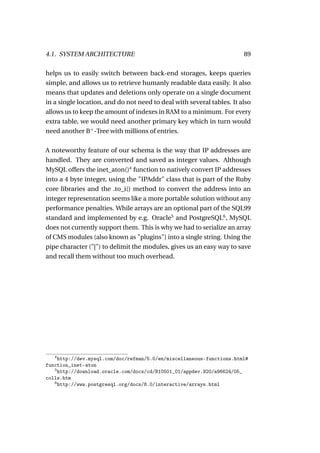
4.1 Architecture overview . . . . . . . . . . . . . . . . . . . . . . .                                                      88


                                                 iv
Chapter 1

Introduction to the Project

1.1       Acquia
The project discussed in this thesis was created for Acquia Inc. Acquia
is a startup company based near Boston, Massachusetts. They provide
services around the content management system Drupal ranging from
hosting to consulting. The original idea for this project can be found in
a blog post by Dries Buytaert titled the "Drupal site crawler project"1 .
Dries Buytaert is the original creator of the content management system
Drupal as well as the CTO and Co-founder of Acquia.


1.2       Requirements
Acquia would benefit from knowing the current distribution of the Drupal
content management system. As an open source project, tracking the
number of Drupal installations can’t be done by looking at licensing
numbers. Instead, an actual crawling of web sites needs to be done
to accurately count Drupal’s real world usage. The initial idea for the
project was the creation of a web crawler that would analyse websites
for certain properties. Most importantly, the crawler should be able to
detect if a website is using a content management system. Especially for
   1
       http://buytaert.net/drupal-site-crawler-project

                                      1
2                     CHAPTER 1. INTRODUCTION TO THE PROJECT

websites running on the Drupal CMS, the application should be able to
detect details like version numbers, modules that are in use, and other
specifics. Over the course of the project, the possibility of searching
the collected data for certain combinations of features, e.g. "all Drupal
sites that run on the IIS webserver and use a ’.edu’ toplevel domain",
was added to the requirements. A specific focus was set on getting the
crawler infrastructure scalable enough to collect details about hundreds
of millions of domains while still keeping the the data searchable. The
initial version of the crawler was designed by Dries Buytaert himself. He
describes his experience in designing the initial crawler like this:

     Thanks to my engineering background and my work on Drupal,
     scalability issues weren’t new to me, but writing a crawler
     that processes information from billions of pages on the web,
     is a whole different ball park. At various different stages of
     the project and index sizes, some of the crawler’s essential
     algorithms and data structures got seriously bogged down.
     I made a lot of trade-offs between scalability, performance
     and resource usage. In addition to the scalability issues, you
     also have to learn to deal with massive sites, dynamic pages,
     wild-card domain names, rate limiting and politeness, cycles
     in the page/site graph, discovery of new sites, etc.

During the course of this project, I have encountered similar trade-offs
and problems. This thesis is a collection of the lessons I learned while
working on the project combined with the necessary knowledge that
went into architectural decisions. The thesis should be able to give an
overview of possibilities and the choices I have made. This way, it should
be possible to use these evaluations of building blocks in other projects.


1.3 Existing codebase
When starting the project, there was already a small amount of code
available. It was an initial version of the crawler that had been created
1.3. EXISTING CODEBASE                                                   3

by an intern over the course of a few weeks. It was based on the Hadoop
framework. Hadoop is a Java-based framework to create and manage
Map-Reduce jobs. The framework consists of several architectural components
such as a distributed file system (HDFS), a central locking service (Zookeeper),
a database (HBase) and a job distribution service (Jobtracker). Using this
infrastructure, developers are able to split their tasks into several map
and reduce phases and distribute these jobs over a number of servers in
a transparent way.

While the Map-Reduce implementation that Hadoop provides is a good
option for analysing large amounts of data, it added a large overhead
to a web crawler infrastructure. Most of the first productive week of the
project was spent trying to set up the complete Hadoop infrastructure
and getting all of the components to work together. The wrapping of
data collection phases into map and reduce phases added an extra
layer of complexity on top of the actual application logic which seemed
unnecessary. After discussing these issues with other engineers working
at Acquia, I came to the conclusion that taking a fresh start with a worker
queue based approach was a viable alternative to the current system
design.
Chapter 2

Architectural decisions and
limitations

2.1     Estimated back-end load
The first step in designing the system architecture is to accurately predict
the production load on the back-end systems. Knowing these numbers
will heavily influence the selection of caching layers and data stores that
provide the foundation for the project. Let’s assume our initial use-case
is the simple crawling of a single website. Our crawler would go through
a process involving these steps:

  1. Get the domain URL from a queue

  2. Download the front page (path: "/") and robots.txt file

  3. Parse all links to other domains

  4. Check if the discovered links to external domains have already been
     analysed

  5. If they haven’t, put them on a queue.If they have, update an incoming
     link counter

  6. Save the collected information about the site to the database.

                                    5
6       CHAPTER 2. ARCHITECTURAL DECISIONS AND LIMITATIONS

    7. Optionally: Save the sites HTML and HTTP headers to the database

Looking at I/O operations, this means that for every link to a domain we
encounter, we have got to:

    1. Check if this domain is already in the data store

    2. Insert the link into the queue OR increment a incoming link counter

That means at least two operations for every discovered external link,
given that our back-end has atomic increments of integer values. As
an average load, this means that the back-end systems would have to
withstand:

                            ops = dps ∗ (2 ∗ elpd) + is

ops = back-end i/o operations per second
dps = number of processed domains per second
elpd = external links per domain
is = amount of operations needed for storing the collected information.
depending on the back-end, this might only be 1 write operation (e.g. a
single SQL INSERT)

Let us see what this means if we put in conservative values:

dps: The initial target for the crawler are 10 domains per second (about
     864.000 domains per day).

elpd: Information about this number can be found in several other
     papers. For our calculation, we assume an average of 7.5 external
     links per web page. 1
    1
     Broder et al.[2] estimated the average degree of external links per page at about 7.
Ola Ågren talks in his paper "Assessment of WWW-Based Ranking Systems for Smaller
Web Sites"[4] about "8.42 outgoing hyperlinks per HTML page." with a sample size
of 7312 pages A group of Brazilian researchers set the number at 6.9 links per page
with a sample size of about 6 Million pages and documented the data in the paper
"Link-Based Similarity Measures for the Classification of Web Documents"[5]
2.2. RUBY                                                                7

is: In our case, we assume that our back-end data is completely denormalized
      and that we can write the fingerprint information to the data store
      in one single write operation.

With these numbers, we end up with approximately: 10 ∗ (2 ∗ 7.5) + 1 +
2 ∗ (0.005) ≈ 151 operations per second on our back-end system just for
crawling the front page alone. Additional operations will be necessary for
making the data searchable, backups and other tasks. Even without those
additional tasks, our back-end would have to complete an operation in
under 7 milliseconds if we want to be able to process 10 domains per
second.

With our current estimations, our back-end would end up having to
deal with a minimum of 16 back-end operations for every domain we
analyse. Additional features such as monitoring CMS changes when
recrawling a domain or crawling more than just the front page would
drive up the load on the system.


2.2       Ruby
2.2.1 The choice for Ruby
While the already existing source code was Java based, I decided to
implement the new crawler in the programming language Ruby. Because
of the size of the project and only me working on it, my main goal was to
keep the code simple and rely on library support wherever possible. Ruby
has strong roots in Perl and seemed to be a good fit for the analytical part
of the process. Fingerprinting content management systems and dealing
with HTML is greatly simplified by the support of regular expressions on
a language level. and the availability of well documented and designed
HTML parsers such as Nokogiri2 and Hpricot 3 . A downside of Ruby is the
set of problems that occur when using threads as a means of parallelizing
   2
       http://nokogiri.org/
   3
       http://wiki.github.com/hpricot/hpricot/
8       CHAPTER 2. ARCHITECTURAL DECISIONS AND LIMITATIONS

processes. The differences between the different available Ruby VMs in
terms of threading support will be discussed in the VM subsection (2.2.4)
of this chapter.

Another downside that people usually see when talking about Ruby
is the low performance in terms of execution speed. Since our main
performance intensive operation is the parsing of the incoming HTML,
this problem is solved by Ruby’s usage of libraries with c-extensions (see:
2.2.3).


2.2.2    Language Features
Ruby is a multi-paradigm programming language. It allows:

object orientation : every data type is an object. This also includes
     classes and types that many other languages implement as primitives
     (e.g. booleans, integers or null/nil)

procedural programming : when defining functions or variables outside
     of classes, it makes them part of the root, ’self’ Object

functional programming : Ruby supports anonymous functions, closures,
     and continuations. All statements have values and all functions
     return the last evaluation implicitly

    Besides these paradigms, Ruby is also a dynamic language in that it
supports introspection, reflection as well as meta programming. Ruby
uses a dynamic type system (so called "duck typing"). In terms of
object orientation, Ruby supports inheritance and singleton methods.
Although Ruby does not support multiple inheritance it allows the import
of functionality using modules. These imports are called "mixins".


2.2.3    C Extensions
A good way of differentiating between the leading Ruby VMs is looking at
the way they support C extensions. C extensions are a way for ruby-libraries
2.2. RUBY                                                                 9

to speed up computation extensive operations(e.g. XML parsing). By
implementing these operations in C, library creators allow developers
to interact with Ruby and still harvest the performance of raw C code.
This performance advantage was especially important in the early days
of Ruby. While Ruby’s performance has increased, the usage of C based
extensions is still beneficial. This holds especially true when it comes to
gaining the functionality of many of the stable and well tested C-libraries.
Wrapping these libraries into a Ruby layer is especially helpful when it
comes to the large C-based libraries such as "libxml" (used in the Ruby
XML/HTML parser "Nokogiri") or ImageMagick, for which RMagick
provides a Ruby interface.

The downside of C extensions from a language point of view is, that they
offer direct pointer access. This complicates the implementation of e.g.
better garbage collection and in general, holds back VM development.
It has to be noted that not all of the Ruby VMs support the use of C
extensions. The level of support will be discussed in the respective VM’s
chapter. There are two different kinds of C extensions. The "regular" C
extensions pose a problem for alternate implementations like JRuby,
because of the complexity involved when exposing internals of the
Ruby implementation or the usage of expensive (de)serialization. These
extensions connect to Ruby’s native API as exposed through ruby.h and
libruby.

With the foreign function interface "FFI", programmers do not have
to write a lot of C code and can stay in Ruby for most of the work. Charles
Nutter, the project lead for Ruby, describes FFI in one of his blog posts4
as follows:

        FFI stands for Foreign Function Interface. FFI has been implemented
        in various libraries; one of them, libffi, actually serves as the
        core of JNA, allowing Java code to load and call arbitrary C
   4
       http://blog.headius.com/2008/10/ffi-for-ruby-now-available.html
10         CHAPTER 2. ARCHITECTURAL DECISIONS AND LIMITATIONS

          libraries. libffi allows code to load a library by name, retrieve
          a pointer to a function within that library, and invoke it, all
          without static bindings, header files, or any compile phase.


2.2.4        VMs
One of the interesting things about Ruby is the number of Virtual Machines
that are able to execute Ruby source code. From a feature point of
view, the VMs differ in the way they implement threads (green threads
vs. native threads), their general performance, the garbage collection
algorithms they use, and weather or not the VM uses a global interpreter
lock to synchronize threads. Some of them also employ different techniques
such as JIT compilers to gain execution speed. To look at different
performance numbers, The "great Ruby Shootout"5 offers a lot of comparisons
between the current Ruby VMs. The series of articles mainly focuses
on performance in micro-benchmarks, but also pays attention to RAM
consumption.


2.2.4.1 Global interpreter lock and threading

Especially when trying to implement a crawler that has a good domain
throughput, it is important to look at the way that the execution environment
handles threads. When a VM implements a global interpreter lock, it
forces threads to acquire a lock before executing code. This lock is shared
between all of the threads inside a VM. This means that only one thread
can run at a time. While this seems to defeat the purpose of threads,
it still enables a program to gain performance compared to a single
threaded alternative. The way that the VM switches between threads has
a large impact on the possible gains. Sasada Koichi, creator of YARV (the
VM that is powering Ruby 1.9), explains on the ruby mailing list 6 how
developers of C extensions can unlock the GIL before calling blocking
functions by using the rb_thread_blocking_region() API. This allows
     5
         http://programmingzen.com/2010/07/19/the-great-ruby-shootout-july-2010/
     6
         http://blade.nagaokaut.ac.jp/cgi-bin/scat.rb/ruby/ruby-core/10252
2.2. RUBY                                                                  11

parallel execution of code in a native OS threads. Doing this however
results in some limitations:

  1. The called function must be thread safe

  2. You cannot call ruby functions from within your extension

  3. System calls like thread_mutex_lock() can’t be interrupted. This
     means that timeout() won’t affect a function using these calls

While this is only useful for C extensions and does not allow "pure"
Ruby threads to run in parallel, it solves most of the "big" performance
problems for computationally expensive operations since most of them
are implemented as 3rd party libraries in C. This especially holds true
in our case where the external network calls are all handled by C-based
libraries. Guido van Rossum, inventor of the Python programming
language, even goes a step further and has this to say about the existence
of a global interpreter lock in modern Programming languages such as
Ruby and Python in one of his posts on the python-3000 mailing list 7 :

        Nevertheless, you’re right the GIL is not as bad as you would
        initially think: you just have to undo the brainwashing you
        got from Windows and Java proponents who seem to consider
        threads as the only way to approach concurrent activities. Just
        because Java was once aimed at a set-top box OS that did not
        support multiple address spaces, and just because process
        creation in Windows used to be slow as a dog, doesn’t mean
        that multiple processes (with judicious use of IPC) aren’t a
        much better approach to writing apps for multi-CPU boxes
        than threads. Just Say No to the combined evils of locking,
        deadlocks, lock granularity, livelocks, nondeterminism and
        race conditions.

Especially when looking at languages made for highly parallel applications
such as Erlang or Mozart/Oz, the existence of lightweight user-level
   7
       http://mail.python.org/pipermail/python-3000/2007-May/007414.html
12    CHAPTER 2. ARCHITECTURAL DECISIONS AND LIMITATIONS

threads is widespread. For scaling over several CPUs, the current idea
is to just launch several processes or fork the VM. The fork() system
call allows for cheap duplication of a running process which is mostly
implemented using copy-on-write semantics. Copy operations are implemented
on a page-level and make fork() an alternative to investigate. It has to be
noted though, that fork() is highly dependant on its implementation in
the operating system. Here is a short excerpt from the Linux man page
for fork:

     fork() creates a child process that differs from the parent
     process only in its PID and PPID, and in the fact that resource
     utilizations are set to 0. File locks and pending signals are not
     inherited. Under Linux, fork() is implemented using copy-on-write
     pages, so the only penalty that it incurs is the time and memory
     required to duplicate the parent’s page tables, and to create a
     unique task structure for the child.

2.2.4.2 MRI - Ruby 1.8

The VM that is currently most widely deployed is called "MRI", short for
Matz’s Ruby Interpreter. It was implemented by Ruby’s inventor Yukihiro
Matsumoto. It was the official VM for Ruby over the last few years and
has the version number 1.8.

Threads: MRI implements threads as lightweight green threads and
    synchronizes them using a global interpreter lock.

C Extensions: MRI supports C Extensions

Garbage Collection: MRI uses a simple "mark and sweep" garbage collection
    algorithm.

Misc: MRI is probably still the most compatible version for third party
     libraries, although most library-developers are slowly moving to
     1.9 compatibility. The changes between 1.8 and 1.9 are not that big,
     so it is an easy port for most projects.
2.2. RUBY                                                               13

2.2.4.3 YARV - Ruby 1.9

YARV (Yet Another Ruby VM) aka. Ruby 1.9 is the current, official Ruby
VM and the successor of Ruby 1.8 (MRI). It has a vastly improved performance
compared to 1.8.

Threads: YARV implements threads as native threads. They are, however,
    still synchronized with a global interpreter lock.

C Extensions: YARV supports C Extensions

Garbage Collection: YARV still uses a simple "mark and sweep" garbage
    collection algorithm.

Misc: Further performance improvements are available in the current
     development version. Ruby 1.9 added coroutines called "Fibers"
     for lightweight concurrency.

2.2.4.4     JRuby

JRuby is an implementation of Ruby running on the Java Virtual machine.
JRuby essentially compiles ruby source code down to Java bytecode. For
some of the dynamic features of Ruby, JRuby has to go through great
lengths to imitate them using the given set of JVM bytecodes and thus
does not reach native Java performance. At the time of writing, it ties
with Ruby 1.9 in terms of performance. An added bonus is the ability
to easily interact with Java libraries. This way, it can be used as "glue
code" to keep the verbosity of Java to a minimum while still being able
to leverage the high performance of the JVM.

Threads: JRuby uses operating system threads and doesn’t have a global
    interpreter lock

C Extensions: JRuby can use C-extensions that use the Foreign Function
     Interface (FFI)8 . Some of the bigger libraries ship Java-based extensions
     to create compatibility with JRuby. There is work on the way to fully
   8
       http://github.com/ffi/ffi#readme
14         CHAPTER 2. ARCHITECTURAL DECISIONS AND LIMITATIONS

          support C extensions. A good recap of this can be found on Charles
          Nutter’s Blog9 . He is one of the Project leads for JRuby and has
          valuable insight on the possible support for regular C extensions in
          JRuby:

               There’s a very good chance that JRuby C extension support
               won’t perform as well as C extensions on C Ruby, but in
               many cases that won’t matter. Where there’s no equivalent
               library now, having something that’s only 5-10x slower
               to call – but still runs fast and matches API – may be just
               fine. Think about the coarse-grained operations you feed
               to a MySQL or SQLite and you get the picture.

Garbage Collection: JRuby is able to use the generational garbage collector
    available on the JVM.

Misc: JRuby is able to use a JIT compiler to enhance code execution
     performance.

2.2.4.5 Rubinius

The Rubinius virtual machine is written in C++. It uses LLVM to compile
bytecode to machine code at runtime. The bytecode compiler and vast
majority of the core classes are written in pure Ruby. The achieved
performance and functionality gains over the last few months make
Rubinius one of the most promising Virtual Machines for the Ruby
programming language.

Threads: Rubinius uses operating systems threads in combination with
    a global interpreter lock

C Extensions: Rubinius supports C-extensions (with or without FFI)

Garbage Collection: Rubinius uses a precise, compacting, generational
    garbage collector
     9
         http://blog.headius.com/2010/07/what-jruby-c-extension-support-means-to.
html
2.3. I/O MODEL (ASYNC VS THREADING)                                     15

Misc: Rubinius features a JIT compiler. At the time of writing, it is a bit
     behind Ruby 1.9 or JRuby in terms of performance.


2.2.4.6   Misc

At the time of writing, there are other Implementations such as IronRuby,
a .NET implementation of the Ruby programming language, or Maglev, a
Ruby implementation with integrated object persistence and distributed
shared cache. While Maglev shows some nice performance numbers,
it is still considered alpha and should not be used in a production
environment at the moment.


2.2.4.7   Conclusion for the project

The complete support for C extensions and the performance enhancements
over MRI (Ruby 1.8) make YARV (Ruby 1.9) the main deployment platform
for the project. Remaining compatibility with JRuby and Rubinius is
an interesting option, but it is not a high priority. Especially with the
upcoming support for C Extensions in JRuby and the progress in Rubinius,
the compatibility between the different VMs should reach almost 100%
in the near future.


2.3       I/O model (async vs threading)
I/O related waits are one of the major performance problems when
designing a crawler. Network I/O is several orders of magnitude slower
than disk I/O and almost unpredictable in terms of request duration. A
single request to a website involves not only an HTTP request, but also
DNS resolution. Both of these steps can take from a few milliseconds to
several seconds, depending on the location of the target URL and the
performance of the respective servers.

An additional problem is that some of the domains that show up as links
on the web are either non-existent or in a segment of the internet that is
16        CHAPTER 2. ARCHITECTURAL DECISIONS AND LIMITATIONS

not reliably reachable from the Amazon EC2 network. Doing requests
to these systems in a serial manner will result in very low throughput. A
solution to this problem is running more than one request in parallel.
While it does not solve the problem of web servers that have a large
roundtrip time, it keeps connections to these servers from completely
blocking other operations.

The two ways of introducing parallelism to the crawling process are
either the use of threads or some form of non-blocking, asynchronous
I/O conforming to the reactor/proactor pattern. A discussion of the
implications of asynchronous I/O can be found in my paper "Event-Driven
I/O - A hands-on introduction"[9]. Especially because of the VM limitations
concerning threads, an asynchronous approach using the eventmachine
framework10 and libraries such as em-http-request11 , em-redis12 and
em-mysqlplus13 seemed beneficial to optimizing the system’s throughput.
There are voices in the developer community that question the usefulness
of non-blocking I/O in comparison to the top of the line Virtual Machine
and Operating System threading models. Especially for Java, Paul Tyma
has an excellent presentation up on his blog called "Thousands of Threads
and Blocking I/O - The old way to write Java Servers is New again (and
way better)"[10].

While his presentation is controversial, it offers good insights in the
changes to thread-costs that happened over the last few years. In the
case of the crawler project, however, these findings cannot be 100%
transferred. As mentioned in the Ruby section of this thesis (2.2), the
existence of a global interpreter lock makes threading a bit of a problem.
While quasi-parallel execution in C-based extensions is still possible by
unlocking the GIL, a single extension not doing this can stop the whole
crawler just because of, for example, an unresponsive DNS server.
     10
        http://rubyeventmachine.com/
     11
        http://github.com/igrigorik/em-http-request
     12
        http://github.com/madsimian/em-redis
     13
        http://github.com/igrigorik/em-mysqlplus
2.4. AMAZON ELASTIC COMPUTE CLOUD                                    17


A series of great posts about this topic can be found on Ilya Grigorik’s
blog14 . Especially his presentation "No Callbacks, No Threads: Async &
Cooperative Web Servers with Ruby 1.9"[11] does a great job explaining
the problems and drawing comparisons to other popular frameworks
that deal with asynchronous I/O (such as Node.JS). For the project, the
decision was to go asynchronous where needed and stay synchronous
and maybe introduce threading where performance is not the major
issue. While running synchronous code does stop the reactor loop
in eventmachine, CPU-bound operations take so little time that the
overhead in comparison to I/O operations can be ignored.


2.4    Amazon Elastic Compute Cloud
One of the requirements for the project was the ability for it to run on
Amazon Elastic Compute Cloud (also known as "EC2"). Amazon EC2 is a
service by Amazon that allows companies (and private users) to create
and boot up virtual servers. These servers are hosted in Amazon data
centres and based on the XEN virtualization technology.


2.4.1 Instance Types

Amazon offers several different hardware configurations. These are the
configurations from the Amazon Instance Types Webpage15 at the time
of writing. Note: According to Amazon16 , "One EC2 Compute Unit (ECU)
provides the equivalent CPU capacity of a 1.0-1.2 GHz 2007 Opteron or
2007 Xeon processor."

  14
     http://www.igvita.com
  15
     http://aws.amazon.com/ec2/instance-types/
  16
     http://aws.amazon.com/ec2/
18          CHAPTER 2. ARCHITECTURAL DECISIONS AND LIMITATIONS


 Name                 RAM        EC2 Compute Units           storage   bit     I/O       $/h
 m1.small            1.7 GB                 1                160 GB    32    moderate    0.085
 m1.large            7.5 GB       4 (2 cores *2 units)       850 GB    64      high      0.34
 m1.xlarge            15 GB       8 (4 cores * 2 units)      1690 GB   64      high      0.68
 m2.xlarge           17.1 GB    6.5 (2 cores * 3.25 units)   420 GB    64    moderate    0.50
 m2.2xlarge          34.2 GB    13 (4 cores * 3.25 units)    850 GB    64      high      1.00
 m2.4xlarge          68.4 GB    26 (8 cores * 3.25 units)    1690 GB   64      high      2.00
 c1.medium           1.7 GB      5 (2 cores * 2.5 units)     350 GB    32    moderate    0.17
 c1.xlarge            7 GB       20 (8 cores * 2.5 units)    1690 GB   64      high      0.68
 cc1.4xlarge          23 GB    2*Xeon X5570,quad-core        1690 GB   64    very high   1.60

One of the important limitations compared to other solutions is the lack
of small instances with a 64 bit architecture in Amazon’s lineup. A lot of
back-end systems that use memory mapped I/O need a 64 bit operating
system to work with large amounts of data. The MongoDB developers
for example had this to say17 :

           32-bit MongoDB processes are limited to about 2.5 gb of data.
           This has come as a surprise to a lot of people who are used
           to not having to worry about that. The reason for this is that
           the MongoDB storage engine uses memory-mapped files for
           performance. By not supporting more than 2gb on 32-bit,
           we’ve been able to keep our code much simpler and cleaner.
           This greatly reduces the number of bugs, and reduces the time
           that we need to release a 1.0 product. The world is moving
           toward all 64-bit very quickly. Right now there aren’t too many
           people for whom 64-bit is a problem, and in the long term,
           we think this will be a non-issue.

This makes MongoDB basically unusable on anything below a EC2 large
instance. While most other solutions tend to work on 32 bit, using a
EC2 large instance is highly beneficial for I/O throughput, provides a
     17
          http://blog.mongodb.org/post/137788967/32-bit-limitations
2.4. AMAZON ELASTIC COMPUTE CLOUD                                           19

64 bit environment and thus offers better database performance. The
Cassandra wiki describes the situation as follows when it comes to the
data access mode18 :

        mmapped i/o is substantially faster, but only practical on a
        64bit machine (which notably does not include EC2 "small"
        instances) or relatively small datasets. "auto", the safe choice,
        will enable mmapping on a 64bit JVM. Other values are "mmap",
        "mmap_index_only" (which may allow you to get part of the
        benefits of mmap on a 32bit machine by mmapping only
        index files) and "standard". (The buffer size settings that
        follow only apply to standard, non-mmapped I/O.)

The downside of this is that the smallest 64bit-Instance available on EC2
today is the m1.large instance. This instance is four times as expensive as
the m1.small. While other "cloud hosting" providers offer 64 bit systems
for smaller VM instances (e.g. Rackspace), using Amazon EC2 allows the
project to leverage the knowledge of a large developer community. In this
case, using Amazon EC2 is also beneficial because of Acquia’s previous
experience with the service and the existing infrastructure within the
company.


2.4.2 Elastic Block Store
Amazon Elastic Block Store (EBS) provides block level storage volumes
for use with Amazon EC2 instances. In contrast to an instances "ephemeral
storage", EBS survives a shutdown or crash of the machine. This is
why Important data should always be saved on Amazon’s Elastic Block
Store when using EC2. An EBS device can be mounted just like a regular
blockdevice (even as a boot volume) and has the ability to create snapshots,
provided that the file system supports it (XFS for example does). Using
it as a a boot volume also allows switching between instance sizes (e.g.
from small to medium) without having to set up all services again. The
  18
       http://wiki.apache.org/cassandra/StorageConfiguration
20        CHAPTER 2. ARCHITECTURAL DECISIONS AND LIMITATIONS

problem with these upgrades is, that switching from a small EC2 instance
to a large EC2 instance also means switching from 32 bit to 64 bit. This is
usually not a good idea and a reinstallation is highly recommended.

Another interesting possibility when using EBS is the ability to use
more than one volume and add them together in a RAID configuration.
There are several benchmarks that prove the performance increase when
doing so. The MySQL performance blog has a comparison between a
single EBS volume and an EBS RAID configuration19 , victortrac.com
offers a comparison of EBS against the ephermal disks20 and the heroku
blog21 offers more EBS specific benchmarks. More about the problems
with benchmarking EBS and ephemeral storage can be found in the
performance section (2.4.3) of this chapter. Many articles about EBS
highlight, that access times and throughput vary greatly depending on
the load of other instances on the same host node. This means that while
EBS can be faster than ephemeral storage, it is not consistent. Therefore
its main advantage is the ability to have persistent data and the possible
usage of a snapshot mechanism.


2.4.3      Performance
One major factor in the design of the crawler is the way that the EC2
platform virtualizes I/O operations. The back-end load against the
database is one of the key limitations for big parts of the project. While
most database storage engines are able to cache frequently requested
data, the amount of domains that will be collected will result in frequent
cache misses.

A good overview of the I/O behaviour of virtualized "cloud" servers

     19
      http://www.mysqlperformanceblog.com/2009/08/06/
ec2ebs-single-and-raid-volumes-io-bencmark/
   20
      http://victortrac.com/EC2_Ephemeral_Disks_vs_EBS_Volumes
   21
      http://orion.heroku.com/past/2009/7/29/io_performance_on_ebs/
2.4. AMAZON ELASTIC COMPUTE CLOUD                                           21

can be found at the cloudharmony blog22 . In our case, using a single
EC2 large instance seems to be the right choice when it comes to I/O
throughput. In general, an actual non-virtualized hard disc would be
beneficial when it comes to performance.

When reading benchmarks, it is important to pay attention to the official
Amazon EC2 documentation23 . It mentions a penalty for the first write
to a block on the virtualized I/O devices. If people don’t pay attention
to this, benchmarks will produce invalid results. This is the matching
quote from the documentation:

        Due to how Amazon EC2 virtualizes disks, the first write to
        any location on an instance’s drives performs slower than
        subsequent writes. For most applications, amortizing this
        cost over the lifetime of the instance is acceptable. However, if
        you require high disk performance, we recommend initializing
        drives by writing once to every drive location before production
        use.


  22
       http://blog.cloudharmony.com/2010/06/disk-io-benchmarking-in-cloud.
html
  23
    http://docs.amazonwebservices.com/AWSEC2/latest/DeveloperGuide/index.
html?instance-storage-using.html
Chapter 3

Back-end and Search

This chapter goes into detail about the different possibilities of persisting
data and the algorithms behind it. It looks at ways to make the saved data
searchable and evaluates current software-solutions to both problems.


3.1     Datastores

3.1.1 Categorization
One of the biggest problems in designing a crawler is the actual storage
of data. An estimated dataset with well over 100 million domains that has
a high number of reads and writes requires some further research when
it comes to possible storage back-ends. The main idea of this chapter is
to outline the possible technologies that store data in a persistent way.
When it comes to persistently storing data, we can currently distinguish
among 5 main categories of data-stores:

  1. Relational database management systems

  2. Column stores

  3. Document stores

  4. Key-Value stores

                                     23
24                                      CHAPTER 3. BACK-END AND SEARCH

     5. Graph databases


   All of them offer a way to persist a document over an application
restart and make it network accessible. When quoting examples, this
paper will mostly concentrate on open-source projects that have an
active community.


3.1.1.1 Relational database management systems

The family of RDBMS1 are based on the idea that data can be represented
in a collection of related tables that store their data in columns and rows.
This idea was first coined by Edgar F. Codd in his paper "A Relational
Model of Data for Large Shared Data Banks"[1]. Most RDBMS focus on
being able to provide consistent data and the ability to enforce specific
rules on data types, relational constraints, and the ability to do ad-hoc
queries. For larger datasets, this is usually enabled by indexing the
entries using a data structure such as a b-tree. The implications of the
specific data structures will be discussed in chapter 3.2.

Most relational database management systems use SQL, the Structured
Query Language, as the primary way for developers to filter out a specific
subset of data. While features such as transactions or full consistency
for data can be fine-tuned, they still add to the systems complexity and
have a negative impact on the performance of writes and reads. The
major free implementations of RDBMS are MySQL and ProstgreSQL
and will be discussed in section 3.5.3. While there are also relational
databases that are available as software as a service (e.g. Amazon RDS),
using them would require access over a network connection. While
this would help with distributing the project, it would also limit the
maximum throughput compared to a local instance of a database.

     1
         short for: Relational database management systems
3.1. DATASTORES                                                        25

3.1.1.2 Column Stores

Column Stores manage their data inside of columns. They differ from the
relational schema of RDBMs in that they do not use rows, meaning that
the different saved records don’t need to share a common schema. They
still offer some internal structure when compared to pure Key-Value
stores. Another difference between Column stores and RDBMs is, that
most of the available open-source Column Store solutions don’t focus
on ACID properties or constraints between different sets of data. A
detailed explanation of these differences can be found in the paper
"Column-Stores vs. Row-Stores: How Different Are They Really?" by
Abadi, Madden and Hachem[6] This largest open-source projects providing
a column store are Hadoop/HBase2 , Cassandra3 and Hypertable4


3.1.1.3    Document Stores

Systems that can be described as "document stores" actually have knowledge
about the data that they store. They usually are able to do basic operations
(e.g. increment an integer inside of a document) and usually support
map/reduce-type operations. Some (e.g. MongoDB) even offer "advanced"
data structures such as arrays and hashes. The most popular Document
stores at the time of writing are CouchDB5 and MongoDB6 .


3.1.1.4    Key-Value Stores

Key-Value stores offer the simplest model of data storage. They basically
provide a networked persistence to what is commonly known as an
associative array (Ruby/Perl hashes, Python dictionaries, Java Hashtable).
Most of them offer only three operations:

  1. put
   2
     http://hbase.apache.org/
   3
     http://cassandra.apache.org/
   4
     http://hypertable.org/
   5
     http://couchdb.apache.org/
   6
     http://www.mongodb.org/
26                                 CHAPTER 3. BACK-END AND SEARCH

     2. get

     3. delete

One of the bigger examples often quoted in literature is Amazon’s Dynamo,
a distributed key-value store described in [23]. It is also cited as a design
inspiration by a lot of the bigger Key-Value store projects. Popular
open-source projects include Project Voldemort7 , Riak8 , Scalaris9 , Berkley
DB10 and to some extend Redis11 (Redis also offers arrays and some other
data structures with the respective operations). Amazon SimpleDB is a
commercial offering by Amazon that provides a Key-Value interface to
data storage as software as a service.

Since Key-Value stores do not offer features such as complex query filters,
joins, foreign key constraints, sorting or triggers, their performance is
easily predictable and mainly a function of the amount of stored keys
(given that there is enough RAM to store the basic index structures).
Since the keys themselves don’t have an internal relation to one another,
scaling key value stores vertically is an easier task than doing the same for
their RDBMS counterparts. Key-Value stores are often used in combination
with an object serialization format such as Protocol Buffers, Thrift, BERT,
BSON, or plain JSON. These formats help storing complex objects as a
regular value.


3.1.1.5 Graph Databases

While there is a certain subset of graph databases that have specialized
in storing only certain graphs (triplestores, network databases...), we are
only paying attention to generic graph databases that can store arbitrary
graphs. These graph databases usually consist of 3 basic building blocks:
     7
        http://project-voldemort.com/
     8
        https://wiki.basho.com/display/RIAK/Riak
      9
        http://code.google.com/p/scalaris/
     10
        http://www.oracle.com/technology/products/berkeley-db/index.html
     11
        http://code.google.com/p/redis/
3.1. DATASTORES                                                       27

   • Nodes

   • Edges

   • Properties

These items are combined to represent real world data. Graph databases
are optimized for associative data sets. They are a good fit for uses
such as tagging or metadata annotations. The crawler data would be an
interesting fit since it is basically just a tagging of domain-nodes with
several different data attributes (cms name, web server name, top level
domain, ...). Querying the data inside of a Graph Database usually means
traversing the graph along the edges of the nodes’ relationships. This
works fine for general "has this TLD" or "is powered by" relations, but
it is harder to model things like the amount of incoming links. While
setting it as a property does work, a search for every domain with more
than 300 links would require an extended data schema or the support
of a dedicated search library. One of the biggest open-source projects
implementing a graph database is Neo4j12 .


3.1.2 Data store scalability
A key metric when evaluating data stores is the way they are able to deal
with a large number of documents. There are mainly two ways of doing
this:

  1. Vertical scaling

  2. Horizontal scaling

Vertical scaling is the ability to enhance performance by simply running
on a faster processor, more RAM, or faster storage. This scalability
completely focuses on a single-node operation. The higher the throughput
and the more optimized the algorithms behind the system, the less
urgent it is to actually have the need for horizontal scalability. In our
  12
       http://neo4j.org/
28                                CHAPTER 3. BACK-END AND SEARCH

case, being able to store, search, and query 100 million documents with
a modest amount of fields is a target that would allow us to keep all of
the back-end operation on a single machine, and only add additional
machines when we want a higher HTTP/analytical throughput. Horizontal
scalability describes the ability of the system to distribute data over
more than a single computer. In our project, this should happen in a
transparent way that does not require time-intensive or overly complex
administrative tasks when dealing with backups or software updates.


3.2 Datastructures
This section of the thesis is devoted to giving a high-level overview about
data structres that can usually be found in storage systems and the
implication of using them.


3.2.0.1 B-trees

In general, B-trees are balanced trees that are optimized for situations
in which there is not enough RAM to keep all of the data structure in
memory, and parts of it have to be maintained on a block device (e.g.
a magnetic hard-disc). B-Trees allow efficient insertion, updates, and
removal of items that are identified by a key. In our case, this would most
likely be the domain name.

The most common representative of the B-Tree family in data-storage
systems is the B+ -Tree. The main difference between a B-Tree and a
B+ -Tree is that one is not allowed to store keys in one of the in a B+ -Tree’s
leaves. They are reserved for data only. The advantage of a B+ -Tree
over a regular B-Tree is that it tends to have a large fan-out (number
of child nodes). This results in fewer indirections and thus fewer I/O
operations to reach a certain piece of data. This is especially helpful
with block based devices and one of the reasons why many file systems
(NTFS, ReiserFS, XFS, JFS) use B+ -Trees for indexing metadata.
3.2. DATASTRUCTURES                                                    29


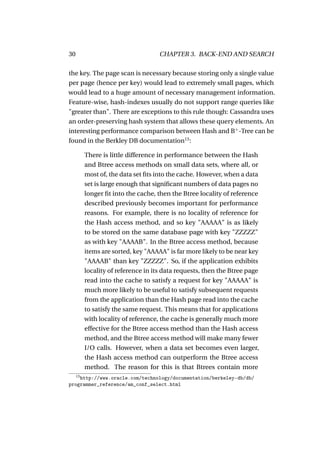
          Figure 3.1: B+ -Tree mapping the numbers 1..7 to d1..7


According to Shaffer[17], when it comes to database systems, the B-tree
and its variations (B+ -Tree, B*Tree, ...) are:

     [...] the standard file organization for applications requiring
     insertion, deletion, and key range searches. B-trees address
     effectively all of the major problems encountered when implementing
     disk-based search trees: 1. B-trees are always height balanced,
     with all leaf nodes at the same level. 2. Update and search
     operations affect only a few disk blocks. The fewer the number
     of disk blocks affected, the less disk I/O is required. 3. B-trees
     keep related records (that is, records with similar key values)
     on the same disk block, which helps to minimize disk I/O on
     searches due to locality of reference.


3.2.1 Hash-based
The idea behind a hash-based index is that the position of an arbitrary
document in a key-value store can be calculated easily. By giving the key
as the input to a special hashing function, it returns the documents/values
position allowing the system to jump directly to the memory-page in
question. After it arrives at the page, it does a simple linear scan to find
30                                   CHAPTER 3. BACK-END AND SEARCH

the key. The page scan is necessary because storing only a single value
per page (hence per key) would lead to extremely small pages, which
would lead to a huge amount of necessary management information.
Feature-wise, hash-indexes usually do not support range queries like
"greater than". There are exceptions to this rule though: Cassandra uses
an order-preserving hash system that allows these query elements. An
interesting performance comparison between Hash and B+ -Tree can be
found in the Berkley DB documentation13 :

          There is little difference in performance between the Hash
          and Btree access methods on small data sets, where all, or
          most of, the data set fits into the cache. However, when a data
          set is large enough that significant numbers of data pages no
          longer fit into the cache, then the Btree locality of reference
          described previously becomes important for performance
          reasons. For example, there is no locality of reference for
          the Hash access method, and so key "AAAAA" is as likely
          to be stored on the same database page with key "ZZZZZ"
          as with key "AAAAB". In the Btree access method, because
          items are sorted, key "AAAAA" is far more likely to be near key
          "AAAAB" than key "ZZZZZ". So, if the application exhibits
          locality of reference in its data requests, then the Btree page
          read into the cache to satisfy a request for key "AAAAA" is
          much more likely to be useful to satisfy subsequent requests
          from the application than the Hash page read into the cache
          to satisfy the same request. This means that for applications
          with locality of reference, the cache is generally much more
          effective for the Btree access method than the Hash access
          method, and the Btree access method will make many fewer
          I/O calls. However, when a data set becomes even larger,
          the Hash access method can outperform the Btree access
          method. The reason for this is that Btrees contain more
     13
    http://www.oracle.com/technology/documentation/berkeley-db/db/
programmer_reference/am_conf_select.html
3.2. DATASTRUCTURES                                                        31

        metadata pages than Hash databases. The data set can grow
        so large that metadata pages begin to dominate the cache
        for the Btree access method. If this happens, the Btree can
        be forced to do an I/O for each data request because the
        probability that any particular data page is already in the
        cache becomes quite small. Because the Hash access method
        has fewer metadata pages, its cache stays "hotter" longer in
        the presence of large data sets. In addition, once the data set
        is so large that both the Btree and Hash access methods are
        almost certainly doing an I/O for each random data request,
        the fact that Hash does not have to walk several internal pages
        as part of a key search becomes a performance advantage for
        the Hash access method as well.

The Postgres 8 documentation is a little bit more definitive in its wording
when it comes to Hash Indexes14 :

        Note: Testing has shown PostgreSQL’s hash indexes to perform
        no better than B-tree indexes, and the index size and build
        time for hash indexes is much worse. For these reasons, hash
        index use is presently discouraged.

As can be seen, the specific implementation of the indexes, the amount
of stored data, and the access patterns all change the performance of
the solution in question. This is why benchmarking with actual data and
real-world load is an important step in the progress of developing this
project. Synthetic benchmarks will probably not provide exact results in
this case.


3.2.2 R-tree-based
While this data-structure is not of primary interest for our project, R-Trees
show up in data-storage systems from time to time, so knowing what
they do without going into too much detail seems beneficial. R-trees are
  14
       http://www.postgresql.org/docs/8.0/interactive/indexes-types.html
32                                   CHAPTER 3. BACK-END AND SEARCH

data structures similar to B-Trees. They are primarily used for indexing
multi-dimensional data such as geo-coordinates. They got described by
Antonin Guttman (UC Berkley) in his 1984 paper "R-Trees - A Dynamic
Index Structure for Spatial Searching"[22]. CouchDB, for example, has a
fork called "GeoCouch" that uses R-Trees for geospatial indexing. SQLite
also offers R*Tree support15 as a compile time option. There are also
other options for indexing geo-spatial data. MongoDB, for example,
offers geospatial indexing16 using a geographic hash code on top of
standard MongoDB B+ -Trees. However, the MongoDB manual entry
mentions that:


          The problem with geo-hashing is that prefix lookups don’t
          give you exact results, especially around bit flip areas. MongoDB
          solves this by doing a grid by grid search after the initial prefix
          scan. This guarantees performance remains very high while
          providing correct results.


3.2.3        Merkle-tree-based
Merkle trees (also known has "Hash-trees") are not primarily used to
store data efficiently. They are a type of data structure that encodes
summary information about a larger piece of data in tree form. This
information can be used to verify data. Especially in a distributed
data-storage systems, this can be used to detect inconsistencies between
replicas faster, while also minimizing the amount of transferred data.
This is often described as an "anti entropy" process. More information
is provided by the Amazon Dynamo paper[23] in chapter 4.7 "Handling
permanent failures: Replica synchronization". The dynamo-based data-stores
Cassandra and Riak also provide this feature. The Riak team mentions
merkle trees in their architecture document17 :

     15
        http://www.sqlite.org/rtree.html
     16
        http://www.mongodb.org/display/DOCS/Geospatial+Indexing
     17
        http://riak.basho.com/edoc/architecture.txt
3.2. DATASTRUCTURES                                                       33

       Riak attempts to move data toward a consistent state across
       nodes, but it doesn’t do so by comparing each and every
       object on each node. Instead, nodes gossip a "merkle tree",
       which allows them to quickly decide which values need comparing.

The Cassandra documentation mentions a difference between the original
dynamo model and the one in Cassadra as follows18 :

       The key difference in Cassandra’s implementation of anti-entropy
       is that the Merkle trees are built per column family, and they
       are not maintained for longer than it takes to send them
       to neighboring nodes. Instead, the trees are generated as
       snapshots of the dataset during major compactions: this
       means that excess data might be sent across the network,
       but it saves local disk I/O, and is preferable for very large
       datasets.

    Other uses of hash trees can be found in the ZFS filesystem19 and also
in the Google Wave protocol20


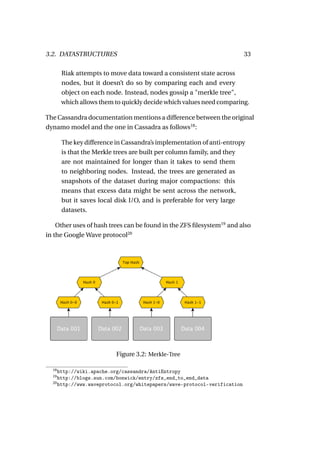
                          Figure 3.2: Merkle-Tree

  18
     http://wiki.apache.org/cassandra/AntiEntropy
  19
     http://blogs.sun.com/bonwick/entry/zfs_end_to_end_data
  20
     http://www.waveprotocol.org/whitepapers/wave-protocol-verification
34                                      CHAPTER 3. BACK-END AND SEARCH


3.2.4          Trie-based
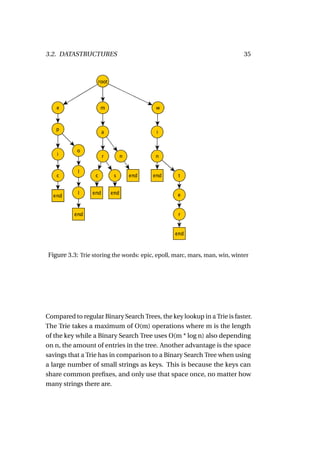
A trie21 , also known as a prefix-tree, is an ordered tree data structure
optimized for storage of key-value data. The basic idea behind storing
strings in a trie is that each successive letter is stored as a separate node
in the tree. To find out if the word ’car’ is in the list of stored words, one
starts at the root and looks up the ’c’ node. After having located the ’c’
node, c’s children are searched for an ’a’ node, and so on. To differentiate
between ’car’ and ’carpet’, each completed word is ended by a previously
defined delimiter. The definition of a Trie by the Information Technology
Laboratory by the US National Institute of Standards and Technology
(NIST) is the following22 :

           Definition: A tree for storing strings in which there is one
           node for every common prefix. The strings are stored in extra
           leaf nodes.

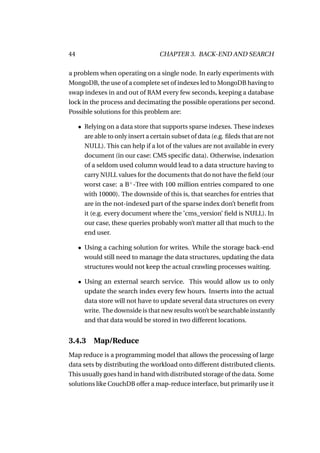
A typical use case is the storage of language dictionaries used for spell
checking or input fields that should auto-complete (e.g. eMail addresses
in a mail program). An example of a software using tries to manage data
is Lucene, the library powering the Solr search service. Since Lucene
treats most data internally as strings, working with numeric ranges
can be greatly accelerated by using the Trie data structure to store the
values. Figure 3.4 shows how a range query can be mapped to a Trie. For
further details, Edward Fredkin’s original paper about Tries called "Trie
Memory"[20] should be a good starting point.


     21
          The origin of the term trie stems from the word "retrieval"
     22
          http://www.itl.nist.gov/div897/sqg/dads/HTML/trie.html
3.2. DATASTRUCTURES                                                        35


Figure 3.3: Trie storing the words: epic, epoll, marc, mars, man, win, winter


Compared to regular Binary Search Trees, the key lookup in a Trie is faster.
The Trie takes a maximum of O(m) operations where m is the length
of the key while a Binary Search Tree uses O(m * log n) also depending
on n, the amount of entries in the tree. Another advantage is the space
savings that a Trie has in comparison to a Binary Search Tree when using
a large number of small strings as keys. This is because the keys can
share common prefixes, and only use that space once, no matter how
many strings there are.
36                               CHAPTER 3. BACK-END AND SEARCH


                     Figure 3.4: Range query in a Trie


3.2.5    Bitmap-based
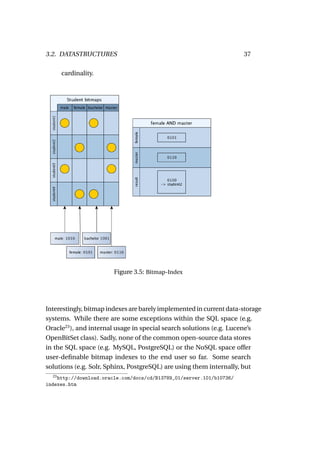
A bitmap index is a special kind of index that has traditionally been used
for data-entries that only have a limited amount of possible values. A
bitmap index uses bit arrays as its main data-structure and can answer
most queries by performing bitwise logical operations on them. They
have the nice property that multiple bitmap indexes can be merged into
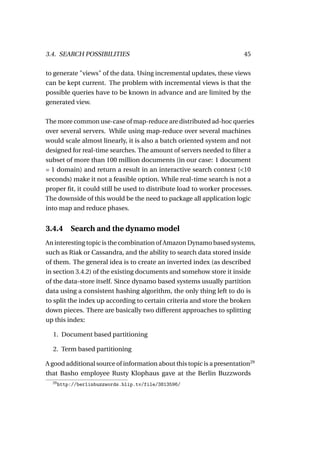
one combined index to resolve simple queries over multiple fields. An
example of a simple AND query can be seen in figure 3.5. Bitmap indexes
were usually used for low cardinality values such as gender, weekday etc.
In this case, a bitmap index can have a large performance advantage
over commonly used B+ -Trees. In "An Adequate Design for Large Data
Warehouse Systems: Bitmap index versus B-tree index" by Zaker et al
[19], the authors go even as far as saying that for certain situations, the
cardinality of the values does not matter. Their conclusive statement is
as follows:

     Thus, we conclude that Bitmap index is the conclusive choice
     for a DW designing no matter for columns with high or low
3.2. DATASTRUCTURES                                                   37

       cardinality.


                        Figure 3.5: Bitmap-Index


Interestingly, bitmap indexes are barely implemented in current data-storage
systems. While there are some exceptions within the SQL space (e.g.
Oracle23 ), and internal usage in special search solutions (e.g. Lucene’s
OpenBitSet class). Sadly, none of the common open-source data stores
in the SQL space (e.g. MySQL, PostgreSQL) or the NoSQL space offer
user-definable bitmap indexes to the end user so far. Some search
solutions (e.g. Solr, Sphinx, PostgreSQL) are using them internally, but
  23
    http://download.oracle.com/docs/cd/B13789_01/server.101/b10736/
indexes.htm
38                                    CHAPTER 3. BACK-END AND SEARCH

offer only limited user control at the time of writing. A typical use-case
of bitmap indexes can be found in PostgreSQL, which uses them to
combine B-Tree indexes when using AND or OR queries24 . More details
about bitmap indexes can also be found in Chan and Ioannidi’s "Bitmap
index design and evaluation"[18].

An interesting project that provides a highly optimized bitmap index
implementation is "FastBit"25 created by UC Berkley in connection with
the U.S. Department of Energy. The project has a lot of available publications26
explaining the details of its implementation such as its compression
algorithm for bitmaps and other technical properties of the system.


3.3 Generic Problems
This section of the paper is dedicated to describing some commonly seen
problems with storage solutions that could be found while evaluating
specific software products. They seem to be common problems and thus
should be checked for every new product.


3.3.1         HTTP persistent connections
HTTP persistent connections are also known as "HTTP keep-alive".
The idea behind them is to use the same TCP connection to send and
receive multiple HTTP requests/responses, as opposed to opening a
new connection for every single request/response pair. Especially when
working with data stores that have an HTTP based interface (e.g. CouchDB),
it is important to rely on a HTTP library that is able to keep the TCP
connection to the data store open. Some libraries establish a new connection
for each request, resulting in a lot of overhead. For Ruby, the Patron
     24
          http://www.postgresql.org/docs/current/static/indexes-bitmap-scans.
html
     25
          https://sdm.lbl.gov/fastbit/
     26
          http://crd.lbl.gov/~kewu/fastbit/publications.html
3.3. GENERIC PROBLEMS                                                   39

project27 is an HTTP library that is based on libcurl and supports the
creation of session objects that use libcurl’s persistent HTTP connections.


3.3.2 Locking
One of the biggest problems with storage systems, in the case of our
project, is that the system will have a lot of mixed writes and reads
in a highly parallel fashion. Some systems like MongoDB or MySQL
with the MyISAM storage engine are locking the whole database (or
Database table) when updating a single document/row. This leads to a
situation where a lot of parallel processes pile up requests for hundreds
of other domains just because of an update to a single domain. This
cuts down the performance of the whole system. Especially when using
distributed crawlers, this could lead to latency even worsening that
situation. Possible solutions for this are:

   • Using a storage back-end that has some form of optimistic locking
     or multi-version concurrency control. Systems which provide this
     include CouchDB , Riak, and the InnoDB storage engine (used with
     MySQL).

   • Using a queueing system that can buffer write requests. While it
     would put the whole system into an eventually consistent state,
     it would at least help to take wait-time away from the crawling
     processes by buffering some operations (e.g. writing updates,
     inserting results)

   • Using caches for the high-volume requests. Links to prominent
     domains like twitter.com that are encountered (and thus checked)
     frequently could be kept in a LRU-cache, a cache that discards the
     least recently used items first, and be answered locally instead of
     reaching out to the database. This would keep the total amount
     of read-requests down. The problem with this approach is that
     the cached requests can’t be recorded to the data-storage without
  27
       http://github.com/toland/patron
40                                    CHAPTER 3. BACK-END AND SEARCH

           adding an additional write. This makes it hard to keep track of the
           number of incoming links to a certain domain. Incoming links
           are a good metric for the domain’s popularity. A possible solution
           is to keep track of hits locally and write out the new number in
           exponential intervals.

It has to be noted that looking at the internals of the databases’ locking
mechanism is an important step in evaluating the storage back-end.
While MySQL using MyISAM does have table level locks, MyISAM offers
things like concurrent Inserts28 that allow new inserts to run while a
’SELECT" call is in progress. These options might make the usage of
large grained locks tolerable. Especially with MySQL, the amount of
tuning options is overwhelming at first, and a lot can be gained by
understanding them. A good source for this kind of information is "High
Performance MySQL, Second Edition" that got published by O’Reilly
Media[21]. More discussion about MySQL can be found in the respective
section (3.5.3) of this thesis.


3.3.3         Append-only storage and compacting
Some databases use an append-only file format that, instead of changing
an old document, will create a new document when writing updates to
the database. This allows the database to keep the old data in a consistent
state in case of a crash during the write process. The problem with some
of these systems is that they have to "compact" the data-files on disc
from time to time to clean the old versions of the file that are not in
use any more. CouchDB, for example, uses a simple approach by just
traversing over the whole file and copying the most recent version of
each record into a new file. After the traversal is done, an atomic switch
to the new file happens. The problem with this approach is that it slows
down performance heavily when being used on a system with a lot of
updates (e.g. incoming link counters) and a slow I/O subsystem (e.g.
virtualized EC2 storage). In my experiments, inserts were coming in at
     28
          http://dev.mysql.com/doc/refman/5.0/en/concurrent-inserts.html
3.4. SEARCH POSSIBILITIES                                             41

such a fast rate that the compaction process took days to finish while
still doubling the space requirements of the data on disk. This holds
especially true when other I/O intensive operations (e.g. backups) are
running at the same time.


3.4     Search possibilities
This section will give an overview about the different techniques to make
a large data collection searchable and the resulting implications.


3.4.1 Classification
One of the important features when choosing a storage back-end is the
ability to filter our data according to certain criteria. There are three
major categories of searches:

  1. Specific domain Searches for a specific domain and its connected
     data. Example: A search for all saved details about "example.org"

  2. Property combinations. Searches for a combination of saved properties.
     Example: All Drupal sites running on the IIS web server that are
     ranked among the top 1 million websites worldwide according to
     Alexa

  3. Fulltext search. A search for all documents that have a certain
     substring in a specified field. An example would be "All domains
     that have the word ’cake’ in their domain name"

When searching for a specific domain, all of the previously discussed
data-stores offer a primary key lookup. In our case, this lookup would be
a way of getting the data referenced by a website’s domain name. This is
the minimum a system should be able to do for us.

Property combinations require a bit more of a data schema or computing
capacity to work efficiently. While using map-reduce to simply iterate
42                              CHAPTER 3. BACK-END AND SEARCH

over all of the gathered domains would result in the correct answer, it
would also take a long time unless being done on a large cluster. This
can be optimized by only looking at a certain subset of domains. In
our example case, simply keeping a list for each Content Management
System with the matching domain names would greatly reduce the
total amount of documents that would need to be scanned from "all
domains" to "all domains in the drupal-collection". The downside of
this approach is, that managing these collections adds extra complexity
to the application logic. An automated way of doing this internally is
provided by some of the back-ends (most RDBMS, search solutions like
lucene/solr or sphinx, some document stores like MongoDB). The RAM
requirements for keeping these indexes in memory grow with the total
amount of collected domains. The more "free form" your queries are,
the more indexes one has to add to the data in order to keep query
performance at an acceptable limit. An interesting solution for "fixed"
queries is offered by CouchDB’s incrementally updated views which
require only one index per view and spread the processing power that is
needed over every insert/update/delete operation. Aside from RDBMS
and Document Stores, Graph databases are also a nice fit when querying
for single attributes, since their natural data-model is highly optimized
for this kind of situation.

Fulltext search: Filtering data for a field that has a specific substring
with a wildcard in the end of the term (example*) usually just requires a
back-end that organizes the searchable data in B+Trees. This is available
in most data-stores that go beyond the simple key-value model. Examples
would be MongoDB, MySQL or Tokyo Cabinet. If there is a leading
wildcard, the data-store would usually have to reverse the field in question
("example.com" -> "moc.elpmaxe" ) and save the inverted field into a
seperate B+Tree. This behaviour is offered by Solr with the use of the
"reversedwildcardfilterfactory".
3.4. SEARCH POSSIBILITIES                                              43

3.4.2    Indexation
One of the most common ways to keep data searchable is the usage
of so called "indexes". The "inverted index" is a data structure that is
used to store a mapping from content (e.g. a word or a primary key) to a
position inside of the database. This enables a database system to move
away from full table scans to simply accessing the term that is looked for
directly with as few redirections as possible. More about the commonly
used data structures to implement these reverse indexes (e.g. B+ -Trees,
Bitmap-Indexes) can be found in section 3.2. An interesting use case
of these indexes is the ability to combine them using boolean logic. A
simple example would be the search for "term A AND term A". To solve
this query, the database only has to look up the resulting positions for a
search for term A and simply do an AND merge of this list with the results
for term B. After merging the intersection of these lists using a logical
AND, the resulting list points to documents that feature both terms.


                        Figure 3.6: Reverse Index


One of the important things to keep in mind is the RAM and CPU usage of
these data-structures. For every added or deleted entry to the data-store,
all corresponding indexes have to be updated. Especially when trying to
make all of the fields in the data searchable, RAM usage might become
44                                  CHAPTER 3. BACK-END AND SEARCH

a problem when operating on a single node. In early experiments with
MongoDB, the use of a complete set of indexes led to MongoDB having to
swap indexes in and out of RAM every few seconds, keeping a database
lock in the process and decimating the possible operations per second.
Possible solutions for this problem are:

     • Relying on a data store that supports sparse indexes. These indexes
       are able to only insert a certain subset of data (e.g. fileds that are not
       NULL). This can help if a lot of the values are not available in every
       document (in our case: CMS specific data). Otherwise, indexation
       of a seldom used column would lead to a data structure having to
       carry NULL values for the documents that do not have the field (our
       worst case: a B+ -Tree with 100 million entries compared to one
       with 10000). The downside of this is, that searches for entries that
       are in the not-indexed part of the sparse index don’t benefit from
       it (e.g. every document where the ’cms_version’ field is NULL). In
       our case, these queries probably won’t matter all that much to the
       end user.

     • Using a caching solution for writes. While the storage back-end
       would still need to manage the data structures, updating the data
       structures would not keep the actual crawling processes waiting.

     • Using an external search service. This would allow us to only
       update the search index every few hours. Inserts into the actual
       data store will not have to update several data structures on every
       write. The downside is that new results won’t be searchable instantly
       and that data would be stored in two different locations.


3.4.3     Map/Reduce
Map reduce is a programming model that allows the processing of large
data sets by distributing the workload onto different distributed clients.
This usually goes hand in hand with distributed storage of the data. Some
solutions like CouchDB offer a map-reduce interface, but primarily use it
3.4. SEARCH POSSIBILITIES                                               45

to generate "views" of the data. Using incremental updates, these views
can be kept current. The problem with incremental views is that the
possible queries have to be known in advance and are limited by the
generated view.

The more common use-case of map-reduce are distributed ad-hoc queries
over several servers. While using map-reduce over several machines
would scale almost linearly, it is also a batch oriented system and not
designed for real-time searches. The amount of servers needed to filter a
subset of more than 100 million documents (in our case: 1 document
= 1 domain) and return a result in an interactive search context (<10
seconds) make it not a feasible option. While real-time search is not a
proper fit, it could still be used to distribute load to worker processes.
The downside of this would be the need to package all application logic
into map and reduce phases.


3.4.4 Search and the dynamo model
An interesting topic is the combination of Amazon Dynamo based systems,
such as Riak or Cassandra, and the ability to search data stored inside
of them. The general idea is to create an inverted index (as described
in section 3.4.2) of the existing documents and somehow store it inside
of the data-store itself. Since dynamo based systems usually partition
data using a consistent hashing algorithm, the only thing left to do is
to split the index up according to certain criteria and store the broken
down pieces. There are basically two different approaches to splitting
up this index:

  1. Document based partitioning

  2. Term based partitioning

A good additional source of information about this topic is a presentation29
that Basho employee Rusty Klophaus gave at the Berlin Buzzwords
  29
       http://berlinbuzzwords.blip.tv/file/3813596/
46                                CHAPTER 3. BACK-END AND SEARCH

conference in 2010. In this presentation, he explains the design behind
"Riak Search", the soon-to-be-released addition of Lucene on top of the
dynamo based Riak data-store.


3.4.4.1 Document based partitioning

The idea behind this is to store an inverted index for every document
in the partition where the document itself is stored. This means that a
query for a certain term has to hit every partition to check weather or
not any documents contain that term. One advantage in a multi-server
environment is that a single query tends to have a lower latency because
it can hit all available nodes in parallel. After the slowest node has
answered, you have got all possible results. It is also nice in terms of index
distribution, since it disperses the index the same way the documents
are dispersed over the system, evening out the storage requirements.
The problem is that the total query-throughput of the system is smaller
because every single query will be passed on to all of the available nodes.
Running more than one query in parallel means that query 2 has to
basically wait for query 1 to finish. This way of partitioning the inverted
index also leads to a lot of seeks on the disks of the nodes, and to a lot of
network connections.


3.4.4.2 Term based partitioning

The idea behind term based partitioning is to split the document into
its terms, and store the inverted index according to its terms (e.g. single
words in a text). This means that the terms of a single document will be
scattered around the whole system. If two documents have the same
term, both of them will be referenced by the partition holding this term.
This means that finding all documents containing a certain term is
relatively easy. The system just has to use its consistent hashing function
on this term and will be able to immediately find the inverted index
pointing to all of the documents containing this term. The downside
is that putting a new document into the inverted index requires writes
3.5. EVALUATION                                                        47

to a lot of partitions, compared to the document based partitioning
approach. Another downside is that the query latency tends to be higher
because there is only one single node answering the query. The upside
of this is that parallel queries will probably be split between several
nodes of the system and not have to hit all of them at once. One of the
biggest problems with this approach is the "hot spot" problem. Since
this approach will always map the same term to the same partition, a
popular term will always end up on the same partition. This means that
all searches for this term will end up on that single node.


3.5       Evaluation
This section of the paper should give an overview of the possible candidates
for back-end storage of the collected data. The main focus in the selection
of the participants was on open-source projects that have an active
community and that still show frequent progress in development.


3.5.1 MongoDB
3.5.1.1     Features

One of the most promising data storage back-ends these days is MongoDB.
It is a document store that has an extremely rich data-model that includes
data structures such as arrays, associative arrays and supports atomic
operations30 like integer increments etc. Internally, MongoDB saves data
in the BSON format. BSON is a binary encoded serialization of JSON-like
documents with an open specification available at bsonspec.org.

MongoDB uses B+ -Trees to be able to allow ad-hoc queries that are
comparable in features to an SQL SELECT. Atomic modifiers allow things
like incrementing integers on the server side or pushing data into arrays.
There is also the possibility of running Javascript code on the server and
  30
       http://www.mongodb.org/display/DOCS/Atomic+Operations
48                                    CHAPTER 3. BACK-END AND SEARCH

MongoDB even provides an interface for Javascript-based map/reduce
tasks. MongoDB also has a feature called "GridFS" that allows applications
to store files of any size inside the database without adding extra complexity
to the user’s source code. Internally, the usual data structures are used
to save the chunks of data. Accessing and modifying data happens using
a pretty intuitive syntax. The developer basically constructs a document
with the things that he is looking for. As an example, a search for a
student named John that is enrolled would result in a query like this
(Javascript syntax):

db.my_collection.find({"name":"John"}, {"enrolled":true})

It also has advanced query operators like greater than or less than:

db.my_collection.find({ "name":"John", "age" : { $gt: 25} } )

It even supports search using regular expressions, e.g. a case-insensitive
search for John or Jon:

db.my_collection.find( { "name" : /^joh?n/i } );

Updates work basically the same way, only that you have to also supply a
second document with the update instructions. Atomically incrementing
the semester of everybody named John would look like this

db.my_collection.update( { "name":"John" }, { $inc: { "semester" : 1 } } );

A simple update of a field would look like this:

db.my_collection.update( {"student_id":62123 }, { "enrolled": false } );

MongoDB offers an interactive shell that allows one to do simple searches
like this on the fly. There are also tools like "MongoHub"31 that allow
easy introspection and visual navigation through the stored data.
    MongoDB officially provides drivers for C, C++, Java, Javascript, Perl,
PHP Python, and Ruby. There is also a wealth of community supported
     ,
     31
          http://mongohub.todayclose.com/
3.5. EVALUATION                                                       49

drivers for nearly any programming language available. Links to them
can also be found in the official MongoDB wiki32 . They also feature an
alpha quality REST interface33 .


3.5.1.2   Scalability

The single node performance of MongoDB is more than impressive.
Even without trying to horizontally scale MongoDB, it offers better
performance than all of the other comparable systems (RDBMS / Document
stores). It has to be noted that MongoDB, by default, has data durability
constraints that are a little bit more relaxed than some of the other
database solutions. This, however, is not a real problem for the data in
our project. Inserts and updates in MongoDB also offer the possibility of
setting a "safe" and "fsync" option that will make the call return either
when the data has been written to the server or when the server has
fsynced the data to disk. The official MongoDB blog contains a good
article34 about MongoDB’s approach to single-node durability.

Concerning the need for vertical scalability, the official MongoDB website
collects independent third party benchmarks in their wiki35 . Horizontal
scaling with replication and sharding is in heavy development and
looks promising. The downside is that it requires different categories
of machines, and does not follow a uniform approach as such as the
dynamo based Cassandra, Riak or Project Voldemort. Servers have to
specifically be configured as a "Master", marked as routing instances,
and also manually removed from the cluster, which drives up complexity
in operation of the system.


  32
     http://www.mongodb.org/display/DOCS/Drivers
  33
     http://www.mongodb.org/display/DOCS/Http+Interface
  34
     http://blog.mongodb.org/post/381927266/what-about-durability
  35
     http://www.mongodb.org/display/DOCS/Benchmarks
50                                    CHAPTER 3. BACK-END AND SEARCH

3.5.1.3 Limitations

MongoDB uses memory-mapped I/O, this limits its ability to store data
bigger than 2.5 GB on 32 bit systems. A big problem for our project is
the fact that MongoDB currently uses global locking when manipulating
data. This means that a long running write will block all other reads and
writes. MongoDB is developing rapidly and adding "yield" mechanisms
to allow long-running operations to give over control to other waiting
operations. There is however the problem that the locking occurs on
process level and writes to database A can block reads on database B.


3.5.1.4 Search

As previously mentioned, MongoDB offers its own internal query mechanism.
To be able to deal with millions of documents, however, the need for
putting indexes on a lot of fields would slow down inserts/updates and
also require a lot of RAM to be able to update the matching parts of the
B+ -Tree of every index. Another downside is the fact, that MongoDB
does not support sparse indexes at the moment. Especially for fields that
don’t show up in every document, including a NULL value in the index
drives up memory usage in the generated B+ -Trees and also uses up disk
space. Faceting is possible by using a map/reduce task, this however
does not perform particularly well with a large number of documents
and results in slowdowns. During the last few releases, the yielding of
locks during the map-reduce phase was introduced which helped a bit
with the problem of slowdowns.

Projects also exist that try to integrate MongoDB into external search
solutions like Solr. Photovoltaic36 , for example, uses MongoDBs replication
internals to pipe changes into a Solr Index as they happen. This is not
as convenient as Solr’s internal update mechanism that supports some
data-stores such as MySQL as a data source, but it is at least a possibility.

     36
          http://github.com/mikejs/photovoltaic
3.5. EVALUATION                                                         51

3.5.1.5 Operations

Backups can be easily achieved by calling the "fsync" command on the
database, setting a write lock and then creating a file system snapshot
(using XFS and EBS). The MongoDB homepage offers a good overview of
the different backup possibilities 37 . The sharding is still more complicated
than dynamo based solutions (namely Riak or Cassandra), but development
is moving fast and the active mailing lists and IRC channel are a big plus
compared to other solutions with less active communities (e.g. tokyo
cabinet).


3.5.1.6     Conclusion for the Project

MongoDB would be a great fit in terms of data storage. Especially the
atomic operations such as increments help to keep the code base small
and clean. A downside is the need for 64 bit instances in connection with
EC2. This drives up costs when compared to other solutions because the
minimum configuration would be an EC2 large instance.

Horizontal scaling would only be necessary if we actually wanted to
use the database for search operations and create indexes that would
take up more RAM than a single machine could provide in a cost effective
manner. The effect of the global locking would have to be re-evaluated
over time. Almost every new major version of the database over the
last months eased the locks by introducing yielding operations and fine
tuning the databases behaviour.

Search for specific subsets of the data would require a third party tool
like Solr This, however, might change if sparse indexes are introduced to
MongoDB. In that case, all of the Drupal specific fields could be indexed
without including millions of documents that do not have the field.
Another solution to this problem might be splitting the data into several
databases according to the detected CMS. This would require manual
  37
       http://www.mongodb.org/display/DOCS/Backups
52                                  CHAPTER 3. BACK-END AND SEARCH

management of data which would increase code complexity. The current
locking policy (process wide, not database wide) also complicates this
solution.


3.5.2        CouchDB
3.5.2.1 Features

Apache CouchDB is one of the older "NoSQL" solutions. It features
a RESTful JSON API that makes it easy to access using HTTP Another  .
interesting feature is the ability to use Javascript or Erlang based incremental
MapReduce operations to create something similar to "views" in RBDMS.
There are also different third party implementations of "view servers"38
that allow the user to write map-reduce functions in other languages
(Python39 , Ruby40 or Java41 ). Using the third party view servers requires
some additional setup. Since views can be generated incrementally on
every insert, update, or delete, they have a pretty constant (low) overhead
during regular operations, yet still allow complex transformations and
filtering of the stored data.

CouchDB’s internal multi-version concurrency control design automatically
provides snapshot capabilities but also adds a disk space penalty that
makes the database require compaction from time to time. CouchDB
uses B-trees internally, but adds some slight modifications. This is
described in the official CouchDB book42 :

          CouchDB’s B-tree implementation is a bit different from the
          original. While it maintains all of the important properties,
          it adds Multi Version Concurrency Control (MVCC) and an
          append-only design. B-trees are used to store the main database
     38
        http://wiki.apache.org/couchdb/View_server
     39
        http://code.google.com/p/couchdb-python/
     40
        http://github.com/candlerb/couchdb_ruby_view
     41
        http://github.com/cloudant/couchjava
     42
        http://books.couchdb.org/relax/appendix/btrees
3.5. EVALUATION                                                          53

     file as well as view indexes. One database is one B-tree and
     one view index is one B-tree. MVCC allows concurrent reads
     and writes without using a locking system. Writes are serialized,
     allowing only one write operation at any point in time, for
     any single database. Write operations do not block reads
     and there can be any number of read operations at any time.
     Each read operation is guaranteed a consistent view of the
     database, How this is accomplished, is at the core of CouchDB’s
     storage model. The short answer is that because CouchDB
     uses append-only files, the B-tree root node must be rewritten
     every time the file is updated. However, old portions of the
     file will never change, so every old B-tree root, should you
     happen to have a pointer to it, will also point to a consistent
     snapshot of the database.

Another interesting feature of the CouchDB project is "futon". It is an
included web interface that helps the user to administer CouchDB. It
allows the user to view and manipulate stored data. It can also be used
to administer most aspects of CouchDB, such as compaction, creation
of views, or setting up replication.

3.5.2.2   Scalability

Thanks to the previously mentioned MVCC append-only approach and
Erlang as a programming language, CouchDB offers one of the best
concurrency behaviours in the field allowing good vertical scalability.
Horizontal scalability in CouchDB basically consists of incremental
replication with bi-directional conflict detection and resolution. Setting
up replication is easily available over CouchDB’s REST interface. A simple
HTTP POST request to "/_replicate" with this body is all that is necessary:

     "source":"$source_database","target":"$target_database"

Sharding is not supported on the server side. There are, however, third
party frameworks that provide clustering/partitioning for CouchDB (an
54                                    CHAPTER 3. BACK-END AND SEARCH

example would be couchdb-lounge43 ).

3.5.2.3 Limitations

CouchDB has no limitations for database sizes on 32 bit systems such
as MongoDB. However, it does have other problems when it comes
to large amounts of data. In my tests, running CouchDB on an small
EC2 instance resulted in problems when it came to compacting its
append-only storage format. Under production load, the compaction
process could not follow up with updates to stored data and was not able
not finish compaction in a reasonable amount of time (a day). This has
also been described as a generic problem of some append only storage
back-ends in section 3.3.3.

3.5.2.4 Search

Thanks to its copy on write nature, CouchDB offers an interesting approach
to indexes. CouchDB supports the creation of "views" according to a
custom search query. These views will be saved as a collection and are
updated incrementally on every access. It is also possible to update
them at fixed intervals or after every document update. The views can
be created in Javascript or Erlang. An example of a Javascript based view
from the CouchDB wiki44 would be this:

Map:
function(doc) {
  emit(null, doc);
}

Reduce:
function(doc) {
  if (doc.Type == "customer") {
    emit(doc.LastName, {FirstName: doc.FirstName, Address: doc.Address});
     43
          http://tilgovi.github.com/couchdb-lounge/
     44
          http://wiki.apache.org/couchdb/Introduction_to_CouchDB_views
3.5. EVALUATION                                                        55

        emit(doc.FirstName, {LastName: doc.LastName, Address: doc.Address});
    }
}

    This would create a view that includes all customers from the database
with their full names and addresses. The interesting thing is that this
would allow one to look up customers by first OR last name because both
of them were emitted as a key. The resulting view would look like this:

{
        "total_rows":4,
        "offset":0,
        "rows":
        [
          {
            "id":"64ACF01B05F53ACFEC48C062A5D01D89",
            "key":"Katz",
            "value":{"FirstName":"Damien", "Address":"2407 Sawyer drive, Charlotte NC"}
          },
          {
            "id":"64ACF01B05F53ACFEC48C062A5D01D89",
            "key":"Damien",
            "value":{"LastName":"Katz", "Address":"2407 Sawyer drive, Charlotte NC"}
          },
          {
            "id":"5D01D8964ACF01B05F53ACFEC48C062A",
            "key":"Kerr",
            "value":{"FirstName":"Wayne", "Address":"123 Fake st., such and such"}
          },
          {
            "id":"5D01D8964ACF01B05F53ACFEC48C062A",
            "key":"Wayne",
            "value":{"LastName":"Kerr", "Address":"123 Fake st., such and such"}
          },
56                                    CHAPTER 3. BACK-END AND SEARCH

      ]
}


While this would allow us to create certain fixed views and even to keep
faceted searches up-to-date easily, ad hoc queries are still impossible
unless all of them are known in advance and have been prepared as a
view. Another (third party) option of searching within CouchDB is the
"CouchDB-lucene"45 project. CouchDB-lucene integrates the lucene
search service on top of CouchDB. This would allow ad-hoc searches
using the lucene syntax.


3.5.2.5 Operations

Since CouchDB uses an append only storage back-end, just creating
snapshots (even without an fsync command) will still result in a valid
data structure. This is one of the advantages of CouchDB when it comes
to the operation of the database. Notes on this can be found over at the
CouchDB WIki46 .


3.5.2.6 Conclusion for the Project

While CouchDB is a great choice in terms of parallel access and performance,
the amount of updates (e.g. for link counters) that we need to be able to
do would require constant compacting of the back-end. This would slow
down other operations because of the heavy I/O load and almost double
the disk space requirements. If CouchDB ever optimized the back-end
compaction, it would be worth a second evaluation, but at the time of
writing, it is a bad choice from an operations perspective.

     45
          http://github.com/rnewson/couchdb-lucene
     46
          http://wiki.apache.org/couchdb/FilesystemBackups
3.5. EVALUATION                                                        57

3.5.3     MySQL and PostgreSQL
3.5.3.1 Features

One of the differences between MySQL and PostgreSQL is their design
philosophy. While PostgreSQL is a single, unified database server, MySQL
is a network front-end to a number of different storage engines. Feature
wise, the two open source RDBMS offer a wide range of options. While
most of the transactional features are not really important for our project,
there are some things that help keep the code clean and enhance performance,
such as:

   • Ability to fine-tune data types (e.g. using an unsigned integer for
     link counters since they are by definition not negative)

   • Atomic increments (e.g. "UPDATE MyTable SET LinkCount=LinkCount+1
     Where domain=example.org")

   • On-the-fly compression (if we wanted to save the HTML code of
     certain sites)

   • Ability to fine-tune indexation (e.g. only indexing the first 5 letters
     of the cms name. After the fifth letter, it is usually unique enough)

   • Support for partial indexes that disregard NULL values (only in
     Postgres, not MySQL)

3.5.3.2   Scalability

Both PostgreSQL and the InnoDB storage back-end in MySQL rely on
MVCC and are able to provide non-locking parallel access. When it
comes to MySQL, the choice of database back-end (MyISAM, InnoDB,
MariaDB, ...) is one of the most important choices when it comes
to performance. Especially with InnoDB, the database also requires
extensive tuning of cache-sizes to get to a good performance level. A
great resource to read up on the different MySQL storage options is the
"High Performance MySQL" book published by O’Reilly[21]. PostgreSQL
58                                    CHAPTER 3. BACK-END AND SEARCH

and MySQL performance lags behind the other solutions when it comes
to simple key-value access of data.

Both of them support replication and sharding as a form of horizontal
scalability either internally or using third party tools, but it is nowhere
near the level of ease of use that most of the NoSQL solutions offer. In
general, more thought has to go into the creation of a data-schema and
fine-tuning parameters than for most other data-stores.


3.5.3.3 Limitations

Besides the comparatively low performance numbers, the solutions don’t
have any direct limitations concerning operations or general use in our
project. Looking at operational constraints of other data-stores, the
maturity of the RBDMS projects seems to be beneficial.


3.5.3.4 Search

While both MySQL and Postgres support the creation of indexes (usually
B+ -Tree, sometimes hash-based), optimized search solutions such as
Solr offer better performance and flexibility. MySQL and Postgres are
supported by SOLR’s data import handler and can be indexed without
the need for another third party tool.

An interesting feature of the internal indexation implementations is the
use of adaptive hash indexes in MySQL’s InnoDB back-end47 . This feature
automatically generates Hash indexes in addition to the regular B+ -Tree
when it would benefit performance. With the amount of data we handle,
however, this might not come into action. Another interesting feature is
the support for partial Indexes when using PostgreSQL48 . The main idea
behind this is that a column that is seldom used (e.g. the version number
that is only collected for Drupal sites) will not be indexed as a "NULL"
     47
          http://dev.mysql.com/doc/refman/5.0/en/innodb-adaptive-hash.html
     48
          http://www.postgresql.org/docs/8.4/static/indexes-partial.html
3.5. EVALUATION                                                          59

value but would simply be ignored. This way, the size of the B+ -Tree is
only connected to the amount of rows that include this column, and not
to the total amount of columns. The use of partial indexes could make it
possible to rely on the internal indexing mechanisms of PostgreSQL to
index our collected data.


3.5.3.5     Operations

MySQL and Postgres are mature and stable solutions that offer a great
amount of information and tooling. On-line backups can be done in a
variety of ways and relying on already existing solutions limits the need
for extra documentation. For InnoDB databases, Percona’s Xtrabackup49
provides on-line backup functionality. The included "mysqldump" tool
can also do on-line backups of InnoDB tables using the "single-transaction"
switch. For PostgreSQL, the included pg_dump tool offers similar functionality.
Backups using Amazon EBS and file system snapshots are also possible.


3.5.3.6     Conclusion for the Project

The use of a relational database system allows for seamless integration
with external search services such as Solr or Sphinx, while offering a great
amount of tooling and available expertise. If it is possible to keep up with
the necessary amount of operations per second, long term storage in
one of the systems seems to be a good compromise between ease of use
from an operational standpoint and performance. The only downside
is the overhead of having to use SQL for simple operations and the
performance penalty of having to support unneeded ACID constraints.


3.5.4 Tokyo Cabinet
3.5.4.1     Features

Tokyo cabinet is developed and sponsored by Mixi, the Japanese equivalent
of Facebook. It is a fast and feature-rich library that offers several
  49
       https://launchpad.net/percona-xtrabackup
60                                    CHAPTER 3. BACK-END AND SEARCH

different data-structures:


B+ -Tree: A regular B+ -Tree, allowing several values for a single key. It
      supports prefix and range matching on a key.


Hash: A hash-based database allowing only a single value per key.


Fixed-length: High performance data-structure containing an array of
     fixed-length elements.


Table: A column store with support for indexation and queries.


Tokyo cabinet has excellent single-node performance numbers and is
leading the field together with MongoDB. It also provides on-the-fly
compression of data (bzip, gzip) and does fine-grained record level
locking. Tokyo cabinet is only responsible for data-storage; a network
interface is provided by "Tokyo Tyrant". Tokyo Tyrant supports asynchrnous
I/O with epoll/kqueue and can be used in a highly parallel manner.

An interesting feature of Tokyo Tyrant is the ability to extend it using
scripts in the Lua programming language. Ilya Grigorik has covered this
extendibility in a great blog post50 . The use of lua allows the easy creation
of server-side atomic commands such as the incrementing of integer
numbers. The scripting extensions can be either record-locking or use a
global lock.

Bindings for Tokyo-Cabinet and Tokyo-Tyrant are available for almost
any major programming language (including Java, Ruby, Erlang, Lua,
Python, and Haskell). A subset of Tokyo Tyrant functions is also available
via the memchached protocol and HTTP in case a native library is not
available in the language of choice.

     50
          http://www.igvita.com/2009/07/13/extending-tokyo-cabinet-db-with-lua/
3.5. EVALUATION                                                          61

3.5.4.2 Scalability

The single node performance of Tokyo Cabinet is one of its biggest
advantages. It delivers comparable numbers to MongoDB and usually
is faster than other data-stores. For large amounts of data, tuning of
the b+ -Tree parameters is necessary. Horizontal scalability would need
to be part of Tokyo Tyrant. Tokyo Tyrant is the network interface to
Tokyo Cabinet. It offers Master-Master and Master-Slave replication.
Automatic sharding is not part of Tokyo-Tyrant itself, however there are
third party libraries like LightCloud51 that use Tokyo Tyrant as a back-end.
Access to LightCloud from Ruby is still in development52 and adds further
dependencies to the project.


3.5.4.3   Limitations

Sadly, the community surrounding Tokyo Cabinet is not as vibrant as the
one around projects like MongoDB or CouchDB. A lot of the engineering
blog posts are in Japanese and the only central point for the english-speaking
community is a mailing list53 and a wiki54 .

While there are reports of corrupted data-files from time to time, I
haven’t encountered any problems when evaluating the database with
real world data. In case of a problem, Toru Maesaka highlights low-level
recovery tools in his blog post "How to recover a Tokyo cabinet database
file"55 . Tokyo Cabinets successor Kyoto Cabinet has even less available
information. For both of them, tuning of startup parameters is necessary
when trying to access more than a few million documents without
heavy speed degradation. The only real information about important
parameters and their meaning is currently available at James Edward

  51
     http://opensource.plurk.com/LightCloud/
  52
     http://github.com/mitchellh/lightcloud
  53
     http://groups.google.com/group/tokyocabinet-users
  54
     http://tokyocabinetwiki.pbworks.com/
  55
     http://torum.net/2010/01/how-to-recover-a-tokyo-cabinet-database-file/
62                               CHAPTER 3. BACK-END AND SEARCH

Gray II’s blog in his series on Tokyo Cabinet56 .

3.5.4.4 Search

Tokyo Cabinet offers support for indexation using the "Table" database.
The performance while testing it with 60 million documents isn’t usable
in production, even when indexing the columns. A second option would
be the use of "Tokyo Dystopia", a full-text search system that integrates
within Tokyo Cabinet and should provide better performance. Sadly, the
missing community behind the solution is one of the main reasons for
not evaluating the Tokyo Dystopia in detail.

3.5.4.5 Operations

Backup and replication are included with Tokyo Tyrant and the "tcrmgr"
tool that is shipped with it, but are not an optimal solution. Using "tcrmgr
copy", a backup copy of the database is being created. Sadly, this blocks
incoming connections to the server. Another possibility would be the
booting of a process that acts as a read-slave for the backup procedure.

3.5.4.6 Conclusion for the Project

While the Tokyo-family of products offers interesting functionality and
great performance, the missing community and resources for operating
it make it a sub-par choice for the project.


3.5.5     Riak
3.5.5.1 Features

Riak is an open-source Erlang-based implementation of Amazon’s Dynamo[23]
created by a company called "Basho". One of the differences from some
of the other open-source Dynamo implementations (e.g. Cassandra)
is that Riak actually tries to stay close to the original paper and uses a
     56
    http://blog.grayproductions.net/articles/tokyo_cabinets_keyvalue_
database_types
3.5. EVALUATION                                                        63

vector clock implementation for conflict resolution. Details about Vector
clocks can be found on the official Basho Blog in the excellent posts
"Why Vector Clocks are Easy"57 and "Why Vector Clocks are Hard"58 .

In addition to the Dynamo paper, Riak offers Javascript-based Map/Reduce
to filter out certain subsets of data or do simple calculations (such as
maximum, minimum or average). They also provide built in map-reduce
helpers in Erlang59 that assist in the creation of high performance versions
of these tasks. Riak also has the ability to use HTTP Link Headers
(as defined in RFC 2068 [14], section 19.6.2.4) to create connections
between different records and allow something called "Link walking"
which helps to annotate data with links, and thus enabling more than
simple key-value queries. "Link walking" has been described in the "Link
walking by example" post60 on the basho blog. Interaction with Riak can
be done with a REST API or Google’s Protocol Buffers (which have less of
an overhead). Ruby libraries exist for both protocols. Another interesting
feature is Riak’s support for pluggable back-end storage systems. While
it originally used InnoDB, the developers switched over to their own
system called "Bitcask". There are also experimental back-ends such as
a Redis backend61 for Riak.

3.5.5.2 Scalability

Concerning horizontal scalability, Riak supports elastically adding and
removing machines from a server-cluster while automatically balancing
the load on each machine. When adding a new node to a running cluster,
it automatically starts taking an equal share of the existing data from
the other machines in the cluster, as well as an equal share of all new
requests and data. The mechanism behind this is the automatic division
of the cluster’s data space into partitions (64 by default). Upon adding
  57
     http://blog.basho.com/2010/01/29/why-vector-clocks-are-easy/
  58
     http://blog.basho.com/2010/04/05/why-vector-clocks-are-hard/
  59
     http://hg.basho.com/riak_kv/src/tip/priv/mapred_builtins.js
  60
     http://blog.basho.com/2010/02/24/link-walking-by-example/
  61
     http://github.com/cstar/riak_redis_backend
64                                   CHAPTER 3. BACK-END AND SEARCH

a new node to the cluster, it claims an equal share of the partitions,
meaning that every other node has a fewer partitions to worry about.
When removing a node, the reverse happens. The removed node hands
partitions back to the remaining nodes in the cluster.

Vertical scalability is enhanced by Riak’s back-end storage engine called
"Bitcask". The design principles are described in the paper "Bitcask
- A Log-Structured Hash Table for Fast Key/Value Data"[15] by Justin
Sheehy and David Smith. Jeff Darcy has run some benchmarks and
presented the results in his "Bitcask Rocks" blogpost 62 . The current
memory usage is 32 bytes per key (20 bytes hash + 4 bytes file id + 8 bytes
offset). This would allow us to store 100 million keys in less than 3 GB
of RAM. According to the riak IRC channel, this number will be brought
down over time using optimizations such as Burst tries63 . More details
about the possible optimizations can be found in a chat transcript from
the official IRC channel64 .


3.5.5.3 Limitations

When using map-reduce operations to filter data, the map operation
requires a list of keys that should be used with the map operation. Since
our goal is to select a subset of all of our data, we would have to pass all
available keys (-> domain names). Riak allows the passing of a whole
collection of keys (a so called "bucket"), but the manual has this to say
about the process:

          You may also pass just the name of a bucket ("inputs":"mybucket",...),
          which is equivalent to passing all of the keys in that bucket
          as inputs (i.e. "a map/reduce across the whole bucket"). You
          should be aware that this triggers the somewhat expensive
          "list keys" operation, so you should use it sparingly.
     62
        http://pl.atyp.us/wordpress/?p=2868
     63
        http://portal.acm.org/citation.cfm?id=506312
     64
        http://gist.github.com/438065
3.5. EVALUATION                                                         65

Since we are dealing with several million keys, using the "list keys"
operation is sadly not something that we can consider in a real-time
search environment. While finishing the thesis, Justin Sheehy put up a
post to the Riak mailing list titled "list_keys is less bad"65 in which he
describes some optimizations that promise improved performance of
up to 10 times. Evaluating the performance of the map/reduce queries
might be something to consider once the changes have been merged
into a stable release.

3.5.5.4   Search

Since map-reduce operations are currently not feasible, and Riak does
not offer any other options so far, an interesting approach could be the
use of an external search service (Solr or Sphinx) together with Riak’s
"Post-Commit hooks"66 . These hooks allow the execution of Erlang code
after a successful write (update or deletes are also considered writes).
This way, the data could be posted to the web-service part of the search
service and real-time searches could become possible. Basho is working
on their own implementation of this called "Riak Search"67 . At the time
of writing, however, this feature is not available to the general public.

3.5.5.5   Operations

Riak is a nicely designed piece of software from an operations perspective.
It does not require special nodes; all of them are equal. Updating software
versions is as easy as taking down a node, updating it, and then bringing
it back online. This can be done one by one until the whole cluster runs
the updated version. Centralized backups (and restores) can be done
using the Riak command line tools68 . Since Riak is a distributed system,
doing file system snapshots might work if there were only one machine
  65
      http://lists.basho.com/pipermail/riak-users_lists.basho.com/
2010-August/001811.html
   66
      http://wiki.basho.com/display/RIAK/Pre-+and+Post-Commit+Hooks
   67
      http://www.basho.com/riaksearch.html
   68
      https://wiki.basho.com/display/RIAK/Command-Line+Tools#
Command-LineTools-backup
66                              CHAPTER 3. BACK-END AND SEARCH

in the cluster and the file system storage back-end (riak_kv_fs_backend)
is used. This is defiantly not recommended for production use.


3.5.5.6 Conclusion for the Project

While Riak would be a good solution in terms of pure data storage
and scalability, there are some deficits. The missing ability to filter out
certain subsets of data easily, the limitations for map-reduce operations,
and the missing integration with third party search services make it a
unsatisfactory choice for our project.


3.5.6    Cassandra
3.5.6.1 Features

Cassandra is a Java-based open source implementation of the system
described in Amazon’s dynamo paper[23] and was initially implemented
by the Facebook engineering team. However, it does differ in some
aspects from the original paper. For example, it does not use vector
clocks for conflict resolution (such as Riak). Instead, it uses timestamps.
This requires all of the client machines (not servers!) to be NTP synced.
Cassandra also moved away from the original partition-based consistent
hashing over to key ranges for replication and sharding, while adding
functionality like order-preserving partitioners and range queries. Cassandra
can also function as a back-end for the map-reduce framework Hadoop,
and provide data stored in Cassandra to Hadoop jobs.


3.5.6.2 Scalability

Concerning horizontal scalability, dynamo based systems distribute data
well over several machines in a cluster. While Cassandra is really similar
to Riak in this regard, there are some differences between the two. When
adding a machine to a Cassandra cluster, by default Cassandra will take
on half the key range of whichever node has the largest amount of data
stored. This can be fine-tuned, but in general leads to a way of balancing
3.5. EVALUATION                                                         67

that is less smooth than Riak’s partition based approach. It also results
in a problem when lots of machines in a cluster are overloaded by a
tiny amount. If all nodes in an N-node cluster were overloaded, you
would need to add N/2 new nodes. It has to be said that Cassandra also
provides a tool (’nodetool loadbalance’) that can be run on each node to
rebalance the cluster manually.


3.5.6.3   Limitations

Cassandra’s data-model consisting of Keyspaces and Column Families
is defined in an XML file. Currently, changing the data-model at this
level requires a rolling reboot of the entire cluster. Its competitor Riak
allows the creation of new "buckets" with a changed data-model on
the fly. The upcoming version 0.7, however, will feature live schema
updates, according to the official Cassandra wiki69 . Something that is
common with current dynamo based systems is the missing support for
atomic operations (e.g. incrementing Integer numbers). Although there
is a story for this in the Cassandra bugtracker70 , it would require the
inclusion of the open-source coordination service Apache Zookeeper71 ,
a close clone of Google’s "Chubby" system72 .


3.5.6.4   Search

An interesting project called "lucandra"73 allows one to store the data
structures used by the Lucene/Solr search service inside Cassandra itself.
While this does not help with the actual indexation of content, it does
help to distribute the disk requirements of the data structures, while also
allowing more than one search service accessing the same data. This
could help upgrading a cluster node without losing the ability to search
the data. The storage of a reverse index was actually the original use-case
  69
     http://wiki.apache.org/cassandra/LiveSchemaUpdates
  70
     https://issues.apache.org/jira/browse/CASSANDRA-721
  71
     http://hadoop.apache.org/zookeeper/
  72
     http://labs.google.com/papers/chubby.html
  73
     http://github.com/tjake/Lucandra
68                                    CHAPTER 3. BACK-END AND SEARCH

of Cassandra at Facebook. The indexation of content would still have to
be the task of custom code that pushes changed records to Solr.


3.5.6.5 Operations

Cassandra is a fairly low maintenance tool when it comes to operations
because of its auto-balancing features. Backups can be done in two ways
according to the operations part of the Cassandra wiki74 . The first way of
doing backups is to either use the "nodetool snapshot" command or to
create file systems snapshots of the single nodes themselves. The wiki
mentions this about the implications of snapshotting:

           You can get an eventually consistent backup by flushing all
           nodes and snapshotting; no individual node’s backup is guaranteed
           to be consistent but if you restore from that snapshot then
           clients will get eventually consistent behaviour as usual.

Another option is using the "sstable2json" and "json2sstable" commands
that will take a node’s local Cassandra datafile as an input argument and
export the saved data in JSON format. This also has to be done on
every node in the cluster. Currently there is no "central" backup solution
comparable to Riak’s "riak-admin backup" command. Concerning monitoring,
it has to be noted that Cassandra exposes internal metrics as JMX data,
the common standard in the JVM world.


3.5.6.6 Conclusion for the Project

Cassandra is an interesting project in that it allows the easy distribution
of back-end data over several nodes. The downside is that it does not
offer any direct search possibilities. The only advantage to Riak that
can be currently found for our project is the already existing third party
integration for storing Lucene/Solr data and the possible interaction
with Hadoop (although Riak offers limited map/reduce too).
     74
          http://wiki.apache.org/cassandra/Operations
3.5. EVALUATION                                                         69

3.5.7      Miscellaneous
There are a few other interesting storage back-end systems that, at the
time of writing, look promising but either do not offer any advantages
over already discussed solutions, or need some more time to build up
a community before using them in production. This section will give a
short overview of other projects that were considered.


3.5.7.1     Terrastore

Terrastore75 is a Java-based document store built on top of the Terracotta
Plattform76 . It automatically partitions data over several cluster nodes
and has a HTTP REST interface. It supports atomic server-side operations
such as integer increments, or even the execution of Javascript functions.
Documents uploaded to the storage engine have to be encoded as JSON
data.

An interesting feature is the integration of Elastic Search into Terrastore
which would allow fulltext-queries within the stored data. From an
operations perspective, Terrastore distinguishes between "master" and
"server" nodes. While master nodes provide cluster management and
storage services, server nodes provide actual access to Terrastore data
and operations. This means that the setup involves more work than with
systems like Cassandra or Riak which have "equal" nodes.

Terrastore has a nice technical basis, but is still a very new project and
mainly developed by a single lead-developer (Sergio Bossa). Terrastore
itself is also a pretty Java-centric project and while the HTTP interface is
usable from Ruby, a dedicated client library would be a nice addition. In
my limited performance measurements, the initial single-node performance
with smaller data samples (< 1 million) was comparable to other databases,
but when testing samples growing into the tens of millions of documents,
  75
       http://code.google.com/p/terrastore/
  76
       http://www.terracotta.org/
70                               CHAPTER 3. BACK-END AND SEARCH

there was a steep drop in insertion performance. This is understandable
since neither Terrastore nor the included ElasticSearch have been optimized
for single node operation. In general, the project shows great potential
and should be re-evaluated after another few months.

3.5.7.2 Amazon SimpleDB

SimpleDB is a commercial web service provided by Amazon that allows
storage and retrieval of schemaless rows of data. While SimpleDB would
be an interesting fit for our data, there are some limitations77 . There is
a maximum response size for "SELECT" calls (1 MB, 2500 items) and a
maximum of 10 GBs of data per domain that would require additional
code.

Another limitation detailed in the "Cloud Tips: How to Efficiently Forklift
1 Billion Rows into SimpleDB" Blogpost78 by practicalcloudcomputing.com
is a throttling that occurs at about 70 singleton PUT-operations per
SimpleDB domain per second. This would require batching access to
simpleDB using batched PUTs79 which, in turn, would require additional
code.

While the additional costs of using SimpleDB might even out with the
ability to use smaller EC2 instances when offloading data-storage to
SimpleDB, the extra code required to work arround the SimpleDB limitations
does not seem to be worth the effort for a one person project.

3.5.7.3 Project Voldemort

Project Voldemort is another Java-based dynamo clone that offers a
simple key-value interface to data. While it is a perfectly fine solution,
     77
      http://docs.amazonwebservices.com/AmazonSimpleDB/latest/
DeveloperGuide/index.html?SDBLimits.html
   78
      http://practicalcloudcomputing.com/post/284222088/
forklift-1b-records
   79
      http://aws.amazon.com/about-aws/whats-new/2009/03/24/
write-your-simpledb-data-faster-with-batch-put/
3.5. EVALUATION                                                          71

the community behind Riak and Cassandra is more active these days and
provides better integration with the Ruby programming language. Riak
and Cassandra also offer more features on top of the dynamo model (e.g.
map/reduce functionality with Riak or range queries with Cassandra).


3.5.7.4   Neo4j

Neo4J is a graph database that operates on nodes, edges, and relationships
instead of the usual rows, columns, or key-value pairs. Treating relationships
as "first class citizens" could be an interesting fit for our data schema that
mainly consists of a domain and its various properties ("is a Drupal site",
"is located in Germany", etc.). Neo4j seems to be mainly suggested as an
embedded database rather than a standalone process that is accessible
over a network connection. It offers an impressive vertical scalability in
that it can handle billions of nodes on a single server configuration.
While it is hard to find proper benchmarks on the web, initial tests
showed these numbers to be true. Another interesting property is that
access speed while traversing the graph does not depend on the size
of the graph, but remains nearly constant. Since the vertical scalability
is impressive, the lack of "proper" horizontally scaling is not a high
priority item. The homepage80 mentions that it "can be sharded to scale
out across multiple machines", but there is no support for automatic
server-side sharding. Sharding has to be done manually by the client.

Neo4j also offers Lucene integration81 to do a fulltext indexation of nodes.
Since our main query use-case does not require full text indexation, but
could be satisfied by the relationships provided in the graph, the usage
of this feature for the project would have to be evaluated further. There is
a feature complete ruby library called Neo4j.rb82 that allows access from
ruby to Neo4j. Sadly, Neo4j.rb it is limited to JRuby and can’t be used from
any of the other Ruby VMs. While there is some work on the way to create
  80
     http://neo4j.org/
  81
     http://components.neo4j.org/index-util/
  82
     http://github.com/andreasronge/neo4j
72                                    CHAPTER 3. BACK-END AND SEARCH

a REST server for neo4j and details are available on the projects wiki83
and in the introducing blog post84 , it is currently considered unstable
and not a good choice for the project.

In general, Neo4j would be an interesting fit, but the small size of its
community and the missing network interface exclude it as primary
choice for the project.


3.6 External search
While it is easy to find a current "nosql"-data-store that offers great
performance or scalability, it is hard to find one that allows easy ad-hoc
search functionality. High performance ad-hoc searches require additional
data structures to be able to keep CPU usage and search time down
to a minimum. Something good about our use-case is that real-time
indexation of incoming data is not a big priority, and updating the
index with newly added domains once a day is more than enough.
Specialized search services can help with high-performance searches
through millions of domains. This chapter should give a short overview
over the possible options.


3.6.1         Sphinx
3.6.1.1 Overview

Sphinx is an open-source full-text search server written in C++. While
it operates as a standalone server, it can also be integrated into MySQL.
"SphinxSE" offers a MySQL storage engine that, despite the name, does
not actually store any data itself. The official documentation85 describes
it as follows:
     83
          http://wiki.neo4j.org/content/Getting_Started_REST
     84
          http://blog.neo4j.org/2010/04/neo4j-rest-server-part1-get-it-going.
html
     85
          http://www.sphinxsearch.com/docs/current.html
3.6. EXTERNAL SEARCH                                                    73

     It is actually a built-in client which allows MySQL server to
     talk to searchd, run search queries, and obtain search results.
     All indexing and searching happen outside MySQL. Obvious
     SphinxSE applications include:

        • easier porting of MySQL FTS applications to Sphinx;
        • allowing Sphinx use with programming languages for
          which native APIs are not available yet;
        • optimizations when additional Sphinx result set processing
          on MySQL side is required (including JOINs with original
          document tables or additional MySQL-side filtering).

3.6.1.2 Data input

One of the (minor) downsides of the Sphinx search server is the restriction
it poses on source data. This is a direct quote from the official Sphinx
documentation:

     There are a few different restrictions imposed on the source
     data which is going to be indexed by Sphinx, of which the
     single most important one is:
     ALL DOCUMENT IDS MUST BE UNIQUE UNSIGNED NON-ZERO
     INTEGER NUMBERS (32-BIT OR 64-BIT, DEPENDING ON
     BUILD TIME SETTINGS).
     If this requirement is not met, different bad things can happen.
     For instance, Sphinx can crash with an internal assertion
     while indexing; or produce strange results when searching
     due to conflicting IDs. Also, a 1000-pound gorilla might
     eventually come out of your display and start throwing barrels
     at you. You’ve been warned.

While this is not a unsolvable problem, it does require changes to the
source data. In our case, an unsigned auto-incrementing integer offers
more than enough room, but would add another index to the system.
This would increase the RAM usage when dealing with large numbers
74                                    CHAPTER 3. BACK-END AND SEARCH

of documents and require additional CPU cycles on every insert to the
database.

3.6.1.3 Search queries

When using Sphinx in connection with MySQL, Sphinx offers an SQL
dialect called "SphinxQL" that allows filtering out certain subsets of the
collected data. The official manual describes it like this:

           SphinxQL is our SQL dialect that exposes all of the search
           daemon functionality using a standard SQL syntax with a
           few Sphinx-specific extensions. Everything available via the
           SphinxAPI is also available SphinxQL but not vice versa; for
           instance, writes into RT indexes are only available via SphinxQL.

Especially for simple queries, there is basically no difference between
SQL and SphinxQL. A simple example from the manual looks like this:

SELECT *, AVG(price) AS avgprice, COUNT(DISTINCT storeid)
FROM products
WHERE MATCH(’ipod’)
GROUP BY vendorid

Another alternative is the use of the query API from Ruby using one of the
available libraries. Thinking Sphinx86 allows the usage of Active Record
with Sphinx, and Riddle87 provides ruby-wrapped raw access to Sphinx.
Riddle also offers a nice way of updating data that is currently in the
sphinx search index.

3.6.1.4 Conclusion for the project

The performance numbers and features would be a good fit for the
project. The need for an extra integer ID in the SQL schema is suboptimal,
but still an acceptable modification. A downside of using Sphinx for the
project is the missing expertise inside of Acquia compared to Solr.
     86
          http://freelancing-god.github.com/ts/en/
     87
          http://github.com/freelancing-god/riddle
3.6. EXTERNAL SEARCH                                                    75

3.6.2     Solr
3.6.2.1 Overview

Apache Solr is a Java-based search platform built on top of the Apache
Lucene library. It provides a REST interface which allows interaction for
both querying and application specific tasks such as reindexing.

3.6.2.2   Data input

There are several ways of getting data from external sources into Solr.
The one offering the broadest support is probably Solr’s ability to accept
XML over a restful HTTP connection. In the default configuration, the
interface listens on port 8983 and expects XML in the following format:

<add>
  <doc>
    <field name="id">example.com</field>
    <field name="cms_name">drupal</field>
    <field name="cms_version">7.0</field>
  </doc>
</add>

While this interface can be accessed from basically any language that has
an HTTP library, Solr offers a second possibility that is more suited to
the crawlers infrastructure: a JDBC import. By specifying the connection
to the database and a mapping to the current data-schema, Solr will
import the data directly from the database. This results in faster imports.
Solr also allows incremental "delta" imports. Solr saves the timestamp
of the last import and can pass this value to a custom query. This
allows Solr to only add records to the index that changed since the last
update. This way, indexation can happen at night using a cronjob and the
direct communication between storage back-end and search back-end
keeps down the complexity. It does, however, make it harder to switch
technologies in case there are unforeseen problems with Solr.
76                                    CHAPTER 3. BACK-END AND SEARCH

A big advantage is that Solr can map document input to its internal
data schema. This allows us to keep our back-end data unchanged and
just use SQL and the schema mapping mechanism to determine which
parts of the data have to be searchable, and which parts of the data
should actually be saved in the index.


3.6.2.3 Search queries

In general, Solr supports multiple query syntaxes through its query
parser plugin framework. The default syntax is the Lucene query parser
syntax88 which is a simple text string that can be enhanced with boolean
operators, and even allows boosting certain search terms in priority and
wildcards, among other features.

The data can be accessed using Solr’s HTTP interface. A more convenient
way for accessing the data from Ruby is the rsolr-ext89 library that wraps
the communication in ruby-esque datatypes. A sample-query using the
rsolr-ext library and employing a variety of features such as faceting and
range queries looks like this:

 require ’rsolr-ext’
  solr = RSolr.connect
  solr_params = {
    :page=>2,
    :per_page=>10,
    :phrases=>{:name=>’This is a phrase’},
    :filters=>[’test’, {:price=>(1..10)}],
    :phrase_filters=>{:manu=>[’Apple’]},
    :queries=>’ipod’,
    :facets=>{:fields=>[’cat’, ’blah’]},
    :echoParams => ’EXPLICIT’
  }
     88
          http://lucene.apache.org/java/2_9_1/queryparsersyntax.html
     89
          http://github.com/mwmitchell/rsolr-ext
3.6. EXTERNAL SEARCH                                                        77

  response = rsolr.find solr_params

The rsolr gem also provides the ability to add or update data currently in
Solr.


3.6.2.4     Conclusion for the project

The huge feature-set of Solr makes it a good choice for the project. Since
there is a lot of internal knowledge about Solr available at Acquia, it
seems to be the best solution for the problem at this point in time. While
the indexation is slower than in sphinx, this is not a problem since we do
not target real time search of newly analysed domains.


3.6.3 Elasticsearch
3.6.3.1     Overview

Elastic Search is a fairly new project that started in early 2010. Its main
goal is to provide an automatically sharded search solution based on
the Lucene project (the same is true for Solr, see section 3.6.2). A pretty
accurate differentiation from the Solr project has been given by the
author himself when he was asked "How is Elastic Search different from
Solr?" in an interview posted on the Sematext blog90 :

        To be honest, I never used Solr. When I was looking around for
        current distributed search solutions, I took a brief look at Solr
        distributed model, and was shocked that this is what people
        need to deal with in order to build a scalable search solution
        (that was 7 months ago, so maybe things have changed).
        While looking at Solr distributed model I also noticed the very
        problematic “REST” API it exposes. I am a strong believer
        in having the product talk the domain model, and not the
        other way around. ElasticSearch is very much a domain
        driven search engine, and I explain it more here: http://www.
  90
       http://blog.sematext.com/2010/05/03/elastic-search-distributed-lucene/
78                               CHAPTER 3. BACK-END AND SEARCH

       elasticsearch.com/blog/2010/02/12/yourdatayoursearch.html.
       You will find this attitude throughout elasticsearch APIs.


3.6.3.2 Data input

Elasticsearch currently offers three different ways for a developer to add
data to the index:


     1. A REST API


     2. A Java API


     3. A groovy API


Since our project is neither Java nor Groovy based, the most interesting
interface for the project’s specific use-case is the REST API. The project
offers both interaction with the index (indexation), and the service itself
(administration). The usage is refreshingly simple and consists of an
API that expects JSON encoded parameters, and can be accessed using
either HTTP or the memcached protocol. The returned results are also
encoded in JSON. The interaction is simple and straight forward as can
be seen by the REST API overview:
3.6. EXTERNAL SEARCH                                                      79


    API                       Descripton
    index                     Index a typed JSON document into a specific
                              index and make it searchable.
    delete                    Delete a typed JSON document from a specific
                              index based on its id.
    get                       Get a typed JSON document from an index based
                              on its id.
    search                    Execute a search query against one or more
                              indices and get back search hits.
    count                     Execute a query against one or more indices and
                              get hits count.
    create_index              Creates an index with optional settings.
    delete_index              Deletes an index.
    put_mapping               Register specific mapping definition for a
                              specific type against one or more indices.

3.6.3.3      Search queries

Elastic Search offers a query DSL91 that is accessible over the REST
interface. A search for all sites running on the Drupal CMS would consist
of sending this JSON string to the REST interface:

{
          "term" : { "cms_name" : "drupal" }
}

There are two ruby libraries (rubberband92 and elasticsearch93 ) that allow
easy ruby-like access to the search interface.

3.6.3.4      Conclusion for the project

Elastic search is a very promising project that targets deployment on
multiple machines. It would be a nice fit in combination with one of the
     91
        http://www.elasticsearch.com/docs/elasticsearch/rest_api/query_dsl/
     92
        http://github.com/grantr/rubberband
     93
        http://github.com/adrpac/elasticsearch
80                                 CHAPTER 3. BACK-END AND SEARCH

dynamo based systems (Riak or Cassandra). Since it is not specifically
designed for single-node operation and still early in development, more
mature projects like Solr seem to be a better solution for our problem.


3.7 Work Queues
While there are a lot of queuing and messaging systems available on the
market, the main focus of the project was on systems that allow an easy
configuration, and do not add a lot of operations overhead. While the
discussed systems do not provide complex clustering or replication, they
have more than enough throughput, and most interestingly, are almost
configuration free. For bigger projects that do not have a big focus on
simplicity and a higher degree of parallelization across a large number
of servers, alternative job distribution systems like Gearman94 or even
Hadoop95 might be worth an evaluation.


3.7.1      Redis
3.7.1.1 Features

Redis is not strictly speaking a work queue; it is a network-accessible
data-structure server. Using a Key-Value interface, a developer can work
with strings, lists, sets, and ordered sets. Each specific type features a
large array of atomic operations. The "list" type, for example, is basically
a stack that allows the developer to push to and pop values from it.
Since both of the operations can operate in a LIFO or FIFO manner, it
allows the usage of a Redis list as a simple queue. Even more complex
operations such as "RPOPLPUSH" exist, allowing to "Return and remove
(atomically) the last element of the source List stored at srckey and push
the same element to the destination List stored at dstkey"96 . Using an
ordered sets type, this simple list can be turned into a persistent queue
     94
        http://gearman.org/
     95
        http://hadoop.apache.org/
     96
        http://code.google.com/p/redis/wiki/CommandReference
3.7. WORK QUEUES                                                          81

with priories.

When it comes to performance, Redis is one of the fastest data-stores
available. Even with a small EC2 instance (1,7 GB RAM, 1 EC2 Compute
unit, 32 bit), the numbers gathered by the c-based Redis-benchmark tool
are impressive:

SET: 9363 requests per second
GET: 8940 requests per second
INCR: 8547 requests per second
LPUSH: 9141 requests per second
LPOP: 8713 requests per second

It has to be noted, however, that network latency and not using C might
slow down individual clients. Redis is also really impressive when it
comes to parallel access. Jak Sprats ran a series of benchmarks97 and
showed that the performance degradation with 27,000 parallel accessing
clients is minimal when compared to just 10 parallel clients. His results
in Figure 3.7 depict the amount of parallel connections on the horizontal
axis and the GET requests per second on the vertical axis.

Libraries to interact with Redis exist for most languages (Java, Erlang,
Scala, Ruby, Lua, Perl, Python, Actionscript, PHP Haskel and many
                                                        ,
      98
more ). For the interaction with the asynchronous Eventmachine library
in Ruby, em-redis99 provides library support. A disadvantage of using
Redis as a queue is that it does not provide a native "reserve" functionality.
Most specialized queueing systems allow clients to "reserve" a job. This
results in the job not being available for other clients, but still staying in
the queue. This can usually be coupled with a timeout, after which the
job will be reservable again by other clients. This helps with retaining
the job data in the case of a client crash.
  97
      http://groups.google.com/group/redis-db/browse_thread/thread/
1fc6fd6c8937dda7
   98
      http://code.google.com/p/redis/wiki/SupportedLanguages
   99
      http://github.com/madsimian/em-redis
82                               CHAPTER 3. BACK-END AND SEARCH


                      Figure 3.7: Redis parallel access


When using blocking push and pop commands ("BLPOP", "BRPOP"),
it is a good idea to open up a second connection to Redis which is only
used for writing. Especially when working in a threaded environment,
BLPOP on an empty list will lock the connection until somebody pushes
a value to the list. The problem when only using a single connection is
that you cannot push a value because of BLPOP’s lock.


3.7.2    Conclusion for the project

Redis seems a great fit for usage in the project. While it lacks certain
optional functionality, if used it in other parts of the system (caching for
example) it would help to reduce the amount of infrastructure, while still
providing great performance.
3.7. WORK QUEUES                                                          83

3.7.3      Beanstalkd
3.7.3.1 Features

Beanstalkd was, according to the official website100 , originally designed
for "reducing the latency of page views in high-volume web applications
by running time-consuming tasks asynchronously". Ilya Grigorik describes
beanstalk in his blog post "scalable work-queues with beanstalk"101 like
this:

        A single instance of Beanstalk is perfectly capable of handling
        thousands of jobs a second (or more, depending on your
        job size) because it is an in-memory, event-driven system.
        Powered by libevent under the hood, it requires zero setup
        (launch and forget, ala memcached), optional log based persistence,
        an easily parsed ASCII protocol, and a rich set of tools for job
        management that go well beyond a simple FIFO work queue.

Beanstalkd offers internal priorities. By setting a priority variable (default:
65536) when adding a job to the queue, the user can decide how important
a certain job is. Higher priorities (higher numbers) will be picked up
and processed faster by workers requesting a job. In general, beanstalkd
offers several different states for jobs. Jobs will move between the following
states:

ready: job can be picked up by worker. When this will happen depends
     on the job’s relative priority

reserved: the job is being worked on at the moment

delayed: A job in this state has been inserted with a delay. When this
     time period is over, it will automatically switch over to the "ready"
     state
 100
       http://kr.github.com/beanstalkd/
 101
       http://www.igvita.com/2010/05/20/scalable-work-queues-with-beanstalk/
84                                CHAPTER 3. BACK-END AND SEARCH

burried: This state is usually for jobs that crashed while being processed.
     Worker clients can mark the job as burried if the developer wants
     to check the cause of the crash later in time.

When interacting with beanstalkd from ruby, beanstalkd’s ruby client
("beanstalk-client"102 ) still lacks a bit when it comes to a multi-threaded
environment as the projects current readme file103 will tell you:

       If you want to use this library from multiple concurrent threads,
       you should synchronize access to the connection. This library
       does no internal synchronization.

While synchronizing access manually does work, it adds lots of extra,
unnecessary code to the project. Interaction with the asynchronous
Eventmachine library from Ruby can be achieved using em-jack104 . Other
client libraries are available for most major programming languages105 .
Performance wise, beanstalkd is comparable to Redis as it can deal with
several thousand job operations per second.


3.7.4     Conclusion for the project
While Beanstalk is a great and simple queueing system, it does not have
a lot of advantages over Redis in our specific use-case. The ability to
monitor crashed jobs is a nice feature, but it does not weigh heavier than
adding another piece of infrastructure to our system.


 102
     http://beanstalk.rubyforge.org/
 103
     http://github.com/kr/beanstalk-client-ruby/blob/master/README.rdoc
 104
     http://github.com/dj2/em-jack
 105
     http://wiki.github.com/kr/beanstalkd/client-libraries
Chapter 4

Crawler

4.1     System architecture
This section will describe the architecture of the crawler at the end of the
project. This architecture is the result of the infrastructure evaluation
documented in the other sections of this thesis.


4.1.1    Components
The architecture consists of 4 main components:

  1. Redis

  2. MySQL

  3. Solr

  4. Ruby scripts

A graphical overview of the connections between the several components
can be seen in figure 4.1. The main components fulfil the following tasks:

Redis is a distributed data structure server who’s main task is to function
     as a queueing system and write through cache. Instead of writing
     results directly to MySQL, the data is written to a list data structure
     inside of Redis. This happens using an Eventmachine-based (asynchronous)

                                    85
86                                              CHAPTER 4. CRAWLER

     library. A second Ruby application is continuously pushing the data
     from the Redis insertion queue to MySQL. Redis also works as a
     cache for all detected links. Instead of querying MySQL every time
     we hit a new link, and thus stop the crawling process, we push the
     links into a Redis list. Another process is continuously getting the
     links from the queue, checking their existence in the database or
     a local cache, and adding newly detected domains to the crawl
     queue.

MySQL is mainly used as a persistent back-end storage. The InnoDB
    storage engine allows concurrent access to the database. Keeping
    MySQL on EBS allows a simple backup process using file system
    snapshots. Since MySQL does not support partial indexes (see
    3.5.3.4), indexation of all of the available columns is simply not
    possible without needing large amounts of RAM. A switch to PostgreSQL
    might help with this situation, but the time constraints and the
    missing expertise concerning Postgres sadly did not make a further
    evaluation possible. Another reason to chose MySQL as a back-end
    is the seamless interaction with the Solr search service. MySQL can
    be natively accessed by Solr and incremental data imports work
    without the need of custom scripting.

Solr allows to search the collected data. In our case, it even stores
     a copy of the data itself to help separate the storage back-end
     (MySQL) from the web interface. Its faceting features allow the
     easy generation of statistical data like the CMS distribution in the
     Alexa top 1 Million sites. It also supports incremental imports by
     using a timestamp in the SQL data that updates whenever a row
     is changed. This way, a simple cron job can launch a daily import
     of new data. Since it currently saves all of the indexed data, it can
     function as the only source of information for the web interface.

Ruby scripts function as glue code between all of the systems and contain
    the application logic. They collect the data (crawling), insert it into
4.1. SYSTEM ARCHITECTURE                                                 87

       the database, and manage the crawling queue. The internal web
       interface is also powered by a minimalist ruby web framework
       called Sinatra1 for now. Sooner or later, this will be probably be
       transferred to a Drupal powered web page that accesses Solr. The
       HTTP requests during the crawling-phase are powered by em-http-request2 ,
       an asynchronous HTTP library based on the asynchronous Ruby
       I/O framework Eventmachine3 .

When it comes to the crawling and link collection process itself, a single
step per domain seems to be beneficial compared to splitting the different
steps (analytical processing, link extraction, etc.) into several independent
processes. Having a completely decoupled system with a lot of workers
has a certain architectural charm to it, but passing the data between
the several processes results in a big network overhead, while saving all
of the data into a temporary storage results in a lot more load on the
storage back-end.

In the end, the best solution seemed to keep all of the application logic
that does not need to access any additional external network data (e.g.
fingerprinting or geo-locating) in one process and just write the results
of this step into a fast Redis cache for further insertion into permanent
Storage. This also gives us a central place to filter or introspect data
running through the system, without the need to modify any application
code. It also gives us the advantage of being able to write all of the data
to the database in one big write, compared to incrementally filling up a
record in several small updates.


   1
     http://www.sinatrarb.com
   2
     http://github.com/igrigorik/em-http-request
   3
     http://rubyeventmachine.com/
88                                              CHAPTER 4. CRAWLER


                    Figure 4.1: Architecture overview


4.1.2   Data schema
The data schema is kept in denormalized form. While adding degrees of
normalization to it might help with space usage, keeping it denormalized
4.1. SYSTEM ARCHITECTURE                                               89

helps us to easily switch between back-end storages, keeps queries
simple, and allows us to retrieve humanly readable data easily. It also
means that updates and deletions only operate on a single document
in a single location, and do not need to deal with several tables. It also
allows us to keep the amount of indexes in RAM to a minimum. For every
extra table, we would need another primary key which in turn would
need another B+ -Tree with millions of entries.

A noteworthy feature of our schema is the way that IP addresses are
handled. They are converted and saved as integer values. Although
MySQL offers the inet_aton()4 function to natively convert IP addresses
into a 4 byte integer, using the "IPAddr" class that is part of the Ruby
core libraries and the .to_i() method to convert the address into an
integer representation seems like a more portable solution without any
performance penalties. While arrays are an optional part of the SQL99
standard and implemented by e.g. Oracle5 and PostgreSQL6 , MySQL
does not currently support them. This is why we had to serialize an array
of CMS modules (also known as "plugins") into a single string. Using the
pipe character ("|") to delimit the modules, gives us an easy way to save
and recall them without too much overhead.


   4
     http://dev.mysql.com/doc/refman/5.0/en/miscellaneous-functions.html#
function_inet-aton
   5
     http://download.oracle.com/docs/cd/B10501_01/appdev.920/a96624/05_
colls.htm
   6
     http://www.postgresql.org/docs/8.0/interactive/arrays.html
90                                           CHAPTER 4. CRAWLER


             key              type        note               example data
           domain          varchar(255)   primary key        acquia.com
              ts           timestamp      indexed    and     2010-09-06
                                          automatically      11:11:15
                                          updated     on
                                          document
                                          change. Used
                                          by Solr delta
                                          indexation
        domain_suffix       varchar(32)                       com
        domain_root        varchar(255)                      acquia
     domain_subdomain      varchar(255)                      www
         cms_name          varchar(100)                      drupal
        websrv_name        varchar(100)                      apache
              ip             int(25)      saving        as   1264949760
                                          integer    saves
                                          space
           country         varchar(25)    country code       us
     incoming_link_count     int(20)      unsigned           180225
       response_time       smallint(20)   unsigned           1501
          provider         varchar(50)    according to ip    amazon
                                          range
        cms_version        varchar(15)                       n/a
        cms_modules            text       "|"-seperated      jstools|wiki|[...]
         alexa_rank          int(10)      unsigned           16119
          industry         varchar(255)                      software         &
                                                             internet
         subindustry       varchar(255)                      e-commerce
                                                             and    internet
                                                             businesses
          last_crawl       timestamp      to determine 2010-08-28
                                          necessity  for 11:22:13
                                          recrawling
4.2. PROBLEMS                                                         91


4.2     Problems

4.2.1 HTTP redirects and standards
One of the interesting things to discover while writing a crawler was how
most HTTP redirects that can be encountered in the wild do not conform
to the standards. The main problem is the values that can usually be
found in the "Location" field of the HTTP redirect header.
    The W3C RFC 2616[7] is pretty clear about the fact that the location
field should have an absolute URI. Here is a direct quote from the
matching part of the document:

      4.30 Location
      The Location response-header field is used to redirect the
      recipient to a location other than the Request-URI for completion
      of the request or identification of a new resource. For 201
      (Created) responses, the Location is that of the new resource
      which was created by the request. For 3xx responses, the
      location SHOULD indicate the server’s preferred URI for automatic
      redirection to the resource. The field value consists of a single
      absolute URI.
      Location = "Location" ":" absoluteURI
      An example is:
      Location: http://www.w3.org/pub/WWW/People.html

   Instead, here is what you tend to find in the wild:

   • a file name (index_new.php)

   • an absolute path (/new/site.htm)

   • a relative path (cms/index.php)

   • backslashes, preferably on IIS Webservers (http:example.org)

   • local paths (e:/mmbm-web/404b.htm)
92                                                   CHAPTER 4. CRAWLER

    To be sure to properly identify sites even if their redirect is broken, it
is beneficial to implement a cleanup method. This method can take the
domain and the received redirect string as an input and return a proper
URI.


4.2.2        wildcard subdomains and spam
Another thing that one has to pay attention to is the possibility of domains
to use a Wildcard DNS record. This allows a server to answer requests
for all possible sub-domains. Details can be found in section 4.3.3 of
RFC 1034 [8]. One of the big problems with this is keeping down the
amount of time that we use on a single domain. This can especially
be a problem for big sites like tumblr or deviantART that give each of
their members a sub-domain. While it would be possible to crawl all
possible sub-domains, crawling the millions of tumblr or deviantART
sub-domains does not lead to any new information, but only takes up a
lot of time. We also have to pay attention to the frequency with which we
crawl the domains. Hammering on the sub-domains of a single provider
will usually trigger some rate control mechanism that either blocks our
IP or results in things like the server answering with a HTTP 503 status
code ("Service Unavailable" ).

Another big problem are domains that use a wildcard cname entry and
generate hundreds of links. These links can be found as spam in forums,
blog comments, or just on a simple HTML page. These are probably
used in order to fake importance in search engines. A solution to this
is to keep a whitelist of allowed subdomains ("www.", "blog.", "shop.",
"web.", "cms.", etc.) and a whitelist of top level domains that usually
do not serve up wildcard subdomains (e.g. ".edu", ".gov", ".museum",
".mil", ".int"). One interesting thing: while .pro domains are limited to a
certain group of people7 , whitelisting this toplevel domain would also
whitelist services like dyndns.pro. The problem is that dyndns.pro is
     7
         http://www.registry.pro/pro/eligibility.shtml
4.2. PROBLEMS                                                            93

a service that allows people to register arbitrary custom sub-domains.
During the operation of the crawler, we encountered a network of spam
sites utilizing thousands of dyndns.pro sub-domains.


4.2.3    www cname records
Another big problem is that a lot of domains do not actually serve
their root domain, but only their "www." sub-domain. This means that
when getting a link to example.com, doing a HTTP GET request to that
site could time out or result in an error message. What a lot of web
browsers will do in this case is simply check if the "www.example.com"
sub-domain answers the request successfully. This means that in case
a domain does not answer, the crawler should also check the matching
www. sub-domain. This is especially expensive in the case of a synchronous
DNS request in combination with a DNS server that takes long to answer.
In this case, a thread will be blocked for twice as long as the timeout value
just as it waits for a DNS answer. An alternative would be to pre-resolve
the domains in the queue using an asynchronous DNS library and add
the IP information to the queue before the domain actually reaches the
http library. The other alternative is using asynchronous I/O for both
the HTTP and DNS request. While this adds a bit of complexity to the
project, the performance gains can be substantial.


4.2.4    top level domain detection
Another interesting quirk when dealing with the Internet is the fact
that there is no algorithmic way of determining which part of a URL
represents the toplevel domain. For a lot of domains it is easily recognizable.
For instance the usual country toplevel domains:

   • example.de

   • example.fr

   • example.us
94                                                  CHAPTER 4. CRAWLER

Some of the more interesting cases are domains like these, where everything
behind the "example." is actually a valid domain suffix:

     • example.research.aero

     • example.gv.at

     • example.kiev.ua

     • example.edu.vn

     • example.pvt.k12.wy.us

Detecting the public suffix of a domain is necessary to be able to block
generated subdomains (some-generated-domain.spam.com) while still
allowing valid ones (university.edu.vn). Sadly, there is no algorithmic
approach to detecting which part of an URL is an actual top level domain
and which part is a sub-domain. Luckily, the Mozilla Foundation has a
project called "The public suffix list"8 that tries to categorize all public
suffixes that are available on the web. Ruby libraries such as Domainatrix9
or "Public suffix service"10 are able to parse the list and analyse domains
according to the rules of the list.


4.2.5      Balancing parallelism
Another interesting performance problem is the balancing of either
crawling-threads or asynchronous i/o requests over time. In theory, we
could just experiment with a different number of threads and find the
one that utilizes our server’s resources to a maximum without overloading
it. The major problem with this approach is the differences in response
times between different groups of domains. If we happen to currently
crawl several sites in China, the I/O wait times will be much larger
compared to sites hosted inside of the United States. Larger waiting
times also means less CPU utilization. If we are running with a fixed
     8
        http://publicsuffix.org/
     9
        http://github.com/pauldix/domainatrix
     10
        http://www.simonecarletti.com/code/public_suffix_service
4.2. PROBLEMS                                                            95

amount of parallel threads, the server will either be underutilized in
the case of the Chinese sites or overutilized in the case of the websites
hosted in the United States. A seemingly easy solution would be to
add additional processes once we drop under a certain throughput per
second. The problem is that other processes running on the server (e.g.
Solr indexation) could require a share of the CPU, and thus limit the
throughput at this moment. Adding additional threads would kill server
performance in this case.

Another point to pay attention to is the load that increasing the number
of file descriptors and context switches adds to the system. This keeps the
system from scaling linearly. The current practical solution is to simply
find a good fixed amount of parallel operations that keep the throughput
at a satisfactory level even when going through a large number of quickly
answering target domains. While this is probably still improvable, the
insertion of the collected data into the MySQL back-end currently seems
to be the bottleneck, so there is no need for immediate action on this part.
An interesting approach for future improvements might be monitoring
the time each request takes and act accordingly. For regular requests,
launch a thread to replace the current one after its termination.
For slow requests, start an additional thread.
For very fast requests, let the thread terminate without launching a new
one.


4.2.6    File descriptors
Especially when working with asynchronous I/O, the amount of available
file descriptors for the process is of great importance. File descriptors are
(among other things) used to track the availability of socket data in Unix
like systems. Limiting the amount of file descriptors effectively limits the
possible concurrency of the application. Especially when developing on
Mac OS X, the default limit of only 256 file descriptors for user processes
starts to be a problem quickly. Hitting this limit can cause the application
96                                                  CHAPTER 4. CRAWLER

to break at seemingly random points during execution. Setting the file
descriptor limit to a higher value using the "ulimit" command before
executing the application solves this problem. Another approach is
to limit the amount of file descriptors that will be allocated by the
framework. In Eventmachine, the set_descriptor_table_size() method
can put an upper limit on the amount of descriptors. This, however,
could harm performance and throughput.


4.3 Link collection
4.3.1         RegExp vs HTML Parsing
When it comes to extracting hyperlinks from an HTML document, there
are basically two approaches:

      • Use an HTML/XML parser

      • Use regular expressions

Using an HTML parser and focusing on the "href" attribute of HTML
<a> elements will only extract actual links, not domain names that are in
text areas. Using a regular expression will usually extract anything that
looks like a link, regardless if it is actually in the right position or not.
Problems with html parsers might arise when it comes to HTML that is
not well-formed. An example of a regular expression to detect links to
external sites (in our case: links that do not start with a slash) inside of a
href attribute looks like this:

/href.?=.?["’]([^/].*?)["’]/i

   A simple benchmark comparing two c-based html parsers for Ruby
(Nokogiri11 and Hpricot12 ), both using CSS and XPATH selectors to the
previously mentioned regular expression, gives the following results
when parsing the HTML of the reddit.com frontpage 250 times:
     11
          http://nokogiri.org/
     12
          http://wiki.github.com/hpricot/hpricot/
4.3. LINK COLLECTION                                                   97


               Method                      Duration in s
               regexp                      0.352365
               hpricot (xpath)             3.808862
               hpricot (xpath, no href)    7.473591
               hpricot (css)               5.392564
               nokogiri (xpath)            4.532942
               nokogiri (xpath, no href)   4.223752
               nokogiri (css)              4.958362

In our case, "no href" means that we were only looking for a elements
("//a") and not for a elements with href ("//a[@href ]"). The extraction
of the link is happening after we collected the results. Since the regular
expression offers 10 times faster performance in Ruby, using it seems to
be the best solution for the problem. Just in case that Ruby encounters
strange encodings, a fallback leads to a second method using the Nokogiri
HTML/XML parser.


4.3.2   Adaptive crawl depth
After processing a few million domains, collecting new ones becomes
a problem. Websites tend to link only in a certain "circle" of similar
sites. For example, technology sites will usually link to other technology
websites, French domains tend to link to other French domains and so
on. Some examples of previous work dealing with this are Cho, J.’s and
Garcia-Molina’s "Efficient Crawling Through URL Ordering"[24], Marc
Najork and Janet L. Wiener’s "Breadth-first crawling yields high-quality
pages"[25], Baeza-Yates et al. with "Crawling a Country: Better Strategies
than Breadth-First for Web Page Ordering"[26] and Daneshpajouh et al.
with "A Fast Community Based Algorihm for Generating Crawler Seeds
Set"[27].

Our initial strategy for this problem was adjusting the depth of a default
crawl. Instead of just extracting links from the root of the domain ("/"),
as soon as the domains in queue dropped below a certain number,
98                                                    CHAPTER 4. CRAWLER

the depth of the crawl increased. Visiting other links allowed us to
gather more domains while still keeping a good performance when
we have enough new domains to crawl in queue. This behaviour was
discontinued with the introduction of other mechanisms like zone files
(see 4.3.6) and seed sites(see 4.3.4) in favour of a cleaner and simpler
code base. While the approach is an elegant solution to the problem that
offers a trade-off between domain throughput and link-collection, it was
a classical case of "reinventing the wheel". Just parsing links to external
domains from the root of a website still allows us to gather enough new
links to detect domains that are not part of the initial seed of domains,
while keeping the code simple and the throughput high.


4.3.3         Twitter
Another good source of links (especially new and popular domains) is
the micro-blogging service Twitter. Twitter offers a streaming API that
delivers live JSON data from the service directly to the application. There
are several different ways to gather new links. The most effective one
would probably be the "links" stream available for special applications at
http://stream.twitter.com/1/statuses/links.json. The official description
of this resource is as follows:

           Returns all statuses containing http: and https:. The links
           stream is not a generally available resource. Few applications
           require this level of access. Creative use of a combination of
           other resources and various access levels can satisfy nearly
           every application use case.

Twitter had an amount of over 3000 tweets per second with an average of
750 tweets per second in June of 2010, according to the official company
blog13 . Even if only 5% of tweets have a link in them, that would mean
that we would have to deal with over 160 links per second, which would
require some caching and deduplication mechanisms to be able to
     13
          http://blog.twitter.com/2010/06/another-big-record-part-deux.html
4.3. LINK COLLECTION                                                      99

keep the impact on the back-end minimal. This is especially true if
we consider the amount of time it takes to resolve all of the shortened
URLs that are usually used on twitter. Services like bit.ly, TinyURL or is.gd
allow users to post longer links on the character limited micro-blogging
service. These can be resolved using HTTP head requests and checking
the "location" field in the resulting HTTP redirect as can be seen in this
example:

$ curl -I http://bit.ly/9vGKyw
HTTP/1.1 301 Moved
Server: nginx/0.7.42
[...]
Location: http://blog.marc-seeger.de

An easier alternative to the "full" stream is the usage of twitters regular
non-streaming REST API. A simple request to http://search.twitter.
com/search.json?q=blog+filter:links&result_type=recent is able to
return all tweets that include the word "blog" as well as an http link.
Using targeted searches like this, we are able to filter out an interesting
subset of results without having to constantly work through the complete
twitter timeline. This also allows us to include twitter as just another
seed site.


4.3.4      Seed sites
Besides the previously mentioned service Twitter, there are a handful
of other interesting websites that specialize in collecting links, while
also providing a convenient free API. Reddit14 and Delicious15 are sites
that specialize in helping their users collect links to interesting external
sites. While Reddit has a big community aspect with comments and
specific subsections, Delicious is more focused on providing a tagging
solution for linked content. Both of the services offer a REST based JSON
  14
       http://www.reddit.com/
  15
       http://www.delicious.com/
100                                                   CHAPTER 4. CRAWLER

API which we can use to automatically extract newly posted links from
both services. While Delicious offers us a broader variety, Reddit seems
to focus on high-priority websites. Both sites offer developer-friendly
terms of service that allow easy access to the provided data within certain
limitations. The allowed request-frequency is well within the bounds of
being useful for this project.


4.3.5      DMOZ and Wikipedia

An interesting collection of links to bootstrap the crawling process can
be found at the "DMOZ open directory project"16 . DMOZ inherited
its name from "directory.mozilla.org", its original domain name. The
directory of domains provided by the project is available as a RDF dump
file which can easily be fed into the crawler using a little script file. A
comparable list of links to external domains is being provided by the
Mediawiki foundation17 . The files with the pattern "*-externallinks.sql"
provide records of links to external domains found within the contents
of the Wikipedia.


4.3.6      Zone files

One of the most interesting alternatives to manually gathering links is
the usage of zone files. There are services (e.g. premiumdrops.com) that
provide copies of the zone files of major top-level domains. At the time
of writing, this includes the following TLDs:


  16
       http://www.dmoz.org/
  17
       http://download.wikimedia.org/dewiki/latest/
4.4. DISTRIBUTION                                                       101


                            TLD     Domains
                            .com    89 million
                             .net   13 million
                             .org   8.4 million
                            .info   6.7 million
                             .biz    2 million
                             .us    1.6 million

Using these lists, it is possible to keep feeding new domains to the crawler
without paying too much attention to link-collection beyond the parsing
of the initial HTML page at the root of the domain, which has to be done
for fingerprinting purposes anyway.


4.3.7    Recrawling
Another interesting possibility of making sure that the crawler does not
run out of domains late in the crawling cycle is a certain recrawling of
domains. If the crawler hits a link to a domain that has last been crawled
more than a certain amount of time (e.g. 3 months) ago, just readding it
to the crawl queue will keep the information of popular sites relatively
current and also scrap some new domains from their front pages every
now and then. Something to consider is that checking for the date of a
domain’s last crawl adds an additional database request for every single
encountered link to an external domain. This additional load can be cut
down by using local caches or checking in only 50% of the cases.


4.4     Distribution
One of the most interesting problems to solve was the possibility of
distributing the crawling process to more than one machine. While the
system design targets high-performance more than horizontal scalability,
adding lightweight nodes that only deal with the crawling is a desired
feature to enhance throughput. When looking at figure 4.1, it can be seen
102                                               CHAPTER 4. CRAWLER

that the only connection to the back-end that the actual crawling process
needs is the access to the Redis process. Jobs are gathered from Redis
and results (information, discovered links) are immediately written back
to it. There is no further interaction for the crawling process with any
other back-end systems. This allows us to leave a "main" server to do
the heavy back-end work (MySQL, Solr) while letting the actual crawling
take part on machines that are much more lightweight when it comes to
RAM and storage space. The main component for the crawling machines
is available CPU power and network bandwidth. Since the final writes to
Redis can be done in an asynchronous fashion and do not require any
feedback, only getting the next job from the queue actually suffers from
the higher network latency. Besides this read penalty, the only other
thing suffering from a networked connection to Redis is the number
of file descriptors and kernel processes that do the asynchronous I/O.
Inserting the data, checking for the existence of links, and recrawling old
sites can all be put into small processes on the server hosting Redis itself.
This also helps keeping the actual storage back-end logic concentrated
in two processes; the link checker and the database inserter.

The actual long term storage back-end can be switched easily by just
replacing the specific code in these two modules. An additional change
would be required to insert the newly found data into Solr.
Chapter 5

Profiling-Methods

This section of the thesis describes a few commonly used means of
profiling/debugging several parts of the architecture that have been
helpful in the development of the project. There are a lot of tools
that come with a default Unix/Linux installation that allow for generic
profiling of running applications or third party services. The advantage
of analysing applications using these tools is that they allow one to gather
information about any running process. There is no need need for a
modified VM or special startup options of the application itself.


5.1     lsof
The ’lsof’ command lists information about files opened by processes. It
has to be noted that ’files’ also includes sockets in Unix. This helps us
gather information about network connections opened by an application.
This little tool can help, among other things, to detect memory leaks. I
noticed that the amount of RAM the crawler was using went up linearly
with the amount of domains it crawled. Just by doing a simple listing
of the files opened by the crawler process, I noticed that the file for the
geo-ip database had been loaded hundreds of times. This file is used to
determine the country a server is in. Seeing that this might be the cause
of the memory consumption allowed me to quickly look through the

                                    103
104                                 CHAPTER 5. PROFILING-METHODS

sourcecode and notice that a reference to this file was leaked everytime
a domain was analysed. An example output of lsof looks like this:

$ lsof -p 230 | grep REG
texmaker 230 mseeger [...]        /Applications/[...]/texmaker
texmaker 230 mseeger [...]        /Applications/[...]/QtXml
texmaker 230 mseeger [...]        /Applications/[...]/QtGui
texmaker 230 mseeger [...]        /Applications/[...]/QtNetwork
texmaker 230 mseeger [...]        /Applications/[...]/libqkrcodecs.dylib
texmaker 230 mseeger [...]        /Applications/[...]/libqjpeg.dylib
texmaker 230 mseeger [...]        /Applications/[...]/libqmng.dylib


5.2 dtrace and strace
Something similar to lsof can be done using dtrace (on OSX and Solaris)
or strace (on Linux). To list all applications that open files on disk, dtrace
allows to do a simple

#dtrace -n ’syscall::open*:entry {         printf("%s %s",execname,copyinstr(arg0));
[...]
  0 18510     open:entry gedit-bin         /Users/mseeger/Downloads/tyranttest.rb
  0 18510     open:entry gedit-bin         /Users/mseeger/Downloads/tyrant_search.rb
  0 18510     open:entry gedit-bin         /Users/mseeger/Downloads/Python.pdf
  0 18510     open:entry gedit-bin         /Users/mseeger/Downloads/keanu_sad.jpg
[...]

In this case, you can see the files being opened by the "gedit-bin" application.
In general, this can help to find unintended operations that should be
taken out of a loop. Dtrace even offers tools like "iotop" that show you
I/O utilization on a per process basis and many more. On OSX, Apple
ships an application called "instruments" which provides a convenient
user interface to dtrace and has many templates that help to debug
running processes and monitor specific system events. Strace also allows
to debug processes at runtime and to inspect their system calls. It is not
5.3. CURL                                                              105

as powerful and scriptable as dtrace, but is supported on Linux and
works equally as well for simple tasks.


5.3     curl
When it comes to HTTP interaction, curl can be considered the Swiss
army knife of tools. It allows one to easily create GET, HEAD or POST
requests to arbitrary HTTP endpoints, and displays the results in an
easily readable text view. The response to a simple HEAD request looks
like this:

$ curl -I buytaert.net
HTTP/1.1 200 OK
Server: nginx/0.7.62
Content-Type: text/html; charset=utf-8
X-Powered-By: PHP/5.2.4-2ubuntu5.10
Expires: Sun, 19 Nov 1978 05:00:00 GMT
Cache-Control: store, no-cache, must-revalidate, post-check=0, pre-check=0
Set-Cookie: SESS1d728079e066e9a00738cd212ea24f73=08un8nf9slbudvasb09it86pa4; [...]
Last-Modified: Sun, 05 Sep 2010 12:16:48 GMT
Vary: Accept-Encoding
Date: Sun, 05 Sep 2010 12:16:49 GMT
X-Varnish: 819908815
Age: 0
Via: 1.1 varnish
Connection: keep-alive
X-Cache: MISS

Curl is especially helpful when trying to find unique parts of a CMS that
might be used to detect its usage in the fingerprinting stage of the crawler.
In this case, the Expires HTTP header is set to "Sun, 19 Nov 1978 05:00:00
GMT" which usually indicates that a website is running on the Drupal
CMS.
106                               CHAPTER 5. PROFILING-METHODS

5.4 mtop
When using MySQL as a back-end, there are a lot of available profiling
tools that a developer can chose from. A simple tool allowing monitoring
of a running MySQL process, even on the server, is mtop1 . It allows
looking at long-running queries, checking the cache hit ratios, and
counting the amount of queries per second the system is dealing with. If
development requires more than such a simplistic view, tools such as Jet
Profiler2 allow a more in-depth review of running queries compared to
mtop.


5.5 JRuby based profiling
As mentioned in the Ruby section2.2.4, JRuby allows Ruby code to run
on Hotspot, the Java Virtual Machine. Not only does it provide native
threads without a global interpreter lock, it does also allows the usage
of most of the Java Profiling tools. Charles "Headius" Nutter is a core
developer for the JRuby project and has provided several excellent blog-posts
that deal with the available tools and their usage with JRuby:

   • "Browsing Memory the JRuby Way"3 gives an introduction to jmap
     and jhat

   • "Finding Leaks in Ruby Apps with Eclipse Memory Analyzer"4
     introduces the Eclipse Memory Analyzer, a more interactive way of
     finding memory leaks than the jmap/jhat combination

   • "Browsing Memory with Ruby and Java Debug Interface"5 introduces
     the Java Debug Interface that not only allows heap inspection,
   1
     http://mtop.sourceforge.net/
   2
     http://www.jetprofiler.com/
   3
     http://blog.headius.com/2010/07/browsing-memory-jruby-way.html
   4
     http://blog.headius.com/2010/07/finding-leaks-in-ruby-apps-with-eclipse.
html
   5
     BrowsingMemorywithRubyandJavaDebugInterface
5.5. JRUBY BASED PROFILING                                        107

    but also allows installing breakpoints and single stepping through
    running code.
Chapter 6

Fingerprinting

One of the main features of the project is the ability to detect the software
that powers a website in the background. This chapter will explain
the different ways to detect this software and go into details about the
gathering Drupal specific data (used modules and the Drupal release).
While working on this thesis, Patrick S. Thomas released a paper called
"Blind Elephant: Web application fingerprinting with static files"[12]
that also deals with this topic. I suggest to also read his paper which
focuses on version detection for different content management systems.


6.1     CMS detection
At the time of writing, the fingerprinting mechanism created for this
project is able to detect 80 different content management systems. The
interface used is pretty simple:


Input : HTML of the root (’/’) page + HTTP Headers


Output : true or false


The main way of detecting a CMS is checking for specific things the
generated pages include such as:

                                    109
110                                     CHAPTER 6. FINGERPRINTING

6.1.1    The Generator meta tag
Berners-Lee and Connolly described the meta element in RFC 1866
("Hypertext Markup Language - 2.0")[13] as follows:

      The <META> element is an extensible container for use in
      identifying specialized document meta-information.

The "generator" meta tag is used to give information about which application
created the HTML code on the page. While this tag can be removed
without any problems, in the large majority of cases, it exists in the
default installation state of a content management system. It can help
us to determine the CMS and sometimes even its specific version. This
is a sample from a default installation of the Wordpress blogging engine:

<meta name="generator" content="WordPress 2.9.2" />

While security through obscurity is not a proper way to keep an application
safe, it might be a good idea to remove this tag just in case a vulnerability
of a certain version of the CMS would make it easily detectable as a
possible target.


6.1.2    Included files
Since the upcoming of the term "AJAX", most bigger content management
systems use Javascript to allow their users to edit forms or interact with
the website without reloading the complete page. For this, external
Javascript files are usually required. In the case of Drupal, a file called
"drupal.js" is included using the script tag:

<script type="text/javascript" src="/misc/drupal.js?3"></script>

Please pay attention to the problems section (6.1.9) of this chapter for
further comments on this.
6.1. CMS DETECTION                                                    111

6.1.3    Javascript variables
After a javascript library such as jQuery has been loaded, it is sometimes
necessary to set certain CMS specific parameters. In the case of Drupal,
for example, it is often the case that the HTML code includes this call:

<!--//--><![CDATA[//><!--
jQuery.extend(Drupal.settings, {"basePath":"/","googleanalytics":
{"trackOutgoing":1,"trackMailto":1,"trackDownload":1,
"trackDownloadExtensions":"7z|aac|avi|js|[...]|xml|zip"}});
//--><!]]>


6.1.4 Comments
Another way of a content management system to mark created pages is
by inserting an HTML comment inside the page source. A nice example
of this behaviour is the Kajona3 CMS which features this text:

<!--
Website powered by Kajona Open Source Content Management Framework
For more information about Kajona see http://www.kajona.de
-->

And in the case of TYPO3, this comment can often be found:

<!--
This website is powered by TYPO3 - inspiring people to share!
TYPO3 is a free open source Content Management Framework initially created by Kasper
TYPO3 is copyright 1998-2009 of Kasper Skaarhoj. Extensions are copyright of their r
Information and contribution at http://typo3.com/ and http://typo3.org/
-->


6.1.5 Special paths
Besides the actual required files themselves, a lot of CMS systems use
fixed internal paths that give out information about the software in use.
Wordpress, for example, has a lot of paths that feature the "wp-" prefix.
112                                    CHAPTER 6. FINGERPRINTING

<script type=’text/javascript’
src=’http://[...].de/wp-includes/js/jquery/jquery.js?ver=1.3.2’>
</script>

As with the included Javascript files, please also pay attention to the
problems section (6.1.9) of this chapter for further comments on this.
There is also the possibility of actually checking certain application
specific paths that are available for some content management systems.
A good example would be the path "/sites/all" for the Drupal CMS.

Another possibility to detect a CMS would be to check for the default
admin interface URL. For example, Typo3 uses "/typo3" and Wordpress
based blogs use "/wp-admin". While these additional checks would
allow an even better accuracy in the detection process, they would also
require additional HTTP requests. Especially when you consider the
amount of available (and detectable) CMS systems, this would result in
a huge performance loss.


6.1.6    Images
Another thing to look out for are "powered by" images that are also
usually accompanied by matching "alt" tags in the "img" element. Some
versions of the Alfresco CMS, for example, feature a "Powered by Alfresco"
icon that looks like this in the HTML source code:

<img src="assets/images/icons/powered_by_alfresco.gif"
alt="Powered by Alfresco" width="88" height="32" />


6.1.7    HTTP headers
Some CMS are detectable by looking at the HTTP headers of the package
being returned by the web server. One of the more prominent examples
is Drupal which sets the "EXPIRES" header to "Sun, 19 Nov 1978 05:00:00
GMT". In this case, November 19th 1978 is the birthday of the original
creator and project lead for Drupal. Before actually adding this to the
6.1. CMS DETECTION                                                     113

fingerprinting engine, it is always a good idea to check the source code
(if available) to be sure that it was not a load balancer or the web server
that added a certain HTTP header.


6.1.8 Cookies
Another interesting part of the HTTP headers are cookies. A lot of content
management systems use session-cookies to track user behaviour or
restrict access using role based access control systems. An example of
these cookies can be found in headers created by the WebGUI CMS:

Set-Cookie: wgSession=qmDE6izoIcokPhm-PjTNgA;

Another example would be the blogtronix plattform which also sets a
cookie:

Set-Cookie: BTX_CLN=CDD92FE[...]5F6E43E; path=/; HttpOnly


6.1.9 Problems
While the techniques that have been showed so far are able to detect a
large percentage of CMS systems, there are as always exceptions to those
rules. When it comes to the detection of included Javascript/CSS files,
"CSS/Javascript aggregation" can circumvent detection of specific files.
When aggregating Javascript or CSS files, a single file containing all of
the initially included files is generated and linked to. This will generally
improve site load time and might look like this in HTML:

<script type="text/javascript"
src="http://[...].org/files/js/js_35664871d2d4304ed9d4d78267fc9ed5.js">
</script>

The filename is usually just generated, and without inspection of the
file, it is hard to say which CMS (or other preprocessor) created the file.
Another problem arises when it comes to using CMS-specific paths in the
detection process. A good example of CMS paths are the "wp-" prefixed
114                                    CHAPTER 6. FINGERPRINTING

paths that Wordpress uses to store content. Most images posted by a user
will usually have "/wp-content/" in the path-name. The problem is that
"hotlinking", meaning the linking to images that are on another person’s
webspace is pretty common on the internet. By simply relying on paths,
a lot of false positives could arise. Selecting paths carefully might help
with this. In the case of Wordpress, the "wp-includes" path tends to be a
good candidate for detection, as most people will not hotlink another
person’s Javascript/CSS.


6.2 Web servers
When it comes to detecting web servers, there are a lot of sophisticated
methods to do so. Dustin Willioam Lee describes this in detail in his
Master’s Degree Thesis "HMAP: A Technique and Tool For Remote Identification
of HTTP Servers" [[16]] Since the fingerprinting of web servers is not the
main goal of the current project, I decided to simply rely on the "server"
field in the HTTP header. A typical HTTP response including the "Server"
field looks like this:


$ curl -I marc-seeger.de
HTTP/1.1 200 OK
Content-Type: text/html
Connection: keep-alive
Status: 200
X-Powered-By: Phusion Passenger (mod_rails/mod_rack) 2.2.15
Content-Length: 1398
Server: nginx/0.7.67 + Phusion Passenger 2.2.15 (mod_rails/mod_rack)


Using this response, we can deduct that the website in question is
running on the nginx webserver or is at least load-balanced by it. While
some sites try to keep their output to a minimum, the simple check for
the "Server" header is enough to detect a large majority of web servers.
6.3. DRUPAL SPECIFIC DATA                                                 115


6.3     Drupal specific data
Since Drupal is of specific interest to this project, the detection of modules
and version numbers is being processed in an additional step, since the
combination of HTML + HTTP headers is usually not enough to detect
all of it.


6.3.1 Modules
Drupal is a modular CMS and heavily relies on modules, to extend its
functionality. There are thousands of modules and being able to detect
the ones running on a specific site could be helpful when searching for
specific combinations (e.g. sites using an online shop module such as
’Ubercart’).

The initial idea for gathering modules is a simple check of the HTML
code for included files that are in a directory called "modules". In this
case, for example, the website uses modules such as "poll" (to create
online polls) and "lightbox2" (a javascript image viewer):

[...]
<style type="text/css" media="all">@import "/modules/poll/poll.css";</style>
[...]
<script type="text/javascript" src="/sites/all/modules/lightbox2/js/lightbox.js"></s
[...]

While the detection problems (6.1.9) with CSS/JS aggregation also hold
true for this detection method, it still is able to analyze a large percentage
of sites without any additional HTTP overhead.


6.3.2 Versions
When it comes to the detection of the Drupal version (e.g. "6.17"),
however, the regular HTML source code does not provide enough information.
While Wordpress, for example, provides version information within the
116                                    CHAPTER 6. FINGERPRINTING

generator tag, Drupal does not have a generator tag or comment in the
generated HTML that would be able to tell us the version number.

There are some things that can be used to distinguish between different
versions of the CMS: The CHANGELOG.txt file is often present and
accessible in installations. it carries the exact version number of the
running software. This is a sample from the official drupal.org page:


// $Id: CHANGELOG.txt,v 1.253.2.39 2010/06/02 18:52:32 goba Exp $

Drupal 6.17, 2010-06-02
----------------------
- Improved PostgreSQL compatibility
- Better PHP 5.3 and PHP 4 compatibility


While it is possible that people could upgrade to a newer version of
Drupal but not replace the changelog.txt file in the process, the percentage
is small enough to be neglected. If the changelog file is not accessible,
there is another way to do a version check. The "Taxonomy" module is
present in most Drupal installations. If it is accessible (/modules/taxonomy/taxonomy.inf
is also has the version information present:


[...]
; Information added by drupal.org packaging script on 2010-06-02
version = "6.17"
project = "drupal"
datestamp = "1275505216"
[...]


Using these two tests, we were able to detect version information on
approximately 75% of detected Drupal sites (sample size: 300.000 domains
running Drupal).
6.4. HOSTING PROVIDER                                                   117


6.4       Hosting Provider

Another interesting task was to create the ability to detect the hosting
provider for a certain domain. Usually, it’s as easy as having the IP-Ranges
of the big providers available, and checking weather or not the server’s
IP Address is inside their network. For larger providers such as Amazon
EC2, the ranges can be found using a simple Google search. For other
providers, this information is not always that easy to find. It can usually
manually be extracted by just using the "whois" tool to query a server’s
IP:


$ whois 208.97.187.204
[...]
NetRange:       208.97.128.0 - 208.97.191.255
CIDR:           208.97.128.0/18
[...]
NetName:        DREAMHOST-BLK5


In this example, the network 208.97.128.0/18 seems to belong to the
provider "Dreamhost". While it would be nice to be able to automatically
extract this information, the whois protocol sadly does not define a
formatting for this information. When querying for different IPs, it is
soon evident that parsing this data would be a huge project on its own.
The initial steps for such a project called "ruby-whois"1 already exist,
but the main focus is not on the network data and for the time being,
contributing code that would change that is not within the direct scope
of the crawler project. The pragmatic solution to this problem is to
simply get a list of the biggest hosting providers using Google, and spend
a few minutes finding out their network ranges.


   1
       http://www.ruby-whois.org/
118                                      CHAPTER 6. FINGERPRINTING


6.5 Geolocation
Another interesting property of a website is the location of its web server.
This can help to determine the target audience for commonly used
top level domains like .net without going into CPU intensive analysis
of the website’s language. Since IP Ranges are being distributed in a
geographically consistent manner, databases which map an IP address
to a country are publicly available and a reliable source of information.
One example would be the "GeoLite" data by MaxMind. Their "open
data license" is developer friendly and the only thing they request is this:

       All advertising materials and documentation mentioning features
       or use of this database must display the following acknowledgment:
       "This product includes GeoLite data created by MaxMind,
       available from http://maxmind.com/

Existing Ruby-bindings to this database exist2 and work as expected.


6.6 Industry
One of the hardest requirements was the categorization of domains into
different industries. An interesting approach would be the implementation
of machine learning techniques to classify the data. There are several
algorithms that allow classification of data. A neural network or a support
vector machine would allow automatic classification, but this would
probably be a project on its own and does not seem feasible.

An easy alternative to this is the usage of a web-service such as jigsaw.com3 .
Before using this data, it would be wise to study their API’s terms of
service4 and be sure to comply in terms of what can be saved and
which parts of the data are actually restricted. After enough domain +
   2
     http://geoip.rubyforge.org/
   3
     http://developer.jigsaw.com/
   4
     http://developer.jigsaw.com/Developer_Terms_of_Use
6.6. INDUSTRY                                                       119

industry combinations have been collected, using the already mentioned
supervised learning algorithms might be an interesting follow up project.
Chapter 7

Conclusion and Outlook

The implemented architecture has been recorded processing up to 100
domains per second on a single server. At the end of the project the
system gathered information about approximately 100 million domains.
The collected data can be searched instantly and the automated generation
of statistics is visualized in the internal web interface.

For the future, there are two areas of interest that could enhance the
current design. The first one is the fast and steady pace of new developments
in the "nosql" space. Being able to switch the back-end to something
like Riak (with its announced search integration1 ) or newer versions
of MongoDB (that might be using more finely grained locks) would
be worth a future evaluation. The addition of one of these solutions
as a native data-source to Solr would also help to improve the current
architecture. The second area of interest would be the complete transformation
of the last remaining synchronous parts of the system into an asynchronous
and callback-driven workflow.

The project was a great exercise in applying my theoretical knowledge
about scalability to a real-life scenario with large amounts of data, and I
hope that this thesis allows others to learn from my results.

   1
       http://www.basho.com/riaksearch.html

                                     121
Bibliography

[1] E. F. Codd                               2006
    A relational model of data for large     http://www.dcc.ufla.br/infocomp/
    shared data banks.                       artigos/v5.2/art07.pdf
    Communications of the ACM archive
    Volume 13 , Issue 6 (June 1970)        [5] Link-Based Similarity Measures for
    Pages: 377 - 387                           the Classification of Web Documents
    Year of Publication: 1970                  Journal of the American Society for
                                               Information Science and Technology
    ISSN:0001-0782
                                               Volume 57 , Issue 2
                                               Pages: 208 - 221
[2] A. Broder, R. Kumar, F. Maghoul, P.        Year of Publication: 2006
    Raghavan, S. Rajagopalan, R. Stata, A.     ISSN:1532-2882
    Tomkins, and J. Wiener.
    Computer       Networks:          The [6] Column-stores vs. row-stores: how
    International Journal of Computer          different are they really?
    and Telecommunications Networking          International       Conference  on
    archive                                    Management of Data archive
    Volume 33 , Issue 1-6 (June 2000)          Proceedings of the 2008 ACM
    Pages: 309 - 320                           SIGMOD international conference on
    Year of Publication: 2000                  Management of data
    ISSN:1389-1286                             Vancouver, Canada
                                             SESSION: Research Session 20: Tuning
[3] Giuseppe DeCandia, Deniz Hastorun,       and Probing table of contents
    Madan Jampani,        Gunavardhan        Pages: 967-980
    Kakulapati, Avinash Lakshman, Alex       Year of Publication: 2008
    Pilchin, Swami Sivasubramanian,          ISBN:978-1-60558-102-6
    Peter Vosshall and Werner Vogels
    Dynamo: Amazon’s Highly Available [7] Request for Comments: 2616
    Key-Value Store                        Network Working Group
    In the Proceedings of the 21st ACM     Hypertext Transfer Protocol –
    Symposium on Operating Systems         HTTP/1.1
    Principles, Stevenson, WA, October     June 1999
    2007.                                  http://www.ietf.org/rfc/rfc2616.
                                           txt
[4] Ola Ågren, Department of Computing
    Science, Umeå University, SWEDEN   [8] Request for Comments: 1034
    Assessment of WWW-Based Ranking        Network Working Group
    Systems for Smaller Web Sites,         DOMAIN NAMES - CONCEPTS AND

                                      123
124                                                           BIBLIOGRAPHY

   FACILITIES                            [14] Request for Comments: 2068
   November 1987                             Hypertext Transfer Protocol –
   http://tools.ietf.org/html/               HTTP/1.1
   rfc1034                                   Fielding, et. al.
                                             1997
[9] Event-Driven I/O - A hands-on            http://www.ietf.org/rfc/rfc2068.
    introduction                             txt
    Marc Seeger
    HdM Stuttgart
    July 13, 2010                        [15] Bitcask - A Log-Structured Hash
                                             Table for Fast Key/Value Data
                                             Justin Sheehy and David Smith
[10] Thousands of Threads and Blocking       2010
    I/O                                      http://downloads.basho.com/
    The old way to write Java Servers is     papers/bitcask-intro.pdf
    New again (and way better)           [16] HMAP: A Technique and Tool For
    Paul Tyma                                Remote Identification of HTTP
    Presented at the SD West 2008            Servers
    conference                               DUSTIN WILLIAM LEE B.S. (Gonzaga
    http://paultyma.                         University)
    blogspot.com/2008/03/                    1990
    writing-java-multithreaded-servers. http://seclab.cs.ucdavis.edu/
    html                                     papers/hmap-thesis.pdf
[11] No Callbacks, No Threads: Async [17] A Practical Introduction to Data
    webservers in Ruby 1.9                  Structures and Algorithm Analysis
    Ilya Grigorik                           Clifford A. Shaffer. Prentice-Hall
    Railsconf 2010: http://www.oscon.       1997
    com/oscon2010/public/schedule/          http://people.cs.vt.edu/
    detail/13709                            ~shaffer/Book/
    OSCON 2010: http://en.oreilly.
    com/rails2010/public/schedule/      [18] Bitmap Index Design and Evaluation
    detail/14096                            Chee-Yong Chan und Yannis Ioannidis
    Video:      http://www.viddler.com/     Proceedings of the 1998 ACM
    explore/GreggPollack/videos/40/         SIGMOD Conference.
                                            http://www.comp.nus.edu.sg/
[12] BLINDELEPHANT:                WEB      ~chancy/sigmod98.pdf
    APPLICATION       FINGERPRINTING [19] An Adequate Design for Large Data
    WITH STATIC FILES                       Warehouse Systems: Bitmap index
    Patrick S. Thomas                       versus B-tree index
    BlackHat USA - July 28, 2010            Morteza         Zaker,         Somnuk
                                             Phon-Amnuaisuk, Su-Cheng Haw
                                             International Journal of Computers
[13] Request for Comments: 1866
                                             and     Communications,      Issue
    Network     Working    Group,  T.
                                             2, Volume 2, 2008 1 http:
    Berners-Lee & D. Connolly
                                             //www.universitypress.org.uk/
    1995
                                             journals/cc/cc-21.pdf
    http://www.ietf.org/rfc/rfc1866.
    txt                               [20] Trie Memory,
                                          Edward Fredkin
BIBLIOGRAPHY                                                                  125

   CACM, 3(9):490-499                         Web Conference (WWW 1998)
   September 1960                             1998
   http://portal.acm.org/citation.            http://ilpubs.stanford.edu:
   cfm?id=367400                              8090/347/1/1998-51.pdf
[21] High Performance MySQL, Second [25] Marc Najork and Janet L. Wiener
    Edition - Optimization, Backups,         Breadth-first       crawling     yields
    Replication, and More                    high-quality pages.
    ByBaron Schwartz, Peter Zaitsev,         In Proceedings of the Tenth
    Vadim Tkachenko, Jeremy D. Zawodny,      Conference on World Wide Web,
    et al.                                   pages 114–118, Hong Kong, May 2001.
    Publisher:O’Reilly Media                 http://www10.org/cdrom/papers/
    June 2008                                pdf/p208.pdf
    ISBN: 978-0-596-10171-8
                                         [26] R., Castillo, C., Marin, M. and
                                             Rodriguez, A.
[22] R-trees: a dynamic index structure      Crawling a Country: Better Strategies
    for spatial searching                    than Breadth-First for Web Page
    International      Conference    on      Ordering. In Proceedings of the
    Management of Data archive               Industrial and Practical Experience
    Proceedings of the 1984 ACM              track of the 14th conference on World
    SIGMOD international conference on       Wide Web, pages 864–872
    Management of data table of contents     2005
    Boston, Massachusetts                    http://www.dcc.uchile.cl/
    SESSION: Physical database design        ~ccastill/papers/baeza05_
    table of contents                        crawling_country_better_breadth_
    Pages: 47 - 57                           first_web_page_ordering.pdf
    Year of Publication: 1984
    ISBN:0-89791-128-8                   [27] Shervin Daneshpajouh, Mojtaba
                                             Mohammadi Nasiri, Mohammad
                                             Ghodsi
[23] Dynamo: Amazon’s Highly Available       A Fast Community Based Algorihm for
    Key-value Store                          Generating Crawler Seeds Set
    Giuseppe DeCandia, Deniz Hastorun,       In proceeding of 4th International
    Madan Jampani,          Gunavardhan      Conference on Web Information
    Kakulapati, Avinash Lakshman, Alex       Systems        and       Technologies
    Pilchin, Swami Sivasubramanian,          (WEBIST-2008)
    Peter Vosshall and Werner Vogels         2008
    In the Proceedings of the 21st ACM       http://ce.sharif.edu/
    Symposium on Operating Systems           ~daneshpajouh/publications/A%
    Principles                               20Fast%20Community%20Based%
    Stevenson, WA, October 2007.             20Algorithm%20for%20Generating%
    http://www.                              20Crawler%20Seeds%20Set.pdf
    allthingsdistributed.com/files/
    amazon-dynamo-sosp2007.pdf
[24] Efficient Crawling Through URL
    Ordering
    Cho, J. and Garcia-Molina, H. and
    Page, L.
    Seventh International World-Wide

building blocks of a scalable webcrawler

  • 1.
    Building blocks ofa scalable web crawler Marc Seeger Computer Science and Media Stuttgart Media University September 15, 2010 A Thesis Submitted in Fulfilment of the Requirements for a Degree of Master of Science in Computer Science and Media Primary thesis advisor: Prof. Walter Kriha Secondary thesis advisor: Dr. Dries Buytaert I
  • 3.
    I Abstract The purpose ofthis thesis was the investigation and implementation of a good architecture for collecting, analysing and managing website data on a scale of millions of domains. The final project is able to automatically collect data about websites and analyse the content management system they are using. To be able to do this efficiently, different possible storage back-ends were examined and a system was implemented that is able to gather and store data at a fast pace while still keeping it searchable. This thesis is a collection of the lessons learned while working on the project combined with the necessary knowledge that went into architectural decisions. It presents an overview of the different infrastructure possibilities and general approaches and as well as explaining the choices that have been made for the implemented system.
  • 4.
    II Acknowledgements I would liketo thank Acquia and Dries Buytaert for allowing me to experience life in the USA while working on a great project. I would also like to thank Chris Brookins for showing me what agile project management is all about. Working at Acquia combined a great infrastructure and atmosphere with a pool of knowledgeable people. Both these things helped me immensely when trying to find and evaluate a matching architecture to this project. Finally, I would like to thank Professor Kriha who helped with the bureaucratic process and fueled my interest in scalable architectures.
  • 5.
    III Statement of originality Ihereby certify that I am the sole author of this thesis and that no part of this thesis has been published or submitted for publication. I certify that, to the best of my knowledge, my thesis does not infringe upon anyone’s copyright nor violate any proprietary rights and that any ideas, techniques, quotations, or any other material from the work of other people included in my thesis, published or otherwise, are fully acknowledged in accordance with the standard referencing practices. ______________________________ Marc Seeger , September 2010
  • 6.
    Contents Contents i List of Figures iv 1 Introduction to the Project 1 1.1 Acquia . . . . . . . . . . . . . . . . . . . . . . . . . . . . . . 1 1.2 Requirements . . . . . . . . . . . . . . . . . . . . . . . . . 1 1.3 Existing codebase . . . . . . . . . . . . . . . . . . . . . . . 2 2 Architectural decisions and limitations 5 2.1 Estimated back-end load . . . . . . . . . . . . . . . . . . . 5 2.2 Ruby . . . . . . . . . . . . . . . . . . . . . . . . . . . . . . . 7 2.2.1 The choice for Ruby . . . . . . . . . . . . . . . . . . 7 2.2.2 Language Features . . . . . . . . . . . . . . . . . . 8 2.2.3 C Extensions . . . . . . . . . . . . . . . . . . . . . . 8 2.2.4 VMs . . . . . . . . . . . . . . . . . . . . . . . . . . . 10 2.3 I/O model (async vs threading) . . . . . . . . . . . . . . . 15 2.4 Amazon Elastic Compute Cloud . . . . . . . . . . . . . . . 17 2.4.1 Instance Types . . . . . . . . . . . . . . . . . . . . . 17 2.4.2 Elastic Block Store . . . . . . . . . . . . . . . . . . . 19 2.4.3 Performance . . . . . . . . . . . . . . . . . . . . . . 20 3 Back-end and Search 23 3.1 Datastores . . . . . . . . . . . . . . . . . . . . . . . . . . . 23 3.1.1 Categorization . . . . . . . . . . . . . . . . . . . . . 23 3.1.2 Data store scalability . . . . . . . . . . . . . . . . . 27 3.2 Datastructures . . . . . . . . . . . . . . . . . . . . . . . . . 28 3.2.1 Hash-based . . . . . . . . . . . . . . . . . . . . . . 29 3.2.2 R-tree-based . . . . . . . . . . . . . . . . . . . . . . 31 3.2.3 Merkle-tree-based . . . . . . . . . . . . . . . . . . . 32 3.2.4 Trie-based . . . . . . . . . . . . . . . . . . . . . . . 34 i
  • 7.
    ii CONTENTS 3.2.5 Bitmap-based . . . . . . . . . . . . . . . . . . . . . 36 3.3 Generic Problems . . . . . . . . . . . . . . . . . . . . . . . 38 3.3.1 HTTP persistent connections . . . . . . . . . . . . 38 3.3.2 Locking . . . . . . . . . . . . . . . . . . . . . . . . . 39 3.3.3 Append-only storage and compacting . . . . . . . 40 3.4 Search possibilities . . . . . . . . . . . . . . . . . . . . . . 41 3.4.1 Classification . . . . . . . . . . . . . . . . . . . . . . 41 3.4.2 Indexation . . . . . . . . . . . . . . . . . . . . . . . 43 3.4.3 Map/Reduce . . . . . . . . . . . . . . . . . . . . . . 44 3.4.4 Search and the dynamo model . . . . . . . . . . . . 45 3.5 Evaluation . . . . . . . . . . . . . . . . . . . . . . . . . . . 47 3.5.1 MongoDB . . . . . . . . . . . . . . . . . . . . . . . 47 3.5.2 CouchDB . . . . . . . . . . . . . . . . . . . . . . . . 52 3.5.3 MySQL and PostgreSQL . . . . . . . . . . . . . . . . 57 3.5.4 Tokyo Cabinet . . . . . . . . . . . . . . . . . . . . . 59 3.5.5 Riak . . . . . . . . . . . . . . . . . . . . . . . . . . . 62 3.5.6 Cassandra . . . . . . . . . . . . . . . . . . . . . . . 66 3.5.7 Miscellaneous . . . . . . . . . . . . . . . . . . . . . 69 3.6 External search . . . . . . . . . . . . . . . . . . . . . . . . . 72 3.6.1 Sphinx . . . . . . . . . . . . . . . . . . . . . . . . . 72 3.6.2 Solr . . . . . . . . . . . . . . . . . . . . . . . . . . . 75 3.6.3 Elasticsearch . . . . . . . . . . . . . . . . . . . . . . 77 3.7 Work Queues . . . . . . . . . . . . . . . . . . . . . . . . . . 80 3.7.1 Redis . . . . . . . . . . . . . . . . . . . . . . . . . . 80 3.7.2 Conclusion for the project . . . . . . . . . . . . . . 82 3.7.3 Beanstalkd . . . . . . . . . . . . . . . . . . . . . . . 83 3.7.4 Conclusion for the project . . . . . . . . . . . . . . 84 4 Crawler 85 4.1 System architecture . . . . . . . . . . . . . . . . . . . . . . 85 4.1.1 Components . . . . . . . . . . . . . . . . . . . . . . 85 4.1.2 Data schema . . . . . . . . . . . . . . . . . . . . . . 88 4.2 Problems . . . . . . . . . . . . . . . . . . . . . . . . . . . . 91 4.2.1 HTTP redirects and standards . . . . . . . . . . . . 91 4.2.2 wildcard subdomains and spam . . . . . . . . . . . 92 4.2.3 www cname records . . . . . . . . . . . . . . . . . . 93 4.2.4 top level domain detection . . . . . . . . . . . . . . 93 4.2.5 Balancing parallelism . . . . . . . . . . . . . . . . . 94 4.2.6 File descriptors . . . . . . . . . . . . . . . . . . . . 95 4.3 Link collection . . . . . . . . . . . . . . . . . . . . . . . . . 96 4.3.1 RegExp vs HTML Parsing . . . . . . . . . . . . . . . 96
  • 8.
    CONTENTS iii 4.3.2 Adaptive crawl depth . . . . . . . . . . . . . . . . . 97 4.3.3 Twitter . . . . . . . . . . . . . . . . . . . . . . . . . 98 4.3.4 Seed sites . . . . . . . . . . . . . . . . . . . . . . . . 99 4.3.5 DMOZ and Wikipedia . . . . . . . . . . . . . . . . . 100 4.3.6 Zone files . . . . . . . . . . . . . . . . . . . . . . . . 100 4.3.7 Recrawling . . . . . . . . . . . . . . . . . . . . . . . 101 4.4 Distribution . . . . . . . . . . . . . . . . . . . . . . . . . . 101 5 Profiling-Methods 103 5.1 lsof . . . . . . . . . . . . . . . . . . . . . . . . . . . . . . . . 103 5.2 dtrace and strace . . . . . . . . . . . . . . . . . . . . . . . . 104 5.3 curl . . . . . . . . . . . . . . . . . . . . . . . . . . . . . . . 105 5.4 mtop . . . . . . . . . . . . . . . . . . . . . . . . . . . . . . 106 5.5 JRuby based profiling . . . . . . . . . . . . . . . . . . . . . 106 6 Fingerprinting 109 6.1 CMS detection . . . . . . . . . . . . . . . . . . . . . . . . . 109 6.1.1 The Generator meta tag . . . . . . . . . . . . . . . . 110 6.1.2 Included files . . . . . . . . . . . . . . . . . . . . . . 110 6.1.3 Javascript variables . . . . . . . . . . . . . . . . . . 111 6.1.4 Comments . . . . . . . . . . . . . . . . . . . . . . . 111 6.1.5 Special paths . . . . . . . . . . . . . . . . . . . . . . 111 6.1.6 Images . . . . . . . . . . . . . . . . . . . . . . . . . 112 6.1.7 HTTP headers . . . . . . . . . . . . . . . . . . . . . 112 6.1.8 Cookies . . . . . . . . . . . . . . . . . . . . . . . . . 113 6.1.9 Problems . . . . . . . . . . . . . . . . . . . . . . . . 113 6.2 Web servers . . . . . . . . . . . . . . . . . . . . . . . . . . . 114 6.3 Drupal specific data . . . . . . . . . . . . . . . . . . . . . . 115 6.3.1 Modules . . . . . . . . . . . . . . . . . . . . . . . . 115 6.3.2 Versions . . . . . . . . . . . . . . . . . . . . . . . . . 115 6.4 Hosting Provider . . . . . . . . . . . . . . . . . . . . . . . . 117 6.5 Geolocation . . . . . . . . . . . . . . . . . . . . . . . . . . 118 6.6 Industry . . . . . . . . . . . . . . . . . . . . . . . . . . . . . 118 7 Conclusion and Outlook 121 Bibliography 123
  • 9.
    List of Figures 3.1 B+ -Tree . . . . . . . . . . . . . . . . . . . . . . . . . . . . . . . 29 3.2 Merkle-Tree . . . . . . . . . . . . . . . . . . . . . . . . . . . . 33 3.3 Trie datastructure . . . . . . . . . . . . . . . . . . . . . . . . . 35 3.4 Range query in a Trie . . . . . . . . . . . . . . . . . . . . . . . 36 3.5 Bitmap-Index . . . . . . . . . . . . . . . . . . . . . . . . . . . 37 3.6 Reverse Index . . . . . . . . . . . . . . . . . . . . . . . . . . . 43 3.7 Redis parallel access . . . . . . . . . . . . . . . . . . . . . . . . 82 4.1 Architecture overview . . . . . . . . . . . . . . . . . . . . . . . 88 iv
  • 10.
    Chapter 1 Introduction tothe Project 1.1 Acquia The project discussed in this thesis was created for Acquia Inc. Acquia is a startup company based near Boston, Massachusetts. They provide services around the content management system Drupal ranging from hosting to consulting. The original idea for this project can be found in a blog post by Dries Buytaert titled the "Drupal site crawler project"1 . Dries Buytaert is the original creator of the content management system Drupal as well as the CTO and Co-founder of Acquia. 1.2 Requirements Acquia would benefit from knowing the current distribution of the Drupal content management system. As an open source project, tracking the number of Drupal installations can’t be done by looking at licensing numbers. Instead, an actual crawling of web sites needs to be done to accurately count Drupal’s real world usage. The initial idea for the project was the creation of a web crawler that would analyse websites for certain properties. Most importantly, the crawler should be able to detect if a website is using a content management system. Especially for 1 http://buytaert.net/drupal-site-crawler-project 1
  • 11.
    2 CHAPTER 1. INTRODUCTION TO THE PROJECT websites running on the Drupal CMS, the application should be able to detect details like version numbers, modules that are in use, and other specifics. Over the course of the project, the possibility of searching the collected data for certain combinations of features, e.g. "all Drupal sites that run on the IIS webserver and use a ’.edu’ toplevel domain", was added to the requirements. A specific focus was set on getting the crawler infrastructure scalable enough to collect details about hundreds of millions of domains while still keeping the the data searchable. The initial version of the crawler was designed by Dries Buytaert himself. He describes his experience in designing the initial crawler like this: Thanks to my engineering background and my work on Drupal, scalability issues weren’t new to me, but writing a crawler that processes information from billions of pages on the web, is a whole different ball park. At various different stages of the project and index sizes, some of the crawler’s essential algorithms and data structures got seriously bogged down. I made a lot of trade-offs between scalability, performance and resource usage. In addition to the scalability issues, you also have to learn to deal with massive sites, dynamic pages, wild-card domain names, rate limiting and politeness, cycles in the page/site graph, discovery of new sites, etc. During the course of this project, I have encountered similar trade-offs and problems. This thesis is a collection of the lessons I learned while working on the project combined with the necessary knowledge that went into architectural decisions. The thesis should be able to give an overview of possibilities and the choices I have made. This way, it should be possible to use these evaluations of building blocks in other projects. 1.3 Existing codebase When starting the project, there was already a small amount of code available. It was an initial version of the crawler that had been created
  • 12.
    1.3. EXISTING CODEBASE 3 by an intern over the course of a few weeks. It was based on the Hadoop framework. Hadoop is a Java-based framework to create and manage Map-Reduce jobs. The framework consists of several architectural components such as a distributed file system (HDFS), a central locking service (Zookeeper), a database (HBase) and a job distribution service (Jobtracker). Using this infrastructure, developers are able to split their tasks into several map and reduce phases and distribute these jobs over a number of servers in a transparent way. While the Map-Reduce implementation that Hadoop provides is a good option for analysing large amounts of data, it added a large overhead to a web crawler infrastructure. Most of the first productive week of the project was spent trying to set up the complete Hadoop infrastructure and getting all of the components to work together. The wrapping of data collection phases into map and reduce phases added an extra layer of complexity on top of the actual application logic which seemed unnecessary. After discussing these issues with other engineers working at Acquia, I came to the conclusion that taking a fresh start with a worker queue based approach was a viable alternative to the current system design.
  • 14.
    Chapter 2 Architectural decisionsand limitations 2.1 Estimated back-end load The first step in designing the system architecture is to accurately predict the production load on the back-end systems. Knowing these numbers will heavily influence the selection of caching layers and data stores that provide the foundation for the project. Let’s assume our initial use-case is the simple crawling of a single website. Our crawler would go through a process involving these steps: 1. Get the domain URL from a queue 2. Download the front page (path: "/") and robots.txt file 3. Parse all links to other domains 4. Check if the discovered links to external domains have already been analysed 5. If they haven’t, put them on a queue.If they have, update an incoming link counter 6. Save the collected information about the site to the database. 5
  • 15.
    6 CHAPTER 2. ARCHITECTURAL DECISIONS AND LIMITATIONS 7. Optionally: Save the sites HTML and HTTP headers to the database Looking at I/O operations, this means that for every link to a domain we encounter, we have got to: 1. Check if this domain is already in the data store 2. Insert the link into the queue OR increment a incoming link counter That means at least two operations for every discovered external link, given that our back-end has atomic increments of integer values. As an average load, this means that the back-end systems would have to withstand: ops = dps ∗ (2 ∗ elpd) + is ops = back-end i/o operations per second dps = number of processed domains per second elpd = external links per domain is = amount of operations needed for storing the collected information. depending on the back-end, this might only be 1 write operation (e.g. a single SQL INSERT) Let us see what this means if we put in conservative values: dps: The initial target for the crawler are 10 domains per second (about 864.000 domains per day). elpd: Information about this number can be found in several other papers. For our calculation, we assume an average of 7.5 external links per web page. 1 1 Broder et al.[2] estimated the average degree of external links per page at about 7. Ola Ågren talks in his paper "Assessment of WWW-Based Ranking Systems for Smaller Web Sites"[4] about "8.42 outgoing hyperlinks per HTML page." with a sample size of 7312 pages A group of Brazilian researchers set the number at 6.9 links per page with a sample size of about 6 Million pages and documented the data in the paper "Link-Based Similarity Measures for the Classification of Web Documents"[5]
  • 16.
    2.2. RUBY 7 is: In our case, we assume that our back-end data is completely denormalized and that we can write the fingerprint information to the data store in one single write operation. With these numbers, we end up with approximately: 10 ∗ (2 ∗ 7.5) + 1 + 2 ∗ (0.005) ≈ 151 operations per second on our back-end system just for crawling the front page alone. Additional operations will be necessary for making the data searchable, backups and other tasks. Even without those additional tasks, our back-end would have to complete an operation in under 7 milliseconds if we want to be able to process 10 domains per second. With our current estimations, our back-end would end up having to deal with a minimum of 16 back-end operations for every domain we analyse. Additional features such as monitoring CMS changes when recrawling a domain or crawling more than just the front page would drive up the load on the system. 2.2 Ruby 2.2.1 The choice for Ruby While the already existing source code was Java based, I decided to implement the new crawler in the programming language Ruby. Because of the size of the project and only me working on it, my main goal was to keep the code simple and rely on library support wherever possible. Ruby has strong roots in Perl and seemed to be a good fit for the analytical part of the process. Fingerprinting content management systems and dealing with HTML is greatly simplified by the support of regular expressions on a language level. and the availability of well documented and designed HTML parsers such as Nokogiri2 and Hpricot 3 . A downside of Ruby is the set of problems that occur when using threads as a means of parallelizing 2 http://nokogiri.org/ 3 http://wiki.github.com/hpricot/hpricot/
  • 17.
    8 CHAPTER 2. ARCHITECTURAL DECISIONS AND LIMITATIONS processes. The differences between the different available Ruby VMs in terms of threading support will be discussed in the VM subsection (2.2.4) of this chapter. Another downside that people usually see when talking about Ruby is the low performance in terms of execution speed. Since our main performance intensive operation is the parsing of the incoming HTML, this problem is solved by Ruby’s usage of libraries with c-extensions (see: 2.2.3). 2.2.2 Language Features Ruby is a multi-paradigm programming language. It allows: object orientation : every data type is an object. This also includes classes and types that many other languages implement as primitives (e.g. booleans, integers or null/nil) procedural programming : when defining functions or variables outside of classes, it makes them part of the root, ’self’ Object functional programming : Ruby supports anonymous functions, closures, and continuations. All statements have values and all functions return the last evaluation implicitly Besides these paradigms, Ruby is also a dynamic language in that it supports introspection, reflection as well as meta programming. Ruby uses a dynamic type system (so called "duck typing"). In terms of object orientation, Ruby supports inheritance and singleton methods. Although Ruby does not support multiple inheritance it allows the import of functionality using modules. These imports are called "mixins". 2.2.3 C Extensions A good way of differentiating between the leading Ruby VMs is looking at the way they support C extensions. C extensions are a way for ruby-libraries
  • 18.
    2.2. RUBY 9 to speed up computation extensive operations(e.g. XML parsing). By implementing these operations in C, library creators allow developers to interact with Ruby and still harvest the performance of raw C code. This performance advantage was especially important in the early days of Ruby. While Ruby’s performance has increased, the usage of C based extensions is still beneficial. This holds especially true when it comes to gaining the functionality of many of the stable and well tested C-libraries. Wrapping these libraries into a Ruby layer is especially helpful when it comes to the large C-based libraries such as "libxml" (used in the Ruby XML/HTML parser "Nokogiri") or ImageMagick, for which RMagick provides a Ruby interface. The downside of C extensions from a language point of view is, that they offer direct pointer access. This complicates the implementation of e.g. better garbage collection and in general, holds back VM development. It has to be noted that not all of the Ruby VMs support the use of C extensions. The level of support will be discussed in the respective VM’s chapter. There are two different kinds of C extensions. The "regular" C extensions pose a problem for alternate implementations like JRuby, because of the complexity involved when exposing internals of the Ruby implementation or the usage of expensive (de)serialization. These extensions connect to Ruby’s native API as exposed through ruby.h and libruby. With the foreign function interface "FFI", programmers do not have to write a lot of C code and can stay in Ruby for most of the work. Charles Nutter, the project lead for Ruby, describes FFI in one of his blog posts4 as follows: FFI stands for Foreign Function Interface. FFI has been implemented in various libraries; one of them, libffi, actually serves as the core of JNA, allowing Java code to load and call arbitrary C 4 http://blog.headius.com/2008/10/ffi-for-ruby-now-available.html
  • 19.
    10 CHAPTER 2. ARCHITECTURAL DECISIONS AND LIMITATIONS libraries. libffi allows code to load a library by name, retrieve a pointer to a function within that library, and invoke it, all without static bindings, header files, or any compile phase. 2.2.4 VMs One of the interesting things about Ruby is the number of Virtual Machines that are able to execute Ruby source code. From a feature point of view, the VMs differ in the way they implement threads (green threads vs. native threads), their general performance, the garbage collection algorithms they use, and weather or not the VM uses a global interpreter lock to synchronize threads. Some of them also employ different techniques such as JIT compilers to gain execution speed. To look at different performance numbers, The "great Ruby Shootout"5 offers a lot of comparisons between the current Ruby VMs. The series of articles mainly focuses on performance in micro-benchmarks, but also pays attention to RAM consumption. 2.2.4.1 Global interpreter lock and threading Especially when trying to implement a crawler that has a good domain throughput, it is important to look at the way that the execution environment handles threads. When a VM implements a global interpreter lock, it forces threads to acquire a lock before executing code. This lock is shared between all of the threads inside a VM. This means that only one thread can run at a time. While this seems to defeat the purpose of threads, it still enables a program to gain performance compared to a single threaded alternative. The way that the VM switches between threads has a large impact on the possible gains. Sasada Koichi, creator of YARV (the VM that is powering Ruby 1.9), explains on the ruby mailing list 6 how developers of C extensions can unlock the GIL before calling blocking functions by using the rb_thread_blocking_region() API. This allows 5 http://programmingzen.com/2010/07/19/the-great-ruby-shootout-july-2010/ 6 http://blade.nagaokaut.ac.jp/cgi-bin/scat.rb/ruby/ruby-core/10252
  • 20.
    2.2. RUBY 11 parallel execution of code in a native OS threads. Doing this however results in some limitations: 1. The called function must be thread safe 2. You cannot call ruby functions from within your extension 3. System calls like thread_mutex_lock() can’t be interrupted. This means that timeout() won’t affect a function using these calls While this is only useful for C extensions and does not allow "pure" Ruby threads to run in parallel, it solves most of the "big" performance problems for computationally expensive operations since most of them are implemented as 3rd party libraries in C. This especially holds true in our case where the external network calls are all handled by C-based libraries. Guido van Rossum, inventor of the Python programming language, even goes a step further and has this to say about the existence of a global interpreter lock in modern Programming languages such as Ruby and Python in one of his posts on the python-3000 mailing list 7 : Nevertheless, you’re right the GIL is not as bad as you would initially think: you just have to undo the brainwashing you got from Windows and Java proponents who seem to consider threads as the only way to approach concurrent activities. Just because Java was once aimed at a set-top box OS that did not support multiple address spaces, and just because process creation in Windows used to be slow as a dog, doesn’t mean that multiple processes (with judicious use of IPC) aren’t a much better approach to writing apps for multi-CPU boxes than threads. Just Say No to the combined evils of locking, deadlocks, lock granularity, livelocks, nondeterminism and race conditions. Especially when looking at languages made for highly parallel applications such as Erlang or Mozart/Oz, the existence of lightweight user-level 7 http://mail.python.org/pipermail/python-3000/2007-May/007414.html
  • 21.
    12 CHAPTER 2. ARCHITECTURAL DECISIONS AND LIMITATIONS threads is widespread. For scaling over several CPUs, the current idea is to just launch several processes or fork the VM. The fork() system call allows for cheap duplication of a running process which is mostly implemented using copy-on-write semantics. Copy operations are implemented on a page-level and make fork() an alternative to investigate. It has to be noted though, that fork() is highly dependant on its implementation in the operating system. Here is a short excerpt from the Linux man page for fork: fork() creates a child process that differs from the parent process only in its PID and PPID, and in the fact that resource utilizations are set to 0. File locks and pending signals are not inherited. Under Linux, fork() is implemented using copy-on-write pages, so the only penalty that it incurs is the time and memory required to duplicate the parent’s page tables, and to create a unique task structure for the child. 2.2.4.2 MRI - Ruby 1.8 The VM that is currently most widely deployed is called "MRI", short for Matz’s Ruby Interpreter. It was implemented by Ruby’s inventor Yukihiro Matsumoto. It was the official VM for Ruby over the last few years and has the version number 1.8. Threads: MRI implements threads as lightweight green threads and synchronizes them using a global interpreter lock. C Extensions: MRI supports C Extensions Garbage Collection: MRI uses a simple "mark and sweep" garbage collection algorithm. Misc: MRI is probably still the most compatible version for third party libraries, although most library-developers are slowly moving to 1.9 compatibility. The changes between 1.8 and 1.9 are not that big, so it is an easy port for most projects.
  • 22.
    2.2. RUBY 13 2.2.4.3 YARV - Ruby 1.9 YARV (Yet Another Ruby VM) aka. Ruby 1.9 is the current, official Ruby VM and the successor of Ruby 1.8 (MRI). It has a vastly improved performance compared to 1.8. Threads: YARV implements threads as native threads. They are, however, still synchronized with a global interpreter lock. C Extensions: YARV supports C Extensions Garbage Collection: YARV still uses a simple "mark and sweep" garbage collection algorithm. Misc: Further performance improvements are available in the current development version. Ruby 1.9 added coroutines called "Fibers" for lightweight concurrency. 2.2.4.4 JRuby JRuby is an implementation of Ruby running on the Java Virtual machine. JRuby essentially compiles ruby source code down to Java bytecode. For some of the dynamic features of Ruby, JRuby has to go through great lengths to imitate them using the given set of JVM bytecodes and thus does not reach native Java performance. At the time of writing, it ties with Ruby 1.9 in terms of performance. An added bonus is the ability to easily interact with Java libraries. This way, it can be used as "glue code" to keep the verbosity of Java to a minimum while still being able to leverage the high performance of the JVM. Threads: JRuby uses operating system threads and doesn’t have a global interpreter lock C Extensions: JRuby can use C-extensions that use the Foreign Function Interface (FFI)8 . Some of the bigger libraries ship Java-based extensions to create compatibility with JRuby. There is work on the way to fully 8 http://github.com/ffi/ffi#readme
  • 23.
    14 CHAPTER 2. ARCHITECTURAL DECISIONS AND LIMITATIONS support C extensions. A good recap of this can be found on Charles Nutter’s Blog9 . He is one of the Project leads for JRuby and has valuable insight on the possible support for regular C extensions in JRuby: There’s a very good chance that JRuby C extension support won’t perform as well as C extensions on C Ruby, but in many cases that won’t matter. Where there’s no equivalent library now, having something that’s only 5-10x slower to call – but still runs fast and matches API – may be just fine. Think about the coarse-grained operations you feed to a MySQL or SQLite and you get the picture. Garbage Collection: JRuby is able to use the generational garbage collector available on the JVM. Misc: JRuby is able to use a JIT compiler to enhance code execution performance. 2.2.4.5 Rubinius The Rubinius virtual machine is written in C++. It uses LLVM to compile bytecode to machine code at runtime. The bytecode compiler and vast majority of the core classes are written in pure Ruby. The achieved performance and functionality gains over the last few months make Rubinius one of the most promising Virtual Machines for the Ruby programming language. Threads: Rubinius uses operating systems threads in combination with a global interpreter lock C Extensions: Rubinius supports C-extensions (with or without FFI) Garbage Collection: Rubinius uses a precise, compacting, generational garbage collector 9 http://blog.headius.com/2010/07/what-jruby-c-extension-support-means-to. html
  • 24.
    2.3. I/O MODEL(ASYNC VS THREADING) 15 Misc: Rubinius features a JIT compiler. At the time of writing, it is a bit behind Ruby 1.9 or JRuby in terms of performance. 2.2.4.6 Misc At the time of writing, there are other Implementations such as IronRuby, a .NET implementation of the Ruby programming language, or Maglev, a Ruby implementation with integrated object persistence and distributed shared cache. While Maglev shows some nice performance numbers, it is still considered alpha and should not be used in a production environment at the moment. 2.2.4.7 Conclusion for the project The complete support for C extensions and the performance enhancements over MRI (Ruby 1.8) make YARV (Ruby 1.9) the main deployment platform for the project. Remaining compatibility with JRuby and Rubinius is an interesting option, but it is not a high priority. Especially with the upcoming support for C Extensions in JRuby and the progress in Rubinius, the compatibility between the different VMs should reach almost 100% in the near future. 2.3 I/O model (async vs threading) I/O related waits are one of the major performance problems when designing a crawler. Network I/O is several orders of magnitude slower than disk I/O and almost unpredictable in terms of request duration. A single request to a website involves not only an HTTP request, but also DNS resolution. Both of these steps can take from a few milliseconds to several seconds, depending on the location of the target URL and the performance of the respective servers. An additional problem is that some of the domains that show up as links on the web are either non-existent or in a segment of the internet that is
  • 25.
    16 CHAPTER 2. ARCHITECTURAL DECISIONS AND LIMITATIONS not reliably reachable from the Amazon EC2 network. Doing requests to these systems in a serial manner will result in very low throughput. A solution to this problem is running more than one request in parallel. While it does not solve the problem of web servers that have a large roundtrip time, it keeps connections to these servers from completely blocking other operations. The two ways of introducing parallelism to the crawling process are either the use of threads or some form of non-blocking, asynchronous I/O conforming to the reactor/proactor pattern. A discussion of the implications of asynchronous I/O can be found in my paper "Event-Driven I/O - A hands-on introduction"[9]. Especially because of the VM limitations concerning threads, an asynchronous approach using the eventmachine framework10 and libraries such as em-http-request11 , em-redis12 and em-mysqlplus13 seemed beneficial to optimizing the system’s throughput. There are voices in the developer community that question the usefulness of non-blocking I/O in comparison to the top of the line Virtual Machine and Operating System threading models. Especially for Java, Paul Tyma has an excellent presentation up on his blog called "Thousands of Threads and Blocking I/O - The old way to write Java Servers is New again (and way better)"[10]. While his presentation is controversial, it offers good insights in the changes to thread-costs that happened over the last few years. In the case of the crawler project, however, these findings cannot be 100% transferred. As mentioned in the Ruby section of this thesis (2.2), the existence of a global interpreter lock makes threading a bit of a problem. While quasi-parallel execution in C-based extensions is still possible by unlocking the GIL, a single extension not doing this can stop the whole crawler just because of, for example, an unresponsive DNS server. 10 http://rubyeventmachine.com/ 11 http://github.com/igrigorik/em-http-request 12 http://github.com/madsimian/em-redis 13 http://github.com/igrigorik/em-mysqlplus
  • 26.
    2.4. AMAZON ELASTICCOMPUTE CLOUD 17 A series of great posts about this topic can be found on Ilya Grigorik’s blog14 . Especially his presentation "No Callbacks, No Threads: Async & Cooperative Web Servers with Ruby 1.9"[11] does a great job explaining the problems and drawing comparisons to other popular frameworks that deal with asynchronous I/O (such as Node.JS). For the project, the decision was to go asynchronous where needed and stay synchronous and maybe introduce threading where performance is not the major issue. While running synchronous code does stop the reactor loop in eventmachine, CPU-bound operations take so little time that the overhead in comparison to I/O operations can be ignored. 2.4 Amazon Elastic Compute Cloud One of the requirements for the project was the ability for it to run on Amazon Elastic Compute Cloud (also known as "EC2"). Amazon EC2 is a service by Amazon that allows companies (and private users) to create and boot up virtual servers. These servers are hosted in Amazon data centres and based on the XEN virtualization technology. 2.4.1 Instance Types Amazon offers several different hardware configurations. These are the configurations from the Amazon Instance Types Webpage15 at the time of writing. Note: According to Amazon16 , "One EC2 Compute Unit (ECU) provides the equivalent CPU capacity of a 1.0-1.2 GHz 2007 Opteron or 2007 Xeon processor." 14 http://www.igvita.com 15 http://aws.amazon.com/ec2/instance-types/ 16 http://aws.amazon.com/ec2/
  • 27.
    18 CHAPTER 2. ARCHITECTURAL DECISIONS AND LIMITATIONS Name RAM EC2 Compute Units storage bit I/O $/h m1.small 1.7 GB 1 160 GB 32 moderate 0.085 m1.large 7.5 GB 4 (2 cores *2 units) 850 GB 64 high 0.34 m1.xlarge 15 GB 8 (4 cores * 2 units) 1690 GB 64 high 0.68 m2.xlarge 17.1 GB 6.5 (2 cores * 3.25 units) 420 GB 64 moderate 0.50 m2.2xlarge 34.2 GB 13 (4 cores * 3.25 units) 850 GB 64 high 1.00 m2.4xlarge 68.4 GB 26 (8 cores * 3.25 units) 1690 GB 64 high 2.00 c1.medium 1.7 GB 5 (2 cores * 2.5 units) 350 GB 32 moderate 0.17 c1.xlarge 7 GB 20 (8 cores * 2.5 units) 1690 GB 64 high 0.68 cc1.4xlarge 23 GB 2*Xeon X5570,quad-core 1690 GB 64 very high 1.60 One of the important limitations compared to other solutions is the lack of small instances with a 64 bit architecture in Amazon’s lineup. A lot of back-end systems that use memory mapped I/O need a 64 bit operating system to work with large amounts of data. The MongoDB developers for example had this to say17 : 32-bit MongoDB processes are limited to about 2.5 gb of data. This has come as a surprise to a lot of people who are used to not having to worry about that. The reason for this is that the MongoDB storage engine uses memory-mapped files for performance. By not supporting more than 2gb on 32-bit, we’ve been able to keep our code much simpler and cleaner. This greatly reduces the number of bugs, and reduces the time that we need to release a 1.0 product. The world is moving toward all 64-bit very quickly. Right now there aren’t too many people for whom 64-bit is a problem, and in the long term, we think this will be a non-issue. This makes MongoDB basically unusable on anything below a EC2 large instance. While most other solutions tend to work on 32 bit, using a EC2 large instance is highly beneficial for I/O throughput, provides a 17 http://blog.mongodb.org/post/137788967/32-bit-limitations
  • 28.
    2.4. AMAZON ELASTICCOMPUTE CLOUD 19 64 bit environment and thus offers better database performance. The Cassandra wiki describes the situation as follows when it comes to the data access mode18 : mmapped i/o is substantially faster, but only practical on a 64bit machine (which notably does not include EC2 "small" instances) or relatively small datasets. "auto", the safe choice, will enable mmapping on a 64bit JVM. Other values are "mmap", "mmap_index_only" (which may allow you to get part of the benefits of mmap on a 32bit machine by mmapping only index files) and "standard". (The buffer size settings that follow only apply to standard, non-mmapped I/O.) The downside of this is that the smallest 64bit-Instance available on EC2 today is the m1.large instance. This instance is four times as expensive as the m1.small. While other "cloud hosting" providers offer 64 bit systems for smaller VM instances (e.g. Rackspace), using Amazon EC2 allows the project to leverage the knowledge of a large developer community. In this case, using Amazon EC2 is also beneficial because of Acquia’s previous experience with the service and the existing infrastructure within the company. 2.4.2 Elastic Block Store Amazon Elastic Block Store (EBS) provides block level storage volumes for use with Amazon EC2 instances. In contrast to an instances "ephemeral storage", EBS survives a shutdown or crash of the machine. This is why Important data should always be saved on Amazon’s Elastic Block Store when using EC2. An EBS device can be mounted just like a regular blockdevice (even as a boot volume) and has the ability to create snapshots, provided that the file system supports it (XFS for example does). Using it as a a boot volume also allows switching between instance sizes (e.g. from small to medium) without having to set up all services again. The 18 http://wiki.apache.org/cassandra/StorageConfiguration
  • 29.
    20 CHAPTER 2. ARCHITECTURAL DECISIONS AND LIMITATIONS problem with these upgrades is, that switching from a small EC2 instance to a large EC2 instance also means switching from 32 bit to 64 bit. This is usually not a good idea and a reinstallation is highly recommended. Another interesting possibility when using EBS is the ability to use more than one volume and add them together in a RAID configuration. There are several benchmarks that prove the performance increase when doing so. The MySQL performance blog has a comparison between a single EBS volume and an EBS RAID configuration19 , victortrac.com offers a comparison of EBS against the ephermal disks20 and the heroku blog21 offers more EBS specific benchmarks. More about the problems with benchmarking EBS and ephemeral storage can be found in the performance section (2.4.3) of this chapter. Many articles about EBS highlight, that access times and throughput vary greatly depending on the load of other instances on the same host node. This means that while EBS can be faster than ephemeral storage, it is not consistent. Therefore its main advantage is the ability to have persistent data and the possible usage of a snapshot mechanism. 2.4.3 Performance One major factor in the design of the crawler is the way that the EC2 platform virtualizes I/O operations. The back-end load against the database is one of the key limitations for big parts of the project. While most database storage engines are able to cache frequently requested data, the amount of domains that will be collected will result in frequent cache misses. A good overview of the I/O behaviour of virtualized "cloud" servers 19 http://www.mysqlperformanceblog.com/2009/08/06/ ec2ebs-single-and-raid-volumes-io-bencmark/ 20 http://victortrac.com/EC2_Ephemeral_Disks_vs_EBS_Volumes 21 http://orion.heroku.com/past/2009/7/29/io_performance_on_ebs/
  • 30.
    2.4. AMAZON ELASTICCOMPUTE CLOUD 21 can be found at the cloudharmony blog22 . In our case, using a single EC2 large instance seems to be the right choice when it comes to I/O throughput. In general, an actual non-virtualized hard disc would be beneficial when it comes to performance. When reading benchmarks, it is important to pay attention to the official Amazon EC2 documentation23 . It mentions a penalty for the first write to a block on the virtualized I/O devices. If people don’t pay attention to this, benchmarks will produce invalid results. This is the matching quote from the documentation: Due to how Amazon EC2 virtualizes disks, the first write to any location on an instance’s drives performs slower than subsequent writes. For most applications, amortizing this cost over the lifetime of the instance is acceptable. However, if you require high disk performance, we recommend initializing drives by writing once to every drive location before production use. 22 http://blog.cloudharmony.com/2010/06/disk-io-benchmarking-in-cloud. html 23 http://docs.amazonwebservices.com/AWSEC2/latest/DeveloperGuide/index. html?instance-storage-using.html
  • 32.
    Chapter 3 Back-end andSearch This chapter goes into detail about the different possibilities of persisting data and the algorithms behind it. It looks at ways to make the saved data searchable and evaluates current software-solutions to both problems. 3.1 Datastores 3.1.1 Categorization One of the biggest problems in designing a crawler is the actual storage of data. An estimated dataset with well over 100 million domains that has a high number of reads and writes requires some further research when it comes to possible storage back-ends. The main idea of this chapter is to outline the possible technologies that store data in a persistent way. When it comes to persistently storing data, we can currently distinguish among 5 main categories of data-stores: 1. Relational database management systems 2. Column stores 3. Document stores 4. Key-Value stores 23
  • 33.
    24 CHAPTER 3. BACK-END AND SEARCH 5. Graph databases All of them offer a way to persist a document over an application restart and make it network accessible. When quoting examples, this paper will mostly concentrate on open-source projects that have an active community. 3.1.1.1 Relational database management systems The family of RDBMS1 are based on the idea that data can be represented in a collection of related tables that store their data in columns and rows. This idea was first coined by Edgar F. Codd in his paper "A Relational Model of Data for Large Shared Data Banks"[1]. Most RDBMS focus on being able to provide consistent data and the ability to enforce specific rules on data types, relational constraints, and the ability to do ad-hoc queries. For larger datasets, this is usually enabled by indexing the entries using a data structure such as a b-tree. The implications of the specific data structures will be discussed in chapter 3.2. Most relational database management systems use SQL, the Structured Query Language, as the primary way for developers to filter out a specific subset of data. While features such as transactions or full consistency for data can be fine-tuned, they still add to the systems complexity and have a negative impact on the performance of writes and reads. The major free implementations of RDBMS are MySQL and ProstgreSQL and will be discussed in section 3.5.3. While there are also relational databases that are available as software as a service (e.g. Amazon RDS), using them would require access over a network connection. While this would help with distributing the project, it would also limit the maximum throughput compared to a local instance of a database. 1 short for: Relational database management systems
  • 34.
    3.1. DATASTORES 25 3.1.1.2 Column Stores Column Stores manage their data inside of columns. They differ from the relational schema of RDBMs in that they do not use rows, meaning that the different saved records don’t need to share a common schema. They still offer some internal structure when compared to pure Key-Value stores. Another difference between Column stores and RDBMs is, that most of the available open-source Column Store solutions don’t focus on ACID properties or constraints between different sets of data. A detailed explanation of these differences can be found in the paper "Column-Stores vs. Row-Stores: How Different Are They Really?" by Abadi, Madden and Hachem[6] This largest open-source projects providing a column store are Hadoop/HBase2 , Cassandra3 and Hypertable4 3.1.1.3 Document Stores Systems that can be described as "document stores" actually have knowledge about the data that they store. They usually are able to do basic operations (e.g. increment an integer inside of a document) and usually support map/reduce-type operations. Some (e.g. MongoDB) even offer "advanced" data structures such as arrays and hashes. The most popular Document stores at the time of writing are CouchDB5 and MongoDB6 . 3.1.1.4 Key-Value Stores Key-Value stores offer the simplest model of data storage. They basically provide a networked persistence to what is commonly known as an associative array (Ruby/Perl hashes, Python dictionaries, Java Hashtable). Most of them offer only three operations: 1. put 2 http://hbase.apache.org/ 3 http://cassandra.apache.org/ 4 http://hypertable.org/ 5 http://couchdb.apache.org/ 6 http://www.mongodb.org/
  • 35.
    26 CHAPTER 3. BACK-END AND SEARCH 2. get 3. delete One of the bigger examples often quoted in literature is Amazon’s Dynamo, a distributed key-value store described in [23]. It is also cited as a design inspiration by a lot of the bigger Key-Value store projects. Popular open-source projects include Project Voldemort7 , Riak8 , Scalaris9 , Berkley DB10 and to some extend Redis11 (Redis also offers arrays and some other data structures with the respective operations). Amazon SimpleDB is a commercial offering by Amazon that provides a Key-Value interface to data storage as software as a service. Since Key-Value stores do not offer features such as complex query filters, joins, foreign key constraints, sorting or triggers, their performance is easily predictable and mainly a function of the amount of stored keys (given that there is enough RAM to store the basic index structures). Since the keys themselves don’t have an internal relation to one another, scaling key value stores vertically is an easier task than doing the same for their RDBMS counterparts. Key-Value stores are often used in combination with an object serialization format such as Protocol Buffers, Thrift, BERT, BSON, or plain JSON. These formats help storing complex objects as a regular value. 3.1.1.5 Graph Databases While there is a certain subset of graph databases that have specialized in storing only certain graphs (triplestores, network databases...), we are only paying attention to generic graph databases that can store arbitrary graphs. These graph databases usually consist of 3 basic building blocks: 7 http://project-voldemort.com/ 8 https://wiki.basho.com/display/RIAK/Riak 9 http://code.google.com/p/scalaris/ 10 http://www.oracle.com/technology/products/berkeley-db/index.html 11 http://code.google.com/p/redis/
  • 36.
    3.1. DATASTORES 27 • Nodes • Edges • Properties These items are combined to represent real world data. Graph databases are optimized for associative data sets. They are a good fit for uses such as tagging or metadata annotations. The crawler data would be an interesting fit since it is basically just a tagging of domain-nodes with several different data attributes (cms name, web server name, top level domain, ...). Querying the data inside of a Graph Database usually means traversing the graph along the edges of the nodes’ relationships. This works fine for general "has this TLD" or "is powered by" relations, but it is harder to model things like the amount of incoming links. While setting it as a property does work, a search for every domain with more than 300 links would require an extended data schema or the support of a dedicated search library. One of the biggest open-source projects implementing a graph database is Neo4j12 . 3.1.2 Data store scalability A key metric when evaluating data stores is the way they are able to deal with a large number of documents. There are mainly two ways of doing this: 1. Vertical scaling 2. Horizontal scaling Vertical scaling is the ability to enhance performance by simply running on a faster processor, more RAM, or faster storage. This scalability completely focuses on a single-node operation. The higher the throughput and the more optimized the algorithms behind the system, the less urgent it is to actually have the need for horizontal scalability. In our 12 http://neo4j.org/
  • 37.
    28 CHAPTER 3. BACK-END AND SEARCH case, being able to store, search, and query 100 million documents with a modest amount of fields is a target that would allow us to keep all of the back-end operation on a single machine, and only add additional machines when we want a higher HTTP/analytical throughput. Horizontal scalability describes the ability of the system to distribute data over more than a single computer. In our project, this should happen in a transparent way that does not require time-intensive or overly complex administrative tasks when dealing with backups or software updates. 3.2 Datastructures This section of the thesis is devoted to giving a high-level overview about data structres that can usually be found in storage systems and the implication of using them. 3.2.0.1 B-trees In general, B-trees are balanced trees that are optimized for situations in which there is not enough RAM to keep all of the data structure in memory, and parts of it have to be maintained on a block device (e.g. a magnetic hard-disc). B-Trees allow efficient insertion, updates, and removal of items that are identified by a key. In our case, this would most likely be the domain name. The most common representative of the B-Tree family in data-storage systems is the B+ -Tree. The main difference between a B-Tree and a B+ -Tree is that one is not allowed to store keys in one of the in a B+ -Tree’s leaves. They are reserved for data only. The advantage of a B+ -Tree over a regular B-Tree is that it tends to have a large fan-out (number of child nodes). This results in fewer indirections and thus fewer I/O operations to reach a certain piece of data. This is especially helpful with block based devices and one of the reasons why many file systems (NTFS, ReiserFS, XFS, JFS) use B+ -Trees for indexing metadata.
  • 38.
    3.2. DATASTRUCTURES 29 Figure 3.1: B+ -Tree mapping the numbers 1..7 to d1..7 According to Shaffer[17], when it comes to database systems, the B-tree and its variations (B+ -Tree, B*Tree, ...) are: [...] the standard file organization for applications requiring insertion, deletion, and key range searches. B-trees address effectively all of the major problems encountered when implementing disk-based search trees: 1. B-trees are always height balanced, with all leaf nodes at the same level. 2. Update and search operations affect only a few disk blocks. The fewer the number of disk blocks affected, the less disk I/O is required. 3. B-trees keep related records (that is, records with similar key values) on the same disk block, which helps to minimize disk I/O on searches due to locality of reference. 3.2.1 Hash-based The idea behind a hash-based index is that the position of an arbitrary document in a key-value store can be calculated easily. By giving the key as the input to a special hashing function, it returns the documents/values position allowing the system to jump directly to the memory-page in question. After it arrives at the page, it does a simple linear scan to find
  • 39.
    30 CHAPTER 3. BACK-END AND SEARCH the key. The page scan is necessary because storing only a single value per page (hence per key) would lead to extremely small pages, which would lead to a huge amount of necessary management information. Feature-wise, hash-indexes usually do not support range queries like "greater than". There are exceptions to this rule though: Cassandra uses an order-preserving hash system that allows these query elements. An interesting performance comparison between Hash and B+ -Tree can be found in the Berkley DB documentation13 : There is little difference in performance between the Hash and Btree access methods on small data sets, where all, or most of, the data set fits into the cache. However, when a data set is large enough that significant numbers of data pages no longer fit into the cache, then the Btree locality of reference described previously becomes important for performance reasons. For example, there is no locality of reference for the Hash access method, and so key "AAAAA" is as likely to be stored on the same database page with key "ZZZZZ" as with key "AAAAB". In the Btree access method, because items are sorted, key "AAAAA" is far more likely to be near key "AAAAB" than key "ZZZZZ". So, if the application exhibits locality of reference in its data requests, then the Btree page read into the cache to satisfy a request for key "AAAAA" is much more likely to be useful to satisfy subsequent requests from the application than the Hash page read into the cache to satisfy the same request. This means that for applications with locality of reference, the cache is generally much more effective for the Btree access method than the Hash access method, and the Btree access method will make many fewer I/O calls. However, when a data set becomes even larger, the Hash access method can outperform the Btree access method. The reason for this is that Btrees contain more 13 http://www.oracle.com/technology/documentation/berkeley-db/db/ programmer_reference/am_conf_select.html
  • 40.
    3.2. DATASTRUCTURES 31 metadata pages than Hash databases. The data set can grow so large that metadata pages begin to dominate the cache for the Btree access method. If this happens, the Btree can be forced to do an I/O for each data request because the probability that any particular data page is already in the cache becomes quite small. Because the Hash access method has fewer metadata pages, its cache stays "hotter" longer in the presence of large data sets. In addition, once the data set is so large that both the Btree and Hash access methods are almost certainly doing an I/O for each random data request, the fact that Hash does not have to walk several internal pages as part of a key search becomes a performance advantage for the Hash access method as well. The Postgres 8 documentation is a little bit more definitive in its wording when it comes to Hash Indexes14 : Note: Testing has shown PostgreSQL’s hash indexes to perform no better than B-tree indexes, and the index size and build time for hash indexes is much worse. For these reasons, hash index use is presently discouraged. As can be seen, the specific implementation of the indexes, the amount of stored data, and the access patterns all change the performance of the solution in question. This is why benchmarking with actual data and real-world load is an important step in the progress of developing this project. Synthetic benchmarks will probably not provide exact results in this case. 3.2.2 R-tree-based While this data-structure is not of primary interest for our project, R-Trees show up in data-storage systems from time to time, so knowing what they do without going into too much detail seems beneficial. R-trees are 14 http://www.postgresql.org/docs/8.0/interactive/indexes-types.html
  • 41.
    32 CHAPTER 3. BACK-END AND SEARCH data structures similar to B-Trees. They are primarily used for indexing multi-dimensional data such as geo-coordinates. They got described by Antonin Guttman (UC Berkley) in his 1984 paper "R-Trees - A Dynamic Index Structure for Spatial Searching"[22]. CouchDB, for example, has a fork called "GeoCouch" that uses R-Trees for geospatial indexing. SQLite also offers R*Tree support15 as a compile time option. There are also other options for indexing geo-spatial data. MongoDB, for example, offers geospatial indexing16 using a geographic hash code on top of standard MongoDB B+ -Trees. However, the MongoDB manual entry mentions that: The problem with geo-hashing is that prefix lookups don’t give you exact results, especially around bit flip areas. MongoDB solves this by doing a grid by grid search after the initial prefix scan. This guarantees performance remains very high while providing correct results. 3.2.3 Merkle-tree-based Merkle trees (also known has "Hash-trees") are not primarily used to store data efficiently. They are a type of data structure that encodes summary information about a larger piece of data in tree form. This information can be used to verify data. Especially in a distributed data-storage systems, this can be used to detect inconsistencies between replicas faster, while also minimizing the amount of transferred data. This is often described as an "anti entropy" process. More information is provided by the Amazon Dynamo paper[23] in chapter 4.7 "Handling permanent failures: Replica synchronization". The dynamo-based data-stores Cassandra and Riak also provide this feature. The Riak team mentions merkle trees in their architecture document17 : 15 http://www.sqlite.org/rtree.html 16 http://www.mongodb.org/display/DOCS/Geospatial+Indexing 17 http://riak.basho.com/edoc/architecture.txt
  • 42.
    3.2. DATASTRUCTURES 33 Riak attempts to move data toward a consistent state across nodes, but it doesn’t do so by comparing each and every object on each node. Instead, nodes gossip a "merkle tree", which allows them to quickly decide which values need comparing. The Cassandra documentation mentions a difference between the original dynamo model and the one in Cassadra as follows18 : The key difference in Cassandra’s implementation of anti-entropy is that the Merkle trees are built per column family, and they are not maintained for longer than it takes to send them to neighboring nodes. Instead, the trees are generated as snapshots of the dataset during major compactions: this means that excess data might be sent across the network, but it saves local disk I/O, and is preferable for very large datasets. Other uses of hash trees can be found in the ZFS filesystem19 and also in the Google Wave protocol20 Figure 3.2: Merkle-Tree 18 http://wiki.apache.org/cassandra/AntiEntropy 19 http://blogs.sun.com/bonwick/entry/zfs_end_to_end_data 20 http://www.waveprotocol.org/whitepapers/wave-protocol-verification
  • 43.
    34 CHAPTER 3. BACK-END AND SEARCH 3.2.4 Trie-based A trie21 , also known as a prefix-tree, is an ordered tree data structure optimized for storage of key-value data. The basic idea behind storing strings in a trie is that each successive letter is stored as a separate node in the tree. To find out if the word ’car’ is in the list of stored words, one starts at the root and looks up the ’c’ node. After having located the ’c’ node, c’s children are searched for an ’a’ node, and so on. To differentiate between ’car’ and ’carpet’, each completed word is ended by a previously defined delimiter. The definition of a Trie by the Information Technology Laboratory by the US National Institute of Standards and Technology (NIST) is the following22 : Definition: A tree for storing strings in which there is one node for every common prefix. The strings are stored in extra leaf nodes. A typical use case is the storage of language dictionaries used for spell checking or input fields that should auto-complete (e.g. eMail addresses in a mail program). An example of a software using tries to manage data is Lucene, the library powering the Solr search service. Since Lucene treats most data internally as strings, working with numeric ranges can be greatly accelerated by using the Trie data structure to store the values. Figure 3.4 shows how a range query can be mapped to a Trie. For further details, Edward Fredkin’s original paper about Tries called "Trie Memory"[20] should be a good starting point. 21 The origin of the term trie stems from the word "retrieval" 22 http://www.itl.nist.gov/div897/sqg/dads/HTML/trie.html
  • 44.
    3.2. DATASTRUCTURES 35 Figure 3.3: Trie storing the words: epic, epoll, marc, mars, man, win, winter Compared to regular Binary Search Trees, the key lookup in a Trie is faster. The Trie takes a maximum of O(m) operations where m is the length of the key while a Binary Search Tree uses O(m * log n) also depending on n, the amount of entries in the tree. Another advantage is the space savings that a Trie has in comparison to a Binary Search Tree when using a large number of small strings as keys. This is because the keys can share common prefixes, and only use that space once, no matter how many strings there are.
  • 45.
    36 CHAPTER 3. BACK-END AND SEARCH Figure 3.4: Range query in a Trie 3.2.5 Bitmap-based A bitmap index is a special kind of index that has traditionally been used for data-entries that only have a limited amount of possible values. A bitmap index uses bit arrays as its main data-structure and can answer most queries by performing bitwise logical operations on them. They have the nice property that multiple bitmap indexes can be merged into one combined index to resolve simple queries over multiple fields. An example of a simple AND query can be seen in figure 3.5. Bitmap indexes were usually used for low cardinality values such as gender, weekday etc. In this case, a bitmap index can have a large performance advantage over commonly used B+ -Trees. In "An Adequate Design for Large Data Warehouse Systems: Bitmap index versus B-tree index" by Zaker et al [19], the authors go even as far as saying that for certain situations, the cardinality of the values does not matter. Their conclusive statement is as follows: Thus, we conclude that Bitmap index is the conclusive choice for a DW designing no matter for columns with high or low
  • 46.
    3.2. DATASTRUCTURES 37 cardinality. Figure 3.5: Bitmap-Index Interestingly, bitmap indexes are barely implemented in current data-storage systems. While there are some exceptions within the SQL space (e.g. Oracle23 ), and internal usage in special search solutions (e.g. Lucene’s OpenBitSet class). Sadly, none of the common open-source data stores in the SQL space (e.g. MySQL, PostgreSQL) or the NoSQL space offer user-definable bitmap indexes to the end user so far. Some search solutions (e.g. Solr, Sphinx, PostgreSQL) are using them internally, but 23 http://download.oracle.com/docs/cd/B13789_01/server.101/b10736/ indexes.htm
  • 47.
    38 CHAPTER 3. BACK-END AND SEARCH offer only limited user control at the time of writing. A typical use-case of bitmap indexes can be found in PostgreSQL, which uses them to combine B-Tree indexes when using AND or OR queries24 . More details about bitmap indexes can also be found in Chan and Ioannidi’s "Bitmap index design and evaluation"[18]. An interesting project that provides a highly optimized bitmap index implementation is "FastBit"25 created by UC Berkley in connection with the U.S. Department of Energy. The project has a lot of available publications26 explaining the details of its implementation such as its compression algorithm for bitmaps and other technical properties of the system. 3.3 Generic Problems This section of the paper is dedicated to describing some commonly seen problems with storage solutions that could be found while evaluating specific software products. They seem to be common problems and thus should be checked for every new product. 3.3.1 HTTP persistent connections HTTP persistent connections are also known as "HTTP keep-alive". The idea behind them is to use the same TCP connection to send and receive multiple HTTP requests/responses, as opposed to opening a new connection for every single request/response pair. Especially when working with data stores that have an HTTP based interface (e.g. CouchDB), it is important to rely on a HTTP library that is able to keep the TCP connection to the data store open. Some libraries establish a new connection for each request, resulting in a lot of overhead. For Ruby, the Patron 24 http://www.postgresql.org/docs/current/static/indexes-bitmap-scans. html 25 https://sdm.lbl.gov/fastbit/ 26 http://crd.lbl.gov/~kewu/fastbit/publications.html
  • 48.
    3.3. GENERIC PROBLEMS 39 project27 is an HTTP library that is based on libcurl and supports the creation of session objects that use libcurl’s persistent HTTP connections. 3.3.2 Locking One of the biggest problems with storage systems, in the case of our project, is that the system will have a lot of mixed writes and reads in a highly parallel fashion. Some systems like MongoDB or MySQL with the MyISAM storage engine are locking the whole database (or Database table) when updating a single document/row. This leads to a situation where a lot of parallel processes pile up requests for hundreds of other domains just because of an update to a single domain. This cuts down the performance of the whole system. Especially when using distributed crawlers, this could lead to latency even worsening that situation. Possible solutions for this are: • Using a storage back-end that has some form of optimistic locking or multi-version concurrency control. Systems which provide this include CouchDB , Riak, and the InnoDB storage engine (used with MySQL). • Using a queueing system that can buffer write requests. While it would put the whole system into an eventually consistent state, it would at least help to take wait-time away from the crawling processes by buffering some operations (e.g. writing updates, inserting results) • Using caches for the high-volume requests. Links to prominent domains like twitter.com that are encountered (and thus checked) frequently could be kept in a LRU-cache, a cache that discards the least recently used items first, and be answered locally instead of reaching out to the database. This would keep the total amount of read-requests down. The problem with this approach is that the cached requests can’t be recorded to the data-storage without 27 http://github.com/toland/patron
  • 49.
    40 CHAPTER 3. BACK-END AND SEARCH adding an additional write. This makes it hard to keep track of the number of incoming links to a certain domain. Incoming links are a good metric for the domain’s popularity. A possible solution is to keep track of hits locally and write out the new number in exponential intervals. It has to be noted that looking at the internals of the databases’ locking mechanism is an important step in evaluating the storage back-end. While MySQL using MyISAM does have table level locks, MyISAM offers things like concurrent Inserts28 that allow new inserts to run while a ’SELECT" call is in progress. These options might make the usage of large grained locks tolerable. Especially with MySQL, the amount of tuning options is overwhelming at first, and a lot can be gained by understanding them. A good source for this kind of information is "High Performance MySQL, Second Edition" that got published by O’Reilly Media[21]. More discussion about MySQL can be found in the respective section (3.5.3) of this thesis. 3.3.3 Append-only storage and compacting Some databases use an append-only file format that, instead of changing an old document, will create a new document when writing updates to the database. This allows the database to keep the old data in a consistent state in case of a crash during the write process. The problem with some of these systems is that they have to "compact" the data-files on disc from time to time to clean the old versions of the file that are not in use any more. CouchDB, for example, uses a simple approach by just traversing over the whole file and copying the most recent version of each record into a new file. After the traversal is done, an atomic switch to the new file happens. The problem with this approach is that it slows down performance heavily when being used on a system with a lot of updates (e.g. incoming link counters) and a slow I/O subsystem (e.g. virtualized EC2 storage). In my experiments, inserts were coming in at 28 http://dev.mysql.com/doc/refman/5.0/en/concurrent-inserts.html
  • 50.
    3.4. SEARCH POSSIBILITIES 41 such a fast rate that the compaction process took days to finish while still doubling the space requirements of the data on disk. This holds especially true when other I/O intensive operations (e.g. backups) are running at the same time. 3.4 Search possibilities This section will give an overview about the different techniques to make a large data collection searchable and the resulting implications. 3.4.1 Classification One of the important features when choosing a storage back-end is the ability to filter our data according to certain criteria. There are three major categories of searches: 1. Specific domain Searches for a specific domain and its connected data. Example: A search for all saved details about "example.org" 2. Property combinations. Searches for a combination of saved properties. Example: All Drupal sites running on the IIS web server that are ranked among the top 1 million websites worldwide according to Alexa 3. Fulltext search. A search for all documents that have a certain substring in a specified field. An example would be "All domains that have the word ’cake’ in their domain name" When searching for a specific domain, all of the previously discussed data-stores offer a primary key lookup. In our case, this lookup would be a way of getting the data referenced by a website’s domain name. This is the minimum a system should be able to do for us. Property combinations require a bit more of a data schema or computing capacity to work efficiently. While using map-reduce to simply iterate
  • 51.
    42 CHAPTER 3. BACK-END AND SEARCH over all of the gathered domains would result in the correct answer, it would also take a long time unless being done on a large cluster. This can be optimized by only looking at a certain subset of domains. In our example case, simply keeping a list for each Content Management System with the matching domain names would greatly reduce the total amount of documents that would need to be scanned from "all domains" to "all domains in the drupal-collection". The downside of this approach is, that managing these collections adds extra complexity to the application logic. An automated way of doing this internally is provided by some of the back-ends (most RDBMS, search solutions like lucene/solr or sphinx, some document stores like MongoDB). The RAM requirements for keeping these indexes in memory grow with the total amount of collected domains. The more "free form" your queries are, the more indexes one has to add to the data in order to keep query performance at an acceptable limit. An interesting solution for "fixed" queries is offered by CouchDB’s incrementally updated views which require only one index per view and spread the processing power that is needed over every insert/update/delete operation. Aside from RDBMS and Document Stores, Graph databases are also a nice fit when querying for single attributes, since their natural data-model is highly optimized for this kind of situation. Fulltext search: Filtering data for a field that has a specific substring with a wildcard in the end of the term (example*) usually just requires a back-end that organizes the searchable data in B+Trees. This is available in most data-stores that go beyond the simple key-value model. Examples would be MongoDB, MySQL or Tokyo Cabinet. If there is a leading wildcard, the data-store would usually have to reverse the field in question ("example.com" -> "moc.elpmaxe" ) and save the inverted field into a seperate B+Tree. This behaviour is offered by Solr with the use of the "reversedwildcardfilterfactory".
  • 52.
    3.4. SEARCH POSSIBILITIES 43 3.4.2 Indexation One of the most common ways to keep data searchable is the usage of so called "indexes". The "inverted index" is a data structure that is used to store a mapping from content (e.g. a word or a primary key) to a position inside of the database. This enables a database system to move away from full table scans to simply accessing the term that is looked for directly with as few redirections as possible. More about the commonly used data structures to implement these reverse indexes (e.g. B+ -Trees, Bitmap-Indexes) can be found in section 3.2. An interesting use case of these indexes is the ability to combine them using boolean logic. A simple example would be the search for "term A AND term A". To solve this query, the database only has to look up the resulting positions for a search for term A and simply do an AND merge of this list with the results for term B. After merging the intersection of these lists using a logical AND, the resulting list points to documents that feature both terms. Figure 3.6: Reverse Index One of the important things to keep in mind is the RAM and CPU usage of these data-structures. For every added or deleted entry to the data-store, all corresponding indexes have to be updated. Especially when trying to make all of the fields in the data searchable, RAM usage might become
  • 53.
    44 CHAPTER 3. BACK-END AND SEARCH a problem when operating on a single node. In early experiments with MongoDB, the use of a complete set of indexes led to MongoDB having to swap indexes in and out of RAM every few seconds, keeping a database lock in the process and decimating the possible operations per second. Possible solutions for this problem are: • Relying on a data store that supports sparse indexes. These indexes are able to only insert a certain subset of data (e.g. fileds that are not NULL). This can help if a lot of the values are not available in every document (in our case: CMS specific data). Otherwise, indexation of a seldom used column would lead to a data structure having to carry NULL values for the documents that do not have the field (our worst case: a B+ -Tree with 100 million entries compared to one with 10000). The downside of this is, that searches for entries that are in the not-indexed part of the sparse index don’t benefit from it (e.g. every document where the ’cms_version’ field is NULL). In our case, these queries probably won’t matter all that much to the end user. • Using a caching solution for writes. While the storage back-end would still need to manage the data structures, updating the data structures would not keep the actual crawling processes waiting. • Using an external search service. This would allow us to only update the search index every few hours. Inserts into the actual data store will not have to update several data structures on every write. The downside is that new results won’t be searchable instantly and that data would be stored in two different locations. 3.4.3 Map/Reduce Map reduce is a programming model that allows the processing of large data sets by distributing the workload onto different distributed clients. This usually goes hand in hand with distributed storage of the data. Some solutions like CouchDB offer a map-reduce interface, but primarily use it
  • 54.
    3.4. SEARCH POSSIBILITIES 45 to generate "views" of the data. Using incremental updates, these views can be kept current. The problem with incremental views is that the possible queries have to be known in advance and are limited by the generated view. The more common use-case of map-reduce are distributed ad-hoc queries over several servers. While using map-reduce over several machines would scale almost linearly, it is also a batch oriented system and not designed for real-time searches. The amount of servers needed to filter a subset of more than 100 million documents (in our case: 1 document = 1 domain) and return a result in an interactive search context (<10 seconds) make it not a feasible option. While real-time search is not a proper fit, it could still be used to distribute load to worker processes. The downside of this would be the need to package all application logic into map and reduce phases. 3.4.4 Search and the dynamo model An interesting topic is the combination of Amazon Dynamo based systems, such as Riak or Cassandra, and the ability to search data stored inside of them. The general idea is to create an inverted index (as described in section 3.4.2) of the existing documents and somehow store it inside of the data-store itself. Since dynamo based systems usually partition data using a consistent hashing algorithm, the only thing left to do is to split the index up according to certain criteria and store the broken down pieces. There are basically two different approaches to splitting up this index: 1. Document based partitioning 2. Term based partitioning A good additional source of information about this topic is a presentation29 that Basho employee Rusty Klophaus gave at the Berlin Buzzwords 29 http://berlinbuzzwords.blip.tv/file/3813596/
  • 55.
    46 CHAPTER 3. BACK-END AND SEARCH conference in 2010. In this presentation, he explains the design behind "Riak Search", the soon-to-be-released addition of Lucene on top of the dynamo based Riak data-store. 3.4.4.1 Document based partitioning The idea behind this is to store an inverted index for every document in the partition where the document itself is stored. This means that a query for a certain term has to hit every partition to check weather or not any documents contain that term. One advantage in a multi-server environment is that a single query tends to have a lower latency because it can hit all available nodes in parallel. After the slowest node has answered, you have got all possible results. It is also nice in terms of index distribution, since it disperses the index the same way the documents are dispersed over the system, evening out the storage requirements. The problem is that the total query-throughput of the system is smaller because every single query will be passed on to all of the available nodes. Running more than one query in parallel means that query 2 has to basically wait for query 1 to finish. This way of partitioning the inverted index also leads to a lot of seeks on the disks of the nodes, and to a lot of network connections. 3.4.4.2 Term based partitioning The idea behind term based partitioning is to split the document into its terms, and store the inverted index according to its terms (e.g. single words in a text). This means that the terms of a single document will be scattered around the whole system. If two documents have the same term, both of them will be referenced by the partition holding this term. This means that finding all documents containing a certain term is relatively easy. The system just has to use its consistent hashing function on this term and will be able to immediately find the inverted index pointing to all of the documents containing this term. The downside is that putting a new document into the inverted index requires writes
  • 56.
    3.5. EVALUATION 47 to a lot of partitions, compared to the document based partitioning approach. Another downside is that the query latency tends to be higher because there is only one single node answering the query. The upside of this is that parallel queries will probably be split between several nodes of the system and not have to hit all of them at once. One of the biggest problems with this approach is the "hot spot" problem. Since this approach will always map the same term to the same partition, a popular term will always end up on the same partition. This means that all searches for this term will end up on that single node. 3.5 Evaluation This section of the paper should give an overview of the possible candidates for back-end storage of the collected data. The main focus in the selection of the participants was on open-source projects that have an active community and that still show frequent progress in development. 3.5.1 MongoDB 3.5.1.1 Features One of the most promising data storage back-ends these days is MongoDB. It is a document store that has an extremely rich data-model that includes data structures such as arrays, associative arrays and supports atomic operations30 like integer increments etc. Internally, MongoDB saves data in the BSON format. BSON is a binary encoded serialization of JSON-like documents with an open specification available at bsonspec.org. MongoDB uses B+ -Trees to be able to allow ad-hoc queries that are comparable in features to an SQL SELECT. Atomic modifiers allow things like incrementing integers on the server side or pushing data into arrays. There is also the possibility of running Javascript code on the server and 30 http://www.mongodb.org/display/DOCS/Atomic+Operations
  • 57.
    48 CHAPTER 3. BACK-END AND SEARCH MongoDB even provides an interface for Javascript-based map/reduce tasks. MongoDB also has a feature called "GridFS" that allows applications to store files of any size inside the database without adding extra complexity to the user’s source code. Internally, the usual data structures are used to save the chunks of data. Accessing and modifying data happens using a pretty intuitive syntax. The developer basically constructs a document with the things that he is looking for. As an example, a search for a student named John that is enrolled would result in a query like this (Javascript syntax): db.my_collection.find({"name":"John"}, {"enrolled":true}) It also has advanced query operators like greater than or less than: db.my_collection.find({ "name":"John", "age" : { $gt: 25} } ) It even supports search using regular expressions, e.g. a case-insensitive search for John or Jon: db.my_collection.find( { "name" : /^joh?n/i } ); Updates work basically the same way, only that you have to also supply a second document with the update instructions. Atomically incrementing the semester of everybody named John would look like this db.my_collection.update( { "name":"John" }, { $inc: { "semester" : 1 } } ); A simple update of a field would look like this: db.my_collection.update( {"student_id":62123 }, { "enrolled": false } ); MongoDB offers an interactive shell that allows one to do simple searches like this on the fly. There are also tools like "MongoHub"31 that allow easy introspection and visual navigation through the stored data. MongoDB officially provides drivers for C, C++, Java, Javascript, Perl, PHP Python, and Ruby. There is also a wealth of community supported , 31 http://mongohub.todayclose.com/
  • 58.
    3.5. EVALUATION 49 drivers for nearly any programming language available. Links to them can also be found in the official MongoDB wiki32 . They also feature an alpha quality REST interface33 . 3.5.1.2 Scalability The single node performance of MongoDB is more than impressive. Even without trying to horizontally scale MongoDB, it offers better performance than all of the other comparable systems (RDBMS / Document stores). It has to be noted that MongoDB, by default, has data durability constraints that are a little bit more relaxed than some of the other database solutions. This, however, is not a real problem for the data in our project. Inserts and updates in MongoDB also offer the possibility of setting a "safe" and "fsync" option that will make the call return either when the data has been written to the server or when the server has fsynced the data to disk. The official MongoDB blog contains a good article34 about MongoDB’s approach to single-node durability. Concerning the need for vertical scalability, the official MongoDB website collects independent third party benchmarks in their wiki35 . Horizontal scaling with replication and sharding is in heavy development and looks promising. The downside is that it requires different categories of machines, and does not follow a uniform approach as such as the dynamo based Cassandra, Riak or Project Voldemort. Servers have to specifically be configured as a "Master", marked as routing instances, and also manually removed from the cluster, which drives up complexity in operation of the system. 32 http://www.mongodb.org/display/DOCS/Drivers 33 http://www.mongodb.org/display/DOCS/Http+Interface 34 http://blog.mongodb.org/post/381927266/what-about-durability 35 http://www.mongodb.org/display/DOCS/Benchmarks
  • 59.
    50 CHAPTER 3. BACK-END AND SEARCH 3.5.1.3 Limitations MongoDB uses memory-mapped I/O, this limits its ability to store data bigger than 2.5 GB on 32 bit systems. A big problem for our project is the fact that MongoDB currently uses global locking when manipulating data. This means that a long running write will block all other reads and writes. MongoDB is developing rapidly and adding "yield" mechanisms to allow long-running operations to give over control to other waiting operations. There is however the problem that the locking occurs on process level and writes to database A can block reads on database B. 3.5.1.4 Search As previously mentioned, MongoDB offers its own internal query mechanism. To be able to deal with millions of documents, however, the need for putting indexes on a lot of fields would slow down inserts/updates and also require a lot of RAM to be able to update the matching parts of the B+ -Tree of every index. Another downside is the fact, that MongoDB does not support sparse indexes at the moment. Especially for fields that don’t show up in every document, including a NULL value in the index drives up memory usage in the generated B+ -Trees and also uses up disk space. Faceting is possible by using a map/reduce task, this however does not perform particularly well with a large number of documents and results in slowdowns. During the last few releases, the yielding of locks during the map-reduce phase was introduced which helped a bit with the problem of slowdowns. Projects also exist that try to integrate MongoDB into external search solutions like Solr. Photovoltaic36 , for example, uses MongoDBs replication internals to pipe changes into a Solr Index as they happen. This is not as convenient as Solr’s internal update mechanism that supports some data-stores such as MySQL as a data source, but it is at least a possibility. 36 http://github.com/mikejs/photovoltaic
  • 60.
    3.5. EVALUATION 51 3.5.1.5 Operations Backups can be easily achieved by calling the "fsync" command on the database, setting a write lock and then creating a file system snapshot (using XFS and EBS). The MongoDB homepage offers a good overview of the different backup possibilities 37 . The sharding is still more complicated than dynamo based solutions (namely Riak or Cassandra), but development is moving fast and the active mailing lists and IRC channel are a big plus compared to other solutions with less active communities (e.g. tokyo cabinet). 3.5.1.6 Conclusion for the Project MongoDB would be a great fit in terms of data storage. Especially the atomic operations such as increments help to keep the code base small and clean. A downside is the need for 64 bit instances in connection with EC2. This drives up costs when compared to other solutions because the minimum configuration would be an EC2 large instance. Horizontal scaling would only be necessary if we actually wanted to use the database for search operations and create indexes that would take up more RAM than a single machine could provide in a cost effective manner. The effect of the global locking would have to be re-evaluated over time. Almost every new major version of the database over the last months eased the locks by introducing yielding operations and fine tuning the databases behaviour. Search for specific subsets of the data would require a third party tool like Solr This, however, might change if sparse indexes are introduced to MongoDB. In that case, all of the Drupal specific fields could be indexed without including millions of documents that do not have the field. Another solution to this problem might be splitting the data into several databases according to the detected CMS. This would require manual 37 http://www.mongodb.org/display/DOCS/Backups
  • 61.
    52 CHAPTER 3. BACK-END AND SEARCH management of data which would increase code complexity. The current locking policy (process wide, not database wide) also complicates this solution. 3.5.2 CouchDB 3.5.2.1 Features Apache CouchDB is one of the older "NoSQL" solutions. It features a RESTful JSON API that makes it easy to access using HTTP Another . interesting feature is the ability to use Javascript or Erlang based incremental MapReduce operations to create something similar to "views" in RBDMS. There are also different third party implementations of "view servers"38 that allow the user to write map-reduce functions in other languages (Python39 , Ruby40 or Java41 ). Using the third party view servers requires some additional setup. Since views can be generated incrementally on every insert, update, or delete, they have a pretty constant (low) overhead during regular operations, yet still allow complex transformations and filtering of the stored data. CouchDB’s internal multi-version concurrency control design automatically provides snapshot capabilities but also adds a disk space penalty that makes the database require compaction from time to time. CouchDB uses B-trees internally, but adds some slight modifications. This is described in the official CouchDB book42 : CouchDB’s B-tree implementation is a bit different from the original. While it maintains all of the important properties, it adds Multi Version Concurrency Control (MVCC) and an append-only design. B-trees are used to store the main database 38 http://wiki.apache.org/couchdb/View_server 39 http://code.google.com/p/couchdb-python/ 40 http://github.com/candlerb/couchdb_ruby_view 41 http://github.com/cloudant/couchjava 42 http://books.couchdb.org/relax/appendix/btrees
  • 62.
    3.5. EVALUATION 53 file as well as view indexes. One database is one B-tree and one view index is one B-tree. MVCC allows concurrent reads and writes without using a locking system. Writes are serialized, allowing only one write operation at any point in time, for any single database. Write operations do not block reads and there can be any number of read operations at any time. Each read operation is guaranteed a consistent view of the database, How this is accomplished, is at the core of CouchDB’s storage model. The short answer is that because CouchDB uses append-only files, the B-tree root node must be rewritten every time the file is updated. However, old portions of the file will never change, so every old B-tree root, should you happen to have a pointer to it, will also point to a consistent snapshot of the database. Another interesting feature of the CouchDB project is "futon". It is an included web interface that helps the user to administer CouchDB. It allows the user to view and manipulate stored data. It can also be used to administer most aspects of CouchDB, such as compaction, creation of views, or setting up replication. 3.5.2.2 Scalability Thanks to the previously mentioned MVCC append-only approach and Erlang as a programming language, CouchDB offers one of the best concurrency behaviours in the field allowing good vertical scalability. Horizontal scalability in CouchDB basically consists of incremental replication with bi-directional conflict detection and resolution. Setting up replication is easily available over CouchDB’s REST interface. A simple HTTP POST request to "/_replicate" with this body is all that is necessary: "source":"$source_database","target":"$target_database" Sharding is not supported on the server side. There are, however, third party frameworks that provide clustering/partitioning for CouchDB (an
  • 63.
    54 CHAPTER 3. BACK-END AND SEARCH example would be couchdb-lounge43 ). 3.5.2.3 Limitations CouchDB has no limitations for database sizes on 32 bit systems such as MongoDB. However, it does have other problems when it comes to large amounts of data. In my tests, running CouchDB on an small EC2 instance resulted in problems when it came to compacting its append-only storage format. Under production load, the compaction process could not follow up with updates to stored data and was not able not finish compaction in a reasonable amount of time (a day). This has also been described as a generic problem of some append only storage back-ends in section 3.3.3. 3.5.2.4 Search Thanks to its copy on write nature, CouchDB offers an interesting approach to indexes. CouchDB supports the creation of "views" according to a custom search query. These views will be saved as a collection and are updated incrementally on every access. It is also possible to update them at fixed intervals or after every document update. The views can be created in Javascript or Erlang. An example of a Javascript based view from the CouchDB wiki44 would be this: Map: function(doc) { emit(null, doc); } Reduce: function(doc) { if (doc.Type == "customer") { emit(doc.LastName, {FirstName: doc.FirstName, Address: doc.Address}); 43 http://tilgovi.github.com/couchdb-lounge/ 44 http://wiki.apache.org/couchdb/Introduction_to_CouchDB_views
  • 64.
    3.5. EVALUATION 55 emit(doc.FirstName, {LastName: doc.LastName, Address: doc.Address}); } } This would create a view that includes all customers from the database with their full names and addresses. The interesting thing is that this would allow one to look up customers by first OR last name because both of them were emitted as a key. The resulting view would look like this: { "total_rows":4, "offset":0, "rows": [ { "id":"64ACF01B05F53ACFEC48C062A5D01D89", "key":"Katz", "value":{"FirstName":"Damien", "Address":"2407 Sawyer drive, Charlotte NC"} }, { "id":"64ACF01B05F53ACFEC48C062A5D01D89", "key":"Damien", "value":{"LastName":"Katz", "Address":"2407 Sawyer drive, Charlotte NC"} }, { "id":"5D01D8964ACF01B05F53ACFEC48C062A", "key":"Kerr", "value":{"FirstName":"Wayne", "Address":"123 Fake st., such and such"} }, { "id":"5D01D8964ACF01B05F53ACFEC48C062A", "key":"Wayne", "value":{"LastName":"Kerr", "Address":"123 Fake st., such and such"} },
  • 65.
    56 CHAPTER 3. BACK-END AND SEARCH ] } While this would allow us to create certain fixed views and even to keep faceted searches up-to-date easily, ad hoc queries are still impossible unless all of them are known in advance and have been prepared as a view. Another (third party) option of searching within CouchDB is the "CouchDB-lucene"45 project. CouchDB-lucene integrates the lucene search service on top of CouchDB. This would allow ad-hoc searches using the lucene syntax. 3.5.2.5 Operations Since CouchDB uses an append only storage back-end, just creating snapshots (even without an fsync command) will still result in a valid data structure. This is one of the advantages of CouchDB when it comes to the operation of the database. Notes on this can be found over at the CouchDB WIki46 . 3.5.2.6 Conclusion for the Project While CouchDB is a great choice in terms of parallel access and performance, the amount of updates (e.g. for link counters) that we need to be able to do would require constant compacting of the back-end. This would slow down other operations because of the heavy I/O load and almost double the disk space requirements. If CouchDB ever optimized the back-end compaction, it would be worth a second evaluation, but at the time of writing, it is a bad choice from an operations perspective. 45 http://github.com/rnewson/couchdb-lucene 46 http://wiki.apache.org/couchdb/FilesystemBackups
  • 66.
    3.5. EVALUATION 57 3.5.3 MySQL and PostgreSQL 3.5.3.1 Features One of the differences between MySQL and PostgreSQL is their design philosophy. While PostgreSQL is a single, unified database server, MySQL is a network front-end to a number of different storage engines. Feature wise, the two open source RDBMS offer a wide range of options. While most of the transactional features are not really important for our project, there are some things that help keep the code clean and enhance performance, such as: • Ability to fine-tune data types (e.g. using an unsigned integer for link counters since they are by definition not negative) • Atomic increments (e.g. "UPDATE MyTable SET LinkCount=LinkCount+1 Where domain=example.org") • On-the-fly compression (if we wanted to save the HTML code of certain sites) • Ability to fine-tune indexation (e.g. only indexing the first 5 letters of the cms name. After the fifth letter, it is usually unique enough) • Support for partial indexes that disregard NULL values (only in Postgres, not MySQL) 3.5.3.2 Scalability Both PostgreSQL and the InnoDB storage back-end in MySQL rely on MVCC and are able to provide non-locking parallel access. When it comes to MySQL, the choice of database back-end (MyISAM, InnoDB, MariaDB, ...) is one of the most important choices when it comes to performance. Especially with InnoDB, the database also requires extensive tuning of cache-sizes to get to a good performance level. A great resource to read up on the different MySQL storage options is the "High Performance MySQL" book published by O’Reilly[21]. PostgreSQL
  • 67.
    58 CHAPTER 3. BACK-END AND SEARCH and MySQL performance lags behind the other solutions when it comes to simple key-value access of data. Both of them support replication and sharding as a form of horizontal scalability either internally or using third party tools, but it is nowhere near the level of ease of use that most of the NoSQL solutions offer. In general, more thought has to go into the creation of a data-schema and fine-tuning parameters than for most other data-stores. 3.5.3.3 Limitations Besides the comparatively low performance numbers, the solutions don’t have any direct limitations concerning operations or general use in our project. Looking at operational constraints of other data-stores, the maturity of the RBDMS projects seems to be beneficial. 3.5.3.4 Search While both MySQL and Postgres support the creation of indexes (usually B+ -Tree, sometimes hash-based), optimized search solutions such as Solr offer better performance and flexibility. MySQL and Postgres are supported by SOLR’s data import handler and can be indexed without the need for another third party tool. An interesting feature of the internal indexation implementations is the use of adaptive hash indexes in MySQL’s InnoDB back-end47 . This feature automatically generates Hash indexes in addition to the regular B+ -Tree when it would benefit performance. With the amount of data we handle, however, this might not come into action. Another interesting feature is the support for partial Indexes when using PostgreSQL48 . The main idea behind this is that a column that is seldom used (e.g. the version number that is only collected for Drupal sites) will not be indexed as a "NULL" 47 http://dev.mysql.com/doc/refman/5.0/en/innodb-adaptive-hash.html 48 http://www.postgresql.org/docs/8.4/static/indexes-partial.html
  • 68.
    3.5. EVALUATION 59 value but would simply be ignored. This way, the size of the B+ -Tree is only connected to the amount of rows that include this column, and not to the total amount of columns. The use of partial indexes could make it possible to rely on the internal indexing mechanisms of PostgreSQL to index our collected data. 3.5.3.5 Operations MySQL and Postgres are mature and stable solutions that offer a great amount of information and tooling. On-line backups can be done in a variety of ways and relying on already existing solutions limits the need for extra documentation. For InnoDB databases, Percona’s Xtrabackup49 provides on-line backup functionality. The included "mysqldump" tool can also do on-line backups of InnoDB tables using the "single-transaction" switch. For PostgreSQL, the included pg_dump tool offers similar functionality. Backups using Amazon EBS and file system snapshots are also possible. 3.5.3.6 Conclusion for the Project The use of a relational database system allows for seamless integration with external search services such as Solr or Sphinx, while offering a great amount of tooling and available expertise. If it is possible to keep up with the necessary amount of operations per second, long term storage in one of the systems seems to be a good compromise between ease of use from an operational standpoint and performance. The only downside is the overhead of having to use SQL for simple operations and the performance penalty of having to support unneeded ACID constraints. 3.5.4 Tokyo Cabinet 3.5.4.1 Features Tokyo cabinet is developed and sponsored by Mixi, the Japanese equivalent of Facebook. It is a fast and feature-rich library that offers several 49 https://launchpad.net/percona-xtrabackup
  • 69.
    60 CHAPTER 3. BACK-END AND SEARCH different data-structures: B+ -Tree: A regular B+ -Tree, allowing several values for a single key. It supports prefix and range matching on a key. Hash: A hash-based database allowing only a single value per key. Fixed-length: High performance data-structure containing an array of fixed-length elements. Table: A column store with support for indexation and queries. Tokyo cabinet has excellent single-node performance numbers and is leading the field together with MongoDB. It also provides on-the-fly compression of data (bzip, gzip) and does fine-grained record level locking. Tokyo cabinet is only responsible for data-storage; a network interface is provided by "Tokyo Tyrant". Tokyo Tyrant supports asynchrnous I/O with epoll/kqueue and can be used in a highly parallel manner. An interesting feature of Tokyo Tyrant is the ability to extend it using scripts in the Lua programming language. Ilya Grigorik has covered this extendibility in a great blog post50 . The use of lua allows the easy creation of server-side atomic commands such as the incrementing of integer numbers. The scripting extensions can be either record-locking or use a global lock. Bindings for Tokyo-Cabinet and Tokyo-Tyrant are available for almost any major programming language (including Java, Ruby, Erlang, Lua, Python, and Haskell). A subset of Tokyo Tyrant functions is also available via the memchached protocol and HTTP in case a native library is not available in the language of choice. 50 http://www.igvita.com/2009/07/13/extending-tokyo-cabinet-db-with-lua/
  • 70.
    3.5. EVALUATION 61 3.5.4.2 Scalability The single node performance of Tokyo Cabinet is one of its biggest advantages. It delivers comparable numbers to MongoDB and usually is faster than other data-stores. For large amounts of data, tuning of the b+ -Tree parameters is necessary. Horizontal scalability would need to be part of Tokyo Tyrant. Tokyo Tyrant is the network interface to Tokyo Cabinet. It offers Master-Master and Master-Slave replication. Automatic sharding is not part of Tokyo-Tyrant itself, however there are third party libraries like LightCloud51 that use Tokyo Tyrant as a back-end. Access to LightCloud from Ruby is still in development52 and adds further dependencies to the project. 3.5.4.3 Limitations Sadly, the community surrounding Tokyo Cabinet is not as vibrant as the one around projects like MongoDB or CouchDB. A lot of the engineering blog posts are in Japanese and the only central point for the english-speaking community is a mailing list53 and a wiki54 . While there are reports of corrupted data-files from time to time, I haven’t encountered any problems when evaluating the database with real world data. In case of a problem, Toru Maesaka highlights low-level recovery tools in his blog post "How to recover a Tokyo cabinet database file"55 . Tokyo Cabinets successor Kyoto Cabinet has even less available information. For both of them, tuning of startup parameters is necessary when trying to access more than a few million documents without heavy speed degradation. The only real information about important parameters and their meaning is currently available at James Edward 51 http://opensource.plurk.com/LightCloud/ 52 http://github.com/mitchellh/lightcloud 53 http://groups.google.com/group/tokyocabinet-users 54 http://tokyocabinetwiki.pbworks.com/ 55 http://torum.net/2010/01/how-to-recover-a-tokyo-cabinet-database-file/
  • 71.
    62 CHAPTER 3. BACK-END AND SEARCH Gray II’s blog in his series on Tokyo Cabinet56 . 3.5.4.4 Search Tokyo Cabinet offers support for indexation using the "Table" database. The performance while testing it with 60 million documents isn’t usable in production, even when indexing the columns. A second option would be the use of "Tokyo Dystopia", a full-text search system that integrates within Tokyo Cabinet and should provide better performance. Sadly, the missing community behind the solution is one of the main reasons for not evaluating the Tokyo Dystopia in detail. 3.5.4.5 Operations Backup and replication are included with Tokyo Tyrant and the "tcrmgr" tool that is shipped with it, but are not an optimal solution. Using "tcrmgr copy", a backup copy of the database is being created. Sadly, this blocks incoming connections to the server. Another possibility would be the booting of a process that acts as a read-slave for the backup procedure. 3.5.4.6 Conclusion for the Project While the Tokyo-family of products offers interesting functionality and great performance, the missing community and resources for operating it make it a sub-par choice for the project. 3.5.5 Riak 3.5.5.1 Features Riak is an open-source Erlang-based implementation of Amazon’s Dynamo[23] created by a company called "Basho". One of the differences from some of the other open-source Dynamo implementations (e.g. Cassandra) is that Riak actually tries to stay close to the original paper and uses a 56 http://blog.grayproductions.net/articles/tokyo_cabinets_keyvalue_ database_types
  • 72.
    3.5. EVALUATION 63 vector clock implementation for conflict resolution. Details about Vector clocks can be found on the official Basho Blog in the excellent posts "Why Vector Clocks are Easy"57 and "Why Vector Clocks are Hard"58 . In addition to the Dynamo paper, Riak offers Javascript-based Map/Reduce to filter out certain subsets of data or do simple calculations (such as maximum, minimum or average). They also provide built in map-reduce helpers in Erlang59 that assist in the creation of high performance versions of these tasks. Riak also has the ability to use HTTP Link Headers (as defined in RFC 2068 [14], section 19.6.2.4) to create connections between different records and allow something called "Link walking" which helps to annotate data with links, and thus enabling more than simple key-value queries. "Link walking" has been described in the "Link walking by example" post60 on the basho blog. Interaction with Riak can be done with a REST API or Google’s Protocol Buffers (which have less of an overhead). Ruby libraries exist for both protocols. Another interesting feature is Riak’s support for pluggable back-end storage systems. While it originally used InnoDB, the developers switched over to their own system called "Bitcask". There are also experimental back-ends such as a Redis backend61 for Riak. 3.5.5.2 Scalability Concerning horizontal scalability, Riak supports elastically adding and removing machines from a server-cluster while automatically balancing the load on each machine. When adding a new node to a running cluster, it automatically starts taking an equal share of the existing data from the other machines in the cluster, as well as an equal share of all new requests and data. The mechanism behind this is the automatic division of the cluster’s data space into partitions (64 by default). Upon adding 57 http://blog.basho.com/2010/01/29/why-vector-clocks-are-easy/ 58 http://blog.basho.com/2010/04/05/why-vector-clocks-are-hard/ 59 http://hg.basho.com/riak_kv/src/tip/priv/mapred_builtins.js 60 http://blog.basho.com/2010/02/24/link-walking-by-example/ 61 http://github.com/cstar/riak_redis_backend
  • 73.
    64 CHAPTER 3. BACK-END AND SEARCH a new node to the cluster, it claims an equal share of the partitions, meaning that every other node has a fewer partitions to worry about. When removing a node, the reverse happens. The removed node hands partitions back to the remaining nodes in the cluster. Vertical scalability is enhanced by Riak’s back-end storage engine called "Bitcask". The design principles are described in the paper "Bitcask - A Log-Structured Hash Table for Fast Key/Value Data"[15] by Justin Sheehy and David Smith. Jeff Darcy has run some benchmarks and presented the results in his "Bitcask Rocks" blogpost 62 . The current memory usage is 32 bytes per key (20 bytes hash + 4 bytes file id + 8 bytes offset). This would allow us to store 100 million keys in less than 3 GB of RAM. According to the riak IRC channel, this number will be brought down over time using optimizations such as Burst tries63 . More details about the possible optimizations can be found in a chat transcript from the official IRC channel64 . 3.5.5.3 Limitations When using map-reduce operations to filter data, the map operation requires a list of keys that should be used with the map operation. Since our goal is to select a subset of all of our data, we would have to pass all available keys (-> domain names). Riak allows the passing of a whole collection of keys (a so called "bucket"), but the manual has this to say about the process: You may also pass just the name of a bucket ("inputs":"mybucket",...), which is equivalent to passing all of the keys in that bucket as inputs (i.e. "a map/reduce across the whole bucket"). You should be aware that this triggers the somewhat expensive "list keys" operation, so you should use it sparingly. 62 http://pl.atyp.us/wordpress/?p=2868 63 http://portal.acm.org/citation.cfm?id=506312 64 http://gist.github.com/438065
  • 74.
    3.5. EVALUATION 65 Since we are dealing with several million keys, using the "list keys" operation is sadly not something that we can consider in a real-time search environment. While finishing the thesis, Justin Sheehy put up a post to the Riak mailing list titled "list_keys is less bad"65 in which he describes some optimizations that promise improved performance of up to 10 times. Evaluating the performance of the map/reduce queries might be something to consider once the changes have been merged into a stable release. 3.5.5.4 Search Since map-reduce operations are currently not feasible, and Riak does not offer any other options so far, an interesting approach could be the use of an external search service (Solr or Sphinx) together with Riak’s "Post-Commit hooks"66 . These hooks allow the execution of Erlang code after a successful write (update or deletes are also considered writes). This way, the data could be posted to the web-service part of the search service and real-time searches could become possible. Basho is working on their own implementation of this called "Riak Search"67 . At the time of writing, however, this feature is not available to the general public. 3.5.5.5 Operations Riak is a nicely designed piece of software from an operations perspective. It does not require special nodes; all of them are equal. Updating software versions is as easy as taking down a node, updating it, and then bringing it back online. This can be done one by one until the whole cluster runs the updated version. Centralized backups (and restores) can be done using the Riak command line tools68 . Since Riak is a distributed system, doing file system snapshots might work if there were only one machine 65 http://lists.basho.com/pipermail/riak-users_lists.basho.com/ 2010-August/001811.html 66 http://wiki.basho.com/display/RIAK/Pre-+and+Post-Commit+Hooks 67 http://www.basho.com/riaksearch.html 68 https://wiki.basho.com/display/RIAK/Command-Line+Tools# Command-LineTools-backup
  • 75.
    66 CHAPTER 3. BACK-END AND SEARCH in the cluster and the file system storage back-end (riak_kv_fs_backend) is used. This is defiantly not recommended for production use. 3.5.5.6 Conclusion for the Project While Riak would be a good solution in terms of pure data storage and scalability, there are some deficits. The missing ability to filter out certain subsets of data easily, the limitations for map-reduce operations, and the missing integration with third party search services make it a unsatisfactory choice for our project. 3.5.6 Cassandra 3.5.6.1 Features Cassandra is a Java-based open source implementation of the system described in Amazon’s dynamo paper[23] and was initially implemented by the Facebook engineering team. However, it does differ in some aspects from the original paper. For example, it does not use vector clocks for conflict resolution (such as Riak). Instead, it uses timestamps. This requires all of the client machines (not servers!) to be NTP synced. Cassandra also moved away from the original partition-based consistent hashing over to key ranges for replication and sharding, while adding functionality like order-preserving partitioners and range queries. Cassandra can also function as a back-end for the map-reduce framework Hadoop, and provide data stored in Cassandra to Hadoop jobs. 3.5.6.2 Scalability Concerning horizontal scalability, dynamo based systems distribute data well over several machines in a cluster. While Cassandra is really similar to Riak in this regard, there are some differences between the two. When adding a machine to a Cassandra cluster, by default Cassandra will take on half the key range of whichever node has the largest amount of data stored. This can be fine-tuned, but in general leads to a way of balancing
  • 76.
    3.5. EVALUATION 67 that is less smooth than Riak’s partition based approach. It also results in a problem when lots of machines in a cluster are overloaded by a tiny amount. If all nodes in an N-node cluster were overloaded, you would need to add N/2 new nodes. It has to be said that Cassandra also provides a tool (’nodetool loadbalance’) that can be run on each node to rebalance the cluster manually. 3.5.6.3 Limitations Cassandra’s data-model consisting of Keyspaces and Column Families is defined in an XML file. Currently, changing the data-model at this level requires a rolling reboot of the entire cluster. Its competitor Riak allows the creation of new "buckets" with a changed data-model on the fly. The upcoming version 0.7, however, will feature live schema updates, according to the official Cassandra wiki69 . Something that is common with current dynamo based systems is the missing support for atomic operations (e.g. incrementing Integer numbers). Although there is a story for this in the Cassandra bugtracker70 , it would require the inclusion of the open-source coordination service Apache Zookeeper71 , a close clone of Google’s "Chubby" system72 . 3.5.6.4 Search An interesting project called "lucandra"73 allows one to store the data structures used by the Lucene/Solr search service inside Cassandra itself. While this does not help with the actual indexation of content, it does help to distribute the disk requirements of the data structures, while also allowing more than one search service accessing the same data. This could help upgrading a cluster node without losing the ability to search the data. The storage of a reverse index was actually the original use-case 69 http://wiki.apache.org/cassandra/LiveSchemaUpdates 70 https://issues.apache.org/jira/browse/CASSANDRA-721 71 http://hadoop.apache.org/zookeeper/ 72 http://labs.google.com/papers/chubby.html 73 http://github.com/tjake/Lucandra
  • 77.
    68 CHAPTER 3. BACK-END AND SEARCH of Cassandra at Facebook. The indexation of content would still have to be the task of custom code that pushes changed records to Solr. 3.5.6.5 Operations Cassandra is a fairly low maintenance tool when it comes to operations because of its auto-balancing features. Backups can be done in two ways according to the operations part of the Cassandra wiki74 . The first way of doing backups is to either use the "nodetool snapshot" command or to create file systems snapshots of the single nodes themselves. The wiki mentions this about the implications of snapshotting: You can get an eventually consistent backup by flushing all nodes and snapshotting; no individual node’s backup is guaranteed to be consistent but if you restore from that snapshot then clients will get eventually consistent behaviour as usual. Another option is using the "sstable2json" and "json2sstable" commands that will take a node’s local Cassandra datafile as an input argument and export the saved data in JSON format. This also has to be done on every node in the cluster. Currently there is no "central" backup solution comparable to Riak’s "riak-admin backup" command. Concerning monitoring, it has to be noted that Cassandra exposes internal metrics as JMX data, the common standard in the JVM world. 3.5.6.6 Conclusion for the Project Cassandra is an interesting project in that it allows the easy distribution of back-end data over several nodes. The downside is that it does not offer any direct search possibilities. The only advantage to Riak that can be currently found for our project is the already existing third party integration for storing Lucene/Solr data and the possible interaction with Hadoop (although Riak offers limited map/reduce too). 74 http://wiki.apache.org/cassandra/Operations
  • 78.
    3.5. EVALUATION 69 3.5.7 Miscellaneous There are a few other interesting storage back-end systems that, at the time of writing, look promising but either do not offer any advantages over already discussed solutions, or need some more time to build up a community before using them in production. This section will give a short overview of other projects that were considered. 3.5.7.1 Terrastore Terrastore75 is a Java-based document store built on top of the Terracotta Plattform76 . It automatically partitions data over several cluster nodes and has a HTTP REST interface. It supports atomic server-side operations such as integer increments, or even the execution of Javascript functions. Documents uploaded to the storage engine have to be encoded as JSON data. An interesting feature is the integration of Elastic Search into Terrastore which would allow fulltext-queries within the stored data. From an operations perspective, Terrastore distinguishes between "master" and "server" nodes. While master nodes provide cluster management and storage services, server nodes provide actual access to Terrastore data and operations. This means that the setup involves more work than with systems like Cassandra or Riak which have "equal" nodes. Terrastore has a nice technical basis, but is still a very new project and mainly developed by a single lead-developer (Sergio Bossa). Terrastore itself is also a pretty Java-centric project and while the HTTP interface is usable from Ruby, a dedicated client library would be a nice addition. In my limited performance measurements, the initial single-node performance with smaller data samples (< 1 million) was comparable to other databases, but when testing samples growing into the tens of millions of documents, 75 http://code.google.com/p/terrastore/ 76 http://www.terracotta.org/
  • 79.
    70 CHAPTER 3. BACK-END AND SEARCH there was a steep drop in insertion performance. This is understandable since neither Terrastore nor the included ElasticSearch have been optimized for single node operation. In general, the project shows great potential and should be re-evaluated after another few months. 3.5.7.2 Amazon SimpleDB SimpleDB is a commercial web service provided by Amazon that allows storage and retrieval of schemaless rows of data. While SimpleDB would be an interesting fit for our data, there are some limitations77 . There is a maximum response size for "SELECT" calls (1 MB, 2500 items) and a maximum of 10 GBs of data per domain that would require additional code. Another limitation detailed in the "Cloud Tips: How to Efficiently Forklift 1 Billion Rows into SimpleDB" Blogpost78 by practicalcloudcomputing.com is a throttling that occurs at about 70 singleton PUT-operations per SimpleDB domain per second. This would require batching access to simpleDB using batched PUTs79 which, in turn, would require additional code. While the additional costs of using SimpleDB might even out with the ability to use smaller EC2 instances when offloading data-storage to SimpleDB, the extra code required to work arround the SimpleDB limitations does not seem to be worth the effort for a one person project. 3.5.7.3 Project Voldemort Project Voldemort is another Java-based dynamo clone that offers a simple key-value interface to data. While it is a perfectly fine solution, 77 http://docs.amazonwebservices.com/AmazonSimpleDB/latest/ DeveloperGuide/index.html?SDBLimits.html 78 http://practicalcloudcomputing.com/post/284222088/ forklift-1b-records 79 http://aws.amazon.com/about-aws/whats-new/2009/03/24/ write-your-simpledb-data-faster-with-batch-put/
  • 80.
    3.5. EVALUATION 71 the community behind Riak and Cassandra is more active these days and provides better integration with the Ruby programming language. Riak and Cassandra also offer more features on top of the dynamo model (e.g. map/reduce functionality with Riak or range queries with Cassandra). 3.5.7.4 Neo4j Neo4J is a graph database that operates on nodes, edges, and relationships instead of the usual rows, columns, or key-value pairs. Treating relationships as "first class citizens" could be an interesting fit for our data schema that mainly consists of a domain and its various properties ("is a Drupal site", "is located in Germany", etc.). Neo4j seems to be mainly suggested as an embedded database rather than a standalone process that is accessible over a network connection. It offers an impressive vertical scalability in that it can handle billions of nodes on a single server configuration. While it is hard to find proper benchmarks on the web, initial tests showed these numbers to be true. Another interesting property is that access speed while traversing the graph does not depend on the size of the graph, but remains nearly constant. Since the vertical scalability is impressive, the lack of "proper" horizontally scaling is not a high priority item. The homepage80 mentions that it "can be sharded to scale out across multiple machines", but there is no support for automatic server-side sharding. Sharding has to be done manually by the client. Neo4j also offers Lucene integration81 to do a fulltext indexation of nodes. Since our main query use-case does not require full text indexation, but could be satisfied by the relationships provided in the graph, the usage of this feature for the project would have to be evaluated further. There is a feature complete ruby library called Neo4j.rb82 that allows access from ruby to Neo4j. Sadly, Neo4j.rb it is limited to JRuby and can’t be used from any of the other Ruby VMs. While there is some work on the way to create 80 http://neo4j.org/ 81 http://components.neo4j.org/index-util/ 82 http://github.com/andreasronge/neo4j
  • 81.
    72 CHAPTER 3. BACK-END AND SEARCH a REST server for neo4j and details are available on the projects wiki83 and in the introducing blog post84 , it is currently considered unstable and not a good choice for the project. In general, Neo4j would be an interesting fit, but the small size of its community and the missing network interface exclude it as primary choice for the project. 3.6 External search While it is easy to find a current "nosql"-data-store that offers great performance or scalability, it is hard to find one that allows easy ad-hoc search functionality. High performance ad-hoc searches require additional data structures to be able to keep CPU usage and search time down to a minimum. Something good about our use-case is that real-time indexation of incoming data is not a big priority, and updating the index with newly added domains once a day is more than enough. Specialized search services can help with high-performance searches through millions of domains. This chapter should give a short overview over the possible options. 3.6.1 Sphinx 3.6.1.1 Overview Sphinx is an open-source full-text search server written in C++. While it operates as a standalone server, it can also be integrated into MySQL. "SphinxSE" offers a MySQL storage engine that, despite the name, does not actually store any data itself. The official documentation85 describes it as follows: 83 http://wiki.neo4j.org/content/Getting_Started_REST 84 http://blog.neo4j.org/2010/04/neo4j-rest-server-part1-get-it-going. html 85 http://www.sphinxsearch.com/docs/current.html
  • 82.
    3.6. EXTERNAL SEARCH 73 It is actually a built-in client which allows MySQL server to talk to searchd, run search queries, and obtain search results. All indexing and searching happen outside MySQL. Obvious SphinxSE applications include: • easier porting of MySQL FTS applications to Sphinx; • allowing Sphinx use with programming languages for which native APIs are not available yet; • optimizations when additional Sphinx result set processing on MySQL side is required (including JOINs with original document tables or additional MySQL-side filtering). 3.6.1.2 Data input One of the (minor) downsides of the Sphinx search server is the restriction it poses on source data. This is a direct quote from the official Sphinx documentation: There are a few different restrictions imposed on the source data which is going to be indexed by Sphinx, of which the single most important one is: ALL DOCUMENT IDS MUST BE UNIQUE UNSIGNED NON-ZERO INTEGER NUMBERS (32-BIT OR 64-BIT, DEPENDING ON BUILD TIME SETTINGS). If this requirement is not met, different bad things can happen. For instance, Sphinx can crash with an internal assertion while indexing; or produce strange results when searching due to conflicting IDs. Also, a 1000-pound gorilla might eventually come out of your display and start throwing barrels at you. You’ve been warned. While this is not a unsolvable problem, it does require changes to the source data. In our case, an unsigned auto-incrementing integer offers more than enough room, but would add another index to the system. This would increase the RAM usage when dealing with large numbers
  • 83.
    74 CHAPTER 3. BACK-END AND SEARCH of documents and require additional CPU cycles on every insert to the database. 3.6.1.3 Search queries When using Sphinx in connection with MySQL, Sphinx offers an SQL dialect called "SphinxQL" that allows filtering out certain subsets of the collected data. The official manual describes it like this: SphinxQL is our SQL dialect that exposes all of the search daemon functionality using a standard SQL syntax with a few Sphinx-specific extensions. Everything available via the SphinxAPI is also available SphinxQL but not vice versa; for instance, writes into RT indexes are only available via SphinxQL. Especially for simple queries, there is basically no difference between SQL and SphinxQL. A simple example from the manual looks like this: SELECT *, AVG(price) AS avgprice, COUNT(DISTINCT storeid) FROM products WHERE MATCH(’ipod’) GROUP BY vendorid Another alternative is the use of the query API from Ruby using one of the available libraries. Thinking Sphinx86 allows the usage of Active Record with Sphinx, and Riddle87 provides ruby-wrapped raw access to Sphinx. Riddle also offers a nice way of updating data that is currently in the sphinx search index. 3.6.1.4 Conclusion for the project The performance numbers and features would be a good fit for the project. The need for an extra integer ID in the SQL schema is suboptimal, but still an acceptable modification. A downside of using Sphinx for the project is the missing expertise inside of Acquia compared to Solr. 86 http://freelancing-god.github.com/ts/en/ 87 http://github.com/freelancing-god/riddle
  • 84.
    3.6. EXTERNAL SEARCH 75 3.6.2 Solr 3.6.2.1 Overview Apache Solr is a Java-based search platform built on top of the Apache Lucene library. It provides a REST interface which allows interaction for both querying and application specific tasks such as reindexing. 3.6.2.2 Data input There are several ways of getting data from external sources into Solr. The one offering the broadest support is probably Solr’s ability to accept XML over a restful HTTP connection. In the default configuration, the interface listens on port 8983 and expects XML in the following format: <add> <doc> <field name="id">example.com</field> <field name="cms_name">drupal</field> <field name="cms_version">7.0</field> </doc> </add> While this interface can be accessed from basically any language that has an HTTP library, Solr offers a second possibility that is more suited to the crawlers infrastructure: a JDBC import. By specifying the connection to the database and a mapping to the current data-schema, Solr will import the data directly from the database. This results in faster imports. Solr also allows incremental "delta" imports. Solr saves the timestamp of the last import and can pass this value to a custom query. This allows Solr to only add records to the index that changed since the last update. This way, indexation can happen at night using a cronjob and the direct communication between storage back-end and search back-end keeps down the complexity. It does, however, make it harder to switch technologies in case there are unforeseen problems with Solr.
  • 85.
    76 CHAPTER 3. BACK-END AND SEARCH A big advantage is that Solr can map document input to its internal data schema. This allows us to keep our back-end data unchanged and just use SQL and the schema mapping mechanism to determine which parts of the data have to be searchable, and which parts of the data should actually be saved in the index. 3.6.2.3 Search queries In general, Solr supports multiple query syntaxes through its query parser plugin framework. The default syntax is the Lucene query parser syntax88 which is a simple text string that can be enhanced with boolean operators, and even allows boosting certain search terms in priority and wildcards, among other features. The data can be accessed using Solr’s HTTP interface. A more convenient way for accessing the data from Ruby is the rsolr-ext89 library that wraps the communication in ruby-esque datatypes. A sample-query using the rsolr-ext library and employing a variety of features such as faceting and range queries looks like this: require ’rsolr-ext’ solr = RSolr.connect solr_params = { :page=>2, :per_page=>10, :phrases=>{:name=>’This is a phrase’}, :filters=>[’test’, {:price=>(1..10)}], :phrase_filters=>{:manu=>[’Apple’]}, :queries=>’ipod’, :facets=>{:fields=>[’cat’, ’blah’]}, :echoParams => ’EXPLICIT’ } 88 http://lucene.apache.org/java/2_9_1/queryparsersyntax.html 89 http://github.com/mwmitchell/rsolr-ext
  • 86.
    3.6. EXTERNAL SEARCH 77 response = rsolr.find solr_params The rsolr gem also provides the ability to add or update data currently in Solr. 3.6.2.4 Conclusion for the project The huge feature-set of Solr makes it a good choice for the project. Since there is a lot of internal knowledge about Solr available at Acquia, it seems to be the best solution for the problem at this point in time. While the indexation is slower than in sphinx, this is not a problem since we do not target real time search of newly analysed domains. 3.6.3 Elasticsearch 3.6.3.1 Overview Elastic Search is a fairly new project that started in early 2010. Its main goal is to provide an automatically sharded search solution based on the Lucene project (the same is true for Solr, see section 3.6.2). A pretty accurate differentiation from the Solr project has been given by the author himself when he was asked "How is Elastic Search different from Solr?" in an interview posted on the Sematext blog90 : To be honest, I never used Solr. When I was looking around for current distributed search solutions, I took a brief look at Solr distributed model, and was shocked that this is what people need to deal with in order to build a scalable search solution (that was 7 months ago, so maybe things have changed). While looking at Solr distributed model I also noticed the very problematic “REST” API it exposes. I am a strong believer in having the product talk the domain model, and not the other way around. ElasticSearch is very much a domain driven search engine, and I explain it more here: http://www. 90 http://blog.sematext.com/2010/05/03/elastic-search-distributed-lucene/
  • 87.
    78 CHAPTER 3. BACK-END AND SEARCH elasticsearch.com/blog/2010/02/12/yourdatayoursearch.html. You will find this attitude throughout elasticsearch APIs. 3.6.3.2 Data input Elasticsearch currently offers three different ways for a developer to add data to the index: 1. A REST API 2. A Java API 3. A groovy API Since our project is neither Java nor Groovy based, the most interesting interface for the project’s specific use-case is the REST API. The project offers both interaction with the index (indexation), and the service itself (administration). The usage is refreshingly simple and consists of an API that expects JSON encoded parameters, and can be accessed using either HTTP or the memcached protocol. The returned results are also encoded in JSON. The interaction is simple and straight forward as can be seen by the REST API overview:
  • 88.
    3.6. EXTERNAL SEARCH 79 API Descripton index Index a typed JSON document into a specific index and make it searchable. delete Delete a typed JSON document from a specific index based on its id. get Get a typed JSON document from an index based on its id. search Execute a search query against one or more indices and get back search hits. count Execute a query against one or more indices and get hits count. create_index Creates an index with optional settings. delete_index Deletes an index. put_mapping Register specific mapping definition for a specific type against one or more indices. 3.6.3.3 Search queries Elastic Search offers a query DSL91 that is accessible over the REST interface. A search for all sites running on the Drupal CMS would consist of sending this JSON string to the REST interface: { "term" : { "cms_name" : "drupal" } } There are two ruby libraries (rubberband92 and elasticsearch93 ) that allow easy ruby-like access to the search interface. 3.6.3.4 Conclusion for the project Elastic search is a very promising project that targets deployment on multiple machines. It would be a nice fit in combination with one of the 91 http://www.elasticsearch.com/docs/elasticsearch/rest_api/query_dsl/ 92 http://github.com/grantr/rubberband 93 http://github.com/adrpac/elasticsearch
  • 89.
    80 CHAPTER 3. BACK-END AND SEARCH dynamo based systems (Riak or Cassandra). Since it is not specifically designed for single-node operation and still early in development, more mature projects like Solr seem to be a better solution for our problem. 3.7 Work Queues While there are a lot of queuing and messaging systems available on the market, the main focus of the project was on systems that allow an easy configuration, and do not add a lot of operations overhead. While the discussed systems do not provide complex clustering or replication, they have more than enough throughput, and most interestingly, are almost configuration free. For bigger projects that do not have a big focus on simplicity and a higher degree of parallelization across a large number of servers, alternative job distribution systems like Gearman94 or even Hadoop95 might be worth an evaluation. 3.7.1 Redis 3.7.1.1 Features Redis is not strictly speaking a work queue; it is a network-accessible data-structure server. Using a Key-Value interface, a developer can work with strings, lists, sets, and ordered sets. Each specific type features a large array of atomic operations. The "list" type, for example, is basically a stack that allows the developer to push to and pop values from it. Since both of the operations can operate in a LIFO or FIFO manner, it allows the usage of a Redis list as a simple queue. Even more complex operations such as "RPOPLPUSH" exist, allowing to "Return and remove (atomically) the last element of the source List stored at srckey and push the same element to the destination List stored at dstkey"96 . Using an ordered sets type, this simple list can be turned into a persistent queue 94 http://gearman.org/ 95 http://hadoop.apache.org/ 96 http://code.google.com/p/redis/wiki/CommandReference
  • 90.
    3.7. WORK QUEUES 81 with priories. When it comes to performance, Redis is one of the fastest data-stores available. Even with a small EC2 instance (1,7 GB RAM, 1 EC2 Compute unit, 32 bit), the numbers gathered by the c-based Redis-benchmark tool are impressive: SET: 9363 requests per second GET: 8940 requests per second INCR: 8547 requests per second LPUSH: 9141 requests per second LPOP: 8713 requests per second It has to be noted, however, that network latency and not using C might slow down individual clients. Redis is also really impressive when it comes to parallel access. Jak Sprats ran a series of benchmarks97 and showed that the performance degradation with 27,000 parallel accessing clients is minimal when compared to just 10 parallel clients. His results in Figure 3.7 depict the amount of parallel connections on the horizontal axis and the GET requests per second on the vertical axis. Libraries to interact with Redis exist for most languages (Java, Erlang, Scala, Ruby, Lua, Perl, Python, Actionscript, PHP Haskel and many , 98 more ). For the interaction with the asynchronous Eventmachine library in Ruby, em-redis99 provides library support. A disadvantage of using Redis as a queue is that it does not provide a native "reserve" functionality. Most specialized queueing systems allow clients to "reserve" a job. This results in the job not being available for other clients, but still staying in the queue. This can usually be coupled with a timeout, after which the job will be reservable again by other clients. This helps with retaining the job data in the case of a client crash. 97 http://groups.google.com/group/redis-db/browse_thread/thread/ 1fc6fd6c8937dda7 98 http://code.google.com/p/redis/wiki/SupportedLanguages 99 http://github.com/madsimian/em-redis
  • 91.
    82 CHAPTER 3. BACK-END AND SEARCH Figure 3.7: Redis parallel access When using blocking push and pop commands ("BLPOP", "BRPOP"), it is a good idea to open up a second connection to Redis which is only used for writing. Especially when working in a threaded environment, BLPOP on an empty list will lock the connection until somebody pushes a value to the list. The problem when only using a single connection is that you cannot push a value because of BLPOP’s lock. 3.7.2 Conclusion for the project Redis seems a great fit for usage in the project. While it lacks certain optional functionality, if used it in other parts of the system (caching for example) it would help to reduce the amount of infrastructure, while still providing great performance.
  • 92.
    3.7. WORK QUEUES 83 3.7.3 Beanstalkd 3.7.3.1 Features Beanstalkd was, according to the official website100 , originally designed for "reducing the latency of page views in high-volume web applications by running time-consuming tasks asynchronously". Ilya Grigorik describes beanstalk in his blog post "scalable work-queues with beanstalk"101 like this: A single instance of Beanstalk is perfectly capable of handling thousands of jobs a second (or more, depending on your job size) because it is an in-memory, event-driven system. Powered by libevent under the hood, it requires zero setup (launch and forget, ala memcached), optional log based persistence, an easily parsed ASCII protocol, and a rich set of tools for job management that go well beyond a simple FIFO work queue. Beanstalkd offers internal priorities. By setting a priority variable (default: 65536) when adding a job to the queue, the user can decide how important a certain job is. Higher priorities (higher numbers) will be picked up and processed faster by workers requesting a job. In general, beanstalkd offers several different states for jobs. Jobs will move between the following states: ready: job can be picked up by worker. When this will happen depends on the job’s relative priority reserved: the job is being worked on at the moment delayed: A job in this state has been inserted with a delay. When this time period is over, it will automatically switch over to the "ready" state 100 http://kr.github.com/beanstalkd/ 101 http://www.igvita.com/2010/05/20/scalable-work-queues-with-beanstalk/
  • 93.
    84 CHAPTER 3. BACK-END AND SEARCH burried: This state is usually for jobs that crashed while being processed. Worker clients can mark the job as burried if the developer wants to check the cause of the crash later in time. When interacting with beanstalkd from ruby, beanstalkd’s ruby client ("beanstalk-client"102 ) still lacks a bit when it comes to a multi-threaded environment as the projects current readme file103 will tell you: If you want to use this library from multiple concurrent threads, you should synchronize access to the connection. This library does no internal synchronization. While synchronizing access manually does work, it adds lots of extra, unnecessary code to the project. Interaction with the asynchronous Eventmachine library from Ruby can be achieved using em-jack104 . Other client libraries are available for most major programming languages105 . Performance wise, beanstalkd is comparable to Redis as it can deal with several thousand job operations per second. 3.7.4 Conclusion for the project While Beanstalk is a great and simple queueing system, it does not have a lot of advantages over Redis in our specific use-case. The ability to monitor crashed jobs is a nice feature, but it does not weigh heavier than adding another piece of infrastructure to our system. 102 http://beanstalk.rubyforge.org/ 103 http://github.com/kr/beanstalk-client-ruby/blob/master/README.rdoc 104 http://github.com/dj2/em-jack 105 http://wiki.github.com/kr/beanstalkd/client-libraries
  • 94.
    Chapter 4 Crawler 4.1 System architecture This section will describe the architecture of the crawler at the end of the project. This architecture is the result of the infrastructure evaluation documented in the other sections of this thesis. 4.1.1 Components The architecture consists of 4 main components: 1. Redis 2. MySQL 3. Solr 4. Ruby scripts A graphical overview of the connections between the several components can be seen in figure 4.1. The main components fulfil the following tasks: Redis is a distributed data structure server who’s main task is to function as a queueing system and write through cache. Instead of writing results directly to MySQL, the data is written to a list data structure inside of Redis. This happens using an Eventmachine-based (asynchronous) 85
  • 95.
    86 CHAPTER 4. CRAWLER library. A second Ruby application is continuously pushing the data from the Redis insertion queue to MySQL. Redis also works as a cache for all detected links. Instead of querying MySQL every time we hit a new link, and thus stop the crawling process, we push the links into a Redis list. Another process is continuously getting the links from the queue, checking their existence in the database or a local cache, and adding newly detected domains to the crawl queue. MySQL is mainly used as a persistent back-end storage. The InnoDB storage engine allows concurrent access to the database. Keeping MySQL on EBS allows a simple backup process using file system snapshots. Since MySQL does not support partial indexes (see 3.5.3.4), indexation of all of the available columns is simply not possible without needing large amounts of RAM. A switch to PostgreSQL might help with this situation, but the time constraints and the missing expertise concerning Postgres sadly did not make a further evaluation possible. Another reason to chose MySQL as a back-end is the seamless interaction with the Solr search service. MySQL can be natively accessed by Solr and incremental data imports work without the need of custom scripting. Solr allows to search the collected data. In our case, it even stores a copy of the data itself to help separate the storage back-end (MySQL) from the web interface. Its faceting features allow the easy generation of statistical data like the CMS distribution in the Alexa top 1 Million sites. It also supports incremental imports by using a timestamp in the SQL data that updates whenever a row is changed. This way, a simple cron job can launch a daily import of new data. Since it currently saves all of the indexed data, it can function as the only source of information for the web interface. Ruby scripts function as glue code between all of the systems and contain the application logic. They collect the data (crawling), insert it into
  • 96.
    4.1. SYSTEM ARCHITECTURE 87 the database, and manage the crawling queue. The internal web interface is also powered by a minimalist ruby web framework called Sinatra1 for now. Sooner or later, this will be probably be transferred to a Drupal powered web page that accesses Solr. The HTTP requests during the crawling-phase are powered by em-http-request2 , an asynchronous HTTP library based on the asynchronous Ruby I/O framework Eventmachine3 . When it comes to the crawling and link collection process itself, a single step per domain seems to be beneficial compared to splitting the different steps (analytical processing, link extraction, etc.) into several independent processes. Having a completely decoupled system with a lot of workers has a certain architectural charm to it, but passing the data between the several processes results in a big network overhead, while saving all of the data into a temporary storage results in a lot more load on the storage back-end. In the end, the best solution seemed to keep all of the application logic that does not need to access any additional external network data (e.g. fingerprinting or geo-locating) in one process and just write the results of this step into a fast Redis cache for further insertion into permanent Storage. This also gives us a central place to filter or introspect data running through the system, without the need to modify any application code. It also gives us the advantage of being able to write all of the data to the database in one big write, compared to incrementally filling up a record in several small updates. 1 http://www.sinatrarb.com 2 http://github.com/igrigorik/em-http-request 3 http://rubyeventmachine.com/
  • 97.
    88 CHAPTER 4. CRAWLER Figure 4.1: Architecture overview 4.1.2 Data schema The data schema is kept in denormalized form. While adding degrees of normalization to it might help with space usage, keeping it denormalized
  • 98.
    4.1. SYSTEM ARCHITECTURE 89 helps us to easily switch between back-end storages, keeps queries simple, and allows us to retrieve humanly readable data easily. It also means that updates and deletions only operate on a single document in a single location, and do not need to deal with several tables. It also allows us to keep the amount of indexes in RAM to a minimum. For every extra table, we would need another primary key which in turn would need another B+ -Tree with millions of entries. A noteworthy feature of our schema is the way that IP addresses are handled. They are converted and saved as integer values. Although MySQL offers the inet_aton()4 function to natively convert IP addresses into a 4 byte integer, using the "IPAddr" class that is part of the Ruby core libraries and the .to_i() method to convert the address into an integer representation seems like a more portable solution without any performance penalties. While arrays are an optional part of the SQL99 standard and implemented by e.g. Oracle5 and PostgreSQL6 , MySQL does not currently support them. This is why we had to serialize an array of CMS modules (also known as "plugins") into a single string. Using the pipe character ("|") to delimit the modules, gives us an easy way to save and recall them without too much overhead. 4 http://dev.mysql.com/doc/refman/5.0/en/miscellaneous-functions.html# function_inet-aton 5 http://download.oracle.com/docs/cd/B10501_01/appdev.920/a96624/05_ colls.htm 6 http://www.postgresql.org/docs/8.0/interactive/arrays.html
  • 99.
    90 CHAPTER 4. CRAWLER key type note example data domain varchar(255) primary key acquia.com ts timestamp indexed and 2010-09-06 automatically 11:11:15 updated on document change. Used by Solr delta indexation domain_suffix varchar(32) com domain_root varchar(255) acquia domain_subdomain varchar(255) www cms_name varchar(100) drupal websrv_name varchar(100) apache ip int(25) saving as 1264949760 integer saves space country varchar(25) country code us incoming_link_count int(20) unsigned 180225 response_time smallint(20) unsigned 1501 provider varchar(50) according to ip amazon range cms_version varchar(15) n/a cms_modules text "|"-seperated jstools|wiki|[...] alexa_rank int(10) unsigned 16119 industry varchar(255) software & internet subindustry varchar(255) e-commerce and internet businesses last_crawl timestamp to determine 2010-08-28 necessity for 11:22:13 recrawling
  • 100.
    4.2. PROBLEMS 91 4.2 Problems 4.2.1 HTTP redirects and standards One of the interesting things to discover while writing a crawler was how most HTTP redirects that can be encountered in the wild do not conform to the standards. The main problem is the values that can usually be found in the "Location" field of the HTTP redirect header. The W3C RFC 2616[7] is pretty clear about the fact that the location field should have an absolute URI. Here is a direct quote from the matching part of the document: 4.30 Location The Location response-header field is used to redirect the recipient to a location other than the Request-URI for completion of the request or identification of a new resource. For 201 (Created) responses, the Location is that of the new resource which was created by the request. For 3xx responses, the location SHOULD indicate the server’s preferred URI for automatic redirection to the resource. The field value consists of a single absolute URI. Location = "Location" ":" absoluteURI An example is: Location: http://www.w3.org/pub/WWW/People.html Instead, here is what you tend to find in the wild: • a file name (index_new.php) • an absolute path (/new/site.htm) • a relative path (cms/index.php) • backslashes, preferably on IIS Webservers (http:example.org) • local paths (e:/mmbm-web/404b.htm)
  • 101.
    92 CHAPTER 4. CRAWLER To be sure to properly identify sites even if their redirect is broken, it is beneficial to implement a cleanup method. This method can take the domain and the received redirect string as an input and return a proper URI. 4.2.2 wildcard subdomains and spam Another thing that one has to pay attention to is the possibility of domains to use a Wildcard DNS record. This allows a server to answer requests for all possible sub-domains. Details can be found in section 4.3.3 of RFC 1034 [8]. One of the big problems with this is keeping down the amount of time that we use on a single domain. This can especially be a problem for big sites like tumblr or deviantART that give each of their members a sub-domain. While it would be possible to crawl all possible sub-domains, crawling the millions of tumblr or deviantART sub-domains does not lead to any new information, but only takes up a lot of time. We also have to pay attention to the frequency with which we crawl the domains. Hammering on the sub-domains of a single provider will usually trigger some rate control mechanism that either blocks our IP or results in things like the server answering with a HTTP 503 status code ("Service Unavailable" ). Another big problem are domains that use a wildcard cname entry and generate hundreds of links. These links can be found as spam in forums, blog comments, or just on a simple HTML page. These are probably used in order to fake importance in search engines. A solution to this is to keep a whitelist of allowed subdomains ("www.", "blog.", "shop.", "web.", "cms.", etc.) and a whitelist of top level domains that usually do not serve up wildcard subdomains (e.g. ".edu", ".gov", ".museum", ".mil", ".int"). One interesting thing: while .pro domains are limited to a certain group of people7 , whitelisting this toplevel domain would also whitelist services like dyndns.pro. The problem is that dyndns.pro is 7 http://www.registry.pro/pro/eligibility.shtml
  • 102.
    4.2. PROBLEMS 93 a service that allows people to register arbitrary custom sub-domains. During the operation of the crawler, we encountered a network of spam sites utilizing thousands of dyndns.pro sub-domains. 4.2.3 www cname records Another big problem is that a lot of domains do not actually serve their root domain, but only their "www." sub-domain. This means that when getting a link to example.com, doing a HTTP GET request to that site could time out or result in an error message. What a lot of web browsers will do in this case is simply check if the "www.example.com" sub-domain answers the request successfully. This means that in case a domain does not answer, the crawler should also check the matching www. sub-domain. This is especially expensive in the case of a synchronous DNS request in combination with a DNS server that takes long to answer. In this case, a thread will be blocked for twice as long as the timeout value just as it waits for a DNS answer. An alternative would be to pre-resolve the domains in the queue using an asynchronous DNS library and add the IP information to the queue before the domain actually reaches the http library. The other alternative is using asynchronous I/O for both the HTTP and DNS request. While this adds a bit of complexity to the project, the performance gains can be substantial. 4.2.4 top level domain detection Another interesting quirk when dealing with the Internet is the fact that there is no algorithmic way of determining which part of a URL represents the toplevel domain. For a lot of domains it is easily recognizable. For instance the usual country toplevel domains: • example.de • example.fr • example.us
  • 103.
    94 CHAPTER 4. CRAWLER Some of the more interesting cases are domains like these, where everything behind the "example." is actually a valid domain suffix: • example.research.aero • example.gv.at • example.kiev.ua • example.edu.vn • example.pvt.k12.wy.us Detecting the public suffix of a domain is necessary to be able to block generated subdomains (some-generated-domain.spam.com) while still allowing valid ones (university.edu.vn). Sadly, there is no algorithmic approach to detecting which part of an URL is an actual top level domain and which part is a sub-domain. Luckily, the Mozilla Foundation has a project called "The public suffix list"8 that tries to categorize all public suffixes that are available on the web. Ruby libraries such as Domainatrix9 or "Public suffix service"10 are able to parse the list and analyse domains according to the rules of the list. 4.2.5 Balancing parallelism Another interesting performance problem is the balancing of either crawling-threads or asynchronous i/o requests over time. In theory, we could just experiment with a different number of threads and find the one that utilizes our server’s resources to a maximum without overloading it. The major problem with this approach is the differences in response times between different groups of domains. If we happen to currently crawl several sites in China, the I/O wait times will be much larger compared to sites hosted inside of the United States. Larger waiting times also means less CPU utilization. If we are running with a fixed 8 http://publicsuffix.org/ 9 http://github.com/pauldix/domainatrix 10 http://www.simonecarletti.com/code/public_suffix_service
  • 104.
    4.2. PROBLEMS 95 amount of parallel threads, the server will either be underutilized in the case of the Chinese sites or overutilized in the case of the websites hosted in the United States. A seemingly easy solution would be to add additional processes once we drop under a certain throughput per second. The problem is that other processes running on the server (e.g. Solr indexation) could require a share of the CPU, and thus limit the throughput at this moment. Adding additional threads would kill server performance in this case. Another point to pay attention to is the load that increasing the number of file descriptors and context switches adds to the system. This keeps the system from scaling linearly. The current practical solution is to simply find a good fixed amount of parallel operations that keep the throughput at a satisfactory level even when going through a large number of quickly answering target domains. While this is probably still improvable, the insertion of the collected data into the MySQL back-end currently seems to be the bottleneck, so there is no need for immediate action on this part. An interesting approach for future improvements might be monitoring the time each request takes and act accordingly. For regular requests, launch a thread to replace the current one after its termination. For slow requests, start an additional thread. For very fast requests, let the thread terminate without launching a new one. 4.2.6 File descriptors Especially when working with asynchronous I/O, the amount of available file descriptors for the process is of great importance. File descriptors are (among other things) used to track the availability of socket data in Unix like systems. Limiting the amount of file descriptors effectively limits the possible concurrency of the application. Especially when developing on Mac OS X, the default limit of only 256 file descriptors for user processes starts to be a problem quickly. Hitting this limit can cause the application
  • 105.
    96 CHAPTER 4. CRAWLER to break at seemingly random points during execution. Setting the file descriptor limit to a higher value using the "ulimit" command before executing the application solves this problem. Another approach is to limit the amount of file descriptors that will be allocated by the framework. In Eventmachine, the set_descriptor_table_size() method can put an upper limit on the amount of descriptors. This, however, could harm performance and throughput. 4.3 Link collection 4.3.1 RegExp vs HTML Parsing When it comes to extracting hyperlinks from an HTML document, there are basically two approaches: • Use an HTML/XML parser • Use regular expressions Using an HTML parser and focusing on the "href" attribute of HTML <a> elements will only extract actual links, not domain names that are in text areas. Using a regular expression will usually extract anything that looks like a link, regardless if it is actually in the right position or not. Problems with html parsers might arise when it comes to HTML that is not well-formed. An example of a regular expression to detect links to external sites (in our case: links that do not start with a slash) inside of a href attribute looks like this: /href.?=.?["’]([^/].*?)["’]/i A simple benchmark comparing two c-based html parsers for Ruby (Nokogiri11 and Hpricot12 ), both using CSS and XPATH selectors to the previously mentioned regular expression, gives the following results when parsing the HTML of the reddit.com frontpage 250 times: 11 http://nokogiri.org/ 12 http://wiki.github.com/hpricot/hpricot/
  • 106.
    4.3. LINK COLLECTION 97 Method Duration in s regexp 0.352365 hpricot (xpath) 3.808862 hpricot (xpath, no href) 7.473591 hpricot (css) 5.392564 nokogiri (xpath) 4.532942 nokogiri (xpath, no href) 4.223752 nokogiri (css) 4.958362 In our case, "no href" means that we were only looking for a elements ("//a") and not for a elements with href ("//a[@href ]"). The extraction of the link is happening after we collected the results. Since the regular expression offers 10 times faster performance in Ruby, using it seems to be the best solution for the problem. Just in case that Ruby encounters strange encodings, a fallback leads to a second method using the Nokogiri HTML/XML parser. 4.3.2 Adaptive crawl depth After processing a few million domains, collecting new ones becomes a problem. Websites tend to link only in a certain "circle" of similar sites. For example, technology sites will usually link to other technology websites, French domains tend to link to other French domains and so on. Some examples of previous work dealing with this are Cho, J.’s and Garcia-Molina’s "Efficient Crawling Through URL Ordering"[24], Marc Najork and Janet L. Wiener’s "Breadth-first crawling yields high-quality pages"[25], Baeza-Yates et al. with "Crawling a Country: Better Strategies than Breadth-First for Web Page Ordering"[26] and Daneshpajouh et al. with "A Fast Community Based Algorihm for Generating Crawler Seeds Set"[27]. Our initial strategy for this problem was adjusting the depth of a default crawl. Instead of just extracting links from the root of the domain ("/"), as soon as the domains in queue dropped below a certain number,
  • 107.
    98 CHAPTER 4. CRAWLER the depth of the crawl increased. Visiting other links allowed us to gather more domains while still keeping a good performance when we have enough new domains to crawl in queue. This behaviour was discontinued with the introduction of other mechanisms like zone files (see 4.3.6) and seed sites(see 4.3.4) in favour of a cleaner and simpler code base. While the approach is an elegant solution to the problem that offers a trade-off between domain throughput and link-collection, it was a classical case of "reinventing the wheel". Just parsing links to external domains from the root of a website still allows us to gather enough new links to detect domains that are not part of the initial seed of domains, while keeping the code simple and the throughput high. 4.3.3 Twitter Another good source of links (especially new and popular domains) is the micro-blogging service Twitter. Twitter offers a streaming API that delivers live JSON data from the service directly to the application. There are several different ways to gather new links. The most effective one would probably be the "links" stream available for special applications at http://stream.twitter.com/1/statuses/links.json. The official description of this resource is as follows: Returns all statuses containing http: and https:. The links stream is not a generally available resource. Few applications require this level of access. Creative use of a combination of other resources and various access levels can satisfy nearly every application use case. Twitter had an amount of over 3000 tweets per second with an average of 750 tweets per second in June of 2010, according to the official company blog13 . Even if only 5% of tweets have a link in them, that would mean that we would have to deal with over 160 links per second, which would require some caching and deduplication mechanisms to be able to 13 http://blog.twitter.com/2010/06/another-big-record-part-deux.html
  • 108.
    4.3. LINK COLLECTION 99 keep the impact on the back-end minimal. This is especially true if we consider the amount of time it takes to resolve all of the shortened URLs that are usually used on twitter. Services like bit.ly, TinyURL or is.gd allow users to post longer links on the character limited micro-blogging service. These can be resolved using HTTP head requests and checking the "location" field in the resulting HTTP redirect as can be seen in this example: $ curl -I http://bit.ly/9vGKyw HTTP/1.1 301 Moved Server: nginx/0.7.42 [...] Location: http://blog.marc-seeger.de An easier alternative to the "full" stream is the usage of twitters regular non-streaming REST API. A simple request to http://search.twitter. com/search.json?q=blog+filter:links&result_type=recent is able to return all tweets that include the word "blog" as well as an http link. Using targeted searches like this, we are able to filter out an interesting subset of results without having to constantly work through the complete twitter timeline. This also allows us to include twitter as just another seed site. 4.3.4 Seed sites Besides the previously mentioned service Twitter, there are a handful of other interesting websites that specialize in collecting links, while also providing a convenient free API. Reddit14 and Delicious15 are sites that specialize in helping their users collect links to interesting external sites. While Reddit has a big community aspect with comments and specific subsections, Delicious is more focused on providing a tagging solution for linked content. Both of the services offer a REST based JSON 14 http://www.reddit.com/ 15 http://www.delicious.com/
  • 109.
    100 CHAPTER 4. CRAWLER API which we can use to automatically extract newly posted links from both services. While Delicious offers us a broader variety, Reddit seems to focus on high-priority websites. Both sites offer developer-friendly terms of service that allow easy access to the provided data within certain limitations. The allowed request-frequency is well within the bounds of being useful for this project. 4.3.5 DMOZ and Wikipedia An interesting collection of links to bootstrap the crawling process can be found at the "DMOZ open directory project"16 . DMOZ inherited its name from "directory.mozilla.org", its original domain name. The directory of domains provided by the project is available as a RDF dump file which can easily be fed into the crawler using a little script file. A comparable list of links to external domains is being provided by the Mediawiki foundation17 . The files with the pattern "*-externallinks.sql" provide records of links to external domains found within the contents of the Wikipedia. 4.3.6 Zone files One of the most interesting alternatives to manually gathering links is the usage of zone files. There are services (e.g. premiumdrops.com) that provide copies of the zone files of major top-level domains. At the time of writing, this includes the following TLDs: 16 http://www.dmoz.org/ 17 http://download.wikimedia.org/dewiki/latest/
  • 110.
    4.4. DISTRIBUTION 101 TLD Domains .com 89 million .net 13 million .org 8.4 million .info 6.7 million .biz 2 million .us 1.6 million Using these lists, it is possible to keep feeding new domains to the crawler without paying too much attention to link-collection beyond the parsing of the initial HTML page at the root of the domain, which has to be done for fingerprinting purposes anyway. 4.3.7 Recrawling Another interesting possibility of making sure that the crawler does not run out of domains late in the crawling cycle is a certain recrawling of domains. If the crawler hits a link to a domain that has last been crawled more than a certain amount of time (e.g. 3 months) ago, just readding it to the crawl queue will keep the information of popular sites relatively current and also scrap some new domains from their front pages every now and then. Something to consider is that checking for the date of a domain’s last crawl adds an additional database request for every single encountered link to an external domain. This additional load can be cut down by using local caches or checking in only 50% of the cases. 4.4 Distribution One of the most interesting problems to solve was the possibility of distributing the crawling process to more than one machine. While the system design targets high-performance more than horizontal scalability, adding lightweight nodes that only deal with the crawling is a desired feature to enhance throughput. When looking at figure 4.1, it can be seen
  • 111.
    102 CHAPTER 4. CRAWLER that the only connection to the back-end that the actual crawling process needs is the access to the Redis process. Jobs are gathered from Redis and results (information, discovered links) are immediately written back to it. There is no further interaction for the crawling process with any other back-end systems. This allows us to leave a "main" server to do the heavy back-end work (MySQL, Solr) while letting the actual crawling take part on machines that are much more lightweight when it comes to RAM and storage space. The main component for the crawling machines is available CPU power and network bandwidth. Since the final writes to Redis can be done in an asynchronous fashion and do not require any feedback, only getting the next job from the queue actually suffers from the higher network latency. Besides this read penalty, the only other thing suffering from a networked connection to Redis is the number of file descriptors and kernel processes that do the asynchronous I/O. Inserting the data, checking for the existence of links, and recrawling old sites can all be put into small processes on the server hosting Redis itself. This also helps keeping the actual storage back-end logic concentrated in two processes; the link checker and the database inserter. The actual long term storage back-end can be switched easily by just replacing the specific code in these two modules. An additional change would be required to insert the newly found data into Solr.
  • 112.
    Chapter 5 Profiling-Methods This sectionof the thesis describes a few commonly used means of profiling/debugging several parts of the architecture that have been helpful in the development of the project. There are a lot of tools that come with a default Unix/Linux installation that allow for generic profiling of running applications or third party services. The advantage of analysing applications using these tools is that they allow one to gather information about any running process. There is no need need for a modified VM or special startup options of the application itself. 5.1 lsof The ’lsof’ command lists information about files opened by processes. It has to be noted that ’files’ also includes sockets in Unix. This helps us gather information about network connections opened by an application. This little tool can help, among other things, to detect memory leaks. I noticed that the amount of RAM the crawler was using went up linearly with the amount of domains it crawled. Just by doing a simple listing of the files opened by the crawler process, I noticed that the file for the geo-ip database had been loaded hundreds of times. This file is used to determine the country a server is in. Seeing that this might be the cause of the memory consumption allowed me to quickly look through the 103
  • 113.
    104 CHAPTER 5. PROFILING-METHODS sourcecode and notice that a reference to this file was leaked everytime a domain was analysed. An example output of lsof looks like this: $ lsof -p 230 | grep REG texmaker 230 mseeger [...] /Applications/[...]/texmaker texmaker 230 mseeger [...] /Applications/[...]/QtXml texmaker 230 mseeger [...] /Applications/[...]/QtGui texmaker 230 mseeger [...] /Applications/[...]/QtNetwork texmaker 230 mseeger [...] /Applications/[...]/libqkrcodecs.dylib texmaker 230 mseeger [...] /Applications/[...]/libqjpeg.dylib texmaker 230 mseeger [...] /Applications/[...]/libqmng.dylib 5.2 dtrace and strace Something similar to lsof can be done using dtrace (on OSX and Solaris) or strace (on Linux). To list all applications that open files on disk, dtrace allows to do a simple #dtrace -n ’syscall::open*:entry { printf("%s %s",execname,copyinstr(arg0)); [...] 0 18510 open:entry gedit-bin /Users/mseeger/Downloads/tyranttest.rb 0 18510 open:entry gedit-bin /Users/mseeger/Downloads/tyrant_search.rb 0 18510 open:entry gedit-bin /Users/mseeger/Downloads/Python.pdf 0 18510 open:entry gedit-bin /Users/mseeger/Downloads/keanu_sad.jpg [...] In this case, you can see the files being opened by the "gedit-bin" application. In general, this can help to find unintended operations that should be taken out of a loop. Dtrace even offers tools like "iotop" that show you I/O utilization on a per process basis and many more. On OSX, Apple ships an application called "instruments" which provides a convenient user interface to dtrace and has many templates that help to debug running processes and monitor specific system events. Strace also allows to debug processes at runtime and to inspect their system calls. It is not
  • 114.
    5.3. CURL 105 as powerful and scriptable as dtrace, but is supported on Linux and works equally as well for simple tasks. 5.3 curl When it comes to HTTP interaction, curl can be considered the Swiss army knife of tools. It allows one to easily create GET, HEAD or POST requests to arbitrary HTTP endpoints, and displays the results in an easily readable text view. The response to a simple HEAD request looks like this: $ curl -I buytaert.net HTTP/1.1 200 OK Server: nginx/0.7.62 Content-Type: text/html; charset=utf-8 X-Powered-By: PHP/5.2.4-2ubuntu5.10 Expires: Sun, 19 Nov 1978 05:00:00 GMT Cache-Control: store, no-cache, must-revalidate, post-check=0, pre-check=0 Set-Cookie: SESS1d728079e066e9a00738cd212ea24f73=08un8nf9slbudvasb09it86pa4; [...] Last-Modified: Sun, 05 Sep 2010 12:16:48 GMT Vary: Accept-Encoding Date: Sun, 05 Sep 2010 12:16:49 GMT X-Varnish: 819908815 Age: 0 Via: 1.1 varnish Connection: keep-alive X-Cache: MISS Curl is especially helpful when trying to find unique parts of a CMS that might be used to detect its usage in the fingerprinting stage of the crawler. In this case, the Expires HTTP header is set to "Sun, 19 Nov 1978 05:00:00 GMT" which usually indicates that a website is running on the Drupal CMS.
  • 115.
    106 CHAPTER 5. PROFILING-METHODS 5.4 mtop When using MySQL as a back-end, there are a lot of available profiling tools that a developer can chose from. A simple tool allowing monitoring of a running MySQL process, even on the server, is mtop1 . It allows looking at long-running queries, checking the cache hit ratios, and counting the amount of queries per second the system is dealing with. If development requires more than such a simplistic view, tools such as Jet Profiler2 allow a more in-depth review of running queries compared to mtop. 5.5 JRuby based profiling As mentioned in the Ruby section2.2.4, JRuby allows Ruby code to run on Hotspot, the Java Virtual Machine. Not only does it provide native threads without a global interpreter lock, it does also allows the usage of most of the Java Profiling tools. Charles "Headius" Nutter is a core developer for the JRuby project and has provided several excellent blog-posts that deal with the available tools and their usage with JRuby: • "Browsing Memory the JRuby Way"3 gives an introduction to jmap and jhat • "Finding Leaks in Ruby Apps with Eclipse Memory Analyzer"4 introduces the Eclipse Memory Analyzer, a more interactive way of finding memory leaks than the jmap/jhat combination • "Browsing Memory with Ruby and Java Debug Interface"5 introduces the Java Debug Interface that not only allows heap inspection, 1 http://mtop.sourceforge.net/ 2 http://www.jetprofiler.com/ 3 http://blog.headius.com/2010/07/browsing-memory-jruby-way.html 4 http://blog.headius.com/2010/07/finding-leaks-in-ruby-apps-with-eclipse. html 5 BrowsingMemorywithRubyandJavaDebugInterface
  • 116.
    5.5. JRUBY BASEDPROFILING 107 but also allows installing breakpoints and single stepping through running code.
  • 118.
    Chapter 6 Fingerprinting One ofthe main features of the project is the ability to detect the software that powers a website in the background. This chapter will explain the different ways to detect this software and go into details about the gathering Drupal specific data (used modules and the Drupal release). While working on this thesis, Patrick S. Thomas released a paper called "Blind Elephant: Web application fingerprinting with static files"[12] that also deals with this topic. I suggest to also read his paper which focuses on version detection for different content management systems. 6.1 CMS detection At the time of writing, the fingerprinting mechanism created for this project is able to detect 80 different content management systems. The interface used is pretty simple: Input : HTML of the root (’/’) page + HTTP Headers Output : true or false The main way of detecting a CMS is checking for specific things the generated pages include such as: 109
  • 119.
    110 CHAPTER 6. FINGERPRINTING 6.1.1 The Generator meta tag Berners-Lee and Connolly described the meta element in RFC 1866 ("Hypertext Markup Language - 2.0")[13] as follows: The <META> element is an extensible container for use in identifying specialized document meta-information. The "generator" meta tag is used to give information about which application created the HTML code on the page. While this tag can be removed without any problems, in the large majority of cases, it exists in the default installation state of a content management system. It can help us to determine the CMS and sometimes even its specific version. This is a sample from a default installation of the Wordpress blogging engine: <meta name="generator" content="WordPress 2.9.2" /> While security through obscurity is not a proper way to keep an application safe, it might be a good idea to remove this tag just in case a vulnerability of a certain version of the CMS would make it easily detectable as a possible target. 6.1.2 Included files Since the upcoming of the term "AJAX", most bigger content management systems use Javascript to allow their users to edit forms or interact with the website without reloading the complete page. For this, external Javascript files are usually required. In the case of Drupal, a file called "drupal.js" is included using the script tag: <script type="text/javascript" src="/misc/drupal.js?3"></script> Please pay attention to the problems section (6.1.9) of this chapter for further comments on this.
  • 120.
    6.1. CMS DETECTION 111 6.1.3 Javascript variables After a javascript library such as jQuery has been loaded, it is sometimes necessary to set certain CMS specific parameters. In the case of Drupal, for example, it is often the case that the HTML code includes this call: <!--//--><![CDATA[//><!-- jQuery.extend(Drupal.settings, {"basePath":"/","googleanalytics": {"trackOutgoing":1,"trackMailto":1,"trackDownload":1, "trackDownloadExtensions":"7z|aac|avi|js|[...]|xml|zip"}}); //--><!]]> 6.1.4 Comments Another way of a content management system to mark created pages is by inserting an HTML comment inside the page source. A nice example of this behaviour is the Kajona3 CMS which features this text: <!-- Website powered by Kajona Open Source Content Management Framework For more information about Kajona see http://www.kajona.de --> And in the case of TYPO3, this comment can often be found: <!-- This website is powered by TYPO3 - inspiring people to share! TYPO3 is a free open source Content Management Framework initially created by Kasper TYPO3 is copyright 1998-2009 of Kasper Skaarhoj. Extensions are copyright of their r Information and contribution at http://typo3.com/ and http://typo3.org/ --> 6.1.5 Special paths Besides the actual required files themselves, a lot of CMS systems use fixed internal paths that give out information about the software in use. Wordpress, for example, has a lot of paths that feature the "wp-" prefix.
  • 121.
    112 CHAPTER 6. FINGERPRINTING <script type=’text/javascript’ src=’http://[...].de/wp-includes/js/jquery/jquery.js?ver=1.3.2’> </script> As with the included Javascript files, please also pay attention to the problems section (6.1.9) of this chapter for further comments on this. There is also the possibility of actually checking certain application specific paths that are available for some content management systems. A good example would be the path "/sites/all" for the Drupal CMS. Another possibility to detect a CMS would be to check for the default admin interface URL. For example, Typo3 uses "/typo3" and Wordpress based blogs use "/wp-admin". While these additional checks would allow an even better accuracy in the detection process, they would also require additional HTTP requests. Especially when you consider the amount of available (and detectable) CMS systems, this would result in a huge performance loss. 6.1.6 Images Another thing to look out for are "powered by" images that are also usually accompanied by matching "alt" tags in the "img" element. Some versions of the Alfresco CMS, for example, feature a "Powered by Alfresco" icon that looks like this in the HTML source code: <img src="assets/images/icons/powered_by_alfresco.gif" alt="Powered by Alfresco" width="88" height="32" /> 6.1.7 HTTP headers Some CMS are detectable by looking at the HTTP headers of the package being returned by the web server. One of the more prominent examples is Drupal which sets the "EXPIRES" header to "Sun, 19 Nov 1978 05:00:00 GMT". In this case, November 19th 1978 is the birthday of the original creator and project lead for Drupal. Before actually adding this to the
  • 122.
    6.1. CMS DETECTION 113 fingerprinting engine, it is always a good idea to check the source code (if available) to be sure that it was not a load balancer or the web server that added a certain HTTP header. 6.1.8 Cookies Another interesting part of the HTTP headers are cookies. A lot of content management systems use session-cookies to track user behaviour or restrict access using role based access control systems. An example of these cookies can be found in headers created by the WebGUI CMS: Set-Cookie: wgSession=qmDE6izoIcokPhm-PjTNgA; Another example would be the blogtronix plattform which also sets a cookie: Set-Cookie: BTX_CLN=CDD92FE[...]5F6E43E; path=/; HttpOnly 6.1.9 Problems While the techniques that have been showed so far are able to detect a large percentage of CMS systems, there are as always exceptions to those rules. When it comes to the detection of included Javascript/CSS files, "CSS/Javascript aggregation" can circumvent detection of specific files. When aggregating Javascript or CSS files, a single file containing all of the initially included files is generated and linked to. This will generally improve site load time and might look like this in HTML: <script type="text/javascript" src="http://[...].org/files/js/js_35664871d2d4304ed9d4d78267fc9ed5.js"> </script> The filename is usually just generated, and without inspection of the file, it is hard to say which CMS (or other preprocessor) created the file. Another problem arises when it comes to using CMS-specific paths in the detection process. A good example of CMS paths are the "wp-" prefixed
  • 123.
    114 CHAPTER 6. FINGERPRINTING paths that Wordpress uses to store content. Most images posted by a user will usually have "/wp-content/" in the path-name. The problem is that "hotlinking", meaning the linking to images that are on another person’s webspace is pretty common on the internet. By simply relying on paths, a lot of false positives could arise. Selecting paths carefully might help with this. In the case of Wordpress, the "wp-includes" path tends to be a good candidate for detection, as most people will not hotlink another person’s Javascript/CSS. 6.2 Web servers When it comes to detecting web servers, there are a lot of sophisticated methods to do so. Dustin Willioam Lee describes this in detail in his Master’s Degree Thesis "HMAP: A Technique and Tool For Remote Identification of HTTP Servers" [[16]] Since the fingerprinting of web servers is not the main goal of the current project, I decided to simply rely on the "server" field in the HTTP header. A typical HTTP response including the "Server" field looks like this: $ curl -I marc-seeger.de HTTP/1.1 200 OK Content-Type: text/html Connection: keep-alive Status: 200 X-Powered-By: Phusion Passenger (mod_rails/mod_rack) 2.2.15 Content-Length: 1398 Server: nginx/0.7.67 + Phusion Passenger 2.2.15 (mod_rails/mod_rack) Using this response, we can deduct that the website in question is running on the nginx webserver or is at least load-balanced by it. While some sites try to keep their output to a minimum, the simple check for the "Server" header is enough to detect a large majority of web servers.
  • 124.
    6.3. DRUPAL SPECIFICDATA 115 6.3 Drupal specific data Since Drupal is of specific interest to this project, the detection of modules and version numbers is being processed in an additional step, since the combination of HTML + HTTP headers is usually not enough to detect all of it. 6.3.1 Modules Drupal is a modular CMS and heavily relies on modules, to extend its functionality. There are thousands of modules and being able to detect the ones running on a specific site could be helpful when searching for specific combinations (e.g. sites using an online shop module such as ’Ubercart’). The initial idea for gathering modules is a simple check of the HTML code for included files that are in a directory called "modules". In this case, for example, the website uses modules such as "poll" (to create online polls) and "lightbox2" (a javascript image viewer): [...] <style type="text/css" media="all">@import "/modules/poll/poll.css";</style> [...] <script type="text/javascript" src="/sites/all/modules/lightbox2/js/lightbox.js"></s [...] While the detection problems (6.1.9) with CSS/JS aggregation also hold true for this detection method, it still is able to analyze a large percentage of sites without any additional HTTP overhead. 6.3.2 Versions When it comes to the detection of the Drupal version (e.g. "6.17"), however, the regular HTML source code does not provide enough information. While Wordpress, for example, provides version information within the
  • 125.
    116 CHAPTER 6. FINGERPRINTING generator tag, Drupal does not have a generator tag or comment in the generated HTML that would be able to tell us the version number. There are some things that can be used to distinguish between different versions of the CMS: The CHANGELOG.txt file is often present and accessible in installations. it carries the exact version number of the running software. This is a sample from the official drupal.org page: // $Id: CHANGELOG.txt,v 1.253.2.39 2010/06/02 18:52:32 goba Exp $ Drupal 6.17, 2010-06-02 ---------------------- - Improved PostgreSQL compatibility - Better PHP 5.3 and PHP 4 compatibility While it is possible that people could upgrade to a newer version of Drupal but not replace the changelog.txt file in the process, the percentage is small enough to be neglected. If the changelog file is not accessible, there is another way to do a version check. The "Taxonomy" module is present in most Drupal installations. If it is accessible (/modules/taxonomy/taxonomy.inf is also has the version information present: [...] ; Information added by drupal.org packaging script on 2010-06-02 version = "6.17" project = "drupal" datestamp = "1275505216" [...] Using these two tests, we were able to detect version information on approximately 75% of detected Drupal sites (sample size: 300.000 domains running Drupal).
  • 126.
    6.4. HOSTING PROVIDER 117 6.4 Hosting Provider Another interesting task was to create the ability to detect the hosting provider for a certain domain. Usually, it’s as easy as having the IP-Ranges of the big providers available, and checking weather or not the server’s IP Address is inside their network. For larger providers such as Amazon EC2, the ranges can be found using a simple Google search. For other providers, this information is not always that easy to find. It can usually manually be extracted by just using the "whois" tool to query a server’s IP: $ whois 208.97.187.204 [...] NetRange: 208.97.128.0 - 208.97.191.255 CIDR: 208.97.128.0/18 [...] NetName: DREAMHOST-BLK5 In this example, the network 208.97.128.0/18 seems to belong to the provider "Dreamhost". While it would be nice to be able to automatically extract this information, the whois protocol sadly does not define a formatting for this information. When querying for different IPs, it is soon evident that parsing this data would be a huge project on its own. The initial steps for such a project called "ruby-whois"1 already exist, but the main focus is not on the network data and for the time being, contributing code that would change that is not within the direct scope of the crawler project. The pragmatic solution to this problem is to simply get a list of the biggest hosting providers using Google, and spend a few minutes finding out their network ranges. 1 http://www.ruby-whois.org/
  • 127.
    118 CHAPTER 6. FINGERPRINTING 6.5 Geolocation Another interesting property of a website is the location of its web server. This can help to determine the target audience for commonly used top level domains like .net without going into CPU intensive analysis of the website’s language. Since IP Ranges are being distributed in a geographically consistent manner, databases which map an IP address to a country are publicly available and a reliable source of information. One example would be the "GeoLite" data by MaxMind. Their "open data license" is developer friendly and the only thing they request is this: All advertising materials and documentation mentioning features or use of this database must display the following acknowledgment: "This product includes GeoLite data created by MaxMind, available from http://maxmind.com/ Existing Ruby-bindings to this database exist2 and work as expected. 6.6 Industry One of the hardest requirements was the categorization of domains into different industries. An interesting approach would be the implementation of machine learning techniques to classify the data. There are several algorithms that allow classification of data. A neural network or a support vector machine would allow automatic classification, but this would probably be a project on its own and does not seem feasible. An easy alternative to this is the usage of a web-service such as jigsaw.com3 . Before using this data, it would be wise to study their API’s terms of service4 and be sure to comply in terms of what can be saved and which parts of the data are actually restricted. After enough domain + 2 http://geoip.rubyforge.org/ 3 http://developer.jigsaw.com/ 4 http://developer.jigsaw.com/Developer_Terms_of_Use
  • 128.
    6.6. INDUSTRY 119 industry combinations have been collected, using the already mentioned supervised learning algorithms might be an interesting follow up project.
  • 130.
    Chapter 7 Conclusion andOutlook The implemented architecture has been recorded processing up to 100 domains per second on a single server. At the end of the project the system gathered information about approximately 100 million domains. The collected data can be searched instantly and the automated generation of statistics is visualized in the internal web interface. For the future, there are two areas of interest that could enhance the current design. The first one is the fast and steady pace of new developments in the "nosql" space. Being able to switch the back-end to something like Riak (with its announced search integration1 ) or newer versions of MongoDB (that might be using more finely grained locks) would be worth a future evaluation. The addition of one of these solutions as a native data-source to Solr would also help to improve the current architecture. The second area of interest would be the complete transformation of the last remaining synchronous parts of the system into an asynchronous and callback-driven workflow. The project was a great exercise in applying my theoretical knowledge about scalability to a real-life scenario with large amounts of data, and I hope that this thesis allows others to learn from my results. 1 http://www.basho.com/riaksearch.html 121
  • 132.
    Bibliography [1] E. F.Codd 2006 A relational model of data for large http://www.dcc.ufla.br/infocomp/ shared data banks. artigos/v5.2/art07.pdf Communications of the ACM archive Volume 13 , Issue 6 (June 1970) [5] Link-Based Similarity Measures for Pages: 377 - 387 the Classification of Web Documents Year of Publication: 1970 Journal of the American Society for Information Science and Technology ISSN:0001-0782 Volume 57 , Issue 2 Pages: 208 - 221 [2] A. Broder, R. Kumar, F. Maghoul, P. Year of Publication: 2006 Raghavan, S. Rajagopalan, R. Stata, A. ISSN:1532-2882 Tomkins, and J. Wiener. Computer Networks: The [6] Column-stores vs. row-stores: how International Journal of Computer different are they really? and Telecommunications Networking International Conference on archive Management of Data archive Volume 33 , Issue 1-6 (June 2000) Proceedings of the 2008 ACM Pages: 309 - 320 SIGMOD international conference on Year of Publication: 2000 Management of data ISSN:1389-1286 Vancouver, Canada SESSION: Research Session 20: Tuning [3] Giuseppe DeCandia, Deniz Hastorun, and Probing table of contents Madan Jampani, Gunavardhan Pages: 967-980 Kakulapati, Avinash Lakshman, Alex Year of Publication: 2008 Pilchin, Swami Sivasubramanian, ISBN:978-1-60558-102-6 Peter Vosshall and Werner Vogels Dynamo: Amazon’s Highly Available [7] Request for Comments: 2616 Key-Value Store Network Working Group In the Proceedings of the 21st ACM Hypertext Transfer Protocol – Symposium on Operating Systems HTTP/1.1 Principles, Stevenson, WA, October June 1999 2007. http://www.ietf.org/rfc/rfc2616. txt [4] Ola Ågren, Department of Computing Science, Umeå University, SWEDEN [8] Request for Comments: 1034 Assessment of WWW-Based Ranking Network Working Group Systems for Smaller Web Sites, DOMAIN NAMES - CONCEPTS AND 123
  • 133.
    124 BIBLIOGRAPHY FACILITIES [14] Request for Comments: 2068 November 1987 Hypertext Transfer Protocol – http://tools.ietf.org/html/ HTTP/1.1 rfc1034 Fielding, et. al. 1997 [9] Event-Driven I/O - A hands-on http://www.ietf.org/rfc/rfc2068. introduction txt Marc Seeger HdM Stuttgart July 13, 2010 [15] Bitcask - A Log-Structured Hash Table for Fast Key/Value Data Justin Sheehy and David Smith [10] Thousands of Threads and Blocking 2010 I/O http://downloads.basho.com/ The old way to write Java Servers is papers/bitcask-intro.pdf New again (and way better) [16] HMAP: A Technique and Tool For Paul Tyma Remote Identification of HTTP Presented at the SD West 2008 Servers conference DUSTIN WILLIAM LEE B.S. (Gonzaga http://paultyma. University) blogspot.com/2008/03/ 1990 writing-java-multithreaded-servers. http://seclab.cs.ucdavis.edu/ html papers/hmap-thesis.pdf [11] No Callbacks, No Threads: Async [17] A Practical Introduction to Data webservers in Ruby 1.9 Structures and Algorithm Analysis Ilya Grigorik Clifford A. Shaffer. Prentice-Hall Railsconf 2010: http://www.oscon. 1997 com/oscon2010/public/schedule/ http://people.cs.vt.edu/ detail/13709 ~shaffer/Book/ OSCON 2010: http://en.oreilly. com/rails2010/public/schedule/ [18] Bitmap Index Design and Evaluation detail/14096 Chee-Yong Chan und Yannis Ioannidis Video: http://www.viddler.com/ Proceedings of the 1998 ACM explore/GreggPollack/videos/40/ SIGMOD Conference. http://www.comp.nus.edu.sg/ [12] BLINDELEPHANT: WEB ~chancy/sigmod98.pdf APPLICATION FINGERPRINTING [19] An Adequate Design for Large Data WITH STATIC FILES Warehouse Systems: Bitmap index Patrick S. Thomas versus B-tree index BlackHat USA - July 28, 2010 Morteza Zaker, Somnuk Phon-Amnuaisuk, Su-Cheng Haw International Journal of Computers [13] Request for Comments: 1866 and Communications, Issue Network Working Group, T. 2, Volume 2, 2008 1 http: Berners-Lee & D. Connolly //www.universitypress.org.uk/ 1995 journals/cc/cc-21.pdf http://www.ietf.org/rfc/rfc1866. txt [20] Trie Memory, Edward Fredkin
  • 134.
    BIBLIOGRAPHY 125 CACM, 3(9):490-499 Web Conference (WWW 1998) September 1960 1998 http://portal.acm.org/citation. http://ilpubs.stanford.edu: cfm?id=367400 8090/347/1/1998-51.pdf [21] High Performance MySQL, Second [25] Marc Najork and Janet L. Wiener Edition - Optimization, Backups, Breadth-first crawling yields Replication, and More high-quality pages. ByBaron Schwartz, Peter Zaitsev, In Proceedings of the Tenth Vadim Tkachenko, Jeremy D. Zawodny, Conference on World Wide Web, et al. pages 114–118, Hong Kong, May 2001. Publisher:O’Reilly Media http://www10.org/cdrom/papers/ June 2008 pdf/p208.pdf ISBN: 978-0-596-10171-8 [26] R., Castillo, C., Marin, M. and Rodriguez, A. [22] R-trees: a dynamic index structure Crawling a Country: Better Strategies for spatial searching than Breadth-First for Web Page International Conference on Ordering. In Proceedings of the Management of Data archive Industrial and Practical Experience Proceedings of the 1984 ACM track of the 14th conference on World SIGMOD international conference on Wide Web, pages 864–872 Management of data table of contents 2005 Boston, Massachusetts http://www.dcc.uchile.cl/ SESSION: Physical database design ~ccastill/papers/baeza05_ table of contents crawling_country_better_breadth_ Pages: 47 - 57 first_web_page_ordering.pdf Year of Publication: 1984 ISBN:0-89791-128-8 [27] Shervin Daneshpajouh, Mojtaba Mohammadi Nasiri, Mohammad Ghodsi [23] Dynamo: Amazon’s Highly Available A Fast Community Based Algorihm for Key-value Store Generating Crawler Seeds Set Giuseppe DeCandia, Deniz Hastorun, In proceeding of 4th International Madan Jampani, Gunavardhan Conference on Web Information Kakulapati, Avinash Lakshman, Alex Systems and Technologies Pilchin, Swami Sivasubramanian, (WEBIST-2008) Peter Vosshall and Werner Vogels 2008 In the Proceedings of the 21st ACM http://ce.sharif.edu/ Symposium on Operating Systems ~daneshpajouh/publications/A% Principles 20Fast%20Community%20Based% Stevenson, WA, October 2007. 20Algorithm%20for%20Generating% http://www. 20Crawler%20Seeds%20Set.pdf allthingsdistributed.com/files/ amazon-dynamo-sosp2007.pdf [24] Efficient Crawling Through URL Ordering Cho, J. and Garcia-Molina, H. and Page, L. Seventh International World-Wide