LIGHT
PROPERTIES OF
LIGHT
• Light travels in straight lines.
• It is a form of energy.
• It travels at a speed of 3 x 10⁸ m s-1 in vacuum.
• When light hits an object, it can be reflected or refracted.
RAY AND BEAM OF
LIGHT
• A ray of light is indicated by a single straight line.
• A collective light rays is called a beam of light.
REFLECTION OF
LIGHT
• Reflection is light being bounced off after hitting an
  opaque surface.
• Reflection allows us to see objects in our surroundings.
• In reflection of light, there are:
-   Incident ray: Light ray coming towards the surface
-   Reflected ray: Light ray bouncing off the surface
REFLECTION OF
LIGHT
• The type of reflection, regular or diffused is affected by the
  type of surface.
-   Regular reflection: When the light rays are incident on a
    smooth surface, they are reflected on a regular manner.
-   Diffused (or scattered) reflection: When the light rays are
    incident on a rough surface, they are reflected in a
    diffused or scattered manner.
THE LAWS OF
REFLECTION
• The 2 laws of reflection are:
-   Angle of incidence is equal to angle of reflection.
-   In a reflected diagram, the incident ray (i), the reflected ray
    (r) and the normal must lie in the same plane.
PLANE MIRROR
Characteristics of an image formed in a plane mirror:
1. Laterally inverted
2. Same size as the object
3. Upright
4. Same distance of object and image from the mirror
5. Virtual (cannot be captured on screen)
REFRACTION
• Refraction is the bending of light rays when they travel
  from one transparent medium to another.
• Refraction is caused by a change in the speed of light rays
  when they travel in the media of different densities.
• Refraction of light can only take place in transparent
  media such as air, water, vacuum(in space), glass and
  diamond.
• Light travels at different speeds in different media.
-   In a less dense medium, the speed of light is faster.
-   In a denser medium, the speed of light is slower.
HOW LIGHT RAY
TRAVELS
• From a less dense medium to a denser medium:
-   Light ray bend towards the normal.
• From a denser medium to a less dense medium:
-   Light ray bends away from the normal
REFRACTIVE INDEX
• It is a measure of the bending of light ray when travelling
  from one medium into another.
• Formula: n = sin i/ sin r
EFFECT OF REFRACTION
(APPARENT AND REAL DEPTH)
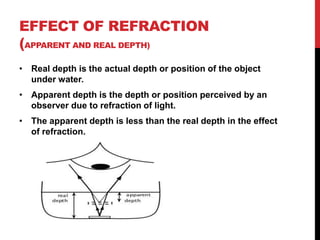
• Real depth is the actual depth or position of the object
  under water.
• Apparent depth is the depth or position perceived by an
  observer due to refraction of light.
• The apparent depth is less than the real depth in the effect
  of refraction.

Light

  • 1.
  • 2.
    PROPERTIES OF LIGHT • Lighttravels in straight lines. • It is a form of energy. • It travels at a speed of 3 x 10⁸ m s-1 in vacuum. • When light hits an object, it can be reflected or refracted.
  • 3.
    RAY AND BEAMOF LIGHT • A ray of light is indicated by a single straight line. • A collective light rays is called a beam of light.
  • 4.
    REFLECTION OF LIGHT • Reflectionis light being bounced off after hitting an opaque surface. • Reflection allows us to see objects in our surroundings. • In reflection of light, there are: - Incident ray: Light ray coming towards the surface - Reflected ray: Light ray bouncing off the surface
  • 5.
    REFLECTION OF LIGHT • Thetype of reflection, regular or diffused is affected by the type of surface. - Regular reflection: When the light rays are incident on a smooth surface, they are reflected on a regular manner. - Diffused (or scattered) reflection: When the light rays are incident on a rough surface, they are reflected in a diffused or scattered manner.
  • 6.
    THE LAWS OF REFLECTION •The 2 laws of reflection are: - Angle of incidence is equal to angle of reflection. - In a reflected diagram, the incident ray (i), the reflected ray (r) and the normal must lie in the same plane.
  • 7.
    PLANE MIRROR Characteristics ofan image formed in a plane mirror: 1. Laterally inverted 2. Same size as the object 3. Upright 4. Same distance of object and image from the mirror 5. Virtual (cannot be captured on screen)
  • 8.
    REFRACTION • Refraction isthe bending of light rays when they travel from one transparent medium to another. • Refraction is caused by a change in the speed of light rays when they travel in the media of different densities. • Refraction of light can only take place in transparent media such as air, water, vacuum(in space), glass and diamond. • Light travels at different speeds in different media. - In a less dense medium, the speed of light is faster. - In a denser medium, the speed of light is slower.
  • 9.
    HOW LIGHT RAY TRAVELS •From a less dense medium to a denser medium: - Light ray bend towards the normal. • From a denser medium to a less dense medium: - Light ray bends away from the normal
  • 10.
    REFRACTIVE INDEX • Itis a measure of the bending of light ray when travelling from one medium into another. • Formula: n = sin i/ sin r
  • 11.
    EFFECT OF REFRACTION (APPARENTAND REAL DEPTH) • Real depth is the actual depth or position of the object under water. • Apparent depth is the depth or position perceived by an observer due to refraction of light. • The apparent depth is less than the real depth in the effect of refraction.