LIGHT


             By:
Kurniawati Ahmida
    09330063 / 5B
OBJECTIVIES OF LEARNING

   Student can to explain the properties of light
   Student can to explain the law of light
    reflection, draw image formation on the flat
    mirror, concave mirror, and convex mirror
   Student can to explain the law of light
    refraction, draw image formation in concave
    lens, and convex lens and explain the image
    properties in concave lens and convex
    lens, calculate the power of lens
Light is an elektromagnetic wave, namely the
wave the vibration of which is electric field and
magnetic field. Different with sound, light can spread
without medium, so light can spread in vacuum.
That’s why, sunlight can arrive to the earth
eventhough between the sun and the earth is found
vacuum space
While several properties of light among other are:
• Spreading according to straigt Line

• Has energy

• Can be seen

• Radiated in the from of radiation

• Has spreading direction perpendicular to vibration
  direction
• Can experience reflection, refraction, inter
  ference, diffraction, and polaritation
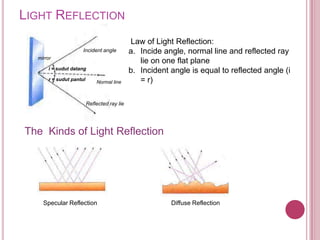
LIGHT REFLECTION
                                             Law of Light Reflection:
                     Incident angle          a. Incide angle, normal line and reflected ray
  mirror
                                                lie on one flat plane
      i = sudut datang
                                             b. Incident angle is equal to reflected angle (i
      r = sudut pantul
                             Normal line        = r)

                         Reflected ray lie


The Kinds of Light Reflection


    Specular Reflection                                  Diffuse Reflection
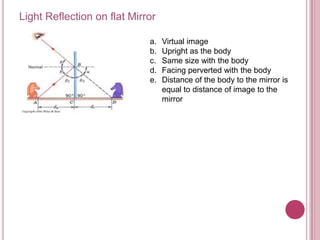
Light Reflection on flat Mirror

                             a.   Virtual image
                             b.   Upright as the body
                             c.   Same size with the body
                             d.   Facing perverted with the body
                             e.   Distance of the body to the mirror is
                                  equal to distance of image to the
                                  mirror
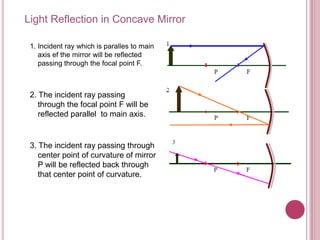
Light Reflection in Concave Mirror

 1. Incident ray which is paralles to main
    axis ef the mirror will be reflected
    passing through the focal point F.


 2. The incident ray passing
    through the focal point F will be
    reflected parallel to main axis.


 3. The incident ray passing through
    center point of curvature of mirror
    P will be reflected back through
    that center point of curvature.
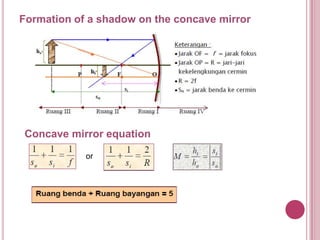
Formation of a shadow on the concave mirror


Concave mirror equation

            or
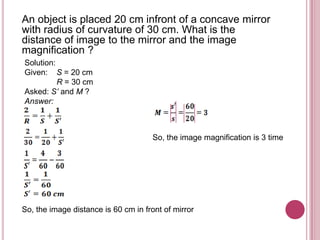
An object is placed 20 cm infront of a concave mirror
with radius of curvature of 30 cm. What is the
distance of image to the mirror and the image
magnification ?
Solution:
Given: S = 20 cm
          R = 30 cm
Asked: S’ and M ?
Answer:


                                      So, the image magnification is 3 time


So, the image distance is 60 cm in front of mirror
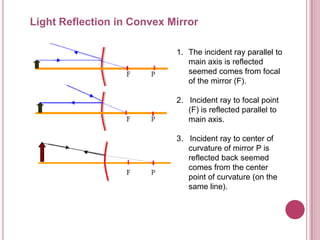
Light Reflection in Convex Mirror

                            1. The incident ray parallel to
                               main axis is reflected
                               seemed comes from focal
                               of the mirror (F).

                            2. Incident ray to focal point
                               (F) is reflected parallel to
                               main axis.

                            3. Incident ray to center of
                               curvature of mirror P is
                               reflected back seemed
                               comes from the center
                               point of curvature (on the
                               same line).
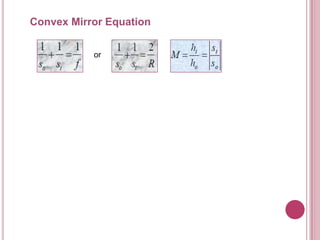
Convex Mirror Equation


           or
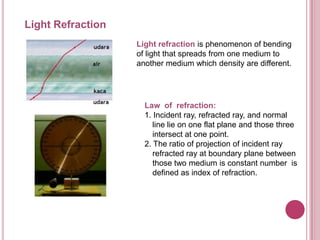
Light Refraction
                   Light refraction is phenomenon of bending
                   of light that spreads from one medium to
                   another medium which density are different.


                     Law of refraction:
                     1. Incident ray, refracted ray, and normal
                        line lie on one flat plane and those three
                        intersect at one point.
                     2. The ratio of projection of incident ray
                        refracted ray at boundary plane between
                        those two medium is constant number is
                        defined as index of refraction.
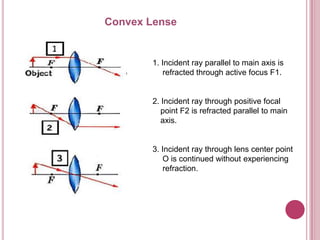
Convex Lense


       1. Incident ray parallel to main axis is
          refracted through active focus F1.


       2. Incident ray through positive focal
          point F2 is refracted parallel to main
          axis.


       3. Incident ray through lens center point
          O is continued without experiencing
          refraction.
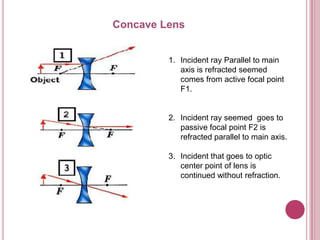
Concave Lens


         1. Incident ray Parallel to main
            axis is refracted seemed
            comes from active focal point
            F1.


         2. Incident ray seemed goes to
            passive focal point F2 is
            refracted parallel to main axis.

         3. Incident that goes to optic
            center point of lens is
            continued without refraction.
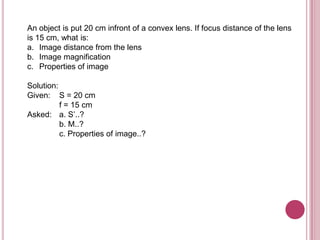
An object is put 20 cm infront of a convex lens. If focus distance of the lens
is 15 cm, what is:
a. Image distance from the lens
b. Image magnification
c. Properties of image

Solution:
Given: S = 20 cm
          f = 15 cm
Asked: a. S’..?
          b. M..?
          c. Properties of image..?
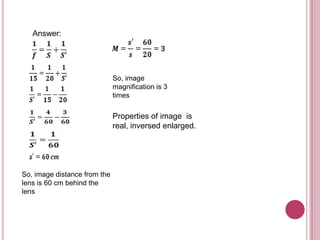
Answer:


                              So, image
                              magnification is 3
                              times

                              Properties of image is
                              real, inversed enlarged.


So, image distance from the
lens is 60 cm behind the
lens
Light

Light

  • 1.
    LIGHT By: Kurniawati Ahmida 09330063 / 5B
  • 2.
    OBJECTIVIES OF LEARNING  Student can to explain the properties of light  Student can to explain the law of light reflection, draw image formation on the flat mirror, concave mirror, and convex mirror  Student can to explain the law of light refraction, draw image formation in concave lens, and convex lens and explain the image properties in concave lens and convex lens, calculate the power of lens
  • 4.
    Light is anelektromagnetic wave, namely the wave the vibration of which is electric field and magnetic field. Different with sound, light can spread without medium, so light can spread in vacuum. That’s why, sunlight can arrive to the earth eventhough between the sun and the earth is found vacuum space
  • 5.
    While several propertiesof light among other are: • Spreading according to straigt Line • Has energy • Can be seen • Radiated in the from of radiation • Has spreading direction perpendicular to vibration direction • Can experience reflection, refraction, inter ference, diffraction, and polaritation
  • 6.
    LIGHT REFLECTION Law of Light Reflection: Incident angle a. Incide angle, normal line and reflected ray mirror lie on one flat plane i = sudut datang b. Incident angle is equal to reflected angle (i r = sudut pantul Normal line = r) Reflected ray lie The Kinds of Light Reflection Specular Reflection Diffuse Reflection
  • 7.
    Light Reflection onflat Mirror a. Virtual image b. Upright as the body c. Same size with the body d. Facing perverted with the body e. Distance of the body to the mirror is equal to distance of image to the mirror
  • 8.
    Light Reflection inConcave Mirror 1. Incident ray which is paralles to main axis ef the mirror will be reflected passing through the focal point F. 2. The incident ray passing through the focal point F will be reflected parallel to main axis. 3. The incident ray passing through center point of curvature of mirror P will be reflected back through that center point of curvature.
  • 9.
    Formation of ashadow on the concave mirror Concave mirror equation or
  • 10.
    An object isplaced 20 cm infront of a concave mirror with radius of curvature of 30 cm. What is the distance of image to the mirror and the image magnification ? Solution: Given: S = 20 cm R = 30 cm Asked: S’ and M ? Answer: So, the image magnification is 3 time So, the image distance is 60 cm in front of mirror
  • 11.
    Light Reflection inConvex Mirror 1. The incident ray parallel to main axis is reflected seemed comes from focal of the mirror (F). 2. Incident ray to focal point (F) is reflected parallel to main axis. 3. Incident ray to center of curvature of mirror P is reflected back seemed comes from the center point of curvature (on the same line).
  • 12.
  • 13.
    Light Refraction Light refraction is phenomenon of bending of light that spreads from one medium to another medium which density are different. Law of refraction: 1. Incident ray, refracted ray, and normal line lie on one flat plane and those three intersect at one point. 2. The ratio of projection of incident ray refracted ray at boundary plane between those two medium is constant number is defined as index of refraction.
  • 14.
    Convex Lense 1. Incident ray parallel to main axis is refracted through active focus F1. 2. Incident ray through positive focal point F2 is refracted parallel to main axis. 3. Incident ray through lens center point O is continued without experiencing refraction.
  • 15.
    Concave Lens 1. Incident ray Parallel to main axis is refracted seemed comes from active focal point F1. 2. Incident ray seemed goes to passive focal point F2 is refracted parallel to main axis. 3. Incident that goes to optic center point of lens is continued without refraction.
  • 16.
    An object isput 20 cm infront of a convex lens. If focus distance of the lens is 15 cm, what is: a. Image distance from the lens b. Image magnification c. Properties of image Solution: Given: S = 20 cm f = 15 cm Asked: a. S’..? b. M..? c. Properties of image..?
  • 17.
    Answer: So, image magnification is 3 times Properties of image is real, inversed enlarged. So, image distance from the lens is 60 cm behind the lens