LI-FI
technology
Submitted by
ANIL KUMAR (2016-333-014)
In partial fulfillment for the award of the degree of
BACHELOR OF TECHNOLOGY(B.Tech)
Submitted to
MR. SYED SIBTAIN KHALID
Department of computer science
JAMIA HAMDARD
New Delhi-110062
(2020)
CONTENTS
Introduction to LI-FI
History of LI-FI
Implementation of LI-FI
How it works
LI-FI vs WI-FI
Applications
Advantages
Limitation
Future Developments
Conclusions
20-Sep-20
2
WHAT IS LI-FI.....????
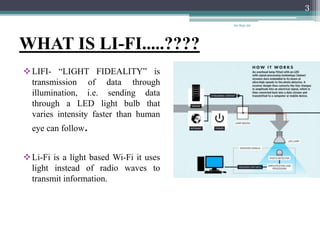
LIFI- “LIGHT FIDEALITY” is
transmission of data through
illumination, i.e. sending data
through a LED light bulb that
varies intensity faster than human
eye can follow.
Li-Fi is a light based Wi-Fi it uses
light instead of radio waves to
transmit information.
20-Sep-20
3
HISTORY-
The technology truly began during
the year 1990’s in countries like
Germany, Korea and Japan where
they discovered LED’s could be
retrofitted to send information.
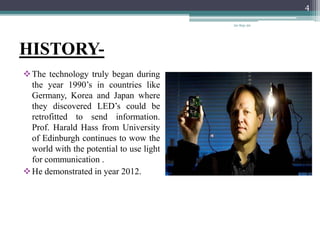
Prof. Harald Hass from University
of Edinburgh continues to wow the
world with the potential to use light
for communication .
He demonstrated in year 2012.
20-Sep-20
4
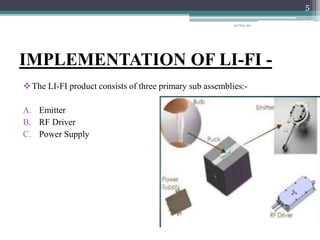
IMPLEMENTATION OF LI-FI -
The LI-FI product consists of three primary sub assemblies:-
A. Emitter
B. RF Driver
C. Power Supply
20-Sep-20
5
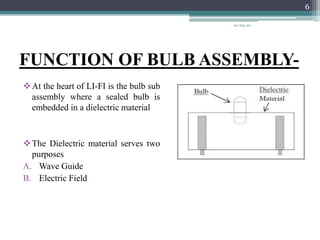
FUNCTION OF BULB ASSEMBLY-
At the heart of LI-FI is the bulb sub
assembly where a sealed bulb is
embedded in a dielectric material
The Dielectric material serves two
purposes
A. Wave Guide
B. Electric Field
20-Sep-20
6
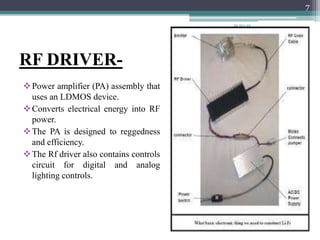
RF DRIVER-
Power amplifier (PA) assembly that
uses an LDMOS device.
Converts electrical energy into RF
power.
The PA is designed to reggedness
and efficiency.
The Rf driver also contains controls
circuit for digital and analog
lighting controls.
20-Sep-20
7
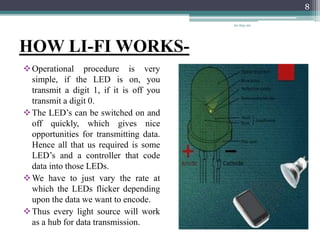
HOW LI-FI WORKS-
Operational procedure is very
simple, if the LED is on, you
transmit a digit 1, if it is off you
transmit a digit 0.
The LED’s can be switched on and
off quickly, which gives nice
opportunities for transmitting data.
Hence all that us required is some
LED’s and a controller that code
data into those LEDs.
We have to just vary the rate at
which the LEDs flicker depending
upon the data we want to encode.
Thus every light source will work
as a hub for data transmission.
20-Sep-20
8
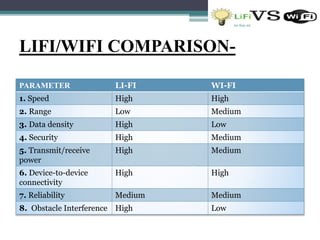
LIFI/WIFI COMPARISON-
PARAMETER LI-FI WI-FI
1. Speed High High
2. Range Low Medium
3. Data density High Low
4. Security High Medium
5. Transmit/receive
power
High Medium
6. Device-to-device
connectivity
High High
7. Reliability Medium Medium
8. Obstacle Interference High Low
20-Sep-20
9
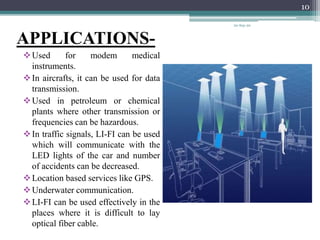
APPLICATIONS-
Used for modem medical
instruments.
In aircrafts, it can be used for data
transmission.
Used in petroleum or chemical
plants where other transmission or
frequencies can be hazardous.
In traffic signals, LI-FI can be used
which will communicate with the
LED lights of the car and number
of accidents can be decreased.
Location based services like GPS.
Underwater communication.
LI-FI can be used effectively in the
places where it is difficult to lay
optical fiber cable.
20-Sep-20
10
ADVANTAGES-
Larger bandwidth.
High efficiency.
High security.
High availability.
No license needed.
Green information technology.
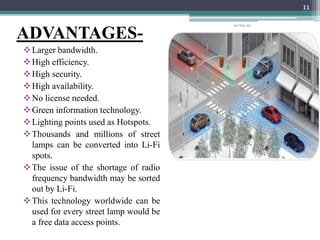
Lighting points used as Hotspots.
Thousands and millions of street
lamps can be converted into Li-Fi
spots.
The issue of the shortage of radio
frequency bandwidth may be sorted
out by Li-Fi.
This technology worldwide can be
used for every street lamp would be
a free data access points.
20-Sep-20
11
LIMITATIONS-
LI-FI doesn’t work in the dark.
LI-FI has big drawback compared
to WI-FI, unlike WI-FI we cannot
move to other rooms unless there
are wired bulbs too.
Light can’t pass through the
objects.
Interference from external sources
like sun light, normal bulbs, and
opaque materials in the path of
transmission will course
interruption in the communication.
High installation cost of the VLC
systems.
A major challenge facing LI-FI is
how the receiving device will
transmit back to the transmitter.
20-Sep-20
12
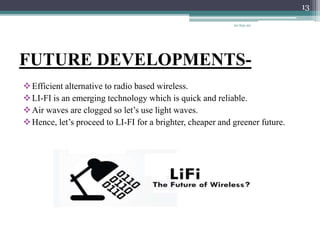
FUTURE DEVELOPMENTS-
Efficient alternative to radio based wireless.
LI-FI is an emerging technology which is quick and reliable.
Air waves are clogged so let’s use light waves.
Hence, let’s proceed to LI-FI for a brighter, cheaper and greener future.
20-Sep-20
13
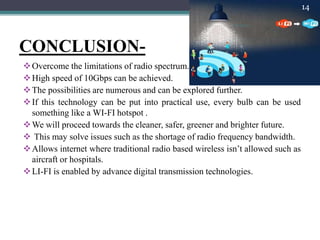
CONCLUSION-
Overcome the limitations of radio spectrum.
High speed of 10Gbps can be achieved.
The possibilities are numerous and can be explored further.
If this technology can be put into practical use, every bulb can be used
something like a WI-FI hotspot .
We will proceed towards the cleaner, safer, greener and brighter future.
 This may solve issues such as the shortage of radio frequency bandwidth.
Allows internet where traditional radio based wireless isn’t allowed such as
aircraft or hospitals.
LI-FI is enabled by advance digital transmission technologies.
20-Sep-20
14
REFERENCE-
http://en.wikipedia.org/wiki/Li-Fi
seminarprojects.com/s/seminar-report-on-Li-Fi
http://teleinfobd.blogspot.in/2012/01/what-is-lifi.html
technopits.blogspot.comtechnology.cgap.org/2012/01/a-Li-Fi-world
www.lificonsortium.org
The-gadgeteer.com/2011/08/Li-Fi
20-Sep-20
15
20-Sep-20
16

LI-FI TECHNOLOGY ( an emerging technology)

  • 1.
    LI-FI technology Submitted by ANIL KUMAR(2016-333-014) In partial fulfillment for the award of the degree of BACHELOR OF TECHNOLOGY(B.Tech) Submitted to MR. SYED SIBTAIN KHALID Department of computer science JAMIA HAMDARD New Delhi-110062 (2020)
  • 2.
    CONTENTS Introduction to LI-FI Historyof LI-FI Implementation of LI-FI How it works LI-FI vs WI-FI Applications Advantages Limitation Future Developments Conclusions 20-Sep-20 2
  • 3.
    WHAT IS LI-FI.....???? LIFI-“LIGHT FIDEALITY” is transmission of data through illumination, i.e. sending data through a LED light bulb that varies intensity faster than human eye can follow. Li-Fi is a light based Wi-Fi it uses light instead of radio waves to transmit information. 20-Sep-20 3
  • 4.
    HISTORY- The technology trulybegan during the year 1990’s in countries like Germany, Korea and Japan where they discovered LED’s could be retrofitted to send information. Prof. Harald Hass from University of Edinburgh continues to wow the world with the potential to use light for communication . He demonstrated in year 2012. 20-Sep-20 4
  • 5.
    IMPLEMENTATION OF LI-FI- The LI-FI product consists of three primary sub assemblies:- A. Emitter B. RF Driver C. Power Supply 20-Sep-20 5
  • 6.
    FUNCTION OF BULBASSEMBLY- At the heart of LI-FI is the bulb sub assembly where a sealed bulb is embedded in a dielectric material The Dielectric material serves two purposes A. Wave Guide B. Electric Field 20-Sep-20 6
  • 7.
    RF DRIVER- Power amplifier(PA) assembly that uses an LDMOS device. Converts electrical energy into RF power. The PA is designed to reggedness and efficiency. The Rf driver also contains controls circuit for digital and analog lighting controls. 20-Sep-20 7
  • 8.
    HOW LI-FI WORKS- Operationalprocedure is very simple, if the LED is on, you transmit a digit 1, if it is off you transmit a digit 0. The LED’s can be switched on and off quickly, which gives nice opportunities for transmitting data. Hence all that us required is some LED’s and a controller that code data into those LEDs. We have to just vary the rate at which the LEDs flicker depending upon the data we want to encode. Thus every light source will work as a hub for data transmission. 20-Sep-20 8
  • 9.
    LIFI/WIFI COMPARISON- PARAMETER LI-FIWI-FI 1. Speed High High 2. Range Low Medium 3. Data density High Low 4. Security High Medium 5. Transmit/receive power High Medium 6. Device-to-device connectivity High High 7. Reliability Medium Medium 8. Obstacle Interference High Low 20-Sep-20 9
  • 10.
    APPLICATIONS- Used for modemmedical instruments. In aircrafts, it can be used for data transmission. Used in petroleum or chemical plants where other transmission or frequencies can be hazardous. In traffic signals, LI-FI can be used which will communicate with the LED lights of the car and number of accidents can be decreased. Location based services like GPS. Underwater communication. LI-FI can be used effectively in the places where it is difficult to lay optical fiber cable. 20-Sep-20 10
  • 11.
    ADVANTAGES- Larger bandwidth. High efficiency. Highsecurity. High availability. No license needed. Green information technology. Lighting points used as Hotspots. Thousands and millions of street lamps can be converted into Li-Fi spots. The issue of the shortage of radio frequency bandwidth may be sorted out by Li-Fi. This technology worldwide can be used for every street lamp would be a free data access points. 20-Sep-20 11
  • 12.
    LIMITATIONS- LI-FI doesn’t workin the dark. LI-FI has big drawback compared to WI-FI, unlike WI-FI we cannot move to other rooms unless there are wired bulbs too. Light can’t pass through the objects. Interference from external sources like sun light, normal bulbs, and opaque materials in the path of transmission will course interruption in the communication. High installation cost of the VLC systems. A major challenge facing LI-FI is how the receiving device will transmit back to the transmitter. 20-Sep-20 12
  • 13.
    FUTURE DEVELOPMENTS- Efficient alternativeto radio based wireless. LI-FI is an emerging technology which is quick and reliable. Air waves are clogged so let’s use light waves. Hence, let’s proceed to LI-FI for a brighter, cheaper and greener future. 20-Sep-20 13
  • 14.
    CONCLUSION- Overcome the limitationsof radio spectrum. High speed of 10Gbps can be achieved. The possibilities are numerous and can be explored further. If this technology can be put into practical use, every bulb can be used something like a WI-FI hotspot . We will proceed towards the cleaner, safer, greener and brighter future.  This may solve issues such as the shortage of radio frequency bandwidth. Allows internet where traditional radio based wireless isn’t allowed such as aircraft or hospitals. LI-FI is enabled by advance digital transmission technologies. 20-Sep-20 14
  • 15.
  • 16.