LI-FI
TECHNOLOGY
BY :- RISHABH RANJAN
U. ROLL:- 1519240187
G.L.BAJAJ INSTITUTE OF
TECHNOLOGY AND MANAGEMENT
CONTENTS
Introduction to LI-FI
History of LI-FI
Implementation
How it works
LI-FI vs WI-FI
Application
Advantages
Limitation
of LI-FI
Future Developments
Conclusions
FI….???WHAT IS LI-
FI ?
LIFI –”LIGHT FIDEALITY” is
transmission of data through
illumination, i.e. sending data
through a LED light bulb that
varies in intensity faster than
human eye can follow.
Li-Fi is a light based Wi-Fi it uses
light instead of radio waves to
transmit information.
HISTORY :-
Harald Hass , a professor at the
University of Edinburgh who
began his research in the field in
2004, gave a debut demonstration
of what he called a Li-Fi prototype
at the TED Global conference in
Edinburgh on 12th July.
:
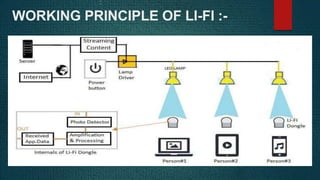
WORKING PRINCIPLE OF LI-FI :-
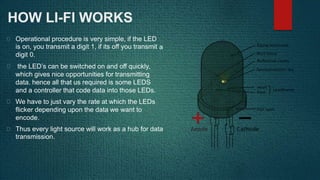
HOW LI-FI WORKS
Operational procedure is very simple, if the LED
is on, you transmit a digit 1, if its off you transmit
digit 0.
the LED’s can be switched on and off quickly,
which gives nice opportunities for transmitting
data. hence all that us required is some LEDS
and a controller that code data into those LEDs.
We have to just vary the rate at which the LEDs
flicker depending upon the data we want to
encode.
a
Thus every light source will work as a hub for data
transmission.
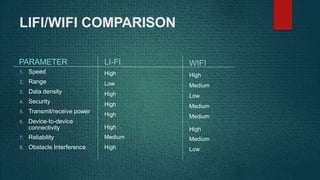
LIFI/WIFI COMPARISON
PARAMETER
1. Speed
2. Range
3. Data density
4. Security
5. Transmit/receive power
6. Device-to-device
connectivity
7. Reliability
8. Obstacle Interference
LI-FI
High
Low
High
High
High
WIFI
High
Medium
Low
Medium
Medium
High
Medium
High
High
Medium
Low
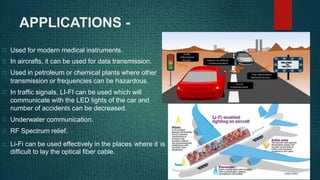
APPLICATIONS -
Used for modern medical instruments.
In aircrafts, it can be used for data transmission.
Used in petroleum or chemical plants where other
transmission or frequencies can be hazardous.
In traffic signals, LI-FI can be used which will
communicate with the LED lights of the car and
number of accidents can be decreased.
Underwater communication.
RF Spectrum relief.
Li-Fi can be used effectively in the places
difficult to lay the optical fiber cable.
where it is
nverted
ADVANTAGES -
Larger bandwidth.
High efficiency.
More availability.
High security.
Thousands and millions
to Li-Fi spots.
No license needed.
of street lamps can be co
Green information technology.
Lighting points used as Hotspots.
The issues of the shortage of radio frequency bandwidth
may be sorted out by Li-Fi.
This technology worldwide can be used for every street
lamp would be a free data access points.
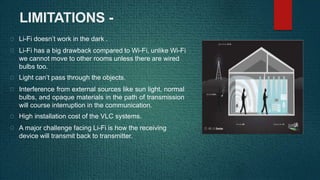
LIMITATIONS -
Li-Fi doesn’t work in the dark .
Li-Fi has a big drawback compared to Wi-Fi, unlike Wi-Fi
we cannot move to other rooms unless there are wired
bulbs too.
Light can’t pass through the objects.
Interference from external sources like sun light, normal
bulbs, and opaque materials in the path of transmission
will course interruption in the communication.
High installation cost of the VLC systems.
A major challenge facing Li-Fi is how the receiving
device will transmit back to transmitter.
FUTURE DEVELOPMENTS:-
Efficient alternative to radio-based wireless.
Li-Fi is an emerging technology which is quick and reliable.
Hence, let’s proceed to Li- Fi for a brighter ,cheaper and greener future.
REFERENCE -
http://en.wikipedia.org/wiki/Li-Fi
seminarprojects.com/s/seminar-report-on-Li-Fi
http://teleinfobd.blogspot.in/2012/01/what-is-lifi.html
technopits.blogspot.comtechnology.cgap.org/2012/01/a-
Li-Fi-world
www.lificonsortium.org
the-gadgeteer.com/2011/08/LI-FI
ANY QUESTIONS ?
THANK YOU

Li fi technology

  • 1.
    LI-FI TECHNOLOGY BY :- RISHABHRANJAN U. ROLL:- 1519240187 G.L.BAJAJ INSTITUTE OF TECHNOLOGY AND MANAGEMENT
  • 2.
    CONTENTS Introduction to LI-FI Historyof LI-FI Implementation How it works LI-FI vs WI-FI Application Advantages Limitation of LI-FI Future Developments Conclusions
  • 3.
    FI….???WHAT IS LI- FI? LIFI –”LIGHT FIDEALITY” is transmission of data through illumination, i.e. sending data through a LED light bulb that varies in intensity faster than human eye can follow. Li-Fi is a light based Wi-Fi it uses light instead of radio waves to transmit information.
  • 4.
    HISTORY :- Harald Hass, a professor at the University of Edinburgh who began his research in the field in 2004, gave a debut demonstration of what he called a Li-Fi prototype at the TED Global conference in Edinburgh on 12th July.
  • 5.
  • 6.
    HOW LI-FI WORKS Operationalprocedure is very simple, if the LED is on, you transmit a digit 1, if its off you transmit digit 0. the LED’s can be switched on and off quickly, which gives nice opportunities for transmitting data. hence all that us required is some LEDS and a controller that code data into those LEDs. We have to just vary the rate at which the LEDs flicker depending upon the data we want to encode. a Thus every light source will work as a hub for data transmission.
  • 7.
    LIFI/WIFI COMPARISON PARAMETER 1. Speed 2.Range 3. Data density 4. Security 5. Transmit/receive power 6. Device-to-device connectivity 7. Reliability 8. Obstacle Interference LI-FI High Low High High High WIFI High Medium Low Medium Medium High Medium High High Medium Low
  • 8.
    APPLICATIONS - Used formodern medical instruments. In aircrafts, it can be used for data transmission. Used in petroleum or chemical plants where other transmission or frequencies can be hazardous. In traffic signals, LI-FI can be used which will communicate with the LED lights of the car and number of accidents can be decreased. Underwater communication. RF Spectrum relief. Li-Fi can be used effectively in the places difficult to lay the optical fiber cable. where it is
  • 9.
    nverted ADVANTAGES - Larger bandwidth. Highefficiency. More availability. High security. Thousands and millions to Li-Fi spots. No license needed. of street lamps can be co Green information technology. Lighting points used as Hotspots. The issues of the shortage of radio frequency bandwidth may be sorted out by Li-Fi. This technology worldwide can be used for every street lamp would be a free data access points.
  • 10.
    LIMITATIONS - Li-Fi doesn’twork in the dark . Li-Fi has a big drawback compared to Wi-Fi, unlike Wi-Fi we cannot move to other rooms unless there are wired bulbs too. Light can’t pass through the objects. Interference from external sources like sun light, normal bulbs, and opaque materials in the path of transmission will course interruption in the communication. High installation cost of the VLC systems. A major challenge facing Li-Fi is how the receiving device will transmit back to transmitter.
  • 11.
    FUTURE DEVELOPMENTS:- Efficient alternativeto radio-based wireless. Li-Fi is an emerging technology which is quick and reliable. Hence, let’s proceed to Li- Fi for a brighter ,cheaper and greener future.
  • 12.
  • 13.
  • 14.