SUBMITTED BY: NITIN KUMAR JAISWAL
INTRODUCTION
• As recognized by IEEE standardization committee for Optical Wireless Communications,
Li-Fi is high speed, bidirectional, networked and mobile communications using light. Li-
Fi can be thought of as a light-based Wi-Fi. That is, it uses light instead of radio waves to
transmit information. And instead of Wi-Fi modems, Li-Fi would use transceiver-fitted
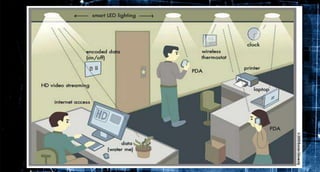
LED lamps that can light a room as well as transmit and receive information.
• This technology was invented by developed by a team of scientists including Dr.
Gordon Povey, Prof. Harald Haas and Dr. Mostafa Afgani at the University of
Edinburgh.
• With Li-Fi technology, data travels in the visible light spectrum through LEDs. Li-Fi uses
visible light between 400 and 800 terahertz and a light is switched on and off much
faster than a human eye can detect which can be used to write data in binary codes.
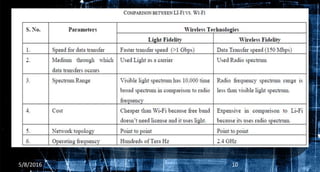
• Li-Fi is fast and cheap optical version of Wi-Fi based on Visible Light
Communication(VLC).
5/8/2016 2
Current Scenario
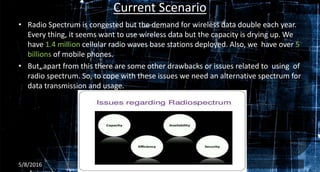
• Radio Spectrum is congested but the demand for wireless data double each year.
Every thing, it seems want to use wireless data but the capacity is drying up. We
have 1.4 million cellular radio waves base stations deployed. Also, we have over 5
billions of mobile phones.
• But, apart from this there are some other drawbacks or issues related to using of
radio spectrum. So, to cope with these issues we need an alternative spectrum for
data transmission and usage.
5/8/2016 3
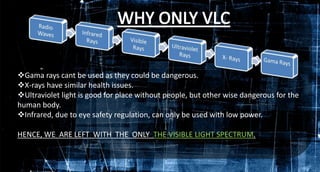
Gama rays cant be used as they could be dangerous.
X-rays have similar health issues.
Ultraviolet light is good for place without people, but other wise dangerous for the
human body.
Infrared, due to eye safety regulation, can only be used with low power.
HENCE, WE ARE LEFT WITH THE ONLY THE VISIBLE LIGHT SPECTRUM.
WORKING PROCESS
 Operational procedure is very simple, if the led is on, you transmit a digital 1, if its off
you transmit a 0. The LEDs can be switched on and off very quickly, which the human
eye cannot detect This invisible on-off activity enables a kind of data transmission using
binary codes.
 Hence all that is required are some LEDs and a controller that code data into those
LEDs. We have to just vary the rate at which the LED’s flicker depending upon the data
we want to encode.
 Thus every light source will works as a hub for data transmission .
5/8/2016 5
6
WORKING OF LIFI
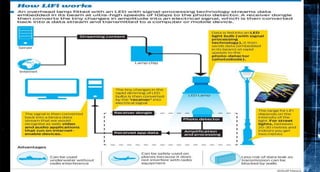
On one end all the data on the internet will be streamed to a lamp driver when the led is
turned on the microchip converts the digital data in form of light
A light sensitive device (photo detector) receives the signal and converts it back into
original data. This method of using rapid pulses of light to transmit information wirelessly
is technically referred as Visible Light Communication .
Further enhancements can be made in this method, like using an array of LEDs for
parallel data transmission, or using mixtures of red, green and blue LEDs to alter the light‘s
frequency with each frequency encoding a different data channel. Such advancements
promise a theoretical speed of 10 Gbps – meaning one can download a full high-definition
film in just 30 seconds.
5/8/2016 7
5/8/2016 8
5/8/2016 9
WORKING OF LIFI
5/8/2016 10
TIMELINE(HISTORY & PRESENT)
• Professor Harald Haas, from the University of Edinburgh in the UK, is widely
recognised as the original founder of Li-Fi. He coined the term Li-Fi and is Chair
man of Mobile Communications at the University of Edinburgh and co-founder of
pureLiFi.
• Haas promoted Li-Fi technology in his 2011 TED Global talk and helped start a
company to market it. PureLiFi, formerly pureVLC, is an original equipment
manufacturer (OEM) firm set up to commercialize Li-Fi products for integration
with existing LED-lighting systems.
• In October 2011, companies and industry groups formed the Li-Fi Consortium, to
promote high-speed optical wireless systems and to overcome the limited amount
of radio-based wireless spectrum available by exploiting a completely different
part of the electromagnetic spectrum.
5/8/2016 11
History(Continued)
• By August 2013, data rates of over 1.6 Gbit/s were
demonstrated over a single color LED.
• In September 2013, a press release said that Li-Fi, or VLC
systems in general, do not require line-of-sight conditions.
• In October 2013, it was reported Chinese manufacturers
were working on Li-Fi development kits.
• Philips lighting company has developed a VLC system for
shoppers at stores. They have to download an app on their
smartphone and then their smartphone works with the
LEDs in the store. The LEDs can pinpoint where they are at
in the store and give them corresponding coupons and
information based on where aisle they are on and what
they are looking at.
08-05-2016 12
Present Scenario
• VLC technology is ready right now; it's being installed
in museums and businesses across France, and is
being embraced by EDF, one of the nation's largest
utilities.
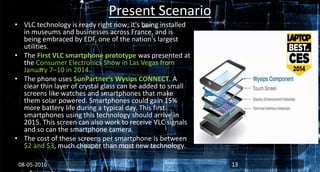
• The First VLC smartphone prototype was presented at
the Consumer Electronics Show in Las Vegas from
January 7–10 in 2014.
• The phone uses SunPartner's Wysips CONNECT. A
clear thin layer of crystal glass can be added to small
screens like watches and smartphones that make
them solar powered. Smartphones could gain 15%
more battery life during a typical day. This first
smartphones using this technology should arrive in
2015. This screen can also work to receive VLC signals
and so can the smartphone camera.
• The cost of these screens per smartphone is between
$2 and $3, much cheaper than most new technology.
08-05-2016 13
• It was in October 2014, when a team of researchers from the universities of Oxford,
Edinburgh, St. Andrews and Strathclyde reached transmission speed of 10.5GBPS using
Li-Fi which was governed under Ultra-Parallel Visible Light Communications Project
• On November 2015 an Estonian start-up Velmenni (whose CEO happens to be an
Indian, Deepak Solanki) with a bunch of scientists tested Li-Fi technology inside a lab in
Tallinn to achieve a whopping speed of 224GBPS. Outside of the lab, scientists
reported speeds of 1GBPS but is still 100 times faster than average Wi-Fi delivery.
• Besides Velmenni, companies like Oledcomm and pureLiFi are working in this field to
provide internet using Li-Fi. A couple of companies have already started to offer kits to
early adopters to install Li-Fi networks in both home and office.
5/8/2016 14
When will we be able to use it?
• It still has a long way from being used commercially. This could potentially be used
as a low cost wireless internet technology but before we move there, the
necessary infrastructure and ancillary need to be developed for its widespread
use and this will still take years.
• Before mass adoption of Li-Fi can be realized, techniques need to be developed
to retrofit current devices with the technology. It is very difficult to create a whole
new infrastructure for Li-Fi so somehow we need to integrate this concept with
our existing system.
5/8/2016 15
POTENTIAL APPLICATION OF LI-FI
Li Fi technology is still in its infancy .However some areas where it seems perfectly applicable are:-
1. TRAFFIC LIGHT.( Avoidance of Accidents):
• One of the smartest application of LIFI is sensors can be implanted in street lights, possible sending
your car info about road conditions, warning you about the guy you can’t see speeding towards the
intersection, or instantly transmitting his plate number to the cops when he does.
• Sensors implanted in front and rear bumpers could receive data transmitted from rear lights of the
car just veered into your lane while you were texting. Both drivers are warned (or may be the car
takes over) and the accident is averted.
2. INTRINSICALLY SAFE ENVIRONMENT
Visible Light is more safe than RF, hence it can be used in places where RF can't be used such as
petrochemical plants. LIFI can also be used in operating rooms where Wi-Fi isn’t allowed due to
radiation concerns.
5/8/2016 16
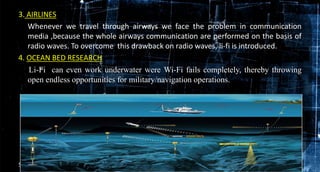
3. AIRLINES
Whenever we travel through airways we face the problem in communication
media ,because the whole airways communication are performed on the basis of
radio waves. To overcome this drawback on radio waves, li-fi is introduced.
4. OCEAN BED RESEARCH
Li-Fi can even work underwater were Wi-Fi fails completely, thereby throwing
open endless opportunities for military/navigation operations.
5/8/2016 17
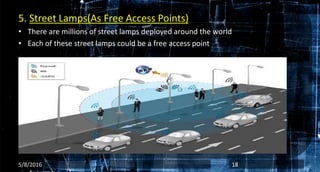
5. Street Lamps(As Free Access Points)
• There are millions of street lamps deployed around the world
• Each of these street lamps could be a free access point
5/8/2016 18
Limitations or Challenges
Light can't pass through objects .
 Interferences from external light sources like sun light, normal bulbs, and opaque
materials in the path of transmission will cause interruption in the communication.
 Li-Fi requires line of sight.
 High installation cost of the VLC systems
A major challenge facing Li-Fi is how the receiving device will transmit back to
transmitter.
CONCLUSION
• The possibilities are numerous and can be explored further. If this technology can
be put into practical use , every bulb can be used something like a Wi-Fi hotspots
to transmit wireless data. Li-Fi could be a huge game changer in transmitting large
data over the internet and impact technologies currently being used in video
transfers .
5/8/2016 20
REFERENCES
• http://en.wikipedia.org/wiki/Li-FI
• http://www.blogmatics.com
• www.lificonsortium.org/
• http://www.digplanet.com/wiki/Li-FI
• ”Visible-light communication: Tripping the light fantastic: A fast and cheap optical
version of Wi-Fi is coming”, Economist, dated 28Jan 2012.
• www.youtube.com
5/8/2016 21
5/8/2016 22

Lifi(seminar)

  • 1.
    SUBMITTED BY: NITINKUMAR JAISWAL
  • 2.
    INTRODUCTION • As recognizedby IEEE standardization committee for Optical Wireless Communications, Li-Fi is high speed, bidirectional, networked and mobile communications using light. Li- Fi can be thought of as a light-based Wi-Fi. That is, it uses light instead of radio waves to transmit information. And instead of Wi-Fi modems, Li-Fi would use transceiver-fitted LED lamps that can light a room as well as transmit and receive information. • This technology was invented by developed by a team of scientists including Dr. Gordon Povey, Prof. Harald Haas and Dr. Mostafa Afgani at the University of Edinburgh. • With Li-Fi technology, data travels in the visible light spectrum through LEDs. Li-Fi uses visible light between 400 and 800 terahertz and a light is switched on and off much faster than a human eye can detect which can be used to write data in binary codes. • Li-Fi is fast and cheap optical version of Wi-Fi based on Visible Light Communication(VLC). 5/8/2016 2
  • 3.
    Current Scenario • RadioSpectrum is congested but the demand for wireless data double each year. Every thing, it seems want to use wireless data but the capacity is drying up. We have 1.4 million cellular radio waves base stations deployed. Also, we have over 5 billions of mobile phones. • But, apart from this there are some other drawbacks or issues related to using of radio spectrum. So, to cope with these issues we need an alternative spectrum for data transmission and usage. 5/8/2016 3
  • 4.
    Gama rays cantbe used as they could be dangerous. X-rays have similar health issues. Ultraviolet light is good for place without people, but other wise dangerous for the human body. Infrared, due to eye safety regulation, can only be used with low power. HENCE, WE ARE LEFT WITH THE ONLY THE VISIBLE LIGHT SPECTRUM.
  • 5.
    WORKING PROCESS  Operationalprocedure is very simple, if the led is on, you transmit a digital 1, if its off you transmit a 0. The LEDs can be switched on and off very quickly, which the human eye cannot detect This invisible on-off activity enables a kind of data transmission using binary codes.  Hence all that is required are some LEDs and a controller that code data into those LEDs. We have to just vary the rate at which the LED’s flicker depending upon the data we want to encode.  Thus every light source will works as a hub for data transmission . 5/8/2016 5
  • 6.
  • 7.
    WORKING OF LIFI Onone end all the data on the internet will be streamed to a lamp driver when the led is turned on the microchip converts the digital data in form of light A light sensitive device (photo detector) receives the signal and converts it back into original data. This method of using rapid pulses of light to transmit information wirelessly is technically referred as Visible Light Communication . Further enhancements can be made in this method, like using an array of LEDs for parallel data transmission, or using mixtures of red, green and blue LEDs to alter the light‘s frequency with each frequency encoding a different data channel. Such advancements promise a theoretical speed of 10 Gbps – meaning one can download a full high-definition film in just 30 seconds. 5/8/2016 7
  • 8.
  • 9.
  • 10.
  • 11.
    TIMELINE(HISTORY & PRESENT) •Professor Harald Haas, from the University of Edinburgh in the UK, is widely recognised as the original founder of Li-Fi. He coined the term Li-Fi and is Chair man of Mobile Communications at the University of Edinburgh and co-founder of pureLiFi. • Haas promoted Li-Fi technology in his 2011 TED Global talk and helped start a company to market it. PureLiFi, formerly pureVLC, is an original equipment manufacturer (OEM) firm set up to commercialize Li-Fi products for integration with existing LED-lighting systems. • In October 2011, companies and industry groups formed the Li-Fi Consortium, to promote high-speed optical wireless systems and to overcome the limited amount of radio-based wireless spectrum available by exploiting a completely different part of the electromagnetic spectrum. 5/8/2016 11
  • 12.
    History(Continued) • By August2013, data rates of over 1.6 Gbit/s were demonstrated over a single color LED. • In September 2013, a press release said that Li-Fi, or VLC systems in general, do not require line-of-sight conditions. • In October 2013, it was reported Chinese manufacturers were working on Li-Fi development kits. • Philips lighting company has developed a VLC system for shoppers at stores. They have to download an app on their smartphone and then their smartphone works with the LEDs in the store. The LEDs can pinpoint where they are at in the store and give them corresponding coupons and information based on where aisle they are on and what they are looking at. 08-05-2016 12
  • 13.
    Present Scenario • VLCtechnology is ready right now; it's being installed in museums and businesses across France, and is being embraced by EDF, one of the nation's largest utilities. • The First VLC smartphone prototype was presented at the Consumer Electronics Show in Las Vegas from January 7–10 in 2014. • The phone uses SunPartner's Wysips CONNECT. A clear thin layer of crystal glass can be added to small screens like watches and smartphones that make them solar powered. Smartphones could gain 15% more battery life during a typical day. This first smartphones using this technology should arrive in 2015. This screen can also work to receive VLC signals and so can the smartphone camera. • The cost of these screens per smartphone is between $2 and $3, much cheaper than most new technology. 08-05-2016 13
  • 14.
    • It wasin October 2014, when a team of researchers from the universities of Oxford, Edinburgh, St. Andrews and Strathclyde reached transmission speed of 10.5GBPS using Li-Fi which was governed under Ultra-Parallel Visible Light Communications Project • On November 2015 an Estonian start-up Velmenni (whose CEO happens to be an Indian, Deepak Solanki) with a bunch of scientists tested Li-Fi technology inside a lab in Tallinn to achieve a whopping speed of 224GBPS. Outside of the lab, scientists reported speeds of 1GBPS but is still 100 times faster than average Wi-Fi delivery. • Besides Velmenni, companies like Oledcomm and pureLiFi are working in this field to provide internet using Li-Fi. A couple of companies have already started to offer kits to early adopters to install Li-Fi networks in both home and office. 5/8/2016 14
  • 15.
    When will webe able to use it? • It still has a long way from being used commercially. This could potentially be used as a low cost wireless internet technology but before we move there, the necessary infrastructure and ancillary need to be developed for its widespread use and this will still take years. • Before mass adoption of Li-Fi can be realized, techniques need to be developed to retrofit current devices with the technology. It is very difficult to create a whole new infrastructure for Li-Fi so somehow we need to integrate this concept with our existing system. 5/8/2016 15
  • 16.
    POTENTIAL APPLICATION OFLI-FI Li Fi technology is still in its infancy .However some areas where it seems perfectly applicable are:- 1. TRAFFIC LIGHT.( Avoidance of Accidents): • One of the smartest application of LIFI is sensors can be implanted in street lights, possible sending your car info about road conditions, warning you about the guy you can’t see speeding towards the intersection, or instantly transmitting his plate number to the cops when he does. • Sensors implanted in front and rear bumpers could receive data transmitted from rear lights of the car just veered into your lane while you were texting. Both drivers are warned (or may be the car takes over) and the accident is averted. 2. INTRINSICALLY SAFE ENVIRONMENT Visible Light is more safe than RF, hence it can be used in places where RF can't be used such as petrochemical plants. LIFI can also be used in operating rooms where Wi-Fi isn’t allowed due to radiation concerns. 5/8/2016 16
  • 17.
    3. AIRLINES Whenever wetravel through airways we face the problem in communication media ,because the whole airways communication are performed on the basis of radio waves. To overcome this drawback on radio waves, li-fi is introduced. 4. OCEAN BED RESEARCH Li-Fi can even work underwater were Wi-Fi fails completely, thereby throwing open endless opportunities for military/navigation operations. 5/8/2016 17
  • 18.
    5. Street Lamps(AsFree Access Points) • There are millions of street lamps deployed around the world • Each of these street lamps could be a free access point 5/8/2016 18
  • 19.
    Limitations or Challenges Lightcan't pass through objects .  Interferences from external light sources like sun light, normal bulbs, and opaque materials in the path of transmission will cause interruption in the communication.  Li-Fi requires line of sight.  High installation cost of the VLC systems A major challenge facing Li-Fi is how the receiving device will transmit back to transmitter.
  • 20.
    CONCLUSION • The possibilitiesare numerous and can be explored further. If this technology can be put into practical use , every bulb can be used something like a Wi-Fi hotspots to transmit wireless data. Li-Fi could be a huge game changer in transmitting large data over the internet and impact technologies currently being used in video transfers . 5/8/2016 20
  • 21.
    REFERENCES • http://en.wikipedia.org/wiki/Li-FI • http://www.blogmatics.com •www.lificonsortium.org/ • http://www.digplanet.com/wiki/Li-FI • ”Visible-light communication: Tripping the light fantastic: A fast and cheap optical version of Wi-Fi is coming”, Economist, dated 28Jan 2012. • www.youtube.com 5/8/2016 21
  • 22.

Editor's Notes

  • #14 SunPartner's Wysips CONNECT  a technique that converts light waves into usable energy, making the phone capable of receiving and decoding signals without drawing on its battery.