LI-FI TECHNOLOGY
ONKAR BHUJBAL
Roll No-27
Div –TE(A)
S.R. PAWARA
CONTENTS
 INTRODUCTION
 HISTORY
 PRESENT SCENARIO
 ISSUES REGARDING RADIO SPECTRUM
 VISIBLE LIGHT SPECTRUM
 HOW LIFI WORKS
 CONSTRUCTION OF LIFI
 COMPARISON OF LIFI WITH WIFI
 APPLICATIONS
 LIMITATIONS
 CONCLUSION
 REFERENCES
INTRODUCTION
 Li-fi basically known as “LIGHT FEDILITY”
 The basic ideology behind this technology is that the data can be transmitted
through LED light whose intensity varies even faster than the human eye.
 Li-Fi is the term some have used to label the fast and cheap wireless-
communication system
 As there are more and more devices coming up day-by-day the signals are
being clogged up due to heavy traffic, there a need for an error free transmission
technology.
history
 The technology truly began during the 1990's in countries like
Germany, Korea, and Japan where they discovered LED's could be
added to send information.
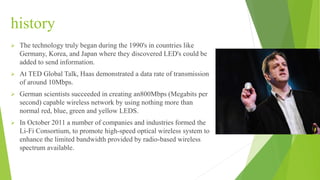
 At TED Global Talk, Haas demonstrated a data rate of transmission
of around 10Mbps.
 German scientists succeeded in creating an800Mbps (Megabits per
second) capable wireless network by using nothing more than
normal red, blue, green and yellow LEDS.
 In October 2011 a number of companies and industries formed the
Li-Fi Consortium, to promote high-speed optical wireless system to
enhance the limited bandwidth provided by radio-based wireless
spectrum available.
PRESENT SCENARIO
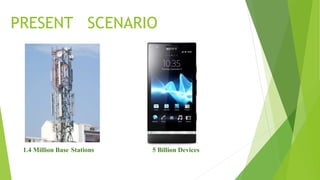
1.4 Million Base Stations 5 Billion Devices
PRESENT SCENARIO
 Radio Spectrum is congested but the demand for wireless data
double each year .Every thing, it seems want to use wireless
data but the capacity is drying up.
 So what can carry this excess demand in the future .
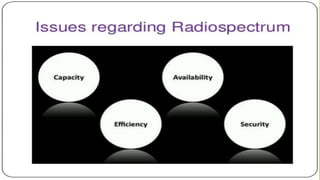
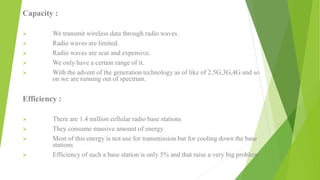
Capacity :
 We transmit wireless data through radio waves.
 Radio waves are limited.
 Radio waves are scar and expensive.
 We only have a certain range of it.
 With the advent of the generation technology as of like of 2.5G,3G,4G and so
on we are running out of spectrum.
Efficiency :
 There are 1.4 million cellular radio base stations
 They consume massive amount of energy
 Most of this energy is not use for transmission but for cooling down the base
stations
 Efficiency of such a base station is only 5% and that raise a very big problem
Availability :
 Availability of radio waves causes another concern.
 We have to switch off our mobiles in airplanes.
 It is not advisable to use mobiles at places like petrochemical plants ,hospitals
petrol pumps.
Security :
 Radio waves penetrates through walls
 They can be intercepted
 If someone has a knowledge and bad intentions then he may misuse it
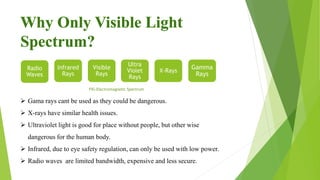
Radio
Waves
Infrared
Rays
Visible
Rays
Ultra
Violet
Rays
X-Rays
Gamma
Rays
 Gama rays cant be used as they could be dangerous.
 X-rays have similar health issues.
 Ultraviolet light is good for place without people, but other wise
dangerous for the human body.
 Infrared, due to eye safety regulation, can only be used with low power.
 Radio waves are limited bandwidth, expensive and less secure.
FIG-Electromagnetic Spectrum
How LI-FI Works ?
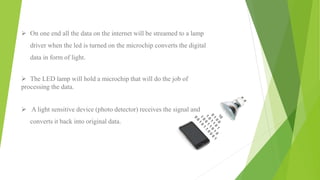
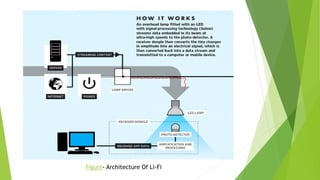
 On one end all the data on the internet will be streamed to a lamp
driver when the led is turned on the microchip converts the digital
data in form of light.
 The LED lamp will hold a microchip that will do the job of
processing the data.
 A light sensitive device (photo detector) receives the signal and
converts it back into original data.
Figure- Architecture Of Li-Fi
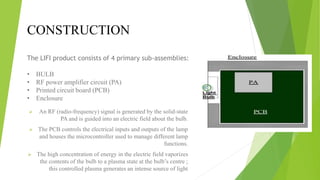
 An RF (radio-frequency) signal is generated by the solid-state
PA and is guided into an electric field about the bulb.
 The PCB controls the electrical inputs and outputs of the lamp
and houses the microcontroller used to manage different lamp
functions.
 The high concentration of energy in the electric field vaporizes
the contents of the bulb to a plasma state at the bulb’s centre ;
this controlled plasma generates an intense source of light
CONSTRUCTION
The LIFI product consists of 4 primary sub-assemblies:
• BULB
• RF power amplifier circuit (PA)
• Printed circuit board (PCB)
• Enclosure
APPLICATIONS OF LIFI
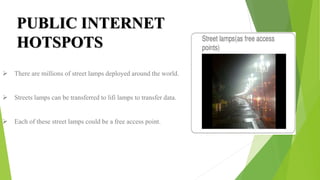
 There are millions of street lamps deployed around the world.
 Streets lamps can be transferred to lifi lamps to transfer data.
 Each of these street lamps could be a free access point.
PUBLIC INTERNET
HOTSPOTS
TRAFFIC LIGHTS
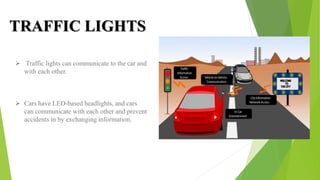
 Traffic lights can communicate to the car and
with each other.
 Cars have LED-based headlights, and cars
can communicate with each other and prevent
accidents in by exchanging information.
ON OCEAN BEDS
 Li-Fi can even work underwater were Wi-Fi fails
completely, thereby throwing open endless
opportunities for military/navigation operations.
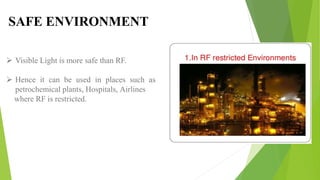
 Visible Light is more safe than RF.
 Hence it can be used in places such as
petrochemical plants, Hospitals, Airlines
where RF is restricted.
SAFE ENVIRONMENT
 High installation cost of the VLC systems.
 A major challenge facing Li-Fi is how the receiving device will transmit
back to transmitter.
 Light can't pass through objects.
 Requires line of sight to transmit data.
LIMITATIONS
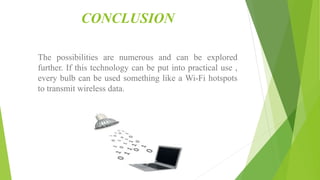
CONCLUSION
The possibilities are numerous and can be explored
further. If this technology can be put into practical use ,
every bulb can be used something like a Wi-Fi hotspots
to transmit wireless data.
REFERENCES
 Wikipedia
 http://lificonsortium.org/
 http://gimt.edu.in/clientFiles/FILE_REPO/2012/NOV/23/1353645362
045/69.pdf
 https://www.youtube.com/watch?v=WRG9iXZbuAc

LIFI TECHNOLOGY

  • 1.
    LI-FI TECHNOLOGY ONKAR BHUJBAL RollNo-27 Div –TE(A) S.R. PAWARA
  • 2.
    CONTENTS  INTRODUCTION  HISTORY PRESENT SCENARIO  ISSUES REGARDING RADIO SPECTRUM  VISIBLE LIGHT SPECTRUM  HOW LIFI WORKS  CONSTRUCTION OF LIFI  COMPARISON OF LIFI WITH WIFI  APPLICATIONS  LIMITATIONS  CONCLUSION  REFERENCES
  • 3.
    INTRODUCTION  Li-fi basicallyknown as “LIGHT FEDILITY”  The basic ideology behind this technology is that the data can be transmitted through LED light whose intensity varies even faster than the human eye.  Li-Fi is the term some have used to label the fast and cheap wireless- communication system  As there are more and more devices coming up day-by-day the signals are being clogged up due to heavy traffic, there a need for an error free transmission technology.
  • 4.
    history  The technologytruly began during the 1990's in countries like Germany, Korea, and Japan where they discovered LED's could be added to send information.  At TED Global Talk, Haas demonstrated a data rate of transmission of around 10Mbps.  German scientists succeeded in creating an800Mbps (Megabits per second) capable wireless network by using nothing more than normal red, blue, green and yellow LEDS.  In October 2011 a number of companies and industries formed the Li-Fi Consortium, to promote high-speed optical wireless system to enhance the limited bandwidth provided by radio-based wireless spectrum available.
  • 5.
    PRESENT SCENARIO 1.4 MillionBase Stations 5 Billion Devices
  • 6.
    PRESENT SCENARIO  RadioSpectrum is congested but the demand for wireless data double each year .Every thing, it seems want to use wireless data but the capacity is drying up.  So what can carry this excess demand in the future .
  • 8.
    Capacity :  Wetransmit wireless data through radio waves.  Radio waves are limited.  Radio waves are scar and expensive.  We only have a certain range of it.  With the advent of the generation technology as of like of 2.5G,3G,4G and so on we are running out of spectrum. Efficiency :  There are 1.4 million cellular radio base stations  They consume massive amount of energy  Most of this energy is not use for transmission but for cooling down the base stations  Efficiency of such a base station is only 5% and that raise a very big problem
  • 9.
    Availability :  Availabilityof radio waves causes another concern.  We have to switch off our mobiles in airplanes.  It is not advisable to use mobiles at places like petrochemical plants ,hospitals petrol pumps. Security :  Radio waves penetrates through walls  They can be intercepted  If someone has a knowledge and bad intentions then he may misuse it
  • 10.
    Radio Waves Infrared Rays Visible Rays Ultra Violet Rays X-Rays Gamma Rays  Gama rayscant be used as they could be dangerous.  X-rays have similar health issues.  Ultraviolet light is good for place without people, but other wise dangerous for the human body.  Infrared, due to eye safety regulation, can only be used with low power.  Radio waves are limited bandwidth, expensive and less secure. FIG-Electromagnetic Spectrum
  • 12.
  • 13.
     On oneend all the data on the internet will be streamed to a lamp driver when the led is turned on the microchip converts the digital data in form of light.  The LED lamp will hold a microchip that will do the job of processing the data.  A light sensitive device (photo detector) receives the signal and converts it back into original data.
  • 14.
  • 15.
     An RF(radio-frequency) signal is generated by the solid-state PA and is guided into an electric field about the bulb.  The PCB controls the electrical inputs and outputs of the lamp and houses the microcontroller used to manage different lamp functions.  The high concentration of energy in the electric field vaporizes the contents of the bulb to a plasma state at the bulb’s centre ; this controlled plasma generates an intense source of light CONSTRUCTION The LIFI product consists of 4 primary sub-assemblies: • BULB • RF power amplifier circuit (PA) • Printed circuit board (PCB) • Enclosure
  • 18.
  • 19.
     There aremillions of street lamps deployed around the world.  Streets lamps can be transferred to lifi lamps to transfer data.  Each of these street lamps could be a free access point. PUBLIC INTERNET HOTSPOTS
  • 20.
    TRAFFIC LIGHTS  Trafficlights can communicate to the car and with each other.  Cars have LED-based headlights, and cars can communicate with each other and prevent accidents in by exchanging information.
  • 21.
    ON OCEAN BEDS Li-Fi can even work underwater were Wi-Fi fails completely, thereby throwing open endless opportunities for military/navigation operations.
  • 22.
     Visible Lightis more safe than RF.  Hence it can be used in places such as petrochemical plants, Hospitals, Airlines where RF is restricted. SAFE ENVIRONMENT
  • 23.
     High installationcost of the VLC systems.  A major challenge facing Li-Fi is how the receiving device will transmit back to transmitter.  Light can't pass through objects.  Requires line of sight to transmit data. LIMITATIONS
  • 24.
    CONCLUSION The possibilities arenumerous and can be explored further. If this technology can be put into practical use , every bulb can be used something like a Wi-Fi hotspots to transmit wireless data.
  • 25.
    REFERENCES  Wikipedia  http://lificonsortium.org/ http://gimt.edu.in/clientFiles/FILE_REPO/2012/NOV/23/1353645362 045/69.pdf  https://www.youtube.com/watch?v=WRG9iXZbuAc