Eye lid
ILOs
Inspect position of the eyelids (Normal lid position, lid retraction,
ptosis, Entropion, Ectropion, Lagophthalmos) Identify signs of previous
trachomatous infection.
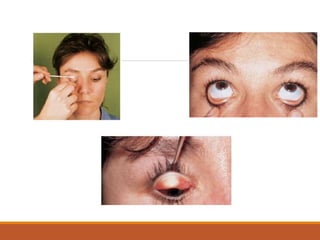
Examine the lid by Penlight, including upper lid eversion.
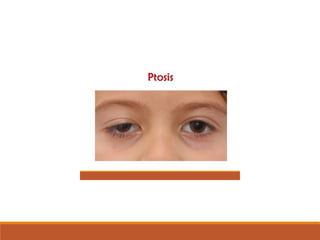
Demonstrate Ptosis evaluation, surgery for good and poor Levator
function.
Review demonstrative videos for surgical correction of entropion,
ectropion, trichiasis and ptosis.
Examination Methods
The eyelids are examined by direct inspection under a bright light.
A slit lamp may be used for this purpose. Bilateral inspection of the
eyelids includes the following aspects:
Eyelid position: Normally the margins of the eyelids are in contact with
theeyeball and the puncta are submerged in the lacus lacrimalis.
 Width of the palpebral fissure: When the eye is open and looking
straightahead, the upper lid should cover the superior margin of the
cornea by about 2 mm.
Skin of the eyelid: The skin of the eyelid is thin with only a slight
amount ofsubcutaneous fatty tissue. Allergic reaction and inflammation
can rapidly cause extensive edema and swelling
History
• Age of onset
• Duration
• Unilateral/ bilateral
• Whether ptosis worsen through the day
• Diplopia
• Muscle weakness
• Trauma / surgery
Examination
• Head posture
• Scar marks
• Lid skin laxity
• Telecanthus, epicanthus inversus
Visual Acuity
 Best corrected visual acuity should be
assessed to record any amblyopia if
present, especially in cases of congenital
ptosis.
 Cycloplegic test refraction is indicated in
all children with ptosis since it is known
that a significant number have
anisometropia due to astigmatism on the
ptotic eye.
Pupil examination
• Horner syndrome
• Third nerve palsy
Ocular motility
• Importance in myogenic ptosis
• Third nerve palsy
• Presence of strabismus , that should be corrected
before the correction of the ptosis
Measurements
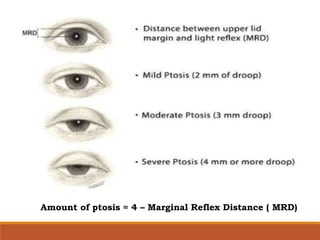
1. Marginal reflex distance
2. Vertical fissure height
3. LPS action
4. Lid crease level
Amount of ptosis = 4 – Marginal Reflex Distance ( MRD)
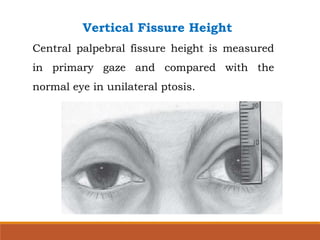
Vertical Fissure Height
Central palpebral fissure height is measured
in primary gaze and compared with the
normal eye in unilateral ptosis.
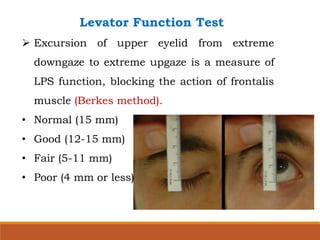
Levator Function Test
 Excursion of upper eyelid from extreme
downgaze to extreme upgaze is a measure of
LPS function, blocking the action of frontalis
muscle (Berkes method).
• Normal (15 mm)
• Good (12-15 mm)
• Fair (5-11 mm)
• Poor (4 mm or less)
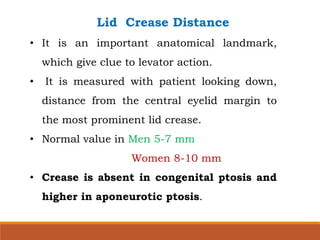
Lid Crease Distance
• It is an important anatomical landmark,
which give clue to levator action.
• It is measured with patient looking down,
distance from the central eyelid margin to
the most prominent lid crease.
• Normal value in Men 5-7 mm
Women 8-10 mm
• Crease is absent in congenital ptosis and
higher in aponeurotic ptosis.
Bells phenomenon
 The eyes moves generally upwards and outwards
on eyelid closure.
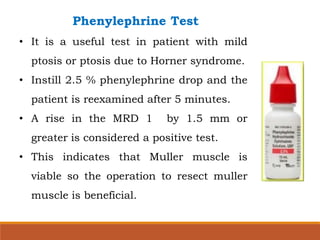
Phenylephrine Test
• It is a useful test in patient with mild
ptosis or ptosis due to Horner syndrome.
• Instill 2.5 % phenylephrine drop and the
patient is reexamined after 5 minutes.
• A rise in the MRD 1 by 1.5 mm or
greater is considered a positive test.
• This indicates that Muller muscle is
viable so the operation to resect muller
muscle is beneficial.
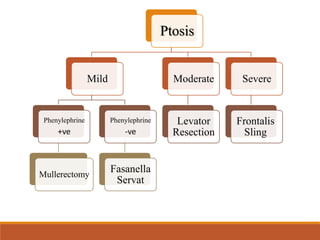
Decision Making
Ptosis
Mild
Phenylephrine
+ve
Mullerectomy
Phenylephrine
-ve
Fasanella
Servat
Moderate
Levator
Resection
Severe
Frontalis
Sling
lid examiantion.pptx

lid examiantion.pptx

  • 1.
  • 2.
    ILOs Inspect position ofthe eyelids (Normal lid position, lid retraction, ptosis, Entropion, Ectropion, Lagophthalmos) Identify signs of previous trachomatous infection. Examine the lid by Penlight, including upper lid eversion. Demonstrate Ptosis evaluation, surgery for good and poor Levator function. Review demonstrative videos for surgical correction of entropion, ectropion, trichiasis and ptosis.
  • 3.
    Examination Methods The eyelidsare examined by direct inspection under a bright light. A slit lamp may be used for this purpose. Bilateral inspection of the eyelids includes the following aspects: Eyelid position: Normally the margins of the eyelids are in contact with theeyeball and the puncta are submerged in the lacus lacrimalis.  Width of the palpebral fissure: When the eye is open and looking straightahead, the upper lid should cover the superior margin of the cornea by about 2 mm.
  • 4.
    Skin of theeyelid: The skin of the eyelid is thin with only a slight amount ofsubcutaneous fatty tissue. Allergic reaction and inflammation can rapidly cause extensive edema and swelling
  • 7.
    History • Age ofonset • Duration • Unilateral/ bilateral • Whether ptosis worsen through the day • Diplopia • Muscle weakness • Trauma / surgery
  • 8.
    Examination • Head posture •Scar marks • Lid skin laxity • Telecanthus, epicanthus inversus
  • 9.
    Visual Acuity  Bestcorrected visual acuity should be assessed to record any amblyopia if present, especially in cases of congenital ptosis.  Cycloplegic test refraction is indicated in all children with ptosis since it is known that a significant number have anisometropia due to astigmatism on the ptotic eye.
  • 10.
    Pupil examination • Hornersyndrome • Third nerve palsy Ocular motility • Importance in myogenic ptosis • Third nerve palsy • Presence of strabismus , that should be corrected before the correction of the ptosis
  • 11.
    Measurements 1. Marginal reflexdistance 2. Vertical fissure height 3. LPS action 4. Lid crease level
  • 12.
    Amount of ptosis= 4 – Marginal Reflex Distance ( MRD)
  • 13.
    Vertical Fissure Height Centralpalpebral fissure height is measured in primary gaze and compared with the normal eye in unilateral ptosis.
  • 14.
    Levator Function Test Excursion of upper eyelid from extreme downgaze to extreme upgaze is a measure of LPS function, blocking the action of frontalis muscle (Berkes method). • Normal (15 mm) • Good (12-15 mm) • Fair (5-11 mm) • Poor (4 mm or less)
  • 15.
    Lid Crease Distance •It is an important anatomical landmark, which give clue to levator action. • It is measured with patient looking down, distance from the central eyelid margin to the most prominent lid crease. • Normal value in Men 5-7 mm Women 8-10 mm • Crease is absent in congenital ptosis and higher in aponeurotic ptosis.
  • 16.
    Bells phenomenon  Theeyes moves generally upwards and outwards on eyelid closure.
  • 17.
    Phenylephrine Test • Itis a useful test in patient with mild ptosis or ptosis due to Horner syndrome. • Instill 2.5 % phenylephrine drop and the patient is reexamined after 5 minutes. • A rise in the MRD 1 by 1.5 mm or greater is considered a positive test. • This indicates that Muller muscle is viable so the operation to resect muller muscle is beneficial.
  • 19.
  • 20.