Electrical
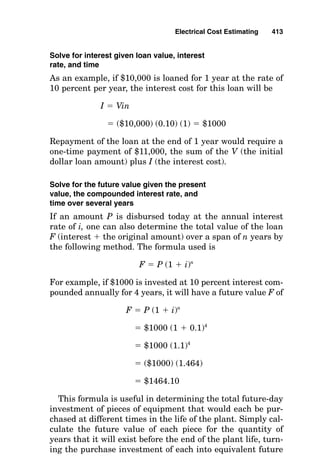
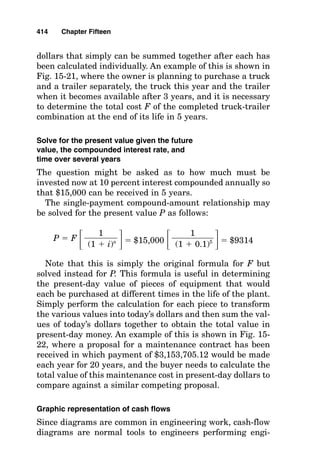
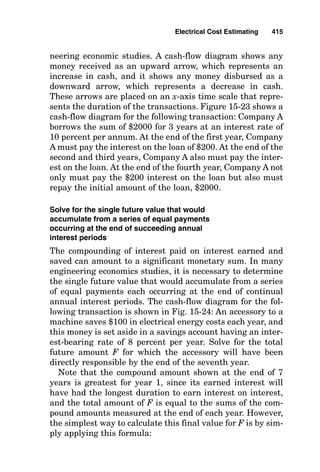
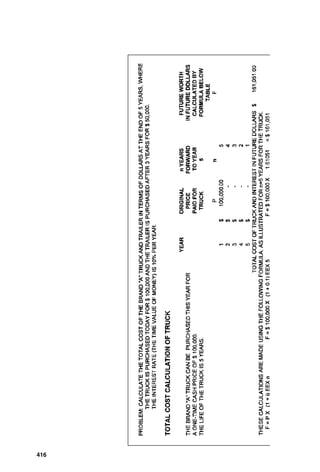
Calculations
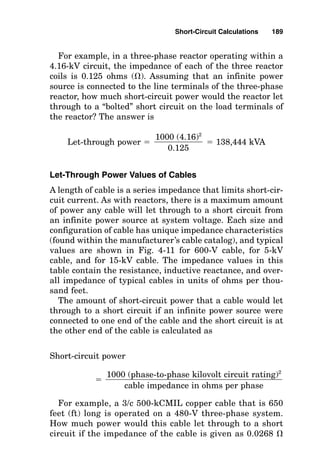
Handbook
EC&M’s
This page intentionally left blank.
EC&M’s
Electrical
Calculations
Handbook
John M. Paschal, Jr., P.E.
McGraw-Hill
New York San Francisco Washington, D.C. Auckland Bogotá
Caracas Lisbon London Madrid Mexico City Milan
Montreal New Delhi San Juan Singapore
Sydney Tokyo Toronto
Copyright © 2001 by The McGraw-Hill Companies, Inc. All rights reserved. Manufactured in the
United States of America. Except as permitted under the United States Copyright Act of 1976, no
part of this publication may be reproduced or distributed in any form or by any means, or stored
in a database or retrieval system, without the prior written permission of the publisher.
0-07-141480-0
The material in this eBook also appears in the print version of this title: 0-07-136095-6.
All trademarks are trademarks of their respective owners. Rather than put a trademark symbol
after every occurrence of a trademarked name, we use names in an editorial fashion only, and to
the benefit of the trademark owner, with no intention of infringement of the trademark. Where
such designations appear in this book, they have been printed with initial caps.
McGraw-Hill eBooks are available at special quantity discounts to use as premiums and sales
promotions, or for use in corporate training programs. For more information, please contact
George Hoare, Special Sales, at george_hoare@mcgraw-hill.com or (212) 904-4069.
TERMS OF USE
This is a copyrighted work and The McGraw-Hill Companies, Inc. (“McGraw-Hill”) and its
licensors reserve all rights in and to the work. Use of this work is subject to these terms. Except
as permitted under the Copyright Act of 1976 and the right to store and retrieve one copy of the
work, you may not decompile, disassemble, reverse engineer, reproduce, modify, create deriva-
tive works based upon, transmit, distribute, disseminate, sell, publish or sublicense the work or
any part of it without McGraw-Hill’s prior consent. You may use the work for your own non-
commercial and personal use; any other use of the work is strictly prohibited. Your right to use
the work may be terminated if you fail to comply with these terms.
THE WORK IS PROVIDED “AS IS”. McGRAW-HILL AND ITS LICENSORS MAKE NO
GUARANTEES OR WARRANTIES AS TO THE ACCURACY, ADEQUACY OR COM-
PLETENESS OF OR RESULTS TO BE OBTAINED FROM USING THE WORK, INCLUD-
ING ANY INFORMATION THAT CAN BE ACCESSED THROUGH THE WORK VIA
HYPERLINK OR OTHERWISE, AND EXPRESSLY DISCLAIM ANY WARRANTY,
EXPRESS OR IMPLIED, INCLUDING BUT NOT LIMITED TO IMPLIED WARRANTIES
OF MERCHANTABILITY OR FITNESS FOR A PARTICULAR PURPOSE. McGraw-Hill and
its licensors do not warrant or guarantee that the functions contained in the work will meet your
requirements or that its operation will be uninterrupted or error free. Neither McGraw-Hill nor
its licensors shall be liable to you or anyone else for any inaccuracy, error or omission, regard-
less of cause, in the work or for any damages resulting therefrom. McGraw-Hill has no respon-
sibility for the content of any information accessed through the work. Under no circumstances
shall McGraw-Hill and/or its licensors be liable for any indirect, incidental, special, punitive,
consequential or similar damages that result from the use of or inability to use the work, even if
any of them has been advised of the possibility of such damages. This limitation of liability shall
apply to any claim or cause whatsoever whether such claim or cause arises in contract, tort or
otherwise.
DOI: 10.1036/0071414800
Contents
Preface
xiii
Chapter 1. Basic Electrical Working Definitions and Concepts 1
Voltage as Potential Difference 1
Current 3
Resistance 4
Direct-Current (dc) Voltage Sources 4
Direct and Alternating Current 5
dc Voltage 6
Current Flow in a Resistive Circuit 15
Current Flow in a Series Resistive Circuit 16
Voltage Division in a Series Circuit 18
Power Rating of a Resistor 18
ac Voltage 23
ac Circuits with Resistance 23
ac Phase Angle and Power 26
Current and Power in a Single-Phase ac Circuit 33
Current and Power in a Three-Phase ac Circuit 33
Inductive Reactance 42
Capacitive Reactance 46
Impedance 52
Chapter 2. Three-Phase Systems 55
Wye-Connected Systems 58
Delta-Connected Systems 60
v
xi
For more information about this book, click here.
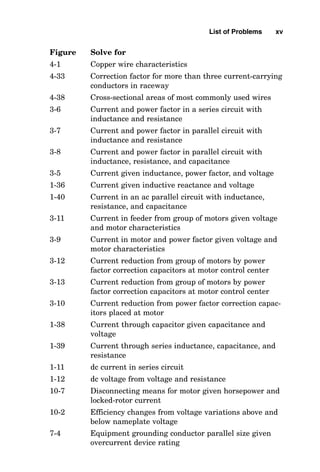
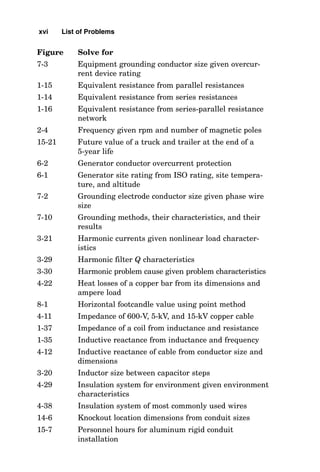
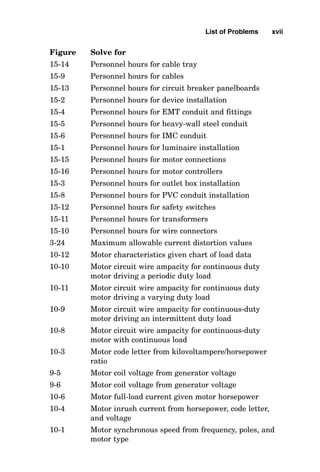
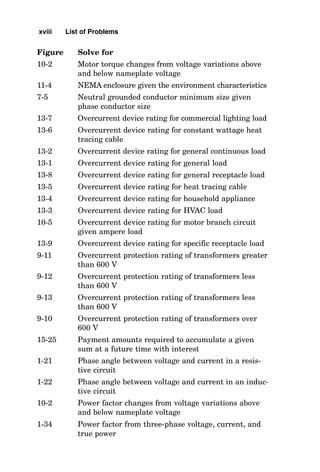
List of Problems
Copyright 2001 by The McGraw-Hill Companies, Inc. Click here for Terms of Use.
Chapter 3. Mathematics for Electrical Calculations,
Power Factor Correction, and Harmonics 69
Changing Vectors from Rectangular to Polar Form and
Back Again 69
Adding Vectors 70
Multiplying or Dividing Vectors 74
Solving for Current and Power Factor in an ac Circuit
Containing Only Inductive Reactance 75
Solving for Current and Power Factor in an ac Circuit
Containing Both Inductive Reactance and Resistance in
Series with One Another 77
Solving for Current and Power Factor in an ac Circuit
Containing Two Parallel Branches That Both Have Inductive
Reactance and Resistance in Series with One Another 77
Solving for Current and Power Factor in an ac Circuit
Containing Parallel Branches, One of Which Has Inductive
Reactance and Resistance in Series with One Another and
the Other of Which Has a Capacitive Reactance 79
Electrical Power in Common ac Circuits 79
Power Factor Correction to Normal Limits 87
Real Power (Kilowatts), Apparent Power (Kilovoltamperes),
Demand, and the Electrical Utility Bill 90
Power Factor Correction System Design in an Electrical Power
System Containing No Harmonics 93
Power Factor Correction System Design in an Electrical Power
System Containing Harmonics 104
Calculating the Parallel Harmonic Resonance of an Electrical
Power System Containing Capacitors 107
Resulting Values of Adding Harmonic Currents or Voltages 108
Acceptable Levels of Harmonic Current and Voltage 110
The Harmonic Current-Flow Model 111
Effects of Harmonic Current on Transformers 114
Effects of Harmonic Voltage on Motors 116
Harmonic Current Flow through Transformers 116
Harmonic Filters 117
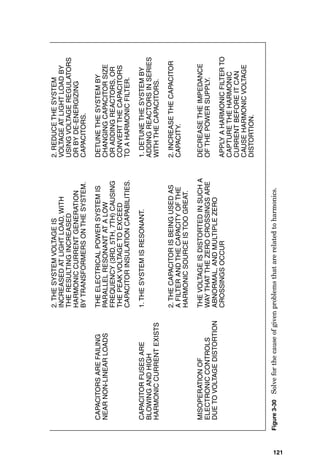
Harmonics Symptoms, Causes, and Remedies 122
Chapter 4. Conductors 125
Conductors, Conductor Resistance, Conductor and Cable
Impedance, and Voltage Drop 125
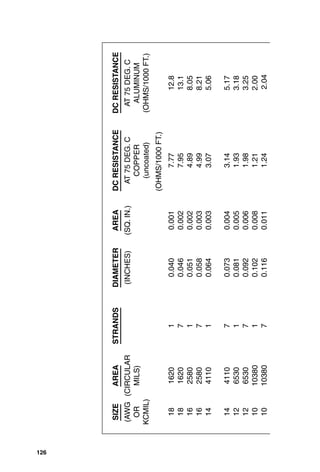
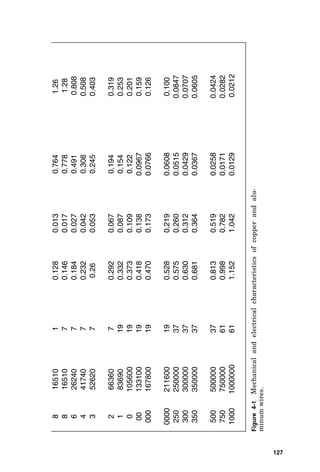
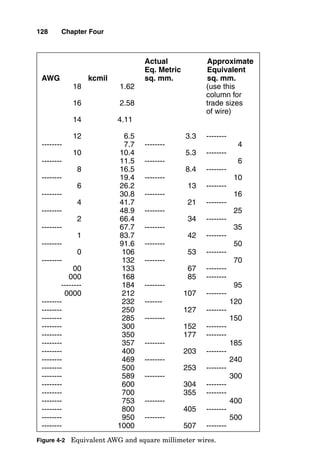
Calculating the One-Way Resistance of a Wire 125
Calculating the Impedance of a Cable 133
Calculating Voltage Drop in a Cable 140
vi Contents
Calculating dc Resistance in a Bus Bar 143
Calculating Heat Loss in a Conductor 143
Wires and Cables 143
Determining Wire Size Given Insulation Type, Circuit Breaker
Clearing Time, and Short Circuit Current 160
Selecting the Proper Insulation for an Environment 161
Aluminum Conductors 170
Conductor and Cable Selection 170
Chapter 5. Short-Circuit Calculations 179
Sources of Short-Circuit Current 182
The Ability of the Electrical Utility System to Produce
Short-Circuit Current 183
Short-Circuit Contributions of On-Site Generators 184
Short-Circuit Contributions of Motors 185
Let-Through Values of Transformers 187
Let-Through Values of Reactors 188
Let-Through Power Values of Cables 189
Sample Short-Circuit Calculation 190
Chapter 6. Generator Sizing Calculations 195
Sizing a Gas-Turbine Generator Set for a Known Kilowatt Load 196
Sizing a Reciprocating Engine-Driven Generator Set for a
Known Kilowatt Load 198
Sizing of Generator Feeder Conductors 200
Chapter 7. Grounding 205
The Functions of Grounding 205
Calculating the Resistance to Remote Earth of Ground Rods 208
Grounding-Electrode Conductors 211
Equipment-Grounding Conductors 211
Methods of Grounding Systems 215
Obtaining the System Grounding Point 217
Chapter 8. Lighting 221
The Lumen Method 221
The Point-by-Point Method 223
Indoor Lighting 229
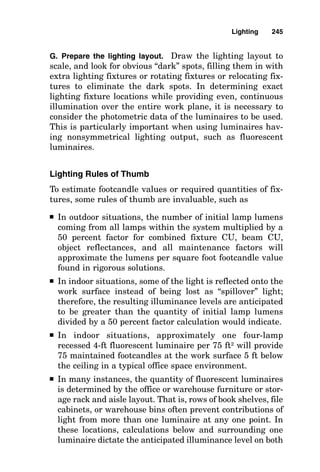
Lighting Rules of Thumb 245
Contents vii
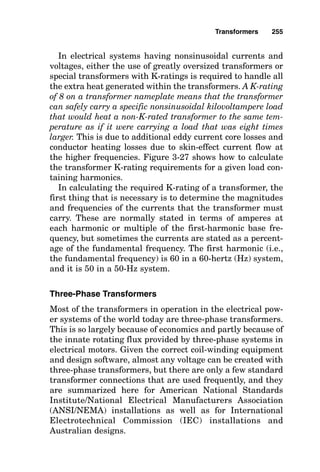
Chapter 9. Transformers 251
Three-Phase Transformers 255
Overcurrent Protection of Transformers 265
Buck-Boost Autotransformers 275
Chapter 10. Motors 285
Selecting Motor Characteristics 286
Calculating Motor Running Current 295
Calculating Motor Branch-Circuit Overcurrent Protection
and Wire Size 296
Chapter 11. Raceways 311
Raceway Types and Their Characteristics 311
Chapter 12. Overcurrent Devices 319
Overcurrent Devices: Fuses and Circuit Breakers 319
Fuses 321
Circuit Breakers 323
Medium-Voltage and Special-Purpose Circuit Breakers
and Relay Controllers 325
Chapter 13. Circuits for Special Loads 335
Designing Circuits for Various Electrical Loads 335
Designing an Electrical System for a Commercial Building 339
Designing an Electrical System for an Industrial Facility 349
Chapter 14. Electrical Design and Layout Calculations 357
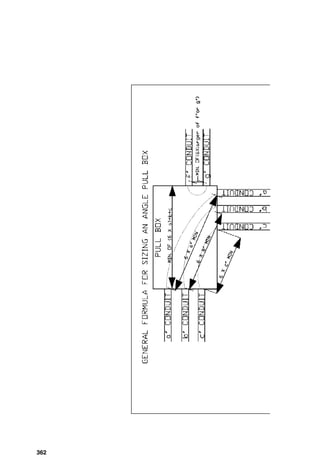
Straight-Through Pull Box in a Conduit System 357
Angle Pull Box in a Conduit System 358
Working Space Surrounding Electrical Equipment 358
Minimum Centerline-to-Centerline Dimensions of Knockouts
to Provide for Locknut Clearance 364
Chapter 15. Electrical Cost Estimating 371
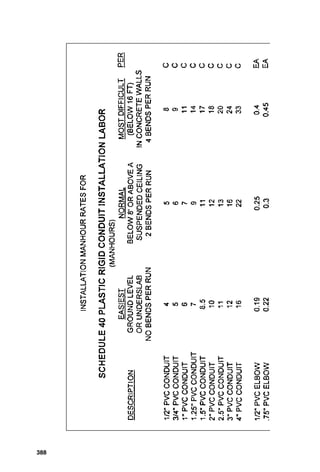
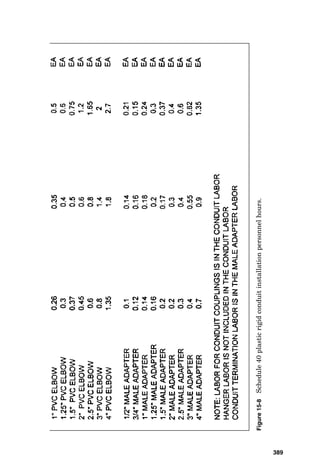
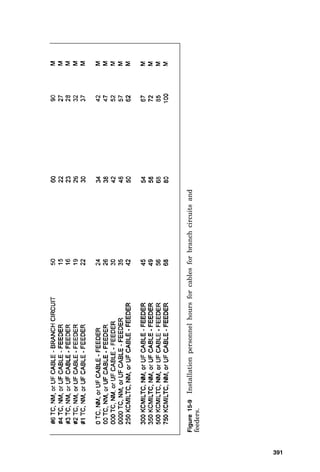
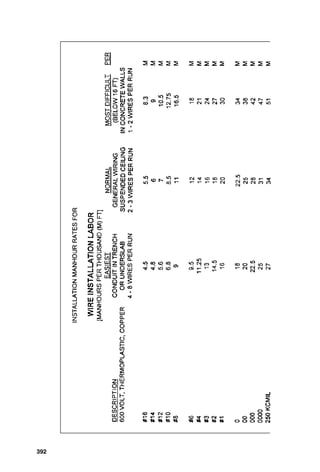
Electrical Takeoff and Personnel-Hour Cost Estimating 371
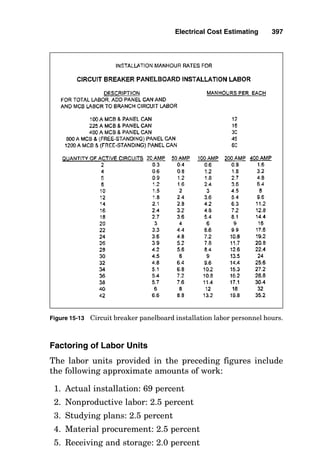
Factoring of Labor Units 397
Estimate of Project Expense 409
viii Contents
Engineering Economics Calculations Considering the Time
Value of Money 411
Chapter 16. Conversion Calculations 425
Temperature Conversion Calculations 425
Frequently Used Conversion Calculations 425
Multiple Conversion Calculations 425
Index 433
Contents ix
This page intentionally left blank.
Preface
We all frequently need electrical reference material, and
sometimes we need an explanation of how certain electrical
equipment works, what dimensions are acceptable or unac-
ceptable, or approximately which values of things such as
voltage drop or wire size are reasonable. I have observed over
the years that there are certain electrical engineering and
design resources that I refer to more frequently than any oth-
ers. In my work I have also noticed that there are certain
types of calculations that are important enough to occur fre-
quently, but not frequently enough for me to have memorized
all of the dimensional or output data associated with them.
In addition, making calculations without reference values to
“go by” sets the stage for errors that could have been avoided
if similar calculations could be referred to. Finally, there is a
need for good explanatory material that can be shared with
fellow engineers or designers or with owners. Such informa-
tion is invaluable in helping them to make sound decisions,
since most thinking individuals can make a good decision
when given the correct data to consider.
It was with all of these in mind that I conceived of this
electrical calculations handbook. It is intended to be a
handy tool that provides in just one place much of the infor-
mation that one normally seeks from reference manuals; it
also provides solved “go-by” problems of the most-often-
encountered types in the electrical industry to expedite
solutions and make calculations easy. Instead of simply pro-
viding formulas without explanations, I took care to explain
each problem type and formula, and to prepare step-by-step
solutions. The problems covered in this book range from
xi
v
Copyright 2001 by The McGraw-Hill Companies, Inc. Click here for Terms of Use.
explanations of Ohm’s law and generator sizing, to lighting
calculations and electrical cost estimating and engineering
economics calculations. I made every effort to make the
book concise enough to be portable, while still including
the very best graphic illustrations. I also included, following
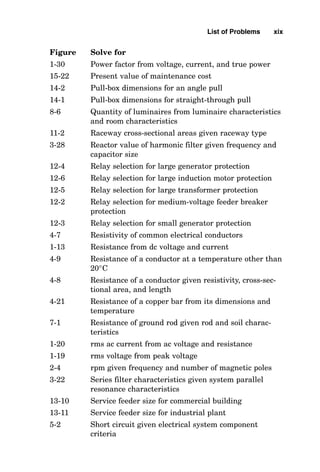
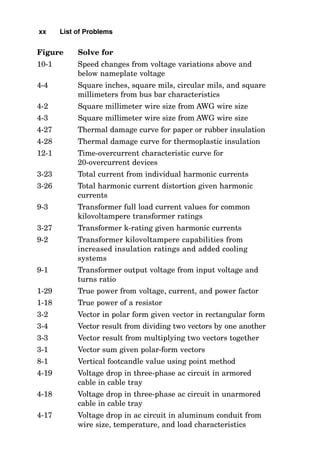
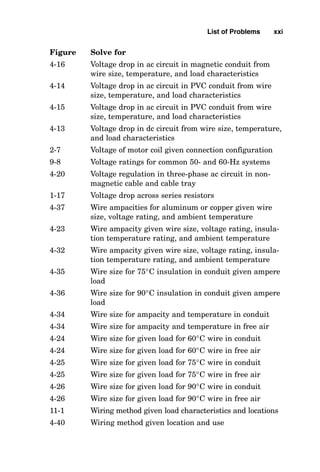
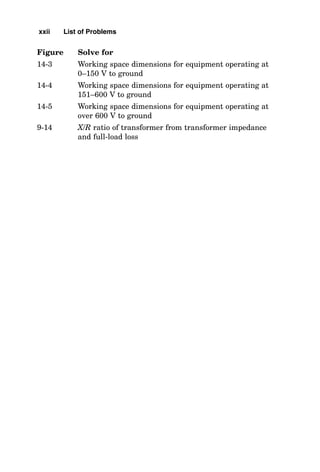
this preface, a detailed listing of problem types in alphabet-
ical order to make finding the proper “go-by” calculation
easy and fast.
I sincerely hope that you will find that keeping this “elec-
trical calculation reference library in one book” close by will
save you from having to carry several other reference
books, and that it will expedite your work while making it
easier and more accurate. I hope that the knowledge and
insight gained from it will add even more fun to your work
in our terrific electrical industry.
John M. Paschal, Jr., P.E.
xii Preface
List of Problems
Figure Solve for
1-27 ac current from voltage, power, and power factor
1-31 ac current given three-phase voltage, power, and power
factor
1-24 ac current in inductive circuit
1-24 ac current in resistive circuit
4-10 ac impedance of copper wire in conduit
4-10 ac resistance of aluminum wire in conduit
4-10 ac resistance of copper wire in conduit
1-32 ac voltage from three-phase current, resistance, and
power factor
1-28 ac voltage from current, resistance, and power factor
2-1 ac voltage given frequency of 60 Hz
2-2 ac voltage given frequency of 50 Hz
2-3 ac voltage selection given frequency and loads
4-6 Aluminum bus bar characteristics
4-1 Aluminum wire characteristics
4-31 Ambient temperature correction factor given ambient
temperature other than 30°C
1-29 Apparent power from voltage, current, and power factor
1-23 Apparent power in an ac circuit
1-18 Apparent power and true power of a resistor
1-19 Average voltage from peak voltage
4-2 AWG wire size from square-millimeter wire size
1-10 Battery output with temperature
xiii
v
Copyright 2001 by The McGraw-Hill Companies, Inc. Click here for Terms of Use.
Figure Solve for
1-4 Battery type
1-4 Battery voltage
4-30 Cable jacket materials for specific environments
4-39 Cable type from application criteria
3-17 Capacitor value given capacitor nameplate voltage
and connected voltage
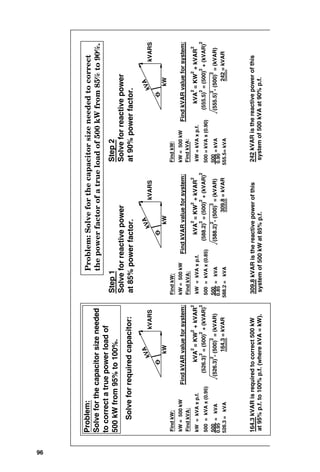
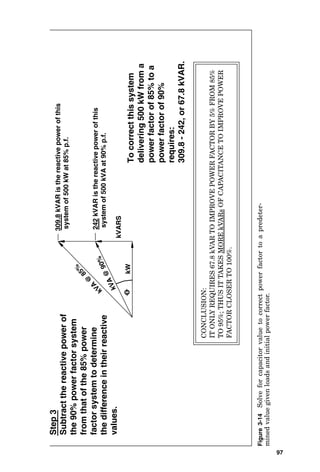
3-14 Capacitor size required for power factor correction
to unity given initial power factor and load character-
istics
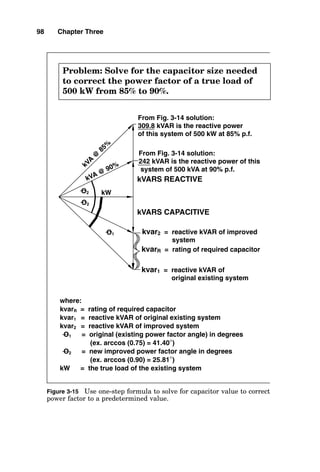
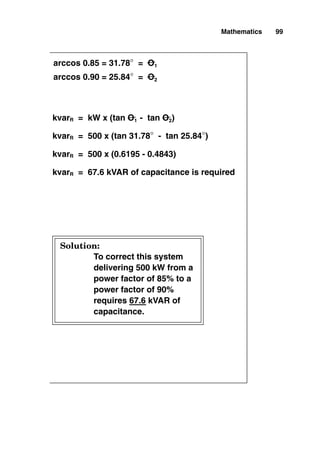
3-15 Capacitor size required for power factor correction to
any value given initial power factor and load charac-
teristics
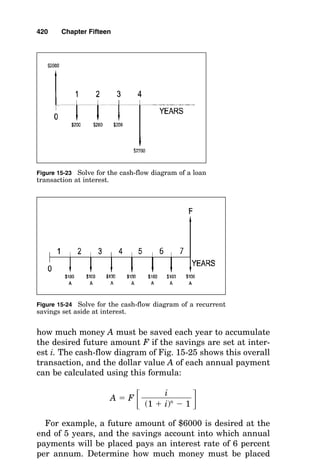
15-23 Cash-flow diagram of a loan transaction at interest
15-24 Cash-flow diagram of a savings account at interest
8-4 Cavity reflectances from colors and surface criteria
8-5 Coefficient of utilization of a luminaire from fixture
type, room ratio, and surface reflectances
8-2 Common lamps and their characteristics
13-7 Conductor size for commercial lighting load
13-6 Conductor size for constant-wattage heat tracing cable
13-2 Conductor size for general continuous load
13-1 Conductor size for general load
13-8 Conductor size for general receptacle load
13-4 Conductor size for household appliance
13-3 Conductor size for HVAC load
13-5 Conductor size for self-regulated heat tracing cable
13-9 Conductor size for specific receptacle load
3-19 Conductor size to capacitor given capacitor size and
voltage
11-3 Conduit size given wire size, quantity, and insulation
type
16-1 Conversion formulas for temperature, °F and °C
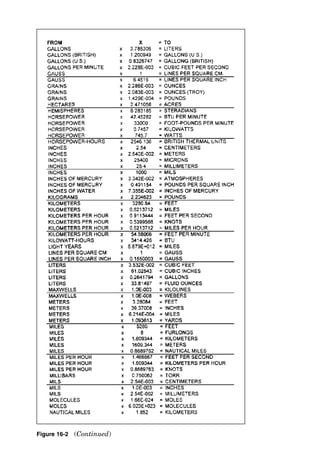
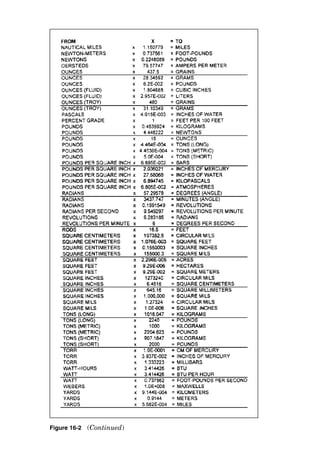
16-2 Conversion formulas, units to units
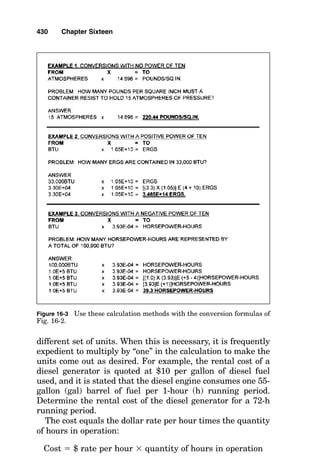
16-3 Conversion methods using powers of 10
4-5 Copper bus bar characteristics
xiv List of Problems
Figure Solve for
4-1 Copper wire characteristics
4-33 Correction factor for more than three current-carrying
conductors in raceway
4-38 Cross-sectional areas of most commonly used wires
3-6 Current and power factor in a series circuit with
inductance and resistance
3-7 Current and power factor in parallel circuit with
inductance and resistance
3-8 Current and power factor in parallel circuit with
inductance, resistance, and capacitance
3-5 Current given inductance, power factor, and voltage
1-36 Current given inductive reactance and voltage
1-40 Current in an ac parallel circuit with inductance,
resistance, and capacitance
3-11 Current in feeder from group of motors given voltage
and motor characteristics
3-9 Current in motor and power factor given voltage and
motor characteristics
3-12 Current reduction from group of motors by power
factor correction capacitors at motor control center
3-13 Current reduction from group of motors by power
factor correction capacitors at motor control center
3-10 Current reduction from power factor correction capac-
itors placed at motor
1-38 Current through capacitor given capacitance and
voltage
1-39 Current through series inductance, capacitance, and
resistance
1-11 dc current in series circuit
1-12 dc voltage from voltage and resistance
10-7 Disconnecting means for motor given horsepower and
locked-rotor current
10-2 Efficiency changes from voltage variations above and
below nameplate voltage
7-4 Equipment grounding conductor parallel size given
overcurrent device rating
List of Problems xv
Figure Solve for
7-3 Equipment grounding conductor size given overcur-
rent device rating
1-15 Equivalent resistance from parallel resistances
1-14 Equivalent resistance from series resistances
1-16 Equivalent resistance from series-parallel resistance
network
2-4 Frequency given rpm and number of magnetic poles
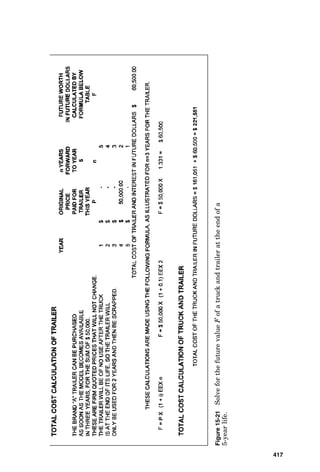
15-21 Future value of a truck and trailer at the end of a
5-year life
6-2 Generator conductor overcurrent protection
6-1 Generator site rating from ISO rating, site tempera-
ture, and altitude
7-2 Grounding electrode conductor size given phase wire
size
7-10 Grounding methods, their characteristics, and their
results
3-21 Harmonic currents given nonlinear load character-
istics
3-29 Harmonic filter Q characteristics
3-30 Harmonic problem cause given problem characteristics
4-22 Heat losses of a copper bar from its dimensions and
ampere load
8-1 Horizontal footcandle value using point method
4-11 Impedance of 600-V, 5-kV, and 15-kV copper cable
1-37 Impedance of a coil from inductance and resistance
1-35 Inductive reactance from inductance and frequency
4-12 Inductive reactance of cable from conductor size and
dimensions
3-20 Inductor size between capacitor steps
4-29 Insulation system for environment given environment
characteristics
4-38 Insulation system of most commonly used wires
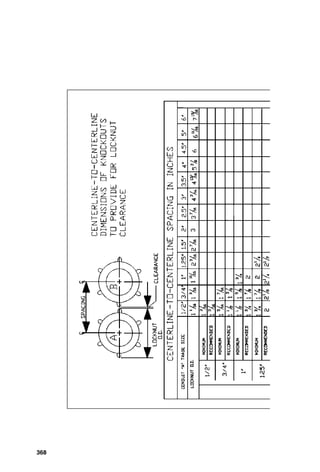
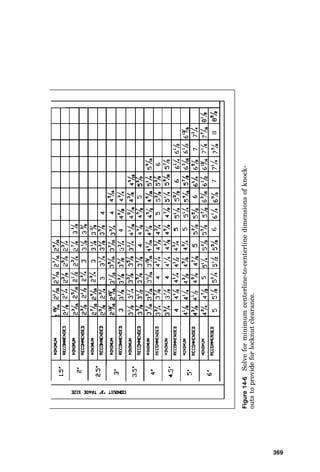
14-6 Knockout location dimensions from conduit sizes
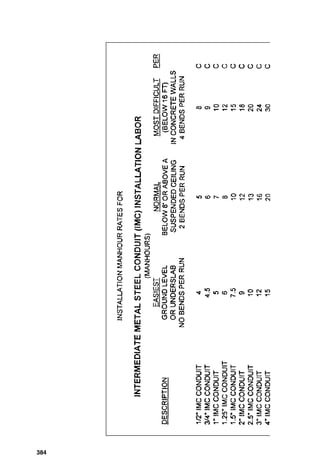
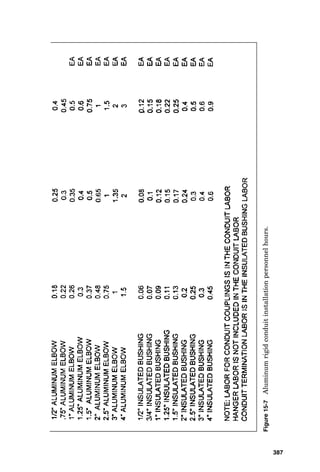
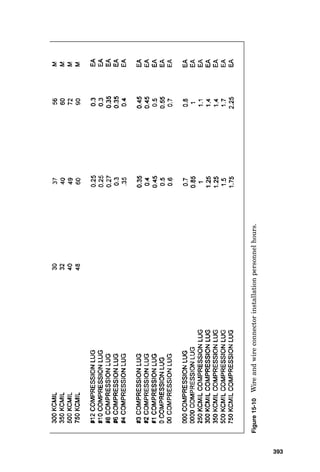
15-7 Personnel hours for aluminum rigid conduit
installation
xvi List of Problems
Figure Solve for
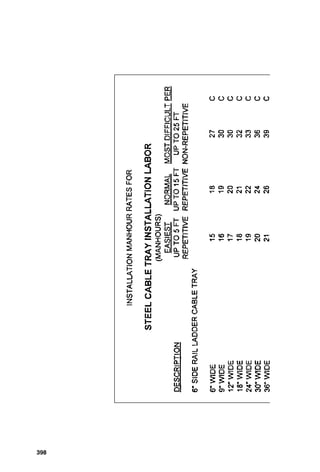
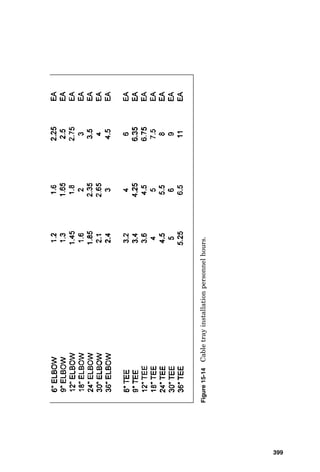
15-14 Personnel hours for cable tray
15-9 Personnel hours for cables
15-13 Personnel hours for circuit breaker panelboards
15-2 Personnel hours for device installation
15-4 Personnel hours for EMT conduit and fittings
15-5 Personnel hours for heavy-wall steel conduit
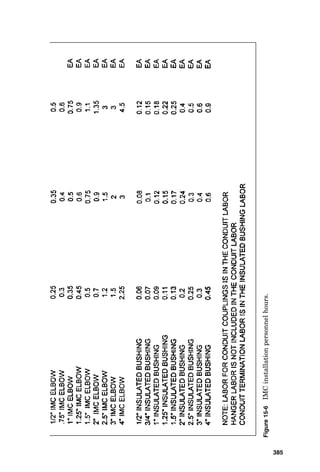
15-6 Personnel hours for IMC conduit
15-1 Personnel hours for luminaire installation
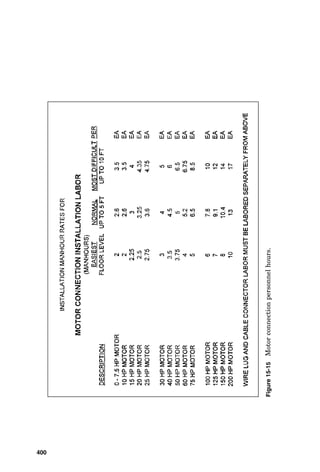
15-15 Personnel hours for motor connections
15-16 Personnel hours for motor controllers
15-3 Personnel hours for outlet box installation
15-8 Personnel hours for PVC conduit installation
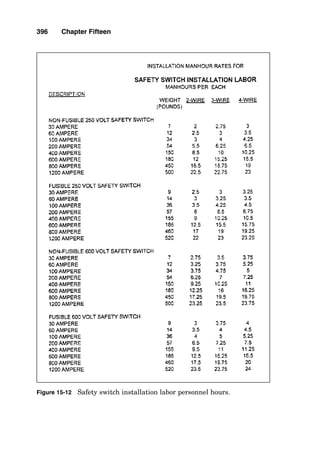
15-12 Personnel hours for safety switches
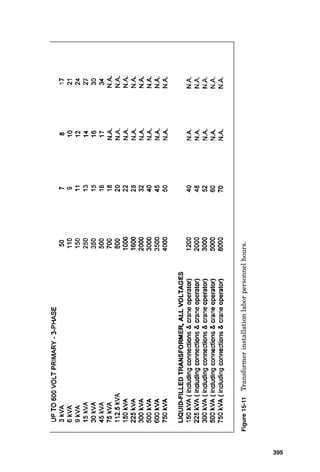
15-11 Personnel hours for transformers
15-10 Personnel hours for wire connectors
3-24 Maximum allowable current distortion values
10-12 Motor characteristics given chart of load data
10-10 Motor circuit wire ampacity for continuous duty
motor driving a periodic duty load
10-11 Motor circuit wire ampacity for continuous duty
motor driving a varying duty load
10-9 Motor circuit wire ampacity for continuous-duty
motor driving an intermittent duty load
10-8 Motor circuit wire ampacity for continuous-duty
motor with continuous load
10-3 Motor code letter from kilovoltampere/horsepower
ratio
9-5 Motor coil voltage from generator voltage
9-6 Motor coil voltage from generator voltage
10-6 Motor full-load current given motor horsepower
10-4 Motor inrush current from horsepower, code letter,
and voltage
10-1 Motor synchronous speed from frequency, poles, and
motor type
List of Problems xvii
Figure Solve for
10-2 Motor torque changes from voltage variations above
and below nameplate voltage
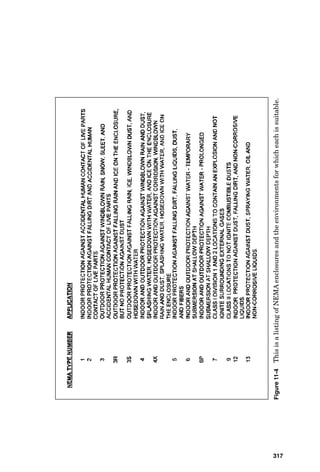
11-4 NEMA enclosure given the environment characteristics
7-5 Neutral grounded conductor minimum size given
phase conductor size
13-7 Overcurrent device rating for commercial lighting load
13-6 Overcurrent device rating for constant wattage heat
tracing cable
13-2 Overcurrent device rating for general continuous load
13-1 Overcurrent device rating for general load
13-8 Overcurrent device rating for general receptacle load
13-5 Overcurrent device rating for heat tracing cable
13-4 Overcurrent device rating for household appliance
13-3 Overcurrent device rating for HVAC load
10-5 Overcurrent device rating for motor branch circuit
given ampere load
13-9 Overcurrent device rating for specific receptacle load
9-11 Overcurrent protection rating of transformers greater
than 600 V
9-12 Overcurrent protection rating of transformers less
than 600 V
9-13 Overcurrent protection rating of transformers less
than 600 V
9-10 Overcurrent protection rating of transformers over
600 V
15-25 Payment amounts required to accumulate a given
sum at a future time with interest
1-21 Phase angle between voltage and current in a resis-
tive circuit
1-22 Phase angle between voltage and current in an induc-
tive circuit
10-2 Power factor changes from voltage variations above
and below nameplate voltage
1-34 Power factor from three-phase voltage, current, and
true power
xviii List of Problems
Figure Solve for
1-30 Power factor from voltage, current, and true power
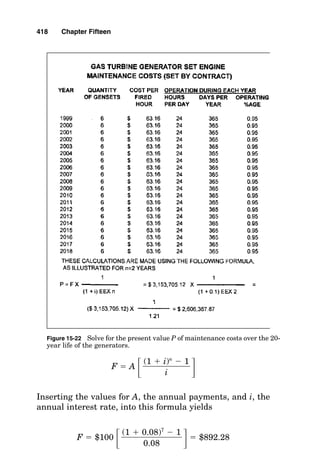
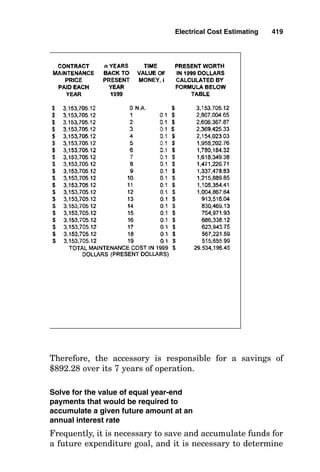
15-22 Present value of maintenance cost
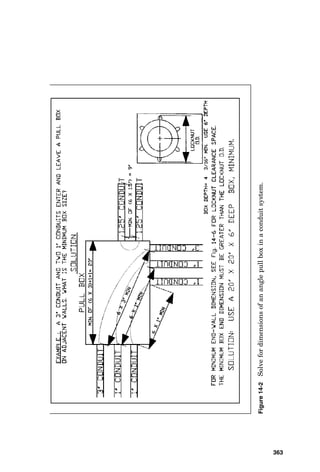
14-2 Pull-box dimensions for an angle pull
14-1 Pull-box dimensions for straight-through pull
8-6 Quantity of luminaires from luminaire characteristics
and room characteristics
11-2 Raceway cross-sectional areas given raceway type
3-28 Reactor value of harmonic filter given frequency and
capacitor size
12-4 Relay selection for large generator protection
12-6 Relay selection for large induction motor protection
12-5 Relay selection for large transformer protection
12-2 Relay selection for medium-voltage feeder breaker
protection
12-3 Relay selection for small generator protection
4-7 Resistivity of common electrical conductors
1-13 Resistance from dc voltage and current
4-9 Resistance of a conductor at a temperature other than
20°C
4-8 Resistance of a conductor given resistivity, cross-sec-
tional area, and length
4-21 Resistance of a copper bar from its dimensions and
temperature
7-1 Resistance of ground rod given rod and soil charac-
teristics
1-20 rms ac current from ac voltage and resistance
1-19 rms voltage from peak voltage
2-4 rpm given frequency and number of magnetic poles
3-22 Series filter characteristics given system parallel
resonance characteristics
13-10 Service feeder size for commercial building
13-11 Service feeder size for industrial plant
5-2 Short circuit given electrical system component
criteria
List of Problems xix
Figure Solve for
10-1 Speed changes from voltage variations above and
below nameplate voltage
4-4 Square inches, square mils, circular mils, and square
millimeters from bus bar characteristics
4-2 Square millimeter wire size from AWG wire size
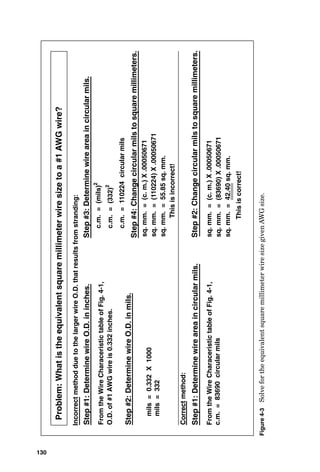
4-3 Square millimeter wire size from AWG wire size
4-27 Thermal damage curve for paper or rubber insulation
4-28 Thermal damage curve for thermoplastic insulation
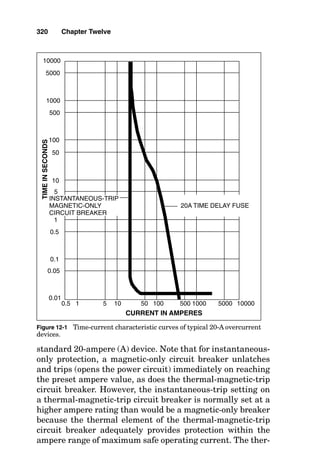
12-1 Time-overcurrent characteristic curve for
20-overcurrent devices
3-23 Total current from individual harmonic currents
3-26 Total harmonic current distortion given harmonic
currents
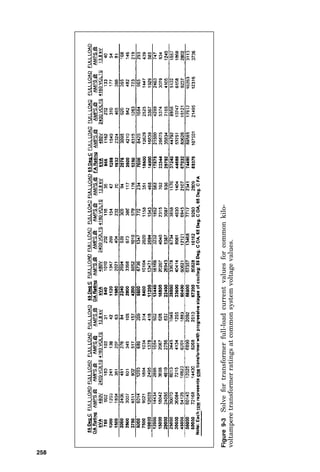
9-3 Transformer full load current values for common
kilovoltampere transformer ratings
3-27 Transformer k-rating given harmonic currents
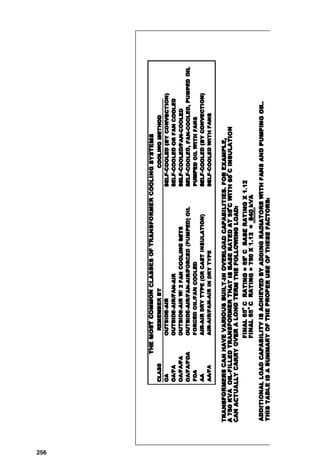
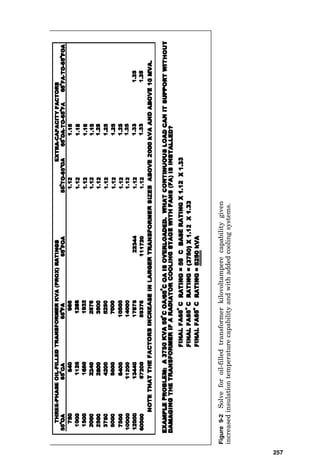
9-2 Transformer kilovoltampere capabilities from
increased insulation ratings and added cooling
systems
9-1 Transformer output voltage from input voltage and
turns ratio
1-29 True power from voltage, current, and power factor
1-18 True power of a resistor
3-2 Vector in polar form given vector in rectangular form
3-4 Vector result from dividing two vectors by one another
3-3 Vector result from multiplying two vectors together
3-1 Vector sum given polar-form vectors
8-1 Vertical footcandle value using point method
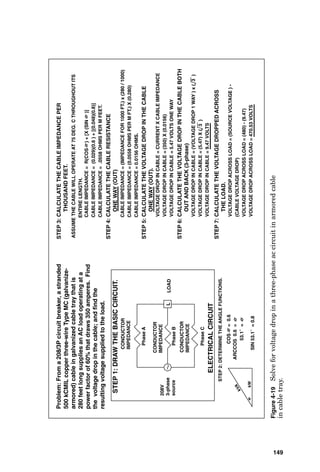
4-19 Voltage drop in three-phase ac circuit in armored
cable in cable tray
4-18 Voltage drop in three-phase ac circuit in unarmored
cable in cable tray
4-17 Voltage drop in ac circuit in aluminum conduit from
wire size, temperature, and load characteristics
xx List of Problems
Figure Solve for
4-16 Voltage drop in ac circuit in magnetic conduit from
wire size, temperature, and load characteristics
4-14 Voltage drop in ac circuit in PVC conduit from wire
size, temperature, and load characteristics
4-15 Voltage drop in ac circuit in PVC conduit from wire
size, temperature, and load characteristics
4-13 Voltage drop in dc circuit from wire size, temperature,
and load characteristics
2-7 Voltage of motor coil given connection configuration
9-8 Voltage ratings for common 50- and 60-Hz systems
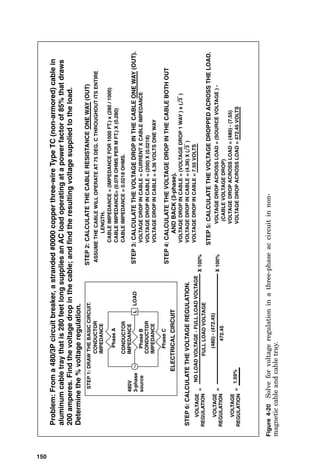
4-20 Voltage regulation in three-phase ac circuit in non-
magnetic cable and cable tray
1-17 Voltage drop across series resistors
4-37 Wire ampacities for aluminum or copper given wire
size, voltage rating, and ambient temperature
4-23 Wire ampacity given wire size, voltage rating, insula-
tion temperature rating, and ambient temperature
4-32 Wire ampacity given wire size, voltage rating, insula-
tion temperature rating, and ambient temperature
4-35 Wire size for 75°C insulation in conduit given ampere
load
4-36 Wire size for 90°C insulation in conduit given ampere
load
4-34 Wire size for ampacity and temperature in conduit
4-34 Wire size for ampacity and temperature in free air
4-24 Wire size for given load for 60°C wire in conduit
4-24 Wire size for given load for 60°C wire in free air
4-25 Wire size for given load for 75°C wire in conduit
4-25 Wire size for given load for 75°C wire in free air
4-26 Wire size for given load for 90°C wire in conduit
4-26 Wire size for given load for 90°C wire in free air
11-1 Wiring method given load characteristics and locations
4-40 Wiring method given location and use
List of Problems xxi
Figure Solve for
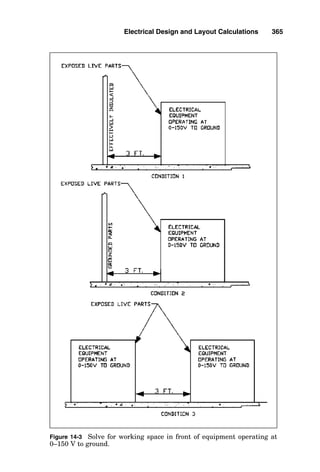
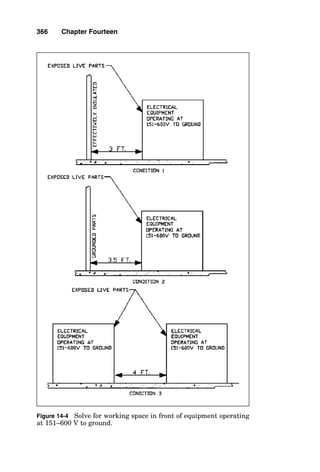
14-3 Working space dimensions for equipment operating at
0–150 V to ground
14-4 Working space dimensions for equipment operating at
151–600 V to ground
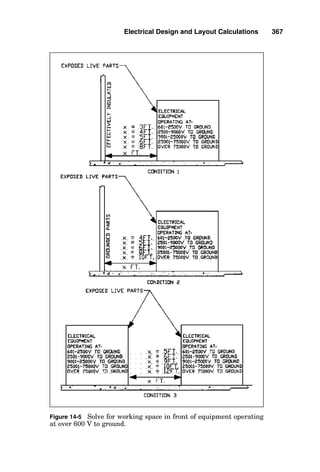
14-5 Working space dimensions for equipment operating at
over 600 V to ground
9-14 X/R ratio of transformer from transformer impedance
and full-load loss
xxii List of Problems
EC&M’s
Electrical
Calculations
Handbook
v
Copyright 2001 by The McGraw-Hill Companies, Inc. Click here for Terms of Use.
This page intentionally left blank.
Basic Electrical
Working Definitions
and Concepts
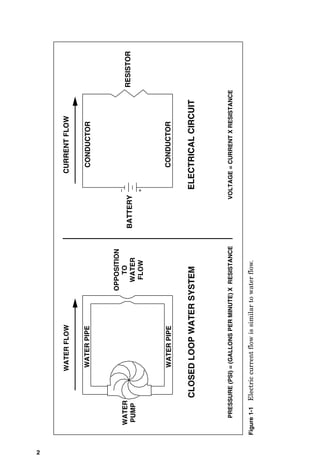
Electricity is an invisible force that is used to transfer
energy into heat, light, intelligence, or motion. Electricity
is explained in terms of electrical charge, potential differ-
ence (or voltage), electrical charge flow (or current), and
resistance to current flow. Figure 1-1 graphically illus-
trates electron flow through a conductor by comparing it
with water flow through a pipe. The normal unit of current
measurement is the ampere, whereas the normal unit of
voltage measurement is the volt. The unit of opposition to
current flow, or resistance, is the ohm.
Voltage as Potential Difference
The basic property of every operating electrical system is
that different parts of the circuit contain items having dif-
ferent polarities. Another way of saying this is that the
“negatively” charged parts contain a surplus of negative-
ly charged electrons, whereas the “positively” charged
parts contain a deficiency of electrons. When molecules
Chapter
1
1
v
Copyright 2001 by The McGraw-Hill Companies, Inc. Click here for Terms of Use.
CLOSED
LOOP
WATER
SYSTEM
ELECTRICAL
CIRCUIT
BATTERY
CONDUCTOR
RESISTOR
CONDUCTOR
PRESSURE
(PSI)
=
(GALLONS
PER
MINUTE)
X
RESISTANCE
VOLTAGE
=
CURRENT
X
RESISTANCE
WATER
PUMP
OPPOSITION
TO
WATER
FLOW
WATER
FLOW
WATER
PIPE
WATER
PIPE
CURRENT
FLOW
Figure
1-1
Electric
current
flow
is
similar
to
water
flow.
2
contain more protons than electrons, they have a defi-
ciency of electrons, and relatively speaking, this means
that they have a “positive” overall charge. In nature,
there is a natural attraction by protons for sufficient elec-
trons to equalize the positive and negative charges of
every molecule. The greater the charge between different
parts of the circuit, the greater is the potential difference
between them. The standard way of describing this state
is to say that the circuit driving voltage, or source voltage,
increases.
Surplus electrons exist on the negative () terminal of a
battery, whereas “slots in molecular outer orbits” for miss-
ing electrons exist in molecules of the positive () terminal
of a battery. In an electrical circuit, a conductor “makes a
complete path” from the negative to the positive battery
terminals, and electrons then flow from the negative ter-
minal to the positive terminal through the conductor.
Within the circuit conductor, electrons flow from one mole-
cule to the next and then to the next.
Some molecules permit the easy movement of electrons,
and the materials composed of these molecules are said to
be conductors. When materials do not permit the easy flow
of electrons, they are said to be insulators. The entire key
to electrical systems is to “show electrons where to flow” by
installing conductors and to “show electrons where not to
flow” by surrounding the conductors with insulators.
Practically speaking, most circuit conductors are made of
either copper or aluminum. Insulators can be rigid or flexi-
ble. Everyday examples of rigid insulators are glass and
plastic, and common examples of flexible insulators are
rubber and air.
Current
In an attempt to provide a quantifying image of how many
electrons are required to form a current flow of one ampere,
one can state that 6.25  1018
electrons flowing past any one
point in an electrical circuit constitutes one ampere of cur-
rent flow.
Basic Electrical Working Definitions and Concepts 3
Resistance
The voltage is the “pressure” that forces the electrons, or
current, to flow through the circuit conductors, and the
opposition to current flow in the circuit, or the circuit resis-
tance, is measured in ohms. One volt can force one ampere
to flow through one ohm of resistance. This is the basic rela-
tionship known as Ohm’s law:
Voltage (volts)  current (amperes)  resistance (ohms)
A characteristic of all conductors is resistance, but some
conductors offer more resistance to current flow than do other
conductors. A conductor can be imagined to consist of bundles
of molecules, each containing “spaces” where electrons are
missing. In current flow, voltage can force electrons to flow
into and out of these “spaces.” To reduce the opposition to cur-
rent flow, the conductor can be widened, thus effectively cre-
ating more parallel paths through which electrons can flow. To
increase the opposition to current flow, the conductor can be
made more narrow. The resistance value of the conductor also
can be altered by lengthening or shortening the conductor.
Longer conductors offer more opposition to current flow and
thus contain more ohms of resistance. Note that the insertion
of an infinitely large resistance into an electric circuit has the
effect of creating an open circuit, causing all electric current
flow to cease. This is what happens when a switch is placed in
the “open” position, since it effectively places a very large val-
ue of resistance in the form of air into the circuit.
Direct-Current (dc) Voltage Sources
Various types of dc cells are available, most providing
approximately 1.75 open-circuit volts across their output ter-
minals. When higher dc voltages are required, additional
cells are connected together in a series “string” called a bat-
tery, and the resulting overall voltage of the battery is equal
to the sum of the voltages of the individual cells in the string.
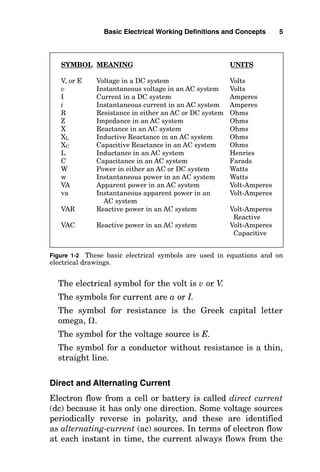
Basic electrical symbols and abbreviations are shown in
Fig. 1-2. Some of the symbols and abbreviations used most
often are as follows:
4 Chapter One
The electrical symbol for the volt is v or V.
The symbols for current are a or I.
The symbol for resistance is the Greek capital letter
omega, .
The symbol for the voltage source is E.
The symbol for a conductor without resistance is a thin,
straight line.
Direct and Alternating Current
Electron flow from a cell or battery is called direct current
(dc) because it has only one direction. Some voltage sources
periodically reverse in polarity, and these are identified
as alternating-current (ac) sources. In terms of electron flow
at each instant in time, the current always flows from the
Basic Electrical Working Definitions and Concepts 5
SYMBOL MEANING UNITS
V, or E Voltage in a DC system Volts
v Instantaneous voltage in an AC system Volts
I Current in a DC system Amperes
i Instantaneous current in an AC system Amperes
R Resistance in either an AC or DC system Ohms
Z Impedance in an AC system Ohms
X Reactance in an AC system Ohms
XL Inductive Reactance in an AC system Ohms
XC Capacitive Reactance in an AC system Ohms
L Inductance in an AC system Henries
C Capacitance in an AC system Farads
W Power in either an AC or DC system Watts
w Instantaneous power in an AC system Watts
VA Apparent power in an AC system Volt-Amperes
va Instantaneous apparent power in an Volt-Amperes
AC system
VAR Reactive power in an AC system Volt-Amperes
Reactive
VAC Reactive power in an AC system Volt-Amperes
Capacitive
Figure 1-2 These basic electrical symbols are used in equations and on
electrical drawings.
negative terminal through the circuit to the positive terminal.
Thus 60-cycle ac power of the type found in most homes is an
example of an ac system. In this example, the frequency of
60 cycles per second, or hertz (Hz), means that the voltage
polarity and the current direction reverse 60 times per sec-
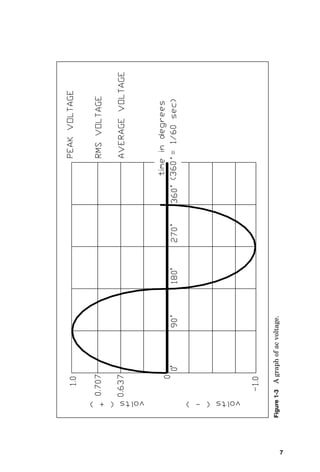
ond. Figure 1-3 is a graph of an ac voltage system in which
key facets are identified. In the ac system, the effective volt-
age is distinguished from the peak-to-peak voltage because
the peak voltage is not always present, so effectively, it can-
not be used accurately in mathematical solutions. The effec-
tive voltage value, however, accommodates the varying
voltage values and their continually varying residence times
to provide accurate electrical system calculations.
dc Voltage
Cells, batteries, and dc voltage
In a dc circuit, the most common voltage source is the chem-
ical cell. Many different types of chemical cells are available
commercially, and each exhibits unique characteristics.
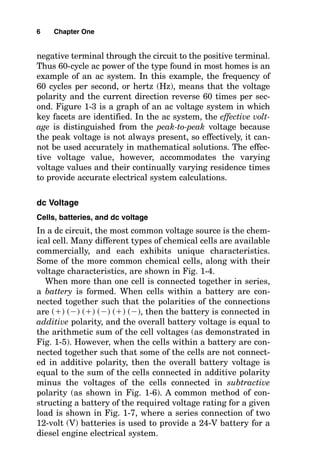
Some of the more common chemical cells, along with their
voltage characteristics, are shown in Fig. 1-4.
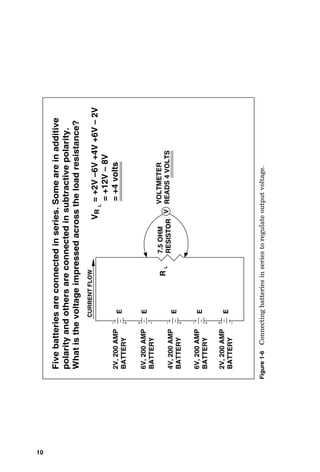
When more than one cell is connected together in series,
a battery is formed. When cells within a battery are con-
nected together such that the polarities of the connections
are () () () () () (), then the battery is connected in
additive polarity, and the overall battery voltage is equal to
the arithmetic sum of the cell voltages (as demonstrated in
Fig. 1-5). However, when the cells within a battery are con-
nected together such that some of the cells are not connect-
ed in additive polarity, then the overall battery voltage is
equal to the sum of the cells connected in additive polarity
minus the voltages of the cells connected in subtractive
polarity (as shown in Fig. 1-6). A common method of con-
structing a battery of the required voltage rating for a given
load is shown in Fig. 1-7, where a series connection of two
12-volt (V) batteries is used to provide a 24-V battery for a
diesel engine electrical system.
6 Chapter One
Figure
1-3
A
graph
of
ac
voltage.
7
Battery current limitations
Sometimes individual batteries are not large enough to pro-
vide sufficient electron flow for the load to operate correctly.
In such cases, additional batteries can be connected in par-
allel with the original batteries without changing the output
voltage. All that changes when identical batteries are added
in parallel is that additional electron flow is made available
from the additional battery plates; the overall voltage, how-
ever, is not changed by adding batteries in parallel.
Accordingly, the amount of current that flows through the
resistive circuit is still simply determined by Ohm’s law. See
Fig. 1-8 for an illustration and an example calculation.
dc voltage source with internal resistance
Every battery is only able to deliver a finite amount of cur-
rent. To understand what is actually happening within a
battery that exhibits a limited current output, it is useful
to draw a more detailed electrical diagram of a battery.
In the more detailed diagram, the battery is shown not only
to have a set of internal electron-producing and voltage-
producing cells but also to incorporate an internal resistor
(see Fig. 1-9). The internal resistance is an artificial manner
of representing the fact that the battery has output-current
limitations such that if a zero-resistance circuit path were
connected from  to  at the battery terminals, current flow
8 Chapter One
TYPE OF CELL WET OR DRY VOLTAGE PER CELL
Carbon-Zinc Dry 1.5
Alkaline Dry Cell Dry 1.5
Lead Acid Wet 2.2
Nickel-Cadmium Wet or Dry 1.25
Mercury Dry 1.3
Figure 1-4 Some of the more common chemical cells and their characteristics.
E
CURRENT
FLOW
E
E
E
E
E
4V
BATTERY
6V
BATTERY
2V
BATTERY
2V
BATTERY
2V
BATTERY
8V
BATTERY
Six
batteries
are
connected
in
series
in
additive
polarity.
The
individual
battery
voltages
are
4V,
6V,
2V,
2V,
2V,
and
8V.
What
is
the
voltage
impressed
across
the
load
resistance?
R
L
V
R
L
=
+4V
+
6V
+2V
+2V
+2V
+8V
=
+24
volts
7.5
OHM
RESISTOR
VOLTMETER
READS
24
VOLTS
V
Figure
1-5
Connecting
batteries
in
series
to
increase
terminal
voltage.
9
CURRENT
FLOW
E
E
E
E
E
2V,
200
AMP
BATTERY
6V,
200
AMP
BATTERY
4V,
200
AMP
BATTERY
6V,
200
AMP
BATTERY
2V,
200
AMP
BATTERY
Five
batteries
are
connected
in
series.
Some
are
in
additive
polarity
and
others
are
connected
in
subtractive
polarity.
What
is
the
voltage
impressed
across
the
load
resistance?
R
L
V
R
L
=
+2V
–6V
+4V
+6V
–
2V
=
+12V
–
8V
=
+4
volts
7.5
OHM
RESISTOR
VOLTMETER
READS
4
VOLTS
V
Figure
1-6
Connecting
batteries
in
series
to
regulate
output
voltage.
10
would not be infinite. From a practical perspective, each bat-
tery has an internal resistance, with its resistive value less-
ening in magnitude as the battery temperature increases.
Conversely, a battery can be expected to have a very low out-
put current during very cold ambient temperatures. For
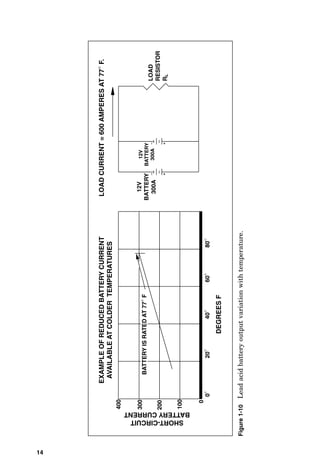
example, at a given ambient temperature of 77°F, a certain
battery is nameplate-rated at 300 amperes (A) at 12 V.
Following the output current versus temperature curve of
Fig. 1-10, if the ambient temperature declines from 77 to
20°F, then the battery output drops to 150 A. Thus, for
continued full 300-A current flow at temperatures colder
than the battery nameplate rating of 77°F, an engineer or
designer must oversize this battery as follows:
Battery output at 20°F  150 A
Battery output at 77°F  300 A
300/150  200 percent
Thus, for continued full 300-A current flow at 20°F, a
battery must be specified that has twice the 77°F name-
Basic Electrical Working Definitions and Concepts 11
12V
BATTERY
12V
BATTERY
SWITCH
24V
MOTOR
ELECTRICAL CIRCUIT
FOR STARTING MOTOR
Figure 1-7 Use two 12-V batteries in series to drive a 24-V motor.
RESISTOR
7.5
OHM
E
R
L
Three
6-volt
batteries
are
connected
in
parallel.
Each
battery
is
rated
to
deliver
200
amperes
at
77
degrees
F
into
a
short
circuit.
What
is
the
voltage
impressed
across
the
load
resistance?
AMP
200
6V,
BATTERY
E
AMP
200
6V,
BATTERY
E
V
A
6-volt
motor
requires
600
amperes
to
deliver
its
full
output
power.
How
many
6-volt
batteries
that
are
each
rated
at
100
amperes
at
77degrees
F
will
be
required
to
energize
the
load,
and
how
will
they
be
connected?
E
E
E
M
600
amp
E
E
E
X
600
AMP
=
6
BATTERIES
Connecting
batteries
in
parallel
does
not
change
output
voltage.
6V,200
AMP
BATTERY
VOLTMETER
READS
6
VOLTS
When
connecting
batteries
in
parallel,
ampacities
add
by
simple
arithmetic.
CURRENT
FLOW
1
BATTERY
100
AMP
6V,
100
AMP
BATTERY
6V,
100
AMP
BATTERY
6V,
100
AMP
BATTERY
6V,
100
AMP
BATTERY
6V,
100
AMP
BATTERY
6V,
100
AMP
BATTERY
Figure
1-8
Connecting
batteries
in
parallel
for
added
current
capacity.
12
BATTERY
TERMINAL
INTERNAL
RESISTOR
100
OHMS
900
OHMS
900
OHMS
100
OHMS
LOAD
RESISTOR
R
L
LOAD
RESISTOR
R
L
100V
BATTERY
BATTERY
TERMINAL
–
+
r
I
INTERNAL
RESISTOR
100V
BATTERY
r
I
LOAD
CURRENT
=
0.1
AMPERE
INTERNAL
VOLTAGE
DROP
VOLTAGE
=
0.1
AMP
X
100
OHMS
VOLTAGE
=
10
VOLTS
VOLTAGE
DROP
ACROSS
LOAD
VOLTAGE
=
0.1
AMP
X
900
OHMS
VOLTAGE
=
90
VOLTS
13
Figure
1-9
Ten
volts
of
the
original
battery
voltage
is
lost
to
internal
resistance.
12V
BATTERY
300A
LOAD
RESISTOR
R
L
LOAD
CURRENT
=
600
AMPERES
AT
77
°
F.
EXAMPLE
OF
REDUCED
BATTERY
CURRENT
AVAILABLE
AT
COLDER
TEMPERATURES
0
0
°
20
°
40
°
60
°
80
°
300
200
400
100
DEGREES
F
SHORT-CIRCUIT
BATTERY
CURRENT
BATTERY
IS
RATED
AT
77
°
F
12V
BATTERY
300A
14
Figure
1-10
Lead
acid
battery
output
variation
with
temperature.
plate battery rating. Therefore, the 77°F nameplate rating of
the required battery source is calculated as
300 A  2  600 A
Different battery types exhibit slightly different tempera-
ture derating curves, but the curve shown in Fig. 1-10 pro-
vides a good approximation for them.
Current Flow in a Resistive Circuit
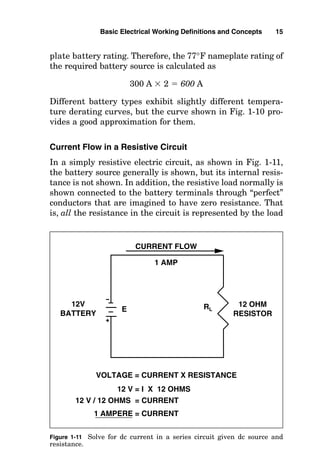
In a simply resistive electric circuit, as shown in Fig. 1-11,
the battery source generally is shown, but its internal resis-
tance is not shown. In addition, the resistive load normally is
shown connected to the battery terminals through “perfect”
conductors that are imagined to have zero resistance. That
is, all the resistance in the circuit is represented by the load
Basic Electrical Working Definitions and Concepts 15
VOLTAGE = CURRENT X RESISTANCE
CURRENT FLOW
1 AMP
E RL
12 V = I X 12 OHMS
12V
BATTERY
12 OHM
RESISTOR
12 V / 12 OHMS = CURRENT
1 AMPERE = CURRENT
Figure 1-11 Solve for dc current in a series circuit given dc source and
resistance.
resistance symbol RL. This methodology offers many conve-
niences in making calculations on more complex circuits.
In a simple series circuit, a 12-V battery source (the sym-
bol for which is E) is able to force a total of 1 A (the symbol
for which is I) to flow through a 12-ohm () load resistor
(the symbol for which is R). This is as would be expected
from the standard Ohm’s law calculation:
E  IR
12  I(R)
12  I(12)
12/12  I  1 A
Common problems that arise in electrical design include
calculation of the source voltage that would be required to
force a certain current magnitude to flow through a given
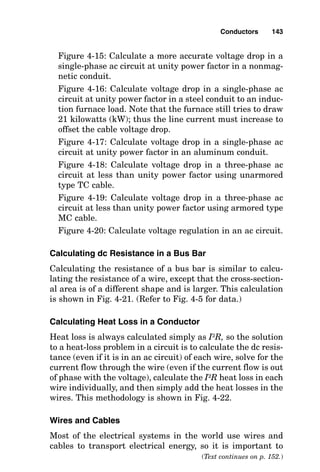
resistance. An example of this type of problem is shown in Fig.
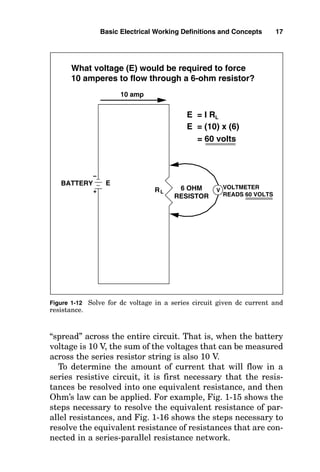
1-12. It shows that 10 A is to flow through a 6- load resistor
and asks what the source voltage must be to make this occur.
The solution to the problem, using Ohm’s law, is 60 V.
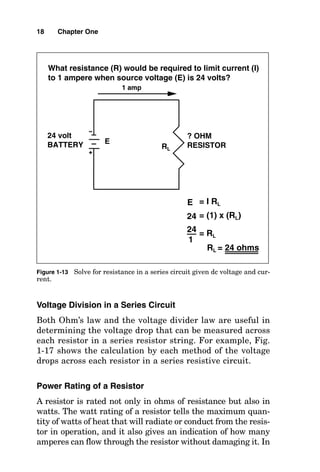
Similarly, often the resistance rating of a resistor is need-
ed when the source voltage and required current flow are
known. Figure 1-13 is a solved problem of this type, once
again simply making use of Ohm’s law.
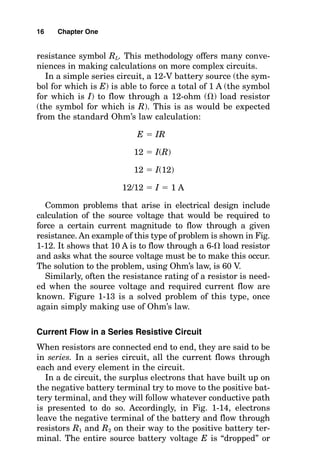
Current Flow in a Series Resistive Circuit
When resistors are connected end to end, they are said to be
in series. In a series circuit, all the current flows through
each and every element in the circuit.
In a dc circuit, the surplus electrons that have built up on
the negative battery terminal try to move to the positive bat-
tery terminal, and they will follow whatever conductive path
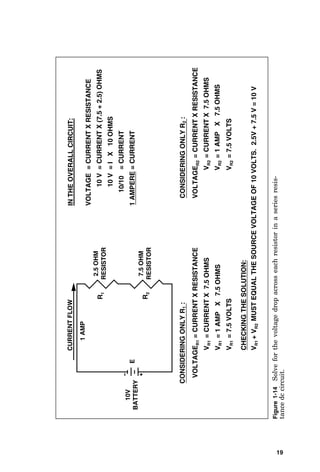
is presented to do so. Accordingly, in Fig. 1-14, electrons
leave the negative terminal of the battery and flow through
resistors R1 and R2 on their way to the positive battery ter-
minal. The entire source battery voltage E is “dropped” or
16 Chapter One
“spread” across the entire circuit. That is, when the battery
voltage is 10 V, the sum of the voltages that can be measured
across the series resistor string is also 10 V.
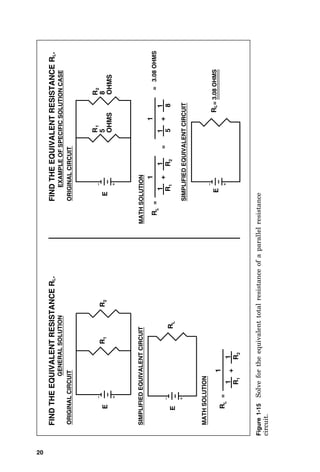
To determine the amount of current that will flow in a
series resistive circuit, it is first necessary that the resis-
tances be resolved into one equivalent resistance, and then
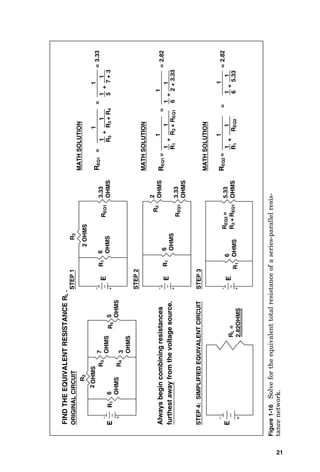
Ohm’s law can be applied. For example, Fig. 1-15 shows the
steps necessary to resolve the equivalent resistance of par-
allel resistances, and Fig. 1-16 shows the steps necessary to
resolve the equivalent resistance of resistances that are con-
nected in a series-parallel resistance network.
Basic Electrical Working Definitions and Concepts 17
RL
What voltage (E) would be required to force
10 amperes to flow through a 6-ohm resistor?
V
BATTERY E
E = I RL
E = (10) x (6)
= 60 volts
10 amp
6 OHM
RESISTOR
VOLTMETER
READS 60 VOLTS
+
–
Figure 1-12 Solve for dc voltage in a series circuit given dc current and
resistance.
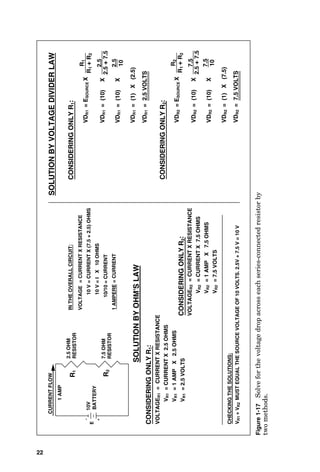
Voltage Division in a Series Circuit
Both Ohm’s law and the voltage divider law are useful in
determining the voltage drop that can be measured across
each resistor in a series resistor string. For example, Fig.
1-17 shows the calculation by each method of the voltage
drops across each resistor in a series resistive circuit.
Power Rating of a Resistor
A resistor is rated not only in ohms of resistance but also in
watts. The watt rating of a resistor tells the maximum quan-
tity of watts of heat that will radiate or conduct from the resis-
tor in operation, and it also gives an indication of how many
amperes can flow through the resistor without damaging it. In
18 Chapter One
1 amp
? OHM
RESISTOR
RL
What resistance (R) would be required to limit current (I)
to 1 ampere when source voltage (E) is 24 volts?
E
E = I RL
= (1) x (RL)
24
24 volt
BATTERY
= RL
24
1
RL = 24 ohms
Figure 1-13 Solve for resistance in a series circuit given dc voltage and cur-
rent.
RESISTOR
CURRENT
FLOW
10V
BATTERY
1
AMP
7.5
OHM
E
R
2
RESISTOR
2.5
OHM
R
1
VOLTAGE
=
CURRENT
X
RESISTANCE
10
V
=
CURRENT
X
(7.5
+
2.5)
OHMS
10
V
=
I
X
10
OHMS
10/10
=
CURRENT
1
AMPERE
=
CURRENT
IN
THE
OVERALL
CIRCUIT:
CONSIDERING
ONLY
R
2
:
VOLTAGE
R2
=
CURRENT
X
RESISTANCE
V
R2
=
CURRENT
X
7.5
OHMS
V
R2
=
1
AMP
X
7.5
OHMS
V
R2
=
7.5
VOLTS
CONSIDERING
ONLY
R
1
:
VOLTAGE
R1
=
CURRENT
X
RESISTANCE
V
R1
=
1
AMP
X
7.5
OHMS
V
R1
=
7.5
VOLTS
V
R1
=
CURRENT
X
7.5
OHMS
CHECKING
THE
SOLUTION:
V
R1
+
V
R2
MUST
EQUAL
THE
SOURCE
VOLTAGE
OF
10
VOLTS.
2.5V
+
7.5
V
=
10
V
19
Figure
1-14
Solve
for
the
voltage
drop
across
each
resistor
in
a
series
resis-
tance
dc
circuit.
E
R
2
FIND
THE
EQUIVALENT
RESISTANCE
R
L
.
R
1
E
R
L
R
L
=
1
R
1
1
1
R
2
+
ORIGINAL
CIRCUIT
SIMPLIFIED
EQUIVALENT
CIRCUIT
MATH
SOLUTION
GENERAL
SOLUTION
SIMPLIFIED
EQUIVALENT
CIRCUIT
MATH
SOLUTION
E
R
L
EXAMPLE
OF
SPECIFIC
SOLUTION
CASE
FIND
THE
EQUIVALENT
RESISTANCE
R
L
.
ORIGINAL
CIRCUIT
E
1
R
2
R
5
OHMS
8
OHMS
=
=
3.08
OHMS
=
3.08
OHMS
R
L
=
1
R
1
1
1
R
2
+
1
5
1
1
8
+
20
Figure
1-15
Solve
for
the
equivalent
total
resistance
of
a
parallel
resistance
circuit.
E
FIND
THE
EQUIVALENT
RESISTANCE
R
L
.
ORIGINAL
CIRCUIT
STEP
4:
SIMPLIFIED
EQUIVALENT
CIRCUIT
E
7
OHMS
3
OHMS
6
OHMS
5
OHMS
OHMS
2
STEP
1
E
6
OHMS
2
OHMS
R
2
R
1
R
5
R
1
R
1
R
1
R
2
R
3
R
4
R
2
R
EQ1
R
EQ1
R
EQ2
=
R
2
+
R
EQ1
+
R
5
MATH
SOLUTION
1
R
EQ1
=
1
5
1
+
1
+
7
3
1
1
=
=
3.33
=
2.82
3.33
OHMS
E
6
OHMS
3.33
OHMS
STEP
2
2
OHMS
STEP
3
E
6
OHMS
5.33
OHMS
R
3
+
R
4
1
+
+
R
1
MATH
SOLUTION
1
R
EQ1
=
R
EQ2
=
1
6
1
=
MATH
SOLUTION
R
2
+
R
EQ1
1
+
R
1
1
1
=
R
EQ2
1
2
+
3.33
1
1
=
2.82
+
6
1
5.33
1
Always
begin
combining
resistances
furthest
away
from
the
voltage
source.
R
L
=
2.82OHMS
21
Figure
1-16
Solve
for
the
equivalent
total
resistance
of
a
series-parallel
resis-
tance
network.
BATTERY
CURRENT
FLOW
10V
1
AMP
7.5
OHM
RESISTOR
E
R
2
R
1
VOLTAGE
=
CURRENT
X
RESISTANCE
10
V
=
CURRENT
X
(7.5
+
2.5)
OHMS
10
V
=
I
X
10
OHMS
10/10
=
CURRENT
1
AMPERE
=
CURRENT
IN
THE
OVERALL
CIRCUIT:
VOLTAGE
R2
=
CURRENT
X
RESISTANCE
V
R2
=
CURRENT
X
7.5
OHMS
V
R2
=
1
AMP
X
7.5
OHMS
V
R2
=
7.5
VOLTS
VOLTAGE
R1
=
CURRENT
X
RESISTANCE
V
R1
=
1
AMP
X
2.5
OHMS
V
R1
=
2.5
VOLTS
V
R1
=
CURRENT
X
2.5
OHMS
V
R1
+
V
R2
MUST
EQUAL
THE
SOURCE
VOLTAGE
OF
10
VOLTS.
2.5V
+
7.5
V
=
10
V
CHECKING
THE
SOLUTIONS:
SOLUTION
BY
OHM'S
LAW
SOLUTION
BY
VOLTAGE
DIVIDER
LAW
CONSIDERING
ONLY
R
2
:
7.5
10
7.5
VD
R2
=
E
SOURCE
X
VD
R2
=
(10)
X
VD
R2
=
(10)
X
VD
R2
=
(1)
X
(7.5)
VD
R2
=
7.5
VOLTS
R
1
+
R
2
R
2
CONSIDERING
ONLY
R
1
:
CONSIDERING
ONLY
R
2
:
2.5
OHM
RESISTOR
2.5
+
7.5
CONSIDERING
ONLY
R
1
:
2.5
10
2.5
VD
R1
=
E
SOURCE
X
VD
R1
=
(10)
X
VD
R1
=
(10)
X
VD
R1
=
(1)
X
(2.5)
VD
R1
=
2.5
VOLTS
R
1
+
R
2
R
1
2.5
+
7.5
22
Figure
1-17
Solve
for
the
voltage
drop
across
each
series-connected
resistor
by
two
methods.
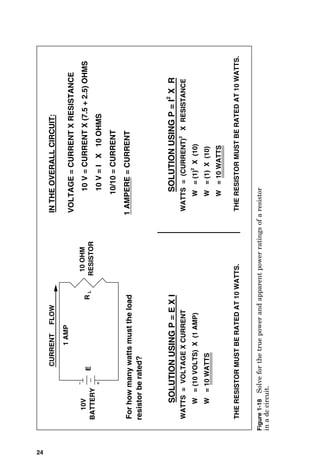
dc systems, watts are equal to the voltage times the current
(W  E  I), and watts are also equal to the current squared
times the resistance (W  I2
 R). The correct application of
each of these formulas is shown in Fig. 1-18.
ac Voltage
The effective value of ac voltage is used in an ac resistive
circuit just as dc voltage is used to calculate current in a dc
circuit. Although many different voltages exist in an ac sys-
tem, useful definitions of only the following three provide
calculation capability for most problems:
1. Peak value
2. Average value
3. Effective, or root-mean-square (rms), value
These three voltages are illustrated graphically on the ac
voltage waveform shown in Fig. 1-19.
In explanation, the peak value is the voltage magnitude
between zero and the highest point of the voltage wave for
one half-cycle. The average voltage value is the arithmetical
average of all the values in the sine wave for one half-cycle
and is equal to 63.7 percent of the peak voltage value. The
rms value of the voltage is the equivalent “effective” voltage
to a matching dc voltage, and the rms value is equal to 70.7
percent of the peak voltage value.
Note that these voltage values are independent of the fre-
quency of the system; however, the system frequency causes
several unique load considerations.
ac Circuits with Resistance
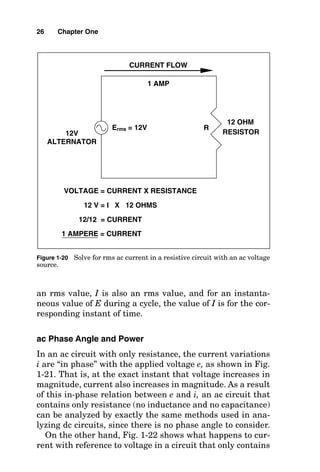
An ac circuit has an ac voltage source. Notice the symbol for
ac voltage shown in Fig. 1-20. This voltage connected across
an external load resistance produces alternating current of
the same waveform and frequency as the applied voltage.
Ohm’s law applies to this circuit at every instant in time, as
well as when considering the sine-wave voltage. When E is
Basic Electrical Working Definitions and Concepts 23
BATTERY
10
V
=
CURRENT
X
(7.5
+
2.5)
OHMS
CURRENT
FLOW
10V
1
AMP
E
10
V
=
I
X
10
OHMS
10/10
=
CURRENT
1
AMPERE
=
CURRENT
RESISTOR
10
OHM
R
L
VOLTAGE
=
CURRENT
X
RESISTANCE
IN
THE
OVERALL
CIRCUIT:
WATTS
=
VOLTAGE
X
CURRENT
W
=
(10
VOLTS)
X
(1
AMP)
W
=
10
WATTS
SOLUTION
USING
P
=
I
2
X
R
For
how
many
watts
must
the
load
resistor
be
rated?
SOLUTION
USING
P
=
E
X
I
THE
RESISTOR
MUST
BE
RATED
AT
10
WATTS.
THE
RESISTOR
MUST
BE
RATED
AT
10
WATTS.
WATTS
=
(CURRENT)
2
X
RESISTANCE
W
=
(1)
2
X
(10)
W
=
(1)
X
(10)
W
=
10
WATTS
24
Figure
1-18
Solve
for
the
true
power
and
apparent
power
ratings
of
a
resistor
in
a
dc
circuit.
25
Figure
1-19
Determine
average
voltage
and
rms
voltage
from
peak
ac
voltage
(rms
is
the
driving
voltage).
an rms value, I is also an rms value, and for an instanta-
neous value of E during a cycle, the value of I is for the cor-
responding instant of time.
ac Phase Angle and Power
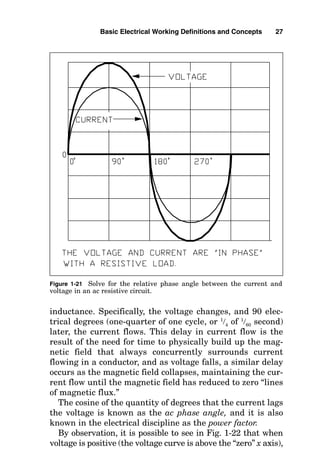
In an ac circuit with only resistance, the current variations
i are “in phase” with the applied voltage e, as shown in Fig.
1-21. That is, at the exact instant that voltage increases in
magnitude, current also increases in magnitude. As a result
of this in-phase relation between e and i, an ac circuit that
contains only resistance (no inductance and no capacitance)
can be analyzed by exactly the same methods used in ana-
lyzing dc circuits, since there is no phase angle to consider.
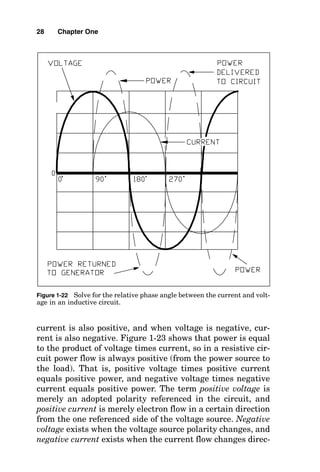
On the other hand, Fig. 1-22 shows what happens to cur-
rent with reference to voltage in a circuit that only contains
26 Chapter One
RESISTOR
VOLTAGE = CURRENT X RESISTANCE
1 AMP
12 OHM
Erms = 12V R
12 V = I X 12 OHMS
12/12 = CURRENT
1 AMPERE = CURRENT
CURRENT FLOW
12V
ALTERNATOR
Figure 1-20 Solve for rms ac current in a resistive circuit with an ac voltage
source.
inductance. Specifically, the voltage changes, and 90 elec-
trical degrees (one-quarter of one cycle, or 1
4 of 1
60 second)
later, the current flows. This delay in current flow is the
result of the need for time to physically build up the mag-
netic field that always concurrently surrounds current
flowing in a conductor, and as voltage falls, a similar delay
occurs as the magnetic field collapses, maintaining the cur-
rent flow until the magnetic field has reduced to zero “lines
of magnetic flux.”
The cosine of the quantity of degrees that the current lags
the voltage is known as the ac phase angle, and it is also
known in the electrical discipline as the power factor.
By observation, it is possible to see in Fig. 1-22 that when
voltage is positive (the voltage curve is above the “zero” x axis),
Basic Electrical Working Definitions and Concepts 27
Figure 1-21 Solve for the relative phase angle between the current and
voltage in an ac resistive circuit.
current is also positive, and when voltage is negative, cur-
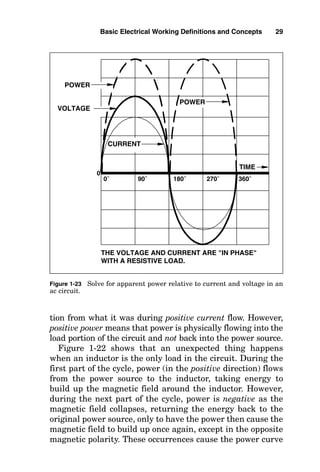
rent is also negative. Figure 1-23 shows that power is equal
to the product of voltage times current, so in a resistive cir-
cuit power flow is always positive (from the power source to
the load). That is, positive voltage times positive current
equals positive power, and negative voltage times negative
current equals positive power. The term positive voltage is
merely an adopted polarity referenced in the circuit, and
positive current is merely electron flow in a certain direction
from the one referenced side of the voltage source. Negative
voltage exists when the voltage source polarity changes, and
negative current exists when the current flow changes direc-
28 Chapter One
Figure 1-22 Solve for the relative phase angle between the current and volt-
age in an inductive circuit.
tion from what it was during positive current flow. However,
positive power means that power is physically flowing into the
load portion of the circuit and not back into the power source.
Figure 1-22 shows that an unexpected thing happens
when an inductor is the only load in the circuit. During the
first part of the cycle, power (in the positive direction) flows
from the power source to the inductor, taking energy to
build up the magnetic field around the inductor. However,
during the next part of the cycle, power is negative as the
magnetic field collapses, returning the energy back to the
original power source, only to have the power then cause the
magnetic field to build up once again, except in the opposite
magnetic polarity. These occurrences cause the power curve
Basic Electrical Working Definitions and Concepts 29
0
0° 90° 180° 270°
VOLTAGE
THE VOLTAGE AND CURRENT ARE IN PHASE
WITH A RESISTIVE LOAD.
CURRENT
POWER
POWER
360°
TIME
Figure 1-23 Solve for apparent power relative to current and voltage in an
ac circuit.
to be at twice the frequency of the voltage curve. A pure
inductor, therefore, returns to the power source all the pow-
er that was delivered to it earlier. Therefore, 0 watts (W) of
power (known as true power) are consumed in a purely
inductive circuit, whereas many voltamperes of apparent
power flow in the circuit. Note that 1 V times 1 A is equal to
1 voltampere (VA).
The circuit containing only an inductor as a load is only a
theoretical circuit, however, because all conductors have
resistance. Even the inductor itself is made of a conductor
that contains resistance. Therefore, in reality, a circuit that
contains an inductor also contains resistance. Since the
inductance opposes current flow in a different way and at a
different time than the resistance opposes current flow, it is
necessary to differentiate between the two.
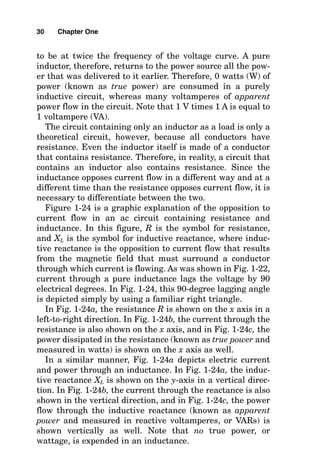
Figure 1-24 is a graphic explanation of the opposition to
current flow in an ac circuit containing resistance and
inductance. In this figure, R is the symbol for resistance,
and XL is the symbol for inductive reactance, where induc-
tive reactance is the opposition to current flow that results
from the magnetic field that must surround a conductor
through which current is flowing. As was shown in Fig. 1-22,
current through a pure inductance lags the voltage by 90
electrical degrees. In Fig. 1-24, this 90-degree lagging angle
is depicted simply by using a familiar right triangle.
In Fig. 1-24a, the resistance R is shown on the x axis in a
left-to-right direction. In Fig. 1-24b, the current through the
resistance is also shown on the x axis, and in Fig. 1-24c, the
power dissipated in the resistance (known as true power and
measured in watts) is shown on the x axis as well.
In a similar manner, Fig. 1-24a depicts electric current
and power through an inductance. In Fig. 1-24a, the induc-
tive reactance XL is shown on the y-axis in a vertical direc-
tion. In Fig. 1-24b, the current through the reactance is also
shown in the vertical direction, and in Fig. 1-24c, the power
flow through the inductive reactance (known as apparent
power and measured in reactive voltamperes, or VARs) is
shown vertically as well. Note that no true power, or
wattage, is expended in an inductance.
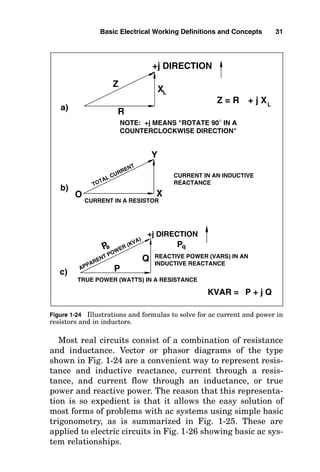
30 Chapter One
Most real circuits consist of a combination of resistance
and inductance. Vector or phasor diagrams of the type
shown in Fig. 1-24 are a convenient way to represent resis-
tance and inductive reactance, current through a resis-
tance, and current flow through an inductance, or true
power and reactive power. The reason that this representa-
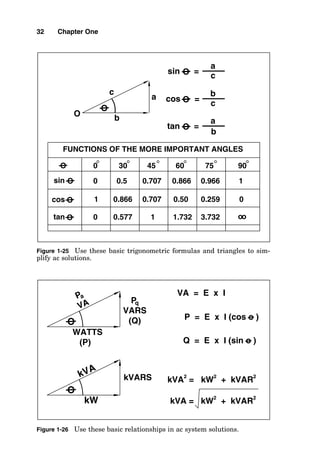
tion is so expedient is that it allows the easy solution of
most forms of problems with ac systems using simple basic
trigonometry, as is summarized in Fig. 1-25. These are
applied to electric circuits in Fig. 1-26 showing basic ac sys-
tem relationships.
Basic Electrical Working Definitions and Concepts 31
CURRENT IN AN INDUCTIVE
REACTANCE
CURRENT IN A RESISTOR
TOTAL CURRENT
Z
R
XL
+j DIRECTION
APPARENT POWER (KVA)
REACTIVE POWER (VARS) IN AN
INDUCTIVE REACTANCE
Q
+j DIRECTION
TRUE POWER (WATTS) IN A RESISTANCE
P
Z = R + j X
P + j Q
KVAR =
L
O
Y
X
NOTE: +j MEANS ROTATE 90° IN A
COUNTERCLOCKWISE DIRECTION
a)
b)
c)
Pa Pq
Figure 1-24 Illustrations and formulas to solve for ac current and power in
resistors and in inductors.
32 Chapter One
FUNCTIONS OF THE MORE IMPORTANT ANGLES
c
b
a
sin =
O
O
a
c
O
cos =
b
O c
tan =
a
O
b
O
sin O
cos O
tan O
0 30 45 60 75 90
0 0.5 0.707 0.866 0.966 1
1 0.866 0.707 0.50 0.259 0
0 0.577 1 1.732 3.732 oo
Figure 1-25 Use these basic trigonometric formulas and triangles to sim-
plify ac solutions.
kVA2
= kW2
+ kVAR2
WATTS
(P)
Pq
VARS
(Q)
VA = E x I
O
P = E x I (cos o )
Q = E x I (sin o )
kW
O
kVA
kVARS
Pa
VA
kVA = kW2
+ kVAR2
Figure 1-26 Use these basic relationships in ac system solutions.
Current and Power in a Single-Phase ac
Circuit
In a single-phase ac circuit, power is related to voltage, cur-
rent, and power factor, as shown in this formula:
P  E  I  power factor
This formula can be used to calculate current to determine
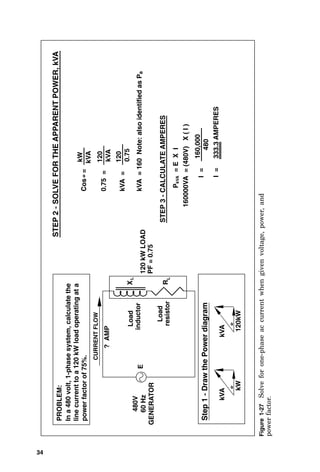
wire size when power, voltage, and power factor are known,
as shown in Fig. 1-27. It also can be used to calculate
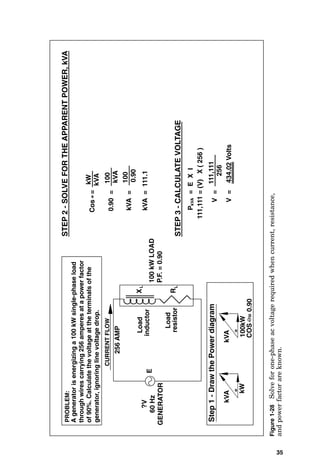
required voltage when power, current, and power factor are
known, as shown in Fig. 1-28. Alternatively, it can be used
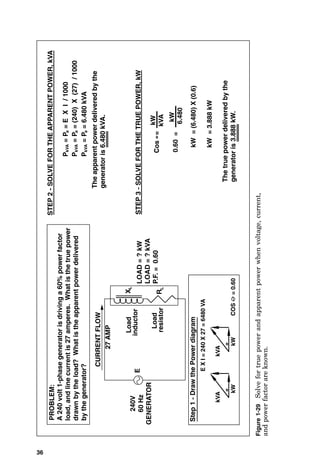
to calculate true and apparent power when voltage, current,
and power factor are known, as shown in Fig. 1-29,
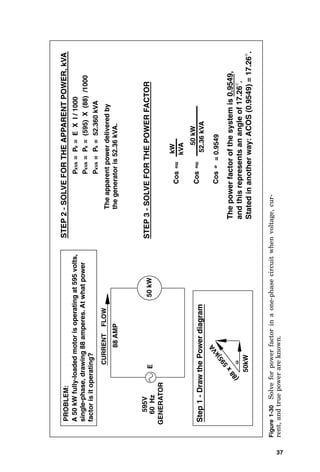
Moreover, it can be used to determine the power factor, as
shown in Fig. 1-30.
Current and Power in a Three-Phase
ac Circuit
In a three-phase ac circuit, apparent power is related to volt-
age, current, and power factor, as shown in this formula:
P
a  E  I  power factor  兹3
苶
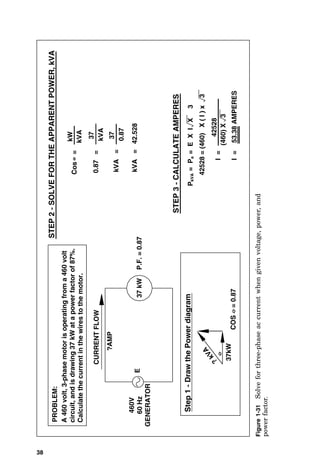
This formula can be used to calculate three-phase current to
determine wire size when power, voltage, and power factor
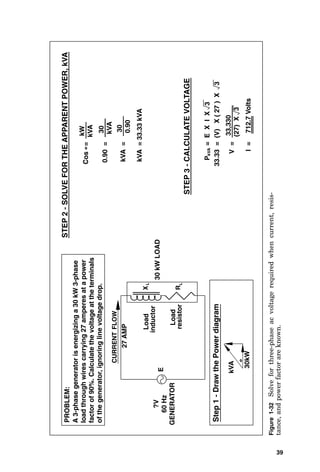
are known, as shown in Fig. 1-31. It also can be used to cal-
culate required voltage when power power, current, and
power factor are known, as shown in Fig. 1-32. Altern-
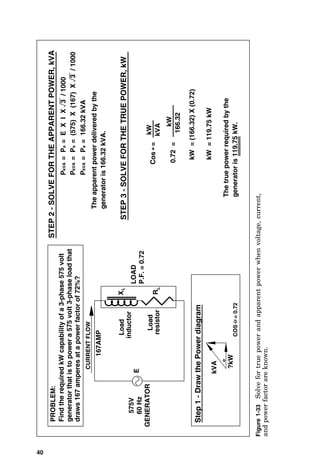
atively, it can be used to calculate true and apparent power
when voltage, current, and power factor are known, as
shown in Fig. 1-33. In addition, it can be used to determine
the power factor, as shown in Fig. 1-34. These are all stan-
dard calculations of the type that electrical engineers solve
frequently and are presented in a resolved step-by-step
manner as reference templates that can be used in any sim-
ilar problem simply by changing the numbers and main-
taining the procedures.
Basic Electrical Working Definitions and Concepts 33
(Text continues on p. 42.)
34
P
kVA
=
E
X
I
STEP
3
-
CALCULATE
AMPERES
480V
60
Hz
GENERATOR
E
inductor
L
R
resistor
Load
?
AMP
X
L
120
kW
LOAD
In
a
480
volt,
1-phase
system,
calculate
the
line
current
to
a
120
kW
load
operating
at
a
power
factor
of
75%.
Step
1
-
Draw
the
Power
diagram
kVA
kW
Load
160000VA
=
(480V)
X
(
I
)
kVA
120kW
Cos
=
STEP
2
-
SOLVE
FOR
THE
APPARENT
POWER,
kVA
kW
kVA
kVA
0.75
=
120
kVA
=
120
0.75
kVA
=
160
Note:
also
identified
as
P
a
I
=
480
160,000
I
=
333.3
AMPERES
PROBLEM:
PF
=
0.75
CURRENT
FLOW
Figure
1-27
Solve
for
one-phase
ac
current
when
given
voltage,
power,
and
power
factor.
35
P
kVA
=
E
X
I
STEP
3
-
CALCULATE
VOLTAGE
?V
60
Hz
GENERATOR
E
inductor
L
R
resistor
Load
256
AMP
X
L
100
kW
LOAD
P.F.
=
0.90
A
generator
is
energizing
a
100
kW
single-phase
load
through
wires
carrying
256
amperes
at
a
power
factor
of
90%.
Calculate
the
voltage
at
the
terminals
of
the
generator,
ignoring
line
voltage
drop.
Step
1
-
Draw
the
Power
diagram
kVA
kW
Load
111,111
=
(V)
X
(
256
)
kVA
100kW
Cos
=
STEP
2
-
SOLVE
FOR
THE
APPARENT
POWER,
kVA
kW
kVA
kVA
0.90
=
100
kVA
=
100
0.90
kVA
=
111.1
V
=
256
111,111
V
=
434.02
Volts
PROBLEM:
COS
=
0.90
CURRENT
FLOW
Figure
1-28
Solve
for
one-phase
ac
voltage
required
when
current,
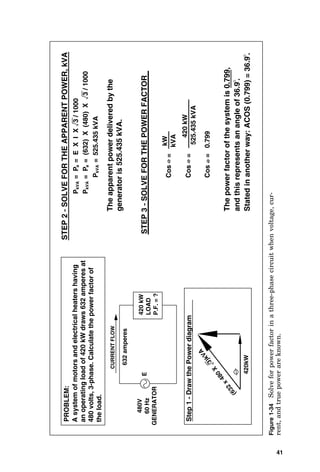
resistance,
and
power
factor
are
known.
36
P
kVA
=
P
a
=
E
X
I
/
1000
240V
60
Hz
GENERATOR
E
inductor
L
R
resistor
Load
27
AMP
X
L
LOAD
=
?
kW
LOAD
=
?
kVA
P.F.
=
0.60
A
240
volt
1-phase
generator
is
driving
a
60%
power
factor
load,
and
line
current
is
27
amperes.
What
is
the
true
power
drawn
by
the
load?
What
is
the
apparent
power
delivered
by
the
generator?
Step
1
-
Draw
the
Power
diagram
kVA
kW
kW
Load
kVA
COS
=
0.60
STEP
2
-
SOLVE
FOR
THE
APPARENT
POWER,
kVA
PROBLEM:
P
kVA
=
P
a
=
(240)
X
(27)
/
1000
P
kVA
=
P
a
=
6.480
kVA
The
apparent
power
delivered
by
the
generator
is
6.480
kVA.
STEP
3
-
SOLVE
FOR
THE
TRUE
POWER,
kW
kW
=
3.888
kW
kW
6.480
kVA
kW
Cos
=
kW
=
(6.480)
X
(0.6)
0.60
=
The
true
power
delivered
by
the
generator
is
3.888
kW.
E
X
I
=
240
X
27
=
6480
VA
CURRENT
FLOW
Figure
1-29
Solve
for
true
power
and
apparent
power
when
voltage,
current,
and
power
factor
are
known.
37
P
kVA
=
P
a
=
E
X
I
/
1000
CURRENT
60
595V
E
Hz
GENERATOR
88
AMP
FLOW
A
50
kW
fully-loaded
motor
is
operating
at
595
volts,
single-phase,
drawing
88
amperes.
At
what
power
factor
is
it
operating?
Step
1
-
Draw
the
Power
diagram
(
8
8
x
5
9
5
)
k
V
A
50kW
STEP
2
-
SOLVE
FOR
THE
APPARENT
POWER,
kVA
PROBLEM:
P
kVA
=
P
a
=
(595)
X
(88)
/1000
P
kVA
=
P
a
=
52.360
kVA
The
apparent
power
delivered
by
the
generator
is
52.36
kVA.
STEP
3
-
SOLVE
FOR
THE
POWER
FACTOR
50
kW
52.36
kVA
kVA
kW
Cos
=
=
0.9549
50
kW
Cos
=
Cos
The
power
factor
of
the
system
is
0.9549,
and
this
represents
an
angle
of
17.26
°
.
Stated
in
another
way:
ACOS
(0.9549)
=
17.26
°
.
Figure
1-30
Solve
for
power
factor
in
a
one-phase
circuit
when
voltage,
cur-
rent,
and
true
power
are
known.
38
P
kVA
=
P
a
=
E
X
I
X
3
STEP
3
-
CALCULATE
AMPERES
A
460
volt,
3-phase
motor
is
operating
from
a
460
volt
circuit,
and
is
drawing
37
kW
at
a
power
factor
of
87%.
Calculate
the
current
in
the
wires
to
the
motor.
42528
=
(460)
X
(
I
)
x
3
Cos
=
STEP
2
-
SOLVE
FOR
THE
APPARENT
POWER,
kVA
kW
kVA
kVA
0.87
=
37
kVA
=
37
0.87
kVA
=
42.528
I
=
(460)
X
3
42528
I
=
53.38
AMPERES
PROBLEM:
460V
60
Hz
GENERATOR
E
?AMP
Step
1
-
Draw
the
Power
diagram
?
k
V
A
37kW
37
kW
P.F.
=
0.87
COS
=
0.87
CURRENT
FLOW
Figure
1-31
Solve
for
three-phase
ac
current
when
given
voltage,
power,
and
power
factor.
39
P
kVA
=
E
X
I
X
3
STEP
3
-
CALCULATE
VOLTAGE
CURRENT
?V
60
Hz
GENERATOR
E
inductor
L
R
resistor
Load
27
AMP
FLOW
X
L
30
kW
LOAD
A
3-phase
generator
is
energizing
a
30
kW
3-phase
load
through
wires
carrying
27
amperes
at
a
power
factor
of
90%.
Calculate
the
voltage
at
the
terminals
of
the
generator,
ignoring
line
voltage
drop.
Step
1
-
Draw
the
Power
diagram
Load
33.33
=
(V)
X
(
27
)
X
3
kVA
30kW
Cos
=
STEP
2
-
SOLVE
FOR
THE
APPARENT
POWER,
kVA
kW
kVA
kVA
0.90
=
30
kVA
=
30
0.90
kVA
=
33.33
kVA
V
=
(27)
X
3
33,330
I
=
712.7
Volts
PROBLEM:
Figure
1-32
Solve
for
three-phase
ac
voltage
required
when
current,
resis-
tance,
and
power
factor
are
known.
40
P
kVA
=
P
a
=
E
X
I
X
3
/
1000
575V
60
Hz
GENERATOR
E
inductor
L
R
resistor
Load
167AMP
X
L
LOAD
P.F.
=
0.72
Find
the
required
kW
capability
of
a
3-phase
575
volt
generator
that
is
to
power
a
575
volt
3-phase
load
that
draws
167
amperes
at
a
power
factor
of
72%?
Step
1
-
Draw
the
Power
diagram
Load
kVA
?kW
STEP
2
-
SOLVE
FOR
THE
APPARENT
POWER,
kVA
PROBLEM:
P
kVA
=
P
a
=
(575)
X
(167)
X
3
/
1000
P
kVA
=
P
a
=
166.32
kVA
The
apparent
power
delivered
by
the
generator
is
166.32
kVA.
STEP
3
-
SOLVE
FOR
THE
TRUE
POWER,
kW
kW
=
119.75
kW
kW
166.32
kVA
kW
Cos
=
kW
=
(166.32)
X
(0.72)
0.72
=
The
true
power
required
by
the
generator
is
119.75
kW.
COS
=
0.72
CURRENT
FLOW
Figure
1-33
Solve
for
true
power
and
apparent
power
when
voltage,
current,
and
power
factor
are
known.
41
P
kVA
=
P
a
=
E
X
I
X
3
/
1000
480V
60
Hz
GENERATOR
E
A
system
of
motors
and
electrical
heaters
having
an
operating
load
of
420
kW
draws
632
amperes
at
480
volts,
3-phase.
Calculate
the
power
factor
of
the
load.
Step
1
-
Draw
the
Power
diagram
(
6
3
2
x
4
8
0
X
3
)
k
V
A
420kW
STEP
2
-
SOLVE
FOR
THE
APPARENT
POWER,
kVA
PROBLEM:
P
kVA
=
P
a
=
(632)
X
(480)
X
3
/
1000
P
kVA
=
525.435
kVA
The
apparent
power
delivered
by
the
generator
is
525.435
kVA.
STEP
3
-
SOLVE
FOR
THE
POWER
FACTOR
420
kW
525.435
kVA
kVA
kW
Cos
=
420
kW
LOAD
P.F.
=
?
Cos
=
Cos
=
0.799
The
power
factor
of
the
system
is
0.799,
and
this
represents
an
angle
of
36.9
°
.
Stated
in
another
way:
ACOS
(0.799)
=
36.9
°
.
632
amperes
CURRENT
FLOW
Figure
1-34
Solve
for
power
factor
in
a
three-phase
circuit
when
voltage,
cur-
rent,
and
true
power
are
known.
Inductive Reactance
The opposition to electron flow presented by the magnetic
field change surrounding a conductor through which current
flow is changing is called inductive reactance. For this rea-
son, an inductor in which the magnetic field is concentrated
by coiling the circuit conductor is often called a reactor.
Current flow through an inductive reactance lags the appli-
cation of voltage, and the lag through a perfect inductor
(with no resistive component) would be 90 electrical
degrees.
Inductive reactance is measured in ohms, the same unit
used to measure resistance, except that the opposition to
current flow created by an inductive reactive ohm occurs 90
electrical degrees later than the opposition to current flow
from a resistive ohm. Therefore, these two values cannot be
added by simple algebra and instead must be added as vec-
tors. The addition of vectors is described and illustrated in
the section on adding vectors in Chap. 3.
Inductive reactance XL can be calculated as
XL  2fL
where   3.14
f  frequency, Hz
L  inductance, henries (H)
From the formula, it is apparent that a given coil can have
a very low value of ohms in a 60-Hz system, whereas the
same coil would have a much greater ohmic value in a 1-
MHz system. A sample problem calculating the value in
ohms of an inductor of a given value is shown in Fig. 1-35. A
sample problem calculating the total opposition to current
flow in a circuit containing a resistor in series with an
inductor is shown in Fig. 1-36, and a sample problem calcu-
lating the total opposition to current flow in a circuit con-
taining a resistor in series with an inductor is shown in Fig.
1-37. An explanation of vector addition and multiplication is
given in Chap. 3. Note that the inductor contains resistance,
as explained previously.
42 Chapter One
43
E
3.5
millihenry
inductor
X
L
X
L
=
2
f
L
CALCULATE
THE
OHM
VALUE
OF
THE
INDUCTOR.
10V
60
Hz
GENERATOR
X
L
=
2
(3.14)
(60)
(3.5
x
10
-3
)
X
L
=
2
(3.14)
(60)
(.0035)
X
L
=
1.319
ohms
AT
60
HZ
CALCULATE
THE
OHM
VALUE
OF
THE
INDUCTOR.
AT
1
MHZ
10V
1MHz
GENERATOR
E
X
L
3.5
millihenry
inductor
X
L
=
2
(3.14)
(1
X
10
6
)
(3.5
x
10
-3
)
X
L
=
21.99
kiloohms
X
L
=
2
(3.14)
(1)
(3.5)
(10
6-3
)
X
L
=
2
f
L
Figure
1-35
Solve
for
the
inductive
reactance
of
an
inductor
given
frequency
and
inductance.
44
10
V
=
CURRENT
X
1.319
OHMS
?
AMP
E
10
V
=
CURRENT
X
1.319
OHMS
10
/
1.319
=
CURRENT
7.582
AMPERES
=
CURRENT
3.5
millihenry
inductor
X
L
VOLTAGE
=
CURRENT
X
INDUCTIVE
REACTANCE
STEP
2
-
CALCULATING
CURRENT
FLOW
Ignoring
phase
angle
and
power
factor,
how
many
amperes
flow
through
the
inductor?
10V
60
Hz
GENERATOR
X
L
=
2
f
L
X
L
=
2
(3.14)
(60)
(3.5
x
10
-3
)
X
L
=
2
(3.14)
(60)
(.0035)
X
L
=
1.319
ohms
STEP
1
-
CALCULATING
INDUCTIVE
REACTANCE
CURRENT
FLOW
Figure
1-36
Solve
for
current
through
an
inductor
given
inductive
reactance
and
voltage.
45
E
3.5
millihenry
inductor
X
L
What
is
the
total
impedance
of
the
series
inductor
and
resistor?
X
L
=
2
π
f
L
X
L
=
2
(3.14)
(60)
(3.5
x
10
-3
)
X
L
=
2
(3.14)
(60)
(.0035)
X
L
=
1.319
ohms
STEP
1
-
CALCULATING
INDUCTIVE
REACTANCE
7.5
OHM
RESISTOR
R
L
STEP
2
-
CALCULATING
IMPEDANCE
Z
=
R
+j
X
L
Z
=
7.5
+j
1.319
STEP
3
-
CHANGE
Z
TO
POLAR
FORM
Z
=
7.5
+j
1.319
Z
=
7.5
+j
1.319
Z
=
(7.5)
2
+
(1.319)
2
arctan
(1.319/7.5)
Z
=
57.99
arctan
(0.1758)
Z
=
7.615
9.974
ohms
CURRENT
FLOW
10V
60Hz
GENERATOR
Figure
1-37
Solve
for
impedance
of
a
coil
given
inductance
and
resistance.
Capacitive Reactance
A capacitor is simply a very thin insulator called a dielectric
that is sandwiched between two conductor “plates” on which
electrons “build up” under the pressure of a voltage source.
No electrons actually flow through a capacitor, and in a dc cir-
cuit, a “charged” capacitor appears to be an open circuit. In an
ac circuit, however, electrons build up first on one side of the
dielectric and then on the other side as the source voltage
polarity changes. In this way, a capacitor appears to conduct
electrons in an ac circuit. The larger the capacitor plates, the
greater is the quantity of electrons that can build up on them,
and the lower is the apparent opposition to current flow pro-
duced by the capacitor. The measurement of opposition to
current flow in a capacitor is called capacitive reactance XC.
When voltage is first applied to a capacitor, the capacitor
appears to be a short circuit until its plates begin to be
charged with electron buildup. Contrasted with an inductor,
in which current flows 90 electrical degrees after the appli-
cation of source voltage, current flow in a capacitor actually
leads the application of source voltage by 90 electrical
degrees. Since both capacitive reactance and inductive reac-
tance are “reactive” and occur 90 electrical degrees from the
time of application of voltage, capacitive reactive ohms can
be added to inductive reactive ohms using simple algebra.
Capacitive reactance XC can be calculated as
XC 
where   3.14
f  frequency, Hz
C  capacitance, farads (F)
As can be observed from this formula, the opposition to current
flow at very low frequencies is quite great, whereas the ohmic
value of capacitive reactance decreases at higher frequencies.
This is exactly the opposite of the behavior of the ohmic value
of an inductive reactance. A sample problem calculating the
value in ohms of a capacitor of a given value is shown in Fig.
1-38, along with a capacitor current flow calculation.
1

2fC
46 Chapter One
47
10
V
=
CURRENT
X
758.26
OHMS
?
AMP
E
0.01318
AMPERES
=
CURRENT
3.5
microfarad
capacitor
X
C
VOLTAGE
=
CURRENT
X
CAPACITIVE
REACTANCE
STEP
2
-
CALCULATING
CURRENT
FLOW
How
many
amperes
flow
through
the
capacitor?
10V
60
Hz
GENERATOR
X
C
=
1/
2
π
f
C
X
C
=
1/
2
(3.14)
(60)
(3.5
x
10
-6
)
X
C
=
1/
2
(3.14)
(60)
(.0000035)
X
C
=
758.26
ohms
STEP
1
-
CALCULATING
CAPACITIVE
REACTANCE
10
/
758.26
=
CURRENT
CURRENT
FLOW
Figure
1-38
Solve
for
current
through
a
capacitor
given
capacitance
value
in
microfarads.
48 Chapter One
Z = (7.5)
2
+ (756.94)
2
Z = 7.5 -j 756.94
STEP 4 - CHANGE Z TO POLAR FORM
Z = 756.97 89.43° ohms
Z = 573014 arctan (100.92)
arctan (756.94/7.5)
10V
60 Hz
GENERATOR
E
XC
RL
3.5 microfarad
capacitor
7.5 OHM
RESISTOR
? AMP
XL
3.5 millihenry
inductor
THE TOTAL SERIES IMPEDANCE IS 756.97 OHMS, AND
IT IS ALMOST ALL CAPACITIVE (ALMOST +90 DEGREES)
How many amperes flow through the series circuit?
Impedance diagram
XL
Z
R
XC
XC XL
CURRENT FLOW
Figure 1-39 Solve for current through a series circuit of inductance,
capacitance, and resistance using vectors impedance solution.
Basic Electrical Working Definitions and Concepts 49
XC = 1/ 2π f C
XC = 1/ 2 (3.14) (60) (3.5 x 10
-6
)
XC = 1/ 2 (3.14) (60) (.0000035)
XC = 758.26 ohms
STEP 1 - CALCULATING CAPACITIVE REACTANCE
STEP 2 - CALCULATING INDUCTIVE REACTANCE
XL = 2 (3.14) (60) (.0035 )
XL = 1.319 ohms
XL = 2 (3.14) (60) (3.5 x 10⁻³
)
XL = 2π f L
Z = 7.5 +j 1.319 -j 758.26
Z = R +j XL -j XC
STEP 3 - CALCULATING TOTAL CIRCUIT IMPEDANCE
Z = 7.5 -j 756.94
STEP 5 - CALCULATING CURRENT FLOW
0.0132 AMPERES = CURRENT
10 V = CURRENT X 756.97 OHMS
10 0° / 756.97 89.43 = CURRENT
VOLTAGE = CURRENT X IMPEDANCE
0.0132 AMPERES = CURRENT
- 89.43°
0.0° - 89.43°
0° 89.43°
50 Chapter One
XC = 1/ 2π f C
XC = 1/ 2 (3.14) (60) (13.25 x 10
-6
)
XC = 1/ 2 (3.14) (60) (.00001325)
XC = 200 ohms
STEP 1 - CALCULATING CAPACITIVE REACTANCE
STEP 2 - CALCULATING INDUCTIVE REACTANCE
XL = 2 (3.14) (60) (0.265)
XL = 100 ohms
XL = 2 (3.14) (60) (265 x 10
-3
)
XL = 2π f L
Z = 75 +j 100
Z = R +j XL
STEP 3 - CALCULATING IMPEDANCE OF BRANCH A
impedance ZT = ?
120V
60 Hz
GENERATOR
E
RL
75 OHM
RESISTOR
XL
265 millihenry
inductor
13.25 microfarad
capacitor
XC
Z = (75)2
+ (100)2
STEP 4 - CHANGE Z OF BRANCH A TO POLAR FORM
Z = 125 53.1° ohms
Z = 15625 arctan (1.33)
arctan (100/75)
A B
This solution is most simply done by solving for
the current in each branch and summing them.
Figure 1-40 Solve for total current in a parallel ac circuit containing
inductance, resistance, and capacitance.
Basic Electrical Working Definitions and Concepts 51
VOLTAGE = CURRENT X IMPEDANCE
0.96 AMPERES = CURRENT
120 = CURRENT X 125 OHMS
120 / 125 = CURRENT
0°
0.0° - 53.1°
53.1°
0° 53.1°
STEP 6 - CALCULATING CURRENT FLOW IN BRANCH A
0.96 AMPERES = CURRENT
- 53.1°
0.6 AMPERES = CURRENT
0.0° - (-90)°
120 / 200 = CURRENT
120 = CURRENT X 200 OHMS
STEP 7 - CALCULATING CURRENT FLOW IN BRANCH B
VOLTAGE = CURRENT X IMPEDANCE
0°
0° -90°
-90°
STEP 8 - CHANGE THE CURRENTS TO VECTOR VALUES,
AND THEN SUM THE CURRENTS FROM BOTH BRANCHES
0.96
= .96 COS -53.1 +j .96 SIN -53.1
= [ (0.96)(0.6) +j (0.96)(-0.7997)
- 53.1°
0.6
= .6 COS 90 +j 0.6SIN 90
= [(.6)(0) +j (0.6)(1)]
90°
= 0.576 -j 0.77
0.6 AMPERES = CURRENT
90°
= 0 +j 0.6
= 0.576 -j 0.17
BRANCH A
BRANCH B
0.576 -j 0.17 = (0.576)2
+ (0.17)2
- ARCTAN (0.17/0.576)
0.3307 - ARCTAN (0.2951)
0.6 -16.4° TOTAL AMPERES
STEP 9 - SOLVE FOR OVERALL IMPEDANCE
E = I X Z
120 = 0.6 X Z
0° -16.4°
120 / 0.6 = Z
0° -16.4°
200 = Z
0°- (-16.4°)
200 OHMS = ZT
16.4°
Impedance
Just as resistance is the measurement of opposition to cur-
rent flow in a dc system, the opposition to current flow in an
ac system is its impedance Z. Impedance is measured in
ohms at a given angle of electrical displacement to describe
when current flows in the circuit with respect to when the
voltage is applied. Figure 1-24a graphically describes the
vector addition of resistive ohms to inductive reactive ohms,
whereas Fig. 1-39 illustrates the addition of capacitive reac-
tive ohms to inductive reactive ohms plus resistive ohms. It
shows a sample problem calculating the total opposition to
current flow in an ac circuit containing a resistor in series
with an inductor and a capacitor, and it also shows the cal-
culation for current flow through the circuit. Figure 1-40
shows a sample problem calculating the total opposition to
current flow in an ac circuit containing a resistor in series
with an inductor, with that series string in parallel with a
capacitor. An explanation of vector addition and multiplica-
tion is given in Chap. 3.
52 Chapter One
NOTES
NOTES
Three-Phase Systems
Figure 2-1 shows the most common electrical system volt-
ages for 60-hertz (Hz) systems, and Fig. 2-2 shows the most
common electrical system voltages for 50-Hz systems. In
general, 60-Hz systems are designed to be in compliance
with Institute of Electrical and Electronics Engineers
(IEEE)/American National Standards Institute
(ANSI)/National Electrical Manufacturers Association
(NEMA)/National Electrical Code (NEC) requirements,
whereas, generally, 50-Hz systems are designed to be in com-
pliance with International Electrotechnical Commission
(IEC) or Australian standards. This book concentrates on 60-
Hz systems but notes 50-Hz system information where it is
pertinent. The immediate question arises as to how to select
the most correct voltage for a system that is being designed,
and the answer is equally straightforward and is shown in
the flowchart in Fig. 2-3. The ultimate goal of this flowchart
is to provide the load with proper current and voltage but not
to exceed approximately 2500 amperes (A) at any one bus
because of switchgear construction physical constraints.
In the simplest case of a single-phase circuit, an alter-
nating-current (ac) system consists of a generator, a load,
and conductors that connect them together. The generator is
Chapter
2
55
v
Copyright 2001 by The McGraw-Hill Companies, Inc. Click here for Terms of Use.
SYSTEM VOLTAGE Notes
115 Volt single-phase Note 1
115/230 Volt single-phase Note 2
120/208 Volt, 3-phase 4-wire wye Note 3
240 Volt, 3-phase, 3-wire delta Note 4
277/480 Volt, 3-phase 4-wire wye Note 5
460 Volt, 3-phase 3-wire delta Note 4
600/347 Volt, 3-phase, 4-wire wye
2400 Volt, 3-phase, 3-wire delta
2400 Coltm 3-phase, 4-wire wye
4160/2400 Volt, 3-phase, 4-wire wye
12470/7200 Volt, 3-phase, 4-wire wye Note 6
24940/14400 Volt, 3-phase, 4-wire wye Note 8
34500/19920 Volt, 3-phase, 4-wire wye Note 9
46000
69000
115000
138000
161000
230000
345000
500000
765000
Notes
1 Also known as 120 Volt, single-phase
2 Also known as 120/240 Volt, single-phase
3 Professionally referred to as 208Y/120 instead of as 120/208
4 This connection is not in frequent use any longer.
5 Professionally referred to as 480Y/277 or 460Y/265 instead of as 277/480
6 Actual voltage setting in this system may be from 12470 Volts to 13800 volts.
7 Professionally referred to as 600 Volts instead of 575 Volts.
8 Professionally referred to as 24940Y/14400 Volts.
9 Professionally referred to as 34500Y/19920 Volts
simply a coil of conductors by which a magnetic field is
passed repeatedly by rotating an electromagnet within the
coil. The voltage output of the generator is proportional to
the number of lines of magnetic flux that “cut” the coil, and
the number of lines of flux is governed by the amount of cur-
rent that flows through the electromagnet. Therefore, the
generator output voltage is regulated simply by increasing
or decreasing the “field” current through the electromagnet.
56 Chapter Two
Figure 2-1 This is a listing of the most common 60-Hz ac electrical
power system voltages.
From the generator to the load are two wires so as to form a
complete circuit, in addition to a “safety ground” conductor
that is run with, or encloses, the circuit conductors. Chapter
7 and article 250 of the National Electrical Code explain
when and how an ac system must be grounded.
Figure 2-4 shows a generator and a motor with three single-
phase circuits that are entirely separate from one another.
Note that the voltage of each of these circuits originates in a
generator coil and that the load of each circuit is a motor coil
that consists of resistance and inductance. All three of these
coils are shown inside one generator housing within which one
electromagnet is spinning, known as the field. The generator
contains three single-phase systems, so it is called a three-
phase generator. The one voltage regulator provides regulated
field magnetic flux for all three phases simultaneously.
In a three-phase generator, the three phases are identi-
fied as phases a, b, and c. As the magnetic field piece rotates,
it passes first by phase coil a, then by phase coil b, and then
by phase coil c. Because of this action, the voltage is gener-
ated in coil a first, then in coil b, and finally in coil c, as
shown graphically in Fig. 2-5. Note that the voltage of one
phase is displaced from the voltage of the next phase by one-
third of a 360-electrical-degree rotation, or by 120 electrical
degrees. The figure also shows graphically how these volt-
ages can be shown as vectors, and it shows the relationship
of one voltage vector to the next.
Three-Phase Systems 57
SYSTEM VOLTAGE Notes
220 Volt single-phase Note 1
220/380 Volt 3-phase 4-wire wye Note 2
3300/1900 Volt, 3-phase 4-wire wye
6600/3800 Volt, 3-phase, 4-wire wye
11000/6350 Volt, 3-phase 4-wire wye
Notes
1 Also known as 230 Volt, single-phase
2 Also known as 400/230 Volt or 415/240 Volt single-phase
Figure 2-2 This is a listing of the most common 50-Hz ac
electrical power system voltages.
Wye-Connected Systems
Noting that the three vectors seem to form a semblance of
the letter Y, it is apparent that all three of these voltage vec-
tors begin at a “zero” or common point. This common point
is called the neutral point. In actuality, generators that are
connected in wye have one point of each of their windings
connected together and to ground, and the other ends of
each of the windings of phases a, b, and c are extended out
to the circuit loads, as shown in Fig. 2-6.
The voltage generated in one coil of the wye-connected
generator is known as the phase-to-ground voltage, or line-to-
58 Chapter Two
Figure 2-3 Use this logic to select the proper system voltage for an
electrical load.
ground voltage. Since any two different phase coils within
the generator are not displaced from one another by 180 elec-
trical degrees, their voltage vectors cannot be added without
considering their relative phase angle. Assuming that a gen-
erator coil voltage is 120 volts (V), Fig. 2-7 illustrates that
the phase-to-phase (or line-to-line) voltage is calculated as
120 ∠ 0°  120 ∠ 120°  120 (兹3
苶)  120 (1.713)  208 V
This relationship is true for all wye connections: Phase-to-
phase voltage is equal to phase-to-neutral voltage multiplied
by 1.713.
Three-Phase Systems 59
Common voltages from wye-connected systems include
120/208, 277/480, 343/595, 2400/4160, and 7200/12,470 V.
Where these systems are grounded, the phase-to-neutral
voltage is also the phase-to-ground voltage.
Delta-Connected Systems
An even more straightforward method of connecting the
three phases together at the generator is known as the delta
connection, as illustrated in Fig. 2-8. In this connection, the
60 Chapter Two
RPM =
EQUIVALENT CIRCUIT FOR EACH
OF THE THREE PHASES.
N
S
3-PHASE GENERATOR 3-PHASE MOTOR
CALCULATE THE 2-POLE
GENERATOR RPM FOR
AN OUTPUT FREQUENCY
OF 60 HERTZ.
E
XL
60 Hz
GENERATOR
R
120f
P
(120)(60)
RPM =
2
RPM = 3600 RPM
MOTOR
ARMATURE
motor
coil
inductance
motor
coil
resistance
RPM RPM
CALCULATE THE 2-POLE
MOTOR RPM FROM THIS
60 HERTZ SOURCE.
S
N
RPM =
RPM =
RPM = 3600 RPM
2
P
120f
(120)(60)
A 3-phase system consists of three 1-phase circuits.
CURRENT FLOW
Figure 2-4 Solve for generator rpm or motor rpm from frequency and
quantity of magnetic poles.
Figure
2-5
A
graph
of
three
ac
voltages
from
a
60-Hz
three-phase
generator.
61
N
S
3-PHASE
GENERATOR
3-PHASE
MOTOR
M
O
T
O
R
A
R
M
A
T
U
R
E
RPM
RPM
S
N
Connections
with
motor
load
connected
in
delta.
3-PHASE
GENERATOR
Source-to-load
external
circuit
connections.
3-PHASE
MOTOR
a
b
c
Generator
and
motor
coil
interconnections.
Question:
How
would
a
wye
generator
be
connected
to
a
delta
motor?
62
3-PHASE
GENERATOR
S
RPM
N
S
3-PHASE
MOTOR
M
O
T
O
R
A
R
M
A
T
U
R
E
RPM
N
Note:
The
dotted
wire
is
not
needed
because
the
neutral
conductor
in
a
balanced
wye
(all
three
phases
have
the
same
load)
carries
no
current.
Connections
with
motor
load
connected
in
wye.
Source-to-load
external
circuit
connections.
c
3-PHASE
GENERATOR
3-PHASE
MOTOR
b
a
Generator
and
motor
coil
interconnections.
Question:
How
would
a
wye
generator
be
connected
to
a
wye
motor?
Figure
2-6
A
wye
three-phase
system
consists
of
three
one-phase
circuits
con-
nected
together
at
a
common
neutral
point
that
is
normally
grounded,
and
from
the
generator,
connections
can
be
made
to
either
wye
or
delta
loads.
63
3-PHASE
GENERATOR
3-PHASE
MOTOR
a
b
c
Calculate
the
voltage
across
each
delta-connected
motor
coil
if
wye-connected
generator
coil
voltage
is
120
volts.
n
180
-j
104
=
(180)
2
+
(104)
2
Minus
Phase
b
voltage
-
(120
120
°
=
-
120
-60
°
)
=
-(-120
COS
60
-j
120
SIN
60)
=
-[(-120)(5)
-j
(120)(.866)]
=
-[-60
+j
103.92]
Phase
a
voltage:
120
=
120
COS
0
+
j
120
SIN
0
=
[
(120)(1)
+j
(120)(0)]
0
°
=
+60
-j
104
ARCTAN
(-
0.577)
ARCTAN
(-104/180)
=
180
-j
104
=
120
+
j
0.0
+
30
°
-
180
°
=
208
THEN
CHANGE
BACK
TO
POLAR
FORM
Making
a
diagram
of
the
circuit:
1.
Diagram
the
system
under
analysis.
CALCULATE
THE
DIFFERENCE
BETWEEN
THE
VOLTAGE
VECTORS
IN
RECTANGULAR
FORM.
=
43199
=
208
-150
°
TOTAL
VOLTS
64
phase
a
phase
b
phase
c
120
volts
0°
120
volts
120°
2.
Sketch
generator
coil
voltage
vectors.
3.
Sketch
adding
voltage
vectors.
phase
a
120
volts
0
°
120
volts
120
°
phase
b
120
°
R
e
s
u
l
t
a
n
t
v
e
c
t
o
r
.
4.
Add
voltage
vectors.
R
e
s
u
l
t
a
n
t
v
e
c
t
o
r
.
1
2
0
v
o
l
t
s
-
6
0
°
60
°
Note
that
the
Tangent
of
180
°
minus
120
°
,
or
60
°
,
also
equals
the
3
,
which
is
1.732
Therefore
the
phase-to-phase
voltage
in
a
wye
equals
coil
voltage
times
3.
Stated
in
another
way,
the
phase-to-phase
voltage
equals
the
phase-to-neutral
voltage
times
3.
Applying
this
general
finding
in
the
problem
stated
above:
Phase-to-phase
voltage
=
delta-connected
motor
coil
voltage
=
Wye
coil
voltage
times
3
Phase-to-phase
voltage
=
(120)
(1.732)
=
208
Volts
65
Figure
2-7
Solve
for
motor
coil
voltage
using
vectors
given
wye-connected
genera-
tor
coil
voltage.
If
a
generator
is
connected
in
“delta”
with
a
coil
voltage
of
460
volts,
what
is
its
phase-to-phase
output
voltage?
3-PHASE
GENERATOR
3-PHASE
GENERATOR
3-PHASE
MOTOR
3-PHASE
MOTOR
E
phase-to-phase
E
coil
E
coil
=
460V
=
460V
RPM
RPM
E
coil
=
460V
=
460V
S
N
S
N
M
O
T
O
R
A
R
M
A
T
U
R
E
Figure
2-8
In
a
delta
three-phase
system,
coil
voltage
is
equal
to
phase-to-phase
voltage.
66
end of one phase coil is connected to the end of the next
phase coil, and it is connected to the other end of the first
coil. The magnetic field effectively rotates within these
three coils, forming voltages that are 120 electrical degrees
apart, but with delta connections, the coil voltage is equal to
the line-to-line voltage.
Common voltages from delta-connected systems include
240, 460, and 2400 V. Where these systems are grounded,
the phase-to-ground voltages are unequal to one another,
thus creating extra considerations in the load circuits.
Three-Phase Systems 67
NOTES
Mathematics for
Electrical Calculations,
Power Factor Correction,
and Harmonics
Just as the 100 pounds (lb) of force that a child exerts when
pulling an object toward the east, or x direction, through a
rope, cannot be added directly to the 150 lb of force that a
separate child exerts simultaneously pulling the same
object toward the north, or y direction, the two pulls do work
together toward the goal of pulling the object in a direction
that is somewhat in the x direction and somewhat in the y
direction. The y direction is depicted in vector geometry as
j, and the y direction is depicted as j. To resolve the val-
ue of the resulting force that is exerted onto the object, vec-
tor addition is used.
Changing Vectors from Rectangular to Polar
Form and Back Again
Vector values are written in two different ways to represent
the same values:
Chapter
3
69
v
Copyright 2001 by The McGraw-Hill Companies, Inc. Click here for Terms of Use.
1. Polar coordinates: (100 ∠ 0°)
2. Rectangular coordinates: (100cos0°  j 100sin0°)
In polar coordinates, the 100-lb pull vector to the right in
the x direction would be written as 100 ∠ 0°, and the 150-lb
pull vector to the upward y direction would be written as
150 ∠ 90°.
A rectangular coordinate vector representation is simply
the (x, y) location on graph paper of the tip of the vector
arrow. A polar coordinate can be changed to a rectangular
coordinate by the formula
E ∠ 
°   Ecos
  j Esin

For example, the polar coordinate vector 100 ∠ 0° can be
written as
100 ∠ 0°   100cos0°  j 100sin0°
  100 (1)  j 100 (0)
  100  j 0
To draw this vector on a graph, the tip of its arrow would
be at (100, 0) on cartesian graph paper, and the base of the
arrow would originate at (0, 0).
Adding Vectors
Vectors are added most easily in rectangular coordinate form.
In this form, each of the two parts of the coordinates is added
together using simple algebra. For example, to sum 80 ∠ 
60°  80 ∠ 135°, as is shown in the solution of Fig. 3-1, the
first thing that must be done is to hand sketch the vectors to
identify the angle from the x axis. In the case of 135°, the
angle from the x axis is 180° minus 135°, or 45°.
80 ∠  60°   80cos60°  j 80 sin60°   80 (0.5)  j 80 (0.866)   40  j 69.3
80 ∠ 135°  80cos45° j 80 sin45°  80 (0.707) j 80 (0.707)  56.6 j 56.6
16.6  j 12.7
70 Chapter Three
Mathematics 71
Figure 3-1 Solve for the sum of two vectors graphically
given the original polar value of each vector.
Step 1. Sketch the original vectors.
-J
-135° AMP
(-X, -J)
b
80
(+X, -J)
a
60° AMP
(+X, +J)
(-X, +J)
-X
45° 135°
60°
O
80
+J
+X
Step 2. Add the two vectors graphically.
(+X, -J)
-J
(-X, -J)
b
(+X, +J)
(-X, +J)
Add vector ob to the
end of vector oa.
b
45°
O 60°
+J
a
-X +X
72 Chapter Three
Figure 3-1 (Continued)
-J
45°
60°
+J
NEW RESULTANT VECTOR
180°- 37.4° AMP
20.9
-16.6 +j 12.7
(-X, +J) (+X, +J)
(-X, -J) (+X, -J)
Step 3. Draw the resultant vector.
+X
+J
-J
(-X, -J)
NEW RESULTANT VECTOR
-16.6 +j 12.7
180°- 37.4° AMP
20.9
(-X, +J)
(+X, -J)
142.6°
(+X, +J)
37.4°
Step 4. Determine the angles from
the signs of x and j.
-X +X
It is necessary to change rectangular coordinates back
into polar coordinate form; this conversion is done in accor-
dance with this formula:
S ∠  
°  兹x2
 y
苶2
苶 ∠ (arctan y/x)
S ∠  
°  兹(16.6)
苶2
 (1
苶2.7)2
苶 ∠ (arctan 12.7/16.6)
S ∠  
°  兹436.8
苶5
苶 ∠ (arctan 0.765)
S ∠  
°  (20.9) ∠ (37.4°)
Note that 37.4° is the angle the resulting vector makes with
the x axis, and (16.6, j12.7) places the arrow tip of the
vector in the second quadrant; thus the true angle from 0 is
(180°  37.4°)  142.6°. Therefore, the resulting vector is
20.9 ∠ (142.6°).
Another example of changing from rectangular form to
polar form is shown in Fig. 3-2. This figure also graphically
illustrates where each of the four quadrants are located and
in which quadrants the x and jy values are () or ().
Mathematics 73
Z = (7.5)2
+ (756.94)2
Z = 7.5 -j 756.94
CHANGE RECTANGULAR Z TO POLAR FORM
Z = 756.97 89.43°ohms
Z = 573014 arctan (100.92)
arctan (756.94/7.5)
quadrant 1
x + j y
quadrant 2
-x + j y
x - j y
quadrant 4
-x - j y
quadrant 3
Figure 3-2 Use this methodology to solve for polar form of vec-
tor given the vector rectangular form.
Multiplying or Dividing Vectors
Vectors are most easily multiplied in polar form (100 ∠ 0°).
When a polar vector (100 ∠ 0°) is multiplied by a scalar
number (a number without an angle, such as 5), the result
maintains the same angle. Thus:
(100 ∠ 0°) (5)  500 ∠ 0°
When a vector in polar form is multiplied by another vec-
tor in polar form, the scalar numbers are multiplied togeth-
er and the angles are added in this way:
(100 ∠ 10°) (10 ∠ 20°)  (1000 ∠ 30°)
See Fig. 3-3 for a further illustration of this calculation.
When a vector in polar form is divided by another vector
in polar form, the scalar numbers are divided and the angle
of the denominator is subtracted from the angle of the
numerator in this way:
(100 ∠ 40°) ÷ (5 ∠ 30°)  20 ∠ 10°)
See Fig. 3-4 for a further illustration of this calculation.
74 Chapter Three
0.576 -j 0.17 = (0.576)2
+ (0.17)2
ARCTAN (-0.17/0.576)
ARCTAN (-0.2951)
0.3607
0.6 -16.4°
1. Change vectors from rectangular to polar form before multiplying.
Problem: (0.576 -j 0.17) x (0.576 -j 0.17) = V; Solve for V.
2. Then, multiply scalars together and add angles.
V = (0.6 -16.4°) x (0.6 -16.4°)
V = (0.6 x 0.6) (-16.4°+ (-16.4°)) units
V = 0.36 -32.8° units
Figure 3-3 To multiply vectors, first change them to rectangular form
and then multiply the scalars together and sum angles.
With these vector calculation tools, calculations of imped-
ances and complex voltage and current values are possible.
Solving for Current and Power Factor in an ac
Circuit Containing Only Inductive Reactance
Figure 3-5 shows the proper methodology to use in solv-
ing for current and power factor in an ac circuit that con-
tains only one branch, an inductive reactance. Note that
the impedance of the inductive reactance is in the j
direction (since current in an inductance lags the voltage
by 90 electrical degrees). The number of degrees is with
reference to the x axis, which is at 0 electrical degrees,
and positive degree counting from there is in a counter-
clockwise direction. For example, a vector from zero
directly upward to j would be at an angle of 90°,
whereas a vector from zero directly downward to j
would be at an angle of 270°, or 90°.
Mathematics 75
0.576 -j 0.17 = (0.576)
2
+ (0.17)
2 ARCTAN (-0.17/0.576)
ARCTAN (-0.2951)
= 0.3607
= 0.6 -16.4°
1. Change vectors from rectangular to polar form before dividing.
Problem: (0.576 -j 0.17) / (0.576 -j 0.17) = V; Solve for V.
2. Then, divide the first scalars by the second scalar and
subtract the denominator angle from the numerator angle.
V = (0.6 -16.4°) / ( 0.6 -16.4°)
V = (0.6 / 0.6) (-16.4° - (-16.4°))
V = 1.0 0° units
Figure 3-4 To divide vectors, first change them to polar form and then
divide the scalars and sum angles.
10
V
=
CURRENT
X
1.319
OHMS
90
°
(since
current
lags
voltage
in
an
inductive
circuit)
?
AMP
POWER
FACTOR
=
?
E
10
/
1.319
90
°
=
CURRENT
7.582
-90
°
AMPERES
=
CURRENT
3.5
millihenry
inductor
X
L
VOLTAGE
=
CURRENT
X
INDUCTIVE
REACTANCE
STEP
2
-
CALCULATING
CURRENT
FLOW
How
many
amperes
flow
through
the
inductor?
10V
60
Hz
GENERATOR
X
L
=
2
π
f
L
X
L
=
2
(3.14)
(60)
(3.5
x
10
-3
)
X
L
=
2
(3.14)
(60)
(.0035)
X
L
=
1.319
ohms
STEP
1
-
CALCULATING
INDUCTIVE
REACTANCE
E
=
I
X
Z
0
°
0
°
(since
voltage
is
the
reference
against
which
the
current
angle
is
measured)
the
sign
is
-
since
current
lags
the
voltage
in
an
inductive
circuit
POWER
FACTOR
=
COS
90°
=
ZERO
CURRENT
FLOW
Figure
3-5
Solve
for
current
flow
through
an
inductor
and
for
power
factor
voltage
source
and
inductance
values.
76
Solving for Current and Power Factor in an
ac Circuit Containing Both Inductive
Reactance and Resistance in Series with One
Another
Figure 3-6 shows the proper methodology to use in solving
for current and power factor in an ac circuit that contains
only one branch having both an inductive reactance and a
resistance. Note that the impedance of the inductive reac-
tance is in the j direction (since current in an inductance
lags the voltage by 90 electrical degrees), whereas the resis-
tance of the resistor is at 0 electrical degrees, or exactly in
phase with the voltage. Therefore, the impedance of the sum
of the resistance plus the inductive reactance is the vector
sum of the resistance at 0 electrical degrees plus the induc-
tive reactance at 90 electrical degrees.
Solving for Current and Power Factor in an
ac Circuit Containing Two Parallel Branches
that Both Have Inductive Reactance and
Resistance in Series with One Another
Figure 3-7 shows the proper methodology to use in solving for
current and power factor in an ac circuit that contains two (or
more) branches each having both an inductive reactance and
a resistance. Note that the impedance of the inductive reac-
tance is in the j direction (90 electrical degrees, which shows
that the current lags the voltage by 90 electrical degrees in an
inductive circuit), whereas the resistance of the resistor is at
0 electrical degrees, or exactly in phase with the voltage.
Therefore, the impedance of the sum of the resistance plus the
inductive reactance is the vector sum of the resistance at 0
electrical degrees plus the inductive reactance at 90 electri-
cal degrees. The impedance of the overall circuit is generally
most easily determined by calculating the impedance of each
individual branch, calculating the current flow through each
individual branch, and summing the branch currents to
obtain total current. Then use Ohm’s law to divide the source
voltage at 0 electrical degrees (because it is the reference
Mathematics 77
10
V
=
CURRENT
X
7.615
OHMS
CURRENT
FLOW
E
1.313
AMPERES
=
CURRENT
1.313
AMPERES
=
CURRENT
3.5
millihenry
inductor
X
L
VOLTAGE
=
CURRENT
X
IMPEDANCE
STEP
4
-
CALCULATING
CURRENT
FLOW
How
many
amperes
flow
through
the
inductor
and
at
what
power
factor?
10V
60
Hz
GENERATOR
X
L
=
2
π
f
L
X
L
=
2
(3.14)
(60)
(3.5
x
10
-3
)
X
L
=
2
(3.14)
(60)
(.0035)
X
L
=
1.319
ohms
STEP
1
-
CALCULATING
INDUCTIVE
REACTANCE
7.5
OHM
RESISTOR
R
L
STEP
2
-
CALCULATING
IMPEDANCE
Z
=
R
+j
X
L
Z
=
7.5
+j
1.319
STEP
3
-
CHANGE
Z
TO
POLAR
FORM
Z
=
7.5
+j
1.319
Z
=
(7.5)
2
+
(1.319)
2
arctan
(1.319/7.5)
Z
=
57.99
arctan
(0.1759)
Z
=
7.615
9.97
°
ohms
9.97°
10
/
7.615
=
CURRENT
9.97
°
0.0
°
-
9.97
°
0°
0
°
-
9.97
°
STEP
5
-
CALCULATING
POWER
FACTOR
POWER
FACTOR
=
-
COS
9.77
°
=
.9849
LAGGING
Figure
3-6
Solve
for
current
and
power
factor
in
a
series
circuit
containing
an
inductor
with
resistance.
78
angle) by the combined total current flow, and the result of the
division will be the impedance of the circuit as seen from the
voltage-source terminals.
Solving for Current and Power Factor in an
ac Circuit Containing Parallel Branches, One
of Which Has Inductive Reactance and
Resistance in Series with One Another and
the Other of Which Has a Capacitive
Reactance
Figure 3-8 shows the proper methodology to use in solving
for current and power factor in an ac circuit that contains
two (or more) branches each having both an inductive reac-
tance and a resistance and one or more parallel branches
that contain parallel capacitive reactances. Note that the
impedance of the inductive reactance is in the j direction
(so that the current will be at 90 electrical degrees, which
is 90 electrical degrees lagging the voltage) and the imped-
ance of the capacitive reactance is in the j direction (so
that the current will be at 90 electrical degrees, which is
90 electrical degrees leading the voltage), whereas the resis-
tance of the resistor is at 0 electrical degrees, or exactly in
phase with the voltage.
While it is possible to “model” electrical power systems
using these symbol tools and vector methodologies, a much
more common and simpler method of solving for power fac-
tor in large electrical power systems is shown later in this
chapter in the sections dealing with power factor correction.
Prior to studying that, however, it is necessary to introduce
standard ac electrical power system voltages and trans-
former connections that produce the selected voltages.
Electrical Power in Common ac Circuits
Power in ac circuits was treated in Chap. 1 from the per-
spective of theoretical circuits. In everyday electrical engi-
neering work, however, power is treated in a much simpler
manner that is explained in this section.
Mathematics 79
Kilowatts do “real” work
By definition, a measured amount of power flowing for a cer-
tain amount of time can do a definite amount of real work,
such as lifting an elevator. In the electrical industry, this real
work is measured in kilowatthours, so the kilowatthour is the
80 Chapter Three
STEP 1 - CALCULATING INDUCTIVE REACTANCE
XL = 2 (3.14) (60) (0.265)
XL = 100 ohms
XL = 2 (3.14) (60) (265 x 10-3
)
XL = 2π f L
Z = R +j XL
Z = 75 +j 100
STEP 2 - CALCULATING IMPEDANCE OF BRANCH A
impedance ZT = ?
60
120V
E
Hz
GENERATOR
RL
75 OHM
RESISTOR
75 OHM
RESISTOR
XL
265 millihenry
inductor
265 millihenry
inductor
ohms
Z = (75)
2
+ (100)
2
STEP 3 - CHANGE Z OF BRANCH A TO POLAR FORM
Z = 125 53.1°
Z = 15625 arctan (1.33)
arctan (100/75)
A B
This solution is most simply done by solving for
the current in each branch and summing them.
RL
XL
Figure 3-7 Solve for current and power factor in a parallel circuit
containing inductance and resistance.
basic electrical utility meter billing unit. As its name implies,
an electrical load of 1 kilowatt (kW) that is operating for 1
hour (h) consumes 1 kilowatthour (kWh). All electrical heating
elements, all incandescent lighting, and the part of rotating
motors that causes the actual rotation of the shaft are exam-
Mathematics 81
VOLTAGE = CURRENT X IMPEDANCE
0.96 AMPERES = CURRENT
120 = CURRENT X 125 OHMS
120 / 125 = CURRENT
0.0° - 53.1°
53.1°
0°
0°
53.1°
STEP 4 - CALCULATING CURRENT FLOW IN BRANCH A
0.96 AMPERES = CURRENT
- 53.1°
STEP 5 - SUM THE CURRENTS FROM BOTH BRANCHES
0.96 - 53.1°
= .96 COS 53.1 -j .96 SIN 53.1
= [ (0.96)(0.6) -j (0.96)(0.7997) = 0.576 -j 0.768
= 1.152 -j 1.536
BRANCH A
BRANCH B (by observation, same as branch A current)
01.152 -j 1.536 = (1.152)2
+(1.1536)
2
ARCTAN (1.536/1.152)
ARCTAN (1.333)
= 3.686
= 1.92 53.13° TOTAL AMPERES
STEP 9 - SOLVE FOR OVERALL IMPEDANCE
E = I X Z
120 = 1.9200 X Z
120 / 1.9200 = Z
62.5 = Z
62.50 OHMS = ZT
0° 53.13°
0° 53.13°
0° - 53.13°
53.13°
0.96 - 53.1°
= .96 COS 53.1 -j .96 SIN 53.1
= [ (0.96)(0.6) -j (0.96)(0.7997) = 0.576 -j 0.768
XC = 1/ 2π f C
XC = 1/ 2 ( 3.14) ( 60) ( 13.25 x 10⁻⁶
)
XC = 1/ 2 ( 3.14) ( 60) ( .00001325 )
XC = 200 ohms
STEP 1 - CALCULATING CAPACITIVE REACTANCE
STEP 2 - CALCULATING INDUCTIVE REACTANCE
XL = 2 (3.14) (60) (0.265)
XL = 100 ohms
XL = 2 (3.14) (60) (265 x 10-3
)
XL = 2π f L
Z = 75 +j 100
Z = R +j XL
STEP 3 - CALCULATING IMPEDANCE OF BRANCH A
impedance ZT = ?
120V
60 Hz
GENERATOR
E
RL
75 OHM
RESISTOR
XL
265 millihenry
inductor
13.25 microfarad
capacitor XC
Z = (75)
2
+ (100)
2
STEP 4 - CHANGE Z OF BRANCH A TO POLAR FORM
Z = 125 53.1° ohms
Z = 15625 arctan (1.33)
arctan (100/75)
A B
STEP 5 - CHANGE Z OF BRANCH B TO POLAR FORM
Z = 200 -90
This solution is most simply done by solving for
the current in each branch and summing them.
Figure 3-8 Solve for current and power factor in a parallel circuit
containing inductance, resistance, and capacitance.
82
VOLTAGE = CURRENT X IMPEDANCE
0.96 AMPERES = CURRENT
120 = CURRENT X 125 OHMS
120 / 125 = CURRENT
0°
0.0°- 53.1°
53.1°
0° 53.1°
STEP 6 - CALCULATING CURRENT FLOW IN BRANCH A
0.96 AMPERES = CURRENT
- 53.1°
0.6 AMPERES = CURRENT
0.0° - (-90)°
120 / 200 = CURRENT
120 = CURRENT X 200 OHMS
STEP 7 - CALCULATING CURRENT FLOW IN BRANCH B
VOLTAGE = CURRENT X IMPEDANCE
0°
0° -90°
-90°
STEP 8 - SUM THE CURRENTS FROM BOTH BRANCHES
0.6 90°
= .6 COS 90 +j 0.6SIN 90
= [(.6)(0) +j (0.6)(1)]
= 0.576 -j 0.77
90°
= 0 +j 0.6
= 0.576 -j 0.17
BRANCH A
0.96 - 53.1°
= .96 COS 53.1 -j .96 SIN 53.1
= [ (0.96)(0.6) -j (0.96)(0.7996)
BRANCH B
0.576 -j 0.17 = (0.576)
2
+ (0.17)2
ARCTAN (0.17/0.576)
ARCTAN (0.2951)
0.3306
0.6 16.4° TOTAL AMPERES
STEP 10 - SOLVE FOR OVERALL IMPEDANCE
E = I X Z
120 = 0.6 X Z
0° 16.4°
120 / 0.6 = Z
0° 16.4°
200 = Z
0°-16.4°
200 OHMS = ZT
16.4°
STEP 9 - SOLVE FOR POWER FACTOR.
POWER FACTOR = COS 16.4°
POWER FACTOR = .9593
83
ples of kilowatt loads. The power factor of kilowatt loads is 1.0,
or 100 percent.
There are types of ac electrical loads that have magnetic
and/or capacitive components, and these ac loads exhibit
leading or lagging power factors. The measurement of
nonzero power factor loads is done using voltamperes (VA)
instead of watts. The relationship of the voltampere to the
watt is as follows: One watt equals one voltampere at 100
percent power factor, or at a power factor of 1.0. Recalling
from Chap. 1 the definition of power factor, where the pow-
er factor is the cosine of the electrical angle () between the
voltage and the current, the calculation of wattage becomes
Watts  voltamperes  power factor
 voltamperes  cos 
Figure 3-9 shows a common calculation for the kilowatts,
reactive kilovoltamperes (kVAR), and power factor for a typ-
ical 480-V three-phase motor. It also shows in vector form
the relationship of these three to one another. Notice that
the quantity of amperes flowing to the motor can be mini-
mized by having the power factor of the motor at 1.0, or 100
percent.
In the vector right triangle, one can observe that changing
the motor power factor to 100 percent would require mini-
mizing the reactive voltamperes. The following is a discus-
sion of the methodology to achieve this desired result.
Leading and lagging voltamperes and
reactive power
Simultaneous with electric current flow in a conductor is the
existence of a magnetic field that surrounds the conductor.
The magnetic field begins at the center of the conductor and
extends outward to infinity. Current cannot flow until this
magnetic field exists, so current lags the application of volt-
age by 90 electrical degrees, and it takes energy to build up
the magnetic field. While the magnetic field exists, energy is
stored within the magnetic field. On interruption of current
flow (such as opening the switch in a circuit), the magnetic
84 Chapter Three
kVA
2
=
KW
2
+
kVAR
2
V
A
WATTS
(P)
VARS
(Q)
VA
=
E
x
I
x
3
O
P
=
E
x
I
(cos
o
)
x
3
kW
O
k
V
A
kVARS
Problem:
A
motor
has
a
nameplate
rating
of
50
kW,
460
volts,
3-phase.
It
operates
at
full
load
at
a
power
factor
of
0.85.
Assuming
the
motor
is
100%
efficient,
a)
What
would
be
its
line
current?
b)
What
would
be
its
line
current
if
a
capacitor
would
be
added
to
correct
its
power
factor
to
100%?
What
capacitor
would
be
needed?
a)
Solving
for
actual
line
current:
P
=
E
x
I
(cos
o)
x
3
50,000
=
460
x
I
(0.85)
x
3
50,000
460
x
(0.85)
x
3
=
I
=
I
50,000
677.23
73.83
amperes
=
line
current
b)
Solving
for
actual
line
current
with
corrected
power
factor:
Step
1:
Solve
for
required
capacitor:
k
V
A
O
kVA
2
=
KW
2
+
kVAR
2
kVARS
kW
kVA
=
E
x
I
x
3
/1000
kVA
=
460
x
73.83
x
3
/1000
kVA
=
58.823
(58.823)
=
(50.000)
2
+
(kVAR)
2
kVA
2
=
KW
2
+
kVAR
2
(58.823)
2
-
(50.000)
2
=
(kVAR)
2
30.986
=
(kVAR)
is
the
required
capacitor
size.
Step
2:
Solve
for
line
current
with
capacitor
connected
to
the
motor
terminals:
50,000
=
460
x
I
(1.00)
x
3
P
=
E
x
I
(cos
o)
x
3
I
=
62.75
amperes
=
motor
line
current
at
100
%
power
factor
460
x
(1.00
)
x
3
50,000
796.74
=
I
50,000
Basic
graphical
relationships:
Figure
3-9
Solve
for
motor
current
and
power
factor
given
voltage
and
motor
characteristics.
85
field collapses, returning the energy back to the electrical
power system. The net result of this is that real power con-
sumption (kilowatts) in a pure inductor (that has no resis-
tance) would be zero.
The exact opposite happens in a circuit to which a capaci-
tor is connected. When current flows into a capacitor, the
current flow leads the voltage by 90 electrical degrees, which
is the exact opposite of that for an inductance. The net result
in an actual circuit is that energy is traded from the mag-
netic field to the capacitor and back again during every cycle
of the voltage wave. If the capacitor and inductor can be
sized to “hold” the same amount of energy, then the current
flow in the circuit to them would be minimized because it
must then only provide the real power energy (watts), and
the net power factor of the load would be 100 percent.
Electric current flows from the inductance to the capacitance
and back again during every cycle, so the closer the capaci-
tor can be placed to the inductor, the less will be the heat
losses (I2R) in the power supply conductor, and the smaller
that conductor needs to be. Often this ideal situation is
implemented simply by connecting the capacitors to the ter-
minals of motors at the location of the motor junction box, as
shown in Fig. 3-10 for one motor, but when doing this, one
must remember that the relative kilovoltampere limitation
shown on the motor nameplate must not be exceeded.
Generally, the limitation is approximately 15 percent of the
kilovoltampere value of the motor, or an individual motor
full-load power factor of 0.95. Exceeding this limitation pre-
sents damage risks to the motor from shaft-twisting over-
torque during starting and from coil overvoltage.
The next best solution is to connect the capacitors to the
motor control center or panelboard bus, as shown in Figs.
3-11 through 3-13. These figures show a system of 10
motors having an overall power factor of 0.80 prior to the
addition of power factor correction and with an overall
power factor of 1.0 after power factor correction of the
combined motor load. Note that in Fig. 3-13 the steps are
shown to determine the feeder ampere rating by sizing the
capacitor for unity power factor. This procedure is differ-
86 Chapter Three
ent from that followed in Fig. 3-12, where the factor of
1.25 [i.e., the multiplying factor from the bottom of
National Electrical Code (NEC) Table 430-151 for an indi-
vidual motor operating at 80 percent power factor] was not
used because power factor was corrected at each motor
(i.e., the branch-circuit current to each motor is as if the
motor is a 100 percent power factor load; therefore, the
note requiring this 1.25 factor at the bottom of NEC Table
430-151 was not applicable). In summary, power factor
can be corrected at each motor or at the motor control cen-
ter. There are benefits to correcting power factor at load
centers, including being able to correct beyond 95 percent
without causing motor problems and including a lowered
cost per reactive kilovoltampere when larger capacitor
units are installed.
Power Factor Correction to Normal Limits
If an existing electrical system has become increasingly
loaded over time and its conductors are operating at their
maximum operating limit, often it is possible to permit
additional load simply by installing capacitors so that the
out-of-phase (lagging) current does not have to come from
the utility power source but instead can come from capac-
itors that are connected near the load. Figure 3-13 shows
how this application is made.
A review of the power triangle shown in Fig. 3-14 shows
that it takes much more capacitance to improve from a pow-
er factor of 0.95 to 1.0 than it takes to improve from a power
factor of 0.85 to 0.90. Since capacitors cost money, the amount
of capacitance that should be added to improve the power fac-
tor of the system generally is dictated by consideration of the
variables in the utility bill or by current-limitation consider-
ations in the supply conductor. Frequently, it is desirable to
change the power factor from some lagging value to an
improved value, but not quite to 1.0. Figure 3-15 shows a
quick method of calculating the amount of capacitance
required to change from an existing measured power factor to
an improved one.
Mathematics 87
88 Chapter Three
WITHOUT CAPACITORS, WIRES MUST CARRY REACTIVE
CURRENT
c
3-PHASE
DELTA PRIMARY
3-PHASE MOTOR
b
a
PROBLEM:
SOLVE FOR BRANCH CIRCUIT WIRE AMPERES WITH,
AND WITHOUT, POWER FACTOR CORRECTION
CAPACITORS AT THE MOTOR.
PHASE A
P
H
A
S
E
C
P
H
A
S
E
B
P
H
A
S
E
C
P
H
A
S
E
B
PHASE A
WITHOUT POWER FACTOR CORRECTION
CAPACITORS AT THE MOTOR.
WIRE CURRENT
78.44 AMPERES
50 KW MOTOR
P = E x I x 3 x POWER FACTOR
50000 = 460 x I x 3 x 0.80
= I
PF = 80%
50000
(460) (0.80) ( 3 )
78.44 AMPERES = I
SOLUTION: BRANCH CIRCUIT AMPERE FLOW IS
REDUCED FROM 78.44 AMPERES TO 62.75 AMPERES
WHEN POWER FACTOR IS CORRECTED TO 100% AT
THE MOTOR. NOTE: MOTOR NAMEPLATE DATA MAY
PROHIBIT CORRECTING ABOVE 95%.
REACTIVE CURRENT FLOW
Figure 3-10 Solve for reduced line current by placing power factor cor-
rection capacitors at the motor terminal box.
Mathematics 89
3-PHASE
DELTA PRIMARY
P
H
A
S
E
B
P
H
A
S
E
B
CAPACITORS DELIVER REACTIVE CURRENT SO THAT IT
NO LONGER MUST COME FROM UTILITY
P
H
A
S
E
C
P
H
A
S
E
C
PHASE A c
b
3-PHASE MOTOR
a
PHASE A
WITH POWER FACTOR CORRECTION
CAPACITORS AT THE MOTOR.
10.328 kVAR
10.328 kVAR
10.328
kVAR
TOTAL
CAPACITOR SIZE:
30.988 kVAR
P = E x I x 3 x POWER FACTOR
62.75 AMPERES = I
50000 = 460 x I x 3 x 1.00
50000
(460) (1.00) ( 3 )
= I
PF = 80%
50 KW MOTOR
WIRE CURRENT
62.75 AMPERES
REACTIVE CURRENT FLOW
Real Power (Kilowatts), Apparent Power
(Kilovoltamperes), Demand, and the
Electrical Utility Bill
Although there are very many ways to calculate an electri-
cal utility bill, for large electrical power systems, almost all
billing methods include provisions for kilowatt billing and
for peak-demand (kilovoltampere) billing. These are related
to one another through the power factor, since at unity pow-
er factor peak kilowatts equal peak kilovoltamperes.
90 Chapter Three
Problem:
Each of ten motors has a
nameplate rating of 40
horsepower, 460 volts,
3-phase, and operates at
full load at a power factor
of 0.80. Assuming the
National Electrical Code
must be followed, find the
required feeder ampacity
for the power panelboard,
PP, that serves the group of
ten motors.
Step 1:
Solve for motor current for
each motor by reference to
NEC Table 430-150:
Step 2:
Solve for motor current for
ten motors, in accordance
with NEC 430-24.
Figure 3-11 Solve for feeder current given motor horsepower and volt-
age and quantity of motors.
The peak demand represents a billable item because the
utility must have enough capability in its system to carry
the current required by the kilovoltampere load regardless
of its kilowatt rating. Further, if the peak electrical demand
exists for only, say, 1 hour every year, it still must be pro-
vided for by making the utility system large enough to meet
this requirement. The required ampere and kilovoltampere
sizes of electrical utility systems and the peak kilovoltam-
pere demand of electrical power systems at customer
Mathematics 91
52 amperes = table line current for 100% power factor
x 1.25 = multiplying factor for 80% power factor
(from note at bottom of Table 430-150)
65 amperes = table line current for 80% power factor
65 amperes table line current for one motor at 80% power factor
multiplying factor for ten motors
x 10
650 amperes
+ 16.25 amp 25% of largest motor rating
(from NEC 430-24)
666.25 amp = Feeder phase current for 80% power
factor motors.
Solution:
premises can be minimized by keeping power factor values
within the customer electrical power systems as near to 100
percent as possible. Although a detailed discussion of this is
beyond the scope of this book, the peak kilovoltampere
demand measured by the utility electric meters can be less-
ened by load shedding (turning off certain loads for short
times) and by the addition of on-site generation.
92 Chapter Three
Problem:
Each of ten motors has a
nameplate rating of 40
horsepower, 460 volts,
3-phase, and operates at
full load at a power factor
of 0.80, corrected to 100%
locally at each motor with a
capacitor. Assuming the
National Electrical Code
must be followed, find the
required feeder ampacity
for the power panelboard,
PP, that serves the group of
ten motors.
Step 1:
Solve for motor current for
each motor by reference to
NEC Table 430-150:
Step 2:
Solve for motor current for
ten motors, in accordance
with NEC 430-24.
Figure 3-12 Solve for reduced feeder current by placing power-factor-
correction capacitors at the motor control center.
Power Factor Correction System Design in
an Electrical Power System Containing No
Harmonics
Installing power factor correction can be done by either
adding capacitors or installing rotating synchronous con-
densers, but the most common method of correcting power
factor is through the addition of capacitors. In electrical
systems that contain only linear loads (those which do not
Mathematics 93
52 amperes = table line current for 100% power factor
52 amperes table line current for one motor at 100% power factor
multiplying factor for ten motors
x 10
520 amperes
+ 13 amp 25% of largest motor rating (52 x 0.25)
(from NEC 430-24)
533 amp = Feeder phase current for 100% power
factor motors.
Solution:
Problem:
Each of ten motors has a
nameplate rating of 40
horsepower, 460 volts,
3-phase, and operates at
full load at a power factor
of 0.80. Assuming the
National Electrical Code
must be followed, find the
required feeder ampacity
for the power panelboard,
PP, that serves the group
of ten motors.
Step 1:
Solve for motor current for
each motor by reference to
NEC Table 430-150:
52 amperes
x 1.25
65 amperes
Step 2:
Solve for motor current for
ten motors, in accordance
with NEC 430-24.
65 amperes
x 10
650 amperes
+ 16.25 amp
666.25 amp
Step 3: Solve for required capacitor:
kVA
O
kVARS
kW
Find kVA:
kVA = E x I x 3
kVA = 460 x 666.25 x 3 /1000
kVA = 530.8 kVA
Find kW:
kW = E x I (cos o ) x 3
kW = (460) x (666.25) x (0.80 ) x 3 /1000
kW = 424.7 kW
Step 4: Solve for line current with
capacitor connected to the Panel.
424,700 = 460 x I (1.00) x 3
P = E x I (cos o ) x 3
= I
= I
533 amperes = line current at
100% power factor
460 x (1.00) x 3
424,700
796.74
424,700
Figure 3-13 Solve for feeder current at the motor control center with
power factor correction capacitors at the motor control center.
94
= table line current for 100% power factor
= multiplying factor for 80% power factor
(from note at bottom of Table 430-151)
= table line current for 80% power factor
table line current for one motor at 80% power factor
multiplying factor for ten motors
Solution:
(532.2)2
= (425.8)2
+ (kVAR)2
kVA2
= KW2
+ kVAR2
(530.8)2
- (424.7)2
= (kVAR)
318.4 = (kVAR) is the required capacitor size to
make kVA equal to kW, which is what
100% power factor means.
Find kVAR capacitor rating:
25% of largest motor rating (65 x 0.25)
(from NEC 430-24)
= Feeder phase current for 80% power factor motors.
95
Problem:
Solve
for
the
capacitor
size
needed
to
correct
a
true
power
load
of
500
kW
from
95%
to
100%.
Solve
for
required
capacitor:
Find
kVA:
Find
kW:
kW
=
500
kW
164.3
kVAR
is
required
to
correct
500
kW
at
95%
p.f.
to
100%
p.f.
(where
kVA
=
kW).
Step
1
Solve
for
reactive
power
at
85%
power
factor.
309.8
kVAR
is
the
reactive
power
of
this
system
of
500
kW
at
85%
p.f.
Step
2
Solve
for
reactive
power
at
90%
power
factor.
588.2
500
=
kVA
x
(0.85)
500
=
kVA
x
(0.95)
=
kVA
526.3
=
kVA
=
kVA
0.85
500
kW
=
kVA
x
p.f.
kW
=
kVA
x
p.f.
242
kVAR
is
the
reactive
power
of
this
system
of
500
kVA
at
90%
p.f.
Find
kVAR
value
for
system:
0.90
=
kVA
555.5
kW
=
kVA
x
p.f.
500
=
kVA
x
(0.90)
=
kVA
500
Find
kVA:
kW
=
500
kW
Find
kW:
Find
kVAR
value
for
system:
O
242
=
kVAR
(555.5)
2
=
(500)
2
+
(kVAR)
2
(555.5)
2
-
(500)
2
=
(kVAR)
kVA
2
=
KW
2
+
kVAR
2
kW
309.8
=
kVAR
(588.2)
2
=
(500)
2
+
(kVAR)
2
(526.3)
2
=
(500)
2
+
(kVAR)
2
(588.2)
2
-
(500)
2
=
(kVAR)
(526.3)
2
-
(500)
2
=
(kVAR)
kVA
2
=
KW
2
+
kVAR
2
kVA
2
=
KW
2
+
kVAR
2
164.3
=
kVAR
kVARS
k
V
A
O
kW
kVARS
k
V
A
O
kW
kVARS
k
V
A
Problem:
Solve
for
the
capacitor
size
needed
to
correct
the
power
factor
of
a
true
load
of
500
kW
from
85%
to
90%.
Find
kVA:
Find
kW:
kW
=
500
kW
Find
kVAR
value
for
system:
=
kVA
0.95
500
96
O
kVARS
k
V
A
@
9
0
%
kW
Step
3
Subtract
the
reactive
power
of
the
90%
power
factor
system
from
that
of
the
85%
power
factor
system
to
determine
the
difference
in
their
reactive
values.
309.8
kVAR
is
the
reactive
power
of
this
system
of
500
kW
at
85%
p.f.
242
kVAR
is
the
reactive
power
of
this
system
of
500
kVA
at
90%
p.f.
k
V
A
@
8
5
%
To
correct
this
system
delivering
500
kW
from
a
power
factor
of
85%
to
a
power
factor
of
90%
requires:
309.8
-
242,
or
67.8
kVAR.
CONCLUSION:
IT
ONLY
REQUIRES
67.8
kVAR
TO
IMPROVE
POWER
FACTOR
BY
5%
FROM
85%
TO
95%;
THUS
IT
TAKES
MORE
kVARs
OF
CAPACITANCE
TO
IMPROVE
POWER
FACTOR
CLOSER
TO
100%.
Figure
3-14
Solve
for
capacitor
value
to
correct
power
factor
to
a
predeter-
mined
value
given
loads
and
initial
power
factor.
97
98 Chapter Three
kVARS REACTIVE
kVA @
90%
kW
kVA
@
85%
where:
kvarR = rating of required capacitor
kvar1 = reactive kVAR of original existing system
kvar2 = reactive kVAR of improved system
O1 = original (existing power factor angle) in degrees
(ex. arccos (0.75) = 41.40°)
O2 = new improved power factor angle in degrees
(ex. arccos (0.90) = 25.81°)
kW = the true load of the existing system
kVARS CAPACITIVE
kvarR = rating of required capacitor
kvar1 = reactive kVAR of
original existing system
kvar2 = reactive kVAR of improved
system
From Fig. 3-14 solution:
309.8 kVAR is the reactive power
of this system of 500 kW at 85% p.f.
From Fig. 3-14 solution:
242 kVAR is the reactive power of this
system of 500 kVA at 90% p.f.
Problem: Solve for the capacitor size needed
to correct the power factor of a true load of
500 kW from 85% to 90%.
O1
O2
O2
Figure 3-15 Use one-step formula to solve for capacitor value to correct
power factor to a predetermined value.
Mathematics 99
To correct this system
delivering 500 kW from a
power factor of 85% to a
power factor of 90%
requires 67.6 kVAR of
capacitance.
kvarR = kW x (tan O1 - tan O2)
kvarR = 500 x (tan 31.78° - tan 25.84°)
kvarR = 500 x (0.6195 - 0.4843)
kvarR = 67.6 kVAR of capacitance is required
arccos 0.90 = 25.84° = O2
arccos 0.85 = 31.78° = O1
Solution:
create harmonic currents in the system), capacitors can be
connected directly to the electrical power system.
Capacitors can be purchased at almost any voltage and at
almost any reactive kilovoltampere rating, although each
manufacturer offers standard values as normal supply
items. See Fig. 3-16 for a listing of commonly available sizes
of capacitors in standard voltage ratings. It is of value to
note, however, that almost any size capacitor is available as
a special-order item.
In applying capacitors to electrical power systems, note
that the installation of three 50-kVAR capacitor “cans” in
either a wye or delta configuration appears as a 150-kVAR
capacitor “bank” because capacitor reactive kilovoltampere
values simply add algebraically to one another as long as
the rated voltage for each capacitor is applied to that capac-
itor in the connection scheme used.
Capacitance value varies with the square of the voltage,
since a little higher voltage physically causes the electrons
to pack much more tightly against the dielectric within
the capacitors. Figure 3-17 shows how to calculate the
resulting value of a capacitor that is connected to an elec-
100 Chapter Three
VOLTAGE 230 460 2400 4.2 – 13.8 kV
7.5 15 15 90
15 30 45 180
30 60 90 900
45 90 135 1800
60 120 180 2700
90 180 600 3600
180 360 900 4500
270 540 1200 5400
450 900 1800
630 1260 2700
3600
Figure 3-16 Use this listing of commonly available capacitor sizes and
common voltages for standard capacitor bank designs.
Resulting
kVAR
=
nameplate
kVAR
X
voltage
applied
to
capacitor
terminals
rated
voltage
2
Resulting
kVAR
=
(100)
X
505
460
2
2
Resulting
kVAR
=
(100)
X
1.0978
Resulting
kVAR
=
120.52
kVAR
Solution:
The
capacitance
of
the
100
kVAR
capacitor
increases
to
120.52
kVAR.
Problem:
Solve
for
the
capacitor
value
resulting
from
an
increase
in
voltage
from
the
nameplate
value
of
100
kVAR
at
460
volts
to
an
actual
voltage
of
505
volts.
Figure
3-17
Solve
for
new
capacitor
value
given
capacitor
voltage
nameplate
rating
and
system
voltage.
101
trical power system having a voltage that is different from
the voltage rating of the capacitor. Figure 3-18 shows
additional useful formulas for use with capacitors, when
needed.
Capacitors draw large amounts of inrush current during
initial energization, and the electrical system protection
devices must permit this current to flow while still protect-
ing the capacitor system from short circuit. While the NEC
requires fuses and circuit breakers to most electrical
devices and requires that conductors be sized in accordance
with the long-time amperage rating of the appliance or
device, an exception is made in the case of capacitors. The
NEC only requires that overcurrent protection for capacitor
banks and the conductors to them be “as low as practica-
ble.” History in the electrical industry has shown that “slow
blow” fuses of the dual-element type will work satisfactori-
ly in these applications when they are sized at approxi-
mately 200 percent of the full-load long-time amperage
rating of the capacitor. The NEC requires that the conduc-
tors to the capacitor bank be sized at 135 percent of the full-
load long-time amperage rating of the capacitor. Figure
3-19 shows how to calculate the size of conductors, switch-
es, and fuses to a 480-V capacitor bank.
The loads within some electrical installations are deener-
gized regularly. For example, in a shopping center, the light-
ing and air-conditioning systems are generally deenergized
after hours and reenergized the following morning. A close
review of the charge-discharge characteristics of capacitors
would reveal that when capacitors are the predominant
loads connected to electrical power systems, the voltage of
the system begins to rise. This is simply due to the charged
plates of the capacitor discharging during the next half-
cycle, acting as voltage generators similar to rotating gener-
ators, and this voltage rise begins noticeably when the
power factor of the system is leading 10 percent or more
(i.e., the power factor is 90 percent leading, and the voltage
rise increases as the power factor changes to 80 percent
leading, and so on). To prevent excessive voltage rise in elec-
trical systems to which capacitors are connected, a power
102 Chapter Three
factor controller normally is used to switch capacitors “on”
when needed for power factor correction and “off” when not
needed. Capacitors are arranged and connected in steps
that permit none, some, or all of the capacitors to be ener-
gized at any one time.
When energized initially, capacitors appear to be short
circuits because of their large values of inrush current.
Similarly, if a capacitor is charged and then a short circuit
is connected to its line terminals, almost infinite instanta-
neous current would flow from the capacitor through the
short circuit. Capacitor banks must be specially designed
when they are controlled with power factor controllers that
provide steps within the bank. A normal capacitor has fus-
es at its line terminals, and the other capacitors in a capac-
itor bank also have fuses at each of their line terminals. If
one capacitor in a bank is energized and operating and
then is switched to be in parallel with a capacitor that has
been deenergized, all the electrons from the charged capac-
itor will flow into the discharged capacitor or short-time
resonance can occur, either of which can cause melting and
clearing of the fuses at each capacitor. To prevent this from
happening, inductive reactance (coils) must be connected
between steps of a multistep capacitor bank, as shown in
Fig. 3-20.
Mathematics 103
where:
Xc is capacitive reactance in ohms
f is the frequency in Hertz per second
C is capacitance in farads
kVAR is capacitance in kilovars
For parallel capacitors, kVAR values add:
kVARTotal = kVAR1 + kVAR2 + …kVARn
Xc = =
1
2πfC
(1000) (kV)2
kVAR
Figure 3-18 These are some capacitor calculation formu-
las that are often useful.
Power Factor Correction System Design in an
Electrical Power System Containing Harmonics
Every electrical power system has a natural parallel reso-
nance frequency. At this frequency, energy is traded back
and forth from the capacitance in the system to the induc-
tance in the system. Although all electrical power system
parts have some capacitance, particularly when shielded
104 Chapter Three
Figure 3-19 Solve for the ratings of conductors, switches, and fuses given
capacitor size and voltage.
medium-voltage cable is involved, most of it is contained
within the capacitors. Similarly, although all electrical pow-
er systems parts have some inductance, most of it is con-
tained within the transformer and motor coils.
The natural resonance frequency of a system having no
capacitors is normally quite high (frequently greater than
50 times the fundamental frequency) due to the low value
of capacitance in the system. When installing power factor
Mathematics 105
Problem:
Insert
minimum
value
of
inductor
to
prevent
capacitor
step
switching
surges
and
natural
frequency
resonance
between
steps
in
a
capacitor
bank.
Note:
These
are
not
detuning
reactors.
Parallel
resonance
scans
must
be
made
after
the
capacitor
bank
is
designed
to
make
certain
that
the
capacitors
with
any
combination
of
steps
energized
are
not
parallel-
resonant
with
the
rest
of
the
electrical
power
system,
with
any
of
its
load
switching
permutations.
Figure
3-20
Solve
for
minimum
inductance
value
between
capacitor
“steps”
to
prevent
fuse
blowing
due
to
inrush
current.
106
correction capacitors, the natural parallel resonance fre-
quency of the electrical power system is reduced. At 100
percent power factor, the natural parallel resonance fre-
quency of an electrical power system can be expected to be
approximately at the fifth harmonic [i.e., if the frequency of
the system is 60 hertz (Hz), then the fifth harmonic is 5
times 60, or 300 Hz].
The natural resonance frequency of a system is of little
importance as long as only 60-Hz voltages and currents are
present in the electrical power system, since the system
capacitance and inductance will not begin to trade power
back and forth, or oscillate, unless the oscillation is initi-
ated by a harmonic source elsewhere in the electrical pow-
er system. Engineers can either field measure the
harmonic contents of an electrical power system or can
observe or computer model the system to determine
whether harmonic currents will exist there and what the
frequencies of those harmonic currents will be. Some
guidelines to forecasting the harmonic currents in an elec-
trical power system are shown in Fig. 3-21. This figure
shows the harmonic currents that are generated by certain
nonlinear loads, from which the harmonic currents flow
back to the electrical power source. In flowing back into the
source impedance of the electrical power source, the har-
monic currents create (Iharmonic  Zsource) harmonic voltages
that “ride” on top of the fundamental 60-Hz sinusoidal
waveform, creating “voltage distortion.”
Calculating the Parallel Harmonic Resonance
of an Electrical Power System Containing
Capacitors
When the addition of capacitors is calculated to create a par-
allel harmonic resonance at a frequency that exists or is
forecast to exist in an electrical system, then reactors can be
added in series with the capacitors to “detune” the capacitor
bank from the specific parallel resonance frequency to
another frequency that does not exist in the system.
Mathematics 107
While the most accurate method of determining the nat-
ural parallel resonance frequency of an electrical power sys-
tem is with a computer program within which the system is
modeled, it is possible to calculate the approximate parallel
resonance frequency of the system with the formula shown
in Fig. 3-22. However, the exact behavior of the electrical
power system after adding detuned capacitors of specific
series resonant values is most accurately determined with a
definite-purpose computer program.
Resulting Values of Adding Harmonic
Currents or Voltages
In dc systems, voltages add by simple algebra, as shown in
Fig. 1-7. In ac systems that have no harmonic contents
108 Chapter Three
PULSE #n CHARACTERISTIC HARMONICS (n ± 1)
2 3, 5, 7, 9, 11, 13, 15, 17, 19…
6 5, 7, 9, 11, 13, 15, 17, 19…
12 11, 13, 15, 17, 19…
18 17, 19…
Typical Harmonic Spectrum for 6-Pulse Converter Current
Harmonic Theoretical Actual
Magnitude Magnitude
5 20.00% 17.50%
7 14.28% 11.10%
11 9.00% 4.50%
13 0.07% 2.90%
17 0.06% 1.50%
19 0.05% 1.00%
23 0.04% 0.90%
25 0.04% 0.80%
Notes:
1) The magnitude is approximately 1/harmonic number.
2) The triplen harmonics of 9 and 15 are normally cancelled in
delta transformer coils.
HARMONIC CURRENTS GENERATED BY LOADS
Figure 3-21 Solve for anticipated harmonic currents given type of
nonlinear load.
DETUNING
REACTOR
L
capacitor
Detune
electrical
power
system
to
a
frequency
not
found
in
the
system.
(i.e.,
not
generated
by
any
harmonic-
producing
loads
in
the
system).
L
source
L
loads,
cables,
transformers
Problem:
A
13.8
kV,
60Hz.
system
has
a
short
circuit
availability
of
360MVA.
A
series-detuned
capacitor
bank
consisting
of
3600
kVAR
(three
1200
kVAR
cans
per
phase,
wye
connected
and
rated
at
8320
kV
per
can)
in
series
with
three
6.64
mH
reactors
(one
reactor
per
phase).
a)
Solve
for
the
series
tuned
frequency
of
the
detuned
capacitor
bank,
and
b)
Solve
for
the
parallel
resonant
frequency
of
the
system
and
the
bank.
a)
Solve
for
Series
Tuning
Point,
h
h
series
=
X
reactor
=
2
π
f
L
X
reactor
=
(2)(3.1415)(60)(0.00664)
X
reactor
=
2.503
ohms
X
capacitor
=
kV
2
MVAR
1-phase
1.2
X
capacitor
=
(8.32)
2
X
capacitor
=
57.865
ohms
X
capacitor
X
reactor
h
series
=
2.503
57.685
h
series
=
4.8th
harmonic
b)
Solve
for
Parallel
Tuning
Point,
h
parallel
cap.
MVAR
h
parallel
=
1
S.C.
MVA
+
1
(h
series
)
2
h
parallel
=
1
+
360
3.6
(
4.8
)
2
1
h
parallel
=
4.33
harmonic,
or
259.6
Hertz
Figure
3-22
Solve
for
series
filter
or
capacitor
bank
detuning
frequency
and
parallel
system
resonance.
109
(these are known as linear), ac voltages of the same fre-
quency and phase also add by simple algebra. However, in
ac systems containing harmonics, the individual voltages or
currents of each frequency must be added vectorially. The
scalar sum of these vector additions can be determined by
the square root of the sum of the squares of these vector val-
ues, as demonstrated in Fig. 3-23.
Acceptable Levels of Harmonic Current and
Voltage
The most commonly accepted document regarding permissi-
ble values of harmonic currents and harmonic voltages is
Institute of Electrical and Electronics Engineers (IEEE)
Standard 519-1992 (sometimes listed as IEEE 519-1993
because it was completed in 1992 and issued in 1993). This
document provides acceptable requirements for total har-
monic current distortion (THCD) at the point of common
coupling (Pcc), where the utility interfaces with the plant or
building system, and these are shown in its Chapter 10 and
summarized in its Table 10.3, and replicated here in Fig. 3-
24. In Chapter 11, IEEE 519 also provides acceptable
requirements for total harmonic voltage distortion (THVD)
at the Pcc, but when the customer meets the current distor-
tion requirements of Table 10.3, then it is up to the electri-
cal utility to provide sufficiently low source impedance to
meet the requirements of Chapter 11 THVD.
In electrical power systems containing harmonic currents
and harmonic voltages, there are two different power fac-
tors. Displacement power factor is defined as watts divided
by the product of the fundamental voltage and the funda-
mental current. That is:
Displacement power factor

The second type of power factor in electrical power sys-
tems containing harmonics is the true power factor. When
harmonic currents are present, the true power factor is
watts

60-Hz voltage  60-Hz current
110 Chapter Three
defined as the wattage divided by the product of the rms
voltage multiplied by the rms current. That is:
True power factor 
The installation of harmonic current producers such as
variable-speed drives causes the power factor value to be
lowered, whereas the removal of harmonic currents and
power factor improvement are both accomplished by the
installation of harmonic filters containing capacitors.
The Harmonic Current-Flow Model
Harmonic current can be thought of as originating at non-
linear loads, such as variable-speed drives, and flowing
toward the power source, as shown in Fig 3-25. This is
exactly the opposite of 60-Hz power flow that originates at
the power source and flows to the loads. If harmonic current
watts

true rms voltage  true rms current
Mathematics 111
Problem: A conductor is carrying 34 amperes of
60 hertz current, 15 amperes of 3rd harmonic current,
21 amperes of 5th, 17 amperes of 7th, and 10 amperes
of 11th harmonic current. What is the total current in
the conductor?
I total = (Iharmonic )
2
h =1
n
I total = (34)2
+ (15)2
+ (21)2
+ (17)2
+ 10)2
I total = 2211
I total = 47.02 amperes
Figure 3-23 Solve for total current given harmonic currents.
Figure
3-24
Replication
of
Table
10.3
of
IEEE
519
showing
maximum
allow-
able
current
distortion
values.
112
distortion at the Pcc is too great, then the current-divider
principle can be implemented to divert some of the harmon-
ic current into harmonic filters, also shown in Fig. 3-25. By
connecting series combinations of inductance and capaci-
tance whose series resonant frequency impedance approach-
es zero at a certain frequency, most of the harmonic current
of that frequency can be redirected into the capacitor
instead of having to flow to the power source. When the
“now diverted” harmonic current does not flow into the
impedance of the power source, it does not create harmonic
voltage distortion. The proper method of computation of
THCD is shown in Fig. 3-26, and THVD is calculated in the
same way.
Mathematics 113
Zsource RECTIFIER
NETWORK
HARMONIC CURRENT FLOW FROM
NON-LINEAR LOAD TO POWER SOURCE.
HARMONIC CURRENT FLOW
HARMONIC CURRENT FLOW FROM NON-LINEAR LOAD
TO THE PARALLEL COMBINATION OF THE HARMONIC
FILTER AND THE POWER SOURCE.
Zsource
HARMONIC CURRENT FLOW
RECTIFIER
NETWORK
TUNING REACTOR
CAPACITOR
HARMONIC
FILTER
CURRENT DIVISION OCCURS HERE
Figure 3-25 Place harmonic filter between the harmonic current source
and the power source to form a harmonic current divider.
Effects of Harmonic Current on Transformers
Harmonic current most seriously affects transformer opera-
tion by causing extra heating from skin effect in coil con-
ductors, extra eddy currents in core laminations, and
excessive hysteresis (molecules rubbing against one anoth-
er, similar to microwave oven operation). After engineers
have either measured or computer-forecast the current val-
ue of each frequency of current that a transformer will con-
duct, they can specify a “k-rated transformer” that is
specially constructed to handle these harmonic currents and
their effects. A harmonic current content of k-4 is one that
would cause heating equal to that which would have been
caused by 1.140 times the load current had it all been fun-
damental (60-Hz) current. The correct manner of determin-
ing the required k-rating of a transformer is most easily
demonstrated by example, as shown in Fig. 3-27.
114 Chapter Three
Problem: A conductor is carrying 34 amperes of
60 hertz current, 1.5 amperes of 3rd harmonic current,
2.1 amperes of 5th, 1.7 amperes of 7th, and 1.0 ampere
of 11th harmonic current. What is the total harmonic
current distortion (THCD) in the conductor?
THCD =
(Iharmonic)2
h =2
n
(1.5)2
+ (2.1)2
+ (1.7)2
+ 1.0)2
I1
THCD =
34
10.55
THCD =
34
THCD = 0.0955, or 9.55 %
Figure 3-26 Solve for total harmonic current distortion given harmonic
currents.
True
rms
amperes
=
73.3
amperes
h
1
=
52.45
amperes
h
7
=
9.44
amperes
h
13
=
4.77
amperes
h
3
=
42.27
amperes
h
9
=
3.72
amperes
h
5
=
24.97
amperes
h
11
=
5.51
amperes
Problem:
If
the
measured
(or
computer-forecast)
current
is
as
follows,
what
K-rating
of
transformer
would
be
required
to
carry
this
load?
Solution:
The
transformer
must
have
a
K-rating
of
8.84
or
greater.
Solving
for
K-rating:
Figure
3-27
Solve
for
the
transfomer
k-rating
given
known
values
of
harmon-
ic
currents.
115
Effects of Harmonic Voltage on Motors
Of all loads, harmonic voltage most seriously affects electri-
cal motors. The reason for this is that every other odd fre-
quency tries to make the motor rotor change in rotational
direction, and the rotor is at “locked rotor” condition at
every frequency above the fundamental frequency. The
question about how much THVD a motor can withstand
without deleterious effects contains too many variables to
calculate effectively, but research into historical documenta-
tion shows that operating a fully loaded motor from a volt-
age containing 10 percent THVD is equivalent in terms of
extra motor heating to operating the motor at 115 percent
load. Thus motors having a 1.15 service factor can only be
loaded safely to 100 percent load when operating from a
voltage source containing 10 percent THVD.
Harmonic Current Flow through
Transformers
While most harmonic currents travel through transformers
from the harmonic current–creating loads to the electrical
power supply, some are captured within the transformer.
Balanced triplen harmonic currents of the third, ninth, and
fifteenth harmonics are captured within the delta winding
of a transformer, where they simply circulate and heat the
delta winding. The only triplen harmonics that travel
through a delta-wye, wye-delta, or wye-delta-wye trans-
former are unbalanced triplen harmonic currents.
Therefore, a good way of eliminating a large portion of the
harmonic currents is simply to insert a transformer with a
delta winding into the power system to the load. Another
good way of “canceling” fifth and seventh harmonic currents
from several loads is to connect some of them to delta-delta
and some to delta-wye transformers, causing a 30° phase
shift and a vector addition to almost zero of fifth and sev-
enth harmonic currents. This is exactly the methodology
used when installing a 12-pulse variable-speed drive (VSD)
instead of a 6-pulse drive, for the 12-pulse drive requires
116 Chapter Three
another transformer winding that is 30° phase-shifted from
the first transformer’s secondary winding.
Harmonic Filters
Tuning of a series resonant filter is done as shown in Fig. 3-
28; this figure also shows the actual three-phase values and
connections in the filter. The theory behind the series-tuned
filter is simply to short circuit one particular harmonic cur-
rent so that the harmonic current will flow into the filter
instead of back to the power source. If more than one har-
monic current exceeds IEEE 519-1992, Table 10.3 values,
then more than one filter normally is used. Frequently, the
simultaneous application of a fifth, seventh, eleventh, and
thirteenth harmonic filter is made, and if there are some
higher-frequency components too, such as the seventeenth
harmonic, then the thirteenth harmonic filter is fitted with
a shunt resistor around the detuning reactor, thus forming
a “high pass” filter for all higher-frequency currents. The
reactor in each filter is designed and constructed with a Q
value, and each series filter has a Q value such that the
greater the resistance and capacitance, the lower is the Q
value. As shown in Fig. 3-29, the higher the Q, the steeper
are the skirts of the resonant curve, and the smaller is the
range of harmonics that will flow through the filter. A Q of
12 is broadband in tuning, whereas a Q of 50 to 150 is nar-
row in tuning. A Q of 12 to 20 would be used when the fifth
harmonic filter is intended to also conduct some seventh
harmonic current. Generally, the harmonic filter is tuned to
just below the harmonic current that it is intended to con-
duct. For example, the fifth harmonic filter generally is
tuned to approximately the 4.7th–4.8th harmonic. The exact
tuning, however, ultimately depends on
1. The resulting THCD at the Pcc with that specific filter in
the system.
2. The parallel resonance scan that is computer-modeled of
the system with the filter connected to the system. The
wrong values of capacitance here can cause voltage rises
Mathematics 117
THE
SERIES-TUNED
HARMONIC
FILTER
Z
source
TUNING
REACTOR
X
L
=
?
CAPACITOR
X
C
HARMONIC
FILTER
HARMONIC-CURRENT-
PRODUCING
LOAD
Problem:
Given
that
5th
harmonic
current
is
measured
in
the
circuit
and
3.6MVAR
is
required
in
the
circuit
for
power
factor
correction,
calculate
the
proper
rating
of
inductive
reactance
for
this
filter.
Step
1:
Select
tuning
point.
Tuning
to
just
below
the
5th
harmonic
is
in
order.
Select
the
4.8th
harmonic.
Step
2:
Solve
for
X
C
X
C
=
MVAR
1-Phase
Connect
the
capacitors
in
a
3-phase
wye
and
use
8320
volt
capacitor
cans.
(8.32)
2
3.6
/
3
=
=
X
C
X
C
(kV
O
-
N
)
2
(8.32)
2
1.2
=
X
C
57.685
ohms
Step
3:
Solve
for
X
L
h
=
Let
h
=
the
series
tuning
frequency
harmonic
X
C
X
L
h
=
X
L
57.685
(4.8)
2
=
57.685
X
L
X
L
=
2.506
ohms
Figure
3-28
Solve
for
harmonic
filter
reactor
value
given
a
frequency
and
capacitor
size.
118
Mathematics 119
High Q tuning accepts 5th harmonic current but rejects
3rd and 7th harmonic currents.
5
1
2
1
3
2
4
7
6
8
Low Q tuning accepts some 3rd and some 7th
harmonic currents, as well as 5th harmonic current.
Harmonic current h number
5
4
3 7
6 10
9
8 12
11
5
14
13
1
1 3
2
3
2
4
7
6
8
Harmonic current h number
6
4 5 8
7 11
9 10 13
12 14
Impedance
Impedance
Figure 3-29 The Q of a filter defines how many harmonic current fre-
quencies are filtered.
SYMPTOM
CAUSE
REMEDY
TOTAL
HARMONIC
CURRENT
1.
NONLINEAR
LOADS
ARE
1.
CHANGE
6-PULSE
UNITS
DISTORTION
EXCEEDS
INTRODUCING
5TH
AND
7TH
HARMONIC
TO
12-PULSE
UNITS.
IEEE
519
LIMITS
CURRENTS
INTO
THE
2.
PUT
APPROXIMATELY
ELECTRICAL
POWER
SYSTEM
ONE
HALF
OF
THE
NON-LINEAR
LOADS
ON
PHASE-SHIFTING
TRANSFORMERS.
3.
ADD
5TH
OR
5TH
AND
7TH
HARMONIC
CURRENT
FILTERS.
TOTAL
HARMONIC
1.
TOTAL
HARMONIC
CURRENT
1.
REDUCE
HARMONIC
VOLTAGE
DISTORTION
DISTORTION
EXCEEDS
IEEE
519'
CURRENT
CONTENT.
EXCEEDS
IEEE
519
LIMITS
LIMITS
2.
IMPEDANCE
OF
POWER
SOURCE
2.
REDUCE
THE
SOURCE
IS
TOO
HIGH.
IMPEDANCE
BY
ADDING
POWER
GENERATION
OR
INCREASING
INCOMING
TRANSFORMER
CAPACITY.
HARMONIC
CURRENT
1.THE
HARMONIC
SOURCES
ARE
ON
1.
MOVE
CAPACITORS
OR
DISTORTION
IS
MEASURED
ONLY
DURING
TIME
PERIODS
OF
CHANGE
THEIR
VALUES
BY
ONLY
AT
LIGHT
LOADS
LIGHT
LOADS,
SUCH
AS
AT
NIGHT.
CAPACITOR
SWITCHING.
120
2.
THE
SYSTEM
VOLTAGE
IS
2.
REDUCE
THE
SYSTEM
INCREASED
AT
LIGHT
LOAD,
WITH
VOLTAGE
AT
LIGHT
LOAD
BY
THE
RESULTING
INCREASED
USING
VOLTAGE
REGULATORS
HARMONIC
CURRENT
GENERATION
OR
BY
DE-ENERGIZING
BY
TRANSFORMERS
ON
THE
SYSTEM.
CAPACITORS.
CAPACITORS
ARE
FAILING
THE
ELECTRICAL
POWER
SYSTEM
IS
DETUNE
THE
SYSTEM
BY
NEAR
NON-LINEAR
LOADS
PARALLEL
RESONANT
AT
A
LOW
CHANGING
CAPACITOR
SIZE
FREQUENCY
(3RD,
5TH,
7TH)
CAUSING
OR
ADDING
REACTORS,
OR
THE
PEAK
VOLTAGE
TO
EXCEED
CONVERT
THE
CAPACITORS
CAPACITOR
INSULATION
CAPABILITIES.
TO
A
HARMONIC
FILTER.
CAPACITOR
FUSES
ARE
1.
THE
SYSTEM
IS
RESONANT.
1.
DETUNE
THE
SYSTEM
BY
BLOWING
AND
HIGH
ADDING
REACTORS
IN
SERIES
HARMONIC
CURRENT
EXISTS
WITH
THE
CAPACITORS.
2.
THE
CAPACITOR
IS
BEING
USED
AS
2.
INCREASE
THE
CAPACITOR
A
FILTER
AND
THE
CAPACITY
OF
THE
CAPACITY.
HARMONIC
SOURCE
IS
TOO
GREAT.
MISOPERATION
OF
THE
VOLTAGE
IS
DISTORTED
IN
SUCH
A
DECREASE
THE
IMPEDANCE
ELECTRONIC
CONTROLS
WAY
THAT
THE
ZERO
CROSSINGS
ARE
OF
THE
POWER
SUPPLY.
DUE
TO
VOLTAGE
DISTORTION
ABNORMAL,
AND
MULTIPLE
ZERO
CROSSINGS
OCCUR
APPLY
A
HARMONIC
FILTER
TO
CAPTURE
THE
HARMONIC
CURRENT
BEFORE
IT
CAN
CAUSE
HARMONIC
VOLTAGE
DISTORTION.
Figure
3-30
Solve
for
the
cause
of
given
problems
that
are
related
to
harmonics.
121
due to parallel resonance. In these cases, additional
capacitance or changed inductor values are required to
eliminate the unwanted parallel resonance.
As with any series resonant ac circuit, the sum of the effec-
tive voltages across each component in the circuit is greater
than the source voltage. Accordingly, the voltage impressed
across the capacitor is greater than the source voltage.
Keeping in mind that capacitance increases as the voltage
increase squared, as shown in Fig. 3-17, capacitance increas-
es from nameplate value when capacitors are connected into
a filter configuration. All professional computer modeling
software accommodates this voltage rise by increasing the
capacitive value of the capacitors accordingly.
Harmonics Symptoms, Causes, and
Remedies
A summary of symptoms, causes, and remedies relating to har-
monic currents and harmonic voltages is given in Fig. 3-30.
122 Chapter Three
NOTES
NOTES
Conductors
Conductors, Conductor Resistance,
Conductor and Cable Impedance, and
Voltage Drop
Conductors are the lifeline of every electrical system, and an
electrical system only operates as well as the conductors that
connect the power source to the loads. In this chapter, calcu-
lations are provided to assist in the selection of conductors.
Calculating the One-Way Resistance of a Wire
To calculate either the voltage drop or the heat losses in a con-
ductor, one must first determine the resistance of the conduc-
tor. This section provides a method for determining conductor
resistance, considering its shape, its length, the material of
which it is made, and the temperature at which its resistance
is to be determined.
To begin with, Fig. 4-1 shows a table containing physical
characteristics and direct-current (dc) resistance at 75°C of
American Wire Gauge (AWG) and circular mil conductors,
and Fig. 4-2 is a table containing cross-references in wire
sizes from AWG to square millimeters, the wire size conven-
tion used in International Electrotechnical Commission
Chapter
4
125
v
Copyright 2001 by The McGraw-Hill Companies, Inc. Click here for Terms of Use.
SIZE
AREA
STRANDS
DIAMETER
AREA
DC
RESISTANCE
DC
RESISTANCE
(AWG
(CIRCULAR
(INCHES)
(SQ.
IN.)
AT
75
DEG.
C
AT
75
DEG.
C
OR
MILS)
COPPER
ALUMINUM
KCMIL)
(uncoated)
(OHMS/1000
FT.)
(OHMS/1000
FT.)
18
1620
1
0.040
0.001
7.77
12.8
18
1620
7
0.046
0.002
7.95
13.1
16
2580
1
0.051
0.002
4.89
8.05
16
2580
7
0.058
0.003
4.99
8.21
14
4110
1
0.064
0.003
3.07
5.06
14
4110
7
0.073
0.004
3.14
5.17
12
6530
1
0.081
0.005
1.93
3.18
12
6530
7
0.092
0.006
1.98
3.25
10
10380
1
0.102
0.008
1.21
2.00
10
10380
7
0.116
0.011
1.24
2.04
126
8
16510
1
0.128
0.013
0.764
1.26
8
16510
7
0.146
0.017
0.778
1.28
6
26240
7
0.184
0.027
0.491
0.808
4
41740
7
0.232
0.042
0.308
0.508
3
52620
7
0.26
0.053
0.245
0.403
2
66360
7
0.292
0.067
0.194
0.319
1
83690
19
0.332
0.087
0.154
0.253
0
105600
19
0.373
0.109
0.122
0.201
00
133100
19
0.418
0.138
0.0967
0.159
000
167800
19
0.470
0.173
0.0766
0.126
0000
211600
19
0.528
0.219
0.0608
0.100
250
250000
37
0.575
0.260
0.0515
0.0847
300
300000
37
0.630
0.312
0.0429
0.0707
350
350000
37
0.681
0.364
0.0367
0.0605
500
500000
37
0.813
0.519
0.0258
0.0424
750
750000
61
0.998
0.782
0.0171
0.0282
1000
1000000
61
1.152
1.042
0.0129
0.0212
Figure
4-1
Mechanical
and
electrical
characteristics
of
copper
and
alu-
minum
wires.
127
128 Chapter Four
Actual Approximate
Eq. Metric Equivalent
AWG kcmil sq. mm. sq. mm.
18 1.62 (use this
column for
16 2.58 trade sizes
of wire)
14 4.11
12 6.5 3.3 --------
-------- 7.7 -------- 4
10 10.4 5.3 --------
-------- 11.5 -------- 6
8 16.5 8.4 --------
-------- 19.4 -------- 10
6 26.2 13 --------
-------- 30.8 -------- 16
4 41.7 21 --------
-------- 48.9 -------- 25
2 66.4 34 --------
-------- 67.7 -------- 35
1 83.7 42 --------
-------- 91.6 -------- 50
0 106 53 --------
-------- 132 -------- 70
00 133 67 --------
000 168 85 --------
-------- 184 -------- 95
0000 212 107 --------
-------- 232 ------- 120
-------- 250 127 --------
-------- 285 -------- 150
-------- 300 152 --------
-------- 350 177 --------
-------- 357 -------- 185
-------- 400 203 --------
-------- 469 -------- 240
-------- 500 253 --------
-------- 589 -------- 300
-------- 600 304 --------
-------- 700 355 --------
-------- 753 -------- 400
-------- 800 405 --------
-------- 950 -------- 500
-------- 1000 507 --------
Figure 4-2 Equivalent AWG and square millimeter wires.
(IEC) countries and within Australia. The table shows wire
sizes that can be calculated using the methodology shown in
Fig. 4-3.
Some conductors, such as rectangular or square tubular
bus bars, are not round, so their characteristics are not
shown in the table. For all nonstandard shapes, it is nec-
essary to know how to convert from AWG and circular mil
wire sizes to square millimeter sizes. The proper methods
of converting from square inches to square mils, from
square inches to circular mils, or from square inches to
square millimeters are shown in Fig. 4-4. For reference,
the physical and electrical characteristics of common cop-
per and aluminum bus bars are shown, respectively, in
Figs. 4-5 and 4-6.
Sometimes the conductor with which one is dealing is not
copper or aluminum, and sometimes its size or shape is very
unusual. In such cases, actual calculation of the resistance
of the conductor must be done. Begin by considering the spe-
cific resistance of the conductor material, which is usually
given in terms of resistivity, using the symbol
(Greek low-
er-case rho) for ohm-meters. Figure 4-7 shows the resistivi-
ty of some of the more common electrical conductor
materials, such as silver, copper, aluminum, tungsten, nick-
el, and iron. Figure 4-8 shows how to calculate the resis-
tance of a conductor that is made of a noncopper material.
Temperature also has an effect on the electrical resis-
tance of conductors. When their operating temperature will
be different from 20°C (on which the table in Fig. 4-7 is
based), a further calculation is required to determine the
resistance at the operating temperature. This calculation is
shown in Fig. 4-9, and this figure also contains values for
the variables required for each conductor material in this
calculation.
There is another factor that affects the apparent resis-
tance of a conductor and is most notable in the resistance of
a round conductor such as a wire. When electric current
flows through a wire, lines of flux form beginning at the
center of the wire and extending out to infinity, but most of
the lines of magnetic flux are concentrated at the center of
Conductors 129
Problem:
What
is
the
equivalent
square
millimeter
wire
size
to
a
#1
AWG
wire?
Step
#1:
Determine
wire
O.D.
in
inches.
From
the
Wire
Characeristic
table
of
Fig.
4-1,
O.D.
of
#1
AWG
wire
is
0.332
inches.
Step
#2:
Determine
wire
O.D.
in
mils.
mils
=
0.332
X
1000
mils
=
332
Step
#3:
Determine
wire
area
in
circular
mils.
c.m.
=
(mils)
2
c.m.
=
(332)
2
c.m.
=
110224
circular
mils
Step
#4:
Change
circular
mils
to
square
millimeters.
sq.
mm.
=
(c.
m.)
X
.00050671
sq.
mm.
=
(110224)
X
.00050671
sq.
mm.
=
55.85
sq.
mm.
This
is
incorrect!
Incorrect
method
due
to
the
larger
wire
O.D.
that
results
from
stranding:
Correct
method:
Step
#1:
Determine
wire
area
in
circular
mils.
sq.
mm.
=
(c.
m.)
X
.00050671
sq.
mm.
=
(83690)
X
.00050671
sq.
mm.
=
42.40
sq.
mm.
Step
#2:
Change
circular
mils
to
square
millimeters.
From
the
Wire
Characeristic
table
of
Fig.
4-1,
c.m.
=
83690
circular
mils
This
is
correct!
Figure
4-3
Solve
for
the
equivalent
square
millimeter
wire
size
given
AWG
size.
130
the wire. As the frequency of the alternating current
increases, the amount of flux increases even more. With the
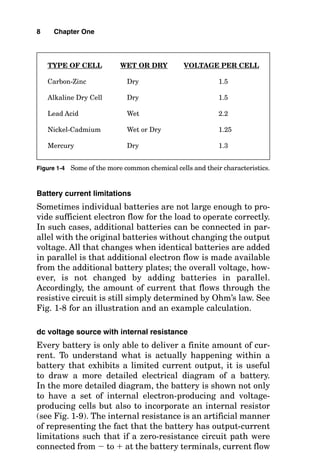
center of the wire essentially “occupied” with concentrated
lines of magnetic flux, electron flow is impeded there to the
extent that most of the electron flow in wires carrying large
amounts of current is along the surface of the wire. This
type of electron flow is known as skin effect, and its inclu-
sion into the resistance value of a wire is said to change the
Step #1: Determine conductor area in square inches.
Step #3: Determine conductor area in circular mils.
=
c.m.
1273236
c.m. = circular mils
=
Step #4: Change circular mils to square millimeters.
sq. mm. (c. m.) X .00050671
(1273236) X .00050671
sq. mm. =
645.16 sq. mm.
sq. mm. =
Problem: Solve for the equivalent area in square
inches, in square mils, in circular mils, and in
square millimeters of a 1/4 X 4 copper bus bar.
Area = length X width
Area = 4 in. X 0.25 in.
Area = 1 sq. in.
square mils
Step #2: Determine conductor area in square mils.
The bus bar measures 250 thousandths by 4000 thousandths, or
250 mils by 4000 mils.
sq. mils = (length in mils) X (width in mils)
sq. mils = (250) X (4000)
sq. mils = 1000000 square mils
0.7854
1000000
0.7854
c.m. =
Figure 4-4 Solve for square inches, square mils, circular mils, and square
millimeters given bus bar dimensions.
resistance value into the alternating-current (ac) resistance
value of the wire. The ac resistance of the wire is increased
when the wire is enclosed within a raceway that itself con-
centrates magnetic flux, such as rigid steel conduit. Note
that the ac resistance value of a wire still does not include
the inductive reactance or the capacitive reactance compo-
nents of the wire impedance. For convenience, Fig. 4-10 is
132 Chapter Four
CHARACTERISTICS OF COMMON RECTANGULAR BUS BARS
98% CONDUCTIVITY COPPER BUS BARS
D.C.
AREA AREA WEIGHT RESISTANCE
SIZE AMPACITY SQ. IN. CIRC. MILS LB./FT. MICRO-OHMS
PER FT.
1/8 X 1 247 0.125 159200 0.485 66.01
1/8 X 2 447 0.25 318300 0.97 33.04
1/8 X 3 696 0.375 477500 1.45 22.02
1/8 X 4 900 0.5 636600 1.94 16.52
1/4 X 1 366 0.25 318300 0.97 33.04
1/4 X 2 647 0.5 636600 1.94 16.52
1/4 X 3 973 0.75 955000 2.91 11.01
1/4 X 4 1220 1 1273000 3.88 8.25
1/4 X 6 1660 1.5 1910000 5.81 5.51
@30 DEG C
AMBIENT,
WITH A
30 DEG C
CHARACTERISTICS OF COMMON RECTANGULAR BUS BARS
61 % CONDUCTIVITY ALUMINUM BUS BARS
D.C.
AREA AREA WEIGHT RESISTANCE
SIZE AMPACITY SQ. IN. CIRC. MILS LB./FT. MICRO-OHMS
PER FT.
1/4 X 1 310 0.25 318300 0.294 57.16
1/4 X 2 550 0.5 636600 0.588 25.58
1/4 X 3 775 0.75 955000 0.882 19.05
1/4 X 4 990 1 1273000 1.176 14.29
1/4 X 6 1400 1.5 1910000 1.764 9.527
@40 DEG C
AMBIENT,
WITH A
30 DEG C
RISE
Figure 4-5 Characteristics of copper bus bars.
Figure 4-6 Characteristics of aluminum bus bars.
a table that shows ac wire resistance and impedance in a
60-Hz system operating at 75°C.
Calculating the Impedance of a Cable
The impedance of a cable or a set of conductors is the vector
sum of
R  jXL  jXC
where R is the conductor resistance calculated in the last
section, and XL is the inductive reactance of the cable. The
Conductors 133
CONDUCTOR RESISTIVITY
MATERIAL (OHM-METERS @ 20°C)  10–8
Silver 1.64
Copper 1.72
Aluminum 2.83
Tungsten 5.5
Nickel 7.8
Iron 12.0
Figure 4-7 Resistivity of common electrical conductors.
Bus bars must be braced for short-circuit current.
X
length
in
meters
Resistance
=
Area
in
square
meters
Problem:
Determine
the
resistance
at
20
Deg.
C
of
656
ft
of
4
sq.
mm.
aluminum
wire.
Step
#1:
Convert
feet
to
meters:
feet
3.28
meters
=
meters
=
3.28
656
meters
=
200
meters
Step
#3:
Calculate
resistance
(
2.83
x
10
-8
)
X
(200)
Resistance
=
Step
#2:
Convert
sq.
mm.
to
sq.
meters:
1
sq.
meter
1000000
sq.
mm.
x
sq.
meter
4
sq.
mm.
(1
sq.
meter)(4
sq.
mm.)
x
sq.
meter
1000000
sq.
mm.
x
sq.
meter
=
0.000004
=
=
x
sq.
meter
4.0
x
10
-6
=
4.0
x
10
-6
Resistance
=
142
x
10
-2
Resistance
=
1.42
ohms
Figure
4-8
Solve
for
the
resistance
of
a
conductor
given
resistivity,
cross-sectional
area,
and
length.
134
Problem:
Determine
the
resistance
at
100
Deg.
C
of
a
copper
wire
that
measures
12
ohms
at
20
Deg.
C.
VALUES
OF
x
FOR
COMMON
CONDUCTORS
CONDUCTOR
MATERIAL
x
(Deg.
C)
Copper
234.5
Aluminum
236
Silver
243
Let
R20
be
the
conductor
resistance
at
20
Deg.
C.
Let
R100
be
the
conductor
resistance
at
100
Deg.
C.
Let
T20
be
the
Temperator
of
20
Deg.
C.
Let
T100
be
the
temperature
at
100
Deg.
C.
R100
x
+
T100
R20
x
+
T20
=
(234.5)
+
20
(234.5)
+
100
12
R100
=
254.5
334.5
R100
12
=
R100
(12)
x
(334.5)
254.5
=
R100
=
15.772
The
wire
increases
in
resistance
from
12
ohms
to
15.772
ohms
when
the
temperature
rises
from
20
Deg.
C
to
100
Deg.
C.
Figure
4-9
Solve
for
the
resistance
of
a
conductor
at
a
temperature
other
than
20°C.
135
inductive reactance of a cable is directly related to the mag-
netic flux coupling of one wire in the cable with the other
wires in the cable. If the wires are very close together, the
fluxes from each conductor add to zero in three-dimensional
space, and the inductive reactance of the cable is very small.
If, however, the wires are spaced far apart, the lines of flux
do not cancel so readily, and the inductive reactance of the
136 Chapter Four
NOTE 1 IMPEDANCE IS R(COS POWER FACTOR ANGLE) + X SIN
(POWER FACTOR ANGLE); THIS TABLE ASSUMES THE POWER
FACTOR IS 85%, LAGGING.
NOTE 2 WIRE SIZES LARGER THAN #8 ARE STRANDED
AC RESISTANCE AND IMPEDANCE OF COPPER AND ALUMINUM WIRES
(3 WIRES IN A CONDUIT)
(TABLE UNITS ARE IN OHMS PER 1000 FEET)
WIRE WIRE INDUCTIVE REACTANCE AC RESISTANCE - COPPER WIRE
SIZE SIZE PVC ALUMINUM STEEL PVC ALUMINUM STEEL
(AWG) (KCMIL) CONDUIT CONDUIT CONDUIT CONDUIT CONDUIT CONDUIT
14 4.11 0.058 0.058 0.073 3.1 3.1 3.1
12 6.53 0.054 0.054 0.068 2 2 2
10 10.38 0.05 0.05 0.063 1.2 1.2 1.2
8 16.51 0.052 0.052 0.065 0.78 0.78 0.78
6 26.24 0.051 0.051 0.064 0.49 0.49 0.49
4 41.74 0.048 0.048 0.06 0.31 0.31 0.31
3 52.62 0.047 0.047 0.059 0.25 0.025 0.25
2 66.36 0.045 0.045 0.057 0.19 0.2 0.2
1 83.69 0.046 0.046 0.057 0.15 0.16 0.16
0 105.6 0.044 0.044 0.055 0.12 0.13 0.12
00 133.1 0.043 0.043 0.054 0.1 0.1 0.1
000 167.8 0.042 0.042 0.052 0.077 0.082 0.079
0000 211.6 0.041 0.041 0.051 0.062 0.067 0.063
N.A. 250 0.041 0.041 0.052 0.052 0.057 0.054
N.A. 300 0.041 0.041 0.051 0.044 0.049 0.045
N.A. 350 0.04 0.04 0.05 0.038 0.043 0.039
N.A. 500 0.039 0.039 0.048 0.027 0.032 0.029
Figure 4-10 ac resistance and impedance values of 600-V copper and
aluminum wire in conduit.
circuit is increased. Figure 4-11 can be used to approximate
the inductive reactance of a cable. Values from this figure
are directly applicable to nonarmored cable, cable with non-
magnetic armor, and cable in a nonmagnetic raceway. For
cable with magnetic armor or cable drawn into a magnetic
raceway, correction factors found in the same figure must be
applied.
Conductors 137
AC RESISTANCE-ALUMINUM WIRE IMPEDANCE-COPPER WIRE IMPEDANCE-ALUMINUM WIRE
PVC ALUMINUM STEEL PVC ALUMINUM STEEL PVC ALUMINUM STEEL
CONDUIT CONDUIT CONDUIT CONDUIT CONDUIT CONDUIT CONDUIT CONDUIT CONDUIT
(NOTE 1) (NOTE 1) (NOTE 1) (NOTE 1) (NOTE 1) (NOTE 1)
N.A. N.A. N.A. 2.67 2.67 2.67 N.A. N.A. N.A.
3.2 3.2 3.2 1.7 1.7 1.7 2.8 2.8 2.8
2 2 2 1.1 1.1 1.1 1.8 1.8 1.8
1.3 1.3 1.3 0.69 0.69 0.7 1.1 1.1 1.1
0.81 0.81 0.81 0.44 0.45 0.45 0.71 0.72 0.72
0.51 0.51 0.51 0.29 0.29 0.3 0.46 0.46 0.46
0.4 0.41 0.4 0.23 0.24 0.24 0.37 0.37 0.37
0.32 0.32 0.32 0.19 0.19 0.2 0.3 0.3 0.3
0.25 0.26 0.25 0.16 0.16 0.16 0.24 0.24 0.25
0.2 0.21 0.2 0.13 0.13 0.13 0.19 0.2 0.2
0.16 0.16 0.16 0.11 0.11 0.11 0.16 0.16 0.16
0.13 0.13 0.13 0.088 0.092 0.094 0.13 0.13 0.14
0.1 0.11 0.1 0.074 0.078 0.08 0.11 0.11 0.11
0.085 0.09 0.086 0.066 0.07 0.073 0.094 0.098 0.1
0.071 0.76 0.072 0.059 0.063 0.065 0.082 0.086 0.088
0.061 0.66 0.063 0.053 0.058 0.06 0.073 0.077 0.08
0.043 0.048 0.045 0.043 0.048 0.05 0.057 0.061 0.064
0.029 0.034 0.031 0.036 0.04 0.043 0.045 0.049 0.052
An individual can calculate the impedance of a cable, but
this work has already been done by cable manufacturers for
many specific types of cable. For convenience, typical cable
impedance values are shown in Fig. 4-12 for 600-volt (V)
cable, for 5-kV cable, and for 15-kV cable.
138 Chapter Four
Bus duct is used to carry large values of current.
Service conductors to commercial building in the form of bus duct.
Conductors 139
CONDUCTOR
SIZE
2000
1750
1500
1250
1000
750
600
500
400
350
300
250
0000
000
00
0
1
2
4
6
8
10
12
14
16
18
REACTANCE
OHMS TO NEUTRAL
PER 1000 FT.
0
.01
.02
.03
.04
.05
.06
.07
.08
.09
0.10
0.11
0.12
0.13
0.14
0.15
0.16
0.17
0.18
0.19
0.2
0.21
0.05
0.06
0.08
0.10
0.15
0.20
0.25
0.30
0.40
0.50
0.60
0.80
1.0
1.5
2.0
2.5
3.0
4.0
5.0
6.0
8.0
10
15
20
25
30
40
50
60
80
100
TRIANGULAR EQUAL
CENTER - TO - CENTER
CONDUCTOR SPACING
(INCHES)
SIZE MULTIPLYING FACTOR
#18 - #1 0.975
0 - 0000 0.975
250 0.965
300 0.960
350 0.950
500 0.940
600 0.930
750 0.925
REACTANCE OF ROUND MULTICONDUCTOR CABLES
CORRECTION FACTORS
FOR MAGNETIC CONDUIT OR
FOR MAGNETIC CABLE ARMOR
Figure 4-11 Solve for inductive reactance of a cable given conductor size
and dimensions.
Calculating Voltage Drop in a Cable
There are several valuable individual voltage-drop calcula-
tions that commonly encountered when working with electri-
cal systems. It is important that the calculations be done
correctly and that the engineer can check the solution to a cur-
rent problem against the answer to an example problem. For
these reasons, the following figures are provided as examples:
Figure 4-13: Calculate voltage drop in a single-phase dc
circuit.
Figure 4-14: Calculate the approximate voltage drop in a
single-phase ac circuit at unity power factor in a plastic
conduit.
140 Chapter Four
Note: All conductors are stranded
IMPEDANCE OF COPPER CABLE
(3/CONDUCTOR CABLE)
TABLE UNITS ARE IN OHMS TO NEUTRAL PER 1000 FEET
WIRE WIRE 600 VOLT 5kV 15kV
SIZE SIZE
(AWG) (KCMIL)
14 4.11 0.0369 N.A. N.A.
12 6.53 0.0347 N.A. N.A.
10 10.38 0.0321 N.A. N.A.
8 16.51 0.0334 0.0537 N.A.
6 26.24 0.034 0.0492 N.A.
4 41.74 0.0321 0.0457 N.A.
3 52.62 0.0307 0.0441 N.A.
2 66.36 0.0298 0.0424 0.0518
1 83.69 0.0309 0.0413 0.0297
0 105.6 0.0305 0.0392 0.0497
00 133.1 0.0294 0.039 0.0462
000 167.8 0.0287 0.0379 0.0445
0000 211.6 0.0281 0.0367 0.0427
N.A. 250 0.0287 0.0358 0.0441
N.A. 300 0.028 0.0349 0.0399
N.A. 350 0.0276 0.034 0.0394
N.A. 500 0.0268 0.0322 0.0368
N.A. 750 0.0265 0.0306 0.0367
Figure 4-12 Impedances of 600-V, 5-kV, and 15-kV copper cable.
ELECTRICAL
CIRCUIT
CONDUCTOR
RESISTANCE
CONDUCTOR
RESISTANCE
OUT
BACK
125V
BATTERY
125
OHMS
LOAD
RESISTOR
Problem:
A
solid
#14
copper
two-wire
cable
that
is
750
feet
long
supplies
a
125
ohm
load
resistor
for
heating
purposes
at
75
deg.
C.
Find
the
voltage
drop
in
the
cable;
and
find
the
resulting
voltage
across
the
load
resistor.
STEP
1:
DRAW
THE
BASIC
CIRCUIT.
STEP
2:
CALCULATE
THE
CABLE
RESISTANCE
ONE
WAY
(OUT)
TO
BE
CONSERVATIVE,
ASSUME
THE
CABLE
IS
75
DEG.
C
THROUGHOUT
ITS
ENTIRE
LENGTH.
CABLE
RESISTANCE
=
(RESISTANCE
FOR
1000
FT.)
x
(750
/
1000)
CABLE
RESISTANCE
=
(3.07
ohms
per
M
ft.)
X
(0.750)
CABLE
RESISTANCE
=
2.3
OHMS.
VOLTAGE
DROP
IN
CABLE
=
CURRENT
X
CABLE
RESISTANCE
VOLTAGE
DROP
IN
CABLE
=
(0.9645)
X
(2.3)
VOLTAGE
DROP
IN
CABLE
=
2.218
VOLTS
ONE
WAY
STEP
4:
CALCULATE
THE
VOLTAGE
DROP
IN
THE
CABLE
ONE
WAY
(OUT).
STEP
3:
CALCULATE
THE
CURRENT
FLOW
IN
THE
CIRCUIT.
125V
=
CURRENT
X
CIRCUIT
RESISTANCE
125
=
CURRENT
X
RESISTANCE
OUT
+
RESISTANCE
BACK
+
LOAD
RESISTANCE
125
=
CURRENT
X
(2.3
+
125
+
2.3)
125
=
CURRENT
X
(129.6)
125
129.6
=
CURRENT
0.9645
AMP
=
CURRENT
STEP
5:
CALCULATE
THE
VOLTAGE
DROP
IN
THE
CABLE
BOTH
OUT
AND
BACK.
VOLTAGE
DROP
IN
CABLE
=
(VOLTAGE
DROP
1
WAY
)
x
(2)
VOLTAGE
DROP
IN
CABLE
=
(2.218)
X
(2)
VOLTAGE
DROP
IN
CABLE
=
4.436
VOLTS
STEP
4:
CALCULATE
THE
VOLTAGE
DROPPED
ACROSS
THE
LOAD.
VOLTAGE
DROP
ACROSS
LOAD
=
(SOURCE
VOLTAGE
)
-
(CABLE
VOLTAGE
DROP)
VOLTAGE
DROP
ACROSS
LOAD
=
(125)
-
(4.436)
VOLTAGE
DROP
ACROSS
LOAD
=
120.56
VOLTS
Figure
4-13
Solve
for
voltage
drop
in
a
dc
circuit
given
wire
size,
temperature,
and
load
characteristics.
141
ELECTRICAL
CIRCUIT
ASSUME
THE
CABLE
WILL
OPERATE
AT
75
DEG.
C
THROUGHOUT
ITS
ENTIRE
LENGTH.
CABLE
IMPEDANCE
=
(IMPEDANCE
FOR
1000
FT.)
x
(750
/
1000)
CABLE
IMPEDANCE=
(1.7
OHMS
PER
M
FT.)
X
(0.750)
CABLE
IMPEDANCE
=
1.275
OHMS.
CONDUCTOR
IMPEDANCE
CONDUCTOR
IMPEDANCE
OUT
BACK
115V
source
Problem:
From
a
115VAC
circuit
breaker,
a
solid
#12
copper
two-wire
cable
in
plastic
conduit
that
is
750
feet
long
supplies
a
motor
load
that
requires
1.3
kW.
Find
the
approximate
voltage
drop
in
the
cable;
and
find
the
resulting
voltage
supplied
to
the
motor
load
(ignoring
constant
kVA
motor
action).
STEP
1:
DRAW
THE
BASIC
CIRCUIT.
STEP
2:
CALCULATE
THE
CABLE
RESISTANCE
ONE
WAY
(OUT)
VOLTAGE
DROP
IN
CABLE
=
CURRENT
X
CABLE
IMPEDANCE
VOLTAGE
DROP
IN
CABLE
=
(11.3)
X
(1.275)
VOLTAGE
DROP
IN
CABLE
=
14.41
VOLTS
ONE
WAY
STEP
4:
CALCULATE
THE
VOLTAGE
DROP
IN
THE
CABLE
ONE
WAY
(OUT).
STEP
3:
CALCULATE
THE
CURRENT
FLOW
IN
THE
CIRCUIT.
POWER
=
VOLTAGE
X
CURRENT
THE
MOTOR
DRAWS
1.3
kW,
THEREFORE,
FOR
A
CLOSE
APPROXIMATION
OF
LINE
CURRENT:
1300
=
(115
VOLTS)
x
(CURRENT)
(ignoring
power
factor)
1300
=
CURRENT
115
11.3
AMP
=
CURRENT
STEP
5:
CALCULATE
THE
VOLTAGE
DROP
IN
THE
CABLE
BOTH
OUT
AND
BACK.
VOLTAGE
DROP
IN
CABLE
=
(VOLTAGE
DROP
1
WAY
)
x
(2)
VOLTAGE
DROP
IN
CABLE
=
(14.41)
X
(2)
VOLTAGE
DROP
IN
CABLE
=
28.82
VOLTS
STEP
6:
CALCULATE
THE
VOLTAGE
DROPPED
ACROSS
THE
LOAD.
VOLTAGE
DROP
ACROSS
LOAD
=
(SOURCE
VOLTAGE
)
-
(CABLE
VOLTAGE
DROP)
VOLTAGE
DROP
ACROSS
LOAD
=
(115)
-
(28.82)
VOLTAGE
DROP
ACROSS
LOAD
=
86.18
VOLTS
M
1.3
kW
LOAD
Figure
4-14
Solve
for
approximate
voltage
drop
in
an
ac
circuit
in
PVC
conduit
given
wire
size,
temperature,
and
load
characteristics.
142
Figure 4-15: Calculate a more accurate voltage drop in a
single-phase ac circuit at unity power factor in a nonmag-
netic conduit.
Figure 4-16: Calculate voltage drop in a single-phase ac
circuit at unity power factor in a steel conduit to an induc-
tion furnace load. Note that the furnace still tries to draw
21 kilowatts (kW); thus the line current must increase to
offset the cable voltage drop.
Figure 4-17: Calculate voltage drop in a single-phase ac
circuit at unity power factor in an aluminum conduit.
Figure 4-18: Calculate voltage drop in a three-phase ac
circuit at less than unity power factor using unarmored
type TC cable.
Figure 4-19: Calculate voltage drop in a three-phase ac
circuit at less than unity power factor using armored type
MC cable.
Figure 4-20: Calculate voltage regulation in an ac circuit.
Calculating dc Resistance in a Bus Bar
Calculating the resistance of a bus bar is similar to calcu-
lating the resistance of a wire, except that the cross-section-
al area is of a different shape and is larger. This calculation
is shown in Fig. 4-21. (Refer to Fig. 4-5 for data.)
Calculating Heat Loss in a Conductor
Heat loss is always calculated simply as I2R, so the solution
to a heat-loss problem in a circuit is to calculate the dc resis-
tance (even if it is in an ac circuit) of each wire, solve for the
current flow through the wire (even if the current flow is out
of phase with the voltage), calculate the I2
R heat loss in each
wire individually, and then simply add the heat losses in the
wires. This methodology is shown in Fig. 4-22.
Wires and Cables
Most of the electrical systems in the world use wires and
cables to transport electrical energy, so it is important to
Conductors 143
(Text continues on p. 152.)
144 Chapter Four
ELECTRICAL CIRCUIT
CONDUCTOR
IMPEDANCE
CONDUCTOR
IMPEDANCE
OUT
BACK
115V
source
Problem: From a 115VAC circuit breaker, a solid #12 copper two-
wire cable that is 560 feet long supplies a motor load that
requires 1.3 kW. Find the actual voltage drop in the cable; and
find the resulting actual voltage supplied to the motor load
(considering constant kVA motor action).
STEP 1: DRAW THE BASIC CIRCUIT.
STEP 2: CALCULATE THE CABLE RESISTANCE ONE WAY (OUT)
ASSUME THE CABLE WILL OPERATE AT 75 DEG. C THROUGHOUT ITS ENTIRE
LENGTH.
CABLE IMPEDANCE = (IMPEDANCE FOR 1000 FT.) x (560 / 1000)
CABLE IMPEDANCE= (1.7 OHMS PER M FT.) X (0.750)
CABLE IMPEDANCE = 1.275 OHMS.
STEP 4: CALCULATE THE VOLTAGE DROP IN THE CABLE ONE WAY (OUT).
VOLTAGE DROP IN CABLE = CURRENT X CABLE IMPEDANCE
VOLTAGE DROP IN CABLE = (11.3) X (1.275)
VOLTAGE DROP IN CABLE = 14.41 VOLTS ONE WAY
STEP 3: CALCULATE THE APROXIMATE INITIAL CURRENT FLOW IN THE CIRCUIT.
POWER = VOLTAGE X CURRENT
THE MOTOR DRAWS 1.3 kW, THEREFORE, FOR A CLOSE APPROXIMATION OF
LINE CURRENT: 1300 = (115 VOLTS) x (CURRENT)
1300
= CURRENT
115
11.3 AMP = CURRENT
STEP 5: CALCULATE THE VOLTAGE DROP IN THE CABLE BOTH OUT AND BACK.
VOLTAGE DROP IN CABLE = (VOLTAGE DROP 1 WAY ) x (2)
VOLTAGE DROP IN CABLE = (14.41) X (2)
VOLTAGE DROP IN CABLE = 28.82 VOLTS
STEP 6: CALCULATE THE VOLTAGE DROPPED ACROSS THE LOAD.
VOLTAGE DROP ACROSS LOAD = (SOURCE VOLTAGE ) – (CABLE VOLTAGE DROP)
VOLTAGE DROP ACROSS LOAD = (115) - (28.82)
VOLTAGE DROP ACROSS LOAD = 86.18 VOLTS
M
1.3 kW
LOAD
Figure 4-15 Solve for accurate voltage drop in ac circuit to motor in non-
magnetic conduit.
Conductors 145
STEP 7: CALCULATE THE ACTUAL LINE CURRENT DRAWN BY THE MOTOR
AT ITS LOW TERMINAL VOLTAGE.
POWER = VOLTAGE X CURRENT
THE MOTOR DRAWS 1.3 kW, THEREFORE, FOR A CLOSER VALUE OF ACTUAL
LINE CURRENT: 1300 = (86.18 VOLTS) x (CURRENT)
15.08 AMP = CURRENT
= CURRENT
1300
86.18
VOLTAGE DROP IN CABLE = CURRENT X CABLE IMPEDANCE
VOLTAGE DROP IN CABLE = (15.08) X (1.275)
VOLTAGE DROP IN CABLE = 19.23 VOLTS ONE WAY
STEP 8: CALCULATE THE VOLTAGE DROP IN THE CABLE ONE WAY (OUT).
VOLTAGE DROP IN CABLE = (VOLTAGE DROP 1 WAY ) x (2)
VOLTAGE DROP IN CABLE = (19.231) X (2)
VOLTAGE DROP IN CABLE = 38.46 VOLTS
STEP 9: CALCULATE THE VOLTAGE DROP IN THE CABLE BOTH OUT
AND BACK.
STEP 10: CALCULATE THE VOLTAGE DROPPED ACROSS THE LOAD.
VOLTAGE DROP ACROSS LOAD = (SOURCE VOLTAGE ) – (CABLE VOLTAGE DROP)
VOLTAGE DROP ACROSS LOAD = (115) - (38.46)
VOLTAGE DROP ACROSS LOAD = 76.53 VOLTS
STEP 11: CALCULATE THE ACTUAL LINE CURRENT DRAWN BY THE
MOTOR AT ITS LOW TERMINAL VOLTAGE.
= CURRENT
16.98 AMP = CURRENT
76.53
POWER = VOLTAGE X CURRENT
THE MOTOR DRAWS 1.3 kW, THEREFORE, FOR A CLOSER VALUE OF ACTUAL
LINE CURRENT: 1300 = (76.53 VOLTS) x (CURRENT)
1300
STEP 14: CALCULATE THE VOLTAGE DROPPED ACROSS THE LOAD.
STEP 13: CALCULATE THE VOLTAGE DROP IN THE CABLE BOTH OUT
AND BACK.
STEP 12: CALCULATE THE VOLTAGE DROP IN THE CABLE ONE WAY (OUT).
VOLTAGE DROP ACROSS LOAD = (SOURCE VOLTAGE ) - (CABLE VOLTAGE DROP)
VOLTAGE DROP ACROSS LOAD = (115) - (43.32)
VOLTAGE DROP ACROSS LOAD = 71.68 VOLTS
VOLTAGE DROP IN CABLE = (VOLTAGE DROP 1 WAY ) x (2)
VOLTAGE DROP IN CABLE = (21.66) X (2)
VOLTAGE DROP IN CABLE = 43.32 VOLTS
VOLTAGE DROP IN CABLE = CURRENT X CABLE IMPEDANCE
VOLTAGE DROP IN CABLE = (16.98) X (1.275)
VOLTAGE DROP IN CABLE = 21.66 VOLTS ONE WAY
COMMENT ON FINAL SOLUTION: THREE ITERATIONS WILL NORMALLY
SUFFICE FOR THIS TYPE OF CALCULATION. THE RESULTS SHOW THAT
A LARGER WIRE SIZE SHOULD BE SELECTED AND THE CALCULATION
DONE AGAIN.
ELECTRICAL
CIRCUIT
ASSUME
THE
CABLE
WILL
OPERATE
AT
75
DEG.
C
THROUGHOUT
ITS
ENTIRE
LENGTH.
CABLE
IMPEDANCE
=
(IMPEDANCE
FOR
1000
FT.)
x
(230
/
1000)
CABLE
IMPEDANCE=
(0.7
OHMS
PER
M
FT.)
X
(0.230)
CABLE
IMPEDANCE
=
0.161
OHMS.
CONDUCTOR
IMPEDANCE
CONDUCTOR
IMPEDANCE
OUT
BACK
480V
source
Problem:
From
a
480VAC
circuit
breaker,
a
solid
#8
copper
two-wire
cable
that
is
230
feet
long
supplies
an
induction
furnace
load
that
requires
21
kW.
Find
the
approximate
voltage
drop
in
the
cable;
and
find
the
resulting
approximate
voltage
supplied
to
the
induction
furnace
(ignoring
current
harmonics).
STEP
1:
DRAW
THE
BASIC
CIRCUIT.
STEP
2:
CALCULATE
THE
CABLE
RESISTANCE
ONE
WAY
(OUT)
VOLTAGE
DROP
IN
CABLE
=
CURRENT
X
CABLE
IMPEDANCE
VOLTAGE
DROP
IN
CABLE
=
(43.75)
X
(0.161)
VOLTAGE
DROP
IN
CABLE
=
7.043
VOLTS
ONE
WAY
STEP
4:
CALCULATE
THE
VOLTAGE
DROP
IN
THE
CABLE
ONE
WAY
(OUT).
STEP
3:
CALCULATE
THE
CURRENT
FLOW
IN
THE
CIRCUIT.
POWER
=
VOLTAGE
X
CURRENT
THE
FURNACE
DRAWS
21kW,
THEREFORE,
LINE
CURRENT
IS:
21000
=
(480
VOLTS)
x
(CURRENT)
21000
=
CURRENT
480
43.75
AMP
=
CURRENT
STEP
5:
CALCULATE
THE
VOLTAGE
DROP
IN
THE
CABLE
BOTH
OUT
AND
BACK.
VOLTAGE
DROP
IN
CABLE
=
(VOLTAGE
DROP
1
WAY
)
x
(2)
VOLTAGE
DROP
IN
CABLE
=
(7.043)
X
(2)
VOLTAGE
DROP
IN
CABLE
=
14.08
VOLTS
STEP
6:
CALCULATE
THE
VOLTAGE
DROPPED
ACROSS
THE
LOAD.
VOLTAGE
DROP
ACROSS
LOAD
=
(SOURCE
VOLTAGE
)
-
(CABLE
VOLTAGE
DROP)
VOLTAGE
DROP
ACROSS
LOAD
=
(480)
-
(14.08)
VOLTAGE
DROP
ACROSS
LOAD
=
465.91
VOLTS
F
21
kW
LOAD
Figure
4-16
Solve
for
approximate
voltage
drop
in
an
ac
circuit
in
magnetic
conduit
given
wire
size,
temperature,
and
load
characteristics.
146
ELECTRICAL
CIRCUIT
ASSUME
THE
CABLE
WILL
OPERATE
AT
75
DEG.
C
THROUGHOUT
ITS
ENTIRE
LENGTH.
CABLE
IMPEDANCE
=
(IMPEDANCE
FOR
1000
FT.)
x
(120
/
1000)
CABLE
IMPEDANCE=
(0.19
OHMS
PER
M
FT.)
X
(0.120)
CABLE
IMPEDANCE
=
0.0228
OHMS.
CONDUCTOR
IMPEDANCE
CONDUCTOR
IMPEDANCE
OUT
BACK
480V
source
Problem:
From
a
480VAC
circuit
breaker,
a
stranded
#2
copper
two-wire
cable
that
is
120
feet
long
supplies
a
computer
load
that
requires
48
kW.
Find
the
approximate
voltage
drop
in
the
cable;
and
find
the
resulting
approximate
voltage
supplied
to
the
computer
(ignoring
current
harmonics).
STEP
1:
DRAW
THE
BASIC
CIRCUIT.
STEP
2:
CALCULATE
THE
CABLE
RESISTANCE
ONE
WAY
(OUT)
VOLTAGE
DROP
IN
CABLE
=
CURRENT
X
CABLE
IMPEDANCE
VOLTAGE
DROP
IN
CABLE
=
(100)
X
(0.0228)
VOLTAGE
DROP
IN
CABLE
=
2.28
VOLTS
ONE
WAY
STEP
4:
CALCULATE
THE
VOLTAGE
DROP
IN
THE
CABLE
ONE
WAY
(OUT).
STEP
3:
CALCULATE
THE
CURRENT
FLOW
IN
THE
CIRCUIT.
POWER
=
VOLTAGE
X
CURRENT
THE
COMPUTER
DRAWS
48
kW,
THEREFORE,
LINE
CURRENT
IS:
48000
=
(480
VOLTS)
x
(CURRENT)
48000
=
CURRENT
480
100
AMP
=
CURRENT
STEP
5:
CALCULATE
THE
VOLTAGE
DROP
IN
THE
CABLE
BOTH
OUT
AND
BACK.
VOLTAGE
DROP
IN
CABLE
=
(VOLTAGE
DROP
1
WAY
)
x
(2)
VOLTAGE
DROP
IN
CABLE
=
(2.28)
X
(2)
VOLTAGE
DROP
IN
CABLE
=
4.56
VOLTS
STEP
6:
CALCULATE
THE
VOLTAGE
DROPPED
ACROSS
THE
LOAD.
VOLTAGE
DROP
ACROSS
LOAD
=
(SOURCE
VOLTAGE
)
-
(CABLE
VOLTAGE
DROP)
VOLTAGE
DROP
ACROSS
LOAD
=
(480)
-
(4.56)
VOLTAGE
DROP
ACROSS
LOAD
=
475.44
VOLTS
C
48
kW
LOAD
Figure
4-17
Solve
for
voltge
drop
in
a
single-phase
ac
circuit
at
unity
PF
in
an
aluminum
conduit.
147
ELECTRICAL
CIRCUIT
ASSUME
THE
CABLE
WILL
OPERATE
AT
75
DEG.
C
THROUGHOUT
ITS
ENTIRE
LENGTH.
CABLE
IMPEDANCE
=
(IMPEDANCE
FOR
1000
FT.)
x
(280
/
1000)
CABLE
IMPEDANCE=
(0.078
OHMS
PER
M
FT.)
X
(0.280)
CABLE
IMPEDANCE
=
0.0218
OHMS.
LOAD
CONDUCTOR
CONDUCTOR
IMPEDANCE
Phase
480V
3-phase
source
Problem:
From
a
480/3P
circuit
breaker,
a
stranded
#0000
copper
three-wire
Type
TC
(non-armored)
cable
that
is
280
ft.
long
and
is
laid
into
in
aluminum
cable
tray.
The
cable
supplies
an
AC
load
operating
at
a
power
factor
of
85%
that
draws
200
amperes.
Find
the
voltage
drop
in
the
cable;
and
find
the
resulting
voltage
supplied
to
the
load.
STEP
1:
DRAW
THE
BASIC
CIRCUIT.
STEP
2:
CALCULATE
THE
CABLE
RESISTANCE
ONE
WAY
(OUT)
VOLTAGE
DROP
IN
CABLE
=
CURRENT
X
CABLE
IMPEDANCE
VOLTAGE
DROP
IN
CABLE
=
(200)
X
(0.0218)
VOLTAGE
DROP
IN
CABLE
=
4.36
VOLTS
ONE
WAY
STEP
3:
CALCULATE
THE
VOLTAGE
DROP
IN
THE
CABLE
ONE
WAY
(OUT).
VOLTAGE
DROP
IN
CABLE
=
(4.36)
X
(
3
)
STEP
4:
CALCULATE
THE
VOLTAGE
DROP
IN
THE
CABLE
BOTH
OUT
AND
BACK
(3-phase).
VOLTAGE
DROP
IN
CABLE
=
(VOLTAGE
DROP
1
WAY
)
x
(
3
)
VOLTAGE
DROP
IN
CABLE
=
7.55
VOLTS
STEP
5:
CALCULATE
THE
VOLTAGE
DROPPED
ACROSS
THE
LOAD.
VOLTAGE
DROP
ACROSS
LOAD
=
(SOURCE
VOLTAGE
)
-
(CABLE
VOLTAGE
DROP)
VOLTAGE
DROP
ACROSS
LOAD
=
(480)
-
(7.55)
VOLTAGE
DROP
ACROSS
LOAD
=
472.45
VOLTS
IMPEDANCE
L
CONDUCTOR
IMPEDANCE
A
Phase
B
Phase
C
Figure
4-18
Solve
for
voltage
drop
in
a
three-phase
ac
circuit
in
nonarmored
cable
in
cable
tray.
148
ELECTRICAL
CIRCUIT
LOAD
CONDUCTOR
IMPEDANCE
CONDUCTOR
IMPEDANCE
Phase
A
208V
3-phase
source
Problem:
From
a
208/3P
circuit
breaker,
a
stranded
500
kCMIL
copper
three-wire
Type
MC
(galvanize-
armored)
cable
in
galvanized
cable
tray
that
is
280
feet
long
supplies
an
AC
load
operating
at
a
power
factor
of
60%
that
draws
350
amperes.
Find
the
voltage
drop
in
the
cable;
and
find
the
resulting
voltage
supplied
to
the
load.
STEP
1:
DRAW
THE
BASIC
CIRCUIT.
L
CONDUCTOR
IMPEDANCE
Phase
B
Phase
C
STEP
2:
DETERMINE
THE
ANGLE
FUNCTIONS.
COS
=
0.6
ARCCOS
0.6
=
53.1
°
=
SIN
53.1
°
=
0.8
kW
k
V
A
STEP
4:
CALCULATE
THE
CABLE
RESISTANCE
ONE
WAY
(OUT)
CABLE
IMPEDANCE
=
(IMPEDANCE
FOR
1000
FT.)
x
(280
/
1000)
CABLE
IMPEDANCE
=
(0.0558
OHMS
PER
M
FT.)
X
(0.280)
CABLE
IMPEDANCE
=
0.0156
OHMS.
VOLTAGE
DROP
IN
CABLE
=
CURRENT
X
CABLE
IMPEDANCE
VOLTAGE
DROP
IN
CABLE
=
(350)
X
(0.0156)
VOLTAGE
DROP
IN
CABLE
=
5.47
VOLTS
ONE
WAY
STEP
5:
CALCULATE
THE
VOLTAGE
DROP
IN
THE
CABLE
ONE
WAY
(OUT).
STEP
6:
CALCULATE
THE
VOLTAGE
DROP
IN
THE
CABLE
BOTH
OUT
AND
BACK
(3-phase)
VOLTAGE
DROP
IN
CABLE
=
(VOLTAGE
DROP
1
WAY
)
x
(
3
)
VOLTAGE
DROP
IN
CABLE
=
(5.47)
X
(
3
)
VOLTAGE
DROP
IN
CABLE
=
9.47
VOLTS
STEP
7:
CALCULATE
THE
VOLTAGE
DROPPED
ACROSS
THE
LOAD.
VOLTAGE
DROP
ACROSS
LOAD
=
(SOURCE
VOLTAGE
)
-
(CABLE
VOLTAGE
DROP)
VOLTAGE
DROP
ACROSS
LOAD
=
(480)
-
(9.47)
VOLTAGE
DROP
ACROSS
LOAD
=
470.53
VOLTS
STEP
3:
CALCULATE
THE
CABLE
IMPEDANCE
PER
THOUSAND
FEET.
ASSUME
THE
CABLE
WILL
OPERATE
AT
75
DEG.
C
THROUGHOUT
ITS
ENTIRE
LENGTH.
CABLE
IMPEDANCE
=
R(COS
)
+
[X
(SIN
)]
CABLE
IMPEDANCE
=
(0.029)(0.6
)
+
[(0.048)(0.8)]
CABLE
IMPEDANCE
=
.0558
OHMS
PER
M
FEET.
Figure
4-19
Solve
for
voltage
drop
in
a
three-phase
ac
circuit
in
armored
cable
in
cable
tray.
149
ELECTRICAL
CIRCUIT
ASSUME
THE
CABLE
WILL
OPERATE
AT
75
DEG.
C
THROUGHOUT
ITS
ENTIRE
LENGTH.
CABLE
IMPEDANCE
=
(IMPEDANCE
FOR
1000
FT.)
x
(280
/
1000)
CABLE
IMPEDANCE=
(0.078
OHMS
PER
M
FT.)
X
(0.280)
CABLE
IMPEDANCE
=
0.0218
OHMS.
LOAD
CONDUCTOR
IMPEDANCE
CONDUCTOR
IMPEDANCE
Phase
A
480V
3-phase
source
Problem:
From
a
480/3P
circuit
breaker,
a
stranded
#0000
copper
three-wire
Type
TC
(non-armored)
cable
in
aluminum
cable
tray
that
is
280
feet
long
supplies
an
AC
load
operating
at
a
power
factor
of
85%
that
draws
200
amperes.
Find
the
voltage
drop
in
the
cable;
and
find
the
resulting
voltage
supplied
to
the
load.
Determine
the
%
voltage
regulation.
STEP
1:
DRAW
THE
BASIC
CIRCUIT.
STEP
2:
CALCULATE
THE
CABLE
RESISTANCE
ONE
WAY
(OUT)
STEP
3:
CALCULATE
THE
VOLTAGE
DROP
IN
THE
CABLE
ONE
WAY
(OUT).
VOLTAGE
DROP
IN
CABLE
=
CURRENT
X
CABLE
IMPEDANCE
VOLTAGE
DROP
IN
CABLE
=
(200)
X
(0.0218)
VOLTAGE
DROP
IN
CABLE
=
4.36
VOLTS
ONE
WAY
STEP
4:
CALCULATE
THE
VOLTAGE
DROP
IN
THE
CABLE
BOTH
OUT
AND
BACK
(3-phase).
STEP
5:
CALCULATE
THE
VOLTAGE
DROPPED
ACROSS
THE
LOAD.
VOLTAGE
DROP
ACROSS
LOAD
=
(SOURCE
VOLTAGE
)
-
(CABLE
VOLTAGE
DROP)
VOLTAGE
DROP
ACROSS
LOAD
=
(480)
-
(7.55)
VOLTAGE
DROP
ACROSS
LOAD
=
472.45
VOLTS
L
CONDUCTOR
IMPEDANCE
Phase
B
Phase
C
=
NO
LOAD
VOLTAGE
-
FULL
LOAD
VOLTAGE
VOLTAGE
REGULATION
FULL
LOAD
VOLTAGE
STEP
6:
CALCULATE
THE
VOLTAGE
REGULATION.
(480)
-
(472.45)
472.45
VOLTAGE
REGULATION
=
=
VOLTAGE
REGULATION
1.59%
X
100%
X
100%
VOLTAGE
DROP
IN
CABLE
=
(VOLTAGE
DROP
1
WAY
)
x
(
3
)
VOLTAGE
DROP
IN
CABLE
=
(4.36)
X
(
3
)
VOLTAGE
DROP
IN
CABLE
=
7.55
VOLTS
Figure
4-20
Solve
for
voltage
regulation
in
a
three-phase
ac
circuit
in
non-
magnetic
cable
and
cable
tray.
150
Conductors 151
Cabling in a cable tray is a normal wiring method in industrial
facilities.
Medium-voltage cables leaving cable tray and entering switchgear
building.
understand how wires and cables work, what types of insu-
lation are suitable for what applications and environments,
and how many amperes can be transported safely through
each size of cable.
Figure 4-23 is a replication of selected parts of Tables 310-
16 and 310-17 of the National Electrical Code. The proper way
to read this table is best illustrated through an example: At
152 Chapter Four
ASSUME THE BUS BAR WILL OPERATE AT 30 DEG. C
(AMBIENT TEMPERATURE) THROUGHOUT ITS ENTIRE LENGTH.
Problem: A 1/4 X 4 copper bus bar is to be installed
in a DC circuit. It will be 200 feet long. Calculate the
DC resistance of the bus bar.
STEP 1: CALCULATE THE BUS BAR RESISTANCE ONE WAY:
RESISTANCE = (RESISTANCE FOR 1 FT.) x (200)
RESISTANCE = (0.00000825 OHMS PER FT.) X (200 FT)
BUS BAR RESISTANCE = 0.00165 OHMS.
Figure 4-21 Solve for the resistance of a copper bar given its dimensions
and temperature.
ASSUME THE BUS BAR WILL OPERATE AT 30 DEG. C (AMBIENT
TEMPERATURE) THROUGHOUT ITS ENTIRE LENGTH.
Problem: A 1/4 X 4 copper bus bar is to be installed
in a DC circuit. It will be 200 feet long. Calculate the
DC resistance of the bus bar and its kW losses when
it carries 1000 amperes.
STEP 1: CALCULATE THE BUS BAR RESISTANCE ONE WAY:
RESISTANCE = (RESISTANCE FOR 1 FT.) x (200)
RESISTANCE = (0.00000825 OHMS PER FT.) X (200 FT)
BUS BAR RESISTANCE = 0.00165 OHMS.
STEP 2: CALCULATE THE HEAT LOSSES:
POWER (HEAT) LOSSES = (CURRENT)
2
X RESISTANCE
POWER (HEAT) LOSSES = (1000)
2
X (0.00165)
POWER (HEAT) LOSSES = 1.65 kW
Figure 4-22 Solve for the heat losses in a copper bar given its dimensions
and ampere load.
the top of the table are several columns, each containing a
Celsius temperature rating. On the left side of the table are
wire sizes, graduated in AWG from small to large. Within the
table are ampacity values. The entire table is based on the
conductor operating within an ambient temperature of 30°C
(which is 86°F). Selecting the row for No. 8 AWG and referring
to the 75°C column, the table is read properly in this way:
When a No. 8 conductor conducts 50 amperes (A) within an
ambient temperature of 30°C and there are no more than
three current-carrying conductors in the cable or raceway,
then the wire will increase in temperature over a long time
period from 30 to 75°C. (See Fig. 4-24 for more examples.)
Several things affect wire ampacity and temperature rat-
ing, and each of these must be considered in making wire
sizing calculations:
■ Insulation temperature capability
■ Ambient temperature
■ Quantity of wires that carry current in a conduit or cable
■ Location where the heat cannot escape from the cable very
rapidly
■ Location where the heat can escape from the cable very
rapidly
■ Duration of current flow (Heat cannot build up over a very
short time period with moderate amounts of overcurrent,
but the repeated starting of motors, for example, can
cause wires to heat excessively.)
■ Wire terminal maximum temperature rating
Insulation temperature capability
Some insulations simply begin to melt when they increase
in temperature to what would be considered to be “warm,”
or 65°C, whereas other insulations such as silicon rubber
appear to be almost impervious to temperature. In Fig. 4-9,
the increase in conductor resistance with temperature was
calculated, but the main component of conductor impedance
Conductors 153
154 Chapter Four
AMPACITIES OF COPPER CABLE RATED 0 - 2 kV
TABLE UNITS ARE IN AMPERES
(3/CONDUCTOR CABLE OR 3 CURRENT-
CARRYING CONDUCTORS IN A RACEWAY)
AMBIENT TEMPERATURE OF 30 DEG. C (86 DEG F)
TEMPERATURE RATING OF INSULATION
WIRE 60 Deg C 75 Deg C 90 Deg C
SIZE
(AWG)
(Kcmil)
18 N.A. N.A. 4
16 N.A. N.A. 18
14 20 20 25
12 25 25 30
10 30 35 40
8 40 50 55
6 55 65 75
4 70 85 95
3 85 100 110
2 95 115 130
1 110 130 150
0 125 150 170
00 145 175 195
000 165 200 225
0000 195 230 260
250 215 255 390
300 240 285 320
350 260 310 350
500 320 380 430
750 400 475 535
INSULATION TW, UF THW, RH, THWN, SIS, FEP, MI, RHH,
TYPES XHHW RHW-2, THHN, THHW,
THW-2, THWN-2,
USE-2, XHH, XHHW-2
Figure 4-23 Solve for wire ampacity given wire size, voltage rating, insu-
lation temperature rating, and ambient temperture.
Conductors 155
SINGLE CONDUCTOR IN FREE AIR
AMBIENT TEMPERATURE OF 30 DEG. C (86 DEG F)
TEMPERATURE RATING OF INSULATION
60 Deg C 75 Deg C 90 Deg C
N.A. N.A. 18
N.A. N.A. 24
25 30 35
30 35 40
40 50 55
60 70 80
80 95 105
105 125 140
120 145 165
140 170 190
165 195 220
195 230 260
225 265 300
260 310 350
300 360 405
450 405 455
375 455 505
420 505 570
515 620 700
655 785 885
TW, UF THW, RH, THWN, SIS, FEP, MI, RHH,
XHHW RHW-2, THHN, THHW,
THW-2, THWN-2,
USE-2, XHH, XHHW-2
was shown to be due to magnetic effects instead of resis-
tance. In this section, the actual maximum temperature of
the insulation is considered, since the insulation system
must remain intact to keep the conductor from forming a
short circuit. To do this, consideration must be made of two
different forms of current flow through the conductor:
1. Short-circuit current flow, such as during a fault condi-
tion
2. Long-time-duration overload current
Figures 4-24 through 4-26 are step-by-step illustrations of
how to correctly use NEC Tables 310-16 and 310-17.
There are many types of insulation, ranging from thermo-
plastic to packed mineral. Insulation limitations deal with
temperature, moisture, and chemical attack. Each type of
insulation exhibits its own unique capability to withstand
heat from short-circuit currents. If the capability of the insu-
lation is exceeded, then the insulation is damaged, and it sim-
ply allows the phase conductor to form a short circuit to
ground. Since conductor temperature is a function of current
squared times time, the amount of time and current can be
156 Chapter Four
Cables of different systems are installed into different cable trays.
used to determine the thermal damage limits of a conductor.
Accordingly, once the available short-circuit current has been
determined from a short-circuit calculation, consideration
must be given to the amount of time the short-circuit current
can flow. This duration is determined by the contact parting
time of the circuit breaker that is to interrupt the short-cir-
cuit current. Circuit breakers exhibit from 1.5-cycle to as long
as 6-cycle contact-parting/current-interrupting times, where
6 cycles requires 0.1 second at a system frequency of 60 Hz
(cycles per second). Armed with the short-circuit current
Conductors 157
(a) To determine the AWG size of wire insulated to operate at a maxi-
mum of 60°C for a load of 36 A in free air, see NEC Table 310-17
(parts of which are replicated in Fig. 4-23), noting that this is the
table for “Allowable Ampacities of Single-Insulated Conductors
Rated 0 through 2000 Volts in Free Air, Based on Ambient Air
Temperature of 30°C.” Start at the top of the column with the head-
ing 60°C and proceed downward, row by row (where each row rep-
resents one AWG wire size, beginning with #18 AWG), until an
ampere value that is greater than or equal to 36 is encountered. The
first ampere value in the 60°C column that is greater than or equal
to the required 36 A is 40 A. Follow the row from the 40 A number
toward the left to the first column in the table, and determine the
answer: #10 AWG is the proper wire size. The table is read in this
way: When conducting 40 A, #10 AWG wire in free air will increase
in temperature to 60°C in an ambient of 30°C.
(b) To determine the AWG size of wire insulated to operate at a maxi-
mum of 60°C for a load of 36 A in conduit, see NEC Table 310-16
(parts of which are replicated in Fig. 4-23), noting that this is the
table for “Allowable Ampacities of Single-Insulated Conductors
Rated 0 through 2000 Volts in Raceway, Cable, or Earth, Based on
Ambient Air Temperature of 30°C.” Start at the top of the column
with the heading 60°C and proceed downward, row by row (where
each row represents one AWG wire size, beginning with #18 AWG),
until an ampere value that is greater than or equal to 36 is encoun-
tered. The first ampere value in the 60°C column that is greater
than or equal to the required 36 A is 40 A. Follow the row from the
40 A number toward the left to the first column in the table, and
determine the answer: #8 AWG is the proper wire size. The table
is read in this way: When conducting 40 A, #8 AWG wire in conduit
will increase in temperature to 60°C in an ambient of 30°C.
Figure 4-24 Solve for required 60°C wire size in free air and in conduit giv-
en ampere load and temperatures.
availability and the circuit breaker interrupting time, an
engineer can refer to Fig. 4-27 to determine the smallest size
of conductor that can be used in a given installation (based on
short-circuit current). Simply enter Fig. 4-27 at the left side
(along the y axis) of the figure at the value that corresponds
to the available short-circuit current; then follow the hori-
zontal line to the right until intersecting the circuit breaker
contact-parting/current-interrupting time. From this point,
simply follow the vertical line down to read the minimum
158 Chapter Four
To determine the AWG size of wire insulated to operate at a maximum
of 75°C for a load of 86 A in conduit, see NEC Table 310-16 (parts of
which are replicated in Fig. 4-23), noting that this is the table for
“Allowable Ampacities of Single-Insulated Conductors Rated 0 through
2000 Volts in Raceway, Cable, or Earth, Based on Ambient Air
Temperature of 30°C.” Start at the top of the column with the heading
75°C and proceed downward, row by row (where each row represents
one AWG wire size, beginning with #18 AWG), until an ampere value
that is greater than or equal to 86 is encountered. The first ampere val-
ue in the 75°C column that is greater than or equal to the required 86
A is 100 A. Follow the row from the 100 A number toward the left to the
first column in the table, and determine the answer: #3 AWG is the
proper wire size. The table is read in this way: When conducting 100
A, #3 AWG wire in conduit will increase in temperature to 75°C in an
ambient of 30°C.
Figure 4-25 Solve for required 75°C wire size in conduit given ampere load
and temperatures.
To determine the ampacity of a 350 kCMIL wire insulated to operate at
a maximum of 90°C, see NEC Table 310-16 (parts of which are replicat-
ed in Fig. 4-23), noting that this is the table for “Allowable Ampacities
of Single-Insulated Conductors Rated 0 through 2000 Volts in Raceway,
Cable, or Earth, Based on Ambient Air Temperature of 30°C.” Start in
the left column at the row labeled 350 kCMIL and proceed to the right
to the column with the heading 90°C, and read the ampere value of that
conductor as 350 amperes. The table is read in this way: When con-
ducting 350 amperes, 350 kCMIL wire in conduit will increase in tem-
perature to 90°C in an ambient of 30°C.
Figure 4-26 Solve for required 90°C wire size in conduit given ampere load
and temperatures.
conductor size on the x axis of the graph. Note that Fig. 4-27
is for paper or rubber insulation, and these insulations sup-
port conductor temperatures of up to 200°C without damage.
For thermoplastic insulation systems, Fig. 4-28 must be used
instead. Observation of a few calculations of this type will
show that generally 600-V cables are considered to be
expendable from the point of view of this calculation.
However, this calculation is the basis for the minimum
Conductors 159
SHORT
CIRCUIT
CURRENT
–
THOUSANDS
OF
AMPERES
COPPER CONDUCTOR SIZE
10 8 6 4 2 1 0 00 000 250 350 500 750
.2
.3
.4
.5
.6
.8
1
2
3
4
5
6
8
10
20
30
40
50
60
80
100
PAPER OR RUBBER INSULATION
OPERATING TEMPERATURE: 75°C
SHORT CIRCUIT TEMPERATURE: 200°C
1
CYCLE
2
CYCLES
4
CYCLES
8
CYCLES
16
CYCLES
30
CYCLES
60
CYCLES
100
CYCLES
Figure 4-27 200°C thermal damage curve set for paper or rubber insulation.
conductor size for given voltages, as required by Table 310-5
of the National Electrical Code.
Determining Wire Size Given Insulation Type,
Circuit Breaker Clearing Time, and Short-
Circuit Current
An example of the use of Fig. 4-28 is in order here. The exam-
ple problem has a 13.8-kV system feeder conductor down-
160 Chapter Four
SHORT
CIRCUIT
CURRENT
–
THOUSANDS
OF
AMPERES
COPPER CONDUCTOR SIZE
10 8 6 4 2 1 0 00 000 250 350 500 750
.2
.3
.4
.5
.6
.8
1
2
3
4
5
6
8
10
20
30
40
50
60
80
100
1
CYCLE
2
CYCLES
4
CYCLES
8
CYCLES
16
CYCLES
30
CYCLES
60
CYCLES
100
CYCLES
THERMOPLASTIC INSULATION
OPERATING TEMPERATURE: 75°C
SHORT CIRCUIT TEMPERATURE: 150°C
Figure 4-28 200°C thermal damage curve set for thermoplastic
insulation.
stream of a 4-cycle circuit breaker that must interrupt 20 kA
and asks that the minimum size of 15-kV cable with ther-
moplastic insulation be determined. In the solution, enter
Fig. 4-28 along the y axis at 20 (thousands of amperes), and
proceed along that line horizontally to the right until inter-
cepting the line representing the 4-cycle breaker. Then pro-
ceed downward vertically to the x axis until reading between
No. 1 AWG and No. 0 copper cable. Select the next larger
cable, the No. 0 size, for the installation.
Selecting the Proper Insulation for an
Environment
Before a conductor with a certain insulation can be selected
for an application, the first things that must be determined
are that no chemical in the intended environment will cause
the insulation to degrade and whether or not the conductor
will be placed in a dry, damp, or wet location. Figure 4-29 is a
listing of the more common insulation types and environ-
ments that would prevent their proper operation, along with
specific information as to whether each insulation type is
usable in damp or wet locations. Note that the figure shows
Conductors 161
Cables in ladder cable tray.
TYPE LIMITED
LETTER COMPOSITION APPLICATION
TW THERMOPLASTIC N.A.
UF THERMOPLASTIC N.A.
THHW THERMOPLASTIC N.A.
THW THERMOPLASTIC N.A.
THWN THERMOPLASTIC  NYLON N.A.
XHHW THERMOSET N.A.
USE THERMOPLASTIC N.A.
SA SILICONE N.A.
SIS THERMOSET N.A.
MI COMPACTED MAGNESIUM OXIDE HIGH TEMPERATURES
THHN THERMOPLASTIC  NYLON N.A.
THHW THERMOPLASTIC N.A.
THW-2 SPECIAL THERMOPLASTIC N.A.
THWN-2 SPECIAL THERMOPLASTIC  NYLON N.A.
USE-2 SPECIAL THERMOPLASTIC N.A.
XHHW THERMOSET N.A.
XHHW-2 SPECIAL THERMOSET N.A.
SF-1 SILICONE HIGH TEMPERATURES
TF THERMOPLASTIC LIGHTING FIXTURES
TFFN THERMOPLASTIC  NYLON LIGHTING FIXTURES
C THERMOPLASTIC LAMP CORD
G THERMOSET PORTABLE POWER CABLE
S THERMOSET PORTABLE POWER CABLE
SJ THERMOSET PORTABLE POWER CABLE
SO THERMOSET PORTABLE POWER CABLE
that the maximum operating temperature of many insulation
types is reduced from 90 to 75°C when the insulation is sub-
merged in water. Accordingly, when the conductor size is
selected, a conductor that is rated for 90°C in dry locations
must be treated as if it were only rated for 75°C.
Figure 4-30 is a summary of the physical characteristics
of different materials from which cable jackets are common-
ly made.
162 Chapter Four
Figure 4-29 Select proper insulation system given environment with-
in which wire will be installed.
Ambient temperature
If the No. 8 conductor in the preceding example is in an
ambient temperature that is very hot, say, 74°C, then it
could carry only a very small current before it would reach
its maximum operating temperature of 75°C. Figure 4-31
shows an example of how to consider the ambient tempera-
ture of the conductor surroundings in determining the
allowable ampacity of the conductor simply by applying the
respective factor to the conductor table ampacity.
Conductors 163
DETERMINE
AMPACITY
FROM NEC TABLE REMARKS
310-16 OR 310-17
310-16 OR 310-17 UNDERGROUND FEEDER CABLE
310-16 OR 310-17 MOISTURE AND HEAT RESISTANT
310-16 OR 310-17
310-16 OR 310-17 WITH A NYLON PROTECTIVE LAYER
310-16 OR 310-17 FLAME RETARDANT
310-16 OR 310-17 UNDERGROUND FEEDER CABLE
310-16 OR 310-17 FOR HIGH TEMPERATURE APPLICATIONS
310-16 OR 310-17 FLAME RETARDANT, FOR SWITCHBOARD WIRING
310-16 OR 310-17 WITH COPPER OR STAINLESS STEEL SHEATH,
ALMOST FLAMEPROOF
310-16 OR 310-17 HEAT RESISTANT, WITH A NYLON PROTECTIVE LAYER
310-16 OR 310-17
310-16 OR 310-17 RATED FOR 90 DEG C IN WET LOCATIONS
310-16 OR 310-17 MOISTURE RESISTANT
310-16 OR 310-17 RATED FOR 90 DEG C IN WET LOCATIONS
402-5 LIGHTING FIXTURE WIRE
402-5 LIMITED TO 60 DEG. C
402-5 WITH A NYLON PROTECTIVE LAYER, RATED AT
90 DEG C
400-5(a) LAMP CORD, NOT FOR HARD USAGE LOCATIONS
400-5(a) CORD FOR EXTRA HARD USAGE
400-5(a) HARD SERVICE CORD
400-5(a) HARD SERVICE CORD FOR CONTACT WITH OIL
NEOPRENE
HYPALON
CHLORINATED
POLYVINYL
RUBBER
POLYETHYLENE
CHLORIDE
TENSILE
STRENGTH
2100-2200
PSI
2100-2200
PSI
1800-1900
PSI
1900-2000
PSI
TENSILE
STRENGTH
AFTER
AGING
DECREASES
25%
INCREASES
10%
DECREASES
1/3
INCREASES
5%
MOISTURE
RESISTANCE
POOR
POOR
TO
FAIR
GOOD
BEST
FLAME
RESISTANCE
GOOD
GOOD
GOOD
POOR
RESISTANCE
TO
OIL
FAIR
TO
GOOD
FAIR
TO
GOOD
BEST
FAIR
IS
FLEXIBLE
IN
COLD
TEMPERATURES
TO
-40
DEG.
C
-40
DEG.
C
-40
DEG.
C
-10
DEG
C.
DISTORTS
WITH
HIGH
TEMPERATURE
AT
120
DEG.
C
NO
NO
YES
YES
RELATIVE
PULLING
TENSION
1
1
0.3
0.5
BEGINS
TO
DECOMPOSE
AT
200
DEG.
C
225
DEG.
C
280
DEG
C
160
DEG.
C
Figure
4-30
Physical
characteristics
of
cable
jacket
materials.
164
Quantity of wires that carry current in a
conduit or cable
When a conductor carries current, it exudes heat equal to I2R,
where I is the current in amperes and R is the resistance of
the conductor. According to the thermal flow laws of thermo-
dynamics, the heat flows away from the conductor to cooler
objects or gases, where the objects or gases absorb the heat
energy and increase in temperature themselves. This heat
flow can become a problem when there is more than one con-
ductor in a cable or raceway because the heat from one con-
ductor passes to the other conductor, heating it while it is
heating itself from I2R heat losses. The net effect is a much
hotter conductor than would have been caused simply by the
self-heat losses of one conductor operating alone. The ampac-
ity table on the left side of Fig. 4-32 considers that three con-
ductors are in a raceway or cable and that all three are
carrying equal current of the values shown in the table. When
more than three current-carrying conductors exist and are
operational in the same cable or conduit, then the conductors
in the cable or raceway reach their maximum operating tem-
perature while carrying less than the current values found in
the table. Figure 4-33 shows the table used to calculate the
Conductors 165
AMBIENT TEMPERATURE CORRECTION FACTORS
(multiply the table ampacity by the following appropriate factor)
AMBIENT AMBIENT MAXIMUM INSULATION
TEMPERATURE TEMPERATURE TEMPERATURE RATING IN DEG. C
DEG. C DEG. F 60 75 90
21-25 70-77 1.08 1.05 1.04
26-30 78-86 1 1 1
31-35 87-95 0.91 0.94 0.96
36-40 96-104 0.82 0.88 0.91
41-45 105-113 0.71 0.82 0.87
46-50 114-122 0.58 0.75 0.82
51-55 123-131 0.41 0.67 0.76
56-60 132-140 N.A. 0.58 0.71
61-70 141-158 N.A. 0.33 0.58
71-80 159-176 N.A. N.A. 0.41
Figure 4-31 Select ambient temperature correction factor for other
than 30°C.
166 Chapter Four
AMPACITIES OF COPPER CABLE RATED 0 - 2 kV
(3/CONDUCTOR CABLE OR 3 CURRENT-
CARRYING CONDUCTORS IN A RACEWAY)
AMBIENT TEMPERATURE OF 30 DEG. C (86 DEG F)
(amperes)
TEMPERATURE RATING OF INSULATION
WIRE 60 Deg C 75 Deg C 90 Deg C
SIZE
(AWG)
(Kcmil)
18 N.A. N.A. 14
16 N.A. N.A. 18
14 20 20 25
12 25 25 30
10 30 35 40
8 40 50 55
6 55 65 75
4 70 85 95
3 85 100 110
2 95 115 130
1 110 130 150
0 125 150 170
00 145 175 195
000 165 200 225
0000 195 230 260
250 215 255 390
300 240 285 320
350 260 310 350
500 320 380 430
750 400 475 535
INSULATION TW, UF THW, RH, THWN, SIS, FEP, MI, RHH,
TYPES XHHW RHW-2, THHN, THHW,
THW-2, THWN-2,
USE-2, XHH, XHHW-2
Figure 4-32 Wire ampacities given wire size, voltage rating, ambient tem-
perature, and insulation temperature rating.
allowable ampacity where there are more than three current-
carrying conductors in a raceway or cable.
Comparing the left side of the table in Fig. 4-23 (conduc-
tors in conduit) with the right side of the table (conductors in
free air), it is apparent how locating a conductor where it can
be cooled greatly increases its current-carrying capability.
Note that, at first glance, neutral conductors that carry
only imbalance current would not be counted as current-
carrying conductors because the current they would carry
simply would be subtracted from the current of a phase
Conductors 167
QUANTITY OF CURRENT- DERATED PERCENT OF ORIGINAL
CARRYING CONDUCTORS AMPERE CONDUCTOR AMPACITY
3 100%
4 - 6 80%
7 - 9 70%
10 - 20 50%
21 - 30 45%
31 - 40 40%
41 OR MORE 35%
Figure 4-33 Select correction factor for more than three current-carrying
conductors in a raceway.
Condulet fittings are used to turn short-radius bends.
conductor in the cable or raceway, and this would be true if
the conductors all carried only fundamental current (60 Hz).
If the load served by the conductors generates third harmon-
ic current, such as does arc-type lighting, the third harmonic
is present in the neutral conductor from each of the three
phases. The net effect of this is that the neutral conductor
heats at almost the same rate as do the phase conductors,
and so the neutral conductor must be counted as a current-
carrying conductor.
Location where the heat cannot escape from
the cable very rapidly
In the thermal flow equation, British thermal units (Btus) of
heat must flow from the operating conductor through thermal
resistance. If the thermal resistance is very high, then the
heat cannot flow away, and the operating conductor increases
in temperature. Consider the case of a cable that is either
buried in the earth or is pulled into a conduit that is buried in
the earth. Some forms of earth carry heat very well, and oth-
ers are essentially thermal insulators. Heat flows from buried
cables through the earth and to the air above the earth. The
actual computer modeling to determine the ultimate allow-
able line current for a cable or cables buried underground is
beyond the scope of this book, but suffice it to state that the
Neher-McGrath method [American Institute of Electrical
Engineers (AIEE) Paper 57-660] of ampacity calculation
should be referred to when a cable is buried deeper than 36
inches (in) or when more than one cable is installed near
another.
Location where the heat can escape from
the cable very rapidly
When a continuous supply of cool air is available to flow
over a conductor, then thermal flow can occur continuously
to maintain a cool conductor temperature, even when the
conductor is carrying current. Thermal flow is improved so
much when a single insulated conductor is located in “free
air” that it takes a great deal more current to elevate the
conductor to its maximum operating temperature.
168 Chapter Four
Wire terminal maximum temperature rating
Although some insulation systems are capable of continuous
operation at very hot temperatures, such as at 200°C, most
wire terminals are not. In fact, most wire terminals for use
below 600 V are only rated for operation at 75°C, and most
wire terminals for use on medium-voltage cables are only
rated for operation at 90°C. When a wire that is rated for
use at 90°C is terminated on a wire terminal that is rated at
75°C, then the wire must be sized as if it can only operate at
up to 75°C.
Figure 4-34 shows how to solve for a 60°C copper wire to
carry 36 A in (a) free air and (b) in conduit. Figure 4-35
shows how to solve for the proper 75°C wire size to carry 86
A. And Fig. 4-36 shows how to determine the ampacity of
350 kCM at 90°C.
Where a raceway contains more than three current-carry-
ing conductors, a final adjustment factor must be used to
derate the current-carrying rating of the conductors in that
raceway. This reduction in current is due to the mutual
heating effect of the conductors and the tendency of the
raceway to contain the heat from them. As is shown in Fig.
4-33, these final adjustment factors are as follows:
Reduced ampacity
Quantity of arrived at using all other
current-carrying conductors considerations and factors
4–6 80%
7–9 70%
10–20 50%
21–30 45%
31–40 40%
41 and more 35%
For example, if a set of 15 current-carrying No. 12 TW
wires in a 2.5-in conduit have already been derated to 0.82
 25 A  20.5 A for being in a room having an ambient tem-
perature of greater than 96°F, to determine the final
ampere-carrying capability of these wires, a further derat-
ing to 50 percent of the 20.5 A must be made. This leaves the
No. 12 TW wires with an ampacity of only 10.25 A.
Conductors 169
Aluminum Conductors
Although most of the conductors installed today in the below
600 V class are copper, many of these conductors are also
made of aluminum. Accordingly, it is of value to note the dif-
ferent electrical characteristic ampacities between copper
and aluminum shown in Fig. 4-37.
Conductor and Cable Selection
Conductors should be selected to be impervious to the envi-
ronment in which they will be located, and the same is true
170 Chapter Four
(a) To determine the AWG size of copper wire insulated to operate at a
maximum of 60°C for a load of 58 A in free air, see NEC Table 310-
17 (parts of which are replicated in Fig. 4-23), noting that this is the
table for “Allowable Ampacities of Single-Insulated Conductors
Rated 0 through 2000 Volts in Free Air, Based on Ambient Air
Temperature of 30°C.” Start at the top of the column with the head-
ing 60°C and proceed downward, row by row (where each row rep-
resents one AWG wire size, beginning with #18 AWG), until an
ampere value that is greater than or equal to 58 is encountered. The
first ampere value in the 60°C column that is greater than or equal
to the required 36 A is 60 A. Follow the row from the 60 A number
toward the left to the first column in the table, and determine the
answer: #8 AWG is the proper wire size. The table is read in this
way: When conducting 60 A, #8 AWG wire in free air will increase in
temperature to 60°C in an ambient of 30°C.
(b) To determine the AWG size of copper wire insulated to operate at a
maximum of 60°C for a load of 58 A in conduit, see NEC Table 310-
16 (parts of which are replicated in Fig. 4-37), noting that this is the
table for “Allowable Ampacities of Single-Insulated Conductors
Rated 0 through 2000 Volts in Raceway, Cable, or Earth, Based on
Ambient Air Temperature of 30°C.” Start at the top of the column
with the heading 60°C and proceed downward, row by row (where
each row represents one AWG wire size, beginning with #18 AWG),
until an ampere value that is greater than or equal to 58 is encoun-
tered. The first ampere value in the 60°C column that is greater
than or equal to the required 58 A is 70 A. Follow the row from the
70 A number toward the left to the first column in the table, and
determine the answer: #4 AWG is the proper wire size. The table
is read in this way: When conducting 70 A, #4 AWG wire in conduit
will increase in temperature to 60°C in an ambient of 30°C.
Figure 4-34 Solve for required wire size in free air and in conduit given
ampere load and temperatures.
for the conductor insulation system. For example, copper
that will be installed within a sulfur recovery unit indus-
trial plant would be subject to attack from the sulfur in the
process flow; therefore, this copper should be of the “tinned”
type, where each strand of copper is coated with a combi-
nation of tin and lead. (Tin and lead are the primary met-
als in electrical solder.) Similarly, the most widely used
insulation today, polyvinyl chloride (PVC), would not be
usable at all for connections to an outdoor load in the Arctic
Circle. This is so because when PVC gets cold, it becomes
Conductors 171
To determine the AWG size of copper wire insulated to operate at a max-
imum of 75°C for a load of 86 A in conduit, see NEC Table 310-16 (parts
of which are replicated in Fig. 4-23), noting that this is the table for
“Allowable Ampacities of Single-Insulated Conductors Rated 0 through
2000 Volts in Raceway, Cable, or Earth, Based on Ambient Air
Temperature of 30°C.” Start at the top of the column with the heading
75°C and proceed downward, row by row (where each row represents
one AWG wire size, beginning with #18 AWG), until an ampere value
that is greater than or equal to 86 is encountered. The first ampere val-
ue in the 75°C column that is greater than or equal to the required 86
A is 100 A. Follow the row from the 100 A number toward the left to the
first column in the table, and determine the answer: #3 AWG is the
proper wire size. The table is read in this way: When conducting 100
A, #3 AWG wire in conduit will increase in temperature to 75°C in an
ambient of 30°C.
Figure 4-35 Solve for required wire size in conduit given ampere load and
75°C insulation temperature.
To determine the ampacity of a 350 kCMIL copper wire insulated to
operate at a maximum of 90°C, see NEC Table 310-16 (parts of which
are replicated in Fig. 4-37), noting that this is the table for “Allowable
Ampacities of Single-Insulated Conductors Rated 0 through 2000 Volts
in Raceway, Cable, or Earth, Based on Ambient Air Temperature of
30°C.” Start in the left column at the row labeled 350 kCMIL and pro-
ceed to the right to the column with the heading 90°C, and read the
ampere value of that conductor as 350 amperes. The table is read in this
way: When conducting 350 amperes, 350 kCMIL wire in conduit will
increase in temperature to 90°C in an ambient of 30°C.
Figure 4-36 Solve for wire ampacity in conduit of a given wire size with
90°C insulation temperature.
TABLE
UNITS
ARE
IN
AMPERES
(3/CONDUCTOR
CABLE
OR
3
CURRENT-CARRYING
CONDUCTORS
IN
A
RACEWAY
)
AMBIENT
TEMPERATURE
OF
30
DEG.
C
(86
DEG
F)
18
N.A.
N.A.
N.A.
N.A.
14
N.A.
16
N.A.
N.A.
N.A.
N.A.
18
N.A.
14
20
N.A.
20
N.A.
25
N.A.
12
25
20
25
20
30
25
10
30
25
35
30
40
35
8
40
30
50
40
55
45
6
55
40
65
50
75
60
4
70
55
85
65
95
75
3
85
65
100
75
110
85
2
95
75
115
90
130
100
1
110
85
130
100
150
115
0
125
100
150
120
170
135
00
145
115
175
135
195
150
000
165
130
200
155
225
175
0000
195
150
230
180
260
205
250
215
170
255
205
390
230
300
240
190
285
230
320
255
350
260
210
310
250
350
280
500
320
260
380
310
430
350
750
400
320
475
385
535
435
AMPACITIES
OF
COPPER
AND
ALUMINUM
CABLE
RATED
0
-
2
kV
TEMPERATURE
RATING
OF
INSULATION
SINGLE
CONDUCTOR
IN
FREE
AIR
AMBIENT
TEMPERATURE
OF
30
DEG.
C
(86
DEG
F)
TEMPERATURE
RATING
OF
INSULATION
WIRE
SIZE
(AWG)
(Kcmil)
60Deg
C
COPPER
60Deg
C
ALUMINUM
75
Deg
C
ALUMINUM
90
Deg
C
ALUMINUM
75
Deg
C
COPPER
90
Deg
C
COPPER
60
Deg
C
COPPER
60
Deg
C
ALUMINUM
75
Deg
C
ALUMINUM
90
Deg
C
ALUMINUM
75
Deg
C
COPPER
90
Deg
C
COPPER
N.A.
N.A.
N.A.
N.A.
18
N.A.
N.A.
N.A.
N.A.
N.A.
24
N.A.
25
N.A.
30
N.A.
35
N.A.
30
25
35
30
40
35
40
35
50
40
55
40
60
45
70
55
80
60
80
60
95
75
105
80
105
80
125
100
140
110
120
95
145
115
165
130
140
110
170
135
190
150
165
130
195
155
220
175
195
150
230
180
260
205
225
175
265
210
300
235
260
200
310
240
350
275
300
235
360
280
405
315
450
265
405
315
455
355
375
290
455
350
505
395
420
330
505
395
570
445
515
405
620
485
700
545
655
515
785
620
885
700
INSULATION
TYPES
TW,
UF
THW,
RH,
THWN,
XHHW
SIS,
FEP,
MI,
RHH,
RHW-2,
THHN,
THHW,
THW-2,
THWN-2,
USE-2,
XHH,
XHHW-2
TW,
UF
THW,
RH,
THWN,
XHHW
SIS,
FEP,
MI,
RHH,
RHW-2,
THHN,
THHW,
THW-2,
THWN-2,
USE-2,
XHH,
XHHW-2
Figure
4-37
Wire
ampacities
for
aluminum
or
copper
conductors
given
wire
size,
voltage
rating,
and
ambient
temperature.
172
Conductors 173
Figure 4-38 Cross-sectional areas and insulations of the most commonly
used wires.
Figure 4-39 Commonly used cables and their applications.
174 Chapter Four
Figure
4.40
Common
wiring
methods
and
locations
where
each
method
is
nor-
mally
implemented.
175
hard and brittle and simply cracks with movement. This
determination requires recognition that all conductors are
subject to movement from three sources:
1. Outside physical vibration
2. Electromagnetic forces
3. Changes in dimension with temperature change
Figure 4-29 shows many of the most commonly used insu-
lation types, along with locations in which their use is suit-
able. Since each type of insulation requires a different
thickness for a given voltage rating, each wire size of each
insulation type has a different cross-sectional area, and
these are shown in Fig. 4-38.
Figure 4-39 is a listing of commonly used cable types,
their descriptions, and locations where they can be used,
and Fig. 4-40 is a listing of common wiring methods, includ-
ing cables, with a listing of the locations where each type of
wiring method is implemented.
176 Chapter Four
NOTES
NOTES
Short-Circuit Calculations
When the current flow path is directed correctly, the pres-
sure of the source voltage forces normal current magnitudes
to flow through the load impedances. During this time, the
insulation surrounding the energized conductors prevents
current from flowing through any path other than through
the load impedance. In this situation, the load impedance is
large enough to limit the current flow to “normal” low val-
ues in accordance with Ohm’s law:
E  I  Z
Problems arise, however, when the conductor insulation
fails, permitting a shortened path for electron flow than
through the load impedance. If the shortened path, or short
circuit (also known as a fault), permits contact between a
phase conductor and an equipment grounding conductor,
this is known as a ground fault, or a phase-to-ground fault.
If, however, the shortened path instead permits contact
between two or three phase conductors, then it is known as
a phase-to-phase fault.
If a solid connection is made between the faulted phase con-
ductor and the other phase wire or the equipment grounding
conductor, then the short circuit is identified as a bolted fault.
Chapter
5
179
v
Copyright 2001 by The McGraw-Hill Companies, Inc. Click here for Terms of Use.
In bolted faults, little or no arcing exists, the voltage drop
across the very low impedance of the almost-nonexistent arc
is very low, and the fault current is of high magnitude.
If an arcing connection is made between the faulted phase
conductor and the other phase wire or the equipment
grounding conductor, then the short circuit is identified as an
arcing fault, with its associated lowered fault current flow. In
certain systems, this arcing fault current can be so low that
it is not recognizable as a problem to the upstream overcur-
rent device. During such events, excessive heat buildup
around the arc can occur, causing further damage to the oth-
erwise sound electrical system or starting fires in nearby
structures or processes. Even though the fault may be small,
heat energy flows from it over time to the surroundings,
eventually causing high temperatures. High temperatures
applied to most wire insulation systems cause plastic defor-
mation and failure, frequently resulting in an even more
severe short circuit than the original one. It is because of this
consideration that everything possible must be done to inter-
rupt current flow to a fault as soon as possible after the
beginning of the fault or to limit fault current flow in some
way, such as with transformers or grounding resistors.
Considering that fault current can reach several hundred
thousand amperes, interrupting fault current flow can be a
formidable task, so one rating of circuit breakers and fuses
intended to interrupt fault currents is the ampere rating
that each can interrupt. These device ampere ratings fre-
quently are given in terms of symmetrical current values
(providing for no direct-current offset) or in terms of asym-
metrical current values that include provision for direct-cur-
rent (dc) offset. The relative amount of dc offset and
resulting asymmetrical current value multiplier used to
multiply by the symmetrical current value are related to the
X/R value of the system at the point of the fault. With a
highly resistive circuit having little reactance, the difference
between the symmetrical and asymmetrical current values
are minimal (there could be no difference at all), but with a
highly reactive system containing only a small resistance
value, the asymmetrical current value could be a multiple of
three to five times the symmetrical value, or higher.
180 Chapter Five
Large values of current cause large magnetic forces.
When fault current flows through switchgear or a circuit
breaker, the bus bars therein are attracted to one another
and then are forced apart from one another at a frequency
of 50 or 60 times per second depending on the frequency of
the power source. This equipment must be braced to with-
stand these forces, and this bracing is rated and is called the
withstand rating of the equipment. Thus a circuit breaker
must be rated in full-load amperes for normal operation, it
must have a withstand rating, and it must have an inter-
rupting rating.
The interrupting rating of a circuit breaker depends largely
on how fast its contacts can operate to begin to interrupt the
current flow in the circuit. A breaker that is extremely fast,
with a contact parting time of, say, one cycle, must be able to
interrupt much more current in a system with a large X/R
value than would a slower breaker. Fuses, on the other hand,
are able to open and interrupt fault current in less than 1
4
cycle, so fuses must carry accordingly greater ratings.
Although the calculation of the asymmetrical current val-
ues from the symmetrical current values is important, most of
the short-circuit calculation work goes into determining the
symmetrical short current availability at the prospective fault
point in the electrical power system. This symmetrical current
calculation normally is done for a phase-to-phase fault, with
the knowledge that this is normally the most demanding case.
Rarely (only where the fault occurs near very large electrical
machines having solidly grounded wye connections) does the
phase-to-ground fault exceed the phase-to-phase fault in cur-
rent availability. Therefore, concentration is on the phase-to-
phase fault for the electrical power system with the largest
expected quantity of rotating machines that will exist on the
system in the foreseeable future.
Short-circuit currents present a huge amount of destruc-
tive energy that can be released through electrical systems
under fault conditions. These currents can cause serious
damage to electrical systems and to equipment or nearby
persons. Protecting persons and electrical systems against
damage during short-circuit conditions is required by the
National Electrical Code (Secs. 110-9 and 110-10).
Short-Circuit Calculations 181
Not only should short-circuit studies be performed when a
facility electrical system is first designed, but they also
should be updated when a major modification or renovation
takes place and no less frequently than every 5 years. Major
changes would include a change by the electrical utility, a
change in the primary or secondary system configuration
within the facility, a change in transformer size or imped-
ance, a change in conductor lengths or sizes, or a change in
the motors that are energized by a system.
When modifications to the electrical system increase the
value of available short-circuit current, a review of overcur-
rent protection device interrupting ratings and equipment
withstand ratings should be made. This may entail replacing
overcurrent protection devices or installing current-limiting
devices such as current-limiting fuses, current-limiting circuit
breakers, or current-limiting reactors. The key is to know, as
accurately as possible, how much short-circuit current is
available at every point within the electrical power system.
Sources of Short-Circuit Current
Every electrical system confines electric current flow to select-
ed paths by surrounding the conductors with insulators of var-
ious types. Short-circuit current is the flow of electrical energy
that results when the insulation barrier fails and allows cur-
rent to flow in a shorter path than the intended circuit. In nor-
mal operation, the impedances of the electrical appliance loads
limit the current flow to relatively small values, but a short-cir-
cuit path bypasses the normal current-limiting load imped-
ance. The result is excessively high current values that are
limited only by the limitations of the power source itself and by
the small impedances of the conductive elements that still
remain in the path between the power source and the short-
circuit point. Short-circuit calculations are used to determine
how much current can flow at certain points in the electrical
system so that the electrical equipment can be selected to with-
stand and interrupt that magnitude of fault current. In short-
circuit calculations, the contribution of current sources is first
determined, and then the current-limiting effects of imped-
182 Chapter Five
ances in the system are considered in determining how much
current can flow in a particular system part.
There are three basic sources of short-circuit currents:
■ The electrical utility
■ Motors
■ On-site generators
There are two types of motors that contribute short-circuit
current:
■ Induction motors
■ Synchronous motors
Between these sources of short-circuit current and the point
of the short circuit, various impedances act to limit (impede)
the flow of current and thus reduce the actual amount of
short-circuit current “available” to flow into a short circuit.
Naturally, the value of these impedances is different at every
point within an electrical system; therefore, the magnitudes
of short-circuit currents available to flow into a short circuit
at different places within the electrical system vary as well.
Several calculation methods are used to determine short-
circuit currents, and reasonably accurate results can be
derived by system simplifications prior to actually perform-
ing the calculations. For example, it is common to ignore the
impedance effect of cables except for locations where
the cables are very long and represent a large part of the
overall short-circuit current path impedance. Accordingly,
in the most common form of short-circuit calculations,
short-circuit current is considered to be produced by gener-
ators and motors, and its flow is considered to be impeded
only by transformers and reactors.
The Ability of the Electrical Utility System to
Produce Short-Circuit Current
By definition, the source-fault capacity is the maximum out-
put capability the utility can produce at system voltage.
Short-Circuit Calculations 183
Generally, this value can be gotten from the electrical utili-
ty company by a simple request and is most often given in
amperes or kilovoltamperes.
Suppose that the utility company electrical system inter-
face data are given as
MVASC  2500 at 138 kilovolts (kV) with an X/R
 7 at the interface point
For this system, the utility can deliver 2,500,000 kilo-
voltamperes (kVA) ÷ [138 kV(兹3
苶)], or a total of 10,459 sym-
metrical amperes (A) of short-circuit current.
The short-circuit value from the electrical utility company
will be “added to” by virtue of contributions from the on-site
generator and motor loads within the plant or building elec-
trical power system. That is, the short-circuit value at the
interface point with the electrical utility will be greater than
just the value of the utility contribution alone.
Short-Circuit Contributions of On-Site
Generators
The nameplate of each on-site generator is marked with its
subtransient reactance Xd″ like this. This subtransient val-
ue occurs immediately after a short circuit and only contin-
ues for a few cycles. For short-circuit current calculations,
the subtransient reactance value is used because it produces
the most short-circuit current.
Determining how many kilovoltamperes an on-site genera-
tor can contribute to the short-circuit current of an electrical
power system is a simple one-step process, solved as follows:
Short-circuit kVA 
For example, a typical synchronous generator connected to
a 5000 shaft horsepower (shp) gas turbine engine is rated at
7265 kVA, and its subtransient reactance Xd″ is 0.17. The
generator kVA rating

Xd″ rating
184 Chapter Five
problem is to determine the short-circuit output capabilities
of this generator. Thus
Short-circuit kVA   42,735 kVA
Note that when more than one source of short-circuit cur-
rent is present in a system, the resulting amount of short-cir-
cuit kilovoltamperes available to flow through a short circuit
is simply the arithmetic sum of the kilovoltamperes from the
various sources, and the total equivalent kilovoltamperes from
all these sources is simply the arithmetic sum of the individ-
ual equivalent kilovoltampere values.
For example, if two of the preceding 7625-kVA, 138-kV
synchronous generators are cogenerating into an electrical
power system that is also supplied from an electrical utility
whose capabilities on the generator side of the utility trans-
former are 300 million voltamperes (MVA), how many total
fault kilovoltamperes are available at the terminals of the
generator? The answer is
Total kVA  2 (42,735 kVA)  300,000 kVA  385,470 kVA
It is worthwhile to note that the kilowatt rating of the gen-
erator set is not used in this calculation. Instead, the kilo-
voltampere rating of the electrical dynamo in the generator
set is used because it (not the engine) determines how many
short-circuit kilovoltamperes can be delivered momentarily
into a fault. This is so because most of the fault current is
quadrature-component current having a very lagging power
factor. Another way of saying this is that the fault current
does little work because of its poor power factor, and the size
of the engine determines the kilowatt value of real work the
generator set can do.
Short-Circuit Contributions of Motors
The nameplate of each motor is marked with its locked-rotor
code letter as well as with its rated continuous full-load current
7265 kVA

0.17
Short-Circuit Calculations 185
and horsepower. The locked-rotor value occurs immediately on
motor energization and also immediately after a short circuit.
After a short circuit, this large amount of current flow through
the motor only continues for a few cycles (even less time with
induction motors). Unless specific information about the indi-
vidual motor locked-rotor current characteristics is known,
normally, a value of six times the motor full-load current is
assumed. Dividing 100 percent current by 600 percent current
produces the normally assumed X″ motor value of 0.17. It is
this value that is used to determine the short-circuit power
contribution of a motor or group of motors. The characteristics
of small induction motors limit current flow more than those
of larger motors; therefore, for calculations involving motors
smaller than 50 horsepower (hp), the 0.17 value must be
increased to 0.20. In addition, the approximation that 1 hp
equals 1 kVA normally can be made with negligible error, par-
ticularly with motors of less than 200 hp.
Determining the short-circuit contribution from a motor is
a simple one-step process solved as follows:
Short-circuit power 
(Note: 1 hp  1 kVA for this calculation.)
Unless specific values of subtransient reactance or motor
locked-rotor code letter are known, for motors of 50 hp and
less, use 0.20 for the subtransient reactance. For individual
motors or groups of motors producing 50 hp and more, use
0.17 for the subtransient reactance. Always assume that 1
hp  1 kVA.
For example, a typical 460-volt (V) motor is rated at 40 hp.
Determine the short-circuit contribution of this motor. Thus
Short-circuit power   200 kVA
If there were 10 identical motors of this same rating con-
nected to one bus, then their total short-circuit contribution
at the bus would be 10  200 kVA  2000 kVA.
40 kVA

0.20
motor horsepower rating

0.17
186 Chapter Five
Note that for motors of 50 hp or larger, the Xd″ rating of
0.17 should be used. For example, a typical 4.16-kV motor is
rated at 2000 hp. Determine the short-circuit power contri-
bution of this motor.
Setting 1 hp equal to 1 kVA, we get
Short-circuit power   11,764 kVA
If all the short-circuit current contributors were at the
same voltage, then short-circuit currents simply could be
added to one another to determine the total amount avail-
able to flow in a system. However, because transformers
greatly lessen the flow of fault current and also change volt-
ages, the impact of transformers must be considered, and
fault values transported through transformers must be cal-
culated in terms of power instead of amperes.
Let-Through Values of Transformers
For any transformer, the maximum amount of power (the
fault capacity) that the transformer will permit to flow from
one side of the transformer to the other side, in kilovoltam-
peres, is calculated as
Let-through power 
For example, a 2000-kVA transformer has a nameplate
impedance of 6.75 percent, and its voltage ratings are 13.8
kV-277/480 V, three phase. Find the maximum amount of
power that this transformer can let through if it is energized
from an infinite power source. The answer is
Let-through power 
  29,630 kVA
2000

0.0675
transformer kilovoltampere rating

%Z/100
transformer kilovoltampere rating

%Z/100
2000 kVA

0.17
Short-Circuit Calculations 187
If the power source upstream of the transformer is not
infinite, then the amount of power that would be available
on the load side of the transformer would be less, and it is
calculated using admittances as follows:
■ Utility short-circuit power is UP, and its admittance is
1/UP.
■ Maximum transformer let-through is T, and its admit-
tance is 1/T.
■ Net power from the utility let through the transformer P
is calculated as
P 
Where the utility can supply 385,000 kVA, the amount
that the preceding 2000-kVA, 6.75 percent impedance trans-
former can let through, or admit, is calculated as
P   27,512 kVA
Let-Through Values of Reactors
Similar to a transformer coil in its current-limiting charac-
teristics, a reactor is a series impedance used to limit fault
current. In a three-phase circuit, there are normally three
identical reactor coils, each connected in series with the
phase conductors between the source and the electrical load.
The amount of power that a reactor will let through from an
infinite power source to a short circuit on the output termi-
nals of the reactor is calculated as
Let-through power

1000 (phase-to-phase kilovolt circuit rating)2

reactor impedance in ohms per phase
1

(1/385,000)  (1/29,630)
1

(1/UP)  (1/T)
188 Chapter Five
For example, in a three-phase reactor operating within a
4.16-kV circuit, the impedance of each of the three reactor
coils is 0.125 ohms (). Assuming that an infinite power
source is connected to the line terminals of the three-phase
reactor, how much short-circuit power would the reactor let
through to a “bolted” short circuit on the load terminals of
the reactor? The answer is
Let-through power   138,444 kVA
Let-Through Power Values of Cables
A length of cable is a series impedance that limits short-cir-
cuit current. As with reactors, there is a maximum amount
of power any cable will let through to a short circuit from
an infinite power source at system voltage. Each size and
configuration of cable has unique impedance characteristics
(found within the manufacturer’s cable catalog), and typical
values are shown in Fig. 4-11 for 600-V cable, for 5-kV
cable, and for 15-kV cable. The impedance values in this
table contain the resistance, inductive reactance, and over-
all impedance of typical cables in units of ohms per thou-
sand feet.
The amount of short-circuit power that a cable would let
through to a short circuit if an infinite power source were
connected to one end of the cable and the short circuit is at
the other end of the cable is calculated as
Short-circuit power

For example, a 3/c 500-kCMIL copper cable that is 650
feet (ft) long is operated on a 480-V three-phase system.
How much power would this cable let through to a short
circuit if the impedance of the cable is given as 0.0268 
1000 (phase-to-phase kilovolt circuit rating)2

cable impedance in ohms per phase
1000 (4.16)2

0.125
Short-Circuit Calculations 189
per thousand feet? The short-circuit capacity of this cable
is calculated as
Let-through power


As mentioned earlier, the effect of cable is often neglected
in short-circuit calculations. However, the amount of fault
current that can flow through a cable, together with the
time duration during which it can flow, can be considered in
sizing medium-voltage cable using a cable damage curve. A
detailed explanation of this thermal damage cable calcula-
tion is provided along with cable thermal damage curves in
Figs. 4-27 and 4-28.
Sample Short-Circuit Calculation
It is desired to determine the short-circuit value available at
the 13.8-kV bus in the electrical system shown in Fig. 5-1.
The equivalent drawing of the electrical system is given in
Fig. 5-2, along with the calculations and calculation results
of the short-circuit values available at different points in the
system. Note the arrows showing the direction of power flow
into the fault point.
In this calculation, the fault point is the 13.8-kV bus.
Fault power is available to flow into this bus from
1. The electrical utility source
2. The 24-megawatt (MW), 30-MVA generator
3. The 5000-hp motor
4. The 200-hp motor
5. The 40-hp motor
If all these loads had been connected directly to the 13.8-
kV bus, the calculation would have been quite straightfor-
1000 (0.480)2

(0.0268 ) 0.650
1000 (phase-to-phase kilovolt circuit rating)2

cable impedance in ohms per phase
190 Chapter Five
ward, but the system contains two transformers that change
current values and present large oppositions to fault current
flow. Therefore, measures must be used in the calculation
procedure to accommodate these transformations and their
impedances.
In this example problem, the following steps are taken and
are shown in numerical form in Fig. 5-2. First, however, note
that electrical short-circuit power can come from four
sources in this circuit:
1. The 400,000-kVA electrical utility service
2. The 24-MW, 30-MVA generator
3. The 5000-hp motor
4. The motors connected to the 480-V bus
Short-Circuit Calculations 191
Figure 5-1 Electrical power system one-line drawing for short-circuit
calculation example.
Step 1. Power from the 400,000-kVA electrical utility ser-
vice is restrained from flowing entirely into the fault point
at the 13.8-kV bus by the impedance of the transformer. As
is shown in the calculation in Fig. 5-2, only 142,857 kVA of
the original 400,000 kVA of electrical utility power can get
through the transformer to the fault point.
Step 2. As shown in the calculation beside the generator
in Fig. 5-2, the subtransient reactance of the 30-MVA gener-
ator limits its contribution into the fault to 176,470 kVA.
Step 3. The contribution of the 5000-hp motor into the
fault is limited by its impedance to 29,411 kVA.
192 Chapter Five
Figure 5-2 Solve for the short-circuit current in the electrical power system
of Fig. 5-1.
Step 4. The small contributions from the 200- and 40-hp
480-V motors, 1376 kVA, are reduced to an even smaller val-
ue by the 1000-kVA transformer to 1275 kVA.
Step 5. The sum of these power contributions into this
fault point is 350,013 kVA, as shown in Fig. 5-2. When this
value is divided by 13.8 kV multiplied by the square root of
3, the result is the actual fault current at the fault point,
which is 14.6 kA.
Short-Circuit Calculations 193
NOTES
Generator Sizing
Calculations
A generator set consists of an engine driver and an electri-
cal dynamo known as an alternator or generator. The prime
mover delivers the mechanical power to generate the elec-
tricity, and the dynamo creates the voltamperes of electrical
apparent power. Ignoring inefficiencies or losses, the kilo-
watt output of the dynamo is equal to the kilowatt power
capability of the prime mover, the engine. On the other
hand, the power factor of the load may cause the kilo-
voltampere flow to greatly exceed the numeric value of kilo-
watts. Accordingly, the kilowatt rating of a generator set is
limited by the output of the engine, whereas the kilo-
voltampere rating of the generator set is limited by the elec-
tric current output of the dynamo connected to the engine.
Engine horsepower output is determined by the burning of
fuel and air and is almost always power limited by air. The
larger the number of pounds of air the engine can take in over
a certain time interval, the more oxygen is available to burn
the fuel, and the more power the engine can produce. Air is
heavier and contains more oxygen molecules when it is cold
and when its pressure is high. Therefore, an engine operating
on a cold day at sea level can produce more horsepower than
Chapter
6
195
v
Copyright 2001 by The McGraw-Hill Companies, Inc. Click here for Terms of Use.
an engine operating on a warm day on a mountaintop. It is
little wonder that engine manufacturers go to great lengths
to provide the largest “charges” of air possible for their
engines. In gas-turbine engines this can take the form of a
zero-stage turbine compressor section or an inlet air chiller,
and in reciprocating engines it can take the form of an
exhaust-driven turbocharger set with intercoolers.
In unusual cases, engine horsepower is limited by the
heat content of the fuel. For example, in dual-fuel recipro-
cating engines, the engine can produce about 40 percent
more power from diesel fuel than it can from methane fuel,
and this is true strictly because of the limited amount of
heat energy contained in the methane fuel for each intake
stroke charge of fuel-air mixture compared with the amount
of heat energy contained in an equivalent volume of diesel
fuel–air intake stroke charge.
Sizing a Gas-Turbine Generator Set for a
Known Kilowatt Load
The gas-turbine generator set consists of two distinct parts,
and each must be sized with a separate calculation. The
engine must be rated with sufficient horsepower (this can be
measured in kilowatts) to drive the watt load, and the elec-
trical dynamo must be sized to allow selected motors to start
while other selected electrical loads are in operation. Except
in very unusual electrical systems where there is one very
large motor load, the manufacturer of the generator set
matches an electrical dynamo with the engine that is kilo-
watt rated at or above the maximum engine kilowatts and
is rated in kilovoltamperes at 125 percent of its kilowatt rat-
ing. (This is usually stated by saying that the dynamo is rat-
ed at 80 percent power factor.) The method of calculating the
generator size is as follows:
A1. Sum all running loads, including approximately an
11 percent motor inefficiency factor for motor windage and
friction.
A2. Add the largest nonsimultaneous load that must be
started while its counterpart motor is still running. For
196 Chapter Six
example, if there is a pump A and a backup pump B, then
only pump A is used in the A1 calculation. In this A2 calcu-
lation, pump B is added into the load sum because both
pumps A and B can be running simultaneously.
A3. Call the load sum determined in step A2 load A.
B1. Select the engine-generator set whose International
Standards Organization (ISO) kilowatt rating is slightly
greater than load A. Note that the ISO rating of a gas-turbine
engine is at 59°F at mean sea level.
B2. Derate the ISO rating of the engine-generator set for
the maximum historical ambient temperature recorded for
the site. Do not use the maximum design temperature stat-
ed for the facility, since there will be days that are hotter
than the design temperature, and it is unacceptable for the
engine-generator set to trip off on underfrequency (the
result of the engine not being able to deliver enough power
for the load) just because a day occurs that is hotter than the
design temperature. Call this resulting temperature rating
rating B. This value is determined either from the engine
manufacturer’s performance curves for the machine or from
derating formulas for other than ISO conditions. Either of
these normally requires specific performance information
for each machine. In the absence of specific performance
data on the gas-turbine engine used, an approximation of
the reduction in power can be made by assuming that
engine shaft horsepower will be reduced by 1 percent for
every 2.7°F above the ISO rating of 59°F.
B3. Derate rating B by 4 percent for dirt buildup on the
turbine blades, and call the resulting rating rating C.
B4. Derate rating C by 3 percent for blade erosion losses
after 25,000 hours of operation (this is immediately before a
scheduled hot-section overhaul). Call the resulting rating
rating D.
C1. Make certain that rating D is greater than load A. If
it is not, then incorporate additional generator sets into the
system or select a machine with a greater kilowatt rating.
The amount by which rating D is greater than load A is the
percent spare capacity for future loads. Generally, the
amount of this spare capacity is within a 15 to 30 percent
Generator Sizing Calculations 197
window, depending on the project and the certainty of the
known loads at the time of the generator sizing calculation.
Additional spare capacity occasionally can be provided
through load shedding.
C2. So that electrical power can still be provided while
one generator set is down for maintenance, common practice
is to add a second generator that is of the same kilowatt rat-
ing as the first generator and normally to operate both gen-
erator sets simultaneously at approximately 50 percent
load. Another commonly used possibility is to provide three
generator sets, two of which can operate the load, while the
third is the running spare.
An example of sizing the gas-turbine generators for an
industrial plant is given in Fig. 6-1.
Sizing a Reciprocating Engine-Driven
Generator Set for a Known Kilowatt Load
Sizing a reciprocating engine-driven generator set for a known
kilowatt load is similar to sizing a gas-turbine generator, as
described earlier, except that the derating of the engine due to
blade-tip burning, dirt buildup, and turbine blade fouling need
not be considered. In addition, responses to the altitude of
operation are different for the two types of engines, as are their
responses to ambient intake air temperature. This is so
because most reciprocating engine-driven generator sets incor-
porate turbocharging and intercooling to effectively negate
much of the density altitude characteristics of low-pressure
“thin” air and high-temperature “thin” air. Accordingly, as long
as the largest motor that must be started by the reciprocating
engine-driven generator set is less than 10 percent of the over-
all rating of the generator set, the problem simply becomes one
of determining the kilowatt value of the load, selecting the next
larger commercially available reciprocating engine-driven gen-
erator set, and making certain that the kilovoltampere rating
of the electrical dynamo bolted to the engine is large enough to
provide current to the running and starting loads without
exceeding the allowable voltage dip for the system. Normally,
the allowable voltage dip is around 80 percent of normal sys-
198 Chapter Six
tem voltage at the terminals of the motor being started and
around 90 percent of the normal system voltage at the genera-
tor switchgear bus. A good rule of thumb to achieve this is to
assume that the generator has a subtransient reactance of
approximately 15 percent (normally this is a valid assumption)
and then to select a generator set whose kilowatt rating
exceeds the total kilowattage of the summed loads [setting 1
kilowatt (kW) equal to 1 horsepower (hp) for this calculation]
and whose kilovoltampere rating is equal to or greater than 50
Generator Sizing Calculations 199
Figure 6-1 Solve for generator site rating given load, temperature, and
altitude.
percent of the total of the running kilowattage plus six times
the kilowatt rating of the largest motor to be started while the
other loads are running. For example, if the running load is
1000 kW and a 150-hp motor is to be started meanwhile, the
minimum kilowatt rating of the generator would be 1000 kW
 150 kW, or 1150 kW, and the minimum kilovoltampere rat-
ing of the generator would be 0.5  [1000 kW  6(150)], or 950
kilovoltamperes (kVA). Select a generator set that meets or
exceeds both the 1150-kW and the 950-kVA requirements and
that has a voltage regulator that can offset approximately a 15
percent internal voltage dip (15 percent regulation) while the
large motor is starting. In this case, the usual offering of a gen-
erator set manufacturer would be a set rated at 1150 kW that
carries a kilovoltampere rating of 1150/0.8, or 1437 kVA. If a
larger motor is to be started, then the kilovoltampere calcula-
tion would have more largely determined the size of the gen-
erator set than would the running kilowatt load.
Sizing of Generator Feeder Conductors
As is shown in Fig. 6-2, solving for the required ampacity of
generator power conductors and generator overcurrent pro-
200 Chapter Six
Gas-turbine generators arrive at the installation site prepackaged
on skids.
Figure
6-2
Solve
for
generator
overcurrent
protection
and
the
wire
ampacity
of
generator
conductors.
201
tection devices requires unique methodologies. The genera-
tor kilowatt rating is set by the engine power, but the kilo-
voltampere and current-carrying capabilities of the
electrical dynamo bolted to the engine depend on the size of
the dynamo and its reactance values. Almost universally,
the generator set kilovoltampere rating is designed to be
125 percent of the generator kilowatt rating; and this is
202 Chapter Six
Diesel engine generator set.
done to accommodate the lagging power factor of the loads,
since quadrature-component currents do not require engine
power because they do no work. Figure 6-1 shows how to
protect the electrical dynamo in the generator set from over-
current and how to size and protect the conductors that
extend from the generator set toward the loads.
Generator Sizing Calculations 203
NOTES
Grounding
The Functions of Grounding
The work of grounding systems is probably one of the best
kept set of secrets in the electrical industry. At first glance,
the deceptively simple passive elements of grounding sys-
tems obviously could not do very much, or could they? The
answer is that grounding systems come in many shapes,
forms, and sizes and do many duties, many of which are
absolutely essential. If they are designed and constructed
well, then the systems they support have a good chance of
working well. However, if the grounding system is flawed in
design or installation, or if it is damaged by impact or chem-
ical attack, the related systems are negatively affected.
Consider the case of a static grounding grid with its vari-
ety of grounding electrode shapes in an industrial plant that
is energized through a high-voltage utility substation. This
almost completely hidden grounding system performs all
these tasks:
■ It minimizes the ground potential rise and coincident
step and touch potentials that occur from high-voltage
system zero sequence current flowing through the earth
during utility system ground faults, such as insulator-
string arc-over.
Chapter
7
205
v
Copyright 2001 by The McGraw-Hill Companies, Inc. Click here for Terms of Use.
■ It equalizes the direct-current (dc) potentials within the
plant that build up from process flows.
■ It limits the system-to-frame voltage for human safety
and prevents overstress in phase-to-ground voltage.
■ For all practical purposes, it provides an equipotential
plane on which humans can stand and not be harmed dur-
ing times of ground fault within the plant. That is, it
equalizes the potential of, say, a motor stator that a main-
tenance person might be touching during a ground fault
and the surrounding earth on which the person would be
standing. With no potential across the person’s body, no
harmful current can flow through the body.
■ It provides a ground reference plane to which all the
instruments in the plant control system can be referenced.
■ It provides a secondary path through which ground-fault
current can flow back to the last transformer (or genera-
tor) ground point in the event of loss of the equipment
grounding conductor path, thereby providing increased
assurance of tripping of overcurrent devices on ground
fault and providing enhanced personnel safety from stray
current flow and from flash burns and induced fires.
■ It provides an earthing point for lightning protection or
for lightning-avoidance systems.
■ It provides a catholic protection current return path.
While providing all these functions, the grounding sys-
tem also controls the stress on the system insulation during
times of ground fault. In ungrounded systems, such as a
460-volt (V), three-phase, three-wire delta system, an arc-
ing fault that repeatedly restrikes can cause voltage “jack-
ing” of up to six times the normal system phase-to-neutral
voltage. In these systems, even where restrike does not
occur, the power system insulation must withstand 173 per-
cent of the normal phase-to-ground system voltage because
the potential difference between the point of the first
ground fault and the opposite phase conductor is full phase-
to-phase voltage.
206 Chapter Seven
In a typical high-rise commercial building, the grounding-
electrode system functions in a manner similar to that in an
industrial plant, except that the shapes of the grounding
electrodes and grounding-electrode conductors are different,
and additional functions are accomplished. The structural
steel columns within the building are suitable for lightning-
protection “down” conductors, and they are also suitable for
use as the grounding-electrode system for each local trans-
former secondary on upper floors. These steel members
assist in the attenuation of magnetic noise emanating from
outside the building by forming a sort of “Faraday cage”
around the building contents. In buildings containing radio
transmitters with rooftop antennas, however, these same
steel columns form a part of the radiating-element–ground-
plane system that tends to cause high-frequency noise with-
in the building systems rather than attenuate it. In almost
every type of structural steel building design, however,
building steel forms a very good low-impedance path for
ground-fault current to promote rapid overcurrent device
tripping and enhance personnel safety and to eliminate arc-
ing noise of the type that comes from arcing faults in high-
impedance equipment grounding conductor paths.
If the building contains specialty systems, such as Article
645 information technology equipment or Article 517 anes-
thetizing locations, the grounding system is relied on to per-
form all the functions just listed and perform the additional
duties of minimizing even low-voltage potential differences
between any two conductive points in locations where delicate
biologic tissues or semiconductor devices are located. Part of
the methodology used to perform these functions rests in the
ability of equipment grounding-conductor forms, such as con-
duits, to absorb transmitted energy by transforming electro-
magnetic (emf) waves into eddy currents and heat instead of
letting the emf “cut” system wires, thereby inducing noise
within the wires. In fact, the entire functionality of digital sys-
tems requires this elimination of noise voltages that the equip-
ment could erroneously interpret as valid information. It is
toward this goal that specific modifications of grounded-cable
shields (terminate and ground on only one end), conduits
Grounding 207
(install insulating section with internal equipment grounding
conductor), or cables (provide many concentric wraps per foot
of cable) are done. And if these and similar steps are insuffi-
cient to guard against voltage transients, then the grounding-
electrode system provides the equipotential plane to which one
side of transient surge suppressors can be connected to “short
to ground” these unwanted voltages at wire terminations.
For verification that the grounding system is really
extremely important to the normal operation of a facility, just
remember what has happened in locations where the ground-
ing systems have been impaired: Fires have started from arc-
ing faults, computers have crashed from spurious noise data,
data-control systems have shut down processes in error,
human hearts have been defibbed and stopped, motors have
burned up and arc-type lamps have turned off due to voltage
imbalances caused by bad service bonding jumper termina-
tions, voltage jacking has occurred on ungrounded power sys-
tems or systems that have lost their grounding connection,
and pipes have sprung leaks as a result of catholic erosion.
Truly, although they are generally hidden from view, ground-
ing systems and their many actions are extremely important.
Calculating the Resistance to Remote Earth
of Ground Rods
The National Electrical Code requires a minimum resis-
tance to remote earth of 25 ohms () for a grounding elec-
trode made of a rod of which at least 8 feet (ft) is buried.
When its measured resistance exceeds the 25 , the code
requires the installation of one additional ground rod at
least 6 ft away from the first. The rods must have a mini-
mum outside diameter (OD) of 3
4 inch (in) if they are made
of galvanized pipe, a minimum of 5
8 in OD if they are solid
iron or steel, and a minimum of 1
2 in OD if they are listed
and made of nonferrous material such as copper or stainless
steel. Due to the sacrificial nature of aluminum, the code
prohibits the use of ground rods made of aluminum.
The function of the grounding-electrode system is to keep
the entire grounding system at earth potential during light-
208 Chapter Seven
ning and other transients. Its function is not principally for
conducting ground-fault current, even though some zero-
sequence current could flow through the grounding elec-
trode during a ground fault. However, where served from
overhead lines where the fault current return path(s) could
break and become an open circuit, grounding system
designs also should be aimed at reducing the potential gra-
dients in the vicinity of the ground rods. This will help to
achieve safe step and touch potentials under ground-fault
conditions in the electrical power supply system.
Earth-electrode resistance is the number of ohms of resis-
tance measured between the ground rod and a distant point
on the earth called remote earth. Remote earth is the point
where the earth-electrode resistance no longer increases
appreciably when the distance measured from the ground-
ing electrode is increased, which is typically about 25 ft for
a 10-ft ground rod. Earth-electrode resistance equals the
sum of the resistance of the metal ground rod and the con-
tact resistance between the electrode and the soil plus the
resistance of the soil itself. The relative resistances of com-
mercially available metal rods are as follows:
Copper 100 percent relative conductance
Stainless steel 2.4 percent relative conductance
Zinc-coated steel 8.5 percent relative conductance
Copper-clad steel 40 percent relative conductance
Since the resistance values of the ground rod and the
soil contact resistance are very low, for all practical pur-
poses, earth-electrode resistance equals the resistance of
the soil surrounding the rod. Except for corrosion consid-
erations, the type of metal of which the ground rod is
made has almost no effect on its earth-electrode resistance
because this resistance value is almost entirely deter-
mined by the soil. Evidence of this is shown in the follow-
ing formula for calculating the resistance of a ground rod
to remote earth, where the type of metal in the rod is not
even in the formula. The resistance R of a ground rod can
be approximated as
Grounding 209
R 
冢ln  1
冣
where
soil resistivity, ohm-meters ( 
 m)
L  rod length, ft
d  rod diameter, in
For example, if the soil resistivity averages 100 
m, then
the resistance of one 0.75-in  10-ft electrode is calculated
to be 32.1 .
The values of some typical soil resistivities, given in ohm-
meters, are as follows:
Loam 25
Clay 33
Sandy clay 43
Slate or shale 55
Silty sand 300
Gravel-sand mixture 800
Granite 1000
Gravel with stones 2585
Limestone 5000
Variables other than soil resistivity are rod length and
diameter. Experimenting with a series of calculations of
rods having differing lengths shows that the diameter of the
rods also makes very little difference in the ultimate resis-
tance to remote earth. It follows that unless they penetrate
the local water table, ground rods that are longer than 10 ft
often provide only insignificant additional reductions in
resistance to remote earth, assuming uniformity of soil
resistivity. For example, the resistance of a 3
4-in rod in a
loam soil only decreases from 8.2  for a 10-ft rod to 3.2 
for a 30-ft rod. This is a relatively small improvement when
compared with the reduction from 52  for a 1-ft rod to 8.2
 for a 10-ft rod. Improving the soil resistivity characteris-
tics immediately surrounding the rod can do this same job
and normally do it much more easily and cost-effectively.
96L

d
1.915L
210 Chapter Seven
The two exceptions to this rule are (1) in a very dry soil,
extending the ground rod down into the permanent ground-
water dramatically improves the resistance value, and (2)
during the winter, having the ground rod extended to the
deep nonfrozen soil greatly improves its resistance value
over what it would have been in frozen soil or ice.
Soil resistance is nonlinear. Most of the earth-electrode
resistance is contained within a few feet of the ground rod
and is concentrated within a horizontal distance that is 1.1
times the length of the ground rod. Therefore, ground rods
that are installed too close together are essentially trying to
flow current in the same earth volume, so their parallel
resistance to remote earth is less than would be expected for
parallel resistances in a normal electric circuit. For maxi-
mum effectiveness, each rod must be provided with its own
volume of earth having a diameter that is approximately 2.2
times the rod length. Figure 7-1 presents a calculation for
the resistance to remote earth of a 3
4-in  10-ft copperweld
ground rod driven into soil having a resistivity of 200 
m.
Grounding-Electrode Conductors
Connecting an electrical system to a grounding electrode
requires a grounding-electrode conductor. The minimum size
of grounding-electrode conductor is shown in the National
Electrical Code in Table 250-66. The size of the grounding-
electrode conductor is based on the amount of fault current
that it might be called on to carry, and this is measured by
the size of the largest phase conductor in the service feeder.
See Fig. 7-2 for an example problem in sizing the grounding-
electrode conductor.
Equipment-Grounding Conductors
When there is a ground fault, a low-impedance path must
be provided from the point of fault to the neutral of the sup-
ply transformer or to the generator. This low-impedance
path is provided by the equipment-grounding conductor.
This conductor can take several forms, such as different
Grounding 211
types of conduit or wire, any of which must be installed in
close proximity to the phase conductors. When the conduc-
tor is wire, the minimum size of equipment-grounding con-
ductor that must be installed is based on the ampere rating
of the overcurrent device immediately upstream of the feed-
er or branch circuit. The minimum size of this conductor is
shown in Table 250-122 of the National Electrical Code. See
Fig. 7-3 for an example problem in sizing the equipment-
grounding conductor.
When feeders other than service feeders are installed in
parallel using wires for the equipment-grounding conductors,
212 Chapter Seven
Figure 7-1 Solve for the resistance of a ground rod to remote
earth given rod and soil characteristics.
Grounding 213
Figure 7-2 Solve for the grounding-electrode conductor size given the
size of the largest phase conductor.
Figure 7-3 Solve for the equipment-grounding conductor size given the
ampacity rating of the overcurrent device.
although the phase and grounded (neutral) conductors can be
reduced in size down to a minimum of 1/0 American Wire
Gauge (AWG), load ampacity permitting, the fully sized
equipment-grounding conductor must be installed within
each and every parallel raceway. This can become an issue
when the parallel phase and neutral conductors are installed
in the form of a multiconductor cable. Standard equipment-
grounding conductor sizes for nonparalleled cables are prede-
termined and inserted into standard cables. The net result of
this is that when using factory-standard cables for parallel
circuits, slightly oversized phase conductors must be selected
to provide large enough equipment-grounding conductors, as
shown in Fig. 7-4.
Since system grounding is done at the service-disconnect-
ing means, the equipment-grounding conductor and the neu-
tral (“grounded”) conductor are two separate conductors that
are insulated from one another at every point downstream of
the service-disconnecting means, where they are bonded
together with the bonding jumper. Upstream of the service-
disconnecting means, however, the neutral conductor is both
214 Chapter Seven
Figure 7-4 Solve for cable size required in standard cable layup to obtain
large enough equipment-grounding conductors with parallel cables.
the grounded neutral conductor and the equipment-ground-
ing conductor, so raceways, metering enclosures, and similar
conductive equipment are made safely grounded upstream of
the service-disconnecting means by being bonded to the neu-
tral conductor there. The neutral conductor in the service
feeder must be large enough to carry the fault current back
to the transformer neutral point, so it must be at least as
large as the grounding-electrode conductor, sized in accor-
dance with Table 250-66 of the National Electrical Code, and
it must be a minimum of 12.5 percent of the size of the
largest phase conductor as well, as is shown in Fig. 7-5.
Methods of Grounding Systems
In residential and commercial establishments, the most com-
mon way of grounding an electrical power system is by
solidly grounding it. This means that a conductive path is
installed between the system grounding point (most common-
ly, this is the “neutral” common center point of a three-phase
wye system or the “neutral” common center point of a single-
phase system) and the grounding-electrode conductor system.
Where this solidly grounded method is installed, the idea is to
facilitate current flow during times of phase-to-ground fault so
Grounding 215
Figure 7-5 Solve for the minimum size of neutral service conductor size
given the size of the largest phase conductor.
that the overcurrent device can rapidly operate and “clear” the
fault. Once a fault occurs in such systems, the tripping of the
overcurrent device deenergizes that portion of the electrical
power system within only a few cycles.
In many industrial establishments, however, the pre-
ferred method of generator grounding or transformer
grounding is through an impedance (reactor grounding used
to limit fault current in a generator to 25 to 100 percent of
three-phase fault-current levels) or a resistance. The value
of this system grounding method is that even after the first
ground fault, the electrical equipment can remain in service
instead of being tripped off-line, as is done in a solidly
grounded system. Grounding resistors or reactors are
inserted in series with the grounding-electrode conductor
from the center-tap point of a wye transformer or generator.
The advantages of resistor grounding of electrical power
systems include
■ Reduced magnitudes of transient overvoltages
■ Simplification of ground-fault protection
■ Improved system and equipment protection from ground
faults
■ Improved service reliability
■ Reduced fault frequency
■ Greater personnel safety
There are several things to keep in mind when designing
this type of a grounding system:
1. The type of grounding system and resistor is normally
decided by the magnitude of capacitive charging current of
the system. If the system is small (i.e., the total length of low-
voltage cable or shielded medium-voltage cable is short), the
charging current is small. An example of this would be a low-
voltage distribution system. If the charging current is less
than 5 amperes (A), the system could be operated as high-
resistance grounded, wherein the adjustable grounding resis-
tance is selected to limit the ground current to approximately
216 Chapter Seven
5 to 7 A. Ground fault on this type of system is normally
alarmed only and not tripped. The grounding resistor must
be sized for 10 A, continuous. Although the resistance-
grounded system limits fault current to low values, it still
effectively limits transient overvoltages.
2. If the system is larger, the charging current is more
because of the larger size of electrical equipment (genera-
tors, transformers, motors, etc.) and the use of longer and
larger cable sizes or shielded cable. If the charging current
is about 10 to 15 A, the system could be operated using a
low-resistance grounded system, where the fault current is
limited to between 200 and 1000 A. Most often, 400 A is
selected as the relay pickup point. With this type of system,
during a ground-fault condition, the faulted feeder and con-
nected equipment are isolated by the tripping of associated
protective devices. Where the high-resistance grounding
system of item 1 permitted the faulted equipment to remain
in operation, the low-resistance grounded system does not.
For this system, the grounding resistor must be rated for
400 A, 10 seconds, and the overcurrent device must be set to
trip open the circuit within 10 seconds to prevent resistor
damage.
3. If the charging current is more than 15 A, the system
is normally designed and operated as solidly grounded.
Under such conditions, the faulted feeder and associated
equipment are isolated immediately by tripping.
4. Reactance grounding is not considered to be an alter-
native to resistance grounding because it still allows a high
percentage (25 to 100 percent) of the fault current to flow. It
is generally used only to limit ground-fault current through
a generator to a value that is no greater than the three-
phase fault current contributed by the generator.
Obtaining the System Grounding Point
The point at which an electrical power system is grounded
must have an infinite impedance to ground-fault current
while effectively being a short circuit to ground-fault cur-
rent. This point is most commonly the neutral point of a
Grounding 217
Figure
7-6
Summary
of
grounding
methods,
their
characteristics,
and
their
results.
218
wye-connected transformer or generator. However, where a
neutral point of a wye-connected machine or transformer is
not available, a fully functional alternative grounding point
can be made at a convenient point in the electrical power
system through the use of a wye-delta grounding trans-
former or a zigzag grounding autotransformer. Figure 7-6
presents a summary of grounding methods for electrical
power systems along with their characteristics and results.
Grounding 219
NOTES
Lighting
The Lumen Method
It is always valuable to keep in mind the definition of a foot-
candle: It is the quantity of lumens per square foot of illumi-
nated work surface. This definition alone provides the
lighting designer a quick rough estimate of the quantity of
lumens required to illuminate (fall on) a certain area: Take
the footcandle value and multiply it by the area in square feet:
Approximate lumen quantity falling on the area
 footcandles  area in square feet
A more accurate and easy approximation of the actual
lamp lumen requirement (how many lumens must be emit-
ted by the lamps within the luminaires) is also possible.
Note that some of the lamp lumens are trapped within the
fixture and do not reach the area to be illuminated. To pro-
vide for this inaccuracy, a determination is made of the
rough approximate total quantity of lumens required to illu-
minate the area; dividing the total lumen requirement by
the lumen output from each luminaire (typically one-half
the lamp lumens) provides a good estimate of the quantity
Chapter
8
221
v
Copyright 2001 by The McGraw-Hill Companies, Inc. Click here for Terms of Use.
of luminaires required to illuminate the area. One-half the
lamp lumens is a good estimate of the light emitted by each
fixture after the combination of luminaire coefficient of use
(CU) and light losses is considered:
Approximate lumen quantity emitted by lamps

or, stated in another way,
Approximate lumen quantity emitted by lamps
 2  (footcandles  area in square feet)
This quick calculation method is also a good method of
checking intensive manual calculations or computer calcu-
lations to see if their results are reasonable.
From this basic logic, the following lumen method of cal-
culation formulas are derived:
Luminaire quantity 
footcandles  area in square feet
(lumens/lamp) (lamps/fixture)
(fixture CU) (maintenance factor)
The footcandle illuminance determination can be made from
a known area and known lighting layout in this way:
Footcandles 
(no. of fixtures) (lumens/lamp)
(lamps/fixture) (fixture CU)
(maintenance factor)
area in square feet
For example, if a 10,000-square-foot (ft2) area is to be illu-
minated by lamps whose lumen output is 2500 lumens per
lamp and the type of luminaire and maintenance factors are
unknown (except that it is known that one luminaire will
contain one lamp), the approximate quantity of luminaires
required to achieve an illuminance of 5 fc will be
footcandles  area in square feet

0.50
222 Chapter Eight
Luminaire quantity 
 40 single-lamp luminaires
The definitions and finer points of maintenance factors and
fixture CUs are discussed in detail later in this chapter and
in Chap. 10.
The lumen method does not give an indication of what the
footcandle level will be at any one specific point or worksta-
tion. For this, it is necessary to use the point-by-point method.
The Point-by-Point Method
How to make point-by-point calculations
Later in this chapter, lighting calculations within areas hav-
ing reflective surfaces, such as interior walls, are shown and
(5 fc)  (10,000 ft2
)

(2500 lumens per lamp) (1) (0.5)
Lighting 223
High-mast lighting can provide even illuminance levels.
explained. However, where no reflective surfaces exist, all
the light falling on the work surface must be provided
directly from the luminaires shining on the work surface,
and the method of manual lighting calculation that is most
accurate for points on the work surface is known as the
point-by-point method of lighting calculation (also known as
the point-to-point method). This method is also used most
often when light at specific locations on the work surface
must be known and for floodlighting calculations.
Direct lighting diminishes inversely as the distance
squared. This relationship can be used to determine the illu-
mination level, or footcandle level, at a specific point, for
with this relationship the footcandle value can be calculated
from the candlepower directed toward that point, the dis-
tance from that point to the light source, and the angle of
incidence the light rays make with the lighted surface.
When the light rays are not falling perpendicularly onto
the lighted surface, the full impact of the light is not available
to illuminate the surface. Exactly how much illumination will
result is easily determined by these two relationships:
1. Footcandles measured at the work surface with the
lightmeter laid flat on the work surface are equal to the can-
dlepower (CP) intensity multiplied by the excluded angle
made by the light ray and the work surface divided by the
square of the distance between the luminaire and the point
on the work surface:
Footcandles 
Note that the angle  is the excluded angle that the light ray
makes with the work surface or with the face of an imaginary
lightmeter laid flat on the work surface.
2. Note that for “normal” footcandle values, the face of the
lightmeter is perpendicular to the light ray, so the angle 
that the light ray makes with the face of the lightmeter is
zero, and the cosine of zero is 1.0 . Therefore, for footcandle
values immediately below the centerline of a luminaire
(known as at nadir), this formula simplifies to
CP  cos 

(distance in feet)2
224 Chapter Eight
Footcandles 
The left side of Fig. 8-1 shows a completed sample problem
solving for normal footcandle values for the case directly
below (at nadir) the luminaire.
To understand how these equations are used, it is neces-
sary to know the following definitions and concepts:
1. Distance in point-by-point calculations is the quantity
of feet between the lighting fixture and the point at which
an imaginary lightmeter is placed at the work surface to be
illuminated.
2. Candlepower is the value of light intensity emitted by
the lighting fixture in the direction formed by a line between
the center of the lamp and the center of the imaginary light-
meter.
3. The lighting calculations result in footcandle illumi-
nation values that would be displayed on an imaginary foot-
candle lightmeter located at the illumination point on the
work surface. The lightmeter would be positioned so that its
photocell pickup transducer would be parallel to the plane of
the work surface rather than perpendicular to the ray of
light coming from the luminaire.
4. Unless specifically stated otherwise in a given prob-
lem, light illuminance is stated in horizontal footcandles.
Horizontal footcandles are the measure of light falling per-
pendicularly onto a horizontal surface.
The quantity of horizontal footcandles is equal to the can-
dlepower emitted by the luminaire in the exact direction of
the point on the surface to be lighted multiplied by the cosine
of the angle the light ray makes with the surface to be light-
ed and divided by the square of the distance between the
luminaire and the point on the surface to be lighted.
It is not necessary that the lighting designer be a mathe-
matician skilled in trigonometry, but rather that the light-
ing designer simply understand that the light ray is not
hitting the work surface squarely. Compensation must be
made for this by multiplying the lighting intensity value by
CP

(distance in feet)2
Lighting 225
Figure
8-1
Solve
for
“normal”
vertical
and
horizontal
footcandles
using
the
point
method
given
candlepower
intensity,
height,
and
distance
or
angle.
226
the factor every scientific calculator will show when the
angle is entered and the “COS” key is depressed.
5. When it is specifically stated within a given problem
that the lighting designer is to solve for a light intensity hit-
ting a facia, a sign, the side of a building or tank, or some
other vertical surface, the light intensity must be solved in
vertical footcandles. Vertical footcandles are the measure of
light falling perpendicularly onto a vertical surface, similar
to light from an automobile headlight illuminating a garage
door.
The quantity of vertical footcandles is equal to the can-
dlepower emitted by the luminaire in the exact direction of
the point on the surface to be lighted multiplied by the sine
of the angle the light ray makes with the surface to be lighted
and divided by the square of the distance between the lumi-
naire and the point on the surface to be lighted.
Again, it is not necessary that the lighting designer be a
mathematician skilled in trigonometry, but rather that the
lighting designer simply understand that the light ray is not
hitting the work surface squarely. Compensation must be
made for this by multiplying the lighting intensity value by
the factor that every scientific calculator will show when the
angle is entered and the “SIN” key is depressed.
6. The point directly under a lighting fixture that is
aimed directly downward is known as nadir.
7. Candlepower emitted from a fixture at any one angle
from nadir does not represent the candlepower emitted at
any other angle.
8. All frequencies of light follow the same intensity and
formula calculations. Therefore, lighting intensity calcula-
tions simply ignore light color.
9. The angle  is the angle formed between straight
down, known as nadir, and the line formed between the cen-
ter of the lamp and the center of the imaginary lightmeter
that is centered on the beam of light.
10. The candlepower values shown in luminaire photo-
metric data already include the fixture CU and efficiency;
therefore, in point-by-point calculations using candlepower
data, the fixture CU and efficiency can be ignored.
Lighting 227
And the last concept is the one on which all area lighting
calculations are based, so it can be considered to be possibly
the most important point of all.
11. If several luminaires contribute to the illumination at
a point, the resulting illumination is determined by making
an individual calculation of the horizontal footcandle contri-
bution by each individual luminaire and then summing these
contributions in a normal algebraic manner. For example, if
two luminaires shine on one certain point, the total horizon-
tal footcandle level at that point would be equal to the sum of
the horizontal footcandles from the first luminaire plus the
horizontal footcandles from the second luminaire.
Sample point-by-point lighting calculations
Refer to Fig. 8-1 for sample point-by-point lighting calcula-
tions for both the nadir point and a point that is not directly
below the fixture aimed in a downward direction where the
horizontal and vertical footcandle values must be determined.
The first sample calculation is as follows: What is the foot-
candle intensity immediately below the fixture? To solve this
228 Chapter Eight
High-mount fixtures are the most cost-effective way of lighting an
outdoor area.
problem, it is first necessary to note that the question has not
specifically asked for vertical footcandle intensity, and there-
fore, the final answer should be in horizontal footcandles.
Next, an inspection of the figure shows that the photo-
metric curves of the fixture have already been read, and
their values at key angles have been placed in table form
beside the sketch of the lighting fixture and the surface to
be illuminated. The formula incorporating the cosine func-
tion provides horizontal footcandles (important for lighting
a walkway), whereas the formula incorporating the sine
function provides vertical footcandles (important for light-
ing a wall).
Indoor Lighting
Zonal cavity method for indoor lighting
calculations
To be able to properly design lighting systems for indoor
locations, the lighting designer needs to understand the zon-
al cavity method of calculations and all the factors that
enter into them. This section details the zonal cavity method
of calculations, describes how these calculations are made,
and provides reference material such as reflectance values
for different colors and textures of interior surfaces.
Lighting is provided by two components:
■ Direct light
■ Reflected light
In all point-to-point calculations, only the direct-light com-
ponent is considered, and this is acceptable for use outdoors,
where few reflective surfaces exist.
When lighting calculations are made for indoor areas,
consideration of the reflected light is frequently needed for
more accuracy because of the large amount of reflected light
from the surfaces of rooms. The zonal cavity method of light-
ing calculations provides a way of calculating the sum of the
direct light and the reflected light, thus calculating all the
light that will shine on a work surface. The reflectances (in
Lighting 229
percent reflected lumens) of different colors and textures of
wall, ceiling, floor, and furniture surfaces (painted with flat
paint) are shown below:
Light red 70%
Dark red 21%
Light orange 68%
Dark orange 35%
Light yellow 82%
Light green 73%
Dark green 7%
Light blue 68%
Dark blue 8%
Light gray 65%
Dark gray 14%
As its name implies, the zonal cavity calculation method
suggests that there are certain cavities that are affected by
light or which affect the lighting within them. In this calcu-
lation methodology, there are three cavities in a room:
■ The room cavity (hRC)
■ The ceiling cavity (hCC)
■ The floor cavity (hFC)
Actually, one or more of these cavities may have no depth
and thus may be neglected within the calculation. See cal-
culation step E below for the steps to determine actual cav-
ity ratios.
Preparation steps and related information
A. Determine the mean footcandle level desired. The footcan-
dle level desired for a given use can be determined by refer-
ring to specifications for the area, to illumination
engineering manuals, to life safety codes, or to the following
abbreviated suggested mean footcandle values:
230 Chapter Eight
Safety egress path 1 fc
General corridor pathway illumination 20 fc
Reading and general office tasks 75 fc
Drawing on tracing paper 200 fc
Background lighting in hospital operating room 500 fc
Paint shop lighting 500 fc
Lighting 231
Illumination for egress paths must be provided in manned instal-
lations.
Note that the issue of veiling reflections on cathode-ray
tube (CRT) screens must be considered when selecting the
luminaire and the lens or louver in the luminaire. That is,
every effort must be made in areas where computers will be
used to prevent the computer operator from seeing the
reflection of the luminaire in the CRT screen. Also, in cer-
tain offices, shiny glass desk tops are used. In these unusu-
al locations, luminaires whose photometric data resemble a
“bat wing” are required. With bat-wing lenses, almost all the
light is emitted at large angles from nadir, whereas almost
no light is emitted straight downward. A knowledge of the
planned use of the space to be lighted is necessary to make
a good lighting design.
B. Select the type of fixture and lamp to be used. This is done
from a vendor catalog or from operator-client details and
specifications. For example, frequently the lighting fixtures
used within an office space measure 2  4 ft, mount into an
inverted-T lay-in ceiling, and are equipped with flat pris-
matic acrylic lenses and two, three, or four F32T8 lamps.
C. Determine initial lumens per lamp. This is done most easi-
ly from lamp manufacturer catalog data. Lamp catalogs
show a wealth of information about each lamp, including
■ The catalog number of the lamp
■ The energy use of the lamp in watts
■ The quantity of lamps that are packaged by the factory in
a standard case
■ The nominal length in inches and in millimeters
■ The initial light output in lumens
■ The mean light output in lumens
■ The average rated life in hours
■ The color temperature in degrees Kelvin
■ The color rendering index information in percent
■ Additional information about special phosphors or ambi-
ent temperatures
232 Chapter Eight
■ The type of lamp (e.g., fluorescent rapid-start medium
bipin)
■ The type of socket base into which the lamp is intended to
mount
A summary of data for some of the most frequently used
lamps is given in Fig. 8-2.
D. Calculate the light-loss factors. The initial lumen values
published within a catalog for a given lamp are based on cer-
tain ambient temperature levels and lamp aging criteria.
Also, not all the lumens emitted from the lamps escape from
the lighting fixture. Finally, dirt accumulation on the fixture
and on the lamps, as well as on the surfaces of the room,
absorbs some of the light. These must all be considered when
designing a lighting system:
1. Ambient temperature
■ Does not significantly affect high-intensity-discharge
(HID) output levels.
■ Does not affect incandescent output levels.
■ Affects fluorescent output levels when the ambient tem-
perature is warmer or colder than 77°F. For example, at
20°F, the output of fluorescent lamps is reduced to 40
percent.
■ See the second bulleted item under “Ballast Factor” below
for the results of extreme overtemperature.
2. Ballast factor. There are several issues concerning bal-
lasts that must be considered, but most of them can be sum-
marized as follows:
■ A “poor” fluorescent ballast causes decreased overall lumi-
naire performance, but this is most often ignored in light-
ing calculations. If ambient temperature can exceed
135°F during the hot summer months, then the thermal
element within Class P ballasts will open, initially deen-
ergizing the fixture. Ultimately (after approximately four
deenergization cycles), however, this will destroy the bal-
Lighting 233
Figure
8-2
Common
lamps
and
their
characteristics.
234
last unless system voltage can be reduced sufficiently to
offset the increased ambient temperature. If this is not
possible, then an anticipated quantity of ballasts that will
be deenergized at one time must be factored into the over-
all calculation. One item that affects the value of this fac-
tor is the type of maintenance program planned for the
facility.
■ The type of ballast used for an HID lamp greatly affects
lumen maintenance.
■ Base the design on standard voltage. If a nonstandard
voltage is to be used, then the output of the lamps must be
reduced. For example, fluorescent lamp output should be
reduced 5 percent for every 10 percent reduction in line
voltage.
3. Room surface dirt depreciation. Room surface dirt deprecia-
tion accounts for decreased wall reflectance when the walls
become aged or dirty. The following dirt depreciation factors
should be subtracted from 100 percent to obtain the dirt
depreciation factor (DDF) that is used in the zonal cavity
calculation formula:
0–12 percent loss Very clean
13–24 percent loss Clean
25–36 percent loss Medium
37–48 percent loss Dirty
49–60 percent loss Very dirty
4. Lamp lumen depreciation. This is one of the key parts of
the lighting calculation because it determines the output of
the lamps as they burn over time. This part of the calcula-
tion recognizes that
■ Aged lamps emit less light. For example, if fluorescent
lamps are not replaced after approximately three-quar-
ters of their rated life, their output is reduced to 66 per-
cent of initial lumen output. This reduction is even more
severe (reduction to 40 percent) when certain HID lamps
are used.
Lighting 235
■ As an alternative to entering the initial lamp lumen rating
and then the lamp lumen depreciation value into the cal-
culation, the lighting designer can instead enter the mean
lumen rating from the catalog data.
■ This section of the calculation must include a considera-
tion of whether “burned out” lamps will be replaced as they
236 Chapter Eight
Parking lot lighting using HID lamps.
die, or whether the passage of time will discover that at the
end of the mean lamp life curve, half the lamps in the facil-
ity will not be burning. If they will not be replaced as they
burn out, then a factor of 0.5 must be entered to accommo-
date this fact.
5. Luminaire dirt depreciation. If dirt is allowed to build up on
lighting fixture lenses and on the lamps, or if airflow is
directed over the lamps in the planned luminaire, then less
Lighting 237
Quartz tungsten lamps are useful where stroboscopic effect is not
permitted.
light will be emitted, and this must be accommodated with-
in the lighting calculation. Light emitted from the fixture is
reduced by 10 percent over time in “clean” environments, by
20 percent in typical industrial areas, and by 30 percent in
very dirty areas.
The total light-loss factor (often called the maintenance
factor) is the product of the factors shown above in items 1
through 5.
E. Calculate the cavity ratios. An individual calculation must
be made of the ceiling cavity, the floor cavity, and the room
cavity. The cavity ratios for each are calculated as follows:
Room cavity ratio: RCR 
where hRC  is the height of the room cavity, feet (ft)
L  the length of the room cavity, ft
W  width of the room cavity, ft
Ceiling cavity ratio: CCR 
where hCC  height of the ceiling cavity, ft
L  length of the ceiling cavity, ft
W  width of the ceiling cavity, ft
Note that if the fixtures are recessed, the ceiling cavity has
a height of zero, and RCR  0.
Floor cavity ratio: FCR 
where hFC  height of the floor cavity, ft
L  length of the floor cavity, ft
W  width of the floor cavity, ft
Note that if the work plane is at the floor, then the floor cav-
ity has a height of zero, and FCR  0.
5hFC (L  W)

L  W
5hCC (L  W)

L  W
5hRC (L  W)

L  W
238 Chapter Eight
When FCR  0, the actual reflectance of the floor can be
used by ignoring further consideration of the FCR in the
lighting calculation. Similarly, when CCR  0, the actual
reflectance of the ceiling can be used by ignoring further
consideration of the CCR in the lighting calculation. These
are done simply by looking up the CU of the fixture with-
in the manufacturer’s data for the room cavity and using
it in the calculation for quantity of luminaires or in the
footcandle formula. That is, if no ceiling cavity or floor
cavity exists, then the CU of the nonexistent floor cavity
or ceiling cavity can be ignored.
If, however, the luminaires are suspended below the ceil-
ing, then there is a ceiling cavity. And if the work plane is
some distance above the floor, typically 30 inches (in), then
there is also a floor cavity. In this case, one would calculate
the ceiling cavity and look up the CU for the ceiling cavity
in the luminaire table. Then one would calculate the floor
cavity and again look up the CU for the floor cavity in the
luminaire table. Then one would arrive at the proper CU for
the luminaire by interpolating between the individual CU
values for the ceiling, the room, and the floor cavities.
Find the CU for the planned luminaire from the calculat-
ed RCR by referring to the specific catalog data for the lumi-
naire. Enter the table with the calculated RCR, then find
the effective ceiling reflectance, and then find the effective
wall reflectance. The resulting number is the CU for the
luminaire.
F. Make the actual zonal cavity calculation
1. Refer to Fig. 8-3 for the basic calculation form to be
filled in with each calculation. Fill in the values for
reflectances from the data provided at the beginning of this
chapter and by referring to Fig. 8-4, and then fill in room
dimensions to match the problem at hand.
2. Calculate the cavity ratios as shown in step E above,
and record them in the calculation form of Fig. 8-3.
3. Refer to the manufacturer’s lighting fixture data
(refer to Fig. 8-5 for an example of some typical data that
Lighting 239
240
Figure
8-3
Zonal
cavity
calculation
worksheet.
241
242 Chapter Eight
Figure 8-4 Effective cavity reflectances.
Lighting 243
Figure 8-5 Solve for the coefficient of utilization for a typical luminaire
given fixture type, room ratio, and surface reflectances.
are similar to the manufacturer’s data for a recessed fluo-
rescent lighting fixture), and from this data select the CU
for the floor cavity based on the hFC. Then select the CU for
the room cavity based on the hRC, and then interpolate
between these CUs to arrive at the overall CU for the over-
all calculation. Then record the overall CU on the calcula-
tion form.
4. Calculate the resulting maintained footcandle value by
the following formula:
Footcandles 
lumens/lamp  lamps/fixture 
(no. of fixtures)  LLF  CU
area to be illuminated in square feet
where LLF  the combined light loss factor from step D
above, and CU  the coefficient of utilization from step F.3
above.
5. Check to make certain that the spacing-to-mounting
height ratio of the installed luminaires is not greater than is
shown in the photometric data for the specific luminaire. If
this number is higher, then uneven lighting distribution is
likely, and pools of light immediately under fixtures with
dark areas between the fixtures are likely to result. Note
that almost no light emanates from the end of fluorescent
fixtures, while most of the light from the lamp is emitted
from the side of the lamp. Accordingly, to avoid “spotty” light-
ing, placing fluorescent fixtures lamp end pointing to lamp
end with no more then one mounting height between fixture
ends is to be expected, while side-to-side spacing can be
increased 1.5 to 2 times the mounting height without caus-
ing excessive unevenness of light on the work surface. When
the spacing criteria require that more luminaires be
installed than was calculated for the required footcandle
value, then a new footcandle value can be calculated based
on the increased quantity of luminaires using the preceding
formula.
Refer to Fig. 8-6 for a completed sample problem showing
the calculation for lighting in a classroom using the zonal
cavity method.
244 Chapter Eight
G. Prepare the lighting layout. Draw the lighting layout to
scale, and look for obvious “dark” spots, filling them in with
extra lighting fixtures or rotating fixtures or relocating fix-
tures to eliminate the dark spots. In determining exact
lighting fixture locations while providing even, continuous
illumination over the entire work plane, it is necessary to
consider the photometric data of the luminaires to be used.
This is particularly important when using luminaires hav-
ing nonsymmetrical lighting output, such as fluorescent
luminaires.
Lighting Rules of Thumb
To estimate footcandle values or required quantities of fix-
tures, some rules of thumb are invaluable, such as
■ In outdoor situations, the number of initial lamp lumens
coming from all lamps within the system multiplied by a
50 percent factor for combined fixture CU, beam CU,
object reflectances, and all maintenance factors will
approximate the lumens per square foot footcandle value
found in rigorous solutions.
■ In indoor situations, some of the light is reflected onto the
work surface instead of being lost as “spillover” light;
therefore, the resulting illuminance levels are anticipated
to be greater than the quantity of initial lamp lumens
divided by a 50 percent factor calculation would indicate.
■ In indoor situations, approximately one four-lamp
recessed 4-ft fluorescent luminaire per 75 ft2 will provide
75 maintained footcandles at the work surface 5 ft below
the ceiling in a typical office space environment.
■ In many instances, the quantity of fluorescent luminaires
is determined by the office or warehouse furniture or stor-
age rack and aisle layout. That is, rows of book shelves, file
cabinets, or warehouse bins often prevent contributions of
light from more than one luminaire at any one point. In
these locations, calculations below and surrounding one
luminaire dictate the anticipated illuminance level on both
Lighting 245
246
Figure
8-6
Solve
for
required
quantity
of
luminaires
given
room
and
luminaire
characteristics.
247
horizontal and vertical surfaces, and luminaires are either
placed end to end or close enough that the light patterns
from adjacent luminaires overlap slightly on the surface(s)
to be lighted. Note that the lighting pattern at the end of a
fluorescent fixture is significantly reduced in intensity and
angle from nadir when compared with the luminaire’s
lighting pattern perpendicular to the lamp.
248 Chapter Eight
NOTES
NOTES
Transformers
While direct-current (dc) systems are essentially “stuck”
with the source voltage (with only a very few exceptions),
alternating-current (ac) systems offer great flexibility in
voltage due to magnetic coupling in transformers. As their
name implies, transformers are used in ac systems to trans-
form, or change, from one voltage to another.
Since transformers are among the most common types of
devices in electrical power systems, second only to wires and
cables, specific attention is paid to designing electrical sys-
tems that contain these devices.
In its simplest form, a transformer consists of two coils
that are so near to one another that the magnetic flux
caused by exciting current in the first, or primary, coil cuts
the three-dimensional space occupied by the second coil,
thereby inducing a voltage in the second coil. With this
action, it is essentially acting just like a generator’s rotating
magnetic field. The voltage imparted to the second coil can
be calculated simply by the ratio

VP

VS
NP

NS
Chapter
9
251
Copyright 2001 by The McGraw-Hill Companies, Inc. Click here for Terms of Use
where NP  the number of turns in the primary coil
NS  number of turns in the secondary coil
VP  voltage measured across the primary coil ter-
minals
VS  voltage generated in the secondary coil
Figure 9-1 is a sample calculation showing how to deter-
mine what the voltage will be out of the secondary terminals
of a transformer with a given input voltage connected to the
primary coil terminals.
Some transformers are more robust than others, and the
amount of electrical abuse that a transformer can withstand
is closely related to the method of heat removal employed
within the transformer. A given transformer that can carry
load x when cooled by convection air can carry more than x
when cooled by an auxiliary fan. Further, when the trans-
former coils are immersed in an insulating liquid such as
mineral oil, internal heat is dispersed and hot spots are
minimized. Thus liquid cooling permits given sizes of trans-
former coils to carry much more load without damage.
Moreover, some transformers are insulated with material
that can remain viable under much hotter temperatures
than others. All these things increase the load-carrying
capability of transformers:
■ Convective air circulation
■ Forced fan air circulation
■ Coil immersion in an insulating liquid
■ Convective air circulation around oil cooling fins
■ Forced fan air circulation around oil cooling fins
■ The addition of two or three sets of oil cooling fins
■ Forced pumping of insulating liquid through cooling fins
■ Coil insulation of a higher temperature rating
Liquid-filled transformers are always base rated accord-
ing to their load-carrying capability by convective air circu-
lation around the transformer and around the first set of
252 Chapter Nine
Figure
9-1
Solve
for
transformer
output
voltage
given
input
voltage
and
turns
ratio.
253
cooling fins if the transformer normally is equipped with
these cooling fins as standard equipment. Normally, liquid-
filled transformers are rated at the highest temperature
that the insulation system can withstand over a long period
without degrading prematurely.
Figure 9-2 is a sample calculation showing how much
additional load-carrying capability a transformer of a given
size can gain when some of the more usual auxiliary cooling
methods are applied. A transformer that is rated OA
55°C/FA 65°C can carry 12 percent more load when permit-
ted to rise to 65°C, even without the cooling fans in opera-
tion. How much each of the more usual insulation systems
and auxiliary cooling methods can increase transformer
load capabilities is shown in Fig. 9-2, and the resulting
transformer kilovoltampere ratings and full-load current
ratings are shown in Fig. 9-3. Note that the percentage
increase is different for very large transformers when com-
pared with transformers in the 1000-kilovoltampere (kVA)
range. Also note that the transformer rating is the 24-hour
average load rating and that it can be exceeded somewhat
for short periods without deleterious effects.
There are a great many types of transformer ratings, and
some are more usual than others. A summary of these rat-
ings is given at the top of Fig. 9-2.
All the things just stated about transformers are predi-
cated on the transformer being in operation with a sinu-
soidal voltage of the exact frequency for which the
transformer is designed and at approximately the voltage
for which the transformer is designed. If the voltage is
reduced, maintaining the kilovoltampere level requires
increased current flow, thus tending to overheat the trans-
former. If the voltage is increased too much, too much excit-
ing current flows, and core magnetic saturation occurs. This
also causes transformer overheating. Operating a trans-
former in an electrical system having a large value of volt-
age distortion and/or current distortion also causes
transformer overheating due to increased eddy current flow
and greatly increased hysteresis losses.
254 Chapter Nine
In electrical systems having nonsinusoidal currents and
voltages, either the use of greatly oversized transformers or
special transformers with K-ratings is required to handle all
the extra heat generated within the transformers. A K-rating
of 8 on a transformer nameplate means that the transformer
can safely carry a specific nonsinusoidal kilovoltampere load
that would heat a non-K-rated transformer to the same tem-
perature as if it were carrying a load that was eight times
larger. This is due to additional eddy current core losses and
conductor heating losses due to skin-effect current flow at
the higher frequencies. Figure 3-27 shows how to calculate
the transformer K-rating requirements for a given load con-
taining harmonics.
In calculating the required K-rating of a transformer, the
first thing that is necessary is to determine the magnitudes
and frequencies of the currents that the transformer must
carry. These are normally stated in terms of amperes at
each harmonic or multiple of the first-harmonic base fre-
quency, but sometimes the currents are stated as a percent-
age of the fundamental frequency. The first harmonic (i.e.,
the fundamental frequency) is 60 in a 60-hertz (Hz) system,
and it is 50 in a 50-Hz system.
Three-Phase Transformers
Most of the transformers in operation in the electrical pow-
er systems of the world today are three-phase transformers.
This is so largely because of economics and partly because of
the innate rotating flux provided by three-phase systems in
electrical motors. Given the correct coil-winding equipment
and design software, almost any voltage can be created with
three-phase transformers, but there are only a few standard
transformer connections that are used frequently, and they
are summarized here for American National Standards
Institute/National Electrical Manufacturers Association
(ANSI/NEMA) installations as well as for International
Electrotechnical Commission (IEC) installations and
Australian designs.
Transformers 255
256
Figure
9-2
Solve
for
oil-filled
transformer
kilovoltampere
capability
given
increased
insulation
temperature
capability
and
with
added
cooling
systems.
257
Figure
9-3
Solve
for
transformer
full-load
current
values
for
common
kilo-
voltampere
transformer
ratings
at
common
system
voltage
values.
258
Three-phase delta
Figure 9-4 shows the connections of the three individual
coils of a generator connected as single-phase units. It also
shows an improvement on the single-phase connection by
adding jumpers at the generator that connect the three sin-
gle-phase coils into a delta configuration. In the delta con-
figuration, each phase appears to be an individual
single-phase system, while together the three single-phase
systems combine to provide three times the load capability
while eliminating three circuit conductors and reducing the
size of the remaining wires to 70.7 percent of the size of the
former single-phase conductors. In the delta connection, the
phase-to-phase voltage is also the coil voltage.
An identical connection is made at a three-phase trans-
former, where all three coils are connected end to end, with
one “phase” wire brought out at every end-to-end joint, and
the 120 electrical degree voltage displacement is faithfully
displayed in vector form on graph paper in the shape of the
Greek letter delta. Figure 9-5 shows the wiring connections
of the three phases at the generator and at three-phase
motors and single-phase loads. There are two basic prob-
lems with delta systems:
Transformers 259
Liquid-filled transformers can carry extra power when fitted with
cooling stages.
260
Figure
9-4
Solve
for
wiring
connections
from
a
wye-connected
generator
to
a
wye-connected
or
delta-connected
motor.
261
262
Figure
9-5
Solve
for
motor
coil
voltage
given
delta-connected
generator
coil
voltage
and
wiring
connection
diagram.
263
■ They offer no lower voltage for smaller loads.
■ Grounding, if done, must be done at one phase, thus
increasing voltage stress on the insulation of the other
two phases.
For these reasons, wye connections are often used.
Figure 9-6 shows how to solve for the motor coil voltage
from a wye-connected generator whose coil voltage is 120
volts (V). The steps are to diagram the system under analy-
sis first and then to sketch the generator coil voltages. Next,
sketch the voltage vectors to be added, and then transform
the voltage vectors to the rectangular coordinate form so
that they can be added. Finally, the resulting voltage sum is
converted back into polar form, showing that in a wye-con-
nected system the phase-to-phase voltage is equal to the coil
voltage multiplied by the square root of 3.
Three-phase wye
Figure 9-4 showed the connections of the three individual
generator coils connected as single-phase units. Figure 9-7
improves on the single-phase connection by adding jumpers
at the generator that connect the three single-phase coils
into a wye configuration. In the wye configuration, as was
true in the delta configuration, each phase appears to be an
individual single-phase system, while together the three
single-phase systems combine to provide three times the
load capability while eliminating three circuit conductors
and reducing the size of the remaining wires to approxi-
mately two-thirds of the size of the former single-phase con-
ductors. In addition, the wye system offers a “neutral” point
at which grounding of the system is convenient and func-
tional without voltage overstressing anywhere in the sys-
tem, and the “neutral” grounded conductor provides a path
for imbalance current to return to the source while provid-
ing a phase-to-neutral coil voltage source applicable for use
with smaller loads at lower voltage.
As at a wye-connected generator, an identical connection
is made at a three-phase wye-connected transformer, where
264 Chapter Nine
all three coils are connected at one end to form the neutral
grounding point, and the 120 electrical degree voltage dis-
placement is faithfully displayed in vector form beside the
transformer symbol on the electrical one-line drawing in the
shape of the letter Y. This is shown on Fig. 9-7, which also
shows the connections of the three phases at both a three-
phase motor and at a single-phase load, as well as at a line-
to-neutral load.
Figure 9-8 shows many of the most common transformer
connections, along with their voltages, for both 50- and 60-
Hz systems around the world.
Frequently, slight modification of the voltage is needed for
proper operation of load appliances. Changing voltage can
be done easily by using multiple “taps” at the transformer to
increase or decrease the output voltage. Generally, when
taps are provided, there are two 2.5 percent taps above and
below the center voltage. Figure 9-9 shows how to change
the output voltage by simply changing taps at the trans-
former coils.
Overcurrent Protection of Transformers
All electrical equipment must be protected against the
effects of both short-circuit current and long-time overload
current, and transformers are no exception. Although trans-
formers are quite tolerant to short-time overloads because of
their large thermal mass (since it takes a long time for the
transformer to heat when subjected to long-time overloads),
specific rules regarding the maximum overcurrent device
settings for most electrical power transformers are set out in
Tables 450-3(a) and (b) of the National Electrical Code.
These tables and the rules that refer to them apply to a
bank of single-phase transformers connected to operate as a
single unit, as well as to individual single-phase or three-
phase units operating alone.
Where an overcurrent device on the transformer sec-
ondary is required by these rules, it can consist of not more
than six circuit breakers or sets of fuses grouped in one loca-
tion. Where multiple overcurrent devices are used, the total
Transformers 265
266 Chapter Nine
Figure 9-6 Solve for motor coil voltage in a delta-connected motor given
the source is a wye-connected generator with a 120-V coil voltage.
Transformers 267
268
Figure
9-7
Solve
for
the
connection
diagram
of
a
wye-connected
transformer
secondary
to
one-phase
and
to
balanced
and
unbalanced
three-phase
loads.
269
270 Chapter Nine
Figure 9-8 Solve for the correct voltage and matching trans-
former connection configuration for common 50- and 60-Hz
systems.
Transformers 271
Figure
9-9
The
transformer
output
voltage
can
be
adjusted
by
switching
to
dif-
ferent
“taps”
of
the
transformer
coil.
272
of all the devices ratings must not exceed the allowed value
of a single overcurrent device. If both circuit breakers and
fuses are used as the overcurrent device, the total of the
device ratings must not exceed that allowed for fuses.
Note that these rules are only for the protection of the
transformer and do not apply to protection of the conductors
to or from the transformer. For protection of the transformer
feeder conductors, compliance with the rules for conductor
protection found in Article 240 of the National Electrical
Code is required.
For transformers having at least one coil
operating at over 600 V
Transformers that have at least one coil operating at over
600 V must have overcurrent protection on both their pri-
mary and secondary. The rating of each overcurrent device
is provided in Table 450-3(a) of the National Electrical Code,
and for the reader’s convenience, it is replicated in Fig. 9-10.
The general rule is that when the required overcurrent
device rating does not correspond to a standard rating, use
of the next-higher standard rating is permitted. The sec-
ondary overcurrent device can be one to six overcurrent
devices, but the sum of their ratings must not exceed the
value shown in the table. Other specific cases are mentioned
in the code where these rating rules are relaxed somewhat,
but these are left to the reader to explore in the code. A sam-
ple calculation showing the application of these rules is
shown in Fig. 9-11.
For transformers operating at below 600 V
When all coil voltages are below 600 V, the basic rule in
transformer overcurrent protection is for the overcurrent
protective device on the primary of the transformer to be rat-
ed at 125 percent of the rated full-load primary transformer
current. There are three minor exceptions to this rule, and
all four rules are shown in Table 450-3(b) of the National
Electrical Code, replicated in Fig. 9-12 on p. 278. A sample
calculation using this table is shown in Fig. 9-13 on p. 279.
Transformers 273
Figure
9-10
Table
replicating
part
of
NEC
Table
450-3(a),
overcurrent
protec-
tion
of
transformers
over
600
V.
274
In many calculations, such as circuit breaker selection
and harmonic resonance scans, the reactance/resistance
ratio, or X/R ratio, of a transformer is required. The X/R val-
ue of a transformer can be determined either from a graph
or from a unique calculation. See Fig. 9-14 on p. 280 for both
a specific calculation method to determine the exact X/R
ratio of a certain transformer and a graph and typical curve
to approximate the general X/R value of different sizes of
transformers.
Buck-Boost Autotransformers
A single-phase two-winding transformer normally has two
separate windings, primary and secondary, that are con-
nected one to the other only through flux coupling, as shown
in Fig. 9-15a on p. 281. In this circuit, the primary winding
carries the exciting current, and its 240-V connection to the
incoming power circuit normally creates 24 V in the sec-
ondary coil because there is a 10:1 turns ratio between the
primary and the secondary.
It is possible and operable to make one solidly conductive
connection between the primary and secondary of this
transformer, connecting the two coils as shown in Fig. 9-15b.
Note that the output voltage is either 240 V  24 V, or 264
V, or 240 V  24 V, or 216 V, depending on whether the sec-
ondary is connected in additive polarity or subtractive polar-
ity. This is where the name buck-boost originates. The same
transformer, when connected as an autotransformer (part of
the primary winding is electrically connected to the sec-
ondary winding), can either buck (reduce) or boost (increase)
the incoming voltage.
Besides the ability of the one autotransformer to provide
a range of output voltages, its kilovoltampere rating (as a
transformer) can be significantly less than its kilovoltam-
pere rating as an autotransformer. Tracing current through
the circuit in Fig. 9-15b, it is apparent that the majority of
the load current is simply conducted through the autotrans-
former. Recognize that the 24-V side of the transformer con-
sists of conductors that are large enough to carry 10 times
Transformers 275
the line current of the primary coil; therefore, the load cur-
rent can be conducted safely straight through the secondary
winding. The only flux coupling (power transfer through
magnetics) done within the autotransformer is that creating
the voltage change. Therefore, if the voltage changes 10 per-
cent, then a transformer rated at x kVA will be rated at x/10
kVA as an autotransformer. That is, a 10 percent buck-boost
276 Chapter Nine
Figure 9-11 Solve for overcurrent device protecting a transformer
operating at over 600 V.
transformer need only be rated at 1/10 the load kilovoltam-
pere value.
If it is necessary to boost or buck the voltages in a three-
phase system, three individual buck-boost transformers can
be connected as shown in Fig. 9-16 on p. 282 to serve the
three-phase load. In this service, each of the three-phase 10
percent buck-boost transformers need only be rated at 10 per-
cent of the kilovoltampere load for one phase.
Transformers 277
Figure
9-12
Table
replicating
part
of
NEC
Table
450-3(b),
overcurrent
protec-
tion
of
transformers
less
than
600
V.
278
Figure
9-13
Solve
for
overcurrent
device
protecting
a
transformer
operating
at
less
than
600
V.
279
Figure
9-14
Solve
for
transformer
X/R
ratio
by
graphic
means
and
by
calcula-
tion
given
transformer
impedance
and
full
load
loss.
280
Figure
9-15
A
standard
two-winding
transformer
can
be
changed
into
an
auto-
transformer
simply
by
interconnecting
the
primary
coil
with
the
secondary
coil,
as
shown.
281
Figure
9-16
Three-phase
buck-boost
autotransformer
connections.
282
NOTES
NOTES
Motors
Given that a very high percentage of the electrical loads in
the world are electric motors, this chapter pays specific
attention to design of electrical systems for these very
important loads. While there are many unique specific-duty
motors, the alternating-current (ac) squirrel-cage three-
phase induction motor is the primary “workhorse” of the
industry.
The rotor of an ac squirrel-cage induction motor consists
of a structure of steel laminations mounted on a shaft.
Embedded in the rotor is the rotor winding, which is a series
of copper or aluminum bars that are all short-circuited at
each end by a metallic end ring. The stator consists of steel
laminations mounted in a frame containing slots that hold
stator windings. These stator windings can be either copper
or aluminum wire coils or bars connected to the motor t-
leads that are brought out to the motor junction box.
Energizing the stator coils with an ac supply voltage causes
current to flow in the coils. The current produces an elec-
tromagnetic field that creates magnetic fields within the
stator. The magnetic fields vary in intensity, location, and
polarity as the ac voltage varies, thus creating a rotating
flux within the stator. The rotor conductors “cut” the stator
Chapter
10
285
v
Copyright 2001 by The McGraw-Hill Companies, Inc. Click here for Terms of Use.
flux, inducing current flow (and its own magnetic field)
within the rotor. The magnetic field of the stator and the
magnetic field of the rotor interact, causing rotation of the
rotor and motor shaft. This action causes several motor
characteristics, such as rotating speed (given in revolutions
per minute), motor torque, motor horsepower, motor start-
ing current, motor running current, and motor efficiency.
Selecting Motor Characteristics
Motor voltage
The power supply to motors can be either single-phase or
three-phase, where single-phase is normally applied to
motors having nameplate ratings of less than 1 horsepower
(hp) and three-phase for larger motors.
Single-phase power is always 120 volts (V), and it is gen-
erally used to supply motors no larger than 1
3 hp. Three-
phase voltage sources of 208, 240, 480, and 600 V are,
respectively, normally applied to motors having nameplate
ratings of 200, 230, 460, and 575 V to offset voltage drop in
the line. This is especially important where torque is of con-
cern because torque is a function of the square of the voltage
(decreasing the applied voltage to 90 percent decreases
torque to 81 percent).
Motor speed
The speed of a motor is determined mainly by the frequen-
cy of the source voltage and the number of poles built into
the structure of the winding. With a 60-hertz (Hz) power
supply, the possible synchronous speeds are 3600, 1800,
1200, and 900 revolutions per minutes (rpm), and slower.
Induction motors develop their torque by operating at a
speed that is slightly less than synchronous speed.
Therefore, full-load speeds for induction motors are, respec-
tively, approximately 3500, 1750, 1160, and 875 rpm. Motors
whose coils can be connected as two-pole, four-pole, or six-
pole coils, for example, can have their speeds changed mere-
ly by switching pole wiring connections.
286 Chapter Ten
The speed (in rpm) at which an induction motor operates
depends on the speed of the stator rotating field and is
approximately equal to 120 times the frequency (f) divided
by the quantity of magnetic poles (P) in the motor stator
minus the rotor slip. Every induction motor must have some
slip to permit lines of stator flux to cut the rotor bars and
induce rotor current; therefore, no induction motor can oper-
ate at exactly synchronous speed (120f/P). The more heavily
the motor is loaded, the greater the slip. Thus, the greater
the voltage, the less is the slip. Figure 10-1 shows a typical
motor speed calculation.
Ambient temperature and humidity
The ambient conditions must be considered in selecting the
type of motor to be used in a specific location. Ambient tem-
perature is the temperature of the air surrounding the
motor. If it is very hot, special lubricant that does not
decompose or “coke” at elevated temperatures and special
Motors 287
Figure 10-1 Solve for motor synchronous speed given frequency, quantity
of magnetic poles in the motor, and type of motor.
wire insulation normally are required. Locations where high
moisture levels or corrosive elements also exist require spe-
cial motor characteristics, such as two-part epoxy paint,
double-dip paint processes, and waterproof grease.
Standard motors are designed to operate in an ambient tem-
perature of up to 40°C (104°F) and normally are lubricated
with high-temperature grease. At altitudes of greater than
3300 feet (ft), the lower density of the air reduces the self-
cooling ability of the motor; therefore, compensation for alti-
tude as well as ambient temperature must be made.
Additional information about altitude compensation is pro-
vided below under the heading “Service Factor.”
Torque
The rotating force that a motor develops is called torque. Due
to the physical laws of inertia, where a body at rest tends to
remain at rest, the amount of torque necessary to start a load
(starting torque) is always much greater than the amount of
torque required to maintain rotation of the load after it has
achieved normal speed. The more quickly a load must accel-
erate from rest to normal rotational speed, the greater must
be the torque capability of the motor driver. For very large
inertia loads or loads that must be accelerated quickly, a
motor having a high starting torque should be applied.
The National Electrical Manufacturers Association
(NEMA) provides design letters to indicate the torque, slip,
and starting characteristics of three-phase induction
motors. They are as follows:
Design A is a general-purpose design used for industrial
motors. This design exhibits normal torques and full-load
slip of approximately 3 percent and can be used for many
types of industrial loads.
Design B is another general-purpose design used for
industrial motors. This design exhibits normal torques
while also having low starting current and a full-load slip
of approximately 3 percent. This design also can be used
for many types of industrial loads.
288 Chapter Ten
Design C motors are characterized by high starting
torque, low starting current, and low slip. Because of its
high starting torque, this design is useful for loads that
are hard to start, such as reciprocating air compressors
without unloader kits.
Design D motors exhibit very high starting torque, very
high slip of 5 to 13 percent, and low starting current.
These motors are excellent in applications such as oilfield
pumping jacks and punch presses with large flywheels.
Variable-torque motors exhibit a speed-torque character-
istic that varies as the square of the speed. For example, a
two-speed 1800/900-rpm motor that develops 10 hp at 1800
rpm produces only 2.5 hp at 900 rpm. Variable-torque
motors are often a good match for loads that have a torque
requirement that varies as the square of the speed, such as
blowers, fans, and centrifugal pumps.
Constant-torque motors can develop the same torque at
each speed; thus power output from these motors varies
directly with speed. For example, a two-speed motor rated
at 10 hp at 1800 rpm would produce 5 hp at 900 rpm. These
motors are useful in applications with constant-torque
requirements, such as mixers, conveyors, and positive-dis-
placement compressors.
Service factor
The service factor shown on a motor nameplate indicates the
amount of continuous overload to which the motor can be
subjected at nameplate voltage and frequency without dam-
aging the motor. The motor may be overloaded up to the
horsepower found by multiplying the nameplate-rated
horsepower by the service factor.
As mentioned earlier, service factor also can be used to
determine if a motor can be operated continuously at alti-
tudes higher than 3300 ft satisfactorily. At altitudes greater
than 3300 ft, the lower density of air reduces the motor’s
cooling ability, thus causing the temperature of the motor to
be higher. This higher temperature can be compensated for,
Motors 289
in part, by reducing the effective service factor to 1.0 on
motors with a 1.15 (or greater) service factor.
Motor enclosures
The two most common types of enclosures for electric motors
are the totally enclosed fan-cooled (TEFC) motor and the
open drip-proof (ODP) motor. The TEFC motor limits
exchange of ambient air to the inside of the motor, thus
keeping dirt and water out of the motor, whereas the ODP
motor allows the free exchange of air from the surrounding
air to the inside of the motor. Other types include the total-
ly enclosed nonventilated (TENV), the totally enclosed air
over (TEAO), and the explosionproof enclosure. Selection of
the enclosure is determined by the motor environment.
Winding insulation type
The most common insulation classes used in electric motors
are class B, class F, and class H. Motor frame size assign-
ments are based on class B insulation, where, based on a
40°C ambient temperature, class B insulation is suitable for
an 80°C temperature rise. Also based on a 40°C ambient
temperature, class F insulation is suitable for a 105°C rise,
and class H insulation is suitable for a 125°C rise. Using
class F or class H insulation in a motor that is rated for a
class B temperature rise is one way to increase the service
factor or the motor’s ability to withstand high ambient tem-
peratures. Also, these insulations incorporate extra capabil-
ity for localized “hot spot” temperatures.
Efficiency
Efficiency of an appliance is defined as the measure of the
input energy to the output energy. The efficiency of an elec-
tric motor is the usable output power of the motor divided by
the input power to the motor, and the differences between
input and output power are losses in the motor. Smaller
motors generally are less efficient than larger motors, and
motors operated at less than half load usually are inefficient
290 Chapter Ten
compared with their operation at full load. Therefore, for
maximum operating efficiency, motors should be selected
such that their nameplate horsepower or kilowatt rating is
nearly the same as the driven load.
All the operating characteristics of a motor are interde-
pendent, as shown in Fig. 10-2. A summary of these charac-
teristics is provided in Fig. 10-2 to assist in expediting
proper motor selection.
Motor starting current
When typical induction motors become energized, a much
larger amount of current than normal operating current
rushes into the motor to set up the magnetic field surround-
ing the motor and to overcome the lack of angular momen-
tum of the motor and its load. As the motor increases to slip
speed, the current drawn subsides to match (1) the current
required at the supplied voltage to supply the load and (2)
losses to windage and friction in the motor and in the load
and transmission system. A motor operating at slip speed
and supplying nameplate horsepower as the load should
draw the current printed on the nameplate, and that cur-
rent should satisfy the equation
Horsepower 
voltage  current 
power factor  motor efficiency  兹3
苶
746
Typical induction motors exhibit a starting power factor of
10 to 20 percent and a full-load running power factor of 80
to 90 percent. Smaller typical induction motors exhibit an
operating full-load efficiency of approximately 92 percent,
whereas large typical induction motors exhibit an operating
full-load efficiency of approximately 97.5 percent.
Since many types of induction motors are made, the
inrush current from an individual motor is important in
designing the electrical power supply system for that motor.
For this purpose, the nameplate on every motor contains a
code letter indicating the kilovoltampere/horsepower start-
ing load rating of the motor. A table of these code letters and
Motors 291
Figure
10-2
Solve
for
motor
torque,
speed,
power
factor,
and
efficiency
reac-
tions
to
varying
voltage
above
and
below
nameplate
voltage
rating.
292
their meanings in approximate kilovoltamperes and horse-
power is shown in Fig. 10-3. Using these values, the inrush
current for a specific motor can be calculated as
Iinrush 
An example of this calculation for a 50-hp code letter G
motor operating at 460 V is shown in Fig. 10-4.
Because of the items listed above, motors that produce
constant kilovoltampere loads make demands on the elec-
trical power system that are extraordinary compared with
the demands of constant kilowatt loads. To start them, the
overcurrent protection system must permit the starting cur-
rent, also called the locked-rotor current, to flow during the
normal starting period, and then the motor-running over-
current must be limited to approximately the nameplate
full-load ampere rating. If the duration of the locked-rotor
code letter value  horsepower  577

voltage
Motors 293
CODE
LETTER
ON
MOTOR
NAMEPLATE
A 0 1.57 3.14
B 3.15 3.345 3.54
C 3.55 3.77 3.99
D 4 4.245 4.49
E 4.5 4.745 4.99
F 5 5.295 5.59
G 5.6 5.945 6.29
H 6.3 6.695 7.09
J 7.1 7.545 7.99
K 8 8.495 8.99
L 9 9.495 9.99
M 10 10.595 11.19
N 11.2 11.845 12.49
P 12.5 13.245 13.99
R 14 14.995 15.99
S 16 16.995 17.99
T 18 18.995 19.99
U 20 29.2 22.39
V 22.4 NO LIMIT
KVA PER
HORSEPOWER
WITH LOCKED
ROTOR
MINIMUM
KVA PER
HORSEPOWER
WITH LOCKED
ROTOR
MEAN VALUE
KVA PER
HORSEPOWER
WITH LOCKED
ROTOR
MAXIMUM
Figure 10-3 Solve for the kilovoltampere/horsepower value given
motor code letter.
294 Chapter Ten
Starting currents exhibited by large induction motors are so much
greater than those for smaller motors that starting voltage dip is a
concern.
Figure 10-4 Solve for inrush current of a 50-hp code letter G motor oper-
ating at 480 V, three-phase.
current is too long, the motor will overheat due to I2
R heat
buildup, and if the long-time ampere draw of the motor is
too high, the motor also will overheat due to I2R heating.
The National Electrical Code provides limitations on both
inrush current and running current, as well as providing a
methodology to determine motor disconnect switch ampere
and horsepower ratings.
Table 430-152 of the National Electrical Code provides the
maximum setting of overcurrent devices upstream of
the motor branch circuit, and portions of this table are
replicated in Fig. 10-5. The code provides motor running
current for typical three-phase induction motors in Table
430-150, portions of which are replicated in Fig. 10-6, and
it provides motor disconnect switch horsepower and ampere
criteria in Table 430-151, portions of which are replicated
in Fig. 10-7 on pp. 298 and 299.
Calculating Motor Running Current
The following figures illustrate the calculations required by
specific types of motors in the design of electric circuits to
permit these loads to start and to continue to protect them
during operation:
Motors 295
Figure 10-5 Replication of NEC Table 430-152 of maximum overcurrent
protective devices for motor circuits. Solve for overcurrent device rating
for motor branch circuit given table ampere load.
Figure 10-8: Continuous-duty motors driving a continu-
ous-duty load (pp. 300 and 301)
Figure 10-9: Continuous-duty motors driving an inter-
mittent-duty load (pp. 302 and 303)
Figure 10-10: Continuous-duty motors driving a periodic-
duty load (pp. 304 and 305)
Figure 10-11: Continuous-duty motors driving a varying-
duty load (pp. 306 and 307)
Calculating Motor Branch-Circuit
Overcurrent Protection and Wire Size
Article 430-52 of the National Electrical Code specifies that
the minimum motor branch-circuit size must be rated at 125
percent of the motor full-load current found in Table 430-
150 for motors that operate continuously, and Section 430-
32 requires that the long-time overload trip rating not be
296 Chapter Ten
HORSEPOWER 208 VOLTS 230 VOLTS 460 VOLTS 575 VOLTS
0.5 2.4 2.2 1.1 0.9
0.75 3.5 3.2 1.6 1.3
1 4.6 4.2 2.1 1.7
1.5 6.6 6 3 2.4
2 7.5 6.8 3.4 2.7
3 10.6 9.6 4.8 3.9
5 16.7 15.2 7.6 6.1
7.5 24.2 22 11 9
10 30.8 28 14 11
15 46.2 42 21 17
20 59.4 54 27 22
25 74.8 68 34 27
30 88 80 40 32
40 114 104 52 41
50 143 130 65 52
60 169 154 77 62
75 211 192 96 77
100 273 248 124 99
125 343 312 156 125
150 396 360 180 144
200 528 480 240 192
Figure 10-6 Table of full-load currents for three-phase ac induction
motors.
greater than 115 percent of the motor nameplate current
unless the motor is marked otherwise. Note that the values
of branch-circuit overcurrent trip (the long-time portion of a
thermal-magnetic trip circuit breaker and the fuse melt-out
curve ampacity) are changed by Table 430-22b for motors
that do not operate continuously.
Motors 297
298
Figure
10-7
Solve
for
the
horsepower
rating
of
motor
disconnecting
means
using
both
horsepower
and
locked-rotor
current.
299
300
Figure
10-8
Solve
for
the
wire
ampere
rating
required
for
a
continuous-duty
ac
motor
driving
a
continuous
load.
301
302
Figure
10-9
Solve
for
the
wire
ampere
rating
required
for
a
continuous-duty
ac
motor
driving
an
intermittent-duty
load.
303
304
Figure
10-10
Solve
for
the
wire
ampere
rating
required
for
a
continuous-duty
ac
motor
driving
a
periodic-duty
load.
305
306
Figure
10-11
Solve
for
the
wire
ampere
rating
required
for
a
continuous-duty
ac
motor
driving
a
varying-duty
load.
307
Figure
10-12
Select
the
correct
motor
characteristics
for
the
driven
load
from
this
chart.
308
NOTES
NOTES
Raceways
Raceway Types and Their Characteristics
Although a very few types of conductors are rated for use
without a raceway (such as for direct burial or for aerial
installation), most conductors require protection in the form
of a raceway. The most common raceways are conduit (both
the metallic and nonmetallic) and sheet-metal wireways of
various configurations. For the convenience of the engineer
or designer selecting a raceway type for a particular instal-
lation, a brief summary of the types of raceways normally
used, along with their trade names, is as follows:
Rigid metal conduit (RGS). Can be made of heavy-wall
steel or aluminum.
Intermediate metal conduit (IMC). Normally made of
steel conduit.
Electrometallic tubing (EMT). Thin-walled steel conduit.
Electric nonmetallic tubing (ENT). Corrugated plastic
flexible raceway.
Nonmetallic underground conduit (PVC). Schedule 40
(heavy wall) or schedule 20 [called EB, for “encased bur-
ial” (in concrete)].
Chapter
11
311
v
Copyright 2001 by The McGraw-Hill Companies, Inc. Click here for Terms of Use.
Flexible metallic tubing, Greenfield, spiral metal flexible
conduit.
Liquidtite flexible metallic conduit, Sealtite, flexible metal
conduit with an overall PVC waterproofing covering.
Surface metal and nonmetallic raceways, Wiremold.
Multioutlet assembly, Plugmold.
Cellular metal floor raceways, underfloor duct, Q-deck,
Walker duct.
Cellular concrete floor raceways, Flexicore, Trenchduct.
Wireways.
Busways, bus duct.
Cablebus.
Boxes.
Auxiliary gutters.
Condulets and similar fittings.
The most common types of metallic raceways are elec-
trometallic tubing (EMT) and rigid galvanized steel or rigid
aluminum conduit. Rigid galvanized steel is available in
both a standard wall thickness and a lighter-weight type
known as intermediate metal conduit (IMC). Figure 11-1
shows the various common wiring methods in use today,
along with the proper application for each to facilitate the
correct selection of the wiring method type for a specific
application.
The outside dimensions (OD) of these raceways are all
approximately the same for each trade size, so the cross-sec-
tional area available within each type of raceway for the
placement of conductors varies with the type of raceway.
Figure 11-2 on p. 315 shows the available cross-sectional
areas within each type of raceway for the installation of con-
ductors.
Pulling conductors into conduits requires considerations
of pull-in friction and cable pinching at conduit bends, and
operating conductors within raceways requires considera-
tions of heat retention and temperature increase within the
312 Chapter Eleven
Figure
11-1
Common
wiring
methods
and
locations
where
each
is
normally
implemented.
313
raceway. These considerations are both lessened in effect by
limiting the raceway fill to 40 percent for three or more con-
ductors, to 31 percent for two conductors, and to 53 percent
for one single round conductor. Accordingly, Fig. 11-2 also
provides the usable cross-sectional area within each type
and size of raceway for 100 and 40 percent fill. Figure 11-3
on p. 316 provides a sample conduit fill calculation.
Many different types of enclosures are available, and they
are selected to match the environment into which they will
be located. Figure 11-4 on p. 317 is a listing of the National
Electrical Manufacturers Association (NEMA) enclosures
along with a description of the installation condition for
which each is intended.
314 Chapter Eleven
Heavy-wall rigid steel conduit in an industrial plant.
Figure
11-2
Cross-sectional
areas
of
commonly
used
different
types
of
raceways.
315
316 Chapter Eleven
Figure 11-3 Solve for minimum conduit size given wire insulation type, wire
size, and wire quantity.
Figure
11-4
This
is
a
listing
of
NEMA
enclosures
and
the
environments
for
which
each
is
suitable.
317
NOTES
Overcurrent Devices
Overcurrent Devices: Fuses and Circuit
Breakers
A tremendous amount of electrical energy is available in
almost every electrical power system, so every part of an
electrical installation must be protected from excessive cur-
rent flow. Excessive current flow can be considered in two
distinct categories:
1. Instantaneous current from inrush on start-up or from a
short circuit
2. Long-time overload current
Overcurrent devices are available in several forms. At low
voltage, the most common forms are
1. Non-time-delay fuse
2. Time-delay dual-element fuse
3. Magnetic-only, instantaneous-trip circuit breaker
4. Thermal-magnetic-trip circuit breaker
Figure 12-1 shows the time-current characteristics of the
most common of these types of overcurrent devices for a
Chapter
12
319
Copyright 2001 by The McGraw-Hill Companies, Inc. Click here for Terms of Use
320 Chapter Twelve
standard 20-ampere (A) device. Note that for instantaneous-
only protection, a magnetic-only circuit breaker unlatches
and trips (opens the power circuit) immediately on reaching
the preset ampere value, as does the thermal-magnetic-trip
circuit breaker. However, the instantaneous-trip setting on
a thermal-magnetic-trip circuit breaker is normally set at a
higher ampere rating than would be a magnetic-only breaker
because the thermal element of the thermal-magnetic-trip
circuit breaker adequately provides protection within the
ampere range of maximum safe operating current. The ther-
CURRENT IN AMPERES
0.01
0.05
0.1
0.5
1
5
10
50
100
500
1000
5000
10000
INSTANTANEOUS-TRIP
MAGNETIC-ONLY
CIRCUIT BREAKER
20A TIME DELAY FUSE
0.5 1 5 10 50 100 500 1000 5000 10000
TIME
IN
SECONDS
Figure 12-1 Time-current characteristic curves of typical 20-A overcurrent
devices.
mal-magnetic-trip breaker curve and the curve of the time-
delay fuse are very similar to each other because the ther-
mal-magnetic-trip breaker curve is designed to mimic the
curve of the time-delay fuse.
Fuses
A fuse heats internally due to I2
R heating, and after enough
heat builds up, the thermal element in the fuse simply
melts, opening the circuit. A time-delay dual-element fuse
simply contains additional thermal mass that requires addi-
tional I2
R heating over time before reaching the melting
temperature of the fuse element.
Although special fuses and circuit breakers are available
in every ampere rating for special applications, their stan-
dard ampere ratings are 15, 20, 25, 30, 35, 40, 45, 50, 60, 70,
80, 90, 100, 110, 125, 150, 175, 200, 225, 250, 300, 350, 400,
450, 500, 600, 700, 800, 1000, 1200, 1600, 2000, 2500, 3000,
4000, 5000, and 6000 A. Additionally, the standard ampere
rating for fuses includes 1, 3, 6, 10, and 601 A.
Short-time fuse operation
When a short circuit occurs in a phase conductor and a large
value of current flows, the short-circuit current must flow
through the fuse because the fuse is in series with the phase
conductor. Inside of the fuse are (1) a conductor of copper or
silver having a small cross-sectional area and therefore a
high resistance compared with the resistance of the other
circuit elements and (2) a spring that is continuously trying
to pull apart the parts of the small cross-sectional conductor.
Due to the electrical property that heat is equal to the
square of the current multiplied by the resistance, the high
fault current creates very high temperatures in the fuse ele-
ment in a very short time (for large fault currents, less than
1
4 cycle). As the fuse element melts, the spring pulls it apart,
causing an arc and interrupting the circuit current.
Where low values of fault (less than 10 kA) are available
to flow into a fault, the plain atmosphere in simple unfilled
Overcurrent Devices 321
fuses is sufficient to extinguish the arc within the fuse bar-
rel. However, where large amounts of fault current are
available, fuses are filled with silica sand or a similar mate-
rial that melts in the established arc, flowing into the arc
and extinguishing it. After this type of current-limiting fuse
“blows,” microscopic bits of fuse element conductor are
mixed with sand particles throughout the fuse barrel. A
check of the continuity of this type of fuse after it has blown
will reveal that it conducts current through an ohmmeter;
however, when placed into a circuit where actual load cur-
rent can be drawn, the resistance of the fuse is shown to be
an open circuit.
A current-limiting fuse exhibits the ability to actually lim-
it the available fault current downstream of the fuse as long
as the available fault current upstream of the fuse is great
enough. Current-limiting fuses cannot reduce fault current
while they are interrupting current in the lower ranges of
their current-limiting capability.
Current-limiting fuse characteristic curves are available
from fuse manufacturers showing how much current each
type and rating of fuse will let through compared with the
amount of fault current available to flow immediately
upstream of the fuse. Each fuse requires its own curve.
Long-time fuse operation
Keeping in mind that temperature is a function of heat flow
or lack of heat flow, while heat energy is being released, a
fuse that is conducting a small (10 to 25 percent) overload
current through its high-resistance fuse element gains I2R
heat. Some of this heat continually flows away from the fuse
element into the surroundings, but not all the heat flows
away. Over time, this heat builds up until the fusible ele-
ment melts and is pulled apart by the spring in the fuse.
When the element is pulled apart, an arc occurs in much the
same way as the arc occurs during a short circuit.
Fuse characteristic curves are available from fuse manu-
facturers showing how long each fuse can carry each value
of current before melting. As with current-limiting fuses,
each fuse requires its own curve.
322 Chapter Twelve
Dual-element (time-delay) fuse operation
During fuse construction, placing a thermal mass, or heat
sink, on the fuse element keeps the fuse element cooler for
a few moments while the I2R heat generated within the fuse
during overload conditions flows to the thermal mass. This
effectively delays the melting of the fuse element during
overload time. However, the thermal mass does not affect
fuse quick-blow operation during short-circuit time, nor
does it affect the current-limiting capability of the fuse.
Circuit Breakers
The National Electrical Code defines a circuit breaker to be “a
device designed to open and close a circuit automatically on
a predetermined overcurrent without damage to itself when
properly applied within its rating.” Besides the current mag-
nitude parameter, circuit breakers also operate within the
time domain. Some circuit breakers trip to open the circuit
instantly on reaching a predetermined setting, whereas oth-
ers require overcurrent to flow for a certain time duration
before tripping. In addition, a given circuit breaker is, by code
definition, supposed to open a circuit while interrupting the
current for which it is rated and to do so “without damage to
itself.” In actuality, circuit breakers that interrupt their rat-
ed current must be overhauled before being put back into ser-
vice. This is due mainly to the pitted main contacts that
result from the heat associated with interrupting a large cur-
rent arc. That is, the apparent code definition of damage is
not what many people normally would consider to be damage,
and instead, the code definition of damage has to do with
pieces of the breaker flying apart in an explosion or dismem-
berment of the mechanical links of the trip assembly. It is
with this in mind that many engineers overspecify the cur-
rent-interrupting duty of circuit breakers to minimize break-
er maintenance and overhaul expense, but the expense of
overspecification is considerable as well. In general, for low-
voltage breakers, increasing the circuit breaker to the next
standard fault duty increases the cost of the circuit breaker
by approximately 25 percent.
Overcurrent Devices 323
The National Electrical Code lists several types of circuit
breakers, including adjustable, instantaneous-trip, inverse-
time, and nonadjustable.
Magnetic-only circuit breakers
Circuit breakers contain contacts that are held together
under spring tension by an arm that, in normal “breaker
closed” position, is “almost tripped.” That is, with hardly
any force on the trip arm at all, the springs within the
breaker pull the contacts apart (instead of holding them
closed) and keep them apart until the breaker is reset. The
force to trip the breaker by moving the trip arm can come
from a small solenoid driven by a ground-fault current mon-
itor system, and this trip device is called a ground-fault trip
unit. Or the force to trip the breaker by moving the trip arm
can come from a magnetic force induced to trip the arm from
a magnetic coil that can be in series with the main power
circuit. When too much current flows, the magnetic forces
set up by it, measured in ampere-turns, simply move the
trip arm and cause the breaker to trip. This magnetic sole-
noid device also can be within an adjustable magnetic trip
system, but the operation of all these breakers is still the
same: The magnetic trip causes the breaker to “trip open”
immediately when the line current reaches a predetermined
ampere value.
Due to the operational requirement that a magnetic-only
circuit breaker permit inrush current to flow in the start-up
of a motor or other appliance, when used with loads having
large inrush currents, magnetic-only circuit breakers must
have trip ratings that are greater than the inrush current
values, and this is a great drawback to their use.
Thermal-magnetic-trip circuit breakers
An improvement in the circuit breaker trip action is offered
in the thermal-magnetic-trip circuit breaker in that it can
permit large inrush currents for short time durations while
still maintaining the ability to trip instantly on short-circuit
current flow.
324 Chapter Twelve
A thermal-magnetic-trip circuit breaker contains the same
magnetic-only trip unit of the magnetic-only breaker, but the
trip unit is placed on a moving platform that rests on a
bimetal. The platform mechanically moves toward the trip-
ping direction as the bimetal temperature gets hotter and
away from the tripping direction as the bimetal cools. Given
the laws of heat flow in classical thermodynamics, when cur-
rent flows through the bimetal, the heat it builds up flows
away from the bimetal less and less slowly as the difference
in temperature between the bimetal and its surroundings
lessens. The result of this is that a given ampere rating of
current will cause the thermal-magnetic-trip circuit breaker
to trip after that current flows for a given time, but the
breaker will trip after a shorter current flow when the cur-
rent magnitude is greater. In the electrical industry, this is
called an inverse-trip circuit breaker because the greater the
current flow, the shorter is the time before the breaker trips
and opens the circuit. The operations of these circuit break-
ers are depicted by time-current curves that roughly follow
the short-time inrush current and long-time low-amperage
running current of motors, heaters, and many other appli-
ances; thus they are normally the circuit breaker type chosen
for most services of this type.
Medium-Voltage and Special-Purpose Circuit
Breakers and Relay Controllers
Sometimes it is important for an overcurrent device to have
exacting trip characteristics (depicted by a special shape of
time-current trip curve), but no standard circuit breaker
can be found with these characteristics. In such cases, as
with the case of medium-voltage characteristics, either
breakers with solid-state controllers or special-purpose
relays are used to monitor the power circuit and trip the
breaker at the proper preselected time. For certain applica-
tions, such as for generator protection, groups of relays are
interconnected into special-purpose relay systems to per-
form the specified functions. In this way, trip curves having
almost any desired characteristics can be achieved.
Overcurrent Devices 325
A relay can be found for almost any purpose, and multi-
purpose relays are available as well. Relays that perform as
phase-overcurrent devices are available, as well as almost a
hundred other types. Each type of relay is designated by
modern standards with an alphanumeric nomenclature.
The following is a list of the identifying symbol and function
of the most frequently used relay types:
12 Overspeed
14 Underspeed
15 Speed matching
21 Distance relay that functions when the circuit admittance,
reactance, or impedance changes beyond set values
25 Synch-check
27 Undervoltage
32 Directional power
37 Undercurrent or underpower
40 Field undercurrent
46 Reverse phase or phase balance
47 Phase sequence
49 Thermal
50 Instantaneous
51 ac time-overcurrent
52 ac circuit breaker control
59 Overvoltage
60 Voltage balance or current balance
62 Time delay
64 Ground detector
65 Governor
67 ac directional overcurrent
71 Level switch
74 Alarm
76 dc overcurrent
81 Frequency or change of frequency
86 Lockout
87 Differential protection
326 Chapter Twelve
Templates showing examples of the uses of these relays
are as follows:
Figure 12-2: Solve for relay selection and connections of a
medium-voltage circuit breaker that incorporates both
instantaneous and time-overcurrent relay protection for a
feeder
Figure 12-3: Solve for relay selection and placement for
the protection of a small generator
Figure 12-4: Solve for relay selection and placement for
the protection of a large generator
Figure 12-5: Solve for relay selection and drawing of
transformer protection that includes transformer differ-
ential protection
Figure 12-6: Solve for relay selection and placement of
relay protection for a large induction motor
In Fig. 12-2, the 50 relays are instantaneous-trip devices
that trip immediately on the flow of a set value of current,
and one of these is required to protect each of the three
phases. The 51 overcurrent relays are time-overcurrent
relays whose time and current settings can be prepro-
grammed to settings that can protect the load circuit and that
can be coordinated with upstream overcurrent devices. The
50N and 51N relays monitor phase-imbalance current and
can be set to trip on a predetermined neutral current value.
In Fig. 12-3, the overcurrent relay (51V) is voltage
restrained to correctly modify the time-current trip curve as
the generator voltage changes. The 32 directional power
relay prevents the generator from running as a motor
instead of generating power into the bus, and the 46 relay
performs a similar function while monitoring negative
sequence currents and phase-imbalance currents. The 87
differential relay set guards against a fault within its pro-
tective zone, which extends from one set of three current
transformers to the other set of current transformers, with
the generator itself within the zone of protection.
As with the protection scheme for a small generator in
Fig. 12-3, in Fig. 12-4 for a large generator, the overcurrent
Overcurrent Devices 327
relay (51V) is voltage restrained to correctly modify the
time-current trip curve as the generator voltage changes.
The 40 directional field relay prevents problems of low field
current, and the 46 relay monitors negative sequence cur-
rents and phase-imbalance currents. The 87 differential
relay set around the controller guards against a fault with-
in its protective zone, which extends from one set of three
current transformers to the other set of current transform-
ers, with the generator itself within the zone of protection.
The other 87 relay set, the 87G, guards against phase-to-
ground faults within the generator, and the 51G monitors
for ground-fault current anywhere in the system.
In Fig. 12-5, the primary circuit breaker is used for trans-
former protection. The basic internal zone short-circuit pro-
tection is provided by the 87T differential relays, where all
328 Chapter Twelve
Figure 12-2 Solve for the relay selection and connections for the protection
of a medium-voltage feeder breaker.
the power that enters this protective zone must exit this pro-
tective zone or else the circuit breaker is signaled to trip. The
50/51 provides backup fault protection through instanta-
neous and long-time overcurrent trips. The 50N/51N func-
tions as backup ground-fault protection. Transformer
overload and load-side conductor protection are provided by
the 51 on the secondary side of the transformer. Since the
low-voltage side is resistance grounded, the 51G-1 ground
relay should be connected to trip breaker 52-1 for secondary
side ground faults between the transformer and the sec-
ondary breaker and for resistor thermal protection. Device
51G-2 should be connected to trip breaker 52-2 to provide bus
Overcurrent Devices 329
Figure 12-3 Solve for relay selection and connections for the protection
of a small generator.
ground-fault protection and feeder ground backup. Device 63
is a sudden-pressure switch or Buckholtz relay that operates
on a given value of pressure or on a given rate of change in
pressure. It is highly sensitive to internal transformer faults.
Note that the current transformers on the wye side of the
transformer are connected in a delta and the current trans-
formers on the delta side of the transformer are connected in
a wye. In this way, the 30° phase shift from delta to wye in
the power transformer is accommodated in the 30° phase
shift in the current transformers from wye to delta. Some of
the new electronic relays allow both sides to be connected in
a wye and take care of the phase shift internally.
In Fig. 12-6, the motor controller can be either a contactor
or an electrically operated circuit breaker. The principal
330 Chapter Twelve
Figure 12-4 Solve for relay selection and connections for the protection of
a large generator.
motor monitor is the 50 instantaneous overcurrent relay,
and it is augmented by a 46 phase-balance relay to prevent
negative sequence currents in the rotor of the motor. The 48
relay operates as phase failure protection and motor start-
ing protection, tripping the motor off-line if its starting time
exceeds the predetermined value set into the relay. This
function is augmented by the 49S relay that mimics the
thermal state of the motor, tripping it off just as a bimetal
heater would trip off a low-voltage motor in a low-voltage
motor starter, and this contact is thermally monitored by
the 49 RTD in the motor stators (of which there are nor-
mally at least two and often six RTDs). The 50GS trips the
Overcurrent Devices 331
Figure 12-5 Solve for relay selection and connections for the protection
of a large transformer with differential protection.
332 Chapter Twelve
Fused medium-voltage contactors are normally fitted with relays as
well as fuses for overcurrent protection.
motor circuit in the event of a motor ground fault, and the 87
differential relay set trips the motor circuit in the event of a
fault within the motor circuit zone. The 50, 49S, and 49 relays
must be set individually for each type and size of motor, and
these are often contained within one overall computer-based
static relay package along with many other relays.
Overcurrent Devices 333
Figure 12-6 Solve for relay selection and connections for the protection
of a large induction motor.
NOTES
Circuits for
Special Loads
Designing Circuits for Various Electrical
Loads
The normal procedure used to determine circuit sizes and
characteristics for typical loads is to determine the wiring
method and conductor and insulation types to be used from
the installation-site environmental data, solve for the cur-
rent that will be drawn by the load, select the conductor
size, and then determine the raceway size. After all this is
completed, a calculation of the voltage drop in the system is
normally done to determine that sufficient operating volt-
age is available at the terminals of the load for it to operate
satisfactorily. A solution using this methodology is shown in
Fig. 13-1. When the load can operate for 3 hours or longer,
it is considered to be a continuous-duty load, and the circuit
must be designed for continuous operation. Figure 13-2 is
the solution method used for designing the electrical circuit
to a continuous load.
There are many types of electrical loads that exhibit special
operational characteristics, such as large inrush currents on
initial energization. The electrical system must be designed to
Chapter
13
335
v
Copyright 2001 by The McGraw-Hill Companies, Inc. Click here for Terms of Use.
Figure
13-1
Solve
for
the
conductor
size
and
overcurrent
device
rating
for
a
general
load.
336
Figure
13-2
Solve
for
the
conductor
size
and
overcurrent
device
rating
for
a
general
continuous
load.
337
permit these unique loads to start and operate successfully
while still providing protection from abnormal current flow.
For example, when starting a motor, a large inrush current
flows until the motor can establish a “back emf” to limit line
current. The electrical system must permit this inrush cur-
rent to flow to start the motor, but it also must be able to inter-
rupt it if the motor does not accelerate to speed in normal
338 Chapter Thirteen
Switchboard and transfer switches require working clearance in
front, but not to the side.
time, lest the motor be damaged or destroyed by excessive I2R
heat. Then the same electrical system must continuously
monitor motor running current to also prevent long-time over-
load from damaging the motor. The following figures illustrate
calculations required by specific types of appliances in the
design of electric circuits to permit unique loads to start and
to continue to protect them during operation:
Figure 13-3: Air-conditioning equipment
Figure 13-4: Household appliances
Figure 13-5: Heat tracing with self-regulating cable (see
Note below)
Figure 13-6: Heat tracing with constant-wattage cable
Figure 13-7: Lighting fixtures
Figure 13-8: Electrical power receptacles with unidenti-
fied loads
Figure 13-9: Electrical power receptacle with specific load
Note: Some of these examples use actual field experience
rather than code requirements for sizing. For example, field
experience with self-regulating heat-tracing cable shows that
initial energization inrush current of up to 4.9 times full-load
rating current occurs for 3 to 5 minutes in dry locations and
indefinitely in wet locations. Therefore, the circuit breaker
and conductors must be sized to deliver this current, lest the
electrical power system fail or trip “off” to this most important
load. For this reason, the electrical engineer and designer
should make every effort to obtain the appliance manufactur-
er’s actual load characteristics for each electrical load.
Designing an Electrical System for a
Commercial Building
The electrical system for a commercial building must be large
enough to safely supply the facility electrical loads. While this
can be done based on physics, over the last century, the best
minds in the electrical industry have contributed information
Circuits for Special Loads 339
Figure
13-3
Solve
for
the
conductor
size,
overcurrent
device
rating,
and
dis-
connect
rating
for
an
HVAC
load.
340
Figure
13-4
Solve
for
the
conductor
size
and
overcurrent
device
rating
for
a
general
household
appliance.
341
Figure
13-5
Solve
for
the
conductor
size
and
overcurrent
device
rating
for
a
self-regulated
heat
tracing
cable.
342
Figure
13-6
Solve
for
the
conductor
size
and
overcurrent
device
rating
for
a
constant-wattage
heat
tracing
cable.
343
Figure
13-7
Solve
for
the
conductor
size
and
overcurrent
device
rating
for
a
commercial
lighting
load.
344
Figure
13-8
Solve
for
the
conductor
size
and
overcurrent
device
rating
for
gen-
eral
receptacle
loads.
345
346
Figure
13-9
Solve
for
the
conductor
size
and
overcurrent
device
rating
for
spe-
cific
receptacle
loads.
to the National Electrical Code (NEC), which now sets the
standards for the characteristics of the required electrical
system. Accordingly, this book both points out the require-
ments using calculation methodology and provides NEC ref-
erence information where the engineer and designer can
obtain further information.
For every feeder and switchgear bus, panelboard bus, or
motor control center bus, a separate calculation must be
made; however, these calculations are all very similar, with
only the connected loads changing. The first of the calcula-
tions that must be made is for the service feeder and service
equipment.
The following six general groups of loads must be consid-
ered within commercial buildings:
1. Lighting
2. Receptacle loads
3. Special appliance loads
4. Motor loads other than heating, ventilation, and air-con-
ditioning (HVAC) loads
5. The greater of
a. HVAC compressor loads and hermetically sealed
motor loads, or
b. Heating loads
Lighting loads consist of
1. The greater of 125 percent (for continuous operation) of
the quantity of voltamperes per square foot shown in
NEC Table 220-3(a) or 125 percent of the actual lighting
fixture load, including low-voltage lighting (Article 411),
outdoor lighting, and 1200-voltampere (VA) sign circuit
[600-4(b)(3)].
2. 125 percent of show window lighting [220-12(a)].
3. Track lighting at 125 percent of 150 VA per lineal foot
[220-12(b)].
Receptacle loads consist of
1. 100 percent of the quantity of 1 VA/ft2 shown in Table 220-
3(a) or 100 percent of 180 VA per receptacle [220-3(b)(9)].
Circuits for Special Loads 347
2. 100 percent of specific appliance loads that “plug into”
receptacles or 125 percent of specific appliance loads that
can operate continuously (for 3 hours or longer) that
“plug into” receptacles.
3. 100 percent of 180 VA per 5 ft of multioutlet assembly or
100 percent of 180 VA per 1 ft of multioutlet assembly,
when every receptacle will be used.
348 Chapter Thirteen
Control room of an industrial facility.
Induction motors driving pumps in industrial facility.
Special appliance loads consist of 100 percent of the
voltampere rating of each appliance that will not run con-
tinuously and 125 percent of each appliance that will run
continuously.
Motor loads other than HVAC loads, in accordance with
NEC Article 430, consist of 125 percent of the largest table
ampere size motor plus 100 percent of all other motors,
except that any motor that is noncoincidental with another
need not be considered. For example, if a building contains
two chilled water pumps, P-1A and P-1B, where P-1B serves
as a backup to P-1A, then only one of the two pumps can be
expected to be running. In this case, the load flow analysis
should include P-1A but not P-1B.
HVAC loads consist of heating and cooling loads.
Frequently, these heating and cooling loads are noncoinci-
dental, with heating loads only running when cooling is not
required, and vice versa. The feeder that serves both nonco-
incidental loads only needs to be sized for the larger of the
two. Note, however, that some loads, such as air-handling
loads, operate with either heating or cooling and must be
added to the load listing for either case.
Demand factors can be applied to receptacle loads (NEC
Table 220-13 lists specific factors), to commercial cooking units
(NEC Table 220-20 lists specific factors), to welders (630-11), to
cranes (610-14), and to motors that will not be running simul-
taneously (430-26). The demand factor for a group of motor
loads must be determined by the engineer or designer.
As an example, Fig. 13-10 shows a calculation of the mini-
mum service feeder ampacity required for a commercial
building that consists of 100,000 ft2
of office space with one
50-horsepower (hp) air-handling unit, one 250-hp chiller with
a branch circuit selection current of 250 A at 480 V three-
phase, one 10-hp domestic water pump, and one 30-kilowatt
(kW) heating coil that provides reheat dehumidification.
Designing an Electrical System for an
Industrial Facility
Engineering and design work in an industrial facility is sim-
ilar to that in commercial buildings, except that the loads are
Circuits for Special Loads 349
Figure
13-10
Solve
for
service
for
a
commercial
building.
350
quite different in type and rating. The electrical load of the
buildings in a typical industrial plant is normally much
smaller than the large-process load, and the design reliabili-
ty considerations are different. In commercial buildings, the
emphasis is on personnel safety first and equipment func-
tionality second. In many industrial plants, the process
equipment is unmanned, and process interruptions can cause
Circuits for Special Loads 351
Motor control center.
Figure
13-11
Solve
for
service
for
an
industrial
plant.
352
millions of dollars in damage losses. Therefore, the continuity
of electrical power to the process equipment is frequently
treated with as much design care as the design for continuity
of electrical power to the life safety electrical system branch
of a hospital electrical system. These two changes, the size of
the loads and system redundancy requirements, are shown
clearly in the following example of sizing of an electrical sys-
tem in an industrial plant, as shown in Fig. 13-11. This sys-
tem consists of the following loads:
1. A 3000-ft2 control building
2. A 2000-ft2
switchgear building
3. A 10-kilovoltampere (kVA) redundant uninterruptible
power system (UPS) to energize the distributed control
system (DCS)
4. The following series of pumps and fans:
a. P-1101A and P-1101B, 10 horsepower (hp), 460 volts
(V)
b. P-1601A, P1601B, 50 hp, 460 V
c. Ten 30-hp finfan motors, 460 V
d. One 20-kW cathodic protection system
e. 50 kW of lighting in the process facility
5. One 10-ton air-conditioner package unit with a 50-hp motor
Circuits for Special Loads 353
Industrial plants commonly incorporate prefabricated switchgear
buildings.
6. One 6000-kW compressor motor that has an operating
power factor of 0.90 at 13.8 kV
The electrical power system to the industrial plant is
redundant from the electrical utility, serving the industrial
plant at 13.8 kV; therefore, each service is capable of oper-
ating the entire plant and is sized to support the load of the
entire plant.
354 Chapter Thirteen
NOTES
NOTES
Electrical Design and
Layout Calculations
Many design and layout issues arise daily in the work of
electrical engineers and designers, such as: What are the
minimum dimensions of a straight-through pull box, an
angle pull box, or a junction box? How close to a wall can a
480/277-volt (V) panel be placed? How close together can
two opposing 13.8-kilovolt (kV) switchgear layouts be
placed? How close together can knockouts be punched with-
out causing locknuts to physically overlap and interfere
with one another? What minimum phase-to-phase and
phase-to-ground dimensions must be maintained when con-
structing an auxiliary wireway? This chapter provides con-
venient answers to these questions by providing the rules
for each, along with completed “go by” calculations that
engineers and designers can use as templates for their spe-
cific calculations simply by changing certain values.
Straight-Through Pull Box in a Conduit
System
When wires are drawn through a conduit, the friction
between the conductor insulation and the conduit can become
Chapter
14
357
v
Copyright 2001 by The McGraw-Hill Companies, Inc. Click here for Terms of Use.
too great, damaging the conductors. Therefore, sometimes
intermediate pulling points are required within what would
otherwise be a continuous conduit run.
When wires are pulled in a conduit run that contains pull
boxes, the wires are completely drawn through and out of
the open cover of the pull box and then are refed into the
next part of the conduit run. As most of the wire length is
pulled into the next part of the conduit run, the wire loop at
the cover of the pull box forms an increasingly smaller
radius until the wire is all in the box. The minimum bend-
ing radius of the conductor, the size of conduit that each con-
ductor circuit will normally fit within, and the possibility of
physically damaging the conductor on the sharp edges of the
pull box flanges have been considered in specifying the min-
imum dimensions of a straight-through pull box, which is
eight times the trade size of the largest conduit entering the
box. See Fig. 14-1 for an example of this calculation.
The other box dimensions are determined by the physical
space required to place a locknut on the conduit fitting, as
shown in Fig. 14-6 and replicated for convenience in Fig. 14-1.
Angle Pull Box in a Conduit System
When conduits enter adjacent walls of a pull box, the loop
that the wire makes as it is pulled in is less of an issue, and
so the box can be smaller (only six times the trade size of the
largest conduit, plus other considerations). When more than
one conduit enters the wall of a box, then the additional con-
duit trade sizes must be added to the “six times the trade
size of the largest conduit” to determine the dimension to
the opposite wall of the box. In addition, raceways enclosing
the same conductors are required to have a minimum sepa-
ration between them of six times the trade size of the con-
duit to provide adequate space for the conductor to make the
bend. Figure 14-2 illustrates these calculations.
Working Space Surrounding Electrical
Equipment
Sufficient working space must be provided for workers to
operate safely around electrical equipment, and National
358 Chapter Fourteen
Electrical Code Table 110-26(a) defines the minimum
dimensions of this working space. The height of the working
space must be the greater of (1) 6.5 feet (ft) or (2) the actual
height of the electrical equipment, and the width of the
working space must be the greater of (1) 30 inches (in), or (2)
the width of the electrical equipment.
There are three distinct possibilities, or conditions, that
determine the depth of the working space:
Condition 1. Exposed live parts on one side and no live
or grounded parts on the other side of the working space
or exposed live parts on both sides effectively guarded by
suitable wood or other insulating materials. Insulated
wire or insulated busbars are considered to be live parts
only if their potential exceeds 300 V to ground.
Condition 2. Exposed live parts on one side and grounded
parts on the other side. Concrete, brick, and tile walls are
all considered to be grounded, just as is sheetrock screwed
to metal studs where the metal screws are accessible.
Condition 3. Exposed live parts on both sides of the work
space with the operator between them.
There is one more consideration regarding working clear-
ance depth. The doors of the electrical equipment must be
able to open a full 90°.
Note that practically everywhere in the code and in the
electrical industry, voltage is given as phase-to-phase volt-
age, but in this case voltage is stated in phase-to-ground
units, and with ungrounded systems, the voltage to ground
is taken as the phase-to-phase voltage.
These requirements apply to equipment that is likely to
require examination, adjustment, servicing, or mainte-
nance. Some examples of such equipment include circuit
breaker panelboards, fused switch panelboards, disconnect
switches, individual circuit breaker enclosures, motor
starters, and switchboards.
Generally, the working clearance requirements for the
rear of rear-accessible electrical equipment are the same as
for the front of the equipment, except that if the equipment
can only be worked on in a deenergized state, then the 36-in
Electrical Design and Layout Calculations 359
360
Figure
14-1
Solve
for
dimensions
of
a
straight-through
pull
box
in
a
conduit
system.
361
362
363
Figure
14-2
Solve
for
dimensions
of
an
angle
pull
box
in
a
conduit
system.
minimum condition 1 clearance for up to 150 V to ground
may be reduced to 30 in. No rear clearance space is required
for equipment that requires no rear access.
The requirements for working space increase as the volt-
age to ground increases. Figure 14-3 shows the required
space for electrical equipment operating at from 0 to 150 V
to ground, Fig. 14-4 on p. 366 shows the required space for
electrical equipment operating at from 151 to 600 V to
ground, and Fig. 14-5 on p. 367 shows the required space for
electrical equipment operating at voltages above 600 V to
ground.
Minimum Centerline-to-Centerline
Dimensions of Knockouts to Provide for
Locknut Clearance
While trade sizes of conduit are well known, the dimensions
of the locknuts that secure conduit connectors are less
established. When planning for conduits to enter a wall of a
junction box or wireway, it is necessary to provide physical
space for the locknuts in addition to providing for the con-
duit opening space. When determining the exact centerlines
of knockouts, it is essential to provide for the locknut space,
or else the connectors will not fit beside one another in the
box wall. Figure 14-6 on pp. 368 and 369 provides exact lay-
out dimensions that can be used to determine the minimum
dimensions from one conduit knockout centerline to the
next, regardless of the sizes of the conduits involved. For
example, reading directly from Fig. 14-6, a knockout center-
line for a 2-in trade size conduit can be no closer than 3.375
in to the sidewall of a box or else the locknut will not fit
between the connector and the box wall. Also reading direct-
ly from Fig. 14-6, the minimum centerline-to-centerline
dimension from the knockout for a 2.5-in conduit to a 1.25-
in conduit would be 3 in, but 3.25 in is the recommended
minimum distance to allow some clearance between the
locknuts.
364 Chapter Fourteen
Electrical Design and Layout Calculations 365
Figure 14-3 Solve for working space in front of equipment operating at
0–150 V to ground.
366 Chapter Fourteen
Figure 14-4 Solve for working space in front of equipment operating
at 151–600 V to ground.
Electrical Design and Layout Calculations 367
Figure 14-5 Solve for working space in front of equipment operating
at over 600 V to ground.
368
Figure
14-6
Solve
for
minimum
centerline-to-centerline
dimensions
of
knock-
outs
to
provide
for
locknut
clearance.
369
NOTES
Electrical Cost Estimating
Determining the cost of an electrical installation is done
professionally using a set mechanical technique that termi-
nates in a complete listing of electrical equipment, race-
ways, luminaires, and devices to “build into” the
installation and a detailed listing of installation personnel
hours that the construction work will require. This chapter
provides insights and templates for use in calculating elec-
trical estimates.
Electrical Takeoff and Personnel-Hour Cost
Estimating
Calculating the value of a typical electrical construction pro-
ject consists of counting the luminaires and devices, mea-
suring the cables and raceways, listing the electrical
equipment, and determining the necessary fittings and
hardware required to complete the installation. The first
step in this work is the takeoff sequence, which includes the
following:
■ List switchgear, including switchboards, panels, trans-
formers, bus duct, motor starters and motor control cen-
ters, and similar equipment items
Chapter
15
371
v
Copyright 2001 by The McGraw-Hill Companies, Inc. Click here for Terms of Use.
■ Count lighting fixtures, lamps, and hanging material
■ Count switch and receptacle devices
■ Count devices in special systems, such as fire alarm sys-
tems, sound systems, security systems, telephone sys-
tems, and other special systems
■ Determine the amount of feeder conduit and wire, listing
fittings and elbows as well
■ Count junction and specialty boxes
■ Count fuses
■ Count connections to large pieces of equipment, such as
air-handling units, chillers, pumps, kitchen equipment,
and similar items
■ Determine the amount of branch-circuit conduit and wiring
■ Sketch and take off control wiring for HVAC and other
systems
■ Count and list all items on drawings or in specifica-
tions that are not colored in at this stage of the takeoff
procedure.
After listing the items to be installed, they must be
entered into an estimate sheet such as the one shown in Fig.
15-17, onto which materials prices and labor unit pricing
can be entered. The labor unit insertion is to determine how
many personnel hours of installation time will be required
to complete the work. This estimate is most easily and
exactly done from personnel-hour tables made from recent-
ly completed similar work. When such tables are not avail-
able, the following can be used to determine approximate
installation personnel-hour budgets:
Lighting fixtures (Fig. 15-1)
Switches and receptacle devices (Fig. 15-2)
Outlet boxes (Fig. 15-3)
Conduit elbows and fittings—EMT (Fig. 15-4)
Conduit and elbows—heavy-wall rigid steel (Fig. 15-5)
372 Chapter Fifteen
Conduit and elbows—IMC steel (Fig. 15-6)
Conduit and elbows—aluminum (Fig. 15-7)
Conduit and elbows—plastic underground (Fig. 15-8)
Cables (Fig. 15-9)
Wires and connectors (Fig. 15-10)
Transformers (Fig. 15-11)
Switches (Fig. 15-12)
Panelboards (Fig. 15-13)
Cable tray (Fig. 15-14)
Motor connections, by horsepower (Fig. 15-15)
Motor controller, individual (Fig. 15-16)
The blank pricing sheet shown in Fig. 15-17 is useful in
preparing electrical estimates. An example of its use is shown
in Fig. 15-18 for the following project: A single-floor commer-
cial building will contain ten 2/96 fluorescent luminaires, five
20-ampere (A) duplex receptacles, and one light switch. It will
be energized through a 100-A, 480-volt (V), two-fuse switch, a
15-kilovoltampere (kVA) 480-120/240-V transformer, a 6-cir-
cuit 480/277-V lighting panel, and a 12-circuit 120/240-V pan-
el. The service feeder is four no. 6 copper THHN conductors
in 1-inch (in) EMT that is 100 feet (ft) in length. Determine
the installation cost of this electrical system.
The electrical estimate must be done in stages, none of
which should be omitted:
1. Perform an electrical equipment listing. This is done
most easily from the electrical one-line drawing.
2. Perform a feeder takeoff using the feeder takeoff sheet
found in Fig. 15-19. The completed feeder takeoff for the
present project is shown in Fig. 15-20.
3. On a blank sheet, make a branch-circuit takeoff sheet
by listing all the symbols shown on the electrical draw-
ing. One symbol is for the fluorescent luminaire, another
is for the light switch, and another is for the duplex
Electrical Cost Estimating 373
374
Figure
15-1
Lighting
fixture
installation
personnel
hours.
375
376
Figure
15-2
Switch
and
receptacle
device
installation
personnel
hours.
377
Figure
15-3
Outlet
box
installation
personnel
hours.
378
receptacle. Then count the symbols from the drawing,
marking them out fully on the drawing with a colored pen-
cil as their quantities are placed onto the takeoff sheet.
4. Under the quantity of each symbol on the branch-circuit
takeoff sheet, write down every piece of material required
to install that symbol, along with how many pieces of
that material will be required for each symbol installa-
tion. For example, mounting a chain-hung 8-ft fluores-
cent luminaire would require two pieces of allthread rod,
two quick bolts, two allthread rod couplings, four hex
nuts, four fender washers, two red/yellow wire nuts, 6 ft
of 1
2-in flexible conduit, 18 ft of no. 14 THHN wire, two
1
2-in flexible conduit connectors, and two lamps.
5. List each piece of electrical equipment on the pricing
sheet found on the branch-circuit takeoff sheet and on
the feeder takeoff sheet, marking it off in colored pencil
from the takeoff sheet as it is transferred to the pricing
sheet. When all items are listed on the pricing sheet, then
all items on the drawing will be colored and all items on
the takeoff sheets will be colored as well.
6. Price and assign personnel hours to the pricing sheet,
referring to the personnel-hour tables found earlier in
this chapter. Current material pricing is normally pro-
cured from an electrical supply house due to the fact that
it changes frequently, and therefore, material pricing is
not shown here.
7. Multiply the quantity of each item by its price and then
by its personnel-hour installation requirement, and then
sum the columns. The totals are the project totals for
“raw cost,” to which labor rate ($/hour), expendable tools,
miscellaneous expenses, and the “labor burden” of fringe
benefits, taxes, and insurance must be added to obtain
actual cost. A project expense sheet, as described below,
should be completed for every project to determine the
cost of all project-related items that are not actual mate-
rials and installation labor items. A complete pricing
sheet for the subject project is shown in Fig. 15-18.
Electrical Cost Estimating 379
(Text continues on p. 397.)
380
Figure
15-4
EMT
conduit,
elbow,
and
fitting
installation
personnel
hours.
381
382
Figure
15-5
Heavy-wall
rigid-steel
installation
personnel
hours.
383
384
Figure
15-6
IMC
installation
personnel
hours.
385
386
Figure
15-7
Aluminum
rigid
conduit
installation
personnel
hours.
387
388
Figure
15-8
Schedule
40
plastic
rigid
conduit
installation
personnel
hours.
389
390
Figure
15-9
Installation
personnel
hours
for
cables
for
branch
circuits
and
feeders.
391
392
Figure
15-10
Wire
and
wire
connector
installation
personnel
hours.
393
394
Figure
15-11
Transformer
installation
labor
personnel
hours.
395
396 Chapter Fifteen
Figure 15-12 Safety switch installation labor personnel hours.
Factoring of Labor Units
The labor units provided in the preceding figures include
the following approximate amounts of work:
1. Actual installation: 69 percent
2. Nonproductive labor: 2.5 percent
3. Studying plans: 2.5 percent
4. Material procurement: 2.5 percent
5. Receiving and storage: 2.0 percent
Electrical Cost Estimating 397
Figure 15-13 Circuit breaker panelboard installation labor personnel hours.
398
Figure
15-14
Cable
tray
installation
personnel
hours.
399
Figure
15-15
Motor
connection
personnel
hours.
400
6. Mobilization: 5.0 percent
7. Layout: 5.0 percent
8. Cleanup: 2.0 percent
9. Punch-list work: 5.0 percent
10. Coffee breaks: 3.5 percent
If one or more of the preceding categories of work will not
be a part of the work scope of a given installation, then the
total personnel-hour budget can be adjusted accordingly.
When a building is more than one floor in height, then the
overall personnel hours for the project should be increased
by 1 percent per floor.
When installing large conduit in parallel runs, less labor
is required than for installing individual runs. Besides the
labor column differences in the personnel-hour tables, the
following further adjustments should be made to the conduit
labor:
■ For two parallel conduits, deduct 10 percent of the conduit
labor.
Figure 15-16 Motor controller personnel hours.
Electrical Cost Estimating 401
402
Figure
15-17
Blank
pricing
sheet
for
electrical
estimating.
403
404
Figure
15-18
Completed
pricing
sheet.
405
■ For three parallel conduits, deduct 15 percent of the con-
duit labor.
■ For four parallel conduits, deduct 20 percent of the con-
duit labor.
■ For five parallel conduits, deduct 25 percent of the conduit
labor.
■ For over five parallel conduits, deduct 30 percent of the
conduit labor.
When installing multiple conductors in a common conduit
or in parallel conduit runs, less labor is required than for
installing individual conductor pulls. Therefore, in addition
to the labor column differences in the personnel-hour tables,
the following further adjustments should be made to the
wire labor:
■ For three conductors pulled during the same pull, deduct
20 percent of the wire labor.
■ For five conductors pulled during the same pull, deduct 35
percent of the wire labor.
406 Chapter Fifteen
Staging of material at an electrical construction site is part of the
manhour requirement for the project.
Figure
15-19
Sample
blank
feeder
takeoff
sheet.
407
Figure
15-20
Completed
feeder
takeoff
sheet.
408
■ For seven conductors pulled during the same pull, deduct
45 percent of the wire labor.
■ For over seven conductors pulled simultaneously, deduct
50 percent of the wire labor.
Estimate of Project Expense
In addition to the material and labor required for an elec-
trical installation, all projects require other work that costs
money, and some projects require more than others. To
accommodate these project expenses, the following checklist
should be used on each project after determining the total
materials and labor for the job:
1. Service truck time should be determined, as well as the
number of service trucks multiplied by their hourly
rental rate.
2. Premium labor cost must be added. This is the price of
labor per hour for time spent working in excess of the
normal work week. The normal work week is 40 hours
in most of the country but is as little as 32 hours per
week in some locations. The premium cost is normally
50 percent of the labor rate of straight-time work, but in
some locations it can be as much as 200 to 300 percent
of the base rate for straight-time work.
3. Excessive guarantee-warranty costs must be deter-
mined and added to the estimate.
4. Rental rates for lifting equipment such as scaffolds, sis-
sors lifts, JLG lifts, etc., must be determined and added
to the estimate.
5. Hoisting costs for crane rental, forklift trucks, etc., must
be determined and added to the estimate. Often a gen-
eral contractor will provide the hoisting equipment, but
sometimes the general contractor will “backcharge” the
electrical contractor for its use and for the cost of the
equipment operator.
6. Travel costs must be determined and added. These costs
may consist of travel to the job site, if the job site is in
Electrical Cost Estimating 409
another city, or these costs may be required travel to fac-
tories that are manufacturing equipment to be installed
at the job site.
7. Room and board must be determined and added for
everyone who must be away from home because of the
project. Sometimes these costs and travel expenses can
be as large as the actual costs of the electrical work
itself.
8. Storage costs must be determined, even if they are nec-
essary as part of the staging of equipment for the pro-
ject. Also, if the equipment must be handled by your
forces at the storage site, then the cost for the personnel
hours to be spent performing this extra handling must
be included within the estimate.
9. The cost of job-site telephone service and the cost of
long-distance telephone expenses must be included in
the estimate.
10. The cost of sanitary facilities should be included, unless
they will be provided by the general contractor and
there is an agreement that the general contractor will
not backcharge the subcontractors for their cost.
11. The cost of ice water should be included, unless it will be
provided by the general contractor and there is an
agreement that the general contractor will not
backcharge the subcontractors for its cost.
12. The cost of freight must be included. It either can be
included as a part of the materials price that is normal-
ly quoted by an electrical supply house or can be includ-
ed as a separate expense sheet item.
13. The purchase or rental cost of special tools must be includ-
ed in the estimate by entering into the expense sheet.
14. The cost of manufacturer’s engineers must be included
if they will be required for start-up or to ensure war-
ranty continuance.
15. The cost of temporary wiring, temporary lighting, tem-
porary elevator, and temporary electrical energy must
410 Chapter Fifteen
be included either by the general contractor or by the
electrical contractor.
16. The cost of “as built” drawings must be determined and
included as an expense sheet item.
17. The cost of testing and relay setting must be determined
and included as an expense sheet item.
18. The cost of purchasing or renting job-site trailers and
offices must be determined and included within the esti-
mate, along with the determination of where they can
be located.
19. The cost of ladders and small tools must be determined
and included within the estimate. Normally, these are
estimated to be 3 percent of labor cost.
20. The cost of the electrical project manager and project
supervision must be forecast and entered into the esti-
mate sheet as a job cost.
21. The cost of parking for the workers must be determined
and included within the estimate.
After all these project expense values have been deter-
mined, they must be added to the cost of material and
installation labor to determine the final job cost. The final
selling price is then determined by adding an “overhead and
profit markup” to the final job cost.
Engineering Economics Calculations
Considering the Time Value of Money
Once the cost of a piece of equipment or installation has
been determined in terms of today’s dollars, it is often of val-
ue to determine its cost over its entire life span, or some-
times it is necessary to compare the costs of one item or
system to the costs of another both in terms of today’s dol-
lars and in terms of long-term operating and maintenance
costs, including interest on the money. The remainder of this
chapter provides information needed to make these cost
comparisons that include the time value of money.
Electrical Cost Estimating 411
There are almost always many ways to accomplish the
same result, and the choice between them is most often
determined by costs. Among cost considerations, the initial
(or capital) cost, the interest rate (also called the time value
of money), and the operating and maintenance cost are the
three most notable costs.
Although the value of a capital expenditure made today
often can be obtained by a simple verbal inquiry, if the mon-
ey to buy that item had to be borrowed at interest and
repaid over the life of the item, the total money that would
be spent to obtain the item would be considerably greater.
And due to the time value of money, the dollar number
would be different today than the dollar number at the end
of the life of the item.
Since money can earn interest over time, it is necessary to
recognize that a dollar received at some future date F is not
worth as much as a dollar received in the present P. The
reverse is true as well, since a hundred dollar bill received
today, at P, is worth much more than a hundred dollar bill
received in 10 years, at F. This is due to the fact that money
has earning power over those 10 years n (where n is the
number of years).
Economic analysis in engineering deals with the evalua-
tion of economic alternatives. Most engineering cost alter-
natives can be determined approximately by simplifying
real-world realities, such as ignoring inflation, taxes, and
depreciation, and considering that interest is simple inter-
est rather than compounded interest.
In most engineering economic calculations, only small
parts of entire schemes are evaluated at one time, and then
the pieces are added together as necessary to formulate the
overall conclusions.
Simple interest is the money to be paid for money bor-
rowed for a certain time, normally given on a per-annum
basis (i.e., for 1 year). In its simplest form, the interest I that
must be paid on such a loan is equal to the value V of the
loan multiplied by the interest rate i per year multiplied by
the quantity of years n. The general formula for this is
I  Vin
412 Chapter Fifteen
Solve for interest given loan value, interest
rate, and time
As an example, if $10,000 is loaned for 1 year at the rate of
10 percent per year, the interest cost for this loan will be
I  Vin
 ($10,000) (0.10) (1)  $1000
Repayment of the loan at the end of 1 year would require a
one-time payment of $11,000, the sum of the V (the initial
dollar loan amount) plus I (the interest cost).
Solve for the future value given the present
value, the compounded interest rate, and
time over several years
If an amount P is disbursed today at the annual interest
rate of i, one can also determine the total value of the loan
F (interest  the original amount) over a span of n years by
the following method. The formula used is
F  P (1  i)n
For example, if $1000 is invested at 10 percent interest com-
pounded annually for 4 years, it will have a future value F of
F  P (1  i)n
 $1000 (1  0.1)4
 $1000 (1.1)4
 ($1000) (1.464)
 $1464.10
This formula is useful in determining the total future-day
investment of pieces of equipment that would each be pur-
chased at different times in the life of the plant. Simply cal-
culate the future value of each piece for the quantity of
years that it will exist before the end of the plant life, turn-
ing the purchase investment of each into equivalent future
Electrical Cost Estimating 413
dollars that simply can be summed together after each has
been calculated individually. An example of this is shown in
Fig. 15-21, where the owner is planning to purchase a truck
and a trailer separately, the truck this year and the trailer
when it becomes available after 3 years, and it is necessary
to determine the total cost F of the completed truck-trailer
combination at the end of its life in 5 years.
Solve for the present value given the future
value, the compounded interest rate, and
time over several years
The question might be asked as to how much must be
invested now at 10 percent interest compounded annually so
that $15,000 can be received in 5 years.
The single-payment compound-amount relationship may
be solved for the present value P as follows:
P  F 冤 冥 $15,000 冤 冥 $9314
Note that this is simply the original formula for F but
solved instead for P. This formula is useful in determining
the present-day value of pieces of equipment that would
each be purchased at different times in the life of the plant.
Simply perform the calculation for each piece to transform
the various values into today’s dollars and then sum the val-
ues of today’s dollars together to obtain the total value in
present-day money. An example of this is shown in Fig. 15-
22, where a proposal for a maintenance contract has been
received in which payment of $3,153,705.12 would be made
each year for 20 years, and the buyer needs to calculate the
total value of this maintenance cost in present-day dollars to
compare against a similar competing proposal.
Graphic representation of cash flows
Since diagrams are common in engineering work, cash-flow
diagrams are normal tools to engineers performing engi-
1

(1  0.1)5
1

(1  i)n
414 Chapter Fifteen
neering economic studies. A cash-flow diagram shows any
money received as an upward arrow, which represents an
increase in cash, and it shows any money disbursed as a
downward arrow, which represents a decrease in cash.
These arrows are placed on an x-axis time scale that repre-
sents the duration of the transactions. Figure 15-23 shows a
cash-flow diagram for the following transaction: Company A
borrows the sum of $2000 for 3 years at an interest rate of
10 percent per annum. At the end of the first year, Company
A must pay the interest on the loan of $200. At the end of the
second and third years, Company A also must pay the inter-
est on the loan. At the end of the fourth year, Company A not
only must pay the $200 interest on the loan but also must
repay the initial amount of the loan, $2000.
Solve for the single future value that would
accumulate from a series of equal payments
occurring at the end of succeeding annual
interest periods
The compounding of interest paid on interest earned and
saved can amount to a significant monetary sum. In many
engineering economics studies, it is necessary to determine
the single future value that would accumulate from a series
of equal payments each occurring at the end of continual
annual interest periods. The cash-flow diagram for the fol-
lowing transaction is shown in Fig. 15-24: An accessory to a
machine saves $100 in electrical energy costs each year, and
this money is set aside in a savings account having an inter-
est-bearing rate of 8 percent per year. Solve for the total
future amount F for which the accessory will have been
directly responsible by the end of the seventh year.
Note that the compound amount shown at the end of 7
years is greatest for year 1, since its earned interest will
have had the longest duration to earn interest on interest,
and the total amount of F is equal to the sums of the com-
pound amounts measured at the end of each year. However,
the simplest way to calculate this final value for F is by sim-
ply applying this formula:
Electrical Cost Estimating 415
416
Figure
15-21
Solve
for
the
future
value
F
of
a
truck
and
trailer
at
the
end
of
a
5-year
life.
417
F  A 冤 冥
Inserting the values for A, the annual payments, and i, the
annual interest rate, into this formula yields
F  $100 冤 冥  $892.28
(1  0.08)7
 1

0.08
(1  i)n
 1

i
418 Chapter Fifteen
Figure 15-22 Solve for the present value P of maintenance costs over the 20-
year life of the generators.
Therefore, the accessory is responsible for a savings of
$892.28 over its 7 years of operation.
Solve for the value of equal year-end
payments that would be required to
accumulate a given future amount at an
annual interest rate
Frequently, it is necessary to save and accumulate funds for
a future expenditure goal, and it is necessary to determine
Electrical Cost Estimating 419
how much money A must be saved each year to accumulate
the desired future amount F if the savings are set at inter-
est i. The cash-flow diagram of Fig. 15-25 shows this overall
transaction, and the dollar value A of each annual payment
can be calculated using this formula:
A  F
冤 冥
For example, a future amount of $6000 is desired at the
end of 5 years, and the savings account into which annual
payments will be placed pays an interest rate of 6 percent
per annum. Determine how much money must be placed
i

(1  i)n
 1
420 Chapter Fifteen
Figure 15-23 Solve for the cash-flow diagram of a loan
transaction at interest.
Figure 15-24 Solve for the cash-flow diagram of a recurrent
savings set aside at interest.
into the savings account at the end of each year to have
$6000 at the end of the fifth year.
Inserting the values for F, the future goal, and i, the
annual interest rate, into this formula yields
A  $6000
冤 冥
 $6000 (0.177396)
 $1064.38 per year
0.06

(1  0.06)5
 1
Electrical Cost Estimating 421
Figure 15-25 Solve for required payments to accumulate a
given sum at a future time at interest.
PVC conduit stored for future installation to take advantage of vol-
ume discounts that exceed the time value of money costs.
Therefore, the sum of $1064.38 must be deposited into the
savings account at the end of each of the 5 years to have
$6000 at the end of the fifth year.
In all engineering economics studies, outgoing payments
made to begin a transaction are made at the beginning of
the transaction period, and payments that occur during the
transaction are assumed to occur at the end of the interest
period during which they occur; normally, this is at the end
of the year. In addition to this, in all engineering cost stud-
ies, the following also should be kept in mind:
■ The end of one year is the beginning of the next year.
■ P is at the beginning of a year at a point in time that is
designated the present time.
■ F occurs at the end of the nth year from P.
■ A occurs at the end of each year in the transaction period.
■ When both P and A are involved in a calculation, the A
occurs 1 year later than P. That is, A occurs at the end of
the year, while P occurred at the beginning of that year.
■ When both F and A are involved in a calculation, during
the last year of the transaction, F and A occur at the same
time.
422 Chapter Fifteen
NOTES
NOTES
Conversion Calculations
Temperature Conversion Calculations
While almost all ambient temperatures in electrical engi-
neering are given in degrees Fahrenheit, almost all tem-
peratures of equipment operation are stated in degrees
Celsius. Therefore, it is important that a quick and easy
conversion method be available. Figure 16-1 shows how to
make these conversions and provides a quick cross-refer-
ence tool from which the conversion can be derived
instantly in either direction.
Frequently Used Conversion Calculations
For work in the electrical industry, many other conversion
calculations are encountered repeatedly. Figure 16-2 pro-
vides the conversion formulas for these common conver-
sions, and Fig. 16-3 is a set of typical sample calculations
showing how to use the conversion formulas correctly. Each
of these conversion calculations has been changed into a
simple one-step calculation for ease of use.
Multiple Conversion Calculations
Sometimes it is necessary to multiply an item in one set of
units by another item to determine an answer in a completely
Chapter
16
425
v
Copyright 2001 by The McGraw-Hill Companies, Inc. Click here for Terms of Use.
Figure 16-1 Use these formulas and values to
solve for degrees Celsius given degrees
Fahrenheit or for degrees Fahrenheit given
degrees Celsius.
Figure 16-2 Commonly used conversion formulas.
Figure 16-2 (Continued)
different set of units. When this is necessary, it is frequently
expedient to multiply by “one” in the calculation to make the
units come out as desired. For example, the rental cost of a
diesel generator is quoted at $10 per gallon of diesel fuel
used, and it is stated that the diesel engine consumes one 55-
gallon (gal) barrel of fuel per 1-hour (h) running period.
Determine the rental cost of the diesel generator for a 72-h
running period.
The cost equals the dollar rate per hour times the quantity
of hours in operation:
Cost  $ rate per hour  quantity of hours in operation
430 Chapter Sixteen
Figure 16-3 Use these calculation methods with the conversion formulas of
Fig. 16-2.
The problem is that the dollar rate per hour is unknown and
must be resolved so that the main equation can be solved.
This is done simply by inserting into the main equation
what is known, as follows:
Cost/hour   
By setting up the equation in this manner, unwanted units
cancel as shown:
Cost/hour   
Thus the final rental cost of the diesel generator is deter-
mined to be $550 per hour of operation. Therefore, the
rental cost of the machine becomes
Cost  $ rate per hour  quantity of hours in operation
 $550/h  72 h of operation  $39,600
The rental cost of the machine is calculated to be $39,600.
The key to this type of conversion calculation is to multiply
by “one.” Multiplying anything by “one” does not change its
value at all. In this calculation, the cost per hour was multi-
plied by 55 gal/barrel, which is “one” because there are 55 gal
in one barrel of fuel. Just as correctly, it could have been mul-
tiplied by 1 barrel/55 gal, but this would not have helped with
the unit manipulation in this specific equation. Other exam-
ples of “one” that can be used in other equations are
■ 24 hours/day
■ 60 minutes/hour
■ 2000 pounds/ton
The entire key is to insert the units that resolve the problem
at hand and then determine the correct coefficients to pre-
cede each unit value.
1 barrel

hour
55 gal

barrel
$10

gal
1 barrel

hour
55 gal

barrel
$10

gal
Conversion Calculations 431
NOTES
Ambient temperature, 165
Ampacity, cable, 154, 172
Ampere, definition, 3
Autotransformers, 275
Batteries, 8
Battery output, 14
Battery voltage, 4
Bill, electrical utility, 90
Box sizing, pull, 357
Bus bars, 132
Capacitance and voltage, 100
Capacitor bank, 103
Capacitor bank detuning, 108
Capacitors, 46, 100
Circuit breakers, 323
Clearance, working, 358
Conductors, equipment-grounding,
214
Conduit cross-sectional area, 315
Conduit fill, 314
Conduit types, 311
Conversion, units, 425
Current:
alternating, 5
definition, 3
direct, 5
through impedance, 75
motor locked-rotor, 298
motor running, 295
motor starting, 291
true rms, 111
Current flow:
harmonic, 111
through resistance, 16
Damage, thermal, to cable, 159
dc offset, 180
Delta systems, 60
Dirt depreciation, 235
Economics, engineering
calculations, 411
Efficiency, motor, 290
Electron flow, 3
Enclosure types, 317
Expense, project, 409
Fault, 180
Filters, harmonic, 117
Footcandles, 221
Frequency, 5
Fuse curve, 320
Fuses, 321
Ground rod resistance, 208
Grounding electrode conductors, 213
Grounding functions, 205
Grounding method, 216, 218
Harmonic-related problems,
troubleshooting solutions for,
120
Harmonics, 104, 114, 116
Heat flow, from cable, 168
Heat loss, from conductor, 143
Illuminance, 221, 231
Impedance, 31, 52
cable, 133, 139
Inductive reactance as function of
conductor spacing, 136
Index
433
v
Copyright 2001 by The McGraw-Hill Companies, Inc. Click here for Terms of Use.

LIBRO-Electrical Calculation HandBook.pdf

  • 2.
  • 3.
  • 4.
    EC&M’s Electrical Calculations Handbook John M. Paschal,Jr., P.E. McGraw-Hill New York San Francisco Washington, D.C. Auckland Bogotá Caracas Lisbon London Madrid Mexico City Milan Montreal New Delhi San Juan Singapore Sydney Tokyo Toronto
  • 5.
    Copyright © 2001by The McGraw-Hill Companies, Inc. All rights reserved. Manufactured in the United States of America. Except as permitted under the United States Copyright Act of 1976, no part of this publication may be reproduced or distributed in any form or by any means, or stored in a database or retrieval system, without the prior written permission of the publisher. 0-07-141480-0 The material in this eBook also appears in the print version of this title: 0-07-136095-6. All trademarks are trademarks of their respective owners. Rather than put a trademark symbol after every occurrence of a trademarked name, we use names in an editorial fashion only, and to the benefit of the trademark owner, with no intention of infringement of the trademark. Where such designations appear in this book, they have been printed with initial caps. McGraw-Hill eBooks are available at special quantity discounts to use as premiums and sales promotions, or for use in corporate training programs. For more information, please contact George Hoare, Special Sales, at george_hoare@mcgraw-hill.com or (212) 904-4069. TERMS OF USE This is a copyrighted work and The McGraw-Hill Companies, Inc. (“McGraw-Hill”) and its licensors reserve all rights in and to the work. Use of this work is subject to these terms. Except as permitted under the Copyright Act of 1976 and the right to store and retrieve one copy of the work, you may not decompile, disassemble, reverse engineer, reproduce, modify, create deriva- tive works based upon, transmit, distribute, disseminate, sell, publish or sublicense the work or any part of it without McGraw-Hill’s prior consent. You may use the work for your own non- commercial and personal use; any other use of the work is strictly prohibited. Your right to use the work may be terminated if you fail to comply with these terms. THE WORK IS PROVIDED “AS IS”. McGRAW-HILL AND ITS LICENSORS MAKE NO GUARANTEES OR WARRANTIES AS TO THE ACCURACY, ADEQUACY OR COM- PLETENESS OF OR RESULTS TO BE OBTAINED FROM USING THE WORK, INCLUD- ING ANY INFORMATION THAT CAN BE ACCESSED THROUGH THE WORK VIA HYPERLINK OR OTHERWISE, AND EXPRESSLY DISCLAIM ANY WARRANTY, EXPRESS OR IMPLIED, INCLUDING BUT NOT LIMITED TO IMPLIED WARRANTIES OF MERCHANTABILITY OR FITNESS FOR A PARTICULAR PURPOSE. McGraw-Hill and its licensors do not warrant or guarantee that the functions contained in the work will meet your requirements or that its operation will be uninterrupted or error free. Neither McGraw-Hill nor its licensors shall be liable to you or anyone else for any inaccuracy, error or omission, regard- less of cause, in the work or for any damages resulting therefrom. McGraw-Hill has no respon- sibility for the content of any information accessed through the work. Under no circumstances shall McGraw-Hill and/or its licensors be liable for any indirect, incidental, special, punitive, consequential or similar damages that result from the use of or inability to use the work, even if any of them has been advised of the possibility of such damages. This limitation of liability shall apply to any claim or cause whatsoever whether such claim or cause arises in contract, tort or otherwise. DOI: 10.1036/0071414800
  • 6.
    Contents Preface xiii Chapter 1. BasicElectrical Working Definitions and Concepts 1 Voltage as Potential Difference 1 Current 3 Resistance 4 Direct-Current (dc) Voltage Sources 4 Direct and Alternating Current 5 dc Voltage 6 Current Flow in a Resistive Circuit 15 Current Flow in a Series Resistive Circuit 16 Voltage Division in a Series Circuit 18 Power Rating of a Resistor 18 ac Voltage 23 ac Circuits with Resistance 23 ac Phase Angle and Power 26 Current and Power in a Single-Phase ac Circuit 33 Current and Power in a Three-Phase ac Circuit 33 Inductive Reactance 42 Capacitive Reactance 46 Impedance 52 Chapter 2. Three-Phase Systems 55 Wye-Connected Systems 58 Delta-Connected Systems 60 v xi For more information about this book, click here. List of Problems Copyright 2001 by The McGraw-Hill Companies, Inc. Click here for Terms of Use.
  • 7.
    Chapter 3. Mathematicsfor Electrical Calculations, Power Factor Correction, and Harmonics 69 Changing Vectors from Rectangular to Polar Form and Back Again 69 Adding Vectors 70 Multiplying or Dividing Vectors 74 Solving for Current and Power Factor in an ac Circuit Containing Only Inductive Reactance 75 Solving for Current and Power Factor in an ac Circuit Containing Both Inductive Reactance and Resistance in Series with One Another 77 Solving for Current and Power Factor in an ac Circuit Containing Two Parallel Branches That Both Have Inductive Reactance and Resistance in Series with One Another 77 Solving for Current and Power Factor in an ac Circuit Containing Parallel Branches, One of Which Has Inductive Reactance and Resistance in Series with One Another and the Other of Which Has a Capacitive Reactance 79 Electrical Power in Common ac Circuits 79 Power Factor Correction to Normal Limits 87 Real Power (Kilowatts), Apparent Power (Kilovoltamperes), Demand, and the Electrical Utility Bill 90 Power Factor Correction System Design in an Electrical Power System Containing No Harmonics 93 Power Factor Correction System Design in an Electrical Power System Containing Harmonics 104 Calculating the Parallel Harmonic Resonance of an Electrical Power System Containing Capacitors 107 Resulting Values of Adding Harmonic Currents or Voltages 108 Acceptable Levels of Harmonic Current and Voltage 110 The Harmonic Current-Flow Model 111 Effects of Harmonic Current on Transformers 114 Effects of Harmonic Voltage on Motors 116 Harmonic Current Flow through Transformers 116 Harmonic Filters 117 Harmonics Symptoms, Causes, and Remedies 122 Chapter 4. Conductors 125 Conductors, Conductor Resistance, Conductor and Cable Impedance, and Voltage Drop 125 Calculating the One-Way Resistance of a Wire 125 Calculating the Impedance of a Cable 133 Calculating Voltage Drop in a Cable 140 vi Contents
  • 8.
    Calculating dc Resistancein a Bus Bar 143 Calculating Heat Loss in a Conductor 143 Wires and Cables 143 Determining Wire Size Given Insulation Type, Circuit Breaker Clearing Time, and Short Circuit Current 160 Selecting the Proper Insulation for an Environment 161 Aluminum Conductors 170 Conductor and Cable Selection 170 Chapter 5. Short-Circuit Calculations 179 Sources of Short-Circuit Current 182 The Ability of the Electrical Utility System to Produce Short-Circuit Current 183 Short-Circuit Contributions of On-Site Generators 184 Short-Circuit Contributions of Motors 185 Let-Through Values of Transformers 187 Let-Through Values of Reactors 188 Let-Through Power Values of Cables 189 Sample Short-Circuit Calculation 190 Chapter 6. Generator Sizing Calculations 195 Sizing a Gas-Turbine Generator Set for a Known Kilowatt Load 196 Sizing a Reciprocating Engine-Driven Generator Set for a Known Kilowatt Load 198 Sizing of Generator Feeder Conductors 200 Chapter 7. Grounding 205 The Functions of Grounding 205 Calculating the Resistance to Remote Earth of Ground Rods 208 Grounding-Electrode Conductors 211 Equipment-Grounding Conductors 211 Methods of Grounding Systems 215 Obtaining the System Grounding Point 217 Chapter 8. Lighting 221 The Lumen Method 221 The Point-by-Point Method 223 Indoor Lighting 229 Lighting Rules of Thumb 245 Contents vii
  • 9.
    Chapter 9. Transformers251 Three-Phase Transformers 255 Overcurrent Protection of Transformers 265 Buck-Boost Autotransformers 275 Chapter 10. Motors 285 Selecting Motor Characteristics 286 Calculating Motor Running Current 295 Calculating Motor Branch-Circuit Overcurrent Protection and Wire Size 296 Chapter 11. Raceways 311 Raceway Types and Their Characteristics 311 Chapter 12. Overcurrent Devices 319 Overcurrent Devices: Fuses and Circuit Breakers 319 Fuses 321 Circuit Breakers 323 Medium-Voltage and Special-Purpose Circuit Breakers and Relay Controllers 325 Chapter 13. Circuits for Special Loads 335 Designing Circuits for Various Electrical Loads 335 Designing an Electrical System for a Commercial Building 339 Designing an Electrical System for an Industrial Facility 349 Chapter 14. Electrical Design and Layout Calculations 357 Straight-Through Pull Box in a Conduit System 357 Angle Pull Box in a Conduit System 358 Working Space Surrounding Electrical Equipment 358 Minimum Centerline-to-Centerline Dimensions of Knockouts to Provide for Locknut Clearance 364 Chapter 15. Electrical Cost Estimating 371 Electrical Takeoff and Personnel-Hour Cost Estimating 371 Factoring of Labor Units 397 Estimate of Project Expense 409 viii Contents
  • 10.
    Engineering Economics CalculationsConsidering the Time Value of Money 411 Chapter 16. Conversion Calculations 425 Temperature Conversion Calculations 425 Frequently Used Conversion Calculations 425 Multiple Conversion Calculations 425 Index 433 Contents ix
  • 11.
  • 12.
    Preface We all frequentlyneed electrical reference material, and sometimes we need an explanation of how certain electrical equipment works, what dimensions are acceptable or unac- ceptable, or approximately which values of things such as voltage drop or wire size are reasonable. I have observed over the years that there are certain electrical engineering and design resources that I refer to more frequently than any oth- ers. In my work I have also noticed that there are certain types of calculations that are important enough to occur fre- quently, but not frequently enough for me to have memorized all of the dimensional or output data associated with them. In addition, making calculations without reference values to “go by” sets the stage for errors that could have been avoided if similar calculations could be referred to. Finally, there is a need for good explanatory material that can be shared with fellow engineers or designers or with owners. Such informa- tion is invaluable in helping them to make sound decisions, since most thinking individuals can make a good decision when given the correct data to consider. It was with all of these in mind that I conceived of this electrical calculations handbook. It is intended to be a handy tool that provides in just one place much of the infor- mation that one normally seeks from reference manuals; it also provides solved “go-by” problems of the most-often- encountered types in the electrical industry to expedite solutions and make calculations easy. Instead of simply pro- viding formulas without explanations, I took care to explain each problem type and formula, and to prepare step-by-step solutions. The problems covered in this book range from xi v Copyright 2001 by The McGraw-Hill Companies, Inc. Click here for Terms of Use.
  • 13.
    explanations of Ohm’slaw and generator sizing, to lighting calculations and electrical cost estimating and engineering economics calculations. I made every effort to make the book concise enough to be portable, while still including the very best graphic illustrations. I also included, following this preface, a detailed listing of problem types in alphabet- ical order to make finding the proper “go-by” calculation easy and fast. I sincerely hope that you will find that keeping this “elec- trical calculation reference library in one book” close by will save you from having to carry several other reference books, and that it will expedite your work while making it easier and more accurate. I hope that the knowledge and insight gained from it will add even more fun to your work in our terrific electrical industry. John M. Paschal, Jr., P.E. xii Preface
  • 14.
    List of Problems FigureSolve for 1-27 ac current from voltage, power, and power factor 1-31 ac current given three-phase voltage, power, and power factor 1-24 ac current in inductive circuit 1-24 ac current in resistive circuit 4-10 ac impedance of copper wire in conduit 4-10 ac resistance of aluminum wire in conduit 4-10 ac resistance of copper wire in conduit 1-32 ac voltage from three-phase current, resistance, and power factor 1-28 ac voltage from current, resistance, and power factor 2-1 ac voltage given frequency of 60 Hz 2-2 ac voltage given frequency of 50 Hz 2-3 ac voltage selection given frequency and loads 4-6 Aluminum bus bar characteristics 4-1 Aluminum wire characteristics 4-31 Ambient temperature correction factor given ambient temperature other than 30°C 1-29 Apparent power from voltage, current, and power factor 1-23 Apparent power in an ac circuit 1-18 Apparent power and true power of a resistor 1-19 Average voltage from peak voltage 4-2 AWG wire size from square-millimeter wire size 1-10 Battery output with temperature xiii v Copyright 2001 by The McGraw-Hill Companies, Inc. Click here for Terms of Use.
  • 15.
    Figure Solve for 1-4Battery type 1-4 Battery voltage 4-30 Cable jacket materials for specific environments 4-39 Cable type from application criteria 3-17 Capacitor value given capacitor nameplate voltage and connected voltage 3-14 Capacitor size required for power factor correction to unity given initial power factor and load character- istics 3-15 Capacitor size required for power factor correction to any value given initial power factor and load charac- teristics 15-23 Cash-flow diagram of a loan transaction at interest 15-24 Cash-flow diagram of a savings account at interest 8-4 Cavity reflectances from colors and surface criteria 8-5 Coefficient of utilization of a luminaire from fixture type, room ratio, and surface reflectances 8-2 Common lamps and their characteristics 13-7 Conductor size for commercial lighting load 13-6 Conductor size for constant-wattage heat tracing cable 13-2 Conductor size for general continuous load 13-1 Conductor size for general load 13-8 Conductor size for general receptacle load 13-4 Conductor size for household appliance 13-3 Conductor size for HVAC load 13-5 Conductor size for self-regulated heat tracing cable 13-9 Conductor size for specific receptacle load 3-19 Conductor size to capacitor given capacitor size and voltage 11-3 Conduit size given wire size, quantity, and insulation type 16-1 Conversion formulas for temperature, °F and °C 16-2 Conversion formulas, units to units 16-3 Conversion methods using powers of 10 4-5 Copper bus bar characteristics xiv List of Problems
  • 16.
    Figure Solve for 4-1Copper wire characteristics 4-33 Correction factor for more than three current-carrying conductors in raceway 4-38 Cross-sectional areas of most commonly used wires 3-6 Current and power factor in a series circuit with inductance and resistance 3-7 Current and power factor in parallel circuit with inductance and resistance 3-8 Current and power factor in parallel circuit with inductance, resistance, and capacitance 3-5 Current given inductance, power factor, and voltage 1-36 Current given inductive reactance and voltage 1-40 Current in an ac parallel circuit with inductance, resistance, and capacitance 3-11 Current in feeder from group of motors given voltage and motor characteristics 3-9 Current in motor and power factor given voltage and motor characteristics 3-12 Current reduction from group of motors by power factor correction capacitors at motor control center 3-13 Current reduction from group of motors by power factor correction capacitors at motor control center 3-10 Current reduction from power factor correction capac- itors placed at motor 1-38 Current through capacitor given capacitance and voltage 1-39 Current through series inductance, capacitance, and resistance 1-11 dc current in series circuit 1-12 dc voltage from voltage and resistance 10-7 Disconnecting means for motor given horsepower and locked-rotor current 10-2 Efficiency changes from voltage variations above and below nameplate voltage 7-4 Equipment grounding conductor parallel size given overcurrent device rating List of Problems xv
  • 17.
    Figure Solve for 7-3Equipment grounding conductor size given overcur- rent device rating 1-15 Equivalent resistance from parallel resistances 1-14 Equivalent resistance from series resistances 1-16 Equivalent resistance from series-parallel resistance network 2-4 Frequency given rpm and number of magnetic poles 15-21 Future value of a truck and trailer at the end of a 5-year life 6-2 Generator conductor overcurrent protection 6-1 Generator site rating from ISO rating, site tempera- ture, and altitude 7-2 Grounding electrode conductor size given phase wire size 7-10 Grounding methods, their characteristics, and their results 3-21 Harmonic currents given nonlinear load character- istics 3-29 Harmonic filter Q characteristics 3-30 Harmonic problem cause given problem characteristics 4-22 Heat losses of a copper bar from its dimensions and ampere load 8-1 Horizontal footcandle value using point method 4-11 Impedance of 600-V, 5-kV, and 15-kV copper cable 1-37 Impedance of a coil from inductance and resistance 1-35 Inductive reactance from inductance and frequency 4-12 Inductive reactance of cable from conductor size and dimensions 3-20 Inductor size between capacitor steps 4-29 Insulation system for environment given environment characteristics 4-38 Insulation system of most commonly used wires 14-6 Knockout location dimensions from conduit sizes 15-7 Personnel hours for aluminum rigid conduit installation xvi List of Problems
  • 18.
    Figure Solve for 15-14Personnel hours for cable tray 15-9 Personnel hours for cables 15-13 Personnel hours for circuit breaker panelboards 15-2 Personnel hours for device installation 15-4 Personnel hours for EMT conduit and fittings 15-5 Personnel hours for heavy-wall steel conduit 15-6 Personnel hours for IMC conduit 15-1 Personnel hours for luminaire installation 15-15 Personnel hours for motor connections 15-16 Personnel hours for motor controllers 15-3 Personnel hours for outlet box installation 15-8 Personnel hours for PVC conduit installation 15-12 Personnel hours for safety switches 15-11 Personnel hours for transformers 15-10 Personnel hours for wire connectors 3-24 Maximum allowable current distortion values 10-12 Motor characteristics given chart of load data 10-10 Motor circuit wire ampacity for continuous duty motor driving a periodic duty load 10-11 Motor circuit wire ampacity for continuous duty motor driving a varying duty load 10-9 Motor circuit wire ampacity for continuous-duty motor driving an intermittent duty load 10-8 Motor circuit wire ampacity for continuous-duty motor with continuous load 10-3 Motor code letter from kilovoltampere/horsepower ratio 9-5 Motor coil voltage from generator voltage 9-6 Motor coil voltage from generator voltage 10-6 Motor full-load current given motor horsepower 10-4 Motor inrush current from horsepower, code letter, and voltage 10-1 Motor synchronous speed from frequency, poles, and motor type List of Problems xvii
  • 19.
    Figure Solve for 10-2Motor torque changes from voltage variations above and below nameplate voltage 11-4 NEMA enclosure given the environment characteristics 7-5 Neutral grounded conductor minimum size given phase conductor size 13-7 Overcurrent device rating for commercial lighting load 13-6 Overcurrent device rating for constant wattage heat tracing cable 13-2 Overcurrent device rating for general continuous load 13-1 Overcurrent device rating for general load 13-8 Overcurrent device rating for general receptacle load 13-5 Overcurrent device rating for heat tracing cable 13-4 Overcurrent device rating for household appliance 13-3 Overcurrent device rating for HVAC load 10-5 Overcurrent device rating for motor branch circuit given ampere load 13-9 Overcurrent device rating for specific receptacle load 9-11 Overcurrent protection rating of transformers greater than 600 V 9-12 Overcurrent protection rating of transformers less than 600 V 9-13 Overcurrent protection rating of transformers less than 600 V 9-10 Overcurrent protection rating of transformers over 600 V 15-25 Payment amounts required to accumulate a given sum at a future time with interest 1-21 Phase angle between voltage and current in a resis- tive circuit 1-22 Phase angle between voltage and current in an induc- tive circuit 10-2 Power factor changes from voltage variations above and below nameplate voltage 1-34 Power factor from three-phase voltage, current, and true power xviii List of Problems
  • 20.
    Figure Solve for 1-30Power factor from voltage, current, and true power 15-22 Present value of maintenance cost 14-2 Pull-box dimensions for an angle pull 14-1 Pull-box dimensions for straight-through pull 8-6 Quantity of luminaires from luminaire characteristics and room characteristics 11-2 Raceway cross-sectional areas given raceway type 3-28 Reactor value of harmonic filter given frequency and capacitor size 12-4 Relay selection for large generator protection 12-6 Relay selection for large induction motor protection 12-5 Relay selection for large transformer protection 12-2 Relay selection for medium-voltage feeder breaker protection 12-3 Relay selection for small generator protection 4-7 Resistivity of common electrical conductors 1-13 Resistance from dc voltage and current 4-9 Resistance of a conductor at a temperature other than 20°C 4-8 Resistance of a conductor given resistivity, cross-sec- tional area, and length 4-21 Resistance of a copper bar from its dimensions and temperature 7-1 Resistance of ground rod given rod and soil charac- teristics 1-20 rms ac current from ac voltage and resistance 1-19 rms voltage from peak voltage 2-4 rpm given frequency and number of magnetic poles 3-22 Series filter characteristics given system parallel resonance characteristics 13-10 Service feeder size for commercial building 13-11 Service feeder size for industrial plant 5-2 Short circuit given electrical system component criteria List of Problems xix
  • 21.
    Figure Solve for 10-1Speed changes from voltage variations above and below nameplate voltage 4-4 Square inches, square mils, circular mils, and square millimeters from bus bar characteristics 4-2 Square millimeter wire size from AWG wire size 4-3 Square millimeter wire size from AWG wire size 4-27 Thermal damage curve for paper or rubber insulation 4-28 Thermal damage curve for thermoplastic insulation 12-1 Time-overcurrent characteristic curve for 20-overcurrent devices 3-23 Total current from individual harmonic currents 3-26 Total harmonic current distortion given harmonic currents 9-3 Transformer full load current values for common kilovoltampere transformer ratings 3-27 Transformer k-rating given harmonic currents 9-2 Transformer kilovoltampere capabilities from increased insulation ratings and added cooling systems 9-1 Transformer output voltage from input voltage and turns ratio 1-29 True power from voltage, current, and power factor 1-18 True power of a resistor 3-2 Vector in polar form given vector in rectangular form 3-4 Vector result from dividing two vectors by one another 3-3 Vector result from multiplying two vectors together 3-1 Vector sum given polar-form vectors 8-1 Vertical footcandle value using point method 4-19 Voltage drop in three-phase ac circuit in armored cable in cable tray 4-18 Voltage drop in three-phase ac circuit in unarmored cable in cable tray 4-17 Voltage drop in ac circuit in aluminum conduit from wire size, temperature, and load characteristics xx List of Problems
  • 22.
    Figure Solve for 4-16Voltage drop in ac circuit in magnetic conduit from wire size, temperature, and load characteristics 4-14 Voltage drop in ac circuit in PVC conduit from wire size, temperature, and load characteristics 4-15 Voltage drop in ac circuit in PVC conduit from wire size, temperature, and load characteristics 4-13 Voltage drop in dc circuit from wire size, temperature, and load characteristics 2-7 Voltage of motor coil given connection configuration 9-8 Voltage ratings for common 50- and 60-Hz systems 4-20 Voltage regulation in three-phase ac circuit in non- magnetic cable and cable tray 1-17 Voltage drop across series resistors 4-37 Wire ampacities for aluminum or copper given wire size, voltage rating, and ambient temperature 4-23 Wire ampacity given wire size, voltage rating, insula- tion temperature rating, and ambient temperature 4-32 Wire ampacity given wire size, voltage rating, insula- tion temperature rating, and ambient temperature 4-35 Wire size for 75°C insulation in conduit given ampere load 4-36 Wire size for 90°C insulation in conduit given ampere load 4-34 Wire size for ampacity and temperature in conduit 4-34 Wire size for ampacity and temperature in free air 4-24 Wire size for given load for 60°C wire in conduit 4-24 Wire size for given load for 60°C wire in free air 4-25 Wire size for given load for 75°C wire in conduit 4-25 Wire size for given load for 75°C wire in free air 4-26 Wire size for given load for 90°C wire in conduit 4-26 Wire size for given load for 90°C wire in free air 11-1 Wiring method given load characteristics and locations 4-40 Wiring method given location and use List of Problems xxi
  • 23.
    Figure Solve for 14-3Working space dimensions for equipment operating at 0–150 V to ground 14-4 Working space dimensions for equipment operating at 151–600 V to ground 14-5 Working space dimensions for equipment operating at over 600 V to ground 9-14 X/R ratio of transformer from transformer impedance and full-load loss xxii List of Problems
  • 24.
    EC&M’s Electrical Calculations Handbook v Copyright 2001 byThe McGraw-Hill Companies, Inc. Click here for Terms of Use.
  • 25.
  • 26.
    Basic Electrical Working Definitions andConcepts Electricity is an invisible force that is used to transfer energy into heat, light, intelligence, or motion. Electricity is explained in terms of electrical charge, potential differ- ence (or voltage), electrical charge flow (or current), and resistance to current flow. Figure 1-1 graphically illus- trates electron flow through a conductor by comparing it with water flow through a pipe. The normal unit of current measurement is the ampere, whereas the normal unit of voltage measurement is the volt. The unit of opposition to current flow, or resistance, is the ohm. Voltage as Potential Difference The basic property of every operating electrical system is that different parts of the circuit contain items having dif- ferent polarities. Another way of saying this is that the “negatively” charged parts contain a surplus of negative- ly charged electrons, whereas the “positively” charged parts contain a deficiency of electrons. When molecules Chapter 1 1 v Copyright 2001 by The McGraw-Hill Companies, Inc. Click here for Terms of Use.
  • 27.
  • 28.
    contain more protonsthan electrons, they have a defi- ciency of electrons, and relatively speaking, this means that they have a “positive” overall charge. In nature, there is a natural attraction by protons for sufficient elec- trons to equalize the positive and negative charges of every molecule. The greater the charge between different parts of the circuit, the greater is the potential difference between them. The standard way of describing this state is to say that the circuit driving voltage, or source voltage, increases. Surplus electrons exist on the negative () terminal of a battery, whereas “slots in molecular outer orbits” for miss- ing electrons exist in molecules of the positive () terminal of a battery. In an electrical circuit, a conductor “makes a complete path” from the negative to the positive battery terminals, and electrons then flow from the negative ter- minal to the positive terminal through the conductor. Within the circuit conductor, electrons flow from one mole- cule to the next and then to the next. Some molecules permit the easy movement of electrons, and the materials composed of these molecules are said to be conductors. When materials do not permit the easy flow of electrons, they are said to be insulators. The entire key to electrical systems is to “show electrons where to flow” by installing conductors and to “show electrons where not to flow” by surrounding the conductors with insulators. Practically speaking, most circuit conductors are made of either copper or aluminum. Insulators can be rigid or flexi- ble. Everyday examples of rigid insulators are glass and plastic, and common examples of flexible insulators are rubber and air. Current In an attempt to provide a quantifying image of how many electrons are required to form a current flow of one ampere, one can state that 6.25 1018 electrons flowing past any one point in an electrical circuit constitutes one ampere of cur- rent flow. Basic Electrical Working Definitions and Concepts 3
  • 29.
    Resistance The voltage isthe “pressure” that forces the electrons, or current, to flow through the circuit conductors, and the opposition to current flow in the circuit, or the circuit resis- tance, is measured in ohms. One volt can force one ampere to flow through one ohm of resistance. This is the basic rela- tionship known as Ohm’s law: Voltage (volts) current (amperes) resistance (ohms) A characteristic of all conductors is resistance, but some conductors offer more resistance to current flow than do other conductors. A conductor can be imagined to consist of bundles of molecules, each containing “spaces” where electrons are missing. In current flow, voltage can force electrons to flow into and out of these “spaces.” To reduce the opposition to cur- rent flow, the conductor can be widened, thus effectively cre- ating more parallel paths through which electrons can flow. To increase the opposition to current flow, the conductor can be made more narrow. The resistance value of the conductor also can be altered by lengthening or shortening the conductor. Longer conductors offer more opposition to current flow and thus contain more ohms of resistance. Note that the insertion of an infinitely large resistance into an electric circuit has the effect of creating an open circuit, causing all electric current flow to cease. This is what happens when a switch is placed in the “open” position, since it effectively places a very large val- ue of resistance in the form of air into the circuit. Direct-Current (dc) Voltage Sources Various types of dc cells are available, most providing approximately 1.75 open-circuit volts across their output ter- minals. When higher dc voltages are required, additional cells are connected together in a series “string” called a bat- tery, and the resulting overall voltage of the battery is equal to the sum of the voltages of the individual cells in the string. Basic electrical symbols and abbreviations are shown in Fig. 1-2. Some of the symbols and abbreviations used most often are as follows: 4 Chapter One
  • 30.
    The electrical symbolfor the volt is v or V. The symbols for current are a or I. The symbol for resistance is the Greek capital letter omega, . The symbol for the voltage source is E. The symbol for a conductor without resistance is a thin, straight line. Direct and Alternating Current Electron flow from a cell or battery is called direct current (dc) because it has only one direction. Some voltage sources periodically reverse in polarity, and these are identified as alternating-current (ac) sources. In terms of electron flow at each instant in time, the current always flows from the Basic Electrical Working Definitions and Concepts 5 SYMBOL MEANING UNITS V, or E Voltage in a DC system Volts v Instantaneous voltage in an AC system Volts I Current in a DC system Amperes i Instantaneous current in an AC system Amperes R Resistance in either an AC or DC system Ohms Z Impedance in an AC system Ohms X Reactance in an AC system Ohms XL Inductive Reactance in an AC system Ohms XC Capacitive Reactance in an AC system Ohms L Inductance in an AC system Henries C Capacitance in an AC system Farads W Power in either an AC or DC system Watts w Instantaneous power in an AC system Watts VA Apparent power in an AC system Volt-Amperes va Instantaneous apparent power in an Volt-Amperes AC system VAR Reactive power in an AC system Volt-Amperes Reactive VAC Reactive power in an AC system Volt-Amperes Capacitive Figure 1-2 These basic electrical symbols are used in equations and on electrical drawings.
  • 31.
    negative terminal throughthe circuit to the positive terminal. Thus 60-cycle ac power of the type found in most homes is an example of an ac system. In this example, the frequency of 60 cycles per second, or hertz (Hz), means that the voltage polarity and the current direction reverse 60 times per sec- ond. Figure 1-3 is a graph of an ac voltage system in which key facets are identified. In the ac system, the effective volt- age is distinguished from the peak-to-peak voltage because the peak voltage is not always present, so effectively, it can- not be used accurately in mathematical solutions. The effec- tive voltage value, however, accommodates the varying voltage values and their continually varying residence times to provide accurate electrical system calculations. dc Voltage Cells, batteries, and dc voltage In a dc circuit, the most common voltage source is the chem- ical cell. Many different types of chemical cells are available commercially, and each exhibits unique characteristics. Some of the more common chemical cells, along with their voltage characteristics, are shown in Fig. 1-4. When more than one cell is connected together in series, a battery is formed. When cells within a battery are con- nected together such that the polarities of the connections are () () () () () (), then the battery is connected in additive polarity, and the overall battery voltage is equal to the arithmetic sum of the cell voltages (as demonstrated in Fig. 1-5). However, when the cells within a battery are con- nected together such that some of the cells are not connect- ed in additive polarity, then the overall battery voltage is equal to the sum of the cells connected in additive polarity minus the voltages of the cells connected in subtractive polarity (as shown in Fig. 1-6). A common method of con- structing a battery of the required voltage rating for a given load is shown in Fig. 1-7, where a series connection of two 12-volt (V) batteries is used to provide a 24-V battery for a diesel engine electrical system. 6 Chapter One
  • 32.
  • 33.
    Battery current limitations Sometimesindividual batteries are not large enough to pro- vide sufficient electron flow for the load to operate correctly. In such cases, additional batteries can be connected in par- allel with the original batteries without changing the output voltage. All that changes when identical batteries are added in parallel is that additional electron flow is made available from the additional battery plates; the overall voltage, how- ever, is not changed by adding batteries in parallel. Accordingly, the amount of current that flows through the resistive circuit is still simply determined by Ohm’s law. See Fig. 1-8 for an illustration and an example calculation. dc voltage source with internal resistance Every battery is only able to deliver a finite amount of cur- rent. To understand what is actually happening within a battery that exhibits a limited current output, it is useful to draw a more detailed electrical diagram of a battery. In the more detailed diagram, the battery is shown not only to have a set of internal electron-producing and voltage- producing cells but also to incorporate an internal resistor (see Fig. 1-9). The internal resistance is an artificial manner of representing the fact that the battery has output-current limitations such that if a zero-resistance circuit path were connected from to at the battery terminals, current flow 8 Chapter One TYPE OF CELL WET OR DRY VOLTAGE PER CELL Carbon-Zinc Dry 1.5 Alkaline Dry Cell Dry 1.5 Lead Acid Wet 2.2 Nickel-Cadmium Wet or Dry 1.25 Mercury Dry 1.3 Figure 1-4 Some of the more common chemical cells and their characteristics.
  • 34.
  • 35.
  • 36.
    would not beinfinite. From a practical perspective, each bat- tery has an internal resistance, with its resistive value less- ening in magnitude as the battery temperature increases. Conversely, a battery can be expected to have a very low out- put current during very cold ambient temperatures. For example, at a given ambient temperature of 77°F, a certain battery is nameplate-rated at 300 amperes (A) at 12 V. Following the output current versus temperature curve of Fig. 1-10, if the ambient temperature declines from 77 to 20°F, then the battery output drops to 150 A. Thus, for continued full 300-A current flow at temperatures colder than the battery nameplate rating of 77°F, an engineer or designer must oversize this battery as follows: Battery output at 20°F 150 A Battery output at 77°F 300 A 300/150 200 percent Thus, for continued full 300-A current flow at 20°F, a battery must be specified that has twice the 77°F name- Basic Electrical Working Definitions and Concepts 11 12V BATTERY 12V BATTERY SWITCH 24V MOTOR ELECTRICAL CIRCUIT FOR STARTING MOTOR Figure 1-7 Use two 12-V batteries in series to drive a 24-V motor.
  • 37.
    RESISTOR 7.5 OHM E R L Three 6-volt batteries are connected in parallel. Each battery is rated to deliver 200 amperes at 77 degrees F into a short circuit. What is the voltage impressed across the load resistance? AMP 200 6V, BATTERY E AMP 200 6V, BATTERY E V A 6-volt motor requires 600 amperes to deliver its full output power. How many 6-volt batteries that are each rated at 100 amperes at 77degrees F will be required to energize the load, and how will they be connected? E E E M 600 amp E E E X 600 AMP = 6 BATTERIES Connecting batteries in parallel does not change output voltage. 6V,200 AMP BATTERY VOLTMETER READS 6 VOLTS When connecting batteries in parallel, ampacities add by simple arithmetic. CURRENT FLOW 1 BATTERY 100 AMP 6V, 100 AMP BATTERY 6V, 100 AMP BATTERY 6V, 100 AMP BATTERY 6V, 100 AMP BATTERY 6V, 100 AMP BATTERY 6V, 100 AMP BATTERY Figure 1-8 Connecting batteries in parallel for added current capacity. 12
  • 38.
  • 39.
  • 40.
    plate battery rating.Therefore, the 77°F nameplate rating of the required battery source is calculated as 300 A 2 600 A Different battery types exhibit slightly different tempera- ture derating curves, but the curve shown in Fig. 1-10 pro- vides a good approximation for them. Current Flow in a Resistive Circuit In a simply resistive electric circuit, as shown in Fig. 1-11, the battery source generally is shown, but its internal resis- tance is not shown. In addition, the resistive load normally is shown connected to the battery terminals through “perfect” conductors that are imagined to have zero resistance. That is, all the resistance in the circuit is represented by the load Basic Electrical Working Definitions and Concepts 15 VOLTAGE = CURRENT X RESISTANCE CURRENT FLOW 1 AMP E RL 12 V = I X 12 OHMS 12V BATTERY 12 OHM RESISTOR 12 V / 12 OHMS = CURRENT 1 AMPERE = CURRENT Figure 1-11 Solve for dc current in a series circuit given dc source and resistance.
  • 41.
    resistance symbol RL.This methodology offers many conve- niences in making calculations on more complex circuits. In a simple series circuit, a 12-V battery source (the sym- bol for which is E) is able to force a total of 1 A (the symbol for which is I) to flow through a 12-ohm () load resistor (the symbol for which is R). This is as would be expected from the standard Ohm’s law calculation: E IR 12 I(R) 12 I(12) 12/12 I 1 A Common problems that arise in electrical design include calculation of the source voltage that would be required to force a certain current magnitude to flow through a given resistance. An example of this type of problem is shown in Fig. 1-12. It shows that 10 A is to flow through a 6- load resistor and asks what the source voltage must be to make this occur. The solution to the problem, using Ohm’s law, is 60 V. Similarly, often the resistance rating of a resistor is need- ed when the source voltage and required current flow are known. Figure 1-13 is a solved problem of this type, once again simply making use of Ohm’s law. Current Flow in a Series Resistive Circuit When resistors are connected end to end, they are said to be in series. In a series circuit, all the current flows through each and every element in the circuit. In a dc circuit, the surplus electrons that have built up on the negative battery terminal try to move to the positive bat- tery terminal, and they will follow whatever conductive path is presented to do so. Accordingly, in Fig. 1-14, electrons leave the negative terminal of the battery and flow through resistors R1 and R2 on their way to the positive battery ter- minal. The entire source battery voltage E is “dropped” or 16 Chapter One
  • 42.
    “spread” across theentire circuit. That is, when the battery voltage is 10 V, the sum of the voltages that can be measured across the series resistor string is also 10 V. To determine the amount of current that will flow in a series resistive circuit, it is first necessary that the resis- tances be resolved into one equivalent resistance, and then Ohm’s law can be applied. For example, Fig. 1-15 shows the steps necessary to resolve the equivalent resistance of par- allel resistances, and Fig. 1-16 shows the steps necessary to resolve the equivalent resistance of resistances that are con- nected in a series-parallel resistance network. Basic Electrical Working Definitions and Concepts 17 RL What voltage (E) would be required to force 10 amperes to flow through a 6-ohm resistor? V BATTERY E E = I RL E = (10) x (6) = 60 volts 10 amp 6 OHM RESISTOR VOLTMETER READS 60 VOLTS + – Figure 1-12 Solve for dc voltage in a series circuit given dc current and resistance.
  • 43.
    Voltage Division ina Series Circuit Both Ohm’s law and the voltage divider law are useful in determining the voltage drop that can be measured across each resistor in a series resistor string. For example, Fig. 1-17 shows the calculation by each method of the voltage drops across each resistor in a series resistive circuit. Power Rating of a Resistor A resistor is rated not only in ohms of resistance but also in watts. The watt rating of a resistor tells the maximum quan- tity of watts of heat that will radiate or conduct from the resis- tor in operation, and it also gives an indication of how many amperes can flow through the resistor without damaging it. In 18 Chapter One 1 amp ? OHM RESISTOR RL What resistance (R) would be required to limit current (I) to 1 ampere when source voltage (E) is 24 volts? E E = I RL = (1) x (RL) 24 24 volt BATTERY = RL 24 1 RL = 24 ohms Figure 1-13 Solve for resistance in a series circuit given dc voltage and cur- rent.
  • 44.
  • 45.
  • 46.
  • 47.
    BATTERY CURRENT FLOW 10V 1 AMP 7.5 OHM RESISTOR E R 2 R 1 VOLTAGE = CURRENT X RESISTANCE 10 V = CURRENT X (7.5 + 2.5) OHMS 10 V = I X 10 OHMS 10/10 = CURRENT 1 AMPERE = CURRENT IN THE OVERALL CIRCUIT: VOLTAGE R2 = CURRENT X RESISTANCE V R2 = CURRENT X 7.5 OHMS V R2 = 1 AMP X 7.5 OHMS V R2 = 7.5 VOLTS VOLTAGE R1 = CURRENT X RESISTANCE V R1 = 1 AMP X 2.5 OHMS V R1 = 2.5 VOLTS V R1 = CURRENT X 2.5 OHMS V R1 + V R2 MUST EQUAL THE SOURCE VOLTAGE OF 10 VOLTS. 2.5V + 7.5 V = 10 V CHECKING THE SOLUTIONS: SOLUTION BY OHM'S LAW SOLUTION BY VOLTAGE DIVIDER LAW CONSIDERING ONLY R 2 : 7.5 10 7.5 VD R2 = E SOURCE X VD R2 = (10) X VD R2 = (10) X VD R2 = (1) X (7.5) VD R2 = 7.5 VOLTS R 1 + R 2 R 2 CONSIDERING ONLY R 1 : CONSIDERING ONLY R 2 : 2.5 OHM RESISTOR 2.5 + 7.5 CONSIDERING ONLY R 1 : 2.5 10 2.5 VD R1 = E SOURCE X VD R1 = (10) X VD R1 = (10) X VD R1 = (1) X (2.5) VD R1 = 2.5 VOLTS R 1 + R 2 R 1 2.5 + 7.5 22 Figure 1-17 Solve for the voltage drop across each series-connected resistor by two methods.
  • 48.
    dc systems, wattsare equal to the voltage times the current (W E I), and watts are also equal to the current squared times the resistance (W I2 R). The correct application of each of these formulas is shown in Fig. 1-18. ac Voltage The effective value of ac voltage is used in an ac resistive circuit just as dc voltage is used to calculate current in a dc circuit. Although many different voltages exist in an ac sys- tem, useful definitions of only the following three provide calculation capability for most problems: 1. Peak value 2. Average value 3. Effective, or root-mean-square (rms), value These three voltages are illustrated graphically on the ac voltage waveform shown in Fig. 1-19. In explanation, the peak value is the voltage magnitude between zero and the highest point of the voltage wave for one half-cycle. The average voltage value is the arithmetical average of all the values in the sine wave for one half-cycle and is equal to 63.7 percent of the peak voltage value. The rms value of the voltage is the equivalent “effective” voltage to a matching dc voltage, and the rms value is equal to 70.7 percent of the peak voltage value. Note that these voltage values are independent of the fre- quency of the system; however, the system frequency causes several unique load considerations. ac Circuits with Resistance An ac circuit has an ac voltage source. Notice the symbol for ac voltage shown in Fig. 1-20. This voltage connected across an external load resistance produces alternating current of the same waveform and frequency as the applied voltage. Ohm’s law applies to this circuit at every instant in time, as well as when considering the sine-wave voltage. When E is Basic Electrical Working Definitions and Concepts 23
  • 49.
  • 50.
  • 51.
    an rms value,I is also an rms value, and for an instanta- neous value of E during a cycle, the value of I is for the cor- responding instant of time. ac Phase Angle and Power In an ac circuit with only resistance, the current variations i are “in phase” with the applied voltage e, as shown in Fig. 1-21. That is, at the exact instant that voltage increases in magnitude, current also increases in magnitude. As a result of this in-phase relation between e and i, an ac circuit that contains only resistance (no inductance and no capacitance) can be analyzed by exactly the same methods used in ana- lyzing dc circuits, since there is no phase angle to consider. On the other hand, Fig. 1-22 shows what happens to cur- rent with reference to voltage in a circuit that only contains 26 Chapter One RESISTOR VOLTAGE = CURRENT X RESISTANCE 1 AMP 12 OHM Erms = 12V R 12 V = I X 12 OHMS 12/12 = CURRENT 1 AMPERE = CURRENT CURRENT FLOW 12V ALTERNATOR Figure 1-20 Solve for rms ac current in a resistive circuit with an ac voltage source.
  • 52.
    inductance. Specifically, thevoltage changes, and 90 elec- trical degrees (one-quarter of one cycle, or 1 4 of 1 60 second) later, the current flows. This delay in current flow is the result of the need for time to physically build up the mag- netic field that always concurrently surrounds current flowing in a conductor, and as voltage falls, a similar delay occurs as the magnetic field collapses, maintaining the cur- rent flow until the magnetic field has reduced to zero “lines of magnetic flux.” The cosine of the quantity of degrees that the current lags the voltage is known as the ac phase angle, and it is also known in the electrical discipline as the power factor. By observation, it is possible to see in Fig. 1-22 that when voltage is positive (the voltage curve is above the “zero” x axis), Basic Electrical Working Definitions and Concepts 27 Figure 1-21 Solve for the relative phase angle between the current and voltage in an ac resistive circuit.
  • 53.
    current is alsopositive, and when voltage is negative, cur- rent is also negative. Figure 1-23 shows that power is equal to the product of voltage times current, so in a resistive cir- cuit power flow is always positive (from the power source to the load). That is, positive voltage times positive current equals positive power, and negative voltage times negative current equals positive power. The term positive voltage is merely an adopted polarity referenced in the circuit, and positive current is merely electron flow in a certain direction from the one referenced side of the voltage source. Negative voltage exists when the voltage source polarity changes, and negative current exists when the current flow changes direc- 28 Chapter One Figure 1-22 Solve for the relative phase angle between the current and volt- age in an inductive circuit.
  • 54.
    tion from whatit was during positive current flow. However, positive power means that power is physically flowing into the load portion of the circuit and not back into the power source. Figure 1-22 shows that an unexpected thing happens when an inductor is the only load in the circuit. During the first part of the cycle, power (in the positive direction) flows from the power source to the inductor, taking energy to build up the magnetic field around the inductor. However, during the next part of the cycle, power is negative as the magnetic field collapses, returning the energy back to the original power source, only to have the power then cause the magnetic field to build up once again, except in the opposite magnetic polarity. These occurrences cause the power curve Basic Electrical Working Definitions and Concepts 29 0 0° 90° 180° 270° VOLTAGE THE VOLTAGE AND CURRENT ARE IN PHASE WITH A RESISTIVE LOAD. CURRENT POWER POWER 360° TIME Figure 1-23 Solve for apparent power relative to current and voltage in an ac circuit.
  • 55.
    to be attwice the frequency of the voltage curve. A pure inductor, therefore, returns to the power source all the pow- er that was delivered to it earlier. Therefore, 0 watts (W) of power (known as true power) are consumed in a purely inductive circuit, whereas many voltamperes of apparent power flow in the circuit. Note that 1 V times 1 A is equal to 1 voltampere (VA). The circuit containing only an inductor as a load is only a theoretical circuit, however, because all conductors have resistance. Even the inductor itself is made of a conductor that contains resistance. Therefore, in reality, a circuit that contains an inductor also contains resistance. Since the inductance opposes current flow in a different way and at a different time than the resistance opposes current flow, it is necessary to differentiate between the two. Figure 1-24 is a graphic explanation of the opposition to current flow in an ac circuit containing resistance and inductance. In this figure, R is the symbol for resistance, and XL is the symbol for inductive reactance, where induc- tive reactance is the opposition to current flow that results from the magnetic field that must surround a conductor through which current is flowing. As was shown in Fig. 1-22, current through a pure inductance lags the voltage by 90 electrical degrees. In Fig. 1-24, this 90-degree lagging angle is depicted simply by using a familiar right triangle. In Fig. 1-24a, the resistance R is shown on the x axis in a left-to-right direction. In Fig. 1-24b, the current through the resistance is also shown on the x axis, and in Fig. 1-24c, the power dissipated in the resistance (known as true power and measured in watts) is shown on the x axis as well. In a similar manner, Fig. 1-24a depicts electric current and power through an inductance. In Fig. 1-24a, the induc- tive reactance XL is shown on the y-axis in a vertical direc- tion. In Fig. 1-24b, the current through the reactance is also shown in the vertical direction, and in Fig. 1-24c, the power flow through the inductive reactance (known as apparent power and measured in reactive voltamperes, or VARs) is shown vertically as well. Note that no true power, or wattage, is expended in an inductance. 30 Chapter One
  • 56.
    Most real circuitsconsist of a combination of resistance and inductance. Vector or phasor diagrams of the type shown in Fig. 1-24 are a convenient way to represent resis- tance and inductive reactance, current through a resis- tance, and current flow through an inductance, or true power and reactive power. The reason that this representa- tion is so expedient is that it allows the easy solution of most forms of problems with ac systems using simple basic trigonometry, as is summarized in Fig. 1-25. These are applied to electric circuits in Fig. 1-26 showing basic ac sys- tem relationships. Basic Electrical Working Definitions and Concepts 31 CURRENT IN AN INDUCTIVE REACTANCE CURRENT IN A RESISTOR TOTAL CURRENT Z R XL +j DIRECTION APPARENT POWER (KVA) REACTIVE POWER (VARS) IN AN INDUCTIVE REACTANCE Q +j DIRECTION TRUE POWER (WATTS) IN A RESISTANCE P Z = R + j X P + j Q KVAR = L O Y X NOTE: +j MEANS ROTATE 90° IN A COUNTERCLOCKWISE DIRECTION a) b) c) Pa Pq Figure 1-24 Illustrations and formulas to solve for ac current and power in resistors and in inductors.
  • 57.
    32 Chapter One FUNCTIONSOF THE MORE IMPORTANT ANGLES c b a sin = O O a c O cos = b O c tan = a O b O sin O cos O tan O 0 30 45 60 75 90 0 0.5 0.707 0.866 0.966 1 1 0.866 0.707 0.50 0.259 0 0 0.577 1 1.732 3.732 oo Figure 1-25 Use these basic trigonometric formulas and triangles to sim- plify ac solutions. kVA2 = kW2 + kVAR2 WATTS (P) Pq VARS (Q) VA = E x I O P = E x I (cos o ) Q = E x I (sin o ) kW O kVA kVARS Pa VA kVA = kW2 + kVAR2 Figure 1-26 Use these basic relationships in ac system solutions.
  • 58.
    Current and Powerin a Single-Phase ac Circuit In a single-phase ac circuit, power is related to voltage, cur- rent, and power factor, as shown in this formula: P E I power factor This formula can be used to calculate current to determine wire size when power, voltage, and power factor are known, as shown in Fig. 1-27. It also can be used to calculate required voltage when power, current, and power factor are known, as shown in Fig. 1-28. Alternatively, it can be used to calculate true and apparent power when voltage, current, and power factor are known, as shown in Fig. 1-29, Moreover, it can be used to determine the power factor, as shown in Fig. 1-30. Current and Power in a Three-Phase ac Circuit In a three-phase ac circuit, apparent power is related to volt- age, current, and power factor, as shown in this formula: P a E I power factor 兹3 苶 This formula can be used to calculate three-phase current to determine wire size when power, voltage, and power factor are known, as shown in Fig. 1-31. It also can be used to cal- culate required voltage when power power, current, and power factor are known, as shown in Fig. 1-32. Altern- atively, it can be used to calculate true and apparent power when voltage, current, and power factor are known, as shown in Fig. 1-33. In addition, it can be used to determine the power factor, as shown in Fig. 1-34. These are all stan- dard calculations of the type that electrical engineers solve frequently and are presented in a resolved step-by-step manner as reference templates that can be used in any sim- ilar problem simply by changing the numbers and main- taining the procedures. Basic Electrical Working Definitions and Concepts 33 (Text continues on p. 42.)
  • 59.
  • 60.
  • 61.
    36 P kVA = P a = E X I / 1000 240V 60 Hz GENERATOR E inductor L R resistor Load 27 AMP X L LOAD = ? kW LOAD = ? kVA P.F. = 0.60 A 240 volt 1-phase generator is driving a 60% power factor load, and line current is 27 amperes. What is the true power drawn by the load? What is the apparent power delivered by the generator? Step 1 - Draw the Power diagram kVA kW kW Load kVA COS = 0.60 STEP 2 - SOLVE FOR THE APPARENT POWER, kVA PROBLEM: P kVA = P a = (240) X (27) / 1000 P kVA = P a = 6.480 kVA The apparent power delivered by the generator is 6.480 kVA. STEP 3 - SOLVE FOR THE TRUE POWER, kW kW = 3.888 kW kW 6.480 kVA kW Cos = kW = (6.480) X (0.6) 0.60 = The true power delivered by the generator is 3.888 kW. E X I = 240 X 27 = 6480 VA CURRENT FLOW Figure 1-29 Solve for true power and apparent power when voltage, current, and power factor are known.
  • 62.
  • 63.
  • 64.
  • 65.
  • 66.
    41 P kVA = P a = E X I X 3 / 1000 480V 60 Hz GENERATOR E A system of motors and electrical heaters having an operating load of 420 kW draws 632 amperes at 480 volts, 3-phase. Calculate the power factor of the load. Step 1 - Draw the Power diagram ( 6 3 2 x 4 8 0 X 3 ) k V A 420kW STEP 2 - SOLVE FOR THE APPARENT POWER, kVA PROBLEM: P kVA = P a = (632) X (480) X 3 / 1000 P kVA = 525.435 kVA The apparent power delivered by the generator is 525.435 kVA. STEP 3 - SOLVE FOR THE POWER FACTOR 420 kW 525.435 kVA kVA kW Cos = 420 kW LOAD P.F. = ? Cos = Cos = 0.799 The power factor of the system is 0.799, and this represents an angle of 36.9 ° . Stated in another way: ACOS (0.799) = 36.9 ° . 632 amperes CURRENT FLOW Figure 1-34 Solve for power factor in a three-phase circuit when voltage, cur- rent, and true power are known.
  • 67.
    Inductive Reactance The oppositionto electron flow presented by the magnetic field change surrounding a conductor through which current flow is changing is called inductive reactance. For this rea- son, an inductor in which the magnetic field is concentrated by coiling the circuit conductor is often called a reactor. Current flow through an inductive reactance lags the appli- cation of voltage, and the lag through a perfect inductor (with no resistive component) would be 90 electrical degrees. Inductive reactance is measured in ohms, the same unit used to measure resistance, except that the opposition to current flow created by an inductive reactive ohm occurs 90 electrical degrees later than the opposition to current flow from a resistive ohm. Therefore, these two values cannot be added by simple algebra and instead must be added as vec- tors. The addition of vectors is described and illustrated in the section on adding vectors in Chap. 3. Inductive reactance XL can be calculated as XL 2fL where 3.14 f frequency, Hz L inductance, henries (H) From the formula, it is apparent that a given coil can have a very low value of ohms in a 60-Hz system, whereas the same coil would have a much greater ohmic value in a 1- MHz system. A sample problem calculating the value in ohms of an inductor of a given value is shown in Fig. 1-35. A sample problem calculating the total opposition to current flow in a circuit containing a resistor in series with an inductor is shown in Fig. 1-36, and a sample problem calcu- lating the total opposition to current flow in a circuit con- taining a resistor in series with an inductor is shown in Fig. 1-37. An explanation of vector addition and multiplication is given in Chap. 3. Note that the inductor contains resistance, as explained previously. 42 Chapter One
  • 68.
  • 69.
  • 70.
  • 71.
    Capacitive Reactance A capacitoris simply a very thin insulator called a dielectric that is sandwiched between two conductor “plates” on which electrons “build up” under the pressure of a voltage source. No electrons actually flow through a capacitor, and in a dc cir- cuit, a “charged” capacitor appears to be an open circuit. In an ac circuit, however, electrons build up first on one side of the dielectric and then on the other side as the source voltage polarity changes. In this way, a capacitor appears to conduct electrons in an ac circuit. The larger the capacitor plates, the greater is the quantity of electrons that can build up on them, and the lower is the apparent opposition to current flow pro- duced by the capacitor. The measurement of opposition to current flow in a capacitor is called capacitive reactance XC. When voltage is first applied to a capacitor, the capacitor appears to be a short circuit until its plates begin to be charged with electron buildup. Contrasted with an inductor, in which current flows 90 electrical degrees after the appli- cation of source voltage, current flow in a capacitor actually leads the application of source voltage by 90 electrical degrees. Since both capacitive reactance and inductive reac- tance are “reactive” and occur 90 electrical degrees from the time of application of voltage, capacitive reactive ohms can be added to inductive reactive ohms using simple algebra. Capacitive reactance XC can be calculated as XC where 3.14 f frequency, Hz C capacitance, farads (F) As can be observed from this formula, the opposition to current flow at very low frequencies is quite great, whereas the ohmic value of capacitive reactance decreases at higher frequencies. This is exactly the opposite of the behavior of the ohmic value of an inductive reactance. A sample problem calculating the value in ohms of a capacitor of a given value is shown in Fig. 1-38, along with a capacitor current flow calculation. 1 2fC 46 Chapter One
  • 72.
  • 73.
    48 Chapter One Z= (7.5) 2 + (756.94) 2 Z = 7.5 -j 756.94 STEP 4 - CHANGE Z TO POLAR FORM Z = 756.97 89.43° ohms Z = 573014 arctan (100.92) arctan (756.94/7.5) 10V 60 Hz GENERATOR E XC RL 3.5 microfarad capacitor 7.5 OHM RESISTOR ? AMP XL 3.5 millihenry inductor THE TOTAL SERIES IMPEDANCE IS 756.97 OHMS, AND IT IS ALMOST ALL CAPACITIVE (ALMOST +90 DEGREES) How many amperes flow through the series circuit? Impedance diagram XL Z R XC XC XL CURRENT FLOW Figure 1-39 Solve for current through a series circuit of inductance, capacitance, and resistance using vectors impedance solution.
  • 74.
    Basic Electrical WorkingDefinitions and Concepts 49 XC = 1/ 2π f C XC = 1/ 2 (3.14) (60) (3.5 x 10 -6 ) XC = 1/ 2 (3.14) (60) (.0000035) XC = 758.26 ohms STEP 1 - CALCULATING CAPACITIVE REACTANCE STEP 2 - CALCULATING INDUCTIVE REACTANCE XL = 2 (3.14) (60) (.0035 ) XL = 1.319 ohms XL = 2 (3.14) (60) (3.5 x 10⁻³ ) XL = 2π f L Z = 7.5 +j 1.319 -j 758.26 Z = R +j XL -j XC STEP 3 - CALCULATING TOTAL CIRCUIT IMPEDANCE Z = 7.5 -j 756.94 STEP 5 - CALCULATING CURRENT FLOW 0.0132 AMPERES = CURRENT 10 V = CURRENT X 756.97 OHMS 10 0° / 756.97 89.43 = CURRENT VOLTAGE = CURRENT X IMPEDANCE 0.0132 AMPERES = CURRENT - 89.43° 0.0° - 89.43° 0° 89.43°
  • 75.
    50 Chapter One XC= 1/ 2π f C XC = 1/ 2 (3.14) (60) (13.25 x 10 -6 ) XC = 1/ 2 (3.14) (60) (.00001325) XC = 200 ohms STEP 1 - CALCULATING CAPACITIVE REACTANCE STEP 2 - CALCULATING INDUCTIVE REACTANCE XL = 2 (3.14) (60) (0.265) XL = 100 ohms XL = 2 (3.14) (60) (265 x 10 -3 ) XL = 2π f L Z = 75 +j 100 Z = R +j XL STEP 3 - CALCULATING IMPEDANCE OF BRANCH A impedance ZT = ? 120V 60 Hz GENERATOR E RL 75 OHM RESISTOR XL 265 millihenry inductor 13.25 microfarad capacitor XC Z = (75)2 + (100)2 STEP 4 - CHANGE Z OF BRANCH A TO POLAR FORM Z = 125 53.1° ohms Z = 15625 arctan (1.33) arctan (100/75) A B This solution is most simply done by solving for the current in each branch and summing them. Figure 1-40 Solve for total current in a parallel ac circuit containing inductance, resistance, and capacitance.
  • 76.
    Basic Electrical WorkingDefinitions and Concepts 51 VOLTAGE = CURRENT X IMPEDANCE 0.96 AMPERES = CURRENT 120 = CURRENT X 125 OHMS 120 / 125 = CURRENT 0° 0.0° - 53.1° 53.1° 0° 53.1° STEP 6 - CALCULATING CURRENT FLOW IN BRANCH A 0.96 AMPERES = CURRENT - 53.1° 0.6 AMPERES = CURRENT 0.0° - (-90)° 120 / 200 = CURRENT 120 = CURRENT X 200 OHMS STEP 7 - CALCULATING CURRENT FLOW IN BRANCH B VOLTAGE = CURRENT X IMPEDANCE 0° 0° -90° -90° STEP 8 - CHANGE THE CURRENTS TO VECTOR VALUES, AND THEN SUM THE CURRENTS FROM BOTH BRANCHES 0.96 = .96 COS -53.1 +j .96 SIN -53.1 = [ (0.96)(0.6) +j (0.96)(-0.7997) - 53.1° 0.6 = .6 COS 90 +j 0.6SIN 90 = [(.6)(0) +j (0.6)(1)] 90° = 0.576 -j 0.77 0.6 AMPERES = CURRENT 90° = 0 +j 0.6 = 0.576 -j 0.17 BRANCH A BRANCH B 0.576 -j 0.17 = (0.576)2 + (0.17)2 - ARCTAN (0.17/0.576) 0.3307 - ARCTAN (0.2951) 0.6 -16.4° TOTAL AMPERES STEP 9 - SOLVE FOR OVERALL IMPEDANCE E = I X Z 120 = 0.6 X Z 0° -16.4° 120 / 0.6 = Z 0° -16.4° 200 = Z 0°- (-16.4°) 200 OHMS = ZT 16.4°
  • 77.
    Impedance Just as resistanceis the measurement of opposition to cur- rent flow in a dc system, the opposition to current flow in an ac system is its impedance Z. Impedance is measured in ohms at a given angle of electrical displacement to describe when current flows in the circuit with respect to when the voltage is applied. Figure 1-24a graphically describes the vector addition of resistive ohms to inductive reactive ohms, whereas Fig. 1-39 illustrates the addition of capacitive reac- tive ohms to inductive reactive ohms plus resistive ohms. It shows a sample problem calculating the total opposition to current flow in an ac circuit containing a resistor in series with an inductor and a capacitor, and it also shows the cal- culation for current flow through the circuit. Figure 1-40 shows a sample problem calculating the total opposition to current flow in an ac circuit containing a resistor in series with an inductor, with that series string in parallel with a capacitor. An explanation of vector addition and multiplica- tion is given in Chap. 3. 52 Chapter One
  • 78.
  • 79.
  • 80.
    Three-Phase Systems Figure 2-1shows the most common electrical system volt- ages for 60-hertz (Hz) systems, and Fig. 2-2 shows the most common electrical system voltages for 50-Hz systems. In general, 60-Hz systems are designed to be in compliance with Institute of Electrical and Electronics Engineers (IEEE)/American National Standards Institute (ANSI)/National Electrical Manufacturers Association (NEMA)/National Electrical Code (NEC) requirements, whereas, generally, 50-Hz systems are designed to be in com- pliance with International Electrotechnical Commission (IEC) or Australian standards. This book concentrates on 60- Hz systems but notes 50-Hz system information where it is pertinent. The immediate question arises as to how to select the most correct voltage for a system that is being designed, and the answer is equally straightforward and is shown in the flowchart in Fig. 2-3. The ultimate goal of this flowchart is to provide the load with proper current and voltage but not to exceed approximately 2500 amperes (A) at any one bus because of switchgear construction physical constraints. In the simplest case of a single-phase circuit, an alter- nating-current (ac) system consists of a generator, a load, and conductors that connect them together. The generator is Chapter 2 55 v Copyright 2001 by The McGraw-Hill Companies, Inc. Click here for Terms of Use.
  • 81.
    SYSTEM VOLTAGE Notes 115Volt single-phase Note 1 115/230 Volt single-phase Note 2 120/208 Volt, 3-phase 4-wire wye Note 3 240 Volt, 3-phase, 3-wire delta Note 4 277/480 Volt, 3-phase 4-wire wye Note 5 460 Volt, 3-phase 3-wire delta Note 4 600/347 Volt, 3-phase, 4-wire wye 2400 Volt, 3-phase, 3-wire delta 2400 Coltm 3-phase, 4-wire wye 4160/2400 Volt, 3-phase, 4-wire wye 12470/7200 Volt, 3-phase, 4-wire wye Note 6 24940/14400 Volt, 3-phase, 4-wire wye Note 8 34500/19920 Volt, 3-phase, 4-wire wye Note 9 46000 69000 115000 138000 161000 230000 345000 500000 765000 Notes 1 Also known as 120 Volt, single-phase 2 Also known as 120/240 Volt, single-phase 3 Professionally referred to as 208Y/120 instead of as 120/208 4 This connection is not in frequent use any longer. 5 Professionally referred to as 480Y/277 or 460Y/265 instead of as 277/480 6 Actual voltage setting in this system may be from 12470 Volts to 13800 volts. 7 Professionally referred to as 600 Volts instead of 575 Volts. 8 Professionally referred to as 24940Y/14400 Volts. 9 Professionally referred to as 34500Y/19920 Volts simply a coil of conductors by which a magnetic field is passed repeatedly by rotating an electromagnet within the coil. The voltage output of the generator is proportional to the number of lines of magnetic flux that “cut” the coil, and the number of lines of flux is governed by the amount of cur- rent that flows through the electromagnet. Therefore, the generator output voltage is regulated simply by increasing or decreasing the “field” current through the electromagnet. 56 Chapter Two Figure 2-1 This is a listing of the most common 60-Hz ac electrical power system voltages.
  • 82.
    From the generatorto the load are two wires so as to form a complete circuit, in addition to a “safety ground” conductor that is run with, or encloses, the circuit conductors. Chapter 7 and article 250 of the National Electrical Code explain when and how an ac system must be grounded. Figure 2-4 shows a generator and a motor with three single- phase circuits that are entirely separate from one another. Note that the voltage of each of these circuits originates in a generator coil and that the load of each circuit is a motor coil that consists of resistance and inductance. All three of these coils are shown inside one generator housing within which one electromagnet is spinning, known as the field. The generator contains three single-phase systems, so it is called a three- phase generator. The one voltage regulator provides regulated field magnetic flux for all three phases simultaneously. In a three-phase generator, the three phases are identi- fied as phases a, b, and c. As the magnetic field piece rotates, it passes first by phase coil a, then by phase coil b, and then by phase coil c. Because of this action, the voltage is gener- ated in coil a first, then in coil b, and finally in coil c, as shown graphically in Fig. 2-5. Note that the voltage of one phase is displaced from the voltage of the next phase by one- third of a 360-electrical-degree rotation, or by 120 electrical degrees. The figure also shows graphically how these volt- ages can be shown as vectors, and it shows the relationship of one voltage vector to the next. Three-Phase Systems 57 SYSTEM VOLTAGE Notes 220 Volt single-phase Note 1 220/380 Volt 3-phase 4-wire wye Note 2 3300/1900 Volt, 3-phase 4-wire wye 6600/3800 Volt, 3-phase, 4-wire wye 11000/6350 Volt, 3-phase 4-wire wye Notes 1 Also known as 230 Volt, single-phase 2 Also known as 400/230 Volt or 415/240 Volt single-phase Figure 2-2 This is a listing of the most common 50-Hz ac electrical power system voltages.
  • 83.
    Wye-Connected Systems Noting thatthe three vectors seem to form a semblance of the letter Y, it is apparent that all three of these voltage vec- tors begin at a “zero” or common point. This common point is called the neutral point. In actuality, generators that are connected in wye have one point of each of their windings connected together and to ground, and the other ends of each of the windings of phases a, b, and c are extended out to the circuit loads, as shown in Fig. 2-6. The voltage generated in one coil of the wye-connected generator is known as the phase-to-ground voltage, or line-to- 58 Chapter Two Figure 2-3 Use this logic to select the proper system voltage for an electrical load.
  • 84.
    ground voltage. Sinceany two different phase coils within the generator are not displaced from one another by 180 elec- trical degrees, their voltage vectors cannot be added without considering their relative phase angle. Assuming that a gen- erator coil voltage is 120 volts (V), Fig. 2-7 illustrates that the phase-to-phase (or line-to-line) voltage is calculated as 120 ∠ 0° 120 ∠ 120° 120 (兹3 苶) 120 (1.713) 208 V This relationship is true for all wye connections: Phase-to- phase voltage is equal to phase-to-neutral voltage multiplied by 1.713. Three-Phase Systems 59
  • 85.
    Common voltages fromwye-connected systems include 120/208, 277/480, 343/595, 2400/4160, and 7200/12,470 V. Where these systems are grounded, the phase-to-neutral voltage is also the phase-to-ground voltage. Delta-Connected Systems An even more straightforward method of connecting the three phases together at the generator is known as the delta connection, as illustrated in Fig. 2-8. In this connection, the 60 Chapter Two RPM = EQUIVALENT CIRCUIT FOR EACH OF THE THREE PHASES. N S 3-PHASE GENERATOR 3-PHASE MOTOR CALCULATE THE 2-POLE GENERATOR RPM FOR AN OUTPUT FREQUENCY OF 60 HERTZ. E XL 60 Hz GENERATOR R 120f P (120)(60) RPM = 2 RPM = 3600 RPM MOTOR ARMATURE motor coil inductance motor coil resistance RPM RPM CALCULATE THE 2-POLE MOTOR RPM FROM THIS 60 HERTZ SOURCE. S N RPM = RPM = RPM = 3600 RPM 2 P 120f (120)(60) A 3-phase system consists of three 1-phase circuits. CURRENT FLOW Figure 2-4 Solve for generator rpm or motor rpm from frequency and quantity of magnetic poles.
  • 86.
  • 87.
  • 88.
  • 89.
  • 90.
    phase a phase b phase c 120 volts 0° 120 volts 120° 2. Sketch generator coil voltage vectors. 3. Sketch adding voltage vectors. phase a 120 volts 0 ° 120 volts 120 ° phase b 120 ° R e s u l t a n t v e c t o r . 4. Add voltage vectors. R e s u l t a n t v e c t o r . 1 2 0 v o l t s - 6 0 ° 60 ° Note that the Tangent of 180 ° minus 120 ° , or 60 ° , also equals the 3 , which is 1.732 Therefore the phase-to-phase voltage in a wye equals coil voltage times 3. Stated in another way, the phase-to-phase voltage equals the phase-to-neutral voltage times 3. Applying this general finding in the problem stated above: Phase-to-phase voltage = delta-connected motor coil voltage = Wye coil voltage times 3 Phase-to-phase voltage = (120) (1.732) = 208 Volts 65 Figure 2-7 Solve for motor coil voltage using vectors given wye-connected genera- tor coil voltage.
  • 91.
  • 92.
    end of onephase coil is connected to the end of the next phase coil, and it is connected to the other end of the first coil. The magnetic field effectively rotates within these three coils, forming voltages that are 120 electrical degrees apart, but with delta connections, the coil voltage is equal to the line-to-line voltage. Common voltages from delta-connected systems include 240, 460, and 2400 V. Where these systems are grounded, the phase-to-ground voltages are unequal to one another, thus creating extra considerations in the load circuits. Three-Phase Systems 67
  • 93.
  • 94.
    Mathematics for Electrical Calculations, PowerFactor Correction, and Harmonics Just as the 100 pounds (lb) of force that a child exerts when pulling an object toward the east, or x direction, through a rope, cannot be added directly to the 150 lb of force that a separate child exerts simultaneously pulling the same object toward the north, or y direction, the two pulls do work together toward the goal of pulling the object in a direction that is somewhat in the x direction and somewhat in the y direction. The y direction is depicted in vector geometry as j, and the y direction is depicted as j. To resolve the val- ue of the resulting force that is exerted onto the object, vec- tor addition is used. Changing Vectors from Rectangular to Polar Form and Back Again Vector values are written in two different ways to represent the same values: Chapter 3 69 v Copyright 2001 by The McGraw-Hill Companies, Inc. Click here for Terms of Use.
  • 95.
    1. Polar coordinates:(100 ∠ 0°) 2. Rectangular coordinates: (100cos0° j 100sin0°) In polar coordinates, the 100-lb pull vector to the right in the x direction would be written as 100 ∠ 0°, and the 150-lb pull vector to the upward y direction would be written as 150 ∠ 90°. A rectangular coordinate vector representation is simply the (x, y) location on graph paper of the tip of the vector arrow. A polar coordinate can be changed to a rectangular coordinate by the formula E ∠ ° Ecos j Esin For example, the polar coordinate vector 100 ∠ 0° can be written as 100 ∠ 0° 100cos0° j 100sin0° 100 (1) j 100 (0) 100 j 0 To draw this vector on a graph, the tip of its arrow would be at (100, 0) on cartesian graph paper, and the base of the arrow would originate at (0, 0). Adding Vectors Vectors are added most easily in rectangular coordinate form. In this form, each of the two parts of the coordinates is added together using simple algebra. For example, to sum 80 ∠ 60° 80 ∠ 135°, as is shown in the solution of Fig. 3-1, the first thing that must be done is to hand sketch the vectors to identify the angle from the x axis. In the case of 135°, the angle from the x axis is 180° minus 135°, or 45°. 80 ∠ 60° 80cos60° j 80 sin60° 80 (0.5) j 80 (0.866) 40 j 69.3 80 ∠ 135° 80cos45° j 80 sin45° 80 (0.707) j 80 (0.707) 56.6 j 56.6 16.6 j 12.7 70 Chapter Three
  • 96.
    Mathematics 71 Figure 3-1Solve for the sum of two vectors graphically given the original polar value of each vector. Step 1. Sketch the original vectors. -J -135° AMP (-X, -J) b 80 (+X, -J) a 60° AMP (+X, +J) (-X, +J) -X 45° 135° 60° O 80 +J +X Step 2. Add the two vectors graphically. (+X, -J) -J (-X, -J) b (+X, +J) (-X, +J) Add vector ob to the end of vector oa. b 45° O 60° +J a -X +X
  • 97.
    72 Chapter Three Figure3-1 (Continued) -J 45° 60° +J NEW RESULTANT VECTOR 180°- 37.4° AMP 20.9 -16.6 +j 12.7 (-X, +J) (+X, +J) (-X, -J) (+X, -J) Step 3. Draw the resultant vector. +X +J -J (-X, -J) NEW RESULTANT VECTOR -16.6 +j 12.7 180°- 37.4° AMP 20.9 (-X, +J) (+X, -J) 142.6° (+X, +J) 37.4° Step 4. Determine the angles from the signs of x and j. -X +X
  • 98.
    It is necessaryto change rectangular coordinates back into polar coordinate form; this conversion is done in accor- dance with this formula: S ∠ ° 兹x2 y 苶2 苶 ∠ (arctan y/x) S ∠ ° 兹(16.6) 苶2 (1 苶2.7)2 苶 ∠ (arctan 12.7/16.6) S ∠ ° 兹436.8 苶5 苶 ∠ (arctan 0.765) S ∠ ° (20.9) ∠ (37.4°) Note that 37.4° is the angle the resulting vector makes with the x axis, and (16.6, j12.7) places the arrow tip of the vector in the second quadrant; thus the true angle from 0 is (180° 37.4°) 142.6°. Therefore, the resulting vector is 20.9 ∠ (142.6°). Another example of changing from rectangular form to polar form is shown in Fig. 3-2. This figure also graphically illustrates where each of the four quadrants are located and in which quadrants the x and jy values are () or (). Mathematics 73 Z = (7.5)2 + (756.94)2 Z = 7.5 -j 756.94 CHANGE RECTANGULAR Z TO POLAR FORM Z = 756.97 89.43°ohms Z = 573014 arctan (100.92) arctan (756.94/7.5) quadrant 1 x + j y quadrant 2 -x + j y x - j y quadrant 4 -x - j y quadrant 3 Figure 3-2 Use this methodology to solve for polar form of vec- tor given the vector rectangular form.
  • 99.
    Multiplying or DividingVectors Vectors are most easily multiplied in polar form (100 ∠ 0°). When a polar vector (100 ∠ 0°) is multiplied by a scalar number (a number without an angle, such as 5), the result maintains the same angle. Thus: (100 ∠ 0°) (5) 500 ∠ 0° When a vector in polar form is multiplied by another vec- tor in polar form, the scalar numbers are multiplied togeth- er and the angles are added in this way: (100 ∠ 10°) (10 ∠ 20°) (1000 ∠ 30°) See Fig. 3-3 for a further illustration of this calculation. When a vector in polar form is divided by another vector in polar form, the scalar numbers are divided and the angle of the denominator is subtracted from the angle of the numerator in this way: (100 ∠ 40°) ÷ (5 ∠ 30°) 20 ∠ 10°) See Fig. 3-4 for a further illustration of this calculation. 74 Chapter Three 0.576 -j 0.17 = (0.576)2 + (0.17)2 ARCTAN (-0.17/0.576) ARCTAN (-0.2951) 0.3607 0.6 -16.4° 1. Change vectors from rectangular to polar form before multiplying. Problem: (0.576 -j 0.17) x (0.576 -j 0.17) = V; Solve for V. 2. Then, multiply scalars together and add angles. V = (0.6 -16.4°) x (0.6 -16.4°) V = (0.6 x 0.6) (-16.4°+ (-16.4°)) units V = 0.36 -32.8° units Figure 3-3 To multiply vectors, first change them to rectangular form and then multiply the scalars together and sum angles.
  • 100.
    With these vectorcalculation tools, calculations of imped- ances and complex voltage and current values are possible. Solving for Current and Power Factor in an ac Circuit Containing Only Inductive Reactance Figure 3-5 shows the proper methodology to use in solv- ing for current and power factor in an ac circuit that con- tains only one branch, an inductive reactance. Note that the impedance of the inductive reactance is in the j direction (since current in an inductance lags the voltage by 90 electrical degrees). The number of degrees is with reference to the x axis, which is at 0 electrical degrees, and positive degree counting from there is in a counter- clockwise direction. For example, a vector from zero directly upward to j would be at an angle of 90°, whereas a vector from zero directly downward to j would be at an angle of 270°, or 90°. Mathematics 75 0.576 -j 0.17 = (0.576) 2 + (0.17) 2 ARCTAN (-0.17/0.576) ARCTAN (-0.2951) = 0.3607 = 0.6 -16.4° 1. Change vectors from rectangular to polar form before dividing. Problem: (0.576 -j 0.17) / (0.576 -j 0.17) = V; Solve for V. 2. Then, divide the first scalars by the second scalar and subtract the denominator angle from the numerator angle. V = (0.6 -16.4°) / ( 0.6 -16.4°) V = (0.6 / 0.6) (-16.4° - (-16.4°)) V = 1.0 0° units Figure 3-4 To divide vectors, first change them to polar form and then divide the scalars and sum angles.
  • 101.
  • 102.
    Solving for Currentand Power Factor in an ac Circuit Containing Both Inductive Reactance and Resistance in Series with One Another Figure 3-6 shows the proper methodology to use in solving for current and power factor in an ac circuit that contains only one branch having both an inductive reactance and a resistance. Note that the impedance of the inductive reac- tance is in the j direction (since current in an inductance lags the voltage by 90 electrical degrees), whereas the resis- tance of the resistor is at 0 electrical degrees, or exactly in phase with the voltage. Therefore, the impedance of the sum of the resistance plus the inductive reactance is the vector sum of the resistance at 0 electrical degrees plus the induc- tive reactance at 90 electrical degrees. Solving for Current and Power Factor in an ac Circuit Containing Two Parallel Branches that Both Have Inductive Reactance and Resistance in Series with One Another Figure 3-7 shows the proper methodology to use in solving for current and power factor in an ac circuit that contains two (or more) branches each having both an inductive reactance and a resistance. Note that the impedance of the inductive reac- tance is in the j direction (90 electrical degrees, which shows that the current lags the voltage by 90 electrical degrees in an inductive circuit), whereas the resistance of the resistor is at 0 electrical degrees, or exactly in phase with the voltage. Therefore, the impedance of the sum of the resistance plus the inductive reactance is the vector sum of the resistance at 0 electrical degrees plus the inductive reactance at 90 electri- cal degrees. The impedance of the overall circuit is generally most easily determined by calculating the impedance of each individual branch, calculating the current flow through each individual branch, and summing the branch currents to obtain total current. Then use Ohm’s law to divide the source voltage at 0 electrical degrees (because it is the reference Mathematics 77
  • 103.
    10 V = CURRENT X 7.615 OHMS CURRENT FLOW E 1.313 AMPERES = CURRENT 1.313 AMPERES = CURRENT 3.5 millihenry inductor X L VOLTAGE = CURRENT X IMPEDANCE STEP 4 - CALCULATING CURRENT FLOW How many amperes flow through the inductor and at what power factor? 10V 60 Hz GENERATOR X L = 2 π f L X L = 2 (3.14) (60) (3.5 x 10 -3 ) X L = 2 (3.14) (60) (.0035) X L = 1.319 ohms STEP 1 - CALCULATING INDUCTIVE REACTANCE 7.5 OHM RESISTOR R L STEP 2 - CALCULATING IMPEDANCE Z = R +j X L Z = 7.5 +j 1.319 STEP 3 - CHANGE Z TO POLAR FORM Z = 7.5 +j 1.319 Z = (7.5) 2 + (1.319) 2 arctan (1.319/7.5) Z = 57.99 arctan (0.1759) Z = 7.615 9.97 ° ohms 9.97° 10 / 7.615 = CURRENT 9.97 ° 0.0 ° - 9.97 ° 0° 0 ° - 9.97 ° STEP 5 - CALCULATING POWER FACTOR POWER FACTOR = - COS 9.77 ° = .9849 LAGGING Figure 3-6 Solve for current and power factor in a series circuit containing an inductor with resistance. 78
  • 104.
    angle) by thecombined total current flow, and the result of the division will be the impedance of the circuit as seen from the voltage-source terminals. Solving for Current and Power Factor in an ac Circuit Containing Parallel Branches, One of Which Has Inductive Reactance and Resistance in Series with One Another and the Other of Which Has a Capacitive Reactance Figure 3-8 shows the proper methodology to use in solving for current and power factor in an ac circuit that contains two (or more) branches each having both an inductive reac- tance and a resistance and one or more parallel branches that contain parallel capacitive reactances. Note that the impedance of the inductive reactance is in the j direction (so that the current will be at 90 electrical degrees, which is 90 electrical degrees lagging the voltage) and the imped- ance of the capacitive reactance is in the j direction (so that the current will be at 90 electrical degrees, which is 90 electrical degrees leading the voltage), whereas the resis- tance of the resistor is at 0 electrical degrees, or exactly in phase with the voltage. While it is possible to “model” electrical power systems using these symbol tools and vector methodologies, a much more common and simpler method of solving for power fac- tor in large electrical power systems is shown later in this chapter in the sections dealing with power factor correction. Prior to studying that, however, it is necessary to introduce standard ac electrical power system voltages and trans- former connections that produce the selected voltages. Electrical Power in Common ac Circuits Power in ac circuits was treated in Chap. 1 from the per- spective of theoretical circuits. In everyday electrical engi- neering work, however, power is treated in a much simpler manner that is explained in this section. Mathematics 79
  • 105.
    Kilowatts do “real”work By definition, a measured amount of power flowing for a cer- tain amount of time can do a definite amount of real work, such as lifting an elevator. In the electrical industry, this real work is measured in kilowatthours, so the kilowatthour is the 80 Chapter Three STEP 1 - CALCULATING INDUCTIVE REACTANCE XL = 2 (3.14) (60) (0.265) XL = 100 ohms XL = 2 (3.14) (60) (265 x 10-3 ) XL = 2π f L Z = R +j XL Z = 75 +j 100 STEP 2 - CALCULATING IMPEDANCE OF BRANCH A impedance ZT = ? 60 120V E Hz GENERATOR RL 75 OHM RESISTOR 75 OHM RESISTOR XL 265 millihenry inductor 265 millihenry inductor ohms Z = (75) 2 + (100) 2 STEP 3 - CHANGE Z OF BRANCH A TO POLAR FORM Z = 125 53.1° Z = 15625 arctan (1.33) arctan (100/75) A B This solution is most simply done by solving for the current in each branch and summing them. RL XL Figure 3-7 Solve for current and power factor in a parallel circuit containing inductance and resistance.
  • 106.
    basic electrical utilitymeter billing unit. As its name implies, an electrical load of 1 kilowatt (kW) that is operating for 1 hour (h) consumes 1 kilowatthour (kWh). All electrical heating elements, all incandescent lighting, and the part of rotating motors that causes the actual rotation of the shaft are exam- Mathematics 81 VOLTAGE = CURRENT X IMPEDANCE 0.96 AMPERES = CURRENT 120 = CURRENT X 125 OHMS 120 / 125 = CURRENT 0.0° - 53.1° 53.1° 0° 0° 53.1° STEP 4 - CALCULATING CURRENT FLOW IN BRANCH A 0.96 AMPERES = CURRENT - 53.1° STEP 5 - SUM THE CURRENTS FROM BOTH BRANCHES 0.96 - 53.1° = .96 COS 53.1 -j .96 SIN 53.1 = [ (0.96)(0.6) -j (0.96)(0.7997) = 0.576 -j 0.768 = 1.152 -j 1.536 BRANCH A BRANCH B (by observation, same as branch A current) 01.152 -j 1.536 = (1.152)2 +(1.1536) 2 ARCTAN (1.536/1.152) ARCTAN (1.333) = 3.686 = 1.92 53.13° TOTAL AMPERES STEP 9 - SOLVE FOR OVERALL IMPEDANCE E = I X Z 120 = 1.9200 X Z 120 / 1.9200 = Z 62.5 = Z 62.50 OHMS = ZT 0° 53.13° 0° 53.13° 0° - 53.13° 53.13° 0.96 - 53.1° = .96 COS 53.1 -j .96 SIN 53.1 = [ (0.96)(0.6) -j (0.96)(0.7997) = 0.576 -j 0.768
  • 107.
    XC = 1/2π f C XC = 1/ 2 ( 3.14) ( 60) ( 13.25 x 10⁻⁶ ) XC = 1/ 2 ( 3.14) ( 60) ( .00001325 ) XC = 200 ohms STEP 1 - CALCULATING CAPACITIVE REACTANCE STEP 2 - CALCULATING INDUCTIVE REACTANCE XL = 2 (3.14) (60) (0.265) XL = 100 ohms XL = 2 (3.14) (60) (265 x 10-3 ) XL = 2π f L Z = 75 +j 100 Z = R +j XL STEP 3 - CALCULATING IMPEDANCE OF BRANCH A impedance ZT = ? 120V 60 Hz GENERATOR E RL 75 OHM RESISTOR XL 265 millihenry inductor 13.25 microfarad capacitor XC Z = (75) 2 + (100) 2 STEP 4 - CHANGE Z OF BRANCH A TO POLAR FORM Z = 125 53.1° ohms Z = 15625 arctan (1.33) arctan (100/75) A B STEP 5 - CHANGE Z OF BRANCH B TO POLAR FORM Z = 200 -90 This solution is most simply done by solving for the current in each branch and summing them. Figure 3-8 Solve for current and power factor in a parallel circuit containing inductance, resistance, and capacitance. 82
  • 108.
    VOLTAGE = CURRENTX IMPEDANCE 0.96 AMPERES = CURRENT 120 = CURRENT X 125 OHMS 120 / 125 = CURRENT 0° 0.0°- 53.1° 53.1° 0° 53.1° STEP 6 - CALCULATING CURRENT FLOW IN BRANCH A 0.96 AMPERES = CURRENT - 53.1° 0.6 AMPERES = CURRENT 0.6 AMPERES = CURRENT 0.0° - (-90)° 120 / 200 = CURRENT 120 = CURRENT X 200 OHMS STEP 7 - CALCULATING CURRENT FLOW IN BRANCH B VOLTAGE = CURRENT X IMPEDANCE 0° 0° -90° -90° STEP 8 - SUM THE CURRENTS FROM BOTH BRANCHES 0.6 90° = .6 COS 90 +j 0.6SIN 90 = [(.6)(0) +j (0.6)(1)] = 0.576 -j 0.77 90° = 0 +j 0.6 = 0.576 -j 0.17 BRANCH A 0.96 - 53.1° = .96 COS 53.1 -j .96 SIN 53.1 = [ (0.96)(0.6) -j (0.96)(0.7996) BRANCH B 0.576 -j 0.17 = (0.576) 2 + (0.17)2 ARCTAN (0.17/0.576) ARCTAN (0.2951) 0.3306 0.6 16.4° TOTAL AMPERES STEP 10 - SOLVE FOR OVERALL IMPEDANCE E = I X Z 120 = 0.6 X Z 0° 16.4° 120 / 0.6 = Z 0° 16.4° 200 = Z 0°-16.4° 200 OHMS = ZT 16.4° STEP 9 - SOLVE FOR POWER FACTOR. POWER FACTOR = COS 16.4° POWER FACTOR = .9593 83
  • 109.
    ples of kilowattloads. The power factor of kilowatt loads is 1.0, or 100 percent. There are types of ac electrical loads that have magnetic and/or capacitive components, and these ac loads exhibit leading or lagging power factors. The measurement of nonzero power factor loads is done using voltamperes (VA) instead of watts. The relationship of the voltampere to the watt is as follows: One watt equals one voltampere at 100 percent power factor, or at a power factor of 1.0. Recalling from Chap. 1 the definition of power factor, where the pow- er factor is the cosine of the electrical angle () between the voltage and the current, the calculation of wattage becomes Watts voltamperes power factor voltamperes cos Figure 3-9 shows a common calculation for the kilowatts, reactive kilovoltamperes (kVAR), and power factor for a typ- ical 480-V three-phase motor. It also shows in vector form the relationship of these three to one another. Notice that the quantity of amperes flowing to the motor can be mini- mized by having the power factor of the motor at 1.0, or 100 percent. In the vector right triangle, one can observe that changing the motor power factor to 100 percent would require mini- mizing the reactive voltamperes. The following is a discus- sion of the methodology to achieve this desired result. Leading and lagging voltamperes and reactive power Simultaneous with electric current flow in a conductor is the existence of a magnetic field that surrounds the conductor. The magnetic field begins at the center of the conductor and extends outward to infinity. Current cannot flow until this magnetic field exists, so current lags the application of volt- age by 90 electrical degrees, and it takes energy to build up the magnetic field. While the magnetic field exists, energy is stored within the magnetic field. On interruption of current flow (such as opening the switch in a circuit), the magnetic 84 Chapter Three
  • 110.
    kVA 2 = KW 2 + kVAR 2 V A WATTS (P) VARS (Q) VA = E x I x 3 O P = E x I (cos o ) x 3 kW O k V A kVARS Problem: A motor has a nameplate rating of 50 kW, 460 volts, 3-phase. It operates at full load at a power factor of 0.85. Assuming the motor is 100% efficient, a) What would be its line current? b) What would be its line current if a capacitor would be added to correct its power factor to 100%? What capacitor would be needed? a) Solving for actual line current: P = E x I (cos o) x 3 50,000 = 460 x I (0.85) x 3 50,000 460 x (0.85) x 3 = I = I 50,000 677.23 73.83 amperes = line current b) Solving for actual line current with corrected power factor: Step 1: Solve for required capacitor: k V A O kVA 2 = KW 2 + kVAR 2 kVARS kW kVA = E x I x 3 /1000 kVA = 460 x 73.83 x 3 /1000 kVA = 58.823 (58.823) = (50.000) 2 + (kVAR) 2 kVA 2 = KW 2 + kVAR 2 (58.823) 2 - (50.000) 2 = (kVAR) 2 30.986 = (kVAR) is the required capacitor size. Step 2: Solve for line current with capacitor connected to the motor terminals: 50,000 = 460 x I (1.00) x 3 P = E x I (cos o) x 3 I = 62.75 amperes = motor line current at 100 % power factor 460 x (1.00 ) x 3 50,000 796.74 = I 50,000 Basic graphical relationships: Figure 3-9 Solve for motor current and power factor given voltage and motor characteristics. 85
  • 111.
    field collapses, returningthe energy back to the electrical power system. The net result of this is that real power con- sumption (kilowatts) in a pure inductor (that has no resis- tance) would be zero. The exact opposite happens in a circuit to which a capaci- tor is connected. When current flows into a capacitor, the current flow leads the voltage by 90 electrical degrees, which is the exact opposite of that for an inductance. The net result in an actual circuit is that energy is traded from the mag- netic field to the capacitor and back again during every cycle of the voltage wave. If the capacitor and inductor can be sized to “hold” the same amount of energy, then the current flow in the circuit to them would be minimized because it must then only provide the real power energy (watts), and the net power factor of the load would be 100 percent. Electric current flows from the inductance to the capacitance and back again during every cycle, so the closer the capaci- tor can be placed to the inductor, the less will be the heat losses (I2R) in the power supply conductor, and the smaller that conductor needs to be. Often this ideal situation is implemented simply by connecting the capacitors to the ter- minals of motors at the location of the motor junction box, as shown in Fig. 3-10 for one motor, but when doing this, one must remember that the relative kilovoltampere limitation shown on the motor nameplate must not be exceeded. Generally, the limitation is approximately 15 percent of the kilovoltampere value of the motor, or an individual motor full-load power factor of 0.95. Exceeding this limitation pre- sents damage risks to the motor from shaft-twisting over- torque during starting and from coil overvoltage. The next best solution is to connect the capacitors to the motor control center or panelboard bus, as shown in Figs. 3-11 through 3-13. These figures show a system of 10 motors having an overall power factor of 0.80 prior to the addition of power factor correction and with an overall power factor of 1.0 after power factor correction of the combined motor load. Note that in Fig. 3-13 the steps are shown to determine the feeder ampere rating by sizing the capacitor for unity power factor. This procedure is differ- 86 Chapter Three
  • 112.
    ent from thatfollowed in Fig. 3-12, where the factor of 1.25 [i.e., the multiplying factor from the bottom of National Electrical Code (NEC) Table 430-151 for an indi- vidual motor operating at 80 percent power factor] was not used because power factor was corrected at each motor (i.e., the branch-circuit current to each motor is as if the motor is a 100 percent power factor load; therefore, the note requiring this 1.25 factor at the bottom of NEC Table 430-151 was not applicable). In summary, power factor can be corrected at each motor or at the motor control cen- ter. There are benefits to correcting power factor at load centers, including being able to correct beyond 95 percent without causing motor problems and including a lowered cost per reactive kilovoltampere when larger capacitor units are installed. Power Factor Correction to Normal Limits If an existing electrical system has become increasingly loaded over time and its conductors are operating at their maximum operating limit, often it is possible to permit additional load simply by installing capacitors so that the out-of-phase (lagging) current does not have to come from the utility power source but instead can come from capac- itors that are connected near the load. Figure 3-13 shows how this application is made. A review of the power triangle shown in Fig. 3-14 shows that it takes much more capacitance to improve from a pow- er factor of 0.95 to 1.0 than it takes to improve from a power factor of 0.85 to 0.90. Since capacitors cost money, the amount of capacitance that should be added to improve the power fac- tor of the system generally is dictated by consideration of the variables in the utility bill or by current-limitation consider- ations in the supply conductor. Frequently, it is desirable to change the power factor from some lagging value to an improved value, but not quite to 1.0. Figure 3-15 shows a quick method of calculating the amount of capacitance required to change from an existing measured power factor to an improved one. Mathematics 87
  • 113.
    88 Chapter Three WITHOUTCAPACITORS, WIRES MUST CARRY REACTIVE CURRENT c 3-PHASE DELTA PRIMARY 3-PHASE MOTOR b a PROBLEM: SOLVE FOR BRANCH CIRCUIT WIRE AMPERES WITH, AND WITHOUT, POWER FACTOR CORRECTION CAPACITORS AT THE MOTOR. PHASE A P H A S E C P H A S E B P H A S E C P H A S E B PHASE A WITHOUT POWER FACTOR CORRECTION CAPACITORS AT THE MOTOR. WIRE CURRENT 78.44 AMPERES 50 KW MOTOR P = E x I x 3 x POWER FACTOR 50000 = 460 x I x 3 x 0.80 = I PF = 80% 50000 (460) (0.80) ( 3 ) 78.44 AMPERES = I SOLUTION: BRANCH CIRCUIT AMPERE FLOW IS REDUCED FROM 78.44 AMPERES TO 62.75 AMPERES WHEN POWER FACTOR IS CORRECTED TO 100% AT THE MOTOR. NOTE: MOTOR NAMEPLATE DATA MAY PROHIBIT CORRECTING ABOVE 95%. REACTIVE CURRENT FLOW Figure 3-10 Solve for reduced line current by placing power factor cor- rection capacitors at the motor terminal box.
  • 114.
    Mathematics 89 3-PHASE DELTA PRIMARY P H A S E B P H A S E B CAPACITORSDELIVER REACTIVE CURRENT SO THAT IT NO LONGER MUST COME FROM UTILITY P H A S E C P H A S E C PHASE A c b 3-PHASE MOTOR a PHASE A WITH POWER FACTOR CORRECTION CAPACITORS AT THE MOTOR. 10.328 kVAR 10.328 kVAR 10.328 kVAR TOTAL CAPACITOR SIZE: 30.988 kVAR P = E x I x 3 x POWER FACTOR 62.75 AMPERES = I 50000 = 460 x I x 3 x 1.00 50000 (460) (1.00) ( 3 ) = I PF = 80% 50 KW MOTOR WIRE CURRENT 62.75 AMPERES REACTIVE CURRENT FLOW
  • 115.
    Real Power (Kilowatts),Apparent Power (Kilovoltamperes), Demand, and the Electrical Utility Bill Although there are very many ways to calculate an electri- cal utility bill, for large electrical power systems, almost all billing methods include provisions for kilowatt billing and for peak-demand (kilovoltampere) billing. These are related to one another through the power factor, since at unity pow- er factor peak kilowatts equal peak kilovoltamperes. 90 Chapter Three Problem: Each of ten motors has a nameplate rating of 40 horsepower, 460 volts, 3-phase, and operates at full load at a power factor of 0.80. Assuming the National Electrical Code must be followed, find the required feeder ampacity for the power panelboard, PP, that serves the group of ten motors. Step 1: Solve for motor current for each motor by reference to NEC Table 430-150: Step 2: Solve for motor current for ten motors, in accordance with NEC 430-24. Figure 3-11 Solve for feeder current given motor horsepower and volt- age and quantity of motors.
  • 116.
    The peak demandrepresents a billable item because the utility must have enough capability in its system to carry the current required by the kilovoltampere load regardless of its kilowatt rating. Further, if the peak electrical demand exists for only, say, 1 hour every year, it still must be pro- vided for by making the utility system large enough to meet this requirement. The required ampere and kilovoltampere sizes of electrical utility systems and the peak kilovoltam- pere demand of electrical power systems at customer Mathematics 91 52 amperes = table line current for 100% power factor x 1.25 = multiplying factor for 80% power factor (from note at bottom of Table 430-150) 65 amperes = table line current for 80% power factor 65 amperes table line current for one motor at 80% power factor multiplying factor for ten motors x 10 650 amperes + 16.25 amp 25% of largest motor rating (from NEC 430-24) 666.25 amp = Feeder phase current for 80% power factor motors. Solution:
  • 117.
    premises can beminimized by keeping power factor values within the customer electrical power systems as near to 100 percent as possible. Although a detailed discussion of this is beyond the scope of this book, the peak kilovoltampere demand measured by the utility electric meters can be less- ened by load shedding (turning off certain loads for short times) and by the addition of on-site generation. 92 Chapter Three Problem: Each of ten motors has a nameplate rating of 40 horsepower, 460 volts, 3-phase, and operates at full load at a power factor of 0.80, corrected to 100% locally at each motor with a capacitor. Assuming the National Electrical Code must be followed, find the required feeder ampacity for the power panelboard, PP, that serves the group of ten motors. Step 1: Solve for motor current for each motor by reference to NEC Table 430-150: Step 2: Solve for motor current for ten motors, in accordance with NEC 430-24. Figure 3-12 Solve for reduced feeder current by placing power-factor- correction capacitors at the motor control center.
  • 118.
    Power Factor CorrectionSystem Design in an Electrical Power System Containing No Harmonics Installing power factor correction can be done by either adding capacitors or installing rotating synchronous con- densers, but the most common method of correcting power factor is through the addition of capacitors. In electrical systems that contain only linear loads (those which do not Mathematics 93 52 amperes = table line current for 100% power factor 52 amperes table line current for one motor at 100% power factor multiplying factor for ten motors x 10 520 amperes + 13 amp 25% of largest motor rating (52 x 0.25) (from NEC 430-24) 533 amp = Feeder phase current for 100% power factor motors. Solution:
  • 119.
    Problem: Each of tenmotors has a nameplate rating of 40 horsepower, 460 volts, 3-phase, and operates at full load at a power factor of 0.80. Assuming the National Electrical Code must be followed, find the required feeder ampacity for the power panelboard, PP, that serves the group of ten motors. Step 1: Solve for motor current for each motor by reference to NEC Table 430-150: 52 amperes x 1.25 65 amperes Step 2: Solve for motor current for ten motors, in accordance with NEC 430-24. 65 amperes x 10 650 amperes + 16.25 amp 666.25 amp Step 3: Solve for required capacitor: kVA O kVARS kW Find kVA: kVA = E x I x 3 kVA = 460 x 666.25 x 3 /1000 kVA = 530.8 kVA Find kW: kW = E x I (cos o ) x 3 kW = (460) x (666.25) x (0.80 ) x 3 /1000 kW = 424.7 kW Step 4: Solve for line current with capacitor connected to the Panel. 424,700 = 460 x I (1.00) x 3 P = E x I (cos o ) x 3 = I = I 533 amperes = line current at 100% power factor 460 x (1.00) x 3 424,700 796.74 424,700 Figure 3-13 Solve for feeder current at the motor control center with power factor correction capacitors at the motor control center. 94
  • 120.
    = table linecurrent for 100% power factor = multiplying factor for 80% power factor (from note at bottom of Table 430-151) = table line current for 80% power factor table line current for one motor at 80% power factor multiplying factor for ten motors Solution: (532.2)2 = (425.8)2 + (kVAR)2 kVA2 = KW2 + kVAR2 (530.8)2 - (424.7)2 = (kVAR) 318.4 = (kVAR) is the required capacitor size to make kVA equal to kW, which is what 100% power factor means. Find kVAR capacitor rating: 25% of largest motor rating (65 x 0.25) (from NEC 430-24) = Feeder phase current for 80% power factor motors. 95
  • 121.
    Problem: Solve for the capacitor size needed to correct a true power load of 500 kW from 95% to 100%. Solve for required capacitor: Find kVA: Find kW: kW = 500 kW 164.3 kVAR is required to correct 500 kW at 95% p.f. to 100% p.f. (where kVA = kW). Step 1 Solve for reactive power at 85% power factor. 309.8 kVAR is the reactive power of this system of 500 kW at 85% p.f. Step 2 Solve for reactive power at 90% power factor. 588.2 500 = kVA x (0.85) 500 = kVA x (0.95) = kVA 526.3 = kVA = kVA 0.85 500 kW = kVA x p.f. kW = kVA x p.f. 242 kVAR is the reactive power of this system of 500 kVA at 90% p.f. Find kVAR value for system: 0.90 = kVA 555.5 kW = kVA x p.f. 500 = kVA x (0.90) = kVA 500 Find kVA: kW = 500 kW Find kW: Find kVAR value for system: O 242 = kVAR (555.5) 2 = (500) 2 + (kVAR) 2 (555.5) 2 - (500) 2 = (kVAR) kVA 2 = KW 2 + kVAR 2 kW 309.8 = kVAR (588.2) 2 = (500) 2 + (kVAR) 2 (526.3) 2 = (500) 2 + (kVAR) 2 (588.2) 2 - (500) 2 = (kVAR) (526.3) 2 - (500) 2 = (kVAR) kVA 2 = KW 2 + kVAR 2 kVA 2 = KW 2 + kVAR 2 164.3 = kVAR kVARS k V A O kW kVARS k V A O kW kVARS k V A Problem: Solve for the capacitor size needed to correct the power factor of a true load of 500 kW from 85% to 90%. Find kVA: Find kW: kW = 500 kW Find kVAR value for system: = kVA 0.95 500 96
  • 122.
  • 123.
    98 Chapter Three kVARSREACTIVE kVA @ 90% kW kVA @ 85% where: kvarR = rating of required capacitor kvar1 = reactive kVAR of original existing system kvar2 = reactive kVAR of improved system O1 = original (existing power factor angle) in degrees (ex. arccos (0.75) = 41.40°) O2 = new improved power factor angle in degrees (ex. arccos (0.90) = 25.81°) kW = the true load of the existing system kVARS CAPACITIVE kvarR = rating of required capacitor kvar1 = reactive kVAR of original existing system kvar2 = reactive kVAR of improved system From Fig. 3-14 solution: 309.8 kVAR is the reactive power of this system of 500 kW at 85% p.f. From Fig. 3-14 solution: 242 kVAR is the reactive power of this system of 500 kVA at 90% p.f. Problem: Solve for the capacitor size needed to correct the power factor of a true load of 500 kW from 85% to 90%. O1 O2 O2 Figure 3-15 Use one-step formula to solve for capacitor value to correct power factor to a predetermined value.
  • 124.
    Mathematics 99 To correctthis system delivering 500 kW from a power factor of 85% to a power factor of 90% requires 67.6 kVAR of capacitance. kvarR = kW x (tan O1 - tan O2) kvarR = 500 x (tan 31.78° - tan 25.84°) kvarR = 500 x (0.6195 - 0.4843) kvarR = 67.6 kVAR of capacitance is required arccos 0.90 = 25.84° = O2 arccos 0.85 = 31.78° = O1 Solution:
  • 125.
    create harmonic currentsin the system), capacitors can be connected directly to the electrical power system. Capacitors can be purchased at almost any voltage and at almost any reactive kilovoltampere rating, although each manufacturer offers standard values as normal supply items. See Fig. 3-16 for a listing of commonly available sizes of capacitors in standard voltage ratings. It is of value to note, however, that almost any size capacitor is available as a special-order item. In applying capacitors to electrical power systems, note that the installation of three 50-kVAR capacitor “cans” in either a wye or delta configuration appears as a 150-kVAR capacitor “bank” because capacitor reactive kilovoltampere values simply add algebraically to one another as long as the rated voltage for each capacitor is applied to that capac- itor in the connection scheme used. Capacitance value varies with the square of the voltage, since a little higher voltage physically causes the electrons to pack much more tightly against the dielectric within the capacitors. Figure 3-17 shows how to calculate the resulting value of a capacitor that is connected to an elec- 100 Chapter Three VOLTAGE 230 460 2400 4.2 – 13.8 kV 7.5 15 15 90 15 30 45 180 30 60 90 900 45 90 135 1800 60 120 180 2700 90 180 600 3600 180 360 900 4500 270 540 1200 5400 450 900 1800 630 1260 2700 3600 Figure 3-16 Use this listing of commonly available capacitor sizes and common voltages for standard capacitor bank designs.
  • 126.
  • 127.
    trical power systemhaving a voltage that is different from the voltage rating of the capacitor. Figure 3-18 shows additional useful formulas for use with capacitors, when needed. Capacitors draw large amounts of inrush current during initial energization, and the electrical system protection devices must permit this current to flow while still protect- ing the capacitor system from short circuit. While the NEC requires fuses and circuit breakers to most electrical devices and requires that conductors be sized in accordance with the long-time amperage rating of the appliance or device, an exception is made in the case of capacitors. The NEC only requires that overcurrent protection for capacitor banks and the conductors to them be “as low as practica- ble.” History in the electrical industry has shown that “slow blow” fuses of the dual-element type will work satisfactori- ly in these applications when they are sized at approxi- mately 200 percent of the full-load long-time amperage rating of the capacitor. The NEC requires that the conduc- tors to the capacitor bank be sized at 135 percent of the full- load long-time amperage rating of the capacitor. Figure 3-19 shows how to calculate the size of conductors, switch- es, and fuses to a 480-V capacitor bank. The loads within some electrical installations are deener- gized regularly. For example, in a shopping center, the light- ing and air-conditioning systems are generally deenergized after hours and reenergized the following morning. A close review of the charge-discharge characteristics of capacitors would reveal that when capacitors are the predominant loads connected to electrical power systems, the voltage of the system begins to rise. This is simply due to the charged plates of the capacitor discharging during the next half- cycle, acting as voltage generators similar to rotating gener- ators, and this voltage rise begins noticeably when the power factor of the system is leading 10 percent or more (i.e., the power factor is 90 percent leading, and the voltage rise increases as the power factor changes to 80 percent leading, and so on). To prevent excessive voltage rise in elec- trical systems to which capacitors are connected, a power 102 Chapter Three
  • 128.
    factor controller normallyis used to switch capacitors “on” when needed for power factor correction and “off” when not needed. Capacitors are arranged and connected in steps that permit none, some, or all of the capacitors to be ener- gized at any one time. When energized initially, capacitors appear to be short circuits because of their large values of inrush current. Similarly, if a capacitor is charged and then a short circuit is connected to its line terminals, almost infinite instanta- neous current would flow from the capacitor through the short circuit. Capacitor banks must be specially designed when they are controlled with power factor controllers that provide steps within the bank. A normal capacitor has fus- es at its line terminals, and the other capacitors in a capac- itor bank also have fuses at each of their line terminals. If one capacitor in a bank is energized and operating and then is switched to be in parallel with a capacitor that has been deenergized, all the electrons from the charged capac- itor will flow into the discharged capacitor or short-time resonance can occur, either of which can cause melting and clearing of the fuses at each capacitor. To prevent this from happening, inductive reactance (coils) must be connected between steps of a multistep capacitor bank, as shown in Fig. 3-20. Mathematics 103 where: Xc is capacitive reactance in ohms f is the frequency in Hertz per second C is capacitance in farads kVAR is capacitance in kilovars For parallel capacitors, kVAR values add: kVARTotal = kVAR1 + kVAR2 + …kVARn Xc = = 1 2πfC (1000) (kV)2 kVAR Figure 3-18 These are some capacitor calculation formu- las that are often useful.
  • 129.
    Power Factor CorrectionSystem Design in an Electrical Power System Containing Harmonics Every electrical power system has a natural parallel reso- nance frequency. At this frequency, energy is traded back and forth from the capacitance in the system to the induc- tance in the system. Although all electrical power system parts have some capacitance, particularly when shielded 104 Chapter Three Figure 3-19 Solve for the ratings of conductors, switches, and fuses given capacitor size and voltage.
  • 130.
    medium-voltage cable isinvolved, most of it is contained within the capacitors. Similarly, although all electrical pow- er systems parts have some inductance, most of it is con- tained within the transformer and motor coils. The natural resonance frequency of a system having no capacitors is normally quite high (frequently greater than 50 times the fundamental frequency) due to the low value of capacitance in the system. When installing power factor Mathematics 105
  • 131.
  • 132.
    correction capacitors, thenatural parallel resonance fre- quency of the electrical power system is reduced. At 100 percent power factor, the natural parallel resonance fre- quency of an electrical power system can be expected to be approximately at the fifth harmonic [i.e., if the frequency of the system is 60 hertz (Hz), then the fifth harmonic is 5 times 60, or 300 Hz]. The natural resonance frequency of a system is of little importance as long as only 60-Hz voltages and currents are present in the electrical power system, since the system capacitance and inductance will not begin to trade power back and forth, or oscillate, unless the oscillation is initi- ated by a harmonic source elsewhere in the electrical pow- er system. Engineers can either field measure the harmonic contents of an electrical power system or can observe or computer model the system to determine whether harmonic currents will exist there and what the frequencies of those harmonic currents will be. Some guidelines to forecasting the harmonic currents in an elec- trical power system are shown in Fig. 3-21. This figure shows the harmonic currents that are generated by certain nonlinear loads, from which the harmonic currents flow back to the electrical power source. In flowing back into the source impedance of the electrical power source, the har- monic currents create (Iharmonic Zsource) harmonic voltages that “ride” on top of the fundamental 60-Hz sinusoidal waveform, creating “voltage distortion.” Calculating the Parallel Harmonic Resonance of an Electrical Power System Containing Capacitors When the addition of capacitors is calculated to create a par- allel harmonic resonance at a frequency that exists or is forecast to exist in an electrical system, then reactors can be added in series with the capacitors to “detune” the capacitor bank from the specific parallel resonance frequency to another frequency that does not exist in the system. Mathematics 107
  • 133.
    While the mostaccurate method of determining the nat- ural parallel resonance frequency of an electrical power sys- tem is with a computer program within which the system is modeled, it is possible to calculate the approximate parallel resonance frequency of the system with the formula shown in Fig. 3-22. However, the exact behavior of the electrical power system after adding detuned capacitors of specific series resonant values is most accurately determined with a definite-purpose computer program. Resulting Values of Adding Harmonic Currents or Voltages In dc systems, voltages add by simple algebra, as shown in Fig. 1-7. In ac systems that have no harmonic contents 108 Chapter Three PULSE #n CHARACTERISTIC HARMONICS (n ± 1) 2 3, 5, 7, 9, 11, 13, 15, 17, 19… 6 5, 7, 9, 11, 13, 15, 17, 19… 12 11, 13, 15, 17, 19… 18 17, 19… Typical Harmonic Spectrum for 6-Pulse Converter Current Harmonic Theoretical Actual Magnitude Magnitude 5 20.00% 17.50% 7 14.28% 11.10% 11 9.00% 4.50% 13 0.07% 2.90% 17 0.06% 1.50% 19 0.05% 1.00% 23 0.04% 0.90% 25 0.04% 0.80% Notes: 1) The magnitude is approximately 1/harmonic number. 2) The triplen harmonics of 9 and 15 are normally cancelled in delta transformer coils. HARMONIC CURRENTS GENERATED BY LOADS Figure 3-21 Solve for anticipated harmonic currents given type of nonlinear load.
  • 134.
    DETUNING REACTOR L capacitor Detune electrical power system to a frequency not found in the system. (i.e., not generated by any harmonic- producing loads in the system). L source L loads, cables, transformers Problem: A 13.8 kV, 60Hz. system has a short circuit availability of 360MVA. A series-detuned capacitor bank consisting of 3600 kVAR (three 1200 kVAR cans per phase, wye connected and rated at 8320 kV per can) in series with three 6.64 mH reactors (one reactor per phase). a) Solve for the series tuned frequency of the detuned capacitor bank, and b) Solve for the parallel resonant frequency of the system and the bank. a) Solve for Series Tuning Point, h h series = X reactor = 2 π f L X reactor = (2)(3.1415)(60)(0.00664) X reactor = 2.503 ohms X capacitor = kV 2 MVAR 1-phase 1.2 X capacitor = (8.32) 2 X capacitor = 57.865 ohms X capacitor X reactor h series = 2.503 57.685 h series = 4.8th harmonic b) Solve for Parallel Tuning Point, h parallel cap. MVAR h parallel = 1 S.C. MVA + 1 (h series ) 2 h parallel = 1 + 360 3.6 ( 4.8 ) 2 1 h parallel = 4.33 harmonic, or 259.6 Hertz Figure 3-22 Solve for series filter or capacitor bank detuning frequency and parallel system resonance. 109
  • 135.
    (these are knownas linear), ac voltages of the same fre- quency and phase also add by simple algebra. However, in ac systems containing harmonics, the individual voltages or currents of each frequency must be added vectorially. The scalar sum of these vector additions can be determined by the square root of the sum of the squares of these vector val- ues, as demonstrated in Fig. 3-23. Acceptable Levels of Harmonic Current and Voltage The most commonly accepted document regarding permissi- ble values of harmonic currents and harmonic voltages is Institute of Electrical and Electronics Engineers (IEEE) Standard 519-1992 (sometimes listed as IEEE 519-1993 because it was completed in 1992 and issued in 1993). This document provides acceptable requirements for total har- monic current distortion (THCD) at the point of common coupling (Pcc), where the utility interfaces with the plant or building system, and these are shown in its Chapter 10 and summarized in its Table 10.3, and replicated here in Fig. 3- 24. In Chapter 11, IEEE 519 also provides acceptable requirements for total harmonic voltage distortion (THVD) at the Pcc, but when the customer meets the current distor- tion requirements of Table 10.3, then it is up to the electri- cal utility to provide sufficiently low source impedance to meet the requirements of Chapter 11 THVD. In electrical power systems containing harmonic currents and harmonic voltages, there are two different power fac- tors. Displacement power factor is defined as watts divided by the product of the fundamental voltage and the funda- mental current. That is: Displacement power factor The second type of power factor in electrical power sys- tems containing harmonics is the true power factor. When harmonic currents are present, the true power factor is watts 60-Hz voltage 60-Hz current 110 Chapter Three
  • 136.
    defined as thewattage divided by the product of the rms voltage multiplied by the rms current. That is: True power factor The installation of harmonic current producers such as variable-speed drives causes the power factor value to be lowered, whereas the removal of harmonic currents and power factor improvement are both accomplished by the installation of harmonic filters containing capacitors. The Harmonic Current-Flow Model Harmonic current can be thought of as originating at non- linear loads, such as variable-speed drives, and flowing toward the power source, as shown in Fig 3-25. This is exactly the opposite of 60-Hz power flow that originates at the power source and flows to the loads. If harmonic current watts true rms voltage true rms current Mathematics 111 Problem: A conductor is carrying 34 amperes of 60 hertz current, 15 amperes of 3rd harmonic current, 21 amperes of 5th, 17 amperes of 7th, and 10 amperes of 11th harmonic current. What is the total current in the conductor? I total = (Iharmonic ) 2 h =1 n I total = (34)2 + (15)2 + (21)2 + (17)2 + 10)2 I total = 2211 I total = 47.02 amperes Figure 3-23 Solve for total current given harmonic currents.
  • 137.
  • 138.
    distortion at thePcc is too great, then the current-divider principle can be implemented to divert some of the harmon- ic current into harmonic filters, also shown in Fig. 3-25. By connecting series combinations of inductance and capaci- tance whose series resonant frequency impedance approach- es zero at a certain frequency, most of the harmonic current of that frequency can be redirected into the capacitor instead of having to flow to the power source. When the “now diverted” harmonic current does not flow into the impedance of the power source, it does not create harmonic voltage distortion. The proper method of computation of THCD is shown in Fig. 3-26, and THVD is calculated in the same way. Mathematics 113 Zsource RECTIFIER NETWORK HARMONIC CURRENT FLOW FROM NON-LINEAR LOAD TO POWER SOURCE. HARMONIC CURRENT FLOW HARMONIC CURRENT FLOW FROM NON-LINEAR LOAD TO THE PARALLEL COMBINATION OF THE HARMONIC FILTER AND THE POWER SOURCE. Zsource HARMONIC CURRENT FLOW RECTIFIER NETWORK TUNING REACTOR CAPACITOR HARMONIC FILTER CURRENT DIVISION OCCURS HERE Figure 3-25 Place harmonic filter between the harmonic current source and the power source to form a harmonic current divider.
  • 139.
    Effects of HarmonicCurrent on Transformers Harmonic current most seriously affects transformer opera- tion by causing extra heating from skin effect in coil con- ductors, extra eddy currents in core laminations, and excessive hysteresis (molecules rubbing against one anoth- er, similar to microwave oven operation). After engineers have either measured or computer-forecast the current val- ue of each frequency of current that a transformer will con- duct, they can specify a “k-rated transformer” that is specially constructed to handle these harmonic currents and their effects. A harmonic current content of k-4 is one that would cause heating equal to that which would have been caused by 1.140 times the load current had it all been fun- damental (60-Hz) current. The correct manner of determin- ing the required k-rating of a transformer is most easily demonstrated by example, as shown in Fig. 3-27. 114 Chapter Three Problem: A conductor is carrying 34 amperes of 60 hertz current, 1.5 amperes of 3rd harmonic current, 2.1 amperes of 5th, 1.7 amperes of 7th, and 1.0 ampere of 11th harmonic current. What is the total harmonic current distortion (THCD) in the conductor? THCD = (Iharmonic)2 h =2 n (1.5)2 + (2.1)2 + (1.7)2 + 1.0)2 I1 THCD = 34 10.55 THCD = 34 THCD = 0.0955, or 9.55 % Figure 3-26 Solve for total harmonic current distortion given harmonic currents.
  • 140.
  • 141.
    Effects of HarmonicVoltage on Motors Of all loads, harmonic voltage most seriously affects electri- cal motors. The reason for this is that every other odd fre- quency tries to make the motor rotor change in rotational direction, and the rotor is at “locked rotor” condition at every frequency above the fundamental frequency. The question about how much THVD a motor can withstand without deleterious effects contains too many variables to calculate effectively, but research into historical documenta- tion shows that operating a fully loaded motor from a volt- age containing 10 percent THVD is equivalent in terms of extra motor heating to operating the motor at 115 percent load. Thus motors having a 1.15 service factor can only be loaded safely to 100 percent load when operating from a voltage source containing 10 percent THVD. Harmonic Current Flow through Transformers While most harmonic currents travel through transformers from the harmonic current–creating loads to the electrical power supply, some are captured within the transformer. Balanced triplen harmonic currents of the third, ninth, and fifteenth harmonics are captured within the delta winding of a transformer, where they simply circulate and heat the delta winding. The only triplen harmonics that travel through a delta-wye, wye-delta, or wye-delta-wye trans- former are unbalanced triplen harmonic currents. Therefore, a good way of eliminating a large portion of the harmonic currents is simply to insert a transformer with a delta winding into the power system to the load. Another good way of “canceling” fifth and seventh harmonic currents from several loads is to connect some of them to delta-delta and some to delta-wye transformers, causing a 30° phase shift and a vector addition to almost zero of fifth and sev- enth harmonic currents. This is exactly the methodology used when installing a 12-pulse variable-speed drive (VSD) instead of a 6-pulse drive, for the 12-pulse drive requires 116 Chapter Three
  • 142.
    another transformer windingthat is 30° phase-shifted from the first transformer’s secondary winding. Harmonic Filters Tuning of a series resonant filter is done as shown in Fig. 3- 28; this figure also shows the actual three-phase values and connections in the filter. The theory behind the series-tuned filter is simply to short circuit one particular harmonic cur- rent so that the harmonic current will flow into the filter instead of back to the power source. If more than one har- monic current exceeds IEEE 519-1992, Table 10.3 values, then more than one filter normally is used. Frequently, the simultaneous application of a fifth, seventh, eleventh, and thirteenth harmonic filter is made, and if there are some higher-frequency components too, such as the seventeenth harmonic, then the thirteenth harmonic filter is fitted with a shunt resistor around the detuning reactor, thus forming a “high pass” filter for all higher-frequency currents. The reactor in each filter is designed and constructed with a Q value, and each series filter has a Q value such that the greater the resistance and capacitance, the lower is the Q value. As shown in Fig. 3-29, the higher the Q, the steeper are the skirts of the resonant curve, and the smaller is the range of harmonics that will flow through the filter. A Q of 12 is broadband in tuning, whereas a Q of 50 to 150 is nar- row in tuning. A Q of 12 to 20 would be used when the fifth harmonic filter is intended to also conduct some seventh harmonic current. Generally, the harmonic filter is tuned to just below the harmonic current that it is intended to con- duct. For example, the fifth harmonic filter generally is tuned to approximately the 4.7th–4.8th harmonic. The exact tuning, however, ultimately depends on 1. The resulting THCD at the Pcc with that specific filter in the system. 2. The parallel resonance scan that is computer-modeled of the system with the filter connected to the system. The wrong values of capacitance here can cause voltage rises Mathematics 117
  • 143.
    THE SERIES-TUNED HARMONIC FILTER Z source TUNING REACTOR X L = ? CAPACITOR X C HARMONIC FILTER HARMONIC-CURRENT- PRODUCING LOAD Problem: Given that 5th harmonic current is measured in the circuit and 3.6MVAR is required in the circuit for power factor correction, calculate the proper rating of inductive reactance for this filter. Step 1: Select tuning point. Tuning to just below the 5th harmonic is in order. Select the 4.8th harmonic. Step 2: Solve for X C X C = MVAR 1-Phase Connect the capacitors in a 3-phase wye and use 8320 volt capacitor cans. (8.32) 2 3.6 / 3 = = X C X C (kV O - N ) 2 (8.32) 2 1.2 = X C 57.685 ohms Step 3: Solve for X L h = Let h = the series tuning frequency harmonic X C X L h = X L 57.685 (4.8) 2 = 57.685 X L X L = 2.506 ohms Figure 3-28 Solve for harmonic filter reactor value given a frequency and capacitor size. 118
  • 144.
    Mathematics 119 High Qtuning accepts 5th harmonic current but rejects 3rd and 7th harmonic currents. 5 1 2 1 3 2 4 7 6 8 Low Q tuning accepts some 3rd and some 7th harmonic currents, as well as 5th harmonic current. Harmonic current h number 5 4 3 7 6 10 9 8 12 11 5 14 13 1 1 3 2 3 2 4 7 6 8 Harmonic current h number 6 4 5 8 7 11 9 10 13 12 14 Impedance Impedance Figure 3-29 The Q of a filter defines how many harmonic current fre- quencies are filtered.
  • 145.
    SYMPTOM CAUSE REMEDY TOTAL HARMONIC CURRENT 1. NONLINEAR LOADS ARE 1. CHANGE 6-PULSE UNITS DISTORTION EXCEEDS INTRODUCING 5TH AND 7TH HARMONIC TO 12-PULSE UNITS. IEEE 519 LIMITS CURRENTS INTO THE 2. PUT APPROXIMATELY ELECTRICAL POWER SYSTEM ONE HALF OF THE NON-LINEAR LOADS ON PHASE-SHIFTING TRANSFORMERS. 3. ADD 5TH OR 5TH AND 7TH HARMONIC CURRENT FILTERS. TOTAL HARMONIC 1. TOTAL HARMONIC CURRENT 1. REDUCE HARMONIC VOLTAGE DISTORTION DISTORTION EXCEEDS IEEE 519' CURRENT CONTENT. EXCEEDS IEEE 519 LIMITS LIMITS 2. IMPEDANCE OF POWER SOURCE 2. REDUCE THE SOURCE IS TOO HIGH. IMPEDANCE BY ADDING POWER GENERATION OR INCREASING INCOMING TRANSFORMER CAPACITY. HARMONIC CURRENT 1.THE HARMONIC SOURCES ARE ON 1. MOVE CAPACITORS OR DISTORTION IS MEASURED ONLY DURING TIME PERIODS OF CHANGE THEIR VALUES BY ONLY AT LIGHT LOADS LIGHT LOADS, SUCH AS AT NIGHT. CAPACITOR SWITCHING. 120
  • 146.
    2. THE SYSTEM VOLTAGE IS 2. REDUCE THE SYSTEM INCREASED AT LIGHT LOAD, WITH VOLTAGE AT LIGHT LOAD BY THE RESULTING INCREASED USING VOLTAGE REGULATORS HARMONIC CURRENT GENERATION OR BY DE-ENERGIZING BY TRANSFORMERS ON THE SYSTEM. CAPACITORS. CAPACITORS ARE FAILING THE ELECTRICAL POWER SYSTEM IS DETUNE THE SYSTEM BY NEAR NON-LINEAR LOADS PARALLEL RESONANT AT A LOW CHANGING CAPACITOR SIZE FREQUENCY (3RD, 5TH, 7TH) CAUSING OR ADDING REACTORS, OR THE PEAK VOLTAGE TO EXCEED CONVERT THE CAPACITORS CAPACITOR INSULATION CAPABILITIES. TO A HARMONIC FILTER. CAPACITOR FUSES ARE 1. THE SYSTEM IS RESONANT. 1. DETUNE THE SYSTEM BY BLOWING AND HIGH ADDING REACTORS IN SERIES HARMONIC CURRENT EXISTS WITH THE CAPACITORS. 2. THE CAPACITOR IS BEING USED AS 2. INCREASE THE CAPACITOR A FILTER AND THE CAPACITY OF THE CAPACITY. HARMONIC SOURCE IS TOO GREAT. MISOPERATION OF THE VOLTAGE IS DISTORTED IN SUCH A DECREASE THE IMPEDANCE ELECTRONIC CONTROLS WAY THAT THE ZERO CROSSINGS ARE OF THE POWER SUPPLY. DUE TO VOLTAGE DISTORTION ABNORMAL, AND MULTIPLE ZERO CROSSINGS OCCUR APPLY A HARMONIC FILTER TO CAPTURE THE HARMONIC CURRENT BEFORE IT CAN CAUSE HARMONIC VOLTAGE DISTORTION. Figure 3-30 Solve for the cause of given problems that are related to harmonics. 121
  • 147.
    due to parallelresonance. In these cases, additional capacitance or changed inductor values are required to eliminate the unwanted parallel resonance. As with any series resonant ac circuit, the sum of the effec- tive voltages across each component in the circuit is greater than the source voltage. Accordingly, the voltage impressed across the capacitor is greater than the source voltage. Keeping in mind that capacitance increases as the voltage increase squared, as shown in Fig. 3-17, capacitance increas- es from nameplate value when capacitors are connected into a filter configuration. All professional computer modeling software accommodates this voltage rise by increasing the capacitive value of the capacitors accordingly. Harmonics Symptoms, Causes, and Remedies A summary of symptoms, causes, and remedies relating to har- monic currents and harmonic voltages is given in Fig. 3-30. 122 Chapter Three
  • 148.
  • 149.
  • 150.
    Conductors Conductors, Conductor Resistance, Conductorand Cable Impedance, and Voltage Drop Conductors are the lifeline of every electrical system, and an electrical system only operates as well as the conductors that connect the power source to the loads. In this chapter, calcu- lations are provided to assist in the selection of conductors. Calculating the One-Way Resistance of a Wire To calculate either the voltage drop or the heat losses in a con- ductor, one must first determine the resistance of the conduc- tor. This section provides a method for determining conductor resistance, considering its shape, its length, the material of which it is made, and the temperature at which its resistance is to be determined. To begin with, Fig. 4-1 shows a table containing physical characteristics and direct-current (dc) resistance at 75°C of American Wire Gauge (AWG) and circular mil conductors, and Fig. 4-2 is a table containing cross-references in wire sizes from AWG to square millimeters, the wire size conven- tion used in International Electrotechnical Commission Chapter 4 125 v Copyright 2001 by The McGraw-Hill Companies, Inc. Click here for Terms of Use.
  • 151.
  • 152.
  • 153.
    128 Chapter Four ActualApproximate Eq. Metric Equivalent AWG kcmil sq. mm. sq. mm. 18 1.62 (use this column for 16 2.58 trade sizes of wire) 14 4.11 12 6.5 3.3 -------- -------- 7.7 -------- 4 10 10.4 5.3 -------- -------- 11.5 -------- 6 8 16.5 8.4 -------- -------- 19.4 -------- 10 6 26.2 13 -------- -------- 30.8 -------- 16 4 41.7 21 -------- -------- 48.9 -------- 25 2 66.4 34 -------- -------- 67.7 -------- 35 1 83.7 42 -------- -------- 91.6 -------- 50 0 106 53 -------- -------- 132 -------- 70 00 133 67 -------- 000 168 85 -------- -------- 184 -------- 95 0000 212 107 -------- -------- 232 ------- 120 -------- 250 127 -------- -------- 285 -------- 150 -------- 300 152 -------- -------- 350 177 -------- -------- 357 -------- 185 -------- 400 203 -------- -------- 469 -------- 240 -------- 500 253 -------- -------- 589 -------- 300 -------- 600 304 -------- -------- 700 355 -------- -------- 753 -------- 400 -------- 800 405 -------- -------- 950 -------- 500 -------- 1000 507 -------- Figure 4-2 Equivalent AWG and square millimeter wires.
  • 154.
    (IEC) countries andwithin Australia. The table shows wire sizes that can be calculated using the methodology shown in Fig. 4-3. Some conductors, such as rectangular or square tubular bus bars, are not round, so their characteristics are not shown in the table. For all nonstandard shapes, it is nec- essary to know how to convert from AWG and circular mil wire sizes to square millimeter sizes. The proper methods of converting from square inches to square mils, from square inches to circular mils, or from square inches to square millimeters are shown in Fig. 4-4. For reference, the physical and electrical characteristics of common cop- per and aluminum bus bars are shown, respectively, in Figs. 4-5 and 4-6. Sometimes the conductor with which one is dealing is not copper or aluminum, and sometimes its size or shape is very unusual. In such cases, actual calculation of the resistance of the conductor must be done. Begin by considering the spe- cific resistance of the conductor material, which is usually given in terms of resistivity, using the symbol
  • 155.
    (Greek low- er-case rho)for ohm-meters. Figure 4-7 shows the resistivi- ty of some of the more common electrical conductor materials, such as silver, copper, aluminum, tungsten, nick- el, and iron. Figure 4-8 shows how to calculate the resis- tance of a conductor that is made of a noncopper material. Temperature also has an effect on the electrical resis- tance of conductors. When their operating temperature will be different from 20°C (on which the table in Fig. 4-7 is based), a further calculation is required to determine the resistance at the operating temperature. This calculation is shown in Fig. 4-9, and this figure also contains values for the variables required for each conductor material in this calculation. There is another factor that affects the apparent resis- tance of a conductor and is most notable in the resistance of a round conductor such as a wire. When electric current flows through a wire, lines of flux form beginning at the center of the wire and extending out to infinity, but most of the lines of magnetic flux are concentrated at the center of Conductors 129
  • 156.
    Problem: What is the equivalent square millimeter wire size to a #1 AWG wire? Step #1: Determine wire O.D. in inches. From the Wire Characeristic table of Fig. 4-1, O.D. of #1 AWG wire is 0.332 inches. Step #2: Determine wire O.D. in mils. mils = 0.332 X 1000 mils = 332 Step #3: Determine wire area in circular mils. c.m. = (mils) 2 c.m. = (332) 2 c.m. = 110224 circular mils Step #4: Change circular mils to square millimeters. sq. mm. = (c. m.) X .00050671 sq. mm. = (110224) X .00050671 sq. mm. = 55.85 sq. mm. This is incorrect! Incorrect method due to the larger wire O.D. that results from stranding: Correct method: Step #1: Determine wire area in circular mils. sq. mm. = (c. m.) X .00050671 sq. mm. = (83690) X .00050671 sq. mm. = 42.40 sq. mm. Step #2: Change circular mils to square millimeters. From the Wire Characeristic table of Fig. 4-1, c.m. = 83690 circular mils This is correct! Figure 4-3 Solve for the equivalent square millimeter wire size given AWG size. 130
  • 157.
    the wire. Asthe frequency of the alternating current increases, the amount of flux increases even more. With the center of the wire essentially “occupied” with concentrated lines of magnetic flux, electron flow is impeded there to the extent that most of the electron flow in wires carrying large amounts of current is along the surface of the wire. This type of electron flow is known as skin effect, and its inclu- sion into the resistance value of a wire is said to change the Step #1: Determine conductor area in square inches. Step #3: Determine conductor area in circular mils. = c.m. 1273236 c.m. = circular mils = Step #4: Change circular mils to square millimeters. sq. mm. (c. m.) X .00050671 (1273236) X .00050671 sq. mm. = 645.16 sq. mm. sq. mm. = Problem: Solve for the equivalent area in square inches, in square mils, in circular mils, and in square millimeters of a 1/4 X 4 copper bus bar. Area = length X width Area = 4 in. X 0.25 in. Area = 1 sq. in. square mils Step #2: Determine conductor area in square mils. The bus bar measures 250 thousandths by 4000 thousandths, or 250 mils by 4000 mils. sq. mils = (length in mils) X (width in mils) sq. mils = (250) X (4000) sq. mils = 1000000 square mils 0.7854 1000000 0.7854 c.m. = Figure 4-4 Solve for square inches, square mils, circular mils, and square millimeters given bus bar dimensions.
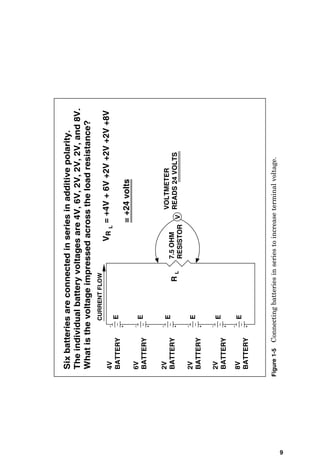
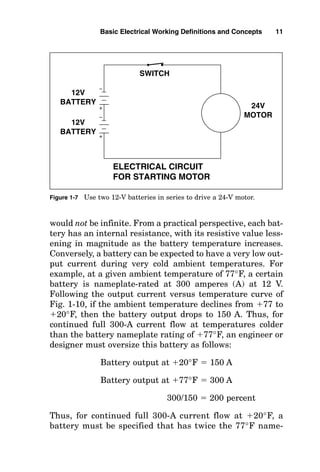
  • 158.
    resistance value intothe alternating-current (ac) resistance value of the wire. The ac resistance of the wire is increased when the wire is enclosed within a raceway that itself con- centrates magnetic flux, such as rigid steel conduit. Note that the ac resistance value of a wire still does not include the inductive reactance or the capacitive reactance compo- nents of the wire impedance. For convenience, Fig. 4-10 is 132 Chapter Four CHARACTERISTICS OF COMMON RECTANGULAR BUS BARS 98% CONDUCTIVITY COPPER BUS BARS D.C. AREA AREA WEIGHT RESISTANCE SIZE AMPACITY SQ. IN. CIRC. MILS LB./FT. MICRO-OHMS PER FT. 1/8 X 1 247 0.125 159200 0.485 66.01 1/8 X 2 447 0.25 318300 0.97 33.04 1/8 X 3 696 0.375 477500 1.45 22.02 1/8 X 4 900 0.5 636600 1.94 16.52 1/4 X 1 366 0.25 318300 0.97 33.04 1/4 X 2 647 0.5 636600 1.94 16.52 1/4 X 3 973 0.75 955000 2.91 11.01 1/4 X 4 1220 1 1273000 3.88 8.25 1/4 X 6 1660 1.5 1910000 5.81 5.51 @30 DEG C AMBIENT, WITH A 30 DEG C CHARACTERISTICS OF COMMON RECTANGULAR BUS BARS 61 % CONDUCTIVITY ALUMINUM BUS BARS D.C. AREA AREA WEIGHT RESISTANCE SIZE AMPACITY SQ. IN. CIRC. MILS LB./FT. MICRO-OHMS PER FT. 1/4 X 1 310 0.25 318300 0.294 57.16 1/4 X 2 550 0.5 636600 0.588 25.58 1/4 X 3 775 0.75 955000 0.882 19.05 1/4 X 4 990 1 1273000 1.176 14.29 1/4 X 6 1400 1.5 1910000 1.764 9.527 @40 DEG C AMBIENT, WITH A 30 DEG C RISE Figure 4-5 Characteristics of copper bus bars. Figure 4-6 Characteristics of aluminum bus bars.
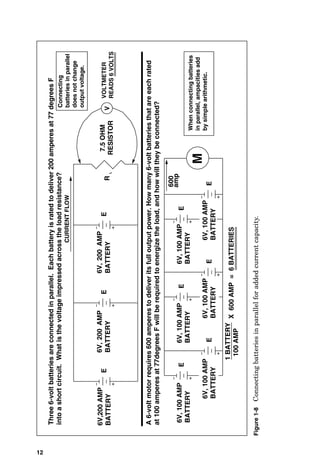
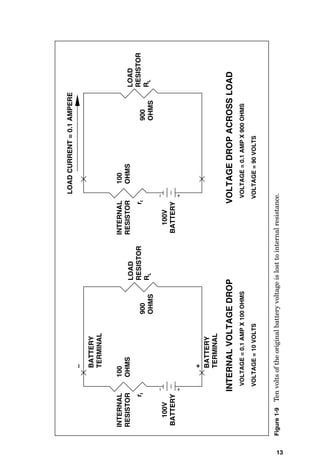
  • 159.
    a table thatshows ac wire resistance and impedance in a 60-Hz system operating at 75°C. Calculating the Impedance of a Cable The impedance of a cable or a set of conductors is the vector sum of R jXL jXC where R is the conductor resistance calculated in the last section, and XL is the inductive reactance of the cable. The Conductors 133 CONDUCTOR RESISTIVITY MATERIAL (OHM-METERS @ 20°C) 10–8 Silver 1.64 Copper 1.72 Aluminum 2.83 Tungsten 5.5 Nickel 7.8 Iron 12.0 Figure 4-7 Resistivity of common electrical conductors. Bus bars must be braced for short-circuit current.
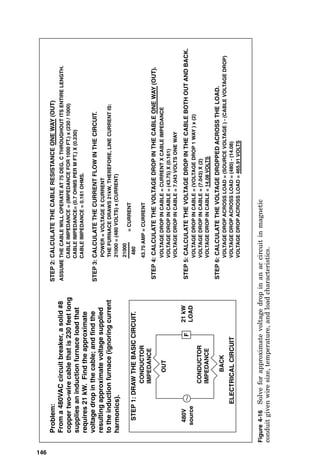
  • 161.
  • 162.
  • 163.
    inductive reactance ofa cable is directly related to the mag- netic flux coupling of one wire in the cable with the other wires in the cable. If the wires are very close together, the fluxes from each conductor add to zero in three-dimensional space, and the inductive reactance of the cable is very small. If, however, the wires are spaced far apart, the lines of flux do not cancel so readily, and the inductive reactance of the 136 Chapter Four NOTE 1 IMPEDANCE IS R(COS POWER FACTOR ANGLE) + X SIN (POWER FACTOR ANGLE); THIS TABLE ASSUMES THE POWER FACTOR IS 85%, LAGGING. NOTE 2 WIRE SIZES LARGER THAN #8 ARE STRANDED AC RESISTANCE AND IMPEDANCE OF COPPER AND ALUMINUM WIRES (3 WIRES IN A CONDUIT) (TABLE UNITS ARE IN OHMS PER 1000 FEET) WIRE WIRE INDUCTIVE REACTANCE AC RESISTANCE - COPPER WIRE SIZE SIZE PVC ALUMINUM STEEL PVC ALUMINUM STEEL (AWG) (KCMIL) CONDUIT CONDUIT CONDUIT CONDUIT CONDUIT CONDUIT 14 4.11 0.058 0.058 0.073 3.1 3.1 3.1 12 6.53 0.054 0.054 0.068 2 2 2 10 10.38 0.05 0.05 0.063 1.2 1.2 1.2 8 16.51 0.052 0.052 0.065 0.78 0.78 0.78 6 26.24 0.051 0.051 0.064 0.49 0.49 0.49 4 41.74 0.048 0.048 0.06 0.31 0.31 0.31 3 52.62 0.047 0.047 0.059 0.25 0.025 0.25 2 66.36 0.045 0.045 0.057 0.19 0.2 0.2 1 83.69 0.046 0.046 0.057 0.15 0.16 0.16 0 105.6 0.044 0.044 0.055 0.12 0.13 0.12 00 133.1 0.043 0.043 0.054 0.1 0.1 0.1 000 167.8 0.042 0.042 0.052 0.077 0.082 0.079 0000 211.6 0.041 0.041 0.051 0.062 0.067 0.063 N.A. 250 0.041 0.041 0.052 0.052 0.057 0.054 N.A. 300 0.041 0.041 0.051 0.044 0.049 0.045 N.A. 350 0.04 0.04 0.05 0.038 0.043 0.039 N.A. 500 0.039 0.039 0.048 0.027 0.032 0.029 Figure 4-10 ac resistance and impedance values of 600-V copper and aluminum wire in conduit.
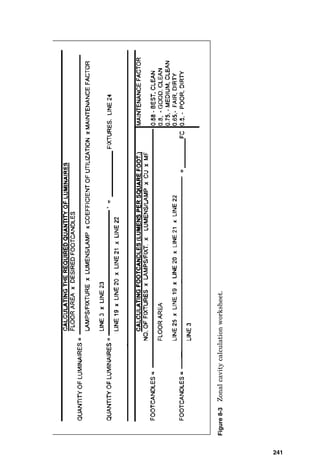
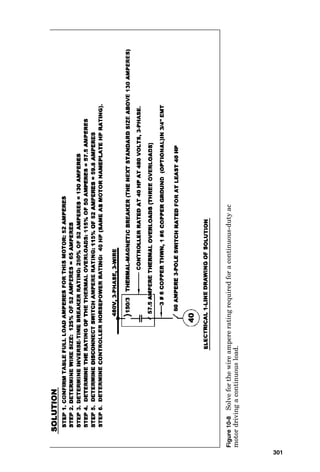
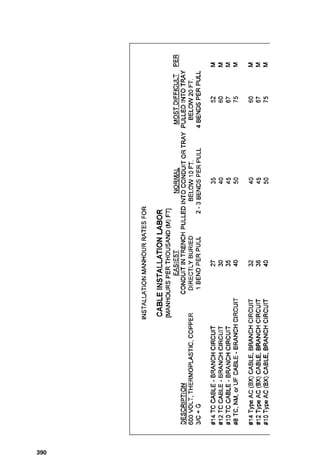
  • 164.
    circuit is increased.Figure 4-11 can be used to approximate the inductive reactance of a cable. Values from this figure are directly applicable to nonarmored cable, cable with non- magnetic armor, and cable in a nonmagnetic raceway. For cable with magnetic armor or cable drawn into a magnetic raceway, correction factors found in the same figure must be applied. Conductors 137 AC RESISTANCE-ALUMINUM WIRE IMPEDANCE-COPPER WIRE IMPEDANCE-ALUMINUM WIRE PVC ALUMINUM STEEL PVC ALUMINUM STEEL PVC ALUMINUM STEEL CONDUIT CONDUIT CONDUIT CONDUIT CONDUIT CONDUIT CONDUIT CONDUIT CONDUIT (NOTE 1) (NOTE 1) (NOTE 1) (NOTE 1) (NOTE 1) (NOTE 1) N.A. N.A. N.A. 2.67 2.67 2.67 N.A. N.A. N.A. 3.2 3.2 3.2 1.7 1.7 1.7 2.8 2.8 2.8 2 2 2 1.1 1.1 1.1 1.8 1.8 1.8 1.3 1.3 1.3 0.69 0.69 0.7 1.1 1.1 1.1 0.81 0.81 0.81 0.44 0.45 0.45 0.71 0.72 0.72 0.51 0.51 0.51 0.29 0.29 0.3 0.46 0.46 0.46 0.4 0.41 0.4 0.23 0.24 0.24 0.37 0.37 0.37 0.32 0.32 0.32 0.19 0.19 0.2 0.3 0.3 0.3 0.25 0.26 0.25 0.16 0.16 0.16 0.24 0.24 0.25 0.2 0.21 0.2 0.13 0.13 0.13 0.19 0.2 0.2 0.16 0.16 0.16 0.11 0.11 0.11 0.16 0.16 0.16 0.13 0.13 0.13 0.088 0.092 0.094 0.13 0.13 0.14 0.1 0.11 0.1 0.074 0.078 0.08 0.11 0.11 0.11 0.085 0.09 0.086 0.066 0.07 0.073 0.094 0.098 0.1 0.071 0.76 0.072 0.059 0.063 0.065 0.082 0.086 0.088 0.061 0.66 0.063 0.053 0.058 0.06 0.073 0.077 0.08 0.043 0.048 0.045 0.043 0.048 0.05 0.057 0.061 0.064 0.029 0.034 0.031 0.036 0.04 0.043 0.045 0.049 0.052
  • 165.
    An individual cancalculate the impedance of a cable, but this work has already been done by cable manufacturers for many specific types of cable. For convenience, typical cable impedance values are shown in Fig. 4-12 for 600-volt (V) cable, for 5-kV cable, and for 15-kV cable. 138 Chapter Four Bus duct is used to carry large values of current. Service conductors to commercial building in the form of bus duct.
  • 166.
    Conductors 139 CONDUCTOR SIZE 2000 1750 1500 1250 1000 750 600 500 400 350 300 250 0000 000 00 0 1 2 4 6 8 10 12 14 16 18 REACTANCE OHMS TONEUTRAL PER 1000 FT. 0 .01 .02 .03 .04 .05 .06 .07 .08 .09 0.10 0.11 0.12 0.13 0.14 0.15 0.16 0.17 0.18 0.19 0.2 0.21 0.05 0.06 0.08 0.10 0.15 0.20 0.25 0.30 0.40 0.50 0.60 0.80 1.0 1.5 2.0 2.5 3.0 4.0 5.0 6.0 8.0 10 15 20 25 30 40 50 60 80 100 TRIANGULAR EQUAL CENTER - TO - CENTER CONDUCTOR SPACING (INCHES) SIZE MULTIPLYING FACTOR #18 - #1 0.975 0 - 0000 0.975 250 0.965 300 0.960 350 0.950 500 0.940 600 0.930 750 0.925 REACTANCE OF ROUND MULTICONDUCTOR CABLES CORRECTION FACTORS FOR MAGNETIC CONDUIT OR FOR MAGNETIC CABLE ARMOR Figure 4-11 Solve for inductive reactance of a cable given conductor size and dimensions.
  • 167.
    Calculating Voltage Dropin a Cable There are several valuable individual voltage-drop calcula- tions that commonly encountered when working with electri- cal systems. It is important that the calculations be done correctly and that the engineer can check the solution to a cur- rent problem against the answer to an example problem. For these reasons, the following figures are provided as examples: Figure 4-13: Calculate voltage drop in a single-phase dc circuit. Figure 4-14: Calculate the approximate voltage drop in a single-phase ac circuit at unity power factor in a plastic conduit. 140 Chapter Four Note: All conductors are stranded IMPEDANCE OF COPPER CABLE (3/CONDUCTOR CABLE) TABLE UNITS ARE IN OHMS TO NEUTRAL PER 1000 FEET WIRE WIRE 600 VOLT 5kV 15kV SIZE SIZE (AWG) (KCMIL) 14 4.11 0.0369 N.A. N.A. 12 6.53 0.0347 N.A. N.A. 10 10.38 0.0321 N.A. N.A. 8 16.51 0.0334 0.0537 N.A. 6 26.24 0.034 0.0492 N.A. 4 41.74 0.0321 0.0457 N.A. 3 52.62 0.0307 0.0441 N.A. 2 66.36 0.0298 0.0424 0.0518 1 83.69 0.0309 0.0413 0.0297 0 105.6 0.0305 0.0392 0.0497 00 133.1 0.0294 0.039 0.0462 000 167.8 0.0287 0.0379 0.0445 0000 211.6 0.0281 0.0367 0.0427 N.A. 250 0.0287 0.0358 0.0441 N.A. 300 0.028 0.0349 0.0399 N.A. 350 0.0276 0.034 0.0394 N.A. 500 0.0268 0.0322 0.0368 N.A. 750 0.0265 0.0306 0.0367 Figure 4-12 Impedances of 600-V, 5-kV, and 15-kV copper cable.
  • 168.
    ELECTRICAL CIRCUIT CONDUCTOR RESISTANCE CONDUCTOR RESISTANCE OUT BACK 125V BATTERY 125 OHMS LOAD RESISTOR Problem: A solid #14 copper two-wire cable that is 750 feet long supplies a 125 ohm load resistor for heating purposes at 75 deg. C. Find the voltage drop in the cable; and find the resulting voltage across the load resistor. STEP 1: DRAW THE BASIC CIRCUIT. STEP 2: CALCULATE THE CABLE RESISTANCE ONE WAY (OUT) TO BE CONSERVATIVE, ASSUME THE CABLE IS 75 DEG. C THROUGHOUT ITS ENTIRE LENGTH. CABLE RESISTANCE = (RESISTANCE FOR 1000 FT.) x (750 / 1000) CABLE RESISTANCE = (3.07 ohms per M ft.) X (0.750) CABLE RESISTANCE = 2.3 OHMS. VOLTAGE DROP IN CABLE = CURRENT X CABLE RESISTANCE VOLTAGE DROP IN CABLE = (0.9645) X (2.3) VOLTAGE DROP IN CABLE = 2.218 VOLTS ONE WAY STEP 4: CALCULATE THE VOLTAGE DROP IN THE CABLE ONE WAY (OUT). STEP 3: CALCULATE THE CURRENT FLOW IN THE CIRCUIT. 125V = CURRENT X CIRCUIT RESISTANCE 125 = CURRENT X RESISTANCE OUT + RESISTANCE BACK + LOAD RESISTANCE 125 = CURRENT X (2.3 + 125 + 2.3) 125 = CURRENT X (129.6) 125 129.6 = CURRENT 0.9645 AMP = CURRENT STEP 5: CALCULATE THE VOLTAGE DROP IN THE CABLE BOTH OUT AND BACK. VOLTAGE DROP IN CABLE = (VOLTAGE DROP 1 WAY ) x (2) VOLTAGE DROP IN CABLE = (2.218) X (2) VOLTAGE DROP IN CABLE = 4.436 VOLTS STEP 4: CALCULATE THE VOLTAGE DROPPED ACROSS THE LOAD. VOLTAGE DROP ACROSS LOAD = (SOURCE VOLTAGE ) - (CABLE VOLTAGE DROP) VOLTAGE DROP ACROSS LOAD = (125) - (4.436) VOLTAGE DROP ACROSS LOAD = 120.56 VOLTS Figure 4-13 Solve for voltage drop in a dc circuit given wire size, temperature, and load characteristics. 141
  • 169.
    ELECTRICAL CIRCUIT ASSUME THE CABLE WILL OPERATE AT 75 DEG. C THROUGHOUT ITS ENTIRE LENGTH. CABLE IMPEDANCE = (IMPEDANCE FOR 1000 FT.) x (750 / 1000) CABLE IMPEDANCE= (1.7 OHMS PER M FT.) X (0.750) CABLE IMPEDANCE = 1.275 OHMS. CONDUCTOR IMPEDANCE CONDUCTOR IMPEDANCE OUT BACK 115V source Problem: From a 115VAC circuit breaker, a solid #12 copper two-wire cable in plastic conduit that is 750 feet long supplies a motor load that requires 1.3 kW. Find the approximate voltage drop in the cable; and find the resulting voltage supplied to the motor load (ignoring constant kVA motor action). STEP 1: DRAW THE BASIC CIRCUIT. STEP 2: CALCULATE THE CABLE RESISTANCE ONE WAY (OUT) VOLTAGE DROP IN CABLE = CURRENT X CABLE IMPEDANCE VOLTAGE DROP IN CABLE = (11.3) X (1.275) VOLTAGE DROP IN CABLE = 14.41 VOLTS ONE WAY STEP 4: CALCULATE THE VOLTAGE DROP IN THE CABLE ONE WAY (OUT). STEP 3: CALCULATE THE CURRENT FLOW IN THE CIRCUIT. POWER = VOLTAGE X CURRENT THE MOTOR DRAWS 1.3 kW, THEREFORE, FOR A CLOSE APPROXIMATION OF LINE CURRENT: 1300 = (115 VOLTS) x (CURRENT) (ignoring power factor) 1300 = CURRENT 115 11.3 AMP = CURRENT STEP 5: CALCULATE THE VOLTAGE DROP IN THE CABLE BOTH OUT AND BACK. VOLTAGE DROP IN CABLE = (VOLTAGE DROP 1 WAY ) x (2) VOLTAGE DROP IN CABLE = (14.41) X (2) VOLTAGE DROP IN CABLE = 28.82 VOLTS STEP 6: CALCULATE THE VOLTAGE DROPPED ACROSS THE LOAD. VOLTAGE DROP ACROSS LOAD = (SOURCE VOLTAGE ) - (CABLE VOLTAGE DROP) VOLTAGE DROP ACROSS LOAD = (115) - (28.82) VOLTAGE DROP ACROSS LOAD = 86.18 VOLTS M 1.3 kW LOAD Figure 4-14 Solve for approximate voltage drop in an ac circuit in PVC conduit given wire size, temperature, and load characteristics. 142
  • 170.
    Figure 4-15: Calculatea more accurate voltage drop in a single-phase ac circuit at unity power factor in a nonmag- netic conduit. Figure 4-16: Calculate voltage drop in a single-phase ac circuit at unity power factor in a steel conduit to an induc- tion furnace load. Note that the furnace still tries to draw 21 kilowatts (kW); thus the line current must increase to offset the cable voltage drop. Figure 4-17: Calculate voltage drop in a single-phase ac circuit at unity power factor in an aluminum conduit. Figure 4-18: Calculate voltage drop in a three-phase ac circuit at less than unity power factor using unarmored type TC cable. Figure 4-19: Calculate voltage drop in a three-phase ac circuit at less than unity power factor using armored type MC cable. Figure 4-20: Calculate voltage regulation in an ac circuit. Calculating dc Resistance in a Bus Bar Calculating the resistance of a bus bar is similar to calcu- lating the resistance of a wire, except that the cross-section- al area is of a different shape and is larger. This calculation is shown in Fig. 4-21. (Refer to Fig. 4-5 for data.) Calculating Heat Loss in a Conductor Heat loss is always calculated simply as I2R, so the solution to a heat-loss problem in a circuit is to calculate the dc resis- tance (even if it is in an ac circuit) of each wire, solve for the current flow through the wire (even if the current flow is out of phase with the voltage), calculate the I2 R heat loss in each wire individually, and then simply add the heat losses in the wires. This methodology is shown in Fig. 4-22. Wires and Cables Most of the electrical systems in the world use wires and cables to transport electrical energy, so it is important to Conductors 143 (Text continues on p. 152.)
  • 171.
    144 Chapter Four ELECTRICALCIRCUIT CONDUCTOR IMPEDANCE CONDUCTOR IMPEDANCE OUT BACK 115V source Problem: From a 115VAC circuit breaker, a solid #12 copper two- wire cable that is 560 feet long supplies a motor load that requires 1.3 kW. Find the actual voltage drop in the cable; and find the resulting actual voltage supplied to the motor load (considering constant kVA motor action). STEP 1: DRAW THE BASIC CIRCUIT. STEP 2: CALCULATE THE CABLE RESISTANCE ONE WAY (OUT) ASSUME THE CABLE WILL OPERATE AT 75 DEG. C THROUGHOUT ITS ENTIRE LENGTH. CABLE IMPEDANCE = (IMPEDANCE FOR 1000 FT.) x (560 / 1000) CABLE IMPEDANCE= (1.7 OHMS PER M FT.) X (0.750) CABLE IMPEDANCE = 1.275 OHMS. STEP 4: CALCULATE THE VOLTAGE DROP IN THE CABLE ONE WAY (OUT). VOLTAGE DROP IN CABLE = CURRENT X CABLE IMPEDANCE VOLTAGE DROP IN CABLE = (11.3) X (1.275) VOLTAGE DROP IN CABLE = 14.41 VOLTS ONE WAY STEP 3: CALCULATE THE APROXIMATE INITIAL CURRENT FLOW IN THE CIRCUIT. POWER = VOLTAGE X CURRENT THE MOTOR DRAWS 1.3 kW, THEREFORE, FOR A CLOSE APPROXIMATION OF LINE CURRENT: 1300 = (115 VOLTS) x (CURRENT) 1300 = CURRENT 115 11.3 AMP = CURRENT STEP 5: CALCULATE THE VOLTAGE DROP IN THE CABLE BOTH OUT AND BACK. VOLTAGE DROP IN CABLE = (VOLTAGE DROP 1 WAY ) x (2) VOLTAGE DROP IN CABLE = (14.41) X (2) VOLTAGE DROP IN CABLE = 28.82 VOLTS STEP 6: CALCULATE THE VOLTAGE DROPPED ACROSS THE LOAD. VOLTAGE DROP ACROSS LOAD = (SOURCE VOLTAGE ) – (CABLE VOLTAGE DROP) VOLTAGE DROP ACROSS LOAD = (115) - (28.82) VOLTAGE DROP ACROSS LOAD = 86.18 VOLTS M 1.3 kW LOAD Figure 4-15 Solve for accurate voltage drop in ac circuit to motor in non- magnetic conduit.
  • 172.
    Conductors 145 STEP 7:CALCULATE THE ACTUAL LINE CURRENT DRAWN BY THE MOTOR AT ITS LOW TERMINAL VOLTAGE. POWER = VOLTAGE X CURRENT THE MOTOR DRAWS 1.3 kW, THEREFORE, FOR A CLOSER VALUE OF ACTUAL LINE CURRENT: 1300 = (86.18 VOLTS) x (CURRENT) 15.08 AMP = CURRENT = CURRENT 1300 86.18 VOLTAGE DROP IN CABLE = CURRENT X CABLE IMPEDANCE VOLTAGE DROP IN CABLE = (15.08) X (1.275) VOLTAGE DROP IN CABLE = 19.23 VOLTS ONE WAY STEP 8: CALCULATE THE VOLTAGE DROP IN THE CABLE ONE WAY (OUT). VOLTAGE DROP IN CABLE = (VOLTAGE DROP 1 WAY ) x (2) VOLTAGE DROP IN CABLE = (19.231) X (2) VOLTAGE DROP IN CABLE = 38.46 VOLTS STEP 9: CALCULATE THE VOLTAGE DROP IN THE CABLE BOTH OUT AND BACK. STEP 10: CALCULATE THE VOLTAGE DROPPED ACROSS THE LOAD. VOLTAGE DROP ACROSS LOAD = (SOURCE VOLTAGE ) – (CABLE VOLTAGE DROP) VOLTAGE DROP ACROSS LOAD = (115) - (38.46) VOLTAGE DROP ACROSS LOAD = 76.53 VOLTS STEP 11: CALCULATE THE ACTUAL LINE CURRENT DRAWN BY THE MOTOR AT ITS LOW TERMINAL VOLTAGE. = CURRENT 16.98 AMP = CURRENT 76.53 POWER = VOLTAGE X CURRENT THE MOTOR DRAWS 1.3 kW, THEREFORE, FOR A CLOSER VALUE OF ACTUAL LINE CURRENT: 1300 = (76.53 VOLTS) x (CURRENT) 1300 STEP 14: CALCULATE THE VOLTAGE DROPPED ACROSS THE LOAD. STEP 13: CALCULATE THE VOLTAGE DROP IN THE CABLE BOTH OUT AND BACK. STEP 12: CALCULATE THE VOLTAGE DROP IN THE CABLE ONE WAY (OUT). VOLTAGE DROP ACROSS LOAD = (SOURCE VOLTAGE ) - (CABLE VOLTAGE DROP) VOLTAGE DROP ACROSS LOAD = (115) - (43.32) VOLTAGE DROP ACROSS LOAD = 71.68 VOLTS VOLTAGE DROP IN CABLE = (VOLTAGE DROP 1 WAY ) x (2) VOLTAGE DROP IN CABLE = (21.66) X (2) VOLTAGE DROP IN CABLE = 43.32 VOLTS VOLTAGE DROP IN CABLE = CURRENT X CABLE IMPEDANCE VOLTAGE DROP IN CABLE = (16.98) X (1.275) VOLTAGE DROP IN CABLE = 21.66 VOLTS ONE WAY COMMENT ON FINAL SOLUTION: THREE ITERATIONS WILL NORMALLY SUFFICE FOR THIS TYPE OF CALCULATION. THE RESULTS SHOW THAT A LARGER WIRE SIZE SHOULD BE SELECTED AND THE CALCULATION DONE AGAIN.
  • 173.
    ELECTRICAL CIRCUIT ASSUME THE CABLE WILL OPERATE AT 75 DEG. C THROUGHOUT ITS ENTIRE LENGTH. CABLE IMPEDANCE = (IMPEDANCE FOR 1000 FT.) x (230 / 1000) CABLE IMPEDANCE= (0.7 OHMS PER M FT.) X (0.230) CABLE IMPEDANCE = 0.161 OHMS. CONDUCTOR IMPEDANCE CONDUCTOR IMPEDANCE OUT BACK 480V source Problem: From a 480VAC circuit breaker, a solid #8 copper two-wire cable that is 230 feet long supplies an induction furnace load that requires 21 kW. Find the approximate voltage drop in the cable; and find the resulting approximate voltage supplied to the induction furnace (ignoring current harmonics). STEP 1: DRAW THE BASIC CIRCUIT. STEP 2: CALCULATE THE CABLE RESISTANCE ONE WAY (OUT) VOLTAGE DROP IN CABLE = CURRENT X CABLE IMPEDANCE VOLTAGE DROP IN CABLE = (43.75) X (0.161) VOLTAGE DROP IN CABLE = 7.043 VOLTS ONE WAY STEP 4: CALCULATE THE VOLTAGE DROP IN THE CABLE ONE WAY (OUT). STEP 3: CALCULATE THE CURRENT FLOW IN THE CIRCUIT. POWER = VOLTAGE X CURRENT THE FURNACE DRAWS 21kW, THEREFORE, LINE CURRENT IS: 21000 = (480 VOLTS) x (CURRENT) 21000 = CURRENT 480 43.75 AMP = CURRENT STEP 5: CALCULATE THE VOLTAGE DROP IN THE CABLE BOTH OUT AND BACK. VOLTAGE DROP IN CABLE = (VOLTAGE DROP 1 WAY ) x (2) VOLTAGE DROP IN CABLE = (7.043) X (2) VOLTAGE DROP IN CABLE = 14.08 VOLTS STEP 6: CALCULATE THE VOLTAGE DROPPED ACROSS THE LOAD. VOLTAGE DROP ACROSS LOAD = (SOURCE VOLTAGE ) - (CABLE VOLTAGE DROP) VOLTAGE DROP ACROSS LOAD = (480) - (14.08) VOLTAGE DROP ACROSS LOAD = 465.91 VOLTS F 21 kW LOAD Figure 4-16 Solve for approximate voltage drop in an ac circuit in magnetic conduit given wire size, temperature, and load characteristics. 146
  • 174.
    ELECTRICAL CIRCUIT ASSUME THE CABLE WILL OPERATE AT 75 DEG. C THROUGHOUT ITS ENTIRE LENGTH. CABLE IMPEDANCE = (IMPEDANCE FOR 1000 FT.) x (120 / 1000) CABLE IMPEDANCE= (0.19 OHMS PER M FT.) X (0.120) CABLE IMPEDANCE = 0.0228 OHMS. CONDUCTOR IMPEDANCE CONDUCTOR IMPEDANCE OUT BACK 480V source Problem: From a 480VAC circuit breaker, a stranded #2 copper two-wire cable that is 120 feet long supplies a computer load that requires 48 kW. Find the approximate voltage drop in the cable; and find the resulting approximate voltage supplied to the computer (ignoring current harmonics). STEP 1: DRAW THE BASIC CIRCUIT. STEP 2: CALCULATE THE CABLE RESISTANCE ONE WAY (OUT) VOLTAGE DROP IN CABLE = CURRENT X CABLE IMPEDANCE VOLTAGE DROP IN CABLE = (100) X (0.0228) VOLTAGE DROP IN CABLE = 2.28 VOLTS ONE WAY STEP 4: CALCULATE THE VOLTAGE DROP IN THE CABLE ONE WAY (OUT). STEP 3: CALCULATE THE CURRENT FLOW IN THE CIRCUIT. POWER = VOLTAGE X CURRENT THE COMPUTER DRAWS 48 kW, THEREFORE, LINE CURRENT IS: 48000 = (480 VOLTS) x (CURRENT) 48000 = CURRENT 480 100 AMP = CURRENT STEP 5: CALCULATE THE VOLTAGE DROP IN THE CABLE BOTH OUT AND BACK. VOLTAGE DROP IN CABLE = (VOLTAGE DROP 1 WAY ) x (2) VOLTAGE DROP IN CABLE = (2.28) X (2) VOLTAGE DROP IN CABLE = 4.56 VOLTS STEP 6: CALCULATE THE VOLTAGE DROPPED ACROSS THE LOAD. VOLTAGE DROP ACROSS LOAD = (SOURCE VOLTAGE ) - (CABLE VOLTAGE DROP) VOLTAGE DROP ACROSS LOAD = (480) - (4.56) VOLTAGE DROP ACROSS LOAD = 475.44 VOLTS C 48 kW LOAD Figure 4-17 Solve for voltge drop in a single-phase ac circuit at unity PF in an aluminum conduit. 147
  • 175.
    ELECTRICAL CIRCUIT ASSUME THE CABLE WILL OPERATE AT 75 DEG. C THROUGHOUT ITS ENTIRE LENGTH. CABLE IMPEDANCE = (IMPEDANCE FOR 1000 FT.) x (280 / 1000) CABLE IMPEDANCE= (0.078 OHMS PER M FT.) X (0.280) CABLE IMPEDANCE = 0.0218 OHMS. LOAD CONDUCTOR CONDUCTOR IMPEDANCE Phase 480V 3-phase source Problem: From a 480/3P circuit breaker, a stranded #0000 copper three-wire Type TC (non-armored) cable that is 280 ft. long and is laid into in aluminum cable tray. The cable supplies an AC load operating at a power factor of 85% that draws 200 amperes. Find the voltage drop in the cable; and find the resulting voltage supplied to the load. STEP 1: DRAW THE BASIC CIRCUIT. STEP 2: CALCULATE THE CABLE RESISTANCE ONE WAY (OUT) VOLTAGE DROP IN CABLE = CURRENT X CABLE IMPEDANCE VOLTAGE DROP IN CABLE = (200) X (0.0218) VOLTAGE DROP IN CABLE = 4.36 VOLTS ONE WAY STEP 3: CALCULATE THE VOLTAGE DROP IN THE CABLE ONE WAY (OUT). VOLTAGE DROP IN CABLE = (4.36) X ( 3 ) STEP 4: CALCULATE THE VOLTAGE DROP IN THE CABLE BOTH OUT AND BACK (3-phase). VOLTAGE DROP IN CABLE = (VOLTAGE DROP 1 WAY ) x ( 3 ) VOLTAGE DROP IN CABLE = 7.55 VOLTS STEP 5: CALCULATE THE VOLTAGE DROPPED ACROSS THE LOAD. VOLTAGE DROP ACROSS LOAD = (SOURCE VOLTAGE ) - (CABLE VOLTAGE DROP) VOLTAGE DROP ACROSS LOAD = (480) - (7.55) VOLTAGE DROP ACROSS LOAD = 472.45 VOLTS IMPEDANCE L CONDUCTOR IMPEDANCE A Phase B Phase C Figure 4-18 Solve for voltage drop in a three-phase ac circuit in nonarmored cable in cable tray. 148
  • 176.
    ELECTRICAL CIRCUIT LOAD CONDUCTOR IMPEDANCE CONDUCTOR IMPEDANCE Phase A 208V 3-phase source Problem: From a 208/3P circuit breaker, a stranded 500 kCMIL copper three-wire Type MC (galvanize- armored) cable in galvanized cable tray that is 280 feet long supplies an AC load operating at a power factor of 60% that draws 350 amperes. Find the voltage drop in the cable; and find the resulting voltage supplied to the load. STEP 1: DRAW THE BASIC CIRCUIT. L CONDUCTOR IMPEDANCE Phase B Phase C STEP 2: DETERMINE THE ANGLE FUNCTIONS. COS = 0.6 ARCCOS 0.6 = 53.1 ° = SIN 53.1 ° = 0.8 kW k V A STEP 4: CALCULATE THE CABLE RESISTANCE ONE WAY (OUT) CABLE IMPEDANCE = (IMPEDANCE FOR 1000 FT.) x (280 / 1000) CABLE IMPEDANCE = (0.0558 OHMS PER M FT.) X (0.280) CABLE IMPEDANCE = 0.0156 OHMS. VOLTAGE DROP IN CABLE = CURRENT X CABLE IMPEDANCE VOLTAGE DROP IN CABLE = (350) X (0.0156) VOLTAGE DROP IN CABLE = 5.47 VOLTS ONE WAY STEP 5: CALCULATE THE VOLTAGE DROP IN THE CABLE ONE WAY (OUT). STEP 6: CALCULATE THE VOLTAGE DROP IN THE CABLE BOTH OUT AND BACK (3-phase) VOLTAGE DROP IN CABLE = (VOLTAGE DROP 1 WAY ) x ( 3 ) VOLTAGE DROP IN CABLE = (5.47) X ( 3 ) VOLTAGE DROP IN CABLE = 9.47 VOLTS STEP 7: CALCULATE THE VOLTAGE DROPPED ACROSS THE LOAD. VOLTAGE DROP ACROSS LOAD = (SOURCE VOLTAGE ) - (CABLE VOLTAGE DROP) VOLTAGE DROP ACROSS LOAD = (480) - (9.47) VOLTAGE DROP ACROSS LOAD = 470.53 VOLTS STEP 3: CALCULATE THE CABLE IMPEDANCE PER THOUSAND FEET. ASSUME THE CABLE WILL OPERATE AT 75 DEG. C THROUGHOUT ITS ENTIRE LENGTH. CABLE IMPEDANCE = R(COS ) + [X (SIN )] CABLE IMPEDANCE = (0.029)(0.6 ) + [(0.048)(0.8)] CABLE IMPEDANCE = .0558 OHMS PER M FEET. Figure 4-19 Solve for voltage drop in a three-phase ac circuit in armored cable in cable tray. 149
  • 177.
    ELECTRICAL CIRCUIT ASSUME THE CABLE WILL OPERATE AT 75 DEG. C THROUGHOUT ITS ENTIRE LENGTH. CABLE IMPEDANCE = (IMPEDANCE FOR 1000 FT.) x (280 / 1000) CABLE IMPEDANCE= (0.078 OHMS PER M FT.) X (0.280) CABLE IMPEDANCE = 0.0218 OHMS. LOAD CONDUCTOR IMPEDANCE CONDUCTOR IMPEDANCE Phase A 480V 3-phase source Problem: From a 480/3P circuit breaker, a stranded #0000 copper three-wire Type TC (non-armored) cable in aluminum cable tray that is 280 feet long supplies an AC load operating at a power factor of 85% that draws 200 amperes. Find the voltage drop in the cable; and find the resulting voltage supplied to the load. Determine the % voltage regulation. STEP 1: DRAW THE BASIC CIRCUIT. STEP 2: CALCULATE THE CABLE RESISTANCE ONE WAY (OUT) STEP 3: CALCULATE THE VOLTAGE DROP IN THE CABLE ONE WAY (OUT). VOLTAGE DROP IN CABLE = CURRENT X CABLE IMPEDANCE VOLTAGE DROP IN CABLE = (200) X (0.0218) VOLTAGE DROP IN CABLE = 4.36 VOLTS ONE WAY STEP 4: CALCULATE THE VOLTAGE DROP IN THE CABLE BOTH OUT AND BACK (3-phase). STEP 5: CALCULATE THE VOLTAGE DROPPED ACROSS THE LOAD. VOLTAGE DROP ACROSS LOAD = (SOURCE VOLTAGE ) - (CABLE VOLTAGE DROP) VOLTAGE DROP ACROSS LOAD = (480) - (7.55) VOLTAGE DROP ACROSS LOAD = 472.45 VOLTS L CONDUCTOR IMPEDANCE Phase B Phase C = NO LOAD VOLTAGE - FULL LOAD VOLTAGE VOLTAGE REGULATION FULL LOAD VOLTAGE STEP 6: CALCULATE THE VOLTAGE REGULATION. (480) - (472.45) 472.45 VOLTAGE REGULATION = = VOLTAGE REGULATION 1.59% X 100% X 100% VOLTAGE DROP IN CABLE = (VOLTAGE DROP 1 WAY ) x ( 3 ) VOLTAGE DROP IN CABLE = (4.36) X ( 3 ) VOLTAGE DROP IN CABLE = 7.55 VOLTS Figure 4-20 Solve for voltage regulation in a three-phase ac circuit in non- magnetic cable and cable tray. 150
  • 178.
    Conductors 151 Cabling ina cable tray is a normal wiring method in industrial facilities. Medium-voltage cables leaving cable tray and entering switchgear building.
  • 179.
    understand how wiresand cables work, what types of insu- lation are suitable for what applications and environments, and how many amperes can be transported safely through each size of cable. Figure 4-23 is a replication of selected parts of Tables 310- 16 and 310-17 of the National Electrical Code. The proper way to read this table is best illustrated through an example: At 152 Chapter Four ASSUME THE BUS BAR WILL OPERATE AT 30 DEG. C (AMBIENT TEMPERATURE) THROUGHOUT ITS ENTIRE LENGTH. Problem: A 1/4 X 4 copper bus bar is to be installed in a DC circuit. It will be 200 feet long. Calculate the DC resistance of the bus bar. STEP 1: CALCULATE THE BUS BAR RESISTANCE ONE WAY: RESISTANCE = (RESISTANCE FOR 1 FT.) x (200) RESISTANCE = (0.00000825 OHMS PER FT.) X (200 FT) BUS BAR RESISTANCE = 0.00165 OHMS. Figure 4-21 Solve for the resistance of a copper bar given its dimensions and temperature. ASSUME THE BUS BAR WILL OPERATE AT 30 DEG. C (AMBIENT TEMPERATURE) THROUGHOUT ITS ENTIRE LENGTH. Problem: A 1/4 X 4 copper bus bar is to be installed in a DC circuit. It will be 200 feet long. Calculate the DC resistance of the bus bar and its kW losses when it carries 1000 amperes. STEP 1: CALCULATE THE BUS BAR RESISTANCE ONE WAY: RESISTANCE = (RESISTANCE FOR 1 FT.) x (200) RESISTANCE = (0.00000825 OHMS PER FT.) X (200 FT) BUS BAR RESISTANCE = 0.00165 OHMS. STEP 2: CALCULATE THE HEAT LOSSES: POWER (HEAT) LOSSES = (CURRENT) 2 X RESISTANCE POWER (HEAT) LOSSES = (1000) 2 X (0.00165) POWER (HEAT) LOSSES = 1.65 kW Figure 4-22 Solve for the heat losses in a copper bar given its dimensions and ampere load.
  • 180.
    the top ofthe table are several columns, each containing a Celsius temperature rating. On the left side of the table are wire sizes, graduated in AWG from small to large. Within the table are ampacity values. The entire table is based on the conductor operating within an ambient temperature of 30°C (which is 86°F). Selecting the row for No. 8 AWG and referring to the 75°C column, the table is read properly in this way: When a No. 8 conductor conducts 50 amperes (A) within an ambient temperature of 30°C and there are no more than three current-carrying conductors in the cable or raceway, then the wire will increase in temperature over a long time period from 30 to 75°C. (See Fig. 4-24 for more examples.) Several things affect wire ampacity and temperature rat- ing, and each of these must be considered in making wire sizing calculations: ■ Insulation temperature capability ■ Ambient temperature ■ Quantity of wires that carry current in a conduit or cable ■ Location where the heat cannot escape from the cable very rapidly ■ Location where the heat can escape from the cable very rapidly ■ Duration of current flow (Heat cannot build up over a very short time period with moderate amounts of overcurrent, but the repeated starting of motors, for example, can cause wires to heat excessively.) ■ Wire terminal maximum temperature rating Insulation temperature capability Some insulations simply begin to melt when they increase in temperature to what would be considered to be “warm,” or 65°C, whereas other insulations such as silicon rubber appear to be almost impervious to temperature. In Fig. 4-9, the increase in conductor resistance with temperature was calculated, but the main component of conductor impedance Conductors 153
  • 181.
    154 Chapter Four AMPACITIESOF COPPER CABLE RATED 0 - 2 kV TABLE UNITS ARE IN AMPERES (3/CONDUCTOR CABLE OR 3 CURRENT- CARRYING CONDUCTORS IN A RACEWAY) AMBIENT TEMPERATURE OF 30 DEG. C (86 DEG F) TEMPERATURE RATING OF INSULATION WIRE 60 Deg C 75 Deg C 90 Deg C SIZE (AWG) (Kcmil) 18 N.A. N.A. 4 16 N.A. N.A. 18 14 20 20 25 12 25 25 30 10 30 35 40 8 40 50 55 6 55 65 75 4 70 85 95 3 85 100 110 2 95 115 130 1 110 130 150 0 125 150 170 00 145 175 195 000 165 200 225 0000 195 230 260 250 215 255 390 300 240 285 320 350 260 310 350 500 320 380 430 750 400 475 535 INSULATION TW, UF THW, RH, THWN, SIS, FEP, MI, RHH, TYPES XHHW RHW-2, THHN, THHW, THW-2, THWN-2, USE-2, XHH, XHHW-2 Figure 4-23 Solve for wire ampacity given wire size, voltage rating, insu- lation temperature rating, and ambient temperture.
  • 182.
    Conductors 155 SINGLE CONDUCTORIN FREE AIR AMBIENT TEMPERATURE OF 30 DEG. C (86 DEG F) TEMPERATURE RATING OF INSULATION 60 Deg C 75 Deg C 90 Deg C N.A. N.A. 18 N.A. N.A. 24 25 30 35 30 35 40 40 50 55 60 70 80 80 95 105 105 125 140 120 145 165 140 170 190 165 195 220 195 230 260 225 265 300 260 310 350 300 360 405 450 405 455 375 455 505 420 505 570 515 620 700 655 785 885 TW, UF THW, RH, THWN, SIS, FEP, MI, RHH, XHHW RHW-2, THHN, THHW, THW-2, THWN-2, USE-2, XHH, XHHW-2
  • 183.
    was shown tobe due to magnetic effects instead of resis- tance. In this section, the actual maximum temperature of the insulation is considered, since the insulation system must remain intact to keep the conductor from forming a short circuit. To do this, consideration must be made of two different forms of current flow through the conductor: 1. Short-circuit current flow, such as during a fault condi- tion 2. Long-time-duration overload current Figures 4-24 through 4-26 are step-by-step illustrations of how to correctly use NEC Tables 310-16 and 310-17. There are many types of insulation, ranging from thermo- plastic to packed mineral. Insulation limitations deal with temperature, moisture, and chemical attack. Each type of insulation exhibits its own unique capability to withstand heat from short-circuit currents. If the capability of the insu- lation is exceeded, then the insulation is damaged, and it sim- ply allows the phase conductor to form a short circuit to ground. Since conductor temperature is a function of current squared times time, the amount of time and current can be 156 Chapter Four Cables of different systems are installed into different cable trays.
  • 184.
    used to determinethe thermal damage limits of a conductor. Accordingly, once the available short-circuit current has been determined from a short-circuit calculation, consideration must be given to the amount of time the short-circuit current can flow. This duration is determined by the contact parting time of the circuit breaker that is to interrupt the short-cir- cuit current. Circuit breakers exhibit from 1.5-cycle to as long as 6-cycle contact-parting/current-interrupting times, where 6 cycles requires 0.1 second at a system frequency of 60 Hz (cycles per second). Armed with the short-circuit current Conductors 157 (a) To determine the AWG size of wire insulated to operate at a maxi- mum of 60°C for a load of 36 A in free air, see NEC Table 310-17 (parts of which are replicated in Fig. 4-23), noting that this is the table for “Allowable Ampacities of Single-Insulated Conductors Rated 0 through 2000 Volts in Free Air, Based on Ambient Air Temperature of 30°C.” Start at the top of the column with the head- ing 60°C and proceed downward, row by row (where each row rep- resents one AWG wire size, beginning with #18 AWG), until an ampere value that is greater than or equal to 36 is encountered. The first ampere value in the 60°C column that is greater than or equal to the required 36 A is 40 A. Follow the row from the 40 A number toward the left to the first column in the table, and determine the answer: #10 AWG is the proper wire size. The table is read in this way: When conducting 40 A, #10 AWG wire in free air will increase in temperature to 60°C in an ambient of 30°C. (b) To determine the AWG size of wire insulated to operate at a maxi- mum of 60°C for a load of 36 A in conduit, see NEC Table 310-16 (parts of which are replicated in Fig. 4-23), noting that this is the table for “Allowable Ampacities of Single-Insulated Conductors Rated 0 through 2000 Volts in Raceway, Cable, or Earth, Based on Ambient Air Temperature of 30°C.” Start at the top of the column with the heading 60°C and proceed downward, row by row (where each row represents one AWG wire size, beginning with #18 AWG), until an ampere value that is greater than or equal to 36 is encoun- tered. The first ampere value in the 60°C column that is greater than or equal to the required 36 A is 40 A. Follow the row from the 40 A number toward the left to the first column in the table, and determine the answer: #8 AWG is the proper wire size. The table is read in this way: When conducting 40 A, #8 AWG wire in conduit will increase in temperature to 60°C in an ambient of 30°C. Figure 4-24 Solve for required 60°C wire size in free air and in conduit giv- en ampere load and temperatures.
  • 185.
    availability and thecircuit breaker interrupting time, an engineer can refer to Fig. 4-27 to determine the smallest size of conductor that can be used in a given installation (based on short-circuit current). Simply enter Fig. 4-27 at the left side (along the y axis) of the figure at the value that corresponds to the available short-circuit current; then follow the hori- zontal line to the right until intersecting the circuit breaker contact-parting/current-interrupting time. From this point, simply follow the vertical line down to read the minimum 158 Chapter Four To determine the AWG size of wire insulated to operate at a maximum of 75°C for a load of 86 A in conduit, see NEC Table 310-16 (parts of which are replicated in Fig. 4-23), noting that this is the table for “Allowable Ampacities of Single-Insulated Conductors Rated 0 through 2000 Volts in Raceway, Cable, or Earth, Based on Ambient Air Temperature of 30°C.” Start at the top of the column with the heading 75°C and proceed downward, row by row (where each row represents one AWG wire size, beginning with #18 AWG), until an ampere value that is greater than or equal to 86 is encountered. The first ampere val- ue in the 75°C column that is greater than or equal to the required 86 A is 100 A. Follow the row from the 100 A number toward the left to the first column in the table, and determine the answer: #3 AWG is the proper wire size. The table is read in this way: When conducting 100 A, #3 AWG wire in conduit will increase in temperature to 75°C in an ambient of 30°C. Figure 4-25 Solve for required 75°C wire size in conduit given ampere load and temperatures. To determine the ampacity of a 350 kCMIL wire insulated to operate at a maximum of 90°C, see NEC Table 310-16 (parts of which are replicat- ed in Fig. 4-23), noting that this is the table for “Allowable Ampacities of Single-Insulated Conductors Rated 0 through 2000 Volts in Raceway, Cable, or Earth, Based on Ambient Air Temperature of 30°C.” Start in the left column at the row labeled 350 kCMIL and proceed to the right to the column with the heading 90°C, and read the ampere value of that conductor as 350 amperes. The table is read in this way: When con- ducting 350 amperes, 350 kCMIL wire in conduit will increase in tem- perature to 90°C in an ambient of 30°C. Figure 4-26 Solve for required 90°C wire size in conduit given ampere load and temperatures.
  • 186.
    conductor size onthe x axis of the graph. Note that Fig. 4-27 is for paper or rubber insulation, and these insulations sup- port conductor temperatures of up to 200°C without damage. For thermoplastic insulation systems, Fig. 4-28 must be used instead. Observation of a few calculations of this type will show that generally 600-V cables are considered to be expendable from the point of view of this calculation. However, this calculation is the basis for the minimum Conductors 159 SHORT CIRCUIT CURRENT – THOUSANDS OF AMPERES COPPER CONDUCTOR SIZE 10 8 6 4 2 1 0 00 000 250 350 500 750 .2 .3 .4 .5 .6 .8 1 2 3 4 5 6 8 10 20 30 40 50 60 80 100 PAPER OR RUBBER INSULATION OPERATING TEMPERATURE: 75°C SHORT CIRCUIT TEMPERATURE: 200°C 1 CYCLE 2 CYCLES 4 CYCLES 8 CYCLES 16 CYCLES 30 CYCLES 60 CYCLES 100 CYCLES Figure 4-27 200°C thermal damage curve set for paper or rubber insulation.
  • 187.
    conductor size forgiven voltages, as required by Table 310-5 of the National Electrical Code. Determining Wire Size Given Insulation Type, Circuit Breaker Clearing Time, and Short- Circuit Current An example of the use of Fig. 4-28 is in order here. The exam- ple problem has a 13.8-kV system feeder conductor down- 160 Chapter Four SHORT CIRCUIT CURRENT – THOUSANDS OF AMPERES COPPER CONDUCTOR SIZE 10 8 6 4 2 1 0 00 000 250 350 500 750 .2 .3 .4 .5 .6 .8 1 2 3 4 5 6 8 10 20 30 40 50 60 80 100 1 CYCLE 2 CYCLES 4 CYCLES 8 CYCLES 16 CYCLES 30 CYCLES 60 CYCLES 100 CYCLES THERMOPLASTIC INSULATION OPERATING TEMPERATURE: 75°C SHORT CIRCUIT TEMPERATURE: 150°C Figure 4-28 200°C thermal damage curve set for thermoplastic insulation.
  • 188.
    stream of a4-cycle circuit breaker that must interrupt 20 kA and asks that the minimum size of 15-kV cable with ther- moplastic insulation be determined. In the solution, enter Fig. 4-28 along the y axis at 20 (thousands of amperes), and proceed along that line horizontally to the right until inter- cepting the line representing the 4-cycle breaker. Then pro- ceed downward vertically to the x axis until reading between No. 1 AWG and No. 0 copper cable. Select the next larger cable, the No. 0 size, for the installation. Selecting the Proper Insulation for an Environment Before a conductor with a certain insulation can be selected for an application, the first things that must be determined are that no chemical in the intended environment will cause the insulation to degrade and whether or not the conductor will be placed in a dry, damp, or wet location. Figure 4-29 is a listing of the more common insulation types and environ- ments that would prevent their proper operation, along with specific information as to whether each insulation type is usable in damp or wet locations. Note that the figure shows Conductors 161 Cables in ladder cable tray.
  • 189.
    TYPE LIMITED LETTER COMPOSITIONAPPLICATION TW THERMOPLASTIC N.A. UF THERMOPLASTIC N.A. THHW THERMOPLASTIC N.A. THW THERMOPLASTIC N.A. THWN THERMOPLASTIC NYLON N.A. XHHW THERMOSET N.A. USE THERMOPLASTIC N.A. SA SILICONE N.A. SIS THERMOSET N.A. MI COMPACTED MAGNESIUM OXIDE HIGH TEMPERATURES THHN THERMOPLASTIC NYLON N.A. THHW THERMOPLASTIC N.A. THW-2 SPECIAL THERMOPLASTIC N.A. THWN-2 SPECIAL THERMOPLASTIC NYLON N.A. USE-2 SPECIAL THERMOPLASTIC N.A. XHHW THERMOSET N.A. XHHW-2 SPECIAL THERMOSET N.A. SF-1 SILICONE HIGH TEMPERATURES TF THERMOPLASTIC LIGHTING FIXTURES TFFN THERMOPLASTIC NYLON LIGHTING FIXTURES C THERMOPLASTIC LAMP CORD G THERMOSET PORTABLE POWER CABLE S THERMOSET PORTABLE POWER CABLE SJ THERMOSET PORTABLE POWER CABLE SO THERMOSET PORTABLE POWER CABLE that the maximum operating temperature of many insulation types is reduced from 90 to 75°C when the insulation is sub- merged in water. Accordingly, when the conductor size is selected, a conductor that is rated for 90°C in dry locations must be treated as if it were only rated for 75°C. Figure 4-30 is a summary of the physical characteristics of different materials from which cable jackets are common- ly made. 162 Chapter Four Figure 4-29 Select proper insulation system given environment with- in which wire will be installed.
  • 190.
    Ambient temperature If theNo. 8 conductor in the preceding example is in an ambient temperature that is very hot, say, 74°C, then it could carry only a very small current before it would reach its maximum operating temperature of 75°C. Figure 4-31 shows an example of how to consider the ambient tempera- ture of the conductor surroundings in determining the allowable ampacity of the conductor simply by applying the respective factor to the conductor table ampacity. Conductors 163 DETERMINE AMPACITY FROM NEC TABLE REMARKS 310-16 OR 310-17 310-16 OR 310-17 UNDERGROUND FEEDER CABLE 310-16 OR 310-17 MOISTURE AND HEAT RESISTANT 310-16 OR 310-17 310-16 OR 310-17 WITH A NYLON PROTECTIVE LAYER 310-16 OR 310-17 FLAME RETARDANT 310-16 OR 310-17 UNDERGROUND FEEDER CABLE 310-16 OR 310-17 FOR HIGH TEMPERATURE APPLICATIONS 310-16 OR 310-17 FLAME RETARDANT, FOR SWITCHBOARD WIRING 310-16 OR 310-17 WITH COPPER OR STAINLESS STEEL SHEATH, ALMOST FLAMEPROOF 310-16 OR 310-17 HEAT RESISTANT, WITH A NYLON PROTECTIVE LAYER 310-16 OR 310-17 310-16 OR 310-17 RATED FOR 90 DEG C IN WET LOCATIONS 310-16 OR 310-17 RATED FOR 90 DEG C IN WET LOCATIONS 310-16 OR 310-17 RATED FOR 90 DEG C IN WET LOCATIONS 310-16 OR 310-17 MOISTURE RESISTANT 310-16 OR 310-17 RATED FOR 90 DEG C IN WET LOCATIONS 402-5 LIGHTING FIXTURE WIRE 402-5 LIMITED TO 60 DEG. C 402-5 WITH A NYLON PROTECTIVE LAYER, RATED AT 90 DEG C 400-5(a) LAMP CORD, NOT FOR HARD USAGE LOCATIONS 400-5(a) CORD FOR EXTRA HARD USAGE 400-5(a) HARD SERVICE CORD 400-5(a) HARD SERVICE CORD 400-5(a) HARD SERVICE CORD FOR CONTACT WITH OIL
  • 191.
  • 192.
    Quantity of wiresthat carry current in a conduit or cable When a conductor carries current, it exudes heat equal to I2R, where I is the current in amperes and R is the resistance of the conductor. According to the thermal flow laws of thermo- dynamics, the heat flows away from the conductor to cooler objects or gases, where the objects or gases absorb the heat energy and increase in temperature themselves. This heat flow can become a problem when there is more than one con- ductor in a cable or raceway because the heat from one con- ductor passes to the other conductor, heating it while it is heating itself from I2R heat losses. The net effect is a much hotter conductor than would have been caused simply by the self-heat losses of one conductor operating alone. The ampac- ity table on the left side of Fig. 4-32 considers that three con- ductors are in a raceway or cable and that all three are carrying equal current of the values shown in the table. When more than three current-carrying conductors exist and are operational in the same cable or conduit, then the conductors in the cable or raceway reach their maximum operating tem- perature while carrying less than the current values found in the table. Figure 4-33 shows the table used to calculate the Conductors 165 AMBIENT TEMPERATURE CORRECTION FACTORS (multiply the table ampacity by the following appropriate factor) AMBIENT AMBIENT MAXIMUM INSULATION TEMPERATURE TEMPERATURE TEMPERATURE RATING IN DEG. C DEG. C DEG. F 60 75 90 21-25 70-77 1.08 1.05 1.04 26-30 78-86 1 1 1 31-35 87-95 0.91 0.94 0.96 36-40 96-104 0.82 0.88 0.91 41-45 105-113 0.71 0.82 0.87 46-50 114-122 0.58 0.75 0.82 51-55 123-131 0.41 0.67 0.76 56-60 132-140 N.A. 0.58 0.71 61-70 141-158 N.A. 0.33 0.58 71-80 159-176 N.A. N.A. 0.41 Figure 4-31 Select ambient temperature correction factor for other than 30°C.
  • 193.
    166 Chapter Four AMPACITIESOF COPPER CABLE RATED 0 - 2 kV (3/CONDUCTOR CABLE OR 3 CURRENT- CARRYING CONDUCTORS IN A RACEWAY) AMBIENT TEMPERATURE OF 30 DEG. C (86 DEG F) (amperes) TEMPERATURE RATING OF INSULATION WIRE 60 Deg C 75 Deg C 90 Deg C SIZE (AWG) (Kcmil) 18 N.A. N.A. 14 16 N.A. N.A. 18 14 20 20 25 12 25 25 30 10 30 35 40 8 40 50 55 6 55 65 75 4 70 85 95 3 85 100 110 2 95 115 130 1 110 130 150 0 125 150 170 00 145 175 195 000 165 200 225 0000 195 230 260 250 215 255 390 300 240 285 320 350 260 310 350 500 320 380 430 750 400 475 535 INSULATION TW, UF THW, RH, THWN, SIS, FEP, MI, RHH, TYPES XHHW RHW-2, THHN, THHW, THW-2, THWN-2, USE-2, XHH, XHHW-2 Figure 4-32 Wire ampacities given wire size, voltage rating, ambient tem- perature, and insulation temperature rating.
  • 194.
    allowable ampacity wherethere are more than three current- carrying conductors in a raceway or cable. Comparing the left side of the table in Fig. 4-23 (conduc- tors in conduit) with the right side of the table (conductors in free air), it is apparent how locating a conductor where it can be cooled greatly increases its current-carrying capability. Note that, at first glance, neutral conductors that carry only imbalance current would not be counted as current- carrying conductors because the current they would carry simply would be subtracted from the current of a phase Conductors 167 QUANTITY OF CURRENT- DERATED PERCENT OF ORIGINAL CARRYING CONDUCTORS AMPERE CONDUCTOR AMPACITY 3 100% 4 - 6 80% 7 - 9 70% 10 - 20 50% 21 - 30 45% 31 - 40 40% 41 OR MORE 35% Figure 4-33 Select correction factor for more than three current-carrying conductors in a raceway. Condulet fittings are used to turn short-radius bends.
  • 195.
    conductor in thecable or raceway, and this would be true if the conductors all carried only fundamental current (60 Hz). If the load served by the conductors generates third harmon- ic current, such as does arc-type lighting, the third harmonic is present in the neutral conductor from each of the three phases. The net effect of this is that the neutral conductor heats at almost the same rate as do the phase conductors, and so the neutral conductor must be counted as a current- carrying conductor. Location where the heat cannot escape from the cable very rapidly In the thermal flow equation, British thermal units (Btus) of heat must flow from the operating conductor through thermal resistance. If the thermal resistance is very high, then the heat cannot flow away, and the operating conductor increases in temperature. Consider the case of a cable that is either buried in the earth or is pulled into a conduit that is buried in the earth. Some forms of earth carry heat very well, and oth- ers are essentially thermal insulators. Heat flows from buried cables through the earth and to the air above the earth. The actual computer modeling to determine the ultimate allow- able line current for a cable or cables buried underground is beyond the scope of this book, but suffice it to state that the Neher-McGrath method [American Institute of Electrical Engineers (AIEE) Paper 57-660] of ampacity calculation should be referred to when a cable is buried deeper than 36 inches (in) or when more than one cable is installed near another. Location where the heat can escape from the cable very rapidly When a continuous supply of cool air is available to flow over a conductor, then thermal flow can occur continuously to maintain a cool conductor temperature, even when the conductor is carrying current. Thermal flow is improved so much when a single insulated conductor is located in “free air” that it takes a great deal more current to elevate the conductor to its maximum operating temperature. 168 Chapter Four
  • 196.
    Wire terminal maximumtemperature rating Although some insulation systems are capable of continuous operation at very hot temperatures, such as at 200°C, most wire terminals are not. In fact, most wire terminals for use below 600 V are only rated for operation at 75°C, and most wire terminals for use on medium-voltage cables are only rated for operation at 90°C. When a wire that is rated for use at 90°C is terminated on a wire terminal that is rated at 75°C, then the wire must be sized as if it can only operate at up to 75°C. Figure 4-34 shows how to solve for a 60°C copper wire to carry 36 A in (a) free air and (b) in conduit. Figure 4-35 shows how to solve for the proper 75°C wire size to carry 86 A. And Fig. 4-36 shows how to determine the ampacity of 350 kCM at 90°C. Where a raceway contains more than three current-carry- ing conductors, a final adjustment factor must be used to derate the current-carrying rating of the conductors in that raceway. This reduction in current is due to the mutual heating effect of the conductors and the tendency of the raceway to contain the heat from them. As is shown in Fig. 4-33, these final adjustment factors are as follows: Reduced ampacity Quantity of arrived at using all other current-carrying conductors considerations and factors 4–6 80% 7–9 70% 10–20 50% 21–30 45% 31–40 40% 41 and more 35% For example, if a set of 15 current-carrying No. 12 TW wires in a 2.5-in conduit have already been derated to 0.82 25 A 20.5 A for being in a room having an ambient tem- perature of greater than 96°F, to determine the final ampere-carrying capability of these wires, a further derat- ing to 50 percent of the 20.5 A must be made. This leaves the No. 12 TW wires with an ampacity of only 10.25 A. Conductors 169
  • 197.
    Aluminum Conductors Although mostof the conductors installed today in the below 600 V class are copper, many of these conductors are also made of aluminum. Accordingly, it is of value to note the dif- ferent electrical characteristic ampacities between copper and aluminum shown in Fig. 4-37. Conductor and Cable Selection Conductors should be selected to be impervious to the envi- ronment in which they will be located, and the same is true 170 Chapter Four (a) To determine the AWG size of copper wire insulated to operate at a maximum of 60°C for a load of 58 A in free air, see NEC Table 310- 17 (parts of which are replicated in Fig. 4-23), noting that this is the table for “Allowable Ampacities of Single-Insulated Conductors Rated 0 through 2000 Volts in Free Air, Based on Ambient Air Temperature of 30°C.” Start at the top of the column with the head- ing 60°C and proceed downward, row by row (where each row rep- resents one AWG wire size, beginning with #18 AWG), until an ampere value that is greater than or equal to 58 is encountered. The first ampere value in the 60°C column that is greater than or equal to the required 36 A is 60 A. Follow the row from the 60 A number toward the left to the first column in the table, and determine the answer: #8 AWG is the proper wire size. The table is read in this way: When conducting 60 A, #8 AWG wire in free air will increase in temperature to 60°C in an ambient of 30°C. (b) To determine the AWG size of copper wire insulated to operate at a maximum of 60°C for a load of 58 A in conduit, see NEC Table 310- 16 (parts of which are replicated in Fig. 4-37), noting that this is the table for “Allowable Ampacities of Single-Insulated Conductors Rated 0 through 2000 Volts in Raceway, Cable, or Earth, Based on Ambient Air Temperature of 30°C.” Start at the top of the column with the heading 60°C and proceed downward, row by row (where each row represents one AWG wire size, beginning with #18 AWG), until an ampere value that is greater than or equal to 58 is encoun- tered. The first ampere value in the 60°C column that is greater than or equal to the required 58 A is 70 A. Follow the row from the 70 A number toward the left to the first column in the table, and determine the answer: #4 AWG is the proper wire size. The table is read in this way: When conducting 70 A, #4 AWG wire in conduit will increase in temperature to 60°C in an ambient of 30°C. Figure 4-34 Solve for required wire size in free air and in conduit given ampere load and temperatures.
  • 198.
    for the conductorinsulation system. For example, copper that will be installed within a sulfur recovery unit indus- trial plant would be subject to attack from the sulfur in the process flow; therefore, this copper should be of the “tinned” type, where each strand of copper is coated with a combi- nation of tin and lead. (Tin and lead are the primary met- als in electrical solder.) Similarly, the most widely used insulation today, polyvinyl chloride (PVC), would not be usable at all for connections to an outdoor load in the Arctic Circle. This is so because when PVC gets cold, it becomes Conductors 171 To determine the AWG size of copper wire insulated to operate at a max- imum of 75°C for a load of 86 A in conduit, see NEC Table 310-16 (parts of which are replicated in Fig. 4-23), noting that this is the table for “Allowable Ampacities of Single-Insulated Conductors Rated 0 through 2000 Volts in Raceway, Cable, or Earth, Based on Ambient Air Temperature of 30°C.” Start at the top of the column with the heading 75°C and proceed downward, row by row (where each row represents one AWG wire size, beginning with #18 AWG), until an ampere value that is greater than or equal to 86 is encountered. The first ampere val- ue in the 75°C column that is greater than or equal to the required 86 A is 100 A. Follow the row from the 100 A number toward the left to the first column in the table, and determine the answer: #3 AWG is the proper wire size. The table is read in this way: When conducting 100 A, #3 AWG wire in conduit will increase in temperature to 75°C in an ambient of 30°C. Figure 4-35 Solve for required wire size in conduit given ampere load and 75°C insulation temperature. To determine the ampacity of a 350 kCMIL copper wire insulated to operate at a maximum of 90°C, see NEC Table 310-16 (parts of which are replicated in Fig. 4-37), noting that this is the table for “Allowable Ampacities of Single-Insulated Conductors Rated 0 through 2000 Volts in Raceway, Cable, or Earth, Based on Ambient Air Temperature of 30°C.” Start in the left column at the row labeled 350 kCMIL and pro- ceed to the right to the column with the heading 90°C, and read the ampere value of that conductor as 350 amperes. The table is read in this way: When conducting 350 amperes, 350 kCMIL wire in conduit will increase in temperature to 90°C in an ambient of 30°C. Figure 4-36 Solve for wire ampacity in conduit of a given wire size with 90°C insulation temperature.
  • 199.
    TABLE UNITS ARE IN AMPERES (3/CONDUCTOR CABLE OR 3 CURRENT-CARRYING CONDUCTORS IN A RACEWAY ) AMBIENT TEMPERATURE OF 30 DEG. C (86 DEG F) 18 N.A. N.A. N.A. N.A. 14 N.A. 16 N.A. N.A. N.A. N.A. 18 N.A. 14 20 N.A. 20 N.A. 25 N.A. 12 25 20 25 20 30 25 10 30 25 35 30 40 35 8 40 30 50 40 55 45 6 55 40 65 50 75 60 4 70 55 85 65 95 75 3 85 65 100 75 110 85 2 95 75 115 90 130 100 1 110 85 130 100 150 115 0 125 100 150 120 170 135 00 145 115 175 135 195 150 000 165 130 200 155 225 175 0000 195 150 230 180 260 205 250 215 170 255 205 390 230 300 240 190 285 230 320 255 350 260 210 310 250 350 280 500 320 260 380 310 430 350 750 400 320 475 385 535 435 AMPACITIES OF COPPER AND ALUMINUM CABLE RATED 0 - 2 kV TEMPERATURE RATING OF INSULATION SINGLE CONDUCTOR IN FREE AIR AMBIENT TEMPERATURE OF 30 DEG. C (86 DEG F) TEMPERATURE RATING OF INSULATION WIRE SIZE (AWG) (Kcmil) 60Deg C COPPER 60Deg C ALUMINUM 75 Deg C ALUMINUM 90 Deg C ALUMINUM 75 Deg C COPPER 90 Deg C COPPER 60 Deg C COPPER 60 Deg C ALUMINUM 75 Deg C ALUMINUM 90 Deg C ALUMINUM 75 Deg C COPPER 90 Deg C COPPER N.A. N.A. N.A. N.A. 18 N.A. N.A. N.A. N.A. N.A. 24 N.A. 25 N.A. 30 N.A. 35 N.A. 30 25 35 30 40 35 40 35 50 40 55 40 60 45 70 55 80 60 80 60 95 75 105 80 105 80 125 100 140 110 120 95 145 115 165 130 140 110 170 135 190 150 165 130 195 155 220 175 195 150 230 180 260 205 225 175 265 210 300 235 260 200 310 240 350 275 300 235 360 280 405 315 450 265 405 315 455 355 375 290 455 350 505 395 420 330 505 395 570 445 515 405 620 485 700 545 655 515 785 620 885 700 INSULATION TYPES TW, UF THW, RH, THWN, XHHW SIS, FEP, MI, RHH, RHW-2, THHN, THHW, THW-2, THWN-2, USE-2, XHH, XHHW-2 TW, UF THW, RH, THWN, XHHW SIS, FEP, MI, RHH, RHW-2, THHN, THHW, THW-2, THWN-2, USE-2, XHH, XHHW-2 Figure 4-37 Wire ampacities for aluminum or copper conductors given wire size, voltage rating, and ambient temperature. 172
  • 200.
    Conductors 173 Figure 4-38Cross-sectional areas and insulations of the most commonly used wires.
  • 201.
    Figure 4-39 Commonlyused cables and their applications. 174 Chapter Four
  • 202.
  • 203.
    hard and brittleand simply cracks with movement. This determination requires recognition that all conductors are subject to movement from three sources: 1. Outside physical vibration 2. Electromagnetic forces 3. Changes in dimension with temperature change Figure 4-29 shows many of the most commonly used insu- lation types, along with locations in which their use is suit- able. Since each type of insulation requires a different thickness for a given voltage rating, each wire size of each insulation type has a different cross-sectional area, and these are shown in Fig. 4-38. Figure 4-39 is a listing of commonly used cable types, their descriptions, and locations where they can be used, and Fig. 4-40 is a listing of common wiring methods, includ- ing cables, with a listing of the locations where each type of wiring method is implemented. 176 Chapter Four
  • 204.
  • 205.
  • 206.
    Short-Circuit Calculations When thecurrent flow path is directed correctly, the pres- sure of the source voltage forces normal current magnitudes to flow through the load impedances. During this time, the insulation surrounding the energized conductors prevents current from flowing through any path other than through the load impedance. In this situation, the load impedance is large enough to limit the current flow to “normal” low val- ues in accordance with Ohm’s law: E I Z Problems arise, however, when the conductor insulation fails, permitting a shortened path for electron flow than through the load impedance. If the shortened path, or short circuit (also known as a fault), permits contact between a phase conductor and an equipment grounding conductor, this is known as a ground fault, or a phase-to-ground fault. If, however, the shortened path instead permits contact between two or three phase conductors, then it is known as a phase-to-phase fault. If a solid connection is made between the faulted phase con- ductor and the other phase wire or the equipment grounding conductor, then the short circuit is identified as a bolted fault. Chapter 5 179 v Copyright 2001 by The McGraw-Hill Companies, Inc. Click here for Terms of Use.
  • 207.
    In bolted faults,little or no arcing exists, the voltage drop across the very low impedance of the almost-nonexistent arc is very low, and the fault current is of high magnitude. If an arcing connection is made between the faulted phase conductor and the other phase wire or the equipment grounding conductor, then the short circuit is identified as an arcing fault, with its associated lowered fault current flow. In certain systems, this arcing fault current can be so low that it is not recognizable as a problem to the upstream overcur- rent device. During such events, excessive heat buildup around the arc can occur, causing further damage to the oth- erwise sound electrical system or starting fires in nearby structures or processes. Even though the fault may be small, heat energy flows from it over time to the surroundings, eventually causing high temperatures. High temperatures applied to most wire insulation systems cause plastic defor- mation and failure, frequently resulting in an even more severe short circuit than the original one. It is because of this consideration that everything possible must be done to inter- rupt current flow to a fault as soon as possible after the beginning of the fault or to limit fault current flow in some way, such as with transformers or grounding resistors. Considering that fault current can reach several hundred thousand amperes, interrupting fault current flow can be a formidable task, so one rating of circuit breakers and fuses intended to interrupt fault currents is the ampere rating that each can interrupt. These device ampere ratings fre- quently are given in terms of symmetrical current values (providing for no direct-current offset) or in terms of asym- metrical current values that include provision for direct-cur- rent (dc) offset. The relative amount of dc offset and resulting asymmetrical current value multiplier used to multiply by the symmetrical current value are related to the X/R value of the system at the point of the fault. With a highly resistive circuit having little reactance, the difference between the symmetrical and asymmetrical current values are minimal (there could be no difference at all), but with a highly reactive system containing only a small resistance value, the asymmetrical current value could be a multiple of three to five times the symmetrical value, or higher. 180 Chapter Five
  • 208.
    Large values ofcurrent cause large magnetic forces. When fault current flows through switchgear or a circuit breaker, the bus bars therein are attracted to one another and then are forced apart from one another at a frequency of 50 or 60 times per second depending on the frequency of the power source. This equipment must be braced to with- stand these forces, and this bracing is rated and is called the withstand rating of the equipment. Thus a circuit breaker must be rated in full-load amperes for normal operation, it must have a withstand rating, and it must have an inter- rupting rating. The interrupting rating of a circuit breaker depends largely on how fast its contacts can operate to begin to interrupt the current flow in the circuit. A breaker that is extremely fast, with a contact parting time of, say, one cycle, must be able to interrupt much more current in a system with a large X/R value than would a slower breaker. Fuses, on the other hand, are able to open and interrupt fault current in less than 1 4 cycle, so fuses must carry accordingly greater ratings. Although the calculation of the asymmetrical current val- ues from the symmetrical current values is important, most of the short-circuit calculation work goes into determining the symmetrical short current availability at the prospective fault point in the electrical power system. This symmetrical current calculation normally is done for a phase-to-phase fault, with the knowledge that this is normally the most demanding case. Rarely (only where the fault occurs near very large electrical machines having solidly grounded wye connections) does the phase-to-ground fault exceed the phase-to-phase fault in cur- rent availability. Therefore, concentration is on the phase-to- phase fault for the electrical power system with the largest expected quantity of rotating machines that will exist on the system in the foreseeable future. Short-circuit currents present a huge amount of destruc- tive energy that can be released through electrical systems under fault conditions. These currents can cause serious damage to electrical systems and to equipment or nearby persons. Protecting persons and electrical systems against damage during short-circuit conditions is required by the National Electrical Code (Secs. 110-9 and 110-10). Short-Circuit Calculations 181
  • 209.
    Not only shouldshort-circuit studies be performed when a facility electrical system is first designed, but they also should be updated when a major modification or renovation takes place and no less frequently than every 5 years. Major changes would include a change by the electrical utility, a change in the primary or secondary system configuration within the facility, a change in transformer size or imped- ance, a change in conductor lengths or sizes, or a change in the motors that are energized by a system. When modifications to the electrical system increase the value of available short-circuit current, a review of overcur- rent protection device interrupting ratings and equipment withstand ratings should be made. This may entail replacing overcurrent protection devices or installing current-limiting devices such as current-limiting fuses, current-limiting circuit breakers, or current-limiting reactors. The key is to know, as accurately as possible, how much short-circuit current is available at every point within the electrical power system. Sources of Short-Circuit Current Every electrical system confines electric current flow to select- ed paths by surrounding the conductors with insulators of var- ious types. Short-circuit current is the flow of electrical energy that results when the insulation barrier fails and allows cur- rent to flow in a shorter path than the intended circuit. In nor- mal operation, the impedances of the electrical appliance loads limit the current flow to relatively small values, but a short-cir- cuit path bypasses the normal current-limiting load imped- ance. The result is excessively high current values that are limited only by the limitations of the power source itself and by the small impedances of the conductive elements that still remain in the path between the power source and the short- circuit point. Short-circuit calculations are used to determine how much current can flow at certain points in the electrical system so that the electrical equipment can be selected to with- stand and interrupt that magnitude of fault current. In short- circuit calculations, the contribution of current sources is first determined, and then the current-limiting effects of imped- 182 Chapter Five
  • 210.
    ances in thesystem are considered in determining how much current can flow in a particular system part. There are three basic sources of short-circuit currents: ■ The electrical utility ■ Motors ■ On-site generators There are two types of motors that contribute short-circuit current: ■ Induction motors ■ Synchronous motors Between these sources of short-circuit current and the point of the short circuit, various impedances act to limit (impede) the flow of current and thus reduce the actual amount of short-circuit current “available” to flow into a short circuit. Naturally, the value of these impedances is different at every point within an electrical system; therefore, the magnitudes of short-circuit currents available to flow into a short circuit at different places within the electrical system vary as well. Several calculation methods are used to determine short- circuit currents, and reasonably accurate results can be derived by system simplifications prior to actually perform- ing the calculations. For example, it is common to ignore the impedance effect of cables except for locations where the cables are very long and represent a large part of the overall short-circuit current path impedance. Accordingly, in the most common form of short-circuit calculations, short-circuit current is considered to be produced by gener- ators and motors, and its flow is considered to be impeded only by transformers and reactors. The Ability of the Electrical Utility System to Produce Short-Circuit Current By definition, the source-fault capacity is the maximum out- put capability the utility can produce at system voltage. Short-Circuit Calculations 183
  • 211.
    Generally, this valuecan be gotten from the electrical utili- ty company by a simple request and is most often given in amperes or kilovoltamperes. Suppose that the utility company electrical system inter- face data are given as MVASC 2500 at 138 kilovolts (kV) with an X/R 7 at the interface point For this system, the utility can deliver 2,500,000 kilo- voltamperes (kVA) ÷ [138 kV(兹3 苶)], or a total of 10,459 sym- metrical amperes (A) of short-circuit current. The short-circuit value from the electrical utility company will be “added to” by virtue of contributions from the on-site generator and motor loads within the plant or building elec- trical power system. That is, the short-circuit value at the interface point with the electrical utility will be greater than just the value of the utility contribution alone. Short-Circuit Contributions of On-Site Generators The nameplate of each on-site generator is marked with its subtransient reactance Xd″ like this. This subtransient val- ue occurs immediately after a short circuit and only contin- ues for a few cycles. For short-circuit current calculations, the subtransient reactance value is used because it produces the most short-circuit current. Determining how many kilovoltamperes an on-site genera- tor can contribute to the short-circuit current of an electrical power system is a simple one-step process, solved as follows: Short-circuit kVA For example, a typical synchronous generator connected to a 5000 shaft horsepower (shp) gas turbine engine is rated at 7265 kVA, and its subtransient reactance Xd″ is 0.17. The generator kVA rating Xd″ rating 184 Chapter Five
  • 212.
    problem is todetermine the short-circuit output capabilities of this generator. Thus Short-circuit kVA 42,735 kVA Note that when more than one source of short-circuit cur- rent is present in a system, the resulting amount of short-cir- cuit kilovoltamperes available to flow through a short circuit is simply the arithmetic sum of the kilovoltamperes from the various sources, and the total equivalent kilovoltamperes from all these sources is simply the arithmetic sum of the individ- ual equivalent kilovoltampere values. For example, if two of the preceding 7625-kVA, 138-kV synchronous generators are cogenerating into an electrical power system that is also supplied from an electrical utility whose capabilities on the generator side of the utility trans- former are 300 million voltamperes (MVA), how many total fault kilovoltamperes are available at the terminals of the generator? The answer is Total kVA 2 (42,735 kVA) 300,000 kVA 385,470 kVA It is worthwhile to note that the kilowatt rating of the gen- erator set is not used in this calculation. Instead, the kilo- voltampere rating of the electrical dynamo in the generator set is used because it (not the engine) determines how many short-circuit kilovoltamperes can be delivered momentarily into a fault. This is so because most of the fault current is quadrature-component current having a very lagging power factor. Another way of saying this is that the fault current does little work because of its poor power factor, and the size of the engine determines the kilowatt value of real work the generator set can do. Short-Circuit Contributions of Motors The nameplate of each motor is marked with its locked-rotor code letter as well as with its rated continuous full-load current 7265 kVA 0.17 Short-Circuit Calculations 185
  • 213.
    and horsepower. Thelocked-rotor value occurs immediately on motor energization and also immediately after a short circuit. After a short circuit, this large amount of current flow through the motor only continues for a few cycles (even less time with induction motors). Unless specific information about the indi- vidual motor locked-rotor current characteristics is known, normally, a value of six times the motor full-load current is assumed. Dividing 100 percent current by 600 percent current produces the normally assumed X″ motor value of 0.17. It is this value that is used to determine the short-circuit power contribution of a motor or group of motors. The characteristics of small induction motors limit current flow more than those of larger motors; therefore, for calculations involving motors smaller than 50 horsepower (hp), the 0.17 value must be increased to 0.20. In addition, the approximation that 1 hp equals 1 kVA normally can be made with negligible error, par- ticularly with motors of less than 200 hp. Determining the short-circuit contribution from a motor is a simple one-step process solved as follows: Short-circuit power (Note: 1 hp 1 kVA for this calculation.) Unless specific values of subtransient reactance or motor locked-rotor code letter are known, for motors of 50 hp and less, use 0.20 for the subtransient reactance. For individual motors or groups of motors producing 50 hp and more, use 0.17 for the subtransient reactance. Always assume that 1 hp 1 kVA. For example, a typical 460-volt (V) motor is rated at 40 hp. Determine the short-circuit contribution of this motor. Thus Short-circuit power 200 kVA If there were 10 identical motors of this same rating con- nected to one bus, then their total short-circuit contribution at the bus would be 10 200 kVA 2000 kVA. 40 kVA 0.20 motor horsepower rating 0.17 186 Chapter Five
  • 214.
    Note that formotors of 50 hp or larger, the Xd″ rating of 0.17 should be used. For example, a typical 4.16-kV motor is rated at 2000 hp. Determine the short-circuit power contri- bution of this motor. Setting 1 hp equal to 1 kVA, we get Short-circuit power 11,764 kVA If all the short-circuit current contributors were at the same voltage, then short-circuit currents simply could be added to one another to determine the total amount avail- able to flow in a system. However, because transformers greatly lessen the flow of fault current and also change volt- ages, the impact of transformers must be considered, and fault values transported through transformers must be cal- culated in terms of power instead of amperes. Let-Through Values of Transformers For any transformer, the maximum amount of power (the fault capacity) that the transformer will permit to flow from one side of the transformer to the other side, in kilovoltam- peres, is calculated as Let-through power For example, a 2000-kVA transformer has a nameplate impedance of 6.75 percent, and its voltage ratings are 13.8 kV-277/480 V, three phase. Find the maximum amount of power that this transformer can let through if it is energized from an infinite power source. The answer is Let-through power 29,630 kVA 2000 0.0675 transformer kilovoltampere rating %Z/100 transformer kilovoltampere rating %Z/100 2000 kVA 0.17 Short-Circuit Calculations 187
  • 215.
    If the powersource upstream of the transformer is not infinite, then the amount of power that would be available on the load side of the transformer would be less, and it is calculated using admittances as follows: ■ Utility short-circuit power is UP, and its admittance is 1/UP. ■ Maximum transformer let-through is T, and its admit- tance is 1/T. ■ Net power from the utility let through the transformer P is calculated as P Where the utility can supply 385,000 kVA, the amount that the preceding 2000-kVA, 6.75 percent impedance trans- former can let through, or admit, is calculated as P 27,512 kVA Let-Through Values of Reactors Similar to a transformer coil in its current-limiting charac- teristics, a reactor is a series impedance used to limit fault current. In a three-phase circuit, there are normally three identical reactor coils, each connected in series with the phase conductors between the source and the electrical load. The amount of power that a reactor will let through from an infinite power source to a short circuit on the output termi- nals of the reactor is calculated as Let-through power 1000 (phase-to-phase kilovolt circuit rating)2 reactor impedance in ohms per phase 1 (1/385,000) (1/29,630) 1 (1/UP) (1/T) 188 Chapter Five
  • 216.
    For example, ina three-phase reactor operating within a 4.16-kV circuit, the impedance of each of the three reactor coils is 0.125 ohms (). Assuming that an infinite power source is connected to the line terminals of the three-phase reactor, how much short-circuit power would the reactor let through to a “bolted” short circuit on the load terminals of the reactor? The answer is Let-through power 138,444 kVA Let-Through Power Values of Cables A length of cable is a series impedance that limits short-cir- cuit current. As with reactors, there is a maximum amount of power any cable will let through to a short circuit from an infinite power source at system voltage. Each size and configuration of cable has unique impedance characteristics (found within the manufacturer’s cable catalog), and typical values are shown in Fig. 4-11 for 600-V cable, for 5-kV cable, and for 15-kV cable. The impedance values in this table contain the resistance, inductive reactance, and over- all impedance of typical cables in units of ohms per thou- sand feet. The amount of short-circuit power that a cable would let through to a short circuit if an infinite power source were connected to one end of the cable and the short circuit is at the other end of the cable is calculated as Short-circuit power For example, a 3/c 500-kCMIL copper cable that is 650 feet (ft) long is operated on a 480-V three-phase system. How much power would this cable let through to a short circuit if the impedance of the cable is given as 0.0268 1000 (phase-to-phase kilovolt circuit rating)2 cable impedance in ohms per phase 1000 (4.16)2 0.125 Short-Circuit Calculations 189
  • 217.
    per thousand feet?The short-circuit capacity of this cable is calculated as Let-through power As mentioned earlier, the effect of cable is often neglected in short-circuit calculations. However, the amount of fault current that can flow through a cable, together with the time duration during which it can flow, can be considered in sizing medium-voltage cable using a cable damage curve. A detailed explanation of this thermal damage cable calcula- tion is provided along with cable thermal damage curves in Figs. 4-27 and 4-28. Sample Short-Circuit Calculation It is desired to determine the short-circuit value available at the 13.8-kV bus in the electrical system shown in Fig. 5-1. The equivalent drawing of the electrical system is given in Fig. 5-2, along with the calculations and calculation results of the short-circuit values available at different points in the system. Note the arrows showing the direction of power flow into the fault point. In this calculation, the fault point is the 13.8-kV bus. Fault power is available to flow into this bus from 1. The electrical utility source 2. The 24-megawatt (MW), 30-MVA generator 3. The 5000-hp motor 4. The 200-hp motor 5. The 40-hp motor If all these loads had been connected directly to the 13.8- kV bus, the calculation would have been quite straightfor- 1000 (0.480)2 (0.0268 ) 0.650 1000 (phase-to-phase kilovolt circuit rating)2 cable impedance in ohms per phase 190 Chapter Five
  • 218.
    ward, but thesystem contains two transformers that change current values and present large oppositions to fault current flow. Therefore, measures must be used in the calculation procedure to accommodate these transformations and their impedances. In this example problem, the following steps are taken and are shown in numerical form in Fig. 5-2. First, however, note that electrical short-circuit power can come from four sources in this circuit: 1. The 400,000-kVA electrical utility service 2. The 24-MW, 30-MVA generator 3. The 5000-hp motor 4. The motors connected to the 480-V bus Short-Circuit Calculations 191 Figure 5-1 Electrical power system one-line drawing for short-circuit calculation example.
  • 219.
    Step 1. Powerfrom the 400,000-kVA electrical utility ser- vice is restrained from flowing entirely into the fault point at the 13.8-kV bus by the impedance of the transformer. As is shown in the calculation in Fig. 5-2, only 142,857 kVA of the original 400,000 kVA of electrical utility power can get through the transformer to the fault point. Step 2. As shown in the calculation beside the generator in Fig. 5-2, the subtransient reactance of the 30-MVA gener- ator limits its contribution into the fault to 176,470 kVA. Step 3. The contribution of the 5000-hp motor into the fault is limited by its impedance to 29,411 kVA. 192 Chapter Five Figure 5-2 Solve for the short-circuit current in the electrical power system of Fig. 5-1.
  • 220.
    Step 4. Thesmall contributions from the 200- and 40-hp 480-V motors, 1376 kVA, are reduced to an even smaller val- ue by the 1000-kVA transformer to 1275 kVA. Step 5. The sum of these power contributions into this fault point is 350,013 kVA, as shown in Fig. 5-2. When this value is divided by 13.8 kV multiplied by the square root of 3, the result is the actual fault current at the fault point, which is 14.6 kA. Short-Circuit Calculations 193
  • 221.
  • 222.
    Generator Sizing Calculations A generatorset consists of an engine driver and an electri- cal dynamo known as an alternator or generator. The prime mover delivers the mechanical power to generate the elec- tricity, and the dynamo creates the voltamperes of electrical apparent power. Ignoring inefficiencies or losses, the kilo- watt output of the dynamo is equal to the kilowatt power capability of the prime mover, the engine. On the other hand, the power factor of the load may cause the kilo- voltampere flow to greatly exceed the numeric value of kilo- watts. Accordingly, the kilowatt rating of a generator set is limited by the output of the engine, whereas the kilo- voltampere rating of the generator set is limited by the elec- tric current output of the dynamo connected to the engine. Engine horsepower output is determined by the burning of fuel and air and is almost always power limited by air. The larger the number of pounds of air the engine can take in over a certain time interval, the more oxygen is available to burn the fuel, and the more power the engine can produce. Air is heavier and contains more oxygen molecules when it is cold and when its pressure is high. Therefore, an engine operating on a cold day at sea level can produce more horsepower than Chapter 6 195 v Copyright 2001 by The McGraw-Hill Companies, Inc. Click here for Terms of Use.
  • 223.
    an engine operatingon a warm day on a mountaintop. It is little wonder that engine manufacturers go to great lengths to provide the largest “charges” of air possible for their engines. In gas-turbine engines this can take the form of a zero-stage turbine compressor section or an inlet air chiller, and in reciprocating engines it can take the form of an exhaust-driven turbocharger set with intercoolers. In unusual cases, engine horsepower is limited by the heat content of the fuel. For example, in dual-fuel recipro- cating engines, the engine can produce about 40 percent more power from diesel fuel than it can from methane fuel, and this is true strictly because of the limited amount of heat energy contained in the methane fuel for each intake stroke charge of fuel-air mixture compared with the amount of heat energy contained in an equivalent volume of diesel fuel–air intake stroke charge. Sizing a Gas-Turbine Generator Set for a Known Kilowatt Load The gas-turbine generator set consists of two distinct parts, and each must be sized with a separate calculation. The engine must be rated with sufficient horsepower (this can be measured in kilowatts) to drive the watt load, and the elec- trical dynamo must be sized to allow selected motors to start while other selected electrical loads are in operation. Except in very unusual electrical systems where there is one very large motor load, the manufacturer of the generator set matches an electrical dynamo with the engine that is kilo- watt rated at or above the maximum engine kilowatts and is rated in kilovoltamperes at 125 percent of its kilowatt rat- ing. (This is usually stated by saying that the dynamo is rat- ed at 80 percent power factor.) The method of calculating the generator size is as follows: A1. Sum all running loads, including approximately an 11 percent motor inefficiency factor for motor windage and friction. A2. Add the largest nonsimultaneous load that must be started while its counterpart motor is still running. For 196 Chapter Six
  • 224.
    example, if thereis a pump A and a backup pump B, then only pump A is used in the A1 calculation. In this A2 calcu- lation, pump B is added into the load sum because both pumps A and B can be running simultaneously. A3. Call the load sum determined in step A2 load A. B1. Select the engine-generator set whose International Standards Organization (ISO) kilowatt rating is slightly greater than load A. Note that the ISO rating of a gas-turbine engine is at 59°F at mean sea level. B2. Derate the ISO rating of the engine-generator set for the maximum historical ambient temperature recorded for the site. Do not use the maximum design temperature stat- ed for the facility, since there will be days that are hotter than the design temperature, and it is unacceptable for the engine-generator set to trip off on underfrequency (the result of the engine not being able to deliver enough power for the load) just because a day occurs that is hotter than the design temperature. Call this resulting temperature rating rating B. This value is determined either from the engine manufacturer’s performance curves for the machine or from derating formulas for other than ISO conditions. Either of these normally requires specific performance information for each machine. In the absence of specific performance data on the gas-turbine engine used, an approximation of the reduction in power can be made by assuming that engine shaft horsepower will be reduced by 1 percent for every 2.7°F above the ISO rating of 59°F. B3. Derate rating B by 4 percent for dirt buildup on the turbine blades, and call the resulting rating rating C. B4. Derate rating C by 3 percent for blade erosion losses after 25,000 hours of operation (this is immediately before a scheduled hot-section overhaul). Call the resulting rating rating D. C1. Make certain that rating D is greater than load A. If it is not, then incorporate additional generator sets into the system or select a machine with a greater kilowatt rating. The amount by which rating D is greater than load A is the percent spare capacity for future loads. Generally, the amount of this spare capacity is within a 15 to 30 percent Generator Sizing Calculations 197
  • 225.
    window, depending onthe project and the certainty of the known loads at the time of the generator sizing calculation. Additional spare capacity occasionally can be provided through load shedding. C2. So that electrical power can still be provided while one generator set is down for maintenance, common practice is to add a second generator that is of the same kilowatt rat- ing as the first generator and normally to operate both gen- erator sets simultaneously at approximately 50 percent load. Another commonly used possibility is to provide three generator sets, two of which can operate the load, while the third is the running spare. An example of sizing the gas-turbine generators for an industrial plant is given in Fig. 6-1. Sizing a Reciprocating Engine-Driven Generator Set for a Known Kilowatt Load Sizing a reciprocating engine-driven generator set for a known kilowatt load is similar to sizing a gas-turbine generator, as described earlier, except that the derating of the engine due to blade-tip burning, dirt buildup, and turbine blade fouling need not be considered. In addition, responses to the altitude of operation are different for the two types of engines, as are their responses to ambient intake air temperature. This is so because most reciprocating engine-driven generator sets incor- porate turbocharging and intercooling to effectively negate much of the density altitude characteristics of low-pressure “thin” air and high-temperature “thin” air. Accordingly, as long as the largest motor that must be started by the reciprocating engine-driven generator set is less than 10 percent of the over- all rating of the generator set, the problem simply becomes one of determining the kilowatt value of the load, selecting the next larger commercially available reciprocating engine-driven gen- erator set, and making certain that the kilovoltampere rating of the electrical dynamo bolted to the engine is large enough to provide current to the running and starting loads without exceeding the allowable voltage dip for the system. Normally, the allowable voltage dip is around 80 percent of normal sys- 198 Chapter Six
  • 226.
    tem voltage atthe terminals of the motor being started and around 90 percent of the normal system voltage at the genera- tor switchgear bus. A good rule of thumb to achieve this is to assume that the generator has a subtransient reactance of approximately 15 percent (normally this is a valid assumption) and then to select a generator set whose kilowatt rating exceeds the total kilowattage of the summed loads [setting 1 kilowatt (kW) equal to 1 horsepower (hp) for this calculation] and whose kilovoltampere rating is equal to or greater than 50 Generator Sizing Calculations 199 Figure 6-1 Solve for generator site rating given load, temperature, and altitude.
  • 227.
    percent of thetotal of the running kilowattage plus six times the kilowatt rating of the largest motor to be started while the other loads are running. For example, if the running load is 1000 kW and a 150-hp motor is to be started meanwhile, the minimum kilowatt rating of the generator would be 1000 kW 150 kW, or 1150 kW, and the minimum kilovoltampere rat- ing of the generator would be 0.5 [1000 kW 6(150)], or 950 kilovoltamperes (kVA). Select a generator set that meets or exceeds both the 1150-kW and the 950-kVA requirements and that has a voltage regulator that can offset approximately a 15 percent internal voltage dip (15 percent regulation) while the large motor is starting. In this case, the usual offering of a gen- erator set manufacturer would be a set rated at 1150 kW that carries a kilovoltampere rating of 1150/0.8, or 1437 kVA. If a larger motor is to be started, then the kilovoltampere calcula- tion would have more largely determined the size of the gen- erator set than would the running kilowatt load. Sizing of Generator Feeder Conductors As is shown in Fig. 6-2, solving for the required ampacity of generator power conductors and generator overcurrent pro- 200 Chapter Six Gas-turbine generators arrive at the installation site prepackaged on skids.
  • 228.
  • 229.
    tection devices requiresunique methodologies. The genera- tor kilowatt rating is set by the engine power, but the kilo- voltampere and current-carrying capabilities of the electrical dynamo bolted to the engine depend on the size of the dynamo and its reactance values. Almost universally, the generator set kilovoltampere rating is designed to be 125 percent of the generator kilowatt rating; and this is 202 Chapter Six Diesel engine generator set.
  • 230.
    done to accommodatethe lagging power factor of the loads, since quadrature-component currents do not require engine power because they do no work. Figure 6-1 shows how to protect the electrical dynamo in the generator set from over- current and how to size and protect the conductors that extend from the generator set toward the loads. Generator Sizing Calculations 203
  • 231.
  • 232.
    Grounding The Functions ofGrounding The work of grounding systems is probably one of the best kept set of secrets in the electrical industry. At first glance, the deceptively simple passive elements of grounding sys- tems obviously could not do very much, or could they? The answer is that grounding systems come in many shapes, forms, and sizes and do many duties, many of which are absolutely essential. If they are designed and constructed well, then the systems they support have a good chance of working well. However, if the grounding system is flawed in design or installation, or if it is damaged by impact or chem- ical attack, the related systems are negatively affected. Consider the case of a static grounding grid with its vari- ety of grounding electrode shapes in an industrial plant that is energized through a high-voltage utility substation. This almost completely hidden grounding system performs all these tasks: ■ It minimizes the ground potential rise and coincident step and touch potentials that occur from high-voltage system zero sequence current flowing through the earth during utility system ground faults, such as insulator- string arc-over. Chapter 7 205 v Copyright 2001 by The McGraw-Hill Companies, Inc. Click here for Terms of Use.
  • 233.
    ■ It equalizesthe direct-current (dc) potentials within the plant that build up from process flows. ■ It limits the system-to-frame voltage for human safety and prevents overstress in phase-to-ground voltage. ■ For all practical purposes, it provides an equipotential plane on which humans can stand and not be harmed dur- ing times of ground fault within the plant. That is, it equalizes the potential of, say, a motor stator that a main- tenance person might be touching during a ground fault and the surrounding earth on which the person would be standing. With no potential across the person’s body, no harmful current can flow through the body. ■ It provides a ground reference plane to which all the instruments in the plant control system can be referenced. ■ It provides a secondary path through which ground-fault current can flow back to the last transformer (or genera- tor) ground point in the event of loss of the equipment grounding conductor path, thereby providing increased assurance of tripping of overcurrent devices on ground fault and providing enhanced personnel safety from stray current flow and from flash burns and induced fires. ■ It provides an earthing point for lightning protection or for lightning-avoidance systems. ■ It provides a catholic protection current return path. While providing all these functions, the grounding sys- tem also controls the stress on the system insulation during times of ground fault. In ungrounded systems, such as a 460-volt (V), three-phase, three-wire delta system, an arc- ing fault that repeatedly restrikes can cause voltage “jack- ing” of up to six times the normal system phase-to-neutral voltage. In these systems, even where restrike does not occur, the power system insulation must withstand 173 per- cent of the normal phase-to-ground system voltage because the potential difference between the point of the first ground fault and the opposite phase conductor is full phase- to-phase voltage. 206 Chapter Seven
  • 234.
    In a typicalhigh-rise commercial building, the grounding- electrode system functions in a manner similar to that in an industrial plant, except that the shapes of the grounding electrodes and grounding-electrode conductors are different, and additional functions are accomplished. The structural steel columns within the building are suitable for lightning- protection “down” conductors, and they are also suitable for use as the grounding-electrode system for each local trans- former secondary on upper floors. These steel members assist in the attenuation of magnetic noise emanating from outside the building by forming a sort of “Faraday cage” around the building contents. In buildings containing radio transmitters with rooftop antennas, however, these same steel columns form a part of the radiating-element–ground- plane system that tends to cause high-frequency noise with- in the building systems rather than attenuate it. In almost every type of structural steel building design, however, building steel forms a very good low-impedance path for ground-fault current to promote rapid overcurrent device tripping and enhance personnel safety and to eliminate arc- ing noise of the type that comes from arcing faults in high- impedance equipment grounding conductor paths. If the building contains specialty systems, such as Article 645 information technology equipment or Article 517 anes- thetizing locations, the grounding system is relied on to per- form all the functions just listed and perform the additional duties of minimizing even low-voltage potential differences between any two conductive points in locations where delicate biologic tissues or semiconductor devices are located. Part of the methodology used to perform these functions rests in the ability of equipment grounding-conductor forms, such as con- duits, to absorb transmitted energy by transforming electro- magnetic (emf) waves into eddy currents and heat instead of letting the emf “cut” system wires, thereby inducing noise within the wires. In fact, the entire functionality of digital sys- tems requires this elimination of noise voltages that the equip- ment could erroneously interpret as valid information. It is toward this goal that specific modifications of grounded-cable shields (terminate and ground on only one end), conduits Grounding 207
  • 235.
    (install insulating sectionwith internal equipment grounding conductor), or cables (provide many concentric wraps per foot of cable) are done. And if these and similar steps are insuffi- cient to guard against voltage transients, then the grounding- electrode system provides the equipotential plane to which one side of transient surge suppressors can be connected to “short to ground” these unwanted voltages at wire terminations. For verification that the grounding system is really extremely important to the normal operation of a facility, just remember what has happened in locations where the ground- ing systems have been impaired: Fires have started from arc- ing faults, computers have crashed from spurious noise data, data-control systems have shut down processes in error, human hearts have been defibbed and stopped, motors have burned up and arc-type lamps have turned off due to voltage imbalances caused by bad service bonding jumper termina- tions, voltage jacking has occurred on ungrounded power sys- tems or systems that have lost their grounding connection, and pipes have sprung leaks as a result of catholic erosion. Truly, although they are generally hidden from view, ground- ing systems and their many actions are extremely important. Calculating the Resistance to Remote Earth of Ground Rods The National Electrical Code requires a minimum resis- tance to remote earth of 25 ohms () for a grounding elec- trode made of a rod of which at least 8 feet (ft) is buried. When its measured resistance exceeds the 25 , the code requires the installation of one additional ground rod at least 6 ft away from the first. The rods must have a mini- mum outside diameter (OD) of 3 4 inch (in) if they are made of galvanized pipe, a minimum of 5 8 in OD if they are solid iron or steel, and a minimum of 1 2 in OD if they are listed and made of nonferrous material such as copper or stainless steel. Due to the sacrificial nature of aluminum, the code prohibits the use of ground rods made of aluminum. The function of the grounding-electrode system is to keep the entire grounding system at earth potential during light- 208 Chapter Seven
  • 236.
    ning and othertransients. Its function is not principally for conducting ground-fault current, even though some zero- sequence current could flow through the grounding elec- trode during a ground fault. However, where served from overhead lines where the fault current return path(s) could break and become an open circuit, grounding system designs also should be aimed at reducing the potential gra- dients in the vicinity of the ground rods. This will help to achieve safe step and touch potentials under ground-fault conditions in the electrical power supply system. Earth-electrode resistance is the number of ohms of resis- tance measured between the ground rod and a distant point on the earth called remote earth. Remote earth is the point where the earth-electrode resistance no longer increases appreciably when the distance measured from the ground- ing electrode is increased, which is typically about 25 ft for a 10-ft ground rod. Earth-electrode resistance equals the sum of the resistance of the metal ground rod and the con- tact resistance between the electrode and the soil plus the resistance of the soil itself. The relative resistances of com- mercially available metal rods are as follows: Copper 100 percent relative conductance Stainless steel 2.4 percent relative conductance Zinc-coated steel 8.5 percent relative conductance Copper-clad steel 40 percent relative conductance Since the resistance values of the ground rod and the soil contact resistance are very low, for all practical pur- poses, earth-electrode resistance equals the resistance of the soil surrounding the rod. Except for corrosion consid- erations, the type of metal of which the ground rod is made has almost no effect on its earth-electrode resistance because this resistance value is almost entirely deter- mined by the soil. Evidence of this is shown in the follow- ing formula for calculating the resistance of a ground rod to remote earth, where the type of metal in the rod is not even in the formula. The resistance R of a ground rod can be approximated as Grounding 209
  • 237.
    R 冢ln 1 冣 where
  • 238.
    soil resistivity, ohm-meters( m) L rod length, ft d rod diameter, in For example, if the soil resistivity averages 100 m, then the resistance of one 0.75-in 10-ft electrode is calculated to be 32.1 . The values of some typical soil resistivities, given in ohm- meters, are as follows: Loam 25 Clay 33 Sandy clay 43 Slate or shale 55 Silty sand 300 Gravel-sand mixture 800 Granite 1000 Gravel with stones 2585 Limestone 5000 Variables other than soil resistivity are rod length and diameter. Experimenting with a series of calculations of rods having differing lengths shows that the diameter of the rods also makes very little difference in the ultimate resis- tance to remote earth. It follows that unless they penetrate the local water table, ground rods that are longer than 10 ft often provide only insignificant additional reductions in resistance to remote earth, assuming uniformity of soil resistivity. For example, the resistance of a 3 4-in rod in a loam soil only decreases from 8.2 for a 10-ft rod to 3.2 for a 30-ft rod. This is a relatively small improvement when compared with the reduction from 52 for a 1-ft rod to 8.2 for a 10-ft rod. Improving the soil resistivity characteris- tics immediately surrounding the rod can do this same job and normally do it much more easily and cost-effectively. 96L d
  • 239.
  • 240.
    The two exceptionsto this rule are (1) in a very dry soil, extending the ground rod down into the permanent ground- water dramatically improves the resistance value, and (2) during the winter, having the ground rod extended to the deep nonfrozen soil greatly improves its resistance value over what it would have been in frozen soil or ice. Soil resistance is nonlinear. Most of the earth-electrode resistance is contained within a few feet of the ground rod and is concentrated within a horizontal distance that is 1.1 times the length of the ground rod. Therefore, ground rods that are installed too close together are essentially trying to flow current in the same earth volume, so their parallel resistance to remote earth is less than would be expected for parallel resistances in a normal electric circuit. For maxi- mum effectiveness, each rod must be provided with its own volume of earth having a diameter that is approximately 2.2 times the rod length. Figure 7-1 presents a calculation for the resistance to remote earth of a 3 4-in 10-ft copperweld ground rod driven into soil having a resistivity of 200 m. Grounding-Electrode Conductors Connecting an electrical system to a grounding electrode requires a grounding-electrode conductor. The minimum size of grounding-electrode conductor is shown in the National Electrical Code in Table 250-66. The size of the grounding- electrode conductor is based on the amount of fault current that it might be called on to carry, and this is measured by the size of the largest phase conductor in the service feeder. See Fig. 7-2 for an example problem in sizing the grounding- electrode conductor. Equipment-Grounding Conductors When there is a ground fault, a low-impedance path must be provided from the point of fault to the neutral of the sup- ply transformer or to the generator. This low-impedance path is provided by the equipment-grounding conductor. This conductor can take several forms, such as different Grounding 211
  • 241.
    types of conduitor wire, any of which must be installed in close proximity to the phase conductors. When the conduc- tor is wire, the minimum size of equipment-grounding con- ductor that must be installed is based on the ampere rating of the overcurrent device immediately upstream of the feed- er or branch circuit. The minimum size of this conductor is shown in Table 250-122 of the National Electrical Code. See Fig. 7-3 for an example problem in sizing the equipment- grounding conductor. When feeders other than service feeders are installed in parallel using wires for the equipment-grounding conductors, 212 Chapter Seven Figure 7-1 Solve for the resistance of a ground rod to remote earth given rod and soil characteristics.
  • 242.
    Grounding 213 Figure 7-2Solve for the grounding-electrode conductor size given the size of the largest phase conductor. Figure 7-3 Solve for the equipment-grounding conductor size given the ampacity rating of the overcurrent device.
  • 243.
    although the phaseand grounded (neutral) conductors can be reduced in size down to a minimum of 1/0 American Wire Gauge (AWG), load ampacity permitting, the fully sized equipment-grounding conductor must be installed within each and every parallel raceway. This can become an issue when the parallel phase and neutral conductors are installed in the form of a multiconductor cable. Standard equipment- grounding conductor sizes for nonparalleled cables are prede- termined and inserted into standard cables. The net result of this is that when using factory-standard cables for parallel circuits, slightly oversized phase conductors must be selected to provide large enough equipment-grounding conductors, as shown in Fig. 7-4. Since system grounding is done at the service-disconnect- ing means, the equipment-grounding conductor and the neu- tral (“grounded”) conductor are two separate conductors that are insulated from one another at every point downstream of the service-disconnecting means, where they are bonded together with the bonding jumper. Upstream of the service- disconnecting means, however, the neutral conductor is both 214 Chapter Seven Figure 7-4 Solve for cable size required in standard cable layup to obtain large enough equipment-grounding conductors with parallel cables.
  • 244.
    the grounded neutralconductor and the equipment-ground- ing conductor, so raceways, metering enclosures, and similar conductive equipment are made safely grounded upstream of the service-disconnecting means by being bonded to the neu- tral conductor there. The neutral conductor in the service feeder must be large enough to carry the fault current back to the transformer neutral point, so it must be at least as large as the grounding-electrode conductor, sized in accor- dance with Table 250-66 of the National Electrical Code, and it must be a minimum of 12.5 percent of the size of the largest phase conductor as well, as is shown in Fig. 7-5. Methods of Grounding Systems In residential and commercial establishments, the most com- mon way of grounding an electrical power system is by solidly grounding it. This means that a conductive path is installed between the system grounding point (most common- ly, this is the “neutral” common center point of a three-phase wye system or the “neutral” common center point of a single- phase system) and the grounding-electrode conductor system. Where this solidly grounded method is installed, the idea is to facilitate current flow during times of phase-to-ground fault so Grounding 215 Figure 7-5 Solve for the minimum size of neutral service conductor size given the size of the largest phase conductor.
  • 245.
    that the overcurrentdevice can rapidly operate and “clear” the fault. Once a fault occurs in such systems, the tripping of the overcurrent device deenergizes that portion of the electrical power system within only a few cycles. In many industrial establishments, however, the pre- ferred method of generator grounding or transformer grounding is through an impedance (reactor grounding used to limit fault current in a generator to 25 to 100 percent of three-phase fault-current levels) or a resistance. The value of this system grounding method is that even after the first ground fault, the electrical equipment can remain in service instead of being tripped off-line, as is done in a solidly grounded system. Grounding resistors or reactors are inserted in series with the grounding-electrode conductor from the center-tap point of a wye transformer or generator. The advantages of resistor grounding of electrical power systems include ■ Reduced magnitudes of transient overvoltages ■ Simplification of ground-fault protection ■ Improved system and equipment protection from ground faults ■ Improved service reliability ■ Reduced fault frequency ■ Greater personnel safety There are several things to keep in mind when designing this type of a grounding system: 1. The type of grounding system and resistor is normally decided by the magnitude of capacitive charging current of the system. If the system is small (i.e., the total length of low- voltage cable or shielded medium-voltage cable is short), the charging current is small. An example of this would be a low- voltage distribution system. If the charging current is less than 5 amperes (A), the system could be operated as high- resistance grounded, wherein the adjustable grounding resis- tance is selected to limit the ground current to approximately 216 Chapter Seven
  • 246.
    5 to 7A. Ground fault on this type of system is normally alarmed only and not tripped. The grounding resistor must be sized for 10 A, continuous. Although the resistance- grounded system limits fault current to low values, it still effectively limits transient overvoltages. 2. If the system is larger, the charging current is more because of the larger size of electrical equipment (genera- tors, transformers, motors, etc.) and the use of longer and larger cable sizes or shielded cable. If the charging current is about 10 to 15 A, the system could be operated using a low-resistance grounded system, where the fault current is limited to between 200 and 1000 A. Most often, 400 A is selected as the relay pickup point. With this type of system, during a ground-fault condition, the faulted feeder and con- nected equipment are isolated by the tripping of associated protective devices. Where the high-resistance grounding system of item 1 permitted the faulted equipment to remain in operation, the low-resistance grounded system does not. For this system, the grounding resistor must be rated for 400 A, 10 seconds, and the overcurrent device must be set to trip open the circuit within 10 seconds to prevent resistor damage. 3. If the charging current is more than 15 A, the system is normally designed and operated as solidly grounded. Under such conditions, the faulted feeder and associated equipment are isolated immediately by tripping. 4. Reactance grounding is not considered to be an alter- native to resistance grounding because it still allows a high percentage (25 to 100 percent) of the fault current to flow. It is generally used only to limit ground-fault current through a generator to a value that is no greater than the three- phase fault current contributed by the generator. Obtaining the System Grounding Point The point at which an electrical power system is grounded must have an infinite impedance to ground-fault current while effectively being a short circuit to ground-fault cur- rent. This point is most commonly the neutral point of a Grounding 217
  • 247.
  • 248.
    wye-connected transformer orgenerator. However, where a neutral point of a wye-connected machine or transformer is not available, a fully functional alternative grounding point can be made at a convenient point in the electrical power system through the use of a wye-delta grounding trans- former or a zigzag grounding autotransformer. Figure 7-6 presents a summary of grounding methods for electrical power systems along with their characteristics and results. Grounding 219
  • 249.
  • 250.
    Lighting The Lumen Method Itis always valuable to keep in mind the definition of a foot- candle: It is the quantity of lumens per square foot of illumi- nated work surface. This definition alone provides the lighting designer a quick rough estimate of the quantity of lumens required to illuminate (fall on) a certain area: Take the footcandle value and multiply it by the area in square feet: Approximate lumen quantity falling on the area footcandles area in square feet A more accurate and easy approximation of the actual lamp lumen requirement (how many lumens must be emit- ted by the lamps within the luminaires) is also possible. Note that some of the lamp lumens are trapped within the fixture and do not reach the area to be illuminated. To pro- vide for this inaccuracy, a determination is made of the rough approximate total quantity of lumens required to illu- minate the area; dividing the total lumen requirement by the lumen output from each luminaire (typically one-half the lamp lumens) provides a good estimate of the quantity Chapter 8 221 v Copyright 2001 by The McGraw-Hill Companies, Inc. Click here for Terms of Use.
  • 251.
    of luminaires requiredto illuminate the area. One-half the lamp lumens is a good estimate of the light emitted by each fixture after the combination of luminaire coefficient of use (CU) and light losses is considered: Approximate lumen quantity emitted by lamps or, stated in another way, Approximate lumen quantity emitted by lamps 2 (footcandles area in square feet) This quick calculation method is also a good method of checking intensive manual calculations or computer calcu- lations to see if their results are reasonable. From this basic logic, the following lumen method of cal- culation formulas are derived: Luminaire quantity footcandles area in square feet (lumens/lamp) (lamps/fixture) (fixture CU) (maintenance factor) The footcandle illuminance determination can be made from a known area and known lighting layout in this way: Footcandles (no. of fixtures) (lumens/lamp) (lamps/fixture) (fixture CU) (maintenance factor) area in square feet For example, if a 10,000-square-foot (ft2) area is to be illu- minated by lamps whose lumen output is 2500 lumens per lamp and the type of luminaire and maintenance factors are unknown (except that it is known that one luminaire will contain one lamp), the approximate quantity of luminaires required to achieve an illuminance of 5 fc will be footcandles area in square feet 0.50 222 Chapter Eight
  • 252.
    Luminaire quantity 40 single-lamp luminaires The definitions and finer points of maintenance factors and fixture CUs are discussed in detail later in this chapter and in Chap. 10. The lumen method does not give an indication of what the footcandle level will be at any one specific point or worksta- tion. For this, it is necessary to use the point-by-point method. The Point-by-Point Method How to make point-by-point calculations Later in this chapter, lighting calculations within areas hav- ing reflective surfaces, such as interior walls, are shown and (5 fc) (10,000 ft2 ) (2500 lumens per lamp) (1) (0.5) Lighting 223 High-mast lighting can provide even illuminance levels.
  • 253.
    explained. However, whereno reflective surfaces exist, all the light falling on the work surface must be provided directly from the luminaires shining on the work surface, and the method of manual lighting calculation that is most accurate for points on the work surface is known as the point-by-point method of lighting calculation (also known as the point-to-point method). This method is also used most often when light at specific locations on the work surface must be known and for floodlighting calculations. Direct lighting diminishes inversely as the distance squared. This relationship can be used to determine the illu- mination level, or footcandle level, at a specific point, for with this relationship the footcandle value can be calculated from the candlepower directed toward that point, the dis- tance from that point to the light source, and the angle of incidence the light rays make with the lighted surface. When the light rays are not falling perpendicularly onto the lighted surface, the full impact of the light is not available to illuminate the surface. Exactly how much illumination will result is easily determined by these two relationships: 1. Footcandles measured at the work surface with the lightmeter laid flat on the work surface are equal to the can- dlepower (CP) intensity multiplied by the excluded angle made by the light ray and the work surface divided by the square of the distance between the luminaire and the point on the work surface: Footcandles Note that the angle is the excluded angle that the light ray makes with the work surface or with the face of an imaginary lightmeter laid flat on the work surface. 2. Note that for “normal” footcandle values, the face of the lightmeter is perpendicular to the light ray, so the angle that the light ray makes with the face of the lightmeter is zero, and the cosine of zero is 1.0 . Therefore, for footcandle values immediately below the centerline of a luminaire (known as at nadir), this formula simplifies to CP cos (distance in feet)2 224 Chapter Eight
  • 254.
    Footcandles The leftside of Fig. 8-1 shows a completed sample problem solving for normal footcandle values for the case directly below (at nadir) the luminaire. To understand how these equations are used, it is neces- sary to know the following definitions and concepts: 1. Distance in point-by-point calculations is the quantity of feet between the lighting fixture and the point at which an imaginary lightmeter is placed at the work surface to be illuminated. 2. Candlepower is the value of light intensity emitted by the lighting fixture in the direction formed by a line between the center of the lamp and the center of the imaginary light- meter. 3. The lighting calculations result in footcandle illumi- nation values that would be displayed on an imaginary foot- candle lightmeter located at the illumination point on the work surface. The lightmeter would be positioned so that its photocell pickup transducer would be parallel to the plane of the work surface rather than perpendicular to the ray of light coming from the luminaire. 4. Unless specifically stated otherwise in a given prob- lem, light illuminance is stated in horizontal footcandles. Horizontal footcandles are the measure of light falling per- pendicularly onto a horizontal surface. The quantity of horizontal footcandles is equal to the can- dlepower emitted by the luminaire in the exact direction of the point on the surface to be lighted multiplied by the cosine of the angle the light ray makes with the surface to be light- ed and divided by the square of the distance between the luminaire and the point on the surface to be lighted. It is not necessary that the lighting designer be a mathe- matician skilled in trigonometry, but rather that the light- ing designer simply understand that the light ray is not hitting the work surface squarely. Compensation must be made for this by multiplying the lighting intensity value by CP (distance in feet)2 Lighting 225
  • 255.
  • 256.
    the factor everyscientific calculator will show when the angle is entered and the “COS” key is depressed. 5. When it is specifically stated within a given problem that the lighting designer is to solve for a light intensity hit- ting a facia, a sign, the side of a building or tank, or some other vertical surface, the light intensity must be solved in vertical footcandles. Vertical footcandles are the measure of light falling perpendicularly onto a vertical surface, similar to light from an automobile headlight illuminating a garage door. The quantity of vertical footcandles is equal to the can- dlepower emitted by the luminaire in the exact direction of the point on the surface to be lighted multiplied by the sine of the angle the light ray makes with the surface to be lighted and divided by the square of the distance between the lumi- naire and the point on the surface to be lighted. Again, it is not necessary that the lighting designer be a mathematician skilled in trigonometry, but rather that the lighting designer simply understand that the light ray is not hitting the work surface squarely. Compensation must be made for this by multiplying the lighting intensity value by the factor that every scientific calculator will show when the angle is entered and the “SIN” key is depressed. 6. The point directly under a lighting fixture that is aimed directly downward is known as nadir. 7. Candlepower emitted from a fixture at any one angle from nadir does not represent the candlepower emitted at any other angle. 8. All frequencies of light follow the same intensity and formula calculations. Therefore, lighting intensity calcula- tions simply ignore light color. 9. The angle is the angle formed between straight down, known as nadir, and the line formed between the cen- ter of the lamp and the center of the imaginary lightmeter that is centered on the beam of light. 10. The candlepower values shown in luminaire photo- metric data already include the fixture CU and efficiency; therefore, in point-by-point calculations using candlepower data, the fixture CU and efficiency can be ignored. Lighting 227
  • 257.
    And the lastconcept is the one on which all area lighting calculations are based, so it can be considered to be possibly the most important point of all. 11. If several luminaires contribute to the illumination at a point, the resulting illumination is determined by making an individual calculation of the horizontal footcandle contri- bution by each individual luminaire and then summing these contributions in a normal algebraic manner. For example, if two luminaires shine on one certain point, the total horizon- tal footcandle level at that point would be equal to the sum of the horizontal footcandles from the first luminaire plus the horizontal footcandles from the second luminaire. Sample point-by-point lighting calculations Refer to Fig. 8-1 for sample point-by-point lighting calcula- tions for both the nadir point and a point that is not directly below the fixture aimed in a downward direction where the horizontal and vertical footcandle values must be determined. The first sample calculation is as follows: What is the foot- candle intensity immediately below the fixture? To solve this 228 Chapter Eight High-mount fixtures are the most cost-effective way of lighting an outdoor area.
  • 258.
    problem, it isfirst necessary to note that the question has not specifically asked for vertical footcandle intensity, and there- fore, the final answer should be in horizontal footcandles. Next, an inspection of the figure shows that the photo- metric curves of the fixture have already been read, and their values at key angles have been placed in table form beside the sketch of the lighting fixture and the surface to be illuminated. The formula incorporating the cosine func- tion provides horizontal footcandles (important for lighting a walkway), whereas the formula incorporating the sine function provides vertical footcandles (important for light- ing a wall). Indoor Lighting Zonal cavity method for indoor lighting calculations To be able to properly design lighting systems for indoor locations, the lighting designer needs to understand the zon- al cavity method of calculations and all the factors that enter into them. This section details the zonal cavity method of calculations, describes how these calculations are made, and provides reference material such as reflectance values for different colors and textures of interior surfaces. Lighting is provided by two components: ■ Direct light ■ Reflected light In all point-to-point calculations, only the direct-light com- ponent is considered, and this is acceptable for use outdoors, where few reflective surfaces exist. When lighting calculations are made for indoor areas, consideration of the reflected light is frequently needed for more accuracy because of the large amount of reflected light from the surfaces of rooms. The zonal cavity method of light- ing calculations provides a way of calculating the sum of the direct light and the reflected light, thus calculating all the light that will shine on a work surface. The reflectances (in Lighting 229
  • 259.
    percent reflected lumens)of different colors and textures of wall, ceiling, floor, and furniture surfaces (painted with flat paint) are shown below: Light red 70% Dark red 21% Light orange 68% Dark orange 35% Light yellow 82% Light green 73% Dark green 7% Light blue 68% Dark blue 8% Light gray 65% Dark gray 14% As its name implies, the zonal cavity calculation method suggests that there are certain cavities that are affected by light or which affect the lighting within them. In this calcu- lation methodology, there are three cavities in a room: ■ The room cavity (hRC) ■ The ceiling cavity (hCC) ■ The floor cavity (hFC) Actually, one or more of these cavities may have no depth and thus may be neglected within the calculation. See cal- culation step E below for the steps to determine actual cav- ity ratios. Preparation steps and related information A. Determine the mean footcandle level desired. The footcan- dle level desired for a given use can be determined by refer- ring to specifications for the area, to illumination engineering manuals, to life safety codes, or to the following abbreviated suggested mean footcandle values: 230 Chapter Eight
  • 260.
    Safety egress path1 fc General corridor pathway illumination 20 fc Reading and general office tasks 75 fc Drawing on tracing paper 200 fc Background lighting in hospital operating room 500 fc Paint shop lighting 500 fc Lighting 231 Illumination for egress paths must be provided in manned instal- lations.
  • 261.
    Note that theissue of veiling reflections on cathode-ray tube (CRT) screens must be considered when selecting the luminaire and the lens or louver in the luminaire. That is, every effort must be made in areas where computers will be used to prevent the computer operator from seeing the reflection of the luminaire in the CRT screen. Also, in cer- tain offices, shiny glass desk tops are used. In these unusu- al locations, luminaires whose photometric data resemble a “bat wing” are required. With bat-wing lenses, almost all the light is emitted at large angles from nadir, whereas almost no light is emitted straight downward. A knowledge of the planned use of the space to be lighted is necessary to make a good lighting design. B. Select the type of fixture and lamp to be used. This is done from a vendor catalog or from operator-client details and specifications. For example, frequently the lighting fixtures used within an office space measure 2 4 ft, mount into an inverted-T lay-in ceiling, and are equipped with flat pris- matic acrylic lenses and two, three, or four F32T8 lamps. C. Determine initial lumens per lamp. This is done most easi- ly from lamp manufacturer catalog data. Lamp catalogs show a wealth of information about each lamp, including ■ The catalog number of the lamp ■ The energy use of the lamp in watts ■ The quantity of lamps that are packaged by the factory in a standard case ■ The nominal length in inches and in millimeters ■ The initial light output in lumens ■ The mean light output in lumens ■ The average rated life in hours ■ The color temperature in degrees Kelvin ■ The color rendering index information in percent ■ Additional information about special phosphors or ambi- ent temperatures 232 Chapter Eight
  • 262.
    ■ The typeof lamp (e.g., fluorescent rapid-start medium bipin) ■ The type of socket base into which the lamp is intended to mount A summary of data for some of the most frequently used lamps is given in Fig. 8-2. D. Calculate the light-loss factors. The initial lumen values published within a catalog for a given lamp are based on cer- tain ambient temperature levels and lamp aging criteria. Also, not all the lumens emitted from the lamps escape from the lighting fixture. Finally, dirt accumulation on the fixture and on the lamps, as well as on the surfaces of the room, absorbs some of the light. These must all be considered when designing a lighting system: 1. Ambient temperature ■ Does not significantly affect high-intensity-discharge (HID) output levels. ■ Does not affect incandescent output levels. ■ Affects fluorescent output levels when the ambient tem- perature is warmer or colder than 77°F. For example, at 20°F, the output of fluorescent lamps is reduced to 40 percent. ■ See the second bulleted item under “Ballast Factor” below for the results of extreme overtemperature. 2. Ballast factor. There are several issues concerning bal- lasts that must be considered, but most of them can be sum- marized as follows: ■ A “poor” fluorescent ballast causes decreased overall lumi- naire performance, but this is most often ignored in light- ing calculations. If ambient temperature can exceed 135°F during the hot summer months, then the thermal element within Class P ballasts will open, initially deen- ergizing the fixture. Ultimately (after approximately four deenergization cycles), however, this will destroy the bal- Lighting 233
  • 263.
  • 264.
    last unless systemvoltage can be reduced sufficiently to offset the increased ambient temperature. If this is not possible, then an anticipated quantity of ballasts that will be deenergized at one time must be factored into the over- all calculation. One item that affects the value of this fac- tor is the type of maintenance program planned for the facility. ■ The type of ballast used for an HID lamp greatly affects lumen maintenance. ■ Base the design on standard voltage. If a nonstandard voltage is to be used, then the output of the lamps must be reduced. For example, fluorescent lamp output should be reduced 5 percent for every 10 percent reduction in line voltage. 3. Room surface dirt depreciation. Room surface dirt deprecia- tion accounts for decreased wall reflectance when the walls become aged or dirty. The following dirt depreciation factors should be subtracted from 100 percent to obtain the dirt depreciation factor (DDF) that is used in the zonal cavity calculation formula: 0–12 percent loss Very clean 13–24 percent loss Clean 25–36 percent loss Medium 37–48 percent loss Dirty 49–60 percent loss Very dirty 4. Lamp lumen depreciation. This is one of the key parts of the lighting calculation because it determines the output of the lamps as they burn over time. This part of the calcula- tion recognizes that ■ Aged lamps emit less light. For example, if fluorescent lamps are not replaced after approximately three-quar- ters of their rated life, their output is reduced to 66 per- cent of initial lumen output. This reduction is even more severe (reduction to 40 percent) when certain HID lamps are used. Lighting 235
  • 265.
    ■ As analternative to entering the initial lamp lumen rating and then the lamp lumen depreciation value into the cal- culation, the lighting designer can instead enter the mean lumen rating from the catalog data. ■ This section of the calculation must include a considera- tion of whether “burned out” lamps will be replaced as they 236 Chapter Eight Parking lot lighting using HID lamps.
  • 266.
    die, or whetherthe passage of time will discover that at the end of the mean lamp life curve, half the lamps in the facil- ity will not be burning. If they will not be replaced as they burn out, then a factor of 0.5 must be entered to accommo- date this fact. 5. Luminaire dirt depreciation. If dirt is allowed to build up on lighting fixture lenses and on the lamps, or if airflow is directed over the lamps in the planned luminaire, then less Lighting 237 Quartz tungsten lamps are useful where stroboscopic effect is not permitted.
  • 267.
    light will beemitted, and this must be accommodated with- in the lighting calculation. Light emitted from the fixture is reduced by 10 percent over time in “clean” environments, by 20 percent in typical industrial areas, and by 30 percent in very dirty areas. The total light-loss factor (often called the maintenance factor) is the product of the factors shown above in items 1 through 5. E. Calculate the cavity ratios. An individual calculation must be made of the ceiling cavity, the floor cavity, and the room cavity. The cavity ratios for each are calculated as follows: Room cavity ratio: RCR where hRC is the height of the room cavity, feet (ft) L the length of the room cavity, ft W width of the room cavity, ft Ceiling cavity ratio: CCR where hCC height of the ceiling cavity, ft L length of the ceiling cavity, ft W width of the ceiling cavity, ft Note that if the fixtures are recessed, the ceiling cavity has a height of zero, and RCR 0. Floor cavity ratio: FCR where hFC height of the floor cavity, ft L length of the floor cavity, ft W width of the floor cavity, ft Note that if the work plane is at the floor, then the floor cav- ity has a height of zero, and FCR 0. 5hFC (L W) L W 5hCC (L W) L W 5hRC (L W) L W 238 Chapter Eight
  • 268.
    When FCR 0, the actual reflectance of the floor can be used by ignoring further consideration of the FCR in the lighting calculation. Similarly, when CCR 0, the actual reflectance of the ceiling can be used by ignoring further consideration of the CCR in the lighting calculation. These are done simply by looking up the CU of the fixture with- in the manufacturer’s data for the room cavity and using it in the calculation for quantity of luminaires or in the footcandle formula. That is, if no ceiling cavity or floor cavity exists, then the CU of the nonexistent floor cavity or ceiling cavity can be ignored. If, however, the luminaires are suspended below the ceil- ing, then there is a ceiling cavity. And if the work plane is some distance above the floor, typically 30 inches (in), then there is also a floor cavity. In this case, one would calculate the ceiling cavity and look up the CU for the ceiling cavity in the luminaire table. Then one would calculate the floor cavity and again look up the CU for the floor cavity in the luminaire table. Then one would arrive at the proper CU for the luminaire by interpolating between the individual CU values for the ceiling, the room, and the floor cavities. Find the CU for the planned luminaire from the calculat- ed RCR by referring to the specific catalog data for the lumi- naire. Enter the table with the calculated RCR, then find the effective ceiling reflectance, and then find the effective wall reflectance. The resulting number is the CU for the luminaire. F. Make the actual zonal cavity calculation 1. Refer to Fig. 8-3 for the basic calculation form to be filled in with each calculation. Fill in the values for reflectances from the data provided at the beginning of this chapter and by referring to Fig. 8-4, and then fill in room dimensions to match the problem at hand. 2. Calculate the cavity ratios as shown in step E above, and record them in the calculation form of Fig. 8-3. 3. Refer to the manufacturer’s lighting fixture data (refer to Fig. 8-5 for an example of some typical data that Lighting 239
  • 269.
  • 270.
  • 271.
    242 Chapter Eight Figure8-4 Effective cavity reflectances.
  • 272.
    Lighting 243 Figure 8-5Solve for the coefficient of utilization for a typical luminaire given fixture type, room ratio, and surface reflectances.
  • 273.
    are similar tothe manufacturer’s data for a recessed fluo- rescent lighting fixture), and from this data select the CU for the floor cavity based on the hFC. Then select the CU for the room cavity based on the hRC, and then interpolate between these CUs to arrive at the overall CU for the over- all calculation. Then record the overall CU on the calcula- tion form. 4. Calculate the resulting maintained footcandle value by the following formula: Footcandles lumens/lamp lamps/fixture (no. of fixtures) LLF CU area to be illuminated in square feet where LLF the combined light loss factor from step D above, and CU the coefficient of utilization from step F.3 above. 5. Check to make certain that the spacing-to-mounting height ratio of the installed luminaires is not greater than is shown in the photometric data for the specific luminaire. If this number is higher, then uneven lighting distribution is likely, and pools of light immediately under fixtures with dark areas between the fixtures are likely to result. Note that almost no light emanates from the end of fluorescent fixtures, while most of the light from the lamp is emitted from the side of the lamp. Accordingly, to avoid “spotty” light- ing, placing fluorescent fixtures lamp end pointing to lamp end with no more then one mounting height between fixture ends is to be expected, while side-to-side spacing can be increased 1.5 to 2 times the mounting height without caus- ing excessive unevenness of light on the work surface. When the spacing criteria require that more luminaires be installed than was calculated for the required footcandle value, then a new footcandle value can be calculated based on the increased quantity of luminaires using the preceding formula. Refer to Fig. 8-6 for a completed sample problem showing the calculation for lighting in a classroom using the zonal cavity method. 244 Chapter Eight
  • 274.
    G. Prepare thelighting layout. Draw the lighting layout to scale, and look for obvious “dark” spots, filling them in with extra lighting fixtures or rotating fixtures or relocating fix- tures to eliminate the dark spots. In determining exact lighting fixture locations while providing even, continuous illumination over the entire work plane, it is necessary to consider the photometric data of the luminaires to be used. This is particularly important when using luminaires hav- ing nonsymmetrical lighting output, such as fluorescent luminaires. Lighting Rules of Thumb To estimate footcandle values or required quantities of fix- tures, some rules of thumb are invaluable, such as ■ In outdoor situations, the number of initial lamp lumens coming from all lamps within the system multiplied by a 50 percent factor for combined fixture CU, beam CU, object reflectances, and all maintenance factors will approximate the lumens per square foot footcandle value found in rigorous solutions. ■ In indoor situations, some of the light is reflected onto the work surface instead of being lost as “spillover” light; therefore, the resulting illuminance levels are anticipated to be greater than the quantity of initial lamp lumens divided by a 50 percent factor calculation would indicate. ■ In indoor situations, approximately one four-lamp recessed 4-ft fluorescent luminaire per 75 ft2 will provide 75 maintained footcandles at the work surface 5 ft below the ceiling in a typical office space environment. ■ In many instances, the quantity of fluorescent luminaires is determined by the office or warehouse furniture or stor- age rack and aisle layout. That is, rows of book shelves, file cabinets, or warehouse bins often prevent contributions of light from more than one luminaire at any one point. In these locations, calculations below and surrounding one luminaire dictate the anticipated illuminance level on both Lighting 245
  • 275.
  • 276.
  • 277.
    horizontal and verticalsurfaces, and luminaires are either placed end to end or close enough that the light patterns from adjacent luminaires overlap slightly on the surface(s) to be lighted. Note that the lighting pattern at the end of a fluorescent fixture is significantly reduced in intensity and angle from nadir when compared with the luminaire’s lighting pattern perpendicular to the lamp. 248 Chapter Eight
  • 278.
  • 279.
  • 280.
    Transformers While direct-current (dc)systems are essentially “stuck” with the source voltage (with only a very few exceptions), alternating-current (ac) systems offer great flexibility in voltage due to magnetic coupling in transformers. As their name implies, transformers are used in ac systems to trans- form, or change, from one voltage to another. Since transformers are among the most common types of devices in electrical power systems, second only to wires and cables, specific attention is paid to designing electrical sys- tems that contain these devices. In its simplest form, a transformer consists of two coils that are so near to one another that the magnetic flux caused by exciting current in the first, or primary, coil cuts the three-dimensional space occupied by the second coil, thereby inducing a voltage in the second coil. With this action, it is essentially acting just like a generator’s rotating magnetic field. The voltage imparted to the second coil can be calculated simply by the ratio VP VS NP NS Chapter 9 251 Copyright 2001 by The McGraw-Hill Companies, Inc. Click here for Terms of Use
  • 281.
    where NP the number of turns in the primary coil NS number of turns in the secondary coil VP voltage measured across the primary coil ter- minals VS voltage generated in the secondary coil Figure 9-1 is a sample calculation showing how to deter- mine what the voltage will be out of the secondary terminals of a transformer with a given input voltage connected to the primary coil terminals. Some transformers are more robust than others, and the amount of electrical abuse that a transformer can withstand is closely related to the method of heat removal employed within the transformer. A given transformer that can carry load x when cooled by convection air can carry more than x when cooled by an auxiliary fan. Further, when the trans- former coils are immersed in an insulating liquid such as mineral oil, internal heat is dispersed and hot spots are minimized. Thus liquid cooling permits given sizes of trans- former coils to carry much more load without damage. Moreover, some transformers are insulated with material that can remain viable under much hotter temperatures than others. All these things increase the load-carrying capability of transformers: ■ Convective air circulation ■ Forced fan air circulation ■ Coil immersion in an insulating liquid ■ Convective air circulation around oil cooling fins ■ Forced fan air circulation around oil cooling fins ■ The addition of two or three sets of oil cooling fins ■ Forced pumping of insulating liquid through cooling fins ■ Coil insulation of a higher temperature rating Liquid-filled transformers are always base rated accord- ing to their load-carrying capability by convective air circu- lation around the transformer and around the first set of 252 Chapter Nine
  • 282.
  • 283.
    cooling fins ifthe transformer normally is equipped with these cooling fins as standard equipment. Normally, liquid- filled transformers are rated at the highest temperature that the insulation system can withstand over a long period without degrading prematurely. Figure 9-2 is a sample calculation showing how much additional load-carrying capability a transformer of a given size can gain when some of the more usual auxiliary cooling methods are applied. A transformer that is rated OA 55°C/FA 65°C can carry 12 percent more load when permit- ted to rise to 65°C, even without the cooling fans in opera- tion. How much each of the more usual insulation systems and auxiliary cooling methods can increase transformer load capabilities is shown in Fig. 9-2, and the resulting transformer kilovoltampere ratings and full-load current ratings are shown in Fig. 9-3. Note that the percentage increase is different for very large transformers when com- pared with transformers in the 1000-kilovoltampere (kVA) range. Also note that the transformer rating is the 24-hour average load rating and that it can be exceeded somewhat for short periods without deleterious effects. There are a great many types of transformer ratings, and some are more usual than others. A summary of these rat- ings is given at the top of Fig. 9-2. All the things just stated about transformers are predi- cated on the transformer being in operation with a sinu- soidal voltage of the exact frequency for which the transformer is designed and at approximately the voltage for which the transformer is designed. If the voltage is reduced, maintaining the kilovoltampere level requires increased current flow, thus tending to overheat the trans- former. If the voltage is increased too much, too much excit- ing current flows, and core magnetic saturation occurs. This also causes transformer overheating. Operating a trans- former in an electrical system having a large value of volt- age distortion and/or current distortion also causes transformer overheating due to increased eddy current flow and greatly increased hysteresis losses. 254 Chapter Nine
  • 284.
    In electrical systemshaving nonsinusoidal currents and voltages, either the use of greatly oversized transformers or special transformers with K-ratings is required to handle all the extra heat generated within the transformers. A K-rating of 8 on a transformer nameplate means that the transformer can safely carry a specific nonsinusoidal kilovoltampere load that would heat a non-K-rated transformer to the same tem- perature as if it were carrying a load that was eight times larger. This is due to additional eddy current core losses and conductor heating losses due to skin-effect current flow at the higher frequencies. Figure 3-27 shows how to calculate the transformer K-rating requirements for a given load con- taining harmonics. In calculating the required K-rating of a transformer, the first thing that is necessary is to determine the magnitudes and frequencies of the currents that the transformer must carry. These are normally stated in terms of amperes at each harmonic or multiple of the first-harmonic base fre- quency, but sometimes the currents are stated as a percent- age of the fundamental frequency. The first harmonic (i.e., the fundamental frequency) is 60 in a 60-hertz (Hz) system, and it is 50 in a 50-Hz system. Three-Phase Transformers Most of the transformers in operation in the electrical pow- er systems of the world today are three-phase transformers. This is so largely because of economics and partly because of the innate rotating flux provided by three-phase systems in electrical motors. Given the correct coil-winding equipment and design software, almost any voltage can be created with three-phase transformers, but there are only a few standard transformer connections that are used frequently, and they are summarized here for American National Standards Institute/National Electrical Manufacturers Association (ANSI/NEMA) installations as well as for International Electrotechnical Commission (IEC) installations and Australian designs. Transformers 255
  • 285.
  • 286.
  • 287.
  • 288.
    Three-phase delta Figure 9-4shows the connections of the three individual coils of a generator connected as single-phase units. It also shows an improvement on the single-phase connection by adding jumpers at the generator that connect the three sin- gle-phase coils into a delta configuration. In the delta con- figuration, each phase appears to be an individual single-phase system, while together the three single-phase systems combine to provide three times the load capability while eliminating three circuit conductors and reducing the size of the remaining wires to 70.7 percent of the size of the former single-phase conductors. In the delta connection, the phase-to-phase voltage is also the coil voltage. An identical connection is made at a three-phase trans- former, where all three coils are connected end to end, with one “phase” wire brought out at every end-to-end joint, and the 120 electrical degree voltage displacement is faithfully displayed in vector form on graph paper in the shape of the Greek letter delta. Figure 9-5 shows the wiring connections of the three phases at the generator and at three-phase motors and single-phase loads. There are two basic prob- lems with delta systems: Transformers 259 Liquid-filled transformers can carry extra power when fitted with cooling stages.
  • 289.
  • 290.
  • 291.
  • 292.
  • 293.
    ■ They offerno lower voltage for smaller loads. ■ Grounding, if done, must be done at one phase, thus increasing voltage stress on the insulation of the other two phases. For these reasons, wye connections are often used. Figure 9-6 shows how to solve for the motor coil voltage from a wye-connected generator whose coil voltage is 120 volts (V). The steps are to diagram the system under analy- sis first and then to sketch the generator coil voltages. Next, sketch the voltage vectors to be added, and then transform the voltage vectors to the rectangular coordinate form so that they can be added. Finally, the resulting voltage sum is converted back into polar form, showing that in a wye-con- nected system the phase-to-phase voltage is equal to the coil voltage multiplied by the square root of 3. Three-phase wye Figure 9-4 showed the connections of the three individual generator coils connected as single-phase units. Figure 9-7 improves on the single-phase connection by adding jumpers at the generator that connect the three single-phase coils into a wye configuration. In the wye configuration, as was true in the delta configuration, each phase appears to be an individual single-phase system, while together the three single-phase systems combine to provide three times the load capability while eliminating three circuit conductors and reducing the size of the remaining wires to approxi- mately two-thirds of the size of the former single-phase con- ductors. In addition, the wye system offers a “neutral” point at which grounding of the system is convenient and func- tional without voltage overstressing anywhere in the sys- tem, and the “neutral” grounded conductor provides a path for imbalance current to return to the source while provid- ing a phase-to-neutral coil voltage source applicable for use with smaller loads at lower voltage. As at a wye-connected generator, an identical connection is made at a three-phase wye-connected transformer, where 264 Chapter Nine
  • 294.
    all three coilsare connected at one end to form the neutral grounding point, and the 120 electrical degree voltage dis- placement is faithfully displayed in vector form beside the transformer symbol on the electrical one-line drawing in the shape of the letter Y. This is shown on Fig. 9-7, which also shows the connections of the three phases at both a three- phase motor and at a single-phase load, as well as at a line- to-neutral load. Figure 9-8 shows many of the most common transformer connections, along with their voltages, for both 50- and 60- Hz systems around the world. Frequently, slight modification of the voltage is needed for proper operation of load appliances. Changing voltage can be done easily by using multiple “taps” at the transformer to increase or decrease the output voltage. Generally, when taps are provided, there are two 2.5 percent taps above and below the center voltage. Figure 9-9 shows how to change the output voltage by simply changing taps at the trans- former coils. Overcurrent Protection of Transformers All electrical equipment must be protected against the effects of both short-circuit current and long-time overload current, and transformers are no exception. Although trans- formers are quite tolerant to short-time overloads because of their large thermal mass (since it takes a long time for the transformer to heat when subjected to long-time overloads), specific rules regarding the maximum overcurrent device settings for most electrical power transformers are set out in Tables 450-3(a) and (b) of the National Electrical Code. These tables and the rules that refer to them apply to a bank of single-phase transformers connected to operate as a single unit, as well as to individual single-phase or three- phase units operating alone. Where an overcurrent device on the transformer sec- ondary is required by these rules, it can consist of not more than six circuit breakers or sets of fuses grouped in one loca- tion. Where multiple overcurrent devices are used, the total Transformers 265
  • 295.
    266 Chapter Nine Figure9-6 Solve for motor coil voltage in a delta-connected motor given the source is a wye-connected generator with a 120-V coil voltage.
  • 296.
  • 297.
  • 298.
  • 299.
    270 Chapter Nine Figure9-8 Solve for the correct voltage and matching trans- former connection configuration for common 50- and 60-Hz systems.
  • 300.
  • 301.
  • 302.
    of all thedevices ratings must not exceed the allowed value of a single overcurrent device. If both circuit breakers and fuses are used as the overcurrent device, the total of the device ratings must not exceed that allowed for fuses. Note that these rules are only for the protection of the transformer and do not apply to protection of the conductors to or from the transformer. For protection of the transformer feeder conductors, compliance with the rules for conductor protection found in Article 240 of the National Electrical Code is required. For transformers having at least one coil operating at over 600 V Transformers that have at least one coil operating at over 600 V must have overcurrent protection on both their pri- mary and secondary. The rating of each overcurrent device is provided in Table 450-3(a) of the National Electrical Code, and for the reader’s convenience, it is replicated in Fig. 9-10. The general rule is that when the required overcurrent device rating does not correspond to a standard rating, use of the next-higher standard rating is permitted. The sec- ondary overcurrent device can be one to six overcurrent devices, but the sum of their ratings must not exceed the value shown in the table. Other specific cases are mentioned in the code where these rating rules are relaxed somewhat, but these are left to the reader to explore in the code. A sam- ple calculation showing the application of these rules is shown in Fig. 9-11. For transformers operating at below 600 V When all coil voltages are below 600 V, the basic rule in transformer overcurrent protection is for the overcurrent protective device on the primary of the transformer to be rat- ed at 125 percent of the rated full-load primary transformer current. There are three minor exceptions to this rule, and all four rules are shown in Table 450-3(b) of the National Electrical Code, replicated in Fig. 9-12 on p. 278. A sample calculation using this table is shown in Fig. 9-13 on p. 279. Transformers 273
  • 303.
  • 304.
    In many calculations,such as circuit breaker selection and harmonic resonance scans, the reactance/resistance ratio, or X/R ratio, of a transformer is required. The X/R val- ue of a transformer can be determined either from a graph or from a unique calculation. See Fig. 9-14 on p. 280 for both a specific calculation method to determine the exact X/R ratio of a certain transformer and a graph and typical curve to approximate the general X/R value of different sizes of transformers. Buck-Boost Autotransformers A single-phase two-winding transformer normally has two separate windings, primary and secondary, that are con- nected one to the other only through flux coupling, as shown in Fig. 9-15a on p. 281. In this circuit, the primary winding carries the exciting current, and its 240-V connection to the incoming power circuit normally creates 24 V in the sec- ondary coil because there is a 10:1 turns ratio between the primary and the secondary. It is possible and operable to make one solidly conductive connection between the primary and secondary of this transformer, connecting the two coils as shown in Fig. 9-15b. Note that the output voltage is either 240 V 24 V, or 264 V, or 240 V 24 V, or 216 V, depending on whether the sec- ondary is connected in additive polarity or subtractive polar- ity. This is where the name buck-boost originates. The same transformer, when connected as an autotransformer (part of the primary winding is electrically connected to the sec- ondary winding), can either buck (reduce) or boost (increase) the incoming voltage. Besides the ability of the one autotransformer to provide a range of output voltages, its kilovoltampere rating (as a transformer) can be significantly less than its kilovoltam- pere rating as an autotransformer. Tracing current through the circuit in Fig. 9-15b, it is apparent that the majority of the load current is simply conducted through the autotrans- former. Recognize that the 24-V side of the transformer con- sists of conductors that are large enough to carry 10 times Transformers 275
  • 305.
    the line currentof the primary coil; therefore, the load cur- rent can be conducted safely straight through the secondary winding. The only flux coupling (power transfer through magnetics) done within the autotransformer is that creating the voltage change. Therefore, if the voltage changes 10 per- cent, then a transformer rated at x kVA will be rated at x/10 kVA as an autotransformer. That is, a 10 percent buck-boost 276 Chapter Nine Figure 9-11 Solve for overcurrent device protecting a transformer operating at over 600 V.
  • 306.
    transformer need onlybe rated at 1/10 the load kilovoltam- pere value. If it is necessary to boost or buck the voltages in a three- phase system, three individual buck-boost transformers can be connected as shown in Fig. 9-16 on p. 282 to serve the three-phase load. In this service, each of the three-phase 10 percent buck-boost transformers need only be rated at 10 per- cent of the kilovoltampere load for one phase. Transformers 277
  • 307.
  • 308.
  • 309.
  • 310.
  • 311.
  • 312.
  • 313.
  • 314.
    Motors Given that avery high percentage of the electrical loads in the world are electric motors, this chapter pays specific attention to design of electrical systems for these very important loads. While there are many unique specific-duty motors, the alternating-current (ac) squirrel-cage three- phase induction motor is the primary “workhorse” of the industry. The rotor of an ac squirrel-cage induction motor consists of a structure of steel laminations mounted on a shaft. Embedded in the rotor is the rotor winding, which is a series of copper or aluminum bars that are all short-circuited at each end by a metallic end ring. The stator consists of steel laminations mounted in a frame containing slots that hold stator windings. These stator windings can be either copper or aluminum wire coils or bars connected to the motor t- leads that are brought out to the motor junction box. Energizing the stator coils with an ac supply voltage causes current to flow in the coils. The current produces an elec- tromagnetic field that creates magnetic fields within the stator. The magnetic fields vary in intensity, location, and polarity as the ac voltage varies, thus creating a rotating flux within the stator. The rotor conductors “cut” the stator Chapter 10 285 v Copyright 2001 by The McGraw-Hill Companies, Inc. Click here for Terms of Use.
  • 315.
    flux, inducing currentflow (and its own magnetic field) within the rotor. The magnetic field of the stator and the magnetic field of the rotor interact, causing rotation of the rotor and motor shaft. This action causes several motor characteristics, such as rotating speed (given in revolutions per minute), motor torque, motor horsepower, motor start- ing current, motor running current, and motor efficiency. Selecting Motor Characteristics Motor voltage The power supply to motors can be either single-phase or three-phase, where single-phase is normally applied to motors having nameplate ratings of less than 1 horsepower (hp) and three-phase for larger motors. Single-phase power is always 120 volts (V), and it is gen- erally used to supply motors no larger than 1 3 hp. Three- phase voltage sources of 208, 240, 480, and 600 V are, respectively, normally applied to motors having nameplate ratings of 200, 230, 460, and 575 V to offset voltage drop in the line. This is especially important where torque is of con- cern because torque is a function of the square of the voltage (decreasing the applied voltage to 90 percent decreases torque to 81 percent). Motor speed The speed of a motor is determined mainly by the frequen- cy of the source voltage and the number of poles built into the structure of the winding. With a 60-hertz (Hz) power supply, the possible synchronous speeds are 3600, 1800, 1200, and 900 revolutions per minutes (rpm), and slower. Induction motors develop their torque by operating at a speed that is slightly less than synchronous speed. Therefore, full-load speeds for induction motors are, respec- tively, approximately 3500, 1750, 1160, and 875 rpm. Motors whose coils can be connected as two-pole, four-pole, or six- pole coils, for example, can have their speeds changed mere- ly by switching pole wiring connections. 286 Chapter Ten
  • 316.
    The speed (inrpm) at which an induction motor operates depends on the speed of the stator rotating field and is approximately equal to 120 times the frequency (f) divided by the quantity of magnetic poles (P) in the motor stator minus the rotor slip. Every induction motor must have some slip to permit lines of stator flux to cut the rotor bars and induce rotor current; therefore, no induction motor can oper- ate at exactly synchronous speed (120f/P). The more heavily the motor is loaded, the greater the slip. Thus, the greater the voltage, the less is the slip. Figure 10-1 shows a typical motor speed calculation. Ambient temperature and humidity The ambient conditions must be considered in selecting the type of motor to be used in a specific location. Ambient tem- perature is the temperature of the air surrounding the motor. If it is very hot, special lubricant that does not decompose or “coke” at elevated temperatures and special Motors 287 Figure 10-1 Solve for motor synchronous speed given frequency, quantity of magnetic poles in the motor, and type of motor.
  • 317.
    wire insulation normallyare required. Locations where high moisture levels or corrosive elements also exist require spe- cial motor characteristics, such as two-part epoxy paint, double-dip paint processes, and waterproof grease. Standard motors are designed to operate in an ambient tem- perature of up to 40°C (104°F) and normally are lubricated with high-temperature grease. At altitudes of greater than 3300 feet (ft), the lower density of the air reduces the self- cooling ability of the motor; therefore, compensation for alti- tude as well as ambient temperature must be made. Additional information about altitude compensation is pro- vided below under the heading “Service Factor.” Torque The rotating force that a motor develops is called torque. Due to the physical laws of inertia, where a body at rest tends to remain at rest, the amount of torque necessary to start a load (starting torque) is always much greater than the amount of torque required to maintain rotation of the load after it has achieved normal speed. The more quickly a load must accel- erate from rest to normal rotational speed, the greater must be the torque capability of the motor driver. For very large inertia loads or loads that must be accelerated quickly, a motor having a high starting torque should be applied. The National Electrical Manufacturers Association (NEMA) provides design letters to indicate the torque, slip, and starting characteristics of three-phase induction motors. They are as follows: Design A is a general-purpose design used for industrial motors. This design exhibits normal torques and full-load slip of approximately 3 percent and can be used for many types of industrial loads. Design B is another general-purpose design used for industrial motors. This design exhibits normal torques while also having low starting current and a full-load slip of approximately 3 percent. This design also can be used for many types of industrial loads. 288 Chapter Ten
  • 318.
    Design C motorsare characterized by high starting torque, low starting current, and low slip. Because of its high starting torque, this design is useful for loads that are hard to start, such as reciprocating air compressors without unloader kits. Design D motors exhibit very high starting torque, very high slip of 5 to 13 percent, and low starting current. These motors are excellent in applications such as oilfield pumping jacks and punch presses with large flywheels. Variable-torque motors exhibit a speed-torque character- istic that varies as the square of the speed. For example, a two-speed 1800/900-rpm motor that develops 10 hp at 1800 rpm produces only 2.5 hp at 900 rpm. Variable-torque motors are often a good match for loads that have a torque requirement that varies as the square of the speed, such as blowers, fans, and centrifugal pumps. Constant-torque motors can develop the same torque at each speed; thus power output from these motors varies directly with speed. For example, a two-speed motor rated at 10 hp at 1800 rpm would produce 5 hp at 900 rpm. These motors are useful in applications with constant-torque requirements, such as mixers, conveyors, and positive-dis- placement compressors. Service factor The service factor shown on a motor nameplate indicates the amount of continuous overload to which the motor can be subjected at nameplate voltage and frequency without dam- aging the motor. The motor may be overloaded up to the horsepower found by multiplying the nameplate-rated horsepower by the service factor. As mentioned earlier, service factor also can be used to determine if a motor can be operated continuously at alti- tudes higher than 3300 ft satisfactorily. At altitudes greater than 3300 ft, the lower density of air reduces the motor’s cooling ability, thus causing the temperature of the motor to be higher. This higher temperature can be compensated for, Motors 289
  • 319.
    in part, byreducing the effective service factor to 1.0 on motors with a 1.15 (or greater) service factor. Motor enclosures The two most common types of enclosures for electric motors are the totally enclosed fan-cooled (TEFC) motor and the open drip-proof (ODP) motor. The TEFC motor limits exchange of ambient air to the inside of the motor, thus keeping dirt and water out of the motor, whereas the ODP motor allows the free exchange of air from the surrounding air to the inside of the motor. Other types include the total- ly enclosed nonventilated (TENV), the totally enclosed air over (TEAO), and the explosionproof enclosure. Selection of the enclosure is determined by the motor environment. Winding insulation type The most common insulation classes used in electric motors are class B, class F, and class H. Motor frame size assign- ments are based on class B insulation, where, based on a 40°C ambient temperature, class B insulation is suitable for an 80°C temperature rise. Also based on a 40°C ambient temperature, class F insulation is suitable for a 105°C rise, and class H insulation is suitable for a 125°C rise. Using class F or class H insulation in a motor that is rated for a class B temperature rise is one way to increase the service factor or the motor’s ability to withstand high ambient tem- peratures. Also, these insulations incorporate extra capabil- ity for localized “hot spot” temperatures. Efficiency Efficiency of an appliance is defined as the measure of the input energy to the output energy. The efficiency of an elec- tric motor is the usable output power of the motor divided by the input power to the motor, and the differences between input and output power are losses in the motor. Smaller motors generally are less efficient than larger motors, and motors operated at less than half load usually are inefficient 290 Chapter Ten
  • 320.
    compared with theiroperation at full load. Therefore, for maximum operating efficiency, motors should be selected such that their nameplate horsepower or kilowatt rating is nearly the same as the driven load. All the operating characteristics of a motor are interde- pendent, as shown in Fig. 10-2. A summary of these charac- teristics is provided in Fig. 10-2 to assist in expediting proper motor selection. Motor starting current When typical induction motors become energized, a much larger amount of current than normal operating current rushes into the motor to set up the magnetic field surround- ing the motor and to overcome the lack of angular momen- tum of the motor and its load. As the motor increases to slip speed, the current drawn subsides to match (1) the current required at the supplied voltage to supply the load and (2) losses to windage and friction in the motor and in the load and transmission system. A motor operating at slip speed and supplying nameplate horsepower as the load should draw the current printed on the nameplate, and that cur- rent should satisfy the equation Horsepower voltage current power factor motor efficiency 兹3 苶 746 Typical induction motors exhibit a starting power factor of 10 to 20 percent and a full-load running power factor of 80 to 90 percent. Smaller typical induction motors exhibit an operating full-load efficiency of approximately 92 percent, whereas large typical induction motors exhibit an operating full-load efficiency of approximately 97.5 percent. Since many types of induction motors are made, the inrush current from an individual motor is important in designing the electrical power supply system for that motor. For this purpose, the nameplate on every motor contains a code letter indicating the kilovoltampere/horsepower start- ing load rating of the motor. A table of these code letters and Motors 291
  • 321.
  • 322.
    their meanings inapproximate kilovoltamperes and horse- power is shown in Fig. 10-3. Using these values, the inrush current for a specific motor can be calculated as Iinrush An example of this calculation for a 50-hp code letter G motor operating at 460 V is shown in Fig. 10-4. Because of the items listed above, motors that produce constant kilovoltampere loads make demands on the elec- trical power system that are extraordinary compared with the demands of constant kilowatt loads. To start them, the overcurrent protection system must permit the starting cur- rent, also called the locked-rotor current, to flow during the normal starting period, and then the motor-running over- current must be limited to approximately the nameplate full-load ampere rating. If the duration of the locked-rotor code letter value horsepower 577 voltage Motors 293 CODE LETTER ON MOTOR NAMEPLATE A 0 1.57 3.14 B 3.15 3.345 3.54 C 3.55 3.77 3.99 D 4 4.245 4.49 E 4.5 4.745 4.99 F 5 5.295 5.59 G 5.6 5.945 6.29 H 6.3 6.695 7.09 J 7.1 7.545 7.99 K 8 8.495 8.99 L 9 9.495 9.99 M 10 10.595 11.19 N 11.2 11.845 12.49 P 12.5 13.245 13.99 R 14 14.995 15.99 S 16 16.995 17.99 T 18 18.995 19.99 U 20 29.2 22.39 V 22.4 NO LIMIT KVA PER HORSEPOWER WITH LOCKED ROTOR MINIMUM KVA PER HORSEPOWER WITH LOCKED ROTOR MEAN VALUE KVA PER HORSEPOWER WITH LOCKED ROTOR MAXIMUM Figure 10-3 Solve for the kilovoltampere/horsepower value given motor code letter.
  • 323.
    294 Chapter Ten Startingcurrents exhibited by large induction motors are so much greater than those for smaller motors that starting voltage dip is a concern. Figure 10-4 Solve for inrush current of a 50-hp code letter G motor oper- ating at 480 V, three-phase.
  • 324.
    current is toolong, the motor will overheat due to I2 R heat buildup, and if the long-time ampere draw of the motor is too high, the motor also will overheat due to I2R heating. The National Electrical Code provides limitations on both inrush current and running current, as well as providing a methodology to determine motor disconnect switch ampere and horsepower ratings. Table 430-152 of the National Electrical Code provides the maximum setting of overcurrent devices upstream of the motor branch circuit, and portions of this table are replicated in Fig. 10-5. The code provides motor running current for typical three-phase induction motors in Table 430-150, portions of which are replicated in Fig. 10-6, and it provides motor disconnect switch horsepower and ampere criteria in Table 430-151, portions of which are replicated in Fig. 10-7 on pp. 298 and 299. Calculating Motor Running Current The following figures illustrate the calculations required by specific types of motors in the design of electric circuits to permit these loads to start and to continue to protect them during operation: Motors 295 Figure 10-5 Replication of NEC Table 430-152 of maximum overcurrent protective devices for motor circuits. Solve for overcurrent device rating for motor branch circuit given table ampere load.
  • 325.
    Figure 10-8: Continuous-dutymotors driving a continu- ous-duty load (pp. 300 and 301) Figure 10-9: Continuous-duty motors driving an inter- mittent-duty load (pp. 302 and 303) Figure 10-10: Continuous-duty motors driving a periodic- duty load (pp. 304 and 305) Figure 10-11: Continuous-duty motors driving a varying- duty load (pp. 306 and 307) Calculating Motor Branch-Circuit Overcurrent Protection and Wire Size Article 430-52 of the National Electrical Code specifies that the minimum motor branch-circuit size must be rated at 125 percent of the motor full-load current found in Table 430- 150 for motors that operate continuously, and Section 430- 32 requires that the long-time overload trip rating not be 296 Chapter Ten HORSEPOWER 208 VOLTS 230 VOLTS 460 VOLTS 575 VOLTS 0.5 2.4 2.2 1.1 0.9 0.75 3.5 3.2 1.6 1.3 1 4.6 4.2 2.1 1.7 1.5 6.6 6 3 2.4 2 7.5 6.8 3.4 2.7 3 10.6 9.6 4.8 3.9 5 16.7 15.2 7.6 6.1 7.5 24.2 22 11 9 10 30.8 28 14 11 15 46.2 42 21 17 20 59.4 54 27 22 25 74.8 68 34 27 30 88 80 40 32 40 114 104 52 41 50 143 130 65 52 60 169 154 77 62 75 211 192 96 77 100 273 248 124 99 125 343 312 156 125 150 396 360 180 144 200 528 480 240 192 Figure 10-6 Table of full-load currents for three-phase ac induction motors.
  • 326.
    greater than 115percent of the motor nameplate current unless the motor is marked otherwise. Note that the values of branch-circuit overcurrent trip (the long-time portion of a thermal-magnetic trip circuit breaker and the fuse melt-out curve ampacity) are changed by Table 430-22b for motors that do not operate continuously. Motors 297
  • 327.
  • 328.
  • 329.
  • 330.
  • 331.
  • 332.
  • 333.
  • 334.
  • 335.
  • 336.
  • 337.
  • 338.
  • 339.
  • 340.
    Raceways Raceway Types andTheir Characteristics Although a very few types of conductors are rated for use without a raceway (such as for direct burial or for aerial installation), most conductors require protection in the form of a raceway. The most common raceways are conduit (both the metallic and nonmetallic) and sheet-metal wireways of various configurations. For the convenience of the engineer or designer selecting a raceway type for a particular instal- lation, a brief summary of the types of raceways normally used, along with their trade names, is as follows: Rigid metal conduit (RGS). Can be made of heavy-wall steel or aluminum. Intermediate metal conduit (IMC). Normally made of steel conduit. Electrometallic tubing (EMT). Thin-walled steel conduit. Electric nonmetallic tubing (ENT). Corrugated plastic flexible raceway. Nonmetallic underground conduit (PVC). Schedule 40 (heavy wall) or schedule 20 [called EB, for “encased bur- ial” (in concrete)]. Chapter 11 311 v Copyright 2001 by The McGraw-Hill Companies, Inc. Click here for Terms of Use.
  • 341.
    Flexible metallic tubing,Greenfield, spiral metal flexible conduit. Liquidtite flexible metallic conduit, Sealtite, flexible metal conduit with an overall PVC waterproofing covering. Surface metal and nonmetallic raceways, Wiremold. Multioutlet assembly, Plugmold. Cellular metal floor raceways, underfloor duct, Q-deck, Walker duct. Cellular concrete floor raceways, Flexicore, Trenchduct. Wireways. Busways, bus duct. Cablebus. Boxes. Auxiliary gutters. Condulets and similar fittings. The most common types of metallic raceways are elec- trometallic tubing (EMT) and rigid galvanized steel or rigid aluminum conduit. Rigid galvanized steel is available in both a standard wall thickness and a lighter-weight type known as intermediate metal conduit (IMC). Figure 11-1 shows the various common wiring methods in use today, along with the proper application for each to facilitate the correct selection of the wiring method type for a specific application. The outside dimensions (OD) of these raceways are all approximately the same for each trade size, so the cross-sec- tional area available within each type of raceway for the placement of conductors varies with the type of raceway. Figure 11-2 on p. 315 shows the available cross-sectional areas within each type of raceway for the installation of con- ductors. Pulling conductors into conduits requires considerations of pull-in friction and cable pinching at conduit bends, and operating conductors within raceways requires considera- tions of heat retention and temperature increase within the 312 Chapter Eleven
  • 342.
  • 343.
    raceway. These considerationsare both lessened in effect by limiting the raceway fill to 40 percent for three or more con- ductors, to 31 percent for two conductors, and to 53 percent for one single round conductor. Accordingly, Fig. 11-2 also provides the usable cross-sectional area within each type and size of raceway for 100 and 40 percent fill. Figure 11-3 on p. 316 provides a sample conduit fill calculation. Many different types of enclosures are available, and they are selected to match the environment into which they will be located. Figure 11-4 on p. 317 is a listing of the National Electrical Manufacturers Association (NEMA) enclosures along with a description of the installation condition for which each is intended. 314 Chapter Eleven Heavy-wall rigid steel conduit in an industrial plant.
  • 344.
  • 345.
    316 Chapter Eleven Figure11-3 Solve for minimum conduit size given wire insulation type, wire size, and wire quantity.
  • 346.
  • 347.
  • 348.
    Overcurrent Devices Overcurrent Devices:Fuses and Circuit Breakers A tremendous amount of electrical energy is available in almost every electrical power system, so every part of an electrical installation must be protected from excessive cur- rent flow. Excessive current flow can be considered in two distinct categories: 1. Instantaneous current from inrush on start-up or from a short circuit 2. Long-time overload current Overcurrent devices are available in several forms. At low voltage, the most common forms are 1. Non-time-delay fuse 2. Time-delay dual-element fuse 3. Magnetic-only, instantaneous-trip circuit breaker 4. Thermal-magnetic-trip circuit breaker Figure 12-1 shows the time-current characteristics of the most common of these types of overcurrent devices for a Chapter 12 319 Copyright 2001 by The McGraw-Hill Companies, Inc. Click here for Terms of Use
  • 349.
    320 Chapter Twelve standard20-ampere (A) device. Note that for instantaneous- only protection, a magnetic-only circuit breaker unlatches and trips (opens the power circuit) immediately on reaching the preset ampere value, as does the thermal-magnetic-trip circuit breaker. However, the instantaneous-trip setting on a thermal-magnetic-trip circuit breaker is normally set at a higher ampere rating than would be a magnetic-only breaker because the thermal element of the thermal-magnetic-trip circuit breaker adequately provides protection within the ampere range of maximum safe operating current. The ther- CURRENT IN AMPERES 0.01 0.05 0.1 0.5 1 5 10 50 100 500 1000 5000 10000 INSTANTANEOUS-TRIP MAGNETIC-ONLY CIRCUIT BREAKER 20A TIME DELAY FUSE 0.5 1 5 10 50 100 500 1000 5000 10000 TIME IN SECONDS Figure 12-1 Time-current characteristic curves of typical 20-A overcurrent devices.
  • 350.
    mal-magnetic-trip breaker curveand the curve of the time- delay fuse are very similar to each other because the ther- mal-magnetic-trip breaker curve is designed to mimic the curve of the time-delay fuse. Fuses A fuse heats internally due to I2 R heating, and after enough heat builds up, the thermal element in the fuse simply melts, opening the circuit. A time-delay dual-element fuse simply contains additional thermal mass that requires addi- tional I2 R heating over time before reaching the melting temperature of the fuse element. Although special fuses and circuit breakers are available in every ampere rating for special applications, their stan- dard ampere ratings are 15, 20, 25, 30, 35, 40, 45, 50, 60, 70, 80, 90, 100, 110, 125, 150, 175, 200, 225, 250, 300, 350, 400, 450, 500, 600, 700, 800, 1000, 1200, 1600, 2000, 2500, 3000, 4000, 5000, and 6000 A. Additionally, the standard ampere rating for fuses includes 1, 3, 6, 10, and 601 A. Short-time fuse operation When a short circuit occurs in a phase conductor and a large value of current flows, the short-circuit current must flow through the fuse because the fuse is in series with the phase conductor. Inside of the fuse are (1) a conductor of copper or silver having a small cross-sectional area and therefore a high resistance compared with the resistance of the other circuit elements and (2) a spring that is continuously trying to pull apart the parts of the small cross-sectional conductor. Due to the electrical property that heat is equal to the square of the current multiplied by the resistance, the high fault current creates very high temperatures in the fuse ele- ment in a very short time (for large fault currents, less than 1 4 cycle). As the fuse element melts, the spring pulls it apart, causing an arc and interrupting the circuit current. Where low values of fault (less than 10 kA) are available to flow into a fault, the plain atmosphere in simple unfilled Overcurrent Devices 321
  • 351.
    fuses is sufficientto extinguish the arc within the fuse bar- rel. However, where large amounts of fault current are available, fuses are filled with silica sand or a similar mate- rial that melts in the established arc, flowing into the arc and extinguishing it. After this type of current-limiting fuse “blows,” microscopic bits of fuse element conductor are mixed with sand particles throughout the fuse barrel. A check of the continuity of this type of fuse after it has blown will reveal that it conducts current through an ohmmeter; however, when placed into a circuit where actual load cur- rent can be drawn, the resistance of the fuse is shown to be an open circuit. A current-limiting fuse exhibits the ability to actually lim- it the available fault current downstream of the fuse as long as the available fault current upstream of the fuse is great enough. Current-limiting fuses cannot reduce fault current while they are interrupting current in the lower ranges of their current-limiting capability. Current-limiting fuse characteristic curves are available from fuse manufacturers showing how much current each type and rating of fuse will let through compared with the amount of fault current available to flow immediately upstream of the fuse. Each fuse requires its own curve. Long-time fuse operation Keeping in mind that temperature is a function of heat flow or lack of heat flow, while heat energy is being released, a fuse that is conducting a small (10 to 25 percent) overload current through its high-resistance fuse element gains I2R heat. Some of this heat continually flows away from the fuse element into the surroundings, but not all the heat flows away. Over time, this heat builds up until the fusible ele- ment melts and is pulled apart by the spring in the fuse. When the element is pulled apart, an arc occurs in much the same way as the arc occurs during a short circuit. Fuse characteristic curves are available from fuse manu- facturers showing how long each fuse can carry each value of current before melting. As with current-limiting fuses, each fuse requires its own curve. 322 Chapter Twelve
  • 352.
    Dual-element (time-delay) fuseoperation During fuse construction, placing a thermal mass, or heat sink, on the fuse element keeps the fuse element cooler for a few moments while the I2R heat generated within the fuse during overload conditions flows to the thermal mass. This effectively delays the melting of the fuse element during overload time. However, the thermal mass does not affect fuse quick-blow operation during short-circuit time, nor does it affect the current-limiting capability of the fuse. Circuit Breakers The National Electrical Code defines a circuit breaker to be “a device designed to open and close a circuit automatically on a predetermined overcurrent without damage to itself when properly applied within its rating.” Besides the current mag- nitude parameter, circuit breakers also operate within the time domain. Some circuit breakers trip to open the circuit instantly on reaching a predetermined setting, whereas oth- ers require overcurrent to flow for a certain time duration before tripping. In addition, a given circuit breaker is, by code definition, supposed to open a circuit while interrupting the current for which it is rated and to do so “without damage to itself.” In actuality, circuit breakers that interrupt their rat- ed current must be overhauled before being put back into ser- vice. This is due mainly to the pitted main contacts that result from the heat associated with interrupting a large cur- rent arc. That is, the apparent code definition of damage is not what many people normally would consider to be damage, and instead, the code definition of damage has to do with pieces of the breaker flying apart in an explosion or dismem- berment of the mechanical links of the trip assembly. It is with this in mind that many engineers overspecify the cur- rent-interrupting duty of circuit breakers to minimize break- er maintenance and overhaul expense, but the expense of overspecification is considerable as well. In general, for low- voltage breakers, increasing the circuit breaker to the next standard fault duty increases the cost of the circuit breaker by approximately 25 percent. Overcurrent Devices 323
  • 353.
    The National ElectricalCode lists several types of circuit breakers, including adjustable, instantaneous-trip, inverse- time, and nonadjustable. Magnetic-only circuit breakers Circuit breakers contain contacts that are held together under spring tension by an arm that, in normal “breaker closed” position, is “almost tripped.” That is, with hardly any force on the trip arm at all, the springs within the breaker pull the contacts apart (instead of holding them closed) and keep them apart until the breaker is reset. The force to trip the breaker by moving the trip arm can come from a small solenoid driven by a ground-fault current mon- itor system, and this trip device is called a ground-fault trip unit. Or the force to trip the breaker by moving the trip arm can come from a magnetic force induced to trip the arm from a magnetic coil that can be in series with the main power circuit. When too much current flows, the magnetic forces set up by it, measured in ampere-turns, simply move the trip arm and cause the breaker to trip. This magnetic sole- noid device also can be within an adjustable magnetic trip system, but the operation of all these breakers is still the same: The magnetic trip causes the breaker to “trip open” immediately when the line current reaches a predetermined ampere value. Due to the operational requirement that a magnetic-only circuit breaker permit inrush current to flow in the start-up of a motor or other appliance, when used with loads having large inrush currents, magnetic-only circuit breakers must have trip ratings that are greater than the inrush current values, and this is a great drawback to their use. Thermal-magnetic-trip circuit breakers An improvement in the circuit breaker trip action is offered in the thermal-magnetic-trip circuit breaker in that it can permit large inrush currents for short time durations while still maintaining the ability to trip instantly on short-circuit current flow. 324 Chapter Twelve
  • 354.
    A thermal-magnetic-trip circuitbreaker contains the same magnetic-only trip unit of the magnetic-only breaker, but the trip unit is placed on a moving platform that rests on a bimetal. The platform mechanically moves toward the trip- ping direction as the bimetal temperature gets hotter and away from the tripping direction as the bimetal cools. Given the laws of heat flow in classical thermodynamics, when cur- rent flows through the bimetal, the heat it builds up flows away from the bimetal less and less slowly as the difference in temperature between the bimetal and its surroundings lessens. The result of this is that a given ampere rating of current will cause the thermal-magnetic-trip circuit breaker to trip after that current flows for a given time, but the breaker will trip after a shorter current flow when the cur- rent magnitude is greater. In the electrical industry, this is called an inverse-trip circuit breaker because the greater the current flow, the shorter is the time before the breaker trips and opens the circuit. The operations of these circuit break- ers are depicted by time-current curves that roughly follow the short-time inrush current and long-time low-amperage running current of motors, heaters, and many other appli- ances; thus they are normally the circuit breaker type chosen for most services of this type. Medium-Voltage and Special-Purpose Circuit Breakers and Relay Controllers Sometimes it is important for an overcurrent device to have exacting trip characteristics (depicted by a special shape of time-current trip curve), but no standard circuit breaker can be found with these characteristics. In such cases, as with the case of medium-voltage characteristics, either breakers with solid-state controllers or special-purpose relays are used to monitor the power circuit and trip the breaker at the proper preselected time. For certain applica- tions, such as for generator protection, groups of relays are interconnected into special-purpose relay systems to per- form the specified functions. In this way, trip curves having almost any desired characteristics can be achieved. Overcurrent Devices 325
  • 355.
    A relay canbe found for almost any purpose, and multi- purpose relays are available as well. Relays that perform as phase-overcurrent devices are available, as well as almost a hundred other types. Each type of relay is designated by modern standards with an alphanumeric nomenclature. The following is a list of the identifying symbol and function of the most frequently used relay types: 12 Overspeed 14 Underspeed 15 Speed matching 21 Distance relay that functions when the circuit admittance, reactance, or impedance changes beyond set values 25 Synch-check 27 Undervoltage 32 Directional power 37 Undercurrent or underpower 40 Field undercurrent 46 Reverse phase or phase balance 47 Phase sequence 49 Thermal 50 Instantaneous 51 ac time-overcurrent 52 ac circuit breaker control 59 Overvoltage 60 Voltage balance or current balance 62 Time delay 64 Ground detector 65 Governor 67 ac directional overcurrent 71 Level switch 74 Alarm 76 dc overcurrent 81 Frequency or change of frequency 86 Lockout 87 Differential protection 326 Chapter Twelve
  • 356.
    Templates showing examplesof the uses of these relays are as follows: Figure 12-2: Solve for relay selection and connections of a medium-voltage circuit breaker that incorporates both instantaneous and time-overcurrent relay protection for a feeder Figure 12-3: Solve for relay selection and placement for the protection of a small generator Figure 12-4: Solve for relay selection and placement for the protection of a large generator Figure 12-5: Solve for relay selection and drawing of transformer protection that includes transformer differ- ential protection Figure 12-6: Solve for relay selection and placement of relay protection for a large induction motor In Fig. 12-2, the 50 relays are instantaneous-trip devices that trip immediately on the flow of a set value of current, and one of these is required to protect each of the three phases. The 51 overcurrent relays are time-overcurrent relays whose time and current settings can be prepro- grammed to settings that can protect the load circuit and that can be coordinated with upstream overcurrent devices. The 50N and 51N relays monitor phase-imbalance current and can be set to trip on a predetermined neutral current value. In Fig. 12-3, the overcurrent relay (51V) is voltage restrained to correctly modify the time-current trip curve as the generator voltage changes. The 32 directional power relay prevents the generator from running as a motor instead of generating power into the bus, and the 46 relay performs a similar function while monitoring negative sequence currents and phase-imbalance currents. The 87 differential relay set guards against a fault within its pro- tective zone, which extends from one set of three current transformers to the other set of current transformers, with the generator itself within the zone of protection. As with the protection scheme for a small generator in Fig. 12-3, in Fig. 12-4 for a large generator, the overcurrent Overcurrent Devices 327
  • 357.
    relay (51V) isvoltage restrained to correctly modify the time-current trip curve as the generator voltage changes. The 40 directional field relay prevents problems of low field current, and the 46 relay monitors negative sequence cur- rents and phase-imbalance currents. The 87 differential relay set around the controller guards against a fault with- in its protective zone, which extends from one set of three current transformers to the other set of current transform- ers, with the generator itself within the zone of protection. The other 87 relay set, the 87G, guards against phase-to- ground faults within the generator, and the 51G monitors for ground-fault current anywhere in the system. In Fig. 12-5, the primary circuit breaker is used for trans- former protection. The basic internal zone short-circuit pro- tection is provided by the 87T differential relays, where all 328 Chapter Twelve Figure 12-2 Solve for the relay selection and connections for the protection of a medium-voltage feeder breaker.
  • 358.
    the power thatenters this protective zone must exit this pro- tective zone or else the circuit breaker is signaled to trip. The 50/51 provides backup fault protection through instanta- neous and long-time overcurrent trips. The 50N/51N func- tions as backup ground-fault protection. Transformer overload and load-side conductor protection are provided by the 51 on the secondary side of the transformer. Since the low-voltage side is resistance grounded, the 51G-1 ground relay should be connected to trip breaker 52-1 for secondary side ground faults between the transformer and the sec- ondary breaker and for resistor thermal protection. Device 51G-2 should be connected to trip breaker 52-2 to provide bus Overcurrent Devices 329 Figure 12-3 Solve for relay selection and connections for the protection of a small generator.
  • 359.
    ground-fault protection andfeeder ground backup. Device 63 is a sudden-pressure switch or Buckholtz relay that operates on a given value of pressure or on a given rate of change in pressure. It is highly sensitive to internal transformer faults. Note that the current transformers on the wye side of the transformer are connected in a delta and the current trans- formers on the delta side of the transformer are connected in a wye. In this way, the 30° phase shift from delta to wye in the power transformer is accommodated in the 30° phase shift in the current transformers from wye to delta. Some of the new electronic relays allow both sides to be connected in a wye and take care of the phase shift internally. In Fig. 12-6, the motor controller can be either a contactor or an electrically operated circuit breaker. The principal 330 Chapter Twelve Figure 12-4 Solve for relay selection and connections for the protection of a large generator.
  • 360.
    motor monitor isthe 50 instantaneous overcurrent relay, and it is augmented by a 46 phase-balance relay to prevent negative sequence currents in the rotor of the motor. The 48 relay operates as phase failure protection and motor start- ing protection, tripping the motor off-line if its starting time exceeds the predetermined value set into the relay. This function is augmented by the 49S relay that mimics the thermal state of the motor, tripping it off just as a bimetal heater would trip off a low-voltage motor in a low-voltage motor starter, and this contact is thermally monitored by the 49 RTD in the motor stators (of which there are nor- mally at least two and often six RTDs). The 50GS trips the Overcurrent Devices 331 Figure 12-5 Solve for relay selection and connections for the protection of a large transformer with differential protection.
  • 361.
    332 Chapter Twelve Fusedmedium-voltage contactors are normally fitted with relays as well as fuses for overcurrent protection.
  • 362.
    motor circuit inthe event of a motor ground fault, and the 87 differential relay set trips the motor circuit in the event of a fault within the motor circuit zone. The 50, 49S, and 49 relays must be set individually for each type and size of motor, and these are often contained within one overall computer-based static relay package along with many other relays. Overcurrent Devices 333 Figure 12-6 Solve for relay selection and connections for the protection of a large induction motor.
  • 363.
  • 364.
    Circuits for Special Loads DesigningCircuits for Various Electrical Loads The normal procedure used to determine circuit sizes and characteristics for typical loads is to determine the wiring method and conductor and insulation types to be used from the installation-site environmental data, solve for the cur- rent that will be drawn by the load, select the conductor size, and then determine the raceway size. After all this is completed, a calculation of the voltage drop in the system is normally done to determine that sufficient operating volt- age is available at the terminals of the load for it to operate satisfactorily. A solution using this methodology is shown in Fig. 13-1. When the load can operate for 3 hours or longer, it is considered to be a continuous-duty load, and the circuit must be designed for continuous operation. Figure 13-2 is the solution method used for designing the electrical circuit to a continuous load. There are many types of electrical loads that exhibit special operational characteristics, such as large inrush currents on initial energization. The electrical system must be designed to Chapter 13 335 v Copyright 2001 by The McGraw-Hill Companies, Inc. Click here for Terms of Use.
  • 365.
  • 366.
  • 367.
    permit these uniqueloads to start and operate successfully while still providing protection from abnormal current flow. For example, when starting a motor, a large inrush current flows until the motor can establish a “back emf” to limit line current. The electrical system must permit this inrush cur- rent to flow to start the motor, but it also must be able to inter- rupt it if the motor does not accelerate to speed in normal 338 Chapter Thirteen Switchboard and transfer switches require working clearance in front, but not to the side.
  • 368.
    time, lest themotor be damaged or destroyed by excessive I2R heat. Then the same electrical system must continuously monitor motor running current to also prevent long-time over- load from damaging the motor. The following figures illustrate calculations required by specific types of appliances in the design of electric circuits to permit unique loads to start and to continue to protect them during operation: Figure 13-3: Air-conditioning equipment Figure 13-4: Household appliances Figure 13-5: Heat tracing with self-regulating cable (see Note below) Figure 13-6: Heat tracing with constant-wattage cable Figure 13-7: Lighting fixtures Figure 13-8: Electrical power receptacles with unidenti- fied loads Figure 13-9: Electrical power receptacle with specific load Note: Some of these examples use actual field experience rather than code requirements for sizing. For example, field experience with self-regulating heat-tracing cable shows that initial energization inrush current of up to 4.9 times full-load rating current occurs for 3 to 5 minutes in dry locations and indefinitely in wet locations. Therefore, the circuit breaker and conductors must be sized to deliver this current, lest the electrical power system fail or trip “off” to this most important load. For this reason, the electrical engineer and designer should make every effort to obtain the appliance manufactur- er’s actual load characteristics for each electrical load. Designing an Electrical System for a Commercial Building The electrical system for a commercial building must be large enough to safely supply the facility electrical loads. While this can be done based on physics, over the last century, the best minds in the electrical industry have contributed information Circuits for Special Loads 339
  • 369.
  • 370.
  • 371.
  • 372.
  • 373.
  • 374.
  • 375.
  • 376.
    to the NationalElectrical Code (NEC), which now sets the standards for the characteristics of the required electrical system. Accordingly, this book both points out the require- ments using calculation methodology and provides NEC ref- erence information where the engineer and designer can obtain further information. For every feeder and switchgear bus, panelboard bus, or motor control center bus, a separate calculation must be made; however, these calculations are all very similar, with only the connected loads changing. The first of the calcula- tions that must be made is for the service feeder and service equipment. The following six general groups of loads must be consid- ered within commercial buildings: 1. Lighting 2. Receptacle loads 3. Special appliance loads 4. Motor loads other than heating, ventilation, and air-con- ditioning (HVAC) loads 5. The greater of a. HVAC compressor loads and hermetically sealed motor loads, or b. Heating loads Lighting loads consist of 1. The greater of 125 percent (for continuous operation) of the quantity of voltamperes per square foot shown in NEC Table 220-3(a) or 125 percent of the actual lighting fixture load, including low-voltage lighting (Article 411), outdoor lighting, and 1200-voltampere (VA) sign circuit [600-4(b)(3)]. 2. 125 percent of show window lighting [220-12(a)]. 3. Track lighting at 125 percent of 150 VA per lineal foot [220-12(b)]. Receptacle loads consist of 1. 100 percent of the quantity of 1 VA/ft2 shown in Table 220- 3(a) or 100 percent of 180 VA per receptacle [220-3(b)(9)]. Circuits for Special Loads 347
  • 377.
    2. 100 percentof specific appliance loads that “plug into” receptacles or 125 percent of specific appliance loads that can operate continuously (for 3 hours or longer) that “plug into” receptacles. 3. 100 percent of 180 VA per 5 ft of multioutlet assembly or 100 percent of 180 VA per 1 ft of multioutlet assembly, when every receptacle will be used. 348 Chapter Thirteen Control room of an industrial facility. Induction motors driving pumps in industrial facility.
  • 378.
    Special appliance loadsconsist of 100 percent of the voltampere rating of each appliance that will not run con- tinuously and 125 percent of each appliance that will run continuously. Motor loads other than HVAC loads, in accordance with NEC Article 430, consist of 125 percent of the largest table ampere size motor plus 100 percent of all other motors, except that any motor that is noncoincidental with another need not be considered. For example, if a building contains two chilled water pumps, P-1A and P-1B, where P-1B serves as a backup to P-1A, then only one of the two pumps can be expected to be running. In this case, the load flow analysis should include P-1A but not P-1B. HVAC loads consist of heating and cooling loads. Frequently, these heating and cooling loads are noncoinci- dental, with heating loads only running when cooling is not required, and vice versa. The feeder that serves both nonco- incidental loads only needs to be sized for the larger of the two. Note, however, that some loads, such as air-handling loads, operate with either heating or cooling and must be added to the load listing for either case. Demand factors can be applied to receptacle loads (NEC Table 220-13 lists specific factors), to commercial cooking units (NEC Table 220-20 lists specific factors), to welders (630-11), to cranes (610-14), and to motors that will not be running simul- taneously (430-26). The demand factor for a group of motor loads must be determined by the engineer or designer. As an example, Fig. 13-10 shows a calculation of the mini- mum service feeder ampacity required for a commercial building that consists of 100,000 ft2 of office space with one 50-horsepower (hp) air-handling unit, one 250-hp chiller with a branch circuit selection current of 250 A at 480 V three- phase, one 10-hp domestic water pump, and one 30-kilowatt (kW) heating coil that provides reheat dehumidification. Designing an Electrical System for an Industrial Facility Engineering and design work in an industrial facility is sim- ilar to that in commercial buildings, except that the loads are Circuits for Special Loads 349
  • 379.
  • 380.
    quite different intype and rating. The electrical load of the buildings in a typical industrial plant is normally much smaller than the large-process load, and the design reliabili- ty considerations are different. In commercial buildings, the emphasis is on personnel safety first and equipment func- tionality second. In many industrial plants, the process equipment is unmanned, and process interruptions can cause Circuits for Special Loads 351 Motor control center.
  • 381.
  • 382.
    millions of dollarsin damage losses. Therefore, the continuity of electrical power to the process equipment is frequently treated with as much design care as the design for continuity of electrical power to the life safety electrical system branch of a hospital electrical system. These two changes, the size of the loads and system redundancy requirements, are shown clearly in the following example of sizing of an electrical sys- tem in an industrial plant, as shown in Fig. 13-11. This sys- tem consists of the following loads: 1. A 3000-ft2 control building 2. A 2000-ft2 switchgear building 3. A 10-kilovoltampere (kVA) redundant uninterruptible power system (UPS) to energize the distributed control system (DCS) 4. The following series of pumps and fans: a. P-1101A and P-1101B, 10 horsepower (hp), 460 volts (V) b. P-1601A, P1601B, 50 hp, 460 V c. Ten 30-hp finfan motors, 460 V d. One 20-kW cathodic protection system e. 50 kW of lighting in the process facility 5. One 10-ton air-conditioner package unit with a 50-hp motor Circuits for Special Loads 353 Industrial plants commonly incorporate prefabricated switchgear buildings.
  • 383.
    6. One 6000-kWcompressor motor that has an operating power factor of 0.90 at 13.8 kV The electrical power system to the industrial plant is redundant from the electrical utility, serving the industrial plant at 13.8 kV; therefore, each service is capable of oper- ating the entire plant and is sized to support the load of the entire plant. 354 Chapter Thirteen
  • 384.
  • 385.
  • 386.
    Electrical Design and LayoutCalculations Many design and layout issues arise daily in the work of electrical engineers and designers, such as: What are the minimum dimensions of a straight-through pull box, an angle pull box, or a junction box? How close to a wall can a 480/277-volt (V) panel be placed? How close together can two opposing 13.8-kilovolt (kV) switchgear layouts be placed? How close together can knockouts be punched with- out causing locknuts to physically overlap and interfere with one another? What minimum phase-to-phase and phase-to-ground dimensions must be maintained when con- structing an auxiliary wireway? This chapter provides con- venient answers to these questions by providing the rules for each, along with completed “go by” calculations that engineers and designers can use as templates for their spe- cific calculations simply by changing certain values. Straight-Through Pull Box in a Conduit System When wires are drawn through a conduit, the friction between the conductor insulation and the conduit can become Chapter 14 357 v Copyright 2001 by The McGraw-Hill Companies, Inc. Click here for Terms of Use.
  • 387.
    too great, damagingthe conductors. Therefore, sometimes intermediate pulling points are required within what would otherwise be a continuous conduit run. When wires are pulled in a conduit run that contains pull boxes, the wires are completely drawn through and out of the open cover of the pull box and then are refed into the next part of the conduit run. As most of the wire length is pulled into the next part of the conduit run, the wire loop at the cover of the pull box forms an increasingly smaller radius until the wire is all in the box. The minimum bend- ing radius of the conductor, the size of conduit that each con- ductor circuit will normally fit within, and the possibility of physically damaging the conductor on the sharp edges of the pull box flanges have been considered in specifying the min- imum dimensions of a straight-through pull box, which is eight times the trade size of the largest conduit entering the box. See Fig. 14-1 for an example of this calculation. The other box dimensions are determined by the physical space required to place a locknut on the conduit fitting, as shown in Fig. 14-6 and replicated for convenience in Fig. 14-1. Angle Pull Box in a Conduit System When conduits enter adjacent walls of a pull box, the loop that the wire makes as it is pulled in is less of an issue, and so the box can be smaller (only six times the trade size of the largest conduit, plus other considerations). When more than one conduit enters the wall of a box, then the additional con- duit trade sizes must be added to the “six times the trade size of the largest conduit” to determine the dimension to the opposite wall of the box. In addition, raceways enclosing the same conductors are required to have a minimum sepa- ration between them of six times the trade size of the con- duit to provide adequate space for the conductor to make the bend. Figure 14-2 illustrates these calculations. Working Space Surrounding Electrical Equipment Sufficient working space must be provided for workers to operate safely around electrical equipment, and National 358 Chapter Fourteen
  • 388.
    Electrical Code Table110-26(a) defines the minimum dimensions of this working space. The height of the working space must be the greater of (1) 6.5 feet (ft) or (2) the actual height of the electrical equipment, and the width of the working space must be the greater of (1) 30 inches (in), or (2) the width of the electrical equipment. There are three distinct possibilities, or conditions, that determine the depth of the working space: Condition 1. Exposed live parts on one side and no live or grounded parts on the other side of the working space or exposed live parts on both sides effectively guarded by suitable wood or other insulating materials. Insulated wire or insulated busbars are considered to be live parts only if their potential exceeds 300 V to ground. Condition 2. Exposed live parts on one side and grounded parts on the other side. Concrete, brick, and tile walls are all considered to be grounded, just as is sheetrock screwed to metal studs where the metal screws are accessible. Condition 3. Exposed live parts on both sides of the work space with the operator between them. There is one more consideration regarding working clear- ance depth. The doors of the electrical equipment must be able to open a full 90°. Note that practically everywhere in the code and in the electrical industry, voltage is given as phase-to-phase volt- age, but in this case voltage is stated in phase-to-ground units, and with ungrounded systems, the voltage to ground is taken as the phase-to-phase voltage. These requirements apply to equipment that is likely to require examination, adjustment, servicing, or mainte- nance. Some examples of such equipment include circuit breaker panelboards, fused switch panelboards, disconnect switches, individual circuit breaker enclosures, motor starters, and switchboards. Generally, the working clearance requirements for the rear of rear-accessible electrical equipment are the same as for the front of the equipment, except that if the equipment can only be worked on in a deenergized state, then the 36-in Electrical Design and Layout Calculations 359
  • 389.
  • 390.
  • 391.
  • 392.
  • 393.
    minimum condition 1clearance for up to 150 V to ground may be reduced to 30 in. No rear clearance space is required for equipment that requires no rear access. The requirements for working space increase as the volt- age to ground increases. Figure 14-3 shows the required space for electrical equipment operating at from 0 to 150 V to ground, Fig. 14-4 on p. 366 shows the required space for electrical equipment operating at from 151 to 600 V to ground, and Fig. 14-5 on p. 367 shows the required space for electrical equipment operating at voltages above 600 V to ground. Minimum Centerline-to-Centerline Dimensions of Knockouts to Provide for Locknut Clearance While trade sizes of conduit are well known, the dimensions of the locknuts that secure conduit connectors are less established. When planning for conduits to enter a wall of a junction box or wireway, it is necessary to provide physical space for the locknuts in addition to providing for the con- duit opening space. When determining the exact centerlines of knockouts, it is essential to provide for the locknut space, or else the connectors will not fit beside one another in the box wall. Figure 14-6 on pp. 368 and 369 provides exact lay- out dimensions that can be used to determine the minimum dimensions from one conduit knockout centerline to the next, regardless of the sizes of the conduits involved. For example, reading directly from Fig. 14-6, a knockout center- line for a 2-in trade size conduit can be no closer than 3.375 in to the sidewall of a box or else the locknut will not fit between the connector and the box wall. Also reading direct- ly from Fig. 14-6, the minimum centerline-to-centerline dimension from the knockout for a 2.5-in conduit to a 1.25- in conduit would be 3 in, but 3.25 in is the recommended minimum distance to allow some clearance between the locknuts. 364 Chapter Fourteen
  • 394.
    Electrical Design andLayout Calculations 365 Figure 14-3 Solve for working space in front of equipment operating at 0–150 V to ground.
  • 395.
    366 Chapter Fourteen Figure14-4 Solve for working space in front of equipment operating at 151–600 V to ground.
  • 396.
    Electrical Design andLayout Calculations 367 Figure 14-5 Solve for working space in front of equipment operating at over 600 V to ground.
  • 397.
  • 398.
  • 399.
  • 400.
    Electrical Cost Estimating Determiningthe cost of an electrical installation is done professionally using a set mechanical technique that termi- nates in a complete listing of electrical equipment, race- ways, luminaires, and devices to “build into” the installation and a detailed listing of installation personnel hours that the construction work will require. This chapter provides insights and templates for use in calculating elec- trical estimates. Electrical Takeoff and Personnel-Hour Cost Estimating Calculating the value of a typical electrical construction pro- ject consists of counting the luminaires and devices, mea- suring the cables and raceways, listing the electrical equipment, and determining the necessary fittings and hardware required to complete the installation. The first step in this work is the takeoff sequence, which includes the following: ■ List switchgear, including switchboards, panels, trans- formers, bus duct, motor starters and motor control cen- ters, and similar equipment items Chapter 15 371 v Copyright 2001 by The McGraw-Hill Companies, Inc. Click here for Terms of Use.
  • 401.
    ■ Count lightingfixtures, lamps, and hanging material ■ Count switch and receptacle devices ■ Count devices in special systems, such as fire alarm sys- tems, sound systems, security systems, telephone sys- tems, and other special systems ■ Determine the amount of feeder conduit and wire, listing fittings and elbows as well ■ Count junction and specialty boxes ■ Count fuses ■ Count connections to large pieces of equipment, such as air-handling units, chillers, pumps, kitchen equipment, and similar items ■ Determine the amount of branch-circuit conduit and wiring ■ Sketch and take off control wiring for HVAC and other systems ■ Count and list all items on drawings or in specifica- tions that are not colored in at this stage of the takeoff procedure. After listing the items to be installed, they must be entered into an estimate sheet such as the one shown in Fig. 15-17, onto which materials prices and labor unit pricing can be entered. The labor unit insertion is to determine how many personnel hours of installation time will be required to complete the work. This estimate is most easily and exactly done from personnel-hour tables made from recent- ly completed similar work. When such tables are not avail- able, the following can be used to determine approximate installation personnel-hour budgets: Lighting fixtures (Fig. 15-1) Switches and receptacle devices (Fig. 15-2) Outlet boxes (Fig. 15-3) Conduit elbows and fittings—EMT (Fig. 15-4) Conduit and elbows—heavy-wall rigid steel (Fig. 15-5) 372 Chapter Fifteen
  • 402.
    Conduit and elbows—IMCsteel (Fig. 15-6) Conduit and elbows—aluminum (Fig. 15-7) Conduit and elbows—plastic underground (Fig. 15-8) Cables (Fig. 15-9) Wires and connectors (Fig. 15-10) Transformers (Fig. 15-11) Switches (Fig. 15-12) Panelboards (Fig. 15-13) Cable tray (Fig. 15-14) Motor connections, by horsepower (Fig. 15-15) Motor controller, individual (Fig. 15-16) The blank pricing sheet shown in Fig. 15-17 is useful in preparing electrical estimates. An example of its use is shown in Fig. 15-18 for the following project: A single-floor commer- cial building will contain ten 2/96 fluorescent luminaires, five 20-ampere (A) duplex receptacles, and one light switch. It will be energized through a 100-A, 480-volt (V), two-fuse switch, a 15-kilovoltampere (kVA) 480-120/240-V transformer, a 6-cir- cuit 480/277-V lighting panel, and a 12-circuit 120/240-V pan- el. The service feeder is four no. 6 copper THHN conductors in 1-inch (in) EMT that is 100 feet (ft) in length. Determine the installation cost of this electrical system. The electrical estimate must be done in stages, none of which should be omitted: 1. Perform an electrical equipment listing. This is done most easily from the electrical one-line drawing. 2. Perform a feeder takeoff using the feeder takeoff sheet found in Fig. 15-19. The completed feeder takeoff for the present project is shown in Fig. 15-20. 3. On a blank sheet, make a branch-circuit takeoff sheet by listing all the symbols shown on the electrical draw- ing. One symbol is for the fluorescent luminaire, another is for the light switch, and another is for the duplex Electrical Cost Estimating 373
  • 403.
  • 404.
  • 405.
  • 406.
  • 407.
  • 408.
    receptacle. Then countthe symbols from the drawing, marking them out fully on the drawing with a colored pen- cil as their quantities are placed onto the takeoff sheet. 4. Under the quantity of each symbol on the branch-circuit takeoff sheet, write down every piece of material required to install that symbol, along with how many pieces of that material will be required for each symbol installa- tion. For example, mounting a chain-hung 8-ft fluores- cent luminaire would require two pieces of allthread rod, two quick bolts, two allthread rod couplings, four hex nuts, four fender washers, two red/yellow wire nuts, 6 ft of 1 2-in flexible conduit, 18 ft of no. 14 THHN wire, two 1 2-in flexible conduit connectors, and two lamps. 5. List each piece of electrical equipment on the pricing sheet found on the branch-circuit takeoff sheet and on the feeder takeoff sheet, marking it off in colored pencil from the takeoff sheet as it is transferred to the pricing sheet. When all items are listed on the pricing sheet, then all items on the drawing will be colored and all items on the takeoff sheets will be colored as well. 6. Price and assign personnel hours to the pricing sheet, referring to the personnel-hour tables found earlier in this chapter. Current material pricing is normally pro- cured from an electrical supply house due to the fact that it changes frequently, and therefore, material pricing is not shown here. 7. Multiply the quantity of each item by its price and then by its personnel-hour installation requirement, and then sum the columns. The totals are the project totals for “raw cost,” to which labor rate ($/hour), expendable tools, miscellaneous expenses, and the “labor burden” of fringe benefits, taxes, and insurance must be added to obtain actual cost. A project expense sheet, as described below, should be completed for every project to determine the cost of all project-related items that are not actual mate- rials and installation labor items. A complete pricing sheet for the subject project is shown in Fig. 15-18. Electrical Cost Estimating 379 (Text continues on p. 397.)
  • 409.
  • 410.
  • 411.
  • 412.
  • 413.
  • 414.
  • 415.
  • 416.
  • 417.
  • 418.
  • 419.
  • 420.
  • 421.
  • 422.
  • 423.
  • 424.
  • 425.
    396 Chapter Fifteen Figure15-12 Safety switch installation labor personnel hours.
  • 426.
    Factoring of LaborUnits The labor units provided in the preceding figures include the following approximate amounts of work: 1. Actual installation: 69 percent 2. Nonproductive labor: 2.5 percent 3. Studying plans: 2.5 percent 4. Material procurement: 2.5 percent 5. Receiving and storage: 2.0 percent Electrical Cost Estimating 397 Figure 15-13 Circuit breaker panelboard installation labor personnel hours.
  • 427.
  • 428.
  • 429.
  • 430.
    6. Mobilization: 5.0percent 7. Layout: 5.0 percent 8. Cleanup: 2.0 percent 9. Punch-list work: 5.0 percent 10. Coffee breaks: 3.5 percent If one or more of the preceding categories of work will not be a part of the work scope of a given installation, then the total personnel-hour budget can be adjusted accordingly. When a building is more than one floor in height, then the overall personnel hours for the project should be increased by 1 percent per floor. When installing large conduit in parallel runs, less labor is required than for installing individual runs. Besides the labor column differences in the personnel-hour tables, the following further adjustments should be made to the conduit labor: ■ For two parallel conduits, deduct 10 percent of the conduit labor. Figure 15-16 Motor controller personnel hours. Electrical Cost Estimating 401
  • 431.
  • 432.
  • 433.
  • 434.
  • 435.
    ■ For threeparallel conduits, deduct 15 percent of the con- duit labor. ■ For four parallel conduits, deduct 20 percent of the con- duit labor. ■ For five parallel conduits, deduct 25 percent of the conduit labor. ■ For over five parallel conduits, deduct 30 percent of the conduit labor. When installing multiple conductors in a common conduit or in parallel conduit runs, less labor is required than for installing individual conductor pulls. Therefore, in addition to the labor column differences in the personnel-hour tables, the following further adjustments should be made to the wire labor: ■ For three conductors pulled during the same pull, deduct 20 percent of the wire labor. ■ For five conductors pulled during the same pull, deduct 35 percent of the wire labor. 406 Chapter Fifteen Staging of material at an electrical construction site is part of the manhour requirement for the project.
  • 436.
  • 437.
  • 438.
    ■ For sevenconductors pulled during the same pull, deduct 45 percent of the wire labor. ■ For over seven conductors pulled simultaneously, deduct 50 percent of the wire labor. Estimate of Project Expense In addition to the material and labor required for an elec- trical installation, all projects require other work that costs money, and some projects require more than others. To accommodate these project expenses, the following checklist should be used on each project after determining the total materials and labor for the job: 1. Service truck time should be determined, as well as the number of service trucks multiplied by their hourly rental rate. 2. Premium labor cost must be added. This is the price of labor per hour for time spent working in excess of the normal work week. The normal work week is 40 hours in most of the country but is as little as 32 hours per week in some locations. The premium cost is normally 50 percent of the labor rate of straight-time work, but in some locations it can be as much as 200 to 300 percent of the base rate for straight-time work. 3. Excessive guarantee-warranty costs must be deter- mined and added to the estimate. 4. Rental rates for lifting equipment such as scaffolds, sis- sors lifts, JLG lifts, etc., must be determined and added to the estimate. 5. Hoisting costs for crane rental, forklift trucks, etc., must be determined and added to the estimate. Often a gen- eral contractor will provide the hoisting equipment, but sometimes the general contractor will “backcharge” the electrical contractor for its use and for the cost of the equipment operator. 6. Travel costs must be determined and added. These costs may consist of travel to the job site, if the job site is in Electrical Cost Estimating 409
  • 439.
    another city, orthese costs may be required travel to fac- tories that are manufacturing equipment to be installed at the job site. 7. Room and board must be determined and added for everyone who must be away from home because of the project. Sometimes these costs and travel expenses can be as large as the actual costs of the electrical work itself. 8. Storage costs must be determined, even if they are nec- essary as part of the staging of equipment for the pro- ject. Also, if the equipment must be handled by your forces at the storage site, then the cost for the personnel hours to be spent performing this extra handling must be included within the estimate. 9. The cost of job-site telephone service and the cost of long-distance telephone expenses must be included in the estimate. 10. The cost of sanitary facilities should be included, unless they will be provided by the general contractor and there is an agreement that the general contractor will not backcharge the subcontractors for their cost. 11. The cost of ice water should be included, unless it will be provided by the general contractor and there is an agreement that the general contractor will not backcharge the subcontractors for its cost. 12. The cost of freight must be included. It either can be included as a part of the materials price that is normal- ly quoted by an electrical supply house or can be includ- ed as a separate expense sheet item. 13. The purchase or rental cost of special tools must be includ- ed in the estimate by entering into the expense sheet. 14. The cost of manufacturer’s engineers must be included if they will be required for start-up or to ensure war- ranty continuance. 15. The cost of temporary wiring, temporary lighting, tem- porary elevator, and temporary electrical energy must 410 Chapter Fifteen
  • 440.
    be included eitherby the general contractor or by the electrical contractor. 16. The cost of “as built” drawings must be determined and included as an expense sheet item. 17. The cost of testing and relay setting must be determined and included as an expense sheet item. 18. The cost of purchasing or renting job-site trailers and offices must be determined and included within the esti- mate, along with the determination of where they can be located. 19. The cost of ladders and small tools must be determined and included within the estimate. Normally, these are estimated to be 3 percent of labor cost. 20. The cost of the electrical project manager and project supervision must be forecast and entered into the esti- mate sheet as a job cost. 21. The cost of parking for the workers must be determined and included within the estimate. After all these project expense values have been deter- mined, they must be added to the cost of material and installation labor to determine the final job cost. The final selling price is then determined by adding an “overhead and profit markup” to the final job cost. Engineering Economics Calculations Considering the Time Value of Money Once the cost of a piece of equipment or installation has been determined in terms of today’s dollars, it is often of val- ue to determine its cost over its entire life span, or some- times it is necessary to compare the costs of one item or system to the costs of another both in terms of today’s dol- lars and in terms of long-term operating and maintenance costs, including interest on the money. The remainder of this chapter provides information needed to make these cost comparisons that include the time value of money. Electrical Cost Estimating 411
  • 441.
    There are almostalways many ways to accomplish the same result, and the choice between them is most often determined by costs. Among cost considerations, the initial (or capital) cost, the interest rate (also called the time value of money), and the operating and maintenance cost are the three most notable costs. Although the value of a capital expenditure made today often can be obtained by a simple verbal inquiry, if the mon- ey to buy that item had to be borrowed at interest and repaid over the life of the item, the total money that would be spent to obtain the item would be considerably greater. And due to the time value of money, the dollar number would be different today than the dollar number at the end of the life of the item. Since money can earn interest over time, it is necessary to recognize that a dollar received at some future date F is not worth as much as a dollar received in the present P. The reverse is true as well, since a hundred dollar bill received today, at P, is worth much more than a hundred dollar bill received in 10 years, at F. This is due to the fact that money has earning power over those 10 years n (where n is the number of years). Economic analysis in engineering deals with the evalua- tion of economic alternatives. Most engineering cost alter- natives can be determined approximately by simplifying real-world realities, such as ignoring inflation, taxes, and depreciation, and considering that interest is simple inter- est rather than compounded interest. In most engineering economic calculations, only small parts of entire schemes are evaluated at one time, and then the pieces are added together as necessary to formulate the overall conclusions. Simple interest is the money to be paid for money bor- rowed for a certain time, normally given on a per-annum basis (i.e., for 1 year). In its simplest form, the interest I that must be paid on such a loan is equal to the value V of the loan multiplied by the interest rate i per year multiplied by the quantity of years n. The general formula for this is I Vin 412 Chapter Fifteen
  • 442.
    Solve for interestgiven loan value, interest rate, and time As an example, if $10,000 is loaned for 1 year at the rate of 10 percent per year, the interest cost for this loan will be I Vin ($10,000) (0.10) (1) $1000 Repayment of the loan at the end of 1 year would require a one-time payment of $11,000, the sum of the V (the initial dollar loan amount) plus I (the interest cost). Solve for the future value given the present value, the compounded interest rate, and time over several years If an amount P is disbursed today at the annual interest rate of i, one can also determine the total value of the loan F (interest the original amount) over a span of n years by the following method. The formula used is F P (1 i)n For example, if $1000 is invested at 10 percent interest com- pounded annually for 4 years, it will have a future value F of F P (1 i)n $1000 (1 0.1)4 $1000 (1.1)4 ($1000) (1.464) $1464.10 This formula is useful in determining the total future-day investment of pieces of equipment that would each be pur- chased at different times in the life of the plant. Simply cal- culate the future value of each piece for the quantity of years that it will exist before the end of the plant life, turn- ing the purchase investment of each into equivalent future Electrical Cost Estimating 413
  • 443.
    dollars that simplycan be summed together after each has been calculated individually. An example of this is shown in Fig. 15-21, where the owner is planning to purchase a truck and a trailer separately, the truck this year and the trailer when it becomes available after 3 years, and it is necessary to determine the total cost F of the completed truck-trailer combination at the end of its life in 5 years. Solve for the present value given the future value, the compounded interest rate, and time over several years The question might be asked as to how much must be invested now at 10 percent interest compounded annually so that $15,000 can be received in 5 years. The single-payment compound-amount relationship may be solved for the present value P as follows: P F 冤 冥 $15,000 冤 冥 $9314 Note that this is simply the original formula for F but solved instead for P. This formula is useful in determining the present-day value of pieces of equipment that would each be purchased at different times in the life of the plant. Simply perform the calculation for each piece to transform the various values into today’s dollars and then sum the val- ues of today’s dollars together to obtain the total value in present-day money. An example of this is shown in Fig. 15- 22, where a proposal for a maintenance contract has been received in which payment of $3,153,705.12 would be made each year for 20 years, and the buyer needs to calculate the total value of this maintenance cost in present-day dollars to compare against a similar competing proposal. Graphic representation of cash flows Since diagrams are common in engineering work, cash-flow diagrams are normal tools to engineers performing engi- 1 (1 0.1)5 1 (1 i)n 414 Chapter Fifteen
  • 444.
    neering economic studies.A cash-flow diagram shows any money received as an upward arrow, which represents an increase in cash, and it shows any money disbursed as a downward arrow, which represents a decrease in cash. These arrows are placed on an x-axis time scale that repre- sents the duration of the transactions. Figure 15-23 shows a cash-flow diagram for the following transaction: Company A borrows the sum of $2000 for 3 years at an interest rate of 10 percent per annum. At the end of the first year, Company A must pay the interest on the loan of $200. At the end of the second and third years, Company A also must pay the inter- est on the loan. At the end of the fourth year, Company A not only must pay the $200 interest on the loan but also must repay the initial amount of the loan, $2000. Solve for the single future value that would accumulate from a series of equal payments occurring at the end of succeeding annual interest periods The compounding of interest paid on interest earned and saved can amount to a significant monetary sum. In many engineering economics studies, it is necessary to determine the single future value that would accumulate from a series of equal payments each occurring at the end of continual annual interest periods. The cash-flow diagram for the fol- lowing transaction is shown in Fig. 15-24: An accessory to a machine saves $100 in electrical energy costs each year, and this money is set aside in a savings account having an inter- est-bearing rate of 8 percent per year. Solve for the total future amount F for which the accessory will have been directly responsible by the end of the seventh year. Note that the compound amount shown at the end of 7 years is greatest for year 1, since its earned interest will have had the longest duration to earn interest on interest, and the total amount of F is equal to the sums of the com- pound amounts measured at the end of each year. However, the simplest way to calculate this final value for F is by sim- ply applying this formula: Electrical Cost Estimating 415
  • 445.
  • 446.
  • 447.
    F A冤 冥 Inserting the values for A, the annual payments, and i, the annual interest rate, into this formula yields F $100 冤 冥 $892.28 (1 0.08)7 1 0.08 (1 i)n 1 i 418 Chapter Fifteen Figure 15-22 Solve for the present value P of maintenance costs over the 20- year life of the generators.
  • 448.
    Therefore, the accessoryis responsible for a savings of $892.28 over its 7 years of operation. Solve for the value of equal year-end payments that would be required to accumulate a given future amount at an annual interest rate Frequently, it is necessary to save and accumulate funds for a future expenditure goal, and it is necessary to determine Electrical Cost Estimating 419
  • 449.
    how much moneyA must be saved each year to accumulate the desired future amount F if the savings are set at inter- est i. The cash-flow diagram of Fig. 15-25 shows this overall transaction, and the dollar value A of each annual payment can be calculated using this formula: A F 冤 冥 For example, a future amount of $6000 is desired at the end of 5 years, and the savings account into which annual payments will be placed pays an interest rate of 6 percent per annum. Determine how much money must be placed i (1 i)n 1 420 Chapter Fifteen Figure 15-23 Solve for the cash-flow diagram of a loan transaction at interest. Figure 15-24 Solve for the cash-flow diagram of a recurrent savings set aside at interest.
  • 450.
    into the savingsaccount at the end of each year to have $6000 at the end of the fifth year. Inserting the values for F, the future goal, and i, the annual interest rate, into this formula yields A $6000 冤 冥 $6000 (0.177396) $1064.38 per year 0.06 (1 0.06)5 1 Electrical Cost Estimating 421 Figure 15-25 Solve for required payments to accumulate a given sum at a future time at interest. PVC conduit stored for future installation to take advantage of vol- ume discounts that exceed the time value of money costs.
  • 451.
    Therefore, the sumof $1064.38 must be deposited into the savings account at the end of each of the 5 years to have $6000 at the end of the fifth year. In all engineering economics studies, outgoing payments made to begin a transaction are made at the beginning of the transaction period, and payments that occur during the transaction are assumed to occur at the end of the interest period during which they occur; normally, this is at the end of the year. In addition to this, in all engineering cost stud- ies, the following also should be kept in mind: ■ The end of one year is the beginning of the next year. ■ P is at the beginning of a year at a point in time that is designated the present time. ■ F occurs at the end of the nth year from P. ■ A occurs at the end of each year in the transaction period. ■ When both P and A are involved in a calculation, the A occurs 1 year later than P. That is, A occurs at the end of the year, while P occurred at the beginning of that year. ■ When both F and A are involved in a calculation, during the last year of the transaction, F and A occur at the same time. 422 Chapter Fifteen
  • 452.
  • 453.
  • 454.
    Conversion Calculations Temperature ConversionCalculations While almost all ambient temperatures in electrical engi- neering are given in degrees Fahrenheit, almost all tem- peratures of equipment operation are stated in degrees Celsius. Therefore, it is important that a quick and easy conversion method be available. Figure 16-1 shows how to make these conversions and provides a quick cross-refer- ence tool from which the conversion can be derived instantly in either direction. Frequently Used Conversion Calculations For work in the electrical industry, many other conversion calculations are encountered repeatedly. Figure 16-2 pro- vides the conversion formulas for these common conver- sions, and Fig. 16-3 is a set of typical sample calculations showing how to use the conversion formulas correctly. Each of these conversion calculations has been changed into a simple one-step calculation for ease of use. Multiple Conversion Calculations Sometimes it is necessary to multiply an item in one set of units by another item to determine an answer in a completely Chapter 16 425 v Copyright 2001 by The McGraw-Hill Companies, Inc. Click here for Terms of Use.
  • 455.
    Figure 16-1 Usethese formulas and values to solve for degrees Celsius given degrees Fahrenheit or for degrees Fahrenheit given degrees Celsius.
  • 456.
    Figure 16-2 Commonlyused conversion formulas.
  • 457.
  • 458.
  • 459.
    different set ofunits. When this is necessary, it is frequently expedient to multiply by “one” in the calculation to make the units come out as desired. For example, the rental cost of a diesel generator is quoted at $10 per gallon of diesel fuel used, and it is stated that the diesel engine consumes one 55- gallon (gal) barrel of fuel per 1-hour (h) running period. Determine the rental cost of the diesel generator for a 72-h running period. The cost equals the dollar rate per hour times the quantity of hours in operation: Cost $ rate per hour quantity of hours in operation 430 Chapter Sixteen Figure 16-3 Use these calculation methods with the conversion formulas of Fig. 16-2.
  • 460.
    The problem isthat the dollar rate per hour is unknown and must be resolved so that the main equation can be solved. This is done simply by inserting into the main equation what is known, as follows: Cost/hour By setting up the equation in this manner, unwanted units cancel as shown: Cost/hour Thus the final rental cost of the diesel generator is deter- mined to be $550 per hour of operation. Therefore, the rental cost of the machine becomes Cost $ rate per hour quantity of hours in operation $550/h 72 h of operation $39,600 The rental cost of the machine is calculated to be $39,600. The key to this type of conversion calculation is to multiply by “one.” Multiplying anything by “one” does not change its value at all. In this calculation, the cost per hour was multi- plied by 55 gal/barrel, which is “one” because there are 55 gal in one barrel of fuel. Just as correctly, it could have been mul- tiplied by 1 barrel/55 gal, but this would not have helped with the unit manipulation in this specific equation. Other exam- ples of “one” that can be used in other equations are ■ 24 hours/day ■ 60 minutes/hour ■ 2000 pounds/ton The entire key is to insert the units that resolve the problem at hand and then determine the correct coefficients to pre- cede each unit value. 1 barrel hour 55 gal barrel $10 gal 1 barrel hour 55 gal barrel $10 gal Conversion Calculations 431
  • 461.
  • 462.
    Ambient temperature, 165 Ampacity,cable, 154, 172 Ampere, definition, 3 Autotransformers, 275 Batteries, 8 Battery output, 14 Battery voltage, 4 Bill, electrical utility, 90 Box sizing, pull, 357 Bus bars, 132 Capacitance and voltage, 100 Capacitor bank, 103 Capacitor bank detuning, 108 Capacitors, 46, 100 Circuit breakers, 323 Clearance, working, 358 Conductors, equipment-grounding, 214 Conduit cross-sectional area, 315 Conduit fill, 314 Conduit types, 311 Conversion, units, 425 Current: alternating, 5 definition, 3 direct, 5 through impedance, 75 motor locked-rotor, 298 motor running, 295 motor starting, 291 true rms, 111 Current flow: harmonic, 111 through resistance, 16 Damage, thermal, to cable, 159 dc offset, 180 Delta systems, 60 Dirt depreciation, 235 Economics, engineering calculations, 411 Efficiency, motor, 290 Electron flow, 3 Enclosure types, 317 Expense, project, 409 Fault, 180 Filters, harmonic, 117 Footcandles, 221 Frequency, 5 Fuse curve, 320 Fuses, 321 Ground rod resistance, 208 Grounding electrode conductors, 213 Grounding functions, 205 Grounding method, 216, 218 Harmonic-related problems, troubleshooting solutions for, 120 Harmonics, 104, 114, 116 Heat flow, from cable, 168 Heat loss, from conductor, 143 Illuminance, 221, 231 Impedance, 31, 52 cable, 133, 139 Inductive reactance as function of conductor spacing, 136 Index 433 v Copyright 2001 by The McGraw-Hill Companies, Inc. Click here for Terms of Use.