Literature ReviewCIE 1001Presented byMonique FlaccaventoOISE LibraryOctober 28, 2009
Agenda What is a literature review? What is its purpose? How does a literature review differ from an academic research paper?  Steps in the research process
Agenda  Finding relevant literature  Writing your literature review
What is a literature review?“an account of what has been published on a topic by accredited scholars and researchers” Dena Taylor, Health Sciences Writing Centre, 			University of Torontohttp://www.writing.utoronto.ca/advice/specific-types-of-writing/literature-review
What is a literature review?“a piece of discursive prose, not a list describing or summarizing one piece of literature after another”Dena Taylor, Health Sciences Writing Centre, University of Torontohttp://www.writing.utoronto.ca/advice/specific-types-of-writing/literature-review
What is a literature review?“[It] may be a self-contained unit -- an end in itself -- or a preface to and rationale for engaging in primary research.”The Writing Centre, University of Wisconsin-Madisonhttp://writing.wisc.edu/Handbook/ReviewofLiterature.html
What is a literature review?“A review is a required part of grant and research proposals and often a chapter in theses and dissertations.”The Writing Centre, University of Wisconsin-Madisonhttp://writing.wisc.edu/Handbook/ReviewofLiterature.html
What is its purpose?“Generally, the purpose of a review is to analyze critically a segment of a published body of knowledge through summary, classification, and comparison of prior research studies, reviews of literature, and theoretical articles.” The Writing Centre, University of Wisconsin-Madisonhttp://writing.wisc.edu/Handbook/ReviewofLiterature.html
What is its purpose?The literature review helps a researcher identify gaps in a body of knowledge 	worthy of further research.
What is its purpose?The literature review:“summarizes and evaluates existing knowledge on a particular topic.  Its purpose is to produce a position on the state of that knowledge; this is the thesis”Machi, Lawrence A. & Brenda T. McEvoy. (2009). The Literature review: Six steps to success.  Thousand Oaks, CA: Corwin,  p. 2
How does it differ from an essay?“the main focus of an academic research paper is to support your own argument”The Writing CentreUniversity of North Carolina at Chapel Hillhttp://www.unc.edu/depts/wcweb/handouts/literature_review.html
How does it differ from an essay?“the focus of a literature review is to summarize and synthesize the arguments and ideas of others.”The Writing CentreUniversity of North Carolina at Chapel Hillhttp://www.unc.edu/depts/wcweb/handouts/literature_review.html
The Research Process1.  Identify your topic.  Formulate a clear research question.2.  Identify keywords and descriptors or subject headings.3.  Make a list of the catalogues, databases / indexes, and websites you plan to search.
The Research Process4.  Search: library catalogues (for books, encyclopaedias, reports, journals, theses, etc.)article databases available through UTL (such as ERIC, PsycInfo, PAIS International, Source OECD); Data Library site
The Research Process Theses (catalogue, T-Space, Dissertations and Theses: Full-Text, AMICUS (LAC))CIDEC R&D Database (http://cide.oise.utoronto.ca/database.php) Google Scholar  Websites – Government, United Nations organizations, etc.
The Research Process5. Refine, focus, or expand your topic as well as your keywords and descriptors6. Scan the literature and critically appraise sources to determine which are the most relevant to your research.
Ask QuestionsWho is the author? Is he / she a respected and / or well-cited scholar in the field?Has the article / study been published in a scholarly / academic / peer-reviewed journal?  Has the book been published by a reputable publisher?
Ask QuestionsIs the author of the website a reputable organization / individual?  How current is the information?  When was it last updated?Are the research methods employed sound?Is there bias in the article?
TipConsider using a citation index (Scopus or Web of Knowledge) or Google Scholar to help you determine which articles are seminal works in your field.Remember, though, that this is not the only criteria which should be used to measure an article’s “worth”.
TipsCheckyour course outline for a list of well-respected CIDE journals  Search Ulrich’s Periodicals Directory to determine if a journal is scholarly (“refereed”) Some databases allow you to limit your searches to peer-reviewed / scholarly articles
Try not to exclude articles which are contrary to your point of view.
The Research Process7. Revise your topic.  You may need to broadenor narrow the scope of your research problem, and refine your keywords / descriptors / subject headings8.  Survey the literature: summarize the most relevant articles / research
The Research Process9. Create a “literature map”.  Group or organize the literature hierarchically, by theme / by important concepts / etc.10. Synthesize the literature.   Ask yourself what is known about this issue, what major themes have emerged in the literature, and what gaps remain in the body of knowledge.
The Writing ProcessA clear, concise guide is available online: http://writing.wisc.edu/Handbook/ReviewofLiterature.htmlThe guide includes suggestions regarding what should be included in the introduction, the body, and the conclusion of your literature review.
Another excellent resource is:Machi, Lawrence A. & Brenda T. McEvoy. (2009). The Literature review: Six steps to success.  Thousand Oaks, CA: Corwin.  (call number 001.4 M149L).1 copy of this book is available on short term loan at the OISE Library (Available at the Circulation Desk).
We’re here to help!In person:	at the Reference DeskBy phone: 	416-978-1860By email:		askeloise@oise.utoronto.caVia live chat:	askONOr, book an in-depth reference consultation…
Or, book an in-depth consultation…Monique Flaccavento416-978-1867monique.flaccavento@utoronto.ca
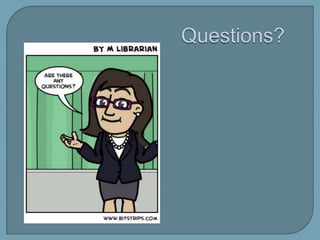
Questions?
Thank you!

Literature Review CIE1001

  • 1.
    Literature ReviewCIE 1001PresentedbyMonique FlaccaventoOISE LibraryOctober 28, 2009
  • 2.
    Agenda What isa literature review? What is its purpose? How does a literature review differ from an academic research paper? Steps in the research process
  • 3.
    Agenda Findingrelevant literature Writing your literature review
  • 4.
    What is aliterature review?“an account of what has been published on a topic by accredited scholars and researchers” Dena Taylor, Health Sciences Writing Centre, University of Torontohttp://www.writing.utoronto.ca/advice/specific-types-of-writing/literature-review
  • 5.
    What is aliterature review?“a piece of discursive prose, not a list describing or summarizing one piece of literature after another”Dena Taylor, Health Sciences Writing Centre, University of Torontohttp://www.writing.utoronto.ca/advice/specific-types-of-writing/literature-review
  • 6.
    What is aliterature review?“[It] may be a self-contained unit -- an end in itself -- or a preface to and rationale for engaging in primary research.”The Writing Centre, University of Wisconsin-Madisonhttp://writing.wisc.edu/Handbook/ReviewofLiterature.html
  • 7.
    What is aliterature review?“A review is a required part of grant and research proposals and often a chapter in theses and dissertations.”The Writing Centre, University of Wisconsin-Madisonhttp://writing.wisc.edu/Handbook/ReviewofLiterature.html
  • 8.
    What is itspurpose?“Generally, the purpose of a review is to analyze critically a segment of a published body of knowledge through summary, classification, and comparison of prior research studies, reviews of literature, and theoretical articles.” The Writing Centre, University of Wisconsin-Madisonhttp://writing.wisc.edu/Handbook/ReviewofLiterature.html
  • 9.
    What is itspurpose?The literature review helps a researcher identify gaps in a body of knowledge worthy of further research.
  • 10.
    What is itspurpose?The literature review:“summarizes and evaluates existing knowledge on a particular topic. Its purpose is to produce a position on the state of that knowledge; this is the thesis”Machi, Lawrence A. & Brenda T. McEvoy. (2009). The Literature review: Six steps to success. Thousand Oaks, CA: Corwin, p. 2
  • 11.
    How does itdiffer from an essay?“the main focus of an academic research paper is to support your own argument”The Writing CentreUniversity of North Carolina at Chapel Hillhttp://www.unc.edu/depts/wcweb/handouts/literature_review.html
  • 12.
    How does itdiffer from an essay?“the focus of a literature review is to summarize and synthesize the arguments and ideas of others.”The Writing CentreUniversity of North Carolina at Chapel Hillhttp://www.unc.edu/depts/wcweb/handouts/literature_review.html
  • 13.
    The Research Process1. Identify your topic. Formulate a clear research question.2. Identify keywords and descriptors or subject headings.3. Make a list of the catalogues, databases / indexes, and websites you plan to search.
  • 14.
    The Research Process4. Search: library catalogues (for books, encyclopaedias, reports, journals, theses, etc.)article databases available through UTL (such as ERIC, PsycInfo, PAIS International, Source OECD); Data Library site
  • 15.
    The Research ProcessTheses (catalogue, T-Space, Dissertations and Theses: Full-Text, AMICUS (LAC))CIDEC R&D Database (http://cide.oise.utoronto.ca/database.php) Google Scholar Websites – Government, United Nations organizations, etc.
  • 16.
    The Research Process5.Refine, focus, or expand your topic as well as your keywords and descriptors6. Scan the literature and critically appraise sources to determine which are the most relevant to your research.
  • 17.
    Ask QuestionsWho isthe author? Is he / she a respected and / or well-cited scholar in the field?Has the article / study been published in a scholarly / academic / peer-reviewed journal? Has the book been published by a reputable publisher?
  • 18.
    Ask QuestionsIs theauthor of the website a reputable organization / individual? How current is the information? When was it last updated?Are the research methods employed sound?Is there bias in the article?
  • 19.
    TipConsider using acitation index (Scopus or Web of Knowledge) or Google Scholar to help you determine which articles are seminal works in your field.Remember, though, that this is not the only criteria which should be used to measure an article’s “worth”.
  • 20.
    TipsCheckyour course outlinefor a list of well-respected CIDE journals Search Ulrich’s Periodicals Directory to determine if a journal is scholarly (“refereed”) Some databases allow you to limit your searches to peer-reviewed / scholarly articles
  • 21.
    Try not toexclude articles which are contrary to your point of view.
  • 22.
    The Research Process7.Revise your topic. You may need to broadenor narrow the scope of your research problem, and refine your keywords / descriptors / subject headings8. Survey the literature: summarize the most relevant articles / research
  • 23.
    The Research Process9.Create a “literature map”. Group or organize the literature hierarchically, by theme / by important concepts / etc.10. Synthesize the literature. Ask yourself what is known about this issue, what major themes have emerged in the literature, and what gaps remain in the body of knowledge.
  • 24.
    The Writing ProcessAclear, concise guide is available online: http://writing.wisc.edu/Handbook/ReviewofLiterature.htmlThe guide includes suggestions regarding what should be included in the introduction, the body, and the conclusion of your literature review.
  • 25.
    Another excellent resourceis:Machi, Lawrence A. & Brenda T. McEvoy. (2009). The Literature review: Six steps to success. Thousand Oaks, CA: Corwin. (call number 001.4 M149L).1 copy of this book is available on short term loan at the OISE Library (Available at the Circulation Desk).
  • 26.
    We’re here tohelp!In person: at the Reference DeskBy phone: 416-978-1860By email: askeloise@oise.utoronto.caVia live chat: askONOr, book an in-depth reference consultation…
  • 27.
    Or, book anin-depth consultation…Monique Flaccavento416-978-1867monique.flaccavento@utoronto.ca
  • 28.
  • 29.