A CITIZEN CENTRIC WORLD
          AND
CHANGING PUBLIC ATTITUDES

      Library Development Council
                    John Creighton
                   March 22, 2010
                      john@creighton.com
                             @johncr8on
                      www.johncr8on.com
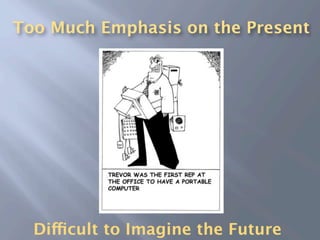
Too Much Emphasis on the Present


  Difficult to Imagine the Future
The World People See at the Moment

                   THE CONSENSUS IN ’95
                 
 “ROLL THE PRESSES!”
                 
 “With few exceptions,
                    virtually everyone
                    agrees that new media
                    is merely a supplement
                    to the traditional print
                    paper.”

                                  - Timeless Values
                                 The Harwood Group
Not Prepared for the Future
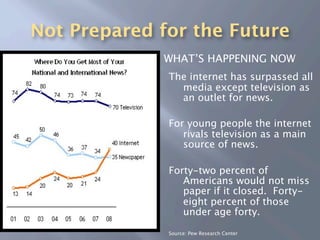
             WHAT’S HAPPENING NOW
              The internet has surpassed all
                media except television as
                an outlet for news.

              For young people the internet
                 rivals television as a main
                 source of news.

              Forty-two percent of
                 Americans would not miss
                 paper if it closed. Forty-
                 eight percent of those
                 under age forty.

              Source: Pew Research Center
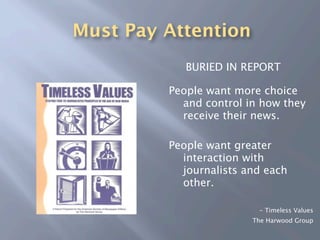
Must Pay Attention
            BURIED IN REPORT

         People want more choice
           and control in how they
           receive their news.

         People want greater
           interaction with
           journalists and each
           other.

                         - Timeless Values
                        The Harwood Group
Message Doesn’t Matter


                         6
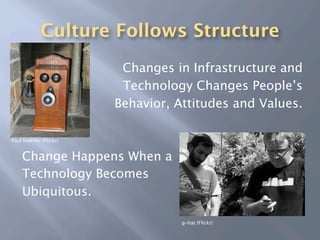
Culture Follows Structure
                         Changes in Infrastructure and
                         Technology Changes People’s
                        Behavior, Attitudes and Values.

Paul Keleher (Flickr)


    Change Happens When a
    Technology Becomes
    Ubiquitous.

                                   g-hat (Flickr)
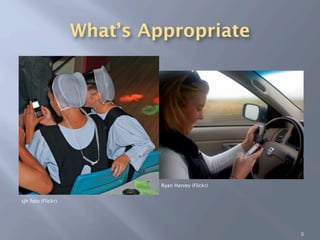
What’s Appropriate


                             Ryan Harvey (Flickr)


sjh foto (Flickr)


                                                    8
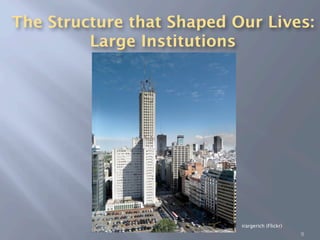
The Structure that Shaped Our Lives:
         Large Institutions


                           irargerich (Flickr)
                                                 9
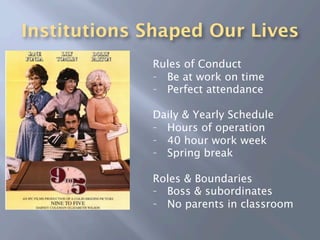
Institutions Shaped Our Lives
             Rules of Conduct
             - Be at work on time
             - Perfect attendance


             Daily & Yearly Schedule
             - Hours of operation
             - 40 hour work week
             - Spring break


             Roles & Boundaries
             - Boss & subordinates
             - No parents in classroom
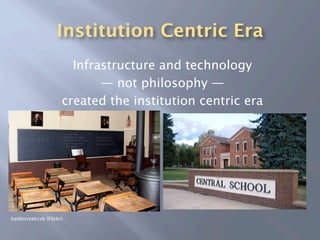
Institution Centric Era
                        Infrastructure and technology
                             — not philosophy —
                      created the institution centric era


battlecreekcvb (Flickr)
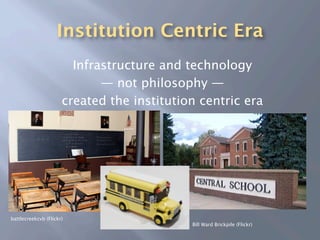
Institution Centric Era
                        Infrastructure and technology
                             — not philosophy —
                      created the institution centric era


battlecreekcvb (Flickr)
                                            Bill Ward Brickpile (Flickr)
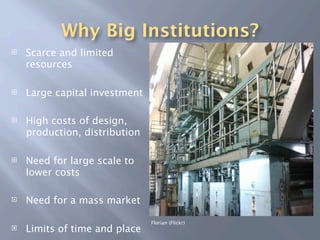
Why Big Institutions?
   Scarce and limited
    resources

   Large capital investment

   High costs of design,
    production, distribution

   Need for large scale to
    lower costs

   Need for a mass market

                               Florian (Flickr)
   Limits of time and place
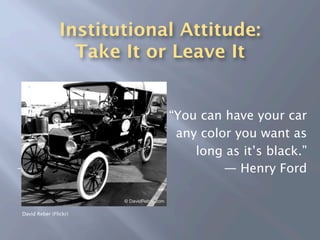
Institutional Attitude:
                      Take It or Leave It


                                “You can have your car
                                 any color you want as
                                    long as it’s black.”
-                                        — Henry Ford


    David Reber (Flickr)
Institution Centric Era Is Over

   “Transformative change happens when
 industries democratize, when they are ripped
      from the sole domain of companies,
    governments, and other institutions and
         handed over to regular folks.”

             - Chris Anderson
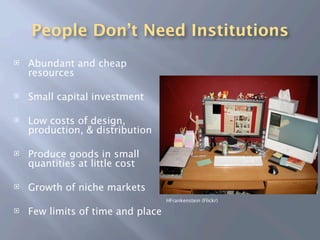
People Don’t Need Institutions
   Abundant and cheap
    resources

   Small capital investment

   Low costs of design,
    production, & distribution

   Produce goods in small
    quantities at little cost

   Growth of niche markets
                                   HFrankenstein (Flickr)

   Few limits of time and place
Culture Follows Structure
New infrastructure and technology are changing
     people’s expectations for institutions.

 Leaving behind an institution centric society
 – a time when institutions shaped our lives.

       Entering a citizen centric society
– a time when people expect to tailor own lives.
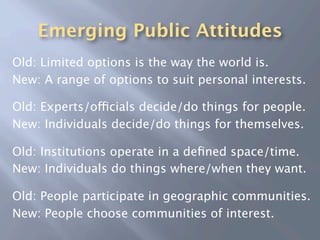
Emerging Public Attitudes
Old: Limited options is the way the world is.
New: A range of options to suit personal interests.
Emerging Public Attitudes
Old: Limited options is the way the world is.
New: A range of options to suit personal interests.

Old: Experts/officials decide/do things for people.
New: Individuals decide/do things for themselves.
Emerging Public Attitudes
Old: Limited options is the way the world is.
New: A range of options to suit personal interests.

Old: Experts/officials decide/do things for people.
New: Individuals decide/do things for themselves.

Old: Institutions operate in a defined space/time.
New: Individuals do things where/when they want.
Emerging Public Attitudes
Old: Limited options is the way the world is.
New: A range of options to suit personal interests.

Old: Experts/officials decide/do things for people.
New: Individuals decide/do things for themselves.

Old: Institutions operate in a defined space/time.
New: Individuals do things where/when they want.

Old: People participate in geographic communities.
New: People choose communities of interest.
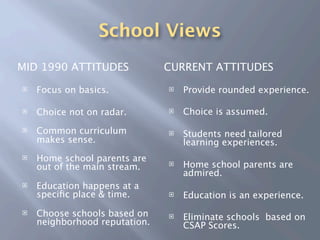
School Views
MID 1990 ATTITUDES             CURRENT ATTITUDES
   Focus on basics.              Provide rounded experience.

   Choice not on radar.          Choice is assumed.
   Common curriculum             Students need tailored
    makes sense.                   learning experiences.
   Home school parents are
    out of the main stream.       Home school parents are
                                   admired.
   Education happens at a
    specific place & time.         Education is an experience.
   Choose schools based on       Eliminate schools based on
    neighborhood reputation.       CSAP Scores.
Biggest Change: 90s to Now

   Choosing a school has become another
    form of individual self-expression.

   Bottom line for parents: Does this school
    support my vision for my child?
Will People Perceive Need for
               School Districts?
   School districts purchased text books and
    curriculum individuals could not afford.
       Cost of text books/curriculum moving toward zero.
   School districts built places for teachers and
    students to gather.
       13,000 Colorado students enroll with online schools.
       2% of St. Vrain students go to online schools.
   School districts provide students transportation.
       Transportation is a cheap good compared to 1970.
       1970 < 1 vehicle per driver; Today 1.2 vehicles per
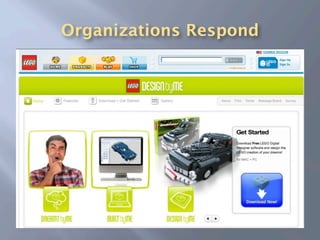
Organizations Respond
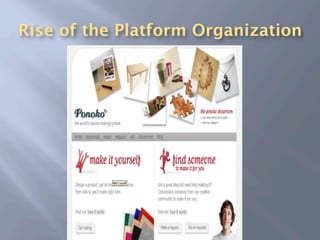
Rise of the Platform Organization
Citizen Centric Society Begs
       Fundamental Questions
   What kinds of institutions are needed in a
    citizen centric society?

   How do existing institutions need to adapt
    to shift toward a citizen centric society?

   What problems do people need solved now?

   How can institutions help facilitate that?

Library Development Council Citizen Centric

  • 1.
    A CITIZEN CENTRICWORLD AND CHANGING PUBLIC ATTITUDES Library Development Council John Creighton March 22, 2010 john@creighton.com @johncr8on www.johncr8on.com
  • 2.
    Too Much Emphasison the Present Difficult to Imagine the Future
  • 3.
    The World PeopleSee at the Moment THE CONSENSUS IN ’95 “ROLL THE PRESSES!” “With few exceptions, virtually everyone agrees that new media is merely a supplement to the traditional print paper.” - Timeless Values The Harwood Group
  • 4.
    Not Prepared forthe Future WHAT’S HAPPENING NOW The internet has surpassed all media except television as an outlet for news. For young people the internet rivals television as a main source of news. Forty-two percent of Americans would not miss paper if it closed. Forty- eight percent of those under age forty. Source: Pew Research Center
  • 5.
    Must Pay Attention BURIED IN REPORT People want more choice and control in how they receive their news. People want greater interaction with journalists and each other. - Timeless Values The Harwood Group
  • 6.
  • 7.
    Culture Follows Structure Changes in Infrastructure and Technology Changes People’s Behavior, Attitudes and Values. Paul Keleher (Flickr) Change Happens When a Technology Becomes Ubiquitous. g-hat (Flickr)
  • 8.
    What’s Appropriate Ryan Harvey (Flickr) sjh foto (Flickr) 8
  • 9.
    The Structure thatShaped Our Lives: Large Institutions irargerich (Flickr) 9
  • 10.
    Institutions Shaped OurLives Rules of Conduct - Be at work on time - Perfect attendance Daily & Yearly Schedule - Hours of operation - 40 hour work week - Spring break Roles & Boundaries - Boss & subordinates - No parents in classroom
  • 11.
    Institution Centric Era Infrastructure and technology — not philosophy — created the institution centric era battlecreekcvb (Flickr)
  • 12.
    Institution Centric Era Infrastructure and technology — not philosophy — created the institution centric era battlecreekcvb (Flickr) Bill Ward Brickpile (Flickr)
  • 13.
    Why Big Institutions?  Scarce and limited resources  Large capital investment  High costs of design, production, distribution  Need for large scale to lower costs  Need for a mass market Florian (Flickr)  Limits of time and place
  • 14.
    Institutional Attitude: Take It or Leave It “You can have your car any color you want as long as it’s black.” - — Henry Ford David Reber (Flickr)
  • 15.
    Institution Centric EraIs Over “Transformative change happens when industries democratize, when they are ripped from the sole domain of companies, governments, and other institutions and handed over to regular folks.” - Chris Anderson
  • 16.
    People Don’t NeedInstitutions  Abundant and cheap resources  Small capital investment  Low costs of design, production, & distribution  Produce goods in small quantities at little cost  Growth of niche markets HFrankenstein (Flickr)  Few limits of time and place
  • 17.
    Culture Follows Structure Newinfrastructure and technology are changing people’s expectations for institutions. Leaving behind an institution centric society – a time when institutions shaped our lives. Entering a citizen centric society – a time when people expect to tailor own lives.
  • 18.
    Emerging Public Attitudes Old:Limited options is the way the world is. New: A range of options to suit personal interests.
  • 19.
    Emerging Public Attitudes Old:Limited options is the way the world is. New: A range of options to suit personal interests. Old: Experts/officials decide/do things for people. New: Individuals decide/do things for themselves.
  • 20.
    Emerging Public Attitudes Old:Limited options is the way the world is. New: A range of options to suit personal interests. Old: Experts/officials decide/do things for people. New: Individuals decide/do things for themselves. Old: Institutions operate in a defined space/time. New: Individuals do things where/when they want.
  • 21.
    Emerging Public Attitudes Old:Limited options is the way the world is. New: A range of options to suit personal interests. Old: Experts/officials decide/do things for people. New: Individuals decide/do things for themselves. Old: Institutions operate in a defined space/time. New: Individuals do things where/when they want. Old: People participate in geographic communities. New: People choose communities of interest.
  • 22.
    School Views MID 1990ATTITUDES CURRENT ATTITUDES  Focus on basics.  Provide rounded experience.  Choice not on radar.  Choice is assumed.  Common curriculum  Students need tailored makes sense. learning experiences.  Home school parents are out of the main stream.  Home school parents are admired.  Education happens at a specific place & time.  Education is an experience.  Choose schools based on  Eliminate schools based on neighborhood reputation. CSAP Scores.
  • 23.
    Biggest Change: 90sto Now  Choosing a school has become another form of individual self-expression.  Bottom line for parents: Does this school support my vision for my child?
  • 24.
    Will People PerceiveNeed for School Districts?  School districts purchased text books and curriculum individuals could not afford.  Cost of text books/curriculum moving toward zero.  School districts built places for teachers and students to gather.  13,000 Colorado students enroll with online schools.  2% of St. Vrain students go to online schools.  School districts provide students transportation.  Transportation is a cheap good compared to 1970.  1970 < 1 vehicle per driver; Today 1.2 vehicles per
  • 25.
  • 26.
    Rise of thePlatform Organization
  • 27.
    Citizen Centric SocietyBegs Fundamental Questions  What kinds of institutions are needed in a citizen centric society?  How do existing institutions need to adapt to shift toward a citizen centric society?  What problems do people need solved now?  How can institutions help facilitate that?