First Principles:

   Designing Effective
   Education Programs
   Using Information
   and Communication
   Technology (ICT)
   Compendium                                                                                          Credit: American Institutes for Research


This First Principles: Designing Effective Education Programs Using Information and Communication Technology (ICT) Compendium provides
important overview guidance for designing and implementing education programs that use technology.The principles and indicators
are primarily meant to guide program designs, including the development of requests for and subsequent review of proposals, the
implementation of program activities, and the development of performance management plans, evaluations, and research studies.
The First Principles are intended to help USAID education officers specifically, as well as other stakeholders—including staff in donor
agencies, government officials, and staff working for international and national non-governmental organizations—take advantage
of good practices and lessons learned to improve projects that involve the use of education technology. The guidance in this
document is meant to be used and adapted for a variety of settings to help USAID officers and others grapple with the multiple
dimensions of ICT in education and overcome the numerous challenges in applying ICT in the developing-country contexts. The
last section provides references for those who would like to learn more about issues and methods for supporting the education
of the underserved. This document is based on extensive experience in, and investigation of, current approaches to technology in
education and draws on research literature, interviews with USAID field personnel, and project documentation. It also includes
profiles of projects funded by USAID and others.This Compendium provides greater depth for those who are interested in knowing
more on this topic. A shorter companion piece called a Digest provides a brief overview of key considerations in the planning and
implementation of education technology projects.
Acknowledgements
                             USAID commissioned this document, First Principles of Designing Effective
                             Education Programs Using Information and Communication Technology (ICT),
                             through the Educational Quality Improvement Program 1 (EQUIP1), with the
                             American Institutes for Research in cooperation with Juárez & Associates and
                             The Natoma Group.

                             First Principles of Designing Effective Education Programs Using Information and
                             Communication Technology (ICT) was developed under the guidance of Suezan
                             Lee, former USAID AOTR of EQUIP1, Yolande Miller-Grandvaux, current
                             AOTR of EQUIP1, Pamela Allen, Director of EQUIP1 at AIR and Cassandra
                             Jessee, AIR Deputy Director of EQUIP1.

                             The authors wish to acknowledge the contributions of several USAID
                             personnel and consultants who were kind enough to participate in interviews:
                             Jean Beaumont, Lela Jakovlevska, Thomas LeBlanc, Andrea Pinnock, Claire
                             Spence, and Melody Williams. Feedback, excellent criticism, and suggestions
                             on improving the material have been provided by: Steve Anzalone, Michael
                             Trucano, Roy Zimmerman, Mark Bellinger, Grace Akukwe, and Larry Goldman.
                             A special thanks goes to Cassandra Jessee who managed the sometimes
                             challenging development process. Editorial support was provided by Holly
                             Baker and Phil Esra and design support was provided by Becca Simon and the
                             AIR Design Team.

                             EQUIP1: Building Educational Quality through Classrooms, Schools, and
                             Communities is a multi-faceted program designed to raise the quality of
                             classroom teaching and the level of student learning by effecting school-
                             level changes. EQUIP1 serves all levels of education, from early childhood
                             development for school readiness, to primary and secondary education, adult
                             basic education, pre-vocational training, and the provision of life-skills. Activities
                             range from teacher support in course content and instructional practices,
                             to principal support for teacher performance, and community involvement
                             for school management and infrastructure, including in crisis and post-crisis
                             environments.


                             This report is made possible by the generous support of the American people
                             through the United States Agency for International Development (USAID).
                             The contents are the responsibility of the Educational Quality Improvement
                             Program 1 (EQUIP1) and do not necessarily reflect the views of USAID or the
                             United States Government.

                             The cooperative agreement number is: GDG-A-00-03-00006-00.


i   First Principles: Designing Effective Education Programs Using Information and Communication Technology (ICT)
Acronyms
ADSL	              Asymmetric Digital Subscriber Line
AED	               Academy for Educational Development
CAI	               Computer-Assisted Instruction
CD-ROM	            Compact Disc–Read-Only Memory
CFSK	              Computers for Schools Kenya
CPU	               Central Processing Unit
CSR	               Corporate Social Responsibility
DBE	               Distributed Basic Education 			
DCGEP	             Discovery Channel Global Education Partnership
DFID	              UK Department for International Development
DVD	               Digital Video Disc
EAC	               East Africa Commission
EDC	               Education Development Center
EEH Project	       Expanding Educational Horizons Project
EMIS 	             Education Management Information System
EQUIP	             Educational Quality Improvement Program
ESMIS	             Education Sector Management Information System
EU	                European Union
FOD	               Fundación Omar Dengo
FQEL	              Fundamental Quality and Equity Levels project
GDA	               Global Development Alliance
GIS	               Geographic Information Systems
GPS	               Global Positioning System
GPRS	              Global Packet Radio Switching
GTL	               Group Teaching and Learning (software)
HEART Trust/NTA	   Human Employment and Resource Training/National Training Agency
ICT 	              Information and Communications Technologies
                   (also “IT,” as in “IT curriculum” or “IT teacher”)
IDB	               Inter-American Development Bank
IDRC	              International Development Research Center
iNET	              Initiative for Namibian Education Technology
INTALEQ	           Innovations in Technology-Assisted Learning for Educational Quality
IRI	               Interactive Radio Instruction
JSAS	              Jamaica School Administration Software
JEI	               Jordan Education Initiative
KERIS	         Korean Education & Research & Information Service
LDC	           Least Developed Country
LOP funding	   Life of Project funding
M4Ed4Dev	      Mobiles for Education for Development
MINEDUC	       Ministry of Education of Rwanda
MOE	           Ministry of Education (multiple countries)
MOEY	          Ministry of Education and Youth (Jamaica)
MOU	           Memorandum of Understanding			
NIIS	          National Integrated Information System
NEI	           National Education Indicators
NEPAD	         New Partnership for Africa’s Development
NGO	           Non-Governmental Organization
OECD	          Organization for Economic Cooperation and Development
OER	           Open Educational Resource
OLPC	          One Laptop Per Child
PC	            Personal Computer
PEP	           Primary Education Project
PHARE	         Programme Harmonisé d’Appui au Renforcement de l’Education
PMO	           Project Management Office
SDS	           School Data System
SEAMOLEC	      South East Asia Ministers of Education Regional Open Learning Centre
SIEEQ	         Stratégies Intégrées pour une Education Equitable et de Qualité
SQL	           Structure Query Language
SSTC	          Student Support Technician Club
T4 Project	    Technology Tools for Teaching & Training Project
TCO	           Total Cost of Ownership
ToT	           Training of Trainers
TRIMS	         Tool for Reporting and Information Management in Schools
USAID	         United States Agency for International Development
USF	           Universal Service Funds
VOIP	          Voice Over Internet Protocol
VPN	           Virtual Private Network
VSAT	          Very Small Aperture Terminal
WCE	           World Computer Exchange
WEF	           World Economic Forum
3G	            Third Generation (wireless)
Contents
               Introduction ……………………………………………………………………………………                                                         1
               10 Key Principles for Developing Ict in Education Programs……………………………                                 7
               	    Principle 1:	 Use ICT to achieve education and development goals. ………………………                      7
               	    Principle 2:	 Use ICT to enhance student knowledge and skills. …………………………… 11
               	    Principle 3:	 Use ICT to support data-driven decision making. …………………………… 13
               	    Principle 4:	 Include all short- and longer-term costs in budget planning. ………………… 16
               	    Principle 5:	 Explore technology alternatives to find appropriate solutions. ……………… 20
               	    Principle 6:	 Focus on teacher development, training and ongoing support.………………… 24
               	    Principle 7:	 Explore and coordinate involvement of many different stakeholders. ………… 28
               	    Principle 8:	 Develop a supportive policy environment. …………………………………… 33
               	    Principle 9:	 Integrate monitoring and evaluation into project planning. …………………… 35
               	    Principle 10: 	“It takes capacity to build capacity”—System strengthening
                    	              precedes system transformation. ……………………………………………… 37

               Challenges and Limitations…………………………………………………………………… 40

               Suggested Indicators of Success……………………………………………………………… 42
               Conclusion……………………………………………………………………………………… 45

               Essential Reading……………………………………………………………………………… 46
               Annex A: Glossary……………………………………………………………………………… 47


First Principles: Designing Effective Education Programs Using Information and Communication Technology (ICT)   iv
Introduction                                                                 finance, manufacturing, health, agriculture, and government. As
                                                                             these changes are taking place, ministries of education (MOEs)
     The illiterate of the 21st century will not be those who cannot         and donor agencies grapple with questions about appropriate,
     read and write, but those who cannot learn, unlearn, and relearn.       effective, and valuable uses of education technology for learning,
                                                                             teaching, and strengthening educational systems: Is ICT the
                                         —Alvin Toffler, American Futurist   most cost-effective way to improve our students’ performance?
                                                                             How can we connect our ICT projects in schools to improved
The emergence of information and communication technologies
                                                                             youth employment? How should we gauge the support that
(ICT) as a force in social and economic development presents
                                                                             technology companies are offering? Should we invest in a “one
a wide range of possibilities to the education systems of
                                                                             laptop per child” initiative?
developed and developing countries. ICT also creates challenges:
By accelerating the expansion of information and increasing the              In many developing countries, efforts to build strong
value of knowledge, technology challenges schools to support                 educational foundations benefit from the use of technology
learning that helps them build skills that they can use now and              to address problems that cause chronically poor learning
that will support their participation in civic and economic life             outcomes. Such problems frequently include teachers’ limited
in a dynamic future.                                                         capacities, the lack of textbooks or other resources, poor
                                                                             school management, poor central decision making, and lessons
Technology has transformed social and economic life in
                                                                             that are irrelevant to the lives of students. These systemic
countries with emerging economies, in many developing
                                                                             problems limit the development of literacy and numeracy
countries, and in many communities in Least Developed
                                                                             skills, as well as the higher-order thinking skills essential for
Countries (LDCs).The scope of change includes sectors such as
                                                                             participation in the global economy. Well-conceived uses of
                                                                             radio, mobile phones, computers, the Internet, and other tools
                                                                             can help provide large-scale solutions to those problems: The
                                                                             USAID-supported Technology Tools for Teaching & Training (T4)
                                                                             program, for example, uses radio, video, computers, multimedia
                                                                             content, and the Internet to reach 42 million students in eight
                                                                             states in India.1 Interactive Radio Instruction (IRI), a relatively
                                                                             low-cost use of technology, has been shown to have a positive
                                                                             impact on learning through different approaches across many
                                                                             different countries.2 In addition, many smaller-scale studies
                                                                             have demonstrated the connection between the effective use
                                                                             of computers and the Internet in schools and the development
                                                                             of a range of 21st century skills.3


                                                                             1	http://t4india.idd.edc.org
                                                                             2	 Tuned in to Student Success: Assessing the Impact of Interactive Radio Instruc-
                                                                                tion Summary, by Jennifer Ho and Hetal Thurkal (Newton, Mass: Education
                                                                                Development Center; 2009; http://idd.edc.org/resources/publications/
                                                                                tuned-student-success-assessing-impact-interactive-radio-instruction-
                                                                                summary; accessed January 13, 2011).
                                                                             3	 References include Are the New Millennium Learners Making the Grade?
                                                                                (Paris: OECD Centre for Educational Research and Innovation; 2010);
                                                                                Laptops and Literacy, by Mark Warschauer (New York: Teachers College
                                                                                Press; 2006); and a meta-analysis of research, Evaluation of Evidence-Based
                                                                                Practices in Online Learning: A Meta-Analysis and Review of Online Studies,
                                                                                by Means et al. (Washington, DC: U.S. Department of Education; 2009).
                                                                                Additional sources are summarized in ICT Policies and Educational
Credit: Edmond Gaible/The Natoma Group                                          Transformation, by Robert Kozma (New York: UNESCO; in press).

    1         First Principles: Designing Effective Education Programs Using Information and Communication Technology (ICT)
What do we mean by “ICT”?
In this First Principles document, information and communication                     ICT includes multiple technology platforms and
technology or “ICT” includes “tools and resources used to                            approaches
communicate, and to create, disseminate, store, and manage
                                                                                     The range of ICT projects in education is broad, with
information.”4 Such tools are frequently lumped together as,
                                                                                     many different kinds of tools used in many different
simply, “technology.” However, the initial definition frames a
                                                                                     configurations. Some examples follow:
rapidly expanding group of different tools used in education
and in development.5 Broad categories of these tools include                         •	    Television broadcasts to create“virtual classrooms”
radio (and audio recordings), television (and video recordings),                           for junior secondary students (Telesecundaria,
mobile telephones and smart phones, desktop and laptop                                     Mexico,9 and the USAID-supported Mindset
computers, and local networks and the Internet. But in each                                Primary School Channel, South Africa10)
category, new products are being developed, adapted, or
marketed all the time for use in developing-country schools                          •	    Radio broadcasts to deliver effective English-
and communities. New tools specific to education include the                               language lessons to primary students (T4,
One Laptop Per Child (OLPC) Children’s Machine XO and the                                  India, Sous la fromager, Pas a Pas, The Gambia,
Intel Classmate netbooks. Commercial and NGO-focused ICT                                   and Programme Haïtien d’Appui à la Réforme de
tools that have proven useful in schools and communities range                             l’Éducation (PHARE), Mali11)
from the Freeplay hand-crank and solar-rechargeable radios6
to Frontline SMS7 communications software to VSAT satellite                          •	    DVD recordings of televised wildlife shows for
Internet connectivity.8                                                                    use in science class (Discovery Channel Global
                                                                                           Education Partnership, Romania12)
A brief list of key resources on ICT in education is presented
at the end of the document.                                                          •	    Digital camcorder recordings of teachers’
                                                                                           classroom activities to support training (SIEEQ,
                                                                                           Congo13)

                                                                                     •	    Mobile-telephone-based SMS messages to request
                                                                                           downloadable video resources (Text2Teach, the
                                                                                           Philippines; Bridgeit, Tanzania14)

                                                                                     •	    Education management information system
                                                                                           (EMIS) and databases for school-based reporting
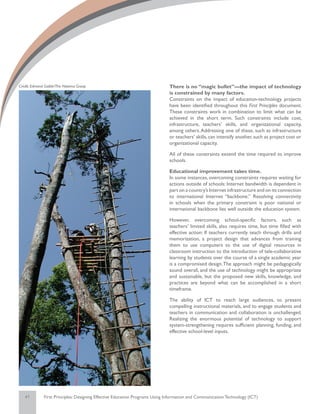
                                                                                           (e.g., Kenya, Egypt, Guatemala)
4	 “New Directions of ICT-Use in Education,” by C. Blurton (New York:
   UNESCO; 1999); http://www.unesco.org/education/educprog/lwf/dl/
   edict.pdf
5	 “ICT4E” and “ICT4D,” respectively.
6	 www.freeplayenergy.com.
7	 Frontline SMS (www.frontlinesms.com) enables NGOs, civil-society or-
   ganizations, and others to use a computer or mobile phone to send text        11	 “Tuned in to Student Success: Assessing the Impact of Interactive Radio
   messages (or “Short Message Service” texts) to many users at one time             Instruction for the Hardest-to-Reach,” by Jennifer Ho and Hetal Thukal,
   and to store both users’ telephone numbers and their responses locally.           Journal of Education for Internatioal Development, v4n2, Dec09.
8	 “Very Small Aperture Terminal” or VSAT dishes have proven useful in           12	 “Learning Center Project in Romania: Evaluation Report,” by Corina
   bringing Internet connectivity to remote locations.                               Cace and Sorin Cace, Virtual Resources Center in Social Work, v12, Jun2010
                                                                                     (http://ideas.repec.org/a/lum/rev6rl/v12y2010ip1-99.html; accessed
9	 Television for Secondary Education: Experience of Mexico and Brazil, by
                                                                                     January 15, 2011).
   Laurence Wolff, Claudio e Moura Castro, Juan Carlos Navarro, and
   Norma Garcia; ICT in Education Toolkit (http://www.ictinedtoolkit.org/        13	 dot-EDU quarterly report, January-March 2007 (http://pdf.usaid.gov/
   usere/library/tech_for_ed_chapters/10.pdf; accessed January 16, 2011).            pdf_docs/PDACK572.pdf; accessed January 15, 2011).
10	 Africa Education Initiative: South Africa Case Study (USAID; 2005; http://   14	 Metasurvey of ICT in Education in Asia and the Pacific, edited by Glen Parks
    pdf.usaid.gov/pdf_docs/PNADG232.pdf; accessed January 15, 2011).                 and Cédric Wachholz (Bangkok: UNESCO; 2003).
Trends in ICT innovation                                            models, and to projects that draw strongly from proven tools
                                                                    and models.
The development of new information and communications
tools is dynamic and accelerating. Rapid changes in the             Drivers of ICT adoption in developing countries
marketplace challenge governments and education systems
to keep up to date, but also present many opportunities to          Country governments and donor agencies, including USAID,
extend access to ICT in schools and rural areas, and to engage      have made substantial investments in education technology.
teachers and students in new ways.                                  Developing and emerging-economy countries that have launched
                                                                    nationwide programs include Argentina, Armenia, Chile, The
Over the past 20 years, ICT in schools has been commonly            Gambia, Jamaica, Jordan, Mexico, Namibia, Peru, Russia, Rwanda,
associated with desktop computers and fixed-line Internet           Sri Lanka, Syria, Turkey, Uruguay, and many others. Some of
connectivity. However, throughout that period, radio and            these programs have used broadcast technologies such as radio
television (and DVDs, audio tapes, CDs, and other media)            (The Gambia) or television (Mexico). Others have established
have also been deployed in large-scale projects and have            web portals15 to disseminate learning resources and teacher
been shown to increase student motivation, promote change           resources (Argentina, Chile), while still others have launched
in classroom practices, and support other improvements              one-to-one (1:1) initiatives using low-cost laptops (Peru,
in education systems. Today, reductions in the cost, size, and      Rwanda, Uruguay).
power requirements of microchips have lowered the cost
and increased the flexibility of ICT. These changes have been       In addition to these large-scale programs, donor agencies,
accompanied by the creation of digital versions of familiar         governments, and other organizations have launched
tools such as cameras and telephones, and by the emergence          hundreds of pilot projects to test and improve approaches
of new, less familiar tools such as tablet PCs and wireless data    to using technology to improve teaching, learning, and school
networks. Non-digital innovations, such as flexible and portable    management, while school committees and parents in countries
solar cells have also been combined with digital technologies to    around the world have used their own resources to give their
extend the reach of ICT to infrastructure-poor areas.               children access to computers and the Internet in schools.

As the boundaries between different kinds of devices have           All of these efforts are underpinned by the shared belief that
blurred, the pathways for introducing technology into schools       ICT has enormous potential to transform education and that
have multiplied. Interactive whiteboards, or “smart boards,”        schools will fall into irrelevance if they are unable to incorporate
enable teachers and students to write, draw, and erase, just as     technology into their operations, especially into teaching and
teachers do using traditional chalk boards. But smart boards also   learning.The increasing importance of the knowledge economy
enable them to show images and videos, and record and export        challenges education systems to improve their performance
their writing as digital files. Mobile phones combine telephone     overall and to integrate new competencies, new procedures,
functionality with databases of contacts, SMS, cameras, and         and new ways of interacting both into their own operations
video cameras, while smart phones go several steps further,         and into students’ learning.
adding data communications and more powerful processors to
                                                                    Technology also enables developing-country governments to
support email and web browsing, Global Positioning System
                                                                    address many of the systemic challenges to their efforts to
(GPS) functions, and catalogs of downloadable purpose-built
                                                                    increase access to and improve the quality of education cost
tools ranging from dictionaries to scanners to knowledge-
                                                                    effectively and at scale.
management systems.
                                                                    In light of these rapid and far-reaching changes, the principles
The emergence of new tools and the blurring of boundaries
                                                                    that follow are for the most part “platform neutral” in terms of
between tools combine to greatly increase the possibilities for
                                                                    technology. They pertain to any project that seeks to leverage
the use of technology in schools.The principles presented in this
                                                                    technologies to increase its scope, scale or impact—whether
document, however, focus without exception on considerations
                                                                    that project involves the use of radio in classrooms, teachers’
with regard to planning and management, not on the tools
                                                                    mobile phones, or school computer labs. These principles are
themselves.These principles and the core strategies elaborated
                                                                    accompanied by examples of relevant and innovative projects
under them can be (and should be) applied to projects that
are exploring “leading edge” technologies and implementation        15	 www.relpe.org provides a list of education portals in Latin America.
Credit: Cassandra Jessee/AIR


that reflect good practices. These principles and projects                          Linking ICT in education to levels of development
are intended to serve as guideposts to the effective use of
technology to support schools now and in the future.                                Many studies find that educational success is an important
                                                                                    factor in individual earnings and in economic and social
These principles have emerged over more than 15 years of                            development.16 Accordingly, in many developing countries,
efforts to use technology to strengthen schools in developing                       improving learning and strengthening educational systems
countries. Many project planners, when they consider the                            are considered imperatives.17 Introducing computers and the
use of ICT, underestimate the challenges of introducing any                         Internet is frequently viewed in developing countries as a swift
new technology into school environments. Poor electrical                            and at times futuristic measure to modernize schools. A senior
power, unsustainable maintenance costs, inadequate Internet                         education specialist at the USAID mission in Macedonia frames
connectivity, resistant or unmotivated teachers, outdated or                        a range of ambitious potential impacts to be achieved through
unproven technologies—these and many other factors have                             the use of technology in schools:
diminished the impact of education-technology projects time
and time again. As important, schools and school systems                               “The role of ICT can be to provide alternative sources of
themselves contain many factors that create resistance to                              information, outside of textbooks. Technology is another source of
                                                                                       quick information, available in a few minutes. Schools don’t need to
change: Existing curricula, textbooks, and high-stakes
                                                                                       have sophisticated labs. Students can perform virtual experiments,
assessments—for example—all constrain teachers to
follow traditional methods of instruction, to minimize
the use of new tools, and to focus students’ learning
on mastery of the narrowest possible skill sets and                                 16	 “Economic Outcomes and School Quality,” by Eric Hanushek (Paris:
bodies of knowledge. The principles presented here can                                  UNESCO; 2005).
identify and help overcome barriers that arise in the use                           17	 “Leadership, Education Change and the Knowledge Society,” by Edmond
of ICT and can help ensure that ICT is used effectively to                              Gaible (Dublin, Ireland: GeSCI; 2010) (http://www.gesci.org/assets/files/
                                                                                        Education%20change,%20leadership%20and%20the%20knowledge%20
improve education.
                                                                                        society.pdf; accessed May 20, 2011).


                               First Principles: Designing Effective Education Programs Using Information and Communication Technology (ICT)                 4
work with 3D math images—to help make up for resource and                assistance,18 linking ICT directly to the need to increase access
  teaching aids that are not available. And technology promotes the        to education and to improve the quality of instruction in
  exchange of information, through social networks, forums, blogs,         specific high-need areas.
  so that there’s a quick exchange of information among students.
  And these students are already using computers to communicate            Most important, the Strategy makes “scale” the highest priority
  outside of school.”                                                      criterion for determining the readiness of country programs to
                                                                           receive support for educational programs.19 Goal 1, to achieve
Macedonia’s successful Primary Education Project (PEP) has,
                                                                           “[i]mproved reading skills for 100 million children by 2015,”20
over the course of its implementation, realized the potential
                                                                           quantifies the need to increase the reach of education initiatives
of technology to help schools achieve such high levels of
                                                                           to reach the largest possible number of students and schools.
engagement with information, resources and peers.
                                                                           As demonstrated by the T4 project in India, and by many other
However, in many countries, infrastructure, technical skill and            projects presented in this document, the use of broadcast and
the technology private sector, teachers’ levels of education               network technologies has the potential to expand services and
and professionalism, and a host of other factors are not yet               increase access cost effectively.
ready to support either the tools or the practices used in PEP.
                                                                           (For more information about the T4 project, see Principle 5:
Approaches to the use of technology in schools and school
                                                                           Explore technology alternatives to find appropriate solutions.)
systems should be appropriate to a country’s current level of
social and economic development, and to the capacity levels                When technology is used to increase program scale, it is
in schools and in the ministry of education. Initiatives that              functioning as part of the “education infrastructure,” supporting
transform teaching and learning in one country can entail high             the operations and services that are essential to the education
risks in another.                                                          system. In this way, technology can be integrated into program
                                                                           designs to support other key points of focus identified in the
Underlying many of the principles in this document—and
                                                                           Strategy, such as:
underlying all good practices in the use of technology in
schools—is the precept that program goals, activities, tools,              Improved reading
and resources must be matched to the conditions in schools                 Improved reading forms the cornerstone of the USAID
and in society.                                                            Education Strategy. Technology offers many proven means of
                                                                           supporting students’ efforts to improve their reading skills,
(For more information, refer to Principle 10: “It takes capacity
                                                                           including assistive technologies such as text-to-speech. Jamaica’s
to build capacity” – System strengthening precedes system
                                                                           Expanding Educational Horizons (EEH) project, profiled in this
transformation.)
                                                                           document, pilot tested the use of “talking word processors”
USAID programming in ICT for education                                     to help students improve spelling, grammar, and other basic
                                                                           reading and writing skills.
USAID is among the world’s largest bilateral supporters
of technology projects in education. Such projects use                     Gender equality
technology to increase access to basic education, to support               The Strategy specifies that program designs should “promote
the development of literacy and numeracy skills, to improve                gender parity, gender equity and focus on improving education
the management of schools and education systems, to enhance                quality for both boys and girls.”21 Although technology is
the relevance and quality of learning, and to extend educational
opportunities to marginalized and vulnerable populations,
including those in crisis and conflict environments.

Technology and the USAID 2011 Education Strategy
                                                                           18	 Education Strategy: Opportunity Through Learning, Washington, DC: USAID;
The current USAID Education Strategy, released in February 2011,               2011, p 7.
specifically identifies “innovation, science and technology” as
                                                                           20	 Op. cit., 7.
the main elements of comparative advantage of U.S. education
                                                                           20	 Op. cit., 9.
                                                                           21	 Op. cit., 8.

   5        First Principles: Designing Effective Education Programs Using Information and Communication Technology (ICT)
frequently seen as more appealing to boys,22 specific content                to provide opportunities for direct instruction of learners and
and approaches can be crafted to enhance girls’ education, as                for support for teachers in challenging and dangerous areas by
they are in the T4 project.                                                  enabling the safe delivery of high-quality learning resources in
                                                                             electronic form, and by supporting communications, distance
Workforce-relevant skills                                                    learning, and other means of providing access to education in
The Strategy highlights the need for education, including                    remote, crisis, and conflict conditions.25
secondary-level vocational and technical education, that helps
young people to build “relevant knowledge and skills” that will              In addition to its impact on learning, technology is also vital to
enable them to “fully participate in and contribute to economic              the effort to improve decision-making through the aggregation
development.”23 Technology plays a dual role in this effort, as an           and analysis of information. The Strategy includes the goal
enabling tool and as a subject.                                              of “increas[ing] accountability through the measurement
                                                                             and disclosure of information about education program
Access in crisis and conflict environments                                   effectiveness, relevance and efficiency.”26
Ensuring the safety of students, teachers, trainers, and aid
workers poses one of the critical challenges to expanded access              (For more information about the broader uses of ICT to
to education in areas of crisis and conflict. The Strategy lists the         make significant improvements in learning and livelihood, and
goal of “increased equitable access to education in crisis and               for additional information about the concept of “education
conflict environments for 15 million learners by 2015.”24 The                infrastructure,” refer to Principle 1: Use ICT to achieve education
infrastructural function that technology plays has high potential            and development goals.)


22	 For a nuanced and experimentally based discussion of girls’ and boys’    24	 Op. cit., 13.
    approaches to technology, see The Second Self: Computers and the Human
                                                                             25	 Open and Distance Learning for Basic Education in South Asia: Its potential
    Spirit (New York: Simon & Schuster; 1985).
                                                                                 for hard-to-reach children and children in conflict and children in conflict and
23	 Op. cit., 12.                                                                disaster areas, Kathmandu, Nepal: UNICEF; 2009.
24	 Op. cit., 13.                                                            26	 USAID, op.cit., 15.


Credit: Edmond Gaible/The Natoma Group
10 Key Principles for Developing                                Principle 1: Use ICT to achieve education and
                                                                development goals.
ICT in Education Programs
                                                                Technology is a cross-cutting resource that should be seen
The “first principles” that follow are intended to guide        as a sustainable, accessible, and valuable means of supporting
conceptualization, design, development, and implementation of   efforts to improve teaching, learning, school operations, and
ICT projects in education.                                      the education sector as a whole. Projects using technology can
                                                                entail risks that arise from costs, complexity, and resistance to
                                                                change at many levels. To make such risks worth the reward,
   First Principles: Designing Effective Education              technology should be used to address areas where system
   Programs in Using ICT                                        capacity is poor, schools are underperforming, or there are
                                                                gaps in student learning.
   •	   Principle 1: Use ICT to achieve education and
        development goals.                                      A well-designed technology deployment can be used to
                                                                disseminate resources, connect students to information,
   •	   Principle 2: Use ICT to enhance student                 enhance teachers’ practices and students’ performance in
        knowledge and skills.                                   all subject areas, improve school management, and support
   •	   Principle 3: Use ICT to support data-driven             data-driven policymaking. Initial deployments can focus
        decision making.                                        on establishing necessary foundations of hardware,
                                                                communications, and human capacity. Once developed, such
   •	   Principle 4: Include all short- and longer-term         foundations can support improvements in all areas of school
        costs in budget planning.                               operations and system management. When ministries and
                                                                implementing agencies possess—or build—the necessary
   •	   Principle 5: Explore technology alternatives to         skills in planning, management, and implementation, such
        find appropriate solutions.                             improvements can begin to be extended system-wide.
   •	   Principle 6: Focus on teacher development,              Core strategies include the following:
        training, and ongoing support.
                                                                Address areas of high need.
   •	   Principle 7: Explore and coordinate involvement of      Given range of areas where technology can support
        many different stakeholders.                            improvement, projects can target specific factors or problems
                                                                that have the potential to yield high impact or support further
   •	   Principle 8: Develop      a   supportive    policy      improvement—e.g., essential gaps in student learning, barriers to
        environment.                                            effective teaching,limitations in information management.In many
   •	   Principle 9: Integrate monitoring and evaluation        schools in developing countries,effective classroom instruction is
        into project planning.                                  still unattainable. Teachers lack knowledge of their subjects and
                                                                understanding of good classroom practices. Such needs are
   •	   Principle 10:    “It takes capacity to build            addressed via Interactive Radio Instruction (IRI) in Mali’s PHARE
        capacity”—System      strengthening precedes            project through broadcast of lessons providing instruction
        system transformation.                                  directly to students. In Indonesia, students in rural schools
                                                                frequently lack textbooks and other learning resources; these
                                                                gaps are addressed via television in the TV Edukasi program, which
Under each principle is presented a series of related core      broadcasts animations that can help build literacy, numeracy, and
strategies.                                                     other skills. In Georgia and Tanzania,27 computers in
                                                                schools are used in conjunction with Education Management
                                                                Information System (EMIS) software to enable schools to


                                                                27	USAID, USAID/Tanzania Education Strategy for Improving the Quality of
                                                                   Education, FY 2009-2013.
compare themselves with other schools in their districts and                      Credit: Edmond Gaible/The Natoma Group
regions and throughout the country.

Conceive of technology as “education infrastructure.”
Projects that establish the use of technology in schools—
whether the tools used are radio, video, mobile phones, or
computers—contribute to the strengthening of a school
system’s education infrastructure. Once established, such
infrastructure can be used to support an array of activities.
In some instances, such infrastructure is composed of real
hardware and networking: The government of Sri Lanka, for
example, has invested in computer facilities and broadband
Internet for all senior secondary schools, with approximately
10 percent of schools currently connected. The Ministry of
Education uses its network (the schools are connected in a
virtual private network, or VPN28) as infrastructure to support
improved education: to disseminate learning resources, to
provide professional development to teachers and direct
instruction to students, and to bring teachers and students
together in online forums.

In many instances, however, the education infrastructure built
in the course of an ICT project should be conceived of as both
the physical hardware that is installed and the human capacity
that is built in the course of planning and managing an ICT-in-                   a high degree of capacity—FOD was asked to manage the
education project and in using ICT in schools. The e-Learning                     introduction of technology-supported learning in Costa Rican
Jamaica Project, 29 for example, has already overseen provision                   secondary schools, vocational schools, and communities.
of multimedia computer facilities and Internet connectivity to all
162 of Jamaica’s secondary schools, plus training of the system’s                 Use ICT to support comprehensive change.
11,400 teachers, and dissemination of e-learning materials that                   While education-technology projects often focus on single areas
support concept development (via video) and test preparation.                     of activity, such as introducing digital learning resources, the
Following these accomplishments, and having developed both                        cross-cutting quality of technology can enable comprehensive
technical and management capacity, e-Learning Jamaica has been                    approaches that extend to many core components of the
tasked by its stakeholders, including the Ministry of Education                   education system. Such approaches, building on technology-
and Youth (MOEY), with extending services to Jamaica’s primary                    supported education infrastructure, offset the high capital and
schools. In contrast, Costa Rica’s Fundación Omar Dengo (FOD                      operational costs of ICT projects by delivering improvements
or the Omar Dengo Foundation) first worked in the nation’s                        in major components and activities of the education system:
primary schools to prove the value of computers, robot kits,                      information management and school leadership, teacher
and other tools supporting the development of higher-order                        development, learning-resource distribution, and direct
thinking skills. After demonstrating success—and building                         instruction. Improvements in the ways schools conduct
                                                                                  these activities, in turn, can lead to increases in reading
                                                                                  and mathematics skills, development of other basic skills, and
28	 VPNs are used by many education systems to connect schools securely           the development of key 21st century skills.30
    to each other, to the national ministry of education, and to the Internet.
    VPNs enable students’ access to the Internet to be filtered or otherwise
    controlled and to ensure that unauthorized users are not entering in to
    the school network.VPNs can be difficult to administer over large areas,
    however, and can slow Internet access substantially in low-bandwidth
    environments.
                                                                                  30	 For more information about 21st century skills, refer to the Partnership
29	 http://www.e-ljam.net/                                                            for 21st Century Skills (www.p21.org).


                             First Principles: Designing Effective Education Programs Using Information and Communication Technology (ICT)                8
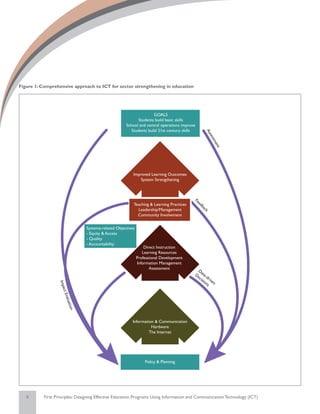
Figure 1: Comprehensive approach to ICT for sector strengthening in education


                                                                    GOALS
                                                            Students build basic skills
                                                     School and central operations improve
                                                        Students build 21st century skills


                                                                                                     As
                                                                                                       ses
                                                                                                          sm
                                                                                                            en
                                                                                                           t
                                                         Improved Learning Outcomes
                                                             System Strengthening


                                                                                         Fe
                                                                                            edb
                                                         Teaching & Learning Practices          ac
                                                           Leadership/Management                  k
                                                           Community Involvement


                                Systems-related Objectives
                                - Equity & Access
                                - Quality
                                - Accountability
                                                                 Direct Instruction
                                                                Learning Resources
                                                             Professional Development
                                                             Information Management
                                                                    Assessment             D
                                                                                         De ata-
                                                                                           cis driv
                                                                                              ion en
                  Imp


                                                                                                 s
                   act E
                     valu
                        atio
                         n


                                                         Information & Communication
                                                                   Hardware
                                                                  The Internet


                                                                 Policy & Planning


   9       First Principles: Designing Effective Education Programs Using Information and Communication Technology (ICT)
Comprehensive approaches to sector improvement can
make use of technology to support different components in
                                                                                   Decentralized Basic Education, Indonesia: A
the education system. The same functions that make ICT an
                                                                                   comprehensive approach to school improvement
important resource for classroom practice and activities can
                                                                                   supported by ICT
also expand teachers’ access to a broader range of professional
development: The SEAMOLEC HyLite program31 enables                                 The USAID-supported Decentralized Basic Education
Indonesian teachers enrolled in skills-upgrade courses at                          (DBE) program in Indonesia, running from 2005 to
regional universities to spend most of the semester at home                        2010, was intended to improve the delivery of basic
in their communities, teaching class while using computers                         education in Indonesia. Technology was used in each
and the Internet to receive course materials and return                            of the three program components, taking advantage of
assignments. In Zambia, an EQUIP2 project with support                             the fact that approximately 50 percent of Indonesian
from USAID connected seven teacher-training colleges to the                        primary and junior-secondary schools have computers
Internet and developed a Global Learning Portal that includes                      for teacher and administrative use (Government of
an online repository for learning resources and a platform for                     Indonesia estimate).
collaboration.
                                                                                   DBE1 addressed school-based management and
Comprehensive deployments of ICT can be challenging. Planning                      governance in 1,074 schools in 50 districts across eight
and implementation require political commitment, effective                         provinces. Activities included strengthening school
project design and management, and high levels of capacity                         leadership and community involvement, supporting
within the education system and among all stakeholders. In                         the development of school-improvement plans, and
lower-capacity education systems in particular, additional                         increased reporting of schools’ unit-costs—all of
investigation is required to determine key characteristics that                    which have contributed to increased school funding.
lead to positive impact.32 In education systems where there                        To increase the use of information at the school level
are “capacity gaps,” adopting focused, “appliance style”                           and to improve reporting, an easy-to-use, spreadsheet-
approaches to the use of ICT can be good first steps, and can                      based School Database System (SDS) was designed.
begin the development of the broader capacity required by                          The SDS supports school-improvement planning,
more complex projects.                                                             budgeting and financial reporting, school accreditation
                                                                                   applications, and school report cards to be shared with
(For information about appliance-style approaches to education
                                                                                   the community.
technology, refer to Principle 10: “It takes capacity to build
capacity”—System strengthening precedes system transformation,                     DBE2 and DBE3 focused on improving teachers’
in relation to this concept.)                                                      competencies, certification, and classroom practices
                                                                                   through a wide range of activities. ICT support
                                                                                   included providing high-quality learning resources, such
                                                                                   as Interactive Audio Instruction (IAI) for kindergarten
                                                                                   students, which involved 106 40-minute programs
                                                                                   prompting hands-on and active learning, and DVD-
                                                                                   based “earthquake preparedness song and dance”
                                                                                   lessons, which combined music and movement.


31	 “Hybrid Learning for Indonesian Teachers,” a project of the South East
    Asia Ministers of Education Regional Open Learning Centre. For more
    information about the HyLite program, see HyLite Program: An ICT-Based ODL
    for Indonesian Teachers Education, by P. Pannen, R. Riyanti, and B. Pramuki,
    2007 (http://digilib.unsri.ac.id/download/2D3_Pannen-Hylite.pdf; accessed
    January 30, 2010).
32	 Knowledge Maps: ICTs in Education, by Michael Trucano (Washington, DC:
    infoDev/World Bank; http://www.infodev.org/en/Publication.159.html;
    accessed April 2010).
a strong correlation with increased students’ motivation to
                                                                         learn—and motivation has been shown to be an important
    Decentralized Basic Education, Indonesia: A
                                                                         factor influencing both student performance and school
    comprehensive approach to school improvement
                                                                         completion.34
    supported by ICT (continued)
                                                                         Core strategies include the following:
    In the Developed Active Learning with ICT (DALI)
    program, a pilot project within DBE2, active- and                    Help students build reading skills and basic skills in all
    project-based-learning approaches were supported                     subjects.
    by introducing one computer and one digital camera                   Although research results are mixed in relation to the impact
    for use in the classroom; by providing downloadable                  of computer and Internet use, Interactive Radio Instruction
    and DVD-based teacher-training materials; and by                     (IRI) and other specific-use tools have proven their ability
    offering an e-learning version of the Better Teaching                to improve basic skills. In Guinea, the Fundamental Quality
    and Learning course for junior-secondary teachers, in                and Equity Levels (FQEL) project used IRI to reduce the gap
    partnership with SEAMOLEC.33 DALI teachers used                      between rural and urban students in French-language skills.35
    the computers for small-group instruction and as part                Many of the Intel Skoool resources localized for use in Yemen’s
    of station-based learning activities.                                INTALQ project present learners with visualizations—of
                                                                         static equilibrium in physics, for example—and invite them to
    The three component programs of DBE in combination
                                                                         adjust variables, observe changes in outcomes, and build their
    make up a comprehensive and well-integrated approach
                                                                         understanding of key concepts.36
    to deploying ICT in education. A wide range of tools
    was used to support the critical aspects of school                   Help students build 21st century life and learning skills.
    operations and classroom activities.                                 Many proven teaching and learning techniques that can help
                                                                         students master school subjects and build more advanced
                                                                         skills have been adapted for use with ICT. The DBE2 DALI
Principle 2: Use ICT                    to     enhance         student   program in Indonesia helps primary-grade teachers guide
knowledge and skills.                                                    their classes through interdisciplinary learning activities in
                                                                         one-computer classrooms. Following on a donation of 6,000
ICT can be used to help students build knowledge across all
                                                                         computers by the Chinese government, the USAID-funded
areas of the curriculum and to help them build higher-order
                                                                         Macedonian e-Schools project provided teacher development
cognitive and life skills. If schooling is intended to be relevant
                                                                         and an education portal to link school communities together
to work and important to a society, success in school should be
                                                                         and promote project-based learning. (Research findings suggest
accompanied by the development of a broad body of knowledge
                                                                         that technology helps students remain engaged through active-
and a complete range of skills—including literacy, numeracy,
                                                                         learning strategies such as project-based learning. )37
information literacy, and independent-learning skills that
contribute to achievement in later life. ICT should be deployed
to help students build these skills. Although policymakers and
ministries of education frequently promote ICT curricula
and building technology skills, the return on investment is
greatest when technology use is combined with learning about
                                                                         34	 What the Research Says About ICT and Motivation, by Becta (United
school subjects.
                                                                             Kingdom: Becta; 2003; http://research.becta.org.uk/upload-dir/
                                                                             downloads/page_documents/research/wtrs_motivation.pdf; accessed
Technology in schools can also help students progress along                  January 23, 2011).
the school-completion continuum, from primary to secondary
                                                                         35	 Improving Educational Quality Through Interactive Radio Instruction, by
to completion of higher education.Among the earliest research                Stephen Anzalone and Andrea Bosch (Washington DC: The World
findings in relation to the instructional use of technology was              Bank; 2005).
                                                                         36	 www.skooolyemen.com
33	 “Decentralized Basic Education 3 Brochure: What is DBE3 doing” and   37	 “Student Motivation and Internet Technology: Are Students
    “Decentralized Basic Education 2 Brochure: Our Programs,” USAID          Empowered to Learn Science?” by M. Mistler-Jackson and N.B. Songer,
    (http://www.dbe-usaid.org/about; accessed January 16, 2011).             Journal of Research in Science Teaching, v37n5, 2000, pp. 459–479.
Focus on learning outcomes.                                                     Credit: American Institutes for Research
When education-technology projects involve student or
teacher use of technology, project designs should focus on
meaningful improvements in instruction and learning. Education
projects that make use of computers and the Internet are
frequently framed in terms of “performance objectives,” such
as successful procurement and installation of a certain number
of computers, the provision of training to a specific percentage
of teachers, and computer access by a certain percentage of
students. Objectives such as these inflate the importance of
access to technology and diminish the impact of technology on
student learning.

Projects that rely on familiar tools and less-complex approaches
are more likely to be designed and assessed in terms of
improved learning. A meta-analysis of IRI conducted by Ho and
Thurkal analyzed results of IRI projects targeting numeracy
in Haiti, India, Sudan, and Zambia, and found that participating
students received on average a 16-percent “boost” in their
math ranking.38 A study of activities of the Discovery Channel
Global Education Partnership (DCGEP) in Romania, where                          Expand the use of computers and the Internet beyond
the project combined video and broadcast programming                            the “IT curriculum” and ICT skills or teachers.
content with teacher development, found significant impact on                   Computers and the Internet are frequently treated as a subject
students’ written-language competencies and their inferential                   in the curriculum and a as subject to be mastered by teachers
and creative thinking skills.39 All of these projects, relying on               in their professional development. Countries that focus on an
simple tools, were designed from the outset with a focus on                     IT curriculum, but then later seek to shift the use of technology
improved learning outcomes.                                                     to support learning in all subjects, can find their prior support
                                                                                for an IT curriculum creates barriers to change. Computer
(For more information about the value of familiar tools and                     labs, IT teachers, national IT exams, and the beliefs of school
simple project designs, refer to Principle 10: “It takes capacity               leadership can combine to impede the transition to using
to build capacity”—System strengthening precedes system                         computers for learning in all subjects.40 And although students
transformation.)                                                                do need to develop computer skills if computers are to be
                                                                                used for learning, the IT curriculum—sometimes spanning six
Projects that deploy computers, the Internet, multimedia, and                   years of classes and monopolizing computer use in schools—is
other complex learning technologies are more frequently framed                  an ineffective way to build those skills: Results from the 2007
and assessed in relation to their successful implementation. But                regional IT exams in the Caribbean suggested that students
such projects should also focus on—and be evaluated on!—                        completing IT curricula did not develop mastery and were not
their impact on teachers’ behaviors and students’ learning.                     building skills that matched up with the needs of business.41
(For more information about project evaluation, refer to
Principle 9: Integrate monitoring and evaluation into project
planning.)

                                                                                40	 Bridging the Digital Divide? Educational Challenges and Opportunities in
                                                                                    Rwanda, by E. Were, J. Rubgiza, and R. Sutherland (EdQual working paper,
                                                                                    presented to the 10th UKFIET International Conference, University of
                                                                                    Oxford, pp. 15–17, September 2009). See page 12 for a description of the
                                                                                    group’s findings.
38	 Ho and Thurkal, op. cit.
                                                                                41	 Critical Survey of ICT in Education in the Caribbean, by Edmond Gaible
39	 Cace and Cace, op. cit.                                                         (Washington, DC: infoDev; 2009).


                           First Principles: Designing Effective Education Programs Using Information and Communication Technology (ICT)                     12
Principle 3: Use ICT to support data-driven
Expanding Educational Horizons, Jamaica: A
                                                                       decision making.
technology-intensive comprehensive approach                            Regular and reliable data are essential to planning and policy,
One of several USAID-supported education projects                      financial management, management of school facilities, decisions
in Jamaica, Expanding Educational Horizons (EEH)                       about school personnel (including teachers), and support for
focused on improving the literacy and numeracy skills                  student learning. United States Secretary of Education Arne
of approximately 30,000 children (6–14 years) through                  Duncan has issued a national call for schools to collect and use
formal, school-based interventions as well as through                  data to improve teaching and learning.43
support to non-formal, non-governmental organization
(NGO) work with at-risk youth. The project has also                    Although the effective use of Education Management
increased stakeholder support for education activities                 Information Systems (EMIS) has encountered many challenges,
in 71 schools and six NGOs. EEH also builds capacity                   technology-supported data-management initiatives show great
among schools to assess their own progress and                         potential to improve policy making and decision making.44 As
students’ performance by using the Jamaica School                      of 2010, USAID was supporting EMIS and data-driven school-
Administrative System Software (JSAS), a school-based                  improvement initiatives in countries that include Djibouti,
computerized data management system.                                   El Salvador, Ethiopia, Guatemala, Jamaica, Liberia, Tanzania,
                                                                       Uganda, Yemen, and Zambia. Many of these initiatives focus
Among the most effective tools in use in EEH schools                   on improving data collection at the school level by providing
is the Renaissance Learning NEO netbooks—low-cost,                     training on spreadsheet-based reporting forms; other initiatives
low-power computers—with software that enables                         address central management of school information to support
students to use a talking word processor and drill-and-                policy and planning.
practice software for math skills. The NEO netbooks
are “easy to manage, you turn it on and start typing,”                 How schools themselves use data is equally important. USAID
says Melody Williams, literacy coordinator for the                     has supported school-based reporting in many projects.
project.The NEO offers many features that help young                   In addition, USAID has recently entered into an umbrella
writers: typing-tutorial software; infra-red “beaming”                 agreement with the Peace Corps to support training of
to share files between writing groups, and quiz-                       volunteers to guide school leaders and community members
construction software. The NEO is also light, portable,                in capturing, analyzing, and graphically representing school
and inexpensive—it can easily be shared within a group                 data, using tools such as geographic information systems and
to support collaborative writing exercises. “We found                  mobile phones.
that students who didn’t like to write were more
willing to write; they wrote more,” says Williams.

In-service professional development was a primary
activity in EEH, with teachers participating at their
schools, with other teachers at “cluster” schools,
and in central locations. As part of their professional
development, teachers were also asked to share
“action research” reports of their activities using the                42	 Information about project funding related to the use of ICT has been
                                                                           included when appropriate. In many instances, however, funding is
NEO, collaborative learning, and other aspects of the                      distributed among many program activities, making accurate or relative
project. Teachers with Internet connections could also                     analysis difficult in this brief document.
access “miniguides” supporting reading-comprehension
                                                                       43	 “National Education Policy Organization Recognizes ‘Using Data’ for
instruction, math activities, and other instructional and                  Helping Schools Narrow Achievement Gaps, Improve Achievement,”
technical content created for the project.                                 eSchool News, October 13, 2009 (http://www.eschoolnews.
                                                                           com/2009/10/13/national-education-policy-organization-recognizes-using-
Life-of-Project (LOP) funding for the EEH project was                      data-for-helping-schools-narrow-achievement-gaps-improve-achievement/;
approximately US $9,131,000 over five years (2005–                         accessed January 17, 2011).
2009). 42                                                              44	 Critical Survey of ICT in Education in the Caribbean, by Edmond Gaible
                                                                           (Washington DC: infoDev; 2009, pp. 35–41; www.infodev.org/en/
                                                                           Document.591.pdf; accessed January 17, 2011).

13      First Principles: Designing Effective Education Programs Using Information and Communication Technology (ICT)
Core strategies include the following:                                       great care must be taken to avoid overlap or conflicting data
                                                                             formats and to ensure that databases are “interoperable”—
Keep tools simple at the school level.                                       that they can share their data.
Data-collection tools that require too much technical expertise
or high-quality Internet connectivity can create challenges at               In Guatemala, a USAID-supported EMIS project providing
the school level and reduce overall participation. Reporting                 public access to education data has achieved a high standard
using the PadatiWeb program in Indonesia is extremely limited,               of interoperability. With that EMIS system as a foundation, a
in part because of the poor Internet backbone that limits                    national information system has been developed that connects
school connectivity across the eastern half of the Indonesian                data from the Ministries of Education, Health, and Finance. (See
archipelago. In contrast, the SDS (School Data System)                       the project profile at the end of this section.)
implemented under DBE1 is a simple spreadsheet-based
reporting form, supporting participation by schools in low-                  Develop information-management tools in stages.
infrastructure environments. The SDS format has since been                   Effective EMIS and other information-management tools are
adapted in the Tool for Reporting and Information Management                 challenging to develop or customize. They must support the
in Schools (TRIMS), which is being introduced to more than                   needs of central policymakers and decision makers, conform
200,000 Indonesian schools.45                                                to the way the education system operates, and be integrated
                                                                             into school routines. Achieving a comprehensive and effective
Collect data that address goals.                                             system that also meets the needs of users in schools is best
Data should be relevant to sector objectives and activities, with            accomplished through stakeholder consultations, field trials,
a specific focus on student performance. Collecting too much                 and many iterations. Current USAID-supported improvements
data (such as information about teachers’ spouses) increases                 to Tanzania’s Education Sector Management Information
the burden on school and district personnel and decreases                    System (ESMIS) will introduce the collection of data on primary
participation. In Egypt, a partnership between USAID and the                 students’ reading and math skills, while complementary efforts
Ministry of Education led to the development of a set of 36                  will improve the timeliness and accuracy of schools’ reporting.
National Education Indicators (NEI) and the strengthening of
EMIS, which together promised to return information of high                  Support the use of data in schools and communities.
value to the ministry. As a result, the ministry has taken steps             Schools can compare their own information in combination
to strengthen technical capacity, improve analysis, and promote              with information about other schools to assess their current
consistent and reliable reporting practices. Overall, the project            situation, make plans, enlist community and government
has stimulated demand in the central government for higher-                  support, and gauge subsequent progress. As of 2011, Indonesian
quality information and analysis to support improved decision                school principals will use the spreadsheet-based TRIMS tool to
making.46                                                                    improve the performance of their schools and also to make
                                                                             requests to the Ministry of Finance for support for school
Ensure that data can be easily accessed and shared.                          operations. In Tanzania, additional development of the ESMIS
Education data are most valuable when they can be easily                     will enable school data to be output as school report cards
accessed, combined with other data sources, and effectively                  to be used locally.48
disaggregated and analyzed. (For example, student data are
frequently disaggregated, or separated, by gender and class or
grade; project evaluations often disaggregate data from urban
and rural schools.) Databases and other tools should conform
to current standards and be based on common or shared
models and standards.47 When multiple data-collection efforts
are taking place, or when several databases are maintained,


                                                                             47	 “Shared models” refers to data models and formats and to
45	 Personal communication by the author with Sheila Town (World Bank),          interoperability frameworks such as the IMS Learner Information
    January 19, 2011, and Dr. Mohamed Ragheb, independent EMIS specialist,       Packaging specification.
    May 10, 2010.
                                                                             48	 USAID/Tanzania Education Strategy for Improving the Quality of Education
46	 Haiyan Ha, op. cit.                                                          (2009–2013).
Credit: Cassandra Jessee/AIR


The use of data by schools also improves the overall quality and             indicators for ICT in education. Organizations include the
reliability of education systems’ data collection and management             UNESCO Institute of Statistics and UNESCO-Bangkok, the
activities. When principals or school heads build information                IDB, the OECD, the EU, KERIS, and the World Bank, among
they can use from the effort that they expend on reporting,                  others. Most of these organizations share their draft core and
their participation in data collection increases. As important,              supplemental indicators.50
when they see and use their own data, principals confirm the
reliability of the information that has been recorded.49                     (These indicators are designed to give comparable images
                                                                             of national education systems. Project evaluations of ICT
One challenge in the use of data is the inability to share and               initiatives in education will require evaluation designs, including
compare findings among different programs and countries.                     indicators, that reflect their objectives and the unique social,
An informal consortium of development agencies and other                     economic, and educational environments in which they take
organizations is engaged in establishing a core set of national              place. See Principle 9 for additional information.)


                                                                             50	 Web links to various organizations’ indicator-related resources can be
                                                                                 found at http://web.worldbank.org/WBSITE/EXTERNAL/TOPICS/EXTED
49	 Putting Data Into Practice: Lessons From New York City, by Bill Tucker       UCATION/0,,contentMDK:22245929~menuPK:617610~pagePK:148956~
    (Washington, DC: Education Sector; 2010), p. 9.                              piPK:216618~theSitePK:282386,00.html.
EMIS in Guatemala: A springboard to a national information system

   Launched in 2007, the EMIS initiative of Guatemala’s Ministry of Education demonstrated the value of reliable data to support
   policy, planning, and management across many government ministries, and led to the National Integrated Information System
   (NIIS).The project arose out of the need for improved education data to support investments in the sector, the professionalization
   of teaching, and increased accountability for student performance. With funding from, and working in partnership with, USAID,
   the ministry revamped its EMIS tools and processes; integrated GIS software, business intelligence software, and other tools;
   and made ministry data freely available through the Internet. As a result of these upgrades, the value of data as a strategic
   resource became clear.

   In response to the demand for accessible data across the social sector, the Ministry of Education–USAID partnership developed
   the NIIS, integrating information from the Ministries of Health and Finance and from the National Institute of Statistics.
   Education data, such as enrolment, student performance, and school infrastructure, could be analyzed in relation to information
   such as disease prevalence, government financial support, and demographics among different cities and regions.

   Technical challenges were significant but were comparable to the broader challenges of capacity and the absence of a “culture
   of information.” One of the key technical challenges was the use of dissimilar data tools, including Excel, SPSS, Access, Oracle,
   SyBase, SQL Server, and paper, both within the Ministry of Education and among the other social-sector institutions. As
   development proceeded, USAID funded the purchase of a countrywide license to business-intelligence software that supported
   the use of EMIS data, ensuring that any interested user in Guatemala could access NIIS data through the Internet. (Business-
   intelligence software is part of a class of “decision support” tools that help analysts make sense out of data.)

   USAID and the Ministry of Education recognized the need to increase awareness and capacity among researchers, other
   university personnel, and NGO staff, among others. This recognition led to the creation of a third organization, also part of the
   partnership, Dialogue for Social Investment, which provided, among other inputs, a series of training workshops for potential
   users from universities, research centers, NGOs, and civil-society organizations. These training sessions led to the emergence
   of a strong community of information users.

   NIIS in Guatemala has emerged as a landmark data-sharing project in Latin America, an early example of open access to
   government data across the social sector, and the region’s first governmental use of business-intelligence software.


Principle 4: Include all short- and longer-term                           upgrades led to years-long project delays with effects that
costs in budget planning.                                                 “cascaded” through hardware procurement, teacher training,
                                                                          donor funding, and many other program components.51
Estimating full capital and operating expenses of technology
projects in schools requires consideration of all equipment and           Even when capital and donor-funded operating costs are
activities needed to ensure that hardware (and software) are              correctly estimated, “mainstreaming” operating costs into
installed, operated, maintained, repaired, and replaced, and that         the regular education budget can still pose challenges. In
teachers and other personnel have the skills and resources they           the Macedonian e-Schools project, USAID jump-started the
need to use their new tools to meet project goals. Education              development of a national broadband network for education
projects that rely on computers and the Internet frequently               with a small catalytic investment; the project, however, faced
underestimate the costs of connectivity, maintenance, security            challenges when the connection grants to schools ended.
and facilities upgrades, and essential educational components
such as teacher development. In the Barbados EduTech 2000
project, the failure to accurately budget the costs of facilities
                                                                          51	 Survey of ICT and Education in the Caribbean, by Edmond Gaible (Washington
                                                                              DC: infoDev, 2009; http://www.infodev.org/en/Document.591.pdf).


                     First Principles: Designing Effective Education Programs Using Information and Communication Technology (ICT)               16
Credit: Edmond Gaible/The Natoma Group                                              Broadcast airtime presents a challenge to the sustainability of
                                                                                    some IRI programs.When support from USAID or other donors
                                                                                    ends, ministries of education or communications frequently
                                                                                    eliminate educational programming rather than pay recurring
                                                                                    airtime costs. USAID education officers in some countries are
                                                                                    currently exploring longer-term funding of airtime costs that
                                                                                    is gradually reduced as government funding or support from
                                                                                    other donors increases. Technology alternatives, especially
                                                                                    for established programs, include transitioning from broadcast
                                                                                    to recorded lessons using cassettes, CDs, MP3 players, or
                                                                                    flash drives, and broadcasting over less-expensive satellite or
                                                                                    digital radio.

                                                                                    The considerations that follow focus on programs using
                                                                                    computers and Internet connectivity because they present
                                                                                    substantial challenges in the form of high costs, complex
                                                                                    budgeting, and procurement issues, among others. However,
                                                                                    these considerations can be adapted, as appropriate, to other
                                                                                    technologies.

                                                                                    Base program budgets on the Total Cost of Ownership
                                                                                    (TCO) of the technology to be used.
                                                                                    Capital costs of computer- and Internet-based projects, such
                                                                                    as hardware, software, networking equipment, and facilities
                                                                                    upgrades, typically receive ample attention as budgets are
                                                                                    being planned; it is critical, however, to ensure that hardware
                                                                                    maintenance and all other operating costs are accurately
                                                                                    reflected, as such costs can exceed 80 percent of the total
                                                                                    budget over the life of a project. Essential budget items
                                                                                    frequently include electricity; security; maintenance and repairs
                                                                                    of hardware, software, and networks; training or professional
Similarly, the end of connectivity subsidies in the Uganda VSAT                     development; and replacement costs of hardware, among
Rural Connectivity Project caused several schools to shut                           others. Tools developed by CoSN,54 GeSCI,55 and SchoolNet
down their Internet connections.52                                                  Africa56 provide support for calculating TCO.
Broadcast technologies such as educational radio and                                In considering TCO, it is critical to distinguish among costs to
television typically have high up-front costs to develop                            be paid centrally and those to be paid by schools themselves,
programming, teacher guides, and management capacity.                               or at the district or provincial level. Hardware maintenance, for
However, operating costs are typically much lower than in                           example, might be addressed in purchasing agreements made
computer-based projects and, because they involve fewer                             by the national government, while schools themselves might
variables, can be more reliably estimated.53 Recurring costs of                     be asked to pay operating costs such as electricity or Internet
Interactive Radio Instruction (IRI) include broadcast airtime,                      connectivity. Increased local costs must be balanced by budget
radios and batteries, printing and distribution of materials,
and training and support of teachers.
                                                                                    54	 Consortium for School Networking (http://www.cosn.org/tco/).
                                                                                    55	 Please see http://www.gesci.org/knowledge-tools.html#tco for more
52	 An Overview of the Uganda Rural Connectivity VSAT Project—Project History &         information about GeSCI’s Total Cost of Ownership Toolkit (accessed
    End of Pilot Examination of Sustainability, by Robert Hawkins, Michael W. van       August 2010).
    der Ven, and Justine Rubira (Washington, DC: World Bank Institute; 2004).
                                                                                    56	 SchoolNet Africa. http://www.schoolnetafrica.org/english/index.htm
53	 Anzalone and Bosch, op. cit.                                                        (accessed May 2010).

   17          First Principles: Designing Effective Education Programs Using Information and Communication Technology (ICT)
allocations or revenues if projects are to be sustained.           however, require far greater interaction and coordination
                                                                   among national governments, implementing organizations,
Ensure capacity to conduct effective procurement.                  donor agencies, and other stakeholders.57
Experience, knowledge, and careful structuring of purchase
agreements can influence a project’s success. However, many        Investigate hardware and software alternatives that
ministries of education in developing countries, as well as        reduce costs.
some ministries of finance, lack experience and capacity in the    Alternatives to new, standalone desktop computers can offer
large-scale procurement of technology goods and services.          equivalent or appropriate features at lower cost. “Desktop
Procurement processes are frequently guided or constrained         virtualization” computer networks such as those offered by
by government and donor requirements, increasing their             n-Computing and Wyse provide computer rooms or computer
complexity.                                                        labs with “client” or “dumb” terminals that all share the storage
                                                                   and processing power of a central server.58 Netbooks—small,
Typical considerations include the decision to purchase or lease   low-power laptops that use solid-state storage memory
equipment, negotiation of maintenance and service contracts,       instead of hard drives—offer a lower-cost alternative that
one- and two-stage bidding processes, and the format of bid-       also supports flexible configurations in schools. Thin-client
preparation documents, among others. Challenges often arise        networks and netbooks can also reduce operating costs. Both
from overreliance on vendors’ sales representatives, inflexible    systems require less electrical power than standalone desktop
contracts or ones that are unfavorable to the purchasers, and      computers. With fewer moving parts, these systems can
problems arising from delays in the release of funding.            be more reliable in hot, dusty, or humid environments.
Procurement of technology must find a balance among fairness
and transparency, responsiveness to rapidly changing products      57	 Templates for bidding documents (e.g., “instructions to bidders”) in
and services, the desire on the part of many stakeholders to           donor-financed technology projects can present problems. Such templates
develop products locally, and other relevant factors. When             are frequently out of date in relation to fast-paced developments in the
                                                                       technology field. Problems can arise as a result of a focus on hardware to
complex products such as education portals or EMIS are being
                                                                       the exclusion of software or web components, overly rigid specification
procured, for example, two-stage bidding processes can enable          of hardware or networking equipment, inability to accommodate current
many vendors to share information about their products                 web-development platforms or tools, and so on.
in initial proposals, leading to revision of bidding terms that    58	 Such networked computer schemes are also known as “thin-client
accurately reflects products in the marketplace. Such processes,       networks.”


Credit: Edmond Gaible/The Natoma Group
Refurbished computers are another way to lower capital               require negotiations with local vendors or a number of
costs. International NGOs such as Computer Aid59 and                 smaller firms, or the payment of additional service fees when
World Computer Exchange (WCE60) accept used computers                on-site maintenance is required.
as donations, wipe them of data, refurbish them, and offer
them at low cost to organizations in developing countries. In        Periodic on-site maintenance of local networks, anti-virus
some countries, local organizations also provide refurbishing        software, and backups can be performed by private-sector
services. At Computers for Schools Kenya (CFSK),61 student           technicians; IT teachers or coordinators, if they have capacity; or
volunteers refurbish and redistribute computers donated by           in some cases by students. The USAID-supported Macedonian
local businesses and in the process build their own technical        Primary Education Project (PEP) is establishing Student
skills.                                                              Support Technician Clubs (SSTCs), in which interested older
                                                                     students (Grades 7 and 8) maintain and supervise the school
In some instances, lower-cost hardware can be combined               computer facilities. However, even activities that develop in-
with open-source software, such as Linux and Edubuntu,62             school capacity for maintenance require planning, management,
to achieve further cost reductions. DVDs and external hard           and inventories of replacement power supplies, hard drives,
drives with preloaded website content, such as E-Granary,63          motherboards, and other components that are likely to fail.
can significantly reduce costs of connectivity by enabling offline
access to learning resources. Technology alternatives can            Projects that are scaled up from field trials or pilot stages
also have drawbacks, and should be researched thoroughly in          frequently encounter maintenance challenges stemming from
relation to program goals and organizational capacities before       the attempt to expand structures and processes that were
they are adopted.                                                    never designed for larger-scale operations. Computer and
                                                                     network maintenance, for example, can be assumed during pilot
(For more information about alternative technologies, refer to       projects by the ministry of education’s ICT unit—especially if
Principle 5.)                                                        the schools are nearby or bring their computers to the central
                                                                     unit. This unit’s primary responsibility, however, is ensuring
Core strategies include the following:                               that the ministry’s internal computers and communications
                                                                     tools are up to date and functioning properly. When such an
Establish budget and capacity for maintenance and
                                                                     organization is tasked with technical support, maintenance,
repairs.
                                                                     and repairs as a project expands to 500 or 5,000 schools, its
It is essential to ensure that computers and networks are
                                                                     capacity is quickly overwhelmed.
fully functional throughout a project. Although hardware repair
costs might be included under vendors’ warranties in the first
years of a project, on-site maintenance services and technical
support help ensure that technology is working properly in
schools. Maintenance processes and agreements will vary
with procurement and with the “profile” of private-sector
technology vendors in a given country. In many countries,
large-scale school-based computer projects can be supplied
by multinational vendors or their national representatives; in
these instances, hardware maintenance is likely to be addressed
by one-to-three-year warranties and by service agreements.
In more remote areas or in countries without large private-
sector technology firms, procurement and service might


59	www.computeraid.org
60	 www.worldcomputerexchange.org
61	 www.cfsk.org
62	 http://www.edubuntu.org/about
63	 http://www.widernet.org/egranary/                                Credit: Edmond Gaible/The Natoma Group
mitigate possible negative impacts through educational
                                                                                programs addressing e-waste disposal and the environment.
    A technology and math-learning specialist for the Expanding
                                                                                CFSK, as with many other local refurbishing organizations,
    Education Horizons project in Jamaica, describes some
                                                                                does not accept donations of computers from overseas
    of the challenges the project faced in providing technical
                                                                                and mitigates the issue of e-waste disposal by keeping used
    support and hardware maintenance to schools in rural
                                                                                machines in service—although all hardware will eventually
    areas:
                                                                                become unusable!
    “Difficulties with technical support could be a real
                                                                                Principle 5: Explore technology alternatives to
    problem. If the computer became infected with viruses,
                                                                                find appropriate solutions.
    it was out of commission. The warranties varied,
    sometimes the school would have to pay for support.                         The proliferation of new tools and new approaches is
    And some of the teams in rural areas, with no Internet                      accelerating in both developed and developing countries; these
    access, it was difficult to update their anti-virus                         innovations challenge project developers to think creatively
    software. If they had a problem, and they were using                        about emerging opportunities. Program designers should
    cell phones, they couldn’t call. We had an 800 number,                      consider alternative ways of meeting proposed educational
    which is toll free, but not when you call from a cell.”                     objectives, including broadcast or other technologies, low-cost/
                                                                                low-power computers, and mobile telephones.
Plan and fund disposal of e-waste.                                              Core strategies include the following:
Disposal of “e-waste” can be part of technology projects in
schools. At some point, all computer hardware can no longer                     Use technology that is appropriate to available
be repaired, or lacks up-to-date functionality.64 Old hardware                  infrastructure.
contains toxic materials, including metals such as lead, mercury,               New means of accessing information and communications are
cadmium, and copper, and chemicals such as dioxin. Improper                     emerging almost daily, driven in part by demand for mobile
disposal results in toxins entering water supplies, food chains,                services in both developed and developing countries. The
and other parts of the ecosystem. Responsibly disposing of                      GATHERdata reporting platform, for example, enables users to
computer hardware involves salvaging usable parts; recycling                    access databases to submit or retrieve information by using text
metals, glass, plastic, and other materials; and disposing of                   messaging, voice recognition, and web pages. GATHERdata is an
remaining materials in ways that keep toxins out of the                         open-source platform developed by the Academy for Education
environment. In many developed countries, the cost of e-waste                   Development (AED), and is currently deployed in Liberia to
disposal is now included in the purchase price of computer                      improve the quality of education information. In Cambodia, the
hardware, and manufacturers or vendors are required                             Educational Support to Children in Underserved Populations
to establish processes for receiving and disposing of old                       project deployed thin-client computer networks in remote
computers. In many developing countries, whose disadvantaged                    schools to achieve cost savings. Thin clients are less susceptible
populations are likely to be more exposed and more vulnerable                   to damage from heat and humidity, and in Cambodia their
to environmental toxins, the requisite regulations and facilities               low energy use enables schools to run computer rooms on
are not yet established.                                                        solar power—helping increase the likelihood that computer
                                                                                operations are sustainable.
The computer-refurbishing organizations Computer Aid and
WCE, which import older computers into developing countries,


64	 Most Pentium I computers, for example, cannot run Windows XP (or
    even Windows 98) and cannot launch current versions of Microsoft
    Office. While such computers can be (and are) used for typing and even
    word processing or spreadsheet data-entry in individual schools, they are
    not likely to be reliably useful to new projects.


                          First Principles: Designing Effective Education Programs Using Information and Communication Technology (ICT)     20
In countries such as Brazil, Chile, and Indonesia, private-sector
roll-out of mobile-broadband network infrastructure is reducing
                                                                                  IRI an more in India:Technology Tools for Teaching
costs and increasing the availability of Internet access in peri-
                                                                                  & Training (T4) Project
urban and rural areas.65 Schools in such areas are increasingly
finding ways to fund connections to the Internet, whether via                     Funded by USAID and implemented by the Education
funding from the Ministry of Education, through independent                       Development Center (EDC), India’s T4 project uses
approaches to parents’ committees or local businesses, or by                      Interactive Radio Instruction (IRI) as its central means
shifting their own budget allocations.                                            of improving instruction. T4 IRI is focused on English
                                                                                  language learning and, in the Jhil Mil series, on math,
Use technology that is appropriate to teachers’ skills
                                                                                  environmental science, and social science. Program
and capacities.
                                                                                  evaluations have found high levels of impact on student
Teachers—especially teachers in poor communities and
                                                                                  learning: In the state of Bihar, for example, Class 5 IRI
under-resourced school systems—can face significant
                                                                                  students performed significantly better than their non-
challenges learning to use computers to support their
                                                                                  IRI peers in math (8.5 percent better), environmental
classroom practices and student learning. Part of the value
                                                                                  science (10.1 percent) and social science (8.9 percent).
of Interactive Radio Instruction (IRI), in contrast, is that
                                                                                  In all eight states, evaluations have found that students
IRI can provide instruction directly to students and at
                                                                                  using IRI make learning gains.
the same time help teachers whose capacities are minimal
improve their classroom practices. The Guinean IRI                                These positive results and other factors have led to
program Sous le fromager, part of the FQEL project,                               rapid expansion of T4, made possible in part by the
guided teachers in leading in-class activities and provided                       low capital costs and requirements for support of
audio examples and instructions directly to students. IRI                         IRI. Begun in 900 schools in three states in 2003, T4
typically incurs high costs to develop effective programming                      has grown to provide instruction and support in over
and to publish supporting printed materials, whereas recurrent                    300,000 schools in eight states, and has reached over
costs on a per student basis are quite low. Because broadcast                     42 million students.
scheduling can sometimes be difficult to synchronize with
school schedules, IRI is frequently delivered as audio recordings                 In addition to IRI, T4 also provides resources for use
via cassette players or MP3 players. The English in Action IRI                    in one-computer classrooms. One example is Group
series in South Africa has demonstrated test-score gains that                     Teaching and Learning (GTL) software, which provides
range from 6.7 percent to 24 percent and correlate to the                         CD-based multimedia programming that engages both
number of lessons received by students.66                                         teachers and students in classroom learning activities.
                                                                                  Building off of the IRI model, GTL (via teachers’
Over the last 35 years, more than 30 countries, including                         manuals) guides teachers in conducting whole-class
Bolivia, the Dominican Republic, Honduras, Lesotho, South                         activities that involve song, movement, small groups,
Africa, Thailand, and Zambia, have implemented IRI programs,                      and students interacting with the computer. In addition
primarily to provide basic instruction in schools where teachers                  to GTL, the T4 project also provides instructional
have few skills and little knowledge of their subjects.                           audio and video support for learning life skills, plus
                                                                                  multimedia kits—incorporating audio, video and print
                                                                                  content on CD-ROMs—that help students understand
65	 Broadband connectivity in schools is now typically provided using
    Asymmetric Digital Subscriber Line, or ADSL, which relies on land-based       concepts and practices in math and science.
    copper telephone lines. Such telephone networks are expensive to
    install, especially with the price of copper increasing. Mobile broadband,    In a comprehensive approach to improving teachers’
    also known as General Packet Radio Switching (GPRS) and as 2.5 G or           classroom practices and students learning, T4
    3G wireless (with “G” standing for “generation”), can be delivered using      complements its technology-based direct instruction
    upgraded mobile-telephone networks. Mobile broadband networks are
    less expensive to install and can offer Internet connectivity at lower cost
                                                                                  and classroom activities with professional development
    to users. Computers can use 3G modems to access mobile broadband.             for teachers and with leadership development for
66	 Using Technology to Train Teachers: Appropriate Uses of ICT for Teacher       ministry administrators.
    Professional Development in Developing Countries, by Edmond Gaible and
    Mary Burns (Washington DC: infoDev; 2006).

   21          First Principles: Designing Effective Education Programs Using Information and Communication Technology (ICT)
Take advantage of what is familiar and what is already
in use.
                                                                                  Open Educational Resources (OERs) are public-domain
When familiar tools—radios, telephones, cameras, even
                                                                                  teaching and learning resources that can be freely used,
television—can be used, professional development can focus
                                                                                  repurposed, and adapted. They include courses, textbooks,
on improvements to teaching, learning, and school management
                                                                                  videos, tests, simulations, and other tools that are useful in
rather than on basic ICT skills. USAID has provided US $2 million
                                                                                  schools. Claire Spence, education officer, USAID Jamaica,
in grant funding to Tanzania’s Bridgeit project, which combines
                                                                                  offers advice regarding taking advantage of OERs and
smart phones with mobile-broadband Internet and video to
                                                                                  other free resources:
improve learning.67 Teachers in 150 Bridgeit schools use the
smart phones to search for and download 5-to-7-minute                             “There’s a lot of free stuff that’s available. Once we
videos, which are then integrated into classroom instruction.                     are able to help people to understand the computer,
The videos support life skills, mathematics, and science                          the power of the Internet, the power of free software,
learning, and are complemented by print-based lesson plans                        and once we can incorporate that into teaching
for learner-centered classroom activities.68 Bridgeit represents                  and learning, teachers can be empowered to make use
an innovative solution to the lack of high-quality education                      of it.”
content and teacher capacity in Tanzanian schools.
                                                                                  The OER movement includes an increasing number of
Use technology that is appropriate to education                                   platforms that empower users to search for, discover,
objectives.                                                                       and make use of free materials for teaching and
Comparisons of alternative tools should be based on all relevant                  learning.70
factors—such as cost, infrastructure, the school environment,
and social context—but it is critical to ensure that tools and
platforms are appropriate to educational objectives. IRI has                  Be cautious about relying on new or unproven
proven effective at helping students build language and numeracy              technologies.
skills; however, its reliance on direct instruction does not build            Additional care is needed when considering unproven hardware
mastery of more extensive bodies of knowledge or more                         (and software) solutions. EduTech 2000 in Barbados, in an
complex cognitive skills. More information-rich and flexible                  innovative pilot program that aimed to deliver 1:1 computing
platforms, such as Internet-connected computers, can support                  to schools, installed “package” style solutions combining
a wider range of educational objectives—if challenges such as                 rugged student laptops with local area networks (LANs) based
infrastructure, financial sustainability, and teacher development             on infrared technologies. Both the laptops and the networks
can be addressed successfully. The Innovations in Technology-                 were developed by a U.S.-based education-technology start-
Assisted Learning for Educational Quality (INTALEQ) project                   up company. Initial problems plagued the hardware package—
in Yemen uses Intel Skoool interactive-multimedia learning                    the laptops lacked adequate memory and were unreliable, and
resources to support improved mathematics and science                         the infrared networks rarely worked. Before these problems
learning. In combination with teacher development focused                     could be addressed, the start-up eliminated all hardware
on introducing student-centered instructional approaches,                     from its product line and shifted to online learning resources.
INTALEQ targets the development of 21st century skills such                   Shortly afterward, Wi-Fi emerged as the worldwide standard
as digital literacy, problem solving, and critical thinking, among            for local wireless networking.71 The innovative technologies
others.69                                                                     designed into EduTech 2000 were compromised before the


67	 Project planners taking advantage of smart phones and mobile broadband
                                                                              70	 Many OER initiatives, such as the MIT Open Courseware Initiative,
    should be sure to account for the costs of mobile-data access—which
                                                                                  focus on higher education. However, there are an increasing number of
    can be substantially higher than the costs of simple telephony.
                                                                                  programs offering OERs that are appropriate for primary and secondary
68	 Bridgeit: Improving the Quality of Education Through the Innovative Use       schools. See OER Africa (www.oerafrica.org) and Curriki (www.curriki.
    of Mobile Technology, by USAID (http://edutechdebate.org/wp-content/          org) for more information.
    uploads/2010/09/BridgeIT_July_2010.pdf; accessed January 20, 2011).
                                                                              71	 “Wi-Fi” is the popular name for wireless networking using the
69	 Announcement at brownbag-lunch-style presentation, Monday, March 8,           802.11 standard recognized by the Institute of Electrical and Electronics
    2010 (provided by USAID).                                                     Engineers (IEEE).
project started to deliver services. Although EduTech 2000                      Credit: Edmond Gaible/The Natoma Group
has made impressive progress since these initial challenges,
its early history is a reminder of the risks posed by unproven
approaches and tools.

Education-specific versions of commercial technologies are
being developed to increase the value of ICT in schools. Among
the most heavily promoted tools are low-cost laptops, such
as the Children’s Machine XO or the Intel Classmate, that
support 1:1 ratios of students and computers. Although 1:1
computer projects have demonstrated terrific potential in
some implementations in OECD countries,72 such projects can
pose significant challenges, especially in project management,
technical support and maintenance, teacher development,
school improvement, and costs.73

Lower-profile technologies have also been developed
specifically for schools and in some cases for specific learning
objectives. Microsoft has released MultiPoint Mouse software,
which enables many students to share one computer for
whole-class activities. MultiPoint has led to the development of
education-software applications and activities in Belarus, China,
India, Russia, and other countries.74 The talking word-processor
software used in the Jamaica EEH project was developed
specifically for the NEO keyboard, a low-cost, easy-to-use,
dedicated word-processing tool.

As important, innovations in commercial products are being
deployed in schools to take advantage of features that include
mobility, low energy consumption, and ease of use. The use
of phones and mobile-broadband connectivity in the Bridgeit                     project in Tanzania is a cost-effective improvement on
                                                                                Text2Teach, an earlier project in the Philippines that used
                                                                                costly VSAT connectivity. “Pico” (very small) projectors
72	 Laptops and Literacy, by Mark Warschauer (New York: Teachers College        reduce costs and energy requirements. The Worldreader
    Press; 2006).                                                               e-book reader (similar to the Amazon Kindle) is currently
73	 Child Laptop Scheme Held Back by Training Shortage in Peru, by Zoraida      being pilot-tested by a USAID-supported project in Ghana
    Portillo (SciDev Net, July 20, 2010; http://www.scidev.net/en/new-tech-     as a way of supporting the efficient distribution of learning
    nologies/digital-divide/news/child-laptop-scheme-held-back-by-training-
    shortage-in-peru.html; accessed January 20, 2011). For a more detailed
                                                                                resources.75
    first-person account of the Una laptop por niño project, refer to
    OLPC in Peru: A Problematic Una laptop por niño Program, by Christoph
    Derndorfer (infoDev EduTech Debate, http://edutechdebate.org/
    olpc-in-south-america; accessed January 20, 2011). Additional results
    include the 2011 study by published by IDB, One-to-One Laptop Programs
    in Latin America: Panorama and Perspectives, by Eugenio Severin and
    Christine Capota (http://www.eduinitiative.net/2011/04/one-to-one-
    laptop-programs-in-latin.html; accessed May 20, 2011).
74	 For information about a more nuanced use of multiple-mouse activities,
    in which student inputs support personalized learning, refer to “Multiple   75	 “Almost There Now: World Reader Folks Busy Opening Boxes in Ghana,”
    mice-based collaborative one-to-one learning,” by Cristián Infante, Pedro       blog post. November. 28, 2010 (http://www.ebookanoid.com/2010/11/28/
    Hidalgo, Miguel Nussbaum, Rosa Alarcón and Alvaro Soto, Computers &             world-reader-busy-soring-our-kindles-in-ghana-ereaders-for-the-schools-
    Education, v53n2, Sept09, 393–401.                                              almost-ready/; accessed January 20, 2011).
Mobiles for Education for Development (M4Ed4Dev)

    In 2010, USAID launched its M4Ed4Dev effort, intended to enhance current practices and knowledge in relation to the use of
    mobile devices in education.

    Mobile telephones and other mobile devices have had a strong impact on social and economic development. Research
    conducted on behalf of the Department for International Development (DFID) in the United Kingdom found that when one
    person in a rural village in Tanzania acquired a mobile telephone, incomes from agriculture for the whole village increased.76
    (Interestingly, the addition of a second phone was found to yield little increase—because key information was shared by the
    owner of the first phone.) Mobile banking is transforming remittance transfers.Tools such as MedicMobile (www.medicmobile.
    org, formerly FrontlineSMS: Medic) are used to improve coordination of healthcare workers, data collection, and patient-clinic
    communications, and to mobilize communities for vaccinations and clinics. Newer mobile technologies, such as smart phones
    and 3G wireless, will broaden the use and increase the impact of mobile devices on development as they penetrate developing-
    country markets.

    M4Ed4Dev aims to strengthen the use of mobile devices to achieve equivalent results in schools and education systems.
    M4Ed4Dev is a collaborative effort, involving USAID and other government agencies, higher-education institutions, foundations,
    NGOs, development organizations, and the private sector. At present, M4Ed4Dev conducts the following:

    •	   Research Roundtables bring together researchers and practitioners to discuss the current use of mobile devices in the
         field of education, identify research gaps, develop new collaborations, and spur further research.

    •	   Monthly seminars and Infobriefs invite researchers, practitioners, NGO representatives, vendors, and others to present
         the results of their work on mobile devices (or mobiles) in education. Seminars are held on the second Thursday of each
         month in the Ronald Reagan building in Washington, DC. Each seminar is accompanied by an Infobrief or 5-minute digest,
         giving a compressed and useful version of the information to be covered. Among the topics that have been addressed are:
         mobile gaming for literacy, mobiles for classroom assessment, e-book readers, and one mobile per school.

    For more information, contact Anthony Bloome at abloome@usaid.gov.


Principle 6: Focus on teacher development,                                   new tools and undertaking new practices within the routines of
training and ongoing support.                                                their normal class periods and workdays—without appropriate
                                                                             training or support. Personnel involved in the Bridgeit project
In-service teacher professional development is frequently                    in Tanzania, which relies on relatively easy-to-use and familiar
among the most important and complex components in an                        tools—smart phones, videos, and video players—attribute the
education-technology project.Teachers are essential to student               project’s success to its intensive focus on teacher development
learning outcomes, even if a teacher’s primary task is to facilitate         in relation to its learner-centered lesson plans.77
IRI by ensuring that the class timetable synchs up with an IRI
broadcast. In many cases, however, teachers are unfamiliar with              Core strategies for teacher professional development that
the tools they are asked to use, or they lack necessary skills. Even         involves developing technology-related skills and practices
more important, they are frequently tasked with using these                  include the following:


                                                                             77	 “Checking in With BridgeIT in Tanzania: Using Mobile Phones To Support
                                                                                 Teachers,” blog post, by Michael Trucano (http://blogs.worldbank.org/
76	 Private communication, Simon Batchelor of Gamos, Ltd. (www.gamos.            edutech/checking-in-with-bridgeit-in-tanzania-using-mobile-phones-to-
    org), February 21, 2008.                                                     support-teachers-0; accessed January 21, 2011).


                        First Principles: Designing Effective Education Programs Using Information and Communication Technology (ICT)             24
Credit: Edmond Gaible/The Natoma Group


Design professional development to meet teachers’                            Connect professional development to recognized
needs and program objectives. (Avoid focusing on basic                       teacher standards for technology use.
ICT skills!)                                                                 Linking professional development curricula to standards can
Teachers must meet many responsibilities in their workdays,                  enhance the overall quality and impact of training and can give
including progressing with their classes through the                         teachers a roadmap and milestones for developing their craft
curriculum and ensuring that students master necessary                       and professionalism. Links to standards can also support the
skills and knowledge. When technology-focused professional                   development of indicators for evaluating the training effort.
development helps teachers learn to integrate new tools into                 (See Principle 9 for more information.)
their classroom practices or professional routines, enables
them to save time, and improves their performance or enables                 Standards for teachers characterize the knowledge and skills
their students to improve, teachers are more likely to adopt                 that teachers should build as they proceed in their professional
the new tools, explore new practices, and continue learning on               development—what teachers should know and be able to
their own. Teachers benefit from building basic computer skills              do. Teacher standards commonly address subject knowledge,
within the context of their professional activities, with training           pedagogical skills, attitudes toward knowledge and learning,
built around accessing online lesson plans, conducting web                   and other important topics. Several organizations have also
searches for new resources, completing attendance records,                   developed technology standards specifically for teachers. Two
preparing resources for presentation in class, and performing                of the more relevant and influential are the UNESCO ICT
other relevant tasks.                                                        Competency Standards for Teachers (CST)78 and ISTE National
                                                                             Education Technology Standards.79
In contrast, when professional development simply trains
teachers to build technology skills, those skills are de-                    The UNESCO ICT CST help teachers locate their professional
contextualized, and teachers have little incentive to                        development in the use of technology on a three-stage
continue their learning after training is complete. They,                    continuum, from “technology literacy” through “knowledge
and school leaders, are also more likely to focus on                         deepening” to “knowledge creation.” These standards have
helping students build a similarly narrow range of skills, rather
than on using technology to master reading and math or build                 78	 http://cst.unesco-ci.org/sites/projects/cst/The%20Standards/Forms/
content knowledge and thinking skills.                                           AllItems.aspx
                                                                             79	 International Society for Technology in Education - (http://www.iste.org/
                                                                                 standards.aspx)

   25         First Principles: Designing Effective Education Programs Using Information and Communication Technology (ICT)
been localized by several developing-country governments,           information. Although it might be important for teachers to
including the Ministry of Education (MINEDUC) in Rwanda.            know that a computer includes a keyboard, a mouse, a monitor,
                                                                    and a central processing unit or CPU, this knowledge will
The ISTE NETS have been localized in several OECD countries,        be meaningless to them if they have no experience of using
as well as in Costa Rica, Malaysia, Mexico, the Philippines, and    computers. And as mentioned, the instructional methods that
Turkey.The ISTE NETS standards for teachers are accompanied         teachers experience in training can influence the instructional
by standards for students and for administrators.                   approaches they take back to their classrooms. Meaningful,
                                                                    active, hands-on learning is best for children and adults!
Complement teacher professional development with
training for school leaders.
Principals and head teachers are key to the success of
education-technology initiatives in their schools. Professional        An education specialist from USAID/Macedonia, describes
development (or orientation, depending on the project) for             the importance of building enthusiasm among teachers:
school administrators and leaders can help ensure that teachers        “Some things happened spontaneously in schools.
are supported throughout program implementation and that               Massive public trainings on basic computer use, free
technology resources are used to support program objectives.           trainings countrywide for the general public.When the
Professional development for school leaders should ensure              schools got computers, the teachers got small laptops
that those leaders understand the objectives of the program,           and the teachers felt so empowered. They took their
its importance to the ministry of education, the role of               laptops home and used them. It was as if someone
technology, and ways to address potential barriers at the local        opened a window in a very stuffy room.”
level. In the absence of professional development, principals
can, for example, restrict teachers’ and students’ access to
                                                                    Conduct professional development in environments
technology resources out of concern that these resources
                                                                    that duplicate school conditions.
will be damaged. Principals’ engagement may also be critical to
                                                                    Technology-focused professional development is most effective
ensuring that electricity and connectivity costs are paid or that
                                                                    when teachers learn to overcome obstacles posed by poor
parents’ committees understand and support students’ use
                                                                    local infrastructure and limited technology resources. When
of new tools. Preliminary results from the IDB evaluation of
                                                                    professional development takes place in infrastructure-rich
Peru’s OLPC project suggest that principals and teachers (and
                                                                    environments—where participants can work individually on
families) keep children from using laptops or taking them home
                                                                    computers, with reliable electricity and high-quality Internet
because they are worried the laptops will be broken.80
                                                                    connections—rural-school teachers (and even trainers) spend
Inflexible, information-dense curricula and high-stakes             too little time preparing for the conditions they will encounter
assessments pose challenges to teachers when they are asked         in their schools. Teachers working with poor-quality Internet
to integrate new technologies or new pedagogies into their          connectivity, for example, can cache web content so that
classroom practices. Properly trained and engaged school            students can later access it locally; the concept of caching is
leaders can be instrumental in helping teachers address these       frequently introduced in professional development sessions
obstacles through measures such as using more effective             with high-speed broadband, but the allure of swift page-loads
timetabling, keeping computer rooms open after school, or           leaves the technique underexplored.
simply encouraging teachers to experiment.
                                                                    High-quality Internet connectivity and 1:1 computer access
Build technology-focused professional development                   do support teachers’ learning and their hands-on cataloging
around hands-on methods.                                            of web resources for use in class. Where possible, training
Professional development that involves building new technology      can alternate between connectivity-rich and connectivity-
skills should be based on “learning by doing” models, not           challenged sessions: Internet connectivity can periodically be
on “learning by hearing” abstract concepts or theoretical           limited with bandwidth-management software; teachers can
                                                                    be required to work in groups of three or more at a single
                                                                    computer. (Moreover, when teachers work together, those

80	 IDB, op. cit., p. 6.
with better technology skills can help their peers progress—                  professional development. Action research, narrative
modeling a technique that all teachers can use in their classes.81)           reflection,82 and other crucial forms of follow-up and support
                                                                              can be provided through various forms of ICT. Where Internet
Synchronize professional development with the roll-                           infrastructure and other factors permit, education portals
out of technology to schools.                                                 such as those developed in the Macedonia e-School project,
Effective professional development is coordinated with the                    the INTALEQ project in Yemen, and the State of the Art
roll-out of technology. When professional development is                      Technology project in Guatemala can support teacher-to-
delivered prematurely, teachers’ new skills can fade, requiring               teacher collaboration and mentoring, as well as action research
costly refresher training; when professional development is                   and other follow-up methods.
delayed well past the arrival of technology, the importance
of the project and the commitment of its sponsors are called                  ICT-focused and ICT-supported professional development
into question, and teachers are less likely to make the effort                should be “mainstreamed” into national education
to participate or to make desired changes to their current                    budgets whenever longer-term commitments to the use
practices.                                                                    of technology are planned. On the one hand, teachers who
                                                                              are not familiar with new technologies or with new classroom
In large education systems—or in systems with schools in                      practices typically require more support than they receive in
remote areas—it can be difficult to find an adequate number                   “cascade” training or other workshop-based models. On the
of accessible training sites with computers and Internet                      other hand, teachers who successfully develop ICT skills can
connectivity. Other challenges in large-scale projects include                find that new job opportunities are open to them, so retaining
finding sufficient numbers of trainers with technology skills and             faculty can become more difficult. Ongoing professional
experience as teachers, delivering Training of Trainers (ToT) in              development helps ensure that new tools and practices are
a timely manner, and developing training courses that focus on                used as planned in schools, and that turnover among staff who
program objectives. In addition, one set of courses is rarely                 have completed their training does not undermine outcomes.
enough:A single school might require professional development
for the head teacher, for two or more subject teachers, and for
a technician or an ICT coordinator before the school can fully
participate in a project.


    Senior staff member of the Expanding Educational
    Horizons project in Jamaica, underscores the importance of
    linking PD to the roll-out of technology:

    “If you’re starting out, there can’t be any gaps between
    training and hardware possession. Sometimes
    purchasing of the hardware is delayed, and you feel you
    have to go ahead with the training. But you need the
    hands-on, and the practice.”


Use ICT to provide follow-up and support to
professional development.
The effectiveness of technology-focused professional
development can be increased through technology-supported
                                                                              82	 Teacher Action Research: Building Knowledge Democracies, by Gerald
                                                                                  Pine (California: SAGE; 2009). For more information and for resources
                                                                                  describing action research in developing-country teacher professional
81	 Professional development can also introduce the concept of students as        development, re fer to In-Service Teacher Professional Development
    “co-educators,” taking leadership roles in technology-supported classes       (compendium) in this First Principles series published by USAID under
    to help other students learn.                                                 EQUIP1 (page 11).
Core strategies include the following:
   SIEEQ: Using video to support professional                             Seek out dynamic local NGOs that can contribute to
   development in Congo                                                   program success.
                                                                          The activities of local NGOs are frequently high impact
   The Stratégies Intégrées pour une Education Equitable
                                                                          and cost effective; engaging such organizations can draw
   et de Qualité (SIEEQ) project of the Democratic
                                                                          advantage from their expertise and energy while enabling
   Republic of the Congo, which ran from 2004 to
                                                                          them to expand the scope and scale of their activities and
   2007, provided professional development in student-
                                                                          impact. In some instances, larger organizations have entered
   centered learning, discovery-based learning, and
                                                                          into partnerships with ministries of education to become key
   gender equity in the classroom to 1,212 teacher and
                                                                          implementing partners in longer-term projects. In Costa Rica,
   150 school heads. Project participants were supported
                                                                          the government-supported Fundación Omar Dengo (www.fod.
   by access to computers, the Internet, and professional
                                                                          ca.cr) assumed responsibility for the design and implementation
   development videos that were shot and edited in Congo.
                                                                          of a nationwide roll-out of computers, learning resources, and
   Initially, Congolese teachers were videotaped teaching
                                                                          professional development, funded by USAID, to support the
   in their classrooms; these videos were edited and
                                                                          development of higher-order thinking skills among primary
   then published to DVD. Using the DVDs in the project’s
                                                                          students. (See Principle 1 for more information.) SchoolNet
   professional development workshops, teachers could
                                                                          Namibia (www.schoolnet.na) was formed in 1999 with
   observe specific pedagogies demonstrated by their
                                                                          support from the International Development Research Center
   peers.
                                                                          (IDRC) and served for a decade as an early source of Internet
   Follow-up support for the professional development                     connectivity for schools, providing them with refurbished
   also relied on video. When SIEEQ trainer teams visited                 computer hardware, solar-powered equipment, and technical
   schools, they videotaped the project’s teachers and                    support, and using teams of at-risk youth as technicians. In 2001,
   uploaded the videos onto laptops (which they charged                   USAID partnered with SchoolNet Namibia and the Ministry
   with inverters running off their cars’ alternators). They              of Basic Education, Sports and Culture on the Initiative for
   then shared the videos immediately with the teachers                   Namibian Education Technology (iNET), building the capacity
   as the basis for encouragement and constructive                        of Namibia’s four colleges of education and the ministry’s 13
   suggestions.                                                           regional education offices to support students’ development
                                                                          of technical skills, basic computer literacy, and subject mastery
   LOP funding for SIEEQ totaled approximately US                         across the curriculum.83
   $6,500,000.
                                                                          Explore the potential of local private-sector technology
                                                                          firms.
Principle 7: Explore and coordinate involvement                           Local technology-related firms can make substantial
of many different stakeholders.                                           contributions to school technology projects. As discussed
                                                                          under Principle 4: Include all short and longer-term costs in budget
It is vital to engage multiple stakeholders in education-                 planning, project expansion can strain government agencies by
technology projects. Such projects frequently cut across                  making them responsible for installing and maintaining school
several sectors and entail great expense as well as technical             ICT resources on a scale that far exceeds their mandates,
and organizational complexity. Valuable contributions can                 resources, and capacities. Similarly, professional-development
be made by international and local organizations, including               initiatives on a nationwide scale can exceed existing government
donor agencies, charitable foundations, NGOs, private-sector              capacity. Local and national technology and training firms can
technology firms, and government agencies, in addition to                 step in to provide installation and on-site maintenance of
ministries of education. However, the value of such contributions         hardware, software, and networks; perform repairs (including
increases with effective coordination of stakeholders’ inputs             repairs covered under warranties); and ensure that sufficient
and participation.                                                        numbers of teachers gain basic ICT skills at the outset of a
                                                                          project.

                                                                          83	 http://www.usaid.gov/na/success2.htm


                     First Principles: Designing Effective Education Programs Using Information and Communication Technology (ICT)      28
(Such training sessions should, as mentioned, always be situated              ADSL connectivity, provided by the telecommunications giant
within educational contexts and should be accompanied by                      PT Telkom.86 In other instances, telecommunications companies
professional development addressing teaching and learning or                  support activities that are not related to their core businesses:
other areas of change.)                                                       As part of the Jordan Education Initiative (JEI), the Fastlink
                                                                              company, the first Jordanian mobile-phone service provider,
Organizations that install computer facilities in schools                     funded the development of the science e-curriculum.
frequently are best positioned to service those installations and
to make repairs. In Indonesia, for example, computer hardware                 (See the project profile that follows for more information
for schools is generally procured directly from local firms via               about JEI.)
block grants; these firms then take on responsibility for service
and repairs. To increase local capacity to install and maintain               Universal Service Funds (USF) obligations frequently require
computer facilities, Inveneo, the ICT-focused social enterprise               telecommunications firms to furnish voice telephony to rural
based in San Francisco, California, has established a training and            and remote areas that are not viable markets. In some countries,
certification program, “Inveneo Certified ICT Partners,” that                 such as Colombia, Morocco, and Turkey, telecommunications
has established networks of local firms in 21 African countries               operators have met USF obligations by supporting hardware
and in Bangladesh, Haiti, and Nepal.84                                        installations and Internet connectivity in schools.87 Although
                                                                              USF is not yet commonly used to drive the extension of
Engage with national and international private-sector                         data communications, changing regulatory practices and the
firms.                                                                        proliferation of mobile-broadband networks will likely lead
Larger private-sector firms have interests in education,economic              to the emergence of USF-derived Internet connectivity in
and social development, and community relations, as well as                   developing countries in the near future.88
interests in specific provinces, cities, and towns; these interests
can help motivate companies to support education-technology                   Take advantage of USAID’s Global Development
projects in a range of ways,often as part of programs in Corporate            Alliance program.
Social Responsibility (CSR). Contributions can include                        Under its Global Development Alliance (GDA) program,
sponsoring hardware acquisition in specific areas, supporting                 USAID partners with U.S.-based and multinational technology
the development of digital learning resources, supporting                     corporations to expand access to education and technology.
outreach and advocacy, and supporting specific curricula such                 Key GDA education partners include Cisco Systems, Microsoft,
as environmental education or health and hygiene. CSR and                     and Intel.These three GDA partners have established programs
other partnerships can be explored with firms in many different               that specifically address the needs of education-technology
sectors; CSR partners do not need to be technology firms.                     projects in developing countries. Key programs include the
                                                                              Cisco Networking Academies and Entrepreneurship Institutes,
In addition, firms operating in technology-related sectors                    Microsoft Partners in Learning, and Intel Teach.89 Intel Teach
frequently can offer in-kind or financial support for ICT projects            typically provides the training courseware and master trainers
in education. Telecommunications companies, for example,                      to help build and conduct large-scale professional development
operate in a sector that typically is regulated in ways that shelter
such companies from competing firms and new technologies
                                                                              86	 “Telkom organizes national education network in almost 20,000 schools
(e.g., VOIP85). Partly as a result of their close relationships with
                                                                                  throughout Indonesia” (company media release, http://www.telkom.
country governments, telecommunications firms are frequently                      co.id/media-corner/press-release/telkom-organizes-national-education-
asked to provide special pricing to schools—or even free                          network-in-almost-20-000-schools-throughout-indonesia.html; accessed
connectivity. In Indonesia, the SchoolNet program administered                    January 21, 2011).
by the government agency Pustekkom offers schools low-cost                    87	 Intel eLearning Deployment Guide: How to Integrate ICT in Education
                                                                                  for the 21st Century (www.intel.com/Assets/PDF/.../WA-Intel-eLearning-
                                                                                  Deployment-Guide.pdf; accessed January 21, 2011).
84	 http://www.inveneo.org/?q=ictpartners                                     88	 For more information, refer to the infoDev ICT Regulations Toolkit
                                                                                  (http://www.ictregulationtoolkit.org/en/Section.1740.html). See also
85	 Voice Over Internet Protocol is the primary means of connecting
                                                                                  Principle 7 in this document.
    telephones via the Internet. At least 15 countries that do not belong
    to the Organization for Economic Cooperation and Development              89	 Web addresses for these programs are: http://cisco.netacad.net, http://
    (OECD) block or restrict VOIP to protect government-owned or                  www.microsoft.com/education/pil/, and http://www.intel.com/about/
    national telecommunications companies.                                        corporateresponsibility/education/programs/intelteach_ww/index.htm.

   29          First Principles: Designing Effective Education Programs Using Information and Communication Technology (ICT)
operations through the cascade training model; participating       Credit: World Education
teachers build ICT skills and begin to integrate school
technologies into their classroom practices.

Advantages of these and other off-the-shelf programs by GDA
partners stem from their proven quality, along with other
factors. Intel Teach, for example, has been used in more than 60
countries to help provide professional development to more
than 7 million teachers and has been extensively evaluated.
With five technology-focused courses, Intel Teach provides
developing-country ministries of education with branded, high-
quality (and low-risk) professional development. Intel Teach
also greatly reduces the cost of courseware development.

In general, Intel Teach, as well as the other technology-focused
GDA education partners, has offered limited potential for
customization or the incorporation of local content. Helping
teachers overcome barriers to the adoption of technology
in schools frequently requires very localized approaches and,
as mentioned, extensive follow-up and support. Intel Teach,
however, has recently been working with USAID missions to
increase the potential for customization of its programs.

While Intel Teach provides proven professional-development
courses, implementation costs remain the responsibility of the
national education ministry or other local partner. Intel Teach
does not pay implementation costs, which dwarf courseware-
development costs. As a result, the effectiveness of an Intel
Teach professional-development program can be limited by
factors that fall outside the framework of the partnership. In
Indonesia, for example, the Ministry of National Education’s
three-year GDA partnership with Intel Teach concluded in
2010, after enabling more than 15,000 teachers to participate
in the program’s first-level course, Getting Started. However,
Indonesia has more than 2.5 million teachers in more than
200,000 schools. As a result of cost, capacity, and commitment
limitations within the ministry, among other factors, the Intel
Teach program has not reached beyond a small fraction of
Indonesia’s teachers.
Weigh the benefits and risks of private-sector
                                                                                contributions of products and services.
    An Education Team Leader from USAID in
                                                                                Decisions about education-technology hardware and software
    Tanzania, describes the process of building an
                                                                                can be distorted by market trends and corporate objectives.
    agreement using GDA partnerships:
                                                                                Multimedia education software, tablet computers (such as
    “So with [introducing computers] as a top priority I                        the iPad), interactive whiteboards (or smartboards), and
    was able to go ahead and make arrangements with                             implementation models such as 1:1 computing are currently
    private-sector partners to see who might be interested                      receiving attention in education systems worldwide. Although
    in doing an MOU [Memorandum of Understanding]                               these and other solutions might be effective in specific
    to come and work here. And I based that on similar                          circumstances and in relation to specific objectives, their
    work that had been done in Kenya, where they had an                         current popularity exceeds their likely contributions.92
    MOU between Microsoft, Cisco and Intel, and USAID
                                                                                Build appropriate mechanisms for coordinating
    Kenya…. So I ended up making contact with people
                                                                                stakeholder efforts.
    from Cisco, Intel, and Microsoft, and we started a
                                                                                As additional stakeholders become involved in projects,
    dialog, and basically said, All right, why don’t we just
                                                                                requirements       for     coordination      increase—and       as
    start meeting, and try to figure out what each one of
                                                                                mentioned, education-technology projects can have many
    you would like to contribute? So we did that for quite
                                                                                organizations making diverse contributions: Within 20
    a long time, came up with an MOU that we liked, sent
                                                                                months of its launch, JEI had been joined by more than
    it to all of our legal people, and everybody signed off
                                                                                30 public- and private-sector stakeholder partners. In
    on that. We started to put together the request for
                                                                                Pakistan, the Punjab IT Labs project received contributions
    applications, which was based on the MOU. We were
                                                                                from many international and national private-sector companies,
    able to get a number of applications, and we were able
                                                                                enabling the installation of computer labs in 4,286 schools in 110
    to get a technical evaluation committee that included
                                                                                days. Without proper planning, however, even an achievement
    members of government—both the mainland and
                                                                                of this type, accomplished through effective management and
    Zanzibar90—and the private sector, the international
                                                                                with strong stakeholder contributions, can strain related efforts
    partners Cisco, Microsoft, and Intel, and two local
                                                                                to train teachers and develop learning resources.93
    ISPs.91 We reviewed all the applications and selected
    one that we thought would work the best. Now we
    basically have signed that cooperative agreement with
    Creative Associates. And now, we are getting into a                             An education specialist at USAID/Macedonia, pinpoints the
    dialog of exactly what we are talking about in terms of                         value of donor coordination:
    how we are going to do this.”                                                   “It is very important for the donor community to be
    For more information about the GDA, please see USAID                            synchronized. If they are conflicting, that’s not good.
    regional GDA alliance builders.You can also visit the USAID                     The donor community is small, but if all donors are in
    GDA partnership web page: http://www.usaid.gov/our_                             agreement it is powerful.”
    work/global_partnerships/gda/


Within any GDA alliance, it is critical that a program ensures
that skills gaps and local education objectives remain at the
forefront in project design and implementation.
                                                                                92	 ”The (Murky) Writing on the Wall in High-Tech Classrooms; Some
                                                                                    Question If Gadgets Truly Aid Achievement,” by Stephanie McCrummen,
                                                                                    Washington Post, June 11, 2010 (http://www.washingtonpost.com/wp-dyn/
90	 Tanzania has both a national government, the laws and acts of which             content/article/2010/06/10/AR2010061005522.html; accessed May 20,
    pertain to the mainland and to all aspects of the union of Tanganyika and       2011).
    Zanzibar, and a government in Zanzibar, including a House of Representa-
                                                                                93	 See punjabitlabs.edu.pk. This section is not intended to suggest that
    tives that can make laws for all parts of that semi-autonomous island.
                                                                                    the rapid roll-out achieved by the Punjab IT Labs project has exceeded
91	 Internet service providers.                                                     program capacities in other areas.
Even without private-sector involvement, duplication of
activities, as well as gaps or conflicts in approaches, can occur
                                                                                    Jordan Education Initiative (JEI): Managing
in the absence of strong multi-stakeholder coordinating
                                                                                    stakeholder contributions (continued)
mechanisms. Such projects require effective coordination
between the ministries of education and telecommunications                          Project management and coordination among
to avoid such problems as multiple installations in some schools                    public- and private-sector and local and international
and no installations in others; heterogeneous hardware that                         organizations broke new ground—but also revealed
complicates maintenance, professional development, learning-                        major challenges. By 2005, 45 public- and private-
resource development, and interoperability; and lack of linkage                     sector organizations were contributing to the project,
between professional development and education plans                                with each international organization matched to a local
and policies. As discussed in relation to Principle 8, planning                     partner. A central Program Management Office (PMO)
and coordination across ministries or across sectors can be                         was established with USAID support and with staffing
improved by policies and plans that specify the goals of using                      by personnel seconded from the international private
technology in education and by effective central agencies with                      sector. While it was effective, the PMO encountered
responsibility for coordinating the deployment of technologies                      a number of challenges in its staffing and resourcing
to achieve these goals.                                                             and in the roll-out of school technologies and teacher
                                                                                    development. Most critically, the PMO was conceived
                                                                                    of and resourced as a coordinating body, while the
    Jordan Education Initiative                    (JEI): Managing                  complexities of the partnerships, capacity limitations
    stakeholder contributions                                                       within the Ministry of Education, and the project’s
                                                                                    management requirements forced PMO staff to assume
    JEI was launched in 2003 at the World Economic Forum                            responsibility for the project’s day-to-day management
    (WEF) by a consortium of partners, including Cisco                              and troubleshooting—tasks that go far beyond project
    Systems (whose CEO, John Chambers, originated                                   coordination.
    the idea), the Hashemite Kingdom of Jordan, USAID,
    UNESCO, Intel, Microsoft, and others. Its purpose was                           In November 2006, JEI was established as a Jordanian
    to improve the quality of education through public-                             NGO under the auspices of Her Majesty Queen
    private partnerships, enhance the quality of education                          Rania Al Abdullah, assuming responsibility for financial
    through technology, build capacity in the local                                 management, project management, stakeholder
    technology sector, and establish a program model for                            coordination, monitoring and evaluation, and other
    global replication.94 The multi-stakeholder partnership                         program components. JEI is now better able to manage
    supported the development of six “e-curricula” that,                            stakeholder contributions; however, in some arenas,
    in concert with the introduction of computers and                               the impact of early lapses and overlaps continues to
    Internet connectivity, were to be fully integrated into                         be felt.
    teaching and learning in more than 100 “Discovery
    Schools,” with approximately 80,000 students and
    more than 2,300 teachers.


94	 The Jordan Education Initiative: A Developing World Education Program, by
    Michelle Selinger (Cisco Systems; 2005).


                           First Principles: Designing Effective Education Programs Using Information and Communication Technology (ICT)   32
Credit: World Education                                                          in Education Policy” that delineates strategic approaches to
                                                                                 curriculum, content, and assessment; infrastructure; EMIS
                                                                                 implementation; and eight other areas.

                                                                                 (Rwanda’s effective policy making and planning activities,
                                                                                 confronted with the realities of poor infrastructure and
                                                                                 low capacity organizations, underscore the challenges of
                                                                                 implementing technology infused development. )

                                                                                 Technology projects in education can also intersect policies
                                                                                 related to job creation and employment, health, agriculture,
                                                                                 and telecommunications, among other sectors; effective policy
                                                                                 and planning are critical to ensuring that project objectives
Principle 8:              Develop         a     supportive            policy     in education and other sectors are coordinated to achieve
environment.                                                                     maximum impact.

Establishing policies, plans, and central agencies to shape the                  Support policy development that frames education-
use of technology in education can help ensure that initial                      related goals.
expenditures and activities support government objectives, and                   The goals and objectives framed by policies that address ICT
that high-impact activities receive ongoing funding.                             in education should identify improvements to the education
                                                                                 system as a whole, improvements to school operations,
Core strategies include the following:                                           and changes in teaching practices and learning outcomes.
                                                                                 Policymakers and politicians limit the influence of such policies
Facilitate the development of education-technology
                                                                                 when they enumerate performance metrics—“50 percent of
policies and achievable plans that align with national
                                                                                 rural schools will have Internet access”—rather than identify
objectives.
                                                                                 education-focused goals and outcomes. First, framing goals in
Policies in ICT in education should be developed in
                                                                                 relation to students’ activities and competencies helps keep
relation to broader national policies, plans, or strategies for
                                                                                 project designs open to the best possible tools, solutions,
development. The Government of Rwanda’s approach to
                                                                                 and activities. Second, policies that frame education-focused
ICT and development exemplifies a comprehensive and
                                                                                 goals enable the development of outcomes-based objectives,
integrated process of policy and planning, leading to, among
                                                                                 which support comparisons of cost and effectiveness among
other outcomes, a well-founded and clear approach to
                                                                                 different approaches. Examples of outcomes-based educational
education technology. At the highest level, the Vision 2020
                                                                                 objectives might include: “Students read at grade level in their
statement identifies the goal of transforming Rwanda into
                                                                                 mother tongue as demonstrated in standardized assessments”
a middle-income country by the year 2020 by supplanting
                                                                                 or “Third-grade teachers lead classes in reading-fluency
the country’s economic base in subsistence farming with
                                                                                 exercises using downloaded materials.” Broader goals for
a knowledge economy. A national ICT policy supports Vision
                                                                                 technology-in-education projects could include “Students
2020, outlining the government’s commitment to a strategy
                                                                                 improve reading skills” or “Schools meet monthly reporting
to “transform the education system using ICTs with the
                                                                                 requirements.”
aim to improving accessibility, quality and relevance to the
development needs of Rwanda.”95 The implementation of the                        Especially when they connect to policy goals, well-articulated
policy is guided by a series of five-year plans that address ICT in              project goals and objectives support outcomes-based
relation to “pillars” of development that include infrastructure,                evaluations. When evaluations reveal positive outcomes,
social development, the private sector, and education,                           education leadership can argue forcefully in favor of
among others. Based on the country’s second five-year plan                       mainstreaming or scaling up successful initiatives. (See Principle
(2005–2010), MINEDUC in 2008 released a draft “ICT                               9: Integrate monitoring and evaluation into technology-project
                                                                                 designs for more information.)
95	 An Integrated Socio-Economic and ICT Policy and Strategies for Accelerated
    Development, by Government of Rwanda (http://www.uneca.org/aisi/nici/
    country_profiles/rwanda/rwanpap3.htm).

   33          First Principles: Designing Effective Education Programs Using Information and Communication Technology (ICT)
Explore enfranchisement of a central agency for                                      performing schools and provide jobs that do not yet exist. But
education technology.                                                                such attitudes can lead to projects that fund hardware while
Education policy and subsequent planning can support the                             ignoring professional development or that exceed the capacity
centralization of responsibility for education technology,                           of local infrastructure and the implementing organizations,
benefiting program coordination, implementation, impact, and                         and that overlook the range of vital considerations that are
data-driven decision making. Such organizations, including Becta                     identified in this document.
in the United Kingdom, the Korean Education & Research &
Information Service (KERIS) in Korea, Enlaces in Chile, and                          Policy that links ICT use to longer-term challenges in the
Fundación Omar Dengo (FOD) in Costa Rica, among others,                              education system, such as increasing teacher capacity, offering
have played vital roles in the evolution of technology use to                        better-quality learning resources, or improving students’
support education in their countries and worldwide.96 The                            competencies across the curriculum, can help mitigate these
effectiveness of these organizations and of others like them                         problems.
depends on continued political and financial support. (Becta,
among the most innovative of these agencies, was scheduled
for closure by the United Kingdom government in 2010 as part                            A USAID education specialist frames the problems that
of across-the-board budget cuts.)                                                       can arise when political considerations drive education
                                                                                        programs:
Including the establishment of central agencies in relevant
policy can help these agencies receive the support they need to                         “Here, decisions are made by ministers themselves,
adapt and facilitate successful educational improvement. Such                           not by experts, and that creates problems. It is difficult
agencies have emerged from a diverse array of circumstances—                            to communicate at the level of the Prime Minister; he
as university programs (Enlaces), as government agencies                                was the person who said we should have a one-to-
(Center for Education Projects, Armenia), as NGOs (FOD, JEI),                           one program—it was difficult to convince him that it’s
and through legislation and policy (KERIS). As a result, many of                        not needed. We were not successful. They bought the
these organizations face challenges as their mandates change—                           computers.
from providing technical expertise, for example, to providing
expertise in educational uses of technology—or as a result of                           “Engage them [ministers] as early as possible. Educate
changes in their political and economic contexts.97                                     them that hardware alone is not enough. It’s not even
                                                                                        a beginning—before procuring, there must be planning,
Guide policy development and planning toward                                            planning, and more planning.”
broader and longer-term goals.
Program officers, project designers, and others need to be
alert to the possibility that policymakers and politicians will
see political advantage in education-technology projects                             Ultimately, ICT policies in education can help ensure that
and steer those projects toward short-term or superficial                            projects and strategies gain the political support that they
objectives. There is great danger in considering computers and                       need to achieve sustainability and impact. If projects funded
the Internet as “magic bullets” that will radically improve low-                     by fixed-term grants and discretionary budgets are to be
                                                                                     continued—or expanded—beyond the term of grant funding,
                                                                                     their costs should be integrated into annual budgets. The
                                                                                     influence of policymakers and politicians is critical to achieving
                                                                                     such transitions. These decision-makers are, in turn, influenced
96	 It is critical to ensure that new agencies, if they are formed, have effective
    leadership and a mandate with sufficient scope and independence                  by outcomes that link to policy.
    that they do not simply become new bureaucracies or extensions of
    existing ones.
97	 The World Bank, KERIS, UNESCO, and other partners are currently
    documenting the experiences and effectiveness of central education-
    technology organizations. For more information, refer to coverage on the
    World Bank’s EduTech blog (http://blogs.worldbank.org/edutech/building-
    national-icteducation-agencies; http://blogs.worldbank.org/edutech/
    seoul2010; http://blogs.worldbank.org/edutech/category/tags/keris).
data from control-group samples. Advance planning, budgeting,
                                                                   and preparation are essential if these measures are to be put
   Rwanda’s ICT policy in education: Avoiding
                                                                   in place.98
   problems caused by lack of direction
                                                                   Although many of the core strategies outlined here can apply
   Although policies and sector wide plans do not
                                                                   to evaluations of all education projects, they are critically
   ensure that education-technology projects will deliver
                                                                   important to projects that are supported by technology. Such
   their intended outcomes, such policies and plans can
                                                                   projects can be complex and costly and can involve multiple
   help avoid common problems. Rwanda’s draft policy
                                                                   stakeholders in multiple sectors. In addition, the introduction of
   identifies 10 “factors” that result from “the lack of
                                                                   new information and communications tools can be perceived
   clear ICT policy”:
                                                                   as threats to cultural mores, can cut across different parts of
   •	   Lack of alignment among initiatives                        school operations, and can be disruptive in both harmful and
                                                                   beneficial ways. Effective monitoring or formative evaluation
   •	   Lack of proper planning and consultation                   enables detection of unanticipated obstacles as they emerge,
                                                                   and supports adaptations to address them; effective summative
   •	   Prioritization                                             evaluation, in addition to identifying challenges and obstacles
                                                                   that influenced outcomes, can describe program impacts and
   •	   Saying “yes” to everything
                                                                   help make the case for (or against) continuation or expansion.
   •	   No clear understanding of what ICT in education is
                                                                   Core strategies include the following:
   •	   Different education agencies not talking to each
                                                                   Support outcomes-based evaluations as well as
        other
                                                                   performance metrics.
   •	   Ownership (of programs)                                    In light of the management and implementation challenges
                                                                   that they pose, computer and Internet projects in schools
   •	   Decentralization of program implementation                 are frequently evaluated in terms of project performance
                                                                   or successful inputs: “Were the computers installed on time
   •	   Need for clear implementation plan                         and on budget?” “How reliable and fast was Internet access?”
                                                                   “How many computers were still functioning after one year
   •	   (Lack of support for) Total cost of ownership
                                                                   of use?” and “How many teachers participated in professional
   Clear, appropriately constructed policies can benefit           development?” are frequent evaluation questions— assessing
   the design and implementation of individual projects            the number, type, and effectiveness of resources and activities
   and can also help achieve overall coordination of               that are introduced as part of a project.
   ICT initiatives within education, and of education-
                                                                   To determine the value of technology projects in relation
   related initiatives in other sectors, such as health,
                                                                   to their (sometimes considerable) costs, however,
   telecommunications, agriculture, and labor.
                                                                   evaluation designs should go beyond the analysis of program
                                                                   implementation to assess real impact. In education-technology
                                                                   projects focused on teaching and learning, impact indicators
Principle 9: Integrate monitoring and evaluation
                                                                   (sometimes referred to as “outcomes”) frequently center
into project planning.
                                                                   on teachers’ actions, including their classroom activities as
Planning (and budgeting) for monitoring and evaluation of          instructors and facilitators, on students’ learning behaviors,
education-technology projects should begin during the first        and on students’ learning outcomes. Impact indicators can be
phase of project design. In most circumstances, it is important    framed in many ways; simple indicators of impact for a program
to emphasize using randomized studies and experimental             introducing Discovery Channel Global Education Partnership
statistics (e.g., multivariate regression and other means of
determining correlations between inputs and outcomes); such        98	 For additional information about randomized evaluations based on
                                                                       experimental methods, including studies of education-technology projects
methods typically require collecting baseline data or collecting
                                                                       in India, Colombia and other countries, refer to the Abdul Lateef Jameel
                                                                       Poverty Action Lab (J-PAL; http://www.povertyactionlab.org/).
programming, teacher development, and lesson plans could                        Include formative assessments.
include “Students use more concrete examples when writing                       In addition, formative assessment—whether formal or
about science,” “Students include more connections between                      informal—is essential to the success of technology projects in
different environmental threats in presentations,” and “Students                education. The introduction of new tools and new pedagogies
science writing in exams is higher volume.”99 (Indicators are                   can encounter unanticipated barriers and challenges. Examples
also addressed in the Examples of indicators section.)                          of challenges that can be revealed in formative evaluation include
                                                                                these: teachers don’t have enough time to address all units in
Technology projects can affect many aspects of education                        the curriculum and engage in project activities; schools stop
systems outside of classroom activities or learning. School                     paying for Internet connectivity; radio lessons are broadcast
report-card projects, for example, might target both improved                   at inconvenient times. Formative evaluation can identify such
collection of data on a nationwide basis and more effective                     obstacles early in a project and enable them to be overcome.
use of information by school heads. Simple impact indicators
might include: “Schools complete all reporting requirements                     Use evaluation results in decision-making.
electronically” and “School heads share school information                      Summative and formative evaluations of ICT projects in
with parents’ committees.”                                                      schools convey objective information about infrastructure,
                                                                                school leadership, teachers’ overall capacity and motivation, the
Support for assessing project performance in terms of                           challenges teachers face, and other factors that are critical to
technology and implementation is important, but assessing                       the efforts to improve schools.The results of evaluations should
project impact is essential!                                                    strongly influence decisions about whether and how projects
                                                                                should be scaled up or mainstreamed into ministry budgets.
Link indicators to project objectives and policy goals.
                                                                                These results should also be considered as new programs are
Project objectives can be a bridge linking the results of an
                                                                                being designed and, in some instances, as sector-improvement
evaluation to policy. Properly structured outcomes-based
                                                                                plans are developed.
indicators should reflect project objectives, which can (and
should) in turn reflect the broader goals articulated in national               Share findings broadly and transparently.
policies.100 A project that demonstrates impact in these terms                  Making evaluation findings—and models—widely available
can receive rational, impassioned, and evidence-based support                   benefits everyone involved in education and in ICT for
for being expanded, replicated, or mainstreamed into national                   education. Technology has failed to achieve its full potential as
education budgets.                                                              a tool for education transformation in part because projects
Make evaluation a participatory process.
Evaluations should engage all stakeholders, ranging from the
classroom level—talk to students!—to teachers, principals, and
families, to key individuals in ministries and among the broader
array of stakeholders. Different groups will highlight different
objectives or outcomes and will provide different explanations
for obstacles that have emerged. Broadening the scope of
evaluation can help increase the accuracy and reliability of
findings.


99	 For more information, refer to “USAID evaluation policy,” which estab-
    lishes terms based on evaluation of impact or outcomes. The policy itself
    mandates performance evaluation of all projects with impact evaluations
    to be undertaken selectively by various missions (http://www.usaid.gov/
    evaluation/USAID_EVALUATION_POLICY.pdf).
100	 “What Is Impact Assessment and Why Is It Important?” by David Streat-
     field and Sharon Markless, Performance Measurement and Metrics, v10n2,
     2009; pp. 134–141. Streatfield and Markless have been instrumental in
     advancing the discussion of impact evaluation and indicator development
     within the international library community.                                Credit: Edmond Gaible/The Natoma Group


                          First Principles: Designing Effective Education Programs Using Information and Communication Technology (ICT)     36
have repeated mistakes that have dogged technology projects                   Principle 10:   “It takes capacity to build
in education for decades. Evaluation is about learning, about                 capacity”—System     strengthening precedes
improvement, and about the future: Sharing and transparency                   system transformation.
are essential.
                                                                              Developing-country school systems rarely have the capacity
                                                                              to effect substantial change in teaching, learning, or school
    The NEPAD e-Schools Demonstration: A model for                            operations—whether technology is used or not. In many
    formative evaluation                                                      instances, the range and intensity of problems are great:
                                                                              schools have no learning resources, teachers lack knowledge
    The evaluation of the e-Schools Demonstration Project                     of their subjects and, worse, are often absent, and schooling,
    of the New Partnership for Africa’s Development                           especially the secondary curriculum, doesn’t improve students’
    (NEPAD) included substantial and valuable formative                       lives or earnings. Infrastructure in the poorest countries and
    assessment—essential for a project spanning 16                            communities hobbles the potential introduction of technologies
    countries. The NEPAD e-Schools Demo ran from                              to address these deficiencies. In such circumstances, investing
    2003 through 2007 and beyond in some countries                            in computers and the Internet as the means of jumpstarting
    that struggled with implementation. Beginning in                          development of a 21st century workforce is wrongheaded or
    January 2006, a series of interim internal reports was                    disingenuous.
    completed for the sponsoring East-Africa Commission
    (EAC). These reports highlighted implementation                           As Thomas Hatch of Columbia University’s Teachers College
    issues encountered in different countries and made                        has said, “It takes capacity to build capacity.”102 Schools
    recommendations for addressing these issues.                              and school systems that lack basic levels of management,
                                                                              leadership, teacher professionalism, resources, and other core
    In light of the variable progress made in different                       components must address these problems to build the stable
    countries, a “final” evaluation was submitted in                          foundation needed for the equitable and effective delivery
    2007 that also presented the project as a work in                         of public education. Students are frequently ready to benefit
    progress but that emphasized lessons learned and                          from instructional methods that involve play, collaborative
    recommendations that would be essential if and when                       learning, problem solving and other learning activities that
    the project is replicated, as initially proposed, in more                 promote higher-order thinking,103 while schools and teachers
    than 550,000 schools in Africa. That evaluation was                       are challenged to help them build basic reading and math skills.
    intended to support adjustments to ongoing project
    implementations, synthesize the lessons learned over                      As the projects cited and profiled in this document
    the course of the project, and provide a model for                        demonstrate, technology can play a vital role in strengthening
    further monitoring and evaluation at the local level.                     education systems. The system-strengthening process is, in
    The final evaluation remained formative, but the results                  most instances, an essential step in the transformation of
    and lessons learned were widely shared both among                         schools and education systems into learning organizations that
    participating organizations and at large.101                              can help students build 21st century skills.

                                                                              Core strategies include the following:


                                                                              102	 “When Improvement Programs Collide,” Phi Delta Kappan, v83n8; 2002.
                                                                              103	 “Gaining Confidence through Collaboration,” by Mary Burns
                                                                                   (Washington, DC: EDC; 2010; http://t4india.idd.edc.org/2010/11/16/gain-
101	 The NEPAD e-Schools Demonstration Project: A Work in Progress, by Glen        ing-confidence-through-collaboration). This article describes a successful
     Farrell, Shafika Isaacs, and Michael Trucano (Washington, DC: infoDev;        approach to collaborative learning in Karnataka State, India, that is part
     2007).                                                                        of the T4 project but that does not involve the use of technology.

   37         First Principles: Designing Effective Education Programs Using Information and Communication Technology (ICT)
Build on “appliance style” use of technologies.                                 same. Providing the same teacher with a netbook, projector,
Appliances are designed to accomplish specific tasks; they do not               and another week of training provides a tool set that can
lend themselves to an array of different uses.When technologies                 support the teacher’s traditional instructional method and save
are introduced into schools as appliances—devices to be used to                 effort and class time. Later, after building familiarity and skills,
accomplish specific, education-related tasks—implementation                     the teacher can shift—with professional development and
and adoption challenges are minimized and specific teaching                     other support—toward more effective uses of the new tools
activities and learning outcomes can be supported. Dedicated                    to enhance student learning.105
word processors, such as the Renaissance Learning NEO2
tools used in the EEH project in Jamaica, present new users                     The DALI project, run as a pilot project under the auspices of
with fewer options and features than laptop computers                           DBE2 in Indonesia, adopted a different approach to scaffolding
do. Their simple design and limited feature-sets can                            primary teachers’ progress. All DBE2 teachers participated
facilitate the adoption and use of these tools in schools; they                 in professional development to build capacity to conduct
can then help students, teachers, and school leadership build                   learner-centered classroom activities. The DALI teachers
skills and practices that will support more powerful and                        also participated in training in basic computer skills and how
complex tools when they are introduced.104                                      to conduct the same learner-centered activities using one
                                                                                computer in their classrooms. Field reports from the DALI
The Bridgeit project in Tanzania demonstrates a variation                       project suggest that participating teachers show very high
on this approach. Nokia smart phones with mobile-                               levels of computer use relative to teachers completing other
broadband Internet are used for one purpose—to                                  technology-focused professional development programs in
download educational videos over the Internet. The                              Indonesia.106
hones themselves are capable of Internet browsing and
support many other tasks, but these features are not
addressed in teachers’ professional development. Training                           A technology specialist for math instruction for the
sessions focus on the teaching practices, lessons, and                              Expanding Education Horizons project in Jamaica, describes
classroom activities that teachers need so they can use the                         teachers’ adoption pathway from the NEO smart keyboard
downloaded videos. Again, technology is introduced as a                             to using real laptops:
way to accomplish a specific task; users’ responsibilities
(in terms of using the new tool) are simplified, possibly paving                    “Facility with the keyboard definitely reduced some of
the way for more expansive use of the smart phones and the                          their anxiety. They learned to use the NEO keyboards
Internet at some time in the future.                                                first, and then worked with the laptops to add photos
                                                                                    to the stories their students had written.”
The progression from simple tools and simple tasks to similar
tools to accomplish more complex tasks is analogous to the
familiar instructional technique of “scaffolding.”

Scaffold approaches to technology integration.
A cart filled with laptops and a week of training in “integrating
technology into the curriculum” can place real strain on a
teacher who is unfamiliar with computers or who teaches by
copying from a textbook and asking the students to do the                       105	 The use of “scaffolding” throughout this section is more accurately
                                                                                     framed as the related pedagogical concept, the Zone of Proximal
                                                                                     Development (ZPD). ZPD is the zone of activity in which a person can
                                                                                     produce something with assistance that he or she cannot produce alone.
                                                                                     For a thorough discussion of scaffolding and ZPD, refer to “The Social
                                                                                     and Technological Dimensions of Scaffolding and Related Theoretical
104	 While the developer of the NEO, AlphaSmart, specialized in dedicated
                                                                                     Concepts for Learning, Education and Human Activity,” by Roy D. Pea,
     word processors for 20 years, the NEO represents a minor departure
                                                                                     Journal of the Learning Sciences, 2004, v13n3, pp. 423–451.
     from its normal product line. Running the Palm Operating System, it has
     a feature-set similar to that of a personal digital assistant (PDA). The   106	 Personal correspondence between the author and Mary Burns,
     NEO is, however, much simpler and easier to use than a netbook or               consultant to DBE, and with Prof. Lim Cher Ping and Mr. Jan Van Rees,
     laptop. (Renaissance Learning acquired AlphaSmart in 2005 and renamed           members of the ICT-in-Education consultative team to the World Bank
     the company NEO Direct.)                                                        Jakarta office.
Credit: Cassandra Jessee/AIR

                                                                                    Rwanda’s ICT Policy Statement: First steps in a
                                                                                    scaffolded approach to school improvement

                                                                                    In 2006, the Ministry of Education of Rwanda
                                                                                    (MINEDUC) released a short policy “statement” two
                                                                                    years in advance of the release of its 2008 draft policy
                                                                                    for ICT in education. The statement was intended
                                                                                    as an interim guide to the use of ICT. While Vision
                                                                                    2020 calls for a workforce with skills required by the
                                                                                    knowledge economy, and the policy document that
                                                                                    emerged in 2008 outlines a broad array of activities
                                                                                    focused on computers and the Internet, the 2006
                                                                                    statement describes a few cogent (and modest)
                                                                                    steps centering on the use of ICT. The first two steps
                                                                                    point realistically to the starting point for technology
                                                                                    in Rwandese schools: “Preparing all sectors of the
                                                                                    education system to understand the investment in and
                                                                                    value of technology” and “Preparing schools to accept
                                                                                    technology.” These first steps are followed by a third
                                                                                    incremental and scaffolded approach to technology-
                                                                                    supported improvement:“[P]rocuring and installing the
                                                                                    technology.”108

                                                                                    As a landlocked, conflict-scarred Least-Developed
                                                                                    Country (LDC), Rwanda faces nearly insurmountable
Develop ICT infrastructure to improve systemwide                                    obstacles in its approach to Vision 2020. Capacity
capacity.                                                                           across the Rwandese education system is very low.The
Just as education systems at their most advanced develop                            first steps outlined here, however, have the potential
“collective capacity” to improve, low-performing systems                            to support system-wide change and accelerate the
require scaffolded approaches to developing their capacity for                      development of collective capacity in schools.
education change.107 When school systems lack foundational
capacity, ICT can be used to establish education-technology
infrastructure—school hardware, Internet connectivity,
and human capacity—that can support incremental school
improvements. Lower-risk, lower-complexity approaches can
provide experience and build essential skills at the ministry,
district, and school levels. The core competencies and key
processes required—ranging from enacting policy to managing
stakeholders to marshalling funds for sustained operations to
using and maintaining tools for learning in schools—are linked
to the principles and core strategies described previously.


107	 All Systems Go:The Change Imperative for Whole System Reform, by Michael   108	 ICT in Education Policy (draft; Kigali: Ministry of Education of the
     Fullan (London: SAGE, Ltd.; 2010), p. xiii.                                     Government of Rwanda; 2008).
Challenges and Limitations                                                          Education-technology projects are subject to political
                                                                                    and marketplace pressures.
There are limitations on the impact of ICT in schools. These                        Decisions about introducing ICT into schools on a large-scale
limitations lie outside the challenges addressed in the principles                  or nationwide level are frequently influenced by factors outside
of using technology to improve education.                                           the education system—most notably political and commercial
                                                                                    interests. Delivering ICT to schools, whether the project is
Technology increases complexity in education systems.                               well designed and appropriate to the system or not, can be
Technology adds an additional layer of complexity to school                         presented to the public as a bold, innovative, and impressive
systems—a layer that encompasses more than the tools                                measure by politicians. As important, electoral timelines can
themselves,but also new skills,new activities,and new interactions.                 shorten technology-project timelines, without scaling back
Ordering this layer of complexity to deliver educational value                      projected results: Decision-makers responding to election
requires new organizational structures—to train teachers and                        cycles can sometimes influence project designs to “fast forward”
students, create and disseminate resources, and assess progress,                    technology roll-out, the projected building of teachers’ skills,
and to procure, install, and maintain the new tools. More flexible                  and students’ achievement, accelerating timelines beyond the
technologies, such as computers and the Internet, introduce                         system’s capacity for new practices or change.
higher degrees of complexity than appliance-style technologies,
such as DVD players, and broadcast technologies, such as
radio. But procuring, distributing, supporting, and integrating
any of these tools requires new practices at every level to be
effective.


Credit: Cassandra Jessee/AIR


                               First Principles: Designing Effective Education Programs Using Information and Communication Technology (ICT)   40
Credit: Edmond Gaible/The Natoma Group                                       There is no “magic bullet”—the impact of technology
                                                                             is constrained by many factors.
                                                                             Constraints on the impact of education-technology projects
                                                                             have been identified throughout this First Principles document.
                                                                             These constraints work in combination to limit what can be
                                                                             achieved in the short term. Such constraints include cost,
                                                                             infrastructure, teachers’ skills, and organizational capacity,
                                                                             among others. Addressing one of these, such as infrastructure
                                                                             or teachers’ skills, can intensify another, such as project cost or
                                                                             organizational capacity.

                                                                             All of these constraints extend the time required to improve
                                                                             schools.

                                                                             Educational improvement takes time.
                                                                             In some instances, overcoming constraints requires waiting for
                                                                             actions outside of schools: Internet bandwidth is dependent in
                                                                             part on a country’s Internet infrastructure and on its connection
                                                                             to international Internet “backbone.” Resolving connectivity
                                                                             in schools when the primary constraint is poor national or
                                                                             international backbone lies well outside the education system.

                                                                             However, overcoming school-specific factors, such as
                                                                             teachers’ limited skills, also requires time, but time filled with
                                                                             effective action: If teachers currently teach through drills and
                                                                             memorization, a project design that advances from training
                                                                             them to use computers to the use of digital resources in
                                                                             classroom instruction to the introduction of tele-collaborative
                                                                             learning by students over the course of a single academic year
                                                                             is a compromised design. The approach might be pedagogically
                                                                             sound overall, and the use of technology might be appropriate
                                                                             and sustainable, but the proposed new skills, knowledge, and
                                                                             practices are beyond what can be accomplished in a short
                                                                             timeframe.

                                                                             The ability of ICT to reach large audiences, to present
                                                                             compelling instructional materials, and to engage students and
                                                                             teachers in communication and collaboration is unchallenged.
                                                                             Realizing the enormous potential of technology to support
                                                                             system-strengthening requires sufficient planning, funding, and
                                                                             effective school-level inputs.


   41         First Principles: Designing Effective Education Programs Using Information and Communication Technology (ICT)
Suggested Indicators of Success                                                   Credit: Edmond Gaible/The Natoma Group


The indicators identified in this section can help program
designers and evaluators frame some of the key areas for
investigation in the assessment of education-technology
projects. In practice, such indicators should be developed in
relation to program design and objectives, the preexisting
education environment, and other factors.109

Access indicators
Access to technology in schools can be a significant hurdle,
limiting a project’s impact in relation to student learning and
other essential outcomes. Frequently used access indicators
include:

•	   Availability of grid-based or mains electrical power
     (including, in low-infrastructure environments, hours per
     week of electrical power)

•	   Availability of alternative electrical power (e.g., diesel
     generator, solar power, pico-hydroelectric power)

•	   Number and type of devices (e.g., computers, printers,
     projectors, smart phones), number of functioning devices,
     and number of users per device (e.g., students per
     computer in a given class period)
                                                                                  Output indicators
•	   Type of Internet connection, bandwidth, and number of
     devices connected110                                                         Output indicators can valuably address changes in teaching
                                                                                  practice and learning behavior that rely on technology or
•	   Percentage of students using school computers per week,                      that meet objectives of technology-supported professional
     and hours of hands-on time per computer-using student                        development. Examples of such indicators follow:

These and other access indicators will typically be considered                    •	   Students use educational software resources112
inputs or input indicators for purposes of project evaluation.111
                                                                                  •	   Students engage in technology-supported collaborative
                                                                                       activities with other students in their class, with students
                                                                                       in other classes, and with students in other schools or
                                                                                       countries


109	 In some instances, indicators in this section have been combined (e.g.,
     type of Internet connection, bandwidth, number of devices connected)         112	 Many educational software products include various forms of computer-
     to streamline reading.                                                            assisted learning (CAI), which typically involve viewing, reading, or
                                                                                       interacting with curriculum content; completing an assessment; and
110	 A more effective indicator is “bandwidth per user”; however, many
                                                                                       remediating poor competencies and then moving on to another
     organizations will not be able to provide this information.
                                                                                       instructional unit. Output indicators can in these instances be based on
111	 Discussion of access indicators is based in part on Technology in Schools:        the completion of a given number of units. (Note that CAI-based re-
     Education, ICT and the Knowledge Society, by Pedro Hepp, Enrique J.               sources vary greatly in their impact on student learning. No such product
     Hinostroza, Ernesto Laval, and Lucio Rehbein (Washington, DC: World               should be deployed without a close review of at least one independently
     Bank; 2004; http://www1.worldbank.org/education/pdf/ICT_report_                   conducted evaluation that demonstrates significant improvements in
     oct04a.pdf; accessed February 1, 2011).                                           learning outcomes in comparison with a control group.)
Credit: Edmond Gaible/The Natoma Group


•	   Students conduct independent research, write reports,          Programs that focus on deploying EMIS or using school report
     and make presentations                                         cards (see Figure 2: “School report card” from EMIS project
                                                                    in Georgia) can assess outputs in relation to participation
•	   Teachers display curriculum-related resources (e.g., videos,   in reporting activities and use of information for school
     simulations) to their classes                                  improvement. Sample indicators follow:
•	   Teachers search for, find, and use lesson plans or other       •	   School heads complete monthly, quarterly, annual, or other
     resources on DVD, a school server, or the Internet                  reports (using technology).
•	   Teachers use technology (e.g., email, blog, SMS) to            •	   School heads share results of school report card with
     communicate with other teachers                                     parents’ committee (using technology).
Whether or not sample indicators require the use of
technology—for writing a report or making a presentation,
for example—should be determined in relation to the
project design.
Impact indicators                                                                    The first two of these three sample indicators would likely
                                                                                     require dedicated assessments; in all instances, assessments
Impact indicators (or outcome indicators) in education-                              of learning outcomes need to be conscientiously designed to
technology projects are often similar to impact indicators used                      eliminate confounding factors. (Improvements in students’ test
to evaluate education projects that do not use technology:                           scores could, for example, improve if schools were open more
Did students develop the intended competencies? Did                                  days during the term, or if a separate initiative led teachers to
students perform better than students in classes that did not                        come to school more regularly.)
participate in the project? These questions can be answered
by standardized assessments, such as national exams, or by                           School report-card projects might include impact indicators
dedicated assessments that are developed specifically as part                        related to school resources and school heads’ abilities to
of the project evaluation.113                                                        mobilize funding from outside sources:

Technology has been shown to have a positive impact on                               •	   Improvements to school facilities (e.g., new room, Internet
student motivation114 (and on teacher motivation), with an                                connection)
indirect impact on attendance and school completion. These
areas can also be addressed by impact indicators.                                    •	   Increased learning resources            (e.g.,   mathematics
                                                                                          manipulatives, science resources)
Impact indicators can also be designed to address the specific
features of a given tool or intervention. For example, a project                     •	   Increased contributions from parents’ committee
in which students use talking word processors (such as the
                                                                                     In addition to input, output, and impact indicators, evaluations
NEO keyboard) might be evaluated using these indicators:
                                                                                     must also account for the broader array of factors that have the
•	   Using the word processor, students write more (e.g.,                            potential to influence the outcome of education-technology
     longer essays), and make fewer spelling errors                                  projects. Those factors include national telecommunications
                                                                                     infrastructure, levels of technology use (and literacy, among
•	   Students make fewer mistakes on spelling quizzes or when                        other factors) in relevant sectors of society, any costs to schools
     writing with pencil and paper                                                   (to enable analysis of costs and benefits), and the relative costs
                                                                                     and impacts of alternative approaches.
Similarly, an evaluation of an IRI program in English-language
instruction might include these impact indicators:

•	   Student pronunciation improves

•	   Student comprehension improves

•	   Student test scores improve


113	 Discussion of impact indicators is informed by Wagner et al., op. cit.
114	 The Effects of Using Instructional Technology in Elementary and Secondary
     Schools:What Controlled Evaluation Studies Say, by Kulik (Menlo Park,
     Calif.: SRI International; 2003, cited in Monitoring and Evaluation of ICT in
     Education Projects: A Handbook for Developing Countries, by Daniel Wagner,
     Bob Day, Tina James, Robert B. Kozma, Jonathan Miller, and Tim Unwin
     (Washington, DC: infoDev; 2005).


                            First Principles: Designing Effective Education Programs Using Information and Communication Technology (ICT)         44
Conclusion                                                                  Credit: James MacNeil/World Education


The introduction of technology into processes of education
change carries risk and great potential benefit. In some instances,
technology is the only feasible and cost-effective means of
improving education across all of a nation’s schools. Broadcast
and networked communications and easily reproduced digital
materials can help provide high-quality resources or direct
instruction to students, information that school leaders and
decision-makers can use, and opportunities for teachers to
enhance their skills. However the skills and knowledge needed
by the organizations charged with guiding technology projects
in schools are often earned through difficult—and costly—
experience.

The 10 principles that have been presented here are guideposts
based on the more than two decades of history of ICT projects
in schools in developing countries. Some principles focus on
broad challenges and barriers that are common to all large-
scale technology projects—matching tools to infrastructure,
securing strong policies and partnerships, and accurately
estimating costs. Other principles seek to ensure that
investments in powerful and even eye-catching new tools pay
off in terms of student learning and school management. Intense
focus on education goals, on students’ skills and knowledge,
and on teachers’ professionalism is essential if real impact is to
be achieved.Without such focus, without such impact, the risks
involved in education-technology projects will not outweigh
the benefit.

Such pitfalls notwithstanding, the forces driving the adoption of
technology in schools today will only intensify in the future.The
relevance of traditional education will increasingly be called
into question by dynamic economies placing new demands on
each nation’s workforce. The models for using technology to
support the development of essential skills—reading, math, and              encounter opportunities that demand new ways of thinking and
job and life skills—will continue to be refined and improved.               acting that rely on their powers of communication and analysis,
The skills and capacities with the highest value for all individuals,       and on their ability to operate in environments that are dense
from small-hold farmers to globally focused professionals, will             with information. Deferring the decision to adopt technology
be less and less tied to mastery of specific bodies of knowledge;           can mean deferring the transformation of schools and school
the new high-value skills and capacities will be in the use of              systems, whether the needed transformation is for equitable
technology to find and assess information, work effectively                 development of basic skills or for more radical transformation
with groups of diverse people, solve new problems, and create               in the ways of thinking and knowing. Starting now on a path
new tools.                                                                  of change that makes use of new tools and acknowledges
                                                                            current capacities and existing challenges, lays the necessary
Today, few countries have mastered the use of technology to                 groundwork for future improvements. First steps along this
improve their education systems or to help today’s students                 path, guided by first principles that have emerged out of years
thrive when they leave school. However, these students                      of practice, will lead to improvements that enable all individuals
will, over the course of their lives, confront challenges and               to flourish in their economic, social, and political lives.

   45        First Principles: Designing Effective Education Programs Using Information and Communication Technology (ICT)
Essential Reading                                                     Key web resources

The reports, books, and websites that follow represent a very         The EduTech blog and the EduTech Debates together provide
short list of essential resources on ICT in education.                updated coverage of issues, events, and publications about the
                                                                      use of technology for development education. The UNESCO
Seminal works, surveys, and anthologies                               ICT in Education focuses primarily on events in regions within
                                                                      Asia but also includes a large catalog of resources organized by
These works provide solid overviews of progress to date in            six themes.
specific areas related to technology in education. Professor
Cuban’s book has shifted the discussion of the role and impact        In the United Kingdom, Becta has compiled an extremely
of technology in education worldwide.                                 valuable catalog of research, standards, planning tools, and
                                                                      firsthand accounts for practitioners at many levels. Many Becta
Anzalone, S. and Bosch, A. 2005. Improving Educational Quality        activities are to be discontinued by the UK government as the
Through Interactive Radio Instruction. Washington DC: The             agency is closed down; Becta resources will continue to be
World Bank. http://www-wds.worldbank.org/servlet/main?me              available at the UK National Archives website.
nuPK=64187510&pagePK=64193027&piPK=64187937&theSit
ePK=523679&entityID=000160016_20060410163243                          Becta: Leading next-generation learning http://www.
                                                                      nationalarchives.gov.uk/webarchive/qualifications.htm
Cuban, L. 2001. Oversold and Underused: Computers in the
Classroom. Cambridge, Mass.: Harvard University Press.                EduTech: A World Bank blog on the use of ICT in education
                                                                      http://blogs.worldbank.org/edutech/
Kozma, R. In press. ICT Policies and Educational Transformation.
New York: UNESCO.                                                     EduTech Debates: Exploring ICT and learning in developing
                                                                      countries (Supported by infoDev and UNESCO) http://
Perraton, H. and Lentell, H. 2004. Policy for Open and Distance       edutechdebate.org/
Learning: World Review for Open and Distance Learning, vol. 4.
London: Routledge.                                                    ICT in education: UNESCO Bangkok http://www.unescobkk.
                                                                      org/education/ict/
Regional surveys
The series of regional surveys was started by UNESCO-
Bangkok with the 2003 meta-survey.

Farrell, G., Isaacs, S., and Trucano, M., eds. 2007. Survey of ICT
in Education in Africa, vols. 1 and 2. Washington, DC: infoDev.
http://www.infodev.org/en/Publication.353.html

Farrell, G. and Waccholz, C., eds. 2003. Meta-Survey on the Use of
Technologies in Education in Asia and the Pacific. Bangkok: UNESCO.
http://www.unescobkk.org/education/ict/online-resources/
e-library/key-resources/metasurvey/

Gaible, E. 2009. Survey of ICT in Education in the Caribbean, vols.
1 and 2: Regional Trends and Analysis. Washington DC: infoDev.
http://www.infodev.org/en/publication.441.html

PriceWaterHouseCoopers.2010. Information and Communication
Technology for Education in India and South Asia. Washington DC:
infoDev. http://www.infodev.org/en/Project.103.html
Annex A: Glossary                                                     Collaborative learning: Education that relies on any of
                                                                      several frameworks for activities in which students work
Active learning: A broad term for classroom or online                 together to solve problems, find and structure information,
processes, such as collaborative learning or project-based            or create reports, playscripts, or other materials; often
learning, in which students are engaged in guided activities          used interchangeably with “cooperative learning,” although
that promote learning; related to “learning by doing,” among          cooperative learning may be used to refer more specifically
other concepts.                                                       to pedagogical techniques involving structured assignments
                                                                      and assessment protocols.
Action research: A process of structured reflection and
problem solving, typically conducted as part of a group (or           Connectivity: The ability to access an electronic network to
“community of practice”) to improve an individual’s approach          send and receive information between locations or devices;
to a specific activity; a method of professional development          connectivity is typically provided using telephone lines, wireless
for teachers.                                                         signals, satellite communications, and other, similar means.

ADSL (Asymmetric Digital Subscriber Line): A form                     Cooperative learning: See “collaborative learning.”
of broadband connectivity provided by telecommunications
companies using existing telephone lines, providing relatively        Curriculum: A fixed course of study in a particular subject
fast transfer of information via the Internet.                        area at a certain developmental point (e.g., age or grade), in
                                                                      which students address specific, related topics and skills and
Assessment: The act of measuring knowledge, skills, and               are assessed on those topics and skills.
performance, usually in the service of learning.
                                                                      Direct instruction: A teaching method involving
Bandwidth: The amount and rate of transmission capability             demonstration, explanation and exercises or practice; used in
of an electronic device. Typically measured in bits per second        connection with ICT, a use of a dedicated learning technology,
for digital devices (like computers) and in cycles per second for     such as educational software or instructional videos.
analog devices (such as radio). It is the range of frequencies that
can be transmitted by phone line, fibre-optic cable, wireless, or     Distance Education (DE): Courses typically at the college-
T-1 line.                                                             level (but also including agricultural extension and other non-
                                                                      formal forms of learning) in which students do not visit a school
Blog (or Web Log): A publicly accessible journal available            campus for every class; in developing countries, often relying
on the World Wide Web, often allowing visitors to the blog            on printed materials and the postal service, but increasingly
to comment on entries; group blogs may feature the blogs of           making use of computers, the Internet, mobile telephony and
several, hundreds, or thousands of individuals.                       other means.

Broadband: A telecommunications signalling method with a              E-book: Electronic book that can be viewed on a computer,
wide range of frequencies, enabling faster transmission of data;      e-book reader, or other device.
often fibre-optic cable or ADSL.
                                                                      E-book reader: Lower-cost and low-power computing device
Chat (or Instant Messaging): An informal online way of                dedicated for use with e-books.
directly connecting people who are online at the same time.
AOL Instant Messenger (AIM), ICQ, or iChat client software            E-learning: A style of learning in which students interact with
can be downloaded free.                                               digitally delivered content, services and support, often including
                                                                      a distant teacher; although most widely applied to Web-based
CAI (Computer Assisted Instruction): A means of                       learning,“e-learning” is also used to refer to learning via satellite
delivering educational content and related problem sets in            TV, DVD, and/or CD-ROM, and is in many instances a sub-set
which the learner’s performance is assessed automatically and         of DE (see “Distance Education”).
frequently, with assessment resulting in delivery of new content
to address deficiencies.                                              EMIS (Education Management Information System):
                                                                      A technological system for collecting, storing, retrieving, and
                                                                      analyzing information about an education system to support
planning and administration; EMIS typically involves teachers                 ISP (Internet Service Provider): An entity that provides
and schools uploading data to a central system; information                   individuals and organizations access to the Internet.
may include anything from student attendance and grades to
the size and condition of school facilities.                                  LAN (Local Area Network): A network connecting
                                                                              computers that are in the same physical location, such as a
E-waste: Discarded electronics equipment, including                           school or classroom.
computers, mobile telephones, digital cameras and other
hardware; e-waste can pose health risks for communities and                   MP3 and MP4: Compression technologies for audio and
for workers.                                                                  video files, respectively; these techniques assist transmission of
                                                                              music and video files over the Internet by making the sizes of
Formative evaluation: Several types of evaluation that are                    the files smaller.
conducted to help shape or monitor projects before or during
implementation.                                                               Netbook: An inexpensive laptop-style portable computer
                                                                              that typically provides limited processing power, uses solid-
Geographic Information System (GIS): Hardware and                             state storage memory instead of a hard disk drive, and has long
software used to store, retrieve, map and analyze geographic                  battery life.
data, usually oriented in relation to Earth coordinates.
                                                                              One-to-one (or 1:1) computing: Classroom-, school-,
Indicator: A variable used in program evaluation to measure                   district- or system-wide provision of computers, typically
change in a process or condition.                                             laptops, to students; laptops and other mobile devices enable
                                                                              students to use computers in all classes and at home.
Information and Communications Technology (ICT):
Any technology (mainly digital but also analog) that allows users             Open Educational Resource (OER): Public-domain
to create, store, display information in all its forms (text, images,         teaching and learning resources that can be freely used,
video, audio) or communicate with others over a distance,                     re-purposed and adapted.
such as computers, television, handheld computers, radio,
audiocassettes, DVD and CD players, cell phones, networks,                    Open Source: Open source refers to any program whose
and the convergence of any of these technologies.                             source code is made freely available for use and modification
                                                                              as users or other developers see fit; also sometimes referred
Internet: A network of networks with worldwide scale, in                      to as “Free and Open Source Software” (FOSS) and “Free/Libre
which millions of computers are interconnected through                        and Open Source Software”).
standardized protocols (TCP/IP).


Credit: Edmond Gaible/The Natoma Group


                         First Principles: Designing Effective Education Programs Using Information and Communication Technology (ICT)    48
Outcome: The effect of program or project activities on                    the school curriculum (exclusive of IT courses); technology
the beliefs, behaviors, skills, knowledge, attitudes or affect of          integration may be designed to build students technology skills,
the targeted population. Outcomes can also be non-personal:                but only in the course of improving their mastery of curriculum
access to resources, changes in policies, improvements in                  content.
environmental conditions, etc.
                                                                           Text-to-speech: The conversion of electronic text into voice
Pedagogy: The science of teaching and the methods used                     output using speech-synthesis technology; a computer or
to teach.                                                                  other device “reads” the electronic text aloud; used to support
                                                                           visually impaired, low-literate and early readers.
Podcasting: A method of publishing audio broad- casts via
the Internet, allowing users to subscribe to a feed of new                 Thin-client network: A LAN that links computer terminals
MP3 files that can be downloaded to portable music players                 (“thin clients” or “dumb terminals”) to a server that provides
or to computers; podcasting uses a syndication model—such                  them with software applications and information-processing
as RSS—to deliver an enclosed file automatically. Podcasting               services; the server may also be used to store users’ data.
enables independent producers to create self-published,
syndicated “radio shows,” and gives broadcast radio programs               Total Cost of Ownership (TCO): A method of developing
a new distribution method.                                                 financial estimates of the cost of purchasing, maintaining and
                                                                           disposing of computer hardware, software and systems; TCO
Professional       Development          (PD)      or Teacher               estimates may include installation, training, electricity or other
Professional Development (TPD): The provision of                           costs associated with purchase and use.
learning opportunities to teachers intended to enable them to
advance their knowledge of their subject areas, their teaching             Twenty-first century skills: A description of skills involving
practices or other components of their careers in education;               independent learning, problem solving, communication,
typically indicates learning opportunities that are both more              collaboration, as well as many others, typically applied to the
broad and more focused on pedagogy than those provided in                  kinds of knowledge and capacities that individuals will need to
“training”; often qualified as “pre-service” and “in-service.”             thrive in a global knowledge society or knowledge economy.

Smart phone: A mobile device that offers the features of a                 Virtual Private Network (VPN): A secure (private)
mobile telephone (voice calls, SMS) as well as the ability to              network, such as a network available only to schools, that
run small software applications (“apps”) and to connect to                 is configured within a larger network, such as a commercial
the Internet to provide email, web browsing and other data-                telecommunications network.
communication services.
                                                                           Voice Over Internet Protocol (VOIP): A means of using
SMS (Short Message Service): A service that allows short                   the Internet to support voice telephony.
text messages to be sent between mobile phones.
                                                                           VSAT (Very Small Aperture Transmission): A small,
Summative evaluation: An assessment of the results of a                    earth-based transceiver that transmits digitally to satellites at
project to determine the effect that the project had, typically in         high speeds.
relation to its objectives.
                                                                           Wireless: The ability of one ICT device (computer, cell phone)
Sustainability: The capacity of a program, project or other                to communicate with another without cables or wires.
intervention to continue its activities over time.
                                                                           World Wide Web: An information-representation method
Tablet PC: A computer contained in a single panel that                     that operates via the Internet to enable users to access
typically is a touch-screen for inputting commands, keystrokes             resources that may contain text, images and sounds, and that
and other information.                                                     display in a standard fashion on many computers and software
                                                                           applications.
Technology integration: The use of technology by teachers
and students as a tool to support learning objectives, enhance
instruction, and improve student learning in any subject in


   49       First Principles: Designing Effective Education Programs Using Information and Communication Technology (ICT)
Produced by
                                       American Institutes for Research
                                             In partnership with
                                           Juárez and Associates
                                                     and
                                            The Natoma Group

                                                      By
                                             Edmond Gaible, Ph.D.
                                                 Tony Bloome
                                            Analice Schwartz, Ph.D.
                                              Janel Hoppes Poché
                                                  Wayan Vota

                                                   June 2011

                                   For More Information
                                  Yolande Miller-Grandvaux, EQUIP1 AOTR
                                  US Agency for International Development
                                          Phone +1 202-712-5207
                                        ymiller-grandvaux@usaid.gov

                                 Cassandra Jessee, EQUIP1 Deputy Director
                                      American Institutes for Research
                                         Phone: +1 202-403-5112
                                              cjessee@air.org


                   First Principles: Designing Effective Education Programs in Using ICT is part
                of a series called First Principles, which provides guidance for programming in
                a range of topics in education and development. Topics in the series include:

•	   Community Engagement                                •	 Curriculum and Instructional Materials Development
•	   Early Childhood Development                         •	 Education for Underserved Populations
•	   Gender                                              •	 Designing Effective Education Programs Using
•	   In-Service Teacher Professional Development            Information and Communication Technology (ICT)
•	   School Health                                       •	 Pre-service Teacher Education
•	   Standards and Assessment                            •	 School Management and Leadership Development


                                               www.equip123.net

E1 fp ict-compendium

  • 1.
    First Principles: Designing Effective Education Programs Using Information and Communication Technology (ICT) Compendium Credit: American Institutes for Research This First Principles: Designing Effective Education Programs Using Information and Communication Technology (ICT) Compendium provides important overview guidance for designing and implementing education programs that use technology.The principles and indicators are primarily meant to guide program designs, including the development of requests for and subsequent review of proposals, the implementation of program activities, and the development of performance management plans, evaluations, and research studies. The First Principles are intended to help USAID education officers specifically, as well as other stakeholders—including staff in donor agencies, government officials, and staff working for international and national non-governmental organizations—take advantage of good practices and lessons learned to improve projects that involve the use of education technology. The guidance in this document is meant to be used and adapted for a variety of settings to help USAID officers and others grapple with the multiple dimensions of ICT in education and overcome the numerous challenges in applying ICT in the developing-country contexts. The last section provides references for those who would like to learn more about issues and methods for supporting the education of the underserved. This document is based on extensive experience in, and investigation of, current approaches to technology in education and draws on research literature, interviews with USAID field personnel, and project documentation. It also includes profiles of projects funded by USAID and others.This Compendium provides greater depth for those who are interested in knowing more on this topic. A shorter companion piece called a Digest provides a brief overview of key considerations in the planning and implementation of education technology projects.
  • 2.
    Acknowledgements USAID commissioned this document, First Principles of Designing Effective Education Programs Using Information and Communication Technology (ICT), through the Educational Quality Improvement Program 1 (EQUIP1), with the American Institutes for Research in cooperation with Juárez & Associates and The Natoma Group. First Principles of Designing Effective Education Programs Using Information and Communication Technology (ICT) was developed under the guidance of Suezan Lee, former USAID AOTR of EQUIP1, Yolande Miller-Grandvaux, current AOTR of EQUIP1, Pamela Allen, Director of EQUIP1 at AIR and Cassandra Jessee, AIR Deputy Director of EQUIP1. The authors wish to acknowledge the contributions of several USAID personnel and consultants who were kind enough to participate in interviews: Jean Beaumont, Lela Jakovlevska, Thomas LeBlanc, Andrea Pinnock, Claire Spence, and Melody Williams. Feedback, excellent criticism, and suggestions on improving the material have been provided by: Steve Anzalone, Michael Trucano, Roy Zimmerman, Mark Bellinger, Grace Akukwe, and Larry Goldman. A special thanks goes to Cassandra Jessee who managed the sometimes challenging development process. Editorial support was provided by Holly Baker and Phil Esra and design support was provided by Becca Simon and the AIR Design Team. EQUIP1: Building Educational Quality through Classrooms, Schools, and Communities is a multi-faceted program designed to raise the quality of classroom teaching and the level of student learning by effecting school- level changes. EQUIP1 serves all levels of education, from early childhood development for school readiness, to primary and secondary education, adult basic education, pre-vocational training, and the provision of life-skills. Activities range from teacher support in course content and instructional practices, to principal support for teacher performance, and community involvement for school management and infrastructure, including in crisis and post-crisis environments. This report is made possible by the generous support of the American people through the United States Agency for International Development (USAID). The contents are the responsibility of the Educational Quality Improvement Program 1 (EQUIP1) and do not necessarily reflect the views of USAID or the United States Government. The cooperative agreement number is: GDG-A-00-03-00006-00. i First Principles: Designing Effective Education Programs Using Information and Communication Technology (ICT)
  • 3.
    Acronyms ADSL Asymmetric Digital Subscriber Line AED Academy for Educational Development CAI Computer-Assisted Instruction CD-ROM Compact Disc–Read-Only Memory CFSK Computers for Schools Kenya CPU Central Processing Unit CSR Corporate Social Responsibility DBE Distributed Basic Education DCGEP Discovery Channel Global Education Partnership DFID UK Department for International Development DVD Digital Video Disc EAC East Africa Commission EDC Education Development Center EEH Project Expanding Educational Horizons Project EMIS Education Management Information System EQUIP Educational Quality Improvement Program ESMIS Education Sector Management Information System EU European Union FOD Fundación Omar Dengo FQEL Fundamental Quality and Equity Levels project GDA Global Development Alliance GIS Geographic Information Systems GPS Global Positioning System GPRS Global Packet Radio Switching GTL Group Teaching and Learning (software) HEART Trust/NTA Human Employment and Resource Training/National Training Agency ICT Information and Communications Technologies (also “IT,” as in “IT curriculum” or “IT teacher”) IDB Inter-American Development Bank IDRC International Development Research Center iNET Initiative for Namibian Education Technology INTALEQ Innovations in Technology-Assisted Learning for Educational Quality IRI Interactive Radio Instruction JSAS Jamaica School Administration Software JEI Jordan Education Initiative
  • 4.
    KERIS Korean Education & Research & Information Service LDC Least Developed Country LOP funding Life of Project funding M4Ed4Dev Mobiles for Education for Development MINEDUC Ministry of Education of Rwanda MOE Ministry of Education (multiple countries) MOEY Ministry of Education and Youth (Jamaica) MOU Memorandum of Understanding NIIS National Integrated Information System NEI National Education Indicators NEPAD New Partnership for Africa’s Development NGO Non-Governmental Organization OECD Organization for Economic Cooperation and Development OER Open Educational Resource OLPC One Laptop Per Child PC Personal Computer PEP Primary Education Project PHARE Programme Harmonisé d’Appui au Renforcement de l’Education PMO Project Management Office SDS School Data System SEAMOLEC South East Asia Ministers of Education Regional Open Learning Centre SIEEQ Stratégies Intégrées pour une Education Equitable et de Qualité SQL Structure Query Language SSTC Student Support Technician Club T4 Project Technology Tools for Teaching & Training Project TCO Total Cost of Ownership ToT Training of Trainers TRIMS Tool for Reporting and Information Management in Schools USAID United States Agency for International Development USF Universal Service Funds VOIP Voice Over Internet Protocol VPN Virtual Private Network VSAT Very Small Aperture Terminal WCE World Computer Exchange WEF World Economic Forum 3G Third Generation (wireless)
  • 5.
    Contents Introduction …………………………………………………………………………………… 1 10 Key Principles for Developing Ict in Education Programs…………………………… 7 Principle 1: Use ICT to achieve education and development goals. ……………………… 7 Principle 2: Use ICT to enhance student knowledge and skills. …………………………… 11 Principle 3: Use ICT to support data-driven decision making. …………………………… 13 Principle 4: Include all short- and longer-term costs in budget planning. ………………… 16 Principle 5: Explore technology alternatives to find appropriate solutions. ……………… 20 Principle 6: Focus on teacher development, training and ongoing support.………………… 24 Principle 7: Explore and coordinate involvement of many different stakeholders. ………… 28 Principle 8: Develop a supportive policy environment. …………………………………… 33 Principle 9: Integrate monitoring and evaluation into project planning. …………………… 35 Principle 10: “It takes capacity to build capacity”—System strengthening precedes system transformation. ……………………………………………… 37 Challenges and Limitations…………………………………………………………………… 40 Suggested Indicators of Success……………………………………………………………… 42 Conclusion……………………………………………………………………………………… 45 Essential Reading……………………………………………………………………………… 46 Annex A: Glossary……………………………………………………………………………… 47 First Principles: Designing Effective Education Programs Using Information and Communication Technology (ICT) iv
  • 6.
    Introduction finance, manufacturing, health, agriculture, and government. As these changes are taking place, ministries of education (MOEs) The illiterate of the 21st century will not be those who cannot and donor agencies grapple with questions about appropriate, read and write, but those who cannot learn, unlearn, and relearn. effective, and valuable uses of education technology for learning, teaching, and strengthening educational systems: Is ICT the —Alvin Toffler, American Futurist most cost-effective way to improve our students’ performance? How can we connect our ICT projects in schools to improved The emergence of information and communication technologies youth employment? How should we gauge the support that (ICT) as a force in social and economic development presents technology companies are offering? Should we invest in a “one a wide range of possibilities to the education systems of laptop per child” initiative? developed and developing countries. ICT also creates challenges: By accelerating the expansion of information and increasing the In many developing countries, efforts to build strong value of knowledge, technology challenges schools to support educational foundations benefit from the use of technology learning that helps them build skills that they can use now and to address problems that cause chronically poor learning that will support their participation in civic and economic life outcomes. Such problems frequently include teachers’ limited in a dynamic future. capacities, the lack of textbooks or other resources, poor school management, poor central decision making, and lessons Technology has transformed social and economic life in that are irrelevant to the lives of students. These systemic countries with emerging economies, in many developing problems limit the development of literacy and numeracy countries, and in many communities in Least Developed skills, as well as the higher-order thinking skills essential for Countries (LDCs).The scope of change includes sectors such as participation in the global economy. Well-conceived uses of radio, mobile phones, computers, the Internet, and other tools can help provide large-scale solutions to those problems: The USAID-supported Technology Tools for Teaching & Training (T4) program, for example, uses radio, video, computers, multimedia content, and the Internet to reach 42 million students in eight states in India.1 Interactive Radio Instruction (IRI), a relatively low-cost use of technology, has been shown to have a positive impact on learning through different approaches across many different countries.2 In addition, many smaller-scale studies have demonstrated the connection between the effective use of computers and the Internet in schools and the development of a range of 21st century skills.3 1 http://t4india.idd.edc.org 2 Tuned in to Student Success: Assessing the Impact of Interactive Radio Instruc- tion Summary, by Jennifer Ho and Hetal Thurkal (Newton, Mass: Education Development Center; 2009; http://idd.edc.org/resources/publications/ tuned-student-success-assessing-impact-interactive-radio-instruction- summary; accessed January 13, 2011). 3 References include Are the New Millennium Learners Making the Grade? (Paris: OECD Centre for Educational Research and Innovation; 2010); Laptops and Literacy, by Mark Warschauer (New York: Teachers College Press; 2006); and a meta-analysis of research, Evaluation of Evidence-Based Practices in Online Learning: A Meta-Analysis and Review of Online Studies, by Means et al. (Washington, DC: U.S. Department of Education; 2009). Additional sources are summarized in ICT Policies and Educational Credit: Edmond Gaible/The Natoma Group Transformation, by Robert Kozma (New York: UNESCO; in press). 1 First Principles: Designing Effective Education Programs Using Information and Communication Technology (ICT)
  • 7.
    What do wemean by “ICT”? In this First Principles document, information and communication ICT includes multiple technology platforms and technology or “ICT” includes “tools and resources used to approaches communicate, and to create, disseminate, store, and manage The range of ICT projects in education is broad, with information.”4 Such tools are frequently lumped together as, many different kinds of tools used in many different simply, “technology.” However, the initial definition frames a configurations. Some examples follow: rapidly expanding group of different tools used in education and in development.5 Broad categories of these tools include • Television broadcasts to create“virtual classrooms” radio (and audio recordings), television (and video recordings), for junior secondary students (Telesecundaria, mobile telephones and smart phones, desktop and laptop Mexico,9 and the USAID-supported Mindset computers, and local networks and the Internet. But in each Primary School Channel, South Africa10) category, new products are being developed, adapted, or marketed all the time for use in developing-country schools • Radio broadcasts to deliver effective English- and communities. New tools specific to education include the language lessons to primary students (T4, One Laptop Per Child (OLPC) Children’s Machine XO and the India, Sous la fromager, Pas a Pas, The Gambia, Intel Classmate netbooks. Commercial and NGO-focused ICT and Programme Haïtien d’Appui à la Réforme de tools that have proven useful in schools and communities range l’Éducation (PHARE), Mali11) from the Freeplay hand-crank and solar-rechargeable radios6 to Frontline SMS7 communications software to VSAT satellite • DVD recordings of televised wildlife shows for Internet connectivity.8 use in science class (Discovery Channel Global Education Partnership, Romania12) A brief list of key resources on ICT in education is presented at the end of the document. • Digital camcorder recordings of teachers’ classroom activities to support training (SIEEQ, Congo13) • Mobile-telephone-based SMS messages to request downloadable video resources (Text2Teach, the Philippines; Bridgeit, Tanzania14) • Education management information system (EMIS) and databases for school-based reporting (e.g., Kenya, Egypt, Guatemala) 4 “New Directions of ICT-Use in Education,” by C. Blurton (New York: UNESCO; 1999); http://www.unesco.org/education/educprog/lwf/dl/ edict.pdf 5 “ICT4E” and “ICT4D,” respectively. 6 www.freeplayenergy.com. 7 Frontline SMS (www.frontlinesms.com) enables NGOs, civil-society or- ganizations, and others to use a computer or mobile phone to send text 11 “Tuned in to Student Success: Assessing the Impact of Interactive Radio messages (or “Short Message Service” texts) to many users at one time Instruction for the Hardest-to-Reach,” by Jennifer Ho and Hetal Thukal, and to store both users’ telephone numbers and their responses locally. Journal of Education for Internatioal Development, v4n2, Dec09. 8 “Very Small Aperture Terminal” or VSAT dishes have proven useful in 12 “Learning Center Project in Romania: Evaluation Report,” by Corina bringing Internet connectivity to remote locations. Cace and Sorin Cace, Virtual Resources Center in Social Work, v12, Jun2010 (http://ideas.repec.org/a/lum/rev6rl/v12y2010ip1-99.html; accessed 9 Television for Secondary Education: Experience of Mexico and Brazil, by January 15, 2011). Laurence Wolff, Claudio e Moura Castro, Juan Carlos Navarro, and Norma Garcia; ICT in Education Toolkit (http://www.ictinedtoolkit.org/ 13 dot-EDU quarterly report, January-March 2007 (http://pdf.usaid.gov/ usere/library/tech_for_ed_chapters/10.pdf; accessed January 16, 2011). pdf_docs/PDACK572.pdf; accessed January 15, 2011). 10 Africa Education Initiative: South Africa Case Study (USAID; 2005; http:// 14 Metasurvey of ICT in Education in Asia and the Pacific, edited by Glen Parks pdf.usaid.gov/pdf_docs/PNADG232.pdf; accessed January 15, 2011). and Cédric Wachholz (Bangkok: UNESCO; 2003).
  • 8.
    Trends in ICTinnovation models, and to projects that draw strongly from proven tools and models. The development of new information and communications tools is dynamic and accelerating. Rapid changes in the Drivers of ICT adoption in developing countries marketplace challenge governments and education systems to keep up to date, but also present many opportunities to Country governments and donor agencies, including USAID, extend access to ICT in schools and rural areas, and to engage have made substantial investments in education technology. teachers and students in new ways. Developing and emerging-economy countries that have launched nationwide programs include Argentina, Armenia, Chile, The Over the past 20 years, ICT in schools has been commonly Gambia, Jamaica, Jordan, Mexico, Namibia, Peru, Russia, Rwanda, associated with desktop computers and fixed-line Internet Sri Lanka, Syria, Turkey, Uruguay, and many others. Some of connectivity. However, throughout that period, radio and these programs have used broadcast technologies such as radio television (and DVDs, audio tapes, CDs, and other media) (The Gambia) or television (Mexico). Others have established have also been deployed in large-scale projects and have web portals15 to disseminate learning resources and teacher been shown to increase student motivation, promote change resources (Argentina, Chile), while still others have launched in classroom practices, and support other improvements one-to-one (1:1) initiatives using low-cost laptops (Peru, in education systems. Today, reductions in the cost, size, and Rwanda, Uruguay). power requirements of microchips have lowered the cost and increased the flexibility of ICT. These changes have been In addition to these large-scale programs, donor agencies, accompanied by the creation of digital versions of familiar governments, and other organizations have launched tools such as cameras and telephones, and by the emergence hundreds of pilot projects to test and improve approaches of new, less familiar tools such as tablet PCs and wireless data to using technology to improve teaching, learning, and school networks. Non-digital innovations, such as flexible and portable management, while school committees and parents in countries solar cells have also been combined with digital technologies to around the world have used their own resources to give their extend the reach of ICT to infrastructure-poor areas. children access to computers and the Internet in schools. As the boundaries between different kinds of devices have All of these efforts are underpinned by the shared belief that blurred, the pathways for introducing technology into schools ICT has enormous potential to transform education and that have multiplied. Interactive whiteboards, or “smart boards,” schools will fall into irrelevance if they are unable to incorporate enable teachers and students to write, draw, and erase, just as technology into their operations, especially into teaching and teachers do using traditional chalk boards. But smart boards also learning.The increasing importance of the knowledge economy enable them to show images and videos, and record and export challenges education systems to improve their performance their writing as digital files. Mobile phones combine telephone overall and to integrate new competencies, new procedures, functionality with databases of contacts, SMS, cameras, and and new ways of interacting both into their own operations video cameras, while smart phones go several steps further, and into students’ learning. adding data communications and more powerful processors to Technology also enables developing-country governments to support email and web browsing, Global Positioning System address many of the systemic challenges to their efforts to (GPS) functions, and catalogs of downloadable purpose-built increase access to and improve the quality of education cost tools ranging from dictionaries to scanners to knowledge- effectively and at scale. management systems. In light of these rapid and far-reaching changes, the principles The emergence of new tools and the blurring of boundaries that follow are for the most part “platform neutral” in terms of between tools combine to greatly increase the possibilities for technology. They pertain to any project that seeks to leverage the use of technology in schools.The principles presented in this technologies to increase its scope, scale or impact—whether document, however, focus without exception on considerations that project involves the use of radio in classrooms, teachers’ with regard to planning and management, not on the tools mobile phones, or school computer labs. These principles are themselves.These principles and the core strategies elaborated accompanied by examples of relevant and innovative projects under them can be (and should be) applied to projects that are exploring “leading edge” technologies and implementation 15 www.relpe.org provides a list of education portals in Latin America.
  • 9.
    Credit: Cassandra Jessee/AIR thatreflect good practices. These principles and projects Linking ICT in education to levels of development are intended to serve as guideposts to the effective use of technology to support schools now and in the future. Many studies find that educational success is an important factor in individual earnings and in economic and social These principles have emerged over more than 15 years of development.16 Accordingly, in many developing countries, efforts to use technology to strengthen schools in developing improving learning and strengthening educational systems countries. Many project planners, when they consider the are considered imperatives.17 Introducing computers and the use of ICT, underestimate the challenges of introducing any Internet is frequently viewed in developing countries as a swift new technology into school environments. Poor electrical and at times futuristic measure to modernize schools. A senior power, unsustainable maintenance costs, inadequate Internet education specialist at the USAID mission in Macedonia frames connectivity, resistant or unmotivated teachers, outdated or a range of ambitious potential impacts to be achieved through unproven technologies—these and many other factors have the use of technology in schools: diminished the impact of education-technology projects time and time again. As important, schools and school systems “The role of ICT can be to provide alternative sources of themselves contain many factors that create resistance to information, outside of textbooks. Technology is another source of quick information, available in a few minutes. Schools don’t need to change: Existing curricula, textbooks, and high-stakes have sophisticated labs. Students can perform virtual experiments, assessments—for example—all constrain teachers to follow traditional methods of instruction, to minimize the use of new tools, and to focus students’ learning on mastery of the narrowest possible skill sets and 16 “Economic Outcomes and School Quality,” by Eric Hanushek (Paris: bodies of knowledge. The principles presented here can UNESCO; 2005). identify and help overcome barriers that arise in the use 17 “Leadership, Education Change and the Knowledge Society,” by Edmond of ICT and can help ensure that ICT is used effectively to Gaible (Dublin, Ireland: GeSCI; 2010) (http://www.gesci.org/assets/files/ Education%20change,%20leadership%20and%20the%20knowledge%20 improve education. society.pdf; accessed May 20, 2011). First Principles: Designing Effective Education Programs Using Information and Communication Technology (ICT) 4
  • 10.
    work with 3Dmath images—to help make up for resource and assistance,18 linking ICT directly to the need to increase access teaching aids that are not available. And technology promotes the to education and to improve the quality of instruction in exchange of information, through social networks, forums, blogs, specific high-need areas. so that there’s a quick exchange of information among students. And these students are already using computers to communicate Most important, the Strategy makes “scale” the highest priority outside of school.” criterion for determining the readiness of country programs to receive support for educational programs.19 Goal 1, to achieve Macedonia’s successful Primary Education Project (PEP) has, “[i]mproved reading skills for 100 million children by 2015,”20 over the course of its implementation, realized the potential quantifies the need to increase the reach of education initiatives of technology to help schools achieve such high levels of to reach the largest possible number of students and schools. engagement with information, resources and peers. As demonstrated by the T4 project in India, and by many other However, in many countries, infrastructure, technical skill and projects presented in this document, the use of broadcast and the technology private sector, teachers’ levels of education network technologies has the potential to expand services and and professionalism, and a host of other factors are not yet increase access cost effectively. ready to support either the tools or the practices used in PEP. (For more information about the T4 project, see Principle 5: Approaches to the use of technology in schools and school Explore technology alternatives to find appropriate solutions.) systems should be appropriate to a country’s current level of social and economic development, and to the capacity levels When technology is used to increase program scale, it is in schools and in the ministry of education. Initiatives that functioning as part of the “education infrastructure,” supporting transform teaching and learning in one country can entail high the operations and services that are essential to the education risks in another. system. In this way, technology can be integrated into program designs to support other key points of focus identified in the Underlying many of the principles in this document—and Strategy, such as: underlying all good practices in the use of technology in schools—is the precept that program goals, activities, tools, Improved reading and resources must be matched to the conditions in schools Improved reading forms the cornerstone of the USAID and in society. Education Strategy. Technology offers many proven means of supporting students’ efforts to improve their reading skills, (For more information, refer to Principle 10: “It takes capacity including assistive technologies such as text-to-speech. Jamaica’s to build capacity” – System strengthening precedes system Expanding Educational Horizons (EEH) project, profiled in this transformation.) document, pilot tested the use of “talking word processors” USAID programming in ICT for education to help students improve spelling, grammar, and other basic reading and writing skills. USAID is among the world’s largest bilateral supporters of technology projects in education. Such projects use Gender equality technology to increase access to basic education, to support The Strategy specifies that program designs should “promote the development of literacy and numeracy skills, to improve gender parity, gender equity and focus on improving education the management of schools and education systems, to enhance quality for both boys and girls.”21 Although technology is the relevance and quality of learning, and to extend educational opportunities to marginalized and vulnerable populations, including those in crisis and conflict environments. Technology and the USAID 2011 Education Strategy 18 Education Strategy: Opportunity Through Learning, Washington, DC: USAID; The current USAID Education Strategy, released in February 2011, 2011, p 7. specifically identifies “innovation, science and technology” as 20 Op. cit., 7. the main elements of comparative advantage of U.S. education 20 Op. cit., 9. 21 Op. cit., 8. 5 First Principles: Designing Effective Education Programs Using Information and Communication Technology (ICT)
  • 11.
    frequently seen asmore appealing to boys,22 specific content to provide opportunities for direct instruction of learners and and approaches can be crafted to enhance girls’ education, as for support for teachers in challenging and dangerous areas by they are in the T4 project. enabling the safe delivery of high-quality learning resources in electronic form, and by supporting communications, distance Workforce-relevant skills learning, and other means of providing access to education in The Strategy highlights the need for education, including remote, crisis, and conflict conditions.25 secondary-level vocational and technical education, that helps young people to build “relevant knowledge and skills” that will In addition to its impact on learning, technology is also vital to enable them to “fully participate in and contribute to economic the effort to improve decision-making through the aggregation development.”23 Technology plays a dual role in this effort, as an and analysis of information. The Strategy includes the goal enabling tool and as a subject. of “increas[ing] accountability through the measurement and disclosure of information about education program Access in crisis and conflict environments effectiveness, relevance and efficiency.”26 Ensuring the safety of students, teachers, trainers, and aid workers poses one of the critical challenges to expanded access (For more information about the broader uses of ICT to to education in areas of crisis and conflict. The Strategy lists the make significant improvements in learning and livelihood, and goal of “increased equitable access to education in crisis and for additional information about the concept of “education conflict environments for 15 million learners by 2015.”24 The infrastructure,” refer to Principle 1: Use ICT to achieve education infrastructural function that technology plays has high potential and development goals.) 22 For a nuanced and experimentally based discussion of girls’ and boys’ 24 Op. cit., 13. approaches to technology, see The Second Self: Computers and the Human 25 Open and Distance Learning for Basic Education in South Asia: Its potential Spirit (New York: Simon & Schuster; 1985). for hard-to-reach children and children in conflict and children in conflict and 23 Op. cit., 12. disaster areas, Kathmandu, Nepal: UNICEF; 2009. 24 Op. cit., 13. 26 USAID, op.cit., 15. Credit: Edmond Gaible/The Natoma Group
  • 12.
    10 Key Principlesfor Developing Principle 1: Use ICT to achieve education and development goals. ICT in Education Programs Technology is a cross-cutting resource that should be seen The “first principles” that follow are intended to guide as a sustainable, accessible, and valuable means of supporting conceptualization, design, development, and implementation of efforts to improve teaching, learning, school operations, and ICT projects in education. the education sector as a whole. Projects using technology can entail risks that arise from costs, complexity, and resistance to change at many levels. To make such risks worth the reward, First Principles: Designing Effective Education technology should be used to address areas where system Programs in Using ICT capacity is poor, schools are underperforming, or there are gaps in student learning. • Principle 1: Use ICT to achieve education and development goals. A well-designed technology deployment can be used to disseminate resources, connect students to information, • Principle 2: Use ICT to enhance student enhance teachers’ practices and students’ performance in knowledge and skills. all subject areas, improve school management, and support • Principle 3: Use ICT to support data-driven data-driven policymaking. Initial deployments can focus decision making. on establishing necessary foundations of hardware, communications, and human capacity. Once developed, such • Principle 4: Include all short- and longer-term foundations can support improvements in all areas of school costs in budget planning. operations and system management. When ministries and implementing agencies possess—or build—the necessary • Principle 5: Explore technology alternatives to skills in planning, management, and implementation, such find appropriate solutions. improvements can begin to be extended system-wide. • Principle 6: Focus on teacher development, Core strategies include the following: training, and ongoing support. Address areas of high need. • Principle 7: Explore and coordinate involvement of Given range of areas where technology can support many different stakeholders. improvement, projects can target specific factors or problems that have the potential to yield high impact or support further • Principle 8: Develop a supportive policy improvement—e.g., essential gaps in student learning, barriers to environment. effective teaching,limitations in information management.In many • Principle 9: Integrate monitoring and evaluation schools in developing countries,effective classroom instruction is into project planning. still unattainable. Teachers lack knowledge of their subjects and understanding of good classroom practices. Such needs are • Principle 10: “It takes capacity to build addressed via Interactive Radio Instruction (IRI) in Mali’s PHARE capacity”—System strengthening precedes project through broadcast of lessons providing instruction system transformation. directly to students. In Indonesia, students in rural schools frequently lack textbooks and other learning resources; these gaps are addressed via television in the TV Edukasi program, which Under each principle is presented a series of related core broadcasts animations that can help build literacy, numeracy, and strategies. other skills. In Georgia and Tanzania,27 computers in schools are used in conjunction with Education Management Information System (EMIS) software to enable schools to 27 USAID, USAID/Tanzania Education Strategy for Improving the Quality of Education, FY 2009-2013.
  • 13.
    compare themselves withother schools in their districts and Credit: Edmond Gaible/The Natoma Group regions and throughout the country. Conceive of technology as “education infrastructure.” Projects that establish the use of technology in schools— whether the tools used are radio, video, mobile phones, or computers—contribute to the strengthening of a school system’s education infrastructure. Once established, such infrastructure can be used to support an array of activities. In some instances, such infrastructure is composed of real hardware and networking: The government of Sri Lanka, for example, has invested in computer facilities and broadband Internet for all senior secondary schools, with approximately 10 percent of schools currently connected. The Ministry of Education uses its network (the schools are connected in a virtual private network, or VPN28) as infrastructure to support improved education: to disseminate learning resources, to provide professional development to teachers and direct instruction to students, and to bring teachers and students together in online forums. In many instances, however, the education infrastructure built in the course of an ICT project should be conceived of as both the physical hardware that is installed and the human capacity that is built in the course of planning and managing an ICT-in- a high degree of capacity—FOD was asked to manage the education project and in using ICT in schools. The e-Learning introduction of technology-supported learning in Costa Rican Jamaica Project, 29 for example, has already overseen provision secondary schools, vocational schools, and communities. of multimedia computer facilities and Internet connectivity to all 162 of Jamaica’s secondary schools, plus training of the system’s Use ICT to support comprehensive change. 11,400 teachers, and dissemination of e-learning materials that While education-technology projects often focus on single areas support concept development (via video) and test preparation. of activity, such as introducing digital learning resources, the Following these accomplishments, and having developed both cross-cutting quality of technology can enable comprehensive technical and management capacity, e-Learning Jamaica has been approaches that extend to many core components of the tasked by its stakeholders, including the Ministry of Education education system. Such approaches, building on technology- and Youth (MOEY), with extending services to Jamaica’s primary supported education infrastructure, offset the high capital and schools. In contrast, Costa Rica’s Fundación Omar Dengo (FOD operational costs of ICT projects by delivering improvements or the Omar Dengo Foundation) first worked in the nation’s in major components and activities of the education system: primary schools to prove the value of computers, robot kits, information management and school leadership, teacher and other tools supporting the development of higher-order development, learning-resource distribution, and direct thinking skills. After demonstrating success—and building instruction. Improvements in the ways schools conduct these activities, in turn, can lead to increases in reading and mathematics skills, development of other basic skills, and 28 VPNs are used by many education systems to connect schools securely the development of key 21st century skills.30 to each other, to the national ministry of education, and to the Internet. VPNs enable students’ access to the Internet to be filtered or otherwise controlled and to ensure that unauthorized users are not entering in to the school network.VPNs can be difficult to administer over large areas, however, and can slow Internet access substantially in low-bandwidth environments. 30 For more information about 21st century skills, refer to the Partnership 29 http://www.e-ljam.net/ for 21st Century Skills (www.p21.org). First Principles: Designing Effective Education Programs Using Information and Communication Technology (ICT) 8
  • 14.
    Figure 1: Comprehensiveapproach to ICT for sector strengthening in education GOALS Students build basic skills School and central operations improve Students build 21st century skills As ses sm en t Improved Learning Outcomes System Strengthening Fe edb Teaching & Learning Practices ac Leadership/Management k Community Involvement Systems-related Objectives - Equity & Access - Quality - Accountability Direct Instruction Learning Resources Professional Development Information Management Assessment D De ata- cis driv ion en Imp s act E valu atio n Information & Communication Hardware The Internet Policy & Planning 9 First Principles: Designing Effective Education Programs Using Information and Communication Technology (ICT)
  • 15.
    Comprehensive approaches tosector improvement can make use of technology to support different components in Decentralized Basic Education, Indonesia: A the education system. The same functions that make ICT an comprehensive approach to school improvement important resource for classroom practice and activities can supported by ICT also expand teachers’ access to a broader range of professional development: The SEAMOLEC HyLite program31 enables The USAID-supported Decentralized Basic Education Indonesian teachers enrolled in skills-upgrade courses at (DBE) program in Indonesia, running from 2005 to regional universities to spend most of the semester at home 2010, was intended to improve the delivery of basic in their communities, teaching class while using computers education in Indonesia. Technology was used in each and the Internet to receive course materials and return of the three program components, taking advantage of assignments. In Zambia, an EQUIP2 project with support the fact that approximately 50 percent of Indonesian from USAID connected seven teacher-training colleges to the primary and junior-secondary schools have computers Internet and developed a Global Learning Portal that includes for teacher and administrative use (Government of an online repository for learning resources and a platform for Indonesia estimate). collaboration. DBE1 addressed school-based management and Comprehensive deployments of ICT can be challenging. Planning governance in 1,074 schools in 50 districts across eight and implementation require political commitment, effective provinces. Activities included strengthening school project design and management, and high levels of capacity leadership and community involvement, supporting within the education system and among all stakeholders. In the development of school-improvement plans, and lower-capacity education systems in particular, additional increased reporting of schools’ unit-costs—all of investigation is required to determine key characteristics that which have contributed to increased school funding. lead to positive impact.32 In education systems where there To increase the use of information at the school level are “capacity gaps,” adopting focused, “appliance style” and to improve reporting, an easy-to-use, spreadsheet- approaches to the use of ICT can be good first steps, and can based School Database System (SDS) was designed. begin the development of the broader capacity required by The SDS supports school-improvement planning, more complex projects. budgeting and financial reporting, school accreditation applications, and school report cards to be shared with (For information about appliance-style approaches to education the community. technology, refer to Principle 10: “It takes capacity to build capacity”—System strengthening precedes system transformation, DBE2 and DBE3 focused on improving teachers’ in relation to this concept.) competencies, certification, and classroom practices through a wide range of activities. ICT support included providing high-quality learning resources, such as Interactive Audio Instruction (IAI) for kindergarten students, which involved 106 40-minute programs prompting hands-on and active learning, and DVD- based “earthquake preparedness song and dance” lessons, which combined music and movement. 31 “Hybrid Learning for Indonesian Teachers,” a project of the South East Asia Ministers of Education Regional Open Learning Centre. For more information about the HyLite program, see HyLite Program: An ICT-Based ODL for Indonesian Teachers Education, by P. Pannen, R. Riyanti, and B. Pramuki, 2007 (http://digilib.unsri.ac.id/download/2D3_Pannen-Hylite.pdf; accessed January 30, 2010). 32 Knowledge Maps: ICTs in Education, by Michael Trucano (Washington, DC: infoDev/World Bank; http://www.infodev.org/en/Publication.159.html; accessed April 2010).
  • 16.
    a strong correlationwith increased students’ motivation to learn—and motivation has been shown to be an important Decentralized Basic Education, Indonesia: A factor influencing both student performance and school comprehensive approach to school improvement completion.34 supported by ICT (continued) Core strategies include the following: In the Developed Active Learning with ICT (DALI) program, a pilot project within DBE2, active- and Help students build reading skills and basic skills in all project-based-learning approaches were supported subjects. by introducing one computer and one digital camera Although research results are mixed in relation to the impact for use in the classroom; by providing downloadable of computer and Internet use, Interactive Radio Instruction and DVD-based teacher-training materials; and by (IRI) and other specific-use tools have proven their ability offering an e-learning version of the Better Teaching to improve basic skills. In Guinea, the Fundamental Quality and Learning course for junior-secondary teachers, in and Equity Levels (FQEL) project used IRI to reduce the gap partnership with SEAMOLEC.33 DALI teachers used between rural and urban students in French-language skills.35 the computers for small-group instruction and as part Many of the Intel Skoool resources localized for use in Yemen’s of station-based learning activities. INTALQ project present learners with visualizations—of static equilibrium in physics, for example—and invite them to The three component programs of DBE in combination adjust variables, observe changes in outcomes, and build their make up a comprehensive and well-integrated approach understanding of key concepts.36 to deploying ICT in education. A wide range of tools was used to support the critical aspects of school Help students build 21st century life and learning skills. operations and classroom activities. Many proven teaching and learning techniques that can help students master school subjects and build more advanced skills have been adapted for use with ICT. The DBE2 DALI Principle 2: Use ICT to enhance student program in Indonesia helps primary-grade teachers guide knowledge and skills. their classes through interdisciplinary learning activities in one-computer classrooms. Following on a donation of 6,000 ICT can be used to help students build knowledge across all computers by the Chinese government, the USAID-funded areas of the curriculum and to help them build higher-order Macedonian e-Schools project provided teacher development cognitive and life skills. If schooling is intended to be relevant and an education portal to link school communities together to work and important to a society, success in school should be and promote project-based learning. (Research findings suggest accompanied by the development of a broad body of knowledge that technology helps students remain engaged through active- and a complete range of skills—including literacy, numeracy, learning strategies such as project-based learning. )37 information literacy, and independent-learning skills that contribute to achievement in later life. ICT should be deployed to help students build these skills. Although policymakers and ministries of education frequently promote ICT curricula and building technology skills, the return on investment is greatest when technology use is combined with learning about 34 What the Research Says About ICT and Motivation, by Becta (United school subjects. Kingdom: Becta; 2003; http://research.becta.org.uk/upload-dir/ downloads/page_documents/research/wtrs_motivation.pdf; accessed Technology in schools can also help students progress along January 23, 2011). the school-completion continuum, from primary to secondary 35 Improving Educational Quality Through Interactive Radio Instruction, by to completion of higher education.Among the earliest research Stephen Anzalone and Andrea Bosch (Washington DC: The World findings in relation to the instructional use of technology was Bank; 2005). 36 www.skooolyemen.com 33 “Decentralized Basic Education 3 Brochure: What is DBE3 doing” and 37 “Student Motivation and Internet Technology: Are Students “Decentralized Basic Education 2 Brochure: Our Programs,” USAID Empowered to Learn Science?” by M. Mistler-Jackson and N.B. Songer, (http://www.dbe-usaid.org/about; accessed January 16, 2011). Journal of Research in Science Teaching, v37n5, 2000, pp. 459–479.
  • 17.
    Focus on learningoutcomes. Credit: American Institutes for Research When education-technology projects involve student or teacher use of technology, project designs should focus on meaningful improvements in instruction and learning. Education projects that make use of computers and the Internet are frequently framed in terms of “performance objectives,” such as successful procurement and installation of a certain number of computers, the provision of training to a specific percentage of teachers, and computer access by a certain percentage of students. Objectives such as these inflate the importance of access to technology and diminish the impact of technology on student learning. Projects that rely on familiar tools and less-complex approaches are more likely to be designed and assessed in terms of improved learning. A meta-analysis of IRI conducted by Ho and Thurkal analyzed results of IRI projects targeting numeracy in Haiti, India, Sudan, and Zambia, and found that participating students received on average a 16-percent “boost” in their math ranking.38 A study of activities of the Discovery Channel Global Education Partnership (DCGEP) in Romania, where Expand the use of computers and the Internet beyond the project combined video and broadcast programming the “IT curriculum” and ICT skills or teachers. content with teacher development, found significant impact on Computers and the Internet are frequently treated as a subject students’ written-language competencies and their inferential in the curriculum and a as subject to be mastered by teachers and creative thinking skills.39 All of these projects, relying on in their professional development. Countries that focus on an simple tools, were designed from the outset with a focus on IT curriculum, but then later seek to shift the use of technology improved learning outcomes. to support learning in all subjects, can find their prior support for an IT curriculum creates barriers to change. Computer (For more information about the value of familiar tools and labs, IT teachers, national IT exams, and the beliefs of school simple project designs, refer to Principle 10: “It takes capacity leadership can combine to impede the transition to using to build capacity”—System strengthening precedes system computers for learning in all subjects.40 And although students transformation.) do need to develop computer skills if computers are to be used for learning, the IT curriculum—sometimes spanning six Projects that deploy computers, the Internet, multimedia, and years of classes and monopolizing computer use in schools—is other complex learning technologies are more frequently framed an ineffective way to build those skills: Results from the 2007 and assessed in relation to their successful implementation. But regional IT exams in the Caribbean suggested that students such projects should also focus on—and be evaluated on!— completing IT curricula did not develop mastery and were not their impact on teachers’ behaviors and students’ learning. building skills that matched up with the needs of business.41 (For more information about project evaluation, refer to Principle 9: Integrate monitoring and evaluation into project planning.) 40 Bridging the Digital Divide? Educational Challenges and Opportunities in Rwanda, by E. Were, J. Rubgiza, and R. Sutherland (EdQual working paper, presented to the 10th UKFIET International Conference, University of Oxford, pp. 15–17, September 2009). See page 12 for a description of the group’s findings. 38 Ho and Thurkal, op. cit. 41 Critical Survey of ICT in Education in the Caribbean, by Edmond Gaible 39 Cace and Cace, op. cit. (Washington, DC: infoDev; 2009). First Principles: Designing Effective Education Programs Using Information and Communication Technology (ICT) 12
  • 18.
    Principle 3: UseICT to support data-driven Expanding Educational Horizons, Jamaica: A decision making. technology-intensive comprehensive approach Regular and reliable data are essential to planning and policy, One of several USAID-supported education projects financial management, management of school facilities, decisions in Jamaica, Expanding Educational Horizons (EEH) about school personnel (including teachers), and support for focused on improving the literacy and numeracy skills student learning. United States Secretary of Education Arne of approximately 30,000 children (6–14 years) through Duncan has issued a national call for schools to collect and use formal, school-based interventions as well as through data to improve teaching and learning.43 support to non-formal, non-governmental organization (NGO) work with at-risk youth. The project has also Although the effective use of Education Management increased stakeholder support for education activities Information Systems (EMIS) has encountered many challenges, in 71 schools and six NGOs. EEH also builds capacity technology-supported data-management initiatives show great among schools to assess their own progress and potential to improve policy making and decision making.44 As students’ performance by using the Jamaica School of 2010, USAID was supporting EMIS and data-driven school- Administrative System Software (JSAS), a school-based improvement initiatives in countries that include Djibouti, computerized data management system. El Salvador, Ethiopia, Guatemala, Jamaica, Liberia, Tanzania, Uganda, Yemen, and Zambia. Many of these initiatives focus Among the most effective tools in use in EEH schools on improving data collection at the school level by providing is the Renaissance Learning NEO netbooks—low-cost, training on spreadsheet-based reporting forms; other initiatives low-power computers—with software that enables address central management of school information to support students to use a talking word processor and drill-and- policy and planning. practice software for math skills. The NEO netbooks are “easy to manage, you turn it on and start typing,” How schools themselves use data is equally important. USAID says Melody Williams, literacy coordinator for the has supported school-based reporting in many projects. project.The NEO offers many features that help young In addition, USAID has recently entered into an umbrella writers: typing-tutorial software; infra-red “beaming” agreement with the Peace Corps to support training of to share files between writing groups, and quiz- volunteers to guide school leaders and community members construction software. The NEO is also light, portable, in capturing, analyzing, and graphically representing school and inexpensive—it can easily be shared within a group data, using tools such as geographic information systems and to support collaborative writing exercises. “We found mobile phones. that students who didn’t like to write were more willing to write; they wrote more,” says Williams. In-service professional development was a primary activity in EEH, with teachers participating at their schools, with other teachers at “cluster” schools, and in central locations. As part of their professional development, teachers were also asked to share “action research” reports of their activities using the 42 Information about project funding related to the use of ICT has been included when appropriate. In many instances, however, funding is NEO, collaborative learning, and other aspects of the distributed among many program activities, making accurate or relative project. Teachers with Internet connections could also analysis difficult in this brief document. access “miniguides” supporting reading-comprehension 43 “National Education Policy Organization Recognizes ‘Using Data’ for instruction, math activities, and other instructional and Helping Schools Narrow Achievement Gaps, Improve Achievement,” technical content created for the project. eSchool News, October 13, 2009 (http://www.eschoolnews. com/2009/10/13/national-education-policy-organization-recognizes-using- Life-of-Project (LOP) funding for the EEH project was data-for-helping-schools-narrow-achievement-gaps-improve-achievement/; approximately US $9,131,000 over five years (2005– accessed January 17, 2011). 2009). 42 44 Critical Survey of ICT in Education in the Caribbean, by Edmond Gaible (Washington DC: infoDev; 2009, pp. 35–41; www.infodev.org/en/ Document.591.pdf; accessed January 17, 2011). 13 First Principles: Designing Effective Education Programs Using Information and Communication Technology (ICT)
  • 19.
    Core strategies includethe following: great care must be taken to avoid overlap or conflicting data formats and to ensure that databases are “interoperable”— Keep tools simple at the school level. that they can share their data. Data-collection tools that require too much technical expertise or high-quality Internet connectivity can create challenges at In Guatemala, a USAID-supported EMIS project providing the school level and reduce overall participation. Reporting public access to education data has achieved a high standard using the PadatiWeb program in Indonesia is extremely limited, of interoperability. With that EMIS system as a foundation, a in part because of the poor Internet backbone that limits national information system has been developed that connects school connectivity across the eastern half of the Indonesian data from the Ministries of Education, Health, and Finance. (See archipelago. In contrast, the SDS (School Data System) the project profile at the end of this section.) implemented under DBE1 is a simple spreadsheet-based reporting form, supporting participation by schools in low- Develop information-management tools in stages. infrastructure environments. The SDS format has since been Effective EMIS and other information-management tools are adapted in the Tool for Reporting and Information Management challenging to develop or customize. They must support the in Schools (TRIMS), which is being introduced to more than needs of central policymakers and decision makers, conform 200,000 Indonesian schools.45 to the way the education system operates, and be integrated into school routines. Achieving a comprehensive and effective Collect data that address goals. system that also meets the needs of users in schools is best Data should be relevant to sector objectives and activities, with accomplished through stakeholder consultations, field trials, a specific focus on student performance. Collecting too much and many iterations. Current USAID-supported improvements data (such as information about teachers’ spouses) increases to Tanzania’s Education Sector Management Information the burden on school and district personnel and decreases System (ESMIS) will introduce the collection of data on primary participation. In Egypt, a partnership between USAID and the students’ reading and math skills, while complementary efforts Ministry of Education led to the development of a set of 36 will improve the timeliness and accuracy of schools’ reporting. National Education Indicators (NEI) and the strengthening of EMIS, which together promised to return information of high Support the use of data in schools and communities. value to the ministry. As a result, the ministry has taken steps Schools can compare their own information in combination to strengthen technical capacity, improve analysis, and promote with information about other schools to assess their current consistent and reliable reporting practices. Overall, the project situation, make plans, enlist community and government has stimulated demand in the central government for higher- support, and gauge subsequent progress. As of 2011, Indonesian quality information and analysis to support improved decision school principals will use the spreadsheet-based TRIMS tool to making.46 improve the performance of their schools and also to make requests to the Ministry of Finance for support for school Ensure that data can be easily accessed and shared. operations. In Tanzania, additional development of the ESMIS Education data are most valuable when they can be easily will enable school data to be output as school report cards accessed, combined with other data sources, and effectively to be used locally.48 disaggregated and analyzed. (For example, student data are frequently disaggregated, or separated, by gender and class or grade; project evaluations often disaggregate data from urban and rural schools.) Databases and other tools should conform to current standards and be based on common or shared models and standards.47 When multiple data-collection efforts are taking place, or when several databases are maintained, 47 “Shared models” refers to data models and formats and to 45 Personal communication by the author with Sheila Town (World Bank), interoperability frameworks such as the IMS Learner Information January 19, 2011, and Dr. Mohamed Ragheb, independent EMIS specialist, Packaging specification. May 10, 2010. 48 USAID/Tanzania Education Strategy for Improving the Quality of Education 46 Haiyan Ha, op. cit. (2009–2013).
  • 20.
    Credit: Cassandra Jessee/AIR Theuse of data by schools also improves the overall quality and indicators for ICT in education. Organizations include the reliability of education systems’ data collection and management UNESCO Institute of Statistics and UNESCO-Bangkok, the activities. When principals or school heads build information IDB, the OECD, the EU, KERIS, and the World Bank, among they can use from the effort that they expend on reporting, others. Most of these organizations share their draft core and their participation in data collection increases. As important, supplemental indicators.50 when they see and use their own data, principals confirm the reliability of the information that has been recorded.49 (These indicators are designed to give comparable images of national education systems. Project evaluations of ICT One challenge in the use of data is the inability to share and initiatives in education will require evaluation designs, including compare findings among different programs and countries. indicators, that reflect their objectives and the unique social, An informal consortium of development agencies and other economic, and educational environments in which they take organizations is engaged in establishing a core set of national place. See Principle 9 for additional information.) 50 Web links to various organizations’ indicator-related resources can be found at http://web.worldbank.org/WBSITE/EXTERNAL/TOPICS/EXTED 49 Putting Data Into Practice: Lessons From New York City, by Bill Tucker UCATION/0,,contentMDK:22245929~menuPK:617610~pagePK:148956~ (Washington, DC: Education Sector; 2010), p. 9. piPK:216618~theSitePK:282386,00.html.
  • 21.
    EMIS in Guatemala:A springboard to a national information system Launched in 2007, the EMIS initiative of Guatemala’s Ministry of Education demonstrated the value of reliable data to support policy, planning, and management across many government ministries, and led to the National Integrated Information System (NIIS).The project arose out of the need for improved education data to support investments in the sector, the professionalization of teaching, and increased accountability for student performance. With funding from, and working in partnership with, USAID, the ministry revamped its EMIS tools and processes; integrated GIS software, business intelligence software, and other tools; and made ministry data freely available through the Internet. As a result of these upgrades, the value of data as a strategic resource became clear. In response to the demand for accessible data across the social sector, the Ministry of Education–USAID partnership developed the NIIS, integrating information from the Ministries of Health and Finance and from the National Institute of Statistics. Education data, such as enrolment, student performance, and school infrastructure, could be analyzed in relation to information such as disease prevalence, government financial support, and demographics among different cities and regions. Technical challenges were significant but were comparable to the broader challenges of capacity and the absence of a “culture of information.” One of the key technical challenges was the use of dissimilar data tools, including Excel, SPSS, Access, Oracle, SyBase, SQL Server, and paper, both within the Ministry of Education and among the other social-sector institutions. As development proceeded, USAID funded the purchase of a countrywide license to business-intelligence software that supported the use of EMIS data, ensuring that any interested user in Guatemala could access NIIS data through the Internet. (Business- intelligence software is part of a class of “decision support” tools that help analysts make sense out of data.) USAID and the Ministry of Education recognized the need to increase awareness and capacity among researchers, other university personnel, and NGO staff, among others. This recognition led to the creation of a third organization, also part of the partnership, Dialogue for Social Investment, which provided, among other inputs, a series of training workshops for potential users from universities, research centers, NGOs, and civil-society organizations. These training sessions led to the emergence of a strong community of information users. NIIS in Guatemala has emerged as a landmark data-sharing project in Latin America, an early example of open access to government data across the social sector, and the region’s first governmental use of business-intelligence software. Principle 4: Include all short- and longer-term upgrades led to years-long project delays with effects that costs in budget planning. “cascaded” through hardware procurement, teacher training, donor funding, and many other program components.51 Estimating full capital and operating expenses of technology projects in schools requires consideration of all equipment and Even when capital and donor-funded operating costs are activities needed to ensure that hardware (and software) are correctly estimated, “mainstreaming” operating costs into installed, operated, maintained, repaired, and replaced, and that the regular education budget can still pose challenges. In teachers and other personnel have the skills and resources they the Macedonian e-Schools project, USAID jump-started the need to use their new tools to meet project goals. Education development of a national broadband network for education projects that rely on computers and the Internet frequently with a small catalytic investment; the project, however, faced underestimate the costs of connectivity, maintenance, security challenges when the connection grants to schools ended. and facilities upgrades, and essential educational components such as teacher development. In the Barbados EduTech 2000 project, the failure to accurately budget the costs of facilities 51 Survey of ICT and Education in the Caribbean, by Edmond Gaible (Washington DC: infoDev, 2009; http://www.infodev.org/en/Document.591.pdf). First Principles: Designing Effective Education Programs Using Information and Communication Technology (ICT) 16
  • 22.
    Credit: Edmond Gaible/TheNatoma Group Broadcast airtime presents a challenge to the sustainability of some IRI programs.When support from USAID or other donors ends, ministries of education or communications frequently eliminate educational programming rather than pay recurring airtime costs. USAID education officers in some countries are currently exploring longer-term funding of airtime costs that is gradually reduced as government funding or support from other donors increases. Technology alternatives, especially for established programs, include transitioning from broadcast to recorded lessons using cassettes, CDs, MP3 players, or flash drives, and broadcasting over less-expensive satellite or digital radio. The considerations that follow focus on programs using computers and Internet connectivity because they present substantial challenges in the form of high costs, complex budgeting, and procurement issues, among others. However, these considerations can be adapted, as appropriate, to other technologies. Base program budgets on the Total Cost of Ownership (TCO) of the technology to be used. Capital costs of computer- and Internet-based projects, such as hardware, software, networking equipment, and facilities upgrades, typically receive ample attention as budgets are being planned; it is critical, however, to ensure that hardware maintenance and all other operating costs are accurately reflected, as such costs can exceed 80 percent of the total budget over the life of a project. Essential budget items frequently include electricity; security; maintenance and repairs of hardware, software, and networks; training or professional Similarly, the end of connectivity subsidies in the Uganda VSAT development; and replacement costs of hardware, among Rural Connectivity Project caused several schools to shut others. Tools developed by CoSN,54 GeSCI,55 and SchoolNet down their Internet connections.52 Africa56 provide support for calculating TCO. Broadcast technologies such as educational radio and In considering TCO, it is critical to distinguish among costs to television typically have high up-front costs to develop be paid centrally and those to be paid by schools themselves, programming, teacher guides, and management capacity. or at the district or provincial level. Hardware maintenance, for However, operating costs are typically much lower than in example, might be addressed in purchasing agreements made computer-based projects and, because they involve fewer by the national government, while schools themselves might variables, can be more reliably estimated.53 Recurring costs of be asked to pay operating costs such as electricity or Internet Interactive Radio Instruction (IRI) include broadcast airtime, connectivity. Increased local costs must be balanced by budget radios and batteries, printing and distribution of materials, and training and support of teachers. 54 Consortium for School Networking (http://www.cosn.org/tco/). 55 Please see http://www.gesci.org/knowledge-tools.html#tco for more 52 An Overview of the Uganda Rural Connectivity VSAT Project—Project History & information about GeSCI’s Total Cost of Ownership Toolkit (accessed End of Pilot Examination of Sustainability, by Robert Hawkins, Michael W. van August 2010). der Ven, and Justine Rubira (Washington, DC: World Bank Institute; 2004). 56 SchoolNet Africa. http://www.schoolnetafrica.org/english/index.htm 53 Anzalone and Bosch, op. cit. (accessed May 2010). 17 First Principles: Designing Effective Education Programs Using Information and Communication Technology (ICT)
  • 23.
    allocations or revenuesif projects are to be sustained. however, require far greater interaction and coordination among national governments, implementing organizations, Ensure capacity to conduct effective procurement. donor agencies, and other stakeholders.57 Experience, knowledge, and careful structuring of purchase agreements can influence a project’s success. However, many Investigate hardware and software alternatives that ministries of education in developing countries, as well as reduce costs. some ministries of finance, lack experience and capacity in the Alternatives to new, standalone desktop computers can offer large-scale procurement of technology goods and services. equivalent or appropriate features at lower cost. “Desktop Procurement processes are frequently guided or constrained virtualization” computer networks such as those offered by by government and donor requirements, increasing their n-Computing and Wyse provide computer rooms or computer complexity. labs with “client” or “dumb” terminals that all share the storage and processing power of a central server.58 Netbooks—small, Typical considerations include the decision to purchase or lease low-power laptops that use solid-state storage memory equipment, negotiation of maintenance and service contracts, instead of hard drives—offer a lower-cost alternative that one- and two-stage bidding processes, and the format of bid- also supports flexible configurations in schools. Thin-client preparation documents, among others. Challenges often arise networks and netbooks can also reduce operating costs. Both from overreliance on vendors’ sales representatives, inflexible systems require less electrical power than standalone desktop contracts or ones that are unfavorable to the purchasers, and computers. With fewer moving parts, these systems can problems arising from delays in the release of funding. be more reliable in hot, dusty, or humid environments. Procurement of technology must find a balance among fairness and transparency, responsiveness to rapidly changing products 57 Templates for bidding documents (e.g., “instructions to bidders”) in and services, the desire on the part of many stakeholders to donor-financed technology projects can present problems. Such templates develop products locally, and other relevant factors. When are frequently out of date in relation to fast-paced developments in the technology field. Problems can arise as a result of a focus on hardware to complex products such as education portals or EMIS are being the exclusion of software or web components, overly rigid specification procured, for example, two-stage bidding processes can enable of hardware or networking equipment, inability to accommodate current many vendors to share information about their products web-development platforms or tools, and so on. in initial proposals, leading to revision of bidding terms that 58 Such networked computer schemes are also known as “thin-client accurately reflects products in the marketplace. Such processes, networks.” Credit: Edmond Gaible/The Natoma Group
  • 24.
    Refurbished computers areanother way to lower capital require negotiations with local vendors or a number of costs. International NGOs such as Computer Aid59 and smaller firms, or the payment of additional service fees when World Computer Exchange (WCE60) accept used computers on-site maintenance is required. as donations, wipe them of data, refurbish them, and offer them at low cost to organizations in developing countries. In Periodic on-site maintenance of local networks, anti-virus some countries, local organizations also provide refurbishing software, and backups can be performed by private-sector services. At Computers for Schools Kenya (CFSK),61 student technicians; IT teachers or coordinators, if they have capacity; or volunteers refurbish and redistribute computers donated by in some cases by students. The USAID-supported Macedonian local businesses and in the process build their own technical Primary Education Project (PEP) is establishing Student skills. Support Technician Clubs (SSTCs), in which interested older students (Grades 7 and 8) maintain and supervise the school In some instances, lower-cost hardware can be combined computer facilities. However, even activities that develop in- with open-source software, such as Linux and Edubuntu,62 school capacity for maintenance require planning, management, to achieve further cost reductions. DVDs and external hard and inventories of replacement power supplies, hard drives, drives with preloaded website content, such as E-Granary,63 motherboards, and other components that are likely to fail. can significantly reduce costs of connectivity by enabling offline access to learning resources. Technology alternatives can Projects that are scaled up from field trials or pilot stages also have drawbacks, and should be researched thoroughly in frequently encounter maintenance challenges stemming from relation to program goals and organizational capacities before the attempt to expand structures and processes that were they are adopted. never designed for larger-scale operations. Computer and network maintenance, for example, can be assumed during pilot (For more information about alternative technologies, refer to projects by the ministry of education’s ICT unit—especially if Principle 5.) the schools are nearby or bring their computers to the central unit. This unit’s primary responsibility, however, is ensuring Core strategies include the following: that the ministry’s internal computers and communications tools are up to date and functioning properly. When such an Establish budget and capacity for maintenance and organization is tasked with technical support, maintenance, repairs. and repairs as a project expands to 500 or 5,000 schools, its It is essential to ensure that computers and networks are capacity is quickly overwhelmed. fully functional throughout a project. Although hardware repair costs might be included under vendors’ warranties in the first years of a project, on-site maintenance services and technical support help ensure that technology is working properly in schools. Maintenance processes and agreements will vary with procurement and with the “profile” of private-sector technology vendors in a given country. In many countries, large-scale school-based computer projects can be supplied by multinational vendors or their national representatives; in these instances, hardware maintenance is likely to be addressed by one-to-three-year warranties and by service agreements. In more remote areas or in countries without large private- sector technology firms, procurement and service might 59 www.computeraid.org 60 www.worldcomputerexchange.org 61 www.cfsk.org 62 http://www.edubuntu.org/about 63 http://www.widernet.org/egranary/ Credit: Edmond Gaible/The Natoma Group
  • 25.
    mitigate possible negativeimpacts through educational programs addressing e-waste disposal and the environment. A technology and math-learning specialist for the Expanding CFSK, as with many other local refurbishing organizations, Education Horizons project in Jamaica, describes some does not accept donations of computers from overseas of the challenges the project faced in providing technical and mitigates the issue of e-waste disposal by keeping used support and hardware maintenance to schools in rural machines in service—although all hardware will eventually areas: become unusable! “Difficulties with technical support could be a real Principle 5: Explore technology alternatives to problem. If the computer became infected with viruses, find appropriate solutions. it was out of commission. The warranties varied, sometimes the school would have to pay for support. The proliferation of new tools and new approaches is And some of the teams in rural areas, with no Internet accelerating in both developed and developing countries; these access, it was difficult to update their anti-virus innovations challenge project developers to think creatively software. If they had a problem, and they were using about emerging opportunities. Program designers should cell phones, they couldn’t call. We had an 800 number, consider alternative ways of meeting proposed educational which is toll free, but not when you call from a cell.” objectives, including broadcast or other technologies, low-cost/ low-power computers, and mobile telephones. Plan and fund disposal of e-waste. Core strategies include the following: Disposal of “e-waste” can be part of technology projects in schools. At some point, all computer hardware can no longer Use technology that is appropriate to available be repaired, or lacks up-to-date functionality.64 Old hardware infrastructure. contains toxic materials, including metals such as lead, mercury, New means of accessing information and communications are cadmium, and copper, and chemicals such as dioxin. Improper emerging almost daily, driven in part by demand for mobile disposal results in toxins entering water supplies, food chains, services in both developed and developing countries. The and other parts of the ecosystem. Responsibly disposing of GATHERdata reporting platform, for example, enables users to computer hardware involves salvaging usable parts; recycling access databases to submit or retrieve information by using text metals, glass, plastic, and other materials; and disposing of messaging, voice recognition, and web pages. GATHERdata is an remaining materials in ways that keep toxins out of the open-source platform developed by the Academy for Education environment. In many developed countries, the cost of e-waste Development (AED), and is currently deployed in Liberia to disposal is now included in the purchase price of computer improve the quality of education information. In Cambodia, the hardware, and manufacturers or vendors are required Educational Support to Children in Underserved Populations to establish processes for receiving and disposing of old project deployed thin-client computer networks in remote computers. In many developing countries, whose disadvantaged schools to achieve cost savings. Thin clients are less susceptible populations are likely to be more exposed and more vulnerable to damage from heat and humidity, and in Cambodia their to environmental toxins, the requisite regulations and facilities low energy use enables schools to run computer rooms on are not yet established. solar power—helping increase the likelihood that computer operations are sustainable. The computer-refurbishing organizations Computer Aid and WCE, which import older computers into developing countries, 64 Most Pentium I computers, for example, cannot run Windows XP (or even Windows 98) and cannot launch current versions of Microsoft Office. While such computers can be (and are) used for typing and even word processing or spreadsheet data-entry in individual schools, they are not likely to be reliably useful to new projects. First Principles: Designing Effective Education Programs Using Information and Communication Technology (ICT) 20
  • 26.
    In countries suchas Brazil, Chile, and Indonesia, private-sector roll-out of mobile-broadband network infrastructure is reducing IRI an more in India:Technology Tools for Teaching costs and increasing the availability of Internet access in peri- & Training (T4) Project urban and rural areas.65 Schools in such areas are increasingly finding ways to fund connections to the Internet, whether via Funded by USAID and implemented by the Education funding from the Ministry of Education, through independent Development Center (EDC), India’s T4 project uses approaches to parents’ committees or local businesses, or by Interactive Radio Instruction (IRI) as its central means shifting their own budget allocations. of improving instruction. T4 IRI is focused on English language learning and, in the Jhil Mil series, on math, Use technology that is appropriate to teachers’ skills environmental science, and social science. Program and capacities. evaluations have found high levels of impact on student Teachers—especially teachers in poor communities and learning: In the state of Bihar, for example, Class 5 IRI under-resourced school systems—can face significant students performed significantly better than their non- challenges learning to use computers to support their IRI peers in math (8.5 percent better), environmental classroom practices and student learning. Part of the value science (10.1 percent) and social science (8.9 percent). of Interactive Radio Instruction (IRI), in contrast, is that In all eight states, evaluations have found that students IRI can provide instruction directly to students and at using IRI make learning gains. the same time help teachers whose capacities are minimal improve their classroom practices. The Guinean IRI These positive results and other factors have led to program Sous le fromager, part of the FQEL project, rapid expansion of T4, made possible in part by the guided teachers in leading in-class activities and provided low capital costs and requirements for support of audio examples and instructions directly to students. IRI IRI. Begun in 900 schools in three states in 2003, T4 typically incurs high costs to develop effective programming has grown to provide instruction and support in over and to publish supporting printed materials, whereas recurrent 300,000 schools in eight states, and has reached over costs on a per student basis are quite low. Because broadcast 42 million students. scheduling can sometimes be difficult to synchronize with school schedules, IRI is frequently delivered as audio recordings In addition to IRI, T4 also provides resources for use via cassette players or MP3 players. The English in Action IRI in one-computer classrooms. One example is Group series in South Africa has demonstrated test-score gains that Teaching and Learning (GTL) software, which provides range from 6.7 percent to 24 percent and correlate to the CD-based multimedia programming that engages both number of lessons received by students.66 teachers and students in classroom learning activities. Building off of the IRI model, GTL (via teachers’ Over the last 35 years, more than 30 countries, including manuals) guides teachers in conducting whole-class Bolivia, the Dominican Republic, Honduras, Lesotho, South activities that involve song, movement, small groups, Africa, Thailand, and Zambia, have implemented IRI programs, and students interacting with the computer. In addition primarily to provide basic instruction in schools where teachers to GTL, the T4 project also provides instructional have few skills and little knowledge of their subjects. audio and video support for learning life skills, plus multimedia kits—incorporating audio, video and print content on CD-ROMs—that help students understand 65 Broadband connectivity in schools is now typically provided using Asymmetric Digital Subscriber Line, or ADSL, which relies on land-based concepts and practices in math and science. copper telephone lines. Such telephone networks are expensive to install, especially with the price of copper increasing. Mobile broadband, In a comprehensive approach to improving teachers’ also known as General Packet Radio Switching (GPRS) and as 2.5 G or classroom practices and students learning, T4 3G wireless (with “G” standing for “generation”), can be delivered using complements its technology-based direct instruction upgraded mobile-telephone networks. Mobile broadband networks are less expensive to install and can offer Internet connectivity at lower cost and classroom activities with professional development to users. Computers can use 3G modems to access mobile broadband. for teachers and with leadership development for 66 Using Technology to Train Teachers: Appropriate Uses of ICT for Teacher ministry administrators. Professional Development in Developing Countries, by Edmond Gaible and Mary Burns (Washington DC: infoDev; 2006). 21 First Principles: Designing Effective Education Programs Using Information and Communication Technology (ICT)
  • 27.
    Take advantage ofwhat is familiar and what is already in use. Open Educational Resources (OERs) are public-domain When familiar tools—radios, telephones, cameras, even teaching and learning resources that can be freely used, television—can be used, professional development can focus repurposed, and adapted. They include courses, textbooks, on improvements to teaching, learning, and school management videos, tests, simulations, and other tools that are useful in rather than on basic ICT skills. USAID has provided US $2 million schools. Claire Spence, education officer, USAID Jamaica, in grant funding to Tanzania’s Bridgeit project, which combines offers advice regarding taking advantage of OERs and smart phones with mobile-broadband Internet and video to other free resources: improve learning.67 Teachers in 150 Bridgeit schools use the smart phones to search for and download 5-to-7-minute “There’s a lot of free stuff that’s available. Once we videos, which are then integrated into classroom instruction. are able to help people to understand the computer, The videos support life skills, mathematics, and science the power of the Internet, the power of free software, learning, and are complemented by print-based lesson plans and once we can incorporate that into teaching for learner-centered classroom activities.68 Bridgeit represents and learning, teachers can be empowered to make use an innovative solution to the lack of high-quality education of it.” content and teacher capacity in Tanzanian schools. The OER movement includes an increasing number of Use technology that is appropriate to education platforms that empower users to search for, discover, objectives. and make use of free materials for teaching and Comparisons of alternative tools should be based on all relevant learning.70 factors—such as cost, infrastructure, the school environment, and social context—but it is critical to ensure that tools and platforms are appropriate to educational objectives. IRI has Be cautious about relying on new or unproven proven effective at helping students build language and numeracy technologies. skills; however, its reliance on direct instruction does not build Additional care is needed when considering unproven hardware mastery of more extensive bodies of knowledge or more (and software) solutions. EduTech 2000 in Barbados, in an complex cognitive skills. More information-rich and flexible innovative pilot program that aimed to deliver 1:1 computing platforms, such as Internet-connected computers, can support to schools, installed “package” style solutions combining a wider range of educational objectives—if challenges such as rugged student laptops with local area networks (LANs) based infrastructure, financial sustainability, and teacher development on infrared technologies. Both the laptops and the networks can be addressed successfully. The Innovations in Technology- were developed by a U.S.-based education-technology start- Assisted Learning for Educational Quality (INTALEQ) project up company. Initial problems plagued the hardware package— in Yemen uses Intel Skoool interactive-multimedia learning the laptops lacked adequate memory and were unreliable, and resources to support improved mathematics and science the infrared networks rarely worked. Before these problems learning. In combination with teacher development focused could be addressed, the start-up eliminated all hardware on introducing student-centered instructional approaches, from its product line and shifted to online learning resources. INTALEQ targets the development of 21st century skills such Shortly afterward, Wi-Fi emerged as the worldwide standard as digital literacy, problem solving, and critical thinking, among for local wireless networking.71 The innovative technologies others.69 designed into EduTech 2000 were compromised before the 67 Project planners taking advantage of smart phones and mobile broadband 70 Many OER initiatives, such as the MIT Open Courseware Initiative, should be sure to account for the costs of mobile-data access—which focus on higher education. However, there are an increasing number of can be substantially higher than the costs of simple telephony. programs offering OERs that are appropriate for primary and secondary 68 Bridgeit: Improving the Quality of Education Through the Innovative Use schools. See OER Africa (www.oerafrica.org) and Curriki (www.curriki. of Mobile Technology, by USAID (http://edutechdebate.org/wp-content/ org) for more information. uploads/2010/09/BridgeIT_July_2010.pdf; accessed January 20, 2011). 71 “Wi-Fi” is the popular name for wireless networking using the 69 Announcement at brownbag-lunch-style presentation, Monday, March 8, 802.11 standard recognized by the Institute of Electrical and Electronics 2010 (provided by USAID). Engineers (IEEE).
  • 28.
    project started todeliver services. Although EduTech 2000 Credit: Edmond Gaible/The Natoma Group has made impressive progress since these initial challenges, its early history is a reminder of the risks posed by unproven approaches and tools. Education-specific versions of commercial technologies are being developed to increase the value of ICT in schools. Among the most heavily promoted tools are low-cost laptops, such as the Children’s Machine XO or the Intel Classmate, that support 1:1 ratios of students and computers. Although 1:1 computer projects have demonstrated terrific potential in some implementations in OECD countries,72 such projects can pose significant challenges, especially in project management, technical support and maintenance, teacher development, school improvement, and costs.73 Lower-profile technologies have also been developed specifically for schools and in some cases for specific learning objectives. Microsoft has released MultiPoint Mouse software, which enables many students to share one computer for whole-class activities. MultiPoint has led to the development of education-software applications and activities in Belarus, China, India, Russia, and other countries.74 The talking word-processor software used in the Jamaica EEH project was developed specifically for the NEO keyboard, a low-cost, easy-to-use, dedicated word-processing tool. As important, innovations in commercial products are being deployed in schools to take advantage of features that include mobility, low energy consumption, and ease of use. The use of phones and mobile-broadband connectivity in the Bridgeit project in Tanzania is a cost-effective improvement on Text2Teach, an earlier project in the Philippines that used costly VSAT connectivity. “Pico” (very small) projectors 72 Laptops and Literacy, by Mark Warschauer (New York: Teachers College reduce costs and energy requirements. The Worldreader Press; 2006). e-book reader (similar to the Amazon Kindle) is currently 73 Child Laptop Scheme Held Back by Training Shortage in Peru, by Zoraida being pilot-tested by a USAID-supported project in Ghana Portillo (SciDev Net, July 20, 2010; http://www.scidev.net/en/new-tech- as a way of supporting the efficient distribution of learning nologies/digital-divide/news/child-laptop-scheme-held-back-by-training- shortage-in-peru.html; accessed January 20, 2011). For a more detailed resources.75 first-person account of the Una laptop por niño project, refer to OLPC in Peru: A Problematic Una laptop por niño Program, by Christoph Derndorfer (infoDev EduTech Debate, http://edutechdebate.org/ olpc-in-south-america; accessed January 20, 2011). Additional results include the 2011 study by published by IDB, One-to-One Laptop Programs in Latin America: Panorama and Perspectives, by Eugenio Severin and Christine Capota (http://www.eduinitiative.net/2011/04/one-to-one- laptop-programs-in-latin.html; accessed May 20, 2011). 74 For information about a more nuanced use of multiple-mouse activities, in which student inputs support personalized learning, refer to “Multiple 75 “Almost There Now: World Reader Folks Busy Opening Boxes in Ghana,” mice-based collaborative one-to-one learning,” by Cristián Infante, Pedro blog post. November. 28, 2010 (http://www.ebookanoid.com/2010/11/28/ Hidalgo, Miguel Nussbaum, Rosa Alarcón and Alvaro Soto, Computers & world-reader-busy-soring-our-kindles-in-ghana-ereaders-for-the-schools- Education, v53n2, Sept09, 393–401. almost-ready/; accessed January 20, 2011).
  • 29.
    Mobiles for Educationfor Development (M4Ed4Dev) In 2010, USAID launched its M4Ed4Dev effort, intended to enhance current practices and knowledge in relation to the use of mobile devices in education. Mobile telephones and other mobile devices have had a strong impact on social and economic development. Research conducted on behalf of the Department for International Development (DFID) in the United Kingdom found that when one person in a rural village in Tanzania acquired a mobile telephone, incomes from agriculture for the whole village increased.76 (Interestingly, the addition of a second phone was found to yield little increase—because key information was shared by the owner of the first phone.) Mobile banking is transforming remittance transfers.Tools such as MedicMobile (www.medicmobile. org, formerly FrontlineSMS: Medic) are used to improve coordination of healthcare workers, data collection, and patient-clinic communications, and to mobilize communities for vaccinations and clinics. Newer mobile technologies, such as smart phones and 3G wireless, will broaden the use and increase the impact of mobile devices on development as they penetrate developing- country markets. M4Ed4Dev aims to strengthen the use of mobile devices to achieve equivalent results in schools and education systems. M4Ed4Dev is a collaborative effort, involving USAID and other government agencies, higher-education institutions, foundations, NGOs, development organizations, and the private sector. At present, M4Ed4Dev conducts the following: • Research Roundtables bring together researchers and practitioners to discuss the current use of mobile devices in the field of education, identify research gaps, develop new collaborations, and spur further research. • Monthly seminars and Infobriefs invite researchers, practitioners, NGO representatives, vendors, and others to present the results of their work on mobile devices (or mobiles) in education. Seminars are held on the second Thursday of each month in the Ronald Reagan building in Washington, DC. Each seminar is accompanied by an Infobrief or 5-minute digest, giving a compressed and useful version of the information to be covered. Among the topics that have been addressed are: mobile gaming for literacy, mobiles for classroom assessment, e-book readers, and one mobile per school. For more information, contact Anthony Bloome at abloome@usaid.gov. Principle 6: Focus on teacher development, new tools and undertaking new practices within the routines of training and ongoing support. their normal class periods and workdays—without appropriate training or support. Personnel involved in the Bridgeit project In-service teacher professional development is frequently in Tanzania, which relies on relatively easy-to-use and familiar among the most important and complex components in an tools—smart phones, videos, and video players—attribute the education-technology project.Teachers are essential to student project’s success to its intensive focus on teacher development learning outcomes, even if a teacher’s primary task is to facilitate in relation to its learner-centered lesson plans.77 IRI by ensuring that the class timetable synchs up with an IRI broadcast. In many cases, however, teachers are unfamiliar with Core strategies for teacher professional development that the tools they are asked to use, or they lack necessary skills. Even involves developing technology-related skills and practices more important, they are frequently tasked with using these include the following: 77 “Checking in With BridgeIT in Tanzania: Using Mobile Phones To Support Teachers,” blog post, by Michael Trucano (http://blogs.worldbank.org/ 76 Private communication, Simon Batchelor of Gamos, Ltd. (www.gamos. edutech/checking-in-with-bridgeit-in-tanzania-using-mobile-phones-to- org), February 21, 2008. support-teachers-0; accessed January 21, 2011). First Principles: Designing Effective Education Programs Using Information and Communication Technology (ICT) 24
  • 30.
    Credit: Edmond Gaible/TheNatoma Group Design professional development to meet teachers’ Connect professional development to recognized needs and program objectives. (Avoid focusing on basic teacher standards for technology use. ICT skills!) Linking professional development curricula to standards can Teachers must meet many responsibilities in their workdays, enhance the overall quality and impact of training and can give including progressing with their classes through the teachers a roadmap and milestones for developing their craft curriculum and ensuring that students master necessary and professionalism. Links to standards can also support the skills and knowledge. When technology-focused professional development of indicators for evaluating the training effort. development helps teachers learn to integrate new tools into (See Principle 9 for more information.) their classroom practices or professional routines, enables them to save time, and improves their performance or enables Standards for teachers characterize the knowledge and skills their students to improve, teachers are more likely to adopt that teachers should build as they proceed in their professional the new tools, explore new practices, and continue learning on development—what teachers should know and be able to their own. Teachers benefit from building basic computer skills do. Teacher standards commonly address subject knowledge, within the context of their professional activities, with training pedagogical skills, attitudes toward knowledge and learning, built around accessing online lesson plans, conducting web and other important topics. Several organizations have also searches for new resources, completing attendance records, developed technology standards specifically for teachers. Two preparing resources for presentation in class, and performing of the more relevant and influential are the UNESCO ICT other relevant tasks. Competency Standards for Teachers (CST)78 and ISTE National Education Technology Standards.79 In contrast, when professional development simply trains teachers to build technology skills, those skills are de- The UNESCO ICT CST help teachers locate their professional contextualized, and teachers have little incentive to development in the use of technology on a three-stage continue their learning after training is complete. They, continuum, from “technology literacy” through “knowledge and school leaders, are also more likely to focus on deepening” to “knowledge creation.” These standards have helping students build a similarly narrow range of skills, rather than on using technology to master reading and math or build 78 http://cst.unesco-ci.org/sites/projects/cst/The%20Standards/Forms/ content knowledge and thinking skills. AllItems.aspx 79 International Society for Technology in Education - (http://www.iste.org/ standards.aspx) 25 First Principles: Designing Effective Education Programs Using Information and Communication Technology (ICT)
  • 31.
    been localized byseveral developing-country governments, information. Although it might be important for teachers to including the Ministry of Education (MINEDUC) in Rwanda. know that a computer includes a keyboard, a mouse, a monitor, and a central processing unit or CPU, this knowledge will The ISTE NETS have been localized in several OECD countries, be meaningless to them if they have no experience of using as well as in Costa Rica, Malaysia, Mexico, the Philippines, and computers. And as mentioned, the instructional methods that Turkey.The ISTE NETS standards for teachers are accompanied teachers experience in training can influence the instructional by standards for students and for administrators. approaches they take back to their classrooms. Meaningful, active, hands-on learning is best for children and adults! Complement teacher professional development with training for school leaders. Principals and head teachers are key to the success of education-technology initiatives in their schools. Professional An education specialist from USAID/Macedonia, describes development (or orientation, depending on the project) for the importance of building enthusiasm among teachers: school administrators and leaders can help ensure that teachers “Some things happened spontaneously in schools. are supported throughout program implementation and that Massive public trainings on basic computer use, free technology resources are used to support program objectives. trainings countrywide for the general public.When the Professional development for school leaders should ensure schools got computers, the teachers got small laptops that those leaders understand the objectives of the program, and the teachers felt so empowered. They took their its importance to the ministry of education, the role of laptops home and used them. It was as if someone technology, and ways to address potential barriers at the local opened a window in a very stuffy room.” level. In the absence of professional development, principals can, for example, restrict teachers’ and students’ access to Conduct professional development in environments technology resources out of concern that these resources that duplicate school conditions. will be damaged. Principals’ engagement may also be critical to Technology-focused professional development is most effective ensuring that electricity and connectivity costs are paid or that when teachers learn to overcome obstacles posed by poor parents’ committees understand and support students’ use local infrastructure and limited technology resources. When of new tools. Preliminary results from the IDB evaluation of professional development takes place in infrastructure-rich Peru’s OLPC project suggest that principals and teachers (and environments—where participants can work individually on families) keep children from using laptops or taking them home computers, with reliable electricity and high-quality Internet because they are worried the laptops will be broken.80 connections—rural-school teachers (and even trainers) spend Inflexible, information-dense curricula and high-stakes too little time preparing for the conditions they will encounter assessments pose challenges to teachers when they are asked in their schools. Teachers working with poor-quality Internet to integrate new technologies or new pedagogies into their connectivity, for example, can cache web content so that classroom practices. Properly trained and engaged school students can later access it locally; the concept of caching is leaders can be instrumental in helping teachers address these frequently introduced in professional development sessions obstacles through measures such as using more effective with high-speed broadband, but the allure of swift page-loads timetabling, keeping computer rooms open after school, or leaves the technique underexplored. simply encouraging teachers to experiment. High-quality Internet connectivity and 1:1 computer access Build technology-focused professional development do support teachers’ learning and their hands-on cataloging around hands-on methods. of web resources for use in class. Where possible, training Professional development that involves building new technology can alternate between connectivity-rich and connectivity- skills should be based on “learning by doing” models, not challenged sessions: Internet connectivity can periodically be on “learning by hearing” abstract concepts or theoretical limited with bandwidth-management software; teachers can be required to work in groups of three or more at a single computer. (Moreover, when teachers work together, those 80 IDB, op. cit., p. 6.
  • 32.
    with better technologyskills can help their peers progress— professional development. Action research, narrative modeling a technique that all teachers can use in their classes.81) reflection,82 and other crucial forms of follow-up and support can be provided through various forms of ICT. Where Internet Synchronize professional development with the roll- infrastructure and other factors permit, education portals out of technology to schools. such as those developed in the Macedonia e-School project, Effective professional development is coordinated with the the INTALEQ project in Yemen, and the State of the Art roll-out of technology. When professional development is Technology project in Guatemala can support teacher-to- delivered prematurely, teachers’ new skills can fade, requiring teacher collaboration and mentoring, as well as action research costly refresher training; when professional development is and other follow-up methods. delayed well past the arrival of technology, the importance of the project and the commitment of its sponsors are called ICT-focused and ICT-supported professional development into question, and teachers are less likely to make the effort should be “mainstreamed” into national education to participate or to make desired changes to their current budgets whenever longer-term commitments to the use practices. of technology are planned. On the one hand, teachers who are not familiar with new technologies or with new classroom In large education systems—or in systems with schools in practices typically require more support than they receive in remote areas—it can be difficult to find an adequate number “cascade” training or other workshop-based models. On the of accessible training sites with computers and Internet other hand, teachers who successfully develop ICT skills can connectivity. Other challenges in large-scale projects include find that new job opportunities are open to them, so retaining finding sufficient numbers of trainers with technology skills and faculty can become more difficult. Ongoing professional experience as teachers, delivering Training of Trainers (ToT) in development helps ensure that new tools and practices are a timely manner, and developing training courses that focus on used as planned in schools, and that turnover among staff who program objectives. In addition, one set of courses is rarely have completed their training does not undermine outcomes. enough:A single school might require professional development for the head teacher, for two or more subject teachers, and for a technician or an ICT coordinator before the school can fully participate in a project. Senior staff member of the Expanding Educational Horizons project in Jamaica, underscores the importance of linking PD to the roll-out of technology: “If you’re starting out, there can’t be any gaps between training and hardware possession. Sometimes purchasing of the hardware is delayed, and you feel you have to go ahead with the training. But you need the hands-on, and the practice.” Use ICT to provide follow-up and support to professional development. The effectiveness of technology-focused professional development can be increased through technology-supported 82 Teacher Action Research: Building Knowledge Democracies, by Gerald Pine (California: SAGE; 2009). For more information and for resources describing action research in developing-country teacher professional 81 Professional development can also introduce the concept of students as development, re fer to In-Service Teacher Professional Development “co-educators,” taking leadership roles in technology-supported classes (compendium) in this First Principles series published by USAID under to help other students learn. EQUIP1 (page 11).
  • 33.
    Core strategies includethe following: SIEEQ: Using video to support professional Seek out dynamic local NGOs that can contribute to development in Congo program success. The activities of local NGOs are frequently high impact The Stratégies Intégrées pour une Education Equitable and cost effective; engaging such organizations can draw et de Qualité (SIEEQ) project of the Democratic advantage from their expertise and energy while enabling Republic of the Congo, which ran from 2004 to them to expand the scope and scale of their activities and 2007, provided professional development in student- impact. In some instances, larger organizations have entered centered learning, discovery-based learning, and into partnerships with ministries of education to become key gender equity in the classroom to 1,212 teacher and implementing partners in longer-term projects. In Costa Rica, 150 school heads. Project participants were supported the government-supported Fundación Omar Dengo (www.fod. by access to computers, the Internet, and professional ca.cr) assumed responsibility for the design and implementation development videos that were shot and edited in Congo. of a nationwide roll-out of computers, learning resources, and Initially, Congolese teachers were videotaped teaching professional development, funded by USAID, to support the in their classrooms; these videos were edited and development of higher-order thinking skills among primary then published to DVD. Using the DVDs in the project’s students. (See Principle 1 for more information.) SchoolNet professional development workshops, teachers could Namibia (www.schoolnet.na) was formed in 1999 with observe specific pedagogies demonstrated by their support from the International Development Research Center peers. (IDRC) and served for a decade as an early source of Internet Follow-up support for the professional development connectivity for schools, providing them with refurbished also relied on video. When SIEEQ trainer teams visited computer hardware, solar-powered equipment, and technical schools, they videotaped the project’s teachers and support, and using teams of at-risk youth as technicians. In 2001, uploaded the videos onto laptops (which they charged USAID partnered with SchoolNet Namibia and the Ministry with inverters running off their cars’ alternators). They of Basic Education, Sports and Culture on the Initiative for then shared the videos immediately with the teachers Namibian Education Technology (iNET), building the capacity as the basis for encouragement and constructive of Namibia’s four colleges of education and the ministry’s 13 suggestions. regional education offices to support students’ development of technical skills, basic computer literacy, and subject mastery LOP funding for SIEEQ totaled approximately US across the curriculum.83 $6,500,000. Explore the potential of local private-sector technology firms. Principle 7: Explore and coordinate involvement Local technology-related firms can make substantial of many different stakeholders. contributions to school technology projects. As discussed under Principle 4: Include all short and longer-term costs in budget It is vital to engage multiple stakeholders in education- planning, project expansion can strain government agencies by technology projects. Such projects frequently cut across making them responsible for installing and maintaining school several sectors and entail great expense as well as technical ICT resources on a scale that far exceeds their mandates, and organizational complexity. Valuable contributions can resources, and capacities. Similarly, professional-development be made by international and local organizations, including initiatives on a nationwide scale can exceed existing government donor agencies, charitable foundations, NGOs, private-sector capacity. Local and national technology and training firms can technology firms, and government agencies, in addition to step in to provide installation and on-site maintenance of ministries of education. However, the value of such contributions hardware, software, and networks; perform repairs (including increases with effective coordination of stakeholders’ inputs repairs covered under warranties); and ensure that sufficient and participation. numbers of teachers gain basic ICT skills at the outset of a project. 83 http://www.usaid.gov/na/success2.htm First Principles: Designing Effective Education Programs Using Information and Communication Technology (ICT) 28
  • 34.
    (Such training sessionsshould, as mentioned, always be situated ADSL connectivity, provided by the telecommunications giant within educational contexts and should be accompanied by PT Telkom.86 In other instances, telecommunications companies professional development addressing teaching and learning or support activities that are not related to their core businesses: other areas of change.) As part of the Jordan Education Initiative (JEI), the Fastlink company, the first Jordanian mobile-phone service provider, Organizations that install computer facilities in schools funded the development of the science e-curriculum. frequently are best positioned to service those installations and to make repairs. In Indonesia, for example, computer hardware (See the project profile that follows for more information for schools is generally procured directly from local firms via about JEI.) block grants; these firms then take on responsibility for service and repairs. To increase local capacity to install and maintain Universal Service Funds (USF) obligations frequently require computer facilities, Inveneo, the ICT-focused social enterprise telecommunications firms to furnish voice telephony to rural based in San Francisco, California, has established a training and and remote areas that are not viable markets. In some countries, certification program, “Inveneo Certified ICT Partners,” that such as Colombia, Morocco, and Turkey, telecommunications has established networks of local firms in 21 African countries operators have met USF obligations by supporting hardware and in Bangladesh, Haiti, and Nepal.84 installations and Internet connectivity in schools.87 Although USF is not yet commonly used to drive the extension of Engage with national and international private-sector data communications, changing regulatory practices and the firms. proliferation of mobile-broadband networks will likely lead Larger private-sector firms have interests in education,economic to the emergence of USF-derived Internet connectivity in and social development, and community relations, as well as developing countries in the near future.88 interests in specific provinces, cities, and towns; these interests can help motivate companies to support education-technology Take advantage of USAID’s Global Development projects in a range of ways,often as part of programs in Corporate Alliance program. Social Responsibility (CSR). Contributions can include Under its Global Development Alliance (GDA) program, sponsoring hardware acquisition in specific areas, supporting USAID partners with U.S.-based and multinational technology the development of digital learning resources, supporting corporations to expand access to education and technology. outreach and advocacy, and supporting specific curricula such Key GDA education partners include Cisco Systems, Microsoft, as environmental education or health and hygiene. CSR and and Intel.These three GDA partners have established programs other partnerships can be explored with firms in many different that specifically address the needs of education-technology sectors; CSR partners do not need to be technology firms. projects in developing countries. Key programs include the Cisco Networking Academies and Entrepreneurship Institutes, In addition, firms operating in technology-related sectors Microsoft Partners in Learning, and Intel Teach.89 Intel Teach frequently can offer in-kind or financial support for ICT projects typically provides the training courseware and master trainers in education. Telecommunications companies, for example, to help build and conduct large-scale professional development operate in a sector that typically is regulated in ways that shelter such companies from competing firms and new technologies 86 “Telkom organizes national education network in almost 20,000 schools (e.g., VOIP85). Partly as a result of their close relationships with throughout Indonesia” (company media release, http://www.telkom. country governments, telecommunications firms are frequently co.id/media-corner/press-release/telkom-organizes-national-education- asked to provide special pricing to schools—or even free network-in-almost-20-000-schools-throughout-indonesia.html; accessed connectivity. In Indonesia, the SchoolNet program administered January 21, 2011). by the government agency Pustekkom offers schools low-cost 87 Intel eLearning Deployment Guide: How to Integrate ICT in Education for the 21st Century (www.intel.com/Assets/PDF/.../WA-Intel-eLearning- Deployment-Guide.pdf; accessed January 21, 2011). 84 http://www.inveneo.org/?q=ictpartners 88 For more information, refer to the infoDev ICT Regulations Toolkit (http://www.ictregulationtoolkit.org/en/Section.1740.html). See also 85 Voice Over Internet Protocol is the primary means of connecting Principle 7 in this document. telephones via the Internet. At least 15 countries that do not belong to the Organization for Economic Cooperation and Development 89 Web addresses for these programs are: http://cisco.netacad.net, http:// (OECD) block or restrict VOIP to protect government-owned or www.microsoft.com/education/pil/, and http://www.intel.com/about/ national telecommunications companies. corporateresponsibility/education/programs/intelteach_ww/index.htm. 29 First Principles: Designing Effective Education Programs Using Information and Communication Technology (ICT)
  • 35.
    operations through thecascade training model; participating Credit: World Education teachers build ICT skills and begin to integrate school technologies into their classroom practices. Advantages of these and other off-the-shelf programs by GDA partners stem from their proven quality, along with other factors. Intel Teach, for example, has been used in more than 60 countries to help provide professional development to more than 7 million teachers and has been extensively evaluated. With five technology-focused courses, Intel Teach provides developing-country ministries of education with branded, high- quality (and low-risk) professional development. Intel Teach also greatly reduces the cost of courseware development. In general, Intel Teach, as well as the other technology-focused GDA education partners, has offered limited potential for customization or the incorporation of local content. Helping teachers overcome barriers to the adoption of technology in schools frequently requires very localized approaches and, as mentioned, extensive follow-up and support. Intel Teach, however, has recently been working with USAID missions to increase the potential for customization of its programs. While Intel Teach provides proven professional-development courses, implementation costs remain the responsibility of the national education ministry or other local partner. Intel Teach does not pay implementation costs, which dwarf courseware- development costs. As a result, the effectiveness of an Intel Teach professional-development program can be limited by factors that fall outside the framework of the partnership. In Indonesia, for example, the Ministry of National Education’s three-year GDA partnership with Intel Teach concluded in 2010, after enabling more than 15,000 teachers to participate in the program’s first-level course, Getting Started. However, Indonesia has more than 2.5 million teachers in more than 200,000 schools. As a result of cost, capacity, and commitment limitations within the ministry, among other factors, the Intel Teach program has not reached beyond a small fraction of Indonesia’s teachers.
  • 36.
    Weigh the benefitsand risks of private-sector contributions of products and services. An Education Team Leader from USAID in Decisions about education-technology hardware and software Tanzania, describes the process of building an can be distorted by market trends and corporate objectives. agreement using GDA partnerships: Multimedia education software, tablet computers (such as “So with [introducing computers] as a top priority I the iPad), interactive whiteboards (or smartboards), and was able to go ahead and make arrangements with implementation models such as 1:1 computing are currently private-sector partners to see who might be interested receiving attention in education systems worldwide. Although in doing an MOU [Memorandum of Understanding] these and other solutions might be effective in specific to come and work here. And I based that on similar circumstances and in relation to specific objectives, their work that had been done in Kenya, where they had an current popularity exceeds their likely contributions.92 MOU between Microsoft, Cisco and Intel, and USAID Build appropriate mechanisms for coordinating Kenya…. So I ended up making contact with people stakeholder efforts. from Cisco, Intel, and Microsoft, and we started a As additional stakeholders become involved in projects, dialog, and basically said, All right, why don’t we just requirements for coordination increase—and as start meeting, and try to figure out what each one of mentioned, education-technology projects can have many you would like to contribute? So we did that for quite organizations making diverse contributions: Within 20 a long time, came up with an MOU that we liked, sent months of its launch, JEI had been joined by more than it to all of our legal people, and everybody signed off 30 public- and private-sector stakeholder partners. In on that. We started to put together the request for Pakistan, the Punjab IT Labs project received contributions applications, which was based on the MOU. We were from many international and national private-sector companies, able to get a number of applications, and we were able enabling the installation of computer labs in 4,286 schools in 110 to get a technical evaluation committee that included days. Without proper planning, however, even an achievement members of government—both the mainland and of this type, accomplished through effective management and Zanzibar90—and the private sector, the international with strong stakeholder contributions, can strain related efforts partners Cisco, Microsoft, and Intel, and two local to train teachers and develop learning resources.93 ISPs.91 We reviewed all the applications and selected one that we thought would work the best. Now we basically have signed that cooperative agreement with Creative Associates. And now, we are getting into a An education specialist at USAID/Macedonia, pinpoints the dialog of exactly what we are talking about in terms of value of donor coordination: how we are going to do this.” “It is very important for the donor community to be For more information about the GDA, please see USAID synchronized. If they are conflicting, that’s not good. regional GDA alliance builders.You can also visit the USAID The donor community is small, but if all donors are in GDA partnership web page: http://www.usaid.gov/our_ agreement it is powerful.” work/global_partnerships/gda/ Within any GDA alliance, it is critical that a program ensures that skills gaps and local education objectives remain at the forefront in project design and implementation. 92 ”The (Murky) Writing on the Wall in High-Tech Classrooms; Some Question If Gadgets Truly Aid Achievement,” by Stephanie McCrummen, Washington Post, June 11, 2010 (http://www.washingtonpost.com/wp-dyn/ 90 Tanzania has both a national government, the laws and acts of which content/article/2010/06/10/AR2010061005522.html; accessed May 20, pertain to the mainland and to all aspects of the union of Tanganyika and 2011). Zanzibar, and a government in Zanzibar, including a House of Representa- 93 See punjabitlabs.edu.pk. This section is not intended to suggest that tives that can make laws for all parts of that semi-autonomous island. the rapid roll-out achieved by the Punjab IT Labs project has exceeded 91 Internet service providers. program capacities in other areas.
  • 37.
    Even without private-sectorinvolvement, duplication of activities, as well as gaps or conflicts in approaches, can occur Jordan Education Initiative (JEI): Managing in the absence of strong multi-stakeholder coordinating stakeholder contributions (continued) mechanisms. Such projects require effective coordination between the ministries of education and telecommunications Project management and coordination among to avoid such problems as multiple installations in some schools public- and private-sector and local and international and no installations in others; heterogeneous hardware that organizations broke new ground—but also revealed complicates maintenance, professional development, learning- major challenges. By 2005, 45 public- and private- resource development, and interoperability; and lack of linkage sector organizations were contributing to the project, between professional development and education plans with each international organization matched to a local and policies. As discussed in relation to Principle 8, planning partner. A central Program Management Office (PMO) and coordination across ministries or across sectors can be was established with USAID support and with staffing improved by policies and plans that specify the goals of using by personnel seconded from the international private technology in education and by effective central agencies with sector. While it was effective, the PMO encountered responsibility for coordinating the deployment of technologies a number of challenges in its staffing and resourcing to achieve these goals. and in the roll-out of school technologies and teacher development. Most critically, the PMO was conceived of and resourced as a coordinating body, while the Jordan Education Initiative (JEI): Managing complexities of the partnerships, capacity limitations stakeholder contributions within the Ministry of Education, and the project’s management requirements forced PMO staff to assume JEI was launched in 2003 at the World Economic Forum responsibility for the project’s day-to-day management (WEF) by a consortium of partners, including Cisco and troubleshooting—tasks that go far beyond project Systems (whose CEO, John Chambers, originated coordination. the idea), the Hashemite Kingdom of Jordan, USAID, UNESCO, Intel, Microsoft, and others. Its purpose was In November 2006, JEI was established as a Jordanian to improve the quality of education through public- NGO under the auspices of Her Majesty Queen private partnerships, enhance the quality of education Rania Al Abdullah, assuming responsibility for financial through technology, build capacity in the local management, project management, stakeholder technology sector, and establish a program model for coordination, monitoring and evaluation, and other global replication.94 The multi-stakeholder partnership program components. JEI is now better able to manage supported the development of six “e-curricula” that, stakeholder contributions; however, in some arenas, in concert with the introduction of computers and the impact of early lapses and overlaps continues to Internet connectivity, were to be fully integrated into be felt. teaching and learning in more than 100 “Discovery Schools,” with approximately 80,000 students and more than 2,300 teachers. 94 The Jordan Education Initiative: A Developing World Education Program, by Michelle Selinger (Cisco Systems; 2005). First Principles: Designing Effective Education Programs Using Information and Communication Technology (ICT) 32
  • 38.
    Credit: World Education in Education Policy” that delineates strategic approaches to curriculum, content, and assessment; infrastructure; EMIS implementation; and eight other areas. (Rwanda’s effective policy making and planning activities, confronted with the realities of poor infrastructure and low capacity organizations, underscore the challenges of implementing technology infused development. ) Technology projects in education can also intersect policies related to job creation and employment, health, agriculture, and telecommunications, among other sectors; effective policy and planning are critical to ensuring that project objectives Principle 8: Develop a supportive policy in education and other sectors are coordinated to achieve environment. maximum impact. Establishing policies, plans, and central agencies to shape the Support policy development that frames education- use of technology in education can help ensure that initial related goals. expenditures and activities support government objectives, and The goals and objectives framed by policies that address ICT that high-impact activities receive ongoing funding. in education should identify improvements to the education system as a whole, improvements to school operations, Core strategies include the following: and changes in teaching practices and learning outcomes. Policymakers and politicians limit the influence of such policies Facilitate the development of education-technology when they enumerate performance metrics—“50 percent of policies and achievable plans that align with national rural schools will have Internet access”—rather than identify objectives. education-focused goals and outcomes. First, framing goals in Policies in ICT in education should be developed in relation to students’ activities and competencies helps keep relation to broader national policies, plans, or strategies for project designs open to the best possible tools, solutions, development. The Government of Rwanda’s approach to and activities. Second, policies that frame education-focused ICT and development exemplifies a comprehensive and goals enable the development of outcomes-based objectives, integrated process of policy and planning, leading to, among which support comparisons of cost and effectiveness among other outcomes, a well-founded and clear approach to different approaches. Examples of outcomes-based educational education technology. At the highest level, the Vision 2020 objectives might include: “Students read at grade level in their statement identifies the goal of transforming Rwanda into mother tongue as demonstrated in standardized assessments” a middle-income country by the year 2020 by supplanting or “Third-grade teachers lead classes in reading-fluency the country’s economic base in subsistence farming with exercises using downloaded materials.” Broader goals for a knowledge economy. A national ICT policy supports Vision technology-in-education projects could include “Students 2020, outlining the government’s commitment to a strategy improve reading skills” or “Schools meet monthly reporting to “transform the education system using ICTs with the requirements.” aim to improving accessibility, quality and relevance to the development needs of Rwanda.”95 The implementation of the Especially when they connect to policy goals, well-articulated policy is guided by a series of five-year plans that address ICT in project goals and objectives support outcomes-based relation to “pillars” of development that include infrastructure, evaluations. When evaluations reveal positive outcomes, social development, the private sector, and education, education leadership can argue forcefully in favor of among others. Based on the country’s second five-year plan mainstreaming or scaling up successful initiatives. (See Principle (2005–2010), MINEDUC in 2008 released a draft “ICT 9: Integrate monitoring and evaluation into technology-project designs for more information.) 95 An Integrated Socio-Economic and ICT Policy and Strategies for Accelerated Development, by Government of Rwanda (http://www.uneca.org/aisi/nici/ country_profiles/rwanda/rwanpap3.htm). 33 First Principles: Designing Effective Education Programs Using Information and Communication Technology (ICT)
  • 39.
    Explore enfranchisement ofa central agency for performing schools and provide jobs that do not yet exist. But education technology. such attitudes can lead to projects that fund hardware while Education policy and subsequent planning can support the ignoring professional development or that exceed the capacity centralization of responsibility for education technology, of local infrastructure and the implementing organizations, benefiting program coordination, implementation, impact, and and that overlook the range of vital considerations that are data-driven decision making. Such organizations, including Becta identified in this document. in the United Kingdom, the Korean Education & Research & Information Service (KERIS) in Korea, Enlaces in Chile, and Policy that links ICT use to longer-term challenges in the Fundación Omar Dengo (FOD) in Costa Rica, among others, education system, such as increasing teacher capacity, offering have played vital roles in the evolution of technology use to better-quality learning resources, or improving students’ support education in their countries and worldwide.96 The competencies across the curriculum, can help mitigate these effectiveness of these organizations and of others like them problems. depends on continued political and financial support. (Becta, among the most innovative of these agencies, was scheduled for closure by the United Kingdom government in 2010 as part A USAID education specialist frames the problems that of across-the-board budget cuts.) can arise when political considerations drive education programs: Including the establishment of central agencies in relevant policy can help these agencies receive the support they need to “Here, decisions are made by ministers themselves, adapt and facilitate successful educational improvement. Such not by experts, and that creates problems. It is difficult agencies have emerged from a diverse array of circumstances— to communicate at the level of the Prime Minister; he as university programs (Enlaces), as government agencies was the person who said we should have a one-to- (Center for Education Projects, Armenia), as NGOs (FOD, JEI), one program—it was difficult to convince him that it’s and through legislation and policy (KERIS). As a result, many of not needed. We were not successful. They bought the these organizations face challenges as their mandates change— computers. from providing technical expertise, for example, to providing expertise in educational uses of technology—or as a result of “Engage them [ministers] as early as possible. Educate changes in their political and economic contexts.97 them that hardware alone is not enough. It’s not even a beginning—before procuring, there must be planning, Guide policy development and planning toward planning, and more planning.” broader and longer-term goals. Program officers, project designers, and others need to be alert to the possibility that policymakers and politicians will see political advantage in education-technology projects Ultimately, ICT policies in education can help ensure that and steer those projects toward short-term or superficial projects and strategies gain the political support that they objectives. There is great danger in considering computers and need to achieve sustainability and impact. If projects funded the Internet as “magic bullets” that will radically improve low- by fixed-term grants and discretionary budgets are to be continued—or expanded—beyond the term of grant funding, their costs should be integrated into annual budgets. The influence of policymakers and politicians is critical to achieving such transitions. These decision-makers are, in turn, influenced 96 It is critical to ensure that new agencies, if they are formed, have effective leadership and a mandate with sufficient scope and independence by outcomes that link to policy. that they do not simply become new bureaucracies or extensions of existing ones. 97 The World Bank, KERIS, UNESCO, and other partners are currently documenting the experiences and effectiveness of central education- technology organizations. For more information, refer to coverage on the World Bank’s EduTech blog (http://blogs.worldbank.org/edutech/building- national-icteducation-agencies; http://blogs.worldbank.org/edutech/ seoul2010; http://blogs.worldbank.org/edutech/category/tags/keris).
  • 40.
    data from control-groupsamples. Advance planning, budgeting, and preparation are essential if these measures are to be put Rwanda’s ICT policy in education: Avoiding in place.98 problems caused by lack of direction Although many of the core strategies outlined here can apply Although policies and sector wide plans do not to evaluations of all education projects, they are critically ensure that education-technology projects will deliver important to projects that are supported by technology. Such their intended outcomes, such policies and plans can projects can be complex and costly and can involve multiple help avoid common problems. Rwanda’s draft policy stakeholders in multiple sectors. In addition, the introduction of identifies 10 “factors” that result from “the lack of new information and communications tools can be perceived clear ICT policy”: as threats to cultural mores, can cut across different parts of • Lack of alignment among initiatives school operations, and can be disruptive in both harmful and beneficial ways. Effective monitoring or formative evaluation • Lack of proper planning and consultation enables detection of unanticipated obstacles as they emerge, and supports adaptations to address them; effective summative • Prioritization evaluation, in addition to identifying challenges and obstacles that influenced outcomes, can describe program impacts and • Saying “yes” to everything help make the case for (or against) continuation or expansion. • No clear understanding of what ICT in education is Core strategies include the following: • Different education agencies not talking to each Support outcomes-based evaluations as well as other performance metrics. • Ownership (of programs) In light of the management and implementation challenges that they pose, computer and Internet projects in schools • Decentralization of program implementation are frequently evaluated in terms of project performance or successful inputs: “Were the computers installed on time • Need for clear implementation plan and on budget?” “How reliable and fast was Internet access?” “How many computers were still functioning after one year • (Lack of support for) Total cost of ownership of use?” and “How many teachers participated in professional Clear, appropriately constructed policies can benefit development?” are frequent evaluation questions— assessing the design and implementation of individual projects the number, type, and effectiveness of resources and activities and can also help achieve overall coordination of that are introduced as part of a project. ICT initiatives within education, and of education- To determine the value of technology projects in relation related initiatives in other sectors, such as health, to their (sometimes considerable) costs, however, telecommunications, agriculture, and labor. evaluation designs should go beyond the analysis of program implementation to assess real impact. In education-technology projects focused on teaching and learning, impact indicators Principle 9: Integrate monitoring and evaluation (sometimes referred to as “outcomes”) frequently center into project planning. on teachers’ actions, including their classroom activities as Planning (and budgeting) for monitoring and evaluation of instructors and facilitators, on students’ learning behaviors, education-technology projects should begin during the first and on students’ learning outcomes. Impact indicators can be phase of project design. In most circumstances, it is important framed in many ways; simple indicators of impact for a program to emphasize using randomized studies and experimental introducing Discovery Channel Global Education Partnership statistics (e.g., multivariate regression and other means of determining correlations between inputs and outcomes); such 98 For additional information about randomized evaluations based on experimental methods, including studies of education-technology projects methods typically require collecting baseline data or collecting in India, Colombia and other countries, refer to the Abdul Lateef Jameel Poverty Action Lab (J-PAL; http://www.povertyactionlab.org/).
  • 41.
    programming, teacher development,and lesson plans could Include formative assessments. include “Students use more concrete examples when writing In addition, formative assessment—whether formal or about science,” “Students include more connections between informal—is essential to the success of technology projects in different environmental threats in presentations,” and “Students education. The introduction of new tools and new pedagogies science writing in exams is higher volume.”99 (Indicators are can encounter unanticipated barriers and challenges. Examples also addressed in the Examples of indicators section.) of challenges that can be revealed in formative evaluation include these: teachers don’t have enough time to address all units in Technology projects can affect many aspects of education the curriculum and engage in project activities; schools stop systems outside of classroom activities or learning. School paying for Internet connectivity; radio lessons are broadcast report-card projects, for example, might target both improved at inconvenient times. Formative evaluation can identify such collection of data on a nationwide basis and more effective obstacles early in a project and enable them to be overcome. use of information by school heads. Simple impact indicators might include: “Schools complete all reporting requirements Use evaluation results in decision-making. electronically” and “School heads share school information Summative and formative evaluations of ICT projects in with parents’ committees.” schools convey objective information about infrastructure, school leadership, teachers’ overall capacity and motivation, the Support for assessing project performance in terms of challenges teachers face, and other factors that are critical to technology and implementation is important, but assessing the efforts to improve schools.The results of evaluations should project impact is essential! strongly influence decisions about whether and how projects should be scaled up or mainstreamed into ministry budgets. Link indicators to project objectives and policy goals. These results should also be considered as new programs are Project objectives can be a bridge linking the results of an being designed and, in some instances, as sector-improvement evaluation to policy. Properly structured outcomes-based plans are developed. indicators should reflect project objectives, which can (and should) in turn reflect the broader goals articulated in national Share findings broadly and transparently. policies.100 A project that demonstrates impact in these terms Making evaluation findings—and models—widely available can receive rational, impassioned, and evidence-based support benefits everyone involved in education and in ICT for for being expanded, replicated, or mainstreamed into national education. Technology has failed to achieve its full potential as education budgets. a tool for education transformation in part because projects Make evaluation a participatory process. Evaluations should engage all stakeholders, ranging from the classroom level—talk to students!—to teachers, principals, and families, to key individuals in ministries and among the broader array of stakeholders. Different groups will highlight different objectives or outcomes and will provide different explanations for obstacles that have emerged. Broadening the scope of evaluation can help increase the accuracy and reliability of findings. 99 For more information, refer to “USAID evaluation policy,” which estab- lishes terms based on evaluation of impact or outcomes. The policy itself mandates performance evaluation of all projects with impact evaluations to be undertaken selectively by various missions (http://www.usaid.gov/ evaluation/USAID_EVALUATION_POLICY.pdf). 100 “What Is Impact Assessment and Why Is It Important?” by David Streat- field and Sharon Markless, Performance Measurement and Metrics, v10n2, 2009; pp. 134–141. Streatfield and Markless have been instrumental in advancing the discussion of impact evaluation and indicator development within the international library community. Credit: Edmond Gaible/The Natoma Group First Principles: Designing Effective Education Programs Using Information and Communication Technology (ICT) 36
  • 42.
    have repeated mistakesthat have dogged technology projects Principle 10: “It takes capacity to build in education for decades. Evaluation is about learning, about capacity”—System strengthening precedes improvement, and about the future: Sharing and transparency system transformation. are essential. Developing-country school systems rarely have the capacity to effect substantial change in teaching, learning, or school The NEPAD e-Schools Demonstration: A model for operations—whether technology is used or not. In many formative evaluation instances, the range and intensity of problems are great: schools have no learning resources, teachers lack knowledge The evaluation of the e-Schools Demonstration Project of their subjects and, worse, are often absent, and schooling, of the New Partnership for Africa’s Development especially the secondary curriculum, doesn’t improve students’ (NEPAD) included substantial and valuable formative lives or earnings. Infrastructure in the poorest countries and assessment—essential for a project spanning 16 communities hobbles the potential introduction of technologies countries. The NEPAD e-Schools Demo ran from to address these deficiencies. In such circumstances, investing 2003 through 2007 and beyond in some countries in computers and the Internet as the means of jumpstarting that struggled with implementation. Beginning in development of a 21st century workforce is wrongheaded or January 2006, a series of interim internal reports was disingenuous. completed for the sponsoring East-Africa Commission (EAC). These reports highlighted implementation As Thomas Hatch of Columbia University’s Teachers College issues encountered in different countries and made has said, “It takes capacity to build capacity.”102 Schools recommendations for addressing these issues. and school systems that lack basic levels of management, leadership, teacher professionalism, resources, and other core In light of the variable progress made in different components must address these problems to build the stable countries, a “final” evaluation was submitted in foundation needed for the equitable and effective delivery 2007 that also presented the project as a work in of public education. Students are frequently ready to benefit progress but that emphasized lessons learned and from instructional methods that involve play, collaborative recommendations that would be essential if and when learning, problem solving and other learning activities that the project is replicated, as initially proposed, in more promote higher-order thinking,103 while schools and teachers than 550,000 schools in Africa. That evaluation was are challenged to help them build basic reading and math skills. intended to support adjustments to ongoing project implementations, synthesize the lessons learned over As the projects cited and profiled in this document the course of the project, and provide a model for demonstrate, technology can play a vital role in strengthening further monitoring and evaluation at the local level. education systems. The system-strengthening process is, in The final evaluation remained formative, but the results most instances, an essential step in the transformation of and lessons learned were widely shared both among schools and education systems into learning organizations that participating organizations and at large.101 can help students build 21st century skills. Core strategies include the following: 102 “When Improvement Programs Collide,” Phi Delta Kappan, v83n8; 2002. 103 “Gaining Confidence through Collaboration,” by Mary Burns (Washington, DC: EDC; 2010; http://t4india.idd.edc.org/2010/11/16/gain- 101 The NEPAD e-Schools Demonstration Project: A Work in Progress, by Glen ing-confidence-through-collaboration). This article describes a successful Farrell, Shafika Isaacs, and Michael Trucano (Washington, DC: infoDev; approach to collaborative learning in Karnataka State, India, that is part 2007). of the T4 project but that does not involve the use of technology. 37 First Principles: Designing Effective Education Programs Using Information and Communication Technology (ICT)
  • 43.
    Build on “appliancestyle” use of technologies. same. Providing the same teacher with a netbook, projector, Appliances are designed to accomplish specific tasks; they do not and another week of training provides a tool set that can lend themselves to an array of different uses.When technologies support the teacher’s traditional instructional method and save are introduced into schools as appliances—devices to be used to effort and class time. Later, after building familiarity and skills, accomplish specific, education-related tasks—implementation the teacher can shift—with professional development and and adoption challenges are minimized and specific teaching other support—toward more effective uses of the new tools activities and learning outcomes can be supported. Dedicated to enhance student learning.105 word processors, such as the Renaissance Learning NEO2 tools used in the EEH project in Jamaica, present new users The DALI project, run as a pilot project under the auspices of with fewer options and features than laptop computers DBE2 in Indonesia, adopted a different approach to scaffolding do. Their simple design and limited feature-sets can primary teachers’ progress. All DBE2 teachers participated facilitate the adoption and use of these tools in schools; they in professional development to build capacity to conduct can then help students, teachers, and school leadership build learner-centered classroom activities. The DALI teachers skills and practices that will support more powerful and also participated in training in basic computer skills and how complex tools when they are introduced.104 to conduct the same learner-centered activities using one computer in their classrooms. Field reports from the DALI The Bridgeit project in Tanzania demonstrates a variation project suggest that participating teachers show very high on this approach. Nokia smart phones with mobile- levels of computer use relative to teachers completing other broadband Internet are used for one purpose—to technology-focused professional development programs in download educational videos over the Internet. The Indonesia.106 hones themselves are capable of Internet browsing and support many other tasks, but these features are not addressed in teachers’ professional development. Training A technology specialist for math instruction for the sessions focus on the teaching practices, lessons, and Expanding Education Horizons project in Jamaica, describes classroom activities that teachers need so they can use the teachers’ adoption pathway from the NEO smart keyboard downloaded videos. Again, technology is introduced as a to using real laptops: way to accomplish a specific task; users’ responsibilities (in terms of using the new tool) are simplified, possibly paving “Facility with the keyboard definitely reduced some of the way for more expansive use of the smart phones and the their anxiety. They learned to use the NEO keyboards Internet at some time in the future. first, and then worked with the laptops to add photos to the stories their students had written.” The progression from simple tools and simple tasks to similar tools to accomplish more complex tasks is analogous to the familiar instructional technique of “scaffolding.” Scaffold approaches to technology integration. A cart filled with laptops and a week of training in “integrating technology into the curriculum” can place real strain on a teacher who is unfamiliar with computers or who teaches by copying from a textbook and asking the students to do the 105 The use of “scaffolding” throughout this section is more accurately framed as the related pedagogical concept, the Zone of Proximal Development (ZPD). ZPD is the zone of activity in which a person can produce something with assistance that he or she cannot produce alone. For a thorough discussion of scaffolding and ZPD, refer to “The Social and Technological Dimensions of Scaffolding and Related Theoretical 104 While the developer of the NEO, AlphaSmart, specialized in dedicated Concepts for Learning, Education and Human Activity,” by Roy D. Pea, word processors for 20 years, the NEO represents a minor departure Journal of the Learning Sciences, 2004, v13n3, pp. 423–451. from its normal product line. Running the Palm Operating System, it has a feature-set similar to that of a personal digital assistant (PDA). The 106 Personal correspondence between the author and Mary Burns, NEO is, however, much simpler and easier to use than a netbook or consultant to DBE, and with Prof. Lim Cher Ping and Mr. Jan Van Rees, laptop. (Renaissance Learning acquired AlphaSmart in 2005 and renamed members of the ICT-in-Education consultative team to the World Bank the company NEO Direct.) Jakarta office.
  • 44.
    Credit: Cassandra Jessee/AIR Rwanda’s ICT Policy Statement: First steps in a scaffolded approach to school improvement In 2006, the Ministry of Education of Rwanda (MINEDUC) released a short policy “statement” two years in advance of the release of its 2008 draft policy for ICT in education. The statement was intended as an interim guide to the use of ICT. While Vision 2020 calls for a workforce with skills required by the knowledge economy, and the policy document that emerged in 2008 outlines a broad array of activities focused on computers and the Internet, the 2006 statement describes a few cogent (and modest) steps centering on the use of ICT. The first two steps point realistically to the starting point for technology in Rwandese schools: “Preparing all sectors of the education system to understand the investment in and value of technology” and “Preparing schools to accept technology.” These first steps are followed by a third incremental and scaffolded approach to technology- supported improvement:“[P]rocuring and installing the technology.”108 As a landlocked, conflict-scarred Least-Developed Country (LDC), Rwanda faces nearly insurmountable Develop ICT infrastructure to improve systemwide obstacles in its approach to Vision 2020. Capacity capacity. across the Rwandese education system is very low.The Just as education systems at their most advanced develop first steps outlined here, however, have the potential “collective capacity” to improve, low-performing systems to support system-wide change and accelerate the require scaffolded approaches to developing their capacity for development of collective capacity in schools. education change.107 When school systems lack foundational capacity, ICT can be used to establish education-technology infrastructure—school hardware, Internet connectivity, and human capacity—that can support incremental school improvements. Lower-risk, lower-complexity approaches can provide experience and build essential skills at the ministry, district, and school levels. The core competencies and key processes required—ranging from enacting policy to managing stakeholders to marshalling funds for sustained operations to using and maintaining tools for learning in schools—are linked to the principles and core strategies described previously. 107 All Systems Go:The Change Imperative for Whole System Reform, by Michael 108 ICT in Education Policy (draft; Kigali: Ministry of Education of the Fullan (London: SAGE, Ltd.; 2010), p. xiii. Government of Rwanda; 2008).
  • 45.
    Challenges and Limitations Education-technology projects are subject to political and marketplace pressures. There are limitations on the impact of ICT in schools. These Decisions about introducing ICT into schools on a large-scale limitations lie outside the challenges addressed in the principles or nationwide level are frequently influenced by factors outside of using technology to improve education. the education system—most notably political and commercial interests. Delivering ICT to schools, whether the project is Technology increases complexity in education systems. well designed and appropriate to the system or not, can be Technology adds an additional layer of complexity to school presented to the public as a bold, innovative, and impressive systems—a layer that encompasses more than the tools measure by politicians. As important, electoral timelines can themselves,but also new skills,new activities,and new interactions. shorten technology-project timelines, without scaling back Ordering this layer of complexity to deliver educational value projected results: Decision-makers responding to election requires new organizational structures—to train teachers and cycles can sometimes influence project designs to “fast forward” students, create and disseminate resources, and assess progress, technology roll-out, the projected building of teachers’ skills, and to procure, install, and maintain the new tools. More flexible and students’ achievement, accelerating timelines beyond the technologies, such as computers and the Internet, introduce system’s capacity for new practices or change. higher degrees of complexity than appliance-style technologies, such as DVD players, and broadcast technologies, such as radio. But procuring, distributing, supporting, and integrating any of these tools requires new practices at every level to be effective. Credit: Cassandra Jessee/AIR First Principles: Designing Effective Education Programs Using Information and Communication Technology (ICT) 40
  • 46.
    Credit: Edmond Gaible/TheNatoma Group There is no “magic bullet”—the impact of technology is constrained by many factors. Constraints on the impact of education-technology projects have been identified throughout this First Principles document. These constraints work in combination to limit what can be achieved in the short term. Such constraints include cost, infrastructure, teachers’ skills, and organizational capacity, among others. Addressing one of these, such as infrastructure or teachers’ skills, can intensify another, such as project cost or organizational capacity. All of these constraints extend the time required to improve schools. Educational improvement takes time. In some instances, overcoming constraints requires waiting for actions outside of schools: Internet bandwidth is dependent in part on a country’s Internet infrastructure and on its connection to international Internet “backbone.” Resolving connectivity in schools when the primary constraint is poor national or international backbone lies well outside the education system. However, overcoming school-specific factors, such as teachers’ limited skills, also requires time, but time filled with effective action: If teachers currently teach through drills and memorization, a project design that advances from training them to use computers to the use of digital resources in classroom instruction to the introduction of tele-collaborative learning by students over the course of a single academic year is a compromised design. The approach might be pedagogically sound overall, and the use of technology might be appropriate and sustainable, but the proposed new skills, knowledge, and practices are beyond what can be accomplished in a short timeframe. The ability of ICT to reach large audiences, to present compelling instructional materials, and to engage students and teachers in communication and collaboration is unchallenged. Realizing the enormous potential of technology to support system-strengthening requires sufficient planning, funding, and effective school-level inputs. 41 First Principles: Designing Effective Education Programs Using Information and Communication Technology (ICT)
  • 47.
    Suggested Indicators ofSuccess Credit: Edmond Gaible/The Natoma Group The indicators identified in this section can help program designers and evaluators frame some of the key areas for investigation in the assessment of education-technology projects. In practice, such indicators should be developed in relation to program design and objectives, the preexisting education environment, and other factors.109 Access indicators Access to technology in schools can be a significant hurdle, limiting a project’s impact in relation to student learning and other essential outcomes. Frequently used access indicators include: • Availability of grid-based or mains electrical power (including, in low-infrastructure environments, hours per week of electrical power) • Availability of alternative electrical power (e.g., diesel generator, solar power, pico-hydroelectric power) • Number and type of devices (e.g., computers, printers, projectors, smart phones), number of functioning devices, and number of users per device (e.g., students per computer in a given class period) Output indicators • Type of Internet connection, bandwidth, and number of devices connected110 Output indicators can valuably address changes in teaching practice and learning behavior that rely on technology or • Percentage of students using school computers per week, that meet objectives of technology-supported professional and hours of hands-on time per computer-using student development. Examples of such indicators follow: These and other access indicators will typically be considered • Students use educational software resources112 inputs or input indicators for purposes of project evaluation.111 • Students engage in technology-supported collaborative activities with other students in their class, with students in other classes, and with students in other schools or countries 109 In some instances, indicators in this section have been combined (e.g., type of Internet connection, bandwidth, number of devices connected) 112 Many educational software products include various forms of computer- to streamline reading. assisted learning (CAI), which typically involve viewing, reading, or interacting with curriculum content; completing an assessment; and 110 A more effective indicator is “bandwidth per user”; however, many remediating poor competencies and then moving on to another organizations will not be able to provide this information. instructional unit. Output indicators can in these instances be based on 111 Discussion of access indicators is based in part on Technology in Schools: the completion of a given number of units. (Note that CAI-based re- Education, ICT and the Knowledge Society, by Pedro Hepp, Enrique J. sources vary greatly in their impact on student learning. No such product Hinostroza, Ernesto Laval, and Lucio Rehbein (Washington, DC: World should be deployed without a close review of at least one independently Bank; 2004; http://www1.worldbank.org/education/pdf/ICT_report_ conducted evaluation that demonstrates significant improvements in oct04a.pdf; accessed February 1, 2011). learning outcomes in comparison with a control group.)
  • 48.
    Credit: Edmond Gaible/TheNatoma Group • Students conduct independent research, write reports, Programs that focus on deploying EMIS or using school report and make presentations cards (see Figure 2: “School report card” from EMIS project in Georgia) can assess outputs in relation to participation • Teachers display curriculum-related resources (e.g., videos, in reporting activities and use of information for school simulations) to their classes improvement. Sample indicators follow: • Teachers search for, find, and use lesson plans or other • School heads complete monthly, quarterly, annual, or other resources on DVD, a school server, or the Internet reports (using technology). • Teachers use technology (e.g., email, blog, SMS) to • School heads share results of school report card with communicate with other teachers parents’ committee (using technology). Whether or not sample indicators require the use of technology—for writing a report or making a presentation, for example—should be determined in relation to the project design.
  • 49.
    Impact indicators The first two of these three sample indicators would likely require dedicated assessments; in all instances, assessments Impact indicators (or outcome indicators) in education- of learning outcomes need to be conscientiously designed to technology projects are often similar to impact indicators used eliminate confounding factors. (Improvements in students’ test to evaluate education projects that do not use technology: scores could, for example, improve if schools were open more Did students develop the intended competencies? Did days during the term, or if a separate initiative led teachers to students perform better than students in classes that did not come to school more regularly.) participate in the project? These questions can be answered by standardized assessments, such as national exams, or by School report-card projects might include impact indicators dedicated assessments that are developed specifically as part related to school resources and school heads’ abilities to of the project evaluation.113 mobilize funding from outside sources: Technology has been shown to have a positive impact on • Improvements to school facilities (e.g., new room, Internet student motivation114 (and on teacher motivation), with an connection) indirect impact on attendance and school completion. These areas can also be addressed by impact indicators. • Increased learning resources (e.g., mathematics manipulatives, science resources) Impact indicators can also be designed to address the specific features of a given tool or intervention. For example, a project • Increased contributions from parents’ committee in which students use talking word processors (such as the In addition to input, output, and impact indicators, evaluations NEO keyboard) might be evaluated using these indicators: must also account for the broader array of factors that have the • Using the word processor, students write more (e.g., potential to influence the outcome of education-technology longer essays), and make fewer spelling errors projects. Those factors include national telecommunications infrastructure, levels of technology use (and literacy, among • Students make fewer mistakes on spelling quizzes or when other factors) in relevant sectors of society, any costs to schools writing with pencil and paper (to enable analysis of costs and benefits), and the relative costs and impacts of alternative approaches. Similarly, an evaluation of an IRI program in English-language instruction might include these impact indicators: • Student pronunciation improves • Student comprehension improves • Student test scores improve 113 Discussion of impact indicators is informed by Wagner et al., op. cit. 114 The Effects of Using Instructional Technology in Elementary and Secondary Schools:What Controlled Evaluation Studies Say, by Kulik (Menlo Park, Calif.: SRI International; 2003, cited in Monitoring and Evaluation of ICT in Education Projects: A Handbook for Developing Countries, by Daniel Wagner, Bob Day, Tina James, Robert B. Kozma, Jonathan Miller, and Tim Unwin (Washington, DC: infoDev; 2005). First Principles: Designing Effective Education Programs Using Information and Communication Technology (ICT) 44
  • 50.
    Conclusion Credit: James MacNeil/World Education The introduction of technology into processes of education change carries risk and great potential benefit. In some instances, technology is the only feasible and cost-effective means of improving education across all of a nation’s schools. Broadcast and networked communications and easily reproduced digital materials can help provide high-quality resources or direct instruction to students, information that school leaders and decision-makers can use, and opportunities for teachers to enhance their skills. However the skills and knowledge needed by the organizations charged with guiding technology projects in schools are often earned through difficult—and costly— experience. The 10 principles that have been presented here are guideposts based on the more than two decades of history of ICT projects in schools in developing countries. Some principles focus on broad challenges and barriers that are common to all large- scale technology projects—matching tools to infrastructure, securing strong policies and partnerships, and accurately estimating costs. Other principles seek to ensure that investments in powerful and even eye-catching new tools pay off in terms of student learning and school management. Intense focus on education goals, on students’ skills and knowledge, and on teachers’ professionalism is essential if real impact is to be achieved.Without such focus, without such impact, the risks involved in education-technology projects will not outweigh the benefit. Such pitfalls notwithstanding, the forces driving the adoption of technology in schools today will only intensify in the future.The relevance of traditional education will increasingly be called into question by dynamic economies placing new demands on each nation’s workforce. The models for using technology to support the development of essential skills—reading, math, and encounter opportunities that demand new ways of thinking and job and life skills—will continue to be refined and improved. acting that rely on their powers of communication and analysis, The skills and capacities with the highest value for all individuals, and on their ability to operate in environments that are dense from small-hold farmers to globally focused professionals, will with information. Deferring the decision to adopt technology be less and less tied to mastery of specific bodies of knowledge; can mean deferring the transformation of schools and school the new high-value skills and capacities will be in the use of systems, whether the needed transformation is for equitable technology to find and assess information, work effectively development of basic skills or for more radical transformation with groups of diverse people, solve new problems, and create in the ways of thinking and knowing. Starting now on a path new tools. of change that makes use of new tools and acknowledges current capacities and existing challenges, lays the necessary Today, few countries have mastered the use of technology to groundwork for future improvements. First steps along this improve their education systems or to help today’s students path, guided by first principles that have emerged out of years thrive when they leave school. However, these students of practice, will lead to improvements that enable all individuals will, over the course of their lives, confront challenges and to flourish in their economic, social, and political lives. 45 First Principles: Designing Effective Education Programs Using Information and Communication Technology (ICT)
  • 51.
    Essential Reading Key web resources The reports, books, and websites that follow represent a very The EduTech blog and the EduTech Debates together provide short list of essential resources on ICT in education. updated coverage of issues, events, and publications about the use of technology for development education. The UNESCO Seminal works, surveys, and anthologies ICT in Education focuses primarily on events in regions within Asia but also includes a large catalog of resources organized by These works provide solid overviews of progress to date in six themes. specific areas related to technology in education. Professor Cuban’s book has shifted the discussion of the role and impact In the United Kingdom, Becta has compiled an extremely of technology in education worldwide. valuable catalog of research, standards, planning tools, and firsthand accounts for practitioners at many levels. Many Becta Anzalone, S. and Bosch, A. 2005. Improving Educational Quality activities are to be discontinued by the UK government as the Through Interactive Radio Instruction. Washington DC: The agency is closed down; Becta resources will continue to be World Bank. http://www-wds.worldbank.org/servlet/main?me available at the UK National Archives website. nuPK=64187510&pagePK=64193027&piPK=64187937&theSit ePK=523679&entityID=000160016_20060410163243 Becta: Leading next-generation learning http://www. nationalarchives.gov.uk/webarchive/qualifications.htm Cuban, L. 2001. Oversold and Underused: Computers in the Classroom. Cambridge, Mass.: Harvard University Press. EduTech: A World Bank blog on the use of ICT in education http://blogs.worldbank.org/edutech/ Kozma, R. In press. ICT Policies and Educational Transformation. New York: UNESCO. EduTech Debates: Exploring ICT and learning in developing countries (Supported by infoDev and UNESCO) http:// Perraton, H. and Lentell, H. 2004. Policy for Open and Distance edutechdebate.org/ Learning: World Review for Open and Distance Learning, vol. 4. London: Routledge. ICT in education: UNESCO Bangkok http://www.unescobkk. org/education/ict/ Regional surveys The series of regional surveys was started by UNESCO- Bangkok with the 2003 meta-survey. Farrell, G., Isaacs, S., and Trucano, M., eds. 2007. Survey of ICT in Education in Africa, vols. 1 and 2. Washington, DC: infoDev. http://www.infodev.org/en/Publication.353.html Farrell, G. and Waccholz, C., eds. 2003. Meta-Survey on the Use of Technologies in Education in Asia and the Pacific. Bangkok: UNESCO. http://www.unescobkk.org/education/ict/online-resources/ e-library/key-resources/metasurvey/ Gaible, E. 2009. Survey of ICT in Education in the Caribbean, vols. 1 and 2: Regional Trends and Analysis. Washington DC: infoDev. http://www.infodev.org/en/publication.441.html PriceWaterHouseCoopers.2010. Information and Communication Technology for Education in India and South Asia. Washington DC: infoDev. http://www.infodev.org/en/Project.103.html
  • 52.
    Annex A: Glossary Collaborative learning: Education that relies on any of several frameworks for activities in which students work Active learning: A broad term for classroom or online together to solve problems, find and structure information, processes, such as collaborative learning or project-based or create reports, playscripts, or other materials; often learning, in which students are engaged in guided activities used interchangeably with “cooperative learning,” although that promote learning; related to “learning by doing,” among cooperative learning may be used to refer more specifically other concepts. to pedagogical techniques involving structured assignments and assessment protocols. Action research: A process of structured reflection and problem solving, typically conducted as part of a group (or Connectivity: The ability to access an electronic network to “community of practice”) to improve an individual’s approach send and receive information between locations or devices; to a specific activity; a method of professional development connectivity is typically provided using telephone lines, wireless for teachers. signals, satellite communications, and other, similar means. ADSL (Asymmetric Digital Subscriber Line): A form Cooperative learning: See “collaborative learning.” of broadband connectivity provided by telecommunications companies using existing telephone lines, providing relatively Curriculum: A fixed course of study in a particular subject fast transfer of information via the Internet. area at a certain developmental point (e.g., age or grade), in which students address specific, related topics and skills and Assessment: The act of measuring knowledge, skills, and are assessed on those topics and skills. performance, usually in the service of learning. Direct instruction: A teaching method involving Bandwidth: The amount and rate of transmission capability demonstration, explanation and exercises or practice; used in of an electronic device. Typically measured in bits per second connection with ICT, a use of a dedicated learning technology, for digital devices (like computers) and in cycles per second for such as educational software or instructional videos. analog devices (such as radio). It is the range of frequencies that can be transmitted by phone line, fibre-optic cable, wireless, or Distance Education (DE): Courses typically at the college- T-1 line. level (but also including agricultural extension and other non- formal forms of learning) in which students do not visit a school Blog (or Web Log): A publicly accessible journal available campus for every class; in developing countries, often relying on the World Wide Web, often allowing visitors to the blog on printed materials and the postal service, but increasingly to comment on entries; group blogs may feature the blogs of making use of computers, the Internet, mobile telephony and several, hundreds, or thousands of individuals. other means. Broadband: A telecommunications signalling method with a E-book: Electronic book that can be viewed on a computer, wide range of frequencies, enabling faster transmission of data; e-book reader, or other device. often fibre-optic cable or ADSL. E-book reader: Lower-cost and low-power computing device Chat (or Instant Messaging): An informal online way of dedicated for use with e-books. directly connecting people who are online at the same time. AOL Instant Messenger (AIM), ICQ, or iChat client software E-learning: A style of learning in which students interact with can be downloaded free. digitally delivered content, services and support, often including a distant teacher; although most widely applied to Web-based CAI (Computer Assisted Instruction): A means of learning,“e-learning” is also used to refer to learning via satellite delivering educational content and related problem sets in TV, DVD, and/or CD-ROM, and is in many instances a sub-set which the learner’s performance is assessed automatically and of DE (see “Distance Education”). frequently, with assessment resulting in delivery of new content to address deficiencies. EMIS (Education Management Information System): A technological system for collecting, storing, retrieving, and analyzing information about an education system to support
  • 53.
    planning and administration;EMIS typically involves teachers ISP (Internet Service Provider): An entity that provides and schools uploading data to a central system; information individuals and organizations access to the Internet. may include anything from student attendance and grades to the size and condition of school facilities. LAN (Local Area Network): A network connecting computers that are in the same physical location, such as a E-waste: Discarded electronics equipment, including school or classroom. computers, mobile telephones, digital cameras and other hardware; e-waste can pose health risks for communities and MP3 and MP4: Compression technologies for audio and for workers. video files, respectively; these techniques assist transmission of music and video files over the Internet by making the sizes of Formative evaluation: Several types of evaluation that are the files smaller. conducted to help shape or monitor projects before or during implementation. Netbook: An inexpensive laptop-style portable computer that typically provides limited processing power, uses solid- Geographic Information System (GIS): Hardware and state storage memory instead of a hard disk drive, and has long software used to store, retrieve, map and analyze geographic battery life. data, usually oriented in relation to Earth coordinates. One-to-one (or 1:1) computing: Classroom-, school-, Indicator: A variable used in program evaluation to measure district- or system-wide provision of computers, typically change in a process or condition. laptops, to students; laptops and other mobile devices enable students to use computers in all classes and at home. Information and Communications Technology (ICT): Any technology (mainly digital but also analog) that allows users Open Educational Resource (OER): Public-domain to create, store, display information in all its forms (text, images, teaching and learning resources that can be freely used, video, audio) or communicate with others over a distance, re-purposed and adapted. such as computers, television, handheld computers, radio, audiocassettes, DVD and CD players, cell phones, networks, Open Source: Open source refers to any program whose and the convergence of any of these technologies. source code is made freely available for use and modification as users or other developers see fit; also sometimes referred Internet: A network of networks with worldwide scale, in to as “Free and Open Source Software” (FOSS) and “Free/Libre which millions of computers are interconnected through and Open Source Software”). standardized protocols (TCP/IP). Credit: Edmond Gaible/The Natoma Group First Principles: Designing Effective Education Programs Using Information and Communication Technology (ICT) 48
  • 54.
    Outcome: The effectof program or project activities on the school curriculum (exclusive of IT courses); technology the beliefs, behaviors, skills, knowledge, attitudes or affect of integration may be designed to build students technology skills, the targeted population. Outcomes can also be non-personal: but only in the course of improving their mastery of curriculum access to resources, changes in policies, improvements in content. environmental conditions, etc. Text-to-speech: The conversion of electronic text into voice Pedagogy: The science of teaching and the methods used output using speech-synthesis technology; a computer or to teach. other device “reads” the electronic text aloud; used to support visually impaired, low-literate and early readers. Podcasting: A method of publishing audio broad- casts via the Internet, allowing users to subscribe to a feed of new Thin-client network: A LAN that links computer terminals MP3 files that can be downloaded to portable music players (“thin clients” or “dumb terminals”) to a server that provides or to computers; podcasting uses a syndication model—such them with software applications and information-processing as RSS—to deliver an enclosed file automatically. Podcasting services; the server may also be used to store users’ data. enables independent producers to create self-published, syndicated “radio shows,” and gives broadcast radio programs Total Cost of Ownership (TCO): A method of developing a new distribution method. financial estimates of the cost of purchasing, maintaining and disposing of computer hardware, software and systems; TCO Professional Development (PD) or Teacher estimates may include installation, training, electricity or other Professional Development (TPD): The provision of costs associated with purchase and use. learning opportunities to teachers intended to enable them to advance their knowledge of their subject areas, their teaching Twenty-first century skills: A description of skills involving practices or other components of their careers in education; independent learning, problem solving, communication, typically indicates learning opportunities that are both more collaboration, as well as many others, typically applied to the broad and more focused on pedagogy than those provided in kinds of knowledge and capacities that individuals will need to “training”; often qualified as “pre-service” and “in-service.” thrive in a global knowledge society or knowledge economy. Smart phone: A mobile device that offers the features of a Virtual Private Network (VPN): A secure (private) mobile telephone (voice calls, SMS) as well as the ability to network, such as a network available only to schools, that run small software applications (“apps”) and to connect to is configured within a larger network, such as a commercial the Internet to provide email, web browsing and other data- telecommunications network. communication services. Voice Over Internet Protocol (VOIP): A means of using SMS (Short Message Service): A service that allows short the Internet to support voice telephony. text messages to be sent between mobile phones. VSAT (Very Small Aperture Transmission): A small, Summative evaluation: An assessment of the results of a earth-based transceiver that transmits digitally to satellites at project to determine the effect that the project had, typically in high speeds. relation to its objectives. Wireless: The ability of one ICT device (computer, cell phone) Sustainability: The capacity of a program, project or other to communicate with another without cables or wires. intervention to continue its activities over time. World Wide Web: An information-representation method Tablet PC: A computer contained in a single panel that that operates via the Internet to enable users to access typically is a touch-screen for inputting commands, keystrokes resources that may contain text, images and sounds, and that and other information. display in a standard fashion on many computers and software applications. Technology integration: The use of technology by teachers and students as a tool to support learning objectives, enhance instruction, and improve student learning in any subject in 49 First Principles: Designing Effective Education Programs Using Information and Communication Technology (ICT)
  • 56.
    Produced by American Institutes for Research In partnership with Juárez and Associates and The Natoma Group By Edmond Gaible, Ph.D. Tony Bloome Analice Schwartz, Ph.D. Janel Hoppes Poché Wayan Vota June 2011 For More Information Yolande Miller-Grandvaux, EQUIP1 AOTR US Agency for International Development Phone +1 202-712-5207 ymiller-grandvaux@usaid.gov Cassandra Jessee, EQUIP1 Deputy Director American Institutes for Research Phone: +1 202-403-5112 cjessee@air.org First Principles: Designing Effective Education Programs in Using ICT is part of a series called First Principles, which provides guidance for programming in a range of topics in education and development. Topics in the series include: • Community Engagement • Curriculum and Instructional Materials Development • Early Childhood Development • Education for Underserved Populations • Gender • Designing Effective Education Programs Using • In-Service Teacher Professional Development Information and Communication Technology (ICT) • School Health • Pre-service Teacher Education • Standards and Assessment • School Management and Leadership Development www.equip123.net