Jackie Scheiber
RADMASTE Centre
   Wits University
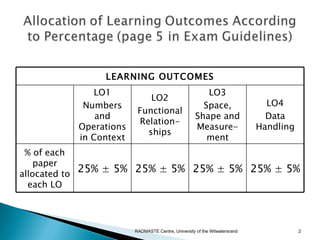
LEARNING OUTCOMES
                  LO1                                      LO3
                                LO2
                Numbers                                   Space,                 LO4
                             Functional
                   and                                  Shape and                Data
                             Relation-
               Operations                               Measure-               Handling
                               ships
               in Context                                  ment
 % of each
    paper
allocated to
               25% ± 5% 25% ± 5% 25% ± 5% 25% ± 5%
  each LO


                            RADMASTE Centre, University of the Witwatersrand              2
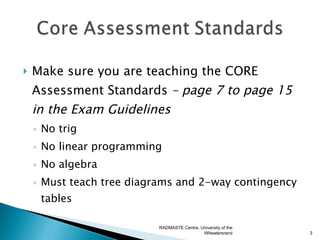
   Make sure you are teaching the CORE
    Assessment Standards – page 7 to page 15
    in the Exam Guidelines
    ◦ No trig
    ◦ No linear programming
    ◦ No algebra
    ◦ Must teach tree diagrams and 2-way contingency
      tables

                          RADMASTE Centre, University of the
                                            Witwatersrand      3
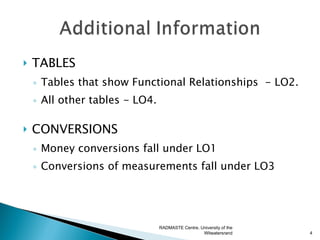
   TABLES
    ◦ Tables that show Functional Relationships - LO2.
    ◦ All other tables - LO4.

   CONVERSIONS
    ◦ Money conversions fall under LO1
    ◦ Conversions of measurements fall under LO3


                                RADMASTE Centre, University of the
                                                  Witwatersrand      4
   Each question should be set on a
    different context.
   Each context should contain questions
    from at least two different LO’s
   Contexts should not interfere with the
    mathematics or detract from the
    mathematics
   As far as possible, contexts should be
    relevant to the learners
                       RADMASTE Centre, University of the
                                         Witwatersrand      5
   Where necessary, diagrams and
    explanations of terms should be provided in
    order to make each context clear to the
    learners

   Language should be simple and sentences
    should be short. Where possible, the
    present tense should be used when
    describing the context.

                        RADMASTE Centre, University of the
                                          Witwatersrand      6
   A basic knowing and routine applications
    paper that consists of between 5 and 8
    shorter questions

   Each question should be set on a separate
    context

   Each context should contain questions from
    at least 2 different Learning Outcomes.

   Approximately 25% of marks from each
    Learning Outcome     RADMASTE Centre, University of the
                                           Witwatersrand      7
   Question 1 – basic calculations and simple
    context questions

   Question 2 – simple short context questions
    divided into sub-questions.


                        RADMASTE Centre, University of the
                                          Witwatersrand      8
   An applications, reasoning and reflecting
    paper

   Consists of between 4 and 6 longer
    questions

   Questions require more interpretation
    and application than Paper 1.


                       RADMASTE Centre, University of the
                                         Witwatersrand      9
   Approximately 25% of the marks allocated
    to each Learning Outcome

   Each question is set on a different context

   Each context should contain questions from
    at least two different Learning Outcomes


                         RADMASTE Centre, University of the
                                           Witwatersrand      10
   Assessment should be pitched at
    different levels of cognitive demand.

    ◦ LEVEL 1 Knowing

    ◦ LEVEL 2 Applying routine procedures in
      familiar contexts

    ◦ LEVEL 3 Applying multi-step procedures in a
      variety of contexts
                         RADMASTE Centre, University of the
                                           Witwatersrand      11
   This means that …

    ◦ At one end of the spectrum there should be
      tasks that require the learners to reproduce facts
     (knowing).

    ◦ At the other end of the spectrum there should be
      tasks that require the learners to analyse and
     explain their conclusions, and use varied and
     complex methods and approaches (reasoning and
     reflecting)
                             RADMASTE Centre, University of the
                                               Witwatersrand      12
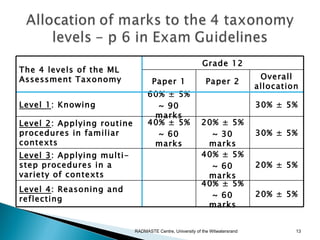
Grade 12
The 4 levels of the ML
Assessment Taxonomy                                                             Overall
                                    Paper 1                  Paper 2
                                                                               allocation
                                 60% ± 5%
Level 1: Knowing                   ~ 90                                        30% ± 5%
                                  marks
Level 2: Applying routine        40% ± 5%                  20% ± 5%
procedures in familiar             ~ 60                      ~ 30              30% ± 5%
contexts                          marks                     marks
Level 3: Applying multi-                                   40% ± 5%
step procedures in a                                         ~ 60              20% ± 5%
variety of contexts                                         marks
                                                           40% ± 5%
Level 4: Reasoning and
                                                             ~ 60              20% ± 5%
reflecting
                                                            marks


                            RADMASTE Centre, University of the Witwatersrand            13
   Make sure you are aware of the suggested
    interpretation of the Taxonomy Levels – page
    16 to page 20 in the Exam Guidelines


                         RADMASTE Centre, University of the
                                           Witwatersrand      14
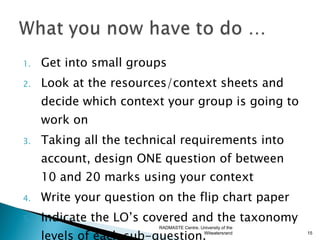
1.   Get into small groups
2.   Look at the resources/context sheets and
     decide which context your group is going to
     work on
3.   Taking all the technical requirements into
     account, design ONE question of between
     10 and 20 marks using your context
4.   Write your question on the flip chart paper
5.   Indicate the LO’s covered and the taxonomy
                         RADMASTE Centre, University of the

     levels of each sub-question.          Witwatersrand      15

Assessing Maths Lit Exams

  • 1.
  • 2.
    LEARNING OUTCOMES LO1 LO3 LO2 Numbers Space, LO4 Functional and Shape and Data Relation- Operations Measure- Handling ships in Context ment % of each paper allocated to 25% ± 5% 25% ± 5% 25% ± 5% 25% ± 5% each LO RADMASTE Centre, University of the Witwatersrand 2
  • 3.
    Make sure you are teaching the CORE Assessment Standards – page 7 to page 15 in the Exam Guidelines ◦ No trig ◦ No linear programming ◦ No algebra ◦ Must teach tree diagrams and 2-way contingency tables RADMASTE Centre, University of the Witwatersrand 3
  • 4.
    TABLES ◦ Tables that show Functional Relationships - LO2. ◦ All other tables - LO4.  CONVERSIONS ◦ Money conversions fall under LO1 ◦ Conversions of measurements fall under LO3 RADMASTE Centre, University of the Witwatersrand 4
  • 5.
    Each question should be set on a different context.  Each context should contain questions from at least two different LO’s  Contexts should not interfere with the mathematics or detract from the mathematics  As far as possible, contexts should be relevant to the learners RADMASTE Centre, University of the Witwatersrand 5
  • 6.
    Where necessary, diagrams and explanations of terms should be provided in order to make each context clear to the learners  Language should be simple and sentences should be short. Where possible, the present tense should be used when describing the context. RADMASTE Centre, University of the Witwatersrand 6
  • 7.
    A basic knowing and routine applications paper that consists of between 5 and 8 shorter questions  Each question should be set on a separate context  Each context should contain questions from at least 2 different Learning Outcomes.  Approximately 25% of marks from each Learning Outcome RADMASTE Centre, University of the Witwatersrand 7
  • 8.
    Question 1 – basic calculations and simple context questions  Question 2 – simple short context questions divided into sub-questions. RADMASTE Centre, University of the Witwatersrand 8
  • 9.
    An applications, reasoning and reflecting paper  Consists of between 4 and 6 longer questions  Questions require more interpretation and application than Paper 1. RADMASTE Centre, University of the Witwatersrand 9
  • 10.
    Approximately 25% of the marks allocated to each Learning Outcome  Each question is set on a different context  Each context should contain questions from at least two different Learning Outcomes RADMASTE Centre, University of the Witwatersrand 10
  • 11.
    Assessment should be pitched at different levels of cognitive demand. ◦ LEVEL 1 Knowing ◦ LEVEL 2 Applying routine procedures in familiar contexts ◦ LEVEL 3 Applying multi-step procedures in a variety of contexts RADMASTE Centre, University of the Witwatersrand 11
  • 12.
    This means that … ◦ At one end of the spectrum there should be tasks that require the learners to reproduce facts (knowing). ◦ At the other end of the spectrum there should be tasks that require the learners to analyse and explain their conclusions, and use varied and complex methods and approaches (reasoning and reflecting) RADMASTE Centre, University of the Witwatersrand 12
  • 13.
    Grade 12 The 4levels of the ML Assessment Taxonomy Overall Paper 1 Paper 2 allocation 60% ± 5% Level 1: Knowing ~ 90 30% ± 5% marks Level 2: Applying routine 40% ± 5% 20% ± 5% procedures in familiar ~ 60 ~ 30 30% ± 5% contexts marks marks Level 3: Applying multi- 40% ± 5% step procedures in a ~ 60 20% ± 5% variety of contexts marks 40% ± 5% Level 4: Reasoning and ~ 60 20% ± 5% reflecting marks RADMASTE Centre, University of the Witwatersrand 13
  • 14.
    Make sure you are aware of the suggested interpretation of the Taxonomy Levels – page 16 to page 20 in the Exam Guidelines RADMASTE Centre, University of the Witwatersrand 14
  • 15.
    1. Get into small groups 2. Look at the resources/context sheets and decide which context your group is going to work on 3. Taking all the technical requirements into account, design ONE question of between 10 and 20 marks using your context 4. Write your question on the flip chart paper 5. Indicate the LO’s covered and the taxonomy RADMASTE Centre, University of the levels of each sub-question. Witwatersrand 15