The Librarian

In a sea of information someone needs to steer
the way
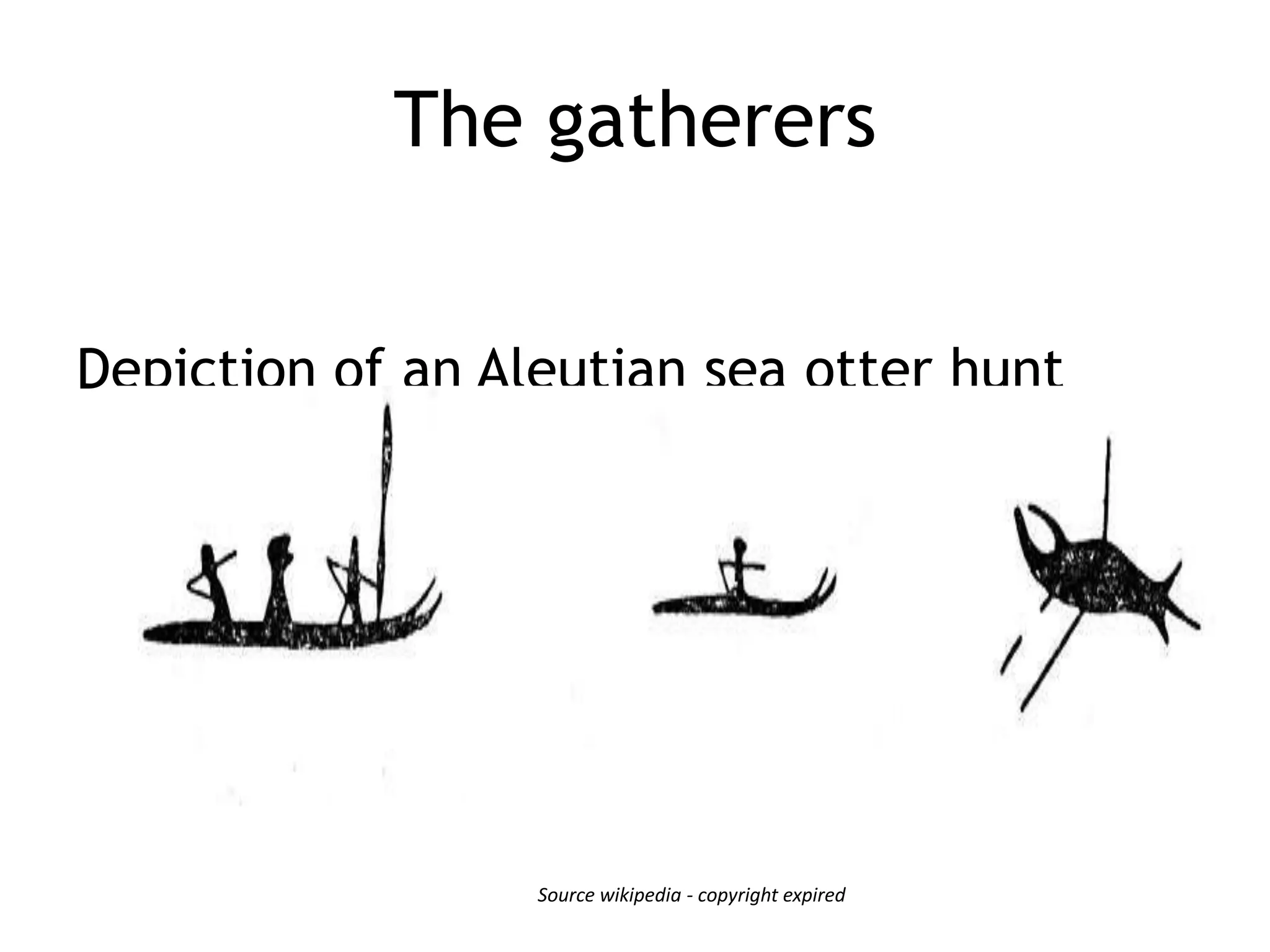
The gatherers
Depiction of an Aleutian sea otter hunt

Source wikipedia - copyright expired
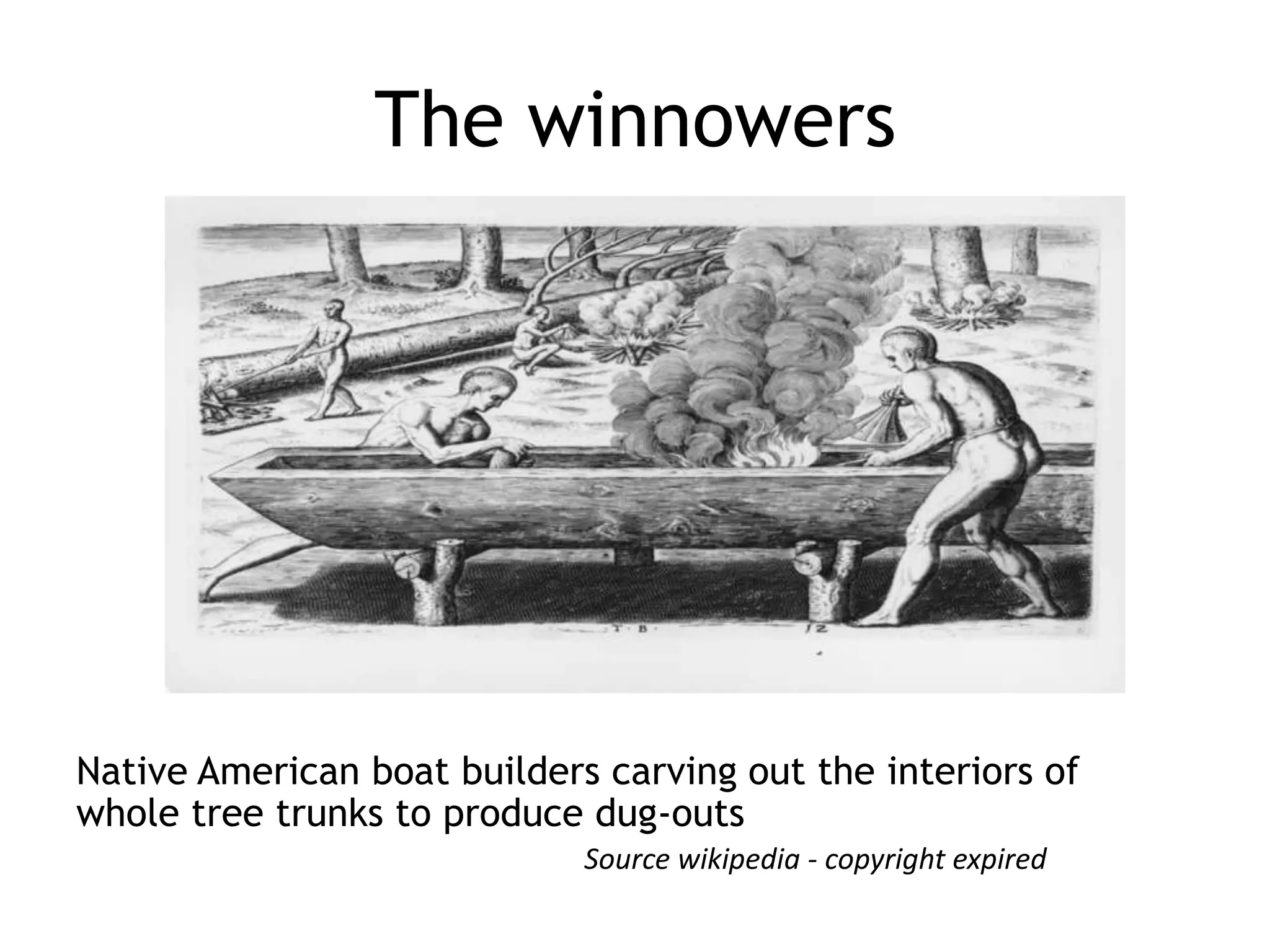
The winnowers

Native American boat builders carving out the interiors of
whole tree trunks to produce dug-outs
Source wikipedia - copyright expired
What is all this research and education for?
According to Larry Sanger the argument runs thus
Should children be educated primarily so as to fit well into
society,

OR
Should the focus be on training minds for critical thinking
and filling them with knowledge?
Brockman, J. ed. 2011 ibid
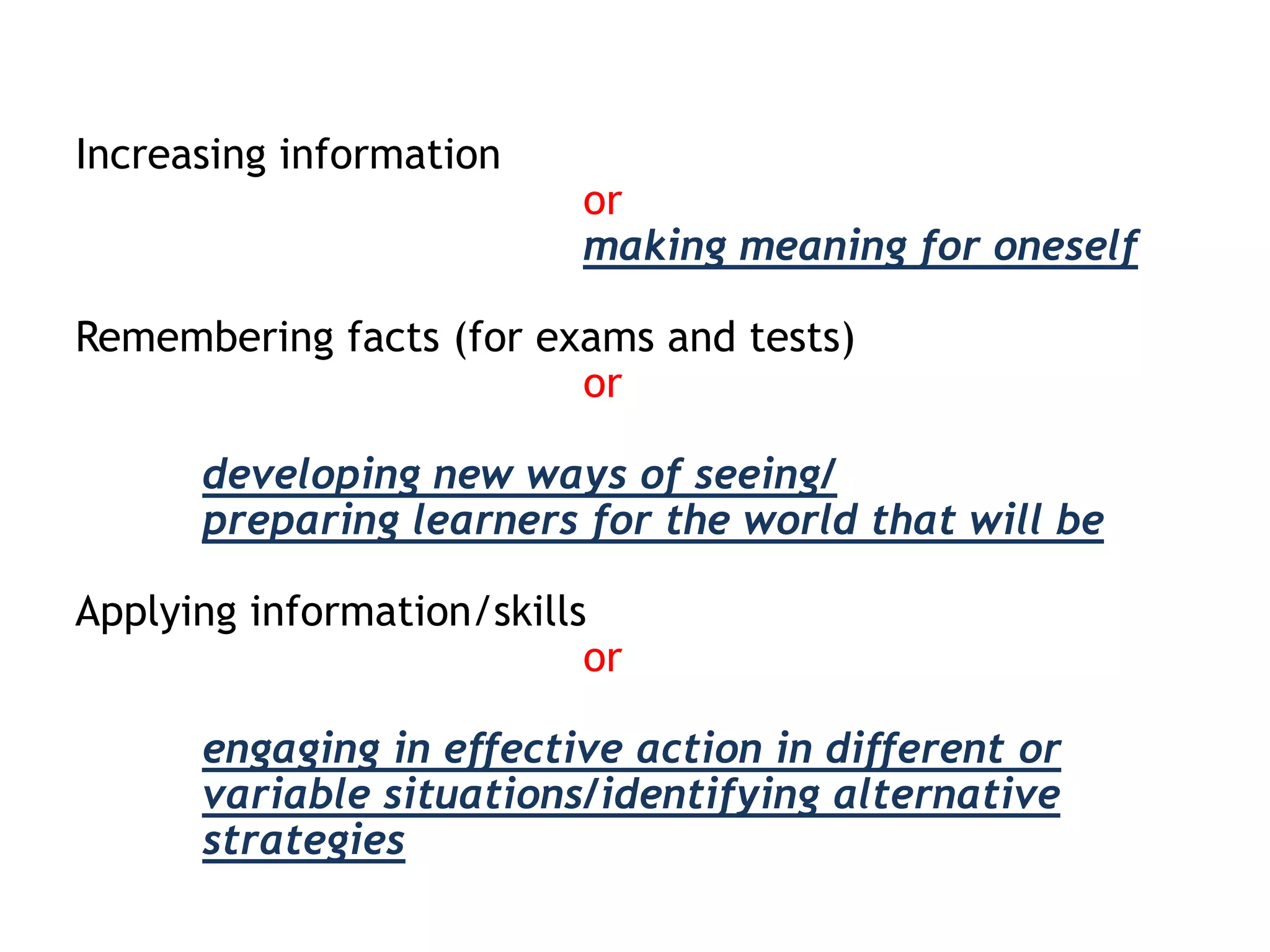
Increasing information

or
making meaning for oneself

Remembering facts (for exams and tests)
or

developing new ways of seeing/
preparing learners for the world that will be
Applying information/skills
or
engaging in effective action in different or
variable situations/identifying alternative
strategies
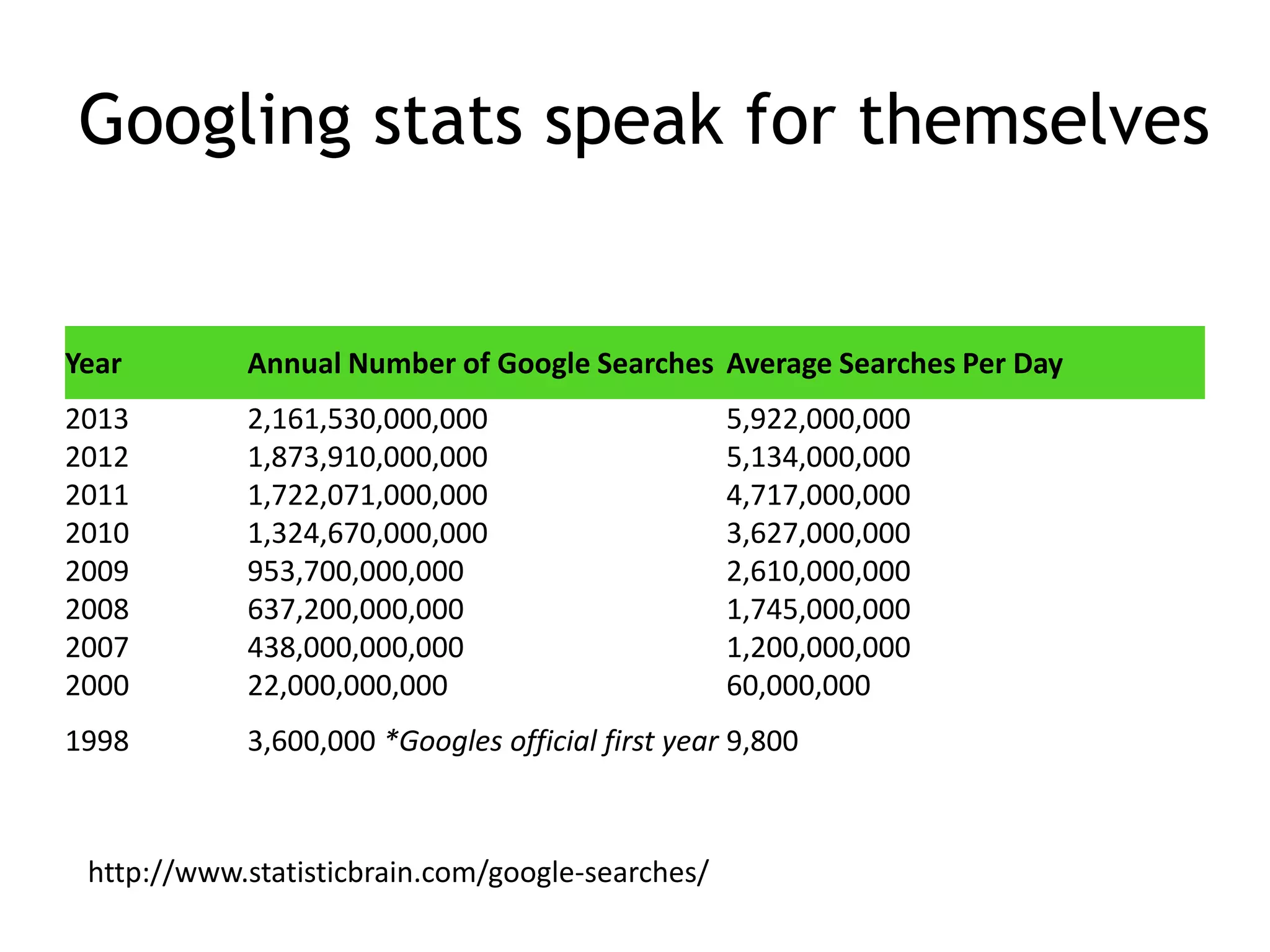
Googling stats speak for themselves

Year

Annual Number of Google Searches Average Searches Per Day

2013
2012
2011
2010
2009
2008
2007
2000

2,161,530,000,000
1,873,910,000,000
1,722,071,000,000
1,324,670,000,000
953,700,000,000
637,200,000,000
438,000,000,000
22,000,000,000

1998

3,600,000 *Googles official first year 9,800

http://www.statisticbrain.com/google-searches/

5,922,000,000
5,134,000,000
4,717,000,000
3,627,000,000
2,610,000,000
1,745,000,000
1,200,000,000
60,000,000
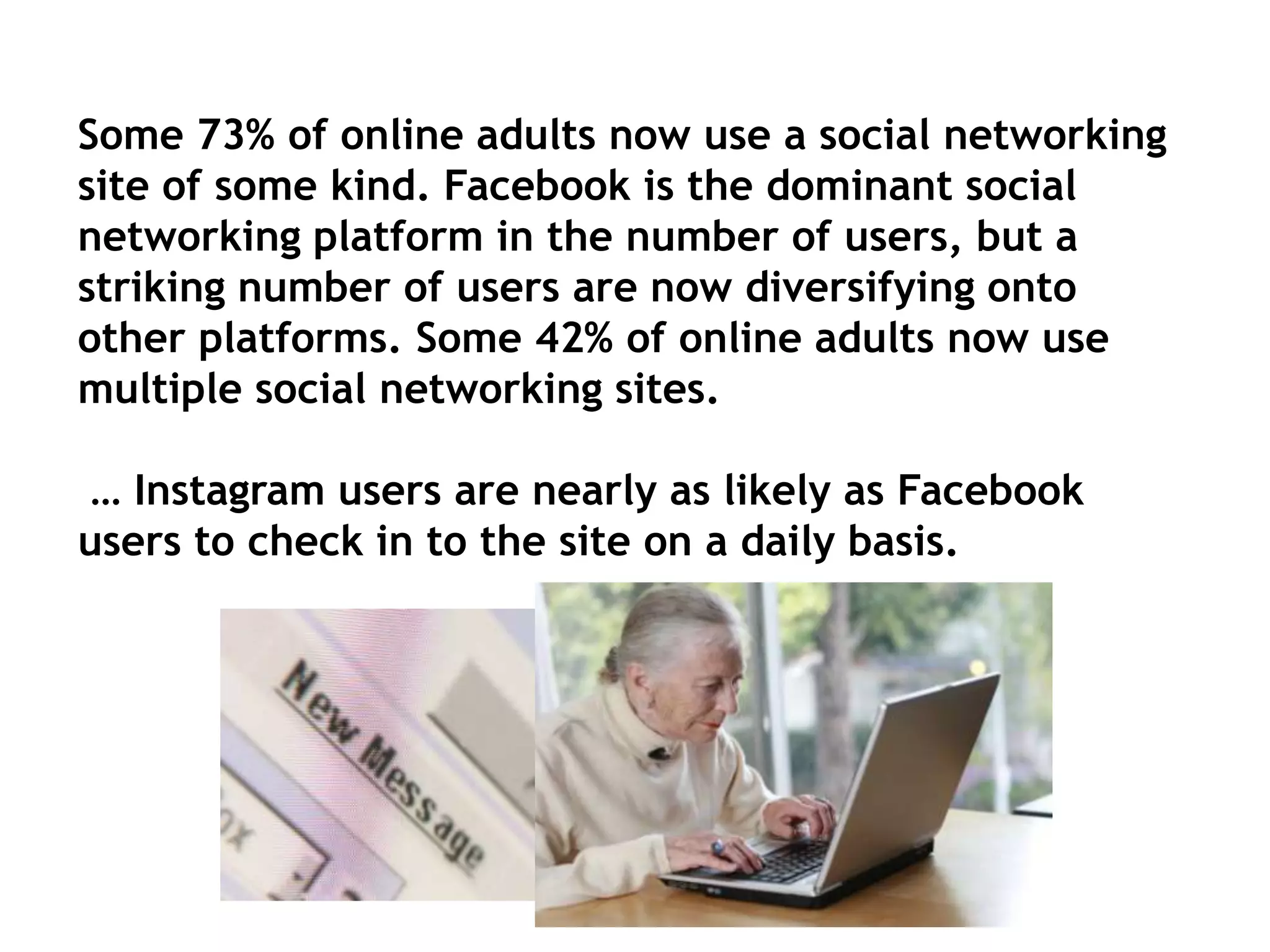
Some 73% of online adults now use a social networking
site of some kind. Facebook is the dominant social
networking platform in the number of users, but a
striking number of users are now diversifying onto
other platforms. Some 42% of online adults now use
multiple social networking sites.
… Instagram users are nearly as likely as Facebook
users to check in to the site on a daily basis.
Daniel Miller

…. a change in Facebook can arise, not from anything that happens
within Facebook itself, but because of changes in the other media it is
differentiated from. In my surveys at schools it is now
Twitter, Instagram, WhatsApp and Snapchat that connect pupils with
other young people. Snapchat connects the closest friends, WhatsApp
the quite close friends, Twitter the wider friends, while Instagram can
include strangers. By contrast, Facebook has become the place where
people interact with older people, especially parents and the wider
family, or even older siblings who have gone to university.

Professor Daniel Miller (UCL)
http://blogs.ucl.ac.uk/social-networking/2013/11/24/what-will-we-learn-from-the-fall-offacebook/
Smartphone users check social media 20 times per day
4 out of 5 minutes on a smartphone are spent on
mobile applications
Users spend more time on Facebook & Twitter through
their phone than they do on their desktops

Apple comes first in ‘most purchased’ smart
phone, with Samsung in second
http://stephenslighthouse.com/2013/06/29/infographic-the-current-state-of-smartphones/
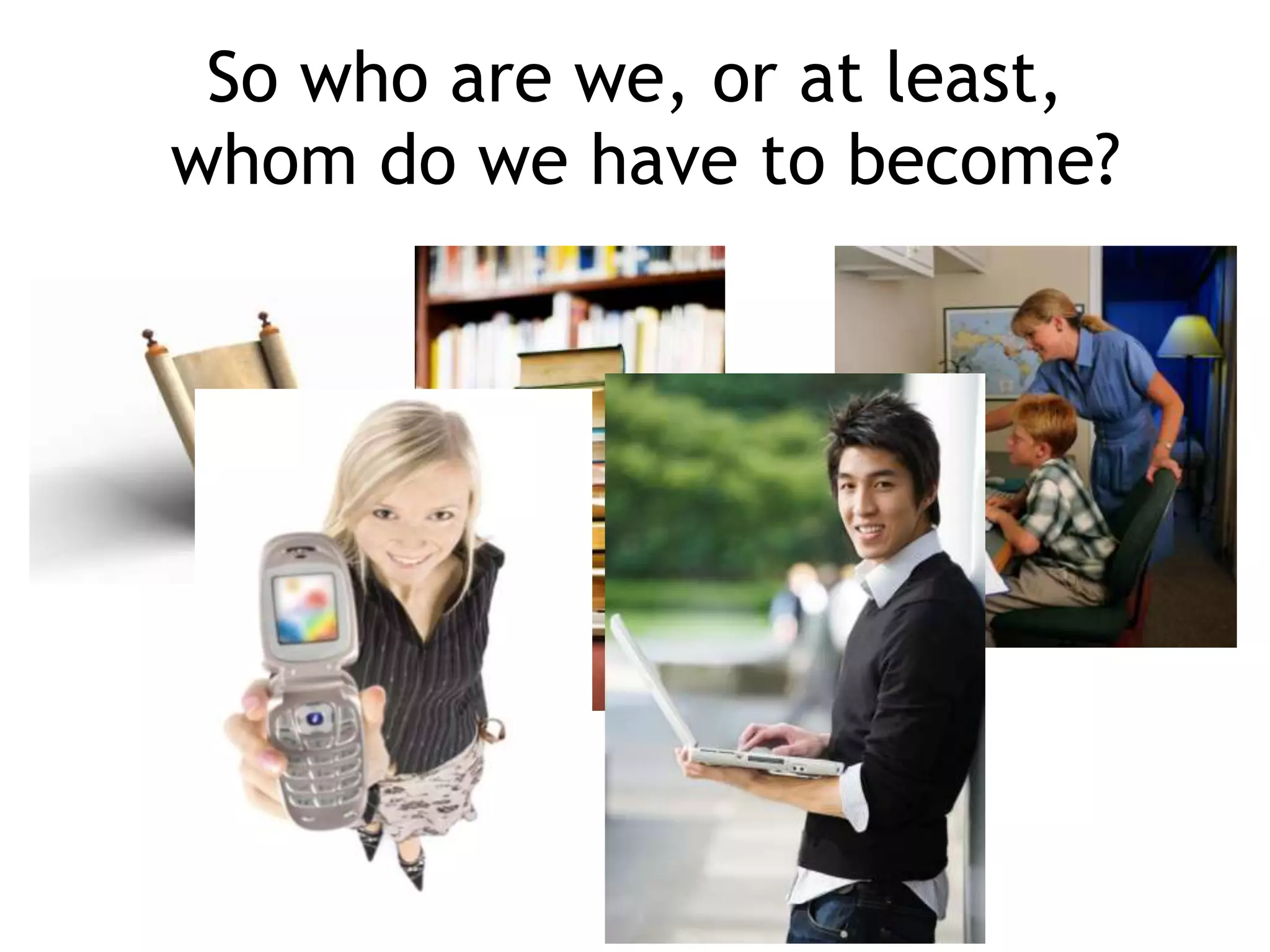
So who are we, or at least,
whom do we have to become?
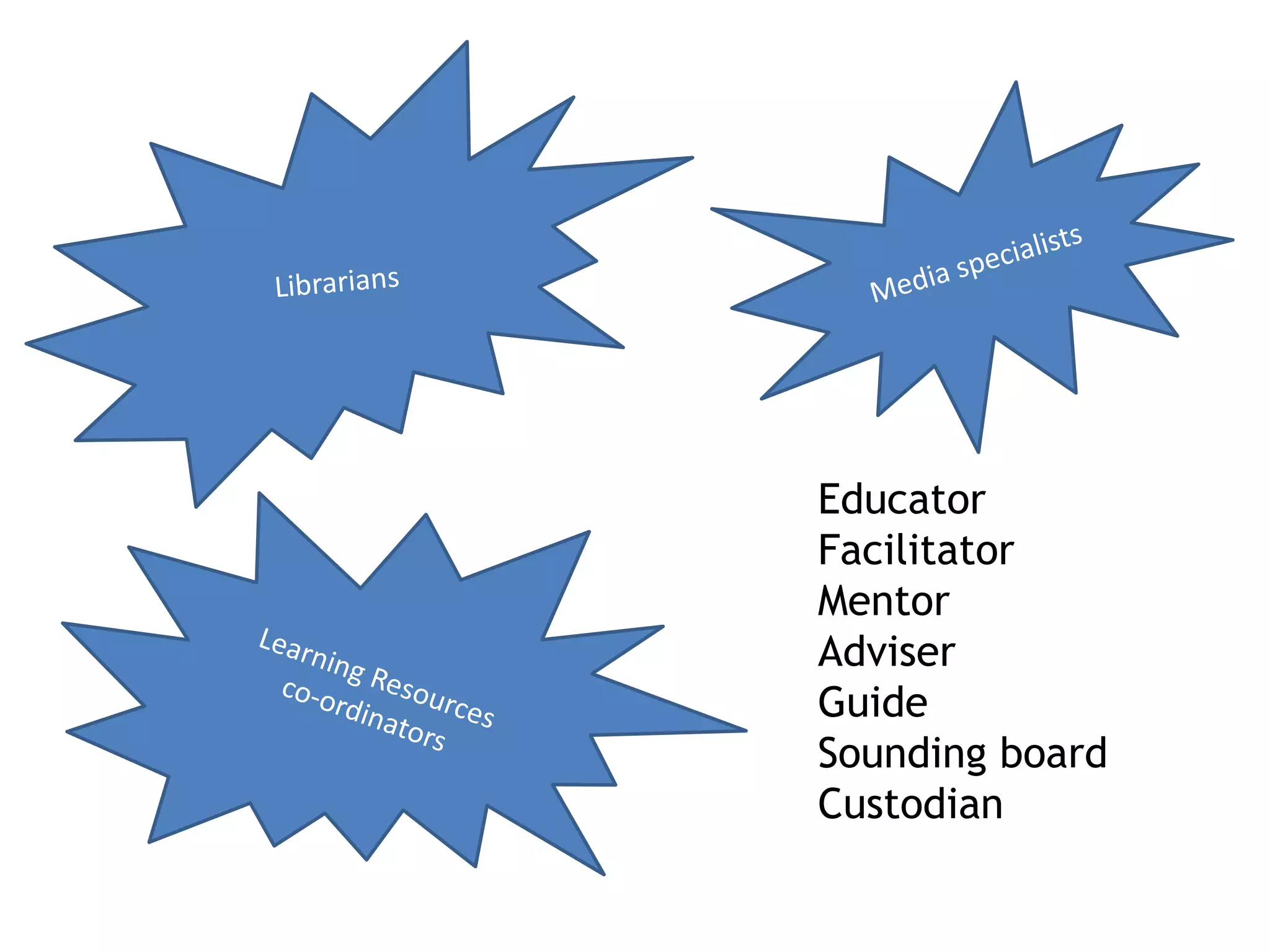
Educator
Facilitator
Mentor
Adviser
Guide
Sounding board
Custodian
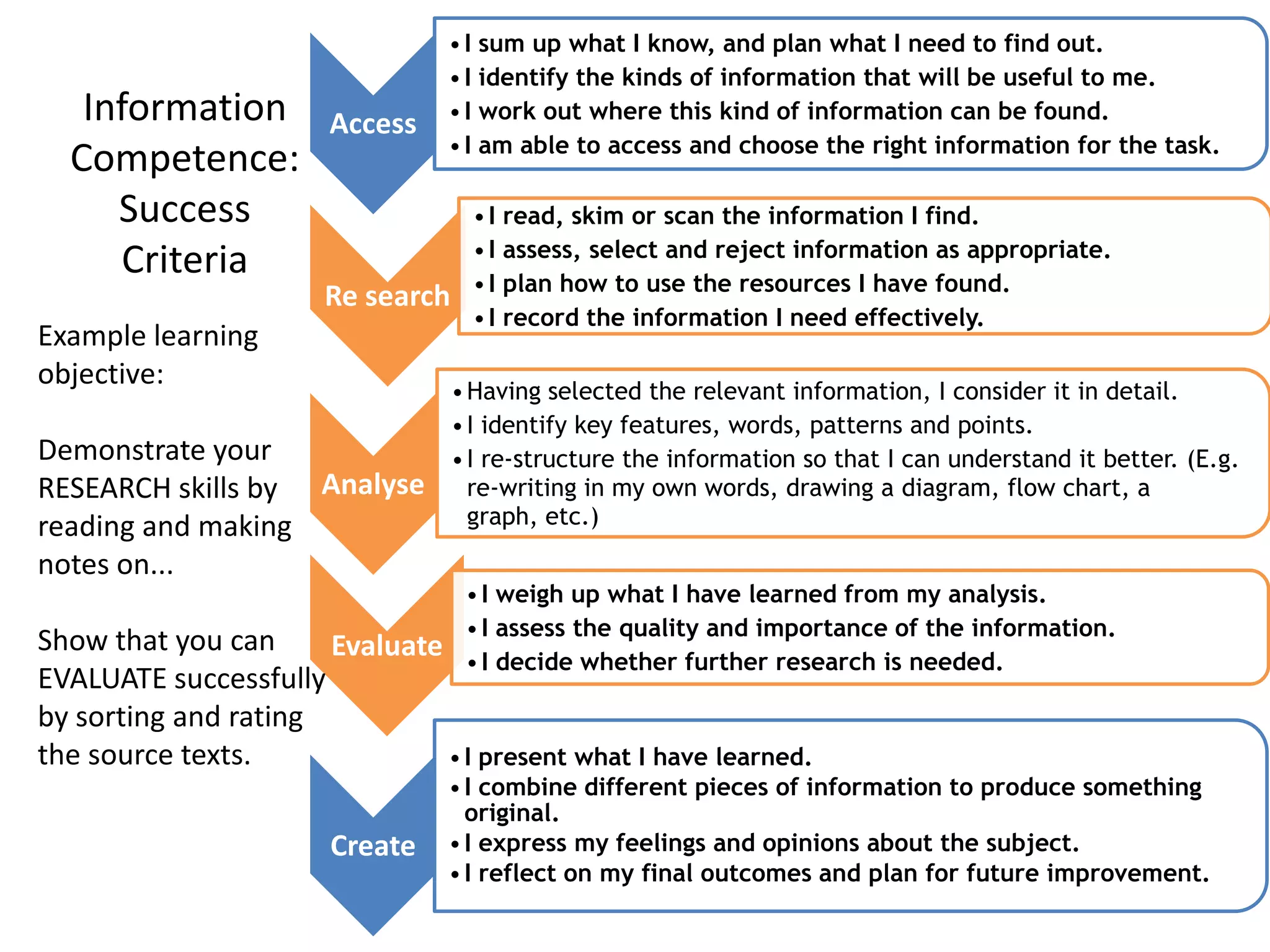
Information
Competence:
Success
Criteria

Access

• I sum up what I know, and plan what I need to find out.
• I identify the kinds of information that will be useful to me.
• I work out where this kind of information can be found.
• I am able to access and choose the right information for the task.

Re search

Example learning
objective:
Demonstrate your
RESEARCH skills by Analyse
reading and making
notes on...

• I read, skim or scan the information I find.
• I assess, select and reject information as appropriate.
• I plan how to use the resources I have found.
• I record the information I need effectively.
• Having selected the relevant information, I consider it in detail.
• I identify key features, words, patterns and points.
• I re-structure the information so that I can understand it better. (E.g.
re-writing in my own words, drawing a diagram, flow chart, a
graph, etc.)
• I weigh up what I have learned from my analysis.
• I assess the quality and importance of the information.
• I decide whether further research is needed.

Show that you can
Evaluate
EVALUATE successfully
by sorting and rating
the source texts.
• I present what I have learned.
Create

• I combine different pieces of information to produce something
original.
• I express my feelings and opinions about the subject.
• I reflect on my final outcomes and plan for future improvement.
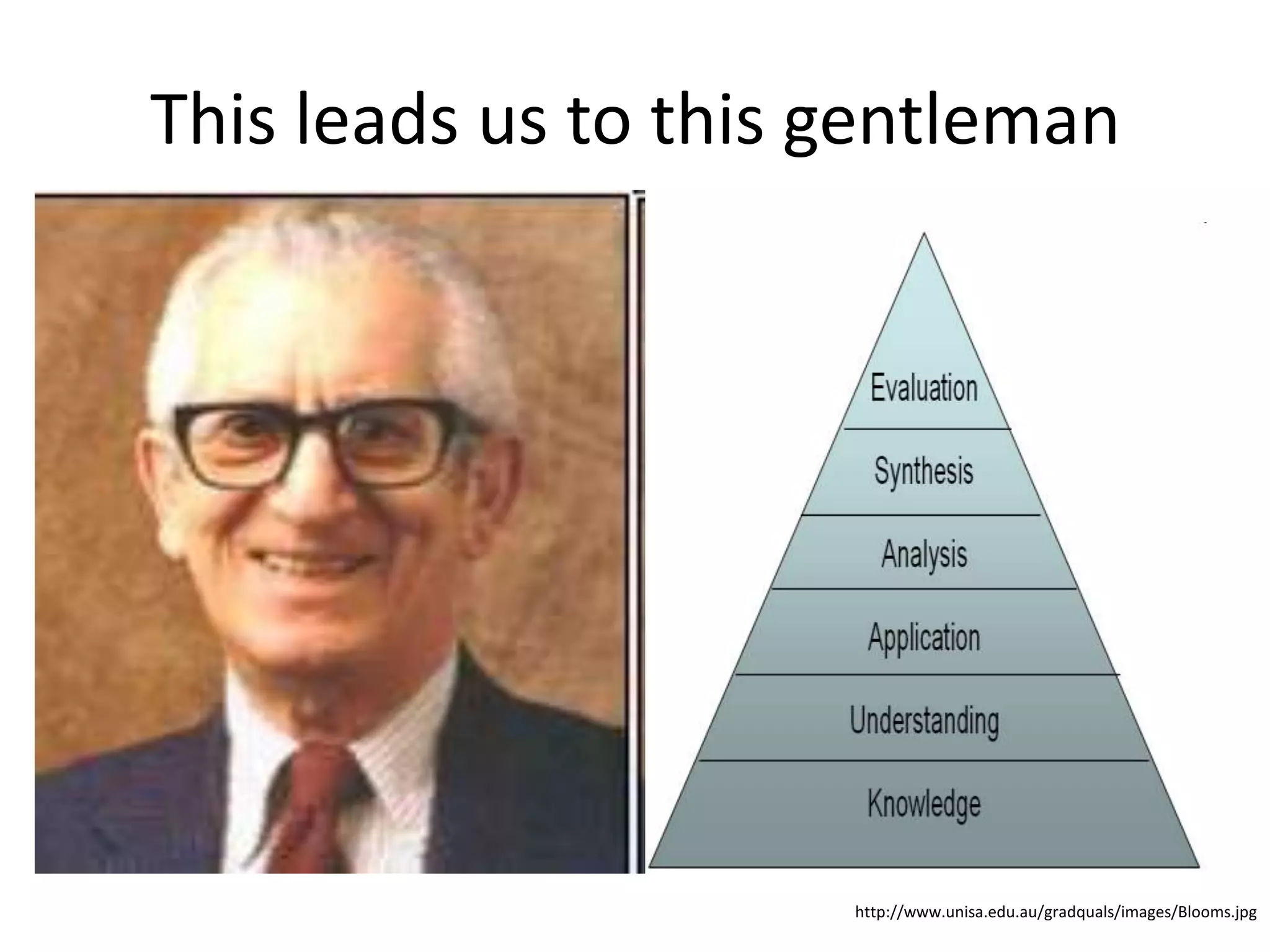
This leads us to this gentleman

http://www.unisa.edu.au/gradquals/images/Blooms.jpg
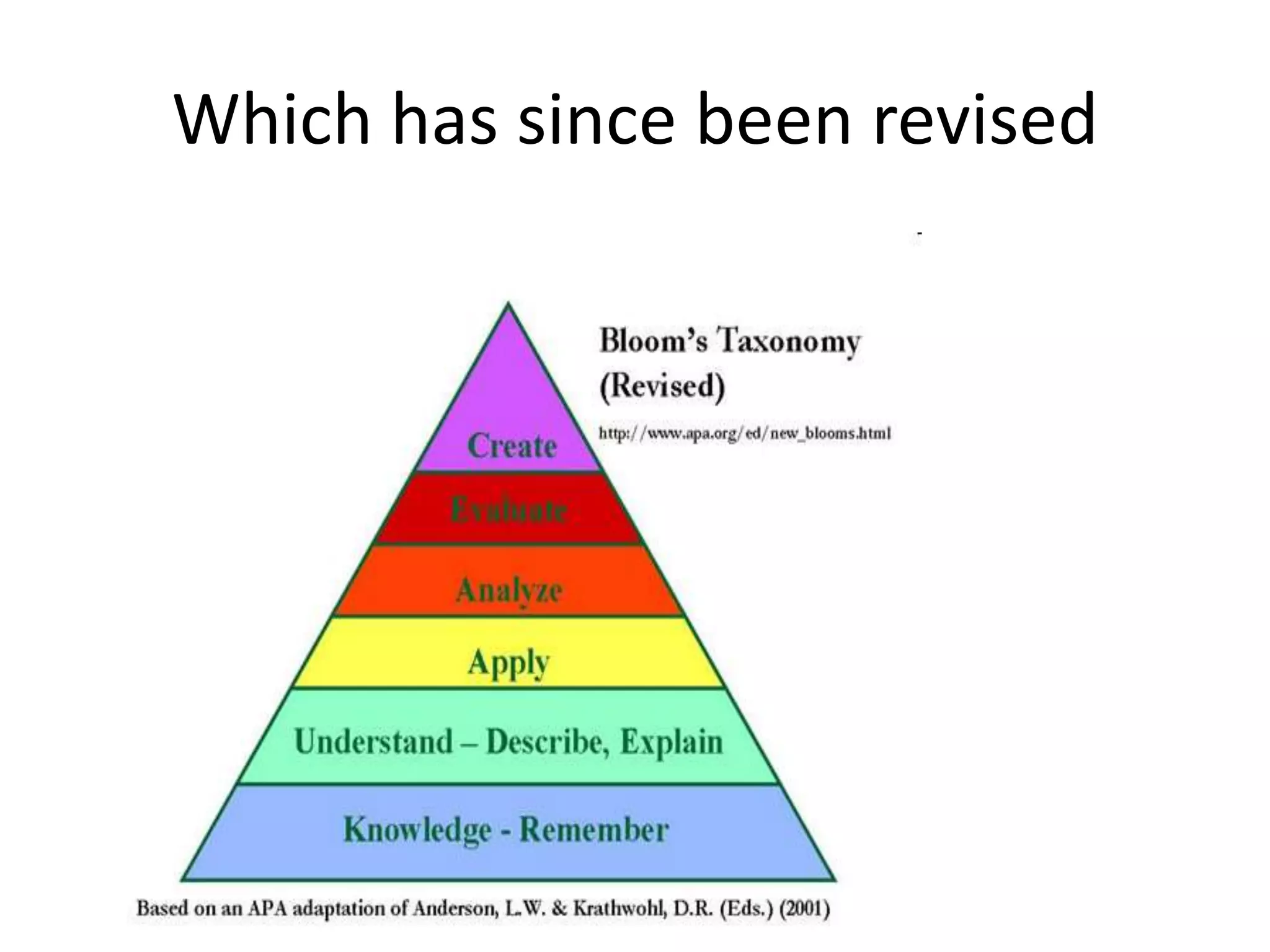
Which has since been revised
There can be lots of ways to
engage your students and promote
the resources they need to use
It’s time to fight back using weapons
freely available.

http://animoto.com/play/DASiJ11scoSmO8WbZismVg
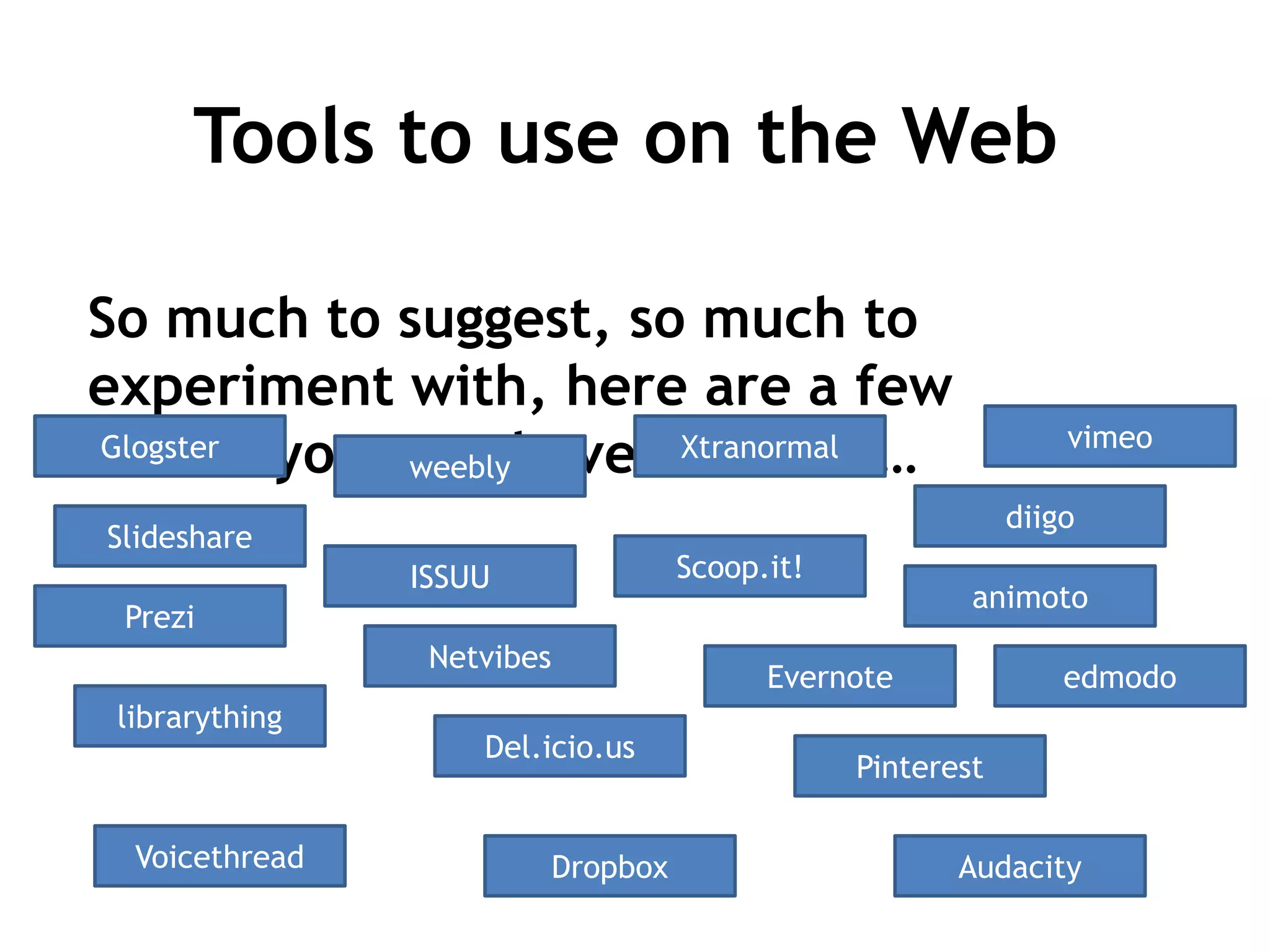
Tools to use on the Web
So much to suggest, so much to
experiment with, here are a few
Glogster
Xtranormal
names you may have heard of…
weebly

diigo

Slideshare

Scoop.it!

ISSUU

animoto

Prezi

Netvibes
librarything

Voicethread

vimeo

Evernote

Del.icio.us

Dropbox

edmodo

Pinterest
Audacity
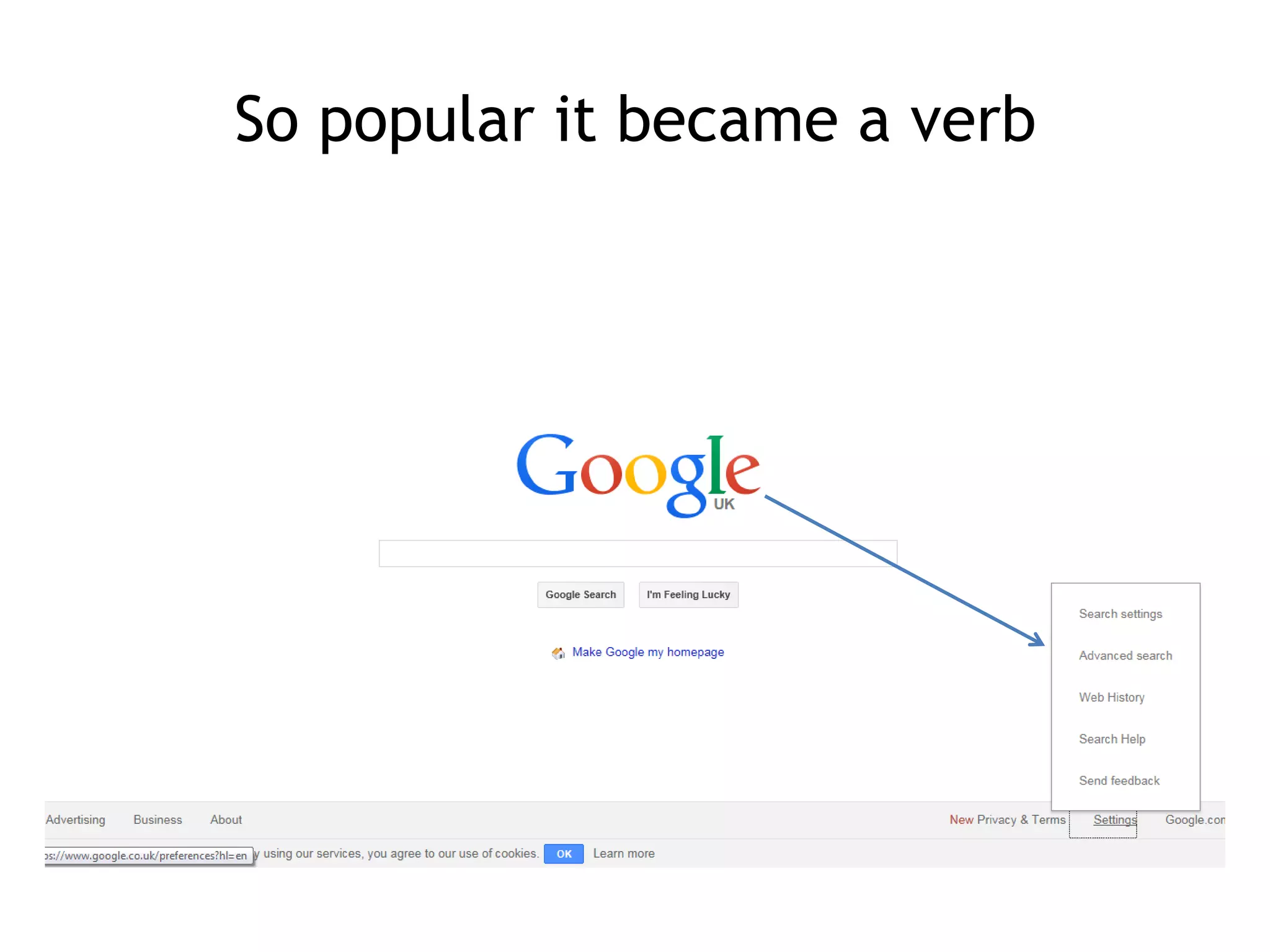
So popular it became a verb
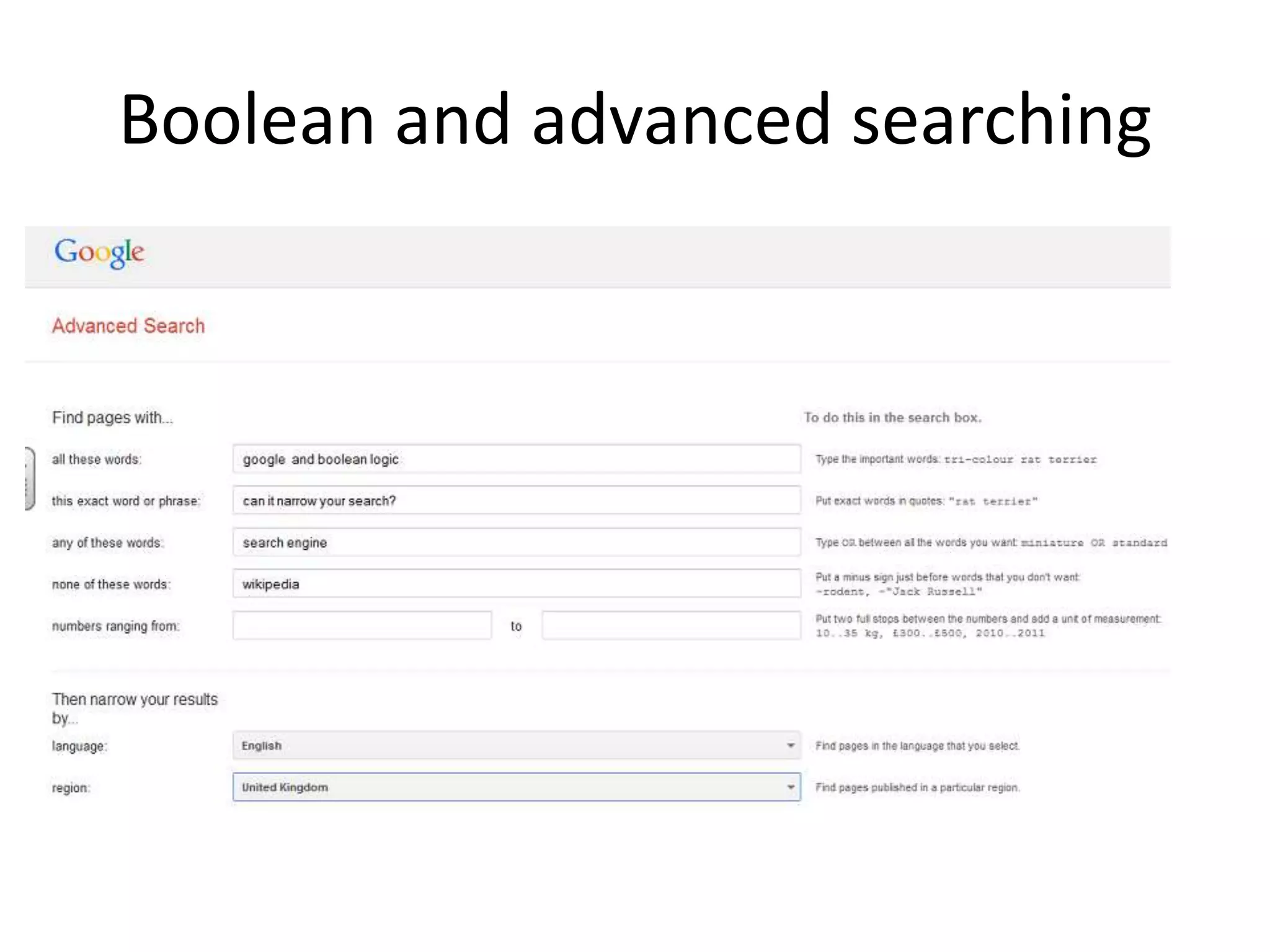
Boolean and advanced searching
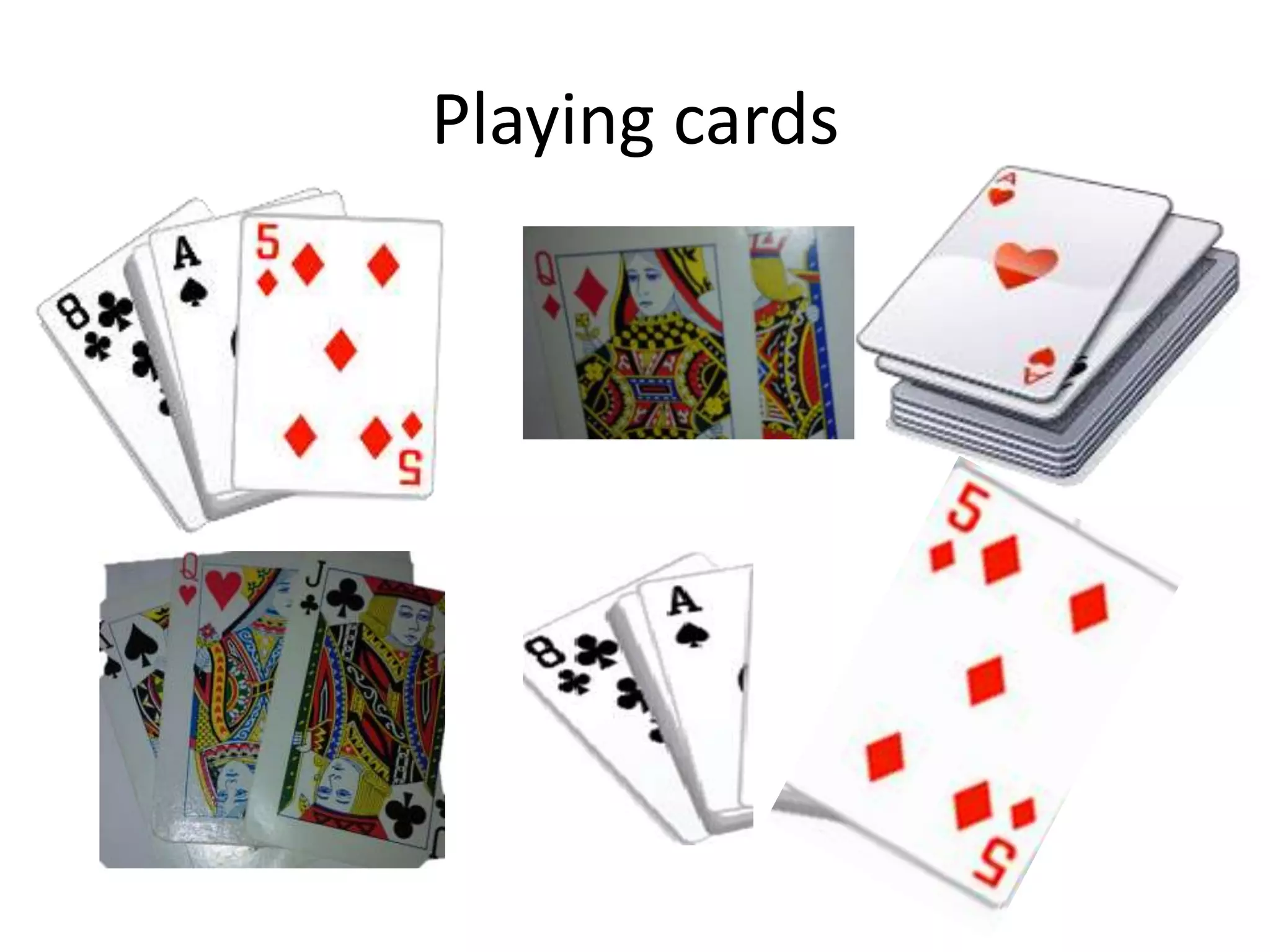
Playing cards
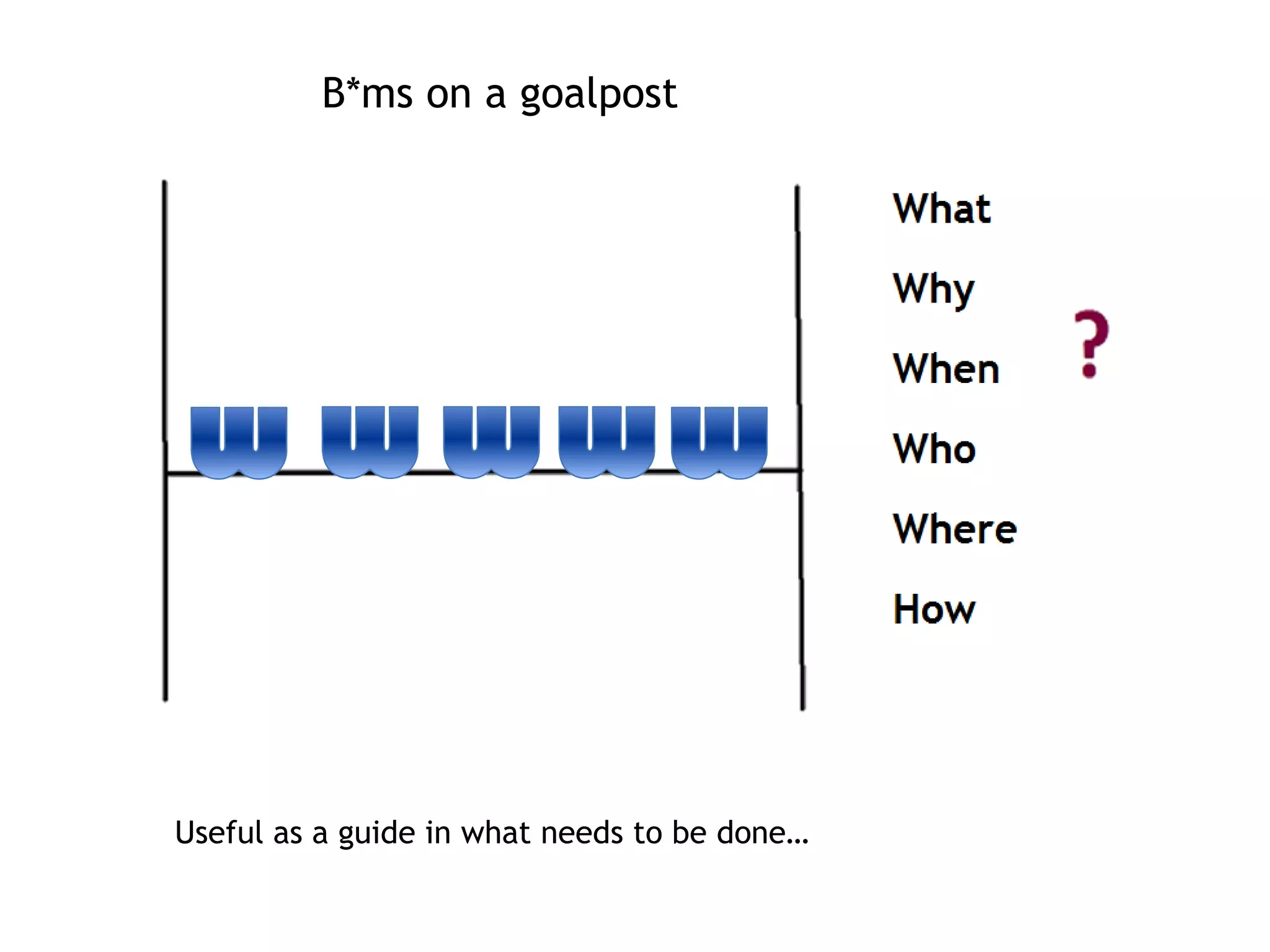
B*ms on a goalpost

Useful as a guide in what needs to be done…
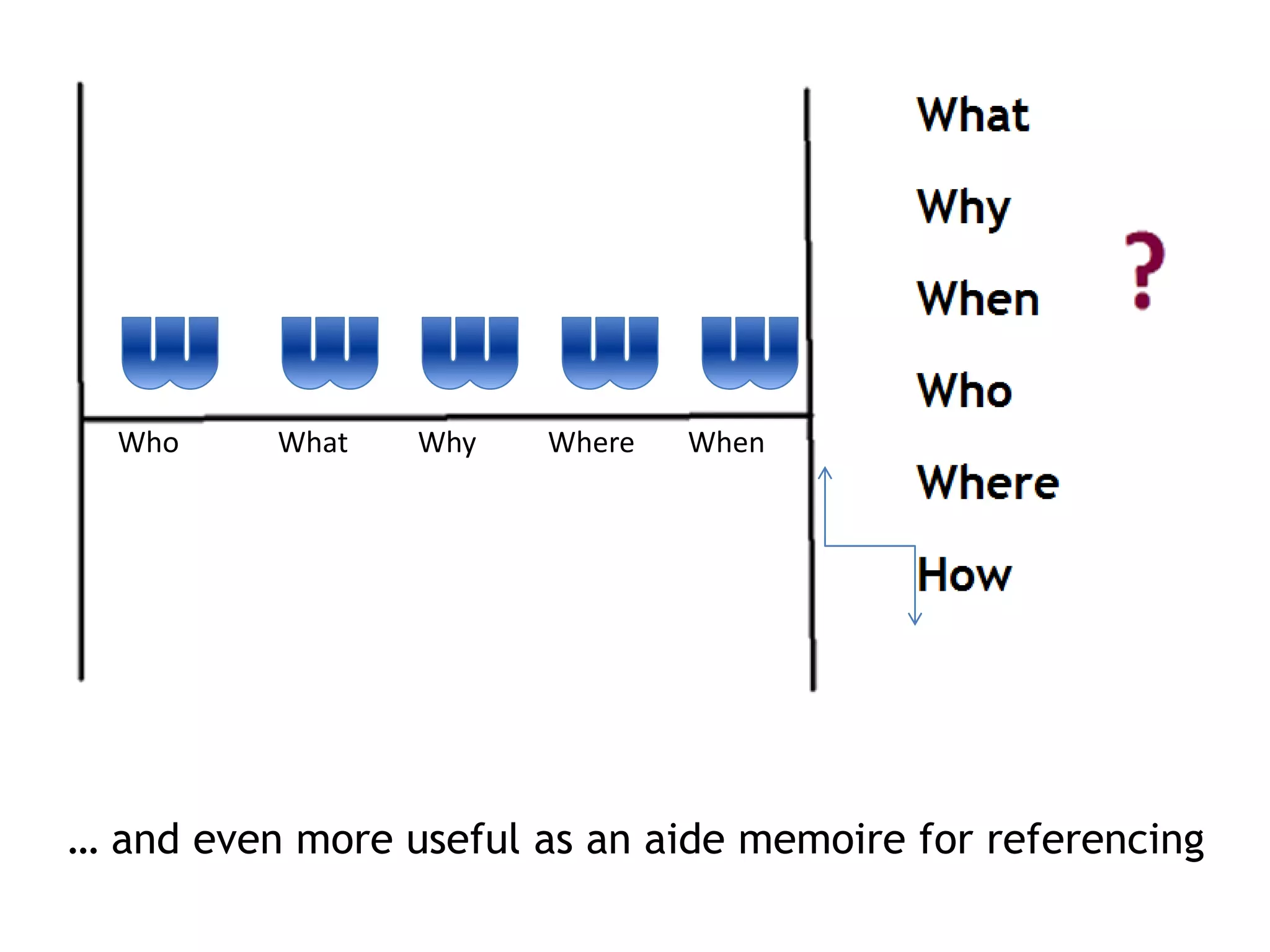
Who

What

Why

Where

When

… and even more useful as an aide memoire for referencing
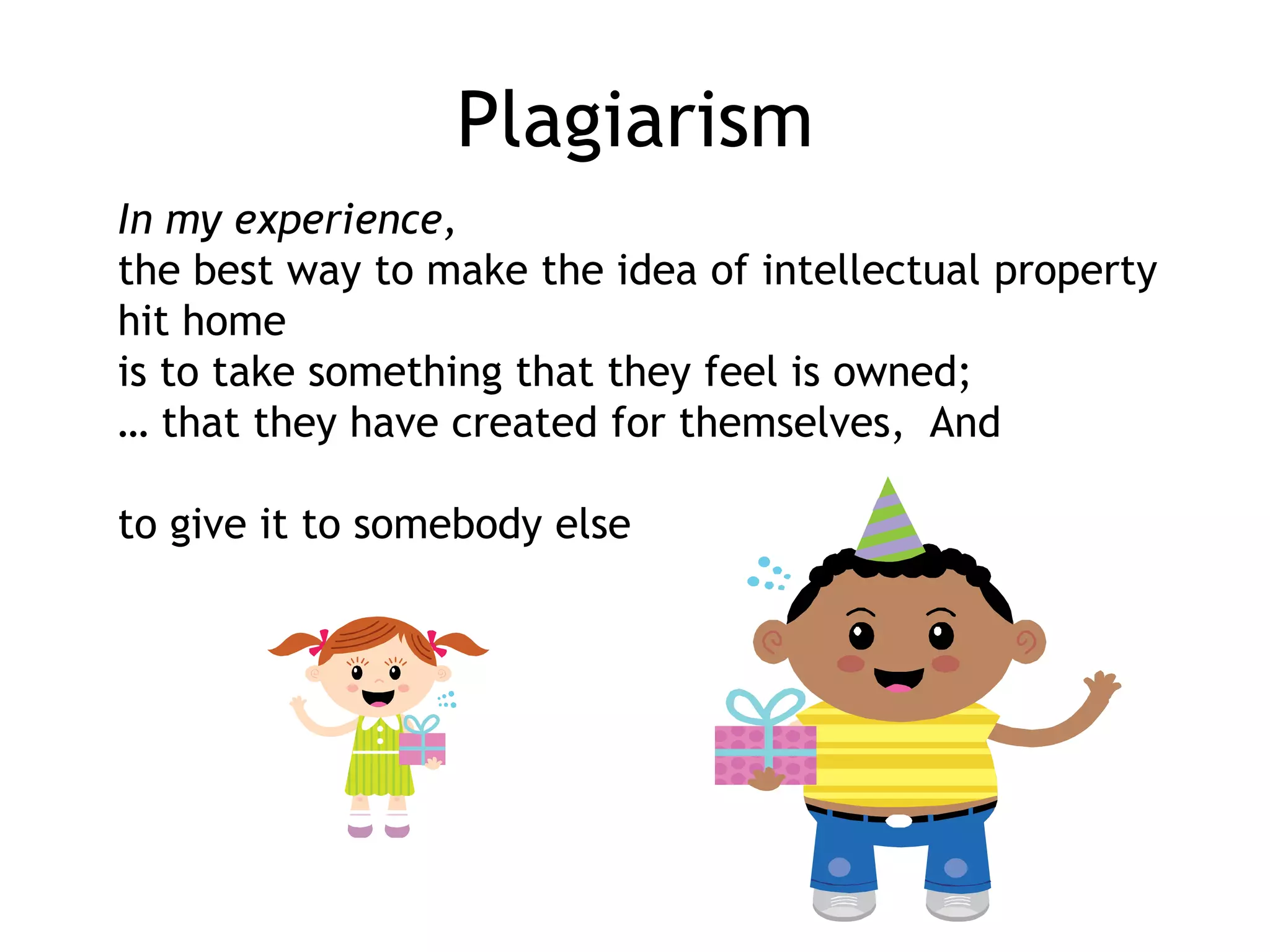
Plagiarism
In my experience,
the best way to make the idea of intellectual property
hit home
is to take something that they feel is owned;
… that they have created for themselves, And
to give it to somebody else
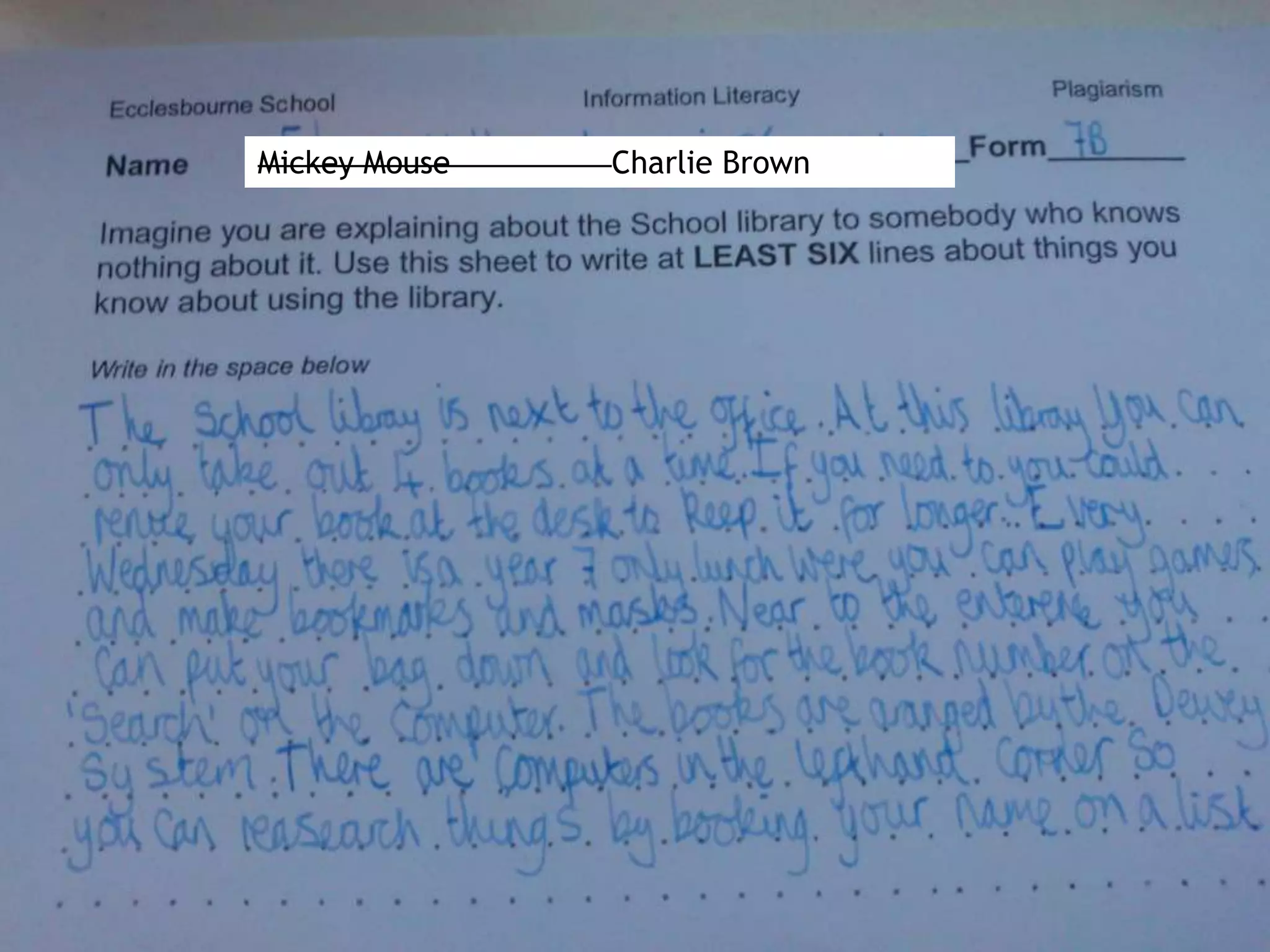
Mickey Mouse

Charlie Brown
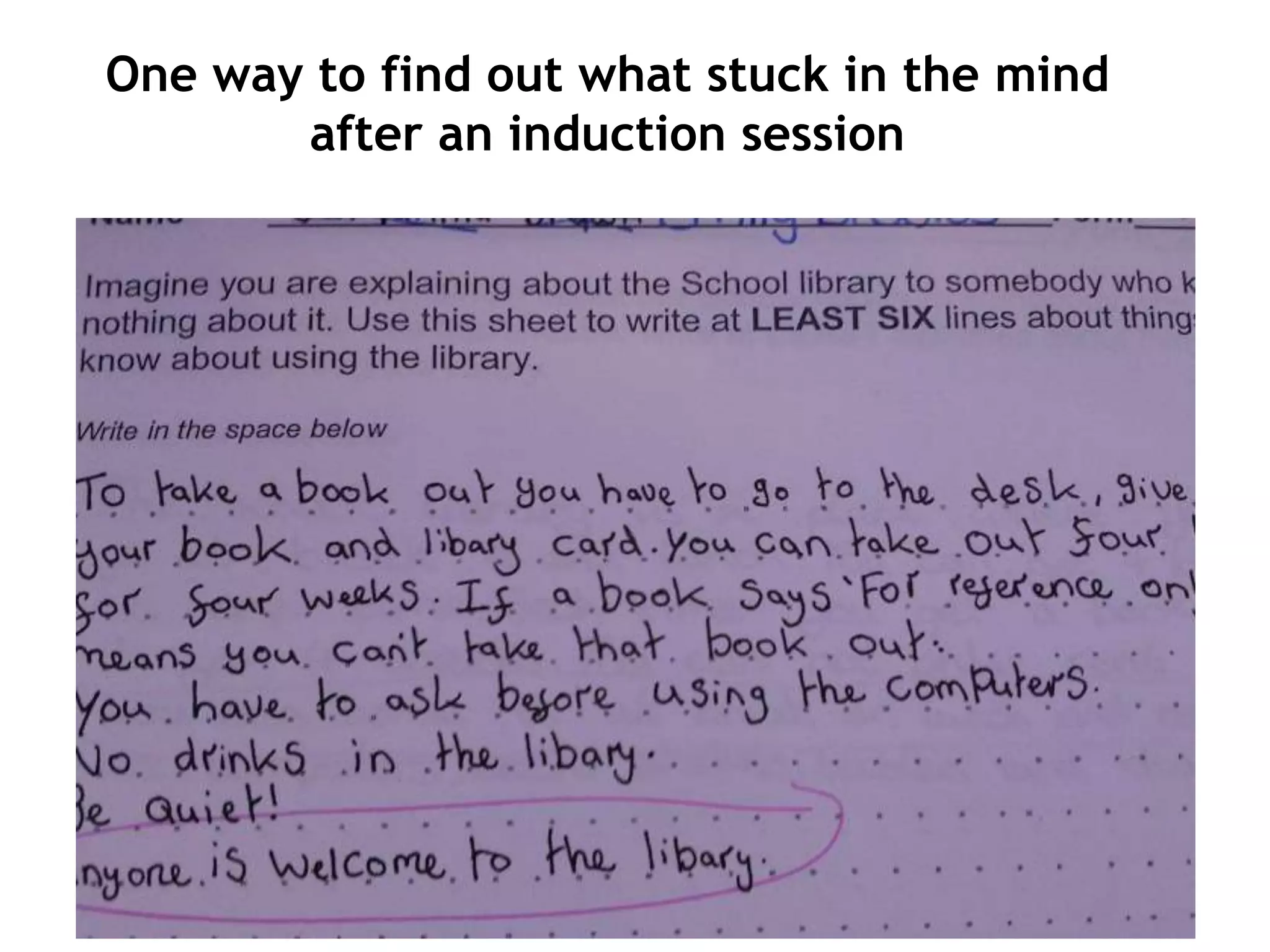
One way to find out what stuck in the mind
after an induction session
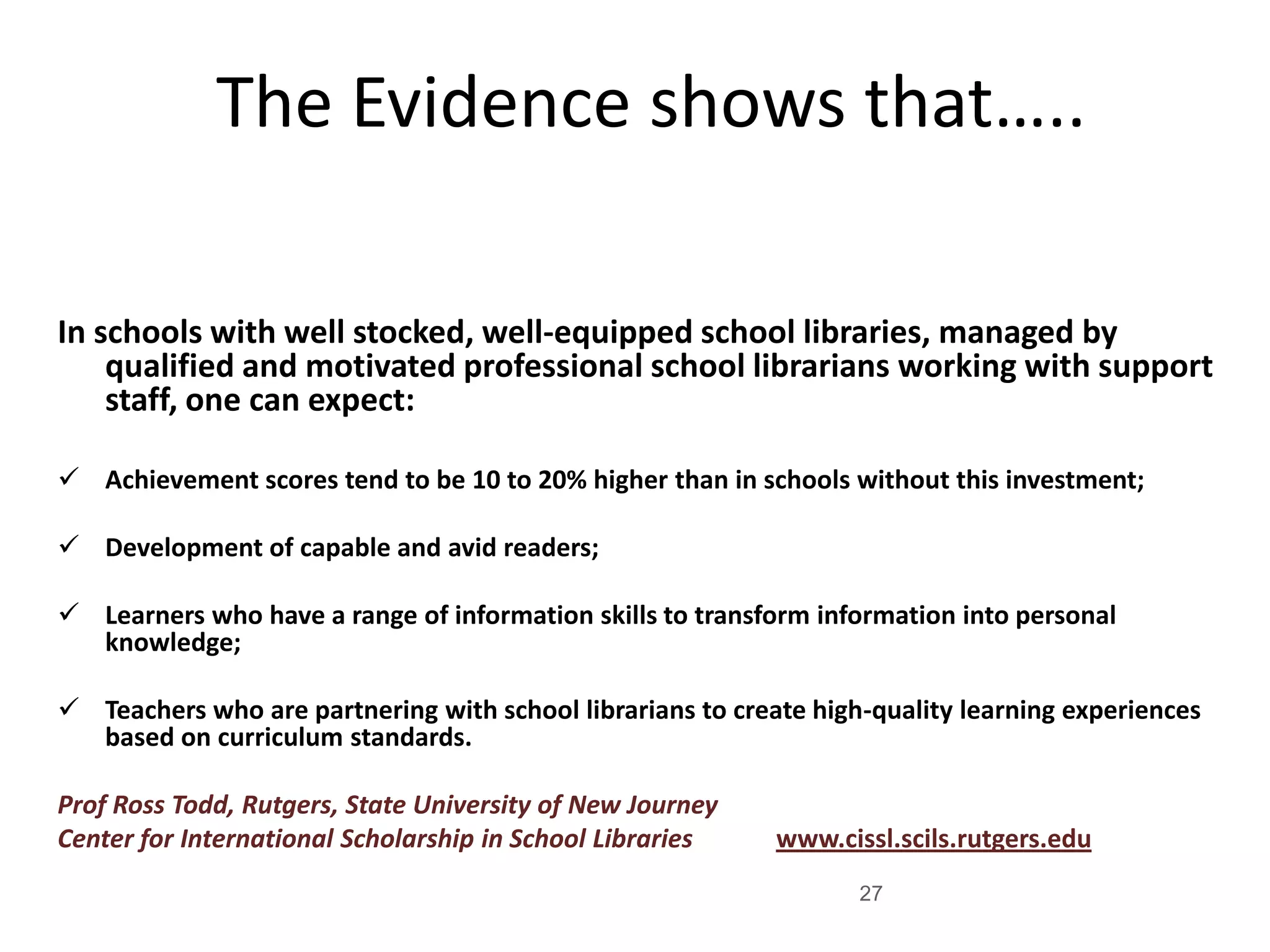
The Evidence shows that…..
In schools with well stocked, well-equipped school libraries, managed by
qualified and motivated professional school librarians working with support
staff, one can expect:
 Achievement scores tend to be 10 to 20% higher than in schools without this investment;
 Development of capable and avid readers;
 Learners who have a range of information skills to transform information into personal
knowledge;
 Teachers who are partnering with school librarians to create high-quality learning experiences
based on curriculum standards.
Prof Ross Todd, Rutgers, State University of New Journey
Center for International Scholarship in School Libraries

www.cissl.scils.rutgers.edu
27
So
The evidence is out there and I could have taken a whole day not merely an
hour to demonstrate some of the wonderful things my colleagues do.
K = the huge lengths we go to in order to motivate and engage students

R = resources, we select, purchase, index, promote to staff + students
U = teaching either explicitly or through ‘the back door’ and to individuals
T = our accessibility , not being tied to a curriculum (+ understanding of
current issues )
T = team (the team with our staff; the team we make with our colleagues)

and,
sometimes it will be the team we create with our
learners
so they achieve more
Source file

References and sources

Brockman, J. ed. 2011 How is the Internet changing the way you think? The Net’s impact on our minds and future.
9780857892454

http://www.edudemic.com/librarian-digital-age/
http://www.pewinternet.org/Reports/2013/Social-Media-Update.aspx
http://gsmis.org/
http://www.statisticbrain.com/google-searches/
http://digitalunite.com/
http://www.businessinsider.com/whatsapp-is-the-leading-messaging-app-2014-1
http://stephenslighthouse.com/
http://www.insidehighered.com/blogs/library-babel-fish/tacit-knowledge-and-studentresearcher#ixzz2XVPlcQNH
http://www.birmingham.ac.uk/Documents/libraries/5883LibrarySkillspack-studentst8.pdf
http://www.informationr.net/ir/13-4/paper355.html
http://www.citethisforme.com/
http://www.neilstoolbox.com/
http://cooltoolsforschools.wikispaces.com/
http://www.scottishlibraries.org/storage/sectors/schools/SLIC_RGU_Impact_of_School_Libraries_2013.pdf
http://www.bbc.co.uk/news/world-europe-21395102
http://sla.org.uk

Librarian steers the way

  • 1.
    The Librarian In asea of information someone needs to steer the way
  • 2.
    The gatherers Depiction ofan Aleutian sea otter hunt Source wikipedia - copyright expired
  • 3.
    The winnowers Native Americanboat builders carving out the interiors of whole tree trunks to produce dug-outs Source wikipedia - copyright expired
  • 4.
    What is allthis research and education for? According to Larry Sanger the argument runs thus Should children be educated primarily so as to fit well into society, OR Should the focus be on training minds for critical thinking and filling them with knowledge? Brockman, J. ed. 2011 ibid
  • 5.
    Increasing information or making meaningfor oneself Remembering facts (for exams and tests) or developing new ways of seeing/ preparing learners for the world that will be Applying information/skills or engaging in effective action in different or variable situations/identifying alternative strategies
  • 6.
    Googling stats speakfor themselves Year Annual Number of Google Searches Average Searches Per Day 2013 2012 2011 2010 2009 2008 2007 2000 2,161,530,000,000 1,873,910,000,000 1,722,071,000,000 1,324,670,000,000 953,700,000,000 637,200,000,000 438,000,000,000 22,000,000,000 1998 3,600,000 *Googles official first year 9,800 http://www.statisticbrain.com/google-searches/ 5,922,000,000 5,134,000,000 4,717,000,000 3,627,000,000 2,610,000,000 1,745,000,000 1,200,000,000 60,000,000
  • 7.
    Some 73% ofonline adults now use a social networking site of some kind. Facebook is the dominant social networking platform in the number of users, but a striking number of users are now diversifying onto other platforms. Some 42% of online adults now use multiple social networking sites. … Instagram users are nearly as likely as Facebook users to check in to the site on a daily basis.
  • 9.
    Daniel Miller …. achange in Facebook can arise, not from anything that happens within Facebook itself, but because of changes in the other media it is differentiated from. In my surveys at schools it is now Twitter, Instagram, WhatsApp and Snapchat that connect pupils with other young people. Snapchat connects the closest friends, WhatsApp the quite close friends, Twitter the wider friends, while Instagram can include strangers. By contrast, Facebook has become the place where people interact with older people, especially parents and the wider family, or even older siblings who have gone to university. Professor Daniel Miller (UCL) http://blogs.ucl.ac.uk/social-networking/2013/11/24/what-will-we-learn-from-the-fall-offacebook/
  • 10.
    Smartphone users checksocial media 20 times per day 4 out of 5 minutes on a smartphone are spent on mobile applications Users spend more time on Facebook & Twitter through their phone than they do on their desktops Apple comes first in ‘most purchased’ smart phone, with Samsung in second http://stephenslighthouse.com/2013/06/29/infographic-the-current-state-of-smartphones/
  • 11.
    So who arewe, or at least, whom do we have to become?
  • 12.
  • 13.
    Information Competence: Success Criteria Access • I sumup what I know, and plan what I need to find out. • I identify the kinds of information that will be useful to me. • I work out where this kind of information can be found. • I am able to access and choose the right information for the task. Re search Example learning objective: Demonstrate your RESEARCH skills by Analyse reading and making notes on... • I read, skim or scan the information I find. • I assess, select and reject information as appropriate. • I plan how to use the resources I have found. • I record the information I need effectively. • Having selected the relevant information, I consider it in detail. • I identify key features, words, patterns and points. • I re-structure the information so that I can understand it better. (E.g. re-writing in my own words, drawing a diagram, flow chart, a graph, etc.) • I weigh up what I have learned from my analysis. • I assess the quality and importance of the information. • I decide whether further research is needed. Show that you can Evaluate EVALUATE successfully by sorting and rating the source texts. • I present what I have learned. Create • I combine different pieces of information to produce something original. • I express my feelings and opinions about the subject. • I reflect on my final outcomes and plan for future improvement.
  • 14.
    This leads usto this gentleman http://www.unisa.edu.au/gradquals/images/Blooms.jpg
  • 15.
    Which has sincebeen revised
  • 17.
    There can belots of ways to engage your students and promote the resources they need to use It’s time to fight back using weapons freely available. http://animoto.com/play/DASiJ11scoSmO8WbZismVg
  • 18.
    Tools to useon the Web So much to suggest, so much to experiment with, here are a few Glogster Xtranormal names you may have heard of… weebly diigo Slideshare Scoop.it! ISSUU animoto Prezi Netvibes librarything Voicethread vimeo Evernote Del.icio.us Dropbox edmodo Pinterest Audacity
  • 19.
    So popular itbecame a verb
  • 20.
  • 21.
  • 22.
    B*ms on agoalpost Useful as a guide in what needs to be done…
  • 23.
    Who What Why Where When … and evenmore useful as an aide memoire for referencing
  • 24.
    Plagiarism In my experience, thebest way to make the idea of intellectual property hit home is to take something that they feel is owned; … that they have created for themselves, And to give it to somebody else
  • 25.
  • 26.
    One way tofind out what stuck in the mind after an induction session
  • 27.
    The Evidence showsthat….. In schools with well stocked, well-equipped school libraries, managed by qualified and motivated professional school librarians working with support staff, one can expect:  Achievement scores tend to be 10 to 20% higher than in schools without this investment;  Development of capable and avid readers;  Learners who have a range of information skills to transform information into personal knowledge;  Teachers who are partnering with school librarians to create high-quality learning experiences based on curriculum standards. Prof Ross Todd, Rutgers, State University of New Journey Center for International Scholarship in School Libraries www.cissl.scils.rutgers.edu 27
  • 29.
    So The evidence isout there and I could have taken a whole day not merely an hour to demonstrate some of the wonderful things my colleagues do. K = the huge lengths we go to in order to motivate and engage students R = resources, we select, purchase, index, promote to staff + students U = teaching either explicitly or through ‘the back door’ and to individuals T = our accessibility , not being tied to a curriculum (+ understanding of current issues ) T = team (the team with our staff; the team we make with our colleagues) and,
  • 30.
    sometimes it willbe the team we create with our learners so they achieve more
  • 31.
    Source file References andsources Brockman, J. ed. 2011 How is the Internet changing the way you think? The Net’s impact on our minds and future. 9780857892454 http://www.edudemic.com/librarian-digital-age/ http://www.pewinternet.org/Reports/2013/Social-Media-Update.aspx http://gsmis.org/ http://www.statisticbrain.com/google-searches/ http://digitalunite.com/ http://www.businessinsider.com/whatsapp-is-the-leading-messaging-app-2014-1 http://stephenslighthouse.com/ http://www.insidehighered.com/blogs/library-babel-fish/tacit-knowledge-and-studentresearcher#ixzz2XVPlcQNH http://www.birmingham.ac.uk/Documents/libraries/5883LibrarySkillspack-studentst8.pdf http://www.informationr.net/ir/13-4/paper355.html http://www.citethisforme.com/ http://www.neilstoolbox.com/ http://cooltoolsforschools.wikispaces.com/ http://www.scottishlibraries.org/storage/sectors/schools/SLIC_RGU_Impact_of_School_Libraries_2013.pdf http://www.bbc.co.uk/news/world-europe-21395102 http://sla.org.uk

Editor's Notes

  • #2 It has been argued that everyone is an information seeker and as some are quite adept at this nowadays the need for an information professional acting as guide has become unnecessary. My contention is that this could not be further from the truth. Librarians around the worlds are constantly seeking ways to make information seeking easier and more effective for their clients. This is especially true for school, college and university librarians.
  • #3 I am grateful to George Dyson for the very short article in a book which I will refer to again later. (Brockman, 2011:119)Dyson, George Kayaks versus canoes (Brockman, 2011:119)How is the Internet changing the way you think? The Net’s impact on our minds and future. To me this explains beautifully how research has changed in the very recent past. So let’s look at the boat building of the North Pacific.The Aleuts historically had no ready supply of timber and were, therefore forced to construct their boats from salvaged wood which washed up on the beaches. Pre-Internet it could be argued that all serious researchers were like this. We trawled through various sources (of course, mostly via a print medium) finding nuggets of information, quotes and opinions which supported our thesis or argument; or which helped to shape our own discourse.We built our reports and essays on the foundations of what we found just as the Aleutians constructed their kayaks from whatever came to hand.
  • #4 Tlingit and other tribes who lived below the tree line had an easily accessible supply of timber and were therefore able todiscard the unnecessary wood until they had sufficient for their purpose – i.e. a floatable and useful canoe.So now (with the advent of the Internet) we are inundated with information. It is not necessarily information which we have critically assembled for ourselves. The algorithmic gatekeepers of our preferred search engine will already be ‘thinking for us’ and structuring our search results to provide what we appear to need. NB. Uneducated users are frequently unaware of just how powerful these gatekeepers are.
  • #5 Let’s move on with the age old question of why we need students to become researchers in the first place! (Brockman, 2011:407)The debate is an old one in the philosophy of education and is essentially between progressivism and traditionalism. The book cited is an excellent introduction to dip into and help to formulate your own opinions. The mechanics of research have changed and continue to do so. So far many librarians are keeping abreast of these changes and some are the change agents themselves. What is clear is that we cannot afford to ignore the change of behaviour in our students’ research methods. I think we also have to make it quite clear that we are able to help.
  • #6 Despite many schools stating that they ‘are not in the business of producing students who are examination fodder’ there is a tendency to teach to the test. Indeed many students now expect to be taught this way; showing a marked reluctance to do more than is necessary in their studies. Although they see attaining good grades as the passport to the next stage in their educational development they may not see the wider picture of themselves developing as a subject specialist or the value of knowing more topics than will be asked for in their examinations.
  • #8 The rise in social media is just one change that has changed how people view their use of the Internet.
  • #9 The Pew Research Center reports are very interesting if u want to research this topic further. I would also strongly recommend looking at the
  • #10 See also article http://www.businessinsider.com/whatsapp-is-the-leading-messaging-app-2014-1 accessed 2ndjanuary 2014
  • #11 Stephen Abram’s Lighthouse sight is a mine of information and is strongly recommended.
  • #12 We know that there is huge take up of anything which is offered. It will be quite clear to anyone who has dealings with teenagers that they are (almost literally) welded to their smart phones. How much we are able to embrace this relationship could be dependent on school or college rules rather than a policy set by library personnel.
  • #13 The name isn’t really important but the profile is. You need to be the ‘go-to’ person in your organisation. This has to apply to staff colleagues as well as the students. The subliminal message when a (respected) subject teacher has brought a class of higher level students to the Library to learn ABOUT learning is quite a powerful weapon. It says “I appreciate this person for their research expertise”. Or in other words “ they might not know about astrophysics but they can show you how you can begin to recognise the people who are the experts”. This isn’t always a straightforward message, especially if subject tutors are not regular library users themselves. They may rely on old data or even old methods in their teaching; or be such proficient users of the Web themselves that they need reminding where you fit in. They mistake student technological proficiency with critical and analytical judgment. They may forget to model or scaffold so that students know how to glean the best of information.
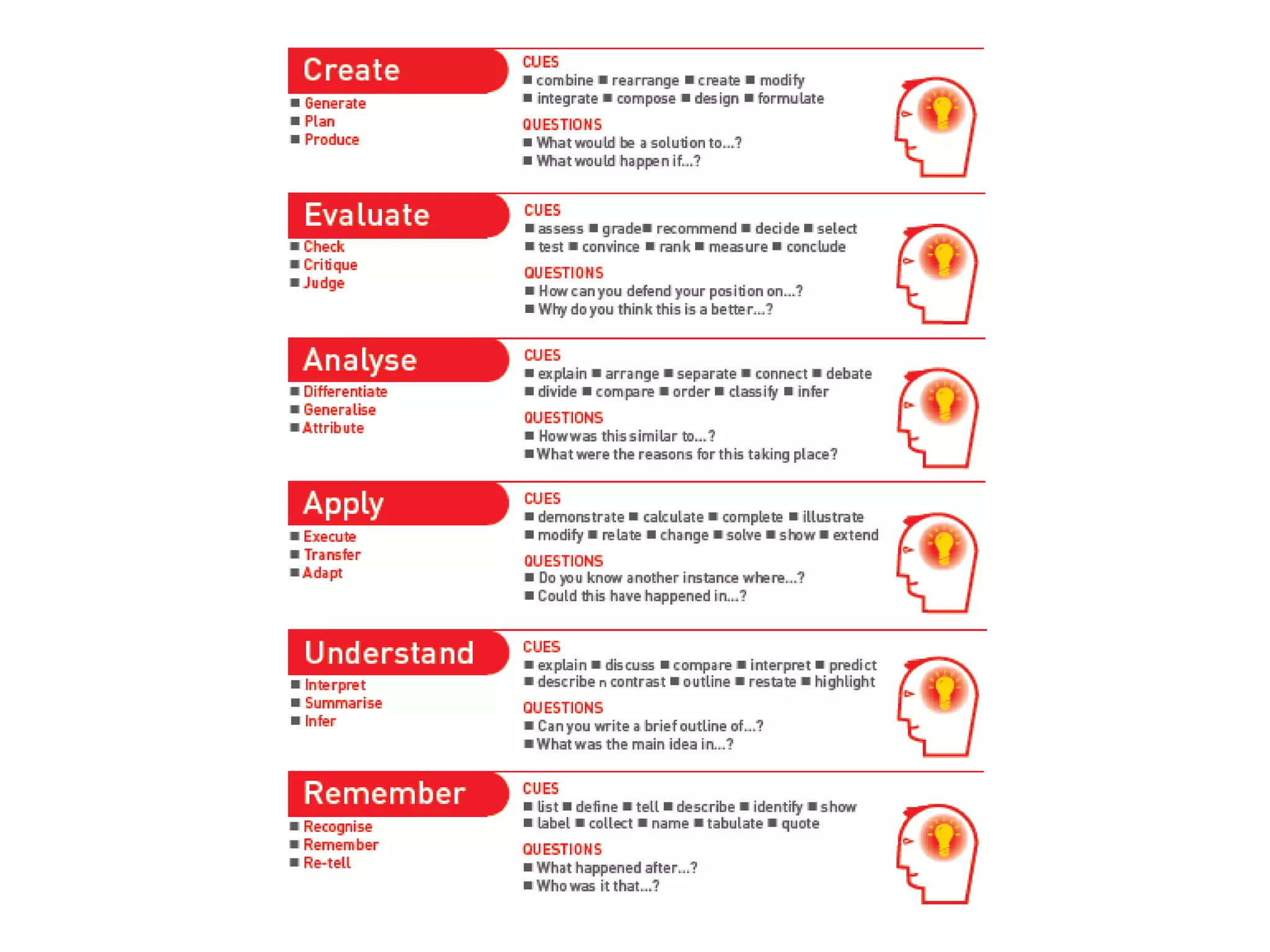
  • #14 Scaffolding the research process can be helpful for some students. It can also be a useful area for target setting by tutors.This table links really well with Bloom’s taxonomy. Sometimes teachers need to remember that students will not use higher order thinking unless they are guided to do so. Effective questioning is key. Slide reproduced with permission from John Iona, Joint School Librarian of the Year 2013.(UKSLA) accessible via Slideshare
  • #16 AMT credit Students operate at higher level if = Don’t have published answers  Require multiple sources to answer: Have more than one answer (or no one right answer): Encourage them to ask more questions! 
  • #17 ©trainvisual www.how2teach.co.uk. Downloadable resource.
  • #18 Made in an afternoon using free educational software. The idea was prompted by an article by Barbara Fister on the fact that students didn’t really have an understanding of what a journal actually was. This seemed such basic knowledge to me so it was so useful to have been prompted to realise that something I thought was obvious probably wasn’t clear at all. Moreover, it was not something that a new students is likely to ask you to explain.
  • #19 It really does need you to check what you can use online within your own systems and it depends what you want to achieve. There are a huge number of fantastic things you can use with varying degrees of usefulness. If you are completely new to this you could try with something like Prezi for a presentation, instead of PowerPoint. My suggestion would be to start in a fairly modest way to see what works well but you will probably find some products aren’t quite what you want.
  • #21 Google advanced search is still available if you know where to look. This is the sort of tool which enables higher level students to be far more accurate in their searching techniques. Anything which makes an enquirer think more deeply about what they need to find out helps them formulate the questions they need to answer.
  • #22 If you have a playing card under your seat please stand up. If you are holding a Queen or a Jack please sit down. If you are holding any cards in the suit of Hearts please sit down. Next we want to eliminate anyone with any picture cards at all, so please be seated if you have a picture card or joker in any suit.Finally, could all the people with black cards please be seated. Now we should only have those people standing who are holding the suit of diamonds but without pictures.Idea reproduced from the student induction pack from Birmingham University Library.
  • #23 In a project situation you can use this to formulate your questions. In this case you would probably start with the WHAT question. This is the normal starter is a KWL type grid - ergo “What do I need to know?” Don’t forget to remind students that they need to activate prior knowledge. This is a really important step especially with boys or with people who need to be reminded to reflect on what they already know. So in essence there are two ‘whats’ here.What do I know already AND what more is needed.Whocould be their team or group dynamics; who will I work with, who has responsibility for this aspect? Etc. Why do we need to know this?Generally tutors will explain to students why this work will lead them on in their learning, especially if they don’t understand the relevance. Anecdotally students in England are pretty quick to protest about work that they don’t see the need for! The When? Question may be important when deadlines for work are paramount.
  • #24 The goal posts idea also works brilliantly with citations. In this context the questions change to Who wrote (said) it; Why did they write it; Where did they write it; when did they write it and finally What did they write AND (moving the central horizontal line)at what level was it written?
  • #25 Although there has been some discussion on the nature of plagiarism world wide, in the UK, particularly in the world of academia this is still essentially thought of in a very poor light. Some secondary schools use plagiarism software although this is not that common due to the cost. It does sometimes come down to the amount of experience that teachers have in identifying the work of a particular student. Examination Boards in England will take up issues of plagiarism with a school or exam centre if they spot a blatant example so it is in the school’s best interest to ensue they see such bad practice first.
  • #26 Names have been changed to protect the innocent! Physically crossing out the name of a classmate seems to really bring the idea of ownership home. I do this with Year 7 students during their induction term in Library lessons. It could easily be done with older students. There are lots of topics you could suggest, such as their favourite rock or pop group, their most favourite jumper, somebody they admire.
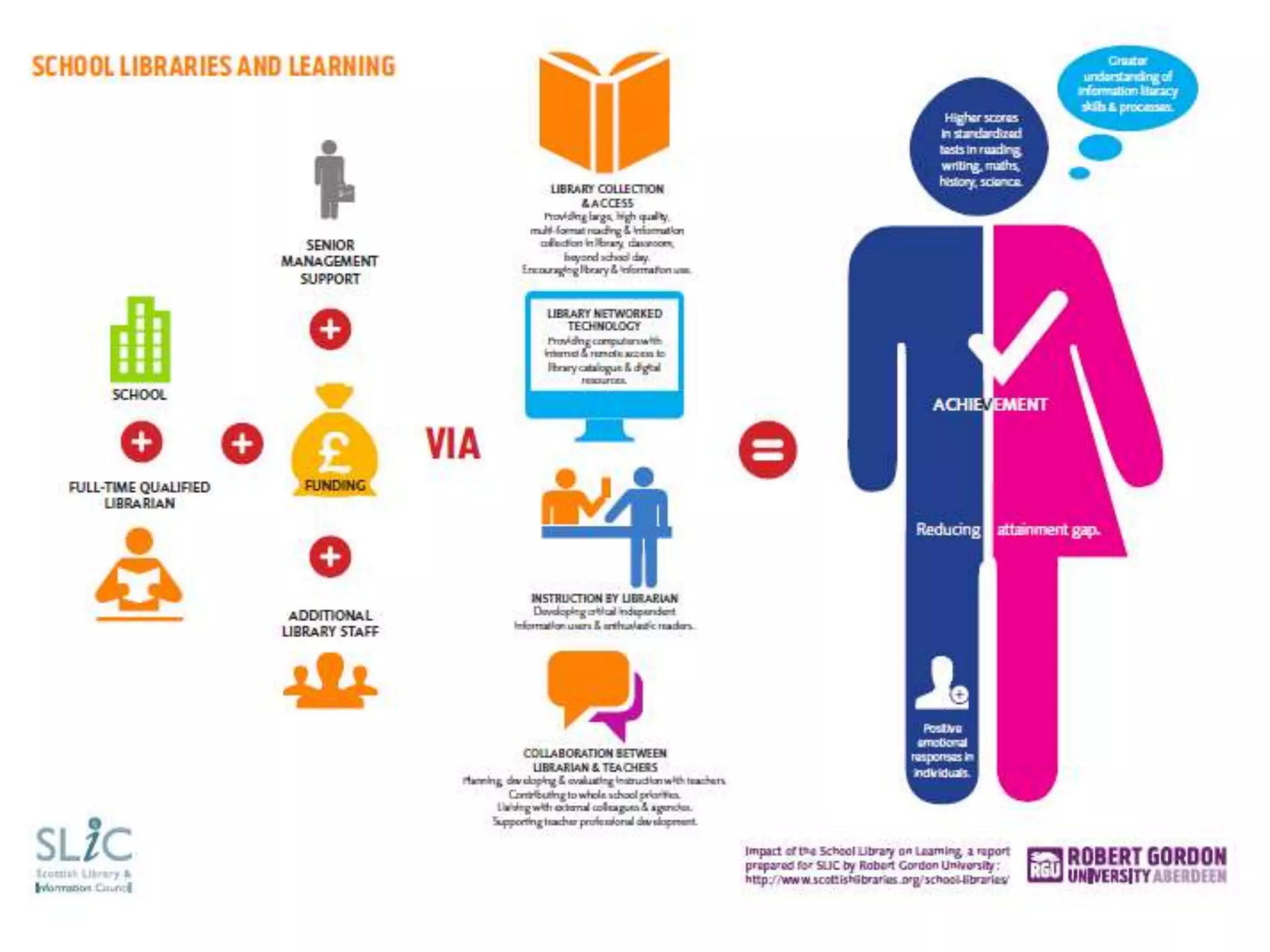
  • #29 Scottish Library and Information Council. Research by Robert Gordon University on the impact of a qualified librarian on student attainment. Flyer of forms part of the report. http://www.scottishlibraries.org/storage/sectors/schools/SLIC_RGU_Impact_of_School_Libraries_2013.pdf