LIBERALIZATION PRIVATIZATION
GLOBALIZATION
A PRESENTATION ON :
1
Introduction
Reasons for implementing LPG
Narasimha Rao Committee Decision
Liberalization
Privatization
Globalization
CONTENTS
2
July 1991,India has taken a series of measures to structure
the economy and improve the investments. The new
economic policy that was introduced effected changes in
several areas.
The policy has salient features which are: -
1.Liberalization
2.Extending Privatization
3.Globalisation of the economy
“LPG”
INTRODUCTION
3
THE MASTERMINDS
4
Excess of consumption and expenditure over
revenue resulting in heavy government borrowings.
Growing inefficiency on the use of resources.
Over protection provided to the Indian industries.
Mismanagement of the firm and the economy.
Reasons for Implementing LPG
5
Increase in losses for public sector enterprises.
Various distortions like poor technological
development, shortage of foreign exchange and
borrowing from abroad.
Low foreign exchange reserves.
Inflation
6
Contd..
Narasimha Rao Committee Decision
 Promoting FDI (Foreign Direct Investment) by means
of raising the highest capital.
 Cutting down duties from a mean level of 85 per cent
to 25 per cent, and withdrawing quantitative
regulations.
 The rupee or the official Indian currency was turned
into an exchangeable currency on trading account.
 Reorganization of the methods for sanction of FDI.
7
Contd..
 Launching of the National Stock Exchange in 1994 in
the form of a computerized share buying and selling
system.
 In 1992, the equity markets of the country were made
available for investment through overseas corporate
investors.
 The companies were allowed to raise funds from
overseas markets through issuance of GDRs or Global
Depository Receipts.
8
LIBERALIZATION
Liberalization refers :
• To fewer government regulations and restrictions.
• Relaxation of the previous government restriction in the area
of social and economic policies.
• In short it means, government has removed the tariff,
subsidies and other restriction on the flow of goods and
services between the countries.
9
The Path for Liberalization
 Relief for foreign investors.
 Devaluation of Indian rupees.
 New industrial Policy.
 New trade policy.
 Removal of Import Restrictions.
 Freedom to import technology.
 MRTP relaxation.
10
Advantages
 Industrial licensing
 Increase in the foreign investment.
 Increase in the foreign exchange reserve.
 Increase in the consumption and Control over price.
 Check on corruption.
 Reduction in dependence on external commercial
borrowings.
11
Disadvantages
 Loss to domestic units.
 Increase in unemployment.
 Increased dependence on foreign nations.
 Unbalanced development.
12
PRIVATIZATION
Privatization means :
• Transfer of ownership and/or management of an
enterprise from the public sector to the private sector.
• It also means the withdrawal of the state from an
industry or sector partially or fully.
• In short, it is opening up of an industry that has been
reserved for public sector to the private sector.
• It also replaces government monopolies with the
competitive pressures.
• Encourages efficiency, quality and innovation in the
delivery of goods and services.
13
Need for Privatization
Though the PSUs have contributed heavily to develop
the industrial base of the country, they continue, even
today, to suffer from a number of shortcomings which
are identified below very briefly :-
 A sizable number of PSUs have been incurring and
reporting losses on a continual basis;
 Multiplicity of authorities to whom the PSUs are
accountable;
14
Contd..
 Delay in implementation of projects.
 Ineffective management.
 Widespread inefficiency in management.
 Many PSUs are over-staffed resulting in lower labour
productivity, bad industrial relations.;
 The sick units were causing a big drain on the
resources of the state.
15
Different ways of Privatization
 Liberalization Approach.
 Relative Share Enlargement Approach.
 Association of Private Sector Management Approach.
 Transfer of Minority Equity Ownership Approach.
 Transfer of Complete Ownership Approach.
16
Advantages
 Privatization helps to reduce the burden on the
Government.
 It will help profit making public sector unit to modernize
and diversify their business.
 It will help in making public sector unit to be more
competitive.
 It will help to improve the quality of decision making.
 Help in reviving sick units which are a liability.
 Increase the foreign investment.
 Increase in efficiency.
17
Disadvantages
 Exploitation of labour.
 Abuse of power by Executives.
 Unequal distribution of wealth and income.
 Lack of job security.
 Ignores weaker sections.
 Ignores the national importance.
18
Examples of Privatization in India
 Lagan Jute Machinery Company Limited (LJMC)
 Videsh Sanchar Nigam Limited (VSNL)
 Hindustan Zinc Limited (HZL)
 Hotel Corporation Limited of India (HCL)
 Bharat Aluminum Company Limited (BALCO)
19
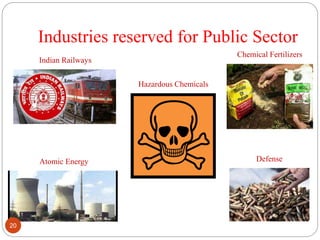
Industries reserved for Public Sector
Hazardous Chemicals
Chemical Fertilizers
Atomic Energy Defense
Indian Railways
20
GLOBALIZATION
 The term globalization means “International
Integration.”
 It is a process through which the diverse world is
unified into a single society.
 Opening up of world trade, development of advanced
means of communication, internationalisation of
financial markets, growing importance of MNCs,
population migrations and more generally increased
mobility of persons, goods, capital, data and ideas.
21
22
Globalization – what’s really new?
New Trade and Production Patterns
New trade pattern: Developing countries ,
 Don't just have to trade their raw materials to the West
and get finished products in return;
 They can become big-time producers as well.
New production pattern: Global product network :
 Companies can locate different parts of their production,
research and marketing in different countries
23
Globalization – what’s really new?
New markets
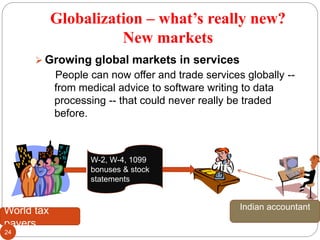
 Growing global markets in services
People can now offer and trade services globally --
from medical advice to software writing to data
processing -- that could never really be traded
before.
W-2, W-4, 1099
bonuses & stock
statements
Indian accountantWorld tax
payers
24
Globalization – what’s really new?
New rules and norms
 Market economic policies spreading around the world,
with greater privatization and liberalization than in
earlier decades.
ex: BRICS
25
Globalization – what’s really new?
New rules and norms
 Multilateral agreements in trade, taking on such new
agendas as environmental and social conditions.
 New multilateral agreements – for services, intellectual
property , communications – more binding on national
governments than any previous agreements.
26
Foreign Direct Investment (FDI)
Foreign Direct Investment is :
• A category of cross border investment;
• It is made by a resident in one economy(direct
investor) in an enterprise in another economy;
• The objective is to establish a ‘lasting interest’;
• The motivation of direct investor is to build a strategic
long term relationship;
• It is undertaken according to the FDI policy issued by
the Government of India based on FEMA provisions.
27
How is FDI done?
28
There are two routes for a foreign investor to invest in
the equity of an Indian Company, they are :
1. Automatic Route
No approval is required from Government or RBI to
invest in Indian companies if the activities are
mentioned in FDI policy.
2. Government Route
If the activities in which the investor wishes to
invest is not covered under ‘Automatic Route’,
requires prior approval from Government.
Estimated Inflow of FDI
29
FDI Inflow estimate from October to March 2014 :
Year Oct-March(in
US $ Million)
% of
increase/dec
rease
2012-13
9,577 45%
2013-14
11,705 22%
2014-15 14,956* 28%
* Estimated , Source
GOI
FDI inflows in India
0
5
10
15
20
25
30
35
40
2011-12 2012-13 2013-14 2014-15 2015-16
Inflow(US$ billion)
Inflow(US$ billion)
30
2015-16 Estimated, Source GOI
Foreign Market Entry Strategies
 Exporting.
 Licensing / Franchising.
 Joint Venturing.
 Merger and Acquisition.
 Fully Owned Manufacturing facilities.
 Liaison Offices.
31
Major Destinations of India's Exports
64.90
12.53
9.76
4.76
4.07 4.00
Exports (In Billion $)
USA
UAE
China
Hong Kong
Singapore
Rest of the world
32 Source : Dept of Commerce, GOI
Major Sources of India’s Imports
64.81
11.33
8.12
6.47
4.96
4.31
Import(in $)
China
Saudi Arabia
UAE
USA
Switzerland
Rest of world
33 Source : Dept of Commerce, GOI
Export target and Achievement
0
50
100
150
200
250
300
350
400
2009-10 2010-11 2011-12 2012-13 2013-14 2014-15
Chart Title
Target Achieved
34 Source : Dept of Commerce, GOI
Advantages
 Free flow of capital and increase in the total capital
employed.
 Free flow of technology.
 Increase in industrialization.
 Spread of production facilities throughout the globe.
35
Contd..
 Balanced development of world economies.
 Increase in production and consumption.
 Commodities at lower price with high quality.
 Increase in jobs and income.
 Higher Standard of living.
36
Disadvantages
 Loss of domestic industries.
 Exploits Human resource.
 Decline in income to home country.
 Unemployment.
 Transfer of natural resources.
 Leads to commercial and political colonialism.
 Widening gap between rich and poor
 Dominance of foreign institutions
37
What is in Store for India?
 The present Government is Pro Industrialist and has
started many schemes for improvement of various
sectors. Eg : Make in India.
 The Government is signing various trade deals with
developed nations like Japan, U.S.A, Russia.
 It is offering easy registration of industries in India in
order to boost the Manufacturing sector.
 India is set to become the manufacturing hub of Asia.
 The concept of ‘Vasudaiva Kutumbakam’ has much in
store for Future India.
38
Contd..
39
 FDI in Insurance to be raised to 49% from the current
26% cap.
 FDI in Defense to be raised to 49% or 72% or even
100%.
 Employment opportunities.
 Estimated GDP growth of 4.7% in FY 14, 5.6% in FY
15 and 6.5% in FY 16.
 Wholesale Price Index stands at 1.77% and Retail
Price Index stands at 5.52% as on October.
Contd..
40
 Increase in FDI can increase Inflation.
 The PSU’s may not be able to withstand the
competition to be faced as more number of foreign
players are entering the Indian economy.
 Chances of not being able to tackle the widening
Current account deficit and BOP situation.
 Make in India cannot solve all the problems, a more
wider concept of “Make in India, Make for India”
needs to be implemented.
THANK YOU
41
Team members :
• Shravan Rao
• Nikitha Baliga
• Madhusudhan Kamath
• Sr. Juliet Reena
• Mohd. Rameez
• Mohd. Samsheer
• Nishitha
• Shubha
• Venessa Pinto
• Narasimha Kamath

LPG - Indian Scenario

  • 1.
  • 2.
    Introduction Reasons for implementingLPG Narasimha Rao Committee Decision Liberalization Privatization Globalization CONTENTS 2
  • 3.
    July 1991,India hastaken a series of measures to structure the economy and improve the investments. The new economic policy that was introduced effected changes in several areas. The policy has salient features which are: - 1.Liberalization 2.Extending Privatization 3.Globalisation of the economy “LPG” INTRODUCTION 3
  • 4.
  • 5.
    Excess of consumptionand expenditure over revenue resulting in heavy government borrowings. Growing inefficiency on the use of resources. Over protection provided to the Indian industries. Mismanagement of the firm and the economy. Reasons for Implementing LPG 5
  • 6.
    Increase in lossesfor public sector enterprises. Various distortions like poor technological development, shortage of foreign exchange and borrowing from abroad. Low foreign exchange reserves. Inflation 6 Contd..
  • 7.
    Narasimha Rao CommitteeDecision  Promoting FDI (Foreign Direct Investment) by means of raising the highest capital.  Cutting down duties from a mean level of 85 per cent to 25 per cent, and withdrawing quantitative regulations.  The rupee or the official Indian currency was turned into an exchangeable currency on trading account.  Reorganization of the methods for sanction of FDI. 7
  • 8.
    Contd..  Launching ofthe National Stock Exchange in 1994 in the form of a computerized share buying and selling system.  In 1992, the equity markets of the country were made available for investment through overseas corporate investors.  The companies were allowed to raise funds from overseas markets through issuance of GDRs or Global Depository Receipts. 8
  • 9.
    LIBERALIZATION Liberalization refers : •To fewer government regulations and restrictions. • Relaxation of the previous government restriction in the area of social and economic policies. • In short it means, government has removed the tariff, subsidies and other restriction on the flow of goods and services between the countries. 9
  • 10.
    The Path forLiberalization  Relief for foreign investors.  Devaluation of Indian rupees.  New industrial Policy.  New trade policy.  Removal of Import Restrictions.  Freedom to import technology.  MRTP relaxation. 10
  • 11.
    Advantages  Industrial licensing Increase in the foreign investment.  Increase in the foreign exchange reserve.  Increase in the consumption and Control over price.  Check on corruption.  Reduction in dependence on external commercial borrowings. 11
  • 12.
    Disadvantages  Loss todomestic units.  Increase in unemployment.  Increased dependence on foreign nations.  Unbalanced development. 12
  • 13.
    PRIVATIZATION Privatization means : •Transfer of ownership and/or management of an enterprise from the public sector to the private sector. • It also means the withdrawal of the state from an industry or sector partially or fully. • In short, it is opening up of an industry that has been reserved for public sector to the private sector. • It also replaces government monopolies with the competitive pressures. • Encourages efficiency, quality and innovation in the delivery of goods and services. 13
  • 14.
    Need for Privatization Thoughthe PSUs have contributed heavily to develop the industrial base of the country, they continue, even today, to suffer from a number of shortcomings which are identified below very briefly :-  A sizable number of PSUs have been incurring and reporting losses on a continual basis;  Multiplicity of authorities to whom the PSUs are accountable; 14
  • 15.
    Contd..  Delay inimplementation of projects.  Ineffective management.  Widespread inefficiency in management.  Many PSUs are over-staffed resulting in lower labour productivity, bad industrial relations.;  The sick units were causing a big drain on the resources of the state. 15
  • 16.
    Different ways ofPrivatization  Liberalization Approach.  Relative Share Enlargement Approach.  Association of Private Sector Management Approach.  Transfer of Minority Equity Ownership Approach.  Transfer of Complete Ownership Approach. 16
  • 17.
    Advantages  Privatization helpsto reduce the burden on the Government.  It will help profit making public sector unit to modernize and diversify their business.  It will help in making public sector unit to be more competitive.  It will help to improve the quality of decision making.  Help in reviving sick units which are a liability.  Increase the foreign investment.  Increase in efficiency. 17
  • 18.
    Disadvantages  Exploitation oflabour.  Abuse of power by Executives.  Unequal distribution of wealth and income.  Lack of job security.  Ignores weaker sections.  Ignores the national importance. 18
  • 19.
    Examples of Privatizationin India  Lagan Jute Machinery Company Limited (LJMC)  Videsh Sanchar Nigam Limited (VSNL)  Hindustan Zinc Limited (HZL)  Hotel Corporation Limited of India (HCL)  Bharat Aluminum Company Limited (BALCO) 19
  • 20.
    Industries reserved forPublic Sector Hazardous Chemicals Chemical Fertilizers Atomic Energy Defense Indian Railways 20
  • 21.
    GLOBALIZATION  The termglobalization means “International Integration.”  It is a process through which the diverse world is unified into a single society.  Opening up of world trade, development of advanced means of communication, internationalisation of financial markets, growing importance of MNCs, population migrations and more generally increased mobility of persons, goods, capital, data and ideas. 21
  • 22.
  • 23.
    Globalization – what’sreally new? New Trade and Production Patterns New trade pattern: Developing countries ,  Don't just have to trade their raw materials to the West and get finished products in return;  They can become big-time producers as well. New production pattern: Global product network :  Companies can locate different parts of their production, research and marketing in different countries 23
  • 24.
    Globalization – what’sreally new? New markets  Growing global markets in services People can now offer and trade services globally -- from medical advice to software writing to data processing -- that could never really be traded before. W-2, W-4, 1099 bonuses & stock statements Indian accountantWorld tax payers 24
  • 25.
    Globalization – what’sreally new? New rules and norms  Market economic policies spreading around the world, with greater privatization and liberalization than in earlier decades. ex: BRICS 25
  • 26.
    Globalization – what’sreally new? New rules and norms  Multilateral agreements in trade, taking on such new agendas as environmental and social conditions.  New multilateral agreements – for services, intellectual property , communications – more binding on national governments than any previous agreements. 26
  • 27.
    Foreign Direct Investment(FDI) Foreign Direct Investment is : • A category of cross border investment; • It is made by a resident in one economy(direct investor) in an enterprise in another economy; • The objective is to establish a ‘lasting interest’; • The motivation of direct investor is to build a strategic long term relationship; • It is undertaken according to the FDI policy issued by the Government of India based on FEMA provisions. 27
  • 28.
    How is FDIdone? 28 There are two routes for a foreign investor to invest in the equity of an Indian Company, they are : 1. Automatic Route No approval is required from Government or RBI to invest in Indian companies if the activities are mentioned in FDI policy. 2. Government Route If the activities in which the investor wishes to invest is not covered under ‘Automatic Route’, requires prior approval from Government.
  • 29.
    Estimated Inflow ofFDI 29 FDI Inflow estimate from October to March 2014 : Year Oct-March(in US $ Million) % of increase/dec rease 2012-13 9,577 45% 2013-14 11,705 22% 2014-15 14,956* 28% * Estimated , Source GOI
  • 30.
    FDI inflows inIndia 0 5 10 15 20 25 30 35 40 2011-12 2012-13 2013-14 2014-15 2015-16 Inflow(US$ billion) Inflow(US$ billion) 30 2015-16 Estimated, Source GOI
  • 31.
    Foreign Market EntryStrategies  Exporting.  Licensing / Franchising.  Joint Venturing.  Merger and Acquisition.  Fully Owned Manufacturing facilities.  Liaison Offices. 31
  • 32.
    Major Destinations ofIndia's Exports 64.90 12.53 9.76 4.76 4.07 4.00 Exports (In Billion $) USA UAE China Hong Kong Singapore Rest of the world 32 Source : Dept of Commerce, GOI
  • 33.
    Major Sources ofIndia’s Imports 64.81 11.33 8.12 6.47 4.96 4.31 Import(in $) China Saudi Arabia UAE USA Switzerland Rest of world 33 Source : Dept of Commerce, GOI
  • 34.
    Export target andAchievement 0 50 100 150 200 250 300 350 400 2009-10 2010-11 2011-12 2012-13 2013-14 2014-15 Chart Title Target Achieved 34 Source : Dept of Commerce, GOI
  • 35.
    Advantages  Free flowof capital and increase in the total capital employed.  Free flow of technology.  Increase in industrialization.  Spread of production facilities throughout the globe. 35
  • 36.
    Contd..  Balanced developmentof world economies.  Increase in production and consumption.  Commodities at lower price with high quality.  Increase in jobs and income.  Higher Standard of living. 36
  • 37.
    Disadvantages  Loss ofdomestic industries.  Exploits Human resource.  Decline in income to home country.  Unemployment.  Transfer of natural resources.  Leads to commercial and political colonialism.  Widening gap between rich and poor  Dominance of foreign institutions 37
  • 38.
    What is inStore for India?  The present Government is Pro Industrialist and has started many schemes for improvement of various sectors. Eg : Make in India.  The Government is signing various trade deals with developed nations like Japan, U.S.A, Russia.  It is offering easy registration of industries in India in order to boost the Manufacturing sector.  India is set to become the manufacturing hub of Asia.  The concept of ‘Vasudaiva Kutumbakam’ has much in store for Future India. 38
  • 39.
    Contd.. 39  FDI inInsurance to be raised to 49% from the current 26% cap.  FDI in Defense to be raised to 49% or 72% or even 100%.  Employment opportunities.  Estimated GDP growth of 4.7% in FY 14, 5.6% in FY 15 and 6.5% in FY 16.  Wholesale Price Index stands at 1.77% and Retail Price Index stands at 5.52% as on October.
  • 40.
    Contd.. 40  Increase inFDI can increase Inflation.  The PSU’s may not be able to withstand the competition to be faced as more number of foreign players are entering the Indian economy.  Chances of not being able to tackle the widening Current account deficit and BOP situation.  Make in India cannot solve all the problems, a more wider concept of “Make in India, Make for India” needs to be implemented.
  • 41.
    THANK YOU 41 Team members: • Shravan Rao • Nikitha Baliga • Madhusudhan Kamath • Sr. Juliet Reena • Mohd. Rameez • Mohd. Samsheer • Nishitha • Shubha • Venessa Pinto • Narasimha Kamath