In-Patient Department
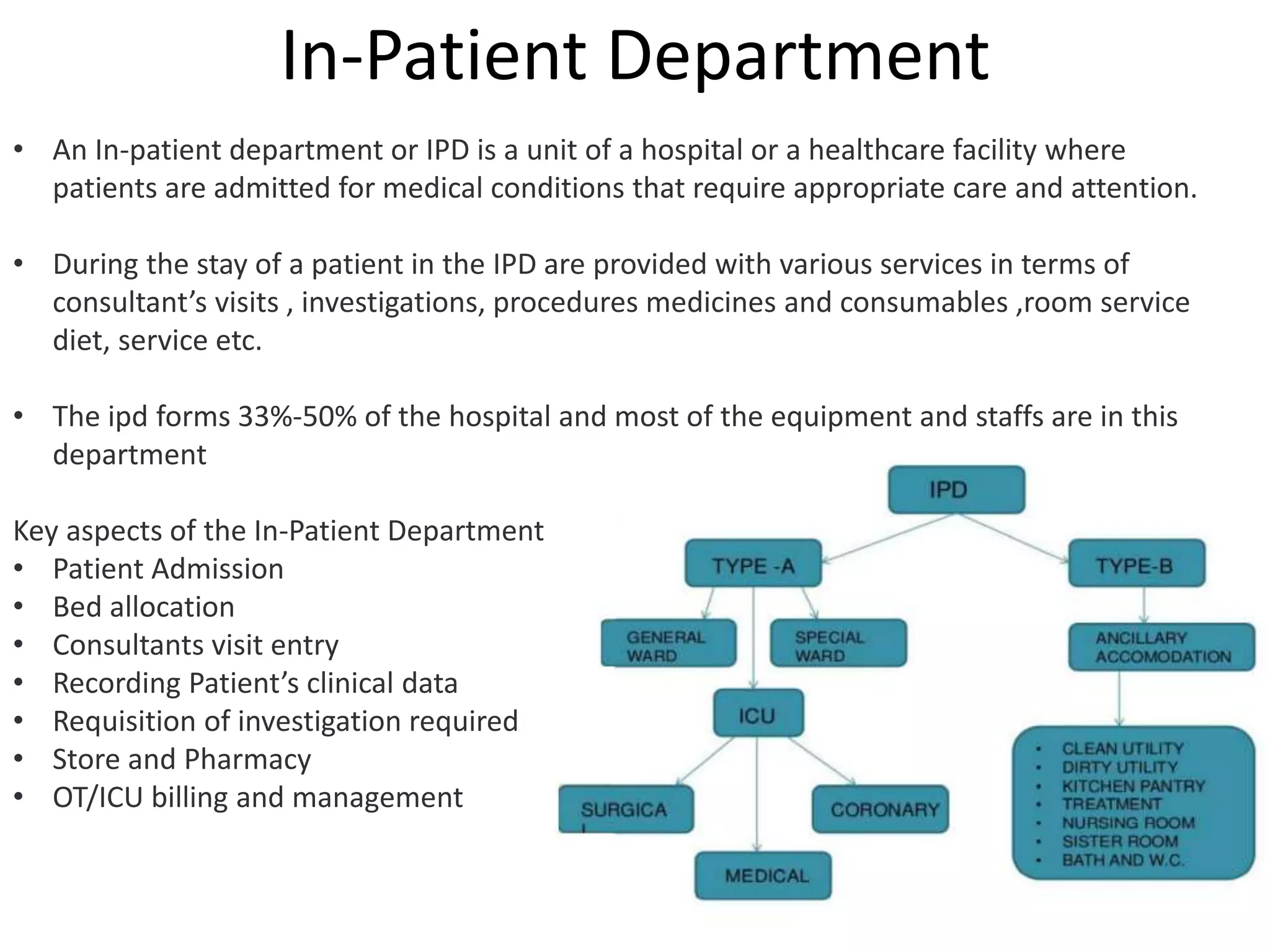
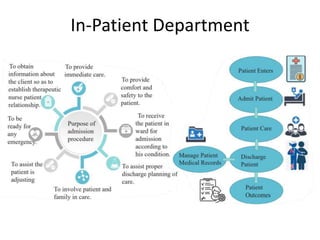
• An In-patient department or IPD is a unit of a hospital or a healthcare facility where
patients are admitted for medical conditions that require appropriate care and attention.
• During the stay of a patient in the IPD are provided with various services in terms of
consultant’s visits , investigations, procedures medicines and consumables ,room service
diet, service etc.
• The ipd forms 33%-50% of the hospital and most of the equipment and staffs are in this
department
Key aspects of the In-Patient Department
• Patient Admission
• Bed allocation
• Consultants visit entry
• Recording Patient’s clinical data
• Requisition of investigation required
• Store and Pharmacy
• OT/ICU billing and management
In-Patient Department
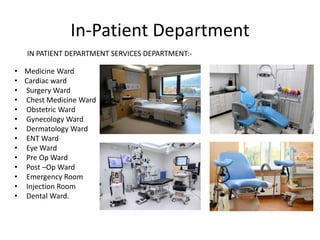
• Medicine Ward
• Cardiac ward
• Surgery Ward
• Chest Medicine Ward
• Obstetric Ward
• Gynecology Ward
• Dermatology Ward
• ENT Ward
• Eye Ward
• Pre Op Ward
• Post –Op Ward
• Emergency Room
• Injection Room
• Dental Ward.
IN PATIENT DEPARTMENT SERVICES DEPARTMENT:-
In-Patient Department
New born Intensive Care Unit(NICU):- This is a nursery in a hospital that provides
around-the-clock care to sick or premature babies.
Pediatric Intensive Care Unit(NICU):- This is a unit where children are taken when they
require the highest level of quality pediatric care.
Surgical Intensive Care Unit(NICU):- This is a unit where children are taken when they
require the highest level of quality pediatric care.
Cardiac Intensive Care Unit (CICU):-This is a hospital ward specialized in the care
of patients with heart attacks, unstable angina, cardiac dysrhythmia and (in practice)
various other cardiac conditions that require continuous monitoring and treatment.
Cardiothoracic Vascular Surgery Department (CTVS)- It specializes in diagnosing and
treating various complex and difficult-to-treat cardiothoracic disorders with perfection.
Casualty- It is the part of a hospital where people who have severe injuries or sudden
illnesses are taken for emergency treatment.
Operation theatre:- An operating theater is a facility within a hospital where surgical
operations are carried out in an aseptic environment.
High Dependency Unit(HDU):-HDU is an area in a hospital where patients can be
cared more extensively than in a normal ward, but not to the point of intensive care.
So, it is also known as the intermediate care unit.
CRITICAL CARE AREA
In-Patient Department
Location: Away from parking and crowd area, adjacent to support and diagnostic
services, should be away from mortuary.
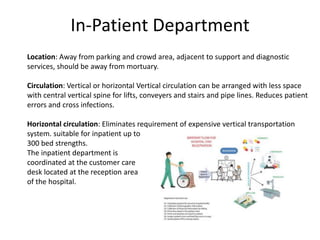
Circulation: Vertical or horizontal Vertical circulation can be arranged with less space
with central vertical spine for lifts, conveyers and stairs and pipe lines. Reduces patient
errors and cross infections.
Horizontal circulation: Eliminates requirement of expensive vertical transportation
system. suitable for inpatient up to
300 bed strengths.
The inpatient department is
coordinated at the customer care
desk located at the reception area
of the hospital.
In-Patient Department
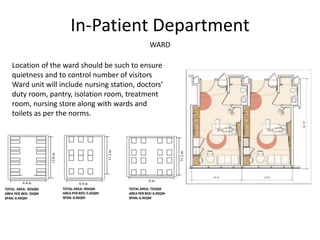
WARD
Location of the ward should be such to ensure
quietness and to control number of visitors
Ward unit will include nursing station, doctors’
duty room, pantry, isolation room, treatment
room, nursing store along with wards and
toilets as per the norms.
In-Patient Department
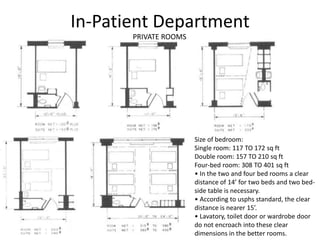
Size of bedroom:
Single room: 117 TO 172 sq ft
Double room: 157 TO 210 sq ft
Four-bed room: 308 TO 401 sq ft
• In the two and four bed rooms a clear
distance of 14’ for two beds and two bed-
side table is necessary.
• According to usphs standard, the clear
distance is nearer 15’.
• Lavatory, toilet door or wardrobe door
do not encroach into these clear
dimensions in the better rooms.
PRIVATE ROOMS
WARDS
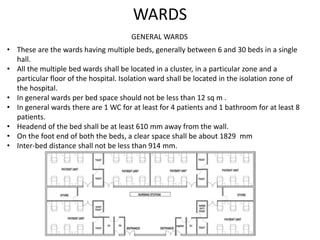
GENERAL WARDS
• These are the wards having multiple beds, generally between 6 and 30 beds in a single
hall.
• All the multiple bed wards shall be located in a cluster, in a particular zone and a
particular floor of the hospital. Isolation ward shall be located in the isolation zone of
the hospital.
• In general wards per bed space should not be less than 12 sq m .
• In general wards there are 1 WC for at least for 4 patients and 1 bathroom for at least 8
patients.
• Headend of the bed shall be at least 610 mm away from the wall.
• On the foot end of both the beds, a clear space shall be about 1829 mm
• Inter-bed distance shall not be less than 914 mm.
WARDS
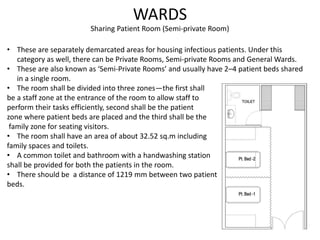
Sharing Patient Room (Semi-private Room)
• These are separately demarcated areas for housing infectious patients. Under this
category as well, there can be Private Rooms, Semi-private Rooms and General Wards.
• These are also known as ‘Semi-Private Rooms’ and usually have 2–4 patient beds shared
in a single room.
• The room shall be divided into three zones—the first shall
be a staff zone at the entrance of the room to allow staff to
perform their tasks efficiently, second shall be the patient
zone where patient beds are placed and the third shall be the
family zone for seating visitors.
• The room shall have an area of about 32.52 sq.m including
family spaces and toilets.
• A common toilet and bathroom with a handwashing station
shall be provided for both the patients in the room.
• There should be a distance of 1219 mm between two patient
beds.
WARDS
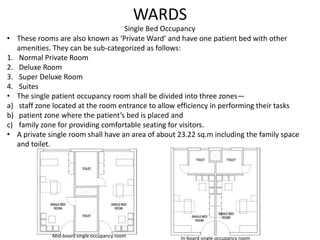
Single Bed Occupancy
• These rooms are also known as ‘Private Ward’ and have one patient bed with other
amenities. They can be sub-categorized as follows:
1. Normal Private Room
2. Deluxe Room
3. Super Deluxe Room
4. Suites
• The single patient occupancy room shall be divided into three zones—
a) staff zone located at the room entrance to allow efficiency in performing their tasks
b) patient zone where the patient’s bed is placed and
c) family zone for providing comfortable seating for visitors.
• A private single room shall have an area of about 23.22 sq.m including the family space
and toilet.
Mid-board single occupancy room In-board single occupancy room
In-Patient Department
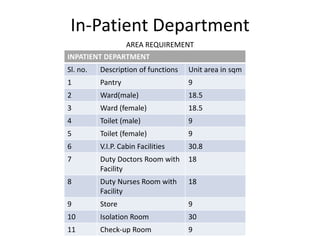
AREA REQUIREMENT
INPATIENT DEPARTMENT
Sl. no. Description of functions Unit area in sqm
1 Pantry 9
2 Ward(male) 18.5
3 Ward (female) 18.5
4 Toilet (male) 9
5 Toilet (female) 9
6 V.I.P. Cabin Facilities 30.8
7 Duty Doctors Room with
Facility
18
8 Duty Nurses Room with
Facility
18
9 Store 9
10 Isolation Room 30
11 Check-up Room 9
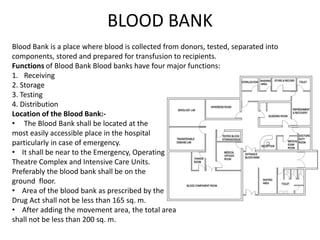
BLOOD BANK
Blood Bank is a place where blood is collected from donors, tested, separated into
components, stored and prepared for transfusion to recipients.
Functions of Blood Bank Blood banks have four major functions:
1. Receiving
2. Storage
3. Testing
4. Distribution
Location of the Blood Bank:-
• The Blood Bank shall be located at the
most easily accessible place in the hospital
particularly in case of emergency.
• It shall be near to the Emergency, Operating
Theatre Complex and Intensive Care Units.
Preferably the blood bank shall be on the
ground floor.
• Area of the blood bank as prescribed by the
Drug Act shall not be less than 165 sq. m.
• After adding the movement area, the total area
shall not be less than 200 sq. m.
BLOOD BANK
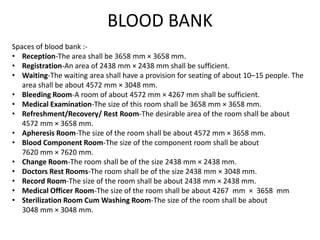
Spaces of blood bank :-
• Reception-The area shall be 3658 mm × 3658 mm.
• Registration-An area of 2438 mm × 2438 mm shall be sufficient.
• Waiting-The waiting area shall have a provision for seating of about 10–15 people. The
area shall be about 4572 mm × 3048 mm.
• Bleeding Room-A room of about 4572 mm × 4267 mm shall be sufficient.
• Medical Examination-The size of this room shall be 3658 mm × 3658 mm.
• Refreshment/Recovery/ Rest Room-The desirable area of the room shall be about
4572 mm × 3658 mm.
• Apheresis Room-The size of the room shall be about 4572 mm × 3658 mm.
• Blood Component Room-The size of the component room shall be about
7620 mm × 7620 mm.
• Change Room-The room shall be of the size 2438 mm × 2438 mm.
• Doctors Rest Rooms-The room shall be of the size 2438 mm × 3048 mm.
• Record Room-The size of the room shall be about 2438 mm × 2438 mm.
• Medical Officer Room-The size of the room shall be about 4267 mm × 3658 mm
• Sterilization Room Cum Washing Room-The size of the room shall be about
3048 mm × 3048 mm.
BLOOD BANK
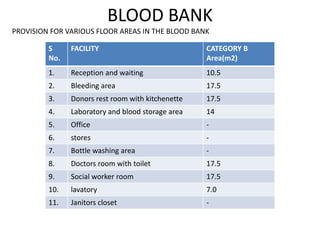
PROVISION FOR VARIOUS FLOOR AREAS IN THE BLOOD BANK
S
No.
FACILITY CATEGORY B
Area(m2)
1. Reception and waiting 10.5
2. Bleeding area 17.5
3. Donors rest room with kitchenette 17.5
4. Laboratory and blood storage area 14
5. Office -
6. stores -
7. Bottle washing area -
8. Doctors room with toilet 17.5
9. Social worker room 17.5
10. lavatory 7.0
11. Janitors closet -
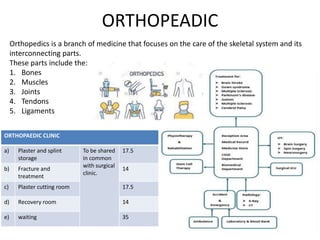
ORTHOPEADIC
Orthopedics is a branch of medicine that focuses on the care of the skeletal system and its
interconnecting parts.
These parts include the:
1. Bones
2. Muscles
3. Joints
4. Tendons
5. Ligaments
ORTHOPAEDIC CLINIC
a) Plaster and splint
storage
To be shared
in common
with surgical
clinic.
17.5
b) Fracture and
treatment
14
c) Plaster cutting room 17.5
d) Recovery room 14
e) waiting 35
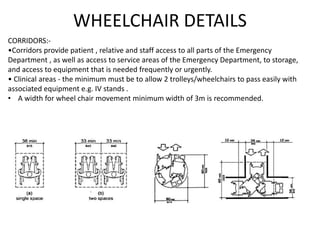
WHEELCHAIR DETAILS
CORRIDORS:-
•Corridors provide patient , relative and staff access to all parts of the Emergency
Department , as well as access to service areas of the Emergency Department, to storage,
and access to equipment that is needed frequently or urgently.
• Clinical areas - the minimum must be to allow 2 trolleys/wheelchairs to pass easily with
associated equipment e.g. IV stands .
• A width for wheel chair movement minimum width of 3m is recommended.
PHARMACY
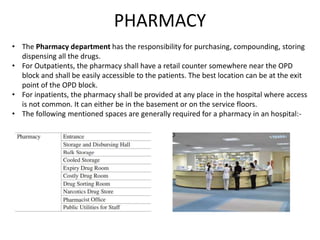
• The Pharmacy department has the responsibility for purchasing, compounding, storing
dispensing all the drugs.
• For Outpatients, the pharmacy shall have a retail counter somewhere near the OPD
block and shall be easily accessible to the patients. The best location can be at the exit
point of the OPD block.
• For inpatients, the pharmacy shall be provided at any place in the hospital where access
is not common. It can either be in the basement or on the service floors.
• The following mentioned spaces are generally required for a pharmacy in an hospital:-
PHARMACY
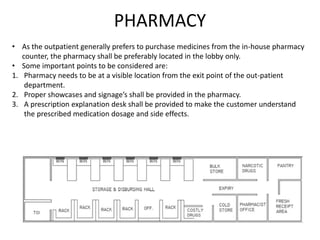
• As the outpatient generally prefers to purchase medicines from the in-house pharmacy
counter, the pharmacy shall be preferably located in the lobby only.
• Some important points to be considered are:
1. Pharmacy needs to be at a visible location from the exit point of the out-patient
department.
2. Proper showcases and signage’s shall be provided in the pharmacy.
3. A prescription explanation desk shall be provided to make the customer understand
the prescribed medication dosage and side effects.
PHARMACY
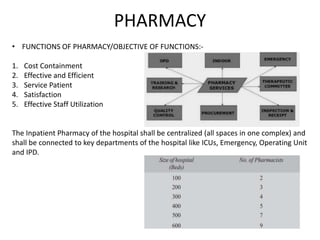
• FUNCTIONS OF PHARMACY/OBJECTIVE OF FUNCTIONS:-
1. Cost Containment
2. Effective and Efficient
3. Service Patient
4. Satisfaction
5. Effective Staff Utilization
The Inpatient Pharmacy of the hospital shall be centralized (all spaces in one complex) and
shall be connected to key departments of the hospital like ICUs, Emergency, Operating Unit
and IPD.
PHARMACY
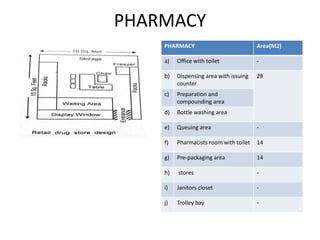
PHARMACY Area(M2)
a) Office with toilet -
b) Dispensing area with issuing
counter
28
c) Preparation and
compounding area
d) Bottle washing area
e) Queuing area -
f) Pharmacists room with toilet 14
g) Pre-packaging area 14
h) stores -
i) Janitors closet -
j) Trolley bay -
Piped Medical Gas Supply System
• Medical gases are one of the main support services used in hospitals .
• Commonly used medical gases in hospitals are:
1. Oxygen (O2).
2. Nitrous oxide (N2O).
3. Medical air 400 KPa or 4 bar (MA 4).
4. Medical air 700 KPa or 7 bar (MA 7).
5. Carbon dioxide (CO2).
6. Nitrogen (N2).
7. Medical vacuum
• All the Medical gases and vacuum are transported and distributed in the hospital
through the copper pipeline distribution system to provide gas or vacuum at the end-
point or terminal units.
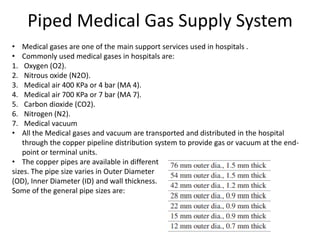
• The copper pipes are available in different
sizes. The pipe size varies in Outer Diameter
(OD), Inner Diameter (ID) and wall thickness.
Some of the general pipe sizes are:
Piped Medical Gas Supply System
• The MGPS system shall have :
1. Liquid Oxygen Tank Area with Landing Bay (If Liquid Oxygen Tank is to be installed).
2. Manifold Room for Oxygen and Nitrous Oxide.
3. Plant room for Compressor, Vacuum units.
4. Medical Gases Control Room.
5. Public Utility for Staff
Medical Record Room
• Medical Record is the systematic documentation of a patient’s medical history and
current treatment and care given to the patient.
• Electronic Medical Records is a computerized recording system that tracks and keeps
details of the patients admitted in the hospital and their attendants.
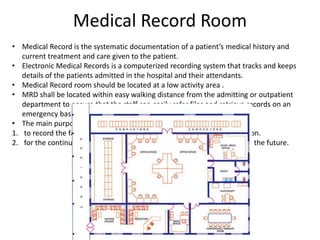
• Medical Record room should be located at a low activity area .
• MRD shall be located within easy walking distance from the admitting or outpatient
department to ensure that the staff can easily refer files and retrieve records on an
emergency basis.
• The main purpose of the medical record is:
1. to record the facts about a patient's health during the current admission.
2. for the continuing care of the patient when they require health care in the future.
Medical Record Room
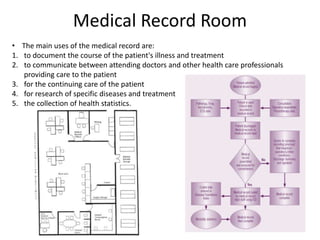
• The main uses of the medical record are:
1. to document the course of the patient's illness and treatment
2. to communicate between attending doctors and other health care professionals
providing care to the patient
3. for the continuing care of the patient
4. for research of specific diseases and treatment
5. the collection of health statistics.
Engineering and Maintenance Unit
• Engineering and Maintenance Unit is the department which is responsible for the
maintenance work of the equipment’s and buildings of the hospital .
• Maintenance Engineering is the discipline and profession of applying engineering
concepts for the optimization of equipment, procedures, and departmental budgets to
achieve better maintainability, reliability, and availability of equipment.
• Location :-Workshops shall be located at a place that is away from the general
movement or clinical areas of the hospital.
• The location shall allow easy shifting of materials and easy approachability of small
vehicles. Vertical lifts shall be provided in the workshops.
• The location shall allow easy shifting of materials and easy approachability of small
vehicles. Vertical lifts shall be provided in the workshops.
• Vertical lifts shall be provided in the workshops.
• Usually, except for the Biomedical Workshop and Low Voltage workshop, all other
workshops can be located outside the main hospital building. This can either be created
in a temporary structured building or can be taken in the annexure building of the main
hospital.
Engineering and Maintenance Unit
• Engineering and Maintenance Unit is the department which is responsible for the
maintenance work of the equipment’s and buildings of the hospital .
• Maintenance Engineering is the discipline and profession of applying engineering
concepts for the optimization of equipment, procedures, and departmental budgets to
achieve better maintainability, reliability, and availability of equipment.
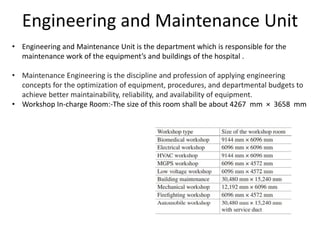
• Workshop In-charge Room:-The size of this room shall be about 4267 mm × 3658 mm

lib. study

  • 1.
    In-Patient Department • AnIn-patient department or IPD is a unit of a hospital or a healthcare facility where patients are admitted for medical conditions that require appropriate care and attention. • During the stay of a patient in the IPD are provided with various services in terms of consultant’s visits , investigations, procedures medicines and consumables ,room service diet, service etc. • The ipd forms 33%-50% of the hospital and most of the equipment and staffs are in this department Key aspects of the In-Patient Department • Patient Admission • Bed allocation • Consultants visit entry • Recording Patient’s clinical data • Requisition of investigation required • Store and Pharmacy • OT/ICU billing and management
  • 2.
    In-Patient Department • MedicineWard • Cardiac ward • Surgery Ward • Chest Medicine Ward • Obstetric Ward • Gynecology Ward • Dermatology Ward • ENT Ward • Eye Ward • Pre Op Ward • Post –Op Ward • Emergency Room • Injection Room • Dental Ward. IN PATIENT DEPARTMENT SERVICES DEPARTMENT:-
  • 3.
    In-Patient Department New bornIntensive Care Unit(NICU):- This is a nursery in a hospital that provides around-the-clock care to sick or premature babies. Pediatric Intensive Care Unit(NICU):- This is a unit where children are taken when they require the highest level of quality pediatric care. Surgical Intensive Care Unit(NICU):- This is a unit where children are taken when they require the highest level of quality pediatric care. Cardiac Intensive Care Unit (CICU):-This is a hospital ward specialized in the care of patients with heart attacks, unstable angina, cardiac dysrhythmia and (in practice) various other cardiac conditions that require continuous monitoring and treatment. Cardiothoracic Vascular Surgery Department (CTVS)- It specializes in diagnosing and treating various complex and difficult-to-treat cardiothoracic disorders with perfection. Casualty- It is the part of a hospital where people who have severe injuries or sudden illnesses are taken for emergency treatment. Operation theatre:- An operating theater is a facility within a hospital where surgical operations are carried out in an aseptic environment. High Dependency Unit(HDU):-HDU is an area in a hospital where patients can be cared more extensively than in a normal ward, but not to the point of intensive care. So, it is also known as the intermediate care unit. CRITICAL CARE AREA
  • 4.
    In-Patient Department Location: Awayfrom parking and crowd area, adjacent to support and diagnostic services, should be away from mortuary. Circulation: Vertical or horizontal Vertical circulation can be arranged with less space with central vertical spine for lifts, conveyers and stairs and pipe lines. Reduces patient errors and cross infections. Horizontal circulation: Eliminates requirement of expensive vertical transportation system. suitable for inpatient up to 300 bed strengths. The inpatient department is coordinated at the customer care desk located at the reception area of the hospital.
  • 5.
  • 6.
    In-Patient Department WARD Location ofthe ward should be such to ensure quietness and to control number of visitors Ward unit will include nursing station, doctors’ duty room, pantry, isolation room, treatment room, nursing store along with wards and toilets as per the norms.
  • 7.
    In-Patient Department Size ofbedroom: Single room: 117 TO 172 sq ft Double room: 157 TO 210 sq ft Four-bed room: 308 TO 401 sq ft • In the two and four bed rooms a clear distance of 14’ for two beds and two bed- side table is necessary. • According to usphs standard, the clear distance is nearer 15’. • Lavatory, toilet door or wardrobe door do not encroach into these clear dimensions in the better rooms. PRIVATE ROOMS
  • 8.
    WARDS GENERAL WARDS • Theseare the wards having multiple beds, generally between 6 and 30 beds in a single hall. • All the multiple bed wards shall be located in a cluster, in a particular zone and a particular floor of the hospital. Isolation ward shall be located in the isolation zone of the hospital. • In general wards per bed space should not be less than 12 sq m . • In general wards there are 1 WC for at least for 4 patients and 1 bathroom for at least 8 patients. • Headend of the bed shall be at least 610 mm away from the wall. • On the foot end of both the beds, a clear space shall be about 1829 mm • Inter-bed distance shall not be less than 914 mm.
  • 9.
    WARDS Sharing Patient Room(Semi-private Room) • These are separately demarcated areas for housing infectious patients. Under this category as well, there can be Private Rooms, Semi-private Rooms and General Wards. • These are also known as ‘Semi-Private Rooms’ and usually have 2–4 patient beds shared in a single room. • The room shall be divided into three zones—the first shall be a staff zone at the entrance of the room to allow staff to perform their tasks efficiently, second shall be the patient zone where patient beds are placed and the third shall be the family zone for seating visitors. • The room shall have an area of about 32.52 sq.m including family spaces and toilets. • A common toilet and bathroom with a handwashing station shall be provided for both the patients in the room. • There should be a distance of 1219 mm between two patient beds.
  • 10.
    WARDS Single Bed Occupancy •These rooms are also known as ‘Private Ward’ and have one patient bed with other amenities. They can be sub-categorized as follows: 1. Normal Private Room 2. Deluxe Room 3. Super Deluxe Room 4. Suites • The single patient occupancy room shall be divided into three zones— a) staff zone located at the room entrance to allow efficiency in performing their tasks b) patient zone where the patient’s bed is placed and c) family zone for providing comfortable seating for visitors. • A private single room shall have an area of about 23.22 sq.m including the family space and toilet. Mid-board single occupancy room In-board single occupancy room
  • 11.
    In-Patient Department AREA REQUIREMENT INPATIENTDEPARTMENT Sl. no. Description of functions Unit area in sqm 1 Pantry 9 2 Ward(male) 18.5 3 Ward (female) 18.5 4 Toilet (male) 9 5 Toilet (female) 9 6 V.I.P. Cabin Facilities 30.8 7 Duty Doctors Room with Facility 18 8 Duty Nurses Room with Facility 18 9 Store 9 10 Isolation Room 30 11 Check-up Room 9
  • 12.
    BLOOD BANK Blood Bankis a place where blood is collected from donors, tested, separated into components, stored and prepared for transfusion to recipients. Functions of Blood Bank Blood banks have four major functions: 1. Receiving 2. Storage 3. Testing 4. Distribution Location of the Blood Bank:- • The Blood Bank shall be located at the most easily accessible place in the hospital particularly in case of emergency. • It shall be near to the Emergency, Operating Theatre Complex and Intensive Care Units. Preferably the blood bank shall be on the ground floor. • Area of the blood bank as prescribed by the Drug Act shall not be less than 165 sq. m. • After adding the movement area, the total area shall not be less than 200 sq. m.
  • 13.
    BLOOD BANK Spaces ofblood bank :- • Reception-The area shall be 3658 mm × 3658 mm. • Registration-An area of 2438 mm × 2438 mm shall be sufficient. • Waiting-The waiting area shall have a provision for seating of about 10–15 people. The area shall be about 4572 mm × 3048 mm. • Bleeding Room-A room of about 4572 mm × 4267 mm shall be sufficient. • Medical Examination-The size of this room shall be 3658 mm × 3658 mm. • Refreshment/Recovery/ Rest Room-The desirable area of the room shall be about 4572 mm × 3658 mm. • Apheresis Room-The size of the room shall be about 4572 mm × 3658 mm. • Blood Component Room-The size of the component room shall be about 7620 mm × 7620 mm. • Change Room-The room shall be of the size 2438 mm × 2438 mm. • Doctors Rest Rooms-The room shall be of the size 2438 mm × 3048 mm. • Record Room-The size of the room shall be about 2438 mm × 2438 mm. • Medical Officer Room-The size of the room shall be about 4267 mm × 3658 mm • Sterilization Room Cum Washing Room-The size of the room shall be about 3048 mm × 3048 mm.
  • 14.
    BLOOD BANK PROVISION FORVARIOUS FLOOR AREAS IN THE BLOOD BANK S No. FACILITY CATEGORY B Area(m2) 1. Reception and waiting 10.5 2. Bleeding area 17.5 3. Donors rest room with kitchenette 17.5 4. Laboratory and blood storage area 14 5. Office - 6. stores - 7. Bottle washing area - 8. Doctors room with toilet 17.5 9. Social worker room 17.5 10. lavatory 7.0 11. Janitors closet -
  • 15.
    ORTHOPEADIC Orthopedics is abranch of medicine that focuses on the care of the skeletal system and its interconnecting parts. These parts include the: 1. Bones 2. Muscles 3. Joints 4. Tendons 5. Ligaments ORTHOPAEDIC CLINIC a) Plaster and splint storage To be shared in common with surgical clinic. 17.5 b) Fracture and treatment 14 c) Plaster cutting room 17.5 d) Recovery room 14 e) waiting 35
  • 16.
    WHEELCHAIR DETAILS CORRIDORS:- •Corridors providepatient , relative and staff access to all parts of the Emergency Department , as well as access to service areas of the Emergency Department, to storage, and access to equipment that is needed frequently or urgently. • Clinical areas - the minimum must be to allow 2 trolleys/wheelchairs to pass easily with associated equipment e.g. IV stands . • A width for wheel chair movement minimum width of 3m is recommended.
  • 17.
    PHARMACY • The Pharmacydepartment has the responsibility for purchasing, compounding, storing dispensing all the drugs. • For Outpatients, the pharmacy shall have a retail counter somewhere near the OPD block and shall be easily accessible to the patients. The best location can be at the exit point of the OPD block. • For inpatients, the pharmacy shall be provided at any place in the hospital where access is not common. It can either be in the basement or on the service floors. • The following mentioned spaces are generally required for a pharmacy in an hospital:-
  • 18.
    PHARMACY • As theoutpatient generally prefers to purchase medicines from the in-house pharmacy counter, the pharmacy shall be preferably located in the lobby only. • Some important points to be considered are: 1. Pharmacy needs to be at a visible location from the exit point of the out-patient department. 2. Proper showcases and signage’s shall be provided in the pharmacy. 3. A prescription explanation desk shall be provided to make the customer understand the prescribed medication dosage and side effects.
  • 19.
    PHARMACY • FUNCTIONS OFPHARMACY/OBJECTIVE OF FUNCTIONS:- 1. Cost Containment 2. Effective and Efficient 3. Service Patient 4. Satisfaction 5. Effective Staff Utilization The Inpatient Pharmacy of the hospital shall be centralized (all spaces in one complex) and shall be connected to key departments of the hospital like ICUs, Emergency, Operating Unit and IPD.
  • 20.
    PHARMACY PHARMACY Area(M2) a) Officewith toilet - b) Dispensing area with issuing counter 28 c) Preparation and compounding area d) Bottle washing area e) Queuing area - f) Pharmacists room with toilet 14 g) Pre-packaging area 14 h) stores - i) Janitors closet - j) Trolley bay -
  • 21.
    Piped Medical GasSupply System • Medical gases are one of the main support services used in hospitals . • Commonly used medical gases in hospitals are: 1. Oxygen (O2). 2. Nitrous oxide (N2O). 3. Medical air 400 KPa or 4 bar (MA 4). 4. Medical air 700 KPa or 7 bar (MA 7). 5. Carbon dioxide (CO2). 6. Nitrogen (N2). 7. Medical vacuum • All the Medical gases and vacuum are transported and distributed in the hospital through the copper pipeline distribution system to provide gas or vacuum at the end- point or terminal units. • The copper pipes are available in different sizes. The pipe size varies in Outer Diameter (OD), Inner Diameter (ID) and wall thickness. Some of the general pipe sizes are:
  • 22.
    Piped Medical GasSupply System • The MGPS system shall have : 1. Liquid Oxygen Tank Area with Landing Bay (If Liquid Oxygen Tank is to be installed). 2. Manifold Room for Oxygen and Nitrous Oxide. 3. Plant room for Compressor, Vacuum units. 4. Medical Gases Control Room. 5. Public Utility for Staff
  • 23.
    Medical Record Room •Medical Record is the systematic documentation of a patient’s medical history and current treatment and care given to the patient. • Electronic Medical Records is a computerized recording system that tracks and keeps details of the patients admitted in the hospital and their attendants. • Medical Record room should be located at a low activity area . • MRD shall be located within easy walking distance from the admitting or outpatient department to ensure that the staff can easily refer files and retrieve records on an emergency basis. • The main purpose of the medical record is: 1. to record the facts about a patient's health during the current admission. 2. for the continuing care of the patient when they require health care in the future.
  • 24.
    Medical Record Room •The main uses of the medical record are: 1. to document the course of the patient's illness and treatment 2. to communicate between attending doctors and other health care professionals providing care to the patient 3. for the continuing care of the patient 4. for research of specific diseases and treatment 5. the collection of health statistics.
  • 25.
    Engineering and MaintenanceUnit • Engineering and Maintenance Unit is the department which is responsible for the maintenance work of the equipment’s and buildings of the hospital . • Maintenance Engineering is the discipline and profession of applying engineering concepts for the optimization of equipment, procedures, and departmental budgets to achieve better maintainability, reliability, and availability of equipment. • Location :-Workshops shall be located at a place that is away from the general movement or clinical areas of the hospital. • The location shall allow easy shifting of materials and easy approachability of small vehicles. Vertical lifts shall be provided in the workshops. • The location shall allow easy shifting of materials and easy approachability of small vehicles. Vertical lifts shall be provided in the workshops. • Vertical lifts shall be provided in the workshops. • Usually, except for the Biomedical Workshop and Low Voltage workshop, all other workshops can be located outside the main hospital building. This can either be created in a temporary structured building or can be taken in the annexure building of the main hospital.
  • 26.
    Engineering and MaintenanceUnit • Engineering and Maintenance Unit is the department which is responsible for the maintenance work of the equipment’s and buildings of the hospital . • Maintenance Engineering is the discipline and profession of applying engineering concepts for the optimization of equipment, procedures, and departmental budgets to achieve better maintainability, reliability, and availability of equipment. • Workshop In-charge Room:-The size of this room shall be about 4267 mm × 3658 mm