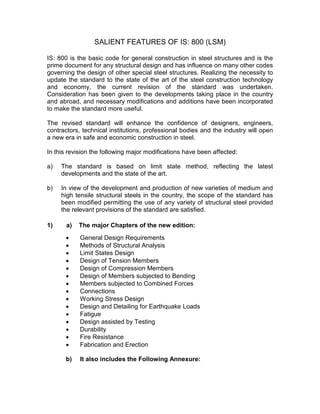
SALIENT FEATURES OF IS: 800 (LSM)

IS: 800 is the basic code for general construction in steel structures and is the
prime document for any structural design and has influence on many other codes
governing the design of other special steel structures. Realizing the necessity to
update the standard to the state of the art of the steel construction technology
and economy, the current revision of the standard was undertaken.
Consideration has been given to the developments taking place in the country
and abroad, and necessary modifications and additions have been incorporated
to make the standard more useful.

The revised standard will enhance the confidence of designers, engineers,
contractors, technical institutions, professional bodies and the industry will open
a new era in safe and economic construction in steel.

In this revision the following major modifications have been affected:

a)   The standard is based on limit state method, reflecting the latest
     developments and the state of the art.

b)   In view of the development and production of new varieties of medium and
     high tensile structural steels in the country, the scope of the standard has
     been modified permitting the use of any variety of structural steel provided
     the relevant provisions of the standard are satisfied.

1)     a)   The major Chapters of the new edition:
      •     General Design Requirements
      •     Methods of Structural Analysis
      •     Limit States Design
      •     Design of Tension Members
      •     Design of Compression Members
      •     Design of Members subjected to Bending
      •     Members subjected to Combined Forces
      •     Connections
      •     Working Stress Design
      •     Design and Detailing for Earthquake Loads
      •     Fatigue
      •     Design assisted by Testing
      •     Durability
      •     Fire Resistance
      •     Fabrication and Erection

      b)    It also includes the Following Annexure:
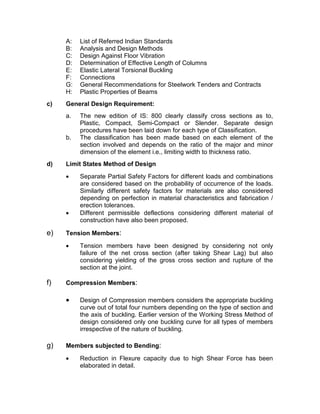
A:   List of Referred Indian Standards
     B:   Analysis and Design Methods
     C:   Design Against Floor Vibration
     D:   Determination of Effective Length of Columns
     E:   Elastic Lateral Torsional Buckling
     F:   Connections
     G:   General Recommendations for Steelwork Tenders and Contracts
     H:   Plastic Properties of Beams
c)   General Design Requirement:
     a.   The new edition of IS: 800 clearly classify cross sections as to,
          Plastic, Compact, Semi-Compact or Slender. Separate design
          procedures have been laid down for each type of Classification.
     b.   The classification has been made based on each element of the
          section involved and depends on the ratio of the major and minor
          dimension of the element i.e., limiting width to thickness ratio.
d)   Limit States Method of Design
     •    Separate Partial Safety Factors for different loads and combinations
          are considered based on the probability of occurrence of the loads.
          Similarly different safety factors for materials are also considered
          depending on perfection in material characteristics and fabrication /
          erection tolerances.
     •    Different permissible deflections considering different material of
          construction have also been proposed.

e)   Tension Members:

     •    Tension members have been designed by considering not only
          failure of the net cross section (after taking Shear Lag) but also
          considering yielding of the gross cross section and rupture of the
          section at the joint.

f)   Compression Members:

     •    Design of Compression members considers the appropriate buckling
          curve out of total four numbers depending on the type of section and
          the axis of buckling. Earlier version of the Working Stress Method of
          design considered only one buckling curve for all types of members
          irrespective of the nature of buckling.

g)   Members subjected to Bending:

     •    Reduction in Flexure capacity due to high Shear Force has been
          elaborated in detail.
•   New version introduces tension field design of plated steel girders.

h)   Members subjected to Combined Forces:

     •   Moment Gradient across a member / element considered in detail,
         while designing against combined action of axial force and bending
         moment in an element of a structure.

i)   Working Stress method of Design:

     •   Working Stress Method (WSM) of Design has been kept in a
         separate chapter with minor modifications (compared to the earlier
         code) and in tune with the specifications of the new code to ensure
         smooth transition from WSM to LSM for practicing engineers and
         academics whosoever desires.

j)   Design against Fatigue:

     •   Design against fatigue has been introduced for the first time. The
         state-of-the-art concept of stress range has been introduced for the
         first time in this code, This code automatically supersedes IS:1024 for
         steel structures which considered the stress – ratio method.

k)   Earthquake Resistance:

     •   Response Reduction factor has been introduced and elaborated in
         the new edition for the first time.

Is800

  • 1.
    SALIENT FEATURES OFIS: 800 (LSM) IS: 800 is the basic code for general construction in steel structures and is the prime document for any structural design and has influence on many other codes governing the design of other special steel structures. Realizing the necessity to update the standard to the state of the art of the steel construction technology and economy, the current revision of the standard was undertaken. Consideration has been given to the developments taking place in the country and abroad, and necessary modifications and additions have been incorporated to make the standard more useful. The revised standard will enhance the confidence of designers, engineers, contractors, technical institutions, professional bodies and the industry will open a new era in safe and economic construction in steel. In this revision the following major modifications have been affected: a) The standard is based on limit state method, reflecting the latest developments and the state of the art. b) In view of the development and production of new varieties of medium and high tensile structural steels in the country, the scope of the standard has been modified permitting the use of any variety of structural steel provided the relevant provisions of the standard are satisfied. 1) a) The major Chapters of the new edition: • General Design Requirements • Methods of Structural Analysis • Limit States Design • Design of Tension Members • Design of Compression Members • Design of Members subjected to Bending • Members subjected to Combined Forces • Connections • Working Stress Design • Design and Detailing for Earthquake Loads • Fatigue • Design assisted by Testing • Durability • Fire Resistance • Fabrication and Erection b) It also includes the Following Annexure:
  • 2.
    A: List of Referred Indian Standards B: Analysis and Design Methods C: Design Against Floor Vibration D: Determination of Effective Length of Columns E: Elastic Lateral Torsional Buckling F: Connections G: General Recommendations for Steelwork Tenders and Contracts H: Plastic Properties of Beams c) General Design Requirement: a. The new edition of IS: 800 clearly classify cross sections as to, Plastic, Compact, Semi-Compact or Slender. Separate design procedures have been laid down for each type of Classification. b. The classification has been made based on each element of the section involved and depends on the ratio of the major and minor dimension of the element i.e., limiting width to thickness ratio. d) Limit States Method of Design • Separate Partial Safety Factors for different loads and combinations are considered based on the probability of occurrence of the loads. Similarly different safety factors for materials are also considered depending on perfection in material characteristics and fabrication / erection tolerances. • Different permissible deflections considering different material of construction have also been proposed. e) Tension Members: • Tension members have been designed by considering not only failure of the net cross section (after taking Shear Lag) but also considering yielding of the gross cross section and rupture of the section at the joint. f) Compression Members: • Design of Compression members considers the appropriate buckling curve out of total four numbers depending on the type of section and the axis of buckling. Earlier version of the Working Stress Method of design considered only one buckling curve for all types of members irrespective of the nature of buckling. g) Members subjected to Bending: • Reduction in Flexure capacity due to high Shear Force has been elaborated in detail.
  • 3.
    New version introduces tension field design of plated steel girders. h) Members subjected to Combined Forces: • Moment Gradient across a member / element considered in detail, while designing against combined action of axial force and bending moment in an element of a structure. i) Working Stress method of Design: • Working Stress Method (WSM) of Design has been kept in a separate chapter with minor modifications (compared to the earlier code) and in tune with the specifications of the new code to ensure smooth transition from WSM to LSM for practicing engineers and academics whosoever desires. j) Design against Fatigue: • Design against fatigue has been introduced for the first time. The state-of-the-art concept of stress range has been introduced for the first time in this code, This code automatically supersedes IS:1024 for steel structures which considered the stress – ratio method. k) Earthquake Resistance: • Response Reduction factor has been introduced and elaborated in the new edition for the first time.