Connecting the dots between data stakeholders
in the impact arena
Gary A. Bolles
CEO, Xigi Inc.
Co-founder, SoCap – Social Capital Markets
Development & Information
Mapping Summit
Oct. 27, 2010
Why are we here today?
• Discover who’s in the room
• Describe who’s doing what
• Demonstrate some cool technology
• Discuss what needs to be done
• Define a set of shared goals
• Determine followup steps
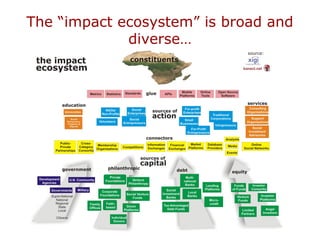
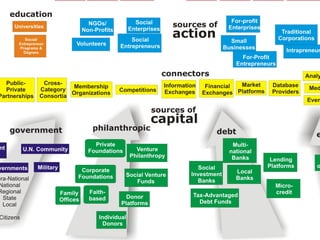
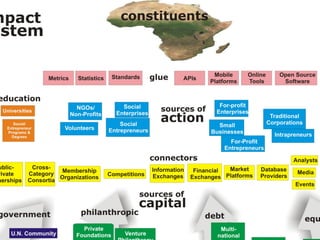
The “impact ecosystem” is broad and
diverse…
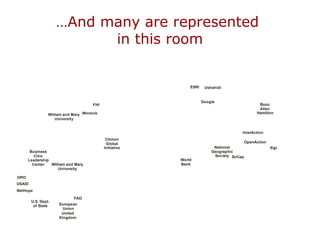
…And many are represented
in this room
Booz
Allen
Hamilton
NetHope
William and Mary
University
Winrock
World
Bank
Xigi
Google
Ushahidi
OpenAction
SoCap
OPIC
U.S. Dept.
of State
United
Kingdom
USAID
ESRI
FHI
William and Mary
University
InterAction
FAO
European
Union
National
Geographic
Society
Business
Civic
Leadership
Center
Clinton
Global
Initiative
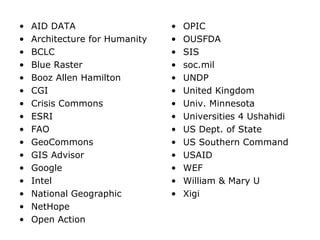
• AID DATA
• Architecture for Humanity
• BCLC
• Blue Raster
• Booz Allen Hamilton
• CGI
• Crisis Commons
• ESRI
• FAO
• GeoCommons
• GIS Advisor
• Google
• Intel
• National Geographic
• NetHope
• Open Action
• OPIC
• OUSFDA
• SIS
• soc.mil
• UNDP
• United Kingdom
• Univ. Minnesota
• Universities 4 Ushahidi
• US Dept. of State
• US Southern Command
• USAID
• WEF
• William & Mary U
• Xigi
Why has it historically been
so disconnected?
• Strong incentive to publish only positive outcomes
• Many point-in-time research initiatives, but few dynamic,
ongoing, comprehensive efforts
• Little rooting in the social graph
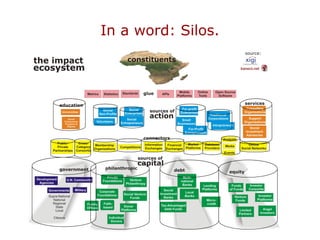
In a word: Silos.
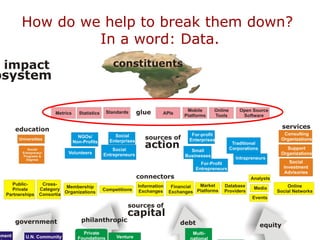
How do we help to break them down?
In a word: Data.
But accurate, up-to-date, & complete
information is hard to find.
• Data exists about these initiatives for impact – but it sits
in silos
– In Web sites
– In proprietary databases
– In documents on local hard drives
• And where the information exists, it’s not connected
– Linking entrepreneurs and sources of funding
– Linking initiatives and the people they’re intended to serve
– Linking intended outcomes with what actually happens
“Data are the new platform
for change.” – Lucy Bernholz,
“Disrupting Philanthropy 2.0”
What are the layers of the data?
• Constituents
– Beneficiaries. Recipients. Receiving partners.
• Problems
– What are the issues that are intended to be impacted?
• Places
– Where are the resources coming from? Where will they be
located? Where will they be applied?
• People
• Organizations
• Resources
– What’s being applied to the problem? Where does it go?
• Initiatives
– How are the people, organizations & resources being focused?
• Impact
– What were the intended outcomes? What were the actual
outcomes – intended or unintended?
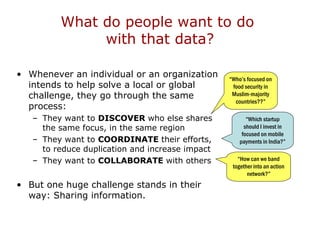
What do people want to do
with that data?
• Whenever an individual or an organization
intends to help solve a local or global
challenge, they go through the same
process:
– They want to DISCOVER who else shares
the same focus, in the same region
– They want to COORDINATE their efforts,
to reduce duplication and increase impact
– They want to COLLABORATE with others
• But one huge challenge stands in their
way: Sharing information.
“Who’s focused on
food security in
Muslim-majority
countries??”
“Which startup
should I invest in
focused on mobile
payments in India?”
“How can we band
together into an action
network?”
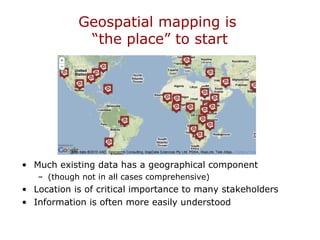
Geospatial mapping is
“the place” to start
• Much existing data has a geographical component
– (though not in all cases comprehensive)
• Location is of critical importance to many stakeholders
• Information is often more easily understood
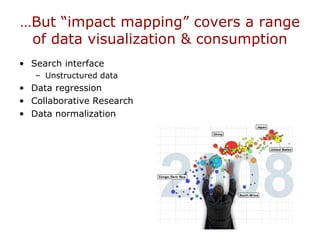
…But “impact mapping” covers a range
of data visualization & consumption
• Search interface
– Unstructured data
• Data regression
• Collaborative Research
• Data normalization
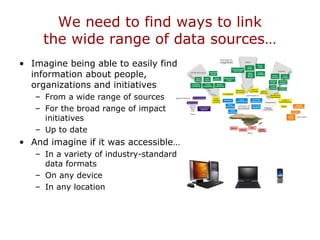
We need to find ways to link
the wide range of data sources…
• Imagine being able to easily find
information about people,
organizations and initiatives
– From a wide range of sources
– For the broad range of impact
initiatives
– Up to date
• And imagine if it was accessible…
– In a variety of industry-standard
data formats
– On any device
– In any location
Universities
Social/
Entrepreneur
Programs &
Degrees
Social
Entrepreneurs
Volunteers For-Profit
Entrepreneurs
sources of
capital
sources of
action
philanthropic
government
connectors
debt
services
glue
Information
Exchanges
Support
Organizations
Cross-
Category
Consortia
Governments
National
Regional
State
Local
Citizens
U.N. Community
Development
Agencies
Family
Offices
Faith-
based
Individual
Donors
Donor
Platforms
NGOs/
Non-Profits
Social
Enterprises
For-profit
Enterprises
Financial
Exchanges Market
Platforms
Competitions
APIs
Mobile
Platforms
Metrics
Corporate
Foundations
Private
Foundations
Venture
Philanthropy
Social Venture
Funds
equity
Angel
Investors
Limited
Partners
Investor
Platforms
Funds
of Funds
Venture
Funds
Investor
Consortia
Traditional
Corporations
Intrapreneurs
Multi-
national
Banks
Local
Banks
Lending
Platforms
Micro-
credit
Tax-Advantaged
Debt Funds
Membership
Organizations
Events &
Social Networks
Media
Statistics
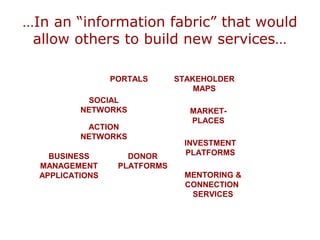
…In an “information fabric” that would
allow others to build new services…
PORTALS
SOCIAL
NETWORKS
STAKEHOLDER
MAPS
ACTION
NETWORKS
MARKET-
PLACES
INVESTMENT
PLATFORMSDONOR
PLATFORMS
MENTORING &
CONNECTION
SERVICES
BUSINESS
MANAGEMENT
APPLICATIONS
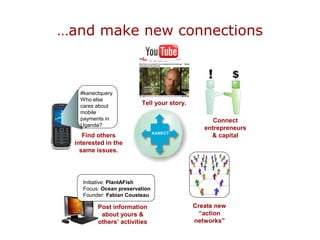
…and make new connections
KANECT
Tell your story.
#kanectquery
Who else
cares about
mobile
payments in
Uganda?
Find others
interested in the
same issues.
Post information
about yours &
others’ activities
Initiative: PlantAFish
Focus: Ocean preservation
Founder: Fabian Cousteau
Create new
“action
networks”
Connect
entrepreneurs
& capital
! $
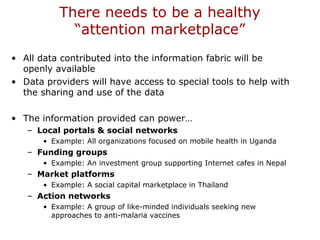
There needs to be a healthy
“attention marketplace”
• All data contributed into the information fabric will be
openly available
• Data providers will have access to special tools to help with
the sharing and use of the data
• The information provided can power…
– Local portals & social networks
• Example: All organizations focused on mobile health in Uganda
– Funding groups
• Example: An investment group supporting Internet cafes in Nepal
– Market platforms
• Example: A social capital marketplace in Thailand
– Action networks
• Example: A group of like-minded individuals seeking new
approaches to anti-malaria vaccines
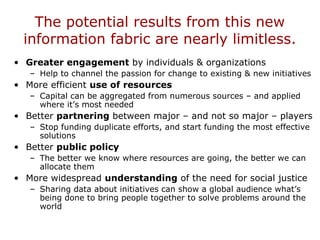
The potential results from this new
information fabric are nearly limitless.
• Greater engagement by individuals & organizations
– Help to channel the passion for change to existing & new initiatives
• More efficient use of resources
– Capital can be aggregated from numerous sources – and applied
where it’s most needed
• Better partnering between major – and not so major – players
– Stop funding duplicate efforts, and start funding the most effective
solutions
• Better public policy
– The better we know where resources are going, the better we can
allocate them
• More widespread understanding of the need for social justice
– Sharing data about initiatives can show a global audience what’s
being done to bring people together to solve problems around the
world
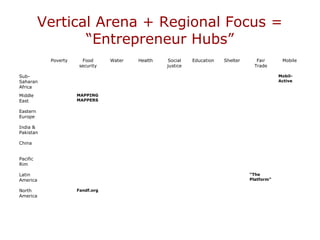
Vertical Arena + Regional Focus =
“Entrepreneur Hubs”
Poverty Food
security
Water Health Social
justice
Education Shelter Fair
Trade
Mobile
Sub-
Saharan
Africa
Mobil-
Active
Middle
East
MAPPING
MAPPERS
Eastern
Europe
India &
Pakistan
China
Pacific
Rim
Latin
America
“The
Platform”
North
America
Fandf.org
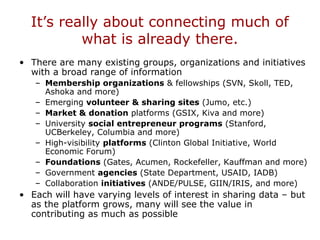
It’s really about connecting much of
what is already there.
• There are many existing groups, organizations and initiatives
with a broad range of information
– Membership organizations & fellowships (SVN, Skoll, TED,
Ashoka and more)
– Emerging volunteer & sharing sites (Jumo, etc.)
– Market & donation platforms (GSIX, Kiva and more)
– University social entrepreneur programs (Stanford,
UCBerkeley, Columbia and more)
– High-visibility platforms (Clinton Global Initiative, World
Economic Forum)
– Foundations (Gates, Acumen, Rockefeller, Kauffman and more)
– Government agencies (State Department, USAID, IADB)
– Collaboration initiatives (ANDE/PULSE, GIIN/IRIS, and more)
• Each will have varying levels of interest in sharing data – but
as the platform grows, many will see the value in
contributing as much as possible
Yes!I want to share my data.
email info@kanect.net
for more
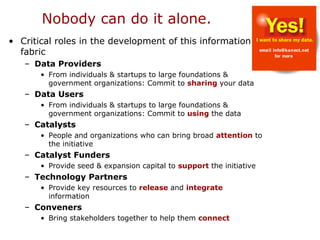
Nobody can do it alone.
• Critical roles in the development of this information
fabric
– Data Providers
• From individuals & startups to large foundations &
government organizations: Commit to sharing your data
– Data Users
• From individuals & startups to large foundations &
government organizations: Commit to using the data
– Catalysts
• People and organizations who can bring broad attention to
the initiative
– Catalyst Funders
• Provide seed & expansion capital to support the initiative
– Technology Partners
• Provide key resources to release and integrate
information
– Conveners
• Bring stakeholders together to help them connect
We have examples to point us to
“a way forward.”
National
Broadband Strategy
Coalition
bb4us.net
Let’s get busy.
• Discover who’s in the room
• Describe who’s doing what
• Demonstrate some cool technology
• Discuss what needs to be done
• Define a set of shared goals
• Determine followup steps

xigi-kanect-mapsummit20101027-kickoff

  • 1.
    Connecting the dotsbetween data stakeholders in the impact arena Gary A. Bolles CEO, Xigi Inc. Co-founder, SoCap – Social Capital Markets Development & Information Mapping Summit Oct. 27, 2010
  • 2.
    Why are wehere today? • Discover who’s in the room • Describe who’s doing what • Demonstrate some cool technology • Discuss what needs to be done • Define a set of shared goals • Determine followup steps
  • 3.
    The “impact ecosystem”is broad and diverse…
  • 6.
    …And many arerepresented in this room Booz Allen Hamilton NetHope William and Mary University Winrock World Bank Xigi Google Ushahidi OpenAction SoCap OPIC U.S. Dept. of State United Kingdom USAID ESRI FHI William and Mary University InterAction FAO European Union National Geographic Society Business Civic Leadership Center Clinton Global Initiative
  • 7.
    • AID DATA •Architecture for Humanity • BCLC • Blue Raster • Booz Allen Hamilton • CGI • Crisis Commons • ESRI • FAO • GeoCommons • GIS Advisor • Google • Intel • National Geographic • NetHope • Open Action • OPIC • OUSFDA • SIS • soc.mil • UNDP • United Kingdom • Univ. Minnesota • Universities 4 Ushahidi • US Dept. of State • US Southern Command • USAID • WEF • William & Mary U • Xigi
  • 8.
    Why has ithistorically been so disconnected? • Strong incentive to publish only positive outcomes • Many point-in-time research initiatives, but few dynamic, ongoing, comprehensive efforts • Little rooting in the social graph
  • 9.
    In a word:Silos.
  • 10.
    How do wehelp to break them down? In a word: Data.
  • 11.
    But accurate, up-to-date,& complete information is hard to find. • Data exists about these initiatives for impact – but it sits in silos – In Web sites – In proprietary databases – In documents on local hard drives • And where the information exists, it’s not connected – Linking entrepreneurs and sources of funding – Linking initiatives and the people they’re intended to serve – Linking intended outcomes with what actually happens “Data are the new platform for change.” – Lucy Bernholz, “Disrupting Philanthropy 2.0”
  • 12.
    What are thelayers of the data? • Constituents – Beneficiaries. Recipients. Receiving partners. • Problems – What are the issues that are intended to be impacted? • Places – Where are the resources coming from? Where will they be located? Where will they be applied? • People • Organizations • Resources – What’s being applied to the problem? Where does it go? • Initiatives – How are the people, organizations & resources being focused? • Impact – What were the intended outcomes? What were the actual outcomes – intended or unintended?
  • 13.
    What do peoplewant to do with that data? • Whenever an individual or an organization intends to help solve a local or global challenge, they go through the same process: – They want to DISCOVER who else shares the same focus, in the same region – They want to COORDINATE their efforts, to reduce duplication and increase impact – They want to COLLABORATE with others • But one huge challenge stands in their way: Sharing information. “Who’s focused on food security in Muslim-majority countries??” “Which startup should I invest in focused on mobile payments in India?” “How can we band together into an action network?”
  • 14.
    Geospatial mapping is “theplace” to start • Much existing data has a geographical component – (though not in all cases comprehensive) • Location is of critical importance to many stakeholders • Information is often more easily understood
  • 15.
    …But “impact mapping”covers a range of data visualization & consumption • Search interface – Unstructured data • Data regression • Collaborative Research • Data normalization
  • 16.
    We need tofind ways to link the wide range of data sources… • Imagine being able to easily find information about people, organizations and initiatives – From a wide range of sources – For the broad range of impact initiatives – Up to date • And imagine if it was accessible… – In a variety of industry-standard data formats – On any device – In any location Universities Social/ Entrepreneur Programs & Degrees Social Entrepreneurs Volunteers For-Profit Entrepreneurs sources of capital sources of action philanthropic government connectors debt services glue Information Exchanges Support Organizations Cross- Category Consortia Governments National Regional State Local Citizens U.N. Community Development Agencies Family Offices Faith- based Individual Donors Donor Platforms NGOs/ Non-Profits Social Enterprises For-profit Enterprises Financial Exchanges Market Platforms Competitions APIs Mobile Platforms Metrics Corporate Foundations Private Foundations Venture Philanthropy Social Venture Funds equity Angel Investors Limited Partners Investor Platforms Funds of Funds Venture Funds Investor Consortia Traditional Corporations Intrapreneurs Multi- national Banks Local Banks Lending Platforms Micro- credit Tax-Advantaged Debt Funds Membership Organizations Events & Social Networks Media Statistics
  • 17.
    …In an “informationfabric” that would allow others to build new services… PORTALS SOCIAL NETWORKS STAKEHOLDER MAPS ACTION NETWORKS MARKET- PLACES INVESTMENT PLATFORMSDONOR PLATFORMS MENTORING & CONNECTION SERVICES BUSINESS MANAGEMENT APPLICATIONS
  • 18.
    …and make newconnections KANECT Tell your story. #kanectquery Who else cares about mobile payments in Uganda? Find others interested in the same issues. Post information about yours & others’ activities Initiative: PlantAFish Focus: Ocean preservation Founder: Fabian Cousteau Create new “action networks” Connect entrepreneurs & capital ! $
  • 19.
    There needs tobe a healthy “attention marketplace” • All data contributed into the information fabric will be openly available • Data providers will have access to special tools to help with the sharing and use of the data • The information provided can power… – Local portals & social networks • Example: All organizations focused on mobile health in Uganda – Funding groups • Example: An investment group supporting Internet cafes in Nepal – Market platforms • Example: A social capital marketplace in Thailand – Action networks • Example: A group of like-minded individuals seeking new approaches to anti-malaria vaccines
  • 20.
    The potential resultsfrom this new information fabric are nearly limitless. • Greater engagement by individuals & organizations – Help to channel the passion for change to existing & new initiatives • More efficient use of resources – Capital can be aggregated from numerous sources – and applied where it’s most needed • Better partnering between major – and not so major – players – Stop funding duplicate efforts, and start funding the most effective solutions • Better public policy – The better we know where resources are going, the better we can allocate them • More widespread understanding of the need for social justice – Sharing data about initiatives can show a global audience what’s being done to bring people together to solve problems around the world
  • 21.
    Vertical Arena +Regional Focus = “Entrepreneur Hubs” Poverty Food security Water Health Social justice Education Shelter Fair Trade Mobile Sub- Saharan Africa Mobil- Active Middle East MAPPING MAPPERS Eastern Europe India & Pakistan China Pacific Rim Latin America “The Platform” North America Fandf.org
  • 22.
    It’s really aboutconnecting much of what is already there. • There are many existing groups, organizations and initiatives with a broad range of information – Membership organizations & fellowships (SVN, Skoll, TED, Ashoka and more) – Emerging volunteer & sharing sites (Jumo, etc.) – Market & donation platforms (GSIX, Kiva and more) – University social entrepreneur programs (Stanford, UCBerkeley, Columbia and more) – High-visibility platforms (Clinton Global Initiative, World Economic Forum) – Foundations (Gates, Acumen, Rockefeller, Kauffman and more) – Government agencies (State Department, USAID, IADB) – Collaboration initiatives (ANDE/PULSE, GIIN/IRIS, and more) • Each will have varying levels of interest in sharing data – but as the platform grows, many will see the value in contributing as much as possible
  • 23.
    Yes!I want toshare my data. email info@kanect.net for more Nobody can do it alone. • Critical roles in the development of this information fabric – Data Providers • From individuals & startups to large foundations & government organizations: Commit to sharing your data – Data Users • From individuals & startups to large foundations & government organizations: Commit to using the data – Catalysts • People and organizations who can bring broad attention to the initiative – Catalyst Funders • Provide seed & expansion capital to support the initiative – Technology Partners • Provide key resources to release and integrate information – Conveners • Bring stakeholders together to help them connect
  • 24.
    We have examplesto point us to “a way forward.” National Broadband Strategy Coalition bb4us.net
  • 25.
    Let’s get busy. •Discover who’s in the room • Describe who’s doing what • Demonstrate some cool technology • Discuss what needs to be done • Define a set of shared goals • Determine followup steps