MORPHOGENESIS IN
BRYOPHYTES
Submitted to :- H.C.Negi ( Subject tutor)
Submitted by :- Anjna Sharma
Roll no. :- 2151018
M.Sc Botany ( 1st Sem.)
MORPHOGENESIS
 Morphe :- Form / shape
 Genesis :- Origin/ creation.
 Defination :- Branch of biology which deals with
the origin of form of organisms.
 Aim :-
 Bryophytes occupies unique position in plant
kingdom in between thallophyta and
pteridophyta
 Identify all metabolic processes which take place
in the organism starting from the single cell stage
to a full formed organisms.
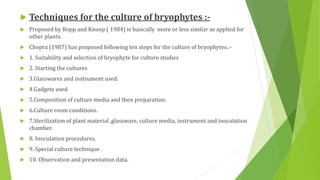
 Bryophytes have gametophytic plant body on
which sporophytic phase depends and for
supports and nutrition.
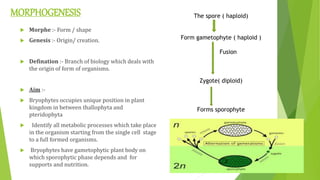
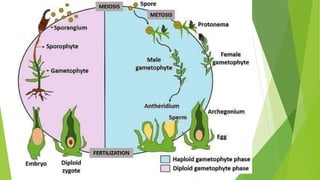
The spore ( haploid)
Form gametophyte ( haploid )
Fusion
Zygote( diploid)
Forms sporophyte
 The morphogenesis in bryophytes involves the entire biochemistry right from
 germination of spore to formation of spore within the capsule.
 Phenomenon of morphogenesis :-
 It includes two primary functions :-
 1. Growth 2. Differentiation.
 Growth :-
 Growth is a synthesis of protoplasm
 Growth can be distinguished in the leval of Cells, tissues , organs or the organisms
in order of complexities.
 It is based on the principle of kinetics of open system :- Both matter and energy
can enter and leave the system .
 Differentiation :-
 In which there is a differentiation of all parts of bryophytes and the distinguished
functions of every parts.
 Process of differentiation leads from the simplicity to complexity in the structure of an
organism.
 Edmund W. Sinnott ( 1960) has divided the subject of morphogenesis into three parts :-
 A) Growth
 B) The phenomenon of morphogenesis :- This parts include following aspects such as :-
 1. Correlation :- Ganetic correlation , physical correlation.
 2. Polarity
 3. Symmetry
 4. Differentiation.
 5. Regeneration.
 6.Tissue mixture .
 7. Abnormal growth.
 C) Morphogenetic factors. :- Light , water, temprature,gravity, chemical factors, growth
substances, genetic factors including cytoplasmic and nuclear and, nuclear organization.
 Techniques for the culture of bryophytes :-
 Proposed by Bopp and Knoop ( 1984) is basically more or less similar as applied for
other plants.
 Chopra (1987) has proposed following ten steps for the culture of bryophytes.:-
 1. Suitability and selection of bryophyte for culture studies
 2. Starting the cultures
 3.Glasswares and instrument used.
 4.Gadgets used
 5.Composition of culture media and then preparation.
 6.Culture room conditions.
 7.Sterilization of plant material ,glassware, culture media, instrument and inoculation
chamber.
 8. Inoculation procedures.
 9. Special culture technique .
 10. Observation and presentation data.
Callus formation :-
 For the development of a callus it is necessary to suppress the polarity –an important
phenomenon of morphogenesis.It is achieved by nutrilization of internal gradients of
nutrients and growth substances.
 Differentiation of callus :-
 In some bryophytes such as Riccia and Funeria the differentiation in callus usually takes
place on the same medium in which they were induced.
 In other bryophytes the differentiation is influenced by several morphogenetic factors
as reported by Sinnot (1960)
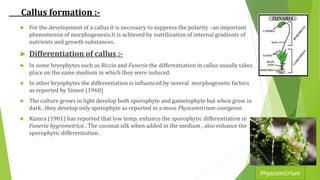
 The culture grows in light develop both sporophyte and gametophyte but when grow in
dark , they develop only sporophyte as reported in a moss Physcomitrium coorgense.
 Kumra (1981) has reported that low temp. enhance the sporophytic differentiation in
Funeria hygrometrica . The coconut silk when added in the medium , also enhance the
sporophytic differentiation .
Physcomitrium
 In morphogenesis, the growth is followed by differentiation . The differentiation is
controlled by three ways :-
 1. Exogenous control
 2. Cytoplasmic control
 3. Nuclear control
 All the three control are interdependent and work in intimate co-ordination .
 The exogenous controls include , light , temp., gravity, and mineral nutrition etc.
 The cytoplasmic controls mediate between the exogenous control and nuclear control. In
fact, cytoplasmic control is very imp. As it acts as buffer.
 Nuclear control is also very important control amongst the three . It is exerted by the genes
of the organism .
 All the genes are not active at the same time ina given tissue or organ . Some are in state of
activity or sone are repressed. Nevertheless they have the capacity to triggered to activity
when exposed to appropriate biochemical environment.
 It can be better explained by Mehra’s gene block hypothesis which states that there is no
fundamental difference in gametophyte and sporophyte generations. In these two
generations , it is the different gene systems that are in the activated state.
APOGAMY IN BRYOPHYTES :-
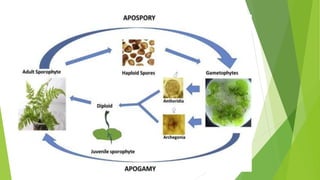
 Apogamy means the development of a sporophyte ( embryo) out of any
gametophytic cell without the union of male and female gametes.
 In bryophytes the sporophyte , which is most simple amongst all the members of
embryophyta and consists of foot , seta and capsule , may be produced
apogamously from haploid gametophytic tissues which may be protonema buds ,
rhizoids, or any part of the plant body .
 Rashid and chopra ( 1969) got success to produce apogamous sporophytes in
Funeria hygrometrica on th axis of the gametophytic plant .
 Lal (1963) produced numerous apogamous sporophyte of Physcomitrium
coorgense on culture medium containing sugar and coconut milk .
Apospry in bryophytes :-
 Apospory means the development of a gametophyte from any part of the
sporophyte without any reduction division .
 In bryophytes the gametophyte , which is thalloid or leafy in liverworts but only
leafy in mosses, is produced aposporously from diploid sporophytic tissues of
either foot or seta or capsule.
 In mosses the protonema and buds are produced before the formation of the plant
, therefore both of them can also be produced aposporously from sporophytic
tissues
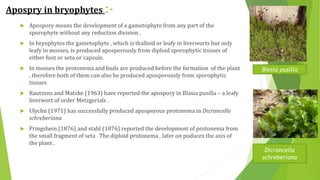
 Rautzens and Matzke (1963) have reported the apospory in Blasia pusilla – a leafy
liverwort of order Metzgerials .
 Ulychn (1971) has successfully produced aposporous protonema in Dicrancella
schreberiana
 Pringshein (1876) and stahl (1876) reported the development of protonema from
the small fragment of seta . The diploid protonema , later on poduces the axis of
the plant .
Dicrancella
schreberiana
Blesia pusilla
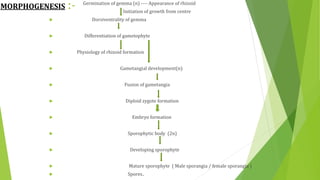
MORPHOGENESIS :- Germination of gemma (n) ---- Appearance of rhizoid
Initiation of growth from centre
 Dorsiventrality of gemma
 Differentiation of gametophyte
 Physiology of rhizoid formation
 Gametangial development(n)
 Fusion of gametangia
 Diploid zygote formation
 Embryo formation
 Sporophytic body (2n)
 Developing sporophyte
 Mature sporophyte ( Male sporangia / female sporangia )
 Spores.
ADVENTAGES OF MORPHOGENESIS :-
 1. The plants are simple , small in size and gametophytic.
 2. Being non – vascular , the cellular complexity is not so much as found in higher plants
 3. The zygote , which is diploid and also called the first cell of sporophyte , develop within
fertilized archegonium and forms embryo.
 4. Embryo forms foot , seta and capsule ( in Riccia only capsule is present and , in
Corsinia only capsule and few small celled foot are present and In Sphaerocarpus capsule
, small seta and small foot is present.
 5. Embryo never forms root , stem, and leaves as in higher plants.
 6. Vegetation propagation is common.
 7. Both the generations can be studied in the same plant .
 8. Life span is short , therefore within a very short duration the experiment can be
completed.
 9. It is easy to induce callus from gametophyte and sporophyte.
 THANKYOU