Presentation on
Underground Metro
Prepared by-Yusuf Rampurawala
Metro?
 Metro is the most common term for underground rapid
transit systems used by non-native
 Rapid transit or mass rapid transit (MRT), is a type of
high-capacity public transport generally found in urban
areas.
 Unlike buses or trams, rapid transit systems are electric
railways that operate on an exclusive right-of-way,
which cannot be accessed by pedestrians or other
vehicles of any sort,and which is often grade-separated
in tunnels or on elevated railways.
 China has the largest number of rapid transit systems in
the world
Somewhere in INDIA…
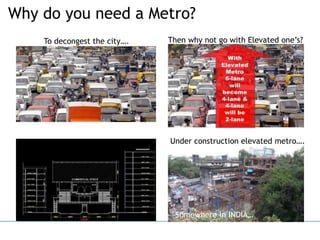
Why do you need a Metro?
To decongest the city…. Then why not go with Elevated one’s?
Under construction elevated metro….
Somewhere in INDIA…
To Start with….!
Rapid transit or mass rapid transit (MRT), also known as heavy rail, Metro, subway or
tube is a type of high-capacity public transport generally found in Metropolitan
cities/urban areas. Unlike buses or trams, rapid transit systems are electric railways
that operate on an exclusive right-of-way, which cannot be accessed by pedestrians
or other vehicles of any sort, and which is often grade separated in tunnels or on
elevated railways.
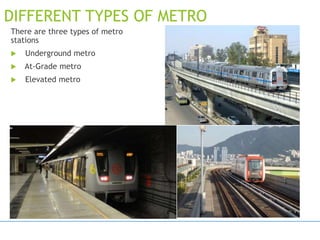
DIFFERENT TYPES OF METRO
There are three types of metro
stations
 Underground metro
 At-Grade metro
 Elevated metro
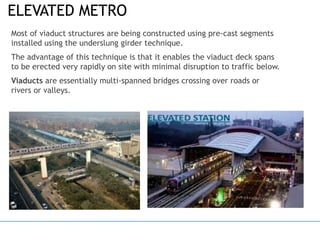
Most of viaduct structures are being constructed using pre-cast segments
installed using the underslung girder technique.
The advantage of this technique is that it enables the viaduct deck spans
to be erected very rapidly on site with minimal disruption to traffic below.
Viaducts are essentially multi-spanned bridges crossing over roads or
rivers or valleys.
ELEVATED METRO
ELEVATED METRO
Metro station
Building Corridor
Via-duct
Building
Corridor
Via-duct
Building
Corridor
Problem for Fire engines
A passenger railway going inside an urban area was called the
METROPOLITAN RAILWAY (urban train system), in modern English: METRO
“Underground Metros were ideal but could not be executed in the city due
to several, particularly financial, constraints.”- Mumbai Metro Rail
Corporation’s (MMRC) Ex-managing director, Ashwini Bhide.
Bhide said the ideal situation could
be that all Metro lines are
underground. But for a country and
a city like ours, where we have a
huge resource crunch, we have tried
to find a solution
Underground METRO
Underground Metro…
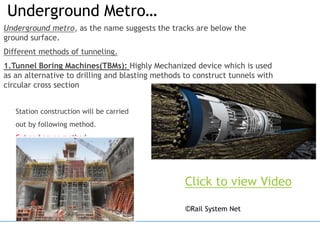
Underground metro, as the name suggests the tracks are below the
ground surface.
Different methods of tunneling.
1.Tunnel Boring Machines(TBMs): Highly Mechanized device which is used
as an alternative to drilling and blasting methods to construct tunnels with
circular cross section
Station construction will be carried
out by following method.
Cut and cover method
Click to view Video
©Rail System Net
2. New Austrian Tunnelling method(NATM):
Modern Tunnel construction methods where the surrounding rock or soil
formation of a tunnel is integrated into an overall ring like support
structure.
Underground Metro… contd…
How TBM Works???
 TBM Video
©MinistryofTranBC
How are tunnel rings made??
©Consolis
 Mumbai Metro – Kalbadevi station NATM video
©MMRCL
Piling Work for Mumbai Metro’s
Hutatma Chowk Station
 Here are two really nice videos which demonstrates how and why
secant piling is used to build a strong retaining/guide-wall for station
boxes
• Here , @ Fort , Mumbai , The Hutatma chowk is surrounded by
British time heritage structures which needs to be protected
while contructing.
• Secant pile method is used for the same.
• Secant piling 1
©PilingContractors
• Secant Piling 2
©David Molony
Piling Work for Mumbai Metro’s Hutatma
Chowk Station
12/5/202
0
12/5/2020
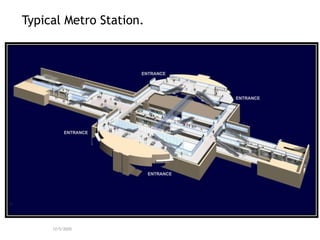
Typical Metro Station.
5
12/5/2020
CONCOURSE LEVEL
5
Concourse Level
Platform Level
Undercroft
Level
UPE
OTE
12/5/2020
CONCOURSE LEVEL
5
12/5/2020
PLATFORM LEVEL
5
12/5/2020
UNDERCROFT LEVEL
5
12/5/2020
LONGITUDINAL SECTION
5
ENVIRONMENTAL CONTROL SYSTEM
(ECS)
PURPOSE OF STATION VAC
 Typically, underground stations are interspaced at 1 km.
 Heat is generated by Traction and other equipment.
 Today's state-of-art modern-rolling stock provided with air-
conditioners dissipates substantial heat inside the subway
resulting in the hot air in the tunnel and pulsating heat load on the
platform along with the train.
 In an underground section, a Large number of Patrons are
Confined in an Enclosed Space
 Supply of fresh air to patrons for biological need
 Removal of latent body heat, obnoxious and harmful gases
 Removal of sensible heat and fumes from batteries, UPS, lights
etc.
VAC – VENTILATION & AIR-CONDITIONING SYSTEM
Consists of
 Air Conditioning of UG Stations
 Mechanical Ventilation for Plant
Rooms
 Smoke Control and Extraction
ECS SYSTEM EQUIPMENT
 Chillers
 Chilled and Condenser Water pumps
 Cooling Towers
 Air Handling Units
 Fan Coil Units
 Fresh Air Fans
 Ventilation Supply/Exhaust Fans
 Smoke Extract Fans
 Staircase Pressurization Fans
ECS Design – Modes Of Operation
Some stations consists of three or more levels. Plant room for the station is located
generally in Ancillary Building / intermediate level/ other level along with pump room.
Two AHU Rooms Located on either end of the station are generally at the
concourse level meant for the purpose of Air Conditioning of public areas and
entrances. Individual Rooms will be air-conditioned by FCUs. The bifurcation of the
rooms on each level is generally as below.
• Paid and Unpaid Public Areas
• AHU Rooms, Station Control Room,
SCADA,Ventilation Fans , SER, TER, Ticket
Office
• Toilets, Train Captain & Crew Rooms , Retail
areas etc
Concourse Level
• UtilityRoom, Water Tank, Pump Room,
Electrical Room.
• Subways
Intermediate
Level
• Public Area , ASS, Electrical Room
• UPS, Telecom Room etc.
Platform Level
12/5/2020
CENTRAL PLANT AIR-CONDITIONING SYSTEM
Condenser
Pump Cooling
Tower
Condenser
Chillers
A
H
U
36°C
30°C
Condenser
Water Line
Motor
Compressor Expansion VLV
8°C
15°C
Chiller Pump
Liquid Refrigerant Line Chilled Water Line
Video
©Pune Metro Rail Project
Tunnel Ventilation System
TVS – Major Design criteria
 Latest ASHRAE /ISHRAE standards for ambient air conditions.
 In normal mode TVS designed to maintain a maximum dry DBT of 40deg C
 Congested mode – TVS designed for 45 deg C ( max ) in the tunnel .
 Emergency mode ( Fire )
 Heat release rate for a train shall be 15 MW
Radiant fraction of 30 % .
 NFPA 130.
 Heat load from train at normal and congested mode shall be around 610
kw for 6 car train .
 Tunnel layouts
 Braking heat loads , traction motor losses , AC loads etc
 Headway.
 One train between two consecutive ventilation shafts .
 Pressurization of non incidental tunnels .
TVS - COMPONENTS
• Tunnel Ventilation Fans
• Attenuators
• Tunnel Ventilation Dampers
• Nozzles
• Air Compressor
• Tunnel Booster Fans (Jet Fans)
• Track way Exhaust Fans
Tunnel Ventilation system – Why ??
Normal operating conditions; to provide ventilation relief from piston
effect.
Congested operation; to provide air flow inside tunnel to control temp.
rise.
Emergency scenario of fire;
to extract smoke from tunnel and
provide safe evacuation path for the passengers
provide safe path for the fire fighters
During Non-Revenue period; to provide ventilation inside tunnel for
maintenance staff
:
TVS – Normal Mode
Piston effect of
running trains
Ventilation in
Normal Mode
Track way
Ventilation system
“ Normal Mode - When trains are working to
timetable throughout the system, at
prescribed headways and dwell times, within
given tolerances.”
Track way exhaust systems
 Over track exhaust system
 Under platform supply system
 OTE ducts
TVS – Normal Mode
TVS – Normal Mode
LOW TEMPERATURE HIGH TEMPERATURE
 PISTON EFFECT
STATION1 STATION2
LOW TEMPERATURE HIGH TEMPERATURE
 PISTON EFFECT
STATION1 STATION2
NORMAL SCENARIO
TVS – Congested Mode
Tunnel
Ventilation fans (
Piston effect zero
) )
Congested
Mode
Track way Ventilation
system
Congested mode – Any deviation from the
Normal operation ( expect from emergency
situations ) . TVS systems ‘ congested mode’
operation to provide air flow inside tunnel to
control temperature rise .
 Over track exhaust system
 Under platform supply system
 OTE ducts
Tunnel Ventilation fans
TVS – Congested Mode
 Draught relief dampers closed .
 TVF are in operation .
 TEF / UPS fans running as required .
TVS – Congested Mode
LOW TEMPERATURE HIGH TEMPERATURE
 PISTON EFFECT
STATION1 STATION2
LOW TEMPERATURE HIGH TEMPERATURE
 PUSH - PULL VENTILATION
STATION1 STATION2
‘CONGESTION SCENARIO’
TVS – Emergency ( In tunnel )
Tunnel Ventilation fans Emergency
Mode
Emergency
 To extract smoke from tunnel
Provide safe evacuation for the
passengers
 Provide safe path for the fire fighters
TVS – Emergency Mode ( Tunnel )
Click here – TVS ( Full layout )
TVS – Emergency Mode ( Cross over )
Pressurization in the adjacent tunnels for safe evacuation of passengers .
TVS – Fire in Track way
* With smoke exhaust off
* With smoke exhaust on
TVS – Fire in Track way
LOW TEMPERATURE HIGH TEMPERATURE
 PISTON EFFECT
STATION1 STATION2
LOW TEMPERATURE HIGH TEMPERATURE
 PUSH - PULL VENTILATION
STATION1 STATION2
FIRE EMERGENCY SCENARIO
CFD Visualization of Piston
effect
 Piston Effect
©StreamCFD
Lets take an idea of Fan
sizes.
 Tunnel ventilation fans, classically, must have the ability to
both supply and extract air from a tunnel system, with the
operator's choice dependent on the tunnel ventilation
system's operating mode most appropriate at any given
point in time. Consequently, tunnel ventilation fans must
incorporate a reversible aerodynamic design which limits
the maximum fan pressure rise.
 These fans range from 1.4 m dia to 2+ m dia as per
requirement. Motor kW ranging from 45 kW- 300 kW.
 https://youtu.be/Ae-awmqLBt0
Video Courtesy : Mr. Fathi Tarada.
12/5/202
0
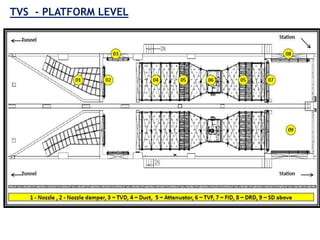
TVS - PLATFORM LEVEL
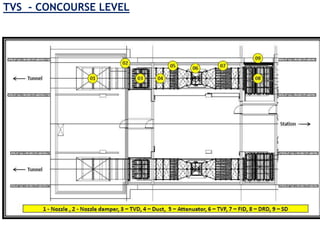
TVS - CONCOURSE LEVEL
TVS – TUNNEL BOOSTER FANS
TVS – TUNNEL VENTILATION DAMPERS
Types of tunnel ventilation system
 Longitudinal Ventilation
Here the direction of airflow is longitudinal in nature. At the
beginning of the tunnel or the tunnel section starting, these
moves the pollutant gasses and effluents, that is followed by
the fresh air. Then at the end of the tunnel portal or at the
tunnel section end, the polluted air is discharged.
The configuration of
longitudinal ventilation can
be either portal to portal,
shaft to shaft or from portal
to shaft. For transit and rail
tunnel, the longitudinal
airfow system is used.
Types of tunnel ventilation system
 Transverse AirHow Ventilation Systems
Here uniform distribution of fresh air is created
along the length of the tunnel. It is mainly
employed in road tunnels. Occasional used for
transit tunnels. A consistent level of temperature
and the pollutants will be maintained if this system
is employed. The system can be either fully or
semi-transverse.
Transverse or semi-transverse ventilation tunnel is
better than a longitudinal one for the tunnels that
are longer than 4 to 5 km.
Types of tunnel ventilation system
 Natural Ventilation Systems in Tunnel
When from one portal to next portal of the tunnel, there is a provision
of drift, it forms a fair ventilation during the operations involving
enlarging. This is when the tunnel length is short. In the case of long
tunnels, such natural ventilation will be inadequate and we design
separate mechanical ventilation system.
The natural ventilation
can be confgured from
portal to portal, shaft to
shaft or from portal to
shaft. The road tunnel has
an air velocity that is
uniform. The temperature
and the pollutant level
increases at the exit
portal or the section end.
TENABLE ENVIRONMENT DURING EMERGENCY MODE
 Air temp. < 60o C
 Noise < 92 dBA
 Visibility up to 110 meter
 CO Concentration < 1500 ppm
 Radiation Heat flow < 2.5 kW/m2
 Maximum Air Velocity < 11 m/s
EMERGENCY OPERATION
 As per NFPA -130 section 7.2.1; the emergency ventilation system shall be
designed to do the following
 Provide a tenable environment along the path of egress from a fire incident in
enclosed train ways
 Produce airflow rates sufficient to prevent back layering of smoke in the egress
within enclosed train ways.
 Be capable of reaching full operational mode within 180 Secs.
 Accommodate maximum number of trains between ventilation shafts during
emergency.
‘NFPA - 130 STANDARD
(FIXED GUIDE WAY TRANSIT SYSTEM)
 Ventilation should meet the critical velocity requirement.
 Evacuation should be in tenable environment.
 Patrons shall not be exposed to high temperature or air-
velocities.
 max. 381 m travel for mid-shaft evacuation.
 max. 244 m travel in case of cross-passages.
TVS OPERATING SCENARIOS
Emergency Conditions - Occurrence
 Train under fire or derailment.
 Report from Train Driver/Passengers
Emergency Conditions - Consequence
 Passengers may expose to smoky environment
EMERGENCY VENTILATION DESIGN CONSIDERATION
 Fire Size
- Heat Release rate per unit time (MW)
 Smoke Propagation in Tunnels
 Critical Air Velocity
- Minimum air velocity required to prevent back layering of smoke
TVS – MAJOR DESIGN ASSUMPTIONS
Design based on the following:-
 One or Two train in a Ventilation Zone
 Train Fire Heat release load – 15 /20 MW
 TVS control shall be through SCADA from OCC
 Group control of TVS plant using Modes
 Semi – Automatic Control for TVS
 Dual feed power supply to TVS
 No passenger carrying trains at sidings, Depot Line, Link Line
CONTROL STRATEGY FOR TVS EQUIPMENT
1. Centrally at the OCC for entire section
Through SCADA workstation.
2. Centrally at Station Control Room for each station
Through local BMS / SCADA workstation.
3. Centrally at Station Control Room for each station
Override provision through Ventilation Control panel (VCP)
4. Locally at each PLC location for each end of station
Through Local Control Panel (LCP) of BMS
5 Locally at each TVS MCC Room
By operation of the “Manual – Off – Auto” switch at MCC room.
PLATFORM SCREE DOORS
 What are PSD??
©Masats S.A.
 PSD Installation
©Cross Rail Project
CONCLUSIONS
 Thus during normal operation tunnel ventilation is achieved by piston
effect of the train
 During congested or emergency mode ventilation is achieved by
running ventilation fans
 Selection of technology, design and equipment provides not only
proven, reliable, but also an energy efficient system.
TUNNEL VENTILATION SYSTEM – Material Logistics
There must be Logistics route pre-planned
for shifting the materials. TVF fans are
weighing almost a ton.
Taking Fans from one side of the station to
other side is a challenge at concourse
level/ Mezzanine levels because of small
corridors and space constraints.
By track the materials are shifted by
trolley and pulled up through the service
cutout.
MATERIAL SHIFTING
Materials are loaded on tractor trolley by crane at the
portal from where underground tunnel is starting.
MATERIAL LIFTING
TUNNEL VENTILATION FLOOR MOUNTED DAMPER INSTALLATION
This is a risky job to fix damper
which is over the tunnel approx. at
6m height from track level.. At
least 600-700mm clearance is
required on each side for safe
working.
Service Corridor
3 to 4 different contractors
are working in same corridor
with their services at
different level. Proper co-
ordination and pre planning
is necessary.
For E&M, ECS & TVS system almost 200-250 wall cutouts and core
cutting both together are required to pass individual services (
Piping, ducting, cable tray etc.) It is recommended to prepare those
cutouts at the time of civil execution itself as it can hamper the
seismic compliance of the building at the time of manual cutting.
INTERFACE PLANNING & MANAGEMENT
 Civil:
 Finalizing of cut outs in the SEM drawings.
 Interface for delivery routes/ access hatches for lowering of materials.
 Interface for timely civil access for TVS, ECS & ancillary building areas.
 General Lighting arrangement.
 E&M:
 Power, Water, Earthing for electrical panels & equipment.
 Interface for the drainage points
 BMS:
 Interface for system requirements with E&M, Signaling, telecom, UPS,
DG, OCC.
 Interface requirement for fire detection and alarm system.
 Interface with signaling for OCC data transfer.
 Interface with signaling for ventilation zones.
Thank You

Presentation on Underground metro.

  • 1.
  • 2.
    Metro?  Metro isthe most common term for underground rapid transit systems used by non-native  Rapid transit or mass rapid transit (MRT), is a type of high-capacity public transport generally found in urban areas.  Unlike buses or trams, rapid transit systems are electric railways that operate on an exclusive right-of-way, which cannot be accessed by pedestrians or other vehicles of any sort,and which is often grade-separated in tunnels or on elevated railways.  China has the largest number of rapid transit systems in the world Somewhere in INDIA…
  • 3.
    Why do youneed a Metro? To decongest the city…. Then why not go with Elevated one’s? Under construction elevated metro…. Somewhere in INDIA…
  • 4.
    To Start with….! Rapidtransit or mass rapid transit (MRT), also known as heavy rail, Metro, subway or tube is a type of high-capacity public transport generally found in Metropolitan cities/urban areas. Unlike buses or trams, rapid transit systems are electric railways that operate on an exclusive right-of-way, which cannot be accessed by pedestrians or other vehicles of any sort, and which is often grade separated in tunnels or on elevated railways.
  • 5.
    DIFFERENT TYPES OFMETRO There are three types of metro stations  Underground metro  At-Grade metro  Elevated metro
  • 6.
    Most of viaductstructures are being constructed using pre-cast segments installed using the underslung girder technique. The advantage of this technique is that it enables the viaduct deck spans to be erected very rapidly on site with minimal disruption to traffic below. Viaducts are essentially multi-spanned bridges crossing over roads or rivers or valleys. ELEVATED METRO
  • 7.
    ELEVATED METRO Metro station BuildingCorridor Via-duct Building Corridor Via-duct Building Corridor Problem for Fire engines
  • 8.
    A passenger railwaygoing inside an urban area was called the METROPOLITAN RAILWAY (urban train system), in modern English: METRO “Underground Metros were ideal but could not be executed in the city due to several, particularly financial, constraints.”- Mumbai Metro Rail Corporation’s (MMRC) Ex-managing director, Ashwini Bhide. Bhide said the ideal situation could be that all Metro lines are underground. But for a country and a city like ours, where we have a huge resource crunch, we have tried to find a solution Underground METRO
  • 9.
    Underground Metro… Underground metro,as the name suggests the tracks are below the ground surface. Different methods of tunneling. 1.Tunnel Boring Machines(TBMs): Highly Mechanized device which is used as an alternative to drilling and blasting methods to construct tunnels with circular cross section Station construction will be carried out by following method. Cut and cover method Click to view Video ©Rail System Net
  • 10.
    2. New AustrianTunnelling method(NATM): Modern Tunnel construction methods where the surrounding rock or soil formation of a tunnel is integrated into an overall ring like support structure. Underground Metro… contd…
  • 11.
    How TBM Works??? TBM Video ©MinistryofTranBC How are tunnel rings made?? ©Consolis
  • 12.
     Mumbai Metro– Kalbadevi station NATM video ©MMRCL
  • 13.
    Piling Work forMumbai Metro’s Hutatma Chowk Station  Here are two really nice videos which demonstrates how and why secant piling is used to build a strong retaining/guide-wall for station boxes • Here , @ Fort , Mumbai , The Hutatma chowk is surrounded by British time heritage structures which needs to be protected while contructing. • Secant pile method is used for the same. • Secant piling 1 ©PilingContractors • Secant Piling 2 ©David Molony
  • 14.
    Piling Work forMumbai Metro’s Hutatma Chowk Station 12/5/202 0
  • 15.
  • 16.
  • 17.
  • 18.
  • 19.
  • 20.
  • 21.
  • 22.
    PURPOSE OF STATIONVAC  Typically, underground stations are interspaced at 1 km.  Heat is generated by Traction and other equipment.  Today's state-of-art modern-rolling stock provided with air- conditioners dissipates substantial heat inside the subway resulting in the hot air in the tunnel and pulsating heat load on the platform along with the train.  In an underground section, a Large number of Patrons are Confined in an Enclosed Space  Supply of fresh air to patrons for biological need  Removal of latent body heat, obnoxious and harmful gases  Removal of sensible heat and fumes from batteries, UPS, lights etc.
  • 23.
    VAC – VENTILATION& AIR-CONDITIONING SYSTEM Consists of  Air Conditioning of UG Stations  Mechanical Ventilation for Plant Rooms  Smoke Control and Extraction
  • 24.
    ECS SYSTEM EQUIPMENT Chillers  Chilled and Condenser Water pumps  Cooling Towers  Air Handling Units  Fan Coil Units  Fresh Air Fans  Ventilation Supply/Exhaust Fans  Smoke Extract Fans  Staircase Pressurization Fans
  • 25.
    ECS Design –Modes Of Operation
  • 26.
    ECS Design –Modes Of Operation
  • 27.
    Some stations consistsof three or more levels. Plant room for the station is located generally in Ancillary Building / intermediate level/ other level along with pump room. Two AHU Rooms Located on either end of the station are generally at the concourse level meant for the purpose of Air Conditioning of public areas and entrances. Individual Rooms will be air-conditioned by FCUs. The bifurcation of the rooms on each level is generally as below. • Paid and Unpaid Public Areas • AHU Rooms, Station Control Room, SCADA,Ventilation Fans , SER, TER, Ticket Office • Toilets, Train Captain & Crew Rooms , Retail areas etc Concourse Level • UtilityRoom, Water Tank, Pump Room, Electrical Room. • Subways Intermediate Level • Public Area , ASS, Electrical Room • UPS, Telecom Room etc. Platform Level
  • 28.
    12/5/2020 CENTRAL PLANT AIR-CONDITIONINGSYSTEM Condenser Pump Cooling Tower Condenser Chillers A H U 36°C 30°C Condenser Water Line Motor Compressor Expansion VLV 8°C 15°C Chiller Pump Liquid Refrigerant Line Chilled Water Line
  • 29.
  • 30.
  • 31.
    TVS – MajorDesign criteria  Latest ASHRAE /ISHRAE standards for ambient air conditions.  In normal mode TVS designed to maintain a maximum dry DBT of 40deg C  Congested mode – TVS designed for 45 deg C ( max ) in the tunnel .  Emergency mode ( Fire )  Heat release rate for a train shall be 15 MW Radiant fraction of 30 % .  NFPA 130.  Heat load from train at normal and congested mode shall be around 610 kw for 6 car train .  Tunnel layouts  Braking heat loads , traction motor losses , AC loads etc  Headway.  One train between two consecutive ventilation shafts .  Pressurization of non incidental tunnels .
  • 32.
    TVS - COMPONENTS •Tunnel Ventilation Fans • Attenuators • Tunnel Ventilation Dampers • Nozzles • Air Compressor • Tunnel Booster Fans (Jet Fans) • Track way Exhaust Fans
  • 33.
    Tunnel Ventilation system– Why ?? Normal operating conditions; to provide ventilation relief from piston effect. Congested operation; to provide air flow inside tunnel to control temp. rise. Emergency scenario of fire; to extract smoke from tunnel and provide safe evacuation path for the passengers provide safe path for the fire fighters During Non-Revenue period; to provide ventilation inside tunnel for maintenance staff :
  • 34.
    TVS – NormalMode Piston effect of running trains Ventilation in Normal Mode Track way Ventilation system “ Normal Mode - When trains are working to timetable throughout the system, at prescribed headways and dwell times, within given tolerances.” Track way exhaust systems  Over track exhaust system  Under platform supply system  OTE ducts
  • 35.
  • 36.
    TVS – NormalMode LOW TEMPERATURE HIGH TEMPERATURE  PISTON EFFECT STATION1 STATION2 LOW TEMPERATURE HIGH TEMPERATURE  PISTON EFFECT STATION1 STATION2 NORMAL SCENARIO
  • 37.
    TVS – CongestedMode Tunnel Ventilation fans ( Piston effect zero ) ) Congested Mode Track way Ventilation system Congested mode – Any deviation from the Normal operation ( expect from emergency situations ) . TVS systems ‘ congested mode’ operation to provide air flow inside tunnel to control temperature rise .  Over track exhaust system  Under platform supply system  OTE ducts Tunnel Ventilation fans
  • 38.
    TVS – CongestedMode  Draught relief dampers closed .  TVF are in operation .  TEF / UPS fans running as required .
  • 39.
    TVS – CongestedMode LOW TEMPERATURE HIGH TEMPERATURE  PISTON EFFECT STATION1 STATION2 LOW TEMPERATURE HIGH TEMPERATURE  PUSH - PULL VENTILATION STATION1 STATION2 ‘CONGESTION SCENARIO’
  • 40.
    TVS – Emergency( In tunnel ) Tunnel Ventilation fans Emergency Mode Emergency  To extract smoke from tunnel Provide safe evacuation for the passengers  Provide safe path for the fire fighters
  • 41.
    TVS – EmergencyMode ( Tunnel ) Click here – TVS ( Full layout )
  • 42.
    TVS – EmergencyMode ( Cross over ) Pressurization in the adjacent tunnels for safe evacuation of passengers .
  • 43.
    TVS – Firein Track way * With smoke exhaust off * With smoke exhaust on
  • 44.
    TVS – Firein Track way LOW TEMPERATURE HIGH TEMPERATURE  PISTON EFFECT STATION1 STATION2 LOW TEMPERATURE HIGH TEMPERATURE  PUSH - PULL VENTILATION STATION1 STATION2 FIRE EMERGENCY SCENARIO
  • 45.
    CFD Visualization ofPiston effect  Piston Effect ©StreamCFD
  • 46.
    Lets take anidea of Fan sizes.  Tunnel ventilation fans, classically, must have the ability to both supply and extract air from a tunnel system, with the operator's choice dependent on the tunnel ventilation system's operating mode most appropriate at any given point in time. Consequently, tunnel ventilation fans must incorporate a reversible aerodynamic design which limits the maximum fan pressure rise.  These fans range from 1.4 m dia to 2+ m dia as per requirement. Motor kW ranging from 45 kW- 300 kW.  https://youtu.be/Ae-awmqLBt0 Video Courtesy : Mr. Fathi Tarada. 12/5/202 0
  • 47.
  • 48.
  • 49.
  • 50.
  • 51.
    TVS – TUNNELBOOSTER FANS
  • 52.
    TVS – TUNNELVENTILATION DAMPERS
  • 53.
    Types of tunnelventilation system  Longitudinal Ventilation Here the direction of airflow is longitudinal in nature. At the beginning of the tunnel or the tunnel section starting, these moves the pollutant gasses and effluents, that is followed by the fresh air. Then at the end of the tunnel portal or at the tunnel section end, the polluted air is discharged. The configuration of longitudinal ventilation can be either portal to portal, shaft to shaft or from portal to shaft. For transit and rail tunnel, the longitudinal airfow system is used.
  • 54.
    Types of tunnelventilation system  Transverse AirHow Ventilation Systems Here uniform distribution of fresh air is created along the length of the tunnel. It is mainly employed in road tunnels. Occasional used for transit tunnels. A consistent level of temperature and the pollutants will be maintained if this system is employed. The system can be either fully or semi-transverse. Transverse or semi-transverse ventilation tunnel is better than a longitudinal one for the tunnels that are longer than 4 to 5 km.
  • 55.
    Types of tunnelventilation system  Natural Ventilation Systems in Tunnel When from one portal to next portal of the tunnel, there is a provision of drift, it forms a fair ventilation during the operations involving enlarging. This is when the tunnel length is short. In the case of long tunnels, such natural ventilation will be inadequate and we design separate mechanical ventilation system. The natural ventilation can be confgured from portal to portal, shaft to shaft or from portal to shaft. The road tunnel has an air velocity that is uniform. The temperature and the pollutant level increases at the exit portal or the section end.
  • 56.
    TENABLE ENVIRONMENT DURINGEMERGENCY MODE  Air temp. < 60o C  Noise < 92 dBA  Visibility up to 110 meter  CO Concentration < 1500 ppm  Radiation Heat flow < 2.5 kW/m2  Maximum Air Velocity < 11 m/s
  • 57.
    EMERGENCY OPERATION  Asper NFPA -130 section 7.2.1; the emergency ventilation system shall be designed to do the following  Provide a tenable environment along the path of egress from a fire incident in enclosed train ways  Produce airflow rates sufficient to prevent back layering of smoke in the egress within enclosed train ways.  Be capable of reaching full operational mode within 180 Secs.  Accommodate maximum number of trains between ventilation shafts during emergency.
  • 58.
    ‘NFPA - 130STANDARD (FIXED GUIDE WAY TRANSIT SYSTEM)  Ventilation should meet the critical velocity requirement.  Evacuation should be in tenable environment.  Patrons shall not be exposed to high temperature or air- velocities.  max. 381 m travel for mid-shaft evacuation.  max. 244 m travel in case of cross-passages.
  • 59.
    TVS OPERATING SCENARIOS EmergencyConditions - Occurrence  Train under fire or derailment.  Report from Train Driver/Passengers Emergency Conditions - Consequence  Passengers may expose to smoky environment
  • 60.
    EMERGENCY VENTILATION DESIGNCONSIDERATION  Fire Size - Heat Release rate per unit time (MW)  Smoke Propagation in Tunnels  Critical Air Velocity - Minimum air velocity required to prevent back layering of smoke
  • 61.
    TVS – MAJORDESIGN ASSUMPTIONS Design based on the following:-  One or Two train in a Ventilation Zone  Train Fire Heat release load – 15 /20 MW  TVS control shall be through SCADA from OCC  Group control of TVS plant using Modes  Semi – Automatic Control for TVS  Dual feed power supply to TVS  No passenger carrying trains at sidings, Depot Line, Link Line
  • 62.
    CONTROL STRATEGY FORTVS EQUIPMENT 1. Centrally at the OCC for entire section Through SCADA workstation. 2. Centrally at Station Control Room for each station Through local BMS / SCADA workstation. 3. Centrally at Station Control Room for each station Override provision through Ventilation Control panel (VCP) 4. Locally at each PLC location for each end of station Through Local Control Panel (LCP) of BMS 5 Locally at each TVS MCC Room By operation of the “Manual – Off – Auto” switch at MCC room.
  • 63.
    PLATFORM SCREE DOORS What are PSD?? ©Masats S.A.  PSD Installation ©Cross Rail Project
  • 64.
    CONCLUSIONS  Thus duringnormal operation tunnel ventilation is achieved by piston effect of the train  During congested or emergency mode ventilation is achieved by running ventilation fans  Selection of technology, design and equipment provides not only proven, reliable, but also an energy efficient system.
  • 65.
    TUNNEL VENTILATION SYSTEM– Material Logistics There must be Logistics route pre-planned for shifting the materials. TVF fans are weighing almost a ton. Taking Fans from one side of the station to other side is a challenge at concourse level/ Mezzanine levels because of small corridors and space constraints. By track the materials are shifted by trolley and pulled up through the service cutout.
  • 66.
    MATERIAL SHIFTING Materials areloaded on tractor trolley by crane at the portal from where underground tunnel is starting.
  • 67.
  • 68.
    TUNNEL VENTILATION FLOORMOUNTED DAMPER INSTALLATION This is a risky job to fix damper which is over the tunnel approx. at 6m height from track level.. At least 600-700mm clearance is required on each side for safe working.
  • 69.
    Service Corridor 3 to4 different contractors are working in same corridor with their services at different level. Proper co- ordination and pre planning is necessary. For E&M, ECS & TVS system almost 200-250 wall cutouts and core cutting both together are required to pass individual services ( Piping, ducting, cable tray etc.) It is recommended to prepare those cutouts at the time of civil execution itself as it can hamper the seismic compliance of the building at the time of manual cutting.
  • 70.
    INTERFACE PLANNING &MANAGEMENT  Civil:  Finalizing of cut outs in the SEM drawings.  Interface for delivery routes/ access hatches for lowering of materials.  Interface for timely civil access for TVS, ECS & ancillary building areas.  General Lighting arrangement.  E&M:  Power, Water, Earthing for electrical panels & equipment.  Interface for the drainage points  BMS:  Interface for system requirements with E&M, Signaling, telecom, UPS, DG, OCC.  Interface requirement for fire detection and alarm system.  Interface with signaling for OCC data transfer.  Interface with signaling for ventilation zones.
  • 71.