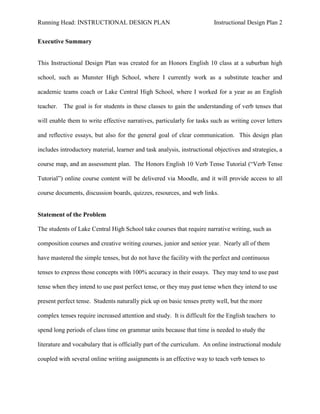
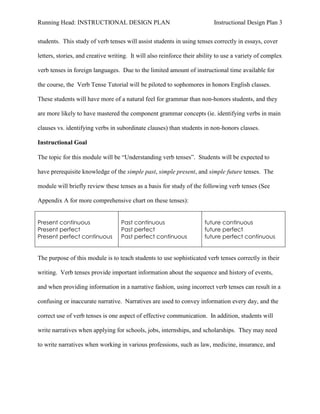
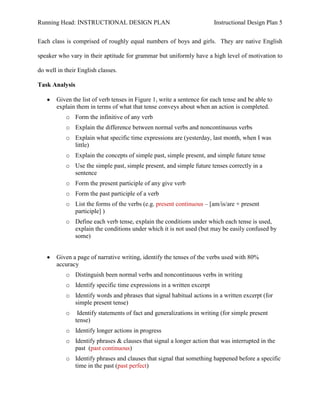
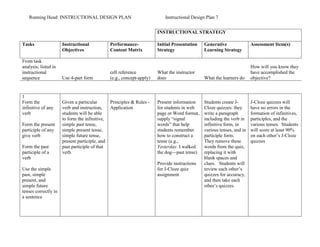
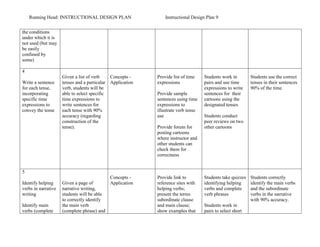
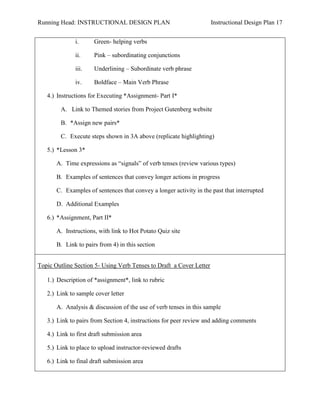
This instructional design plan aims to teach honors sophomore students advanced verb tenses through an online tutorial. The tutorial will review basic verb tenses and teach present continuous, present perfect, past continuous, past perfect, and future verb tenses. Students will practice identifying verb tenses in writing examples and applying various tenses correctly in a sample cover letter. The goal is for students to effectively communicate through accurate use of verb tenses in their own narrative writing.
![Instructional Design Plan<br />for<br />Honors English 10 Verb Tense Tutorial <br />Kathleen Gordon<br />Purdue University Calumet<br />EDCI 575<br />December 17, 2010<br />Executive Summary <br />This Instructional Design Plan was created for an Honors English 10 class at a suburban high school, such as Munster High School, where I currently work as a substitute teacher and academic teams coach or Lake Central High School, where I worked for a year as an English teacher. The goal is for students in these classes to gain the understanding of verb tenses that will enable them to write effective narratives, particularly for tasks such as writing cover letters and reflective essays, but also for the general goal of clear communication. This design plan includes introductory material, learner and task analysis, instructional objectives and strategies, a course map, and an assessment plan. The Honors English 10 Verb Tense Tutorial (“Verb Tense Tutorial”) online course content will be delivered via Moodle, and it will provide access to all course documents, discussion boards, quizzes, resources, and web links.<br />Statement of the Problem<br />The students of Lake Central High School take courses that require narrative writing, such as composition courses and creative writing courses, junior and senior year. Nearly all of them have mastered the simple tenses, but do not have the facility with the perfect and continuous tenses to express those concepts with 100% accuracy in their essays. They may tend to use past tense when they intend to use past perfect tense, or they may past tense when they intend to use present perfect tense. Students naturally pick up on basic tenses pretty well, but the more complex tenses require increased attention and study. It is difficult for the English teachers to spend long periods of class time on grammar units because that time is needed to study the literature and vocabulary that is officially part of the curriculum. An online instructional module coupled with several online writing assignments is an effective way to teach verb tenses to students. This study of verb tenses will assist students in using tenses correctly in essays, cover letters, stories, and creative writing. It will also reinforce their ability to use a variety of complex verb tenses in foreign languages. Due to the limited amount of instructional time available for the course, the Verb Tense Tutorial will be piloted to sophomores in honors English classes. These students will have more of a natural feel for grammar than non-honors students, and they are more likely to have mastered the component grammar concepts (ie. identifying verbs in main clauses vs. identifying verbs in subordinate clauses) than students in non-honors classes. <br />Instructional Goal<br />The topic for this module will be “Understanding verb tenses”. Students will be expected to have prerequisite knowledge of the simple past, simple present, and simple future tenses. The module will briefly review these tenses as a basis for study of the following verb tenses (See Appendix A for more comprehensive chart on these tenses):<br />Present continuousPresent perfectPresent perfect continuousPast continuousPast perfectPast perfect continuousfuture continuousfuture perfectfuture perfect continuous<br />The purpose of this module is to teach students to use sophisticated verb tenses correctly in their writing. Verb tenses provide important information about the sequence and history of events, and when providing information in a narrative fashion, using incorrect verb tenses can result in a confusing or inaccurate narrative. Narratives are used to convey information every day, and the correct use of verb tenses is one aspect of effective communication. In addition, students will write narratives when applying for schools, jobs, internships, and scholarships. They may need to write narratives when working in various professions, such as law, medicine, insurance, and law enforcement. Finally, they may be required to write narratives for legal purposes in work or if involved in litigation.<br />Goals<br />Honors high school sophomores will be able to:<br />Given the list of verb tenses in Figure 1, write a sentence for each tense and be able to explain them in terms of what that tense conveys about when an action is completed.<br />Given a page of narrative writing, identify the tenses of the verbs used with 80% accuracy<br />Use a variety of verb tenses (see Fig. 1) to describe their experiences and qualifications in a 1-page cover letter to an employer requesting an internship (with less than three errors in verb tense use)<br />Learner Analysis<br />The target audience for this instruction is high school sophomores in suburban Northwest Indiana. These students attend required, honors English classes. They have scored in the top 25 ISTEP exam and achieved above grade-level expertise in English. They have received high scores on prior tests for the following topics (which will surface in the Verb Tense Tutorial) and should need only a cursory review of these topics: identifying helping verb, identifying verb phrases, identifying main clauses, identifying subordinate clauses, and using simple tenses (past, present, and future). <br />Most of the students have had computer classes every year in school since first grade, and many of them are quite adept at using the Internet to share music, do research, and play video games. About half of the students have some experience with Moodle. All of them have experience creating Hot Potato quizzes for grammar classes. In addition, many of them have used wikis and blogs in other classes.<br />Each class is comprised of roughly equal numbers of boys and girls. They are native English speaker who vary in their aptitude for grammar but uniformly have a high level of motivation to do well in their English classes. <br />Task Analysis<br />Given the list of verb tenses in Figure 1, write a sentence for each tense and be able to explain them in terms of what that tense conveys about when an action is completed.<br />Form the infinitive of any verb<br />Explain the difference between normal verbs and noncontinuous verbs<br />Explain what specific time expressions are (yesterday, last month, when I was little)<br />Explain the concepts of simple past, simple present, and simple future tense<br />Use the simple past, simple present, and simple future tenses correctly in a sentence<br />Form the present participle of any give verb<br />Form the past participle of a verb<br />List the forms of the verbs (e.g. present continuous – [am/is/are + present participle] ) <br />Define each verb tense, explain the conditions under which each tense is used, explain the conditions under which it is not used (but may be easily confused by some)<br />Given a page of narrative writing, identify the tenses of the verbs used with 80% accuracy<br />Distinguish been normal verbs and noncontinuous verbs in writing<br />Identify specific time expressions in a written excerpt<br />Identify words and phrases that signal habitual actions in a written excerpt (for simple present tense)<br /> Identify statements of fact and generalizations in writing (for simple present tense)<br />Identify longer actions in progress<br />Identify phrases & clauses that signal a longer action that was interrupted in the past (past continuous)<br />Identify phrases and clauses that signal that something happened before a specific time in the past (past perfect)<br />Identify phrases and clauses that signal that a longer action in the future will be interrupted by a shorter action in the future (future continuous)<br />Identify phrases and clauses that signify that something will occur before another action in the future<br />Distinguish between actions that are completed at a specific point in time and those that take place during an unspecified time period<br />Recognize the forms of the verbs (e.g. present continuous – [am/is/are + present participle] ) in writing<br />Use a variety of verb tenses (see Fig. 1) to describe their experiences and qualifications in a 1-page cover letter to an employer requesting an internship (with less than three errors in verb tense use)<br />Draft cover letter, incorporating experiences from the past that have ended (simple past), experiences that happened before another time in the past (past perfect), repeated actions or experiences (simple present),experiences that are currently going on (present continuous), general experiences that have happened at an unspecified time before the present (present perfect), experiences that will be had at a specific time in the future (simple future), and any other experiences, as needed.<br />Use the tasks listed under the second object to revise the cover letter and check for verb tense accuracy.<br />INSTRUCTIONAL STRATEGYTasksInstructional ObjectivesPerformance-Content Matrix Initial Presentation StrategyGenerative Learning StrategyAssessment Item(s)From task analysis; listed in instructional sequenceUse 4-part formcell reference (e.g., concept-apply)What the instructor doesWhat the learners doHow will you know they have accomplished the objective?1Form the infinitive of any verbForm the present participle of any give verbForm the past participle of a verbUse the simple past, simple present, and simple future tenses correctly in a sentenceGiven a particular verb and instruction, students will be able to form the infinitive, simple past tense, simple present tense, simple future tense, present participle, and past participle of that verb.Principles & Rules - ApplicationPresent information for students in web page or Word format, supply “signal words” that help students remember how to construct a tense (e.g., Yesterday. I walked the dog—past tense)Provide instructions for J-Cloze quiz assignmentStudents create J-Cloze quizzes: they write a paragraph including the verb in infinitive form, in various tenses, and in participle form. They remove these words from the quiz, replacing it with blank spaces and clues. Students will review each other’s quizzes for accuracy, and then take each other’s quizzes.J-Cloze quizzes will have no errors in the formation of infinitives, participles, and the various tenses. Students will score at least 90% on each other’s J-Cloze quizzes2Identify verbs as normal or noncontinuous Given a list of 20 verbs, students will be able to correctly identify each verb as either normal (can be used in all tenses) or non-continuous (cannot be used as a continuous tense)Principles & Rules - RecallPresent the definition of normal verbs and non-continuous verbs; have students brainstorm for examples of normal verbs and noncontinuous verbsStudents take online quizzes identifying continuous and noncontinuous verbsStudents will score 90% or higher on the online quizzes3Explain the concepts of simple past, simple present, and simple future tenseList the forms of the verbs (e.g. present continuous – [am/is/are + present participle] ) Define each verb tense, explain the conditions under which each tense is used, explain the conditions under which it is not used (but may be easily confused by some)Given a list of verb tenses and a sample verb, students will be able to correctly list the forms of the verb and effectively define each verb tense, explaining the conditions under which it used and not used.Principles & Rules - RecallConcepts - RecallProvide links to a review of the simple verb tenses, provide forms of the verbs and definitions of each verb tenseProvide guidelines for creating verb tense cartoons that illustrate conditions under which specific tenses are used, provide example of verb tense cartoon, provide template for verb tense cartoonStudents get into pairs, each pair selects a verb and creates cartoons illustrating each verb tense, and displaying the form of the tense and a definition of the tense. Students conduct peer reviews on two other cartoonsStudents correctly define 90% of the verb tenses4Write a sentence for each tense, incorporating specific time expressions to convey the tense Given a list of verb tenses and a particular verb, students will be able to select specific time expressions to write sentences for each tense with 90% accuracy (regarding construction of the tense).Concepts - Application Provide list of time expressionsProvide sample sentences using time expressions to illustrate verb tense useProvide forum for posting cartoons where instructor and other students can check them for correctnessStudents work in pairs and use time expressions to write sentences for their cartoons using the designated tensesStudents conduct peer reviews on two other cartoonsStudents use the correct tenses in their sentences 90% of the time.5Identify helping verbs in narrative writingIdentify main verbs (complete verb phrases) and subordinate verbs in narrative writingGiven a page of narrative writing, students will be able to correctly identify the main verb (complete phrase) and subordinate verb (complete verb phrase), if any, of each sentence, with 90% accuracy.Concepts - ApplicationProvide link to reference sites with helping verbs; present the terms subordinate clause and main clause; show examples that illustrate the difference between subordinate clauses and main clauses, display a section of narrative writing from Project Gutenberg, with the main verbs and the subordinate verbs highlightedProvide guidelines for the student wiki assignmentStudents take quizzes identifying helping verbs and complete verb phrasesStudents work in pairs to select short narratives from Project Gutenberg, paste them in a wiki page or other rewriteable doc, and identify the main verb and subordinate verb in the narratives using highlighting features Students correctly identify the main verbs and the subordinate verbs in the narrative with 90% accuracy.6Distinguish been normal verbs and noncontinuous verbs in writingGiven a page of narrative writing, students will be able to identify whether the main verb in each sentence is normal or continuous, with 90% accuracyConcepts-ApplicationBriefly review the concepts of normal and noncontinuous verbsStudents continue working in pairs with the narratives started in #5 above, identifying main verbs as normal by using underlining featuresStudents correctly identify the verbs as normal 90% of the time.7. Complete the following tasks to identify verb tenses in a narrative excerpt:Identify specific time expressions Identify words and phrases that signal habitual actions (for simple present tense) Identify statements of fact and generalizations in writing (for simple present tense)Identify activities that convey longer actions in progressIdentify phrases & clauses that signal a longer action that was interrupted in the past (past continuous)Identify phrases and clauses that signal that something happened before a specific time in the past (past perfect)Identify phrases and clauses that signal that a longer action in the future will be interrupted by a shorter action in the future (future continuous)Identify phrases and clauses that signify that something will occur before another action in the futureDistinguish between actions that are completed at a specific point in time and those that take place during an unspecified time periodRecognize the forms of the verbs (e.g. present continuous – [am/is/are + present participle] ) Given a page of narrative writing, students will be able to analyze the verb forms, specific time expressions, sentence meaning, and phrases and clauses in each sentence in order to determine the tense of the sentences’s main verb.Concepts-ApplicationUsing the section of narrative writing from #5 above , discuss how the verb forms, specific time expressions, sentence meaning, and phrases and clauses reveal the tense of the verbClarify areas of confusion as necessaryStudents use the sentences in the narrative from #5 and 6 above to create hot potato quizzes that require identification of verb tenses. Students will take each other’s quizzes and write descriptions of how they were able to recognize the correct tense. Students create hot potato quizzes that are 100% accurate.Students score at least 80% on the hot potato quizzes and write clear, comprehensive descriptions of how they were able to recognize the correct tense.8. Draft a 1-page cover letter to an employer, incorporating experiences that reflect the tenses displayed in Fig. 1.Given an assignment to describe their expertise and qualifications in a 1-page cover letter to an employer requesting an internship, students will draft the letter, incorporating the following types of experiences, in roughly the same order as presented below:experiences from the past that have ended;experiences that happened before another time in the past;general experiences that have happened at an unspecified time before the present;experiences that are currently going on;repeated actions or experiences; andexperiences that will be had at a specific time in the future.Concepts-ApplicationProvide instructions for cover letter assignment and cover letter sampleProvide rubric for cover letter.Students draft cover letters and review the letters of two of their peer events, adding comments as necessaryStudents submit drafts with all of the required elements.9. Use the tasks listed in #5-8 above, revise the cover letter and check for verb tense accuracy.Given a rough draft of the cover letter described above, students will apply the techniques listed above to correct errors verb tense errors to no more than oneConcepts-ApplicationReview student drafts and give feedback, marking errors in verb tenseStudents work with partners to correct errors in verb tense marked by instructorStudents submit quality cover letters with no more than one error in verb tense<br />Course Map<br />Understanding Verb Tenses – A Moodle Instructional Module<br />*denotes hyperlink*Topic Outline Section 1 – Introduction to Course1.) General welcome to the course2.) Orientation to course layout in Moodle3.) Narrative introduction to verb tenses (why are they important?)4.) Instructions for students to introduce themselves in *discussion forum*Topic Outline Section 2 – Lesson One – Introductory Verb ExercisesA. Give functional definitions for: infinitives, present participle, past participles; andB. Show how to form infinitives, present participles, and past participlesReview simple past, simple present, and simple future tense*Hot Potato Quiz Assignment* – JCloze Quizzes, includes grade report for submitting an accurate J-Cloze quiz Link to Hot Potato Quiz site (students will have prior knowledge)Review *J-Cloze Quizzes*: Students will have prior knowledgeInstructions on assignment: write a paragraph including the verb in infinitive form, various tenses, and participles form—these words will be the blank spaces in the quizInstructions on pair aspect of the assignment*Assign Groups**Score Reporting Section* (on peer quiz)Topic Outline Section 3- The Verb Tenses*Chart*Row of Headings: Explanation of Tense, How to Form the Tense, Sentences using the tenseNormal or noncontinuous verbs Explanation of normal & noncontinuous verbsLink to discussion forum where students brainstorm examples of continuous and noncontinuous verbsLink to online quiz on identifying continuous and noncontinuous verbsTime ExpressionsProvide overview of time expressionsLink to model of using time expressions to write sentences for cartoonColumn displaying *tenses* - *Cartoon Assignment* - includes rubric for cartoon assignmentInstructions for cartoon assignment, link to pairs from quiz assignment*Template* (for cartoon assignment; space for picture, space for sentence, space for form of each tense, space for definition of each tense,)Link to sample cartoonLink to space for uploading & viewing cartoons as work in progressLink to uploading cartoons as completed projectTopic Outline Section 4 – Identifying Verb Tenses in Narratives*Lesson 1* - Identifying the complete verb (verb phrases)include link to list of helping verbs with definition of helping verb include sentences where the helping verb is highlighted in one color and the verb phrase is underlined*Short Quiz* on identifying helping verbs and verb phrases*Lesson 2* - Review-Identifying the main verb and the subordinate verbReview of subordinate clauses and main clauses, definitions and examplesLink to list of subordinating conjunctionsSummary visual of 1) & 2) above Display narrative piece from Project Gutenberg website with highlighting:Green- helping verbsPink – subordinating conjunctionsUnderlining – Subordinate verb phraseBoldface – Main Verb PhraseInstructions for Executing *Assignment- Part I* Link to Themed stories from Project Gutenberg website*Assign new pairs*Execute steps shown in 3A above (replicate highlighting)*Lesson 3* Time expressions as “signals” of verb tenses (review various types)Examples of sentences that convey longer actions in progressExamples of sentences that convey a longer activity in the past that interruptedAdditional Examples*Assignment, Part II*Instructions, with link to Hot Potato Quiz siteLink to pairs from 4) in this sectionTopic Outline Section 5- Using Verb Tenses to Draft a Cover LetterDescription of *assignment*, link to rubricLink to sample cover letterAnalysis & discussion of the use of verb tenses in this sampleLink to pairs from Section 4, instructions for peer review and adding commentsLink to first draft submission areaLink to place to upload instructor-reviewed draftsLink to final draft submission areaAssessment Plan<br />ObjectiveTask/AssessmentGraded Using:1. Given a particular verb and instruction, students will be able to form the infinitive, simple past tense, simple present tense, simple future tense, present participle, and past participle of that verb.J-Cloze Quiz assignment: create quiz, peer review, take peers’ quizzesRubric2. Given a list of 20 verbs, students will be able to correctly identify each verb as either normal (can be used in all tenses) or non-continuous (cannot be used as a continuous tense)Online quizAutomatic score reports (ungraded assessment)3. Given a list of verb tenses and a sample verb, students will be able to correctly list the forms of the verb and effectively define each verb tense, explaining the conditions under which it used and not used.Cartoons illustrating each verb tense, and displaying the form of the tense and a definition of the tense, peer review of cartoonsRubric (one rubric for cartoon, covers objectives 3 and 4)4. Given a list of verb tenses and a particular verb, students will be able to select specific time expressions to write sentences for each tense with 90% accuracy (regarding construction of the tense).Write sentences for the cartoons, peer review of cartoons(see #3 above) 5. Given a page of narrative writing, students will be able to correctly identify the main verb (complete phrase) and subordinate verb (complete verb phrase), if any, of each sentence, with 90% accuracy.Online quiz on helping verbs, wiki assignment identifying verbs in main clauses and verbs in subordinate clauses Rubric for executing wiki and hot potato quiz (see #7 below), percentage score for correct identification of verbs6. Given a page of narrative writing, students will be able to identify whether the main verb in each sentence is normal or noncontinuous, with 90% accuracyUse wiki from #5 above to identify verbs as normal or noncontinuous(see rubric for #5 above)7. Given a page of narrative writing, students will be able to analyze the verb forms, specific time expressions, sentence meaning, and phrases and clauses in each sentence in order to determine the tense of the sentence’s main verb.Create hot potato quizzes on identifying verb tenses using sentences in from the wiki assignment, take peer’s hot potato quiz andwrite descriptions of how they were able to recognize the correct tense. (see rubric for # 5 above)Score on peer quiz8. Given an assignment to describe their expertise and qualifications in a 1-page cover letter to an employer requesting an internship, students will draft the letter, incorporating the following types of experiences, in roughly the same order as presented below:experiences from the past that have ended;experiences that happened before another time in the past;general experiences that have happened at an unspecified time before the present;experiences that are currently going on;repeated actions or experiences; andexperiences that will be had at a specific time in the future.Cover letter using various tensesRubric (includes peer review from #9 below)9. Given a rough draft of the cover letter described above, students will apply the techniques listed above to correct errors verb tense errors to no more than onePeer Review of cover letter(see rubric for # 8 above)<br />Appendix A – Tenses presented in the Verb Tense Tutorial<br />present continuous – [am/is/are + present participle] Eg: You are watching TV.present perfect - [has/have + past participle] Eg: You have seen that movie many times.present perfect continuous – [has/have + been + present participle] Eg. You have been waiting here for two hours.past continuous - [was/were + present participle]E.g. You were waiting when she called.past perfect - [had + past participle]E.g. You had studied English before you moved to New York.past perfect continuous - [had been + present participle]E.g. You had been waiting there for two hours when she finally arrived.future continuous - [will be + present participle]Eg.: You will be waiting for her when her plane arrives.future perfect - [will have + past participle]Eg.: You will have perfected your English by the time you come back from the U.S.future perfect continuous - [will have been + present participle]Eg: You will have been waiting for more than two hours when her plane finally arrives.<br />](https://image.slidesharecdn.com/kg-instructionaldesignplan-110404142706-phpapp02/85/Instructional-Design-Plan-Moodle-Verb-Tense-Tutorial-1-320.jpg)