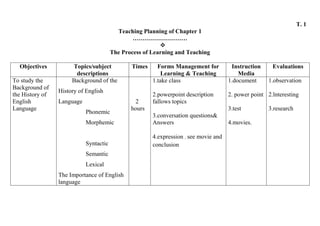
T. 1
Teaching Planning of Chapter 1
………………………

The Process of Learning and Teaching
Objectives Topics/subject
descriptions
Times Forms Management for
Learning & Teaching
Instruction
Media
Evaluations
To study the
Background of
the History of
English
Language
Background of the
History of English
Language
Phonemic
Morphemic
Syntactic
Semantic
Lexical
The Importance of English
language
2
hours
1.take class
2.powerpoint description
fallows topics
3.conversation questions&
Answers
4.expression , see movie and
conclusion
1.document
2. power point
3.test
4.movies.
1.observation
2.lnteresting
3.research
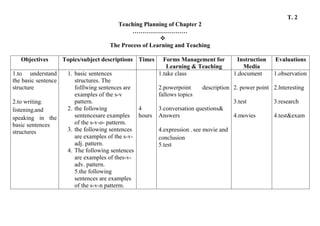
T. 2
Teaching Planning of Chapter 2
………………………

The Process of Learning and Teaching
Objectives Topics/subject descriptions Times Forms Management for
Learning & Teaching
Instruction
Media
Evaluations
1.to understand
the basic sentence
structure
2.to writing,
listening,and
speaking in the
basic sentences
structures
1. basic sentences
structures. The
folllwing sentences are
examples of the s-v
pattern.
2. the following
sentencesare examples
of the s-v-o- patterm.
3. the following sentences
are examples of the s-v-
adj. pattern.
4. The following sentences
are examples of thes-v-
adv. pattern.
5.the following
sentences are examples
of the s-v-n patterm.
4
hours
1.take class
2.powerpoint description
fallows topics
3.conversation questions&
Answers
4.expression , see movie and
conclusion
5.test
1.document
2. power point
3.test
4.movies
1.observation
2.lnteresting
3.research
4.test&exam
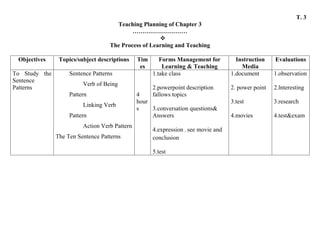
T. 3
Teaching Planning of Chapter 3
………………………

The Process of Learning and Teaching
Objectives Topics/subject descriptions Tim
es
Forms Management for
Learning & Teaching
Instruction
Media
Evaluations
To Study the
Sentence
Patterns
Sentence Patterns
Verb of Being
Pattern
Linking Verb
Pattern
Action Verb Pattern
The Ten Sentence Patterns
4
hour
s
1.take class
2.powerpoint description
fallows topics
3.conversation questions&
Answers
4.expression , see movie and
conclusion
5.test
1.document
2. power point
3.test
4.movies
1.observation
2.lnteresting
3.research
4.test&exam
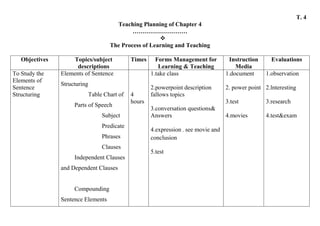
T. 4
Teaching Planning of Chapter 4
………………………

The Process of Learning and Teaching
Objectives Topics/subject
descriptions
Times Forms Management for
Learning & Teaching
Instruction
Media
Evaluations
To Study the
Elements of
Sentence
Structuring
Elements of Sentence
Structuring
Table Chart of
Parts of Speech
Subject
Predicate
Phrases
Clauses
Independent Clauses
and Dependent Clauses
Compounding
Sentence Elements
4
hours
1.take class
2.powerpoint description
fallows topics
3.conversation questions&
Answers
4.expression , see movie and
conclusion
5.test
1.document
2. power point
3.test
4.movies
1.observation
2.lnteresting
3.research
4.test&exam
Words
Phrases
Clauses
Avoiding Fragments
Avoiding Comma
Splices and Fused
Sentences
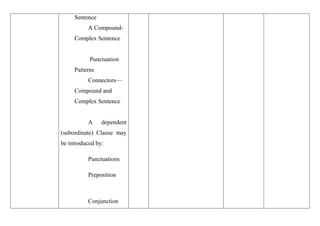
Error #1: The
Comma Splice
Error #2: The
Fused Sentence
Sentence Types and
Punctuation
A Compound
Sentence
A Complex
Sentence
A Compound-
Complex Sentence
Punctuation
Patterns
Connectors—
Compound and
Complex Sentence
A dependent
(subordinate) Clause may
be introduced by:
Punctuations
Preposition
Conjunction
Transition
Review: Punctuation
Marks
Apostrophe
Parentheses
Dash
Italics
(underlining)
Quotation Marks
Quotation:
The Value of Punctuation
Table Chart of
Punctuation Marks
English Tips
T. 5
Teaching Planning of Chapter 5
………………………

The Process of Learning and Teaching
Objectives Topics/subject
descriptions
Times Forms Management for
Learning & Teaching
Instruction
Media
Evaluations
To Study the
Expansion of
Phrases to Clauses
Expansion of Phrases
to Clauses
What are Phrases and
Clauses?
How Can We Identify
Phrases and Clauses?
Five Basic Structures of
Simple Sentences
Samples of Patterns
Expanded with Clauses and
Phrases
Subject/Verb
4
hours
1.take class
2.powerpoint description
fallows topics
3.conversation questions&
Answers
4.expression , see movie and
conclusion
5.tes
1.document
2. power point
3.test
4.movies
1.observation
2.lnteresting
3.research
4.test&exam
expanded with a
dependent
relative clause
and a
prepositional
phrase:
Subject/Verb/O
bject expanded with a
participial phrase:
Subject/Verb/Object
expanded with a dependent
adverbial clause:
Subject/Verb/Object
expanded with a dependent
relative clause:
Subject/Verb/Object
expanded with all of the
above:
A Guide to Phrases
and Clauses
Phrases
T. 6
Teaching Planning of Chapter 6
………………………

The Process of Learning and Teaching
Objectives Topics/subject
descriptions
Times Forms Management for
Learning & Teaching
Instruction
Media
Evaluations
To Study the
Sentence Pattern
Transformations
Sentence Pattern
Transformations
Transform to Passive
Voice
To Create the
Transformation
Transform to the
Expletive there is /
there are
Transform to Cleft/Divide
Method 1
2
hours
1.take class
2.powerpoint description
fallows topics
3.conversation questions&
Answers
4.expression , see movie and
conclusion
5.tes
1.document
2. power point
3.test
4.movies
1.observation
2.lnteresting
3.research
4.test&exam
Method 2
Past
Tense
Present Tense
Past Tense
Transform to
Negative
To Create the Negative
Transformation
Transform to Interrogative
with yes-no Answer
Transform to Interrogative
Interrogative Words
Transform to Emphasis /
Emphatic
Transform to Imperative
Transform to Exclamatory
Answer the Question
Active and Passive
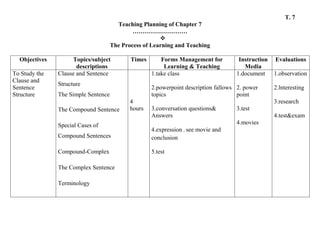
T. 7
Teaching Planning of Chapter 7
………………………

The Process of Learning and Teaching
Objectives Topics/subject
descriptions
Times Forms Management for
Learning & Teaching
Instruction
Media
Evaluations
To Study the
Clause and
Sentence
Structure
Clause and Sentence
Structure
The Simple Sentence
The Compound Sentence
Special Cases of
Compound Sentences
Compound-Complex
The Complex Sentence
Terminology
4
hours
1.take class
2.powerpoint description fallows
topics
3.conversation questions&
Answers
4.expression , see movie and
conclusion
5.test
1.document
2. power
point
3.test
4.movies
1.observation
2.lnteresting
3.research
4.test&exam
English Learning Tip
T. 8
Teaching Planning of Chapter 8
………………………

The Process of Learning and Teaching
Objective
s
Topics/subject descriptions Time
s
Forms
Management
for Learning
& Teaching
Instructio
n Media
Evaluations
To Study
the
Reduction
of Adverb
Clauses to
Modifying
Phrases
Reduction of Adverb Clauses to Modifying Phrases
Time: Since, After, and Before
General Rules
Reduction of Adverb Clauses to Modifying Phrases
(continuous)
Time: While (during the same time)
Cause and Effect
Time + Cause & Effect: Upon -ing/ On –ing
Adverb clauses
2
hours
1.take class
2.powerpoint
description
fallows topics
3.conversatio
n questions&
Answers
4.expression ,
see movie and
conclusion
5.test
1.document
2. power
point
3.test
4.movies
1.observatio
n
2.lnteresting
3.research
4.test&exam
Part 1: Adverb Clauses
1. Introduction
Time 68
Cause and effect
Opposition
Condition
2. Time relationships with adverb
clauses
3. Cause and effect relationships
with adverb clauses
Because
Since
Now that
As
As/so long as
Inasmuch as (very formal)
Part 2: Other ways of showing cause and
effect relationships
1. Such … that and so … that
Using “In order to”
Using: So …that
Using: “because of” and “due
to”
Using “therefore”
Part 3: Reduction of Adverb Clauses to
Modifying Phrases
1. Changing time clauses to
modifying phrases
Adverb clause
Modifying phrase
2. Expressing the idea of “During
the same time” in
Modifying phrases:
3. Expressing cause and effect
relationships in
Modifying phrases
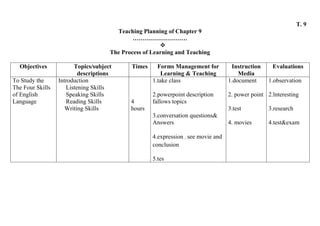
T. 9
Teaching Planning of Chapter 9
………………………

The Process of Learning and Teaching
Objectives Topics/subject
descriptions
Times Forms Management for
Learning & Teaching
Instruction
Media
Evaluations
To Study the
The Four Skills
of English
Language
Introduction
Listening Skills
Speaking Skills
Reading Skills
Writing Skills
4
hours
1.take class
2.powerpoint description
fallows topics
3.conversation questions&
Answers
4.expression , see movie and
conclusion
5.tes
1.document
2. power point
3.test
4. movies
1.observation
2.lnteresting
3.research
4.test&exam
T. 10
Teaching Planning of Chapter 10
………………………

The Process of Learning and Teaching
Objectives Topics/subject descriptions Times Forms Management for
Learning & Teaching
Instruction
Media
Evaluations
To Study the
Writing Essays
and Summaries
Writing Essays and
Summaries
Introduction
The Basic
Paragraph
The Short Essay
The Simple
Essay
Introducing:
2
hours
1.take class
2.powerpoint description
fallows topics
3.conversation questions&
Answers
4.expression , see movie and
conclusion
5.test
1.document
2. power point
3.test
4. movies
1.observation
2.lnteresting
3.research
4.test&exam
Prewriting:
Organization of
Paragraph Form
What is a paragraph?
Title
What is a sentence? S+V....
Capitalization five rules:

Advanced teaching plan

  • 1.
    T. 1 Teaching Planningof Chapter 1 ………………………  The Process of Learning and Teaching Objectives Topics/subject descriptions Times Forms Management for Learning & Teaching Instruction Media Evaluations To study the Background of the History of English Language Background of the History of English Language Phonemic Morphemic Syntactic Semantic Lexical The Importance of English language 2 hours 1.take class 2.powerpoint description fallows topics 3.conversation questions& Answers 4.expression , see movie and conclusion 1.document 2. power point 3.test 4.movies. 1.observation 2.lnteresting 3.research
  • 2.
    T. 2 Teaching Planningof Chapter 2 ………………………  The Process of Learning and Teaching Objectives Topics/subject descriptions Times Forms Management for Learning & Teaching Instruction Media Evaluations 1.to understand the basic sentence structure 2.to writing, listening,and speaking in the basic sentences structures 1. basic sentences structures. The folllwing sentences are examples of the s-v pattern. 2. the following sentencesare examples of the s-v-o- patterm. 3. the following sentences are examples of the s-v- adj. pattern. 4. The following sentences are examples of thes-v- adv. pattern. 5.the following sentences are examples of the s-v-n patterm. 4 hours 1.take class 2.powerpoint description fallows topics 3.conversation questions& Answers 4.expression , see movie and conclusion 5.test 1.document 2. power point 3.test 4.movies 1.observation 2.lnteresting 3.research 4.test&exam
  • 3.
    T. 3 Teaching Planningof Chapter 3 ………………………  The Process of Learning and Teaching Objectives Topics/subject descriptions Tim es Forms Management for Learning & Teaching Instruction Media Evaluations To Study the Sentence Patterns Sentence Patterns Verb of Being Pattern Linking Verb Pattern Action Verb Pattern The Ten Sentence Patterns 4 hour s 1.take class 2.powerpoint description fallows topics 3.conversation questions& Answers 4.expression , see movie and conclusion 5.test 1.document 2. power point 3.test 4.movies 1.observation 2.lnteresting 3.research 4.test&exam
  • 4.
    T. 4 Teaching Planningof Chapter 4 ………………………  The Process of Learning and Teaching Objectives Topics/subject descriptions Times Forms Management for Learning & Teaching Instruction Media Evaluations To Study the Elements of Sentence Structuring Elements of Sentence Structuring Table Chart of Parts of Speech Subject Predicate Phrases Clauses Independent Clauses and Dependent Clauses Compounding Sentence Elements 4 hours 1.take class 2.powerpoint description fallows topics 3.conversation questions& Answers 4.expression , see movie and conclusion 5.test 1.document 2. power point 3.test 4.movies 1.observation 2.lnteresting 3.research 4.test&exam
  • 5.
    Words Phrases Clauses Avoiding Fragments Avoiding Comma Splicesand Fused Sentences Error #1: The Comma Splice Error #2: The Fused Sentence Sentence Types and Punctuation A Compound Sentence A Complex
  • 6.
    Sentence A Compound- Complex Sentence Punctuation Patterns Connectors— Compoundand Complex Sentence A dependent (subordinate) Clause may be introduced by: Punctuations Preposition Conjunction
  • 7.
  • 8.
    Table Chart of PunctuationMarks English Tips
  • 9.
    T. 5 Teaching Planningof Chapter 5 ………………………  The Process of Learning and Teaching Objectives Topics/subject descriptions Times Forms Management for Learning & Teaching Instruction Media Evaluations To Study the Expansion of Phrases to Clauses Expansion of Phrases to Clauses What are Phrases and Clauses? How Can We Identify Phrases and Clauses? Five Basic Structures of Simple Sentences Samples of Patterns Expanded with Clauses and Phrases Subject/Verb 4 hours 1.take class 2.powerpoint description fallows topics 3.conversation questions& Answers 4.expression , see movie and conclusion 5.tes 1.document 2. power point 3.test 4.movies 1.observation 2.lnteresting 3.research 4.test&exam
  • 10.
    expanded with a dependent relativeclause and a prepositional phrase: Subject/Verb/O bject expanded with a participial phrase: Subject/Verb/Object expanded with a dependent adverbial clause: Subject/Verb/Object expanded with a dependent relative clause: Subject/Verb/Object expanded with all of the above:
  • 11.
    A Guide toPhrases and Clauses Phrases
  • 12.
    T. 6 Teaching Planningof Chapter 6 ………………………  The Process of Learning and Teaching Objectives Topics/subject descriptions Times Forms Management for Learning & Teaching Instruction Media Evaluations To Study the Sentence Pattern Transformations Sentence Pattern Transformations Transform to Passive Voice To Create the Transformation Transform to the Expletive there is / there are Transform to Cleft/Divide Method 1 2 hours 1.take class 2.powerpoint description fallows topics 3.conversation questions& Answers 4.expression , see movie and conclusion 5.tes 1.document 2. power point 3.test 4.movies 1.observation 2.lnteresting 3.research 4.test&exam
  • 13.
    Method 2 Past Tense Present Tense PastTense Transform to Negative To Create the Negative Transformation Transform to Interrogative with yes-no Answer Transform to Interrogative Interrogative Words
  • 14.
    Transform to Emphasis/ Emphatic Transform to Imperative Transform to Exclamatory Answer the Question Active and Passive
  • 15.
    T. 7 Teaching Planningof Chapter 7 ………………………  The Process of Learning and Teaching Objectives Topics/subject descriptions Times Forms Management for Learning & Teaching Instruction Media Evaluations To Study the Clause and Sentence Structure Clause and Sentence Structure The Simple Sentence The Compound Sentence Special Cases of Compound Sentences Compound-Complex The Complex Sentence Terminology 4 hours 1.take class 2.powerpoint description fallows topics 3.conversation questions& Answers 4.expression , see movie and conclusion 5.test 1.document 2. power point 3.test 4.movies 1.observation 2.lnteresting 3.research 4.test&exam
  • 16.
  • 17.
    T. 8 Teaching Planningof Chapter 8 ………………………  The Process of Learning and Teaching Objective s Topics/subject descriptions Time s Forms Management for Learning & Teaching Instructio n Media Evaluations To Study the Reduction of Adverb Clauses to Modifying Phrases Reduction of Adverb Clauses to Modifying Phrases Time: Since, After, and Before General Rules Reduction of Adverb Clauses to Modifying Phrases (continuous) Time: While (during the same time) Cause and Effect Time + Cause & Effect: Upon -ing/ On –ing Adverb clauses 2 hours 1.take class 2.powerpoint description fallows topics 3.conversatio n questions& Answers 4.expression , see movie and conclusion 5.test 1.document 2. power point 3.test 4.movies 1.observatio n 2.lnteresting 3.research 4.test&exam
  • 18.
    Part 1: AdverbClauses 1. Introduction Time 68 Cause and effect Opposition Condition 2. Time relationships with adverb clauses 3. Cause and effect relationships with adverb clauses Because Since Now that As As/so long as Inasmuch as (very formal) Part 2: Other ways of showing cause and effect relationships
  • 19.
    1. Such …that and so … that Using “In order to” Using: So …that Using: “because of” and “due to” Using “therefore” Part 3: Reduction of Adverb Clauses to Modifying Phrases 1. Changing time clauses to modifying phrases Adverb clause Modifying phrase 2. Expressing the idea of “During the same time” in Modifying phrases: 3. Expressing cause and effect relationships in
  • 20.
  • 21.
    T. 9 Teaching Planningof Chapter 9 ………………………  The Process of Learning and Teaching Objectives Topics/subject descriptions Times Forms Management for Learning & Teaching Instruction Media Evaluations To Study the The Four Skills of English Language Introduction Listening Skills Speaking Skills Reading Skills Writing Skills 4 hours 1.take class 2.powerpoint description fallows topics 3.conversation questions& Answers 4.expression , see movie and conclusion 5.tes 1.document 2. power point 3.test 4. movies 1.observation 2.lnteresting 3.research 4.test&exam
  • 22.
    T. 10 Teaching Planningof Chapter 10 ………………………  The Process of Learning and Teaching Objectives Topics/subject descriptions Times Forms Management for Learning & Teaching Instruction Media Evaluations To Study the Writing Essays and Summaries Writing Essays and Summaries Introduction The Basic Paragraph The Short Essay The Simple Essay Introducing: 2 hours 1.take class 2.powerpoint description fallows topics 3.conversation questions& Answers 4.expression , see movie and conclusion 5.test 1.document 2. power point 3.test 4. movies 1.observation 2.lnteresting 3.research 4.test&exam
  • 23.
    Prewriting: Organization of Paragraph Form Whatis a paragraph? Title What is a sentence? S+V.... Capitalization five rules: