START
GO
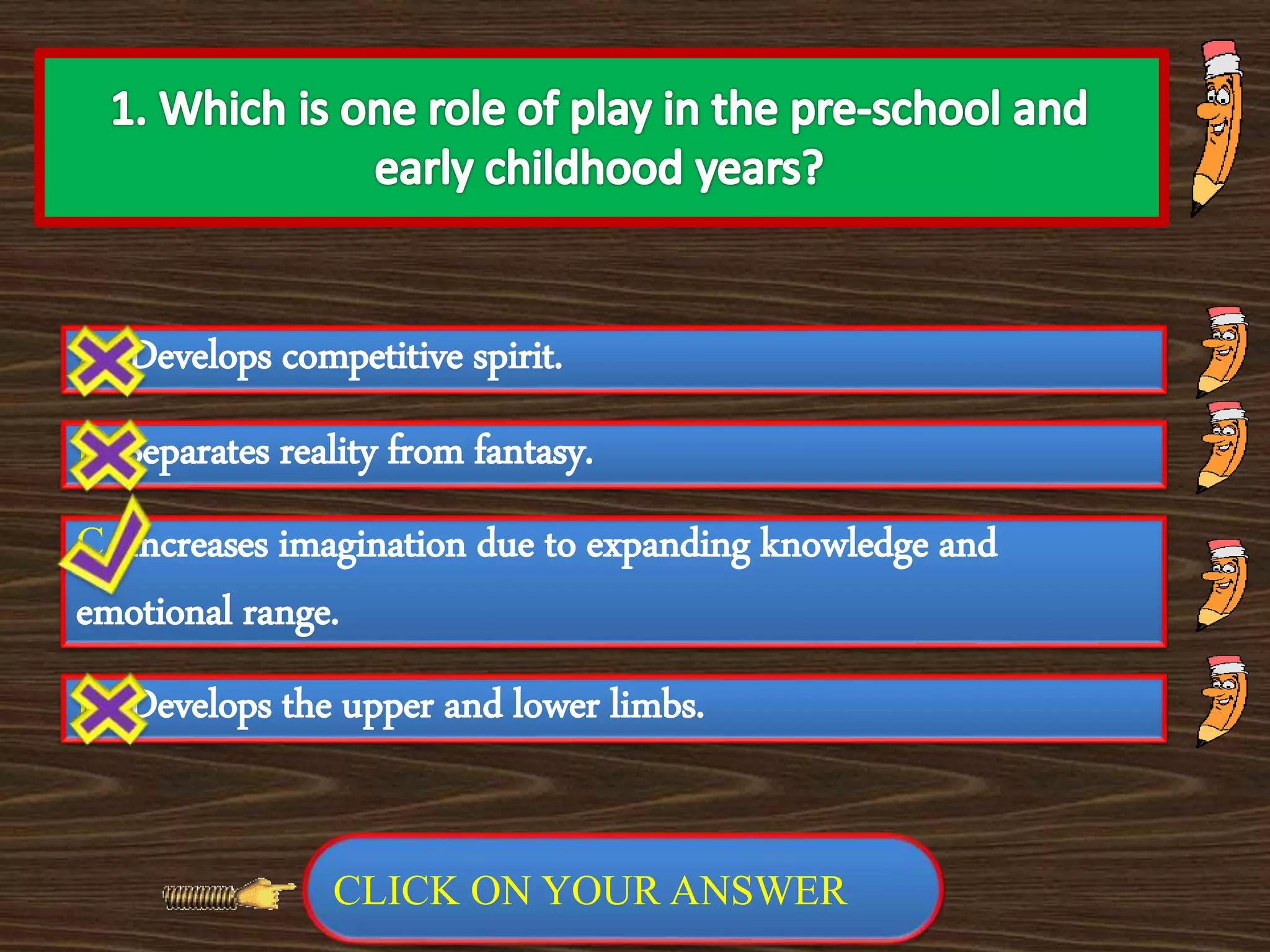
A. Develops competitive spirit.
C. Increases imagination due to expanding knowledge and
emotional range.
B. Separates reality from fantasy.
D. Develops the upper and lower limbs.
PREVIOUS NEXT
CLICK ON YOUR ANSWER
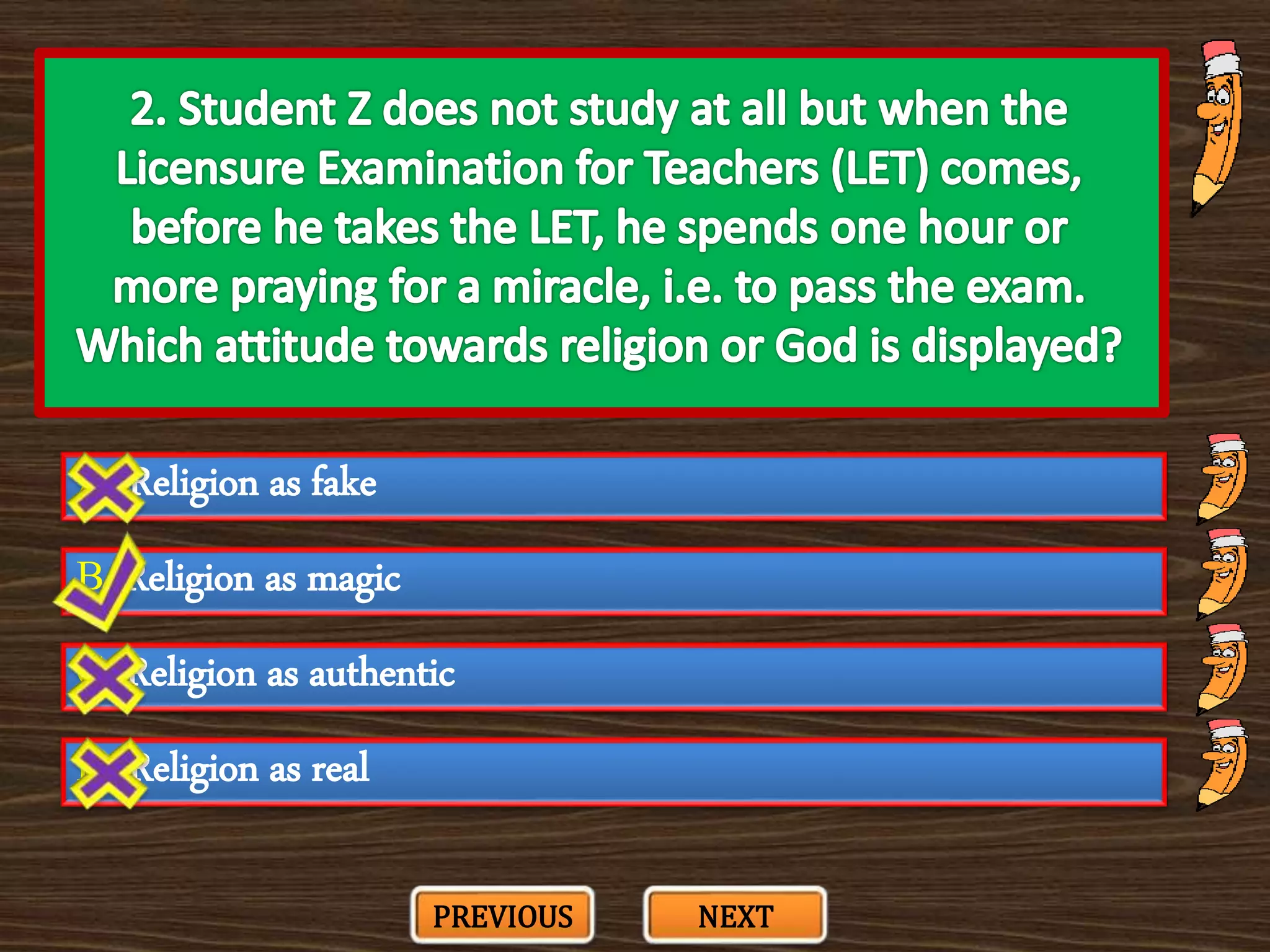
A. Religion as fake
C. Religion as authentic
B. Religion as magic
D. Religion as real
PREVIOUS NEXT
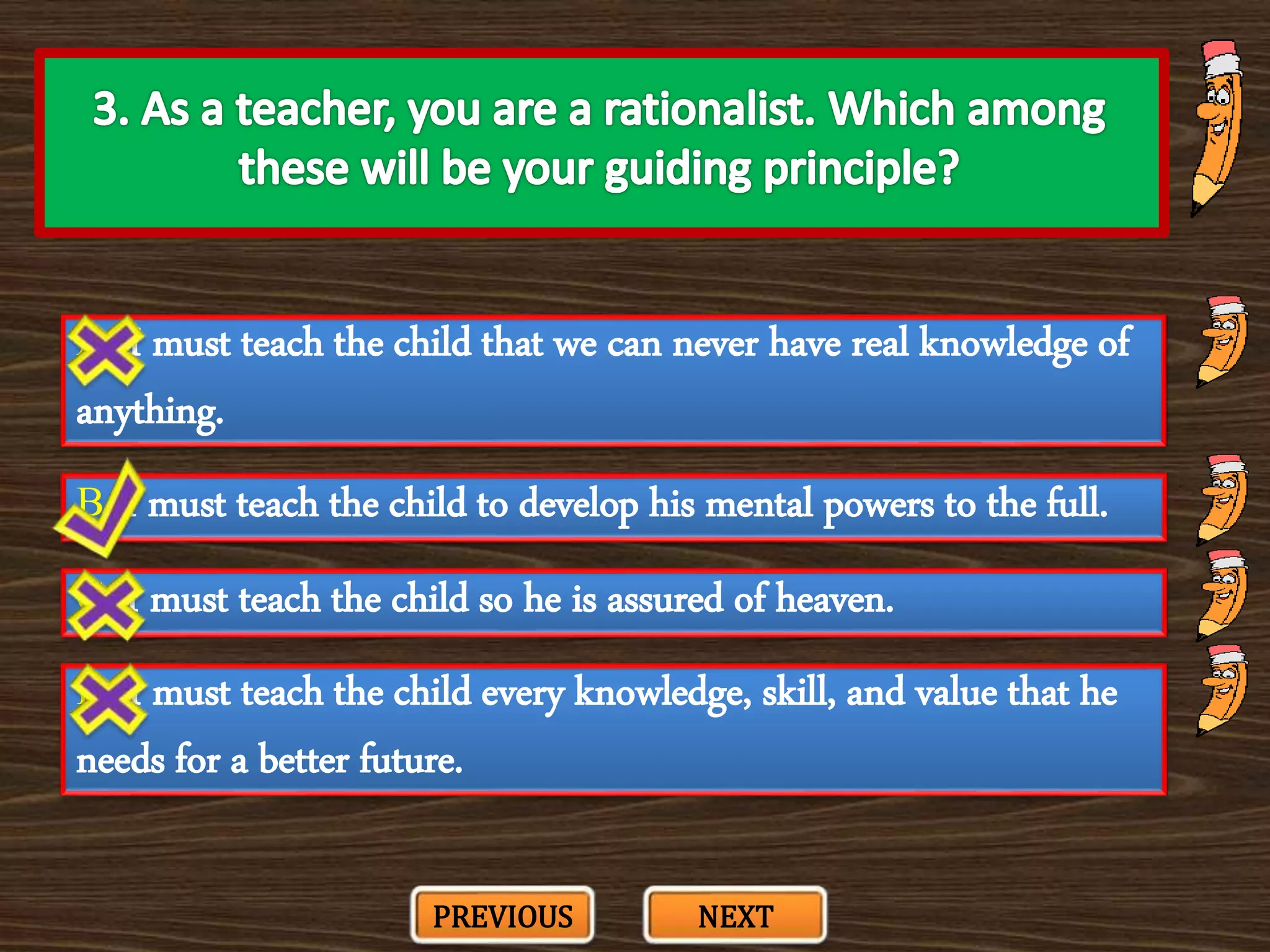
A. I must teach the child that we can never have real knowledge of
anything.
C. I must teach the child so he is assured of heaven.
B. I must teach the child to develop his mental powers to the full.
D. I must teach the child every knowledge, skill, and value that he
needs for a better future.
PREVIOUS NEXT
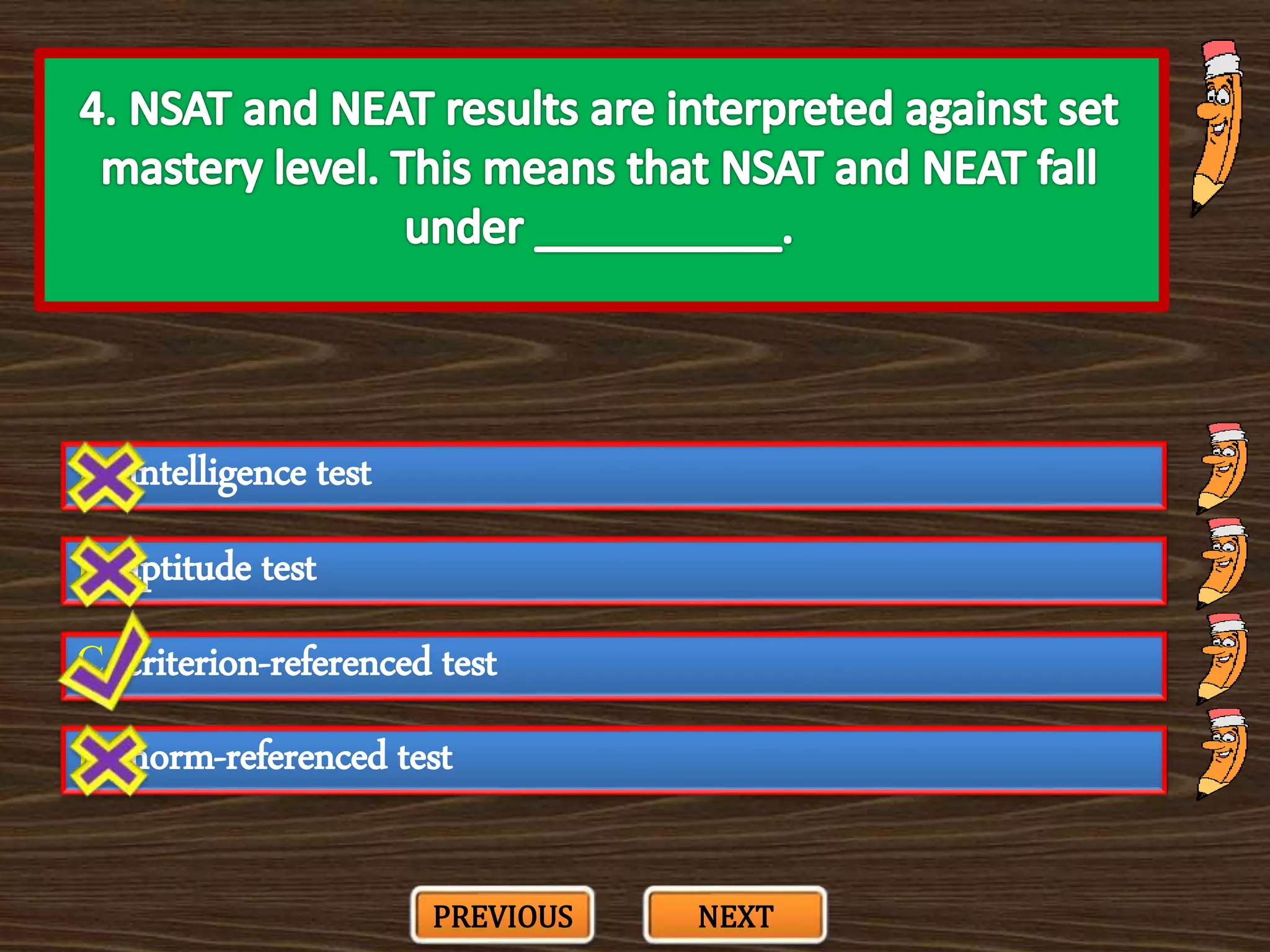
A. intelligence test
C. criterion-referenced test
B. aptitude test
D. norm-referenced test
PREVIOUS NEXT
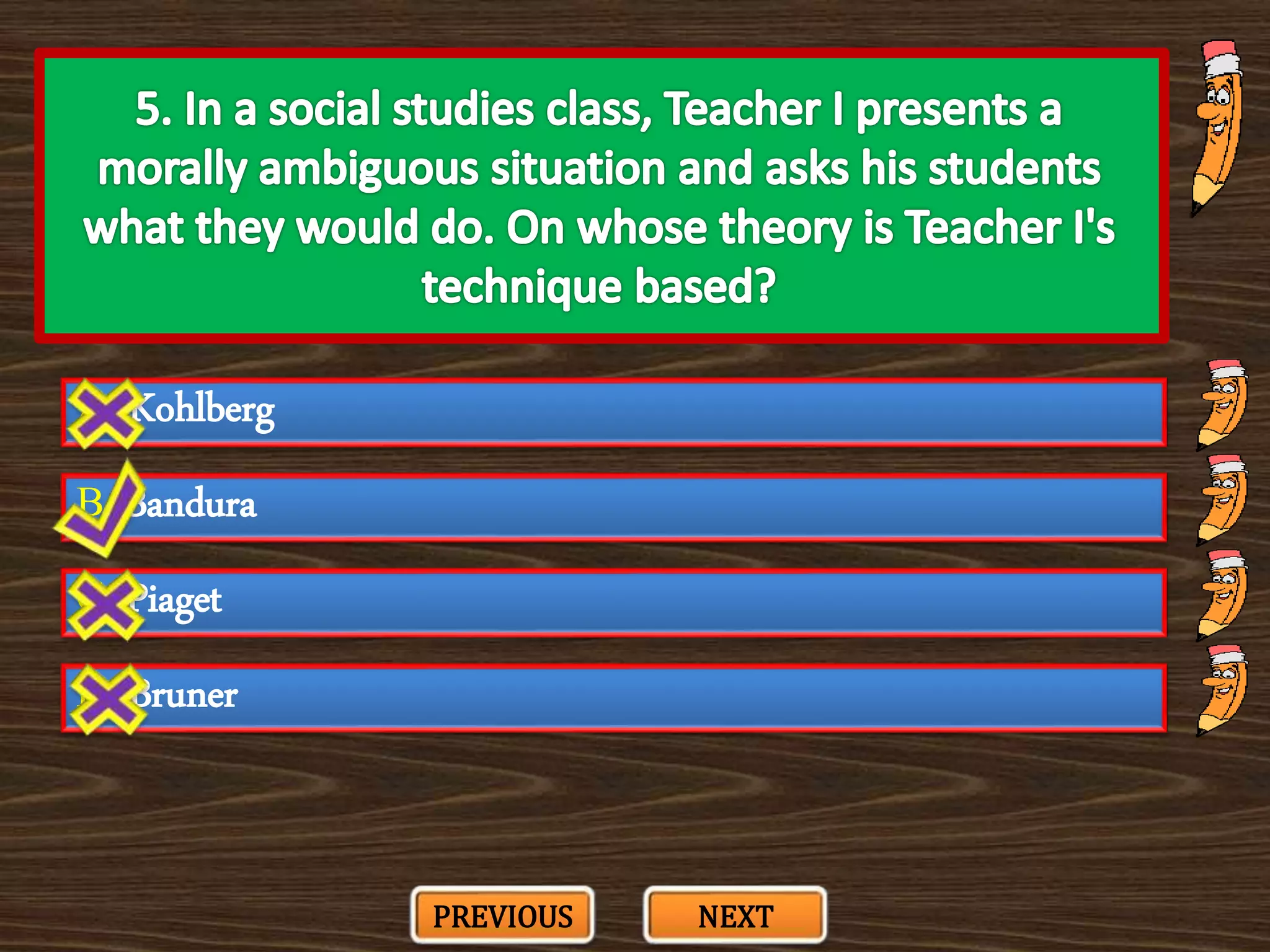
A. Kohlberg
C. Piaget
B. Bandura
D. Bruner
PREVIOUS NEXT
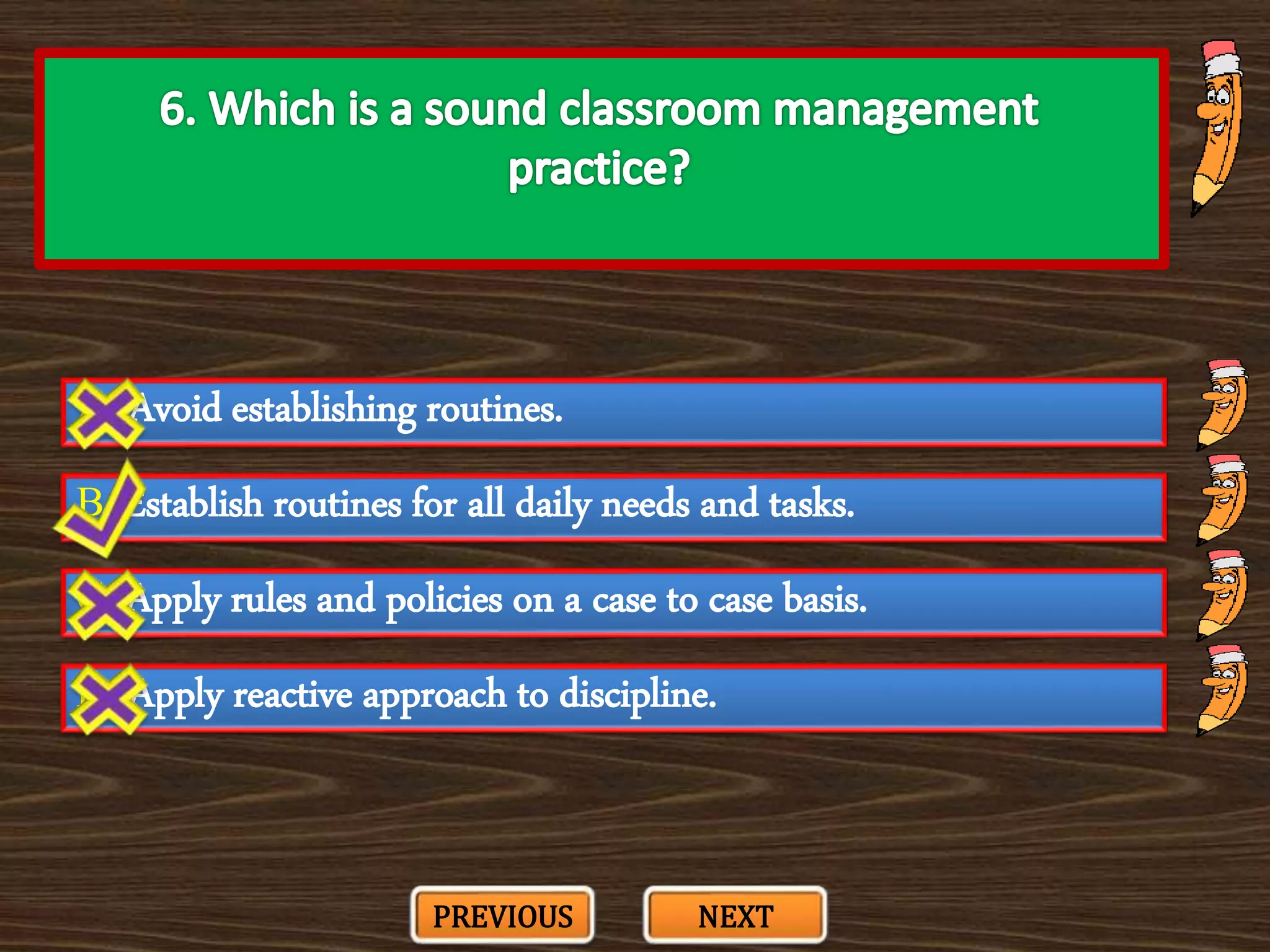
A. Avoid establishing routines.
C. Apply rules and policies on a case to case basis.
B. Establish routines for all daily needs and tasks.
D. Apply reactive approach to discipline.
PREVIOUS NEXT
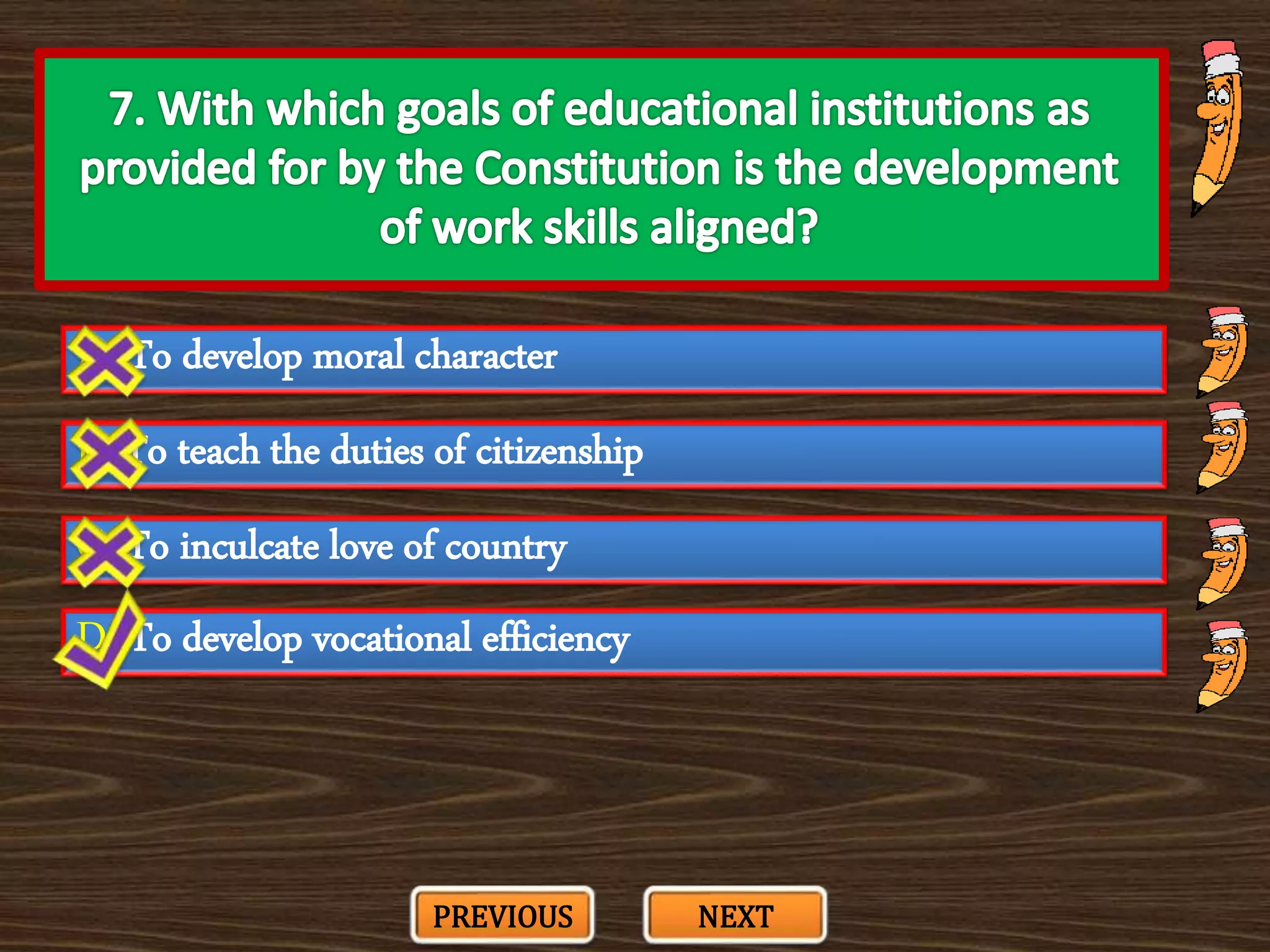
A. To develop moral character
C. To inculcate love of country
B. To teach the duties of citizenship
D. To develop vocational efficiency
PREVIOUS NEXT
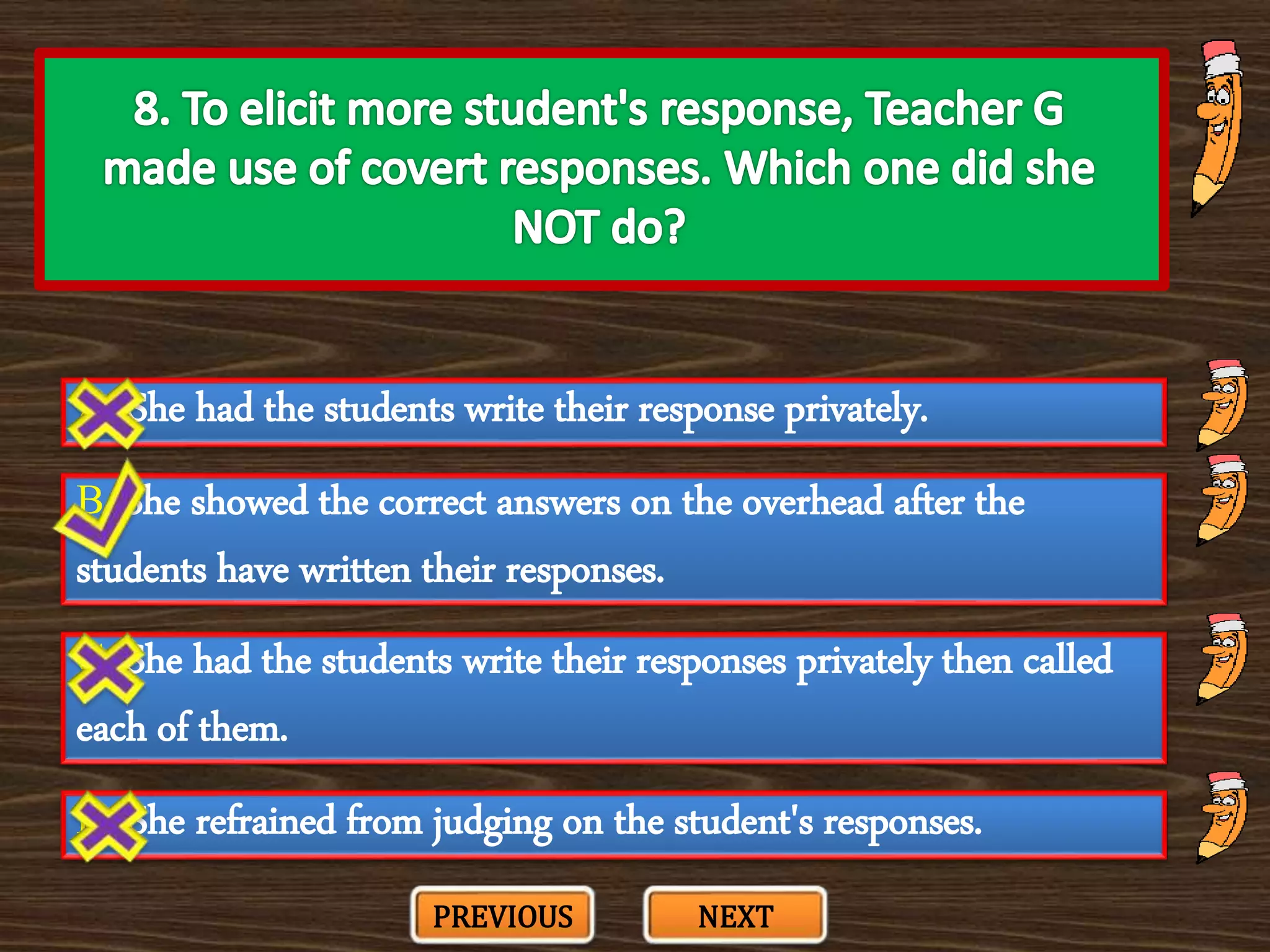
A. She had the students write their response privately.
C. She had the students write their responses privately then called
each of them.
B. She showed the correct answers on the overhead after the
students have written their responses.
D. She refrained from judging on the student's responses.
PREVIOUS NEXT
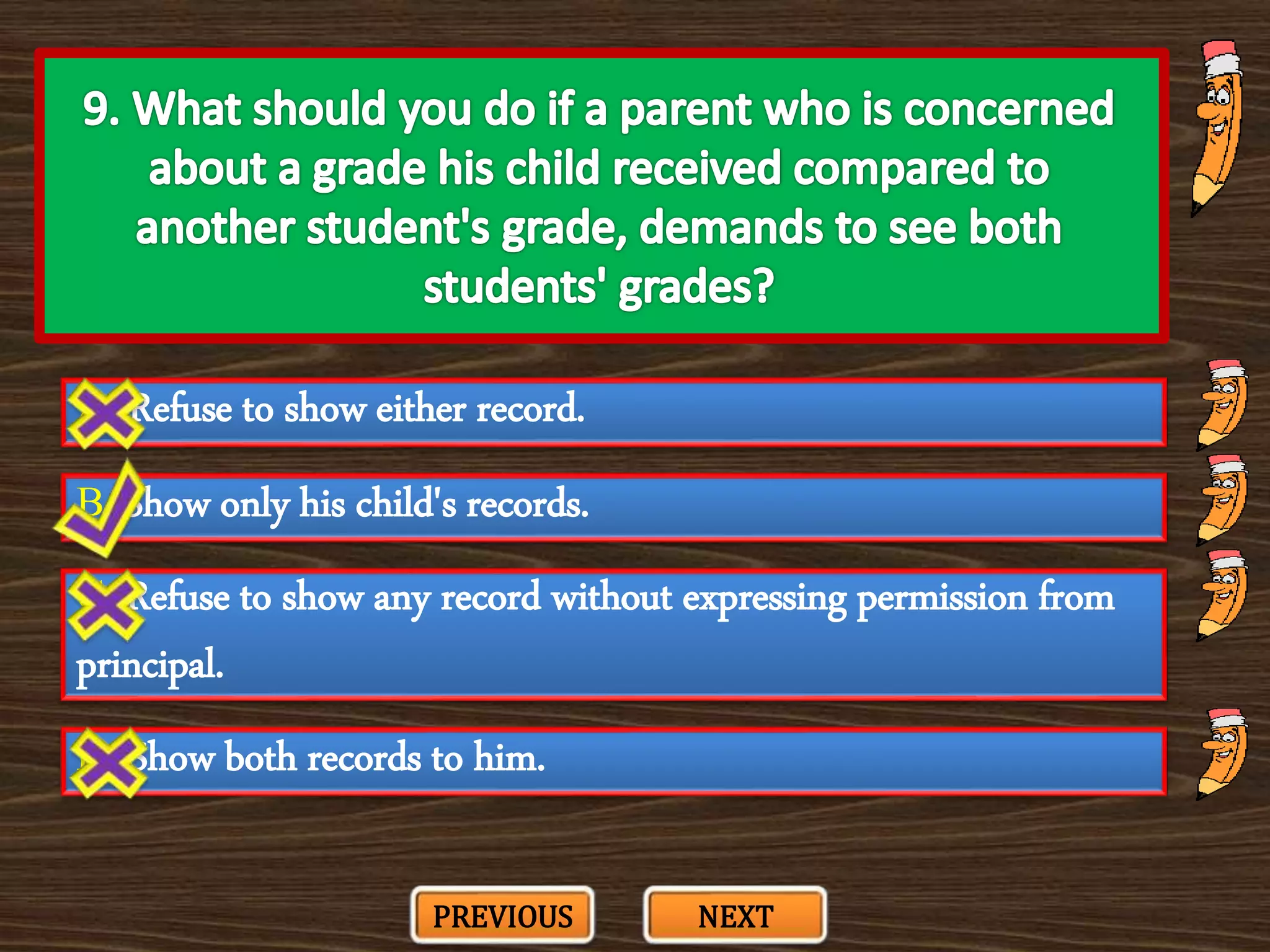
A. Refuse to show either record.
C. Refuse to show any record without expressing permission from
principal.
B. Show only his child's records.
D. Show both records to him.
PREVIOUS NEXT
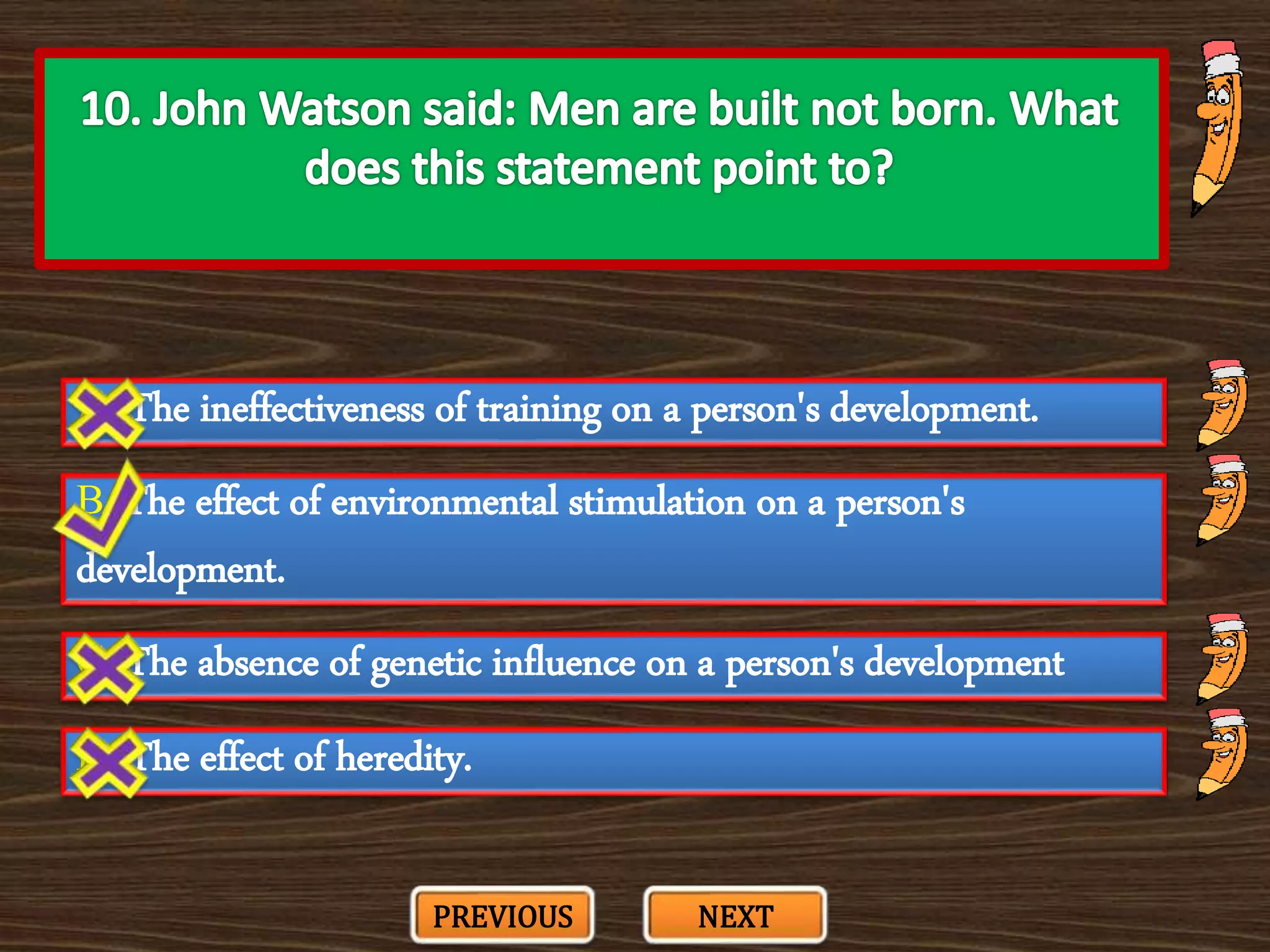
A. The ineffectiveness of training on a person's development.
C. The absence of genetic influence on a person's development
B. The effect of environmental stimulation on a person's
development.
D. The effect of heredity.
PREVIOUS NEXT
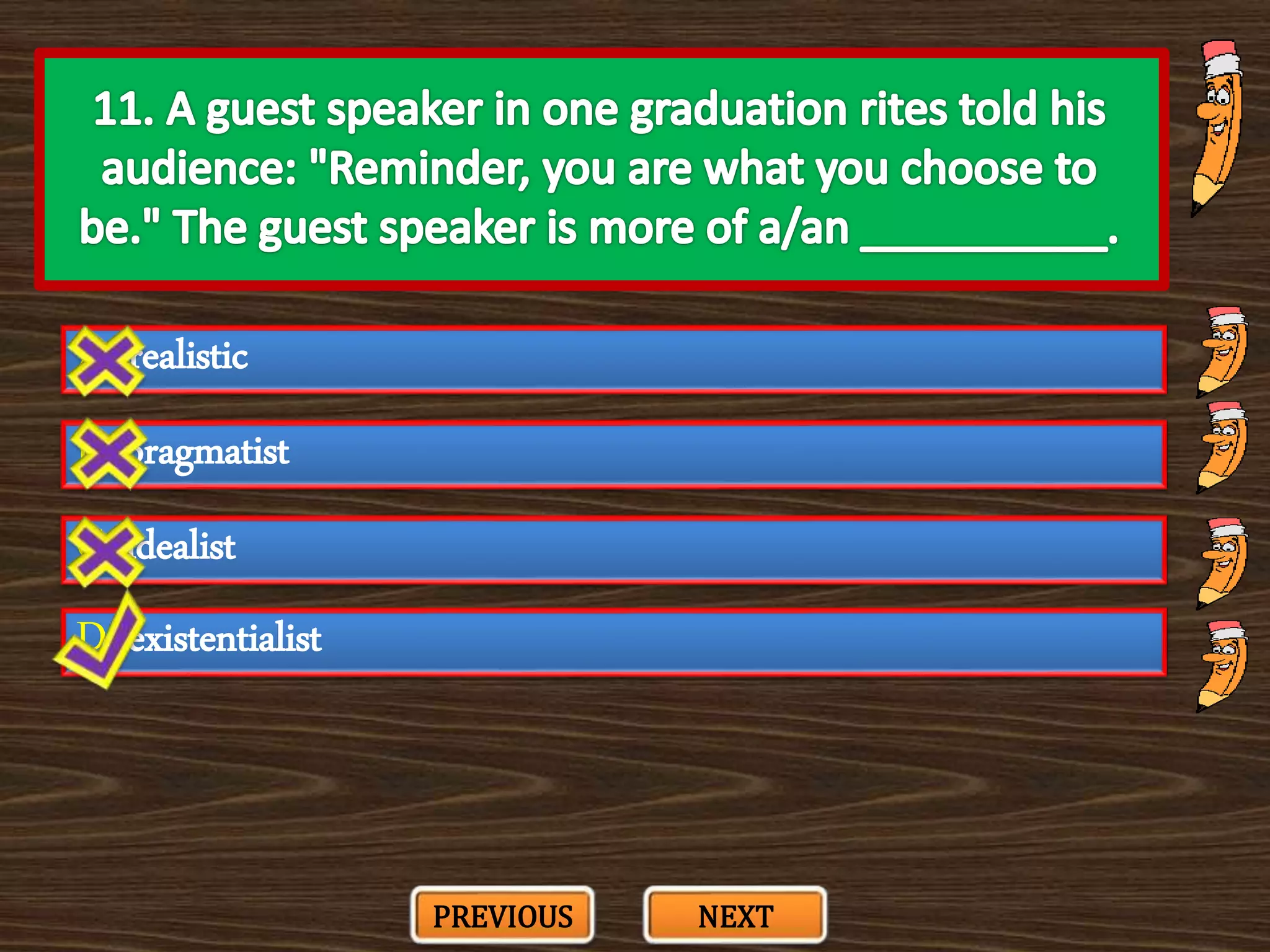
A. realistic
C. idealist
B. pragmatist
D. existentialist
PREVIOUS NEXT
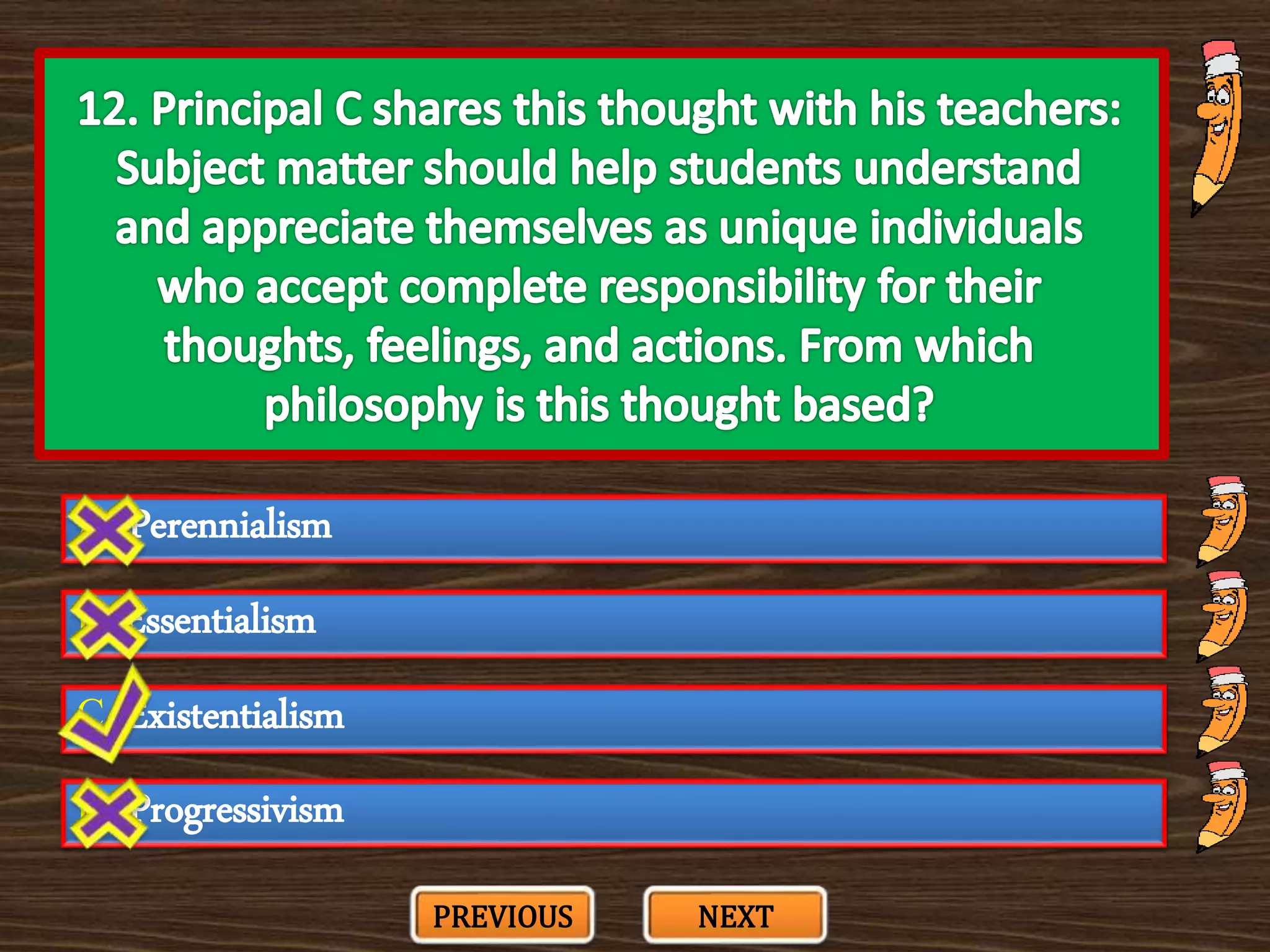
A. Perennialism
C. Existentialism
B. Essentialism
D. Progressivism
PREVIOUS NEXT
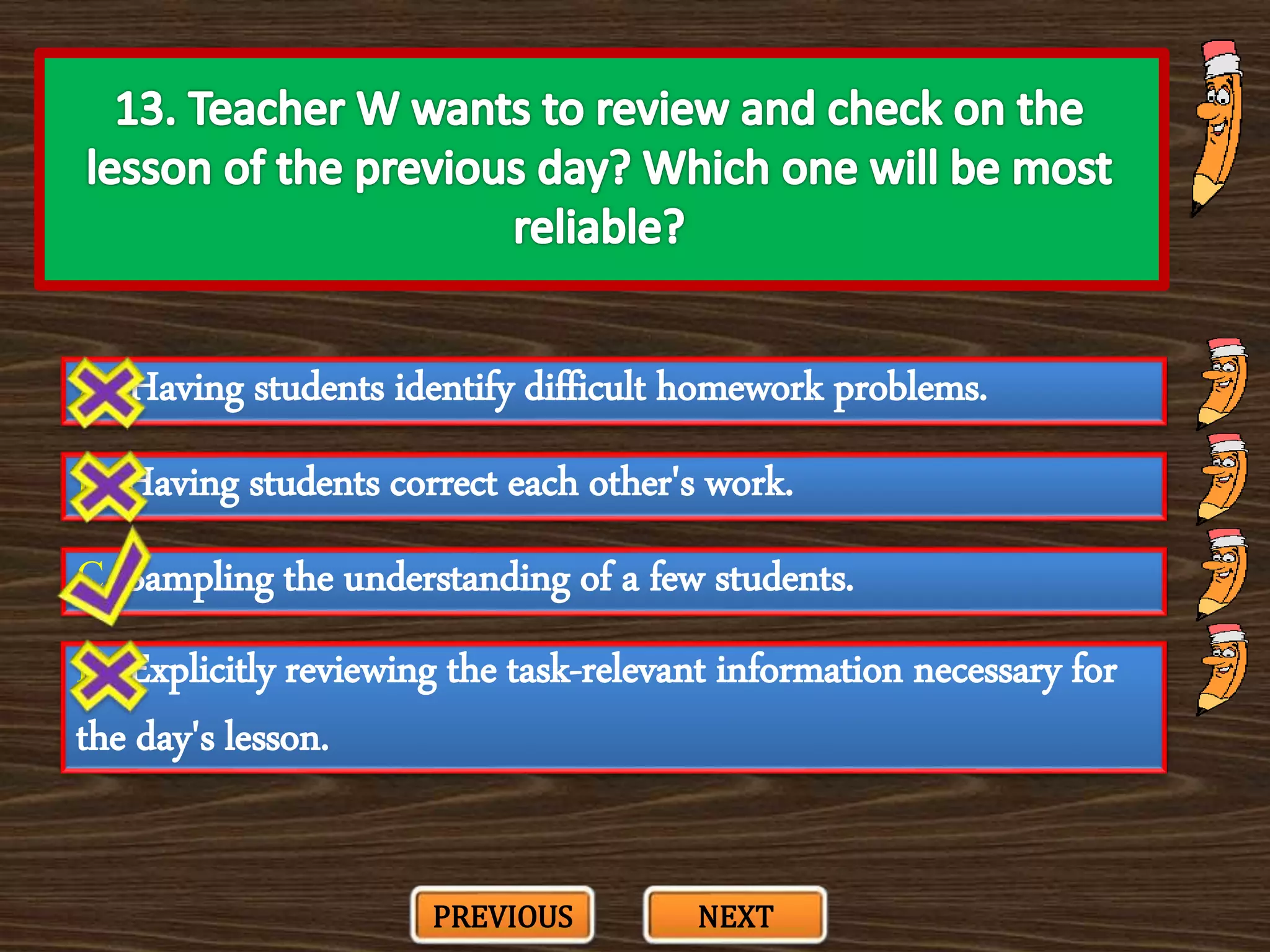
A. Having students identify difficult homework problems.
C. Sampling the understanding of a few students.
B. Having students correct each other's work.
D. Explicitly reviewing the task-relevant information necessary for
the day's lesson.
PREVIOUS NEXT
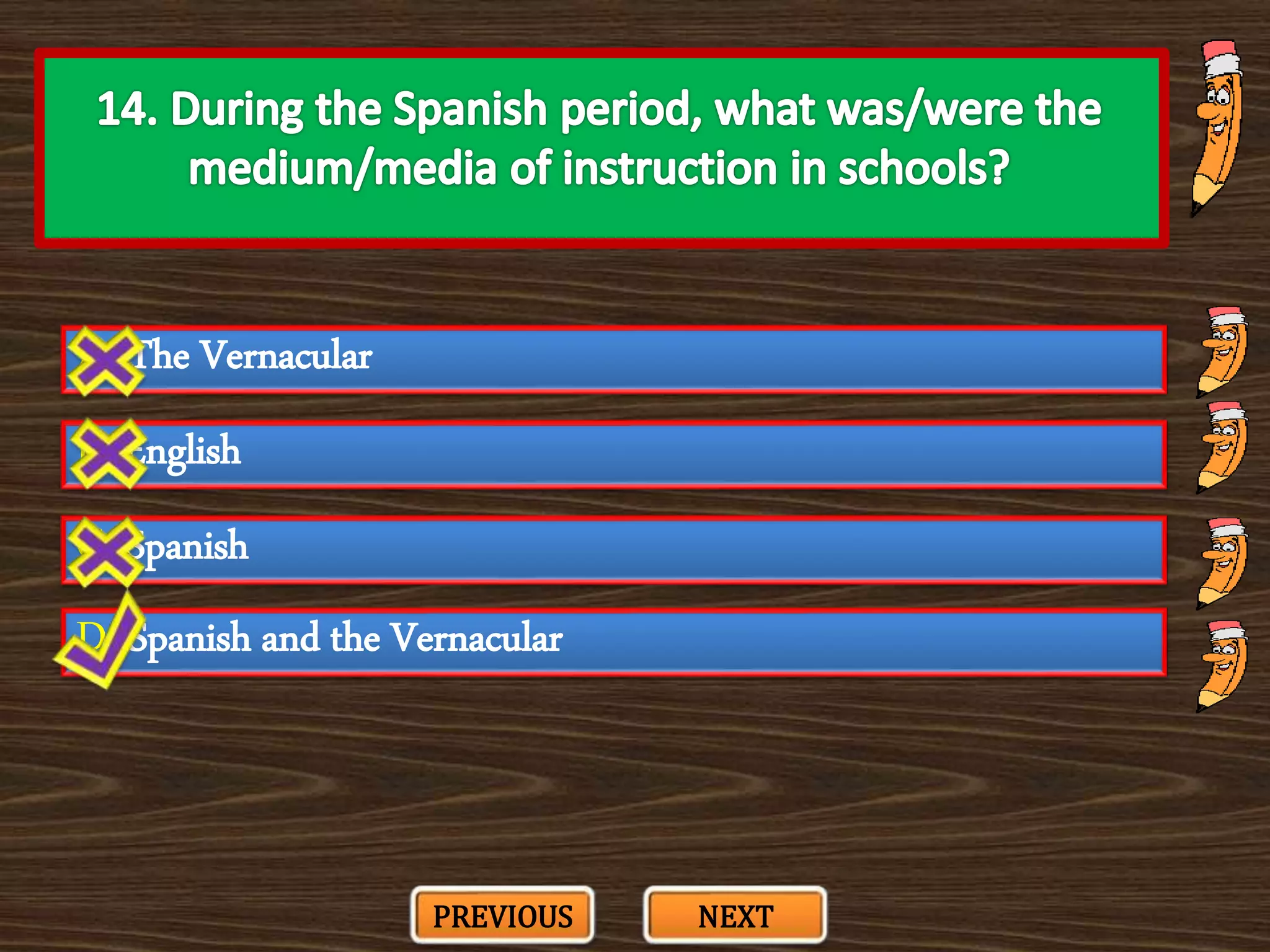
A. The Vernacular
C. Spanish
B. English
D. Spanish and the Vernacular
PREVIOUS NEXT
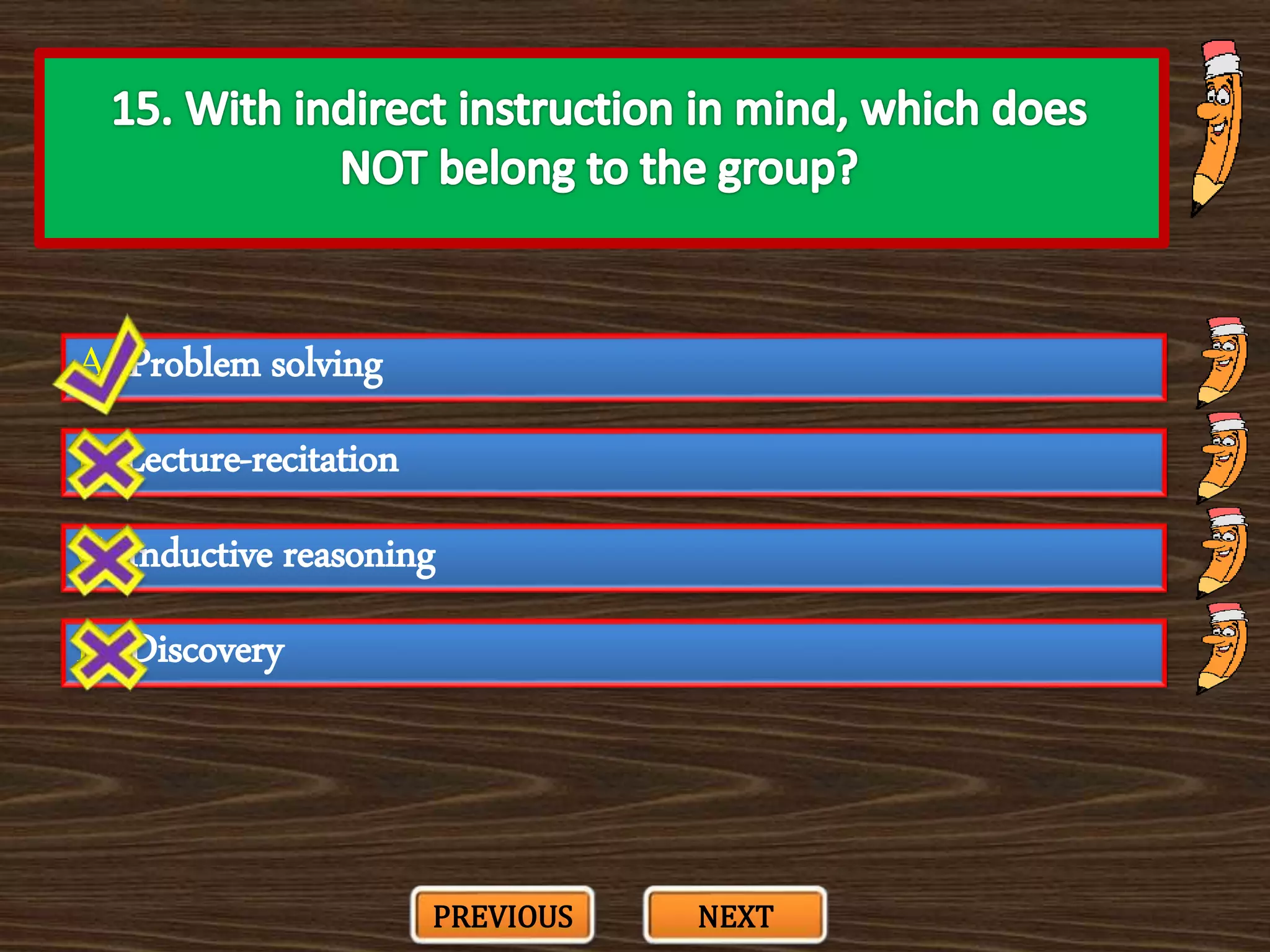
A. Problem solving
C. Inductive reasoning
B. Lecture-recitation
D. Discovery
PREVIOUS NEXT
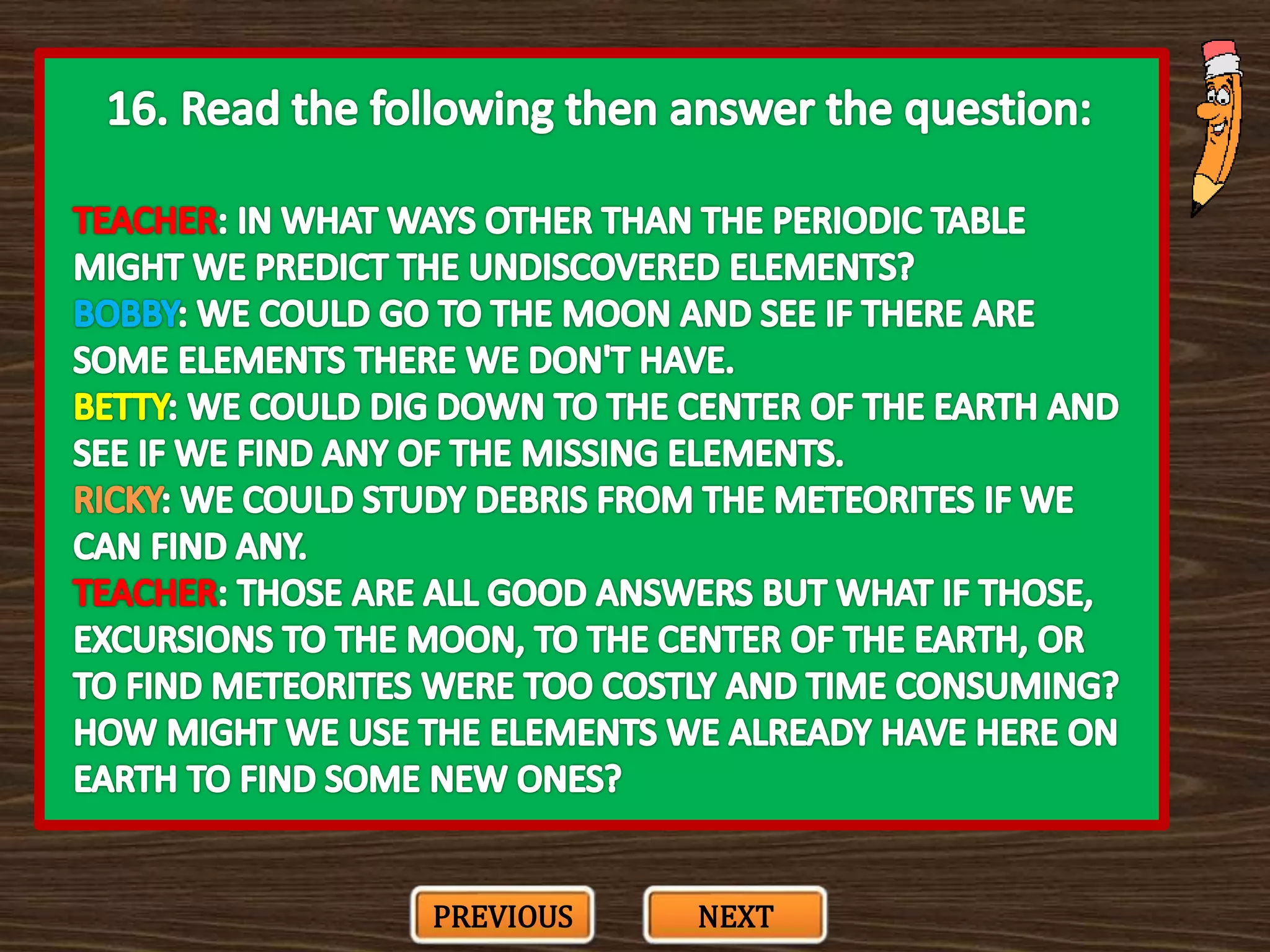
PREVIOUS NEXT
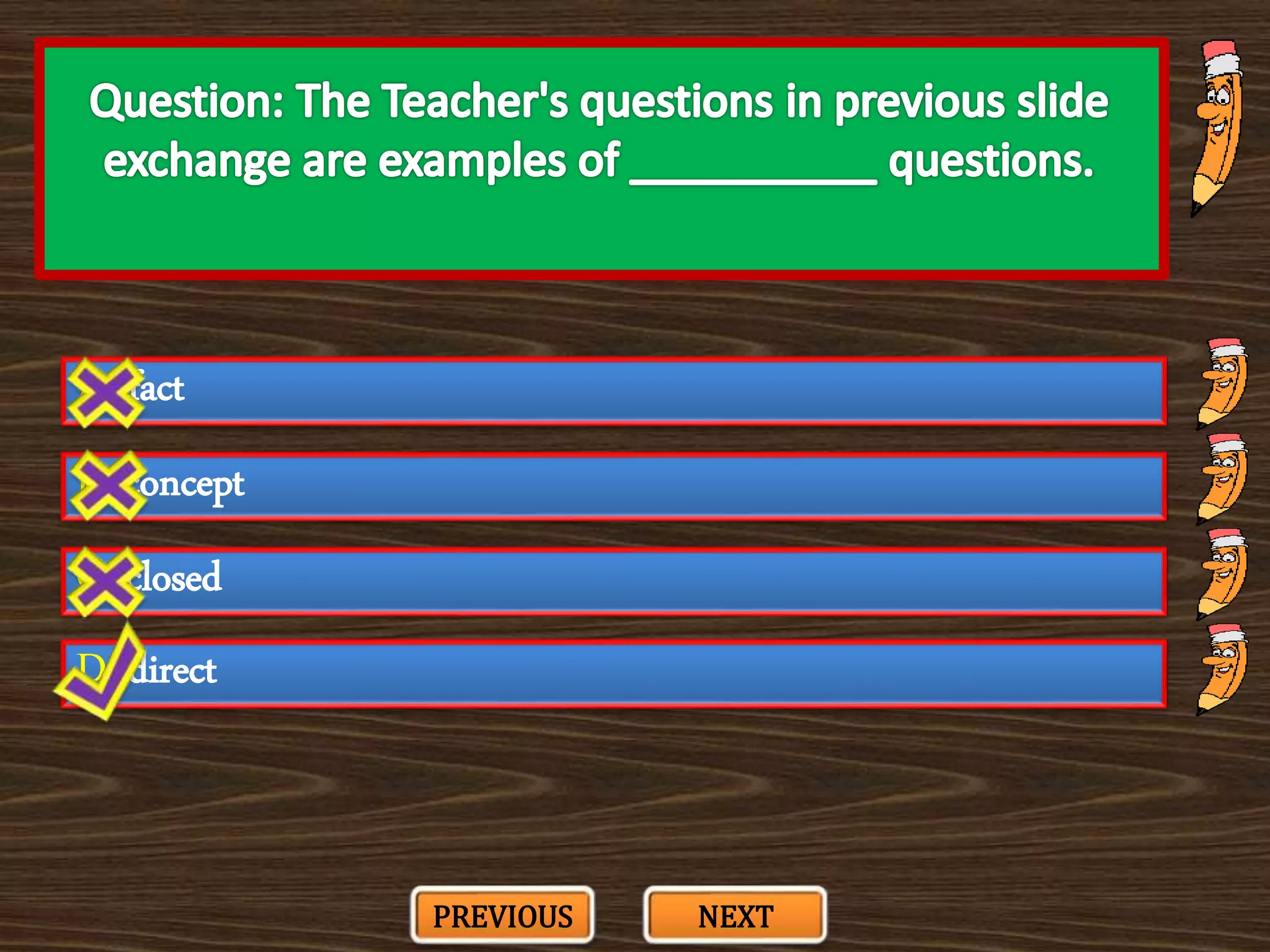
A. fact
C. closed
B. concept
D. direct
PREVIOUS NEXT
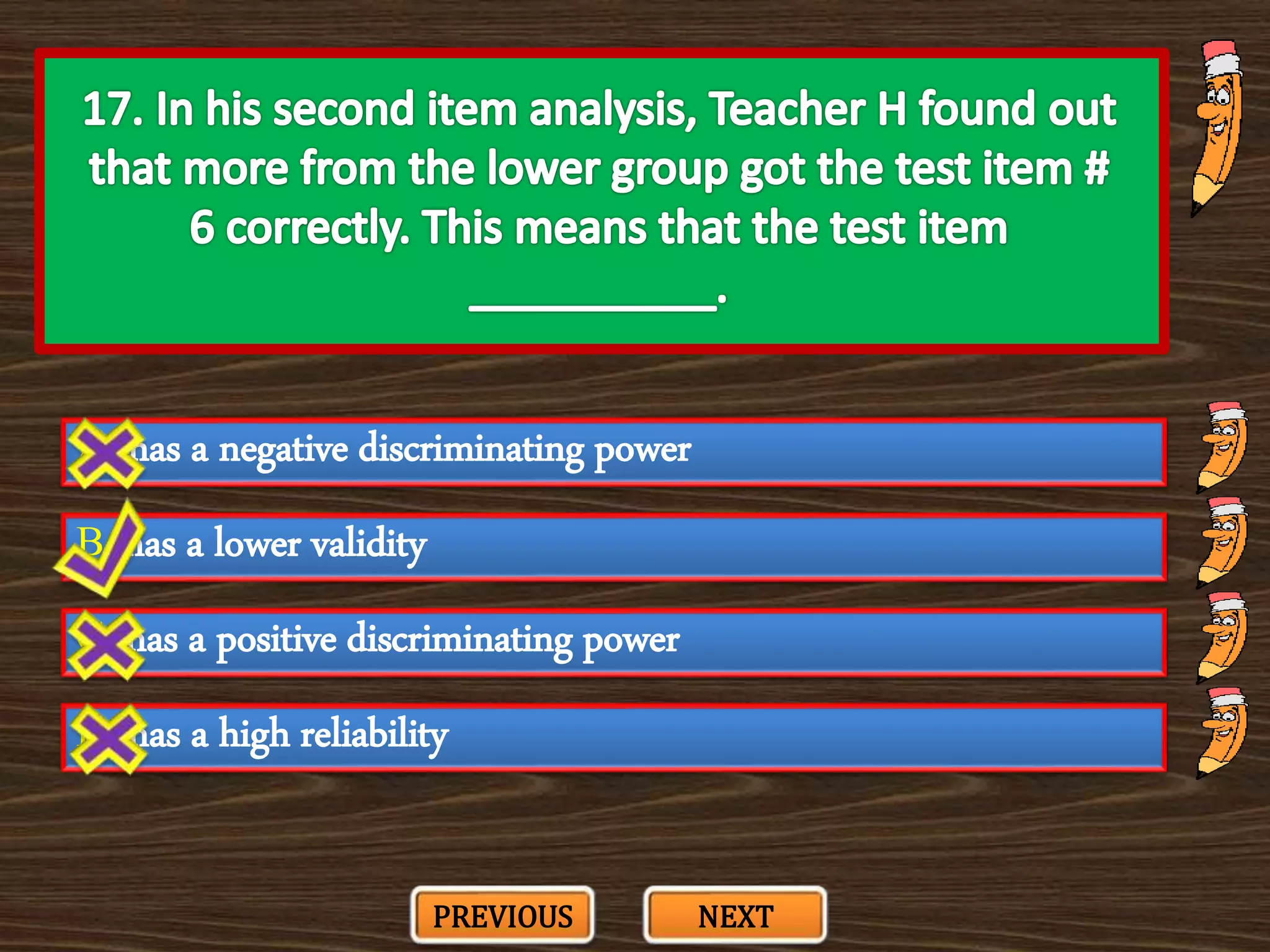
A. has a negative discriminating power
C. has a positive discriminating power
B. has a lower validity
D. has a high reliability
PREVIOUS NEXT
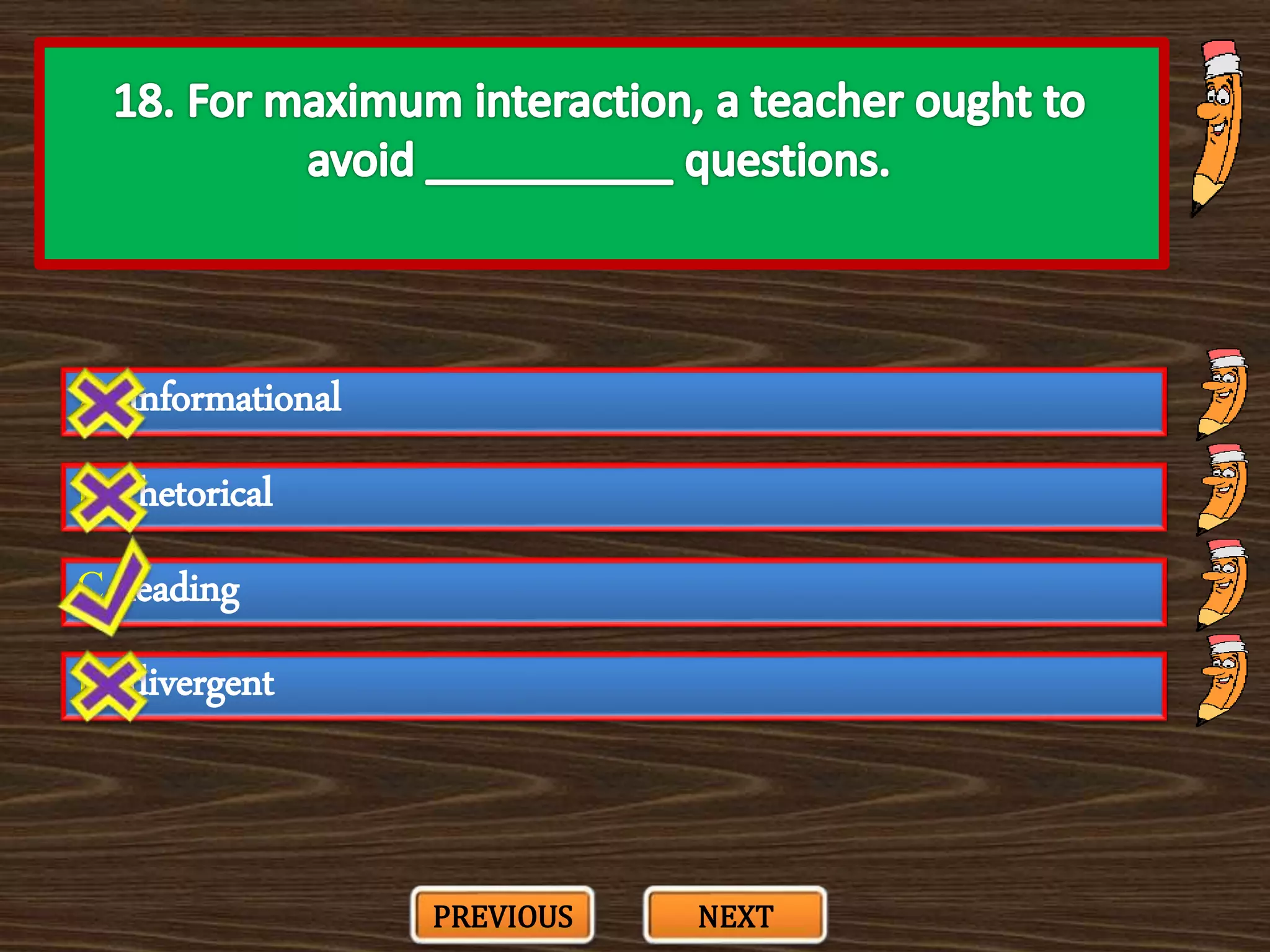
A. informational
C. leading
B. rhetorical
D. divergent
PREVIOUS NEXT
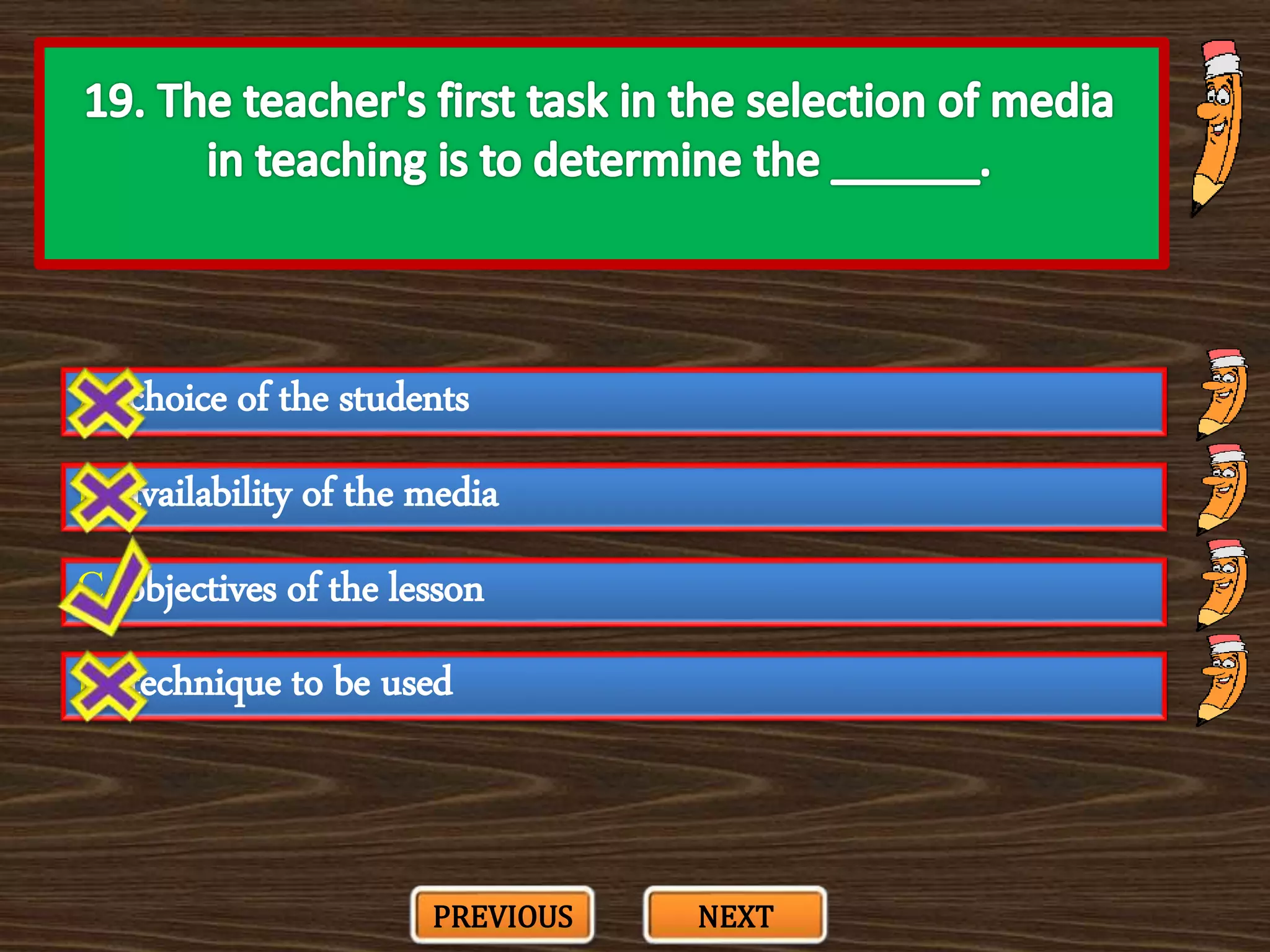
A. choice of the students
C. objectives of the lesson
B. availability of the media
D. technique to be used
PREVIOUS NEXT
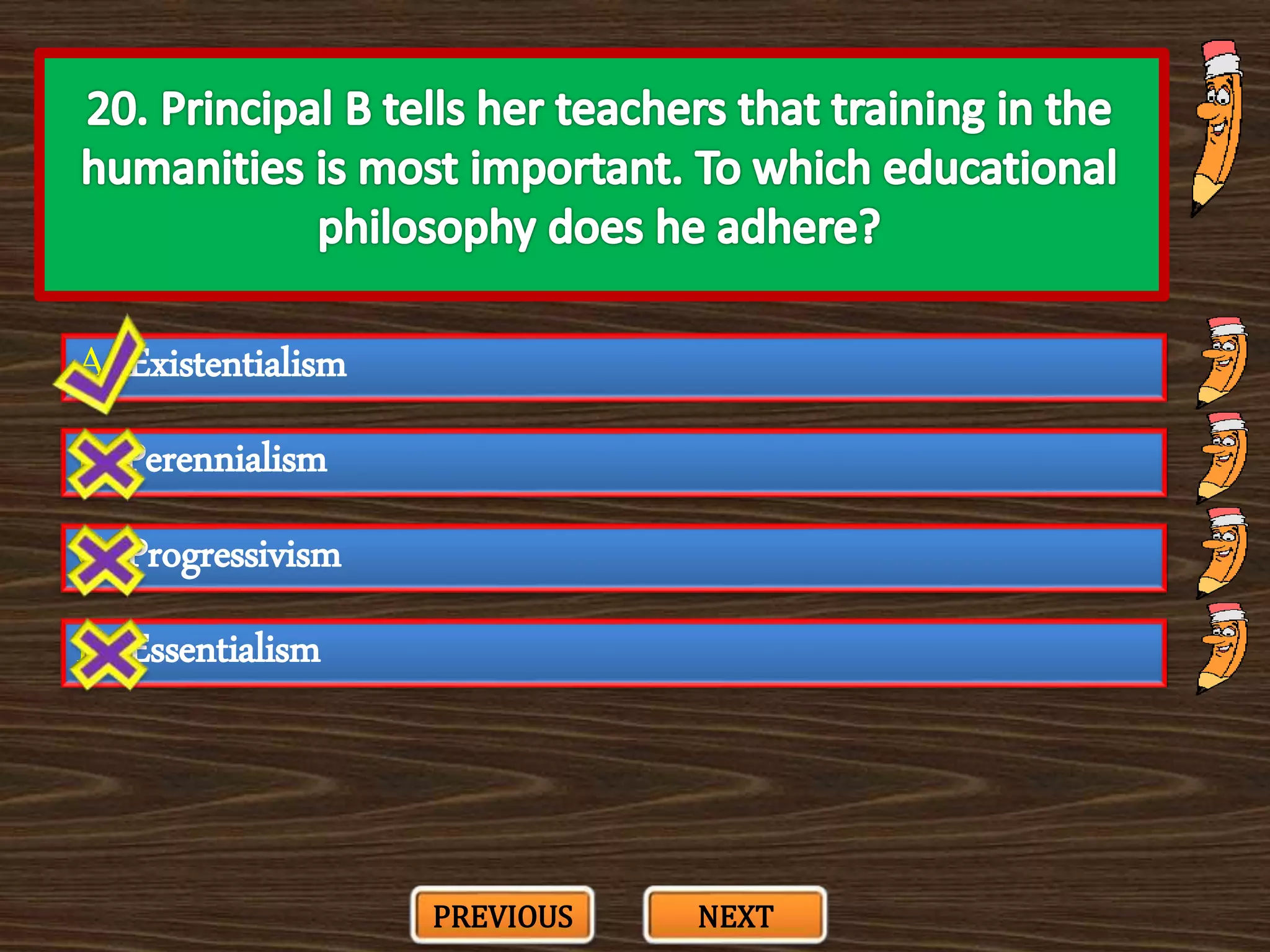
A. Existentialism
C. Progressivism
B. Perennialism
D. Essentialism
PREVIOUS NEXT
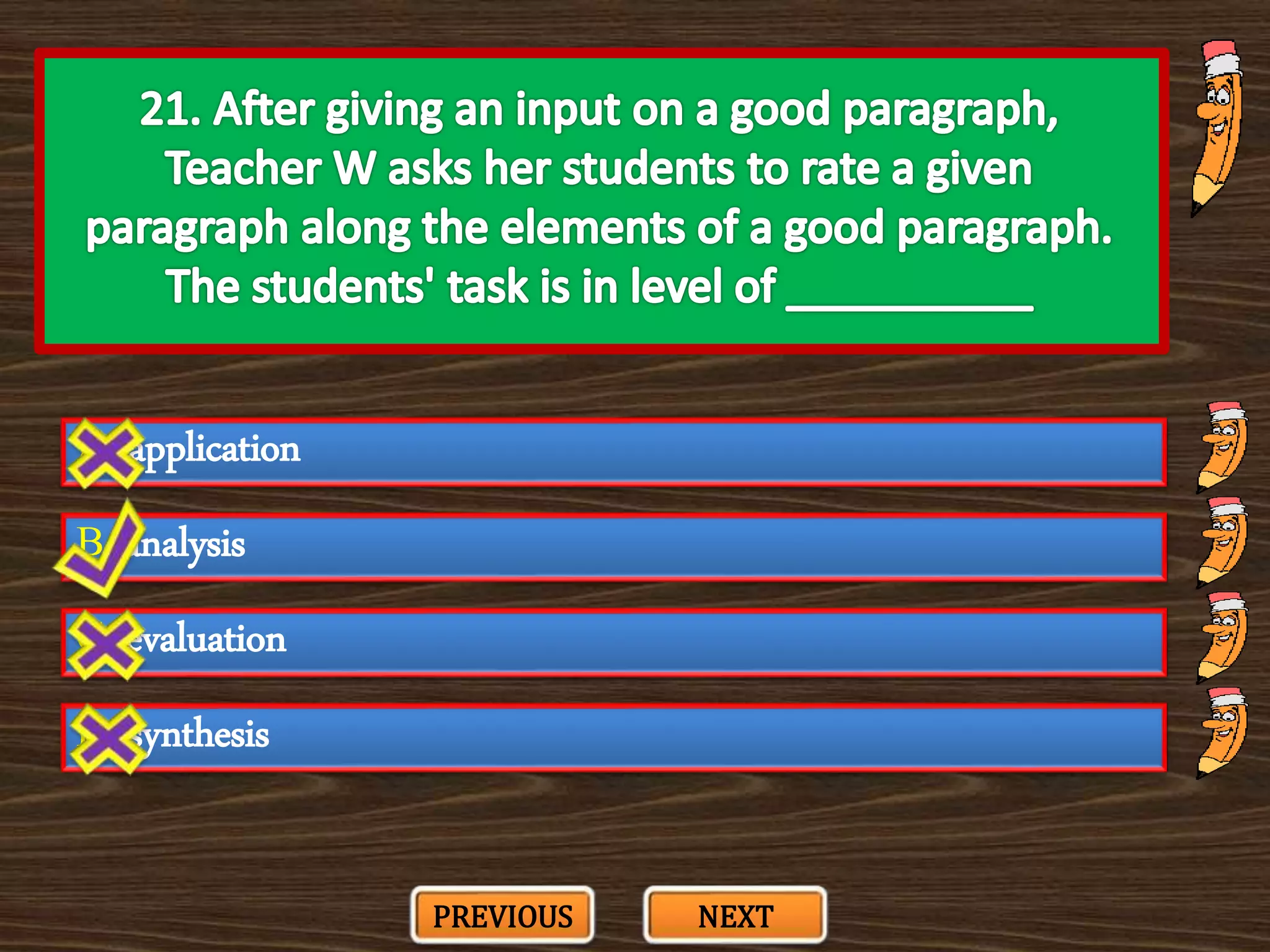
A. application
C. evaluation
B. analysis
D. synthesis
PREVIOUS NEXT
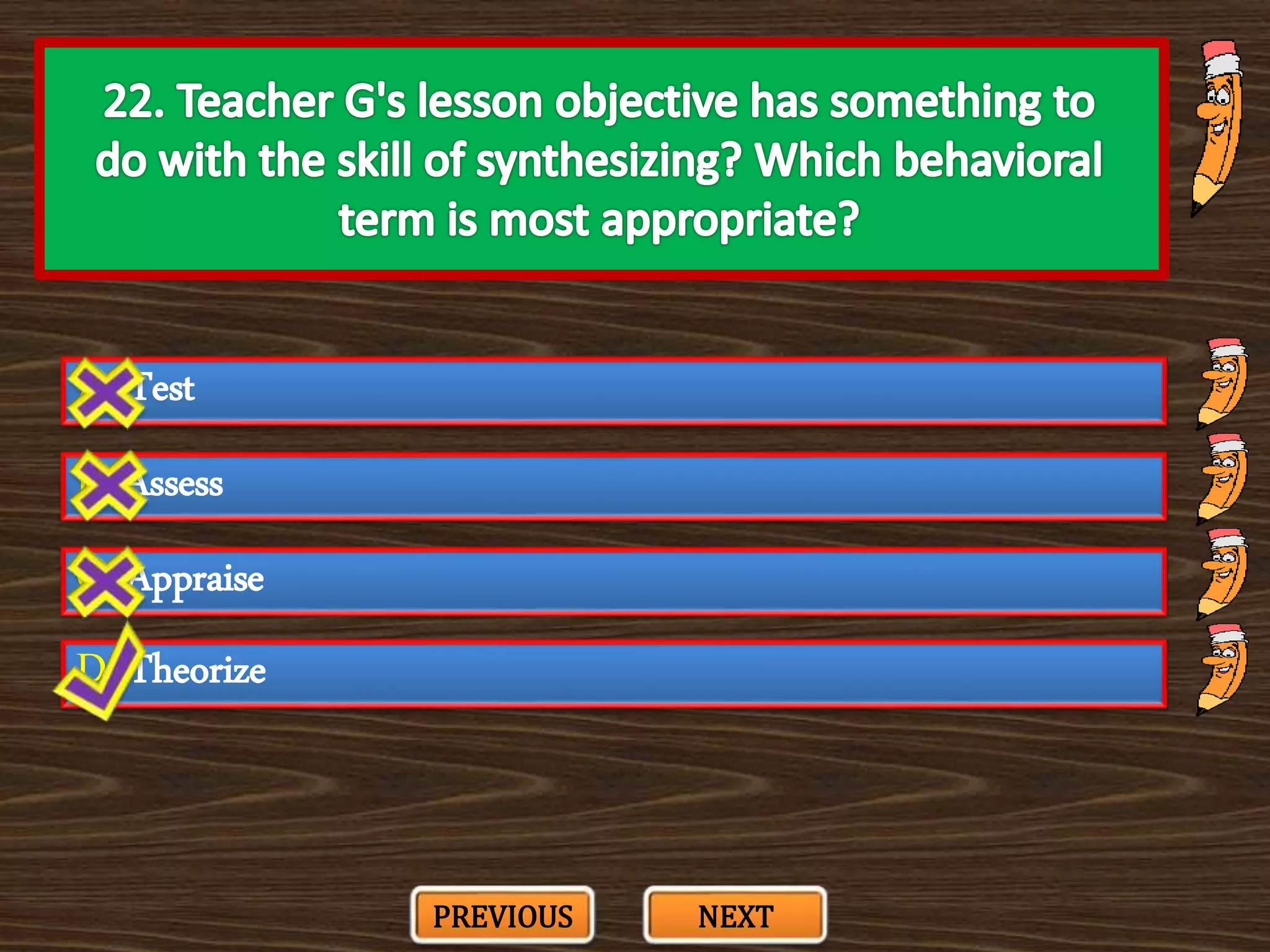
A. Test
C. Appraise
B. Assess
D. Theorize
PREVIOUS NEXT
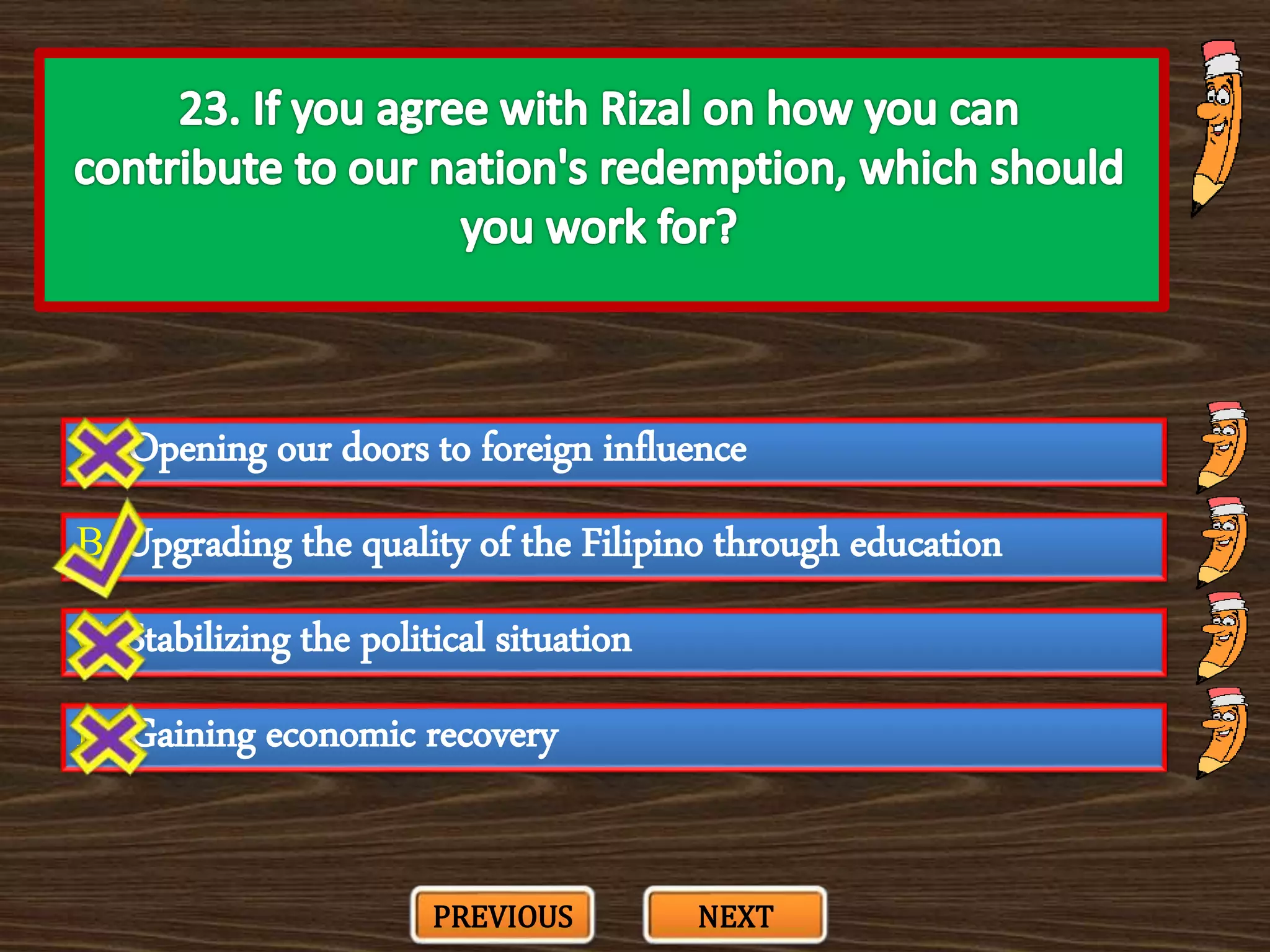
A. Opening our doors to foreign influence
C. Stabilizing the political situation
B. Upgrading the quality of the Filipino through education
D. Gaining economic recovery
PREVIOUS NEXT
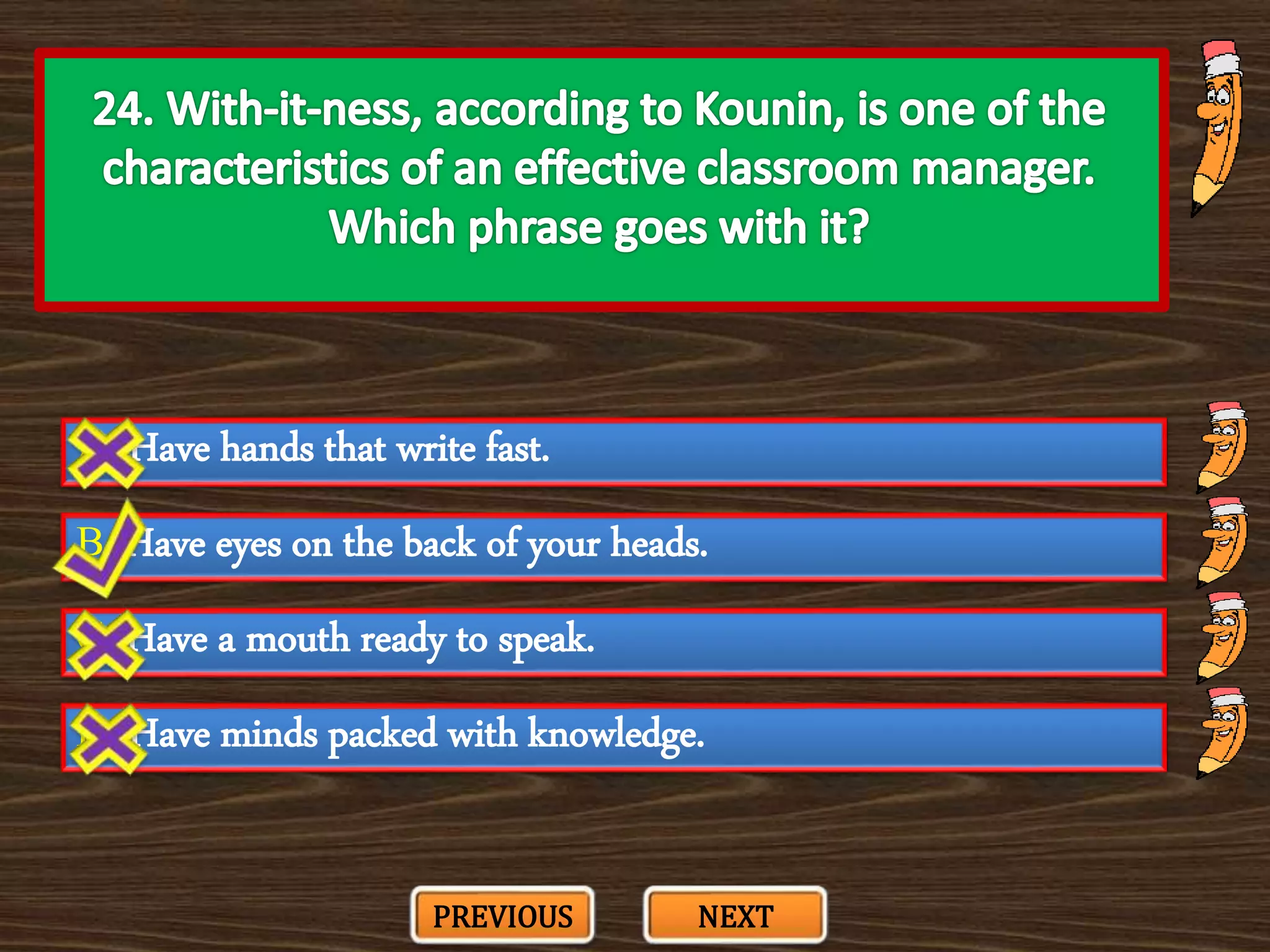
A. Have hands that write fast.
C. Have a mouth ready to speak.
B. Have eyes on the back of your heads.
D. Have minds packed with knowledge.
PREVIOUS NEXT
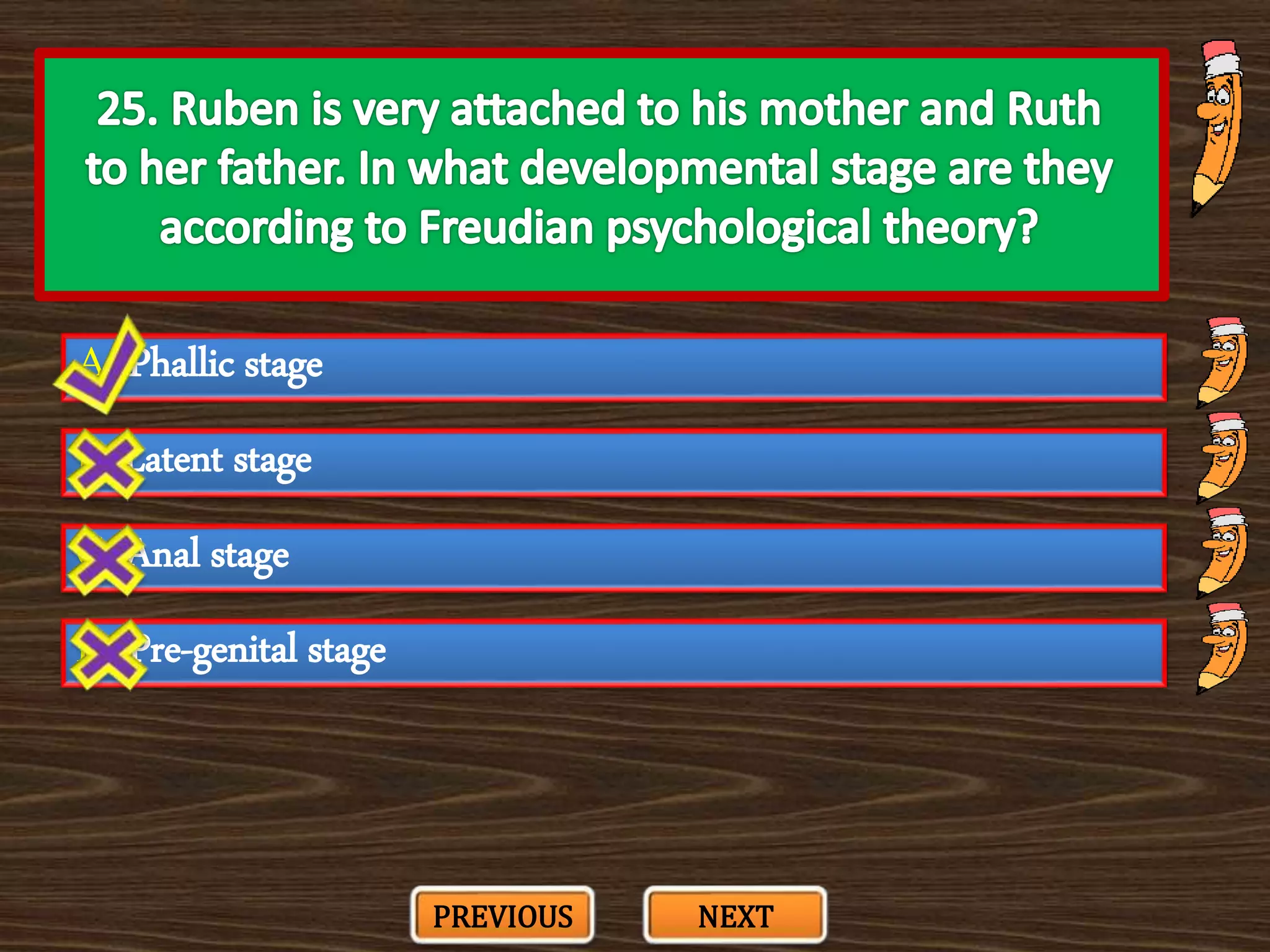
A. Phallic stage
C. Anal stage
B. Latent stage
D. Pre-genital stage
PREVIOUS NEXT
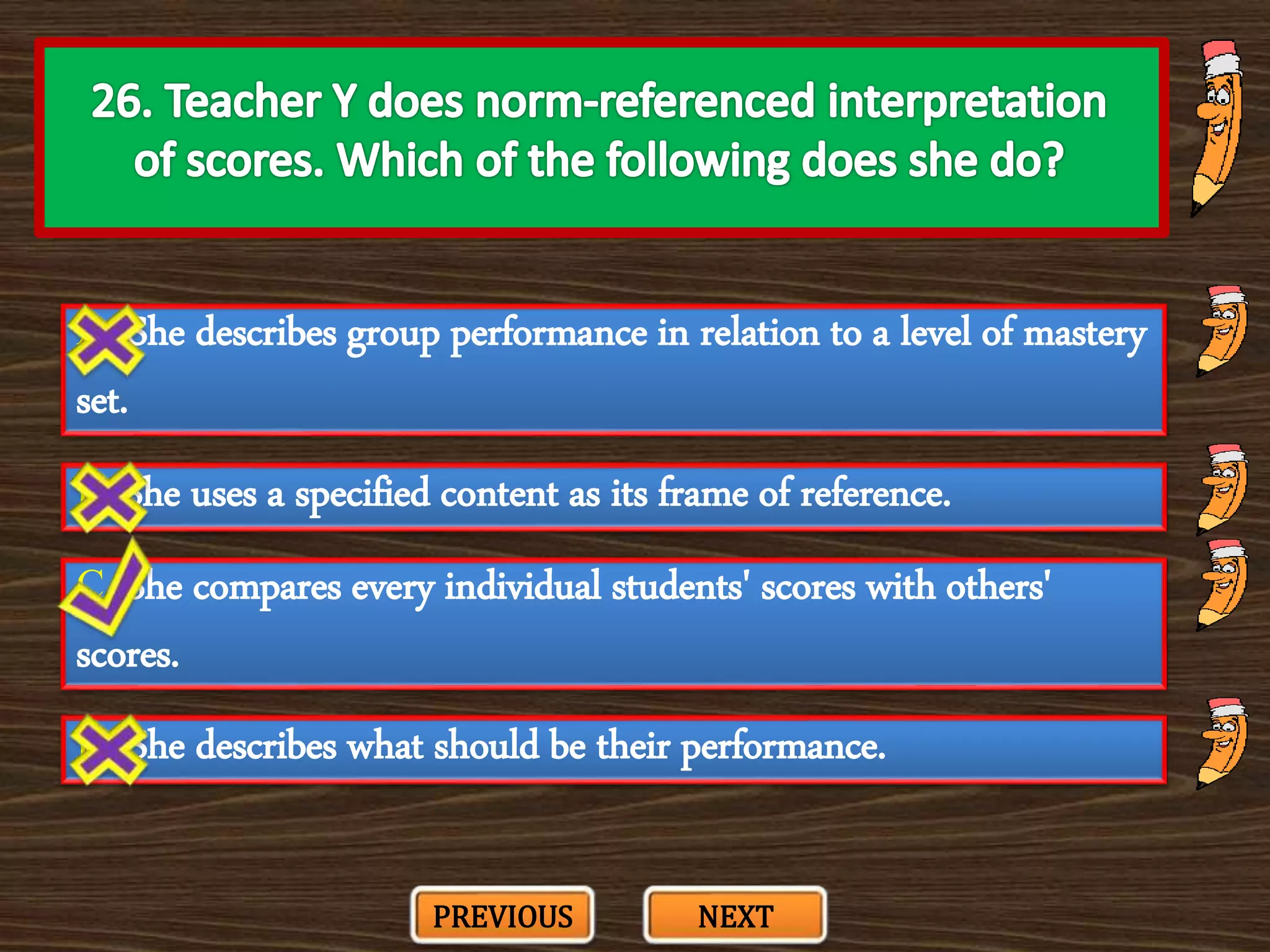
A. She describes group performance in relation to a level of mastery
set.
C. She compares every individual students' scores with others'
scores.
B. She uses a specified content as its frame of reference.
D. She describes what should be their performance.
PREVIOUS NEXT
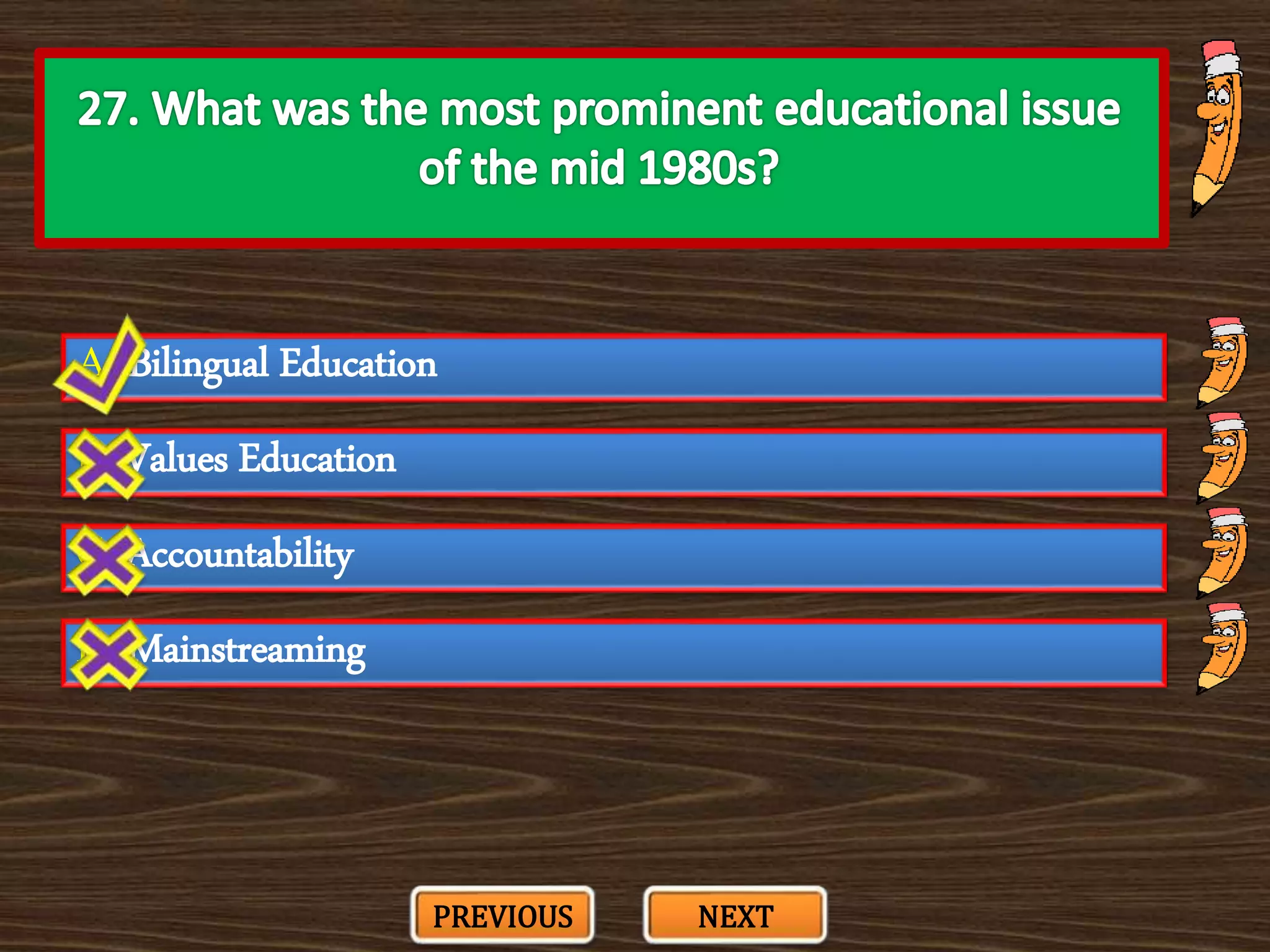
A. Bilingual Education
C. Accountability
B. Values Education
D. Mainstreaming
PREVIOUS NEXT
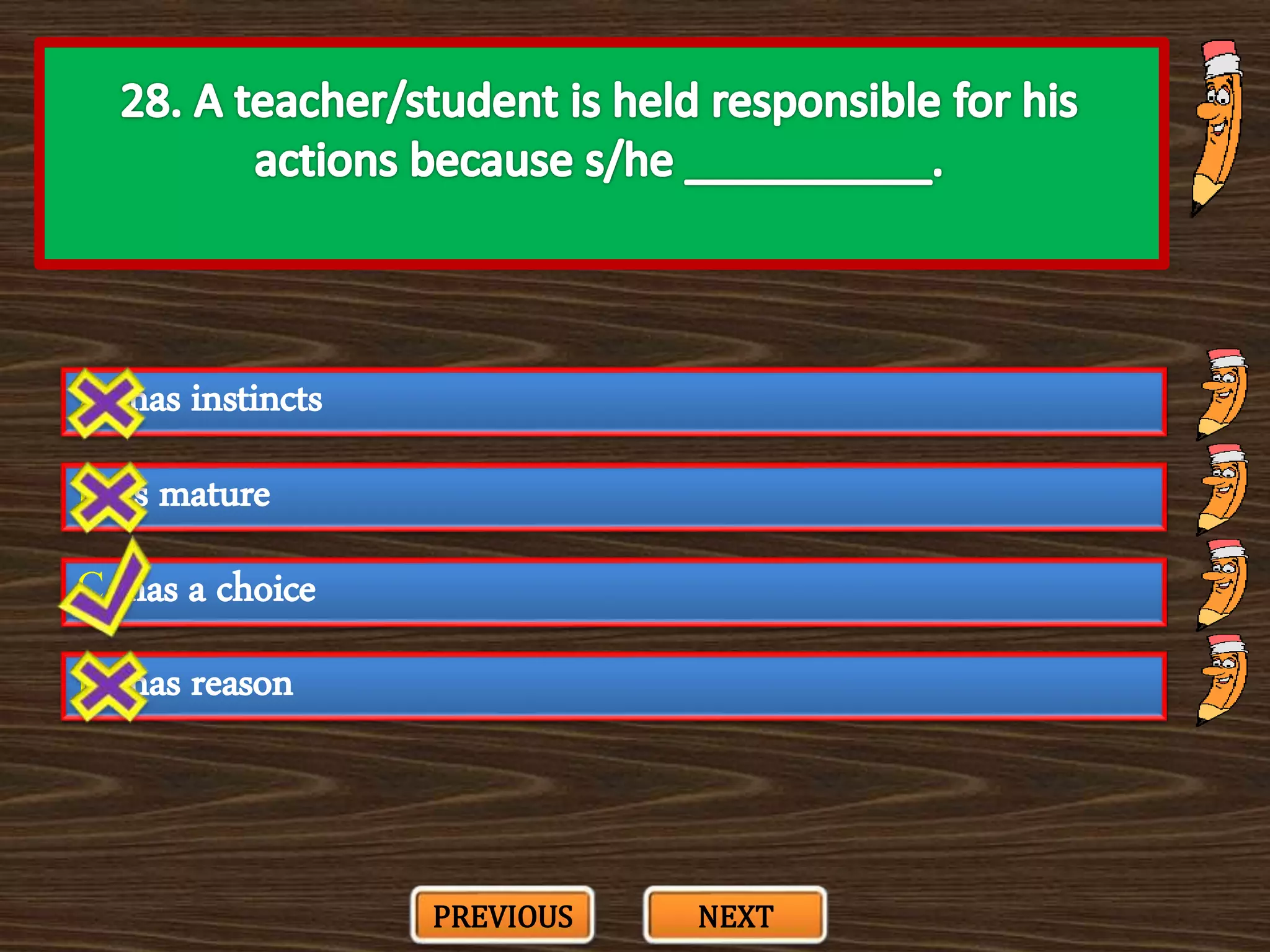
A. has instincts
C. has a choice
B. is mature
D. has reason
PREVIOUS NEXT
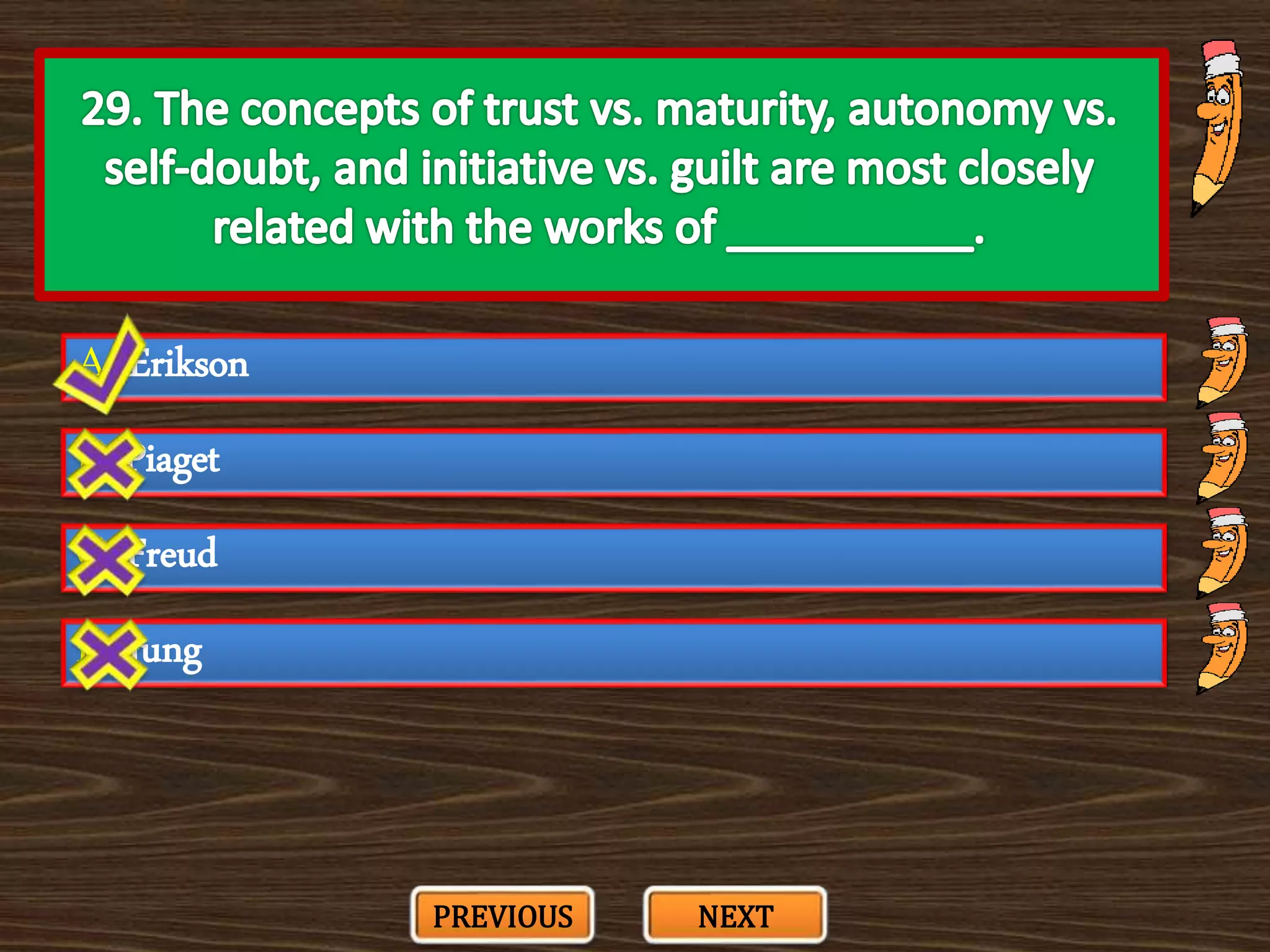
A. Erikson
C. Freud
B. Piaget
D. Jung
PREVIOUS NEXT
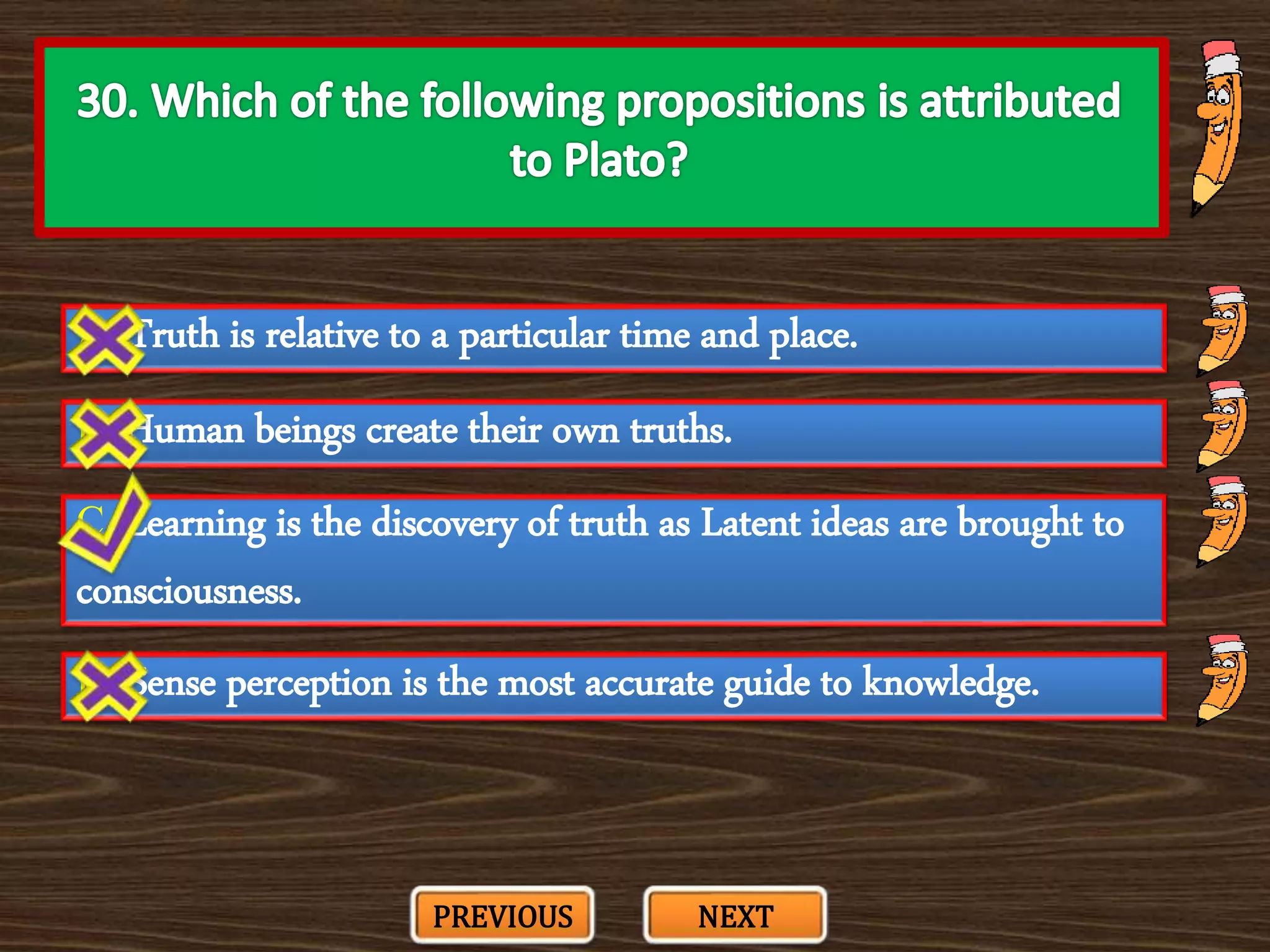
A. Truth is relative to a particular time and place.
C. Learning is the discovery of truth as Latent ideas are brought to
consciousness.
B. Human beings create their own truths.
D. Sense perception is the most accurate guide to knowledge.
PREVIOUS NEXT
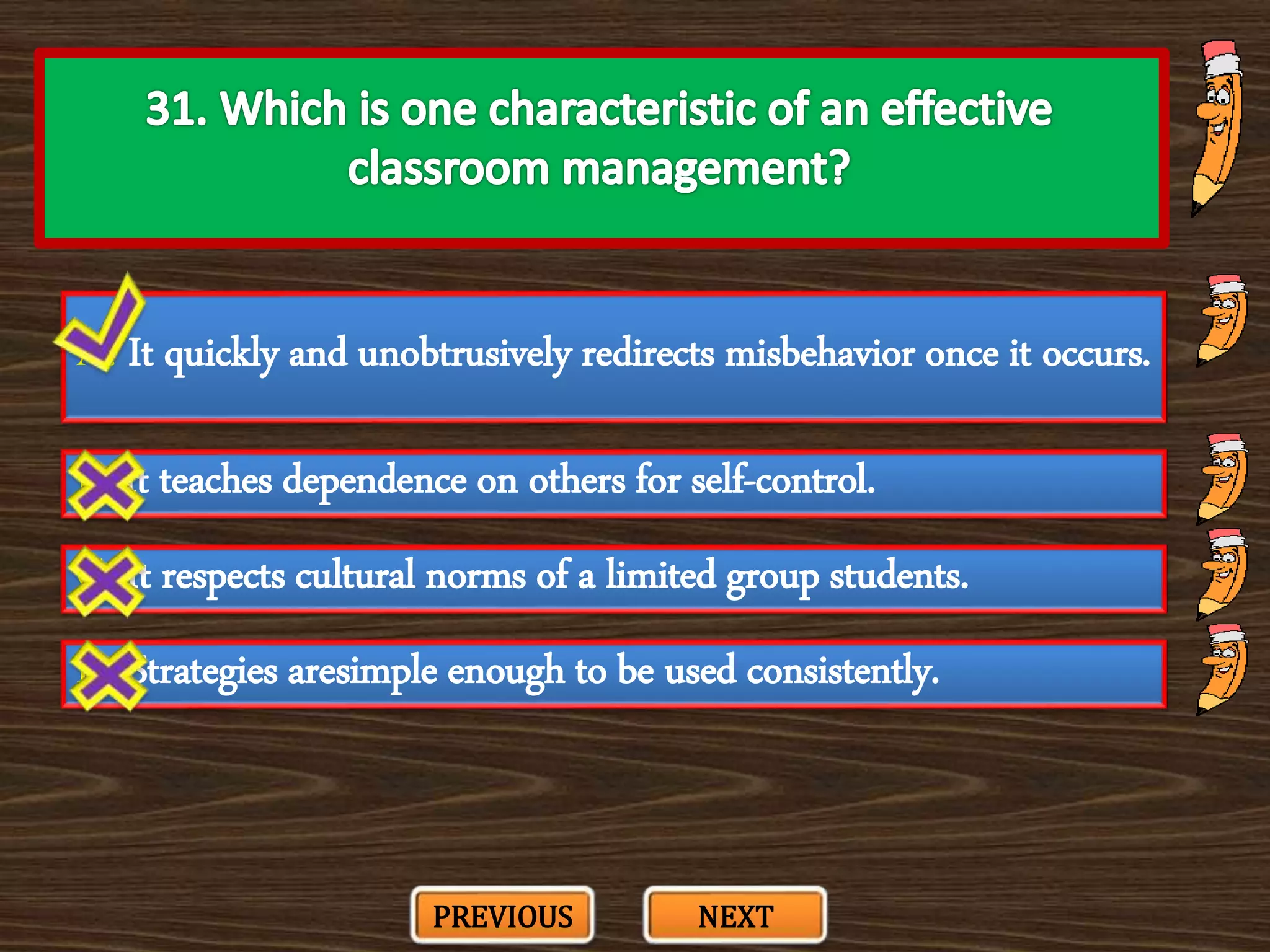
A. It quickly and unobtrusively redirects misbehavior once it occurs.
C. It respects cultural norms of a limited group students.
B. It teaches dependence on others for self-control.
D. Strategies aresimple enough to be used consistently.
PREVIOUS NEXT
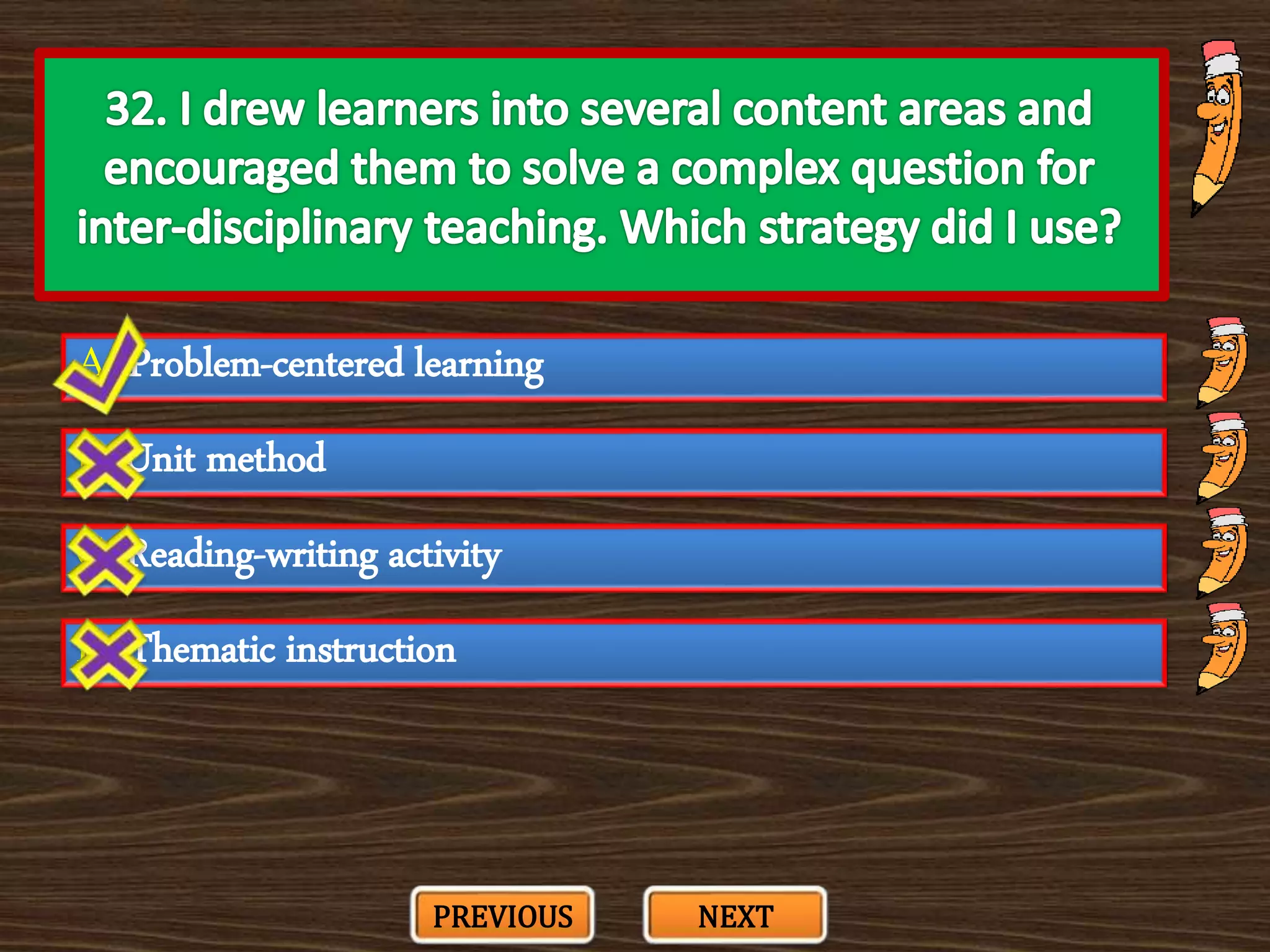
A. Problem-centered learning
C. Reading-writing activity
B. Unit method
D. Thematic instruction
PREVIOUS NEXT
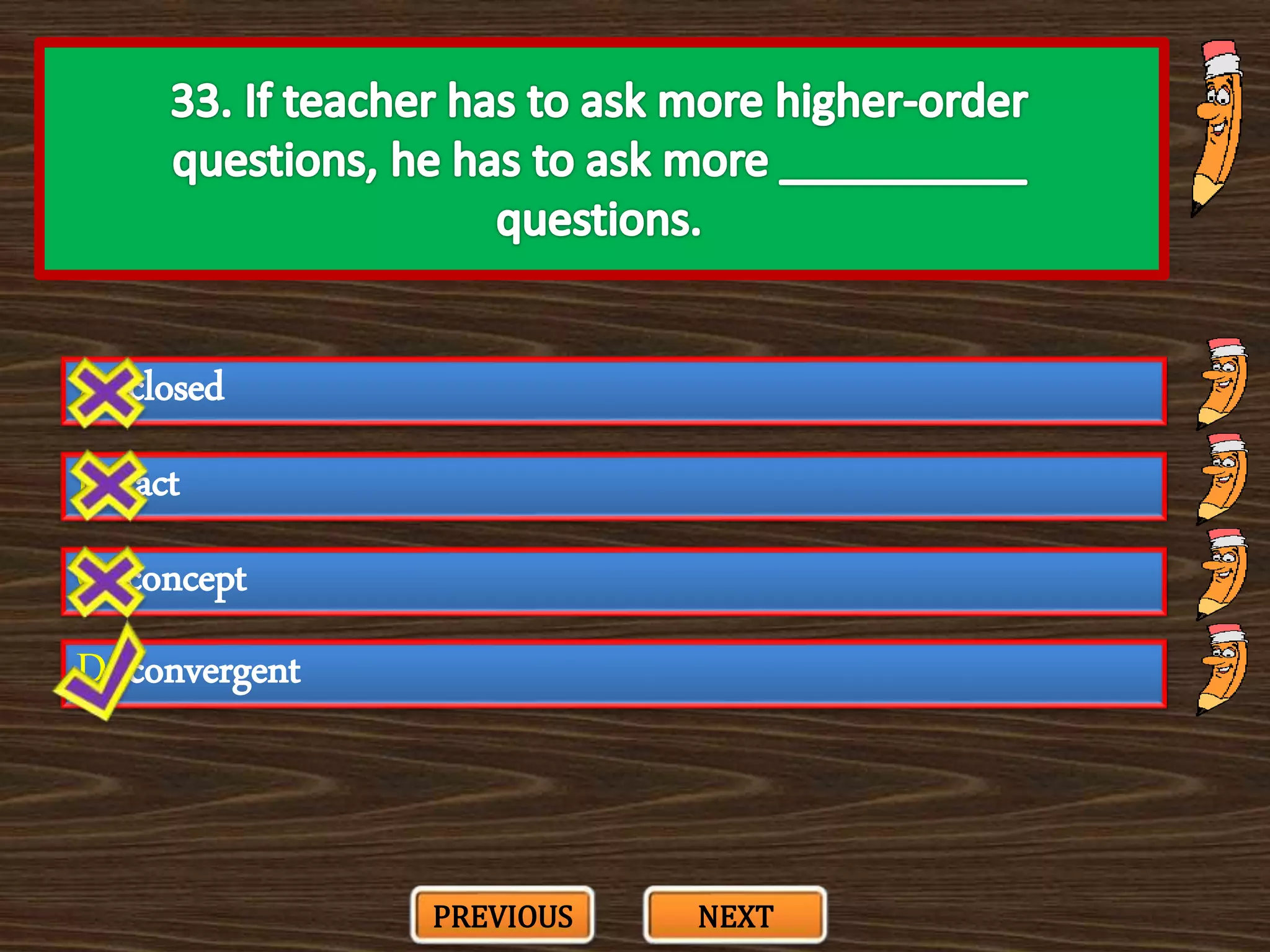
A. closed
C. concept
B. fact
D. convergent
PREVIOUS NEXT
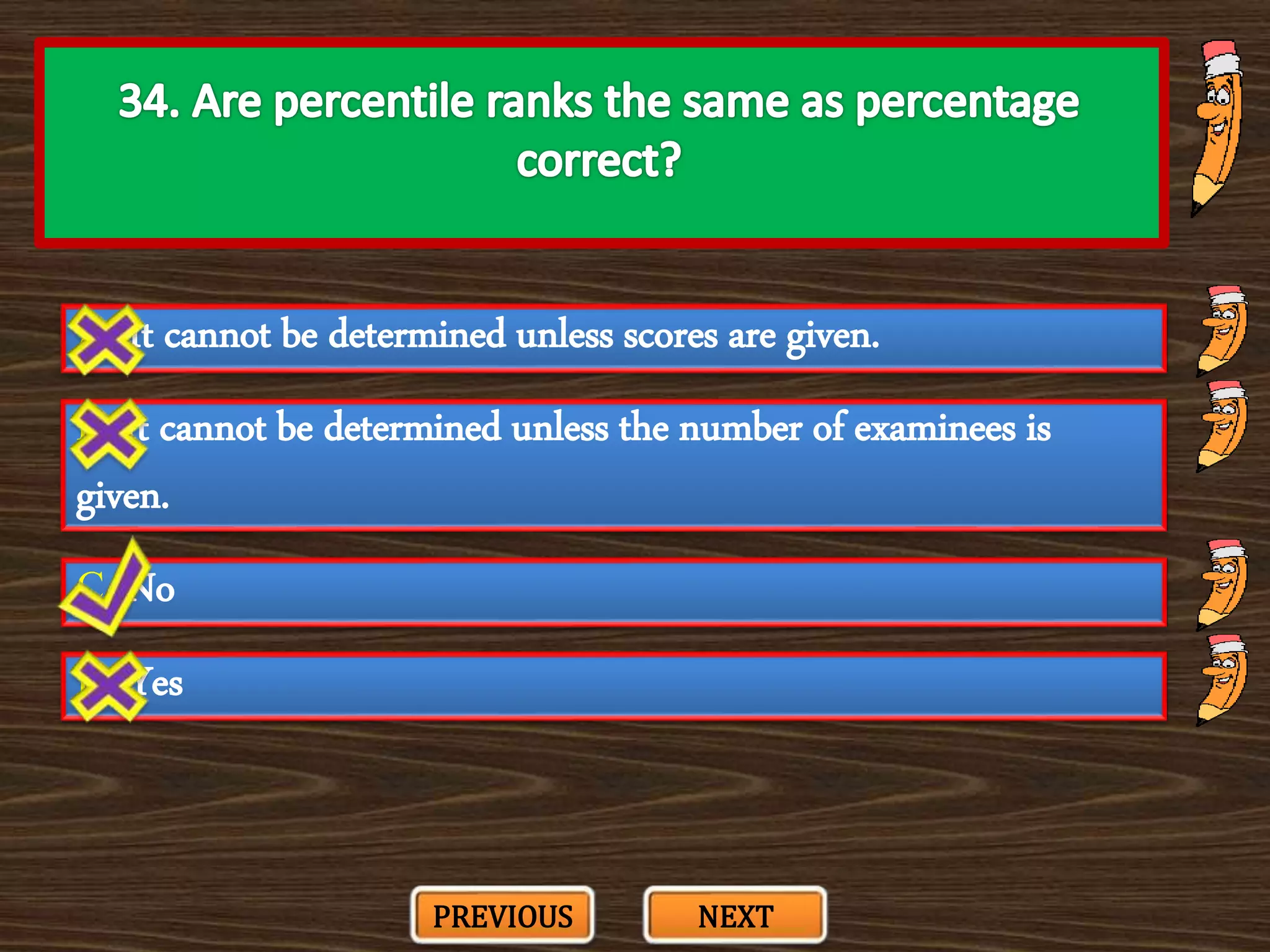
A. It cannot be determined unless scores are given.
C. No
B. It cannot be determined unless the number of examinees is
given.
D. Yes
PREVIOUS NEXT
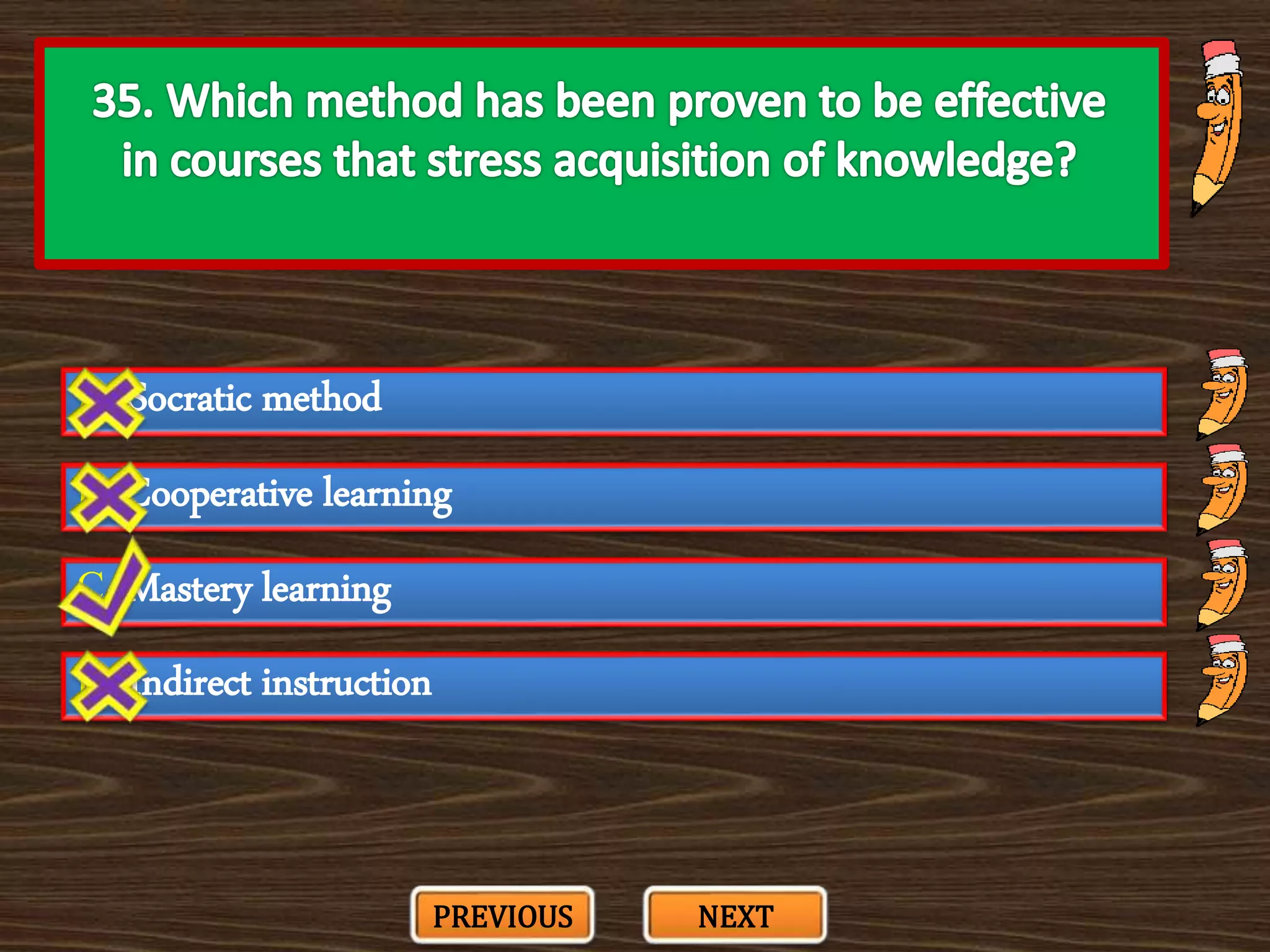
A. Socratic method
C. Mastery learning
B. Cooperative learning
D. Indirect instruction
PREVIOUS NEXT
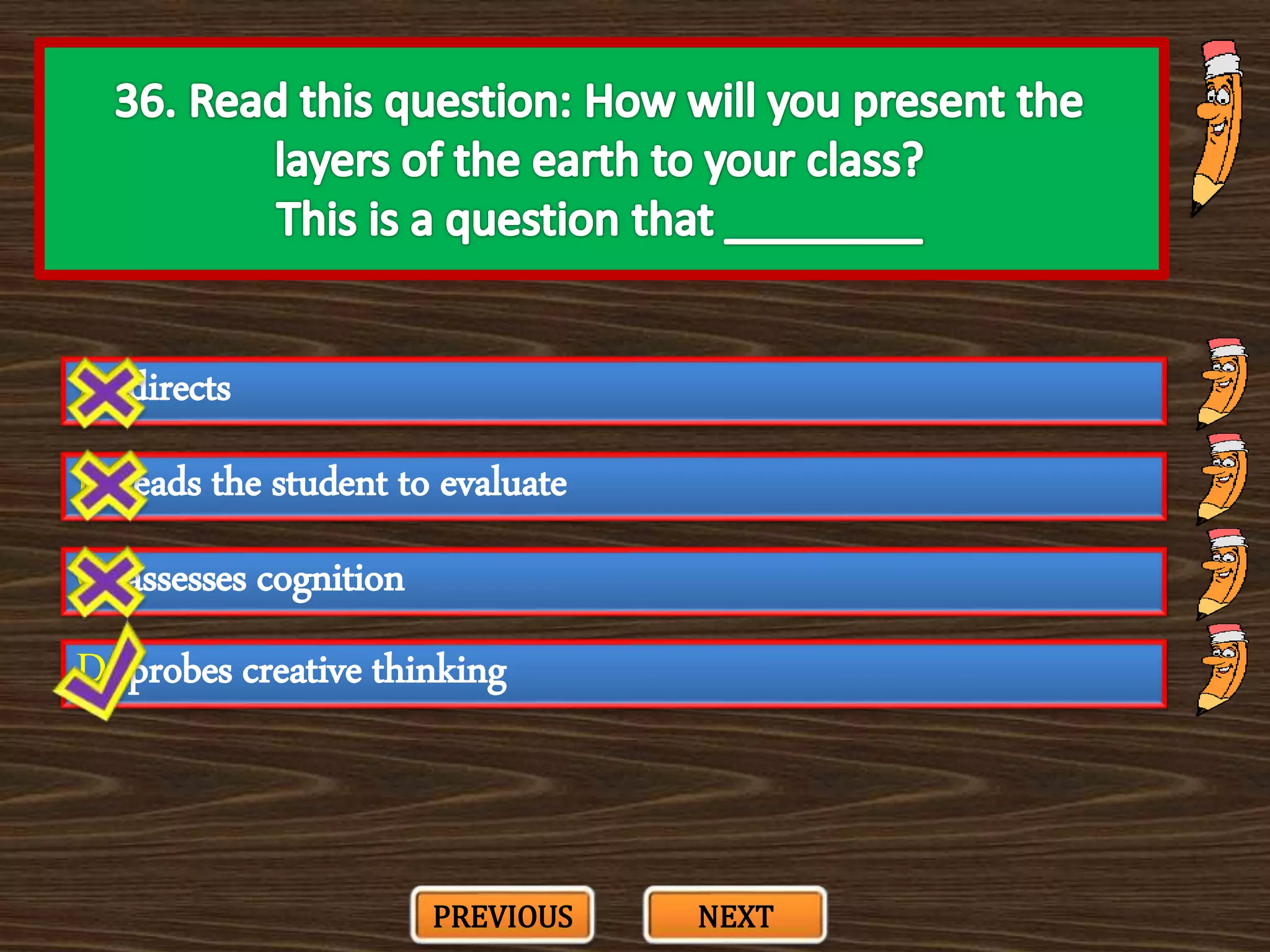
A. directs
C. assesses cognition
B. leads the student to evaluate
D. probes creative thinking
PREVIOUS NEXT
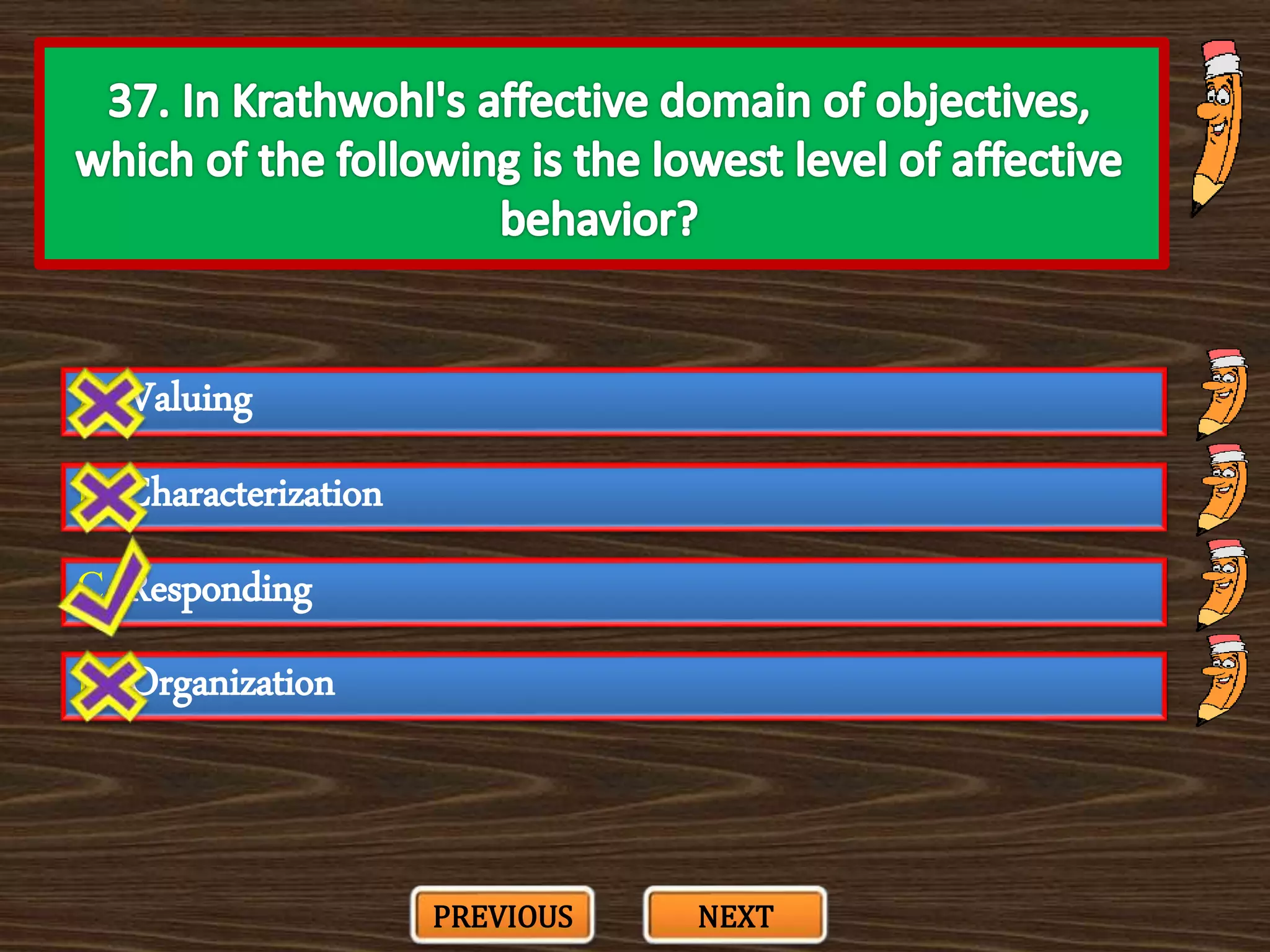
A. Valuing
C. Responding
B. Characterization
D. Organization
PREVIOUS NEXT
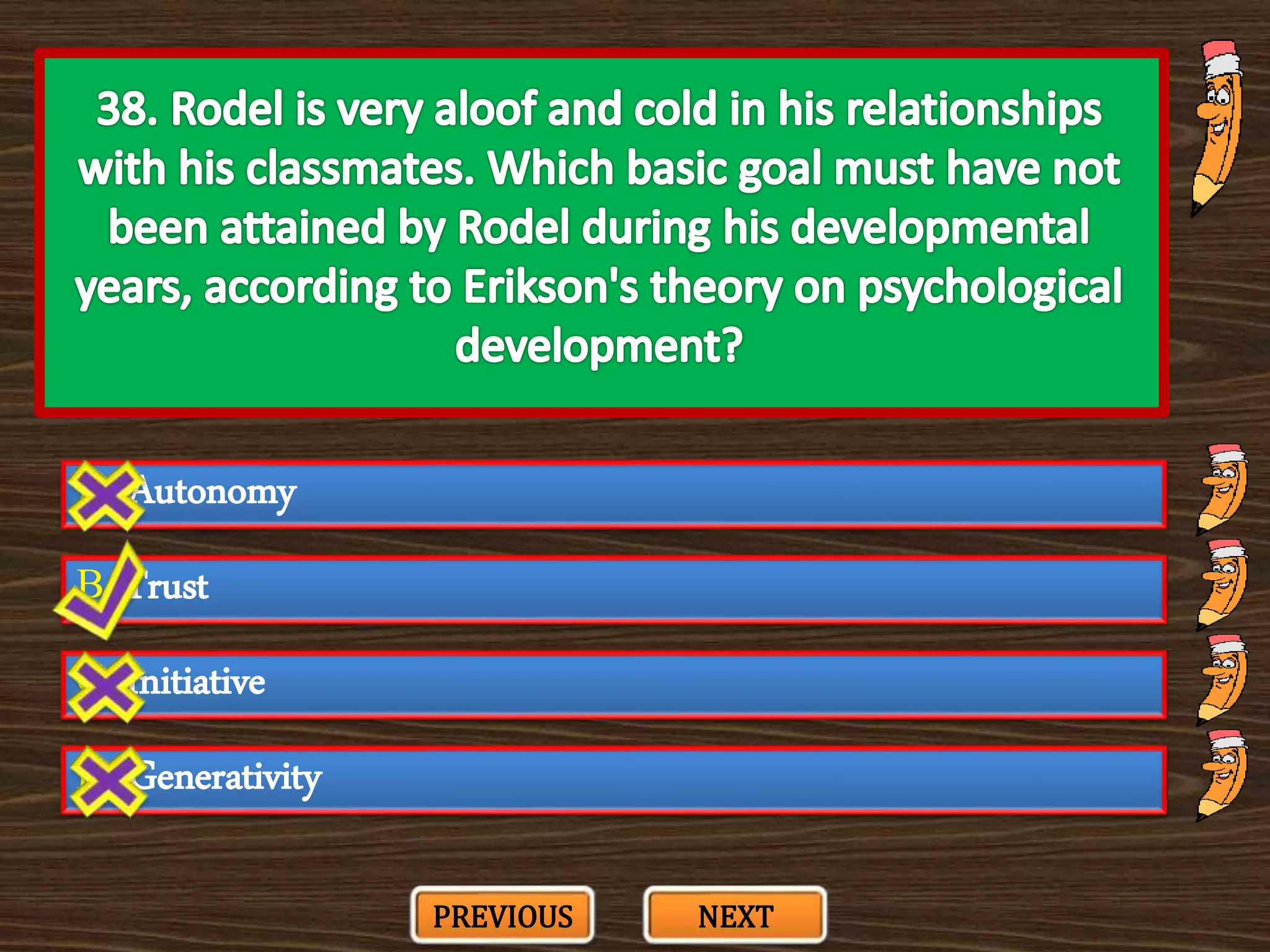
A. Autonomy
C. Initiative
B. Trust
D. Generativity
PREVIOUS NEXT
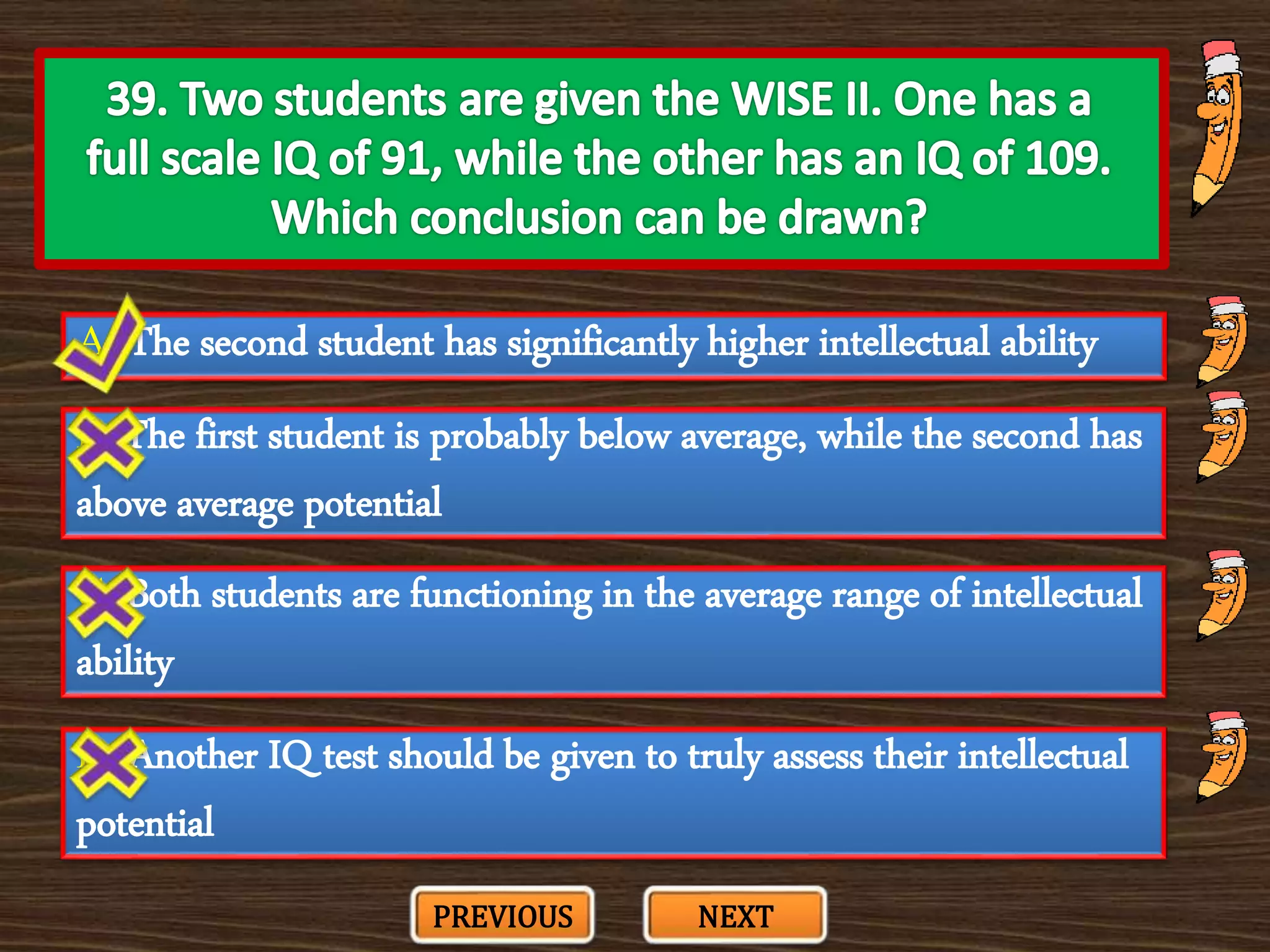
A. The second student has significantly higher intellectual ability
C. Both students are functioning in the average range of intellectual
ability
B. The first student is probably below average, while the second has
above average potential
D. Another IQ test should be given to truly assess their intellectual
potential
PREVIOUS NEXT
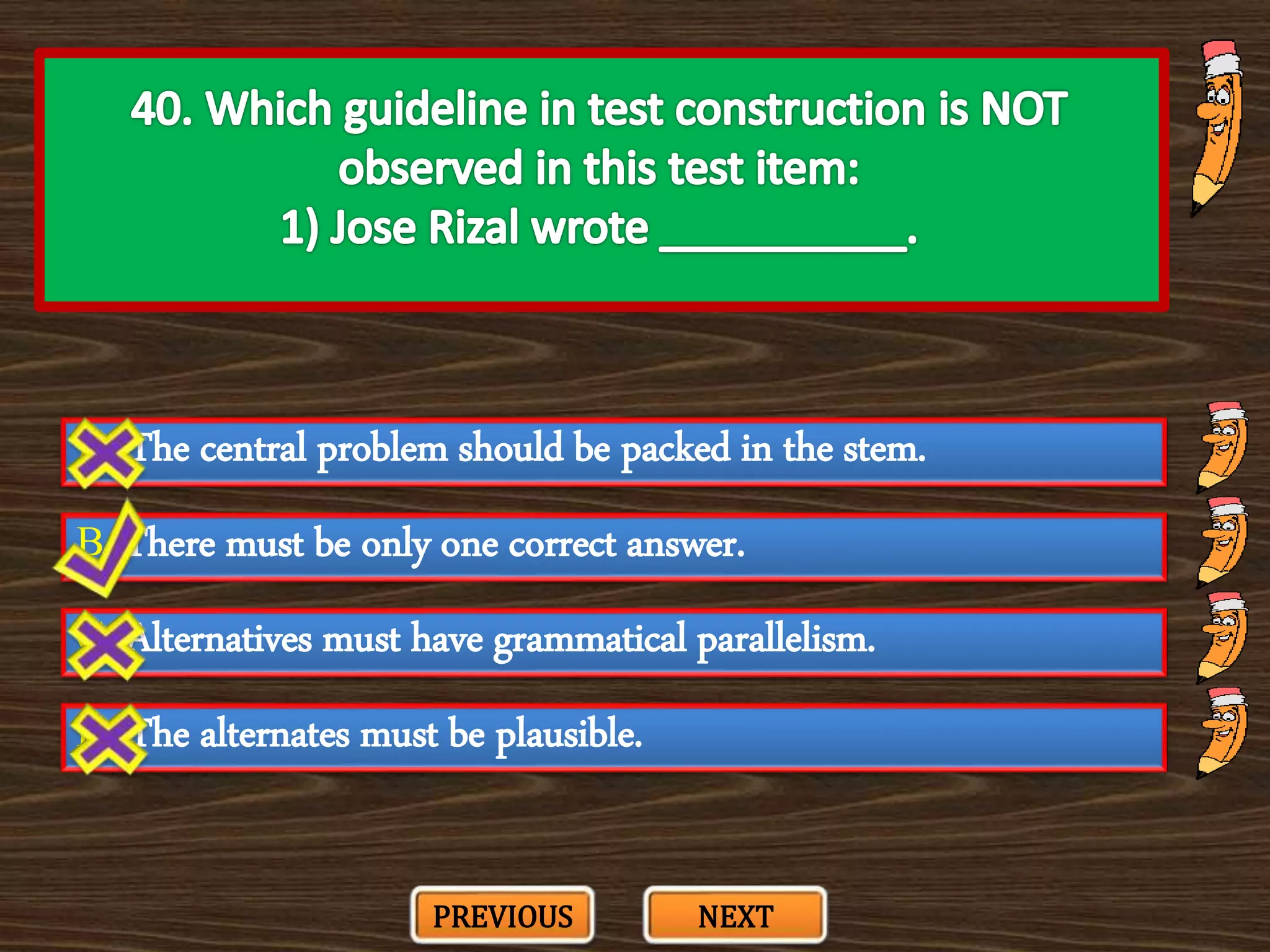
A. The central problem should be packed in the stem.
C. Alternatives must have grammatical parallelism.
B. There must be only one correct answer.
D. The alternates must be plausible.
PREVIOUS NEXT
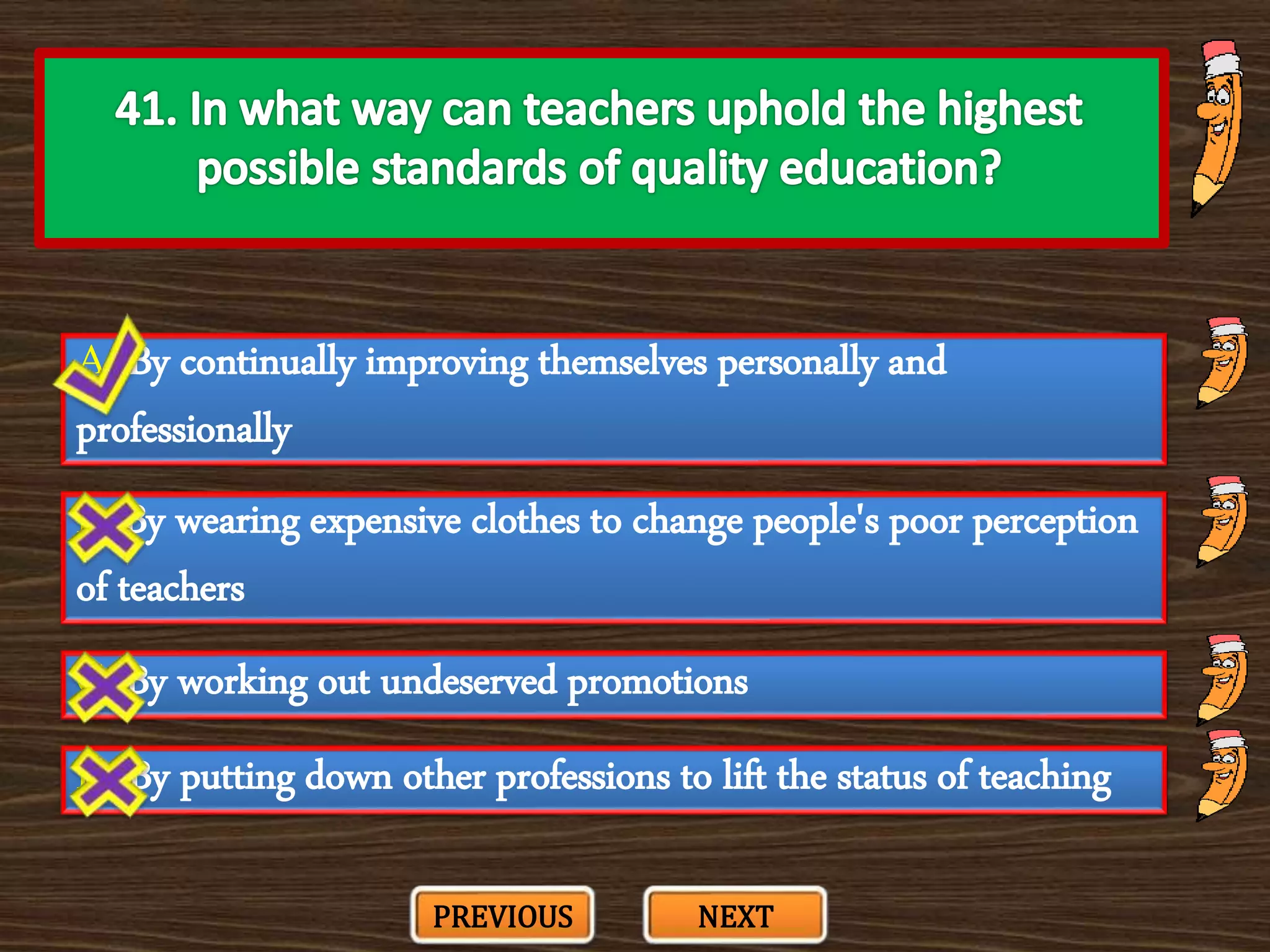
A. By continually improving themselves personally and
professionally
C. By working out undeserved promotions
B. By wearing expensive clothes to change people's poor perception
of teachers
D. By putting down other professions to lift the status of teaching
PREVIOUS NEXT
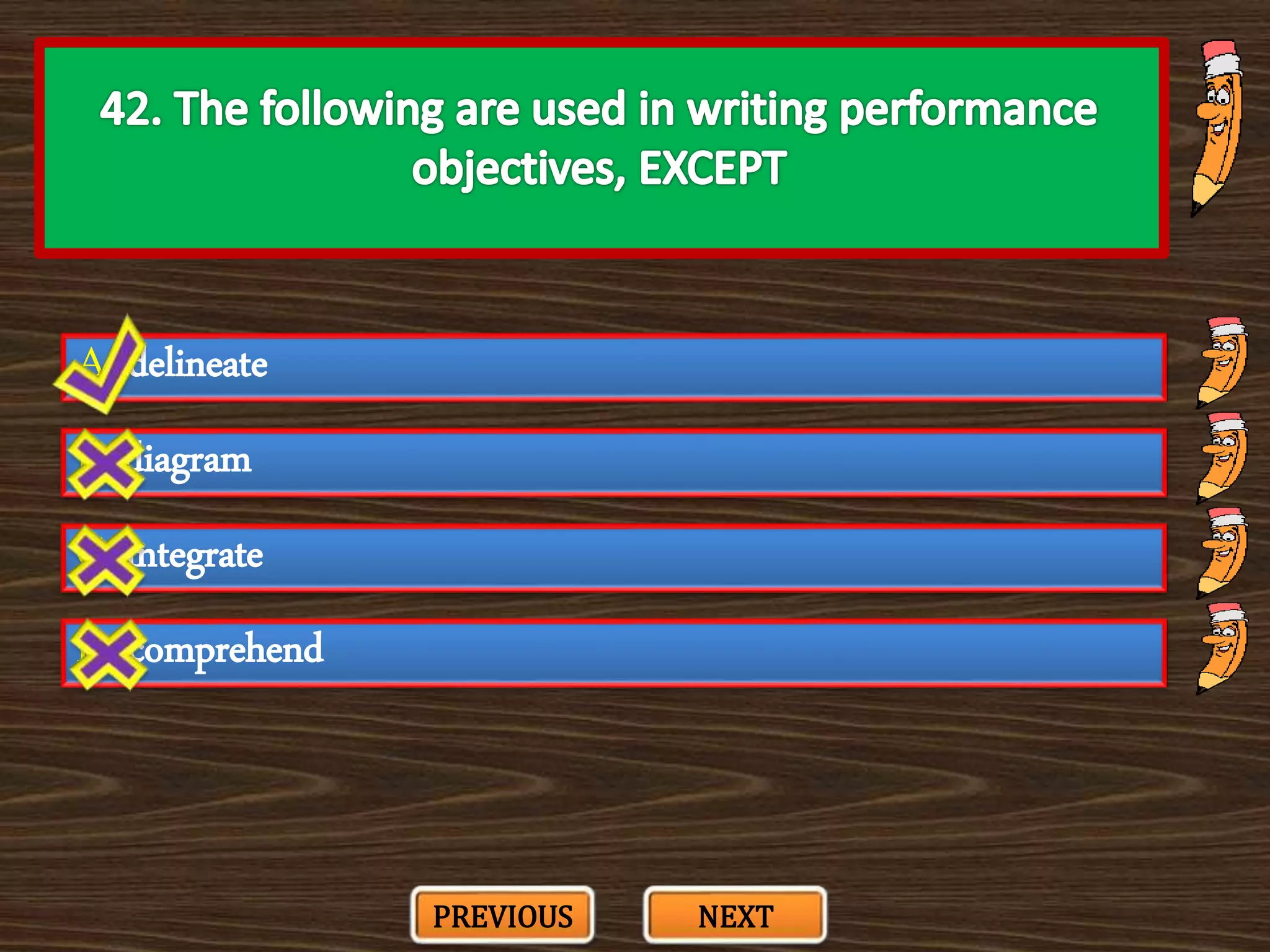
A. delineate
C. integrate
B. diagram
D. comprehend
PREVIOUS NEXT
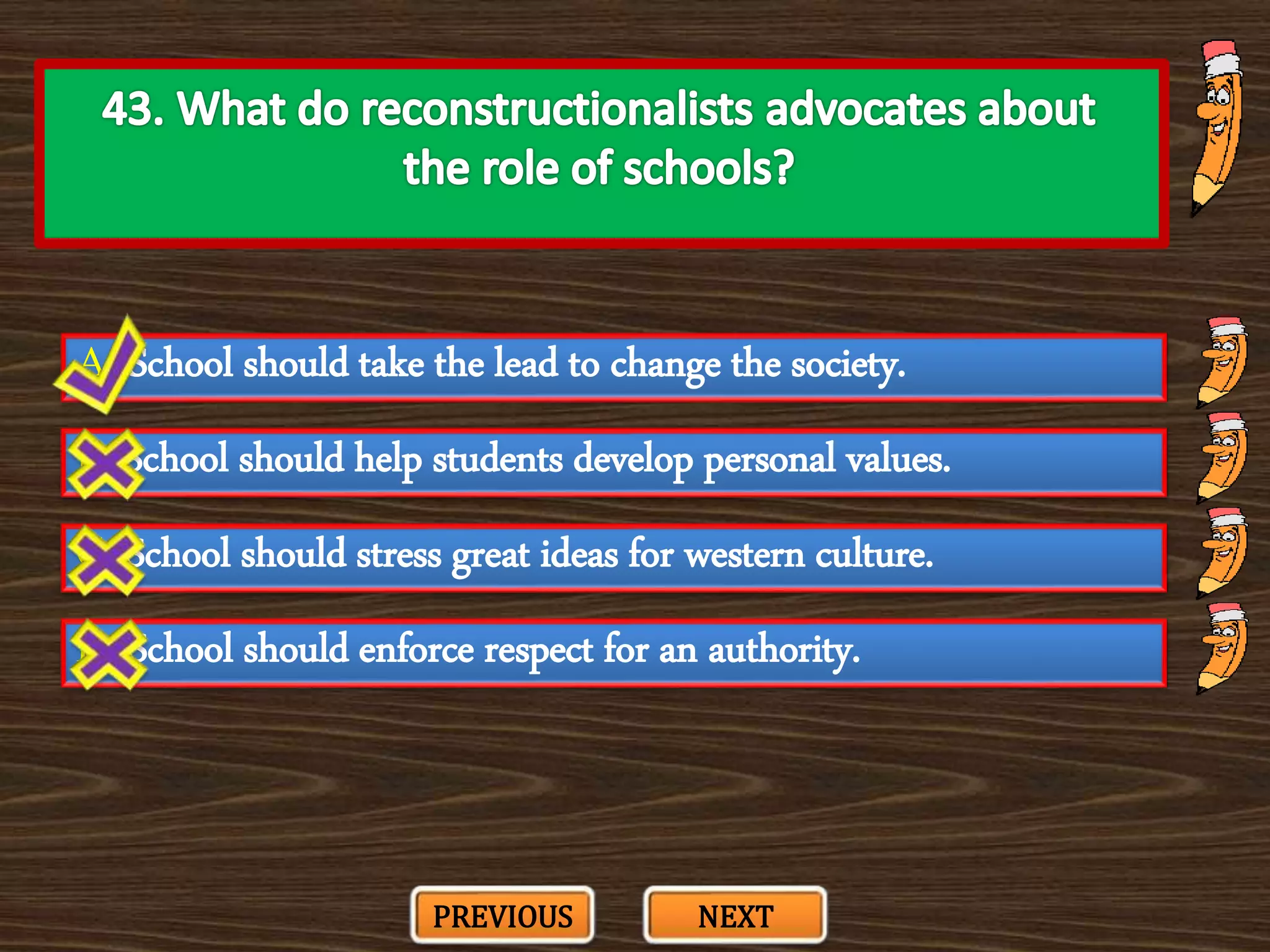
A. School should take the lead to change the society.
C. School should stress great ideas for western culture.
B. School should help students develop personal values.
D. School should enforce respect for an authority.
PREVIOUS NEXT
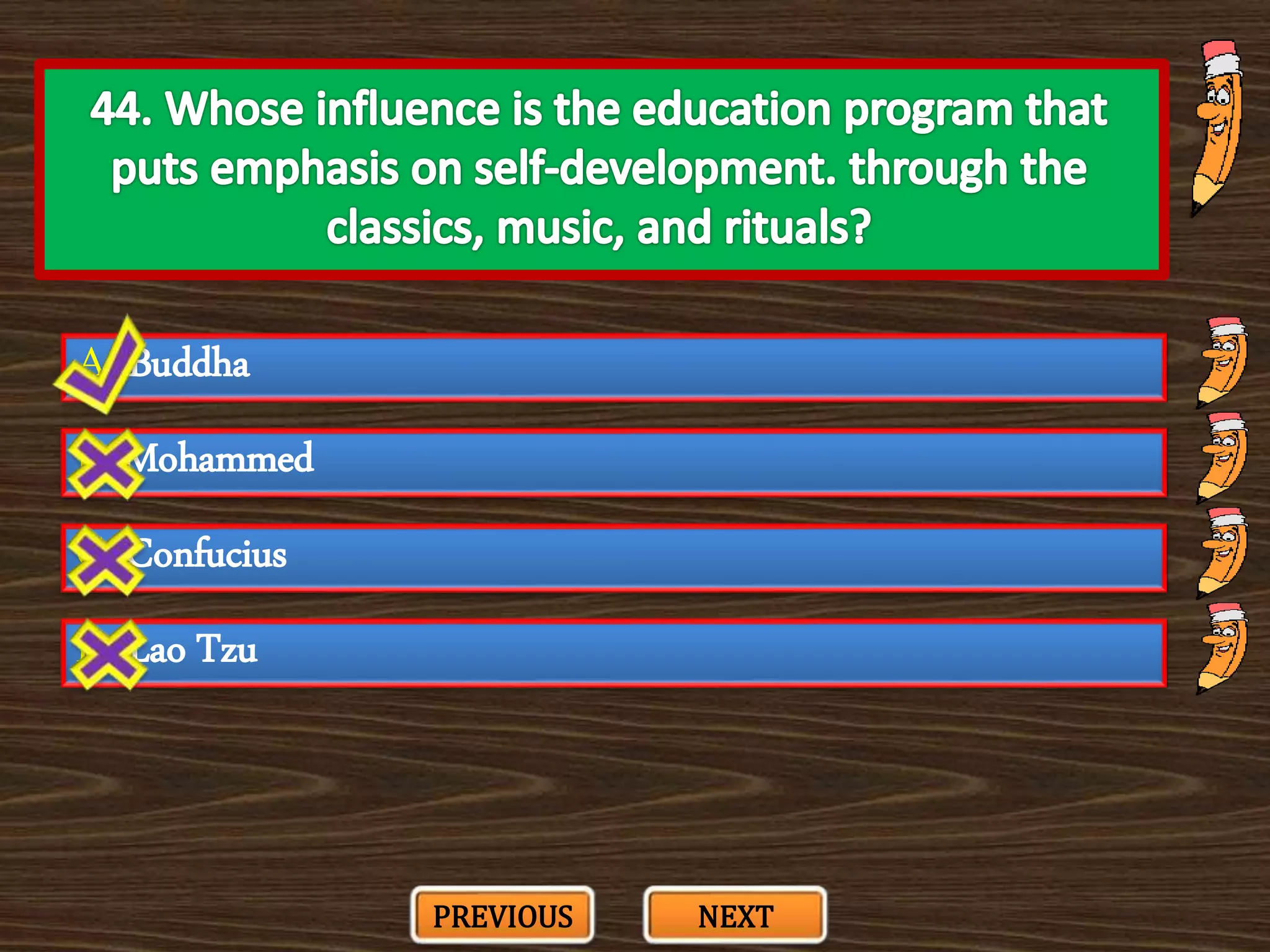
A. Buddha
C. Confucius
B. Mohammed
D. Lao Tzu
PREVIOUS NEXT
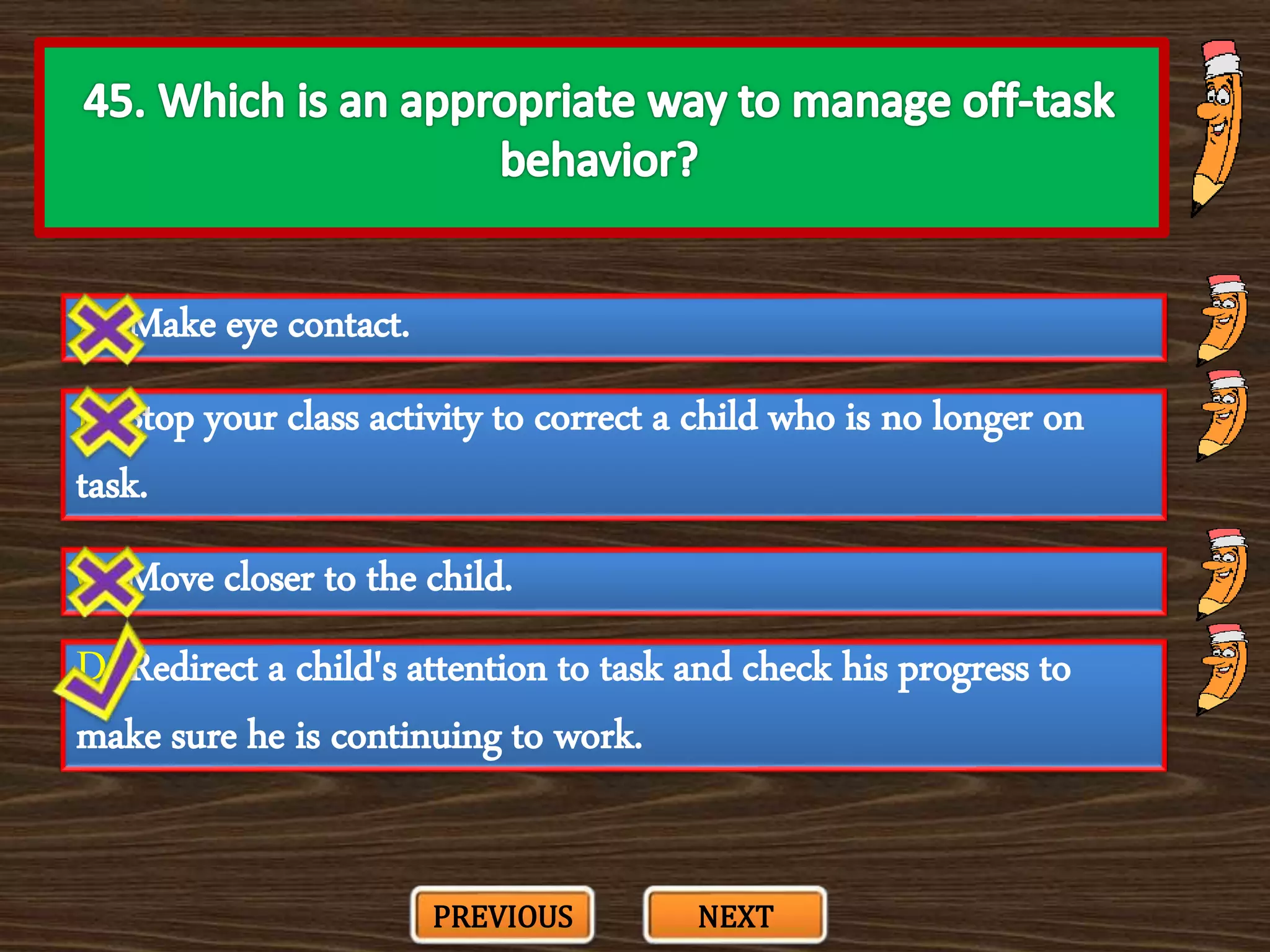
A. Make eye contact.
C. Move closer to the child.
B. Stop your class activity to correct a child who is no longer on
task.
D. Redirect a child's attention to task and check his progress to
make sure he is continuing to work.
PREVIOUS NEXT
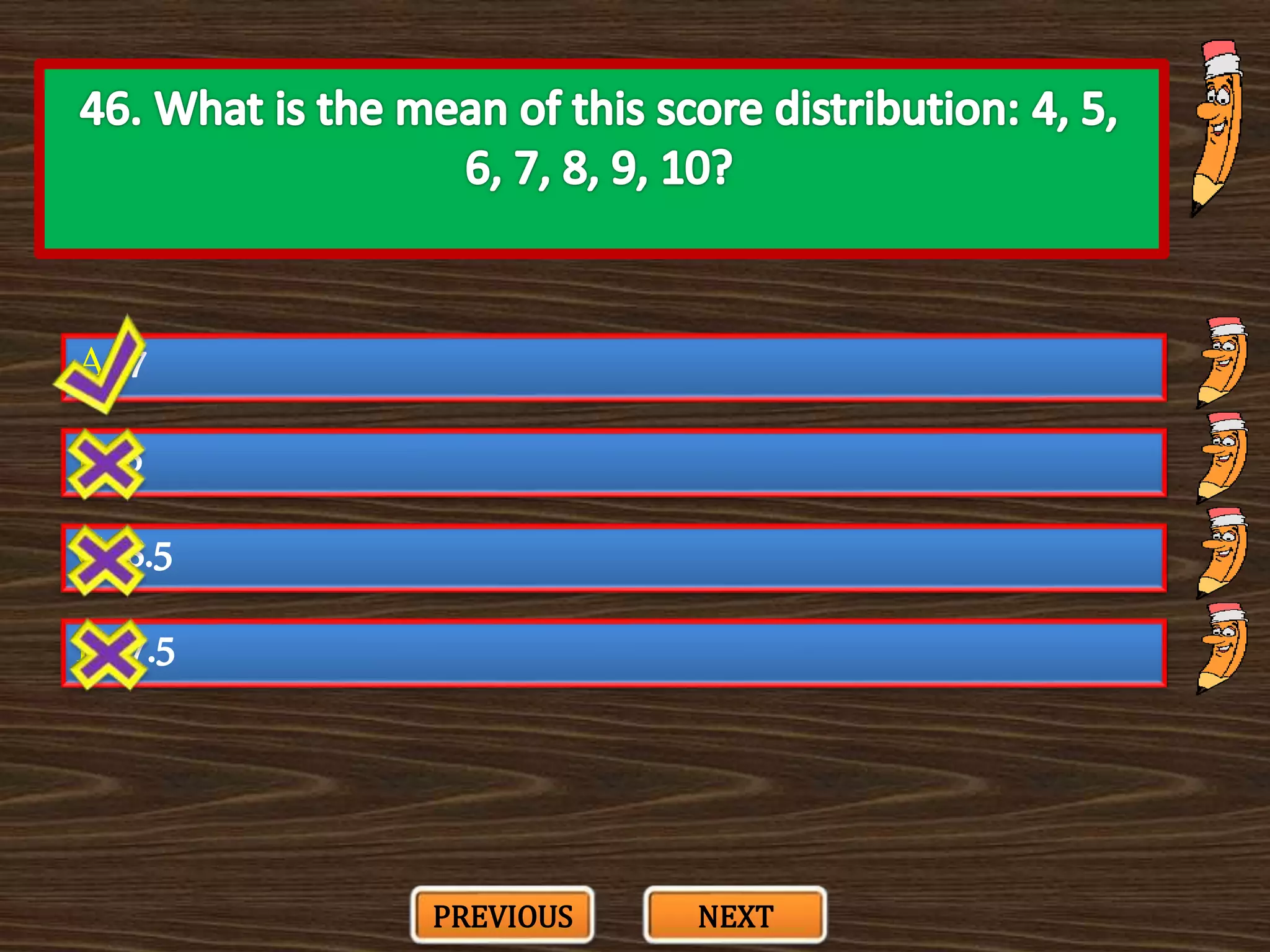
A. 7
C. 8.5
B. 6
D. 7.5
PREVIOUS NEXT
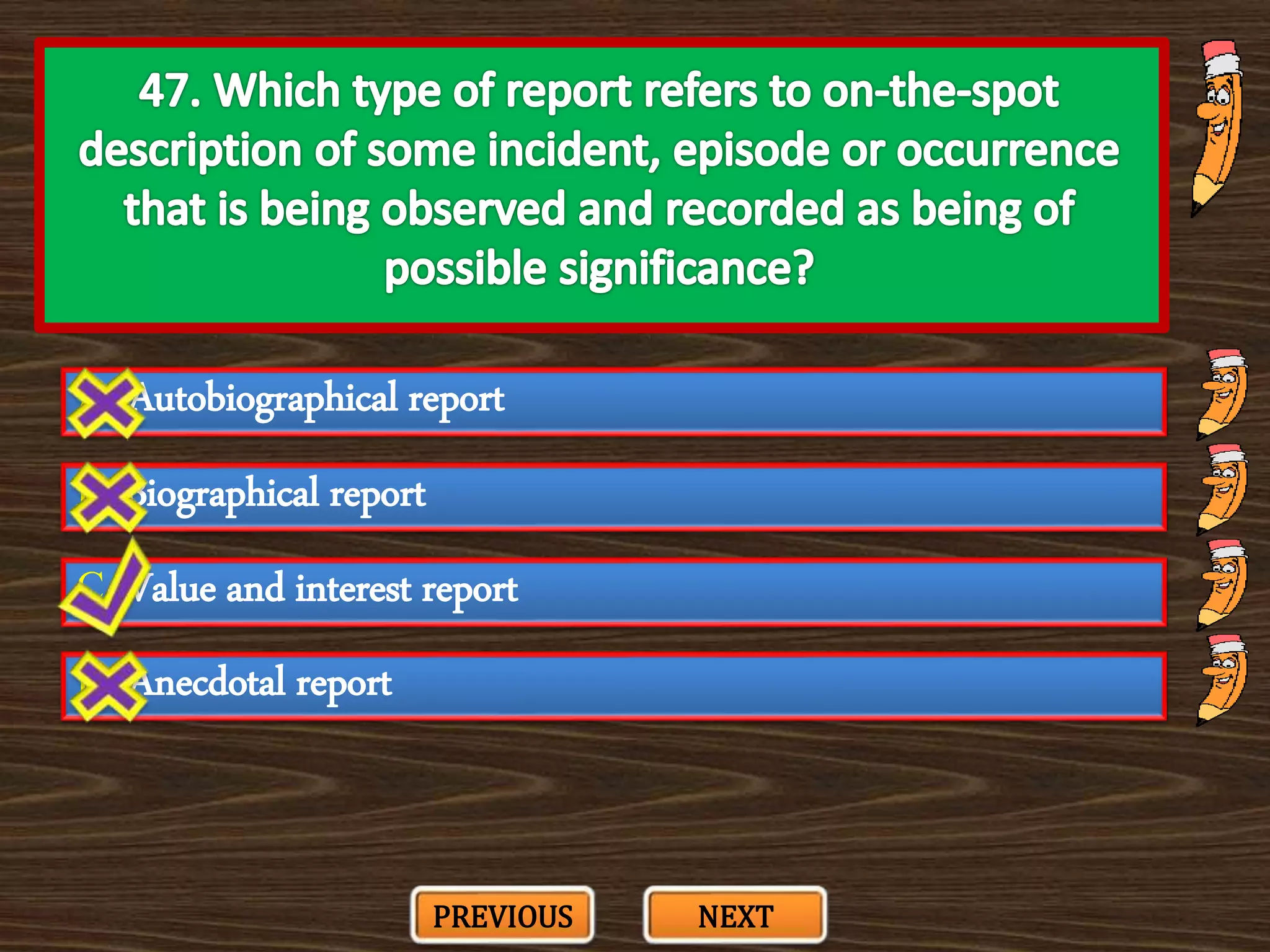
A. Autobiographical report
C. Value and interest report
B. Biographical report
D. Anecdotal report
PREVIOUS NEXT
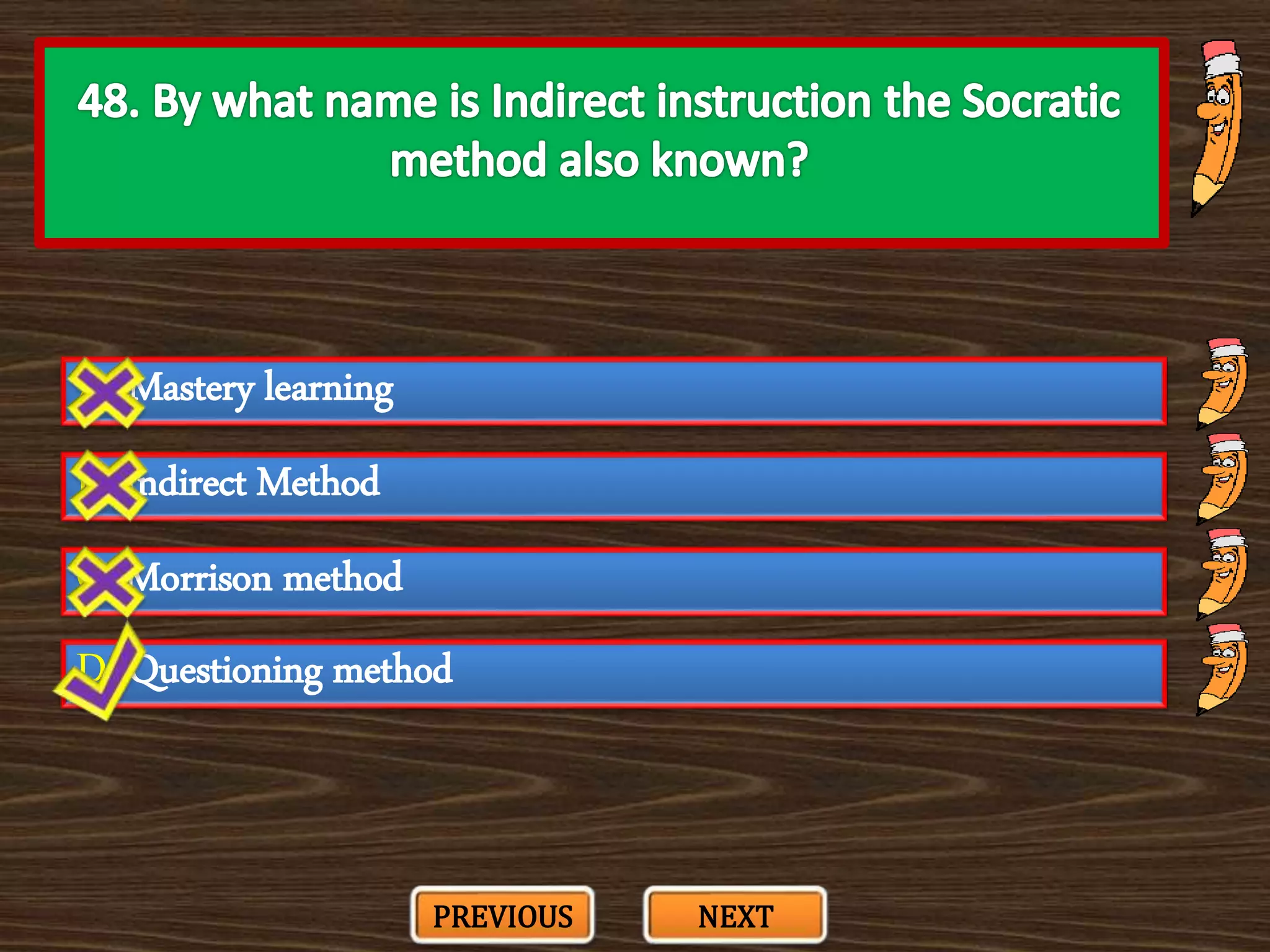
A. Mastery learning
C. Morrison method
B. Indirect Method
D. Questioning method
PREVIOUS NEXT
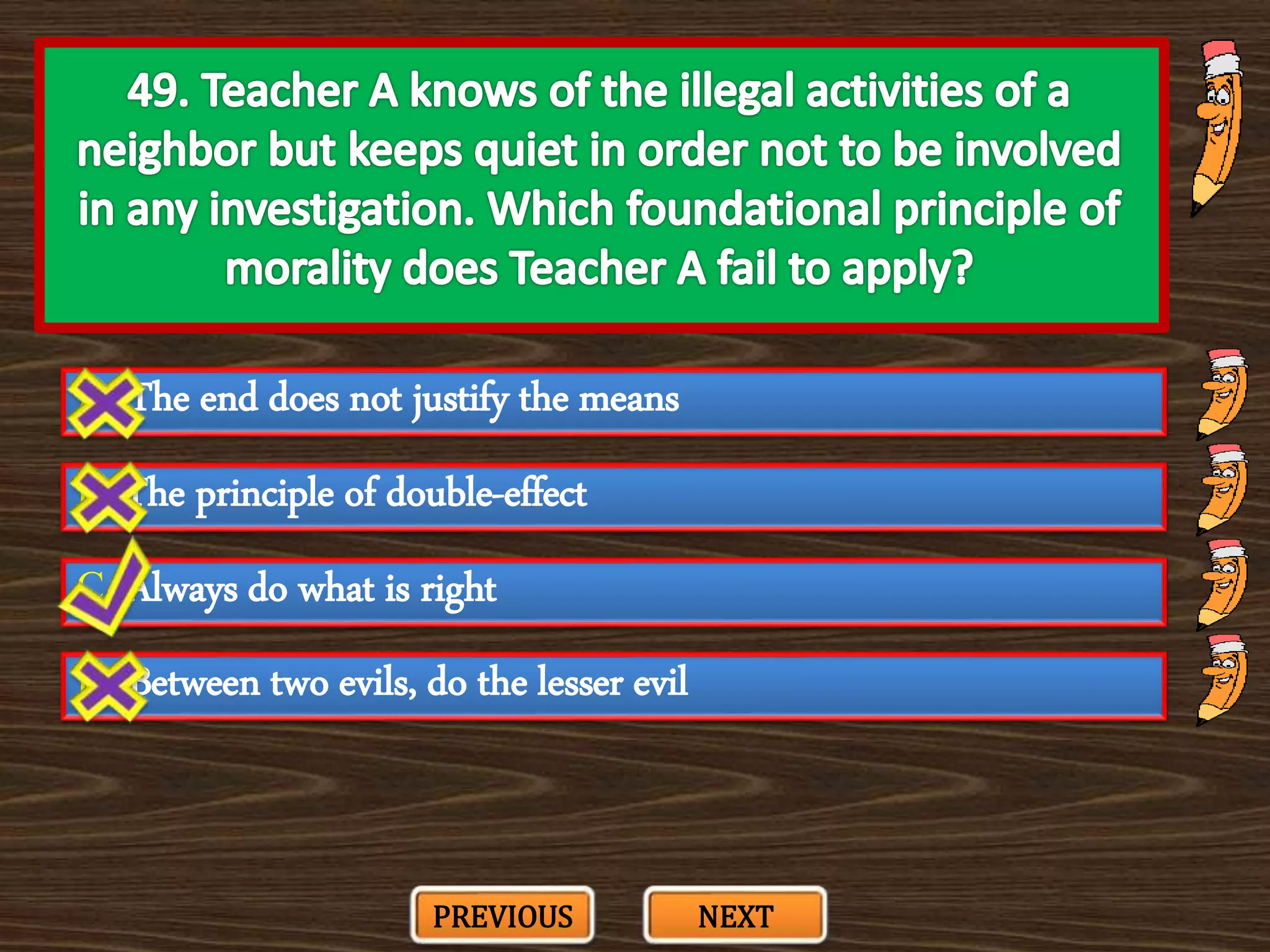
A. The end does not justify the means
C. Always do what is right
B. The principle of double-effect
D. Between two evils, do the lesser evil
PREVIOUS NEXT
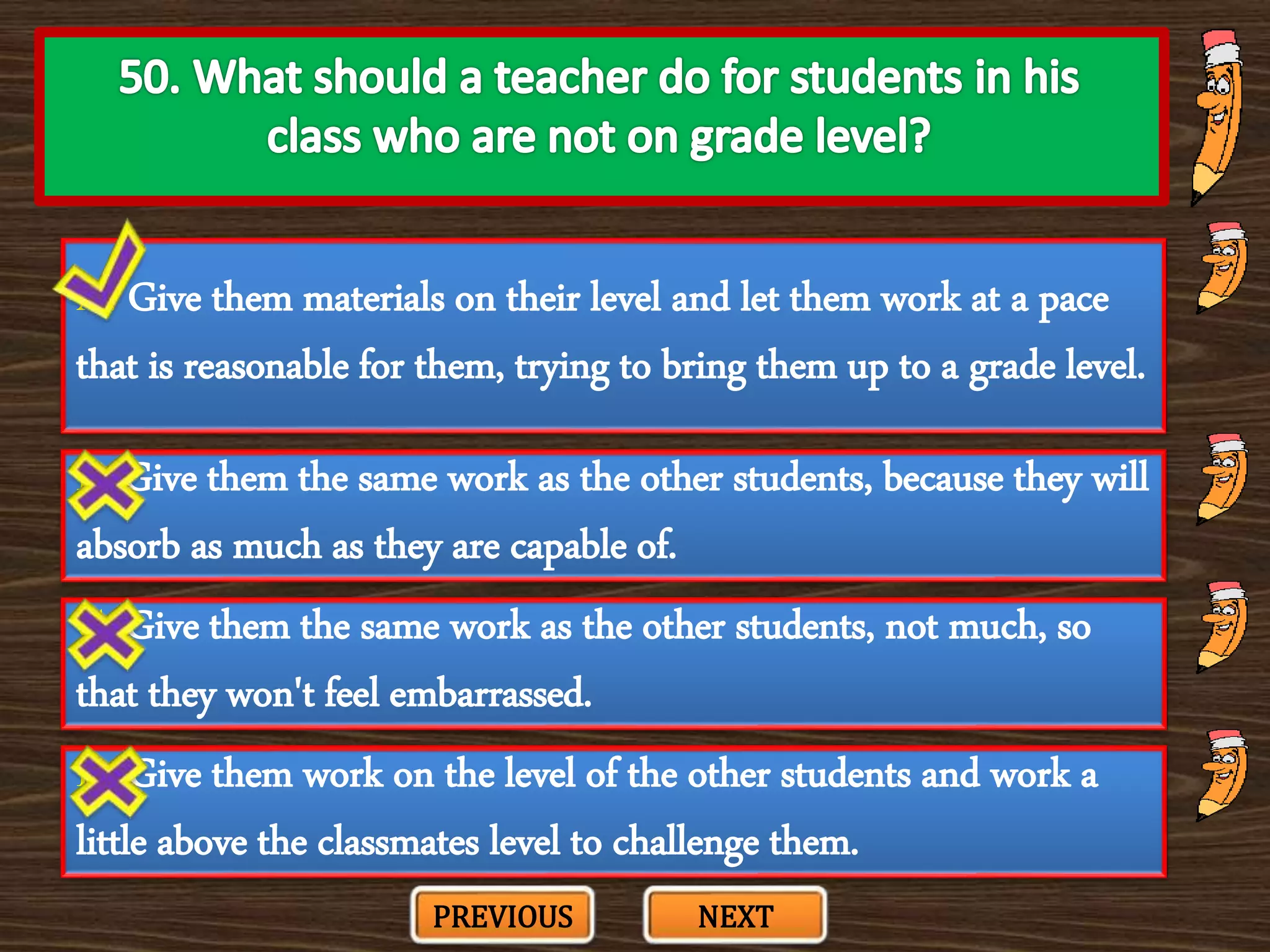
A. Give them materials on their level and let them work at a pace
that is reasonable for them, trying to bring them up to a grade level.
C. Give them the same work as the other students, not much, so
that they won't feel embarrassed.
B. Give them the same work as the other students, because they will
absorb as much as they are capable of.
D. Give them work on the level of the other students and work a
little above the classmates level to challenge them.
PREVIOUS NEXT
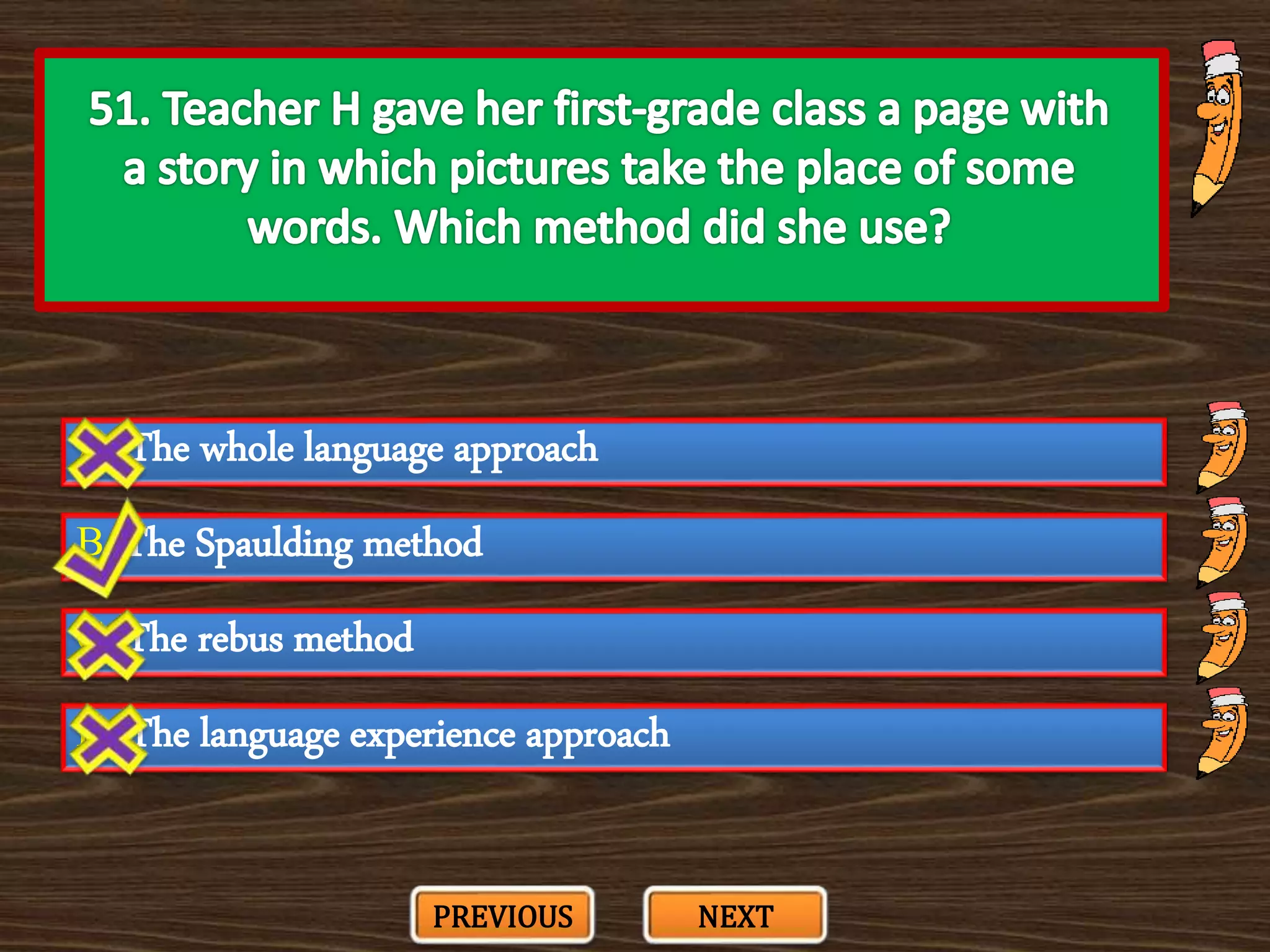
A. The whole language approach
C. The rebus method
B. The Spaulding method
D. The language experience approach
PREVIOUS NEXT
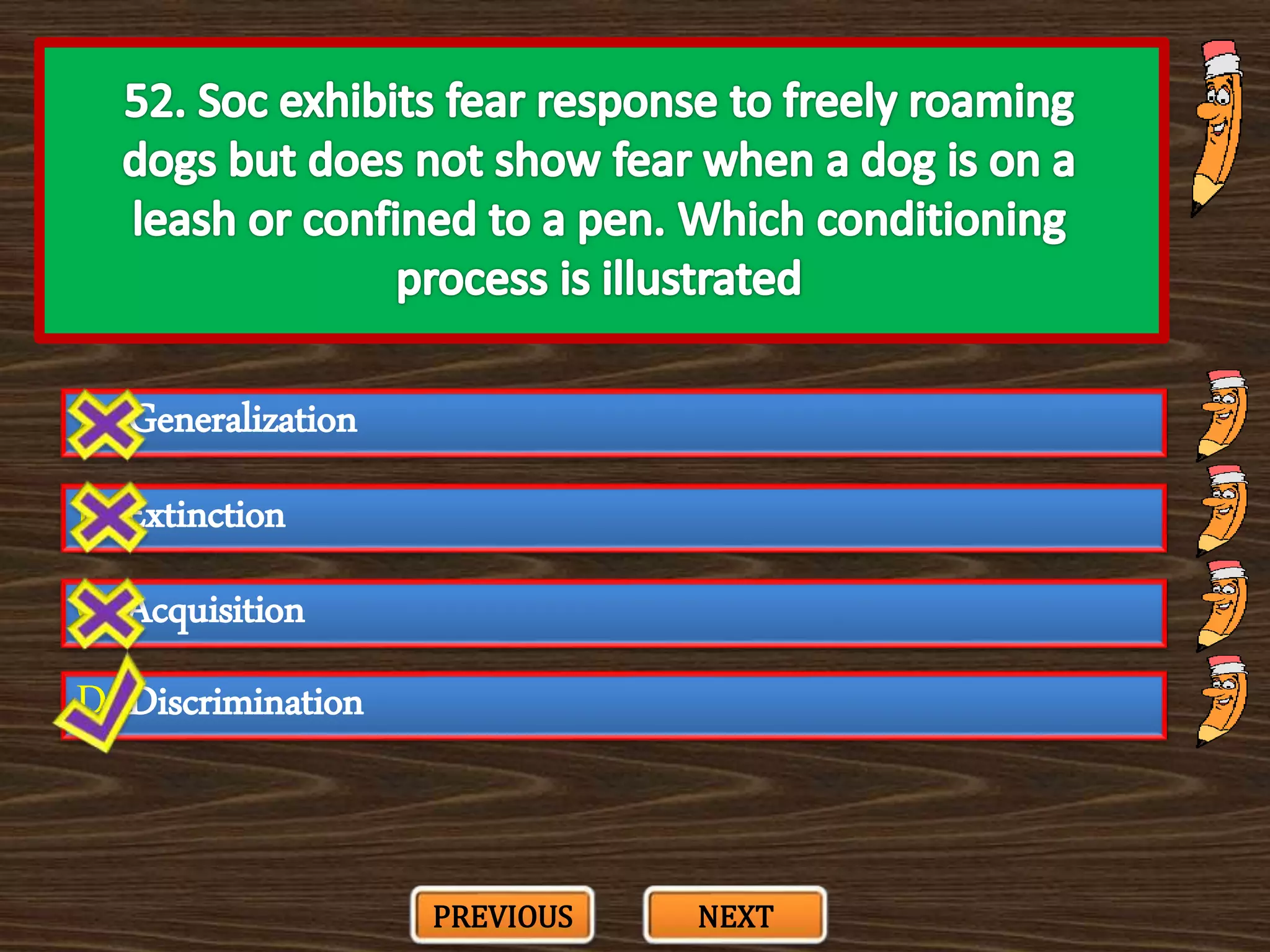
A. Generalization
C. Acquisition
B. Extinction
D. Discrimination
PREVIOUS NEXT
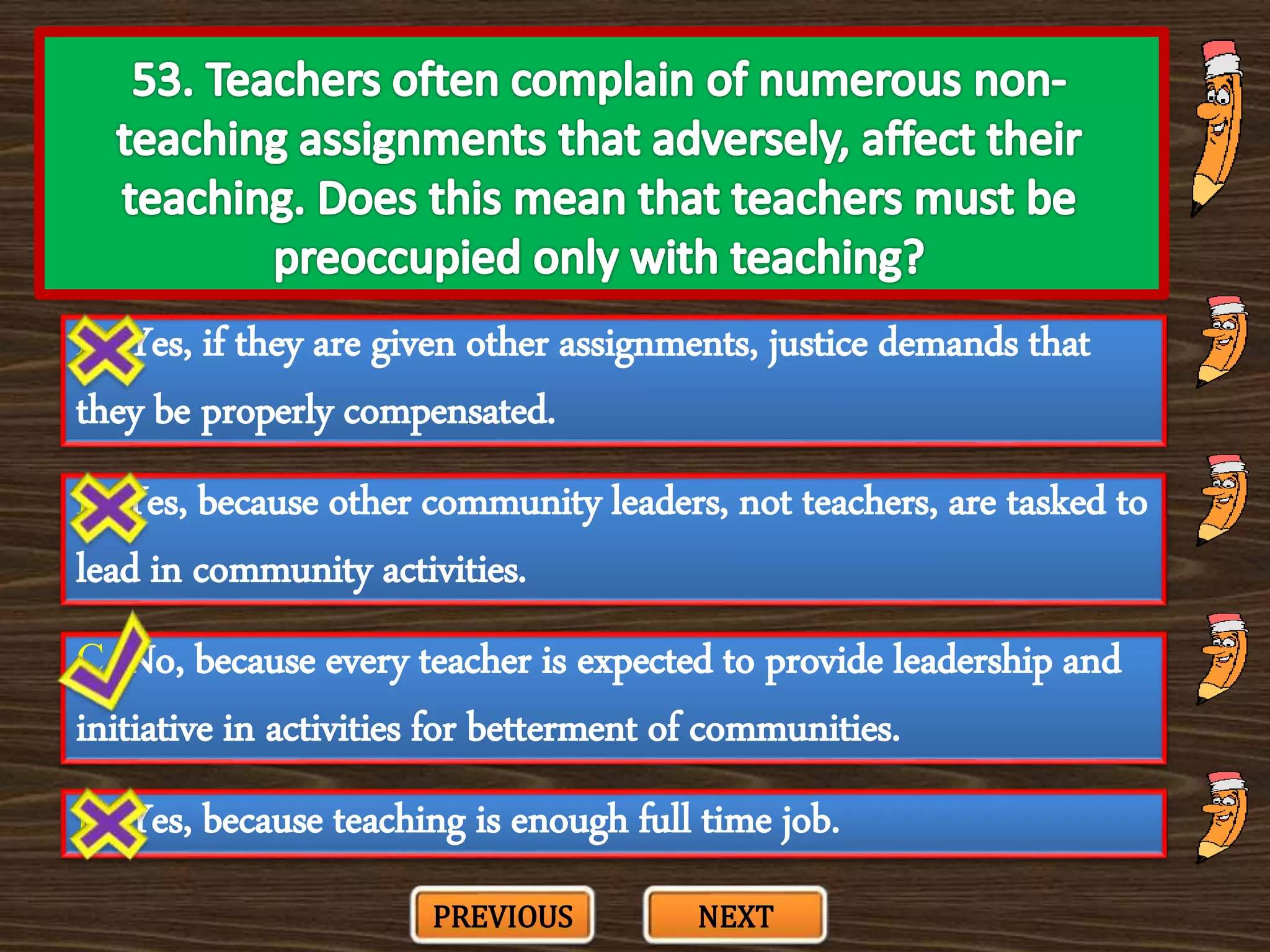
A. Yes, if they are given other assignments, justice demands that
they be properly compensated.
C. No, because every teacher is expected to provide leadership and
initiative in activities for betterment of communities.
B. Yes, because other community leaders, not teachers, are tasked to
lead in community activities.
D. Yes, because teaching is enough full time job.
PREVIOUS NEXT
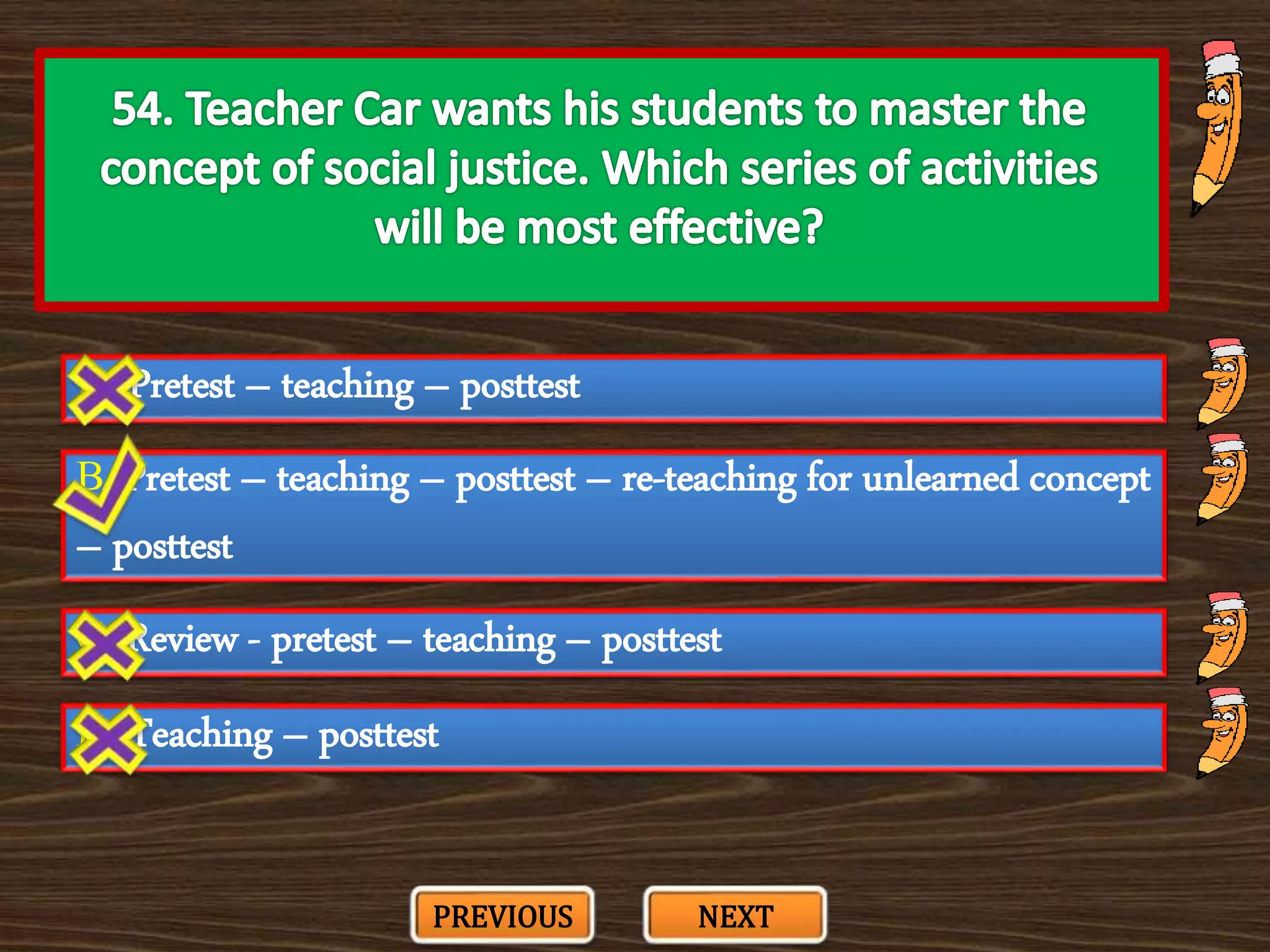
A. Pretest – teaching – posttest
C. Review - pretest – teaching – posttest
B. Pretest – teaching – posttest – re-teaching for unlearned concept
– posttest
D. Teaching – posttest
PREVIOUS NEXT
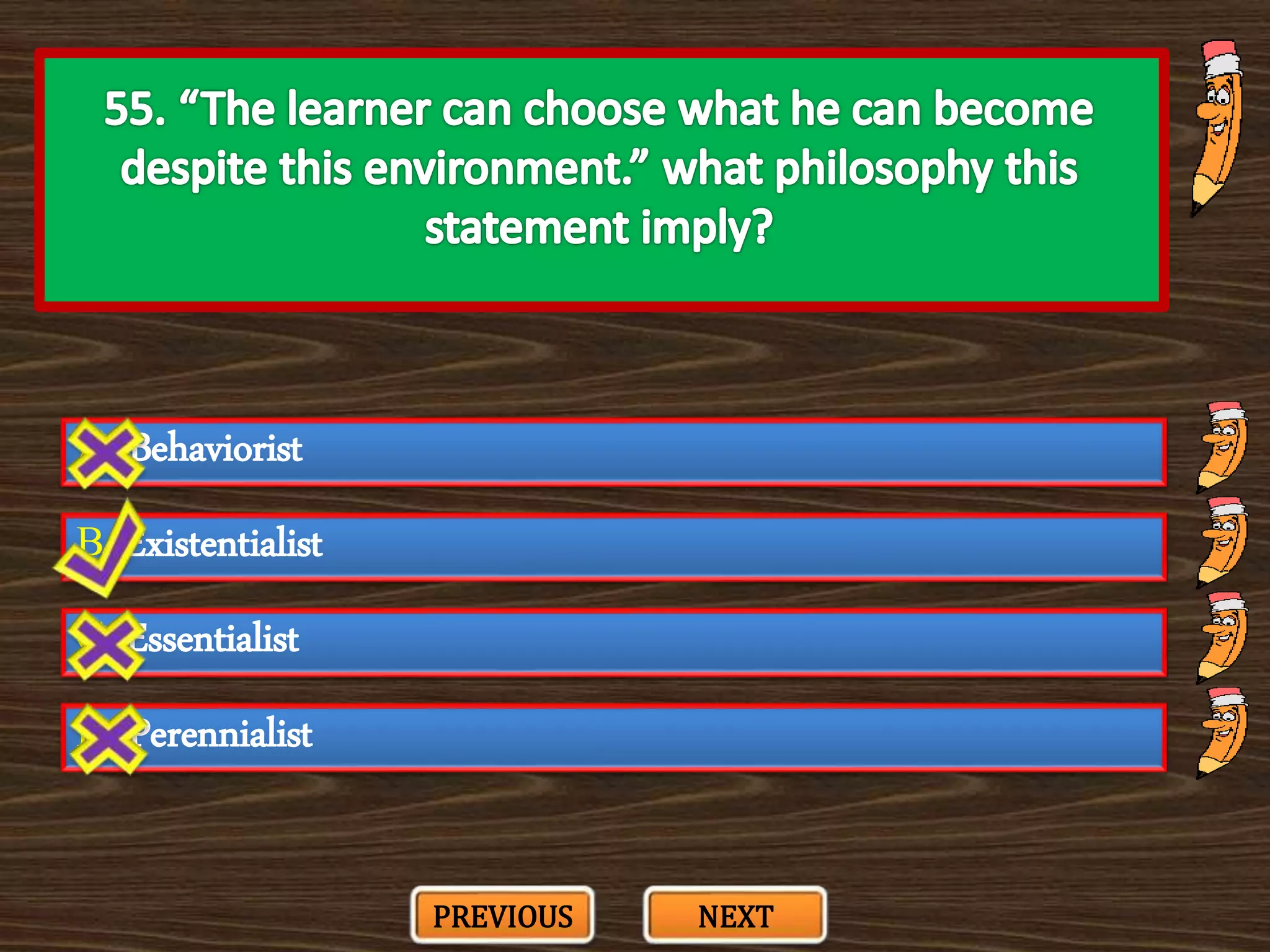
A. Behaviorist
C. Essentialist
B. Existentialist
D. Perennialist
PREVIOUS NEXT
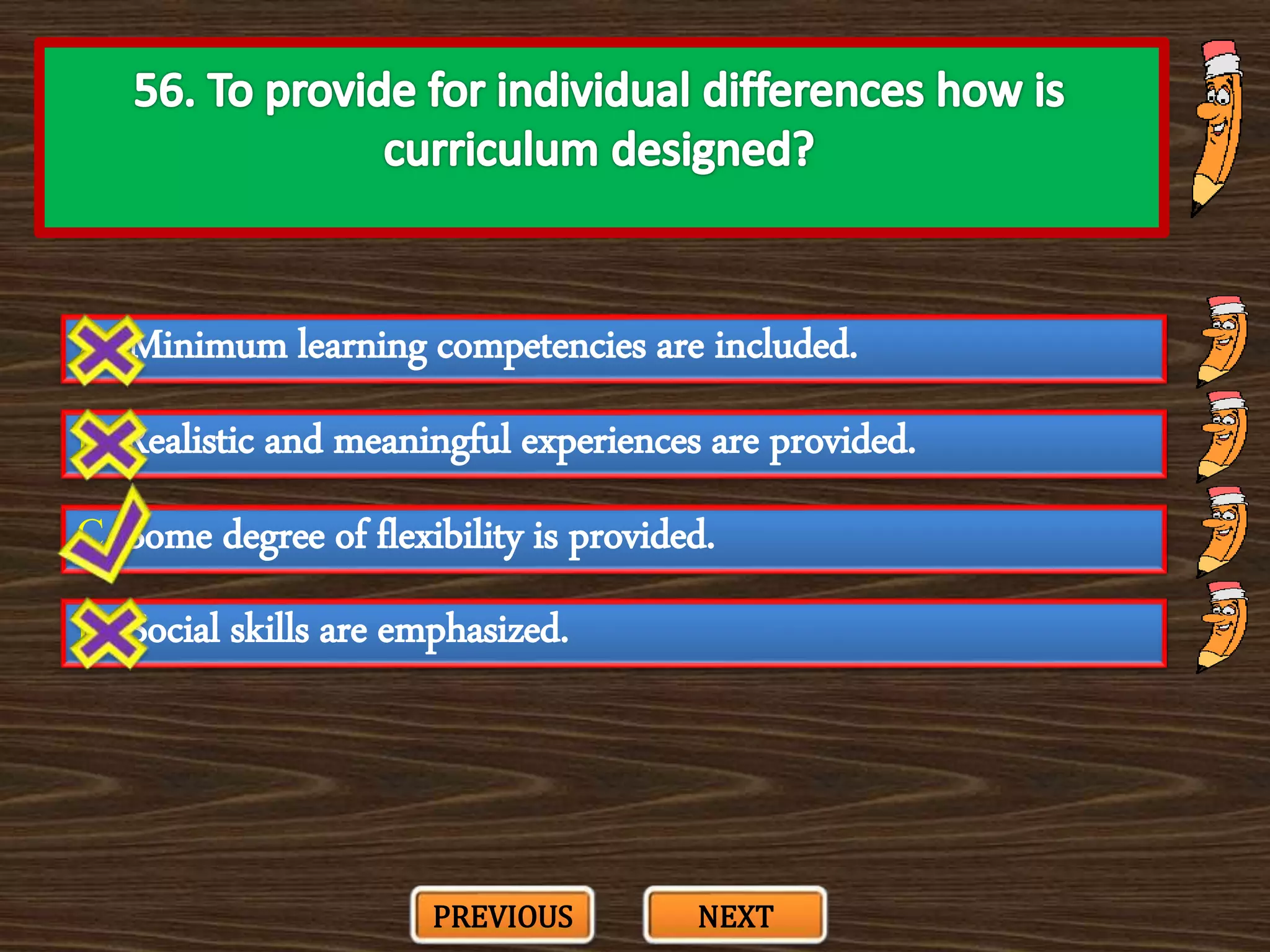
A. Minimum learning competencies are included.
C. Some degree of flexibility is provided.
B. Realistic and meaningful experiences are provided.
D. Social skills are emphasized.
PREVIOUS NEXT
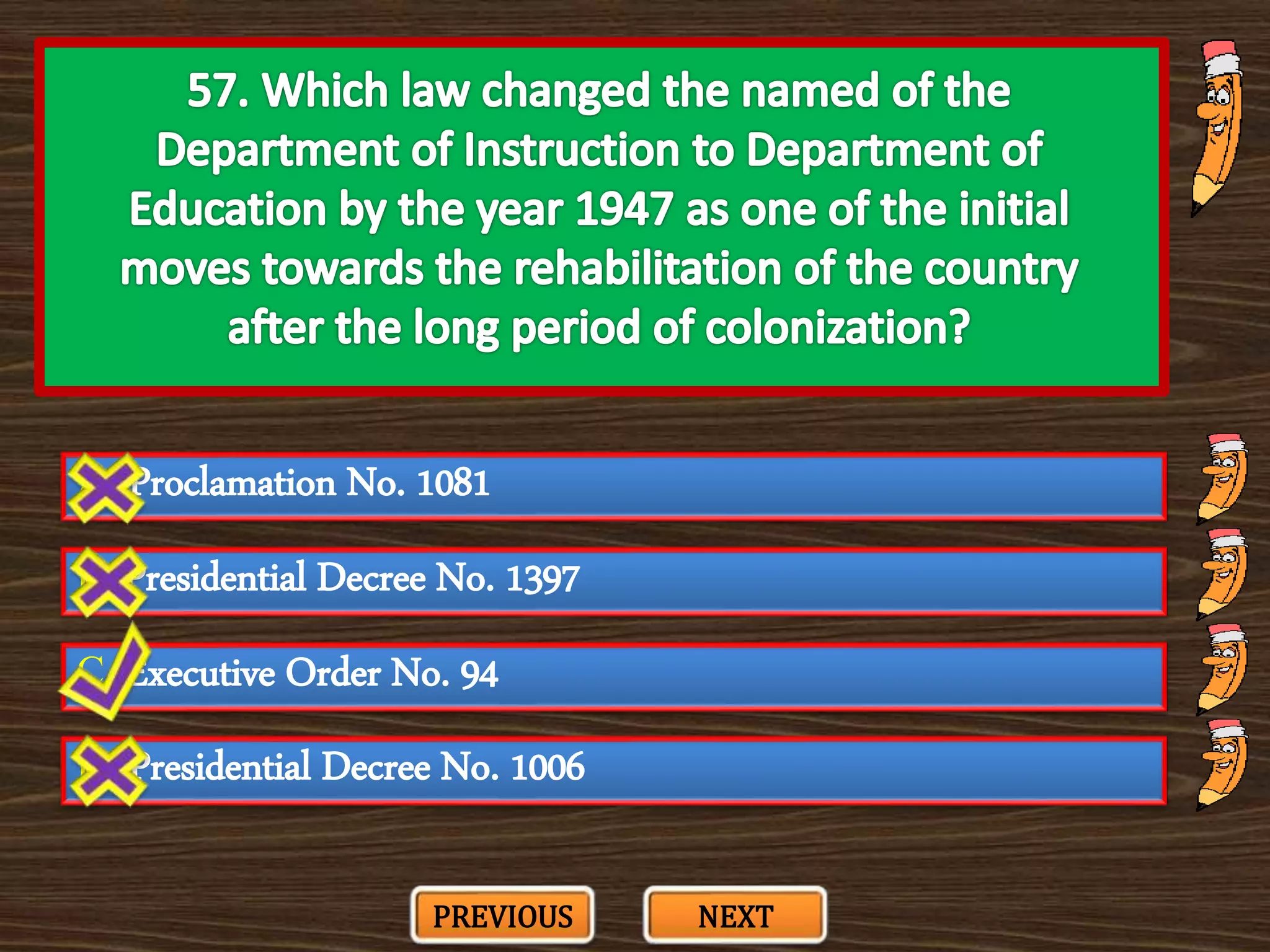
A. Proclamation No. 1081
C. Executive Order No. 94
B. Presidential Decree No. 1397
D. Presidential Decree No. 1006
PREVIOUS NEXT
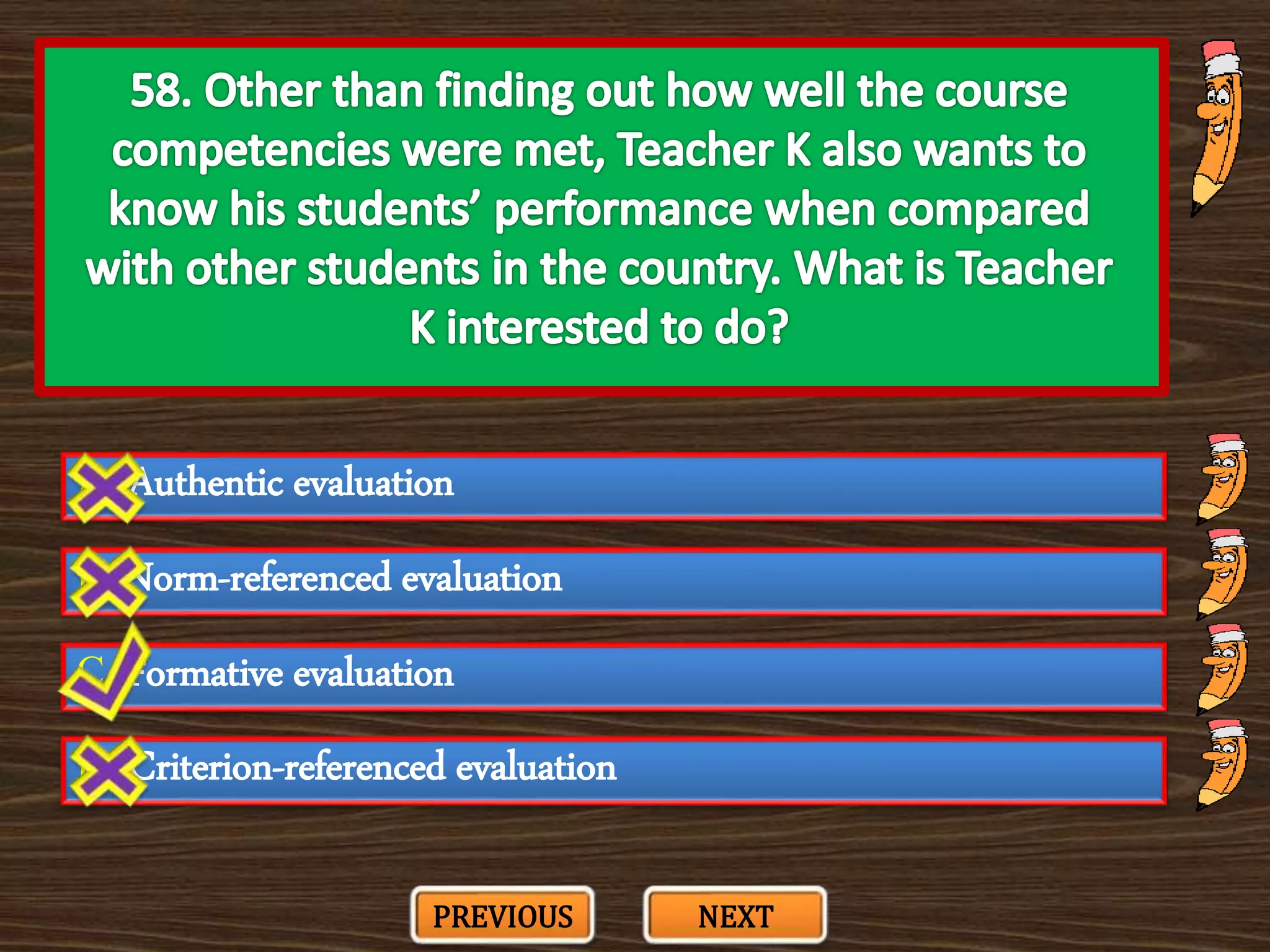
A. Authentic evaluation
C. Formative evaluation
B. Norm-referenced evaluation
D. Criterion-referenced evaluation
PREVIOUS NEXT
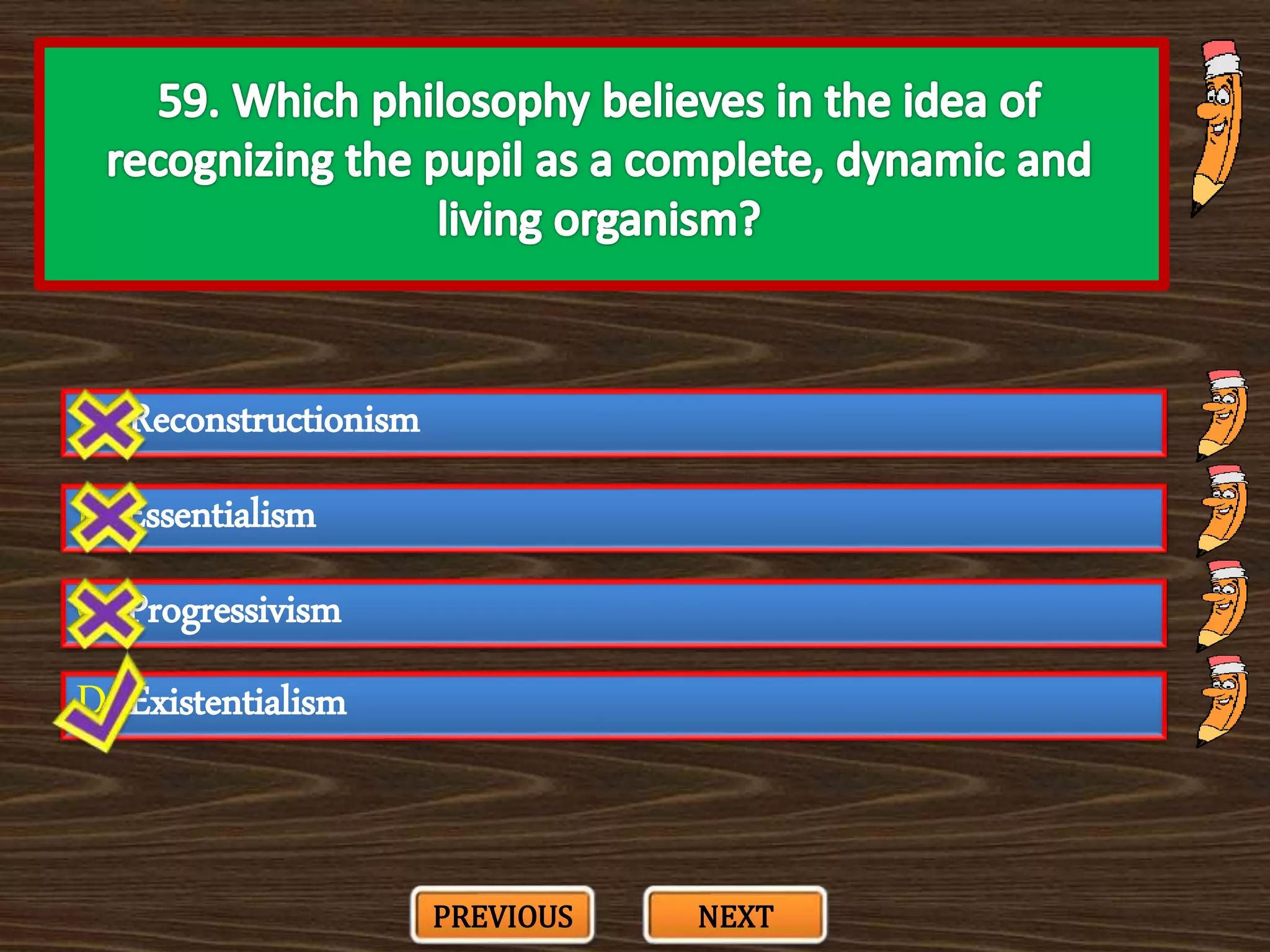
A. Reconstructionism
C. Progressivism
B. Essentialism
D. Existentialism
PREVIOUS NEXT
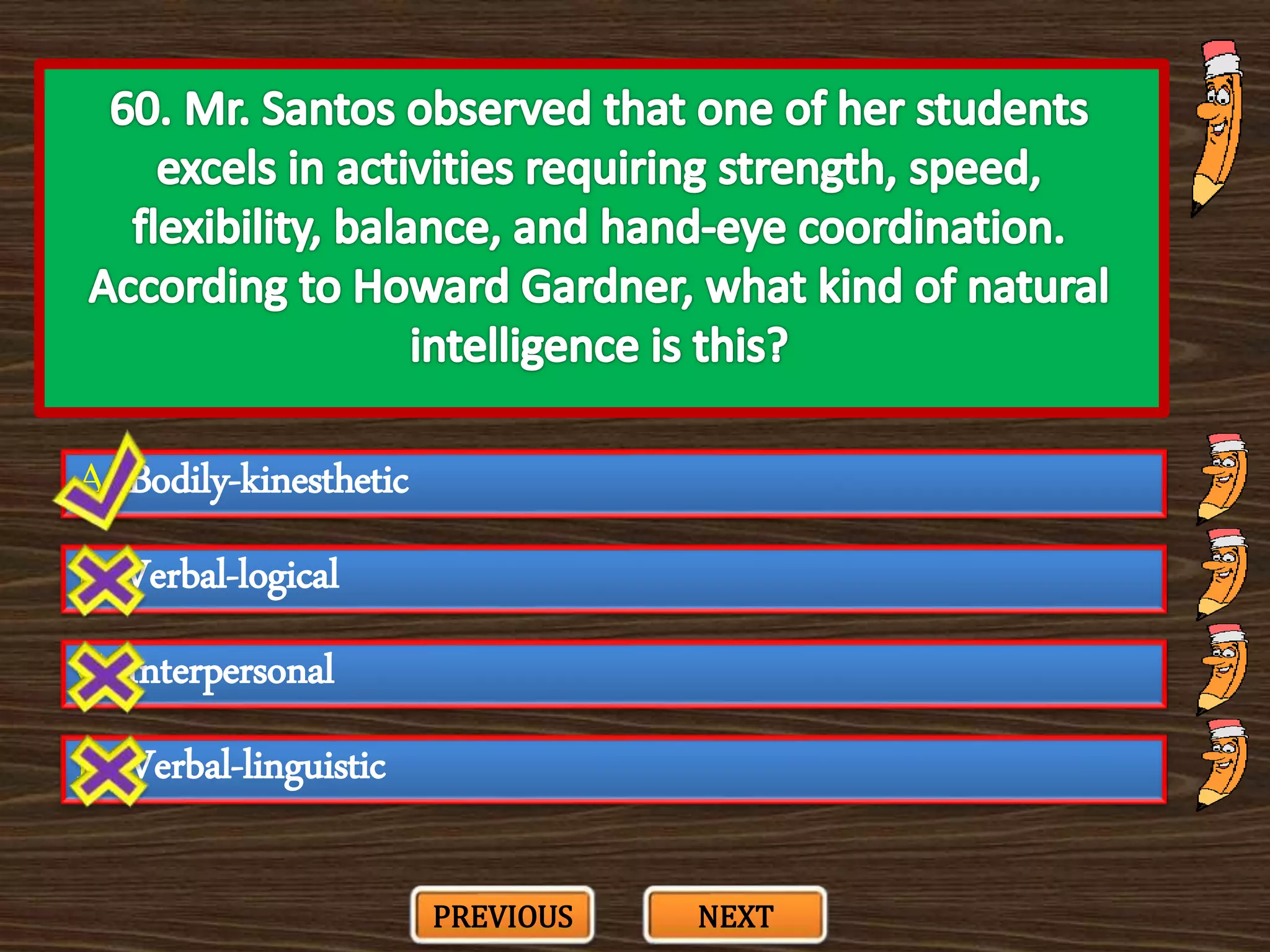
A. Bodily-kinesthetic
C. Interpersonal
B. Verbal-logical
D. Verbal-linguistic
PREVIOUS NEXT
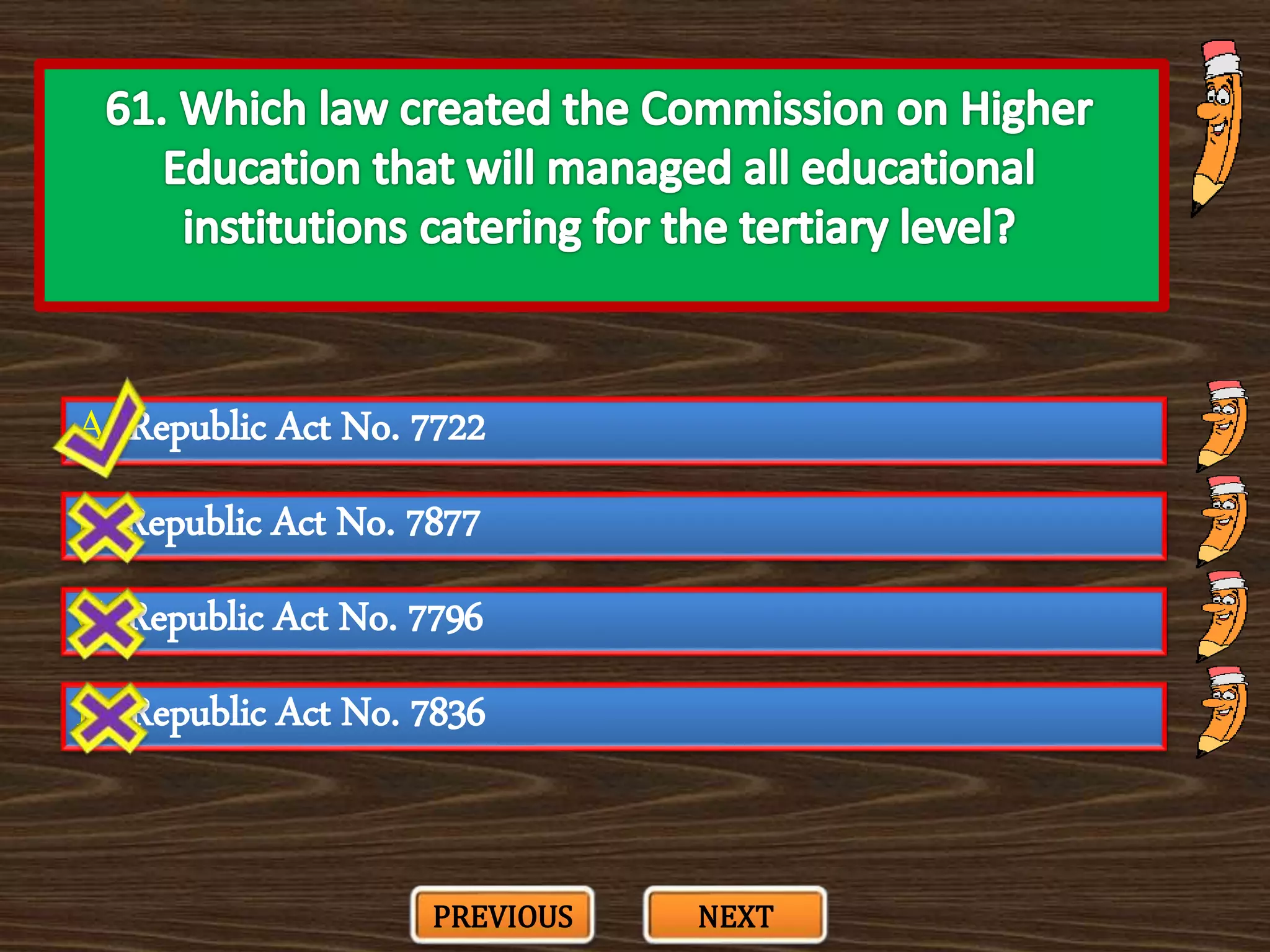
A. Republic Act No. 7722
C. Republic Act No. 7796
B. Republic Act No. 7877
D. Republic Act No. 7836
PREVIOUS NEXT
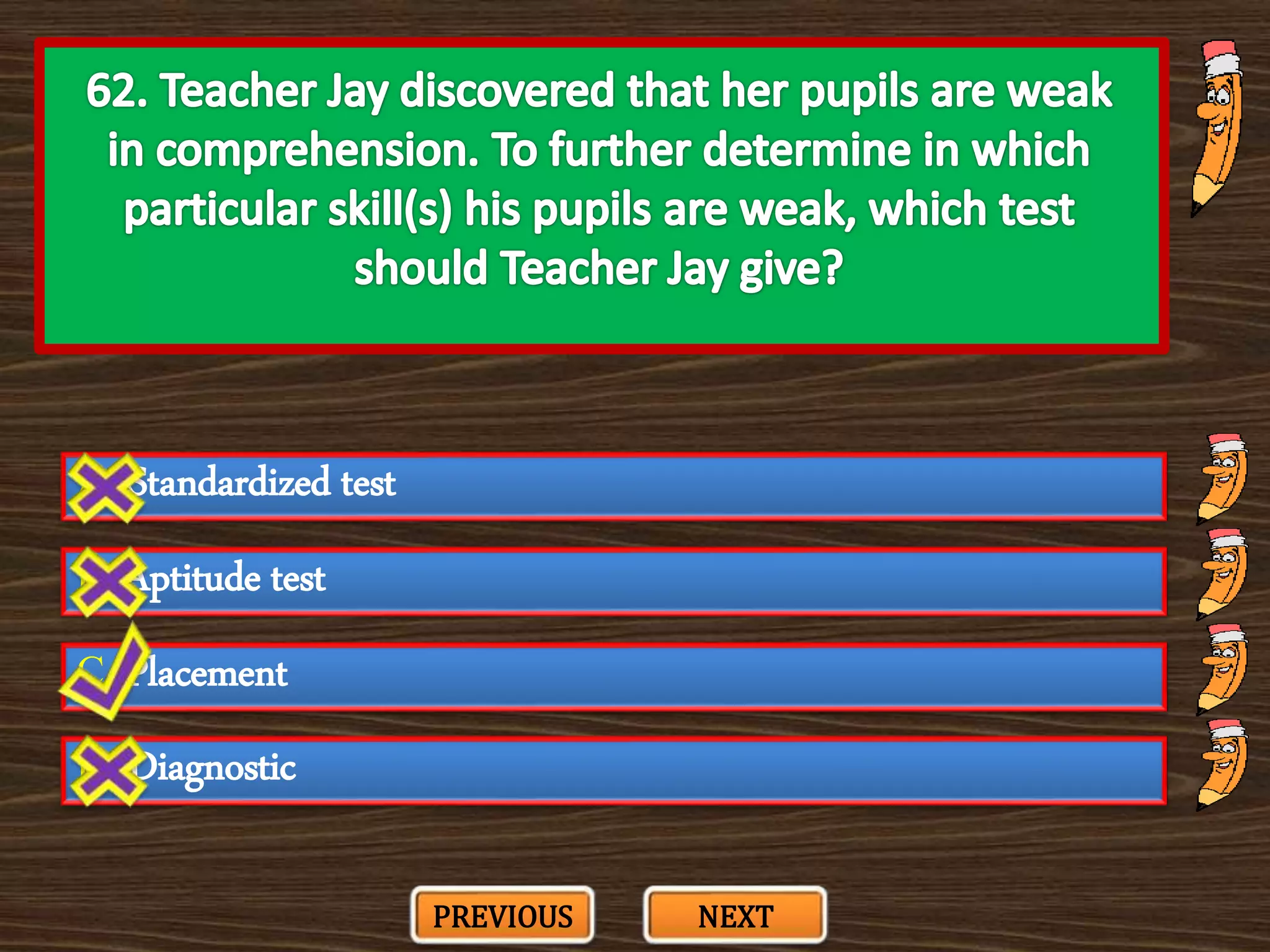
A. Standardized test
C. Placement
B. Aptitude test
D. Diagnostic
PREVIOUS NEXT
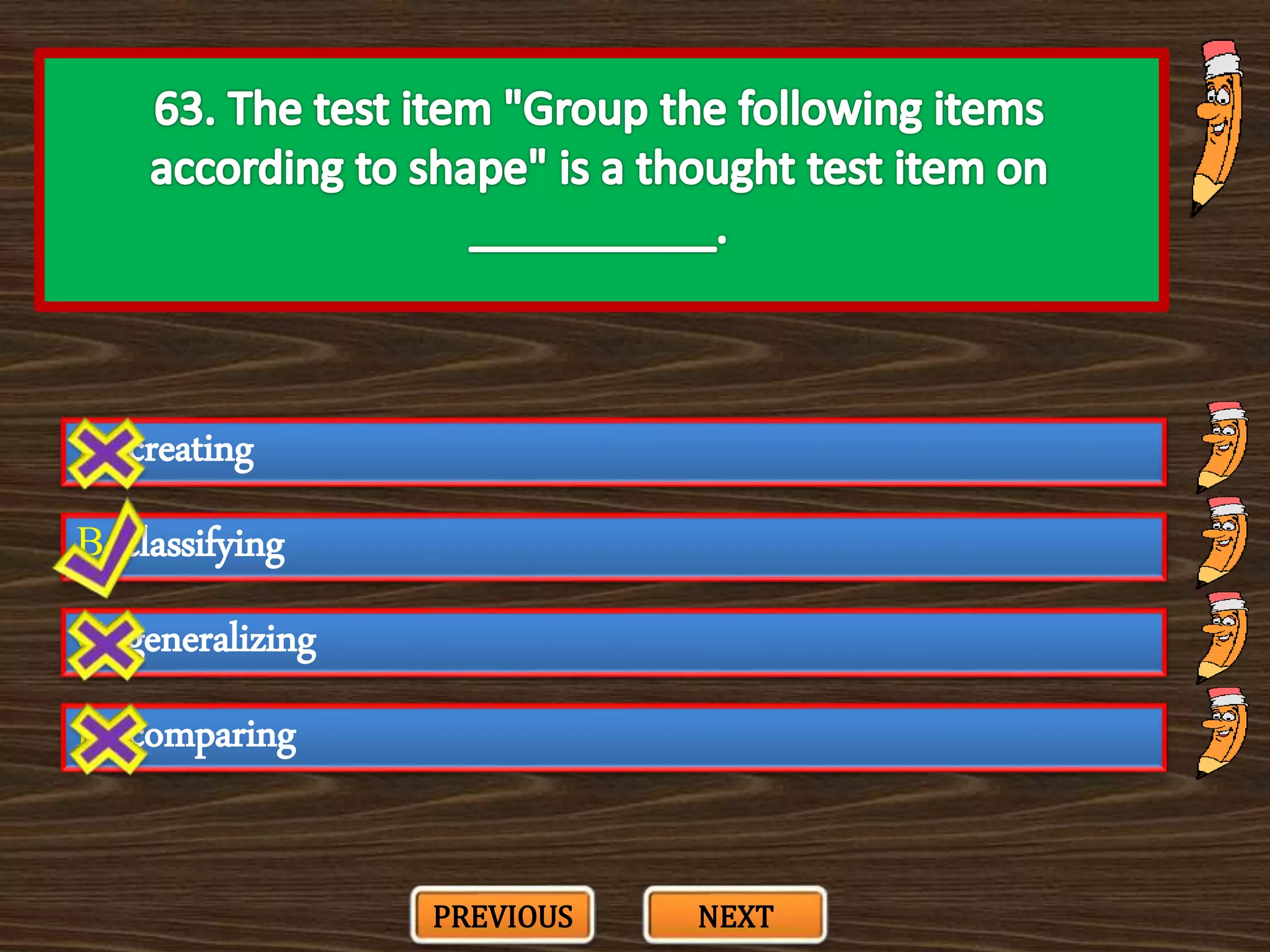
A. creating
C. generalizing
B. classifying
D. comparing
PREVIOUS NEXT
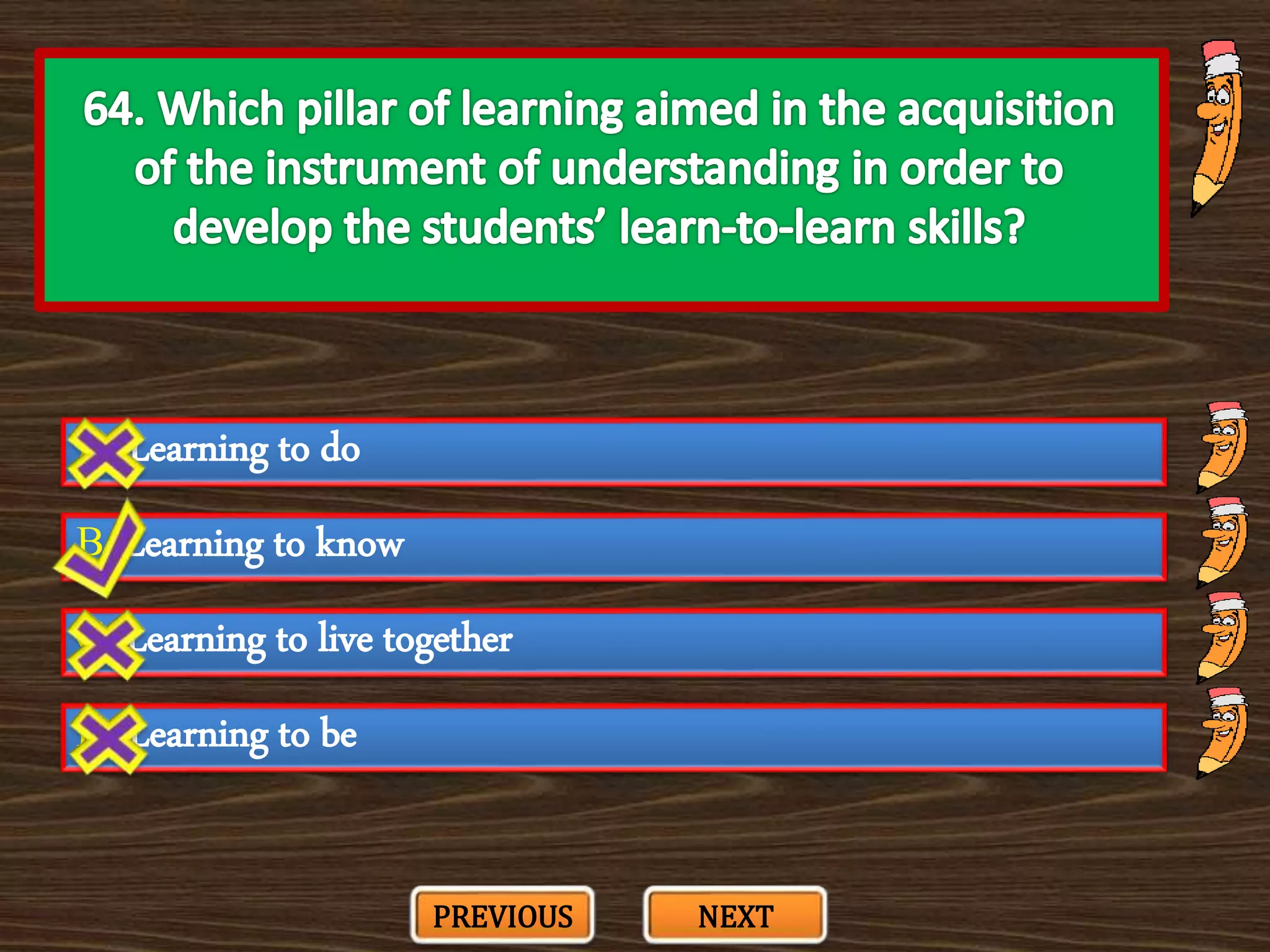
A. Learning to do
C. Learning to live together
B. Learning to know
D. Learning to be
PREVIOUS NEXT
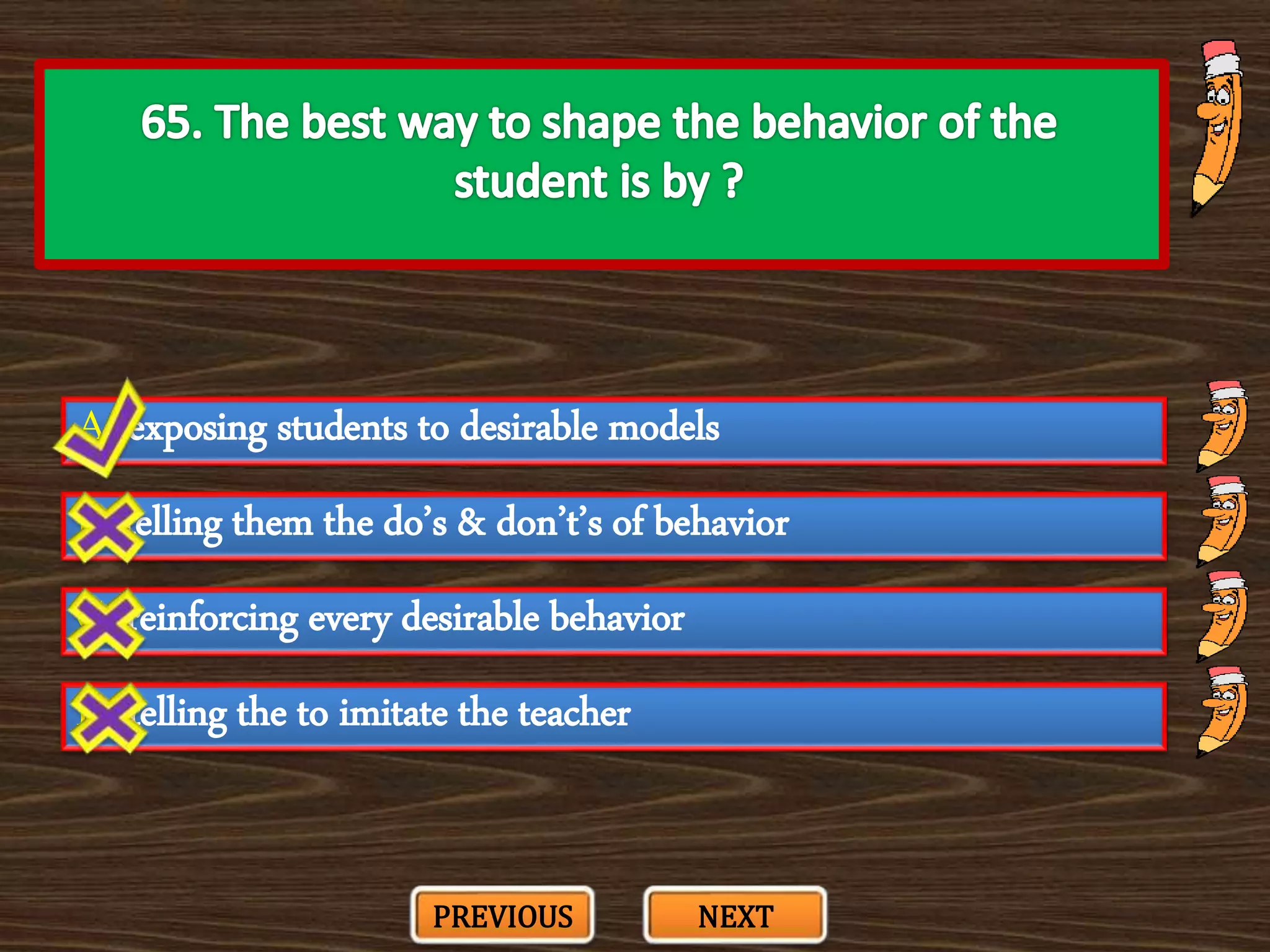
A. exposing students to desirable models
C. reinforcing every desirable behavior
B. telling them the do’s & don’t’s of behavior
D. telling the to imitate the teacher
PREVIOUS NEXT
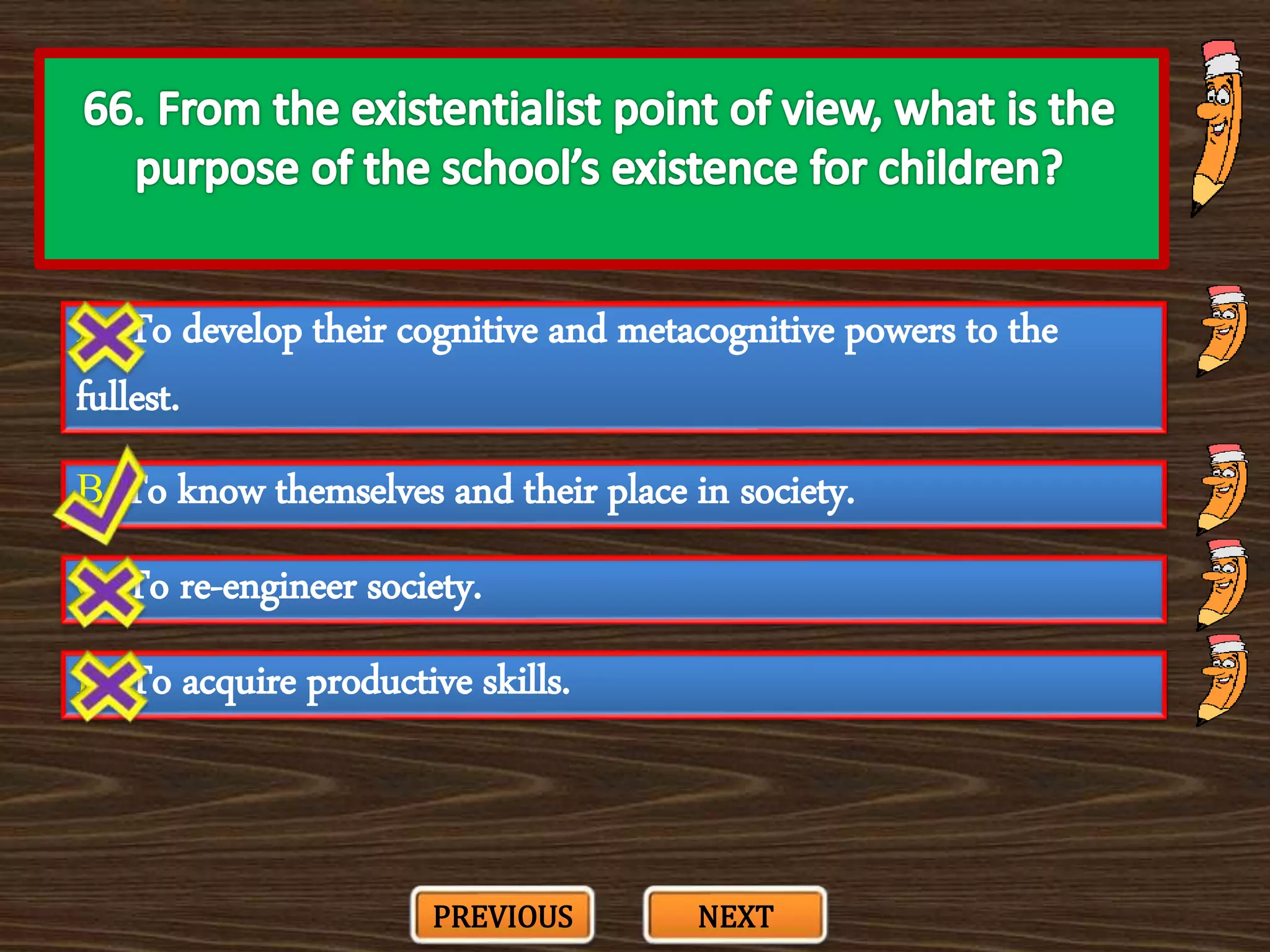
A. To develop their cognitive and metacognitive powers to the
fullest.
C. To re-engineer society.
B. To know themselves and their place in society.
D. To acquire productive skills.
PREVIOUS NEXT
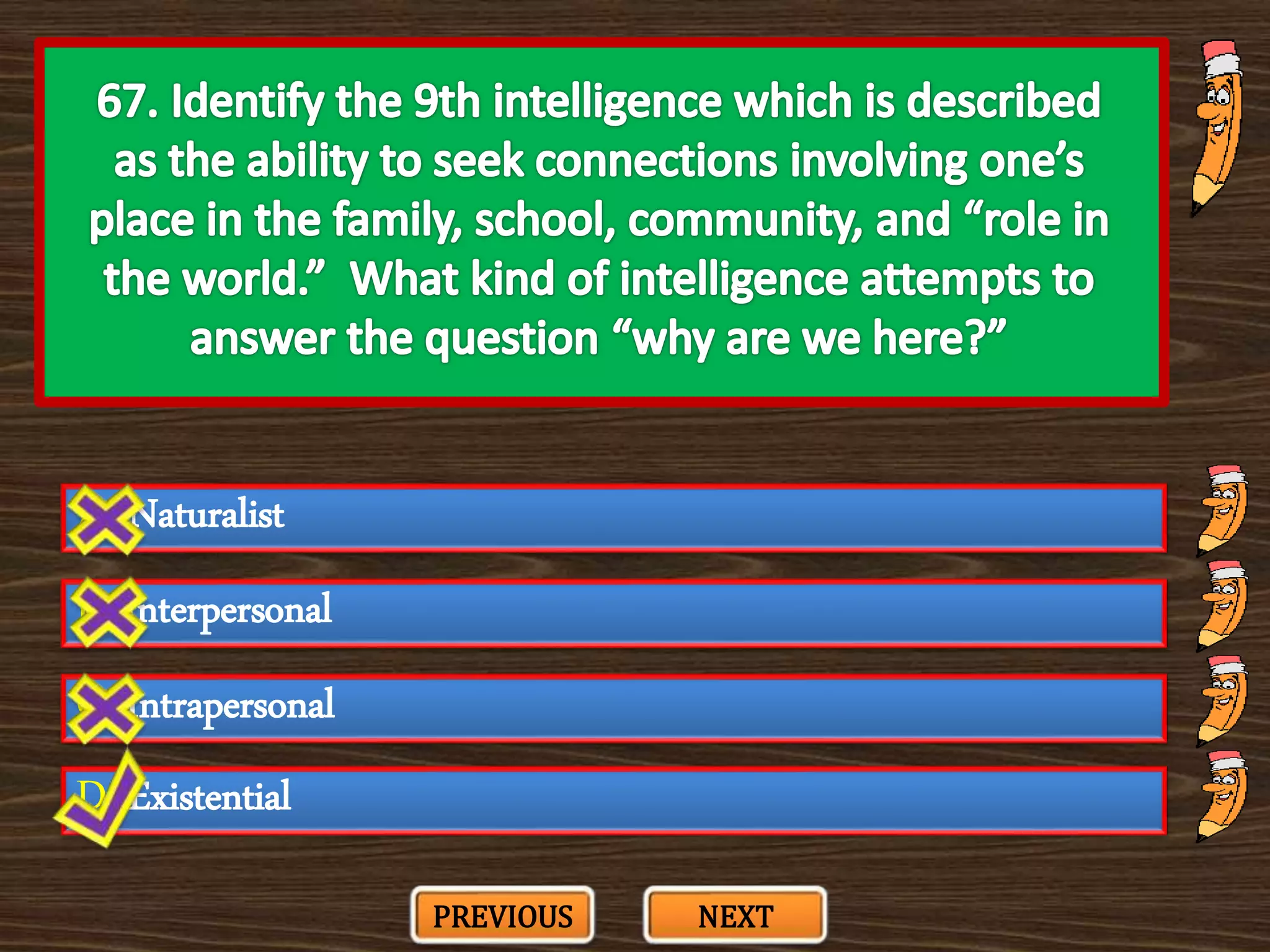
A. Naturalist
C. Intrapersonal
B. Interpersonal
D. Existential
PREVIOUS NEXT
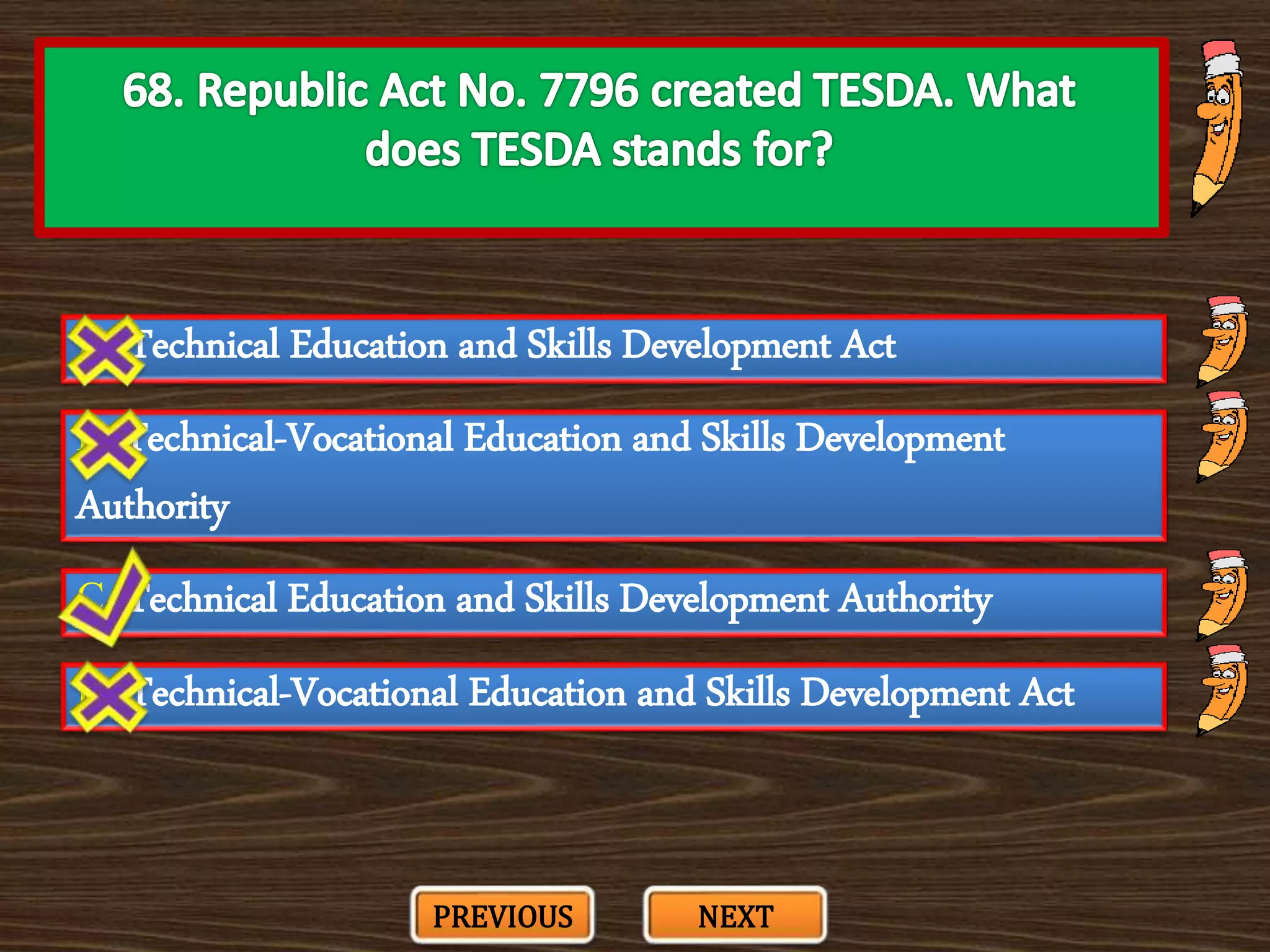
A. Technical Education and Skills Development Act
C. Technical Education and Skills Development Authority
B. Technical-Vocational Education and Skills Development
Authority
D. Technical-Vocational Education and Skills Development Act
PREVIOUS NEXT
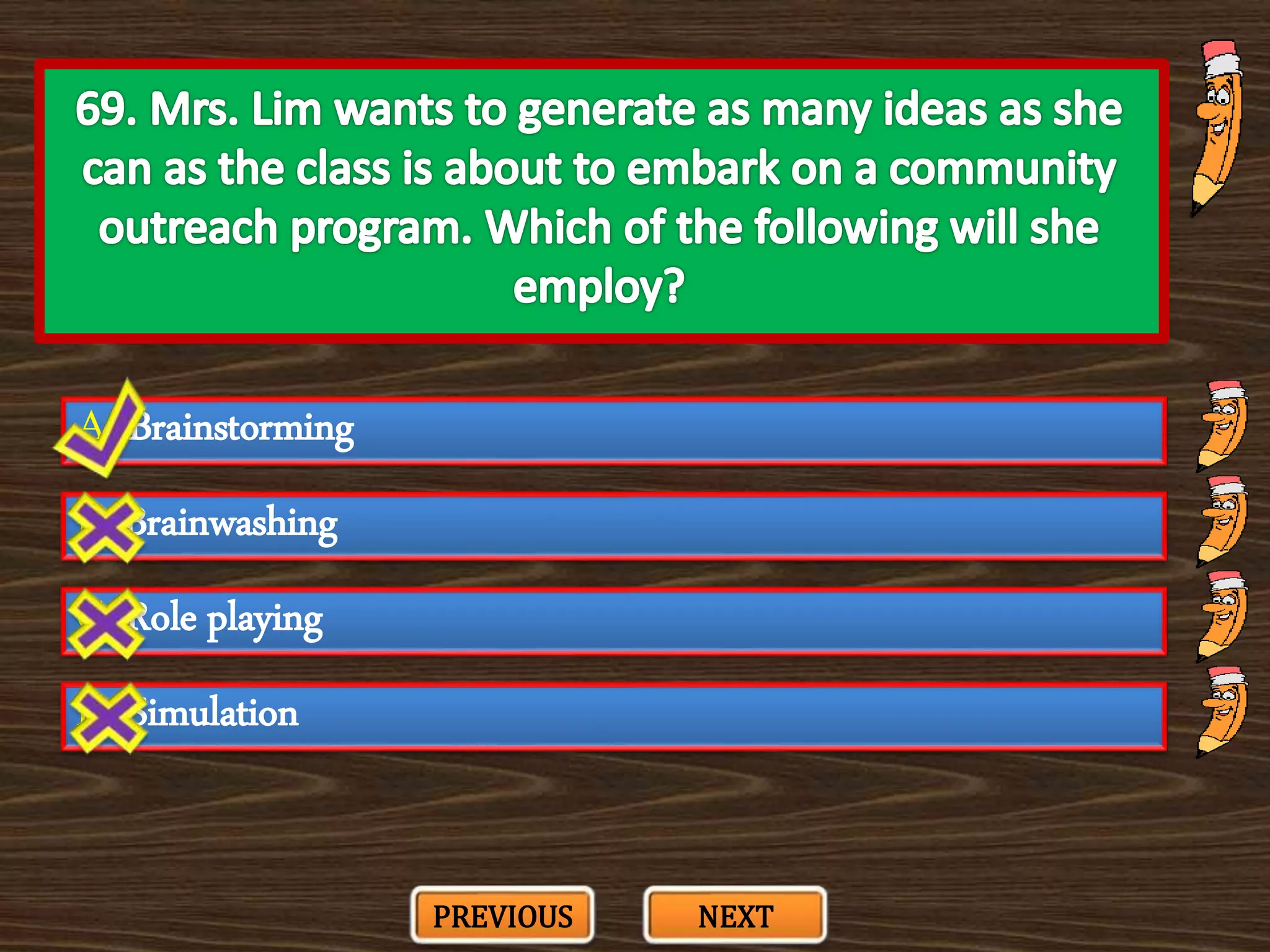
A. Brainstorming
C. Role playing
B. Brainwashing
D. Simulation
PREVIOUS NEXT
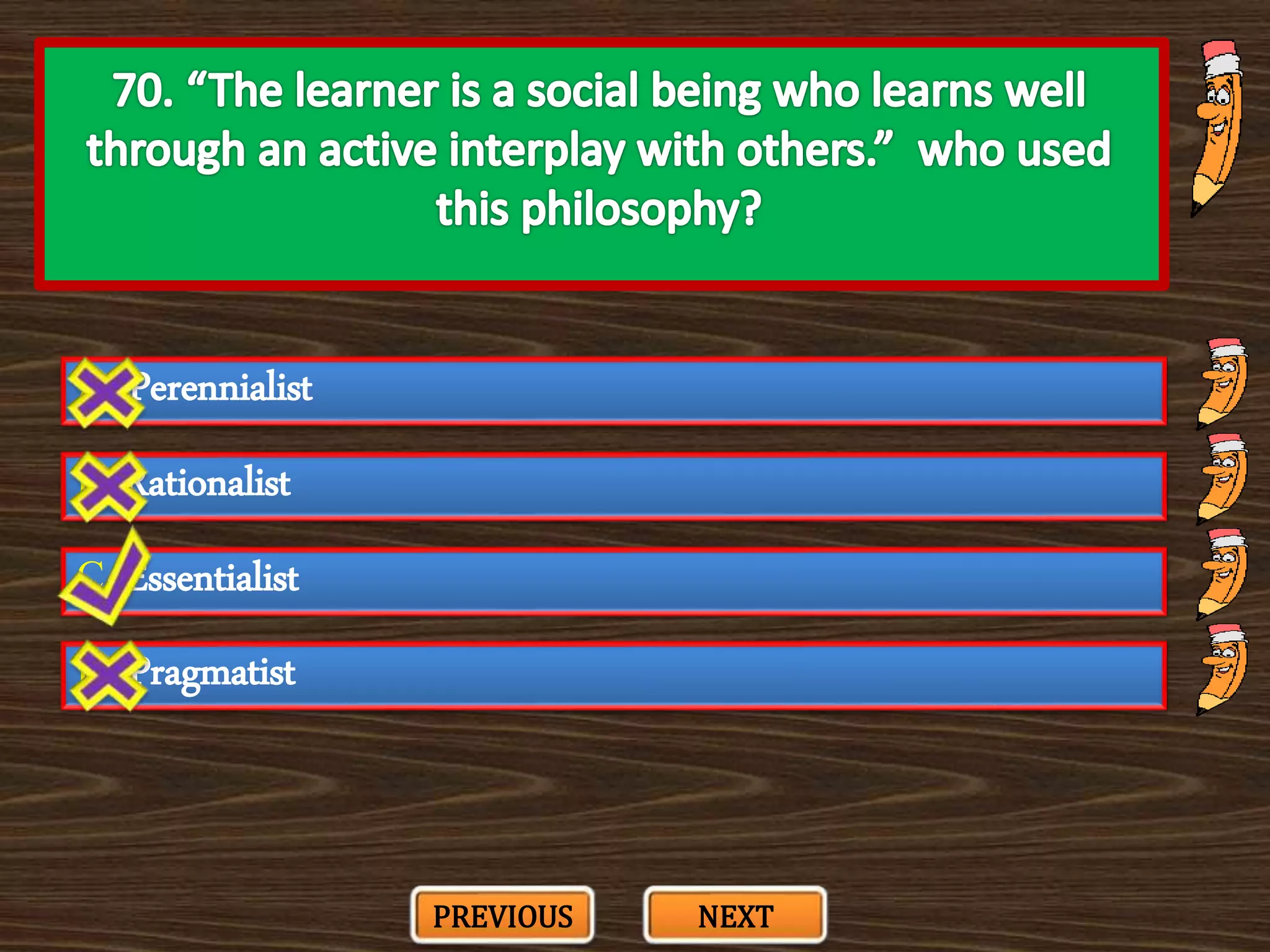
A. Perennialist
C. Essentialist
B. Rationalist
D. Pragmatist
PREVIOUS NEXT
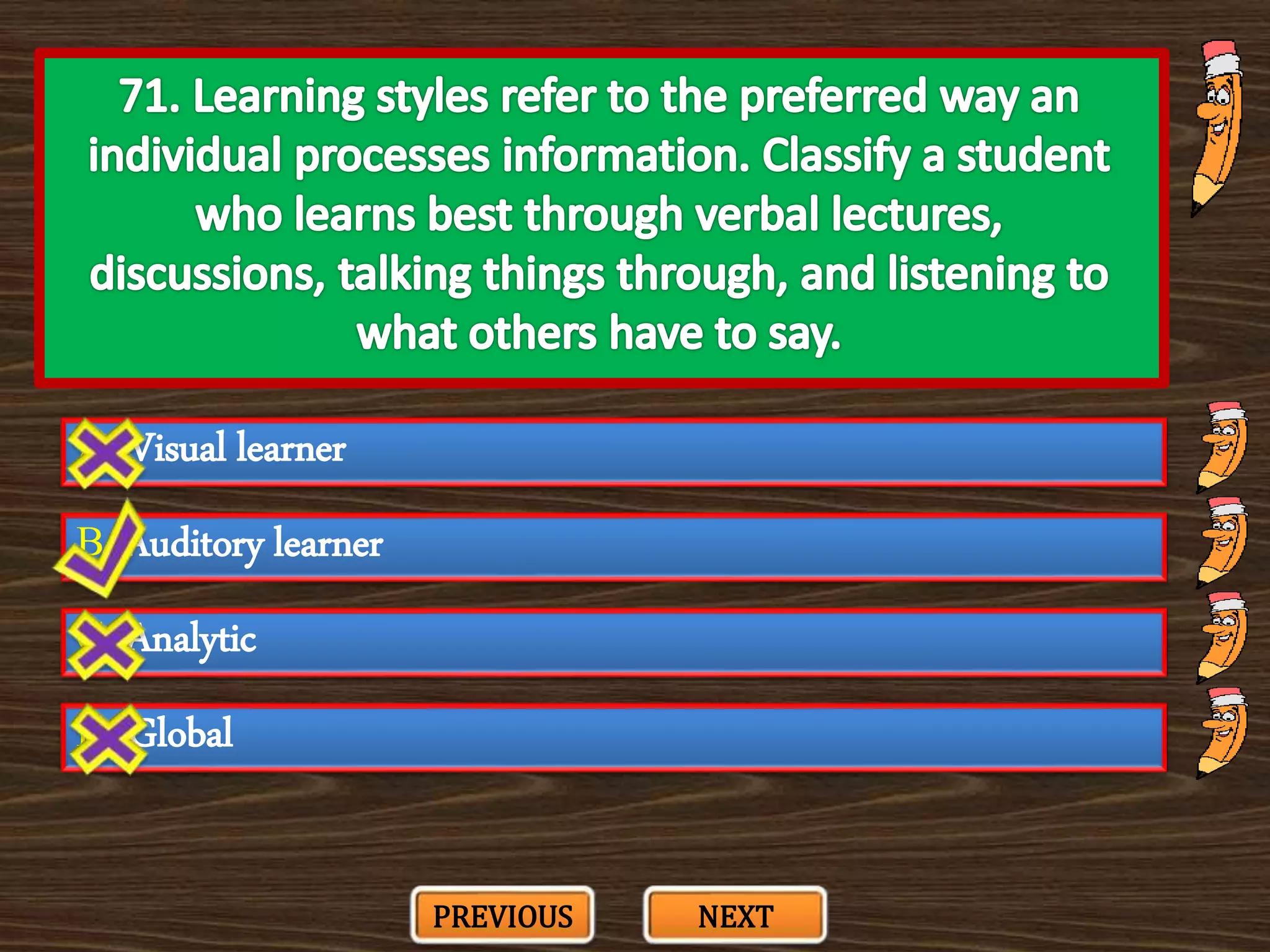
A. Visual learner
C. Analytic
B. Auditory learner
D. Global
PREVIOUS NEXT
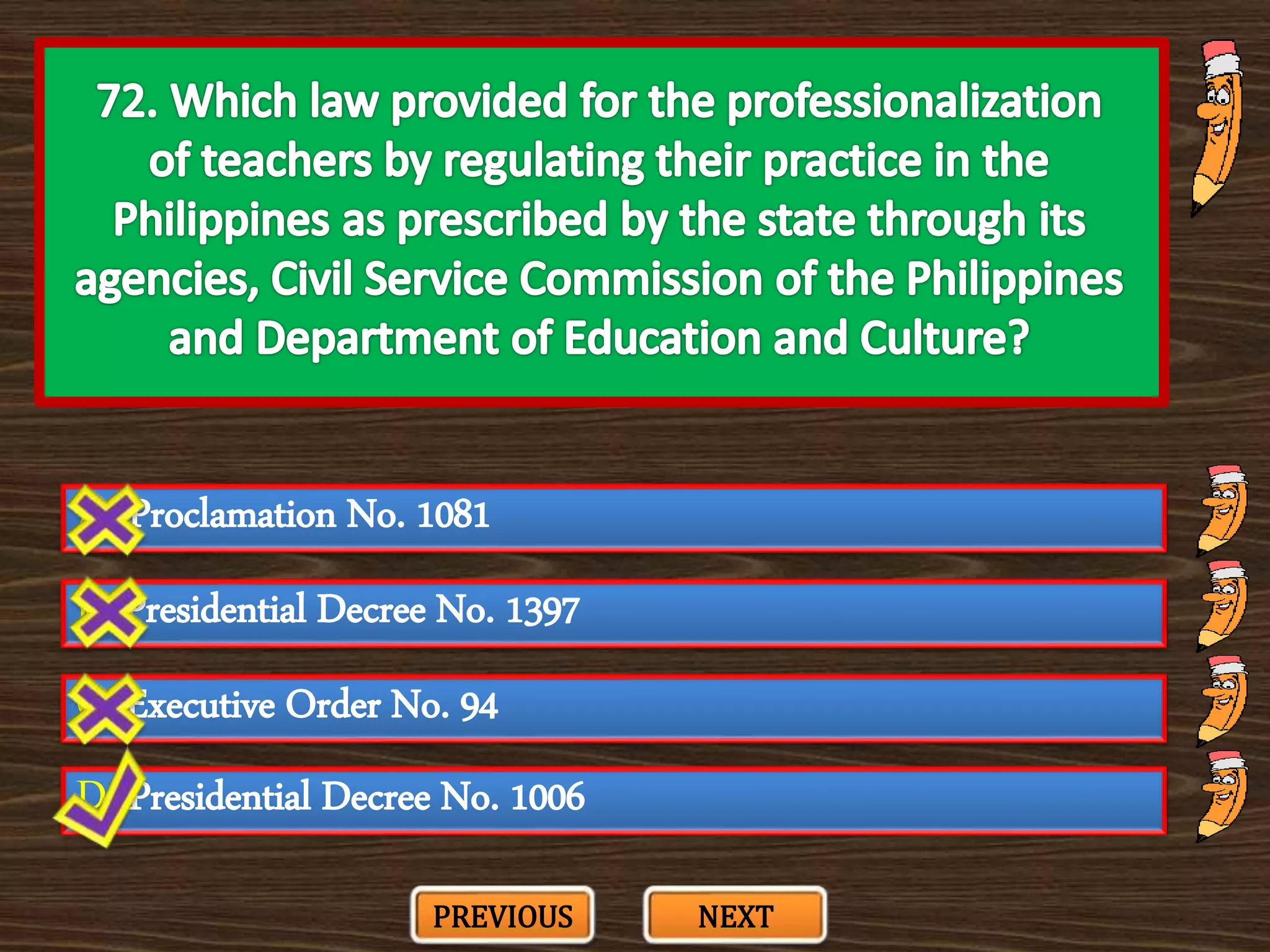
A. Proclamation No. 1081
C. Executive Order No. 94
B. Presidential Decree No. 1397
D. Presidential Decree No. 1006
PREVIOUS NEXT
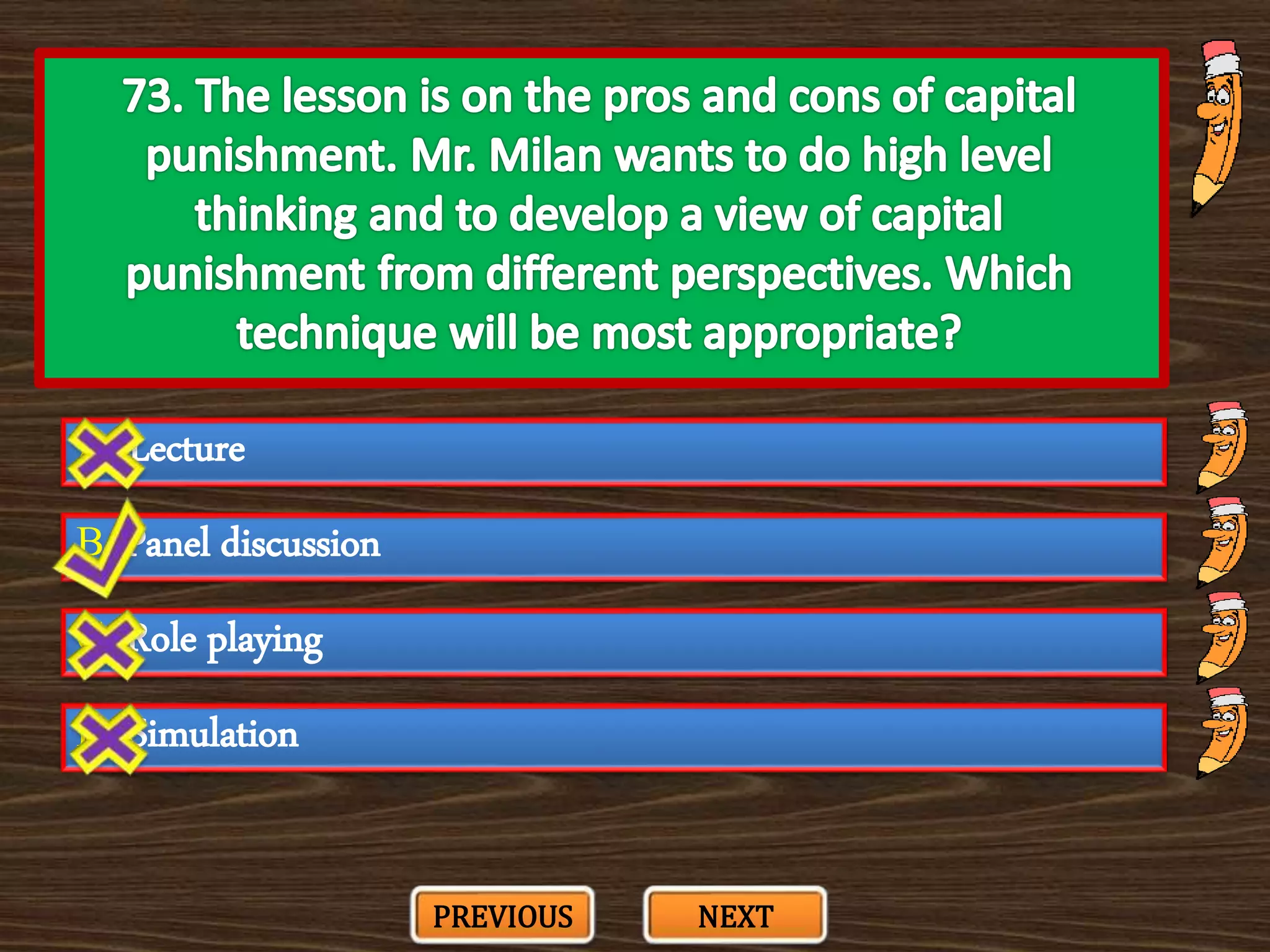
A. Lecture
C. Role playing
B. Panel discussion
D. Simulation
PREVIOUS NEXT
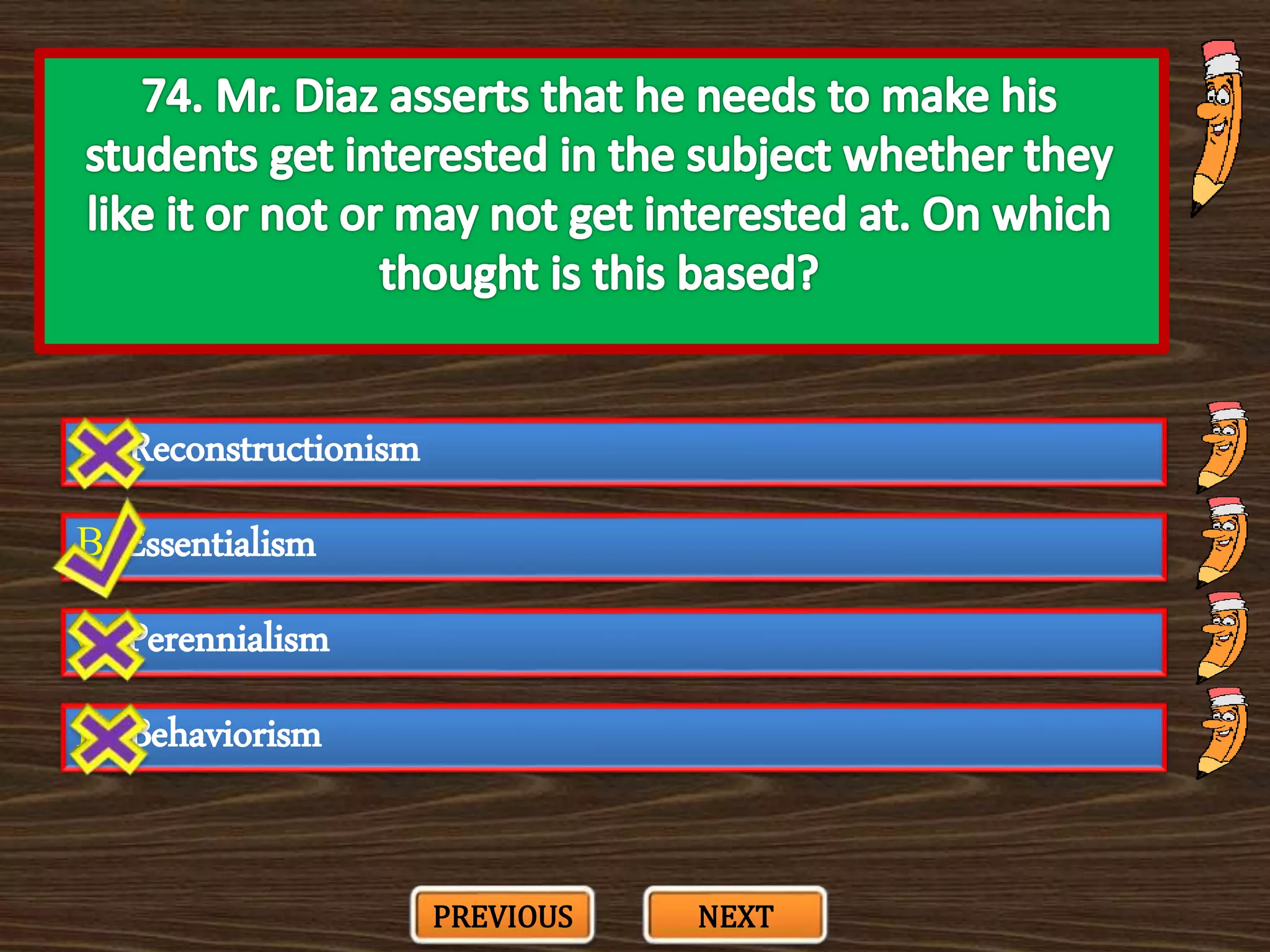
A. Reconstructionism
C. Perennialism
B. Essentialism
D. Behaviorism
PREVIOUS NEXT
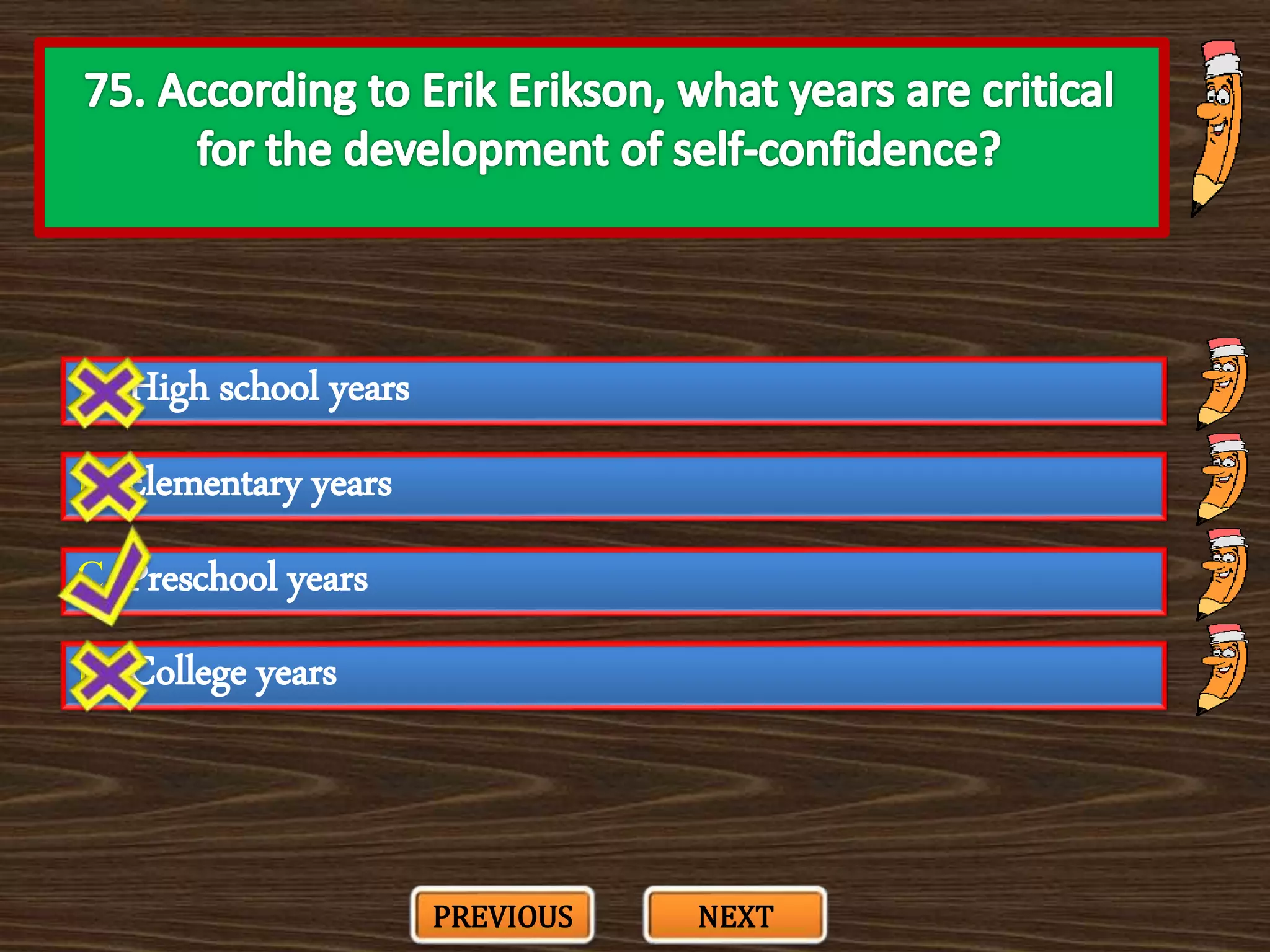
A. High school years
C. Preschool years
B. Elementary years
D. College years
PREVIOUS NEXT
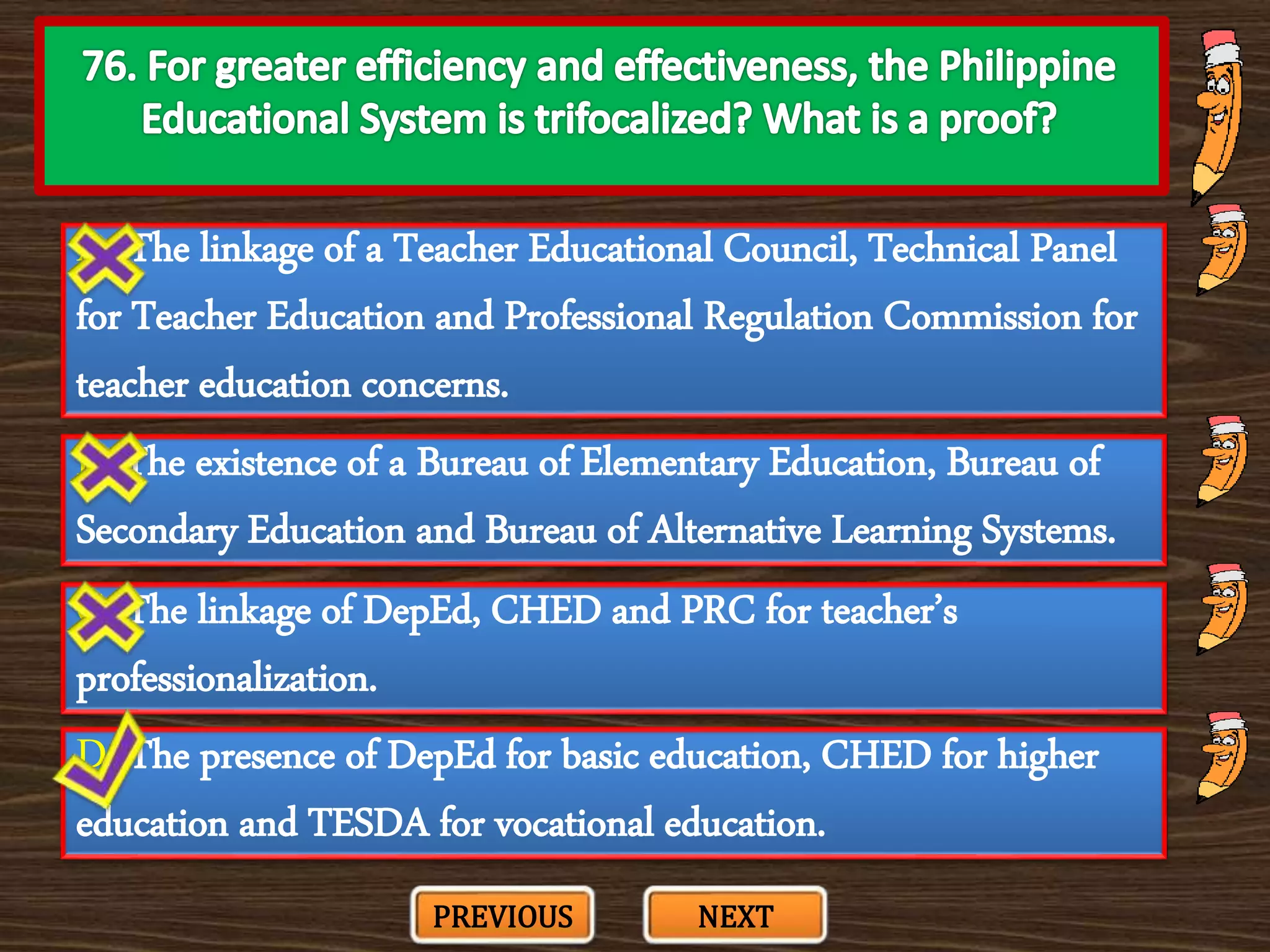
A. The linkage of a Teacher Educational Council, Technical Panel
for Teacher Education and Professional Regulation Commission for
teacher education concerns.
C. The linkage of DepEd, CHED and PRC for teacher’s
professionalization.
B. The existence of a Bureau of Elementary Education, Bureau of
Secondary Education and Bureau of Alternative Learning Systems.
D. The presence of DepEd for basic education, CHED for higher
education and TESDA for vocational education.
PREVIOUS NEXT
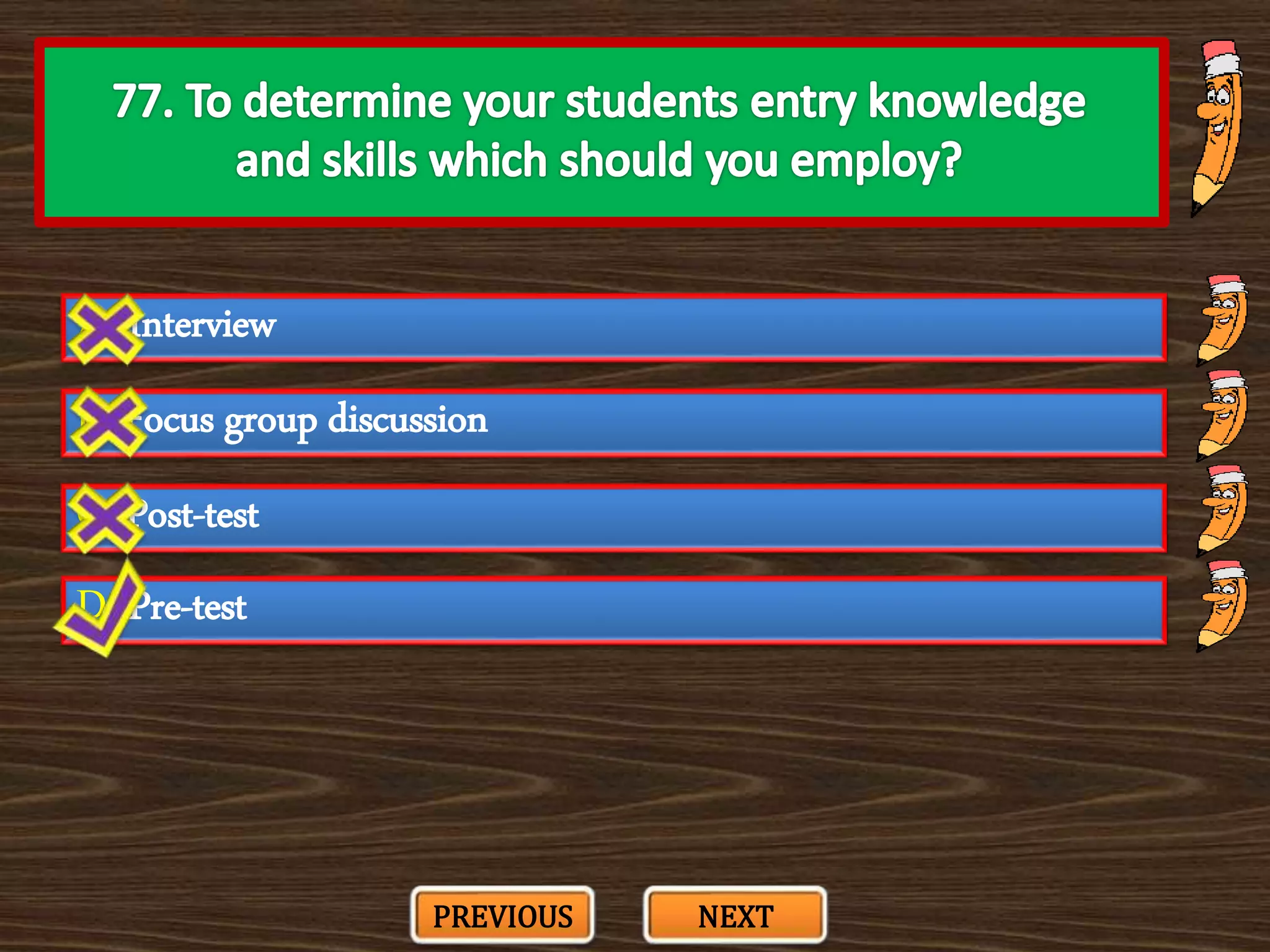
A. Interview
C. Post-test
B. Focus group discussion
D. Pre-test
PREVIOUS NEXT
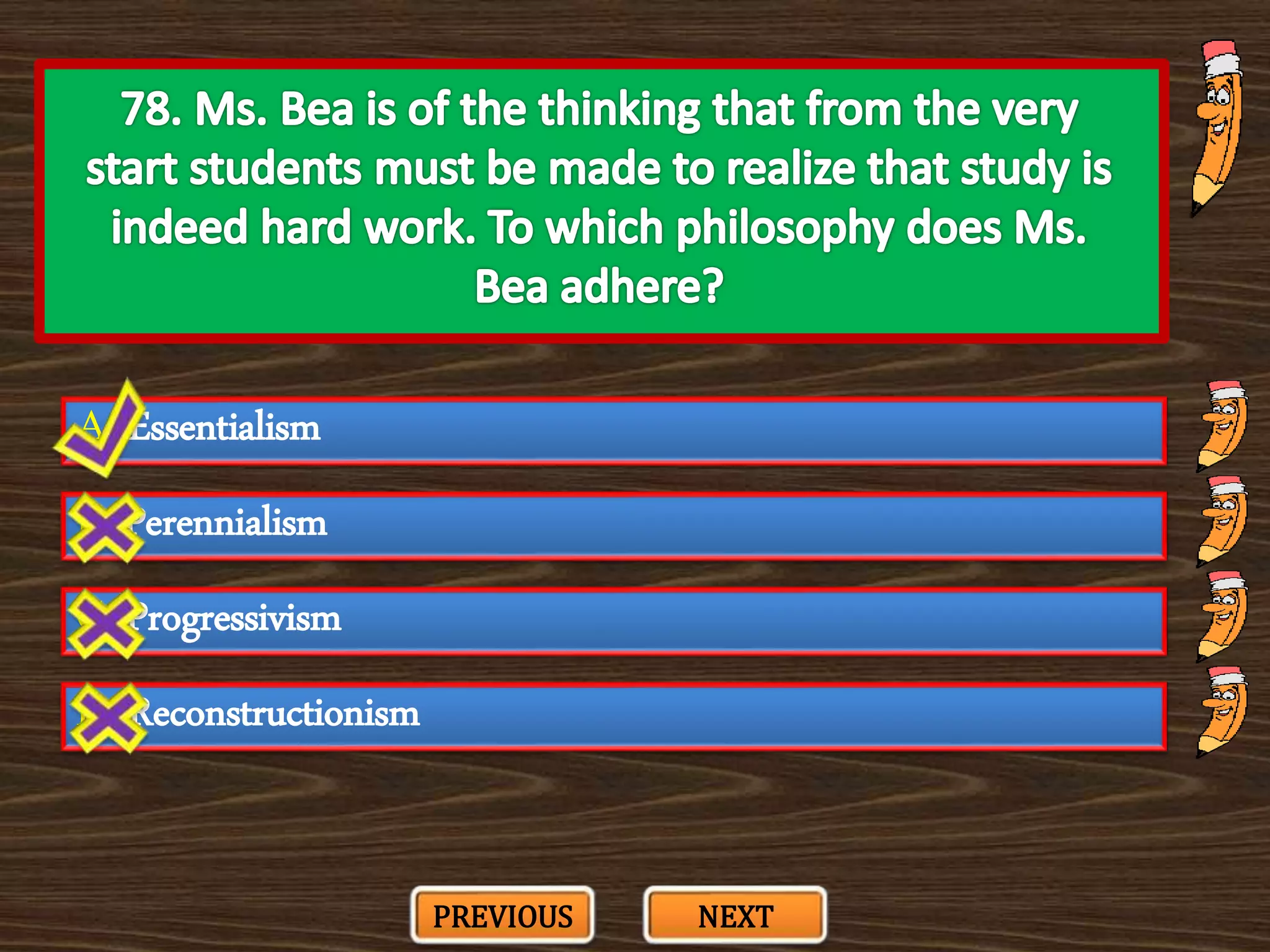
A. Essentialism
C. Progressivism
B. Perennialism
D. Reconstructionism
PREVIOUS NEXT
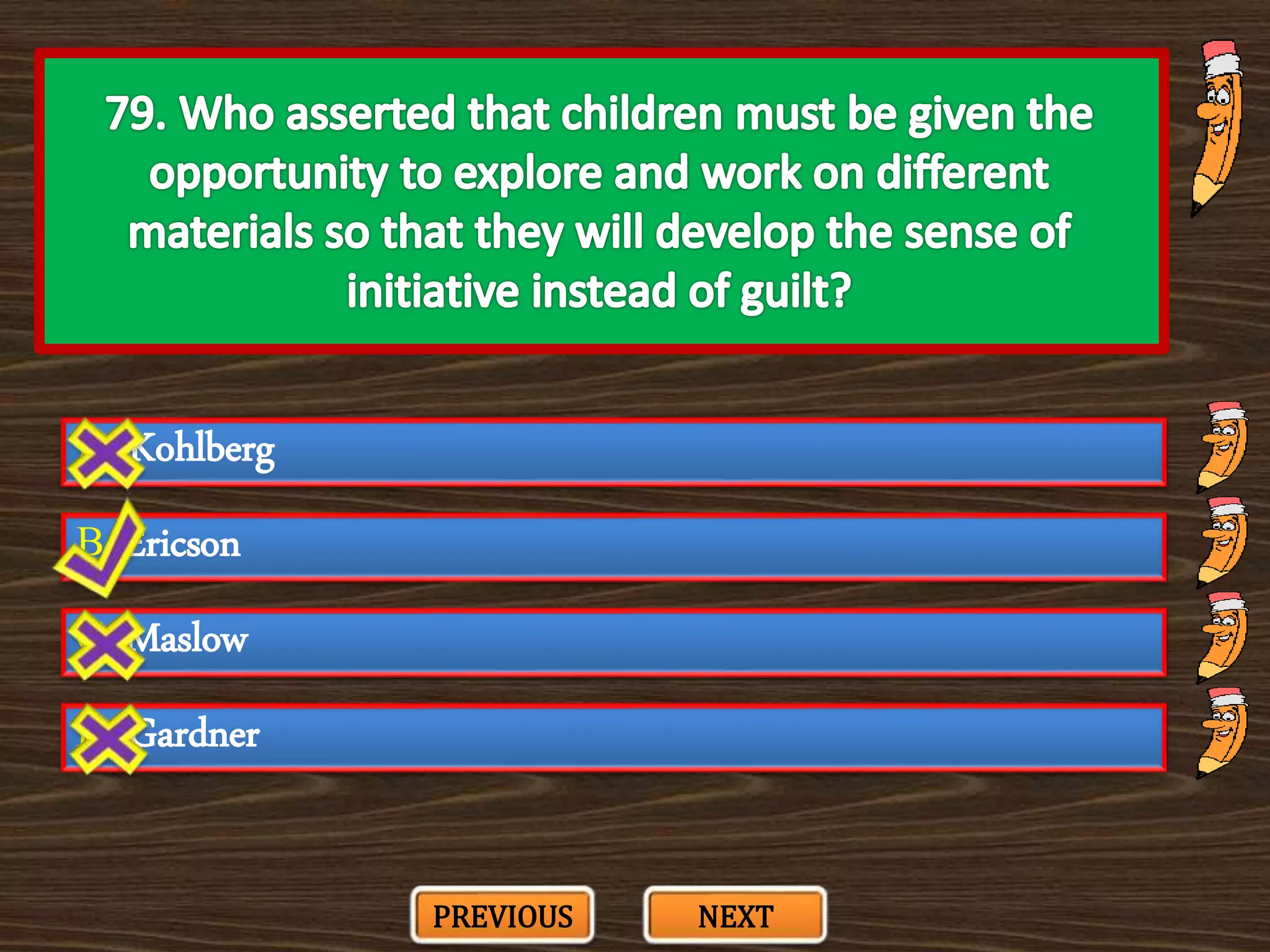
A. Kohlberg
C. Maslow
B. Ericson
D. Gardner
PREVIOUS NEXT
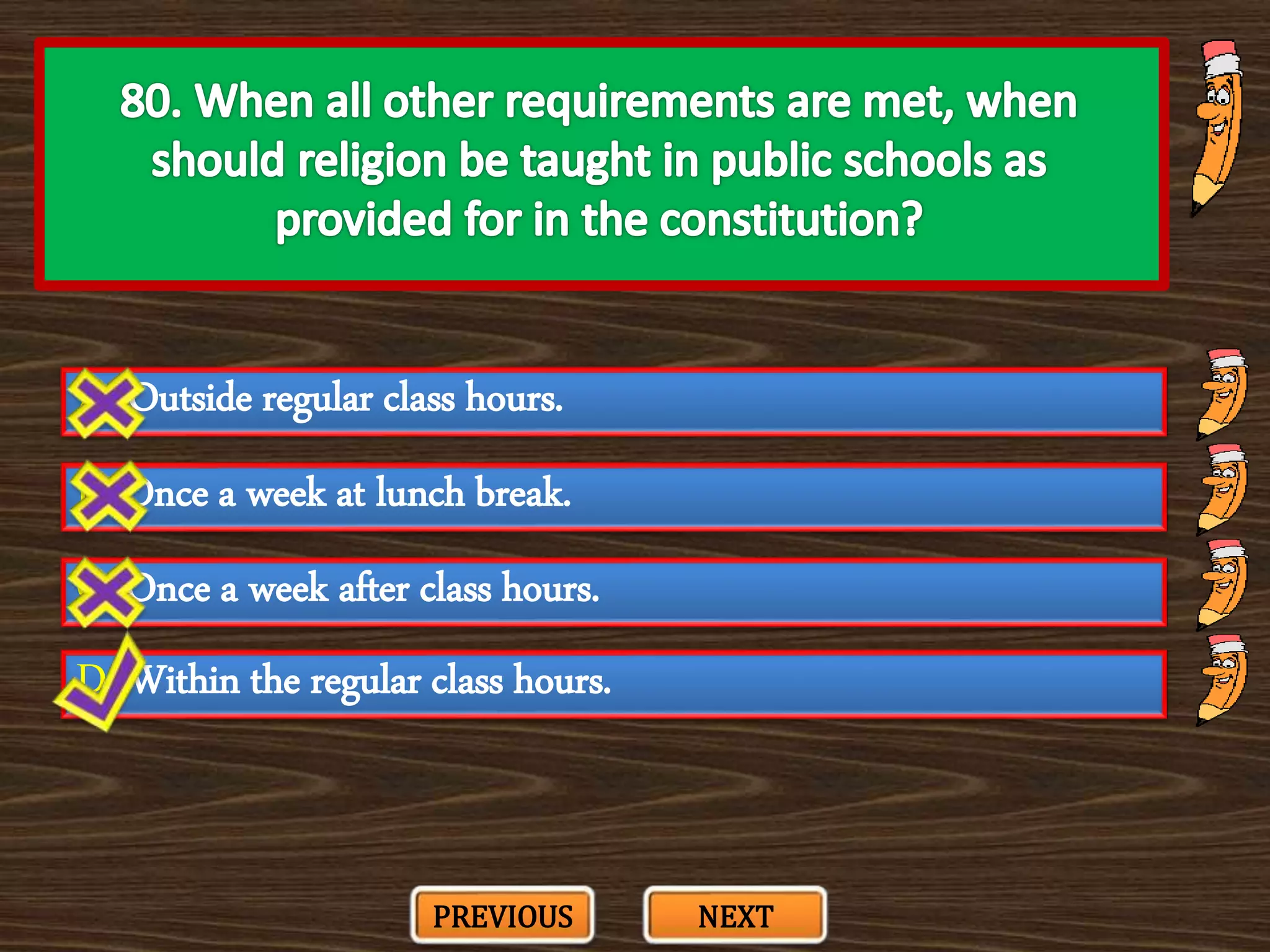
A. Outside regular class hours.
C. Once a week after class hours.
B. Once a week at lunch break.
D. Within the regular class hours.
PREVIOUS NEXT
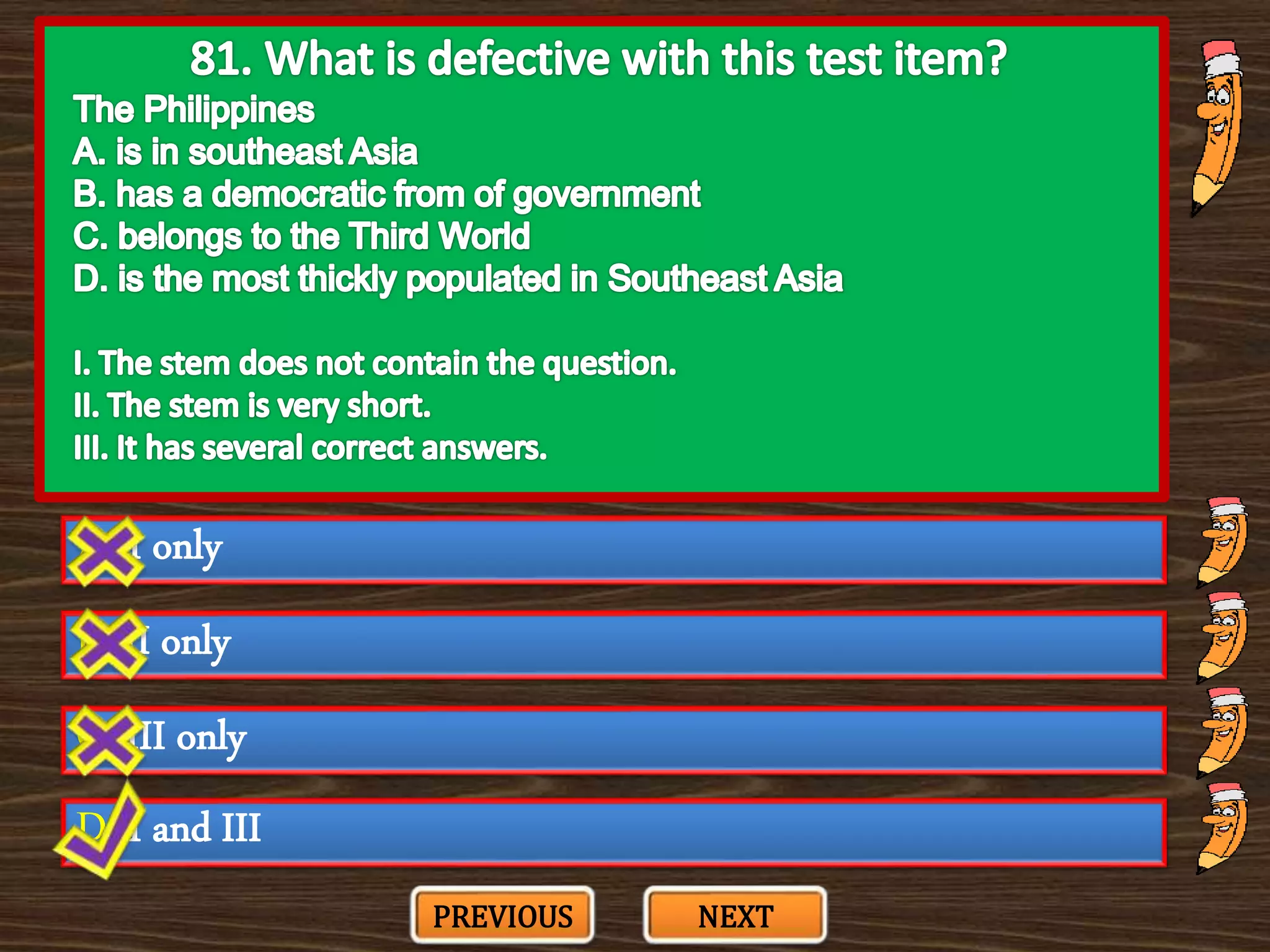
A. I only
C. III only
B. II only
D. I and III
PREVIOUS NEXT
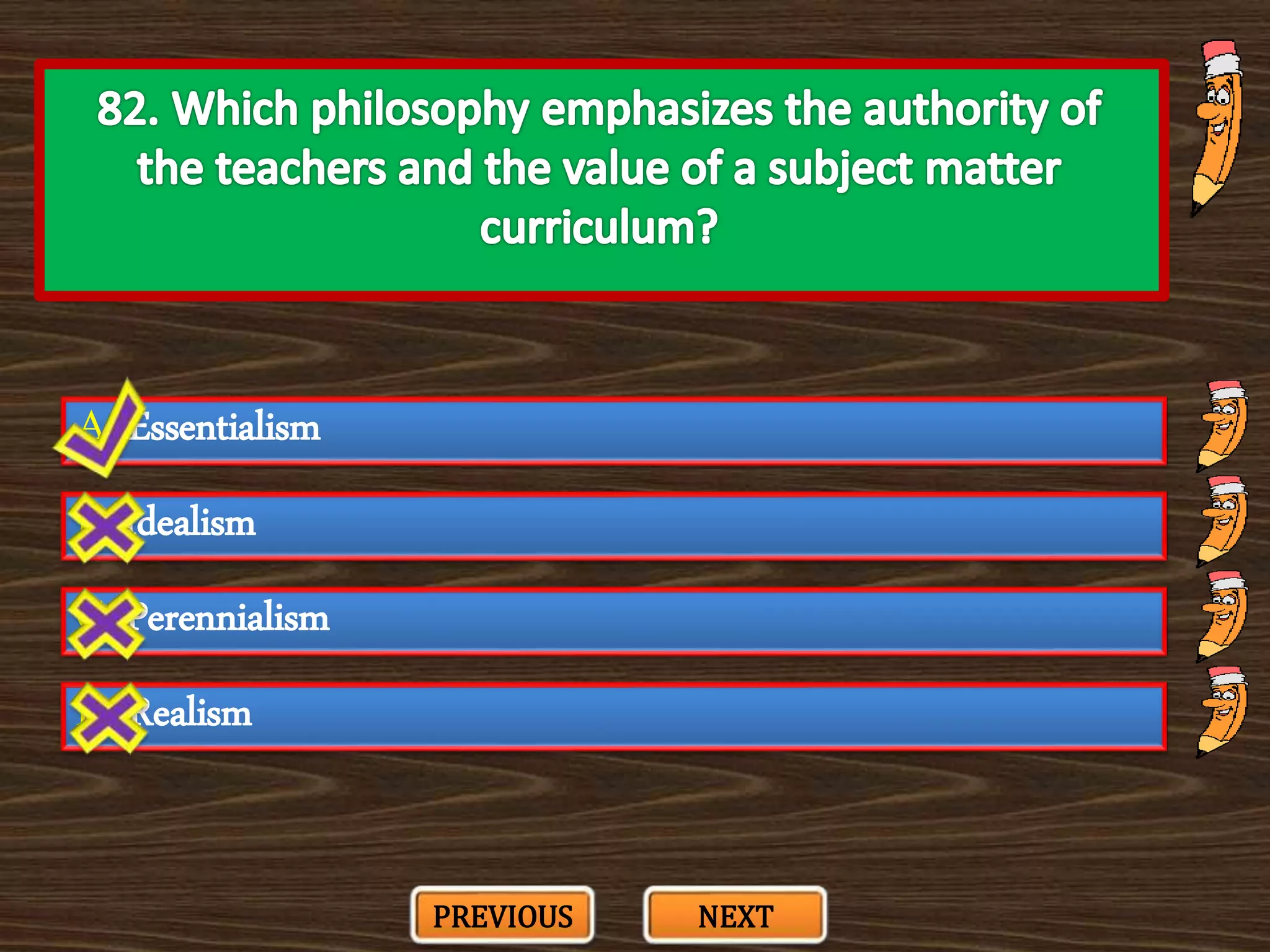
A. Essentialism
C. Perennialism
B. Idealism
D. Realism
PREVIOUS NEXT
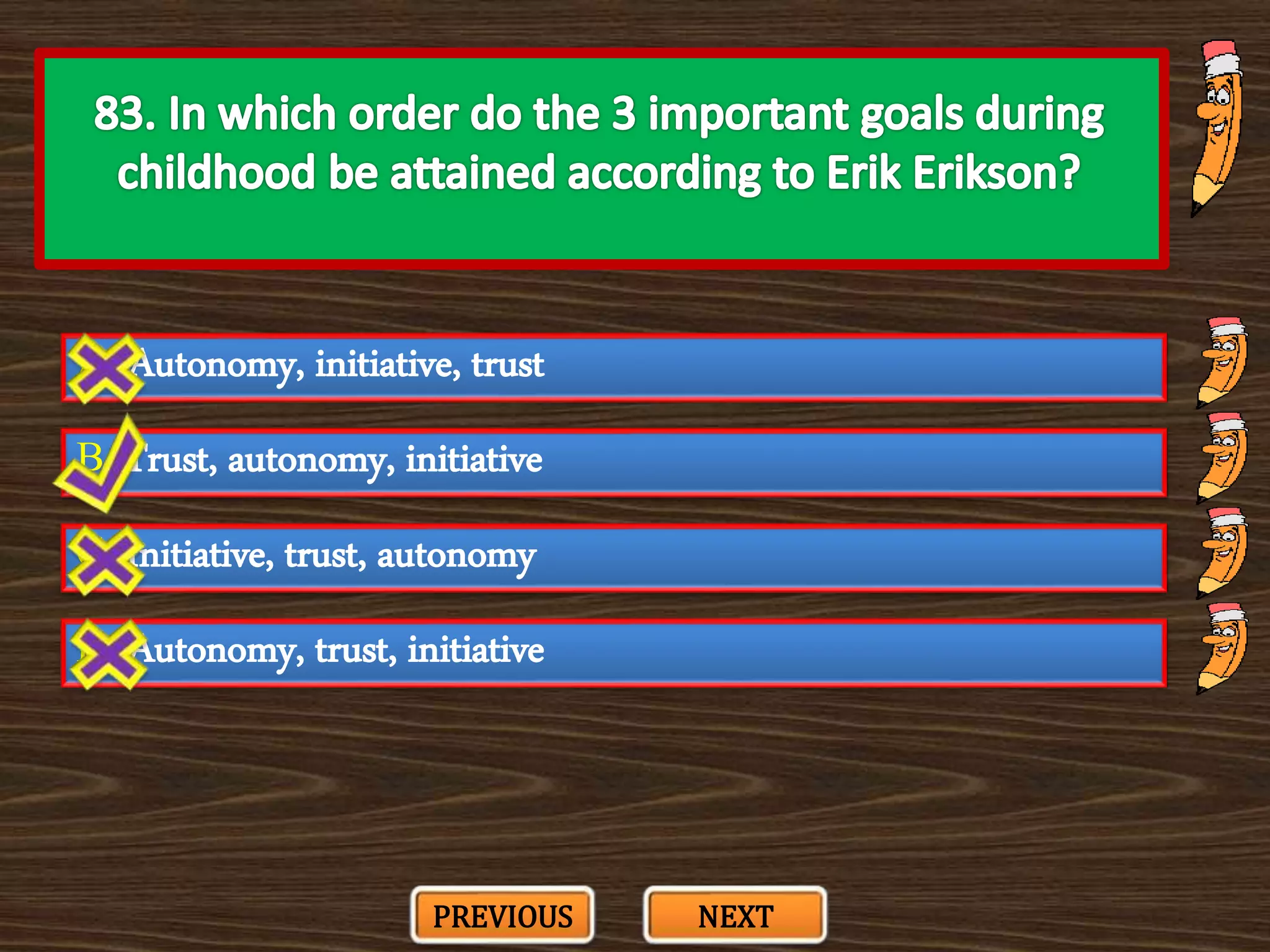
A. Autonomy, initiative, trust
C. Initiative, trust, autonomy
B. Trust, autonomy, initiative
D. Autonomy, trust, initiative
PREVIOUS NEXT
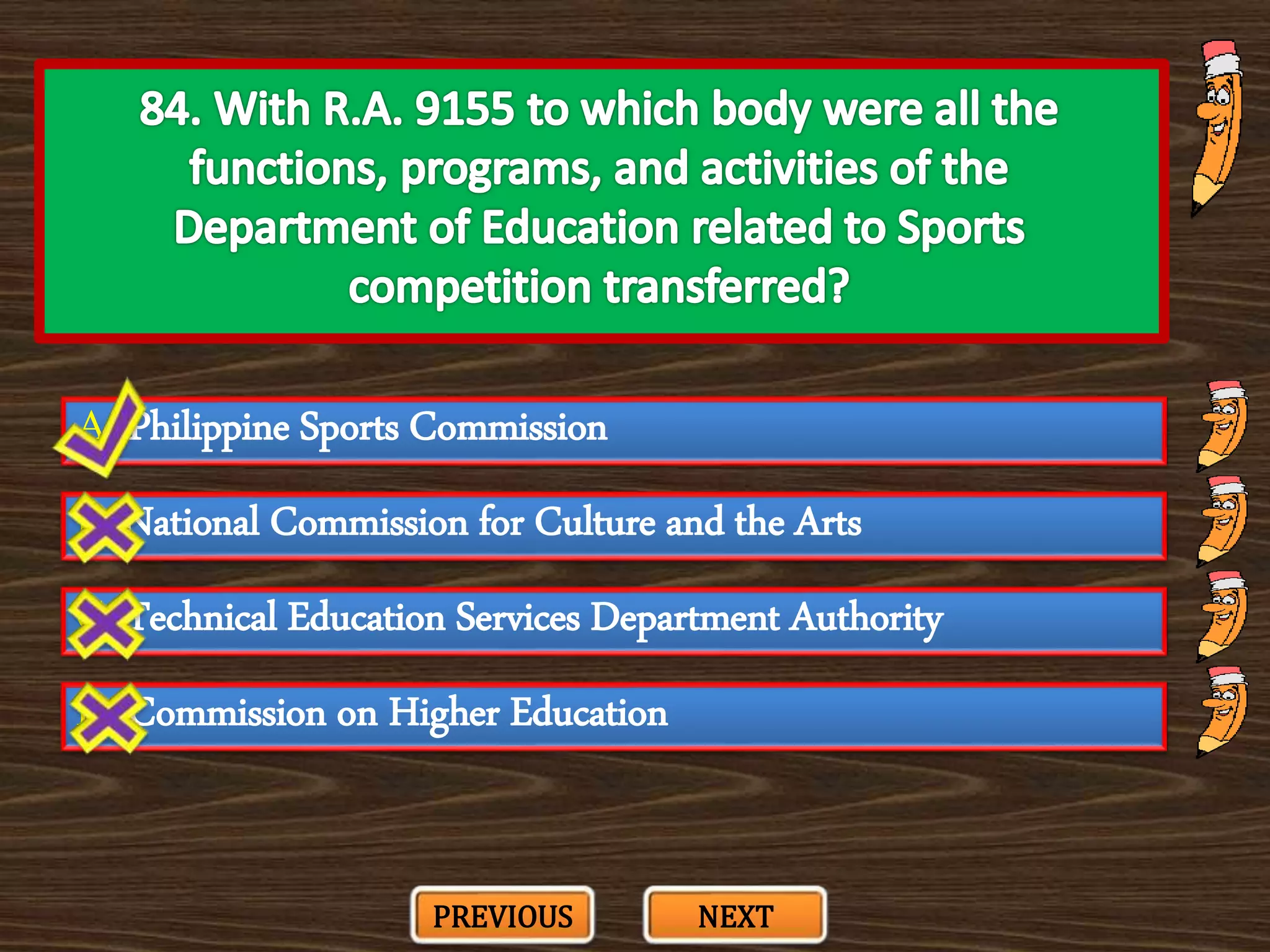
A. Philippine Sports Commission
C. Technical Education Services Department Authority
B. National Commission for Culture and the Arts
D. Commission on Higher Education
PREVIOUS NEXT
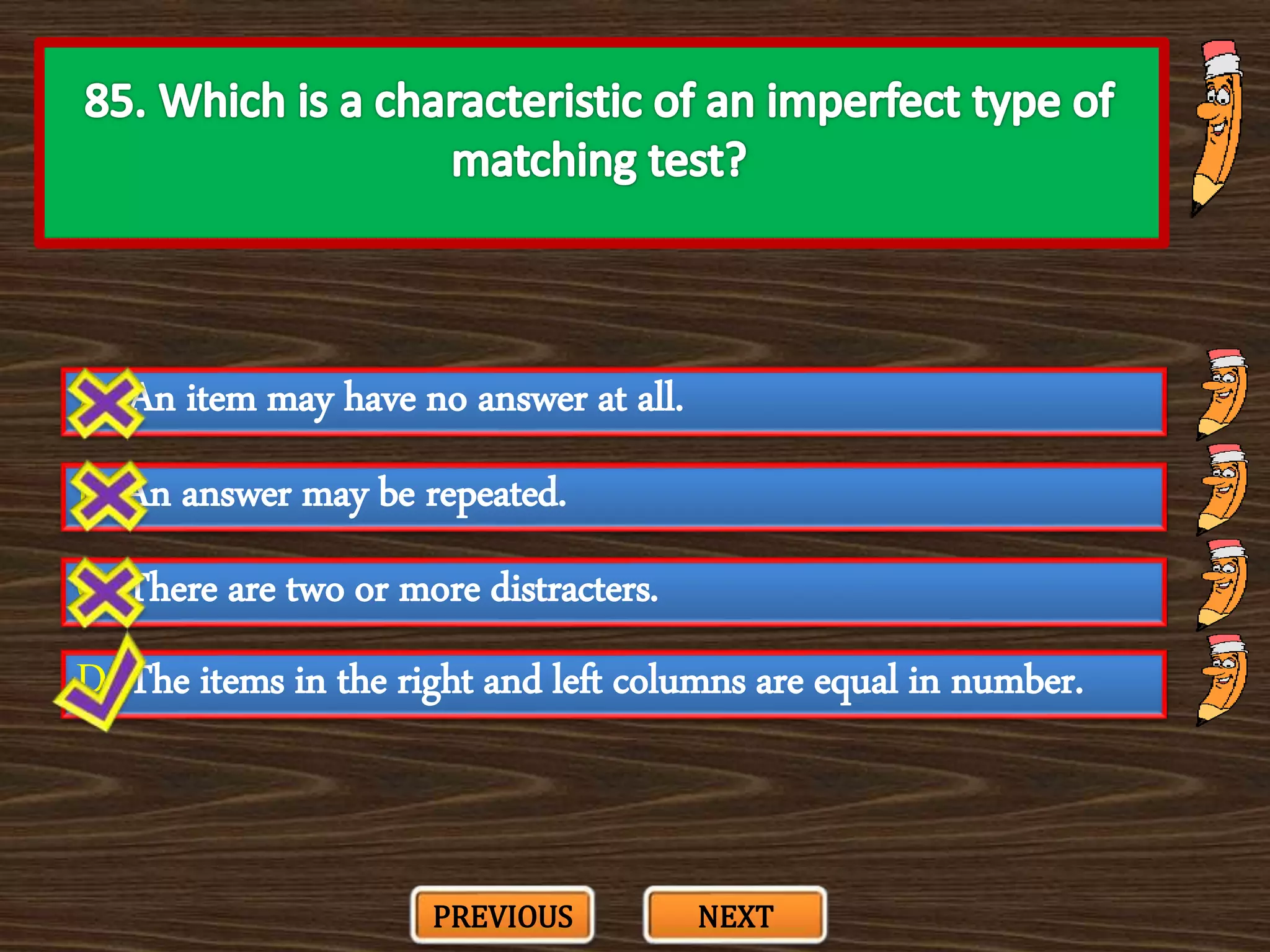
A. An item may have no answer at all.
C. There are two or more distracters.
B. An answer may be repeated.
D. The items in the right and left columns are equal in number.
PREVIOUS NEXT
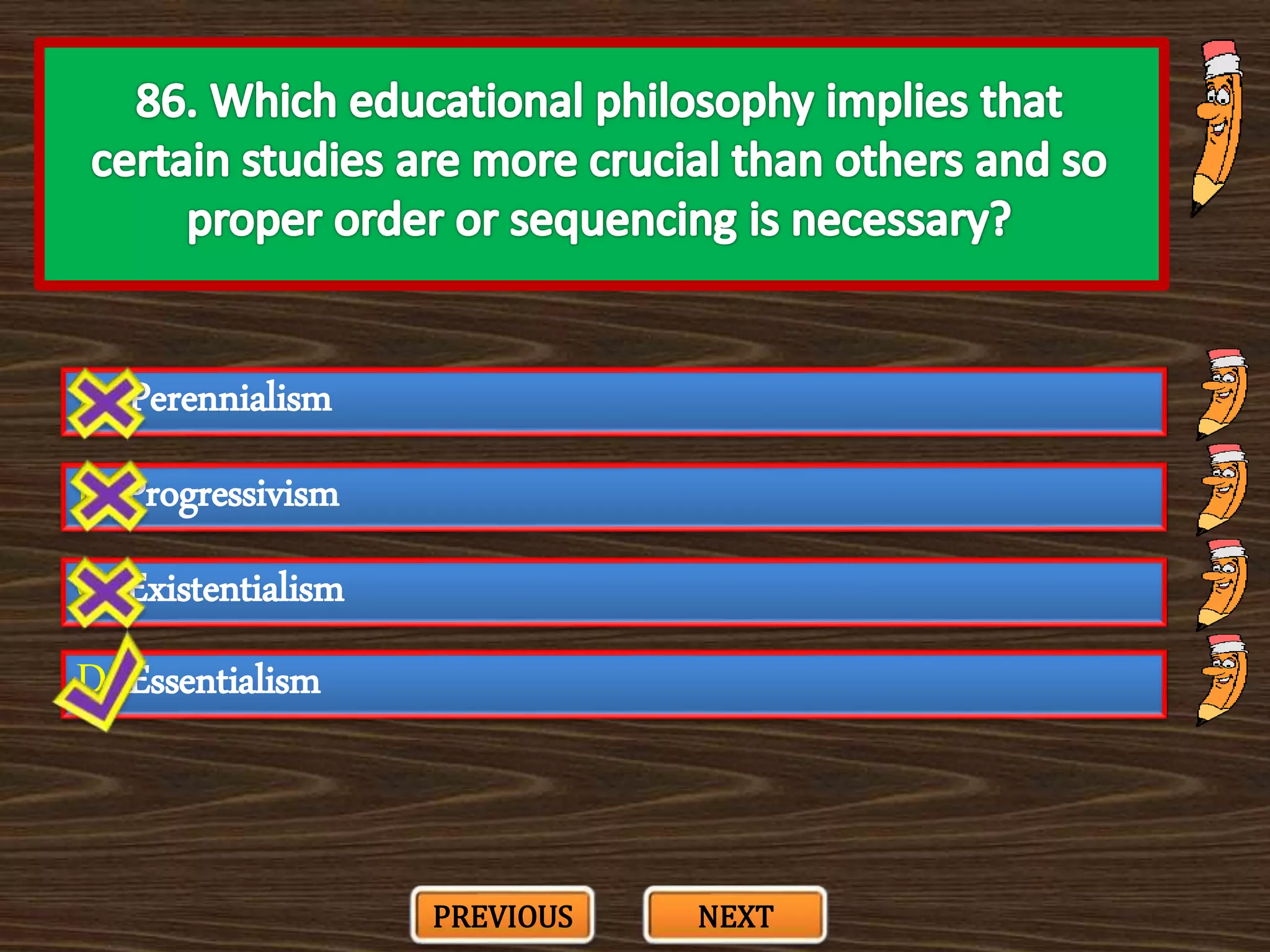
A. Perennialism
C. Existentialism
B. Progressivism
D. Essentialism
PREVIOUS NEXT
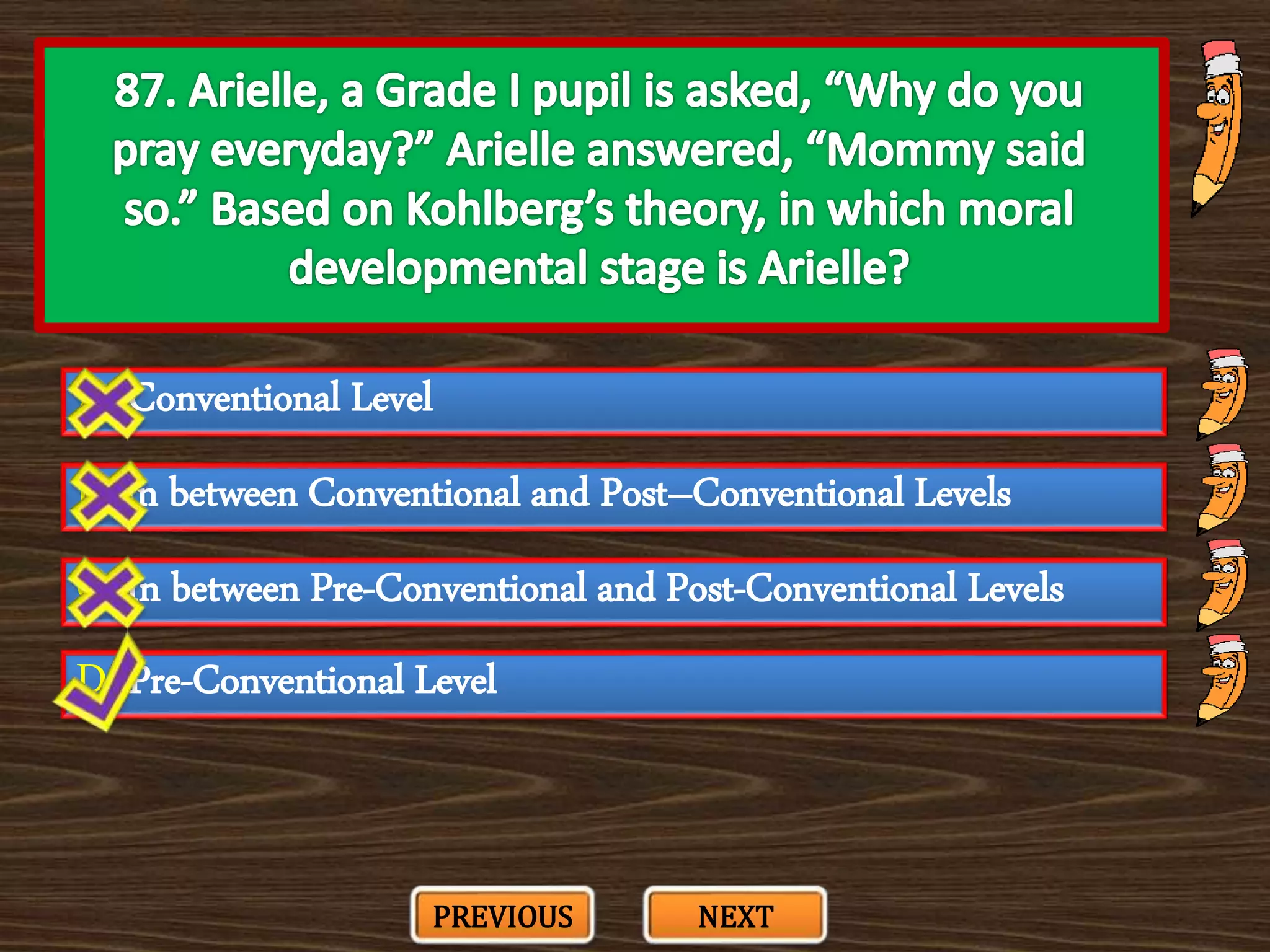
A. Conventional Level
C. In between Pre-Conventional and Post-Conventional Levels
B. In between Conventional and Post–Conventional Levels
D. Pre-Conventional Level
PREVIOUS NEXT
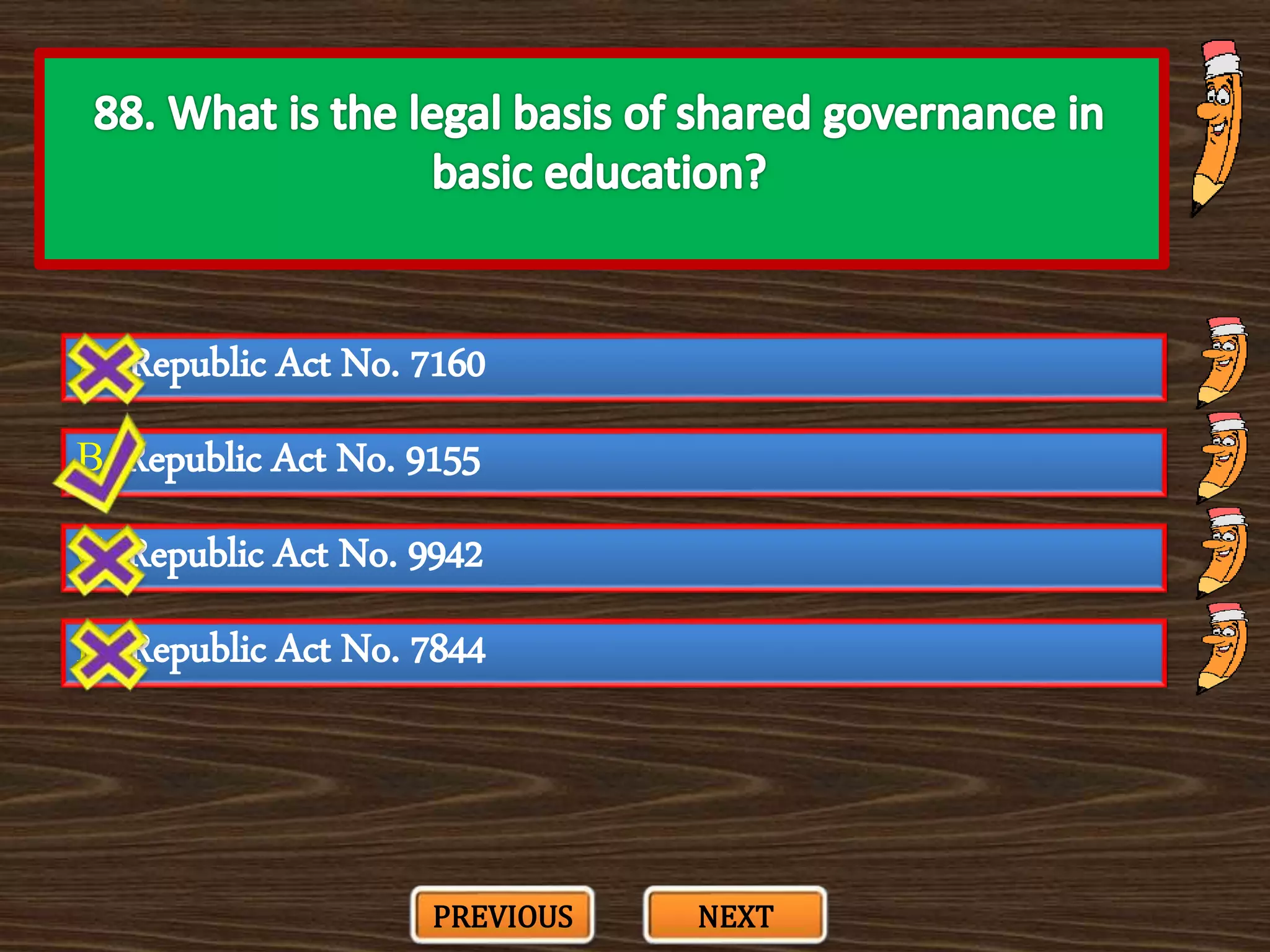
A. Republic Act No. 7160
C. Republic Act No. 9942
B. Republic Act No. 9155
D. Republic Act No. 7844
PREVIOUS NEXT
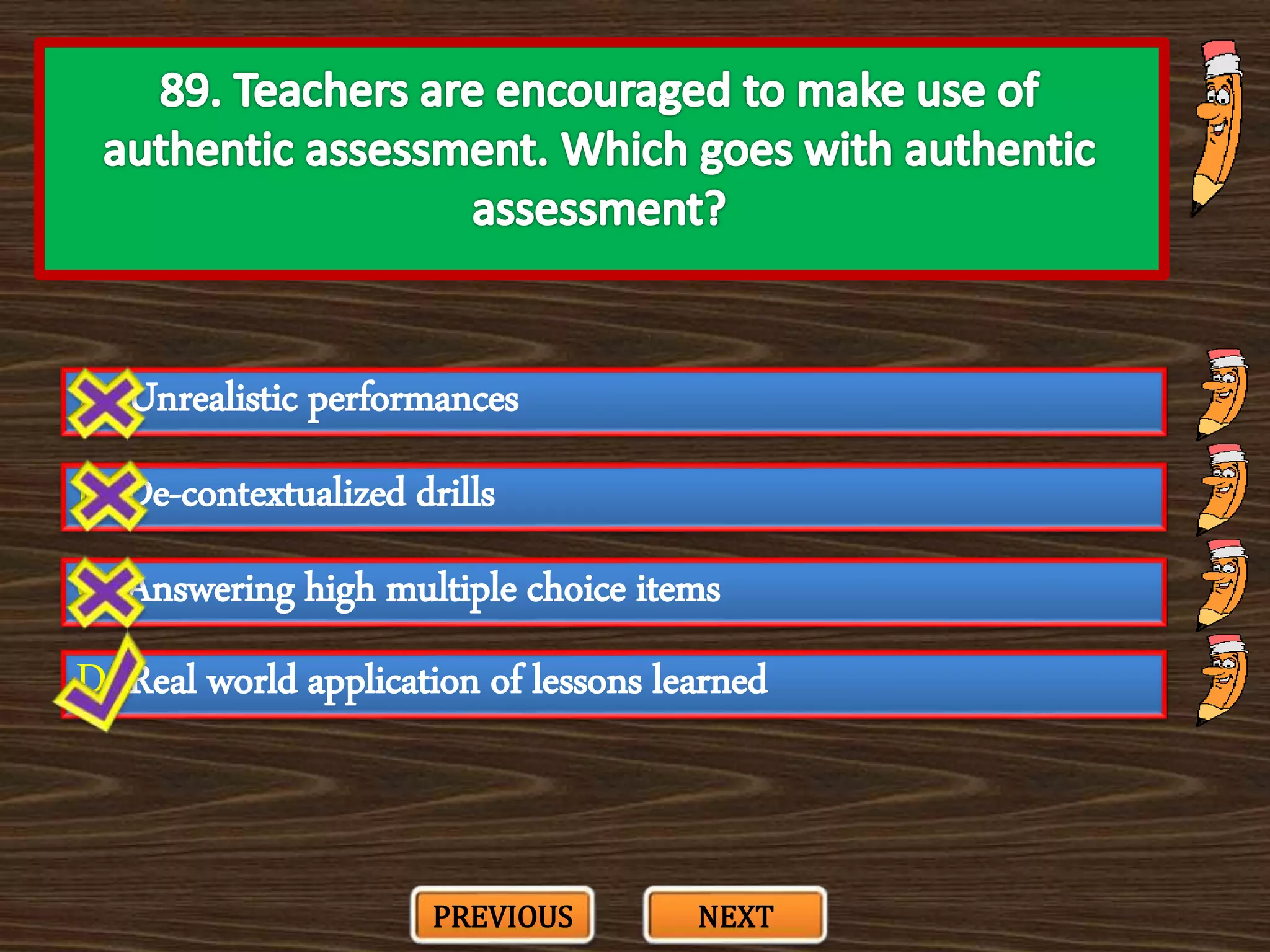
A. Unrealistic performances
C. Answering high multiple choice items
B. De-contextualized drills
D. Real world application of lessons learned
PREVIOUS NEXT
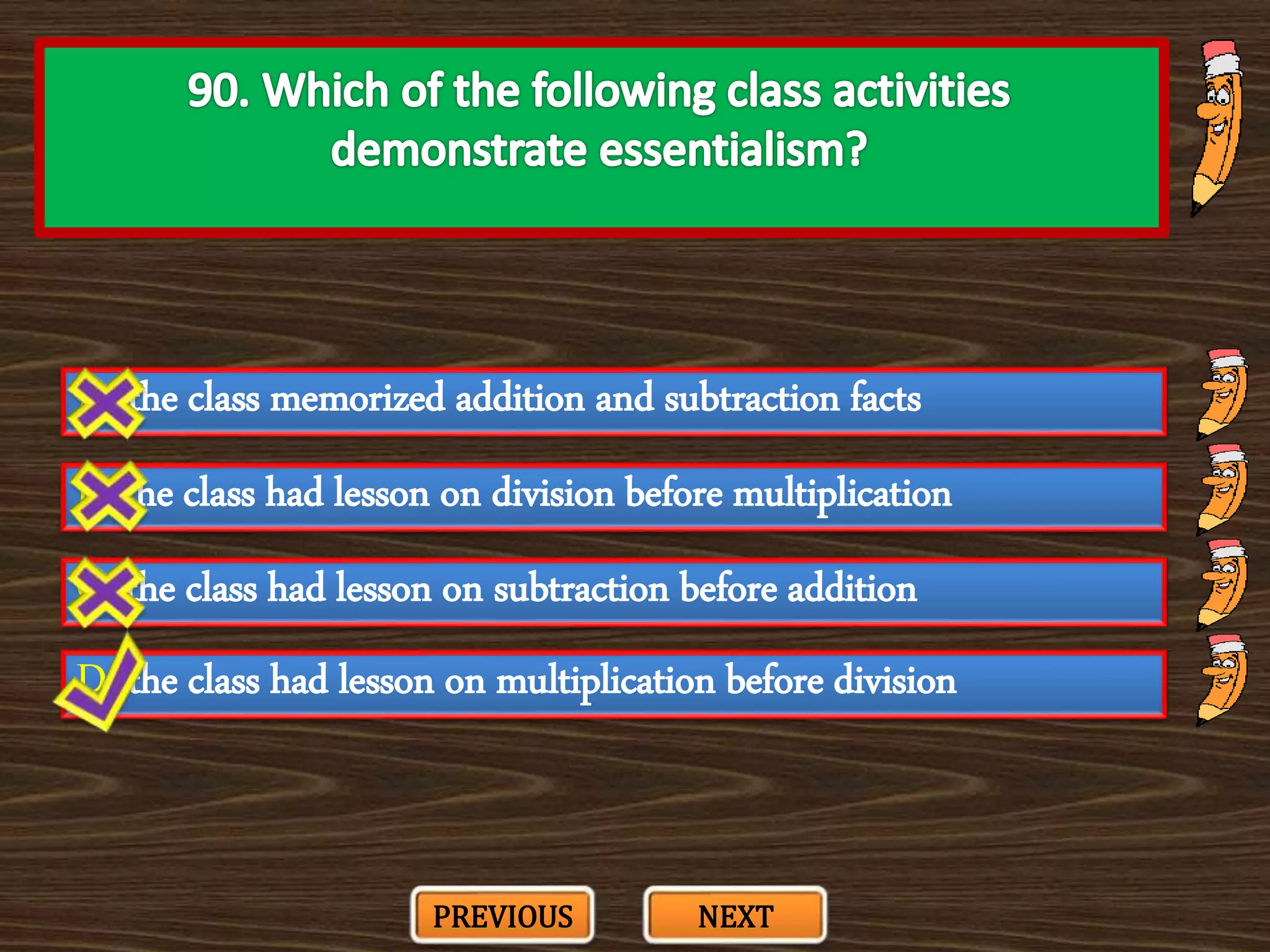
A. the class memorized addition and subtraction facts
C. the class had lesson on subtraction before addition
B. the class had lesson on division before multiplication
D. the class had lesson on multiplication before division
PREVIOUS NEXT
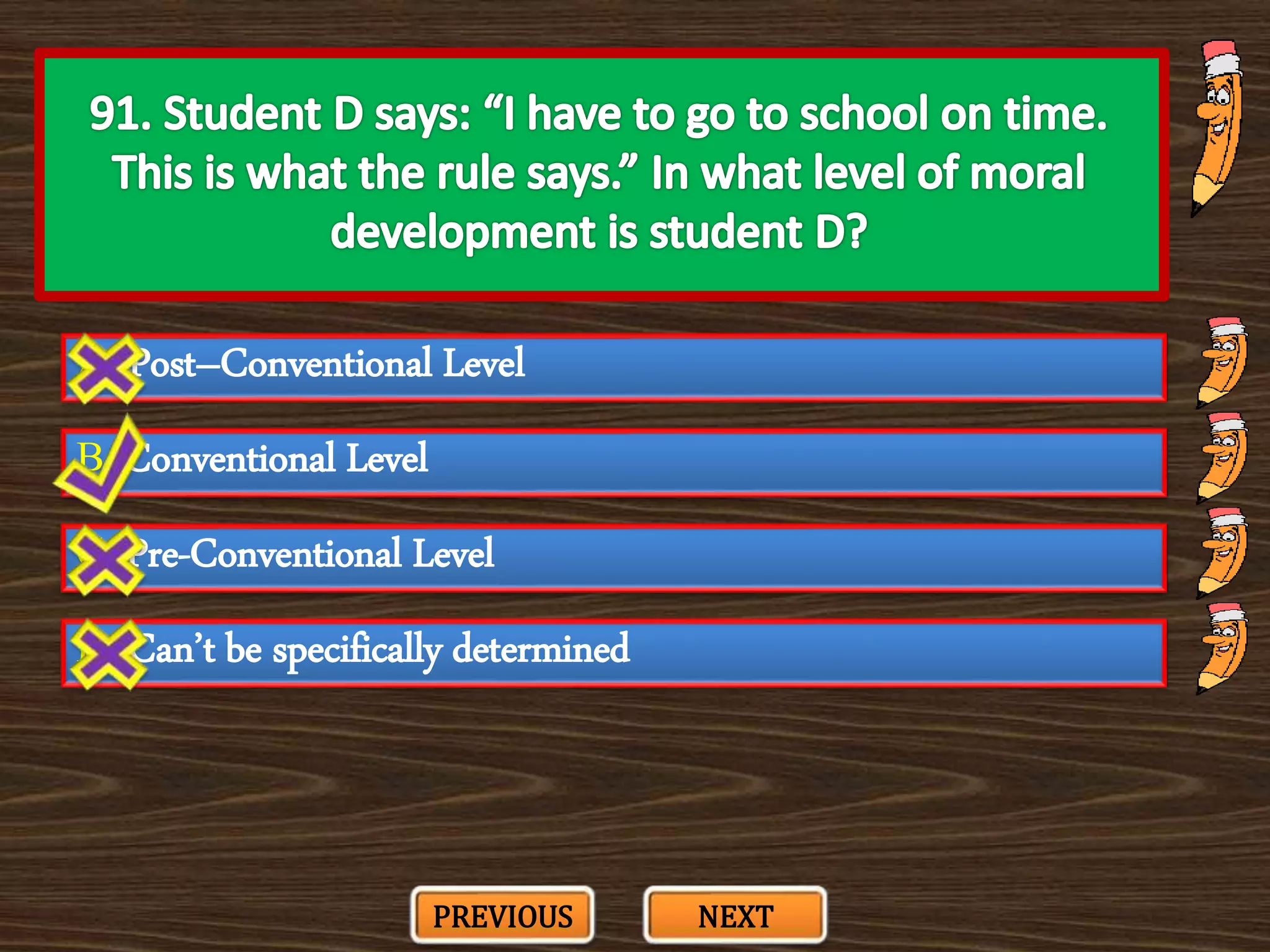
A. Post–Conventional Level
C. Pre-Conventional Level
B. Conventional Level
D. Can’t be specifically determined
PREVIOUS NEXT
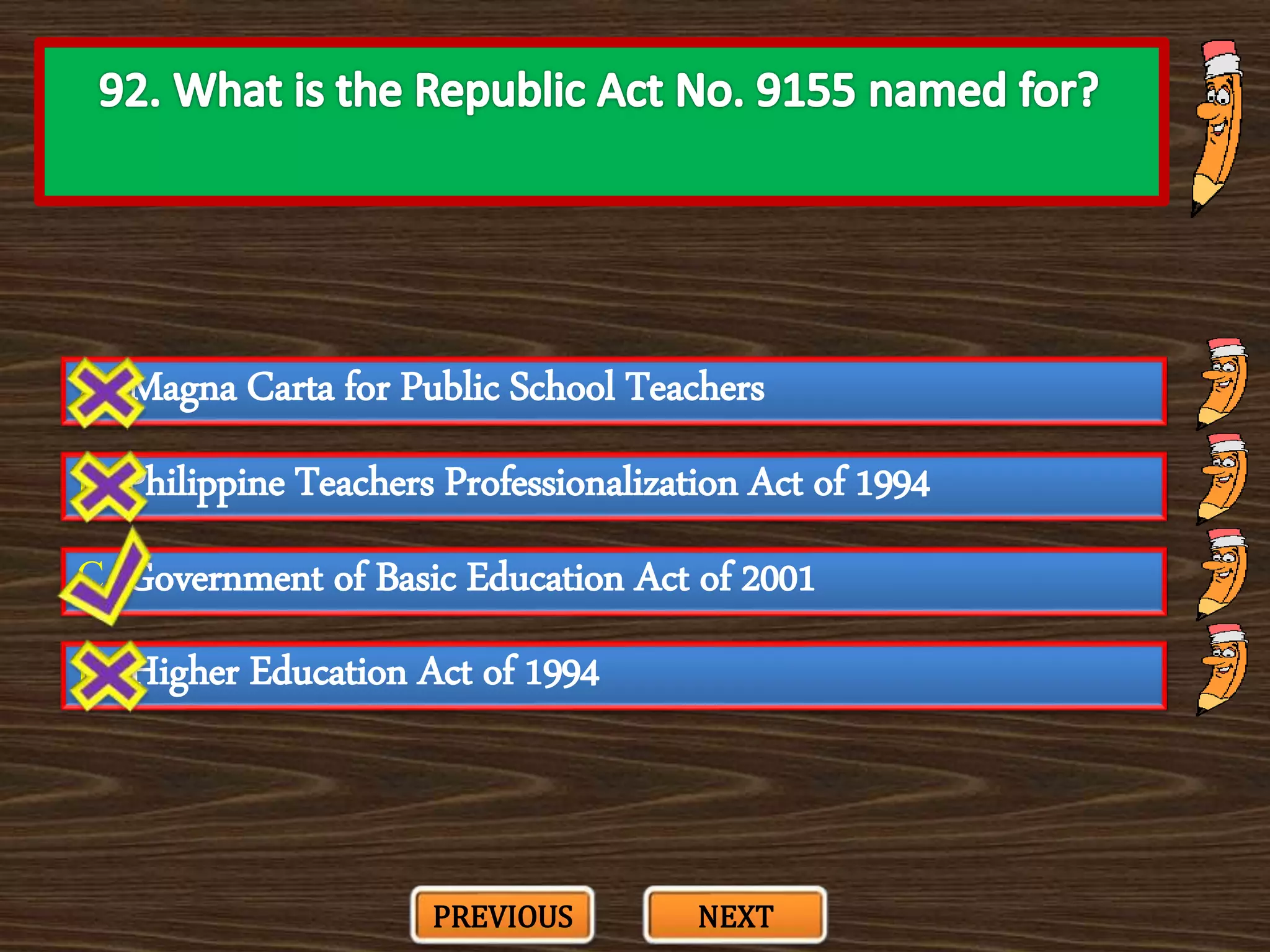
A. Magna Carta for Public School Teachers
C. Government of Basic Education Act of 2001
B. Philippine Teachers Professionalization Act of 1994
D. Higher Education Act of 1994
PREVIOUS NEXT
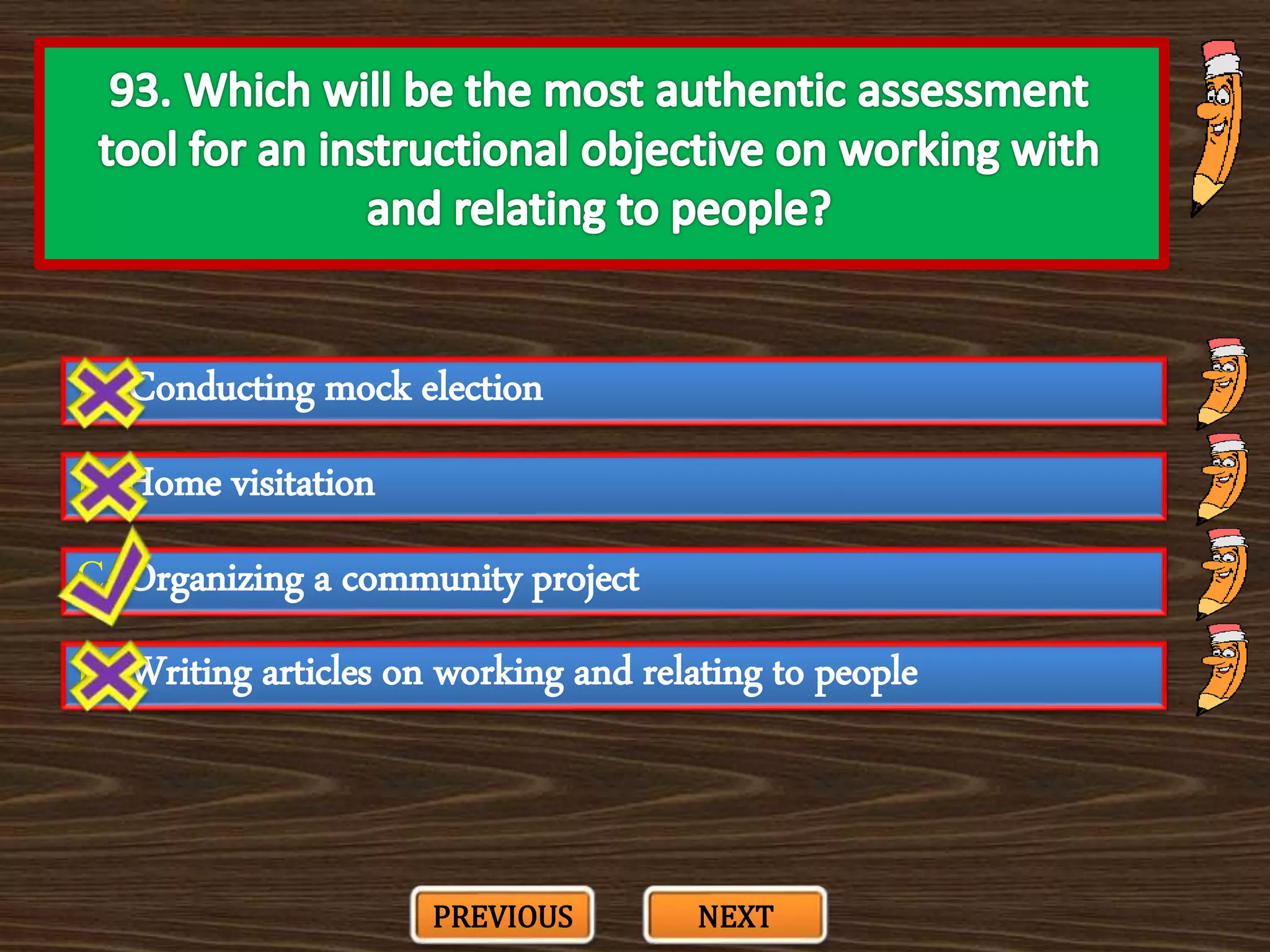
A. Conducting mock election
C. Organizing a community project
B. Home visitation
D. Writing articles on working and relating to people
PREVIOUS NEXT
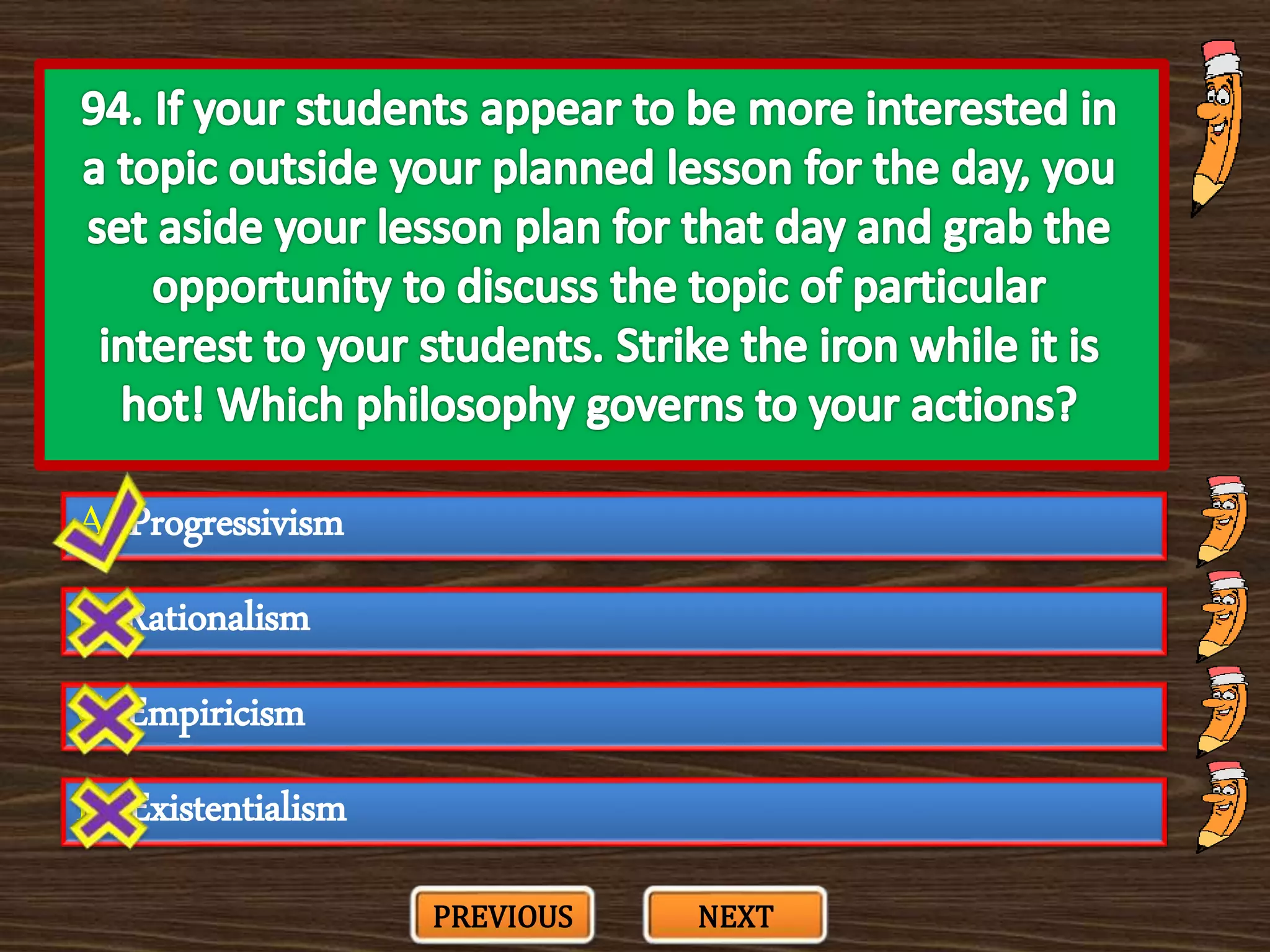
A. Progressivism
C. Empiricism
B. Rationalism
D. Existentialism
PREVIOUS NEXT
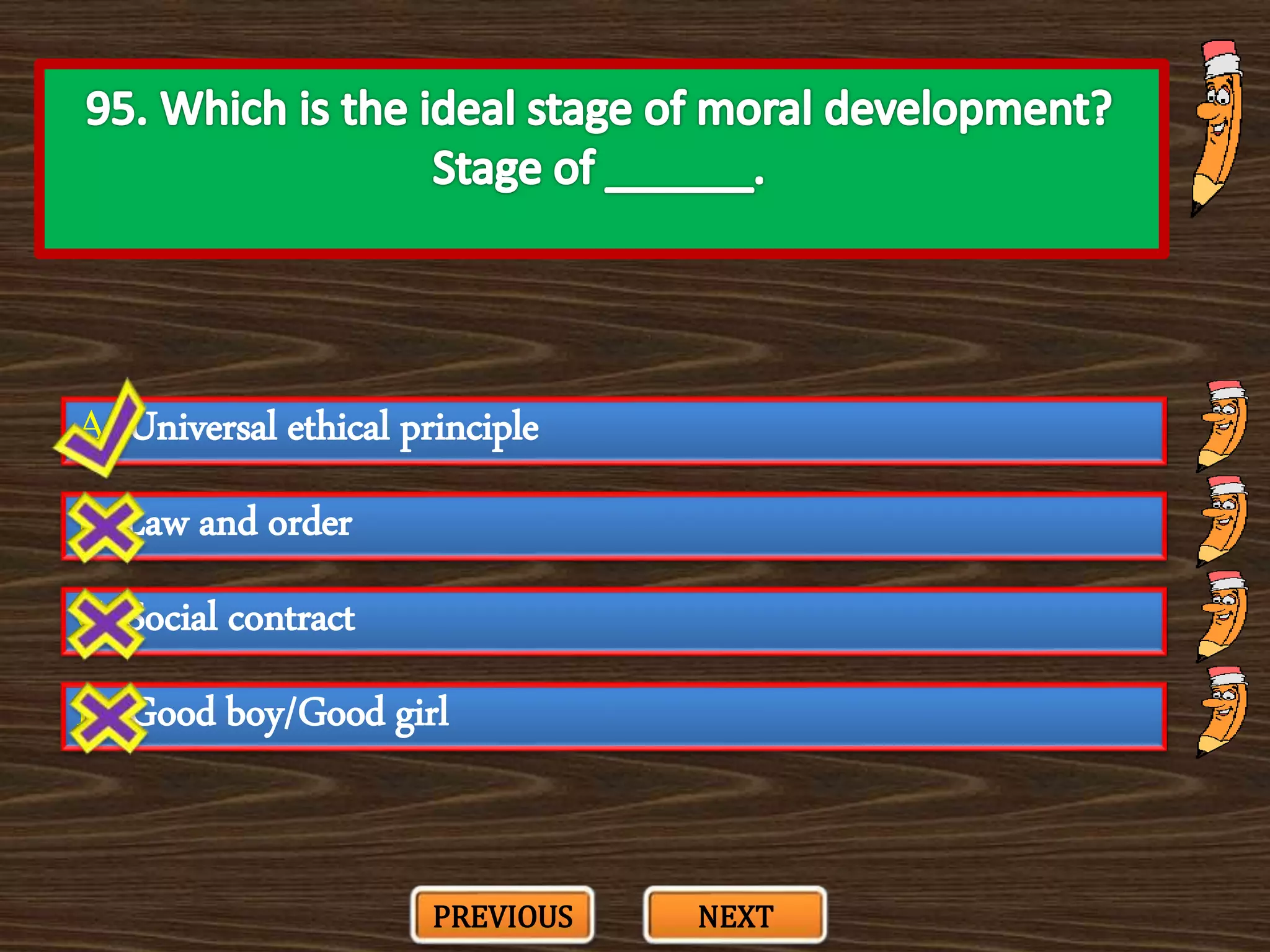
A. Universal ethical principle
C. Social contract
B. Law and order
D. Good boy/Good girl
PREVIOUS NEXT
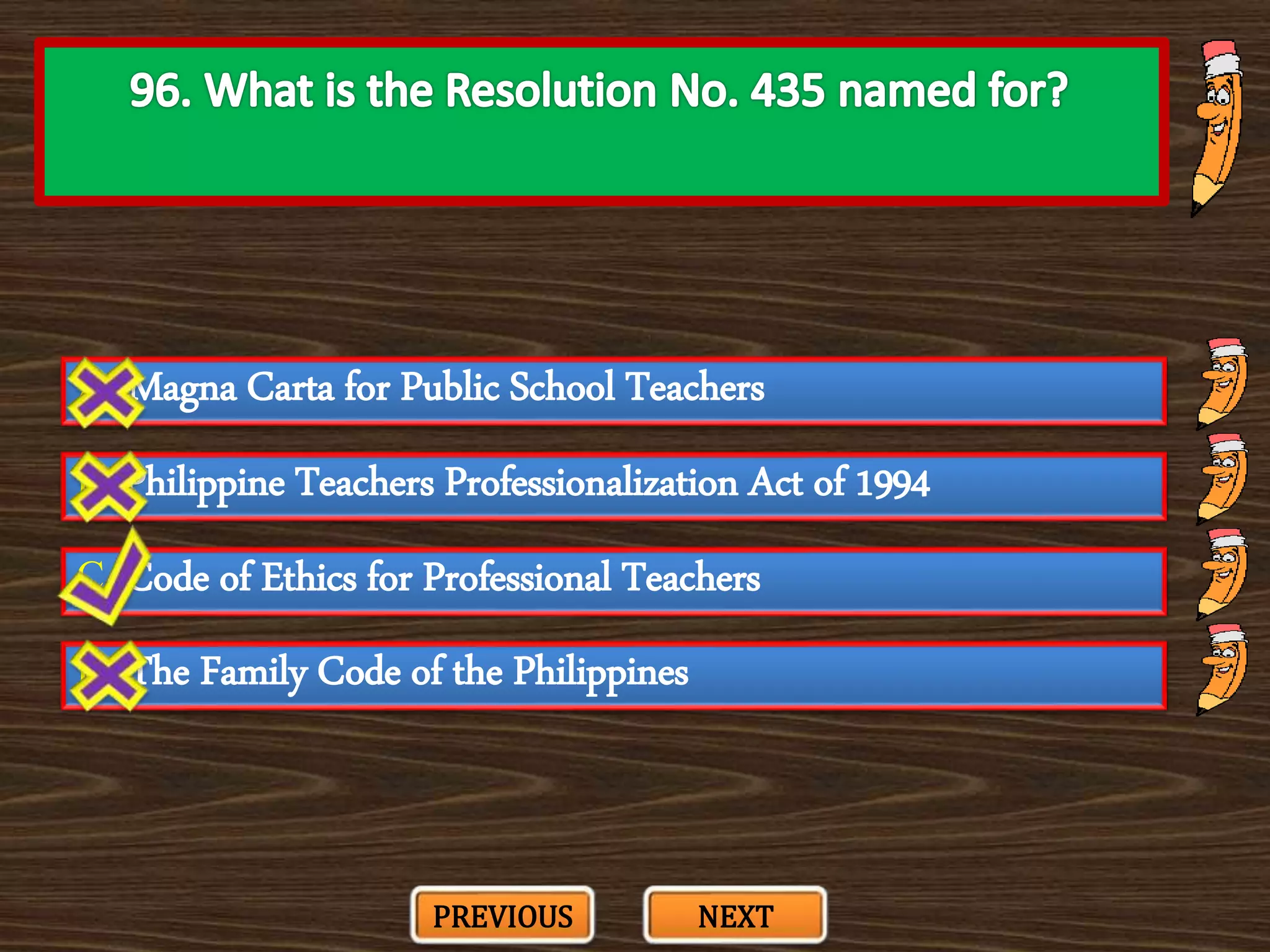
A. Magna Carta for Public School Teachers
C. Code of Ethics for Professional Teachers
B. Philippine Teachers Professionalization Act of 1994
D. The Family Code of the Philippines
PREVIOUS NEXT
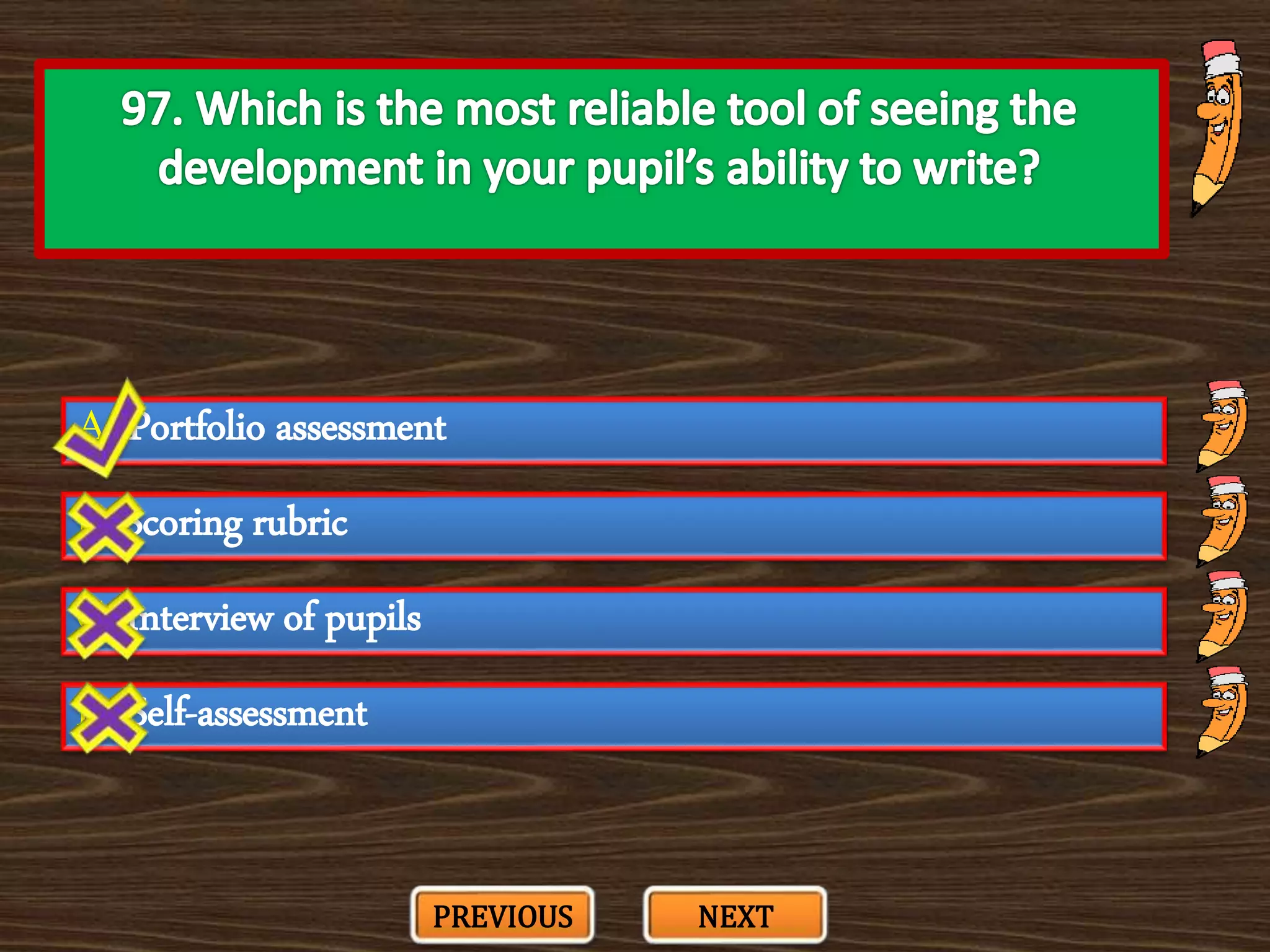
A. Portfolio assessment
C. Interview of pupils
B. Scoring rubric
D. Self-assessment
PREVIOUS NEXT
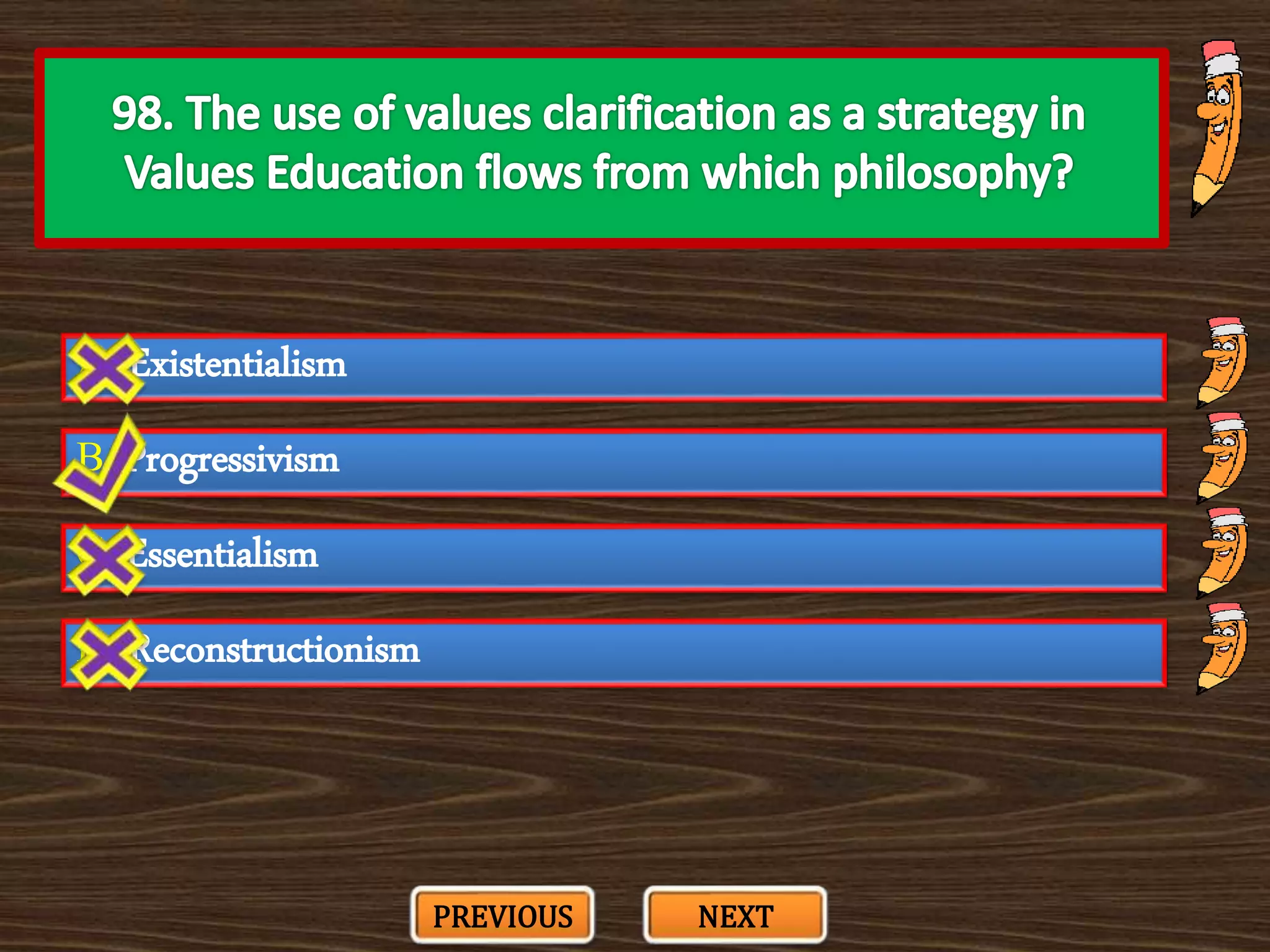
A. Existentialism
C. Essentialism
B. Progressivism
D. Reconstructionism
PREVIOUS NEXT
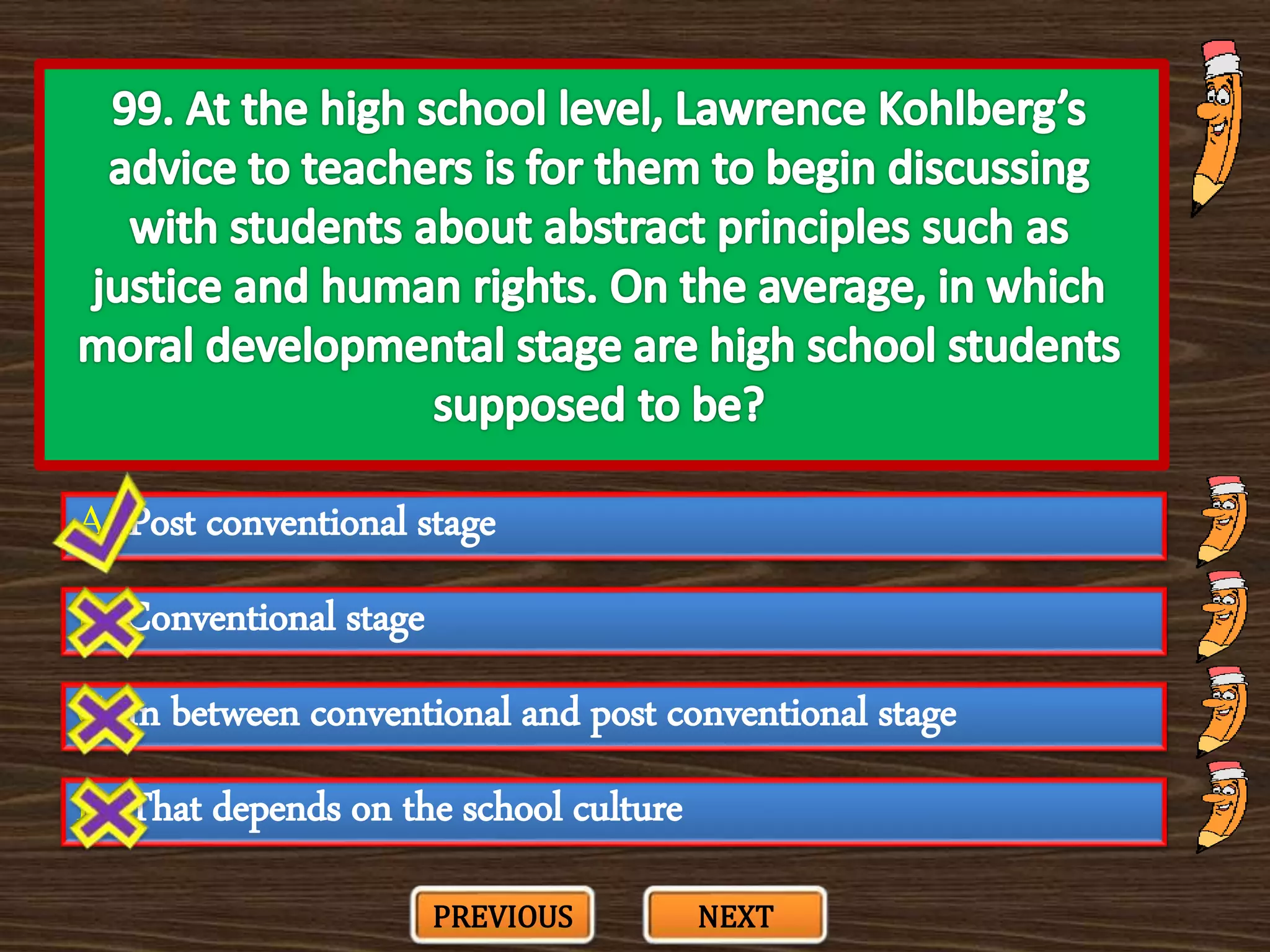
A. Post conventional stage
C. In between conventional and post conventional stage
B. Conventional stage
D. That depends on the school culture
PREVIOUS NEXT
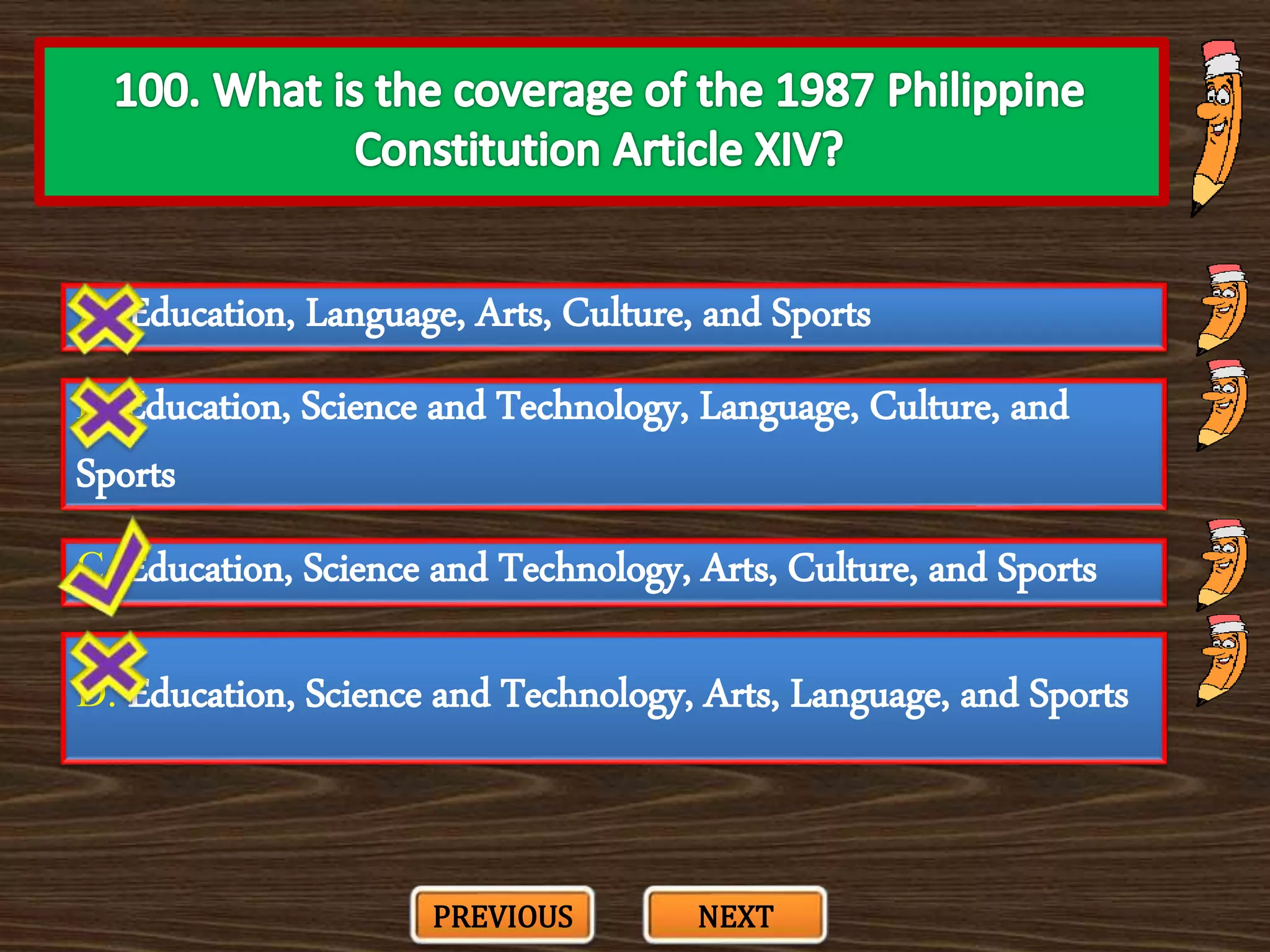
A. Education, Language, Arts, Culture, and Sports
C. Education, Science and Technology, Arts, Culture, and Sports
B. Education, Science and Technology, Language, Culture, and
Sports
D. Education, Science and Technology, Arts, Language, and Sports
PREVIOUS NEXT
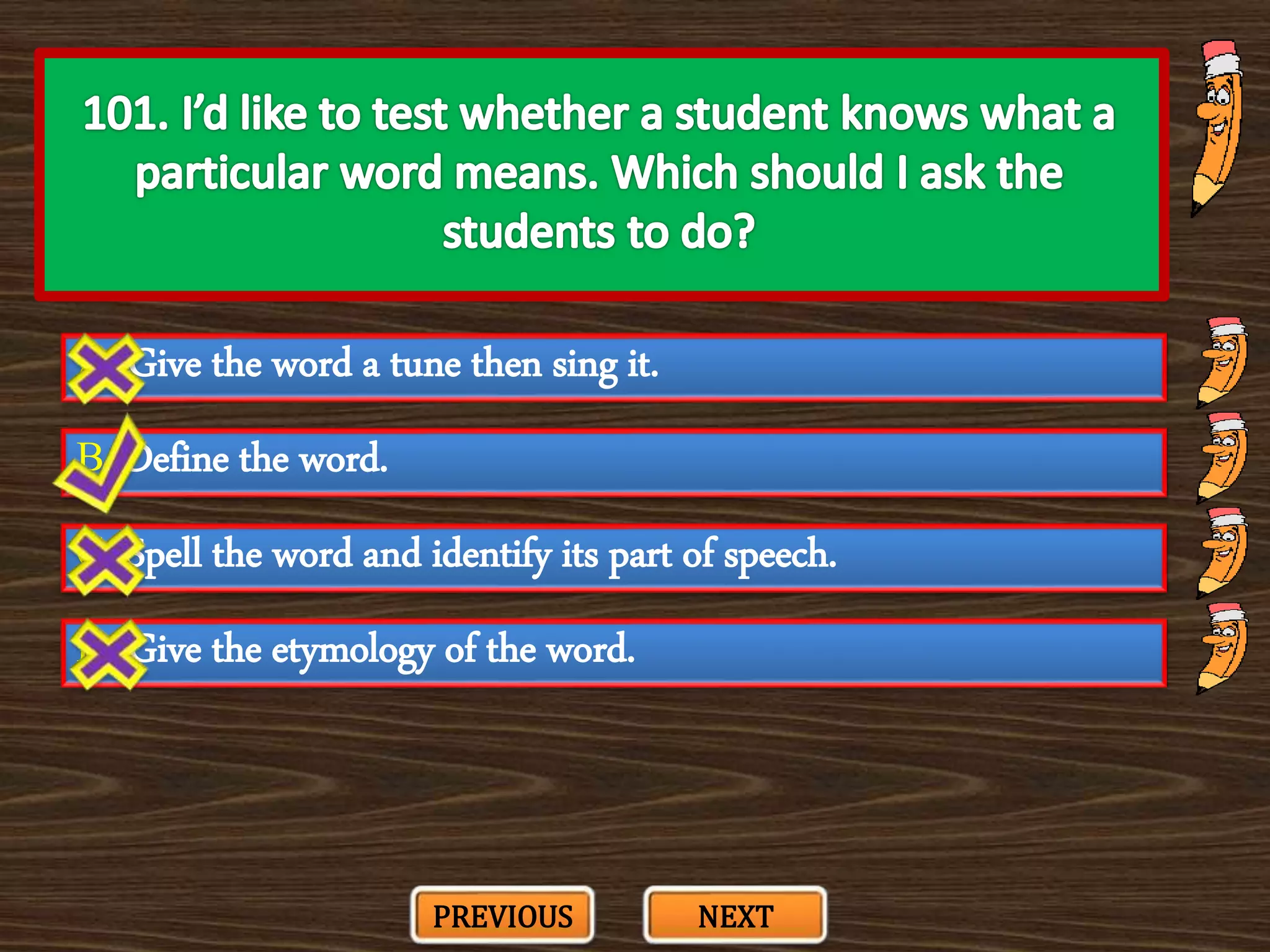
A. Give the word a tune then sing it.
C. Spell the word and identify its part of speech.
B. Define the word.
D. Give the etymology of the word.
PREVIOUS NEXT
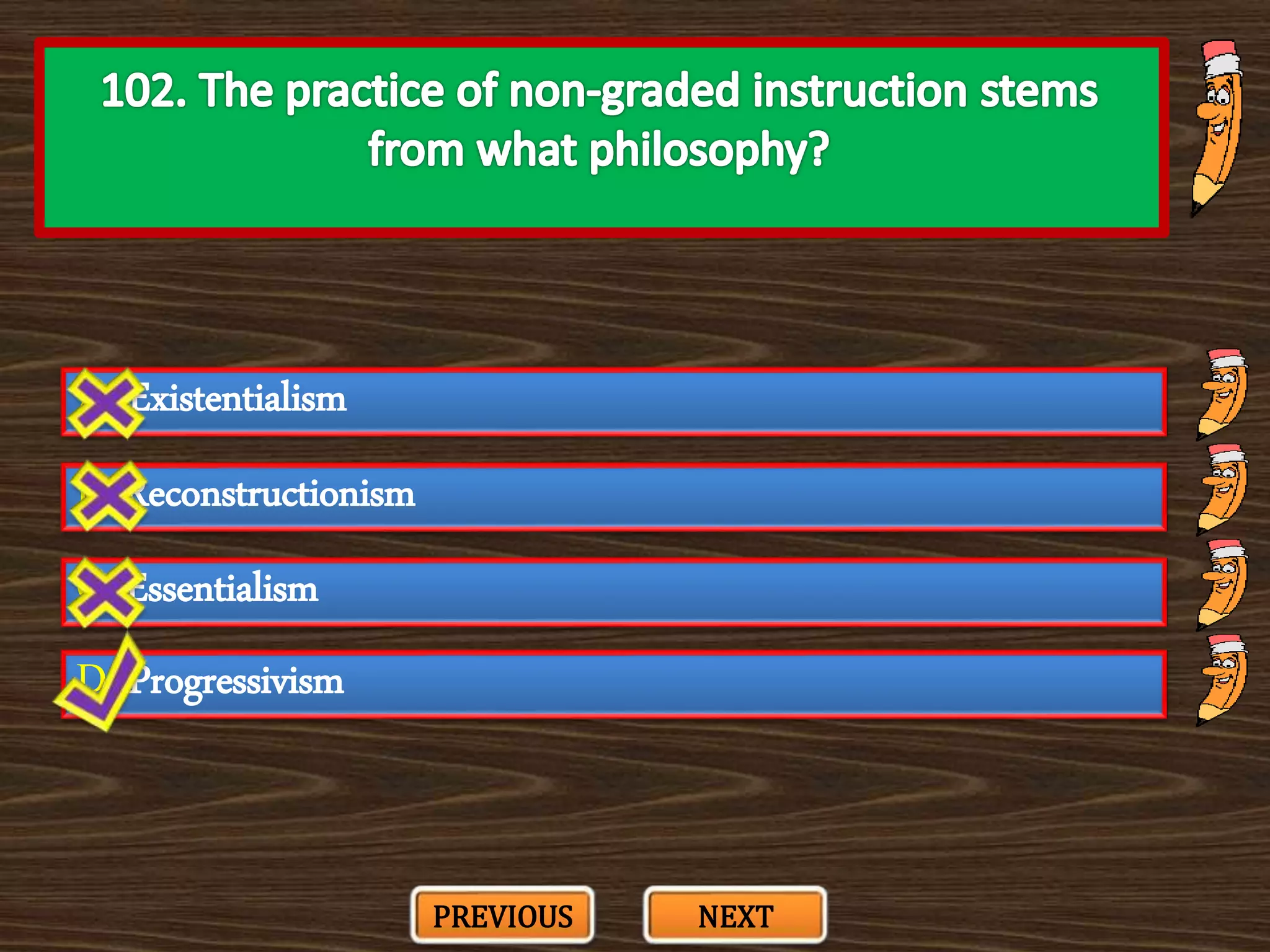
A. Existentialism
C. Essentialism
B. Reconstructionism
D. Progressivism
PREVIOUS NEXT
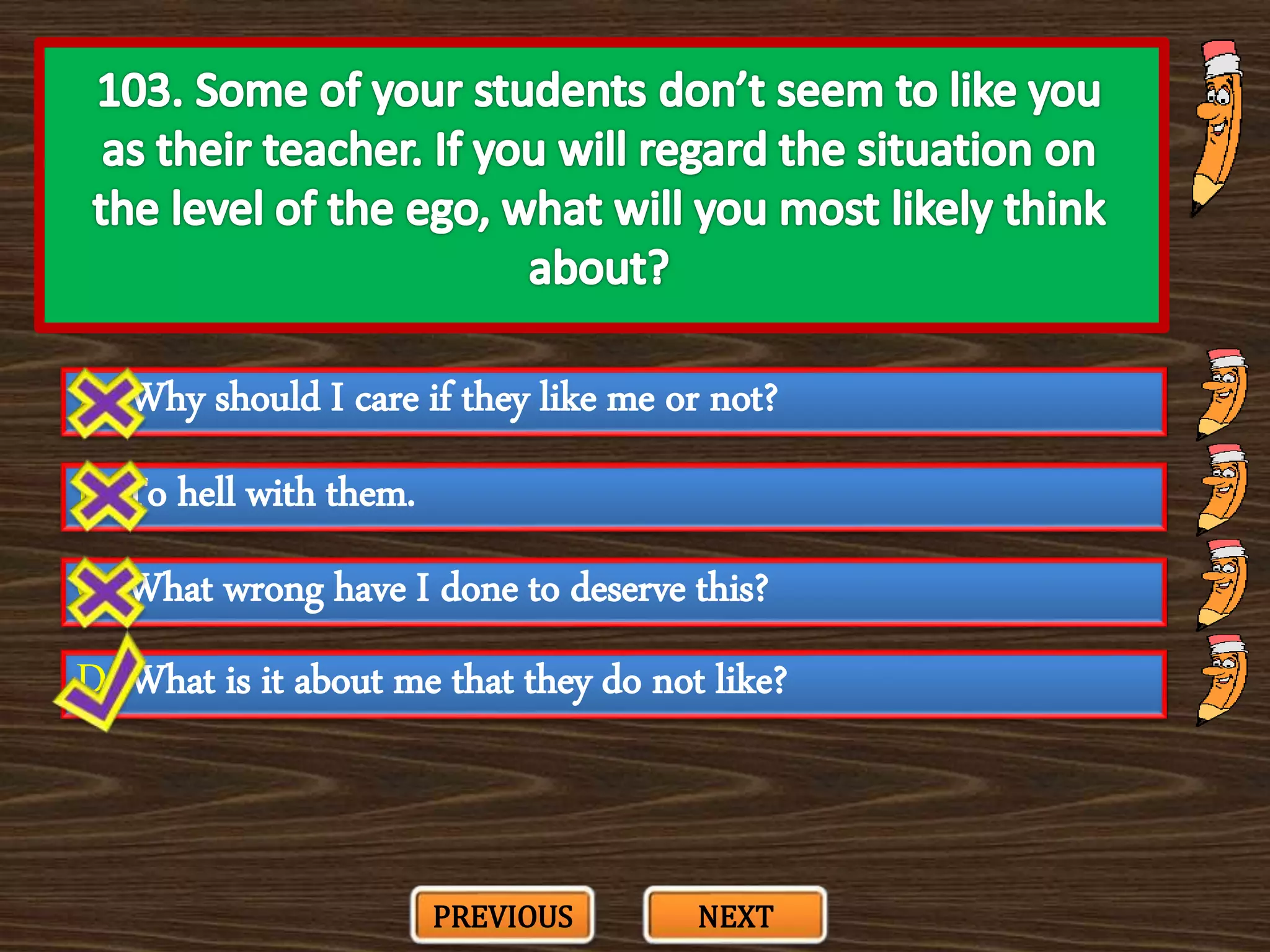
A. Why should I care if they like me or not?
C. What wrong have I done to deserve this?
B. To hell with them.
D. What is it about me that they do not like?
PREVIOUS NEXT
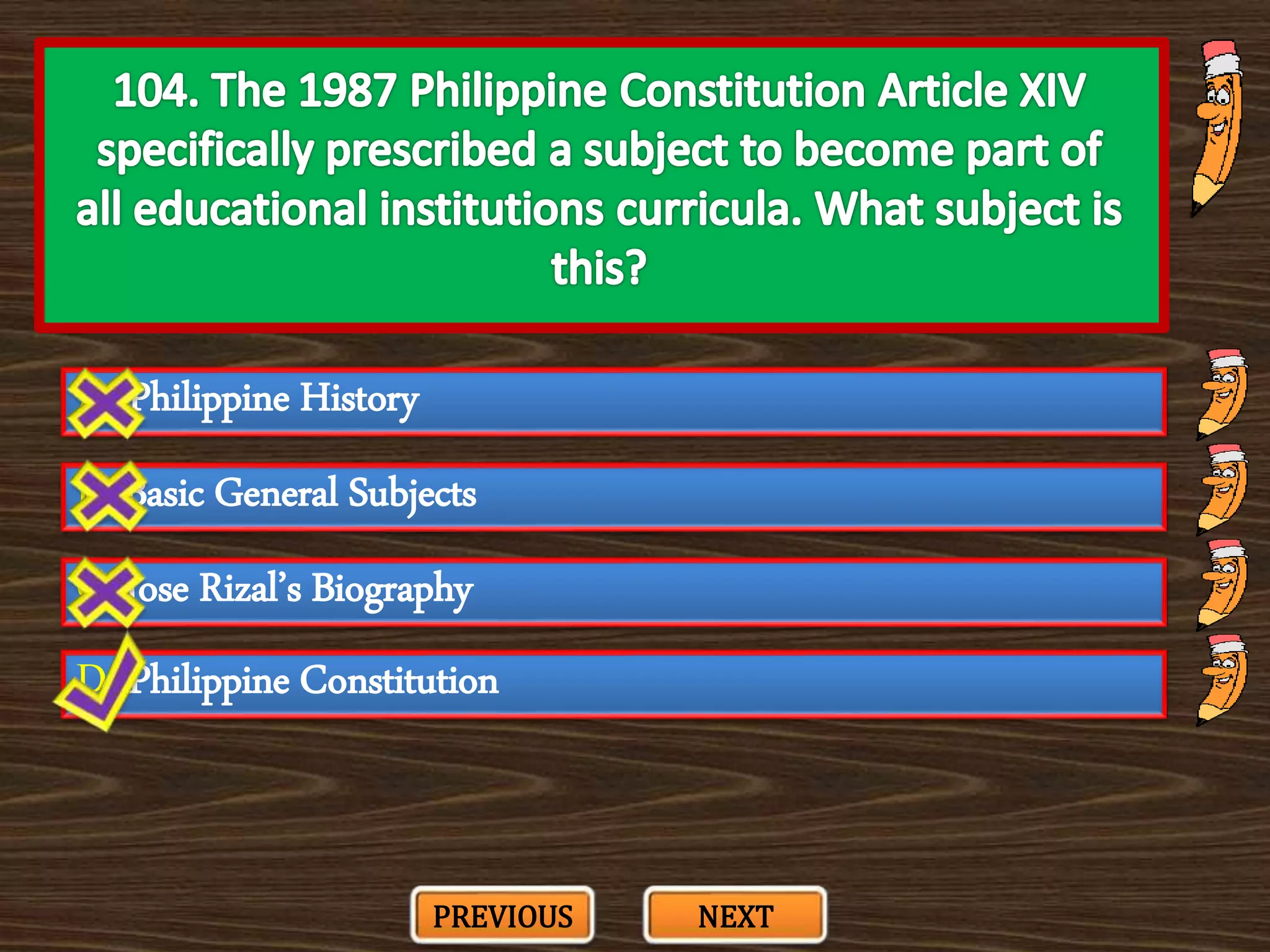
A. Philippine History
C. Jose Rizal’s Biography
B. Basic General Subjects
D. Philippine Constitution
PREVIOUS NEXT
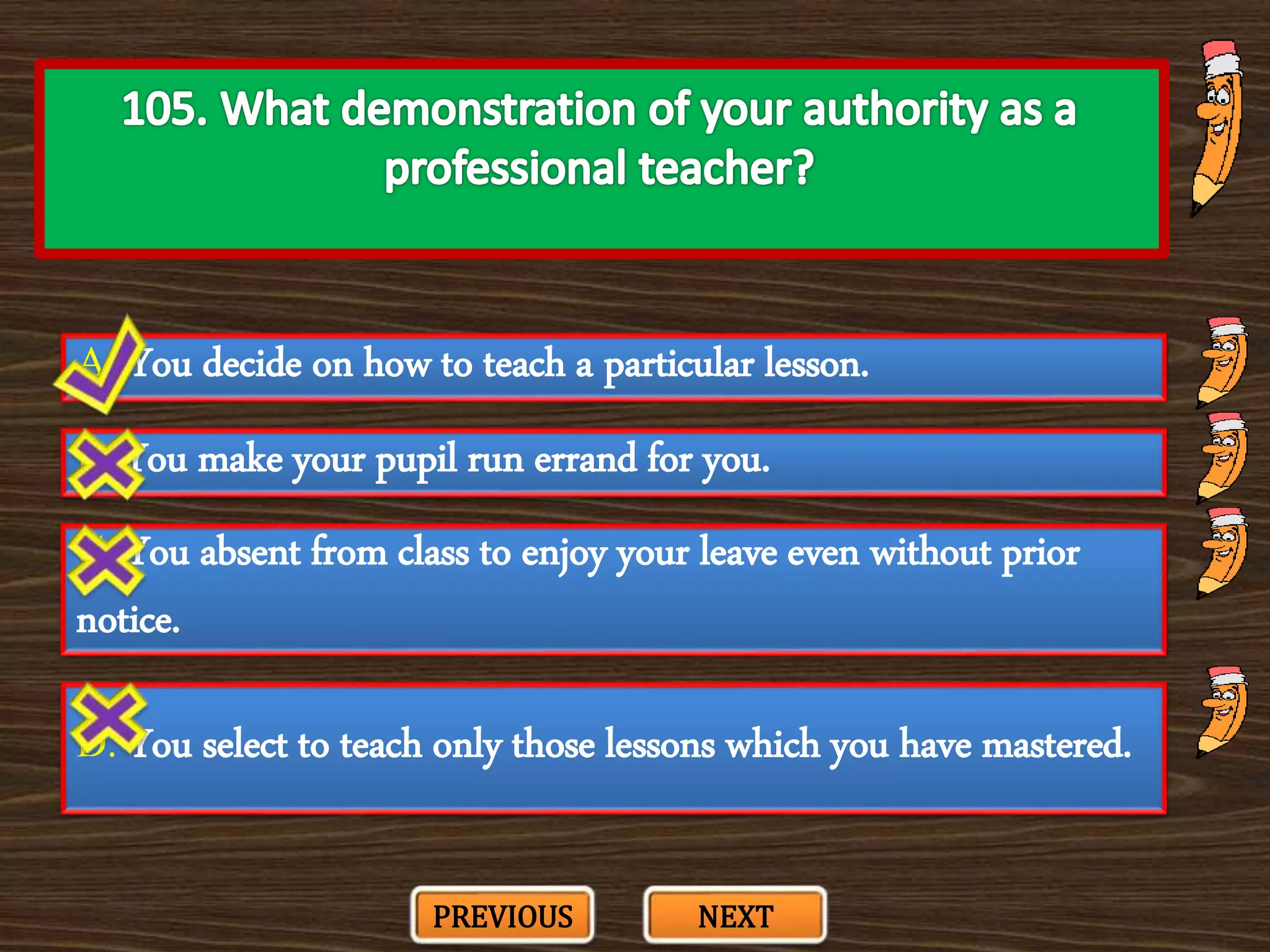
A. You decide on how to teach a particular lesson.
C. You absent from class to enjoy your leave even without prior
notice.
B. You make your pupil run errand for you.
D. You select to teach only those lessons which you have mastered.
PREVIOUS NEXT
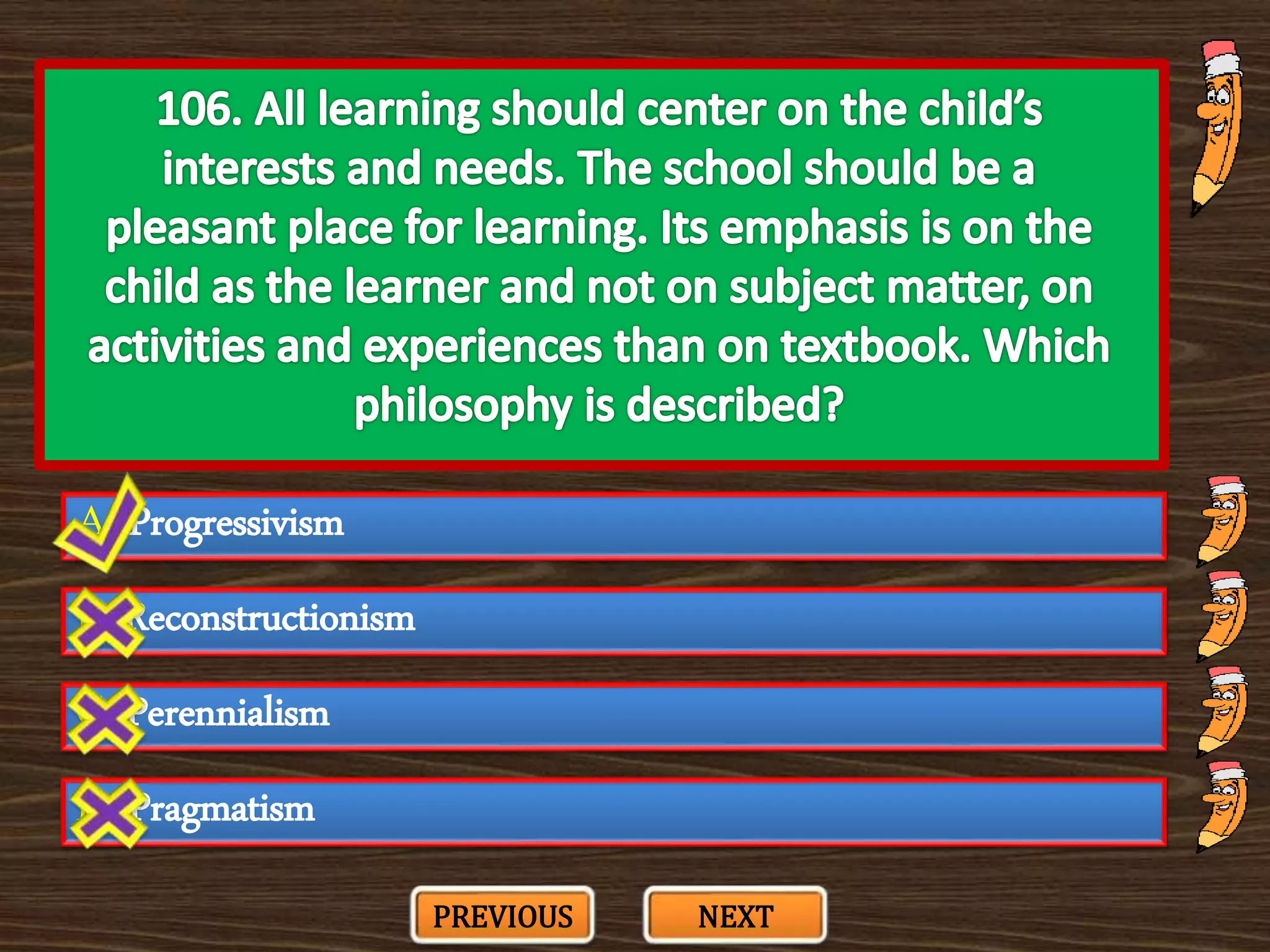
A. Progressivism
C. Perennialism
B. Reconstructionism
D. Pragmatism
PREVIOUS NEXT
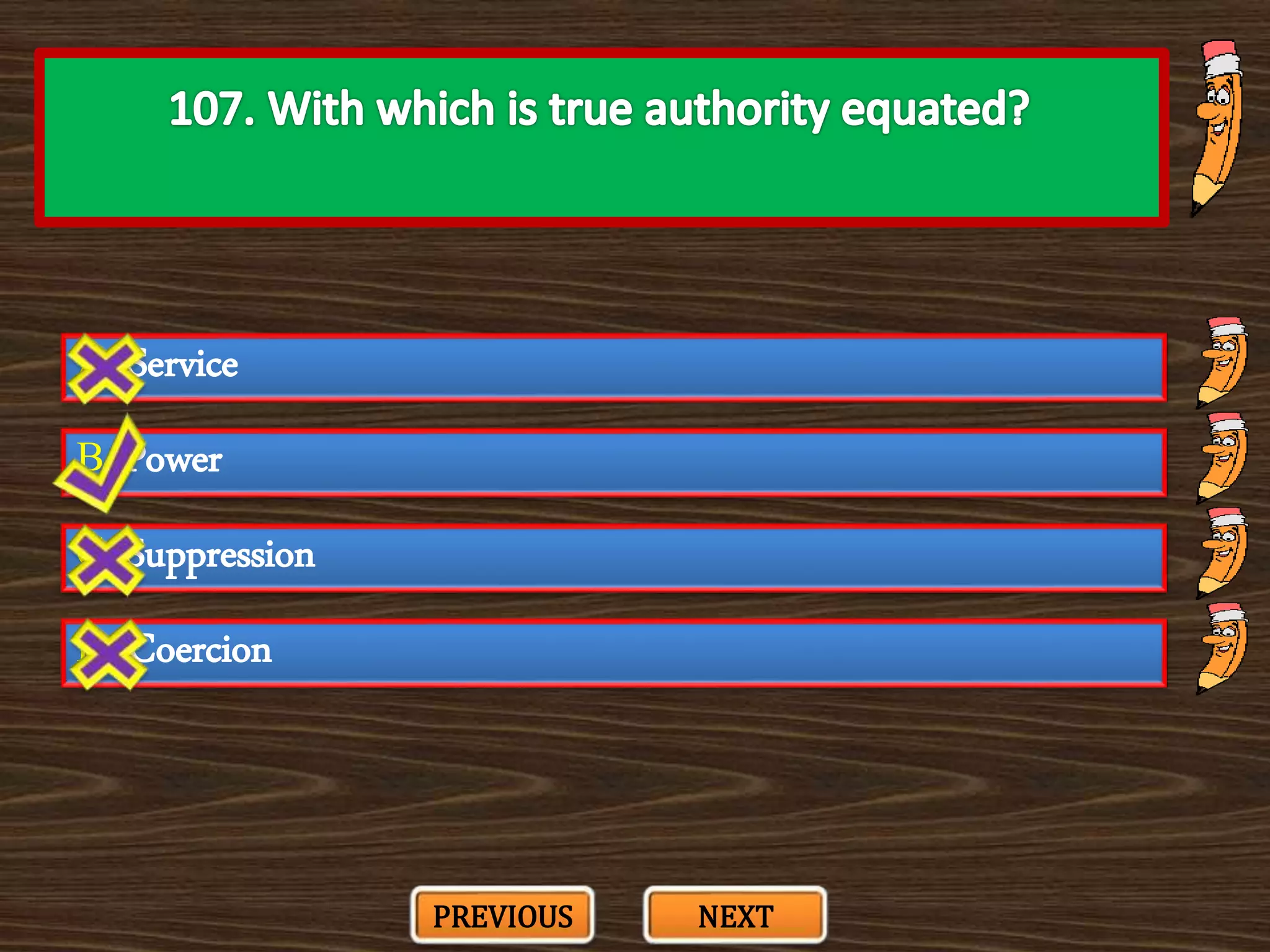
A. Service
C. Suppression
B. Power
D. Coercion
PREVIOUS NEXT
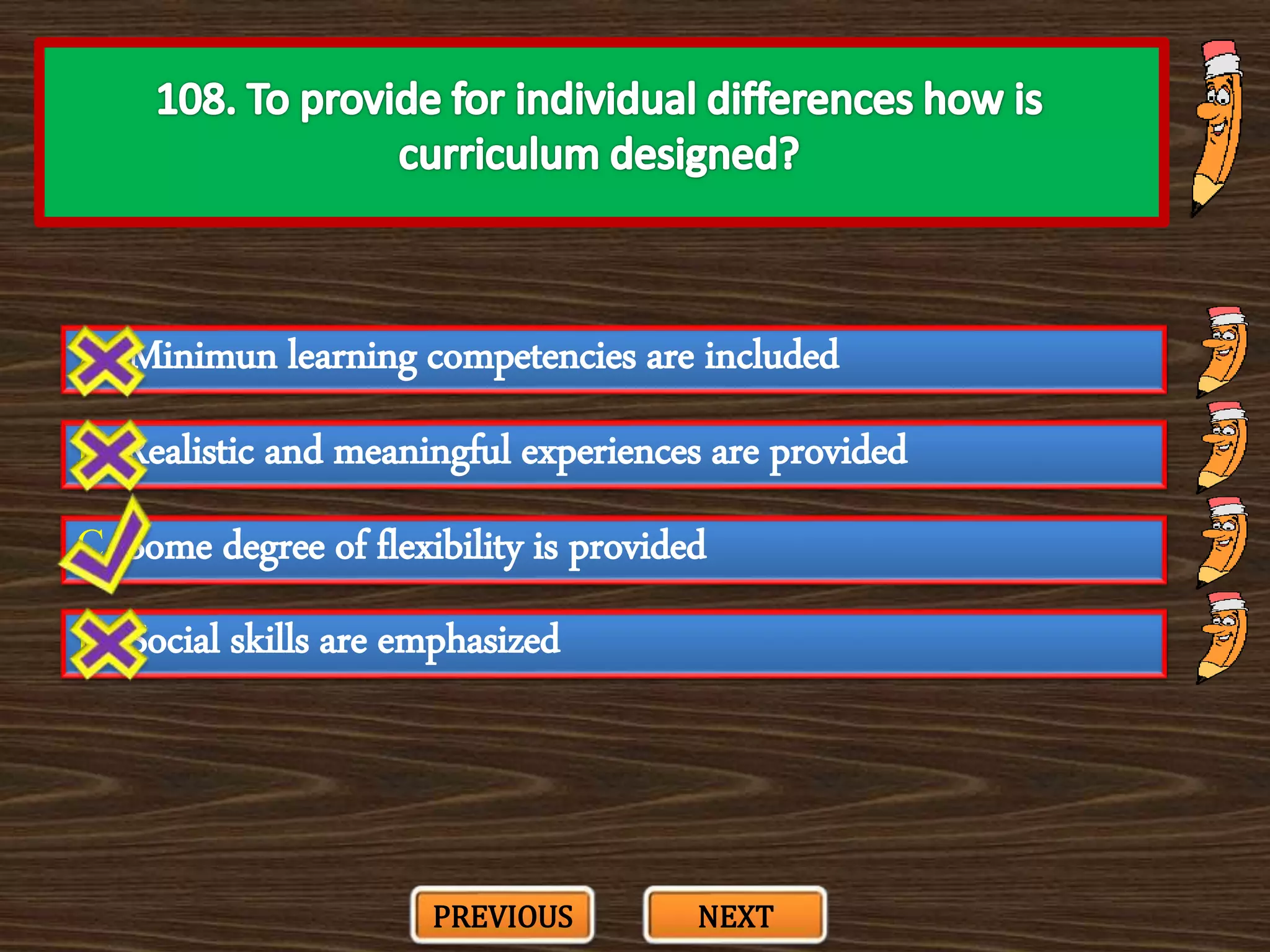
A. Minimun learning competencies are included
C. Some degree of flexibility is provided
B. Realistic and meaningful experiences are provided
D. Social skills are emphasized
PREVIOUS NEXT
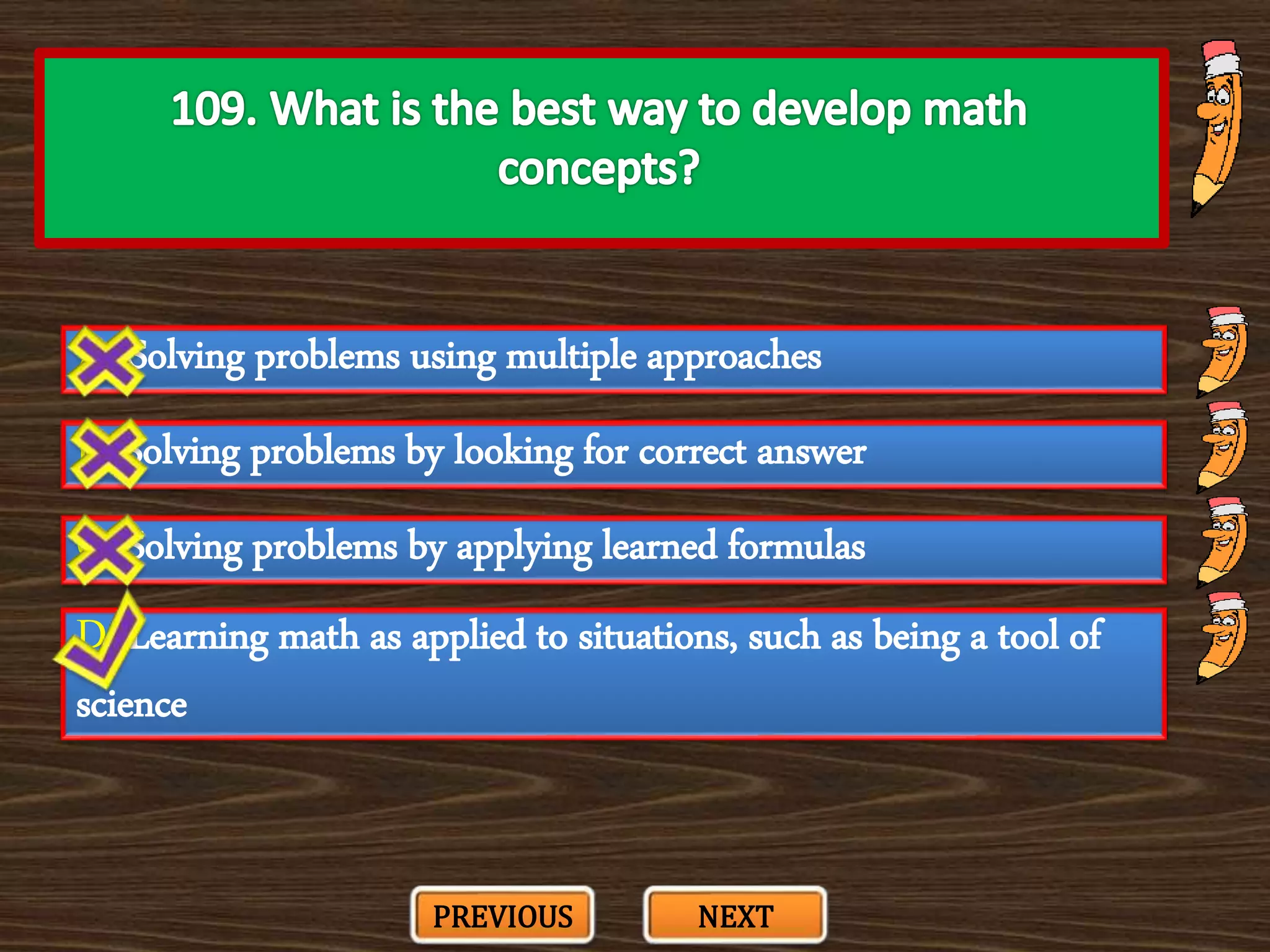
A. Solving problems using multiple approaches
C. Solving problems by applying learned formulas
B. Solving problems by looking for correct answer
D. Learning math as applied to situations, such as being a tool of
science
PREVIOUS NEXT
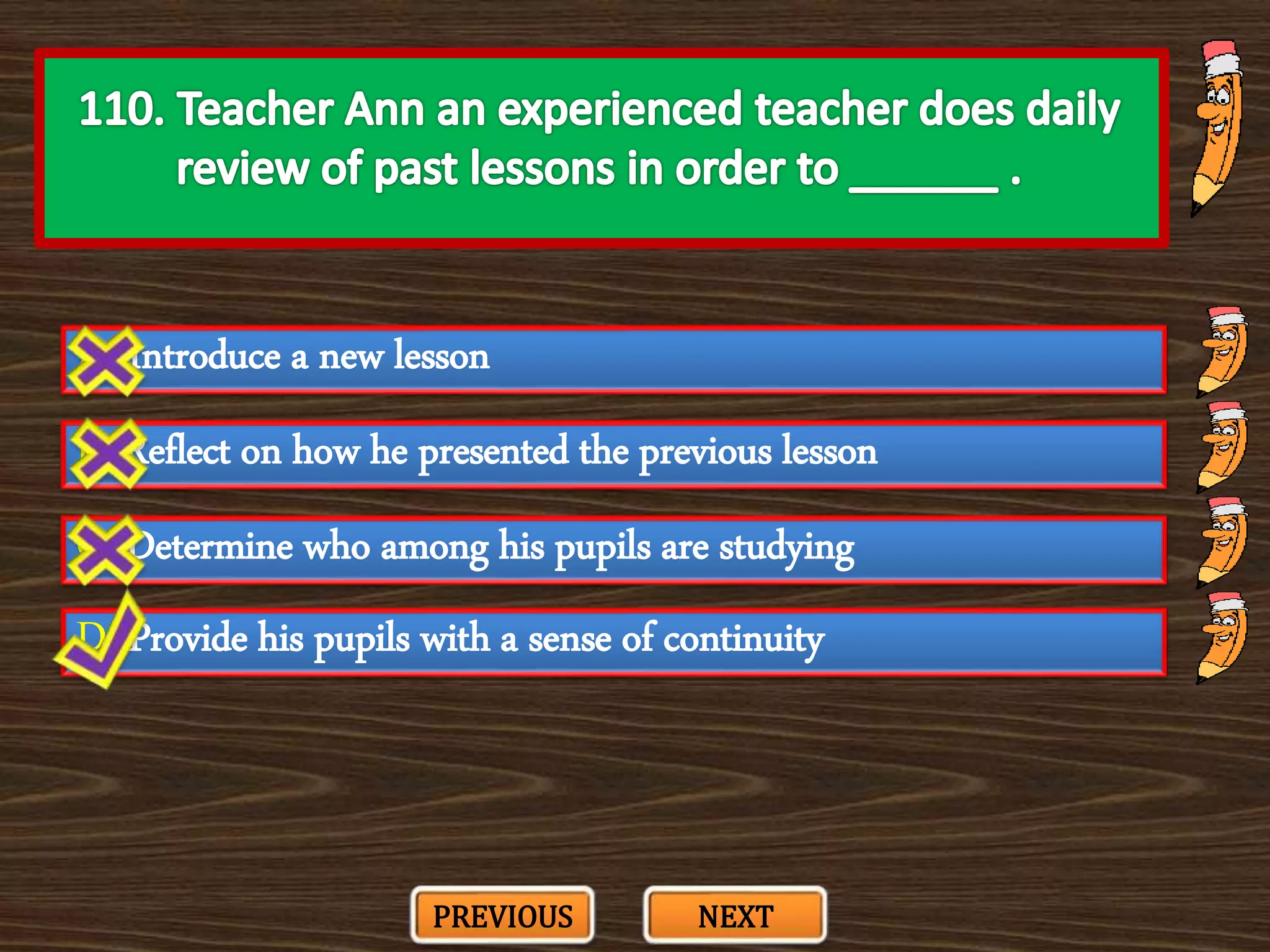
A. Introduce a new lesson
C. Determine who among his pupils are studying
B. Reflect on how he presented the previous lesson
D. Provide his pupils with a sense of continuity
PREVIOUS NEXT
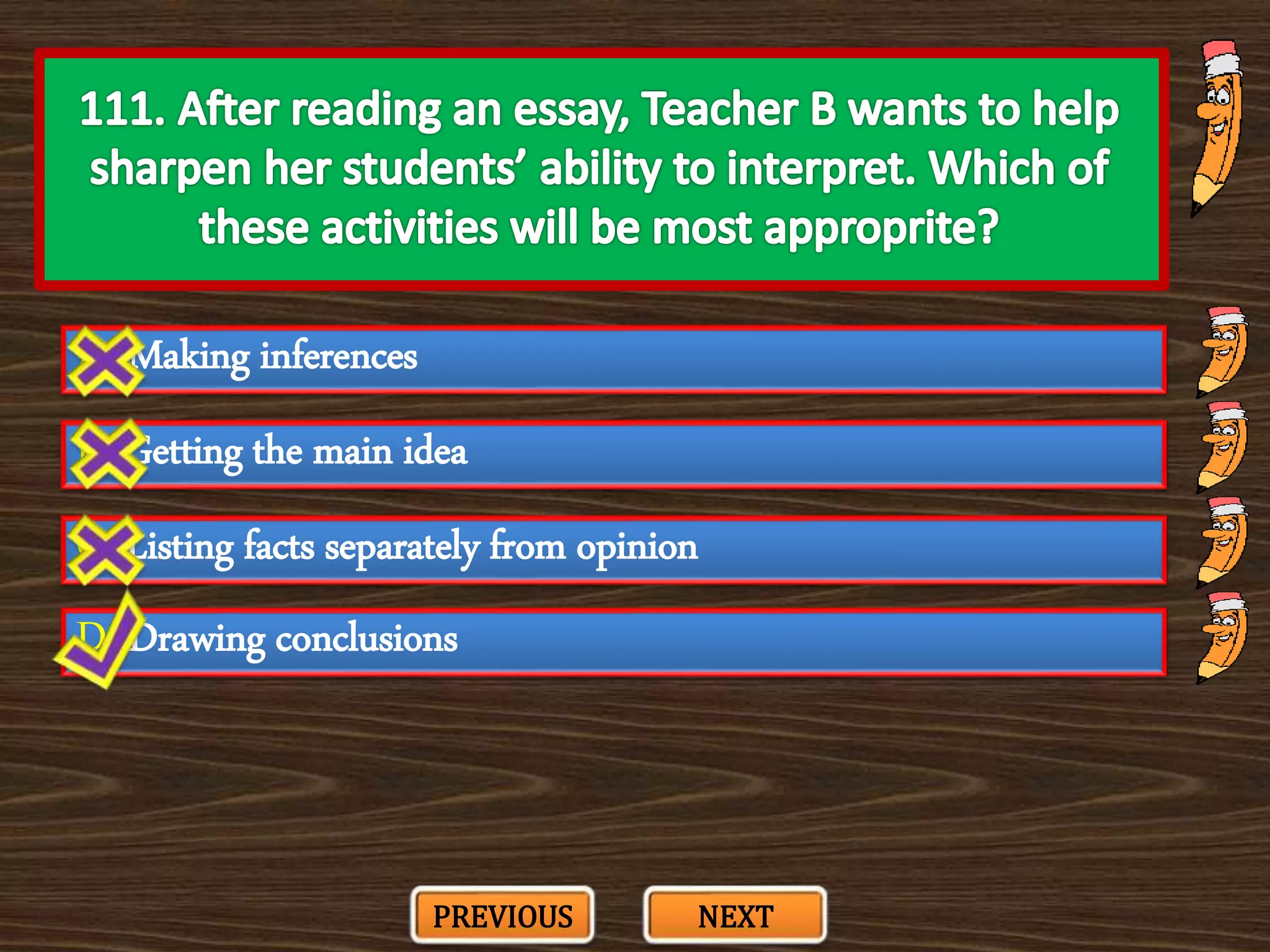
A. Making inferences
C. Listing facts separately from opinion
B. Getting the main idea
D. Drawing conclusions
PREVIOUS NEXT
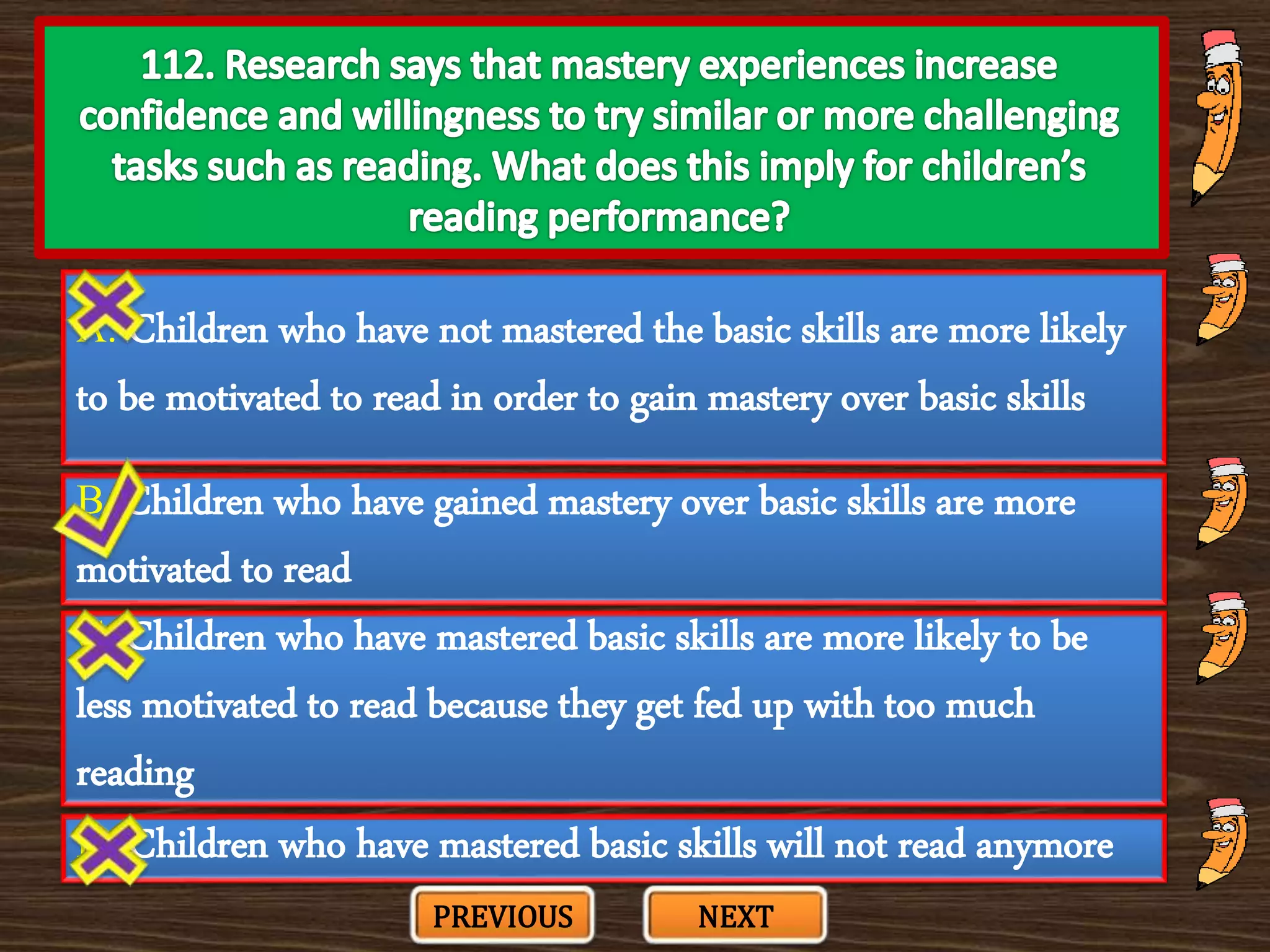
A. Children who have not mastered the basic skills are more likely
to be motivated to read in order to gain mastery over basic skills
C. Children who have mastered basic skills are more likely to be
less motivated to read because they get fed up with too much
reading
B. Children who have gained mastery over basic skills are more
motivated to read
D. Children who have mastered basic skills will not read anymore
PREVIOUS NEXT
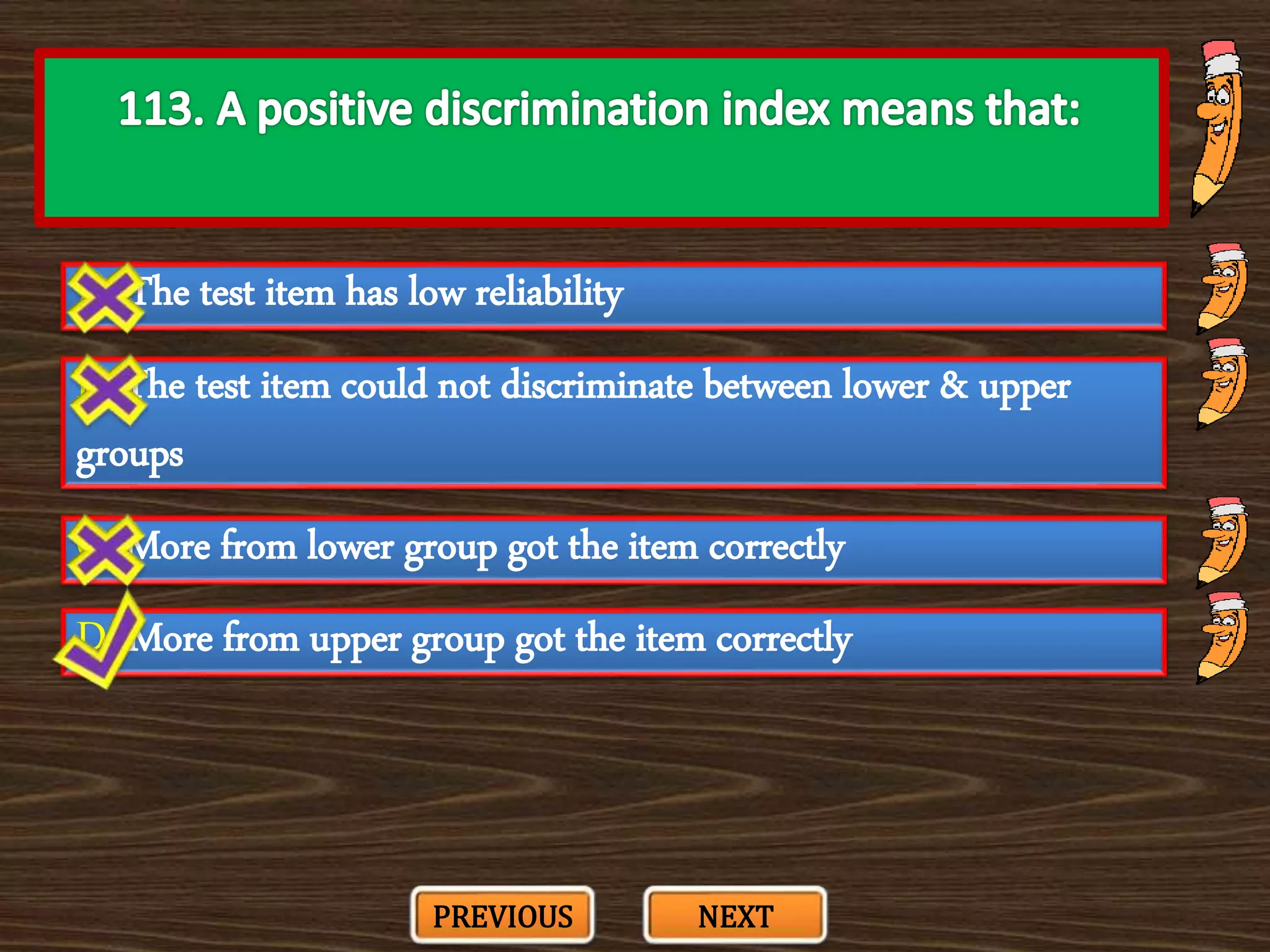
A. The test item has low reliability
C. More from lower group got the item correctly
B. The test item could not discriminate between lower & upper
groups
D. More from upper group got the item correctly
PREVIOUS NEXT
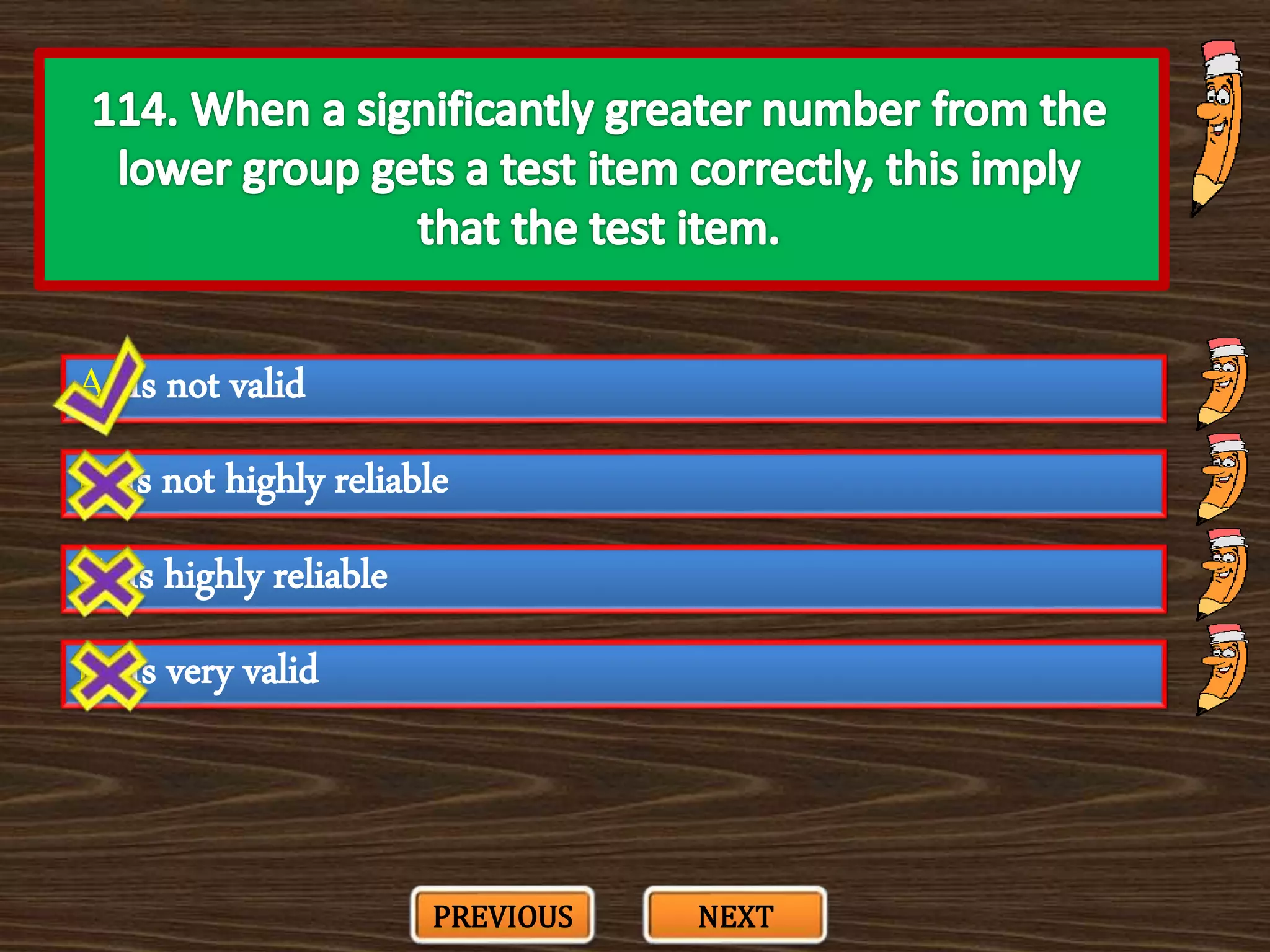
A. Is not valid
C. Is highly reliable
B. Is not highly reliable
D. Is very valid
PREVIOUS NEXT
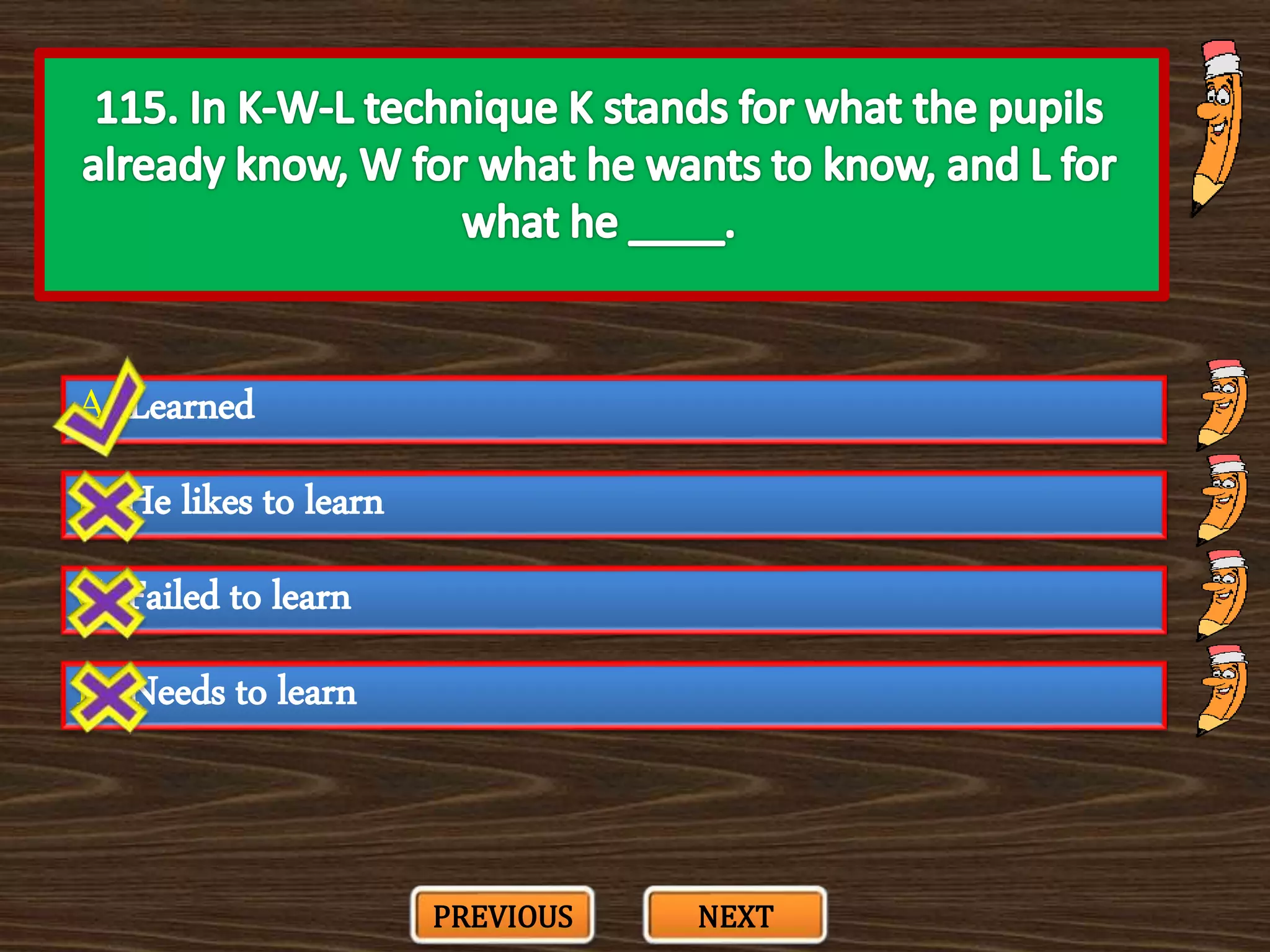
A. Learned
C. Failed to learn
B. He likes to learn
D. Needs to learn
PREVIOUS NEXT
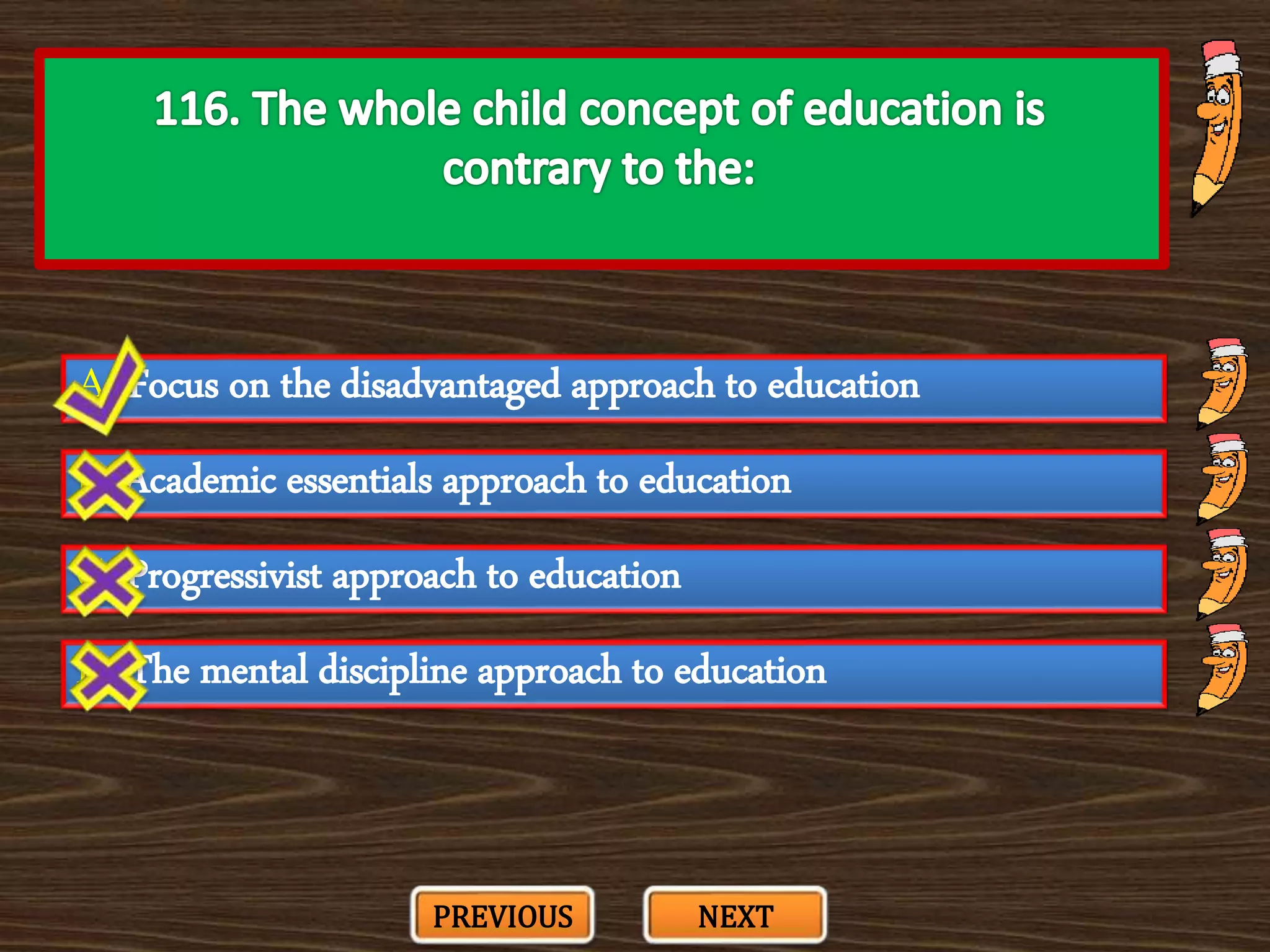
A. Focus on the disadvantaged approach to education
C. Progressivist approach to education
B. Academic essentials approach to education
D. The mental discipline approach to education
PREVIOUS NEXT
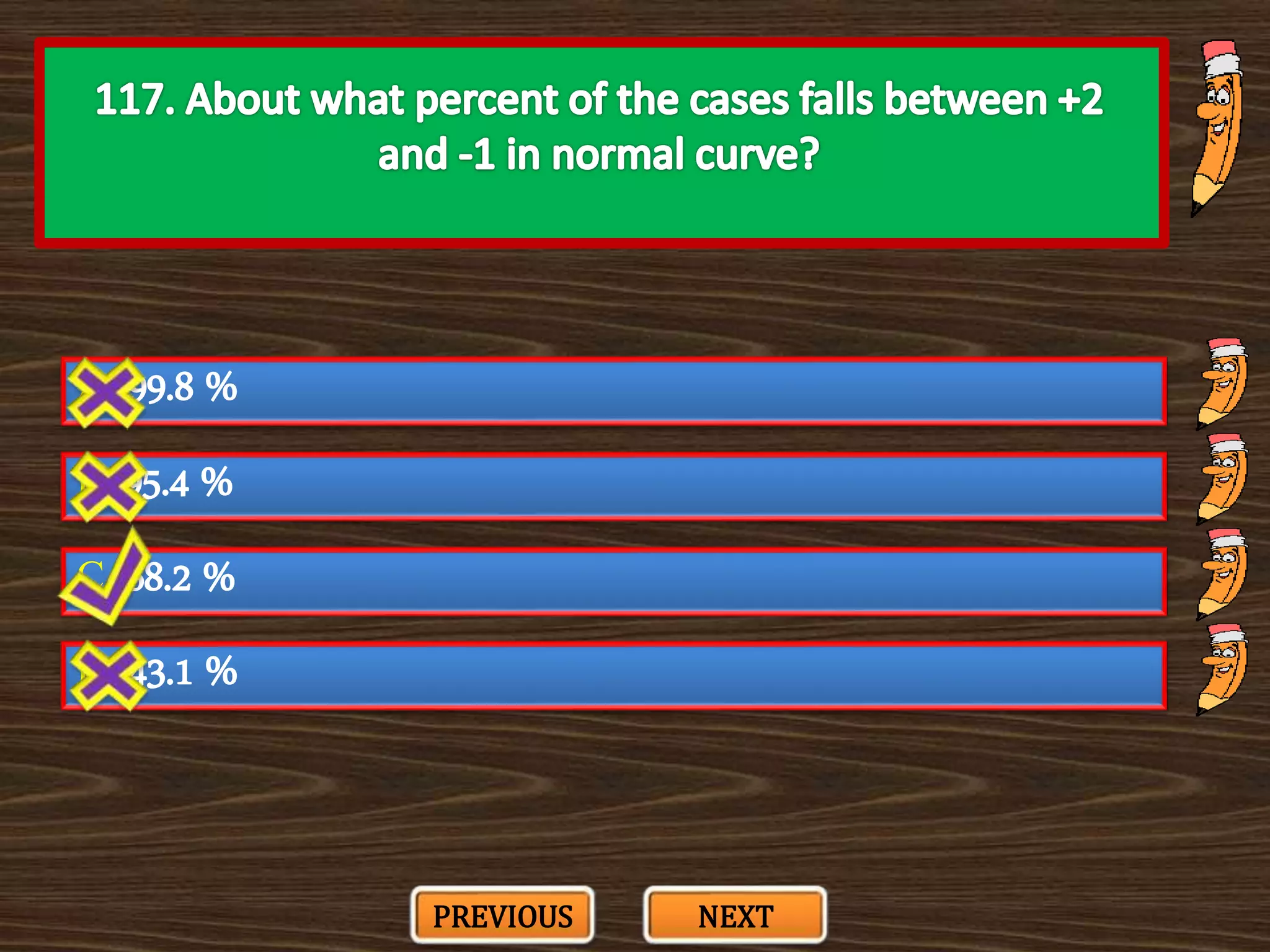
A. 99.8 %
C. 68.2 %
B. 95.4 %
D. 43.1 %
PREVIOUS NEXT
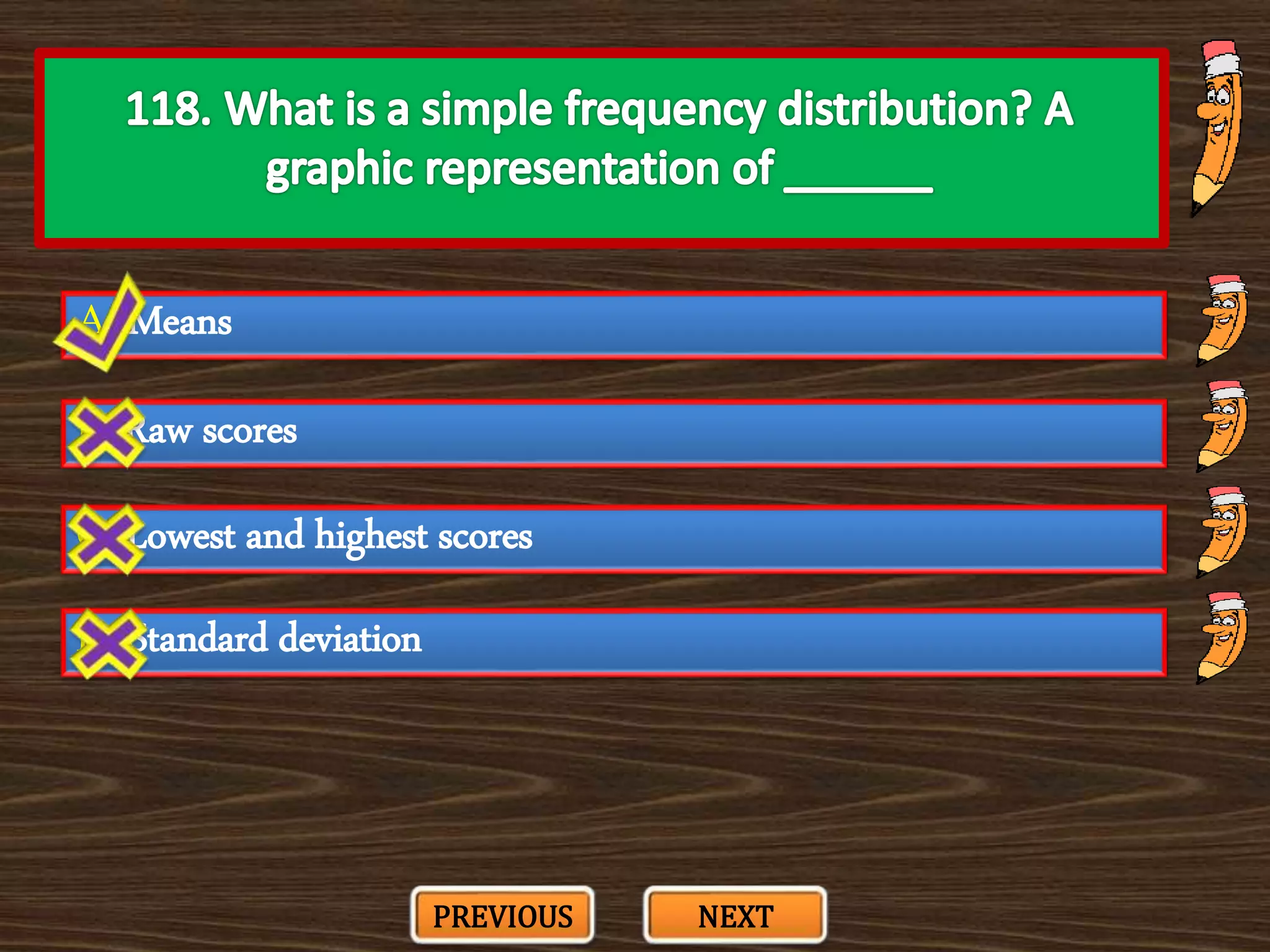
A. Means
C. Lowest and highest scores
B. Raw scores
D. Standard deviation
PREVIOUS NEXT
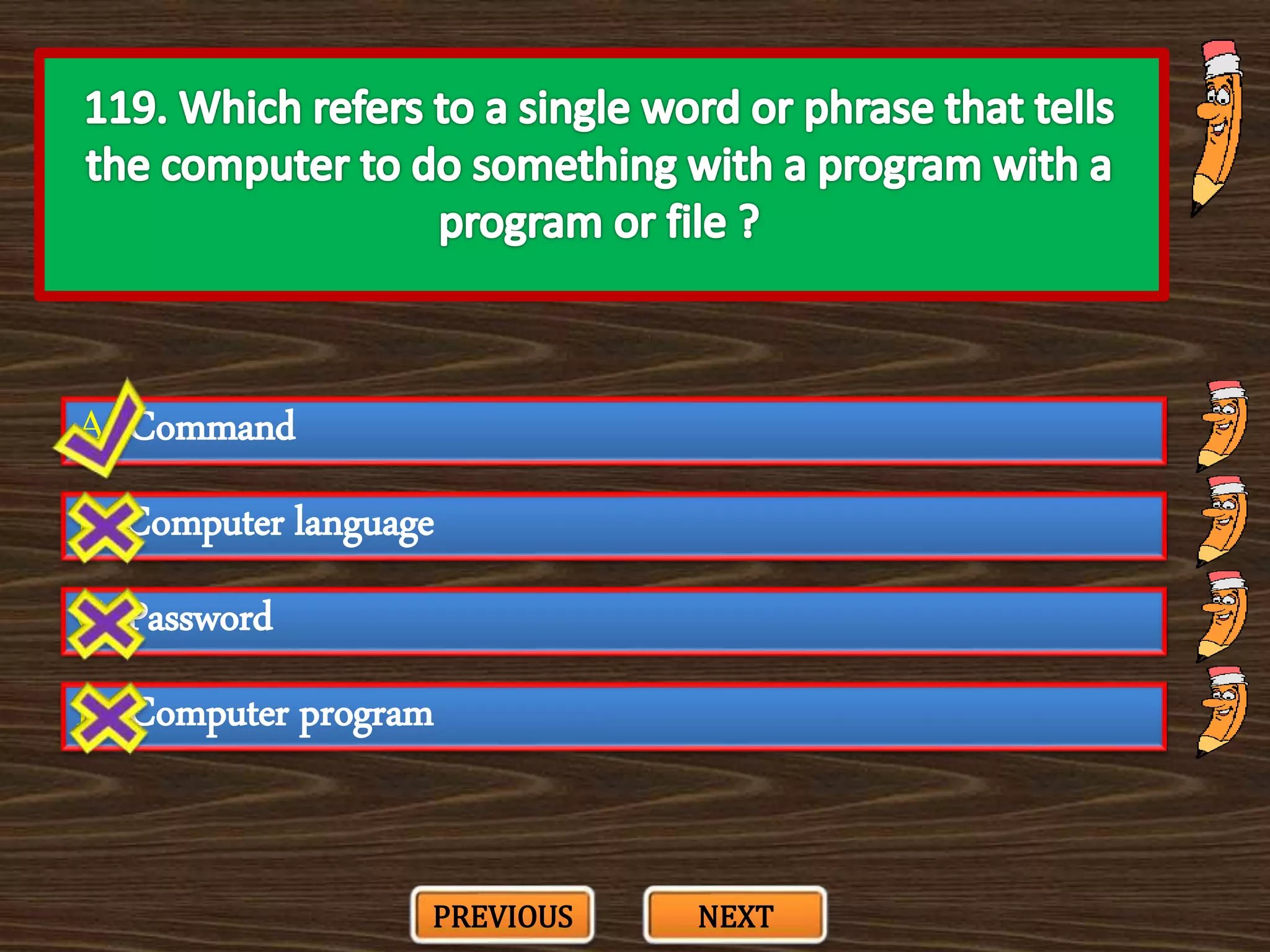
A. Command
C. Password
B. Computer language
D. Computer program
PREVIOUS NEXT
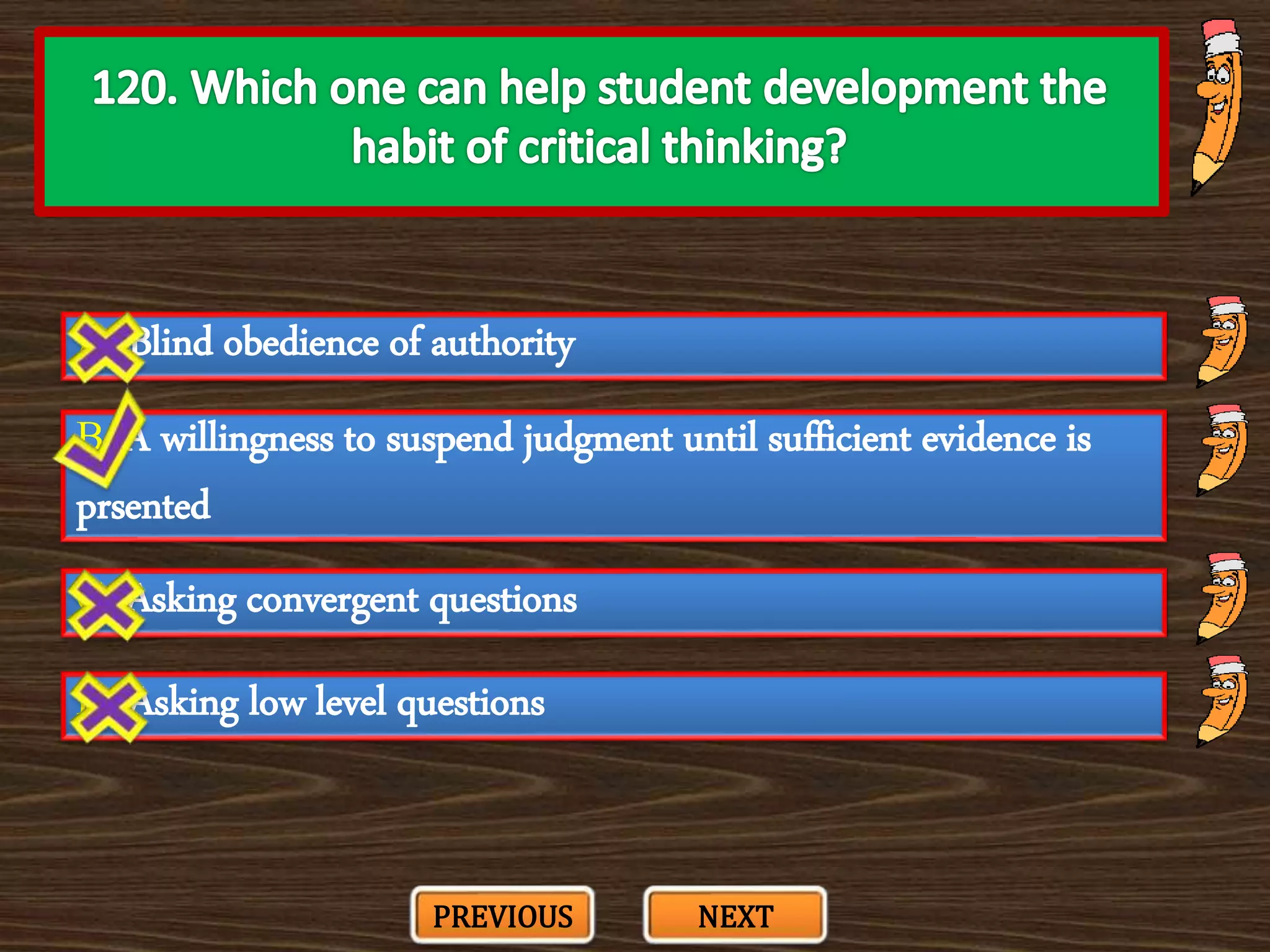
A. Blind obedience of authority
C. Asking convergent questions
B. A willingness to suspend judgment until sufficient evidence is
prsented
D. Asking low level questions
PREVIOUS NEXT
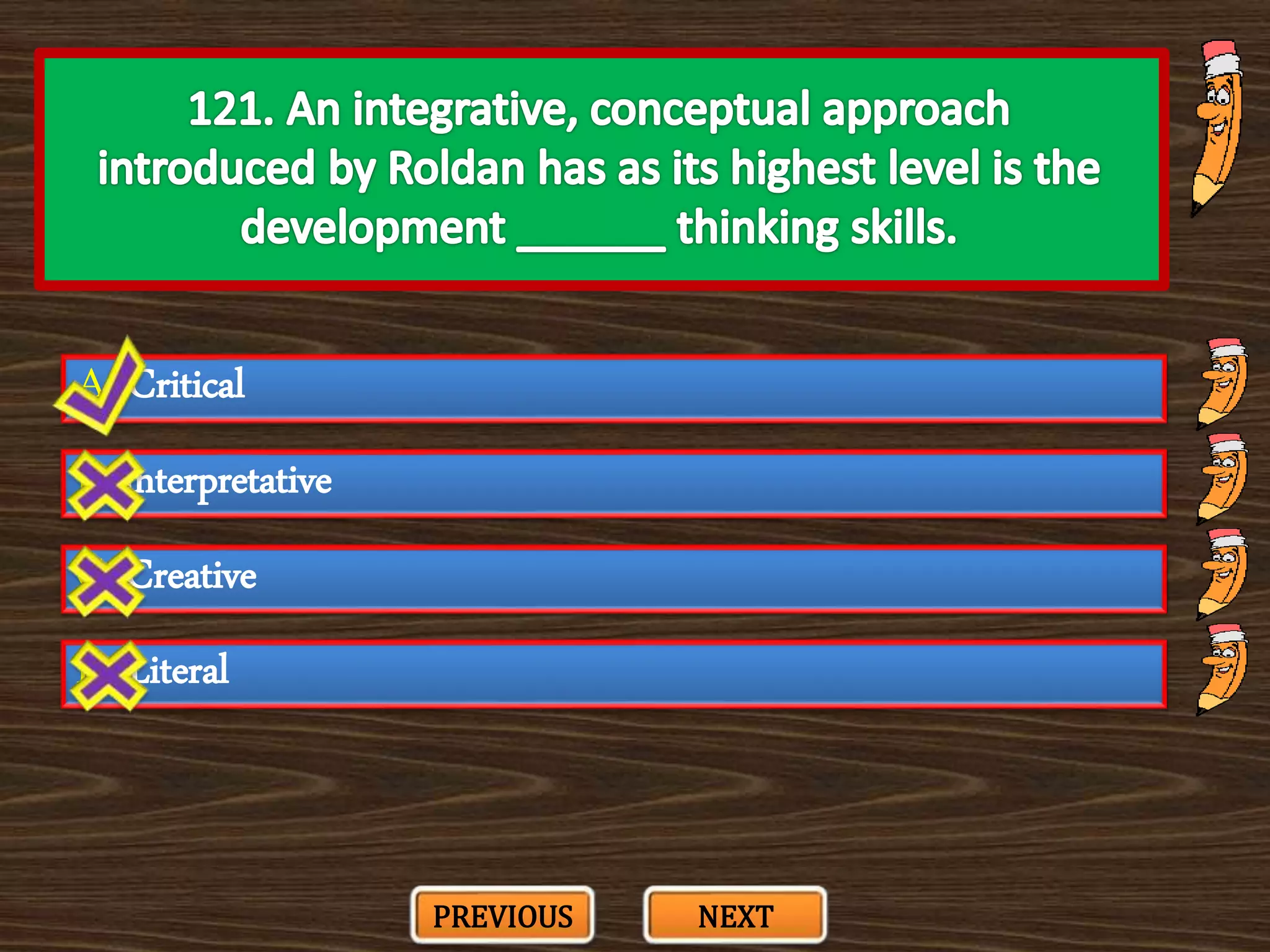
A. Critical
C. Creative
B. interpretative
D. Literal
PREVIOUS NEXT
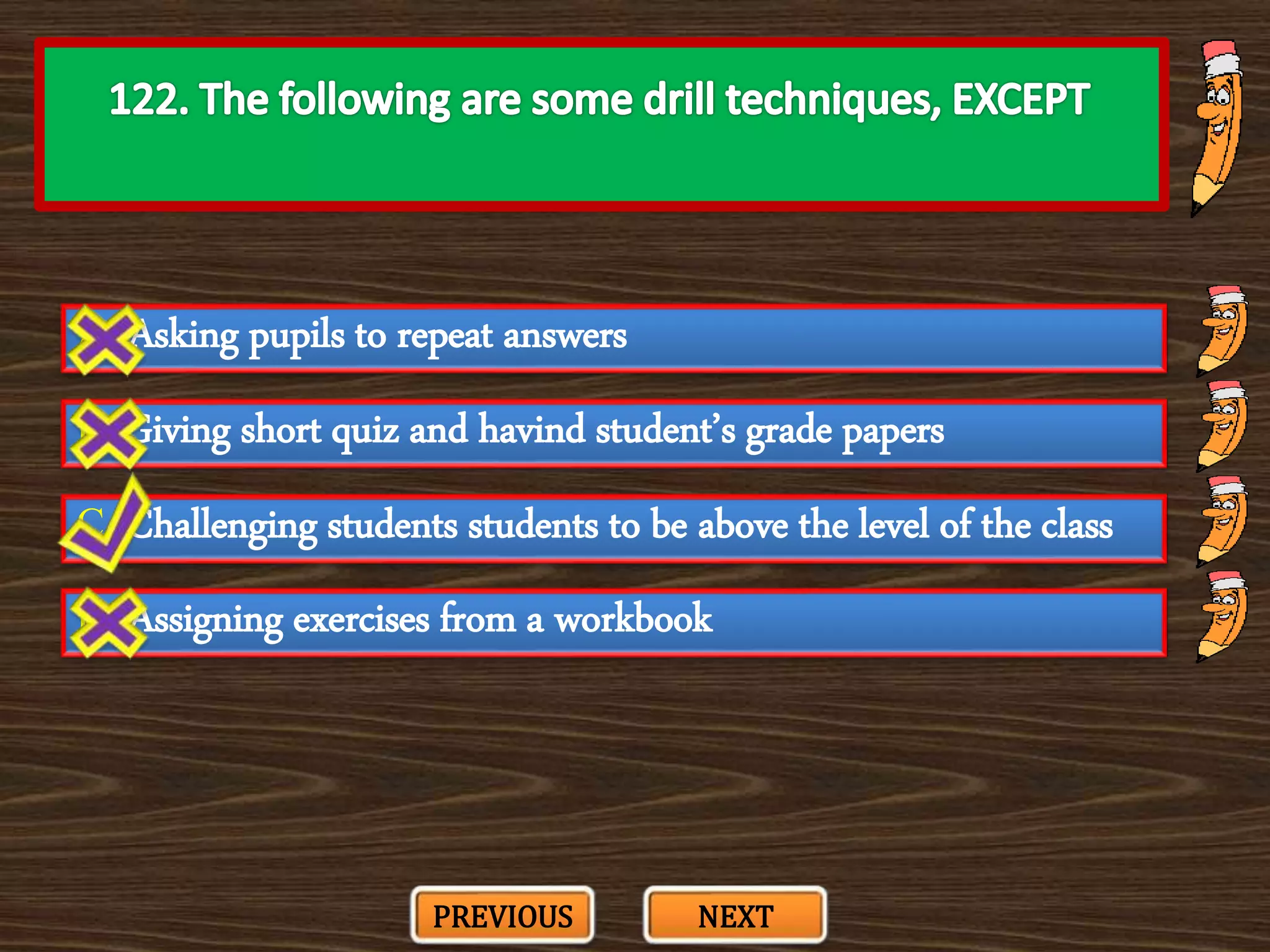
A. Asking pupils to repeat answers
C. Challenging students students to be above the level of the class
B. Giving short quiz and havind student’s grade papers
D. Assigning exercises from a workbook
PREVIOUS NEXT
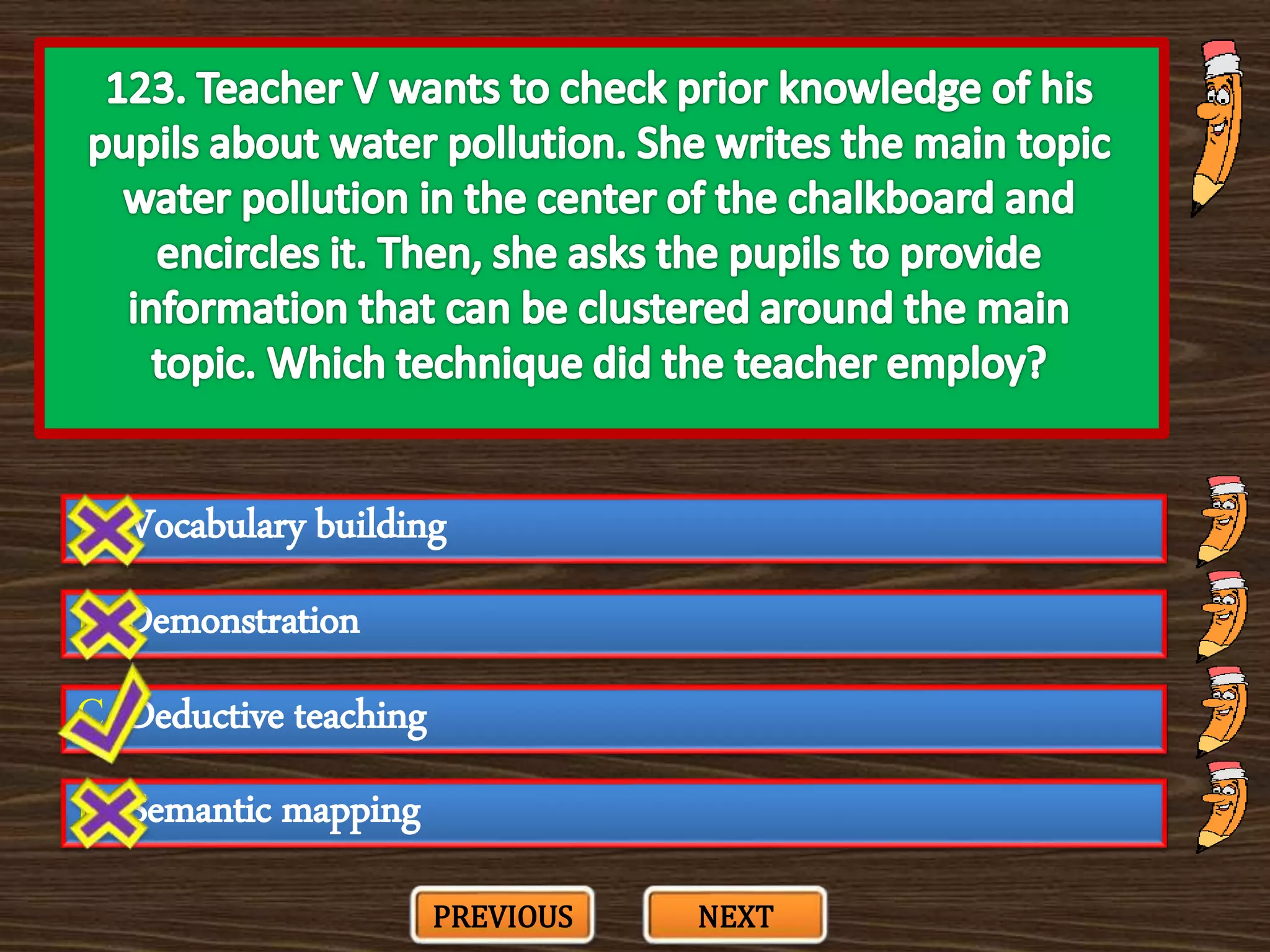
A. Vocabulary building
C. Deductive teaching
B. Demonstration
D. Semantic mapping
PREVIOUS NEXT
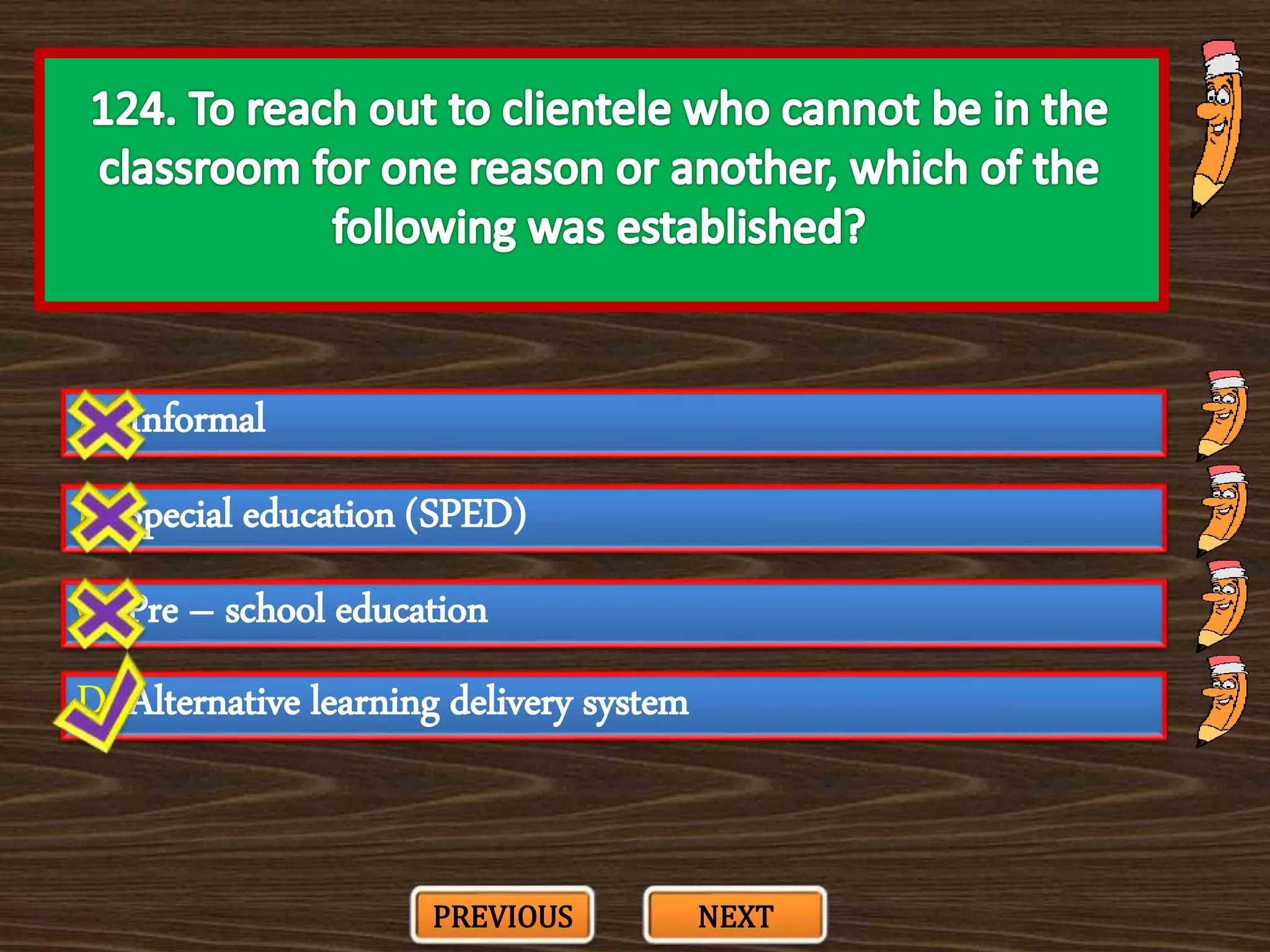
A. Informal
C. Pre – school education
B. Special education (SPED)
D. Alternative learning delivery system
PREVIOUS NEXT
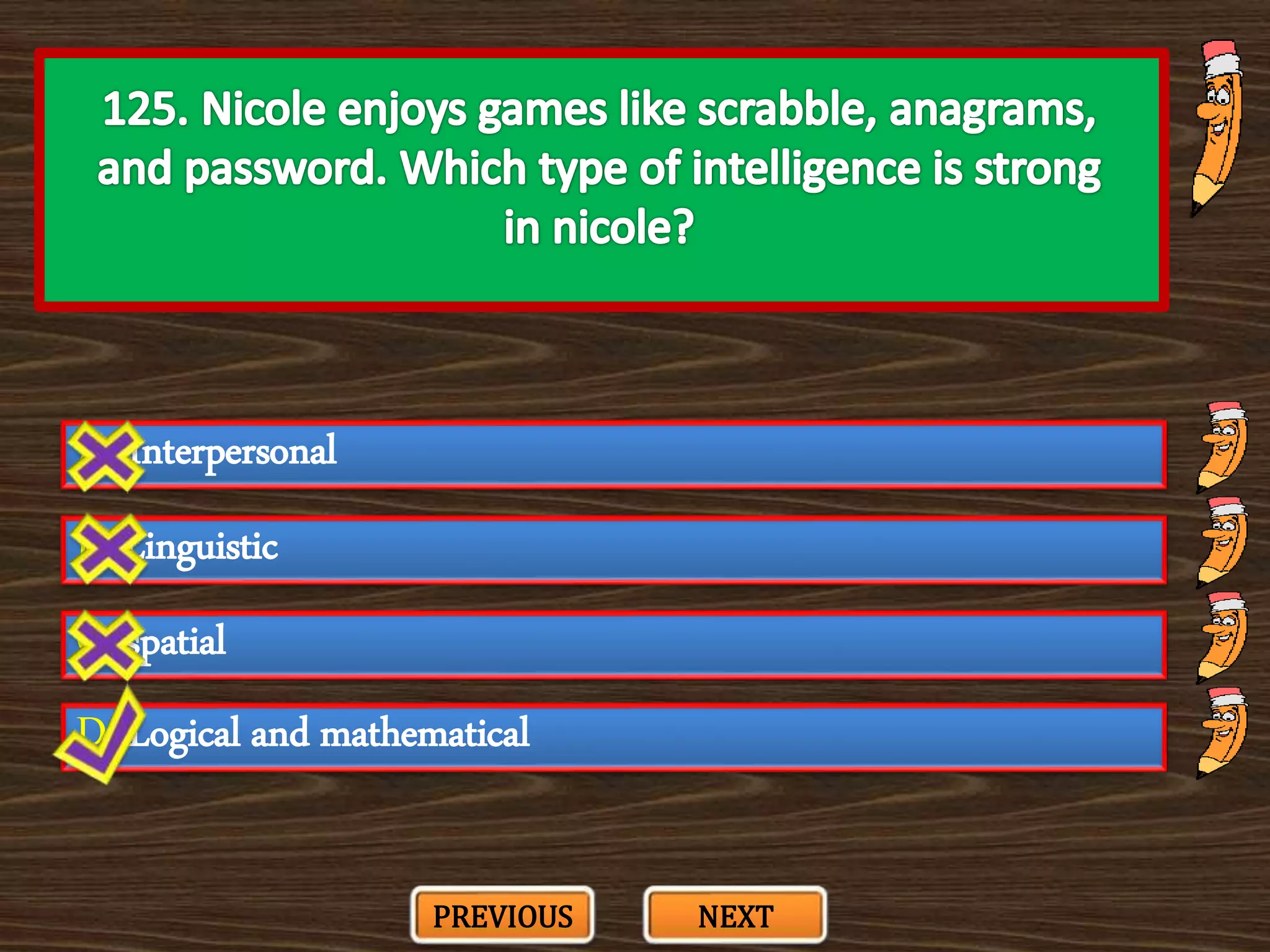
A. Interpersonal
C. spatial
B. Linguistic
D. Logical and mathematical
PREVIOUS NEXT
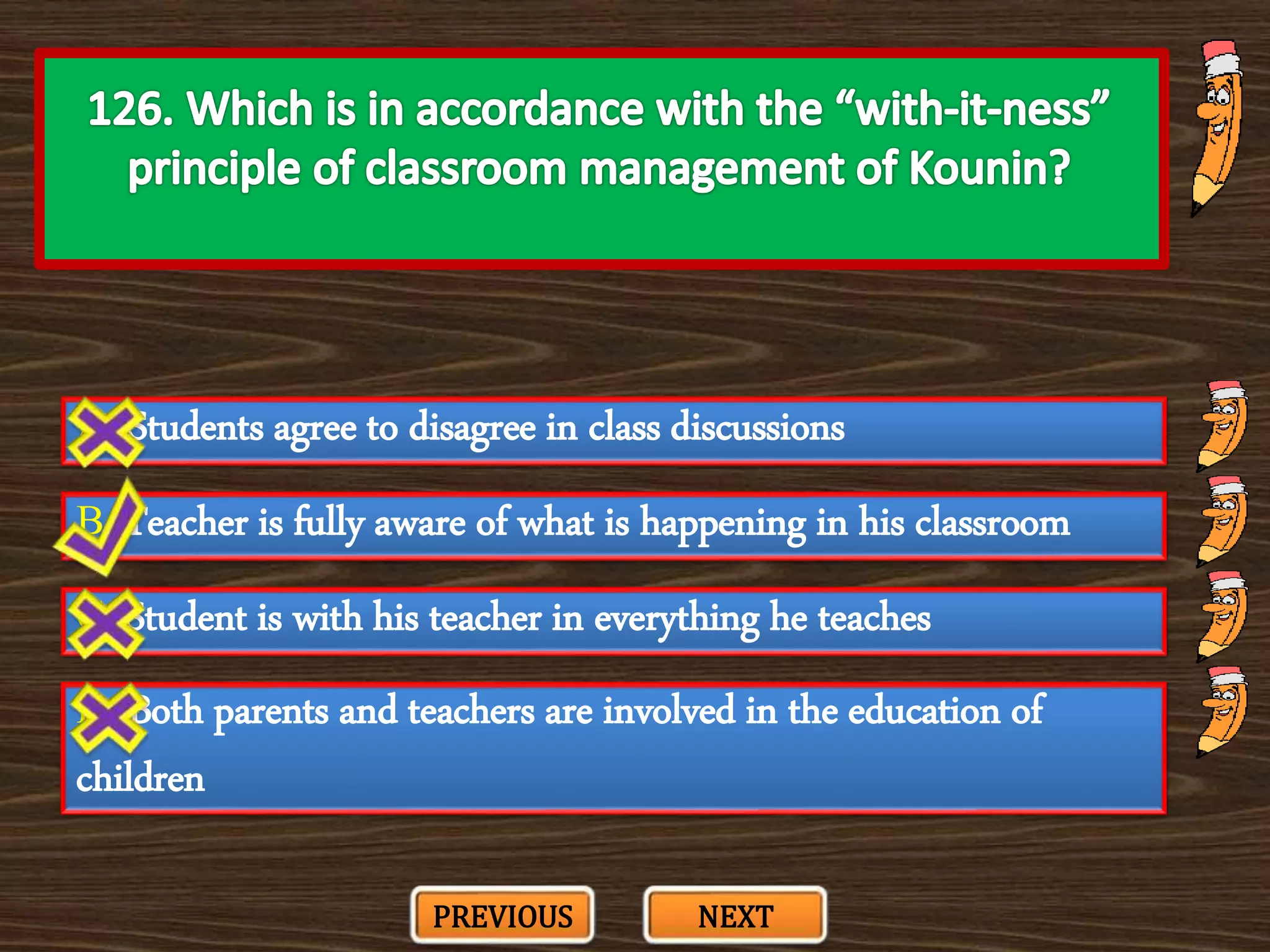
A. Students agree to disagree in class discussions
C. Student is with his teacher in everything he teaches
B. Teacher is fully aware of what is happening in his classroom
D. Both parents and teachers are involved in the education of
children
PREVIOUS NEXT
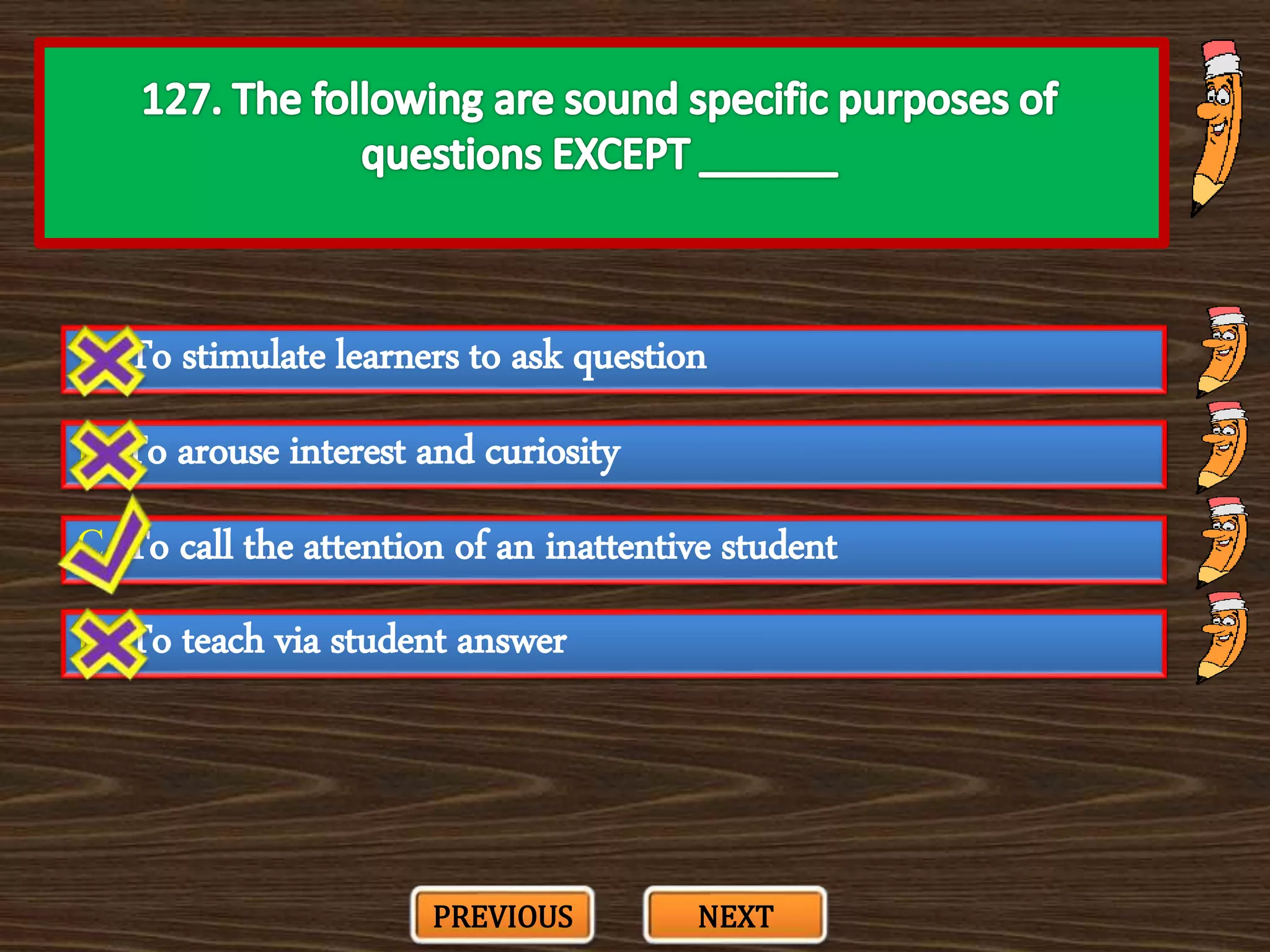
A. To stimulate learners to ask question
C. To call the attention of an inattentive student
B. To arouse interest and curiosity
D. To teach via student answer
PREVIOUS NEXT
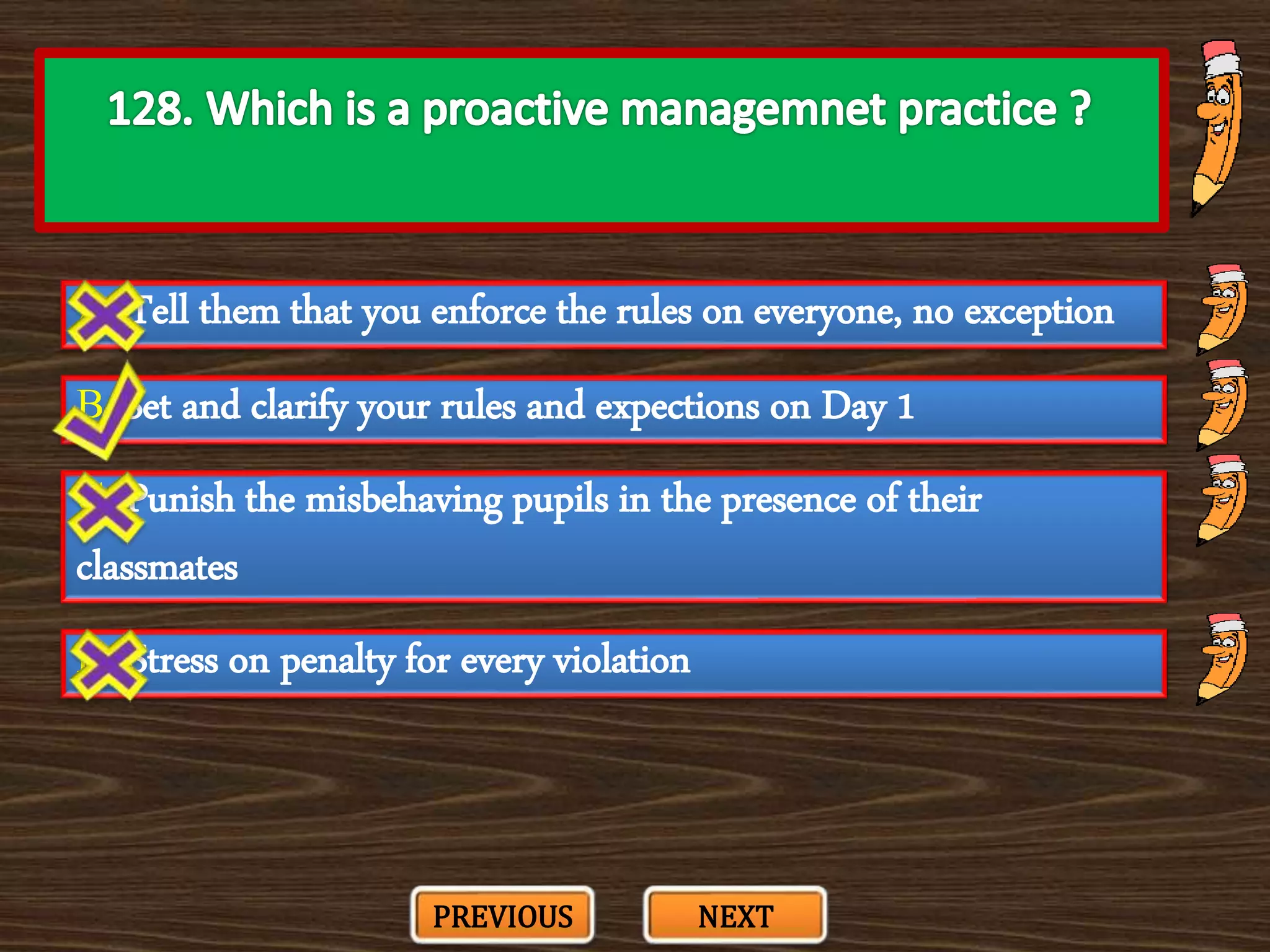
A. Tell them that you enforce the rules on everyone, no exception
C. Punish the misbehaving pupils in the presence of their
classmates
B. Set and clarify your rules and expections on Day 1
D. Stress on penalty for every violation
PREVIOUS NEXT
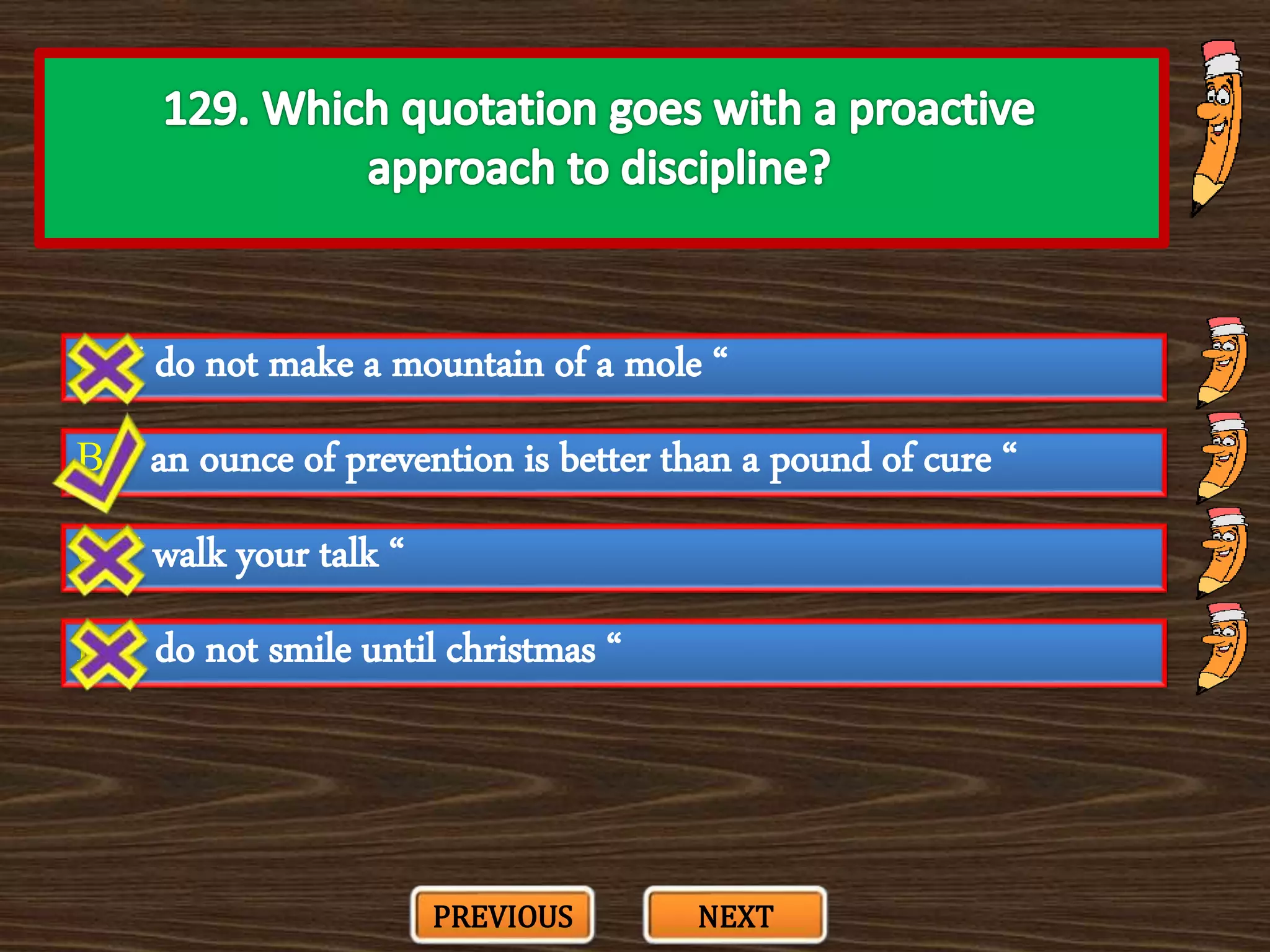
A. “ do not make a mountain of a mole “
C. “ walk your talk “
B. “ an ounce of prevention is better than a pound of cure “
D. “ do not smile until christmas “
PREVIOUS NEXT
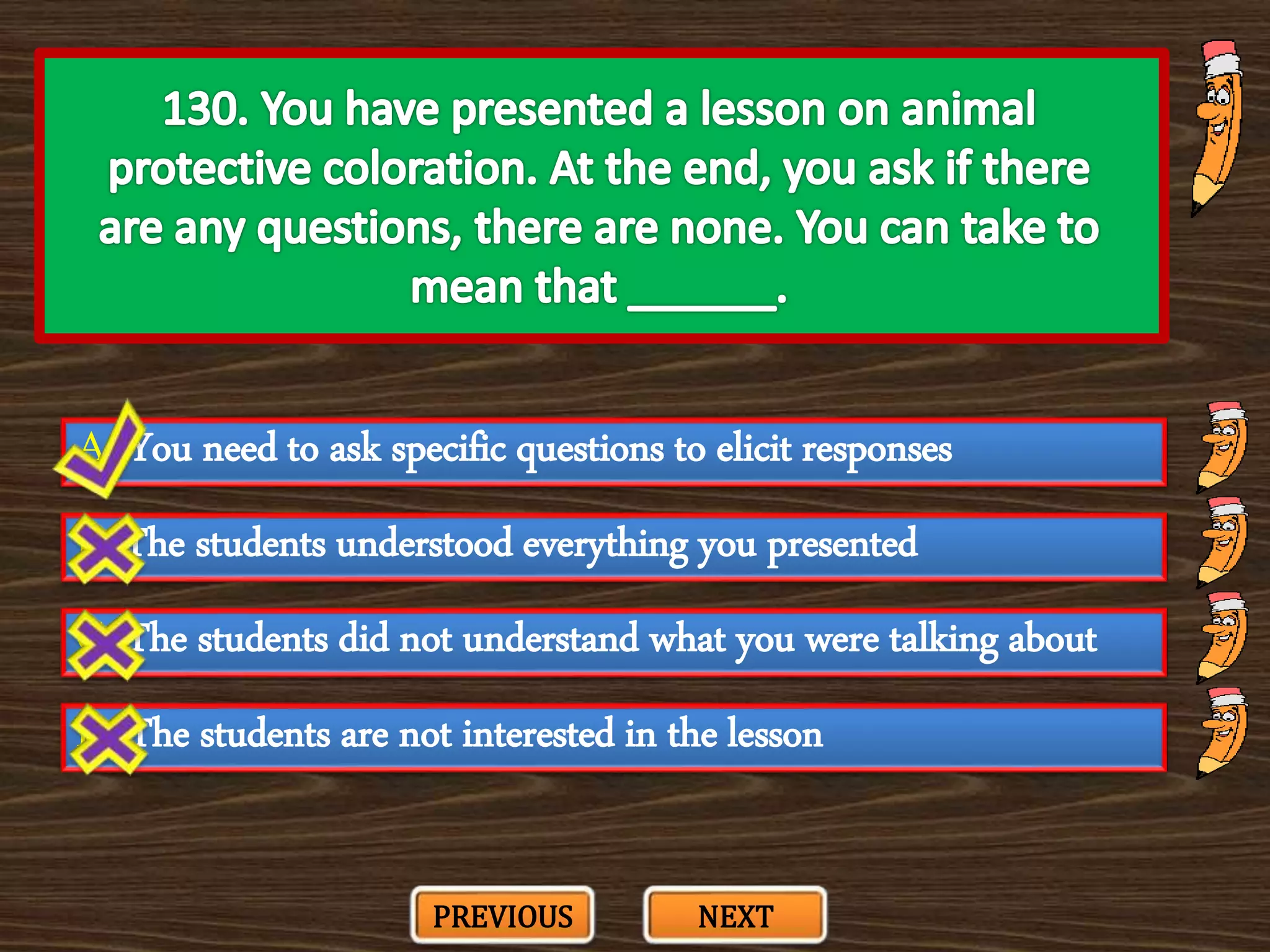
A. You need to ask specific questions to elicit responses
C. The students did not understand what you were talking about
B. The students understood everything you presented
D. The students are not interested in the lesson
PREVIOUS NEXT
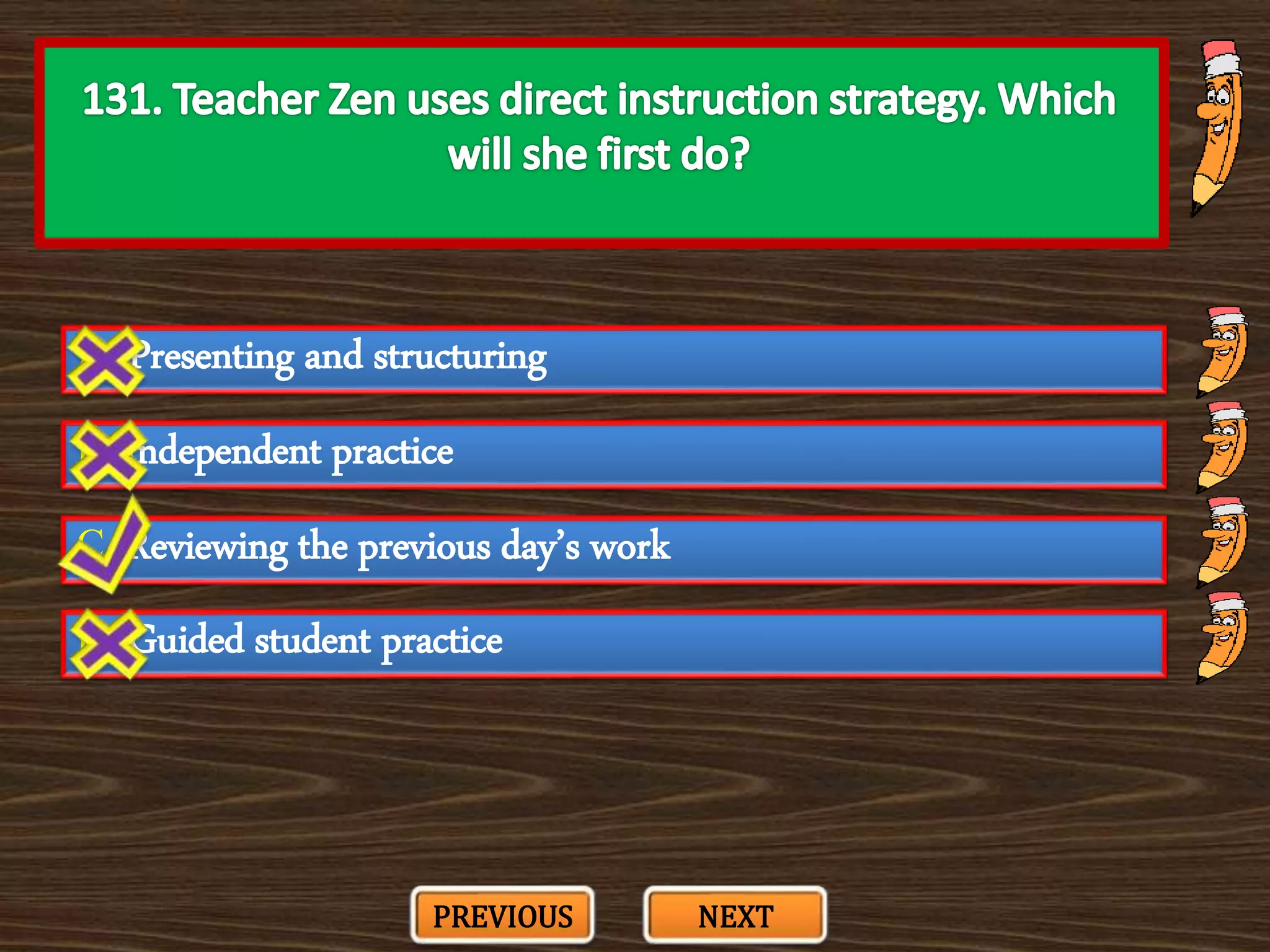
A. Presenting and structuring
C. Reviewing the previous day’s work
B. Independent practice
D. Guided student practice
PREVIOUS NEXT
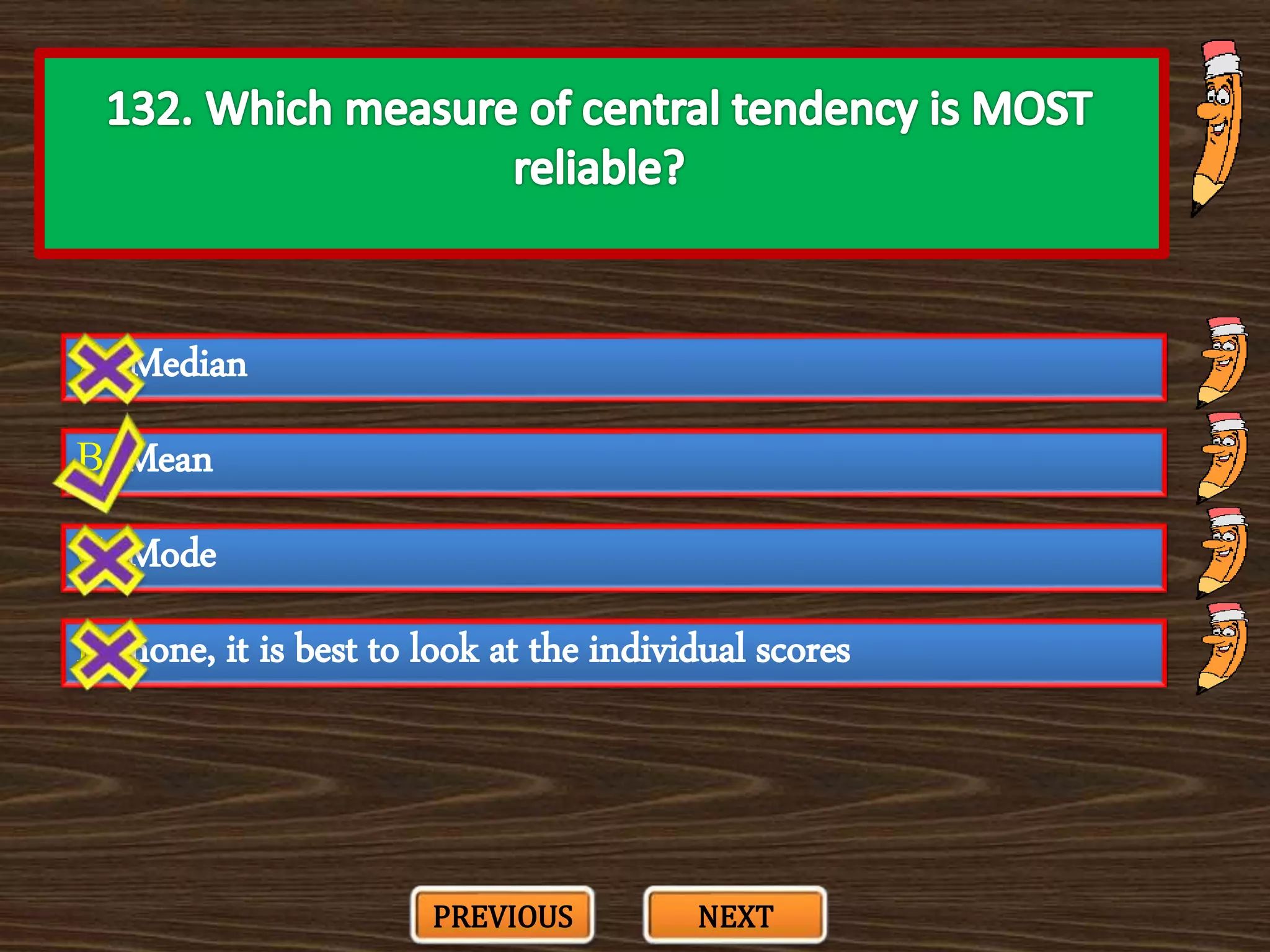
A. Median
C. Mode
B. Mean
D. none, it is best to look at the individual scores
PREVIOUS NEXT
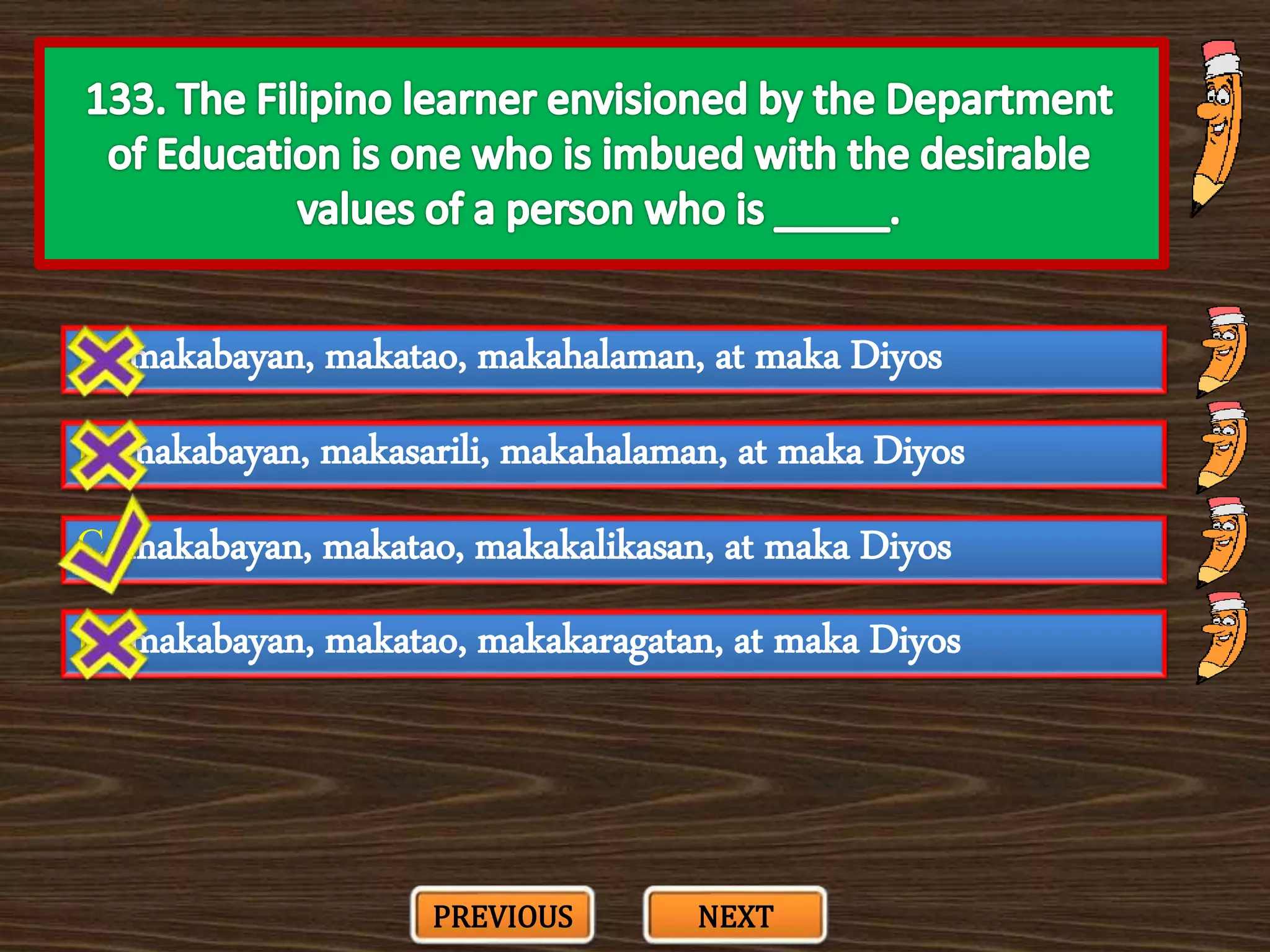
A. makabayan, makatao, makahalaman, at maka Diyos
C. makabayan, makatao, makakalikasan, at maka Diyos
B. makabayan, makasarili, makahalaman, at maka Diyos
D. makabayan, makatao, makakaragatan, at maka Diyos
PREVIOUS NEXT
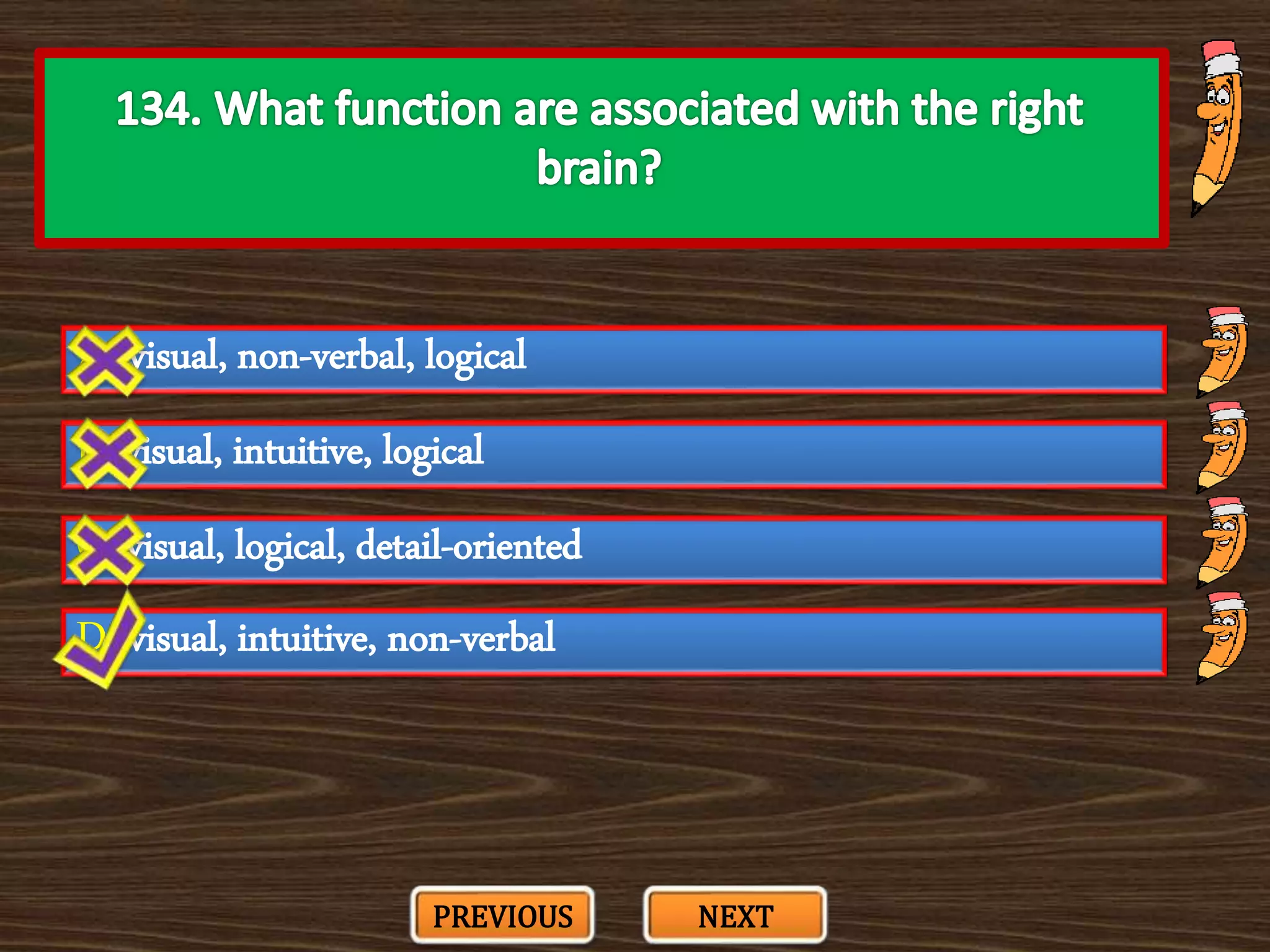
A. visual, non-verbal, logical
C. visual, logical, detail-oriented
B. visual, intuitive, logical
D. visual, intuitive, non-verbal
PREVIOUS NEXT
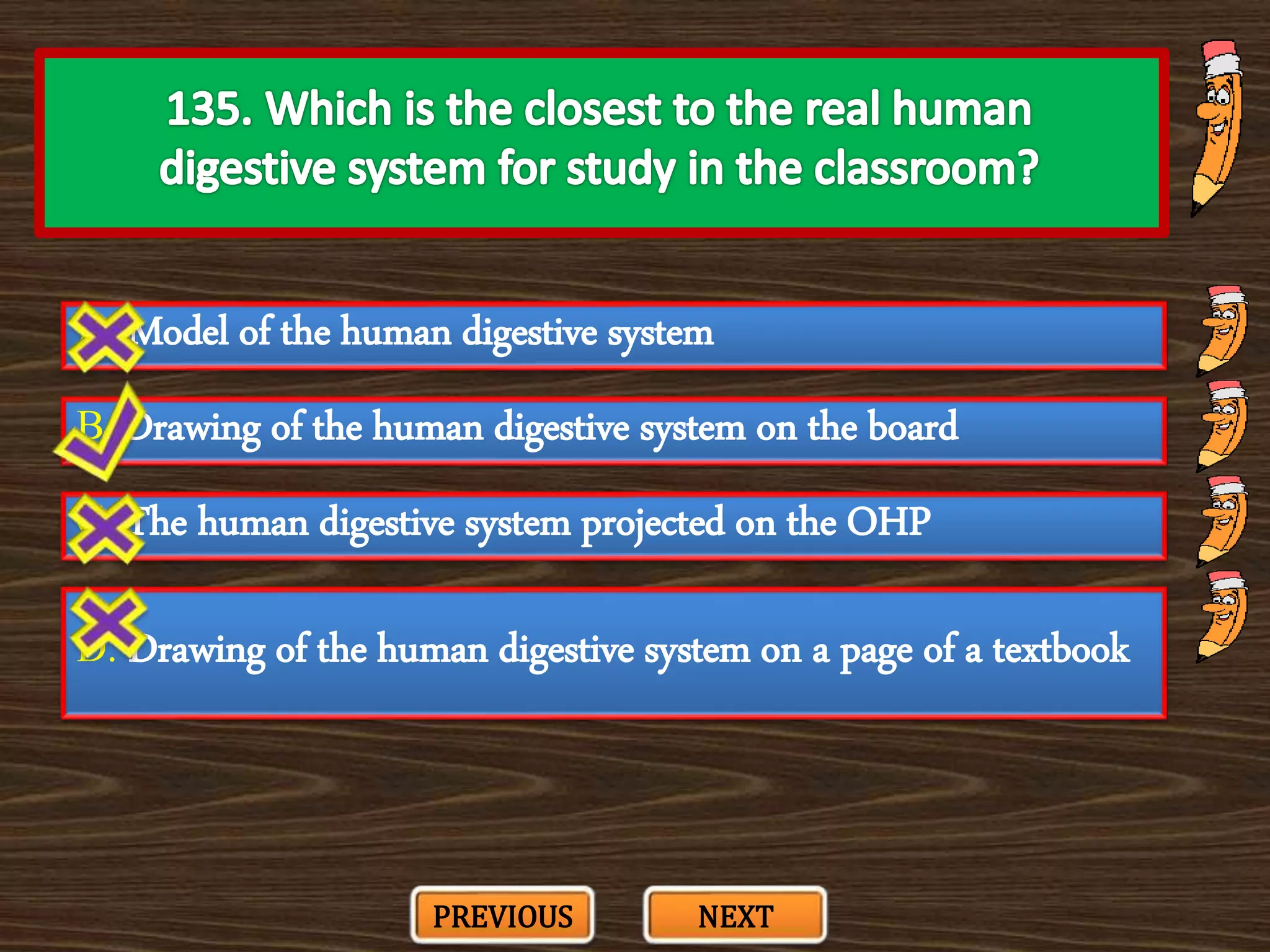
A. Model of the human digestive system
C. The human digestive system projected on the OHP
B. Drawing of the human digestive system on the board
D. Drawing of the human digestive system on a page of a textbook
PREVIOUS NEXT
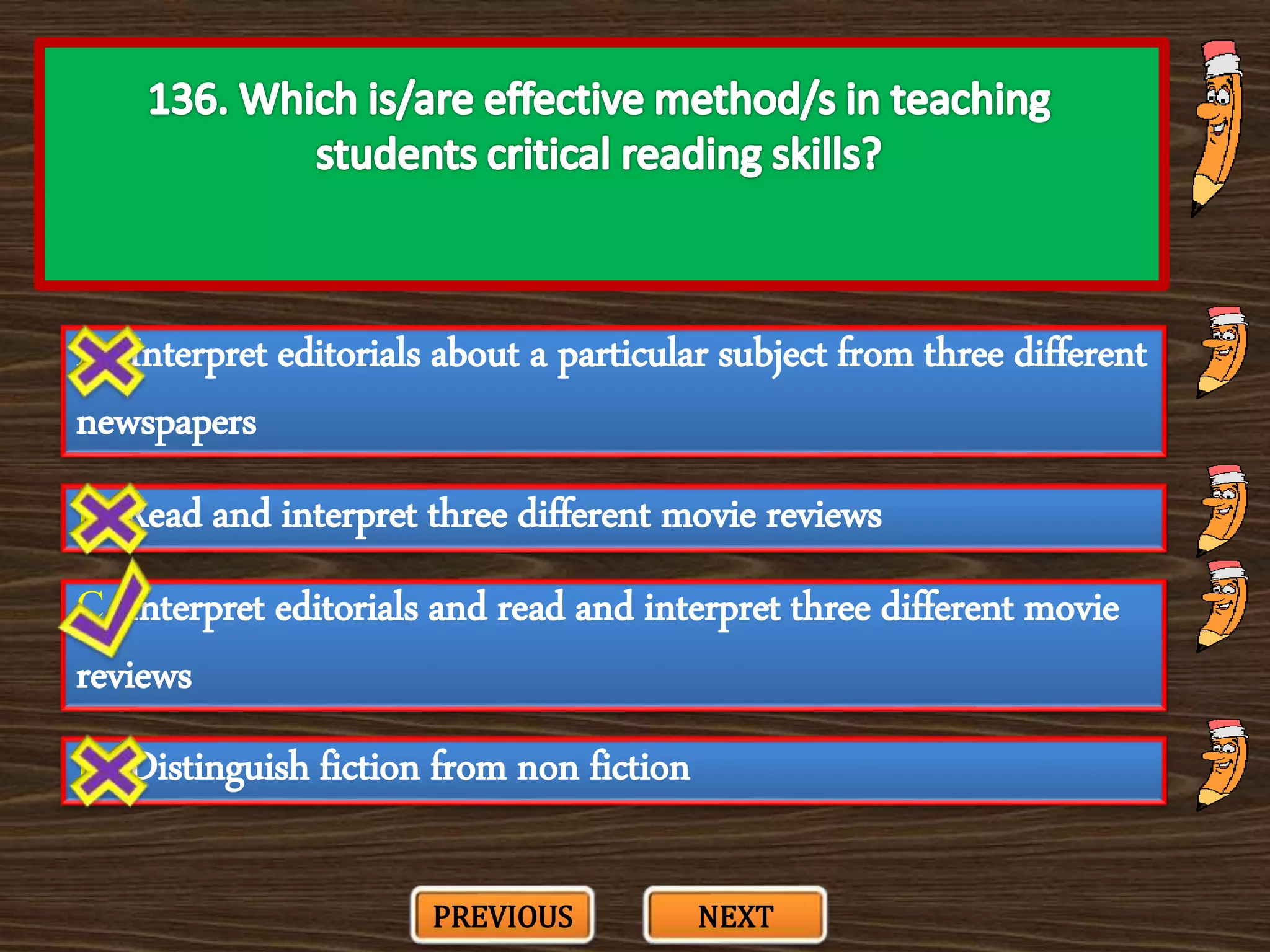
A. Interpret editorials about a particular subject from three different
newspapers
C. Interpret editorials and read and interpret three different movie
reviews
B. Read and interpret three different movie reviews
D. Distinguish fiction from non fiction
PREVIOUS NEXT
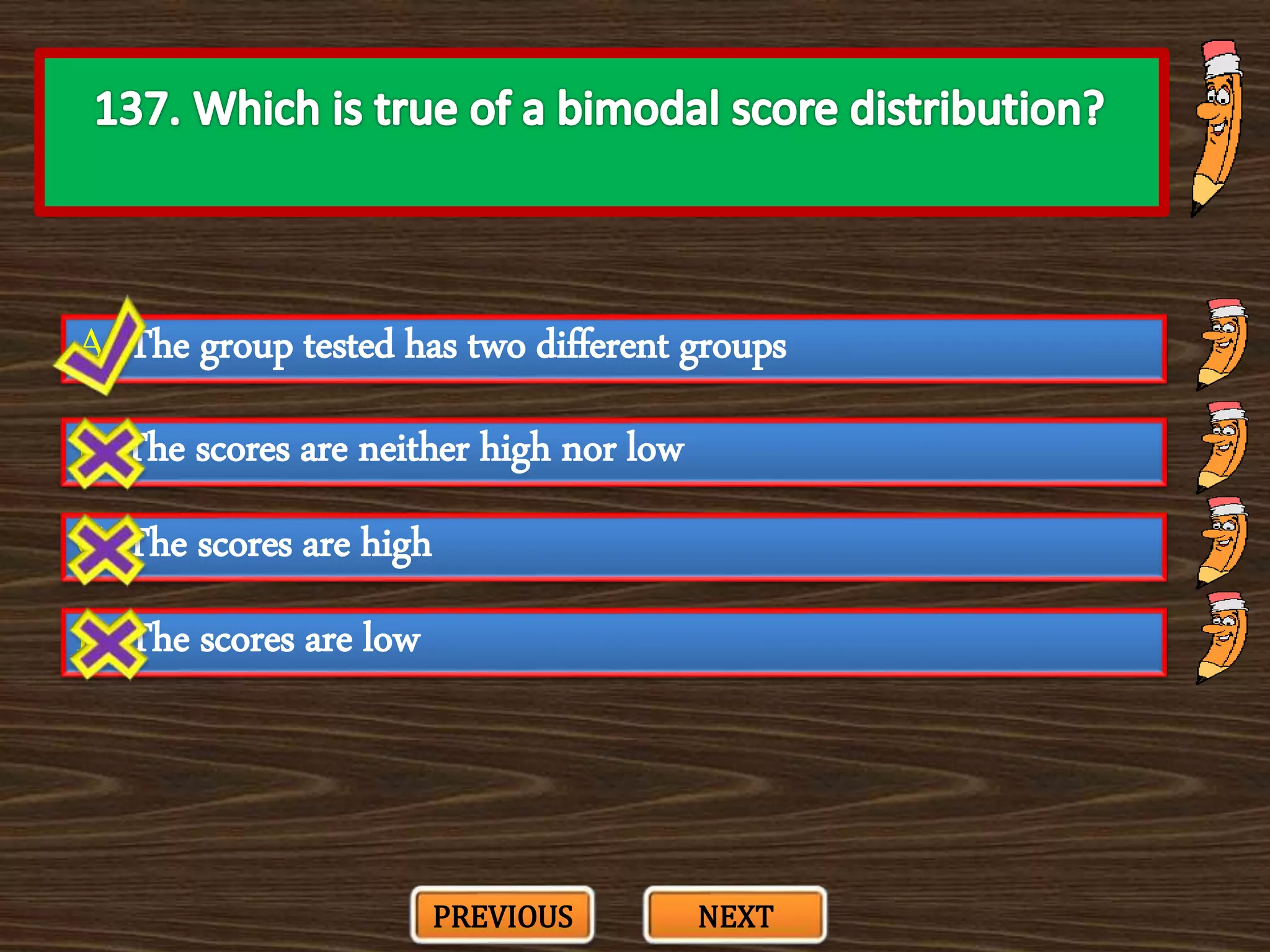
A. The group tested has two different groups
C. The scores are high
B. The scores are neither high nor low
D. The scores are low
PREVIOUS NEXT
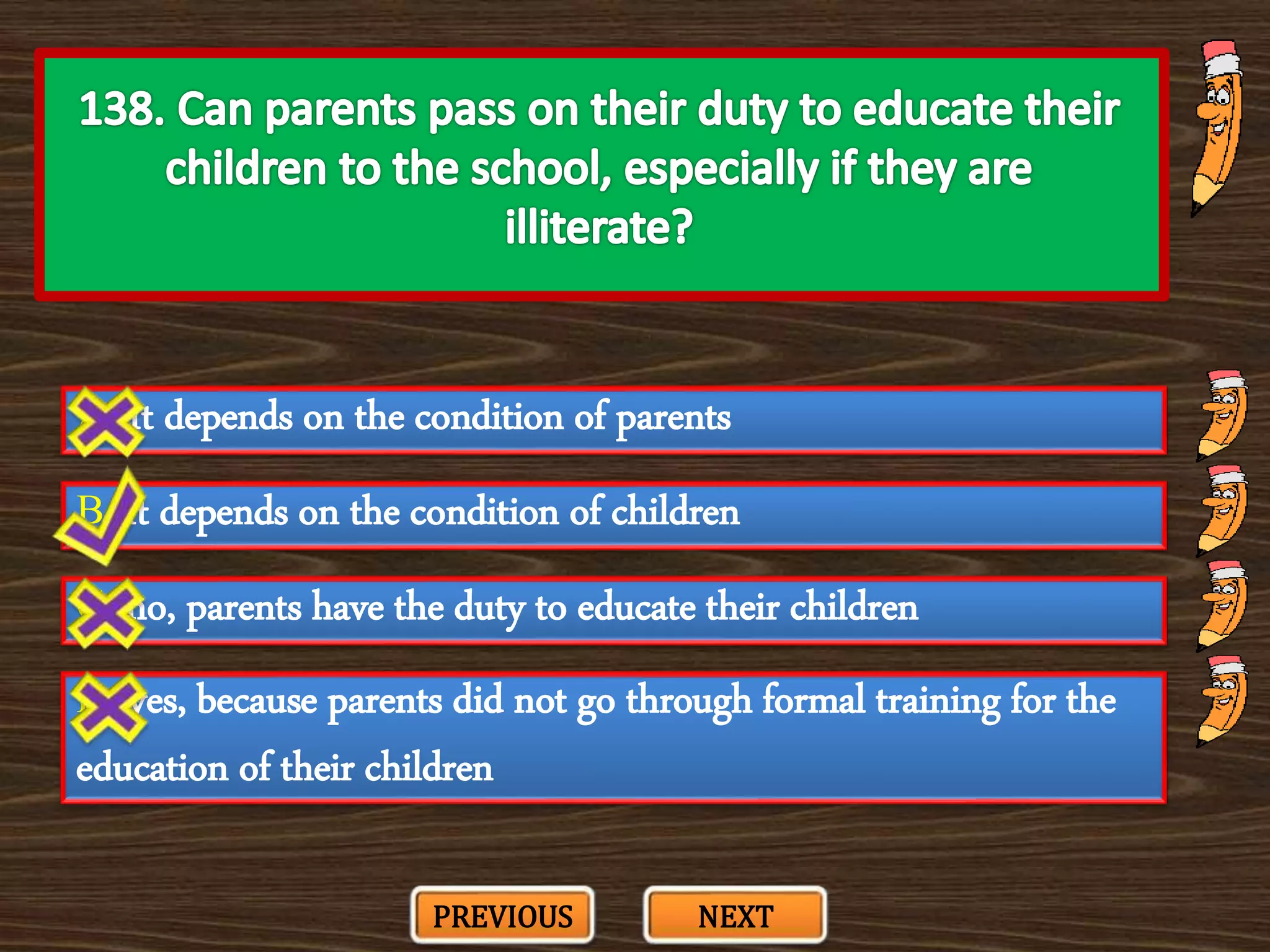
A. It depends on the condition of parents
C. no, parents have the duty to educate their children
B. It depends on the condition of children
D. yes, because parents did not go through formal training for the
education of their children
PREVIOUS NEXT
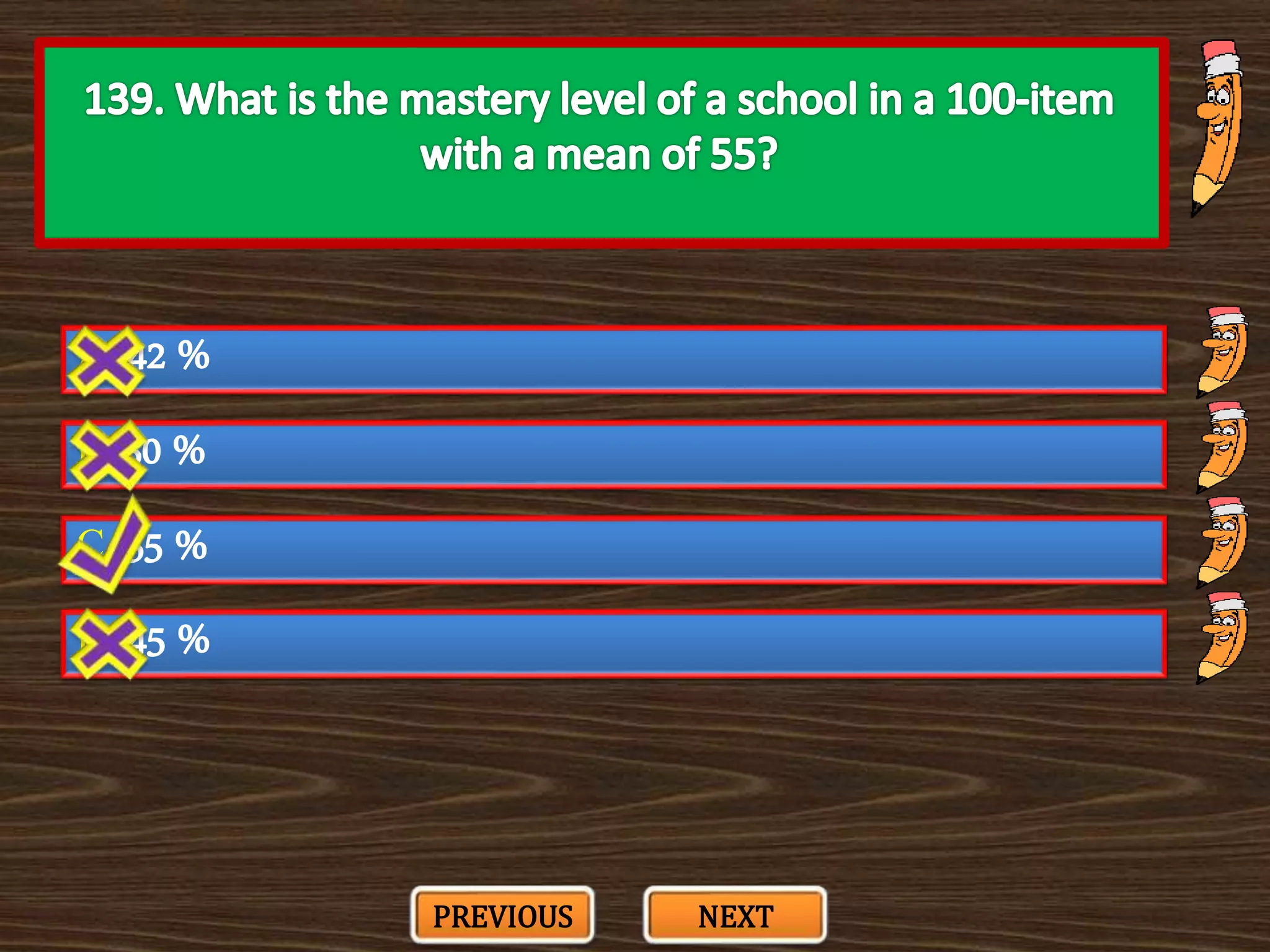
A. 42 %
C. 55 %
B. 50 %
D. 45 %
PREVIOUS NEXT
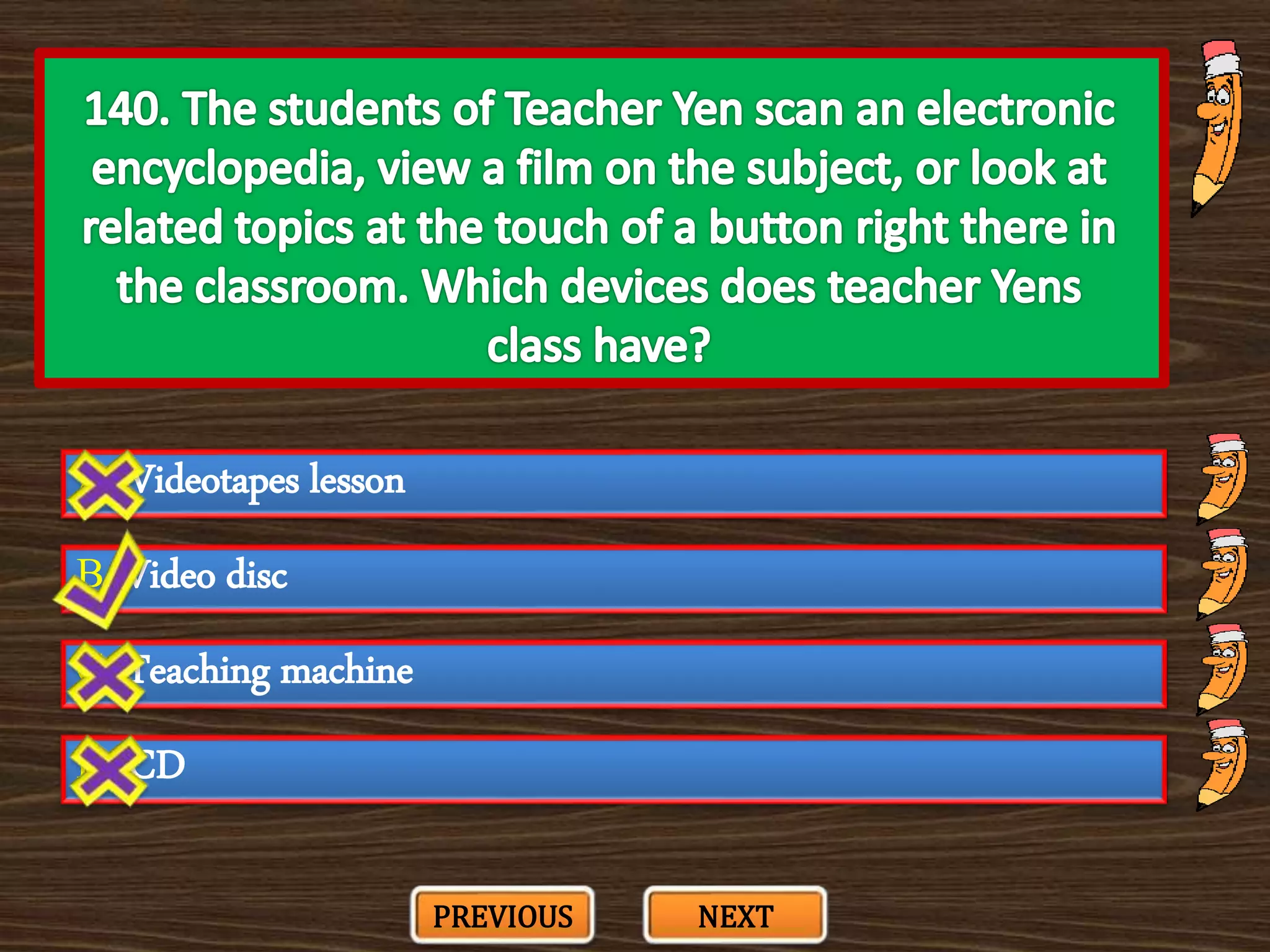
A. Videotapes lesson
C. Teaching machine
B. Video disc
D. CD
PREVIOUS NEXT
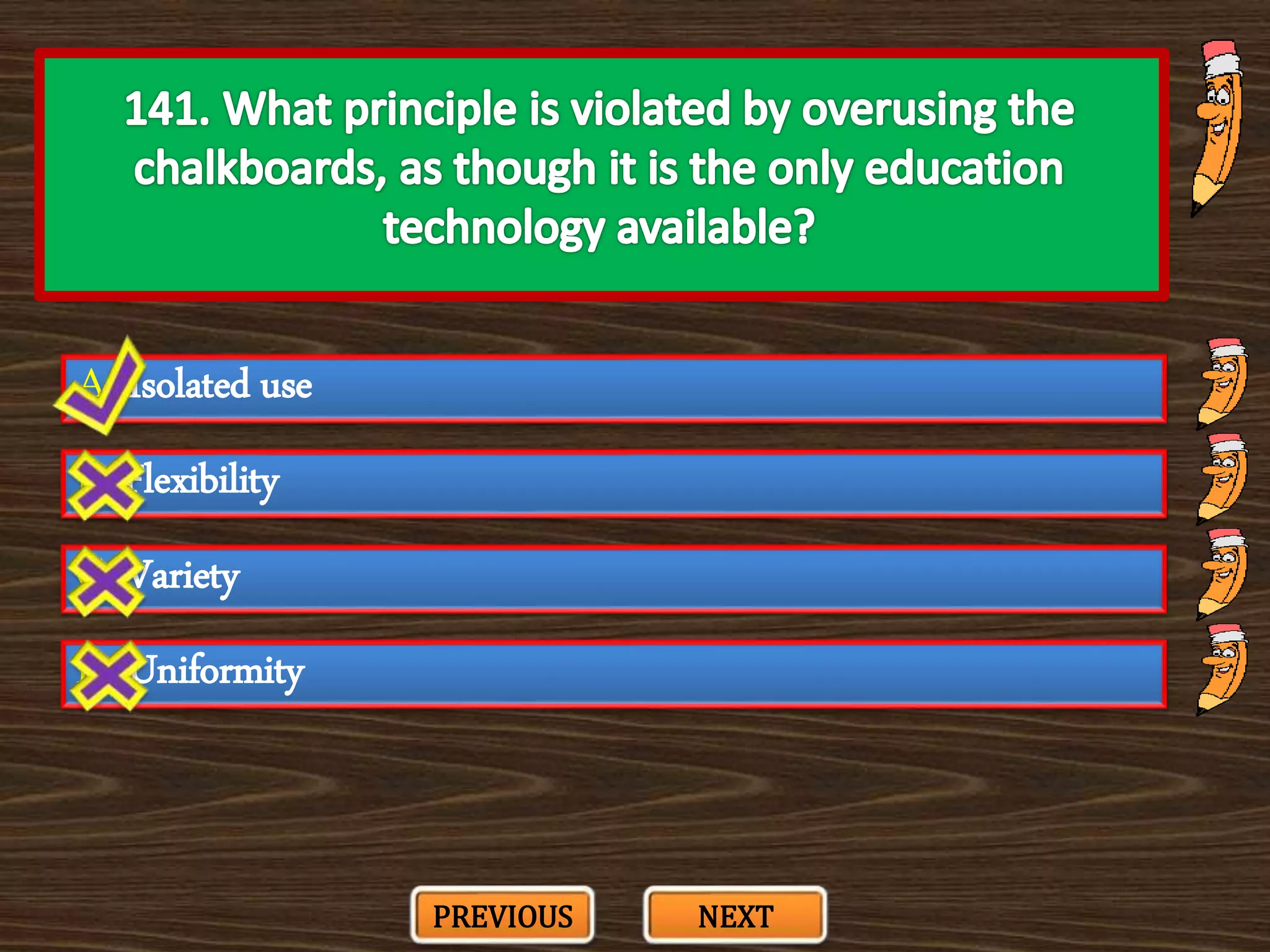
A. Isolated use
C. Variety
B. Flexibility
D. Uniformity
PREVIOUS NEXT
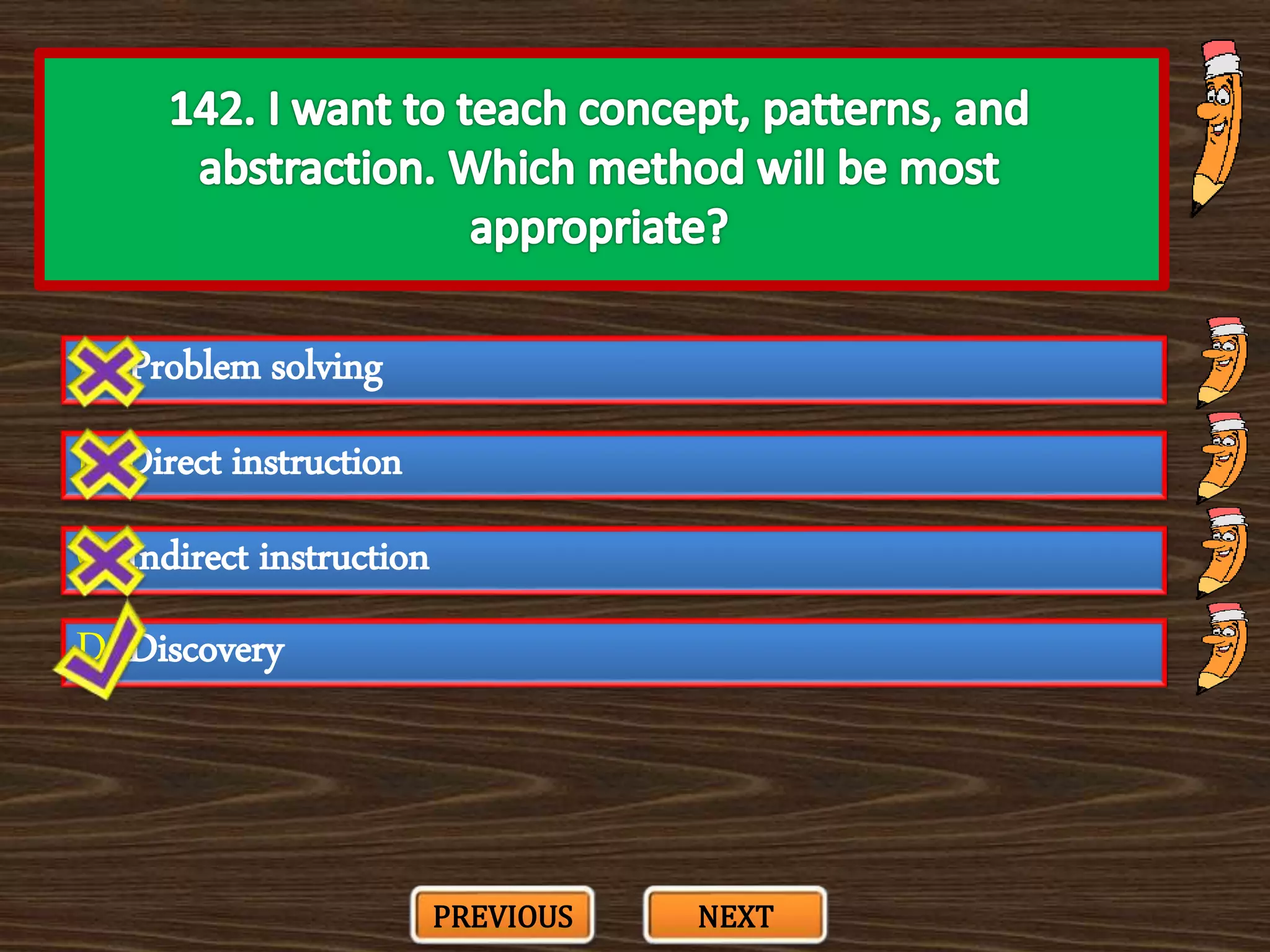
A. Problem solving
C. Indirect instruction
B. Direct instruction
D. Discovery
PREVIOUS NEXT
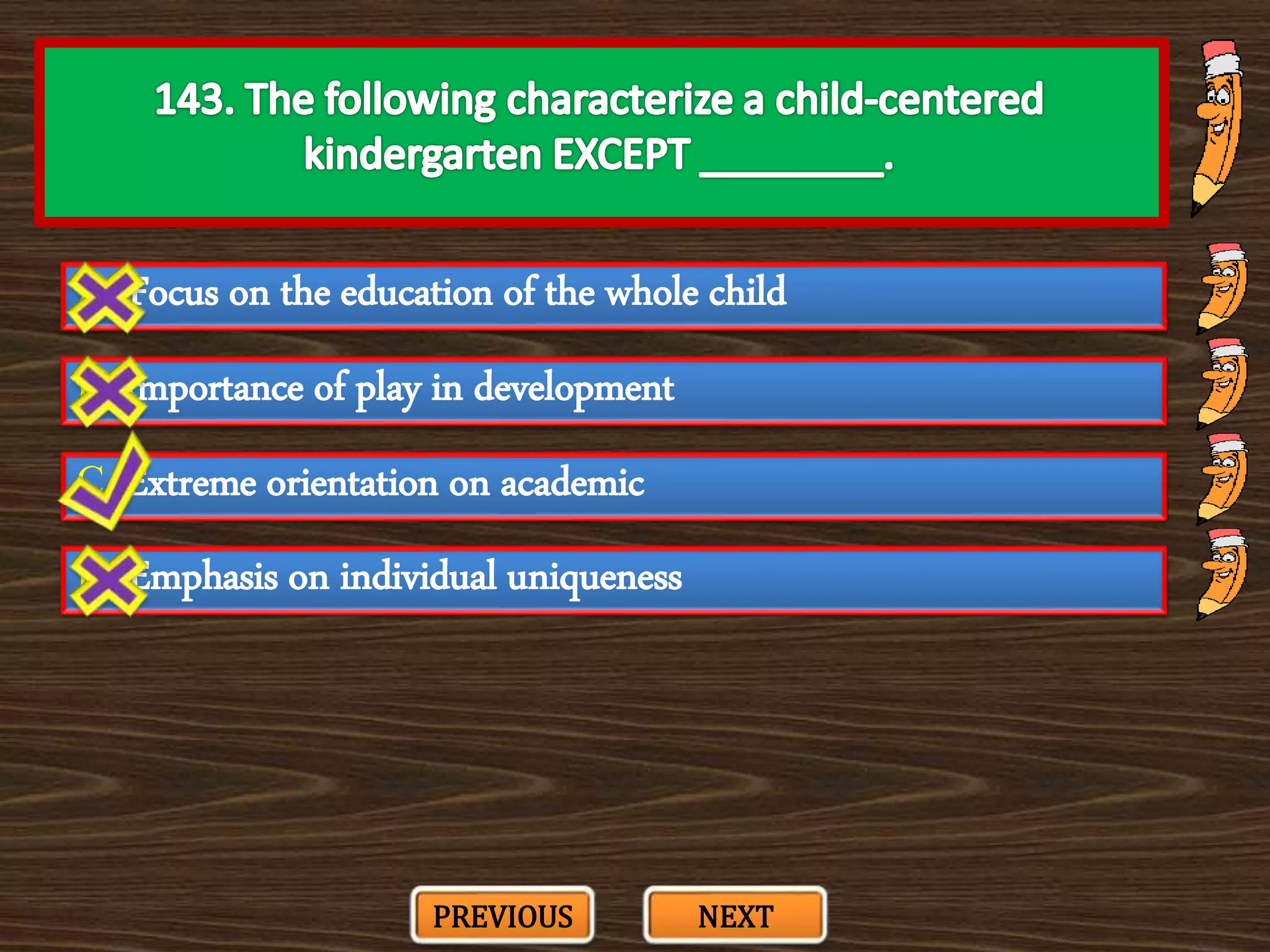
A. Focus on the education of the whole child
C. Extreme orientation on academic
B. Importance of play in development
D. Emphasis on individual uniqueness
PREVIOUS NEXT
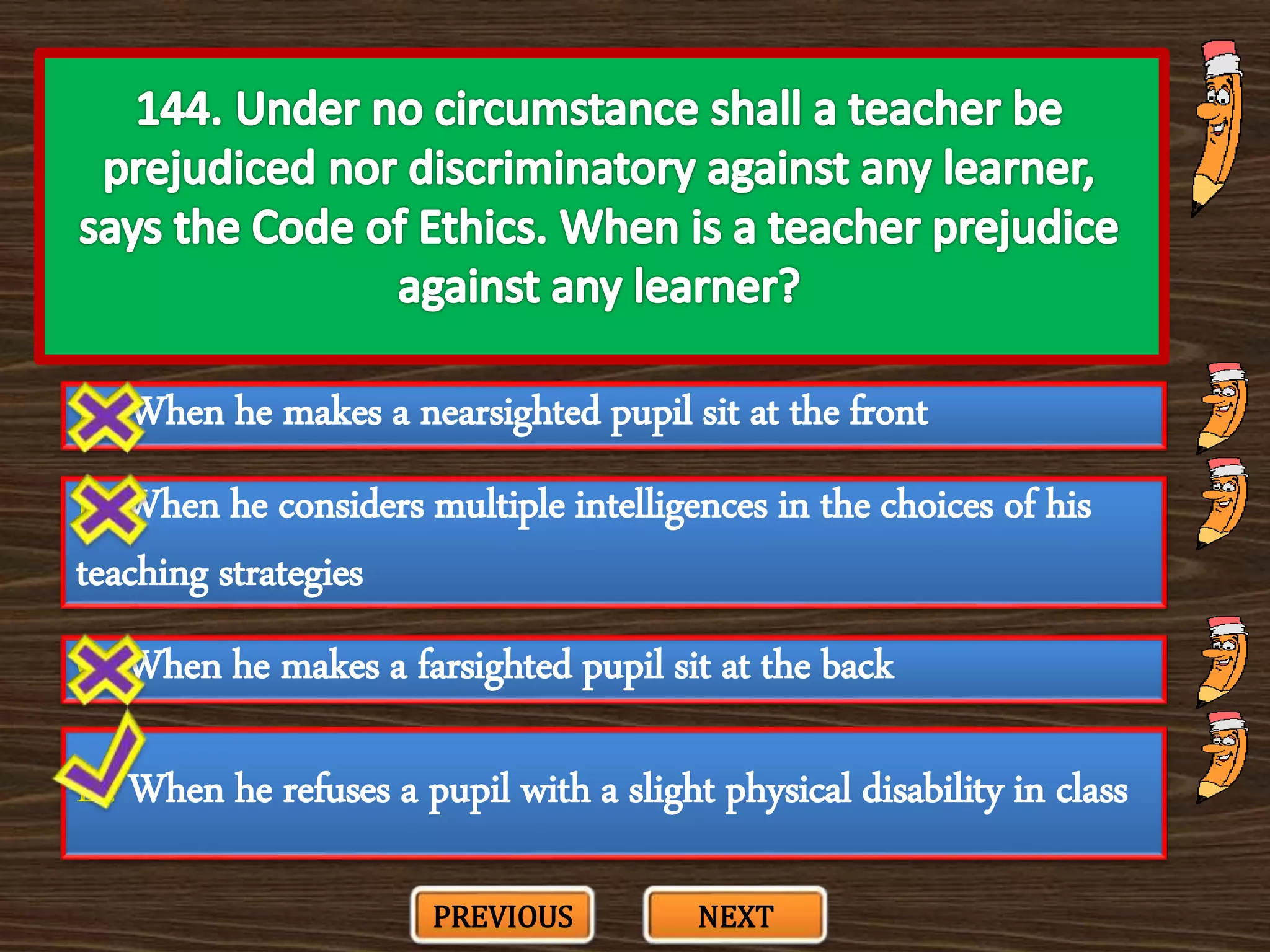
A. When he makes a nearsighted pupil sit at the front
C. When he makes a farsighted pupil sit at the back
B. When he considers multiple intelligences in the choices of his
teaching strategies
D. When he refuses a pupil with a slight physical disability in class
PREVIOUS NEXT
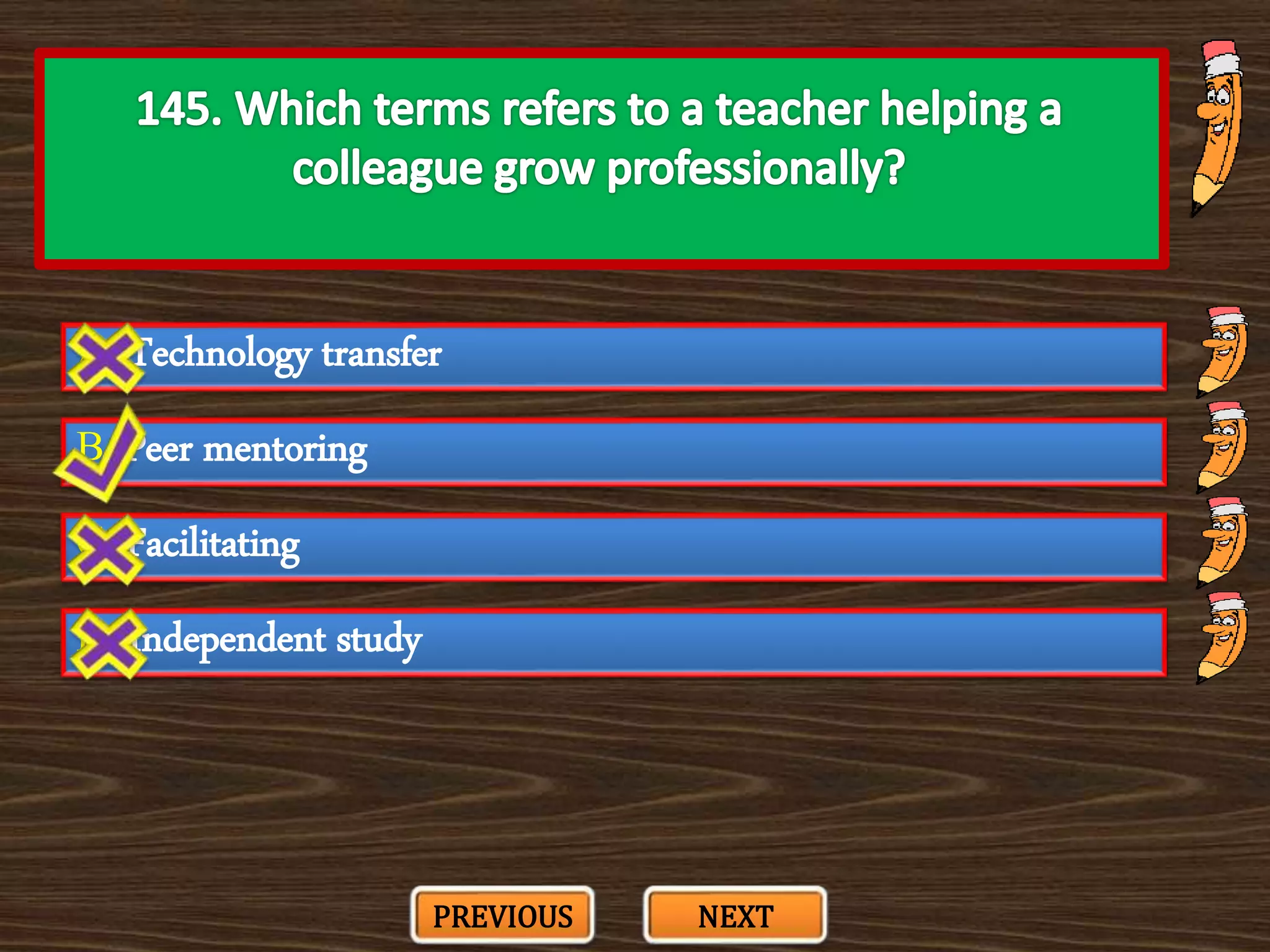
A. Technology transfer
C. Facilitating
B. Peer mentoring
D. Independent study
PREVIOUS NEXT
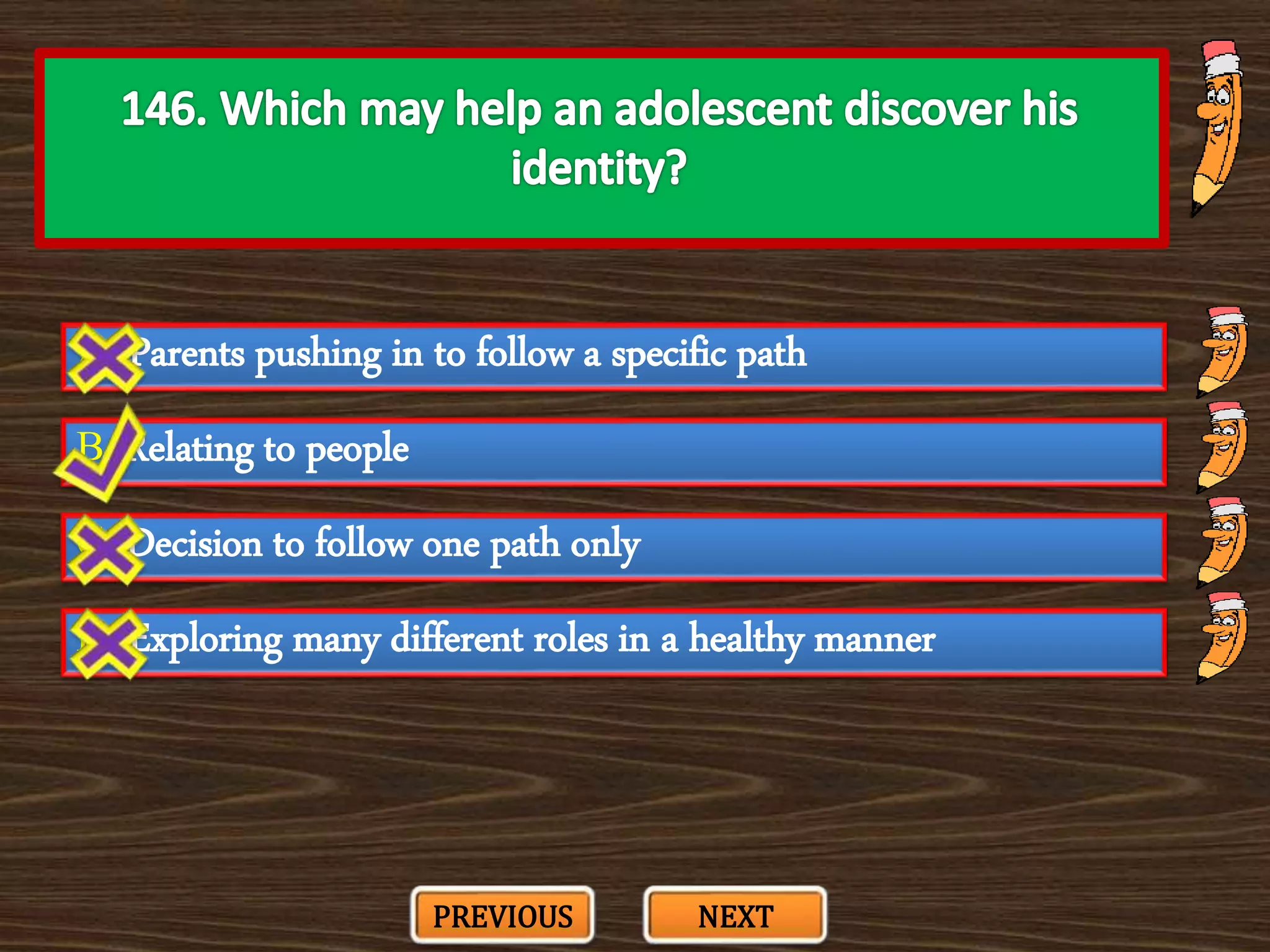
A. Parents pushing in to follow a specific path
C. Decision to follow one path only
B. Relating to people
D. Exploring many different roles in a healthy manner
PREVIOUS NEXT
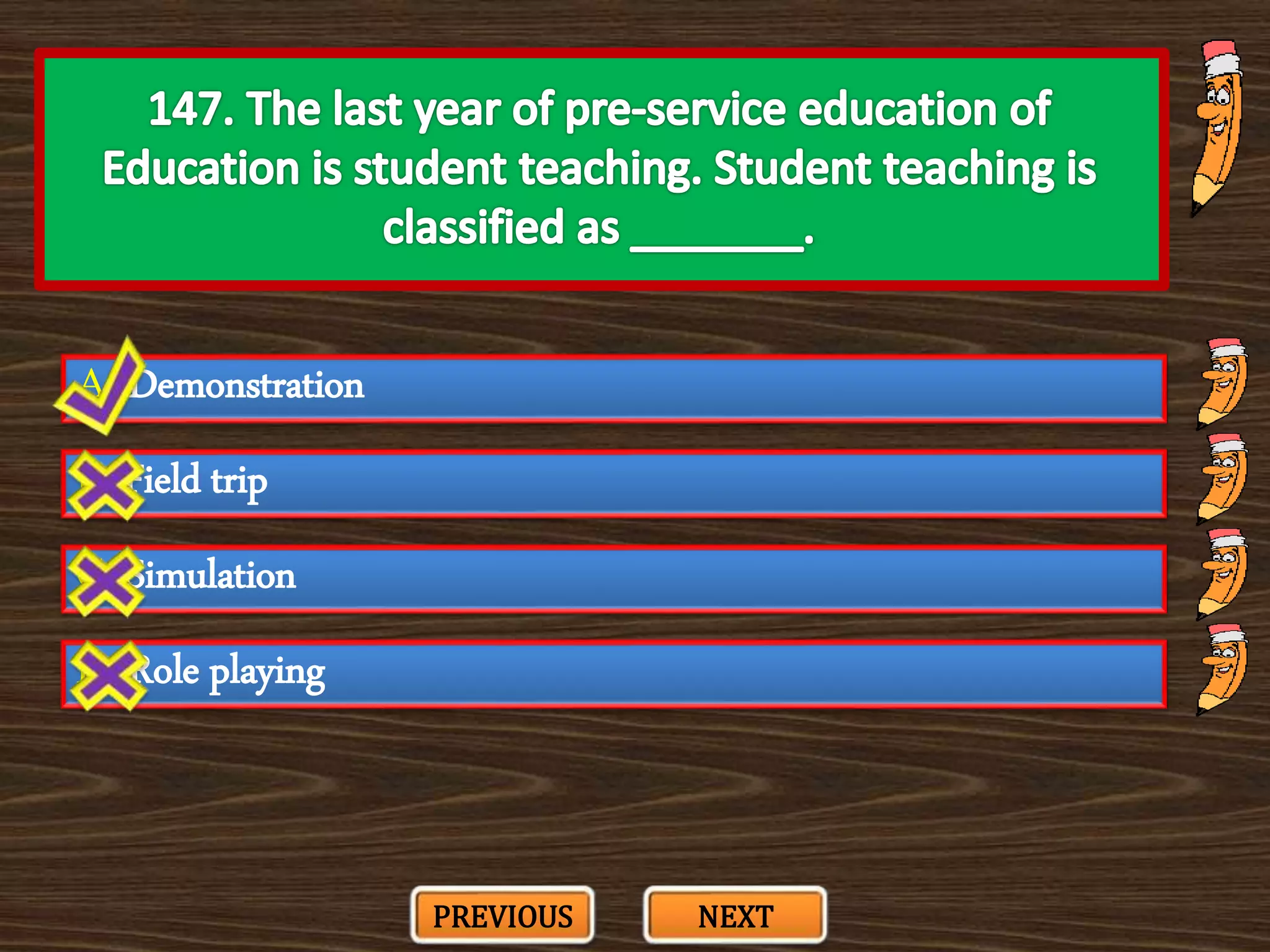
A. Demonstration
C. Simulation
B. Field trip
D. Role playing
PREVIOUS NEXT
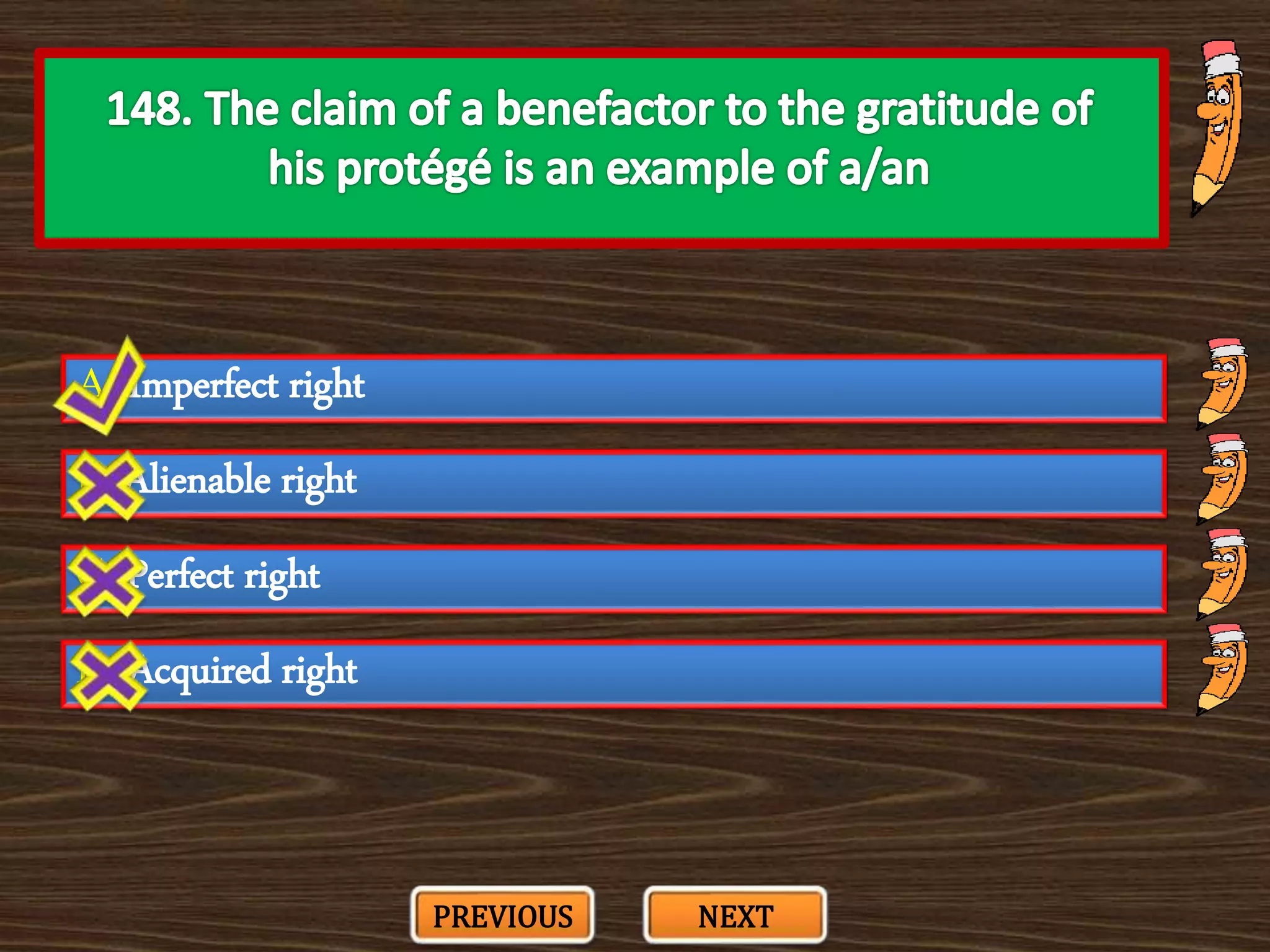
A. Imperfect right
C. Perfect right
B. Alienable right
D. Acquired right
PREVIOUS NEXT
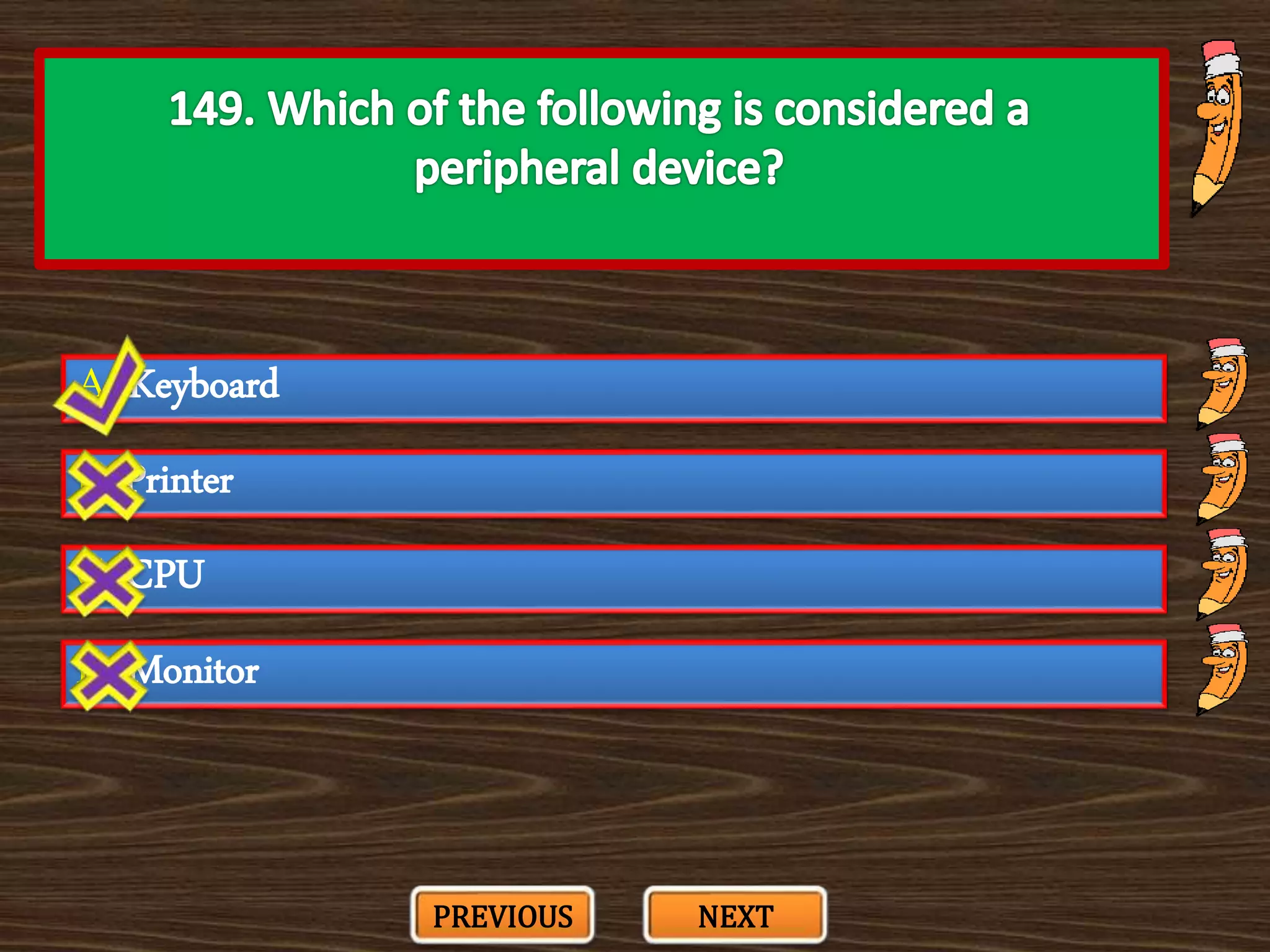
A. Keyboard
C. CPU
B. Printer
D. Monitor
PREVIOUS NEXT
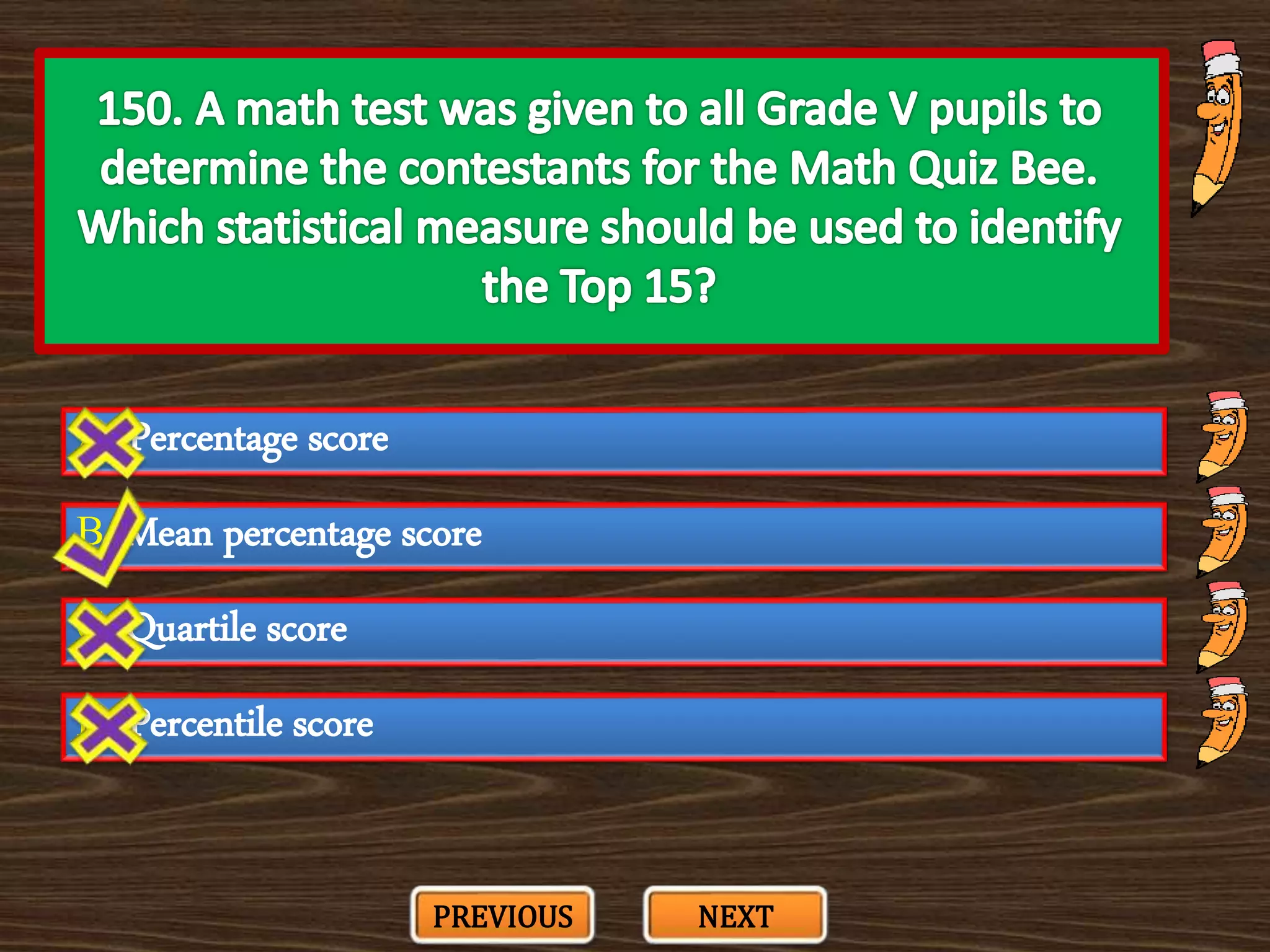
A. Percentage score
C. Quartile score
B. Mean percentage score
D. Percentile score
PREVIOUS NEXT
LET sample questions professional education set 2

LET sample questions professional education set 2

  • 2.
  • 3.
  • 4.
    A. Develops competitivespirit. C. Increases imagination due to expanding knowledge and emotional range. B. Separates reality from fantasy. D. Develops the upper and lower limbs. PREVIOUS NEXT CLICK ON YOUR ANSWER
  • 5.
    A. Religion asfake C. Religion as authentic B. Religion as magic D. Religion as real PREVIOUS NEXT
  • 6.
    A. I mustteach the child that we can never have real knowledge of anything. C. I must teach the child so he is assured of heaven. B. I must teach the child to develop his mental powers to the full. D. I must teach the child every knowledge, skill, and value that he needs for a better future. PREVIOUS NEXT
  • 7.
    A. intelligence test C.criterion-referenced test B. aptitude test D. norm-referenced test PREVIOUS NEXT
  • 8.
    A. Kohlberg C. Piaget B.Bandura D. Bruner PREVIOUS NEXT
  • 9.
    A. Avoid establishingroutines. C. Apply rules and policies on a case to case basis. B. Establish routines for all daily needs and tasks. D. Apply reactive approach to discipline. PREVIOUS NEXT
  • 10.
    A. To developmoral character C. To inculcate love of country B. To teach the duties of citizenship D. To develop vocational efficiency PREVIOUS NEXT
  • 11.
    A. She hadthe students write their response privately. C. She had the students write their responses privately then called each of them. B. She showed the correct answers on the overhead after the students have written their responses. D. She refrained from judging on the student's responses. PREVIOUS NEXT
  • 12.
    A. Refuse toshow either record. C. Refuse to show any record without expressing permission from principal. B. Show only his child's records. D. Show both records to him. PREVIOUS NEXT
  • 13.
    A. The ineffectivenessof training on a person's development. C. The absence of genetic influence on a person's development B. The effect of environmental stimulation on a person's development. D. The effect of heredity. PREVIOUS NEXT
  • 14.
    A. realistic C. idealist B.pragmatist D. existentialist PREVIOUS NEXT
  • 15.
    A. Perennialism C. Existentialism B.Essentialism D. Progressivism PREVIOUS NEXT
  • 16.
    A. Having studentsidentify difficult homework problems. C. Sampling the understanding of a few students. B. Having students correct each other's work. D. Explicitly reviewing the task-relevant information necessary for the day's lesson. PREVIOUS NEXT
  • 17.
    A. The Vernacular C.Spanish B. English D. Spanish and the Vernacular PREVIOUS NEXT
  • 18.
    A. Problem solving C.Inductive reasoning B. Lecture-recitation D. Discovery PREVIOUS NEXT
  • 19.
  • 20.
    A. fact C. closed B.concept D. direct PREVIOUS NEXT
  • 21.
    A. has anegative discriminating power C. has a positive discriminating power B. has a lower validity D. has a high reliability PREVIOUS NEXT
  • 22.
    A. informational C. leading B.rhetorical D. divergent PREVIOUS NEXT
  • 23.
    A. choice ofthe students C. objectives of the lesson B. availability of the media D. technique to be used PREVIOUS NEXT
  • 24.
    A. Existentialism C. Progressivism B.Perennialism D. Essentialism PREVIOUS NEXT
  • 25.
    A. application C. evaluation B.analysis D. synthesis PREVIOUS NEXT
  • 26.
    A. Test C. Appraise B.Assess D. Theorize PREVIOUS NEXT
  • 27.
    A. Opening ourdoors to foreign influence C. Stabilizing the political situation B. Upgrading the quality of the Filipino through education D. Gaining economic recovery PREVIOUS NEXT
  • 28.
    A. Have handsthat write fast. C. Have a mouth ready to speak. B. Have eyes on the back of your heads. D. Have minds packed with knowledge. PREVIOUS NEXT
  • 29.
    A. Phallic stage C.Anal stage B. Latent stage D. Pre-genital stage PREVIOUS NEXT
  • 30.
    A. She describesgroup performance in relation to a level of mastery set. C. She compares every individual students' scores with others' scores. B. She uses a specified content as its frame of reference. D. She describes what should be their performance. PREVIOUS NEXT
  • 31.
    A. Bilingual Education C.Accountability B. Values Education D. Mainstreaming PREVIOUS NEXT
  • 32.
    A. has instincts C.has a choice B. is mature D. has reason PREVIOUS NEXT
  • 33.
    A. Erikson C. Freud B.Piaget D. Jung PREVIOUS NEXT
  • 34.
    A. Truth isrelative to a particular time and place. C. Learning is the discovery of truth as Latent ideas are brought to consciousness. B. Human beings create their own truths. D. Sense perception is the most accurate guide to knowledge. PREVIOUS NEXT
  • 35.
    A. It quicklyand unobtrusively redirects misbehavior once it occurs. C. It respects cultural norms of a limited group students. B. It teaches dependence on others for self-control. D. Strategies aresimple enough to be used consistently. PREVIOUS NEXT
  • 36.
    A. Problem-centered learning C.Reading-writing activity B. Unit method D. Thematic instruction PREVIOUS NEXT
  • 37.
    A. closed C. concept B.fact D. convergent PREVIOUS NEXT
  • 38.
    A. It cannotbe determined unless scores are given. C. No B. It cannot be determined unless the number of examinees is given. D. Yes PREVIOUS NEXT
  • 39.
    A. Socratic method C.Mastery learning B. Cooperative learning D. Indirect instruction PREVIOUS NEXT
  • 40.
    A. directs C. assessescognition B. leads the student to evaluate D. probes creative thinking PREVIOUS NEXT
  • 41.
    A. Valuing C. Responding B.Characterization D. Organization PREVIOUS NEXT
  • 42.
    A. Autonomy C. Initiative B.Trust D. Generativity PREVIOUS NEXT
  • 43.
    A. The secondstudent has significantly higher intellectual ability C. Both students are functioning in the average range of intellectual ability B. The first student is probably below average, while the second has above average potential D. Another IQ test should be given to truly assess their intellectual potential PREVIOUS NEXT
  • 44.
    A. The centralproblem should be packed in the stem. C. Alternatives must have grammatical parallelism. B. There must be only one correct answer. D. The alternates must be plausible. PREVIOUS NEXT
  • 45.
    A. By continuallyimproving themselves personally and professionally C. By working out undeserved promotions B. By wearing expensive clothes to change people's poor perception of teachers D. By putting down other professions to lift the status of teaching PREVIOUS NEXT
  • 46.
    A. delineate C. integrate B.diagram D. comprehend PREVIOUS NEXT
  • 47.
    A. School shouldtake the lead to change the society. C. School should stress great ideas for western culture. B. School should help students develop personal values. D. School should enforce respect for an authority. PREVIOUS NEXT
  • 48.
    A. Buddha C. Confucius B.Mohammed D. Lao Tzu PREVIOUS NEXT
  • 49.
    A. Make eyecontact. C. Move closer to the child. B. Stop your class activity to correct a child who is no longer on task. D. Redirect a child's attention to task and check his progress to make sure he is continuing to work. PREVIOUS NEXT
  • 50.
    A. 7 C. 8.5 B.6 D. 7.5 PREVIOUS NEXT
  • 51.
    A. Autobiographical report C.Value and interest report B. Biographical report D. Anecdotal report PREVIOUS NEXT
  • 52.
    A. Mastery learning C.Morrison method B. Indirect Method D. Questioning method PREVIOUS NEXT
  • 53.
    A. The enddoes not justify the means C. Always do what is right B. The principle of double-effect D. Between two evils, do the lesser evil PREVIOUS NEXT
  • 54.
    A. Give themmaterials on their level and let them work at a pace that is reasonable for them, trying to bring them up to a grade level. C. Give them the same work as the other students, not much, so that they won't feel embarrassed. B. Give them the same work as the other students, because they will absorb as much as they are capable of. D. Give them work on the level of the other students and work a little above the classmates level to challenge them. PREVIOUS NEXT
  • 55.
    A. The wholelanguage approach C. The rebus method B. The Spaulding method D. The language experience approach PREVIOUS NEXT
  • 56.
    A. Generalization C. Acquisition B.Extinction D. Discrimination PREVIOUS NEXT
  • 57.
    A. Yes, ifthey are given other assignments, justice demands that they be properly compensated. C. No, because every teacher is expected to provide leadership and initiative in activities for betterment of communities. B. Yes, because other community leaders, not teachers, are tasked to lead in community activities. D. Yes, because teaching is enough full time job. PREVIOUS NEXT
  • 58.
    A. Pretest –teaching – posttest C. Review - pretest – teaching – posttest B. Pretest – teaching – posttest – re-teaching for unlearned concept – posttest D. Teaching – posttest PREVIOUS NEXT
  • 59.
    A. Behaviorist C. Essentialist B.Existentialist D. Perennialist PREVIOUS NEXT
  • 60.
    A. Minimum learningcompetencies are included. C. Some degree of flexibility is provided. B. Realistic and meaningful experiences are provided. D. Social skills are emphasized. PREVIOUS NEXT
  • 61.
    A. Proclamation No.1081 C. Executive Order No. 94 B. Presidential Decree No. 1397 D. Presidential Decree No. 1006 PREVIOUS NEXT
  • 62.
    A. Authentic evaluation C.Formative evaluation B. Norm-referenced evaluation D. Criterion-referenced evaluation PREVIOUS NEXT
  • 63.
    A. Reconstructionism C. Progressivism B.Essentialism D. Existentialism PREVIOUS NEXT
  • 64.
    A. Bodily-kinesthetic C. Interpersonal B.Verbal-logical D. Verbal-linguistic PREVIOUS NEXT
  • 65.
    A. Republic ActNo. 7722 C. Republic Act No. 7796 B. Republic Act No. 7877 D. Republic Act No. 7836 PREVIOUS NEXT
  • 66.
    A. Standardized test C.Placement B. Aptitude test D. Diagnostic PREVIOUS NEXT
  • 67.
    A. creating C. generalizing B.classifying D. comparing PREVIOUS NEXT
  • 68.
    A. Learning todo C. Learning to live together B. Learning to know D. Learning to be PREVIOUS NEXT
  • 69.
    A. exposing studentsto desirable models C. reinforcing every desirable behavior B. telling them the do’s & don’t’s of behavior D. telling the to imitate the teacher PREVIOUS NEXT
  • 70.
    A. To developtheir cognitive and metacognitive powers to the fullest. C. To re-engineer society. B. To know themselves and their place in society. D. To acquire productive skills. PREVIOUS NEXT
  • 71.
    A. Naturalist C. Intrapersonal B.Interpersonal D. Existential PREVIOUS NEXT
  • 72.
    A. Technical Educationand Skills Development Act C. Technical Education and Skills Development Authority B. Technical-Vocational Education and Skills Development Authority D. Technical-Vocational Education and Skills Development Act PREVIOUS NEXT
  • 73.
    A. Brainstorming C. Roleplaying B. Brainwashing D. Simulation PREVIOUS NEXT
  • 74.
    A. Perennialist C. Essentialist B.Rationalist D. Pragmatist PREVIOUS NEXT
  • 75.
    A. Visual learner C.Analytic B. Auditory learner D. Global PREVIOUS NEXT
  • 76.
    A. Proclamation No.1081 C. Executive Order No. 94 B. Presidential Decree No. 1397 D. Presidential Decree No. 1006 PREVIOUS NEXT
  • 77.
    A. Lecture C. Roleplaying B. Panel discussion D. Simulation PREVIOUS NEXT
  • 78.
    A. Reconstructionism C. Perennialism B.Essentialism D. Behaviorism PREVIOUS NEXT
  • 79.
    A. High schoolyears C. Preschool years B. Elementary years D. College years PREVIOUS NEXT
  • 80.
    A. The linkageof a Teacher Educational Council, Technical Panel for Teacher Education and Professional Regulation Commission for teacher education concerns. C. The linkage of DepEd, CHED and PRC for teacher’s professionalization. B. The existence of a Bureau of Elementary Education, Bureau of Secondary Education and Bureau of Alternative Learning Systems. D. The presence of DepEd for basic education, CHED for higher education and TESDA for vocational education. PREVIOUS NEXT
  • 81.
    A. Interview C. Post-test B.Focus group discussion D. Pre-test PREVIOUS NEXT
  • 82.
    A. Essentialism C. Progressivism B.Perennialism D. Reconstructionism PREVIOUS NEXT
  • 83.
    A. Kohlberg C. Maslow B.Ericson D. Gardner PREVIOUS NEXT
  • 84.
    A. Outside regularclass hours. C. Once a week after class hours. B. Once a week at lunch break. D. Within the regular class hours. PREVIOUS NEXT
  • 85.
    A. I only C.III only B. II only D. I and III PREVIOUS NEXT
  • 86.
    A. Essentialism C. Perennialism B.Idealism D. Realism PREVIOUS NEXT
  • 87.
    A. Autonomy, initiative,trust C. Initiative, trust, autonomy B. Trust, autonomy, initiative D. Autonomy, trust, initiative PREVIOUS NEXT
  • 88.
    A. Philippine SportsCommission C. Technical Education Services Department Authority B. National Commission for Culture and the Arts D. Commission on Higher Education PREVIOUS NEXT
  • 89.
    A. An itemmay have no answer at all. C. There are two or more distracters. B. An answer may be repeated. D. The items in the right and left columns are equal in number. PREVIOUS NEXT
  • 90.
    A. Perennialism C. Existentialism B.Progressivism D. Essentialism PREVIOUS NEXT
  • 91.
    A. Conventional Level C.In between Pre-Conventional and Post-Conventional Levels B. In between Conventional and Post–Conventional Levels D. Pre-Conventional Level PREVIOUS NEXT
  • 92.
    A. Republic ActNo. 7160 C. Republic Act No. 9942 B. Republic Act No. 9155 D. Republic Act No. 7844 PREVIOUS NEXT
  • 93.
    A. Unrealistic performances C.Answering high multiple choice items B. De-contextualized drills D. Real world application of lessons learned PREVIOUS NEXT
  • 94.
    A. the classmemorized addition and subtraction facts C. the class had lesson on subtraction before addition B. the class had lesson on division before multiplication D. the class had lesson on multiplication before division PREVIOUS NEXT
  • 95.
    A. Post–Conventional Level C.Pre-Conventional Level B. Conventional Level D. Can’t be specifically determined PREVIOUS NEXT
  • 96.
    A. Magna Cartafor Public School Teachers C. Government of Basic Education Act of 2001 B. Philippine Teachers Professionalization Act of 1994 D. Higher Education Act of 1994 PREVIOUS NEXT
  • 97.
    A. Conducting mockelection C. Organizing a community project B. Home visitation D. Writing articles on working and relating to people PREVIOUS NEXT
  • 98.
    A. Progressivism C. Empiricism B.Rationalism D. Existentialism PREVIOUS NEXT
  • 99.
    A. Universal ethicalprinciple C. Social contract B. Law and order D. Good boy/Good girl PREVIOUS NEXT
  • 100.
    A. Magna Cartafor Public School Teachers C. Code of Ethics for Professional Teachers B. Philippine Teachers Professionalization Act of 1994 D. The Family Code of the Philippines PREVIOUS NEXT
  • 101.
    A. Portfolio assessment C.Interview of pupils B. Scoring rubric D. Self-assessment PREVIOUS NEXT
  • 102.
    A. Existentialism C. Essentialism B.Progressivism D. Reconstructionism PREVIOUS NEXT
  • 103.
    A. Post conventionalstage C. In between conventional and post conventional stage B. Conventional stage D. That depends on the school culture PREVIOUS NEXT
  • 104.
    A. Education, Language,Arts, Culture, and Sports C. Education, Science and Technology, Arts, Culture, and Sports B. Education, Science and Technology, Language, Culture, and Sports D. Education, Science and Technology, Arts, Language, and Sports PREVIOUS NEXT
  • 105.
    A. Give theword a tune then sing it. C. Spell the word and identify its part of speech. B. Define the word. D. Give the etymology of the word. PREVIOUS NEXT
  • 106.
    A. Existentialism C. Essentialism B.Reconstructionism D. Progressivism PREVIOUS NEXT
  • 107.
    A. Why shouldI care if they like me or not? C. What wrong have I done to deserve this? B. To hell with them. D. What is it about me that they do not like? PREVIOUS NEXT
  • 108.
    A. Philippine History C.Jose Rizal’s Biography B. Basic General Subjects D. Philippine Constitution PREVIOUS NEXT
  • 109.
    A. You decideon how to teach a particular lesson. C. You absent from class to enjoy your leave even without prior notice. B. You make your pupil run errand for you. D. You select to teach only those lessons which you have mastered. PREVIOUS NEXT
  • 110.
    A. Progressivism C. Perennialism B.Reconstructionism D. Pragmatism PREVIOUS NEXT
  • 111.
    A. Service C. Suppression B.Power D. Coercion PREVIOUS NEXT
  • 112.
    A. Minimun learningcompetencies are included C. Some degree of flexibility is provided B. Realistic and meaningful experiences are provided D. Social skills are emphasized PREVIOUS NEXT
  • 113.
    A. Solving problemsusing multiple approaches C. Solving problems by applying learned formulas B. Solving problems by looking for correct answer D. Learning math as applied to situations, such as being a tool of science PREVIOUS NEXT
  • 114.
    A. Introduce anew lesson C. Determine who among his pupils are studying B. Reflect on how he presented the previous lesson D. Provide his pupils with a sense of continuity PREVIOUS NEXT
  • 115.
    A. Making inferences C.Listing facts separately from opinion B. Getting the main idea D. Drawing conclusions PREVIOUS NEXT
  • 116.
    A. Children whohave not mastered the basic skills are more likely to be motivated to read in order to gain mastery over basic skills C. Children who have mastered basic skills are more likely to be less motivated to read because they get fed up with too much reading B. Children who have gained mastery over basic skills are more motivated to read D. Children who have mastered basic skills will not read anymore PREVIOUS NEXT
  • 117.
    A. The testitem has low reliability C. More from lower group got the item correctly B. The test item could not discriminate between lower & upper groups D. More from upper group got the item correctly PREVIOUS NEXT
  • 118.
    A. Is notvalid C. Is highly reliable B. Is not highly reliable D. Is very valid PREVIOUS NEXT
  • 119.
    A. Learned C. Failedto learn B. He likes to learn D. Needs to learn PREVIOUS NEXT
  • 120.
    A. Focus onthe disadvantaged approach to education C. Progressivist approach to education B. Academic essentials approach to education D. The mental discipline approach to education PREVIOUS NEXT
  • 121.
    A. 99.8 % C.68.2 % B. 95.4 % D. 43.1 % PREVIOUS NEXT
  • 122.
    A. Means C. Lowestand highest scores B. Raw scores D. Standard deviation PREVIOUS NEXT
  • 123.
    A. Command C. Password B.Computer language D. Computer program PREVIOUS NEXT
  • 124.
    A. Blind obedienceof authority C. Asking convergent questions B. A willingness to suspend judgment until sufficient evidence is prsented D. Asking low level questions PREVIOUS NEXT
  • 125.
    A. Critical C. Creative B.interpretative D. Literal PREVIOUS NEXT
  • 126.
    A. Asking pupilsto repeat answers C. Challenging students students to be above the level of the class B. Giving short quiz and havind student’s grade papers D. Assigning exercises from a workbook PREVIOUS NEXT
  • 127.
    A. Vocabulary building C.Deductive teaching B. Demonstration D. Semantic mapping PREVIOUS NEXT
  • 128.
    A. Informal C. Pre– school education B. Special education (SPED) D. Alternative learning delivery system PREVIOUS NEXT
  • 129.
    A. Interpersonal C. spatial B.Linguistic D. Logical and mathematical PREVIOUS NEXT
  • 130.
    A. Students agreeto disagree in class discussions C. Student is with his teacher in everything he teaches B. Teacher is fully aware of what is happening in his classroom D. Both parents and teachers are involved in the education of children PREVIOUS NEXT
  • 131.
    A. To stimulatelearners to ask question C. To call the attention of an inattentive student B. To arouse interest and curiosity D. To teach via student answer PREVIOUS NEXT
  • 132.
    A. Tell themthat you enforce the rules on everyone, no exception C. Punish the misbehaving pupils in the presence of their classmates B. Set and clarify your rules and expections on Day 1 D. Stress on penalty for every violation PREVIOUS NEXT
  • 133.
    A. “ donot make a mountain of a mole “ C. “ walk your talk “ B. “ an ounce of prevention is better than a pound of cure “ D. “ do not smile until christmas “ PREVIOUS NEXT
  • 134.
    A. You needto ask specific questions to elicit responses C. The students did not understand what you were talking about B. The students understood everything you presented D. The students are not interested in the lesson PREVIOUS NEXT
  • 135.
    A. Presenting andstructuring C. Reviewing the previous day’s work B. Independent practice D. Guided student practice PREVIOUS NEXT
  • 136.
    A. Median C. Mode B.Mean D. none, it is best to look at the individual scores PREVIOUS NEXT
  • 137.
    A. makabayan, makatao,makahalaman, at maka Diyos C. makabayan, makatao, makakalikasan, at maka Diyos B. makabayan, makasarili, makahalaman, at maka Diyos D. makabayan, makatao, makakaragatan, at maka Diyos PREVIOUS NEXT
  • 138.
    A. visual, non-verbal,logical C. visual, logical, detail-oriented B. visual, intuitive, logical D. visual, intuitive, non-verbal PREVIOUS NEXT
  • 139.
    A. Model ofthe human digestive system C. The human digestive system projected on the OHP B. Drawing of the human digestive system on the board D. Drawing of the human digestive system on a page of a textbook PREVIOUS NEXT
  • 140.
    A. Interpret editorialsabout a particular subject from three different newspapers C. Interpret editorials and read and interpret three different movie reviews B. Read and interpret three different movie reviews D. Distinguish fiction from non fiction PREVIOUS NEXT
  • 141.
    A. The grouptested has two different groups C. The scores are high B. The scores are neither high nor low D. The scores are low PREVIOUS NEXT
  • 142.
    A. It dependson the condition of parents C. no, parents have the duty to educate their children B. It depends on the condition of children D. yes, because parents did not go through formal training for the education of their children PREVIOUS NEXT
  • 143.
    A. 42 % C.55 % B. 50 % D. 45 % PREVIOUS NEXT
  • 144.
    A. Videotapes lesson C.Teaching machine B. Video disc D. CD PREVIOUS NEXT
  • 145.
    A. Isolated use C.Variety B. Flexibility D. Uniformity PREVIOUS NEXT
  • 146.
    A. Problem solving C.Indirect instruction B. Direct instruction D. Discovery PREVIOUS NEXT
  • 147.
    A. Focus onthe education of the whole child C. Extreme orientation on academic B. Importance of play in development D. Emphasis on individual uniqueness PREVIOUS NEXT
  • 148.
    A. When hemakes a nearsighted pupil sit at the front C. When he makes a farsighted pupil sit at the back B. When he considers multiple intelligences in the choices of his teaching strategies D. When he refuses a pupil with a slight physical disability in class PREVIOUS NEXT
  • 149.
    A. Technology transfer C.Facilitating B. Peer mentoring D. Independent study PREVIOUS NEXT
  • 150.
    A. Parents pushingin to follow a specific path C. Decision to follow one path only B. Relating to people D. Exploring many different roles in a healthy manner PREVIOUS NEXT
  • 151.
    A. Demonstration C. Simulation B.Field trip D. Role playing PREVIOUS NEXT
  • 152.
    A. Imperfect right C.Perfect right B. Alienable right D. Acquired right PREVIOUS NEXT
  • 153.
    A. Keyboard C. CPU B.Printer D. Monitor PREVIOUS NEXT
  • 154.
    A. Percentage score C.Quartile score B. Mean percentage score D. Percentile score PREVIOUS NEXT