LESSON PLAN,
by Montserrat Roquet
-SUBJECT: English as a Foreign Language
-LEVEL: 2nd Bachillerato ( Twelfth grade, B1 of
Common European Framework of Reference for
Languages)
-TEACHER: Montserrat Roquet Pugès
-SCHOOL: Middle and High School Joan
Miró, in Cornellà de Llobregat ( Barcelona)
OBJECTIVES
-Students will acquire enough oral
practice with conditionals to
communicate fluently.
-Students will discuss ethical and moral
dilemmas in a mature way, and will feel
motivated by it.
INTRODUCTION
- This is a 90 minutes lesson entirely
created by the teacher but it is part of a
textbook-based didactic unit on
conditionals (Unit 5, Ethics, textbook
Over to You).
- Students have already learnt and
practised the conditionals structure, the
objective now is that they are able to use
them fluenty to communicate with each
other orally about engaging topics.
TIMING
- Warm-up : Students sit in groups of four
and write together in a card the
vocabulary about ethics that they learnt
the week before ( Pre-assessment)
- Motivation: The teacher introduces the
whole unit to the class, explaining the
steps that will follow, including the final
competition.
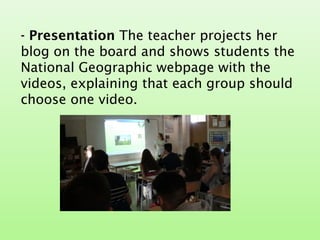
- Presentation The teacher projects her
blog on the board and shows students the
National Geographic webpage with the
videos, explaining that each group should
choose one video.
- Controlled Practice :The teacher
shows them the sample video. Then
students read the questions from the
blog related to the sample video and
practise them orally all together,
guided by the teacher
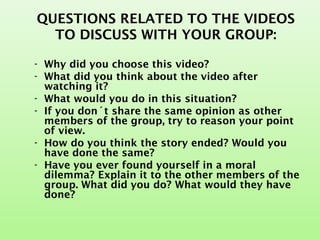
QUESTIONS RELATED TO THE VIDEOS
TO DISCUSS WITH YOUR GROUP:
- Why did you choose this video?
- What did you think about the video after
watching it?
- What would you do in this situation?
- If you don´t share the same opinion as other
members of the group, try to reason your point
of view.
- How do you think the story ended? Would you
have done the same?
- Have you ever found yourself in a moral
dilemma? Explain it to the other members of the
group. What did you do? What would they have
done?
- Free Practice : Students sit in groups,
with one computer each group, choose a
video and start watching it in turns.
Afterwards, they discuss about the moral
dilemmas presented by the video using
the questions that are projected on the
board. Teacher goes around helping
them with the language.
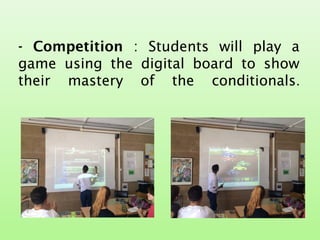
- Competition : Students will play a
game using the digital board to show
their mastery of the conditionals.
- Homework (Post-assessment): Students
have to write a short essay at home
explaining one of the moral dilemmas
they talked about in class and reasoning
about how they would react in that
situation.
- Diverse Learners: The lesson is for
collaboration in mixed-ability teams,
where students are able to select a
chosen topic. There is opportunity for
individualization based on each student´s
capacity.
- Extension suggestions: Students can
choose one of the moral dilemmas, or
invent a new one, and write and act a
short role-play in front of the class.
BIBLIOGRAPHY
- Bradfield, Bess and Kelly, Paul: OVER TO YOU
(Student´s Book 2nd Bachillerato, Oxford University Press)
- Teacher´s blog at
http://montseroquetenglish.blogspot.com.es/
- Moral Dilemmas Videos by National Geographic at
http://natgeotv.com.au/videos/moral-dilemmas/
- If-Conditionals Sentences Game in Classroom Games at
http://www.eslgamesplus.com/

Lessonplan.Montse Roquet.

  • 1.
  • 2.
    -SUBJECT: English asa Foreign Language -LEVEL: 2nd Bachillerato ( Twelfth grade, B1 of Common European Framework of Reference for Languages) -TEACHER: Montserrat Roquet Pugès -SCHOOL: Middle and High School Joan Miró, in Cornellà de Llobregat ( Barcelona)
  • 3.
    OBJECTIVES -Students will acquireenough oral practice with conditionals to communicate fluently. -Students will discuss ethical and moral dilemmas in a mature way, and will feel motivated by it.
  • 4.
    INTRODUCTION - This isa 90 minutes lesson entirely created by the teacher but it is part of a textbook-based didactic unit on conditionals (Unit 5, Ethics, textbook Over to You). - Students have already learnt and practised the conditionals structure, the objective now is that they are able to use them fluenty to communicate with each other orally about engaging topics.
  • 5.
    TIMING - Warm-up :Students sit in groups of four and write together in a card the vocabulary about ethics that they learnt the week before ( Pre-assessment) - Motivation: The teacher introduces the whole unit to the class, explaining the steps that will follow, including the final competition.
  • 6.
    - Presentation Theteacher projects her blog on the board and shows students the National Geographic webpage with the videos, explaining that each group should choose one video.
  • 7.
    - Controlled Practice:The teacher shows them the sample video. Then students read the questions from the blog related to the sample video and practise them orally all together, guided by the teacher
  • 8.
    QUESTIONS RELATED TOTHE VIDEOS TO DISCUSS WITH YOUR GROUP: - Why did you choose this video? - What did you think about the video after watching it? - What would you do in this situation? - If you don´t share the same opinion as other members of the group, try to reason your point of view. - How do you think the story ended? Would you have done the same? - Have you ever found yourself in a moral dilemma? Explain it to the other members of the group. What did you do? What would they have done?
  • 9.
    - Free Practice: Students sit in groups, with one computer each group, choose a video and start watching it in turns. Afterwards, they discuss about the moral dilemmas presented by the video using the questions that are projected on the board. Teacher goes around helping them with the language.
  • 10.
    - Competition :Students will play a game using the digital board to show their mastery of the conditionals.
  • 11.
    - Homework (Post-assessment):Students have to write a short essay at home explaining one of the moral dilemmas they talked about in class and reasoning about how they would react in that situation. - Diverse Learners: The lesson is for collaboration in mixed-ability teams, where students are able to select a chosen topic. There is opportunity for individualization based on each student´s capacity.
  • 12.
    - Extension suggestions:Students can choose one of the moral dilemmas, or invent a new one, and write and act a short role-play in front of the class.
  • 13.
    BIBLIOGRAPHY - Bradfield, Bessand Kelly, Paul: OVER TO YOU (Student´s Book 2nd Bachillerato, Oxford University Press) - Teacher´s blog at http://montseroquetenglish.blogspot.com.es/ - Moral Dilemmas Videos by National Geographic at http://natgeotv.com.au/videos/moral-dilemmas/ - If-Conditionals Sentences Game in Classroom Games at http://www.eslgamesplus.com/