I.F.D.C. LENGUAS VIVAS
TALLER DE PRÁCTICA DOCENTE
Tutora: Aurelia Velázquez
ALUMNO RESIDENTE: Antonella Young
Período de Práctica: Primaria
Institución Educativa: Colegio Sagrado Corazón
Dirección: Pellegrini 389
Sala / Grado / Año - sección: 6to grado
Cantidad de alumnos: 12
Nivel lingüístico del curso: Flyers (A1)
Tipo de Planificación: Clase
Unidad Temática: TV programs
Clase Nº: 1
Fecha: 01/08/2018
Hora:7:45 – 8:35 hs
Duración de la clase: 50 minutos
Fecha de primera entrega: 23/07/2018
 Teaching points: TV programs: Cartoon, comedy, documentary, music
video, news, quiz show, sport, weather. 



 Aims or goals: 
During this lesson, learners will be able to…
 Identify and name TV programs
 Develop Macro-abilities (listening, speaking and reading)
 Develop cognitive skills by infer vocabulary through a text and order a text
properly
 Work in groups and in pairs
 Talk about their favourite programs
 Language focus:
Functions Lexis Structures Pronunciation
New Cartoon,
comedy,
documentary,
music video,
news, quiz
show, sport,
weather
Talkin about
TV programs
students
usually watch
My favourite
program is…
I like watching
…..
I usually
see…..
/ju/ Documentary
Music
News
Teaching approach: The lesson is based on the Natural Approach, and organized through
the PPP procedure (Harmer,2010)


 Integration of skills: What skills will be integrated and how?
 Speaking by asking and answer questions and talking about their
favourite programs
 Listening by paying attention to an audio and take notes about what
they hear
 Reading by completing a text and putting the paragraph into the
correct order and reading it aloud. 

 Materials and resources: 
 Board and chalks
 Photocopies
 TV program pictures, word cards, and envelopes
 A handkerchief
 Kid’s box 5 CD 1
 Photocopies about the activity for homework

 Pedagogical use of ICT in class or at home: -

 Seating arrangement: Students will seat in pairs at the beginning and then
they will accommodate the tables and chairs to work in groups when the task
required it. They will also make space leaving the tables and chairs to one side in
this way they have enough space for a game. 

 Assessment: what will be assessed and how 
I'll check Learners comprehension by correcting the activities together.
Besides I’ll check students’ performance and develop in listening tasks by asking
them to take notes of what they can hear and examining what words they could
write
Stages in the lesson
Routine (2’ min):
Purpose:
 To greet students and start the lesson
Teaching strategies:
 Ask the date for practice
Skills:
 Listening and speaking abilities
Description and instructions: I’ll enter into the classroom and greet pupils. Then I’ll ask
them what day is and I’ll take note on the board.
T: Good morning, everybody
Sts: Good morning, teacher.
T: Is it today Monday?
Sts: No.
T: Or maybe Tuesday? Or Sunday?
Sts: No
T: Oh I wish it was Sunday. Ok, what day is today?
Sts: Wednesday.
T: Great!
Translation: Is everybody here? yes? Ok, so let’s start.
Warm – up (5’ min):
Purpose:
 To introduce the main topic
 To describe a picture orally
Teaching strategies:
 Use of visual aids
Skills:
 Listening and speaking abilities
Description and instructions: I’ll show them a picture in the computer and
I’ll ask them what they can see in it. Then I’ll ask them to pay attention on the
television and I’ll ask them what TV program they think this people is seeing.
T: Look at this! What can you see here? What part of the house is?
STS: The living room
T: Good! And what do you think they are? Are they friends? Or neighbours? Or maybe a
family?
STS: A family
T: Ok, and what are they seeing?
STS: Dibujos!
T: Ok, and in English? How we say “dibujos”?
STS: Cartoon!
T: Very good!
Translation: Thank you for your answers! Now, let’s learn some TV programs.
Presentation (10’min):
Purpose:
 To expose learners to the target language
 To develop their listening and cognitive abilities
Teaching strategies:
 Do movements, mimics, or use pictures for understanding
 Use motivational phrases to keep learning
 Prevent very loud noises by organizing the class to speak
Skills:
 Listening ability
 Cognitive and visual abilities
 Intra and inter personal ability
Description and instructions:
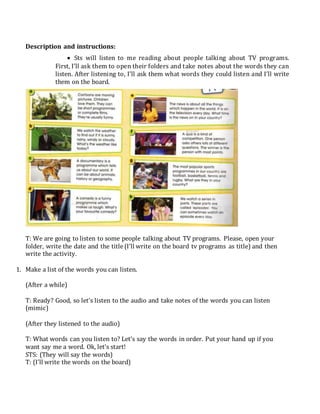
 Sts will listen to me reading about people talking about TV programs.
First, I’ll ask them to open their folders and take notes about the words they can
listen. After listening to, I’ll ask them what words they could listen and I’ll write
them on the board.
T: We are going to listen to some people talking about TV programs. Please, open your
folder, write the date and the title (I’ll write on the board tv programs as title) and then
write the activity.
1. Make a list of the words you can listen.
(After a while)
T: Ready? Good, so let’s listen to the audio and take notes of the words you can listen
(mimic)
(After they listened to the audio)
T: What words can you listen to? Let’s say the words in order. Put your hand up if you
want say me a word. Ok, let’s start!
STS: (They will say the words)
T: (I’ll write the words on the board)
(when they finished)
T: Good job, boys and girls!
 After that I will give each learner photocopy about the reading. Learners will look at
the words that appear under the page and I’ll explain them that they are TV programs.
Then I’ll ask them to make group of four people in each one and I’ll give them an envelope.
I’ll explain them that they will have to match the picture with the correct word and that the
text serves as help to guess the meaning of the words.
T: Look at the words under the page (pointing it). They are TV programs (writing it on the
board as main topic). We are going to work with those words. Let’s do an activity!
T: Please make group of four people. (once they form the groups, I’ll give to each group an
envelope)
T: Don’t open it, please! In this envelope there are some words about TV programs and
pictures about them. You have to match the words with the correct image. The text will
serve you to guess the meaning of the words according to what the people in the
conversation says about each program. I’ll give you 5 minutes to match each word with the
proper picture. Once the time finishes I’ll say STOP and you put your hands next to your
body without touching anything on your table. The group who guess more words will be
the winner.
(Once the game finished)
 I’ll paste the pictures with the proper word on the board and I’ll say them aloud while the
learners repeat what I say.
T: Please, repeat after me! “Cartoon”
STS: “Cartoon”
(The same is doing with the other TV programs)
 To conclude the activity, I’ll ask them what tv programs they like most and what not.
T: What TV programs are your favourite?
STS: Music video …. Sport programs…
T: Ok, try to do this… My favourite program is ….
STS: My favourite program is music video
T: well done! What TV programs do you not like?
STS: News… the weather….
T: Ok! Good, but try this please. I don’t like ….
STS: I don’t like the news
T: Very good! What TV programs do you think are boring (showing a picture of the
adjective)? And what are interesting (showing a picture)?
STS: Documentaries are boring …. And sport programs are interesting
T: And what are exciting (showing a picture)?
STS: Sports are exciting
T: Ok, what do you think are funny and good?
STS: I think that comedy programme is funny
T: and what are bad?
STS: Cartoon…
T: Ok, well done!
Translation: Now let’s practice a bit more!
Development(25’min)
Purpose:
 To practise and internalize vocabulary
 To develop concentration
Teaching strategies:
 Use short and clear sentences to explain the task
 Use movements and mimic for understanding
 Use different way of work like in group, teams, and pairs
Skills:
 Listening and speaking abilities
 Kinesthetic ability
 Cognitive ability
Activity 1 (10’min)
Material: A handkerchief
Description and instructions: I’ll ask for a volunteer to be the “speaker”.
Then I’ll divide the class into two teams (A and B) of an equal number of players.
Each team member is secretly given a name of a TV program. The same names
are given to each team but in different order. For example, I’ll say to the first
child of team A the word “comedy” and I’ll same the same word to the third child
of team B. Once each member has a word, I’ll give to the speaker a list of the
words to be practiced. The two teams line up facing each other, about 3 meters
apart, with the speaker in the middle, at the head of the two teams. The speaker
holds the handkerchief where it is clearly visible. The speaker calls out a word,
for example COMEDY. So the two children who have been named comedy must
run to the speaker and try to grab the handkerchief. The child who grabs it runs
back to their team.
If they manage to reach the team without being touched by the “comedy”
from the opposing team, they win the point. If the opposing “comedy” manages
to catch up with the runner and touch them, then no points are no scored. The
game continues until all the words have been called out. The team with the most
points at the end is the winner.
Resource: Handkerchief tag (page 38) by Luis Nunes (Portugal), Crazy animals – edited by
Fiona Copland and Sue Garton with Monica Davis, British Council.
T: I need for a volunteer. Who want to be?
STS: Me!
T: (pointing to the first who stand up his/her hand) you, please come at the front
and stand next to me.
T: I’ll divide the class into two teams. Those who I say A will line up on the left side
(pointing) and those who I say B will line up on the right side (pointing).
(Once both teams are completed)
T: I’ll say you a TV program secretly and you have to remember it, okay? (looking at
both team)
(Once I said the word to each team)
T: Now, I give you a list of the TV programs. You have to say one while you maintain
the handkerchief (pointing it) up, do you understand? Ok good! (looking at the
volunteer).
He/she will say a word and the boy or girl of each team (mimic) with this word will
run and try to grab the handkerchief (pointing to it). The first who grabs it runs back
with his/her team. If he/she manages to reach the team without being catch up with
the opposing team member win a point but if the opposing boy or girl manages to
catch up with the runner and touch the handkerchief, then the point is not scored.
T: Do you understand? Have you any doubt?
STS: Yes, we understand!
T: Ok, let’s do it once only for practice before starting the game.
Volunteer: “COMEDY”
STS: (both name of each group run and one grabs the handkerchief. He runs back
safely)
T: Excellent! Now, let’s play.
Activity 2 (15 minutes)
Description and instructions: I’ll ask pupils to work in pairs.. I’ll divide two different
texts into three paragraphs in each one. Then I’ll give the first paragraph of one of the text
to a pair of students, the second paragraph to other and the third to other two children. I’ll
say them they are students “A”. The same I’ll do with the other text and the rest of the pair
students but they are named students “B”. Once everybody has an extract of a text I’ll ask
them to complete the gaps with a suitable TV program. I’ll give them five minutes to
complete it. Once they finished, I’ll ask students to group with the other students of the
same letter so they will form two groups (A and B) of six students. I’ll ask them to read the
paragraphs and put it in order. Once both team finished, they will read both text and we’ll
check them together.
T: I’ll give you a part of a text (while I distribute it). You have to work in pairs to
complete the text with a proper TV program. You have only 5 minutes to complete
it.
Group A:
Paragraph 1:
TV programs: News, music video, weather
My name is Sally and I’m 13 years old. Every morning I get up and turn on the
television while I have breakfast. I like watching _____________________ just for relax a
while and have energy for the whole day. But I can’t always watch my favourite TV
program. My father usually put the ____________________ before going to work. So he is
informed about what happen in our city. Then, we watch the ____________________ and
so I decide what wear for school. If the weather is not so good I bring an umbrella
with me because I must walk to school.
Paragraph 2:
TV programs: cartoon, quiz show, sport
After school I go home and have lunch with my family. I have a little brother. He is 3
years old and He likes watching __________________. His favourite program is Tom and
Jerry, he always laughs with the mouse. While we have lunch we watch
________________ programs about volleyball, basketball or football. We love sports and
my parents are P.E. teachers.
In the afternoon I like watching my favourite ________________. I really enjoy seeing
how people compete to win.
Paragraph 3:
TV programs: Documentary, comedy
In the evening, my mother watches a _______________ program called “casados con
hijos”. I always laugh when Pepe Argento makes a joke to Marianela Fuseneco. Then
my father watches a ________________ in discovery channel. He likes programs about
animals or old furnitures. Then, we go to bed and sleep. We usually have a very busy
day and we need to rest.
Group B:
Paragraph 1:
TV programs: Music video, cartoon
My name is Brian and I’m 10 years old. I like watching _________________. My favourite
TV program is “La Guardia del Leon” or Phineas and Ferb. I have a small family, I live
with my mother, my father and my two sisters called Sophia and Lucy. Sophia is 15
years old and she likes watching ________________________. She likes dance while she
watches it and her favourite music is reggaeton.
Paragraph 2:
TV programs: Weather, quiz show, comedy
Lucy is 18 years old and she likes watching ______________________. Her favourite
program is “pasa palabras”, she enjoys guessing the words in the “roscoe”. She also
likes watching ________________________. Every morning before going to school she
watches it to know how to wear. My mother’s name is Claudia. She usually watches
______________. She likes watching films that make her laugh a lot.
Paragraph 3:
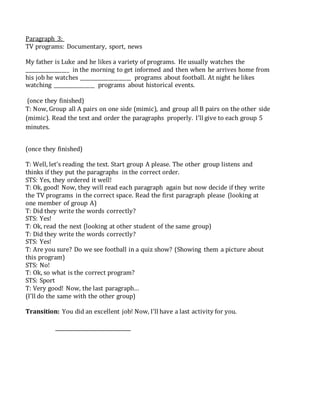
TV programs: Documentary, sport, news
My father is Luke and he likes a variety of programs. He usually watches the
__________________ in the morning to get informed and then when he arrives home from
his job he watches _____________________ programs about football. At night he likes
watching _________________ programs about historical events.
(once they finished)
T: Now, Group all A pairs on one side (mimic), and group all B pairs on the other side
(mimic). Read the text and order the paragraphs properly. I’ll give to each group 5
minutes.
(once they finished)
T: Well, let’s reading the text. Start group A please. The other group listens and
thinks if they put the paragraphs in the correct order.
STS: Yes, they ordered it well!
T: Ok, good! Now, they will read each paragraph again but now decide if they write
the TV programs in the correct space. Read the first paragraph please (looking at
one member of group A)
T: Did they write the words correctly?
STS: Yes!
T: Ok, read the next (looking at other student of the same group)
T: Did they write the words correctly?
STS: Yes!
T: Are you sure? Do we see football in a quiz show? (Showing them a picture about
this program)
STS: No!
T: Ok, so what is the correct program?
STS: Sport
T: Very good! Now, the last paragraph…
(I’ll do the same with the other group)
Transition: You did an excellent job! Now, I’ll have a last activity for you.
Homework (5’minutes):
Purpose:
 To keep practicing at home
 To develop the responsibility
 To practice individually
Skills:
 Reading ability
Description and instructions: I’ll give learners a photocopy that they have to
complete with the programs that the different member of the family watches at
home. They have to complete it for the next class.
T: For the next class please complete this chart. You have to write 5 TV programs
(pointing) that you like and the day and time (pointing) those programs are
transmitted. Please, don’t forget to do this! I’ll take list of those who bring the
material.
My TV Guide
Favourite
TV
programs
Start time Finish time Duration
Day:
Day:
Day:
Day:
Day
Lesson plan
component
Excellent
5
Very Good
4
Good
3
Acceptable
2
Below Standard
1
Visual organization
Coherence and
sequencing
Variety of resources
– Learning styles
Stages and activities
Teaching strategies
Language accuracy
Observations Minimumscore:18 / 30
Score:____ /30

Lesson plans, class 1

  • 1.
    I.F.D.C. LENGUAS VIVAS TALLERDE PRÁCTICA DOCENTE Tutora: Aurelia Velázquez ALUMNO RESIDENTE: Antonella Young Período de Práctica: Primaria Institución Educativa: Colegio Sagrado Corazón Dirección: Pellegrini 389 Sala / Grado / Año - sección: 6to grado Cantidad de alumnos: 12 Nivel lingüístico del curso: Flyers (A1) Tipo de Planificación: Clase Unidad Temática: TV programs Clase Nº: 1 Fecha: 01/08/2018 Hora:7:45 – 8:35 hs Duración de la clase: 50 minutos Fecha de primera entrega: 23/07/2018  Teaching points: TV programs: Cartoon, comedy, documentary, music video, news, quiz show, sport, weather.      Aims or goals:  During this lesson, learners will be able to…  Identify and name TV programs  Develop Macro-abilities (listening, speaking and reading)  Develop cognitive skills by infer vocabulary through a text and order a text properly  Work in groups and in pairs  Talk about their favourite programs  Language focus: Functions Lexis Structures Pronunciation New Cartoon, comedy, documentary, music video, news, quiz show, sport, weather Talkin about TV programs students usually watch My favourite program is… I like watching ….. I usually see….. /ju/ Documentary Music News
  • 2.
    Teaching approach: Thelesson is based on the Natural Approach, and organized through the PPP procedure (Harmer,2010)    Integration of skills: What skills will be integrated and how?  Speaking by asking and answer questions and talking about their favourite programs  Listening by paying attention to an audio and take notes about what they hear  Reading by completing a text and putting the paragraph into the correct order and reading it aloud.    Materials and resources:   Board and chalks  Photocopies  TV program pictures, word cards, and envelopes  A handkerchief  Kid’s box 5 CD 1  Photocopies about the activity for homework   Pedagogical use of ICT in class or at home: -   Seating arrangement: Students will seat in pairs at the beginning and then they will accommodate the tables and chairs to work in groups when the task required it. They will also make space leaving the tables and chairs to one side in this way they have enough space for a game.    Assessment: what will be assessed and how  I'll check Learners comprehension by correcting the activities together. Besides I’ll check students’ performance and develop in listening tasks by asking them to take notes of what they can hear and examining what words they could write
  • 3.
    Stages in thelesson Routine (2’ min): Purpose:  To greet students and start the lesson Teaching strategies:  Ask the date for practice Skills:  Listening and speaking abilities Description and instructions: I’ll enter into the classroom and greet pupils. Then I’ll ask them what day is and I’ll take note on the board. T: Good morning, everybody Sts: Good morning, teacher. T: Is it today Monday? Sts: No. T: Or maybe Tuesday? Or Sunday? Sts: No T: Oh I wish it was Sunday. Ok, what day is today? Sts: Wednesday. T: Great! Translation: Is everybody here? yes? Ok, so let’s start. Warm – up (5’ min): Purpose:  To introduce the main topic  To describe a picture orally Teaching strategies:  Use of visual aids Skills:  Listening and speaking abilities Description and instructions: I’ll show them a picture in the computer and I’ll ask them what they can see in it. Then I’ll ask them to pay attention on the television and I’ll ask them what TV program they think this people is seeing.
  • 4.
    T: Look atthis! What can you see here? What part of the house is? STS: The living room T: Good! And what do you think they are? Are they friends? Or neighbours? Or maybe a family? STS: A family T: Ok, and what are they seeing? STS: Dibujos! T: Ok, and in English? How we say “dibujos”? STS: Cartoon! T: Very good! Translation: Thank you for your answers! Now, let’s learn some TV programs. Presentation (10’min): Purpose:  To expose learners to the target language  To develop their listening and cognitive abilities Teaching strategies:  Do movements, mimics, or use pictures for understanding  Use motivational phrases to keep learning  Prevent very loud noises by organizing the class to speak Skills:  Listening ability  Cognitive and visual abilities  Intra and inter personal ability
  • 5.
    Description and instructions: Sts will listen to me reading about people talking about TV programs. First, I’ll ask them to open their folders and take notes about the words they can listen. After listening to, I’ll ask them what words they could listen and I’ll write them on the board. T: We are going to listen to some people talking about TV programs. Please, open your folder, write the date and the title (I’ll write on the board tv programs as title) and then write the activity. 1. Make a list of the words you can listen. (After a while) T: Ready? Good, so let’s listen to the audio and take notes of the words you can listen (mimic) (After they listened to the audio) T: What words can you listen to? Let’s say the words in order. Put your hand up if you want say me a word. Ok, let’s start! STS: (They will say the words) T: (I’ll write the words on the board)
  • 6.
    (when they finished) T:Good job, boys and girls!  After that I will give each learner photocopy about the reading. Learners will look at the words that appear under the page and I’ll explain them that they are TV programs. Then I’ll ask them to make group of four people in each one and I’ll give them an envelope. I’ll explain them that they will have to match the picture with the correct word and that the text serves as help to guess the meaning of the words. T: Look at the words under the page (pointing it). They are TV programs (writing it on the board as main topic). We are going to work with those words. Let’s do an activity! T: Please make group of four people. (once they form the groups, I’ll give to each group an envelope) T: Don’t open it, please! In this envelope there are some words about TV programs and pictures about them. You have to match the words with the correct image. The text will serve you to guess the meaning of the words according to what the people in the conversation says about each program. I’ll give you 5 minutes to match each word with the proper picture. Once the time finishes I’ll say STOP and you put your hands next to your body without touching anything on your table. The group who guess more words will be the winner. (Once the game finished)  I’ll paste the pictures with the proper word on the board and I’ll say them aloud while the learners repeat what I say. T: Please, repeat after me! “Cartoon” STS: “Cartoon” (The same is doing with the other TV programs)  To conclude the activity, I’ll ask them what tv programs they like most and what not. T: What TV programs are your favourite? STS: Music video …. Sport programs… T: Ok, try to do this… My favourite program is …. STS: My favourite program is music video T: well done! What TV programs do you not like? STS: News… the weather…. T: Ok! Good, but try this please. I don’t like …. STS: I don’t like the news T: Very good! What TV programs do you think are boring (showing a picture of the adjective)? And what are interesting (showing a picture)?
  • 7.
    STS: Documentaries areboring …. And sport programs are interesting T: And what are exciting (showing a picture)? STS: Sports are exciting T: Ok, what do you think are funny and good? STS: I think that comedy programme is funny T: and what are bad? STS: Cartoon… T: Ok, well done! Translation: Now let’s practice a bit more! Development(25’min) Purpose:  To practise and internalize vocabulary  To develop concentration Teaching strategies:  Use short and clear sentences to explain the task  Use movements and mimic for understanding  Use different way of work like in group, teams, and pairs Skills:  Listening and speaking abilities  Kinesthetic ability  Cognitive ability Activity 1 (10’min) Material: A handkerchief Description and instructions: I’ll ask for a volunteer to be the “speaker”. Then I’ll divide the class into two teams (A and B) of an equal number of players. Each team member is secretly given a name of a TV program. The same names are given to each team but in different order. For example, I’ll say to the first child of team A the word “comedy” and I’ll same the same word to the third child of team B. Once each member has a word, I’ll give to the speaker a list of the words to be practiced. The two teams line up facing each other, about 3 meters apart, with the speaker in the middle, at the head of the two teams. The speaker holds the handkerchief where it is clearly visible. The speaker calls out a word, for example COMEDY. So the two children who have been named comedy must run to the speaker and try to grab the handkerchief. The child who grabs it runs back to their team.
  • 8.
    If they manageto reach the team without being touched by the “comedy” from the opposing team, they win the point. If the opposing “comedy” manages to catch up with the runner and touch them, then no points are no scored. The game continues until all the words have been called out. The team with the most points at the end is the winner. Resource: Handkerchief tag (page 38) by Luis Nunes (Portugal), Crazy animals – edited by Fiona Copland and Sue Garton with Monica Davis, British Council. T: I need for a volunteer. Who want to be? STS: Me! T: (pointing to the first who stand up his/her hand) you, please come at the front and stand next to me. T: I’ll divide the class into two teams. Those who I say A will line up on the left side (pointing) and those who I say B will line up on the right side (pointing). (Once both teams are completed) T: I’ll say you a TV program secretly and you have to remember it, okay? (looking at both team) (Once I said the word to each team) T: Now, I give you a list of the TV programs. You have to say one while you maintain the handkerchief (pointing it) up, do you understand? Ok good! (looking at the volunteer). He/she will say a word and the boy or girl of each team (mimic) with this word will run and try to grab the handkerchief (pointing to it). The first who grabs it runs back with his/her team. If he/she manages to reach the team without being catch up with the opposing team member win a point but if the opposing boy or girl manages to catch up with the runner and touch the handkerchief, then the point is not scored. T: Do you understand? Have you any doubt?
  • 9.
    STS: Yes, weunderstand! T: Ok, let’s do it once only for practice before starting the game. Volunteer: “COMEDY” STS: (both name of each group run and one grabs the handkerchief. He runs back safely) T: Excellent! Now, let’s play. Activity 2 (15 minutes) Description and instructions: I’ll ask pupils to work in pairs.. I’ll divide two different texts into three paragraphs in each one. Then I’ll give the first paragraph of one of the text to a pair of students, the second paragraph to other and the third to other two children. I’ll say them they are students “A”. The same I’ll do with the other text and the rest of the pair students but they are named students “B”. Once everybody has an extract of a text I’ll ask them to complete the gaps with a suitable TV program. I’ll give them five minutes to complete it. Once they finished, I’ll ask students to group with the other students of the same letter so they will form two groups (A and B) of six students. I’ll ask them to read the paragraphs and put it in order. Once both team finished, they will read both text and we’ll check them together. T: I’ll give you a part of a text (while I distribute it). You have to work in pairs to complete the text with a proper TV program. You have only 5 minutes to complete it. Group A: Paragraph 1: TV programs: News, music video, weather My name is Sally and I’m 13 years old. Every morning I get up and turn on the television while I have breakfast. I like watching _____________________ just for relax a while and have energy for the whole day. But I can’t always watch my favourite TV program. My father usually put the ____________________ before going to work. So he is informed about what happen in our city. Then, we watch the ____________________ and so I decide what wear for school. If the weather is not so good I bring an umbrella with me because I must walk to school.
  • 10.
    Paragraph 2: TV programs:cartoon, quiz show, sport After school I go home and have lunch with my family. I have a little brother. He is 3 years old and He likes watching __________________. His favourite program is Tom and Jerry, he always laughs with the mouse. While we have lunch we watch ________________ programs about volleyball, basketball or football. We love sports and my parents are P.E. teachers. In the afternoon I like watching my favourite ________________. I really enjoy seeing how people compete to win. Paragraph 3: TV programs: Documentary, comedy In the evening, my mother watches a _______________ program called “casados con hijos”. I always laugh when Pepe Argento makes a joke to Marianela Fuseneco. Then my father watches a ________________ in discovery channel. He likes programs about animals or old furnitures. Then, we go to bed and sleep. We usually have a very busy day and we need to rest. Group B: Paragraph 1: TV programs: Music video, cartoon My name is Brian and I’m 10 years old. I like watching _________________. My favourite TV program is “La Guardia del Leon” or Phineas and Ferb. I have a small family, I live with my mother, my father and my two sisters called Sophia and Lucy. Sophia is 15 years old and she likes watching ________________________. She likes dance while she watches it and her favourite music is reggaeton. Paragraph 2: TV programs: Weather, quiz show, comedy Lucy is 18 years old and she likes watching ______________________. Her favourite program is “pasa palabras”, she enjoys guessing the words in the “roscoe”. She also likes watching ________________________. Every morning before going to school she watches it to know how to wear. My mother’s name is Claudia. She usually watches ______________. She likes watching films that make her laugh a lot.
  • 11.
    Paragraph 3: TV programs:Documentary, sport, news My father is Luke and he likes a variety of programs. He usually watches the __________________ in the morning to get informed and then when he arrives home from his job he watches _____________________ programs about football. At night he likes watching _________________ programs about historical events. (once they finished) T: Now, Group all A pairs on one side (mimic), and group all B pairs on the other side (mimic). Read the text and order the paragraphs properly. I’ll give to each group 5 minutes. (once they finished) T: Well, let’s reading the text. Start group A please. The other group listens and thinks if they put the paragraphs in the correct order. STS: Yes, they ordered it well! T: Ok, good! Now, they will read each paragraph again but now decide if they write the TV programs in the correct space. Read the first paragraph please (looking at one member of group A) T: Did they write the words correctly? STS: Yes! T: Ok, read the next (looking at other student of the same group) T: Did they write the words correctly? STS: Yes! T: Are you sure? Do we see football in a quiz show? (Showing them a picture about this program) STS: No! T: Ok, so what is the correct program? STS: Sport T: Very good! Now, the last paragraph… (I’ll do the same with the other group) Transition: You did an excellent job! Now, I’ll have a last activity for you.
  • 12.
    Homework (5’minutes): Purpose:  Tokeep practicing at home  To develop the responsibility  To practice individually Skills:  Reading ability Description and instructions: I’ll give learners a photocopy that they have to complete with the programs that the different member of the family watches at home. They have to complete it for the next class. T: For the next class please complete this chart. You have to write 5 TV programs (pointing) that you like and the day and time (pointing) those programs are transmitted. Please, don’t forget to do this! I’ll take list of those who bring the material. My TV Guide Favourite TV programs Start time Finish time Duration Day: Day:
  • 13.
  • 14.
    Lesson plan component Excellent 5 Very Good 4 Good 3 Acceptable 2 BelowStandard 1 Visual organization Coherence and sequencing Variety of resources – Learning styles Stages and activities Teaching strategies Language accuracy Observations Minimumscore:18 / 30 Score:____ /30