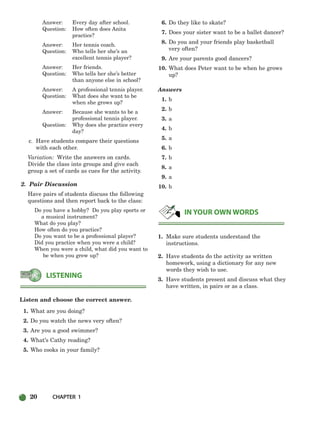
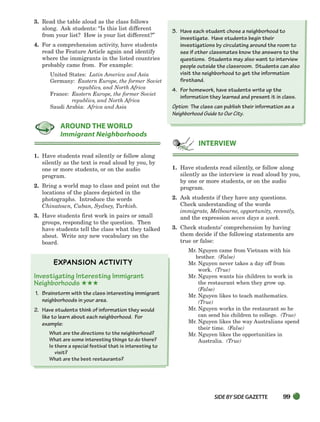
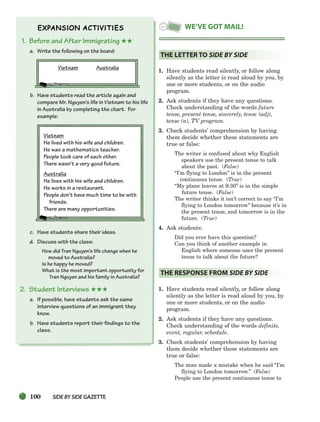
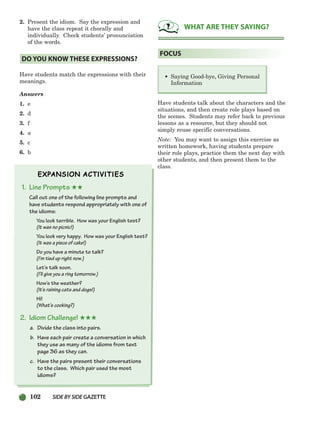
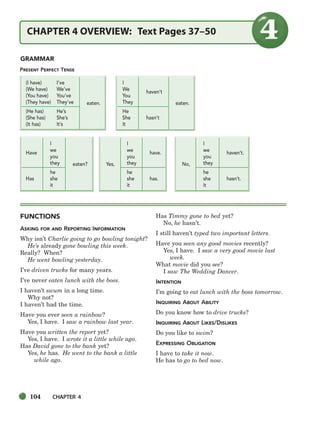
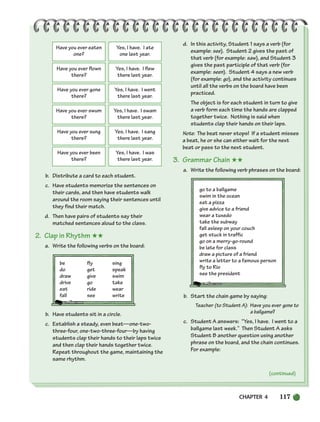
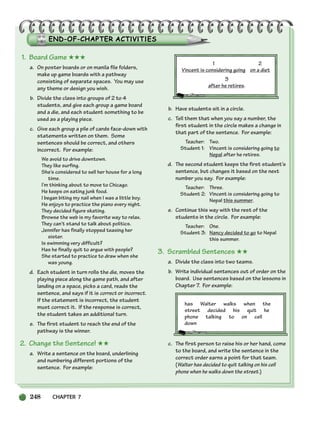
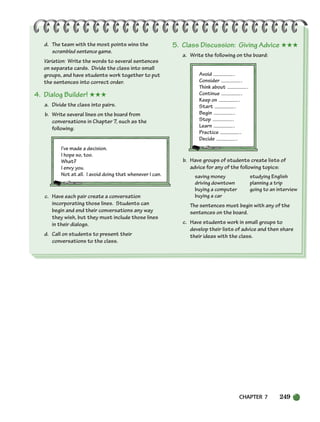
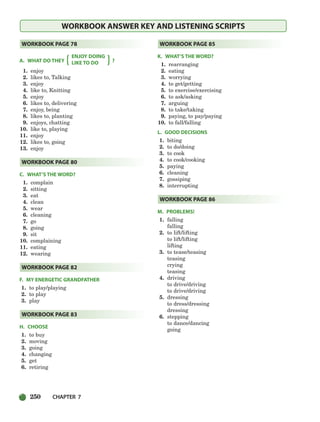
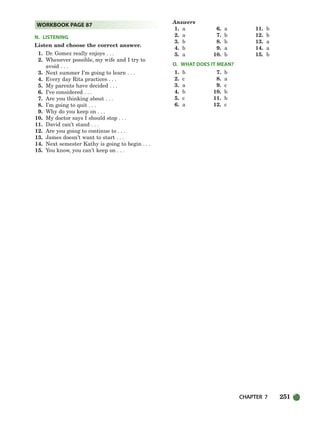
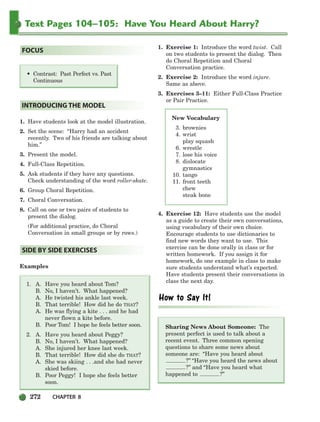
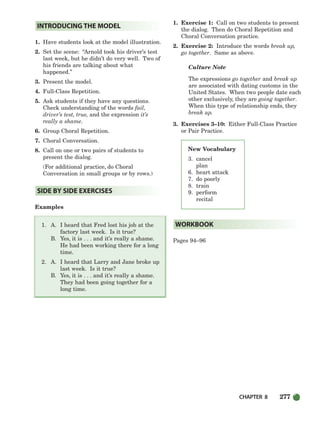
TEACHER’S GUIDE
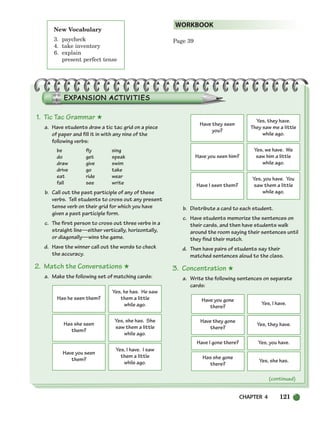
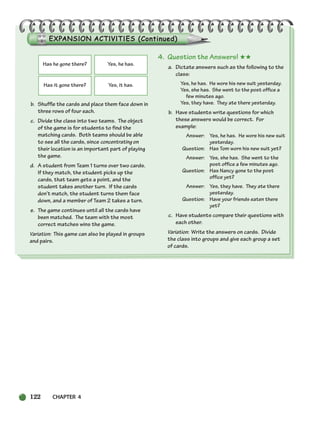
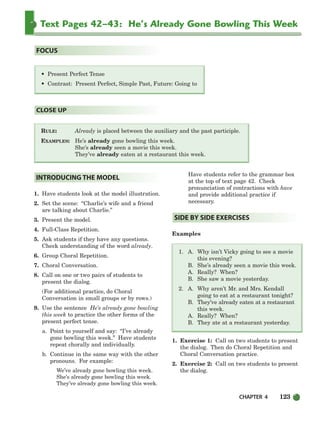
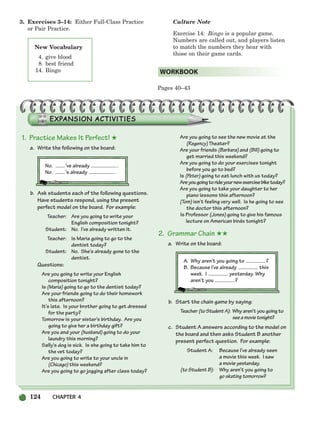
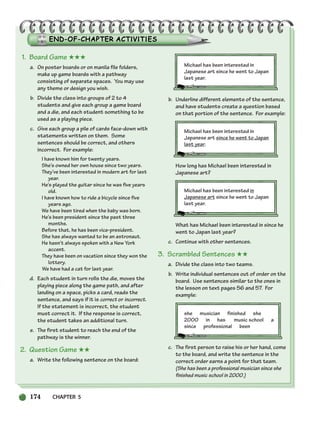
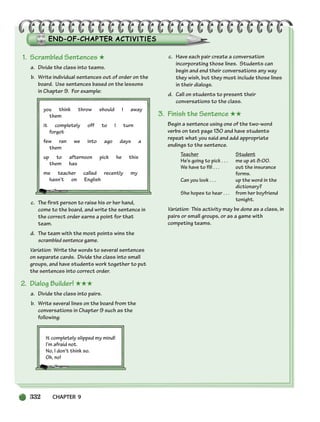
Steven J. Molinsky
Bill Bliss
THIRD EDITION
THIRD EDITION
BOOK
3
Contributing Authors
Sarah Lynn
Mary Ann Perry
with
John Kopec
i-xv_SBSTG3_FM.QXD 8/16/07 9:08 AM Page i
Side by Side, 3rd edition
Teacher’s Guide 3
Copyright © 2002 by Prentice Hall Regents
Addison Wesley Longman, Inc.
A Pearson Education Company.
All rights reserved.
No part of this publication may be reproduced,
stored in a retrieval system, or transmitted
in any form or by any means, electronic, mechanical,
photocopying, recording, or otherwise,
without the prior permission of the publisher.
Pearson Education, 10 Bank Street, White Plains, NY 10606
Vice president, director of publishing: Allen Ascher
Editorial manager: Pam Fishman
Vice president, director of design and production: Rhea Banker
Director of electronic production: Aliza Greenblatt
Production manager: Ray Keating
Director of manufacturing: Patrice Fraccio
Digital layout specialists: Kelly Tavares, Paula Williams, Wendy Wolf
Interior design: Wendy Wolf
Interior art: Judy A. Wolf
Cover design: Elizabeth Carlson
Cover art: Richard E. Hill
Copyediting: Janet Johnston
The authors gratefully acknowledge the contribution
of Tina Carver in the development of the original
Side by Side program.
ISBN 0-13-512612-6
ISBN 978-0-13-512612-7
Printed in the United States of America
1 2 3 4 5 6 7 8 9 10 – QWD – 12 11 10 09 08 07
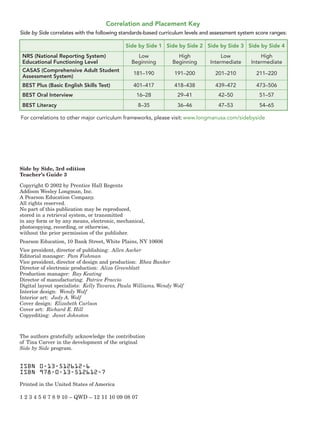
Correlation and Placement Key
Side by Side correlates with the following standards-based curriculum levels and assessment system score ranges:
Side by Side 1 Side by Side 2 Side by Side 3 Side by Side 4
NRS (National Reporting System)
Educational Functioning Level
Low
Beginning
High
Beginning
Low
Intermediate
High
Intermediate
CASAS (Comprehensive Adult Student
Assessment System)
181–190 191–200 201–210 211–220
BEST Plus (Basic English Skills Test) 401–417 418–438 439–472 473–506
BEST Oral Interview 16–28 29–41 42–50 51–57
BEST Literacy 8–35 36–46 47–53 54–65
For correlations to other major curriculum frameworks, please visit: www.longmanusa.com/sidebyside
i-xv_SBSTG3_FM.QXD 8/16/07 9:08 AM Page ii
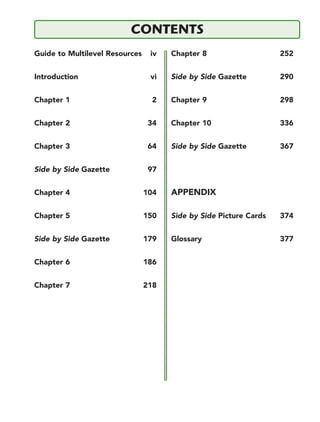
CONTENTS
Guide to Multilevel Resources iv
Introduction vi
Chapter 1 2
Chapter 2 34
Chapter 3 64
Side by Side Gazette 97
Chapter 4 104
Chapter 5 150
Side by Side Gazette 179
Chapter 6 186
Chapter 7 218
Chapter 8 252
Side by Side Gazette 290
Chapter 9 298
Chapter 10 336
Side by Side Gazette 367
APPENDIX
Side by Side Picture Cards 374
Glossary 377
i-xv_SBSTG3_FM.QXD 8/16/07 9:08 AM Page iii
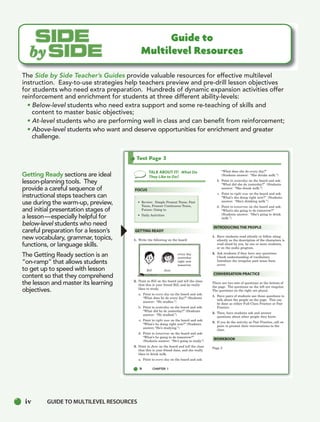
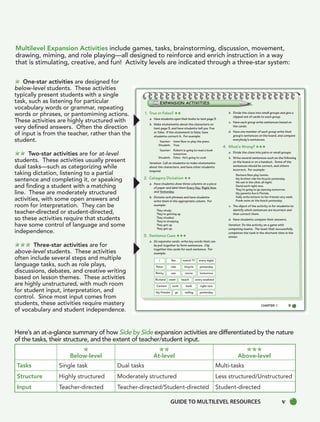
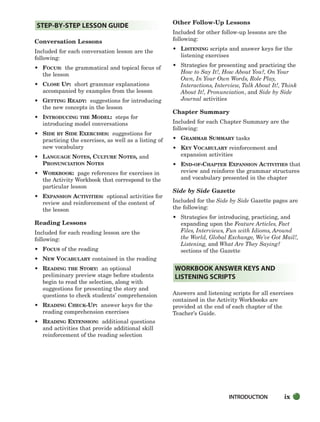
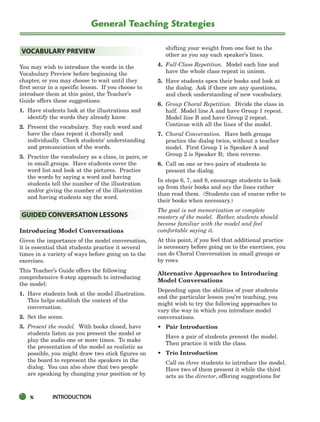
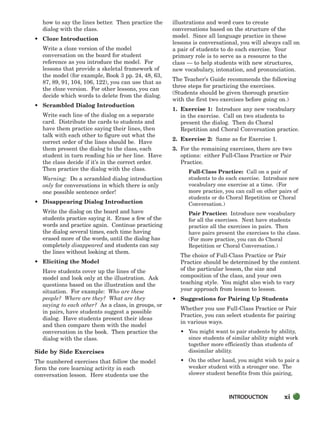
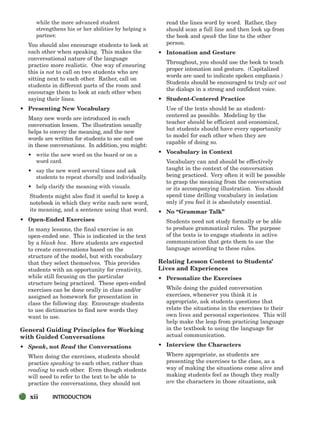
The Side by Side Teacher’s Guides provide valuable resources for effective multilevel
instruction. Easy-to-use strategies help teachers preview and pre-drill lesson objectives
for students who need extra preparation. Hundreds of dynamic expansion activities offer
reinforcement and enrichment for students at three different ability-levels:
• Below-level students who need extra support and some re-teaching of skills and
content to master basic objectives;
• At-level students who are performing well in class and can benefit from reinforcement;
• Above-level students who want and deserve opportunities for enrichment and greater
challenge.
8 CHAPTER 1
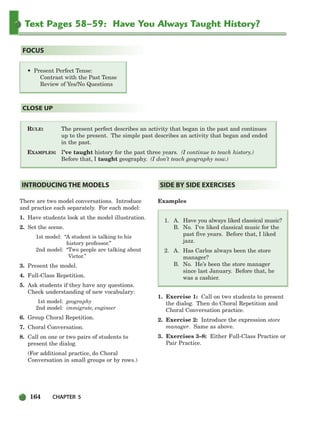
Text Page 3
1. Write the following on the board:
every day
yesterday
right now
tomorrow
Bill Jane
2. Point to Bill on the board and tell the class
that this is your friend Bill, and he really
likes to study.
a. Point to every day on the board and ask:
“What does he do every day?” (Students
answer: “He studies.”)
b. Point to yesterday on the board and ask:
“What did he do yesterday?” (Students
answer: “He studied.”)
c. Point to right now on the board and ask:
“What’s he doing right now?” (Students
answer, “He’s studying.”)
d. Point to tomorrow on the board and ask:
“What’s he going to do tomorrow?”
(Students answer: “He’s going to study.”)
3. Point to Jane on the board and tell the class
that this is your friend Jane, and she really
likes to drink milk.
a. Point to every day on the board and ask:
“What does she do every day?”
(Students answer: “She drinks milk.”)
b. Point to yesterday on the board and ask:
“What did she do yesterday?” (Students
answer: “She drank milk.”)
c. Point to right now on the board and ask:
“What’s she doing right now?” (Students
answer: “She’s drinking milk.”)
d. Point to tomorrow on the board and ask:
“What’s she going to do tomorrow?”
(Students answer: “She’s going to drink
milk.”)
1. Have students read silently or follow along
silently as the description of the characters is
read aloud by you, by one or more students,
or on the audio program.
2. Ask students if they have any questions.
Check understanding of vocabulary.
Introduce the irregular past tense form
swam.
There are two sets of questions at the bottom of
the page. The questions on the left are singular.
The questions on the right are plural.
1. Have pairs of students use these questions to
talk about the people on the page. This can
be done as either Full-Class Practice or Pair
Practice.
2. Then, have students ask and answer
questions about other people they know.
3. If you do the activity as Pair Practice, call on
pairs to present their conversations to the
class.
Page 3
WORKBOOK
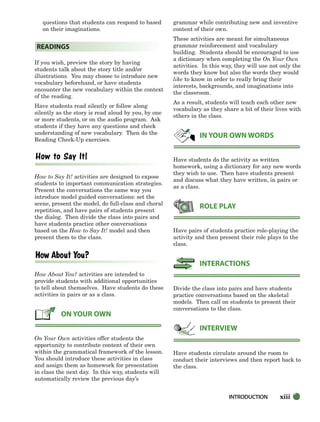
CONVERSATION PRACTICE
INTRODUCING THE PEOPLE
GETTING READY
• Review: Simple Present Tense, Past
Tense, Present Continuous Tense,
Future: Going to
• Daily Activities
FOCUS
TALK ABOUT IT! What Do
They Like to Do?
Getting Ready sections are ideal
lesson-planning tools. They
provide a careful sequence of
instructional steps teachers can
use during the warm-up, preview,
and initial presentation stages of
a lesson––especially helpful for
below-level students who need
careful preparation for a lesson’s
new vocabulary, grammar, topics,
functions, or language skills.
The Getting Ready section is an
“on-ramp” that allows students
to get up to speed with lesson
content so that they comprehend
the lesson and master its learning
objectives.
Guide to
Multilevel Resources
iv GUIDE TO MULTILEVEL RESOURCES
iv-v_SBSTG3_FM.indd iv
iv-v_SBSTG3_FM.indd iv 8/16/07 10:02:23 AM
8/16/07 10:02:23 AM
v
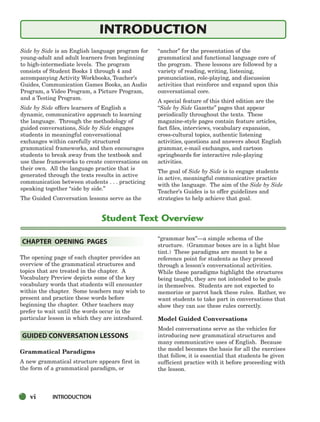
Multilevel Expansion Activities include games, tasks, brainstorming, discussion, movement,
drawing, miming, and role playing––all designed to reinforce and enrich instruction in a way
that is stimulating, creative, and fun! Activity levels are indicated through a three-star system:
One-star activities are designed for
below-level students. These activities
typically present students with a single
task, such as listening for particular
vocabulary words or grammar, repeating
words or phrases, or pantomiming actions.
These activities are highly structured with
very defined answers. Often the direction
of input is from the teacher, rather than the
student.
Two-star activities are for at-level
students. These activities usually present
dual tasks—such as categorizing while
taking dictation, listening to a partial
sentence and completing it, or speaking
and finding a student with a matching
line. These are moderately structured
activities, with some open answers and
room for interpretation. They can be
teacher-directed or student-directed,
so these activities require that students
have some control of language and some
independence.
Three-star activities are for
above-level students. These activities
often include several steps and multiple
language tasks, such as role plays,
discussions, debates, and creative writing
based on lesson themes. These activities
are highly unstructured, with much room
for student input, interpretation, and
control. Since most input comes from
students, these activities require mastery
of vocabulary and student independence.
CHAPTER 1 9
1. True or False? ★★
a. Have students open their books to text page 3.
b. Make statements about the characters on
text page 3, and have students tell you True
or False. If the statement is false, have
students correct it. For example:
Teacher: Irene likes to play the piano.
Student: True.
Teacher: Robert is going to read a book
tomorrow.
Student: False. He’s going to cook.
Variation: Call on students to make statements
about the characters, and have other students
respond.
2. Category Dictation ★★
a. Have students draw three columns on a piece
of paper and label them Every Day, Right Now,
and Yesterday.
b. Dictate verb phrases and have students
write them in the appropriate column. For
example:
They study.
They’re getting up.
They studied.
They’re studying.
They got up.
They get up.
3. Sentence Cues ★★★
a. On separate cards, write key words that can
be put together to form sentences. Clip
together the cards for each sentence. For
example:
b. Divide the class into small groups and give a
clipped set of cards to each group.
c. Have each group write sentences based on
the cards.
d. Have one member of each group write that
group’s sentences on the board, and compare
everybody’s sentences.
4. What’s Wrong? ★★★
a. Divide the class into pairs or small groups.
b. Write several sentences such as the following
on the board or on a handout. Some of the
sentences should be correct, and others
incorrect. For example:
Barbara likes play tennis.
My brother ride his bicycle yesterday.
We sat in the clinic all night.
David work right now.
They’re going to go dancing tomorrow.
My parents live in Florida.
Sally write letters to her friends very week.
Frank swim at the beach yesterday.
c. The object of the activity is for students to
identify which sentences are incorrect and
then correct them.
d. Have students compare their answers.
Variation: Do the activity as a game with
competing teams. The team that successfully
completes the task in the shortest time is the
winner.
I like watch TV every night
Peter ride bicycle yesterday
Betty see movie tomorrow
Richard swim beach every weekend
Carmen work bank right now
My friends go sailing yesterday
Here’s an at-a-glance summary of how Side by Side expansion activities are differentiated by the nature
of the tasks, their structure, and the extent of teacher/student input.
Below-level At-level Above-level
Tasks Single task Dual tasks Multi-tasks
Structure Highly structured Moderately structured Less structured/Unstructured
Input Teacher-directed Teacher-directed/Student-directed Student-directed
GUIDE TO MULTILEVEL RESOURCES v
iv-v_SBSTG3_FM.indd v
iv-v_SBSTG3_FM.indd v 8/16/07 9:51:35 AM
8/16/07 9:51:35 AM
vi INTRODUCTION
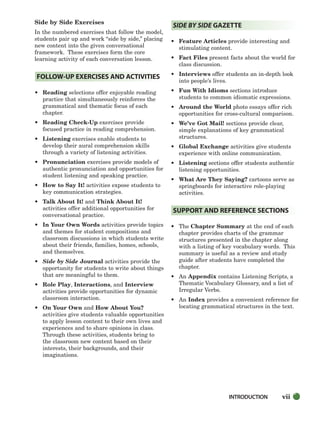
Side by Side is an English language program for
young-adult and adult learners from beginning
to high-intermediate levels. The program
consists of Student Books 1 through 4 and
accompanying Activity Workbooks, Teacher’s
Guides, Communication Games Books, an Audio
Program, a Video Program, a Picture Program,
and a Testing Program.
Side by Side offers learners of English a
dynamic, communicative approach to learning
the language. Through the methodology of
guided conversations, Side by Side engages
students in meaningful conversational
exchanges within carefully structured
grammatical frameworks, and then encourages
students to break away from the textbook and
use these frameworks to create conversations on
their own. All the language practice that is
generated through the texts results in active
communication between students . . . practicing
speaking together “side by side.”
The Guided Conversation lessons serve as the
“anchor” for the presentation of the
grammatical and functional language core of
the program. These lessons are followed by a
variety of reading, writing, listening,
pronunciation, role-playing, and discussion
activities that reinforce and expand upon this
conversational core.
A special feature of this third edition are the
“Side by Side Gazette” pages that appear
periodically throughout the texts. These
magazine-style pages contain feature articles,
fact files, interviews, vocabulary expansion,
cross-cultural topics, authentic listening
activities, questions and answers about English
grammar, e-mail exchanges, and cartoon
springboards for interactive role-playing
activities.
The goal of Side by Side is to engage students
in active, meaningful communicative practice
with the language. The aim of the Side by Side
Teacher’s Guides is to offer guidelines and
strategies to help achieve that goal.
The opening page of each chapter provides an
overview of the grammatical structures and
topics that are treated in the chapter. A
Vocabulary Preview depicts some of the key
vocabulary words that students will encounter
within the chapter. Some teachers may wish to
present and practice these words before
beginning the chapter. Other teachers may
prefer to wait until the words occur in the
particular lesson in which they are introduced.
Grammatical Paradigms
A new grammatical structure appears first in
the form of a grammatical paradigm, or
“grammar box”—a simple schema of the
structure. (Grammar boxes are in a light blue
tint.) These paradigms are meant to be a
reference point for students as they proceed
through a lesson’s conversational activities.
While these paradigms highlight the structures
being taught, they are not intended to be goals
in themselves. Students are not expected to
memorize or parrot back these rules. Rather, we
want students to take part in conversations that
show they can use these rules correctly.
Model Guided Conversations
Model conversations serve as the vehicles for
introducing new grammatical structures and
many communicative uses of English. Because
the model becomes the basis for all the exercises
that follow, it is essential that students be given
sufficient practice with it before proceeding with
the lesson.
GUIDED CONVERSATION LESSONS
CHAPTER OPENING PAGES
Student Text Overview
INTRODUCTION
i-xv_SBSTG3_FM.QXD 8/16/07 9:08 AM Page vi
INTRODUCTION vii
Side by Side Exercises
In the numbered exercises that follow the model,
students pair up and work “side by side,” placing
new content into the given conversational
framework. These exercises form the core
learning activity of each conversation lesson.
• Reading selections offer enjoyable reading
practice that simultaneously reinforces the
grammatical and thematic focus of each
chapter.
• Reading Check-Up exercises provide
focused practice in reading comprehension.
• Listening exercises enable students to
develop their aural comprehension skills
through a variety of listening activities.
• Pronunciation exercises provide models of
authentic pronunciation and opportunities for
student listening and speaking practice.
• How to Say It! activities expose students to
key communication strategies.
• Talk About It! and Think About It!
activities offer additional opportunities for
conversational practice.
• In Your Own Words activities provide topics
and themes for student compositions and
classroom discussions in which students write
about their friends, families, homes, schools,
and themselves.
• Side by Side Journal activities provide the
opportunity for students to write about things
that are meaningful to them.
• Role Play, Interactions, and Interview
activities provide opportunities for dynamic
classroom interaction.
• On Your Own and How About You?
activities give students valuable opportunities
to apply lesson content to their own lives and
experiences and to share opinions in class.
Through these activities, students bring to
the classroom new content based on their
interests, their backgrounds, and their
imaginations.
• Feature Articles provide interesting and
stimulating content.
• Fact Files present facts about the world for
class discussion.
• Interviews offer students an in-depth look
into people’s lives.
• Fun With Idioms sections introduce
students to common idiomatic expressions.
• Around the World photo essays offer rich
opportunities for cross-cultural comparison.
• We’ve Got Mail! sections provide clear,
simple explanations of key grammatical
structures.
• Global Exchange activities give students
experience with online communication.
• Listening sections offer students authentic
listening opportunities.
• What Are They Saying? cartoons serve as
springboards for interactive role-playing
activities.
• The Chapter Summary at the end of each
chapter provides charts of the grammar
structures presented in the chapter along
with a listing of key vocabulary words. This
summary is useful as a review and study
guide after students have completed the
chapter.
• An Appendix contains Listening Scripts, a
Thematic Vocabulary Glossary, and a list of
Irregular Verbs.
• An Index provides a convenient reference for
locating grammatical structures in the text.
SUPPORT AND REFERENCE SECTIONS
SIDE BY SIDE GAZETTE
FOLLOW-UP EXERCISES AND ACTIVITIES
i-xv_SBSTG3_FM.QXD 8/16/07 9:08 AM Page vii
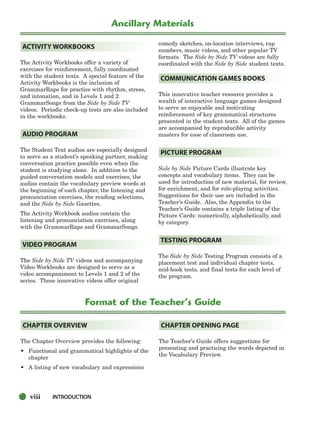
The Activity Workbooks offer a variety of
exercises for reinforcement, fully coordinated
with the student texts. A special feature of the
Activity Workbooks is the inclusion of
GrammarRaps for practice with rhythm, stress,
and intonation, and in Levels 1 and 2
GrammarSongs from the Side by Side TV
videos. Periodic check-up tests are also included
in the workbooks.
The Student Text audios are especially designed
to serve as a student’s speaking partner, making
conversation practice possible even when the
student is studying alone. In addition to the
guided conversation models and exercises, the
audios contain the vocabulary preview words at
the beginning of each chapter, the listening and
pronunciation exercises, the reading selections,
and the Side by Side Gazettes.
The Activity Workbook audios contain the
listening and pronunciation exercises, along
with the GrammarRaps and GrammarSongs.
The Side by Side TV videos and accompanying
Video Workbooks are designed to serve as a
video accompaniment to Levels 1 and 2 of the
series. These innovative videos offer original
comedy sketches, on-location interviews, rap
numbers, music videos, and other popular TV
formats. The Side by Side TV videos are fully
coordinated with the Side by Side student texts.
This innovative teacher resource provides a
wealth of interactive language games designed
to serve as enjoyable and motivating
reinforcement of key grammatical structures
presented in the student texts. All of the games
are accompanied by reproducible activity
masters for ease of classroom use.
Side by Side Picture Cards illustrate key
concepts and vocabulary items. They can be
used for introduction of new material, for review,
for enrichment, and for role-playing activities.
Suggestions for their use are included in the
Teacher’s Guide. Also, the Appendix to the
Teacher’s Guide contains a triple listing of the
Picture Cards: numerically, alphabetically, and
by category.
The Side by Side Testing Program consists of a
placement test and individual chapter tests,
mid-book tests, and final tests for each level of
the program.
TESTING PROGRAM
PICTURE PROGRAM
COMMUNICATION GAMES BOOKS
VIDEO PROGRAM
AUDIO PROGRAM
ACTIVITY WORKBOOKS
Ancillary Materials
Format of the Teacher’s Guide
The Chapter Overview provides the following:
• Functional and grammatical highlights of the
chapter
• A listing of new vocabulary and expressions
The Teacher’s Guide offers suggestions for
presenting and practicing the words depicted in
the Vocabulary Preview.
CHAPTER OPENING PAGE
CHAPTER OVERVIEW
viii INTRODUCTION
i-xv_SBSTG3_FM.QXD 8/16/07 9:08 AM Page viii
Conversation Lessons
Included for each conversation lesson are the
following:
• FOCUS: the grammatical and topical focus of
the lesson
• CLOSE UP: short grammar explanations
accompanied by examples from the lesson
• GETTING READY: suggestions for introducing
the new concepts in the lesson
• INTRODUCING THE MODEL: steps for
introducing model conversations
• SIDE BY SIDE EXERCISES: suggestions for
practicing the exercises, as well as a listing of
new vocabulary
• LANGUAGE NOTES, CULTURE NOTES, and
PRONUNCIATION NOTES
• WORKBOOK: page references for exercises in
the Activity Workbook that correspond to the
particular lesson
• EXPANSION ACTIVITIES: optional activities for
review and reinforcement of the content of
the lesson
Reading Lessons
Included for each reading lesson are the
following:
• FOCUS of the reading
• NEW VOCABULARY contained in the reading
• READING THE STORY: an optional
preliminary preview stage before students
begin to read the selection, along with
suggestions for presenting the story and
questions to check students’ comprehension
• READING CHECK-UP: answer keys for the
reading comprehension exercises
• READING EXTENSION: additional questions
and activities that provide additional skill
reinforcement of the reading selection
Other Follow-Up Lessons
Included for other follow-up lessons are the
following:
• LISTENING scripts and answer keys for the
listening exercises
• Strategies for presenting and practicing the
How to Say It!, How About You?, On Your
Own, In Your Own Words, Role Play,
Interactions, Interview, Talk About It!, Think
About It!, Pronunciation, and Side by Side
Journal activities
Chapter Summary
Included for each Chapter Summary are the
following:
• GRAMMAR SUMMARY tasks
• KEY VOCABULARY reinforcement and
expansion activities
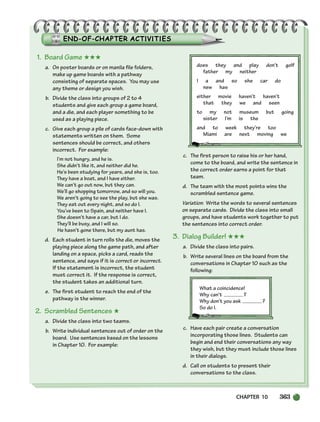
• END-OF-CHAPTER EXPANSION ACTIVITIES that
review and reinforce the grammar structures
and vocabulary presented in the chapter
Side by Side Gazette
Included for the Side by Side Gazette pages are
the following:
• Strategies for introducing, practicing, and
expanding upon the Feature Articles, Fact
Files, Interviews, Fun with Idioms, Around
the World, Global Exchange, We’ve Got Mail!,
Listening, and What Are They Saying?
sections of the Gazette
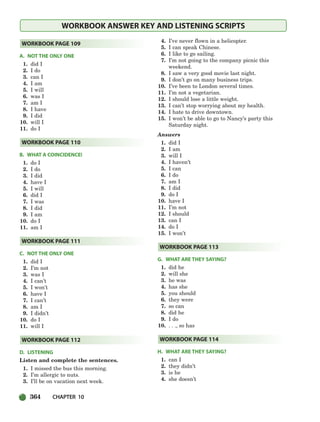
Answers and listening scripts for all exercises
contained in the Activity Workbooks are
provided at the end of each chapter of the
Teacher’s Guide.
WORKBOOK ANSWER KEYS AND
LISTENING SCRIPTS
STEP-BY-STEP LESSON GUIDE
ix
INTRODUCTION
i-xv_SBSTG3_FM.QXD 8/16/07 9:08 AM Page ix
You may wish to introduce the words in the
Vocabulary Preview before beginning the
chapter, or you may choose to wait until they
first occur in a specific lesson. If you choose to
introduce them at this point, the Teacher’s
Guide offers these suggestions:
1. Have students look at the illustrations and
identify the words they already know.
2. Present the vocabulary. Say each word and
have the class repeat it chorally and
individually. Check students’ understanding
and pronunciation of the words.
3. Practice the vocabulary as a class, in pairs, or
in small groups. Have students cover the
word list and look at the pictures. Practice
the words by saying a word and having
students tell the number of the illustration
and/or giving the number of the illustration
and having students say the word.
Introducing Model Conversations
Given the importance of the model conversation,
it is essential that students practice it several
times in a variety of ways before going on to the
exercises.
This Teacher’s Guide offers the following
comprehensive 8-step approach to introducing
the model:
1. Have students look at the model illustration.
This helps establish the context of the
conversation.
2. Set the scene.
3. Present the model. With books closed, have
students listen as you present the model or
play the audio one or more times. To make
the presentation of the model as realistic as
possible, you might draw two stick figures on
the board to represent the speakers in the
dialog. You can also show that two people
are speaking by changing your position or by
shifting your weight from one foot to the
other as you say each speaker’s lines.
4. Full-Class Repetition. Model each line and
have the whole class repeat in unison.
5. Have students open their books and look at
the dialog. Ask if there are any questions,
and check understanding of new vocabulary.
6. Group Choral Repetition. Divide the class in
half. Model line A and have Group 1 repeat.
Model line B and have Group 2 repeat.
Continue with all the lines of the model.
7. Choral Conversation. Have both groups
practice the dialog twice, without a teacher
model. First Group 1 is Speaker A and
Group 2 is Speaker B; then reverse.
8. Call on one or two pairs of students to
present the dialog.
In steps 6, 7, and 8, encourage students to look
up from their books and say the lines rather
than read them. (Students can of course refer to
their books when necessary.)
The goal is not memorization or complete
mastery of the model. Rather, students should
become familiar with the model and feel
comfortable saying it.
At this point, if you feel that additional practice
is necessary before going on to the exercises, you
can do Choral Conversation in small groups or
by rows.
Alternative Approaches to Introducing
Model Conversations
Depending upon the abilities of your students
and the particular lesson you’re teaching, you
might wish to try the following approaches to
vary the way in which you introduce model
conversations.
• Pair Introduction
Have a pair of students present the model.
Then practice it with the class.
• Trio Introduction
Call on three students to introduce the model.
Have two of them present it while the third
acts as the director, offering suggestions for
GUIDED CONVERSATION LESSONS
VOCABULARY PREVIEW
General Teaching Strategies
x INTRODUCTION
i-xv_SBSTG3_FM.QXD 8/16/07 9:08 AM Page x
how to say the lines better. Then practice the
dialog with the class.
• Cloze Introduction
Write a cloze version of the model
conversation on the board for student
reference as you introduce the model. For
lessons that provide a skeletal framework of
the model (for example, Book 3 pp. 24, 48, 63,
87, 89, 91, 104, 106, 122), you can use that as
the cloze version. For other lessons, you can
decide which words to delete from the dialog.
• Scrambled Dialog Introduction
Write each line of the dialog on a separate
card. Distribute the cards to students and
have them practice saying their lines, then
talk with each other to figure out what the
correct order of the lines should be. Have
them present the dialog to the class, each
student in turn reading his or her line. Have
the class decide if it’s in the correct order.
Then practice the dialog with the class.
Warning: Do a scrambled dialog introduction
only for conversations in which there is only
one possible sentence order!
• Disappearing Dialog Introduction
Write the dialog on the board and have
students practice saying it. Erase a few of the
words and practice again. Continue practicing
the dialog several times, each time having
erased more of the words, until the dialog has
completely disappeared and students can say
the lines without looking at them.
• Eliciting the Model
Have students cover up the lines of the
model and look only at the illustration. Ask
questions based on the illustration and the
situation. For example: Who are these
people? Where are they? What are they
saying to each other? As a class, in groups, or
in pairs, have students suggest a possible
dialog. Have students present their ideas
and then compare them with the model
conversation in the book. Then practice the
dialog with the class.
Side by Side Exercises
The numbered exercises that follow the model
form the core learning activity in each
conversation lesson. Here students use the
illustrations and word cues to create
conversations based on the structure of the
model. Since all language practice in these
lessons is conversational, you will always call on
a pair of students to do each exercise. Your
primary role is to serve as a resource to the
class — to help students with new structures,
new vocabulary, intonation, and pronunciation.
The Teacher’s Guide recommends the following
three steps for practicing the exercises.
(Students should be given thorough practice
with the first two exercises before going on.)
1. Exercise 1: Introduce any new vocabulary
in the exercise. Call on two students to
present the dialog. Then do Choral
Repetition and Choral Conversation practice.
2. Exercise 2: Same as for Exercise 1.
3. For the remaining exercises, there are two
options: either Full-Class Practice or Pair
Practice.
Full-Class Practice: Call on a pair of
students to do each exercise. Introduce new
vocabulary one exercise at a time. (For
more practice, you can call on other pairs of
students or do Choral Repetition or Choral
Conversation.)
Pair Practice: Introduce new vocabulary
for all the exercises. Next have students
practice all the exercises in pairs. Then
have pairs present the exercises to the class.
(For more practice, you can do Choral
Repetition or Choral Conversation.)
The choice of Full-Class Practice or Pair
Practice should be determined by the content
of the particular lesson, the size and
composition of the class, and your own
teaching style. You might also wish to vary
your approach from lesson to lesson.
• Suggestions for Pairing Up Students
Whether you use Full-Class Practice or Pair
Practice, you can select students for pairing
in various ways.
• You might want to pair students by ability,
since students of similar ability might work
together more efficiently than students of
dissimilar ability.
• On the other hand, you might wish to pair a
weaker student with a stronger one. The
slower student benefits from this pairing,
INTRODUCTION xi
i-xv_SBSTG3_FM.QXD 8/16/07 9:08 AM Page xi
while the more advanced student
strengthens his or her abilities by helping a
partner.
You should also encourage students to look at
each other when speaking. This makes the
conversational nature of the language
practice more realistic. One way of ensuring
this is not to call on two students who are
sitting next to each other. Rather, call on
students in different parts of the room and
encourage them to look at each other when
saying their lines.
• Presenting New Vocabulary
Many new words are introduced in each
conversation lesson. The illustration usually
helps to convey the meaning, and the new
words are written for students to see and use
in these conversations. In addition, you might:
• write the new word on the board or on a
word card.
• say the new word several times and ask
students to repeat chorally and individually.
• help clarify the meaning with visuals.
Students might also find it useful to keep a
notebook in which they write each new word,
its meaning, and a sentence using that word.
• Open-Ended Exercises
In many lessons, the final exercise is an
open-ended one. This is indicated in the text
by a blank box. Here students are expected
to create conversations based on the
structure of the model, but with vocabulary
that they select themselves. This provides
students with an opportunity for creativity,
while still focusing on the particular
structure being practiced. These open-ended
exercises can be done orally in class and/or
assigned as homework for presentation in
class the following day. Encourage students
to use dictionaries to find new words they
want to use.
General Guiding Principles for Working
with Guided Conversations
• Speak, not Read the Conversations
When doing the exercises, students should
practice speaking to each other, rather than
reading to each other. Even though students
will need to refer to the text to be able to
practice the conversations, they should not
read the lines word by word. Rather, they
should scan a full line and then look up from
the book and speak the line to the other
person.
• Intonation and Gesture
Throughout, you should use the book to teach
proper intonation and gesture. (Capitalized
words are used to indicate spoken emphasis.)
Students should be encouraged to truly act out
the dialogs in a strong and confident voice.
• Student-Centered Practice
Use of the texts should be as student-
centered as possible. Modeling by the
teacher should be efficient and economical,
but students should have every opportunity
to model for each other when they are
capable of doing so.
• Vocabulary in Context
Vocabulary can and should be effectively
taught in the context of the conversation
being practiced. Very often it will be possible
to grasp the meaning from the conversation
or its accompanying illustration. You should
spend time drilling vocabulary in isolation
only if you feel it is absolutely essential.
• No “Grammar Talk”
Students need not study formally or be able
to produce grammatical rules. The purpose
of the texts is to engage students in active
communication that gets them to use the
language according to these rules.
Relating Lesson Content to Students’
Lives and Experiences
• Personalize the Exercises
While doing the guided conversation
exercises, whenever you think it is
appropriate, ask students questions that
relate the situations in the exercises to their
own lives and personal experiences. This will
help make the leap from practicing language
in the textbook to using the language for
actual communication.
• Interview the Characters
Where appropriate, as students are
presenting the exercises to the class, as a
way of making the situations come alive and
making students feel as though they really
are the characters in those situations, ask
xii INTRODUCTION
i-xv_SBSTG3_FM.QXD 8/16/07 9:08 AM Page xii
xiii
questions that students can respond to based
on their imaginations.
If you wish, preview the story by having
students talk about the story title and/or
illustrations. You may choose to introduce new
vocabulary beforehand, or have students
encounter the new vocabulary within the context
of the reading.
Have students read silently or follow along
silently as the story is read aloud by you, by one
or more students, or on the audio program. Ask
students if they have any questions and check
understanding of new vocabulary. Then do the
Reading Check-Up exercises.
How to Say It! activities are designed to expose
students to important communication strategies.
Present the conversations the same way you
introduce model guided conversations: set the
scene, present the model, do full-class and choral
repetition, and have pairs of students present
the dialog. Then divide the class into pairs and
have students practice other conversations
based on the How to Say It! model and then
present them to the class.
How About You? activities are intended to
provide students with additional opportunities
to tell about themselves. Have students do these
activities in pairs or as a class.
On Your Own activities offer students the
opportunity to contribute content of their own
within the grammatical framework of the lesson.
You should introduce these activities in class
and assign them as homework for presentation
in class the next day. In this way, students will
automatically review the previous day’s
grammar while contributing new and inventive
content of their own.
These activities are meant for simultaneous
grammar reinforcement and vocabulary
building. Students should be encouraged to use
a dictionary when completing the On Your Own
activities. In this way, they will use not only the
words they know but also the words they would
like to know in order to really bring their
interests, backgrounds, and imaginations into
the classroom.
As a result, students will teach each other new
vocabulary as they share a bit of their lives with
others in the class.
Have students do the activity as written
homework, using a dictionary for any new words
they wish to use. Then have students present
and discuss what they have written, in pairs or
as a class.
Have pairs of students practice role-playing the
activity and then present their role plays to the
class.
Divide the class into pairs and have students
practice conversations based on the skeletal
models. Then call on students to present their
conversations to the class.
Have students circulate around the room to
conduct their interviews and then report back to
the class.
INTERVIEW
INTERACTIONS
ROLE PLAY
IN YOUR OWN WORDS
ON YOUR OWN
READINGS
INTRODUCTION
i-xv_SBSTG3_FM.QXD 8/16/07 9:08 AM Page xiii
Call on a few different pairs of students to
present the model dialogs. Then divide the class
into pairs and have students take turns using
the models to ask and answer questions about
the characters and situations depicted on the
page. Then call on pairs to present
conversations to the class.
Divide the class into pairs or small groups.
Have students discuss the questions and then
share their thoughts with the class.
Pronunciation exercises provide students with
models of natural English pronunciation. The
goal of these exercises is to enable learners to
improve their own pronunciation and to
understand the pronunciation of native speakers
using English in natural conversational
contexts.
Have students first focus on listening to the
sentences. Say each sentence in the left column
or play the audio one or more times and have
students listen carefully and repeat. Next, focus
on pronunciation. Have students say each
sentence in the right column and then listen
carefully as you say it or play the audio. If you
wish, you can have students continue practicing
the sentences to improve their pronunciation.
The purpose of the Side by Side Journal activity
is to show students how writing can become a
vehicle for communicating thoughts and feelings.
Have students begin a journal in a composition
notebook. In these journals, students have the
opportunity to write about things that are
meaningful to them.
Have students write their journal entries at
home or in class. Encourage students to use a
dictionary to look up words they would like to
use. They can share their written work with
other students if appropriate. Then as a class, in
pairs, or in small groups, have students discuss
what they have written.
If time permits, you may want to write a
response in each student’s journal, sharing your
own opinions and experiences as well as reacting
to what the student has written. If you are
keeping portfolios of students’ work, these
compositions serve as excellent examples of
students’ progress in learning English.
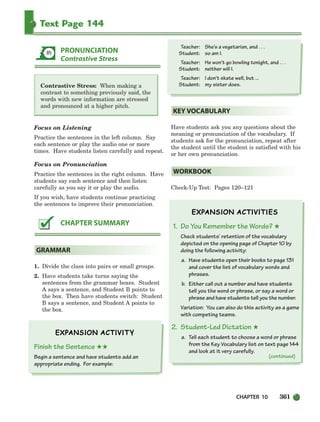
• Grammar
Divide the class into pairs or small groups,
and have students take turns forming
sentences from the words in the grammar
boxes. Student A says a sentence, and
Student B points to the words from each
column that are in the sentence. Then have
students switch: Student B says a sentence,
and Student A points to the words.
• Key Vocabulary
Have students ask you any questions about
the meaning or pronunciation of the
vocabulary. If students ask for the
pronunciation, repeat after the student until
the student is satisfied with his or her own
pronunciation.
• Key Vocabulary Check
When completing a chapter, as a way of
checking students’ retention of the key
vocabulary depicted on the opening page of the
chapter, have students open their books to the
first page of the chapter and cover the list of
vocabulary words. Either call out a number
and have students tell you the word, or say a
word and have students tell you the number.
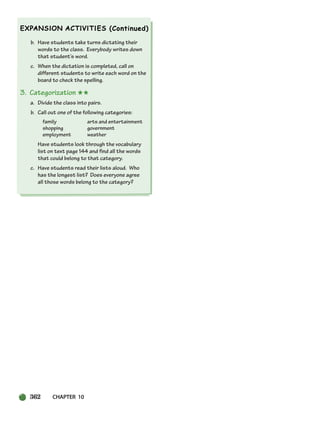
CHAPTER SUMMARY
PRONUNCIATION
THINK ABOUT IT!
TALK ABOUT IT!
xiv INTRODUCTION
i-xv_SBSTG3_FM.QXD 8/16/07 9:08 AM Page xiv
Multilevel Expansion Activities
xv
Have students read silently or follow along silently
as the article is read aloud by you, by one or more
students, or on the audio program. You may
choose to introduce new vocabulary beforehand, or
have students encounter it within the context of
the article. Ask students if they have any
questions, and check understanding of vocabulary.
Present the information and have the class
discuss it.
Have students read silently or follow along
silently as the interview is read aloud by you, by
one or more students, or on the audio program.
Have students look at the illustrations. Say each
expression or play the audio and have the class
repeat it chorally and individually. Check
students’ understanding and pronunciation of the
expressions. Then have students match the
expressions with their meanings.
Divide the class into pairs or small groups and
have students react to the photographs and
answer the questions. Then have students
report back to the class.
Have students read silently or follow along
silently as the letters are read aloud by you, by
one or more students, or on the audio program.
Have students read silently or follow along
silently as the message is read aloud by you, by
one or more students, or on the audio program.
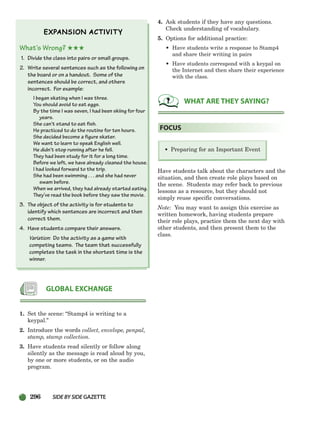
For additional practice, you can have students
write back to the person and then share their
writing with the class. You may also wish to
have students correspond with a keypal on the
Internet and then share their experience with
the class.
Have students talk about the people and the
situation in the cartoon and then create role
plays based on the scene. Students may refer
back to previous lessons as a resource, but they
should not simply reuse specific conversations.
You may want to assign this exercise as written
homework, having students prepare their role
plays, practice them the next day with other
students, and then present them to the class.
This Teacher’s Guide offers a rich variety of
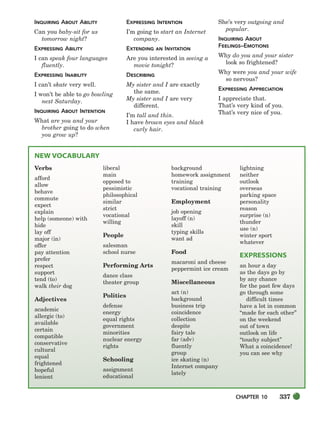
Multilevel Expansion Activities for review and
reinforcement. Feel free to pick and choose or
vary the activities to fit the particular ability-levels,
needs, and learning styles of your students.
Activity levels are indicated through a three-star
system:
One-star activities are designed for below-level
students who need extra support and some re-
teaching of skills and content to master basic
objectives;
Two-star activities are for at-level students
who are performing well in class and can benefit
from reinforcement;
Three-star activities are for above-level
students who want and deserve opportunities for
enrichment and greater challenge.
See pages iv–v for a complete description of these
ability-levels.
We encourage you to try some of the teaching
approaches offered in this Teacher’s Guide.
In keeping with the spirit of Side by Side,
these suggestions are intended to provide
students with a language learning experience
that is dynamic . . . interactive . . . and fun!
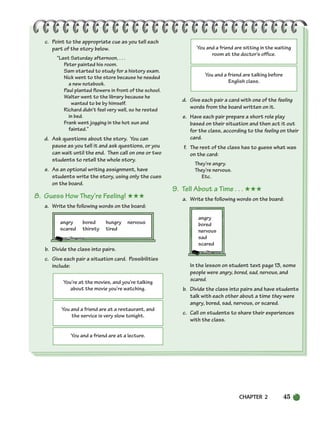
Steven J. Molinsky
Bill Bliss
WHAT ARE THEY SAYING?
GLOBAL EXCHANGE
WE’VE GOT MAIL!
AROUND THE WORLD
FUN WITH IDIOMS
INTERVIEW
FACT FILE
FEATURE ARTICLE
i-xv_SBSTG3_FM.QXD 8/16/07 9:08 AM Page xv
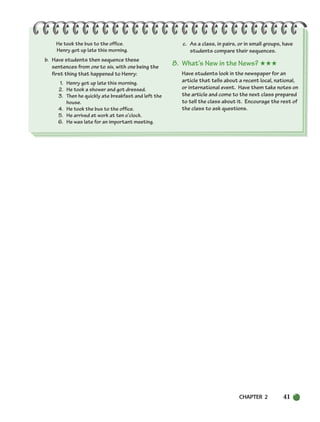
2 CHAPTER 1
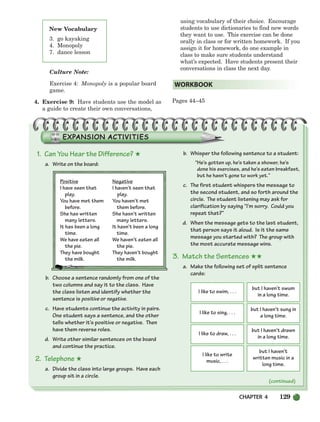
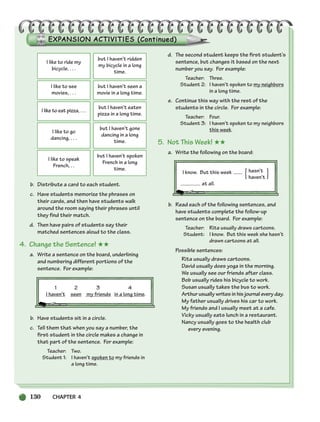
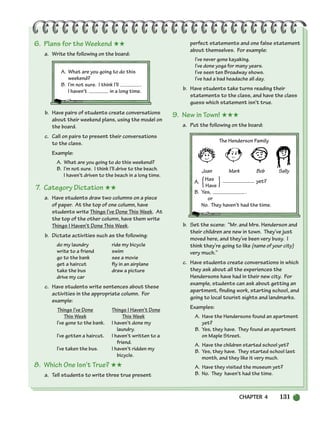
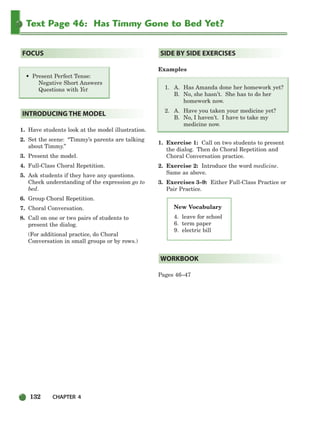
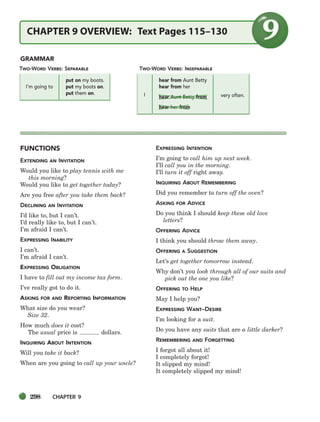
CHAPTER 1 OVERVIEW: Text Pages 1–10
FUNCTIONS
ASKING FOR AND REPORTING
INFORMATION
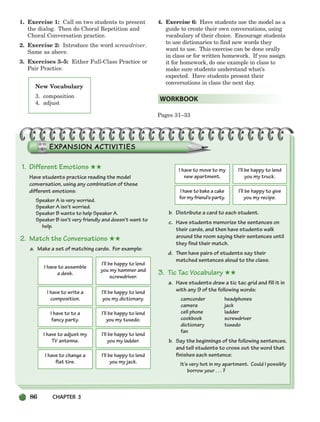
Are you busy?
Yes, I am. I’m studying.
What are you studying?
I’m studying English.
Who are you calling?
What are you doing?
I’m practicing the piano.
What are George and Herman
talking about?
What are you complaining
about?
What’s your teacher’s name?
What are their names?
What do you do?
When do you go to class?
Where are you from?
Where do you live now?
Where do you work?
How often do you watch TV?
Do you practice very often?
Yes, I do.
Is she a good tennis player?
Yes, she is.
Are you married?
Are you single?
Her tennis coach says she’s
excellent.
Her friends tell her she plays
tennis better than anyone
else.
INQUIRING ABOUT LIKES/DISLIKES
Do you like to ski?
What do you like to do in your
free time?
EXPRESSING INABILITY
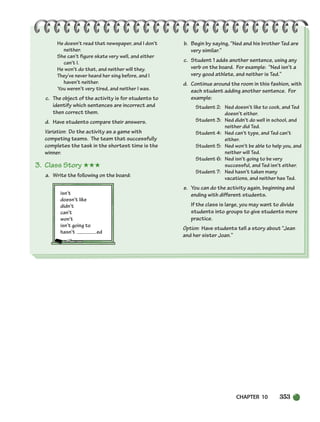
I’m not a very good skier.
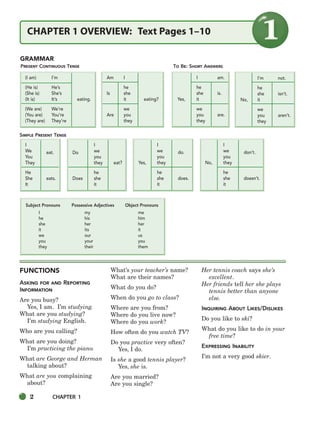
GRAMMAR
I
we
Do
you
they eat?
he
Does she
it
I
We eat.
You
They
He
She eats.
It
PRESENT CONTINUOUS TENSE
(I am) I’m
(He is) He’s
(She is) She’s
(It is) It’s eating.
(We are) We’re
(You are) You’re
(They are) They’re
SIMPLE PRESENT TENSE
Subject Pronouns
I
he
she
it
we
you
they
I
we don’t.
you
No, they
he
she doesn’t.
it
I
we do.
you
Yes, they
he
she does.
it
Am I
he
Is she
it eating?
we
Are you
they
Possessive Adjectives
my
his
her
its
our
your
their
Object Pronouns
me
him
her
it
us
you
them
I’m not.
he
she isn’t.
No, it
we
you aren’t.
they
I am.
he
she is.
Yes, it
we
you are.
they
TO BE: SHORT ANSWERS
002-033_SBSTG3_CH01.qxp 7/10/07 2:13 PM Page 2
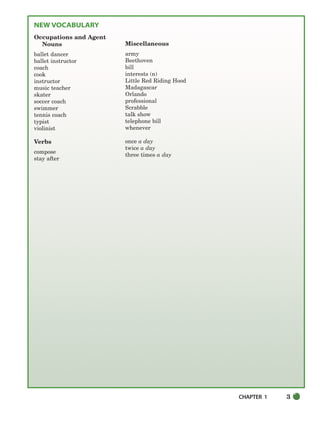
CHAPTER 1 3
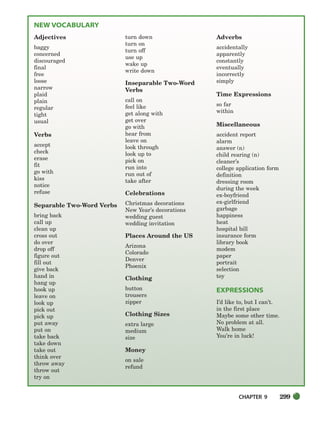
NEW VOCABULARY
Occupations and Agent
Nouns
ballet dancer
ballet instructor
coach
cook
instructor
music teacher
skater
soccer coach
swimmer
tennis coach
typist
violinist
Verbs
compose
stay after
Miscellaneous
army
Beethoven
bill
interests (n)
Little Red Riding Hood
Madagascar
Orlando
professional
Scrabble
talk show
telephone bill
whenever
once a day
twice a day
three times a day
002-033_SBSTG3_CH01.qxp 7/10/07 2:13 PM Page 3
4 CHAPTER 1
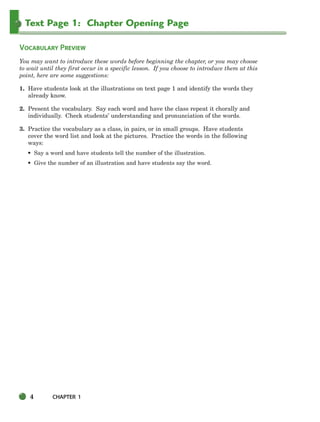
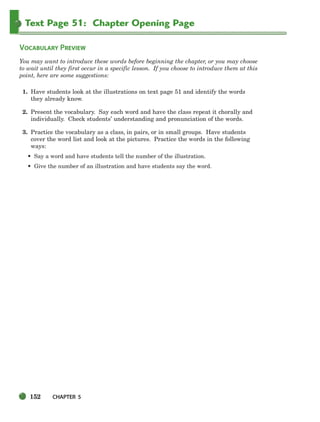
Text Page 1: Chapter Opening Page
VOCABULARY PREVIEW
You may want to introduce these words before beginning the chapter, or you may choose
to wait until they first occur in a specific lesson. If you choose to introduce them at this
point, here are some suggestions:
1. Have students look at the illustrations on text page 1 and identify the words they
already know.
2. Present the vocabulary. Say each word and have the class repeat it chorally and
individually. Check students’ understanding and pronunciation of the words.
3. Practice the vocabulary as a class, in pairs, or in small groups. Have students
cover the word list and look at the pictures. Practice the words in the following
ways:
• Say a word and have students tell the number of the illustration.
• Give the number of an illustration and have students say the word.
002-033_SBSTG3_CH01.qxp 7/10/07 2:13 PM Page 4
CHAPTER 1 5
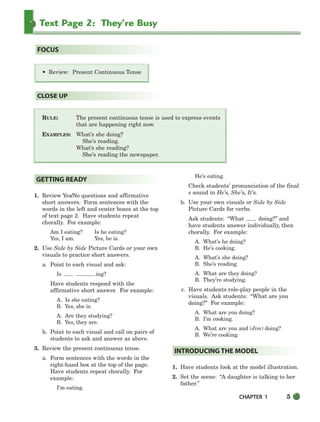
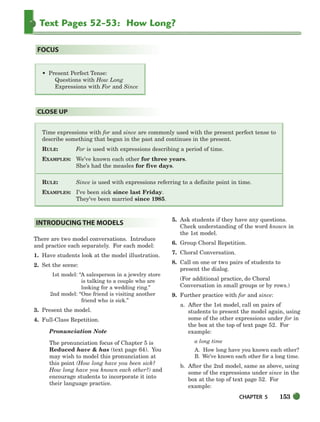
Text Page 2: They’re Busy
RULE: The present continuous tense is used to express events
that are happening right now.
EXAMPLES: What’s she doing?
She’s reading.
What’s she reading?
She’s reading the newspaper.
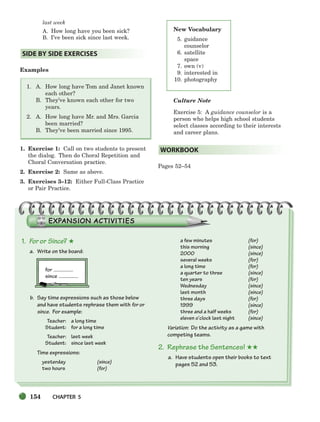
CLOSE UP
• Review: Present Continuous Tense
FOCUS
1. Review Yes/No questions and affirmative
short answers. Form sentences with the
words in the left and center boxes at the top
of text page 2. Have students repeat
chorally. For example:
Am I eating? Is he eating?
Yes, I am. Yes, he is.
2. Use Side by Side Picture Cards or your own
visuals to practice short answers.
a. Point to each visual and ask:
Is ing?
Have students respond with the
affirmative short answer. For example:
A. Is she eating?
B. Yes, she is.
A. Are they studying?
B. Yes, they are.
b. Point to each visual and call on pairs of
students to ask and answer as above.
3. Review the present continuous tense.
a. Form sentences with the words in the
right-hand box at the top of the page.
Have students repeat chorally. For
example:
I’m eating.
He’s eating.
Check students’ pronunciation of the final
s sound in He’s, She’s, It’s.
b. Use your own visuals or Side by Side
Picture Cards for verbs.
Ask students: “What doing?” and
have students answer individually, then
chorally. For example:
A. What’s he doing?
B. He’s cooking.
A. What’s she doing?
B. She’s reading.
A. What are they doing?
B. They’re studying.
c. Have students role-play people in the
visuals. Ask students: “What are you
doing?” For example:
A. What are you doing?
B. I’m cooking.
A. What are you and (Jim) doing?
B. We’re cooking.
1. Have students look at the model illustration.
2. Set the scene: “A daughter is talking to her
father.”
INTRODUCING THE MODEL
GETTING READY
002-033_SBSTG3_CH01.qxp 8/9/07 8:59 PM Page 5
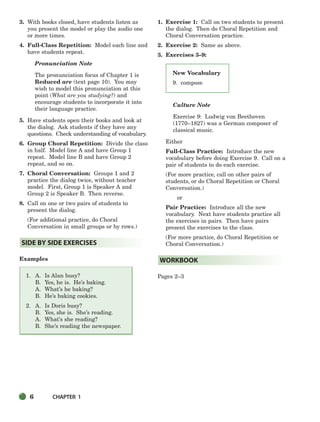
6 CHAPTER 1
New Vocabulary
9. compose
3. With books closed, have students listen as
you present the model or play the audio one
or more times.
4. Full-Class Repetition: Model each line and
have students repeat.
Pronunciation Note
The pronunciation focus of Chapter 1 is
Reduced are (text page 10). You may
wish to model this pronunciation at this
point (What are you studying?) and
encourage students to incorporate it into
their language practice.
5. Have students open their books and look at
the dialog. Ask students if they have any
questions. Check understanding of vocabulary.
6. Group Choral Repetition: Divide the class
in half. Model line A and have Group 1
repeat. Model line B and have Group 2
repeat, and so on.
7. Choral Conversation: Groups 1 and 2
practice the dialog twice, without teacher
model. First, Group 1 is Speaker A and
Group 2 is Speaker B. Then reverse.
8. Call on one or two pairs of students to
present the dialog.
(For additional practice, do Choral
Conversation in small groups or by rows.)
Examples
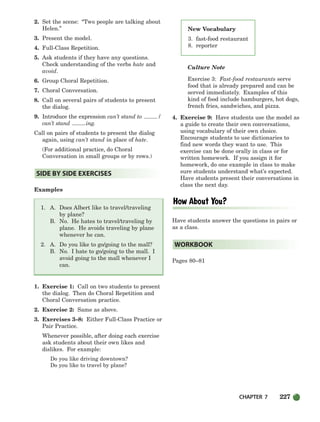
1. A. Is Alan busy?
B. Yes, he is. He’s baking.
A. What’s he baking?
B. He’s baking cookies.
2. A. Is Doris busy?
B. Yes, she is. She’s reading.
A. What’s she reading?
B. She’s reading the newspaper.
1. Exercise 1: Call on two students to present
the dialog. Then do Choral Repetition and
Choral Conversation practice.
2. Exercise 2: Same as above.
3. Exercises 3–9:
Culture Note
Exercise 9: Ludwig von Beethoven
(1770–1827) was a German composer of
classical music.
Either
Full-Class Practice: Introduce the new
vocabulary before doing Exercise 9. Call on a
pair of students to do each exercise.
(For more practice, call on other pairs of
students, or do Choral Repetition or Choral
Conversation.)
or
Pair Practice: Introduce all the new
vocabulary. Next have students practice all
the exercises in pairs. Then have pairs
present the exercises to the class.
(For more practice, do Choral Repetition or
Choral Conversation.)
Pages 2–3
WORKBOOK
SIDE BY SIDE EXERCISES
002-033_SBSTG3_CH01.qxp 7/10/07 2:13 PM Page 6
CHAPTER 1 7
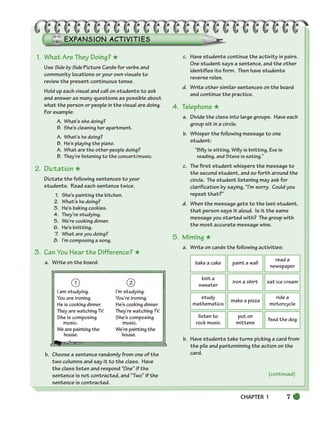
1. What Are They Doing? ★
Use Side by Side Picture Cards for verbs and
community locations or your own visuals to
review the present continuous tense.
Hold up each visual and call on students to ask
and answer as many questions as possible about
what the person or people in the visual are doing.
For example:
A. What’s she doing?
B. She’s cleaning her apartment.
A. What’s he doing?
B. He’s playing the piano.
A. What are the other people doing?
B. They’re listening to the concert/music.
2. Dictation ★
Dictate the following sentences to your
students. Read each sentence twice.
1. She’s painting the kitchen.
2. What’s he doing?
3. He’s baking cookies.
4. They’re studying.
5. We’re cooking dinner.
6. He’s knitting.
7. What are you doing?
8. I’m composing a song.
3. Can You Hear the Difference? ★
a. Write on the board:
1 2
I am studying. I’m studying.
You are ironing. You’re ironing.
He is cooking dinner. He’s cooking dinner.
They are watching TV. They’re watching TV.
She is composing She’s composing
music. music.
We are painting the We’re painting the
house. house.
.
b. Choose a sentence randomly from one of the
two columns and say it to the class. Have
the class listen and respond “One” if the
sentence is not contracted, and “Two” if the
sentence is contracted.
c. Have students continue the activity in pairs.
One student says a sentence, and the other
identifies its form. Then have students
reverse roles.
d. Write other similar sentences on the board
and continue the practice.
4. Telephone ★
a. Divide the class into large groups. Have each
group sit in a circle.
b. Whisper the following message to one
student:
“Billy is sitting, Willy is knitting, Eve is
reading, and Steve is eating.”
c. The first student whispers the message to
the second student, and so forth around the
circle. The student listening may ask for
clarification by saying, “I’m sorry. Could you
repeat that?”
d. When the message gets to the last student,
that person says it aloud. Is it the same
message you started with? The group with
the most accurate message wins.
5. Miming ★
a. Write on cards the following activities:
b. Have students take turns picking a card from
the pile and pantomiming the action on the
card.
bake a cake paint a wall
read a
newspaper
knit a
sweater
iron a shirt eat ice cream
study
mathematics
make a pizza
ride a
motorcycle
listen to
rock music
put on
mittens
feed the dog
(continued)
002-033_SBSTG3_CH01.qxp 7/10/07 2:13 PM Page 7
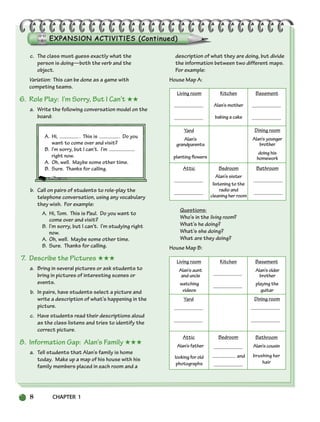
8 CHAPTER 1
Living room Kitchen
Alan’s mother
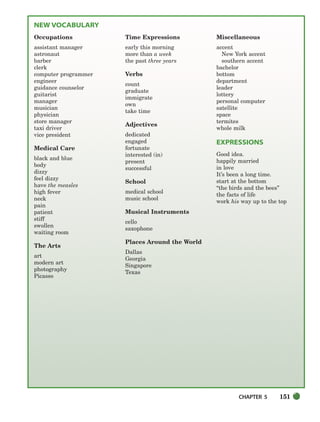
baking a cake
Basement
Attic Bedroom
Alan’s sister
listening to the
radio and
cleaning her room
Bathroom
Yard
Alan’s
grandparents
planting flowers
Dining room
Alan’syounger
brother
doing his
homework
Living room
Alan’saunt
anduncle
watching
videos
Kitchen Basement
Alan’solder
brother
playing the
guitar
Attic
Alan’sfather
looking for old
photographs
Bedroom
and
Bathroom
Alan’scousin
brushing her
hair
Yard Dining room
c. The class must guess exactly what the
person is doing—both the verb and the
object.
Variation: This can be done as a game with
competing teams.
6. Role Play: I’m Sorry, But I Can’t ★★
a. Write the following conversation model on the
board:
A. Hi, . This is . Do you
want to come over and visit?
B. I’m sorry, but I can’t. I’m
right now.
A. Oh, well. Maybe some other time.
B. Sure. Thanks for calling.
b. Call on pairs of students to role-play the
telephone conversation, using any vocabulary
they wish. For example:
A. Hi, Tom. This is Paul. Do you want to
come over and visit?
B. I’m sorry, but I can’t. I’m studying right
now.
A. Oh, well. Maybe some other time.
B. Sure. Thanks for calling.
7. Describe the Pictures ★★★
a. Bring in several pictures or ask students to
bring in pictures of interesting scenes or
events.
b. In pairs, have students select a picture and
write a description of what’s happening in the
picture.
c. Have students read their descriptions aloud
as the class listens and tries to identify the
correct picture.
8. Information Gap: Alan’s Family ★★★
a. Tell students that Alan’s family is home
today. Make up a map of his house with his
family members placed in each room and a
description of what they are doing, but divide
the information between two different maps.
For example:
House Map A:
Questions:
Who’s in the living room?
What’s he doing?
What’s she doing?
What are they doing?
House Map B:
002-033_SBSTG3_CH01.qxp 7/12/07 8:18 AM Page 8
CHAPTER 1 9
Questions:
Who’s in the living room?
What’s he doing?
What’s she doing?
What are they doing?
b. Divide the class into pairs. Give each member
of the pair a different map. Have students
ask each other questions and fill in their
house maps. For example:
Student A: Who’s in the living room?
Student B: Alan’s aunt and uncle.
Student A: What are they doing?
Student B: They’re watching videos.
StudentA[writestheinformationinHouseMapA]
c. The pairs continue until each has a filled map.
d. Have students look at their partner’s map to
make sure that they have written the
information correctly.
002-033_SBSTG3_CH01.qxp 7/10/07 2:13 PM Page 9
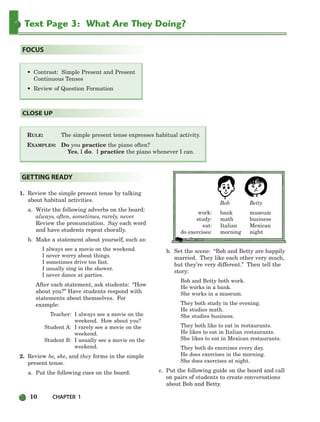
10 CHAPTER 1
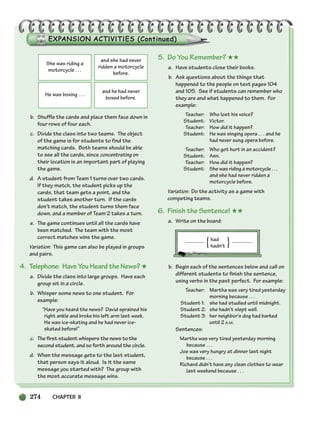
Text Page 3: What Are They Doing?
1. Review the simple present tense by talking
about habitual activities.
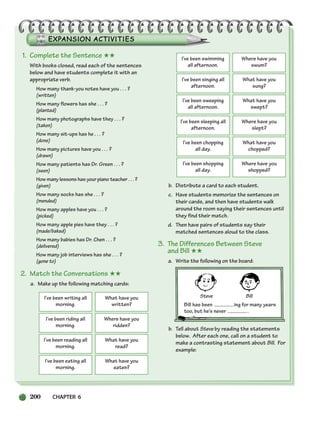
a. Write the following adverbs on the board:
always, often, sometimes, rarely, never.
Review the pronunciation. Say each word
and have students repeat chorally.
b. Make a statement about yourself, such as:
I always see a movie on the weekend.
I never worry about things.
I sometimes drive too fast.
I usually sing in the shower.
I never dance at parties.
After each statement, ask students: “How
about you?” Have students respond with
statements about themselves. For
example:
Teacher: I always see a movie on the
weekend. How about you?
Student A: I rarely see a movie on the
weekend.
Student B: I usually see a movie on the
weekend.
2. Review he, she, and they forms in the simple
present tense.
a. Put the following cues on the board:
Bob Betty
work: bank museum
study: math business
eat: Italian Mexican
do exercises: morning night
b. Set the scene: “Bob and Betty are happily
married. They like each other very much,
but they’re very different.” Then tell the
story:
Bob and Betty both work.
He works in a bank.
She works in a museum.
They both study in the evening.
He studies math.
She studies business.
They both like to eat in restaurants.
He likes to eat in Italian restaurants.
She likes to eat in Mexican restaurants.
They both do exercises every day.
He does exercises in the morning.
She does exercises at night.
c. Put the following guide on the board and call
on pairs of students to create conversations
about Bob and Betty.
GETTING READY
RULE: The simple present tense expresses habitual activity.
EXAMPLES: Do you practice the piano often?
Yes, I do. I practice the piano whenever I can.
CLOSE UP
• Contrast: Simple Present and Present
Continuous Tenses
• Review of Question Formation
FOCUS
002-033_SBSTG3_CH01.qxp 7/10/07 2:13 PM Page 10
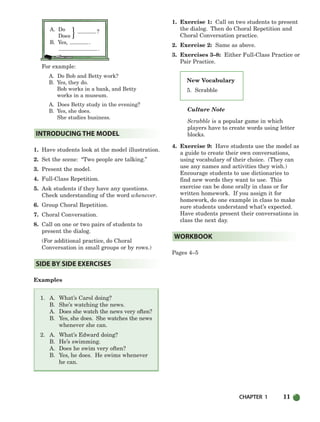
CHAPTER 1 11
A. Do
Does
?
B. Yes, .
.
For example:
A. Do Bob and Betty work?
B. Yes, they do.
Bob works in a bank, and Betty
works in a museum.
A. Does Betty study in the evening?
B. Yes, she does.
She studies business.
1. Have students look at the model illustration.
2. Set the scene: “Two people are talking.”
3. Present the model.
4. Full-Class Repetition.
5. Ask students if they have any questions.
Check understanding of the word whenever.
6. Group Choral Repetition.
7. Choral Conversation.
8. Call on one or two pairs of students to
present the dialog.
(For additional practice, do Choral
Conversation in small groups or by rows.)
Examples
1. A. What’s Carol doing?
B. She’s watching the news.
A. Does she watch the news very often?
B. Yes, she does. She watches the news
whenever she can.
2. A. What’s Edward doing?
B. He’s swimming.
A. Does he swim very often?
B. Yes, he does. He swims whenever
he can.
1. Exercise 1: Call on two students to present
the dialog. Then do Choral Repetition and
Choral Conversation practice.
2. Exercise 2: Same as above.
3. Exercises 3–8: Either Full-Class Practice or
Pair Practice.
Culture Note
Scrabble is a popular game in which
players have to create words using letter
blocks.
4. Exercise 9: Have students use the model as
a guide to create their own conversations,
using vocabulary of their choice. (They can
use any names and activities they wish.)
Encourage students to use dictionaries to
find new words they want to use. This
exercise can be done orally in class or for
written homework. If you assign it for
homework, do one example in class to make
sure students understand what’s expected.
Have students present their conversations in
class the next day.
Pages 4–5
WORKBOOK
SIDE BY SIDE EXERCISES
INTRODUCING THE MODEL
}
New Vocabulary
5. Scrabble
002-033_SBSTG3_CH01.qxp 7/10/07 2:13 PM Page 11
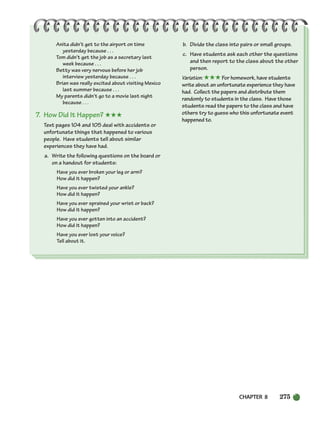
12 CHAPTER 1
Mrs. Murphy
dance
Howard
roller-blade
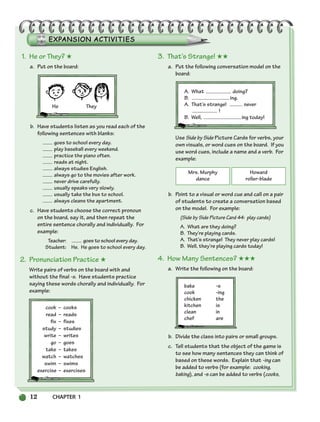
1. He or They? ★
a. Put on the board:
b. Have students listen as you read each of the
following sentences with blanks:
goes to school every day.
play baseball every weekend.
practice the piano often.
reads at night.
always studies English.
always go to the movies after work.
never drive carefully.
usually speaks very slowly.
usually take the bus to school.
always cleans the apartment.
c. Have students choose the correct pronoun
on the board, say it, and then repeat the
entire sentence chorally and individually. For
example:
Teacher: goes to school every day.
Student: He. He goes to school every day.
2. Pronunciation Practice ★
Write pairs of verbs on the board with and
without the final -s. Have students practice
saying these words chorally and individually. For
example:
cook – cooks
read – reads
fix – fixes
study – studies
write – writes
go – goes
take – takes
watch – watches
swim – swims
exercise – exercises
3. That’s Strange! ★★
a. Put the following conversation model on the
board:
A. What doing?
B. ing.
A. That’s strange! never
!
B. Well, ing today!
Use Side by Side Picture Cards for verbs, your
own visuals, or word cues on the board. If you
use word cues, include a name and a verb. For
example:
b. Point to a visual or word cue and call on a pair
of students to create a conversation based
on the model. For example:
(Side by Side Picture Card 44: play cards)
A. What are they doing?
B. They’re playing cards.
A. That’s strange! They never play cards!
B. Well, they’re playing cards today!
4. How Many Sentences? ★★★
a. Write the following on the board:
bake -s
cook -ing
chicken the
kitchen is
clean in
chef are
b. Divide the class into pairs or small groups.
c. Tell students that the object of the game is
to see how many sentences they can think of
based on these words. Explain that -ing can
be added to verbs (for example: cooking,
baking), and -s can be added to verbs (cooks,
He They
002-033_SBSTG3_CH01.qxp 7/10/07 2:13 PM Page 12
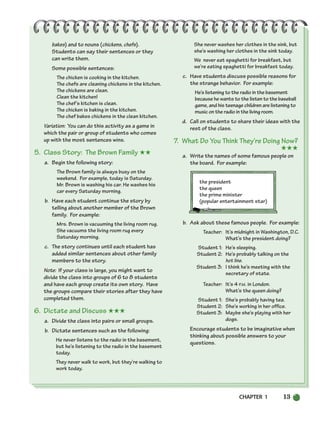
CHAPTER 1 13
bakes) and to nouns (chickens, chefs).
Students can say their sentences or they
can write them.
Some possible sentences:
The chicken is cooking in the kitchen.
The chefs are cleaning chickens in the kitchen.
The chickens are clean.
Clean the kitchen!
The chef’s kitchen is clean.
The chicken is baking in the kitchen.
The chef bakes chickens in the clean kitchen.
Variation: You can do this activity as a game in
which the pair or group of students who comes
up with the most sentences wins.
5. Class Story: The Brown Family ★★
a. Begin the following story:
The Brown family is always busy on the
weekend. For example, today is Saturday.
Mr. Brown is washing his car. He washes his
car every Saturday morning.
b. Have each student continue the story by
telling about another member of the Brown
family. For example:
Mrs. Brown is vacuuming the living room rug.
She vacuums the living room rug every
Saturday morning.
c. The story continues until each student has
added similar sentences about other family
members to the story.
Note: If your class is large, you might want to
divide the class into groups of 6 to 8 students
and have each group create its own story. Have
the groups compare their stories after they have
completed them.
6. Dictate and Discuss ★★★
a. Divide the class into pairs or small groups.
b. Dictate sentences such as the following:
He never listens to the radio in the basement,
but he’s listening to the radio in the basement
today.
They never walk to work, but they’re walking to
work today.
She never washes her clothes in the sink, but
she’s washing her clothes in the sink today.
We never eat spaghetti for breakfast, but
we’re eating spaghetti for breakfast today.
c. Have students discuss possible reasons for
the strange behavior. For example:
He’s listening to the radio in the basement
because he wants to the listen to the baseball
game, and his teenage children are listening to
music on the radio in the living room.
d. Call on students to share their ideas with the
rest of the class.
7. What Do You Think They’re Doing Now?
★★★
a. Write the names of some famous people on
the board. For example:
the president
the queen
the prime minister
(popular entertainment star)
b. Ask about these famous people. For example:
Teacher: It’s midnight in Washington, D.C.
What’s the president doing?
Student 1: He’s sleeping.
Student 2: He’s probably talking on the
hot line.
Student 3: I think he’s meeting with the
secretary of state.
Teacher: It’s 4 P.M. in London.
What’s the queen doing?
Student 1: She’s probably having tea.
Student 2: She’s working in her office.
Student 3: Maybe she’s playing with her
dogs.
Encourage students to be imaginative when
thinking about possible answers to your
questions.
002-033_SBSTG3_CH01.qxp 7/10/07 2:13 PM Page 13
14 CHAPTER 1
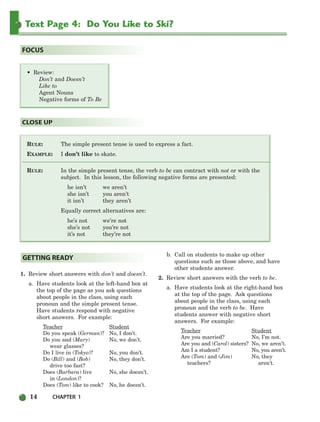
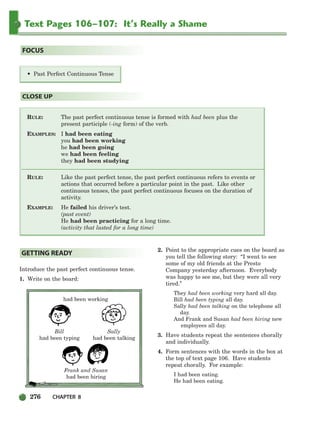
Text Page 4: Do You Like to Ski?
RULE: The simple present tense is used to express a fact.
EXAMPLE: I don’t like to skate.
RULE: In the simple present tense, the verb to be can contract with not or with the
subject. In this lesson, the following negative forms are presented:
he isn’t we aren’t
she isn’t you aren’t
it isn’t they aren’t
Equally correct alternatives are:
he’s not we’re not
she’s not you’re not
it’s not they’re not
CLOSE UP
• Review:
Don’t and Doesn’t
Like to
Agent Nouns
Negative forms of To Be
FOCUS
1. Review short answers with don’t and doesn’t.
a. Have students look at the left-hand box at
the top of the page as you ask questions
about people in the class, using each
pronoun and the simple present tense.
Have students respond with negative
short answers. For example:
Teacher Student
Do you speak (German)? No, I don’t.
Do you and (Mary) No, we don’t.
wear glasses?
Do I live in (Tokyo)? No, you don’t.
Do (Bill) and (Bob) No, they don’t.
drive too fast?
Does (Barbara) live No, she doesn’t.
in (London)?
Does (Tom) like to cook? No, he doesn’t.
b. Call on students to make up other
questions such as those above, and have
other students answer.
2. Review short answers with the verb to be.
a. Have students look at the right-hand box
at the top of the page. Ask questions
about people in the class, using each
pronoun and the verb to be. Have
students answer with negative short
answers. For example:
Teacher Student
Are you married? No, I’m not.
Are you and (Carol) sisters? No, we aren’t.
Am I a student? No, you aren’t.
Are (Tom) and (Jim) No, they
teachers? aren’t.
GETTING READY
002-033_SBSTG3_CH01.qxp 7/12/07 8:18 AM Page 14
CHAPTER 1 15
New Vocabulary
5. typist
9. cook
Is (Ted) a truck driver? No, he isn’t.
Is (Betty) a doctor? No, she isn’t.
b. Call on students to make up other
questions such as those above, and have
other students answer.
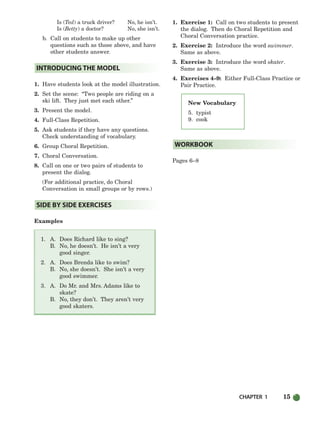
1. Have students look at the model illustration.
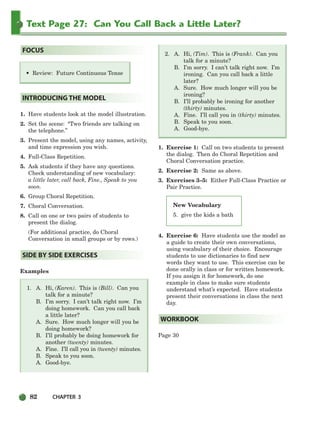
2. Set the scene: “Two people are riding on a
ski lift. They just met each other.”
3. Present the model.
4. Full-Class Repetition.
5. Ask students if they have any questions.
Check understanding of vocabulary.
6. Group Choral Repetition.
7. Choral Conversation.
8. Call on one or two pairs of students to
present the dialog.
(For additional practice, do Choral
Conversation in small groups or by rows.)
Examples
1. A. Does Richard like to sing?
B. No, he doesn’t. He isn’t a very
good singer.
2. A. Does Brenda like to swim?
B. No, she doesn’t. She isn’t a very
good swimmer.
3. A. Do Mr. and Mrs. Adams like to
skate?
B. No, they don’t. They aren’t very
good skaters.
1. Exercise 1: Call on two students to present
the dialog. Then do Choral Repetition and
Choral Conversation practice.
2. Exercise 2: Introduce the word swimmer.
Same as above.
3. Exercise 3: Introduce the word skater.
Same as above.
4. Exercises 4–9: Either Full-Class Practice or
Pair Practice.
Pages 6–8
WORKBOOK
SIDE BY SIDE EXERCISES
INTRODUCING THE MODEL
002-033_SBSTG3_CH01.qxp 8/16/07 9:10 AM Page 15
16 CHAPTER 1
(Rita) dances beautifully.
(Richard) doesn’t ski very well.
(Michael) and (Maria) type very quickly.
You’re a very good skier.
(Peter) doesn’t act very well.
(Carol) skates very badly.
I sing beautifully.
You and (Jane) cook very well.
(Sam) writes very interesting stories.
(Thomas) drives very carelessly.
(Shirley) swims very badly.
{ } { }
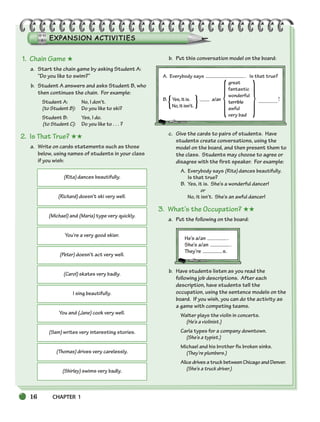
1. Chain Game ★
a. Start the chain game by asking Student A:
“Do you like to swim?”
b. Student A answers and asks Student B, who
then continues the chain. For example:
Student A: No, I don’t.
(to Student B): Do you like to ski?
Student B: Yes, I do.
(to Student C): Do you like to . . . ?
2. Is That True? ★★
a. Write on cards statements such as those
below, using names of students in your class
if you wish:
b. Put this conversation model on the board:
A. Everybody says . Is that true?
great
fantastic
wonderful
B. Yes,itis. a/an terrible !
No,itisn’t. awful
very bad
c. Give the cards to pairs of students. Have
students create conversations, using the
model on the board, and then present them to
the class. Students may choose to agree or
disagree with the first speaker. For example:
A. Everybody says (Rita) dances beautifully.
Is that true?
B. Yes, it is. She’s a wonderful dancer!
or
No, it isn’t. She’s an awful dancer!
3. What’s the Occupation? ★★
a. Put the following on the board:
He’s a/an .
She’s a/an .
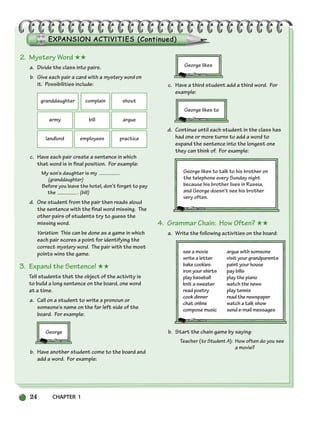
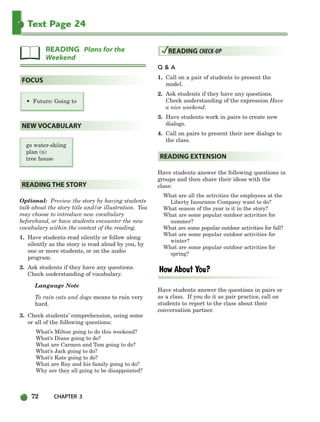
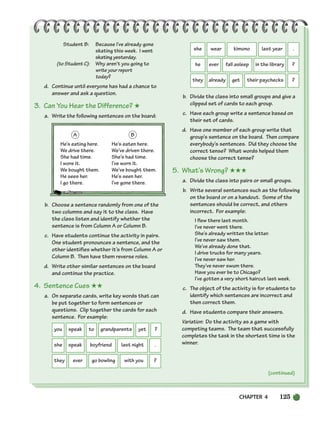
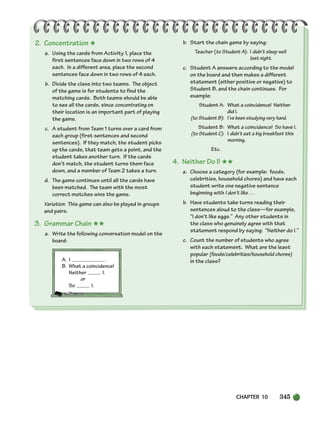
They’re s.
b. Have students listen as you read the
following job descriptions. After each
description, have students tell the
occupation, using the sentence models on the
board. If you wish, you can do the activity as
a game with competing teams.
Walter plays the violin in concerts.
(He’s a violinist.)
Carla types for a company downtown.
(She’s a typist.)
Michael and his brother fix broken sinks.
(They’re plumbers.)
Alice drives a truck between Chicago and Denver.
(She’s a truck driver.)
002-033_SBSTG3_CH01.qxp 7/12/07 8:18 AM Page 16
CHAPTER 1 17
Tom plays tennis all around the world.
(He’s a tennis player.)
Barbara paints houses for a living.
(She’s a painter/house painter.)
David acts in plays and movies and on TV.
(He’s an actor.)
His girlfriend also acts.
(She’s a actress.)
Brian repairs televisions.
(He’s a TV repairperson.)
Tony and Greta repair cars and trucks.
(They’re mechanics.)
Boris plays chess in countries all around the
world.
(He’s a chess player.)
Diane cleans people’s chimneys.
(She’s a chimneysweep.)
Bob takes pictures at weddings and other
special occasions.
(He’s a photographer.)
Olga translates from English into Russian.
(She’s a translator.)
Frank and his brother cook in a very good
restaurant downtown.
(They’re cooks/chefs.)
Barbara designs beautiful clothes.
(She’s a designer.)
Joe bakes bread, cakes, and special desserts.
(He’s a baker.)
George and Paul plant flowers in people’s yards.
(They’re gardeners.)
Betty helps doctors and takes care of people
in the hospital.
(She’s a nurse.)
Peter takes care of sick dogs and cats.
(He’s a veterinarian.)
c. Find out what other occupations your
students are interested in. Have students
use their dictionaries to find out the names
of these occupations and tell what the people
do.
4. Tell About Yourself! ★★
a. Set the scene by telling about yourself or
about a person on the board. For example:
“This is Mary. Mary likes to swim, and she’s
a good swimmer. She likes to type, but she
isn’t a very good typist. She doesn’t like to
cook because she isn’t a very good cook.
She likes to play the piano, and she plays
whenever she can.”
b. Divide students into pairs.
c. Have students interview each other to find
out about their likes and dislikes and related
abilities.
d. Then have each student tell the class about
the person he or she interviewed.
Variation: You can do this as a writing activity.
For homework, have students write about
themselves: their likes, dislikes, and related
abilities.
5. Common Interests ★★★
a. Put the following on the board:
I like to .
He/She likes to .
He’s/She’s a good .
We both like to .
We’re both good .
b. Divide the class into pairs.
c. Have students interview each other about
what they like to do. The object is for
students to find things they have in common
and then report back to the class. For
example: (continued)
Mary
002-033_SBSTG3_CH01.qxp 7/12/07 8:18 AM Page 17
18 CHAPTER 1
I interviewed Maria. I like to ski. She likes to
skate. She’s a good skater. We both like to
dance. We’re both good dancers. Also, we
both like to sing. We’re both good singers.
6. Classroom Interviews ★★★
a. On an index card, have each student write
three things that he or she likes to do. For
example:
I like to swim.
I like to watch TV.
I like to play tennis.
b. Collect the cards and distribute them
randomly to all the students in the class.
c. Have students interview others in the class
to match the correct person with each card,
that is, to find out which student likes to do
the three activities written on each card.
d. When the interviews are completed, call on
students to tell about the others in the
class, based on their interviews. For example:
Alexander likes to swim.
He likes to watch TV.
And he likes to play tennis.
002-033_SBSTG3_CH01.qxp 7/10/07 2:13 PM Page 18
CHAPTER 1 19
Text Pages 5–6
• Review:
Simple Present Tense
Present Continuous Tense
Subject Pronouns
Possessive Adjectives
ballet dancer
ballet instructor
coach (n)
instructor
music teacher
professional
soccer coach
stay after
tennis coach
violinist
Optional: Preview the story by having students
talk about the story title and/or illustrations.
You may choose to introduce new vocabulary
beforehand, or have students encounter the new
vocabulary within the context of the reading.
1. Have students read silently or follow along
silently as the story is read aloud by you, by
one or more students, or on the audio
program.
2. Ask students if they have any questions.
Check understanding of vocabulary.
3. Check students’ comprehension, using some
or all of the following questions:
What am I doing?
How often do I practice?
What does my soccer coach tell me?
What do my friends tell me?
What do I want to be when I grow up?
What’s Anita doing?
How often does she practice?
What does her tennis coach tell her?
What do her friends tell her?
What does she want to be when she grows
up?
What’s Hector doing?
How often does he practice?
What does his music teacher tell him?
What do his friends tell him?
What does he want to be when he grows up?
What are Jenny and Vanessa doing?
How often do they practice?
What does their ballet instructor tell them?
What do they want to be when they grow
up?
Q & A
1. Call on a pair of students to present the
model.
2. Have students work in pairs to create new
dialogs.
3. Call on pairs to present their new dialogs to
the class.
1. Question the Answers!
a. Choose one of the four paragraphs.
Dictate answers such as these to the class:
Every day after school.
Her tennis coach.
Her friends.
A professional tennis player.
Because she wants to be a professional
tennis player.
b. Have students write questions for which
these answers would be correct. For
example:
READING EXTENSION
READING CHECK-UP
READING THE STORY
NEW VOCABULARY
FOCUS
READING Practicing
002-033_SBSTG3_CH01.qxp 7/10/07 2:13 PM Page 19
20 CHAPTER 1
Answer: Every day after school.
Question: How often does Anita
practice?
Answer: Her tennis coach.
Question: Who tells her she’s an
excellent tennis player?
Answer: Her friends.
Question: Who tells her she’s better
than anyone else in school?
Answer: A professional tennis player.
Question: What does she want to be
when she grows up?
Answer: Because she wants to be a
professional tennis player.
Question: Why does she practice every
day?
c. Have students compare their questions
with each other.
Variation: Write the answers on cards.
Divide the class into groups and give each
group a set of cards as cues for the activity.
2. Pair Discussion
Have pairs of students discuss the following
questions and then report back to the class:
Do you have a hobby? Do you play sports or
a musical instrument?
What do you play?
How often do you practice?
Do you want to be a professional player?
Did you practice when you were a child?
When you were a child, what did you want to
be when you grew up?
Listen and choose the correct answer.
1. What are you doing?
2. Do you watch the news very often?
3. Are you a good swimmer?
4. What’s Cathy reading?
5. Who cooks in your family?
6. Do they like to skate?
7. Does your sister want to be a ballet dancer?
8. Do you and your friends play basketball
very often?
9. Are your parents good dancers?
10. What does Peter want to be when he grows
up?
Answers
1. b
2. b
3. a
4. b
5. a
6. b
7. b
8. a
9. a
10. b
1. Make sure students understand the
instructions.
2. Have students do the activity as written
homework, using a dictionary for any new
words they wish to use.
3. Have students present and discuss what they
have written, in pairs or as a class.
IN YOUR OWN WORDS
LISTENING
002-033_SBSTG3_CH01.qxp 7/10/07 2:13 PM Page 20
CHAPTER 1 21
Text Pages 7–8: How Often?
RULE: In spoken English, who is used to refer to both a subject and an object.
EXAMPLES: Who are you calling? (I’m calling my brother.)
Who is calling your brother? (I am calling my brother.)
Who are you arguing with? (I am arguing with my neighbor.)
RULE: In formal and written English, whom is used to refer to an object.
EXAMPLES: Whom are you calling?
With whom are you arguing?
CLOSE UP
• Pronoun Review
• Contrast: Simple Present and Present
Continuous Tenses
FOCUS
1. Review pronouns.
a. Write on the board:
b. Set the scene: “My friend Bob likes to
visit me here in (name of your city). When
he comes to visit, I always take him to his
favorite restaurant.”
c. Have students use this model to review
other pronouns. Ask students: “What
about your friend(s) ?” Students
can refer to the box at the top of text page
7 for the pronoun. For example:
A. What about your friend Maria?
B. My friend Maria likes to visit me here
in . When she comes to visit, I
always take her to her favorite
museum.
A. What about your friends Dave and
Donna?
B. My friends Dave and Donna like to
visit me here in . When they
come to visit, I always take them to
their favorite theater.
GETTING READY
friend likes
My
friends likes
to visit me here in .
comes
museum
When
come
to visit, I always take to favorite restaurant .
theater
{ } { }
}
{
{ }
002-033_SBSTG3_CH01.qxp 7/12/07 8:18 AM Page 21
22 CHAPTER 1
d. Change my to our in the model on the
board. Have students make all the
necessary changes as they tell about our
friend(s) and .
2. Review time expressions.
a. Write on the board:
study English play soccer
clean your house watch the news
call your grandparents read poetry
read the newspaper iron clothes
ask questions in class exercise
do your homework chat online
b. Ask students a few questions based on the
cues on the board, and have students
respond, using the expressions with every
in the chart on text page 7. For example:
Teacher: How often do you study
English?
Student: I study English every day.
c. Introduce the new expressions with once,
twice. Ask students: “How often do you
play soccer?” Have students respond,
using the time expressions with once,
twice, and (three) times, which are
presented in the chart on text page 7. For
example:
Teacher: How often do you play soccer?
Student: I play soccer twice a week.
d. In pairs, have students ask and answer
How often questions, using the cues on the
board.
There are two model conversations. Introduce
and practice each separately. For each model:
1. Have students look at the model
illustration.
2. Set the scene:
1st model: “Two friends are talking. One
of them is making a phone
call.”
2nd model: “Two friends are sitting and
talking in the park.”
3. Present the model.
4. Full-Class Repetition.
5. Ask students if they have any questions.
Check understanding of vocabulary.
6. Group Choral Repetition.
7. Choral Conversation.
8. Call on one or two pairs of students to
present the dialog.
9. After the 1st model:
a. Go over the alternative vocabulary at the
top of the page.
b. Have several pairs of students present
the dialog again, using alternative
vocabulary in place of every Sunday
evening.
10. After the 2nd model, have several pairs of
students present the dialog again, using
alternative vocabulary in place of all the
time.
Students can use any time expression they wish
to complete these conversations.
Examples
1. A. Who is Mr. Tanaka calling?
B. He’s calling his son in New York.
A. How often does he call him?
B. He calls him (every week).
2. A. Who is Mrs. Kramer writing to?
B. She’s writing to her daughter in
the army.
A. How often does she write to her?
B. She writes to her (once a month).
1. Exercise 1: Call on two students to present
the dialog. Then do Choral Repetition and
Choral Conversation practice.
2. Exercise 2: Introduce the word army. Same
as above.
3. Exercises 3–9: Either Full-Class Practice or
Pair Practice.
SIDE BY SIDE EXERCISES
INTRODUCING THE MODELS
002-033_SBSTG3_CH01.qxp 7/12/07 8:18 AM Page 22
CHAPTER 1 23
New Vocabulary
7. telephone bill
8. talk show
Whenever possible, after each exercise ask
students to compare their own experiences
with that of the people in the exercise. For
example, after Exercise 4 ask: “How about
you? Do you argue with your landlord?”
After Exercise 5 ask: “How about you? How
often do you send e-mail messages to friends
and family members?” After Exercise 6 ask:
“Do you know someone who shouts a lot?”
After Exercise 7 ask: “Do you get large
telephone bills? Do you make many long-
distance phone calls?” After Exercise 8 ask:
“How often do you watch TV talk shows?
Which is your favorite?” After Exercise 9
ask: “How often do you visit your
grandparents?”
Culture Note
Exercise 9: Little Red Riding Hood is a
well-known folk tale about a little girl
wearing a red hood who goes to visit her
grandmother in her house in the woods.
In the story, a clever wolf pretends to be
the grandmother and nearly succeeds in
eating Little Red Riding Hood.
4. Exercise 10: Have students use the model as
a guide to create their own conversations,
using vocabulary of their choice. Encourage
students to use dictionaries to find new words
they want to use. This exercise can be done
orally in class or for written homework. If you
assign it for homework, do one example in
class to make sure students understand what’s
expected. Have students present their
conversations in class the next day.
Pages 9–11
WORKBOOK
1. Pronoun Review: A Story About Peggy
and John ★
a. Put the following on the board:
Peggy John
b. Set the scene: “I want to tell you about my
friends Peggy and John.”
c. Read each sentence below while pointing to
the faces on the board. Have students listen
and repeat each sentence, changing all the
nouns to pronouns.
Example: Peggy and John are married.
(They’re married.)
Peggy likes John.
(She likes him.)
John likes Peggy.
(He likes her.)
Peggy and John live in Canada.
(They live in Canada.)
Peggy and John’s last name is Jones.
(Their last name is Jones.)
Peggy met John at a party.
(She met him at a party.)
John liked Peggy right away.
(He liked her right away.)
John and Peggy got married at Peggy’s
parents’ house.
(They got married at her parents’ house.)
On Peggy’s last birthday, John gave Peggy a
watch.
(On her last birthday, he gave her a watch.)
On John’s last birthday, Peggy gave John a
new coat.
(On his last birthday, she gave him a new coat.)
(continued)
002-033_SBSTG3_CH01.qxp 7/10/07 2:13 PM Page 23
24 CHAPTER 1
granddaughter complain shout
army bill argue
landlord employees practice
2. Mystery Word ★★
a. Divide the class into pairs.
b. Give each pair a card with a mystery word on
it. Possibilities include:
c. Have each pair create a sentence in which
that word is in final position. For example:
My son’s daughter is my .
(granddaughter)
Before you leave the hotel, don’t forget to pay
the . (bill)
d. One student from the pair then reads aloud
the sentence with the final word missing. The
other pairs of students try to guess the
missing word.
Variation: This can be done as a game in which
each pair scores a point for identifying the
correct mystery word. The pair with the most
points wins the game.
3. Expand the Sentence! ★★
Tell students that the object of the activity is
to build a long sentence on the board, one word
at a time.
a. Call on a student to write a pronoun or
someone’s name on the far left side of the
board. For example:
George
b. Have another student come to the board and
add a word. For example:
George likes
c. Have a third student add a third word. For
example:
George likes to
d. Continue until each student in the class has
had one or more turns to add a word to
expand the sentence into the longest one
they can think of. For example:
George likes to talk to his brother on
the telephone every Sunday night
because his brother lives in Russia,
and George doesn’t see his brother
very often.
4. Grammar Chain: How Often? ★★
a. Write the following activities on the board:
see a movie argue with someone
write a letter visit your grandparents
bake cookies paint your house
iron your shirts pay bills
play baseball play the piano
knit a sweater watch the news
read poetry play tennis
cook dinner read the newspaper
chat online watch a talk show
compose music send e-mail messages
b. Start the chain game by saying:
Teacher (to Student A): How often do you see
a movie?
002-033_SBSTG3_CH01.qxp 7/12/07 8:18 AM Page 24
CHAPTER 1 25
A. How often do you ?
all the time.
every .
B. I once a .
twice a .
times a .
A. I see. And how often do you ?
B. I .
A. Well, you don’t have any serious medical
problems. I’ll see you next year.
{
c. Student A answers truthfully and then
makes a new question, using another verb
phrase on the board. Student A asks the new
question to Student B, who then continues
the chain. For example:
Student A: I see a movie every weekend.
(toStudentB): How often do you write a letter?
Student B: I write a letter once a week.
(toStudentC): How often do you read poetry?
5. Find the Right Person! ★★
a. Collect some information about students’
habits.
b. Put the information on a handout in the
following form:
Find someone who . . .
1. watches talk shows every night.
2. bakes bread once a week.
3. knits sweaters.
4. chats online every evening.
5. reads a novel once a month.
c. Have students circulate around the room,
asking each other questions to identify the
above people. For example:
How often do you watch talk shows?
Do you bake bread? How often?
d. The first student to find all the people, raise
his or her hand, and tell the class who they
are is the winner of the game.
6. Role Play: At the Doctor’s Office ★★
a. Put the following conversation model on the
board:
b. Also put these word cues on the board:
exercise
take vitamins
eat rich desserts
go to bed late
listen to loud music
go to the dentist
eat fatty foods
eat healthy foods
c. Set the scene: “You’re at the doctor’s office
for your annual physical examination.”
d. Call on pairs of students to role-play the
conversation. Speaker A is the doctor.
Speaker B is the patient. For example:
A. How often do you exercise?
B. I exercise once a week.
A. I see. And how often do you take vitamins?
B. I take vitamins every morning.
A. Well, you don’t have any serious medical
problems. I’ll see you next year.
Encourage students to expand the
conversation in any way they wish.
7. Interview the Characters ★★★
Have students pretend to be the different
characters from this lesson. Interview them to
find out more about their situations. For
example:
Model 1: Tell us, what do you and your
sister usually talk about?
Model 2: George and Herman, tell us about
your grandchildren.
Exercise 1: Mr. Tanaka, what do you usually
talk to your son about?
Exercise 2: Mrs. Kramer, what do you write
to your daughter about?
Exercise 3: What are you saying about your
teachers?
Exercise 4: Lenny, what’s the problem? What
are you arguing about with your
landlord?
(continued)
002-033_SBSTG3_CH01.qxp 7/10/07 2:13 PM Page 25
26 CHAPTER 1
Exercise 5: Martha, tell us about your
granddaughter. What do you
write to her about?
Exercise 6: Mr. Crabapple, why are you
shouting at your employees?
(Also interview some employees:
Why is Mr. Crabapple shouting at
you? How often does that
happen? What kind of a boss is
he?)
Exercise 7: What’s the problem with your
telephone bill?
Exercise 8: George, what’s your favorite talk
show? Why is it your favorite?
Tell us about it.
Exercise 9: Little Red Riding Hood, does your
grandmother look a little
different today?
8. Role Plays ★★★
a. Divide the class into pairs.
b. Have each pair choose one of the situations in
the lesson—either of the models or any of
the exercises—and create a role play based
on that situation.
c. Have the pairs present their role plays to the
class and compare their interpretations of
the situation.
9. Little Red Riding Hood ★★★
Little Red Riding Hood appears in Exercise 9 in
the student text. If you think your students
would be interested, go to the library or look on
the Internet, find the story of Little Red Riding
Hood, and read it to the class. Possible follow-up
activities:
a. Call on students to retell the story.
b. Read the story and have students write it as
best they can remember it.
c. Have students tell the class famous folk
tales from their countries.
002-033_SBSTG3_CH01.qxp 7/10/07 2:13 PM Page 26
CHAPTER 1 27
Text Page 9
Asking for and Reacting to
Information: Tell me is a common way to
preface a question. There are many ways
to react to new information. “Oh,” “Really?”
“Oh, really?” and “That’s interesting” are
four common phrases. The intonation rises
to indicate interest in what the other
person has just said.
1. Set the scene: “Two diplomats at the United
Nations are talking.”
2. Present the conversation.
3. Full-Class Repetition.
4. Ask students if they have any questions.
Bring a world map to class and point out the
location of Madagascar.
5. Group Choral Repetition.
6. Choral Conversation.
There are three topics of conversation, with
suggested questions under each. For each topic:
1. Go over the questions and introduce the new
vocabulary: What do you do?, interests.
Culture Note
The question What do you do? is
commonly asked to find out what
someone’s profession is. The importance of
this question in U.S. culture reflects the
value of work as a means of establishing
one’s identity.
2. Divide the class into pairs. Have students
interview each other, using the questions on
student text page 9. Remind students to use
the phrases in How to Say It! to express
interest in what the other person is saying.
Have students take notes during their
interviews in order to remember each other’s
answers.
3. Call on several students to report back to the
class about the people they interviewed.
Option: As the class changes topics, have
students change partners so they may get to
know many different people in the class.
4. For homework, have students write several
sentences about each person they
interviewed.
1. Silent Letters ★
Write the words below on the board. Have
students try to find the silent letter or letters
in each word:
knit neighbor
plumber ballet
daughter right
knife wrong
2. Who Is Your Favorite? ★★
Have students talk about their favorite writers,
singers, painters, actors, actresses, and
composers.
a. Put on the board:
INTERACTIONS
writer
singer
A. Who is your favorite painter ?
actor
actress
composer
B. .
read books
listen to songs
A. Do you look at paintings very often?
see movies
listen to music
B. .
{
{ }
(continued)
}
002-033_SBSTG3_CH01.qxp 7/12/07 8:18 AM Page 27
28 CHAPTER 1
b. Have pairs of students create conversations
based on the model. This can be done as Full-
Class Practice or Pair Practice. Examples:
A. Who is your favorite singer?
B. (Timmy Martin.)
A. Do you listen to his songs very often?
B. Yes, I do. I listen to them every day.
A. Who is your favorite actress?
B. (Julie Richards.)
A. Do you see her movies very often?
B. Yes. I see them whenever I can.
Have students write their journal entries at
home or in class. Encourage students to use a
dictionary to look up words they would like to
use. Students can share their written work
with other students if appropriate. Have
students discuss what they have written as a
class, in pairs, or in small groups.
002-033_SBSTG3_CH01.qxp 7/10/07 2:13 PM Page 28
CHAPTER 1 29
Text Page 10
Reduced are: When the word are is in
the middle of a question or sentence, it is
reduced to an /er/ sound.
Focus on Listening
Practice the sentences in the left column. Say
each sentence or play the audio one or more
times. Have students listen carefully and
repeat.
Focus on Pronunciation
Practice the sentences in the right column.
Have students say each sentence and then listen
carefully as you say it or play the audio.
If you wish, have students continue practicing
the sentences to improve their pronunciation.
1. Divide the class into pairs or small groups.
2. Have students take turns forming sentences
from the words in the grammar boxes.
Student A says a sentence, and Student B
points to the words from each column that
are in the sentence. Then have students
switch: Student B says a sentence, and
Student A points to the words.
Have students ask you any questions about the
meaning or pronunciation of the vocabulary. If
students ask for the pronunciation, repeat after
the student until the student is satisfied with
his or her own pronunciation.
1. Do You Remember the Words? ★
Check students’ retention of the vocabulary
depicted on the opening page of Chapter 1 by
doing the following activity:
a. Have students open their books to page 1
and cover the list of vocabulary words.
b. Either call out a number and have students
tell you the word, or say a word and have
students tell you the number.
Variation: You can also do this activity as a
game with competing teams.
2. Student-Led Dictation ★
a. Tell each student to choose a word or
phrase from the Key Vocabulary list on text
page 10 and look at it very carefully.
b. Have students take turns dictating their
words to the class. Everybody writes down
that student’s word.
c. When the dictation is completed, call on
different students to write each word on
the board to check the spelling.
3. Beanbag Toss ★
a. Call out the topic: Actions.
b. Have students toss a beanbag back and
forth. The student to whom the beanbag is
tossed must name an action. For example:
Student 1: argue
Student 2: bake
Student 3: shout
c. Continue until all the words in the category
have been named.
Variation: You can also do this activity as a
game with competing teams.
4. Letter Game ★
a. Divide the class into two teams.
b. Say: “I’m thinking of a family member that
begins with d.”
KEY VOCABULARY
GRAMMAR
CHAPTER SUMMARY
PRONUNCIATION
(continued)
002-033_SBSTG3_CH01.qxp 7/10/07 2:13 PM Page 29
30 CHAPTER 1
c. The first person to raise his or her hand and
guess correctly [daughter] wins a point for his
or her team.
d. Continue with other letters of the alphabet.
The team that gets the most correct answers
wins the game.
5. Miming Agent Nouns ★
a. Write on cards the agent nouns on text page
10.
b. Have students take turns picking a card from
the pile and pantomiming the agent noun on
the card.
c. The class must guess what word the person
is miming.
Variation: This can be done as a game with
competing teams.
6. Who Is It? ★★
Divide the class into teams and quiz them with
the following clues:
your mother’s mother (grandmother)
your mother’s brother (uncle)
your father’s sister (aunt)
your father’s father (grandfather)
your daughter’s son (grandson)
your son’s children (grandchildren)
the man you married (husband)
the woman you married (wife)
your parents’ son (brother)
your parents’ daughter (sister)
002-033_SBSTG3_CH01.qxp 7/10/07 2:13 PM Page 30
CHAPTER 1 31
1. Board Game ★★★
a. On poster boards or on manila file folders,
make up game boards with a pathway
consisting of separate spaces. You may use
any theme or design you wish.
b. Divide the class into groups of 2 to 4
students and give each group a game board
and a die, and each student something to be
used as a playing piece.
c. Give each group a pile of cards face-down with
sentences written on them. Some sentences
should be correct and others incorrect. For
example:
Are you busy?
Yes, she’s.
Does they eat?
Who does she sending an e-mail to?
Are you married to?
What do you do?
I’m swimming whenever I can.
How often do you practice soccer?
I’m calling my brother. I call her every Friday.
They watch a movie on TV one a week.
How often she visits her grandparents?
I talk to them every month.
What they are complaining about?
Does he like to swim?
She’s not very good skater.
Why he shouting at those people?
d. Each student in turn rolls the die, moves the
playing piece along the game path, and after
landing on a space, picks a card, reads the
sentence, and says if it is correct or incorrect.
If the statement is incorrect, the student
must correct it. If the response is correct,
the student takes an additional turn.
e. The first student to reach the end of the
pathway is the winner.
2. Question the Answers! ★★
a. Dictate answers such as the following to the
class:
Yes, she is.
No, they aren’t.
Yes, I do.
No, we don’t.
I’m an actor.
Her name is Alice.
I read the newspaper every morning.
I’m from El Salvador.
She lives in New York.
b. Have students write questions for which
these answers would be correct. For
example:
Answer: Yes, she is.
Question: Is your sister married?
Answer: No, they aren’t.
Question: Are they good skiers?
c. Have students compare their questions with
each other.
Variation: Write the answers on cards. Divide
the class into groups and give each group a set
of cards.
3. Dialog Builder ★★★
a. Divide the class into pairs.
b. Write several lines on the board from several
conversations such as the following:
Yes, I am.
Do you like to ?
How often do you ?
No, he doesn’t.
Really?
That’s interesting.
c. Have each pair create a conversation
incorporating those lines. Students can
begin and end their conversations any way
they wish, but they must include those lines
in their dialogs.
d. Call on students to present their
conversations to the class.
002-033_SBSTG3_CH01.qxp 7/12/07 8:18 AM Page 31
32 CHAPTER 1
WORKBOOK ANSWER KEY AND LISTENING SCRIPTS
A. WHAT’S HAPPENING?
1. What’s, reading, She’s reading
2. Where’s, going, He’s going
3. What’s, watching, She’s watching
4. What are, cooking, I’m cooking
5. Where are, moving, We’re moving
6. Where are, sitting, They’re sitting
7. What’s, composing, He’s composing
8. What are, baking, I’m baking
B. ON THE PHONE
1. are
I’m watching
Is
she is, She’s taking
2. Are
They’re
are they
is doing
is playing
What are you
I’m cooking
3. Is
he isn’t, He’s exercising
She’s, She’s fixing
C. YOU DECIDE: Why Is Today Different?
1. clean, I’m cleaning, . . .
2. irons, he’s ironing, . . .
3. argue, we’re arguing, . . .
4. worry, I’m worrying, . . .
5. watches, she’s watching, . . .
6. writes, he’s writing, . . .
7. take, I’m taking, . . .
8. combs, he’s combing, . . .
9. gets up, she’s getting up, . . .
10. smiles, he’s smiling, . . .
11. bark, they’re barking, . . .
12. wears, she’s wearing, . . .
D. WHAT ARE THEY SAYING?
1. Do you recommend
2. Does, bake
3. Does, get up
4. Do, complain
5. Does, speak
6. Does, live
7. Do you watch
8. Does she play
9. Does he practice
10. Do you plant
11. Does he add
12. Do you wear
13. Does she ride
14. Does he jog
15. Do we need
16. Does he iron
17. Do they have
E. PUZZLE
F. WHAT’S THE ANSWER?
1. b 5. b
2. c 6. c
3. b 7. a
4. c 8. b
G. WHAT ARE THEY SAYING?
1. don’t, doesn’t
isn’t, cook
2. don’t, I’m
drive
3. Do you
don’t, I’m
You’re, type
WORKBOOK PAGE 7
WORKBOOK PAGE 6
WORKBOOK PAGE 5
WORKBOOK PAGE 4
WORKBOOK PAGE 3
WORKBOOK PAGE 2
002-033_SBSTG3_CH01.qxp 7/10/07 2:13 PM Page 32
CHAPTER 1 33
4. composes, he’s
5. isn’t, doesn’t
swimmer
6. don’t
speak, speaker
H. LISTENING
Listen to each question and then complete
the answer.
1. Does Jim like to play soccer?
2. Is Alice working today?
3. Are those students staying after school today?
4. Do Mr. and Mrs. Jackson work hard?
5. Does your wife still write poetry?
6. Is it raining?
7. Is he busy?
8. Do you have to leave?
9. Does your sister play the violin?
10. Is your brother studying in the library?
11. Are you wearing a necklace today?
12. Do you and your husband go camping very
often?
13. Is your niece doing her homework?
14. Are they still chatting online?
15. Do you and your friends play Scrabble very
often?
Answers
1. he does
2. she isn’t
3. they are
4. they do
5. she doesn’t
6. it is
7. he isn’t
8. I do
9. she doesn’t
10. he is
11. I’m not
12. we do
13. she is
14. they aren’t
15. we don’t
J. WHAT’S THE QUESTION?
1. What are you waiting for?
2. Who is he thinking about?
3. What are they ironing?
4. Who are you calling?
5. Who is she dancing with?
6. What’s he watching?
7. What are they complaining about?
8. Who is she playing baseball with?
9. Who are they visiting?
10. What are you looking at?
11. What are you writing about?
12. Who is he arguing with?
13. Who is she knitting a sweater for?
14. What are you making?
15. Who are you sending an e-mail to?
16. What are they worrying about?
17. Who is she talking to?
18. Who is he skating with?
K. WHAT ARE THEY SAYING?
1. your
We’re, them
2. his
He, them, his
3. they, me
4. her
She, them
5. your
I, my
6. your
I’m, her
7. They, them
8. us, it
9. he, it
10. your
She, my
L. WHAT’S THE WORD?
1. with
2.
3. at
4. 2
5. about
6.
7. , with
8. for
9.
WORKBOOK PAGE 11
WORKBOOK PAGE 10
WORKBOOK PAGE 9
002-033_SBSTG3_CH01.qxp 7/12/07 8:18 AM Page 33
34 CHAPTER 2
CHAPTER 2 OVERVIEW: Text Pages 11–20
FUNCTIONS
ASKING FOR AND REPORTING
INFORMATION
Who did you meet?
What did you buy?
What did she do yesterday?
What were you doing?
What happened?
What language did you speak?
What kind of hotel did you
stay in?
Where were you?
Where did you go?
Why?
How did John break his arm?
How did you feel?
How did you get there?
How many pictures did you
take?
How long were you there?
Did Robert shout at his dog?
Yes, he did.
No, he didn’t.
Did you have a good time?
ADMITTING POOR PERFORMANCE
I didn’t teach very well this
morning.
I taught very badly.
INITIATING A TOPIC
You know . . .
Tell me about . . .
MAKING A DEDUCTION
I bet that was a difficult
experience for you.
REACTING TO BAD NEWS
What a shame!
What a pity!
That’s a shame.
GRAMMAR
I
he
she
Did it fall asleep?
we
you
they
SIMPLE PAST TENSE
I
he
she
What did it do?
we
you
they
I
He
She
It worked.
We
You
They
I
he
she
Yes, it did.
we
you
they
I
he
she
No, it didn’t.
we
you
they
I
He was
She
It tired.
We
You were
They
I
He wasn’t
She
It tired.
We
You weren’t
They
I
He was
She
It working.
We
You were
They
PAST CONTINUOUS TENSE
034-063_SBSTG3_CH02.qxp 7/10/07 2:16 PM Page 34
CHAPTER 2 35
NEW VOCABULARY
Travel and Tourism
boat
Colosseum
Mediterranean
souvenir
take pictures
tourist
Vatican
Verbs
bet
fight
hike
prepare
realize
rip
snowboard
sprain
wave
Miscellaneous
ankle
audience
black eye
daily
daily exercises
demonstrator
experience
kid
lines
magic trick
magician
prepared
EXPRESSIONS
at the back of
get around by taxi/by bus
I bet
look over his shoulder
sleep well
PAST TENSE VERB FORMS
Irregular
am/is – was
are – were
break – broke
buy – bought
come – came
cut – cut
do – did
drink – drank
eat – ate
fall – fell
feel – felt
fight – fought
forget – forgot
get – got
go – went
have – had
hurt – hurt
Regular
realize
rip
shave
shout
snowboard
sprain
stay
study
talk
trip
type
wash
watch
wave
work
keep – kept
lose – lost
meet – met
ride – rode
see – saw
shake – shook
sing – sang
sit – sat
sleep – slept
speak – spoke
stand – stood
swim – swam
take – took
teach – taught
tell – told
write – wrote
burn
chop
cover
cry
deliver
finish
growl
hike
jump
look
paint
play
poke
practice
prepare
034-063_SBSTG3_CH02.qxp 7/10/07 2:16 PM Page 35
36 CHAPTER 2
Text Page 11: Chapter Opening Page
VOCABULARY PREVIEW
You may want to introduce these words before beginning the chapter, or you may choose
to wait until they first occur in a specific lesson. If you choose to introduce them at this
point, here are some suggestions:
1. Have students look at the illustrations on text page 11 and identify the verbs they
already know.
2. Present the vocabulary. Say each word and have the class repeat it chorally and
individually. Check students’ understanding and pronunciation of the verbs.
3. Practice the vocabulary as a class, in pairs, or in small groups. Have students
cover the word list and look at the pictures. Practice the words in the following
ways:
• Say a verb in its present or past form and have students tell the number of the
illustration.
• Give the number of an illustration and have students say the verb in its present and
past forms.
034-063_SBSTG3_CH02.qxp 7/10/07 2:16 PM Page 36
CHAPTER 2 37
Text Page 12: Did They Sleep Well Last Night?
The simple past tense is used to express events that happened in the past.
RULE: The simple past tense describes events that occurred at a
particular point in time.
EXAMPLE: Did you sleep well last night?
Yes, I did.
RULE: The simple past tense also describes events that took place over
a period of time.
EXAMPLES: I studied English all day.
She taught all day.
RULE: When a verb ending with t or d takes the regular past tense -ed
ending, an additional syllable is formed at the end of the word.
EXAMPLE: He painted his apartment all day.
CLOSE UP
• Past Tense Review:
Regular and Irregular Verbs
To Be
Was/Were
Questions with Did
Affirmative Short Answers
FOCUS
Review the past tense.
1. Practice listening for the -ed ending.
a. Write on the board:
every day yesterday
b. Read statements such as the following one
or more times:
She works.
He worked.
They worked.
They work.
We study.
I bake a cake.
He studied.
She plays the piano.
We played cards.
They need some books.
I study.
She needed some bread.
c. Have students respond by saying “every
day” when they hear a verb in the present
tense and “yesterday” when they hear a
verb in the past tense. For example:
Teacher Students
I work. every day
I worked. yesterday
GETTING READY
034-063_SBSTG3_CH02.qxp 7/10/07 2:16 PM Page 37
38 CHAPTER 2
{ }
2. Practice forming sentences that contrast verb
endings in the simple present and simple
past tenses.
a. Write on the board:
I
He work yesterday.
She
We study
You
They rest every day.
b. Call on students to form sentences with
these words. For each student, point to
one word in each column. The student
then makes a sentence using these words.
For example:
(She) (work) (every day) She works
every day.
(He) (study) (yesterday) He studied
yesterday.
(They) (rest) (yesterday) They rested
yesterday.
3. Review a few irregular verbs in the past
tense.
a. Using the same columns on the board
from 2 above, change the verbs to teach,
write, and meet people.
b. Review the past tense forms taught, wrote,
and met.
c. Again, have students form sentences,
using one word from each column.
4. Review the past tense of the verb to be.
a. Write on the board:
was
tired.
were
b. Say each pronoun and have students form
sentences using the correct verb. Have
students respond chorally and
individually. For example:
(He): He was tired.
(They): They were tired.
1. Have students look at the model illustration.
2. Set the scene: “Two people are talking about
Emma.”
3. Present the model.
4. Full-Class Repetition.
Pronunciation Note
The pronunciation focus of Chapter 2 is
Did you (text page 20). You may wish to
model this pronunciation at this point
(What did you do yesterday?) and
encourage students to incorporate it into
their language practice.
5. Ask students if they have any questions.
Check understanding of the expression sleep
well.
6. Group Choral Repetition.
7. Choral Conversation.
8. Call on one or two pairs of students to
present the dialog.
(For additional practice, do Choral
Conversation in small groups or by rows.)
Examples
1. A. Did you sleep well last night?
B. Yes, I did. I was VERY tired.
A. Why? What did you do yesterday?
B. I studied English all day.
2. A. Did Rick sleep well last night?
B. Yes, he did. He was VERY tired.
A. Why? What did he do yesterday?
B. He painted his apartment all day.
1. Exercise 1: Call on two students to present
the dialog. Then do Choral Repetition and
Choral Conversation practice.
2. Exercise 2: Same as above.
3. Exercises 3–8: Either Full-Class Practice or
Pair Practice.
SIDE BY SIDE EXERCISES
INTRODUCING THE MODEL
034-063_SBSTG3_CH02.qxp 7/12/07 8:20 AM Page 38
CHAPTER 2 39
4. Exercise 9: Have students use the model as
a guide to create their own conversations,
using vocabulary of their choice. (They can
use any names and activities they wish.)
Encourage students to use dictionaries to
find new words they want to use. This
exercise can be done orally in class or for
written homework. If you assign it for
homework, do one example in class to make
sure students understand what’s expected.
Have students present their conversations in
class the next day.
Pages 12–13
WORKBOOK
1. Can You Hear the Difference? ★
a. Write on the board:
b. Choose a sentence randomly from one of the
two columns and say it to the class. Have
the class listen and identify whether the
sentence is present or past.
c. Have students continue the activity in pairs.
One student says a sentence and the other
identifies its time frame. Then have students
reverse roles.
d. Write other similar sentences on the board
and continue the practice.
2. Tell More About Situation 8 ★★
Have students look at the illustration for Situation
8. Ask students the questions below. These
questions allow students to use their imaginations
to tellyoumore about the people in the situation.
Did the president sleep well last night?
What did he do yesterday?
Who did the president meet?
What did they talk about?
3. Interview ★★
a. Write the following on the board:
What did you do yesterday?
b. Have pairs of students interview each other
about what they did yesterday and then
report back to the class.
Option: Have the class decide who had the most
interesting day yesterday.
4. Find the Right Person! ★★
a. From the prior activity, write down
information about what students did
yesterday.
b. Put the information on a handout in the
following form:
Find someone who . . .
1. cleaned the house.
2. wrote a letter.
3. worked late.
4. rode her bicycle.
5. studied math.
c. Have students circulate around the room,
asking each other information questions to
identify the above people. For example:
What did you do yesterday?
Where did you go? (continued)
I study English. I studied English.
You work all day. You worked all day.
They wash windows. They washed windows.
They deliver pizzas. They delivered pizzas.
We paint the We painted the
apartment. apartment
034-063_SBSTG3_CH02.qxp 7/12/07 8:20 AM Page 39
40 CHAPTER 2
d. The first student to find all the people, raise
his or her hand, and identify the students is
the winner of the game.
5. Sense or Nonsense? ★★
a. Divide the class into four groups.
b. Make four sets of split-sentence cards with
beginnings and endings of sentences. For
example:
c. Mix up the cards and distribute sets of cards
to each group, keeping the beginning and
ending cards in different piles.
d. Have students take turns picking up one card
from each pile and reading the sentence to
the group. For example:
e. The group decides if the sentence makes
sense or is nonsense.
f. After all the cards have been picked, have the
groups lay out all the cards and put together
all the sentence combinations that make
sense.
6. Miming: Why Am I So Tired? ★★
a. On cards write activities such as the
following:
b. Have students take turns picking three cards
from the pile and pantomiming the actions on
the cards in succession.
c. The class must guess what the person did
yesterday. For example:
You studied, you painted your apartment, and
you washed clothes.
Variation: This can be done as a game with
competing teams.
7. Sequencing ★★
a. Dictate the following sentences to students:
He was late for an important meeting.
Then he quickly ate breakfast and left the house.
He took a shower and got dressed.
He arrived at work at ten o’clock.
She worked in the office all day.
I washed mail all morning.
He washed windows all day.
I met
a professional soccer
player yesterday.
We rode our bicycles all day.
They taught English all day.
I studied for the English test.
She painted the living room.
We delivered mail all morning.
He wrote letters all afternoon.
paint my
apartment
cook wash clothes
ride my
bicycle
write letters
vacuum my
rugs
plant flowers play soccer bake a cake
clean my
apartment
rearrange
furniture
do exercises
pay bills rake leaves fix my car
work study type letters
034-063_SBSTG3_CH02.qxp 7/10/07 2:16 PM Page 40
CHAPTER 2 41
He took the bus to the office.
Henry got up late this morning.
b. Have students then sequence these
sentences from one to six, with one being the
first thing that happened to Henry:
1. Henry got up late this morning.
2. He took a shower and got dressed.
3. Then he quickly ate breakfast and left the
house.
4. He took the bus to the office.
5. He arrived at work at ten o’clock.
6. He was late for an important meeting.
c. As a class, in pairs, or in small groups, have
students compare their sequences.
8. What’s New in the News? ★★★
Have students look in the newspaper for an
article that tells about a recent local, national,
or international event. Have them take notes on
the article and come to the next class prepared
to tell the class about it. Encourage the rest of
the class to ask questions.
034-063_SBSTG3_CH02.qxp 7/10/07 2:16 PM Page 41
42 CHAPTER 2
Text Page 13: Did Robert Shout at His Dog?
New Vocabulary
4. prepared
5. lines
• Past Tense Review:
Regular and Irregular Verbs
Yes/No Questions and Short Answers
with Did
Negative Statements with To Be
Contrast did and was/were.
1. Write on the board:
Yes,
was
were
did .
No,
wasn’t
weren’t
didn’t .
2. Make up questions, such as those below, that
will pertain to your students’ experience.
Pick questions that will allow students to
practice all the forms on the board. Read
each question and have students respond
chorally and/or individually.
Was it (sunny) yesterday?
Did it (rain) yesterday?
Were (Bob) and (Jane) late for class today?
Did (Mary) miss class last week?
Were (you) on time this morning?
Did (Alice) and (George) ride their bicycles
to class today?
Were we at school last (Wednesday)?
Was (Gloria) at the beach yesterday?
Did you sleep for (15) hours last night?
Was (John) tired this morning?
Did we study (French) in class last week?
There are two model conversations. Introduce
and practice each separately. For each model:
1. Have students look at the model illustration
in the book.
2. Set the scene:
1st model: “Two people are talking about
Robert.”
2nd model: “Two people are talking about
Helen.”
3. Present the model.
4. Full-Class Repetition.
5. Ask students if they have any questions.
6. Group Choral Repetition.
7. Choral Conversation.
8. Call on one or two pairs of students to
present the dialog.
(For additional practice, do Choral
Conversation in small groups or by rows.)
Examples
1. A. Did Howard fall asleep in class?
B. Yes, he did. He was bored.
2. A. Did Amy take the plane to Rio?
B. No, she didn’t. She wasn’t on time.
1. Exercise 1: Call on two students to present
the dialog. Then do Choral Repetition and
Choral Conversation practice.
2. Exercise 2: Same as above.
3. Exercises 3–8: Either Full-Class Practice or
Pair Practice.
Pages 14–17
WORKBOOK
SIDE BY SIDE EXERCISES
INTRODUCING THE MODELS
GETTING READY
FOCUS
}
}
{
{
034-063_SBSTG3_CH02.qxp 8/9/07 9:01 PM Page 42
CHAPTER 2 43
Did you enjoy
yourself?
No, I didn’t. I was
bored.
(continued)
1. What Did They Do? ★
Use your own visuals or Side by Side Picture
Cards 36–67, 141–148, and 158–162 to review
verbs in the past tense.
a. Hold up a visual and ask a student:
What did do (yesterday/last night . . .)?
You can use any appropriate time expression
or name in your questions. For example:
What did (Bill) do last weekend?
What did (your friends) do yesterday?
What did (Sally) do this morning?
What did (you) do today?
What did (we) do last week?
b. Give the visuals to students and have them
ask and answer questions in the past tense.
2. Finish the Sentence! ★
a. Write the following words on the board:
b. Say the sentences below. Have students
complete each sentence with the appropriate
word on the board.
He drank two bottles of soda because he was
very . . .
I didn’t know the answers on the test because
I wasn’t . . .
Kathy didn’t want to go into that dark room
herself because she was . . .
It rained all day yesterday. I stayed home and
didn’t do anything. I was . . .
I didn’t have any lunch today, and now I’m . . .
Class began at nine. I arrived at nine thirty.
I wasn’t . . .
My little brother cried because he was . . .
Bob fell asleep in class because he was . . .
Your big exam is tomorrow. Are you feeling . . .?
Paul had an accident with his father’s car. His
father was very . . .
3. Tic Tac Adjective! ★★
a. Have students draw a tic tac grid on their
papers and fill in the grid with any nine of the
ten adjectives in the previous activity.
b. Read the sentences from Activity 2, and tell
students to cross out any word on their
grids that finishes the sentence.
c. The first person to cross out three words in a
straight line—either vertically, horizontally,
or diagonally—wins the game.
d. Have the winner call out the words to check
the accuracy.
4. Question the Answers! ★★
a. Dictate answers such as the following to the
class:
Yes, she did. She was prepared.
No, he didn’t. He wasn’t on time.
Yes, they did. They were very angry.
No, he didn’t. He wasn’t hungry.
Yes, we did. We were tired.
No, she didn’t. She wasn’t nervous.
b. Have students write questions for which
these answers would be correct. For example:
Answer: Yes, she did. She was prepared.
Question: Did Betty do well on her English
exam?
Answer: No, he didn’t. He wasn’t on time.
Question: Did your husband take the bus to
Denver this morning?
c. Have students compare their questions with
each other.
Variation: Write the answers on cards. Divide the
class into groups and give each group a set of
cards.
5. Match the Conversations ★★
a. Make a set of matching cards. For example:
angry hungry on time scared tired
bored nervous prepared thirsty upset
034-063_SBSTG3_CH02.qxp 8/9/07 9:01 PM Page 43
b. Distribute a card to each student.
c. Have students memorize the sentences on
their cards, and then have students walk
around the room saying their sentences until
they find their match.
d. Then have pairs of students say their
matched sentences aloud to the class.
6. Extend the Conversations ★★★
a. Review the following verb forms from student
text page 13:
Model Conversations
shout–shouted
sleep–slept
Exercises
1. fall–fell
2. take–took
3. cry–cried
4. do–did
5. forget–forgot
6. cover–covered
b. Divide the class into pairs and have each pair
prepare a short role play to present to the
class. Use both model conversations and
Exercises 1–6. Have students pretend to be
the people in the situations and create a
possible 4- to 6-line dialog based on the
situation. Encourage students to use their
imaginations to embellish the dialogs.
Suggest that students begin their dialogs
like this: “Hi, What’s new?” For
example:
(Model 1)
A. Hi, Robert. What’s new?
B. Well, I’m very upset.
A. What happened?
B. My dog ate today’s newspaper. I was so
angry that I shouted at him.
A. Hmm. Maybe you should feed your dog
more often.
7. Pronunciation Story: The Boys at
Dover Academy ★★
Use the story below to have students practice
past tense verbs in -ted and -ded.
a. Put on the board:
Peter Sam Nick Paul
painted started went planted
needed
Walter Richard Frank
went didn’t feel well went
wanted rested fainted
b. Set the scene: “The boys at Dover Academy
are always very busy.”
44 CHAPTER 2
Drink you drink that
whole glass of water?
Yes, I did.
I was thirsty.
Do you do well on
the test?
No, I didn’t.
I wasn’t prepared.
Did you miss
the bus?
No, I didn’t.
I was on time.
Did you finish the
apple pie?
Yes, I did.
I was hungry.
Did you shout at
those people?
Yes, I did.
I was angry.
Did you cry at
the play?
No, I didn’t.
It wasn’t sad.
Did you laugh during
the movie?
No, I didn’t.
It wasn’t funny.
Did you bite
your nails?
Yes, I did.
I was nervous.
034-063_SBSTG3_CH02.qxp 7/12/07 8:20 AM Page 44
CHAPTER 2 45
You’re at the movies, and you’re talking
about the movie you’re watching.
You and a friend are at a restaurant, and
the service is very slow tonight.
You and a friend are sitting in the waiting
room at the doctor’s office.
You and a friend are talking before
English class.
You and a friend are at a lecture.
c. Point to the appropriate cue as you tell each
part of the story below.
“Last Saturday afternoon, . . .
Peter painted his room.
Sam started to study for a history exam.
Nick went to the store because he needed
a new notebook.
Paul planted flowers in front of the school.
Walter went to the library because he
wanted to be by himself.
Richard didn’t feel very well, so he rested
in bed.
Frank went jogging in the hot sun and
fainted.”
d. Ask questions about the story. You can
pause as you tell it and ask questions, or you
can wait until the end. Then call on one or two
students to retell the whole story.
e. As an optional writing assignment, have
students write the story, using only the cues
on the board.
8. Guess How They’re Feeling! ★★★
a. Write the following words on the board:
angry bored hungry nervous
scared thirsty tired
b. Divide the class into pairs.
c. Give each pair a situation card. Possibilities
include:
d. Give each pair a card with one of the feeling
words from the board written on it.
e. Have each pair prepare a short role play
based on their situation and then act it out
for the class, according to the feeling on their
card.
f. The rest of the class has to guess what was
on the card:
They’re angry.
They’re nervous.
Etc.
9. Tell About a Time . . . ★★★
a. Write the following words on the board:
angry
bored
nervous
sad
scared
In the lesson on student text page 13, some
people were angry, bored, sad, nervous, and
scared.
b. Divide the class into pairs and have students
talk with each other about a time they were
angry, bored, sad, nervous, or scared.
c. Call on students to share their experiences
with the class.
034-063_SBSTG3_CH02.qxp 8/16/07 9:10 AM Page 45
46 CHAPTER 2
Text Pages 14–15: How Did Marty Break His Leg?
RULE: The past continuous tense is commonly used to show a past
activity that was in progress when another event happened.
EXAMPLES: He broke his leg while he was snowboarding.
She sprained her ankle while she was playing volleyball.
CLOSE UP
• Review: Past Continuous Tense
FOCUS
1. Use your own visuals or Side by Side Picture
Cards for verbs to review the past continuous
tense.
a. Hold up visuals and ask students
questions in the past continuous tense.
For example:
(Side by Side Picture Card 44)
A. What were they doing last night?
B. They were playing cards.
(Side by Side Picture Card 36)
A. What was she doing last night?
B. She was reading.
b. Hold up visuals and have pairs of
students ask and answer, using the past
continuous tense.
2. Review the irregular past forms of the
following verbs: lose–lost, cut–cut, fall–fell,
get–got, hurt–hurt.
a. Write the following verbs on the board:
cut hurt
fall lost
get
b. Call on students to pantomime actions
with those verbs and have the class tell
what the person just did.
1. Have students look at the model illustration.
2. Set the scene: “Two people are talking about
Marty’s accident.”
3. Present the model.
4. Full-Class Repetition.
5. Ask students if they have any questions.
Check understanding of the word snowboard.
6. Group Choral Repetition.
7. Choral Conversation.
8. Call on one or two pairs of students to
present the dialog.
(For additional practice, do Choral
Conversation in small groups or by rows.)
Examples
1. A. How did Greta sprain her ankle?
B. She sprained it while she was
playing volleyball.
A. That’s too bad!
2. A. How did Larry lose his wallet?
B. He lost it while he was hiking in
the woods.
A. That’s too bad!
SIDE BY SIDE EXERCISES
INTRODUCING THE MODEL
GETTING READY
034-063_SBSTG3_CH02.qxp 7/10/07 2:16 PM Page 46
CHAPTER 2 47
1. Exercise 1: Introduce the words sprain,
ankle. Call on two students to present the
dialog. Then do Choral Repetition and
Choral Conversation practice.
2. Exercise 2: Introduce the words hike,
woods. Same as above.
3. Exercises 3–10: Either Full-Class Practice
or Pair Practice.
Pages 18–19
WORKBOOK
(continued)
New Vocabulary
4. prepare 10. magician
5. rip magic trick
daily exercises
9. black eye
fight
kid
1. Do You Remember? ★
a. Divide the class into pairs.
b. Show the class a picture for two or three
minutes of a scene with many people engaged
in many activities.
c. Put the picture away and have students write
down what the characters in the picture were
doing.
d. Have the partners compare their sentences
and then look at the picture again to see how
much they remembered.
2. Find the Right Person! ★★
a. Find out what students were doing last night
at 8:00.
b. Put the information on a handout in the
following form:
Find someone who . . .
1. was cleaning the house.
2. was watching TV.
3. was listening to music.
4. was studying for a math exam.
5. was preparing dinner.
c. To identify the above people, have students
circulate around the room, asking each other
information questions about their activities
yesterday. For example: “What were you
doing last night at 8:00?”
d. The first student to find all the people, raise
his or her hand, and identify the people is the
winner of the game.
3. What Were They Doing? ★★★
a. Divide the class into pairs or small groups.
b. Dictate sentences such as the following:
He fell off the train while he was . . .
She sprained her ankle while she was . . .
They burned their hands while they were . . .
I lost my glasses while I was . . .
He hurt his finger while he was . . .
We met the president while we were . . .
She ripped her jacket while she was . . .
c. Have students write possible endings for the
sentences.
d. Call on students to share their ideas with the
rest of the class.
034-063_SBSTG3_CH02.qxp 7/10/07 2:16 PM Page 47
48 CHAPTER 2
4. I Saw You! ★★
Have pairs of students role play the
conversation below. Use your own visuals or Side
by Side Picture Cards as cues for community
locations. Students can use any vocabulary they
wish to finish the dialog as long as the verb is in
the past continuous tense.
a. Briefly review some or all of the locations in
the community below, using visuals if
possible. Say each word and then have
students tell what people usually do in that
location. For example:
library: read/study/borrow books
airport hospital
bakery laundromat
bank library
bus station movie theater
butcher shop museum
cafeteria park
candy store pet shop
clinic playground
concert hall police station
courthouse post office
department store school
doctor’s office shopping mall
drug store supermarket
gas station train station
hardware store zoo
b. Write on the board:
A. Were you at the yesterday?
B. Yes, I was. How did you know?
A. I was there, too. I was . I saw
you, but I guess you didn’t see me.
B. I’m sorry I didn’t see you. I was ,
and I was in a hurry.
c. Call on pairs of students to role play the
dialog. For each pair, signal a location in the
community with a visual or word card. For
example:
Cue: department store
A. Were you at the department store
yesterday?
B. Yes, I was. How did you know?
A. I was there, too. I was (lookingforanewcoat).
I saw you, but I guess you didn’t see me.
B. I’m sorry I didn’t see you. I was (buying a
birthday present for my brother), and I was
in a hurry.
5. Chain Story ★★
a. Begin by saying: “Henry had a bad day today.
He fell while he was getting out of bed.”
b. Student 1 repeats what you said and
continues the story. For example:
Henry had a bad day today. He tripped and
fell while he was getting out of bed. Then he
cut himself while he was shaving.
c. Continue around the room in this fashion,
with each student repeating what the
previous one said and adding another
sentence.
d. You can do the activity again, beginning and
ending with different students.
If the class is large, you may want to divide
students into groups to give students more
practice.
6. A Bad Day ★★
a. Write the following conversation model on the
board:
A. I had a bad day today.
B. Why? What happened?
A. I while .
B. That’s too bad!
b. Write the following cues on the board or on
word cards:
burn forget
cut lose
fall asleep rip
fall down spill
034-063_SBSTG3_CH02.qxp 7/12/07 8:20 AM Page 48
CHAPTER 2 49
c. Have pairs of students create conversations
based on the word cues and the model on the
board. For example:
A. I had a bad day today.
B. Why? What happened?
A. I cut myself while I was cooking dinner.
B. That’s too bad!
A. I had a bad day today.
B. Why? What happened?
A. I lost my homework while I was walking to
school.
B. That’s too bad!
7. Student Discussion: Accidents ★★★
a. Write on the board:
Were you ever in an accident?
What happened?
What were you doing when the accident
happened?
b. In pairs or small groups, have students share
their stories and then share them with the
class.
8. How Did You Meet? ★★★
a. Put the following on the board:
How did you meet your boyfriend/
girlfriend/ best friend/husband/wife?
Where were you?
What were you doing?
What was he/she doing?
b. Divide the class into pairs and have students
discuss the questions on the board. Have
them tell how they met their boyfriend,
girlfriend, best friend, husband, or wife.
Where were they? What were they doing?
What was the other person doing?
c. Have students share their stories with the
class.
Reacting to Bad News: There are many
ways to respond with sympathy to bad
news. “That’s too bad!” “That’s a shame!”
“What a shame!” “What a pity!” and “I’m
sorry to hear that” are five common
sympathetic responses.
1. Set the scene: “Someone just heard some bad
news.”
2. Present the expressions.
3. Full-Class Repetition.
4. Ask students if they have any questions.
5. Group Choral Repetition.
6. Have students practice the conversations in
the lesson again, reacting to the bad news
with any of these five expressions.
7. Call on students to present their
conversations to the class.
034-063_SBSTG3_CH02.qxp 7/10/07 2:16 PM Page 49
50 CHAPTER 2
Text Pages 16–17
• Review:
Simple Past Tense
Past Continuous Tense
at the back of look over his shoulder
audience principal
demonstrator realize
experience wave
Optional: Preview the story by having students
talk about the story title and/or illustrations. You
may choose to introduce new vocabulary
beforehand, or have students encounter the new
vocabulary within the context of the reading.
1. Have students read silently or follow along
silently as the story is read aloud by you, by
one or more students, or on the audio
program.
2. Ask students if they have any questions.
Check understanding of vocabulary.
Culture Note
Demonstrators often go to listen to a
politician’s speech. During the speech,
they shout and disrupt the politician
because they disagree and are angry with
what the person has to say.
3. Check students’ comprehension, using some
or all of the following questions:
Did Ms. Henderson teach well this morning?
How did she teach?
Why?
Why was it a difficult experience for Ms.
Henderson?
Why couldn’t she do anything about it?
Did Stuart type well today?
How did he type?
Why?
Why was it a difficult experience for Stuart?
Why couldn’t he do anything about it?
Did the Baxter Boys sing well last night?
How did they sing?
Why?
Why was it a difficult experience for the
Baxter Boys?
Why couldn’t they do anything about it?
Did the president speak well this afternoon?
How did he speak?
Why?
Why was it a difficult experience for the
president?
Why couldn’t he do anything about it?
Q & A
1. Call on a pair of students to present the
model. Check understanding of the
expression I bet.
2. Have students work in pairs to create new
dialogs.
3. Call on pairs to present their new dialogs to
the class.
MATCH
1. f
2. c
3. h
4. a
5. g
6. d
7. e
8. b
READING CHECK-UP
READING THE STORY
NEW VOCABULARY
FOCUS
READING Difficult
Experiences
034-063_SBSTG3_CH02.qxp 7/10/07 2:16 PM Page 50
CHAPTER 2 51
1. Class Discussion
a. Have students discuss the following:
In each situation, the character was too
upset to do a good job. What advice can
you give each of these people? What are
some simple ways to relax?
b. Call on students to share their thoughts
with the class.
2. Stories Alive!
a. Divide some of the students into pairs,
and have them choose either the story
about Ms. Henderson or the story about
Stuart, and then create a dramatization of
the situation.
b. Divide the rest of the class into groups.
Have them choose either the story about
the Baxter Boys or the story about the
president, and then create a
dramatization of the situation.
c. Call on students to present their dramas
to the class.
Have students answer the questions, in pairs or
as a class. If you do it as pair practice, call on
students to report to the class about their
conversation partner.
Listen and choose the correct answer.
1. Did you do well at your job interview
yesterday?
2. Were your children tired last night?
3. What was he doing when he broke his leg?
4. Did you finish your dinner last night?
5. How did your husband lose his wallet?
6. What was your supervisor doing?
7. Did you do well on the exam?
8. What happened while you were preparing
lunch?
Answers
1. a
2. b
3. b
4. a
5. b
6. b
7. a
8. a
LISTENING
READING EXTENSION
034-063_SBSTG3_CH02.qxp 7/10/07 2:16 PM Page 51
52 CHAPTER 2
Text Pages 18–19: Tell Me About Your Vacation
• Past Tense Review:
Regular and Irregular Verbs
Information Questions
Review the irregular past forms of the following
verbs: get–got, eat–ate, speak–spoke, take–took,
buy–bought, swim–swam, see–saw, meet–met,
come–came.
1. Write the following cues on the board:
get up
eat
speak
take the bus
buy
swim
see
meet
come home
2. Call on students to pantomime actions with
those verbs, and have the class tell what the
person just did.
1. Have students look at the illustration at the
top of the page and then the illustration for
Exercise 1.
2. Set the scene: “One neighbor is telling the
other about her vacation.”
3. Present the introductory conversation and
Exercise 1.
4. Full-Class Repetition.
5. Ask students if they have any questions.
Check understanding of vocabulary.
6. Group Choral Repetition.
7. Choral Conversation.
8. Call on one or two pairs of students to
present the dialog.
(For additional practice, do Choral
Conversation in small groups or by rows.)
Examples
1. A. Did you go to Paris?
B. No, we didn’t.
A. Where did you go?
B. We went to Rome.
2. A. Did you get there by boat?
B. No, we didn’t.
A. How did you get there?
B. We got there by plane.
1. Exercise 2: Introduce the expressions get
there, by boat. Call on two students to
present the dialog. Then do Choral
Repetition and Choral Conversation practice.
2. Exercise 3: Same as above.
3. Exercises 4–12: Either Full-Class Practice
or Pair Practice.
Culture Note
Exercise 9: Each year many people in
Rome visit the Vatican, the seat of the
Roman Catholic church and home of the
pope. The Roman Colosseum, an ancient
amphitheater, is a major tourist attraction
in the city.
Pages 20–23
WORKBOOK
SIDE BY SIDE EXERCISES
INTRODUCING THE MODEL (EXERCISE 1)
GETTING READY
FOCUS
New Vocabulary
6. take pictures
7. souvenir
8. Mediterranean
9. Colisseum
Vatican
10. get around by
taxi/by bus
11. tourist
034-063_SBSTG3_CH02.qxp 7/10/07 2:16 PM Page 52
CHAPTER 2 53
1. Correct the Statement! ★★
Make statements about the characters’
vacation in Italy described in the exercises on
text pages 18 and 19. Some statements should
be true, and others false. Have students
respond to your statements. If a statement is
false, a student should correct it. For example:
Teacher: They went to Italy.
Student: That’s right.
Teacher: They went to Venice.
Student: No, they didn’t. They went to
Rome.
Variation 1: ★★★Have students make
statements for others to react to.
Variation 2: ★★Do the activity as a game with
competing teams.
2. Tell a Story! ★★
a. Tell the following short story to the class:
“Mr. and Mrs. Lane took a vacation last
month. They went to Paris. They took the
plane, but it was a terrible experience. The
plane left three hours late, and they had very
bad weather during the flight. When they
arrived in Paris, it was raining. In fact, it
rained for three days. They stayed in a small
hotel and tried to eat in restaurants that
weren’t too expensive. They visited the Eiffel
Tower and other famous places in Paris, they
bought a few souvenirs, and they took a lot
of photographs. They sent postcards to all
their friends and told them about their trip.
Mr. and Mrs. Lane didn’t meet a lot of people
because they didn’t speak any French. But
they didn’t care. They had a very good time.”
b. After you finish telling the story, make
several statements about it. Some should be
true, and others should be false.
c. Students listen to the statements and
decide if they’re true or false. If a statement
is false, have students correct it. For
example:
Teacher: Mr. and Mrs. Lane went to
Madrid.
Student: False. They didn’t go to Madrid.
They went to Paris.
Variation: This activity can be done as a game
with competing teams. The teams take turns
deciding whether the statements are true or
false.
3. Question Game ★★★
a. Write the following sentence on the board:
Mrs. Watson went to Paris last week.
b. Underline different elements of the sentence,
and have students create a question based
on that portion of the sentence. For example:
Mrs. Watson went to Paris last week.
Who went to Paris last week?
Mrs. Watson went to Paris last week.
When did Mrs. Watson go to Paris?
Mrs. Watson went to Paris last week.
Where did Mrs. Watson go last week?
Mrs. Watson went to Paris last week.
What did Mrs. Watson do last week?
c. Continue with other sentences.
(continued)
034-063_SBSTG3_CH02.qxp 7/10/07 2:16 PM Page 53
54 CHAPTER 2
4. I’m Sorry I Can’t Hear You! ★★★
In real-life conversations, people often miss
some of what was said because of noise and
distractions or a bad telephone connection. In
this exercise, students practice asking for
clarification about the part of the conversation
they missed.
a. Give students cards with statements on
them such as the following:
b. Set the scene: “We’re all at a party. We’re
talking about vacations and trips, but it’s
noisy and we can’t always hear very well.”
c. Have students who are holding cards choose
another student to begin a conversation
with. Have each student begin by reading the
statement, but substituting the nonsense
syllable Bzzz for the word in parentheses.
For example:
A. I went to (Bzzz) last week.
Student B must answer “I’m sorry” and ask a
question about the part of the
communication he or she didn’t understand.
For example:
B. I’m sorry. WHERE did you go last week?
Student A repeats the statement, but this
time he or she says the word in parentheses.
The two students must then continue the
dialog for two more lines, using any vocabulary
they wish.
Example:
A. My (Bzzz) just got back from Spain.
B. I’m sorry. WHO just got back from Spain?
I went to (Hawaii) last week.
My (father) just got back from Spain.
When my family went to Korea, our plane was
(three) hours late.
While we were visiting Rome, we ate in a lot of
(expensive) restaurants.
My friend and I went to Africa by (boat) last
summer.
I remember when I went to Chicago.
The weather was (terrible).
When I went to Germany, I spoke only
(English).
My family and I bought a lot of (clothing) when
we went to France last year.
I really enjoyed my trip to Greece. We
(swam) every day.
The best thing about my trip to New York was
that I saw (the Statue of Liberty).
I’ll never forget my trip to Argentina because
I lost my (suitcase).
When I was in England, I traveled everywhere
by (bicycle).
I flew to (Tokyo) last summer, and I
loved it.
We wanted to go to (Portugal) two years ago,
but we just weren’t able to go.
034-063_SBSTG3_CH02.qxp 7/10/07 2:16 PM Page 54
CHAPTER 2 55
A. My father just got back from Spain.
B. Oh. How long was he there?
A. He was there for a few weeks.
5. Grammar Chain: The Bakers’ Bad
Vacation ★★
a. Start the chain game by saying:
Teacher: The Bakers went to Los
Angeles last week. They
had a terrible time!
(to Student A): Did they eat in good
restaurants?
b. Student A must answer the question
negatively, then ask Student B another past
tense question. For example:
Student A: No, they didn’t. They ate
in very bad restaurants.
(to Student B): Did they meet any famous
people?
c. The chain continues. For example:
Student B: No, they didn’t. They
didn’t meet anyone.
(to Student C): Did they take many
pictures?
6. Group Story ★★★
a. Begin the following story: “The Jacksons
went to Los Angeles last week. They had a
wonderful time!”
b. Divide the class into small groups of 3 to 5
students.
c. Have each group continue the story with at
least ten sentences about the Jacksons’
vacation. Encourage students to use any
vocabulary they wish and to draw from their
own knowledge in describing the vacation.
d. Have one person from each group present
that group’s story to the class.
e. Have the class decide which group’s story
describes the best vacation of all.
7. Find the Right Person! ★★★
a. Collect information about the students’ last
vacation. Ask them:
Where did you go on your last vacation?
How did you get there?
What interesting sights did you see?
What did you do?
b. Put the information on a handout in the
following form:
Find someone who . . .
1. went to New York.
2. took a plane.
3. went to museums.
4. met famous people.
5. saw the Statue of Liberty.
6. ate in very good restaurants.
c. Have students circulate around the room,
asking each other information questions to
identify the above people.
d. The first student to find all the people, raise
his or her hand, and identify the students is
the winner of the game.
8. Telling About Our Travels ★★★
a. Have students tell the class about a tourist
sight they visited. If possible, have students
show the class photographs, postcards, and
souvenirs.
b. As students listen, have them ask questions
such as those in the lesson.
Have students write their journal entries at
home or in class. Encourage students to use a
dictionary to look up words they would like to
use. Students can share their written work with
other students if appropriate. Have students
discuss what they have written as a class, in
pairs, or in small groups.
034-063_SBSTG3_CH02.qxp 7/12/07 8:20 AM Page 55
56 CHAPTER 2
Text Page 20
Did you: The final /d/ sound of did
combines with the initial /y/ sound of
you to form a /j/ sound. This is very
common in everyday conversational
English.
Focus on Listening
Practice the sentences in the left column. Say
each sentence or play the audio one or more
times. Have students listen carefully and repeat.
Focus on Pronunciation
Practice the sentences in the right column.
Have students say each sentence and then listen
carefully as you say it or play the audio.
If you wish, have students continue practicing
the sentences to improve their pronunciation.
1. Divide the class into pairs or small groups.
2. Have students take turns forming sentences
from the words in the grammar boxes.
Student A says a sentence, and Student B
points to the words from each column that
are in the sentence. Then have students
switch: Student B says a sentence, and
Student A points to the words.
Have students ask you any questions about the
meaning or pronunciation of the vocabulary. If
students ask for the pronunciation, repeat after
the student until the student is satisfied with
his or her own pronunciation.
1. Do You Remember the Words? ★
Check students’ retention of the vocabulary
depicted on the opening page of Chapter 2 by
doing the following activity:
a. Have students open their books to page 11
and cover the list of verbs.
b. Either call out a number and have students
tell you the verb and its present and past
form, or say a verb in the past and have
students tell you the number.
Variation: You can also do this activity as a
game with competing teams.
2. Student-Led Dictation ★
a. Tell each student to choose a word from
the Key Vocabulary list on text page 20 and
look at it very carefully.
b. Have students take turns dictating their
words to the class. Everybody writes down
that student’s word.
c. When the dictation is completed, call on
different students to write each word on
the board to check the spelling.
3. Beanbag Toss ★
a. Call out the topic: Regular Verbs.
b. Have students toss a beanbag back and
forth. The student to whom the beanbag is
tossed must name a regularverb in its base
form and past tense form. For example:
Student 1: stay–stayed
Student 2: shave–shaved
Student 3: hike–hiked
c. Continue until all the words in the category
have been named.
Variation: You can also do this activity as a
game with competing teams.
4. Letter Game ★
a. Divide the class into two teams.
KEY VOCABULARY
GRAMMAR
CHAPTER SUMMARY
PRONUNCIATION
034-063_SBSTG3_CH02.qxp 7/10/07 2:16 PM Page 56
CHAPTER 2 57
b. Say: “I’m thinking of an irregular past tense
verb that begins with d.”
c. The first person to raise his or her hand and
guess correctly [drank] wins a point for his or
her team.
d. Continue with other letters of the alphabet.
The team that gets the most correct answers
wins the game.
5. Miming Verbs ★
a. Write down on cards the verbs on text page
20.
b. Have students take turns picking a card from
the pile and pantomiming the action on the
card.
c. The class must guess the action verb and
give its present and past tense forms.
Variation: This can be done as a game with
competing teams.
6. Tic Tac Verbs ★
a. Have students draw a tic tac grid on a piece
of paper and fill it in with the present tense
form of any of the irregular verbs listed on
text page 20.
b. Call out the past tense form of any of these
verbs. Tell students to cross out any present
tense verb on their grid for which you have
given a past tense form.
c. The first person to cross out three verbs in a
straight line—either vertically, horizontally,
or diagonally—wins the game.
d. Have the winner call out the words to check
the accuracy.
034-063_SBSTG3_CH02.qxp 7/10/07 2:16 PM Page 57
58 CHAPTER 2
1. Board Game ★★★
a. On poster boards or on manila file folders,
make up game boards with a pathway
consisting of separate spaces. You may use
any theme or design you wish.
b. Divide the class into groups of 2 to 4
students and give each group a game board
and a die, and each student something to be
used as a playing piece.
c. Give each group a pile of cards face-down with
sentences written on them. Some sentences
should be correct and others incorrect. For
example:
Did they study for the exam?
What did you delivered?
Why was he waving?
He cutted himself with a knife.
She didn’t sang well at the concert today.
They didn’t embarrassed.
They covered their eyes because they was
scared.
I sprained my ankle while I was hiking in the
woods.
He ripped his pants while he got on the bus.
How did they got there?
What did they see at the museum?
Were you watch a movie last night?
I poked myself in the eye at work.
The father teached his son how to ride a
bicycle.
d. Each student in turn rolls the die, moves the
playing piece along the game path, and after
landing on a space, picks a card, reads the
sentence, and says if it is correct or incorrect.
If the statement is incorrect, the student
must correct it. If the response is correct,
the student takes an additional turn.
e. The first student to reach the end of the
pathway is the winner.
2. Question Game ★★★
a. Write the following sentence on the board:
Martin sprained his ankle while he was
walking in the woods.
b. Underline different elements of the sentence,
and have students create a question based
on that portion of the sentence. For example:
Martin sprained his ankle while he was
walking in the woods.
Who sprained his ankle while he was walking in
the woods?
Martin sprained his ankle while he was
walking in the woods.
What did Martin sprain?
Martin sprained his ankle while he was
walking in the woods.
What was Martin doing when he sprained his
ankle?
or
How did Martin sprain his ankle?
Martin sprained his ankle while he was
walking in the woods.
Where was Martin when he sprained his
ankle?
c. Continue with other sentences.
3. Expand the Sentence! ★★
Tell students that the object of the activity is
to build a long sentence on the board, one word
at a time.
a. Call on a student to write a pronoun or
someone’s name on the far left side of the
board. For example:
034-063_SBSTG3_CH02.qxp 7/10/07 2:16 PM Page 58
CHAPTER 2 59
Matthew
b. Have another student come to the board and
add a word. For example:
Matthew was
c. Have a third student add a third word. For
example:
Matthew was walking
d. Continue until each student in the class has
had one or more turns to add a word to
expand the sentence into the longest one
they can think of. For example:
Matthew was walking home from work
yesterday afternoon at five-thirty when
he saw a very bad accident at the corner
of Main Street and Central Boulevard.
e. Begin a new sentence about the accident and
continue as above.
4. Dialog Builder! ★★★
a. Divide the class into pairs.
b. Write several lines such as the following on
the board:
No, he didn’t.
Yes, she did.
What a shame!
I’m sorry to hear that.
He was too upset.
Why?
c. Have each pair create a conversation
incorporating those lines. Students can
begin and end their conversations any way
they wish, but they must include those lines
in their dialogs.
d. Call on students to present their
conversations to the class.
034-063_SBSTG3_CH02.qxp 7/10/07 2:16 PM Page 59
60 CHAPTER 2
WORKBOOK ANSWER KEY AND LISTENING SCRIPTS
A. HERBERT’S TERRIBLE DAY!
1. had
2. got up
3. ate
4. rushed
5. ran
6. missed
7. waited
8. decided
9. arrived
10. sat
11. began
12. called
13. typed
14. made
15. fixed
16. finished
17. put
18. spilled
19. went
20. ordered
21. felt
22. forgot
23. crashed
24. fell
25. broke
26. hurt
27. left
28. took
29. went
B. LISTENING
Listen and circle the correct answer.
1. They work.
2. They worked.
3. We study English.
4. I waited for the bus.
5. We visit our friends.
6. She met important people.
7. He taught Chinese.
8. She delivers the mail.
9. I wrote letters to my friends.
10. I ride my bicycle to work.
11. He sleeps very well.
12. I had a terrible headache.
Answers
1. every day
2. yesterday
3. every day
4. yesterday
5. every day
6. yesterday
7. yesterday
8. every day
9. yesterday
10. every day
11. every day
12. yesterday
C. WHAT’S THE WORD?
1. wanted
2. lifted
3. painted
4. roller-bladed
5. planted
6. needed
7. waited
8. decided
D. PUZZLE: What Did They Do?
E. WHAT’S THE QUESTION?
1. Did you buy
2. Did they take
3. Did she see
4. Did he speak
5. Did you break
6. Did it begin
7. Did she fly
8. Did you have
WORKBOOK PAGE 14
WORKBOOK PAGE 13
WORKBOOK PAGE 12
034-063_SBSTG3_CH02.qxp 7/12/07 8:20 AM Page 60
CHAPTER 2 61
9. Did they go
10. Did I sing
11. Did he meet
12. Did you lose
F. WHAT’S THE ANSWER?
1. they were bored
2. I wasn’t hungry
3. they were tired
4. she wasn’t prepared
5. he was angry
6. I wasn’t on time
7. she wasn’t thirsty
8. I was scared
9. they were sad
G. SOMETHING DIFFERENT
1. didn’t drive, drove
2. didn’t come, came
3. didn’t take, took
4. didn’t go, went
5. didn’t forget, forgot
6. didn’t wear, wore
7. didn’t teach, taught
8. didn’t eat, ate
9. didn’t give, gave
10. didn’t sit, sat
11. didn’t have, had
12. didn’t sing, sang
H. WHAT ARE THEY SAYING?
1. Did you
didn’t, was
2. Did you
didn’t
met
3. Did
did
wasn’t
4. Did
she didn’t
weren’t
5. Did, fall
he didn’t
fell
was
6. Did
I didn’t, rode
was
was
7. Did you
did, was
didn’t
was
8. Was
was, Were
I wasn’t, didn’t
9. Did
did
didn’t
were
10. Did
they didn’t
danced
were
11. did
I did, bought
Did you
didn’t
wasn’t
12. were
were
I was, was
was
wasn’t
I. HOW DID IT HAPPEN?
1. He sprained his ankle while he was playing
tennis.
2. She ripped her pants while she was
exercising.
3. I broke my arm while I was playing volleyball.
4. He poked himself in the eye while he was
fixing his sink.
5. We hurt ourselves while we were
skateboarding.
6. They tripped and fell while they were dancing.
7. He burned himself while he was cooking
french fries.
8. She got a black eye while she was fighting
with the kid across the street.
9. I cut myself while I was chopping carrots.
10. He lost his cell phone while he was jogging in
the park.
L. WHAT’S THE QUESTION?
1. Who did you meet?
2. What did she lose?
3. Where did you do your exercises?
4. When did they leave?
WORKBOOK PAGE 20
WORKBOOK PAGE 18
WORKBOOK PAGES 16–17
WORKBOOK PAGE 15
034-063_SBSTG3_CH02.qxp 7/10/07 2:16 PM Page 61
62 CHAPTER 2
5. How did she get here?
6. Where did he sing?
7. How long did they stay?
8. What kind of movie did you see?
9. Why did he cry?
10. Who did she write a letter to?
11. What did they complain about?
12. How many grapes did you eat?
13. Where did he speak?
14. How long did they lift weights?
15. Who did she give a present to?
16. What kind of pie did you order?
17. How many videos did you rent?
18. Who did they send an e-mail to?
19. When did he fall asleep?
20. When did you lose your hat?
M. OUR VACATION
1. we didn’t
did you go
We went
2. we didn’t
did you get there
We got there by plane.
3. it didn’t
did it leave
It left
4. we didn’t
weather did you have
We had
5. we didn’t
hotel did you stay in
We stayed in a small hotel.
6. we didn’t
food did you eat
We ate Japanese food.
7. we didn’t
did you take (with you)
We took
8. we didn’t
did you get around the city
We got around the city by taxi.
9. we didn’t
did you meet
We met
10. we didn’t
did you buy
We bought
11. we didn’t
did you speak
We spoke English.
12. we did
money did you spend
We spent . . .
N. SOUND IT OUT!
1. these
2. did
3. Rita
4. big
5. green
6. mittens
7. knit
8. Did Rita knit these big green mittens?
9. Greek
10. his
11. Richard
12. every
13. speaks
14. with
15. week
16. sister
17. Richard speaks Greek with his sister every
week.
WORKBOOK PAGE 23
WORKBOOK PAGES 21–22
034-063_SBSTG3_CH02.qxp 7/10/07 2:16 PM Page 62
CHAPTER 2 63
034-063_SBSTG3_CH02.qxp 7/10/07 2:16 PM Page 63
64 CHAPTER 3
FUNCTIONS
ASKING FOR AND REPORTING INFORMATION
Will Ms. Martinez return soon?
Yes, she will.
No, she won’t.
Will you be home this evening?
Yes, I will. I’ll be watching videos.
No, I won’t. I’ll be working overtime.
Will the play begin soon?
Will the train arrive soon?
How much longer will you be doing homework?
I’ll probably be doing homework for another
30 minutes.
What are you looking forward to?
What’s the weather forecast?
Do you know anybody who does?
Tell me, Milton, .
INQUIRING ABOUT INTENTION
What are you going to do?
What are you going to do this weekend?
What are you going to buy?
Are you going to buy a donut this morning?
EXPRESSING INTENTION
I’m going to buy a muffin.
I’ll call you in 30 minutes.
I’ll call him right away.
EXPRESSING PROBABILITY
I’ll probably be doing homework for another 30
minutes.
REQUESTING
Could you do me a favor?
Could you possibly do me a favor?
Could you do a favor for me?
Could I ask you a favor?
Could I possibly borrow yours?
GRAMMAR
CHAPTER 3 OVERVIEW: Text Pages 21–32
(I will) I’ll
(He will) He’ll
(She will) She’ll
(It will) It’ll work.
(We will) We’ll
(You will) You’ll
(They will) They’ll
FUTURE: GOING TO
am I
he
is she
What it going to do?
we
are you
they
FUTURE: WILL
(I am) I’m
(He is) He’s
(She is) She’s
(It is) It’s going to read.
(We are) We’re
(You are) You’re
(They are) They’re
mine
his
hers
—
ours
yours
theirs
POSSESSIVE
PRONOUNS
I
He
She
It won’t work.
We
You
They
(I will) I’ll
(He will) He’ll
(She will) She’ll
(It will) It’ll be working.
(We will) We’ll
(You will) You’ll
(They will) They’ll
FUTURE CONTINUOUS TENSE
064-103_SBSTG3_CH03.qxp 7/10/07 2:17 PM Page 64
CHAPTER 3 65
Time Expressions
a little later
for a long time
last January
last spring
last Sunday
next January
next spring
next Sunday
this Friday night
this January
this spring
this Sunday
Free Time
day off
retirement
summer vacation
Verbs
adjust
browse the web
call back
come back
do research
give the kids a bath
go water-skiing
ice skate
relax
say good-bye
stay with
work out
Adverbs
perhaps
permanently
possibly
Adjectives
emotional
excited
lonely
Music
Broadway show tunes
folk songs
Foods
onion soup
pea soup
Subjects
astronomy
biology
Superheroes
Batman
Superman
Miscellaneous
Channel
composition
Europe
favor
flight
Halloween
income tax form
jack
jail
meeting
plan (n)
screwdriver
semester
tree house
EXPRESSIONS
as you can imagine
Fine.
have a good life
Have a nice weekend.
have a party for
look forward to
Speak to you soon.
RESPONDING TO REQUESTS
Sure. What is it?
GREETING PEOPLE
Hi, . This is .
Can you talk for a minute?
I’m sorry. I can’t talk right now. I’m doing
homework. Can you call back a little
later?
LEAVE-TAKING
Well, have a nice weekend.
You, too.
Speak to you soon.
Good-bye.
APOLOGIZING
I’m sorry.
EXPRESSING INABILITY
I’m sorry. I can’t talk right now.
EXPRESSING OBLIGATION
I have to fix a flat tire.
ADMITTING
I’m afraid I don’t have one.
OFFERING ADVICE
You should call Joe.
EXPRESSING CERTAINTY
I’m sure he’ll be happy to lend you his.
EXPRESSING GRATITUDE
Thanks.
NEW VOCABULARY
064-103_SBSTG3_CH03.qxp 7/10/07 2:17 PM Page 65
66 CHAPTER 3
Text Page 21: Chapter Opening Page
VOCABULARY PREVIEW
You may want to introduce these time expressions before beginning the chapter, or you
may choose to wait until they first occur in a specific lesson. If you choose to introduce
them at this point, here are some suggestions:
1. Have students look at the illustrations on text page 21 and identify the time
expressions they already know.
2. Present the vocabulary. Say each time expression and have the class repeat it
chorally and individually. Check students’ understanding and pronunciation.
3. Practice the vocabulary as a class, in pairs, or in small groups. Have students
cover the word list and look at the pictures. Practice the time expressions in the
following ways:
To practice time expressions for yesterday, ask about 1, 4, 7, 10.
To practice time expressions for today, ask about 2, 5, 8, 11.
To practice time expressions for tomorrow, ask about 3, 6, 9, 12.
To practice morning time expressions, ask about 1, 2, 3.
To practice afternoon time expressions, ask about 4, 5, 6.
To practice evening time expressions, ask about 7, 8, 9.
To practice night time expressions, ask about 10, 11, 12.
• Say a time expression and have students tell the number of the illustration.
• Give the number of an illustration and have students say the time expression.
4. For further practice, ask about the situations that are depicted:
Situations 1–3—morning:
What did they do yesterday morning?
Where are they this morning?
Where are they going to be tomorrow morning?
Situations 4–6—afternoon:
What did he do yesterday afternoon?
What’s he doing this afternoon?
What’s going to happen tomorrow afternoon?
Situations 7–9—evening:
What did they do yesterday evening?
What’s happening this evening?
What are they going to do tomorrow evening?
Situations 10–12—night:
What happened last night?
What’s happening tonight?
Where are they going to be tomorrow night?
064-103_SBSTG3_CH03.qxp 7/10/07 2:17 PM Page 66
CHAPTER 3 67
Text Pages 22–23: What Are They Going to Do?
RULE: Going to + verb is used to express future plans or intentions.
EXAMPLES: I’m going to buy a muffin.
She’s going to sing Broadway show tunes.
We’re going to go to Hawaii.
They’re going to watch the news program.
CLOSE UP
• Review: Future: Going to
• Contrast: Future and Past Tenses
• Contrast: Future and Past Time Expressions
FOCUS
Review time expressions and contracted forms
with going to.
1. Have students look at the list of time
expressions on text page 22 as you read the
examples below.
George couldn’t go shopping yesterday.
He’s going to go shopping TODAY.
Jane didn’t study last night.
She’s going to study TONIGHT.
It isn’t going to rain this week.
It’s going to rain NEXT week.
2. Read the statements below and call on
students to respond following the pattern
above, using going to and a corresponding
future time expression.
Mr. and Mrs. Mason didn’t come home from
their vacation yesterday.
Marylou didn’t clean her apartment last week.
David can’t write to his girlfriend this week.
Shirley couldn’t take a trip last year.
We didn’t study very hard last month.
Mr. Davis didn’t visit his son last spring.
Jim and Bob aren’t going to study today.
Bill didn’t come to work last Monday.
Gloria couldn’t go skiing last January.
Our neighbors didn’t have a party yesterday.
1. Have students look at the model illustration.
2. Set the scene: “Two friends are talking.”
3. Present the model.
4. Full-Class Repetition.
Pronunciation Note
The pronunciation focus of Chapter 3 is
Going to (text page 32). Tell students
that this is very common in informal
speech. You may wish to model this
pronunciation at this point and encourage
students to incorporate it into their
language practice.
Are you “gonna” buy a donut this morning?
I’m “gonna” buy a muffin.
5. Ask students if they have any questions.
Check understanding of vocabulary.
6. Group Choral Repetition.
7. Choral Conversation.
8. Call on one or two pairs of students to
present the dialog.
(For additional practice, do Choral
Conversation in small groups or by rows.)
INTRODUCING THE MODEL
GETTING READY
064-103_SBSTG3_CH03.qxp 7/10/07 2:17 PM Page 67
68 CHAPTER 3
Examples
1. A. Is Mr. Hopper going to have cake for
dessert tonight?
B. No, he isn’t. He had cake for dessert
LAST night.
A. What’s he going to have?
B. He’s going to have ice cream.
2. A. Is Valerie going to sing folk songs this
evening?
B. No, she isn’t. She sang folk songs
YESTERDAY evening.
A. What’s she going to sing?
B. She’s going to sing Broadway show
tunes.
1. Exercise 1: Call on two students to present
the dialog. Then do Choral Repetition and
Choral Conversation practice.
2. Exercise 2: Introduce the expressions folk
songs, Broadway show tunes. Same as above.
Culture Notes
Folk songs are traditional songs of
ordinary country people. They are usually
accompanied by instruments such as a
guitar, banjo, or harmonica.
Broadway show tunes are songs from
musical productions that have been
performed in theaters in the Broadway
area of New York City.
3. Exercises 3–10: Either Full-Class Practice
or Pair Practice.
Culture Notes
Exercise 10: Superman is a superhero
who saves people in trouble. He can fly,
see through objects, and hear sound from
very far away. He wears a large S on his
red, yellow, and blue costume.
Batman is a futuristic superhero who
saves the world from bad people. A cave
under his house is equipped with special
technology. Batman has a special vehicle
that can move very fast. His black and
gray costume resembles a bat.
Halloween is a popular holiday in the
United States. It takes place on October
31st. Children dress up as their favorite
characters and go door to door asking for
candy. If children don’t receive candy, they
play tricks on people.
Pages 24–26
WORKBOOK
SIDE BY SIDE EXERCISES New Vocabulary
3. Europe
4. Channel
this Friday night
7. onion soup
pea soup
8. biology
semester
astronomy
10. Superman
Halloween
Batman
064-103_SBSTG3_CH03.qxp 7/10/07 2:17 PM Page 68
CHAPTER 3 69
1. Memory Chain ★★
a. Divide the class into groups of 5 or 6
students each.
b. Have students answer the question What are
you going to do tomorrow?
c. One group at a time, have Student 1 begin.
For example:
I’m going to have dinner at my favorite
restaurant.
d. Student 2 repeats what Student 1 said and
adds a statement about himself or herself.
For example:
Maria is going to have dinner at her favorite
restaurant, and I’m going to go bowling.
e. Student 3 continues in the same way. For
example:
Maria is going to have dinner at her favorite
restaurant, Edward is going to go bowling, and
I’m going to visit my grandparents.
f. Continue until everyone has had a chance to
play the memory chain.
2. Sense or Nonsense? ★★
a. Divide the class into four groups.
b. Make four sets of split sentence cards with
beginnings and endings of sentences. For
example:
c. Mix up the cards and distribute sets of cards
to each group, keeping the beginning and
ending cards in different piles.
d. Have students take turns picking up one card
from each pile and reading the sentence to
the group. For example:
e. That group decides if the sentence makes
sense or is nonsense.
f. After all the cards have been picked, have the
groups lay out all the cards and put together
all the sentence combinations that make
sense.
3. Concentration ★★
a. Use the cards from the above activity. Place
them face down in three rows of 6 each.
b. Divide the class into two teams. The object
of the game is for students to find the
I’m not going to have
cake for dessert, . . .
I’m going to have
pie.
I’m not going to take
biology this
semester, . . .
I’m going to sing
show tunes.
I’m not going to sing
folk songs, . . .
I’m going to sing
show tunes.
I’m not going to take
biology this
semester, . . .
I’m going to take
astronomy.
I’m not going to play
chess this
afternoon, . . .
I’m going to play
cards.
I’m not going to make
soup today, . . .
I’m going to make
stew.
I’m not going to wear
a suit today, . . .
I’m going to wear
jeans.
I’m not going to plant
vegetables this
year, . . .
I’m going to plant
flowers.
I’m not going to go
out with my
friends, . . .
I’m going to go out
with my cousins.
I’m not going to go to
Europe this
summer. . .
I’m going to go to
Canada.
(continued)
064-103_SBSTG3_CH03.qxp 7/10/07 2:17 PM Page 69
70 CHAPTER 3
matching cards. Both teams should be able
to see all the cards since concentrating on
their location is an important part of playing
the game.
c. A student from Team 1 turns over two cards.
If they match, the student picks up the
cards, that team gets a point, and the
student takes another turn. If the cards
don’t match, the student turns them face
down, and a member of Team 2 takes a turn.
d. The game continues until all the cards have
been matched. The team with the most
correct matches wins the game.
Variation: This game can also be played in groups
or pairs.
4. Expand the Sentence ★★
Tell students that the object of the activity is
to build a long sentence on the board, one word
at a time.
a. Call on a student to write a pronoun or
someone’s name on the far left side of the
board. For example:
Jennifer
b. Have another student come to the board and
add a word. For example:
Jennifer isn’t
c. Have a third student add a third word. For
example:
Jennifer isn’t going
d. Continue until each student in the class has
had one or more turns to add a word to
expand the sentence into the longest one
they can think of. For example:
Jennifer isn’t going to go to work today
because she has a terrible sore throat,
and she thinks she should go to the clinic
to see her doctor instead.
5. You Just Did That! ★★
a. Put the following on the board:
A. I’m going to tomorrow.
B. But you last week!
A. I know. But I’m going to again.
B. Why are you going to do that?
A. .
b. Put the following cues on the board or on word
cards that you can distribute to students:
paint my
fly to
go to
visit
drive to
go ing
take a to
have for dessert
ride my bicycle to
write a letter to
complain about
c. Divide the class into pairs and have students
create conversations based on the model on
the board and the cues. Encourage students
to expand their conversations any way they
wish. For example:
A. I’m going to paint my kitchen tomorrow.
B. But you painted your kitchen last week!
A. I know. But I’m going to paint my kitchen
again.
B. Why are you going to do that?
A. Because I don’t like the color.
064-103_SBSTG3_CH03.qxp 7/10/07 2:17 PM Page 70
CHAPTER 3 71
A. I’m going to fly to Rio tomorrow.
B. But you flew to Rio last week!
A. I know. But I’m going to fly to Rio again.
B. Why are you going to do that?
A. I’m going to meet a friend and travel
around Brazil.
6. Find the Right Person! ★★★
a. Write the following times on the board:
after class
tonight
this weekend
b. On a separate piece of paper, have students
write three sentences about plans they have,
using the time expressions on the board. For
example:
I’m going to have lunch after class.
I’m going to watch TV tonight.
I’m going to see a movie this weekend.
c. Collect the papers and distribute them
randomly to different students in the class.
d. Have each student interview others (for
example: “What are you going to do tonight?”
“Are you going to see a movie this weekend?”)
in order to find out whose plans match those
on his or her particular card.
e. Once everybody has identified the correct
person, call on students to tell about the
people on their cards. For example:
Thomas is going to go home after class.
He’s going to study tonight.
He’s going to visit his cousins this weekend.
7. Class Story ★★★
a. Begin by saying “The Jones family is going to
take a very exciting trip next summer.
They’re going to travel around the world.”
b. Student 1 begins the story. For example:
“First, they’re going to go to Europe.”
c. Student 2 continues. For example: “They’re
going to spend a week in London.”
d. Continue around the room in this fashion,
with each student telling more about the
Jones family trip.
064-103_SBSTG3_CH03.qxp 7/10/07 2:17 PM Page 71
72 CHAPTER 3
Text Page 24
• Future: Going to
go water-skiing
plan (n)
tree house
Optional: Preview the story by having students
talk about the story title and/or illustration. You
may choose to introduce new vocabulary
beforehand, or have students encounter the new
vocabulary within the context of the reading.
1. Have students read silently or follow along
silently as the story is read aloud by you, by
one or more students, or on the audio
program.
2. Ask students if they have any questions.
Check understanding of vocabulary.
Language Note
To rain cats and dogs means to rain very
hard.
3. Check students’ comprehension, using some
or all of the following questions:
What’s Milton going to do this weekend?
What’s Diane going to do?
What are Carmen and Tom going to do?
What’s Jack going to do?
What’s Kate going to do?
What are Ray and his family going to do?
Why are they all going to be disappointed?
Q & A
1. Call on a pair of students to present the
model.
2. Ask students if they have any questions.
Check understanding of the expression Have
a nice weekend.
3. Have students work in pairs to create new
dialogs.
4. Call on pairs to present their new dialogs to
the class.
Have students answer the following questions in
groups and then share their ideas with the
class:
What are all the activities the employees at the
Liberty Insurance Company want to do?
What season of the year is it in the story?
What are some popular outdoor activities for
summer?
What are some popular outdoor activities for fall?
What are some popular outdoor activities for
winter?
What are some popular outdoor activities for
spring?
Have students answer the questions in pairs or
as a class. If you do it as pair practice, call on
students to report to the class about their
conversation partner.
READING EXTENSION
READING CHECK-UP
READING THE STORY
NEW VOCABULARY
FOCUS
READING Plans for the
Weekend
064-103_SBSTG3_CH03.qxp 7/10/07 2:17 PM Page 72
CHAPTER 3 73
Listen to the conversation and choose the
answer that is true.
1. A. Are you going to wear your brown suit
today?
B. No, I don’t think so. I wore my brown suit
yesterday. I’m going to wear my gray suit.
2. A. Let’s make beef stew for dinner!
B. But we had that last week. Let’s make
spaghetti and meatballs instead.
A. Okay.
3. A. Do you want to watch the game show on
Channel 5 or the news program on
Channel 9?
B. Let’s watch the news program.
4. A. What’s the matter with it?
B. The brakes don’t work, and it doesn’t start
very well in the morning.
5. A. What are you going to do tomorrow?
B. I’m going to plant carrots, tomatoes, and
lettuce.
6. A. This computer is very powerful, but it’s
too expensive.
B. You’re right.
Answers
1. a
2. a
3. b
4. a
5. b
6. b
LISTENING
064-103_SBSTG3_CH03.qxp 8/16/07 9:10 AM Page 73
74 CHAPTER 3
Text Page 25: Will Ms. Martinez Return Soon?
RULE: The future tense with will expresses a predictable or expected future event.
EXAMPLES: Will the play begin soon?
Yes, it will.
It’ll begin at 7:30.
Will Flight 216 arrive soon?
No, it won’t.
It won’t arrive for several hours.
RULE: Will does not contract with subject pronouns in short answers.
EXAMPLES: Will Ms. Martinez return soon?
Yes, she will.
(She’ll return in a little while.)
Will Ken and Kim see each other again soon?
Yes, they will.
(They’ll see each other again this Saturday night.)
CLOSE UP
• Review: Future Tense: Will
FOCUS
Review will and won’t.
1. Write the following on the board:
Yes, will.
No, won’t. ( ’ll .)
2. Ask Yes/No questions about some predictable
future event in your students’ lives. Have
students respond, using any of the forms on
the board. For example:
Will we finish class at (12 o’clock)?
Yes, we will.
Will class start at (9 o’clock) tomorrow?
No, it won’t. It’ll start at (10 o’clock).
Will you come to school (next Sunday)?
No, I won’t. I’ll come to school (next Monday).
There are two model conversations. Introduce
and practice each separately. For each model:
1. Have students look at the model illustration.
2. Set the scene:
1st model: “Someone is asking about Ms.
Martinez.”
2nd model: “Two friends are talking.”
3. Present the model.
4. Full-Class Repetition.
5. Ask students if they have any questions.
Check understanding of new vocabulary:
2nd model: for a long time
INTRODUCING THE MODELS
GETTING READY
064-103_SBSTG3_CH03.qxp 7/10/07 2:17 PM Page 74
CHAPTER 3 75
New Vocabulary
6. flight
8. jail
6. Group Choral Repetition.
7. Choral Conversation.
8. Call on one or two pairs of students to
present the dialog.
(For additional practice, do Choral
Conversation in small groups or by rows.)
Examples
1. A. Will the play begin soon?
B. Yes, it will. It’ll begin at 7:30.
2. A. Will the concert begin soon?
B. No, it won’t. It won’t begin until
8:00.
1. Exercise 1: Call on two students to present
the dialog. Then do Choral Repetition and
Choral Conversation practice.
2. Exercise 2: Same as above.
3. Exercises 3–8: Either Full-Class Practice or
Pair Practice.
Page 27
WORKBOOK
SIDE BY SIDE EXERCISES
1. Can You Hear the Difference? ★
a. Write on the board:
b. Choose a sentence randomly from one of the
two columns and say it to the class. Have
the class listen and identify whether the
sentence is in the present or in the future.
c. Have students continue the activity in pairs.
One student says a sentence, and the other
identifies the tense. Then have them reverse
roles.
d. Write other similar sentences on the board
and continue the practice.
2. Information Gap Handouts ★★
a. Tell students: “Ken and Kim plan to see each
other this Saturday night.” Write out their
plans, but divide the information between two
different charts. For example:
C
Ch
ha
ar
rt
t A
A:
:
6:00
6:30 eat in a fancy restaurant
7:30 walk to the theater
8:00
11:00 go out for dessert
12:00
C
Ch
ha
ar
rt
t B
B:
:
6:00 take a taxi downtown
6:30
7:30
8:00 see a Broadway play
11:00
12:00 make plans for their next date
(continued)
Present Future
They return at 7:00. They’ll return at 7:00.
I get out soon. I’ll get out soon.
You see each other You’ll see each other
every day. every day.
We call each other. We’ll call each other.
064-103_SBSTG3_CH03.qxp 7/10/07 2:17 PM Page 75
76 CHAPTER 3
b. Divide the class into pairs. Give each member
of the pair a different chart. Have students
share their information and fill in their
charts. For example:
Student A: What will they do at 6:00?
Student B: They’ll take a taxi downtown.
Student A: [writes the information in Chart A]
c. The pairs continue until each has a complete
chart.
d. Have students look at their partner’s chart
to make sure that they have written the
information correctly.
3. At the Office ★★
a. Write the following on the board:
A. Hello, . May I help you?
B. Yes. Is in?
A. I’m sorry. isn’t in the office
right now.
B. When do you think ’ll be back?
A. ’ll probably be back in .
B. Thank you very much. I’ll call back later.
A. You’re welcome. Good-bye.
b. Divide the class into pairs and have students
role play the telephone conversation.
Students can use any names and time
expressions they wish.
c. Give Speaker A in each pair a card showing
the name of a business, such as those below.
Encourage students to make up other names
of businesses if they wish.
Carlson Computers
Smith Tire Company
Gold Star Travel
Sure Technology Company
Wilson Trucking
Presto Furniture
Rock Village Apartments
Real Engineering Corporation
True Insurance Company
Big Boy Paper Company
Goodman’s Department Store
Dr. Peterson’s Office
d. Call on pairs to present their conversations
to the class without referring to the model
on the board. For example:
A. Hello, Carlson Computers. May I help you?
B. Yes. Is Ms. Blake in?
A. I’m sorry. She isn’t in the office right now.
B. When do you think she’ll be back?
A. She’ll probably be back in a few hours.
B. Thank you very much. I’ll call back later.
A. You’re welcome. Good-bye.
4. Question the Answers! ★★
a. Dictate answers such as the following to the
class:
Yes, he will. He’ll get out in a week.
Yes, she will. She’ll return in an hour.
No, it won’t. It won’t arrive for several hours.
Don’t worry. They’ll be back soon.
No, they won’t. They won’t see each other for
several weeks.
b. Have students write questions for which
these answers would be correct. For
example:
Answer: Yes, he will. He’ll get out in a
week.
Question: Will your brother get out of the
hospital soon?
Answer: Yes, she will. She’ll return in an
hour.
Question: Will Ms. Parker return to her
office soon?
c. Have students compare their questions with
each other.
Variation: Write the answers on cards. Divide the
class into groups and give each group a set of
cards.
5. Jigsaw Contest: When Will They Get
Home? ★★★
a. Divide the class into groups of four. Give each
member of the group one of these cards:
• Larry won’t get home for four hours
• John won’t get home until 4:00.
064-103_SBSTG3_CH03.qxp 7/10/07 2:17 PM Page 76
CHAPTER 3 77
• It’s now 1:00.
• Ralph will get home an hour before John.
• Lisa will get home in an hour.
• Julie will get home at the same time
as John.
• Valerie will arrive an hour after Larry
gets home.
• David will get home at the same time
as Lisa.
b. Have students share their information to
create the correct schedule. Answer Key:
It’s now 1:00.
Lisa and David will get home at 2:00.
Ralph will get home at 3:00.
John and Julie will get home at 4:00.
Larry will get home at 5:00.
Valerie will arrive at 6:00.
c. The first group to finish wins.
6. Mystery Conversations ★★★
a. Divide the class into pairs.
b. Write the following conversation framework
on the board:
A. Will soon?
B. No, won’t. won’t
until .
c. Write roles such as the following on word
cards and give one to each pair of students:
d. Have each pair create a short dialog that
begins “Will soon?” The dialogs
should be appropriate for the roles the
students have on their cards.
e. Have each pair present their dialog to the
class. Then have the other students guess
who the people are: Are they married? Is a
teacher talking to a student? For example:
[soccer coach–player]
A. Will I play in the game soon?
B. No, you won’t. You won’t play until the
second half of the game.
7. Predictions for the Future ★★★
a. Divide the class into pairs or small groups.
b. Have students write predictions for the
future and then discuss them with the class.
For example:
We’ll have a very hot summer this year.
(Maria) will be the president of her own
company some day.
(George) will become a famous Hollywood
movie star.
People will soon be able to fly in the air by
themselves.
The world will be a safer place in the future.
a parent and a child
a boss and an
employee
a teacher and a
student
a mechanic and a car
owner
a soccer coach and a
player
a doctor and a
patient
a wife and a husband
a ballet teacher and
a dancer
064-103_SBSTG3_CH03.qxp 7/10/07 2:17 PM Page 77
78 CHAPTER 3
Text Page 26: Will You Be Home This Evening?
RULE: The future continuous tense emphasizes the ongoing nature or duration
of an activity in the future.
EXAMPLES: Will you be home this evening?
Yes, I will. I’ll be watching videos (this evening).
Will Frank be home this evening?
Yes, he will. He’ll be paying bills (this evening).
CLOSE UP
• Review: Future Continuous Tense
FOCUS
Review the future continuous tense.
1. Write on the board:
Mr. Davis Spanish
Mrs. Davis Arabic
Betty and Fred Davis Russian
Martha Davis Chinese
Bob Davis German
2. Set the scene: “Everyone in the Davis family
loves languages. This year they’ll all be
studying new languages. For example, Mr.
Davis will be studying Spanish.”
3. Have students ask and answer about the
others, using the future continuous tense.
For example:
A. What will Mrs. Davis be studying?
B. She’ll be studying Arabic.
A. What will Bob Davis be studying?
B. He’ll be studying German.
A. Martha, what will you be studying?
B. I’ll be studying Chinese.
There are two model conversations. Introduce
and practice each separately. For each model:
1. Have students look at the model illustration
in the book.
2. Set the scene:
1st model: “Two friends are talking.”
2nd model: “Two people are talking about
Nancy.”
3. Present the model.
4. Full-Class Repetition.
5. Ask students if they have any questions.
Check understanding of vocabulary.
Culture Note
Work overtime. Employees often have to
work after their scheduled hours in order to
finish a project or meet a deadline. This
extra work time is called overtime. When
employees are paid by the hour, they receive
a higher rate for their overtime work.
6. Group Choral Repetition.
INTRODUCING THE MODELS
GETTING READY
064-103_SBSTG3_CH03.qxp 7/10/07 2:17 PM Page 78
CHAPTER 3 79
7. Choral Conversation.
8. Call on one or two pairs of students to
present the dialog.
(For additional practice, do Choral
Conversation in small groups or by rows.)
Examples
1. A. Will you be home this evening?
B. Yes, I will. I’ll be paying bills.
2. A. Will Angela be home this evening?
B. No, she won’t. She’ll be shopping
at the mall.
1. Exercise 1: Call on two students to present
the dialog. Then do Choral Repetition and
Choral Conversation practice.
2. Exercise 2: Same as above.
3. Exercises 3–9: Either Full–Class Practice
or Pair Practice.
Culture Note
Exercise 8: Federal income taxes in the
United States are due on April 15th of
every year. Many people fill out the forms
themselves, while others hire an
accountant to fill out these forms for them.
Pages 28–29
WORKBOOK
SIDE BY SIDE EXERCISES
New Vocabulary
4. meeting
5. ice skate
6. browse the web
7. do research
8. income tax form
9. work out
1. What Will They Be Doing? ★★
a. Have the class listen as you tell about people
who are getting new jobs or changing jobs.
b. Then call on several students to tell what the
person will be doing in his or her new job.
Whenever possible, hold up a visual for the
occupation as you talk about it. (You can use
Side by Side Picture Cards 131–140.) For
example:
Jane will start her new job as an English
teacher next week.
Possible responses:
She’ll be going to school every day.
She’ll be teaching English.
She’ll be speaking English to students.
Other possible introductions:
(Larry) just got a new job as a (truck driver).
He’ll start his new job next month.
A company just hired (Marie) as a (secretary).
She’ll start work next Monday.
(John) studied (cooking) for several years. A
very good (restaurant) just hired him to be
the (chef).
(Susan) is a (plumber). She’ll start her first
job soon.
2. WritingPredictions: FiveYearsfromNow
★★
a. Write on the board:
I’ll be ing.
I won’t be ing.
(continued)
064-103_SBSTG3_CH03.qxp 7/12/07 8:20 AM Page 79
80 CHAPTER 3
b. On a separate piece of paper, have each
student use the patterns on the board to
write a short prediction of what he or she will
be doing five years from now. For example:
Five years from now, I’ll be living in Mexico City.
I won’t be studying English anymore. I’ll be
working for a large import-export company.
c. Collect the papers and read them aloud. Have
the class guess which student wrote each
prediction.
3. Find the Right Person ★★
a. Collect information about students’ plans for
a specific time later in the day (for example:
What will you be doing today at six o’clock?).
b. Put this information in the following form:
Find someone who . . .
1. will be doing research.
2. will be working out.
3. will be studying English.
4. will be driving home.
5. will be eating dinner.
c. Have students circulate around the room,
asking each other information questions to
identify the above people. For example:
Student A: What will you be doing today at
six o’clock?
Student B: I’ll be working out. How about
you?
d. The first student to identify all the people
wins.
4. Change the Sentence! ★★
a. Write a sentence on the board, underlining
and numbering different portions of the
sentence. For example:
1 2 3 4
I’ll be watching videos this evening.
b. Have students sit in a circle.
c. Tell them that when you say a number, the
first student in the circle makes a change in
that part of the sentence. For example:
Teacher: Two.
Student 1: I’ll be buying videos this evening.
d. The second student keeps the first student’s
sentence, but changes it based on the next
number you say. For example:
Teacher: Three.
Student 2: I’ll be buying ice cream this
evening.
e. Continue this way with the rest of the
students in the circle. For example:
Teacher: Four.
Student 3: I’ll be buying ice cream this
afternoon.
5. Memory Chain ★★
a. Divide the class into groups of 5 or 6
students each.
b. Tell each student to say what he or she will be
doing tonight.
c. One group at a time, have Student 1 begin.
For example:
I’ll be watching TV.
d. Student 2 repeats what Student 1 said and
adds a statement about himself or herself.
For example:
Jane will be watching TV, and I’ll be visiting my
aunt in the hospital.
e. Student 3 continues in the same way. For
example:
Jane will be watching TV, Albert will be visiting
his aunt in the hospital, and I’ll be studying in
the library.
f. Continue until everyone has had a chance to
play the memory chain.
064-103_SBSTG3_CH03.qxp 7/10/07 2:17 PM Page 80
CHAPTER 3 81
6. Likely or Unlikely? ★★★
a. Write the following on the board:
likely?
unlikely?
b. Make statements such as the following and
have students tell you whether the
statements are likely or unlikely:
Fred will be watching TV at home tonight.
Sally will be swimming in her office tomorrow
morning.
We’ll be browsing the web at the bakery this
afternoon.
Mr. and Mrs. Chang will be planting flowers in
their yard tomorrow.
I’ll be ice skating in my living room tonight.
The president will be meeting several
important people tomorrow.
The electrician will be fixing our bathtub
tomorrow morning.
I’ll be doing research at the library today.
We’ll be working at the office all day.
Bob will be working out at the meeting this
afternoon.
Variation: Divide the class into pairs or small
groups and have students make up statements
for others to react to.
064-103_SBSTG3_CH03.qxp 7/10/07 2:17 PM Page 81
82 CHAPTER 3
Text Page 27: Can You Call Back a Little Later?
New Vocabulary
5. give the kids a bath
• Review: Future Continuous Tense
1. Have students look at the model illustration.
2. Set the scene: “Two friends are talking on
the telephone.”
3. Present the model, using any names, activity,
and time expression you wish.
4. Full-Class Repetition.
5. Ask students if they have any questions.
Check understanding of new vocabulary:
a little later, call back, Fine., Speak to you
soon.
6. Group Choral Repetition.
7. Choral Conversation.
8. Call on one or two pairs of students to
present the dialog.
(For additional practice, do Choral
Conversation in small groups or by rows.)
Examples
1. A. Hi, (Karen). This is (Bill). Can you
talk for a minute?
B. I’m sorry. I can’t talk right now. I’m
doing homework. Can you call back
a little later?
A. Sure. How much longer will you be
doing homework?
B. I’ll probably be doing homework for
another (twenty) minutes.
A. Fine. I’ll call you in (twenty) minutes.
B. Speak to you soon.
A. Good-bye.
2. A. Hi, (Tim). This is (Frank). Can you
talk for a minute?
B. I’m sorry. I can’t talk right now. I’m
ironing. Can you call back a little
later?
A. Sure. How much longer will you be
ironing?
B. I’ll probably be ironing for another
(thirty) minutes.
A. Fine. I’ll call you in (thirty) minutes.
B. Speak to you soon.
A. Good-bye.
1. Exercise 1: Call on two students to present
the dialog. Then do Choral Repetition and
Choral Conversation practice.
2. Exercise 2: Same as above.
3. Exercises 3–5: Either Full-Class Practice or
Pair Practice.
4. Exercise 6: Have students use the model as
a guide to create their own conversations,
using vocabulary of their choice. Encourage
students to use dictionaries to find new
words they want to use. This exercise can be
done orally in class or for written homework.
If you assign it for homework, do one
example in class to make sure students
understand what’s expected. Have students
present their conversations in class the next
day.
Page 30
WORKBOOK
SIDE BY SIDE EXERCISES
INTRODUCING THE MODEL
FOCUS
064-103_SBSTG3_CH03.qxp 7/10/07 2:17 PM Page 82
CHAPTER 3 83
(continued)
1. Disappearing Dialog ★
a. Write the model conversation on the board,
using any names, time expression, and activity
you wish.
b. Ask for two student volunteers to read the
conversation.
c. Erase a few of the words from each line of the
dialog. Have two different students read the
conversation.
d. Erase more words and call on two more
students to read the conversation.
e. Continue erasing words and calling on pairs of
students to say the model until all the words
have been erased and the dialog has disappeared.
2. Students’ Plans ★★
a. Write the following on the board:
What will you be doing next summer?
What will you be studying next semester?
b. Divide the class into pairs or small groups.
c. Have students answer the questions on the
board and then report to the class about each
other’s plans.
3. Information Gap Role Plays ★★★
a. Divide the class into pairs.
b. Write the following situations on index cards
and give one of the situations to each pair. Give
Role A to one member of the pair and Role B to
the other.
c. Have students practice their role plays and
then present them to the class. Compare
different students’ versions of the same
situations.
Role A:
Yourcarisattherepairshop. Callthemechanic.
You want to find out when your car will be ready.
You need to have your car right away.
Role B:
You’re a mechanic at a repair shop. Someone
is going to call you about his or her car.
You’re still working on it. You found a lot of
problems with the car.
Role A:
Call your friend. You really need to talk to
her. It’s very important. Someone else is
going to answer the phone.
Role B:
Someone is calling your daughter, but she’s
busy now. She’s fixing her bicycle. Then she
has to study for a test.
Role A:
You’re going to be late for work this morning.
You have a flat tire, and you’re fixing it right
now. Call your boss from your cell phone.
Role B:
One of your employees is going to call you.
This person is late for work, and you’re very
upset. This person needs to be at an
important meeting.
Role A:
It’s late. You made dinner for your wife and
children, but your wife isn’t home yet. Call
her at the office.
Role B:
Your husband is going to call you. It’s late,
but you’re very busy at your office. You still
have to do a lot of things.
(continued)
064-103_SBSTG3_CH03.qxp 7/10/07 2:17 PM Page 83
84 CHAPTER 3
4. Celebrity Travel Plans: Who Am I? ★★★
a. Divide the class into small groups.
b. Give each person a card with the name of a
famous person. For example:
c. Write the following cues on the board:
leave for
meet with
go to
visit
talk to
have lunch/dinner with
return to
d. Have each group work together, choosing
expressions from the board, to write
imaginary travel plans for the person on their
card.
e. When the groups have finished, call on one
person to read each group’s itinerary and
have the other students in the class try to
guess who the famous person is. For example:
Tonight I’ll be leaving Washington for Miami.
Tomorrow morning I’ll be meeting with local
politicians. In the afternoon, I’ll be talking to
the mayor about problems of the city. Then
I’ll be returning to Washington. Who am I?
the
president
the prime
minister
(famous
athlete)
(famous singer) (famous movie star)
I’ll be ing.
064-103_SBSTG3_CH03.qxp 7/10/07 2:17 PM Page 84
CHAPTER 3 85
Text Pages 28-29: Could You Do Me a Favor?
• Review: Possessive Pronouns
• Review: Should
• Review: Requests with Could
Review possessive pronouns.
1. Write on the board:
Doris Steve Susan and Michael
, too.
2. Read statements such as those below and
point to one of the three illustrations on the
board. Have students make a similar
statement about the person or people you are
pointing to, using the possessive pronoun.
For example:
Teacher: I lost my wallet
(point to Doris)
Students: Doris lost hers, too.
Teacher: I lost my book.
(point to Steve)
Students: Steve lost his, too.
Possible statements:
I found my book.
I lost my cat.
I did well on the test.
I like my job.
I like my friends.
I sold my bicycle.
I called my boss.
I want to sell my car.
1. Have students look at the model illustration.
2. Set the scene: “Two neighbors are talking.
One of them is asking a favor.”
3. Present the model.
4. Full-Class Repetition.
5. Ask students if they have any questions.
Check understanding of new vocabulary and
expressions: Could you do me a favor? jack,
possibly.
6. Group Choral Repetition.
7. Choral Conversation.
8. Call on one or two pairs of students to
present the dialog.
(For additional practice, do Choral
Conversation in small groups or by rows.)
Examples
1. A. Could you do me a favor?
B. Sure. What is it?
A. I have to fix my front steps, and I
don’t have a hammer. Could I
possibly borrow yours?
B. I’m sorry. I’m afraid I don’t have one.
A. Oh. Do you know anyone who does?
B. Yes. You should call Janet. I’m sure
she’ll be happy to lend you hers.
A. Thanks. I’ll call her right away.
2. A. Could you do me a favor?
B. Sure. What is it?
A. I have to assemble my new bookshelf,
and I don’t have a screwdriver. Could
I possibly borrow yours?
B. I’m sorry. I’m afraid I don’t have one.
A. Oh. Do you know anyone who does?
B. Yes. You should call Bruce. I’m sure
he’ll be happy to lend you his.
A. Thanks. I’ll call him right away.
SIDE BY SIDE EXERCISES
INTRODUCING THE MODEL
GETTING READY
FOCUS
064-103_SBSTG3_CH03.qxp 7/10/07 2:17 PM Page 85
86 CHAPTER 3
1. Exercise 1: Call on two students to present
the dialog. Then do Choral Repetition and
Choral Conversation practice.
2. Exercise 2: Introduce the word screwdriver.
Same as above.
3. Exercises 3–5: Either Full-Class Practice or
Pair Practice.
4. Exercise 6: Have students use the model as a
guide to create their own conversations, using
vocabulary of their choice. Encourage students
to use dictionaries to find new words they
want to use. This exercise can be done orally
in class or for written homework. If you assign
it for homework, do one example in class to
make sure students understand what’s
expected. Have students present their
conversations in class the next day.
Pages 31–33
WORKBOOK
New Vocabulary
3. composition
4. adjust
1. Different Emotions ★★
Have students practice reading the model
conversation, using any combination of these
different emotions:
Speaker A is very worried.
Speaker A isn’t worried.
Speaker B wants to help Speaker A.
Speaker B isn’t very friendly and doesn’t want to
help.
2. Match the Conversations ★★
a. Make a set of matching cards. For example:
b. Distribute a card to each student.
c. Have students memorize the sentences on
their cards, and then have students walk
around the room saying their sentences until
they find their match.
d. Then have pairs of students say their
matched sentences aloud to the class.
3. Tic Tac Vocabulary ★★
a. Have students draw a tic tac grid and fill it in
with any 9 of the following words:
camcorder headphones
camera jack
cell phone ladder
cookbook screwdriver
dictionary tuxedo
fan
b. Say the beginnings of the following sentences,
and tell students to cross out the word that
finishes each sentence:
It’s very hot in my apartment. Could I possibly
borrow your . . . ?
I have to assemble
a desk.
I’ll be happy to lend
you my hammer and
screwdriver.
I have to write a
composition.
I’ll be happy to lend
you my dictionary.
I have to to a
fancy party.
I’ll be happy to lend
you my tuxedo.
I have to adjust my
TV antenna.
I’ll be happy to lend
you my ladder.
I have to change a
flat tire.
I’ll be happy to lend
you my jack.
I have to move to my
new apartment.
I’ll be happy to lend
you my truck.
I have to bake a cake
for my friend’s party.
I’ll be happy to give
you my recipe.
064-103_SBSTG3_CH03.qxp 7/10/07 2:17 PM Page 86
CHAPTER 3 87
(continued)
I have to fix my satellite dish. Could I possibly
borrow your . . . ?
I want to take photographs at our family
reunion. Could I possibly borrow your . . . ?
My brother is going to a very fancy party.
Could he possibly borrow your . . . ?
I’ve got to fix a flat tire on my car. Could I
possibly borrow your . . . ?
I’ve got to write a composition for my English
class. Could I possibly borrow your . . . ?
I’m looking for a good recipe for apple pie.
Could I possibly borrow your . . . ?
I need to call my mother right away. Could I
possibly borrow your . . . ?
I want to take videos at my daughter’s
wedding. Could I possibly borrow your . . . ?
I’m trying to assemble a new bookshelf. I have
a hammer. Could I possibly borrow your . . . ?
I want to listen to some music on my CD
player. Could I possibly borrow your . . . ?
c. The first student to cross out three words in
a straight line—either horizontally, vertically,
or diagonally—wins the game.
d. Have the winner call out the words to check
for accuracy.
4. Information Gap Role Play: Could I Ask
You a Favor? ★★★
a. Divide the class into pairs.
b. Write the following situations on index cards
and give one situation to each pair. Give Role
A to one member of the pair and Role B to the
other.
c. Have students practice their role plays and
then present them to the class. Compare
different students’ versions of the same
situations.
5. Category Dictation: Lending Practices
★★★
a. Have students draw two columns on a piece
of paper. At the top of one column, have
students write I’ll be happy to lend you my . . .
At the top of the other column, have them
write I don’t really like to lend my . . . .
b. Dictate items to the class. Tell the class to
imagine lending each item to a close friend,
and have students choose the appropriate
column. For example:
I’ll be happy to lend I don’t really like
you my . . . to lend my . . .
bicycle car
pen cell phone
calculator laptop computer
Role A:
Your car is broken, and you need a ride to
work today. Ask your friend.
Role B:
You aren’t going to work today because you
have a bad cold.
Role A:
Your car has a flat tire, and you can’t find
your jack. Ask your friend.
Role B:
Your sister borrowed your jack last week, and
she forgot to return it.
Role A:
You’re baking a cake, and you just realized you
don’t have any more flour! Your next-door
neighbor is walking out of the building. Maybe
your neighbor is going to the supermarket.
Role B:
You’re walking out of your apartment
building. First, you’re going to the bank. Then
you’re going to the post office. After that,
you’re going to the drug store. And finally,
you’re going to the supermarket.
(continued)
064-103_SBSTG3_CH03.qxp 7/10/07 2:17 PM Page 87
88 CHAPTER 3
c. Have students compare their lists in small
groups. Ask the class:
What items are easy to lend?
What items are difficult to lend?
Why don’t you like to lend these items to a
friend?
What do you do when a friend forgets to
return an item?
6. Class Discussion ★★★
a. Write the following questions on the board or
on a handout for students:
Do your friends or neighbors ever ask
you to do a favor for them?
How do you feel when someone asks you
to do a favor?
What was the biggest favor someone
asked you to do? Tell about it.
b. Divide the class into small groups and have
students discuss doing favors. Then call on
students to tell about their discussions.
Asking for a Favor: There are many
ways to request a favor. “Could you do me
a favor?” “Could you possibly do me a
favor?” “Could you do a favor for me?”
“Could I ask you a favor?” are four common
ways. The word possibly makes the request
less direct and therefore more polite.
1. Set the scene: “The neighbors from text page
28 are talking.”
2. Present the expressions.
3. Full-Class Repetition.
4. Ask students if they have any questions.
5. Group Choral Repetition.
6. Have student practice the conversations in
this lesson again, asking for favors with any
of these four expressions.
7. Call on pairs to present their conversations
to the class.
064-103_SBSTG3_CH03.qxp 7/10/07 2:17 PM Page 88
CHAPTER 3 89
Text Page 30
as you can imagine lonely
Canada perhaps
come back permanently
emotional say good-bye
excited stay with
have a good life Toronto
Optional: Preview the story by having students
talk about the story title and/or illustrations.
You may choose to introduce new vocabulary
beforehand, or have students encounter the new
vocabulary within the context of the reading.
l. Have students read silently or follow along
silently as the story is read aloud by you, by
one or more students, or on the audio
program.
2. Ask students if they have any questions.
Check understanding of vocabulary.
3. Check students’ comprehension, using some
or all of the following questions:
Where are Mr. and Mrs. Karpov?
What are they doing?
What will Sasha and his family do in a few
minutes?
Why won’t Mr. and Mrs. Karpov be seeing
them for a long time?
Where are Sasha and his family going to
live?
Who are they going to stay with?
What will Sasha do?
What will his wife, Marina, do?
What will their children do?
Why are Mr. and Mrs. Karpov happy?
Why are Mr. and Mrs. Karpov sad?
Why are they going to be lonely?
What will Mr. and Mrs. Karpov do some day?
TRUE OR FALSE?
1. False
2. True
3. False
4. True
5. False
Class Discussion
1. Have students work in pairs to write several
sentences in which they give advice to Sasha
and Marina as they begin their new life in
Canada. For example:
They should try to learn English as quickly
as possible.
They should try to learn about their
children’s school.
They should find a good doctor right away.
2. Have students share their sentences with the
class and explain the rationale for their
answers.
Have students answer the questions in pairs or
as a class. If you do it as pair practice, call on
students to report to the class about their
conversation partner.
READING EXTENSION
READING CHECK-UP
READING THE STORY
NEW VOCABULARY
• Future Tense: Will
• Future Continuous Tense
FOCUS
READING Saying Good-bye
064-103_SBSTG3_CH03.qxp 7/10/07 2:17 PM Page 89
90 CHAPTER 3
Text Page 31
• Review: Going to
For each situation:
1. Have students look at the illustrations and
cover the text as you read or play the audio.
2. Then have students look at the text and
follow along as you read or play the audio
again.
3. Ask students if they have any questions.
Check understanding of new vocabulary:
have a party for, look forward to, relax,
retirement, summer vacation.
4. Ask questions about the situations and/or
have students ask each other questions. For
example:
What’s Jerry looking forward to?
Is he going to think about work this
weekend?
What’s he going to do?
What’s Amanda looking forward to?
Why?
Who’s going to be at the party?
What are Mr. and Mrs. Cook looking forward
to?
Where are they going to go?
What are they going to do there?
What are Mr. and Mrs. Lee looking forward
to?
Why?
5. Have students talk about what they are
looking forward to.
a. Check understanding of the expression
day off.
b. Divide the class into pairs. Have each
student find out something the other is
looking forward to and then report back to
the class. For example:
Barbara is looking forward to this
weekend because she’s going to go to her
sister’s wedding. She’s looking forward to
it because everybody in her family is
going to be there.
Richard is looking forward to his winter
vacation because he’s going to go skiing
during the day and sit in front of a warm
fireplace every evening.
Have students write their journal entries at
home or in class. Encourage students to use a
dictionary to look up words they would like to
use. Students can share their written work with
other students if appropriate. Have students
discuss what they have written as a class, in
pairs, or in small groups.
FOCUS
ON YOUR OWN Looking
Forward
064-103_SBSTG3_CH03.qxp 7/10/07 2:17 PM Page 90
CHAPTER 3 91
Text Page 32
Going to: In daily English usage, the
pronunciation of the verb phrase going to
is reduced to gonna.
Focus on Listening
Practice the sentences in the left column. Say
each sentence or play the audio one or more
times. Have students listen carefully and repeat.
Focus on Pronunciation
Practice the sentences in the right column.
Have students say each sentence and then listen
carefully as you say it or play the audio.
If you wish, have students continue practicing
the sentences to improve their pronunciation.
Check-Up Test: Pages 34–35
1. Divide the class into pairs or small groups.
2. Have students take turns forming sentences
from the words in the grammar boxes.
Student A says a sentence, and Student B
points to the words from each column that
are in the sentence. Then have students
switch: Student B says a sentence, and
Student A points to the words.
Have students ask you any questions about the
meaning or pronunciation of the vocabulary. If
students ask for the pronunciation, repeat after
the student until the student is satisfied with
his or her own pronunciation.
1. Do You Remember the Words? ★
Check students’ retention of the vocabulary
depicted on the opening page of Chapter 3 by
doing the following activity:
a. Have students open their books to page 21
and cover the list of time expressions.
b. Either call out a number and have students
tell you the time expression, or say a time
expression and have students tell you the
number.
Variation: You can also do this activity as a
game with competing teams.
2. Student-Led Dictation ★
a. Tell each student to choose a word or
phrase from the Key Vocabulary list on
text page 32 and look at it very carefully.
b. Have students take turns dictating their
words to the class. Everybody writes down
that student’s word.
c. When the dictation is completed, call on
different students to write each word on
the board to check the spelling.
3. Letter Game ★
a. Divide the class into two teams.
b. Say, “I’m thinking of a verb that starts with
g.”
c. The first person to raise his or her hand and
guess correctly [give] wins a point for his or
her team.
d. Continue with other letters of the alphabet
and other verbs.
The team that gets the most correct answers
wins the game.
4. Miming ★
a. Write on cards some of the actions and
activities listed on text page 32.
KEY VOCABULARY
GRAMMAR
CHAPTER SUMMARY
WORKBOOK
PRONUNCIATION
(continued)
064-103_SBSTG3_CH03.qxp 7/10/07 2:17 PM Page 91
92 CHAPTER 3
b. Have students take turns picking a card from
the pile and pantomiming the action on the
card.
c. The class must guess what the person is
doing.
Variation: This can be done as a game with
competing teams.
5. Finish the Sentence! ★★
Begin a sentence using the verbs listed on text
page 32 and have students repeat what you said
and add appropriate endings to the sentence.
For example:
Teacher Students
I’ll assemble . . . I’ll assemble the furniture.
I’ll assemble the toy.
He’ll browse . . . He’ll browse the web.
He’ll browse the Internet.
We’ll paint . . . We’ll paint a picture.
We’ll paint the walls.
We’ll paint the house.
Variation: This activity may be done as a class, in
pairs or small groups, or as a game with
competing teams.
064-103_SBSTG3_CH03.qxp 7/10/07 2:17 PM Page 92
CHAPTER 3 93
1. Board Game ★★★
a. On poster boards or on manila file folders,
make up game boards with a pathway
consisting of separate spaces. You may use
any theme or design you wish.
b. Divide the class into groups of 2 to 4
students and give each group a game board
and a die, and each student something to be
used as a playing piece.
c. Give each group a pile of cards face-down with
statements written on them. Some
sentences should be correct, and others
incorrect. For example:
What will he going to do?
What will they doing tonight?
She’s going to read.
That book is their.
Those tools are his.
They’ll work tomorrow night.
She’s going to go water-skiing.
That’s our car. That’s ours.
I’ll be home. I’ll be fix our TV.
Could you give me a favor?
I’m sure he’ll be happy to borrow you his.
They’re be seeing each other soon.
What’s he will wear?
This is my screwdriver. This is mine.
Theirs going to be a retirement party for Mr.
and Mrs. Lee.
d. Each student in turn rolls the die, moves the
playing piece along the game path, and after
landing on a space, picks a card, reads the
sentence, and says if it is correct or incorrect.
If the statement is incorrect, the student
must correct it. If the response is correct,
the student takes an additional turn.
e. The first student to reach the end of the
pathway is the winner.
2. Question Game ★★★
a. Write the following sentences on the board:
b. Underline different elements of one of the
sentences, and have students create a
question based on that portion of the
sentence. For example:
When will Nancy be home?
Where will Nancy be this evening?
What will Nancy be doing this evening?
c. Continue with other sentences.
3. Dialog Builder ★★★
a. Divide the class into pairs.
b. Write several lines on the board from several
conversations such as the following:
Could you do a favor for me?
I’m sorry. I’m afraid I don’t have one.
Thank you.
Speak to you soon.
Oh.
I’ll call him right away.
c. Have each pair create a conversation
incorporating those lines. Students can
begin and end their conversations any way
they wish, but they must include those lines
in their dialogs.
d. Call on students to present their
conversations to the class.
Nancy will be home this evening.
She’ll be paying bills.
Nancy will be home this evening.
She’ll be paying bills.
Nancy will be home this evening.
She’ll be paying bills.
Nancy will be home this evening.
She’ll be paying bills.
064-103_SBSTG3_CH03.qxp 7/10/07 2:17 PM Page 93
94 CHAPTER 3
WORKBOOK ANSWER KEY AND LISTENING SCRIPTS
A. WHAT ARE THEY SAYING?
1. No, I didn’t.
rode
I’m going to ride
2. No, he didn’t.
wore
He’s going to wear
3. No, she didn’t.
gave
She’s going to give
4. No, they didn’t.
drove
They’re going to drive
5. No, we didn’t.
had
We’re going to have
6. No, I didn’t.
went
I’m going to go
7. No, he didn’t.
wrote
He’s going to write
8. No, she didn’t.
left
She’s going to leave
B. BAD CONNECTIONS!
1. your dentist going to do
2. are you going to go
3. is she going to move to Alaska
4. What are they going to give you?
5. What are you going to do?
6. When are you going to get married?
7. Who are you going to meet?
8. What are you going to name your new puppy?
9. Why are they going to sell your house?
10. Where are you going to go?
11. Who do you have to call?
12. Why are you going to fire me?
C. LISTENING
Listen and choose the time of the action.
1. My daughter is going to sing Broadway show
tunes in her high school show.
2. Janet bought a new dress for her friend’s
party.
3. Are you going to go out with George?
4. I went shopping at the new mall.
5. How did you poke yourself in the eye?
6. Who’s going to prepare dinner?
7. Did the baby sleep well?
8. I’m really looking forward to Saturday night.
9. Is your son going to play games on his
computer?
10. We’re going to complain to the landlord about
the heat in our apartment.
11. We bought a dozen donuts.
12. I’m going to take astronomy.
Answers
1. b 7. b
2. a 8. a
3. a 9. a
4. b 10. b
5. a 11. b
6. b 12. a
D. THE PESSIMIST AND THE OPTIMISTS
1. won’t have you will, You’ll
2. will hurt he won’t, He won’t
3. won’t she will, She’ll
4. will be she won’t, She won’t
5. won’t lose you will, You’ll
6. will forget they won’t, They won’t
7. won’t fix he will, He’ll
8. won’t they will, They’ll like
9. I’ll you won’t, You won’t
E. WHAT WILL BE HAPPENING?
1. she will, She’ll be doing
2. I will, I’ll be filling out
3. he won’t, He’ll be working out
4. they will, They’ll be cleaning
5. he will, He’ll be browsing
6. we will, We’ll be watching
7. she won’t, She’ll be attending
8. it won’t, It’ll be raining
G. WHAT ARE THEY SAYING?
1. giving, will you be giving
2. will you be doing, be doing
3. talk, talk, studying
4. having/eating, will you be having/eating
WORKBOOK PAGE 29
WORKBOOK PAGE 28
WORKBOOK PAGE 27
WORKBOOK PAGES 25–26
WORKBOOK PAGE 24
064-103_SBSTG3_CH03.qxp 7/10/07 2:17 PM Page 94
CHAPTER 3 95
I. WHOSE IS IT?
1. yours
2. mine
3. his
4. hers
5. theirs
6. ours
7. hers
8. hers
K. WHAT DOES IT MEAN?
1. b 13. a
2. c 14. b
3. b 15. a
4. b 16. b
5. a 17. a
6. a 18. b
7. c 19. c
8. b 20. a
9. a 21. c
10. c 22. a
11. a 23. b
12. c 24. c
L. LISTENING: Looking Forward
Listen to each story. Then answer the
questions.
What Are Mr. and Mrs. Miller Looking
Forward to?
Mr. and Mrs. Miller moved into their new house
in Los Angeles last week. They’re happy because
the house has a large, bright living room and a big,
beautiful yard. They’re looking forward to life in
their new home. Every weekend they’ll be able to
relax in their living room and enjoy the beautiful
California weather in their big, beautiful yard.
But this weekend Mr. and Mrs. Miller won’t be
relaxing. They’re going to be very busy. First,
they’re going to repaint the living room. Then,
they’re going to assemble their new computer and
VCR. And finally, they’re going to plant some
flowers in their yard. They’ll finally be able to
relax NEXT weekend.
Answers
1. a
2. c
3. b
What’s Jonathan Looking Forward to?
I’m so excited! I’m sitting at my computer in
my office, but I’m not thinking about my work
today. I’m thinking about next weekend because
next Saturday is the day I’ll be getting married.
After the wedding, my wife and I will be going to
Hawaii for a week. I can’t wait! For one week, we
won’t be working, we won’t be cooking, we won’t be
cleaning, and we won’t be paying bills. We’ll be
swimming in the ocean, relaxing on the beach, and
eating in fantastic restaurants.
Answers
4. b
5. c
6. b
What’s Mrs. Grant Looking Forward to?
Mrs. Grant is going to retire this year, and she’s
really looking forward to her new life. She won’t be
getting up early every morning and taking the bus
to work. She’ll be able to sleep late every day of the
week. She’ll read books, she’ll work in her garden,
and she’ll go to museums with her friends And
she’s very happy that she’ll be able to spend more
time with her grandchildren. She’ll take them to
the park to feed the birds, she’ll take them to the
zoo to see the animals, and she’ll baby-sit when her
son and daughter-in-law go out on Saturday nights.
Answers
7. b
8. a
9. c
CHECK-UP TEST: Chapters 1–3
A.
1. are
dance
2. drives
3. you’re
swimmers
4. I’m
typist
5. aren’t, skiers
B.
1. didn’t, was
spoke
2. didn’t
bought
3. Did
didn’t, got
4. didn’t, taught
was
WORKBOOK PAGES 34–35
WORKBOOK PAGES 32–33
WORKBOOK PAGE 31
064-103_SBSTG3_CH03.qxp 7/10/07 2:17 PM Page 95
96 CHAPTER 3
5. Did
didn’t, talked
wasn’t
C.
1. What are you writing about?
2. What are they going to fix?
3. Where did he hike?
4. When will she be ready?
5. How did they arrive?
6. How long will you be staying?
7. How many people is she going to hire?
D.
1. She’s adjusting her satellite dish.
2. He chats online.
3. I’m going to visit my mother-in-law.
4. They delivered groceries.
5. He was baking a cake.
6. I’ll take the bus.
7. We’ll be watching TV.
8. I was chopping carrots.
E.
Listen to each question and then complete
the answer.
Ex. Does your brother like to swim?
1. Are you going to buy donuts tomorrow?
2. Will Jennifer and John see each other again
soon?
3. Doctor, did I sprain my ankle?
4. Does Tommy have a black eye?
5. Is your daughter practicing the violin?
6. Do you and your husband go to the movies very
often?
7. Does Diane go out with her boyfriend every
Saturday evening?
8. Will you and your wife be visiting us tonight?
Answers
1. I am 5. she isn’t
2. they won’t 6. we do
3. you did 7. she doesn’t
4. he does 8. we will
064-103_SBSTG3_CH03.qxp 7/10/07 2:17 PM Page 96
SIDEBYSIDE GAZETTE 97
Text Pages 33–36: Side by Side Gazette
1. Have students talk about the title of the
article and the accompanying photograph.
2. You may choose to introduce the following
new vocabulary beforehand, or have students
encounter it within the context of the article:
earthquake
economic
flood
flow (n)
for example
foreign
foreign born
historic
immigrant
immigration
living conditions
marry
native
natural disaster
political
public school
reason
republic
total
war
Places Around the World
Africa
Albania
Asia
Bulgaria
Eastern Europe
former Soviet republics
Latin America
Middle East
Moldova
North Africa
Saudi Arabia
Ukraine
Western Europe
1. Have students read silently, or follow along
silently as the article is read aloud by you, by
one or more students, or on the audio
program.
2. Ask students if they have any questions and
check understanding of new vocabulary.
Show the class a world map and have
students identify the locations of all the place
names mentioned in the article.
3. Check students’ comprehension by asking the
following questions:
Why do people move to other countries?
What are examples of natural disasters?
Name three different flows of immigrants.
Where do immigrants often live in their new
countries?
What changes do immigrants bring to their
new neighborhoods?
In the Los Angeles public schools, how many
different languages do children speak?
How many people in New York are foreign
born?
1. World Map ★★
Cut out seven large arrows that can be taped to
a large world map. Have students tape the
arrows on the world map to indicate the flows
of immigrants according to the feature article.
2. Class Discussion ★★★
a. In small groups, have students discuss the
following questions:
Are there immigrants in your city, your town,
or your neighborhood?
Where do these immigrants come from?
Why did they come to your country?
What changes have they brought to your
community?
b. Have the groups report back to the class.
READING THE ARTICLE
PREVIEWING THE ARTICLE
FEATURE ARTICLE
Immigration Around the World
064-103_SBSTG3_CH03.qxp 7/10/07 2:17 PM Page 97
98 SIDEBYSIDE GAZETTE
1. Have students talk about the title of the
article and the accompanying photograph.
2. You may choose to introduce the following
new vocabulary beforehand, or have students
encounter it within the context of the article:
check
come through
document
former
harbor
immigration official
island
medical examination
official
pass through
reception hall
Places Around the World
Austria
Austria-Hungary
England
Germany
Hungary
Ireland
Italy
Russia
1. Have students read silently, or follow along
silently as the article is read aloud by you, by
one or more students, or on the audio
program.
2. Ask students if they have any questions and
check understanding of new vocabulary.
Show the class a world map and have
students identify the locations of all the place
names.
3. Check students’ comprehension by having
them decide if the following statements are
true or false:
Ellis Island was an immigration center in
the United States. (True)
Ellis Island was an immigration center for
75 years. (False)
At Ellis Island, officials checked immigrants’
health and their documents. (True)
Some immigrants couldn’t stay in the
United States. (True)
Most immigrants who came through Ellis
Island were from the Soviet Republics.
(False)
Forty percent of the present U.S. population
came through Ellis Island. (False)
Class Discussion ★★★
1. In small groups, have students discuss the
following questions:
How do you think immigrants traveled to Ellis
Island?
What do you think they brought with them?
How do you think they felt when immigration
officials checked their documents and gave
them medical exams?
Which immigrants probably had to return to
their countries?
2. Have the groups report back to the class.
1. Before reading the Fact File, show the class a
world map. Have students identify the
locations of the following place names:
Australia
Canada
France
Germany
Saudi Arabia
the United States
2. Have students rank the countries according
to which they believe would have the largest
immigrant populations. Write students’
ideas on the board. Then have students read
the table on text page 33 to check their
predictions.
FACT FILE Countries with
Large Number of Immigrants
READING THE ARTICLE
PREVIEWING THE ARTICLE
2nd ARTICLE
Ellis Island
064-103_SBSTG3_CH03.qxp 7/10/07 2:17 PM Page 98
SIDEBYSIDE GAZETTE 99
3. Read the table aloud as the class follows
along. Ask students: “Is this list different
from your list? How is your list different?”
4. For a comprehension activity, have students
read the Feature Article again and identify
where the immigrants in the listed countries
probably came from. For example:
United States: Latin America and Asia
Germany: Eastern Europe, the former Soviet
republics, and North Africa
France: Eastern Europe, the former Soviet
republics, and North Africa
Saudi Arabia: Africa and Asia
1. Have students read silently or follow along
silently as the text is read aloud by you, by
one or more students, or on the audio
program.
2. Bring a world map to class and point out the
locations of the places depicted in the
photographs. Introduce the words
Chinatown, Cuban, Sydney, Turkish.
3. Have students first work in pairs or small
groups, responding to the question. Then
have students tell the class what they talked
about. Write any new vocabulary on the
board.
Investigating Interesting Immigrant
Neighborhoods ★★★
1. Brainstorm with the class interesting immigrant
neighborhoods in your area.
2. Have students think of information they would
like to learn about each neighborhood. For
example:
What are the directions to the neighborhood?
What are some interesting things to do there?
Is there a special festival that is interesting to
visit?
What are the best restaurants?
3. Have each student chose a neighborhood to
investigate. Have students begin their
investigations by circulating around the room to
see if other classmates know the answers to the
questions. Students may also want to interview
people outside the classroom. Students can also
visit the neighborhood to get the information
firsthand.
4. For homework, have students write up the
information they learned and present it in class.
Option: The class can publish their information as a
Neighborhood Guide to Our City.
1. Have students read silently, or follow along
silently as the interview is read aloud by you,
by one or more students, or on the audio
program.
2. Ask students if they have any questions.
Check understanding of the words
immigrate, Melbourne, opportunity, recently,
and the expression seven days a week.
3. Check students’ comprehension by having
them decide if the following statements are
true or false:
Mr. Nguyen came from Vietnam with his
brother. (False)
Mr. Nguyen never takes a day off from
work. (True)
Mr. Nguyen wants his children to work in
the restaurant when they grow up.
(False)
Mr. Nguyen likes to teach mathematics.
(True)
Mr. Nguyen works in the restaurant so he
can send his children to college. (True)
Mr. Nguyen likes the way Australians spend
their time. (False)
Mr. Nguyen likes the opportunities in
Australia. (True)
INTERVIEW
AROUND THE WORLD
Immigrant Neighborhoods
064-103_SBSTG3_CH03.qxp 7/12/07 8:20 AM Page 99
100 SIDEBYSIDE GAZETTE
1. Before and After Immigrating ★★
a. Write the following on the board:
Vietnam Australia
b. Have students read the article again and
compare Mr. Nguyen’s life in Vietnam to his life
in Australia by completing the chart. For
example:
Vietnam
He lived with his wife and children.
He was a mathematics teacher.
People took care of each other.
There wasn’t a very good future.
Australia
He lives with his wife and children.
He works in a restaurant.
People don’t have much time to be with
friends.
There are many opportunities.
c. Have students share their ideas.
d. Discuss with the class:
How did Tran Nguyen’s life change when he
moved to Australia?
Is he happy he moved?
What is the most important opportunity for
Tran Nguyen and his family in Australia?
2. Student Interviews ★★★
a. If possible, have students ask the same
interview questions of an immigrant they
know.
b. Have students report their findings to the
class.
1. Have students read silently, or follow along
silently as the letter is read aloud by you, by
one or more students, or on the audio
program.
2. Ask students if they have any questions.
Check understanding of the words future
tense, present tense, sincerely, tense (adj),
tense (n), TV program.
3. Check students’ comprehension by having
them decide whether these statements are
true or false:
The writer is confused about why English
speakers use the present tense to talk
about the past. (False)
“I’m flying to London” is in the present
continuous tense. (True)
“My plane leaves at 9:30” is in the simple
future tense. (False)
The writer thinks it isn’t correct to say “I’m
flying to London tomorrow” because it’s in
the present tense, and tomorrow is in the
future. (True)
4. Ask students:
Did you ever have this question?
Can you think of another example in
English where someone uses the present
tense to talk about the future?
1. Have students read silently, or follow along
silently as the letter is read aloud by you, by
one or more students, or on the audio
program.
2. Ask students if they have any questions.
Check understanding of the words definite,
event, regular, schedule.
3. Check students’ comprehension by having
them decide whether these statements are
true or false:
The man made a mistake when he said “I’m
flying to London tomorrow.” (False)
People use the present continuous tense to
THE RESPONSE FROM SIDE BY SIDE
THE LETTER TO SIDE BY SIDE
WE’VE GOT MAIL!
064-103_SBSTG3_CH03.qxp 7/10/07 2:17 PM Page 100
SIDEBYSIDE GAZETTE 101
talk about definite plans in the future.
(True)
People use the simple present tense to talk
about special schedules and unusual
events. (False)
“My planes leaves at 9:30” means the same
as “My plane will leave at 9:30.” (True)
4. Ask students:
Can you use the present tense for the future
in your language?
1. Set the scene: “Two keypals are writing to
each other.”
2. Have students read silently or follow along
silently as the messages are read aloud by
you, by one or more students, or on the audio
program.
3. Ask students if they have any questions.
Check understanding of the following new
words and expressions: after midnight,
campfire, computer lab, family reunion, final
exam, lake, turn off.
4. Options for additional practice:
• Have students write about their activities
last weekend and their plans for next
weekend and share their writing in pairs.
• Have students correspond with a keypal on
the Internet and then share their experience
with the class.
Set the scene: “Dave invited his friends to a
party. These are phone messages that his
friends left for him.”
Listen to the messages on Dave’s machine.
Match the messages
You have five messages.
Message Number One: “Hi, Dave. It’s Sarah.
Thanks for the invitation, but I can’t come to
your party tomorrow. I’ll be taking my uncle to
the hospital. Maybe next time.” [beep]
Message Number Two: “Hello, Dave. It’s Bob.
I’m sorry that my wife and I won’t be able to
come to your party tomorrow. We’ll be attending
a wedding out of town. I hope it’s a great party.
Have fun!” [beep]
Message Number Three: “Dave? It’s Paula.
How’s it going? I got your message about the
party tomorrow. Unfortunately, I won’t be able
to go. I’ll be studying all weekend. Talk to you
soon.” [beep]
Message Number Four: “Hi, Dave. It’s Joe.
Thanks for the invitation to your party. I’ll be
visiting my parents in New York City, so I’m
afraid I won’t be around. I’ll call you when I get
back.” [beep]
Message Number Five: “Hello, Dave? It’s Carla.
Thanks for the invitation to your party. I don’t
have anything to do tomorrow night, so I’ll
definitely be there. I’m really looking forward to
it. See you tomorrow. “ [beep]
Answers
1. e
2. c
3. b
4. a
5. d
a piece of cake
give someone a ring
no picnic
raining cats and dogs
tied up
What’s cooking?
For each idiom, do the following:
1. Have students look at the illustration.
INTRODUCTION AND PRACTICE
FUN WITH IDIOMS
LISTENING SCRIPT
LISTENING You Have Five
Messages!
GLOBAL EXCHANGE
064-103_SBSTG3_CH03.qxp 7/10/07 2:17 PM Page 101
102 SIDEBYSIDE GAZETTE
2. Present the idiom. Say the expression and
have the class repeat it chorally and
individually. Check students’ pronunciation
of the words.
Have students match the expressions with their
meanings.
Answers
1. e
2. d
3. f
4. a
5. c
6. b
1. Line Prompts ★★
Call out one of the following line prompts and
have students respond appropriately with one of
the idioms:
You look terrible. How was your English test?
(It was no picnic!)
You look very happy. How was your English test?
(It was a piece of cake!)
Do you have a minute to talk?
(I’m tied up right now.)
Let’s talk soon.
(I’ll give you a ring tomorrow.)
How’s the weather?
(It’s raining cats and dogs!)
Hi!
(What’s cooking?)
2. Idiom Challenge! ★★★
a. Divide the class into pairs.
b. Have each pair create a conversation in which
they use as many of the idioms from text
page 36 as they can.
c. Have the pairs present their conversations
to the class. Which pair used the most
idioms?
Have students talk about the characters and the
situations, and then create role plays based on
the scenes. Students may refer back to previous
lessons as a resource, but they should not
simply reuse specific conversations.
Note: You may want to assign this exercise as
written homework, having students prepare
their role plays, practice them the next day with
other students, and then present them to the
class.
• Saying Good-bye, Giving Personal
Information
FOCUS
WHAT ARE THEY SAYING?
DO YOU KNOW THESE EXPRESSIONS?
064-103_SBSTG3_CH03.qxp 7/10/07 2:17 PM Page 102
SIDEBYSIDE GAZETTE 103
064-103_SBSTG3_CH03.qxp 7/10/07 2:17 PM Page 103
104 CHAPTER 4
FUNCTIONS
ASKING FOR AND REPORTING INFORMATION
Why isn’t Charlie going to go bowling tonight?
He’s already gone bowling this week.
Really? When?
He went bowling yesterday.
I’ve driven trucks for many years.
I’ve never eaten lunch with the boss.
I haven’t swum in a long time.
Why not?
I haven’t had the time.
Have you ever seen a rainbow?
Yes, I have. I saw a rainbow last year.
Have you written the report yet?
Yes, I have. I wrote it a little while ago.
Has David gone to the bank yet?
Yes, he has. He went to the bank a little
while ago.
Has Timmy gone to bed yet?
No, he hasn’t.
I still haven’t typed two important letters.
Have you seen any good movies recently?
Yes, I have. I saw a very good movie last
week.
What movie did you see?
I saw The Wedding Dancer.
INTENTION
I’m going to eat lunch with the boss tomorrow.
INQUIRING ABOUT ABILITY
Do you know how to drive trucks?
INQUIRING ABOUT LIKES/DISLIKES
Do you like to swim?
EXPRESSING OBLIGATION
I have to take it now.
He has to go to bed now.
GRAMMAR
CHAPTER 4 OVERVIEW: Text Pages 37–50
PRESENT PERFECT TENSE
(I have) I’ve
(We have) We’ve
(You have) You’ve
(They have) They’ve eaten.
(He has) He’s
(She has) She’s
(It has) It’s
I
Have
we
you
they eaten?
he
Has she
it
I
We
haven’t
You
They eaten.
He
She hasn’t
It
I
we
have.
you
Yes, they
he
she has.
it
I
we
haven’t.
you
No, they
he
she hasn’t.
it
104-149_SBSTG3_CH04.qxp 7/10/07 2:18 PM Page 104
CHAPTER 4 105
NEW VOCABULARY
At Work
bookkeeper
inventory
mail room
office clerk
paycheck
presentation
report
Free Time
Bingo
Broadway show
cruise
hot-air balloon
Monopoly
Tourist Attractions
Alcatraz Prison
Chinatown
Empire State Building
Fisherman’s Wharf
Golden Gate Park
Statue of Liberty
Times Square
United Nations
Time Expressions
already
at the beginning
at this point
ever
for many years
in a long time
recently
yet
Transportation
cable car
helicopter
limousine
Medical Words
aspirin
blood
first-aid course
injection
medicine
Verbs
draw
explain
get a raise
get rid of
get stuck
give blood
go kayaking
go scuba diving
got to bed
have the time
leave for school
take a cruise
take a ride
take a tour
take your medicine
Adjectives
jealous
surprised
Miscellaneous
beginning (n)
best friend
chopsticks
cotton candy
dance lesson
electric bill
extremely
horse
kimono
present prefect tense
rainbow
speech
Swahili
term paper
top
EXPRESSIONS
as for me
Have a good weekend.
Look!
EXPRESSING AN OPINION
It’s one of the best movies I’ve ever seen.
EXPRESSING SATISFACTION
How was it?
It was excellent/very good/wonderful/great/
fantastic/terrific/phenomenal/
awesome.
INITIATING A CONVERSATION
I see you haven’t gone home yet.
EXPRESSING AGREEMENT
That’s right.
LEAVE-TAKING
Have a good weekend.
You, too.
104-149_SBSTG3_CH04.qxp 7/10/07 2:18 PM Page 105
106 CHAPTER 4
Text Page 37: Chapter Opening Page
VOCABULARY PREVIEW
These are the irregular past participles that are introduced in Chapter 4. You may
want to introduce these forms before beginning the chapter, or you may choose to wait
until they first occur in a specific lesson. If you choose to introduce them at this point,
here are some suggestions:
1. Write the phrases with their base forms on the board:
2. Have students look at the illustrations on text page 37. Tell the class that these
are all the things this person has to do today. Say each phrase and have the class
repeat after you. Check students’ understanding and pronunciation of the words.
3. One phrase at a time, erase the base form of the verb and replace it with the past
participle form. Tell students that this person has done all these things. Say each
phrase in the present perfect (for example: “I’ve gone to the bank, I’ve done the
laundry”) and have students repeat it chorally and individually. Check students’
understanding and pronunciation of the verb forms.
4. After students have practiced saying the present perfect forms, erase the phrases
on the board and have students look again at the illustrations on text page 37.
5. Practice the vocabulary as a class, in pairs, or in small groups. Have students
cover the word list and look at the pictures. Practice the words in the following
way:
• Give the number of an illustration and have students say the phrase in the present
perfect.
1. go to the bank
2. do the laundry
3. get a haircut
4. write to Grandma
5. take the dog for a walk
6. give the dog a bath
7. speak to the landlord
8. drive the kids to their dance lesson
9. eat lunch
10. ride my exercise bike
11. swim
12. see a movie
104-149_SBSTG3_CH04.qxp 7/10/07 2:18 PM Page 106
CHAPTER 4 107
Text Page 38: I’ve Driven Trucks for Many Years
RULE: The present perfect tense is formed with the auxiliary verb have + the past
participle. The auxiliary verb can contract with the subject pronoun unlike
the verb have, which cannot contract with the subject pronoun.
EXAMPLES: I have driven. I’ve driven.
You have driven. You’ve driven.
He has driven. He’s driven.
We have driven. We’ve driven.
They have driven. They’ve driven.
RULE: The past participle of all regular verbs and some irregular verbs is the same
as the past tense form.
EXAMPLES: Yesterday I washed the dishes.
I’ve washed dishes for many years.
Yesterday I played the piano.
I’ve played the piano for many years.
Yesterday I bought oranges from Florida.
I’ve bought oranges from Florida for many years.
RULE: Most irregular verbs have a different past participle form.
EXAMPLES: Present Past Past Participle
be was/were been
do did done
draw drew drawn
drive drove driven
eat ate eaten
fall fell fallen
fly flew flown
get got gotten
go went gone
give gave given
ride rode ridden
see saw seen
sing sang sung
speak spoke spoken
swim swam swum
CLOSE UP
• Introduction of the Present Perfect Tense:
1st Person Positive Statements
FOCUS
(continued)
104-149_SBSTG3_CH04.qxp 7/10/07 2:18 PM Page 107
108 CHAPTER 4
Present Past Past Participle
take took taken
wear wore worn
write wrote written
RULE: When the present perfect tense is used with for, it describes a situation that
began in the past and continues until the present. For is followed by a length
of time.
EXAMPLES: I’ve driven trucks for many years.
(I continue to drive trucks.)
I’ve written reports for many years.
(I continue to write reports.)
Review the language of ability.
1. Write on the board:
Do you know how to ?
2. Ask students the above question with the
following:
ride a motorcycle
drive a car
eat with chopsticks
speak Spanish
do karate
write in Chinese
For example:
Teacher: Do you know how to ride a
motorcycle?
Student: Yes, I do.
Teacher: Do you know how to write in
Chinese?
Student: No, I don’t.
1. Have students look at the model illustration.
2. Set the scene: “Someone is at a job
interview.”
3. Present the model.
4. Full-Class Repetition.
5. Ask students if they have any questions.
Check understanding of vocabulary.
6. Group Choral Repetition.
7. Choral Conversation.
8. Call on one or two pairs of students to
present the dialog.
(For additional practice, do Choral
Conversation in small groups or by rows.)
Examples
1. A. Do you know how to write reports?
B. Yes. I’ve written reports for many
years.
2. A. Do you know how to fly airplanes?
B. Yes. I’ve flown airplanes for many
years.
1. Exercise 1: Introduce the word report. Call
on two students to present the dialog. Then
do Choral Repetition and Choral
Conversation practice.
2. Exercise 2: Same as above.
SIDE BY SIDE EXERCISES
INTRODUCING THE MODEL
GETTING READY
104-149_SBSTG3_CH04.qxp 7/12/07 8:26 AM Page 108
CHAPTER 4 109
New Vocabulary
4. Swahili
5. chopsticks
6. injection
7. draw
9. horse
3. Exercises 3–9: Either Full-Class Practice or
Pair Practice.
Page 36
WORKBOOK
1. Tic Tac Grammar ★
a. Have students draw a tic tac grid on a piece
of paper and fill it in with any nine of the
following verbs:
drive write
fly take
speak eat
give draw
do ride
b. Call out the past participle of any of these
verbs. Tell students to cross out any
present tense verb on their grid for which you
have given a past participle form.
c. The first person to cross out three verbs in a
straight line—either vertically, horizontally,
or diagonally—wins the game.
d. Have the winner call out the words to check
the accuracy.
2. Concentration ★
a. Write the following verbs on separate cards:
b. Shuffle the cards and place them face down
in five rows of 4 each.
c. Divide the class into two teams. The object
of the game is for students to find the
matching cards. Both teams should be able
to see all the cards, since concentrating on
their location is an important part of playing
the game.
d. A student from Team 1 turns over two cards.
If they match, the student picks up the
cards, that team gets a point, and the
student takes another turn. If the cards
don’t match, the student turns them face
down, and a member of Team 2 takes a turn.
e. The game continues until all the cards have
been matched. The team with the most
correct matches wins the game.
drive drove
ride rode
write wrote
give given
fly flown
take taken
speak spoken
eat eaten
draw drawn
do done
(continued)
104-149_SBSTG3_CH04.qxp 7/10/07 2:18 PM Page 109
110 CHAPTER 4
Variation: This game can also be played in groups
and pairs.
3. Grammar Chain ★★
a. Write the following conversation model and
verbs on the board:
A. Do you know how to ?
B. Yes. I’ve for many years.
Do you know how to ?
do give
drive ride
draw speak
eat take
fly write
b. Start the chain game by saying:
Teacher (to Student A): Do you know how to
speak Spanish?
c. Student A answers “Yes.” and makes a
statement using the present perfect: “I’ve
spoken Spanish for many years.” Then
Student A asks Student B another ability
question, using another verb on the board,
and the chain continues. For example:
Student A: Yes. I’ve spoken Spanish
for many years.
(to Student B): Do you know how to ride
a bicycle?
Student B: Yes. I’ve ridden a bicycle
for many years.
(to Student C): Do you know how to fly
an airplane?
d. Continue until everyone has had a chance to
answer and ask a question.
4. Match the Conversations ★★
a. Make a set of matching cards based on the
model and exercises on text page 38.
b. Distribute a card to each student.
c. Have students memorize the sentences on
their cards, and then have students walk
around the room saying their sentences until
they find their match.
d. Then have pairs of students say their
matched sentences aloud to the class.
Do you know how to
drive trucks?
Yes. I’ve driven
trucks for many
years.
Do you know how to
write reports?
Yes. I’ve written
reports for many
years.
Do you know how to
fly airplanes?
Yes. I’ve flown
airplanes for many
years.
Do you know how to
take X-rays?
Yes. I’ve taken
X-rays for many
years.
Do you know how to
speak Swahili?
Yes. I’ve spoken
Swahili for many
years.
Do you know how to
eat with
chopsticks?
Yes. I’ve eaten with
chopsticks for
many years.
Do you know how to
draw cartoons?
Yes. I’ve drawn
cartoons for many
years.
Do you know how to
do yoga?
Yes. I’ve done yoga
for many years.
Do you know how to
ride horses?
Yes. I’ve ridden
horses for many
years.
104-149_SBSTG3_CH04.qxp 7/12/07 8:26 AM Page 110
CHAPTER 4 111
5. Which One Isn’t True? ★★★
a. Put the following verb list on the board:
do give
drive ride
draw speak
eat take
fly write
b. Tell students to write two true statements
and one false statement about themselves
using any of the verbs on the board and the
phrase “for many years.” For example:
I’ve driven a car for many years.
I’ve done yoga for many years.
I’ve ridden a motorcycle for many years.
c. Have students take turns reading their
statements to the class. Have the class
determine which statement isn’t true.
104-149_SBSTG3_CH04.qxp 7/10/07 2:18 PM Page 111
112 CHAPTER 4
RULE: When the present perfect tense is used with never, it describes a situation
that began in the past and continues until the present.
EXAMPLES: I’ve never eaten lunch with the boss.
I’ve never flown in a helicopter.
CLOSE UP
• Present Perfect Tense: 1st Person
Negative Statements with never
FOCUS
Text Page 39: I’ve Never Eaten Lunch with the Boss
1. Have students look at the model illustration.
2. Set the scene: “Two co-workers are talking.”
3. Present the model.
4. Full-Class Repetition.
5. Ask students if they have any questions.
Check understanding of the word jealous.
6. Group Choral Repetition.
7. Choral Conversation.
8. Call on one or two pairs of students to
present the dialog.
(For additional practice, do Choral
Conversation in small groups or by rows.)
Examples
1. A. I’m going to fly in a helicopter tomorrow.
B. I’m jealous. I’ve never flown in a
helicopter.
2. A. I’m going to see a Broadway show
tomorrow.
B. I’m jealous. I’ve never seen a
Broadway show.
1. Exercise 1: Introduce the word helicopter.
Call on two students to present the dialog.
Then do Choral Repetition and Choral
Conversation practice.
2. Exercise 2: Introduce the expression
Broadway show. Same as above.
3. Exercises 3–9: Either Full-Class Practice or
Pair Practice.
Page 37
WORKBOOK
SIDE BY SIDE EXERCISES
INTRODUCING THE MODEL
New Vocabulary
3. cruise
6. get a raise
8. take a ride
hot-air balloon
9. limousine
104-149_SBSTG3_CH04.qxp 7/10/07 2:18 PM Page 112
CHAPTER 4 113
1. Tic Tac Grammar ★
a. Have students draw a tic tac grid on a piece
of paper and fill it in with any nine of the
following verbs:
see go
sing swim
get be
drive write
fly take
speak eat
give draw
do ride
b. Call out the past participle of any of these
verbs. Tell students to cross out any
present tense verb on their grid for which you
have given a past participle form.
c. The first person to cross out three verbs in a
straight line—either vertically, horizontally,
or diagonally—wins the game.
d. Have the winner call out the words to check
the accuracy.
2. Grammar Chain: Tall Tales ★★
a. Write on the board:
A. Tomorrow I’m going to .
B. I’ve never , but tomorrow
I’M going to .
b. Start the chain game by saying:
Teacher (to Student A): Tomorrow I’m going to
fly in a hot-air balloon.
c. Student A responds to Student B according
to the model on the board. For example:
Student A: I’ve never flown in a hot-air
(to Student B) balloon, but tomorrow I’M
going to swiminthe
Mediterranean.
Student B continues the chain. For example:
Student B: I’ve never swum in the
(to Student C) Mediterranean, but tomorrow
I’M going to beonTV.
3. Which One Isn’t True? ★★★
a. Tell students to write two true statements
and one false statement about themselves in
the present perfect with never. For example:
I’ve never ridden a motorcycle.
I’ve never eaten with chopsticks.
I’ve never gone to the White House.
b. Have students take turns reading their
statements to the class, and have the class
guess which statement isn’t true.
4. Category Dictation ★★
a. Have students draw two columns on a piece
of paper. At the top of one column, have
students write I’ve never. At the top of the
other column, have them write I’ve.
b. Dictate phrases such as the following to the
class:
go out all night
speak Greek
take guitar lessons
get a raise
be in a boat
swim in a lake
draw a picture of our teacher
meet a famous person
give a ring to someone
be on the radio
see a Broadway show
be on TV
go on a cruise
take a ride on the back of a bicycle
write a love letter
sing with an orchestra
c. Have students choose the appropriate
column according to their own experience and
write the verb with its past participle. For
example:
I’ve never I’ve
met a famous person gone out all night
been on the radio seen a Broadway show
d. In pairs, have students compare their lists.
(continued)
104-149_SBSTG3_CH04.qxp 7/12/07 8:26 AM Page 113
5. Class Discussion: Our Greatest
Wishes ★★★
a. Divide the class into groups of three. Have
students answer the following question:
What is something you have always wanted to
do but have never done?
b. Have the groups share their greatest wishes
with the class.
114 CHAPTER 4
104-149_SBSTG3_CH04.qxp 7/10/07 2:18 PM Page 114
Text Page 40: Have You Ever Seen a Rainbow?
RULE: The present perfect describes an activity that occurred at an unspecified
time in the past.
EXAMPLE: Have you ever seen a rainbow?
(In your general past, have you seen a rainbow?)
RULE: The simple past describes an activity that occurred at a specific time in
the past.
EXAMPLE: I saw a rainbow last year.
(I saw a rainbow at a specific time in the past.)
RULE: Ever is placed between the subject and the past participle.
EXAMPLES: Have you ever given a speech?
Have you ever been in the hospital?
RULE: The short answer response in the present perfect is formed with the
auxiliary verb have.
EXAMPLES: Have you ever eaten cotton candy?
Yes, I have.
Have you ever fallen asleep in class?
Yes, I have.
CLOSE UP
• Present Perfect Tense:
Yes/No Questions with You
Affirmative Short Answers
• Contrast: Present Perfect and Simple Past
FOCUS
1. Have students look at the model illustration.
2. Set the scene: “Two people on a date are
talking.”
3. Present the model.
4. Full-Class Repetition.
5. Ask students if they have any questions.
Check understanding of the word rainbow.
6. Group Choral Repetition.
7. Choral Conversation.
8. Call on one or two pairs of students to
present the dialog.
(For additional practice, do Choral
Conversation in small groups or by rows.)
INTRODUCING THE MODEL
CHAPTER 4 115
104-149_SBSTG3_CH04.qxp 7/12/07 8:26 AM Page 115
116 CHAPTER 4
Examples
1. A. Have you ever gone scuba diving?
B. Yes, I have. I went scuba diving last
year.
2. A. Have you ever given a speech?
B. Yes, I have. I gave a speech last year.
1. Exercise 1: Introduce the expression go
scuba diving. Call on two students to
present the dialog. Then do Choral
Repetition and Choral Conversation practice.
2. Exercise 2: Introduce the word speech.
Same as above.
3. Exercises 3–9: Either Full-Class Practice or
Pair Practice.
Culture Notes
Exercise 3: A kimono is a long Japanese
dress for women. In modern times it is
used for very formal occasions such as
weddings.
Exercise 4: Cotton candy is a sweet treat
of spun sugar wrapped around a stick. It
is usually served at carnivals and
amusements parks.
Exercise 5: A first-aid course teaches
people how to treat minor medical
emergencies.
Page 38
WORKBOOK
SIDE BY SIDE EXERCISES
New Vocabulary
3. kimono
4. cotton candy
5. first-aid course
8. get stuck
1. Match the Conversations ★
a. Make the following set of matching cards:
Have you ever seen
one?
Yes, I have. I saw
one last year.
Have you ever
worn one?
Yes, I have. I wore
one last year.
Have you ever
gotten one?
Yes, I have. I got
one last year.
Have you ever given
one?
Yes, I have. I gave
one last year.
Have you ever
written one?
Yes, I have. I wrote
one last year.
Have you ever
driven one?
Yes, I have. I drove
one last year.
Have you ever taken
one?
Yes, I have. I took
one last year.
Have you ever
ridden one?
Yes, I have. I rode
one last year.
Have you ever
drawn one?
Yes, I have. I drew
one last year.
104-149_SBSTG3_CH04.qxp 7/10/07 2:18 PM Page 116
CHAPTER 4 117
(continued)
Have you ever gone
there?
Yes, I have. I went
there last year.
Have you ever eaten
one?
Yes, I have. I ate
one last year.
Have you ever sung
there?
Yes, I have. I sang
there last year.
Have you ever flown
there?
Yes, I have. I flew
there last year.
Have you ever been
there?
Yes, I have. I was
there last year.
Have you ever swum
there?
Yes, I have. I swam
there last year.
b. Distribute a card to each student.
c. Have students memorize the sentences on
their cards, and then have students walk
around the room saying their sentences until
they find their match.
d. Then have pairs of students say their
matched sentences aloud to the class.
2. Clap in Rhythm ★★
a. Write the following verbs on the board:
be fly sing
do get speak
draw give swim
drive go take
eat ride wear
fall see write
b. Have students sit in a circle.
c. Establish a steady, even beat—one-two-
three-four, one-two-three-four—by having
students clap their hands to their laps twice
and then clap their hands together twice.
Repeat throughout the game, maintaining the
same rhythm.
d. In this activity, Student 1 says a verb (for
example: see). Student 2 gives the past of
that verb (for example: saw), and Student 3
gives the past participle of that verb (for
example: seen). Student 4 says a new verb
(for example: go), and the activity continues
until all the verbs on the board have been
practiced.
The object is for each student in turn to give
a verb form each time the hands are clapped
together twice. Nothing is said when
students clap their hands on their laps.
Note: The beat never stops! If a student misses
a beat, he or she can either wait for the next
beat or pass to the next student.
3. Grammar Chain ★★
a. Write the following verb phrases on the board:
go to a ballgame
swim in the ocean
eat a pizza
give advice to a friend
wear a tuxedo
take the subway
fall asleep on your couch
get stuck in traffic
go on a merry-go-round
be late for class
draw a picture of a friend
write a letter to a famous person
fly to Rio
see the president
b. Start the chain game by saying:
Teacher (to Student A): Have you ever gone to
a ballgame?
c. Student A answers: “Yes, I have. I went to a
ballgame last week.” Then Student A asks
Student B another question using another
phrase on the board, and the chain continues.
For example:
104-149_SBSTG3_CH04.qxp 7/10/07 2:18 PM Page 117
118 CHAPTER 4
Student A: Yes, I have. I went to a
ballgame last week.
(to Student B): Have you ever eaten a pizza?
Student B: Yes, I have. I ate a pizza
last week.
(to Student C): Have you ever gotten
stuck in traffic?
d. Continue until everyone has had a chance to
answer and ask a question.
4. Question the Answers! ★★
a. Dictate answers such as the following to the
class:
Yes, I have. I went to Japan last summer.
Yes, I have. I took a French course last
semester.
Yes, I have. I saw a famous person last week.
b. Have students write questions for which
these answers would be correct.
For example:
Answer: Yes, I have. I went to Japan last
summer.
Question: Have you ever gone to Japan?
Answer: Yes, I have. I took a French
course last summer.
Question: Have you ever taken a French
course?
c. Have students compare their questions with
each other.
Variation: Write the answers on cards. Divide the
class into groups and give each group a set of
cards.
5. Question Game: How Many Questions?
★★
a. Divide the class into pairs.
b. Dictate the following answers to the class:
Yes, I have.
Yes, I did.
c. Tell students that in five minutes, they
should write as many questions as they can
think of for which these answers would be
correct. For example:
Yes, I have. Have you ever driven a truck?
Have you ever gone fishing?
Have you ever worn jeans
to work?
Yes, I did. Did you write your report last
night?
Did you see a movie last
weekend?
Did you go to a ballgame
yesterday?
d. Have students read their questions to the
class. The pair with the most correct
questions wins the question game.
6. Class Survey: Have You Ever? ★★
a. Make up the following handout based on the
lesson on student text page 40, and give
each student a copy:
Have you ever . . . Yes No
seen a rainbow? ____ ____
gone scuba diving? ____ ____
given a speech? ____ ____
worn a kimono? ____ ____
eaten cotton candy? ____ ____
taken a first-aid course? ____ ____
fallen asleep in class? ____ ____
been in the hospital? ____ ____
gotten stuck in an elevator? ____ ____
b. Have students go around the room
interviewing each other.
c. Have students report their findings to the
class.
Variation: Have students do the same activity
with questions based on the situations on text
pages 38 and 39.
7. Find the Right Person! ★★
a. Write the following on the board:
I’ve .
104-149_SBSTG3_CH04.qxp 7/12/07 8:26 AM Page 118
CHAPTER 4 119
b. Have each student write one special thing
that he or she has done.
c. Collect the information and put it on a
handout in the following form:
Find someone who . . .
1. has gone scuba diving. _____
2. has given a speech in front _____
of a hundred people.
3. has eaten octopus. _____
4. has ridden in a limousine. _____
5. has flown in a helicopter. _____
d. Have students circulate around the room,
asking each other questions to identify the
above people. For example:
Student A: Have you ever gone scuba diving?
Student B: Yes, I have. I went scuba diving
last summer.
e. The first student to find all the people, raise
his or her hand, and identify the students is
the winner of the game.
104-149_SBSTG3_CH04.qxp 7/10/07 2:18 PM Page 119
120 CHAPTER 4
Text Page 41: Have You Written the Report Yet?
RULE: Yes/No questions with yet express the expectation that something has
happened before now. The word yet is always at the end of the question.
EXAMPLES: Have you driven the new van yet?
Has Nancy given her presentation yet?
CLOSE UP
• Present Perfect Tense:
Yes/No Questions
Affirmative Short Answers
• Questions with Yet
FOCUS
There are two model conversations. Introduce
and practice each separately. For each model:
1. Have students look at the model illustration.
2. Set the scene.
1st model: “A supervisor is talking to an
employee.”
2nd model: “Two co-workers are talking
about David.”
3. Present the model.
4. Full-Class Repetition.
5. Ask students if they have any questions.
6. Group Choral Repetition.
7. Choral Conversation.
8. Call on one or two pairs of students to
present the dialog.
(For additional practice, do Choral
Conversation in small groups or by rows.)
Examples
1. A. Have you driven the new van yet?
B. Yes, I have. I drove the new van a
little while ago.
2. A. Has Nancy given her presentation
yet?
B. Yes, she has. She gave her
presentation a little while ago.
1. Exercise 1: Call on two students to present
the dialog. Then do Choral Repetition and
Choral Conversation practice.
2. Exercise 2: Introduce the word
presentation. Same as above.
3. Exercises 3–6: Either Full-Class Practice or
Pair Practice.
SIDE BY SIDE EXERCISES
INTRODUCING THE MODELS
104-149_SBSTG3_CH04.qxp 7/10/07 2:18 PM Page 120
CHAPTER 4 121
Page 39
WORKBOOK
New Vocabulary
3. paycheck
4. take inventory
6. explain
present perfect tense
1. Tic Tac Grammar ★
a. Have students draw a tic tac grid on a piece
of paper and fill it in with any nine of the
following verbs:
be fly sing
do get speak
draw give swim
drive go take
eat ride wear
fall see write
b. Call out the past participle of any of these
verbs. Tell students to cross out any present
tense verb on their grid for which you have
given a past participle form.
c. The first person to cross out three verbs in a
straight line—either vertically, horizontally,
or diagonally—wins the game.
d. Have the winner call out the words to check
the accuracy.
2. Match the Conversations ★
a. Make the following set of matching cards:
b. Distribute a card to each student.
c. Have students memorize the sentences on
their cards, and then have students walk
around the room saying their sentences until
they find their match.
d. Then have pairs of students say their
matched sentences aloud to the class.
3. Concentration ★
a. Write the following sentences on separate
cards:
(continued)
Has he seen them?
Yes, he has. He saw
them a little
while ago.
Has she seen
them?
Yes, she has. She
saw them a little
while ago.
Have you seen
them?
Yes, I have. I saw
them a little
while ago.
Have they seen
you?
Yes, they have.
They saw me a little
while ago.
Have you seen him?
Yes, we have. We
saw him a little
while ago.
Have I seen them?
Yes, you have. You
saw them a little
while ago.
Have you gone
there?
Yes, I have.
Have they gone
there?
Yes, they have.
Have I gone there? Yes, you have.
Has she gone
there?
Yes, she has.
104-149_SBSTG3_CH04.qxp 7/10/07 2:18 PM Page 121
122 CHAPTER 4
b. Shuffle the cards and place them face down in
three rows of four each.
c. Divide the class into two teams. The object
of the game is for students to find the
matching cards. Both teams should be able
to see all the cards, since concentrating on
their location is an important part of playing
the game.
d. A student from Team 1 turns over two cards.
If they match, the student picks up the
cards, that team gets a point, and the
student takes another turn. If the cards
don’t match, the student turns them face
down, and a member of Team 2 takes a turn.
e. The game continues until all the cards have
been matched. The team with the most
correct matches wins the game.
Variation: This game can also be played in groups
and pairs.
4. Question the Answers! ★★
a. Dictate answers such as the following to the
class:
Yes, he has. He wore his new suit yesterday.
Yes, she has. She went to the post office a
few minutes ago.
Yes, they have. They ate there yesterday.
b. Have students write questions for which
these answers would be correct. For
example:
Answer: Yes, he has. He wore his new suit
yesterday.
Question: Has Tom worn his new suit yet?
Answer: Yes, she has. She went to the
post office a few minutes ago.
Question: Has Nancy gone to the post
office yet?
Answer: Yes, they have. They ate there
yesterday.
Question: Have your friends eaten there
yet?
c. Have students compare their questions with
each other.
Variation: Write the answers on cards. Divide
the class into groups and give each group a set
of cards.
Has he gone there? Yes, he has.
Has it gone there? Yes, it has.
104-149_SBSTG3_CH04.qxp 7/10/07 2:18 PM Page 122
CHAPTER 4 123
Text Pages 42–43: He’s Already Gone Bowling This Week
RULE: Already is placed between the auxiliary and the past participle.
EXAMPLES: He’s already gone bowling this week.
She’s already seen a movie this week.
They’ve already eaten at a restaurant this week.
CLOSE UP
• Present Perfect Tense
• Contrast: Present Perfect, Simple Past, Future: Going to
FOCUS
1. Have students look at the model illustration.
2. Set the scene: “Charlie’s wife and a friend
are talking about Charlie.”
3. Present the model.
4. Full-Class Repetition.
5. Ask students if they have any questions.
Check understanding of the word already.
6. Group Choral Repetition.
7. Choral Conversation.
8. Call on one or two pairs of students to
present the dialog.
(For additional practice, do Choral
Conversation in small groups or by rows.)
9. Use the sentence He’s already gone bowling
this week to practice the other forms of the
present perfect tense.
a. Point to yourself and say: “I’ve already
gone bowling this week.” Have students
repeat chorally and individually.
b. Continue in the same way with the other
pronouns. For example:
We’ve already gone bowling this week.
She’s already gone bowling this week.
They’ve already gone bowling this week.
Have students refer to the grammar box
at the top of text page 42. Check
pronunciation of contractions with have
and provide additional practice if
necessary.
Examples
1. A. Why isn’t Vicky going to see a movie
this evening?
B. She’s already seen a movie this week.
A. Really? When?
B. She saw a movie yesterday.
2. A. Why aren’t Mr. and Mrs. Kendall
going to eat at a restaurant tonight?
B. They’ve already eaten at a restaurant
this week.
A. Really? When?
B. They ate at a restaurant yesterday.
1. Exercise 1: Call on two students to present
the dialog. Then do Choral Repetition and
Choral Conversation practice.
2. Exercise 2: Call on two students to present
the dialog.
SIDE BY SIDE EXERCISES
INTRODUCING THE MODEL
104-149_SBSTG3_CH04.qxp 7/10/07 2:18 PM Page 123
124 CHAPTER 4
3. Exercises 3–14: Either Full-Class Practice
or Pair Practice.
Culture Note
Exercise 14: Bingo is a popular game.
Numbers are called out, and players listen
to match the numbers they hear with
those on their game cards.
Pages 40–43
WORKBOOK
New Vocabulary
4. give blood
8. best friend
14. Bingo
1. Practice Makes It Perfect! ★
a. Write the following on the board:
No. ’ve already .
No. ’s already .
b. Ask students each of the following questions.
Have students respond, using the present
perfect model on the board. For example:
Teacher: Are you going to write your
English composition tonight?
Student: No. I’ve already written it.
Teacher: Is Maria going to go to the
dentist today?
Student: No. She’s already gone to the
dentist.
Questions:
Are you going to write your English
composition tonight?
Is (Maria) going to go to the dentist today?
Are your friends going to do their homework
this afternoon?
It’s late. Is your brother going to get dressed
for the party?
Tomorrow is your sister’s birthday. Are you
going to give her a birthday gift?
Are you and your (husband) going to do your
laundry this morning?
Sally’s dog is sick. Is she going to take him to
the vet today?
Are you going to write to your uncle in
(Chicago) this weekend?
Are you going to go jogging after class today?
Are you going to see the new movie at the
(Regency) Theater?
Are your friends (Barbara) and (Bill) going to
get married this weekend?
Are you going to do your exercises tonight
before you go to bed?
Is (Peter) going to eat lunch with us today?
Areyougoingtorideyournewexercisebiketoday?
Are you going to take your daughter to her
piano lessons this afternoon?
(Tom) isn’t feeling very well. Is he going to see
the doctor this afternoon?
Is Professor (Jones) going to give his famous
lecture on American birds tonight?
2. Grammar Chain ★★
a. Write on the board:
A. Why aren’t you going to ?
B. Because I’ve already this
week. I yesterday. Why
aren’t you ?
b. Start the chain game by saying:
Teacher (toStudentA): Why aren’t you going to
seeamovietonight?
c. Student A answers according to the model on
the board and then asks Student B another
present perfect question. For example:
Student A: Because I’ve already seen
a movie this week. I saw
a movie yesterday.
(to Student B): Why aren’t you going to
go skating tomorrow?
104-149_SBSTG3_CH04.qxp 7/12/07 8:26 AM Page 124
CHAPTER 4 125
you speak to grandparents yet ?
she speak boyfriend last night .
they ever go bowling with you ?
she wear kimono last year .
he ever fall asleep in the library ?
they already get their paychecks ?
(continued)
Student B: Because I’ve already gone
skating this week. I went
skating yesterday.
(to Student C): Why aren’t you going to
write your report
today?
d. Continue until everyone has had a chance to
answer and ask a question.
3. Can You Hear the Difference? ★
a. Write the following sentences on the board:
A B
He’s eating here. He’s eaten here.
We drive there. We’ve driven there.
She had time. She’s had time.
I wore it. I’ve worn it.
We bought them. We’ve bought them.
He sees her. He’s seen her.
I go there. I’ve gone there.
b. Choose a sentence randomly from one of the
two columns and say it to the class. Have
the class listen and identify whether the
sentence is from Column A or Column B.
c. Have students continue the activity in pairs.
One student pronounces a sentence, and the
other identifies whether it’s from Column A or
Column B. Then have them reverse roles.
d. Write other similar sentences on the board
and continue the practice.
4. Sentence Cues ★★
a. On separate cards, write key words that can
be put together to form sentences or
questions. Clip together the cards for each
sentence. For example:
b. Divide the class into small groups and give a
clipped set of cards to each group.
c. Have each group write a sentence based on
their set of cards.
d. Have one member of each group write that
group’s sentence on the board. Then compare
everybody’s sentences. Did they choose the
correct tense? What words helped them
choose the correct tense?
5. What’s Wrong? ★★★
a. Divide the class into pairs or small groups.
b. Write several sentences such as the following
on the board or on a handout. Some of the
sentences should be correct, and others
incorrect. For example:
I flew there last month.
I’ve never went there.
She’s already written the letter.
I’ve never saw them.
We’ve already done that.
I drive trucks for many years.
I’ve never saw her.
They’ve never swum there.
Have you ever be to Chicago?
I’ve gotten a very short haircut last week.
c. The object of the activity is for students to
identify which sentences are incorrect and
then correct them.
d. Have students compare their answers.
Variation: Do the activity as a game with
competing teams. The team that successfully
completes the task in the shortest time is the
winner.
104-149_SBSTG3_CH04.qxp 7/10/07 2:18 PM Page 125
126 CHAPTER 4
6. Don’t You Remember? ★★★
a. Write the following on the board:
b. Call on pairs of students to create
conversations based on the model on the
board. Give one member of the pair one of
these cards as a cue for the conversation.
You know, we should see the new science
fiction movie at the Regency Theater.
You know, we really should do the laundry.
You know, you should wear the wool
sweater your grandmother gave you
for your birthday.
You know, your sister should really
invite us for dinner.
You know, Timmy should get a haircut.
You know, we should write to Uncle Charlie.
You know, you should take the car to
the mechanic.
You know, our friends should visit us
in our new apartment.
A. You know, .
B. But
’s
’ve
already .
A. Really? When?
B. Don’t you remember? a few days ago.
A. Oh. That’s right. I forgot.
{ }
104-149_SBSTG3_CH04.qxp 7/12/07 8:26 AM Page 126
CHAPTER 4 127
Text Page 44
• Present Perfect Tense
Optional: Preview the story by having students
talk about the story title and/or illustration. You
may choose to introduce new vocabulary
beforehand, or have students encounter the new
vocabulary within the context of the reading.
1. Have students read silently or follow along
silently as the story is read aloud by you, by
one or more students, or on the audio
program.
2. Ask students if they have any questions.
Check understanding of vocabulary.
3. Check students’ comprehension, using some
or all of the following questions:
What don’t I want to do tonight?
Why not?
What doesn’t Maggie want to do tonight?
Why not?
What doesn’t Mark want to do tonight?
Why not?
What don’t Betty and Mike want to do
tonight?
Why not?
Who wants to go dancing?
Why not?
1. Make sure students understand the
instructions. Check understanding of the
expression Look!
2. Have students work in groups to create a role
play based on the model. Encourage them to
continue the conversation any way they wish.
3. Call on groups to present their role plays to
the class.
Have students answer these questions in groups
and then share their ideas with the class.
What have you done in your free time this
week?
What are you going to do in your free time next
weekend?
Before doing the activity, introduce the following
new vocabulary:
aspirin
at the beginning
at this point
extremely
get rid of
Answers
1. gone
2. seen
3. stayed
4. taken
5. drunk
6. eaten
7. rested
8. done
COMPLETE THE STORY
READING EXTENSION
ROLE PLAY
READING THE STORY
FOCUS
READING We Can’t Decide
104-149_SBSTG3_CH04.qxp 7/10/07 2:18 PM Page 127
128 CHAPTER 4
Text Page 45: They Haven’t Had the Time
RULE: In spoken and informal written English, the auxiliary verb have/has
contracts with not.
EXAMPLES: I haven’t (have not) had the time.
She hasn’t (has not) drawn in a long time.
CLOSE UP
• Present Perfect Tense: Negative Statements
FOCUS
There are two model conversations. Introduce
and practice each separately. For each model:
1. Have students look at the model illustration.
2. Set the scene.
1st model: “Two co-workers are talking
after work.”
2nd model: “A friend is asking Rita’s mother
a question.”
3. Present the model.
4. Full-Class Repetition.
5. Ask students if they have any questions.
Check understanding of the expressions
in a long time, have the time.
6. Group Choral Repetition.
7. Choral Conversation.
8. Call on one or two pairs of students to
present the dialog.
(For additional practice, do Choral
Conversation in small groups or by rows.)
Examples
1. A. Do you like to ride your bicycle?
B. Yes, but I haven’t ridden my bicycle
in a long time.
A. Why not?
B. I haven’t had the time.
2. A. Does Arthur like to write poetry?
B. Yes, but he hasn’t written poetry in
a long time.
A. Why not?
B. He hasn’t had the time.
1. Exercise 1: Call on two students to present
the dialog. Then do Choral Repetition and
Choral Conversation practice.
2. Exercise 2: Same as above.
3. Exercises 3–8: Either Full-Class Practice or
Pair Practice.
SIDE BY SIDE EXERCISES
INTRODUCING THE MODELS
104-149_SBSTG3_CH04.qxp 7/10/07 2:18 PM Page 128
CHAPTER 4 129
(continued)
Culture Note:
Exercise 4: Monopoly is a popular board
game.
4. Exercise 9: Have students use the model as
a guide to create their own conversations,
using vocabulary of their choice. Encourage
students to use dictionaries to find new words
they want to use. This exercise can be done
orally in class or for written homework. If you
assign it for homework, do one example in
class to make sure students understand
what’s expected. Have students present their
conversations in class the next day.
Pages 44–45
WORKBOOK
New Vocabulary
3. go kayaking
4. Monopoly
7. dance lesson
I like to swim, . . .
but I haven’t swum
in a long time.
I like to sing, . . .
but I haven’t sung in
a long time.
I like to draw, . . .
but I haven’t drawn
in a long time.
I like to write
music, . . .
but I haven’t
written music in a
long time.
1. Can You Hear the Difference? ★
a. Write on the board:
Positive Negative
I have seen that I haven’t seen that
play. play.
You have met them You haven’t met
before. them before.
She has written She hasn’t written
many letters. many letters.
It has been a long It hasn’t been a long
time. time.
We have eaten all We haven’t eaten all
the pie. the pie.
They have bought They haven’t bought
the milk. the milk.
b. Choose a sentence randomly from one of the
two columns and say it to the class. Have
the class listen and identify whether the
sentence is positive or negative.
c. Have students continue the activity in pairs.
One student says a sentence, and the other
tells whether it’s positive or negative. Then
have them reverse roles.
d. Write other similar sentences on the board
and continue the practice.
2. Telephone ★
a. Divide the class into large groups. Have each
group sit in a circle.
b. Whisper the following sentence to a student:
“He’s gotten up, he’s taken a shower, he’s
done his exercises, and he’s eaten breakfast,
but he hasn’t gone to work yet.”
c. The first student whispers the message to
the second student, and so forth around the
circle. The student listening may ask for
clarification by saying “I’m sorry. Could you
repeat that?”
d. When the message gets to the last student,
that person says it aloud. Is it the same
message you started with? The group with
the most accurate message wins.
3. Match the Sentences ★★
a. Make the following set of split sentence
cards:
104-149_SBSTG3_CH04.qxp 7/10/07 2:18 PM Page 129
130 CHAPTER 4
I like to ride my
bicycle, . . .
but I haven’t ridden
my bicycle in a long
time.
I like to see
movies, . . .
but I haven’t seen a
movie in a long time.
I like to eat pizza, . . .
but I haven’t eaten
pizza in a long time.
I like to go
dancing, . . .
but I haven’t gone
dancing in a long
time.
I like to speak
French, . .
but I haven’t spoken
French in a long
time.
b. Distribute a card to each student.
c. Have students memorize the phrases on
their cards, and then have students walk
around the room saying their phrases until
they find their match.
d. Then have pairs of students say their
matched sentences aloud to the class.
4. Change the Sentence! ★★
a. Write a sentence on the board, underlining
and numbering different portions of the
sentence. For example:
b. Have students sit in a circle.
c. Tell them that when you say a number, the
first student in the circle makes a change in
that part of the sentence. For example:
Teacher: Two.
Student 1: I haven’t spoken to my friends in
a long time.
d. The second student keeps the first student’s
sentence, but changes it based on the next
number you say. For example:
Teacher: Three.
Student 2: I haven’t spoken to my neighbors
in a long time.
e. Continue this way with the rest of the
students in the circle. For example:
Teacher: Four.
Student 3: I haven’t spoken to my neighbors
this week.
5. Not This Week! ★★
a. Write the following on the board:
I know. But this week hasn’t
haven’t
at all.
b. Read each of the following sentences, and
have students complete the follow-up
sentence on the board. For example:
Teacher: Rita usually draws cartoons.
Student: I know. But this week she hasn’t
drawn cartoons at all.
Possible sentences:
Rita usually draws cartoons.
David usually does yoga in the morning.
We usually see our friends after class.
Bob usually rides his bicycle to work.
Susan usually takes the bus to work.
Arthur usually writes in his journal every day.
My father usually drives his car to work.
My friends and I usually meet at a cafe.
Vicky usually eats lunch in a restaurant.
Nancy usually goes to the health club
every evening.
{ }
1 2 3 4
I haven’t seen my friends in a long time.
104-149_SBSTG3_CH04.qxp 7/10/07 2:18 PM Page 130
CHAPTER 4 131
6. Plans for the Weekend ★★
a. Write the following on the board:
A. What are you going to do this
weekend?
B. I’m not sure. I think I’ll .
I haven’t in a long time.
b. Have pairs of students create conversations
about their weekend plans, using the model on
the board.
c. Call on pairs to present their conversations
to the class.
Example:
A. What are you going to do this weekend?
B. I’m not sure. I think I’ll drive to the beach.
I haven’t driven to the beach in a long time.
7. Category Dictation ★★
a. Have students draw two columns on a piece
of paper. At the top of one column, have
students write Things I’ve Done This Week. At
the top of the other column, have them write
Things I Haven’t Done This Week.
b. Dictate activities such as the following:
do my laundry ride my bicycle
write to a friend swim
go to the bank see a movie
get a haircut fly in an airplane
take the bus draw a picture
drive my car
c. Have students write sentences about these
activities in the appropriate column. For
example:
Things I’ve Done Things I Haven’t Done
This Week This Week
I’ve gone to the bank. I haven’t done my
laundry.
I’ve gotten a haircut. I haven’t written to a
friend.
I’ve taken the bus. I haven’t ridden my
bicycle.
8. Which One Isn’t True? ★★
a. Tell students to write three true present
perfect statements and one false statement
about themselves. For example:
I’ve never gone kayaking.
I’ve done yoga for many years.
I’ve seen ten Broadway shows.
I’ve had a bad headache all day.
b. Have students take turns reading their
statements to the class, and have the class
guess which statement isn’t true.
9. New in Town! ★★★
a. Put the following on the board:
The Henderson Family
b. Set the scene: “Mr. and Mrs. Henderson and
their children are new in town. They’ve just
moved here, and they’ve been very busy. I
think they’re going to like (name of your city)
very much.”
c. Have students create conversations in which
they ask about all the experiences the
Hendersons have had in their new city. For
example, students can ask about getting an
apartment, finding work, starting school, and
going to local tourist sights and landmarks.
Examples:
A. Have the Hendersons found an apartment
yet?
B. Yes, they have. They found an apartment
on Maple Street.
A. Have the children started school yet?
B. Yes, they have. They started school last
month, and they like it very much.
A. Have they visited the museum yet?
B. No. They haven’t had the time.
Joan Mark Bob Sally
A. Has
Have
yet?
B. Yes, .
or
No. They haven’t had the time.
{ }
104-149_SBSTG3_CH04.qxp 7/12/07 8:26 AM Page 131
132 CHAPTER 4
Text Page 46: Has Timmy Gone to Bed Yet?
New Vocabulary
4. leave for school
6. term paper
9. electric bill
• Present Perfect Tense:
Negative Short Answers
Questions with Yet
1. Have students look at the model illustration.
2. Set the scene: “Timmy’s parents are talking
about Timmy.”
3. Present the model.
4. Full-Class Choral Repetition.
5. Ask students if they have any questions.
Check understanding of the expression go to
bed.
6. Group Choral Repetition.
7. Choral Conversation.
8. Call on one or two pairs of students to
present the dialog.
(For additional practice, do Choral
Conversation in small groups or by rows.)
Examples
1. A. Has Amanda done her homework yet?
B. No, she hasn’t. She has to do her
homework now.
2. A. Have you taken your medicine yet?
B. No, I haven’t. I have to take my
medicine now.
1. Exercise 1: Call on two students to present
the dialog. Then do Choral Repetition and
Choral Conversation practice.
2. Exercise 2: Introduce the word medicine.
Same as above.
3. Exercises 3–9: Either Full-Class Practice or
Pair Practice.
Pages 46–47
WORKBOOK
SIDE BY SIDE EXERCISES
INTRODUCING THE MODEL
FOCUS
104-149_SBSTG3_CH04.qxp 7/10/07 2:18 PM Page 132
CHAPTER 4 133
(continued)
1. Grammar Chain ★★
a. Write on the board:
A. Have you yet?
B. No, I haven’t. I have to now.
Have you yet?
b. Start the chain game by saying:
Teacher (to Student A): Have you done your
homework yet?
c. Student A answers according to the model,
then asks Student B another present
perfect question, and the chain continues.
For example:
Student A: No, I haven’t. I have to do
my homework now.
(to Student B): Have you written your
paper yet?
Student B: No, I haven’t. I have to
write my paper now.
(to Student C): Have you eaten lunch
yet?
d. Continue until everyone gets a chance to
answer and ask a question.
2. Tic Tac Question the Answer ★★
a. Draw a tic tac grid on the board and fill it in with
the following short answers to questions:
Yes, we have. No, she hasn’t. Yes, he did.
No, I didn’t. Yes, I have. No, it hasn’t.
No, they haven’t. Yes, he has. No, we didn’t.
b. Divide the class into teams. Give each team a
mark: X or O.
c. Have each team ask a question for an answer
in the grid. For example:
X Team: Have you done your homework yet?
Yes, I have.
d. If the question is appropriate and is stated
correctly, that team may replace the answer
with its team mark. For example:
Yes, we have. No, she hasn’t. Yes, he did.
No, I didn’t. X No, it hasn’t.
No, they haven’t. Yes, he has. No, we didn’t.
e. The first team to mark out three boxes in a
straight line—either vertically, horizontally,
or diagonally—wins.
3. Mystery Conversations ★★★
a. Divide the class into pairs.
b. Write the following conversation framework
on the board:
Have you yet?
c. Write roles such as the following on word
cards and give one to each pair of students:
a parent and a child
a boss and an
employee
a teacher and a
student
two friends
two neighbors
a nurse and a
patient
a wife and a
husband
a brother and a
sister
104-149_SBSTG3_CH04.qxp 7/12/07 8:26 AM Page 133
134 CHAPTER 4
d. Have each pair create a short dialog that
begins “Have you yet?” The dialogs
should be appropriate for the roles the
students have on their cards.
e. Have each pair present their dialog to the
class. Then have the other students guess
who the people are: Are they friends? Is a
teacher talking to a student? For example:
[parent–child]
A. Have you cleaned your room yet?
B. No, I haven’t. But I’m going to clean it
tonight.
A. Well, please don’t forget. I’ve already
asked you two times.
B. Don’t worry. I won’t forget.
[boss–employee]
A. Have you typed those letters yet?
B. Yes, I have. I just finished them a few
minutes ago.
A. Can I see them, please?
B. Certainly. Here they are.
4. Asking Questions ★★★
a. Write the following on the board:
Have/Has ?
take his medicine finish her homework
get up say good-bye
feed him call her boss
go to bed speak to your
pay his electric bill landlord
b. Read the situations below and call on
students to respond, using the present
perfect and an appropriate phrase from the
list on the board. For example:
Teacher: I don’t have any heat in my
apartment!
Student: Have you spoken to your landlord?
Situations:
I don’t have any heat in my apartment!
(Have you spoken to your landlord?)
The lights in Henry’s house won’t go on.
(Has he paid his electric bill?)
Walter is feeling very sick.
(Has he taken his medicine?)
The dog is very hungry, and he’s barking loudly.
(Have you fed him?)
My daughter wants to watch TV.
(Has she finished her homework?)
Mary’s alarm clock is ringing.
(Has she gotten up?)
Alice has decided to stay home from work
today.
(Has she called her boss?)
My son is very tired.
(Has he gone to bed?)
Margaret and Michael are leaving for the
airport.
(Have they said good-bye?)
5. Going Abroad ★★★
a. Write the following on the board:
Have you yet?
get your passport
apply for your visa
buy for the trip
make hotel reservations
pack
buy your plane ticket
b. Divide the class into pairs and set the scene:
“One of you is going on a trip and you have a
lot of things to do before you go. Your friend
is trying to help you remember everything you
have to do.”
c. Using cues on the board, have pairs create
conversations about the trip one of them is
going to take.
d. After the students have rehearsed their
conversations, call on several pairs to present
their conversations to the class. For example:
104-149_SBSTG3_CH04.qxp 7/12/07 8:26 AM Page 134
CHAPTER 4 135
A. Where are you going?
B. To China.
A. When are you leaving?
B. Next month.
A. Have you gotten your passport yet?
B. Yes, I have. I got it yesterday.
A. Have you bought clothes for the trip yet?
B. Yes. I’ve already bought everything I need.
A. Have you packed yet?
B. No, I haven’t. I’ll pack the night before I
leave.
A. Have you learned any Chinese phrases yet?
B. Yes. I’ve learned how to say “Hello” and
“Good-bye.”
104-149_SBSTG3_CH04.qxp 7/10/07 2:18 PM Page 135
136 CHAPTER 4
Text Page 47
as for me office clerk
bookkeeper surprised
Optional: Preview the story by having students
talk about the story title and/or illustration. You
may choose to introduce new vocabulary
beforehand, or have students encounter the new
vocabulary within the context of the reading.
1. Have students read silently or follow along
silently as the story is read aloud by you, by
one or more students, or on the audio
program.
2. Ask students if they have any questions.
Check understanding of vocabulary.
Culture Note
Overtime is any work done over the 40-
hour work week. Workers are usually paid
more per hour than their normal salary,
usually one and a half times their hourly
wage.
3. Check students’ comprehension, using some
or all of the following questions:
Have the employees of the Goodwell
Computer Company gone home yet?
Why not?
Why hasn’t the secretary gone home yet?
Why hasn’t the bookkeeper gone home yet?
Why haven’t the office clerks gone home yet?
Why hasn’t the boss gone home yet?
Why hasn’t the custodian gone home yet?
Why hasn’t he cleaned all the offices?
Why isn’t he surprised?
Q & A
1. Call on a pair of students to present the
model. Check understanding of the
expression Have a good weekend.
2. Have students work in pairs to create new
dialogs.
3. Call on pairs to present their new dialogs to
the class.
Tic Tac Question Formation
1. Draw a tic tac grid on the board and fill it
with question words. For example:
Have? Who? What?
Has? How many? What day?
Is? Are? Where?
2. Divide the class into two teams. Give each
team a mark: X or O.
3. Have each team ask a question that begins
with one of the question words and then
provide the answer to the question. If the
question and answer are correct, the team
gets to put its mark in that space. For
example:
X Team: Have the office clerks delivered all
the mail?
No, they haven’t.
READING EXTENSION
READING CHECK-UP
READING THE STORY
NEW VOCABULARY
• Present Perfect Tense
• Expressions with Still
FOCUS
READING Working Overtime
104-149_SBSTG3_CH04.qxp 7/10/07 2:18 PM Page 136
CHAPTER 4 137
X Who? What?
Has? How many? What day?
Is? Are? Where?
4. The first team to mark out three boxes in a
straight line—vertically, horizontally, or
diagonally—wins.
WHAT’S THE WORD?
Before doing the exercise, check understanding
if the expression mail room in Exercise 7.
1. seen
saw
2. eaten
ate
3. gone
has, went
4. spoken
have, spoke
5. made
made
6. read
read
7. taken
hasn’t, took
he hasn’t taken
8. finished
has, gone
104-149_SBSTG3_CH04.qxp 7/10/07 2:18 PM Page 137
138 CHAPTER 4
Text Page 48: Have You Seen Any Good Movies Recently?
1. Have students look at the model illustration.
2. Set the scene: “ Two co-workers are talking
during a break on the job.”
3. Present the model.
4. Full-Class Repetition.
5. Ask students if they have any questions.
Check understanding of the word recently.
6. Group Choral Repetition.
7. Choral Conversation.
8. Call on one or two pairs of students to
present the dialog.
(For additional practice, do Choral
Conversation in small groups or by rows.)
Example
1. A. Have you read any good books
recently?
B. Yes, I have. I read a very good book
last week.
A. Really? What book did you read?
B. I read (War and Peace).
A. Oh. How was it?
B. It was excellent. It’s one of the best
books I’ve ever read.
1. Exercise 1: Call on two students to present
the dialog. Then do Choral Repetition and
Choral Conversation practice.
2. Exercises 2–3: Either Full-Class Practice or
Pair Practice.
Expressing Satisfaction: In informal
and spoken English, there are many ways
to express satisfaction, such as the ones
listed on text page 48. “Awesome” and
“phenomenal” are popular expressions
among younger speakers.
1. Set the scene: “The co-workers from the
conversation above are talking.”
2. Present the expressions.
3. Full-Class Repetition.
4. Ask students if they have any questions.
5. Group Choral Repetition.
6. Have students practice the conversations in
this lesson again, using any of these new
expressions.
7. Call on pairs to present their conversations
to the class.
Pages 48–50
WORKBOOK
SIDE BY SIDE EXERCISES
INTRODUCING THE MODEL
• Present Perfect Tense
• Expressions with Recently and Ever
FOCUS
104-149_SBSTG3_CH04.qxp 7/10/07 2:18 PM Page 138
CHAPTER 4 139
1. Disappearing Dialog ★
a. Write the model conversation on the board.
b. Ask for two student volunteers to read the
conversation.
c. Erase a few of the words from each line of the
dialog. Have two different students read the
conversation.
d. Erase more words and call on two more
students to read the conversation.
e. Continue erasing words and calling on pairs of
students to say the model until all the words
have been erased and the dialog has
disappeared.
2. Role Play: Meeting a Famous Person ★★
a. Ask students to name a few of their favorite
writers, actors/actresses, dancers, singers,
or other artists.
b. Write on the board:
A. Excuse me. Aren’t you ?
B. Yes, I am.
A. (Mr./Mrs./Miss/Ms.) , I’ve always
wanted to meet you! I’ve all
your s, and I think they’re the
s I’ve ever .
B. Thank you very much.
(Have students expand the dialog.)
c. Set the scene: “Imagine that you’re walking
down the street and you see a famous person
you have always wanted to meet.”
d. Call on pairs of students to role play this
chance encounter. Student A can pretend to
meet the writer/actor/etc, he or she really
admires. For example:
A. Excuse me. Aren’t you Sophia Loren?
B. Yes, I am.
A. Ms. Loren, I’ve always wanted to meet you!
I’ve seen all your movies, and I think they’re
the best movies I’ve ever seen.
B. Thank you very much.
(Possible expansion)
A. Ms. Loren. Could you possibly do me a
favor?
B. Of course. What is it?
A. Could you please give me your autograph?
B. I’ll be happy to.
3. Our Recommendations ★★
a. Write the following conversation model on
the board:
book
movie
A. Can you recommend a good restaurant ?
hotel
TV program
B. Yes. is a good . As a
matter of fact, I think it’s one of the best
s I’ve ever .
A. .
B. .
A. That’s great! Thanks for the
recommendation.
b. Call on pairs of students to create
conversations based on the model, using
names of real books, movies, restaurants,
hotels, etc. For example:
A. Can you recommend a good restaurant?
B. Yes. Luigi’s is a good restaurant. As a
matter of fact, I think it’s one of the best
restaurants I’ve ever eaten at.
A. Is it very expensive?
B. No, not at all.
A. That’s great! Thanks for the
recommendation.
A. Can you recommend a good hotel?
B. Yes. The Windsor is a good hotel. As a
matter of fact, I think it’s one of the best
hotels I’ve ever stayed at.
A. Where is it located?
B. It’s on Jackson Boulevard, near the park.
A. That’s great! Thanks for the
recommendation.
(continued)
{ }
104-149_SBSTG3_CH04.qxp 7/12/07 8:26 AM Page 139
140 CHAPTER 4
4. Write a Review ★★★
a. Have students pretend they work for a
newspaper and write a review of one of the
following:
a movie they’ve seen
a play they’ve seen
a book they’ve read
a restaurant where they’ve eaten
b. Have students read their reviews to the
class, and have others react to the reviews
by agreeing or disagreeing, or perhaps by
asking for more information about the movie,
play, book, or restaurant.
5. The Best! ★★
a. Divide the class into small groups. Have
students develop a listing of their
recommendations for the following:
the best restaurant
the best fast-food restaurant
the best newspaper
the best magazine
the best new movie
the best TV program
the best CD
b. Have the groups share their ideas with the
class and compile the top three picks for each
category, if necessary through voting.
Option: ★★★ Have students “publish” their
listing and distribute it to other classes in your
school.
104-149_SBSTG3_CH04.qxp 7/10/07 2:18 PM Page 140
CHAPTER 4 141
Text Page 49
Empire State Building
Statue of Liberty
take a tour
Times Square
top
United Nations
Optional: Preview the story by having students
talk about the story title and/or illustration. You
may choose to introduce new vocabulary
beforehand, or have students encounter the new
vocabulary within the context of the reading.
1. Have students read silently or follow along
silently as the story is read aloud by you, by
one or more students, or on the audio program.
2. Ask students if they have any questions.
Check understanding of vocabulary.
3. Check students’ comprehension, using the
following questions:
What has Linda done in New York?
What hasn’t she done yet?
Culture Note
Times Square on New Year’s Eve:
Thousands of people gather in Times
Square in New York City to count down the
last minute of the old year as a giant ball
descends. Everyone cheers when the ball
touches down and marks the new year.
Have students answer these questions in pairs
or small groups and then share their ideas.
1. Places We Have Visited
Have students tell about interesting places
they have visited.
Where did they go?
What interesting things did they see?
What did they do there?
2. Places We Want to Visit
Have students tell about interesting places
they want to visit.
What places around the world do you want
to visit?
What do you want to do and see in those
places?
What are some places you want to visit in
your own city or region?
Before doing the listening, introduce the new
words cable car, Golden Gate Bridge, Golden
Gate Park, Alcatraz Prison, Chinatown,
Fisherman’s Wharf.
1. Linda is on vacation in San Francisco.
This is her list of things to do. Check
the things on the list Linda has already
done.
Linda has already seen the Golden Gate
Bridge. She hasn’t visited Golden Gate Park
yet. She took a tour of Alcatraz Prison
yesterday. She’s going to go to Chinatown
tomorrow. She hasn’t ridden a cable car yet.
She’s eaten at Fisherman’s Wharf, but she
hasn’t had time to buy souvenirs.
2. Alan is a secretary in a very busy office.
This is his list of things to do before 5
P.M. on Friday. Check the things on the
list Alan has already done.
LISTENING
READING EXTENSION
READING THE STORY
NEW VOCABULARY
• Present Perfect Tense
FOCUS
READING Linda Likes
New York
104-149_SBSTG3_CH04.qxp 7/10/07 2:18 PM Page 141
142 CHAPTER 4
Alan has already called Mrs. Porter. He has
to type the letter to the Mervis Company. He
hasn’t taken the mail to the post office yet.
He’s gone to the bank. He hasn’t sent an
e-mail to the company’s office in Denver, and
he’s going to speak to the boss about his
salary next week.
3. It’s Saturday, and Judy and Paul
Johnson are doing lots of things around
the house. This is the list of things they
have to do today. Check the things on
the list they’ve already done.
Judy and Paul haven’t done the laundry.
They have to wash the kitchen windows.
They’ve paid the bills. They haven’t given
the dog a bath. They’ll clean the garage
later. They couldn’t fix the bathroom sink or
repair the fence, but they vacuumed the
living room rug.
Answers
see the Golden Gate Bridge
visit Golden Gate Park
take a tour of Alcatraz Prison
go to Chinatown
ride a cable car
eat at Fisherman’s Wharf
buy souvenirs
call Mrs. Porter
type the letter to the Mervis
Company
take the mail to the post office
go to the bank
send an e-mail to the company’s
office in Denver
speak to the boss about my salary
do the laundry
wash the kitchen windows
pay the bills
give the dog a bath
clean the garage
the bathroom sink
repair the fence
vacuum the living room rug
Have students share their lists of things they
have and haven’t done this week with each other
in pairs or small groups.


104-149_SBSTG3_CH04.qxp 7/12/07 8:26 AM Page 142
CHAPTER 4 143
Text Page 50
T
Contractions with is  has: When the
auxiliary verbs is and has are contracted,
they are indistinguishable. He’s (he is) is
pronounced and written the same way as
he’s (he has).
Focus on Listening
Practice the sentences in the left column. Say
each sentence or play the audio one or more
times. Have students listen carefully and
repeat.
Focus on Pronunciation
Practice the sentences in the right column.
Have students say each sentence and then listen
carefully as you say it or play the audio.
If you wish, have students continue practicing
the sentences to improve their pronunciation.
Page 51
Category Dictation ★★
1. Have students draw two columns on a piece of
paper. At the top of one column, have students
write is. At the top of the other column, have
them write has.
2. Dictate various sentences with is and has (as an
auxiliary), and have students write them in the
appropriate columns. For example:
is has
He’s going to see a movie. He’s seen a movie.
She’s very tired. She’s been very tired.
It’s working well. It’s worked well.
Have students write their journal entries at
home or in class. Encourage students to use a
dictionary to look up words they would like to
use. Students can share their written work with
other students if appropriate. Have students
discuss what they have written as a class, in
pairs, or in small groups.
1. Divide the class into pairs or small groups.
2. Have students take turns forming sentences
from the words in the grammar boxes.
Student A says a sentence, and Student B
points to the words from each column that
are in the sentence. Then have students
switch: Student B says a sentence, and
Student A points to the words.
Tic Tac Grammar ★
1. Have students draw a tic tac grid on a piece of
paper and fill it in with the present form of any
of the verbs on text page 50.
2. Call out the past participle of any of these verbs.
Tell students to cross out any present tense
verb on their grid for which you have given a past
participle form.
3. The first person to cross out three verbs in a
straight line—either vertically, horizontally, or
diagonally—wins the game.
4. Have the winner call out the words to check the
accuracy.
GRAMMAR
CHAPTER SUMMARY
WORKBOOK
PRONUNCIATION
Contractions with is  has
104-149_SBSTG3_CH04.qxp 7/10/07 2:18 PM Page 143
144 CHAPTER 4
Have students ask you any questions about the
meaning or pronunciation of the vocabulary. If
students ask for the pronunciation, repeat after
the student until the student is satisfied with
his or her own pronunciation.
1. Do You Remember the Verbs? ★
Check students’ retention of the vocabulary
depicted on the opening page of Chapter 4 by
doing the following activity:
a. Have students open their books to text page
37 and cover the list of verb phrases.
b. Call out a number and have students tell you
the phrase in the present perfect.
Variation: You can also do this activity as a game
with competing teams.
2. Student-Led Dictation ★
a. Tell each student to choose a verb in its three
forms from the Key Vocabulary list on text
page 50 and look at it very carefully.
b. Have students take turns dictating their
words to the class. Everybody writes down
that student’s words.
c. When the dictation is completed, call on
different students to write each word on the
board to check the spelling.
3. Letter Game ★
a. Divide the class into two teams.
b. Say: “I’m thinking of a verb that starts with g.”
c. The first person to raise his or her hand and
guess correctly and say its present, simple
past, and past participle forms [give-gave-
given] wins a point for his or her team.
d. Continue with other letters of the alphabet
and verbs.
The team that gets the most correct answers
wins the game.
4. Miming ★
a. Write down on cards some of the actions
and activities listed on text page 50.
b. Have students take turns picking a card
from the pile and pantomiming the action
on the card.
c. The class must guess what the person is
doing and say the present, simple past, and
past participle forms.
Variation: This can be done as a game with
competing teams.
5. Finish the Sentence! ★★
Begin a sentence using the verbs listed on text
page 50, and have students repeat what you
said and add appropriate endings to the
sentence. For example:
Teacher Students
I’ve drawn . . . I’ve drawn cartoons.
I’ve drawn pictures.
He’s written . . . He’s written reports.
He’s written term papers.
He’s written letters.
We’ve ridden . . . We’ve ridden horses.
We’ve ridden motorcycles
We’ve ridden bicycles.
Variation: This activity may be done as a class,
in pairs or small groups, or as a game with
competing teams.
KEY VOCABULARY
104-149_SBSTG3_CH04.qxp 7/10/07 2:18 PM Page 144
CHAPTER 4 145
1. Board Game ★★★
a. On poster boards or on manila file folders, make
up game boards with a pathway consisting of
separate spaces. You may use any theme or
design you wish.
b. Divide the class into groups of 2 to 4 students
and give each group a game board and a die, and
each student something to be used as a playing
piece.
c. Give each group a pile of cards face-down with
statements written on them. Some
sentences should be correct, and others
incorrect. For example:
I have flew airplanes.
Do you know how to speak Spanish?
I’ve sung on Broadway.
Have you gone to the zoo ever?
Never I’ve eaten lunch with the president.
Have you ever fallen asleep in class?
Is the teacher explained it yet?
She’s given a speech last year.
She’s gone already to the mall.
We have done yoga yesterday.
He hasn’t gotten a haircut yet.
I’ve already went to the bank.
We have to pay the bills now.
That is one of the best videos I ever saw.
d. Each student in turn rolls the die, moves the
playing piece along the game path, and after
landing on a space, picks a card, reads the
sentence, and says if it is correct or incorrect.
If the statement is incorrect, the student
must correct it. If the response is correct,
the student takes an additional turn.
e. The first student to reach the end of the
pathway is the winner.
2. Question Game ★★
a. Write the following sentence on the board:
Laura likes to go to the museum, but
hasn’t gone in a long time because she
hasn’t had the time.
b. Underline different elements of the sentence,
and have students create a question based
on that portion of the sentence. For example:
Laura likes to go to the museum, but
hasn’t gone in a long time because she
hasn’t had the time.
Where does Laura like to go?
Laura likes to go to the museum, but
hasn’t gone in a long time because she
hasn’t had the time.
Why hasn’t Laura gone to the museum in a
long time?
c. Continue with other sentences.
3. Dialog Builder! ★★★
a. Divide the class into pairs.
b. Write several lines on the board from
conversations in Chapter 4 such as the
following:
I’m jealous.
Yes, I have.
A little while ago.
Really?
When?
Why not?
It was phenomenal.
c. Have each pair create a conversation
incorporating those lines. Students can
begin and end their conversations any way
they wish, but they must include those lines
in their dialogs.
d. Call on students to present their
conversations to the class.
104-149_SBSTG3_CH04.qxp 7/10/07 2:18 PM Page 145
146 CHAPTER 4
WORKBOOK ANSWER KEY AND LISTENING SCRIPTS
A. FOR MANY YEARS
1. I’ve given
2. I’ve flown
3. I’ve ridden
4. I’ve spoken
5. I’ve taken
6. I’ve done
7. I’ve drawn
8. I’ve written
9. I’ve driven
B. LISTENING
Listen and choose the word you hear.
1. I’ve ridden them for many years.
2. Yes. I’ve taken French.
3. I’m giving injections.
4. I’ve driven one for many years.
5. Yes. I’ve written it.
6. I’m drawing it right now.
7. I’ve spoken it for many years.
8. Yes. I’ve drawn that.
Answers
1. a 5. b
2. b 6. a
3. a 7. a
4. b 8. b
C. I’VE NEVER
1. I’ve never flown
2. I’ve never gotten
3. I’ve never ridden
4. I’ve never drawn
5. I’ve never written
6. I’ve never taken
7. I’ve never sung
8. I’ve never swum
9. I’ve never been
10. I’ve never gone
11. I’ve never given
12. I’ve never seen
D. LISTENING
Is Speaker B answering Yes or No? Listen to
each conversation and circle the correct
answer.
1. A. Do you know how to drive a bus?
B. I’ve driven a bus for many years.
2. A. I usually take the train to work. Do you
also take the train?
B. Actually, I’ve never taken the train to work.
3. A. Are you a good swimmer?
B. To tell the truth, I’ve never swum very
well.
4. A. Did you get up early this morning?
B. I’ve gotten up early every morning this
week.
5. A. I’m going to give my dog a bath today. Do
you have any advice?
B. Sorry. I don’t. I’ve never given my dog a
bath.
6. A. Do you like to eat sushi?
B. Of course! I’ve eaten sushi for many years.
7. A. I just got a big raise! Did you also get one?
B. Actually, I’ve never gotten a raise.
8. A. I did very well on the math exam. How
about you?
B. I’ve never done well on a math exam.
Answers
1. Yes 5. No
2. No 6. Yes
3. No 7. No
4. Yes 8. No
E. WHAT ARE THEY SAYING?
1. Have you ever gotten
I got
2. Have you ever ridden
I rode
3. Have you ever worn
I wore
4. Have you ever gone
I went
5. Have you ever given
I gave
6. Have you ever fallen
I fell
G. WHAT ARE THEY SAYING?
1. Have, eaten
they have, They ate
2. Has, driven
he has, He drove
WORKBOOK PAGE 39
WORKBOOK PAGE 38
WORKBOOK PAGE 37
WORKBOOK PAGE 36
104-149_SBSTG3_CH04.qxp 7/10/07 2:18 PM Page 146
CHAPTER 4 147
3. Has, gone
she has, She went
4. Have, seen
we have, We saw
5. Have, taken
they have, They took
6. Have, spoken
I have, I spoke
7. Have, written
you have, You wrote
8. Have, met
we have, We met
H. NOT TODAY
1. They’ve, eaten
They ate
2. She’s, gone
She went
3. He’s, worn
He wore
4. We’ve, done
We did
5. He’s, given
He gave
6. I’ve, seen
I saw
7. We’ve, bought
We bought
8. She’s, visited
She visited
9. He’s, taken
He took
I. WHAT’S THE WORD?
1. go
2. went
3. gone
4. seen
5. saw
6. see
7. ate
8. eaten
9. eat
10. write
11. written
12. wrote
J. WHAT ARE THEY SAYING?
1. I’ve, done
I did
have, written
I have
2. I’ve, swum
I swam
3. I’ve, taken
I took
Have, taken
I have, took
4. He’s, gotten
He got
5. We’ve, eaten
We ate
eaten
6. I’ve, spoken
I spoke
L. IN A LONG TIME
1. I haven’t ridden
2. haven’t bought
3. I haven’t flown
4. I haven’t taken
5. I haven’t swum
6. hasn’t eaten
7. hasn’t cleaned
M. PUZZLE: What Have They Already Done?
WORKBOOK PAGES 44–45
WORKBOOK PAGES 42–43
WORKBOOK PAGE 41
WORKBOOK PAGE 40
13. wear
14. worn
15. wore
16. spoke
17. speak
18. spoken
19. driven
20. drive
21. drove
22. do
23. did
24. done
8. He hasn’t read
9. I haven’t studied
10. haven’t seen
11. I haven’t given
12. He hasn’t made
13. haven’t gone
14. I haven’t danced
104-149_SBSTG3_CH04.qxp 7/10/07 2:18 PM Page 147
148 CHAPTER 4
N. A LOT OF THINGS TO DO
1. He’s already gone to the supermarket.
2. He hasn’t cleaned his apartment yet.
3. He’s already gotten a haircut.
4. He hasn’t baked a cake yet.
5. He’s already fixed his CD player.
6. She’s already taken a shower.
7. She hasn’t done her exercises yet.
8. She hasn’t fed the cat yet.
9. She’s already walked the dog.
10. She hasn’t eaten breakfast yet.
11. They haven’t done their laundry yet.
12. They’ve already gotten their paychecks.
13. They’ve already paid their bills.
14. They haven’t packed their suitcases yet.
15. They haven’t said good-bye to their friends yet.
16. She’s already written to Mrs. Lane.
17. She’s already called Mr. Sanchez.
18. She hasn’t met with Ms. Wong yet.
19. She hasn’t read her e-mail yet.
20. She’s already sent a fax to the Ace Company.
O. LISTENING
What things have these people done? What
haven’t they done? Listen and check Yes or
No.
1. A. Carla, have you done your homework yet?
B. Yes, I have. I did my homework this
morning.
A. And have you practiced the violin?
B. No, I haven’t practiced yet. I promise I’ll
practice this afternoon.
2. A. Kevin?
B. Yes, Mrs. Blackwell?
A. Have you written your report yet?
B. No, I haven’t. I’ll write it immediately.
A. And have you sent a fax to the Crane
Company?
B. No, I haven’t. I promise I’ll send them a
fax after I write the report.
3. A. Have you fed the dog yet?
B. Yes, I have. I fed him a few minutes ago.
A. Good. Well, I guess we can leave for work
now.
B. But we haven’t eaten breakfast yet!
4. A. I’m leaving now, Mr. Green.
B. Have you fixed the pipes in the basement,
Charlie?
A. Yes, I have.
B. And have you repaired the washing
machine?
A. Yes, I have. It’s working again.
B. That’s great! Thank you, Charlie.
A. I’ll send you a bill, Mr. Green.
5. A. You know, we haven’t done the laundry all
week.
B. I know. We should do it today.
A. We also haven’t vacuumed the rugs!
B. We haven’t?
A. No, we haven’t.
B. Oh. I guess we should vacuum them today.
6. A. Are we ready for the party?
B. I think so. We’ve gotten all the food at the
supermarket, and we’ve cleaned the house
from top to bottom!
A. Well, I guess we’re ready for the party!
7. A. Have you spoken to the landlord about our
broken light?
B. Yes, I have. I spoke to him this morning.
A. What did he say?
B. He said we should call an electrician.
A. Okay. Let’s call Ajax Electric.
B. Don’t worry. I’ve already called them, and
they’re coming this afternoon.
8. A. Have you hooked up the new VCR yet?
B. I can’t do it. It’s really difficult.
A. Have you read the instructions?
B. Yes, I have. I’ve read them ten times, and I
still can’t understand them!
Answers
Yes No
1.
2.
3.
4.
5.
6.
7.
8.
✔
✔
✔
✔
✔
✔
✔
✔
✔
✔
✔
✔
✔
✔
✔
✔
WORKBOOK PAGES 46–47
104-149_SBSTG3_CH04.qxp 7/10/07 2:18 PM Page 148
CHAPTER 4 149
P. WHAT ARE THEY SAYING?
1. have, spoke
did
flown
2. Have
haven’t, saw
see
seen
3. taken
took
Have, sent
sent
Have, given
4. Have
have, went
Have, gone/been
have, I went/was
5. did
gave
are you going to buy
spent
did you
bought
listen
6. I’m not, taken
got
Have
I have, ate
washed/done
R. J ULIA’S BROKEN KEYBOARD
1.
Judy,
Have you seen my blue and yellow jacket at
your house? I think I left it there yesterday
after the jazz concert. I’ve looked everywhere,
and I just can’t find it anywhere.
Julia
2.
Dear Jennifer,
We’re sorry you haven’t been able to visit us
this year. Do you think you could come in June
or July? We really enjoyed your visit last year.
We really want to see you again.
Julia
3.
Jeff,
Jack and I have gone out jogging, but we’ll be
back in just a few minutes. Make yourself
comfortable. You can wait for us in the yard.
We haven’t eaten lunch yet. We’ll have some
yogurt and orange juice when we get back.
Julia
4.
Dear Jane,
We just received the beautiful pajamas you
sent to Jimmy. Thank you very much. Jimmy is
too young to write to you himself, but he says
“Thank you.” He’s already worn the pajamas,
and he’s enjoying them a lot.
Julia
5.
Dear Janet,
Jack and I are coming to visit you and John in
New York. We’ve been to New York before, but
we haven’t visited the Statue of Liberty or the
Empire State Building yet. See you in January
or maybe in June.
Julia
6.
Dear Joe,
We got a letter from James last week. He has
enjoyed college a lot this year. His favorite
subjects are German and Japanese. He’s looking
for a job as a journalist in Japan, but he hasn’t
found one yet.
Julia
S. IS OR HAS?
1. has 11. is
2. is 12. has
3. is 13. is
4. has 14. has
5. is 15. has
6. is 16. is
7. has 17. has
8. is 18. is
9. is 19. is
10. has 20. has
WORKBOOK PAGE 51
WORKBOOK PAGE 50
WORKBOOK PAGES 48–49
104-149_SBSTG3_CH04.qxp 7/10/07 2:18 PM Page 149
150 CHAPTER 5
FUNCTIONS
ASKING FOR AND REPORTING
INFORMATION
How long has your neck been
stiff?
For more than a week.
Do you know how to ski?
Yes, I do. I’ve known how to
ski since I was a little
girl.
How long have you known
each other?
We’ve known each other for
three years.
We’ve known each other
since 1998.
Has Victor always been a taxi
driver?
No. He’s been a taxi driver
since he immigrated.
Before that, he was an
engineer.
Have you always taught
history?
No. I’ve taught history for
the past three years.
Before that, I taught
geography.
Do you still live on Main
Street?
No. I haven’t lived on Main
Street for several years.
Are you still a barber?
No. I haven’t been a barber
for several years.
So how are you feeling today,
George?
Not very well, Dr. Fernando.
What seems to be the
problem?
My neck is stiff.
What is your present address?
How long have you lived
there?
What was your last address?
How long did you live there?
Tell me, .
Tell me, Tony, .
And how about YOU?
REACTING TO INFORMATION
Oh. I didn’t know that.
Oh. I didn’t realize that.
Oh. I wasn’t aware of that.
INDICATING UNDERSTANDING
I see.
GREETING PEOPLE
George!
Tony!
How have you been?
Fine. And how about YOU?
Everything’s fine with me, too.
EXPRESSING SURPRISE-DISBELIEF
I can’t believe it’s you!
EXPRESSING AGREEMENT
That’s right, George.
LEAVE-TAKING
Well, George, I’m afraid I have
to go now. We should get
together soon.
Good idea, Tony.
CHAPTER 5 OVERVIEW: Text Pages 51–64
SINCE /FOR
three o’clock.
yesterday afternoon.
since last week.
2000.
we were in high school.
We’ve known each other
three hours.
two days.
for a week.
a long time.
PRESENT PERFECT VS. PRESENT TENSE
I know how to ski.
I’ve known how to ski since I was a little girl.
PRESENT PERFECT VS. PAST TENSE
Victor was an engineer.
He’s been a taxi driver since he immigrated.
GRAMMAR
150-185_SBSTG3_CH05.qxp 7/12/07 8:27 AM Page 150
CHAPTER 5 151
NEW VOCABULARY
Occupations
assistant manager
astronaut
barber
clerk
computer programmer
engineer
guidance counselor
guitarist
manager
musician
physician
store manager
taxi driver
vice president
Medical Care
black and blue
body
dizzy
feel dizzy
have the measles
high fever
neck
pain
patient
stiff
swollen
waiting room
The Arts
art
modern art
photography
Picasso
Time Expressions
early this morning
more than a week
the past three years
Verbs
count
graduate
immigrate
own
take time
Adjectives
dedicated
engaged
fortunate
interested (in)
present
successful
School
medical school
music school
Musical Instruments
cello
saxophone
Places Around the World
Dallas
Georgia
Singapore
Texas
Miscellaneous
accent
New York accent
southern accent
bachelor
bottom
department
leader
lottery
personal computer
satellite
space
termites
whole milk
EXPRESSIONS
Good idea.
happily married
in love
It’s been a long time.
start at the bottom
“the birds and the bees”
the facts of life
work his way up to the top
150-185_SBSTG3_CH05.qxp 7/10/07 2:18 PM Page 151
152 CHAPTER 5
Text Page 51: Chapter Opening Page
VOCABULARY PREVIEW
You may want to introduce these words before beginning the chapter, or you may choose
to wait until they first occur in a specific lesson. If you choose to introduce them at this
point, here are some suggestions:
1. Have students look at the illustrations on text page 51 and identify the words
they already know.
2. Present the vocabulary. Say each word and have the class repeat it chorally and
individually. Check students’ understanding and pronunciation of the words.
3. Practice the vocabulary as a class, in pairs, or in small groups. Have students
cover the word list and look at the pictures. Practice the words in the following
ways:
• Say a word and have students tell the number of the illustration.
• Give the number of an illustration and have students say the word.
150-185_SBSTG3_CH05.qxp 7/10/07 2:18 PM Page 152
CHAPTER 5 153
Text Pages 52-53: How Long?
Time expressions with for and since are commonly used with the present perfect tense to
describe something that began in the past and continues in the present.
RULE: For is used with expressions describing a period of time.
EXAMPLES: We’ve known each other for three years.
She’s had the measles for five days.
RULE: Since is used with expressions referring to a definite point in time.
EXAMPLES: I’ve been sick since last Friday.
They’ve been married since 1985.
CLOSE UP
• Present Perfect Tense:
Questions with How Long
Expressions with For and Since
FOCUS
There are two model conversations. Introduce
and practice each separately. For each model:
1. Have students look at the model illustration.
2. Set the scene:
1st model: “A salesperson in a jewelry store
is talking to a couple who are
looking for a wedding ring.”
2nd model: “One friend is visiting another
friend who is sick.”
3. Present the model.
4. Full-Class Repetition.
Pronunciation Note
The pronunciation focus of Chapter 5 is
Reduced have  has (text page 64). You
may wish to model this pronunciation at
this point (How long have you been sick?
How long have you known each other?) and
encourage students to incorporate it into
their language practice.
5. Ask students if they have any questions.
Check understanding of the word known in
the 1st model.
6. Group Choral Repetition.
7. Choral Conversation.
8. Call on one or two pairs of students to
present the dialog.
(For additional practice, do Choral
Conversation in small groups or by rows.)
9. Further practice with for and since:
a. After the 1st model, call on pairs of
students to present the model again, using
some of the other expressions under for in
the box at the top of text page 52. For
example:
a long time
A. How long have you known each other?
B. We’ve known each other for a long time.
b. After the 2nd model, same as above, using
some of the expressions under since in the
box at the top of text page 52. For
example:
INTRODUCING THE MODELS
150-185_SBSTG3_CH05.qxp 7/10/07 2:18 PM Page 153
154 CHAPTER 5
last week
A. How long have you been sick?
B. I’ve been sick since last week.
Examples
1. A. How long have Tom and Janet known
each other?
B. They’ve known each other for two
years.
2. A. How long have Mr. and Mrs. Garcia
been married?
B. They’ve been married since 1995.
1. Exercise 1: Call on two students to present
the dialog. Then do Choral Repetition and
Choral Conversation practice.
2. Exercise 2: Same as above.
3. Exercises 3–12: Either Full-Class Practice
or Pair Practice.
Culture Note
Exercise 5: A guidance counselor is a
person who helps high school students
select classes according to their interests
and career plans.
Pages 52–54
WORKBOOK
SIDE BY SIDE EXERCISES
New Vocabulary
5. guidance
counselor
6. satellite
space
7. own (v)
9. interested in
10. photography
1. For or Since? ★
a. Write on the board:
for
since
b. Say time expressions such as those below
and have students rephrase them with for or
since. For example:
Teacher: a long time
Student: for a long time
Teacher: last week
Student: since last week
Time expressions:
yesterday (since)
two hours (for)
a few minutes (for)
this morning (since)
2000 (since)
several weeks (for)
a long time (for)
a quarter to three (since)
ten years (for)
Wednesday (since)
last month (since)
three days (for)
1999 (since)
three and a half weeks (for)
eleven o’clock last night (since)
Variation: Do the activity as a game with
competing teams.
2. Rephrase the Sentences! ★★
a. Have students open their books to text
pages 52 and 53.
150-185_SBSTG3_CH05.qxp 7/10/07 2:18 PM Page 154
CHAPTER 5 155
b. Write the current year on the board. For
example:
This year is (2004).
c. Based on what the year is, have students
rephrase the sentences about the characters
in Exercises 1, 2, 5, 6, 7, 8, and 11 on text pages
52 and 53. Have students either say or write
their new sentences. For example:
Exercise 1: Tom and Janet have known each
other for two years.
rephrased: They’ve known each other since
(2002).
Exercise 2: Mr. and Mrs. Garcia have been
married since 1985.
rephrased: They’ve been married for (19)
years.
Exercise 5: Ms. Bennett has been a
guidance counselor for 19 years.
rephrased: She’s been a guidance counselor
since (1985).
Exercise 6: There have been satellites in
space since 1957.
rephrased: There have been satellites in
space for (47) years.
Exercise 7: I’ve owned this car for three and
a half years.
rephrased: I’ve owned this car since (2001).
Exercise 8: Bob has owned his own house
since 1991.
rephrased: Bob has owned his own house
for (13) years.
Exercise 11: I’ve been here since 1979.
rephrased: I’ve been here for (25) years.
d. Call on individual students to give their
answers.
Variation: Do the activity as a game with
competing teams. The team that writes the
sentences in the shortest time is the winner.
3. Grammar Chain: How Long Have You
Lived Here? ★★
a. Write the following conversation model on the
board:
A. How long have you lived here?
B. I’ve lived here since .
A. Since ? You’ve lived here
for years!
B. That’s right. How long have YOU
lived here?
b. Start the chain game by modeling the
conversation with a student. Then have
students continue the chain. For example:
Teacher: How long have you lived here?
Student A: I’ve lived here since (1991).
Teacher: Since (1991)? You’ve lived here
for (13) years!
Student A: That’s right. [to Student B:]
How long have YOU lived here?
Student B: I’ve lived here since (2001).
Tell students they can use any date they
wish to answer the first question.
4. Get to Know Your Classmates ★★★
a. Write the following on the board:
study
live in
be interested in
own
have
be
know
b. Divide the class into pairs and have students
ask each other questions with how long, using
the verbs on the board. For example:
A. How long have you studied English?
B. I’ve studied English for two years.
A. How long have you owned a bicycle?
B. I’ve owned a bicycle since 2000.
c. Have students tell the class about the
person they interviewed.
(continued)
150-185_SBSTG3_CH05.qxp 7/12/07 8:27 AM Page 155
156 CHAPTER 5
5. Find the Right Person! ★★★
a. From the prior activity, write down
information about the students.
b. Put the information on a handout in the
following form:
Find someone who . . .
1. has lived here since 1986.
2. has studied English for
five years.
3. has owned a bicycle for
ten years.
4. has been interested in jazz
since he was a teenager.
c. Have students circulate around the room,
asking each other questions to identify the
above people.
d. The first student to find all the people, raise
his or her hand, and correctly identify the
people is the winner of the game.
6. Which One Isn’t True? ★★★
a. Tell students to write two true statements
and one false statement about themselves.
For example:
I’ve owned a car since 2001.
I’ve been interested in ballet since I was ten.
I’ve had a bad headache since last night.
b. Have students take turns reading their
statements to the class, and have the class
guess which statement isn’t true.
150-185_SBSTG3_CH05.qxp 7/12/07 8:27 AM Page 156
CHAPTER 5 157
Text Pages 54–55
dizzy fever red spots headache
black
and blue
arm
pain in
the back
stiff
neck
swollen
knee
• Present Perfect Tense
• Since/For
black and blue more than a week
body neck
dedicated pain
dizzy patient (n)
early this morning stiff
feel dizzy swollen
for the past 24 hours take time
high fever waiting room
Optional: Preview the story by having students
talk about the story title and/or illustrations.
You may choose to introduce new vocabulary
beforehand, or have students encounter the new
vocabulary within the context of the reading.
1. Have students read silently, or follow along
silently as the story is read aloud by you, by
one or more students, or on the audio
program.
2. Ask students if they have any questions.
Check understanding of vocabulary.
3. Check students’ comprehension, using some
or all of the following questions:
What’s the matter with George?
What’s the matter with Martha?
What’s the matter with Lenny?
What’s the matter with Carol?
What’s the matter with Bob?
What’s the matter with Bill?
What’s the matter with Tommy and Julie?
How long has Dr. Fernando been in his
office?
What don’t his patients know?
What’s the matter with him?
Why hasn’t he taken time to stay at home
and rest?
Q  A
1. Call on a pair of students to present the
model.
2. Have students work in pairs to create new
dialogs.
3. Call on pairs to present their new dialogs to
the class.
CHOOSE
1. a
2. b
3. b
4. a
CHOOSE
1. b
2. a
3. b
1. Miming
a. Write on cards the symptoms from the
reading. For example:
READING EXTENSION
READING CHECK-UP
READING THE STORY
NEW VOCABULARY
FOCUS
READING A Very Dedicated
Doctor
5. a
6. b
7. a
8. a
4. a
5. b
6. b
150-185_SBSTG3_CH05.qxp 7/10/07 2:18 PM Page 157
158 CHAPTER 5
b. Have students take turns picking a card
from the pile and pantomiming the
symptom on the card.
c. The class must guess what symptom the
person is miming and which character in
the story has that symptom.
Variation: Do the activity as a game with
competing teams.
2. Class Discussion: A Good Doctor
a. Write the following on the board:
A good doctor is dedicated.
A good doctor is and
.
A good doctor doesn’t think about
.
A good doctor always .
A good doctor never .
b. Have students complete the sentences and
then compare their answers.
c. Follow up with a class discussion about
what qualities make a good doctor.
150-185_SBSTG3_CH05.qxp 7/12/07 8:27 AM Page 158
CHAPTER 5 159
Text Pages 56–57: Since I Was a Little Girl
RULE: Since is used with past time phrases that describe a point in time in
the past.
EXAMPLES: I’ve known how to ski since I was a little girl.
We’ve been engaged since we finished college.
CLOSE UP
• Present Perfect Tense:
Contrast with the Present Tense
Since Expressions
FOCUS
Contrast the simple present tense and the
present perfect tense.
1. Put these cues on the board:
speak English
interested/astronomy
married
own/house
work/restaurant
2. Make two statements about each cue: one in
the present tense and one in the present
perfect tense. For example:
Lucy speaks English.
She’s spoken English since she was young.
Lucy is interested in astronomy.
She’s been interested in astronomy for a
long time.
3. Point to each cue and call on one or more
students to tell about Lucy in the same way.
There are two model conversations. Introduce
and practice each separately. For each model:
1. Have students look at the model illustration.
2. Set the scene:
1st model: “Two friends are talking.”
2nd model: “A woman is talking to a young
couple at a party.”
3. Present the model.
4. Full-Class Repetition.
5. Ask students if they have any questions.
Check understanding of the word engaged in
the 2nd model.
Culture Note
In traditional U.S. culture, a couple who
are planning to get married may announce
their intentions by becoming engaged to be
married. The man may also give the
woman an engagement ring.
6. Group Choral Repetition.
7. Choral Conversation.
8. Call on one or two pairs of students to
present the dialog.
(For additional practice, do Choral
Conversation in small groups or by rows.)
INTRODUCING THE MODELS
GETTING READY
Lucy
150-185_SBSTG3_CH05.qxp 7/10/07 2:18 PM Page 159
New Vocabulary
3. personal computer
4. modern art
Picasso
6. count (v)
10. termites
12. the birds and the bees
the facts of life
Examples
1. A. Does your sister Jennifer play the
cello?
B. Yes. She’s played the cello since she
was eight years old.
2. A. Is your friend Michael a professional
musician?
B. Yes. He’s been a professional musician
since he graduated from music school.
1. Exercise 1: Introduce the word cello. Call
on two students to present the dialog. Then
do Choral Repetition and Choral
Conversation practice.
2. Exercise 2: Introduce the words musician,
graduate (v), music school. Same as above.
3. Exercises 3–12: Either Full-Class Practice
or Pair Practice.
Culture Notes
Exercise 4: Pablo Picasso is a famous
20th-century artist.
Exercise 11: Titanic is the true story of a
large ship that sank in the North Atlantic.
Most of the ship’s passengers died in the
disaster.
Exercise 12: The euphemistic expression
“the birds and the bees” is used in polite
conversation to refer to the facts of life or
where babies come from.
Pages 55–57
WORKBOOK
SIDE BY SIDE EXERCISES
1. Sense or Nonsense? ★★
a. Divide the class into four groups.
b. Make many sets of split sentence cards with
beginnings and endings of sentences. For
example:
She’s had a
stomachache
since . . .
she ate a donut
this morning.
He’s liked classical
music since . . .
he heard his first
concert.
She’s been
interested in
astronomy since . . .
she first saw the
stars at night.
He’s studied
Spanish since . . .
he went to Mexico
on vacation.
160 CHAPTER 5
150-185_SBSTG3_CH05.qxp 7/10/07 2:18 PM Page 160
(continued)
She’s owned her
own business
since . . .
she graduated from
business school.
They’ve had blue
hair since . . .
they became rock
stars.
She’s been interested
in photography
since . . .
she bought a new
camera.
He’s had pain in his
back since . . .
he worked in his
garden yesterday.
My children have
stayed in bed
since . . .
they got the
measles.
Her neck has been
stiff since . . .
she was in a car
accident.
She’s been
interested in
photography
since . . .
they got the
measles.
c. Mix up the cards and distribute sets of cards
to each group, keeping the beginning and
ending cards in different piles.
d. Have students take turns picking up one card
from each pile and reading the sentence to
the group. For example:
e. That group decides if the sentence makes
sense or is nonsense.
f. After all the cards have been picked, have the
groups lay out all the cards and put together
all the sentence combinations that make
sense.
2. Change the Sentence! ★★
a. Write a sentence on the board, underlining
and numbering different portions of the
sentence. For example:
1 2
Paul has been interested in
3 4
Russian history since he visited Moscow.
b. Have students sit in a circle.
c. Tell them that when you say a number, the
first student in the circle makes a change in
that part of the sentence. For example:
Teacher: Two.
Student 1: Paul has wanted to study Russian
history since he visited Moscow.
d. The second student keeps the first student’s
sentence, but changes it based on the next
number you say. For example:
Teacher: Three.
Student 2: Paul has wanted to study Russian
poetry since he visited Moscow.
e. Continue this way with the rest of the
students in the circle. For example:
Teacher: Four.
Student 3: Paul has wanted to study Russian
poetry since he met Anna.
3. Expand the Sentence! ★★
Tell students that the object of the activity is to
build a long sentence on the board, one word at a
time.
a. Call on a student to write a pronoun or
someone’s name on the far left side of the
board. For example:
Barbara
b. Have another student come to the board and
add a word. For example:
Barbara has
CHAPTER 5 161
150-185_SBSTG3_CH05.qxp 7/12/07 8:27 AM Page 161
162 CHAPTER 5
you speak Spanish since
go to
Caracas
she
be
interested
ballet since
see Swan
Lake
they work
on the
farm
since
leave New
York City
c. Have a third student add a third word. For
example:
Barbara has been
d. Continue until each student in the class has
had one or more turns to add a word to
expand the sentence into the longest one
they can think of. For example:
Barbara has been interested in modern
art since she found a wonderful book
about Picasso in the library in the
center of her city.
4. Class Discussion: Complete the
Sentences ★★
a. Write on the board the following sentence
beginnings:
Since I was a child, I’ve known how to
.
Since I was a child, I’ve liked .
Since I started English classes, I’ve
.
Since I read about , I’ve wanted
to .
b. Have students complete the sentences
individually and then share their sentences in
small groups or as a class.
5. Sentence Cues ★★
a. On separate cards, write key words that can
be put together to form sentences or
questions. Clip together the cards for each
sentence. For example:
b. Divide the class into small groups and give a
clipped set of cards to each group.
c. Have each group write a sentence based on
their set of cards.
d. Have one member of each group write that
group’s sentence on the board and compare
everybody’s sentences.
6. Guess Who! ★★★
a. Write on the board:
I like .
I’m interested in .
I know how to
I play .
I’m a .
I want to be a .
I have .
b. Have each student write three sentences
about himself or herself, using some of the
cues on the board. For example:
I’m interested in computers.
I play the guitar.
I have a pet bird.
c. Have students fold their papers and give
them to you. Mix them up and give each
student someone else’s paper.
d. Call on students to read the sentences. Then
have the class guess who wrote them.
e. After the class has identified the person who
wrote the statements, have students ask
that person any questions they wish, using
how long.
150-185_SBSTG3_CH05.qxp 7/10/07 2:18 PM Page 162
CHAPTER 5 163
7. Key Word Role Play: At a Party ★★★
a. Write the following on the board:
interested in?
live?
work?
how long?
b. Divide the class into pairs.
c. Tell each pair that they’ve just met at a
party. Have them create a role play, using the
key expressions on the board.
d. Call on pairs to present their role plays to the
class.
8. What’s Wrong? ★★★
a. Divide the class into pairs or small groups.
b. Write several sentences such as the following
on the board or on a handout. Some of the
sentences should be correct, and others
incorrect. For example:
I know them for a long time.
He’s been interested in computers since
many years.
She’s played the piano since she was a child.
They been married for fifty years.
How long you own that car?
I been sick since last Monday.
You’ve had a backache for a week.
How long there be problems at your company?
c. The object of the activity is for students to
identify which sentences are incorrect and
then correct them.
d. Have students compare their answers.
Variation: Do the activity as a game with
competing teams. The team that successfully
completes the task in the shortest time is the
winner.
150-185_SBSTG3_CH05.qxp 7/10/07 2:18 PM Page 163
164 CHAPTER 5
Text Pages 58–59: Have You Always Taught History?
RULE: The present perfect describes an activity that began in the past and continues
up to the present. The simple past describes an activity that began and ended
in the past.
EXAMPLES: I’ve taught history for the past three years. (I continue to teach history.)
Before that, I taught geography. (I don’t teach geography now.)
CLOSE UP
• Present Perfect Tense:
Contrast with the Past Tense
Review of Yes/No Questions
FOCUS
There are two model conversations. Introduce
and practice each separately. For each model:
1. Have students look at the model illustration.
2. Set the scene.
1st model: “A student is talking to his
history professor.”
2nd model: “Two people are talking about
Victor.”
3. Present the model.
4. Full-Class Repetition.
5. Ask students if they have any questions.
Check understanding of new vocabulary:
1st model: geography
2nd model: immigrate, engineer
6. Group Choral Repetition.
7. Choral Conversation.
8. Call on one or two pairs of students to
present the dialog.
(For additional practice, do Choral
Conversation in small groups or by rows.)
Examples
1. A. Have you always liked classical music?
B. No. I’ve liked classical music for the
past five years. Before that, I liked
jazz.
2. A. Has Carlos always been the store
manager?
B. No. He’s been the store manager
since last January. Before that, he
was a cashier.
1. Exercise 1: Call on two students to present
the dialog. Then do Choral Repetition and
Choral Conversation practice.
2. Exercise 2: Introduce the expression store
manager. Same as above.
3. Exercises 3–8: Either Full-Class Practice or
Pair Practice.
SIDE BY SIDE EXERCISES
INTRODUCING THE MODELS
150-185_SBSTG3_CH05.qxp 7/10/07 2:18 PM Page 164
CHAPTER 5 165
(continued)
New Vocabulary
4. astronaut
5. southern accent
New York accent
Georgia
7. whole milk
8. lottery
Reacting to Information: In spoken
English, it is common to react to new
information with any of these three
phrases: “Oh. I didn’t know that.” “Oh. I
didn’t realize that.” “Oh. I wasn’t aware of
that.”
1. Present the expressions.
2. Full-Class Repetition.
3. Ask students if they have any questions.
4. Group Choral Repetition.
5. Have students practice the conversations in
this lesson again, using any of these new
expressions.
5. Call pairs of students to present their
conversations to the class.
1. Go over the questions before students do the
activity.
2. Call on a few pairs of students to ask and
answer the questions.
3. Divide the class into pairs, and have students
ask and answer the questions. Remind
students to use the expressions for Reacting
to Information from the How to Say It!
section above.
Pages 58–59
WORKBOOK
1. Summarizing with the Present Perfect
★★
Have students listen as you read each of the
situations below. Then call on a student to
summarize what happened, using the present
perfect. (There may be more than one way to
summarize what happened.) For example:
Situation: Bill saw Jim this morning. He saw
him again at lunch. Then he saw him
again in the parking lot.
Summary: Bill has seen Jim three times today.
or
Bill has seen Jim several times/
a lot today.
Situations:
Gloria called her cousin this morning, and she
called him again this afternoon.
Robert wrote two letters to the Kendall
Company last week, and he wrote them
another one this morning.
We saw Mr. and Mrs. Chen at a basketball
game on Tuesday night and at a concert on
Thursday night.
Alan studied French in high school. He studied
Spanish in college. And last year he
studied Japanese.
Mrs. Phillips went to Europe in 1995. She
went to Europe again in 2000.
Larry is reading a lot this year in school. He
read four books last semester. And he
read two more books last month.
Joe came to class late yesterday. He came to
class late again today.
Julie’s aunt sent her a birthday gift this week.
Her friend Eileen sent her one, too.
Veronica had a baby girl in 1998. In 2001 she
had a baby boy.
Mrs. Garcia’s students did well on their
history tests last semester. They did well
on their tests this semester, too.
150-185_SBSTG3_CH05.qxp 7/10/07 2:18 PM Page 165
166 CHAPTER 5
2. Find the Right Person! ★★
a. Write the following on the board:
For the past six months I have .
For the past few years I have .
I have always .
b. Have students complete these sentences
any way they wish and hand them in to you.
c. Put the information on a handout in the
following form:
Find someone who . . .
1. has been school president
for the past six months.
2. has studied piano for the
past few years.
3. has always wanted to fly
an airplane.
d. Have students circulate around the room,
asking each other questions to identify the
above people. For example:
Student A: Have you ever been school
president?
Student B: Yes, I have. I’ve been school
president for the past six
months.
e. The first student to find all the people, raise
his or her hand, and identify the people is the
winner of the game.
3. Same and Different: Musical Tastes
★★★
a. Put the following on the board:
I have .
My partner has .
We both have .
b. Write a list of questions about students’
musical tastes such as the following on the
board or on a handout for students:
What kind of music do you like?
How long have you liked/listened to ?
Do you play any musical instruments?
How long have you studied ?
c. Divide the class into pairs.
d. Have students interview each other and then
report to the class about the ways in which
they’re the same and the ways in which they’re
different. For example:
I have listened to jazz since I was young.
My partner has studied the piano for ten
years.
We both have always liked classical music.
4. Sharing Histories ★★★
a. Write on the board:
I’ve since/for .
Before that I .
b. Have students complete the sentences,
using the model on the board. Have them
write about their work histories, where they
have lived, where they have gone to school,
sports they have played, or general facts
about themselves.
c. Divide the class into groups. Have students
share their information with the class.
Remind students that they can react using
the expressions in the How to Say It! section
on student text page 59.
150-185_SBSTG3_CH05.qxp 7/10/07 2:18 PM Page 166
CHAPTER 5 167
Text Page 60
• Present Perfect vs. Present Tense
bachelor medical school
computer programmer physician
fortunate Singapore
guitarist successful
happily married
Optional: Preview the story by having students
talk about the story title and/or illustration. You
may choose to introduce new vocabulary
beforehand, or have students encounter the new
vocabulary within the context of the reading.
1. Have students read silently or follow along
silently as the story is read aloud by you, by
one or more students, or on the audio
program.
2. Ask students if they have any questions.
Check understanding of vocabulary.
3. Check students’ comprehension, using some
or all of the following questions:
What does Ruth do?
How long has she been an engineer?
How long have Ruth and Pablo been
married?
What does Pablo do?
How long has he known how to play the
guitar?
What does David do?
How long has he been interested in
computers?
What does Rita do?
How long has she been a physician?
Is Herbert married?
What does Herbert do?
Have Mr. and Mrs. Patterson seen him
recently?
1. True
2. False
3. False
4. True
5. False
6. True
7. False
Family Trees
1. Have students draw a family tree for the
Patterson family in the reading. Have pairs
of students compare their drawings.
2. Have students then draw their own family
trees. Have students share their family trees
in small groups. Have students ask and
answer questions about each other’s family.
For example:
Where does he/she live?
How long has he/she lived there?
What does he/she do?
How long has he/she been a ?
Listen to the conversation and choose the
answer that is true.
1. A. How long have you had a backache?
B. For three days.
2. A. Has your father always been an
engineer?
B. No, he hasn’t.
LISTENING
READING EXTENSION
READING CHECK-UP
READING THE STORY
NEW VOCABULARY
FOCUS
READING A Wonderful Family
150-185_SBSTG3_CH05.qxp 7/10/07 2:18 PM Page 167
168 CHAPTER 5
3. A. How long has your knee been swollen?
B. For a week.
4. A. How long have you known how to ski?
B. Since I was a teenager.
5. A. Did you live in Tokyo for a long time?
B. Yes. Five years.
6. A. How long has Roger been interested in
Egyptian history?
B. Since he lived in Cairo.
7. A. Is Amy still in the hospital?
B. Oh. I forgot to tell you. She’s been home
for two days.
8. A. Have you played hockey for a long time?
B. Yes. I’ve played hockey since I moved to
Toronto three years ago.
Answers
1. b
2. a
3. b
4. a
5. b
6. b
7. a
8. a
150-185_SBSTG3_CH05.qxp 8/16/07 8:22 AM Page 168
CHAPTER 5 169
Text Page 61
• Present Perfect vs. Past Tense
assistant manager
bottom
Dallas
department
start at the bottom
Texas
vice president
work his way up to the top
Optional: Preview the story by having students
talk about the story title and/or illustrations.
You may choose to introduce new vocabulary
beforehand, or have students encounter the new
vocabulary within the context of the reading.
1. Have students read silently or follow along
silently as the story is read aloud by you, by
one or more students, or on the audio
program.
2. Ask students if they have any questions.
Check understanding of vocabulary.
3. Check students’ comprehension, using some
or all of the following questions:
How long has Louis been the store manager?
How long was he a clerk?
How long was he a cashier?
How long was he an assistant manager?
When did he become the manager?
Why is everybody at the Big Value
Supermarket proud of Louis?
How long has Kate been the president?
How long was she a salesperson?
How long was she the manager of the
Women’s Clothing Department?
How long was she the store manager?
What happened after that?
When did she become the president?
Why is everybody at the Marcy Department
Store in Dallas proud of Kate?
1. False
2. True
3. Maybe
4. False
5. Maybe
6. True
1. Tic Tac Question the Answer
a. Draw a tic tac grid on the board and fill it
in with short answers to questions:
For six years. Two years ago. Yes, he did.
For three years. Yes, they have. No, he didn’t.
Yes, she has. Yes, he has. Yes, she did.
b. Divide the class into teams. Give each
team a mark: X or O.
c. Have each team ask a question about the
story on text page 61 for an answer in the
grid. For example:
X Team: Has Kate worked very hard to
get where she is today?
Yes, she has.
d. If an answer is appropriate and is stated
correctly, that team may replace the
answer with its team mark. For example:
READING EXTENSION
READING CHECK-UP
READING THE STORY
NEW VOCABULARY
FOCUS
READING Working Their Way
to the Top
150-185_SBSTG3_CH05.qxp 7/10/07 2:18 PM Page 169
170 CHAPTER 5
For six years. Two years ago. Yes, he did.
For three years. Yes, they have. No, he didn’t.
X Yes, he has. Yes, she did.
e. The first team to mark out three boxes in
a straight line—either vertically,
horizontally, or diagonally—wins.
2. Time Lines
a. Have students draw a time line for the two
characters in the reading. Have pairs of
students compare their time lines.
b. Have students then draw a time line of
someone they know. Have students share
their time lines with a partner. Have
students ask and answer questions about
each other’s time line. For example:
When did he/she begin that job?
Where did he/she live?
How long did he/she work there?
What does he/she do now?
1. Make sure students understand the questions.
2. Have students ask you the questions and take
notes based on your answers.
3. Have students write their stories about you at
home, using a dictionary for any new words
they wish to use.
4. Have students present and discuss what they
have written in pairs, small groups, or as a
class.
150-185_SBSTG3_CH05.qxp 7/10/07 2:18 PM Page 170
CHAPTER 5 171
Text Pages 62–63
• Review: Present Perfect Tense
1. Have students look at the model illustration.
2. Set the scene: “Two old friends have just met
on the street. They haven’t seen each other
in a long time.”
3. Have students listen as you present the
dialog or play the audio one or more times.
4. Ask students if they have any questions.
Check understanding of new vocabulary:
barber, taxi driver, saxophone, Good idea, It’s
been a long time.
Language Note
Good idea is a reduced form of the
expression That’s a good idea.
5. Divide the class into pairs. Have students
practice the dialog.
6. Call on one or two pairs of students to
present the dialog.
1. Divide the class into pairs. Have students
role play the dialog using the guide on text
page 63 and any vocabulary they wish.
2. Call on pairs of students to present their role
plays to the class without referring to the
text.
Scrambled Dialog Game ★★
1. Divide the class into five teams.
2. Make five sets of the conversation from student
text page 62, writing each line on a separate
card.
3. Give each group one set of the cards, and have
the group members reorder the conversations.
4. The first team to put the conversation in the
correct order is the winner.
Pages 60–61
WORKBOOK
ROLE PLAY
INTRODUCING THE MODEL
FOCUS
ROLE PLAY It’s Been a Long
Time
150-185_SBSTG3_CH05.qxp 7/10/07 2:18 PM Page 171
172 CHAPTER 5
Text Page 64
Reduced have  has: In spoken
English, the pronunciation of the h in the
auxiliaries have and has is often omitted.
The reduced pronunciation of have is [ov]
and of has is [az].
Focus on Listening
Practice the sentences in the left column. Say
each sentence or play the audio one or more
times. Have students listen carefully and
repeat.
Focus on Pronunciation
Practice the sentences in the right column.
Have students say each sentence and then listen
carefully as you say it or play the audio.
If you wish, have students continue practicing
the sentences to improve their pronunciation.
Have students write their journal entries at
home or in class. Encourage students to use a
dictionary to look up words they would like to
use. Students can share their written work with
other students if appropriate. Have students
discuss what they have written as a class, in
pairs, or in small groups
1. Divide the class into pairs or small groups.
2. Have students take turns forming sentences
from the words in the grammar boxes.
Student A says a sentence, and Student B
points to the words from each column that
are in the sentence. Then have students
switch: Student B says a sentence, and
Student A points to the words.
Category Dictation ★★
1. Have students draw two columns on a piece of
paper. At the top of one column, have students
write since. At the top of the other column, have
them write for.
2. Dictate various time expressions and have
students write them in the appropriate column.
For example:
since for
she was born three years
last night the past ten minutes
he saw her a long time
Have students ask you any questions about the
meaning or pronunciation of the vocabulary. If
students ask for the pronunciation, repeat after
the student until the student is satisfied with
his or her own pronunciation.
KEY VOCABULARY
GRAMMAR
CHAPTER SUMMARY
PRONUNCIATION Reduced
have  has
150-185_SBSTG3_CH05.qxp 7/10/07 2:18 PM Page 172
CHAPTER 5 173
1. Do You Remember the Words? ★
Check students’ retention of the vocabulary
depicted on the opening page of Chapter 5 by
doing the following activity:
a. Have students open their books to text page
51 and cover the list of vocabulary words and
phrases.
b. Either call out a number and have students
tell you the word or phrase, or say a word or
phrase and have students tell you the
number.
Variation: You can also do this activity as a game
with competing teams.
2. Student-Led Dictation ★
a. Tell each student to choose a word or phrase
from the Key Vocabulary list on text page 64
and look at it very carefully.
b. Have students take turns dictating their
words to the class. Everybody writes down
that student’s word.
c. When the dictation is completed, call on
different students to write each word on the
board to check the spelling.
3. Letter Game ★
a. Divide the class into two teams.
b. Say: “I’m thinking of a medical care word that
starts with h.”
c. The first person to raise his or her hand and
guess correctly [headache] wins a point for his
or her team.
d. Continue with other letters of the alphabet
and words.
The team that gets the most correct answers
wins the game.
4. Tic Tac Occupation ★★
a. Have students draw a tic tac grid on their
papers and fill in the grid with any nine of the
occupations listed on text page 64.
b. Give definitions of the occupations, and tell
students to cross out any word on their
grids for which you have given the definition.
c. The first person to cross out three words in a
straight line—either vertically, horizontally,
or diagonally—wins the game.
d. Have the winner call out the words to check
the accuracy.
150-185_SBSTG3_CH05.qxp 7/10/07 2:18 PM Page 173
174 CHAPTER 5
174
1. Board Game ★★★
a. On poster boards or on manila file folders,
make up game boards with a pathway
consisting of separate spaces. You may use
any theme or design you wish.
b. Divide the class into groups of 2 to 4
students and give each group a game board
and a die, and each student something to be
used as a playing piece.
c. Give each group a pile of cards face-down with
statements written on them. Some
sentences should be correct, and others
incorrect. For example:
I have known him for twenty years.
She’s owned her own house since two years.
They’ve been interested in modern art for last
year.
He’s played the guitar since he was five years
old.
I have known how to ride a bicycle since five
years ago.
We have been tired when the baby was born.
He’s been president since the past three
months.
Before that, he has been vice-president.
She has always wanted to be an astronaut.
He hasn’t always spoken with a New York
accent.
They have been on vacation since they won the
lottery.
We have had a cat for last year.
d. Each student in turn rolls the die, moves the
playing piece along the game path, and after
landing on a space, picks a card, reads the
sentence, and says if it is correct or incorrect.
If the statement is incorrect, the student
must correct it. If the response is correct,
the student takes an additional turn.
e. The first student to reach the end of the
pathway is the winner.
2. Question Game ★★
a. Write the following sentence on the board:
Michael has been interested in
Japanese art since he went to Japan
last year.
b. Underline different elements of the sentence,
and have students create a question based
on that portion of the sentence. For example:
Michael has been interested in
Japanese art since he went to Japan
last year.
How long has Michael been interested in
Japanese art?
Michael has been interested in
Japanese art since he went to Japan
last year.
What has Michael been interested in since he
went to Japan last year?
c. Continue with other sentences.
3. Scrambled Sentences ★★
a. Divide the class into two teams.
b. Write individual sentences out of order on the
board. Use sentences similar to the ones in
the lesson on text pages 56 and 57. For
example:
she musician finished she
2000 in has music school a
since professional been
c. The first person to raise his or her hand, come
to the board, and write the sentence in the
correct order earns a point for that team.
(She has been a professional musician since she
finished music school in 2000.)
150-185_SBSTG3_CH05.qxp 7/10/07 2:18 PM Page 174
CHAPTER 5 175
d. The team with the most points wins the
scrambled sentence game.
Variation: Write the words to several sentences
on separate cards. Divide the class into small
groups, and have students work together to put
the sentences into correct order.
4. Mystery Conversations ★★★
a. Divide the class into pairs.
b. Write the following on the board:
Are you still ?
c. Write roles such as the following on word
cards and give one to each pair of students:
d. Have each pair create a short dialog that
begins “Are you still ?” The dialogs
should be appropriate for the roles the
students have on their cards.
e. Have each pair present their dialog to the
class. Then have the other students guess
who the people are: Are they friends? Is a
teacher talking to a student? For example:
[parent–child]
A. Are you still on the phone?
B. No, I’m not. I haven’t been on the phone for
ten minutes!
[boss–employee]
A. Are you still working on the report?
B. No. I’ve already finished it.
a parent and a child
a boss and an
employee
a teacher and a
student
two friends
two neighbors
a nurse and a
patient
a wife and a
husband
a brother and a
sister
150-185_SBSTG3_CH05.qxp 7/10/07 2:18 PM Page 175
176 CHAPTER 5
WORKBOOK ANSWER KEY AND LISTENING SCRIPTS
A. HOW LONG?
1. I’ve had a headache since
2. They’ve been married for
3. He’s owned a motorcycle since
4. She’s been interested in astronomy for
5. I’ve had a cell phone since
6. We’ve known each other since
7. They’ve had a dog for
8. I’ve had problems with my upstairs neighbor
for
9. She’s been a computer programmer since
10. He’s played in the school orchestra since
11. There have been mice in our attic for
B. WHAT’S THE QUESTION?
1. How long has, wanted to be an engineer
2. How long has, owned his own house
3. How long have, been married
4. How long have, been interested in photography
5. How long has, worn glasses
6. How long have, known how to snowboard
7. How long has, had a girlfriend
8. How long has, been a pizza shop in town
D. SINCE WHEN?
1. I’m
I’ve been sick
2. has
She’s had
3. knows
He’s known
4. They’re
They’ve been
5. We’re
We’ve been
6. have
I’ve had
7. It’s
It’s been
8. plays
She’s
9. is
He’s been
10. I’m
I’ve been
E. LISTENING
Listen and choose the correct answer.
1. Bob has been engaged since he got out of the
army.
2. My sister Carol has been a professional
musician since she finished music school.
3. Michael has been home since he fell and hurt
himself last week.
4. My wife has gotten up early every morning
since she started her new job.
5. Richard has eaten breakfast in the school
cafeteria every morning since he started college.
6. Nancy and Tom have known each other for five
and a half years.
7. My friend Charlie and I have played soccer
every weekend since we were eight years old.
8. Patty has had short hair since she was a
teenager.
9. Ron has owned his own business since he
moved to Chicago nine years ago.
10. I’ve been interested in astronomy for the past
eleven years.
11. I use my personal computer all the time. I’ve
had it since I was in high school.
12. Alan has had problems with his house since he
bought it fifteen years ago.
Answers
1. b 7. a
2. b 8. b
3. a 9. b
4. b 10. a
5. a 11. b
6. a 12. a
F. CROSSWORD
WORKBOOK PAGE 56
WORKBOOK PAGE 55
WORKBOOK PAGE 53
WORKBOOK PAGE 52
150-185_SBSTG3_CH05.qxp 7/10/07 2:18 PM Page 176
CHAPTER 5 177
G. SCRAMBLED SENTENCES
1. Julie has liked jazz since she was a teenager.
2. He’s known how to play the piano since he was
a little boy.
3. I’ve been interested in astronomy since I was
young.
4. They’ve been engaged since they finished
college.
5. He’s been a chef since he graduated from
cooking school.
6. She’s wanted to be a teacher since she was
eighteen years old.
7. They’ve owned their own business since they
moved here a year ago.
I. THEN AND NOW
1. walk
They’ve walked
they
walked
2. speaks
He’s spoken
he spoke
3. is
She’s been
she was
4. taught
he teaches
He’s taught
5. has
visited
visited
visit
6. has
She’s had
had
J. LOOKING BACK
1. has Victor been
He’s been a musician, 1990
2. was he
He was a photographer, 7 years
3. has Mrs. Sanchez taught
She’s taught science, 1995
4. did she teach
She taught math, 9 years
5. did your grandparents have
They had a cat, 11 years
6. have they had
They’ve had a dog, 1998
7. has Betty worked
She’s worked at the bank, 2000
8. did she work
She worked at the mall, 2 years
9. did your parents live
They lived in New York, 20 years
10. have they lived
They’ve lived in Miami, 2001
L. LISTENING
Listen and choose the correct answer.
1. A. Have you always been a salesperson?
B. No. I’ve been a salesperson for the past
four years. Before that, I was a cashier.
2. A. How long has your daughter been in
medical school?
B. She’s been in medical school for the past
two years.
3. A. Have your parents always lived in a house?
B. No. They’ve lived in a house for the past
ten years. Before that, they lived in an
apartment.
4. A. How long have you wanted to be an actor?
B. I’ve wanted to be an actor since I was in
college. Before that, I wanted to be a
musician.
5. A. Do you and your husband still exercise at
your health club every day?
B. No. We haven’t done that for a year.
6. A. Has James been a bachelor all his life?
B. No, he hasn’t. He was married for ten
years.
7. A. Has your sister Jane always wanted to be a
writer?
B. Yes, she has. She’s wanted to be a writer
all her life.
8. A. Have you ever broken your ankle?
B. No. I’ve sprained it a few times, but I’ve
never broken it.
9. A. Have you always liked classical music?
B. No. I’ve liked classical music for the past
few years. Before that, I liked rock music.
10. A. Has Billy had a sore throat for a long time?
B. He’s had a sore throat for the past two
days. Before that, he had a fever.
11. A. Jennifer has been the store manager since
last fall.
B. What did she do before that?
A. She was a salesperson.
WORKBOOK PAGE 61
WORKBOOK PAGE 59
WORKBOOK PAGE 58
WORKBOOK PAGE 57
150-185_SBSTG3_CH05.qxp 7/10/07 2:18 PM Page 177
178 CHAPTER 5
12. A Have you always been interested in modern
art?
B. No. I’ve been interested in modern art
since I moved to Paris a few years ago.
Before that, I was only interested in sports.
Answers
1. b 7. b
2. b 8. a
3. a 9. b
4. b 10. b
5. b 11. b
6. a 12. a
150-185_SBSTG3_CH05.qxp 8/16/07 9:33 AM Page 178
186 CHAPTER 6
FUNCTIONS
ASKING FOR AND REPORTING
INFORMATION
What have you been doing?
I’ve been writing letters.
How many letters have you
written?
I’ve already written fifteen
letters.
How long have you been
waiting?
I’ve been waiting for two
hours.
I’ve been waiting since this
morning.
What are your neighbors
doing?
They’re arguing.
Have they been arguing for a
long time?
Yes, they have. They’ve
been arguing all day.
Where do you live now?
How long have you been living
there?
Where else have you lived?
I’ve also lived in .
How long did you live there?
I lived there for .
What do you do there?
And where did you work
before that?
I worked at .
What did you do?
We’re having a problem with
our bedroom ceiling.
Oh? What’s the problem?
It’s leaking.
Tell me, ?
Why?
RESPONDING TO INFORMATION
Really?
INDICATING UNDERSTANDING
I see.
EXPRESSING SURPRISE–DISBELIEF
You’re kidding!
No kidding!
You’ve got to be kidding!
I can’t believe it!
That’s incredible!
That’s unbelievable!
That’s amazing!
DESCRIBING FEELINGS–EMOTIONS
I’m nervous.
REASSURING
Don’t worry!
Believe me, there’s nothing to
be nervous about!
PERSUADING
Believe me, . . .
EXPRESSING INTENTION
I’ll take care of it as soon as I
can.
We’ll call you soon.
GREETING PEOPLE
Hello.
Hello. This is Mrs. Banks.
Yes, Mrs. Banks. What can I
do for you?
INITIATING A TOPIC
You look tired.
EXPRESSING GRATITUDE
Thank you.
Thank you very much.
I appreciate the opportunity to
meet with you.
RESPONDING TO GRATITUDE
It’s been a pleasure.
GRAMMAR
CHAPTER 6 OVERVIEW: Text Pages 69–80
PRESENT PERFECT CONTINUOUS TENSE
(I have) I’ve
(We have) We’ve
(You have) You’ve
(They have) They’ve been working.
(He has) He’s
(She has) She’s
(It has) It’s
I
we
Have
you
they been working?
he
Has she
it
I
we
have.
you
Yes, they
he
she has.
it
186-217_SBSTG3_CH06.qxp 7/12/07 8:28 AM Page 186
CHAPTER 6 187
NEW VOCABULARY
Applying for a Job
opportunity
resume
work experience
Housing
ceiling
hallway
heating system
water heater
Verbs
appreciate
date
deliver a baby
direct traffic
do sit-ups
give piano lessons
leak
make noises
mend
peel
pick
ring
stand in line
Time Expressions
as soon as
lately
Adjectives
exhausted
furious
valuable
Miscellaneous
cage
chemistry
concert ticket
downtown
marathon
officer
parking ticket
pleasure
ticket
EXPRESSIONS
all right
believe me
for years
It’s been a pleasure.
There’s nothing to be nervous
about!
What can I do for you?
You’re kidding!
No kidding!
You’ve got to be kidding!
I can’t believe it.
That’s incredible!
That’s unbelievable!
That’s amazing!
186-217_SBSTG3_CH06.qxp 7/10/07 2:18 PM Page 187
188 CHAPTER 6
Text Page 69: Chapter Opening Page
VOCABULARY PREVIEW
You may want to present these words before beginning the chapter, or you may choose
to wait until they first occur in a specific lesson. If you choose to present them at this
point, here are some suggestions:
1. Have students look at the illustrations on text page 69 and identify the words they
already know.
2. Present the vocabulary. Say each word and have the class repeat it chorally and
individually. Check students’ understanding and pronunciation of the words.
3. Practice the vocabulary as a class, in pairs, or in small groups. Have students cover
the word list and look at the pictures. Practice the words in the following ways:
• Say a word and have students tell the number of the illustration.
• Give the number of an illustration and have students say the word.
186-217_SBSTG3_CH06.qxp 7/10/07 2:18 PM Page 188
CHAPTER 6 189
Text Pages 70–71: How Long Have You Been Waiting?
RULE: The present perfect continuous tense is formed with the auxiliary verb have +
been + the present participle (the -ing form of the verb). The auxiliary verb
have/has is usually contracted in informal language.
EXAMPLES: I’ve been working.
You’ve been working.
He’s been working.
She’s been working.
It’s been working.
We’ve been working.
They’ve been working.
RULE: Like the present perfect tense, the present perfect continuous tense is
associated with a period of time beginning in the past and continuing up until
the present.
EXAMPLES: I’ve been waiting for two hours. (I’m still waiting.)
It’s been barking since this morning. (It’s still barking.)
CLOSE UP
• Present Perfect Continuous Tense
FOCUS
There are two model conversations. Introduce
and practice each separately. For each model:
1. Have students look at the model illustration.
2. Set the scene:
1st model: “Some people are waiting to
see the doctor.”
2nd model: “One friend is asking the other
about her neighbor’s dog.”
3. Present the model.
4. Full-Class Repetition.
Pronunciation Note
The pronunciation focus of Chapter 6 is
Reduced for (text page 80). You may
wish to model this pronunciation at this
point (I’ve been waiting for two hours) and
encourage students to incorporate it into
their language practice.
5. Ask students if they have any questions.
Check understanding of new vocabulary:
1st model: have been waiting
2nd model: has been barking
6. Group Choral Repetition.
7. Choral Conversation.
INTRODUCING THE MODELS
186-217_SBSTG3_CH06.qxp 7/10/07 2:18 PM Page 189
190 CHAPTER 6
New Vocabulary
3. ring (v)
9. date (v)
8. Call on one or two pairs of students to
present the dialog.
(For additional practice, do Choral
Conversation in small groups or by rows.)
9. Form sentences with the words in the box at
the top of text page 70 and have students
repeat chorally. For example:
I’ve been working.
We’ve been working.
10. Expand the first model with further practice
by replacing you with they, we, Mary. For
example:
they
A. How long have they been waiting?
B. They’ve been waiting for two hours.
Examples
1. A. How long has Yasmin been studying
English?
B. She’s been studying English for eight
months.
2. A. How long have Mr. and Mrs. Green
been living on School Street?
B. They’ve been living on School Street
since 1994.
1. Exercise 1: Call on two students to present
the dialog. Then do Choral Repetition and
Choral Conversation practice.
2. Exercise 2: Same as above.
3. Exercises 3–12: Either Full Class Practice
or Pair Practice.
Pages 62–65
WORKBOOK
SIDE BY SIDE EXERCISES
1. Match the Conversations ★★
a. Make up matching cards such as the
following:
How long have you
been reading?
I’ve been reading for
an hour.
How long have you
been eating?
I’ve been eating for
an hour.
How long has she
been driving?
She’s been driving
since ten o’clock.
How long has she
been riding?
She’s been riding
since ten o’clock.
How long has he
been sitting?
He’s been sitting
for fifteen minutes.
How long has he
been knitting?
He’s been knitting
for fifteen minutes.
How long have you
been dating?
We’ve been dating
since last month.
186-217_SBSTG3_CH06.qxp 7/10/07 2:18 PM Page 190
CHAPTER 6 191
(continued)
How long have you
been waiting?
We’ve been waiting
since last month.
How long have they
been ringing?
They’ve been ringing
for a long time.
How long have they
been singing?
They’ve been singing
for a long time.
How long have you
been feeling bad?
I’ve been feeling bad
since last Tuesday.
How long have you
been feeling sad?
I’ve been feeling sad
since last Tuesday.
b. Distribute a card to each student.
c. Have students memorize the sentences on
their cards, and then have students walk
around the room saying their sentences until
they find their match.
d. Then have pairs of students say their
matched sentences aloud to the class.
2. Create a Story ★★
Have students look at the illustration for
Exercise 1 and use their imaginations to tell more
about Yasmin.
a. Write the following on the board:
study hard
do her homework every
come to class on time
speak English with
watch television programs
see movies
b. Tell the class that Yasmin is going to take a
very important English examination soon.
She’s been trying to get ready for the exam.
c. Have students use the cues on the board as
well as ideas of their own to answer the
question: “What has Yasmin been doing to
get ready for the exam?” For example:
She’s been studying hard.
She’s been doing her homework every day.
She’s been coming to class on time.
She’s been speaking English with other
students.
She’s been watching television programs in
English.
She’s been seeing American movies.
She’s been listening to English language
tapes.
She’s been talking to the teacher after class.
d. Have students pretend to be Yasmin, and ask
them: “Yasmin, what have you been doing to
improve your English?”
I’ve been studying very hard.
I’ve been doing my homework every day.
etc.
3. Change the Sentence! ★★
a. Write a sentence on the board, underlining
and numbering different portions of the
sentence. For example:
1 2
Paul has been practicing
3 4
the guitar since this morning.
b. Have students sit in a circle.
c. Tell them that when you say a number, the
first student in the circle makes a change in
that part of the sentence. For example:
Teacher: Two.
Student 1: Paul has been cleaning the guitar
since this morning.
d. The second student keeps the first student’s
sentence, but changes it based on the next
number you say. For example:
Teacher: Three.
Student 2: Paul has been cleaning the house
since this morning.
e. Continue this way with the rest of the
students in the circle. For example:
Teacher: Four.
Student 3: Paul has been cleaning the house
for two hours.
186-217_SBSTG3_CH06.qxp 7/10/07 2:18 PM Page 191
192 CHAPTER 6
4. Role Play: I’ve Been Very Busy ★★
a. Write the following conversation model on the
board:
A. Hi, . How are you?
B. Okay. And you?
A. Fine, thanks. I haven’t spoken to you
in a few days. What’s new?
B. Well, I’ve been very busy.
A. Oh. What have you been doing?
B.
b. Make up the following situation cards:
You’re having a big English test this week.
You’ve been ing.
You’ve been ing.
You’ve been ing.
You’re having a big party this weekend.
You’ve been ing.
You’ve been ing.
You’ve been ing.
You’re going on a vacation next week, and
you’ve been very busy.
You’ve been ing.
You’ve been ing.
You’ve been ing.
c. Divide the class into pairs and have them
create role plays based on the model on the
board. Give one member of the pair one of the
situation cards as a cue for why he or she has
been so busy. That person must tell about at
least three things he or she has been doing.
d. Have students rehearse their role plays, and
then call on various pairs to present them to
the class.
5. Question the Answers! ★★
a. Dictate answers such as the following to the
class:
For two hours.
Since last week.
For several years.
Since I was a child.
For twenty minutes.
b. Have students write questions for which
these answers would be correct. For example:
For two hours. How long have you been
waiting for the doctor?
Since last week. How long has your back
been hurting you?
c. Have students compare their questions with
each other.
Variation: Write the answers on cards. Divide the
class into groups and give each group a set of
cards.
6. Find the Right Person! ★★★
a. Write the questions below on the board. Have
students write their responses and hand
them in to you.
Where do you live?
How long have you been living there?
What do you do?
How long have you been doing that?
What are your hobbies?
How long have you been doing them?
b. Put the information in the following form:
Find someone who . . .
1. has been living in Westville
for 10 years.
2. has been skiing since
first grade.
3. has been working at a
bank for three months.
4. has been studying guitar
for two years.
c. Have students circulate around the room,
asking each other the original questions on
the board to identify the above people.
186-217_SBSTG3_CH06.qxp 7/10/07 2:19 PM Page 192
CHAPTER 6 193
{ }
d. The first student to find all the people, raise
his or her hand, and identify the students is
the winner of the game.
7. Barry’s Boring Life ★★★
a. Write the following on the board:
Barry
He .
He’s been ing every
for the last
since
.
b. Set the scene: “Barry is a very nice person,
but his life is a little boring. Barry’s life never
changes. He’s been doing the same things for
many, many years. For example: He works at
the post office on Main Street. He’s been
working at the post office on Main Street
since 1985.”
c. Ask questions about Barry. Have students
use the model on the board to tell about
Barry’s boring life, using any vocabulary they
wish. For example:
Teacher: What does Barry eat for
breakfast every morning?
Student: He eats scrambled eggs and two
pieces of bread. He’s been eating
scrambled eggs and two pieces
of bread for breakfast every
morning for the past twenty
years.
Possible questions:
What time does Barry get up every morning?
How does Barry get to work every day?
What does he have for lunch every day?
What does he do every evening after work?
What time does he go to bed at night?
When does he clean his apartment?
What does he do every Saturday night?
Where does he go on vacation every year?
d. Have students suggest ways in which Barry
might change his life to make it less boring.
186-217_SBSTG3_CH06.qxp 7/12/07 8:28 AM Page 193
194 CHAPTER 6
Text Page 72: They’ve Been Arguing All Day
1. Have students look at the model illustration.
2. Set the scene: “Two friends are talking. One
of them is upset about his noisy neighbors.”
3. Present the model.
4. Full-Class Repetition.
5. Ask students if they have any questions.
Check understanding of vocabulary.
6. Group Choral Repetition.
7. Choral Conversation.
8. Call on one or two pairs of students to
present the dialog. Have some of the
students use the alternative expressions
(shown under the model) in place of all day.
(For additional practice, do Choral
Conversation in small groups or by rows.)
Students can use any time expressions they
wish in the exercises.
Examples
1. A. What are you doing?
B. I’m studying.
A. Have you been studying for a long
time?
B. Yes, I have. I’ve been studying all
(morning).
2. A. What’s Gary doing?
B. He’s exercising.
A. Has he been exercising for a long
time?
B. Yes, he has. He’s been exercising all
(afternoon).
1. Exercise 1: Call on two students to present
the dialog. Then do Choral Repetition and
Choral Conversation practice.
2. Exercise 2: Same as above.
3. Exercises 3–8: Either Full-Class Practice or
Pair Practice.
4. Exercise 9: Have students use the model as
a guide to create their own conversations,
using vocabulary of their choice. Encourage
students to use dictionaries to find new
words they want to use. This exercise can be
done orally in class or for written homework.
If you assign it for homework, do one
example in class to make sure students
understand what’s expected. Have students
present their conversations in class the next
day.
Page 66–68
WORKBOOK
SIDE BY SIDE EXERCISES
INTRODUCING THE MODEL
• Present Perfect Continuous Tense:
Yes/No Questions and Short
Answers
• Contrast: Present Perfect
Continuous and Present
Continuous Tenses
FOCUS
New Vocabulary
5. make noises
6. direct traffic
8. stand in line
tickets
186-217_SBSTG3_CH06.qxp 7/10/07 2:19 PM Page 194
CHAPTER 6 195
(continued)
exercising crying jogging
looking for
your wallet
waiting for
the train
standing in
line
studying
for a test
practicing
the piano
watching
people
lifting
weights
repairing
your bicycle
paying bills
1. Not Long at All! ★★
For this activity, use Side by Side Picture Cards
for verbs (36–67, 88–90, 123–130, 158–162) or
your own visuals that depict actions.
a. Write the following on the board:
A. Has/Have been ing
very long?
B. No. hasn’t/haven’t been ing
long at all. In fact, just started
ing a few minutes ago.
b. Hold up a visual and call on a pair of students
to create a conversation, using the model on
the board. For example:
[visual: man reading]
A. Has he been reading very long?
B. No, he hasn’t been reading long at all. In
fact, he just started reading a few
minutes ago.
[visual: couple dancing]
A. Have they been dancing very long?
B. No, they haven’t been dancing long at all. In
fact, they just started dancing a few
minutes ago.
2. Tic Tac Question the Answer ★★
a. Draw a tic tac grid on the board and fill it in
with short answers to questions:
Yes, she has. Yes, she is. Yes, they are.
No, they haven’t. Yes, we have. No, we aren’t.
Yes, it is. No, it isn’t. Yes, it has.
b. Divide the class into teams. Give each team
a mark: X or O.
c. Have each team ask a question for an answer
in the grid. For example:
X Team: Have you been studying English
for a long time?
Yes, we have.
d. If an answer is appropriate and is stated
correctly, that team may replace the answer
with its team mark. For example:
Yes, she has. Yes, she is. Yes, they are.
No, they haven’t. X No, we aren’t.
Yes, it is. No, it isn’t. Yes, it has.
e. The first team to mark out three boxes in a
straight line—either vertically, horizontally,
or diagonally—wins.
3. Miming ★★
a. Write various activities on cards . For
example:
b. Have students take turns picking a card from
the pile and pantomiming the action on the
card.
c. Students must guess what the person is
doing. Once the action has been guessed,
students may then ask: “How long have you
been ?” The person answers using
any time expression he or she wishes.
186-217_SBSTG3_CH06.qxp 7/12/07 8:28 AM Page 195
Variation: Do the activity as a game with
competing teams.
4. Picture Clues ★★★
a. Show the class a picture of an interesting
scene.
b. Divide the class into pairs. Have students
answer the following questions:
What’s happening?
What are the people doing?
How long have they been doing that?
What will happen next?
c. Have students share their interpretations
with the class.
5. Group Story ★★★
a. Write on the board:
Today has been one of the worst days I
can remember! has/have been
ing since/for .
b. Divide the class into groups of 3 to 5
students.
c. Begin the following story, using the model on
the board:
Today has been one of the worst days I can
remember! My upstairs neighbors have been
arguing since nine o’clock this morning.
d. Have each group continue the story by writing
at least ten more things that have been
happening. Encourage students to use their
imaginations to tell the story of this person’s
terrible day.
e. Have one person from each group present
that group’s story to the class.
f. Have the class decide which group’s story
describes the worst day of all.
196 CHAPTER 6
186-217_SBSTG3_CH06.qxp 7/10/07 2:19 PM Page 196
Text Page 73
• Present Perfect Continuous Tense
ceiling leak (v)
furious peel
hallway water heater
heating system
Optional: Preview the story by having
students talk about the story title and/or
illustration. You may choose to introduce new
vocabulary beforehand, or have students
encounter the new vocabulary within the
context of the reading.
1. Have students read silently, or follow along
silently as the story is read aloud by you, by
one or more students, or on the audio
program.
2. Ask students if they have any questions.
Check understanding of vocabulary.
3. Check students’ comprehension, using some
or all of the following questions:
What’s wrong with the bedroom ceiling?
What’s wrong with the refrigerator?
What’s wrong with the paint in the hallway?
Why have they been taking cold showers?
Why haven’t they been sleeping at night?
Who have they been calling every day?
What has he been promising?
Has he fixed anything yet?
Tic Tac Question the Answer
1. Draw a tic tac grid on the board and fill it in
with the following short answers to questions:
For more than No, it hasn’t. Since last
a week. week.
No, he hasn’t. Every day. Yes, it has.
Yes, they have. For several No, they
weeks. haven’t.
2. Divide the class into teams. Give each team
a mark: X or O.
3. Have each team ask a question about the
reading for an answer in the grid. For example:
X Team: How often have Mr. and Mrs.
Banks been calling their landlord?
Every day.
4. If an answer is appropriate to the reading
and is stated correctly, that team may replace
the answer with its team mark.
5. The first team to mark out three boxes in a
straight line—either vertically, horizontally,
or diagonally—wins.
Q  A
1. Call on a pair of students to present the model.
Check understanding of the expressions What
can I do for you?, all right, as soon as I can.
2. Have students work in pairs to create new
dialogs.
3. Call on pairs to present their new dialogs to
the class.
Have students answer the question in pairs or
as a class.
READING CHECK-UP
READING EXTENSION
READING THE STORY
NEW VOCABULARY
FOCUS
READING Apartment
Problems
CHAPTER 6 197
186-217_SBSTG3_CH06.qxp 7/12/07 8:28 AM Page 197
198 CHAPTER 6
Text Pages 74–75: No Wonder They’re Tired!
RULE: Unlike the present perfect, the present perfect continuous cannot be used to
describe an event which has ended or has been completed.
EXAMPLES: I’ve been writing letters since nine o’clock this morning.
(I’m still writing.)
I’ve already written fifteen letters.
(I’ve completed fifteen letters.)
CLOSE UP
• Contrast: Present Perfect and Present
Perfect Continuous Tenses
FOCUS
Contrast the present perfect continuous and
present perfect tenses.
1. Write the following on the board:
have been building (1995)
Tom Tim have built
has been writing (10 years)
Jane has written (3)
has been teaching (25 years)
Mr. Dow has taught (5)
has been having
Jerry has had (2)
2. Have students listen as you tell the
following, while pointing to the appropriate
cues on the board:
Tom and his brother Tim have been building
houses since 1995. They’ve built twenty
houses this year.
Jane has been writing books for ten years.
She’s written three novels.
Mr. Dow has been teaching languages for
twenty-five years. He’s taught five different
languages.
Unfortunately, Jerry isn’t a very good driver.
He’s been having accidents since he started
driving. He’s already had two accidents this
year.
3. Check students’ understanding of the two
tenses.
4. Tell each situation again and ask questions
after each. For example:
How long have Tom and Tim been building
houses?
How many houses have they built this year?
There are two model conversations. Introduce
and practice each separately. For each model:
1. Have students look at the model illustration.
INTRODUCING THE MODELS
GETTING READY
186-217_SBSTG3_CH06.qxp 7/12/07 8:28 AM Page 198
CHAPTER 6 199
2. Set the scene:
1st model: “One friend is visiting another.”
2nd model: “Two people are talking about
Anthony.”
3. Present the model. (Note that the capitalized
words indicate spoken emphasis.)
4. Full-Class Repetition.
5. Ask students if they have any questions.
Check understanding of vocabulary.
6. Group Choral Repetition.
7. Choral Conversation.
8. Call on one or two pairs of students to
present the dialog.
(For additional practice, do Choral
Conversation in small groups or by rows.)
Students can use any time expressions and
numbers they wish in the exercises.
Examples
1. A. You look tired. What have you been
doing?
B. I’ve been planting flowers since (eight
o’clock) this morning.
A. Really? How many flowers have you
planted?
B. Believe it or not, I’ve already planted
(fifty) flowers.
A. You’re kidding! (Fifty) flowers?! NO
WONDER you’re tired!
2. A. Ms. Perkins looks tired. What has
she been doing?
B. She’s been giving piano lessons since
(ten o’clock) this morning.
A. Really? How many piano lessons has
she given?
B. Believe it or not, she’s already given
(seven) piano lessons.
A. You’re kidding! (Seven) piano lessons?!
NO WONDER she’s tired!
1. Exercise 1: Call on two students to present
the dialog. Then do Choral Repetition and
Choral Conversation practice.
2. Exercise 2: Introduce the new expression
give piano lessons. Same as above.
3. Exercises 3–12: Either Full Class Practice
or Pair Practice.
Culture Note
Exercise 6: It’s polite to write a thank-you
note after receiving a gift or after
spending two or more days visiting at
someone’s home.
Language Note
Exercise 12: To deliver a baby is to help
the mother give birth.
Pages 69–71
WORKBOOK
SIDE BY SIDE EXERCISES
New Vocabulary
4. mend
5. pick
6. thank-you note
10. cage
11. do sit-ups
12. deliver a baby
186-217_SBSTG3_CH06.qxp 7/10/07 2:19 PM Page 199
I’ve been writing all
morning.
What have you
written?
I’ve been riding all
morning.
Where have you
ridden?
I’ve been reading all
morning.
What have you
read?
I’ve been eating all
morning.
What have you
eaten?
I’ve been swimming
all afternoon.
Where have you
swum?
I’ve been singing all
afternoon.
What have you
sung?
I’ve been sweeping
all afternoon.
What have you
swept?
I’ve been sleeping all
afternoon.
Where have you
slept?
I’ve been chopping
all day.
What have you
chopped?
I’ve been shopping
all day.
Where have you
shopped?
1. Complete the Sentence ★★
With books closed, read each of the sentences
below and have students complete it with an
appropriate verb.
How many thank-you notes have you . . . ?
(written)
How many flowers has she . . . ?
(planted)
How many photographs have they . . . ?
(taken)
How many sit-ups has he . . . ?
(done)
How many pictures have you . . . ?
(drawn)
How many patients has Dr. Green . . . ?
(seen)
How many lessons has your piano teacher . . . ?
(given)
How many socks has she . . . ?
(mended)
How many apples have you . . . ?
(picked)
How many apple pies have they . . . ?
(made/baked)
How many babies has Dr. Chen . . . ?
(delivered)
How many job interviews has she . . . ?
(gone to)
2. Match the Conversations ★★
a. Make up the following matching cards:
b. Distribute a card to each student.
c. Have students memorize the sentences on
their cards, and then have students walk
around the room saying their sentences until
they find their match.
d. Then have pairs of students say their
matched sentences aloud to the class.
3. The Differences Between Steve
and Bill ★★
a. Write the following on the board:
Steve Bill
Bill has been ing for many years
too, but he’s never .
b. Tell about Steve by reading the statements
below. After each one, call on a student to
make a contrasting statement about Bill. For
example:
200 CHAPTER 6
186-217_SBSTG3_CH06.qxp 7/12/07 8:28 AM Page 200
Teacher: Steve has been driving for many
years, and he’s had a lot of
accidents.
Student: Bill has been driving for many
years too, but he’s never had an
accident.
Statements:
Steve has been studying French for many years,
and he’s traveled to France many times.
Steve has been working in Washington for many
years, and he’s seen the president several
times.
Steve has been listening to jazz on the radio for
many years, and he’s gone to a lot of jazz
concerts.
Steve has been playing baseball for many years,
and his team has won all their games.
Steve has been visiting New York for many years,
and he’s seen the Statue of Liberty many
times.
Steve has been going skiing every winter for
many years, and he’s broken his leg a few
times.
Steve has been going sailing every summer for
many years, and he’s gotten seasick a few
times.
Steve has been cooking delicious meals for many
years, and he’s had several dinner parties.
Steve has been giving blood at the hospital every
year for a long time, and he’s fainted a few
times.
Steve has been singing opera for many years,
and he’s sung at the White House two or
three times.
Steve has been swimming every day for many
years, and he has swum in the Mediterranean
several times.
Steve has been playing the piano for many years,
and he’s written several songs.
4. Begin the Sentence! ★★
Give students sentence endings and have them
add appropriate beginnings, paying attention to
the verb tenses. For example:
Teacher: fifteen lessons
Student: The teacher has given fifteen
lessons.
Teacher: pizzas since eight o’clock
Student: He’s been making pizzas since
eight o’clock.
Variation: This activity may be done as a class, in
pairs or small groups, or as a game with
competing teams.
5. Surprise Situations ★★★
a. Put a skeletal framework of the model
conversation on the board:
A. You look tired. What doing?
B. I’ve been since .
A. Really? How many ?
B. Believe it or not, already
.
A. ?! No wonder you’re tired!
b. Ask for a pair of student volunteers to come
to the front of the room.
c. Give them word cards such as the following
and have them create a conversation based
on the framework on the board, using the
information on their cards. They should feel
free to modify the conversation any way they
wish.
Speaker A:
Your friend looks
tired.
Speaker B:
You’ve been making
cookies since
.
Speaker A:
Your friend looks
tired.
Speaker B:
You’ve been doing
grammar exercises
since .
Speaker A:
Your friend looks
tired.
Speaker B:
You’ve been filling
out job applications
since .
(continued)
CHAPTER 6 201
186-217_SBSTG3_CH06.qxp 7/10/07 2:19 PM Page 201
202 CHAPTER 6
Expressing Surprise: In informal spoken
English, there are many ways to express
surprise, such as the ones presented on text
page 75.
1. Present the expressions.
2. Full-Class Repetition.
3. Ask students if they have any questions.
4. Have students practice the conversations in
this lesson again, using any of these new
expressions.
5. Call on pairs to present their conversations
to the class.
6. Interview: Students’ Hobbies ★★★
a. Brainstorm with the class questions to ask
each other about hobbies and sports
interests. For example:
What hobbies do you have?
How long have you been ?
Do you play any team sports?
How long have you been playing ?
How many games have you played this
season?
How many awards has your team won?
How often does your team practice?
b. Have students interview each other and then
report to the class.
7. Number Facts ★★★
a. Have students complete the following
sentences:
I’ve three .
I’ve four .
I’ve five .
I’ve ten .
b. Have students share their sentences in pairs
or small groups. For example:
I’ve skied two times this year.
I’ve been to Paris four times.
I’ve read five books by Agatha Christie.
I’ve seen ten movies this year.
c. Have students report to the class any
interesting facts they have learned about
each other.
186-217_SBSTG3_CH06.qxp 7/12/07 8:28 AM Page 202
Text Pages 76–77: There’s Nothing to Be Nervous About!
CHAPTER 6 203
• Contrast: Present Perfect and Present
Perfect Continuous Tenses
1. Have students look at the model illustration.
2. Set the scene: “Two college roommates are
talking. One of them is going on a trip
tomorrow.”
3. Present the model.
4. Full-Class Repetition.
5. Ask students if they have any questions. Check
understanding of new vocabulary: for years,
believe me, There’s nothing to be nervous about!
6. Group Choral Repetition.
7. Choral Conversation.
8. Call on one or two pairs of students to
present the dialog.
(For additional practice, do Choral
Conversation in small groups or by rows.)
Examples
1. A. I’m nervous.
B. Why?
A. I’m going to drive downtown tomorrow,
and I’ve never driven downtown before.
B. Don’t worry! I’ve been driving
downtown for years. And believe me,
there’s nothing to be nervous about!
2. A. I’m nervous.
B. Why?
A. I’m going to give blood tomorrow, and
I’ve never given blood before.
B. Don’t worry! I’ve been giving blood
for years. And believe me, there’s
nothing to be nervous about!
1. Exercise 1: Introduce the word downtown.
Call on two students to present the dialog.
Then do Choral Repetition and Choral
Conversation practice.
2. Exercise 2: Same as above.
3. Exercises 3–11: Either Full-Class Practice
or Pair Practice.
Culture Notes
Exercise 5: Long-distance running and
running in marathons for amateur
athletes is very popular in the United
States. Some U.S. cities, such as Boston
and New York, sponsor annual marathons.
Exercise 10: It is common for U.S.
employers to give their workers regular
salary increases. Employees may also ask
for additional increases in salary if they
feel they deserve more money for the work
they do.
After each exercise, have students tell about
their own experiences. Encourage students
to ask each other questions. For example,
after doing Exercise 2:
Have you ever given blood?
Were you nervous?
Tell about your experience.
4. Exercise 12: Have students use the model
as a guide to create their own conversations,
using vocabulary of their choice. Encourage
students to use dictionaries to find new
words they want to use. This exercise can be
done orally in class or for written homework.
If you assign it for homework, do one
example in class to make sure students
understand what’s expected. Have students
present their conversations in class the next
day.
SIDE BY SIDE EXERCISES
INTRODUCING THE MODEL
FOCUS
New Vocabulary
4. chemistry
5. marathon
186-217_SBSTG3_CH06.qxp 7/10/07 2:19 PM Page 203
204 CHAPTER 6
1. Check understanding of the word valuable.
2. Have students interview each other about
their experiences and then report back to the
class.
Pages 72–75
WORKBOOK
INTERVIEW Have You Ever ...?
1. Memory Chain ★★
a. Divide the class into groups of 5 or 6
students each.
b. Tell each student to think of something that
he or she has never done.
c. One group at a time, have Student 1 begin.
For example:
I’ve never given blood.
d. Student 2 repeats what Student 1 said and
adds a statement about himself or herself.
For example:
Marco has never given blood, and I’ve never run
in a marathon.
e. Student 3 continues in the same way. For
example:
Marco has never given blood. Carol has never
run in a marathon, and I’ve never ridden a
motorcycle.
f. Continue until everyone has had a chance to
play the memory chain.
2. Good Suggestions ★★
a. Write the following conversation model on the
board:
A. I’ve never before. Do you have
any suggestions?
B. Yes. You should , you should
, and most of all you should
.
A. Thanks. Those are good suggestions.
b. Have pairs of students talk about how to
prepare for the situations on text pages 76
and 77, using the model on the board as a
guide. For example:
Situation 2
A. I’ve never gone to a job interview before.
Do you have any suggestions?
B. Yes. You should prepare a resume, you
should make a list of your qualifications,
and most of all you should relax.
A. Thanks. Those are good suggestions.
3. Grammar Chain ★★
a. Write the following conversation model and
verbs on the board:
A. Have you ever ?
B. Yes. I’ve been for years!
ride
speak
take a lesson
sing in front of
ask for
drive
go out
buy a used
give
fly
186-217_SBSTG3_CH06.qxp 7/10/07 2:19 PM Page 204
CHAPTER 6 205
(continued)
I like to swim, . . .
but I haven’t swum
in a long time.
I like to sing, . . .
but I haven’t sung in
a long time.
I like to draw, . . .
but I haven’t drawn
in a long time.
I like to write
music, . . .
but I haven’t
written music in a
long time.
b. Start the chain game by saying:
Teacher (to Student A): Have you ever ridden a
motorcycle?
c. Student A answers according to the model
on the board, and then asks a different
question to Student B, and the chain
continues. For example:
Student A: Yes. I’ve been riding
motorcycles for years!
(to Student B): Have you ever spoken at a
meeting?
Student B: Yes. I’ve been speaking at
meetings for years!
(to Student A): Have you ever taken a karate
lesson?
4. Surprise Situations ★★★
a. Put the following cues for the model
conversation on the board:
A. nervous
B. Why?
A. going to
never / before
B. Don’t worry!
for years
Believe me!
b. Ask for a pair of student volunteers to come
to the front of the room.
c. Give them word cards such as the following
and have them create a conversation based
on the model conversation from the text,
using the key words on the board and the
information on their cards. They should feel
free to modify the conversation any way they
wish.
5. Pantomime Role Play ★★★
This activity is similar to Activity 4. However,
this activity is done through miming.
a. Make up role-play cards such as the following:
b. Have pairs of students pantomime their role
plays. The class watches and guesses the
situation and what the two characters are
saying.
Speaker A:
You’re nervous!
You’re going to ride
in a hot-air balloon.
Speaker B:
Your friend is nervous.
Give your friend some
encouragement.
Speaker A:
You’re nervous!
You’re going to go
water-skiing.
Speaker B:
Your friend is nervous.
Give your friend some
encouragement.
Speaker A:
You’re nervous!
You’re going to sing
in a karaoke club.
Speaker B:
Your friend is nervous.
Give your friend some
encouragement.
You’re nervous. You’re going to fly in a
helicopter, and you’ve never flown in a
helicopter before. Your friend tells you
not to worry.
You’re nervous. You’re going ride a horse,
and you’ve never ridden a horse before.
Your friend tells you not to worry.
You’re nervous. You’re going drive a truck,
and you’ve never driven a truck before.
Your friend tells you not to worry.
You’re nervous. You’re going to go scuba
diving, and you’ve never gone scuba diving
before. Your friend tells you not to
worry.
(continued)
186-217_SBSTG3_CH06.qxp 7/10/07 2:19 PM Page 205
206 CHAPTER 6
6. Which One Isn’t True? ★★
a. Tell students to write three true statements
and one false statement about themselves.
For example:
I’ve never given blood.
I’ve run in several marathons.
I called the president on the telephone last
week.
I’ve been studying Swahili for the past two
years.
b. Have students take turns reading their
statements to the class, and have the class
guess which statement isn’t true.
186-217_SBSTG3_CH06.qxp 7/10/07 2:19 PM Page 206
CHAPTER 6 207
Text Page 78
• Review: Present Perfect, Present Perfect
Continuous, Simple Past
1. Have students look at the model.
2. Set the scene: “Someone is at a job
interview.”
3. Present the model dialog, using any names,
places, and time expressions you wish.
4. Ask students if they have any questions.
Check understanding of new vocabulary:
resume, work experience, appreciate,
opportunity, It’s been a pleasure.
1. Call on two of your stronger students to role-
play the conversation, using any names,
places, and time expressions they wish.
2. Divide the class into pairs and have students
practice the role play. Then call on pairs to
present their role plays to the class.
Scrambled Interview ★★
1. Complete the first 6 lines of the dialog on text
page 78 any way you wish, and write each line
on a separate card.
2. Scramble the cards, and give a card to six
different students.
3. Have those students work together to put the
lines in the correct order.
4. Those students should then come to the front
of the room and present their lines in the
correct order.
5. Do the same with the next 6 lines, beginning
with “Okay. I see here on your resume . . .”
6. Do the same with the next 12 lines, beginning
with “Tell me about your work experience.”
ROLE PLAY
INTRODUCING THE ROLE PLAY
FOCUS
ROLE PLAY At a Job Interview
186-217_SBSTG3_CH06.qxp 7/10/07 2:19 PM Page 207
208 CHAPTER 6
Text Page 79
• Present Perfect Tense
• Present Perfect Continuous Tense
exhausted
officer
parking ticket
Optional: Preview the story by having
students talk about the story title and/or
illustrations. You may choose to introduce
new vocabulary beforehand, or have students
encounter the new vocabulary within the
context of the reading.
1. Have students read silently, or follow along
silently as the story is read aloud by you, by
one or more students, or on the audio
program.
2. Ask students if they have any questions.
Check understanding of vocabulary.
Culture Note
Parking is a problem in many U.S. cities.
Public parking garages are expensive.
Street parking is difficult to find. People
have to put money into parking meters for
street parking. Police officers give parking
tickets to cars parked in illegal spaces and
at meters that have run out of money.
3. Check students’ comprehension, using some
or all of the following questions:
What has Frank been doing since 7 A.M.?
How many cameras has he assembled?
Has he ever assembled that many cameras
in one day before?
What does he have to do before he can go
home?
What has Julie been doing since 9 A.M.?
How many letters has she typed?
Has she ever typed that many letters in one
day before?
What does she have to do before she can go
home?
What has Officer Jackson been doing since
8 A.M.?
How many parking tickets has he written?
Has he ever written that many parking
tickets in one day before?
What does he have to do before he can go
home?
Q  A
1. Call on a pair of students to present the
model.
2. Have students work in pairs to create new
dialogs.
3. Call on pairs to present their new dialogs to
the class.
Tic Tac Question the Answer
1. Draw a tic tac grid on the board and fill it in
with short answers to questions:
Yes, she has. Yes, she is. 25.
No, she hasn’t. Yes, it has. No, he hasn’t.
19. 211. Yes, he is.
2. Divide the class into teams. Give each team
a mark: X or O.
READING EXTENSION
READING CHECK-UP
READING THE STORY
NEW VOCABULARY
FOCUS
READING It’s Been a Long Day
186-217_SBSTG3_CH06.qxp 7/10/07 2:19 PM Page 208
CHAPTER 6 209
3. Have each team ask a question for an answer
in the grid. For example:
X Team: Has Julie been typing letters since
9 A.M.?
Yes, she has.
4. If an answer is appropriate and is stated
correctly, that team may replace the answer
with its team mark.
5. The first team to mark out three boxes in a
straight line—either vertically, horizontally,
or diagonally—wins.
WHICH WORD DO YOU HEAR?
Listen and choose the correct answer.
1. He’s gone to the bank.
2. I’ve never written so many letters in one day
before.
3. She’s been seeing patients all day.
4. What courses have you taken this year?
5. Is Beverly giving blood?
6. Ben has driven all night.
Answers
1. a
2. a
3. b
4. a
5. b
6. a
WHO IS SPEAKING?
Listen and decide who is speaking.
1. What a day! All the tenants have been
complaining that nothing is working.
2. I’m very tired. I’ve given six lessons today.
3. Thank you! You’ve been a wonderful
audience!
4. I’m really tired. I’ve been watching them all
day.
5. I’m very tired. I’ve been looking at paychecks
since early this morning.
6. It’s been a long day. I’ve been selling tickets
since ten A.M.
Answers
1. a
2. b
3. a
4. b
5. b
6. a
LISTENING
186-217_SBSTG3_CH06.qxp 7/10/07 2:19 PM Page 209
210 CHAPTER 6
Text Page 80
Reduced for: When spoken in mid-
sentence, the word for is commonly reduced
to “fr.”
Focus on Listening
Practice the sentences in the left column. Say
each sentence or play the audio one or more
times. Have students listen carefully and
repeat.
Focus on Pronunciation
Practice the sentences in the right column.
Have students say each sentence and then listen
carefully as you say it or play the audio.
If you wish, have students continue practicing
the sentences to improve their pronunciation.
Have students write their journal entries at
home or in class. Encourage students to use a
dictionary to look up words they would like to
use. Students can share their written work with
other students if appropriate. Have students
discuss what they have written as a class, in
pairs, or in small groups.
Check-Up Test: Pages 76–77
1. Divide the class into pairs or small groups.
2. Have students take turns forming sentences
from the words in the grammar boxes.
Student A says a sentence, and Student B
points to the words from each column that
are in the sentence. Then have students
switch: Student B says a sentence, and
Student A points to the words.
Have students ask you any questions about the
meaning or pronunciation of the vocabulary. If
students ask for the pronunciation, repeat after
the student until the student is satisfied with
his or her own pronunciation.
1. Do You Remember the Words? ★
Check students’ retention of the vocabulary
depicted on the opening page of Chapter 6 by
doing the following activity:
a. Have students open their books to page 69
and cover the list of vocabulary words and
phrases.
b. Either call out a number and have students
tell you the word or phrase, or say a word or
phrase and have students tell you the
number.
Variation: You can also do this activity as a
game with competing teams.
KEY VOCABULARY
GRAMMAR
CHAPTER SUMMARY
WORKBOOK
PRONUNCIATION Reduced
for
186-217_SBSTG3_CH06.qxp 7/10/07 2:19 PM Page 210
CHAPTER 6 211
2. Student-Led Dictation ★
a. Tell each student to choose a word or phrase
from the Key Vocabulary list on text page
80 and look at it very carefully.
b. Have students take turns dictating their
words to the class. Everybody writes down
that student’s word.
c. When the dictation is completed, call on
different students to write each word on
the board to check the spelling.
3. Letter Game ★
a. Divide the class into two teams.
b. Say, “I’m thinking of a verb that starts with r.”
c. The first person to raise his or her hand and
guess correctly and say its present, past,
and past participle forms [ring-rang-rung] wins
a point for his or her team.
d. Continue with other letters of the alphabet
and verbs.
The team that gets the most correct answers
wins the game.
4. Miming ★
a. Write on cards some of the actions and
activities listed on text page 80.
b. Have students take turns picking a card from
the pile and pantomiming the action on the
card.
c. The class must guess what the person is
doing and say the present, past, and past
participle forms of the verb.
Variation: This can be done as a game with
competing teams.
5. Tic Tac Grammar ★
a. Have students draw a tic tac grid on a piece
of paper and fill it in with the present form of
any of the verbs on text page 80.
b. Call out the past participle of any of these
verbs. Tell students to cross out any present
tense verb on their grid for which you have
given a past participle form.
c. The first person to cross out three verbs in a
straight line—either vertically, horizontally,
or diagonally—wins the game.
d. Have the winner call out the words to check
the accuracy.
6. Finish the Sentence! ★★
Begin a sentence using the verbs listed on text
page 80, and have students repeat what you
said and add appropriate endings to the
sentence, paying attention to the verb tenses.
For example:
Teacher Students
I’ve been drawing . . . I’ve been drawing
pictures all day.
He’s written . . . He’s written ten
thank-you notes.
We’ve been picking . . . We’ve been picking
flowers since early
this morning.
Variation: This activity may be done as a class,
in pairs or small groups, or as a game with
competing teams.
186-217_SBSTG3_CH06.qxp 7/10/07 2:19 PM Page 211
212 CHAPTER 6
1. Board Game ★★★
a. On poster boards or on manila file folders,
make up game boards with a pathway
consisting of separate spaces. You may use
any theme or design you wish.
b. Divide the class into groups of 2 to 4
students and give each group a game board
and a die, and each student something to be
used as a playing piece.
c. Give each group a pile of cards face-down with
statements written on them. Some
sentences should be correct, and others
incorrect. For example:
We’ve been arguing all day long.
They’ve been living on this street for 1998.
I’ve been feeling bad since five hours ago.
Did they been waiting in line for a long time?
It been making strange noises all day.
It’s been leaking for about an hour.
I’ve been writing ten letters since nine o’clock
this morning.
They’ve made already twelve cakes.
He’s been taking photographs since ten
o’clock this morning.
I’ve never been buying a used car.
We’ve been running in marathons for years.
She has sung never in front of an audience
before.
d. Each student in turn rolls the die, moves the
playing piece along the game path, and after
landing on a space, picks a card, reads the
sentence, and says if it is correct or incorrect.
If the statement is incorrect, the student
must correct it. If the response is correct,
the student takes an additional turn.
e. The first student to reach the end of the
pathway is the winner.
2. Dialog Builder ★★★
a. Divide the class into pairs.
b. Write lines on the board from conversations
in Chapter 6 such as the following:
That’s incredible!
Don’t worry!
I’m nervous.
Believe it or not, . . .
c. Have each pair create a conversation
incorporating those lines. Students can
begin and end their conversations any way
they wish, but they must include those lines
in their dialogs.
d. Call on students to present their
conversations to the class.
3. Sentence Cues ★★
a. On separate cards, write key words that can
be put together to form sentences or
questions. Clip together the cards for each
sentence. For example:
b. Divide the class into small groups and give a
clipped set of cards to each group.
c. Have each group write a sentence based on
their set of cards.
d. Have one member of each group write that
group’s sentence on the board, then compare
everybody’s sentences. Did they choose the
correct tense? What words helped them
choose the correct tense?
how long speak
on the
phone
they argue all day
he never before
go to a job
interview
I take photographs
since this
morning
they run
in
marathons
for years
186-217_SBSTG3_CH06.qxp 7/10/07 2:19 PM Page 212
CHAPTER 6 213
WORKBOOK ANSWER KEY AND LISTENING SCRIPTS
A. WHAT’S THE WORD?
1. since
2. for
3. for
4. since
5. since
6. for
7. since
8. for
B. CHOOSE
1. a
2. b
3. b
4. a
5. b
6. b
C. HOW LONG?
1. I’ve been studying since
2. She’s been feeling sick for
3. He’s been having problems with his car for
4. They’ve been arguing since
5. We’ve been waiting for
6. It’s been ringing since
7. He’s been talking for
8. They’ve been dating since
9. I’ve been teaching since
10. You’ve been chatting online for
D. WHAT ARE THEY DOING?
1. is looking
He’s been looking
2. is jogging
She’s been jogging
3. is barking
It’s been barking
4. are planting
They’ve been planting
5. is doing
He’s been doing
6. is browsing
She’s been browsing
7. are assembling
They’ve been assembling
8. baking
I’ve been baking
9. are making
You’ve been making
E. LISTENING
Listen and choose the correct time
expressions to complete the sentences.
1. A. How long have you been living there?
B. I’ve been living there since . . .
2. A. How long has your daughter been
practicing the piano?
B. She’s been practicing for . . .
3. A. How long have I been running?
B. You’ve been running since . . .
4. A. How long have you been feeling bad?
B. I’ve been feeling bad for . . .
5. A. How long have they been waiting?
B. They’ve been waiting for . . .
6. A. How long has your son been studying?
B. He’s been studying since . . .
7. A. How long have your sister and her
boyfriend been dating?
B. They’ve been dating since . . .
8. A. Dad, how long have we been driving?
B. Hmm. I think we’ve been driving for . . .
9. A. How long has your little girl been crying?
B. She’s been crying for . . .
Answers
1. a
2. b
3. a
4. b
5. b
6. a
7. b
8. a
9. b
G. WHAT ARE THEY SAYING?
1. Have you been waiting
have
I’ve been waiting
2. Has it been snowing
it has
It’s been snowing
3. Has he been taking
he has
He’s been taking
WORKBOOK PAGES 66–67
WORKBOOK PAGE 64
WORKBOOK PAGE 63
WORKBOOK PAGE 62
186-217_SBSTG3_CH06.qxp 7/10/07 2:19 PM Page 213
214 CHAPTER 6
4. Have you been working
I haven’t
been working
5. Has, been making
it has
It’s been making
6. Have you been vacuuming
I have
I’ve been vacuuming
7. Have they been studying
they have
They’ve been studying
8. Have we been running
have
We’ve been running
9. Have you been wearing
I haven’t
I’ve been wearing
10. Have you been playing
I haven’t
I’ve been playing
H. LISTENING
Listen and choose what the people are
talking about.
1. She’s been directing it for an hour.
2. We’ve been rearranging it all morning.
3. I’ve been paying them on time.
4. He’s been playing them for years.
5. Have you been bathing them for a long time?
6. They’ve been rebuilding it for a year.
7. She’s been writing it for a week.
8. He’s been translating them for many years.
9. I’ve been reading it all afternoon.
10. She’s been knitting them for a few weeks.
11. We’ve been listening to them all afternoon.
12. I’ve been recommending it for years.
13. They’ve been repairing it all day.
14. She’s been taking it all morning.
15. I’ve been solving them all my life.
Answers
1. a
2. b
3. b
4. a
5. b
6. b
7. a
8. a
9. b
10. a
11. b
12. a
13. b
14. a
15. b
I. SOUND IT OUT!
1. interested
2. is
3. Steve’s
4. in
5. history
6. sister
7. very
8. Chinese
9. Steve’s sister is very interested in Chinese
history.
10. receive
11. this
12. any
13. Peter
14. week
15. didn’t
16. e-mail
17. Peter didn’t receive any e-mail this week.
K. WHAT’S HAPPENING?
1. We’ve been eating
We’ve, eaten
We haven’t eaten
2. She’s been seeing
She’s, seen
She hasn’t seen
3. He’s been swimming
He’s, swum
4. She’s been going
She’s, gone
5. He’s been talking
He’s, talked
he hasn’t talked
6. They’ve been writing
They’ve, written
they haven’t written
7. he’s been making
He’s, made
He hasn’t made
8. She’s been studying
She’s, studied
she hasn’t studied
9. He’s been reading
He’s, read
he hasn’t read
10. They’ve been complaining
They’ve, complained
haven’t complained
WORKBOOK PAGES 70–71
WORKBOOK PAGE 68
186-217_SBSTG3_CH06.qxp 7/10/07 2:19 PM Page 214
CHAPTER 6 215
L. LISTENING
Listen and decide where the conversation is
taking place.
1. A. I’m really tired.
B. No wonder! You’ve been chopping tomatoes
for the past hour.
2. A. Mark! I’m surprised. You’ve been falling
asleep in class all morning, and you’ve
never fallen asleep in class before.
B. I’m sorry, Mrs. Applebee. It won’t happen
again.
3. A. I’ve been washing these shirts for the past
half hour, and they still aren’t clean.
B. Here. Try this Presto Soap.
4. A. We’ve been standing in line for an hour and
forty-five minutes.
B. I know. I hope the movie is good. I’ve
never stood in line for such a long time.
5. A. What seems to be the problem, Mr. Jones?
B. My back has been hurting me for the past
few days.
A. I’m sorry to hear that.
6. A. You know, we’ve been reading here for more
than two hours.
B. You’re right. I think it’s time to go now.
7. A. Do you want to leave?
B. I think so. We’ve seen all the paintings
here.
8. A. How long have you been exercising?
B. For an hour and a half.
9. A. We’ve been waiting for an hour, and it still
isn’t here.
B. I know. I’m going to be late for work.
10. A. I think we’ve seen them all. Which one do
you want to buy?
B. I like that black one over there.
11. A. We’ve been watching this movie for the past
hour, and it’s terrible!
B. You’re right. Let’s change the channel.
12. A. I’ve got a terrible headache.
B. Why?
A. Customers have been complaining all
morning.
B. What have they been complaining about?
A. Some people have complained about our
terrible products, but most people have
complained about our high prices.
Answers
1. a
2. b
3. b
4. a
5. a
6. b
7. b
8. a
9. b
10. b
11. a
12. b
M. WHICH WORD?
1. leaking
2. flying
3. run
4. made
5. have you been
6. seen
7. given
8. taken
9. gone
10. has been ringing
11. singing
O. A NEW LIFE
1. He’s never lived in a big city
2. He’s never taken English lessons
3. He’s never taken the subway
4. He’s never shopped in American supermarkets
5. He’s never eaten American food
6. He’s never played American football
8. They’ve been living in a big city
9. They’ve been taking English lessons
10. They’ve been taking the subway
11. They’ve been shopping in American
supermarkets
12. They’ve been eating American food
13. They’ve been playing American football
CHECK-UP TEST: Chapters 4–6
A.
1. have, eaten
2. hasn’t taken
3. haven’t written
4. has, gone
5. haven’t paid
6. has, had
WORKBOOK PAGES 76–77
WORKBOOK PAGE 74
WORKBOOK PAGE 72
186-217_SBSTG3_CH06.qxp 7/10/07 2:19 PM Page 215
216 CHAPTER 6
B.
1. Have you spoken
2. Has he ridden
3. Have they gotten
4. Has he, flown
5. Has she, been
6. Have you met
C.
1. It’s been sunny
2. We’ve been browsing
3. She’s had
4. He’s been studying
5. They’ve been arguing
6. I’ve known
7. She’s been
8. We’ve been cleaning
D.
1. She’s been working at the bank since
2. They’ve been barking for
3. It’s been snowing for
4. I’ve wanted to be an astronaut since
E.
1. He’s owned
he owned
2. I’ve been
I was
3. She’s liked
she liked
F.
Listen and choose the correct answer.
1. A. How long has Janet been an actress?
B. She’s been an actress since she graduated
from acting school.
2. A. Have you watched the news yet?
B. Yes. I saw the president, and I heard his
speech.
3. A. Have you always lived in Denver?
B. No. We’ve lived in Denver since 1995.
Before that, we lived in New York.
4. A. Has Dad made dinner yet?
B. Not yet. He still has to make it.
5. A. How long has your ceiling been leaking?
B. It’s been leaking for more than a week.
A. Have you called the superintendent?
B. Yes, I have. I’ve called him several times.
6. A. Billy is having trouble with his homework.
B. Has he asked anyone to help him?
A. No, he hasn’t.
Answers
1. b
2. a
3. b
4. a
5. a
6. b
186-217_SBSTG3_CH06.qxp 7/10/07 2:19 PM Page 216
CHAPTER 6 217
186-217_SBSTG3_CH06.qxp 7/10/07 2:19 PM Page 217
218 CHAPTER 7
FUNCTIONS
INQUIRING ABOUT LIKES/DISLIKES
Do you like to watch TV?
What do you like to read?
EXPRESSING LIKES
I enjoy reading short stories.
I enjoy watching TV very much.
I like to read books about famous people.
Watching TV is my favorite way to relax.
EXPRESSING DISLIKES
I can’t stand to drive downtown.
I can’t stand driving downtown.
I avoid going to the mall whenever I can.
INQUIRING ABOUT SATISFACTION
Are you enjoying the party?
EXPRESSING PREFERENCE
I’d rather be reading.
OFFERING ADVICE
I don’t mean to be critical, but I really think
you should stop eating junk food.
Getting married is a great idea.
INITIATING A TOPIC
Guess what I’ve decided to do!
I’ve made a decision.
ASKING FOR AND REPORTING INFORMATION
How about you?
I’ve never swum before.
I’ve decided to get married.
I considered getting married a few years ago,
but never did.
How long have you been thinking about
getting married?
How did you learn to swim so well?
I started to swim when I was young, and
I’ve been swimming ever since.
Have you ever tried to stop eating junk food
before?
RESPONDING TO INFORMATION
I hope you’re successful this time.
FOCUSING ATTENTION
In fact, . . .
After all, . . .
GRAMMAR
CHAPTER 7 OVERVIEW: Text Pages 81–94
VERB + INFINITIVE
decide
learn
to
avoid
consider
enjoy
keep on
ing
practice
quit
stop
think about
begin
can’t stand
continue to
hate ing
like
start
VERB + INFINITIVE /GERUND
VERB + GERUND
GERUND AS SUBJECT
Watching TV is my favorite way to relax.
GERUND AS OBJECT
I’m thinking about getting married.
218-251_SBSTG3_CH07.qxp 7/10/07 2:19 PM Page 218
CHAPTER 7 219
NEW VOCABULARY
Verbs
avoid
box
break a habit
can’t stand
consider
continue
enroll
envy
figure skate
go on a diet
go out of business
gossip
guess
hate
interrupt
keep on
make a decision
quit
surf
tap dance
tease
Miscellaneous
critical
engineering
ever since
fast-food restaurant
habit
junk food
network programming
part
rather
reporter
rest
technical school
vegetarian
EXPRESSIONS
after all
I don’t mean to be critical.
I hope so.
It was nice meeting you.
Nice meeting you, too
Not at all.
the rest of
the truth is
to tell you the truth
ADMITTING
To tell you the truth, . . .
The truth is . . .
CONGRATULATING
That’s wonderful!
That’s great!
EXPRESSING AGREEMENT
You’re right.
EXPRESSING GRATITUDE
Thank you.
Thanks.
EXPRESSING APPRECIATION
Thank you.
I appreciate that.
That’s very kind of you.
That’s very nice of you.
LEAVE TAKING
Well, please excuse me.
I have to go now.
It was nice meeting you.
Nice meeting you, too.
DESCRIBING FEELINGS–EMOTIONS
I envy you.
HESITATING
You know, . . .
ATTRACTING ATTENTION
Nancy?
218-251_SBSTG3_CH07.qxp 7/10/07 2:19 PM Page 219
220 CHAPTER 7
Text Page 81: Chapter Opening Page
VOCABULARY PREVIEW
You may want to present these words before beginning the chapter, or you may choose
to wait until they first occur in a specific lesson. If you choose to present them at this
point, here are some suggestions:
1. Have students look at the illustrations on text page 81 and identify the words they
already know.
2. Present the vocabulary. Say each word and have the class repeat it chorally and
individually. Check students’ understanding and pronunciation of the words.
3. Practice the vocabulary as a class, in pairs, or in small groups. Have students
cover the word list and look at the pictures. Practice the words in the following
ways:
• Say a word and have students tell the number of the illustration.
• Give the number of an illustration and have students say the word.
218-251_SBSTG3_CH07.qxp 7/10/07 2:19 PM Page 220
CHAPTER 7 221
Text Page 82: My Favorite Way to Relax
RULE: Gerunds are formed by adding -ing to the base form of the verb.
EXAMPLES: watch watching
paint painting
swim swimming
RULE: Gerunds perform the same function as nouns. They can act as subjects and as
objects.
EXAMPLES: I enjoy watching TV.
Watching TV is my favorite way to relax.
RULE: Some verbs are followed only by gerunds and others only by infinitives. Some
verbs are followed by either gerunds or infinitives with no change in meaning.
For a comprehensive list of each category, see text page 94.
EXAMPLES: like to watch
like watching
enjoy watching
CLOSE UP
• Like to
• Enjoy ing
• Gerunds as Subject of a Sentence
FOCUS
Introduce like with infinitives and enjoy with
gerunds.
1. Write on the board:
read
like to
dance
swim
reading
enjoy
dancing
swimming
2. Form sentences with the words on the board
and have students repeat chorally. For
example:
I like to read.
I enjoy reading.
(George) likes to dance.
He enjoys dancing.
(Jane) likes to swim.
She enjoys swimming.
3. Ask students questions in order to have them
practice making statements about
themselves, using these verbs. For example:
Teacher: What do you like to do?
Student: I like to swim.
GETTING READY
{ }
{ }
218-251_SBSTG3_CH07.qxp 7/12/07 8:29 AM Page 221
222 CHAPTER 7
Teacher: What do you enjoy doing?
Student: I enjoy playing baseball.
1. Have students look at the model illustration.
2. Set the scene: “Two co-workers are talking
during a break at work.”
3. Present the model.
4. Full-Class Repetition.
Pronunciation Note
The pronunciation focus of Chapter 7 is
Reduced to (text page 94). You may wish
to model this pronunciation at this point
and encourage students to incorporate it
into their language practice.
5. Ask students if they have any questions.
Check understanding of vocabulary.
6. Group Choral Repetition.
7. Choral Conversation.
8. Call on one or two pairs of students to
present the dialog.
9. Expand the model with further practice by
replacing she, he, and they with names of
students in the class. For example:
Does (Anna) like to watch TV?
Yes. She enjoys watching TV very much.
Watching TV is her favorite way to relax.
(For additional practice, do Choral
Conversation in small groups or by rows.)
Examples
1. A. Do you like to paint?
B. Yes. I enjoy painting very much.
Painting is my favorite way to relax.
2. A. Does Beverly like to knit?
B. Yes. She enjoys knitting very much.
Knitting is her favorite way to relax.
1. Exercise 1: Call on two students to present
the dialog. Then do Choral Repetition and
Choral Conversation practice.
2. Exercise 2: Same as above.
3. Exercises 3–8: Either Full-Class or Pair
Practice.
Whenever possible, after doing each exercise
ask students about their own likes and
dislikes. For example:
Do you like to swim?
Do you enjoy dancing?
4. Exercise 9: Have students use the model as
a guide to create their own conversations,
using vocabulary of their own choice.
Encourage students to use dictionaries to
find new words they want to use. This
exercise can be done orally in class or for
written homework. If you assign it for
homework, do one example in class to make
sure students understand what’s expected.
Have students present their conversations in
class the next day.
Pages 78–79
WORKBOOK
SIDE BY SIDE EXERCISES
INTRODUCING THE MODEL
218-251_SBSTG3_CH07.qxp 7/10/07 2:19 PM Page 222
CHAPTER 7 223
(continued)
1. Grammar Chain ★★
a. Write the following conversation model on the
board:
A. Do you like to ?
B. Yes. I enjoy a lot. As a matter
of fact, I’ve been for years!
b. Start the chain game by saying:
Teacher (to Student A): Do you like to skate?
c. Student A answers according to the model
on the board and then asks Student B a
different question, and the chain continues.
For example:
Student A: Yes. I enjoy skating a lot. As a
matter of fact, I’ve been
skating for years!
(to Student B): Do you like to run?
Student B: Yes. I enjoy running a lot. As a
matter of fact, I’ve been running
for years!
(to Student C): Do you like to knit?
Etc.
2. Memory Chain ★★
a. Divide the class into groups of 5 or 6
students each.
b. Have each student tell what he or she enjoys
doing to relax.
c. One group at a time, have Student 1 begin.
For example:
I enjoy sitting in the park.
d. Student 2 repeats what Student 1 said and
adds a statement about himself or herself.
For example:
Susan enjoys sitting in the park, and I enjoy
reading.
e. Student 3 continues in the same way. For
example:
Susan enjoys sitting in the park, Robert
enjoys reading, and I enjoy playing chess.
f. Continue until everyone has had a chance to
play the memory chain.
3. Find the Right Person ★★
a. Write the following on the board:
I like to .
I enjoy ing.
ing is my favorite way to relax.
b. Have students complete these sentences on
a separate piece of paper with real
information about themselves.
c. Collect the papers and distribute them
randomly to everyone in the class.
d. Have students interview each other in order
to find the correct person to match the
information they have. For example:
Do you like to (ski)?
Do you enjoy (going to movies)?
Is (reading) your favorite way to relax?
e. Have students report back to the class.
Variation: This activity can be done as a game in
which the first student to identify the correct
person is the winner.
4. Places Around Town ★★
a. Write the following on the board:
A. Have you ever gone to ?
B. Yes. I really enjoy ing there.
b. The object of the activity is for students to
tell things people enjoy doing in different
places in their community. Present the dialog
with one of your students. Begin by asking
about a place such as a park, a restaurant, a
cafe, or a museum. For example:
A. Have you ever gone to (The Europa Cafe)?
B. Yes. I really enjoy eating there.
218-251_SBSTG3_CH07.qxp 7/12/07 8:29 AM Page 223
224 CHAPTER 7
A. Have you ever gone to (Central Park)?
B. Yes. I really enjoy flying my kite there.
c. In pairs or as a class, have students talk
about other places around town, using the
model on the board.
5. Survey ★★
a. Have the class brainstorm the different
things people do to relax, and have students
write down these activities on a sheet of
paper with columns for yes and no responses.
For example:
Ways to Relax Yes No
go to the movies
listen to music
read
rent videos
go to the mall
plant flowers
b. Have students circulate around the room
interviewing each other about their preferred
relaxation activities. For example:
Student 1: Do you like to go to the movies?
Student 2: No, I don’t.
Student 1: Do you enjoy listening to music?
Student 2: Yes, I do. How about you? Do you
enjoy going to the movies?
Etc.
c. Have students report their findings to the
class.
Variation: ★★ Have students also interview
friends and family members and report to the
class.
Option: ★★★ Have students put the results of
their surveys in chart or graph form.
6. Complete the Sentences ★★★
a. Write the following on the board or on a
handout:
is boring.
is easy.
is difficult.
is healthy.
is fun.
b. Divide the class into pairs or small groups.
c. Have students complete each sentence with
5 examples.
d. Have students compare their lists.
7. Dictate and Discuss ★★★
a. Divide the class into pairs or small groups.
b. Dictate sentences such as the following, and
then have students discuss whether they
agree or disagree:
Watching TV is a good way to relax.
Running is not good for you.
Drinking coffee is a good way to stay awake.
Swimming is healthier than jogging.
Skiing is easier than skating.
Going to the movies is more fun than renting
videos.
Knitting is only for women.
Browsing the web is boring.
Going to English movies is a good way to
learn the language.
Playing golf is only for men.
c. Call on students to share their opinions with
the rest of the class.
Variation: Divide the class into small groups, and
have the groups create statements for others in
the class to react to.
218-251_SBSTG3_CH07.qxp 7/12/07 8:29 AM Page 224
CHAPTER 7 225
Text Page 83
• Gerunds
part
Optional: Preview the story by having
students talk about the story title and/or
illustrations. You may choose to introduce
new vocabulary beforehand, or have students
encounter the new vocabulary within the
context of the reading.
1. Have students read silently, or follow along
silently as the story is read aloud by you, by
one or more students, or on the audio
program.
2. Ask students if they have any questions.
Check understanding of vocabulary.
3. Check students’ comprehension, using some
or all of the following questions:
What does Howard enjoy doing?
Where does he like to read?
What does Patty enjoy doing?
Where does she like to sing?
What does Brenda enjoy doing?
Where does she like to watch TV?
What does Tom enjoy doing?
Who does Tom like to talk about politics with?
Q  A
1. Call on a pair of students to present the
model.
2. Introduce the following expressions: to tell
you the truth, It was nice meeting you. Nice
meeting you, too.
3. Have students work in pairs to create new
dialogs.
4. Call on pairs to present their new dialogs to
the class.
Guess Who!
1. Have each student think of a famous person.
2. Have a volunteer come to the front of the
classroom and pretend to be that person.
3. The other students in the class then try to
guess the person’s identity by asking
questions. For example:
[thinking of Andrea Bocelli]
Student 1: I’m a famous person.
Student 2: What do you like to do?
Student 1: I like to sing.
Student 3: What kind of music do you enjoy
singing?
Student 1: I enjoy singing opera.
Student 4: What language do you usually
sing in?
Student 1: I usually sing in Italian.
Student 2: Are you Andrea Bocelli?
Student 1: Yes, I am!
4. Have other students take a turn thinking of
a celebrity for the others to guess.
READING EXTENSION
READING CHECK-UP
READING THE STORY
NEW VOCABULARY
FOCUS
READING Enjoying Life
218-251_SBSTG3_CH07.qxp 7/10/07 2:19 PM Page 225
226 CHAPTER 7
Text Page 84: She Hates to Drive Downtown
RULE: The verbs like and hate are followed by either gerunds or infinitives
with no change in meaning.
EXAMPLES: like to work
like working
hate to work
hate working
RULE: The verb avoid is followed only by a gerund.
EXAMPLE: avoid driving
CLOSE UP
FOCUS
Introduce like, hate, and avoid.
1. Write the following on the board:
likes to hates to
likes ing hates ing
avoids ing
2. Tell the following story about Richard. Point
to the appropriate verb on the board as you
tell each part of the story.
Richard likes to study languages.
He also likes meeting people from other
countries.
Unfortunately, he doesn’t like to travel.
In fact, he HATES to travel.
He hates riding in airplanes.
He also hates driving long distances.
It’s too bad that Richard avoids traveling.
He could meet a lot of interesting people.
3. Point to each verb on the board as you say
each sentence again. Call on students to
retell that sentence.
In this model conversation, the verbs like and
hate can be used with the infinitives to drive or
the gerund driving. Present the model first
with the infinitive. Then present it again with
the gerund.
1. Have students look at the model illustration.
INTRODUCING THE MODEL
GETTING READY
Like to
• Like ing
Hate to
• Hate ing
• Avoid ing
{
{
218-251_SBSTG3_CH07.qxp 7/12/07 8:29 AM Page 226
CHAPTER 7 227
New Vocabulary
3. fast-food restaurant
8. reporter
2. Set the scene: “Two people are talking about
Helen.”
3. Present the model.
4. Full-Class Repetition.
5. Ask students if they have any questions.
Check understanding of the verbs hate and
avoid.
6. Group Choral Repetition.
7. Choral Conversation.
8. Call on several pairs of students to present
the dialog.
9. Introduce the expression can’t stand to /
can’t stand ing.
Call on pairs of students to present the dialog
again, using can’t stand in place of hate.
(For additional practice, do Choral
Conversation in small groups or by rows.)
Examples
1. A. Does Albert like to travel/traveling
by plane?
B. No. He hates to travel/traveling by
plane. He avoids traveling by plane
whenever he can.
2. A. Do you like to go/going to the mall?
B. No. I hate to go/going to the mall. I
avoid going to the mall whenever I
can.
1. Exercise 1: Call on two students to present
the dialog. Then do Choral Repetition and
Choral Conversation practice.
2. Exercise 2: Same as above.
3. Exercises 3–8: Either Full-Class Practice or
Pair Practice.
Whenever possible, after doing each exercise
ask students about their own likes and
dislikes. For example:
Do you like driving downtown?
Do you like to travel by plane?
Culture Note
Exercise 3: Fast-food restaurants serve
food that is already prepared and can be
served immediately. Examples of this
kind of food include hamburgers, hot dogs,
french fries, sandwiches, and pizza.
4. Exercise 9: Have students use the model as
a guide to create their own conversations,
using vocabulary of their own choice.
Encourage students to use dictionaries to
find new words they want to use. This
exercise can be done orally in class or for
written homework. If you assign it for
homework, do one example in class to make
sure students understand what’s expected.
Have students present their conversations in
class the next day.
Have students answer the questions in pairs or
as a class.
Pages 80–81
WORKBOOK
SIDE BY SIDE EXERCISES
218-251_SBSTG3_CH07.qxp 7/12/07 8:29 AM Page 227
228 CHAPTER 7
1. Memory Chain ★★
a. Divide the class into groups of 5 or 6
students each.
b. Tell each student to name something he or
she hates or can’t stand to do.
c. One group at a time, have Student 1 begin.
For example:
I hate going to the mall.
d. Student 2 repeats what Student 1 said and
adds a statement about himself or herself.
For example:
Marco hates going to the mall, and I can’t
stand driving downtown.
e. Student 3 continues in the same way. For
example:
Marco hates going to the mall, Nancy can’t
stand driving downtown, and I hate to wear a
tie.
f. Continue until everyone has had a chance to
play the memory chain.
2. Sense or Nonsense? ★★
a. Divide the class into four groups.
b. Make many sets of split sentence cards with
beginnings and endings of sentences. For
example:
c. Mix up the cards and distribute sets of cards
to each group, keeping the beginning and
endings cards in different piles.
d. Have students take turns picking up one card
from each pile and reading the sentence to
the group. For example:
e. The group decides if the sentence makes
sense or is nonsense.
f. After all the cards have been picked, have the
groups lay out all the cards and put together
all the sentence combinations that make
sense.
3. Miming ★★
a. Write the following on cards:
I can’t stand
talking on . . .
the phone.
I don’t like to
talk . . .
about politics.
I try to avoid
eating in . . .
expensive
restaurants.
I can’t stand
eating . . .
fish.
I don’t like
taking . . .
tests.
I try to avoid
taking a . . .
taxi to the office.
I can’t stand
traveling . . .
by bus.
I avoid shopping . . . on the Internet.
I avoid sitting . . . in the sun.
I really like to sit
on . . .
my new living room
couch.
I can’t stand
traveling . . .
about politics.
travel by
plane
sit in the
sun
talk on a
cell phone
wear a suit
and tie
eat with
chopsticks
iron shirts
work
overtime
baby-sit do sit-ups
218-251_SBSTG3_CH07.qxp 7/10/07 2:19 PM Page 228
CHAPTER 7 229
go water-
skiing
browse the
web
give blood
(continued)
b. Have students take turns picking a card from
the pile and pantomiming the action or
situation on the card. The student should
decide whether he or she likes to do that
thing or hates to do that thing, and mime
accordingly.
c. The class must guess how the person feels
about what he or she is doing. For example:
Maria likes doing sit-ups.
Anthony hates wearing a suit and tie.
Variation: This can be done as a game with
competing teams.
4. Change the Sentence! ★★
a. Write a sentence on the board, underlining
and numbering different portions of the
sentence. For example:
1 2 3 4
She can’t stand to use a cell phone.
b. Have students sit in a circle.
c. Tell them that when you say a number, the
first student in the circle makes a change in
that part of the sentence. For example:
Teacher: Two.
Student 1: She likes to use a cell phone.
d. The second student keeps the first student’s
sentence, but changes it based on the next
number you say. For example:
Teacher: Three.
Student 2: She likes to talk on a cell phone.
e. Continue this way with the rest of the
students in the circle. For example:
Teacher: Four.
Student 3: She likes to talk on the Internet.
5. Expand the Sentence! ★★
Tell students that the object of the activity is
to build a long sentence on the board, one word
at a time.
a. Call on a student to write a pronoun or
someone’s name on the far left side of the
board. For example:
Carmen
b. Have another student come to the board and
add a word. For example:
Carmen enjoys
c. Have a third student add a third word. For
example:
Carmen enjoys going
d. Continue until each student in the class has
had one or more turns to add a word to
expand the sentence into the longest one
they can think of. For example:
Carmen enjoys going to the movies on
the weekend because she wants to
become a movie star when she grows up.
6. Category Dictation: What We Share in
Common ★★★
a. Have students draw two columns on a piece
of paper. At the top of one column, have
students write I like. At the top of the other
column, have them write I hate.
b. Dictate various activities introduced in
previous chapters. For example:
speaking English going to the bank
writing letters using the Internet
driving in the city swimming
doing the laundry eating with chopsticks
218-251_SBSTG3_CH07.qxp 7/10/07 2:19 PM Page 229
230 CHAPTER 7
giving blood exercising
mending clothes standing in line
doing sit-ups running
waiting for the bus watching the news
Have students write the activities in the
appropriate column. For example:
I like I hate
speaking English driving in the city
watching the news doing sit-ups
c. Divide the class into groups of four. Have
students compare their lists and find at
least three activities they share in common.
Have each group share their common
interests with the class.
7. Which One Isn’t True? ★★
a. Tell students to write three true statements
and one false statement about themselves,
using like, hate, and avoid. For example:
I like going to the movies.
I hate to run in marathons.
I avoid eating in fast-food restaurants.
b. Have students take turns reading their
statements to the class, and have the class
guess which statement isn’t true.
8. Pair Conversations ★★★
a. Write the following verbs and conversation
model on the board:
watch talk about
eat listen to
do talk to
play go to
read practice
like to
A. Do you like ?
enjoy
B. Yes. .
(or)
No. I hate .
A. Why do you enjoy it?
(or)
Why don’t you enjoy it?
B. Because .
b. Have pairs of students create conversations
based on the verbs and the model on the
board. For example:
A. Do you enjoy talking about world politics?
B. Yes. I like it a lot.
A. Why do you enjoy it?
B. Because I think it’s interesting to hear
other people’s opinions.
A. Do you like to practice the piano?
B. No. I can’t stand practicing the piano.
A. Why don’t you enjoy it?
B. Because it’s boring, and it takes a lot of
time.
{ }
218-251_SBSTG3_CH07.qxp 7/10/07 2:19 PM Page 230
CHAPTER 7 231
Text Page 85
• Gerunds
break a habit interrupt
gossip (v) junk food
habit keep on
Optional: Preview the story by having
students talk about the story title and/or
illustrations. You may choose to introduce new
vocabulary beforehand, or have students
encounter the new vocabulary within the
context of the reading.
1. Have students read silently, or follow along
silently as the story is read aloud by you, by
one or more students, or on the audio
program.
2. Ask students if they have any questions.
Check understanding of vocabulary.
Culture Note
Junk food refers to packaged snack foods
such as soft drinks, potato chips, and
candy.
3. Check students’ comprehension, using some
or all of the following questions:
What do Jill’s friends tell her?
Why?
Has Jill stopped eating junk food?
Why can’t she stop?
What do Vincent’s friends tell him?
Why?
Has Vincent stopped gossiping?
Why can’t he stop?
What do Jennifer’s parents tell her?
Why?
Has Jennifer stopped interrupting people
while they’re talking?
Why can’t she stop?
What does Walter’s wife tell him?
Why?
Has Walter stopped talking about business?
Why can’t he stop?
Q  A
1. Call on a pair of students to present the
model.
2. Introduce the following new expressions:
I don’t mean to be critical, the truth is.
3. Have students work in pairs to create new
dialogs.
4. Call on pairs to present their new dialogs to
the class.
Giving Advice
1. Have groups of students create lists of advice
for breaking one of the four bad habits in the
reading. Their sentences can begin with:
Avoid .
Keep on .
2. Have students work in small groups to
develop their lists of advice and then share
their ideas with the class.
Have students do the activity in pairs or as a
class.
READING EXTENSION
READING CHECK-UP
READING THE STORY
NEW VOCABULARY
FOCUS
READING Bad Habits
218-251_SBSTG3_CH07.qxp 7/12/07 8:29 AM Page 231
232 CHAPTER 7
Text Pages 86–87: How Did You Learn to Swim So Well?
RULE: The verb start is followed by either a gerund or an infinitive
with no change in meaning.
EXAMPLES: start to swim
start swimming
RULE: The verb practice is followed only by a gerund.
EXAMPLE: practice swimming
RULE: The verb learn is followed only by an infinitive.
EXAMPLE: learn to swim
CLOSE UP
FOCUS
{
{
Introduce start, learn, and practice.
1. Write on the board:
learned to
started to
started ing
practice ing
2. Tell the story below about Bruno one or two
times. Point to the appropriate verb on the
board as you tell each part of the story.
Bruno learned to swim at the beach a long
time ago.
His family started to go to the beach every
summer when he was five years old.
And that’s when Bruno started swimming.
Now he practices swimming in the pool at
school whenever he can.
3. Point to each verb on the board as you say
each sentence again. Call on students to
retell that sentence.
1. Have students look at the model illustration.
2. Set the scene: “Someone is talking to a girl
who is swimming.”
3. Present the model. In line 2, first say the
sentence with started to swim. Present the
sentence again, using started swimming.
INTRODUCING THE MODEL
GETTING READY
Start to
• Start ing
Learn to
• Practice ing
• Review of Tenses
218-251_SBSTG3_CH07.qxp 7/12/07 8:29 AM Page 232
CHAPTER 7 233
New Vocabulary
3. surf
4. figure skate
5. tap dance
4. Full-Class Repetition.
5. Ask students if they have any questions.
Check understanding of new vocabulary:
ever since, envy, Not at all.
6. Group Choral Repetition.
7. Choral Conversation.
8. Call on two pairs of students to present the
dialog. Have one pair use started to swim
and have the other use started swimming.
(For additional practice, do Choral
Conversation in small groups or by rows.)
Examples
1. A. How did you learn to draw so well?
B. Well, I started to draw/drawing when
I was young, and I’ve been drawing
ever since.
A. I envy you. I’ve never drawn before.
B. I’ll be glad to teach you how.
A. Thank you. But isn’t drawing very
difficult?
B. Not at all. After you practice drawing
a few times, you’ll probably draw as
well as I do.
2. A. How did you learn to box so well?
B. Well, I started to box/boxing when I
was young, and I’ve been boxing ever
since.
A. I envy you. I’ve never boxed before.
B. I’ll be glad to teach you how.
A. Thank you. But isn’t boxing very
difficult?
B. Not at all. After you practice boxing
a few times, you’ll probably box as
well as I do.
1. Exercise 1: Call on two students to present
the dialog. Then do Choral Repetition and
Choral Conversation practice.
2. Exercise 2: Introduce the word box.
3. Exercises 3–5: Either Full-Class Practice or
Pair Practice.
4. Exercise 6: Have students use the model as
a guide to create their own conversations,
using vocabulary of their own choice.
Encourage students to use dictionaries to
find new words they want to use. This
exercise can be done orally in class or for
written homework. If you assign it for
homework, do one example in class to make
sure students understand what’s expected.
Have students present their conversations in
class the next day.
Expressing Appreciation: In spoken
English there are many ways to express
appreciation to someone. These are the
most common phrases: “Thank you.” “I
appreciate that.” “That’s very kind of you.”
and “That’s very nice of you.”
1. Present the expressions.
2. Full-Class Repetition.
3. Ask students if they have any questions.
Check understanding of the expressions.
4. Group Choral Repetition.
5. Have students practice the conversations in
this lesson again, using any of these new
expressions.
6. Have pairs of students present conversations
to the class.
Page 82
WORKBOOK
SIDE BY SIDE EXERCISES
218-251_SBSTG3_CH07.qxp 7/10/07 2:19 PM Page 233
234 CHAPTER 7
how you learn
do
karate
so
well
I start do karate in 2000
I do karate ever since
I never tap dance before
After you practice
tap dance
very well
tap
dance
you
1. Sentence Cues ★★
a. On separate cards, write key words that can
be put together to form sentences or
questions. Clip together the cards for each
sentence. For example:
b. Divide the class into small groups and give a
clipped set of cards to each group.
c. Have each group write a sentence based on
their set of cards.
d. Have one member of each group write that
group’s sentence on the board and compare
everybody’s sentences. Did they choose the
correct tense? What words helped them
choose the correct verb form?
2. Scrambled Dialogs ★
a. Divide the class into pairs or small groups.
b. Write each line of the model conversation on
text page 86 and the exercises on text page
87 on separate cards.
c. Give each pair or group a clipped set of cards
for one conversation.
d. Have students unscramble the lines to put
together their conversation.
e. Call on pairs to read their unscrambled
dialogs.
3. Class Interviews ★★
a. Write on the board:
I can very well.
b. Call on students to tell about something
they’re good at. For example:
I can skate very well.
I can fix cars very well.
c. Ask students the following questions:
When did you start to ?
or
When did you start ing?
Is ing very difficult?
Why? / Why not?
How often do you practice ing?
Encourage others in the class to ask
additional questions.
Variation: ★★★ Divide the class into pairs, and
have students interview each other about their
skills and then report back to the class.
4. Role Play: Welcome to School! ★★★
a. Write on the board:
A. Welcome to School! We’re
very glad you’re going to be studying
here with us. Do you have any
questions?
B. Yes. What will we be learning first?
A. First, we’ll learn to , and we’ll
practice .
B. And what will we be learning after that?
A. Next, we’ll practice , and we’ll
learn how to .
B. And when will we start studying
?
A. .
B. Oh, that’ll be great! I’m really looking
forward to starting school.
218-251_SBSTG3_CH07.qxp 7/10/07 2:19 PM Page 234
CHAPTER 7 235
b. Divide the class into pairs. Have each pair
choose or make up the name of a training
school. For example:
The (Speedy) Secretarial School
The (Ace) Driving School
The (Chen) Cooking School
(Charlie’s) Auto Repair School
The (Century) Computer Programming School
The (Ajax) Accounting School
Have each pair create a role play about the
school, using the model on the board.
Speaker A is the director or a teacher.
Speaker B is a new student. Have students
use dictionaries to find new vocabulary for
skills one might learn at that school.
c. Have students present their role plays to the
class. For example:
A. Welcome to (The Speedy Secretarial School)!
We’re very glad you’re going to be studying
here with us. Do you have any questions?
B. Yes. What will we be learning first?
A. First we’ll learn to (file), and we’ll practice
(filing letters).
B. And what will we be learning after that?
A. Next, we’ll practice (typing), and we’ll learn
how to (type business letters).
B. And when will we start studying
(accounting)?
A. (We’ll start studying accounting in a few
weeks.)
B. Oh, that’ll be great! I’m really looking
forward to starting school.
5. Mystery People! ★★
a. Write the following on the board:
I can .
I started when I was .
I practice every .
I enjoy because .
b. Have students complete the sentences
about themselves and then return them to
you. For example:
I can ski.
I started skiing when I was twelve.
I practice skiing every winter.
I enjoy skiing because I think it’s good
exercise.
c. Distribute students’ sentences to others in
the class, and call on students to read them.
See if the class can guess who the mystery
people are.
6. Group Conversations ★★★
a. Write on the board:
I like .
I learned to when I was young.
l’ve been since .
b. Have students complete the sentences
about their hobbies and special interests,
using the model on the board.
c. Divide the class into groups. Have students
share their information with one another.
218-251_SBSTG3_CH07.qxp 7/10/07 2:19 PM Page 235
236 CHAPTER 7
Text Pages 88–89: Guess What I’ve Decided to Do!
RULE: The verbs consider and think about are followed by gerunds.
EXAMPLES: consider buying
think about buying
RULE: The verb decide is followed by an infinitive.
EXAMPLE: decide to buy
CLOSE UP
FOCUS
Introduce the new expressions consider ing,
think about ing, and decide to .
1. Write on the board:
Nancy Joe Mr. and Mrs. Taylor
consider ing
think about ing
decide to
2. Have students listen for the new verbs as
you tell about the people on the board one or
more times:
Nancy recently moved into a new
apartment. She’s considering buying a new
TV. She saw a nice TV in a store downtown,
and she’s thinking about buying it.
Joe graduated from high school recently.
He’s looking for a job. He considered going
to college. And for a while he was thinking
about visiting some schools. But he’s
decided to work for a few years first.
Mr. and Mrs. Taylor are going to retire next
year. They’re considering moving after that.
They’re thinking about selling their house in
the suburbs and buying an apartment in the
city. They aren’t sure what they’ll do.
3. Check students’ understanding of the new
verbs by asking questions about each person.
Have students retell as much of each story as
they can. For example, after telling about
Nancy, you can ask:
What did Nancy do recently?
What’s she considering doing?
1. Have students look at the model illustration.
2. Set the scene: “Two co-workers are having
lunch in the company cafeteria. One of them
has some exciting news.”
3. Present the model.
INTRODUCING THE MODEL
GETTING READY
• Decide to
• Consider ing
• Think about ing
218-251_SBSTG3_CH07.qxp 7/12/07 8:29 AM Page 236
CHAPTER 7 237
New Vocabulary
5. go back
8. vegetarian
4. Full-Class Repetition.
5. Ask students if they have any questions.
Check understanding of new vocabulary:
guess, consider, make a decision.
6. Group Choral Repetition.
7. Choral Conversation.
8. Call on one or two pairs of students to
present the dialog.
(For additional practice, do Choral
Conversation in small groups or by rows.)
Examples
1. A. Guess what I’ve decided to do!
B. What?
A. I’ve decided to get a dog.
B. That’s wonderful! How long have you
been thinking about getting a dog?
A. For a long time, actually. I considered
getting a dog a few years ago, but
never did.
B. Well, I think you’re making the right
decision. Getting a dog is a great idea.
2. A. Guess what I’ve decided to do!
B. What?
A. I’ve decided to buy a new car.
B. That’s wonderful! How long have you
been thinking about getting a new car?
A. For a long time, actually. I considered
getting a new car a few years ago, but
never did.
B. Well, I think you’re making the right
decision. Getting a new car is a great
idea.
1. Exercise 1: Call on two students to present
the dialog. Then do Choral Repetition and
Choral Conversation practice.
2. Exercise 2: Same as above.
3. Exercises 3–8: Either Full-Class Practice or
Pair Practice.
As a follow-up after each pair has presented
its conversation about an important decision
someone has made, interview that person
and ask what the reasons were for making
that decision.
4. Exercise 9: Have students use the model as
a guide to create their own conversations,
using vocabulary of their own choice.
Encourage students to use dictionaries to
find new words they want to use. This
exercise can be done orally in class or for
written homework. If you assign it for
homework, do one example in class to make
sure students understand what’s expected.
Have students present their conversations in
class the next day.
Pages 83–84
WORKBOOK
SIDE BY SIDE EXERCISES
218-251_SBSTG3_CH07.qxp 7/10/07 2:19 PM Page 237
238 CHAPTER 7
{ }
1. Our Future Plans ★★
a. Write on the board:
A. What are you going to do after ?
B. I’ve been thinking about .
considering
How about you? What do YOU plan to do
after ?
b. Have pairs of students create conversations
about their future plans. Encourage
students to expand and vary the dialog any
way they wish.
2. Advantages and Disadvantages ★★★
a. Have students draw two columns on a piece
of paper. At the top of one column, have
students write Advantages. At the top of
the other column, have them write
Disadvantages.
b. Say one of the decisions on student text
page 89, and have students brainstorm its
advantages and disadvantages. Write their
ideas in the columns, and have students copy
them on their papers. For example:
buy a new car
Advantages Disadvantages
The car will last a The insurance is more
long time. expensive.
New cars have new You don’t know if the
technology. car is reliable.
c. For homework, have students write two
paragraphs: one about the advantages of a
particular decision discussed in class and
another about the disadvantages of that
decision.
3. Role Play: Giving Advice ★★★
After doing the above activity of advantages and
disadvantages, have students create role plays
in which they give advice to the various
characters on student text page 89.
a. Write on the board:
Have you ever considered ?
You should avoid .
You should start .
b. In pairs, have students develop a
conversation with a character in the lesson
based on the advantages and disadvantages
identified in Activity 2. Students may wish
to use the phrases on the board in their role
plays.
c. Call on pairs to present their role plays to the
class.
4. Role Play: That’s Too Bad! ★★★
a. Write the following conversation model on the
board:
A. I’m having problems with my .
B. What’s the matter?
A. .
B. That’s too bad.
Have you considered ?
Have you thought about ?
A. That’s a good idea.
b. Divide the class into pairs. Give one member
of the pair a cue card with one of the
following:
car bicycle cell phone
son daughter dog
cat roof feet
computer back boss
girlfriend boyfriend
kitchen
sink
{
218-251_SBSTG3_CH07.qxp 7/10/07 2:19 PM Page 238
CHAPTER 7 239
c. Have pairs of students create conversations
based on the cue cards and the conversation
model on the board.
d. Call on pairs of students to present their
conversations to the class. For example:
A. I’m having problems with my back.
B. What’s the matter?
A. It hurts after I sit at my desk all day.
B. That’s too bad. Have you thought about
doing back exercises?
A. That’s a good idea.
5. Big Decisions ★★★
a. Individually, have students make a list of big
decisions they have made in their lives. For
example:
I decided to go to this university.
I decided to major in astronomy.
I decided to live on campus.
I decided to quit my job.
b. Divide the class into small groups, and have
students share their lists with each other
and tell whether they think they made the
right decisions.
c. Call on students to report back to the class.
6. Dialog Builder! ★★★
a. Divide the class into pairs.
b. Write the following on the board:
I think you’re making the wrong decision!
c. Have each pair create a conversation
incorporating that line. Students can begin
and end their conversations any way they
wish, but they must include that line in their
dialogs.
d. Call on students to present their
conversations to the class.
218-251_SBSTG3_CH07.qxp 7/10/07 2:19 PM Page 239
240 CHAPTER 7
Text Pages 90–91: I’ve Made a Decision
RULE: The verbs begin and continue are followed by either infinitives or gerunds,
with no change in meaning.
EXAMPLES: begin to eat
begin eating
continue to eat
continue eating
RULE: The verbs keep on, quit, and stop are followed by gerunds.
EXAMPLES: keep on eating
quit eating
stop eating
RULE: Begin and start are synonyms, keep on and continue are synonyms, and
quit and stop are synonyms.
EXAMPLES: begin to eat/begin eating = start to eat/start eating
keep on eating = continue to eat/continue eating
quit eating = stop eating
CLOSE UP
FOCUS
• Review: Start to
Keep on ing
Stop ing
• Introduction of New Expressions:
Begin to
Begin ing
Continue to
Continue ing
Quit ing
{
{
218-251_SBSTG3_CH07.qxp 7/12/07 8:29 AM Page 240
CHAPTER 7 241
{ }
{ }
{ }
1. Write the following on the board:
began to
began ing
Tim started to
several years
ago.
started ing
kept on ing
He has continued to
every day
continued ing
since then.
He says he’ll never
quit ing
.
stop ing
2. Tell the following story about Tim, pointing
to the appropriate verbs on the board as you
tell the story:
Tim began to ride his bicycle to work several
years ago.
He has kept on riding his bicycle to work
every day since then.
He says he’ll never quit riding his bicycle to
work.
Tell the story again, and then call on
individual students to repeat each line.
3. Point to other verb forms on the board, and
call on students to retell the story, using
those verbs. For example:
Tim started riding his bicycle to work
several years ago.
He has continued to ride his bicycle to work
every day since then.
He says he’ll never stop riding it to work.
1. Have students look at the model illustration.
2. Set the scene: “Two friends are talking. One
of them has made a decision.”
3. Present the model.
4. Full Class Repetition.
5. Ask students of they have any questions.
Check understanding of new vocabulary:
begun, I hope so, after all, the rest of.
6. Group Choral Repetition.
7. Choral Conversation.
8. Call on one or two pairs of students to
present the dialog.
9. Call on pairs of students to present the
model again, using the synonyms given below
the grammar boxes as replacements for the
boldface verbs in the model dialog.
(For additional practice, do Choral
Conversation in small groups or by rows.)
Examples
1. A I’ve made a decision.
B. What is it?
A. I’ve decided to quit biting my nails.
B. That’s great! Have you ever tried to
stop biting your nails before?
A. Yes. Many times. But every time
I’ve stopped biting them, I’ve begun
to bite/begun biting them again
after a few days.
B. Well, I hope you’re successful this
time.
A. I hope so, too. After all, I can’t keep
on biting my nails for the rest of my
life.
2. A. I’ve made a decision.
B. What is it?
A. I’ve decided to quit teasing my little
sister.
B. That’s great! Have you ever tried to
stop teasing your little sister before?
A. Yes. Many times. But every time
I’ve stopped teasing her, I’ve begun
to tease/begun teasing her again
after a few days.
B. Well, I hope you’re successful this
time.
A. I hope so, too. After all, I can’t keep
on teasing my little sister for the
rest of my life.
SIDE BY SIDE EXERCISES
INTRODUCING THE MODEL
GETTING READY
218-251_SBSTG3_CH07.qxp 7/10/07 2:19 PM Page 241
242 CHAPTER 7
1. Scrambled Dialog ★
a. Divide the class into five groups.
b. Make five sets of the model conversation
from text page 90, writing each line on a
separate card.
c. Give each group one set of the cards, and
have the group members reorder the
conversations.
d. Have one group read the conversation aloud
while the others listen to check for accuracy.
2. Grammar Chain ★★
a. Write the following conversation model on the
board:
A. When did you start ?
B. I began .
I’ve continued .
In fact, I’Il never quit .
How about you?
When did you start ?
b. Start the chain game by saying:
Teacher (to Student A): When did you start
studying English?
c. Student A answers according to the model
and then asks a different question to
Student B, and the chain continues. For
example:
Student A: I began studying two years ago.
I’ve continued to study English.
In fact, I’Il never quit studying
English.
(to Student B): How about you? When did you
start to use a cell phone?
Student B: I began using a cell phone last
year. I’ve continued to use a cell
phone. In fact, I’ll never quit
using a cell phone.
(to Student C): How about you? When did you
start jogging every day?
Etc.
d. Continue until everyone has had a chance to
answer and ask a question.
3. In Common ★★★
a. Divide the class into pairs.
b. The object is for pairs of students to find one
habit they have in common that they would
like to break, and then report back to the
class. For example:
We both can’t stop worrying about school.
c. Have students switch partners and again find
a common habit they would like to break.
d. Continue until each student has talked with
four other students. Ask the class: “What is
the most common habit that people would
like to break? What are ways to stop this
habit?”
1. Exercise 1: Call on two students to present
the dialog. Then do Choral Repetition and
Choral Conversation practice.
2. Exercise 2: Introduce the word tease. Same
as above.
3. Exercises 3–5: Either Full-Class Practice or
Pair Practice.
As a follow-up after each pair has presented
its conversation, ask Speaker A: “What
things are you going to do to help you quit?”
4. Exercise 6: Have students use the model as
a guide to create their own conversations,
using vocabulary of their own choice.
Encourage students to use dictionaries to
find new words they want to use. This
exercise can be done orally in class or for
written homework. If you assign it for
homework, do one example in class to make
sure students understand what’s expected.
Have students present their conversations in
class the next day.
Pages 85–87
WORKBOOK
218-251_SBSTG3_CH07.qxp 7/10/07 2:19 PM Page 242
CHAPTER 7 243
4. What Should You Do? ★★★
a. Write the following on the board:
start
begin
continue
keep on
stop
quit
b. Present situations such as the following and
have students respond, using appropriate
verbs from the list on the board:
You’re driving along a street, and you see a red
traffic light. What should you do?
You’re driving down the street, and you see a
green traffic light. What should you do?
You’re driving down the street, and you see a
yellow traffic light. What should you do?
You’ve been eating dinner, and now you’re
feeling full. (There’s still a lot of food on
your plate.) What should you do?
You have an exam tomorrow, and you haven’t
opened a book yet. What should you?
You have an exam tomorrow. You’ve studied
for an hour, and now your friends want to
go to a movie. What should you do?
Your doctor is concerned about your blood
pressure. What should you do?
You don’t think your supervisor is pleased
with your work. What should you do?
You think your neighbors are going to complain
to the landlord about you. What should you
do?
c. Divide the class into small groups, and have
students think of other situations.
d. Have each group present its situations to
the class, and have students respond, using
the verbs on the board.
5. Chain Story ★★
a. Begin by saying: “John made an important
decision yesterday.”
b. Student 1 repeats what you said and adds
another item. For example: “John made an
important decision yesterday. He decided to
quit worrying about his health.”
c. Continue around the room in this fashion, with
each student repeating what the previous
one said and adding another sentence.
d. You can do the activity again, beginning and
ending with different students.
If the class is large, you may want to divide
students into groups to give students more
practice.
218-251_SBSTG3_CH07.qxp 7/10/07 2:19 PM Page 243
244 CHAPTER 7
Text Pages 92–93
• Gerunds
• Infinitives
engineering
go out of business
network programming
technical school
Optional: Preview the story by having
students talk about the story title and/or
illustrations. You may choose to introduce
new vocabulary beforehand, or have students
encounter the new vocabulary within the
context of the reading.
1. Have students read silently, or follow along
silently as the story is read aloud by you, by
one or more students, or on the audio
program.
2. Ask students if they have any questions.
Check understanding of vocabulary.
Language Note
Network programming is the development
of computer programs for computer
networks that are most commonly used in
businesses and schools.
3. Check students’ comprehension, using some
or all of the following questions:
Why did Jim have to make an important
decision recently?
What did he consider doing first?
Then what did he think about doing?
What did he finally decide to do?
How does Jim feel about his decision?
Why did Emily have to make an important
decision recently?
What did she consider doing first?
Then what did she think about doing?
What did she finally decide to do?
How does Emily feel about her decision?
Why did Nick have to make an important
decision recently?
What did he consider doing first?
Then what did he think about doing?
What did he finally decide to do?
How does Nick feel about his decision?
Why did Maria have to make an important
decision recently?
What did she consider doing first?
Then what did she think about doing?
What did she finally decide to do?
How does Maria feel about her decision?
1. True
2. Maybe
3. True
4. False
5. Maybe
6. False
7. Maybe
8. Maybe
9. False
10. True
1. Tic Tac Question the Answer
a. Draw a tic tac grid on the board and fill it
in with short answers to questions about
one of the stories on text pages 92–93.
For example:
READING EXTENSION
READING CHECK-UP
READING THE STORY
NEW VOCABULARY
FOCUS
READING Important
Decisions
218-251_SBSTG3_CH07.qxp 7/10/07 2:19 PM Page 244
CHAPTER 7 245
Wear a Wearing a
A suit and tie.
sweater. sports jacket.
Yes, he does.
The Tektron
Yes, he is.
Internet Co.
Because it was
the best thing Recently. No, he didn’t.
to do.
b. Divide the class into teams. Give each
team a mark: X or O.
c. Have each team ask a question about the
story for an answer in the grid. For
example:
Story One
X Team: Why did Jim wear a suit and tie to
the interview?
Because it was the best thing to
do.
d. If an answer is appropriate and is stated
correctly, that team may replace the
answer with its team mark.
e. The first team to mark out three boxes in
a straight line—either vertically,
horizontally, or diagonally—wins.
f. Do the same for the other stories.
2. Interview the Characters
a. Divide the class into pairs.
b. One member of the pair is Jim, Emily,
Nick, or Maria from the story. The other
is a friend. The friend wants to know why
that person thought his or her decision
was the best thing to do.
c. Have students report back to the class
about their conversations, and compare
everybody’s reasons.
Listen and choose the correct answer.
1. A. I avoid going to the mall whenever I can.
B. Me, too.
2. A. I’ve decided to sell my car.
B. Your beautiful car?
3. A. Please try to quit biting your nails.
B. Okay, Mom.
4. A. Do you enjoy traveling by plane?
B. Very much.
5. A. We’re thinking about moving to Florida.
B. Oh. That’s interesting.
6. A. I’ve been considering getting married for
a long time.
B. Oh, really? I didn’t know that.
7. A. Don’t stop practicing.
B. Okay.
8. A. Interrupting people is a habit I just can’t
break.
B. That’s too bad.
Answers
1. b
2. b
3. a
4. a
5. b
6. b
7. a
8. a
LISTENING
218-251_SBSTG3_CH07.qxp 7/10/07 2:19 PM Page 245
246 CHAPTER 7
Text Page 94
Reduced to: In spoken English, the
pronunciation of to is often reduced to [t ].
Focus on Listening
Practice the sentences in the left column. Say
each sentence or play the audio one or more
times. Have students listen carefully and
repeat.
Focus on Pronunciation
Practice the sentences in the right column.
Have students say each sentence and then listen
carefully as you say it or play the audio.
If you wish, have students continue practicing
the sentences to improve their pronunciation.
Have students write their journal entries at
home or in class. Encourage students to use a
dictionary to look up words they would like to
use. Students can share their written work with
other students if appropriate. Have students
discuss what they have written as a class, in
pairs, or in small groups
1. Divide the class into pairs or small groups.
2. Have students take turns forming sentences
from the words in the grammar boxes.
Student A says a sentence, and Student B
points to the words from each column that
are in the sentence. Then have students
switch: Student B says a sentence, and
Student A points to the words.
Category Dictation ★★
1. Have students draw two columns on a piece of
paper. At the top of one column, have students
write tap dancing. At the top of the other
column, have them write to tap dance.
2. Dictate various verbs and have students write
them in the appropriate column. For example:
tap dancing to tap dance
begin begin
start start
like like
avoid learn
practice decide
enjoy
Have students ask you any questions about the
meaning or pronunciation of the vocabulary. If
students ask for the pronunciation, repeat after
the student until the student is satisfied with
his or her own pronunciation.
1. Do You Remember the Words? ★
Check students’ retention of the vocabulary
depicted on the opening page of Chapter 7 by
doing the following activity:
a. Have students open their books to page 81
and cover the list of vocabulary words.
KEY VOCABULARY
GRAMMAR
CHAPTER SUMMARY
PRONUNCIATION Reduced to
e
(continued)
218-251_SBSTG3_CH07.qxp 7/10/07 2:19 PM Page 246
CHAPTER 7 247
b. Either call out a number and have students
tell you the word, or say a word and have
students tell you the number.
Variation: You can also do this activity as a game
with competing teams.
2. Student-Led Dictation ★
a. Tell each student to choose a word or phrase
from the Key Vocabulary list on text page 94
and look at it very carefully.
b. Have students take turns dictating their
words to the class. Everybody writes down
that student’s word.
c. When the dictation is completed, call on
different students to write each word on
the board to check the spelling.
3. Complete the Sentence! ★★
Begin a sentence using the vocabulary from the
first two columns on text page 94, and have
students complete the sentence with the
correct synonym. For example:
Teacher Student
Another word for begin is . . . start.
Another word for quit is . . . stop.
Variation: This activity may be done as a class,
in pairs or small groups, or as a game with
competing teams.
218-251_SBSTG3_CH07.qxp 7/10/07 2:19 PM Page 247
248 CHAPTER 7
1. Board Game ★★★
a. On poster boards or on manila file folders,
make up game boards with a pathway
consisting of separate spaces. You may use
any theme or design you wish.
b. Divide the class into groups of 2 to 4
students, and give each group a game board
and a die, and each student something to be
used as a playing piece.
c. Give each group a pile of cards face-down with
statements written on them. Some
sentences should be correct, and others
incorrect. For example:
We avoid to drive downtown.
They like surfing.
She’s considered to sell her house for a long
time.
I’m thinking about to move to Chicago.
He keeps on eating junk food.
I began biting my nail when I was a little boy.
He enjoys to practice the piano every night.
They decided figure skating.
Browse the web is my favorite way to relax.
They can’t stand to talk about politics.
Jennifer has finally stopped teasing her
sister.
Is swimming very difficult?
Has he finally quit to argue with people?
She started to practice to draw when she
was young.
d. Each student in turn rolls the die, moves the
playing piece along the game path, and after
landing on a space, picks a card, reads the
sentence, and says if it is correct or incorrect.
If the statement is incorrect, the student
must correct it. If the response is correct,
the student takes an additional turn.
e. The first student to reach the end of the
pathway is the winner.
2. Change the Sentence! ★★
a. Write a sentence on the board, underlining
and numbering different portions of the
sentence. For example:
1 2
Vincent is considering going on a diet
3
after he retires.
b. Have students sit in a circle.
c. Tell them that when you say a number, the
first student in the circle makes a change in
that part of the sentence. For example:
Teacher: Two.
Student 1: Vincent is considering going to
Nepal after he retires.
d. The second student keeps the first student’s
sentence, but changes it based on the next
number you say. For example:
Teacher: Three.
Student 2: Vincent is considering going to
Nepal this summer.
e. Continue this way with the rest of the
students in the circle. For example:
Teacher: One.
Student 3: Nancy decided to go to Nepal
this summer.
3. Scrambled Sentences ★★
a. Divide the class into two teams.
b. Write individual sentences out of order on the
board. Use sentences based on the lessons in
Chapter 7. For example:
has Walter walks when the
street decided his quit he
phone talking to on cell
down
c. The first person to raise his or her hand, come
to the board, and write the sentence in the
correct order earns a point for that team.
(Walter has decided to quit talking on his cell
phone when he walks down the street.)
218-251_SBSTG3_CH07.qxp 7/10/07 2:19 PM Page 248
CHAPTER 7 249
d. The team with the most points wins the
scrambled sentence game.
Variation: Write the words to several sentences
on separate cards. Divide the class into small
groups, and have students work together to put
the sentences into correct order.
4. Dialog Builder! ★★★
a. Divide the class into pairs.
b. Write several lines on the board from
conversations in Chapter 7, such as the
following:
I’ve made a decision.
I hope so, too.
What?
I envy you.
Not at all. I avoid doing that whenever I can.
c. Have each pair create a conversation
incorporating those lines. Students can
begin and end their conversations any way
they wish, but they must include those lines
in their dialogs.
d. Call on students to present their
conversations to the class.
5. Class Discussion: Giving Advice ★★★
a. Write the following on the board:
Avoid .
Consider .
Think about .
Continue .
Keep on .
Start .
Begin .
Stop .
Learn .
Practice .
Decide .
b. Have groups of students create lists of
advice for any of the following topics:
saving money studying English
driving downtown planning a trip
buying a computer going to an interview
buying a car
The sentences must begin with any of the
sentences on the board.
c. Have students work in small groups to
develop their lists of advice and then share
their ideas with the class.
218-251_SBSTG3_CH07.qxp 7/12/07 8:29 AM Page 249
250 CHAPTER 7
WORKBOOK ANSWER KEY AND LISTENING SCRIPTS
A. WHAT DO THEY
ENJOY DOING
?
LIKE TO DO
1. enjoy
2. likes to, Talking
3. enjoy
4. like to, Knitting
5. enjoy
6. likes to, delivering
7. enjoy, being
8. likes to, planting
9. enjoys, chatting
10. like to, playing
11. enjoy
12. likes to, going
13. enjoy
C. WHAT’S THE WORD?
1. complain
2. sitting
3. eat
4. clean
5. wear
6. cleaning
7. go
8. going
9. sit
10. complaining
11. eating
12. wearing
F. MY ENERGETIC GRANDFATHER
1. to play/playing
2. to play
3. play
H. CHOOSE
1. to buy
2. moving
3. going
4. changing
5. get
6. retiring
K. WHAT’S THE WORD?
1. rearranging
2. eating
3. worrying
4. to get/getting
5. to exercise/exercising
6. to ask/asking
7. arguing
8. to take/taking
9. paying, to pay/paying
10. to fall/falling
L. GOOD DECISIONS
1. biting
2. to do/doing
3. to cook
4. to cook/cooking
5. paying
6. cleaning
7. gossiping
8. interrupting
M. PROBLEMS!
1. falling
falling
2. to lift/lifting
to lift/lifting
lifting
3. to tease/teasing
teasing
crying
teasing
4. driving
to drive/driving
to drive/driving
5. dressing
to dress/dressing
dressing
6. stepping
to dance/dancing
going
WORKBOOK PAGE 86
WORKBOOK PAGE 85
WORKBOOK PAGE 83
WORKBOOK PAGE 82
WORKBOOK PAGE 80
WORKBOOK PAGE 78
{ {
218-251_SBSTG3_CH07.qxp 7/10/07 2:19 PM Page 250
CHAPTER 7 251
N. LISTENING
Listen and choose the correct answer.
1. Dr. Gomez really enjoys . . .
2. Whenever possible, my wife and I try to
avoid . . .
3. Next summer I’m going to learn . . .
4. Every day Rita practices . . .
5. My parents have decided . . .
6. I’ve considered . . .
7. Are you thinking about . . .
8. I’m going to quit . . .
9. Why do you keep on . . .
10. My doctor says I should stop . . .
11. David can’t stand . . .
12. Are you going to continue to . . .
13. James doesn’t want to start . . .
14. Next semester Kathy is going to begin . . .
15. You know, you can’t keep on . . .
Answers
1. a 6. a 11. b
2. a 7. b 12. b
3. b 8. b 13. a
4. b 9. a 14. a
5. a 10. b 15. b
O. WHAT DOES IT MEAN?
1. b 7. b
2. c 8. a
3. a 9. c
4. b 10. b
5. c 11. b
6. a 12. c
WORKBOOK PAGE 87
218-251_SBSTG3_CH07.qxp 7/10/07 2:19 PM Page 251
252 CHAPTER 8
FUNCTIONS
ASKING FOR AND REPORTING
INFORMATION
I heard that Arnold failed his
driver’s test.
What happened?
What went wrong?
He broke his leg.
She sprained her wrist.
How did he do that?
He was roller-skating . . . and
he had never roller-skated
before.
I hadn’t swum in the ocean in
a long time.
Why didn’t Mr. and Mrs.
Henderson see a movie last
weekend?
They didn’t want to. They had
seen a movie the weekend
before.
Did you get to the plane on
time?
No I didn’t. By the time I got
to the plane, it had already
taken off.
What were you preparing for?
What had you done?
What had you forgotten to do?
What had you planned to do?
What had you done
beforehand?
How long had you been
planning to do it?
How long had you been
preparing for that?
What did you accomplish?
Is it true?
Yes, it is.
SHARING NEWS ABOUT SOMEONE
Have you heard about Harry?
Have you heard the news
about Harry?
Have you heard what
happened to Harry?
RESPONDING TO INFORMATION
That’s terrible!
SYMPATHIZING
Poor Harry!
EXPRESSING REGRET
It’s really a shame.
EXPRESSING HOPE
I hope he feels better soon.
INQUIRING ABOUT
FEELINGS–EMOTIONS
Were you upset?
Were you disappointed?
DESCRIBING FEELINGS–EMOTIONS
I feel nostalgic when .
I felt foolish when .
I was furious when .
I was heartbroken when
.
INQUIRING ABOUT SATISFACTION
Did you enjoy swimming last
weekend?
EXPRESSING WANT–DESIRE
They didn’t want to.
EXPRESSING APPRECIATION
I appreciate that.
That’s very kind of you.
That’s very nice of you.
GRAMMAR
CHAPTER 8 OVERVIEW: Text Pages 95–110
PAST PERFECT TENSE
I
He
She
It had eaten.
We
You
They
I
He
She
It hadn’t eaten.
We
You
They
I
He
She
It had been eating.
We
You
They
PAST PERFECT CONTINUOUS TENSE
252-297_SBSTG3_CH08.qxp 7/10/07 2:20 PM Page 252
CHAPTER 8 253
Verbs
accomplish
break up
bring along
bring back
bump into
cancel
chew
deserve
discuss
dislocate
do card tricks
do poorly
earn
eat out
fail
fall through
fly a kite
get ready (for)
get to
give a party
go by
go canoeing
go together
injure
look through
lose his voice
memorize
move out
pass a test
pass by
plan
perform
play squash
purchase
rehearse
roller-skate
sail away
say hello
shine
shovel
take a course
take off
train
twist her wrist
water
wrestle
Time Expressions
ahead of time
beforehand
by the time
end
in advance
Performing Arts
curtain
movie hero
opera
recital
tango
voice
Entertaining
dinner party
dinner table
invitation
visit (n)
Leisure
card tricks
“hide and seek”
kite
window-shopping
Adjectives
foolish
heartbroken
homemade
imported
nostalgic
tenth-grade
Food
brownies
health food
popcorn
steak bone
strawberry shortcake
Travel
plane ticket
traveler’s checks
Getting a Driver’s License
driver’s test
driving school
“rules of the road”
Miscellaneous
accomplishment
balcony
candy store
ceremony
childhood
computer programming
driveway
extra
field
front teeth
gymnastics
heart attack
home town
lap
lecture
love letter
memories
outskirts
oven
parade
perfectly
plane ticket
promotion
rules
science teacher
true
wrist
EXPRESSIONS
days gone by
from beginning to end
“get cold feet”
It’s really a shame.
Poor Harry!
NEW VOCABULARY
252-297_SBSTG3_CH08.qxp 7/10/07 2:20 PM Page 253
254 CHAPTER 8
Text Page 95: Chapter Opening Page
VOCABULARY PREVIEW
You may want to present these words before beginning the chapter, or you may choose
to wait until they first occur in a specific lesson. If you choose to present them at this
point, here are some suggestions:
1. Have students look at the illustrations on text page 95 and identify the words they
already know.
2. Present the vocabulary. Say each word and have the class repeat it chorally and
individually. Check students’ understanding and pronunciation of the words.
3. Practice the vocabulary as a class, in pairs, or in small groups. Have students
cover the word list and look at the pictures. Practice the words in the following
ways:
• Say a word and have students tell the number of the illustration.
• Give the number of an illustration and have students say the word.
252-297_SBSTG3_CH08.qxp 7/10/07 2:20 PM Page 254
CHAPTER 8 255
Text Pages 96–97: They Didn’t Want to
RULE: The past perfect tense is formed with had plus the past participle of the verb.
EXAMPLES: I had eaten.
They had driven.
He had gone.
RULE: The past perfect is used to refer to actions or events that occurred before a
particular point in the past.
EXAMPLES: They had seen a movie the weekend before.
She had made eggs the morning before.
CLOSE UP
• Past Perfect Tense
FOCUS
1. Have students look at the model illustration.
2. Set the scene:
a. Put the following time line on the board:
the
weekend last
before weekend now
b. “Two people are talking about Mr. and
Mrs. Henderson. One of them wants to
know why the Hendersons didn’t see a
movie last weekend.”
3. Present the model. Point to the appropriate
time expression on the board as you present
each line of the model.
4. Full-Class Repetition.
Pronunciation Note
The pronunciation focus of Chapter 8 is
Reduced had (text page 110). You may
wish to model this pronunciation at this
point and encourage students to
incorporate it into their language practice.
5. Ask students if they have any questions.
Check understanding of the expression the
weekend before.
6. Group Choral Repetition.
7. Choral Conversation.
8. Call on one or two pairs of students to
present the dialog.
(For additional practice, do Choral
Conversation in small groups or by rows.)
9. Practice other verbs in the past perfect tense.
a. Practice verbs whose past participles are
the same as the past tense forms.
INTRODUCING THE MODEL
252-297_SBSTG3_CH08.qxp 7/10/07 2:20 PM Page 255
256 CHAPTER 8
New Vocabulary
9. opera
10. window-shopping
11. kite
12. discuss
dinner table
13. card tricks
1.) Write on the board:
They had .
2.) Say the simple form of each verb and
have students make a sentence with
that verb in the past perfect tense,
using the model on the board. For
example:
Teacher: walk to school
Student: They had walked to school.
listen to music watch TV
talk about politics have a party
work late wait for the bus
buy a car visit some friends
read the review their
newspaper lessons
b. Practice verbs whose past participles
differ from the past tense forms.
1.) Write on the board:
She had .
2.) Have students make sentences as
above.
eat dinner do well on the test
take the bus fly to London
go to school write a letter
have dinner make pizza
give a party drive to the airport
Examples
1. A. Why didn’t your parents eat out
yesterday evening?
B. They didn’t want to. They had eaten
out the evening before.
2. A. Why didn’t Barry go canoeing last
Saturday?
B. He didn’t want to. He had gone
canoeing the Saturday before.
1. Exercise 1: Introduce the expression eat
out. Call on two students to present the
dialog. Then do Choral Repetition and
Choral Conversation practice.
2. Exercise 2: Introduce the expression go
canoeing. Same as above.
3. Exercises 3–13: Either Full-Class Practice
or Pair Practice.
Language Note
Exercise 10: Go window-shopping is an
idiomatic expression that means just
looking around stores, store windows, and
displays, or shopping without buying
anything.
4. Exercise 14: Have students use the model
as a guide to create their own conversations,
using vocabulary of their choice. Encourage
students to use dictionaries to find new
words they want to use. This exercise can be
done orally in class or for written homework.
If you assign it for homework, do one
example in class to make sure students
understand what’s expected. Have students
present their conversations in class the next
day.
Pages 88–89
WORKBOOK
SIDE BY SIDE EXERCISES
252-297_SBSTG3_CH08.qxp 7/12/07 8:32 AM Page 256
CHAPTER 8 257
(continued)
1. Grammar Chain ★★
a. Write the following conversation model on the
board:
A. Did you last night?
B. No, I didn’t. I had the night
before.
b. Start the chain game by saying:
Teacher (to Student A): Did you go out to eat
last night?
c. Student A answers according to the model
on the board and then asks a different
question to Student B, and the chain
continues. For example
Student A: No, I didn’t. I had gone out to
eat the night before.
(to Student B): Did you wear your suit last
night?
Student B: No, I didn’t. I had worn my suit
the night before.
(to Student C): Did you drive downtown last
night?
2. Match the Sentences ★★
a. Make a set of split sentence cards such as
the following:
b. Distribute a card to each student.
c. Have students memorize the sentence
portion on their cards, then walk around the
room trying to find their corresponding
match.
d. Then have pairs of students say their
completed sentences aloud to the class.
3. Concentration ★
a. Using the cards from the previous expansion
activity, shuffle them and place them in five
rows of four each.
b. Divide the class into two teams. The object
of the game is for students to find the
matching cards. Both teams should be able
to see all the cards, since concentrating on
their location is an important part of playing
the game.
I didn’t want to
have a sandwich for
lunch today . . .
because I had had
one yesterday.
I didn’t want to
wear a suit
yesterday . . .
because I had worn
one the day before.
I didn’t want to fly
a kite last
weekend . . .
because I had flown
one the weekend
before.
I didn’t want to
take an astronomy
course last
semester . . .
because I had taken
one the semester
before.
I didn’t want to
make an omelet
yesterday
morning . . .
because I had made
one the morning
before.
I didn’t want to see
a play last
weekend . . .
because I had seen
one the weekend
before.
I didn’t want to
drive to the beach
last Sunday . . .
because I had driven
there the Sunday
before.
I didn’t want to give
a party last night . . .
because I had given
one the night
before.
I didn’t want to
write a composition
yesterday . . .
because I had
written one the day
before.
I didn’t want to ride
a motorcycle last
weekend . . .
because I had
ridden one the
weekend before.
252-297_SBSTG3_CH08.qxp 7/10/07 2:20 PM Page 257
258 CHAPTER 8
I didn’t want to
have a sandwich for
lunch today . . .
because I had given
one the night
before.
c. A student from Team 1 turns over two cards.
If they match, the student picks up the
cards, that team gets a point, and the
student takes another turn. If the cards
don’t match, the student turns them face
down, and a member of Team 2 takes a turn.
d. The game continues until all the cards have
been matched. The team with the most
correct matches wins the game.
Variation: This game can also be played in groups
and pairs.
4. Sense or Nonsense? ★★
a. Divide the class into four groups.
b. Using the cards from Expansion Activity 2,
mix up the cards and distribute sets of cards
to each group, keeping the beginning and
endings cards in different piles.
c. Have students take turns picking up one card
from each pile and reading the sentence to
the group. For example:
d. That group decides if the sentence makes
sense or is nonsense.
e. After all the cards have been picked, have the
groups lay out all the cards and put together
all the sentence combinations that make
sense.
5. Student Interviews ★★★
a. Divide the class into pairs. Have students
interview each other about what they did last
weekend.
b. Have students report back to the class
explaining what their classmate had done last
weekend. Remind students to use the past
perfect tense.
6. Where’s Martha? ★★★
a. Write the following on the board or on a
handout for students:
Martha
Morning
get up
wash her hair
meet a friend for breakfast
borrow some books from the library
take a math test
Afternoon
eat lunch with a friend
walk to the post office to get her mail
go to history class
talk to her English teacher about her exam
do her laundry
buy some things
A. Have you seen Martha today?
B. Yes. I saw her this morning .
afternoon
She had just , and she was
getting ready to .
b. Set the scene: “Martha and Sally are college
students. They’re roommates in a dormitory
at the college. It’s evening now. Sally is in her
room, and she’s worried because Martha isn’t
there. She’s asking other people in the
dormitory if they have seen Martha.” For
example, she asked Bill: “Have you seen
Martha today?” And Bill said:
“Yes. I saw her this afternoon. She had just
eaten lunch with a friend, and she was
getting ready to walk to the post office to
get her mail.”
{ }
252-297_SBSTG3_CH08.qxp 7/12/07 8:32 AM Page 258
CHAPTER 8 259
c. Role play the conversation with a few of your
students. Then call on pairs of students to
role play. (Speaker B decides which cue to
use in the answer.)
7. What’s First? ★★
a. Divide the class into pairs.
b. On a handout, write pairs of sentences such
as the following:
She studied hard.
She took the test.
He made dinner.
He bought the food.
She went to work.
She brushed her teeth.
He started to cook on the barbecue.
He made a fire.
They practiced a lot.
They ran in the race.
My parents came to visit.
I cleaned the house
She returned it to the library.
She read the book.
We put on our coats.
We went outside.
She went to bed.
She ate dinner.
c. Have students in each pair decide which
sentence happened first, and then combine
the sentences using the word before. For
example:
She had studied hard before she took the
test.
He had bought the food before he made
dinner.
d. Have the pairs compare their sentences.
252-297_SBSTG3_CH08.qxp 7/10/07 2:20 PM Page 259
260 CHAPTER 8
Text Pages 98–99
• Past Perfect Tense
ahead of time look through
bring along memorize
curtain oven
dinner party perfectly
driveway plane ticket
end (n) purchase (v)
foolish rehearse
from beginning to end shine
heartbroken shovel
imported (adj) traveler’s checks
in advance water (v)
invitation
Optional: Preview the story by having
students talk about the story title and/or
illustrations. You may choose to introduce
new vocabulary beforehand, or have students
encounter the new vocabulary within the
context of the reading.
1. Have students read silently, or follow along
silently as the story is read aloud by you, by
one or more students, or on the audio
program.
2. Ask students if they have any questions.
Check understanding of vocabulary.
3. Check students’ comprehension, using some
or all of the following questions:
What had Roger done to prepare for his
dinner party?
What had he forgotten to do?
Why did Roger feel foolish?
What had Mr. and Mrs. Jenkins done to
prepare for their vacation?
What had they forgotten to do?
Why were they heartbroken?
What had Harold done to prepare for his job
interview?
What had he forgotten?
Why was Harold furious with himself?
What had Janet done to prepare for the
play?
What had she forgotten to do?
Why was she embarrassed?
TRUE, FALSE, OR MAYBE?
1. True
2. True
3. Maybe
4. False
5. True
6. True
7. Maybe
8. False
9. True
WHICH IS CORRECT?
Before doing the exercise, introduce the word
laptop.
1. traveler’s checks
2. an invitation
3. borrowed
4. heartbroken
5. important, imported
READING CHECK-UP
READING THE STORY
NEW VOCABULARY
FOCUS
READING The Most Important
Thing
252-297_SBSTG3_CH08.qxp 7/10/07 2:20 PM Page 260
CHAPTER 8 261
1. Time Lines
Have students draw a time line for the each
of the characters in the four readings. In
pairs, have students compare their time
lines.
2. Chain Story
a. Begin by saying, “Henry was all prepared
for his first interview. He had bought a
new suit.”
b. Student 1 repeats what you said and adds
another item. For example: “Henry was
all prepared for his first interview. He
had bought a new suit, and he had
practiced the interview questions.”
c. Continue around the room in this fashion,
with each student repeating what the
previous one said and adding another
sentence.
d. You can do the activity again, beginning
and ending with different students.
If the class is large, you may want to
divide students into groups to give
students more practice. Here are some
additional story lines:
Martha was all prepared for the move to
a new apartment.
Barry and Paul were all prepared for
their car trip.
Our neighbors were all prepared for the
rainstorm.
Jim was all prepared for the first day of
school.
Have students answer the questions in pairs or
as a class.
READING EXTENSION
252-297_SBSTG3_CH08.qxp 7/10/07 2:20 PM Page 261
262 CHAPTER 8
Text Page 100: They Didn’t Get There on Time
RULE: The time expression by the time establishes a point in time before which
something occurred.
EXAMPLES: By the time I got to the concert, it had already begun.
By the time I got to the plane, it had already taken off.
CLOSE UP
• Past Perfect Tense
FOCUS
New Vocabulary
5. lecture
8. sail away
1. Have students look at the model illustration.
2. Put the following time line on the board:
the concert I got to
began the concert now
3. Set the scene: Two friends are talking. One
was late for a concert.”
4. Present the model while pointing to the
appropriate cues on the time line on the
board.
5. Full-Class Repetition.
6. Ask students if they have any questions.
Check understanding of the expressions by
the time, get to.
7. Group Choral Repetition.
8. Choral Conversation.
9. Call on one or two pairs of students to
present the dialog.
(For additional practice, do Choral
Conversation in small groups or by rows.)
Examples
1. A. Did you get to the post office on time?
B. No, I didn’t. By the time I got to the
post office, it had already closed.
2. A. Did you get to the plane on time?
B. No, I didn’t. By the time I got to the
plane, it had already taken off.
1. Exercise 1: Call on two students to present
the dialog. Then do Choral Repetition and
Choral Conversation practice.
2. Exercise 2: Introduce the expression take
off. Same as above.
3. Exercises 3–9: Either Full-Class Practice or
Pair Practice.
Page 90
WORKBOOK
SIDE BY SIDE EXERCISES
INTRODUCING THE MODEL
9. parade
go by
252-297_SBSTG3_CH08.qxp 7/10/07 2:20 PM Page 262
CHAPTER 8 263
(continued)
1. Grammar Chain ★★
a. Write the following conversation model and
verbs on the board:
A. Did you ?
B. No. By the time I got to ,
had already .
catch your plane mail the letter
cash the check talk to the mechanic
buy the milk take the train
see the play enjoy the lecture
return the book see the doctor
b. Start the chain game by saying:
Teacher (to Student A): Did you catch your
plane?
c. Student A answers according to the model
on the board and then asks a different
question to Student B, and the chain
continues. For example
Student A: No. By the time I got to the
airport, the plane had already
taken off.
(to Student B): Did you mail the letter?
Student B: No. By the time I got to the
post office, it had already
closed.
(to Student C): Did you cash the check?
Etc.
2. Change the Sentence! ★★
a. Write a sentence on the board, underlining
and numbering different portions of the
sentence. For example:
1 2
By the time I got to the concert,
3
it had already begun.
b. Have students sit in a circle.
c. Tell them that when you say a number, the
first student in the circle makes a change in
that part of the sentence. For example:
Teacher: Two.
Student 1: By the time I got to the movie, it
had already begun.
d. The second student keeps the first student’s
sentence, but changes it based on the next
number you say. For example:
Teacher: Three.
Student 2: By the time I got to the movie,
it had already ended.
e. Continue this way with the rest of the
students in the circle. For example:
Teacher: One.
Student 3: By the time we decided to see
the movie, it had already ended.
3. Sentence Cues ★★
a. On separate cards, write key words that can
be put together to form sentences or
questions. Clip together the cards for each
sentence. For example:
by
the
time
she get
to
class
it
already begin
they
paint the
house
before
they
sell it
end
take
off
he travel
around
the
world
get
married
before
he
she
by the
time
already
arrive
it
by the
time
we
already
get
there
it
252-297_SBSTG3_CH08.qxp 7/12/07 8:32 AM Page 263
b. Divide the class into small groups and give a
clipped set of cards to each group.
c. Have each group write a sentence based on
their set of cards.
d. Have one member of each group write that
group’s sentence on the board and compare
everybody’s sentences. Did they choose the
correct tense? What words helped them
choose the correct verb form?
4. Finish the Sentence! ★★
Begin sentences with “By the time, . . .” and call
on students to repeat what you said and then
complete the sentence any way they wish. For
example:
Teacher: By the time I got to the party, . . .
Student: By the time I got to the party,
everybody had already left.
Teacher: By the time I got to the parade, . . .
Student: By the time I got to the parade, it
had already gone by.
5. No Wonder! ★★★
a. Write the following conversation framework
on the board:
A. I saw at yesterday,
and (he/she) looked very upset/sad/
excited/happy.
B. I know. (He/She) had just .
A. No wonder (he/she) looked so !
b. Divide the class into pairs.
c. Have students create conversations based
on the model on the board and then present
them to the class. For example:
A. I saw your uncle at the supermarket
yesterday, and he looked very upset.
B. I know. He had just lost his wallet.
A. No wonder he looked so upset!
A. I saw Gloria at the bank yesterday, and she
looked very excited.
B. I know. She had just gotten a raise.
A. No wonder she looked so excited!
6. Class Quiz ★★★
a. Divide the class into pairs or small groups.
b. Dictate sentences about history (local,
national, entertainment, or sports history)
and then have students discuss whether
they agree or disagree. For example:
By the time the French Revolution began, the
American Revolutionary War had already
ended.
c. Call on students to respond. For example:
I agree. The American Revolutionary War
ended in 1783, and the French Revolution
didn’t begin until 1789.
7. Memory Game ★★
a. Write the following on a handout.
8:00–9:00 Alice took the bus to work.
9:00–12:00 She wrote a report.
12:00–1:00 She had lunch with a friend.
1:00–2:00 She went to the clinic for a
check-up.
2:00–5:00 She gave a presentation at
work.
5:00–6:00 She took the bus to the
museum.
7:00–9:00 She looked at the paintings.
10:00 She came home.
b. Give the handout to students and tell them
they have 30 seconds to look at it and try to
remember as much information as they can.
c. Have students put the handout aside.
d. Write the following beginning of a sentence on
the board:
By 2:00, Alice had already .
264 CHAPTER 8
252-297_SBSTG3_CH08.qxp 7/10/07 2:20 PM Page 264
Have students write down as many
sentences as they can remember about
Alice’s day, using the past perfect.
e. Have students share their sentences with
the class.
f. Let students look at the schedule for
another 30 seconds, and then write the
following sentence on the board:
By 10:00 P.M. she had already .
See how many students can write down all
the things Alice had done that day.
Variation: You can do this activity as a game with
competing teams. The first team to write the
most number of correct statements about
Alice’s day is the winner.
CHAPTER 8 265
252-297_SBSTG3_CH08.qxp 7/12/07 8:32 AM Page 265
266 CHAPTER 8
Text Page 101: He Hadn’t Gone Fishing in a Long Time
RULE: To form the negative of the past perfect tense, not is added. The word not
contracts with the auxiliary had.
EXAMPLES: I had not gone. I hadn’t gone.
You had not gone. You hadn’t gone.
She had not gone. She hadn’t gone.
He had not gone. He hadn’t gone.
We had not gone. We hadn’t gone.
They had not gone. They hadn’t gone.
CLOSE UP
• Past Perfect: Negatives
FOCUS
1. Have students look at the model illustration.
2. Set the scene: “Two people are talking about
their grandfather.”
3. Present the model.
4. Full-Class Repetition.
5. Ask students if they have any questions.
Check understanding of vocabulary.
6. Group Choral Repetition.
7. Choral Conversation.
8. Call on one or two pairs of students to
present the dialog.
(For additional practice, do Choral
Conversation in small groups or by rows.)
Examples
1. A. Did Natalie enjoy swimming in the
ocean last weekend?
B. Yes, she did. She hadn’t swum in the
ocean in a long time.
2. A. Did you enjoy seeing a movie
yesterday evening?
B. Yes, I did. I hadn’t seen a movie in a
long time.
1. Exercise 1: Call on two students to present
the dialog. Then do Choral Repetition and
Choral Conversation practice.
2. Exercise 2: Same as above.
SIDE BY SIDE EXERCISES
INTRODUCING THE MODEL
252-297_SBSTG3_CH08.qxp 7/10/07 2:20 PM Page 266
CHAPTER 8 267
3. Exercises 3–9: Either Full-Class Practice or
Pair Practice.
Culture Note
Hide and seek is a favorite game of young
children in which one person hides and
the others seek (look for) the person who is
hiding.
Page 91
WORKBOOK
New Vocabulary
6. strawberry shortcake
8. hide and seek
9. love letter
1. Match the Sentences ★★
a. Make a set of split sentence cards such as
the following:
b. Distribute a card to each student.
c. Have students memorize the sentence portion
on their cards, then walk around the room trying
to find their corresponding match.
d. Then have pairs of students say their
completed sentences aloud to the class.
2. Concentration ★
a. Using the cards from the previous expansion
activity, shuffle them and place them in four
rows of four each.
b. Divide the class into two teams. The object
of the game is for students to find the
matching cards. Both teams should be able
to see all the cards, since concentrating on
their location is an important part of playing
the game.
c. A student from Team 1 turns over two cards.
If they match, the student picks up the
cards, that team gets a point, and the
student takes another turn. If the cards
don’t match, the student turns them face
down, and a member of Team 2 takes a turn.
I enjoyed looking at
the paintings
because . . .
I hadn’t gone to a
museum in a long
time.
I enjoyed going to
the beach last
weekend because . . .
I hadn’t gone
swimming in a
long time.
I enjoyed going out
for dinner last
Friday because . . .
I hadn’t eaten in a
restaurant in a
long time.
I enjoyed going to
the symphony last
night because . . .
I hadn’t listened to
classical music in a
long time.
I enjoyed relaxing in
my yard last
Saturday
because . . .
I hadn’t stayed
home on the
weekend in along
time.
I enjoyed making an
apple pie yesterday
because . . .
I hadn’t baked
anything in a
long time.
I enjoyed working in
my garden on
Sunday because . . .
I hadn’t planted
flowers in a
long time.
I enjoyed my flight
to Denver last week
because . . .
I hadn’t flown
anywhere in a
long time.
(continued)
252-297_SBSTG3_CH08.qxp 7/10/07 2:20 PM Page 267
268 CHAPTER 8
I enjoyed going out
for dinner last
Friday because . . .
I hadn’t gone
swimming in a long
time.
Betty
have her baby
Bill
move into his new
apartment
Julie
run in the marathon
George
take his English
exam
Jane
win the lottery
Ted
begin studying
French
d. The game continues until all the cards have
been matched. The team with the most
correct matches wins the game.
Variation: This game can also be played in groups
and pairs.
3. Sense or Nonsense? ★★
a. Divide the class into four groups.
b. Using the cards from Expansion Activity 2,
mix up the cards and distribute sets of cards
to each group, keeping the beginning and
endings cards in different piles.
c. Have students take turns picking up one card
from each pile and reading the sentence to
the group. For example:
d. That group decides if the sentence makes
sense or is nonsense.
e. After all the cards have been picked, have the
groups lay out all the cards and put together
all the sentence combinations that make
sense.
4. What’s the Reason? ★★
a. Write the following list of verbs and
conversation framework on the board:
drive ride
eat run
fly sing
give speak
That’s because hadn’t
in a long time.
b. Present the situations below and have
students respond, using an appropriate verb
and the sentence framework on the board. For
example:
Teacher: Tom had too much pizza last
night.
Student: That’s because he hadn’t eaten
pizza in a long time.
Situations:
Tom had too much pizza last night.
Barbara was very nervous before her flight to
Florida yesterday.
Richard was afraid to take his car into New
York City last weekend.
Kathy was very nervous before the marathon
race last Saturday.
Alan was feeling nervous before choir practice
yesterday.
Gloria almost fainted yesterday when the
nurse at the hospital started taking her
blood.
The president practiced Spanish all weekend
before the president of Colombia arrived in
Washington.
Tim Flynn, the movie actor, wasn’t looking
forward to making a western movie last
year.
5. Have You Seen Them? ★★★
a. Write the following on the board:
A. Have you seen since
(he/she/they) ?
B. No, I haven’t. The last time I saw ,
(he/she/they) hadn’t yet.
b. Write the following cues on cards:
252-297_SBSTG3_CH08.qxp 7/12/07 8:32 AM Page 268
CHAPTER 8 269
c. Call on pairs of students to come to the front
of the room. Have each pair pick a card and
create a conversation based on that
situation and the model on the board. For
example:
A. Have you seen Betty since she had her
baby?
B. No, I haven’t. The last time I saw her, she
hadn’t had her baby yet.
A. Have you seen Bill since he moved into his
new apartment.
B. No, I haven’t. The last time I saw him, he
hadn’t moved into his new apartment yet.
6. What’s Wrong? ★★★
a. Divide the class into pairs or small groups.
b. Write several sentences such as the following
on the board or on a handout. Some of the
sentences should be correct, and others
incorrect. For example:
I hadn’t see them in a long time.
I enjoyed swim at the beach last weekend.
She hadn’t ate there in a long time.
By the time we got to the theater, the play
had already started.
Did you seen your friends at the party?
They had took that course before.
By the time they got to the meeting, it
already began.
Did they get to the airport on time?
Why didn’t he gone to class last week?
He had ridden on a roller coaster in a long
time.
c. The object of the activity is for students to
identify which sentences are incorrect and
then correct them.
d. Have students compare their answers.
Variation: Do the activity as a game with
competing teams. The team that successfully
completes the task in the shortest time is the
winner.
Gloria
become a movie
star
Ron
meet his new
girlfriend
Sally
speak to her
supervisor about
a raise
Brian
decide to move to
South America
Mr. and Mrs. Lopez
buy a sports car
Judy and Tim
get married
Walter
had an operation on
his knee
Nancy
quit her job
Howard
lose fifty pounds
Rita
start lifting
weights
252-297_SBSTG3_CH08.qxp 7/10/07 2:20 PM Page 269
270 CHAPTER 8
Text Pages 102–103
balcony move out
bring back movie hero
bump into nostalgic
candy store outskirts
childhood pass by
days gone by popcorn
field say hello
homemade science teacher
home town tenth-grade
memories visit (n)
Optional: Preview the story by having
students talk about the story title and/or
illustrations. You may choose to introduce
new vocabulary beforehand, or have students
encounter the new vocabulary within the
context of the reading.
1. Have students read silently, or follow along
silently as the story is read aloud by you, by
one or more students, or on the audio
program.
2. Ask students if they have any questions.
Check understanding of vocabulary.
3. Check students’ comprehension, using some
or all of the following questions:
What did Michael do last month?
Why was Michael’s visit to Fullerton very
special to him?
Where did he walk, and what did he
remember?
What did he pass by?
Where did he stand for a while, and what
did he think about?
What did he have at the ice cream shop?
What did he do in the park?
Where did he go fishing?
Why did Michael feel like a kid again?
Who did Michael visit?
Who did he say hello to?
Who did he bump into?
What did Michael remember during his visit
to his home town?
Why was his trip back to Fullerton a very
nostalgic experience for him?
TRUE, FALSE, OR MAYBE?
1. False
2. True
3. False
4. True
5. Maybe
6. True
7. True
8. Maybe
WHICH WORD IS CORRECT?
Before doing the exercise, introduce the word
located.
1. homemade
2. outskirts
3. spent
4. into
READING CHECK-UP
READING THE STORY
NEW VOCABULARY
• Past Perfect Tense
FOCUS
READING Days Gone By
252-297_SBSTG3_CH08.qxp 7/10/07 2:20 PM Page 270
CHAPTER 8 271
5. back
6. nostalgic
1. Michael’s Childhood
Have students compose a short paragraph
describing Michael’s childhood based on the
information in the reading.
2. Childhood Memories
a. Have students individually make a list of
activities they enjoyed in their childhood.
b. Divide the class into pairs and have
students share their lists. As they talk,
have them find common childhood hobbies
or activities.
c. Have students report to the class about
their partners.
Listen and choose the correct answer.
1. Did your parents enjoy eating at Joe’s
Restaurant last night?
2. Why don’t you want to see the new James
Bond movie with us next weekend?
3. Did you get to the play on time last night?
4. Michael, please go upstairs and do your
homework.
5. Why did Carmen do so well on the history
test?
6. We really enjoyed our vacation at the Ritz
Hotel.
Answers
1. b
2. b
3. a
4. b
5. a
6. b
Have students complete the sentences and then
share their responses in pairs or as a class.
THINK ABOUT IT! Feelings
and Experiences
LISTENING
READING EXTENSION
252-297_SBSTG3_CH08.qxp 7/10/07 2:20 PM Page 271
272 CHAPTER 8
Text Pages 104–105: Have You Heard About Harry?
1. Have students look at the model illustration.
2. Set the scene: “Harry had an accident
recently. Two of his friends are talking about
him.”
3. Present the model.
4. Full-Class Repetition.
5. Ask students if they have any questions.
Check understanding of the word roller-skate.
6. Group Choral Repetition.
7. Choral Conversation.
8. Call on one or two pairs of students to
present the dialog.
(For additional practice, do Choral
Conversation in small groups or by rows.)
Examples
1. A. Have you heard about Tom?
B. No, I haven’t. What happened?
A. He twisted his ankle last week.
B. That terrible! How did he do THAT?
A. He was flying a kite . . . and he had
never flown a kite before.
B. Poor Tom! I hope he feels better soon.
2. A. Have you heard about Peggy?
B. No, I haven’t. What happened?
A. She injured her knee last week.
B. That terrible! How did she do THAT?
A. She was skiing . . .and she had never
skied before.
B. Poor Peggy! I hope she feels better
soon.
1. Exercise 1: Introduce the word twist. Call
on two students to present the dialog. Then
do Choral Repetition and Choral
Conversation practice.
2. Exercise 2: Introduce the word injure.
Same as above.
3. Exercises 3–11: Either Full-Class Practice
or Pair Practice.
4. Exercise 12: Have students use the model
as a guide to create their own conversations,
using vocabulary of their own choice.
Encourage students to use dictionaries to
find new words they want to use. This
exercise can be done orally in class or for
written homework. If you assign it for
homework, do one example in class to make
sure students understand what’s expected.
Have students present their conversations in
class the next day.
Sharing News About Someone: The
present perfect is used to talk about a
recent event. Three common opening
questions to share some news about
someone are: “Have you heard about
?” “Have you heard the news about
?” and “Have you heard what
happened to ?”
SIDE BY SIDE EXERCISES
INTRODUCING THE MODEL
• Contrast: Past Perfect vs. Past
Continuous
FOCUS
New Vocabulary
3. brownies
4. wrist
play squash
6. wrestle
7. lose his voice
8. dislocate
gymnastics
10. tango
11. front teeth
chew
steak bone
252-297_SBSTG3_CH08.qxp 7/12/07 8:32 AM Page 272
CHAPTER 8 273
1. Present the expressions.
2. Full-Class Repetition.
3. Ask students if they have any questions.
Check understanding of the expressions.
4. Group Choral Repetition.
5. Have students practice the conversations in
this lesson again, beginning with any of these
new expressions.
6. Call on pairs to present their conversations
to the class.
Pages 92–93
WORKBOOK
1. Can You Hear the Difference? ★
a. Write on the board:
Present Perfect Past Perfect
I have seen that. I had seen that.
You have been there. You had been there.
We have had those. We had had those.
They have gone. They had gone.
b. Choose a sentence randomly from one of the
two columns and say it to the class. Have
the class listen and identify whether the
sentence is in the present perfect or in the
past perfect.
c. Have students continue the activity in pairs.
One student pronounces a sentence and the
other identifies the tense. Then have them
reverse roles.
d. Write other similar sentences on the board
and continue the practice.
2. Scrambled Dialogs ★
a. Write each line of Exercise 1 and Exercise 2
from text page 104 on a separate card.
Scramble the cards.
b. Give the cards to 12 students. Have them
unscramble the lines and put together the
two conversations.
[Variation]
a. Divide the class into three groups.
b. Make three sets of Exercises 1 and 2, writing
each line on a separate card.
c. Give each group one set of the cards, and
have the group members reorder the
conversations.
d. Have each group read one of the
conversations aloud while the others listen
to check for accuracy.
3. Concentration ★
a. Write the following sentences on separate
cards:
She was roller-
skating . . .
and she had never
roller-skated
before.
He was flying a
kite . . .
and he had never
flown a kite before.
She was skiing . . .
and she had never
skied before.
He was singing
opera . . .
and he had never
sung opera before.
She was doing
gymnastics . . .
and she had never
done gymnastics
before.
He was doing the
tango . . .
and he had never
done the tango
before.
(continued)
252-297_SBSTG3_CH08.qxp 7/10/07 2:20 PM Page 273
274 CHAPTER 8
b. Shuffle the cards and place them face down in
four rows of four each.
c. Divide the class into two teams. The object
of the game is for students to find the
matching cards. Both teams should be able
to see all the cards, since concentrating on
their location is an important part of playing
the game.
d. A student from Team 1 turns over two cards.
If they match, the student picks up the
cards, that team gets a point, and the
student takes another turn. If the cards
don’t match, the student turns them face
down, and a member of Team 2 takes a turn.
e. The game continues until all the cards have
been matched. The team with the most
correct matches wins the game.
Variation: This game can also be played in groups
and pairs.
4. Telephone: Have You Heard the News? ★
a. Divide the class into large groups. Have each
group sit in a circle.
b. Whisper some news to one student. For
example:
“Have you heard the news? David sprained his
right ankle and broke his left arm last week.
He was ice-skating and he had never ice-
skated before!”
c. The first student whispers the news to the
second student, and so forth around the circle.
d. When the message gets to the last student,
that person says it aloud. Is it the same
message you started with? The group with
the most accurate message wins.
5. Do You Remember? ★★
a. Have students close their books.
b. Ask questions about the things that
happened to the people on text pages 104
and 105. See if students can remember who
they are and what happened to them. For
example:
Teacher: Who lost his voice?
Student: Victor.
Teacher: How did it happen?
Student: He was singing opera . . . and he
had never sung opera before.
Teacher: Who got hurt in an accident?
Student: Ann.
Teacher: How did it happen?
Student: She was riding a motorcycle . . .
and she had never ridden a
motorcycle before.
Variation: Do the activity as a game with
competing teams.
6. Finish the Sentence! ★★
a. Write on the board:
had .
hadn’t
b. Begin each of the sentences below and call on
different students to finish the sentence,
using verbs in the past perfect. For example:
Teacher: Martha was very tired yesterday
morning because . . .
Student 1: she had studied until midnight.
Student 2: she hadn’t slept well.
Student 3: her neighbor’s dog had barked
until 2 A.M.
Sentences:
Martha was very tired yesterday morning
because . . .
Joe was very hungry at dinner last night
because . . .
Richard didn’t have any clean clothes to wear
last weekend because . . .
She was riding a
motorcycle . . .
and she had never
ridden a motorcycle
before.
He was boxing . . .
and he had never
boxed before.
{ }
252-297_SBSTG3_CH08.qxp 7/12/07 8:32 AM Page 274
CHAPTER 8 275
Anita didn’t get to the airport on time
yesterday because . . .
Tom didn’t get the job as a secretary last
week because . . .
Betty was very nervous before her job
interview yesterday because . . .
Brian was really excited about visiting Mexico
last summer because . . .
My parents didn’t go to a movie last night
because . . .
7. How Did It Happen? ★★★
Text pages 104 and 105 deal with accidents or
unfortunate things that happened to various
people. Have students tell about similar
experiences they have had.
a. Write the following questions on the board or
on a handout for students:
Have you ever broken your leg or arm?
How did it happen?
Have you ever twisted your ankle?
How did it happen?
Have you ever sprained your wrist or back?
How did it happen?
Have you ever gotten into an accident?
How did it happen?
Have you ever lost your voice?
Tell about it.
b. Divide the class into pairs or small groups.
c. Have students ask each other the questions
and then report to the class about the other
person.
Variation: ★★★For homework, have students
write about an unfortunate experience they have
had. Collect the papers and distribute them
randomly to students in the class. Have those
students read the papers to the class and have
others try to guess who this unfortunate event
happened to.
252-297_SBSTG3_CH08.qxp 7/10/07 2:20 PM Page 275
276 CHAPTER 8
Text Pages 106–107: It’s Really a Shame
RULE: The past perfect continuous tense is formed with had been plus the
present participle (-ing form) of the verb.
EXAMPLES: I had been eating
you had been working
he had been going
we had been feeling
they had been studying
RULE: Like the past perfect tense, the past perfect continuous refers to events or
actions that occurred before a particular point in the past. Like other
continuous tenses, the past perfect continuous focuses on the duration of
activity.
EXAMPLE: He failed his driver’s test.
(past event)
He had been practicing for a long time.
(activity that lasted for a long time)
CLOSE UP
• Past Perfect Continuous Tense
FOCUS
Introduce the past perfect continuous tense.
1. Write on the board:
had been working
Bill Sally
had been typing had been talking
Frank and Susan
had been hiring
2. Point to the appropriate cues on the board as
you tell the following story: “I went to see
some of my old friends at the Presto
Company yesterday afternoon. Everybody
was happy to see me, but they were all very
tired.”
They had been working very hard all day.
Bill had been typing all day.
Sally had been talking on the telephone all
day.
And Frank and Susan had been hiring new
employees all day.
3. Have students repeat the sentences chorally
and individually.
4. Form sentences with the words in the box at
the top of text page 106. Have students
repeat chorally. For example:
I had been eating.
He had been eating.
GETTING READY
252-297_SBSTG3_CH08.qxp 7/10/07 2:20 PM Page 276
CHAPTER 8 277
1. Have students look at the model illustration.
2. Set the scene: “Arnold took his driver’s test
last week, but he didn’t do very well. Two of
his friends are talking about what
happened.”
3. Present the model.
4. Full-Class Repetition.
5. Ask students if they have any questions.
Check understanding of the words fail,
driver’s test, true, and the expression it’s
really a shame.
6. Group Choral Repetition.
7. Choral Conversation.
8. Call on one or two pairs of students to
present the dialog.
(For additional practice, do Choral
Conversation in small groups or by rows.)
Examples
1. A. I heard that Fred lost his job at the
factory last week. Is it true?
B. Yes, it is . . . and it’s really a shame.
He had been working there for a long
time.
2. A. I heard that Larry and Jane broke up
last week. Is it true?
B. Yes, it is . . . and it’s really a shame.
They had been going together for a
long time.
1. Exercise 1: Call on two students to present
the dialog. Then do Choral Repetition and
Choral Conversation practice.
2. Exercise 2: Introduce the words break up,
go together. Same as above.
Culture Note
The expressions go together and break up
are associated with dating customs in the
United States. When two people date each
other exclusively, they are going together.
When this type of relationship ends, they
break up.
3. Exercises 3–10: Either Full-Class Practice
or Pair Practice.
Pages 94–96
WORKBOOK
SIDE BY SIDE EXERCISES
INTRODUCING THE MODEL
New Vocabulary
3. cancel
plan
6. heart attack
7. do poorly
8. train
9. perform
recital
252-297_SBSTG3_CH08.qxp 7/10/07 2:20 PM Page 277
278 CHAPTER 8
1. Who Is It? ★
Make statements about the people in the
exercises. Have students respond by telling who
you’re talking about. For example:
They had been arguing a lot.
Larry and Jane [Exercise 2]
He had been trying to lose weight.
Walter [Exercise 6]
She had been studying French.
Mona [Exercise 3]
He hadn’t studied enough.
Alex [Exercise 7]
She hadn’t been wearing good shoes.
Penny [Exercise 8]
He had been a good employee.
Fred [Exercise 1]
She had fallen in love with someone else.
Pam [Exercise 4]
They had found a nice house in a different city.
Mr. and Mrs. Williams [Exercise 5]
2. Jigsaw Story ★★★
a. Divide the class into groups of six. Give each
member of the group one of these cards:
• John had been feeling very nervous.
• Alice had been looking for a dress.
• John’s mother had been writing invitations.
• Alice’s father had been trying on new
tuxedos.
• John’s father had been talking to bakers
about special cakes.
• Alice’s mother had been looking at different
churches.
b. Have students share their information to
create a story. Have them answer these two
questions: What had they been preparing for?
What happened?
c. Have each group tell its story and explain its
logic to the class.
3. For a Long Time ★★
a. Write the following on the board:
Yes. had been ing
for a long time.
b. Ask students the questions below and have
them answer according to the model on the
board. For example:
Teacher: Was it raining when you got up
this morning?
Student: Yes. It had been raining for a long
time.
Questions:
Was it raining when you got up this morning?
Were the musicians playing when you arrived at
the concert?
Had Bob started working at the bank when you
met him?
Was Professor Lopez already teaching when you
came to class?
Had Nancy started driving trucks for a living
when you met her?
Had Peter started to study astronomy when he
went to college?
Had Mr. and Mrs. Miller already started to paint
their house when you saw them last week?
Did Maria speak English when she moved to
Canada?
Did you play baseball before you went to high
school?
Were your friends eating when you got to the
restaurant last night?
Were people dancing when you got to the party?
4. Chain Story ★★
a. Begin by saying, “It’s really a shame Roger
didn’t get a raise. He had been working very
hard.”
b. Student 1 repeats what you said and adds
another item. For example: “It’s really a
shame Roger didn’t get the raise. He had
been working very hard. He had been staying
late at the office.”
252-297_SBSTG3_CH08.qxp 7/12/07 8:32 AM Page 278
CHAPTER 8 279
You finally passed your driver’s test.
Your wife/husband just lost his/her job.
Your wife/husband just got promoted.
You just broke up with your
boyfriend/girlfriend.
You just got engaged.
You did very badly on your (English) exam.
You did very well on your (English) exam.
You hurt your back and couldn’t be in the
school play last weekend.
You had to cancel your trip to (Mexico)
because you sprained your ankle.
c. Continue around the room in this fashion,
with each student repeating what the
previous one said and adding another
sentence.
d. You can do the activity again, beginning and
ending with different students.
If the class is large, you may want to divide
students into groups to give students more
practice. Here are some additional story
lines:
Herbert failed his English exam and couldn’t
graduate.
Mary lost her voice and couldn’t perform in
the Broadway show.
There was a bad fire at the Smiths’ new
house.
5. Good News/Bad News ★★★
a. Write the following conversation model on the
board:
A. Hi, . What’s new?
B. .
A. That’s great! had been ing.
or
That’s a shame! had been ing.
b. Write the following situations on cards:
c. Have pairs of students pick a card and create
conversations based on the model on the
board. Encourage them to then expand the
conversation any way they wish. For example:
A. Hi, Joe. What’s new?
B. I finally passed by driver’s test.
A. That’s great! You had been preparing for it
for a long time.
B. You’re right.
A. How are you going to celebrate?
B. I’m going to drive to the beach this
weekend with my friends.
A. Hi, Barbara. What’s new?
B. My husband just lost his job at Green’s
Supermarket.
A. That’s a shame! He had been working there
for a long time.
B. I know.
A. What’s he going to do?
B. He’s going to look for a job at another
supermarket.
A. I hope he finds one.
6. When Your Parents Were Young ★★★
a. Write the following on the board:
A. Did when your parents were
young?
B. Yes. had been ing
for a long time.
or
No. hadn’t started
yet.
b. Use cues such as the following to create
conversations about how things have changed
since your students’ parents were young.
Write these cues on the board or on a
handout for students:
(continued)
252-297_SBSTG3_CH08.qxp 7/10/07 2:20 PM Page 279
280 CHAPTER 8
Did people . . .
wear jeans?
watch TV?
drive cars?
travel by airplane?
listen to rock music?
eat frozen food?
eat a lot of junk food?
use computers?
use fax machines?
talk on cell phones?
use the Internet?
send e-mail?
Did women . . .
work?
wear pants?
wear suits?
Did men . . .
stay home and take care of their children?
wear their hair long?
wear earrings?
c. Have students think of other questions to
ask and continue the activity.
252-297_SBSTG3_CH08.qxp 7/10/07 2:20 PM Page 280
CHAPTER 8 281
Text Page 108
• Past Perfect
• Past Perfect Continuous
ceremony
fall through
“get cold feet”
get ready (for)
Optional: Preview the story by having
students talk about the story title and/or
illustrations. You may choose to introduce
new vocabulary beforehand, or have students
encounter the new vocabulary within the
context of the reading.
1. Have students read silently, or follow along
silently as the story is read aloud by you, by
one or more students, or on the audio
program.
2. Ask students if they have any questions.
Check understanding of vocabulary.
Language Note
The expression get cold feet is most often
used when someone fails to follow through
with an important plan, such as a
wedding, asking someone out on a date, or
applying for an important job.
3. Check students’ comprehension, using some
or all of the following questions:
What had Patty planned to do last
weekend?
What had she done before the party?
Why did she have to cancel the party?
What had Michael planned to do last
weekend?
How had he been preparing to ask for a
raise?
Did he get the raise? Why not?
What had John and Julia planned to do last
month?
What had they done before the wedding?
Did they get married? Why not?
Role Play
1. Divide the class into pairs.
2. Have students role-play a conversation
between a friend and one of the characters in
the three stories. For example:
A. Patty, how are you?
B. I’m sick. And I’m so disappointed! I had
to cancel my party!
A. That’s a shame. You had been preparing
for the party for so long.
B. I know. I had invited everyone, I had
cleaned the house, and I had cooked my
favorite food. But then I got sick!
A. Well, maybe you can have another party
soon.
3. Have students present their role plays to the
class.
1. Make sure students understand the
instructions. Check understanding of the
word beforehand.
2. Have students do the activity as written
homework, using a dictionary for any new
words they wish to use.
3. Have students present and discuss what they
have written, in pairs or as a class.
IN YOUR OWN WORDS
READING EXTENSION
READING THE STORY
NEW VOCABULARY
FOCUS
READING Their Plans“Fell
Through”
252-297_SBSTG3_CH08.qxp 7/10/07 2:20 PM Page 281
282 CHAPTER 8
Text Page 109
1. Set the scene: “These are situations about
people who worked very hard to get
something.” Check understanding of the title,
Accomplishments.
2. Have students read each situation silently, or
follow along silently as the situation is read
aloud by you, by one or more students, or on
the audio program.
3. Ask students if they have any questions.
Check understanding of new vocabulary:
Situation 1: health food, deserve
Situation 2: pass a test, driving school,
rules of the road
Situation 3: computer programming, extra,
earn
4. Check students’ comprehension with the
following questions:
Situation 1:
What did Stella Karp win last week?
What had she been doing every morning?
What had she been doing several months?
What had she been doing every day after
work?
Why did she deserve to win?
Situation 2:
What did Stuart pass the other day?
What had he been doing for several
months?
What had he been doing the past several
weeks?
What had he been studying since he was a
little boy?
Why did he deserve to pass his driver’s
test?
Situation 3:
What did Sally Compton get last week?
What had she been doing for several
months?
What had she been studying in the
evening?
What had she been doing on the
weekends?
Why did she deserve to get a promotion?
5. In pairs, small groups, or as a class, have
students tell about their own
accomplishments.
Page 97
Have students write their journal entries at
home or in class. Encourage students to use a
dictionary to look up words they would like to
use. Students can share their written work with
other students if appropriate. Have students
discuss what they have written as a class, in
pairs, or in small groups.
WORKBOOK
ON YOUR OWN ACTIVITY
• Past Perfect Continuous Tense
FOCUS
ON YOUR OWN
Accomplishments
252-297_SBSTG3_CH08.qxp 7/10/07 2:20 PM Page 282
CHAPTER 8 283
Text Page 110
Reduced had: In spoken English, the
pronunciation of had in the past perfect and
past perfect continuous tenses is often
reduced to [h d].
Focus on Listening
Practice the sentences in the left column. Say
each sentence or play the audio one or more
times. Have students listen carefully and repeat.
Focus on Pronunciation
Practice the sentences in the right column. Have
students say each sentence and then listen
carefully as you say it or play the audio.
If you wish, have students continue practicing
the sentences to improve their pronunciation.
Check-Up Test: Pages 98–99
1. Divide the class into pairs or small groups.
2. Have students take turns forming sentences
from the words in the grammar boxes.
Student A says a sentence, and Student B
points to the words from each column that
are in the sentence. Then have students
switch: Student B says a sentence, and
Student A points to the words.
Have students ask you any questions about the
meaning or pronunciation of the vocabulary. If
students ask for the pronunciation, repeat after
the student until the student is satisfied with his
or her own pronunciation.
1. Do You Remember the Words? ★
Check students’ retention of the vocabulary
depicted on the opening page of Chapter 8 by
doing the following activity:
a. Have students open their books to page 95
and cover the list of vocabulary words.
b. Either call out a number and have students
tell you the word, or say a word and have
students tell you the number.
Variation: You can also do this activity as a game
with competing teams.
2. Student-Led Dictation ★
a. Tell each student to choose a word or phrase
from the Key Vocabulary list on text page 110
and look at it very carefully.
b. Have students take turns dictating their
words to the class. Everybody writes down
that student’s word.
c. When the dictation is completed, call on
different students to write each word on the
board to check the spelling.
KEY VOCABULARY
GRAMMAR
CHAPTER SUMMARY
WORKBOOK
PRONUNCIATION Reduced
had
(continued)
e
252-297_SBSTG3_CH08.qxp 7/10/07 2:20 PM Page 283
284 CHAPTER 8
3. Miming ★
a. Write on cards actions from the verb list on
text page 110. For example:
b. Have students take turns picking a card from
the pile and pantomiming the action on the
card.
c. The class must guess what the person is
doing.
Variation: This can be done as a game with
competing teams.
4. Chain Story ★★
a. Write some of the words in the vocabulary list
on small slips of paper and distribute one to
each student.
b. Have the class form a circle. Begin the story
by saying, “Herbert woke up early.”
c. A student repeats what you said and adds
another sentences using the word on the slip.
For example, “Herbert woke up early. He had
caught a cold and didn’t feel well.”
d. Continue having students add sentences
using their designated vocabulary words.
e. You can do the activity again, beginning and
ending with different students.
Variation 1: If the class is large, you may want to
divide students into groups to give students
more practice.
Variation 2: You can do this activity on paper.
Have several students begin stories with their
designated words and then pass their papers
along for other students to add sentences. Then
read aloud the final composition to the class.
5. Categorization ★★
a. Divide the class into pairs.
b. Call out one of the following categories.
sports
love
employment
friendship
illness and injury
the outdoors
housework
school
food
Have students look through the vocabulary
list on text page 110 and find all the verbs
that could belong to that category.
c. Have students read their lists aloud. Who
has the longest list? Does everybody agree
that all those verbs belong to the category?
do the
tango
do
gymnastics
catch a
cold
fly a kite get married go camping
find box lose
bump into go fishing discuss
borrow break injure
252-297_SBSTG3_CH08.qxp 7/10/07 2:20 PM Page 284
CHAPTER 8 285
1. Board Game ★★★
a. On poster boards or on manila file folders,
make up game boards with a pathway
consisting of separate spaces. You may use
any theme or design you wish.
b. Divide the class into groups of 2 to 4
students and give each group a game board
and a die, and each student something to be
used as a playing piece.
c. Give each group a pile of cards face-down with
statements written on them. Some
sentences should be correct, and others
incorrect. For example:
He had been working there since a long time.
They had never ate there before.
She already had gone there,
He hadn’t spoken to me in a long time.
By the time we arrived, the lecture had
already began.
We had felt very foolish.
She had flew on an airplane the Sunday
before.
By the time I already had got there, the store
had closed.
She enjoyed seeing a movie last week. She
had seen a movie in a long time.
We were very tired because we hadn’t slept
the night before.
He hadn’t ridden on a bike since he had been a
child.
She felt nostalgic when she visited her old
home.
d. Each student in turn rolls the die, moves the
playing piece along the game path, and after
landing on a space, picks a card, reads the
sentence, and says if it is correct or incorrect.
If the statement is incorrect, the student
must correct it. If the response is correct,
the student takes an additional turn.
e. The first student to reach the end of the
pathway is the winner.
2. Scrambled Sentences ★★
a. Divide the class into two teams.
b. Write individual sentences out of order on the
board. Use sentences based on the lessons
in Chapter 8. For example:
he he playing played soccer
had was before never it
and
every had the after piano
been she school practicing
day
had they already to the it
by the post office time
closed got
c. The first person to raise his or her hand,
come to the board, and write the sentence in
the correct order earns a point for that
team.
d. The team with the most points wins the
scrambled sentence game.
Variation: Write the words to several sentences
on separate cards. Divide the class into small
groups, and have students work together to put
the sentences into correct order.
3. Finish the Sentence ★★
Begin a sentence and have students add
appropriate endings to the sentence using the
past perfect. For example:
Teacher: He was heartbroken because . . .
Student: his girlfriend had left him.
Teacher: She was furious because . . .
Student: her friend had broken her laptop.
Teacher: They felt foolish because . . .
Student: they had forgotten about the party.
Teacher: He caught a cold because . . .
Student: he had walked in the rain.
Teacher: She lost her job because . . .
Student: the company had decided to move.
(continued)
252-297_SBSTG3_CH08.qxp 7/10/07 2:20 PM Page 285
286 CHAPTER 8
Variation: This activity may be done as a class, in
pairs or small groups, or as a game with
competing teams.
4. Dialog Builder! ★★★
a. Divide the class into pairs.
b. Write several lines on the board from
conversations in Chapter 8 such as the
following:
That’s terrible!
Poor !
I was heartbroken when .
Is it true?
How did do that?
c. Have each pair create a conversation
incorporating those lines. Students can
begin and end their conversations any way
they wish, but they must include those lines
in their dialogs.
d. Call on students to present their
conversations to the class.
252-297_SBSTG3_CH08.qxp 7/10/07 2:20 PM Page 286
CHAPTER 8 287
WORKBOOK ANSWER KEY AND LISTENING SCRIPTS
A. BEFORE
1. had eaten
2. had, gotten
3. had, visited
4. had driven
5. had, cut
6. had spent
7. had, gone
8. had made
9. had seen
10. had, left
11. had had
12. had, given
13. had lost
C. LATE FOR EVERYTHING
1. had, left
2. had, begun
3. had, gone
4. had, closed
5. had, started
6. had, left
7. had, arrived
D. IN A LONG TIME
1. hadn’t listened
2. hadn’t seen
3. hadn’t had
4. hadn’t gone
5. hadn’t remembered
6. hadn’t ironed, hadn’t shaved
7. hadn’t lost
8. hadn’t skied
9. hadn’t gotten
10. hadn’t taken off
11. hadn’t studied
12. hadn’t ridden
E. WORKING HARD
1. She was studying for her science test.
2. She had already written an English
composition.
3. She hadn’t practiced the trombone yet.
4. She hadn’t read the next history chapter yet.
5. She hadn’t memorized her lines for the school
play yet.
6. He was hooking up the new printer.
7. He had already sent an e-mail to the boss.
8. He had already given the employees their
paychecks.
9. He hadn’t written to the Bentley Company
yet.
10. He hadn’t taken two packages to the post
office yet.
11. They were cleaning the garage.
12. They had already assembled Billy’s new
bicycle.
13. They had already fixed the fence.
14. They hadn’t repaired the roof yet.
15. They hadn’t started to build a tree house yet.
16. She was playing squash.
17. She had already done yoga.
18. She had already gone jogging.
19. She hadn’t lifted weights yet.
20. She hadn’t swum across the pool 10 times yet.
F. WHAT HAD THEY BEEN DOING?
1. had been talking
2. had been living
3. had been working
4. had been going out
5. had been planning
6. had been thinking about
7. had been getting
8. had been borrowing
9. had been eating
10. had been rehearsing
11. had been looking forward
12. had been training
13. had been arriving
I. MARYLOU’S BROKEN KEYBOARD
1.
Roger,
I’m afraid there’s something wrong with the
fireplace in the living room. Also, the
refrigerator is broken. I’ve been calling the
landlord for three days on his cell phone, but
he hasn’t called back. I hope he calls me
tomorrow.
Marylou
WORKBOOK PAGE 96
WORKBOOK PAGE 94
WORKBOOK PAGES 92–93
WORKBOOK PAGE 91
WORKBOOK PAGE 90
WORKBOOK PAGE 88
252-297_SBSTG3_CH08.qxp 7/10/07 2:20 PM Page 287
288 CHAPTER 8
2.
Louise,
I’m terribly worried about my brother Larry’s
health. He hurt his leg while he was playing
baseball. He had already dislocated his
shoulder while he was surfing last Friday.
According to his doctor, he is also having
problems with his blood pressure and with his
right wrist. He really should try to relax and
take life a little easier.
Marylou
3.
Arnold,
Can you possibly recommend a good
restaurant in your neighborhood? I’m planning
on taking my relatives to lunch tomorrow, but
I’m not sure where.
We ate at a very nice Greek restaurant near
your apartment building last month, but I
haven’t been able to remember the name.
Do you know the place?
Your friend,
Marylou
4.
Rosa,
I have been planning a trip to Florida. I’ll be
flying to Orlando on Friday, and I’ll be
returning three days later. Have you ever been
there? I remember you had family members
who lived in Florida several years ago.
Please write back.
All my love,
Marylou
J. LISTENING
Listen and choose the correct answer.
1. Steve lost his voice.
2. Is Beverly one of your relatives?
3. We just canceled our trip to South America.
4. Ricky has been failing all of his tests this year.
5. Francine dislocated her shoulder.
6. What did you and your students discuss in
class?
7. My girlfriend and I rode on the roller coaster
yesterday.
8. Grandma can’t chew this piece of steak very
well.
9. Jimmy loves my homemade food.
10. Did you see the motorcycles go by?
11. Do you think Mr. Montero will take a day off
soon?
12. Amy wanted to ask her boss for a raise, but
she got cold feet.
13. Have you heard that Margaret sprained her
wrist?
14. I have to make an important decision.
15. I envy you.
16. I feel terrible. Debbie and Dan broke up last
week.
17. My ankle hurts a lot.
18. I was heartbroken when I heard what
happened.
19. Michael was furious with his neighbors.
20. We went to a recital last night.
21. Tom, don’t forget to shine your shoes!
22. My friend Carla is extremely athletic.
23. My husband and I have been writing
invitations all afternoon.
24. Charles rented a beautiful tuxedo for his
niece’s wedding.
Answers
1. c
2. b
3. c
4. b
5. c
6. b
7. a
8. b
9. c
10. b
11. a
12. c
CHECK-UP TEST Chapters 7–8
A.
1. eating
2. wrestling
3. to stop
4. boxing
5. Swimming
6. to skate
7. talking
8. doing
WORKBOOK PAGES 98–99
WORKBOOK PAGE 97
13. b
14. a
15. c
16. c
17. b
18. c
19. b
20. a
21. b
22. c
23. a
24. c
252-297_SBSTG3_CH08.qxp 7/12/07 8:32 AM Page 288
CHAPTER 8 289
B.
1. hadn’t spoken
2. had, done
3. had, left
4. hadn’t written
5. hadn’t had
6. hadn’t taken
7. hadn’t eaten
8. hadn’t gone
C.
1. had been working
2. had been training
3. had been arguing
4. had been planning
D.
Listen and choose the correct answer.
Ex. My grandfather likes to . . .
1. Susan says she’s going to stop . . .
2. My wife and I are thinking about . . .
3. David is considering . . .
4. I can’t stand to . . .
5. You should definitely keep on . . .
Answers
1. b
2. a
3. b
4. b
5. a
252-297_SBSTG3_CH08.qxp 7/10/07 2:20 PM Page 289
290 SIDEBYSIDE GAZETTE
Text Pages 111-114: Side by Side Gazette
1. Have students talk about the title of the
article and the accompanying photographs.
2. You may choose to introduce the following
new vocabulary beforehand, or have students
encounter it within the context of the article:
bobsled
compete
competition
event
fact
fiction
first time
four-person
give up
group
impossible (n)
include
Jamaican
last time
movie soundtrack
Olympics
place (v)
reggae music
represent
skating (n)
skiing (n)
soundtrack
strong
Summer Olympics
swimming (n)
team
track
training center
two-person
weight train
Winter Olympic Games
Winter Olympics
Places Around the World
Calgary, Canada
Caribbean
Jamaica
Lake Placid, New York
Norway
1. Have students read silently, or follow along
silently as the article is read aloud by you, by
one or more students, or on the audio program.
2. Ask students if they have any questions and
check understanding of new vocabulary. Show
the class a world map and have students
identify the locations of all the place names.
3. Have students read the captions under the
photos silently, or follow along silently as the
captions are read aloud by you or by one or
more students.
4. Ask students if they have any questions.
Check understanding of new vocabulary.
5. Check students’ comprehension of the article
and captions by having students answer the
following questions:
Feature Article
Why was the Jamaican Bobsled Team
unusual?
How had they trained for their first Olympic
event in Calgary, Canada?
How did they do in the 1988 Olympics?
How did they train for the 1994 Olympic
Winter Games?
How had they become famous?
How did they do in the 1994 Olympics?
1st Caption
Is the movie about the Jamaican Bobsled
team true?
What kind of music was in the movie?
2nd Caption
When were the first modern Olympics?
Where were the first modern Olympics?
What are some sports in the Summer
Olympics?
READING THE ARTICLE
PREVIEWING THE ARTICLE
FEATURE ARTICLE
The Jamaican Bobsled Team
252-297_SBSTG3_CH08.qxp 7/10/07 2:20 PM Page 290
SIDEBYSIDE GAZETTE 291
What are some sports in the Winter
Olympics?
1. Making Inferences ★★★
a. In small groups, have students discuss the
following questions:
Why do you think the Jamaican athletes
decided to try bobsledding?
Why do you think their story is so popular?
b. Have the groups report back to the class.
2. Who’s the Best? ★★★
a. Divide the class into small groups. Have
students discuss the following questions:
What are your favorite Olympic sports?
Which countries do best in those sports?
Why are those countries so good at those
sports?
What kinds of advantages do they have?
b. Have students share their ideas with the
class. Write any new sports vocabulary on
the board.
3. Olympic Sports Game ★★★
a. Divide the class into several teams.
b. Have the students in each team work
together to make a list of all the sports that
are played in the Summer Olympics.
c. Have the teams share their lists with the
class. Write any new sports vocabulary on
the board. The team with the longest list
wins.
d. Play the game again with sports that are
played in the Winter Olympics.
1. Have students read silently or follow along
silently as the text is read aloud by you, by one
or more students, or on the audio program.
2. Check understanding of the expressions
distance running, sports training.
3. Have students first work in pairs or small
groups to respond to the questions. Then
have students tell the class what they talked
about. Write any new vocabulary on the
board.
Dictate and Discuss ★★★
1. Divide the class into pairs or small groups.
2. Dictate sentences such as the following and then
have students discuss them:
If you want to be the best, you must begin
training at a very young age.
Parents often push their children too hard to
win in sports.
Young children should not compete in sports.
Team sports teach children many good things.
3. Call on students to share their opinions with the
rest of the class.
1. Have students read silently, or follow along
silently as the interview is read aloud by you,
by one or more students, or on the audio
program.
2. Ask students if they have any questions.
Check understanding of the words dream,
figure-skating, level, medal, national, over
and over, regional, routine.
3. Check students’ comprehension by having
them answer the following questions:
How many hours a day had Olga been
practicing for the Regional Competition?
How old was Olga when she began skating?
What had she done by the time she was
seven?
How old was she when she found a
professional couch?
What did Olga win recently?
What’s the next step for her?
If she wins in the National Competition,
what’s the next level?
INTERVIEW
AROUND THE WORLD
Children and Sports Training
252-297_SBSTG3_CH08.qxp 7/10/07 2:20 PM Page 291
292 SIDEBYSIDE GAZETTE
Student Interviews ★★★
1. Identify students in the class who are especially
good at a particular sport. Have the other
students form groups around these people. Then
have students interview these athletes.
Brainstorm with the class possible questions to
ask. For example:
What’s your favorite sport?
How long have you been doing that sport?
When did you begin?
Do you remember your first coach or teacher?
Have you ever thought about competing? Why or
why not?
What’s the most difficult part of your sport?
How often do you practice?
2 Have the groups move from speaker to speaker
so they may interview all the athletes in the
class.
1. Ask students: “How many countries do you
think participate in the Olympics?” Write
students’ estimates on the board.
2. Read the table aloud as the class follows
along. Ask students: “Whose number was the
closest?”
3. For a comprehension activity, state the
number of countries participating in the
Olympics and have students tell you what
year you are describing. For example:
Teacher: 50 countries participated in the
Olympics.
Student: That was in 1924.
4. As a class, in pairs, or in small groups, have
students discuss the questions posed in the
fact file.
1. Set the scene: “This is a news report about
the highlights of the most recent Olympics.”
Culture Notes
When covering large and complex sporting
events, such as the Olympics, television
reporters often report just the highlights,
the most interesting moments.
Three medals are awarded in an Olympic
event. A gold medal is awarded to the
first-place winner, a silver medal to the
second-place winner, and a bronze medal
to the third-place winner.
Language Note
The simple present tense is often used to
describe an ongoing action. Sports
commentators use it to narrate the actions
in the sports event they are describing.
2. There is a lot of new vocabulary in the
listening. Encourage students to listen for
key words that will help them identify which
sport is being described. For example:
basketball: game, team, basket
swimming: water
gymnastics: fell, graceful
running: run, move
skating: ice, move, gracefully, music
Basketball
basket
shoot
Swimming
even (adj)
lane
move through
speed
even (adj)
Gymnastics
balance beam
floor routine
NEW VOCABULARY
LISTENING Olympic Game
Highlights
FACT FILE
Countries in the Olympics
Running
a time of two hours
finish line
lead (n)
race
Skating
five point eight
judge
marks
score
252-297_SBSTG3_CH08.qxp 7/10/07 2:20 PM Page 292
SIDEBYSIDE GAZETTE 293
Listen to the Olympic Game highlights.
Match the highlight and the sport.
And now, sports fans, let’s finish today’s
program with highlights of the Olympic Games.
Here are five of my favorite moments in the
most recent summer and winter games:
There are three seconds left in the game.
Number 38 gets ready to shoot again. His team
needs this point to win the game. He shoots,
and it’s in the basket! [Buzzer] That’s it! The
game is over! And the United States wins 99 to
98. The U.S. gets the gold medal!
Kirshner is still in front. But wait! Look at
Tanaka in the next lane! What speed! Look at
him move through the water! Tanaka is even
with Kirshner. Now Tanaka is ahead! And
Tanaka wins the event! Japan wins the gold
medal, Germany gets the silver, and Hungary
gets the bronze.
Natasha knows she must do this floor routine
perfectly to win the gold medal. She had
problems today when she fell off the balance
beam, and that’s usually her best event. She’s
doing very well. What a strong and graceful
athlete! And here’s the most difficult part of her
routine. Beautiful! But, oh . . . she falls!
Natasha has fallen at the very end of her
routine. What a shame! There will be no gold
for Natasha this year.
What a race! Anderson is still in first place and
Sanchez is right behind him in second place. Look
at Sanchez run! He’s moving ahead of Anderson.
The lead has changed! Sanchez is now in front!
He crosses the finish line! Sanchez wins with a
time of two hours, ten minutes, and eleven
seconds. So Mexico wins the gold, Canada gets
the silver, and France gets the bronze.
And Tamara leaves the ice after a beautiful long
program! I think that’s one of the best
programs I’ve ever seen at the Olympics. She
moved so gracefully to the music. Let’s see what
the judges think. Look at these marks! Five-
point-eight, five-point-nine, five-point-nine, five-
point-eight, five-point-seven, five-point-nine,
five-point-nine, six-point-oh, five-point-eight.
Excellent scores! Tamara wins the gold medal!
Look at all the flowers people are throwing on
the ice! I’m sure this is the happiest day of
Tamara’s life!
Answers
1. b
2. e
3. d
4. c
5. a
1. Listening Comprehension ★★★
Have students listen to the audio program again
and answer the following questions:
Basketball
How many seconds were left in the game?
Who won?
By how many points did they win?
Swimming
Who was in the lead in the swimming competition?
What happened at the end of the competition?
Where is Tanaka from?
Gymnastics
How has Natasha’s day been?
In what event did she fall?
Did Natasha win the gold medal?
Running
Who won the running competition?
Where is Sanchez from?
Where is Anderson from?
Ice-skating
Did Tamara skate alone?
How many judges were watching her?
Why were people throwing flowers on the ice?
2. Association Game ★★
a. Divide the class into pairs or small groups.
b. Call out a sport and tell students to write
down all the words they associate with that
sport. For example:
running: lanes, sneakers, fast, finish line
baseball: ball, uniforms, run, throw
c. Have a student from each pair or group come
to the board and write their words.
Variation: Do the activity as a game in which you
divide the class into teams. The team with the
most number of associations is the winner.
LISTENING SCRIPT
252-297_SBSTG3_CH08.qxp 7/10/07 2:20 PM Page 293
294 SIDEBYSIDE GAZETTE
Break a leg!
Get off my back!
Hold your tongue!
Keep your chin up!
Keep your eye on the ball!
Put your best foot forward!
For each idiom, do the following:
1. Have students look at the illustration.
2. Present the idiom. Say the expression and
have the class repeat it chorally and
individually. Check students’ pronunciation
of the words.
Have students match the expressions with their
meanings.
Answers
1. c
2. f
3. a
4. d
5. b
6. e
1. Mystery Conversations ★★★
a. Divide the class into pairs.
b. Have each pair choose an idiom
c. Write roles such as the following on word
cards and give one to each pair of students:
d. Have each pair create a short dialog that
uses one of the idioms. The dialogs should be
appropriate for the roles the students have
on their cards.
e. Have each pair present their dialog to the
class. Then have the other students guess
who the people are: Are they a parent and a
child? Are they two competing athletes?
2. Idiom Challenge! ★★★
a. Divide the class into pairs.
b. Have each pair create a conversation in which
they use as many of the idioms from text
page 113 as they can.
c. Have the pairs present their conversations
to the class. Which pair used the most
idioms?
DO YOU KNOW THESE EXPRESSIONS?
INTRODUCTION AND PRACTICE
FUN WITH IDIOMS
a parent and a child
a teacher and a student
two teammates
two athletes competing against each other
a boss and an employee
a coach and an athlete
a fan and an athlete
a brother and a sister
252-297_SBSTG3_CH08.qxp 7/10/07 2:20 PM Page 294
SIDEBYSIDE GAZETTE 295
1. Have students read silently, or follow along
silently as the letter is read aloud by you, by
one or more students, or on the audio
program.
2. Ask students if they have any questions.
Check understanding of the words gerund,
infinitive, rule, verb.
3. Check students’ comprehension by having
them decide whether these statements are
true or false:
The writer wants to know the rules for
using gerunds and infinitive. (True)
The writer uses incorrect examples of
gerunds and infinitives. (False)
4. Ask students:
Are you ever confused about gerunds and
infinitives?
Can you think of another example of a verb
that takes a gerund?
Can you think of another example of a verb
that takes an infinitive?
Can you think of another example of a verb
that takes a gerund and an infinitive?
1. Have students read silently, or follow along
silently as the letter is read aloud by you, by
one or more students, or on the audio
program.
2. Ask students if they have any questions.
Check understanding of vocabulary.
3. Check students’ comprehension by having
them decide whether these statements are
true or false:
There are rules about how to use gerunds
and infinitives. (False)
The best way to learn how to use gerunds
and infinitives is to practice using the
verbs. (True)
4. Ask students: “How do you memorize these
verbs and their forms?”
1. Have students read silently, or follow along
silently as the letter is read aloud by you, by
one or more students, or on the audio
program.
2. Ask students if they have any questions.
Check understanding of the words grammar,
past perfect tense, present perfect, present
perfect continuous.
3. Check students’ comprehension by having
them decide whether these statements are
true or false:
The writer understands when to use this
tense: “I have been.” (True)
The writer understands when to use this
tense: “She has been playing.” (True)
The writer understands when to use this
tense: “We had written.” (False)
4. Ask students: “Have you ever had this
question?”
1. Have students read silently, or follow along
silently as the letter is read aloud by you, by
one or more students, or on the audio
program.
2. Ask students if they have any questions.
Check understanding of the word difference.
3. Check students’ comprehension by having
them decide whether these statements are
true or false:
People use the present perfect to speak
about an event in the past. (True)
People use the present perfect to speak
about an event before another event in
the past. (False)
4. Ask students:
Do you have a tense like the past perfect in
your language?
Can you explain how the present perfect is
different from the past perfect?
THE RESPONSE FROM SIDE BY SIDE
THE 2ND LETTER TO SIDE BY SIDE
THE RESPONSE FROM SIDE BY SIDE
THE 1ST LETTER TO SIDE BY SIDE
WE’VE GOT MAIL!
252-297_SBSTG3_CH08.qxp 7/10/07 2:20 PM Page 295
296 SIDEBYSIDE GAZETTE
What’s Wrong? ★★★
1. Divide the class into pairs or small groups.
2. Write several sentences such as the following on
the board or on a handout. Some of the
sentences should be correct, and others
incorrect. For example:
I began skating when I was three.
You should avoid to eat eggs.
By the time I was seven, I had been skiing for four
years.
She can’t stand to eat fish.
He practiced to do the routine for ten hours.
She decided become a figure skater.
We want to learn to speak English well.
He didn’t stop running after he fell.
They had been study for it for a long time.
Before we left, we have already cleaned the house.
I had looked forward to the trip.
She had been swimming . . . and she had never
swam before.
When we arrived, they had already started eating.
They’ve read the book before they saw the movie.
3. The object of the activity is for students to
identify which sentences are incorrect and then
correct them.
4. Have students compare their answers.
Variation: Do the activity as a game with
competing teams. The team that successfully
completes the task in the shortest time is the
winner.
1. Set the scene: “Stamp4 is writing to a
keypal.”
2. Introduce the words collect, envelope, penpal,
stamp, stamp collection.
3. Have students read silently or follow along
silently as the message is read aloud by you,
by one or more students, or on the audio
program.
4. Ask students if they have any questions.
Check understanding of vocabulary.
5. Options for additional practice:
• Have students write a response to Stamp4
and share their writing in pairs
• Have students correspond with a keypal on
the Internet and then share their experience
with the class.
Have students talk about the characters and the
situation, and then create role plays based on
the scene. Students may refer back to previous
lessons as a resource, but they should not
simply reuse specific conversations.
Note: You may want to assign this exercise as
written homework, having students prepare
their role plays, practice them the next day with
other students, and then present them to the
class.
• Preparing for an Important Event
FOCUS
WHAT ARE THEY SAYING?
GLOBAL EXCHANGE
252-297_SBSTG3_CH08.qxp 7/10/07 2:20 PM Page 296
SIDEBYSIDE GAZETTE 297
252-297_SBSTG3_CH08.qxp 7/10/07 2:20 PM Page 297
298 CHAPTER 9
FUNCTIONS
EXTENDING AN INVITATION
Would you like to play tennis with me
this morning?
Would you like to get together today?
Are you free after you take them back?
DECLINING AN INVITATION
I’d like to, but I can’t.
I’d really like to, but I can’t.
I’m afraid I can’t.
EXPRESSING INABILITY
I can’t.
I’m afraid I can’t.
EXPRESSING OBLIGATION
I have to fill out my income tax form.
I’ve really got to do it.
ASKING FOR AND REPORTING INFORMATION
What size do you wear?
Size 32.
How much does it cost?
The usual price is dollars.
INQUIRING ABOUT INTENTION
Will you take it back?
When are you going to call up your uncle?
EXPRESSING INTENTION
I’m going to call him up next week.
I’ll call you in the morning.
I’ll turn it off right away.
INQUIRING ABOUT REMEMBERING
Did you remember to turn off the oven?
ASKING FOR ADVICE
Do you think I should keep these old love
letters?
OFFERING ADVICE
I think you should throw them away.
OFFERING A SUGGESTION
Let’s get together tomorrow instead.
Why don’t you look through all of our suits and
pick out the one you like?
OFFERING TO HELP
May I help you?
EXPRESSING WANT–DESIRE
I’m looking for a suit.
Do you have any suits that are a little darker?
REMEMBERING AND FORGETTING
I forgot all about it!
I completely forgot!
It slipped my mind!
It completely slipped my mind!
GRAMMAR
CHAPTER 9 OVERVIEW: Text Pages 115–130
TWO-WORD VERBS: SEPARABLE
put on my boots.
I’m going to put my boots on.
put them on.
hear from Aunt Betty
I
hear from her
very often.
hear Aunt Betty from
hear her from
TWO-WORD VERBS: INSEPARABLE
298-335_SBSTG3_CH09.qxp 7/12/07 8:33 AM Page 298
CHAPTER 9 299
NEW VOCABULARY
Adjectives
baggy
concerned
discouraged
final
free
loose
narrow
plaid
plain
regular
tight
usual
Verbs
accept
check
erase
fit
go with
kiss
notice
refuse
Separable Two-Word Verbs
bring back
call up
clean up
cross out
do over
drop off
figure out
fill out
give back
hand in
hang up
hook up
leave on
look up
pick out
pick up
put away
put on
take back
take down
take out
think over
throw away
throw out
try on
turn down
turn on
turn off
use up
wake up
write down
Inseparable Two-Word
Verbs
call on
feel like
get along with
get over
go with
hear from
leave on
look through
look up to
pick on
run into
run out of
take after
Celebrations
Christmas decorations
New Year’s decorations
wedding guest
wedding invitation
Places Around the US
Arizona
Colorado
Denver
Phoenix
Clothing
button
trousers
zipper
Clothing Sizes
extra large
medium
size
Money
on sale
refund
Adverbs
accidentally
apparently
constantly
eventually
incorrectly
simply
Time Expressions
so far
within
Miscellaneous
accident report
alarm
answer (n)
child rearing (n)
cleaner’s
college application form
definition
dressing room
during the week
ex-boyfriend
ex-girlfriend
garbage
happiness
heat
hospital bill
insurance form
library book
modem
paper
portrait
selection
toy
EXPRESSIONS
I’d like to, but I can’t.
in the first place
Maybe some other time.
No problem at all.
Walk home
You’re in luck!
298-335_SBSTG3_CH09.qxp 7/10/07 2:20 PM Page 299
300 CHAPTER 9
Text Page 115: Chapter Opening Page
VOCABULARY PREVIEW
You may want to present these words before beginning the chapter, or you may choose
to wait until they first occur in a specific lesson. If you choose to introduce them at this
point, here are some suggestions:
1. Have students look at the illustrations on text page 115 and identify the words
they already know.
2. Present the vocabulary. Say each word and have the class repeat it chorally and
individually. Check students’ understanding and pronunciation of the words.
3. Practice the vocabulary as a class, in pairs, or in small groups. Have students
cover the word list and look at the pictures. Practice the words in the following
ways:
• Say a word and have students tell the number of the illustration.
• Give the number of an illustration and have students say the word.
298-335_SBSTG3_CH09.qxp 7/10/07 2:20 PM Page 300
CHAPTER 9 301
Text Page 116: Sometime Next Week
RULE: A two-word verb consists of a main verb plus a particle. In most cases, the
addition of the particle changes the meaning of the verb.
EXAMPLES: I’m going to take the bus.
She’s going to take back her books.
We’re going to take down the Christmas tree.
RULE: In some cases, the two-word verb is interchangeable with the main verb.
EXAMPLES: I’m going to call my uncle.
I’m going to call up my uncle.
RULE: Some two-word verbs are separable. The noun object can follow the two-word
verb or the two-word verb can be separated by a noun object.
EXAMPLES: He’s going to throw out his old newspapers.
He’s going to throw his old newspapers out.
RULE: When the noun object of a two-word verb is replaced by a pronoun, the
pronoun must be placed between the two parts of the verb.
EXAMPLES: She’s going to fill out her college application forms.
She’s going to fill them out.
I’m going to hook up my new computer.
I’m going to hook it up.
See text page 130 for a list of separable two-word verbs introduced in Chapter 9.
CLOSE UP
• Separable Two-Word Verbs:
bring back pick up
call up take back
fill out take down
hang up throw out
hook up turn on
• Separating Two-Word Verbs with Pronouns
FOCUS
298-335_SBSTG3_CH09.qxp 7/10/07 2:20 PM Page 301
302 CHAPTER 9
New Vocabulary
3. fill out
college
application
form
4. pick up
cleaner’s
5. take back
library book
1. Have students look at the model illustration.
2. Set the scene: “A husband and wife are
talking. He’s upset because a repairman has
just taken the TV set from their house.”
3. Present the model.
4. Full-Class Repetition.
5. Ask students if they have any questions.
Check understanding of the two-word verb
bring back.
6. Group Choral Repetition.
7. Choral Conversation.
8. Call on one or two pairs of students to
present the dialog.
(For additional practice, do Choral
Conversation in small groups or by rows.)
9. Read the verbs in the box at the top of text
page 116, which show how other two-word
verbs can be separated by a pronoun:
bring back the TV
bring it back
call up Sally
call her up
throw out the newspapers
throw them out
Examples
1. A. When are you going to call up your
uncle in Ohio?
B. I’m going to call him up sometime
next week.
2. A. When is Ted going to throw out his
old newspapers?
B. He’s going to throw them out
sometime next week.
1. Exercise 1: Introduce the verb call up. Call
on two students to present the dialog. Then
do Choral Repetition and Choral
Conversation practice.
2. Exercise 2: Introduce the verb throw out.
Same as above.
3. Exercises 3–9: Either Full-Class Practice or
Pair Practice.
Page 100
WORKBOOK
SIDE BY SIDE EXERCISES
INTRODUCING THE MODEL
6. hook up
7. hang up
portrait
8. take down
Christmas
decorations
9. turn on
heat
298-335_SBSTG3_CH09.qxp 7/10/07 2:20 PM Page 302
CHAPTER 9 303
(continued)
1. Grammar Chain ★★
a. Write the following conversation model and
phrases on the board:
A. When are you going to ?
B. I’m going to sometime
tomorrow.
pick up the groceries
fill out the income tax form
take back the computer
hang up the photograph
turn on the heat
throw out that old couch
call up Aunt Bertha
hook up the computer
take down that ugly portrait
b. Start the chain game by saying:
Teacher (to Student A): When are you going to
pick up the groceries?
c. Student A answers according to the model
on the board and then asks a different
question to Student B, and the chain
continues. For example
Student A: I’m going to pick them up
sometime tomorrow.
(to Student B): When are you going to throw out
that old couch?
Student B: I’m going to throw it out
sometime tomorrow.
(to Student C): When are you going to call up
Aunt Bertha?
Etc.
2. What’s Missing? ★★
a. Write on the board:
I’m going to soon.
bring back pick up
call up take back
fill out take down
hang up throw out
hook up turn on
b. Say each of the object cues below. For each
one, have students choose a two-word verb
that fits that object and make a sentence
using the model on the board. For example:
Teacher: Uncle Bill
Student: I’m going to call up Uncle Bill
soon.
Object Cues:
the college application form (fill out)
some friends at the airport (pick up)
these old shoes (throw out)
the TV at the repair shop (pick up)
my new photographs (hang up)
the hammer and screwdriver you borrowed
(bring back)
the heat (turn on)
the library books (take back)
tickets at the symphony (pick up)
the garbage (throw out)
the new fax machine (hook up)
the Christmas decorations (take down)
the air conditioner (turn on)
my income tax form (fill out)
these old souvenirs we don’t want anymore
(throw out)
my sister at the dentist’s office (pick up)
the videos (take back)
this portrait of my grandmother (hang up)
Mr. and Mrs. Garcia (call up)
3. Finish the Sentence Line-Up ★★
a. Write the following two-word verbs on the
board:
298-335_SBSTG3_CH09.qxp 7/10/07 2:20 PM Page 303
304 CHAPTER 9
fill out a
form
turn on the
heat
hang up a
portrait
pick up
clothes at
the
cleaner’s
call up your
girlfriend/
boyfriend
hook up a
computer
and a
printer
take down
decorations
throw out
old
newspapers
take back
videos to
the video
store
bring back pick up
call up take back
fill out take down
hang up throw out
hook up turn on
b. Have students line up in two rows opposite
each other.
c. Have the first student in the left row begin a
sentence with one of the verbs on the board.
The opposite student in the right row must
complete the sentence. For example:
Student 1: I turned on . . .
Student 2: the heat.
d. Then have the next student in the right row
begin a sentence with another verb, and the
opposite student in the left row complete it.
For example:
Student 3: He hung up . . .
Student 4: the picture.
e. Continue going back and forth until all the
students have had an opportunity to either
begin or complete a sentence.
4. Miming ★★
a. Write the following on cards:
b. Have students take turns picking a card from
the pile and pantomiming the action on the
card.
c. The class must guess what the person is
doing.
Variation: Do the activity as a game with
competing teams.
5. Match the Sentences ★
a. Make a set of split sentence cards such as
the following:
b. Distribute a card to each student.
c. Have students memorize the sentence
portion on their cards, then walk around the
room trying to find their corresponding
match.
Every Sunday we
call . . .
up the family.
We have to
throw . . .
out the old
newspapers.
She is going to
fill . . .
out the application
form.
They haven’t
brought . . .
back the TV yet.
You can hook . . .
up the DVD player
with the computer.
You should take . . .
down that horrible
portrait of yourself.
Please turn . . . on the TV.
She likes to
hang . . .
up Christmas
decorations around
the house.
I’ve got to pick . . .
up my car at the
repair shop.
298-335_SBSTG3_CH09.qxp 7/10/07 2:20 PM Page 304
CHAPTER 9 305
I’ve got to pick . . . on the TV.
d. Then have pairs of students say their
completed sentences aloud to the class.
6. Sense or Nonsense? ★★
a. Divide the class into small groups.
b. Make multiple sets of cards from Activity 5,
mix them up, and distribute them to each
group, keeping the beginning and ending cards
in different piles.
c. Have students take turns picking up one card
from each pile and reading the sentence to
the group. For example:
d. That group decides if the sentence makes
sense or is nonsense.
e. After all the cards have been picked, have the
groups lay out all the cards and put together
all the sentence combinations that make
sense.
7. Tomorrow! ★★
a. Write on the board:
I never have the time to .
I think I’ll tomorrow.
b. Call out a two-word verb from text page 116
and have students complete the sentence,
drawing on their own experiences. For
example:
Teacher: call up
Student: I never have the time to call up
my Uncle William. I think I’ll call
him up tomorrow.
c. Have students share their sentences in
groups or pairs. Ask the class: What do you
avoid doing? Why?
298-335_SBSTG3_CH09.qxp 7/12/07 8:33 AM Page 305
306 CHAPTER 9
Text Page 117: Oh, No! I Forgot!
This model should be presented twice: once
with the object noun after the verb (turn off the
oven) and once with the noun between the two
parts of the verb (turn the oven off).
1. Have students look at the model illustration.
2. Set the scene: “A husband and wife are
having dinner together. They turned on the
oven while they were cooking dinner, and it’s
still on.”
3. Present the model.
4. Full-Class Repetition.
Pronunciation Note
The pronunciation focus of Chapter 9 is
Linking “t” Between Vowels (text page
130). You may wish to model this
pronunciation at this point and encourage
students to incorporate it into their
language practice.
I’ll turn it off right away.
I’ll fill it out right away.
5. Ask students if they have any questions.
Check understanding of the verb turn off.
6. Group Choral Repetition.
7. Choral Conversation.
8. Call on one or two pairs of students to
present the dialog.
9. Expand the model with further practice. Call
on pairs of students to present the model,
using the lights, the radio.
(For additional practice, do Choral
Conversation in small groups or by rows.)
Examples
1. A. Did you remember to take back the
videos/take the videos back?
B. Oh, no! I forgot! I’ll take them
back right away.
2. A. Did you remember to fill out the
accident/report fill the accident
report out?
B. Oh, no! I forgot! I’ll fill it out right
away.
1. Exercise 1: Call on two students to present
the dialog. Then do Choral Repetition and
Choral Conversation practice.
2. Exercise 2: Introduce the phrase accident
report. Same as above.
3. Exercises 3–9: Either Full-Class Practice or
Pair Practice.
SIDE BY SIDE EXERCISES
INTRODUCING THE MODEL
• Separable Two-Word Verbs:
hand in
put on
take off
take out
turn off
• Separating Two-Word Verbs with
Pronouns and Nouns
FOCUS
New Vocabulary
3. alarm
4. put away
toy
5. hand in
6. wake up
7. put on
8. take off
9. take out
garbage
298-335_SBSTG3_CH09.qxp 7/10/07 2:21 PM Page 306
CHAPTER 9 307
Remembering and Forgetting: In
spoken English there are many ways to
express forgetting something.
1. Present the expressions.
2. Full-Class Repetition.
3. Ask students if they have any questions.
Check understanding of the new expressions:
I forgot all about it! I completely forgot!
It slipped my mind! It completely slipped my
mind!
4. Group Choral Repetition.
5. Have students practice again the
conversations in this lesson using any of
these new expressions.
6. Call on pairs of students to present their
conversations to the class.
Pages 101–102
WORKBOOK
(continued)
1. Finish the Verb! ★
Say each of the verbs below and have students
add any particles they have learned to make
them into two-word verbs:
Teacher Student
bring bring back
call call up
fill fill out
hand hand in
hang hang up
hook hook up
pick pick up
put put away
put on
throw throw out
turn turn on
turn off
take take back
take down
take off
take out
wake wake up
2. Associations ★
a. Divide the class into pairs or small groups.
b. Call out a two-word verb, and tell students to
write down all the words they associate with
that verb. For example:
take back: the videos/the books
fill out: the form/the application/the report
turn on: the TV/the radio/the alarm
c. Have a student from each pair or group come
to the board and write their words.
Variation: Do the activity as a game in which you
divide the class into teams. The team with the
most number of associations is the winner.
3. What’s the Word? ★★
a. Write the following verbs on the board:
bring back take back
call up take down
fill out take out
hand in take off
hang up throw out
hook up turn off
pick up turn on
put away wake up
put on
A. Have you yet?
B. Yes. I yesterday.
298-335_SBSTG3_CH09.qxp 7/10/07 2:21 PM Page 307
308 CHAPTER 9
b. Point to a verb and call on a pair of students
to create a conversation, using the model on
the board. For example:
call up
A. Have you called up Uncle Marvin yet?
or
Have you called Uncle Marvin up yet?
B. Yes. I called him up yesterday.
hand in
A. Have you handed in your English homework
yet?
or
Have you handed your English homework in
yet?
B. Yes. I handed it in yesterday.
4. Scrambled Sentences ★★
a. Divide the class into teams.
b. Write individual sentences out of order on the
board. For example:
it away off I’ll turn right
you your yesterday in homework
handed
going off to his he’s shoes
take
c. The first person to raise his or her hand, come
to the board, and write the sentence in the
correct order earns a point for that team.
d. The team with the most points wins the
scrambled sentence game.
Variation: Write the words to several sentences
on separate cards. Divide the class into small
groups, and have students work together to put
the sentences into correct order.
5. Finish the Sentence ★★
a. Write the following verbs on the board:
bring back take back
call up take down
fill out take out
hand in take off
hang up throw out
hook up turn off
pick up turn on
put away wake up
put on
b. Begin the sentences below, and have
students complete them with an appropriate
two-word verb. For example:
Teacher: I’ve already read these library
books, so I think I’ll . . .
Student: take them back.
Questions:
My clothes are ready at the cleaner’s. I think
I’ll . . . (pick them up).
I haven’t spoken to Aunt Clara for a while, so I
think I’ll . . . (call her up).
I’ve already completed my homework, so I
think I’ll . . . (hand it in).
I love this new portrait. I’m going to . . .
(hang it up).
Is the heat too high? I’ll . . . (turn it off).
My new printer doesn’t work. I’m having
trouble . . . (hooking it up).
My income tax forms are on the kitchen table.
It’s time to . . . (fill them out).
I don’t want these old magazines anymore.
I think I’ll . . . (throw them out).
I’m upset. It’s very hot, and my air conditioner
is broken. I can’t . . . (turn it on).
I’m unhappy without my TV. When is the
repairman going to . . . (bring it back)?
It’s July, and my Christmas decorations are
still in my living room. I think it’s time to . . .
(take them down).
It’s late, and the children are still sleeping.
It’s time to . . . (wake them up).
The garbage is still in the kitchen. Please . . .
(take it out).
Do you want to see my new coat? I’ll . . .
(put it on).
298-335_SBSTG3_CH09.qxp 7/10/07 2:21 PM Page 308
CHAPTER 9 309
turn it on
my coat
the heat
turn it on
my coat
the heat
turn it off
my jacket
the stove
fill it out
the accident report
a new suit
throw it out
the garbage
my new raincoat
hand it in
the telephone
my homework
put them away
my books
my children
take it off
the oven
my coat
hang them up
the portraits
the magazines
I’ve already watched all these videos. I think
I’ll . . . (take them back).
Is the oven still on? You should . . . (turn it off).
Billy, your toys are in the living room, and
guests are coming for dinner. Please . . .
(put them away).
6. Listen for the Right Answer ★★
a. Write the following on the board:
A. Have you yet?
B. ? Yes. I a few
minutes ago.
b. Have pairs of students create conversations
based on the model. Give Student A a verb
cue and Student B a card with two object
cues. Based on the verb he or she hears,
Student B must choose the correct object to
complete the dialog. For example:
Student A Student B
A. Have you turned it on yet?
B. The heat? Yes. I turned it on a few
minutes ago.
Cue cards:
298-335_SBSTG3_CH09.qxp 7/12/07 8:33 AM Page 309
310 CHAPTER 9
Text Page 118
Optional: Preview the story by having students
talk about the story title and/or illustrations.
You may choose to introduce new vocabulary
beforehand, or have students encounter the new
vocabulary within the context of the reading.
1. Have students read silently, or follow along
silently as the story is read aloud by you, by
one or more students, or on the audio program.
2. Ask students if they have any questions.
Check understanding of vocabulary.
3. Check students’ comprehension, using some
or all of the following questions:
Why is everybody in the Peterson family
going to be busy today?
What does Mr. Peterson have to do? Why?
What does Mrs. Peterson have to do? Why?
What does Steve have to do? Why?
What does Michael have to do? Why?
What does Stacey have to do? Why?
What does Abigail have to do? Why?
Q  A
1. Call on a pair of students to present the model.
2. Introduce the new expressions: I’d like to,
but I can’t. Maybe some other time.
3. Have students work in pairs to create new
dialogs.
4. Call on pairs to present their new dialogs to
the class.
Tic Tac Question Formation
1. Draw a tic tac grid on the board and fill it
with question words. For example:
Why? Does? What?
Which? When? Do?
Is? Are? Where?
2. Divide the class into two teams. Give each
team a mark: X or O.
3. Have each team ask a question about the
reading that begins with one of the question
words, then provide the answer to the
question. If the question and answer are
correct, the team gets to put its mark in that
space. For example:
X Team: Does Abigail have to take the
library books back?
No, she doesn’t.
Why? X What?
Which? When? Do?
Is? Are? Where?
4. The first team to mark out three boxes in a
straight line—vertically, horizontally, or
diagonally—wins.
Have students do the activity in pairs or as a
class.
READING EXTENSION
READING CHECK-UP
READING THE STORY
during the week
feel like
modem
NEW VOCABULARY
• Separable Two-Word Verbs
FOCUS
READING A Busy Saturday
298-335_SBSTG3_CH09.qxp 7/10/07 2:21 PM Page 310
CHAPTER 9 311
Text Page 119: I Don’t Think So
1. Have students look at the model illustration.
2. Set the scene: “Two friends are looking
through some old things. One of them has
found some old letters from a boyfriend. She
doesn’t know what to do with them.”
3. Present the model.
4. Full-Class Repetition.
5. Ask students if they have any questions.
Check understanding of the two-word verb
throw away.
6. Group Choral Repetition.
7. Choral Conversation.
8. Call on one or two pairs of students to
present the dialog.
(For additional practice, do Choral
Conversation in small groups or by rows.)
Examples
1. A. Do you think I should hand in my
homework?
B. No, I don’t think so. I think you
should do it over.
2. A. Do you think I should use up this old
milk?
B. No, I don’t think so. I think you
should throw it out.
1. Exercise 1:
a. Set the scene: “This person has made a
lot of mistakes on his homework. He’s
asking what he should do.”
b. Introduce the verb do over.
c. Call on two students to present the dialog.
Then do Choral Repetition and Choral
Conversation practice.
2. Exercise 2:
a. Set the scene: “There’s a little more milk
in the carton. It’s old, but it might be
okay to drink.”
b. Introduce the verb use up.
c. Same as above.
3. Exercises 3–9: Either Full-Class Practice or
Pair Practice.
Language Note
Exercises 8 and 9: Ex-boyfriend and ex-
girlfriend. The prefix ex- means former.
Other examples of this are ex-husband and
ex-wife.
As you introduce the new two-word verb in
each exercise, set each of the following scenes:
3. “This person made a lot of mistakes on his
homework. He isn’t going to do it over,
but he wants to fix the mistakes.”
4. “It’s very hot today. The air conditioner
has been on, but now it’s too cold.”
5. “This person can’t remember Amy’s
telephone number.”
6. “Some students use a dictionary when
they don’t know the definition of a word.
Other students like to ask the teacher.”
SIDE BY SIDE EXERCISES
INTRODUCING THE MODEL
• Separable Two-Word Verbs:
cross out think over
do over throw away
give back throw out
leave on turn down
look up write down
FOCUS
New Vocabulary
3. erase
cross out
4. leave on
5. write down
6. definition
look up
7. think over
8. ex-boyfriend
give back
9. accept
ex-girlfriend
turn down
298-335_SBSTG3_CH09.qxp 7/10/07 2:21 PM Page 311
7. “When you have an important decision to
make, it’s a good idea to think about it for
a while before you make your decision.”
8. “This person has broken up with her
boyfriend, but she still has the ring he
gave her.”
9. “This person has been invited to the
wedding of an old girlfriend and can’t
decide what to do.”
Page 103
WORKBOOK
1. Finish the Sentence! ★★
Read the following incomplete sentences and
have students complete each with an
appropriate two-word verb. For example:
Teacher: I didn’t ask anyone the definition of
that word. I . . .
Student: looked it up.
Sentences:
I didn’t ask anyone the definition of that word.
I . . .
I didn’t accept the invitation. I . . .
I didn’t erase my mistakes. I . . .
I didn’t keep those old letters. I . . .
I didn’t use up the old milk in my refrigerator.
I . . .
I didn’t try to remember their phone number.
I . . .
I didn’t leave on the air conditioner. I . . .
I didn’t keep the hammer I borrowed from my
neighbor. I . . .
I didn’t hand in my homework. I . . .
I didn’t make my decision right away. I . . .
Variation: Divide the class into teams and do the
activity as a game. Say a sentence, and the first
person to raise his or her hand and complete the
sentence correctly gets a point for that team.
The team with the most points wins the game.
2. Match the Conversations ★★
a. Make up the following matching cards:
b. Distribute a card to each student.
c. Have students memorize the sentences on
their cards, and then have students walk
around the room saying their sentences until
they find their match.
Don’t keep those
letters!
Throw them away!
Don’t drink this
old milk!
Throw it out!
Don’t hand in that
terrible
composition!
Do it over!
Don’t erase your
mistakes!
Cross them out!
Don’t leave the
heat on!
Turn it off!
Don’t try to
remember their
address!
Write it down!
Don’t ask me the
definition of this
word!
Look it up!
Don’t make your
decision right away!
Think it over!
Don’t accept that
invitation!
Turn it down!
Don’t keep the
screwdriver you
borrowed!
Give it back!
312 CHAPTER 9
298-335_SBSTG3_CH09.qxp 7/10/07 2:21 PM Page 312
d. Then have pairs of students say their
matched sentences aloud to the class.
3. Concentration ★
a. Shuffle the cards from Activity 2 above and
place them face down in four rows of 5 each.
b. Divide the class into two teams. The object
of the game is for students to find the
matching cards. Both teams should be able
to see all the cards, since concentrating on
their location is an important part of playing
the game.
c. A student from Team 1 turns over two cards.
If they match, the student picks up the
cards, that team gets a point, and the
student takes another turn. If the cards
don’t match, the student turns them face
down, and a member of Team 2 takes a turn.
d. The game continues until all the cards have
been matched. The team with the most
correct matches wins the game.
Variation: This game can also be played in groups
and pairs.
4. Question the Answers! ★★
a. Write the following two-word verbs on the
board:
bring back take back
call up take down
cross out take off
do over take out
fill out think over
give back throw away
hand in throw out
hang up turn down
hook up turn off
look up turn on
pick up wake up
put away write down
put on
b. Dictate answers and have students write
questions for which these answers would be
correct. For example:
Answer: His brother’s dictionary.
Question: What did he give back?
Answer: A new recipe.
Question: What did you write down?
Answer: Her computer.
Question: What did she turn on?
What did she hook up?
c. Have students compare their questions with
each other.
Answers and possible questions:
His brother’s dictionary.
(What did he give back?)
A new recipe?
(What did you write down?)
Her computer.
(What did she hook up?)
(What did she turn on?)
His shoes.
(What did he put on?)
Her old letters.
(What did she throw out?)
Your homework.
(What did you do over?)
(What did you hand in?)
Their mistakes.
(What did they cross out?)
The invitation.
(What did they turn down?)
His old milk.
(What did he throw out?)
My TV.
(What did you turn on?)
(What did you turn off?)
The definition.
(What did you look up?)
The decision.
(What did she think over?)
Their photographs.
(What did they hang up?)
(continued)
CHAPTER 9 313
298-335_SBSTG3_CH09.qxp 7/10/07 2:21 PM Page 313
314 CHAPTER 9
Her tax forms.
(What did she fill out?)
Variation: Write the answers on cards. Divide the
class into groups and give each group a set of
cards.
5. Synonyms ★★
a. Write on the board:
call up pick up
cross out take back
do over think over
fill out throw away
give back turn down
hand in turn off
hang up use up
look up write down
Okay. I’ll right away.
b. Read each of the statements below. Have
students respond with an appropriate two-
word verb synonym from the list on the board.
For example:
Teacher: Don’t forget to phone her.
Student: Okay. I’ll call her up right away.
Situations:
Don’t forget to phone her. (call her up)
Don’t forget to return this book. (take it back)
Please complete the form. (fill it out)
Don’t forget to find the meaning of this word.
(look it up)
Please get off the telephone. (hang up)
Please write these exercises again.
(do them over)
Don’t forget to copy Mr. Franklin’s address.
(write it down)
Don’t forget to get my shirt at the cleaner’s.
I need it this morning. (pick it up)
Please fix your mistakes. (cross them out)
Don’t forget to give the teacher your
homework. (hand it in)
6. What’s Wrong? ★★★
a. Divide the class into pairs or small groups.
b. Write several sentences such as the following
on the board or on a handout. Some of the
sentences should be correct, and others
incorrect. For example:
I think you should leave the heat on.
He’s going to bring back it soon.
He should think over it.
They forgot to hand their homework in.
She’ll take the old garbage out right away.
It slipped out of my mind!
I forgot all about it!
They should use up it.
We try to every address write down.
He should turn them down.
c. The object of the activity is for students to
identify which sentences are incorrect and
then correct them.
d. Have students compare their answers.
Variation: Do the activity as a game with
competing teams. The team that successfully
completes the task in the shortest time is the
winner.
298-335_SBSTG3_CH09.qxp 7/12/07 8:33 AM Page 314
CHAPTER 9 315
Text Pages 120–121
Optional: Preview the story by having students
talk about the story title and/or illustration. You
may choose to introduce new vocabulary
beforehand, or have students encounter the new
vocabulary within the context of the reading.
1. Have students read silently, or follow along
silently as the story is read aloud by you, by
one or more students, or on the audio program.
2. Ask students if they have any questions.
Check understanding of vocabulary.
3. Check students’ comprehension, using some
or all of the following questions:
Why is Lucy discouraged?
Why did her English teacher tell her to do
her English composition over?
What had she done with her mistakes?
Why had she used several words incorrectly?
Why hadn’t she written her homework on
the correct paper?
TRUE, FALSE, OR MAYBE?
1. True
2. False
3. Maybe
4. True
5. False
6. Maybe
WHAT’S THE WORD?
1. give it back
2. hand it in
3. do it over
4. throw it away
5. look it up
6. cross them out
Good Study Habits
1. Have pairs of students write a list of good
study habits. For example:
Look up new words in the dictionary.
Write down the new word and its definition
in a special place.
Write down all homework assignments in a
special place so you don’t forget.
2. Have pairs of students share their lists with
the class. As they talk, write their ideas on
the board. According to students in the class,
what are the most important study habits?
READING EXTENSION
READING CHECK-UP
READING THE STORY
accidentally
apparently
check (v)
discouraged
in the first place
incorrectly
paper
simply
throw away
NEW VOCABULARY
• Separable Two-Word Verbs
FOCUS
READING Lucy’s English
Composition
298-335_SBSTG3_CH09.qxp 7/10/07 2:21 PM Page 315
316 CHAPTER 9
Before doing the activity, show students on a
map the locations of Denver, Colorado, and
Phoenix, Arizona.
“Discouraged Donald” Letter
1. gave it back
2. thrown them away
3. thought it over
4. turned me down
5. call her up
“Frustrated Fran” Letter
1. turns it off
2. turns it on
3. hung it up
4. took it down
5. put them away
6. took them out
For homework, have students write letters of
advice to “Discouraged Donald” and “Frustrated
Fran”. Have students share their letters in
class.
COMPLETE THE LETTERS
298-335_SBSTG3_CH09.qxp 7/10/07 2:21 PM Page 316
CHAPTER 9 317
Text Pages 122–123: Would You Like to Get Together Today?
1. Have students look at the model illustration.
2. Set the scene: “Two friends are talking on
the telephone.”
3. Present the model.
4. Full-Class Repetition.
5. Ask students if they have any questions.
Check understanding of the words free,
drop off.
Language Notes
The expression Are you free? means Are
you available? or Do you have free time?
In I’d really like to, the word I’d is a
contraction of I would. The expression I’d
really like to and similar expressions with
I’d are often used in polite language for
expressing one’s wants and needs.
6. Group Choral Repetition.
7. Choral Conversation.
8. Divide the class into pairs and have students
practice the model conversation.
9. Call on pairs of students to present the
dialog.
(For additional practice, do Choral
Conversation in small groups or by rows.)
Examples
1. A. Would you like to get together today?
B. I’m afraid I can’t. I have to clean up
my living room.
A. Are you free after you clean it up?
B. I’m afraid not. I also have to throw
out all my old newspapers.
A. Would you like to get together after
you throw them out?
B. I’d really like to, but I can’t. I ALSO
have to pick my brother up at the
train station.
A. You’re really busy today! What do you
have to do after you pick him up?
B. Nothing. But by then I’ll probably be
exhausted. Let’s get together
tomorrow instead.
A. Fine. I’ll call you in the morning.
2. A. Would you like to get together today?
B. I’m afraid I can’t. I have to figure
out my hospital bill
A. Are you free after you figure it out?
B. I’m afraid not. I also have to fill out
my insurance form.
A. Would you like to get together after
you fill it out?
B. I’d really like to, but I can’t. I ALSO
have to call the doctor up.
A. You’re really busy today! What do you
have to do after you call him/her up?
B. Nothing. But by then I’ll probably
be exhausted. Let’s get together
tomorrow instead.
A. Fine. I’ll call you in the morning.
1. Exercise 1: Introduce the verb clean up.
Call on two students to present the dialog.
Then do Choral Repetition and Choral
Conversation practice.
SIDE BY SIDE EXERCISES
INTRODUCING THE MODEL
• Review: Separable Two-Word Verbs
• Introduction: clean up, drop off, figure out
FOCUS
298-335_SBSTG3_CH09.qxp 7/10/07 2:21 PM Page 317
318 CHAPTER 9
2. Exercise 2: Introduce the words figure out,
hospital bill, insurance form. Same as above.
3. Exercises 3–5: Either Full-Class Practice or
Pair Practice.
4. Exercise 6: For homework, have students
write a new conversation using any two-word
verbs they wish. Have students present their
dialogs in the next class.
Pages 104–105
WORKBOOK
New Vocabulary
3. New Year’s decorations
4. pick out
wedding guest
wedding invitation
1. Scrambled Dialog ★
a. Writeeachlineofthemodelconversationontext
page122oranyoftheexercisesontextpage123
onaseparatecard. Scramblethecards.
b. Give the cards to 9 students. Have them
unscramble the lines and put together the
conversation.
2. What’s the Word? ★★
a. Write on the board:
call up look up take off
clean up pick out take out
figure out pick up think over
hand in put on turn off
hang up take down
I’ll .
b. Read the sentences below and have students
respond with an appropriate two-word verb
from the list on the board. For example:
Teacher: Your coat is on the floor.
Student: I’ll pick it up.
Sentences:
Your coat is on the floor. (pick it up) (hang it up)
Which tie should I wear with this suit?
(pick it out)
We’re supposed to write our name, address,
and phone number on this form. (fill it out)
What does “edible” mean? (look it up)
How much is 2436 and 8941? (figure it out)
There’s a lot of garbage in the kitchen.
(take it out)
What are you going to do, stay or leave?
(think it over)
The basement is really dirty! (clean it up)
Those pictures on the wall look terrible!
(take them down)
You should wear those new gloves I gave you.
(put them on)
That black tie doesn’t look very good with your
brown suit. (take it off)
Who’s watching TV? Nobody. (turn it off)
I have to talk to you this weekend about
something very important. (call you up)
3. That’s a Good Idea ★★★
a. Write on the board:
A. .
B. Why don’t you ?
A. That’s a good idea. I think I’ll
right now.
298-335_SBSTG3_CH09.qxp 7/12/07 8:33 AM Page 318
CHAPTER 9 319
I’d like to hear some good music.
This coat is too warm.
My living room is so dirty, I can’t stand it.
I can never remember your phone number.
I really don’t need these boots during
the summer.
The birthday party was a week ago.
These decorations are starting to
look terrible.
I’d really like to talk to my friend Bob in
New York.
I’d really like to know the definition
of that word.
My homework looks terrible! It has
too many mistakes.
I really want to wear my blue suit,
but it’s at the cleaner’s.
I’d really like to watch the news on TV.
I’ll never be able to remember the
directions to Amanda’s house.
(continued)
b. Write the following on cue cards:
c. Divide the class into pairs and give each pair a
card. Have Speaker A begin a conversation by
reading a cue. Speaker B continues the
conversation using any two-word verb and the
model on the board. For example:
A. I’d like to hear some good music.
B. Why don’t you turn on the CD player?
A. That’s a good idea. I’ll turn it on right now.
4. Mysteries ★★★
a. Divide the class into pairs.
b. Write the following question on the board:
Did you put it away?
c. Have each pair create a short dialog that
begins with “Did you put it away?” The dialogs
should elaborate about it without revealing
what it is.
d. Have each pair present their dialog to the
class. Then have the other students guess
what it is. For example:
A. Did you put it away?
B. Yes. I put it in the closet, under some
shoes. I don’t think she can find it.
A. I hope she likes it.
B. We’ll give it to her after we have the cake
tomorrow.
[a birthday gift]
5. Chain Story ★★
a. Tell students they’re going to construct a
story about preparing for a party, using two-
word verbs. Ask: “What two-word verbs have
you learned?” Make a list of the verbs on the
board as they name them.
b. Begin the story by saying: “Today is a busy
day. First, I have to clean up my apartment.”
c. Have each student take a turn in which he or
she repeats or rewords the last sentence of
the previous person and then adds a new line
using one of the two-word verbs. For example:
Student 1: First I have to clean up my
apartment. After I clean it up, I
have to put up some decorations.
298-335_SBSTG3_CH09.qxp 7/10/07 2:21 PM Page 319
320 CHAPTER 9
Student 2: After I put them up, I have to pick
up some flowers.
Student 3: After I pick them up, I have to
hang up some decorations.
Etc.
6. Student Lists ★★
a. Write the following events on the board:
a job interview
a play performance
a wedding
a marriage proposal
a New Year’s Eve party
a vacation in Tahiti
b. Divide the class into pairs.
c. Have each pair choose one of the events on
the board and make up a list of all the things
to do before that event. Encourage students
to use their newly learned two-word verbs.
d. Have students share their lists with the
class.
Variation: ★★★ Have students read their lists,
but not say what the event is, and the class has
to guess the event based on the list.
7. Group Story Game ★★★
a. Divide the class into small groups.
b. Have each group write a story in which they
use as many two-word verbs as they can.
c. The group that includes the most number of
two-word verbs is the winner of the story
game.
298-335_SBSTG3_CH09.qxp 7/10/07 2:21 PM Page 320
CHAPTER 9 321
Text Page 124: I Heard from Her Just Last Week
RULE: Some two-word verbs are inseparable. The noun or pronoun object must
always follow the two-word verb.
EXAMPLES: I heard from Aunt Betty last week.
I heard from her last week.
See text page 130 for a list of inseparable two-word verbs introduced in Chapter 9.
CLOSE UP
• Inseparable Two-Word Verbs
call on look up to
get along with pick on
get over run into
hear from run out of
look through take after
FOCUS
1. Have students look at the model illustration.
2. Set the scene: “A brother and a sister are
talking. They usually get a letter from their
aunt every month.”
3. Present the model.
4. Full-Class Repetition.
5. Ask students if they have any questions.
Check understanding of the verb hear from.
6. Group Choral Repetition.
7. Choral Conversation.
8. Call on one or two pairs of students to
present the dialog.
(For additional practice, do Choral
Conversation in small groups or by rows.)
Examples
1. A. Have you run into Mr. Clark recently?
B. Yes, I have. I ran into him just last
week.
2. A. Have you run out of paper recently?
B. Yes, I have. I ran out of it just last
week.
1. Exercise 1: Introduce the verb run into.
Call on two students to present the dialog.
Then do Choral Repetition and Choral
Conversation practice.
2. Exercise 2: Introduce the verb run out of.
Same as above.
SIDE BY SIDE EXERCISES
INTRODUCING THE MODEL
298-335_SBSTG3_CH09.qxp 7/10/07 2:21 PM Page 321
322 CHAPTER 9
3. Exercises 3–6: Either Full-Class Practice or
Pair Practice.
Introduce the new expressions get along with,
take after, look up to. Write these new
expressions on the board. Then point to each
one as you tell the following situations:
“Mary gets along with her sister very well.
They never argue, and they like each other
very much. They enjoy spending time
together.”
“John takes after his father. John’s father is
good at mathematics. John does very well in
math, too. His father can sing very well, and
John sings well, too.”
“Mr. and Mrs. Smith have a son named Mark.
Mark really looks up to his parents. He thinks
they’re wonderful people, and he hopes he’ll be
like them when he grows up.”
Have students answer the questions in pairs or
as a class.
Pages 106–107
WORKBOOK
New Vocabulary
3. get over
4. call on
5. look through
6. pick on
1. Scrambled Sentences ★
a. Divide the class into teams.
b. Write individual sentences out of order on the
board. For example:
week last over got it she
looked we yesterday them
through
our into yesterday ran neighbor
we
c. The first person to raise his or her hand, come
to the board, and write the sentence in the
correct order earns a point for that team.
d. The team with the most points wins the
scrambled sentence game.
Variation: Write the words to several sentences
on separate cards. Divide the class into small
groups, and have students work together to put
the sentences into the correct order.
2. Finish the Sentence Line-Up ★★
a. Write the following two-word verbs on the
board:
hear from
pick on
take after
run into
call on
get along with
look through
get over
look up to
b. Have students line up in two rows opposite
each other.
c. Have the first student in the left row begin a
sentence with one of the verbs on the board.
The opposite student in the right row must
complete the sentence. For example:
298-335_SBSTG3_CH09.qxp 7/10/07 2:21 PM Page 322
CHAPTER 9 323
(continued)
Student 1: I heard from . . .
Student 2: my grandmother.
d. Then have the next student in the right row
begin a sentence with another verb, and the
opposite student in the left row complete it.
For example:
Student 3: He called on . . .
Student 4: the student.
e. Continue going back and forth until all the
students have had an opportunity to either
begin or complete a sentence.
3. Match the Sentences ★★
a. Make a set of split sentence cards such as
the following:
b. Distribute a card to each student.
c. Have students memorize the sentence
portion on their cards, then walk around the
room trying to find their corresponding
match.
d. Then have pairs of students say their
completed sentences aloud to the class.
We don’t have
enough flour to
make bread. We
ran . . .
out of it.
I see my neighbor
all the time.
Every day I
run . . .
into her.
My house is very
messy. I’m going
to clean . . .
it up.
We don’t have
enough flour to
make bread. We
ran . . .
out of it.
I’m confused by
my insurance
form. I can’t
figure . . .
it out.
Every morning I
take my son to
school. I drop . . .
him off.
I don’t like this
new chair. I’m
going to take . . .
it back.
My daughter
fights with my
son. She always
picks . . .
on him.
They were very
sick. I hope they
got . . .
over it.
He’s just like his
mother. He
takes . . .
after her.
I miss my Aunt
Clara. I’d like to
hear . . .
from her.
Sam usually
gives the correct
answer.
Teachers like to
call . . .
on him.
(continued)
298-335_SBSTG3_CH09.qxp 7/10/07 2:21 PM Page 323
324 CHAPTER 9
I miss my Aunt
Clara. I’d like to
hear . . .
after her.
4. Sense or Nonsense? ★★
Use the cards from Activity 3.
a. Mix up the cards and distribute sets of cards
to each group, keeping the beginning and
ending cards in different piles.
b. Have students take turns picking up one card
from each pile and reading the sentence to
the group. For example:
c. That group decides if the sentence makes
sense or is nonsense.
d. After all the cards have been picked, have the
groups lay out all the cards and put together all
the sentence combinations that make sense.
5. Category Dictation ★★
a. Have students draw two columns on a piece of
paper. At the top of one column, have students
write Separable, and at the top of the other
column, have them write Inseparable.
b. Dictate various two-word verbs from the
chapter and have students write them in the
appropriate column. For example:
Separable Inseparable
hang up hear from
look up look through
pick out pick on
take out take after
6. Synonyms: Guess Who? ★★
a. Write the following two-word verbs on the
board:
call on look up to
get along with pick on
get over run into
hear from run out of
look through take after
I don’t know. Who ?
b. Read the sentences below and have students
respond with an appropriate two-word verb
from the list on the board. For example:
Teacher: Guess who I met downtown!
Student: I don’t know. Who did you run
into?
Sentences:
Guess who I met downtown! (run into)
Guess who my little brother was fighting
with! (pick on)
Guess who wrote me a letter! (hear from)
Guess which student Ms. Thomas asked
about two-word verbs (call on)
Guess who I admire! (look up to)
Guess who doesn’t have any more paper!
(run out of)
Guess which of my parents I’m similar to!
(look like/take after)
Guess who my favorite friends are!
(get along with)
Guess who doesn’t have the flu any more!
(get over)
7. Create a Story ★★★
a. Put the following on the board:
b. Set the scene: “Julie is twelve years old.
She’s a healthy, happy young girl.”
c. Ask the following questions about Julie. Have
students use their imaginations to make up
answers.
1. Julie has two younger brothers. Does she
pick on them? (When? Why?)
2. Julie is the best student in her class.
Does she get embarrassed when the
teacher calls on her?
Julie
298-335_SBSTG3_CH09.qxp 7/10/07 2:21 PM Page 324
CHAPTER 9 325
3. How does she get along with the other
students in her class?
4. Julie likes to get letters and phone calls.
Who does she like to hear from?
5. Who does Julie look up to? Who looks up
to Julie?
6. After school Julie likes to go to the drug
store and buy a soda. Who does she hope
she runs into there?
7. Last year Julie had a boyfriend, but they
broke up. Has she gotten over it yet?
8. What’s Wrong? ★★★
a. Divide the class into pairs or small groups.
b. Write several sentences such as the following
on the board or on a handout. Some of the
sentences should be correct, and others
incorrect. For example:
I ran into Herbert yesterday.
I ran them into yesterday.
She’ll drop them off at 2:00.
I’ll fill out it at home.
He doesn’t get along with them.
You should write down it.
She doesn’t take him after,
The teacher always calls me on.
She got over the flu.
They did their homework over.
c. The object of the activity is for students to
identify which sentences are incorrect and
then correct them.
d. Have students compare their answers.
Variation: Do the activity as a game with
competing teams. The team that successfully
completes the task in the shortest time is the
winner.
298-335_SBSTG3_CH09.qxp 7/10/07 2:21 PM Page 325
326 CHAPTER 9
Text Page 125
Optional: Preview the story by having students
talk about the story title and/or illustration. You
may choose to introduce new vocabulary
beforehand, or have students encounter the new
vocabulary within the context of the reading.
1. Have students read silently, or follow along
silently as the story is read aloud by you, by
one or more students, or on the audio program.
2. Ask students if they have any questions.
Check understanding of vocabulary.
3. Check students’ comprehension, using some
or all of the following questions:
How do Timmy and his little sister Patty
get along with each other?
What do they constantly do?
When does he pick on her?
When does she pick on him?
Why are their parents concerned?
How have they looked for an answer to their
problem?
Have they been successful so far?
What are they hoping?
Child-Rearing Advice
1. Divide the class into pairs and ask them to
write a list of advice for the parents.
2. Have the pairs share their lists with the
class. As they talk, write their ideas on the
board and discuss them as a class.
TRUE, FALSE, OR MAYBE?
1. False
2. True
3. True
4. False
5. Maybe
CHOOSE
Before doing the exercise, introduce the word
kiss.
1. a
2. a
3. b
4. b
5. a
6. b
7. a
8. b
READING CHECK-UP
READING EXTENSION
READING THE STORY
answer (n)
child rearing (n)
concerned
constantly
eventually
so far
NEW VOCABULARY
• Inseparable Two-Word Verbs
FOCUS
READING A Child-Rearing
Problem
298-335_SBSTG3_CH09.qxp 7/10/07 2:21 PM Page 326
CHAPTER 9 327
Text Pages 126–127
1. Set the scene: “A salesman in a department
store is talking to a customer.”
2. Go over the conversational model. Introduce
the following new vocabulary:
baggy regular
dressing room selection
extra large size
fit tight
loose try on
medium usual
narrow within
No problem at all. You’re in luck.
plain
Language Note
May I help you?, I think I’ll take (it/them),
and Thanks for your help are expressions
that are typically used in shopping
situations.
3. Present Exercise 1 at the bottom of text page
127 with a student. Then do Choral
Repetition practice.
4. Divide the class into pairs, and have students
practice Exercises 1–3.
5. Call on pairs of students to present their role
plays.
Example
1. A. May I help you?
B. Yes, please. I’m looking for a suit.
A. What size do you wear?
B. (Size 40.)
A. Here. How do you like this one?
B. Hmm. I think it’s a little too (dark).
Do have any suits that are a little
(lighter)?
A. Yes. We have a wide selection. Why
don’t you look through all of our suits
on your own and pick out the one
you like?
A. Can I try it on?
B. Of course. You can try it on in the
dressing room over there.
[5 minutes later]
A. Well, how does it fit?
B. I’m afraid it’s a little too (short). Do
you have any suits that are a little
(longer)?
A. Yes, we do. I think you’ll like THIS
suit. It’s a little (longer) than the
one you just tried on.
B. Will you take it back if I decide to
return it?
A. Of course. No problem at all. Just
bring it back within (10) days, and
we’ll give you your money back.
B. Fine. I think I’ll take it. How much
does it cost?
A. The usual price is (200) dollars. But
you’re in luck! We’re having a sale
this week, and all of our suits are
(20) percent off the regular price.
B. That’s a real bargain! I’m glad I
decided to buy a suit this week.
Thanks for your help.
6. Exercise 4: For homework, have students write
a new role play with any article of clothing they
wish. Encourage students to use dictionaries to
find new words they wish to use. Have students
act out their role plays in the next class.
Page 108
WORKBOOK
ROLE PLAY
• Review: Separable and Inseparable
Two-Word Verbs
FOCUS
ROLE PLAY May I Help You?
298-335_SBSTG3_CH09.qxp 7/10/07 2:21 PM Page 327
328 CHAPTER 9
Text Pages 128–129
Optional: Preview the story by having students
talk about the story title and/or illustrations.
You may choose to introduce new vocabulary
beforehand, or have students encounter the new
vocabulary within the context of the reading.
1. Have students read silently, or follow along
silently as the story is read aloud by you, by
one or more students, or on the audio
program
2. Ask students if they have any questions.
Check understanding of vocabulary.
3. Check students’ comprehension, using some
or all of the following questions:
Why did Gary go to a men’s clothing store
yesterday?
What did he look through?
What did he pick out first?
How did it fit?
What did he pick out next?
How did it fit?
Finally, what did he pick out?
How did it fit?
Then what did he decide to buy?
What did he look through?
What did he pick out first?
How did they fit?
What did he pick out next?
How did they fit?
Finally, what did he pick out?
How did they fit?
Why was Gary especially happy?
Why didn’t Gary’s happiness last very long?
What did he do the next day?
Why did the people at the store refuse to
give him his money back?
What will Gary do the next time he buys
something on sale?
WHAT’S THE SEQUENCE?
1. Gary went shopping for clothes yesterday.
2. Gary picked out a few jackets he really
liked.
3. The brown jacket seemed to fit perfectly.
4. He picked out several pairs of trousers.
5. A pair of plaid pants fit very well.
6. He paid only half of the regular price.
7. He walked home feeling very happy.
8. But then, Gary noticed problems with the
jacket and the pants.
9. Gary went back and asked for a refund.
10. The store refused to give him back his
money.
11. He walked home feeling very upset and
angry.
READING CHECK-UP
READING THE STORY
NEW VOCABULARY
• Separable and Inseparable Two-Word
Verbs
FOCUS
READING On Sale
button
final
go with
happiness
men’s clothing
store
notice
on sale
plaid
refund (n)
refuse (v)
trousers
walk home
zipper
298-335_SBSTG3_CH09.qxp 7/10/07 2:21 PM Page 328
CHAPTER 9 329
Consumer Advice
1. Have pairs of students write a list of advice
for Gary (or any other consumer). For
example:
Always read the signs next to the cashier.
Always ask about the store’s return policy.
Look for holes in the clothes.
Keep your receipt.
2. Have pairs of students share their lists with
the class. As they talk, write their ideas on
the board.
Have students do the activity in pairs or as a
class.
Listen and choose what the people are
talking about.
1. A. Where can I try them on?
B. The dressing room is over there.
2. A. Now remember, you can’t bring them
back!
B. I understand.
3. A. Have you filled it out yet?
B. No. I’m having some trouble. Can you
help me?
4. A. Please drop them off at the school by
eight o’clock.
B. By eight o’clock? Okay.
5. A. Where should I hang them?
B. What about over the fireplace?
6. A. Have you thought it over?
B. Yes, I have.
7. A. It’s cold in here.
B. You’re right. I’ll turn it on.
8. A. Should we use it up?
B. No. Let’s throw it out.
9. A. What are you going to do?
B. I’m going to turn it down.
Answers
1. a
2. a
3. a
4. b
5. a
6. b
7. b
8. a
9. b
LISTENING
READING EXTENSION
298-335_SBSTG3_CH09.qxp 7/10/07 2:21 PM Page 329
330 CHAPTER 9
Text Page 130
Focus on Listening
Practice the sentences in the left column. Say
each sentence or play the audio one or more
times. Have students listen carefully and repeat.
Focus on Pronunciation
Practice the sentences in the right column. Have
students say each sentence and then listen
carefully as you say it or play the audio.
If you wish, have students continue practicing
the sentences to improve their pronunciation.
Have students write their journal entries at
home or in class. Encourage students to use a
dictionary to look up words they would like to
use. Students can share their written work with
other students if appropriate. Have students
discuss what they have written as a class, in
pairs, or in small groups
1. Divide the class into pairs or small groups.
2. Have students take turns forming sentences
from the words in the grammar boxes.
Student A says a sentence, and Student B
points to the words from each column that
are in the sentence. Then have students
switch: Student B says a sentence, and
Student A points to the words.
Verb Quiz ★★
1. Divide the class into teams.
2. Call out a two-word verb and a pronoun. Have the
teams take turns producing a correct and
complete sentence using the verb and pronoun.
For example:
Teacher: hook up, it
Team 1: I’m going to hook it up tomorrow.
3. A team wins a point every time it produces a
correct sentence. The team with the most
points wins.
Have students ask you any questions about the
meaning or pronunciation of the vocabulary. If
students ask for the pronunciation, repeat after
the student until the student is satisfied with his
or her own pronunciation.
1. Do You Remember the Words? ★
Check students’ retention of the vocabulary
depicted on the opening page of Chapter 9 by
doing the following activity:
a. Have students open their books to page 115
and cover the list of two-word verbs.
b. Either call out a number and have students
tell you the verb, or say a verb and have
students tell you the number.
Variation: You can also do this activity as a
game with competing teams.
2. Student-Led Dictation ★
a. Tell each student to choose a two-word verb
from the Key Vocabulary list on text page
130 and look at it very carefully.
KEY VOCABULARY
GRAMMAR
CHAPTER SUMMARY
The consonant “t” is pronounced with a
flapped [d] sound when it occurs
between vowels.
PRONUNCIATION Linking“t”
Between Vowels
298-335_SBSTG3_CH09.qxp 7/10/07 2:21 PM Page 330
CHAPTER 9 331
b. Have students take turns dictating their
words to the class. Everybody writes down
that student’s word.
c. When the dictation is completed, call on
different students to write each word on
the board to check the spelling.
3. Miming ★
a. Write on cards actions from the verb list on
text page 130.
b. Have students take turns picking a card
from the pile and pantomiming the action
on the card.
c. The class must guess the verb and then
produce a correct sentence using it.
Variation: This can be done as a game with
competing teams.
4. Chain Story ★★
a. Write some of the two-word verbs in the
vocabulary list on small slips of paper and
distribute one to each student.
b. Have the class form a circle. Begin the story
by saying: “Sandra has a lot of things to do
today.”
c. A student repeats what you said and adds
another sentence using the word on the slip.
For example: “Sandra has a lot of things to
do today. She has to figure out a problem.”
d. Continue having students add sentences
using their designated vocabulary words.
e. You can do the activity again, beginning and
ending with different students.
Variation 1: If the class is large, you may want to
divide students into groups to give students
more practice.
Variation 2: You can do this activity on paper.
Have several students begin stories with their
designated words and then pass their papers
along for other students to add sentences.
Then read aloud the final composition to the
class.
298-335_SBSTG3_CH09.qxp 7/10/07 2:21 PM Page 331
332 CHAPTER 9
1. Scrambled Sentences ★
a. Divide the class into teams.
b. Write individual sentences out of order on the
board. Use sentences based on the lessons
in Chapter 9. For example:
you think throw should I away
them
it completely off to I turn
forgot
few ran we into ago days a
them
up to afternoon pick he this
them has
me teacher called recently my
hasn’t on English
c. The first person to raise his or her hand,
come to the board, and write the sentence in
the correct order earns a point for that
team.
d. The team with the most points wins the
scrambled sentence game.
Variation: Write the words to several sentences
on separate cards. Divide the class into small
groups, and have students work together to put
the sentences into correct order.
2. Dialog Builder! ★★★
a. Divide the class into pairs.
b. Write several lines on the board from the
conversations in Chapter 9 such as the
following:
It completely slipped my mind!
I’m afraid not.
No, I don’t think so.
Oh, no!
c. Have each pair create a conversation
incorporating those lines. Students can
begin and end their conversations any way
they wish, but they must include those lines
in their dialogs.
d. Call on students to present their
conversations to the class.
3. Finish the Sentence ★★
Begin a sentence using one of the two-word
verbs on text page 130 and have students
repeat what you said and add appropriate
endings to the sentence.
Teacher Student
He’s going to pick . . . me up at 8:00.
We have to fill . . . out the insurance
forms.
Can you look . . . up the word in the
dictionary?
She hopes to hear . . . from her boyfriend
tonight.
Variation: This activity may be done as a class, in
pairs or small groups, or as a game with
competing teams.
298-335_SBSTG3_CH09.qxp 7/10/07 2:21 PM Page 332
CHAPTER 9 333
WORKBOOK ANSWER KEY AND LISTENING SCRIPTS
A. WHAT ARE THEY SAYING?
1. pick him up
2. turned it on
3. take them back
4. fill them out
5. hang it up
6. hook it up
7. throw them out
8. took it back
9. took them down
10. call her up
B. WHAT ARE THEY SAYING?
1. turn on
turn it on
2. hand, in
hand it in
3. wake up
wake them up
4. turn, off
turn it off
5. take off
take them off
6. put, away
put them away
7. Put, on
put them on
8. bring, back
bring her back
D. WHAT ARE THEY SAYING?
1. do it over
2. gave it back
3. hook it up
4. think it over
5. look it up
6. turn him down
7. throw them away
8. written it down
9. cross them out
10. turned it off
E. WHAT’S THE WORD?
1. put away
2. hook up
3. take back
4. wake up
5. call up
6. write down
7. clean up
8. put away
9. throw out
10. hang up
F. WHAT SHOULD THEY DO?
1. think it over
2. give it back
3. used it up
4. look it up
5. figure it out
6. wake them up
7. turn it off
8. throw them out
G. LISTENING
Listen and choose the correct answer.
1. A. I looked in the refrigerator, and I can’t find
the orange juice.
B. That’s because we . . .
2. A. I’m frustrated! My computer isn’t working
today.
B. I think you forgot to . . .
3. A. What should I do with the Christmas
decorations?
B. I think it’s time to . . .
4. A. Should I take these clothes to the cleaner’s?
B. Yes. You should definitely . . .
5. A. Hmm. What does this word mean?
B. You should . . .
6. A. I have to return this skateboard to my
cousin.
B. When are you going to . . .
WORKBOOK PAGE 105
WORKBOOK PAGE 104
WORKBOOK PAGE 103
WORKBOOK PAGE 101
WORKBOOK PAGE 100
298-335_SBSTG3_CH09.qxp 7/10/07 2:21 PM Page 333
334 CHAPTER 9
7. A. This math problem is very difficult.
B. Maybe I can . . .
8. A. I’ll never remember their new telephone
number.
B. You should . . .
9. A. I just spilled milk on the kitchen floor!
B. Don’t worry. I’ll . . .
Answers
1. b
2. b
3. a
4. b
5. b
6. a
7. b
8. a
9. b
H. COME UP WITH THE RIGHT ANSWER
1. take after
take after him
2. heard from
hear from him
3. called on
call on me
4. looking through
looked through them
5. got over
got over it
6. look up to
look up to me
7. ran into
ran into her
8. get along with
get along with her
9. picks on
picks on them
J. CHOOSE
1. b
2. a
3. b
4. b
5. a
6. b
7. b
8. a
9. a
10. b
11. a
12. a
13. b
14. b
K. WHAT DOES IT MEAN?
1. b
2. c
3. b
4. c
5. a
6. a
7. b
8. c
L. LISTENING
Listen and choose the correct answer.
1. I really look up to my father.
2. My brother picks on me all the time.
3. Did you throw away the last can of paint?
4. I still haven’t gotten over the flu.
5. Have you heard from your cousin Sam
recently?
6. Why did you turn him down?
7. Did your French teacher call on you today?
8. George picked out a new suit for his wedding.
9. I have to drop my sister off at the airport.
10. Everything in the store is 20 percent off this
week.
11. This jacket fits you.
12. Did you try on a lot of shoes?
Answers
1. c
2. b
3. c
4. a
5. b
6. c
7. a
8. c
9. c
10. b
11. a
12. b
WORKBOOK PAGE 108
WORKBOOK PAGE 107
WORKBOOK PAGE 106
298-335_SBSTG3_CH09.qxp 7/10/07 2:21 PM Page 334
CHAPTER 9 335
298-335_SBSTG3_CH09.qxp 7/10/07 2:21 PM Page 335
336 CHAPTER 10
FUNCTIONS
ASKING FOR AND REPORTING
INFORMATION
How do you know Mr. and
Mrs. Randall?
Have you heard tomorrow’s
weather forecast?
Where were you when the
accident happened?
I was standing on the
corner.
Tell me about your skills.
Have you had any special
vocational training?
When can you start?
SHARING NEWS ABOUT SOMEONE
Have you heard about Harry?
Have you heard the news
about Harry?
Have you heard what
happened to Harry?
EXPRESSING LIKES
I like peppermint ice cream.
He enjoys sports.
EXPRESSING DISLIKES
I don’t like macaroni and
cheese.
I don’t like fairy tales very
much.
INQUIRING ABOUT WANT–DESIRE
Why do you and your husband
want to enroll in my dance
class?
What do you and Greg want to
talk to me about?
Why don’t you and your
friends want to come to the
game?
EXPRESSING WANT–DESIRE
He wants this parking space.
She doesn’t want to take the
garbage out.
GRAMMAR
CHAPTER 10 OVERVIEW: Text Pages 131–144
CONNECTORS:
TOO/SO
I am, too.
I’m hungry.
So am I.
I can, too.
I can swim.
So can I.
I’ve seen that I have, too.
movie. So have I.
I do, too.
I have a car.
So do I.
I did, too.
I worked yesterday.
So did I.
I’m not either.
I’m not hungry.
Neither am I.
I can’t either.
I can’t swim.
Neither can I.
I’ve haven’t seen I haven’t either.
that movie. Neither have I.
I don’t either.
I don’t have a car.
Neither do I.
I didn’t either.
I didn’t work.
Neither did I.
EITHER/NEITHER
I don’t sing, but my
sister does.
She didn’t know the
answer, but I did.
He can play chess,
but I can’t.
We’re ready, but
they aren’t.
BUT
and he is, too.
I’m tired,
and so is he.
and she will, too.
He’ll be busy,
and so will she.
and he has, too.
She’s been sick,
and so has he.
and she does, too.
They sing,
and so does she.
and I did, too.
She studied,
and so did I.
and he isn’t either.
I’m not tired,
and neither is he.
and she won’t either.
He won’t be busy,
and neither will she.
and he hasn’t either.
She hasn’t been sick,
and neither has he.
and she doesn’t either.
They don’t sing,
and neither does she.
and I didn’t either.
She didn’t study,
and neither did I.
336-373_SBSTG3_CH10.qxp 7/10/07 2:21 PM Page 336
CHAPTER 10 337
Verbs
afford
allow
behave
commute
expect
explain
help (someone) with
hide
lay off
major (in)
offer
pay attention
prefer
respect
support
tend (to)
walk their dog
Adjectives
academic
allergic (to)
available
certain
compatible
conservative
cultural
equal
frightened
hopeful
lenient
liberal
main
opposed to
pessimistic
philosophical
similar
strict
vocational
willing
People
salesman
school nurse
Performing Arts
dance class
theater group
Politics
defense
energy
equal rights
government
minorities
nuclear energy
rights
Schooling
assignment
educational
background
homework assignment
training
vocational training
Employment
job opening
layoff (n)
skill
typing skills
want ad
Food
macaroni and cheese
peppermint ice cream
Miscellaneous
act (n)
background
business trip
coincidence
collection
despite
fairy tale
far (adv)
fluently
group
ice skating (n)
Internet company
lately
lightning
neither
outlook
overseas
parking space
personality
reason
surprise (n)
thunder
use (n)
winter sport
whatever
EXPRESSIONS
an hour a day
as the days go by
by any chance
for the past few days
go through some
difficult times
have a lot in common
“made for each other”
on the weekend
out of town
outlook on life
“touchy subject”
What a coincidence!
you can see why
INQUIRING ABOUT ABILITY
Can you baby-sit for us
tomorrow night?
EXPRESSING ABILITY
I can speak four languages
fluently.
EXPRESSING INABILITY
I can’t skate very well.
I won’t be able to go bowling
next Saturday.
INQUIRING ABOUT INTENTION
What are you and your
brother going to do when
you grow up?
EXPRESSING INTENTION
I’m going to start an Internet
company.
EXTENDING AN INVITATION
Are you interested in seeing a
movie tonight?
DESCRIBING
My sister and I are exactly
the same.
My sister and I are very
different.
I’m tall and thin.
I have brown eyes and black
curly hair.
She’s very outgoing and
popular.
INQUIRING ABOUT
FEELINGS–EMOTIONS
Why do you and your sister
look so frightened?
Why were you and your wife
so nervous?
EXPRESSING APPRECIATION
I appreciate that.
That’s very kind of you.
That’s very nice of you.
NEW VOCABULARY
336-373_SBSTG3_CH10.qxp 7/10/07 2:21 PM Page 337
338 CHAPTER 10
Text Page 131: Chapter Opening Page
VOCABULARY PREVIEW
You may want to introduce these words before beginning the chapter, or you may choose
to wait until they first occur in a specific lesson. If you choose to introduce them at this
point, here are some suggestions:
1. Have students look at the illustrations on text page 131 and identify the words
they already know.
2. Present the vocabulary. Say each word and have the class repeat it chorally and
individually. Check students’ understanding and pronunciation of the words.
3. Practice the vocabulary as a class, in pairs, or in small groups. Have students cover
the word list and look at the pictures. Practice the words in the following ways:
• Say a word and have students tell the number of the illustration.
• Give the number of an illustration and have students say the word.
336-373_SBSTG3_CH10.qxp 7/10/07 2:21 PM Page 338
CHAPTER 10 339
Text Page 132: What a Coincidence!
RULE: The expressions so and too are interchangeable in meaning, but they require
different word orders. Too comes at the end of the sentence and is preceded
by a comma. So reverses the word order, with the verb preceding the subject.
EXAMPLES: I’m tired.
I am, too.
So am I.
RULE: The auxiliary verb replaces and agrees with the initial verb phrase.
EXAMPLES: (To Be) I am happy. So am I. I am, too.
(Past Continuous) I was watching. So was I. I was, too.
(Future: Will) I’ll be busy. So will I. I will, too.
(Present Perfect) I’ve been sick. So have I. I have, too.
(Simple Present) I have an exam So do I. I do, too.
(Simple Past) I missed the bus. So did I. I did, too.
CLOSE UP
• So, Too in 1st person Expressions:
am
can
I have , too.
do
did
am
can
So have I.
do
did
FOCUS
1. Have students look at the model illustration.
2. Set the scene: “Two friends are talking about
a problem they both have.”
3. Present the model twice, once with each
expression in the brackets.
4. Full-Class Repetition.
5. Ask students if they have any questions.
Check understanding of the expressions
allergic (to), What a coincidence!
6. Group Choral Repetition.
7. Choral Conversation.
8. Call on one or two pairs of students to
present the dialog. Have students practice
both of the expressions with the model.
(For additional practice, do Choral
Conversation in small groups or by rows.)
INTRODUCING THE MODEL
{ }
{ }
336-373_SBSTG3_CH10.qxp 7/10/07 2:21 PM Page 339
340 CHAPTER 10
New Vocabulary
3. fluently
5. business trip
6. lately
9. Practice the expressions in the boxes at the
top of the page. There are five short dialogs
(each with a statement and a response). For
each:
a. Present the dialog, and have students
repeat chorally. Then call on pairs of
students to present the dialog.
b. Write on the board:
I , too.
So I.
Have students close their books. Read
each statement. Then, point to the
expressions on the board and call on
students to form correct responses. For
example:
Teacher: I’m hungry.
Student: I am, too.
Teacher: I’m hungry.
Student: So am I.
Examples
1. A. I’m a vegetarian.
B. What a coincidence!
I am, too./So am I.
2. A. I like peppermint ice cream.
B. What a coincidence!
I do, too./So do I.
1. Exercise 1: Call on two pairs of students to
present the dialog. Have each pair use a
different expression of agreement.
2. Exercise 2: Introduce the expression
peppermint ice cream. Same as above.
3. Exercises 3–8: Either Full-Class Practice or
Pair Practice. Have students practice both
possible expressions for each exercise.
4. Exercise 9: Have students use the model as
a guide to create their own conversations,
using vocabulary of their choice. Encourage
students to use dictionaries to find new
words they want to use. This exercise can be
done orally in class or for written homework.
If you assign it for homework, do one
example in class to make sure students
understand what’s expected. Have students
present their conversations in class the next
day.
Pages 109–110
WORKBOOK
SIDE BY SIDE EXERCISES
336-373_SBSTG3_CH10.qxp 7/10/07 2:21 PM Page 340
CHAPTER 10 341
(continued)
1. Match the Sentences ★★
a. Make a set of split sentence cards such as
the following:
b. Distribute a card to each student.
c. Have students memorize the sentences on
their cards, then walk around the room trying
to find their corresponding match.
d. Then have pairs of students say their
matching sentences aloud to the class.
2. Concentration ★
a. Using the cards from Activity 1, place the
first sentences face down in two rows of 4
each. In a different area, place the second
sentences face down in two rows of 4 each.
b. Divide the class into two teams. The object of
the game is for students to find the matching
cards. Both teams should be able to see all the
cards, since concentrating on their location is an
important part of playing the game.
c. A student from Team 1 turns over a card from
each group (first sentences and second
sentences). If they match, the student picks
up the cards, that team gets a point, and the
student takes another turn. If the cards
don’t match, the student turns them face
down, and a member of Team 2 takes a turn.
d. The game continues until all the cards have
been matched. The team with the most
correct matches wins the game.
Variation: This game can also be played in groups
and pairs.
3. Grammar Chain ★★
a. Write the following conversation model on
the board:
A. I .
B. What a coincidence! So I.
b. Start the chain game by saying:
Teacher (to Student A): I like to watch scary
movies.
c. Student A answers according to the model
on the board and then makes a different
statement to Student B, and the chain
continues. For example
Student A: What a coincidence! So do I.
(to Student B): I’ve studied the guitar for two
years.
Student B: What a coincidence! So have I.
(to Student C): I went to the Baxter Boys
concert last night.
Etc.
I went to the
ballgame.
So did I.
I’ll be on vacation
next week.
I will, too.
I had already done
that.
I had, too.
I can play tennis
very well.
I can, too.
I’ve got to leave
now.
So do I.
I’m going to see
the play.
I am, too.
I was at a play
last night.
So was I.
I’ve worked hard
this week.
So have I.
336-373_SBSTG3_CH10.qxp 7/10/07 2:21 PM Page 341
342 CHAPTER 10
4. So Do I! ★★
a. Have each student write one sentence about a
favorite weekend activity beginning with Ilike...
b. Have students take turns reading their
sentences aloud to the class—for example, “I
like to go camping.” Any other students in the
class who genuinely like to do the same thing on
the weekend respond by saying “I do, too.”
c. Count the number of students who agree with
each statement. What are the most popular
weekend activities in the class?
336-373_SBSTG3_CH10.qxp 7/10/07 2:21 PM Page 342
CHAPTER 10 343
Text Page 133: What a Coincidence!
RULE: The expressions either and neither are interchangeable in meaning, but they
require different word orders. Either comes at the end of the sentence.
Neither reverses the word order, with the verb preceding the subject.
EXAMPLES: I’m not hungry.
I’m not either.
Neither am I.
RULE: A negative verb is used with either, and an affirmative verb is used with
neither.
EXAMPLES: I didn’t work.
I didn’t either.
Neither did I.
CLOSE UP
• Either, Neither in 1st Person Expressions:
I’m not am
I can’t can
I haven’t either. Neither have I.
I don’t do
I didn’t did
FOCUS
{ }
1. Have students look at the model illustration.
2. Set the scene: “Two people are dancing.”
3. Present the model twice, once with each
expression in the brackets.
4. Full-Class Repetition.
5. Ask students if they have any questions.
Check understanding of vocabulary.
6. Group Choral Repetition.
7. Choral Conversation.
8. Call on one or two pairs of students to
present the dialog. Have students practice
both of the expressions with the model.
(For additional practice, do Choral
Conversation in small groups or by rows.)
9. Practice the expressions in the boxes at the
top of the page. There are five short dialogs
(each with a statement and a response). For
each:
a. Present the dialog, and have students
repeat chorally. Then call on pairs of
students to present the dialog.
b. Write on the board:
I either.
Neither I.
PRESENTING THE MODEL
}
336-373_SBSTG3_CH10.qxp 7/10/07 2:21 PM Page 343
344 CHAPTER 10
Have students close their books. Read
each statement. Then, point to the
expressions on the board and call on
students to form correct responses. For
example:
Teacher: I’m not hungry.
Student: I’m not either.
Teacher: I’m not hungry.
Student: Neither am I.
Examples
1. A. I don’t like macaroni and cheese.
B. What a coincidence!
I don’t either./Neither do I.
2. A. I didn’t see the stop sign.
B. What a coincidence!
I didn’t either./Neither did I.
1. Exercise 1: Introduce the expression
macaroni and cheese. Call on two students to
present the dialog. Then do Choral
Repetition and Choral Conversation practice.
Culture Note
Macaroni and cheese is a common food
served to children in school cafeterias.
2. Exercise 2: Same as above.
3. Exercises 3–8: Either Full Class Practice or
Pair Practice. Have students practice both
possible expressions for each exercise.
4. Exercise 9: Have students use the model as
a guide to create their own conversations,
using vocabulary of their choice. Encourage
students to use dictionaries to find new
words they want to use. This exercise can be
done orally in class or for written homework.
If you assign it for homework, do one
example in class to make sure students
understand what’s expected. Have students
present their conversations in class the next
day.
Pages 111–112
WORKBOOK
SIDE BY SIDE EXERCISES
1. Match the Sentences ★★
a. Make a set of split sentence cards such as
the following:
b. Distribute a card to each student.
c. Have students memorize the sentences on
their cards, then walk around the room trying
to find their corresponding match.
d. Then have pairs of students say their
matching sentences aloud to the class.
I didn’t like
the movie.
Neither did I.
I won’t be in class
tomorrow.
Neither will I.
I had never
done that.
I hadn’t either.
I wasn’t feeling well
yesterday.
I wasn’t either.
I can’t ski very well. Neither can I.
I’m not going to get
there on time.
Neither am I.
I don’t have to work
tonight.
I don’t either.
I haven’t been to
Moscow.
I haven’t either.
336-373_SBSTG3_CH10.qxp 7/10/07 2:21 PM Page 344
CHAPTER 10 345
2. Concentration ★
a. Using the cards from Activity 1, place the
first sentences face down in two rows of 4
each. In a different area, place the second
sentences face down in two rows of 4 each.
b. Divide the class into two teams. The object
of the game is for students to find the
matching cards. Both teams should be able
to see all the cards, since concentrating on
their location is an important part of playing
the game.
c. A student from Team 1 turns over a card from
each group (first sentences and second
sentences). If they match, the student picks
up the cards, that team gets a point, and the
student takes another turn. If the cards
don’t match, the student turns them face
down, and a member of Team 2 takes a turn.
d. The game continues until all the cards have
been matched. The team with the most
correct matches wins the game.
Variation: This game can also be played in groups
and pairs.
3. Grammar Chain ★★
a. Write the following conversation model on the
board:
A. I .
B. What a coincidence!
Neither I.
or
So I.
b. Start the chain game by saying:
Teacher (to Student A): I didn’t sleep well
last night.
c. Student A answers according to the model
on the board and then makes a different
statement (either positive or negative) to
Student B, and the chain continues. For
example:
Student A: What a coincidence! Neither
did I.
(to Student B): I’ve been studying very hard.
Student B: What a coincidence! So have I.
(to Student C): I didn’t eat a big breakfast this
morning.
Etc.
4. Neither Do I! ★★
a. Choose a category (for example: foods,
celebrities, household chores) and have each
student write one negative sentence
beginning with I don’t like . . .
b. Have students take turns reading their
sentences aloud to the class—for example,
“I don’t like eggs.” Any other students in
the class who genuinely agree with that
statement respond by saying: “Neither do I.”
c. Count the number of students who agree
with each statement. What are the least
popular (foods/celebrities/household chores)
in the class?
336-373_SBSTG3_CH10.qxp 7/10/07 2:21 PM Page 345
346 CHAPTER 10
Text Pages 134–135: And They Do, Too
{ }
Practice the 3rd person singular with a variety
of tenses.
1. Write on the board:
A. .
Mr. Jones
.
B. So
Mrs. Smith
Mr. Jones Mrs. Smith
studied
has studied
had studied
is teaching
teaches
is going to write
will send
will be coming
2. Set the scene: “A school needs to hire a new
language teacher. Two people want the job:
Mr. Jones and Mrs. Smith. Let’s talk about
them.”
3. Read the statements below and have students
respond, using line B of the model on the board.
Mrs. Smith studied Spanish in Madrid and
French in Paris. (So did Mr. Jones.)
Mr. Jones has studied in many countries
around the world. (So has Mrs. Smith.)
By the time Mr. Jones was sixteen, he had
already studied many languages.
(So had Mrs. Smith.)
Mrs. Smith is teaching in England now.
(So is Mr. Jones.)
Mr. Jones teaches there every summer.
(So does Mrs. Smith.)
Mrs. Smith is going to write a book soon.
(So is Mr. Jones.)
Mr. Jones will send us his new book as soon
as it’s ready. (So will Mrs. Smith.)
Mrs. Smith will be coming for a job interview
next week. (So will Mr. Jones.)
1. Have students look at the model illustration.
2. Set the scene: “This family has just finished
eating dinner, and the father is starting to
wash the dishes.”
3. Present the model twice, once with each
expression in the brackets.
4. Full-Class Repetition.
5. Ask students if they have any questions.
Check understanding of the expression help
me with.
6. Group Choral Repetition.
7. Choral Conversation.
8. Call on one or two pairs of students to
present the dialog. Have students practice
both of the expressions.
(For additional practice, do Choral
Conversation in small groups or by rows.)
Examples
1. A. Why weren’t you and Bob at the
meeting this morning?
B. I missed the bus, and he did too/and
so did he.
2. A. Why are you and Vanessa so nervous
today?
B. I have two final exams tomorrow, and
she does too/and so does she.
SIDE BY SIDE EXERCISES
INTRODUCING THE MODEL
GETTING READY
• Expressions with So and Too with
All Pronouns
FOCUS
336-373_SBSTG3_CH10.qxp 7/10/07 2:21 PM Page 346
CHAPTER 10 347
New Vocabulary
3. Internet Company
5. walk their dog
6. out of town
7. for the past few
days
10. parking space
12. act (of a play)
13. hide
thunder and
lightning
1. Exercise 1: Call on two students to present
the dialog. Then do Choral Repetition and
Choral Conversation practice.
2. Exercise 2: Same as above.
3. Exercises 3–13: Either Full Class Practice
or Pair Practice. Have students practice both
possible expressions for each exercise.
4. Exercise 14: Have students use the model
as a guide to create their own conversations,
using vocabulary of their choice. Encourage
students to use dictionaries to find new
words they want to use. This exercise can be
done orally in class or for written homework.
If you assign it for homework, do one
example in class to make sure students
understand what’s expected. Have students
present their conversations in class the next
day.
Page 113
WORKBOOK
1. Same and Different ★★★
a. Write the following categories on the board:
sports school
music home
food family
clothes travel
b. Divide the class into pairs.
c. The object is for pairs of students to find one
thing in each of the categories that they have
in common and then report back to the class.
For example:
sports: She can play tennis, and so can I.
music: I like classical music, and she does,
too.
food: She ate cereal for breakfast, and so
did I.
clothes: I have a yellow raincoat, and she
does, too.
school: She enjoys science, and so do I.
home: My apartment building has six
floors, and hers does, too.
family: I have a cat and a dog, and so does
she.
travel: She’s been to New York City, and
so have I.
2. What’s Wrong? ★★★
a. Divide the class into pairs or small groups.
b. Write several sentences such as the following
on the board or on a handout. Some of the
sentences should be correct, and others
incorrect. For example:
I’ve already seen that play, and so have she.
He’s afraid of dogs, and so they are.
They’ll be back by 9:00, and we will, too.
She’s going to see it tomorrow, and are we,
too.
They missed the train, and so did he.
I’m eating dinner right now, and she is, so.
He’ll be working overtime tonight, and will I,
too.
They’ve heard her sing before, and I have so.
You were very sleepy, and too was I.
c. The object of the activity is for students to
identify which sentences are incorrect and
then correct them.
d. Have students compare their answers.
Variation: Do the activity as a game with
competing teams. The team that successfully
completes the task in the shortest time is the
winner.
(continued)
336-373_SBSTG3_CH10.qxp 7/10/07 2:21 PM Page 347
348 CHAPTER 10
3. Class Story ★★★
a. Write the following on the board:
is
has
went
can
will
is going to
has ed
b. Begin by saying: “Jean and her sister Joan
are very similar.”
c. Student 1 adds another sentence, using any
verb on the board. For example: “Jean is tall
and thin, and so is Joan.”
d. Continue around the room in this fashion,
with each student adding another sentence.
For example:
Student 2: Jean has a new job, and so does
Joan.
Student 3: Jean went to college in Boston,
and so did Joan.
Student 4: Jean can swim very fast, and
Joan can, too.
Student 5: Jean will be a doctor someday,
and so will Joan.
Student 6: Jean is going to move to Miami,
and Joan is, too.
Student 7: Jean has been to San Francisco,
and so has Joan.
e. You can do the activity again, beginning and
ending with different students.
If the class is large, you may want to divide
students into groups to give students more
practice.
Option: Have students tell a story about “Ned
and his brother Ted.”
336-373_SBSTG3_CH10.qxp 7/10/07 2:21 PM Page 348
CHAPTER 10 349
Text Pages 136–137
Optional: Preview the story by having students
talk about the story title and/or illustrations.
You may choose to introduce new vocabulary
beforehand, or have students encounter the new
vocabulary within the context of the reading.
1. Have students read silently, or follow along
silently as the story is read aloud by you, by
one or more students, or on the audio
program.
2. Ask students if they have any questions.
Check understanding of vocabulary.
3. Check students’ comprehension, using some
or all of the following questions:
Why are Louise and Brian very compatible
people?
How are their backgrounds similar?
How are their academic interests similar?
How are their athletic interests similar?
How are their cultural interests similar?
How are their personalities similar?
How are their outlooks on life similar?
What does everybody say about Louise and
Brian?
TRUE, FALSE, OR MAYBE?
1. True
2. False
3. True
4. Maybe
5. False
6. False
7. False
1. Same and Different
a. Write the following categories on the
board:
background
cultural interests
sports
academic interests
personalities
outlooks on life
b. Divide the class into pairs.
c. The object is for pairs of students to find
one thing in each of the categories that
they have in common and then report
back to the class.
READING EXTENSION
READING CHECK-UP
READING THE STORY
academic
art museum
background
collection
compatible
cultural
equal rights
group
have a lot in common
ice skating (n)
“made for each other”
major in (v)
minorities
nuclear energy
offer (v)
opposed to
outlook on life
personality
similar
support
tend (to)
theater group
use (n)
NEW VOCABULARY
• Connectors:
and . . . too
so
FOCUS
READING “Made For Each
Other”
336-373_SBSTG3_CH10.qxp 7/10/07 2:21 PM Page 349
350 CHAPTER 10
2. A Close Friend
a. Have students write about a close friend
and ways in which they are similar to
their close friend. Have students consider
the categories mentioned in the above
activity.
b. Have students share their writing in
small groups.
Before you do the exercise, check understanding
of the word scientific.
Listen and choose what people are talking
about.
1. A. To tell the truth, I’m a little shy.
B. What a coincidence! I am, too.
2. A. I enjoy going to plays and concerts.
B. We’re very compatible. So do I.
3. A. I’m enjoying this course.
B. I am, too.
4. A. I’m from Minnesota.
B. That’s interesting. So am I.
5. A. I go swimming three times a week.
B. What a coincidence! I do, too.
6. A. I’m opposed to using animals in scientific
experiments.
B. I am, too.
Answers
1. a
2. b
3. a
4. b
5. a
6. b
LISTENING
336-373_SBSTG3_CH10.qxp 7/10/07 2:21 PM Page 350
CHAPTER 10 351
Text Pages 138–139: And She Hasn’t Either
Practice expressions with either and neither.
1. Write on the board:
Tim Tom Ted
Tim .
Tom either.
Neither Ted.
2. Set the scene: “Tim, Tom, and Ted are
triplets.* May 27th is Tim’s birthday. It’s
Tom and Ted’s birthday, too.”
3. Read the following statements about Tim.
Have students make statements about Tom
and Ted, using the model on the board. For
example:
Teacher: Tim isn’t a very good student.
Student: Tom isn’t either, and neither is
Ted.
Statements about Tim:
Tim hadn’t studied Spanish before this year.
Tim won’t be finishing high school next year.
Tim isn’t going to go to college.
Tim can’t dance very well.
Tim doesn’t like Italian food.
Tim didn’t like sports when he was young.
Tim couldn’t come to meet us today.
*Triplets are three children born at a single
birth.
1. Have students look at the model illustration.
2. Set the scene: “Someone is talking to a
brother and sister on a roller coaster.”
3. Present the model.
4. Full Class Repetition.
5. Ask students of they have any questions.
Check understanding of the word frightened.
6. Group Choral Repetition.
7. Choral Conversation.
8. Call on one or two pairs of students to
present the dialog.
(For additional practice, do Choral
Conversation in small groups or by rows.)
Examples
1. A. Why haven’t you and your roommate
hooked up your new DVD player?
B. I don’t understand the instructions,
and he doesn’t either/neither does he.
2. A. Why didn’t you or your parents
answer the telephone all weekend?
B. I wasn’t home, and they weren’t
either/neither were they.
1. Exercise 1: Call on two students to present
the dialog. Then do Choral Repetition and
Choral Conversation practice.
2. Exercise 2: Same as above.
3. Exercises 3–13: Either Full Class Practice
or Pair Practice. Have students practice both
possible expressions for each exercise.
SIDE BY SIDE EXERCISES
INTRODUCING THE MODEL
GETTING READY
• Expressions with Either and Neither
with All Pronouns
FOCUS
336-373_SBSTG3_CH10.qxp 7/10/07 2:21 PM Page 351
352 CHAPTER 10
Language Note
Exercise 13: Fairy tales are short stories
about magical creatures that are told to
young children.
4. Exercise 14: Have students use the model
as a guide to create their own conversations,
using vocabulary of their choice. Encourage
students to use dictionaries to find new
words they want to use. This exercise can be
done orally in class or for written homework.
If you assign it for homework, do one
example in class to make sure students
understand what’s expected. Have students
present their conversations in class the next
day.
Pages 114–115
WORKBOOK
New Vocabulary
5. dance class
6. school nurse
12. afford
13. fairy tale
1. Same and Different ★★★
a. Write the following categories on the board:
sports school
music home
food family
clothes travel
b. Divide the class into pairs.
c. The object is for pairs of students to find one
negative thing in each of the categories that
they have in common and then report back to
the class. For example:
sports: He can’t play golf, and neither can I.
music: I don’t like classical music, and he
doesn’t either.
food: He didn’t have eggs for breakfast,
and neither did I.
clothes: I don’t own a tuxedo, and he doesn’t
either.
school: He doesn’t like mathematics, and
neither do I.
home: I don’t live on the first floor, and
neither does he.
family: I don’t have a sister, and he doesn’t
either.
travel: He’s never been on a boat, and I
haven’t either.
2. What’s Wrong? ★★★
a. Divide the class into pairs or small groups.
b. Write several sentences such as the following
on the board or on a handout. Some of the
sentences should be correct, and others
incorrect. For example:
I’ve never gone on a safari, and neither he has.
She isn’t going to the party, and I’m not
neither.
They won’t arrive soon, and she won’t either.
I’m not going to call them, and they are
neither.
336-373_SBSTG3_CH10.qxp 7/10/07 2:21 PM Page 352
CHAPTER 10 353
He doesn’t read that newspaper, and I don’t
neither.
She can’t figure skate very well, and either
can’t I.
He won’t do that, and neither will they.
They’ve never heard her sing before, and I
haven’t neither.
You weren’t very tired, and neither I was.
c. The object of the activity is for students to
identify which sentences are incorrect and
then correct them.
d. Have students compare their answers.
Variation: Do the activity as a game with
competing teams. The team that successfully
completes the task in the shortest time is the
winner.
3. Class Story ★★★
a. Write the following on the board:
isn’t
doesn’t like
didn’t
can’t
won’t
isn’t going to
hasn’t ed
b. Begin by saying, “Ned and his brother Ted are
very similar.”
c. Student 1 adds another sentence, using any
verb on the board. For example: “Ned isn’t a
very good athlete, and neither is Ted.”
d. Continue around the room in this fashion, with
each student adding another sentence. For
example:
Student 2: Ned doesn’t like to cook, and Ted
doesn’t either.
Student 3: Ned didn’t do well in school, and
neither did Ted.
Student 4: Ned can’t type, and Ted can’t
either.
Student 5: Ned won’t be able to help you, and
neither will Ted.
Student 6: Ned isn’t going to be very
successful, and Ted isn’t either.
Student 7: Ned hasn’t taken many
vacations, and neither has Ted.
e. You can do the activity again, beginning and
ending with different students.
If the class is large, you may want to divide
students into groups to give students more
practice.
Option: Have students tell a story about “Jean
and her sister Joan.”
336-373_SBSTG3_CH10.qxp 7/10/07 2:21 PM Page 353
354 CHAPTER 10
Text Page 140
Optional: Preview the story by having students
talk about the story title and/or illustrations.
You may choose to introduce new vocabulary
beforehand, or have students encounter the new
vocabulary within the context of the reading.
1. Have students read silently, or follow along
silently as the story is read aloud by you, by
one or more students, or on the audio program.
2. Ask students if they have any questions.
Check understanding of vocabulary.
Culture Note
Companies lay off people when there are
too many employees and too little work for
them. Workers who are laid off can collect
a part of their salary while they are
waiting to be called back to work or until
they find a new job.
3. Check students’ comprehension, using some
or all of the following questions:
Why are Jack and Betty Williams going
through some difficult times?
Why are they becoming more and more
concerned about their futures?
Were the layoffs a surprise?
Why not?
What hadn’t they expected?
What have they been doing ever since they
were laid off?
Have they been successful?
What’s the main reason they’re having
trouble finding work?
Have the want ads been helpful?
Have there been many job openings?
Have their friends been helpful?
What’s another reason they’re having
trouble finding work?
What do Jack and Betty know about
computers?
How are their typing skills?
Have they had any special vocational
training?
What’s a third reason they’re having trouble
finding work?
What do they think about working at night?
What do they think about working on
weekends?
What do they think about commuting far to
work?
Are Jack and Betty completely discouraged?
Why not?
TRUE, FALSE, OR MAYBE?
1. False
2. False
3. Maybe
4. True
5. Maybe
READING CHECK-UP
READING THE STORY
as the day goes by
at the same time
available
certain
commute
despite
expect
far (adv)
go through some
difficult times
hopeful
job opening
lay-off (v)
layoff (n)
main
on the weekend
pessimistic
prefer
skill
surprise (n)
training
typing skills
vocational
want ad
willing
NEW VOCABULARY
• Connectors:
and . . . either
neither
FOCUS
READING Laid Off
336-373_SBSTG3_CH10.qxp 7/10/07 2:21 PM Page 354
CHAPTER 10 355
What Can They Do?
1. Have the class discuss the following
questions:
What is one problem Jack and Betty
Williams have?
(They don’t have any vocational skills.)
What is one possible solution?
(Betty can take a typing class.)
What will happen if she does that?
(Betty will get some good job skills, but she
might have to wait to find a job.)
2. Write students’ ideas on the board. Be sure
to discuss several different problems and
several different solutions.
3. Have students write two or three paragraphs
in which they give advice to Jack and Betty,
using the ideas generated from this class
discussion.
1. Check understanding of the expression
educational background.
2. Have students role-play a job interview using
the questions suggested on text page 140.
One student is the job interviewer. The other
is the job applicant. Have pairs of students
practice their role plays and then present
them to the class.
A JOB INTERVIEW
READING EXTENSION
336-373_SBSTG3_CH10.qxp 7/10/07 2:21 PM Page 355
356 CHAPTER 10
Text Page 141: You Should Ask Them
New Vocabulary
4. homework assignment
5. by any chance
6. pay attention
salesman
1. Have students look at the model illustration.
2. Set the scene: “A woman is talking to the girl
who lives next-door.”
3. Present the model.
4. Full-Class Choral Repetition.
Pronunciation Note
The pronunciation focus of Chapter 10 is
Contrastive Stress (text page 144).
Model this pronunciation at this point and
encourage students to incorporate it into
their language practice.
I can’t, but my SISTER can.
You should ask HER.
5. Ask students if they have any questions.
Check understanding of the word baby-sit.
6. Group Choral Repetition.
7. Choral Conversation.
8. Call on one or two pairs of students to present
the dialog.
(For additional practice, do Choral
Conversation in small groups or by rows.)
9. Read the statements in the box at the top of
the page, and have students repeat chorally.
Examples
1. A. Have you heard the weather forecast?
B. No, I haven’t, but my FATHER has.
You should ask HIM.
2. A. Do you have a hammer?
B. No, I don’t, but my upstairs NEIGHBORS
do. You should ask THEM.
1. Exercise 1: Call on two students to present
the dialog. Then do Choral Repetition and
Choral Conversation practice.
2. Exercise 2: Same as above.
3. Exercises 3–6: Either Full-Class Practice or
Pair Practice.
Offering a Suggestion: There are many
ways to offer a suggestion. “You should ask
HER,” “Why don’t you ask HER?” and “How
about asking HER?” are equally polite. How
about is followed by a gerund.
1. Present the expressions.
2. Full-Class Repetition.
3. Ask students if they have any questions.
Check understanding of the expressions:
Why don’t you . . .? How about . . . ?
4. Group Choral Repetition.
5. Have students practice again the
conversations in this lesson using any of these
new expressions.
6. Call on pairs to present their conversations to
the class.
Pages 116–117
WORKBOOK
SIDE BY SIDE EXERCISES
INTRODUCING THE MODEL
• Contrasting Statements with But
FOCUS
336-373_SBSTG3_CH10.qxp 7/10/07 2:21 PM Page 356
CHAPTER 10 357
1. Places Around the World ★★★
a. Write on the board:
How are they similar?
How are they different?
b. Divide the class into small groups of 3 to 5
students. Have each group choose two cities
(either local cities or world cities). Have the
students work together to write five ways
these cities are similar and five ways they’re
different. Encourage students to use
dictionaries if they need to.
c. Have one student from each group present
the findings to the class. For example:
London and Rome
(similar)
London isn’t a small city, and neither is Rome.
Rome has some very old buildings, and London
does, too.
(different)
People in London speak English, but in Rome
people speak Italian.
The weather in London is very cold in the
winter, but the weather in Rome isn’t.
2. Our Differences ★★★
a. Write the following categories on the board:
sports school
music home
food family
clothes travel
b. Divide the class into pairs.
c. The object is for pairs of students to find one
thing in each of the categories that they
don’t have in common and then report back to
the class. For example:
sports: She can’t play soccer, but I can.
music: I like rock music, but she doesn’t.
food: She enjoys Italian food, but I don’t.
clothes: Her shoes are red, but mine aren’t.
school: I’m taking history this year, but she
isn’t.
home: My apartment has a jacuzzi, but
hers doesn’t.
family: Her sister is in college, but mine
isn’t.
travel: She’s never flown in an airplane,
but I have.
3. Telephone ★
a. Divide the class into large groups. Have each
group sit in a circle.
b. Set the scene: “A couple is in a restaurant.
They’re ordering spaghetti and meatballs, but
they have very special instructions!”
c. Whisper the food order to one student. For
example:
“They both want spaghetti and meatballs.
She wants spaghetti with butter, and he
does, too. She doesn’t want tomato sauce,
but he does. She wants the meatballs on the
spaghetti, but he doesn’t. He wants them on
a different plate.”
d. The first student whispers the food order to
the second student, and so forth around the
circle.
e. When the message gets to the last student,
that person says it aloud. Is it the same
message you started with? The group with
the most accurate message wins.
4. Comparison Shopping ★★
a. Bring to class several shopping catalogs.
b. Divide the class into pairs or small groups
and give each group two catalogs selling
similar merchandise.
c. Have students compare the selections and
prices in their catalogs. For example:
This catalog sells clothes and shoes, but that
one doesn’t. That one only sells shoes.
This catalog sells shoes for men and women,
and that one does, too.
This catalog has good quality shoes, and so
does that one.
(continued)
336-373_SBSTG3_CH10.qxp 7/10/07 2:21 PM Page 357
358 CHAPTER 10
d. Have students report back to the class and
discuss which catalogs are the best for
shopping.
5. Matchmaker ★★★
a. Divide the class into groups of four. Give each
student in the group one of the following
cards.
b. The student holding the John card begins by
reading aloud the first sentence. Students
then take turns reading aloud the
corresponding sentences for Carla, Mary, and
Louise. After each round, have students
compare their characters. For example:
Student 1: John grew up in a big family.
Student 2: Carla did, too.
Student 3: But John is from a big city, and
so is Louise.
c. Have students continue comparing people
and then decide on the best match for John.
d. Have students report back to the class and
give reasons for their conclusions.
• John grew up in a big family in a big city.
• John doesn’t like to play golf, but he likes
to play tennis.
• John is a Spanish teacher.
• John is a vegetarian.
• John enjoys going to movies, but he
doesn’t like to dance.
• Mary grew up in a small family in a small town.
• Mary doesn’t like to play golf, and she doesn’t
like to play tennis.
• Mary is a lawyer.
• Mary is a vegetarian.
• Mary enjoys going to movies, and she likes to
dance.
• Louise grew up in a small family in a big city.
• Louise likes to play golf, and she likes to play
tennis.
• Louise is a French teacher.
• Louise likes to eat meat.
• Louise enjoys going to movies, but she
doesn’t like to dance.
• Carla grew up in a big family in a small town.
• Carla doesn’t like to play golf, but she likes to
play tennis.
• Carla is a science teacher.
• Carla is a vegetarian.
• Carla doesn’t enjoy going to movies, but she
likes to dance.
336-373_SBSTG3_CH10.qxp 7/10/07 2:21 PM Page 358
CHAPTER 10 359
Text Page 142
allow defense strict
an hour a day government “touchy subject”
behave lenient whatever
conservative liberal you can see why
Optional: Preview the story by having students
talk about the story title and/or illustrations.
You may choose to introduce new vocabulary
beforehand, or have students encounter the new
vocabulary within the context of the reading.
1. Have students read silently, or follow along
silently as the story is read aloud by you, by
one or more students, or on the audio
program.
2. Ask students if they have any questions.
Check understanding of vocabulary.
3. Check students’ comprehension, using some
or all of the following questions:
Do Larry and his parents agree when they
talk about politics?
What are their political philosophies?
What do Larry and his parents think about
the president?
What do Larry and his parents think about
money for defense?
Do the Greens and their next-door
neighbors, the Harrisons, agree when
they talk about child rearing?
What are their philosophies of child rearing?
When do the Greens and the Harrisons let
their children watch television?
What do the Greens and the Harrisons
think about table manners?
TRUE, FALSE, OR MAYBE?
1. True
2. Maybe
3. False
4. Maybe
5. False
“Touchy Subject” Role Play
1. Brainstorm with the class what they think
some touchy subjects are. Write their ideas
on the board.
2. Have students think of good responses to
people who begin to talk about a touchy
subject. Write their ideas on the board.
3. Have students practice and then present
brief role plays in which one student
introduces a touchy subject and the other
responds appropriately.
1. Present the questions.
2. Have the students do the activity as written
homework, using a dictionary for any new
words they wish to use.
3. Have students present and discuss what they
have written in pairs or as a class.
READING EXTENSION
READING CHECK-UP
READING THE STORY
NEW VOCABULARY
• But
FOCUS
READING “Touchy Subjects”
336-373_SBSTG3_CH10.qxp 7/10/07 2:21 PM Page 359
360 CHAPTER 10
Text Page 143
1. Have students look at the illustration and
cover the text with a piece of paper.
2. Have students listen as you read or play the
audio about the sisters.
3. Have students look at the text and listen as
you read or play the audio once more.
4. Check understanding of the words overseas,
philosophical, respect (v).
5. Write on the board:
A. they ?
B.
Yes/No. They .
One of them , but the other
one .
Call on pairs of students to ask and answer
questions about the sisters, using the model
on the board. For example:
A. Do they have black hair?
B. Yes. They both have black hair.
A. Are they married?
B. No. They aren’t married.
A. Do they like classical music?
B. One of them does, but the other one
doesn’t.
A. Have they been to New York?
B. One of them has, but the other one
hasn’t.
Pages 118–119
Have students write their journal entries at
home or in class. Encourage students to use a
dictionary to look up words they would like to
use. Students can share their written work with
other students if appropriate. Have students
discuss what they have written as a class, in
pairs, or in small groups
WORKBOOK
ON YOUR OWN ACTIVITY
• Review: So/Too/Either/Neither
FOCUS
ON YOUR OWN Same and
Different
{
336-373_SBSTG3_CH10.qxp 7/10/07 2:21 PM Page 360
CHAPTER 10 361
Text Page 144
Contrastive Stress: When making a
contrast to something previously said, the
words with new information are stressed
and pronounced at a higher pitch.
Focus on Listening
Practice the sentences in the left column. Say
each sentence or play the audio one or more
times. Have students listen carefully and repeat.
Focus on Pronunciation
Practice the sentences in the right column. Have
students say each sentence and then listen
carefully as you say it or play the audio.
If you wish, have students continue practicing
the sentences to improve their pronunciation.
1. Divide the class into pairs or small groups.
2. Have students take turns saying the
sentences from the grammar boxes. Student
A says a sentence, and Student B points to
the box. Then have students switch: Student
B says a sentence, and Student A points to
the box.
Finish the Sentence ★★
Begin a sentence and have students add an
appropriate ending. For example:
Teacher: She’s a vegetarian, and . . .
Student: so am I.
Teacher: He won’t go bowling tonight, and . . .
Student: neither will I.
Teacher: I don’t skate well, but ...
Student: my sister does.
Have students ask you any questions about the
meaning or pronunciation of the vocabulary. If
students ask for the pronunciation, repeat after
the student until the student is satisfied with his
or her own pronunciation.
Check-Up Test: Pages 120–121
1. Do You Remember the Words? ★
Check students’ retention of the vocabulary
depicted on the opening page of Chapter 10 by
doing the following activity:
a. Have students open their books to page 131
and cover the list of vocabulary words and
phrases.
b. Either call out a number and have students
tell you the word or phrase, or say a word or
phrase and have students tell you the number.
Variation: You can also do this activity as a game
with competing teams.
2. Student-Led Dictation ★
a. Tell each student to choose a word or phrase
from the Key Vocabulary list on text page 144
and look at it very carefully.
WORKBOOK
KEY VOCABULARY
GRAMMAR
CHAPTER SUMMARY
PRONUNCIATION
Contrastive Stress
(continued)
336-373_SBSTG3_CH10.qxp 7/10/07 2:21 PM Page 361
362 CHAPTER 10
b. Have students take turns dictating their
words to the class. Everybody writes down
that student’s word.
c. When the dictation is completed, call on
different students to write each word on the
board to check the spelling.
3. Categorization ★★
a. Divide the class into pairs.
b. Call out one of the following categories:
family arts and entertainment
shopping government
employment weather
Have students look through the vocabulary
list on text page 144 and find all the words
that could belong to that category.
c. Have students read their lists aloud. Who
has the longest list? Does everyone agree
all those words belong to the category?
336-373_SBSTG3_CH10.qxp 7/10/07 2:21 PM Page 362
CHAPTER 10 363
1. Board Game ★★★
a. On poster boards or on manila file folders,
make up game boards with a pathway
consisting of separate spaces. You may use
any theme or design you wish.
b. Divide the class into groups of 2 to 4
students and give each group a game board,
and a die, and each player something to be
used as a playing piece.
c. Give each group a pile of cards face-down with
statements written on them. Some
sentences should be correct, and others
incorrect. For example:
I’m not hungry, and he is.
She didn’t like it, and neither did he.
He’s been studying for years, and she is, too.
They have a boat, and I have either.
We can’t go out now, but they can.
We’ll go shopping tomorrow, and so will you.
We aren’t going to see the play, but she was.
They eat out every night, and so do I.
You’ve been to Spain, and neither have I.
She doesn’t have a car, but I do.
They’ll be busy, and I will so.
He hasn’t gone there, but my aunt has.
d. Each student in turn rolls the die, moves the
playing piece along the game path, and after
landing on a space, picks a card, reads the
sentence, and says if it is correct or incorrect.
If the statement is incorrect, the student
must correct it. If the response is correct,
the student takes an additional turn.
e. The first student to reach the end of the
pathway is the winner.
2. Scrambled Sentences ★
a. Divide the class into two teams.
b. Write individual sentences out of order on the
board. Use sentences based on the lessons
in Chapter 10. For example:
does they and play don’t golf
father my neither
I a and so she car do
new has
either movie haven’t haven’t
that they we and seen
to my not museum but going
sister I’m is the
and to week they’re too
Miami are next moving we
c. The first person to raise his or her hand,
come to the board, and write the sentence in
the correct order earns a point for that
team.
d. The team with the most points wins the
scrambled sentence game.
Variation: Write the words to several sentences
on separate cards. Divide the class into small
groups, and have students work together to put
the sentences into correct order.
3. Dialog Builder! ★★★
a. Divide the class into pairs.
b. Write several lines on the board from the
conversations in Chapter 10 such as the
following:
What a coincidence!
Why can’t ?
Why don’t you ask ?
So do I.
c. Have each pair create a conversation
incorporating those lines. Students can
begin and end their conversations any way
they wish, but they must include those lines
in their dialogs.
d. Call on students to present their
conversations to the class.
336-373_SBSTG3_CH10.qxp 7/10/07 2:21 PM Page 363
364 CHAPTER 10
WORKBOOK ANSWER KEY AND LISTENING SCRIPTS
A. NOT THE ONLY ONE
1. did I
2. I do
3. can I
4. I am
5. I will
6. was I
7. am I
8. I have
9. I did
10. will I
11. do I
B. WHAT A COINCIDENCE!
1. do I
2. I do
3. I did
4. have I
5. I will
6. did I
7. I was
8. I did
9. I am
10. do I
11. am I
C. NOT THE ONLY ONE
1. did I
2. I’m not
3. was I
4. I can’t
5. I won’t
6. have I
7. I can’t
8. am I
9. I didn’t
10. do I
11. will I
D. LISTENING
Listen and complete the sentences.
1. I missed the bus this morning.
2. I’m allergic to nuts.
3. I’ll be on vacation next week.
4. I’ve never flown in a helicopter.
5. I can speak Chinese.
6. I like to go sailing.
7. I’m not going to the company picnic this
weekend.
8. I saw a very good movie last night.
9. I don’t go on many business trips.
10. I’ve been to London several times.
11. I’m not a vegetarian.
12. I should lose a little weight.
13. I can’t stop worrying about my health.
14. I hate to drive downtown.
15. I won’t be able to go to Nancy’s party this
Saturday night.
Answers
1. did I
2. I am
3. will I
4. I haven’t
5. I can
6. I do
7. am I
8. I did
9. do I
10. have I
11. I’m not
12. I should
13. can I
14. do I
15. I won’t
G. WHAT ARE THEY SAYING?
1. did he
2. will she
3. he was
4. has she
5. you should
6. they were
7. so can
8. did he
9. I do
10. . . ., so has
H. WHAT ARE THEY SAYING?
1. can I
2. they didn’t
3. is he
4. she doesn’t
WORKBOOK PAGE 114
WORKBOOK PAGE 113
WORKBOOK PAGE 112
WORKBOOK PAGE 111
WORKBOOK PAGE 110
WORKBOOK PAGE 109
336-373_SBSTG3_CH10.qxp 7/10/07 2:21 PM Page 364
CHAPTER 10 365
5. were they
6. she hasn’t
7. will they
8. aren’t either
9. neither has
10. she hadn’t
I. WHAT ARE THEY SAYING?
1. so did she
she did, too
2. neither could he
he couldn’t either
3. so does he
he does, too
4. neither does she
she doesn’t either
5. neither had she
she hadn’t either
6. so is he
he is, too
J. OUR FAMILY
1. aren’t, been
2. is, playing, doing
3. can, drawing, was
4. doesn’t, going
5. isn’t, has been taking
6. haven’t, lived, for, lived
7. doesn’t, hasn’t spoken
8. won’t, hasn’t
9. does, sung, since
10. aren’t, up, away
11. doesn’t, for
12. aren’t, skating, had, skated
K. LISTENING
Listen and complete the sentences.
1. I missed the bus today, . . .
2. I’m allergic to cats, . . .
3. I’ll be on vacation next week, . . .
4. You’ve never seen a rainbow, . . .
5. I can speak Italian, . . .
6. I like to go sailing, . . .
7. I’ve been on television several times, . . .
8. I saw an exciting movie last weekend, . . .
9. I won’t be in the office tomorrow, . . .
10. We were late, . . .
11. I’m not a vegetarian, . . .
12. I saw the stop sign, . . .
13. I can’t swim very well, . . .
14. They have to work overtime this weekend, . . .
15. I won’t be able to go to Sam’s party this
Friday night, . . .
16. I’m not afraid of flying, . . .
17. I haven’t eaten breakfast yet, . . .
18. The other students weren’t bored, . . .
Answers
1. didn’t
2. isn’t
3. won’t
4. have
5. can’t
6. doesn’t
7. haven’t
8. didn’t
9. will
10. wasn’t
11. is
12. didn’t
13. can
14. don’t
15. will
16. is
17. have
18. was
M. SOUND IT OUT!
1. cooks
2. too
3. shouldn’t
4. put
5. cookies
6. good
7. sugar
8. Good cooks shouldn’t put too much sugar in
their cookies.
9. two
10. books
11. bookcase
12. who
13. took
14. afternoon
15. Susan’s
16. Who took two books from Susan’s bookcase
this afternoon?
WORKBOOK PAGE 118
WORKBOOK PAGE 117
WORKBOOK PAGE 116
WORKBOOK PAGE 115
336-373_SBSTG3_CH10.qxp 7/10/07 2:21 PM Page 365
366 CHAPTER 10
N. WHAT DOES IT MEAN?
1. j
2. c
3. q
4. s
5. n
6. h
7. i
8. x
9. m
10. v
11. w
12. y
13. b
14. a
15. u
16. l
17. p
18. e
19. o
20. k
21. f
22. t
23. z
24. g
25. d
26. r
CHECK-UP TEST: Chapters 9-10
A.
1. it in
2. up to him
3. from her
4. it over
5. it up
6. out of it
7. for it
8. them up
9. them out
10. it down
11. over it
B.
1. so is
2. neither will
3. were, too
4. can’t either
5. so have
6. did, too
7. neither has
8. so do
9. neither is
C.
Listen and complete the sentences.
Ex. Nancy knows how to her type, . . .
1. I’m interested in science, . . .
2. I won’t be home this evening, . . .
3. I own my own business, . . .
4. I’ve never hooked up a computer, . . .
5. You just got a raise, . . .
Answers
1. isn’t
2. will
3. doesn’t
4. has
5. didn’t
WORKBOOK PAGES 120–121
WORKBOOK PAGE 119
336-373_SBSTG3_CH10.qxp 7/10/07 2:21 PM Page 366
SIDEBYSIDE GAZETTE 367
Text Pages 145–148: Side by Side Gazette
1. Have students talk about the title of the
article and the accompanying photograph.
2. You may choose to introduce the following
new vocabulary beforehand, or have students
encounter it within the context of the article:
agreement
approve
arrange
arrangement
astrologer
astrological
birth
choose
custom
dating service
education
freedom
horoscope
information
marriage
match (n)
matchmaker
matchmaking service
modern-day
newlywed
occupation
partner
personal ad
questionnaire
rural
tradition
traditionally
valuable
version
1. Have students read silently, or follow along
silently as the article is read aloud by you, by
one or more students, or on the audio
program.
2. Ask students if they have any questions.
Check understanding of vocabulary.
3. Check students’ comprehension by having
them answer these questions:
How do families in India traditionally
arrange a marriage?
What does a matchmaker do?
How are marriage traditions and customs
changing in modern cities?
What is the modern-day version of a
matchmaker?
1. Dictate and Discuss ★★★
a. Divide the class into pairs or small groups.
b. Dictate sentences such as the following and
then have students discuss them:
A husband and wife in an arranged marriage
can learn to love each other.
Parents know best who their child should
have as a husband or wife.
An astrologer can help people decide if they
are a good match.
c. Call on students to share their opinions with
the rest of the class.
2. How People Meet ★★
a. Divide the class into several groups. Have
students brainstorm different ways people
meet marriage partners in their culture.
b. Have the groups report back to the class.
3. Advantages and Disadvantages ★★★
a. Have students draw two columns on a piece
of paper. At the top of one column, have
students write Advantages. At the top of
the other column, have them write
Disadvantages.
b. Have students brainstorm the advantages and
disadvantages of having an arranged marriage.
READING THE ARTICLE
PREVIEWING THE ARTICLE
FEATURE ARTICLE From
Matchmakers to Dating
Services
(continued)
336-373_SBSTG3_CH10.qxp 7/10/07 2:21 PM Page 367
368 SIDEBYSIDE GAZETTE
Write their ideas in the columns and have
students copy the list on their papers.
c. Have students repeat the exercise, naming
the advantages and disadvantages of
choosing one’s own partner.
4. Interviews ★★★
In this activity, students interview their elders
to find out how they met their marriage
partners.
a. Have students brainstorm questions they
would like to ask in their interviews.
b. Have students conduct their interviews
outside the classroom and then write a
report of the interview to share in class.
1. Before reading the Fact File, show the class a
world map. Have students identify the
locations of the following place names:
Australia
Brazil
Greece
India
Japan
Korea
Mexico
Russia
Saudi Arabia
Swaziland
Sweden
2. Ask students: “In which of these countries do
you think people marry at a young age?
“Have students rank the countries according
to what they believe. Write students’ ideas
on the board. Then have students read the
table on student text page 145 to check their
predictions.
3. Read the table aloud as the class follows
along. Ask: “Is this list different from your
list? How is your list different?”
Making Inferences ★★★
1. In small groups, have students discuss the
following questions:
Why do you think people marry younger in some
countries?
Why do you think they marry older in other
countries?
This fact file gives the average age of the woman
(the bride). Do you think the age of the man
(the groom) is older or younger ? Why?
2. Have groups report back to the class.
1. Before reading the text, show the class a
world map. Have students identify the
locations of the following places:
Colombia
Cyprus
India
Japan
Korea
Romania
the Slovak Republic
the United States
2. Have students read silently, or follow along
silently as the text is read aloud by you, by
one or more students, or on the audio
program.
3. Ask students if they have any questions.
Check understanding of new vocabulary.
bouquet
bride
candle
catch
confetti
couple
crown
flower petal
groom
involve
AROUND THE WORLD
Wedding Customs and
Traditions
FACT FILE
When People Get Married
light (v)
pin (v)
private
reception hall
throw
veil
wedding procession
wish
worship
336-373_SBSTG3_CH10.qxp 7/12/07 8:34 AM Page 368
SIDEBYSIDE GAZETTE 369
4. Have students first work in pairs or small
groups to respond to the question. Then have
students tell the class what they talked
about. Write any new vocabulary on the
board.
1. Categorization ★★
a. Write the following categories on the board:
Clothes, Places, Special Customs, Throwing
Things.
b. Have students read the text and captions
again, and have them put the information into
the appropriate categories on the board. For
example:
Clothes
silver crown
veil
Places
in a church
in homes
outdoors
Special Customs
pinning money
lighting candles
cutting the cake
Throwing Things
confetti
flower petals
rice
c. Have the class then brainstorm other
traditions they know and add them to the
categories on the board (or if necessary,
create new categories).
2. Wedding Pictures ★★★
If possible, have students bring in pictures of a
wedding they attended. Have students share
their pictures in small groups. Have students
tell the following:
What did the bride wear? How about the groom?
What special food was there at the wedding?
Where was the wedding ceremony?
What did the guests do to bring good luck to
the bride and groom?
Tell about the music and dancing.
How did the bride and groom arrive? How did
they leave?
1. Have students read silently, or follow along
silently as the interview is read aloud by you,
by one or more students, or on the audio
program.
2. Ask students if they have any questions.
Check understanding of the expression blind
date.
1. Ranking ★★★
a. Have the class brainstorm several different
places to meet a marriage partner. Write
their ideas on the board.
b. Have students rank these place from the best
to the worst places to meet a marriage
partner.
c. As a class, in pairs, or in small groups, have
students compare their lists and explain
their reasoning.
2. Student Interviews ★★★
a. Have students interview each other about
ways they have met a boyfriend or a girlfriend,
and perhaps even their marriage partners.
b. Have the class compile its results. Ask: “
What is the most common way to meet a
partner? Which of these ways is more
successful? Which ways resulted in
marriage?”
to be nuts about (someone)
to fall for (someone)
to give (someone) the cold shoulder
to stand (someone) up
FUN WITH IDIOMS
INTERVIEW
336-373_SBSTG3_CH10.qxp 7/10/07 2:21 PM Page 369
370 SIDEBYSIDE GAZETTE
For each idiom do the following:
1. Have students look at the illustration.
2. Present the idiom. Say the expression and
have the class repeat it chorally and
individually. Check students’ pronunciation
of the words.
Have students match the expressions with their
meanings.
Answers
1. b 3. a
2. d 4. c
1. Idiom Challenge! ★★★
a. Divide the class into pairs.
b. Have each pair create a conversation in which
they use as many of the idioms from text
page 147 as they can.
c. Have the pairs present their conversations to
the class. Which pair used the most idioms?
2. Dialog Builder ★★★
a. Divide the class into pairs.
b. Write several idioms and other new
vocabulary words from this Gazette on the
board. For example:
to be nuts about someone
to stand someone up
to fall for someone
to give someone the cold shoulder
matchmaker
partner
background
bouquet of flowers
choose
c. Have each pair create a conversation
incorporating at least six of the items.
Students can begin and end their conversations
any way they wish, but they must include at
least six items in their dialogs.
d. Call on students to present their
conversations to the class.
1. Have students read silently, or follow along
silently as the letter is read aloud by you, by
one or more students, or on the audio
program.
2. Ask students if they have any questions.
Check understanding of the words
inseparable, separable, two-word verb.
3. To check students’ comprehension, have
students answer the following question:
What does the writer want to know?
4. Ask students:
Did you ever have this question?
Can you think of an example of a separable
two-word verb?
Can you think of an example of an
inseparable two-word verb?
1. Have students read silently, or follow along
silently as the letter is read aloud by you, by
one or more students, or on the audio
program.
2. Ask students if they have any questions.
Check understanding of the words circle,
sentence, separately, suggestion.
3. Check students’ comprehension by having
them decide whether these statements are
true or false:
There’s a rule that explains which two-word
verbs are separable and which two-word
verbs are inseparable. (False)
THE RESPONSE FROM SIDE BY SIDE
THE 1ST LETTER TO SIDE BY SIDE
WE’VE GOT MAIL!
DO YOU KNOW THESE EXPRESSIONS?
INTRODUCTION AND PRACTICE
336-373_SBSTG3_CH10.qxp 7/10/07 2:21 PM Page 370
SIDEBYSIDE GAZETTE 371
The best way to learn about two-word verbs
is to memorize them all. (True)
It’s correct to say “Hear you from soon.”
(False)
4. Ask students: How do you remember which
two-word verbs are separable and which are
inseparable?
1. Class Game ★★
a. Divide the class into teams.
b. Give the teams five minutes to make a list of
the two different types of two-word verbs:
separable and inseparable.
c. Have the teams share their lists. The team
with the longest list of correct verbs wins.
2. What’s Wrong? ★★★
a. Divide the class into pairs or small groups.
b. Write several sentences such as the following
on the board or on a handout. Some of the
sentences should be correct, and others
incorrect. For example:
She will bring back it next week.
He didn’t cross out his mistakes.
The teacher always calls me on in class.
They never hear her from.
We almost ran out milk of yesterday.
He has hooked the computer up.
She has taken off it.
They wrote down all their notes.
My big brother always picks on me.
They don’t take their father after.
We plan to look through our books tonight.
He can’t figure out it.
c. The object of the activity is for students to
identify which sentences are incorrect and
then correct them.
d. Have students compare their answers.
Variation: Do the activity as a game with competing
teams. The team that successfully completes the
task in the shortest time is the winner.
1. Have students read silently, or follow along
silently as the letter is read aloud by you, by
one or more students, or on the audio
program.
2. Ask students if they have any questions.
Check understanding of the word expressions.
3. Check students’ comprehension by having
them decide whether these statements are
true or false:
“Turn on” has a similar meaning to “turn
down.” (False)
The meaning of two-word verbs is different
from the meaning of each verb separately.
(True)
The writer doesn’t understand why English
uses the same verbs again and again.
(True)
4. Ask students:
Did you ever have this question?
Can you think of other verbs that change
their meaning when they are part of a
two-word verb?
1. Have students read silently, or follow along
silently as the letter is read aloud by you, by
one or more students, or on the audio
program.
2. Ask students if they have any questions.
Check understanding of the words decline,
formal, informal, resemble, speaker, unhappy.
3. Check students’ comprehension by having
them decide whether these statements are
true or false:
When people want to speak formally, they
use two-word verbs. (False)
There are many verbs that have the same
meaning as many two-word verbs. (True)
“Decline” means the same as “turn on.”
(False)
“Resemble” means the same as “take after.”
(True)
THE RESPONSE FROM SIDE BY SIDE
THE 2ND LETTER TO SIDE BY SIDE
336-373_SBSTG3_CH10.qxp 7/10/07 2:21 PM Page 371
372 SIDEBYSIDE GAZETTE
1. Set the scene: “PedroJ is writing to a keypal.”
2. Have students read silently or follow along
silently as the message is read aloud by you,
by one or more students, or on the audio
program.
3. Ask students if they have any questions.
Check understanding of the words alike,
originally.
4. Options for additional practice:
• Have students write a response to PedroJ
and share their writing in pairs
• Have students correspond with a keypal on
the Internet and then share their experience
with the class.
1. Set the scene: “Jim and Mary are trying to
make plans for the weekend. They keep
missing each other’s calls, and they leave
messages for each other.”
2. Introduce the expression telephone tag.
Listen to the messages on Mary and Jim’s
answering machines. Answer true or false.
[Monday, 6:15 P.M.]
Hi, Mary. It’s Jim. Are you by any chance
interested in going to a jazz concert this Friday
night? Please call me and let me know. Talk to
you later.
[Monday, 9:13 P.M.]
Hi, Jim. It’s Mary. I’m returning your call.
Thanks for the invitation. I know you like jazz,
and I do, too. And I’d really like to go to the
concert with you, but I have to work this Friday
night. Do you want to play tennis on Saturday
afternoon? Let me know. ‘Bye.
[Tuesday, 3:40 P.M.]
Hi, Mary. It’s Jim. I’m sorry I missed your call
last night. I was at the laundromat, and I got
home very late. I’m free on Saturday, but
unfortunately, I really don’t like to play tennis.
Actually, I’m a very bad tennis player. Do you
want to go to the ballet with me on Saturday
night? Let me know and I’ll order tickets. Talk
to you soon.
[Wednesday, 5:50 P.M.]
Hi, Jim. It’s Mary. I got your message. Believe
it or not, I’ve already gone to the ballet this
week. I went with my sister last night. I have
an idea! Let’s see the new Steven Steelberg
movie. I hear that it’s great. Call and let me
know.
[Thursday, 6:30 P.M.]
Hi, Mary. It’s Jim. Sorry I missed your call
again. I guess we’re playing “telephone tag!”
The movie sounds great. I haven’t seen it yet.
Do you want to have dinner before the movie?
There’s a wonderful new Italian restaurant
downtown. Let me know. ‘Bye.
[Friday, 5:17 P.M.]
Hi, Jim. Guess who! You won’t believe it! I just
found out that I have to work this Saturday
night. It’s a shame because I really wanted to
see that movie. I’m not busy on Sunday. Are
you free on Sunday afternoon? Let me know.
By the way, I don’t really like Italian food very
much. There’s a very good Greek restaurant in
my neighborhood. Maybe we can have dinner
there after the movie. What do you think? Talk
to you later.
Answers
1. True
2. False
3. True
4. True
5. False
LISTENING SCRIPT
LISTENING “Telephone Tag”
True or False?
GLOBAL EXCHANGE
336-373_SBSTG3_CH10.qxp 7/10/07 2:21 PM Page 372
SIDEBYSIDE GAZETTE 373
Have students talk about the people and the
situation, and then create role plays based on
the scene. Students may refer back to previous
lessons as a resource, but they should not
simply reuse specific conversations.
Note: You may want to assign this exercise as
written homework, having students prepare
their role plays, practice them the next day with
other students, and then present them to the
class.
• Things People Have (or Don’t
Have) in Common
FOCUS
WHAT ARE THEY SAYING?
336-373_SBSTG3_CH10.qxp 7/10/07 2:21 PM Page 373

Side by Side Level 3 TEACHER'S GUIDE.pdf

  • 1.
    TEACHER’S GUIDE Steven J.Molinsky Bill Bliss THIRD EDITION THIRD EDITION BOOK 3 Contributing Authors Sarah Lynn Mary Ann Perry with John Kopec i-xv_SBSTG3_FM.QXD 8/16/07 9:08 AM Page i
  • 2.
    Side by Side,3rd edition Teacher’s Guide 3 Copyright © 2002 by Prentice Hall Regents Addison Wesley Longman, Inc. A Pearson Education Company. All rights reserved. No part of this publication may be reproduced, stored in a retrieval system, or transmitted in any form or by any means, electronic, mechanical, photocopying, recording, or otherwise, without the prior permission of the publisher. Pearson Education, 10 Bank Street, White Plains, NY 10606 Vice president, director of publishing: Allen Ascher Editorial manager: Pam Fishman Vice president, director of design and production: Rhea Banker Director of electronic production: Aliza Greenblatt Production manager: Ray Keating Director of manufacturing: Patrice Fraccio Digital layout specialists: Kelly Tavares, Paula Williams, Wendy Wolf Interior design: Wendy Wolf Interior art: Judy A. Wolf Cover design: Elizabeth Carlson Cover art: Richard E. Hill Copyediting: Janet Johnston The authors gratefully acknowledge the contribution of Tina Carver in the development of the original Side by Side program. ISBN 0-13-512612-6 ISBN 978-0-13-512612-7 Printed in the United States of America 1 2 3 4 5 6 7 8 9 10 – QWD – 12 11 10 09 08 07 Correlation and Placement Key Side by Side correlates with the following standards-based curriculum levels and assessment system score ranges: Side by Side 1 Side by Side 2 Side by Side 3 Side by Side 4 NRS (National Reporting System) Educational Functioning Level Low Beginning High Beginning Low Intermediate High Intermediate CASAS (Comprehensive Adult Student Assessment System) 181–190 191–200 201–210 211–220 BEST Plus (Basic English Skills Test) 401–417 418–438 439–472 473–506 BEST Oral Interview 16–28 29–41 42–50 51–57 BEST Literacy 8–35 36–46 47–53 54–65 For correlations to other major curriculum frameworks, please visit: www.longmanusa.com/sidebyside i-xv_SBSTG3_FM.QXD 8/16/07 9:08 AM Page ii
  • 3.
    CONTENTS Guide to MultilevelResources iv Introduction vi Chapter 1 2 Chapter 2 34 Chapter 3 64 Side by Side Gazette 97 Chapter 4 104 Chapter 5 150 Side by Side Gazette 179 Chapter 6 186 Chapter 7 218 Chapter 8 252 Side by Side Gazette 290 Chapter 9 298 Chapter 10 336 Side by Side Gazette 367 APPENDIX Side by Side Picture Cards 374 Glossary 377 i-xv_SBSTG3_FM.QXD 8/16/07 9:08 AM Page iii
  • 4.
    The Side bySide Teacher’s Guides provide valuable resources for effective multilevel instruction. Easy-to-use strategies help teachers preview and pre-drill lesson objectives for students who need extra preparation. Hundreds of dynamic expansion activities offer reinforcement and enrichment for students at three different ability-levels: • Below-level students who need extra support and some re-teaching of skills and content to master basic objectives; • At-level students who are performing well in class and can benefit from reinforcement; • Above-level students who want and deserve opportunities for enrichment and greater challenge. 8 CHAPTER 1 Text Page 3 1. Write the following on the board: every day yesterday right now tomorrow Bill Jane 2. Point to Bill on the board and tell the class that this is your friend Bill, and he really likes to study. a. Point to every day on the board and ask: “What does he do every day?” (Students answer: “He studies.”) b. Point to yesterday on the board and ask: “What did he do yesterday?” (Students answer: “He studied.”) c. Point to right now on the board and ask: “What’s he doing right now?” (Students answer, “He’s studying.”) d. Point to tomorrow on the board and ask: “What’s he going to do tomorrow?” (Students answer: “He’s going to study.”) 3. Point to Jane on the board and tell the class that this is your friend Jane, and she really likes to drink milk. a. Point to every day on the board and ask: “What does she do every day?” (Students answer: “She drinks milk.”) b. Point to yesterday on the board and ask: “What did she do yesterday?” (Students answer: “She drank milk.”) c. Point to right now on the board and ask: “What’s she doing right now?” (Students answer: “She’s drinking milk.”) d. Point to tomorrow on the board and ask: “What’s she going to do tomorrow?” (Students answer: “She’s going to drink milk.”) 1. Have students read silently or follow along silently as the description of the characters is read aloud by you, by one or more students, or on the audio program. 2. Ask students if they have any questions. Check understanding of vocabulary. Introduce the irregular past tense form swam. There are two sets of questions at the bottom of the page. The questions on the left are singular. The questions on the right are plural. 1. Have pairs of students use these questions to talk about the people on the page. This can be done as either Full-Class Practice or Pair Practice. 2. Then, have students ask and answer questions about other people they know. 3. If you do the activity as Pair Practice, call on pairs to present their conversations to the class. Page 3 WORKBOOK CONVERSATION PRACTICE INTRODUCING THE PEOPLE GETTING READY • Review: Simple Present Tense, Past Tense, Present Continuous Tense, Future: Going to • Daily Activities FOCUS TALK ABOUT IT! What Do They Like to Do? Getting Ready sections are ideal lesson-planning tools. They provide a careful sequence of instructional steps teachers can use during the warm-up, preview, and initial presentation stages of a lesson––especially helpful for below-level students who need careful preparation for a lesson’s new vocabulary, grammar, topics, functions, or language skills. The Getting Ready section is an “on-ramp” that allows students to get up to speed with lesson content so that they comprehend the lesson and master its learning objectives. Guide to Multilevel Resources iv GUIDE TO MULTILEVEL RESOURCES iv-v_SBSTG3_FM.indd iv iv-v_SBSTG3_FM.indd iv 8/16/07 10:02:23 AM 8/16/07 10:02:23 AM
  • 5.
    v Multilevel Expansion Activitiesinclude games, tasks, brainstorming, discussion, movement, drawing, miming, and role playing––all designed to reinforce and enrich instruction in a way that is stimulating, creative, and fun! Activity levels are indicated through a three-star system: One-star activities are designed for below-level students. These activities typically present students with a single task, such as listening for particular vocabulary words or grammar, repeating words or phrases, or pantomiming actions. These activities are highly structured with very defined answers. Often the direction of input is from the teacher, rather than the student. Two-star activities are for at-level students. These activities usually present dual tasks—such as categorizing while taking dictation, listening to a partial sentence and completing it, or speaking and finding a student with a matching line. These are moderately structured activities, with some open answers and room for interpretation. They can be teacher-directed or student-directed, so these activities require that students have some control of language and some independence. Three-star activities are for above-level students. These activities often include several steps and multiple language tasks, such as role plays, discussions, debates, and creative writing based on lesson themes. These activities are highly unstructured, with much room for student input, interpretation, and control. Since most input comes from students, these activities require mastery of vocabulary and student independence. CHAPTER 1 9 1. True or False? ★★ a. Have students open their books to text page 3. b. Make statements about the characters on text page 3, and have students tell you True or False. If the statement is false, have students correct it. For example: Teacher: Irene likes to play the piano. Student: True. Teacher: Robert is going to read a book tomorrow. Student: False. He’s going to cook. Variation: Call on students to make statements about the characters, and have other students respond. 2. Category Dictation ★★ a. Have students draw three columns on a piece of paper and label them Every Day, Right Now, and Yesterday. b. Dictate verb phrases and have students write them in the appropriate column. For example: They study. They’re getting up. They studied. They’re studying. They got up. They get up. 3. Sentence Cues ★★★ a. On separate cards, write key words that can be put together to form sentences. Clip together the cards for each sentence. For example: b. Divide the class into small groups and give a clipped set of cards to each group. c. Have each group write sentences based on the cards. d. Have one member of each group write that group’s sentences on the board, and compare everybody’s sentences. 4. What’s Wrong? ★★★ a. Divide the class into pairs or small groups. b. Write several sentences such as the following on the board or on a handout. Some of the sentences should be correct, and others incorrect. For example: Barbara likes play tennis. My brother ride his bicycle yesterday. We sat in the clinic all night. David work right now. They’re going to go dancing tomorrow. My parents live in Florida. Sally write letters to her friends very week. Frank swim at the beach yesterday. c. The object of the activity is for students to identify which sentences are incorrect and then correct them. d. Have students compare their answers. Variation: Do the activity as a game with competing teams. The team that successfully completes the task in the shortest time is the winner. I like watch TV every night Peter ride bicycle yesterday Betty see movie tomorrow Richard swim beach every weekend Carmen work bank right now My friends go sailing yesterday Here’s an at-a-glance summary of how Side by Side expansion activities are differentiated by the nature of the tasks, their structure, and the extent of teacher/student input. Below-level At-level Above-level Tasks Single task Dual tasks Multi-tasks Structure Highly structured Moderately structured Less structured/Unstructured Input Teacher-directed Teacher-directed/Student-directed Student-directed GUIDE TO MULTILEVEL RESOURCES v iv-v_SBSTG3_FM.indd v iv-v_SBSTG3_FM.indd v 8/16/07 9:51:35 AM 8/16/07 9:51:35 AM
  • 6.
    vi INTRODUCTION Side bySide is an English language program for young-adult and adult learners from beginning to high-intermediate levels. The program consists of Student Books 1 through 4 and accompanying Activity Workbooks, Teacher’s Guides, Communication Games Books, an Audio Program, a Video Program, a Picture Program, and a Testing Program. Side by Side offers learners of English a dynamic, communicative approach to learning the language. Through the methodology of guided conversations, Side by Side engages students in meaningful conversational exchanges within carefully structured grammatical frameworks, and then encourages students to break away from the textbook and use these frameworks to create conversations on their own. All the language practice that is generated through the texts results in active communication between students . . . practicing speaking together “side by side.” The Guided Conversation lessons serve as the “anchor” for the presentation of the grammatical and functional language core of the program. These lessons are followed by a variety of reading, writing, listening, pronunciation, role-playing, and discussion activities that reinforce and expand upon this conversational core. A special feature of this third edition are the “Side by Side Gazette” pages that appear periodically throughout the texts. These magazine-style pages contain feature articles, fact files, interviews, vocabulary expansion, cross-cultural topics, authentic listening activities, questions and answers about English grammar, e-mail exchanges, and cartoon springboards for interactive role-playing activities. The goal of Side by Side is to engage students in active, meaningful communicative practice with the language. The aim of the Side by Side Teacher’s Guides is to offer guidelines and strategies to help achieve that goal. The opening page of each chapter provides an overview of the grammatical structures and topics that are treated in the chapter. A Vocabulary Preview depicts some of the key vocabulary words that students will encounter within the chapter. Some teachers may wish to present and practice these words before beginning the chapter. Other teachers may prefer to wait until the words occur in the particular lesson in which they are introduced. Grammatical Paradigms A new grammatical structure appears first in the form of a grammatical paradigm, or “grammar box”—a simple schema of the structure. (Grammar boxes are in a light blue tint.) These paradigms are meant to be a reference point for students as they proceed through a lesson’s conversational activities. While these paradigms highlight the structures being taught, they are not intended to be goals in themselves. Students are not expected to memorize or parrot back these rules. Rather, we want students to take part in conversations that show they can use these rules correctly. Model Guided Conversations Model conversations serve as the vehicles for introducing new grammatical structures and many communicative uses of English. Because the model becomes the basis for all the exercises that follow, it is essential that students be given sufficient practice with it before proceeding with the lesson. GUIDED CONVERSATION LESSONS CHAPTER OPENING PAGES Student Text Overview INTRODUCTION i-xv_SBSTG3_FM.QXD 8/16/07 9:08 AM Page vi
  • 7.
    INTRODUCTION vii Side bySide Exercises In the numbered exercises that follow the model, students pair up and work “side by side,” placing new content into the given conversational framework. These exercises form the core learning activity of each conversation lesson. • Reading selections offer enjoyable reading practice that simultaneously reinforces the grammatical and thematic focus of each chapter. • Reading Check-Up exercises provide focused practice in reading comprehension. • Listening exercises enable students to develop their aural comprehension skills through a variety of listening activities. • Pronunciation exercises provide models of authentic pronunciation and opportunities for student listening and speaking practice. • How to Say It! activities expose students to key communication strategies. • Talk About It! and Think About It! activities offer additional opportunities for conversational practice. • In Your Own Words activities provide topics and themes for student compositions and classroom discussions in which students write about their friends, families, homes, schools, and themselves. • Side by Side Journal activities provide the opportunity for students to write about things that are meaningful to them. • Role Play, Interactions, and Interview activities provide opportunities for dynamic classroom interaction. • On Your Own and How About You? activities give students valuable opportunities to apply lesson content to their own lives and experiences and to share opinions in class. Through these activities, students bring to the classroom new content based on their interests, their backgrounds, and their imaginations. • Feature Articles provide interesting and stimulating content. • Fact Files present facts about the world for class discussion. • Interviews offer students an in-depth look into people’s lives. • Fun With Idioms sections introduce students to common idiomatic expressions. • Around the World photo essays offer rich opportunities for cross-cultural comparison. • We’ve Got Mail! sections provide clear, simple explanations of key grammatical structures. • Global Exchange activities give students experience with online communication. • Listening sections offer students authentic listening opportunities. • What Are They Saying? cartoons serve as springboards for interactive role-playing activities. • The Chapter Summary at the end of each chapter provides charts of the grammar structures presented in the chapter along with a listing of key vocabulary words. This summary is useful as a review and study guide after students have completed the chapter. • An Appendix contains Listening Scripts, a Thematic Vocabulary Glossary, and a list of Irregular Verbs. • An Index provides a convenient reference for locating grammatical structures in the text. SUPPORT AND REFERENCE SECTIONS SIDE BY SIDE GAZETTE FOLLOW-UP EXERCISES AND ACTIVITIES i-xv_SBSTG3_FM.QXD 8/16/07 9:08 AM Page vii
  • 8.
    The Activity Workbooksoffer a variety of exercises for reinforcement, fully coordinated with the student texts. A special feature of the Activity Workbooks is the inclusion of GrammarRaps for practice with rhythm, stress, and intonation, and in Levels 1 and 2 GrammarSongs from the Side by Side TV videos. Periodic check-up tests are also included in the workbooks. The Student Text audios are especially designed to serve as a student’s speaking partner, making conversation practice possible even when the student is studying alone. In addition to the guided conversation models and exercises, the audios contain the vocabulary preview words at the beginning of each chapter, the listening and pronunciation exercises, the reading selections, and the Side by Side Gazettes. The Activity Workbook audios contain the listening and pronunciation exercises, along with the GrammarRaps and GrammarSongs. The Side by Side TV videos and accompanying Video Workbooks are designed to serve as a video accompaniment to Levels 1 and 2 of the series. These innovative videos offer original comedy sketches, on-location interviews, rap numbers, music videos, and other popular TV formats. The Side by Side TV videos are fully coordinated with the Side by Side student texts. This innovative teacher resource provides a wealth of interactive language games designed to serve as enjoyable and motivating reinforcement of key grammatical structures presented in the student texts. All of the games are accompanied by reproducible activity masters for ease of classroom use. Side by Side Picture Cards illustrate key concepts and vocabulary items. They can be used for introduction of new material, for review, for enrichment, and for role-playing activities. Suggestions for their use are included in the Teacher’s Guide. Also, the Appendix to the Teacher’s Guide contains a triple listing of the Picture Cards: numerically, alphabetically, and by category. The Side by Side Testing Program consists of a placement test and individual chapter tests, mid-book tests, and final tests for each level of the program. TESTING PROGRAM PICTURE PROGRAM COMMUNICATION GAMES BOOKS VIDEO PROGRAM AUDIO PROGRAM ACTIVITY WORKBOOKS Ancillary Materials Format of the Teacher’s Guide The Chapter Overview provides the following: • Functional and grammatical highlights of the chapter • A listing of new vocabulary and expressions The Teacher’s Guide offers suggestions for presenting and practicing the words depicted in the Vocabulary Preview. CHAPTER OPENING PAGE CHAPTER OVERVIEW viii INTRODUCTION i-xv_SBSTG3_FM.QXD 8/16/07 9:08 AM Page viii
  • 9.
    Conversation Lessons Included foreach conversation lesson are the following: • FOCUS: the grammatical and topical focus of the lesson • CLOSE UP: short grammar explanations accompanied by examples from the lesson • GETTING READY: suggestions for introducing the new concepts in the lesson • INTRODUCING THE MODEL: steps for introducing model conversations • SIDE BY SIDE EXERCISES: suggestions for practicing the exercises, as well as a listing of new vocabulary • LANGUAGE NOTES, CULTURE NOTES, and PRONUNCIATION NOTES • WORKBOOK: page references for exercises in the Activity Workbook that correspond to the particular lesson • EXPANSION ACTIVITIES: optional activities for review and reinforcement of the content of the lesson Reading Lessons Included for each reading lesson are the following: • FOCUS of the reading • NEW VOCABULARY contained in the reading • READING THE STORY: an optional preliminary preview stage before students begin to read the selection, along with suggestions for presenting the story and questions to check students’ comprehension • READING CHECK-UP: answer keys for the reading comprehension exercises • READING EXTENSION: additional questions and activities that provide additional skill reinforcement of the reading selection Other Follow-Up Lessons Included for other follow-up lessons are the following: • LISTENING scripts and answer keys for the listening exercises • Strategies for presenting and practicing the How to Say It!, How About You?, On Your Own, In Your Own Words, Role Play, Interactions, Interview, Talk About It!, Think About It!, Pronunciation, and Side by Side Journal activities Chapter Summary Included for each Chapter Summary are the following: • GRAMMAR SUMMARY tasks • KEY VOCABULARY reinforcement and expansion activities • END-OF-CHAPTER EXPANSION ACTIVITIES that review and reinforce the grammar structures and vocabulary presented in the chapter Side by Side Gazette Included for the Side by Side Gazette pages are the following: • Strategies for introducing, practicing, and expanding upon the Feature Articles, Fact Files, Interviews, Fun with Idioms, Around the World, Global Exchange, We’ve Got Mail!, Listening, and What Are They Saying? sections of the Gazette Answers and listening scripts for all exercises contained in the Activity Workbooks are provided at the end of each chapter of the Teacher’s Guide. WORKBOOK ANSWER KEYS AND LISTENING SCRIPTS STEP-BY-STEP LESSON GUIDE ix INTRODUCTION i-xv_SBSTG3_FM.QXD 8/16/07 9:08 AM Page ix
  • 10.
    You may wishto introduce the words in the Vocabulary Preview before beginning the chapter, or you may choose to wait until they first occur in a specific lesson. If you choose to introduce them at this point, the Teacher’s Guide offers these suggestions: 1. Have students look at the illustrations and identify the words they already know. 2. Present the vocabulary. Say each word and have the class repeat it chorally and individually. Check students’ understanding and pronunciation of the words. 3. Practice the vocabulary as a class, in pairs, or in small groups. Have students cover the word list and look at the pictures. Practice the words by saying a word and having students tell the number of the illustration and/or giving the number of the illustration and having students say the word. Introducing Model Conversations Given the importance of the model conversation, it is essential that students practice it several times in a variety of ways before going on to the exercises. This Teacher’s Guide offers the following comprehensive 8-step approach to introducing the model: 1. Have students look at the model illustration. This helps establish the context of the conversation. 2. Set the scene. 3. Present the model. With books closed, have students listen as you present the model or play the audio one or more times. To make the presentation of the model as realistic as possible, you might draw two stick figures on the board to represent the speakers in the dialog. You can also show that two people are speaking by changing your position or by shifting your weight from one foot to the other as you say each speaker’s lines. 4. Full-Class Repetition. Model each line and have the whole class repeat in unison. 5. Have students open their books and look at the dialog. Ask if there are any questions, and check understanding of new vocabulary. 6. Group Choral Repetition. Divide the class in half. Model line A and have Group 1 repeat. Model line B and have Group 2 repeat. Continue with all the lines of the model. 7. Choral Conversation. Have both groups practice the dialog twice, without a teacher model. First Group 1 is Speaker A and Group 2 is Speaker B; then reverse. 8. Call on one or two pairs of students to present the dialog. In steps 6, 7, and 8, encourage students to look up from their books and say the lines rather than read them. (Students can of course refer to their books when necessary.) The goal is not memorization or complete mastery of the model. Rather, students should become familiar with the model and feel comfortable saying it. At this point, if you feel that additional practice is necessary before going on to the exercises, you can do Choral Conversation in small groups or by rows. Alternative Approaches to Introducing Model Conversations Depending upon the abilities of your students and the particular lesson you’re teaching, you might wish to try the following approaches to vary the way in which you introduce model conversations. • Pair Introduction Have a pair of students present the model. Then practice it with the class. • Trio Introduction Call on three students to introduce the model. Have two of them present it while the third acts as the director, offering suggestions for GUIDED CONVERSATION LESSONS VOCABULARY PREVIEW General Teaching Strategies x INTRODUCTION i-xv_SBSTG3_FM.QXD 8/16/07 9:08 AM Page x
  • 11.
    how to saythe lines better. Then practice the dialog with the class. • Cloze Introduction Write a cloze version of the model conversation on the board for student reference as you introduce the model. For lessons that provide a skeletal framework of the model (for example, Book 3 pp. 24, 48, 63, 87, 89, 91, 104, 106, 122), you can use that as the cloze version. For other lessons, you can decide which words to delete from the dialog. • Scrambled Dialog Introduction Write each line of the dialog on a separate card. Distribute the cards to students and have them practice saying their lines, then talk with each other to figure out what the correct order of the lines should be. Have them present the dialog to the class, each student in turn reading his or her line. Have the class decide if it’s in the correct order. Then practice the dialog with the class. Warning: Do a scrambled dialog introduction only for conversations in which there is only one possible sentence order! • Disappearing Dialog Introduction Write the dialog on the board and have students practice saying it. Erase a few of the words and practice again. Continue practicing the dialog several times, each time having erased more of the words, until the dialog has completely disappeared and students can say the lines without looking at them. • Eliciting the Model Have students cover up the lines of the model and look only at the illustration. Ask questions based on the illustration and the situation. For example: Who are these people? Where are they? What are they saying to each other? As a class, in groups, or in pairs, have students suggest a possible dialog. Have students present their ideas and then compare them with the model conversation in the book. Then practice the dialog with the class. Side by Side Exercises The numbered exercises that follow the model form the core learning activity in each conversation lesson. Here students use the illustrations and word cues to create conversations based on the structure of the model. Since all language practice in these lessons is conversational, you will always call on a pair of students to do each exercise. Your primary role is to serve as a resource to the class — to help students with new structures, new vocabulary, intonation, and pronunciation. The Teacher’s Guide recommends the following three steps for practicing the exercises. (Students should be given thorough practice with the first two exercises before going on.) 1. Exercise 1: Introduce any new vocabulary in the exercise. Call on two students to present the dialog. Then do Choral Repetition and Choral Conversation practice. 2. Exercise 2: Same as for Exercise 1. 3. For the remaining exercises, there are two options: either Full-Class Practice or Pair Practice. Full-Class Practice: Call on a pair of students to do each exercise. Introduce new vocabulary one exercise at a time. (For more practice, you can call on other pairs of students or do Choral Repetition or Choral Conversation.) Pair Practice: Introduce new vocabulary for all the exercises. Next have students practice all the exercises in pairs. Then have pairs present the exercises to the class. (For more practice, you can do Choral Repetition or Choral Conversation.) The choice of Full-Class Practice or Pair Practice should be determined by the content of the particular lesson, the size and composition of the class, and your own teaching style. You might also wish to vary your approach from lesson to lesson. • Suggestions for Pairing Up Students Whether you use Full-Class Practice or Pair Practice, you can select students for pairing in various ways. • You might want to pair students by ability, since students of similar ability might work together more efficiently than students of dissimilar ability. • On the other hand, you might wish to pair a weaker student with a stronger one. The slower student benefits from this pairing, INTRODUCTION xi i-xv_SBSTG3_FM.QXD 8/16/07 9:08 AM Page xi
  • 12.
    while the moreadvanced student strengthens his or her abilities by helping a partner. You should also encourage students to look at each other when speaking. This makes the conversational nature of the language practice more realistic. One way of ensuring this is not to call on two students who are sitting next to each other. Rather, call on students in different parts of the room and encourage them to look at each other when saying their lines. • Presenting New Vocabulary Many new words are introduced in each conversation lesson. The illustration usually helps to convey the meaning, and the new words are written for students to see and use in these conversations. In addition, you might: • write the new word on the board or on a word card. • say the new word several times and ask students to repeat chorally and individually. • help clarify the meaning with visuals. Students might also find it useful to keep a notebook in which they write each new word, its meaning, and a sentence using that word. • Open-Ended Exercises In many lessons, the final exercise is an open-ended one. This is indicated in the text by a blank box. Here students are expected to create conversations based on the structure of the model, but with vocabulary that they select themselves. This provides students with an opportunity for creativity, while still focusing on the particular structure being practiced. These open-ended exercises can be done orally in class and/or assigned as homework for presentation in class the following day. Encourage students to use dictionaries to find new words they want to use. General Guiding Principles for Working with Guided Conversations • Speak, not Read the Conversations When doing the exercises, students should practice speaking to each other, rather than reading to each other. Even though students will need to refer to the text to be able to practice the conversations, they should not read the lines word by word. Rather, they should scan a full line and then look up from the book and speak the line to the other person. • Intonation and Gesture Throughout, you should use the book to teach proper intonation and gesture. (Capitalized words are used to indicate spoken emphasis.) Students should be encouraged to truly act out the dialogs in a strong and confident voice. • Student-Centered Practice Use of the texts should be as student- centered as possible. Modeling by the teacher should be efficient and economical, but students should have every opportunity to model for each other when they are capable of doing so. • Vocabulary in Context Vocabulary can and should be effectively taught in the context of the conversation being practiced. Very often it will be possible to grasp the meaning from the conversation or its accompanying illustration. You should spend time drilling vocabulary in isolation only if you feel it is absolutely essential. • No “Grammar Talk” Students need not study formally or be able to produce grammatical rules. The purpose of the texts is to engage students in active communication that gets them to use the language according to these rules. Relating Lesson Content to Students’ Lives and Experiences • Personalize the Exercises While doing the guided conversation exercises, whenever you think it is appropriate, ask students questions that relate the situations in the exercises to their own lives and personal experiences. This will help make the leap from practicing language in the textbook to using the language for actual communication. • Interview the Characters Where appropriate, as students are presenting the exercises to the class, as a way of making the situations come alive and making students feel as though they really are the characters in those situations, ask xii INTRODUCTION i-xv_SBSTG3_FM.QXD 8/16/07 9:08 AM Page xii
  • 13.
    xiii questions that studentscan respond to based on their imaginations. If you wish, preview the story by having students talk about the story title and/or illustrations. You may choose to introduce new vocabulary beforehand, or have students encounter the new vocabulary within the context of the reading. Have students read silently or follow along silently as the story is read aloud by you, by one or more students, or on the audio program. Ask students if they have any questions and check understanding of new vocabulary. Then do the Reading Check-Up exercises. How to Say It! activities are designed to expose students to important communication strategies. Present the conversations the same way you introduce model guided conversations: set the scene, present the model, do full-class and choral repetition, and have pairs of students present the dialog. Then divide the class into pairs and have students practice other conversations based on the How to Say It! model and then present them to the class. How About You? activities are intended to provide students with additional opportunities to tell about themselves. Have students do these activities in pairs or as a class. On Your Own activities offer students the opportunity to contribute content of their own within the grammatical framework of the lesson. You should introduce these activities in class and assign them as homework for presentation in class the next day. In this way, students will automatically review the previous day’s grammar while contributing new and inventive content of their own. These activities are meant for simultaneous grammar reinforcement and vocabulary building. Students should be encouraged to use a dictionary when completing the On Your Own activities. In this way, they will use not only the words they know but also the words they would like to know in order to really bring their interests, backgrounds, and imaginations into the classroom. As a result, students will teach each other new vocabulary as they share a bit of their lives with others in the class. Have students do the activity as written homework, using a dictionary for any new words they wish to use. Then have students present and discuss what they have written, in pairs or as a class. Have pairs of students practice role-playing the activity and then present their role plays to the class. Divide the class into pairs and have students practice conversations based on the skeletal models. Then call on students to present their conversations to the class. Have students circulate around the room to conduct their interviews and then report back to the class. INTERVIEW INTERACTIONS ROLE PLAY IN YOUR OWN WORDS ON YOUR OWN READINGS INTRODUCTION i-xv_SBSTG3_FM.QXD 8/16/07 9:08 AM Page xiii
  • 14.
    Call on afew different pairs of students to present the model dialogs. Then divide the class into pairs and have students take turns using the models to ask and answer questions about the characters and situations depicted on the page. Then call on pairs to present conversations to the class. Divide the class into pairs or small groups. Have students discuss the questions and then share their thoughts with the class. Pronunciation exercises provide students with models of natural English pronunciation. The goal of these exercises is to enable learners to improve their own pronunciation and to understand the pronunciation of native speakers using English in natural conversational contexts. Have students first focus on listening to the sentences. Say each sentence in the left column or play the audio one or more times and have students listen carefully and repeat. Next, focus on pronunciation. Have students say each sentence in the right column and then listen carefully as you say it or play the audio. If you wish, you can have students continue practicing the sentences to improve their pronunciation. The purpose of the Side by Side Journal activity is to show students how writing can become a vehicle for communicating thoughts and feelings. Have students begin a journal in a composition notebook. In these journals, students have the opportunity to write about things that are meaningful to them. Have students write their journal entries at home or in class. Encourage students to use a dictionary to look up words they would like to use. They can share their written work with other students if appropriate. Then as a class, in pairs, or in small groups, have students discuss what they have written. If time permits, you may want to write a response in each student’s journal, sharing your own opinions and experiences as well as reacting to what the student has written. If you are keeping portfolios of students’ work, these compositions serve as excellent examples of students’ progress in learning English. • Grammar Divide the class into pairs or small groups, and have students take turns forming sentences from the words in the grammar boxes. Student A says a sentence, and Student B points to the words from each column that are in the sentence. Then have students switch: Student B says a sentence, and Student A points to the words. • Key Vocabulary Have students ask you any questions about the meaning or pronunciation of the vocabulary. If students ask for the pronunciation, repeat after the student until the student is satisfied with his or her own pronunciation. • Key Vocabulary Check When completing a chapter, as a way of checking students’ retention of the key vocabulary depicted on the opening page of the chapter, have students open their books to the first page of the chapter and cover the list of vocabulary words. Either call out a number and have students tell you the word, or say a word and have students tell you the number. CHAPTER SUMMARY PRONUNCIATION THINK ABOUT IT! TALK ABOUT IT! xiv INTRODUCTION i-xv_SBSTG3_FM.QXD 8/16/07 9:08 AM Page xiv
  • 15.
    Multilevel Expansion Activities xv Havestudents read silently or follow along silently as the article is read aloud by you, by one or more students, or on the audio program. You may choose to introduce new vocabulary beforehand, or have students encounter it within the context of the article. Ask students if they have any questions, and check understanding of vocabulary. Present the information and have the class discuss it. Have students read silently or follow along silently as the interview is read aloud by you, by one or more students, or on the audio program. Have students look at the illustrations. Say each expression or play the audio and have the class repeat it chorally and individually. Check students’ understanding and pronunciation of the expressions. Then have students match the expressions with their meanings. Divide the class into pairs or small groups and have students react to the photographs and answer the questions. Then have students report back to the class. Have students read silently or follow along silently as the letters are read aloud by you, by one or more students, or on the audio program. Have students read silently or follow along silently as the message is read aloud by you, by one or more students, or on the audio program. For additional practice, you can have students write back to the person and then share their writing with the class. You may also wish to have students correspond with a keypal on the Internet and then share their experience with the class. Have students talk about the people and the situation in the cartoon and then create role plays based on the scene. Students may refer back to previous lessons as a resource, but they should not simply reuse specific conversations. You may want to assign this exercise as written homework, having students prepare their role plays, practice them the next day with other students, and then present them to the class. This Teacher’s Guide offers a rich variety of Multilevel Expansion Activities for review and reinforcement. Feel free to pick and choose or vary the activities to fit the particular ability-levels, needs, and learning styles of your students. Activity levels are indicated through a three-star system: One-star activities are designed for below-level students who need extra support and some re- teaching of skills and content to master basic objectives; Two-star activities are for at-level students who are performing well in class and can benefit from reinforcement; Three-star activities are for above-level students who want and deserve opportunities for enrichment and greater challenge. See pages iv–v for a complete description of these ability-levels. We encourage you to try some of the teaching approaches offered in this Teacher’s Guide. In keeping with the spirit of Side by Side, these suggestions are intended to provide students with a language learning experience that is dynamic . . . interactive . . . and fun! Steven J. Molinsky Bill Bliss WHAT ARE THEY SAYING? GLOBAL EXCHANGE WE’VE GOT MAIL! AROUND THE WORLD FUN WITH IDIOMS INTERVIEW FACT FILE FEATURE ARTICLE i-xv_SBSTG3_FM.QXD 8/16/07 9:08 AM Page xv
  • 16.
    2 CHAPTER 1 CHAPTER1 OVERVIEW: Text Pages 1–10 FUNCTIONS ASKING FOR AND REPORTING INFORMATION Are you busy? Yes, I am. I’m studying. What are you studying? I’m studying English. Who are you calling? What are you doing? I’m practicing the piano. What are George and Herman talking about? What are you complaining about? What’s your teacher’s name? What are their names? What do you do? When do you go to class? Where are you from? Where do you live now? Where do you work? How often do you watch TV? Do you practice very often? Yes, I do. Is she a good tennis player? Yes, she is. Are you married? Are you single? Her tennis coach says she’s excellent. Her friends tell her she plays tennis better than anyone else. INQUIRING ABOUT LIKES/DISLIKES Do you like to ski? What do you like to do in your free time? EXPRESSING INABILITY I’m not a very good skier. GRAMMAR I we Do you they eat? he Does she it I We eat. You They He She eats. It PRESENT CONTINUOUS TENSE (I am) I’m (He is) He’s (She is) She’s (It is) It’s eating. (We are) We’re (You are) You’re (They are) They’re SIMPLE PRESENT TENSE Subject Pronouns I he she it we you they I we don’t. you No, they he she doesn’t. it I we do. you Yes, they he she does. it Am I he Is she it eating? we Are you they Possessive Adjectives my his her its our your their Object Pronouns me him her it us you them I’m not. he she isn’t. No, it we you aren’t. they I am. he she is. Yes, it we you are. they TO BE: SHORT ANSWERS 002-033_SBSTG3_CH01.qxp 7/10/07 2:13 PM Page 2
  • 17.
    CHAPTER 1 3 NEWVOCABULARY Occupations and Agent Nouns ballet dancer ballet instructor coach cook instructor music teacher skater soccer coach swimmer tennis coach typist violinist Verbs compose stay after Miscellaneous army Beethoven bill interests (n) Little Red Riding Hood Madagascar Orlando professional Scrabble talk show telephone bill whenever once a day twice a day three times a day 002-033_SBSTG3_CH01.qxp 7/10/07 2:13 PM Page 3
  • 18.
    4 CHAPTER 1 TextPage 1: Chapter Opening Page VOCABULARY PREVIEW You may want to introduce these words before beginning the chapter, or you may choose to wait until they first occur in a specific lesson. If you choose to introduce them at this point, here are some suggestions: 1. Have students look at the illustrations on text page 1 and identify the words they already know. 2. Present the vocabulary. Say each word and have the class repeat it chorally and individually. Check students’ understanding and pronunciation of the words. 3. Practice the vocabulary as a class, in pairs, or in small groups. Have students cover the word list and look at the pictures. Practice the words in the following ways: • Say a word and have students tell the number of the illustration. • Give the number of an illustration and have students say the word. 002-033_SBSTG3_CH01.qxp 7/10/07 2:13 PM Page 4
  • 19.
    CHAPTER 1 5 TextPage 2: They’re Busy RULE: The present continuous tense is used to express events that are happening right now. EXAMPLES: What’s she doing? She’s reading. What’s she reading? She’s reading the newspaper. CLOSE UP • Review: Present Continuous Tense FOCUS 1. Review Yes/No questions and affirmative short answers. Form sentences with the words in the left and center boxes at the top of text page 2. Have students repeat chorally. For example: Am I eating? Is he eating? Yes, I am. Yes, he is. 2. Use Side by Side Picture Cards or your own visuals to practice short answers. a. Point to each visual and ask: Is ing? Have students respond with the affirmative short answer. For example: A. Is she eating? B. Yes, she is. A. Are they studying? B. Yes, they are. b. Point to each visual and call on pairs of students to ask and answer as above. 3. Review the present continuous tense. a. Form sentences with the words in the right-hand box at the top of the page. Have students repeat chorally. For example: I’m eating. He’s eating. Check students’ pronunciation of the final s sound in He’s, She’s, It’s. b. Use your own visuals or Side by Side Picture Cards for verbs. Ask students: “What doing?” and have students answer individually, then chorally. For example: A. What’s he doing? B. He’s cooking. A. What’s she doing? B. She’s reading. A. What are they doing? B. They’re studying. c. Have students role-play people in the visuals. Ask students: “What are you doing?” For example: A. What are you doing? B. I’m cooking. A. What are you and (Jim) doing? B. We’re cooking. 1. Have students look at the model illustration. 2. Set the scene: “A daughter is talking to her father.” INTRODUCING THE MODEL GETTING READY 002-033_SBSTG3_CH01.qxp 8/9/07 8:59 PM Page 5
  • 20.
    6 CHAPTER 1 NewVocabulary 9. compose 3. With books closed, have students listen as you present the model or play the audio one or more times. 4. Full-Class Repetition: Model each line and have students repeat. Pronunciation Note The pronunciation focus of Chapter 1 is Reduced are (text page 10). You may wish to model this pronunciation at this point (What are you studying?) and encourage students to incorporate it into their language practice. 5. Have students open their books and look at the dialog. Ask students if they have any questions. Check understanding of vocabulary. 6. Group Choral Repetition: Divide the class in half. Model line A and have Group 1 repeat. Model line B and have Group 2 repeat, and so on. 7. Choral Conversation: Groups 1 and 2 practice the dialog twice, without teacher model. First, Group 1 is Speaker A and Group 2 is Speaker B. Then reverse. 8. Call on one or two pairs of students to present the dialog. (For additional practice, do Choral Conversation in small groups or by rows.) Examples 1. A. Is Alan busy? B. Yes, he is. He’s baking. A. What’s he baking? B. He’s baking cookies. 2. A. Is Doris busy? B. Yes, she is. She’s reading. A. What’s she reading? B. She’s reading the newspaper. 1. Exercise 1: Call on two students to present the dialog. Then do Choral Repetition and Choral Conversation practice. 2. Exercise 2: Same as above. 3. Exercises 3–9: Culture Note Exercise 9: Ludwig von Beethoven (1770–1827) was a German composer of classical music. Either Full-Class Practice: Introduce the new vocabulary before doing Exercise 9. Call on a pair of students to do each exercise. (For more practice, call on other pairs of students, or do Choral Repetition or Choral Conversation.) or Pair Practice: Introduce all the new vocabulary. Next have students practice all the exercises in pairs. Then have pairs present the exercises to the class. (For more practice, do Choral Repetition or Choral Conversation.) Pages 2–3 WORKBOOK SIDE BY SIDE EXERCISES 002-033_SBSTG3_CH01.qxp 7/10/07 2:13 PM Page 6
  • 21.
    CHAPTER 1 7 1.What Are They Doing? ★ Use Side by Side Picture Cards for verbs and community locations or your own visuals to review the present continuous tense. Hold up each visual and call on students to ask and answer as many questions as possible about what the person or people in the visual are doing. For example: A. What’s she doing? B. She’s cleaning her apartment. A. What’s he doing? B. He’s playing the piano. A. What are the other people doing? B. They’re listening to the concert/music. 2. Dictation ★ Dictate the following sentences to your students. Read each sentence twice. 1. She’s painting the kitchen. 2. What’s he doing? 3. He’s baking cookies. 4. They’re studying. 5. We’re cooking dinner. 6. He’s knitting. 7. What are you doing? 8. I’m composing a song. 3. Can You Hear the Difference? ★ a. Write on the board: 1 2 I am studying. I’m studying. You are ironing. You’re ironing. He is cooking dinner. He’s cooking dinner. They are watching TV. They’re watching TV. She is composing She’s composing music. music. We are painting the We’re painting the house. house. . b. Choose a sentence randomly from one of the two columns and say it to the class. Have the class listen and respond “One” if the sentence is not contracted, and “Two” if the sentence is contracted. c. Have students continue the activity in pairs. One student says a sentence, and the other identifies its form. Then have students reverse roles. d. Write other similar sentences on the board and continue the practice. 4. Telephone ★ a. Divide the class into large groups. Have each group sit in a circle. b. Whisper the following message to one student: “Billy is sitting, Willy is knitting, Eve is reading, and Steve is eating.” c. The first student whispers the message to the second student, and so forth around the circle. The student listening may ask for clarification by saying, “I’m sorry. Could you repeat that?” d. When the message gets to the last student, that person says it aloud. Is it the same message you started with? The group with the most accurate message wins. 5. Miming ★ a. Write on cards the following activities: b. Have students take turns picking a card from the pile and pantomiming the action on the card. bake a cake paint a wall read a newspaper knit a sweater iron a shirt eat ice cream study mathematics make a pizza ride a motorcycle listen to rock music put on mittens feed the dog (continued) 002-033_SBSTG3_CH01.qxp 7/10/07 2:13 PM Page 7
  • 22.
    8 CHAPTER 1 Livingroom Kitchen Alan’s mother baking a cake Basement Attic Bedroom Alan’s sister listening to the radio and cleaning her room Bathroom Yard Alan’s grandparents planting flowers Dining room Alan’syounger brother doing his homework Living room Alan’saunt anduncle watching videos Kitchen Basement Alan’solder brother playing the guitar Attic Alan’sfather looking for old photographs Bedroom and Bathroom Alan’scousin brushing her hair Yard Dining room c. The class must guess exactly what the person is doing—both the verb and the object. Variation: This can be done as a game with competing teams. 6. Role Play: I’m Sorry, But I Can’t ★★ a. Write the following conversation model on the board: A. Hi, . This is . Do you want to come over and visit? B. I’m sorry, but I can’t. I’m right now. A. Oh, well. Maybe some other time. B. Sure. Thanks for calling. b. Call on pairs of students to role-play the telephone conversation, using any vocabulary they wish. For example: A. Hi, Tom. This is Paul. Do you want to come over and visit? B. I’m sorry, but I can’t. I’m studying right now. A. Oh, well. Maybe some other time. B. Sure. Thanks for calling. 7. Describe the Pictures ★★★ a. Bring in several pictures or ask students to bring in pictures of interesting scenes or events. b. In pairs, have students select a picture and write a description of what’s happening in the picture. c. Have students read their descriptions aloud as the class listens and tries to identify the correct picture. 8. Information Gap: Alan’s Family ★★★ a. Tell students that Alan’s family is home today. Make up a map of his house with his family members placed in each room and a description of what they are doing, but divide the information between two different maps. For example: House Map A: Questions: Who’s in the living room? What’s he doing? What’s she doing? What are they doing? House Map B: 002-033_SBSTG3_CH01.qxp 7/12/07 8:18 AM Page 8
  • 23.
    CHAPTER 1 9 Questions: Who’sin the living room? What’s he doing? What’s she doing? What are they doing? b. Divide the class into pairs. Give each member of the pair a different map. Have students ask each other questions and fill in their house maps. For example: Student A: Who’s in the living room? Student B: Alan’s aunt and uncle. Student A: What are they doing? Student B: They’re watching videos. StudentA[writestheinformationinHouseMapA] c. The pairs continue until each has a filled map. d. Have students look at their partner’s map to make sure that they have written the information correctly. 002-033_SBSTG3_CH01.qxp 7/10/07 2:13 PM Page 9
  • 24.
    10 CHAPTER 1 TextPage 3: What Are They Doing? 1. Review the simple present tense by talking about habitual activities. a. Write the following adverbs on the board: always, often, sometimes, rarely, never. Review the pronunciation. Say each word and have students repeat chorally. b. Make a statement about yourself, such as: I always see a movie on the weekend. I never worry about things. I sometimes drive too fast. I usually sing in the shower. I never dance at parties. After each statement, ask students: “How about you?” Have students respond with statements about themselves. For example: Teacher: I always see a movie on the weekend. How about you? Student A: I rarely see a movie on the weekend. Student B: I usually see a movie on the weekend. 2. Review he, she, and they forms in the simple present tense. a. Put the following cues on the board: Bob Betty work: bank museum study: math business eat: Italian Mexican do exercises: morning night b. Set the scene: “Bob and Betty are happily married. They like each other very much, but they’re very different.” Then tell the story: Bob and Betty both work. He works in a bank. She works in a museum. They both study in the evening. He studies math. She studies business. They both like to eat in restaurants. He likes to eat in Italian restaurants. She likes to eat in Mexican restaurants. They both do exercises every day. He does exercises in the morning. She does exercises at night. c. Put the following guide on the board and call on pairs of students to create conversations about Bob and Betty. GETTING READY RULE: The simple present tense expresses habitual activity. EXAMPLES: Do you practice the piano often? Yes, I do. I practice the piano whenever I can. CLOSE UP • Contrast: Simple Present and Present Continuous Tenses • Review of Question Formation FOCUS 002-033_SBSTG3_CH01.qxp 7/10/07 2:13 PM Page 10
  • 25.
    CHAPTER 1 11 A.Do Does ? B. Yes, . . For example: A. Do Bob and Betty work? B. Yes, they do. Bob works in a bank, and Betty works in a museum. A. Does Betty study in the evening? B. Yes, she does. She studies business. 1. Have students look at the model illustration. 2. Set the scene: “Two people are talking.” 3. Present the model. 4. Full-Class Repetition. 5. Ask students if they have any questions. Check understanding of the word whenever. 6. Group Choral Repetition. 7. Choral Conversation. 8. Call on one or two pairs of students to present the dialog. (For additional practice, do Choral Conversation in small groups or by rows.) Examples 1. A. What’s Carol doing? B. She’s watching the news. A. Does she watch the news very often? B. Yes, she does. She watches the news whenever she can. 2. A. What’s Edward doing? B. He’s swimming. A. Does he swim very often? B. Yes, he does. He swims whenever he can. 1. Exercise 1: Call on two students to present the dialog. Then do Choral Repetition and Choral Conversation practice. 2. Exercise 2: Same as above. 3. Exercises 3–8: Either Full-Class Practice or Pair Practice. Culture Note Scrabble is a popular game in which players have to create words using letter blocks. 4. Exercise 9: Have students use the model as a guide to create their own conversations, using vocabulary of their choice. (They can use any names and activities they wish.) Encourage students to use dictionaries to find new words they want to use. This exercise can be done orally in class or for written homework. If you assign it for homework, do one example in class to make sure students understand what’s expected. Have students present their conversations in class the next day. Pages 4–5 WORKBOOK SIDE BY SIDE EXERCISES INTRODUCING THE MODEL } New Vocabulary 5. Scrabble 002-033_SBSTG3_CH01.qxp 7/10/07 2:13 PM Page 11
  • 26.
    12 CHAPTER 1 Mrs.Murphy dance Howard roller-blade 1. He or They? ★ a. Put on the board: b. Have students listen as you read each of the following sentences with blanks: goes to school every day. play baseball every weekend. practice the piano often. reads at night. always studies English. always go to the movies after work. never drive carefully. usually speaks very slowly. usually take the bus to school. always cleans the apartment. c. Have students choose the correct pronoun on the board, say it, and then repeat the entire sentence chorally and individually. For example: Teacher: goes to school every day. Student: He. He goes to school every day. 2. Pronunciation Practice ★ Write pairs of verbs on the board with and without the final -s. Have students practice saying these words chorally and individually. For example: cook – cooks read – reads fix – fixes study – studies write – writes go – goes take – takes watch – watches swim – swims exercise – exercises 3. That’s Strange! ★★ a. Put the following conversation model on the board: A. What doing? B. ing. A. That’s strange! never ! B. Well, ing today! Use Side by Side Picture Cards for verbs, your own visuals, or word cues on the board. If you use word cues, include a name and a verb. For example: b. Point to a visual or word cue and call on a pair of students to create a conversation based on the model. For example: (Side by Side Picture Card 44: play cards) A. What are they doing? B. They’re playing cards. A. That’s strange! They never play cards! B. Well, they’re playing cards today! 4. How Many Sentences? ★★★ a. Write the following on the board: bake -s cook -ing chicken the kitchen is clean in chef are b. Divide the class into pairs or small groups. c. Tell students that the object of the game is to see how many sentences they can think of based on these words. Explain that -ing can be added to verbs (for example: cooking, baking), and -s can be added to verbs (cooks, He They 002-033_SBSTG3_CH01.qxp 7/10/07 2:13 PM Page 12
  • 27.
    CHAPTER 1 13 bakes)and to nouns (chickens, chefs). Students can say their sentences or they can write them. Some possible sentences: The chicken is cooking in the kitchen. The chefs are cleaning chickens in the kitchen. The chickens are clean. Clean the kitchen! The chef’s kitchen is clean. The chicken is baking in the kitchen. The chef bakes chickens in the clean kitchen. Variation: You can do this activity as a game in which the pair or group of students who comes up with the most sentences wins. 5. Class Story: The Brown Family ★★ a. Begin the following story: The Brown family is always busy on the weekend. For example, today is Saturday. Mr. Brown is washing his car. He washes his car every Saturday morning. b. Have each student continue the story by telling about another member of the Brown family. For example: Mrs. Brown is vacuuming the living room rug. She vacuums the living room rug every Saturday morning. c. The story continues until each student has added similar sentences about other family members to the story. Note: If your class is large, you might want to divide the class into groups of 6 to 8 students and have each group create its own story. Have the groups compare their stories after they have completed them. 6. Dictate and Discuss ★★★ a. Divide the class into pairs or small groups. b. Dictate sentences such as the following: He never listens to the radio in the basement, but he’s listening to the radio in the basement today. They never walk to work, but they’re walking to work today. She never washes her clothes in the sink, but she’s washing her clothes in the sink today. We never eat spaghetti for breakfast, but we’re eating spaghetti for breakfast today. c. Have students discuss possible reasons for the strange behavior. For example: He’s listening to the radio in the basement because he wants to the listen to the baseball game, and his teenage children are listening to music on the radio in the living room. d. Call on students to share their ideas with the rest of the class. 7. What Do You Think They’re Doing Now? ★★★ a. Write the names of some famous people on the board. For example: the president the queen the prime minister (popular entertainment star) b. Ask about these famous people. For example: Teacher: It’s midnight in Washington, D.C. What’s the president doing? Student 1: He’s sleeping. Student 2: He’s probably talking on the hot line. Student 3: I think he’s meeting with the secretary of state. Teacher: It’s 4 P.M. in London. What’s the queen doing? Student 1: She’s probably having tea. Student 2: She’s working in her office. Student 3: Maybe she’s playing with her dogs. Encourage students to be imaginative when thinking about possible answers to your questions. 002-033_SBSTG3_CH01.qxp 7/10/07 2:13 PM Page 13
  • 28.
    14 CHAPTER 1 TextPage 4: Do You Like to Ski? RULE: The simple present tense is used to express a fact. EXAMPLE: I don’t like to skate. RULE: In the simple present tense, the verb to be can contract with not or with the subject. In this lesson, the following negative forms are presented: he isn’t we aren’t she isn’t you aren’t it isn’t they aren’t Equally correct alternatives are: he’s not we’re not she’s not you’re not it’s not they’re not CLOSE UP • Review: Don’t and Doesn’t Like to Agent Nouns Negative forms of To Be FOCUS 1. Review short answers with don’t and doesn’t. a. Have students look at the left-hand box at the top of the page as you ask questions about people in the class, using each pronoun and the simple present tense. Have students respond with negative short answers. For example: Teacher Student Do you speak (German)? No, I don’t. Do you and (Mary) No, we don’t. wear glasses? Do I live in (Tokyo)? No, you don’t. Do (Bill) and (Bob) No, they don’t. drive too fast? Does (Barbara) live No, she doesn’t. in (London)? Does (Tom) like to cook? No, he doesn’t. b. Call on students to make up other questions such as those above, and have other students answer. 2. Review short answers with the verb to be. a. Have students look at the right-hand box at the top of the page. Ask questions about people in the class, using each pronoun and the verb to be. Have students answer with negative short answers. For example: Teacher Student Are you married? No, I’m not. Are you and (Carol) sisters? No, we aren’t. Am I a student? No, you aren’t. Are (Tom) and (Jim) No, they teachers? aren’t. GETTING READY 002-033_SBSTG3_CH01.qxp 7/12/07 8:18 AM Page 14
  • 29.
    CHAPTER 1 15 NewVocabulary 5. typist 9. cook Is (Ted) a truck driver? No, he isn’t. Is (Betty) a doctor? No, she isn’t. b. Call on students to make up other questions such as those above, and have other students answer. 1. Have students look at the model illustration. 2. Set the scene: “Two people are riding on a ski lift. They just met each other.” 3. Present the model. 4. Full-Class Repetition. 5. Ask students if they have any questions. Check understanding of vocabulary. 6. Group Choral Repetition. 7. Choral Conversation. 8. Call on one or two pairs of students to present the dialog. (For additional practice, do Choral Conversation in small groups or by rows.) Examples 1. A. Does Richard like to sing? B. No, he doesn’t. He isn’t a very good singer. 2. A. Does Brenda like to swim? B. No, she doesn’t. She isn’t a very good swimmer. 3. A. Do Mr. and Mrs. Adams like to skate? B. No, they don’t. They aren’t very good skaters. 1. Exercise 1: Call on two students to present the dialog. Then do Choral Repetition and Choral Conversation practice. 2. Exercise 2: Introduce the word swimmer. Same as above. 3. Exercise 3: Introduce the word skater. Same as above. 4. Exercises 4–9: Either Full-Class Practice or Pair Practice. Pages 6–8 WORKBOOK SIDE BY SIDE EXERCISES INTRODUCING THE MODEL 002-033_SBSTG3_CH01.qxp 8/16/07 9:10 AM Page 15
  • 30.
    16 CHAPTER 1 (Rita)dances beautifully. (Richard) doesn’t ski very well. (Michael) and (Maria) type very quickly. You’re a very good skier. (Peter) doesn’t act very well. (Carol) skates very badly. I sing beautifully. You and (Jane) cook very well. (Sam) writes very interesting stories. (Thomas) drives very carelessly. (Shirley) swims very badly. { } { } 1. Chain Game ★ a. Start the chain game by asking Student A: “Do you like to swim?” b. Student A answers and asks Student B, who then continues the chain. For example: Student A: No, I don’t. (to Student B): Do you like to ski? Student B: Yes, I do. (to Student C): Do you like to . . . ? 2. Is That True? ★★ a. Write on cards statements such as those below, using names of students in your class if you wish: b. Put this conversation model on the board: A. Everybody says . Is that true? great fantastic wonderful B. Yes,itis. a/an terrible ! No,itisn’t. awful very bad c. Give the cards to pairs of students. Have students create conversations, using the model on the board, and then present them to the class. Students may choose to agree or disagree with the first speaker. For example: A. Everybody says (Rita) dances beautifully. Is that true? B. Yes, it is. She’s a wonderful dancer! or No, it isn’t. She’s an awful dancer! 3. What’s the Occupation? ★★ a. Put the following on the board: He’s a/an . She’s a/an . They’re s. b. Have students listen as you read the following job descriptions. After each description, have students tell the occupation, using the sentence models on the board. If you wish, you can do the activity as a game with competing teams. Walter plays the violin in concerts. (He’s a violinist.) Carla types for a company downtown. (She’s a typist.) Michael and his brother fix broken sinks. (They’re plumbers.) Alice drives a truck between Chicago and Denver. (She’s a truck driver.) 002-033_SBSTG3_CH01.qxp 7/12/07 8:18 AM Page 16
  • 31.
    CHAPTER 1 17 Tomplays tennis all around the world. (He’s a tennis player.) Barbara paints houses for a living. (She’s a painter/house painter.) David acts in plays and movies and on TV. (He’s an actor.) His girlfriend also acts. (She’s a actress.) Brian repairs televisions. (He’s a TV repairperson.) Tony and Greta repair cars and trucks. (They’re mechanics.) Boris plays chess in countries all around the world. (He’s a chess player.) Diane cleans people’s chimneys. (She’s a chimneysweep.) Bob takes pictures at weddings and other special occasions. (He’s a photographer.) Olga translates from English into Russian. (She’s a translator.) Frank and his brother cook in a very good restaurant downtown. (They’re cooks/chefs.) Barbara designs beautiful clothes. (She’s a designer.) Joe bakes bread, cakes, and special desserts. (He’s a baker.) George and Paul plant flowers in people’s yards. (They’re gardeners.) Betty helps doctors and takes care of people in the hospital. (She’s a nurse.) Peter takes care of sick dogs and cats. (He’s a veterinarian.) c. Find out what other occupations your students are interested in. Have students use their dictionaries to find out the names of these occupations and tell what the people do. 4. Tell About Yourself! ★★ a. Set the scene by telling about yourself or about a person on the board. For example: “This is Mary. Mary likes to swim, and she’s a good swimmer. She likes to type, but she isn’t a very good typist. She doesn’t like to cook because she isn’t a very good cook. She likes to play the piano, and she plays whenever she can.” b. Divide students into pairs. c. Have students interview each other to find out about their likes and dislikes and related abilities. d. Then have each student tell the class about the person he or she interviewed. Variation: You can do this as a writing activity. For homework, have students write about themselves: their likes, dislikes, and related abilities. 5. Common Interests ★★★ a. Put the following on the board: I like to . He/She likes to . He’s/She’s a good . We both like to . We’re both good . b. Divide the class into pairs. c. Have students interview each other about what they like to do. The object is for students to find things they have in common and then report back to the class. For example: (continued) Mary 002-033_SBSTG3_CH01.qxp 7/12/07 8:18 AM Page 17
  • 32.
    18 CHAPTER 1 Iinterviewed Maria. I like to ski. She likes to skate. She’s a good skater. We both like to dance. We’re both good dancers. Also, we both like to sing. We’re both good singers. 6. Classroom Interviews ★★★ a. On an index card, have each student write three things that he or she likes to do. For example: I like to swim. I like to watch TV. I like to play tennis. b. Collect the cards and distribute them randomly to all the students in the class. c. Have students interview others in the class to match the correct person with each card, that is, to find out which student likes to do the three activities written on each card. d. When the interviews are completed, call on students to tell about the others in the class, based on their interviews. For example: Alexander likes to swim. He likes to watch TV. And he likes to play tennis. 002-033_SBSTG3_CH01.qxp 7/10/07 2:13 PM Page 18
  • 33.
    CHAPTER 1 19 TextPages 5–6 • Review: Simple Present Tense Present Continuous Tense Subject Pronouns Possessive Adjectives ballet dancer ballet instructor coach (n) instructor music teacher professional soccer coach stay after tennis coach violinist Optional: Preview the story by having students talk about the story title and/or illustrations. You may choose to introduce new vocabulary beforehand, or have students encounter the new vocabulary within the context of the reading. 1. Have students read silently or follow along silently as the story is read aloud by you, by one or more students, or on the audio program. 2. Ask students if they have any questions. Check understanding of vocabulary. 3. Check students’ comprehension, using some or all of the following questions: What am I doing? How often do I practice? What does my soccer coach tell me? What do my friends tell me? What do I want to be when I grow up? What’s Anita doing? How often does she practice? What does her tennis coach tell her? What do her friends tell her? What does she want to be when she grows up? What’s Hector doing? How often does he practice? What does his music teacher tell him? What do his friends tell him? What does he want to be when he grows up? What are Jenny and Vanessa doing? How often do they practice? What does their ballet instructor tell them? What do they want to be when they grow up? Q & A 1. Call on a pair of students to present the model. 2. Have students work in pairs to create new dialogs. 3. Call on pairs to present their new dialogs to the class. 1. Question the Answers! a. Choose one of the four paragraphs. Dictate answers such as these to the class: Every day after school. Her tennis coach. Her friends. A professional tennis player. Because she wants to be a professional tennis player. b. Have students write questions for which these answers would be correct. For example: READING EXTENSION READING CHECK-UP READING THE STORY NEW VOCABULARY FOCUS READING Practicing 002-033_SBSTG3_CH01.qxp 7/10/07 2:13 PM Page 19
  • 34.
    20 CHAPTER 1 Answer:Every day after school. Question: How often does Anita practice? Answer: Her tennis coach. Question: Who tells her she’s an excellent tennis player? Answer: Her friends. Question: Who tells her she’s better than anyone else in school? Answer: A professional tennis player. Question: What does she want to be when she grows up? Answer: Because she wants to be a professional tennis player. Question: Why does she practice every day? c. Have students compare their questions with each other. Variation: Write the answers on cards. Divide the class into groups and give each group a set of cards as cues for the activity. 2. Pair Discussion Have pairs of students discuss the following questions and then report back to the class: Do you have a hobby? Do you play sports or a musical instrument? What do you play? How often do you practice? Do you want to be a professional player? Did you practice when you were a child? When you were a child, what did you want to be when you grew up? Listen and choose the correct answer. 1. What are you doing? 2. Do you watch the news very often? 3. Are you a good swimmer? 4. What’s Cathy reading? 5. Who cooks in your family? 6. Do they like to skate? 7. Does your sister want to be a ballet dancer? 8. Do you and your friends play basketball very often? 9. Are your parents good dancers? 10. What does Peter want to be when he grows up? Answers 1. b 2. b 3. a 4. b 5. a 6. b 7. b 8. a 9. a 10. b 1. Make sure students understand the instructions. 2. Have students do the activity as written homework, using a dictionary for any new words they wish to use. 3. Have students present and discuss what they have written, in pairs or as a class. IN YOUR OWN WORDS LISTENING 002-033_SBSTG3_CH01.qxp 7/10/07 2:13 PM Page 20
  • 35.
    CHAPTER 1 21 TextPages 7–8: How Often? RULE: In spoken English, who is used to refer to both a subject and an object. EXAMPLES: Who are you calling? (I’m calling my brother.) Who is calling your brother? (I am calling my brother.) Who are you arguing with? (I am arguing with my neighbor.) RULE: In formal and written English, whom is used to refer to an object. EXAMPLES: Whom are you calling? With whom are you arguing? CLOSE UP • Pronoun Review • Contrast: Simple Present and Present Continuous Tenses FOCUS 1. Review pronouns. a. Write on the board: b. Set the scene: “My friend Bob likes to visit me here in (name of your city). When he comes to visit, I always take him to his favorite restaurant.” c. Have students use this model to review other pronouns. Ask students: “What about your friend(s) ?” Students can refer to the box at the top of text page 7 for the pronoun. For example: A. What about your friend Maria? B. My friend Maria likes to visit me here in . When she comes to visit, I always take her to her favorite museum. A. What about your friends Dave and Donna? B. My friends Dave and Donna like to visit me here in . When they come to visit, I always take them to their favorite theater. GETTING READY friend likes My friends likes to visit me here in . comes museum When come to visit, I always take to favorite restaurant . theater { } { } } { { } 002-033_SBSTG3_CH01.qxp 7/12/07 8:18 AM Page 21
  • 36.
    22 CHAPTER 1 d.Change my to our in the model on the board. Have students make all the necessary changes as they tell about our friend(s) and . 2. Review time expressions. a. Write on the board: study English play soccer clean your house watch the news call your grandparents read poetry read the newspaper iron clothes ask questions in class exercise do your homework chat online b. Ask students a few questions based on the cues on the board, and have students respond, using the expressions with every in the chart on text page 7. For example: Teacher: How often do you study English? Student: I study English every day. c. Introduce the new expressions with once, twice. Ask students: “How often do you play soccer?” Have students respond, using the time expressions with once, twice, and (three) times, which are presented in the chart on text page 7. For example: Teacher: How often do you play soccer? Student: I play soccer twice a week. d. In pairs, have students ask and answer How often questions, using the cues on the board. There are two model conversations. Introduce and practice each separately. For each model: 1. Have students look at the model illustration. 2. Set the scene: 1st model: “Two friends are talking. One of them is making a phone call.” 2nd model: “Two friends are sitting and talking in the park.” 3. Present the model. 4. Full-Class Repetition. 5. Ask students if they have any questions. Check understanding of vocabulary. 6. Group Choral Repetition. 7. Choral Conversation. 8. Call on one or two pairs of students to present the dialog. 9. After the 1st model: a. Go over the alternative vocabulary at the top of the page. b. Have several pairs of students present the dialog again, using alternative vocabulary in place of every Sunday evening. 10. After the 2nd model, have several pairs of students present the dialog again, using alternative vocabulary in place of all the time. Students can use any time expression they wish to complete these conversations. Examples 1. A. Who is Mr. Tanaka calling? B. He’s calling his son in New York. A. How often does he call him? B. He calls him (every week). 2. A. Who is Mrs. Kramer writing to? B. She’s writing to her daughter in the army. A. How often does she write to her? B. She writes to her (once a month). 1. Exercise 1: Call on two students to present the dialog. Then do Choral Repetition and Choral Conversation practice. 2. Exercise 2: Introduce the word army. Same as above. 3. Exercises 3–9: Either Full-Class Practice or Pair Practice. SIDE BY SIDE EXERCISES INTRODUCING THE MODELS 002-033_SBSTG3_CH01.qxp 7/12/07 8:18 AM Page 22
  • 37.
    CHAPTER 1 23 NewVocabulary 7. telephone bill 8. talk show Whenever possible, after each exercise ask students to compare their own experiences with that of the people in the exercise. For example, after Exercise 4 ask: “How about you? Do you argue with your landlord?” After Exercise 5 ask: “How about you? How often do you send e-mail messages to friends and family members?” After Exercise 6 ask: “Do you know someone who shouts a lot?” After Exercise 7 ask: “Do you get large telephone bills? Do you make many long- distance phone calls?” After Exercise 8 ask: “How often do you watch TV talk shows? Which is your favorite?” After Exercise 9 ask: “How often do you visit your grandparents?” Culture Note Exercise 9: Little Red Riding Hood is a well-known folk tale about a little girl wearing a red hood who goes to visit her grandmother in her house in the woods. In the story, a clever wolf pretends to be the grandmother and nearly succeeds in eating Little Red Riding Hood. 4. Exercise 10: Have students use the model as a guide to create their own conversations, using vocabulary of their choice. Encourage students to use dictionaries to find new words they want to use. This exercise can be done orally in class or for written homework. If you assign it for homework, do one example in class to make sure students understand what’s expected. Have students present their conversations in class the next day. Pages 9–11 WORKBOOK 1. Pronoun Review: A Story About Peggy and John ★ a. Put the following on the board: Peggy John b. Set the scene: “I want to tell you about my friends Peggy and John.” c. Read each sentence below while pointing to the faces on the board. Have students listen and repeat each sentence, changing all the nouns to pronouns. Example: Peggy and John are married. (They’re married.) Peggy likes John. (She likes him.) John likes Peggy. (He likes her.) Peggy and John live in Canada. (They live in Canada.) Peggy and John’s last name is Jones. (Their last name is Jones.) Peggy met John at a party. (She met him at a party.) John liked Peggy right away. (He liked her right away.) John and Peggy got married at Peggy’s parents’ house. (They got married at her parents’ house.) On Peggy’s last birthday, John gave Peggy a watch. (On her last birthday, he gave her a watch.) On John’s last birthday, Peggy gave John a new coat. (On his last birthday, she gave him a new coat.) (continued) 002-033_SBSTG3_CH01.qxp 7/10/07 2:13 PM Page 23
  • 38.
    24 CHAPTER 1 granddaughtercomplain shout army bill argue landlord employees practice 2. Mystery Word ★★ a. Divide the class into pairs. b. Give each pair a card with a mystery word on it. Possibilities include: c. Have each pair create a sentence in which that word is in final position. For example: My son’s daughter is my . (granddaughter) Before you leave the hotel, don’t forget to pay the . (bill) d. One student from the pair then reads aloud the sentence with the final word missing. The other pairs of students try to guess the missing word. Variation: This can be done as a game in which each pair scores a point for identifying the correct mystery word. The pair with the most points wins the game. 3. Expand the Sentence! ★★ Tell students that the object of the activity is to build a long sentence on the board, one word at a time. a. Call on a student to write a pronoun or someone’s name on the far left side of the board. For example: George b. Have another student come to the board and add a word. For example: George likes c. Have a third student add a third word. For example: George likes to d. Continue until each student in the class has had one or more turns to add a word to expand the sentence into the longest one they can think of. For example: George likes to talk to his brother on the telephone every Sunday night because his brother lives in Russia, and George doesn’t see his brother very often. 4. Grammar Chain: How Often? ★★ a. Write the following activities on the board: see a movie argue with someone write a letter visit your grandparents bake cookies paint your house iron your shirts pay bills play baseball play the piano knit a sweater watch the news read poetry play tennis cook dinner read the newspaper chat online watch a talk show compose music send e-mail messages b. Start the chain game by saying: Teacher (to Student A): How often do you see a movie? 002-033_SBSTG3_CH01.qxp 7/12/07 8:18 AM Page 24
  • 39.
    CHAPTER 1 25 A.How often do you ? all the time. every . B. I once a . twice a . times a . A. I see. And how often do you ? B. I . A. Well, you don’t have any serious medical problems. I’ll see you next year. { c. Student A answers truthfully and then makes a new question, using another verb phrase on the board. Student A asks the new question to Student B, who then continues the chain. For example: Student A: I see a movie every weekend. (toStudentB): How often do you write a letter? Student B: I write a letter once a week. (toStudentC): How often do you read poetry? 5. Find the Right Person! ★★ a. Collect some information about students’ habits. b. Put the information on a handout in the following form: Find someone who . . . 1. watches talk shows every night. 2. bakes bread once a week. 3. knits sweaters. 4. chats online every evening. 5. reads a novel once a month. c. Have students circulate around the room, asking each other questions to identify the above people. For example: How often do you watch talk shows? Do you bake bread? How often? d. The first student to find all the people, raise his or her hand, and tell the class who they are is the winner of the game. 6. Role Play: At the Doctor’s Office ★★ a. Put the following conversation model on the board: b. Also put these word cues on the board: exercise take vitamins eat rich desserts go to bed late listen to loud music go to the dentist eat fatty foods eat healthy foods c. Set the scene: “You’re at the doctor’s office for your annual physical examination.” d. Call on pairs of students to role-play the conversation. Speaker A is the doctor. Speaker B is the patient. For example: A. How often do you exercise? B. I exercise once a week. A. I see. And how often do you take vitamins? B. I take vitamins every morning. A. Well, you don’t have any serious medical problems. I’ll see you next year. Encourage students to expand the conversation in any way they wish. 7. Interview the Characters ★★★ Have students pretend to be the different characters from this lesson. Interview them to find out more about their situations. For example: Model 1: Tell us, what do you and your sister usually talk about? Model 2: George and Herman, tell us about your grandchildren. Exercise 1: Mr. Tanaka, what do you usually talk to your son about? Exercise 2: Mrs. Kramer, what do you write to your daughter about? Exercise 3: What are you saying about your teachers? Exercise 4: Lenny, what’s the problem? What are you arguing about with your landlord? (continued) 002-033_SBSTG3_CH01.qxp 7/10/07 2:13 PM Page 25
  • 40.
    26 CHAPTER 1 Exercise5: Martha, tell us about your granddaughter. What do you write to her about? Exercise 6: Mr. Crabapple, why are you shouting at your employees? (Also interview some employees: Why is Mr. Crabapple shouting at you? How often does that happen? What kind of a boss is he?) Exercise 7: What’s the problem with your telephone bill? Exercise 8: George, what’s your favorite talk show? Why is it your favorite? Tell us about it. Exercise 9: Little Red Riding Hood, does your grandmother look a little different today? 8. Role Plays ★★★ a. Divide the class into pairs. b. Have each pair choose one of the situations in the lesson—either of the models or any of the exercises—and create a role play based on that situation. c. Have the pairs present their role plays to the class and compare their interpretations of the situation. 9. Little Red Riding Hood ★★★ Little Red Riding Hood appears in Exercise 9 in the student text. If you think your students would be interested, go to the library or look on the Internet, find the story of Little Red Riding Hood, and read it to the class. Possible follow-up activities: a. Call on students to retell the story. b. Read the story and have students write it as best they can remember it. c. Have students tell the class famous folk tales from their countries. 002-033_SBSTG3_CH01.qxp 7/10/07 2:13 PM Page 26
  • 41.
    CHAPTER 1 27 TextPage 9 Asking for and Reacting to Information: Tell me is a common way to preface a question. There are many ways to react to new information. “Oh,” “Really?” “Oh, really?” and “That’s interesting” are four common phrases. The intonation rises to indicate interest in what the other person has just said. 1. Set the scene: “Two diplomats at the United Nations are talking.” 2. Present the conversation. 3. Full-Class Repetition. 4. Ask students if they have any questions. Bring a world map to class and point out the location of Madagascar. 5. Group Choral Repetition. 6. Choral Conversation. There are three topics of conversation, with suggested questions under each. For each topic: 1. Go over the questions and introduce the new vocabulary: What do you do?, interests. Culture Note The question What do you do? is commonly asked to find out what someone’s profession is. The importance of this question in U.S. culture reflects the value of work as a means of establishing one’s identity. 2. Divide the class into pairs. Have students interview each other, using the questions on student text page 9. Remind students to use the phrases in How to Say It! to express interest in what the other person is saying. Have students take notes during their interviews in order to remember each other’s answers. 3. Call on several students to report back to the class about the people they interviewed. Option: As the class changes topics, have students change partners so they may get to know many different people in the class. 4. For homework, have students write several sentences about each person they interviewed. 1. Silent Letters ★ Write the words below on the board. Have students try to find the silent letter or letters in each word: knit neighbor plumber ballet daughter right knife wrong 2. Who Is Your Favorite? ★★ Have students talk about their favorite writers, singers, painters, actors, actresses, and composers. a. Put on the board: INTERACTIONS writer singer A. Who is your favorite painter ? actor actress composer B. . read books listen to songs A. Do you look at paintings very often? see movies listen to music B. . { { } (continued) } 002-033_SBSTG3_CH01.qxp 7/12/07 8:18 AM Page 27
  • 42.
    28 CHAPTER 1 b.Have pairs of students create conversations based on the model. This can be done as Full- Class Practice or Pair Practice. Examples: A. Who is your favorite singer? B. (Timmy Martin.) A. Do you listen to his songs very often? B. Yes, I do. I listen to them every day. A. Who is your favorite actress? B. (Julie Richards.) A. Do you see her movies very often? B. Yes. I see them whenever I can. Have students write their journal entries at home or in class. Encourage students to use a dictionary to look up words they would like to use. Students can share their written work with other students if appropriate. Have students discuss what they have written as a class, in pairs, or in small groups. 002-033_SBSTG3_CH01.qxp 7/10/07 2:13 PM Page 28
  • 43.
    CHAPTER 1 29 TextPage 10 Reduced are: When the word are is in the middle of a question or sentence, it is reduced to an /er/ sound. Focus on Listening Practice the sentences in the left column. Say each sentence or play the audio one or more times. Have students listen carefully and repeat. Focus on Pronunciation Practice the sentences in the right column. Have students say each sentence and then listen carefully as you say it or play the audio. If you wish, have students continue practicing the sentences to improve their pronunciation. 1. Divide the class into pairs or small groups. 2. Have students take turns forming sentences from the words in the grammar boxes. Student A says a sentence, and Student B points to the words from each column that are in the sentence. Then have students switch: Student B says a sentence, and Student A points to the words. Have students ask you any questions about the meaning or pronunciation of the vocabulary. If students ask for the pronunciation, repeat after the student until the student is satisfied with his or her own pronunciation. 1. Do You Remember the Words? ★ Check students’ retention of the vocabulary depicted on the opening page of Chapter 1 by doing the following activity: a. Have students open their books to page 1 and cover the list of vocabulary words. b. Either call out a number and have students tell you the word, or say a word and have students tell you the number. Variation: You can also do this activity as a game with competing teams. 2. Student-Led Dictation ★ a. Tell each student to choose a word or phrase from the Key Vocabulary list on text page 10 and look at it very carefully. b. Have students take turns dictating their words to the class. Everybody writes down that student’s word. c. When the dictation is completed, call on different students to write each word on the board to check the spelling. 3. Beanbag Toss ★ a. Call out the topic: Actions. b. Have students toss a beanbag back and forth. The student to whom the beanbag is tossed must name an action. For example: Student 1: argue Student 2: bake Student 3: shout c. Continue until all the words in the category have been named. Variation: You can also do this activity as a game with competing teams. 4. Letter Game ★ a. Divide the class into two teams. b. Say: “I’m thinking of a family member that begins with d.” KEY VOCABULARY GRAMMAR CHAPTER SUMMARY PRONUNCIATION (continued) 002-033_SBSTG3_CH01.qxp 7/10/07 2:13 PM Page 29
  • 44.
    30 CHAPTER 1 c.The first person to raise his or her hand and guess correctly [daughter] wins a point for his or her team. d. Continue with other letters of the alphabet. The team that gets the most correct answers wins the game. 5. Miming Agent Nouns ★ a. Write on cards the agent nouns on text page 10. b. Have students take turns picking a card from the pile and pantomiming the agent noun on the card. c. The class must guess what word the person is miming. Variation: This can be done as a game with competing teams. 6. Who Is It? ★★ Divide the class into teams and quiz them with the following clues: your mother’s mother (grandmother) your mother’s brother (uncle) your father’s sister (aunt) your father’s father (grandfather) your daughter’s son (grandson) your son’s children (grandchildren) the man you married (husband) the woman you married (wife) your parents’ son (brother) your parents’ daughter (sister) 002-033_SBSTG3_CH01.qxp 7/10/07 2:13 PM Page 30
  • 45.
    CHAPTER 1 31 1.Board Game ★★★ a. On poster boards or on manila file folders, make up game boards with a pathway consisting of separate spaces. You may use any theme or design you wish. b. Divide the class into groups of 2 to 4 students and give each group a game board and a die, and each student something to be used as a playing piece. c. Give each group a pile of cards face-down with sentences written on them. Some sentences should be correct and others incorrect. For example: Are you busy? Yes, she’s. Does they eat? Who does she sending an e-mail to? Are you married to? What do you do? I’m swimming whenever I can. How often do you practice soccer? I’m calling my brother. I call her every Friday. They watch a movie on TV one a week. How often she visits her grandparents? I talk to them every month. What they are complaining about? Does he like to swim? She’s not very good skater. Why he shouting at those people? d. Each student in turn rolls the die, moves the playing piece along the game path, and after landing on a space, picks a card, reads the sentence, and says if it is correct or incorrect. If the statement is incorrect, the student must correct it. If the response is correct, the student takes an additional turn. e. The first student to reach the end of the pathway is the winner. 2. Question the Answers! ★★ a. Dictate answers such as the following to the class: Yes, she is. No, they aren’t. Yes, I do. No, we don’t. I’m an actor. Her name is Alice. I read the newspaper every morning. I’m from El Salvador. She lives in New York. b. Have students write questions for which these answers would be correct. For example: Answer: Yes, she is. Question: Is your sister married? Answer: No, they aren’t. Question: Are they good skiers? c. Have students compare their questions with each other. Variation: Write the answers on cards. Divide the class into groups and give each group a set of cards. 3. Dialog Builder ★★★ a. Divide the class into pairs. b. Write several lines on the board from several conversations such as the following: Yes, I am. Do you like to ? How often do you ? No, he doesn’t. Really? That’s interesting. c. Have each pair create a conversation incorporating those lines. Students can begin and end their conversations any way they wish, but they must include those lines in their dialogs. d. Call on students to present their conversations to the class. 002-033_SBSTG3_CH01.qxp 7/12/07 8:18 AM Page 31
  • 46.
    32 CHAPTER 1 WORKBOOKANSWER KEY AND LISTENING SCRIPTS A. WHAT’S HAPPENING? 1. What’s, reading, She’s reading 2. Where’s, going, He’s going 3. What’s, watching, She’s watching 4. What are, cooking, I’m cooking 5. Where are, moving, We’re moving 6. Where are, sitting, They’re sitting 7. What’s, composing, He’s composing 8. What are, baking, I’m baking B. ON THE PHONE 1. are I’m watching Is she is, She’s taking 2. Are They’re are they is doing is playing What are you I’m cooking 3. Is he isn’t, He’s exercising She’s, She’s fixing C. YOU DECIDE: Why Is Today Different? 1. clean, I’m cleaning, . . . 2. irons, he’s ironing, . . . 3. argue, we’re arguing, . . . 4. worry, I’m worrying, . . . 5. watches, she’s watching, . . . 6. writes, he’s writing, . . . 7. take, I’m taking, . . . 8. combs, he’s combing, . . . 9. gets up, she’s getting up, . . . 10. smiles, he’s smiling, . . . 11. bark, they’re barking, . . . 12. wears, she’s wearing, . . . D. WHAT ARE THEY SAYING? 1. Do you recommend 2. Does, bake 3. Does, get up 4. Do, complain 5. Does, speak 6. Does, live 7. Do you watch 8. Does she play 9. Does he practice 10. Do you plant 11. Does he add 12. Do you wear 13. Does she ride 14. Does he jog 15. Do we need 16. Does he iron 17. Do they have E. PUZZLE F. WHAT’S THE ANSWER? 1. b 5. b 2. c 6. c 3. b 7. a 4. c 8. b G. WHAT ARE THEY SAYING? 1. don’t, doesn’t isn’t, cook 2. don’t, I’m drive 3. Do you don’t, I’m You’re, type WORKBOOK PAGE 7 WORKBOOK PAGE 6 WORKBOOK PAGE 5 WORKBOOK PAGE 4 WORKBOOK PAGE 3 WORKBOOK PAGE 2 002-033_SBSTG3_CH01.qxp 7/10/07 2:13 PM Page 32
  • 47.
    CHAPTER 1 33 4.composes, he’s 5. isn’t, doesn’t swimmer 6. don’t speak, speaker H. LISTENING Listen to each question and then complete the answer. 1. Does Jim like to play soccer? 2. Is Alice working today? 3. Are those students staying after school today? 4. Do Mr. and Mrs. Jackson work hard? 5. Does your wife still write poetry? 6. Is it raining? 7. Is he busy? 8. Do you have to leave? 9. Does your sister play the violin? 10. Is your brother studying in the library? 11. Are you wearing a necklace today? 12. Do you and your husband go camping very often? 13. Is your niece doing her homework? 14. Are they still chatting online? 15. Do you and your friends play Scrabble very often? Answers 1. he does 2. she isn’t 3. they are 4. they do 5. she doesn’t 6. it is 7. he isn’t 8. I do 9. she doesn’t 10. he is 11. I’m not 12. we do 13. she is 14. they aren’t 15. we don’t J. WHAT’S THE QUESTION? 1. What are you waiting for? 2. Who is he thinking about? 3. What are they ironing? 4. Who are you calling? 5. Who is she dancing with? 6. What’s he watching? 7. What are they complaining about? 8. Who is she playing baseball with? 9. Who are they visiting? 10. What are you looking at? 11. What are you writing about? 12. Who is he arguing with? 13. Who is she knitting a sweater for? 14. What are you making? 15. Who are you sending an e-mail to? 16. What are they worrying about? 17. Who is she talking to? 18. Who is he skating with? K. WHAT ARE THEY SAYING? 1. your We’re, them 2. his He, them, his 3. they, me 4. her She, them 5. your I, my 6. your I’m, her 7. They, them 8. us, it 9. he, it 10. your She, my L. WHAT’S THE WORD? 1. with 2. 3. at 4. 2 5. about 6. 7. , with 8. for 9. WORKBOOK PAGE 11 WORKBOOK PAGE 10 WORKBOOK PAGE 9 002-033_SBSTG3_CH01.qxp 7/12/07 8:18 AM Page 33
  • 48.
    34 CHAPTER 2 CHAPTER2 OVERVIEW: Text Pages 11–20 FUNCTIONS ASKING FOR AND REPORTING INFORMATION Who did you meet? What did you buy? What did she do yesterday? What were you doing? What happened? What language did you speak? What kind of hotel did you stay in? Where were you? Where did you go? Why? How did John break his arm? How did you feel? How did you get there? How many pictures did you take? How long were you there? Did Robert shout at his dog? Yes, he did. No, he didn’t. Did you have a good time? ADMITTING POOR PERFORMANCE I didn’t teach very well this morning. I taught very badly. INITIATING A TOPIC You know . . . Tell me about . . . MAKING A DEDUCTION I bet that was a difficult experience for you. REACTING TO BAD NEWS What a shame! What a pity! That’s a shame. GRAMMAR I he she Did it fall asleep? we you they SIMPLE PAST TENSE I he she What did it do? we you they I He She It worked. We You They I he she Yes, it did. we you they I he she No, it didn’t. we you they I He was She It tired. We You were They I He wasn’t She It tired. We You weren’t They I He was She It working. We You were They PAST CONTINUOUS TENSE 034-063_SBSTG3_CH02.qxp 7/10/07 2:16 PM Page 34
  • 49.
    CHAPTER 2 35 NEWVOCABULARY Travel and Tourism boat Colosseum Mediterranean souvenir take pictures tourist Vatican Verbs bet fight hike prepare realize rip snowboard sprain wave Miscellaneous ankle audience black eye daily daily exercises demonstrator experience kid lines magic trick magician prepared EXPRESSIONS at the back of get around by taxi/by bus I bet look over his shoulder sleep well PAST TENSE VERB FORMS Irregular am/is – was are – were break – broke buy – bought come – came cut – cut do – did drink – drank eat – ate fall – fell feel – felt fight – fought forget – forgot get – got go – went have – had hurt – hurt Regular realize rip shave shout snowboard sprain stay study talk trip type wash watch wave work keep – kept lose – lost meet – met ride – rode see – saw shake – shook sing – sang sit – sat sleep – slept speak – spoke stand – stood swim – swam take – took teach – taught tell – told write – wrote burn chop cover cry deliver finish growl hike jump look paint play poke practice prepare 034-063_SBSTG3_CH02.qxp 7/10/07 2:16 PM Page 35
  • 50.
    36 CHAPTER 2 TextPage 11: Chapter Opening Page VOCABULARY PREVIEW You may want to introduce these words before beginning the chapter, or you may choose to wait until they first occur in a specific lesson. If you choose to introduce them at this point, here are some suggestions: 1. Have students look at the illustrations on text page 11 and identify the verbs they already know. 2. Present the vocabulary. Say each word and have the class repeat it chorally and individually. Check students’ understanding and pronunciation of the verbs. 3. Practice the vocabulary as a class, in pairs, or in small groups. Have students cover the word list and look at the pictures. Practice the words in the following ways: • Say a verb in its present or past form and have students tell the number of the illustration. • Give the number of an illustration and have students say the verb in its present and past forms. 034-063_SBSTG3_CH02.qxp 7/10/07 2:16 PM Page 36
  • 51.
    CHAPTER 2 37 TextPage 12: Did They Sleep Well Last Night? The simple past tense is used to express events that happened in the past. RULE: The simple past tense describes events that occurred at a particular point in time. EXAMPLE: Did you sleep well last night? Yes, I did. RULE: The simple past tense also describes events that took place over a period of time. EXAMPLES: I studied English all day. She taught all day. RULE: When a verb ending with t or d takes the regular past tense -ed ending, an additional syllable is formed at the end of the word. EXAMPLE: He painted his apartment all day. CLOSE UP • Past Tense Review: Regular and Irregular Verbs To Be Was/Were Questions with Did Affirmative Short Answers FOCUS Review the past tense. 1. Practice listening for the -ed ending. a. Write on the board: every day yesterday b. Read statements such as the following one or more times: She works. He worked. They worked. They work. We study. I bake a cake. He studied. She plays the piano. We played cards. They need some books. I study. She needed some bread. c. Have students respond by saying “every day” when they hear a verb in the present tense and “yesterday” when they hear a verb in the past tense. For example: Teacher Students I work. every day I worked. yesterday GETTING READY 034-063_SBSTG3_CH02.qxp 7/10/07 2:16 PM Page 37
  • 52.
    38 CHAPTER 2 {} 2. Practice forming sentences that contrast verb endings in the simple present and simple past tenses. a. Write on the board: I He work yesterday. She We study You They rest every day. b. Call on students to form sentences with these words. For each student, point to one word in each column. The student then makes a sentence using these words. For example: (She) (work) (every day) She works every day. (He) (study) (yesterday) He studied yesterday. (They) (rest) (yesterday) They rested yesterday. 3. Review a few irregular verbs in the past tense. a. Using the same columns on the board from 2 above, change the verbs to teach, write, and meet people. b. Review the past tense forms taught, wrote, and met. c. Again, have students form sentences, using one word from each column. 4. Review the past tense of the verb to be. a. Write on the board: was tired. were b. Say each pronoun and have students form sentences using the correct verb. Have students respond chorally and individually. For example: (He): He was tired. (They): They were tired. 1. Have students look at the model illustration. 2. Set the scene: “Two people are talking about Emma.” 3. Present the model. 4. Full-Class Repetition. Pronunciation Note The pronunciation focus of Chapter 2 is Did you (text page 20). You may wish to model this pronunciation at this point (What did you do yesterday?) and encourage students to incorporate it into their language practice. 5. Ask students if they have any questions. Check understanding of the expression sleep well. 6. Group Choral Repetition. 7. Choral Conversation. 8. Call on one or two pairs of students to present the dialog. (For additional practice, do Choral Conversation in small groups or by rows.) Examples 1. A. Did you sleep well last night? B. Yes, I did. I was VERY tired. A. Why? What did you do yesterday? B. I studied English all day. 2. A. Did Rick sleep well last night? B. Yes, he did. He was VERY tired. A. Why? What did he do yesterday? B. He painted his apartment all day. 1. Exercise 1: Call on two students to present the dialog. Then do Choral Repetition and Choral Conversation practice. 2. Exercise 2: Same as above. 3. Exercises 3–8: Either Full-Class Practice or Pair Practice. SIDE BY SIDE EXERCISES INTRODUCING THE MODEL 034-063_SBSTG3_CH02.qxp 7/12/07 8:20 AM Page 38
  • 53.
    CHAPTER 2 39 4.Exercise 9: Have students use the model as a guide to create their own conversations, using vocabulary of their choice. (They can use any names and activities they wish.) Encourage students to use dictionaries to find new words they want to use. This exercise can be done orally in class or for written homework. If you assign it for homework, do one example in class to make sure students understand what’s expected. Have students present their conversations in class the next day. Pages 12–13 WORKBOOK 1. Can You Hear the Difference? ★ a. Write on the board: b. Choose a sentence randomly from one of the two columns and say it to the class. Have the class listen and identify whether the sentence is present or past. c. Have students continue the activity in pairs. One student says a sentence and the other identifies its time frame. Then have students reverse roles. d. Write other similar sentences on the board and continue the practice. 2. Tell More About Situation 8 ★★ Have students look at the illustration for Situation 8. Ask students the questions below. These questions allow students to use their imaginations to tellyoumore about the people in the situation. Did the president sleep well last night? What did he do yesterday? Who did the president meet? What did they talk about? 3. Interview ★★ a. Write the following on the board: What did you do yesterday? b. Have pairs of students interview each other about what they did yesterday and then report back to the class. Option: Have the class decide who had the most interesting day yesterday. 4. Find the Right Person! ★★ a. From the prior activity, write down information about what students did yesterday. b. Put the information on a handout in the following form: Find someone who . . . 1. cleaned the house. 2. wrote a letter. 3. worked late. 4. rode her bicycle. 5. studied math. c. Have students circulate around the room, asking each other information questions to identify the above people. For example: What did you do yesterday? Where did you go? (continued) I study English. I studied English. You work all day. You worked all day. They wash windows. They washed windows. They deliver pizzas. They delivered pizzas. We paint the We painted the apartment. apartment 034-063_SBSTG3_CH02.qxp 7/12/07 8:20 AM Page 39
  • 54.
    40 CHAPTER 2 d.The first student to find all the people, raise his or her hand, and identify the students is the winner of the game. 5. Sense or Nonsense? ★★ a. Divide the class into four groups. b. Make four sets of split-sentence cards with beginnings and endings of sentences. For example: c. Mix up the cards and distribute sets of cards to each group, keeping the beginning and ending cards in different piles. d. Have students take turns picking up one card from each pile and reading the sentence to the group. For example: e. The group decides if the sentence makes sense or is nonsense. f. After all the cards have been picked, have the groups lay out all the cards and put together all the sentence combinations that make sense. 6. Miming: Why Am I So Tired? ★★ a. On cards write activities such as the following: b. Have students take turns picking three cards from the pile and pantomiming the actions on the cards in succession. c. The class must guess what the person did yesterday. For example: You studied, you painted your apartment, and you washed clothes. Variation: This can be done as a game with competing teams. 7. Sequencing ★★ a. Dictate the following sentences to students: He was late for an important meeting. Then he quickly ate breakfast and left the house. He took a shower and got dressed. He arrived at work at ten o’clock. She worked in the office all day. I washed mail all morning. He washed windows all day. I met a professional soccer player yesterday. We rode our bicycles all day. They taught English all day. I studied for the English test. She painted the living room. We delivered mail all morning. He wrote letters all afternoon. paint my apartment cook wash clothes ride my bicycle write letters vacuum my rugs plant flowers play soccer bake a cake clean my apartment rearrange furniture do exercises pay bills rake leaves fix my car work study type letters 034-063_SBSTG3_CH02.qxp 7/10/07 2:16 PM Page 40
  • 55.
    CHAPTER 2 41 Hetook the bus to the office. Henry got up late this morning. b. Have students then sequence these sentences from one to six, with one being the first thing that happened to Henry: 1. Henry got up late this morning. 2. He took a shower and got dressed. 3. Then he quickly ate breakfast and left the house. 4. He took the bus to the office. 5. He arrived at work at ten o’clock. 6. He was late for an important meeting. c. As a class, in pairs, or in small groups, have students compare their sequences. 8. What’s New in the News? ★★★ Have students look in the newspaper for an article that tells about a recent local, national, or international event. Have them take notes on the article and come to the next class prepared to tell the class about it. Encourage the rest of the class to ask questions. 034-063_SBSTG3_CH02.qxp 7/10/07 2:16 PM Page 41
  • 56.
    42 CHAPTER 2 TextPage 13: Did Robert Shout at His Dog? New Vocabulary 4. prepared 5. lines • Past Tense Review: Regular and Irregular Verbs Yes/No Questions and Short Answers with Did Negative Statements with To Be Contrast did and was/were. 1. Write on the board: Yes, was were did . No, wasn’t weren’t didn’t . 2. Make up questions, such as those below, that will pertain to your students’ experience. Pick questions that will allow students to practice all the forms on the board. Read each question and have students respond chorally and/or individually. Was it (sunny) yesterday? Did it (rain) yesterday? Were (Bob) and (Jane) late for class today? Did (Mary) miss class last week? Were (you) on time this morning? Did (Alice) and (George) ride their bicycles to class today? Were we at school last (Wednesday)? Was (Gloria) at the beach yesterday? Did you sleep for (15) hours last night? Was (John) tired this morning? Did we study (French) in class last week? There are two model conversations. Introduce and practice each separately. For each model: 1. Have students look at the model illustration in the book. 2. Set the scene: 1st model: “Two people are talking about Robert.” 2nd model: “Two people are talking about Helen.” 3. Present the model. 4. Full-Class Repetition. 5. Ask students if they have any questions. 6. Group Choral Repetition. 7. Choral Conversation. 8. Call on one or two pairs of students to present the dialog. (For additional practice, do Choral Conversation in small groups or by rows.) Examples 1. A. Did Howard fall asleep in class? B. Yes, he did. He was bored. 2. A. Did Amy take the plane to Rio? B. No, she didn’t. She wasn’t on time. 1. Exercise 1: Call on two students to present the dialog. Then do Choral Repetition and Choral Conversation practice. 2. Exercise 2: Same as above. 3. Exercises 3–8: Either Full-Class Practice or Pair Practice. Pages 14–17 WORKBOOK SIDE BY SIDE EXERCISES INTRODUCING THE MODELS GETTING READY FOCUS } } { { 034-063_SBSTG3_CH02.qxp 8/9/07 9:01 PM Page 42
  • 57.
    CHAPTER 2 43 Didyou enjoy yourself? No, I didn’t. I was bored. (continued) 1. What Did They Do? ★ Use your own visuals or Side by Side Picture Cards 36–67, 141–148, and 158–162 to review verbs in the past tense. a. Hold up a visual and ask a student: What did do (yesterday/last night . . .)? You can use any appropriate time expression or name in your questions. For example: What did (Bill) do last weekend? What did (your friends) do yesterday? What did (Sally) do this morning? What did (you) do today? What did (we) do last week? b. Give the visuals to students and have them ask and answer questions in the past tense. 2. Finish the Sentence! ★ a. Write the following words on the board: b. Say the sentences below. Have students complete each sentence with the appropriate word on the board. He drank two bottles of soda because he was very . . . I didn’t know the answers on the test because I wasn’t . . . Kathy didn’t want to go into that dark room herself because she was . . . It rained all day yesterday. I stayed home and didn’t do anything. I was . . . I didn’t have any lunch today, and now I’m . . . Class began at nine. I arrived at nine thirty. I wasn’t . . . My little brother cried because he was . . . Bob fell asleep in class because he was . . . Your big exam is tomorrow. Are you feeling . . .? Paul had an accident with his father’s car. His father was very . . . 3. Tic Tac Adjective! ★★ a. Have students draw a tic tac grid on their papers and fill in the grid with any nine of the ten adjectives in the previous activity. b. Read the sentences from Activity 2, and tell students to cross out any word on their grids that finishes the sentence. c. The first person to cross out three words in a straight line—either vertically, horizontally, or diagonally—wins the game. d. Have the winner call out the words to check the accuracy. 4. Question the Answers! ★★ a. Dictate answers such as the following to the class: Yes, she did. She was prepared. No, he didn’t. He wasn’t on time. Yes, they did. They were very angry. No, he didn’t. He wasn’t hungry. Yes, we did. We were tired. No, she didn’t. She wasn’t nervous. b. Have students write questions for which these answers would be correct. For example: Answer: Yes, she did. She was prepared. Question: Did Betty do well on her English exam? Answer: No, he didn’t. He wasn’t on time. Question: Did your husband take the bus to Denver this morning? c. Have students compare their questions with each other. Variation: Write the answers on cards. Divide the class into groups and give each group a set of cards. 5. Match the Conversations ★★ a. Make a set of matching cards. For example: angry hungry on time scared tired bored nervous prepared thirsty upset 034-063_SBSTG3_CH02.qxp 8/9/07 9:01 PM Page 43
  • 58.
    b. Distribute acard to each student. c. Have students memorize the sentences on their cards, and then have students walk around the room saying their sentences until they find their match. d. Then have pairs of students say their matched sentences aloud to the class. 6. Extend the Conversations ★★★ a. Review the following verb forms from student text page 13: Model Conversations shout–shouted sleep–slept Exercises 1. fall–fell 2. take–took 3. cry–cried 4. do–did 5. forget–forgot 6. cover–covered b. Divide the class into pairs and have each pair prepare a short role play to present to the class. Use both model conversations and Exercises 1–6. Have students pretend to be the people in the situations and create a possible 4- to 6-line dialog based on the situation. Encourage students to use their imaginations to embellish the dialogs. Suggest that students begin their dialogs like this: “Hi, What’s new?” For example: (Model 1) A. Hi, Robert. What’s new? B. Well, I’m very upset. A. What happened? B. My dog ate today’s newspaper. I was so angry that I shouted at him. A. Hmm. Maybe you should feed your dog more often. 7. Pronunciation Story: The Boys at Dover Academy ★★ Use the story below to have students practice past tense verbs in -ted and -ded. a. Put on the board: Peter Sam Nick Paul painted started went planted needed Walter Richard Frank went didn’t feel well went wanted rested fainted b. Set the scene: “The boys at Dover Academy are always very busy.” 44 CHAPTER 2 Drink you drink that whole glass of water? Yes, I did. I was thirsty. Do you do well on the test? No, I didn’t. I wasn’t prepared. Did you miss the bus? No, I didn’t. I was on time. Did you finish the apple pie? Yes, I did. I was hungry. Did you shout at those people? Yes, I did. I was angry. Did you cry at the play? No, I didn’t. It wasn’t sad. Did you laugh during the movie? No, I didn’t. It wasn’t funny. Did you bite your nails? Yes, I did. I was nervous. 034-063_SBSTG3_CH02.qxp 7/12/07 8:20 AM Page 44
  • 59.
    CHAPTER 2 45 You’reat the movies, and you’re talking about the movie you’re watching. You and a friend are at a restaurant, and the service is very slow tonight. You and a friend are sitting in the waiting room at the doctor’s office. You and a friend are talking before English class. You and a friend are at a lecture. c. Point to the appropriate cue as you tell each part of the story below. “Last Saturday afternoon, . . . Peter painted his room. Sam started to study for a history exam. Nick went to the store because he needed a new notebook. Paul planted flowers in front of the school. Walter went to the library because he wanted to be by himself. Richard didn’t feel very well, so he rested in bed. Frank went jogging in the hot sun and fainted.” d. Ask questions about the story. You can pause as you tell it and ask questions, or you can wait until the end. Then call on one or two students to retell the whole story. e. As an optional writing assignment, have students write the story, using only the cues on the board. 8. Guess How They’re Feeling! ★★★ a. Write the following words on the board: angry bored hungry nervous scared thirsty tired b. Divide the class into pairs. c. Give each pair a situation card. Possibilities include: d. Give each pair a card with one of the feeling words from the board written on it. e. Have each pair prepare a short role play based on their situation and then act it out for the class, according to the feeling on their card. f. The rest of the class has to guess what was on the card: They’re angry. They’re nervous. Etc. 9. Tell About a Time . . . ★★★ a. Write the following words on the board: angry bored nervous sad scared In the lesson on student text page 13, some people were angry, bored, sad, nervous, and scared. b. Divide the class into pairs and have students talk with each other about a time they were angry, bored, sad, nervous, or scared. c. Call on students to share their experiences with the class. 034-063_SBSTG3_CH02.qxp 8/16/07 9:10 AM Page 45
  • 60.
    46 CHAPTER 2 TextPages 14–15: How Did Marty Break His Leg? RULE: The past continuous tense is commonly used to show a past activity that was in progress when another event happened. EXAMPLES: He broke his leg while he was snowboarding. She sprained her ankle while she was playing volleyball. CLOSE UP • Review: Past Continuous Tense FOCUS 1. Use your own visuals or Side by Side Picture Cards for verbs to review the past continuous tense. a. Hold up visuals and ask students questions in the past continuous tense. For example: (Side by Side Picture Card 44) A. What were they doing last night? B. They were playing cards. (Side by Side Picture Card 36) A. What was she doing last night? B. She was reading. b. Hold up visuals and have pairs of students ask and answer, using the past continuous tense. 2. Review the irregular past forms of the following verbs: lose–lost, cut–cut, fall–fell, get–got, hurt–hurt. a. Write the following verbs on the board: cut hurt fall lost get b. Call on students to pantomime actions with those verbs and have the class tell what the person just did. 1. Have students look at the model illustration. 2. Set the scene: “Two people are talking about Marty’s accident.” 3. Present the model. 4. Full-Class Repetition. 5. Ask students if they have any questions. Check understanding of the word snowboard. 6. Group Choral Repetition. 7. Choral Conversation. 8. Call on one or two pairs of students to present the dialog. (For additional practice, do Choral Conversation in small groups or by rows.) Examples 1. A. How did Greta sprain her ankle? B. She sprained it while she was playing volleyball. A. That’s too bad! 2. A. How did Larry lose his wallet? B. He lost it while he was hiking in the woods. A. That’s too bad! SIDE BY SIDE EXERCISES INTRODUCING THE MODEL GETTING READY 034-063_SBSTG3_CH02.qxp 7/10/07 2:16 PM Page 46
  • 61.
    CHAPTER 2 47 1.Exercise 1: Introduce the words sprain, ankle. Call on two students to present the dialog. Then do Choral Repetition and Choral Conversation practice. 2. Exercise 2: Introduce the words hike, woods. Same as above. 3. Exercises 3–10: Either Full-Class Practice or Pair Practice. Pages 18–19 WORKBOOK (continued) New Vocabulary 4. prepare 10. magician 5. rip magic trick daily exercises 9. black eye fight kid 1. Do You Remember? ★ a. Divide the class into pairs. b. Show the class a picture for two or three minutes of a scene with many people engaged in many activities. c. Put the picture away and have students write down what the characters in the picture were doing. d. Have the partners compare their sentences and then look at the picture again to see how much they remembered. 2. Find the Right Person! ★★ a. Find out what students were doing last night at 8:00. b. Put the information on a handout in the following form: Find someone who . . . 1. was cleaning the house. 2. was watching TV. 3. was listening to music. 4. was studying for a math exam. 5. was preparing dinner. c. To identify the above people, have students circulate around the room, asking each other information questions about their activities yesterday. For example: “What were you doing last night at 8:00?” d. The first student to find all the people, raise his or her hand, and identify the people is the winner of the game. 3. What Were They Doing? ★★★ a. Divide the class into pairs or small groups. b. Dictate sentences such as the following: He fell off the train while he was . . . She sprained her ankle while she was . . . They burned their hands while they were . . . I lost my glasses while I was . . . He hurt his finger while he was . . . We met the president while we were . . . She ripped her jacket while she was . . . c. Have students write possible endings for the sentences. d. Call on students to share their ideas with the rest of the class. 034-063_SBSTG3_CH02.qxp 7/10/07 2:16 PM Page 47
  • 62.
    48 CHAPTER 2 4.I Saw You! ★★ Have pairs of students role play the conversation below. Use your own visuals or Side by Side Picture Cards as cues for community locations. Students can use any vocabulary they wish to finish the dialog as long as the verb is in the past continuous tense. a. Briefly review some or all of the locations in the community below, using visuals if possible. Say each word and then have students tell what people usually do in that location. For example: library: read/study/borrow books airport hospital bakery laundromat bank library bus station movie theater butcher shop museum cafeteria park candy store pet shop clinic playground concert hall police station courthouse post office department store school doctor’s office shopping mall drug store supermarket gas station train station hardware store zoo b. Write on the board: A. Were you at the yesterday? B. Yes, I was. How did you know? A. I was there, too. I was . I saw you, but I guess you didn’t see me. B. I’m sorry I didn’t see you. I was , and I was in a hurry. c. Call on pairs of students to role play the dialog. For each pair, signal a location in the community with a visual or word card. For example: Cue: department store A. Were you at the department store yesterday? B. Yes, I was. How did you know? A. I was there, too. I was (lookingforanewcoat). I saw you, but I guess you didn’t see me. B. I’m sorry I didn’t see you. I was (buying a birthday present for my brother), and I was in a hurry. 5. Chain Story ★★ a. Begin by saying: “Henry had a bad day today. He fell while he was getting out of bed.” b. Student 1 repeats what you said and continues the story. For example: Henry had a bad day today. He tripped and fell while he was getting out of bed. Then he cut himself while he was shaving. c. Continue around the room in this fashion, with each student repeating what the previous one said and adding another sentence. d. You can do the activity again, beginning and ending with different students. If the class is large, you may want to divide students into groups to give students more practice. 6. A Bad Day ★★ a. Write the following conversation model on the board: A. I had a bad day today. B. Why? What happened? A. I while . B. That’s too bad! b. Write the following cues on the board or on word cards: burn forget cut lose fall asleep rip fall down spill 034-063_SBSTG3_CH02.qxp 7/12/07 8:20 AM Page 48
  • 63.
    CHAPTER 2 49 c.Have pairs of students create conversations based on the word cues and the model on the board. For example: A. I had a bad day today. B. Why? What happened? A. I cut myself while I was cooking dinner. B. That’s too bad! A. I had a bad day today. B. Why? What happened? A. I lost my homework while I was walking to school. B. That’s too bad! 7. Student Discussion: Accidents ★★★ a. Write on the board: Were you ever in an accident? What happened? What were you doing when the accident happened? b. In pairs or small groups, have students share their stories and then share them with the class. 8. How Did You Meet? ★★★ a. Put the following on the board: How did you meet your boyfriend/ girlfriend/ best friend/husband/wife? Where were you? What were you doing? What was he/she doing? b. Divide the class into pairs and have students discuss the questions on the board. Have them tell how they met their boyfriend, girlfriend, best friend, husband, or wife. Where were they? What were they doing? What was the other person doing? c. Have students share their stories with the class. Reacting to Bad News: There are many ways to respond with sympathy to bad news. “That’s too bad!” “That’s a shame!” “What a shame!” “What a pity!” and “I’m sorry to hear that” are five common sympathetic responses. 1. Set the scene: “Someone just heard some bad news.” 2. Present the expressions. 3. Full-Class Repetition. 4. Ask students if they have any questions. 5. Group Choral Repetition. 6. Have students practice the conversations in the lesson again, reacting to the bad news with any of these five expressions. 7. Call on students to present their conversations to the class. 034-063_SBSTG3_CH02.qxp 7/10/07 2:16 PM Page 49
  • 64.
    50 CHAPTER 2 TextPages 16–17 • Review: Simple Past Tense Past Continuous Tense at the back of look over his shoulder audience principal demonstrator realize experience wave Optional: Preview the story by having students talk about the story title and/or illustrations. You may choose to introduce new vocabulary beforehand, or have students encounter the new vocabulary within the context of the reading. 1. Have students read silently or follow along silently as the story is read aloud by you, by one or more students, or on the audio program. 2. Ask students if they have any questions. Check understanding of vocabulary. Culture Note Demonstrators often go to listen to a politician’s speech. During the speech, they shout and disrupt the politician because they disagree and are angry with what the person has to say. 3. Check students’ comprehension, using some or all of the following questions: Did Ms. Henderson teach well this morning? How did she teach? Why? Why was it a difficult experience for Ms. Henderson? Why couldn’t she do anything about it? Did Stuart type well today? How did he type? Why? Why was it a difficult experience for Stuart? Why couldn’t he do anything about it? Did the Baxter Boys sing well last night? How did they sing? Why? Why was it a difficult experience for the Baxter Boys? Why couldn’t they do anything about it? Did the president speak well this afternoon? How did he speak? Why? Why was it a difficult experience for the president? Why couldn’t he do anything about it? Q & A 1. Call on a pair of students to present the model. Check understanding of the expression I bet. 2. Have students work in pairs to create new dialogs. 3. Call on pairs to present their new dialogs to the class. MATCH 1. f 2. c 3. h 4. a 5. g 6. d 7. e 8. b READING CHECK-UP READING THE STORY NEW VOCABULARY FOCUS READING Difficult Experiences 034-063_SBSTG3_CH02.qxp 7/10/07 2:16 PM Page 50
  • 65.
    CHAPTER 2 51 1.Class Discussion a. Have students discuss the following: In each situation, the character was too upset to do a good job. What advice can you give each of these people? What are some simple ways to relax? b. Call on students to share their thoughts with the class. 2. Stories Alive! a. Divide some of the students into pairs, and have them choose either the story about Ms. Henderson or the story about Stuart, and then create a dramatization of the situation. b. Divide the rest of the class into groups. Have them choose either the story about the Baxter Boys or the story about the president, and then create a dramatization of the situation. c. Call on students to present their dramas to the class. Have students answer the questions, in pairs or as a class. If you do it as pair practice, call on students to report to the class about their conversation partner. Listen and choose the correct answer. 1. Did you do well at your job interview yesterday? 2. Were your children tired last night? 3. What was he doing when he broke his leg? 4. Did you finish your dinner last night? 5. How did your husband lose his wallet? 6. What was your supervisor doing? 7. Did you do well on the exam? 8. What happened while you were preparing lunch? Answers 1. a 2. b 3. b 4. a 5. b 6. b 7. a 8. a LISTENING READING EXTENSION 034-063_SBSTG3_CH02.qxp 7/10/07 2:16 PM Page 51
  • 66.
    52 CHAPTER 2 TextPages 18–19: Tell Me About Your Vacation • Past Tense Review: Regular and Irregular Verbs Information Questions Review the irregular past forms of the following verbs: get–got, eat–ate, speak–spoke, take–took, buy–bought, swim–swam, see–saw, meet–met, come–came. 1. Write the following cues on the board: get up eat speak take the bus buy swim see meet come home 2. Call on students to pantomime actions with those verbs, and have the class tell what the person just did. 1. Have students look at the illustration at the top of the page and then the illustration for Exercise 1. 2. Set the scene: “One neighbor is telling the other about her vacation.” 3. Present the introductory conversation and Exercise 1. 4. Full-Class Repetition. 5. Ask students if they have any questions. Check understanding of vocabulary. 6. Group Choral Repetition. 7. Choral Conversation. 8. Call on one or two pairs of students to present the dialog. (For additional practice, do Choral Conversation in small groups or by rows.) Examples 1. A. Did you go to Paris? B. No, we didn’t. A. Where did you go? B. We went to Rome. 2. A. Did you get there by boat? B. No, we didn’t. A. How did you get there? B. We got there by plane. 1. Exercise 2: Introduce the expressions get there, by boat. Call on two students to present the dialog. Then do Choral Repetition and Choral Conversation practice. 2. Exercise 3: Same as above. 3. Exercises 4–12: Either Full-Class Practice or Pair Practice. Culture Note Exercise 9: Each year many people in Rome visit the Vatican, the seat of the Roman Catholic church and home of the pope. The Roman Colosseum, an ancient amphitheater, is a major tourist attraction in the city. Pages 20–23 WORKBOOK SIDE BY SIDE EXERCISES INTRODUCING THE MODEL (EXERCISE 1) GETTING READY FOCUS New Vocabulary 6. take pictures 7. souvenir 8. Mediterranean 9. Colisseum Vatican 10. get around by taxi/by bus 11. tourist 034-063_SBSTG3_CH02.qxp 7/10/07 2:16 PM Page 52
  • 67.
    CHAPTER 2 53 1.Correct the Statement! ★★ Make statements about the characters’ vacation in Italy described in the exercises on text pages 18 and 19. Some statements should be true, and others false. Have students respond to your statements. If a statement is false, a student should correct it. For example: Teacher: They went to Italy. Student: That’s right. Teacher: They went to Venice. Student: No, they didn’t. They went to Rome. Variation 1: ★★★Have students make statements for others to react to. Variation 2: ★★Do the activity as a game with competing teams. 2. Tell a Story! ★★ a. Tell the following short story to the class: “Mr. and Mrs. Lane took a vacation last month. They went to Paris. They took the plane, but it was a terrible experience. The plane left three hours late, and they had very bad weather during the flight. When they arrived in Paris, it was raining. In fact, it rained for three days. They stayed in a small hotel and tried to eat in restaurants that weren’t too expensive. They visited the Eiffel Tower and other famous places in Paris, they bought a few souvenirs, and they took a lot of photographs. They sent postcards to all their friends and told them about their trip. Mr. and Mrs. Lane didn’t meet a lot of people because they didn’t speak any French. But they didn’t care. They had a very good time.” b. After you finish telling the story, make several statements about it. Some should be true, and others should be false. c. Students listen to the statements and decide if they’re true or false. If a statement is false, have students correct it. For example: Teacher: Mr. and Mrs. Lane went to Madrid. Student: False. They didn’t go to Madrid. They went to Paris. Variation: This activity can be done as a game with competing teams. The teams take turns deciding whether the statements are true or false. 3. Question Game ★★★ a. Write the following sentence on the board: Mrs. Watson went to Paris last week. b. Underline different elements of the sentence, and have students create a question based on that portion of the sentence. For example: Mrs. Watson went to Paris last week. Who went to Paris last week? Mrs. Watson went to Paris last week. When did Mrs. Watson go to Paris? Mrs. Watson went to Paris last week. Where did Mrs. Watson go last week? Mrs. Watson went to Paris last week. What did Mrs. Watson do last week? c. Continue with other sentences. (continued) 034-063_SBSTG3_CH02.qxp 7/10/07 2:16 PM Page 53
  • 68.
    54 CHAPTER 2 4.I’m Sorry I Can’t Hear You! ★★★ In real-life conversations, people often miss some of what was said because of noise and distractions or a bad telephone connection. In this exercise, students practice asking for clarification about the part of the conversation they missed. a. Give students cards with statements on them such as the following: b. Set the scene: “We’re all at a party. We’re talking about vacations and trips, but it’s noisy and we can’t always hear very well.” c. Have students who are holding cards choose another student to begin a conversation with. Have each student begin by reading the statement, but substituting the nonsense syllable Bzzz for the word in parentheses. For example: A. I went to (Bzzz) last week. Student B must answer “I’m sorry” and ask a question about the part of the communication he or she didn’t understand. For example: B. I’m sorry. WHERE did you go last week? Student A repeats the statement, but this time he or she says the word in parentheses. The two students must then continue the dialog for two more lines, using any vocabulary they wish. Example: A. My (Bzzz) just got back from Spain. B. I’m sorry. WHO just got back from Spain? I went to (Hawaii) last week. My (father) just got back from Spain. When my family went to Korea, our plane was (three) hours late. While we were visiting Rome, we ate in a lot of (expensive) restaurants. My friend and I went to Africa by (boat) last summer. I remember when I went to Chicago. The weather was (terrible). When I went to Germany, I spoke only (English). My family and I bought a lot of (clothing) when we went to France last year. I really enjoyed my trip to Greece. We (swam) every day. The best thing about my trip to New York was that I saw (the Statue of Liberty). I’ll never forget my trip to Argentina because I lost my (suitcase). When I was in England, I traveled everywhere by (bicycle). I flew to (Tokyo) last summer, and I loved it. We wanted to go to (Portugal) two years ago, but we just weren’t able to go. 034-063_SBSTG3_CH02.qxp 7/10/07 2:16 PM Page 54
  • 69.
    CHAPTER 2 55 A.My father just got back from Spain. B. Oh. How long was he there? A. He was there for a few weeks. 5. Grammar Chain: The Bakers’ Bad Vacation ★★ a. Start the chain game by saying: Teacher: The Bakers went to Los Angeles last week. They had a terrible time! (to Student A): Did they eat in good restaurants? b. Student A must answer the question negatively, then ask Student B another past tense question. For example: Student A: No, they didn’t. They ate in very bad restaurants. (to Student B): Did they meet any famous people? c. The chain continues. For example: Student B: No, they didn’t. They didn’t meet anyone. (to Student C): Did they take many pictures? 6. Group Story ★★★ a. Begin the following story: “The Jacksons went to Los Angeles last week. They had a wonderful time!” b. Divide the class into small groups of 3 to 5 students. c. Have each group continue the story with at least ten sentences about the Jacksons’ vacation. Encourage students to use any vocabulary they wish and to draw from their own knowledge in describing the vacation. d. Have one person from each group present that group’s story to the class. e. Have the class decide which group’s story describes the best vacation of all. 7. Find the Right Person! ★★★ a. Collect information about the students’ last vacation. Ask them: Where did you go on your last vacation? How did you get there? What interesting sights did you see? What did you do? b. Put the information on a handout in the following form: Find someone who . . . 1. went to New York. 2. took a plane. 3. went to museums. 4. met famous people. 5. saw the Statue of Liberty. 6. ate in very good restaurants. c. Have students circulate around the room, asking each other information questions to identify the above people. d. The first student to find all the people, raise his or her hand, and identify the students is the winner of the game. 8. Telling About Our Travels ★★★ a. Have students tell the class about a tourist sight they visited. If possible, have students show the class photographs, postcards, and souvenirs. b. As students listen, have them ask questions such as those in the lesson. Have students write their journal entries at home or in class. Encourage students to use a dictionary to look up words they would like to use. Students can share their written work with other students if appropriate. Have students discuss what they have written as a class, in pairs, or in small groups. 034-063_SBSTG3_CH02.qxp 7/12/07 8:20 AM Page 55
  • 70.
    56 CHAPTER 2 TextPage 20 Did you: The final /d/ sound of did combines with the initial /y/ sound of you to form a /j/ sound. This is very common in everyday conversational English. Focus on Listening Practice the sentences in the left column. Say each sentence or play the audio one or more times. Have students listen carefully and repeat. Focus on Pronunciation Practice the sentences in the right column. Have students say each sentence and then listen carefully as you say it or play the audio. If you wish, have students continue practicing the sentences to improve their pronunciation. 1. Divide the class into pairs or small groups. 2. Have students take turns forming sentences from the words in the grammar boxes. Student A says a sentence, and Student B points to the words from each column that are in the sentence. Then have students switch: Student B says a sentence, and Student A points to the words. Have students ask you any questions about the meaning or pronunciation of the vocabulary. If students ask for the pronunciation, repeat after the student until the student is satisfied with his or her own pronunciation. 1. Do You Remember the Words? ★ Check students’ retention of the vocabulary depicted on the opening page of Chapter 2 by doing the following activity: a. Have students open their books to page 11 and cover the list of verbs. b. Either call out a number and have students tell you the verb and its present and past form, or say a verb in the past and have students tell you the number. Variation: You can also do this activity as a game with competing teams. 2. Student-Led Dictation ★ a. Tell each student to choose a word from the Key Vocabulary list on text page 20 and look at it very carefully. b. Have students take turns dictating their words to the class. Everybody writes down that student’s word. c. When the dictation is completed, call on different students to write each word on the board to check the spelling. 3. Beanbag Toss ★ a. Call out the topic: Regular Verbs. b. Have students toss a beanbag back and forth. The student to whom the beanbag is tossed must name a regularverb in its base form and past tense form. For example: Student 1: stay–stayed Student 2: shave–shaved Student 3: hike–hiked c. Continue until all the words in the category have been named. Variation: You can also do this activity as a game with competing teams. 4. Letter Game ★ a. Divide the class into two teams. KEY VOCABULARY GRAMMAR CHAPTER SUMMARY PRONUNCIATION 034-063_SBSTG3_CH02.qxp 7/10/07 2:16 PM Page 56
  • 71.
    CHAPTER 2 57 b.Say: “I’m thinking of an irregular past tense verb that begins with d.” c. The first person to raise his or her hand and guess correctly [drank] wins a point for his or her team. d. Continue with other letters of the alphabet. The team that gets the most correct answers wins the game. 5. Miming Verbs ★ a. Write down on cards the verbs on text page 20. b. Have students take turns picking a card from the pile and pantomiming the action on the card. c. The class must guess the action verb and give its present and past tense forms. Variation: This can be done as a game with competing teams. 6. Tic Tac Verbs ★ a. Have students draw a tic tac grid on a piece of paper and fill it in with the present tense form of any of the irregular verbs listed on text page 20. b. Call out the past tense form of any of these verbs. Tell students to cross out any present tense verb on their grid for which you have given a past tense form. c. The first person to cross out three verbs in a straight line—either vertically, horizontally, or diagonally—wins the game. d. Have the winner call out the words to check the accuracy. 034-063_SBSTG3_CH02.qxp 7/10/07 2:16 PM Page 57
  • 72.
    58 CHAPTER 2 1.Board Game ★★★ a. On poster boards or on manila file folders, make up game boards with a pathway consisting of separate spaces. You may use any theme or design you wish. b. Divide the class into groups of 2 to 4 students and give each group a game board and a die, and each student something to be used as a playing piece. c. Give each group a pile of cards face-down with sentences written on them. Some sentences should be correct and others incorrect. For example: Did they study for the exam? What did you delivered? Why was he waving? He cutted himself with a knife. She didn’t sang well at the concert today. They didn’t embarrassed. They covered their eyes because they was scared. I sprained my ankle while I was hiking in the woods. He ripped his pants while he got on the bus. How did they got there? What did they see at the museum? Were you watch a movie last night? I poked myself in the eye at work. The father teached his son how to ride a bicycle. d. Each student in turn rolls the die, moves the playing piece along the game path, and after landing on a space, picks a card, reads the sentence, and says if it is correct or incorrect. If the statement is incorrect, the student must correct it. If the response is correct, the student takes an additional turn. e. The first student to reach the end of the pathway is the winner. 2. Question Game ★★★ a. Write the following sentence on the board: Martin sprained his ankle while he was walking in the woods. b. Underline different elements of the sentence, and have students create a question based on that portion of the sentence. For example: Martin sprained his ankle while he was walking in the woods. Who sprained his ankle while he was walking in the woods? Martin sprained his ankle while he was walking in the woods. What did Martin sprain? Martin sprained his ankle while he was walking in the woods. What was Martin doing when he sprained his ankle? or How did Martin sprain his ankle? Martin sprained his ankle while he was walking in the woods. Where was Martin when he sprained his ankle? c. Continue with other sentences. 3. Expand the Sentence! ★★ Tell students that the object of the activity is to build a long sentence on the board, one word at a time. a. Call on a student to write a pronoun or someone’s name on the far left side of the board. For example: 034-063_SBSTG3_CH02.qxp 7/10/07 2:16 PM Page 58
  • 73.
    CHAPTER 2 59 Matthew b.Have another student come to the board and add a word. For example: Matthew was c. Have a third student add a third word. For example: Matthew was walking d. Continue until each student in the class has had one or more turns to add a word to expand the sentence into the longest one they can think of. For example: Matthew was walking home from work yesterday afternoon at five-thirty when he saw a very bad accident at the corner of Main Street and Central Boulevard. e. Begin a new sentence about the accident and continue as above. 4. Dialog Builder! ★★★ a. Divide the class into pairs. b. Write several lines such as the following on the board: No, he didn’t. Yes, she did. What a shame! I’m sorry to hear that. He was too upset. Why? c. Have each pair create a conversation incorporating those lines. Students can begin and end their conversations any way they wish, but they must include those lines in their dialogs. d. Call on students to present their conversations to the class. 034-063_SBSTG3_CH02.qxp 7/10/07 2:16 PM Page 59
  • 74.
    60 CHAPTER 2 WORKBOOKANSWER KEY AND LISTENING SCRIPTS A. HERBERT’S TERRIBLE DAY! 1. had 2. got up 3. ate 4. rushed 5. ran 6. missed 7. waited 8. decided 9. arrived 10. sat 11. began 12. called 13. typed 14. made 15. fixed 16. finished 17. put 18. spilled 19. went 20. ordered 21. felt 22. forgot 23. crashed 24. fell 25. broke 26. hurt 27. left 28. took 29. went B. LISTENING Listen and circle the correct answer. 1. They work. 2. They worked. 3. We study English. 4. I waited for the bus. 5. We visit our friends. 6. She met important people. 7. He taught Chinese. 8. She delivers the mail. 9. I wrote letters to my friends. 10. I ride my bicycle to work. 11. He sleeps very well. 12. I had a terrible headache. Answers 1. every day 2. yesterday 3. every day 4. yesterday 5. every day 6. yesterday 7. yesterday 8. every day 9. yesterday 10. every day 11. every day 12. yesterday C. WHAT’S THE WORD? 1. wanted 2. lifted 3. painted 4. roller-bladed 5. planted 6. needed 7. waited 8. decided D. PUZZLE: What Did They Do? E. WHAT’S THE QUESTION? 1. Did you buy 2. Did they take 3. Did she see 4. Did he speak 5. Did you break 6. Did it begin 7. Did she fly 8. Did you have WORKBOOK PAGE 14 WORKBOOK PAGE 13 WORKBOOK PAGE 12 034-063_SBSTG3_CH02.qxp 7/12/07 8:20 AM Page 60
  • 75.
    CHAPTER 2 61 9.Did they go 10. Did I sing 11. Did he meet 12. Did you lose F. WHAT’S THE ANSWER? 1. they were bored 2. I wasn’t hungry 3. they were tired 4. she wasn’t prepared 5. he was angry 6. I wasn’t on time 7. she wasn’t thirsty 8. I was scared 9. they were sad G. SOMETHING DIFFERENT 1. didn’t drive, drove 2. didn’t come, came 3. didn’t take, took 4. didn’t go, went 5. didn’t forget, forgot 6. didn’t wear, wore 7. didn’t teach, taught 8. didn’t eat, ate 9. didn’t give, gave 10. didn’t sit, sat 11. didn’t have, had 12. didn’t sing, sang H. WHAT ARE THEY SAYING? 1. Did you didn’t, was 2. Did you didn’t met 3. Did did wasn’t 4. Did she didn’t weren’t 5. Did, fall he didn’t fell was 6. Did I didn’t, rode was was 7. Did you did, was didn’t was 8. Was was, Were I wasn’t, didn’t 9. Did did didn’t were 10. Did they didn’t danced were 11. did I did, bought Did you didn’t wasn’t 12. were were I was, was was wasn’t I. HOW DID IT HAPPEN? 1. He sprained his ankle while he was playing tennis. 2. She ripped her pants while she was exercising. 3. I broke my arm while I was playing volleyball. 4. He poked himself in the eye while he was fixing his sink. 5. We hurt ourselves while we were skateboarding. 6. They tripped and fell while they were dancing. 7. He burned himself while he was cooking french fries. 8. She got a black eye while she was fighting with the kid across the street. 9. I cut myself while I was chopping carrots. 10. He lost his cell phone while he was jogging in the park. L. WHAT’S THE QUESTION? 1. Who did you meet? 2. What did she lose? 3. Where did you do your exercises? 4. When did they leave? WORKBOOK PAGE 20 WORKBOOK PAGE 18 WORKBOOK PAGES 16–17 WORKBOOK PAGE 15 034-063_SBSTG3_CH02.qxp 7/10/07 2:16 PM Page 61
  • 76.
    62 CHAPTER 2 5.How did she get here? 6. Where did he sing? 7. How long did they stay? 8. What kind of movie did you see? 9. Why did he cry? 10. Who did she write a letter to? 11. What did they complain about? 12. How many grapes did you eat? 13. Where did he speak? 14. How long did they lift weights? 15. Who did she give a present to? 16. What kind of pie did you order? 17. How many videos did you rent? 18. Who did they send an e-mail to? 19. When did he fall asleep? 20. When did you lose your hat? M. OUR VACATION 1. we didn’t did you go We went 2. we didn’t did you get there We got there by plane. 3. it didn’t did it leave It left 4. we didn’t weather did you have We had 5. we didn’t hotel did you stay in We stayed in a small hotel. 6. we didn’t food did you eat We ate Japanese food. 7. we didn’t did you take (with you) We took 8. we didn’t did you get around the city We got around the city by taxi. 9. we didn’t did you meet We met 10. we didn’t did you buy We bought 11. we didn’t did you speak We spoke English. 12. we did money did you spend We spent . . . N. SOUND IT OUT! 1. these 2. did 3. Rita 4. big 5. green 6. mittens 7. knit 8. Did Rita knit these big green mittens? 9. Greek 10. his 11. Richard 12. every 13. speaks 14. with 15. week 16. sister 17. Richard speaks Greek with his sister every week. WORKBOOK PAGE 23 WORKBOOK PAGES 21–22 034-063_SBSTG3_CH02.qxp 7/10/07 2:16 PM Page 62
  • 77.
    CHAPTER 2 63 034-063_SBSTG3_CH02.qxp7/10/07 2:16 PM Page 63
  • 78.
    64 CHAPTER 3 FUNCTIONS ASKINGFOR AND REPORTING INFORMATION Will Ms. Martinez return soon? Yes, she will. No, she won’t. Will you be home this evening? Yes, I will. I’ll be watching videos. No, I won’t. I’ll be working overtime. Will the play begin soon? Will the train arrive soon? How much longer will you be doing homework? I’ll probably be doing homework for another 30 minutes. What are you looking forward to? What’s the weather forecast? Do you know anybody who does? Tell me, Milton, . INQUIRING ABOUT INTENTION What are you going to do? What are you going to do this weekend? What are you going to buy? Are you going to buy a donut this morning? EXPRESSING INTENTION I’m going to buy a muffin. I’ll call you in 30 minutes. I’ll call him right away. EXPRESSING PROBABILITY I’ll probably be doing homework for another 30 minutes. REQUESTING Could you do me a favor? Could you possibly do me a favor? Could you do a favor for me? Could I ask you a favor? Could I possibly borrow yours? GRAMMAR CHAPTER 3 OVERVIEW: Text Pages 21–32 (I will) I’ll (He will) He’ll (She will) She’ll (It will) It’ll work. (We will) We’ll (You will) You’ll (They will) They’ll FUTURE: GOING TO am I he is she What it going to do? we are you they FUTURE: WILL (I am) I’m (He is) He’s (She is) She’s (It is) It’s going to read. (We are) We’re (You are) You’re (They are) They’re mine his hers — ours yours theirs POSSESSIVE PRONOUNS I He She It won’t work. We You They (I will) I’ll (He will) He’ll (She will) She’ll (It will) It’ll be working. (We will) We’ll (You will) You’ll (They will) They’ll FUTURE CONTINUOUS TENSE 064-103_SBSTG3_CH03.qxp 7/10/07 2:17 PM Page 64
  • 79.
    CHAPTER 3 65 TimeExpressions a little later for a long time last January last spring last Sunday next January next spring next Sunday this Friday night this January this spring this Sunday Free Time day off retirement summer vacation Verbs adjust browse the web call back come back do research give the kids a bath go water-skiing ice skate relax say good-bye stay with work out Adverbs perhaps permanently possibly Adjectives emotional excited lonely Music Broadway show tunes folk songs Foods onion soup pea soup Subjects astronomy biology Superheroes Batman Superman Miscellaneous Channel composition Europe favor flight Halloween income tax form jack jail meeting plan (n) screwdriver semester tree house EXPRESSIONS as you can imagine Fine. have a good life Have a nice weekend. have a party for look forward to Speak to you soon. RESPONDING TO REQUESTS Sure. What is it? GREETING PEOPLE Hi, . This is . Can you talk for a minute? I’m sorry. I can’t talk right now. I’m doing homework. Can you call back a little later? LEAVE-TAKING Well, have a nice weekend. You, too. Speak to you soon. Good-bye. APOLOGIZING I’m sorry. EXPRESSING INABILITY I’m sorry. I can’t talk right now. EXPRESSING OBLIGATION I have to fix a flat tire. ADMITTING I’m afraid I don’t have one. OFFERING ADVICE You should call Joe. EXPRESSING CERTAINTY I’m sure he’ll be happy to lend you his. EXPRESSING GRATITUDE Thanks. NEW VOCABULARY 064-103_SBSTG3_CH03.qxp 7/10/07 2:17 PM Page 65
  • 80.
    66 CHAPTER 3 TextPage 21: Chapter Opening Page VOCABULARY PREVIEW You may want to introduce these time expressions before beginning the chapter, or you may choose to wait until they first occur in a specific lesson. If you choose to introduce them at this point, here are some suggestions: 1. Have students look at the illustrations on text page 21 and identify the time expressions they already know. 2. Present the vocabulary. Say each time expression and have the class repeat it chorally and individually. Check students’ understanding and pronunciation. 3. Practice the vocabulary as a class, in pairs, or in small groups. Have students cover the word list and look at the pictures. Practice the time expressions in the following ways: To practice time expressions for yesterday, ask about 1, 4, 7, 10. To practice time expressions for today, ask about 2, 5, 8, 11. To practice time expressions for tomorrow, ask about 3, 6, 9, 12. To practice morning time expressions, ask about 1, 2, 3. To practice afternoon time expressions, ask about 4, 5, 6. To practice evening time expressions, ask about 7, 8, 9. To practice night time expressions, ask about 10, 11, 12. • Say a time expression and have students tell the number of the illustration. • Give the number of an illustration and have students say the time expression. 4. For further practice, ask about the situations that are depicted: Situations 1–3—morning: What did they do yesterday morning? Where are they this morning? Where are they going to be tomorrow morning? Situations 4–6—afternoon: What did he do yesterday afternoon? What’s he doing this afternoon? What’s going to happen tomorrow afternoon? Situations 7–9—evening: What did they do yesterday evening? What’s happening this evening? What are they going to do tomorrow evening? Situations 10–12—night: What happened last night? What’s happening tonight? Where are they going to be tomorrow night? 064-103_SBSTG3_CH03.qxp 7/10/07 2:17 PM Page 66
  • 81.
    CHAPTER 3 67 TextPages 22–23: What Are They Going to Do? RULE: Going to + verb is used to express future plans or intentions. EXAMPLES: I’m going to buy a muffin. She’s going to sing Broadway show tunes. We’re going to go to Hawaii. They’re going to watch the news program. CLOSE UP • Review: Future: Going to • Contrast: Future and Past Tenses • Contrast: Future and Past Time Expressions FOCUS Review time expressions and contracted forms with going to. 1. Have students look at the list of time expressions on text page 22 as you read the examples below. George couldn’t go shopping yesterday. He’s going to go shopping TODAY. Jane didn’t study last night. She’s going to study TONIGHT. It isn’t going to rain this week. It’s going to rain NEXT week. 2. Read the statements below and call on students to respond following the pattern above, using going to and a corresponding future time expression. Mr. and Mrs. Mason didn’t come home from their vacation yesterday. Marylou didn’t clean her apartment last week. David can’t write to his girlfriend this week. Shirley couldn’t take a trip last year. We didn’t study very hard last month. Mr. Davis didn’t visit his son last spring. Jim and Bob aren’t going to study today. Bill didn’t come to work last Monday. Gloria couldn’t go skiing last January. Our neighbors didn’t have a party yesterday. 1. Have students look at the model illustration. 2. Set the scene: “Two friends are talking.” 3. Present the model. 4. Full-Class Repetition. Pronunciation Note The pronunciation focus of Chapter 3 is Going to (text page 32). Tell students that this is very common in informal speech. You may wish to model this pronunciation at this point and encourage students to incorporate it into their language practice. Are you “gonna” buy a donut this morning? I’m “gonna” buy a muffin. 5. Ask students if they have any questions. Check understanding of vocabulary. 6. Group Choral Repetition. 7. Choral Conversation. 8. Call on one or two pairs of students to present the dialog. (For additional practice, do Choral Conversation in small groups or by rows.) INTRODUCING THE MODEL GETTING READY 064-103_SBSTG3_CH03.qxp 7/10/07 2:17 PM Page 67
  • 82.
    68 CHAPTER 3 Examples 1.A. Is Mr. Hopper going to have cake for dessert tonight? B. No, he isn’t. He had cake for dessert LAST night. A. What’s he going to have? B. He’s going to have ice cream. 2. A. Is Valerie going to sing folk songs this evening? B. No, she isn’t. She sang folk songs YESTERDAY evening. A. What’s she going to sing? B. She’s going to sing Broadway show tunes. 1. Exercise 1: Call on two students to present the dialog. Then do Choral Repetition and Choral Conversation practice. 2. Exercise 2: Introduce the expressions folk songs, Broadway show tunes. Same as above. Culture Notes Folk songs are traditional songs of ordinary country people. They are usually accompanied by instruments such as a guitar, banjo, or harmonica. Broadway show tunes are songs from musical productions that have been performed in theaters in the Broadway area of New York City. 3. Exercises 3–10: Either Full-Class Practice or Pair Practice. Culture Notes Exercise 10: Superman is a superhero who saves people in trouble. He can fly, see through objects, and hear sound from very far away. He wears a large S on his red, yellow, and blue costume. Batman is a futuristic superhero who saves the world from bad people. A cave under his house is equipped with special technology. Batman has a special vehicle that can move very fast. His black and gray costume resembles a bat. Halloween is a popular holiday in the United States. It takes place on October 31st. Children dress up as their favorite characters and go door to door asking for candy. If children don’t receive candy, they play tricks on people. Pages 24–26 WORKBOOK SIDE BY SIDE EXERCISES New Vocabulary 3. Europe 4. Channel this Friday night 7. onion soup pea soup 8. biology semester astronomy 10. Superman Halloween Batman 064-103_SBSTG3_CH03.qxp 7/10/07 2:17 PM Page 68
  • 83.
    CHAPTER 3 69 1.Memory Chain ★★ a. Divide the class into groups of 5 or 6 students each. b. Have students answer the question What are you going to do tomorrow? c. One group at a time, have Student 1 begin. For example: I’m going to have dinner at my favorite restaurant. d. Student 2 repeats what Student 1 said and adds a statement about himself or herself. For example: Maria is going to have dinner at her favorite restaurant, and I’m going to go bowling. e. Student 3 continues in the same way. For example: Maria is going to have dinner at her favorite restaurant, Edward is going to go bowling, and I’m going to visit my grandparents. f. Continue until everyone has had a chance to play the memory chain. 2. Sense or Nonsense? ★★ a. Divide the class into four groups. b. Make four sets of split sentence cards with beginnings and endings of sentences. For example: c. Mix up the cards and distribute sets of cards to each group, keeping the beginning and ending cards in different piles. d. Have students take turns picking up one card from each pile and reading the sentence to the group. For example: e. That group decides if the sentence makes sense or is nonsense. f. After all the cards have been picked, have the groups lay out all the cards and put together all the sentence combinations that make sense. 3. Concentration ★★ a. Use the cards from the above activity. Place them face down in three rows of 6 each. b. Divide the class into two teams. The object of the game is for students to find the I’m not going to have cake for dessert, . . . I’m going to have pie. I’m not going to take biology this semester, . . . I’m going to sing show tunes. I’m not going to sing folk songs, . . . I’m going to sing show tunes. I’m not going to take biology this semester, . . . I’m going to take astronomy. I’m not going to play chess this afternoon, . . . I’m going to play cards. I’m not going to make soup today, . . . I’m going to make stew. I’m not going to wear a suit today, . . . I’m going to wear jeans. I’m not going to plant vegetables this year, . . . I’m going to plant flowers. I’m not going to go out with my friends, . . . I’m going to go out with my cousins. I’m not going to go to Europe this summer. . . I’m going to go to Canada. (continued) 064-103_SBSTG3_CH03.qxp 7/10/07 2:17 PM Page 69
  • 84.
    70 CHAPTER 3 matchingcards. Both teams should be able to see all the cards since concentrating on their location is an important part of playing the game. c. A student from Team 1 turns over two cards. If they match, the student picks up the cards, that team gets a point, and the student takes another turn. If the cards don’t match, the student turns them face down, and a member of Team 2 takes a turn. d. The game continues until all the cards have been matched. The team with the most correct matches wins the game. Variation: This game can also be played in groups or pairs. 4. Expand the Sentence ★★ Tell students that the object of the activity is to build a long sentence on the board, one word at a time. a. Call on a student to write a pronoun or someone’s name on the far left side of the board. For example: Jennifer b. Have another student come to the board and add a word. For example: Jennifer isn’t c. Have a third student add a third word. For example: Jennifer isn’t going d. Continue until each student in the class has had one or more turns to add a word to expand the sentence into the longest one they can think of. For example: Jennifer isn’t going to go to work today because she has a terrible sore throat, and she thinks she should go to the clinic to see her doctor instead. 5. You Just Did That! ★★ a. Put the following on the board: A. I’m going to tomorrow. B. But you last week! A. I know. But I’m going to again. B. Why are you going to do that? A. . b. Put the following cues on the board or on word cards that you can distribute to students: paint my fly to go to visit drive to go ing take a to have for dessert ride my bicycle to write a letter to complain about c. Divide the class into pairs and have students create conversations based on the model on the board and the cues. Encourage students to expand their conversations any way they wish. For example: A. I’m going to paint my kitchen tomorrow. B. But you painted your kitchen last week! A. I know. But I’m going to paint my kitchen again. B. Why are you going to do that? A. Because I don’t like the color. 064-103_SBSTG3_CH03.qxp 7/10/07 2:17 PM Page 70
  • 85.
    CHAPTER 3 71 A.I’m going to fly to Rio tomorrow. B. But you flew to Rio last week! A. I know. But I’m going to fly to Rio again. B. Why are you going to do that? A. I’m going to meet a friend and travel around Brazil. 6. Find the Right Person! ★★★ a. Write the following times on the board: after class tonight this weekend b. On a separate piece of paper, have students write three sentences about plans they have, using the time expressions on the board. For example: I’m going to have lunch after class. I’m going to watch TV tonight. I’m going to see a movie this weekend. c. Collect the papers and distribute them randomly to different students in the class. d. Have each student interview others (for example: “What are you going to do tonight?” “Are you going to see a movie this weekend?”) in order to find out whose plans match those on his or her particular card. e. Once everybody has identified the correct person, call on students to tell about the people on their cards. For example: Thomas is going to go home after class. He’s going to study tonight. He’s going to visit his cousins this weekend. 7. Class Story ★★★ a. Begin by saying “The Jones family is going to take a very exciting trip next summer. They’re going to travel around the world.” b. Student 1 begins the story. For example: “First, they’re going to go to Europe.” c. Student 2 continues. For example: “They’re going to spend a week in London.” d. Continue around the room in this fashion, with each student telling more about the Jones family trip. 064-103_SBSTG3_CH03.qxp 7/10/07 2:17 PM Page 71
  • 86.
    72 CHAPTER 3 TextPage 24 • Future: Going to go water-skiing plan (n) tree house Optional: Preview the story by having students talk about the story title and/or illustration. You may choose to introduce new vocabulary beforehand, or have students encounter the new vocabulary within the context of the reading. 1. Have students read silently or follow along silently as the story is read aloud by you, by one or more students, or on the audio program. 2. Ask students if they have any questions. Check understanding of vocabulary. Language Note To rain cats and dogs means to rain very hard. 3. Check students’ comprehension, using some or all of the following questions: What’s Milton going to do this weekend? What’s Diane going to do? What are Carmen and Tom going to do? What’s Jack going to do? What’s Kate going to do? What are Ray and his family going to do? Why are they all going to be disappointed? Q & A 1. Call on a pair of students to present the model. 2. Ask students if they have any questions. Check understanding of the expression Have a nice weekend. 3. Have students work in pairs to create new dialogs. 4. Call on pairs to present their new dialogs to the class. Have students answer the following questions in groups and then share their ideas with the class: What are all the activities the employees at the Liberty Insurance Company want to do? What season of the year is it in the story? What are some popular outdoor activities for summer? What are some popular outdoor activities for fall? What are some popular outdoor activities for winter? What are some popular outdoor activities for spring? Have students answer the questions in pairs or as a class. If you do it as pair practice, call on students to report to the class about their conversation partner. READING EXTENSION READING CHECK-UP READING THE STORY NEW VOCABULARY FOCUS READING Plans for the Weekend 064-103_SBSTG3_CH03.qxp 7/10/07 2:17 PM Page 72
  • 87.
    CHAPTER 3 73 Listento the conversation and choose the answer that is true. 1. A. Are you going to wear your brown suit today? B. No, I don’t think so. I wore my brown suit yesterday. I’m going to wear my gray suit. 2. A. Let’s make beef stew for dinner! B. But we had that last week. Let’s make spaghetti and meatballs instead. A. Okay. 3. A. Do you want to watch the game show on Channel 5 or the news program on Channel 9? B. Let’s watch the news program. 4. A. What’s the matter with it? B. The brakes don’t work, and it doesn’t start very well in the morning. 5. A. What are you going to do tomorrow? B. I’m going to plant carrots, tomatoes, and lettuce. 6. A. This computer is very powerful, but it’s too expensive. B. You’re right. Answers 1. a 2. a 3. b 4. a 5. b 6. b LISTENING 064-103_SBSTG3_CH03.qxp 8/16/07 9:10 AM Page 73
  • 88.
    74 CHAPTER 3 TextPage 25: Will Ms. Martinez Return Soon? RULE: The future tense with will expresses a predictable or expected future event. EXAMPLES: Will the play begin soon? Yes, it will. It’ll begin at 7:30. Will Flight 216 arrive soon? No, it won’t. It won’t arrive for several hours. RULE: Will does not contract with subject pronouns in short answers. EXAMPLES: Will Ms. Martinez return soon? Yes, she will. (She’ll return in a little while.) Will Ken and Kim see each other again soon? Yes, they will. (They’ll see each other again this Saturday night.) CLOSE UP • Review: Future Tense: Will FOCUS Review will and won’t. 1. Write the following on the board: Yes, will. No, won’t. ( ’ll .) 2. Ask Yes/No questions about some predictable future event in your students’ lives. Have students respond, using any of the forms on the board. For example: Will we finish class at (12 o’clock)? Yes, we will. Will class start at (9 o’clock) tomorrow? No, it won’t. It’ll start at (10 o’clock). Will you come to school (next Sunday)? No, I won’t. I’ll come to school (next Monday). There are two model conversations. Introduce and practice each separately. For each model: 1. Have students look at the model illustration. 2. Set the scene: 1st model: “Someone is asking about Ms. Martinez.” 2nd model: “Two friends are talking.” 3. Present the model. 4. Full-Class Repetition. 5. Ask students if they have any questions. Check understanding of new vocabulary: 2nd model: for a long time INTRODUCING THE MODELS GETTING READY 064-103_SBSTG3_CH03.qxp 7/10/07 2:17 PM Page 74
  • 89.
    CHAPTER 3 75 NewVocabulary 6. flight 8. jail 6. Group Choral Repetition. 7. Choral Conversation. 8. Call on one or two pairs of students to present the dialog. (For additional practice, do Choral Conversation in small groups or by rows.) Examples 1. A. Will the play begin soon? B. Yes, it will. It’ll begin at 7:30. 2. A. Will the concert begin soon? B. No, it won’t. It won’t begin until 8:00. 1. Exercise 1: Call on two students to present the dialog. Then do Choral Repetition and Choral Conversation practice. 2. Exercise 2: Same as above. 3. Exercises 3–8: Either Full-Class Practice or Pair Practice. Page 27 WORKBOOK SIDE BY SIDE EXERCISES 1. Can You Hear the Difference? ★ a. Write on the board: b. Choose a sentence randomly from one of the two columns and say it to the class. Have the class listen and identify whether the sentence is in the present or in the future. c. Have students continue the activity in pairs. One student says a sentence, and the other identifies the tense. Then have them reverse roles. d. Write other similar sentences on the board and continue the practice. 2. Information Gap Handouts ★★ a. Tell students: “Ken and Kim plan to see each other this Saturday night.” Write out their plans, but divide the information between two different charts. For example: C Ch ha ar rt t A A: : 6:00 6:30 eat in a fancy restaurant 7:30 walk to the theater 8:00 11:00 go out for dessert 12:00 C Ch ha ar rt t B B: : 6:00 take a taxi downtown 6:30 7:30 8:00 see a Broadway play 11:00 12:00 make plans for their next date (continued) Present Future They return at 7:00. They’ll return at 7:00. I get out soon. I’ll get out soon. You see each other You’ll see each other every day. every day. We call each other. We’ll call each other. 064-103_SBSTG3_CH03.qxp 7/10/07 2:17 PM Page 75
  • 90.
    76 CHAPTER 3 b.Divide the class into pairs. Give each member of the pair a different chart. Have students share their information and fill in their charts. For example: Student A: What will they do at 6:00? Student B: They’ll take a taxi downtown. Student A: [writes the information in Chart A] c. The pairs continue until each has a complete chart. d. Have students look at their partner’s chart to make sure that they have written the information correctly. 3. At the Office ★★ a. Write the following on the board: A. Hello, . May I help you? B. Yes. Is in? A. I’m sorry. isn’t in the office right now. B. When do you think ’ll be back? A. ’ll probably be back in . B. Thank you very much. I’ll call back later. A. You’re welcome. Good-bye. b. Divide the class into pairs and have students role play the telephone conversation. Students can use any names and time expressions they wish. c. Give Speaker A in each pair a card showing the name of a business, such as those below. Encourage students to make up other names of businesses if they wish. Carlson Computers Smith Tire Company Gold Star Travel Sure Technology Company Wilson Trucking Presto Furniture Rock Village Apartments Real Engineering Corporation True Insurance Company Big Boy Paper Company Goodman’s Department Store Dr. Peterson’s Office d. Call on pairs to present their conversations to the class without referring to the model on the board. For example: A. Hello, Carlson Computers. May I help you? B. Yes. Is Ms. Blake in? A. I’m sorry. She isn’t in the office right now. B. When do you think she’ll be back? A. She’ll probably be back in a few hours. B. Thank you very much. I’ll call back later. A. You’re welcome. Good-bye. 4. Question the Answers! ★★ a. Dictate answers such as the following to the class: Yes, he will. He’ll get out in a week. Yes, she will. She’ll return in an hour. No, it won’t. It won’t arrive for several hours. Don’t worry. They’ll be back soon. No, they won’t. They won’t see each other for several weeks. b. Have students write questions for which these answers would be correct. For example: Answer: Yes, he will. He’ll get out in a week. Question: Will your brother get out of the hospital soon? Answer: Yes, she will. She’ll return in an hour. Question: Will Ms. Parker return to her office soon? c. Have students compare their questions with each other. Variation: Write the answers on cards. Divide the class into groups and give each group a set of cards. 5. Jigsaw Contest: When Will They Get Home? ★★★ a. Divide the class into groups of four. Give each member of the group one of these cards: • Larry won’t get home for four hours • John won’t get home until 4:00. 064-103_SBSTG3_CH03.qxp 7/10/07 2:17 PM Page 76
  • 91.
    CHAPTER 3 77 •It’s now 1:00. • Ralph will get home an hour before John. • Lisa will get home in an hour. • Julie will get home at the same time as John. • Valerie will arrive an hour after Larry gets home. • David will get home at the same time as Lisa. b. Have students share their information to create the correct schedule. Answer Key: It’s now 1:00. Lisa and David will get home at 2:00. Ralph will get home at 3:00. John and Julie will get home at 4:00. Larry will get home at 5:00. Valerie will arrive at 6:00. c. The first group to finish wins. 6. Mystery Conversations ★★★ a. Divide the class into pairs. b. Write the following conversation framework on the board: A. Will soon? B. No, won’t. won’t until . c. Write roles such as the following on word cards and give one to each pair of students: d. Have each pair create a short dialog that begins “Will soon?” The dialogs should be appropriate for the roles the students have on their cards. e. Have each pair present their dialog to the class. Then have the other students guess who the people are: Are they married? Is a teacher talking to a student? For example: [soccer coach–player] A. Will I play in the game soon? B. No, you won’t. You won’t play until the second half of the game. 7. Predictions for the Future ★★★ a. Divide the class into pairs or small groups. b. Have students write predictions for the future and then discuss them with the class. For example: We’ll have a very hot summer this year. (Maria) will be the president of her own company some day. (George) will become a famous Hollywood movie star. People will soon be able to fly in the air by themselves. The world will be a safer place in the future. a parent and a child a boss and an employee a teacher and a student a mechanic and a car owner a soccer coach and a player a doctor and a patient a wife and a husband a ballet teacher and a dancer 064-103_SBSTG3_CH03.qxp 7/10/07 2:17 PM Page 77
  • 92.
    78 CHAPTER 3 TextPage 26: Will You Be Home This Evening? RULE: The future continuous tense emphasizes the ongoing nature or duration of an activity in the future. EXAMPLES: Will you be home this evening? Yes, I will. I’ll be watching videos (this evening). Will Frank be home this evening? Yes, he will. He’ll be paying bills (this evening). CLOSE UP • Review: Future Continuous Tense FOCUS Review the future continuous tense. 1. Write on the board: Mr. Davis Spanish Mrs. Davis Arabic Betty and Fred Davis Russian Martha Davis Chinese Bob Davis German 2. Set the scene: “Everyone in the Davis family loves languages. This year they’ll all be studying new languages. For example, Mr. Davis will be studying Spanish.” 3. Have students ask and answer about the others, using the future continuous tense. For example: A. What will Mrs. Davis be studying? B. She’ll be studying Arabic. A. What will Bob Davis be studying? B. He’ll be studying German. A. Martha, what will you be studying? B. I’ll be studying Chinese. There are two model conversations. Introduce and practice each separately. For each model: 1. Have students look at the model illustration in the book. 2. Set the scene: 1st model: “Two friends are talking.” 2nd model: “Two people are talking about Nancy.” 3. Present the model. 4. Full-Class Repetition. 5. Ask students if they have any questions. Check understanding of vocabulary. Culture Note Work overtime. Employees often have to work after their scheduled hours in order to finish a project or meet a deadline. This extra work time is called overtime. When employees are paid by the hour, they receive a higher rate for their overtime work. 6. Group Choral Repetition. INTRODUCING THE MODELS GETTING READY 064-103_SBSTG3_CH03.qxp 7/10/07 2:17 PM Page 78
  • 93.
    CHAPTER 3 79 7.Choral Conversation. 8. Call on one or two pairs of students to present the dialog. (For additional practice, do Choral Conversation in small groups or by rows.) Examples 1. A. Will you be home this evening? B. Yes, I will. I’ll be paying bills. 2. A. Will Angela be home this evening? B. No, she won’t. She’ll be shopping at the mall. 1. Exercise 1: Call on two students to present the dialog. Then do Choral Repetition and Choral Conversation practice. 2. Exercise 2: Same as above. 3. Exercises 3–9: Either Full–Class Practice or Pair Practice. Culture Note Exercise 8: Federal income taxes in the United States are due on April 15th of every year. Many people fill out the forms themselves, while others hire an accountant to fill out these forms for them. Pages 28–29 WORKBOOK SIDE BY SIDE EXERCISES New Vocabulary 4. meeting 5. ice skate 6. browse the web 7. do research 8. income tax form 9. work out 1. What Will They Be Doing? ★★ a. Have the class listen as you tell about people who are getting new jobs or changing jobs. b. Then call on several students to tell what the person will be doing in his or her new job. Whenever possible, hold up a visual for the occupation as you talk about it. (You can use Side by Side Picture Cards 131–140.) For example: Jane will start her new job as an English teacher next week. Possible responses: She’ll be going to school every day. She’ll be teaching English. She’ll be speaking English to students. Other possible introductions: (Larry) just got a new job as a (truck driver). He’ll start his new job next month. A company just hired (Marie) as a (secretary). She’ll start work next Monday. (John) studied (cooking) for several years. A very good (restaurant) just hired him to be the (chef). (Susan) is a (plumber). She’ll start her first job soon. 2. WritingPredictions: FiveYearsfromNow ★★ a. Write on the board: I’ll be ing. I won’t be ing. (continued) 064-103_SBSTG3_CH03.qxp 7/12/07 8:20 AM Page 79
  • 94.
    80 CHAPTER 3 b.On a separate piece of paper, have each student use the patterns on the board to write a short prediction of what he or she will be doing five years from now. For example: Five years from now, I’ll be living in Mexico City. I won’t be studying English anymore. I’ll be working for a large import-export company. c. Collect the papers and read them aloud. Have the class guess which student wrote each prediction. 3. Find the Right Person ★★ a. Collect information about students’ plans for a specific time later in the day (for example: What will you be doing today at six o’clock?). b. Put this information in the following form: Find someone who . . . 1. will be doing research. 2. will be working out. 3. will be studying English. 4. will be driving home. 5. will be eating dinner. c. Have students circulate around the room, asking each other information questions to identify the above people. For example: Student A: What will you be doing today at six o’clock? Student B: I’ll be working out. How about you? d. The first student to identify all the people wins. 4. Change the Sentence! ★★ a. Write a sentence on the board, underlining and numbering different portions of the sentence. For example: 1 2 3 4 I’ll be watching videos this evening. b. Have students sit in a circle. c. Tell them that when you say a number, the first student in the circle makes a change in that part of the sentence. For example: Teacher: Two. Student 1: I’ll be buying videos this evening. d. The second student keeps the first student’s sentence, but changes it based on the next number you say. For example: Teacher: Three. Student 2: I’ll be buying ice cream this evening. e. Continue this way with the rest of the students in the circle. For example: Teacher: Four. Student 3: I’ll be buying ice cream this afternoon. 5. Memory Chain ★★ a. Divide the class into groups of 5 or 6 students each. b. Tell each student to say what he or she will be doing tonight. c. One group at a time, have Student 1 begin. For example: I’ll be watching TV. d. Student 2 repeats what Student 1 said and adds a statement about himself or herself. For example: Jane will be watching TV, and I’ll be visiting my aunt in the hospital. e. Student 3 continues in the same way. For example: Jane will be watching TV, Albert will be visiting his aunt in the hospital, and I’ll be studying in the library. f. Continue until everyone has had a chance to play the memory chain. 064-103_SBSTG3_CH03.qxp 7/10/07 2:17 PM Page 80
  • 95.
    CHAPTER 3 81 6.Likely or Unlikely? ★★★ a. Write the following on the board: likely? unlikely? b. Make statements such as the following and have students tell you whether the statements are likely or unlikely: Fred will be watching TV at home tonight. Sally will be swimming in her office tomorrow morning. We’ll be browsing the web at the bakery this afternoon. Mr. and Mrs. Chang will be planting flowers in their yard tomorrow. I’ll be ice skating in my living room tonight. The president will be meeting several important people tomorrow. The electrician will be fixing our bathtub tomorrow morning. I’ll be doing research at the library today. We’ll be working at the office all day. Bob will be working out at the meeting this afternoon. Variation: Divide the class into pairs or small groups and have students make up statements for others to react to. 064-103_SBSTG3_CH03.qxp 7/10/07 2:17 PM Page 81
  • 96.
    82 CHAPTER 3 TextPage 27: Can You Call Back a Little Later? New Vocabulary 5. give the kids a bath • Review: Future Continuous Tense 1. Have students look at the model illustration. 2. Set the scene: “Two friends are talking on the telephone.” 3. Present the model, using any names, activity, and time expression you wish. 4. Full-Class Repetition. 5. Ask students if they have any questions. Check understanding of new vocabulary: a little later, call back, Fine., Speak to you soon. 6. Group Choral Repetition. 7. Choral Conversation. 8. Call on one or two pairs of students to present the dialog. (For additional practice, do Choral Conversation in small groups or by rows.) Examples 1. A. Hi, (Karen). This is (Bill). Can you talk for a minute? B. I’m sorry. I can’t talk right now. I’m doing homework. Can you call back a little later? A. Sure. How much longer will you be doing homework? B. I’ll probably be doing homework for another (twenty) minutes. A. Fine. I’ll call you in (twenty) minutes. B. Speak to you soon. A. Good-bye. 2. A. Hi, (Tim). This is (Frank). Can you talk for a minute? B. I’m sorry. I can’t talk right now. I’m ironing. Can you call back a little later? A. Sure. How much longer will you be ironing? B. I’ll probably be ironing for another (thirty) minutes. A. Fine. I’ll call you in (thirty) minutes. B. Speak to you soon. A. Good-bye. 1. Exercise 1: Call on two students to present the dialog. Then do Choral Repetition and Choral Conversation practice. 2. Exercise 2: Same as above. 3. Exercises 3–5: Either Full-Class Practice or Pair Practice. 4. Exercise 6: Have students use the model as a guide to create their own conversations, using vocabulary of their choice. Encourage students to use dictionaries to find new words they want to use. This exercise can be done orally in class or for written homework. If you assign it for homework, do one example in class to make sure students understand what’s expected. Have students present their conversations in class the next day. Page 30 WORKBOOK SIDE BY SIDE EXERCISES INTRODUCING THE MODEL FOCUS 064-103_SBSTG3_CH03.qxp 7/10/07 2:17 PM Page 82
  • 97.
    CHAPTER 3 83 (continued) 1.Disappearing Dialog ★ a. Write the model conversation on the board, using any names, time expression, and activity you wish. b. Ask for two student volunteers to read the conversation. c. Erase a few of the words from each line of the dialog. Have two different students read the conversation. d. Erase more words and call on two more students to read the conversation. e. Continue erasing words and calling on pairs of students to say the model until all the words have been erased and the dialog has disappeared. 2. Students’ Plans ★★ a. Write the following on the board: What will you be doing next summer? What will you be studying next semester? b. Divide the class into pairs or small groups. c. Have students answer the questions on the board and then report to the class about each other’s plans. 3. Information Gap Role Plays ★★★ a. Divide the class into pairs. b. Write the following situations on index cards and give one of the situations to each pair. Give Role A to one member of the pair and Role B to the other. c. Have students practice their role plays and then present them to the class. Compare different students’ versions of the same situations. Role A: Yourcarisattherepairshop. Callthemechanic. You want to find out when your car will be ready. You need to have your car right away. Role B: You’re a mechanic at a repair shop. Someone is going to call you about his or her car. You’re still working on it. You found a lot of problems with the car. Role A: Call your friend. You really need to talk to her. It’s very important. Someone else is going to answer the phone. Role B: Someone is calling your daughter, but she’s busy now. She’s fixing her bicycle. Then she has to study for a test. Role A: You’re going to be late for work this morning. You have a flat tire, and you’re fixing it right now. Call your boss from your cell phone. Role B: One of your employees is going to call you. This person is late for work, and you’re very upset. This person needs to be at an important meeting. Role A: It’s late. You made dinner for your wife and children, but your wife isn’t home yet. Call her at the office. Role B: Your husband is going to call you. It’s late, but you’re very busy at your office. You still have to do a lot of things. (continued) 064-103_SBSTG3_CH03.qxp 7/10/07 2:17 PM Page 83
  • 98.
    84 CHAPTER 3 4.Celebrity Travel Plans: Who Am I? ★★★ a. Divide the class into small groups. b. Give each person a card with the name of a famous person. For example: c. Write the following cues on the board: leave for meet with go to visit talk to have lunch/dinner with return to d. Have each group work together, choosing expressions from the board, to write imaginary travel plans for the person on their card. e. When the groups have finished, call on one person to read each group’s itinerary and have the other students in the class try to guess who the famous person is. For example: Tonight I’ll be leaving Washington for Miami. Tomorrow morning I’ll be meeting with local politicians. In the afternoon, I’ll be talking to the mayor about problems of the city. Then I’ll be returning to Washington. Who am I? the president the prime minister (famous athlete) (famous singer) (famous movie star) I’ll be ing. 064-103_SBSTG3_CH03.qxp 7/10/07 2:17 PM Page 84
  • 99.
    CHAPTER 3 85 TextPages 28-29: Could You Do Me a Favor? • Review: Possessive Pronouns • Review: Should • Review: Requests with Could Review possessive pronouns. 1. Write on the board: Doris Steve Susan and Michael , too. 2. Read statements such as those below and point to one of the three illustrations on the board. Have students make a similar statement about the person or people you are pointing to, using the possessive pronoun. For example: Teacher: I lost my wallet (point to Doris) Students: Doris lost hers, too. Teacher: I lost my book. (point to Steve) Students: Steve lost his, too. Possible statements: I found my book. I lost my cat. I did well on the test. I like my job. I like my friends. I sold my bicycle. I called my boss. I want to sell my car. 1. Have students look at the model illustration. 2. Set the scene: “Two neighbors are talking. One of them is asking a favor.” 3. Present the model. 4. Full-Class Repetition. 5. Ask students if they have any questions. Check understanding of new vocabulary and expressions: Could you do me a favor? jack, possibly. 6. Group Choral Repetition. 7. Choral Conversation. 8. Call on one or two pairs of students to present the dialog. (For additional practice, do Choral Conversation in small groups or by rows.) Examples 1. A. Could you do me a favor? B. Sure. What is it? A. I have to fix my front steps, and I don’t have a hammer. Could I possibly borrow yours? B. I’m sorry. I’m afraid I don’t have one. A. Oh. Do you know anyone who does? B. Yes. You should call Janet. I’m sure she’ll be happy to lend you hers. A. Thanks. I’ll call her right away. 2. A. Could you do me a favor? B. Sure. What is it? A. I have to assemble my new bookshelf, and I don’t have a screwdriver. Could I possibly borrow yours? B. I’m sorry. I’m afraid I don’t have one. A. Oh. Do you know anyone who does? B. Yes. You should call Bruce. I’m sure he’ll be happy to lend you his. A. Thanks. I’ll call him right away. SIDE BY SIDE EXERCISES INTRODUCING THE MODEL GETTING READY FOCUS 064-103_SBSTG3_CH03.qxp 7/10/07 2:17 PM Page 85
  • 100.
    86 CHAPTER 3 1.Exercise 1: Call on two students to present the dialog. Then do Choral Repetition and Choral Conversation practice. 2. Exercise 2: Introduce the word screwdriver. Same as above. 3. Exercises 3–5: Either Full-Class Practice or Pair Practice. 4. Exercise 6: Have students use the model as a guide to create their own conversations, using vocabulary of their choice. Encourage students to use dictionaries to find new words they want to use. This exercise can be done orally in class or for written homework. If you assign it for homework, do one example in class to make sure students understand what’s expected. Have students present their conversations in class the next day. Pages 31–33 WORKBOOK New Vocabulary 3. composition 4. adjust 1. Different Emotions ★★ Have students practice reading the model conversation, using any combination of these different emotions: Speaker A is very worried. Speaker A isn’t worried. Speaker B wants to help Speaker A. Speaker B isn’t very friendly and doesn’t want to help. 2. Match the Conversations ★★ a. Make a set of matching cards. For example: b. Distribute a card to each student. c. Have students memorize the sentences on their cards, and then have students walk around the room saying their sentences until they find their match. d. Then have pairs of students say their matched sentences aloud to the class. 3. Tic Tac Vocabulary ★★ a. Have students draw a tic tac grid and fill it in with any 9 of the following words: camcorder headphones camera jack cell phone ladder cookbook screwdriver dictionary tuxedo fan b. Say the beginnings of the following sentences, and tell students to cross out the word that finishes each sentence: It’s very hot in my apartment. Could I possibly borrow your . . . ? I have to assemble a desk. I’ll be happy to lend you my hammer and screwdriver. I have to write a composition. I’ll be happy to lend you my dictionary. I have to to a fancy party. I’ll be happy to lend you my tuxedo. I have to adjust my TV antenna. I’ll be happy to lend you my ladder. I have to change a flat tire. I’ll be happy to lend you my jack. I have to move to my new apartment. I’ll be happy to lend you my truck. I have to bake a cake for my friend’s party. I’ll be happy to give you my recipe. 064-103_SBSTG3_CH03.qxp 7/10/07 2:17 PM Page 86
  • 101.
    CHAPTER 3 87 (continued) Ihave to fix my satellite dish. Could I possibly borrow your . . . ? I want to take photographs at our family reunion. Could I possibly borrow your . . . ? My brother is going to a very fancy party. Could he possibly borrow your . . . ? I’ve got to fix a flat tire on my car. Could I possibly borrow your . . . ? I’ve got to write a composition for my English class. Could I possibly borrow your . . . ? I’m looking for a good recipe for apple pie. Could I possibly borrow your . . . ? I need to call my mother right away. Could I possibly borrow your . . . ? I want to take videos at my daughter’s wedding. Could I possibly borrow your . . . ? I’m trying to assemble a new bookshelf. I have a hammer. Could I possibly borrow your . . . ? I want to listen to some music on my CD player. Could I possibly borrow your . . . ? c. The first student to cross out three words in a straight line—either horizontally, vertically, or diagonally—wins the game. d. Have the winner call out the words to check for accuracy. 4. Information Gap Role Play: Could I Ask You a Favor? ★★★ a. Divide the class into pairs. b. Write the following situations on index cards and give one situation to each pair. Give Role A to one member of the pair and Role B to the other. c. Have students practice their role plays and then present them to the class. Compare different students’ versions of the same situations. 5. Category Dictation: Lending Practices ★★★ a. Have students draw two columns on a piece of paper. At the top of one column, have students write I’ll be happy to lend you my . . . At the top of the other column, have them write I don’t really like to lend my . . . . b. Dictate items to the class. Tell the class to imagine lending each item to a close friend, and have students choose the appropriate column. For example: I’ll be happy to lend I don’t really like you my . . . to lend my . . . bicycle car pen cell phone calculator laptop computer Role A: Your car is broken, and you need a ride to work today. Ask your friend. Role B: You aren’t going to work today because you have a bad cold. Role A: Your car has a flat tire, and you can’t find your jack. Ask your friend. Role B: Your sister borrowed your jack last week, and she forgot to return it. Role A: You’re baking a cake, and you just realized you don’t have any more flour! Your next-door neighbor is walking out of the building. Maybe your neighbor is going to the supermarket. Role B: You’re walking out of your apartment building. First, you’re going to the bank. Then you’re going to the post office. After that, you’re going to the drug store. And finally, you’re going to the supermarket. (continued) 064-103_SBSTG3_CH03.qxp 7/10/07 2:17 PM Page 87
  • 102.
    88 CHAPTER 3 c.Have students compare their lists in small groups. Ask the class: What items are easy to lend? What items are difficult to lend? Why don’t you like to lend these items to a friend? What do you do when a friend forgets to return an item? 6. Class Discussion ★★★ a. Write the following questions on the board or on a handout for students: Do your friends or neighbors ever ask you to do a favor for them? How do you feel when someone asks you to do a favor? What was the biggest favor someone asked you to do? Tell about it. b. Divide the class into small groups and have students discuss doing favors. Then call on students to tell about their discussions. Asking for a Favor: There are many ways to request a favor. “Could you do me a favor?” “Could you possibly do me a favor?” “Could you do a favor for me?” “Could I ask you a favor?” are four common ways. The word possibly makes the request less direct and therefore more polite. 1. Set the scene: “The neighbors from text page 28 are talking.” 2. Present the expressions. 3. Full-Class Repetition. 4. Ask students if they have any questions. 5. Group Choral Repetition. 6. Have student practice the conversations in this lesson again, asking for favors with any of these four expressions. 7. Call on pairs to present their conversations to the class. 064-103_SBSTG3_CH03.qxp 7/10/07 2:17 PM Page 88
  • 103.
    CHAPTER 3 89 TextPage 30 as you can imagine lonely Canada perhaps come back permanently emotional say good-bye excited stay with have a good life Toronto Optional: Preview the story by having students talk about the story title and/or illustrations. You may choose to introduce new vocabulary beforehand, or have students encounter the new vocabulary within the context of the reading. l. Have students read silently or follow along silently as the story is read aloud by you, by one or more students, or on the audio program. 2. Ask students if they have any questions. Check understanding of vocabulary. 3. Check students’ comprehension, using some or all of the following questions: Where are Mr. and Mrs. Karpov? What are they doing? What will Sasha and his family do in a few minutes? Why won’t Mr. and Mrs. Karpov be seeing them for a long time? Where are Sasha and his family going to live? Who are they going to stay with? What will Sasha do? What will his wife, Marina, do? What will their children do? Why are Mr. and Mrs. Karpov happy? Why are Mr. and Mrs. Karpov sad? Why are they going to be lonely? What will Mr. and Mrs. Karpov do some day? TRUE OR FALSE? 1. False 2. True 3. False 4. True 5. False Class Discussion 1. Have students work in pairs to write several sentences in which they give advice to Sasha and Marina as they begin their new life in Canada. For example: They should try to learn English as quickly as possible. They should try to learn about their children’s school. They should find a good doctor right away. 2. Have students share their sentences with the class and explain the rationale for their answers. Have students answer the questions in pairs or as a class. If you do it as pair practice, call on students to report to the class about their conversation partner. READING EXTENSION READING CHECK-UP READING THE STORY NEW VOCABULARY • Future Tense: Will • Future Continuous Tense FOCUS READING Saying Good-bye 064-103_SBSTG3_CH03.qxp 7/10/07 2:17 PM Page 89
  • 104.
    90 CHAPTER 3 TextPage 31 • Review: Going to For each situation: 1. Have students look at the illustrations and cover the text as you read or play the audio. 2. Then have students look at the text and follow along as you read or play the audio again. 3. Ask students if they have any questions. Check understanding of new vocabulary: have a party for, look forward to, relax, retirement, summer vacation. 4. Ask questions about the situations and/or have students ask each other questions. For example: What’s Jerry looking forward to? Is he going to think about work this weekend? What’s he going to do? What’s Amanda looking forward to? Why? Who’s going to be at the party? What are Mr. and Mrs. Cook looking forward to? Where are they going to go? What are they going to do there? What are Mr. and Mrs. Lee looking forward to? Why? 5. Have students talk about what they are looking forward to. a. Check understanding of the expression day off. b. Divide the class into pairs. Have each student find out something the other is looking forward to and then report back to the class. For example: Barbara is looking forward to this weekend because she’s going to go to her sister’s wedding. She’s looking forward to it because everybody in her family is going to be there. Richard is looking forward to his winter vacation because he’s going to go skiing during the day and sit in front of a warm fireplace every evening. Have students write their journal entries at home or in class. Encourage students to use a dictionary to look up words they would like to use. Students can share their written work with other students if appropriate. Have students discuss what they have written as a class, in pairs, or in small groups. FOCUS ON YOUR OWN Looking Forward 064-103_SBSTG3_CH03.qxp 7/10/07 2:17 PM Page 90
  • 105.
    CHAPTER 3 91 TextPage 32 Going to: In daily English usage, the pronunciation of the verb phrase going to is reduced to gonna. Focus on Listening Practice the sentences in the left column. Say each sentence or play the audio one or more times. Have students listen carefully and repeat. Focus on Pronunciation Practice the sentences in the right column. Have students say each sentence and then listen carefully as you say it or play the audio. If you wish, have students continue practicing the sentences to improve their pronunciation. Check-Up Test: Pages 34–35 1. Divide the class into pairs or small groups. 2. Have students take turns forming sentences from the words in the grammar boxes. Student A says a sentence, and Student B points to the words from each column that are in the sentence. Then have students switch: Student B says a sentence, and Student A points to the words. Have students ask you any questions about the meaning or pronunciation of the vocabulary. If students ask for the pronunciation, repeat after the student until the student is satisfied with his or her own pronunciation. 1. Do You Remember the Words? ★ Check students’ retention of the vocabulary depicted on the opening page of Chapter 3 by doing the following activity: a. Have students open their books to page 21 and cover the list of time expressions. b. Either call out a number and have students tell you the time expression, or say a time expression and have students tell you the number. Variation: You can also do this activity as a game with competing teams. 2. Student-Led Dictation ★ a. Tell each student to choose a word or phrase from the Key Vocabulary list on text page 32 and look at it very carefully. b. Have students take turns dictating their words to the class. Everybody writes down that student’s word. c. When the dictation is completed, call on different students to write each word on the board to check the spelling. 3. Letter Game ★ a. Divide the class into two teams. b. Say, “I’m thinking of a verb that starts with g.” c. The first person to raise his or her hand and guess correctly [give] wins a point for his or her team. d. Continue with other letters of the alphabet and other verbs. The team that gets the most correct answers wins the game. 4. Miming ★ a. Write on cards some of the actions and activities listed on text page 32. KEY VOCABULARY GRAMMAR CHAPTER SUMMARY WORKBOOK PRONUNCIATION (continued) 064-103_SBSTG3_CH03.qxp 7/10/07 2:17 PM Page 91
  • 106.
    92 CHAPTER 3 b.Have students take turns picking a card from the pile and pantomiming the action on the card. c. The class must guess what the person is doing. Variation: This can be done as a game with competing teams. 5. Finish the Sentence! ★★ Begin a sentence using the verbs listed on text page 32 and have students repeat what you said and add appropriate endings to the sentence. For example: Teacher Students I’ll assemble . . . I’ll assemble the furniture. I’ll assemble the toy. He’ll browse . . . He’ll browse the web. He’ll browse the Internet. We’ll paint . . . We’ll paint a picture. We’ll paint the walls. We’ll paint the house. Variation: This activity may be done as a class, in pairs or small groups, or as a game with competing teams. 064-103_SBSTG3_CH03.qxp 7/10/07 2:17 PM Page 92
  • 107.
    CHAPTER 3 93 1.Board Game ★★★ a. On poster boards or on manila file folders, make up game boards with a pathway consisting of separate spaces. You may use any theme or design you wish. b. Divide the class into groups of 2 to 4 students and give each group a game board and a die, and each student something to be used as a playing piece. c. Give each group a pile of cards face-down with statements written on them. Some sentences should be correct, and others incorrect. For example: What will he going to do? What will they doing tonight? She’s going to read. That book is their. Those tools are his. They’ll work tomorrow night. She’s going to go water-skiing. That’s our car. That’s ours. I’ll be home. I’ll be fix our TV. Could you give me a favor? I’m sure he’ll be happy to borrow you his. They’re be seeing each other soon. What’s he will wear? This is my screwdriver. This is mine. Theirs going to be a retirement party for Mr. and Mrs. Lee. d. Each student in turn rolls the die, moves the playing piece along the game path, and after landing on a space, picks a card, reads the sentence, and says if it is correct or incorrect. If the statement is incorrect, the student must correct it. If the response is correct, the student takes an additional turn. e. The first student to reach the end of the pathway is the winner. 2. Question Game ★★★ a. Write the following sentences on the board: b. Underline different elements of one of the sentences, and have students create a question based on that portion of the sentence. For example: When will Nancy be home? Where will Nancy be this evening? What will Nancy be doing this evening? c. Continue with other sentences. 3. Dialog Builder ★★★ a. Divide the class into pairs. b. Write several lines on the board from several conversations such as the following: Could you do a favor for me? I’m sorry. I’m afraid I don’t have one. Thank you. Speak to you soon. Oh. I’ll call him right away. c. Have each pair create a conversation incorporating those lines. Students can begin and end their conversations any way they wish, but they must include those lines in their dialogs. d. Call on students to present their conversations to the class. Nancy will be home this evening. She’ll be paying bills. Nancy will be home this evening. She’ll be paying bills. Nancy will be home this evening. She’ll be paying bills. Nancy will be home this evening. She’ll be paying bills. 064-103_SBSTG3_CH03.qxp 7/10/07 2:17 PM Page 93
  • 108.
    94 CHAPTER 3 WORKBOOKANSWER KEY AND LISTENING SCRIPTS A. WHAT ARE THEY SAYING? 1. No, I didn’t. rode I’m going to ride 2. No, he didn’t. wore He’s going to wear 3. No, she didn’t. gave She’s going to give 4. No, they didn’t. drove They’re going to drive 5. No, we didn’t. had We’re going to have 6. No, I didn’t. went I’m going to go 7. No, he didn’t. wrote He’s going to write 8. No, she didn’t. left She’s going to leave B. BAD CONNECTIONS! 1. your dentist going to do 2. are you going to go 3. is she going to move to Alaska 4. What are they going to give you? 5. What are you going to do? 6. When are you going to get married? 7. Who are you going to meet? 8. What are you going to name your new puppy? 9. Why are they going to sell your house? 10. Where are you going to go? 11. Who do you have to call? 12. Why are you going to fire me? C. LISTENING Listen and choose the time of the action. 1. My daughter is going to sing Broadway show tunes in her high school show. 2. Janet bought a new dress for her friend’s party. 3. Are you going to go out with George? 4. I went shopping at the new mall. 5. How did you poke yourself in the eye? 6. Who’s going to prepare dinner? 7. Did the baby sleep well? 8. I’m really looking forward to Saturday night. 9. Is your son going to play games on his computer? 10. We’re going to complain to the landlord about the heat in our apartment. 11. We bought a dozen donuts. 12. I’m going to take astronomy. Answers 1. b 7. b 2. a 8. a 3. a 9. a 4. b 10. b 5. a 11. b 6. b 12. a D. THE PESSIMIST AND THE OPTIMISTS 1. won’t have you will, You’ll 2. will hurt he won’t, He won’t 3. won’t she will, She’ll 4. will be she won’t, She won’t 5. won’t lose you will, You’ll 6. will forget they won’t, They won’t 7. won’t fix he will, He’ll 8. won’t they will, They’ll like 9. I’ll you won’t, You won’t E. WHAT WILL BE HAPPENING? 1. she will, She’ll be doing 2. I will, I’ll be filling out 3. he won’t, He’ll be working out 4. they will, They’ll be cleaning 5. he will, He’ll be browsing 6. we will, We’ll be watching 7. she won’t, She’ll be attending 8. it won’t, It’ll be raining G. WHAT ARE THEY SAYING? 1. giving, will you be giving 2. will you be doing, be doing 3. talk, talk, studying 4. having/eating, will you be having/eating WORKBOOK PAGE 29 WORKBOOK PAGE 28 WORKBOOK PAGE 27 WORKBOOK PAGES 25–26 WORKBOOK PAGE 24 064-103_SBSTG3_CH03.qxp 7/10/07 2:17 PM Page 94
  • 109.
    CHAPTER 3 95 I.WHOSE IS IT? 1. yours 2. mine 3. his 4. hers 5. theirs 6. ours 7. hers 8. hers K. WHAT DOES IT MEAN? 1. b 13. a 2. c 14. b 3. b 15. a 4. b 16. b 5. a 17. a 6. a 18. b 7. c 19. c 8. b 20. a 9. a 21. c 10. c 22. a 11. a 23. b 12. c 24. c L. LISTENING: Looking Forward Listen to each story. Then answer the questions. What Are Mr. and Mrs. Miller Looking Forward to? Mr. and Mrs. Miller moved into their new house in Los Angeles last week. They’re happy because the house has a large, bright living room and a big, beautiful yard. They’re looking forward to life in their new home. Every weekend they’ll be able to relax in their living room and enjoy the beautiful California weather in their big, beautiful yard. But this weekend Mr. and Mrs. Miller won’t be relaxing. They’re going to be very busy. First, they’re going to repaint the living room. Then, they’re going to assemble their new computer and VCR. And finally, they’re going to plant some flowers in their yard. They’ll finally be able to relax NEXT weekend. Answers 1. a 2. c 3. b What’s Jonathan Looking Forward to? I’m so excited! I’m sitting at my computer in my office, but I’m not thinking about my work today. I’m thinking about next weekend because next Saturday is the day I’ll be getting married. After the wedding, my wife and I will be going to Hawaii for a week. I can’t wait! For one week, we won’t be working, we won’t be cooking, we won’t be cleaning, and we won’t be paying bills. We’ll be swimming in the ocean, relaxing on the beach, and eating in fantastic restaurants. Answers 4. b 5. c 6. b What’s Mrs. Grant Looking Forward to? Mrs. Grant is going to retire this year, and she’s really looking forward to her new life. She won’t be getting up early every morning and taking the bus to work. She’ll be able to sleep late every day of the week. She’ll read books, she’ll work in her garden, and she’ll go to museums with her friends And she’s very happy that she’ll be able to spend more time with her grandchildren. She’ll take them to the park to feed the birds, she’ll take them to the zoo to see the animals, and she’ll baby-sit when her son and daughter-in-law go out on Saturday nights. Answers 7. b 8. a 9. c CHECK-UP TEST: Chapters 1–3 A. 1. are dance 2. drives 3. you’re swimmers 4. I’m typist 5. aren’t, skiers B. 1. didn’t, was spoke 2. didn’t bought 3. Did didn’t, got 4. didn’t, taught was WORKBOOK PAGES 34–35 WORKBOOK PAGES 32–33 WORKBOOK PAGE 31 064-103_SBSTG3_CH03.qxp 7/10/07 2:17 PM Page 95
  • 110.
    96 CHAPTER 3 5.Did didn’t, talked wasn’t C. 1. What are you writing about? 2. What are they going to fix? 3. Where did he hike? 4. When will she be ready? 5. How did they arrive? 6. How long will you be staying? 7. How many people is she going to hire? D. 1. She’s adjusting her satellite dish. 2. He chats online. 3. I’m going to visit my mother-in-law. 4. They delivered groceries. 5. He was baking a cake. 6. I’ll take the bus. 7. We’ll be watching TV. 8. I was chopping carrots. E. Listen to each question and then complete the answer. Ex. Does your brother like to swim? 1. Are you going to buy donuts tomorrow? 2. Will Jennifer and John see each other again soon? 3. Doctor, did I sprain my ankle? 4. Does Tommy have a black eye? 5. Is your daughter practicing the violin? 6. Do you and your husband go to the movies very often? 7. Does Diane go out with her boyfriend every Saturday evening? 8. Will you and your wife be visiting us tonight? Answers 1. I am 5. she isn’t 2. they won’t 6. we do 3. you did 7. she doesn’t 4. he does 8. we will 064-103_SBSTG3_CH03.qxp 7/10/07 2:17 PM Page 96
  • 111.
    SIDEBYSIDE GAZETTE 97 TextPages 33–36: Side by Side Gazette 1. Have students talk about the title of the article and the accompanying photograph. 2. You may choose to introduce the following new vocabulary beforehand, or have students encounter it within the context of the article: earthquake economic flood flow (n) for example foreign foreign born historic immigrant immigration living conditions marry native natural disaster political public school reason republic total war Places Around the World Africa Albania Asia Bulgaria Eastern Europe former Soviet republics Latin America Middle East Moldova North Africa Saudi Arabia Ukraine Western Europe 1. Have students read silently, or follow along silently as the article is read aloud by you, by one or more students, or on the audio program. 2. Ask students if they have any questions and check understanding of new vocabulary. Show the class a world map and have students identify the locations of all the place names mentioned in the article. 3. Check students’ comprehension by asking the following questions: Why do people move to other countries? What are examples of natural disasters? Name three different flows of immigrants. Where do immigrants often live in their new countries? What changes do immigrants bring to their new neighborhoods? In the Los Angeles public schools, how many different languages do children speak? How many people in New York are foreign born? 1. World Map ★★ Cut out seven large arrows that can be taped to a large world map. Have students tape the arrows on the world map to indicate the flows of immigrants according to the feature article. 2. Class Discussion ★★★ a. In small groups, have students discuss the following questions: Are there immigrants in your city, your town, or your neighborhood? Where do these immigrants come from? Why did they come to your country? What changes have they brought to your community? b. Have the groups report back to the class. READING THE ARTICLE PREVIEWING THE ARTICLE FEATURE ARTICLE Immigration Around the World 064-103_SBSTG3_CH03.qxp 7/10/07 2:17 PM Page 97
  • 112.
    98 SIDEBYSIDE GAZETTE 1.Have students talk about the title of the article and the accompanying photograph. 2. You may choose to introduce the following new vocabulary beforehand, or have students encounter it within the context of the article: check come through document former harbor immigration official island medical examination official pass through reception hall Places Around the World Austria Austria-Hungary England Germany Hungary Ireland Italy Russia 1. Have students read silently, or follow along silently as the article is read aloud by you, by one or more students, or on the audio program. 2. Ask students if they have any questions and check understanding of new vocabulary. Show the class a world map and have students identify the locations of all the place names. 3. Check students’ comprehension by having them decide if the following statements are true or false: Ellis Island was an immigration center in the United States. (True) Ellis Island was an immigration center for 75 years. (False) At Ellis Island, officials checked immigrants’ health and their documents. (True) Some immigrants couldn’t stay in the United States. (True) Most immigrants who came through Ellis Island were from the Soviet Republics. (False) Forty percent of the present U.S. population came through Ellis Island. (False) Class Discussion ★★★ 1. In small groups, have students discuss the following questions: How do you think immigrants traveled to Ellis Island? What do you think they brought with them? How do you think they felt when immigration officials checked their documents and gave them medical exams? Which immigrants probably had to return to their countries? 2. Have the groups report back to the class. 1. Before reading the Fact File, show the class a world map. Have students identify the locations of the following place names: Australia Canada France Germany Saudi Arabia the United States 2. Have students rank the countries according to which they believe would have the largest immigrant populations. Write students’ ideas on the board. Then have students read the table on text page 33 to check their predictions. FACT FILE Countries with Large Number of Immigrants READING THE ARTICLE PREVIEWING THE ARTICLE 2nd ARTICLE Ellis Island 064-103_SBSTG3_CH03.qxp 7/10/07 2:17 PM Page 98
  • 113.
    SIDEBYSIDE GAZETTE 99 3.Read the table aloud as the class follows along. Ask students: “Is this list different from your list? How is your list different?” 4. For a comprehension activity, have students read the Feature Article again and identify where the immigrants in the listed countries probably came from. For example: United States: Latin America and Asia Germany: Eastern Europe, the former Soviet republics, and North Africa France: Eastern Europe, the former Soviet republics, and North Africa Saudi Arabia: Africa and Asia 1. Have students read silently or follow along silently as the text is read aloud by you, by one or more students, or on the audio program. 2. Bring a world map to class and point out the locations of the places depicted in the photographs. Introduce the words Chinatown, Cuban, Sydney, Turkish. 3. Have students first work in pairs or small groups, responding to the question. Then have students tell the class what they talked about. Write any new vocabulary on the board. Investigating Interesting Immigrant Neighborhoods ★★★ 1. Brainstorm with the class interesting immigrant neighborhoods in your area. 2. Have students think of information they would like to learn about each neighborhood. For example: What are the directions to the neighborhood? What are some interesting things to do there? Is there a special festival that is interesting to visit? What are the best restaurants? 3. Have each student chose a neighborhood to investigate. Have students begin their investigations by circulating around the room to see if other classmates know the answers to the questions. Students may also want to interview people outside the classroom. Students can also visit the neighborhood to get the information firsthand. 4. For homework, have students write up the information they learned and present it in class. Option: The class can publish their information as a Neighborhood Guide to Our City. 1. Have students read silently, or follow along silently as the interview is read aloud by you, by one or more students, or on the audio program. 2. Ask students if they have any questions. Check understanding of the words immigrate, Melbourne, opportunity, recently, and the expression seven days a week. 3. Check students’ comprehension by having them decide if the following statements are true or false: Mr. Nguyen came from Vietnam with his brother. (False) Mr. Nguyen never takes a day off from work. (True) Mr. Nguyen wants his children to work in the restaurant when they grow up. (False) Mr. Nguyen likes to teach mathematics. (True) Mr. Nguyen works in the restaurant so he can send his children to college. (True) Mr. Nguyen likes the way Australians spend their time. (False) Mr. Nguyen likes the opportunities in Australia. (True) INTERVIEW AROUND THE WORLD Immigrant Neighborhoods 064-103_SBSTG3_CH03.qxp 7/12/07 8:20 AM Page 99
  • 114.
    100 SIDEBYSIDE GAZETTE 1.Before and After Immigrating ★★ a. Write the following on the board: Vietnam Australia b. Have students read the article again and compare Mr. Nguyen’s life in Vietnam to his life in Australia by completing the chart. For example: Vietnam He lived with his wife and children. He was a mathematics teacher. People took care of each other. There wasn’t a very good future. Australia He lives with his wife and children. He works in a restaurant. People don’t have much time to be with friends. There are many opportunities. c. Have students share their ideas. d. Discuss with the class: How did Tran Nguyen’s life change when he moved to Australia? Is he happy he moved? What is the most important opportunity for Tran Nguyen and his family in Australia? 2. Student Interviews ★★★ a. If possible, have students ask the same interview questions of an immigrant they know. b. Have students report their findings to the class. 1. Have students read silently, or follow along silently as the letter is read aloud by you, by one or more students, or on the audio program. 2. Ask students if they have any questions. Check understanding of the words future tense, present tense, sincerely, tense (adj), tense (n), TV program. 3. Check students’ comprehension by having them decide whether these statements are true or false: The writer is confused about why English speakers use the present tense to talk about the past. (False) “I’m flying to London” is in the present continuous tense. (True) “My plane leaves at 9:30” is in the simple future tense. (False) The writer thinks it isn’t correct to say “I’m flying to London tomorrow” because it’s in the present tense, and tomorrow is in the future. (True) 4. Ask students: Did you ever have this question? Can you think of another example in English where someone uses the present tense to talk about the future? 1. Have students read silently, or follow along silently as the letter is read aloud by you, by one or more students, or on the audio program. 2. Ask students if they have any questions. Check understanding of the words definite, event, regular, schedule. 3. Check students’ comprehension by having them decide whether these statements are true or false: The man made a mistake when he said “I’m flying to London tomorrow.” (False) People use the present continuous tense to THE RESPONSE FROM SIDE BY SIDE THE LETTER TO SIDE BY SIDE WE’VE GOT MAIL! 064-103_SBSTG3_CH03.qxp 7/10/07 2:17 PM Page 100
  • 115.
    SIDEBYSIDE GAZETTE 101 talkabout definite plans in the future. (True) People use the simple present tense to talk about special schedules and unusual events. (False) “My planes leaves at 9:30” means the same as “My plane will leave at 9:30.” (True) 4. Ask students: Can you use the present tense for the future in your language? 1. Set the scene: “Two keypals are writing to each other.” 2. Have students read silently or follow along silently as the messages are read aloud by you, by one or more students, or on the audio program. 3. Ask students if they have any questions. Check understanding of the following new words and expressions: after midnight, campfire, computer lab, family reunion, final exam, lake, turn off. 4. Options for additional practice: • Have students write about their activities last weekend and their plans for next weekend and share their writing in pairs. • Have students correspond with a keypal on the Internet and then share their experience with the class. Set the scene: “Dave invited his friends to a party. These are phone messages that his friends left for him.” Listen to the messages on Dave’s machine. Match the messages You have five messages. Message Number One: “Hi, Dave. It’s Sarah. Thanks for the invitation, but I can’t come to your party tomorrow. I’ll be taking my uncle to the hospital. Maybe next time.” [beep] Message Number Two: “Hello, Dave. It’s Bob. I’m sorry that my wife and I won’t be able to come to your party tomorrow. We’ll be attending a wedding out of town. I hope it’s a great party. Have fun!” [beep] Message Number Three: “Dave? It’s Paula. How’s it going? I got your message about the party tomorrow. Unfortunately, I won’t be able to go. I’ll be studying all weekend. Talk to you soon.” [beep] Message Number Four: “Hi, Dave. It’s Joe. Thanks for the invitation to your party. I’ll be visiting my parents in New York City, so I’m afraid I won’t be around. I’ll call you when I get back.” [beep] Message Number Five: “Hello, Dave? It’s Carla. Thanks for the invitation to your party. I don’t have anything to do tomorrow night, so I’ll definitely be there. I’m really looking forward to it. See you tomorrow. “ [beep] Answers 1. e 2. c 3. b 4. a 5. d a piece of cake give someone a ring no picnic raining cats and dogs tied up What’s cooking? For each idiom, do the following: 1. Have students look at the illustration. INTRODUCTION AND PRACTICE FUN WITH IDIOMS LISTENING SCRIPT LISTENING You Have Five Messages! GLOBAL EXCHANGE 064-103_SBSTG3_CH03.qxp 7/10/07 2:17 PM Page 101
  • 116.
    102 SIDEBYSIDE GAZETTE 2.Present the idiom. Say the expression and have the class repeat it chorally and individually. Check students’ pronunciation of the words. Have students match the expressions with their meanings. Answers 1. e 2. d 3. f 4. a 5. c 6. b 1. Line Prompts ★★ Call out one of the following line prompts and have students respond appropriately with one of the idioms: You look terrible. How was your English test? (It was no picnic!) You look very happy. How was your English test? (It was a piece of cake!) Do you have a minute to talk? (I’m tied up right now.) Let’s talk soon. (I’ll give you a ring tomorrow.) How’s the weather? (It’s raining cats and dogs!) Hi! (What’s cooking?) 2. Idiom Challenge! ★★★ a. Divide the class into pairs. b. Have each pair create a conversation in which they use as many of the idioms from text page 36 as they can. c. Have the pairs present their conversations to the class. Which pair used the most idioms? Have students talk about the characters and the situations, and then create role plays based on the scenes. Students may refer back to previous lessons as a resource, but they should not simply reuse specific conversations. Note: You may want to assign this exercise as written homework, having students prepare their role plays, practice them the next day with other students, and then present them to the class. • Saying Good-bye, Giving Personal Information FOCUS WHAT ARE THEY SAYING? DO YOU KNOW THESE EXPRESSIONS? 064-103_SBSTG3_CH03.qxp 7/10/07 2:17 PM Page 102
  • 117.
  • 118.
    104 CHAPTER 4 FUNCTIONS ASKINGFOR AND REPORTING INFORMATION Why isn’t Charlie going to go bowling tonight? He’s already gone bowling this week. Really? When? He went bowling yesterday. I’ve driven trucks for many years. I’ve never eaten lunch with the boss. I haven’t swum in a long time. Why not? I haven’t had the time. Have you ever seen a rainbow? Yes, I have. I saw a rainbow last year. Have you written the report yet? Yes, I have. I wrote it a little while ago. Has David gone to the bank yet? Yes, he has. He went to the bank a little while ago. Has Timmy gone to bed yet? No, he hasn’t. I still haven’t typed two important letters. Have you seen any good movies recently? Yes, I have. I saw a very good movie last week. What movie did you see? I saw The Wedding Dancer. INTENTION I’m going to eat lunch with the boss tomorrow. INQUIRING ABOUT ABILITY Do you know how to drive trucks? INQUIRING ABOUT LIKES/DISLIKES Do you like to swim? EXPRESSING OBLIGATION I have to take it now. He has to go to bed now. GRAMMAR CHAPTER 4 OVERVIEW: Text Pages 37–50 PRESENT PERFECT TENSE (I have) I’ve (We have) We’ve (You have) You’ve (They have) They’ve eaten. (He has) He’s (She has) She’s (It has) It’s I Have we you they eaten? he Has she it I We haven’t You They eaten. He She hasn’t It I we have. you Yes, they he she has. it I we haven’t. you No, they he she hasn’t. it 104-149_SBSTG3_CH04.qxp 7/10/07 2:18 PM Page 104
  • 119.
    CHAPTER 4 105 NEWVOCABULARY At Work bookkeeper inventory mail room office clerk paycheck presentation report Free Time Bingo Broadway show cruise hot-air balloon Monopoly Tourist Attractions Alcatraz Prison Chinatown Empire State Building Fisherman’s Wharf Golden Gate Park Statue of Liberty Times Square United Nations Time Expressions already at the beginning at this point ever for many years in a long time recently yet Transportation cable car helicopter limousine Medical Words aspirin blood first-aid course injection medicine Verbs draw explain get a raise get rid of get stuck give blood go kayaking go scuba diving got to bed have the time leave for school take a cruise take a ride take a tour take your medicine Adjectives jealous surprised Miscellaneous beginning (n) best friend chopsticks cotton candy dance lesson electric bill extremely horse kimono present prefect tense rainbow speech Swahili term paper top EXPRESSIONS as for me Have a good weekend. Look! EXPRESSING AN OPINION It’s one of the best movies I’ve ever seen. EXPRESSING SATISFACTION How was it? It was excellent/very good/wonderful/great/ fantastic/terrific/phenomenal/ awesome. INITIATING A CONVERSATION I see you haven’t gone home yet. EXPRESSING AGREEMENT That’s right. LEAVE-TAKING Have a good weekend. You, too. 104-149_SBSTG3_CH04.qxp 7/10/07 2:18 PM Page 105
  • 120.
    106 CHAPTER 4 TextPage 37: Chapter Opening Page VOCABULARY PREVIEW These are the irregular past participles that are introduced in Chapter 4. You may want to introduce these forms before beginning the chapter, or you may choose to wait until they first occur in a specific lesson. If you choose to introduce them at this point, here are some suggestions: 1. Write the phrases with their base forms on the board: 2. Have students look at the illustrations on text page 37. Tell the class that these are all the things this person has to do today. Say each phrase and have the class repeat after you. Check students’ understanding and pronunciation of the words. 3. One phrase at a time, erase the base form of the verb and replace it with the past participle form. Tell students that this person has done all these things. Say each phrase in the present perfect (for example: “I’ve gone to the bank, I’ve done the laundry”) and have students repeat it chorally and individually. Check students’ understanding and pronunciation of the verb forms. 4. After students have practiced saying the present perfect forms, erase the phrases on the board and have students look again at the illustrations on text page 37. 5. Practice the vocabulary as a class, in pairs, or in small groups. Have students cover the word list and look at the pictures. Practice the words in the following way: • Give the number of an illustration and have students say the phrase in the present perfect. 1. go to the bank 2. do the laundry 3. get a haircut 4. write to Grandma 5. take the dog for a walk 6. give the dog a bath 7. speak to the landlord 8. drive the kids to their dance lesson 9. eat lunch 10. ride my exercise bike 11. swim 12. see a movie 104-149_SBSTG3_CH04.qxp 7/10/07 2:18 PM Page 106
  • 121.
    CHAPTER 4 107 TextPage 38: I’ve Driven Trucks for Many Years RULE: The present perfect tense is formed with the auxiliary verb have + the past participle. The auxiliary verb can contract with the subject pronoun unlike the verb have, which cannot contract with the subject pronoun. EXAMPLES: I have driven. I’ve driven. You have driven. You’ve driven. He has driven. He’s driven. We have driven. We’ve driven. They have driven. They’ve driven. RULE: The past participle of all regular verbs and some irregular verbs is the same as the past tense form. EXAMPLES: Yesterday I washed the dishes. I’ve washed dishes for many years. Yesterday I played the piano. I’ve played the piano for many years. Yesterday I bought oranges from Florida. I’ve bought oranges from Florida for many years. RULE: Most irregular verbs have a different past participle form. EXAMPLES: Present Past Past Participle be was/were been do did done draw drew drawn drive drove driven eat ate eaten fall fell fallen fly flew flown get got gotten go went gone give gave given ride rode ridden see saw seen sing sang sung speak spoke spoken swim swam swum CLOSE UP • Introduction of the Present Perfect Tense: 1st Person Positive Statements FOCUS (continued) 104-149_SBSTG3_CH04.qxp 7/10/07 2:18 PM Page 107
  • 122.
    108 CHAPTER 4 PresentPast Past Participle take took taken wear wore worn write wrote written RULE: When the present perfect tense is used with for, it describes a situation that began in the past and continues until the present. For is followed by a length of time. EXAMPLES: I’ve driven trucks for many years. (I continue to drive trucks.) I’ve written reports for many years. (I continue to write reports.) Review the language of ability. 1. Write on the board: Do you know how to ? 2. Ask students the above question with the following: ride a motorcycle drive a car eat with chopsticks speak Spanish do karate write in Chinese For example: Teacher: Do you know how to ride a motorcycle? Student: Yes, I do. Teacher: Do you know how to write in Chinese? Student: No, I don’t. 1. Have students look at the model illustration. 2. Set the scene: “Someone is at a job interview.” 3. Present the model. 4. Full-Class Repetition. 5. Ask students if they have any questions. Check understanding of vocabulary. 6. Group Choral Repetition. 7. Choral Conversation. 8. Call on one or two pairs of students to present the dialog. (For additional practice, do Choral Conversation in small groups or by rows.) Examples 1. A. Do you know how to write reports? B. Yes. I’ve written reports for many years. 2. A. Do you know how to fly airplanes? B. Yes. I’ve flown airplanes for many years. 1. Exercise 1: Introduce the word report. Call on two students to present the dialog. Then do Choral Repetition and Choral Conversation practice. 2. Exercise 2: Same as above. SIDE BY SIDE EXERCISES INTRODUCING THE MODEL GETTING READY 104-149_SBSTG3_CH04.qxp 7/12/07 8:26 AM Page 108
  • 123.
    CHAPTER 4 109 NewVocabulary 4. Swahili 5. chopsticks 6. injection 7. draw 9. horse 3. Exercises 3–9: Either Full-Class Practice or Pair Practice. Page 36 WORKBOOK 1. Tic Tac Grammar ★ a. Have students draw a tic tac grid on a piece of paper and fill it in with any nine of the following verbs: drive write fly take speak eat give draw do ride b. Call out the past participle of any of these verbs. Tell students to cross out any present tense verb on their grid for which you have given a past participle form. c. The first person to cross out three verbs in a straight line—either vertically, horizontally, or diagonally—wins the game. d. Have the winner call out the words to check the accuracy. 2. Concentration ★ a. Write the following verbs on separate cards: b. Shuffle the cards and place them face down in five rows of 4 each. c. Divide the class into two teams. The object of the game is for students to find the matching cards. Both teams should be able to see all the cards, since concentrating on their location is an important part of playing the game. d. A student from Team 1 turns over two cards. If they match, the student picks up the cards, that team gets a point, and the student takes another turn. If the cards don’t match, the student turns them face down, and a member of Team 2 takes a turn. e. The game continues until all the cards have been matched. The team with the most correct matches wins the game. drive drove ride rode write wrote give given fly flown take taken speak spoken eat eaten draw drawn do done (continued) 104-149_SBSTG3_CH04.qxp 7/10/07 2:18 PM Page 109
  • 124.
    110 CHAPTER 4 Variation:This game can also be played in groups and pairs. 3. Grammar Chain ★★ a. Write the following conversation model and verbs on the board: A. Do you know how to ? B. Yes. I’ve for many years. Do you know how to ? do give drive ride draw speak eat take fly write b. Start the chain game by saying: Teacher (to Student A): Do you know how to speak Spanish? c. Student A answers “Yes.” and makes a statement using the present perfect: “I’ve spoken Spanish for many years.” Then Student A asks Student B another ability question, using another verb on the board, and the chain continues. For example: Student A: Yes. I’ve spoken Spanish for many years. (to Student B): Do you know how to ride a bicycle? Student B: Yes. I’ve ridden a bicycle for many years. (to Student C): Do you know how to fly an airplane? d. Continue until everyone has had a chance to answer and ask a question. 4. Match the Conversations ★★ a. Make a set of matching cards based on the model and exercises on text page 38. b. Distribute a card to each student. c. Have students memorize the sentences on their cards, and then have students walk around the room saying their sentences until they find their match. d. Then have pairs of students say their matched sentences aloud to the class. Do you know how to drive trucks? Yes. I’ve driven trucks for many years. Do you know how to write reports? Yes. I’ve written reports for many years. Do you know how to fly airplanes? Yes. I’ve flown airplanes for many years. Do you know how to take X-rays? Yes. I’ve taken X-rays for many years. Do you know how to speak Swahili? Yes. I’ve spoken Swahili for many years. Do you know how to eat with chopsticks? Yes. I’ve eaten with chopsticks for many years. Do you know how to draw cartoons? Yes. I’ve drawn cartoons for many years. Do you know how to do yoga? Yes. I’ve done yoga for many years. Do you know how to ride horses? Yes. I’ve ridden horses for many years. 104-149_SBSTG3_CH04.qxp 7/12/07 8:26 AM Page 110
  • 125.
    CHAPTER 4 111 5.Which One Isn’t True? ★★★ a. Put the following verb list on the board: do give drive ride draw speak eat take fly write b. Tell students to write two true statements and one false statement about themselves using any of the verbs on the board and the phrase “for many years.” For example: I’ve driven a car for many years. I’ve done yoga for many years. I’ve ridden a motorcycle for many years. c. Have students take turns reading their statements to the class. Have the class determine which statement isn’t true. 104-149_SBSTG3_CH04.qxp 7/10/07 2:18 PM Page 111
  • 126.
    112 CHAPTER 4 RULE:When the present perfect tense is used with never, it describes a situation that began in the past and continues until the present. EXAMPLES: I’ve never eaten lunch with the boss. I’ve never flown in a helicopter. CLOSE UP • Present Perfect Tense: 1st Person Negative Statements with never FOCUS Text Page 39: I’ve Never Eaten Lunch with the Boss 1. Have students look at the model illustration. 2. Set the scene: “Two co-workers are talking.” 3. Present the model. 4. Full-Class Repetition. 5. Ask students if they have any questions. Check understanding of the word jealous. 6. Group Choral Repetition. 7. Choral Conversation. 8. Call on one or two pairs of students to present the dialog. (For additional practice, do Choral Conversation in small groups or by rows.) Examples 1. A. I’m going to fly in a helicopter tomorrow. B. I’m jealous. I’ve never flown in a helicopter. 2. A. I’m going to see a Broadway show tomorrow. B. I’m jealous. I’ve never seen a Broadway show. 1. Exercise 1: Introduce the word helicopter. Call on two students to present the dialog. Then do Choral Repetition and Choral Conversation practice. 2. Exercise 2: Introduce the expression Broadway show. Same as above. 3. Exercises 3–9: Either Full-Class Practice or Pair Practice. Page 37 WORKBOOK SIDE BY SIDE EXERCISES INTRODUCING THE MODEL New Vocabulary 3. cruise 6. get a raise 8. take a ride hot-air balloon 9. limousine 104-149_SBSTG3_CH04.qxp 7/10/07 2:18 PM Page 112
  • 127.
    CHAPTER 4 113 1.Tic Tac Grammar ★ a. Have students draw a tic tac grid on a piece of paper and fill it in with any nine of the following verbs: see go sing swim get be drive write fly take speak eat give draw do ride b. Call out the past participle of any of these verbs. Tell students to cross out any present tense verb on their grid for which you have given a past participle form. c. The first person to cross out three verbs in a straight line—either vertically, horizontally, or diagonally—wins the game. d. Have the winner call out the words to check the accuracy. 2. Grammar Chain: Tall Tales ★★ a. Write on the board: A. Tomorrow I’m going to . B. I’ve never , but tomorrow I’M going to . b. Start the chain game by saying: Teacher (to Student A): Tomorrow I’m going to fly in a hot-air balloon. c. Student A responds to Student B according to the model on the board. For example: Student A: I’ve never flown in a hot-air (to Student B) balloon, but tomorrow I’M going to swiminthe Mediterranean. Student B continues the chain. For example: Student B: I’ve never swum in the (to Student C) Mediterranean, but tomorrow I’M going to beonTV. 3. Which One Isn’t True? ★★★ a. Tell students to write two true statements and one false statement about themselves in the present perfect with never. For example: I’ve never ridden a motorcycle. I’ve never eaten with chopsticks. I’ve never gone to the White House. b. Have students take turns reading their statements to the class, and have the class guess which statement isn’t true. 4. Category Dictation ★★ a. Have students draw two columns on a piece of paper. At the top of one column, have students write I’ve never. At the top of the other column, have them write I’ve. b. Dictate phrases such as the following to the class: go out all night speak Greek take guitar lessons get a raise be in a boat swim in a lake draw a picture of our teacher meet a famous person give a ring to someone be on the radio see a Broadway show be on TV go on a cruise take a ride on the back of a bicycle write a love letter sing with an orchestra c. Have students choose the appropriate column according to their own experience and write the verb with its past participle. For example: I’ve never I’ve met a famous person gone out all night been on the radio seen a Broadway show d. In pairs, have students compare their lists. (continued) 104-149_SBSTG3_CH04.qxp 7/12/07 8:26 AM Page 113
  • 128.
    5. Class Discussion:Our Greatest Wishes ★★★ a. Divide the class into groups of three. Have students answer the following question: What is something you have always wanted to do but have never done? b. Have the groups share their greatest wishes with the class. 114 CHAPTER 4 104-149_SBSTG3_CH04.qxp 7/10/07 2:18 PM Page 114
  • 129.
    Text Page 40:Have You Ever Seen a Rainbow? RULE: The present perfect describes an activity that occurred at an unspecified time in the past. EXAMPLE: Have you ever seen a rainbow? (In your general past, have you seen a rainbow?) RULE: The simple past describes an activity that occurred at a specific time in the past. EXAMPLE: I saw a rainbow last year. (I saw a rainbow at a specific time in the past.) RULE: Ever is placed between the subject and the past participle. EXAMPLES: Have you ever given a speech? Have you ever been in the hospital? RULE: The short answer response in the present perfect is formed with the auxiliary verb have. EXAMPLES: Have you ever eaten cotton candy? Yes, I have. Have you ever fallen asleep in class? Yes, I have. CLOSE UP • Present Perfect Tense: Yes/No Questions with You Affirmative Short Answers • Contrast: Present Perfect and Simple Past FOCUS 1. Have students look at the model illustration. 2. Set the scene: “Two people on a date are talking.” 3. Present the model. 4. Full-Class Repetition. 5. Ask students if they have any questions. Check understanding of the word rainbow. 6. Group Choral Repetition. 7. Choral Conversation. 8. Call on one or two pairs of students to present the dialog. (For additional practice, do Choral Conversation in small groups or by rows.) INTRODUCING THE MODEL CHAPTER 4 115 104-149_SBSTG3_CH04.qxp 7/12/07 8:26 AM Page 115
  • 130.
    116 CHAPTER 4 Examples 1.A. Have you ever gone scuba diving? B. Yes, I have. I went scuba diving last year. 2. A. Have you ever given a speech? B. Yes, I have. I gave a speech last year. 1. Exercise 1: Introduce the expression go scuba diving. Call on two students to present the dialog. Then do Choral Repetition and Choral Conversation practice. 2. Exercise 2: Introduce the word speech. Same as above. 3. Exercises 3–9: Either Full-Class Practice or Pair Practice. Culture Notes Exercise 3: A kimono is a long Japanese dress for women. In modern times it is used for very formal occasions such as weddings. Exercise 4: Cotton candy is a sweet treat of spun sugar wrapped around a stick. It is usually served at carnivals and amusements parks. Exercise 5: A first-aid course teaches people how to treat minor medical emergencies. Page 38 WORKBOOK SIDE BY SIDE EXERCISES New Vocabulary 3. kimono 4. cotton candy 5. first-aid course 8. get stuck 1. Match the Conversations ★ a. Make the following set of matching cards: Have you ever seen one? Yes, I have. I saw one last year. Have you ever worn one? Yes, I have. I wore one last year. Have you ever gotten one? Yes, I have. I got one last year. Have you ever given one? Yes, I have. I gave one last year. Have you ever written one? Yes, I have. I wrote one last year. Have you ever driven one? Yes, I have. I drove one last year. Have you ever taken one? Yes, I have. I took one last year. Have you ever ridden one? Yes, I have. I rode one last year. Have you ever drawn one? Yes, I have. I drew one last year. 104-149_SBSTG3_CH04.qxp 7/10/07 2:18 PM Page 116
  • 131.
    CHAPTER 4 117 (continued) Haveyou ever gone there? Yes, I have. I went there last year. Have you ever eaten one? Yes, I have. I ate one last year. Have you ever sung there? Yes, I have. I sang there last year. Have you ever flown there? Yes, I have. I flew there last year. Have you ever been there? Yes, I have. I was there last year. Have you ever swum there? Yes, I have. I swam there last year. b. Distribute a card to each student. c. Have students memorize the sentences on their cards, and then have students walk around the room saying their sentences until they find their match. d. Then have pairs of students say their matched sentences aloud to the class. 2. Clap in Rhythm ★★ a. Write the following verbs on the board: be fly sing do get speak draw give swim drive go take eat ride wear fall see write b. Have students sit in a circle. c. Establish a steady, even beat—one-two- three-four, one-two-three-four—by having students clap their hands to their laps twice and then clap their hands together twice. Repeat throughout the game, maintaining the same rhythm. d. In this activity, Student 1 says a verb (for example: see). Student 2 gives the past of that verb (for example: saw), and Student 3 gives the past participle of that verb (for example: seen). Student 4 says a new verb (for example: go), and the activity continues until all the verbs on the board have been practiced. The object is for each student in turn to give a verb form each time the hands are clapped together twice. Nothing is said when students clap their hands on their laps. Note: The beat never stops! If a student misses a beat, he or she can either wait for the next beat or pass to the next student. 3. Grammar Chain ★★ a. Write the following verb phrases on the board: go to a ballgame swim in the ocean eat a pizza give advice to a friend wear a tuxedo take the subway fall asleep on your couch get stuck in traffic go on a merry-go-round be late for class draw a picture of a friend write a letter to a famous person fly to Rio see the president b. Start the chain game by saying: Teacher (to Student A): Have you ever gone to a ballgame? c. Student A answers: “Yes, I have. I went to a ballgame last week.” Then Student A asks Student B another question using another phrase on the board, and the chain continues. For example: 104-149_SBSTG3_CH04.qxp 7/10/07 2:18 PM Page 117
  • 132.
    118 CHAPTER 4 StudentA: Yes, I have. I went to a ballgame last week. (to Student B): Have you ever eaten a pizza? Student B: Yes, I have. I ate a pizza last week. (to Student C): Have you ever gotten stuck in traffic? d. Continue until everyone has had a chance to answer and ask a question. 4. Question the Answers! ★★ a. Dictate answers such as the following to the class: Yes, I have. I went to Japan last summer. Yes, I have. I took a French course last semester. Yes, I have. I saw a famous person last week. b. Have students write questions for which these answers would be correct. For example: Answer: Yes, I have. I went to Japan last summer. Question: Have you ever gone to Japan? Answer: Yes, I have. I took a French course last summer. Question: Have you ever taken a French course? c. Have students compare their questions with each other. Variation: Write the answers on cards. Divide the class into groups and give each group a set of cards. 5. Question Game: How Many Questions? ★★ a. Divide the class into pairs. b. Dictate the following answers to the class: Yes, I have. Yes, I did. c. Tell students that in five minutes, they should write as many questions as they can think of for which these answers would be correct. For example: Yes, I have. Have you ever driven a truck? Have you ever gone fishing? Have you ever worn jeans to work? Yes, I did. Did you write your report last night? Did you see a movie last weekend? Did you go to a ballgame yesterday? d. Have students read their questions to the class. The pair with the most correct questions wins the question game. 6. Class Survey: Have You Ever? ★★ a. Make up the following handout based on the lesson on student text page 40, and give each student a copy: Have you ever . . . Yes No seen a rainbow? ____ ____ gone scuba diving? ____ ____ given a speech? ____ ____ worn a kimono? ____ ____ eaten cotton candy? ____ ____ taken a first-aid course? ____ ____ fallen asleep in class? ____ ____ been in the hospital? ____ ____ gotten stuck in an elevator? ____ ____ b. Have students go around the room interviewing each other. c. Have students report their findings to the class. Variation: Have students do the same activity with questions based on the situations on text pages 38 and 39. 7. Find the Right Person! ★★ a. Write the following on the board: I’ve . 104-149_SBSTG3_CH04.qxp 7/12/07 8:26 AM Page 118
  • 133.
    CHAPTER 4 119 b.Have each student write one special thing that he or she has done. c. Collect the information and put it on a handout in the following form: Find someone who . . . 1. has gone scuba diving. _____ 2. has given a speech in front _____ of a hundred people. 3. has eaten octopus. _____ 4. has ridden in a limousine. _____ 5. has flown in a helicopter. _____ d. Have students circulate around the room, asking each other questions to identify the above people. For example: Student A: Have you ever gone scuba diving? Student B: Yes, I have. I went scuba diving last summer. e. The first student to find all the people, raise his or her hand, and identify the students is the winner of the game. 104-149_SBSTG3_CH04.qxp 7/10/07 2:18 PM Page 119
  • 134.
    120 CHAPTER 4 TextPage 41: Have You Written the Report Yet? RULE: Yes/No questions with yet express the expectation that something has happened before now. The word yet is always at the end of the question. EXAMPLES: Have you driven the new van yet? Has Nancy given her presentation yet? CLOSE UP • Present Perfect Tense: Yes/No Questions Affirmative Short Answers • Questions with Yet FOCUS There are two model conversations. Introduce and practice each separately. For each model: 1. Have students look at the model illustration. 2. Set the scene. 1st model: “A supervisor is talking to an employee.” 2nd model: “Two co-workers are talking about David.” 3. Present the model. 4. Full-Class Repetition. 5. Ask students if they have any questions. 6. Group Choral Repetition. 7. Choral Conversation. 8. Call on one or two pairs of students to present the dialog. (For additional practice, do Choral Conversation in small groups or by rows.) Examples 1. A. Have you driven the new van yet? B. Yes, I have. I drove the new van a little while ago. 2. A. Has Nancy given her presentation yet? B. Yes, she has. She gave her presentation a little while ago. 1. Exercise 1: Call on two students to present the dialog. Then do Choral Repetition and Choral Conversation practice. 2. Exercise 2: Introduce the word presentation. Same as above. 3. Exercises 3–6: Either Full-Class Practice or Pair Practice. SIDE BY SIDE EXERCISES INTRODUCING THE MODELS 104-149_SBSTG3_CH04.qxp 7/10/07 2:18 PM Page 120
  • 135.
    CHAPTER 4 121 Page39 WORKBOOK New Vocabulary 3. paycheck 4. take inventory 6. explain present perfect tense 1. Tic Tac Grammar ★ a. Have students draw a tic tac grid on a piece of paper and fill it in with any nine of the following verbs: be fly sing do get speak draw give swim drive go take eat ride wear fall see write b. Call out the past participle of any of these verbs. Tell students to cross out any present tense verb on their grid for which you have given a past participle form. c. The first person to cross out three verbs in a straight line—either vertically, horizontally, or diagonally—wins the game. d. Have the winner call out the words to check the accuracy. 2. Match the Conversations ★ a. Make the following set of matching cards: b. Distribute a card to each student. c. Have students memorize the sentences on their cards, and then have students walk around the room saying their sentences until they find their match. d. Then have pairs of students say their matched sentences aloud to the class. 3. Concentration ★ a. Write the following sentences on separate cards: (continued) Has he seen them? Yes, he has. He saw them a little while ago. Has she seen them? Yes, she has. She saw them a little while ago. Have you seen them? Yes, I have. I saw them a little while ago. Have they seen you? Yes, they have. They saw me a little while ago. Have you seen him? Yes, we have. We saw him a little while ago. Have I seen them? Yes, you have. You saw them a little while ago. Have you gone there? Yes, I have. Have they gone there? Yes, they have. Have I gone there? Yes, you have. Has she gone there? Yes, she has. 104-149_SBSTG3_CH04.qxp 7/10/07 2:18 PM Page 121
  • 136.
    122 CHAPTER 4 b.Shuffle the cards and place them face down in three rows of four each. c. Divide the class into two teams. The object of the game is for students to find the matching cards. Both teams should be able to see all the cards, since concentrating on their location is an important part of playing the game. d. A student from Team 1 turns over two cards. If they match, the student picks up the cards, that team gets a point, and the student takes another turn. If the cards don’t match, the student turns them face down, and a member of Team 2 takes a turn. e. The game continues until all the cards have been matched. The team with the most correct matches wins the game. Variation: This game can also be played in groups and pairs. 4. Question the Answers! ★★ a. Dictate answers such as the following to the class: Yes, he has. He wore his new suit yesterday. Yes, she has. She went to the post office a few minutes ago. Yes, they have. They ate there yesterday. b. Have students write questions for which these answers would be correct. For example: Answer: Yes, he has. He wore his new suit yesterday. Question: Has Tom worn his new suit yet? Answer: Yes, she has. She went to the post office a few minutes ago. Question: Has Nancy gone to the post office yet? Answer: Yes, they have. They ate there yesterday. Question: Have your friends eaten there yet? c. Have students compare their questions with each other. Variation: Write the answers on cards. Divide the class into groups and give each group a set of cards. Has he gone there? Yes, he has. Has it gone there? Yes, it has. 104-149_SBSTG3_CH04.qxp 7/10/07 2:18 PM Page 122
  • 137.
    CHAPTER 4 123 TextPages 42–43: He’s Already Gone Bowling This Week RULE: Already is placed between the auxiliary and the past participle. EXAMPLES: He’s already gone bowling this week. She’s already seen a movie this week. They’ve already eaten at a restaurant this week. CLOSE UP • Present Perfect Tense • Contrast: Present Perfect, Simple Past, Future: Going to FOCUS 1. Have students look at the model illustration. 2. Set the scene: “Charlie’s wife and a friend are talking about Charlie.” 3. Present the model. 4. Full-Class Repetition. 5. Ask students if they have any questions. Check understanding of the word already. 6. Group Choral Repetition. 7. Choral Conversation. 8. Call on one or two pairs of students to present the dialog. (For additional practice, do Choral Conversation in small groups or by rows.) 9. Use the sentence He’s already gone bowling this week to practice the other forms of the present perfect tense. a. Point to yourself and say: “I’ve already gone bowling this week.” Have students repeat chorally and individually. b. Continue in the same way with the other pronouns. For example: We’ve already gone bowling this week. She’s already gone bowling this week. They’ve already gone bowling this week. Have students refer to the grammar box at the top of text page 42. Check pronunciation of contractions with have and provide additional practice if necessary. Examples 1. A. Why isn’t Vicky going to see a movie this evening? B. She’s already seen a movie this week. A. Really? When? B. She saw a movie yesterday. 2. A. Why aren’t Mr. and Mrs. Kendall going to eat at a restaurant tonight? B. They’ve already eaten at a restaurant this week. A. Really? When? B. They ate at a restaurant yesterday. 1. Exercise 1: Call on two students to present the dialog. Then do Choral Repetition and Choral Conversation practice. 2. Exercise 2: Call on two students to present the dialog. SIDE BY SIDE EXERCISES INTRODUCING THE MODEL 104-149_SBSTG3_CH04.qxp 7/10/07 2:18 PM Page 123
  • 138.
    124 CHAPTER 4 3.Exercises 3–14: Either Full-Class Practice or Pair Practice. Culture Note Exercise 14: Bingo is a popular game. Numbers are called out, and players listen to match the numbers they hear with those on their game cards. Pages 40–43 WORKBOOK New Vocabulary 4. give blood 8. best friend 14. Bingo 1. Practice Makes It Perfect! ★ a. Write the following on the board: No. ’ve already . No. ’s already . b. Ask students each of the following questions. Have students respond, using the present perfect model on the board. For example: Teacher: Are you going to write your English composition tonight? Student: No. I’ve already written it. Teacher: Is Maria going to go to the dentist today? Student: No. She’s already gone to the dentist. Questions: Are you going to write your English composition tonight? Is (Maria) going to go to the dentist today? Are your friends going to do their homework this afternoon? It’s late. Is your brother going to get dressed for the party? Tomorrow is your sister’s birthday. Are you going to give her a birthday gift? Are you and your (husband) going to do your laundry this morning? Sally’s dog is sick. Is she going to take him to the vet today? Are you going to write to your uncle in (Chicago) this weekend? Are you going to go jogging after class today? Are you going to see the new movie at the (Regency) Theater? Are your friends (Barbara) and (Bill) going to get married this weekend? Are you going to do your exercises tonight before you go to bed? Is (Peter) going to eat lunch with us today? Areyougoingtorideyournewexercisebiketoday? Are you going to take your daughter to her piano lessons this afternoon? (Tom) isn’t feeling very well. Is he going to see the doctor this afternoon? Is Professor (Jones) going to give his famous lecture on American birds tonight? 2. Grammar Chain ★★ a. Write on the board: A. Why aren’t you going to ? B. Because I’ve already this week. I yesterday. Why aren’t you ? b. Start the chain game by saying: Teacher (toStudentA): Why aren’t you going to seeamovietonight? c. Student A answers according to the model on the board and then asks Student B another present perfect question. For example: Student A: Because I’ve already seen a movie this week. I saw a movie yesterday. (to Student B): Why aren’t you going to go skating tomorrow? 104-149_SBSTG3_CH04.qxp 7/12/07 8:26 AM Page 124
  • 139.
    CHAPTER 4 125 youspeak to grandparents yet ? she speak boyfriend last night . they ever go bowling with you ? she wear kimono last year . he ever fall asleep in the library ? they already get their paychecks ? (continued) Student B: Because I’ve already gone skating this week. I went skating yesterday. (to Student C): Why aren’t you going to write your report today? d. Continue until everyone has had a chance to answer and ask a question. 3. Can You Hear the Difference? ★ a. Write the following sentences on the board: A B He’s eating here. He’s eaten here. We drive there. We’ve driven there. She had time. She’s had time. I wore it. I’ve worn it. We bought them. We’ve bought them. He sees her. He’s seen her. I go there. I’ve gone there. b. Choose a sentence randomly from one of the two columns and say it to the class. Have the class listen and identify whether the sentence is from Column A or Column B. c. Have students continue the activity in pairs. One student pronounces a sentence, and the other identifies whether it’s from Column A or Column B. Then have them reverse roles. d. Write other similar sentences on the board and continue the practice. 4. Sentence Cues ★★ a. On separate cards, write key words that can be put together to form sentences or questions. Clip together the cards for each sentence. For example: b. Divide the class into small groups and give a clipped set of cards to each group. c. Have each group write a sentence based on their set of cards. d. Have one member of each group write that group’s sentence on the board. Then compare everybody’s sentences. Did they choose the correct tense? What words helped them choose the correct tense? 5. What’s Wrong? ★★★ a. Divide the class into pairs or small groups. b. Write several sentences such as the following on the board or on a handout. Some of the sentences should be correct, and others incorrect. For example: I flew there last month. I’ve never went there. She’s already written the letter. I’ve never saw them. We’ve already done that. I drive trucks for many years. I’ve never saw her. They’ve never swum there. Have you ever be to Chicago? I’ve gotten a very short haircut last week. c. The object of the activity is for students to identify which sentences are incorrect and then correct them. d. Have students compare their answers. Variation: Do the activity as a game with competing teams. The team that successfully completes the task in the shortest time is the winner. 104-149_SBSTG3_CH04.qxp 7/10/07 2:18 PM Page 125
  • 140.
    126 CHAPTER 4 6.Don’t You Remember? ★★★ a. Write the following on the board: b. Call on pairs of students to create conversations based on the model on the board. Give one member of the pair one of these cards as a cue for the conversation. You know, we should see the new science fiction movie at the Regency Theater. You know, we really should do the laundry. You know, you should wear the wool sweater your grandmother gave you for your birthday. You know, your sister should really invite us for dinner. You know, Timmy should get a haircut. You know, we should write to Uncle Charlie. You know, you should take the car to the mechanic. You know, our friends should visit us in our new apartment. A. You know, . B. But ’s ’ve already . A. Really? When? B. Don’t you remember? a few days ago. A. Oh. That’s right. I forgot. { } 104-149_SBSTG3_CH04.qxp 7/12/07 8:26 AM Page 126
  • 141.
    CHAPTER 4 127 TextPage 44 • Present Perfect Tense Optional: Preview the story by having students talk about the story title and/or illustration. You may choose to introduce new vocabulary beforehand, or have students encounter the new vocabulary within the context of the reading. 1. Have students read silently or follow along silently as the story is read aloud by you, by one or more students, or on the audio program. 2. Ask students if they have any questions. Check understanding of vocabulary. 3. Check students’ comprehension, using some or all of the following questions: What don’t I want to do tonight? Why not? What doesn’t Maggie want to do tonight? Why not? What doesn’t Mark want to do tonight? Why not? What don’t Betty and Mike want to do tonight? Why not? Who wants to go dancing? Why not? 1. Make sure students understand the instructions. Check understanding of the expression Look! 2. Have students work in groups to create a role play based on the model. Encourage them to continue the conversation any way they wish. 3. Call on groups to present their role plays to the class. Have students answer these questions in groups and then share their ideas with the class. What have you done in your free time this week? What are you going to do in your free time next weekend? Before doing the activity, introduce the following new vocabulary: aspirin at the beginning at this point extremely get rid of Answers 1. gone 2. seen 3. stayed 4. taken 5. drunk 6. eaten 7. rested 8. done COMPLETE THE STORY READING EXTENSION ROLE PLAY READING THE STORY FOCUS READING We Can’t Decide 104-149_SBSTG3_CH04.qxp 7/10/07 2:18 PM Page 127
  • 142.
    128 CHAPTER 4 TextPage 45: They Haven’t Had the Time RULE: In spoken and informal written English, the auxiliary verb have/has contracts with not. EXAMPLES: I haven’t (have not) had the time. She hasn’t (has not) drawn in a long time. CLOSE UP • Present Perfect Tense: Negative Statements FOCUS There are two model conversations. Introduce and practice each separately. For each model: 1. Have students look at the model illustration. 2. Set the scene. 1st model: “Two co-workers are talking after work.” 2nd model: “A friend is asking Rita’s mother a question.” 3. Present the model. 4. Full-Class Repetition. 5. Ask students if they have any questions. Check understanding of the expressions in a long time, have the time. 6. Group Choral Repetition. 7. Choral Conversation. 8. Call on one or two pairs of students to present the dialog. (For additional practice, do Choral Conversation in small groups or by rows.) Examples 1. A. Do you like to ride your bicycle? B. Yes, but I haven’t ridden my bicycle in a long time. A. Why not? B. I haven’t had the time. 2. A. Does Arthur like to write poetry? B. Yes, but he hasn’t written poetry in a long time. A. Why not? B. He hasn’t had the time. 1. Exercise 1: Call on two students to present the dialog. Then do Choral Repetition and Choral Conversation practice. 2. Exercise 2: Same as above. 3. Exercises 3–8: Either Full-Class Practice or Pair Practice. SIDE BY SIDE EXERCISES INTRODUCING THE MODELS 104-149_SBSTG3_CH04.qxp 7/10/07 2:18 PM Page 128
  • 143.
    CHAPTER 4 129 (continued) CultureNote: Exercise 4: Monopoly is a popular board game. 4. Exercise 9: Have students use the model as a guide to create their own conversations, using vocabulary of their choice. Encourage students to use dictionaries to find new words they want to use. This exercise can be done orally in class or for written homework. If you assign it for homework, do one example in class to make sure students understand what’s expected. Have students present their conversations in class the next day. Pages 44–45 WORKBOOK New Vocabulary 3. go kayaking 4. Monopoly 7. dance lesson I like to swim, . . . but I haven’t swum in a long time. I like to sing, . . . but I haven’t sung in a long time. I like to draw, . . . but I haven’t drawn in a long time. I like to write music, . . . but I haven’t written music in a long time. 1. Can You Hear the Difference? ★ a. Write on the board: Positive Negative I have seen that I haven’t seen that play. play. You have met them You haven’t met before. them before. She has written She hasn’t written many letters. many letters. It has been a long It hasn’t been a long time. time. We have eaten all We haven’t eaten all the pie. the pie. They have bought They haven’t bought the milk. the milk. b. Choose a sentence randomly from one of the two columns and say it to the class. Have the class listen and identify whether the sentence is positive or negative. c. Have students continue the activity in pairs. One student says a sentence, and the other tells whether it’s positive or negative. Then have them reverse roles. d. Write other similar sentences on the board and continue the practice. 2. Telephone ★ a. Divide the class into large groups. Have each group sit in a circle. b. Whisper the following sentence to a student: “He’s gotten up, he’s taken a shower, he’s done his exercises, and he’s eaten breakfast, but he hasn’t gone to work yet.” c. The first student whispers the message to the second student, and so forth around the circle. The student listening may ask for clarification by saying “I’m sorry. Could you repeat that?” d. When the message gets to the last student, that person says it aloud. Is it the same message you started with? The group with the most accurate message wins. 3. Match the Sentences ★★ a. Make the following set of split sentence cards: 104-149_SBSTG3_CH04.qxp 7/10/07 2:18 PM Page 129
  • 144.
    130 CHAPTER 4 Ilike to ride my bicycle, . . . but I haven’t ridden my bicycle in a long time. I like to see movies, . . . but I haven’t seen a movie in a long time. I like to eat pizza, . . . but I haven’t eaten pizza in a long time. I like to go dancing, . . . but I haven’t gone dancing in a long time. I like to speak French, . . but I haven’t spoken French in a long time. b. Distribute a card to each student. c. Have students memorize the phrases on their cards, and then have students walk around the room saying their phrases until they find their match. d. Then have pairs of students say their matched sentences aloud to the class. 4. Change the Sentence! ★★ a. Write a sentence on the board, underlining and numbering different portions of the sentence. For example: b. Have students sit in a circle. c. Tell them that when you say a number, the first student in the circle makes a change in that part of the sentence. For example: Teacher: Two. Student 1: I haven’t spoken to my friends in a long time. d. The second student keeps the first student’s sentence, but changes it based on the next number you say. For example: Teacher: Three. Student 2: I haven’t spoken to my neighbors in a long time. e. Continue this way with the rest of the students in the circle. For example: Teacher: Four. Student 3: I haven’t spoken to my neighbors this week. 5. Not This Week! ★★ a. Write the following on the board: I know. But this week hasn’t haven’t at all. b. Read each of the following sentences, and have students complete the follow-up sentence on the board. For example: Teacher: Rita usually draws cartoons. Student: I know. But this week she hasn’t drawn cartoons at all. Possible sentences: Rita usually draws cartoons. David usually does yoga in the morning. We usually see our friends after class. Bob usually rides his bicycle to work. Susan usually takes the bus to work. Arthur usually writes in his journal every day. My father usually drives his car to work. My friends and I usually meet at a cafe. Vicky usually eats lunch in a restaurant. Nancy usually goes to the health club every evening. { } 1 2 3 4 I haven’t seen my friends in a long time. 104-149_SBSTG3_CH04.qxp 7/10/07 2:18 PM Page 130
  • 145.
    CHAPTER 4 131 6.Plans for the Weekend ★★ a. Write the following on the board: A. What are you going to do this weekend? B. I’m not sure. I think I’ll . I haven’t in a long time. b. Have pairs of students create conversations about their weekend plans, using the model on the board. c. Call on pairs to present their conversations to the class. Example: A. What are you going to do this weekend? B. I’m not sure. I think I’ll drive to the beach. I haven’t driven to the beach in a long time. 7. Category Dictation ★★ a. Have students draw two columns on a piece of paper. At the top of one column, have students write Things I’ve Done This Week. At the top of the other column, have them write Things I Haven’t Done This Week. b. Dictate activities such as the following: do my laundry ride my bicycle write to a friend swim go to the bank see a movie get a haircut fly in an airplane take the bus draw a picture drive my car c. Have students write sentences about these activities in the appropriate column. For example: Things I’ve Done Things I Haven’t Done This Week This Week I’ve gone to the bank. I haven’t done my laundry. I’ve gotten a haircut. I haven’t written to a friend. I’ve taken the bus. I haven’t ridden my bicycle. 8. Which One Isn’t True? ★★ a. Tell students to write three true present perfect statements and one false statement about themselves. For example: I’ve never gone kayaking. I’ve done yoga for many years. I’ve seen ten Broadway shows. I’ve had a bad headache all day. b. Have students take turns reading their statements to the class, and have the class guess which statement isn’t true. 9. New in Town! ★★★ a. Put the following on the board: The Henderson Family b. Set the scene: “Mr. and Mrs. Henderson and their children are new in town. They’ve just moved here, and they’ve been very busy. I think they’re going to like (name of your city) very much.” c. Have students create conversations in which they ask about all the experiences the Hendersons have had in their new city. For example, students can ask about getting an apartment, finding work, starting school, and going to local tourist sights and landmarks. Examples: A. Have the Hendersons found an apartment yet? B. Yes, they have. They found an apartment on Maple Street. A. Have the children started school yet? B. Yes, they have. They started school last month, and they like it very much. A. Have they visited the museum yet? B. No. They haven’t had the time. Joan Mark Bob Sally A. Has Have yet? B. Yes, . or No. They haven’t had the time. { } 104-149_SBSTG3_CH04.qxp 7/12/07 8:26 AM Page 131
  • 146.
    132 CHAPTER 4 TextPage 46: Has Timmy Gone to Bed Yet? New Vocabulary 4. leave for school 6. term paper 9. electric bill • Present Perfect Tense: Negative Short Answers Questions with Yet 1. Have students look at the model illustration. 2. Set the scene: “Timmy’s parents are talking about Timmy.” 3. Present the model. 4. Full-Class Choral Repetition. 5. Ask students if they have any questions. Check understanding of the expression go to bed. 6. Group Choral Repetition. 7. Choral Conversation. 8. Call on one or two pairs of students to present the dialog. (For additional practice, do Choral Conversation in small groups or by rows.) Examples 1. A. Has Amanda done her homework yet? B. No, she hasn’t. She has to do her homework now. 2. A. Have you taken your medicine yet? B. No, I haven’t. I have to take my medicine now. 1. Exercise 1: Call on two students to present the dialog. Then do Choral Repetition and Choral Conversation practice. 2. Exercise 2: Introduce the word medicine. Same as above. 3. Exercises 3–9: Either Full-Class Practice or Pair Practice. Pages 46–47 WORKBOOK SIDE BY SIDE EXERCISES INTRODUCING THE MODEL FOCUS 104-149_SBSTG3_CH04.qxp 7/10/07 2:18 PM Page 132
  • 147.
    CHAPTER 4 133 (continued) 1.Grammar Chain ★★ a. Write on the board: A. Have you yet? B. No, I haven’t. I have to now. Have you yet? b. Start the chain game by saying: Teacher (to Student A): Have you done your homework yet? c. Student A answers according to the model, then asks Student B another present perfect question, and the chain continues. For example: Student A: No, I haven’t. I have to do my homework now. (to Student B): Have you written your paper yet? Student B: No, I haven’t. I have to write my paper now. (to Student C): Have you eaten lunch yet? d. Continue until everyone gets a chance to answer and ask a question. 2. Tic Tac Question the Answer ★★ a. Draw a tic tac grid on the board and fill it in with the following short answers to questions: Yes, we have. No, she hasn’t. Yes, he did. No, I didn’t. Yes, I have. No, it hasn’t. No, they haven’t. Yes, he has. No, we didn’t. b. Divide the class into teams. Give each team a mark: X or O. c. Have each team ask a question for an answer in the grid. For example: X Team: Have you done your homework yet? Yes, I have. d. If the question is appropriate and is stated correctly, that team may replace the answer with its team mark. For example: Yes, we have. No, she hasn’t. Yes, he did. No, I didn’t. X No, it hasn’t. No, they haven’t. Yes, he has. No, we didn’t. e. The first team to mark out three boxes in a straight line—either vertically, horizontally, or diagonally—wins. 3. Mystery Conversations ★★★ a. Divide the class into pairs. b. Write the following conversation framework on the board: Have you yet? c. Write roles such as the following on word cards and give one to each pair of students: a parent and a child a boss and an employee a teacher and a student two friends two neighbors a nurse and a patient a wife and a husband a brother and a sister 104-149_SBSTG3_CH04.qxp 7/12/07 8:26 AM Page 133
  • 148.
    134 CHAPTER 4 d.Have each pair create a short dialog that begins “Have you yet?” The dialogs should be appropriate for the roles the students have on their cards. e. Have each pair present their dialog to the class. Then have the other students guess who the people are: Are they friends? Is a teacher talking to a student? For example: [parent–child] A. Have you cleaned your room yet? B. No, I haven’t. But I’m going to clean it tonight. A. Well, please don’t forget. I’ve already asked you two times. B. Don’t worry. I won’t forget. [boss–employee] A. Have you typed those letters yet? B. Yes, I have. I just finished them a few minutes ago. A. Can I see them, please? B. Certainly. Here they are. 4. Asking Questions ★★★ a. Write the following on the board: Have/Has ? take his medicine finish her homework get up say good-bye feed him call her boss go to bed speak to your pay his electric bill landlord b. Read the situations below and call on students to respond, using the present perfect and an appropriate phrase from the list on the board. For example: Teacher: I don’t have any heat in my apartment! Student: Have you spoken to your landlord? Situations: I don’t have any heat in my apartment! (Have you spoken to your landlord?) The lights in Henry’s house won’t go on. (Has he paid his electric bill?) Walter is feeling very sick. (Has he taken his medicine?) The dog is very hungry, and he’s barking loudly. (Have you fed him?) My daughter wants to watch TV. (Has she finished her homework?) Mary’s alarm clock is ringing. (Has she gotten up?) Alice has decided to stay home from work today. (Has she called her boss?) My son is very tired. (Has he gone to bed?) Margaret and Michael are leaving for the airport. (Have they said good-bye?) 5. Going Abroad ★★★ a. Write the following on the board: Have you yet? get your passport apply for your visa buy for the trip make hotel reservations pack buy your plane ticket b. Divide the class into pairs and set the scene: “One of you is going on a trip and you have a lot of things to do before you go. Your friend is trying to help you remember everything you have to do.” c. Using cues on the board, have pairs create conversations about the trip one of them is going to take. d. After the students have rehearsed their conversations, call on several pairs to present their conversations to the class. For example: 104-149_SBSTG3_CH04.qxp 7/12/07 8:26 AM Page 134
  • 149.
    CHAPTER 4 135 A.Where are you going? B. To China. A. When are you leaving? B. Next month. A. Have you gotten your passport yet? B. Yes, I have. I got it yesterday. A. Have you bought clothes for the trip yet? B. Yes. I’ve already bought everything I need. A. Have you packed yet? B. No, I haven’t. I’ll pack the night before I leave. A. Have you learned any Chinese phrases yet? B. Yes. I’ve learned how to say “Hello” and “Good-bye.” 104-149_SBSTG3_CH04.qxp 7/10/07 2:18 PM Page 135
  • 150.
    136 CHAPTER 4 TextPage 47 as for me office clerk bookkeeper surprised Optional: Preview the story by having students talk about the story title and/or illustration. You may choose to introduce new vocabulary beforehand, or have students encounter the new vocabulary within the context of the reading. 1. Have students read silently or follow along silently as the story is read aloud by you, by one or more students, or on the audio program. 2. Ask students if they have any questions. Check understanding of vocabulary. Culture Note Overtime is any work done over the 40- hour work week. Workers are usually paid more per hour than their normal salary, usually one and a half times their hourly wage. 3. Check students’ comprehension, using some or all of the following questions: Have the employees of the Goodwell Computer Company gone home yet? Why not? Why hasn’t the secretary gone home yet? Why hasn’t the bookkeeper gone home yet? Why haven’t the office clerks gone home yet? Why hasn’t the boss gone home yet? Why hasn’t the custodian gone home yet? Why hasn’t he cleaned all the offices? Why isn’t he surprised? Q & A 1. Call on a pair of students to present the model. Check understanding of the expression Have a good weekend. 2. Have students work in pairs to create new dialogs. 3. Call on pairs to present their new dialogs to the class. Tic Tac Question Formation 1. Draw a tic tac grid on the board and fill it with question words. For example: Have? Who? What? Has? How many? What day? Is? Are? Where? 2. Divide the class into two teams. Give each team a mark: X or O. 3. Have each team ask a question that begins with one of the question words and then provide the answer to the question. If the question and answer are correct, the team gets to put its mark in that space. For example: X Team: Have the office clerks delivered all the mail? No, they haven’t. READING EXTENSION READING CHECK-UP READING THE STORY NEW VOCABULARY • Present Perfect Tense • Expressions with Still FOCUS READING Working Overtime 104-149_SBSTG3_CH04.qxp 7/10/07 2:18 PM Page 136
  • 151.
    CHAPTER 4 137 XWho? What? Has? How many? What day? Is? Are? Where? 4. The first team to mark out three boxes in a straight line—vertically, horizontally, or diagonally—wins. WHAT’S THE WORD? Before doing the exercise, check understanding if the expression mail room in Exercise 7. 1. seen saw 2. eaten ate 3. gone has, went 4. spoken have, spoke 5. made made 6. read read 7. taken hasn’t, took he hasn’t taken 8. finished has, gone 104-149_SBSTG3_CH04.qxp 7/10/07 2:18 PM Page 137
  • 152.
    138 CHAPTER 4 TextPage 48: Have You Seen Any Good Movies Recently? 1. Have students look at the model illustration. 2. Set the scene: “ Two co-workers are talking during a break on the job.” 3. Present the model. 4. Full-Class Repetition. 5. Ask students if they have any questions. Check understanding of the word recently. 6. Group Choral Repetition. 7. Choral Conversation. 8. Call on one or two pairs of students to present the dialog. (For additional practice, do Choral Conversation in small groups or by rows.) Example 1. A. Have you read any good books recently? B. Yes, I have. I read a very good book last week. A. Really? What book did you read? B. I read (War and Peace). A. Oh. How was it? B. It was excellent. It’s one of the best books I’ve ever read. 1. Exercise 1: Call on two students to present the dialog. Then do Choral Repetition and Choral Conversation practice. 2. Exercises 2–3: Either Full-Class Practice or Pair Practice. Expressing Satisfaction: In informal and spoken English, there are many ways to express satisfaction, such as the ones listed on text page 48. “Awesome” and “phenomenal” are popular expressions among younger speakers. 1. Set the scene: “The co-workers from the conversation above are talking.” 2. Present the expressions. 3. Full-Class Repetition. 4. Ask students if they have any questions. 5. Group Choral Repetition. 6. Have students practice the conversations in this lesson again, using any of these new expressions. 7. Call on pairs to present their conversations to the class. Pages 48–50 WORKBOOK SIDE BY SIDE EXERCISES INTRODUCING THE MODEL • Present Perfect Tense • Expressions with Recently and Ever FOCUS 104-149_SBSTG3_CH04.qxp 7/10/07 2:18 PM Page 138
  • 153.
    CHAPTER 4 139 1.Disappearing Dialog ★ a. Write the model conversation on the board. b. Ask for two student volunteers to read the conversation. c. Erase a few of the words from each line of the dialog. Have two different students read the conversation. d. Erase more words and call on two more students to read the conversation. e. Continue erasing words and calling on pairs of students to say the model until all the words have been erased and the dialog has disappeared. 2. Role Play: Meeting a Famous Person ★★ a. Ask students to name a few of their favorite writers, actors/actresses, dancers, singers, or other artists. b. Write on the board: A. Excuse me. Aren’t you ? B. Yes, I am. A. (Mr./Mrs./Miss/Ms.) , I’ve always wanted to meet you! I’ve all your s, and I think they’re the s I’ve ever . B. Thank you very much. (Have students expand the dialog.) c. Set the scene: “Imagine that you’re walking down the street and you see a famous person you have always wanted to meet.” d. Call on pairs of students to role play this chance encounter. Student A can pretend to meet the writer/actor/etc, he or she really admires. For example: A. Excuse me. Aren’t you Sophia Loren? B. Yes, I am. A. Ms. Loren, I’ve always wanted to meet you! I’ve seen all your movies, and I think they’re the best movies I’ve ever seen. B. Thank you very much. (Possible expansion) A. Ms. Loren. Could you possibly do me a favor? B. Of course. What is it? A. Could you please give me your autograph? B. I’ll be happy to. 3. Our Recommendations ★★ a. Write the following conversation model on the board: book movie A. Can you recommend a good restaurant ? hotel TV program B. Yes. is a good . As a matter of fact, I think it’s one of the best s I’ve ever . A. . B. . A. That’s great! Thanks for the recommendation. b. Call on pairs of students to create conversations based on the model, using names of real books, movies, restaurants, hotels, etc. For example: A. Can you recommend a good restaurant? B. Yes. Luigi’s is a good restaurant. As a matter of fact, I think it’s one of the best restaurants I’ve ever eaten at. A. Is it very expensive? B. No, not at all. A. That’s great! Thanks for the recommendation. A. Can you recommend a good hotel? B. Yes. The Windsor is a good hotel. As a matter of fact, I think it’s one of the best hotels I’ve ever stayed at. A. Where is it located? B. It’s on Jackson Boulevard, near the park. A. That’s great! Thanks for the recommendation. (continued) { } 104-149_SBSTG3_CH04.qxp 7/12/07 8:26 AM Page 139
  • 154.
    140 CHAPTER 4 4.Write a Review ★★★ a. Have students pretend they work for a newspaper and write a review of one of the following: a movie they’ve seen a play they’ve seen a book they’ve read a restaurant where they’ve eaten b. Have students read their reviews to the class, and have others react to the reviews by agreeing or disagreeing, or perhaps by asking for more information about the movie, play, book, or restaurant. 5. The Best! ★★ a. Divide the class into small groups. Have students develop a listing of their recommendations for the following: the best restaurant the best fast-food restaurant the best newspaper the best magazine the best new movie the best TV program the best CD b. Have the groups share their ideas with the class and compile the top three picks for each category, if necessary through voting. Option: ★★★ Have students “publish” their listing and distribute it to other classes in your school. 104-149_SBSTG3_CH04.qxp 7/10/07 2:18 PM Page 140
  • 155.
    CHAPTER 4 141 TextPage 49 Empire State Building Statue of Liberty take a tour Times Square top United Nations Optional: Preview the story by having students talk about the story title and/or illustration. You may choose to introduce new vocabulary beforehand, or have students encounter the new vocabulary within the context of the reading. 1. Have students read silently or follow along silently as the story is read aloud by you, by one or more students, or on the audio program. 2. Ask students if they have any questions. Check understanding of vocabulary. 3. Check students’ comprehension, using the following questions: What has Linda done in New York? What hasn’t she done yet? Culture Note Times Square on New Year’s Eve: Thousands of people gather in Times Square in New York City to count down the last minute of the old year as a giant ball descends. Everyone cheers when the ball touches down and marks the new year. Have students answer these questions in pairs or small groups and then share their ideas. 1. Places We Have Visited Have students tell about interesting places they have visited. Where did they go? What interesting things did they see? What did they do there? 2. Places We Want to Visit Have students tell about interesting places they want to visit. What places around the world do you want to visit? What do you want to do and see in those places? What are some places you want to visit in your own city or region? Before doing the listening, introduce the new words cable car, Golden Gate Bridge, Golden Gate Park, Alcatraz Prison, Chinatown, Fisherman’s Wharf. 1. Linda is on vacation in San Francisco. This is her list of things to do. Check the things on the list Linda has already done. Linda has already seen the Golden Gate Bridge. She hasn’t visited Golden Gate Park yet. She took a tour of Alcatraz Prison yesterday. She’s going to go to Chinatown tomorrow. She hasn’t ridden a cable car yet. She’s eaten at Fisherman’s Wharf, but she hasn’t had time to buy souvenirs. 2. Alan is a secretary in a very busy office. This is his list of things to do before 5 P.M. on Friday. Check the things on the list Alan has already done. LISTENING READING EXTENSION READING THE STORY NEW VOCABULARY • Present Perfect Tense FOCUS READING Linda Likes New York 104-149_SBSTG3_CH04.qxp 7/10/07 2:18 PM Page 141
  • 156.
    142 CHAPTER 4 Alanhas already called Mrs. Porter. He has to type the letter to the Mervis Company. He hasn’t taken the mail to the post office yet. He’s gone to the bank. He hasn’t sent an e-mail to the company’s office in Denver, and he’s going to speak to the boss about his salary next week. 3. It’s Saturday, and Judy and Paul Johnson are doing lots of things around the house. This is the list of things they have to do today. Check the things on the list they’ve already done. Judy and Paul haven’t done the laundry. They have to wash the kitchen windows. They’ve paid the bills. They haven’t given the dog a bath. They’ll clean the garage later. They couldn’t fix the bathroom sink or repair the fence, but they vacuumed the living room rug. Answers see the Golden Gate Bridge visit Golden Gate Park take a tour of Alcatraz Prison go to Chinatown ride a cable car eat at Fisherman’s Wharf buy souvenirs call Mrs. Porter type the letter to the Mervis Company take the mail to the post office go to the bank send an e-mail to the company’s office in Denver speak to the boss about my salary do the laundry wash the kitchen windows pay the bills give the dog a bath clean the garage the bathroom sink repair the fence vacuum the living room rug Have students share their lists of things they have and haven’t done this week with each other in pairs or small groups. 104-149_SBSTG3_CH04.qxp 7/12/07 8:26 AM Page 142
  • 157.
    CHAPTER 4 143 TextPage 50 T Contractions with is has: When the auxiliary verbs is and has are contracted, they are indistinguishable. He’s (he is) is pronounced and written the same way as he’s (he has). Focus on Listening Practice the sentences in the left column. Say each sentence or play the audio one or more times. Have students listen carefully and repeat. Focus on Pronunciation Practice the sentences in the right column. Have students say each sentence and then listen carefully as you say it or play the audio. If you wish, have students continue practicing the sentences to improve their pronunciation. Page 51 Category Dictation ★★ 1. Have students draw two columns on a piece of paper. At the top of one column, have students write is. At the top of the other column, have them write has. 2. Dictate various sentences with is and has (as an auxiliary), and have students write them in the appropriate columns. For example: is has He’s going to see a movie. He’s seen a movie. She’s very tired. She’s been very tired. It’s working well. It’s worked well. Have students write their journal entries at home or in class. Encourage students to use a dictionary to look up words they would like to use. Students can share their written work with other students if appropriate. Have students discuss what they have written as a class, in pairs, or in small groups. 1. Divide the class into pairs or small groups. 2. Have students take turns forming sentences from the words in the grammar boxes. Student A says a sentence, and Student B points to the words from each column that are in the sentence. Then have students switch: Student B says a sentence, and Student A points to the words. Tic Tac Grammar ★ 1. Have students draw a tic tac grid on a piece of paper and fill it in with the present form of any of the verbs on text page 50. 2. Call out the past participle of any of these verbs. Tell students to cross out any present tense verb on their grid for which you have given a past participle form. 3. The first person to cross out three verbs in a straight line—either vertically, horizontally, or diagonally—wins the game. 4. Have the winner call out the words to check the accuracy. GRAMMAR CHAPTER SUMMARY WORKBOOK PRONUNCIATION Contractions with is has 104-149_SBSTG3_CH04.qxp 7/10/07 2:18 PM Page 143
  • 158.
    144 CHAPTER 4 Havestudents ask you any questions about the meaning or pronunciation of the vocabulary. If students ask for the pronunciation, repeat after the student until the student is satisfied with his or her own pronunciation. 1. Do You Remember the Verbs? ★ Check students’ retention of the vocabulary depicted on the opening page of Chapter 4 by doing the following activity: a. Have students open their books to text page 37 and cover the list of verb phrases. b. Call out a number and have students tell you the phrase in the present perfect. Variation: You can also do this activity as a game with competing teams. 2. Student-Led Dictation ★ a. Tell each student to choose a verb in its three forms from the Key Vocabulary list on text page 50 and look at it very carefully. b. Have students take turns dictating their words to the class. Everybody writes down that student’s words. c. When the dictation is completed, call on different students to write each word on the board to check the spelling. 3. Letter Game ★ a. Divide the class into two teams. b. Say: “I’m thinking of a verb that starts with g.” c. The first person to raise his or her hand and guess correctly and say its present, simple past, and past participle forms [give-gave- given] wins a point for his or her team. d. Continue with other letters of the alphabet and verbs. The team that gets the most correct answers wins the game. 4. Miming ★ a. Write down on cards some of the actions and activities listed on text page 50. b. Have students take turns picking a card from the pile and pantomiming the action on the card. c. The class must guess what the person is doing and say the present, simple past, and past participle forms. Variation: This can be done as a game with competing teams. 5. Finish the Sentence! ★★ Begin a sentence using the verbs listed on text page 50, and have students repeat what you said and add appropriate endings to the sentence. For example: Teacher Students I’ve drawn . . . I’ve drawn cartoons. I’ve drawn pictures. He’s written . . . He’s written reports. He’s written term papers. He’s written letters. We’ve ridden . . . We’ve ridden horses. We’ve ridden motorcycles We’ve ridden bicycles. Variation: This activity may be done as a class, in pairs or small groups, or as a game with competing teams. KEY VOCABULARY 104-149_SBSTG3_CH04.qxp 7/10/07 2:18 PM Page 144
  • 159.
    CHAPTER 4 145 1.Board Game ★★★ a. On poster boards or on manila file folders, make up game boards with a pathway consisting of separate spaces. You may use any theme or design you wish. b. Divide the class into groups of 2 to 4 students and give each group a game board and a die, and each student something to be used as a playing piece. c. Give each group a pile of cards face-down with statements written on them. Some sentences should be correct, and others incorrect. For example: I have flew airplanes. Do you know how to speak Spanish? I’ve sung on Broadway. Have you gone to the zoo ever? Never I’ve eaten lunch with the president. Have you ever fallen asleep in class? Is the teacher explained it yet? She’s given a speech last year. She’s gone already to the mall. We have done yoga yesterday. He hasn’t gotten a haircut yet. I’ve already went to the bank. We have to pay the bills now. That is one of the best videos I ever saw. d. Each student in turn rolls the die, moves the playing piece along the game path, and after landing on a space, picks a card, reads the sentence, and says if it is correct or incorrect. If the statement is incorrect, the student must correct it. If the response is correct, the student takes an additional turn. e. The first student to reach the end of the pathway is the winner. 2. Question Game ★★ a. Write the following sentence on the board: Laura likes to go to the museum, but hasn’t gone in a long time because she hasn’t had the time. b. Underline different elements of the sentence, and have students create a question based on that portion of the sentence. For example: Laura likes to go to the museum, but hasn’t gone in a long time because she hasn’t had the time. Where does Laura like to go? Laura likes to go to the museum, but hasn’t gone in a long time because she hasn’t had the time. Why hasn’t Laura gone to the museum in a long time? c. Continue with other sentences. 3. Dialog Builder! ★★★ a. Divide the class into pairs. b. Write several lines on the board from conversations in Chapter 4 such as the following: I’m jealous. Yes, I have. A little while ago. Really? When? Why not? It was phenomenal. c. Have each pair create a conversation incorporating those lines. Students can begin and end their conversations any way they wish, but they must include those lines in their dialogs. d. Call on students to present their conversations to the class. 104-149_SBSTG3_CH04.qxp 7/10/07 2:18 PM Page 145
  • 160.
    146 CHAPTER 4 WORKBOOKANSWER KEY AND LISTENING SCRIPTS A. FOR MANY YEARS 1. I’ve given 2. I’ve flown 3. I’ve ridden 4. I’ve spoken 5. I’ve taken 6. I’ve done 7. I’ve drawn 8. I’ve written 9. I’ve driven B. LISTENING Listen and choose the word you hear. 1. I’ve ridden them for many years. 2. Yes. I’ve taken French. 3. I’m giving injections. 4. I’ve driven one for many years. 5. Yes. I’ve written it. 6. I’m drawing it right now. 7. I’ve spoken it for many years. 8. Yes. I’ve drawn that. Answers 1. a 5. b 2. b 6. a 3. a 7. a 4. b 8. b C. I’VE NEVER 1. I’ve never flown 2. I’ve never gotten 3. I’ve never ridden 4. I’ve never drawn 5. I’ve never written 6. I’ve never taken 7. I’ve never sung 8. I’ve never swum 9. I’ve never been 10. I’ve never gone 11. I’ve never given 12. I’ve never seen D. LISTENING Is Speaker B answering Yes or No? Listen to each conversation and circle the correct answer. 1. A. Do you know how to drive a bus? B. I’ve driven a bus for many years. 2. A. I usually take the train to work. Do you also take the train? B. Actually, I’ve never taken the train to work. 3. A. Are you a good swimmer? B. To tell the truth, I’ve never swum very well. 4. A. Did you get up early this morning? B. I’ve gotten up early every morning this week. 5. A. I’m going to give my dog a bath today. Do you have any advice? B. Sorry. I don’t. I’ve never given my dog a bath. 6. A. Do you like to eat sushi? B. Of course! I’ve eaten sushi for many years. 7. A. I just got a big raise! Did you also get one? B. Actually, I’ve never gotten a raise. 8. A. I did very well on the math exam. How about you? B. I’ve never done well on a math exam. Answers 1. Yes 5. No 2. No 6. Yes 3. No 7. No 4. Yes 8. No E. WHAT ARE THEY SAYING? 1. Have you ever gotten I got 2. Have you ever ridden I rode 3. Have you ever worn I wore 4. Have you ever gone I went 5. Have you ever given I gave 6. Have you ever fallen I fell G. WHAT ARE THEY SAYING? 1. Have, eaten they have, They ate 2. Has, driven he has, He drove WORKBOOK PAGE 39 WORKBOOK PAGE 38 WORKBOOK PAGE 37 WORKBOOK PAGE 36 104-149_SBSTG3_CH04.qxp 7/10/07 2:18 PM Page 146
  • 161.
    CHAPTER 4 147 3.Has, gone she has, She went 4. Have, seen we have, We saw 5. Have, taken they have, They took 6. Have, spoken I have, I spoke 7. Have, written you have, You wrote 8. Have, met we have, We met H. NOT TODAY 1. They’ve, eaten They ate 2. She’s, gone She went 3. He’s, worn He wore 4. We’ve, done We did 5. He’s, given He gave 6. I’ve, seen I saw 7. We’ve, bought We bought 8. She’s, visited She visited 9. He’s, taken He took I. WHAT’S THE WORD? 1. go 2. went 3. gone 4. seen 5. saw 6. see 7. ate 8. eaten 9. eat 10. write 11. written 12. wrote J. WHAT ARE THEY SAYING? 1. I’ve, done I did have, written I have 2. I’ve, swum I swam 3. I’ve, taken I took Have, taken I have, took 4. He’s, gotten He got 5. We’ve, eaten We ate eaten 6. I’ve, spoken I spoke L. IN A LONG TIME 1. I haven’t ridden 2. haven’t bought 3. I haven’t flown 4. I haven’t taken 5. I haven’t swum 6. hasn’t eaten 7. hasn’t cleaned M. PUZZLE: What Have They Already Done? WORKBOOK PAGES 44–45 WORKBOOK PAGES 42–43 WORKBOOK PAGE 41 WORKBOOK PAGE 40 13. wear 14. worn 15. wore 16. spoke 17. speak 18. spoken 19. driven 20. drive 21. drove 22. do 23. did 24. done 8. He hasn’t read 9. I haven’t studied 10. haven’t seen 11. I haven’t given 12. He hasn’t made 13. haven’t gone 14. I haven’t danced 104-149_SBSTG3_CH04.qxp 7/10/07 2:18 PM Page 147
  • 162.
    148 CHAPTER 4 N.A LOT OF THINGS TO DO 1. He’s already gone to the supermarket. 2. He hasn’t cleaned his apartment yet. 3. He’s already gotten a haircut. 4. He hasn’t baked a cake yet. 5. He’s already fixed his CD player. 6. She’s already taken a shower. 7. She hasn’t done her exercises yet. 8. She hasn’t fed the cat yet. 9. She’s already walked the dog. 10. She hasn’t eaten breakfast yet. 11. They haven’t done their laundry yet. 12. They’ve already gotten their paychecks. 13. They’ve already paid their bills. 14. They haven’t packed their suitcases yet. 15. They haven’t said good-bye to their friends yet. 16. She’s already written to Mrs. Lane. 17. She’s already called Mr. Sanchez. 18. She hasn’t met with Ms. Wong yet. 19. She hasn’t read her e-mail yet. 20. She’s already sent a fax to the Ace Company. O. LISTENING What things have these people done? What haven’t they done? Listen and check Yes or No. 1. A. Carla, have you done your homework yet? B. Yes, I have. I did my homework this morning. A. And have you practiced the violin? B. No, I haven’t practiced yet. I promise I’ll practice this afternoon. 2. A. Kevin? B. Yes, Mrs. Blackwell? A. Have you written your report yet? B. No, I haven’t. I’ll write it immediately. A. And have you sent a fax to the Crane Company? B. No, I haven’t. I promise I’ll send them a fax after I write the report. 3. A. Have you fed the dog yet? B. Yes, I have. I fed him a few minutes ago. A. Good. Well, I guess we can leave for work now. B. But we haven’t eaten breakfast yet! 4. A. I’m leaving now, Mr. Green. B. Have you fixed the pipes in the basement, Charlie? A. Yes, I have. B. And have you repaired the washing machine? A. Yes, I have. It’s working again. B. That’s great! Thank you, Charlie. A. I’ll send you a bill, Mr. Green. 5. A. You know, we haven’t done the laundry all week. B. I know. We should do it today. A. We also haven’t vacuumed the rugs! B. We haven’t? A. No, we haven’t. B. Oh. I guess we should vacuum them today. 6. A. Are we ready for the party? B. I think so. We’ve gotten all the food at the supermarket, and we’ve cleaned the house from top to bottom! A. Well, I guess we’re ready for the party! 7. A. Have you spoken to the landlord about our broken light? B. Yes, I have. I spoke to him this morning. A. What did he say? B. He said we should call an electrician. A. Okay. Let’s call Ajax Electric. B. Don’t worry. I’ve already called them, and they’re coming this afternoon. 8. A. Have you hooked up the new VCR yet? B. I can’t do it. It’s really difficult. A. Have you read the instructions? B. Yes, I have. I’ve read them ten times, and I still can’t understand them! Answers Yes No 1. 2. 3. 4. 5. 6. 7. 8. ✔ ✔ ✔ ✔ ✔ ✔ ✔ ✔ ✔ ✔ ✔ ✔ ✔ ✔ ✔ ✔ WORKBOOK PAGES 46–47 104-149_SBSTG3_CH04.qxp 7/10/07 2:18 PM Page 148
  • 163.
    CHAPTER 4 149 P.WHAT ARE THEY SAYING? 1. have, spoke did flown 2. Have haven’t, saw see seen 3. taken took Have, sent sent Have, given 4. Have have, went Have, gone/been have, I went/was 5. did gave are you going to buy spent did you bought listen 6. I’m not, taken got Have I have, ate washed/done R. J ULIA’S BROKEN KEYBOARD 1. Judy, Have you seen my blue and yellow jacket at your house? I think I left it there yesterday after the jazz concert. I’ve looked everywhere, and I just can’t find it anywhere. Julia 2. Dear Jennifer, We’re sorry you haven’t been able to visit us this year. Do you think you could come in June or July? We really enjoyed your visit last year. We really want to see you again. Julia 3. Jeff, Jack and I have gone out jogging, but we’ll be back in just a few minutes. Make yourself comfortable. You can wait for us in the yard. We haven’t eaten lunch yet. We’ll have some yogurt and orange juice when we get back. Julia 4. Dear Jane, We just received the beautiful pajamas you sent to Jimmy. Thank you very much. Jimmy is too young to write to you himself, but he says “Thank you.” He’s already worn the pajamas, and he’s enjoying them a lot. Julia 5. Dear Janet, Jack and I are coming to visit you and John in New York. We’ve been to New York before, but we haven’t visited the Statue of Liberty or the Empire State Building yet. See you in January or maybe in June. Julia 6. Dear Joe, We got a letter from James last week. He has enjoyed college a lot this year. His favorite subjects are German and Japanese. He’s looking for a job as a journalist in Japan, but he hasn’t found one yet. Julia S. IS OR HAS? 1. has 11. is 2. is 12. has 3. is 13. is 4. has 14. has 5. is 15. has 6. is 16. is 7. has 17. has 8. is 18. is 9. is 19. is 10. has 20. has WORKBOOK PAGE 51 WORKBOOK PAGE 50 WORKBOOK PAGES 48–49 104-149_SBSTG3_CH04.qxp 7/10/07 2:18 PM Page 149
  • 164.
    150 CHAPTER 5 FUNCTIONS ASKINGFOR AND REPORTING INFORMATION How long has your neck been stiff? For more than a week. Do you know how to ski? Yes, I do. I’ve known how to ski since I was a little girl. How long have you known each other? We’ve known each other for three years. We’ve known each other since 1998. Has Victor always been a taxi driver? No. He’s been a taxi driver since he immigrated. Before that, he was an engineer. Have you always taught history? No. I’ve taught history for the past three years. Before that, I taught geography. Do you still live on Main Street? No. I haven’t lived on Main Street for several years. Are you still a barber? No. I haven’t been a barber for several years. So how are you feeling today, George? Not very well, Dr. Fernando. What seems to be the problem? My neck is stiff. What is your present address? How long have you lived there? What was your last address? How long did you live there? Tell me, . Tell me, Tony, . And how about YOU? REACTING TO INFORMATION Oh. I didn’t know that. Oh. I didn’t realize that. Oh. I wasn’t aware of that. INDICATING UNDERSTANDING I see. GREETING PEOPLE George! Tony! How have you been? Fine. And how about YOU? Everything’s fine with me, too. EXPRESSING SURPRISE-DISBELIEF I can’t believe it’s you! EXPRESSING AGREEMENT That’s right, George. LEAVE-TAKING Well, George, I’m afraid I have to go now. We should get together soon. Good idea, Tony. CHAPTER 5 OVERVIEW: Text Pages 51–64 SINCE /FOR three o’clock. yesterday afternoon. since last week. 2000. we were in high school. We’ve known each other three hours. two days. for a week. a long time. PRESENT PERFECT VS. PRESENT TENSE I know how to ski. I’ve known how to ski since I was a little girl. PRESENT PERFECT VS. PAST TENSE Victor was an engineer. He’s been a taxi driver since he immigrated. GRAMMAR 150-185_SBSTG3_CH05.qxp 7/12/07 8:27 AM Page 150
  • 165.
    CHAPTER 5 151 NEWVOCABULARY Occupations assistant manager astronaut barber clerk computer programmer engineer guidance counselor guitarist manager musician physician store manager taxi driver vice president Medical Care black and blue body dizzy feel dizzy have the measles high fever neck pain patient stiff swollen waiting room The Arts art modern art photography Picasso Time Expressions early this morning more than a week the past three years Verbs count graduate immigrate own take time Adjectives dedicated engaged fortunate interested (in) present successful School medical school music school Musical Instruments cello saxophone Places Around the World Dallas Georgia Singapore Texas Miscellaneous accent New York accent southern accent bachelor bottom department leader lottery personal computer satellite space termites whole milk EXPRESSIONS Good idea. happily married in love It’s been a long time. start at the bottom “the birds and the bees” the facts of life work his way up to the top 150-185_SBSTG3_CH05.qxp 7/10/07 2:18 PM Page 151
  • 166.
    152 CHAPTER 5 TextPage 51: Chapter Opening Page VOCABULARY PREVIEW You may want to introduce these words before beginning the chapter, or you may choose to wait until they first occur in a specific lesson. If you choose to introduce them at this point, here are some suggestions: 1. Have students look at the illustrations on text page 51 and identify the words they already know. 2. Present the vocabulary. Say each word and have the class repeat it chorally and individually. Check students’ understanding and pronunciation of the words. 3. Practice the vocabulary as a class, in pairs, or in small groups. Have students cover the word list and look at the pictures. Practice the words in the following ways: • Say a word and have students tell the number of the illustration. • Give the number of an illustration and have students say the word. 150-185_SBSTG3_CH05.qxp 7/10/07 2:18 PM Page 152
  • 167.
    CHAPTER 5 153 TextPages 52-53: How Long? Time expressions with for and since are commonly used with the present perfect tense to describe something that began in the past and continues in the present. RULE: For is used with expressions describing a period of time. EXAMPLES: We’ve known each other for three years. She’s had the measles for five days. RULE: Since is used with expressions referring to a definite point in time. EXAMPLES: I’ve been sick since last Friday. They’ve been married since 1985. CLOSE UP • Present Perfect Tense: Questions with How Long Expressions with For and Since FOCUS There are two model conversations. Introduce and practice each separately. For each model: 1. Have students look at the model illustration. 2. Set the scene: 1st model: “A salesperson in a jewelry store is talking to a couple who are looking for a wedding ring.” 2nd model: “One friend is visiting another friend who is sick.” 3. Present the model. 4. Full-Class Repetition. Pronunciation Note The pronunciation focus of Chapter 5 is Reduced have has (text page 64). You may wish to model this pronunciation at this point (How long have you been sick? How long have you known each other?) and encourage students to incorporate it into their language practice. 5. Ask students if they have any questions. Check understanding of the word known in the 1st model. 6. Group Choral Repetition. 7. Choral Conversation. 8. Call on one or two pairs of students to present the dialog. (For additional practice, do Choral Conversation in small groups or by rows.) 9. Further practice with for and since: a. After the 1st model, call on pairs of students to present the model again, using some of the other expressions under for in the box at the top of text page 52. For example: a long time A. How long have you known each other? B. We’ve known each other for a long time. b. After the 2nd model, same as above, using some of the expressions under since in the box at the top of text page 52. For example: INTRODUCING THE MODELS 150-185_SBSTG3_CH05.qxp 7/10/07 2:18 PM Page 153
  • 168.
    154 CHAPTER 5 lastweek A. How long have you been sick? B. I’ve been sick since last week. Examples 1. A. How long have Tom and Janet known each other? B. They’ve known each other for two years. 2. A. How long have Mr. and Mrs. Garcia been married? B. They’ve been married since 1995. 1. Exercise 1: Call on two students to present the dialog. Then do Choral Repetition and Choral Conversation practice. 2. Exercise 2: Same as above. 3. Exercises 3–12: Either Full-Class Practice or Pair Practice. Culture Note Exercise 5: A guidance counselor is a person who helps high school students select classes according to their interests and career plans. Pages 52–54 WORKBOOK SIDE BY SIDE EXERCISES New Vocabulary 5. guidance counselor 6. satellite space 7. own (v) 9. interested in 10. photography 1. For or Since? ★ a. Write on the board: for since b. Say time expressions such as those below and have students rephrase them with for or since. For example: Teacher: a long time Student: for a long time Teacher: last week Student: since last week Time expressions: yesterday (since) two hours (for) a few minutes (for) this morning (since) 2000 (since) several weeks (for) a long time (for) a quarter to three (since) ten years (for) Wednesday (since) last month (since) three days (for) 1999 (since) three and a half weeks (for) eleven o’clock last night (since) Variation: Do the activity as a game with competing teams. 2. Rephrase the Sentences! ★★ a. Have students open their books to text pages 52 and 53. 150-185_SBSTG3_CH05.qxp 7/10/07 2:18 PM Page 154
  • 169.
    CHAPTER 5 155 b.Write the current year on the board. For example: This year is (2004). c. Based on what the year is, have students rephrase the sentences about the characters in Exercises 1, 2, 5, 6, 7, 8, and 11 on text pages 52 and 53. Have students either say or write their new sentences. For example: Exercise 1: Tom and Janet have known each other for two years. rephrased: They’ve known each other since (2002). Exercise 2: Mr. and Mrs. Garcia have been married since 1985. rephrased: They’ve been married for (19) years. Exercise 5: Ms. Bennett has been a guidance counselor for 19 years. rephrased: She’s been a guidance counselor since (1985). Exercise 6: There have been satellites in space since 1957. rephrased: There have been satellites in space for (47) years. Exercise 7: I’ve owned this car for three and a half years. rephrased: I’ve owned this car since (2001). Exercise 8: Bob has owned his own house since 1991. rephrased: Bob has owned his own house for (13) years. Exercise 11: I’ve been here since 1979. rephrased: I’ve been here for (25) years. d. Call on individual students to give their answers. Variation: Do the activity as a game with competing teams. The team that writes the sentences in the shortest time is the winner. 3. Grammar Chain: How Long Have You Lived Here? ★★ a. Write the following conversation model on the board: A. How long have you lived here? B. I’ve lived here since . A. Since ? You’ve lived here for years! B. That’s right. How long have YOU lived here? b. Start the chain game by modeling the conversation with a student. Then have students continue the chain. For example: Teacher: How long have you lived here? Student A: I’ve lived here since (1991). Teacher: Since (1991)? You’ve lived here for (13) years! Student A: That’s right. [to Student B:] How long have YOU lived here? Student B: I’ve lived here since (2001). Tell students they can use any date they wish to answer the first question. 4. Get to Know Your Classmates ★★★ a. Write the following on the board: study live in be interested in own have be know b. Divide the class into pairs and have students ask each other questions with how long, using the verbs on the board. For example: A. How long have you studied English? B. I’ve studied English for two years. A. How long have you owned a bicycle? B. I’ve owned a bicycle since 2000. c. Have students tell the class about the person they interviewed. (continued) 150-185_SBSTG3_CH05.qxp 7/12/07 8:27 AM Page 155
  • 170.
    156 CHAPTER 5 5.Find the Right Person! ★★★ a. From the prior activity, write down information about the students. b. Put the information on a handout in the following form: Find someone who . . . 1. has lived here since 1986. 2. has studied English for five years. 3. has owned a bicycle for ten years. 4. has been interested in jazz since he was a teenager. c. Have students circulate around the room, asking each other questions to identify the above people. d. The first student to find all the people, raise his or her hand, and correctly identify the people is the winner of the game. 6. Which One Isn’t True? ★★★ a. Tell students to write two true statements and one false statement about themselves. For example: I’ve owned a car since 2001. I’ve been interested in ballet since I was ten. I’ve had a bad headache since last night. b. Have students take turns reading their statements to the class, and have the class guess which statement isn’t true. 150-185_SBSTG3_CH05.qxp 7/12/07 8:27 AM Page 156
  • 171.
    CHAPTER 5 157 TextPages 54–55 dizzy fever red spots headache black and blue arm pain in the back stiff neck swollen knee • Present Perfect Tense • Since/For black and blue more than a week body neck dedicated pain dizzy patient (n) early this morning stiff feel dizzy swollen for the past 24 hours take time high fever waiting room Optional: Preview the story by having students talk about the story title and/or illustrations. You may choose to introduce new vocabulary beforehand, or have students encounter the new vocabulary within the context of the reading. 1. Have students read silently, or follow along silently as the story is read aloud by you, by one or more students, or on the audio program. 2. Ask students if they have any questions. Check understanding of vocabulary. 3. Check students’ comprehension, using some or all of the following questions: What’s the matter with George? What’s the matter with Martha? What’s the matter with Lenny? What’s the matter with Carol? What’s the matter with Bob? What’s the matter with Bill? What’s the matter with Tommy and Julie? How long has Dr. Fernando been in his office? What don’t his patients know? What’s the matter with him? Why hasn’t he taken time to stay at home and rest? Q A 1. Call on a pair of students to present the model. 2. Have students work in pairs to create new dialogs. 3. Call on pairs to present their new dialogs to the class. CHOOSE 1. a 2. b 3. b 4. a CHOOSE 1. b 2. a 3. b 1. Miming a. Write on cards the symptoms from the reading. For example: READING EXTENSION READING CHECK-UP READING THE STORY NEW VOCABULARY FOCUS READING A Very Dedicated Doctor 5. a 6. b 7. a 8. a 4. a 5. b 6. b 150-185_SBSTG3_CH05.qxp 7/10/07 2:18 PM Page 157
  • 172.
    158 CHAPTER 5 b.Have students take turns picking a card from the pile and pantomiming the symptom on the card. c. The class must guess what symptom the person is miming and which character in the story has that symptom. Variation: Do the activity as a game with competing teams. 2. Class Discussion: A Good Doctor a. Write the following on the board: A good doctor is dedicated. A good doctor is and . A good doctor doesn’t think about . A good doctor always . A good doctor never . b. Have students complete the sentences and then compare their answers. c. Follow up with a class discussion about what qualities make a good doctor. 150-185_SBSTG3_CH05.qxp 7/12/07 8:27 AM Page 158
  • 173.
    CHAPTER 5 159 TextPages 56–57: Since I Was a Little Girl RULE: Since is used with past time phrases that describe a point in time in the past. EXAMPLES: I’ve known how to ski since I was a little girl. We’ve been engaged since we finished college. CLOSE UP • Present Perfect Tense: Contrast with the Present Tense Since Expressions FOCUS Contrast the simple present tense and the present perfect tense. 1. Put these cues on the board: speak English interested/astronomy married own/house work/restaurant 2. Make two statements about each cue: one in the present tense and one in the present perfect tense. For example: Lucy speaks English. She’s spoken English since she was young. Lucy is interested in astronomy. She’s been interested in astronomy for a long time. 3. Point to each cue and call on one or more students to tell about Lucy in the same way. There are two model conversations. Introduce and practice each separately. For each model: 1. Have students look at the model illustration. 2. Set the scene: 1st model: “Two friends are talking.” 2nd model: “A woman is talking to a young couple at a party.” 3. Present the model. 4. Full-Class Repetition. 5. Ask students if they have any questions. Check understanding of the word engaged in the 2nd model. Culture Note In traditional U.S. culture, a couple who are planning to get married may announce their intentions by becoming engaged to be married. The man may also give the woman an engagement ring. 6. Group Choral Repetition. 7. Choral Conversation. 8. Call on one or two pairs of students to present the dialog. (For additional practice, do Choral Conversation in small groups or by rows.) INTRODUCING THE MODELS GETTING READY Lucy 150-185_SBSTG3_CH05.qxp 7/10/07 2:18 PM Page 159
  • 174.
    New Vocabulary 3. personalcomputer 4. modern art Picasso 6. count (v) 10. termites 12. the birds and the bees the facts of life Examples 1. A. Does your sister Jennifer play the cello? B. Yes. She’s played the cello since she was eight years old. 2. A. Is your friend Michael a professional musician? B. Yes. He’s been a professional musician since he graduated from music school. 1. Exercise 1: Introduce the word cello. Call on two students to present the dialog. Then do Choral Repetition and Choral Conversation practice. 2. Exercise 2: Introduce the words musician, graduate (v), music school. Same as above. 3. Exercises 3–12: Either Full-Class Practice or Pair Practice. Culture Notes Exercise 4: Pablo Picasso is a famous 20th-century artist. Exercise 11: Titanic is the true story of a large ship that sank in the North Atlantic. Most of the ship’s passengers died in the disaster. Exercise 12: The euphemistic expression “the birds and the bees” is used in polite conversation to refer to the facts of life or where babies come from. Pages 55–57 WORKBOOK SIDE BY SIDE EXERCISES 1. Sense or Nonsense? ★★ a. Divide the class into four groups. b. Make many sets of split sentence cards with beginnings and endings of sentences. For example: She’s had a stomachache since . . . she ate a donut this morning. He’s liked classical music since . . . he heard his first concert. She’s been interested in astronomy since . . . she first saw the stars at night. He’s studied Spanish since . . . he went to Mexico on vacation. 160 CHAPTER 5 150-185_SBSTG3_CH05.qxp 7/10/07 2:18 PM Page 160
  • 175.
    (continued) She’s owned her ownbusiness since . . . she graduated from business school. They’ve had blue hair since . . . they became rock stars. She’s been interested in photography since . . . she bought a new camera. He’s had pain in his back since . . . he worked in his garden yesterday. My children have stayed in bed since . . . they got the measles. Her neck has been stiff since . . . she was in a car accident. She’s been interested in photography since . . . they got the measles. c. Mix up the cards and distribute sets of cards to each group, keeping the beginning and ending cards in different piles. d. Have students take turns picking up one card from each pile and reading the sentence to the group. For example: e. That group decides if the sentence makes sense or is nonsense. f. After all the cards have been picked, have the groups lay out all the cards and put together all the sentence combinations that make sense. 2. Change the Sentence! ★★ a. Write a sentence on the board, underlining and numbering different portions of the sentence. For example: 1 2 Paul has been interested in 3 4 Russian history since he visited Moscow. b. Have students sit in a circle. c. Tell them that when you say a number, the first student in the circle makes a change in that part of the sentence. For example: Teacher: Two. Student 1: Paul has wanted to study Russian history since he visited Moscow. d. The second student keeps the first student’s sentence, but changes it based on the next number you say. For example: Teacher: Three. Student 2: Paul has wanted to study Russian poetry since he visited Moscow. e. Continue this way with the rest of the students in the circle. For example: Teacher: Four. Student 3: Paul has wanted to study Russian poetry since he met Anna. 3. Expand the Sentence! ★★ Tell students that the object of the activity is to build a long sentence on the board, one word at a time. a. Call on a student to write a pronoun or someone’s name on the far left side of the board. For example: Barbara b. Have another student come to the board and add a word. For example: Barbara has CHAPTER 5 161 150-185_SBSTG3_CH05.qxp 7/12/07 8:27 AM Page 161
  • 176.
    162 CHAPTER 5 youspeak Spanish since go to Caracas she be interested ballet since see Swan Lake they work on the farm since leave New York City c. Have a third student add a third word. For example: Barbara has been d. Continue until each student in the class has had one or more turns to add a word to expand the sentence into the longest one they can think of. For example: Barbara has been interested in modern art since she found a wonderful book about Picasso in the library in the center of her city. 4. Class Discussion: Complete the Sentences ★★ a. Write on the board the following sentence beginnings: Since I was a child, I’ve known how to . Since I was a child, I’ve liked . Since I started English classes, I’ve . Since I read about , I’ve wanted to . b. Have students complete the sentences individually and then share their sentences in small groups or as a class. 5. Sentence Cues ★★ a. On separate cards, write key words that can be put together to form sentences or questions. Clip together the cards for each sentence. For example: b. Divide the class into small groups and give a clipped set of cards to each group. c. Have each group write a sentence based on their set of cards. d. Have one member of each group write that group’s sentence on the board and compare everybody’s sentences. 6. Guess Who! ★★★ a. Write on the board: I like . I’m interested in . I know how to I play . I’m a . I want to be a . I have . b. Have each student write three sentences about himself or herself, using some of the cues on the board. For example: I’m interested in computers. I play the guitar. I have a pet bird. c. Have students fold their papers and give them to you. Mix them up and give each student someone else’s paper. d. Call on students to read the sentences. Then have the class guess who wrote them. e. After the class has identified the person who wrote the statements, have students ask that person any questions they wish, using how long. 150-185_SBSTG3_CH05.qxp 7/10/07 2:18 PM Page 162
  • 177.
    CHAPTER 5 163 7.Key Word Role Play: At a Party ★★★ a. Write the following on the board: interested in? live? work? how long? b. Divide the class into pairs. c. Tell each pair that they’ve just met at a party. Have them create a role play, using the key expressions on the board. d. Call on pairs to present their role plays to the class. 8. What’s Wrong? ★★★ a. Divide the class into pairs or small groups. b. Write several sentences such as the following on the board or on a handout. Some of the sentences should be correct, and others incorrect. For example: I know them for a long time. He’s been interested in computers since many years. She’s played the piano since she was a child. They been married for fifty years. How long you own that car? I been sick since last Monday. You’ve had a backache for a week. How long there be problems at your company? c. The object of the activity is for students to identify which sentences are incorrect and then correct them. d. Have students compare their answers. Variation: Do the activity as a game with competing teams. The team that successfully completes the task in the shortest time is the winner. 150-185_SBSTG3_CH05.qxp 7/10/07 2:18 PM Page 163
  • 178.
    164 CHAPTER 5 TextPages 58–59: Have You Always Taught History? RULE: The present perfect describes an activity that began in the past and continues up to the present. The simple past describes an activity that began and ended in the past. EXAMPLES: I’ve taught history for the past three years. (I continue to teach history.) Before that, I taught geography. (I don’t teach geography now.) CLOSE UP • Present Perfect Tense: Contrast with the Past Tense Review of Yes/No Questions FOCUS There are two model conversations. Introduce and practice each separately. For each model: 1. Have students look at the model illustration. 2. Set the scene. 1st model: “A student is talking to his history professor.” 2nd model: “Two people are talking about Victor.” 3. Present the model. 4. Full-Class Repetition. 5. Ask students if they have any questions. Check understanding of new vocabulary: 1st model: geography 2nd model: immigrate, engineer 6. Group Choral Repetition. 7. Choral Conversation. 8. Call on one or two pairs of students to present the dialog. (For additional practice, do Choral Conversation in small groups or by rows.) Examples 1. A. Have you always liked classical music? B. No. I’ve liked classical music for the past five years. Before that, I liked jazz. 2. A. Has Carlos always been the store manager? B. No. He’s been the store manager since last January. Before that, he was a cashier. 1. Exercise 1: Call on two students to present the dialog. Then do Choral Repetition and Choral Conversation practice. 2. Exercise 2: Introduce the expression store manager. Same as above. 3. Exercises 3–8: Either Full-Class Practice or Pair Practice. SIDE BY SIDE EXERCISES INTRODUCING THE MODELS 150-185_SBSTG3_CH05.qxp 7/10/07 2:18 PM Page 164
  • 179.
    CHAPTER 5 165 (continued) NewVocabulary 4. astronaut 5. southern accent New York accent Georgia 7. whole milk 8. lottery Reacting to Information: In spoken English, it is common to react to new information with any of these three phrases: “Oh. I didn’t know that.” “Oh. I didn’t realize that.” “Oh. I wasn’t aware of that.” 1. Present the expressions. 2. Full-Class Repetition. 3. Ask students if they have any questions. 4. Group Choral Repetition. 5. Have students practice the conversations in this lesson again, using any of these new expressions. 5. Call pairs of students to present their conversations to the class. 1. Go over the questions before students do the activity. 2. Call on a few pairs of students to ask and answer the questions. 3. Divide the class into pairs, and have students ask and answer the questions. Remind students to use the expressions for Reacting to Information from the How to Say It! section above. Pages 58–59 WORKBOOK 1. Summarizing with the Present Perfect ★★ Have students listen as you read each of the situations below. Then call on a student to summarize what happened, using the present perfect. (There may be more than one way to summarize what happened.) For example: Situation: Bill saw Jim this morning. He saw him again at lunch. Then he saw him again in the parking lot. Summary: Bill has seen Jim three times today. or Bill has seen Jim several times/ a lot today. Situations: Gloria called her cousin this morning, and she called him again this afternoon. Robert wrote two letters to the Kendall Company last week, and he wrote them another one this morning. We saw Mr. and Mrs. Chen at a basketball game on Tuesday night and at a concert on Thursday night. Alan studied French in high school. He studied Spanish in college. And last year he studied Japanese. Mrs. Phillips went to Europe in 1995. She went to Europe again in 2000. Larry is reading a lot this year in school. He read four books last semester. And he read two more books last month. Joe came to class late yesterday. He came to class late again today. Julie’s aunt sent her a birthday gift this week. Her friend Eileen sent her one, too. Veronica had a baby girl in 1998. In 2001 she had a baby boy. Mrs. Garcia’s students did well on their history tests last semester. They did well on their tests this semester, too. 150-185_SBSTG3_CH05.qxp 7/10/07 2:18 PM Page 165
  • 180.
    166 CHAPTER 5 2.Find the Right Person! ★★ a. Write the following on the board: For the past six months I have . For the past few years I have . I have always . b. Have students complete these sentences any way they wish and hand them in to you. c. Put the information on a handout in the following form: Find someone who . . . 1. has been school president for the past six months. 2. has studied piano for the past few years. 3. has always wanted to fly an airplane. d. Have students circulate around the room, asking each other questions to identify the above people. For example: Student A: Have you ever been school president? Student B: Yes, I have. I’ve been school president for the past six months. e. The first student to find all the people, raise his or her hand, and identify the people is the winner of the game. 3. Same and Different: Musical Tastes ★★★ a. Put the following on the board: I have . My partner has . We both have . b. Write a list of questions about students’ musical tastes such as the following on the board or on a handout for students: What kind of music do you like? How long have you liked/listened to ? Do you play any musical instruments? How long have you studied ? c. Divide the class into pairs. d. Have students interview each other and then report to the class about the ways in which they’re the same and the ways in which they’re different. For example: I have listened to jazz since I was young. My partner has studied the piano for ten years. We both have always liked classical music. 4. Sharing Histories ★★★ a. Write on the board: I’ve since/for . Before that I . b. Have students complete the sentences, using the model on the board. Have them write about their work histories, where they have lived, where they have gone to school, sports they have played, or general facts about themselves. c. Divide the class into groups. Have students share their information with the class. Remind students that they can react using the expressions in the How to Say It! section on student text page 59. 150-185_SBSTG3_CH05.qxp 7/10/07 2:18 PM Page 166
  • 181.
    CHAPTER 5 167 TextPage 60 • Present Perfect vs. Present Tense bachelor medical school computer programmer physician fortunate Singapore guitarist successful happily married Optional: Preview the story by having students talk about the story title and/or illustration. You may choose to introduce new vocabulary beforehand, or have students encounter the new vocabulary within the context of the reading. 1. Have students read silently or follow along silently as the story is read aloud by you, by one or more students, or on the audio program. 2. Ask students if they have any questions. Check understanding of vocabulary. 3. Check students’ comprehension, using some or all of the following questions: What does Ruth do? How long has she been an engineer? How long have Ruth and Pablo been married? What does Pablo do? How long has he known how to play the guitar? What does David do? How long has he been interested in computers? What does Rita do? How long has she been a physician? Is Herbert married? What does Herbert do? Have Mr. and Mrs. Patterson seen him recently? 1. True 2. False 3. False 4. True 5. False 6. True 7. False Family Trees 1. Have students draw a family tree for the Patterson family in the reading. Have pairs of students compare their drawings. 2. Have students then draw their own family trees. Have students share their family trees in small groups. Have students ask and answer questions about each other’s family. For example: Where does he/she live? How long has he/she lived there? What does he/she do? How long has he/she been a ? Listen to the conversation and choose the answer that is true. 1. A. How long have you had a backache? B. For three days. 2. A. Has your father always been an engineer? B. No, he hasn’t. LISTENING READING EXTENSION READING CHECK-UP READING THE STORY NEW VOCABULARY FOCUS READING A Wonderful Family 150-185_SBSTG3_CH05.qxp 7/10/07 2:18 PM Page 167
  • 182.
    168 CHAPTER 5 3.A. How long has your knee been swollen? B. For a week. 4. A. How long have you known how to ski? B. Since I was a teenager. 5. A. Did you live in Tokyo for a long time? B. Yes. Five years. 6. A. How long has Roger been interested in Egyptian history? B. Since he lived in Cairo. 7. A. Is Amy still in the hospital? B. Oh. I forgot to tell you. She’s been home for two days. 8. A. Have you played hockey for a long time? B. Yes. I’ve played hockey since I moved to Toronto three years ago. Answers 1. b 2. a 3. b 4. a 5. b 6. b 7. a 8. a 150-185_SBSTG3_CH05.qxp 8/16/07 8:22 AM Page 168
  • 183.
    CHAPTER 5 169 TextPage 61 • Present Perfect vs. Past Tense assistant manager bottom Dallas department start at the bottom Texas vice president work his way up to the top Optional: Preview the story by having students talk about the story title and/or illustrations. You may choose to introduce new vocabulary beforehand, or have students encounter the new vocabulary within the context of the reading. 1. Have students read silently or follow along silently as the story is read aloud by you, by one or more students, or on the audio program. 2. Ask students if they have any questions. Check understanding of vocabulary. 3. Check students’ comprehension, using some or all of the following questions: How long has Louis been the store manager? How long was he a clerk? How long was he a cashier? How long was he an assistant manager? When did he become the manager? Why is everybody at the Big Value Supermarket proud of Louis? How long has Kate been the president? How long was she a salesperson? How long was she the manager of the Women’s Clothing Department? How long was she the store manager? What happened after that? When did she become the president? Why is everybody at the Marcy Department Store in Dallas proud of Kate? 1. False 2. True 3. Maybe 4. False 5. Maybe 6. True 1. Tic Tac Question the Answer a. Draw a tic tac grid on the board and fill it in with short answers to questions: For six years. Two years ago. Yes, he did. For three years. Yes, they have. No, he didn’t. Yes, she has. Yes, he has. Yes, she did. b. Divide the class into teams. Give each team a mark: X or O. c. Have each team ask a question about the story on text page 61 for an answer in the grid. For example: X Team: Has Kate worked very hard to get where she is today? Yes, she has. d. If an answer is appropriate and is stated correctly, that team may replace the answer with its team mark. For example: READING EXTENSION READING CHECK-UP READING THE STORY NEW VOCABULARY FOCUS READING Working Their Way to the Top 150-185_SBSTG3_CH05.qxp 7/10/07 2:18 PM Page 169
  • 184.
    170 CHAPTER 5 Forsix years. Two years ago. Yes, he did. For three years. Yes, they have. No, he didn’t. X Yes, he has. Yes, she did. e. The first team to mark out three boxes in a straight line—either vertically, horizontally, or diagonally—wins. 2. Time Lines a. Have students draw a time line for the two characters in the reading. Have pairs of students compare their time lines. b. Have students then draw a time line of someone they know. Have students share their time lines with a partner. Have students ask and answer questions about each other’s time line. For example: When did he/she begin that job? Where did he/she live? How long did he/she work there? What does he/she do now? 1. Make sure students understand the questions. 2. Have students ask you the questions and take notes based on your answers. 3. Have students write their stories about you at home, using a dictionary for any new words they wish to use. 4. Have students present and discuss what they have written in pairs, small groups, or as a class. 150-185_SBSTG3_CH05.qxp 7/10/07 2:18 PM Page 170
  • 185.
    CHAPTER 5 171 TextPages 62–63 • Review: Present Perfect Tense 1. Have students look at the model illustration. 2. Set the scene: “Two old friends have just met on the street. They haven’t seen each other in a long time.” 3. Have students listen as you present the dialog or play the audio one or more times. 4. Ask students if they have any questions. Check understanding of new vocabulary: barber, taxi driver, saxophone, Good idea, It’s been a long time. Language Note Good idea is a reduced form of the expression That’s a good idea. 5. Divide the class into pairs. Have students practice the dialog. 6. Call on one or two pairs of students to present the dialog. 1. Divide the class into pairs. Have students role play the dialog using the guide on text page 63 and any vocabulary they wish. 2. Call on pairs of students to present their role plays to the class without referring to the text. Scrambled Dialog Game ★★ 1. Divide the class into five teams. 2. Make five sets of the conversation from student text page 62, writing each line on a separate card. 3. Give each group one set of the cards, and have the group members reorder the conversations. 4. The first team to put the conversation in the correct order is the winner. Pages 60–61 WORKBOOK ROLE PLAY INTRODUCING THE MODEL FOCUS ROLE PLAY It’s Been a Long Time 150-185_SBSTG3_CH05.qxp 7/10/07 2:18 PM Page 171
  • 186.
    172 CHAPTER 5 TextPage 64 Reduced have has: In spoken English, the pronunciation of the h in the auxiliaries have and has is often omitted. The reduced pronunciation of have is [ov] and of has is [az]. Focus on Listening Practice the sentences in the left column. Say each sentence or play the audio one or more times. Have students listen carefully and repeat. Focus on Pronunciation Practice the sentences in the right column. Have students say each sentence and then listen carefully as you say it or play the audio. If you wish, have students continue practicing the sentences to improve their pronunciation. Have students write their journal entries at home or in class. Encourage students to use a dictionary to look up words they would like to use. Students can share their written work with other students if appropriate. Have students discuss what they have written as a class, in pairs, or in small groups 1. Divide the class into pairs or small groups. 2. Have students take turns forming sentences from the words in the grammar boxes. Student A says a sentence, and Student B points to the words from each column that are in the sentence. Then have students switch: Student B says a sentence, and Student A points to the words. Category Dictation ★★ 1. Have students draw two columns on a piece of paper. At the top of one column, have students write since. At the top of the other column, have them write for. 2. Dictate various time expressions and have students write them in the appropriate column. For example: since for she was born three years last night the past ten minutes he saw her a long time Have students ask you any questions about the meaning or pronunciation of the vocabulary. If students ask for the pronunciation, repeat after the student until the student is satisfied with his or her own pronunciation. KEY VOCABULARY GRAMMAR CHAPTER SUMMARY PRONUNCIATION Reduced have has 150-185_SBSTG3_CH05.qxp 7/10/07 2:18 PM Page 172
  • 187.
    CHAPTER 5 173 1.Do You Remember the Words? ★ Check students’ retention of the vocabulary depicted on the opening page of Chapter 5 by doing the following activity: a. Have students open their books to text page 51 and cover the list of vocabulary words and phrases. b. Either call out a number and have students tell you the word or phrase, or say a word or phrase and have students tell you the number. Variation: You can also do this activity as a game with competing teams. 2. Student-Led Dictation ★ a. Tell each student to choose a word or phrase from the Key Vocabulary list on text page 64 and look at it very carefully. b. Have students take turns dictating their words to the class. Everybody writes down that student’s word. c. When the dictation is completed, call on different students to write each word on the board to check the spelling. 3. Letter Game ★ a. Divide the class into two teams. b. Say: “I’m thinking of a medical care word that starts with h.” c. The first person to raise his or her hand and guess correctly [headache] wins a point for his or her team. d. Continue with other letters of the alphabet and words. The team that gets the most correct answers wins the game. 4. Tic Tac Occupation ★★ a. Have students draw a tic tac grid on their papers and fill in the grid with any nine of the occupations listed on text page 64. b. Give definitions of the occupations, and tell students to cross out any word on their grids for which you have given the definition. c. The first person to cross out three words in a straight line—either vertically, horizontally, or diagonally—wins the game. d. Have the winner call out the words to check the accuracy. 150-185_SBSTG3_CH05.qxp 7/10/07 2:18 PM Page 173
  • 188.
    174 CHAPTER 5 174 1.Board Game ★★★ a. On poster boards or on manila file folders, make up game boards with a pathway consisting of separate spaces. You may use any theme or design you wish. b. Divide the class into groups of 2 to 4 students and give each group a game board and a die, and each student something to be used as a playing piece. c. Give each group a pile of cards face-down with statements written on them. Some sentences should be correct, and others incorrect. For example: I have known him for twenty years. She’s owned her own house since two years. They’ve been interested in modern art for last year. He’s played the guitar since he was five years old. I have known how to ride a bicycle since five years ago. We have been tired when the baby was born. He’s been president since the past three months. Before that, he has been vice-president. She has always wanted to be an astronaut. He hasn’t always spoken with a New York accent. They have been on vacation since they won the lottery. We have had a cat for last year. d. Each student in turn rolls the die, moves the playing piece along the game path, and after landing on a space, picks a card, reads the sentence, and says if it is correct or incorrect. If the statement is incorrect, the student must correct it. If the response is correct, the student takes an additional turn. e. The first student to reach the end of the pathway is the winner. 2. Question Game ★★ a. Write the following sentence on the board: Michael has been interested in Japanese art since he went to Japan last year. b. Underline different elements of the sentence, and have students create a question based on that portion of the sentence. For example: Michael has been interested in Japanese art since he went to Japan last year. How long has Michael been interested in Japanese art? Michael has been interested in Japanese art since he went to Japan last year. What has Michael been interested in since he went to Japan last year? c. Continue with other sentences. 3. Scrambled Sentences ★★ a. Divide the class into two teams. b. Write individual sentences out of order on the board. Use sentences similar to the ones in the lesson on text pages 56 and 57. For example: she musician finished she 2000 in has music school a since professional been c. The first person to raise his or her hand, come to the board, and write the sentence in the correct order earns a point for that team. (She has been a professional musician since she finished music school in 2000.) 150-185_SBSTG3_CH05.qxp 7/10/07 2:18 PM Page 174
  • 189.
    CHAPTER 5 175 d.The team with the most points wins the scrambled sentence game. Variation: Write the words to several sentences on separate cards. Divide the class into small groups, and have students work together to put the sentences into correct order. 4. Mystery Conversations ★★★ a. Divide the class into pairs. b. Write the following on the board: Are you still ? c. Write roles such as the following on word cards and give one to each pair of students: d. Have each pair create a short dialog that begins “Are you still ?” The dialogs should be appropriate for the roles the students have on their cards. e. Have each pair present their dialog to the class. Then have the other students guess who the people are: Are they friends? Is a teacher talking to a student? For example: [parent–child] A. Are you still on the phone? B. No, I’m not. I haven’t been on the phone for ten minutes! [boss–employee] A. Are you still working on the report? B. No. I’ve already finished it. a parent and a child a boss and an employee a teacher and a student two friends two neighbors a nurse and a patient a wife and a husband a brother and a sister 150-185_SBSTG3_CH05.qxp 7/10/07 2:18 PM Page 175
  • 190.
    176 CHAPTER 5 WORKBOOKANSWER KEY AND LISTENING SCRIPTS A. HOW LONG? 1. I’ve had a headache since 2. They’ve been married for 3. He’s owned a motorcycle since 4. She’s been interested in astronomy for 5. I’ve had a cell phone since 6. We’ve known each other since 7. They’ve had a dog for 8. I’ve had problems with my upstairs neighbor for 9. She’s been a computer programmer since 10. He’s played in the school orchestra since 11. There have been mice in our attic for B. WHAT’S THE QUESTION? 1. How long has, wanted to be an engineer 2. How long has, owned his own house 3. How long have, been married 4. How long have, been interested in photography 5. How long has, worn glasses 6. How long have, known how to snowboard 7. How long has, had a girlfriend 8. How long has, been a pizza shop in town D. SINCE WHEN? 1. I’m I’ve been sick 2. has She’s had 3. knows He’s known 4. They’re They’ve been 5. We’re We’ve been 6. have I’ve had 7. It’s It’s been 8. plays She’s 9. is He’s been 10. I’m I’ve been E. LISTENING Listen and choose the correct answer. 1. Bob has been engaged since he got out of the army. 2. My sister Carol has been a professional musician since she finished music school. 3. Michael has been home since he fell and hurt himself last week. 4. My wife has gotten up early every morning since she started her new job. 5. Richard has eaten breakfast in the school cafeteria every morning since he started college. 6. Nancy and Tom have known each other for five and a half years. 7. My friend Charlie and I have played soccer every weekend since we were eight years old. 8. Patty has had short hair since she was a teenager. 9. Ron has owned his own business since he moved to Chicago nine years ago. 10. I’ve been interested in astronomy for the past eleven years. 11. I use my personal computer all the time. I’ve had it since I was in high school. 12. Alan has had problems with his house since he bought it fifteen years ago. Answers 1. b 7. a 2. b 8. b 3. a 9. b 4. b 10. a 5. a 11. b 6. a 12. a F. CROSSWORD WORKBOOK PAGE 56 WORKBOOK PAGE 55 WORKBOOK PAGE 53 WORKBOOK PAGE 52 150-185_SBSTG3_CH05.qxp 7/10/07 2:18 PM Page 176
  • 191.
    CHAPTER 5 177 G.SCRAMBLED SENTENCES 1. Julie has liked jazz since she was a teenager. 2. He’s known how to play the piano since he was a little boy. 3. I’ve been interested in astronomy since I was young. 4. They’ve been engaged since they finished college. 5. He’s been a chef since he graduated from cooking school. 6. She’s wanted to be a teacher since she was eighteen years old. 7. They’ve owned their own business since they moved here a year ago. I. THEN AND NOW 1. walk They’ve walked they walked 2. speaks He’s spoken he spoke 3. is She’s been she was 4. taught he teaches He’s taught 5. has visited visited visit 6. has She’s had had J. LOOKING BACK 1. has Victor been He’s been a musician, 1990 2. was he He was a photographer, 7 years 3. has Mrs. Sanchez taught She’s taught science, 1995 4. did she teach She taught math, 9 years 5. did your grandparents have They had a cat, 11 years 6. have they had They’ve had a dog, 1998 7. has Betty worked She’s worked at the bank, 2000 8. did she work She worked at the mall, 2 years 9. did your parents live They lived in New York, 20 years 10. have they lived They’ve lived in Miami, 2001 L. LISTENING Listen and choose the correct answer. 1. A. Have you always been a salesperson? B. No. I’ve been a salesperson for the past four years. Before that, I was a cashier. 2. A. How long has your daughter been in medical school? B. She’s been in medical school for the past two years. 3. A. Have your parents always lived in a house? B. No. They’ve lived in a house for the past ten years. Before that, they lived in an apartment. 4. A. How long have you wanted to be an actor? B. I’ve wanted to be an actor since I was in college. Before that, I wanted to be a musician. 5. A. Do you and your husband still exercise at your health club every day? B. No. We haven’t done that for a year. 6. A. Has James been a bachelor all his life? B. No, he hasn’t. He was married for ten years. 7. A. Has your sister Jane always wanted to be a writer? B. Yes, she has. She’s wanted to be a writer all her life. 8. A. Have you ever broken your ankle? B. No. I’ve sprained it a few times, but I’ve never broken it. 9. A. Have you always liked classical music? B. No. I’ve liked classical music for the past few years. Before that, I liked rock music. 10. A. Has Billy had a sore throat for a long time? B. He’s had a sore throat for the past two days. Before that, he had a fever. 11. A. Jennifer has been the store manager since last fall. B. What did she do before that? A. She was a salesperson. WORKBOOK PAGE 61 WORKBOOK PAGE 59 WORKBOOK PAGE 58 WORKBOOK PAGE 57 150-185_SBSTG3_CH05.qxp 7/10/07 2:18 PM Page 177
  • 192.
    178 CHAPTER 5 12.A Have you always been interested in modern art? B. No. I’ve been interested in modern art since I moved to Paris a few years ago. Before that, I was only interested in sports. Answers 1. b 7. b 2. b 8. a 3. a 9. b 4. b 10. b 5. b 11. b 6. a 12. a 150-185_SBSTG3_CH05.qxp 8/16/07 9:33 AM Page 178
  • 193.
    186 CHAPTER 6 FUNCTIONS ASKINGFOR AND REPORTING INFORMATION What have you been doing? I’ve been writing letters. How many letters have you written? I’ve already written fifteen letters. How long have you been waiting? I’ve been waiting for two hours. I’ve been waiting since this morning. What are your neighbors doing? They’re arguing. Have they been arguing for a long time? Yes, they have. They’ve been arguing all day. Where do you live now? How long have you been living there? Where else have you lived? I’ve also lived in . How long did you live there? I lived there for . What do you do there? And where did you work before that? I worked at . What did you do? We’re having a problem with our bedroom ceiling. Oh? What’s the problem? It’s leaking. Tell me, ? Why? RESPONDING TO INFORMATION Really? INDICATING UNDERSTANDING I see. EXPRESSING SURPRISE–DISBELIEF You’re kidding! No kidding! You’ve got to be kidding! I can’t believe it! That’s incredible! That’s unbelievable! That’s amazing! DESCRIBING FEELINGS–EMOTIONS I’m nervous. REASSURING Don’t worry! Believe me, there’s nothing to be nervous about! PERSUADING Believe me, . . . EXPRESSING INTENTION I’ll take care of it as soon as I can. We’ll call you soon. GREETING PEOPLE Hello. Hello. This is Mrs. Banks. Yes, Mrs. Banks. What can I do for you? INITIATING A TOPIC You look tired. EXPRESSING GRATITUDE Thank you. Thank you very much. I appreciate the opportunity to meet with you. RESPONDING TO GRATITUDE It’s been a pleasure. GRAMMAR CHAPTER 6 OVERVIEW: Text Pages 69–80 PRESENT PERFECT CONTINUOUS TENSE (I have) I’ve (We have) We’ve (You have) You’ve (They have) They’ve been working. (He has) He’s (She has) She’s (It has) It’s I we Have you they been working? he Has she it I we have. you Yes, they he she has. it 186-217_SBSTG3_CH06.qxp 7/12/07 8:28 AM Page 186
  • 194.
    CHAPTER 6 187 NEWVOCABULARY Applying for a Job opportunity resume work experience Housing ceiling hallway heating system water heater Verbs appreciate date deliver a baby direct traffic do sit-ups give piano lessons leak make noises mend peel pick ring stand in line Time Expressions as soon as lately Adjectives exhausted furious valuable Miscellaneous cage chemistry concert ticket downtown marathon officer parking ticket pleasure ticket EXPRESSIONS all right believe me for years It’s been a pleasure. There’s nothing to be nervous about! What can I do for you? You’re kidding! No kidding! You’ve got to be kidding! I can’t believe it. That’s incredible! That’s unbelievable! That’s amazing! 186-217_SBSTG3_CH06.qxp 7/10/07 2:18 PM Page 187
  • 195.
    188 CHAPTER 6 TextPage 69: Chapter Opening Page VOCABULARY PREVIEW You may want to present these words before beginning the chapter, or you may choose to wait until they first occur in a specific lesson. If you choose to present them at this point, here are some suggestions: 1. Have students look at the illustrations on text page 69 and identify the words they already know. 2. Present the vocabulary. Say each word and have the class repeat it chorally and individually. Check students’ understanding and pronunciation of the words. 3. Practice the vocabulary as a class, in pairs, or in small groups. Have students cover the word list and look at the pictures. Practice the words in the following ways: • Say a word and have students tell the number of the illustration. • Give the number of an illustration and have students say the word. 186-217_SBSTG3_CH06.qxp 7/10/07 2:18 PM Page 188
  • 196.
    CHAPTER 6 189 TextPages 70–71: How Long Have You Been Waiting? RULE: The present perfect continuous tense is formed with the auxiliary verb have + been + the present participle (the -ing form of the verb). The auxiliary verb have/has is usually contracted in informal language. EXAMPLES: I’ve been working. You’ve been working. He’s been working. She’s been working. It’s been working. We’ve been working. They’ve been working. RULE: Like the present perfect tense, the present perfect continuous tense is associated with a period of time beginning in the past and continuing up until the present. EXAMPLES: I’ve been waiting for two hours. (I’m still waiting.) It’s been barking since this morning. (It’s still barking.) CLOSE UP • Present Perfect Continuous Tense FOCUS There are two model conversations. Introduce and practice each separately. For each model: 1. Have students look at the model illustration. 2. Set the scene: 1st model: “Some people are waiting to see the doctor.” 2nd model: “One friend is asking the other about her neighbor’s dog.” 3. Present the model. 4. Full-Class Repetition. Pronunciation Note The pronunciation focus of Chapter 6 is Reduced for (text page 80). You may wish to model this pronunciation at this point (I’ve been waiting for two hours) and encourage students to incorporate it into their language practice. 5. Ask students if they have any questions. Check understanding of new vocabulary: 1st model: have been waiting 2nd model: has been barking 6. Group Choral Repetition. 7. Choral Conversation. INTRODUCING THE MODELS 186-217_SBSTG3_CH06.qxp 7/10/07 2:18 PM Page 189
  • 197.
    190 CHAPTER 6 NewVocabulary 3. ring (v) 9. date (v) 8. Call on one or two pairs of students to present the dialog. (For additional practice, do Choral Conversation in small groups or by rows.) 9. Form sentences with the words in the box at the top of text page 70 and have students repeat chorally. For example: I’ve been working. We’ve been working. 10. Expand the first model with further practice by replacing you with they, we, Mary. For example: they A. How long have they been waiting? B. They’ve been waiting for two hours. Examples 1. A. How long has Yasmin been studying English? B. She’s been studying English for eight months. 2. A. How long have Mr. and Mrs. Green been living on School Street? B. They’ve been living on School Street since 1994. 1. Exercise 1: Call on two students to present the dialog. Then do Choral Repetition and Choral Conversation practice. 2. Exercise 2: Same as above. 3. Exercises 3–12: Either Full Class Practice or Pair Practice. Pages 62–65 WORKBOOK SIDE BY SIDE EXERCISES 1. Match the Conversations ★★ a. Make up matching cards such as the following: How long have you been reading? I’ve been reading for an hour. How long have you been eating? I’ve been eating for an hour. How long has she been driving? She’s been driving since ten o’clock. How long has she been riding? She’s been riding since ten o’clock. How long has he been sitting? He’s been sitting for fifteen minutes. How long has he been knitting? He’s been knitting for fifteen minutes. How long have you been dating? We’ve been dating since last month. 186-217_SBSTG3_CH06.qxp 7/10/07 2:18 PM Page 190
  • 198.
    CHAPTER 6 191 (continued) Howlong have you been waiting? We’ve been waiting since last month. How long have they been ringing? They’ve been ringing for a long time. How long have they been singing? They’ve been singing for a long time. How long have you been feeling bad? I’ve been feeling bad since last Tuesday. How long have you been feeling sad? I’ve been feeling sad since last Tuesday. b. Distribute a card to each student. c. Have students memorize the sentences on their cards, and then have students walk around the room saying their sentences until they find their match. d. Then have pairs of students say their matched sentences aloud to the class. 2. Create a Story ★★ Have students look at the illustration for Exercise 1 and use their imaginations to tell more about Yasmin. a. Write the following on the board: study hard do her homework every come to class on time speak English with watch television programs see movies b. Tell the class that Yasmin is going to take a very important English examination soon. She’s been trying to get ready for the exam. c. Have students use the cues on the board as well as ideas of their own to answer the question: “What has Yasmin been doing to get ready for the exam?” For example: She’s been studying hard. She’s been doing her homework every day. She’s been coming to class on time. She’s been speaking English with other students. She’s been watching television programs in English. She’s been seeing American movies. She’s been listening to English language tapes. She’s been talking to the teacher after class. d. Have students pretend to be Yasmin, and ask them: “Yasmin, what have you been doing to improve your English?” I’ve been studying very hard. I’ve been doing my homework every day. etc. 3. Change the Sentence! ★★ a. Write a sentence on the board, underlining and numbering different portions of the sentence. For example: 1 2 Paul has been practicing 3 4 the guitar since this morning. b. Have students sit in a circle. c. Tell them that when you say a number, the first student in the circle makes a change in that part of the sentence. For example: Teacher: Two. Student 1: Paul has been cleaning the guitar since this morning. d. The second student keeps the first student’s sentence, but changes it based on the next number you say. For example: Teacher: Three. Student 2: Paul has been cleaning the house since this morning. e. Continue this way with the rest of the students in the circle. For example: Teacher: Four. Student 3: Paul has been cleaning the house for two hours. 186-217_SBSTG3_CH06.qxp 7/10/07 2:18 PM Page 191
  • 199.
    192 CHAPTER 6 4.Role Play: I’ve Been Very Busy ★★ a. Write the following conversation model on the board: A. Hi, . How are you? B. Okay. And you? A. Fine, thanks. I haven’t spoken to you in a few days. What’s new? B. Well, I’ve been very busy. A. Oh. What have you been doing? B. b. Make up the following situation cards: You’re having a big English test this week. You’ve been ing. You’ve been ing. You’ve been ing. You’re having a big party this weekend. You’ve been ing. You’ve been ing. You’ve been ing. You’re going on a vacation next week, and you’ve been very busy. You’ve been ing. You’ve been ing. You’ve been ing. c. Divide the class into pairs and have them create role plays based on the model on the board. Give one member of the pair one of the situation cards as a cue for why he or she has been so busy. That person must tell about at least three things he or she has been doing. d. Have students rehearse their role plays, and then call on various pairs to present them to the class. 5. Question the Answers! ★★ a. Dictate answers such as the following to the class: For two hours. Since last week. For several years. Since I was a child. For twenty minutes. b. Have students write questions for which these answers would be correct. For example: For two hours. How long have you been waiting for the doctor? Since last week. How long has your back been hurting you? c. Have students compare their questions with each other. Variation: Write the answers on cards. Divide the class into groups and give each group a set of cards. 6. Find the Right Person! ★★★ a. Write the questions below on the board. Have students write their responses and hand them in to you. Where do you live? How long have you been living there? What do you do? How long have you been doing that? What are your hobbies? How long have you been doing them? b. Put the information in the following form: Find someone who . . . 1. has been living in Westville for 10 years. 2. has been skiing since first grade. 3. has been working at a bank for three months. 4. has been studying guitar for two years. c. Have students circulate around the room, asking each other the original questions on the board to identify the above people. 186-217_SBSTG3_CH06.qxp 7/10/07 2:19 PM Page 192
  • 200.
    CHAPTER 6 193 {} d. The first student to find all the people, raise his or her hand, and identify the students is the winner of the game. 7. Barry’s Boring Life ★★★ a. Write the following on the board: Barry He . He’s been ing every for the last since . b. Set the scene: “Barry is a very nice person, but his life is a little boring. Barry’s life never changes. He’s been doing the same things for many, many years. For example: He works at the post office on Main Street. He’s been working at the post office on Main Street since 1985.” c. Ask questions about Barry. Have students use the model on the board to tell about Barry’s boring life, using any vocabulary they wish. For example: Teacher: What does Barry eat for breakfast every morning? Student: He eats scrambled eggs and two pieces of bread. He’s been eating scrambled eggs and two pieces of bread for breakfast every morning for the past twenty years. Possible questions: What time does Barry get up every morning? How does Barry get to work every day? What does he have for lunch every day? What does he do every evening after work? What time does he go to bed at night? When does he clean his apartment? What does he do every Saturday night? Where does he go on vacation every year? d. Have students suggest ways in which Barry might change his life to make it less boring. 186-217_SBSTG3_CH06.qxp 7/12/07 8:28 AM Page 193
  • 201.
    194 CHAPTER 6 TextPage 72: They’ve Been Arguing All Day 1. Have students look at the model illustration. 2. Set the scene: “Two friends are talking. One of them is upset about his noisy neighbors.” 3. Present the model. 4. Full-Class Repetition. 5. Ask students if they have any questions. Check understanding of vocabulary. 6. Group Choral Repetition. 7. Choral Conversation. 8. Call on one or two pairs of students to present the dialog. Have some of the students use the alternative expressions (shown under the model) in place of all day. (For additional practice, do Choral Conversation in small groups or by rows.) Students can use any time expressions they wish in the exercises. Examples 1. A. What are you doing? B. I’m studying. A. Have you been studying for a long time? B. Yes, I have. I’ve been studying all (morning). 2. A. What’s Gary doing? B. He’s exercising. A. Has he been exercising for a long time? B. Yes, he has. He’s been exercising all (afternoon). 1. Exercise 1: Call on two students to present the dialog. Then do Choral Repetition and Choral Conversation practice. 2. Exercise 2: Same as above. 3. Exercises 3–8: Either Full-Class Practice or Pair Practice. 4. Exercise 9: Have students use the model as a guide to create their own conversations, using vocabulary of their choice. Encourage students to use dictionaries to find new words they want to use. This exercise can be done orally in class or for written homework. If you assign it for homework, do one example in class to make sure students understand what’s expected. Have students present their conversations in class the next day. Page 66–68 WORKBOOK SIDE BY SIDE EXERCISES INTRODUCING THE MODEL • Present Perfect Continuous Tense: Yes/No Questions and Short Answers • Contrast: Present Perfect Continuous and Present Continuous Tenses FOCUS New Vocabulary 5. make noises 6. direct traffic 8. stand in line tickets 186-217_SBSTG3_CH06.qxp 7/10/07 2:19 PM Page 194
  • 202.
    CHAPTER 6 195 (continued) exercisingcrying jogging looking for your wallet waiting for the train standing in line studying for a test practicing the piano watching people lifting weights repairing your bicycle paying bills 1. Not Long at All! ★★ For this activity, use Side by Side Picture Cards for verbs (36–67, 88–90, 123–130, 158–162) or your own visuals that depict actions. a. Write the following on the board: A. Has/Have been ing very long? B. No. hasn’t/haven’t been ing long at all. In fact, just started ing a few minutes ago. b. Hold up a visual and call on a pair of students to create a conversation, using the model on the board. For example: [visual: man reading] A. Has he been reading very long? B. No, he hasn’t been reading long at all. In fact, he just started reading a few minutes ago. [visual: couple dancing] A. Have they been dancing very long? B. No, they haven’t been dancing long at all. In fact, they just started dancing a few minutes ago. 2. Tic Tac Question the Answer ★★ a. Draw a tic tac grid on the board and fill it in with short answers to questions: Yes, she has. Yes, she is. Yes, they are. No, they haven’t. Yes, we have. No, we aren’t. Yes, it is. No, it isn’t. Yes, it has. b. Divide the class into teams. Give each team a mark: X or O. c. Have each team ask a question for an answer in the grid. For example: X Team: Have you been studying English for a long time? Yes, we have. d. If an answer is appropriate and is stated correctly, that team may replace the answer with its team mark. For example: Yes, she has. Yes, she is. Yes, they are. No, they haven’t. X No, we aren’t. Yes, it is. No, it isn’t. Yes, it has. e. The first team to mark out three boxes in a straight line—either vertically, horizontally, or diagonally—wins. 3. Miming ★★ a. Write various activities on cards . For example: b. Have students take turns picking a card from the pile and pantomiming the action on the card. c. Students must guess what the person is doing. Once the action has been guessed, students may then ask: “How long have you been ?” The person answers using any time expression he or she wishes. 186-217_SBSTG3_CH06.qxp 7/12/07 8:28 AM Page 195
  • 203.
    Variation: Do theactivity as a game with competing teams. 4. Picture Clues ★★★ a. Show the class a picture of an interesting scene. b. Divide the class into pairs. Have students answer the following questions: What’s happening? What are the people doing? How long have they been doing that? What will happen next? c. Have students share their interpretations with the class. 5. Group Story ★★★ a. Write on the board: Today has been one of the worst days I can remember! has/have been ing since/for . b. Divide the class into groups of 3 to 5 students. c. Begin the following story, using the model on the board: Today has been one of the worst days I can remember! My upstairs neighbors have been arguing since nine o’clock this morning. d. Have each group continue the story by writing at least ten more things that have been happening. Encourage students to use their imaginations to tell the story of this person’s terrible day. e. Have one person from each group present that group’s story to the class. f. Have the class decide which group’s story describes the worst day of all. 196 CHAPTER 6 186-217_SBSTG3_CH06.qxp 7/10/07 2:19 PM Page 196
  • 204.
    Text Page 73 •Present Perfect Continuous Tense ceiling leak (v) furious peel hallway water heater heating system Optional: Preview the story by having students talk about the story title and/or illustration. You may choose to introduce new vocabulary beforehand, or have students encounter the new vocabulary within the context of the reading. 1. Have students read silently, or follow along silently as the story is read aloud by you, by one or more students, or on the audio program. 2. Ask students if they have any questions. Check understanding of vocabulary. 3. Check students’ comprehension, using some or all of the following questions: What’s wrong with the bedroom ceiling? What’s wrong with the refrigerator? What’s wrong with the paint in the hallway? Why have they been taking cold showers? Why haven’t they been sleeping at night? Who have they been calling every day? What has he been promising? Has he fixed anything yet? Tic Tac Question the Answer 1. Draw a tic tac grid on the board and fill it in with the following short answers to questions: For more than No, it hasn’t. Since last a week. week. No, he hasn’t. Every day. Yes, it has. Yes, they have. For several No, they weeks. haven’t. 2. Divide the class into teams. Give each team a mark: X or O. 3. Have each team ask a question about the reading for an answer in the grid. For example: X Team: How often have Mr. and Mrs. Banks been calling their landlord? Every day. 4. If an answer is appropriate to the reading and is stated correctly, that team may replace the answer with its team mark. 5. The first team to mark out three boxes in a straight line—either vertically, horizontally, or diagonally—wins. Q A 1. Call on a pair of students to present the model. Check understanding of the expressions What can I do for you?, all right, as soon as I can. 2. Have students work in pairs to create new dialogs. 3. Call on pairs to present their new dialogs to the class. Have students answer the question in pairs or as a class. READING CHECK-UP READING EXTENSION READING THE STORY NEW VOCABULARY FOCUS READING Apartment Problems CHAPTER 6 197 186-217_SBSTG3_CH06.qxp 7/12/07 8:28 AM Page 197
  • 205.
    198 CHAPTER 6 TextPages 74–75: No Wonder They’re Tired! RULE: Unlike the present perfect, the present perfect continuous cannot be used to describe an event which has ended or has been completed. EXAMPLES: I’ve been writing letters since nine o’clock this morning. (I’m still writing.) I’ve already written fifteen letters. (I’ve completed fifteen letters.) CLOSE UP • Contrast: Present Perfect and Present Perfect Continuous Tenses FOCUS Contrast the present perfect continuous and present perfect tenses. 1. Write the following on the board: have been building (1995) Tom Tim have built has been writing (10 years) Jane has written (3) has been teaching (25 years) Mr. Dow has taught (5) has been having Jerry has had (2) 2. Have students listen as you tell the following, while pointing to the appropriate cues on the board: Tom and his brother Tim have been building houses since 1995. They’ve built twenty houses this year. Jane has been writing books for ten years. She’s written three novels. Mr. Dow has been teaching languages for twenty-five years. He’s taught five different languages. Unfortunately, Jerry isn’t a very good driver. He’s been having accidents since he started driving. He’s already had two accidents this year. 3. Check students’ understanding of the two tenses. 4. Tell each situation again and ask questions after each. For example: How long have Tom and Tim been building houses? How many houses have they built this year? There are two model conversations. Introduce and practice each separately. For each model: 1. Have students look at the model illustration. INTRODUCING THE MODELS GETTING READY 186-217_SBSTG3_CH06.qxp 7/12/07 8:28 AM Page 198
  • 206.
    CHAPTER 6 199 2.Set the scene: 1st model: “One friend is visiting another.” 2nd model: “Two people are talking about Anthony.” 3. Present the model. (Note that the capitalized words indicate spoken emphasis.) 4. Full-Class Repetition. 5. Ask students if they have any questions. Check understanding of vocabulary. 6. Group Choral Repetition. 7. Choral Conversation. 8. Call on one or two pairs of students to present the dialog. (For additional practice, do Choral Conversation in small groups or by rows.) Students can use any time expressions and numbers they wish in the exercises. Examples 1. A. You look tired. What have you been doing? B. I’ve been planting flowers since (eight o’clock) this morning. A. Really? How many flowers have you planted? B. Believe it or not, I’ve already planted (fifty) flowers. A. You’re kidding! (Fifty) flowers?! NO WONDER you’re tired! 2. A. Ms. Perkins looks tired. What has she been doing? B. She’s been giving piano lessons since (ten o’clock) this morning. A. Really? How many piano lessons has she given? B. Believe it or not, she’s already given (seven) piano lessons. A. You’re kidding! (Seven) piano lessons?! NO WONDER she’s tired! 1. Exercise 1: Call on two students to present the dialog. Then do Choral Repetition and Choral Conversation practice. 2. Exercise 2: Introduce the new expression give piano lessons. Same as above. 3. Exercises 3–12: Either Full Class Practice or Pair Practice. Culture Note Exercise 6: It’s polite to write a thank-you note after receiving a gift or after spending two or more days visiting at someone’s home. Language Note Exercise 12: To deliver a baby is to help the mother give birth. Pages 69–71 WORKBOOK SIDE BY SIDE EXERCISES New Vocabulary 4. mend 5. pick 6. thank-you note 10. cage 11. do sit-ups 12. deliver a baby 186-217_SBSTG3_CH06.qxp 7/10/07 2:19 PM Page 199
  • 207.
    I’ve been writingall morning. What have you written? I’ve been riding all morning. Where have you ridden? I’ve been reading all morning. What have you read? I’ve been eating all morning. What have you eaten? I’ve been swimming all afternoon. Where have you swum? I’ve been singing all afternoon. What have you sung? I’ve been sweeping all afternoon. What have you swept? I’ve been sleeping all afternoon. Where have you slept? I’ve been chopping all day. What have you chopped? I’ve been shopping all day. Where have you shopped? 1. Complete the Sentence ★★ With books closed, read each of the sentences below and have students complete it with an appropriate verb. How many thank-you notes have you . . . ? (written) How many flowers has she . . . ? (planted) How many photographs have they . . . ? (taken) How many sit-ups has he . . . ? (done) How many pictures have you . . . ? (drawn) How many patients has Dr. Green . . . ? (seen) How many lessons has your piano teacher . . . ? (given) How many socks has she . . . ? (mended) How many apples have you . . . ? (picked) How many apple pies have they . . . ? (made/baked) How many babies has Dr. Chen . . . ? (delivered) How many job interviews has she . . . ? (gone to) 2. Match the Conversations ★★ a. Make up the following matching cards: b. Distribute a card to each student. c. Have students memorize the sentences on their cards, and then have students walk around the room saying their sentences until they find their match. d. Then have pairs of students say their matched sentences aloud to the class. 3. The Differences Between Steve and Bill ★★ a. Write the following on the board: Steve Bill Bill has been ing for many years too, but he’s never . b. Tell about Steve by reading the statements below. After each one, call on a student to make a contrasting statement about Bill. For example: 200 CHAPTER 6 186-217_SBSTG3_CH06.qxp 7/12/07 8:28 AM Page 200
  • 208.
    Teacher: Steve hasbeen driving for many years, and he’s had a lot of accidents. Student: Bill has been driving for many years too, but he’s never had an accident. Statements: Steve has been studying French for many years, and he’s traveled to France many times. Steve has been working in Washington for many years, and he’s seen the president several times. Steve has been listening to jazz on the radio for many years, and he’s gone to a lot of jazz concerts. Steve has been playing baseball for many years, and his team has won all their games. Steve has been visiting New York for many years, and he’s seen the Statue of Liberty many times. Steve has been going skiing every winter for many years, and he’s broken his leg a few times. Steve has been going sailing every summer for many years, and he’s gotten seasick a few times. Steve has been cooking delicious meals for many years, and he’s had several dinner parties. Steve has been giving blood at the hospital every year for a long time, and he’s fainted a few times. Steve has been singing opera for many years, and he’s sung at the White House two or three times. Steve has been swimming every day for many years, and he has swum in the Mediterranean several times. Steve has been playing the piano for many years, and he’s written several songs. 4. Begin the Sentence! ★★ Give students sentence endings and have them add appropriate beginnings, paying attention to the verb tenses. For example: Teacher: fifteen lessons Student: The teacher has given fifteen lessons. Teacher: pizzas since eight o’clock Student: He’s been making pizzas since eight o’clock. Variation: This activity may be done as a class, in pairs or small groups, or as a game with competing teams. 5. Surprise Situations ★★★ a. Put a skeletal framework of the model conversation on the board: A. You look tired. What doing? B. I’ve been since . A. Really? How many ? B. Believe it or not, already . A. ?! No wonder you’re tired! b. Ask for a pair of student volunteers to come to the front of the room. c. Give them word cards such as the following and have them create a conversation based on the framework on the board, using the information on their cards. They should feel free to modify the conversation any way they wish. Speaker A: Your friend looks tired. Speaker B: You’ve been making cookies since . Speaker A: Your friend looks tired. Speaker B: You’ve been doing grammar exercises since . Speaker A: Your friend looks tired. Speaker B: You’ve been filling out job applications since . (continued) CHAPTER 6 201 186-217_SBSTG3_CH06.qxp 7/10/07 2:19 PM Page 201
  • 209.
    202 CHAPTER 6 ExpressingSurprise: In informal spoken English, there are many ways to express surprise, such as the ones presented on text page 75. 1. Present the expressions. 2. Full-Class Repetition. 3. Ask students if they have any questions. 4. Have students practice the conversations in this lesson again, using any of these new expressions. 5. Call on pairs to present their conversations to the class. 6. Interview: Students’ Hobbies ★★★ a. Brainstorm with the class questions to ask each other about hobbies and sports interests. For example: What hobbies do you have? How long have you been ? Do you play any team sports? How long have you been playing ? How many games have you played this season? How many awards has your team won? How often does your team practice? b. Have students interview each other and then report to the class. 7. Number Facts ★★★ a. Have students complete the following sentences: I’ve three . I’ve four . I’ve five . I’ve ten . b. Have students share their sentences in pairs or small groups. For example: I’ve skied two times this year. I’ve been to Paris four times. I’ve read five books by Agatha Christie. I’ve seen ten movies this year. c. Have students report to the class any interesting facts they have learned about each other. 186-217_SBSTG3_CH06.qxp 7/12/07 8:28 AM Page 202
  • 210.
    Text Pages 76–77:There’s Nothing to Be Nervous About! CHAPTER 6 203 • Contrast: Present Perfect and Present Perfect Continuous Tenses 1. Have students look at the model illustration. 2. Set the scene: “Two college roommates are talking. One of them is going on a trip tomorrow.” 3. Present the model. 4. Full-Class Repetition. 5. Ask students if they have any questions. Check understanding of new vocabulary: for years, believe me, There’s nothing to be nervous about! 6. Group Choral Repetition. 7. Choral Conversation. 8. Call on one or two pairs of students to present the dialog. (For additional practice, do Choral Conversation in small groups or by rows.) Examples 1. A. I’m nervous. B. Why? A. I’m going to drive downtown tomorrow, and I’ve never driven downtown before. B. Don’t worry! I’ve been driving downtown for years. And believe me, there’s nothing to be nervous about! 2. A. I’m nervous. B. Why? A. I’m going to give blood tomorrow, and I’ve never given blood before. B. Don’t worry! I’ve been giving blood for years. And believe me, there’s nothing to be nervous about! 1. Exercise 1: Introduce the word downtown. Call on two students to present the dialog. Then do Choral Repetition and Choral Conversation practice. 2. Exercise 2: Same as above. 3. Exercises 3–11: Either Full-Class Practice or Pair Practice. Culture Notes Exercise 5: Long-distance running and running in marathons for amateur athletes is very popular in the United States. Some U.S. cities, such as Boston and New York, sponsor annual marathons. Exercise 10: It is common for U.S. employers to give their workers regular salary increases. Employees may also ask for additional increases in salary if they feel they deserve more money for the work they do. After each exercise, have students tell about their own experiences. Encourage students to ask each other questions. For example, after doing Exercise 2: Have you ever given blood? Were you nervous? Tell about your experience. 4. Exercise 12: Have students use the model as a guide to create their own conversations, using vocabulary of their choice. Encourage students to use dictionaries to find new words they want to use. This exercise can be done orally in class or for written homework. If you assign it for homework, do one example in class to make sure students understand what’s expected. Have students present their conversations in class the next day. SIDE BY SIDE EXERCISES INTRODUCING THE MODEL FOCUS New Vocabulary 4. chemistry 5. marathon 186-217_SBSTG3_CH06.qxp 7/10/07 2:19 PM Page 203
  • 211.
    204 CHAPTER 6 1.Check understanding of the word valuable. 2. Have students interview each other about their experiences and then report back to the class. Pages 72–75 WORKBOOK INTERVIEW Have You Ever ...? 1. Memory Chain ★★ a. Divide the class into groups of 5 or 6 students each. b. Tell each student to think of something that he or she has never done. c. One group at a time, have Student 1 begin. For example: I’ve never given blood. d. Student 2 repeats what Student 1 said and adds a statement about himself or herself. For example: Marco has never given blood, and I’ve never run in a marathon. e. Student 3 continues in the same way. For example: Marco has never given blood. Carol has never run in a marathon, and I’ve never ridden a motorcycle. f. Continue until everyone has had a chance to play the memory chain. 2. Good Suggestions ★★ a. Write the following conversation model on the board: A. I’ve never before. Do you have any suggestions? B. Yes. You should , you should , and most of all you should . A. Thanks. Those are good suggestions. b. Have pairs of students talk about how to prepare for the situations on text pages 76 and 77, using the model on the board as a guide. For example: Situation 2 A. I’ve never gone to a job interview before. Do you have any suggestions? B. Yes. You should prepare a resume, you should make a list of your qualifications, and most of all you should relax. A. Thanks. Those are good suggestions. 3. Grammar Chain ★★ a. Write the following conversation model and verbs on the board: A. Have you ever ? B. Yes. I’ve been for years! ride speak take a lesson sing in front of ask for drive go out buy a used give fly 186-217_SBSTG3_CH06.qxp 7/10/07 2:19 PM Page 204
  • 212.
    CHAPTER 6 205 (continued) Ilike to swim, . . . but I haven’t swum in a long time. I like to sing, . . . but I haven’t sung in a long time. I like to draw, . . . but I haven’t drawn in a long time. I like to write music, . . . but I haven’t written music in a long time. b. Start the chain game by saying: Teacher (to Student A): Have you ever ridden a motorcycle? c. Student A answers according to the model on the board, and then asks a different question to Student B, and the chain continues. For example: Student A: Yes. I’ve been riding motorcycles for years! (to Student B): Have you ever spoken at a meeting? Student B: Yes. I’ve been speaking at meetings for years! (to Student A): Have you ever taken a karate lesson? 4. Surprise Situations ★★★ a. Put the following cues for the model conversation on the board: A. nervous B. Why? A. going to never / before B. Don’t worry! for years Believe me! b. Ask for a pair of student volunteers to come to the front of the room. c. Give them word cards such as the following and have them create a conversation based on the model conversation from the text, using the key words on the board and the information on their cards. They should feel free to modify the conversation any way they wish. 5. Pantomime Role Play ★★★ This activity is similar to Activity 4. However, this activity is done through miming. a. Make up role-play cards such as the following: b. Have pairs of students pantomime their role plays. The class watches and guesses the situation and what the two characters are saying. Speaker A: You’re nervous! You’re going to ride in a hot-air balloon. Speaker B: Your friend is nervous. Give your friend some encouragement. Speaker A: You’re nervous! You’re going to go water-skiing. Speaker B: Your friend is nervous. Give your friend some encouragement. Speaker A: You’re nervous! You’re going to sing in a karaoke club. Speaker B: Your friend is nervous. Give your friend some encouragement. You’re nervous. You’re going to fly in a helicopter, and you’ve never flown in a helicopter before. Your friend tells you not to worry. You’re nervous. You’re going ride a horse, and you’ve never ridden a horse before. Your friend tells you not to worry. You’re nervous. You’re going drive a truck, and you’ve never driven a truck before. Your friend tells you not to worry. You’re nervous. You’re going to go scuba diving, and you’ve never gone scuba diving before. Your friend tells you not to worry. (continued) 186-217_SBSTG3_CH06.qxp 7/10/07 2:19 PM Page 205
  • 213.
    206 CHAPTER 6 6.Which One Isn’t True? ★★ a. Tell students to write three true statements and one false statement about themselves. For example: I’ve never given blood. I’ve run in several marathons. I called the president on the telephone last week. I’ve been studying Swahili for the past two years. b. Have students take turns reading their statements to the class, and have the class guess which statement isn’t true. 186-217_SBSTG3_CH06.qxp 7/10/07 2:19 PM Page 206
  • 214.
    CHAPTER 6 207 TextPage 78 • Review: Present Perfect, Present Perfect Continuous, Simple Past 1. Have students look at the model. 2. Set the scene: “Someone is at a job interview.” 3. Present the model dialog, using any names, places, and time expressions you wish. 4. Ask students if they have any questions. Check understanding of new vocabulary: resume, work experience, appreciate, opportunity, It’s been a pleasure. 1. Call on two of your stronger students to role- play the conversation, using any names, places, and time expressions they wish. 2. Divide the class into pairs and have students practice the role play. Then call on pairs to present their role plays to the class. Scrambled Interview ★★ 1. Complete the first 6 lines of the dialog on text page 78 any way you wish, and write each line on a separate card. 2. Scramble the cards, and give a card to six different students. 3. Have those students work together to put the lines in the correct order. 4. Those students should then come to the front of the room and present their lines in the correct order. 5. Do the same with the next 6 lines, beginning with “Okay. I see here on your resume . . .” 6. Do the same with the next 12 lines, beginning with “Tell me about your work experience.” ROLE PLAY INTRODUCING THE ROLE PLAY FOCUS ROLE PLAY At a Job Interview 186-217_SBSTG3_CH06.qxp 7/10/07 2:19 PM Page 207
  • 215.
    208 CHAPTER 6 TextPage 79 • Present Perfect Tense • Present Perfect Continuous Tense exhausted officer parking ticket Optional: Preview the story by having students talk about the story title and/or illustrations. You may choose to introduce new vocabulary beforehand, or have students encounter the new vocabulary within the context of the reading. 1. Have students read silently, or follow along silently as the story is read aloud by you, by one or more students, or on the audio program. 2. Ask students if they have any questions. Check understanding of vocabulary. Culture Note Parking is a problem in many U.S. cities. Public parking garages are expensive. Street parking is difficult to find. People have to put money into parking meters for street parking. Police officers give parking tickets to cars parked in illegal spaces and at meters that have run out of money. 3. Check students’ comprehension, using some or all of the following questions: What has Frank been doing since 7 A.M.? How many cameras has he assembled? Has he ever assembled that many cameras in one day before? What does he have to do before he can go home? What has Julie been doing since 9 A.M.? How many letters has she typed? Has she ever typed that many letters in one day before? What does she have to do before she can go home? What has Officer Jackson been doing since 8 A.M.? How many parking tickets has he written? Has he ever written that many parking tickets in one day before? What does he have to do before he can go home? Q A 1. Call on a pair of students to present the model. 2. Have students work in pairs to create new dialogs. 3. Call on pairs to present their new dialogs to the class. Tic Tac Question the Answer 1. Draw a tic tac grid on the board and fill it in with short answers to questions: Yes, she has. Yes, she is. 25. No, she hasn’t. Yes, it has. No, he hasn’t. 19. 211. Yes, he is. 2. Divide the class into teams. Give each team a mark: X or O. READING EXTENSION READING CHECK-UP READING THE STORY NEW VOCABULARY FOCUS READING It’s Been a Long Day 186-217_SBSTG3_CH06.qxp 7/10/07 2:19 PM Page 208
  • 216.
    CHAPTER 6 209 3.Have each team ask a question for an answer in the grid. For example: X Team: Has Julie been typing letters since 9 A.M.? Yes, she has. 4. If an answer is appropriate and is stated correctly, that team may replace the answer with its team mark. 5. The first team to mark out three boxes in a straight line—either vertically, horizontally, or diagonally—wins. WHICH WORD DO YOU HEAR? Listen and choose the correct answer. 1. He’s gone to the bank. 2. I’ve never written so many letters in one day before. 3. She’s been seeing patients all day. 4. What courses have you taken this year? 5. Is Beverly giving blood? 6. Ben has driven all night. Answers 1. a 2. a 3. b 4. a 5. b 6. a WHO IS SPEAKING? Listen and decide who is speaking. 1. What a day! All the tenants have been complaining that nothing is working. 2. I’m very tired. I’ve given six lessons today. 3. Thank you! You’ve been a wonderful audience! 4. I’m really tired. I’ve been watching them all day. 5. I’m very tired. I’ve been looking at paychecks since early this morning. 6. It’s been a long day. I’ve been selling tickets since ten A.M. Answers 1. a 2. b 3. a 4. b 5. b 6. a LISTENING 186-217_SBSTG3_CH06.qxp 7/10/07 2:19 PM Page 209
  • 217.
    210 CHAPTER 6 TextPage 80 Reduced for: When spoken in mid- sentence, the word for is commonly reduced to “fr.” Focus on Listening Practice the sentences in the left column. Say each sentence or play the audio one or more times. Have students listen carefully and repeat. Focus on Pronunciation Practice the sentences in the right column. Have students say each sentence and then listen carefully as you say it or play the audio. If you wish, have students continue practicing the sentences to improve their pronunciation. Have students write their journal entries at home or in class. Encourage students to use a dictionary to look up words they would like to use. Students can share their written work with other students if appropriate. Have students discuss what they have written as a class, in pairs, or in small groups. Check-Up Test: Pages 76–77 1. Divide the class into pairs or small groups. 2. Have students take turns forming sentences from the words in the grammar boxes. Student A says a sentence, and Student B points to the words from each column that are in the sentence. Then have students switch: Student B says a sentence, and Student A points to the words. Have students ask you any questions about the meaning or pronunciation of the vocabulary. If students ask for the pronunciation, repeat after the student until the student is satisfied with his or her own pronunciation. 1. Do You Remember the Words? ★ Check students’ retention of the vocabulary depicted on the opening page of Chapter 6 by doing the following activity: a. Have students open their books to page 69 and cover the list of vocabulary words and phrases. b. Either call out a number and have students tell you the word or phrase, or say a word or phrase and have students tell you the number. Variation: You can also do this activity as a game with competing teams. KEY VOCABULARY GRAMMAR CHAPTER SUMMARY WORKBOOK PRONUNCIATION Reduced for 186-217_SBSTG3_CH06.qxp 7/10/07 2:19 PM Page 210
  • 218.
    CHAPTER 6 211 2.Student-Led Dictation ★ a. Tell each student to choose a word or phrase from the Key Vocabulary list on text page 80 and look at it very carefully. b. Have students take turns dictating their words to the class. Everybody writes down that student’s word. c. When the dictation is completed, call on different students to write each word on the board to check the spelling. 3. Letter Game ★ a. Divide the class into two teams. b. Say, “I’m thinking of a verb that starts with r.” c. The first person to raise his or her hand and guess correctly and say its present, past, and past participle forms [ring-rang-rung] wins a point for his or her team. d. Continue with other letters of the alphabet and verbs. The team that gets the most correct answers wins the game. 4. Miming ★ a. Write on cards some of the actions and activities listed on text page 80. b. Have students take turns picking a card from the pile and pantomiming the action on the card. c. The class must guess what the person is doing and say the present, past, and past participle forms of the verb. Variation: This can be done as a game with competing teams. 5. Tic Tac Grammar ★ a. Have students draw a tic tac grid on a piece of paper and fill it in with the present form of any of the verbs on text page 80. b. Call out the past participle of any of these verbs. Tell students to cross out any present tense verb on their grid for which you have given a past participle form. c. The first person to cross out three verbs in a straight line—either vertically, horizontally, or diagonally—wins the game. d. Have the winner call out the words to check the accuracy. 6. Finish the Sentence! ★★ Begin a sentence using the verbs listed on text page 80, and have students repeat what you said and add appropriate endings to the sentence, paying attention to the verb tenses. For example: Teacher Students I’ve been drawing . . . I’ve been drawing pictures all day. He’s written . . . He’s written ten thank-you notes. We’ve been picking . . . We’ve been picking flowers since early this morning. Variation: This activity may be done as a class, in pairs or small groups, or as a game with competing teams. 186-217_SBSTG3_CH06.qxp 7/10/07 2:19 PM Page 211
  • 219.
    212 CHAPTER 6 1.Board Game ★★★ a. On poster boards or on manila file folders, make up game boards with a pathway consisting of separate spaces. You may use any theme or design you wish. b. Divide the class into groups of 2 to 4 students and give each group a game board and a die, and each student something to be used as a playing piece. c. Give each group a pile of cards face-down with statements written on them. Some sentences should be correct, and others incorrect. For example: We’ve been arguing all day long. They’ve been living on this street for 1998. I’ve been feeling bad since five hours ago. Did they been waiting in line for a long time? It been making strange noises all day. It’s been leaking for about an hour. I’ve been writing ten letters since nine o’clock this morning. They’ve made already twelve cakes. He’s been taking photographs since ten o’clock this morning. I’ve never been buying a used car. We’ve been running in marathons for years. She has sung never in front of an audience before. d. Each student in turn rolls the die, moves the playing piece along the game path, and after landing on a space, picks a card, reads the sentence, and says if it is correct or incorrect. If the statement is incorrect, the student must correct it. If the response is correct, the student takes an additional turn. e. The first student to reach the end of the pathway is the winner. 2. Dialog Builder ★★★ a. Divide the class into pairs. b. Write lines on the board from conversations in Chapter 6 such as the following: That’s incredible! Don’t worry! I’m nervous. Believe it or not, . . . c. Have each pair create a conversation incorporating those lines. Students can begin and end their conversations any way they wish, but they must include those lines in their dialogs. d. Call on students to present their conversations to the class. 3. Sentence Cues ★★ a. On separate cards, write key words that can be put together to form sentences or questions. Clip together the cards for each sentence. For example: b. Divide the class into small groups and give a clipped set of cards to each group. c. Have each group write a sentence based on their set of cards. d. Have one member of each group write that group’s sentence on the board, then compare everybody’s sentences. Did they choose the correct tense? What words helped them choose the correct tense? how long speak on the phone they argue all day he never before go to a job interview I take photographs since this morning they run in marathons for years 186-217_SBSTG3_CH06.qxp 7/10/07 2:19 PM Page 212
  • 220.
    CHAPTER 6 213 WORKBOOKANSWER KEY AND LISTENING SCRIPTS A. WHAT’S THE WORD? 1. since 2. for 3. for 4. since 5. since 6. for 7. since 8. for B. CHOOSE 1. a 2. b 3. b 4. a 5. b 6. b C. HOW LONG? 1. I’ve been studying since 2. She’s been feeling sick for 3. He’s been having problems with his car for 4. They’ve been arguing since 5. We’ve been waiting for 6. It’s been ringing since 7. He’s been talking for 8. They’ve been dating since 9. I’ve been teaching since 10. You’ve been chatting online for D. WHAT ARE THEY DOING? 1. is looking He’s been looking 2. is jogging She’s been jogging 3. is barking It’s been barking 4. are planting They’ve been planting 5. is doing He’s been doing 6. is browsing She’s been browsing 7. are assembling They’ve been assembling 8. baking I’ve been baking 9. are making You’ve been making E. LISTENING Listen and choose the correct time expressions to complete the sentences. 1. A. How long have you been living there? B. I’ve been living there since . . . 2. A. How long has your daughter been practicing the piano? B. She’s been practicing for . . . 3. A. How long have I been running? B. You’ve been running since . . . 4. A. How long have you been feeling bad? B. I’ve been feeling bad for . . . 5. A. How long have they been waiting? B. They’ve been waiting for . . . 6. A. How long has your son been studying? B. He’s been studying since . . . 7. A. How long have your sister and her boyfriend been dating? B. They’ve been dating since . . . 8. A. Dad, how long have we been driving? B. Hmm. I think we’ve been driving for . . . 9. A. How long has your little girl been crying? B. She’s been crying for . . . Answers 1. a 2. b 3. a 4. b 5. b 6. a 7. b 8. a 9. b G. WHAT ARE THEY SAYING? 1. Have you been waiting have I’ve been waiting 2. Has it been snowing it has It’s been snowing 3. Has he been taking he has He’s been taking WORKBOOK PAGES 66–67 WORKBOOK PAGE 64 WORKBOOK PAGE 63 WORKBOOK PAGE 62 186-217_SBSTG3_CH06.qxp 7/10/07 2:19 PM Page 213
  • 221.
    214 CHAPTER 6 4.Have you been working I haven’t been working 5. Has, been making it has It’s been making 6. Have you been vacuuming I have I’ve been vacuuming 7. Have they been studying they have They’ve been studying 8. Have we been running have We’ve been running 9. Have you been wearing I haven’t I’ve been wearing 10. Have you been playing I haven’t I’ve been playing H. LISTENING Listen and choose what the people are talking about. 1. She’s been directing it for an hour. 2. We’ve been rearranging it all morning. 3. I’ve been paying them on time. 4. He’s been playing them for years. 5. Have you been bathing them for a long time? 6. They’ve been rebuilding it for a year. 7. She’s been writing it for a week. 8. He’s been translating them for many years. 9. I’ve been reading it all afternoon. 10. She’s been knitting them for a few weeks. 11. We’ve been listening to them all afternoon. 12. I’ve been recommending it for years. 13. They’ve been repairing it all day. 14. She’s been taking it all morning. 15. I’ve been solving them all my life. Answers 1. a 2. b 3. b 4. a 5. b 6. b 7. a 8. a 9. b 10. a 11. b 12. a 13. b 14. a 15. b I. SOUND IT OUT! 1. interested 2. is 3. Steve’s 4. in 5. history 6. sister 7. very 8. Chinese 9. Steve’s sister is very interested in Chinese history. 10. receive 11. this 12. any 13. Peter 14. week 15. didn’t 16. e-mail 17. Peter didn’t receive any e-mail this week. K. WHAT’S HAPPENING? 1. We’ve been eating We’ve, eaten We haven’t eaten 2. She’s been seeing She’s, seen She hasn’t seen 3. He’s been swimming He’s, swum 4. She’s been going She’s, gone 5. He’s been talking He’s, talked he hasn’t talked 6. They’ve been writing They’ve, written they haven’t written 7. he’s been making He’s, made He hasn’t made 8. She’s been studying She’s, studied she hasn’t studied 9. He’s been reading He’s, read he hasn’t read 10. They’ve been complaining They’ve, complained haven’t complained WORKBOOK PAGES 70–71 WORKBOOK PAGE 68 186-217_SBSTG3_CH06.qxp 7/10/07 2:19 PM Page 214
  • 222.
    CHAPTER 6 215 L.LISTENING Listen and decide where the conversation is taking place. 1. A. I’m really tired. B. No wonder! You’ve been chopping tomatoes for the past hour. 2. A. Mark! I’m surprised. You’ve been falling asleep in class all morning, and you’ve never fallen asleep in class before. B. I’m sorry, Mrs. Applebee. It won’t happen again. 3. A. I’ve been washing these shirts for the past half hour, and they still aren’t clean. B. Here. Try this Presto Soap. 4. A. We’ve been standing in line for an hour and forty-five minutes. B. I know. I hope the movie is good. I’ve never stood in line for such a long time. 5. A. What seems to be the problem, Mr. Jones? B. My back has been hurting me for the past few days. A. I’m sorry to hear that. 6. A. You know, we’ve been reading here for more than two hours. B. You’re right. I think it’s time to go now. 7. A. Do you want to leave? B. I think so. We’ve seen all the paintings here. 8. A. How long have you been exercising? B. For an hour and a half. 9. A. We’ve been waiting for an hour, and it still isn’t here. B. I know. I’m going to be late for work. 10. A. I think we’ve seen them all. Which one do you want to buy? B. I like that black one over there. 11. A. We’ve been watching this movie for the past hour, and it’s terrible! B. You’re right. Let’s change the channel. 12. A. I’ve got a terrible headache. B. Why? A. Customers have been complaining all morning. B. What have they been complaining about? A. Some people have complained about our terrible products, but most people have complained about our high prices. Answers 1. a 2. b 3. b 4. a 5. a 6. b 7. b 8. a 9. b 10. b 11. a 12. b M. WHICH WORD? 1. leaking 2. flying 3. run 4. made 5. have you been 6. seen 7. given 8. taken 9. gone 10. has been ringing 11. singing O. A NEW LIFE 1. He’s never lived in a big city 2. He’s never taken English lessons 3. He’s never taken the subway 4. He’s never shopped in American supermarkets 5. He’s never eaten American food 6. He’s never played American football 8. They’ve been living in a big city 9. They’ve been taking English lessons 10. They’ve been taking the subway 11. They’ve been shopping in American supermarkets 12. They’ve been eating American food 13. They’ve been playing American football CHECK-UP TEST: Chapters 4–6 A. 1. have, eaten 2. hasn’t taken 3. haven’t written 4. has, gone 5. haven’t paid 6. has, had WORKBOOK PAGES 76–77 WORKBOOK PAGE 74 WORKBOOK PAGE 72 186-217_SBSTG3_CH06.qxp 7/10/07 2:19 PM Page 215
  • 223.
    216 CHAPTER 6 B. 1.Have you spoken 2. Has he ridden 3. Have they gotten 4. Has he, flown 5. Has she, been 6. Have you met C. 1. It’s been sunny 2. We’ve been browsing 3. She’s had 4. He’s been studying 5. They’ve been arguing 6. I’ve known 7. She’s been 8. We’ve been cleaning D. 1. She’s been working at the bank since 2. They’ve been barking for 3. It’s been snowing for 4. I’ve wanted to be an astronaut since E. 1. He’s owned he owned 2. I’ve been I was 3. She’s liked she liked F. Listen and choose the correct answer. 1. A. How long has Janet been an actress? B. She’s been an actress since she graduated from acting school. 2. A. Have you watched the news yet? B. Yes. I saw the president, and I heard his speech. 3. A. Have you always lived in Denver? B. No. We’ve lived in Denver since 1995. Before that, we lived in New York. 4. A. Has Dad made dinner yet? B. Not yet. He still has to make it. 5. A. How long has your ceiling been leaking? B. It’s been leaking for more than a week. A. Have you called the superintendent? B. Yes, I have. I’ve called him several times. 6. A. Billy is having trouble with his homework. B. Has he asked anyone to help him? A. No, he hasn’t. Answers 1. b 2. a 3. b 4. a 5. a 6. b 186-217_SBSTG3_CH06.qxp 7/10/07 2:19 PM Page 216
  • 224.
    CHAPTER 6 217 186-217_SBSTG3_CH06.qxp7/10/07 2:19 PM Page 217
  • 225.
    218 CHAPTER 7 FUNCTIONS INQUIRINGABOUT LIKES/DISLIKES Do you like to watch TV? What do you like to read? EXPRESSING LIKES I enjoy reading short stories. I enjoy watching TV very much. I like to read books about famous people. Watching TV is my favorite way to relax. EXPRESSING DISLIKES I can’t stand to drive downtown. I can’t stand driving downtown. I avoid going to the mall whenever I can. INQUIRING ABOUT SATISFACTION Are you enjoying the party? EXPRESSING PREFERENCE I’d rather be reading. OFFERING ADVICE I don’t mean to be critical, but I really think you should stop eating junk food. Getting married is a great idea. INITIATING A TOPIC Guess what I’ve decided to do! I’ve made a decision. ASKING FOR AND REPORTING INFORMATION How about you? I’ve never swum before. I’ve decided to get married. I considered getting married a few years ago, but never did. How long have you been thinking about getting married? How did you learn to swim so well? I started to swim when I was young, and I’ve been swimming ever since. Have you ever tried to stop eating junk food before? RESPONDING TO INFORMATION I hope you’re successful this time. FOCUSING ATTENTION In fact, . . . After all, . . . GRAMMAR CHAPTER 7 OVERVIEW: Text Pages 81–94 VERB + INFINITIVE decide learn to avoid consider enjoy keep on ing practice quit stop think about begin can’t stand continue to hate ing like start VERB + INFINITIVE /GERUND VERB + GERUND GERUND AS SUBJECT Watching TV is my favorite way to relax. GERUND AS OBJECT I’m thinking about getting married. 218-251_SBSTG3_CH07.qxp 7/10/07 2:19 PM Page 218
  • 226.
    CHAPTER 7 219 NEWVOCABULARY Verbs avoid box break a habit can’t stand consider continue enroll envy figure skate go on a diet go out of business gossip guess hate interrupt keep on make a decision quit surf tap dance tease Miscellaneous critical engineering ever since fast-food restaurant habit junk food network programming part rather reporter rest technical school vegetarian EXPRESSIONS after all I don’t mean to be critical. I hope so. It was nice meeting you. Nice meeting you, too Not at all. the rest of the truth is to tell you the truth ADMITTING To tell you the truth, . . . The truth is . . . CONGRATULATING That’s wonderful! That’s great! EXPRESSING AGREEMENT You’re right. EXPRESSING GRATITUDE Thank you. Thanks. EXPRESSING APPRECIATION Thank you. I appreciate that. That’s very kind of you. That’s very nice of you. LEAVE TAKING Well, please excuse me. I have to go now. It was nice meeting you. Nice meeting you, too. DESCRIBING FEELINGS–EMOTIONS I envy you. HESITATING You know, . . . ATTRACTING ATTENTION Nancy? 218-251_SBSTG3_CH07.qxp 7/10/07 2:19 PM Page 219
  • 227.
    220 CHAPTER 7 TextPage 81: Chapter Opening Page VOCABULARY PREVIEW You may want to present these words before beginning the chapter, or you may choose to wait until they first occur in a specific lesson. If you choose to present them at this point, here are some suggestions: 1. Have students look at the illustrations on text page 81 and identify the words they already know. 2. Present the vocabulary. Say each word and have the class repeat it chorally and individually. Check students’ understanding and pronunciation of the words. 3. Practice the vocabulary as a class, in pairs, or in small groups. Have students cover the word list and look at the pictures. Practice the words in the following ways: • Say a word and have students tell the number of the illustration. • Give the number of an illustration and have students say the word. 218-251_SBSTG3_CH07.qxp 7/10/07 2:19 PM Page 220
  • 228.
    CHAPTER 7 221 TextPage 82: My Favorite Way to Relax RULE: Gerunds are formed by adding -ing to the base form of the verb. EXAMPLES: watch watching paint painting swim swimming RULE: Gerunds perform the same function as nouns. They can act as subjects and as objects. EXAMPLES: I enjoy watching TV. Watching TV is my favorite way to relax. RULE: Some verbs are followed only by gerunds and others only by infinitives. Some verbs are followed by either gerunds or infinitives with no change in meaning. For a comprehensive list of each category, see text page 94. EXAMPLES: like to watch like watching enjoy watching CLOSE UP • Like to • Enjoy ing • Gerunds as Subject of a Sentence FOCUS Introduce like with infinitives and enjoy with gerunds. 1. Write on the board: read like to dance swim reading enjoy dancing swimming 2. Form sentences with the words on the board and have students repeat chorally. For example: I like to read. I enjoy reading. (George) likes to dance. He enjoys dancing. (Jane) likes to swim. She enjoys swimming. 3. Ask students questions in order to have them practice making statements about themselves, using these verbs. For example: Teacher: What do you like to do? Student: I like to swim. GETTING READY { } { } 218-251_SBSTG3_CH07.qxp 7/12/07 8:29 AM Page 221
  • 229.
    222 CHAPTER 7 Teacher:What do you enjoy doing? Student: I enjoy playing baseball. 1. Have students look at the model illustration. 2. Set the scene: “Two co-workers are talking during a break at work.” 3. Present the model. 4. Full-Class Repetition. Pronunciation Note The pronunciation focus of Chapter 7 is Reduced to (text page 94). You may wish to model this pronunciation at this point and encourage students to incorporate it into their language practice. 5. Ask students if they have any questions. Check understanding of vocabulary. 6. Group Choral Repetition. 7. Choral Conversation. 8. Call on one or two pairs of students to present the dialog. 9. Expand the model with further practice by replacing she, he, and they with names of students in the class. For example: Does (Anna) like to watch TV? Yes. She enjoys watching TV very much. Watching TV is her favorite way to relax. (For additional practice, do Choral Conversation in small groups or by rows.) Examples 1. A. Do you like to paint? B. Yes. I enjoy painting very much. Painting is my favorite way to relax. 2. A. Does Beverly like to knit? B. Yes. She enjoys knitting very much. Knitting is her favorite way to relax. 1. Exercise 1: Call on two students to present the dialog. Then do Choral Repetition and Choral Conversation practice. 2. Exercise 2: Same as above. 3. Exercises 3–8: Either Full-Class or Pair Practice. Whenever possible, after doing each exercise ask students about their own likes and dislikes. For example: Do you like to swim? Do you enjoy dancing? 4. Exercise 9: Have students use the model as a guide to create their own conversations, using vocabulary of their own choice. Encourage students to use dictionaries to find new words they want to use. This exercise can be done orally in class or for written homework. If you assign it for homework, do one example in class to make sure students understand what’s expected. Have students present their conversations in class the next day. Pages 78–79 WORKBOOK SIDE BY SIDE EXERCISES INTRODUCING THE MODEL 218-251_SBSTG3_CH07.qxp 7/10/07 2:19 PM Page 222
  • 230.
    CHAPTER 7 223 (continued) 1.Grammar Chain ★★ a. Write the following conversation model on the board: A. Do you like to ? B. Yes. I enjoy a lot. As a matter of fact, I’ve been for years! b. Start the chain game by saying: Teacher (to Student A): Do you like to skate? c. Student A answers according to the model on the board and then asks Student B a different question, and the chain continues. For example: Student A: Yes. I enjoy skating a lot. As a matter of fact, I’ve been skating for years! (to Student B): Do you like to run? Student B: Yes. I enjoy running a lot. As a matter of fact, I’ve been running for years! (to Student C): Do you like to knit? Etc. 2. Memory Chain ★★ a. Divide the class into groups of 5 or 6 students each. b. Have each student tell what he or she enjoys doing to relax. c. One group at a time, have Student 1 begin. For example: I enjoy sitting in the park. d. Student 2 repeats what Student 1 said and adds a statement about himself or herself. For example: Susan enjoys sitting in the park, and I enjoy reading. e. Student 3 continues in the same way. For example: Susan enjoys sitting in the park, Robert enjoys reading, and I enjoy playing chess. f. Continue until everyone has had a chance to play the memory chain. 3. Find the Right Person ★★ a. Write the following on the board: I like to . I enjoy ing. ing is my favorite way to relax. b. Have students complete these sentences on a separate piece of paper with real information about themselves. c. Collect the papers and distribute them randomly to everyone in the class. d. Have students interview each other in order to find the correct person to match the information they have. For example: Do you like to (ski)? Do you enjoy (going to movies)? Is (reading) your favorite way to relax? e. Have students report back to the class. Variation: This activity can be done as a game in which the first student to identify the correct person is the winner. 4. Places Around Town ★★ a. Write the following on the board: A. Have you ever gone to ? B. Yes. I really enjoy ing there. b. The object of the activity is for students to tell things people enjoy doing in different places in their community. Present the dialog with one of your students. Begin by asking about a place such as a park, a restaurant, a cafe, or a museum. For example: A. Have you ever gone to (The Europa Cafe)? B. Yes. I really enjoy eating there. 218-251_SBSTG3_CH07.qxp 7/12/07 8:29 AM Page 223
  • 231.
    224 CHAPTER 7 A.Have you ever gone to (Central Park)? B. Yes. I really enjoy flying my kite there. c. In pairs or as a class, have students talk about other places around town, using the model on the board. 5. Survey ★★ a. Have the class brainstorm the different things people do to relax, and have students write down these activities on a sheet of paper with columns for yes and no responses. For example: Ways to Relax Yes No go to the movies listen to music read rent videos go to the mall plant flowers b. Have students circulate around the room interviewing each other about their preferred relaxation activities. For example: Student 1: Do you like to go to the movies? Student 2: No, I don’t. Student 1: Do you enjoy listening to music? Student 2: Yes, I do. How about you? Do you enjoy going to the movies? Etc. c. Have students report their findings to the class. Variation: ★★ Have students also interview friends and family members and report to the class. Option: ★★★ Have students put the results of their surveys in chart or graph form. 6. Complete the Sentences ★★★ a. Write the following on the board or on a handout: is boring. is easy. is difficult. is healthy. is fun. b. Divide the class into pairs or small groups. c. Have students complete each sentence with 5 examples. d. Have students compare their lists. 7. Dictate and Discuss ★★★ a. Divide the class into pairs or small groups. b. Dictate sentences such as the following, and then have students discuss whether they agree or disagree: Watching TV is a good way to relax. Running is not good for you. Drinking coffee is a good way to stay awake. Swimming is healthier than jogging. Skiing is easier than skating. Going to the movies is more fun than renting videos. Knitting is only for women. Browsing the web is boring. Going to English movies is a good way to learn the language. Playing golf is only for men. c. Call on students to share their opinions with the rest of the class. Variation: Divide the class into small groups, and have the groups create statements for others in the class to react to. 218-251_SBSTG3_CH07.qxp 7/12/07 8:29 AM Page 224
  • 232.
    CHAPTER 7 225 TextPage 83 • Gerunds part Optional: Preview the story by having students talk about the story title and/or illustrations. You may choose to introduce new vocabulary beforehand, or have students encounter the new vocabulary within the context of the reading. 1. Have students read silently, or follow along silently as the story is read aloud by you, by one or more students, or on the audio program. 2. Ask students if they have any questions. Check understanding of vocabulary. 3. Check students’ comprehension, using some or all of the following questions: What does Howard enjoy doing? Where does he like to read? What does Patty enjoy doing? Where does she like to sing? What does Brenda enjoy doing? Where does she like to watch TV? What does Tom enjoy doing? Who does Tom like to talk about politics with? Q A 1. Call on a pair of students to present the model. 2. Introduce the following expressions: to tell you the truth, It was nice meeting you. Nice meeting you, too. 3. Have students work in pairs to create new dialogs. 4. Call on pairs to present their new dialogs to the class. Guess Who! 1. Have each student think of a famous person. 2. Have a volunteer come to the front of the classroom and pretend to be that person. 3. The other students in the class then try to guess the person’s identity by asking questions. For example: [thinking of Andrea Bocelli] Student 1: I’m a famous person. Student 2: What do you like to do? Student 1: I like to sing. Student 3: What kind of music do you enjoy singing? Student 1: I enjoy singing opera. Student 4: What language do you usually sing in? Student 1: I usually sing in Italian. Student 2: Are you Andrea Bocelli? Student 1: Yes, I am! 4. Have other students take a turn thinking of a celebrity for the others to guess. READING EXTENSION READING CHECK-UP READING THE STORY NEW VOCABULARY FOCUS READING Enjoying Life 218-251_SBSTG3_CH07.qxp 7/10/07 2:19 PM Page 225
  • 233.
    226 CHAPTER 7 TextPage 84: She Hates to Drive Downtown RULE: The verbs like and hate are followed by either gerunds or infinitives with no change in meaning. EXAMPLES: like to work like working hate to work hate working RULE: The verb avoid is followed only by a gerund. EXAMPLE: avoid driving CLOSE UP FOCUS Introduce like, hate, and avoid. 1. Write the following on the board: likes to hates to likes ing hates ing avoids ing 2. Tell the following story about Richard. Point to the appropriate verb on the board as you tell each part of the story. Richard likes to study languages. He also likes meeting people from other countries. Unfortunately, he doesn’t like to travel. In fact, he HATES to travel. He hates riding in airplanes. He also hates driving long distances. It’s too bad that Richard avoids traveling. He could meet a lot of interesting people. 3. Point to each verb on the board as you say each sentence again. Call on students to retell that sentence. In this model conversation, the verbs like and hate can be used with the infinitives to drive or the gerund driving. Present the model first with the infinitive. Then present it again with the gerund. 1. Have students look at the model illustration. INTRODUCING THE MODEL GETTING READY Like to • Like ing Hate to • Hate ing • Avoid ing { { 218-251_SBSTG3_CH07.qxp 7/12/07 8:29 AM Page 226
  • 234.
    CHAPTER 7 227 NewVocabulary 3. fast-food restaurant 8. reporter 2. Set the scene: “Two people are talking about Helen.” 3. Present the model. 4. Full-Class Repetition. 5. Ask students if they have any questions. Check understanding of the verbs hate and avoid. 6. Group Choral Repetition. 7. Choral Conversation. 8. Call on several pairs of students to present the dialog. 9. Introduce the expression can’t stand to / can’t stand ing. Call on pairs of students to present the dialog again, using can’t stand in place of hate. (For additional practice, do Choral Conversation in small groups or by rows.) Examples 1. A. Does Albert like to travel/traveling by plane? B. No. He hates to travel/traveling by plane. He avoids traveling by plane whenever he can. 2. A. Do you like to go/going to the mall? B. No. I hate to go/going to the mall. I avoid going to the mall whenever I can. 1. Exercise 1: Call on two students to present the dialog. Then do Choral Repetition and Choral Conversation practice. 2. Exercise 2: Same as above. 3. Exercises 3–8: Either Full-Class Practice or Pair Practice. Whenever possible, after doing each exercise ask students about their own likes and dislikes. For example: Do you like driving downtown? Do you like to travel by plane? Culture Note Exercise 3: Fast-food restaurants serve food that is already prepared and can be served immediately. Examples of this kind of food include hamburgers, hot dogs, french fries, sandwiches, and pizza. 4. Exercise 9: Have students use the model as a guide to create their own conversations, using vocabulary of their own choice. Encourage students to use dictionaries to find new words they want to use. This exercise can be done orally in class or for written homework. If you assign it for homework, do one example in class to make sure students understand what’s expected. Have students present their conversations in class the next day. Have students answer the questions in pairs or as a class. Pages 80–81 WORKBOOK SIDE BY SIDE EXERCISES 218-251_SBSTG3_CH07.qxp 7/12/07 8:29 AM Page 227
  • 235.
    228 CHAPTER 7 1.Memory Chain ★★ a. Divide the class into groups of 5 or 6 students each. b. Tell each student to name something he or she hates or can’t stand to do. c. One group at a time, have Student 1 begin. For example: I hate going to the mall. d. Student 2 repeats what Student 1 said and adds a statement about himself or herself. For example: Marco hates going to the mall, and I can’t stand driving downtown. e. Student 3 continues in the same way. For example: Marco hates going to the mall, Nancy can’t stand driving downtown, and I hate to wear a tie. f. Continue until everyone has had a chance to play the memory chain. 2. Sense or Nonsense? ★★ a. Divide the class into four groups. b. Make many sets of split sentence cards with beginnings and endings of sentences. For example: c. Mix up the cards and distribute sets of cards to each group, keeping the beginning and endings cards in different piles. d. Have students take turns picking up one card from each pile and reading the sentence to the group. For example: e. The group decides if the sentence makes sense or is nonsense. f. After all the cards have been picked, have the groups lay out all the cards and put together all the sentence combinations that make sense. 3. Miming ★★ a. Write the following on cards: I can’t stand talking on . . . the phone. I don’t like to talk . . . about politics. I try to avoid eating in . . . expensive restaurants. I can’t stand eating . . . fish. I don’t like taking . . . tests. I try to avoid taking a . . . taxi to the office. I can’t stand traveling . . . by bus. I avoid shopping . . . on the Internet. I avoid sitting . . . in the sun. I really like to sit on . . . my new living room couch. I can’t stand traveling . . . about politics. travel by plane sit in the sun talk on a cell phone wear a suit and tie eat with chopsticks iron shirts work overtime baby-sit do sit-ups 218-251_SBSTG3_CH07.qxp 7/10/07 2:19 PM Page 228
  • 236.
    CHAPTER 7 229 gowater- skiing browse the web give blood (continued) b. Have students take turns picking a card from the pile and pantomiming the action or situation on the card. The student should decide whether he or she likes to do that thing or hates to do that thing, and mime accordingly. c. The class must guess how the person feels about what he or she is doing. For example: Maria likes doing sit-ups. Anthony hates wearing a suit and tie. Variation: This can be done as a game with competing teams. 4. Change the Sentence! ★★ a. Write a sentence on the board, underlining and numbering different portions of the sentence. For example: 1 2 3 4 She can’t stand to use a cell phone. b. Have students sit in a circle. c. Tell them that when you say a number, the first student in the circle makes a change in that part of the sentence. For example: Teacher: Two. Student 1: She likes to use a cell phone. d. The second student keeps the first student’s sentence, but changes it based on the next number you say. For example: Teacher: Three. Student 2: She likes to talk on a cell phone. e. Continue this way with the rest of the students in the circle. For example: Teacher: Four. Student 3: She likes to talk on the Internet. 5. Expand the Sentence! ★★ Tell students that the object of the activity is to build a long sentence on the board, one word at a time. a. Call on a student to write a pronoun or someone’s name on the far left side of the board. For example: Carmen b. Have another student come to the board and add a word. For example: Carmen enjoys c. Have a third student add a third word. For example: Carmen enjoys going d. Continue until each student in the class has had one or more turns to add a word to expand the sentence into the longest one they can think of. For example: Carmen enjoys going to the movies on the weekend because she wants to become a movie star when she grows up. 6. Category Dictation: What We Share in Common ★★★ a. Have students draw two columns on a piece of paper. At the top of one column, have students write I like. At the top of the other column, have them write I hate. b. Dictate various activities introduced in previous chapters. For example: speaking English going to the bank writing letters using the Internet driving in the city swimming doing the laundry eating with chopsticks 218-251_SBSTG3_CH07.qxp 7/10/07 2:19 PM Page 229
  • 237.
    230 CHAPTER 7 givingblood exercising mending clothes standing in line doing sit-ups running waiting for the bus watching the news Have students write the activities in the appropriate column. For example: I like I hate speaking English driving in the city watching the news doing sit-ups c. Divide the class into groups of four. Have students compare their lists and find at least three activities they share in common. Have each group share their common interests with the class. 7. Which One Isn’t True? ★★ a. Tell students to write three true statements and one false statement about themselves, using like, hate, and avoid. For example: I like going to the movies. I hate to run in marathons. I avoid eating in fast-food restaurants. b. Have students take turns reading their statements to the class, and have the class guess which statement isn’t true. 8. Pair Conversations ★★★ a. Write the following verbs and conversation model on the board: watch talk about eat listen to do talk to play go to read practice like to A. Do you like ? enjoy B. Yes. . (or) No. I hate . A. Why do you enjoy it? (or) Why don’t you enjoy it? B. Because . b. Have pairs of students create conversations based on the verbs and the model on the board. For example: A. Do you enjoy talking about world politics? B. Yes. I like it a lot. A. Why do you enjoy it? B. Because I think it’s interesting to hear other people’s opinions. A. Do you like to practice the piano? B. No. I can’t stand practicing the piano. A. Why don’t you enjoy it? B. Because it’s boring, and it takes a lot of time. { } 218-251_SBSTG3_CH07.qxp 7/10/07 2:19 PM Page 230
  • 238.
    CHAPTER 7 231 TextPage 85 • Gerunds break a habit interrupt gossip (v) junk food habit keep on Optional: Preview the story by having students talk about the story title and/or illustrations. You may choose to introduce new vocabulary beforehand, or have students encounter the new vocabulary within the context of the reading. 1. Have students read silently, or follow along silently as the story is read aloud by you, by one or more students, or on the audio program. 2. Ask students if they have any questions. Check understanding of vocabulary. Culture Note Junk food refers to packaged snack foods such as soft drinks, potato chips, and candy. 3. Check students’ comprehension, using some or all of the following questions: What do Jill’s friends tell her? Why? Has Jill stopped eating junk food? Why can’t she stop? What do Vincent’s friends tell him? Why? Has Vincent stopped gossiping? Why can’t he stop? What do Jennifer’s parents tell her? Why? Has Jennifer stopped interrupting people while they’re talking? Why can’t she stop? What does Walter’s wife tell him? Why? Has Walter stopped talking about business? Why can’t he stop? Q A 1. Call on a pair of students to present the model. 2. Introduce the following new expressions: I don’t mean to be critical, the truth is. 3. Have students work in pairs to create new dialogs. 4. Call on pairs to present their new dialogs to the class. Giving Advice 1. Have groups of students create lists of advice for breaking one of the four bad habits in the reading. Their sentences can begin with: Avoid . Keep on . 2. Have students work in small groups to develop their lists of advice and then share their ideas with the class. Have students do the activity in pairs or as a class. READING EXTENSION READING CHECK-UP READING THE STORY NEW VOCABULARY FOCUS READING Bad Habits 218-251_SBSTG3_CH07.qxp 7/12/07 8:29 AM Page 231
  • 239.
    232 CHAPTER 7 TextPages 86–87: How Did You Learn to Swim So Well? RULE: The verb start is followed by either a gerund or an infinitive with no change in meaning. EXAMPLES: start to swim start swimming RULE: The verb practice is followed only by a gerund. EXAMPLE: practice swimming RULE: The verb learn is followed only by an infinitive. EXAMPLE: learn to swim CLOSE UP FOCUS { { Introduce start, learn, and practice. 1. Write on the board: learned to started to started ing practice ing 2. Tell the story below about Bruno one or two times. Point to the appropriate verb on the board as you tell each part of the story. Bruno learned to swim at the beach a long time ago. His family started to go to the beach every summer when he was five years old. And that’s when Bruno started swimming. Now he practices swimming in the pool at school whenever he can. 3. Point to each verb on the board as you say each sentence again. Call on students to retell that sentence. 1. Have students look at the model illustration. 2. Set the scene: “Someone is talking to a girl who is swimming.” 3. Present the model. In line 2, first say the sentence with started to swim. Present the sentence again, using started swimming. INTRODUCING THE MODEL GETTING READY Start to • Start ing Learn to • Practice ing • Review of Tenses 218-251_SBSTG3_CH07.qxp 7/12/07 8:29 AM Page 232
  • 240.
    CHAPTER 7 233 NewVocabulary 3. surf 4. figure skate 5. tap dance 4. Full-Class Repetition. 5. Ask students if they have any questions. Check understanding of new vocabulary: ever since, envy, Not at all. 6. Group Choral Repetition. 7. Choral Conversation. 8. Call on two pairs of students to present the dialog. Have one pair use started to swim and have the other use started swimming. (For additional practice, do Choral Conversation in small groups or by rows.) Examples 1. A. How did you learn to draw so well? B. Well, I started to draw/drawing when I was young, and I’ve been drawing ever since. A. I envy you. I’ve never drawn before. B. I’ll be glad to teach you how. A. Thank you. But isn’t drawing very difficult? B. Not at all. After you practice drawing a few times, you’ll probably draw as well as I do. 2. A. How did you learn to box so well? B. Well, I started to box/boxing when I was young, and I’ve been boxing ever since. A. I envy you. I’ve never boxed before. B. I’ll be glad to teach you how. A. Thank you. But isn’t boxing very difficult? B. Not at all. After you practice boxing a few times, you’ll probably box as well as I do. 1. Exercise 1: Call on two students to present the dialog. Then do Choral Repetition and Choral Conversation practice. 2. Exercise 2: Introduce the word box. 3. Exercises 3–5: Either Full-Class Practice or Pair Practice. 4. Exercise 6: Have students use the model as a guide to create their own conversations, using vocabulary of their own choice. Encourage students to use dictionaries to find new words they want to use. This exercise can be done orally in class or for written homework. If you assign it for homework, do one example in class to make sure students understand what’s expected. Have students present their conversations in class the next day. Expressing Appreciation: In spoken English there are many ways to express appreciation to someone. These are the most common phrases: “Thank you.” “I appreciate that.” “That’s very kind of you.” and “That’s very nice of you.” 1. Present the expressions. 2. Full-Class Repetition. 3. Ask students if they have any questions. Check understanding of the expressions. 4. Group Choral Repetition. 5. Have students practice the conversations in this lesson again, using any of these new expressions. 6. Have pairs of students present conversations to the class. Page 82 WORKBOOK SIDE BY SIDE EXERCISES 218-251_SBSTG3_CH07.qxp 7/10/07 2:19 PM Page 233
  • 241.
    234 CHAPTER 7 howyou learn do karate so well I start do karate in 2000 I do karate ever since I never tap dance before After you practice tap dance very well tap dance you 1. Sentence Cues ★★ a. On separate cards, write key words that can be put together to form sentences or questions. Clip together the cards for each sentence. For example: b. Divide the class into small groups and give a clipped set of cards to each group. c. Have each group write a sentence based on their set of cards. d. Have one member of each group write that group’s sentence on the board and compare everybody’s sentences. Did they choose the correct tense? What words helped them choose the correct verb form? 2. Scrambled Dialogs ★ a. Divide the class into pairs or small groups. b. Write each line of the model conversation on text page 86 and the exercises on text page 87 on separate cards. c. Give each pair or group a clipped set of cards for one conversation. d. Have students unscramble the lines to put together their conversation. e. Call on pairs to read their unscrambled dialogs. 3. Class Interviews ★★ a. Write on the board: I can very well. b. Call on students to tell about something they’re good at. For example: I can skate very well. I can fix cars very well. c. Ask students the following questions: When did you start to ? or When did you start ing? Is ing very difficult? Why? / Why not? How often do you practice ing? Encourage others in the class to ask additional questions. Variation: ★★★ Divide the class into pairs, and have students interview each other about their skills and then report back to the class. 4. Role Play: Welcome to School! ★★★ a. Write on the board: A. Welcome to School! We’re very glad you’re going to be studying here with us. Do you have any questions? B. Yes. What will we be learning first? A. First, we’ll learn to , and we’ll practice . B. And what will we be learning after that? A. Next, we’ll practice , and we’ll learn how to . B. And when will we start studying ? A. . B. Oh, that’ll be great! I’m really looking forward to starting school. 218-251_SBSTG3_CH07.qxp 7/10/07 2:19 PM Page 234
  • 242.
    CHAPTER 7 235 b.Divide the class into pairs. Have each pair choose or make up the name of a training school. For example: The (Speedy) Secretarial School The (Ace) Driving School The (Chen) Cooking School (Charlie’s) Auto Repair School The (Century) Computer Programming School The (Ajax) Accounting School Have each pair create a role play about the school, using the model on the board. Speaker A is the director or a teacher. Speaker B is a new student. Have students use dictionaries to find new vocabulary for skills one might learn at that school. c. Have students present their role plays to the class. For example: A. Welcome to (The Speedy Secretarial School)! We’re very glad you’re going to be studying here with us. Do you have any questions? B. Yes. What will we be learning first? A. First we’ll learn to (file), and we’ll practice (filing letters). B. And what will we be learning after that? A. Next, we’ll practice (typing), and we’ll learn how to (type business letters). B. And when will we start studying (accounting)? A. (We’ll start studying accounting in a few weeks.) B. Oh, that’ll be great! I’m really looking forward to starting school. 5. Mystery People! ★★ a. Write the following on the board: I can . I started when I was . I practice every . I enjoy because . b. Have students complete the sentences about themselves and then return them to you. For example: I can ski. I started skiing when I was twelve. I practice skiing every winter. I enjoy skiing because I think it’s good exercise. c. Distribute students’ sentences to others in the class, and call on students to read them. See if the class can guess who the mystery people are. 6. Group Conversations ★★★ a. Write on the board: I like . I learned to when I was young. l’ve been since . b. Have students complete the sentences about their hobbies and special interests, using the model on the board. c. Divide the class into groups. Have students share their information with one another. 218-251_SBSTG3_CH07.qxp 7/10/07 2:19 PM Page 235
  • 243.
    236 CHAPTER 7 TextPages 88–89: Guess What I’ve Decided to Do! RULE: The verbs consider and think about are followed by gerunds. EXAMPLES: consider buying think about buying RULE: The verb decide is followed by an infinitive. EXAMPLE: decide to buy CLOSE UP FOCUS Introduce the new expressions consider ing, think about ing, and decide to . 1. Write on the board: Nancy Joe Mr. and Mrs. Taylor consider ing think about ing decide to 2. Have students listen for the new verbs as you tell about the people on the board one or more times: Nancy recently moved into a new apartment. She’s considering buying a new TV. She saw a nice TV in a store downtown, and she’s thinking about buying it. Joe graduated from high school recently. He’s looking for a job. He considered going to college. And for a while he was thinking about visiting some schools. But he’s decided to work for a few years first. Mr. and Mrs. Taylor are going to retire next year. They’re considering moving after that. They’re thinking about selling their house in the suburbs and buying an apartment in the city. They aren’t sure what they’ll do. 3. Check students’ understanding of the new verbs by asking questions about each person. Have students retell as much of each story as they can. For example, after telling about Nancy, you can ask: What did Nancy do recently? What’s she considering doing? 1. Have students look at the model illustration. 2. Set the scene: “Two co-workers are having lunch in the company cafeteria. One of them has some exciting news.” 3. Present the model. INTRODUCING THE MODEL GETTING READY • Decide to • Consider ing • Think about ing 218-251_SBSTG3_CH07.qxp 7/12/07 8:29 AM Page 236
  • 244.
    CHAPTER 7 237 NewVocabulary 5. go back 8. vegetarian 4. Full-Class Repetition. 5. Ask students if they have any questions. Check understanding of new vocabulary: guess, consider, make a decision. 6. Group Choral Repetition. 7. Choral Conversation. 8. Call on one or two pairs of students to present the dialog. (For additional practice, do Choral Conversation in small groups or by rows.) Examples 1. A. Guess what I’ve decided to do! B. What? A. I’ve decided to get a dog. B. That’s wonderful! How long have you been thinking about getting a dog? A. For a long time, actually. I considered getting a dog a few years ago, but never did. B. Well, I think you’re making the right decision. Getting a dog is a great idea. 2. A. Guess what I’ve decided to do! B. What? A. I’ve decided to buy a new car. B. That’s wonderful! How long have you been thinking about getting a new car? A. For a long time, actually. I considered getting a new car a few years ago, but never did. B. Well, I think you’re making the right decision. Getting a new car is a great idea. 1. Exercise 1: Call on two students to present the dialog. Then do Choral Repetition and Choral Conversation practice. 2. Exercise 2: Same as above. 3. Exercises 3–8: Either Full-Class Practice or Pair Practice. As a follow-up after each pair has presented its conversation about an important decision someone has made, interview that person and ask what the reasons were for making that decision. 4. Exercise 9: Have students use the model as a guide to create their own conversations, using vocabulary of their own choice. Encourage students to use dictionaries to find new words they want to use. This exercise can be done orally in class or for written homework. If you assign it for homework, do one example in class to make sure students understand what’s expected. Have students present their conversations in class the next day. Pages 83–84 WORKBOOK SIDE BY SIDE EXERCISES 218-251_SBSTG3_CH07.qxp 7/10/07 2:19 PM Page 237
  • 245.
    238 CHAPTER 7 {} 1. Our Future Plans ★★ a. Write on the board: A. What are you going to do after ? B. I’ve been thinking about . considering How about you? What do YOU plan to do after ? b. Have pairs of students create conversations about their future plans. Encourage students to expand and vary the dialog any way they wish. 2. Advantages and Disadvantages ★★★ a. Have students draw two columns on a piece of paper. At the top of one column, have students write Advantages. At the top of the other column, have them write Disadvantages. b. Say one of the decisions on student text page 89, and have students brainstorm its advantages and disadvantages. Write their ideas in the columns, and have students copy them on their papers. For example: buy a new car Advantages Disadvantages The car will last a The insurance is more long time. expensive. New cars have new You don’t know if the technology. car is reliable. c. For homework, have students write two paragraphs: one about the advantages of a particular decision discussed in class and another about the disadvantages of that decision. 3. Role Play: Giving Advice ★★★ After doing the above activity of advantages and disadvantages, have students create role plays in which they give advice to the various characters on student text page 89. a. Write on the board: Have you ever considered ? You should avoid . You should start . b. In pairs, have students develop a conversation with a character in the lesson based on the advantages and disadvantages identified in Activity 2. Students may wish to use the phrases on the board in their role plays. c. Call on pairs to present their role plays to the class. 4. Role Play: That’s Too Bad! ★★★ a. Write the following conversation model on the board: A. I’m having problems with my . B. What’s the matter? A. . B. That’s too bad. Have you considered ? Have you thought about ? A. That’s a good idea. b. Divide the class into pairs. Give one member of the pair a cue card with one of the following: car bicycle cell phone son daughter dog cat roof feet computer back boss girlfriend boyfriend kitchen sink { 218-251_SBSTG3_CH07.qxp 7/10/07 2:19 PM Page 238
  • 246.
    CHAPTER 7 239 c.Have pairs of students create conversations based on the cue cards and the conversation model on the board. d. Call on pairs of students to present their conversations to the class. For example: A. I’m having problems with my back. B. What’s the matter? A. It hurts after I sit at my desk all day. B. That’s too bad. Have you thought about doing back exercises? A. That’s a good idea. 5. Big Decisions ★★★ a. Individually, have students make a list of big decisions they have made in their lives. For example: I decided to go to this university. I decided to major in astronomy. I decided to live on campus. I decided to quit my job. b. Divide the class into small groups, and have students share their lists with each other and tell whether they think they made the right decisions. c. Call on students to report back to the class. 6. Dialog Builder! ★★★ a. Divide the class into pairs. b. Write the following on the board: I think you’re making the wrong decision! c. Have each pair create a conversation incorporating that line. Students can begin and end their conversations any way they wish, but they must include that line in their dialogs. d. Call on students to present their conversations to the class. 218-251_SBSTG3_CH07.qxp 7/10/07 2:19 PM Page 239
  • 247.
    240 CHAPTER 7 TextPages 90–91: I’ve Made a Decision RULE: The verbs begin and continue are followed by either infinitives or gerunds, with no change in meaning. EXAMPLES: begin to eat begin eating continue to eat continue eating RULE: The verbs keep on, quit, and stop are followed by gerunds. EXAMPLES: keep on eating quit eating stop eating RULE: Begin and start are synonyms, keep on and continue are synonyms, and quit and stop are synonyms. EXAMPLES: begin to eat/begin eating = start to eat/start eating keep on eating = continue to eat/continue eating quit eating = stop eating CLOSE UP FOCUS • Review: Start to Keep on ing Stop ing • Introduction of New Expressions: Begin to Begin ing Continue to Continue ing Quit ing { { 218-251_SBSTG3_CH07.qxp 7/12/07 8:29 AM Page 240
  • 248.
    CHAPTER 7 241 {} { } { } 1. Write the following on the board: began to began ing Tim started to several years ago. started ing kept on ing He has continued to every day continued ing since then. He says he’ll never quit ing . stop ing 2. Tell the following story about Tim, pointing to the appropriate verbs on the board as you tell the story: Tim began to ride his bicycle to work several years ago. He has kept on riding his bicycle to work every day since then. He says he’ll never quit riding his bicycle to work. Tell the story again, and then call on individual students to repeat each line. 3. Point to other verb forms on the board, and call on students to retell the story, using those verbs. For example: Tim started riding his bicycle to work several years ago. He has continued to ride his bicycle to work every day since then. He says he’ll never stop riding it to work. 1. Have students look at the model illustration. 2. Set the scene: “Two friends are talking. One of them has made a decision.” 3. Present the model. 4. Full Class Repetition. 5. Ask students of they have any questions. Check understanding of new vocabulary: begun, I hope so, after all, the rest of. 6. Group Choral Repetition. 7. Choral Conversation. 8. Call on one or two pairs of students to present the dialog. 9. Call on pairs of students to present the model again, using the synonyms given below the grammar boxes as replacements for the boldface verbs in the model dialog. (For additional practice, do Choral Conversation in small groups or by rows.) Examples 1. A I’ve made a decision. B. What is it? A. I’ve decided to quit biting my nails. B. That’s great! Have you ever tried to stop biting your nails before? A. Yes. Many times. But every time I’ve stopped biting them, I’ve begun to bite/begun biting them again after a few days. B. Well, I hope you’re successful this time. A. I hope so, too. After all, I can’t keep on biting my nails for the rest of my life. 2. A. I’ve made a decision. B. What is it? A. I’ve decided to quit teasing my little sister. B. That’s great! Have you ever tried to stop teasing your little sister before? A. Yes. Many times. But every time I’ve stopped teasing her, I’ve begun to tease/begun teasing her again after a few days. B. Well, I hope you’re successful this time. A. I hope so, too. After all, I can’t keep on teasing my little sister for the rest of my life. SIDE BY SIDE EXERCISES INTRODUCING THE MODEL GETTING READY 218-251_SBSTG3_CH07.qxp 7/10/07 2:19 PM Page 241
  • 249.
    242 CHAPTER 7 1.Scrambled Dialog ★ a. Divide the class into five groups. b. Make five sets of the model conversation from text page 90, writing each line on a separate card. c. Give each group one set of the cards, and have the group members reorder the conversations. d. Have one group read the conversation aloud while the others listen to check for accuracy. 2. Grammar Chain ★★ a. Write the following conversation model on the board: A. When did you start ? B. I began . I’ve continued . In fact, I’Il never quit . How about you? When did you start ? b. Start the chain game by saying: Teacher (to Student A): When did you start studying English? c. Student A answers according to the model and then asks a different question to Student B, and the chain continues. For example: Student A: I began studying two years ago. I’ve continued to study English. In fact, I’Il never quit studying English. (to Student B): How about you? When did you start to use a cell phone? Student B: I began using a cell phone last year. I’ve continued to use a cell phone. In fact, I’ll never quit using a cell phone. (to Student C): How about you? When did you start jogging every day? Etc. d. Continue until everyone has had a chance to answer and ask a question. 3. In Common ★★★ a. Divide the class into pairs. b. The object is for pairs of students to find one habit they have in common that they would like to break, and then report back to the class. For example: We both can’t stop worrying about school. c. Have students switch partners and again find a common habit they would like to break. d. Continue until each student has talked with four other students. Ask the class: “What is the most common habit that people would like to break? What are ways to stop this habit?” 1. Exercise 1: Call on two students to present the dialog. Then do Choral Repetition and Choral Conversation practice. 2. Exercise 2: Introduce the word tease. Same as above. 3. Exercises 3–5: Either Full-Class Practice or Pair Practice. As a follow-up after each pair has presented its conversation, ask Speaker A: “What things are you going to do to help you quit?” 4. Exercise 6: Have students use the model as a guide to create their own conversations, using vocabulary of their own choice. Encourage students to use dictionaries to find new words they want to use. This exercise can be done orally in class or for written homework. If you assign it for homework, do one example in class to make sure students understand what’s expected. Have students present their conversations in class the next day. Pages 85–87 WORKBOOK 218-251_SBSTG3_CH07.qxp 7/10/07 2:19 PM Page 242
  • 250.
    CHAPTER 7 243 4.What Should You Do? ★★★ a. Write the following on the board: start begin continue keep on stop quit b. Present situations such as the following and have students respond, using appropriate verbs from the list on the board: You’re driving along a street, and you see a red traffic light. What should you do? You’re driving down the street, and you see a green traffic light. What should you do? You’re driving down the street, and you see a yellow traffic light. What should you do? You’ve been eating dinner, and now you’re feeling full. (There’s still a lot of food on your plate.) What should you do? You have an exam tomorrow, and you haven’t opened a book yet. What should you? You have an exam tomorrow. You’ve studied for an hour, and now your friends want to go to a movie. What should you do? Your doctor is concerned about your blood pressure. What should you do? You don’t think your supervisor is pleased with your work. What should you do? You think your neighbors are going to complain to the landlord about you. What should you do? c. Divide the class into small groups, and have students think of other situations. d. Have each group present its situations to the class, and have students respond, using the verbs on the board. 5. Chain Story ★★ a. Begin by saying: “John made an important decision yesterday.” b. Student 1 repeats what you said and adds another item. For example: “John made an important decision yesterday. He decided to quit worrying about his health.” c. Continue around the room in this fashion, with each student repeating what the previous one said and adding another sentence. d. You can do the activity again, beginning and ending with different students. If the class is large, you may want to divide students into groups to give students more practice. 218-251_SBSTG3_CH07.qxp 7/10/07 2:19 PM Page 243
  • 251.
    244 CHAPTER 7 TextPages 92–93 • Gerunds • Infinitives engineering go out of business network programming technical school Optional: Preview the story by having students talk about the story title and/or illustrations. You may choose to introduce new vocabulary beforehand, or have students encounter the new vocabulary within the context of the reading. 1. Have students read silently, or follow along silently as the story is read aloud by you, by one or more students, or on the audio program. 2. Ask students if they have any questions. Check understanding of vocabulary. Language Note Network programming is the development of computer programs for computer networks that are most commonly used in businesses and schools. 3. Check students’ comprehension, using some or all of the following questions: Why did Jim have to make an important decision recently? What did he consider doing first? Then what did he think about doing? What did he finally decide to do? How does Jim feel about his decision? Why did Emily have to make an important decision recently? What did she consider doing first? Then what did she think about doing? What did she finally decide to do? How does Emily feel about her decision? Why did Nick have to make an important decision recently? What did he consider doing first? Then what did he think about doing? What did he finally decide to do? How does Nick feel about his decision? Why did Maria have to make an important decision recently? What did she consider doing first? Then what did she think about doing? What did she finally decide to do? How does Maria feel about her decision? 1. True 2. Maybe 3. True 4. False 5. Maybe 6. False 7. Maybe 8. Maybe 9. False 10. True 1. Tic Tac Question the Answer a. Draw a tic tac grid on the board and fill it in with short answers to questions about one of the stories on text pages 92–93. For example: READING EXTENSION READING CHECK-UP READING THE STORY NEW VOCABULARY FOCUS READING Important Decisions 218-251_SBSTG3_CH07.qxp 7/10/07 2:19 PM Page 244
  • 252.
    CHAPTER 7 245 Weara Wearing a A suit and tie. sweater. sports jacket. Yes, he does. The Tektron Yes, he is. Internet Co. Because it was the best thing Recently. No, he didn’t. to do. b. Divide the class into teams. Give each team a mark: X or O. c. Have each team ask a question about the story for an answer in the grid. For example: Story One X Team: Why did Jim wear a suit and tie to the interview? Because it was the best thing to do. d. If an answer is appropriate and is stated correctly, that team may replace the answer with its team mark. e. The first team to mark out three boxes in a straight line—either vertically, horizontally, or diagonally—wins. f. Do the same for the other stories. 2. Interview the Characters a. Divide the class into pairs. b. One member of the pair is Jim, Emily, Nick, or Maria from the story. The other is a friend. The friend wants to know why that person thought his or her decision was the best thing to do. c. Have students report back to the class about their conversations, and compare everybody’s reasons. Listen and choose the correct answer. 1. A. I avoid going to the mall whenever I can. B. Me, too. 2. A. I’ve decided to sell my car. B. Your beautiful car? 3. A. Please try to quit biting your nails. B. Okay, Mom. 4. A. Do you enjoy traveling by plane? B. Very much. 5. A. We’re thinking about moving to Florida. B. Oh. That’s interesting. 6. A. I’ve been considering getting married for a long time. B. Oh, really? I didn’t know that. 7. A. Don’t stop practicing. B. Okay. 8. A. Interrupting people is a habit I just can’t break. B. That’s too bad. Answers 1. b 2. b 3. a 4. a 5. b 6. b 7. a 8. a LISTENING 218-251_SBSTG3_CH07.qxp 7/10/07 2:19 PM Page 245
  • 253.
    246 CHAPTER 7 TextPage 94 Reduced to: In spoken English, the pronunciation of to is often reduced to [t ]. Focus on Listening Practice the sentences in the left column. Say each sentence or play the audio one or more times. Have students listen carefully and repeat. Focus on Pronunciation Practice the sentences in the right column. Have students say each sentence and then listen carefully as you say it or play the audio. If you wish, have students continue practicing the sentences to improve their pronunciation. Have students write their journal entries at home or in class. Encourage students to use a dictionary to look up words they would like to use. Students can share their written work with other students if appropriate. Have students discuss what they have written as a class, in pairs, or in small groups 1. Divide the class into pairs or small groups. 2. Have students take turns forming sentences from the words in the grammar boxes. Student A says a sentence, and Student B points to the words from each column that are in the sentence. Then have students switch: Student B says a sentence, and Student A points to the words. Category Dictation ★★ 1. Have students draw two columns on a piece of paper. At the top of one column, have students write tap dancing. At the top of the other column, have them write to tap dance. 2. Dictate various verbs and have students write them in the appropriate column. For example: tap dancing to tap dance begin begin start start like like avoid learn practice decide enjoy Have students ask you any questions about the meaning or pronunciation of the vocabulary. If students ask for the pronunciation, repeat after the student until the student is satisfied with his or her own pronunciation. 1. Do You Remember the Words? ★ Check students’ retention of the vocabulary depicted on the opening page of Chapter 7 by doing the following activity: a. Have students open their books to page 81 and cover the list of vocabulary words. KEY VOCABULARY GRAMMAR CHAPTER SUMMARY PRONUNCIATION Reduced to e (continued) 218-251_SBSTG3_CH07.qxp 7/10/07 2:19 PM Page 246
  • 254.
    CHAPTER 7 247 b.Either call out a number and have students tell you the word, or say a word and have students tell you the number. Variation: You can also do this activity as a game with competing teams. 2. Student-Led Dictation ★ a. Tell each student to choose a word or phrase from the Key Vocabulary list on text page 94 and look at it very carefully. b. Have students take turns dictating their words to the class. Everybody writes down that student’s word. c. When the dictation is completed, call on different students to write each word on the board to check the spelling. 3. Complete the Sentence! ★★ Begin a sentence using the vocabulary from the first two columns on text page 94, and have students complete the sentence with the correct synonym. For example: Teacher Student Another word for begin is . . . start. Another word for quit is . . . stop. Variation: This activity may be done as a class, in pairs or small groups, or as a game with competing teams. 218-251_SBSTG3_CH07.qxp 7/10/07 2:19 PM Page 247
  • 255.
    248 CHAPTER 7 1.Board Game ★★★ a. On poster boards or on manila file folders, make up game boards with a pathway consisting of separate spaces. You may use any theme or design you wish. b. Divide the class into groups of 2 to 4 students, and give each group a game board and a die, and each student something to be used as a playing piece. c. Give each group a pile of cards face-down with statements written on them. Some sentences should be correct, and others incorrect. For example: We avoid to drive downtown. They like surfing. She’s considered to sell her house for a long time. I’m thinking about to move to Chicago. He keeps on eating junk food. I began biting my nail when I was a little boy. He enjoys to practice the piano every night. They decided figure skating. Browse the web is my favorite way to relax. They can’t stand to talk about politics. Jennifer has finally stopped teasing her sister. Is swimming very difficult? Has he finally quit to argue with people? She started to practice to draw when she was young. d. Each student in turn rolls the die, moves the playing piece along the game path, and after landing on a space, picks a card, reads the sentence, and says if it is correct or incorrect. If the statement is incorrect, the student must correct it. If the response is correct, the student takes an additional turn. e. The first student to reach the end of the pathway is the winner. 2. Change the Sentence! ★★ a. Write a sentence on the board, underlining and numbering different portions of the sentence. For example: 1 2 Vincent is considering going on a diet 3 after he retires. b. Have students sit in a circle. c. Tell them that when you say a number, the first student in the circle makes a change in that part of the sentence. For example: Teacher: Two. Student 1: Vincent is considering going to Nepal after he retires. d. The second student keeps the first student’s sentence, but changes it based on the next number you say. For example: Teacher: Three. Student 2: Vincent is considering going to Nepal this summer. e. Continue this way with the rest of the students in the circle. For example: Teacher: One. Student 3: Nancy decided to go to Nepal this summer. 3. Scrambled Sentences ★★ a. Divide the class into two teams. b. Write individual sentences out of order on the board. Use sentences based on the lessons in Chapter 7. For example: has Walter walks when the street decided his quit he phone talking to on cell down c. The first person to raise his or her hand, come to the board, and write the sentence in the correct order earns a point for that team. (Walter has decided to quit talking on his cell phone when he walks down the street.) 218-251_SBSTG3_CH07.qxp 7/10/07 2:19 PM Page 248
  • 256.
    CHAPTER 7 249 d.The team with the most points wins the scrambled sentence game. Variation: Write the words to several sentences on separate cards. Divide the class into small groups, and have students work together to put the sentences into correct order. 4. Dialog Builder! ★★★ a. Divide the class into pairs. b. Write several lines on the board from conversations in Chapter 7, such as the following: I’ve made a decision. I hope so, too. What? I envy you. Not at all. I avoid doing that whenever I can. c. Have each pair create a conversation incorporating those lines. Students can begin and end their conversations any way they wish, but they must include those lines in their dialogs. d. Call on students to present their conversations to the class. 5. Class Discussion: Giving Advice ★★★ a. Write the following on the board: Avoid . Consider . Think about . Continue . Keep on . Start . Begin . Stop . Learn . Practice . Decide . b. Have groups of students create lists of advice for any of the following topics: saving money studying English driving downtown planning a trip buying a computer going to an interview buying a car The sentences must begin with any of the sentences on the board. c. Have students work in small groups to develop their lists of advice and then share their ideas with the class. 218-251_SBSTG3_CH07.qxp 7/12/07 8:29 AM Page 249
  • 257.
    250 CHAPTER 7 WORKBOOKANSWER KEY AND LISTENING SCRIPTS A. WHAT DO THEY ENJOY DOING ? LIKE TO DO 1. enjoy 2. likes to, Talking 3. enjoy 4. like to, Knitting 5. enjoy 6. likes to, delivering 7. enjoy, being 8. likes to, planting 9. enjoys, chatting 10. like to, playing 11. enjoy 12. likes to, going 13. enjoy C. WHAT’S THE WORD? 1. complain 2. sitting 3. eat 4. clean 5. wear 6. cleaning 7. go 8. going 9. sit 10. complaining 11. eating 12. wearing F. MY ENERGETIC GRANDFATHER 1. to play/playing 2. to play 3. play H. CHOOSE 1. to buy 2. moving 3. going 4. changing 5. get 6. retiring K. WHAT’S THE WORD? 1. rearranging 2. eating 3. worrying 4. to get/getting 5. to exercise/exercising 6. to ask/asking 7. arguing 8. to take/taking 9. paying, to pay/paying 10. to fall/falling L. GOOD DECISIONS 1. biting 2. to do/doing 3. to cook 4. to cook/cooking 5. paying 6. cleaning 7. gossiping 8. interrupting M. PROBLEMS! 1. falling falling 2. to lift/lifting to lift/lifting lifting 3. to tease/teasing teasing crying teasing 4. driving to drive/driving to drive/driving 5. dressing to dress/dressing dressing 6. stepping to dance/dancing going WORKBOOK PAGE 86 WORKBOOK PAGE 85 WORKBOOK PAGE 83 WORKBOOK PAGE 82 WORKBOOK PAGE 80 WORKBOOK PAGE 78 { { 218-251_SBSTG3_CH07.qxp 7/10/07 2:19 PM Page 250
  • 258.
    CHAPTER 7 251 N.LISTENING Listen and choose the correct answer. 1. Dr. Gomez really enjoys . . . 2. Whenever possible, my wife and I try to avoid . . . 3. Next summer I’m going to learn . . . 4. Every day Rita practices . . . 5. My parents have decided . . . 6. I’ve considered . . . 7. Are you thinking about . . . 8. I’m going to quit . . . 9. Why do you keep on . . . 10. My doctor says I should stop . . . 11. David can’t stand . . . 12. Are you going to continue to . . . 13. James doesn’t want to start . . . 14. Next semester Kathy is going to begin . . . 15. You know, you can’t keep on . . . Answers 1. a 6. a 11. b 2. a 7. b 12. b 3. b 8. b 13. a 4. b 9. a 14. a 5. a 10. b 15. b O. WHAT DOES IT MEAN? 1. b 7. b 2. c 8. a 3. a 9. c 4. b 10. b 5. c 11. b 6. a 12. c WORKBOOK PAGE 87 218-251_SBSTG3_CH07.qxp 7/10/07 2:19 PM Page 251
  • 259.
    252 CHAPTER 8 FUNCTIONS ASKINGFOR AND REPORTING INFORMATION I heard that Arnold failed his driver’s test. What happened? What went wrong? He broke his leg. She sprained her wrist. How did he do that? He was roller-skating . . . and he had never roller-skated before. I hadn’t swum in the ocean in a long time. Why didn’t Mr. and Mrs. Henderson see a movie last weekend? They didn’t want to. They had seen a movie the weekend before. Did you get to the plane on time? No I didn’t. By the time I got to the plane, it had already taken off. What were you preparing for? What had you done? What had you forgotten to do? What had you planned to do? What had you done beforehand? How long had you been planning to do it? How long had you been preparing for that? What did you accomplish? Is it true? Yes, it is. SHARING NEWS ABOUT SOMEONE Have you heard about Harry? Have you heard the news about Harry? Have you heard what happened to Harry? RESPONDING TO INFORMATION That’s terrible! SYMPATHIZING Poor Harry! EXPRESSING REGRET It’s really a shame. EXPRESSING HOPE I hope he feels better soon. INQUIRING ABOUT FEELINGS–EMOTIONS Were you upset? Were you disappointed? DESCRIBING FEELINGS–EMOTIONS I feel nostalgic when . I felt foolish when . I was furious when . I was heartbroken when . INQUIRING ABOUT SATISFACTION Did you enjoy swimming last weekend? EXPRESSING WANT–DESIRE They didn’t want to. EXPRESSING APPRECIATION I appreciate that. That’s very kind of you. That’s very nice of you. GRAMMAR CHAPTER 8 OVERVIEW: Text Pages 95–110 PAST PERFECT TENSE I He She It had eaten. We You They I He She It hadn’t eaten. We You They I He She It had been eating. We You They PAST PERFECT CONTINUOUS TENSE 252-297_SBSTG3_CH08.qxp 7/10/07 2:20 PM Page 252
  • 260.
    CHAPTER 8 253 Verbs accomplish breakup bring along bring back bump into cancel chew deserve discuss dislocate do card tricks do poorly earn eat out fail fall through fly a kite get ready (for) get to give a party go by go canoeing go together injure look through lose his voice memorize move out pass a test pass by plan perform play squash purchase rehearse roller-skate sail away say hello shine shovel take a course take off train twist her wrist water wrestle Time Expressions ahead of time beforehand by the time end in advance Performing Arts curtain movie hero opera recital tango voice Entertaining dinner party dinner table invitation visit (n) Leisure card tricks “hide and seek” kite window-shopping Adjectives foolish heartbroken homemade imported nostalgic tenth-grade Food brownies health food popcorn steak bone strawberry shortcake Travel plane ticket traveler’s checks Getting a Driver’s License driver’s test driving school “rules of the road” Miscellaneous accomplishment balcony candy store ceremony childhood computer programming driveway extra field front teeth gymnastics heart attack home town lap lecture love letter memories outskirts oven parade perfectly plane ticket promotion rules science teacher true wrist EXPRESSIONS days gone by from beginning to end “get cold feet” It’s really a shame. Poor Harry! NEW VOCABULARY 252-297_SBSTG3_CH08.qxp 7/10/07 2:20 PM Page 253
  • 261.
    254 CHAPTER 8 TextPage 95: Chapter Opening Page VOCABULARY PREVIEW You may want to present these words before beginning the chapter, or you may choose to wait until they first occur in a specific lesson. If you choose to present them at this point, here are some suggestions: 1. Have students look at the illustrations on text page 95 and identify the words they already know. 2. Present the vocabulary. Say each word and have the class repeat it chorally and individually. Check students’ understanding and pronunciation of the words. 3. Practice the vocabulary as a class, in pairs, or in small groups. Have students cover the word list and look at the pictures. Practice the words in the following ways: • Say a word and have students tell the number of the illustration. • Give the number of an illustration and have students say the word. 252-297_SBSTG3_CH08.qxp 7/10/07 2:20 PM Page 254
  • 262.
    CHAPTER 8 255 TextPages 96–97: They Didn’t Want to RULE: The past perfect tense is formed with had plus the past participle of the verb. EXAMPLES: I had eaten. They had driven. He had gone. RULE: The past perfect is used to refer to actions or events that occurred before a particular point in the past. EXAMPLES: They had seen a movie the weekend before. She had made eggs the morning before. CLOSE UP • Past Perfect Tense FOCUS 1. Have students look at the model illustration. 2. Set the scene: a. Put the following time line on the board: the weekend last before weekend now b. “Two people are talking about Mr. and Mrs. Henderson. One of them wants to know why the Hendersons didn’t see a movie last weekend.” 3. Present the model. Point to the appropriate time expression on the board as you present each line of the model. 4. Full-Class Repetition. Pronunciation Note The pronunciation focus of Chapter 8 is Reduced had (text page 110). You may wish to model this pronunciation at this point and encourage students to incorporate it into their language practice. 5. Ask students if they have any questions. Check understanding of the expression the weekend before. 6. Group Choral Repetition. 7. Choral Conversation. 8. Call on one or two pairs of students to present the dialog. (For additional practice, do Choral Conversation in small groups or by rows.) 9. Practice other verbs in the past perfect tense. a. Practice verbs whose past participles are the same as the past tense forms. INTRODUCING THE MODEL 252-297_SBSTG3_CH08.qxp 7/10/07 2:20 PM Page 255
  • 263.
    256 CHAPTER 8 NewVocabulary 9. opera 10. window-shopping 11. kite 12. discuss dinner table 13. card tricks 1.) Write on the board: They had . 2.) Say the simple form of each verb and have students make a sentence with that verb in the past perfect tense, using the model on the board. For example: Teacher: walk to school Student: They had walked to school. listen to music watch TV talk about politics have a party work late wait for the bus buy a car visit some friends read the review their newspaper lessons b. Practice verbs whose past participles differ from the past tense forms. 1.) Write on the board: She had . 2.) Have students make sentences as above. eat dinner do well on the test take the bus fly to London go to school write a letter have dinner make pizza give a party drive to the airport Examples 1. A. Why didn’t your parents eat out yesterday evening? B. They didn’t want to. They had eaten out the evening before. 2. A. Why didn’t Barry go canoeing last Saturday? B. He didn’t want to. He had gone canoeing the Saturday before. 1. Exercise 1: Introduce the expression eat out. Call on two students to present the dialog. Then do Choral Repetition and Choral Conversation practice. 2. Exercise 2: Introduce the expression go canoeing. Same as above. 3. Exercises 3–13: Either Full-Class Practice or Pair Practice. Language Note Exercise 10: Go window-shopping is an idiomatic expression that means just looking around stores, store windows, and displays, or shopping without buying anything. 4. Exercise 14: Have students use the model as a guide to create their own conversations, using vocabulary of their choice. Encourage students to use dictionaries to find new words they want to use. This exercise can be done orally in class or for written homework. If you assign it for homework, do one example in class to make sure students understand what’s expected. Have students present their conversations in class the next day. Pages 88–89 WORKBOOK SIDE BY SIDE EXERCISES 252-297_SBSTG3_CH08.qxp 7/12/07 8:32 AM Page 256
  • 264.
    CHAPTER 8 257 (continued) 1.Grammar Chain ★★ a. Write the following conversation model on the board: A. Did you last night? B. No, I didn’t. I had the night before. b. Start the chain game by saying: Teacher (to Student A): Did you go out to eat last night? c. Student A answers according to the model on the board and then asks a different question to Student B, and the chain continues. For example Student A: No, I didn’t. I had gone out to eat the night before. (to Student B): Did you wear your suit last night? Student B: No, I didn’t. I had worn my suit the night before. (to Student C): Did you drive downtown last night? 2. Match the Sentences ★★ a. Make a set of split sentence cards such as the following: b. Distribute a card to each student. c. Have students memorize the sentence portion on their cards, then walk around the room trying to find their corresponding match. d. Then have pairs of students say their completed sentences aloud to the class. 3. Concentration ★ a. Using the cards from the previous expansion activity, shuffle them and place them in five rows of four each. b. Divide the class into two teams. The object of the game is for students to find the matching cards. Both teams should be able to see all the cards, since concentrating on their location is an important part of playing the game. I didn’t want to have a sandwich for lunch today . . . because I had had one yesterday. I didn’t want to wear a suit yesterday . . . because I had worn one the day before. I didn’t want to fly a kite last weekend . . . because I had flown one the weekend before. I didn’t want to take an astronomy course last semester . . . because I had taken one the semester before. I didn’t want to make an omelet yesterday morning . . . because I had made one the morning before. I didn’t want to see a play last weekend . . . because I had seen one the weekend before. I didn’t want to drive to the beach last Sunday . . . because I had driven there the Sunday before. I didn’t want to give a party last night . . . because I had given one the night before. I didn’t want to write a composition yesterday . . . because I had written one the day before. I didn’t want to ride a motorcycle last weekend . . . because I had ridden one the weekend before. 252-297_SBSTG3_CH08.qxp 7/10/07 2:20 PM Page 257
  • 265.
    258 CHAPTER 8 Ididn’t want to have a sandwich for lunch today . . . because I had given one the night before. c. A student from Team 1 turns over two cards. If they match, the student picks up the cards, that team gets a point, and the student takes another turn. If the cards don’t match, the student turns them face down, and a member of Team 2 takes a turn. d. The game continues until all the cards have been matched. The team with the most correct matches wins the game. Variation: This game can also be played in groups and pairs. 4. Sense or Nonsense? ★★ a. Divide the class into four groups. b. Using the cards from Expansion Activity 2, mix up the cards and distribute sets of cards to each group, keeping the beginning and endings cards in different piles. c. Have students take turns picking up one card from each pile and reading the sentence to the group. For example: d. That group decides if the sentence makes sense or is nonsense. e. After all the cards have been picked, have the groups lay out all the cards and put together all the sentence combinations that make sense. 5. Student Interviews ★★★ a. Divide the class into pairs. Have students interview each other about what they did last weekend. b. Have students report back to the class explaining what their classmate had done last weekend. Remind students to use the past perfect tense. 6. Where’s Martha? ★★★ a. Write the following on the board or on a handout for students: Martha Morning get up wash her hair meet a friend for breakfast borrow some books from the library take a math test Afternoon eat lunch with a friend walk to the post office to get her mail go to history class talk to her English teacher about her exam do her laundry buy some things A. Have you seen Martha today? B. Yes. I saw her this morning . afternoon She had just , and she was getting ready to . b. Set the scene: “Martha and Sally are college students. They’re roommates in a dormitory at the college. It’s evening now. Sally is in her room, and she’s worried because Martha isn’t there. She’s asking other people in the dormitory if they have seen Martha.” For example, she asked Bill: “Have you seen Martha today?” And Bill said: “Yes. I saw her this afternoon. She had just eaten lunch with a friend, and she was getting ready to walk to the post office to get her mail.” { } 252-297_SBSTG3_CH08.qxp 7/12/07 8:32 AM Page 258
  • 266.
    CHAPTER 8 259 c.Role play the conversation with a few of your students. Then call on pairs of students to role play. (Speaker B decides which cue to use in the answer.) 7. What’s First? ★★ a. Divide the class into pairs. b. On a handout, write pairs of sentences such as the following: She studied hard. She took the test. He made dinner. He bought the food. She went to work. She brushed her teeth. He started to cook on the barbecue. He made a fire. They practiced a lot. They ran in the race. My parents came to visit. I cleaned the house She returned it to the library. She read the book. We put on our coats. We went outside. She went to bed. She ate dinner. c. Have students in each pair decide which sentence happened first, and then combine the sentences using the word before. For example: She had studied hard before she took the test. He had bought the food before he made dinner. d. Have the pairs compare their sentences. 252-297_SBSTG3_CH08.qxp 7/10/07 2:20 PM Page 259
  • 267.
    260 CHAPTER 8 TextPages 98–99 • Past Perfect Tense ahead of time look through bring along memorize curtain oven dinner party perfectly driveway plane ticket end (n) purchase (v) foolish rehearse from beginning to end shine heartbroken shovel imported (adj) traveler’s checks in advance water (v) invitation Optional: Preview the story by having students talk about the story title and/or illustrations. You may choose to introduce new vocabulary beforehand, or have students encounter the new vocabulary within the context of the reading. 1. Have students read silently, or follow along silently as the story is read aloud by you, by one or more students, or on the audio program. 2. Ask students if they have any questions. Check understanding of vocabulary. 3. Check students’ comprehension, using some or all of the following questions: What had Roger done to prepare for his dinner party? What had he forgotten to do? Why did Roger feel foolish? What had Mr. and Mrs. Jenkins done to prepare for their vacation? What had they forgotten to do? Why were they heartbroken? What had Harold done to prepare for his job interview? What had he forgotten? Why was Harold furious with himself? What had Janet done to prepare for the play? What had she forgotten to do? Why was she embarrassed? TRUE, FALSE, OR MAYBE? 1. True 2. True 3. Maybe 4. False 5. True 6. True 7. Maybe 8. False 9. True WHICH IS CORRECT? Before doing the exercise, introduce the word laptop. 1. traveler’s checks 2. an invitation 3. borrowed 4. heartbroken 5. important, imported READING CHECK-UP READING THE STORY NEW VOCABULARY FOCUS READING The Most Important Thing 252-297_SBSTG3_CH08.qxp 7/10/07 2:20 PM Page 260
  • 268.
    CHAPTER 8 261 1.Time Lines Have students draw a time line for the each of the characters in the four readings. In pairs, have students compare their time lines. 2. Chain Story a. Begin by saying, “Henry was all prepared for his first interview. He had bought a new suit.” b. Student 1 repeats what you said and adds another item. For example: “Henry was all prepared for his first interview. He had bought a new suit, and he had practiced the interview questions.” c. Continue around the room in this fashion, with each student repeating what the previous one said and adding another sentence. d. You can do the activity again, beginning and ending with different students. If the class is large, you may want to divide students into groups to give students more practice. Here are some additional story lines: Martha was all prepared for the move to a new apartment. Barry and Paul were all prepared for their car trip. Our neighbors were all prepared for the rainstorm. Jim was all prepared for the first day of school. Have students answer the questions in pairs or as a class. READING EXTENSION 252-297_SBSTG3_CH08.qxp 7/10/07 2:20 PM Page 261
  • 269.
    262 CHAPTER 8 TextPage 100: They Didn’t Get There on Time RULE: The time expression by the time establishes a point in time before which something occurred. EXAMPLES: By the time I got to the concert, it had already begun. By the time I got to the plane, it had already taken off. CLOSE UP • Past Perfect Tense FOCUS New Vocabulary 5. lecture 8. sail away 1. Have students look at the model illustration. 2. Put the following time line on the board: the concert I got to began the concert now 3. Set the scene: Two friends are talking. One was late for a concert.” 4. Present the model while pointing to the appropriate cues on the time line on the board. 5. Full-Class Repetition. 6. Ask students if they have any questions. Check understanding of the expressions by the time, get to. 7. Group Choral Repetition. 8. Choral Conversation. 9. Call on one or two pairs of students to present the dialog. (For additional practice, do Choral Conversation in small groups or by rows.) Examples 1. A. Did you get to the post office on time? B. No, I didn’t. By the time I got to the post office, it had already closed. 2. A. Did you get to the plane on time? B. No, I didn’t. By the time I got to the plane, it had already taken off. 1. Exercise 1: Call on two students to present the dialog. Then do Choral Repetition and Choral Conversation practice. 2. Exercise 2: Introduce the expression take off. Same as above. 3. Exercises 3–9: Either Full-Class Practice or Pair Practice. Page 90 WORKBOOK SIDE BY SIDE EXERCISES INTRODUCING THE MODEL 9. parade go by 252-297_SBSTG3_CH08.qxp 7/10/07 2:20 PM Page 262
  • 270.
    CHAPTER 8 263 (continued) 1.Grammar Chain ★★ a. Write the following conversation model and verbs on the board: A. Did you ? B. No. By the time I got to , had already . catch your plane mail the letter cash the check talk to the mechanic buy the milk take the train see the play enjoy the lecture return the book see the doctor b. Start the chain game by saying: Teacher (to Student A): Did you catch your plane? c. Student A answers according to the model on the board and then asks a different question to Student B, and the chain continues. For example Student A: No. By the time I got to the airport, the plane had already taken off. (to Student B): Did you mail the letter? Student B: No. By the time I got to the post office, it had already closed. (to Student C): Did you cash the check? Etc. 2. Change the Sentence! ★★ a. Write a sentence on the board, underlining and numbering different portions of the sentence. For example: 1 2 By the time I got to the concert, 3 it had already begun. b. Have students sit in a circle. c. Tell them that when you say a number, the first student in the circle makes a change in that part of the sentence. For example: Teacher: Two. Student 1: By the time I got to the movie, it had already begun. d. The second student keeps the first student’s sentence, but changes it based on the next number you say. For example: Teacher: Three. Student 2: By the time I got to the movie, it had already ended. e. Continue this way with the rest of the students in the circle. For example: Teacher: One. Student 3: By the time we decided to see the movie, it had already ended. 3. Sentence Cues ★★ a. On separate cards, write key words that can be put together to form sentences or questions. Clip together the cards for each sentence. For example: by the time she get to class it already begin they paint the house before they sell it end take off he travel around the world get married before he she by the time already arrive it by the time we already get there it 252-297_SBSTG3_CH08.qxp 7/12/07 8:32 AM Page 263
  • 271.
    b. Divide theclass into small groups and give a clipped set of cards to each group. c. Have each group write a sentence based on their set of cards. d. Have one member of each group write that group’s sentence on the board and compare everybody’s sentences. Did they choose the correct tense? What words helped them choose the correct verb form? 4. Finish the Sentence! ★★ Begin sentences with “By the time, . . .” and call on students to repeat what you said and then complete the sentence any way they wish. For example: Teacher: By the time I got to the party, . . . Student: By the time I got to the party, everybody had already left. Teacher: By the time I got to the parade, . . . Student: By the time I got to the parade, it had already gone by. 5. No Wonder! ★★★ a. Write the following conversation framework on the board: A. I saw at yesterday, and (he/she) looked very upset/sad/ excited/happy. B. I know. (He/She) had just . A. No wonder (he/she) looked so ! b. Divide the class into pairs. c. Have students create conversations based on the model on the board and then present them to the class. For example: A. I saw your uncle at the supermarket yesterday, and he looked very upset. B. I know. He had just lost his wallet. A. No wonder he looked so upset! A. I saw Gloria at the bank yesterday, and she looked very excited. B. I know. She had just gotten a raise. A. No wonder she looked so excited! 6. Class Quiz ★★★ a. Divide the class into pairs or small groups. b. Dictate sentences about history (local, national, entertainment, or sports history) and then have students discuss whether they agree or disagree. For example: By the time the French Revolution began, the American Revolutionary War had already ended. c. Call on students to respond. For example: I agree. The American Revolutionary War ended in 1783, and the French Revolution didn’t begin until 1789. 7. Memory Game ★★ a. Write the following on a handout. 8:00–9:00 Alice took the bus to work. 9:00–12:00 She wrote a report. 12:00–1:00 She had lunch with a friend. 1:00–2:00 She went to the clinic for a check-up. 2:00–5:00 She gave a presentation at work. 5:00–6:00 She took the bus to the museum. 7:00–9:00 She looked at the paintings. 10:00 She came home. b. Give the handout to students and tell them they have 30 seconds to look at it and try to remember as much information as they can. c. Have students put the handout aside. d. Write the following beginning of a sentence on the board: By 2:00, Alice had already . 264 CHAPTER 8 252-297_SBSTG3_CH08.qxp 7/10/07 2:20 PM Page 264
  • 272.
    Have students writedown as many sentences as they can remember about Alice’s day, using the past perfect. e. Have students share their sentences with the class. f. Let students look at the schedule for another 30 seconds, and then write the following sentence on the board: By 10:00 P.M. she had already . See how many students can write down all the things Alice had done that day. Variation: You can do this activity as a game with competing teams. The first team to write the most number of correct statements about Alice’s day is the winner. CHAPTER 8 265 252-297_SBSTG3_CH08.qxp 7/12/07 8:32 AM Page 265
  • 273.
    266 CHAPTER 8 TextPage 101: He Hadn’t Gone Fishing in a Long Time RULE: To form the negative of the past perfect tense, not is added. The word not contracts with the auxiliary had. EXAMPLES: I had not gone. I hadn’t gone. You had not gone. You hadn’t gone. She had not gone. She hadn’t gone. He had not gone. He hadn’t gone. We had not gone. We hadn’t gone. They had not gone. They hadn’t gone. CLOSE UP • Past Perfect: Negatives FOCUS 1. Have students look at the model illustration. 2. Set the scene: “Two people are talking about their grandfather.” 3. Present the model. 4. Full-Class Repetition. 5. Ask students if they have any questions. Check understanding of vocabulary. 6. Group Choral Repetition. 7. Choral Conversation. 8. Call on one or two pairs of students to present the dialog. (For additional practice, do Choral Conversation in small groups or by rows.) Examples 1. A. Did Natalie enjoy swimming in the ocean last weekend? B. Yes, she did. She hadn’t swum in the ocean in a long time. 2. A. Did you enjoy seeing a movie yesterday evening? B. Yes, I did. I hadn’t seen a movie in a long time. 1. Exercise 1: Call on two students to present the dialog. Then do Choral Repetition and Choral Conversation practice. 2. Exercise 2: Same as above. SIDE BY SIDE EXERCISES INTRODUCING THE MODEL 252-297_SBSTG3_CH08.qxp 7/10/07 2:20 PM Page 266
  • 274.
    CHAPTER 8 267 3.Exercises 3–9: Either Full-Class Practice or Pair Practice. Culture Note Hide and seek is a favorite game of young children in which one person hides and the others seek (look for) the person who is hiding. Page 91 WORKBOOK New Vocabulary 6. strawberry shortcake 8. hide and seek 9. love letter 1. Match the Sentences ★★ a. Make a set of split sentence cards such as the following: b. Distribute a card to each student. c. Have students memorize the sentence portion on their cards, then walk around the room trying to find their corresponding match. d. Then have pairs of students say their completed sentences aloud to the class. 2. Concentration ★ a. Using the cards from the previous expansion activity, shuffle them and place them in four rows of four each. b. Divide the class into two teams. The object of the game is for students to find the matching cards. Both teams should be able to see all the cards, since concentrating on their location is an important part of playing the game. c. A student from Team 1 turns over two cards. If they match, the student picks up the cards, that team gets a point, and the student takes another turn. If the cards don’t match, the student turns them face down, and a member of Team 2 takes a turn. I enjoyed looking at the paintings because . . . I hadn’t gone to a museum in a long time. I enjoyed going to the beach last weekend because . . . I hadn’t gone swimming in a long time. I enjoyed going out for dinner last Friday because . . . I hadn’t eaten in a restaurant in a long time. I enjoyed going to the symphony last night because . . . I hadn’t listened to classical music in a long time. I enjoyed relaxing in my yard last Saturday because . . . I hadn’t stayed home on the weekend in along time. I enjoyed making an apple pie yesterday because . . . I hadn’t baked anything in a long time. I enjoyed working in my garden on Sunday because . . . I hadn’t planted flowers in a long time. I enjoyed my flight to Denver last week because . . . I hadn’t flown anywhere in a long time. (continued) 252-297_SBSTG3_CH08.qxp 7/10/07 2:20 PM Page 267
  • 275.
    268 CHAPTER 8 Ienjoyed going out for dinner last Friday because . . . I hadn’t gone swimming in a long time. Betty have her baby Bill move into his new apartment Julie run in the marathon George take his English exam Jane win the lottery Ted begin studying French d. The game continues until all the cards have been matched. The team with the most correct matches wins the game. Variation: This game can also be played in groups and pairs. 3. Sense or Nonsense? ★★ a. Divide the class into four groups. b. Using the cards from Expansion Activity 2, mix up the cards and distribute sets of cards to each group, keeping the beginning and endings cards in different piles. c. Have students take turns picking up one card from each pile and reading the sentence to the group. For example: d. That group decides if the sentence makes sense or is nonsense. e. After all the cards have been picked, have the groups lay out all the cards and put together all the sentence combinations that make sense. 4. What’s the Reason? ★★ a. Write the following list of verbs and conversation framework on the board: drive ride eat run fly sing give speak That’s because hadn’t in a long time. b. Present the situations below and have students respond, using an appropriate verb and the sentence framework on the board. For example: Teacher: Tom had too much pizza last night. Student: That’s because he hadn’t eaten pizza in a long time. Situations: Tom had too much pizza last night. Barbara was very nervous before her flight to Florida yesterday. Richard was afraid to take his car into New York City last weekend. Kathy was very nervous before the marathon race last Saturday. Alan was feeling nervous before choir practice yesterday. Gloria almost fainted yesterday when the nurse at the hospital started taking her blood. The president practiced Spanish all weekend before the president of Colombia arrived in Washington. Tim Flynn, the movie actor, wasn’t looking forward to making a western movie last year. 5. Have You Seen Them? ★★★ a. Write the following on the board: A. Have you seen since (he/she/they) ? B. No, I haven’t. The last time I saw , (he/she/they) hadn’t yet. b. Write the following cues on cards: 252-297_SBSTG3_CH08.qxp 7/12/07 8:32 AM Page 268
  • 276.
    CHAPTER 8 269 c.Call on pairs of students to come to the front of the room. Have each pair pick a card and create a conversation based on that situation and the model on the board. For example: A. Have you seen Betty since she had her baby? B. No, I haven’t. The last time I saw her, she hadn’t had her baby yet. A. Have you seen Bill since he moved into his new apartment. B. No, I haven’t. The last time I saw him, he hadn’t moved into his new apartment yet. 6. What’s Wrong? ★★★ a. Divide the class into pairs or small groups. b. Write several sentences such as the following on the board or on a handout. Some of the sentences should be correct, and others incorrect. For example: I hadn’t see them in a long time. I enjoyed swim at the beach last weekend. She hadn’t ate there in a long time. By the time we got to the theater, the play had already started. Did you seen your friends at the party? They had took that course before. By the time they got to the meeting, it already began. Did they get to the airport on time? Why didn’t he gone to class last week? He had ridden on a roller coaster in a long time. c. The object of the activity is for students to identify which sentences are incorrect and then correct them. d. Have students compare their answers. Variation: Do the activity as a game with competing teams. The team that successfully completes the task in the shortest time is the winner. Gloria become a movie star Ron meet his new girlfriend Sally speak to her supervisor about a raise Brian decide to move to South America Mr. and Mrs. Lopez buy a sports car Judy and Tim get married Walter had an operation on his knee Nancy quit her job Howard lose fifty pounds Rita start lifting weights 252-297_SBSTG3_CH08.qxp 7/10/07 2:20 PM Page 269
  • 277.
    270 CHAPTER 8 TextPages 102–103 balcony move out bring back movie hero bump into nostalgic candy store outskirts childhood pass by days gone by popcorn field say hello homemade science teacher home town tenth-grade memories visit (n) Optional: Preview the story by having students talk about the story title and/or illustrations. You may choose to introduce new vocabulary beforehand, or have students encounter the new vocabulary within the context of the reading. 1. Have students read silently, or follow along silently as the story is read aloud by you, by one or more students, or on the audio program. 2. Ask students if they have any questions. Check understanding of vocabulary. 3. Check students’ comprehension, using some or all of the following questions: What did Michael do last month? Why was Michael’s visit to Fullerton very special to him? Where did he walk, and what did he remember? What did he pass by? Where did he stand for a while, and what did he think about? What did he have at the ice cream shop? What did he do in the park? Where did he go fishing? Why did Michael feel like a kid again? Who did Michael visit? Who did he say hello to? Who did he bump into? What did Michael remember during his visit to his home town? Why was his trip back to Fullerton a very nostalgic experience for him? TRUE, FALSE, OR MAYBE? 1. False 2. True 3. False 4. True 5. Maybe 6. True 7. True 8. Maybe WHICH WORD IS CORRECT? Before doing the exercise, introduce the word located. 1. homemade 2. outskirts 3. spent 4. into READING CHECK-UP READING THE STORY NEW VOCABULARY • Past Perfect Tense FOCUS READING Days Gone By 252-297_SBSTG3_CH08.qxp 7/10/07 2:20 PM Page 270
  • 278.
    CHAPTER 8 271 5.back 6. nostalgic 1. Michael’s Childhood Have students compose a short paragraph describing Michael’s childhood based on the information in the reading. 2. Childhood Memories a. Have students individually make a list of activities they enjoyed in their childhood. b. Divide the class into pairs and have students share their lists. As they talk, have them find common childhood hobbies or activities. c. Have students report to the class about their partners. Listen and choose the correct answer. 1. Did your parents enjoy eating at Joe’s Restaurant last night? 2. Why don’t you want to see the new James Bond movie with us next weekend? 3. Did you get to the play on time last night? 4. Michael, please go upstairs and do your homework. 5. Why did Carmen do so well on the history test? 6. We really enjoyed our vacation at the Ritz Hotel. Answers 1. b 2. b 3. a 4. b 5. a 6. b Have students complete the sentences and then share their responses in pairs or as a class. THINK ABOUT IT! Feelings and Experiences LISTENING READING EXTENSION 252-297_SBSTG3_CH08.qxp 7/10/07 2:20 PM Page 271
  • 279.
    272 CHAPTER 8 TextPages 104–105: Have You Heard About Harry? 1. Have students look at the model illustration. 2. Set the scene: “Harry had an accident recently. Two of his friends are talking about him.” 3. Present the model. 4. Full-Class Repetition. 5. Ask students if they have any questions. Check understanding of the word roller-skate. 6. Group Choral Repetition. 7. Choral Conversation. 8. Call on one or two pairs of students to present the dialog. (For additional practice, do Choral Conversation in small groups or by rows.) Examples 1. A. Have you heard about Tom? B. No, I haven’t. What happened? A. He twisted his ankle last week. B. That terrible! How did he do THAT? A. He was flying a kite . . . and he had never flown a kite before. B. Poor Tom! I hope he feels better soon. 2. A. Have you heard about Peggy? B. No, I haven’t. What happened? A. She injured her knee last week. B. That terrible! How did she do THAT? A. She was skiing . . .and she had never skied before. B. Poor Peggy! I hope she feels better soon. 1. Exercise 1: Introduce the word twist. Call on two students to present the dialog. Then do Choral Repetition and Choral Conversation practice. 2. Exercise 2: Introduce the word injure. Same as above. 3. Exercises 3–11: Either Full-Class Practice or Pair Practice. 4. Exercise 12: Have students use the model as a guide to create their own conversations, using vocabulary of their own choice. Encourage students to use dictionaries to find new words they want to use. This exercise can be done orally in class or for written homework. If you assign it for homework, do one example in class to make sure students understand what’s expected. Have students present their conversations in class the next day. Sharing News About Someone: The present perfect is used to talk about a recent event. Three common opening questions to share some news about someone are: “Have you heard about ?” “Have you heard the news about ?” and “Have you heard what happened to ?” SIDE BY SIDE EXERCISES INTRODUCING THE MODEL • Contrast: Past Perfect vs. Past Continuous FOCUS New Vocabulary 3. brownies 4. wrist play squash 6. wrestle 7. lose his voice 8. dislocate gymnastics 10. tango 11. front teeth chew steak bone 252-297_SBSTG3_CH08.qxp 7/12/07 8:32 AM Page 272
  • 280.
    CHAPTER 8 273 1.Present the expressions. 2. Full-Class Repetition. 3. Ask students if they have any questions. Check understanding of the expressions. 4. Group Choral Repetition. 5. Have students practice the conversations in this lesson again, beginning with any of these new expressions. 6. Call on pairs to present their conversations to the class. Pages 92–93 WORKBOOK 1. Can You Hear the Difference? ★ a. Write on the board: Present Perfect Past Perfect I have seen that. I had seen that. You have been there. You had been there. We have had those. We had had those. They have gone. They had gone. b. Choose a sentence randomly from one of the two columns and say it to the class. Have the class listen and identify whether the sentence is in the present perfect or in the past perfect. c. Have students continue the activity in pairs. One student pronounces a sentence and the other identifies the tense. Then have them reverse roles. d. Write other similar sentences on the board and continue the practice. 2. Scrambled Dialogs ★ a. Write each line of Exercise 1 and Exercise 2 from text page 104 on a separate card. Scramble the cards. b. Give the cards to 12 students. Have them unscramble the lines and put together the two conversations. [Variation] a. Divide the class into three groups. b. Make three sets of Exercises 1 and 2, writing each line on a separate card. c. Give each group one set of the cards, and have the group members reorder the conversations. d. Have each group read one of the conversations aloud while the others listen to check for accuracy. 3. Concentration ★ a. Write the following sentences on separate cards: She was roller- skating . . . and she had never roller-skated before. He was flying a kite . . . and he had never flown a kite before. She was skiing . . . and she had never skied before. He was singing opera . . . and he had never sung opera before. She was doing gymnastics . . . and she had never done gymnastics before. He was doing the tango . . . and he had never done the tango before. (continued) 252-297_SBSTG3_CH08.qxp 7/10/07 2:20 PM Page 273
  • 281.
    274 CHAPTER 8 b.Shuffle the cards and place them face down in four rows of four each. c. Divide the class into two teams. The object of the game is for students to find the matching cards. Both teams should be able to see all the cards, since concentrating on their location is an important part of playing the game. d. A student from Team 1 turns over two cards. If they match, the student picks up the cards, that team gets a point, and the student takes another turn. If the cards don’t match, the student turns them face down, and a member of Team 2 takes a turn. e. The game continues until all the cards have been matched. The team with the most correct matches wins the game. Variation: This game can also be played in groups and pairs. 4. Telephone: Have You Heard the News? ★ a. Divide the class into large groups. Have each group sit in a circle. b. Whisper some news to one student. For example: “Have you heard the news? David sprained his right ankle and broke his left arm last week. He was ice-skating and he had never ice- skated before!” c. The first student whispers the news to the second student, and so forth around the circle. d. When the message gets to the last student, that person says it aloud. Is it the same message you started with? The group with the most accurate message wins. 5. Do You Remember? ★★ a. Have students close their books. b. Ask questions about the things that happened to the people on text pages 104 and 105. See if students can remember who they are and what happened to them. For example: Teacher: Who lost his voice? Student: Victor. Teacher: How did it happen? Student: He was singing opera . . . and he had never sung opera before. Teacher: Who got hurt in an accident? Student: Ann. Teacher: How did it happen? Student: She was riding a motorcycle . . . and she had never ridden a motorcycle before. Variation: Do the activity as a game with competing teams. 6. Finish the Sentence! ★★ a. Write on the board: had . hadn’t b. Begin each of the sentences below and call on different students to finish the sentence, using verbs in the past perfect. For example: Teacher: Martha was very tired yesterday morning because . . . Student 1: she had studied until midnight. Student 2: she hadn’t slept well. Student 3: her neighbor’s dog had barked until 2 A.M. Sentences: Martha was very tired yesterday morning because . . . Joe was very hungry at dinner last night because . . . Richard didn’t have any clean clothes to wear last weekend because . . . She was riding a motorcycle . . . and she had never ridden a motorcycle before. He was boxing . . . and he had never boxed before. { } 252-297_SBSTG3_CH08.qxp 7/12/07 8:32 AM Page 274
  • 282.
    CHAPTER 8 275 Anitadidn’t get to the airport on time yesterday because . . . Tom didn’t get the job as a secretary last week because . . . Betty was very nervous before her job interview yesterday because . . . Brian was really excited about visiting Mexico last summer because . . . My parents didn’t go to a movie last night because . . . 7. How Did It Happen? ★★★ Text pages 104 and 105 deal with accidents or unfortunate things that happened to various people. Have students tell about similar experiences they have had. a. Write the following questions on the board or on a handout for students: Have you ever broken your leg or arm? How did it happen? Have you ever twisted your ankle? How did it happen? Have you ever sprained your wrist or back? How did it happen? Have you ever gotten into an accident? How did it happen? Have you ever lost your voice? Tell about it. b. Divide the class into pairs or small groups. c. Have students ask each other the questions and then report to the class about the other person. Variation: ★★★For homework, have students write about an unfortunate experience they have had. Collect the papers and distribute them randomly to students in the class. Have those students read the papers to the class and have others try to guess who this unfortunate event happened to. 252-297_SBSTG3_CH08.qxp 7/10/07 2:20 PM Page 275
  • 283.
    276 CHAPTER 8 TextPages 106–107: It’s Really a Shame RULE: The past perfect continuous tense is formed with had been plus the present participle (-ing form) of the verb. EXAMPLES: I had been eating you had been working he had been going we had been feeling they had been studying RULE: Like the past perfect tense, the past perfect continuous refers to events or actions that occurred before a particular point in the past. Like other continuous tenses, the past perfect continuous focuses on the duration of activity. EXAMPLE: He failed his driver’s test. (past event) He had been practicing for a long time. (activity that lasted for a long time) CLOSE UP • Past Perfect Continuous Tense FOCUS Introduce the past perfect continuous tense. 1. Write on the board: had been working Bill Sally had been typing had been talking Frank and Susan had been hiring 2. Point to the appropriate cues on the board as you tell the following story: “I went to see some of my old friends at the Presto Company yesterday afternoon. Everybody was happy to see me, but they were all very tired.” They had been working very hard all day. Bill had been typing all day. Sally had been talking on the telephone all day. And Frank and Susan had been hiring new employees all day. 3. Have students repeat the sentences chorally and individually. 4. Form sentences with the words in the box at the top of text page 106. Have students repeat chorally. For example: I had been eating. He had been eating. GETTING READY 252-297_SBSTG3_CH08.qxp 7/10/07 2:20 PM Page 276
  • 284.
    CHAPTER 8 277 1.Have students look at the model illustration. 2. Set the scene: “Arnold took his driver’s test last week, but he didn’t do very well. Two of his friends are talking about what happened.” 3. Present the model. 4. Full-Class Repetition. 5. Ask students if they have any questions. Check understanding of the words fail, driver’s test, true, and the expression it’s really a shame. 6. Group Choral Repetition. 7. Choral Conversation. 8. Call on one or two pairs of students to present the dialog. (For additional practice, do Choral Conversation in small groups or by rows.) Examples 1. A. I heard that Fred lost his job at the factory last week. Is it true? B. Yes, it is . . . and it’s really a shame. He had been working there for a long time. 2. A. I heard that Larry and Jane broke up last week. Is it true? B. Yes, it is . . . and it’s really a shame. They had been going together for a long time. 1. Exercise 1: Call on two students to present the dialog. Then do Choral Repetition and Choral Conversation practice. 2. Exercise 2: Introduce the words break up, go together. Same as above. Culture Note The expressions go together and break up are associated with dating customs in the United States. When two people date each other exclusively, they are going together. When this type of relationship ends, they break up. 3. Exercises 3–10: Either Full-Class Practice or Pair Practice. Pages 94–96 WORKBOOK SIDE BY SIDE EXERCISES INTRODUCING THE MODEL New Vocabulary 3. cancel plan 6. heart attack 7. do poorly 8. train 9. perform recital 252-297_SBSTG3_CH08.qxp 7/10/07 2:20 PM Page 277
  • 285.
    278 CHAPTER 8 1.Who Is It? ★ Make statements about the people in the exercises. Have students respond by telling who you’re talking about. For example: They had been arguing a lot. Larry and Jane [Exercise 2] He had been trying to lose weight. Walter [Exercise 6] She had been studying French. Mona [Exercise 3] He hadn’t studied enough. Alex [Exercise 7] She hadn’t been wearing good shoes. Penny [Exercise 8] He had been a good employee. Fred [Exercise 1] She had fallen in love with someone else. Pam [Exercise 4] They had found a nice house in a different city. Mr. and Mrs. Williams [Exercise 5] 2. Jigsaw Story ★★★ a. Divide the class into groups of six. Give each member of the group one of these cards: • John had been feeling very nervous. • Alice had been looking for a dress. • John’s mother had been writing invitations. • Alice’s father had been trying on new tuxedos. • John’s father had been talking to bakers about special cakes. • Alice’s mother had been looking at different churches. b. Have students share their information to create a story. Have them answer these two questions: What had they been preparing for? What happened? c. Have each group tell its story and explain its logic to the class. 3. For a Long Time ★★ a. Write the following on the board: Yes. had been ing for a long time. b. Ask students the questions below and have them answer according to the model on the board. For example: Teacher: Was it raining when you got up this morning? Student: Yes. It had been raining for a long time. Questions: Was it raining when you got up this morning? Were the musicians playing when you arrived at the concert? Had Bob started working at the bank when you met him? Was Professor Lopez already teaching when you came to class? Had Nancy started driving trucks for a living when you met her? Had Peter started to study astronomy when he went to college? Had Mr. and Mrs. Miller already started to paint their house when you saw them last week? Did Maria speak English when she moved to Canada? Did you play baseball before you went to high school? Were your friends eating when you got to the restaurant last night? Were people dancing when you got to the party? 4. Chain Story ★★ a. Begin by saying, “It’s really a shame Roger didn’t get a raise. He had been working very hard.” b. Student 1 repeats what you said and adds another item. For example: “It’s really a shame Roger didn’t get the raise. He had been working very hard. He had been staying late at the office.” 252-297_SBSTG3_CH08.qxp 7/12/07 8:32 AM Page 278
  • 286.
    CHAPTER 8 279 Youfinally passed your driver’s test. Your wife/husband just lost his/her job. Your wife/husband just got promoted. You just broke up with your boyfriend/girlfriend. You just got engaged. You did very badly on your (English) exam. You did very well on your (English) exam. You hurt your back and couldn’t be in the school play last weekend. You had to cancel your trip to (Mexico) because you sprained your ankle. c. Continue around the room in this fashion, with each student repeating what the previous one said and adding another sentence. d. You can do the activity again, beginning and ending with different students. If the class is large, you may want to divide students into groups to give students more practice. Here are some additional story lines: Herbert failed his English exam and couldn’t graduate. Mary lost her voice and couldn’t perform in the Broadway show. There was a bad fire at the Smiths’ new house. 5. Good News/Bad News ★★★ a. Write the following conversation model on the board: A. Hi, . What’s new? B. . A. That’s great! had been ing. or That’s a shame! had been ing. b. Write the following situations on cards: c. Have pairs of students pick a card and create conversations based on the model on the board. Encourage them to then expand the conversation any way they wish. For example: A. Hi, Joe. What’s new? B. I finally passed by driver’s test. A. That’s great! You had been preparing for it for a long time. B. You’re right. A. How are you going to celebrate? B. I’m going to drive to the beach this weekend with my friends. A. Hi, Barbara. What’s new? B. My husband just lost his job at Green’s Supermarket. A. That’s a shame! He had been working there for a long time. B. I know. A. What’s he going to do? B. He’s going to look for a job at another supermarket. A. I hope he finds one. 6. When Your Parents Were Young ★★★ a. Write the following on the board: A. Did when your parents were young? B. Yes. had been ing for a long time. or No. hadn’t started yet. b. Use cues such as the following to create conversations about how things have changed since your students’ parents were young. Write these cues on the board or on a handout for students: (continued) 252-297_SBSTG3_CH08.qxp 7/10/07 2:20 PM Page 279
  • 287.
    280 CHAPTER 8 Didpeople . . . wear jeans? watch TV? drive cars? travel by airplane? listen to rock music? eat frozen food? eat a lot of junk food? use computers? use fax machines? talk on cell phones? use the Internet? send e-mail? Did women . . . work? wear pants? wear suits? Did men . . . stay home and take care of their children? wear their hair long? wear earrings? c. Have students think of other questions to ask and continue the activity. 252-297_SBSTG3_CH08.qxp 7/10/07 2:20 PM Page 280
  • 288.
    CHAPTER 8 281 TextPage 108 • Past Perfect • Past Perfect Continuous ceremony fall through “get cold feet” get ready (for) Optional: Preview the story by having students talk about the story title and/or illustrations. You may choose to introduce new vocabulary beforehand, or have students encounter the new vocabulary within the context of the reading. 1. Have students read silently, or follow along silently as the story is read aloud by you, by one or more students, or on the audio program. 2. Ask students if they have any questions. Check understanding of vocabulary. Language Note The expression get cold feet is most often used when someone fails to follow through with an important plan, such as a wedding, asking someone out on a date, or applying for an important job. 3. Check students’ comprehension, using some or all of the following questions: What had Patty planned to do last weekend? What had she done before the party? Why did she have to cancel the party? What had Michael planned to do last weekend? How had he been preparing to ask for a raise? Did he get the raise? Why not? What had John and Julia planned to do last month? What had they done before the wedding? Did they get married? Why not? Role Play 1. Divide the class into pairs. 2. Have students role-play a conversation between a friend and one of the characters in the three stories. For example: A. Patty, how are you? B. I’m sick. And I’m so disappointed! I had to cancel my party! A. That’s a shame. You had been preparing for the party for so long. B. I know. I had invited everyone, I had cleaned the house, and I had cooked my favorite food. But then I got sick! A. Well, maybe you can have another party soon. 3. Have students present their role plays to the class. 1. Make sure students understand the instructions. Check understanding of the word beforehand. 2. Have students do the activity as written homework, using a dictionary for any new words they wish to use. 3. Have students present and discuss what they have written, in pairs or as a class. IN YOUR OWN WORDS READING EXTENSION READING THE STORY NEW VOCABULARY FOCUS READING Their Plans“Fell Through” 252-297_SBSTG3_CH08.qxp 7/10/07 2:20 PM Page 281
  • 289.
    282 CHAPTER 8 TextPage 109 1. Set the scene: “These are situations about people who worked very hard to get something.” Check understanding of the title, Accomplishments. 2. Have students read each situation silently, or follow along silently as the situation is read aloud by you, by one or more students, or on the audio program. 3. Ask students if they have any questions. Check understanding of new vocabulary: Situation 1: health food, deserve Situation 2: pass a test, driving school, rules of the road Situation 3: computer programming, extra, earn 4. Check students’ comprehension with the following questions: Situation 1: What did Stella Karp win last week? What had she been doing every morning? What had she been doing several months? What had she been doing every day after work? Why did she deserve to win? Situation 2: What did Stuart pass the other day? What had he been doing for several months? What had he been doing the past several weeks? What had he been studying since he was a little boy? Why did he deserve to pass his driver’s test? Situation 3: What did Sally Compton get last week? What had she been doing for several months? What had she been studying in the evening? What had she been doing on the weekends? Why did she deserve to get a promotion? 5. In pairs, small groups, or as a class, have students tell about their own accomplishments. Page 97 Have students write their journal entries at home or in class. Encourage students to use a dictionary to look up words they would like to use. Students can share their written work with other students if appropriate. Have students discuss what they have written as a class, in pairs, or in small groups. WORKBOOK ON YOUR OWN ACTIVITY • Past Perfect Continuous Tense FOCUS ON YOUR OWN Accomplishments 252-297_SBSTG3_CH08.qxp 7/10/07 2:20 PM Page 282
  • 290.
    CHAPTER 8 283 TextPage 110 Reduced had: In spoken English, the pronunciation of had in the past perfect and past perfect continuous tenses is often reduced to [h d]. Focus on Listening Practice the sentences in the left column. Say each sentence or play the audio one or more times. Have students listen carefully and repeat. Focus on Pronunciation Practice the sentences in the right column. Have students say each sentence and then listen carefully as you say it or play the audio. If you wish, have students continue practicing the sentences to improve their pronunciation. Check-Up Test: Pages 98–99 1. Divide the class into pairs or small groups. 2. Have students take turns forming sentences from the words in the grammar boxes. Student A says a sentence, and Student B points to the words from each column that are in the sentence. Then have students switch: Student B says a sentence, and Student A points to the words. Have students ask you any questions about the meaning or pronunciation of the vocabulary. If students ask for the pronunciation, repeat after the student until the student is satisfied with his or her own pronunciation. 1. Do You Remember the Words? ★ Check students’ retention of the vocabulary depicted on the opening page of Chapter 8 by doing the following activity: a. Have students open their books to page 95 and cover the list of vocabulary words. b. Either call out a number and have students tell you the word, or say a word and have students tell you the number. Variation: You can also do this activity as a game with competing teams. 2. Student-Led Dictation ★ a. Tell each student to choose a word or phrase from the Key Vocabulary list on text page 110 and look at it very carefully. b. Have students take turns dictating their words to the class. Everybody writes down that student’s word. c. When the dictation is completed, call on different students to write each word on the board to check the spelling. KEY VOCABULARY GRAMMAR CHAPTER SUMMARY WORKBOOK PRONUNCIATION Reduced had (continued) e 252-297_SBSTG3_CH08.qxp 7/10/07 2:20 PM Page 283
  • 291.
    284 CHAPTER 8 3.Miming ★ a. Write on cards actions from the verb list on text page 110. For example: b. Have students take turns picking a card from the pile and pantomiming the action on the card. c. The class must guess what the person is doing. Variation: This can be done as a game with competing teams. 4. Chain Story ★★ a. Write some of the words in the vocabulary list on small slips of paper and distribute one to each student. b. Have the class form a circle. Begin the story by saying, “Herbert woke up early.” c. A student repeats what you said and adds another sentences using the word on the slip. For example, “Herbert woke up early. He had caught a cold and didn’t feel well.” d. Continue having students add sentences using their designated vocabulary words. e. You can do the activity again, beginning and ending with different students. Variation 1: If the class is large, you may want to divide students into groups to give students more practice. Variation 2: You can do this activity on paper. Have several students begin stories with their designated words and then pass their papers along for other students to add sentences. Then read aloud the final composition to the class. 5. Categorization ★★ a. Divide the class into pairs. b. Call out one of the following categories. sports love employment friendship illness and injury the outdoors housework school food Have students look through the vocabulary list on text page 110 and find all the verbs that could belong to that category. c. Have students read their lists aloud. Who has the longest list? Does everybody agree that all those verbs belong to the category? do the tango do gymnastics catch a cold fly a kite get married go camping find box lose bump into go fishing discuss borrow break injure 252-297_SBSTG3_CH08.qxp 7/10/07 2:20 PM Page 284
  • 292.
    CHAPTER 8 285 1.Board Game ★★★ a. On poster boards or on manila file folders, make up game boards with a pathway consisting of separate spaces. You may use any theme or design you wish. b. Divide the class into groups of 2 to 4 students and give each group a game board and a die, and each student something to be used as a playing piece. c. Give each group a pile of cards face-down with statements written on them. Some sentences should be correct, and others incorrect. For example: He had been working there since a long time. They had never ate there before. She already had gone there, He hadn’t spoken to me in a long time. By the time we arrived, the lecture had already began. We had felt very foolish. She had flew on an airplane the Sunday before. By the time I already had got there, the store had closed. She enjoyed seeing a movie last week. She had seen a movie in a long time. We were very tired because we hadn’t slept the night before. He hadn’t ridden on a bike since he had been a child. She felt nostalgic when she visited her old home. d. Each student in turn rolls the die, moves the playing piece along the game path, and after landing on a space, picks a card, reads the sentence, and says if it is correct or incorrect. If the statement is incorrect, the student must correct it. If the response is correct, the student takes an additional turn. e. The first student to reach the end of the pathway is the winner. 2. Scrambled Sentences ★★ a. Divide the class into two teams. b. Write individual sentences out of order on the board. Use sentences based on the lessons in Chapter 8. For example: he he playing played soccer had was before never it and every had the after piano been she school practicing day had they already to the it by the post office time closed got c. The first person to raise his or her hand, come to the board, and write the sentence in the correct order earns a point for that team. d. The team with the most points wins the scrambled sentence game. Variation: Write the words to several sentences on separate cards. Divide the class into small groups, and have students work together to put the sentences into correct order. 3. Finish the Sentence ★★ Begin a sentence and have students add appropriate endings to the sentence using the past perfect. For example: Teacher: He was heartbroken because . . . Student: his girlfriend had left him. Teacher: She was furious because . . . Student: her friend had broken her laptop. Teacher: They felt foolish because . . . Student: they had forgotten about the party. Teacher: He caught a cold because . . . Student: he had walked in the rain. Teacher: She lost her job because . . . Student: the company had decided to move. (continued) 252-297_SBSTG3_CH08.qxp 7/10/07 2:20 PM Page 285
  • 293.
    286 CHAPTER 8 Variation:This activity may be done as a class, in pairs or small groups, or as a game with competing teams. 4. Dialog Builder! ★★★ a. Divide the class into pairs. b. Write several lines on the board from conversations in Chapter 8 such as the following: That’s terrible! Poor ! I was heartbroken when . Is it true? How did do that? c. Have each pair create a conversation incorporating those lines. Students can begin and end their conversations any way they wish, but they must include those lines in their dialogs. d. Call on students to present their conversations to the class. 252-297_SBSTG3_CH08.qxp 7/10/07 2:20 PM Page 286
  • 294.
    CHAPTER 8 287 WORKBOOKANSWER KEY AND LISTENING SCRIPTS A. BEFORE 1. had eaten 2. had, gotten 3. had, visited 4. had driven 5. had, cut 6. had spent 7. had, gone 8. had made 9. had seen 10. had, left 11. had had 12. had, given 13. had lost C. LATE FOR EVERYTHING 1. had, left 2. had, begun 3. had, gone 4. had, closed 5. had, started 6. had, left 7. had, arrived D. IN A LONG TIME 1. hadn’t listened 2. hadn’t seen 3. hadn’t had 4. hadn’t gone 5. hadn’t remembered 6. hadn’t ironed, hadn’t shaved 7. hadn’t lost 8. hadn’t skied 9. hadn’t gotten 10. hadn’t taken off 11. hadn’t studied 12. hadn’t ridden E. WORKING HARD 1. She was studying for her science test. 2. She had already written an English composition. 3. She hadn’t practiced the trombone yet. 4. She hadn’t read the next history chapter yet. 5. She hadn’t memorized her lines for the school play yet. 6. He was hooking up the new printer. 7. He had already sent an e-mail to the boss. 8. He had already given the employees their paychecks. 9. He hadn’t written to the Bentley Company yet. 10. He hadn’t taken two packages to the post office yet. 11. They were cleaning the garage. 12. They had already assembled Billy’s new bicycle. 13. They had already fixed the fence. 14. They hadn’t repaired the roof yet. 15. They hadn’t started to build a tree house yet. 16. She was playing squash. 17. She had already done yoga. 18. She had already gone jogging. 19. She hadn’t lifted weights yet. 20. She hadn’t swum across the pool 10 times yet. F. WHAT HAD THEY BEEN DOING? 1. had been talking 2. had been living 3. had been working 4. had been going out 5. had been planning 6. had been thinking about 7. had been getting 8. had been borrowing 9. had been eating 10. had been rehearsing 11. had been looking forward 12. had been training 13. had been arriving I. MARYLOU’S BROKEN KEYBOARD 1. Roger, I’m afraid there’s something wrong with the fireplace in the living room. Also, the refrigerator is broken. I’ve been calling the landlord for three days on his cell phone, but he hasn’t called back. I hope he calls me tomorrow. Marylou WORKBOOK PAGE 96 WORKBOOK PAGE 94 WORKBOOK PAGES 92–93 WORKBOOK PAGE 91 WORKBOOK PAGE 90 WORKBOOK PAGE 88 252-297_SBSTG3_CH08.qxp 7/10/07 2:20 PM Page 287
  • 295.
    288 CHAPTER 8 2. Louise, I’mterribly worried about my brother Larry’s health. He hurt his leg while he was playing baseball. He had already dislocated his shoulder while he was surfing last Friday. According to his doctor, he is also having problems with his blood pressure and with his right wrist. He really should try to relax and take life a little easier. Marylou 3. Arnold, Can you possibly recommend a good restaurant in your neighborhood? I’m planning on taking my relatives to lunch tomorrow, but I’m not sure where. We ate at a very nice Greek restaurant near your apartment building last month, but I haven’t been able to remember the name. Do you know the place? Your friend, Marylou 4. Rosa, I have been planning a trip to Florida. I’ll be flying to Orlando on Friday, and I’ll be returning three days later. Have you ever been there? I remember you had family members who lived in Florida several years ago. Please write back. All my love, Marylou J. LISTENING Listen and choose the correct answer. 1. Steve lost his voice. 2. Is Beverly one of your relatives? 3. We just canceled our trip to South America. 4. Ricky has been failing all of his tests this year. 5. Francine dislocated her shoulder. 6. What did you and your students discuss in class? 7. My girlfriend and I rode on the roller coaster yesterday. 8. Grandma can’t chew this piece of steak very well. 9. Jimmy loves my homemade food. 10. Did you see the motorcycles go by? 11. Do you think Mr. Montero will take a day off soon? 12. Amy wanted to ask her boss for a raise, but she got cold feet. 13. Have you heard that Margaret sprained her wrist? 14. I have to make an important decision. 15. I envy you. 16. I feel terrible. Debbie and Dan broke up last week. 17. My ankle hurts a lot. 18. I was heartbroken when I heard what happened. 19. Michael was furious with his neighbors. 20. We went to a recital last night. 21. Tom, don’t forget to shine your shoes! 22. My friend Carla is extremely athletic. 23. My husband and I have been writing invitations all afternoon. 24. Charles rented a beautiful tuxedo for his niece’s wedding. Answers 1. c 2. b 3. c 4. b 5. c 6. b 7. a 8. b 9. c 10. b 11. a 12. c CHECK-UP TEST Chapters 7–8 A. 1. eating 2. wrestling 3. to stop 4. boxing 5. Swimming 6. to skate 7. talking 8. doing WORKBOOK PAGES 98–99 WORKBOOK PAGE 97 13. b 14. a 15. c 16. c 17. b 18. c 19. b 20. a 21. b 22. c 23. a 24. c 252-297_SBSTG3_CH08.qxp 7/12/07 8:32 AM Page 288
  • 296.
    CHAPTER 8 289 B. 1.hadn’t spoken 2. had, done 3. had, left 4. hadn’t written 5. hadn’t had 6. hadn’t taken 7. hadn’t eaten 8. hadn’t gone C. 1. had been working 2. had been training 3. had been arguing 4. had been planning D. Listen and choose the correct answer. Ex. My grandfather likes to . . . 1. Susan says she’s going to stop . . . 2. My wife and I are thinking about . . . 3. David is considering . . . 4. I can’t stand to . . . 5. You should definitely keep on . . . Answers 1. b 2. a 3. b 4. b 5. a 252-297_SBSTG3_CH08.qxp 7/10/07 2:20 PM Page 289
  • 297.
    290 SIDEBYSIDE GAZETTE TextPages 111-114: Side by Side Gazette 1. Have students talk about the title of the article and the accompanying photographs. 2. You may choose to introduce the following new vocabulary beforehand, or have students encounter it within the context of the article: bobsled compete competition event fact fiction first time four-person give up group impossible (n) include Jamaican last time movie soundtrack Olympics place (v) reggae music represent skating (n) skiing (n) soundtrack strong Summer Olympics swimming (n) team track training center two-person weight train Winter Olympic Games Winter Olympics Places Around the World Calgary, Canada Caribbean Jamaica Lake Placid, New York Norway 1. Have students read silently, or follow along silently as the article is read aloud by you, by one or more students, or on the audio program. 2. Ask students if they have any questions and check understanding of new vocabulary. Show the class a world map and have students identify the locations of all the place names. 3. Have students read the captions under the photos silently, or follow along silently as the captions are read aloud by you or by one or more students. 4. Ask students if they have any questions. Check understanding of new vocabulary. 5. Check students’ comprehension of the article and captions by having students answer the following questions: Feature Article Why was the Jamaican Bobsled Team unusual? How had they trained for their first Olympic event in Calgary, Canada? How did they do in the 1988 Olympics? How did they train for the 1994 Olympic Winter Games? How had they become famous? How did they do in the 1994 Olympics? 1st Caption Is the movie about the Jamaican Bobsled team true? What kind of music was in the movie? 2nd Caption When were the first modern Olympics? Where were the first modern Olympics? What are some sports in the Summer Olympics? READING THE ARTICLE PREVIEWING THE ARTICLE FEATURE ARTICLE The Jamaican Bobsled Team 252-297_SBSTG3_CH08.qxp 7/10/07 2:20 PM Page 290
  • 298.
    SIDEBYSIDE GAZETTE 291 Whatare some sports in the Winter Olympics? 1. Making Inferences ★★★ a. In small groups, have students discuss the following questions: Why do you think the Jamaican athletes decided to try bobsledding? Why do you think their story is so popular? b. Have the groups report back to the class. 2. Who’s the Best? ★★★ a. Divide the class into small groups. Have students discuss the following questions: What are your favorite Olympic sports? Which countries do best in those sports? Why are those countries so good at those sports? What kinds of advantages do they have? b. Have students share their ideas with the class. Write any new sports vocabulary on the board. 3. Olympic Sports Game ★★★ a. Divide the class into several teams. b. Have the students in each team work together to make a list of all the sports that are played in the Summer Olympics. c. Have the teams share their lists with the class. Write any new sports vocabulary on the board. The team with the longest list wins. d. Play the game again with sports that are played in the Winter Olympics. 1. Have students read silently or follow along silently as the text is read aloud by you, by one or more students, or on the audio program. 2. Check understanding of the expressions distance running, sports training. 3. Have students first work in pairs or small groups to respond to the questions. Then have students tell the class what they talked about. Write any new vocabulary on the board. Dictate and Discuss ★★★ 1. Divide the class into pairs or small groups. 2. Dictate sentences such as the following and then have students discuss them: If you want to be the best, you must begin training at a very young age. Parents often push their children too hard to win in sports. Young children should not compete in sports. Team sports teach children many good things. 3. Call on students to share their opinions with the rest of the class. 1. Have students read silently, or follow along silently as the interview is read aloud by you, by one or more students, or on the audio program. 2. Ask students if they have any questions. Check understanding of the words dream, figure-skating, level, medal, national, over and over, regional, routine. 3. Check students’ comprehension by having them answer the following questions: How many hours a day had Olga been practicing for the Regional Competition? How old was Olga when she began skating? What had she done by the time she was seven? How old was she when she found a professional couch? What did Olga win recently? What’s the next step for her? If she wins in the National Competition, what’s the next level? INTERVIEW AROUND THE WORLD Children and Sports Training 252-297_SBSTG3_CH08.qxp 7/10/07 2:20 PM Page 291
  • 299.
    292 SIDEBYSIDE GAZETTE StudentInterviews ★★★ 1. Identify students in the class who are especially good at a particular sport. Have the other students form groups around these people. Then have students interview these athletes. Brainstorm with the class possible questions to ask. For example: What’s your favorite sport? How long have you been doing that sport? When did you begin? Do you remember your first coach or teacher? Have you ever thought about competing? Why or why not? What’s the most difficult part of your sport? How often do you practice? 2 Have the groups move from speaker to speaker so they may interview all the athletes in the class. 1. Ask students: “How many countries do you think participate in the Olympics?” Write students’ estimates on the board. 2. Read the table aloud as the class follows along. Ask students: “Whose number was the closest?” 3. For a comprehension activity, state the number of countries participating in the Olympics and have students tell you what year you are describing. For example: Teacher: 50 countries participated in the Olympics. Student: That was in 1924. 4. As a class, in pairs, or in small groups, have students discuss the questions posed in the fact file. 1. Set the scene: “This is a news report about the highlights of the most recent Olympics.” Culture Notes When covering large and complex sporting events, such as the Olympics, television reporters often report just the highlights, the most interesting moments. Three medals are awarded in an Olympic event. A gold medal is awarded to the first-place winner, a silver medal to the second-place winner, and a bronze medal to the third-place winner. Language Note The simple present tense is often used to describe an ongoing action. Sports commentators use it to narrate the actions in the sports event they are describing. 2. There is a lot of new vocabulary in the listening. Encourage students to listen for key words that will help them identify which sport is being described. For example: basketball: game, team, basket swimming: water gymnastics: fell, graceful running: run, move skating: ice, move, gracefully, music Basketball basket shoot Swimming even (adj) lane move through speed even (adj) Gymnastics balance beam floor routine NEW VOCABULARY LISTENING Olympic Game Highlights FACT FILE Countries in the Olympics Running a time of two hours finish line lead (n) race Skating five point eight judge marks score 252-297_SBSTG3_CH08.qxp 7/10/07 2:20 PM Page 292
  • 300.
    SIDEBYSIDE GAZETTE 293 Listento the Olympic Game highlights. Match the highlight and the sport. And now, sports fans, let’s finish today’s program with highlights of the Olympic Games. Here are five of my favorite moments in the most recent summer and winter games: There are three seconds left in the game. Number 38 gets ready to shoot again. His team needs this point to win the game. He shoots, and it’s in the basket! [Buzzer] That’s it! The game is over! And the United States wins 99 to 98. The U.S. gets the gold medal! Kirshner is still in front. But wait! Look at Tanaka in the next lane! What speed! Look at him move through the water! Tanaka is even with Kirshner. Now Tanaka is ahead! And Tanaka wins the event! Japan wins the gold medal, Germany gets the silver, and Hungary gets the bronze. Natasha knows she must do this floor routine perfectly to win the gold medal. She had problems today when she fell off the balance beam, and that’s usually her best event. She’s doing very well. What a strong and graceful athlete! And here’s the most difficult part of her routine. Beautiful! But, oh . . . she falls! Natasha has fallen at the very end of her routine. What a shame! There will be no gold for Natasha this year. What a race! Anderson is still in first place and Sanchez is right behind him in second place. Look at Sanchez run! He’s moving ahead of Anderson. The lead has changed! Sanchez is now in front! He crosses the finish line! Sanchez wins with a time of two hours, ten minutes, and eleven seconds. So Mexico wins the gold, Canada gets the silver, and France gets the bronze. And Tamara leaves the ice after a beautiful long program! I think that’s one of the best programs I’ve ever seen at the Olympics. She moved so gracefully to the music. Let’s see what the judges think. Look at these marks! Five- point-eight, five-point-nine, five-point-nine, five- point-eight, five-point-seven, five-point-nine, five-point-nine, six-point-oh, five-point-eight. Excellent scores! Tamara wins the gold medal! Look at all the flowers people are throwing on the ice! I’m sure this is the happiest day of Tamara’s life! Answers 1. b 2. e 3. d 4. c 5. a 1. Listening Comprehension ★★★ Have students listen to the audio program again and answer the following questions: Basketball How many seconds were left in the game? Who won? By how many points did they win? Swimming Who was in the lead in the swimming competition? What happened at the end of the competition? Where is Tanaka from? Gymnastics How has Natasha’s day been? In what event did she fall? Did Natasha win the gold medal? Running Who won the running competition? Where is Sanchez from? Where is Anderson from? Ice-skating Did Tamara skate alone? How many judges were watching her? Why were people throwing flowers on the ice? 2. Association Game ★★ a. Divide the class into pairs or small groups. b. Call out a sport and tell students to write down all the words they associate with that sport. For example: running: lanes, sneakers, fast, finish line baseball: ball, uniforms, run, throw c. Have a student from each pair or group come to the board and write their words. Variation: Do the activity as a game in which you divide the class into teams. The team with the most number of associations is the winner. LISTENING SCRIPT 252-297_SBSTG3_CH08.qxp 7/10/07 2:20 PM Page 293
  • 301.
    294 SIDEBYSIDE GAZETTE Breaka leg! Get off my back! Hold your tongue! Keep your chin up! Keep your eye on the ball! Put your best foot forward! For each idiom, do the following: 1. Have students look at the illustration. 2. Present the idiom. Say the expression and have the class repeat it chorally and individually. Check students’ pronunciation of the words. Have students match the expressions with their meanings. Answers 1. c 2. f 3. a 4. d 5. b 6. e 1. Mystery Conversations ★★★ a. Divide the class into pairs. b. Have each pair choose an idiom c. Write roles such as the following on word cards and give one to each pair of students: d. Have each pair create a short dialog that uses one of the idioms. The dialogs should be appropriate for the roles the students have on their cards. e. Have each pair present their dialog to the class. Then have the other students guess who the people are: Are they a parent and a child? Are they two competing athletes? 2. Idiom Challenge! ★★★ a. Divide the class into pairs. b. Have each pair create a conversation in which they use as many of the idioms from text page 113 as they can. c. Have the pairs present their conversations to the class. Which pair used the most idioms? DO YOU KNOW THESE EXPRESSIONS? INTRODUCTION AND PRACTICE FUN WITH IDIOMS a parent and a child a teacher and a student two teammates two athletes competing against each other a boss and an employee a coach and an athlete a fan and an athlete a brother and a sister 252-297_SBSTG3_CH08.qxp 7/10/07 2:20 PM Page 294
  • 302.
    SIDEBYSIDE GAZETTE 295 1.Have students read silently, or follow along silently as the letter is read aloud by you, by one or more students, or on the audio program. 2. Ask students if they have any questions. Check understanding of the words gerund, infinitive, rule, verb. 3. Check students’ comprehension by having them decide whether these statements are true or false: The writer wants to know the rules for using gerunds and infinitive. (True) The writer uses incorrect examples of gerunds and infinitives. (False) 4. Ask students: Are you ever confused about gerunds and infinitives? Can you think of another example of a verb that takes a gerund? Can you think of another example of a verb that takes an infinitive? Can you think of another example of a verb that takes a gerund and an infinitive? 1. Have students read silently, or follow along silently as the letter is read aloud by you, by one or more students, or on the audio program. 2. Ask students if they have any questions. Check understanding of vocabulary. 3. Check students’ comprehension by having them decide whether these statements are true or false: There are rules about how to use gerunds and infinitives. (False) The best way to learn how to use gerunds and infinitives is to practice using the verbs. (True) 4. Ask students: “How do you memorize these verbs and their forms?” 1. Have students read silently, or follow along silently as the letter is read aloud by you, by one or more students, or on the audio program. 2. Ask students if they have any questions. Check understanding of the words grammar, past perfect tense, present perfect, present perfect continuous. 3. Check students’ comprehension by having them decide whether these statements are true or false: The writer understands when to use this tense: “I have been.” (True) The writer understands when to use this tense: “She has been playing.” (True) The writer understands when to use this tense: “We had written.” (False) 4. Ask students: “Have you ever had this question?” 1. Have students read silently, or follow along silently as the letter is read aloud by you, by one or more students, or on the audio program. 2. Ask students if they have any questions. Check understanding of the word difference. 3. Check students’ comprehension by having them decide whether these statements are true or false: People use the present perfect to speak about an event in the past. (True) People use the present perfect to speak about an event before another event in the past. (False) 4. Ask students: Do you have a tense like the past perfect in your language? Can you explain how the present perfect is different from the past perfect? THE RESPONSE FROM SIDE BY SIDE THE 2ND LETTER TO SIDE BY SIDE THE RESPONSE FROM SIDE BY SIDE THE 1ST LETTER TO SIDE BY SIDE WE’VE GOT MAIL! 252-297_SBSTG3_CH08.qxp 7/10/07 2:20 PM Page 295
  • 303.
    296 SIDEBYSIDE GAZETTE What’sWrong? ★★★ 1. Divide the class into pairs or small groups. 2. Write several sentences such as the following on the board or on a handout. Some of the sentences should be correct, and others incorrect. For example: I began skating when I was three. You should avoid to eat eggs. By the time I was seven, I had been skiing for four years. She can’t stand to eat fish. He practiced to do the routine for ten hours. She decided become a figure skater. We want to learn to speak English well. He didn’t stop running after he fell. They had been study for it for a long time. Before we left, we have already cleaned the house. I had looked forward to the trip. She had been swimming . . . and she had never swam before. When we arrived, they had already started eating. They’ve read the book before they saw the movie. 3. The object of the activity is for students to identify which sentences are incorrect and then correct them. 4. Have students compare their answers. Variation: Do the activity as a game with competing teams. The team that successfully completes the task in the shortest time is the winner. 1. Set the scene: “Stamp4 is writing to a keypal.” 2. Introduce the words collect, envelope, penpal, stamp, stamp collection. 3. Have students read silently or follow along silently as the message is read aloud by you, by one or more students, or on the audio program. 4. Ask students if they have any questions. Check understanding of vocabulary. 5. Options for additional practice: • Have students write a response to Stamp4 and share their writing in pairs • Have students correspond with a keypal on the Internet and then share their experience with the class. Have students talk about the characters and the situation, and then create role plays based on the scene. Students may refer back to previous lessons as a resource, but they should not simply reuse specific conversations. Note: You may want to assign this exercise as written homework, having students prepare their role plays, practice them the next day with other students, and then present them to the class. • Preparing for an Important Event FOCUS WHAT ARE THEY SAYING? GLOBAL EXCHANGE 252-297_SBSTG3_CH08.qxp 7/10/07 2:20 PM Page 296
  • 304.
  • 305.
    298 CHAPTER 9 FUNCTIONS EXTENDINGAN INVITATION Would you like to play tennis with me this morning? Would you like to get together today? Are you free after you take them back? DECLINING AN INVITATION I’d like to, but I can’t. I’d really like to, but I can’t. I’m afraid I can’t. EXPRESSING INABILITY I can’t. I’m afraid I can’t. EXPRESSING OBLIGATION I have to fill out my income tax form. I’ve really got to do it. ASKING FOR AND REPORTING INFORMATION What size do you wear? Size 32. How much does it cost? The usual price is dollars. INQUIRING ABOUT INTENTION Will you take it back? When are you going to call up your uncle? EXPRESSING INTENTION I’m going to call him up next week. I’ll call you in the morning. I’ll turn it off right away. INQUIRING ABOUT REMEMBERING Did you remember to turn off the oven? ASKING FOR ADVICE Do you think I should keep these old love letters? OFFERING ADVICE I think you should throw them away. OFFERING A SUGGESTION Let’s get together tomorrow instead. Why don’t you look through all of our suits and pick out the one you like? OFFERING TO HELP May I help you? EXPRESSING WANT–DESIRE I’m looking for a suit. Do you have any suits that are a little darker? REMEMBERING AND FORGETTING I forgot all about it! I completely forgot! It slipped my mind! It completely slipped my mind! GRAMMAR CHAPTER 9 OVERVIEW: Text Pages 115–130 TWO-WORD VERBS: SEPARABLE put on my boots. I’m going to put my boots on. put them on. hear from Aunt Betty I hear from her very often. hear Aunt Betty from hear her from TWO-WORD VERBS: INSEPARABLE 298-335_SBSTG3_CH09.qxp 7/12/07 8:33 AM Page 298
  • 306.
    CHAPTER 9 299 NEWVOCABULARY Adjectives baggy concerned discouraged final free loose narrow plaid plain regular tight usual Verbs accept check erase fit go with kiss notice refuse Separable Two-Word Verbs bring back call up clean up cross out do over drop off figure out fill out give back hand in hang up hook up leave on look up pick out pick up put away put on take back take down take out think over throw away throw out try on turn down turn on turn off use up wake up write down Inseparable Two-Word Verbs call on feel like get along with get over go with hear from leave on look through look up to pick on run into run out of take after Celebrations Christmas decorations New Year’s decorations wedding guest wedding invitation Places Around the US Arizona Colorado Denver Phoenix Clothing button trousers zipper Clothing Sizes extra large medium size Money on sale refund Adverbs accidentally apparently constantly eventually incorrectly simply Time Expressions so far within Miscellaneous accident report alarm answer (n) child rearing (n) cleaner’s college application form definition dressing room during the week ex-boyfriend ex-girlfriend garbage happiness heat hospital bill insurance form library book modem paper portrait selection toy EXPRESSIONS I’d like to, but I can’t. in the first place Maybe some other time. No problem at all. Walk home You’re in luck! 298-335_SBSTG3_CH09.qxp 7/10/07 2:20 PM Page 299
  • 307.
    300 CHAPTER 9 TextPage 115: Chapter Opening Page VOCABULARY PREVIEW You may want to present these words before beginning the chapter, or you may choose to wait until they first occur in a specific lesson. If you choose to introduce them at this point, here are some suggestions: 1. Have students look at the illustrations on text page 115 and identify the words they already know. 2. Present the vocabulary. Say each word and have the class repeat it chorally and individually. Check students’ understanding and pronunciation of the words. 3. Practice the vocabulary as a class, in pairs, or in small groups. Have students cover the word list and look at the pictures. Practice the words in the following ways: • Say a word and have students tell the number of the illustration. • Give the number of an illustration and have students say the word. 298-335_SBSTG3_CH09.qxp 7/10/07 2:20 PM Page 300
  • 308.
    CHAPTER 9 301 TextPage 116: Sometime Next Week RULE: A two-word verb consists of a main verb plus a particle. In most cases, the addition of the particle changes the meaning of the verb. EXAMPLES: I’m going to take the bus. She’s going to take back her books. We’re going to take down the Christmas tree. RULE: In some cases, the two-word verb is interchangeable with the main verb. EXAMPLES: I’m going to call my uncle. I’m going to call up my uncle. RULE: Some two-word verbs are separable. The noun object can follow the two-word verb or the two-word verb can be separated by a noun object. EXAMPLES: He’s going to throw out his old newspapers. He’s going to throw his old newspapers out. RULE: When the noun object of a two-word verb is replaced by a pronoun, the pronoun must be placed between the two parts of the verb. EXAMPLES: She’s going to fill out her college application forms. She’s going to fill them out. I’m going to hook up my new computer. I’m going to hook it up. See text page 130 for a list of separable two-word verbs introduced in Chapter 9. CLOSE UP • Separable Two-Word Verbs: bring back pick up call up take back fill out take down hang up throw out hook up turn on • Separating Two-Word Verbs with Pronouns FOCUS 298-335_SBSTG3_CH09.qxp 7/10/07 2:20 PM Page 301
  • 309.
    302 CHAPTER 9 NewVocabulary 3. fill out college application form 4. pick up cleaner’s 5. take back library book 1. Have students look at the model illustration. 2. Set the scene: “A husband and wife are talking. He’s upset because a repairman has just taken the TV set from their house.” 3. Present the model. 4. Full-Class Repetition. 5. Ask students if they have any questions. Check understanding of the two-word verb bring back. 6. Group Choral Repetition. 7. Choral Conversation. 8. Call on one or two pairs of students to present the dialog. (For additional practice, do Choral Conversation in small groups or by rows.) 9. Read the verbs in the box at the top of text page 116, which show how other two-word verbs can be separated by a pronoun: bring back the TV bring it back call up Sally call her up throw out the newspapers throw them out Examples 1. A. When are you going to call up your uncle in Ohio? B. I’m going to call him up sometime next week. 2. A. When is Ted going to throw out his old newspapers? B. He’s going to throw them out sometime next week. 1. Exercise 1: Introduce the verb call up. Call on two students to present the dialog. Then do Choral Repetition and Choral Conversation practice. 2. Exercise 2: Introduce the verb throw out. Same as above. 3. Exercises 3–9: Either Full-Class Practice or Pair Practice. Page 100 WORKBOOK SIDE BY SIDE EXERCISES INTRODUCING THE MODEL 6. hook up 7. hang up portrait 8. take down Christmas decorations 9. turn on heat 298-335_SBSTG3_CH09.qxp 7/10/07 2:20 PM Page 302
  • 310.
    CHAPTER 9 303 (continued) 1.Grammar Chain ★★ a. Write the following conversation model and phrases on the board: A. When are you going to ? B. I’m going to sometime tomorrow. pick up the groceries fill out the income tax form take back the computer hang up the photograph turn on the heat throw out that old couch call up Aunt Bertha hook up the computer take down that ugly portrait b. Start the chain game by saying: Teacher (to Student A): When are you going to pick up the groceries? c. Student A answers according to the model on the board and then asks a different question to Student B, and the chain continues. For example Student A: I’m going to pick them up sometime tomorrow. (to Student B): When are you going to throw out that old couch? Student B: I’m going to throw it out sometime tomorrow. (to Student C): When are you going to call up Aunt Bertha? Etc. 2. What’s Missing? ★★ a. Write on the board: I’m going to soon. bring back pick up call up take back fill out take down hang up throw out hook up turn on b. Say each of the object cues below. For each one, have students choose a two-word verb that fits that object and make a sentence using the model on the board. For example: Teacher: Uncle Bill Student: I’m going to call up Uncle Bill soon. Object Cues: the college application form (fill out) some friends at the airport (pick up) these old shoes (throw out) the TV at the repair shop (pick up) my new photographs (hang up) the hammer and screwdriver you borrowed (bring back) the heat (turn on) the library books (take back) tickets at the symphony (pick up) the garbage (throw out) the new fax machine (hook up) the Christmas decorations (take down) the air conditioner (turn on) my income tax form (fill out) these old souvenirs we don’t want anymore (throw out) my sister at the dentist’s office (pick up) the videos (take back) this portrait of my grandmother (hang up) Mr. and Mrs. Garcia (call up) 3. Finish the Sentence Line-Up ★★ a. Write the following two-word verbs on the board: 298-335_SBSTG3_CH09.qxp 7/10/07 2:20 PM Page 303
  • 311.
    304 CHAPTER 9 fillout a form turn on the heat hang up a portrait pick up clothes at the cleaner’s call up your girlfriend/ boyfriend hook up a computer and a printer take down decorations throw out old newspapers take back videos to the video store bring back pick up call up take back fill out take down hang up throw out hook up turn on b. Have students line up in two rows opposite each other. c. Have the first student in the left row begin a sentence with one of the verbs on the board. The opposite student in the right row must complete the sentence. For example: Student 1: I turned on . . . Student 2: the heat. d. Then have the next student in the right row begin a sentence with another verb, and the opposite student in the left row complete it. For example: Student 3: He hung up . . . Student 4: the picture. e. Continue going back and forth until all the students have had an opportunity to either begin or complete a sentence. 4. Miming ★★ a. Write the following on cards: b. Have students take turns picking a card from the pile and pantomiming the action on the card. c. The class must guess what the person is doing. Variation: Do the activity as a game with competing teams. 5. Match the Sentences ★ a. Make a set of split sentence cards such as the following: b. Distribute a card to each student. c. Have students memorize the sentence portion on their cards, then walk around the room trying to find their corresponding match. Every Sunday we call . . . up the family. We have to throw . . . out the old newspapers. She is going to fill . . . out the application form. They haven’t brought . . . back the TV yet. You can hook . . . up the DVD player with the computer. You should take . . . down that horrible portrait of yourself. Please turn . . . on the TV. She likes to hang . . . up Christmas decorations around the house. I’ve got to pick . . . up my car at the repair shop. 298-335_SBSTG3_CH09.qxp 7/10/07 2:20 PM Page 304
  • 312.
    CHAPTER 9 305 I’vegot to pick . . . on the TV. d. Then have pairs of students say their completed sentences aloud to the class. 6. Sense or Nonsense? ★★ a. Divide the class into small groups. b. Make multiple sets of cards from Activity 5, mix them up, and distribute them to each group, keeping the beginning and ending cards in different piles. c. Have students take turns picking up one card from each pile and reading the sentence to the group. For example: d. That group decides if the sentence makes sense or is nonsense. e. After all the cards have been picked, have the groups lay out all the cards and put together all the sentence combinations that make sense. 7. Tomorrow! ★★ a. Write on the board: I never have the time to . I think I’ll tomorrow. b. Call out a two-word verb from text page 116 and have students complete the sentence, drawing on their own experiences. For example: Teacher: call up Student: I never have the time to call up my Uncle William. I think I’ll call him up tomorrow. c. Have students share their sentences in groups or pairs. Ask the class: What do you avoid doing? Why? 298-335_SBSTG3_CH09.qxp 7/12/07 8:33 AM Page 305
  • 313.
    306 CHAPTER 9 TextPage 117: Oh, No! I Forgot! This model should be presented twice: once with the object noun after the verb (turn off the oven) and once with the noun between the two parts of the verb (turn the oven off). 1. Have students look at the model illustration. 2. Set the scene: “A husband and wife are having dinner together. They turned on the oven while they were cooking dinner, and it’s still on.” 3. Present the model. 4. Full-Class Repetition. Pronunciation Note The pronunciation focus of Chapter 9 is Linking “t” Between Vowels (text page 130). You may wish to model this pronunciation at this point and encourage students to incorporate it into their language practice. I’ll turn it off right away. I’ll fill it out right away. 5. Ask students if they have any questions. Check understanding of the verb turn off. 6. Group Choral Repetition. 7. Choral Conversation. 8. Call on one or two pairs of students to present the dialog. 9. Expand the model with further practice. Call on pairs of students to present the model, using the lights, the radio. (For additional practice, do Choral Conversation in small groups or by rows.) Examples 1. A. Did you remember to take back the videos/take the videos back? B. Oh, no! I forgot! I’ll take them back right away. 2. A. Did you remember to fill out the accident/report fill the accident report out? B. Oh, no! I forgot! I’ll fill it out right away. 1. Exercise 1: Call on two students to present the dialog. Then do Choral Repetition and Choral Conversation practice. 2. Exercise 2: Introduce the phrase accident report. Same as above. 3. Exercises 3–9: Either Full-Class Practice or Pair Practice. SIDE BY SIDE EXERCISES INTRODUCING THE MODEL • Separable Two-Word Verbs: hand in put on take off take out turn off • Separating Two-Word Verbs with Pronouns and Nouns FOCUS New Vocabulary 3. alarm 4. put away toy 5. hand in 6. wake up 7. put on 8. take off 9. take out garbage 298-335_SBSTG3_CH09.qxp 7/10/07 2:21 PM Page 306
  • 314.
    CHAPTER 9 307 Rememberingand Forgetting: In spoken English there are many ways to express forgetting something. 1. Present the expressions. 2. Full-Class Repetition. 3. Ask students if they have any questions. Check understanding of the new expressions: I forgot all about it! I completely forgot! It slipped my mind! It completely slipped my mind! 4. Group Choral Repetition. 5. Have students practice again the conversations in this lesson using any of these new expressions. 6. Call on pairs of students to present their conversations to the class. Pages 101–102 WORKBOOK (continued) 1. Finish the Verb! ★ Say each of the verbs below and have students add any particles they have learned to make them into two-word verbs: Teacher Student bring bring back call call up fill fill out hand hand in hang hang up hook hook up pick pick up put put away put on throw throw out turn turn on turn off take take back take down take off take out wake wake up 2. Associations ★ a. Divide the class into pairs or small groups. b. Call out a two-word verb, and tell students to write down all the words they associate with that verb. For example: take back: the videos/the books fill out: the form/the application/the report turn on: the TV/the radio/the alarm c. Have a student from each pair or group come to the board and write their words. Variation: Do the activity as a game in which you divide the class into teams. The team with the most number of associations is the winner. 3. What’s the Word? ★★ a. Write the following verbs on the board: bring back take back call up take down fill out take out hand in take off hang up throw out hook up turn off pick up turn on put away wake up put on A. Have you yet? B. Yes. I yesterday. 298-335_SBSTG3_CH09.qxp 7/10/07 2:21 PM Page 307
  • 315.
    308 CHAPTER 9 b.Point to a verb and call on a pair of students to create a conversation, using the model on the board. For example: call up A. Have you called up Uncle Marvin yet? or Have you called Uncle Marvin up yet? B. Yes. I called him up yesterday. hand in A. Have you handed in your English homework yet? or Have you handed your English homework in yet? B. Yes. I handed it in yesterday. 4. Scrambled Sentences ★★ a. Divide the class into teams. b. Write individual sentences out of order on the board. For example: it away off I’ll turn right you your yesterday in homework handed going off to his he’s shoes take c. The first person to raise his or her hand, come to the board, and write the sentence in the correct order earns a point for that team. d. The team with the most points wins the scrambled sentence game. Variation: Write the words to several sentences on separate cards. Divide the class into small groups, and have students work together to put the sentences into correct order. 5. Finish the Sentence ★★ a. Write the following verbs on the board: bring back take back call up take down fill out take out hand in take off hang up throw out hook up turn off pick up turn on put away wake up put on b. Begin the sentences below, and have students complete them with an appropriate two-word verb. For example: Teacher: I’ve already read these library books, so I think I’ll . . . Student: take them back. Questions: My clothes are ready at the cleaner’s. I think I’ll . . . (pick them up). I haven’t spoken to Aunt Clara for a while, so I think I’ll . . . (call her up). I’ve already completed my homework, so I think I’ll . . . (hand it in). I love this new portrait. I’m going to . . . (hang it up). Is the heat too high? I’ll . . . (turn it off). My new printer doesn’t work. I’m having trouble . . . (hooking it up). My income tax forms are on the kitchen table. It’s time to . . . (fill them out). I don’t want these old magazines anymore. I think I’ll . . . (throw them out). I’m upset. It’s very hot, and my air conditioner is broken. I can’t . . . (turn it on). I’m unhappy without my TV. When is the repairman going to . . . (bring it back)? It’s July, and my Christmas decorations are still in my living room. I think it’s time to . . . (take them down). It’s late, and the children are still sleeping. It’s time to . . . (wake them up). The garbage is still in the kitchen. Please . . . (take it out). Do you want to see my new coat? I’ll . . . (put it on). 298-335_SBSTG3_CH09.qxp 7/10/07 2:21 PM Page 308
  • 316.
    CHAPTER 9 309 turnit on my coat the heat turn it on my coat the heat turn it off my jacket the stove fill it out the accident report a new suit throw it out the garbage my new raincoat hand it in the telephone my homework put them away my books my children take it off the oven my coat hang them up the portraits the magazines I’ve already watched all these videos. I think I’ll . . . (take them back). Is the oven still on? You should . . . (turn it off). Billy, your toys are in the living room, and guests are coming for dinner. Please . . . (put them away). 6. Listen for the Right Answer ★★ a. Write the following on the board: A. Have you yet? B. ? Yes. I a few minutes ago. b. Have pairs of students create conversations based on the model. Give Student A a verb cue and Student B a card with two object cues. Based on the verb he or she hears, Student B must choose the correct object to complete the dialog. For example: Student A Student B A. Have you turned it on yet? B. The heat? Yes. I turned it on a few minutes ago. Cue cards: 298-335_SBSTG3_CH09.qxp 7/12/07 8:33 AM Page 309
  • 317.
    310 CHAPTER 9 TextPage 118 Optional: Preview the story by having students talk about the story title and/or illustrations. You may choose to introduce new vocabulary beforehand, or have students encounter the new vocabulary within the context of the reading. 1. Have students read silently, or follow along silently as the story is read aloud by you, by one or more students, or on the audio program. 2. Ask students if they have any questions. Check understanding of vocabulary. 3. Check students’ comprehension, using some or all of the following questions: Why is everybody in the Peterson family going to be busy today? What does Mr. Peterson have to do? Why? What does Mrs. Peterson have to do? Why? What does Steve have to do? Why? What does Michael have to do? Why? What does Stacey have to do? Why? What does Abigail have to do? Why? Q A 1. Call on a pair of students to present the model. 2. Introduce the new expressions: I’d like to, but I can’t. Maybe some other time. 3. Have students work in pairs to create new dialogs. 4. Call on pairs to present their new dialogs to the class. Tic Tac Question Formation 1. Draw a tic tac grid on the board and fill it with question words. For example: Why? Does? What? Which? When? Do? Is? Are? Where? 2. Divide the class into two teams. Give each team a mark: X or O. 3. Have each team ask a question about the reading that begins with one of the question words, then provide the answer to the question. If the question and answer are correct, the team gets to put its mark in that space. For example: X Team: Does Abigail have to take the library books back? No, she doesn’t. Why? X What? Which? When? Do? Is? Are? Where? 4. The first team to mark out three boxes in a straight line—vertically, horizontally, or diagonally—wins. Have students do the activity in pairs or as a class. READING EXTENSION READING CHECK-UP READING THE STORY during the week feel like modem NEW VOCABULARY • Separable Two-Word Verbs FOCUS READING A Busy Saturday 298-335_SBSTG3_CH09.qxp 7/10/07 2:21 PM Page 310
  • 318.
    CHAPTER 9 311 TextPage 119: I Don’t Think So 1. Have students look at the model illustration. 2. Set the scene: “Two friends are looking through some old things. One of them has found some old letters from a boyfriend. She doesn’t know what to do with them.” 3. Present the model. 4. Full-Class Repetition. 5. Ask students if they have any questions. Check understanding of the two-word verb throw away. 6. Group Choral Repetition. 7. Choral Conversation. 8. Call on one or two pairs of students to present the dialog. (For additional practice, do Choral Conversation in small groups or by rows.) Examples 1. A. Do you think I should hand in my homework? B. No, I don’t think so. I think you should do it over. 2. A. Do you think I should use up this old milk? B. No, I don’t think so. I think you should throw it out. 1. Exercise 1: a. Set the scene: “This person has made a lot of mistakes on his homework. He’s asking what he should do.” b. Introduce the verb do over. c. Call on two students to present the dialog. Then do Choral Repetition and Choral Conversation practice. 2. Exercise 2: a. Set the scene: “There’s a little more milk in the carton. It’s old, but it might be okay to drink.” b. Introduce the verb use up. c. Same as above. 3. Exercises 3–9: Either Full-Class Practice or Pair Practice. Language Note Exercises 8 and 9: Ex-boyfriend and ex- girlfriend. The prefix ex- means former. Other examples of this are ex-husband and ex-wife. As you introduce the new two-word verb in each exercise, set each of the following scenes: 3. “This person made a lot of mistakes on his homework. He isn’t going to do it over, but he wants to fix the mistakes.” 4. “It’s very hot today. The air conditioner has been on, but now it’s too cold.” 5. “This person can’t remember Amy’s telephone number.” 6. “Some students use a dictionary when they don’t know the definition of a word. Other students like to ask the teacher.” SIDE BY SIDE EXERCISES INTRODUCING THE MODEL • Separable Two-Word Verbs: cross out think over do over throw away give back throw out leave on turn down look up write down FOCUS New Vocabulary 3. erase cross out 4. leave on 5. write down 6. definition look up 7. think over 8. ex-boyfriend give back 9. accept ex-girlfriend turn down 298-335_SBSTG3_CH09.qxp 7/10/07 2:21 PM Page 311
  • 319.
    7. “When youhave an important decision to make, it’s a good idea to think about it for a while before you make your decision.” 8. “This person has broken up with her boyfriend, but she still has the ring he gave her.” 9. “This person has been invited to the wedding of an old girlfriend and can’t decide what to do.” Page 103 WORKBOOK 1. Finish the Sentence! ★★ Read the following incomplete sentences and have students complete each with an appropriate two-word verb. For example: Teacher: I didn’t ask anyone the definition of that word. I . . . Student: looked it up. Sentences: I didn’t ask anyone the definition of that word. I . . . I didn’t accept the invitation. I . . . I didn’t erase my mistakes. I . . . I didn’t keep those old letters. I . . . I didn’t use up the old milk in my refrigerator. I . . . I didn’t try to remember their phone number. I . . . I didn’t leave on the air conditioner. I . . . I didn’t keep the hammer I borrowed from my neighbor. I . . . I didn’t hand in my homework. I . . . I didn’t make my decision right away. I . . . Variation: Divide the class into teams and do the activity as a game. Say a sentence, and the first person to raise his or her hand and complete the sentence correctly gets a point for that team. The team with the most points wins the game. 2. Match the Conversations ★★ a. Make up the following matching cards: b. Distribute a card to each student. c. Have students memorize the sentences on their cards, and then have students walk around the room saying their sentences until they find their match. Don’t keep those letters! Throw them away! Don’t drink this old milk! Throw it out! Don’t hand in that terrible composition! Do it over! Don’t erase your mistakes! Cross them out! Don’t leave the heat on! Turn it off! Don’t try to remember their address! Write it down! Don’t ask me the definition of this word! Look it up! Don’t make your decision right away! Think it over! Don’t accept that invitation! Turn it down! Don’t keep the screwdriver you borrowed! Give it back! 312 CHAPTER 9 298-335_SBSTG3_CH09.qxp 7/10/07 2:21 PM Page 312
  • 320.
    d. Then havepairs of students say their matched sentences aloud to the class. 3. Concentration ★ a. Shuffle the cards from Activity 2 above and place them face down in four rows of 5 each. b. Divide the class into two teams. The object of the game is for students to find the matching cards. Both teams should be able to see all the cards, since concentrating on their location is an important part of playing the game. c. A student from Team 1 turns over two cards. If they match, the student picks up the cards, that team gets a point, and the student takes another turn. If the cards don’t match, the student turns them face down, and a member of Team 2 takes a turn. d. The game continues until all the cards have been matched. The team with the most correct matches wins the game. Variation: This game can also be played in groups and pairs. 4. Question the Answers! ★★ a. Write the following two-word verbs on the board: bring back take back call up take down cross out take off do over take out fill out think over give back throw away hand in throw out hang up turn down hook up turn off look up turn on pick up wake up put away write down put on b. Dictate answers and have students write questions for which these answers would be correct. For example: Answer: His brother’s dictionary. Question: What did he give back? Answer: A new recipe. Question: What did you write down? Answer: Her computer. Question: What did she turn on? What did she hook up? c. Have students compare their questions with each other. Answers and possible questions: His brother’s dictionary. (What did he give back?) A new recipe? (What did you write down?) Her computer. (What did she hook up?) (What did she turn on?) His shoes. (What did he put on?) Her old letters. (What did she throw out?) Your homework. (What did you do over?) (What did you hand in?) Their mistakes. (What did they cross out?) The invitation. (What did they turn down?) His old milk. (What did he throw out?) My TV. (What did you turn on?) (What did you turn off?) The definition. (What did you look up?) The decision. (What did she think over?) Their photographs. (What did they hang up?) (continued) CHAPTER 9 313 298-335_SBSTG3_CH09.qxp 7/10/07 2:21 PM Page 313
  • 321.
    314 CHAPTER 9 Hertax forms. (What did she fill out?) Variation: Write the answers on cards. Divide the class into groups and give each group a set of cards. 5. Synonyms ★★ a. Write on the board: call up pick up cross out take back do over think over fill out throw away give back turn down hand in turn off hang up use up look up write down Okay. I’ll right away. b. Read each of the statements below. Have students respond with an appropriate two- word verb synonym from the list on the board. For example: Teacher: Don’t forget to phone her. Student: Okay. I’ll call her up right away. Situations: Don’t forget to phone her. (call her up) Don’t forget to return this book. (take it back) Please complete the form. (fill it out) Don’t forget to find the meaning of this word. (look it up) Please get off the telephone. (hang up) Please write these exercises again. (do them over) Don’t forget to copy Mr. Franklin’s address. (write it down) Don’t forget to get my shirt at the cleaner’s. I need it this morning. (pick it up) Please fix your mistakes. (cross them out) Don’t forget to give the teacher your homework. (hand it in) 6. What’s Wrong? ★★★ a. Divide the class into pairs or small groups. b. Write several sentences such as the following on the board or on a handout. Some of the sentences should be correct, and others incorrect. For example: I think you should leave the heat on. He’s going to bring back it soon. He should think over it. They forgot to hand their homework in. She’ll take the old garbage out right away. It slipped out of my mind! I forgot all about it! They should use up it. We try to every address write down. He should turn them down. c. The object of the activity is for students to identify which sentences are incorrect and then correct them. d. Have students compare their answers. Variation: Do the activity as a game with competing teams. The team that successfully completes the task in the shortest time is the winner. 298-335_SBSTG3_CH09.qxp 7/12/07 8:33 AM Page 314
  • 322.
    CHAPTER 9 315 TextPages 120–121 Optional: Preview the story by having students talk about the story title and/or illustration. You may choose to introduce new vocabulary beforehand, or have students encounter the new vocabulary within the context of the reading. 1. Have students read silently, or follow along silently as the story is read aloud by you, by one or more students, or on the audio program. 2. Ask students if they have any questions. Check understanding of vocabulary. 3. Check students’ comprehension, using some or all of the following questions: Why is Lucy discouraged? Why did her English teacher tell her to do her English composition over? What had she done with her mistakes? Why had she used several words incorrectly? Why hadn’t she written her homework on the correct paper? TRUE, FALSE, OR MAYBE? 1. True 2. False 3. Maybe 4. True 5. False 6. Maybe WHAT’S THE WORD? 1. give it back 2. hand it in 3. do it over 4. throw it away 5. look it up 6. cross them out Good Study Habits 1. Have pairs of students write a list of good study habits. For example: Look up new words in the dictionary. Write down the new word and its definition in a special place. Write down all homework assignments in a special place so you don’t forget. 2. Have pairs of students share their lists with the class. As they talk, write their ideas on the board. According to students in the class, what are the most important study habits? READING EXTENSION READING CHECK-UP READING THE STORY accidentally apparently check (v) discouraged in the first place incorrectly paper simply throw away NEW VOCABULARY • Separable Two-Word Verbs FOCUS READING Lucy’s English Composition 298-335_SBSTG3_CH09.qxp 7/10/07 2:21 PM Page 315
  • 323.
    316 CHAPTER 9 Beforedoing the activity, show students on a map the locations of Denver, Colorado, and Phoenix, Arizona. “Discouraged Donald” Letter 1. gave it back 2. thrown them away 3. thought it over 4. turned me down 5. call her up “Frustrated Fran” Letter 1. turns it off 2. turns it on 3. hung it up 4. took it down 5. put them away 6. took them out For homework, have students write letters of advice to “Discouraged Donald” and “Frustrated Fran”. Have students share their letters in class. COMPLETE THE LETTERS 298-335_SBSTG3_CH09.qxp 7/10/07 2:21 PM Page 316
  • 324.
    CHAPTER 9 317 TextPages 122–123: Would You Like to Get Together Today? 1. Have students look at the model illustration. 2. Set the scene: “Two friends are talking on the telephone.” 3. Present the model. 4. Full-Class Repetition. 5. Ask students if they have any questions. Check understanding of the words free, drop off. Language Notes The expression Are you free? means Are you available? or Do you have free time? In I’d really like to, the word I’d is a contraction of I would. The expression I’d really like to and similar expressions with I’d are often used in polite language for expressing one’s wants and needs. 6. Group Choral Repetition. 7. Choral Conversation. 8. Divide the class into pairs and have students practice the model conversation. 9. Call on pairs of students to present the dialog. (For additional practice, do Choral Conversation in small groups or by rows.) Examples 1. A. Would you like to get together today? B. I’m afraid I can’t. I have to clean up my living room. A. Are you free after you clean it up? B. I’m afraid not. I also have to throw out all my old newspapers. A. Would you like to get together after you throw them out? B. I’d really like to, but I can’t. I ALSO have to pick my brother up at the train station. A. You’re really busy today! What do you have to do after you pick him up? B. Nothing. But by then I’ll probably be exhausted. Let’s get together tomorrow instead. A. Fine. I’ll call you in the morning. 2. A. Would you like to get together today? B. I’m afraid I can’t. I have to figure out my hospital bill A. Are you free after you figure it out? B. I’m afraid not. I also have to fill out my insurance form. A. Would you like to get together after you fill it out? B. I’d really like to, but I can’t. I ALSO have to call the doctor up. A. You’re really busy today! What do you have to do after you call him/her up? B. Nothing. But by then I’ll probably be exhausted. Let’s get together tomorrow instead. A. Fine. I’ll call you in the morning. 1. Exercise 1: Introduce the verb clean up. Call on two students to present the dialog. Then do Choral Repetition and Choral Conversation practice. SIDE BY SIDE EXERCISES INTRODUCING THE MODEL • Review: Separable Two-Word Verbs • Introduction: clean up, drop off, figure out FOCUS 298-335_SBSTG3_CH09.qxp 7/10/07 2:21 PM Page 317
  • 325.
    318 CHAPTER 9 2.Exercise 2: Introduce the words figure out, hospital bill, insurance form. Same as above. 3. Exercises 3–5: Either Full-Class Practice or Pair Practice. 4. Exercise 6: For homework, have students write a new conversation using any two-word verbs they wish. Have students present their dialogs in the next class. Pages 104–105 WORKBOOK New Vocabulary 3. New Year’s decorations 4. pick out wedding guest wedding invitation 1. Scrambled Dialog ★ a. Writeeachlineofthemodelconversationontext page122oranyoftheexercisesontextpage123 onaseparatecard. Scramblethecards. b. Give the cards to 9 students. Have them unscramble the lines and put together the conversation. 2. What’s the Word? ★★ a. Write on the board: call up look up take off clean up pick out take out figure out pick up think over hand in put on turn off hang up take down I’ll . b. Read the sentences below and have students respond with an appropriate two-word verb from the list on the board. For example: Teacher: Your coat is on the floor. Student: I’ll pick it up. Sentences: Your coat is on the floor. (pick it up) (hang it up) Which tie should I wear with this suit? (pick it out) We’re supposed to write our name, address, and phone number on this form. (fill it out) What does “edible” mean? (look it up) How much is 2436 and 8941? (figure it out) There’s a lot of garbage in the kitchen. (take it out) What are you going to do, stay or leave? (think it over) The basement is really dirty! (clean it up) Those pictures on the wall look terrible! (take them down) You should wear those new gloves I gave you. (put them on) That black tie doesn’t look very good with your brown suit. (take it off) Who’s watching TV? Nobody. (turn it off) I have to talk to you this weekend about something very important. (call you up) 3. That’s a Good Idea ★★★ a. Write on the board: A. . B. Why don’t you ? A. That’s a good idea. I think I’ll right now. 298-335_SBSTG3_CH09.qxp 7/12/07 8:33 AM Page 318
  • 326.
    CHAPTER 9 319 I’dlike to hear some good music. This coat is too warm. My living room is so dirty, I can’t stand it. I can never remember your phone number. I really don’t need these boots during the summer. The birthday party was a week ago. These decorations are starting to look terrible. I’d really like to talk to my friend Bob in New York. I’d really like to know the definition of that word. My homework looks terrible! It has too many mistakes. I really want to wear my blue suit, but it’s at the cleaner’s. I’d really like to watch the news on TV. I’ll never be able to remember the directions to Amanda’s house. (continued) b. Write the following on cue cards: c. Divide the class into pairs and give each pair a card. Have Speaker A begin a conversation by reading a cue. Speaker B continues the conversation using any two-word verb and the model on the board. For example: A. I’d like to hear some good music. B. Why don’t you turn on the CD player? A. That’s a good idea. I’ll turn it on right now. 4. Mysteries ★★★ a. Divide the class into pairs. b. Write the following question on the board: Did you put it away? c. Have each pair create a short dialog that begins with “Did you put it away?” The dialogs should elaborate about it without revealing what it is. d. Have each pair present their dialog to the class. Then have the other students guess what it is. For example: A. Did you put it away? B. Yes. I put it in the closet, under some shoes. I don’t think she can find it. A. I hope she likes it. B. We’ll give it to her after we have the cake tomorrow. [a birthday gift] 5. Chain Story ★★ a. Tell students they’re going to construct a story about preparing for a party, using two- word verbs. Ask: “What two-word verbs have you learned?” Make a list of the verbs on the board as they name them. b. Begin the story by saying: “Today is a busy day. First, I have to clean up my apartment.” c. Have each student take a turn in which he or she repeats or rewords the last sentence of the previous person and then adds a new line using one of the two-word verbs. For example: Student 1: First I have to clean up my apartment. After I clean it up, I have to put up some decorations. 298-335_SBSTG3_CH09.qxp 7/10/07 2:21 PM Page 319
  • 327.
    320 CHAPTER 9 Student2: After I put them up, I have to pick up some flowers. Student 3: After I pick them up, I have to hang up some decorations. Etc. 6. Student Lists ★★ a. Write the following events on the board: a job interview a play performance a wedding a marriage proposal a New Year’s Eve party a vacation in Tahiti b. Divide the class into pairs. c. Have each pair choose one of the events on the board and make up a list of all the things to do before that event. Encourage students to use their newly learned two-word verbs. d. Have students share their lists with the class. Variation: ★★★ Have students read their lists, but not say what the event is, and the class has to guess the event based on the list. 7. Group Story Game ★★★ a. Divide the class into small groups. b. Have each group write a story in which they use as many two-word verbs as they can. c. The group that includes the most number of two-word verbs is the winner of the story game. 298-335_SBSTG3_CH09.qxp 7/10/07 2:21 PM Page 320
  • 328.
    CHAPTER 9 321 TextPage 124: I Heard from Her Just Last Week RULE: Some two-word verbs are inseparable. The noun or pronoun object must always follow the two-word verb. EXAMPLES: I heard from Aunt Betty last week. I heard from her last week. See text page 130 for a list of inseparable two-word verbs introduced in Chapter 9. CLOSE UP • Inseparable Two-Word Verbs call on look up to get along with pick on get over run into hear from run out of look through take after FOCUS 1. Have students look at the model illustration. 2. Set the scene: “A brother and a sister are talking. They usually get a letter from their aunt every month.” 3. Present the model. 4. Full-Class Repetition. 5. Ask students if they have any questions. Check understanding of the verb hear from. 6. Group Choral Repetition. 7. Choral Conversation. 8. Call on one or two pairs of students to present the dialog. (For additional practice, do Choral Conversation in small groups or by rows.) Examples 1. A. Have you run into Mr. Clark recently? B. Yes, I have. I ran into him just last week. 2. A. Have you run out of paper recently? B. Yes, I have. I ran out of it just last week. 1. Exercise 1: Introduce the verb run into. Call on two students to present the dialog. Then do Choral Repetition and Choral Conversation practice. 2. Exercise 2: Introduce the verb run out of. Same as above. SIDE BY SIDE EXERCISES INTRODUCING THE MODEL 298-335_SBSTG3_CH09.qxp 7/10/07 2:21 PM Page 321
  • 329.
    322 CHAPTER 9 3.Exercises 3–6: Either Full-Class Practice or Pair Practice. Introduce the new expressions get along with, take after, look up to. Write these new expressions on the board. Then point to each one as you tell the following situations: “Mary gets along with her sister very well. They never argue, and they like each other very much. They enjoy spending time together.” “John takes after his father. John’s father is good at mathematics. John does very well in math, too. His father can sing very well, and John sings well, too.” “Mr. and Mrs. Smith have a son named Mark. Mark really looks up to his parents. He thinks they’re wonderful people, and he hopes he’ll be like them when he grows up.” Have students answer the questions in pairs or as a class. Pages 106–107 WORKBOOK New Vocabulary 3. get over 4. call on 5. look through 6. pick on 1. Scrambled Sentences ★ a. Divide the class into teams. b. Write individual sentences out of order on the board. For example: week last over got it she looked we yesterday them through our into yesterday ran neighbor we c. The first person to raise his or her hand, come to the board, and write the sentence in the correct order earns a point for that team. d. The team with the most points wins the scrambled sentence game. Variation: Write the words to several sentences on separate cards. Divide the class into small groups, and have students work together to put the sentences into the correct order. 2. Finish the Sentence Line-Up ★★ a. Write the following two-word verbs on the board: hear from pick on take after run into call on get along with look through get over look up to b. Have students line up in two rows opposite each other. c. Have the first student in the left row begin a sentence with one of the verbs on the board. The opposite student in the right row must complete the sentence. For example: 298-335_SBSTG3_CH09.qxp 7/10/07 2:21 PM Page 322
  • 330.
    CHAPTER 9 323 (continued) Student1: I heard from . . . Student 2: my grandmother. d. Then have the next student in the right row begin a sentence with another verb, and the opposite student in the left row complete it. For example: Student 3: He called on . . . Student 4: the student. e. Continue going back and forth until all the students have had an opportunity to either begin or complete a sentence. 3. Match the Sentences ★★ a. Make a set of split sentence cards such as the following: b. Distribute a card to each student. c. Have students memorize the sentence portion on their cards, then walk around the room trying to find their corresponding match. d. Then have pairs of students say their completed sentences aloud to the class. We don’t have enough flour to make bread. We ran . . . out of it. I see my neighbor all the time. Every day I run . . . into her. My house is very messy. I’m going to clean . . . it up. We don’t have enough flour to make bread. We ran . . . out of it. I’m confused by my insurance form. I can’t figure . . . it out. Every morning I take my son to school. I drop . . . him off. I don’t like this new chair. I’m going to take . . . it back. My daughter fights with my son. She always picks . . . on him. They were very sick. I hope they got . . . over it. He’s just like his mother. He takes . . . after her. I miss my Aunt Clara. I’d like to hear . . . from her. Sam usually gives the correct answer. Teachers like to call . . . on him. (continued) 298-335_SBSTG3_CH09.qxp 7/10/07 2:21 PM Page 323
  • 331.
    324 CHAPTER 9 Imiss my Aunt Clara. I’d like to hear . . . after her. 4. Sense or Nonsense? ★★ Use the cards from Activity 3. a. Mix up the cards and distribute sets of cards to each group, keeping the beginning and ending cards in different piles. b. Have students take turns picking up one card from each pile and reading the sentence to the group. For example: c. That group decides if the sentence makes sense or is nonsense. d. After all the cards have been picked, have the groups lay out all the cards and put together all the sentence combinations that make sense. 5. Category Dictation ★★ a. Have students draw two columns on a piece of paper. At the top of one column, have students write Separable, and at the top of the other column, have them write Inseparable. b. Dictate various two-word verbs from the chapter and have students write them in the appropriate column. For example: Separable Inseparable hang up hear from look up look through pick out pick on take out take after 6. Synonyms: Guess Who? ★★ a. Write the following two-word verbs on the board: call on look up to get along with pick on get over run into hear from run out of look through take after I don’t know. Who ? b. Read the sentences below and have students respond with an appropriate two-word verb from the list on the board. For example: Teacher: Guess who I met downtown! Student: I don’t know. Who did you run into? Sentences: Guess who I met downtown! (run into) Guess who my little brother was fighting with! (pick on) Guess who wrote me a letter! (hear from) Guess which student Ms. Thomas asked about two-word verbs (call on) Guess who I admire! (look up to) Guess who doesn’t have any more paper! (run out of) Guess which of my parents I’m similar to! (look like/take after) Guess who my favorite friends are! (get along with) Guess who doesn’t have the flu any more! (get over) 7. Create a Story ★★★ a. Put the following on the board: b. Set the scene: “Julie is twelve years old. She’s a healthy, happy young girl.” c. Ask the following questions about Julie. Have students use their imaginations to make up answers. 1. Julie has two younger brothers. Does she pick on them? (When? Why?) 2. Julie is the best student in her class. Does she get embarrassed when the teacher calls on her? Julie 298-335_SBSTG3_CH09.qxp 7/10/07 2:21 PM Page 324
  • 332.
    CHAPTER 9 325 3.How does she get along with the other students in her class? 4. Julie likes to get letters and phone calls. Who does she like to hear from? 5. Who does Julie look up to? Who looks up to Julie? 6. After school Julie likes to go to the drug store and buy a soda. Who does she hope she runs into there? 7. Last year Julie had a boyfriend, but they broke up. Has she gotten over it yet? 8. What’s Wrong? ★★★ a. Divide the class into pairs or small groups. b. Write several sentences such as the following on the board or on a handout. Some of the sentences should be correct, and others incorrect. For example: I ran into Herbert yesterday. I ran them into yesterday. She’ll drop them off at 2:00. I’ll fill out it at home. He doesn’t get along with them. You should write down it. She doesn’t take him after, The teacher always calls me on. She got over the flu. They did their homework over. c. The object of the activity is for students to identify which sentences are incorrect and then correct them. d. Have students compare their answers. Variation: Do the activity as a game with competing teams. The team that successfully completes the task in the shortest time is the winner. 298-335_SBSTG3_CH09.qxp 7/10/07 2:21 PM Page 325
  • 333.
    326 CHAPTER 9 TextPage 125 Optional: Preview the story by having students talk about the story title and/or illustration. You may choose to introduce new vocabulary beforehand, or have students encounter the new vocabulary within the context of the reading. 1. Have students read silently, or follow along silently as the story is read aloud by you, by one or more students, or on the audio program. 2. Ask students if they have any questions. Check understanding of vocabulary. 3. Check students’ comprehension, using some or all of the following questions: How do Timmy and his little sister Patty get along with each other? What do they constantly do? When does he pick on her? When does she pick on him? Why are their parents concerned? How have they looked for an answer to their problem? Have they been successful so far? What are they hoping? Child-Rearing Advice 1. Divide the class into pairs and ask them to write a list of advice for the parents. 2. Have the pairs share their lists with the class. As they talk, write their ideas on the board and discuss them as a class. TRUE, FALSE, OR MAYBE? 1. False 2. True 3. True 4. False 5. Maybe CHOOSE Before doing the exercise, introduce the word kiss. 1. a 2. a 3. b 4. b 5. a 6. b 7. a 8. b READING CHECK-UP READING EXTENSION READING THE STORY answer (n) child rearing (n) concerned constantly eventually so far NEW VOCABULARY • Inseparable Two-Word Verbs FOCUS READING A Child-Rearing Problem 298-335_SBSTG3_CH09.qxp 7/10/07 2:21 PM Page 326
  • 334.
    CHAPTER 9 327 TextPages 126–127 1. Set the scene: “A salesman in a department store is talking to a customer.” 2. Go over the conversational model. Introduce the following new vocabulary: baggy regular dressing room selection extra large size fit tight loose try on medium usual narrow within No problem at all. You’re in luck. plain Language Note May I help you?, I think I’ll take (it/them), and Thanks for your help are expressions that are typically used in shopping situations. 3. Present Exercise 1 at the bottom of text page 127 with a student. Then do Choral Repetition practice. 4. Divide the class into pairs, and have students practice Exercises 1–3. 5. Call on pairs of students to present their role plays. Example 1. A. May I help you? B. Yes, please. I’m looking for a suit. A. What size do you wear? B. (Size 40.) A. Here. How do you like this one? B. Hmm. I think it’s a little too (dark). Do have any suits that are a little (lighter)? A. Yes. We have a wide selection. Why don’t you look through all of our suits on your own and pick out the one you like? A. Can I try it on? B. Of course. You can try it on in the dressing room over there. [5 minutes later] A. Well, how does it fit? B. I’m afraid it’s a little too (short). Do you have any suits that are a little (longer)? A. Yes, we do. I think you’ll like THIS suit. It’s a little (longer) than the one you just tried on. B. Will you take it back if I decide to return it? A. Of course. No problem at all. Just bring it back within (10) days, and we’ll give you your money back. B. Fine. I think I’ll take it. How much does it cost? A. The usual price is (200) dollars. But you’re in luck! We’re having a sale this week, and all of our suits are (20) percent off the regular price. B. That’s a real bargain! I’m glad I decided to buy a suit this week. Thanks for your help. 6. Exercise 4: For homework, have students write a new role play with any article of clothing they wish. Encourage students to use dictionaries to find new words they wish to use. Have students act out their role plays in the next class. Page 108 WORKBOOK ROLE PLAY • Review: Separable and Inseparable Two-Word Verbs FOCUS ROLE PLAY May I Help You? 298-335_SBSTG3_CH09.qxp 7/10/07 2:21 PM Page 327
  • 335.
    328 CHAPTER 9 TextPages 128–129 Optional: Preview the story by having students talk about the story title and/or illustrations. You may choose to introduce new vocabulary beforehand, or have students encounter the new vocabulary within the context of the reading. 1. Have students read silently, or follow along silently as the story is read aloud by you, by one or more students, or on the audio program 2. Ask students if they have any questions. Check understanding of vocabulary. 3. Check students’ comprehension, using some or all of the following questions: Why did Gary go to a men’s clothing store yesterday? What did he look through? What did he pick out first? How did it fit? What did he pick out next? How did it fit? Finally, what did he pick out? How did it fit? Then what did he decide to buy? What did he look through? What did he pick out first? How did they fit? What did he pick out next? How did they fit? Finally, what did he pick out? How did they fit? Why was Gary especially happy? Why didn’t Gary’s happiness last very long? What did he do the next day? Why did the people at the store refuse to give him his money back? What will Gary do the next time he buys something on sale? WHAT’S THE SEQUENCE? 1. Gary went shopping for clothes yesterday. 2. Gary picked out a few jackets he really liked. 3. The brown jacket seemed to fit perfectly. 4. He picked out several pairs of trousers. 5. A pair of plaid pants fit very well. 6. He paid only half of the regular price. 7. He walked home feeling very happy. 8. But then, Gary noticed problems with the jacket and the pants. 9. Gary went back and asked for a refund. 10. The store refused to give him back his money. 11. He walked home feeling very upset and angry. READING CHECK-UP READING THE STORY NEW VOCABULARY • Separable and Inseparable Two-Word Verbs FOCUS READING On Sale button final go with happiness men’s clothing store notice on sale plaid refund (n) refuse (v) trousers walk home zipper 298-335_SBSTG3_CH09.qxp 7/10/07 2:21 PM Page 328
  • 336.
    CHAPTER 9 329 ConsumerAdvice 1. Have pairs of students write a list of advice for Gary (or any other consumer). For example: Always read the signs next to the cashier. Always ask about the store’s return policy. Look for holes in the clothes. Keep your receipt. 2. Have pairs of students share their lists with the class. As they talk, write their ideas on the board. Have students do the activity in pairs or as a class. Listen and choose what the people are talking about. 1. A. Where can I try them on? B. The dressing room is over there. 2. A. Now remember, you can’t bring them back! B. I understand. 3. A. Have you filled it out yet? B. No. I’m having some trouble. Can you help me? 4. A. Please drop them off at the school by eight o’clock. B. By eight o’clock? Okay. 5. A. Where should I hang them? B. What about over the fireplace? 6. A. Have you thought it over? B. Yes, I have. 7. A. It’s cold in here. B. You’re right. I’ll turn it on. 8. A. Should we use it up? B. No. Let’s throw it out. 9. A. What are you going to do? B. I’m going to turn it down. Answers 1. a 2. a 3. a 4. b 5. a 6. b 7. b 8. a 9. b LISTENING READING EXTENSION 298-335_SBSTG3_CH09.qxp 7/10/07 2:21 PM Page 329
  • 337.
    330 CHAPTER 9 TextPage 130 Focus on Listening Practice the sentences in the left column. Say each sentence or play the audio one or more times. Have students listen carefully and repeat. Focus on Pronunciation Practice the sentences in the right column. Have students say each sentence and then listen carefully as you say it or play the audio. If you wish, have students continue practicing the sentences to improve their pronunciation. Have students write their journal entries at home or in class. Encourage students to use a dictionary to look up words they would like to use. Students can share their written work with other students if appropriate. Have students discuss what they have written as a class, in pairs, or in small groups 1. Divide the class into pairs or small groups. 2. Have students take turns forming sentences from the words in the grammar boxes. Student A says a sentence, and Student B points to the words from each column that are in the sentence. Then have students switch: Student B says a sentence, and Student A points to the words. Verb Quiz ★★ 1. Divide the class into teams. 2. Call out a two-word verb and a pronoun. Have the teams take turns producing a correct and complete sentence using the verb and pronoun. For example: Teacher: hook up, it Team 1: I’m going to hook it up tomorrow. 3. A team wins a point every time it produces a correct sentence. The team with the most points wins. Have students ask you any questions about the meaning or pronunciation of the vocabulary. If students ask for the pronunciation, repeat after the student until the student is satisfied with his or her own pronunciation. 1. Do You Remember the Words? ★ Check students’ retention of the vocabulary depicted on the opening page of Chapter 9 by doing the following activity: a. Have students open their books to page 115 and cover the list of two-word verbs. b. Either call out a number and have students tell you the verb, or say a verb and have students tell you the number. Variation: You can also do this activity as a game with competing teams. 2. Student-Led Dictation ★ a. Tell each student to choose a two-word verb from the Key Vocabulary list on text page 130 and look at it very carefully. KEY VOCABULARY GRAMMAR CHAPTER SUMMARY The consonant “t” is pronounced with a flapped [d] sound when it occurs between vowels. PRONUNCIATION Linking“t” Between Vowels 298-335_SBSTG3_CH09.qxp 7/10/07 2:21 PM Page 330
  • 338.
    CHAPTER 9 331 b.Have students take turns dictating their words to the class. Everybody writes down that student’s word. c. When the dictation is completed, call on different students to write each word on the board to check the spelling. 3. Miming ★ a. Write on cards actions from the verb list on text page 130. b. Have students take turns picking a card from the pile and pantomiming the action on the card. c. The class must guess the verb and then produce a correct sentence using it. Variation: This can be done as a game with competing teams. 4. Chain Story ★★ a. Write some of the two-word verbs in the vocabulary list on small slips of paper and distribute one to each student. b. Have the class form a circle. Begin the story by saying: “Sandra has a lot of things to do today.” c. A student repeats what you said and adds another sentence using the word on the slip. For example: “Sandra has a lot of things to do today. She has to figure out a problem.” d. Continue having students add sentences using their designated vocabulary words. e. You can do the activity again, beginning and ending with different students. Variation 1: If the class is large, you may want to divide students into groups to give students more practice. Variation 2: You can do this activity on paper. Have several students begin stories with their designated words and then pass their papers along for other students to add sentences. Then read aloud the final composition to the class. 298-335_SBSTG3_CH09.qxp 7/10/07 2:21 PM Page 331
  • 339.
    332 CHAPTER 9 1.Scrambled Sentences ★ a. Divide the class into teams. b. Write individual sentences out of order on the board. Use sentences based on the lessons in Chapter 9. For example: you think throw should I away them it completely off to I turn forgot few ran we into ago days a them up to afternoon pick he this them has me teacher called recently my hasn’t on English c. The first person to raise his or her hand, come to the board, and write the sentence in the correct order earns a point for that team. d. The team with the most points wins the scrambled sentence game. Variation: Write the words to several sentences on separate cards. Divide the class into small groups, and have students work together to put the sentences into correct order. 2. Dialog Builder! ★★★ a. Divide the class into pairs. b. Write several lines on the board from the conversations in Chapter 9 such as the following: It completely slipped my mind! I’m afraid not. No, I don’t think so. Oh, no! c. Have each pair create a conversation incorporating those lines. Students can begin and end their conversations any way they wish, but they must include those lines in their dialogs. d. Call on students to present their conversations to the class. 3. Finish the Sentence ★★ Begin a sentence using one of the two-word verbs on text page 130 and have students repeat what you said and add appropriate endings to the sentence. Teacher Student He’s going to pick . . . me up at 8:00. We have to fill . . . out the insurance forms. Can you look . . . up the word in the dictionary? She hopes to hear . . . from her boyfriend tonight. Variation: This activity may be done as a class, in pairs or small groups, or as a game with competing teams. 298-335_SBSTG3_CH09.qxp 7/10/07 2:21 PM Page 332
  • 340.
    CHAPTER 9 333 WORKBOOKANSWER KEY AND LISTENING SCRIPTS A. WHAT ARE THEY SAYING? 1. pick him up 2. turned it on 3. take them back 4. fill them out 5. hang it up 6. hook it up 7. throw them out 8. took it back 9. took them down 10. call her up B. WHAT ARE THEY SAYING? 1. turn on turn it on 2. hand, in hand it in 3. wake up wake them up 4. turn, off turn it off 5. take off take them off 6. put, away put them away 7. Put, on put them on 8. bring, back bring her back D. WHAT ARE THEY SAYING? 1. do it over 2. gave it back 3. hook it up 4. think it over 5. look it up 6. turn him down 7. throw them away 8. written it down 9. cross them out 10. turned it off E. WHAT’S THE WORD? 1. put away 2. hook up 3. take back 4. wake up 5. call up 6. write down 7. clean up 8. put away 9. throw out 10. hang up F. WHAT SHOULD THEY DO? 1. think it over 2. give it back 3. used it up 4. look it up 5. figure it out 6. wake them up 7. turn it off 8. throw them out G. LISTENING Listen and choose the correct answer. 1. A. I looked in the refrigerator, and I can’t find the orange juice. B. That’s because we . . . 2. A. I’m frustrated! My computer isn’t working today. B. I think you forgot to . . . 3. A. What should I do with the Christmas decorations? B. I think it’s time to . . . 4. A. Should I take these clothes to the cleaner’s? B. Yes. You should definitely . . . 5. A. Hmm. What does this word mean? B. You should . . . 6. A. I have to return this skateboard to my cousin. B. When are you going to . . . WORKBOOK PAGE 105 WORKBOOK PAGE 104 WORKBOOK PAGE 103 WORKBOOK PAGE 101 WORKBOOK PAGE 100 298-335_SBSTG3_CH09.qxp 7/10/07 2:21 PM Page 333
  • 341.
    334 CHAPTER 9 7.A. This math problem is very difficult. B. Maybe I can . . . 8. A. I’ll never remember their new telephone number. B. You should . . . 9. A. I just spilled milk on the kitchen floor! B. Don’t worry. I’ll . . . Answers 1. b 2. b 3. a 4. b 5. b 6. a 7. b 8. a 9. b H. COME UP WITH THE RIGHT ANSWER 1. take after take after him 2. heard from hear from him 3. called on call on me 4. looking through looked through them 5. got over got over it 6. look up to look up to me 7. ran into ran into her 8. get along with get along with her 9. picks on picks on them J. CHOOSE 1. b 2. a 3. b 4. b 5. a 6. b 7. b 8. a 9. a 10. b 11. a 12. a 13. b 14. b K. WHAT DOES IT MEAN? 1. b 2. c 3. b 4. c 5. a 6. a 7. b 8. c L. LISTENING Listen and choose the correct answer. 1. I really look up to my father. 2. My brother picks on me all the time. 3. Did you throw away the last can of paint? 4. I still haven’t gotten over the flu. 5. Have you heard from your cousin Sam recently? 6. Why did you turn him down? 7. Did your French teacher call on you today? 8. George picked out a new suit for his wedding. 9. I have to drop my sister off at the airport. 10. Everything in the store is 20 percent off this week. 11. This jacket fits you. 12. Did you try on a lot of shoes? Answers 1. c 2. b 3. c 4. a 5. b 6. c 7. a 8. c 9. c 10. b 11. a 12. b WORKBOOK PAGE 108 WORKBOOK PAGE 107 WORKBOOK PAGE 106 298-335_SBSTG3_CH09.qxp 7/10/07 2:21 PM Page 334
  • 342.
    CHAPTER 9 335 298-335_SBSTG3_CH09.qxp7/10/07 2:21 PM Page 335
  • 343.
    336 CHAPTER 10 FUNCTIONS ASKINGFOR AND REPORTING INFORMATION How do you know Mr. and Mrs. Randall? Have you heard tomorrow’s weather forecast? Where were you when the accident happened? I was standing on the corner. Tell me about your skills. Have you had any special vocational training? When can you start? SHARING NEWS ABOUT SOMEONE Have you heard about Harry? Have you heard the news about Harry? Have you heard what happened to Harry? EXPRESSING LIKES I like peppermint ice cream. He enjoys sports. EXPRESSING DISLIKES I don’t like macaroni and cheese. I don’t like fairy tales very much. INQUIRING ABOUT WANT–DESIRE Why do you and your husband want to enroll in my dance class? What do you and Greg want to talk to me about? Why don’t you and your friends want to come to the game? EXPRESSING WANT–DESIRE He wants this parking space. She doesn’t want to take the garbage out. GRAMMAR CHAPTER 10 OVERVIEW: Text Pages 131–144 CONNECTORS: TOO/SO I am, too. I’m hungry. So am I. I can, too. I can swim. So can I. I’ve seen that I have, too. movie. So have I. I do, too. I have a car. So do I. I did, too. I worked yesterday. So did I. I’m not either. I’m not hungry. Neither am I. I can’t either. I can’t swim. Neither can I. I’ve haven’t seen I haven’t either. that movie. Neither have I. I don’t either. I don’t have a car. Neither do I. I didn’t either. I didn’t work. Neither did I. EITHER/NEITHER I don’t sing, but my sister does. She didn’t know the answer, but I did. He can play chess, but I can’t. We’re ready, but they aren’t. BUT and he is, too. I’m tired, and so is he. and she will, too. He’ll be busy, and so will she. and he has, too. She’s been sick, and so has he. and she does, too. They sing, and so does she. and I did, too. She studied, and so did I. and he isn’t either. I’m not tired, and neither is he. and she won’t either. He won’t be busy, and neither will she. and he hasn’t either. She hasn’t been sick, and neither has he. and she doesn’t either. They don’t sing, and neither does she. and I didn’t either. She didn’t study, and neither did I. 336-373_SBSTG3_CH10.qxp 7/10/07 2:21 PM Page 336
  • 344.
    CHAPTER 10 337 Verbs afford allow behave commute expect explain help(someone) with hide lay off major (in) offer pay attention prefer respect support tend (to) walk their dog Adjectives academic allergic (to) available certain compatible conservative cultural equal frightened hopeful lenient liberal main opposed to pessimistic philosophical similar strict vocational willing People salesman school nurse Performing Arts dance class theater group Politics defense energy equal rights government minorities nuclear energy rights Schooling assignment educational background homework assignment training vocational training Employment job opening layoff (n) skill typing skills want ad Food macaroni and cheese peppermint ice cream Miscellaneous act (n) background business trip coincidence collection despite fairy tale far (adv) fluently group ice skating (n) Internet company lately lightning neither outlook overseas parking space personality reason surprise (n) thunder use (n) winter sport whatever EXPRESSIONS an hour a day as the days go by by any chance for the past few days go through some difficult times have a lot in common “made for each other” on the weekend out of town outlook on life “touchy subject” What a coincidence! you can see why INQUIRING ABOUT ABILITY Can you baby-sit for us tomorrow night? EXPRESSING ABILITY I can speak four languages fluently. EXPRESSING INABILITY I can’t skate very well. I won’t be able to go bowling next Saturday. INQUIRING ABOUT INTENTION What are you and your brother going to do when you grow up? EXPRESSING INTENTION I’m going to start an Internet company. EXTENDING AN INVITATION Are you interested in seeing a movie tonight? DESCRIBING My sister and I are exactly the same. My sister and I are very different. I’m tall and thin. I have brown eyes and black curly hair. She’s very outgoing and popular. INQUIRING ABOUT FEELINGS–EMOTIONS Why do you and your sister look so frightened? Why were you and your wife so nervous? EXPRESSING APPRECIATION I appreciate that. That’s very kind of you. That’s very nice of you. NEW VOCABULARY 336-373_SBSTG3_CH10.qxp 7/10/07 2:21 PM Page 337
  • 345.
    338 CHAPTER 10 TextPage 131: Chapter Opening Page VOCABULARY PREVIEW You may want to introduce these words before beginning the chapter, or you may choose to wait until they first occur in a specific lesson. If you choose to introduce them at this point, here are some suggestions: 1. Have students look at the illustrations on text page 131 and identify the words they already know. 2. Present the vocabulary. Say each word and have the class repeat it chorally and individually. Check students’ understanding and pronunciation of the words. 3. Practice the vocabulary as a class, in pairs, or in small groups. Have students cover the word list and look at the pictures. Practice the words in the following ways: • Say a word and have students tell the number of the illustration. • Give the number of an illustration and have students say the word. 336-373_SBSTG3_CH10.qxp 7/10/07 2:21 PM Page 338
  • 346.
    CHAPTER 10 339 TextPage 132: What a Coincidence! RULE: The expressions so and too are interchangeable in meaning, but they require different word orders. Too comes at the end of the sentence and is preceded by a comma. So reverses the word order, with the verb preceding the subject. EXAMPLES: I’m tired. I am, too. So am I. RULE: The auxiliary verb replaces and agrees with the initial verb phrase. EXAMPLES: (To Be) I am happy. So am I. I am, too. (Past Continuous) I was watching. So was I. I was, too. (Future: Will) I’ll be busy. So will I. I will, too. (Present Perfect) I’ve been sick. So have I. I have, too. (Simple Present) I have an exam So do I. I do, too. (Simple Past) I missed the bus. So did I. I did, too. CLOSE UP • So, Too in 1st person Expressions: am can I have , too. do did am can So have I. do did FOCUS 1. Have students look at the model illustration. 2. Set the scene: “Two friends are talking about a problem they both have.” 3. Present the model twice, once with each expression in the brackets. 4. Full-Class Repetition. 5. Ask students if they have any questions. Check understanding of the expressions allergic (to), What a coincidence! 6. Group Choral Repetition. 7. Choral Conversation. 8. Call on one or two pairs of students to present the dialog. Have students practice both of the expressions with the model. (For additional practice, do Choral Conversation in small groups or by rows.) INTRODUCING THE MODEL { } { } 336-373_SBSTG3_CH10.qxp 7/10/07 2:21 PM Page 339
  • 347.
    340 CHAPTER 10 NewVocabulary 3. fluently 5. business trip 6. lately 9. Practice the expressions in the boxes at the top of the page. There are five short dialogs (each with a statement and a response). For each: a. Present the dialog, and have students repeat chorally. Then call on pairs of students to present the dialog. b. Write on the board: I , too. So I. Have students close their books. Read each statement. Then, point to the expressions on the board and call on students to form correct responses. For example: Teacher: I’m hungry. Student: I am, too. Teacher: I’m hungry. Student: So am I. Examples 1. A. I’m a vegetarian. B. What a coincidence! I am, too./So am I. 2. A. I like peppermint ice cream. B. What a coincidence! I do, too./So do I. 1. Exercise 1: Call on two pairs of students to present the dialog. Have each pair use a different expression of agreement. 2. Exercise 2: Introduce the expression peppermint ice cream. Same as above. 3. Exercises 3–8: Either Full-Class Practice or Pair Practice. Have students practice both possible expressions for each exercise. 4. Exercise 9: Have students use the model as a guide to create their own conversations, using vocabulary of their choice. Encourage students to use dictionaries to find new words they want to use. This exercise can be done orally in class or for written homework. If you assign it for homework, do one example in class to make sure students understand what’s expected. Have students present their conversations in class the next day. Pages 109–110 WORKBOOK SIDE BY SIDE EXERCISES 336-373_SBSTG3_CH10.qxp 7/10/07 2:21 PM Page 340
  • 348.
    CHAPTER 10 341 (continued) 1.Match the Sentences ★★ a. Make a set of split sentence cards such as the following: b. Distribute a card to each student. c. Have students memorize the sentences on their cards, then walk around the room trying to find their corresponding match. d. Then have pairs of students say their matching sentences aloud to the class. 2. Concentration ★ a. Using the cards from Activity 1, place the first sentences face down in two rows of 4 each. In a different area, place the second sentences face down in two rows of 4 each. b. Divide the class into two teams. The object of the game is for students to find the matching cards. Both teams should be able to see all the cards, since concentrating on their location is an important part of playing the game. c. A student from Team 1 turns over a card from each group (first sentences and second sentences). If they match, the student picks up the cards, that team gets a point, and the student takes another turn. If the cards don’t match, the student turns them face down, and a member of Team 2 takes a turn. d. The game continues until all the cards have been matched. The team with the most correct matches wins the game. Variation: This game can also be played in groups and pairs. 3. Grammar Chain ★★ a. Write the following conversation model on the board: A. I . B. What a coincidence! So I. b. Start the chain game by saying: Teacher (to Student A): I like to watch scary movies. c. Student A answers according to the model on the board and then makes a different statement to Student B, and the chain continues. For example Student A: What a coincidence! So do I. (to Student B): I’ve studied the guitar for two years. Student B: What a coincidence! So have I. (to Student C): I went to the Baxter Boys concert last night. Etc. I went to the ballgame. So did I. I’ll be on vacation next week. I will, too. I had already done that. I had, too. I can play tennis very well. I can, too. I’ve got to leave now. So do I. I’m going to see the play. I am, too. I was at a play last night. So was I. I’ve worked hard this week. So have I. 336-373_SBSTG3_CH10.qxp 7/10/07 2:21 PM Page 341
  • 349.
    342 CHAPTER 10 4.So Do I! ★★ a. Have each student write one sentence about a favorite weekend activity beginning with Ilike... b. Have students take turns reading their sentences aloud to the class—for example, “I like to go camping.” Any other students in the class who genuinely like to do the same thing on the weekend respond by saying “I do, too.” c. Count the number of students who agree with each statement. What are the most popular weekend activities in the class? 336-373_SBSTG3_CH10.qxp 7/10/07 2:21 PM Page 342
  • 350.
    CHAPTER 10 343 TextPage 133: What a Coincidence! RULE: The expressions either and neither are interchangeable in meaning, but they require different word orders. Either comes at the end of the sentence. Neither reverses the word order, with the verb preceding the subject. EXAMPLES: I’m not hungry. I’m not either. Neither am I. RULE: A negative verb is used with either, and an affirmative verb is used with neither. EXAMPLES: I didn’t work. I didn’t either. Neither did I. CLOSE UP • Either, Neither in 1st Person Expressions: I’m not am I can’t can I haven’t either. Neither have I. I don’t do I didn’t did FOCUS { } 1. Have students look at the model illustration. 2. Set the scene: “Two people are dancing.” 3. Present the model twice, once with each expression in the brackets. 4. Full-Class Repetition. 5. Ask students if they have any questions. Check understanding of vocabulary. 6. Group Choral Repetition. 7. Choral Conversation. 8. Call on one or two pairs of students to present the dialog. Have students practice both of the expressions with the model. (For additional practice, do Choral Conversation in small groups or by rows.) 9. Practice the expressions in the boxes at the top of the page. There are five short dialogs (each with a statement and a response). For each: a. Present the dialog, and have students repeat chorally. Then call on pairs of students to present the dialog. b. Write on the board: I either. Neither I. PRESENTING THE MODEL } 336-373_SBSTG3_CH10.qxp 7/10/07 2:21 PM Page 343
  • 351.
    344 CHAPTER 10 Havestudents close their books. Read each statement. Then, point to the expressions on the board and call on students to form correct responses. For example: Teacher: I’m not hungry. Student: I’m not either. Teacher: I’m not hungry. Student: Neither am I. Examples 1. A. I don’t like macaroni and cheese. B. What a coincidence! I don’t either./Neither do I. 2. A. I didn’t see the stop sign. B. What a coincidence! I didn’t either./Neither did I. 1. Exercise 1: Introduce the expression macaroni and cheese. Call on two students to present the dialog. Then do Choral Repetition and Choral Conversation practice. Culture Note Macaroni and cheese is a common food served to children in school cafeterias. 2. Exercise 2: Same as above. 3. Exercises 3–8: Either Full Class Practice or Pair Practice. Have students practice both possible expressions for each exercise. 4. Exercise 9: Have students use the model as a guide to create their own conversations, using vocabulary of their choice. Encourage students to use dictionaries to find new words they want to use. This exercise can be done orally in class or for written homework. If you assign it for homework, do one example in class to make sure students understand what’s expected. Have students present their conversations in class the next day. Pages 111–112 WORKBOOK SIDE BY SIDE EXERCISES 1. Match the Sentences ★★ a. Make a set of split sentence cards such as the following: b. Distribute a card to each student. c. Have students memorize the sentences on their cards, then walk around the room trying to find their corresponding match. d. Then have pairs of students say their matching sentences aloud to the class. I didn’t like the movie. Neither did I. I won’t be in class tomorrow. Neither will I. I had never done that. I hadn’t either. I wasn’t feeling well yesterday. I wasn’t either. I can’t ski very well. Neither can I. I’m not going to get there on time. Neither am I. I don’t have to work tonight. I don’t either. I haven’t been to Moscow. I haven’t either. 336-373_SBSTG3_CH10.qxp 7/10/07 2:21 PM Page 344
  • 352.
    CHAPTER 10 345 2.Concentration ★ a. Using the cards from Activity 1, place the first sentences face down in two rows of 4 each. In a different area, place the second sentences face down in two rows of 4 each. b. Divide the class into two teams. The object of the game is for students to find the matching cards. Both teams should be able to see all the cards, since concentrating on their location is an important part of playing the game. c. A student from Team 1 turns over a card from each group (first sentences and second sentences). If they match, the student picks up the cards, that team gets a point, and the student takes another turn. If the cards don’t match, the student turns them face down, and a member of Team 2 takes a turn. d. The game continues until all the cards have been matched. The team with the most correct matches wins the game. Variation: This game can also be played in groups and pairs. 3. Grammar Chain ★★ a. Write the following conversation model on the board: A. I . B. What a coincidence! Neither I. or So I. b. Start the chain game by saying: Teacher (to Student A): I didn’t sleep well last night. c. Student A answers according to the model on the board and then makes a different statement (either positive or negative) to Student B, and the chain continues. For example: Student A: What a coincidence! Neither did I. (to Student B): I’ve been studying very hard. Student B: What a coincidence! So have I. (to Student C): I didn’t eat a big breakfast this morning. Etc. 4. Neither Do I! ★★ a. Choose a category (for example: foods, celebrities, household chores) and have each student write one negative sentence beginning with I don’t like . . . b. Have students take turns reading their sentences aloud to the class—for example, “I don’t like eggs.” Any other students in the class who genuinely agree with that statement respond by saying: “Neither do I.” c. Count the number of students who agree with each statement. What are the least popular (foods/celebrities/household chores) in the class? 336-373_SBSTG3_CH10.qxp 7/10/07 2:21 PM Page 345
  • 353.
    346 CHAPTER 10 TextPages 134–135: And They Do, Too { } Practice the 3rd person singular with a variety of tenses. 1. Write on the board: A. . Mr. Jones . B. So Mrs. Smith Mr. Jones Mrs. Smith studied has studied had studied is teaching teaches is going to write will send will be coming 2. Set the scene: “A school needs to hire a new language teacher. Two people want the job: Mr. Jones and Mrs. Smith. Let’s talk about them.” 3. Read the statements below and have students respond, using line B of the model on the board. Mrs. Smith studied Spanish in Madrid and French in Paris. (So did Mr. Jones.) Mr. Jones has studied in many countries around the world. (So has Mrs. Smith.) By the time Mr. Jones was sixteen, he had already studied many languages. (So had Mrs. Smith.) Mrs. Smith is teaching in England now. (So is Mr. Jones.) Mr. Jones teaches there every summer. (So does Mrs. Smith.) Mrs. Smith is going to write a book soon. (So is Mr. Jones.) Mr. Jones will send us his new book as soon as it’s ready. (So will Mrs. Smith.) Mrs. Smith will be coming for a job interview next week. (So will Mr. Jones.) 1. Have students look at the model illustration. 2. Set the scene: “This family has just finished eating dinner, and the father is starting to wash the dishes.” 3. Present the model twice, once with each expression in the brackets. 4. Full-Class Repetition. 5. Ask students if they have any questions. Check understanding of the expression help me with. 6. Group Choral Repetition. 7. Choral Conversation. 8. Call on one or two pairs of students to present the dialog. Have students practice both of the expressions. (For additional practice, do Choral Conversation in small groups or by rows.) Examples 1. A. Why weren’t you and Bob at the meeting this morning? B. I missed the bus, and he did too/and so did he. 2. A. Why are you and Vanessa so nervous today? B. I have two final exams tomorrow, and she does too/and so does she. SIDE BY SIDE EXERCISES INTRODUCING THE MODEL GETTING READY • Expressions with So and Too with All Pronouns FOCUS 336-373_SBSTG3_CH10.qxp 7/10/07 2:21 PM Page 346
  • 354.
    CHAPTER 10 347 NewVocabulary 3. Internet Company 5. walk their dog 6. out of town 7. for the past few days 10. parking space 12. act (of a play) 13. hide thunder and lightning 1. Exercise 1: Call on two students to present the dialog. Then do Choral Repetition and Choral Conversation practice. 2. Exercise 2: Same as above. 3. Exercises 3–13: Either Full Class Practice or Pair Practice. Have students practice both possible expressions for each exercise. 4. Exercise 14: Have students use the model as a guide to create their own conversations, using vocabulary of their choice. Encourage students to use dictionaries to find new words they want to use. This exercise can be done orally in class or for written homework. If you assign it for homework, do one example in class to make sure students understand what’s expected. Have students present their conversations in class the next day. Page 113 WORKBOOK 1. Same and Different ★★★ a. Write the following categories on the board: sports school music home food family clothes travel b. Divide the class into pairs. c. The object is for pairs of students to find one thing in each of the categories that they have in common and then report back to the class. For example: sports: She can play tennis, and so can I. music: I like classical music, and she does, too. food: She ate cereal for breakfast, and so did I. clothes: I have a yellow raincoat, and she does, too. school: She enjoys science, and so do I. home: My apartment building has six floors, and hers does, too. family: I have a cat and a dog, and so does she. travel: She’s been to New York City, and so have I. 2. What’s Wrong? ★★★ a. Divide the class into pairs or small groups. b. Write several sentences such as the following on the board or on a handout. Some of the sentences should be correct, and others incorrect. For example: I’ve already seen that play, and so have she. He’s afraid of dogs, and so they are. They’ll be back by 9:00, and we will, too. She’s going to see it tomorrow, and are we, too. They missed the train, and so did he. I’m eating dinner right now, and she is, so. He’ll be working overtime tonight, and will I, too. They’ve heard her sing before, and I have so. You were very sleepy, and too was I. c. The object of the activity is for students to identify which sentences are incorrect and then correct them. d. Have students compare their answers. Variation: Do the activity as a game with competing teams. The team that successfully completes the task in the shortest time is the winner. (continued) 336-373_SBSTG3_CH10.qxp 7/10/07 2:21 PM Page 347
  • 355.
    348 CHAPTER 10 3.Class Story ★★★ a. Write the following on the board: is has went can will is going to has ed b. Begin by saying: “Jean and her sister Joan are very similar.” c. Student 1 adds another sentence, using any verb on the board. For example: “Jean is tall and thin, and so is Joan.” d. Continue around the room in this fashion, with each student adding another sentence. For example: Student 2: Jean has a new job, and so does Joan. Student 3: Jean went to college in Boston, and so did Joan. Student 4: Jean can swim very fast, and Joan can, too. Student 5: Jean will be a doctor someday, and so will Joan. Student 6: Jean is going to move to Miami, and Joan is, too. Student 7: Jean has been to San Francisco, and so has Joan. e. You can do the activity again, beginning and ending with different students. If the class is large, you may want to divide students into groups to give students more practice. Option: Have students tell a story about “Ned and his brother Ted.” 336-373_SBSTG3_CH10.qxp 7/10/07 2:21 PM Page 348
  • 356.
    CHAPTER 10 349 TextPages 136–137 Optional: Preview the story by having students talk about the story title and/or illustrations. You may choose to introduce new vocabulary beforehand, or have students encounter the new vocabulary within the context of the reading. 1. Have students read silently, or follow along silently as the story is read aloud by you, by one or more students, or on the audio program. 2. Ask students if they have any questions. Check understanding of vocabulary. 3. Check students’ comprehension, using some or all of the following questions: Why are Louise and Brian very compatible people? How are their backgrounds similar? How are their academic interests similar? How are their athletic interests similar? How are their cultural interests similar? How are their personalities similar? How are their outlooks on life similar? What does everybody say about Louise and Brian? TRUE, FALSE, OR MAYBE? 1. True 2. False 3. True 4. Maybe 5. False 6. False 7. False 1. Same and Different a. Write the following categories on the board: background cultural interests sports academic interests personalities outlooks on life b. Divide the class into pairs. c. The object is for pairs of students to find one thing in each of the categories that they have in common and then report back to the class. READING EXTENSION READING CHECK-UP READING THE STORY academic art museum background collection compatible cultural equal rights group have a lot in common ice skating (n) “made for each other” major in (v) minorities nuclear energy offer (v) opposed to outlook on life personality similar support tend (to) theater group use (n) NEW VOCABULARY • Connectors: and . . . too so FOCUS READING “Made For Each Other” 336-373_SBSTG3_CH10.qxp 7/10/07 2:21 PM Page 349
  • 357.
    350 CHAPTER 10 2.A Close Friend a. Have students write about a close friend and ways in which they are similar to their close friend. Have students consider the categories mentioned in the above activity. b. Have students share their writing in small groups. Before you do the exercise, check understanding of the word scientific. Listen and choose what people are talking about. 1. A. To tell the truth, I’m a little shy. B. What a coincidence! I am, too. 2. A. I enjoy going to plays and concerts. B. We’re very compatible. So do I. 3. A. I’m enjoying this course. B. I am, too. 4. A. I’m from Minnesota. B. That’s interesting. So am I. 5. A. I go swimming three times a week. B. What a coincidence! I do, too. 6. A. I’m opposed to using animals in scientific experiments. B. I am, too. Answers 1. a 2. b 3. a 4. b 5. a 6. b LISTENING 336-373_SBSTG3_CH10.qxp 7/10/07 2:21 PM Page 350
  • 358.
    CHAPTER 10 351 TextPages 138–139: And She Hasn’t Either Practice expressions with either and neither. 1. Write on the board: Tim Tom Ted Tim . Tom either. Neither Ted. 2. Set the scene: “Tim, Tom, and Ted are triplets.* May 27th is Tim’s birthday. It’s Tom and Ted’s birthday, too.” 3. Read the following statements about Tim. Have students make statements about Tom and Ted, using the model on the board. For example: Teacher: Tim isn’t a very good student. Student: Tom isn’t either, and neither is Ted. Statements about Tim: Tim hadn’t studied Spanish before this year. Tim won’t be finishing high school next year. Tim isn’t going to go to college. Tim can’t dance very well. Tim doesn’t like Italian food. Tim didn’t like sports when he was young. Tim couldn’t come to meet us today. *Triplets are three children born at a single birth. 1. Have students look at the model illustration. 2. Set the scene: “Someone is talking to a brother and sister on a roller coaster.” 3. Present the model. 4. Full Class Repetition. 5. Ask students of they have any questions. Check understanding of the word frightened. 6. Group Choral Repetition. 7. Choral Conversation. 8. Call on one or two pairs of students to present the dialog. (For additional practice, do Choral Conversation in small groups or by rows.) Examples 1. A. Why haven’t you and your roommate hooked up your new DVD player? B. I don’t understand the instructions, and he doesn’t either/neither does he. 2. A. Why didn’t you or your parents answer the telephone all weekend? B. I wasn’t home, and they weren’t either/neither were they. 1. Exercise 1: Call on two students to present the dialog. Then do Choral Repetition and Choral Conversation practice. 2. Exercise 2: Same as above. 3. Exercises 3–13: Either Full Class Practice or Pair Practice. Have students practice both possible expressions for each exercise. SIDE BY SIDE EXERCISES INTRODUCING THE MODEL GETTING READY • Expressions with Either and Neither with All Pronouns FOCUS 336-373_SBSTG3_CH10.qxp 7/10/07 2:21 PM Page 351
  • 359.
    352 CHAPTER 10 LanguageNote Exercise 13: Fairy tales are short stories about magical creatures that are told to young children. 4. Exercise 14: Have students use the model as a guide to create their own conversations, using vocabulary of their choice. Encourage students to use dictionaries to find new words they want to use. This exercise can be done orally in class or for written homework. If you assign it for homework, do one example in class to make sure students understand what’s expected. Have students present their conversations in class the next day. Pages 114–115 WORKBOOK New Vocabulary 5. dance class 6. school nurse 12. afford 13. fairy tale 1. Same and Different ★★★ a. Write the following categories on the board: sports school music home food family clothes travel b. Divide the class into pairs. c. The object is for pairs of students to find one negative thing in each of the categories that they have in common and then report back to the class. For example: sports: He can’t play golf, and neither can I. music: I don’t like classical music, and he doesn’t either. food: He didn’t have eggs for breakfast, and neither did I. clothes: I don’t own a tuxedo, and he doesn’t either. school: He doesn’t like mathematics, and neither do I. home: I don’t live on the first floor, and neither does he. family: I don’t have a sister, and he doesn’t either. travel: He’s never been on a boat, and I haven’t either. 2. What’s Wrong? ★★★ a. Divide the class into pairs or small groups. b. Write several sentences such as the following on the board or on a handout. Some of the sentences should be correct, and others incorrect. For example: I’ve never gone on a safari, and neither he has. She isn’t going to the party, and I’m not neither. They won’t arrive soon, and she won’t either. I’m not going to call them, and they are neither. 336-373_SBSTG3_CH10.qxp 7/10/07 2:21 PM Page 352
  • 360.
    CHAPTER 10 353 Hedoesn’t read that newspaper, and I don’t neither. She can’t figure skate very well, and either can’t I. He won’t do that, and neither will they. They’ve never heard her sing before, and I haven’t neither. You weren’t very tired, and neither I was. c. The object of the activity is for students to identify which sentences are incorrect and then correct them. d. Have students compare their answers. Variation: Do the activity as a game with competing teams. The team that successfully completes the task in the shortest time is the winner. 3. Class Story ★★★ a. Write the following on the board: isn’t doesn’t like didn’t can’t won’t isn’t going to hasn’t ed b. Begin by saying, “Ned and his brother Ted are very similar.” c. Student 1 adds another sentence, using any verb on the board. For example: “Ned isn’t a very good athlete, and neither is Ted.” d. Continue around the room in this fashion, with each student adding another sentence. For example: Student 2: Ned doesn’t like to cook, and Ted doesn’t either. Student 3: Ned didn’t do well in school, and neither did Ted. Student 4: Ned can’t type, and Ted can’t either. Student 5: Ned won’t be able to help you, and neither will Ted. Student 6: Ned isn’t going to be very successful, and Ted isn’t either. Student 7: Ned hasn’t taken many vacations, and neither has Ted. e. You can do the activity again, beginning and ending with different students. If the class is large, you may want to divide students into groups to give students more practice. Option: Have students tell a story about “Jean and her sister Joan.” 336-373_SBSTG3_CH10.qxp 7/10/07 2:21 PM Page 353
  • 361.
    354 CHAPTER 10 TextPage 140 Optional: Preview the story by having students talk about the story title and/or illustrations. You may choose to introduce new vocabulary beforehand, or have students encounter the new vocabulary within the context of the reading. 1. Have students read silently, or follow along silently as the story is read aloud by you, by one or more students, or on the audio program. 2. Ask students if they have any questions. Check understanding of vocabulary. Culture Note Companies lay off people when there are too many employees and too little work for them. Workers who are laid off can collect a part of their salary while they are waiting to be called back to work or until they find a new job. 3. Check students’ comprehension, using some or all of the following questions: Why are Jack and Betty Williams going through some difficult times? Why are they becoming more and more concerned about their futures? Were the layoffs a surprise? Why not? What hadn’t they expected? What have they been doing ever since they were laid off? Have they been successful? What’s the main reason they’re having trouble finding work? Have the want ads been helpful? Have there been many job openings? Have their friends been helpful? What’s another reason they’re having trouble finding work? What do Jack and Betty know about computers? How are their typing skills? Have they had any special vocational training? What’s a third reason they’re having trouble finding work? What do they think about working at night? What do they think about working on weekends? What do they think about commuting far to work? Are Jack and Betty completely discouraged? Why not? TRUE, FALSE, OR MAYBE? 1. False 2. False 3. Maybe 4. True 5. Maybe READING CHECK-UP READING THE STORY as the day goes by at the same time available certain commute despite expect far (adv) go through some difficult times hopeful job opening lay-off (v) layoff (n) main on the weekend pessimistic prefer skill surprise (n) training typing skills vocational want ad willing NEW VOCABULARY • Connectors: and . . . either neither FOCUS READING Laid Off 336-373_SBSTG3_CH10.qxp 7/10/07 2:21 PM Page 354
  • 362.
    CHAPTER 10 355 WhatCan They Do? 1. Have the class discuss the following questions: What is one problem Jack and Betty Williams have? (They don’t have any vocational skills.) What is one possible solution? (Betty can take a typing class.) What will happen if she does that? (Betty will get some good job skills, but she might have to wait to find a job.) 2. Write students’ ideas on the board. Be sure to discuss several different problems and several different solutions. 3. Have students write two or three paragraphs in which they give advice to Jack and Betty, using the ideas generated from this class discussion. 1. Check understanding of the expression educational background. 2. Have students role-play a job interview using the questions suggested on text page 140. One student is the job interviewer. The other is the job applicant. Have pairs of students practice their role plays and then present them to the class. A JOB INTERVIEW READING EXTENSION 336-373_SBSTG3_CH10.qxp 7/10/07 2:21 PM Page 355
  • 363.
    356 CHAPTER 10 TextPage 141: You Should Ask Them New Vocabulary 4. homework assignment 5. by any chance 6. pay attention salesman 1. Have students look at the model illustration. 2. Set the scene: “A woman is talking to the girl who lives next-door.” 3. Present the model. 4. Full-Class Choral Repetition. Pronunciation Note The pronunciation focus of Chapter 10 is Contrastive Stress (text page 144). Model this pronunciation at this point and encourage students to incorporate it into their language practice. I can’t, but my SISTER can. You should ask HER. 5. Ask students if they have any questions. Check understanding of the word baby-sit. 6. Group Choral Repetition. 7. Choral Conversation. 8. Call on one or two pairs of students to present the dialog. (For additional practice, do Choral Conversation in small groups or by rows.) 9. Read the statements in the box at the top of the page, and have students repeat chorally. Examples 1. A. Have you heard the weather forecast? B. No, I haven’t, but my FATHER has. You should ask HIM. 2. A. Do you have a hammer? B. No, I don’t, but my upstairs NEIGHBORS do. You should ask THEM. 1. Exercise 1: Call on two students to present the dialog. Then do Choral Repetition and Choral Conversation practice. 2. Exercise 2: Same as above. 3. Exercises 3–6: Either Full-Class Practice or Pair Practice. Offering a Suggestion: There are many ways to offer a suggestion. “You should ask HER,” “Why don’t you ask HER?” and “How about asking HER?” are equally polite. How about is followed by a gerund. 1. Present the expressions. 2. Full-Class Repetition. 3. Ask students if they have any questions. Check understanding of the expressions: Why don’t you . . .? How about . . . ? 4. Group Choral Repetition. 5. Have students practice again the conversations in this lesson using any of these new expressions. 6. Call on pairs to present their conversations to the class. Pages 116–117 WORKBOOK SIDE BY SIDE EXERCISES INTRODUCING THE MODEL • Contrasting Statements with But FOCUS 336-373_SBSTG3_CH10.qxp 7/10/07 2:21 PM Page 356
  • 364.
    CHAPTER 10 357 1.Places Around the World ★★★ a. Write on the board: How are they similar? How are they different? b. Divide the class into small groups of 3 to 5 students. Have each group choose two cities (either local cities or world cities). Have the students work together to write five ways these cities are similar and five ways they’re different. Encourage students to use dictionaries if they need to. c. Have one student from each group present the findings to the class. For example: London and Rome (similar) London isn’t a small city, and neither is Rome. Rome has some very old buildings, and London does, too. (different) People in London speak English, but in Rome people speak Italian. The weather in London is very cold in the winter, but the weather in Rome isn’t. 2. Our Differences ★★★ a. Write the following categories on the board: sports school music home food family clothes travel b. Divide the class into pairs. c. The object is for pairs of students to find one thing in each of the categories that they don’t have in common and then report back to the class. For example: sports: She can’t play soccer, but I can. music: I like rock music, but she doesn’t. food: She enjoys Italian food, but I don’t. clothes: Her shoes are red, but mine aren’t. school: I’m taking history this year, but she isn’t. home: My apartment has a jacuzzi, but hers doesn’t. family: Her sister is in college, but mine isn’t. travel: She’s never flown in an airplane, but I have. 3. Telephone ★ a. Divide the class into large groups. Have each group sit in a circle. b. Set the scene: “A couple is in a restaurant. They’re ordering spaghetti and meatballs, but they have very special instructions!” c. Whisper the food order to one student. For example: “They both want spaghetti and meatballs. She wants spaghetti with butter, and he does, too. She doesn’t want tomato sauce, but he does. She wants the meatballs on the spaghetti, but he doesn’t. He wants them on a different plate.” d. The first student whispers the food order to the second student, and so forth around the circle. e. When the message gets to the last student, that person says it aloud. Is it the same message you started with? The group with the most accurate message wins. 4. Comparison Shopping ★★ a. Bring to class several shopping catalogs. b. Divide the class into pairs or small groups and give each group two catalogs selling similar merchandise. c. Have students compare the selections and prices in their catalogs. For example: This catalog sells clothes and shoes, but that one doesn’t. That one only sells shoes. This catalog sells shoes for men and women, and that one does, too. This catalog has good quality shoes, and so does that one. (continued) 336-373_SBSTG3_CH10.qxp 7/10/07 2:21 PM Page 357
  • 365.
    358 CHAPTER 10 d.Have students report back to the class and discuss which catalogs are the best for shopping. 5. Matchmaker ★★★ a. Divide the class into groups of four. Give each student in the group one of the following cards. b. The student holding the John card begins by reading aloud the first sentence. Students then take turns reading aloud the corresponding sentences for Carla, Mary, and Louise. After each round, have students compare their characters. For example: Student 1: John grew up in a big family. Student 2: Carla did, too. Student 3: But John is from a big city, and so is Louise. c. Have students continue comparing people and then decide on the best match for John. d. Have students report back to the class and give reasons for their conclusions. • John grew up in a big family in a big city. • John doesn’t like to play golf, but he likes to play tennis. • John is a Spanish teacher. • John is a vegetarian. • John enjoys going to movies, but he doesn’t like to dance. • Mary grew up in a small family in a small town. • Mary doesn’t like to play golf, and she doesn’t like to play tennis. • Mary is a lawyer. • Mary is a vegetarian. • Mary enjoys going to movies, and she likes to dance. • Louise grew up in a small family in a big city. • Louise likes to play golf, and she likes to play tennis. • Louise is a French teacher. • Louise likes to eat meat. • Louise enjoys going to movies, but she doesn’t like to dance. • Carla grew up in a big family in a small town. • Carla doesn’t like to play golf, but she likes to play tennis. • Carla is a science teacher. • Carla is a vegetarian. • Carla doesn’t enjoy going to movies, but she likes to dance. 336-373_SBSTG3_CH10.qxp 7/10/07 2:21 PM Page 358
  • 366.
    CHAPTER 10 359 TextPage 142 allow defense strict an hour a day government “touchy subject” behave lenient whatever conservative liberal you can see why Optional: Preview the story by having students talk about the story title and/or illustrations. You may choose to introduce new vocabulary beforehand, or have students encounter the new vocabulary within the context of the reading. 1. Have students read silently, or follow along silently as the story is read aloud by you, by one or more students, or on the audio program. 2. Ask students if they have any questions. Check understanding of vocabulary. 3. Check students’ comprehension, using some or all of the following questions: Do Larry and his parents agree when they talk about politics? What are their political philosophies? What do Larry and his parents think about the president? What do Larry and his parents think about money for defense? Do the Greens and their next-door neighbors, the Harrisons, agree when they talk about child rearing? What are their philosophies of child rearing? When do the Greens and the Harrisons let their children watch television? What do the Greens and the Harrisons think about table manners? TRUE, FALSE, OR MAYBE? 1. True 2. Maybe 3. False 4. Maybe 5. False “Touchy Subject” Role Play 1. Brainstorm with the class what they think some touchy subjects are. Write their ideas on the board. 2. Have students think of good responses to people who begin to talk about a touchy subject. Write their ideas on the board. 3. Have students practice and then present brief role plays in which one student introduces a touchy subject and the other responds appropriately. 1. Present the questions. 2. Have the students do the activity as written homework, using a dictionary for any new words they wish to use. 3. Have students present and discuss what they have written in pairs or as a class. READING EXTENSION READING CHECK-UP READING THE STORY NEW VOCABULARY • But FOCUS READING “Touchy Subjects” 336-373_SBSTG3_CH10.qxp 7/10/07 2:21 PM Page 359
  • 367.
    360 CHAPTER 10 TextPage 143 1. Have students look at the illustration and cover the text with a piece of paper. 2. Have students listen as you read or play the audio about the sisters. 3. Have students look at the text and listen as you read or play the audio once more. 4. Check understanding of the words overseas, philosophical, respect (v). 5. Write on the board: A. they ? B. Yes/No. They . One of them , but the other one . Call on pairs of students to ask and answer questions about the sisters, using the model on the board. For example: A. Do they have black hair? B. Yes. They both have black hair. A. Are they married? B. No. They aren’t married. A. Do they like classical music? B. One of them does, but the other one doesn’t. A. Have they been to New York? B. One of them has, but the other one hasn’t. Pages 118–119 Have students write their journal entries at home or in class. Encourage students to use a dictionary to look up words they would like to use. Students can share their written work with other students if appropriate. Have students discuss what they have written as a class, in pairs, or in small groups WORKBOOK ON YOUR OWN ACTIVITY • Review: So/Too/Either/Neither FOCUS ON YOUR OWN Same and Different { 336-373_SBSTG3_CH10.qxp 7/10/07 2:21 PM Page 360
  • 368.
    CHAPTER 10 361 TextPage 144 Contrastive Stress: When making a contrast to something previously said, the words with new information are stressed and pronounced at a higher pitch. Focus on Listening Practice the sentences in the left column. Say each sentence or play the audio one or more times. Have students listen carefully and repeat. Focus on Pronunciation Practice the sentences in the right column. Have students say each sentence and then listen carefully as you say it or play the audio. If you wish, have students continue practicing the sentences to improve their pronunciation. 1. Divide the class into pairs or small groups. 2. Have students take turns saying the sentences from the grammar boxes. Student A says a sentence, and Student B points to the box. Then have students switch: Student B says a sentence, and Student A points to the box. Finish the Sentence ★★ Begin a sentence and have students add an appropriate ending. For example: Teacher: She’s a vegetarian, and . . . Student: so am I. Teacher: He won’t go bowling tonight, and . . . Student: neither will I. Teacher: I don’t skate well, but ... Student: my sister does. Have students ask you any questions about the meaning or pronunciation of the vocabulary. If students ask for the pronunciation, repeat after the student until the student is satisfied with his or her own pronunciation. Check-Up Test: Pages 120–121 1. Do You Remember the Words? ★ Check students’ retention of the vocabulary depicted on the opening page of Chapter 10 by doing the following activity: a. Have students open their books to page 131 and cover the list of vocabulary words and phrases. b. Either call out a number and have students tell you the word or phrase, or say a word or phrase and have students tell you the number. Variation: You can also do this activity as a game with competing teams. 2. Student-Led Dictation ★ a. Tell each student to choose a word or phrase from the Key Vocabulary list on text page 144 and look at it very carefully. WORKBOOK KEY VOCABULARY GRAMMAR CHAPTER SUMMARY PRONUNCIATION Contrastive Stress (continued) 336-373_SBSTG3_CH10.qxp 7/10/07 2:21 PM Page 361
  • 369.
    362 CHAPTER 10 b.Have students take turns dictating their words to the class. Everybody writes down that student’s word. c. When the dictation is completed, call on different students to write each word on the board to check the spelling. 3. Categorization ★★ a. Divide the class into pairs. b. Call out one of the following categories: family arts and entertainment shopping government employment weather Have students look through the vocabulary list on text page 144 and find all the words that could belong to that category. c. Have students read their lists aloud. Who has the longest list? Does everyone agree all those words belong to the category? 336-373_SBSTG3_CH10.qxp 7/10/07 2:21 PM Page 362
  • 370.
    CHAPTER 10 363 1.Board Game ★★★ a. On poster boards or on manila file folders, make up game boards with a pathway consisting of separate spaces. You may use any theme or design you wish. b. Divide the class into groups of 2 to 4 students and give each group a game board, and a die, and each player something to be used as a playing piece. c. Give each group a pile of cards face-down with statements written on them. Some sentences should be correct, and others incorrect. For example: I’m not hungry, and he is. She didn’t like it, and neither did he. He’s been studying for years, and she is, too. They have a boat, and I have either. We can’t go out now, but they can. We’ll go shopping tomorrow, and so will you. We aren’t going to see the play, but she was. They eat out every night, and so do I. You’ve been to Spain, and neither have I. She doesn’t have a car, but I do. They’ll be busy, and I will so. He hasn’t gone there, but my aunt has. d. Each student in turn rolls the die, moves the playing piece along the game path, and after landing on a space, picks a card, reads the sentence, and says if it is correct or incorrect. If the statement is incorrect, the student must correct it. If the response is correct, the student takes an additional turn. e. The first student to reach the end of the pathway is the winner. 2. Scrambled Sentences ★ a. Divide the class into two teams. b. Write individual sentences out of order on the board. Use sentences based on the lessons in Chapter 10. For example: does they and play don’t golf father my neither I a and so she car do new has either movie haven’t haven’t that they we and seen to my not museum but going sister I’m is the and to week they’re too Miami are next moving we c. The first person to raise his or her hand, come to the board, and write the sentence in the correct order earns a point for that team. d. The team with the most points wins the scrambled sentence game. Variation: Write the words to several sentences on separate cards. Divide the class into small groups, and have students work together to put the sentences into correct order. 3. Dialog Builder! ★★★ a. Divide the class into pairs. b. Write several lines on the board from the conversations in Chapter 10 such as the following: What a coincidence! Why can’t ? Why don’t you ask ? So do I. c. Have each pair create a conversation incorporating those lines. Students can begin and end their conversations any way they wish, but they must include those lines in their dialogs. d. Call on students to present their conversations to the class. 336-373_SBSTG3_CH10.qxp 7/10/07 2:21 PM Page 363
  • 371.
    364 CHAPTER 10 WORKBOOKANSWER KEY AND LISTENING SCRIPTS A. NOT THE ONLY ONE 1. did I 2. I do 3. can I 4. I am 5. I will 6. was I 7. am I 8. I have 9. I did 10. will I 11. do I B. WHAT A COINCIDENCE! 1. do I 2. I do 3. I did 4. have I 5. I will 6. did I 7. I was 8. I did 9. I am 10. do I 11. am I C. NOT THE ONLY ONE 1. did I 2. I’m not 3. was I 4. I can’t 5. I won’t 6. have I 7. I can’t 8. am I 9. I didn’t 10. do I 11. will I D. LISTENING Listen and complete the sentences. 1. I missed the bus this morning. 2. I’m allergic to nuts. 3. I’ll be on vacation next week. 4. I’ve never flown in a helicopter. 5. I can speak Chinese. 6. I like to go sailing. 7. I’m not going to the company picnic this weekend. 8. I saw a very good movie last night. 9. I don’t go on many business trips. 10. I’ve been to London several times. 11. I’m not a vegetarian. 12. I should lose a little weight. 13. I can’t stop worrying about my health. 14. I hate to drive downtown. 15. I won’t be able to go to Nancy’s party this Saturday night. Answers 1. did I 2. I am 3. will I 4. I haven’t 5. I can 6. I do 7. am I 8. I did 9. do I 10. have I 11. I’m not 12. I should 13. can I 14. do I 15. I won’t G. WHAT ARE THEY SAYING? 1. did he 2. will she 3. he was 4. has she 5. you should 6. they were 7. so can 8. did he 9. I do 10. . . ., so has H. WHAT ARE THEY SAYING? 1. can I 2. they didn’t 3. is he 4. she doesn’t WORKBOOK PAGE 114 WORKBOOK PAGE 113 WORKBOOK PAGE 112 WORKBOOK PAGE 111 WORKBOOK PAGE 110 WORKBOOK PAGE 109 336-373_SBSTG3_CH10.qxp 7/10/07 2:21 PM Page 364
  • 372.
    CHAPTER 10 365 5.were they 6. she hasn’t 7. will they 8. aren’t either 9. neither has 10. she hadn’t I. WHAT ARE THEY SAYING? 1. so did she she did, too 2. neither could he he couldn’t either 3. so does he he does, too 4. neither does she she doesn’t either 5. neither had she she hadn’t either 6. so is he he is, too J. OUR FAMILY 1. aren’t, been 2. is, playing, doing 3. can, drawing, was 4. doesn’t, going 5. isn’t, has been taking 6. haven’t, lived, for, lived 7. doesn’t, hasn’t spoken 8. won’t, hasn’t 9. does, sung, since 10. aren’t, up, away 11. doesn’t, for 12. aren’t, skating, had, skated K. LISTENING Listen and complete the sentences. 1. I missed the bus today, . . . 2. I’m allergic to cats, . . . 3. I’ll be on vacation next week, . . . 4. You’ve never seen a rainbow, . . . 5. I can speak Italian, . . . 6. I like to go sailing, . . . 7. I’ve been on television several times, . . . 8. I saw an exciting movie last weekend, . . . 9. I won’t be in the office tomorrow, . . . 10. We were late, . . . 11. I’m not a vegetarian, . . . 12. I saw the stop sign, . . . 13. I can’t swim very well, . . . 14. They have to work overtime this weekend, . . . 15. I won’t be able to go to Sam’s party this Friday night, . . . 16. I’m not afraid of flying, . . . 17. I haven’t eaten breakfast yet, . . . 18. The other students weren’t bored, . . . Answers 1. didn’t 2. isn’t 3. won’t 4. have 5. can’t 6. doesn’t 7. haven’t 8. didn’t 9. will 10. wasn’t 11. is 12. didn’t 13. can 14. don’t 15. will 16. is 17. have 18. was M. SOUND IT OUT! 1. cooks 2. too 3. shouldn’t 4. put 5. cookies 6. good 7. sugar 8. Good cooks shouldn’t put too much sugar in their cookies. 9. two 10. books 11. bookcase 12. who 13. took 14. afternoon 15. Susan’s 16. Who took two books from Susan’s bookcase this afternoon? WORKBOOK PAGE 118 WORKBOOK PAGE 117 WORKBOOK PAGE 116 WORKBOOK PAGE 115 336-373_SBSTG3_CH10.qxp 7/10/07 2:21 PM Page 365
  • 373.
    366 CHAPTER 10 N.WHAT DOES IT MEAN? 1. j 2. c 3. q 4. s 5. n 6. h 7. i 8. x 9. m 10. v 11. w 12. y 13. b 14. a 15. u 16. l 17. p 18. e 19. o 20. k 21. f 22. t 23. z 24. g 25. d 26. r CHECK-UP TEST: Chapters 9-10 A. 1. it in 2. up to him 3. from her 4. it over 5. it up 6. out of it 7. for it 8. them up 9. them out 10. it down 11. over it B. 1. so is 2. neither will 3. were, too 4. can’t either 5. so have 6. did, too 7. neither has 8. so do 9. neither is C. Listen and complete the sentences. Ex. Nancy knows how to her type, . . . 1. I’m interested in science, . . . 2. I won’t be home this evening, . . . 3. I own my own business, . . . 4. I’ve never hooked up a computer, . . . 5. You just got a raise, . . . Answers 1. isn’t 2. will 3. doesn’t 4. has 5. didn’t WORKBOOK PAGES 120–121 WORKBOOK PAGE 119 336-373_SBSTG3_CH10.qxp 7/10/07 2:21 PM Page 366
  • 374.
    SIDEBYSIDE GAZETTE 367 TextPages 145–148: Side by Side Gazette 1. Have students talk about the title of the article and the accompanying photograph. 2. You may choose to introduce the following new vocabulary beforehand, or have students encounter it within the context of the article: agreement approve arrange arrangement astrologer astrological birth choose custom dating service education freedom horoscope information marriage match (n) matchmaker matchmaking service modern-day newlywed occupation partner personal ad questionnaire rural tradition traditionally valuable version 1. Have students read silently, or follow along silently as the article is read aloud by you, by one or more students, or on the audio program. 2. Ask students if they have any questions. Check understanding of vocabulary. 3. Check students’ comprehension by having them answer these questions: How do families in India traditionally arrange a marriage? What does a matchmaker do? How are marriage traditions and customs changing in modern cities? What is the modern-day version of a matchmaker? 1. Dictate and Discuss ★★★ a. Divide the class into pairs or small groups. b. Dictate sentences such as the following and then have students discuss them: A husband and wife in an arranged marriage can learn to love each other. Parents know best who their child should have as a husband or wife. An astrologer can help people decide if they are a good match. c. Call on students to share their opinions with the rest of the class. 2. How People Meet ★★ a. Divide the class into several groups. Have students brainstorm different ways people meet marriage partners in their culture. b. Have the groups report back to the class. 3. Advantages and Disadvantages ★★★ a. Have students draw two columns on a piece of paper. At the top of one column, have students write Advantages. At the top of the other column, have them write Disadvantages. b. Have students brainstorm the advantages and disadvantages of having an arranged marriage. READING THE ARTICLE PREVIEWING THE ARTICLE FEATURE ARTICLE From Matchmakers to Dating Services (continued) 336-373_SBSTG3_CH10.qxp 7/10/07 2:21 PM Page 367
  • 375.
    368 SIDEBYSIDE GAZETTE Writetheir ideas in the columns and have students copy the list on their papers. c. Have students repeat the exercise, naming the advantages and disadvantages of choosing one’s own partner. 4. Interviews ★★★ In this activity, students interview their elders to find out how they met their marriage partners. a. Have students brainstorm questions they would like to ask in their interviews. b. Have students conduct their interviews outside the classroom and then write a report of the interview to share in class. 1. Before reading the Fact File, show the class a world map. Have students identify the locations of the following place names: Australia Brazil Greece India Japan Korea Mexico Russia Saudi Arabia Swaziland Sweden 2. Ask students: “In which of these countries do you think people marry at a young age? “Have students rank the countries according to what they believe. Write students’ ideas on the board. Then have students read the table on student text page 145 to check their predictions. 3. Read the table aloud as the class follows along. Ask: “Is this list different from your list? How is your list different?” Making Inferences ★★★ 1. In small groups, have students discuss the following questions: Why do you think people marry younger in some countries? Why do you think they marry older in other countries? This fact file gives the average age of the woman (the bride). Do you think the age of the man (the groom) is older or younger ? Why? 2. Have groups report back to the class. 1. Before reading the text, show the class a world map. Have students identify the locations of the following places: Colombia Cyprus India Japan Korea Romania the Slovak Republic the United States 2. Have students read silently, or follow along silently as the text is read aloud by you, by one or more students, or on the audio program. 3. Ask students if they have any questions. Check understanding of new vocabulary. bouquet bride candle catch confetti couple crown flower petal groom involve AROUND THE WORLD Wedding Customs and Traditions FACT FILE When People Get Married light (v) pin (v) private reception hall throw veil wedding procession wish worship 336-373_SBSTG3_CH10.qxp 7/12/07 8:34 AM Page 368
  • 376.
    SIDEBYSIDE GAZETTE 369 4.Have students first work in pairs or small groups to respond to the question. Then have students tell the class what they talked about. Write any new vocabulary on the board. 1. Categorization ★★ a. Write the following categories on the board: Clothes, Places, Special Customs, Throwing Things. b. Have students read the text and captions again, and have them put the information into the appropriate categories on the board. For example: Clothes silver crown veil Places in a church in homes outdoors Special Customs pinning money lighting candles cutting the cake Throwing Things confetti flower petals rice c. Have the class then brainstorm other traditions they know and add them to the categories on the board (or if necessary, create new categories). 2. Wedding Pictures ★★★ If possible, have students bring in pictures of a wedding they attended. Have students share their pictures in small groups. Have students tell the following: What did the bride wear? How about the groom? What special food was there at the wedding? Where was the wedding ceremony? What did the guests do to bring good luck to the bride and groom? Tell about the music and dancing. How did the bride and groom arrive? How did they leave? 1. Have students read silently, or follow along silently as the interview is read aloud by you, by one or more students, or on the audio program. 2. Ask students if they have any questions. Check understanding of the expression blind date. 1. Ranking ★★★ a. Have the class brainstorm several different places to meet a marriage partner. Write their ideas on the board. b. Have students rank these place from the best to the worst places to meet a marriage partner. c. As a class, in pairs, or in small groups, have students compare their lists and explain their reasoning. 2. Student Interviews ★★★ a. Have students interview each other about ways they have met a boyfriend or a girlfriend, and perhaps even their marriage partners. b. Have the class compile its results. Ask: “ What is the most common way to meet a partner? Which of these ways is more successful? Which ways resulted in marriage?” to be nuts about (someone) to fall for (someone) to give (someone) the cold shoulder to stand (someone) up FUN WITH IDIOMS INTERVIEW 336-373_SBSTG3_CH10.qxp 7/10/07 2:21 PM Page 369
  • 377.
    370 SIDEBYSIDE GAZETTE Foreach idiom do the following: 1. Have students look at the illustration. 2. Present the idiom. Say the expression and have the class repeat it chorally and individually. Check students’ pronunciation of the words. Have students match the expressions with their meanings. Answers 1. b 3. a 2. d 4. c 1. Idiom Challenge! ★★★ a. Divide the class into pairs. b. Have each pair create a conversation in which they use as many of the idioms from text page 147 as they can. c. Have the pairs present their conversations to the class. Which pair used the most idioms? 2. Dialog Builder ★★★ a. Divide the class into pairs. b. Write several idioms and other new vocabulary words from this Gazette on the board. For example: to be nuts about someone to stand someone up to fall for someone to give someone the cold shoulder matchmaker partner background bouquet of flowers choose c. Have each pair create a conversation incorporating at least six of the items. Students can begin and end their conversations any way they wish, but they must include at least six items in their dialogs. d. Call on students to present their conversations to the class. 1. Have students read silently, or follow along silently as the letter is read aloud by you, by one or more students, or on the audio program. 2. Ask students if they have any questions. Check understanding of the words inseparable, separable, two-word verb. 3. To check students’ comprehension, have students answer the following question: What does the writer want to know? 4. Ask students: Did you ever have this question? Can you think of an example of a separable two-word verb? Can you think of an example of an inseparable two-word verb? 1. Have students read silently, or follow along silently as the letter is read aloud by you, by one or more students, or on the audio program. 2. Ask students if they have any questions. Check understanding of the words circle, sentence, separately, suggestion. 3. Check students’ comprehension by having them decide whether these statements are true or false: There’s a rule that explains which two-word verbs are separable and which two-word verbs are inseparable. (False) THE RESPONSE FROM SIDE BY SIDE THE 1ST LETTER TO SIDE BY SIDE WE’VE GOT MAIL! DO YOU KNOW THESE EXPRESSIONS? INTRODUCTION AND PRACTICE 336-373_SBSTG3_CH10.qxp 7/10/07 2:21 PM Page 370
  • 378.
    SIDEBYSIDE GAZETTE 371 Thebest way to learn about two-word verbs is to memorize them all. (True) It’s correct to say “Hear you from soon.” (False) 4. Ask students: How do you remember which two-word verbs are separable and which are inseparable? 1. Class Game ★★ a. Divide the class into teams. b. Give the teams five minutes to make a list of the two different types of two-word verbs: separable and inseparable. c. Have the teams share their lists. The team with the longest list of correct verbs wins. 2. What’s Wrong? ★★★ a. Divide the class into pairs or small groups. b. Write several sentences such as the following on the board or on a handout. Some of the sentences should be correct, and others incorrect. For example: She will bring back it next week. He didn’t cross out his mistakes. The teacher always calls me on in class. They never hear her from. We almost ran out milk of yesterday. He has hooked the computer up. She has taken off it. They wrote down all their notes. My big brother always picks on me. They don’t take their father after. We plan to look through our books tonight. He can’t figure out it. c. The object of the activity is for students to identify which sentences are incorrect and then correct them. d. Have students compare their answers. Variation: Do the activity as a game with competing teams. The team that successfully completes the task in the shortest time is the winner. 1. Have students read silently, or follow along silently as the letter is read aloud by you, by one or more students, or on the audio program. 2. Ask students if they have any questions. Check understanding of the word expressions. 3. Check students’ comprehension by having them decide whether these statements are true or false: “Turn on” has a similar meaning to “turn down.” (False) The meaning of two-word verbs is different from the meaning of each verb separately. (True) The writer doesn’t understand why English uses the same verbs again and again. (True) 4. Ask students: Did you ever have this question? Can you think of other verbs that change their meaning when they are part of a two-word verb? 1. Have students read silently, or follow along silently as the letter is read aloud by you, by one or more students, or on the audio program. 2. Ask students if they have any questions. Check understanding of the words decline, formal, informal, resemble, speaker, unhappy. 3. Check students’ comprehension by having them decide whether these statements are true or false: When people want to speak formally, they use two-word verbs. (False) There are many verbs that have the same meaning as many two-word verbs. (True) “Decline” means the same as “turn on.” (False) “Resemble” means the same as “take after.” (True) THE RESPONSE FROM SIDE BY SIDE THE 2ND LETTER TO SIDE BY SIDE 336-373_SBSTG3_CH10.qxp 7/10/07 2:21 PM Page 371
  • 379.
    372 SIDEBYSIDE GAZETTE 1.Set the scene: “PedroJ is writing to a keypal.” 2. Have students read silently or follow along silently as the message is read aloud by you, by one or more students, or on the audio program. 3. Ask students if they have any questions. Check understanding of the words alike, originally. 4. Options for additional practice: • Have students write a response to PedroJ and share their writing in pairs • Have students correspond with a keypal on the Internet and then share their experience with the class. 1. Set the scene: “Jim and Mary are trying to make plans for the weekend. They keep missing each other’s calls, and they leave messages for each other.” 2. Introduce the expression telephone tag. Listen to the messages on Mary and Jim’s answering machines. Answer true or false. [Monday, 6:15 P.M.] Hi, Mary. It’s Jim. Are you by any chance interested in going to a jazz concert this Friday night? Please call me and let me know. Talk to you later. [Monday, 9:13 P.M.] Hi, Jim. It’s Mary. I’m returning your call. Thanks for the invitation. I know you like jazz, and I do, too. And I’d really like to go to the concert with you, but I have to work this Friday night. Do you want to play tennis on Saturday afternoon? Let me know. ‘Bye. [Tuesday, 3:40 P.M.] Hi, Mary. It’s Jim. I’m sorry I missed your call last night. I was at the laundromat, and I got home very late. I’m free on Saturday, but unfortunately, I really don’t like to play tennis. Actually, I’m a very bad tennis player. Do you want to go to the ballet with me on Saturday night? Let me know and I’ll order tickets. Talk to you soon. [Wednesday, 5:50 P.M.] Hi, Jim. It’s Mary. I got your message. Believe it or not, I’ve already gone to the ballet this week. I went with my sister last night. I have an idea! Let’s see the new Steven Steelberg movie. I hear that it’s great. Call and let me know. [Thursday, 6:30 P.M.] Hi, Mary. It’s Jim. Sorry I missed your call again. I guess we’re playing “telephone tag!” The movie sounds great. I haven’t seen it yet. Do you want to have dinner before the movie? There’s a wonderful new Italian restaurant downtown. Let me know. ‘Bye. [Friday, 5:17 P.M.] Hi, Jim. Guess who! You won’t believe it! I just found out that I have to work this Saturday night. It’s a shame because I really wanted to see that movie. I’m not busy on Sunday. Are you free on Sunday afternoon? Let me know. By the way, I don’t really like Italian food very much. There’s a very good Greek restaurant in my neighborhood. Maybe we can have dinner there after the movie. What do you think? Talk to you later. Answers 1. True 2. False 3. True 4. True 5. False LISTENING SCRIPT LISTENING “Telephone Tag” True or False? GLOBAL EXCHANGE 336-373_SBSTG3_CH10.qxp 7/10/07 2:21 PM Page 372
  • 380.
    SIDEBYSIDE GAZETTE 373 Havestudents talk about the people and the situation, and then create role plays based on the scene. Students may refer back to previous lessons as a resource, but they should not simply reuse specific conversations. Note: You may want to assign this exercise as written homework, having students prepare their role plays, practice them the next day with other students, and then present them to the class. • Things People Have (or Don’t Have) in Common FOCUS WHAT ARE THEY SAYING? 336-373_SBSTG3_CH10.qxp 7/10/07 2:21 PM Page 373