LESSON PLANNING IN ART What is the BIG IDEA?
PRINCIPLE 1 Either the art and/or elementary classroom teacher recognizes the needs for and possibilities of social/political action and human caring within the elementary curriculum.
PRINCIPLE 2 Teachers search for, interpret, and research the contextual origin and functions of artworks and children’s literature including stories and poems to inspire and extend personal and reading, science, social studies, or health textbook ideas. They design integrative learning possibilities that engage children in caring experiences of community.
PRINCIPLE 3  Teachers brainstorm and plan together, each sharing resources and ideas. Each commits to planned learning actions with participating children. Each knows and understands the curricular concepts (big ideas) and conceptual questions with which the other teachers will work.
PRINCIPLE 4 The art and/or classroom teacher(s) present the “what if” idea possibilities inspired by the artworks and literature to the children and to community collaborators, asking them to consider the “what else” possibilities. Teachers, collaborators and children extend ideas and plan learning actions.
PRINCIPLE 5 Teachers and students organize, develop a matrix/timeline, and make needed contacts for community interaction and action
PRINCIPLE 6 Teachers alone and together as a team follow planned learning experiences with the children.
PRINCIPLE 7 Children and teachers, at the end of the lesson/activities, reflect and critique their accomplishments interpretively and plan for follow up.
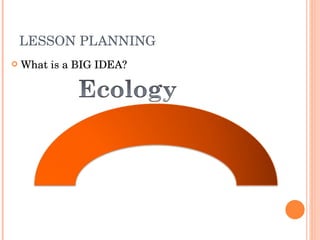
LESSON PLANNING What is a BIG IDEA?
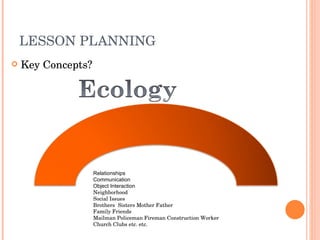
LESSON PLANNING Key Concepts? Relationships Communication Object Interaction Neighborhood Social Issues Brothers  Sisters Mother Father Family Friends Mailman Policeman Fireman Construction Worker  Church Clubs etc. etc.
ESSENTIAL QUESTION Who are the people that make up my community?  
LESSON TITLE This should be something catchy. Think hard!
LEARNING OBJECTIVES What do you want students to be able to do after the lesson is over? This should be active something they can demonstrate. The student will be able to define X The student will be able to produce X The student will be able to describe X The student will be able to analyze X The student will be able to create X
ART CONTENT What content is specific to art production? Art Content Painting Collage Printmaking Sculpture Watercolor  Installation Art Etc.
RESOURCES Resources for the Teacher Resources for the Student
DEFINITION OF NEW TERMS-DEFINE ANY NEW TERMS THAT YOU PRESENT Example: Primary Colors: Red, Yellow, and Blue. These colors can be mixed to produce the secondary colors.
INSTRUCTION AND ITS SEQUENCING: Instructional Strategies: Day I Motivation:  How will you get your students motivated to learn? PowerPoint? Game? Group Activity?  Describe these in detail Purpose: What do you hope to achieve by teaching this lesson? Instruction:  Is it lecture/group work/ independent practice/etc. Guided Practice: How are you guiding them through practical application of the concept?  What questions are you asking?
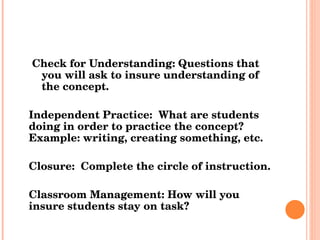
Check for Understanding: Questions that you will ask to insure understanding of the concept. Independent Practice:  What are students doing in order to practice the concept? Example: writing, creating something, etc.  Closure:  Complete the circle of instruction. Classroom Management: How will you insure students stay on task?
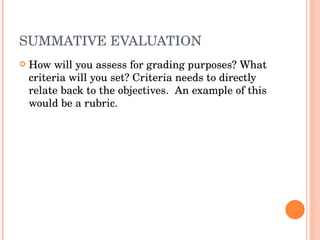
SUMMATIVE EVALUATION How will you assess for grading purposes? What criteria will you set? Criteria needs to directly relate back to the objectives.  An example of this would be a rubric.
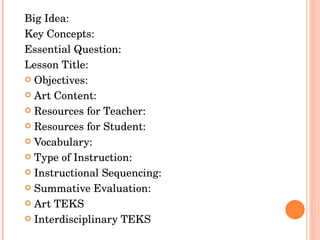
Big Idea: Key Concepts: Essential Question: Lesson Title: Objectives: Art Content: Resources for Teacher: Resources for Student: Vocabulary: Type of Instruction:  Instructional Sequencing: Summative Evaluation: Art TEKS Interdisciplinary TEKS

Lesson Planning

  • 1.
    LESSON PLANNING INART What is the BIG IDEA?
  • 2.
    PRINCIPLE 1 Eitherthe art and/or elementary classroom teacher recognizes the needs for and possibilities of social/political action and human caring within the elementary curriculum.
  • 3.
    PRINCIPLE 2 Teacherssearch for, interpret, and research the contextual origin and functions of artworks and children’s literature including stories and poems to inspire and extend personal and reading, science, social studies, or health textbook ideas. They design integrative learning possibilities that engage children in caring experiences of community.
  • 4.
    PRINCIPLE 3 Teachers brainstorm and plan together, each sharing resources and ideas. Each commits to planned learning actions with participating children. Each knows and understands the curricular concepts (big ideas) and conceptual questions with which the other teachers will work.
  • 5.
    PRINCIPLE 4 Theart and/or classroom teacher(s) present the “what if” idea possibilities inspired by the artworks and literature to the children and to community collaborators, asking them to consider the “what else” possibilities. Teachers, collaborators and children extend ideas and plan learning actions.
  • 6.
    PRINCIPLE 5 Teachersand students organize, develop a matrix/timeline, and make needed contacts for community interaction and action
  • 7.
    PRINCIPLE 6 Teachersalone and together as a team follow planned learning experiences with the children.
  • 8.
    PRINCIPLE 7 Childrenand teachers, at the end of the lesson/activities, reflect and critique their accomplishments interpretively and plan for follow up.
  • 9.
    LESSON PLANNING Whatis a BIG IDEA?
  • 10.
    LESSON PLANNING KeyConcepts? Relationships Communication Object Interaction Neighborhood Social Issues Brothers Sisters Mother Father Family Friends Mailman Policeman Fireman Construction Worker Church Clubs etc. etc.
  • 11.
    ESSENTIAL QUESTION Whoare the people that make up my community?  
  • 12.
    LESSON TITLE Thisshould be something catchy. Think hard!
  • 13.
    LEARNING OBJECTIVES Whatdo you want students to be able to do after the lesson is over? This should be active something they can demonstrate. The student will be able to define X The student will be able to produce X The student will be able to describe X The student will be able to analyze X The student will be able to create X
  • 14.
    ART CONTENT Whatcontent is specific to art production? Art Content Painting Collage Printmaking Sculpture Watercolor Installation Art Etc.
  • 15.
    RESOURCES Resources forthe Teacher Resources for the Student
  • 16.
    DEFINITION OF NEWTERMS-DEFINE ANY NEW TERMS THAT YOU PRESENT Example: Primary Colors: Red, Yellow, and Blue. These colors can be mixed to produce the secondary colors.
  • 17.
    INSTRUCTION AND ITSSEQUENCING: Instructional Strategies: Day I Motivation: How will you get your students motivated to learn? PowerPoint? Game? Group Activity? Describe these in detail Purpose: What do you hope to achieve by teaching this lesson? Instruction: Is it lecture/group work/ independent practice/etc. Guided Practice: How are you guiding them through practical application of the concept? What questions are you asking?
  • 18.
    Check for Understanding:Questions that you will ask to insure understanding of the concept. Independent Practice: What are students doing in order to practice the concept? Example: writing, creating something, etc. Closure: Complete the circle of instruction. Classroom Management: How will you insure students stay on task?
  • 19.
    SUMMATIVE EVALUATION Howwill you assess for grading purposes? What criteria will you set? Criteria needs to directly relate back to the objectives. An example of this would be a rubric.
  • 20.
    Big Idea: KeyConcepts: Essential Question: Lesson Title: Objectives: Art Content: Resources for Teacher: Resources for Student: Vocabulary: Type of Instruction: Instructional Sequencing: Summative Evaluation: Art TEKS Interdisciplinary TEKS