I.F.D.C. LENGUAS VIVAS BARILOCHE
PRÁCTICA DOCENTE I
Alumno residente: Edixson Vidal Hilguera Rojas
Institución Educativa: Jardín de Infantes Martina Tesi
Dirección: Barrio Convivencia manzana 1 D lote 1, Salta
Cantidad de alumnos: 14 (catorce)
Edad: 4 años
Unidad Temática: Body parts
Clase Nº: 7
Fecha: 24 de octubre de 2019
Hora: 14:20
Duración de la clase: 30 minutos
Fecha de entrega de la planificación: 21 de octubre de 2019


Learning aims: 

During this lesson, learners will be able to…
 To name and identify body parts.
 To recognize their body parts.
 To interact with their classmates.
Learning focus:
 Vocabulary about body parts: eyes, nose, mouth, teeth, ears, face,
hair, neck, head, arms, legs, knees, hand, fingers, toes, elbow.
Integration of skills: 
 Linguistic skills: by listening to the teacher and repeating the new
words.
 Social skills: by interacting with their classmates singing and
dancing.
 Physical skills: by moving and pointing to their body parts.
Multiple intelligences:
 Linguistic intelligence: singing and repeating body parts.
 Logical-Mathematical intelligence: counting body parts.
 Interpersonal Intelligence: Talking about their body parts.
Materials and resources:
 Paper sheets.
 Scissors.
 Glue.
 Sellotape.
 Computer.
 Pendrive.
 Guitar.
Possible contingencies:
 Children talking at the same time when the teacher talks.
 Children refusing to sing or dance.
Classroom management strategies:
 Start each activity explaining what it is.
 Use a chant to make children be quiet. (zip it, lock it, save it in
your pocket)
 Accompany children while singing and acting.
 Help children when identifying body parts.
Assessment: collecting information and reporting your findings
-Observing children naming and identifying body parts.
-Making different comments and facial expressions. (Excellent!, OK,
let’s try again)
Lesson stages:
Routine
Purpose: To greet children
Timing: 2 minutes
Activity: The teacher says “Hello children” and they say “Hello Mr.
Edixson”. The teacher sings the song “This is the way we say hello”
moving his hands and pointing children. Then children sing the song
and point to the teacher. The teacher says “Hello children” and they say
“Hello Mr. Edixson”
This is the way we say hello
We say hello, we say hello.
This is the way we say hello
We say hello to you.
Once the teacher has the children’s attention, he presents the following
activity…
Lead-in and Presentation
Purpose: To help children recognize body parts.
Timing: 8 minutes
Activity:
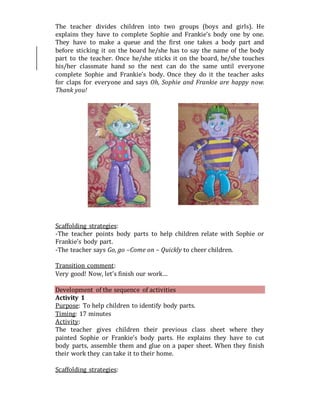
The teacher divides children into two groups (boys and girls). He
explains they have to complete Sophie and Frankie’s body one by one.
They have to make a queue and the first one takes a body part and
before sticking it on the board he/she has to say the name of the body
part to the teacher. Once he/she sticks it on the board, he/she touches
his/her classmate hand so the next can do the same until everyone
complete Sophie and Frankie’s body. Once they do it the teacher asks
for claps for everyone and says Oh, Sophie and Frankie are happy now.
Thank you!
Scaffolding strategies:
-The teacher points body parts to help children relate with Sophie or
Frankie’s body part.
-The teacher says Go, go –Come on – Quickly to cheer children.
Transition comment:
Very good! Now, let’s finish our work…
Development of the sequence of activities
Activity 1
Purpose: To help children to identify body parts.
Timing: 17 minutes
Activity:
The teacher gives children their previous class sheet where they
painted Sophie or Frankie’s body parts. He explains they have to cut
body parts, assemble them and glue on a paper sheet. When they finish
their work they can take it to their home.
Scaffolding strategies:
-The teacher helps children who can not use scissors.
Transition comment:
Excellent! Our friends are complete…
Closure
Purpose: To reinforce body parts vocabulary.
Timing: 3 minutes
Activity:
The teacher invites children to sing and dance Head, shoulders knees
and toes. They do it using only the audio file and not the video to help
children identify body parts. If children can sing and move without the
teacher help, the teacher uses the guitar to sing with them.
https://www.youtube.com/watch?v=ZanHgPprl-0
Scaffolding strategies:
-The teacher helps children remember by pointing his body parts while
they sing.
Transition comment:
Excellent! See you. Good bye children!
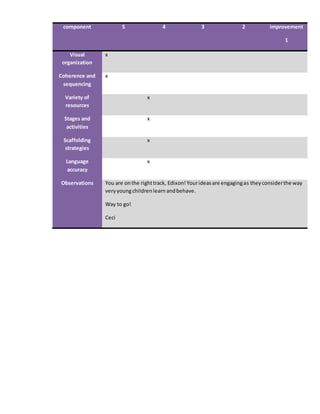
Lesson plan Excellent Very Good Good Acceptable Needs
component 5 4 3 2 improvement
1
Visual
organization
x
Coherence and
sequencing
x
Variety of
resources
x
Stages and
activities
x
Scaffolding
strategies
x
Language
accuracy
x
Observations You are onthe righttrack, Edixon!Yourideasare engagingas theyconsiderthe way
veryyoungchildrenlearn andbehave.
Way to go!
Ceci

Lesson plan 7

  • 1.
    I.F.D.C. LENGUAS VIVASBARILOCHE PRÁCTICA DOCENTE I Alumno residente: Edixson Vidal Hilguera Rojas Institución Educativa: Jardín de Infantes Martina Tesi Dirección: Barrio Convivencia manzana 1 D lote 1, Salta Cantidad de alumnos: 14 (catorce) Edad: 4 años Unidad Temática: Body parts Clase Nº: 7 Fecha: 24 de octubre de 2019 Hora: 14:20 Duración de la clase: 30 minutos Fecha de entrega de la planificación: 21 de octubre de 2019   Learning aims:   During this lesson, learners will be able to…  To name and identify body parts.  To recognize their body parts.  To interact with their classmates. Learning focus:  Vocabulary about body parts: eyes, nose, mouth, teeth, ears, face, hair, neck, head, arms, legs, knees, hand, fingers, toes, elbow. Integration of skills:   Linguistic skills: by listening to the teacher and repeating the new words.  Social skills: by interacting with their classmates singing and dancing.  Physical skills: by moving and pointing to their body parts. Multiple intelligences:  Linguistic intelligence: singing and repeating body parts.  Logical-Mathematical intelligence: counting body parts.  Interpersonal Intelligence: Talking about their body parts. Materials and resources:  Paper sheets.  Scissors.
  • 2.
     Glue.  Sellotape. Computer.  Pendrive.  Guitar. Possible contingencies:  Children talking at the same time when the teacher talks.  Children refusing to sing or dance. Classroom management strategies:  Start each activity explaining what it is.  Use a chant to make children be quiet. (zip it, lock it, save it in your pocket)  Accompany children while singing and acting.  Help children when identifying body parts. Assessment: collecting information and reporting your findings -Observing children naming and identifying body parts. -Making different comments and facial expressions. (Excellent!, OK, let’s try again) Lesson stages: Routine Purpose: To greet children Timing: 2 minutes Activity: The teacher says “Hello children” and they say “Hello Mr. Edixson”. The teacher sings the song “This is the way we say hello” moving his hands and pointing children. Then children sing the song and point to the teacher. The teacher says “Hello children” and they say “Hello Mr. Edixson” This is the way we say hello We say hello, we say hello. This is the way we say hello We say hello to you. Once the teacher has the children’s attention, he presents the following activity… Lead-in and Presentation Purpose: To help children recognize body parts. Timing: 8 minutes Activity:
  • 3.
    The teacher divideschildren into two groups (boys and girls). He explains they have to complete Sophie and Frankie’s body one by one. They have to make a queue and the first one takes a body part and before sticking it on the board he/she has to say the name of the body part to the teacher. Once he/she sticks it on the board, he/she touches his/her classmate hand so the next can do the same until everyone complete Sophie and Frankie’s body. Once they do it the teacher asks for claps for everyone and says Oh, Sophie and Frankie are happy now. Thank you! Scaffolding strategies: -The teacher points body parts to help children relate with Sophie or Frankie’s body part. -The teacher says Go, go –Come on – Quickly to cheer children. Transition comment: Very good! Now, let’s finish our work… Development of the sequence of activities Activity 1 Purpose: To help children to identify body parts. Timing: 17 minutes Activity: The teacher gives children their previous class sheet where they painted Sophie or Frankie’s body parts. He explains they have to cut body parts, assemble them and glue on a paper sheet. When they finish their work they can take it to their home. Scaffolding strategies:
  • 4.
    -The teacher helpschildren who can not use scissors. Transition comment: Excellent! Our friends are complete… Closure Purpose: To reinforce body parts vocabulary. Timing: 3 minutes Activity: The teacher invites children to sing and dance Head, shoulders knees and toes. They do it using only the audio file and not the video to help children identify body parts. If children can sing and move without the teacher help, the teacher uses the guitar to sing with them. https://www.youtube.com/watch?v=ZanHgPprl-0 Scaffolding strategies: -The teacher helps children remember by pointing his body parts while they sing. Transition comment: Excellent! See you. Good bye children! Lesson plan Excellent Very Good Good Acceptable Needs
  • 5.
    component 5 43 2 improvement 1 Visual organization x Coherence and sequencing x Variety of resources x Stages and activities x Scaffolding strategies x Language accuracy x Observations You are onthe righttrack, Edixon!Yourideasare engagingas theyconsiderthe way veryyoungchildrenlearn andbehave. Way to go! Ceci