I.F.D.C. LENGUAS VIVAS BARILOCHE
PRÁCTICA DOCENTE I
Alumno residente: Luis Andrés Redondo
Institución Educativa: Jardín de Infantes “Belén”
Dirección: Rivadavia 322, Las Flores Provincia de Buenos Aires
Cantidad de alumnos: 24
Edad: 5/6 años
Unidad Temática: Means of Transport
Clase Nº: 5
Fecha: 29/10/2018
Hora: 17 a 17:30 hs.
Duración de la clase: 30 minutos
Fecha de entrega de la planificación: 26/10/2018



Learning aims: 

During this lesson, learners will be able to…
 Engage in different modes of expression and play based-activities
to develop their creativity while learning English.
 Use words such as bus, car, train, ship, etc. and language related
to means of transport.
Learning focus:
Children will make meaning of the new vocabulary and language items
by play-based activities along with multimodal tasks in order to expand
their creative skills and enrich their learning experience.
Integration of skills: 

The activity will develop:
 Expand their creativity and learning process through multimodal
experiences.
 Develop TPR skills through playing.
Comentado [CZ1]: Meaningfully.
Multiple intelligences:
Through the sequence of activities we can spot different MI:
 Verbal-linguistic: for the use of new language and known
language related to the topic,
 Intrapersonal: as for the introspection with likes and dislikes
and reinforcement of their body-schema through the blending of
the senses.
Materials and resources:
 Flashcards:
 Worksheet:
 Video:
https://www.youtube.com/watch?v=0-wM311Z0rc
 -Routine song “Hello” Super Simple Songs
https://www.youtube.com/watch?v=tVlcKp3bWH8
 -Routine song “Bye Bye Goodbye” Super Simple Songs
https://www.youtube.com/watch?v=PraN5ZoSjiY
Possible contingencies:
 Children talking at the same time when teacher asks
questions.
 Children getting up at the same time to get their pencil
cases.
Teacher will apply the following strategies to manage each
contingency:
1 We can sing a short chant “Shhh silence please, quiet, please sit down,
please sit down” asking them to join the circle.
2 He will give children their pencil cases.
Classroom management strategies:
 Start each activity explaining what it is about;
 Call their attention when they are distracted;
 If time is short and they were not able to complete the activity, it
will continue next class.
Assessment: collecting information and reporting your findings
 Repeating, miming words together with children.
 Observing children while they work with the worksheets.
.
Lesson stages:
Routine
 Sing the song “Hello” Super Simple Songs
https://www.youtube.com/watch?v=tVlcKp3bWH8
Lyrics
Hello, hello, hello, how are you?
I’m good.
I’m great!
I’m wonderful!
I’m good.
I’m great!
I’m wonderful!
Hello, hello, hello, how are you?
I’m tired.
I’m hungry.
I’m not so good.
I’m tired.
I’m hungry.
I’m not so good.
Comentado [CZ2]: This is scaffolding. Assessment implies
evaluating what children learnt, their difficulties, and so on.
Hello, hello, hello, how are you?
Timing: 2 minutes
Lead-in Presentation
Purpose:
 Revision of words: car, bus, ambulance, police car, etc. showing
them flashcards about means of transportation.
 Timing: 5 minutes
Activity description and instructions as they will be said to
students (include direct speech):
 Tell them they will watch the video about the different means of
transport.
 Transition comment to link each stage of the lesson with the
next one:
 Tell children to sit down on the floor.
Development of the sequence of activities
Activity 1
Purpose:
 Use and understand words and language items related to means
of transport.
 Timing: 8 minutes
Activity description and instructions as they will be said to
students (include direct speech):
 Tell children to watch the video “Transport vehicles”.
 Tell them to repeat the different vehicles together with teacher.
Scaffolding strategies:
 Miming, singing and pointing while repeating the words.
Transition comment to link each stage of the lesson with the next
one:
 Tell them to clap.
 Tell them to sit on the chairs.
Activity 2
Purpose:
Con formato: Fuente:
Comentado [CZ3]: The video bears no context. Although
children will pick the words, remember that a meaningful context
will promote other kinds of learning, understanding, associations,
and so on. Learning an L2 should resemble learning an L1 in this
respect. I strongly recommend you choose a context based resource
and activities for your last class, for example, a story.
 Revision of the means of transport seen in the video.
 Timing: 12
Activity description and instructions as they will be said to
students (include direct speech):
 Tell children to work individually with the worksheets.
 Tell them to paint the pictures of the vehicles.
Scaffolding strategies:
 Observing and helping children while they are working.
Transition comment to link each stage of the lesson with the next
one:
 Tell them that times up.
Closure
Purpose:
 To clean up
Timing: 3 minutes
Activity description and instructions as they will be said to
students (include direct speech):
 Sing a song “Bye Bye Goodbye” Super Simple Songs
https://www.youtube.com/watch?v=PraN5ZoSjiY
Lyrics
Bye bye. Goodbye.
Bye, bye, bye, bye. Goodbye.
I can clap my hands.
I can stamp my feet.
I can clap my hands.
I can stamp my feet.
Bye bye. Goodbye.
Bye, bye, bye, bye. Goodbye.
Bye bye. Goodbye.
Bye, bye, bye, bye. Goodbye.
GOODBYE!
 Tell children to get their school bags.
 Tell them to put their jackets on and make a line.
Comentado [CZ4]: What linguistic purpose will accompany this
activity?
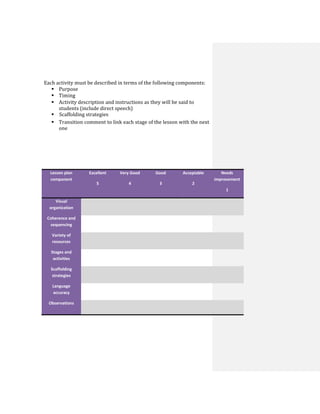
Each activity must be described in terms of the following components:
 Purpose
 Timing
 Activity description and instructions as they will be said to
students (include direct speech)
 Scaffolding strategies
 Transition comment to link each stage of the lesson with the next
one
Lesson plan
component
Excellent
5
Very Good
4
Good
3
Acceptable
2
Needs
improvement
1
Visual
organization
Coherence and
sequencing
Variety of
resources
Stages and
activities
Scaffolding
strategies
Language
accuracy
Observations
Lesson plan 5
Lesson plan 5

Lesson plan 5

  • 1.
    I.F.D.C. LENGUAS VIVASBARILOCHE PRÁCTICA DOCENTE I Alumno residente: Luis Andrés Redondo Institución Educativa: Jardín de Infantes “Belén” Dirección: Rivadavia 322, Las Flores Provincia de Buenos Aires Cantidad de alumnos: 24 Edad: 5/6 años Unidad Temática: Means of Transport Clase Nº: 5 Fecha: 29/10/2018 Hora: 17 a 17:30 hs. Duración de la clase: 30 minutos Fecha de entrega de la planificación: 26/10/2018    Learning aims:   During this lesson, learners will be able to…  Engage in different modes of expression and play based-activities to develop their creativity while learning English.  Use words such as bus, car, train, ship, etc. and language related to means of transport. Learning focus: Children will make meaning of the new vocabulary and language items by play-based activities along with multimodal tasks in order to expand their creative skills and enrich their learning experience. Integration of skills:   The activity will develop:  Expand their creativity and learning process through multimodal experiences.  Develop TPR skills through playing. Comentado [CZ1]: Meaningfully.
  • 2.
    Multiple intelligences: Through thesequence of activities we can spot different MI:  Verbal-linguistic: for the use of new language and known language related to the topic,  Intrapersonal: as for the introspection with likes and dislikes and reinforcement of their body-schema through the blending of the senses. Materials and resources:  Flashcards:
  • 3.
     Worksheet:  Video: https://www.youtube.com/watch?v=0-wM311Z0rc -Routine song “Hello” Super Simple Songs https://www.youtube.com/watch?v=tVlcKp3bWH8  -Routine song “Bye Bye Goodbye” Super Simple Songs https://www.youtube.com/watch?v=PraN5ZoSjiY Possible contingencies:  Children talking at the same time when teacher asks questions.  Children getting up at the same time to get their pencil cases. Teacher will apply the following strategies to manage each contingency: 1 We can sing a short chant “Shhh silence please, quiet, please sit down, please sit down” asking them to join the circle. 2 He will give children their pencil cases.
  • 4.
    Classroom management strategies: Start each activity explaining what it is about;  Call their attention when they are distracted;  If time is short and they were not able to complete the activity, it will continue next class. Assessment: collecting information and reporting your findings  Repeating, miming words together with children.  Observing children while they work with the worksheets. . Lesson stages: Routine  Sing the song “Hello” Super Simple Songs https://www.youtube.com/watch?v=tVlcKp3bWH8 Lyrics Hello, hello, hello, how are you? Hello, hello, hello, how are you? I’m good. I’m great! I’m wonderful! I’m good. I’m great! I’m wonderful! Hello, hello, hello, how are you? Hello, hello, hello, how are you? I’m tired. I’m hungry. I’m not so good. I’m tired. I’m hungry. I’m not so good. Comentado [CZ2]: This is scaffolding. Assessment implies evaluating what children learnt, their difficulties, and so on.
  • 5.
    Hello, hello, hello,how are you? Hello, hello, hello, how are you? Hello, hello, hello, how are you? Hello, hello, hello, how are you? Timing: 2 minutes Lead-in Presentation Purpose:  Revision of words: car, bus, ambulance, police car, etc. showing them flashcards about means of transportation.  Timing: 5 minutes Activity description and instructions as they will be said to students (include direct speech):  Tell them they will watch the video about the different means of transport.  Transition comment to link each stage of the lesson with the next one:  Tell children to sit down on the floor. Development of the sequence of activities Activity 1 Purpose:  Use and understand words and language items related to means of transport.  Timing: 8 minutes Activity description and instructions as they will be said to students (include direct speech):  Tell children to watch the video “Transport vehicles”.  Tell them to repeat the different vehicles together with teacher. Scaffolding strategies:  Miming, singing and pointing while repeating the words. Transition comment to link each stage of the lesson with the next one:  Tell them to clap.  Tell them to sit on the chairs. Activity 2 Purpose: Con formato: Fuente: Comentado [CZ3]: The video bears no context. Although children will pick the words, remember that a meaningful context will promote other kinds of learning, understanding, associations, and so on. Learning an L2 should resemble learning an L1 in this respect. I strongly recommend you choose a context based resource and activities for your last class, for example, a story.
  • 6.
     Revision ofthe means of transport seen in the video.  Timing: 12 Activity description and instructions as they will be said to students (include direct speech):  Tell children to work individually with the worksheets.  Tell them to paint the pictures of the vehicles. Scaffolding strategies:  Observing and helping children while they are working. Transition comment to link each stage of the lesson with the next one:  Tell them that times up. Closure Purpose:  To clean up Timing: 3 minutes Activity description and instructions as they will be said to students (include direct speech):  Sing a song “Bye Bye Goodbye” Super Simple Songs https://www.youtube.com/watch?v=PraN5ZoSjiY Lyrics Bye bye. Goodbye. Bye, bye, bye, bye. Goodbye. I can clap my hands. I can stamp my feet. I can clap my hands. I can stamp my feet. Bye bye. Goodbye. Bye, bye, bye, bye. Goodbye. Bye bye. Goodbye. Bye, bye, bye, bye. Goodbye. GOODBYE!  Tell children to get their school bags.  Tell them to put their jackets on and make a line. Comentado [CZ4]: What linguistic purpose will accompany this activity?
  • 7.
    Each activity mustbe described in terms of the following components:  Purpose  Timing  Activity description and instructions as they will be said to students (include direct speech)  Scaffolding strategies  Transition comment to link each stage of the lesson with the next one Lesson plan component Excellent 5 Very Good 4 Good 3 Acceptable 2 Needs improvement 1 Visual organization Coherence and sequencing Variety of resources Stages and activities Scaffolding strategies Language accuracy Observations