TALLER PRÁCTICA DOCENTE 2017
ALUMNO RESIDENTE: Ailén Moller Poulsen
Período de Práctica: Educación Primaria
Institución Educativa: Colegio Woodville
Dirección: Avda. Los Pioneros km. 2,900 - S.C. de Bariloche, Río Negro
Sala / Grado / Año - sección: 3º grado
Cantidad de alumnos: 28
Nivel lingüístico del curso: Bajo intermedio
Tipo de Planificación: Clase
Unidad Temática:
Clase Nº: 3
Fecha: 15/08/2017
Hora:
Duración de la clase: 80 minutos
Fecha de entrega: 10/08/2017
LESSON PLAN
 Aims or goals:
During this lesson students will be able to:
-Understand and follow commands
-Improve their pronunciation of certain sounds
-Continue working and improving their general knowledge
-Keep working on collaboration among peers
 Teaching points:
 Language Focus:
Functions Lexis Structure Pronunciation
Revision Forming
sentences and
questions
Farm, city, cars,
(farm animals..)
Where would
you like to live?/
Where do you
live?
/ ə/ sound, as in
‘has’, ‘does’
New --- Tractor, town,
cab
--- /aʊ/ sound, as in
‘town’
 Teaching approach or combination of methods / approaches:
The PPP model will be used in this lesson.
 Integration of skills: What skills will be integrated and how?
Listening, reading and speaking skills by explanation, listening to a story and activities.
Comentario [A1]: Context?
 Materials and resources:
Whiteboard, story, pictures, computer, headphones
 Pedagogical use of ICT in class or at home:
Computers will be used in the computer lab (where children will listen to the story)
 Seating arrangement:
Children sitting in front of their computers (they are arranged in a semi circle)
 Assessment: what will be assessed and how
I will check students’ comprehension and understanding by eliciting and going around seeing
how they are working.
STAGES OF THE LESSON PLAN
 ROUTINE (3’)
Purpose: to get students in the mood to start the language class.
T: Hello children!
SS: Hello Miss Ailén
T: How are you today?
SS: Fine, and you?
T: I’m great! Did you have a nice weekend?
SS: Yes...
The teacher will write on the board for children to copy:
Today is Tuesday August 15th
Today is rainy and... (students had to complete it).
Interaction Patterns: T-S
Transition: Listen class, today we are going to the computer lab, so take your things and let’s go!
WARM-UP (10’-15’)
Purpose: to introduce the topic
T: Where do we live?
SS: Bariloche!
T: Ok, yes. But is Bariloche a farm? Or a city?
SS: A city
Comentario [A2]: Is there a computer
per student? Are they actually using the
computers?
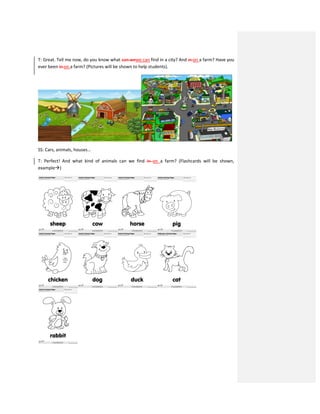
T: Great. Tell me now, do you know what can wewe can find in a city? And in on a farm? Have you
ever been in on a farm? (Pictures will be shown to help students).
SS: Cars, animals, houses…
T: Perfect! And what kind of animals can we find in on a farm? (Flashcards will be shown,
example)
SS: Dogs, cats, horses, rabbits...
T: Perfect! And what things can we do in a city/on a farm? For example, in a city we can go to the
movies; in on a farm we can ride horses, or use a tractor. Do you know what a tractor is?
SS: Yes/No... (T will explain and show a picture)
T: Ok, and where would you like to live/go? Would you like to live in on a farm? Or in a big city?
SS:...
Interaction Patterns: T-S
Transition: Ok, class, we are now going to listen to a story about Tom and his cat Tip, who live in a
farm and want to go the city; and Pam and her dog Mops, who live in the city and want to go a
farm.
 PRESENTATION (20’)
Purpose: to introduce the story
T: Ok, so I told you we were going to listen to a story, but first I would like us to do an activity. I
would want you to look at these two pictures and name 5 things you can see in each picture (they
will work in pairs).
The activity will be checked orally. T will write the words on the board below the corresponding
picture.
Transition: Well done class!
Interaction Patterns: S-S
 DEVELOPMENT (50’)
Activity 1:
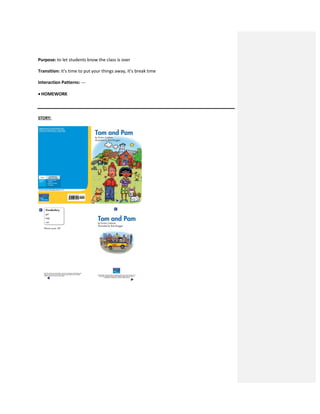
Purpose: listen to the story (you can find it at the end of the document)
T: Do you remember the name of the characters?
SS: Yes/No
T: We have Tom and Tip and Pam and Mops. Tom lives in on a farm and Pam in...
SS: City
T: Good. What do you think will happen when Tom and Tip go to the city? And when Pam and
Mops go the farm?
SS:....
Transition: Ok, good, let’s find out if you were right. Now put your headphones on and listen to
the story.
Interaction Patterns: T-S
Activity 2:
Purpose: checking comprehension
T: Can someone tell me what happened in the story? Did Tom enjoy the city?...
SS:....
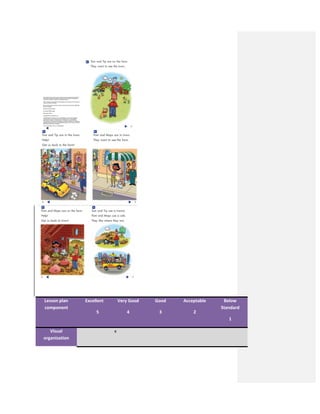
T: Why do you think Pam didn’t like the farm? You can look at the pictures for help, what can you
see?.
SS:...
T: what do you think Pam and Tom could have done to enjoy their time in on the farm/city? For
example, riding a horse, going to the movies...
Transition: Ok class, you can make a drawing about the story, for example, about your favourite
part, about what could Tom or Pam had enjoyed...
Interaction Patterns: T-S
Comentario [A3]: I don´t remember.
Are they familiar with these characters?
Comentario [A4]: Will they be able to
answer these questions?
Comentario [A5]: You may ask them to
draw their favourie part, but do encourage
them to use the target language as well.
They might write a sentence about what
they are drawing.
Or you may just do some oral follow-up
activities. You can say some sentences and
have students respond physically to
determine if they are true or false,
dramatize some parts of the story, among
other activities. Choose the one that suits
the group best! Just make sure it fosters
real practice of the target language.
NOTE:
Extra Activities:
In case they finish too quickly, but usually they take longer than expected.
1. Arrange the pictures in the correct order
2. Word search (http://www.primarygames.com/science/farmanimals/games/word_search/)
3. Crossword
 CLOSURE (5’)
Comentario [A6]: This is a great
activity! You can do some picture
description while putting the pictures in
order.
Comentario [A7]: Please read my
comment below. You can find some online
practice.
Purpose: to let students know the class is over
Transition: it’s time to put your things away, it’s break time
Interaction Patterns: ---
 HOMEWORK
STORY:
Lesson plan
component
Excellent
5
Very Good
4
Good
3
Acceptable
2
Below
Standard
1
Visual
organization
x
Coherence and
sequencing
x
Variety of
resources –
Learning styles
x
Stages and
activities
x
Teaching
strategies
x
Language
accuracy
x
Observations Another story! This time you are taking students to the lab. Keep an eye on
discipline and on timing. Think of the follow-up activities. As you will be in the lab, I
truly believe you should take advantage of that. Why don´t you find some online
games to practise farm animals, for instance? If not, you are just doing a simple
listening activity in a different classroom.
For example, on this webpage there are plenty of games that you can use to
practise the target vocabulary. I really liked the puzzles and wordsearch.
http://www.primarygames.com/science/farmanimals/games.htm
There are tons of resources online. I`m positive you will find great ideas!
Hope you find the comments and suggestions useful.
Enjoy the lesson!
Aure

Moller Poulsen - Primary Lesson Plan 4

  • 1.
    TALLER PRÁCTICA DOCENTE2017 ALUMNO RESIDENTE: Ailén Moller Poulsen Período de Práctica: Educación Primaria Institución Educativa: Colegio Woodville Dirección: Avda. Los Pioneros km. 2,900 - S.C. de Bariloche, Río Negro Sala / Grado / Año - sección: 3º grado Cantidad de alumnos: 28 Nivel lingüístico del curso: Bajo intermedio Tipo de Planificación: Clase Unidad Temática: Clase Nº: 3 Fecha: 15/08/2017 Hora: Duración de la clase: 80 minutos Fecha de entrega: 10/08/2017 LESSON PLAN  Aims or goals: During this lesson students will be able to: -Understand and follow commands -Improve their pronunciation of certain sounds -Continue working and improving their general knowledge -Keep working on collaboration among peers  Teaching points:  Language Focus: Functions Lexis Structure Pronunciation Revision Forming sentences and questions Farm, city, cars, (farm animals..) Where would you like to live?/ Where do you live? / ə/ sound, as in ‘has’, ‘does’ New --- Tractor, town, cab --- /aʊ/ sound, as in ‘town’  Teaching approach or combination of methods / approaches: The PPP model will be used in this lesson.  Integration of skills: What skills will be integrated and how? Listening, reading and speaking skills by explanation, listening to a story and activities. Comentario [A1]: Context?
  • 2.
     Materials andresources: Whiteboard, story, pictures, computer, headphones  Pedagogical use of ICT in class or at home: Computers will be used in the computer lab (where children will listen to the story)  Seating arrangement: Children sitting in front of their computers (they are arranged in a semi circle)  Assessment: what will be assessed and how I will check students’ comprehension and understanding by eliciting and going around seeing how they are working. STAGES OF THE LESSON PLAN  ROUTINE (3’) Purpose: to get students in the mood to start the language class. T: Hello children! SS: Hello Miss Ailén T: How are you today? SS: Fine, and you? T: I’m great! Did you have a nice weekend? SS: Yes... The teacher will write on the board for children to copy: Today is Tuesday August 15th Today is rainy and... (students had to complete it). Interaction Patterns: T-S Transition: Listen class, today we are going to the computer lab, so take your things and let’s go! WARM-UP (10’-15’) Purpose: to introduce the topic T: Where do we live? SS: Bariloche! T: Ok, yes. But is Bariloche a farm? Or a city? SS: A city Comentario [A2]: Is there a computer per student? Are they actually using the computers?
  • 3.
    T: Great. Tellme now, do you know what can wewe can find in a city? And in on a farm? Have you ever been in on a farm? (Pictures will be shown to help students). SS: Cars, animals, houses… T: Perfect! And what kind of animals can we find in on a farm? (Flashcards will be shown, example)
  • 4.
    SS: Dogs, cats,horses, rabbits... T: Perfect! And what things can we do in a city/on a farm? For example, in a city we can go to the movies; in on a farm we can ride horses, or use a tractor. Do you know what a tractor is? SS: Yes/No... (T will explain and show a picture) T: Ok, and where would you like to live/go? Would you like to live in on a farm? Or in a big city? SS:... Interaction Patterns: T-S Transition: Ok, class, we are now going to listen to a story about Tom and his cat Tip, who live in a farm and want to go the city; and Pam and her dog Mops, who live in the city and want to go a farm.  PRESENTATION (20’) Purpose: to introduce the story T: Ok, so I told you we were going to listen to a story, but first I would like us to do an activity. I would want you to look at these two pictures and name 5 things you can see in each picture (they will work in pairs). The activity will be checked orally. T will write the words on the board below the corresponding picture. Transition: Well done class! Interaction Patterns: S-S  DEVELOPMENT (50’) Activity 1: Purpose: listen to the story (you can find it at the end of the document)
  • 5.
    T: Do youremember the name of the characters? SS: Yes/No T: We have Tom and Tip and Pam and Mops. Tom lives in on a farm and Pam in... SS: City T: Good. What do you think will happen when Tom and Tip go to the city? And when Pam and Mops go the farm? SS:.... Transition: Ok, good, let’s find out if you were right. Now put your headphones on and listen to the story. Interaction Patterns: T-S Activity 2: Purpose: checking comprehension T: Can someone tell me what happened in the story? Did Tom enjoy the city?... SS:.... T: Why do you think Pam didn’t like the farm? You can look at the pictures for help, what can you see?. SS:... T: what do you think Pam and Tom could have done to enjoy their time in on the farm/city? For example, riding a horse, going to the movies... Transition: Ok class, you can make a drawing about the story, for example, about your favourite part, about what could Tom or Pam had enjoyed... Interaction Patterns: T-S Comentario [A3]: I don´t remember. Are they familiar with these characters? Comentario [A4]: Will they be able to answer these questions? Comentario [A5]: You may ask them to draw their favourie part, but do encourage them to use the target language as well. They might write a sentence about what they are drawing. Or you may just do some oral follow-up activities. You can say some sentences and have students respond physically to determine if they are true or false, dramatize some parts of the story, among other activities. Choose the one that suits the group best! Just make sure it fosters real practice of the target language.
  • 6.
    NOTE: Extra Activities: In casethey finish too quickly, but usually they take longer than expected. 1. Arrange the pictures in the correct order 2. Word search (http://www.primarygames.com/science/farmanimals/games/word_search/) 3. Crossword  CLOSURE (5’) Comentario [A6]: This is a great activity! You can do some picture description while putting the pictures in order. Comentario [A7]: Please read my comment below. You can find some online practice.
  • 7.
    Purpose: to letstudents know the class is over Transition: it’s time to put your things away, it’s break time Interaction Patterns: ---  HOMEWORK STORY:
  • 8.
  • 9.
    Coherence and sequencing x Variety of resources– Learning styles x Stages and activities x Teaching strategies x Language accuracy x Observations Another story! This time you are taking students to the lab. Keep an eye on discipline and on timing. Think of the follow-up activities. As you will be in the lab, I truly believe you should take advantage of that. Why don´t you find some online games to practise farm animals, for instance? If not, you are just doing a simple listening activity in a different classroom. For example, on this webpage there are plenty of games that you can use to practise the target vocabulary. I really liked the puzzles and wordsearch. http://www.primarygames.com/science/farmanimals/games.htm There are tons of resources online. I`m positive you will find great ideas! Hope you find the comments and suggestions useful. Enjoy the lesson! Aure