Lesson 6
Software, Operating System, and
Different Programming Languages
COMPUTER SYSTEM
Software
•A program or a set
of instructions and
applications used to
manage and control
various functions of
a device such as a
computer.
Two Main Categories of Computer
Software
1. System Software – is a basic requirement for any
computer, as it controls all main functions and
integrates all parts into a unitary system. An example
of a system software is an operating system.
2. Application Software – serves more specific purposes,
such as creating databases and spreadsheets or
processing images. Application software is available as
single programs, software packages or software suites.
CLASSIFICATION OF
OPERATING SYSTEMS
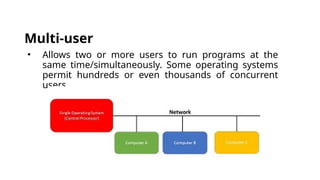
Multi-user
• Allows two or more users to run programs at the
same time/simultaneously. Some operating systems
permit hundreds or even thousands of concurrent
users.
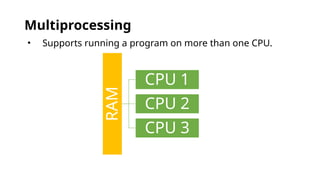
Multiprocessing
• Supports running a program on more than one CPU.
RAM
CPU 1
CPU 2
CPU 3
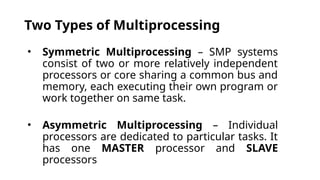
Two Types of Multiprocessing
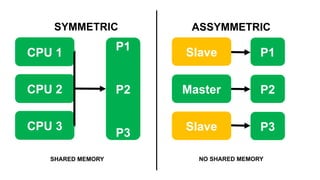
• Symmetric Multiprocessing – SMP systems
consist of two or more relatively independent
processors or core sharing a common bus and
memory, each executing their own program or
work together on same task.
• Asymmetric Multiprocessing – Individual
processors are dedicated to particular tasks. It
has one MASTER processor and SLAVE
processors
CPU 1
CPU 2
CPU 3
P1
P2
P3
SHARED MEMORY
Slave
Master
Slave
P1
P2
P3
NO SHARED MEMORY
SYMMETRIC ASSYMMETRIC
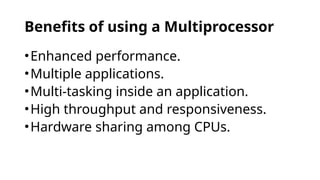
Benefits of using a Multiprocessor
•Enhanced performance.
•Multiple applications.
•Multi-tasking inside an application.
•High throughput and responsiveness.
•Hardware sharing among CPUs.
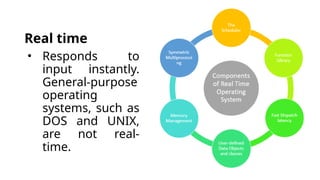
Real time
• Responds to
input instantly.
General-purpose
operating
systems, such as
DOS and UNIX,
are not real-
time.
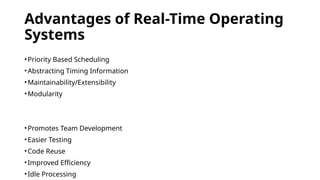
Advantages of Real-Time Operating
Systems
•Priority Based Scheduling
•Abstracting Timing Information
•Maintainability/Extensibility
•Modularity
•Promotes Team Development
•Easier Testing
•Code Reuse
•Improved Efficiency
•Idle Processing
Disadvantages of Real-Time
Operating Systems
•Limited Tasks
•Use Heavy System resources
•Complex Algorithms
•Device driver and interrupt signals
•Thread Priority
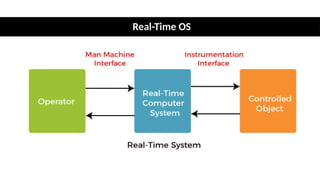
Real-Time OS
Multithreading
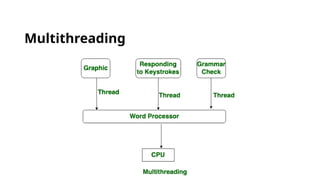
• A thread is a path which is followed during a
program’s execution. Majority of programs
written now a days run as a single thread.
• Multithreading is a process of multiple
threads executes at same time..
Multithreading
• a multithreaded operating system may run several
background tasks, such as logging file changes,
indexing data, and managing windows at the same
time.
Multithreading
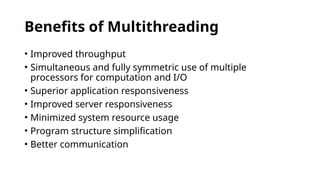
Benefits of Multithreading
• Improved throughput
• Simultaneous and fully symmetric use of multiple
processors for computation and I/O
• Superior application responsiveness
• Improved server responsiveness
• Minimized system resource usage
• Program structure simplification
• Better communication
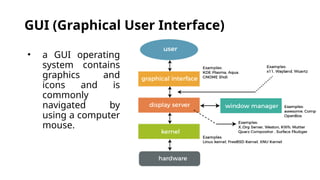
GUI (Graphical User Interface)
• a GUI operating
system contains
graphics and
icons and is
commonly
navigated by
using a computer
mouse.
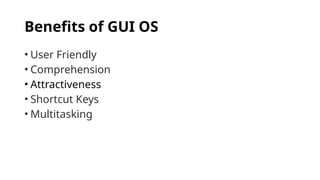
Benefits of GUI OS
• User Friendly
• Comprehension
• Attractiveness
• Shortcut Keys
• Multitasking
Disadvantages of GUI OS
• Implementation
• Cost
• Speed
• Time Consumption
• Memory Usage
OPERATING
SYSTEM
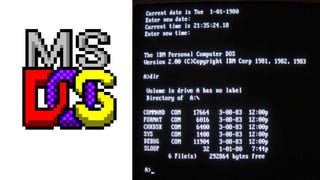
MS-DOS (Microsoft Disk
Operating System)
• a non-graphical command line
operating system derived from
86-DOS that was created for
IBM compatible computers.
MS-DOS originally written by
Tim Paterson and introduced
by Microsoft in August 1981
and was last updated in 1994
when MS-DOS 6.22 was
released.
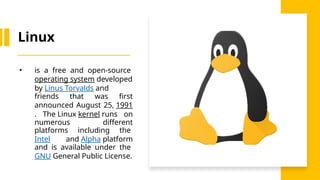
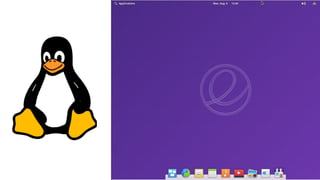
Linux
• is a free and open-source
operating system developed
by Linus Torvalds and
friends that was first
announced August 25, 1991
. The Linux kernel runs on
numerous different
platforms including the
Intel and Alpha platform
and is available under the
GNU General Public License.
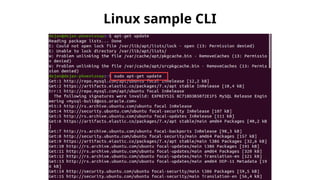
Linux sample CLI
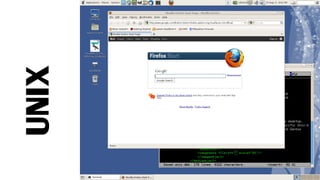
UNIX
• Coined by
Brian Kernighan
, Unix or UNIX (not an
acronym) is an
operating system
developed by members of
the (Multiplexed
Information and
Computing Service)
MULTICS team at the Bell
Laboratories starting in
the late 1960's, many who
also help create C.
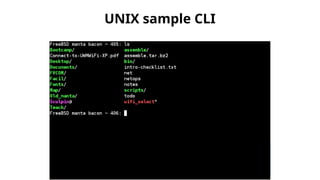
UNIX sample CLI
Microsoft
Windows
• is an operating environment
created by Microsoft that
provides an interface, known
as a Graphical User Interface (
GUI), for computers. Windows
eliminates the need to
memorize commands for the
command line (MS-DOS) by
using a mouse to navigate
through menus, dialog boxes,
buttons, tabs, and icons.
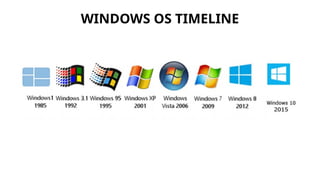
WINDOWS OS TIMELINE
Windows 10 – which version is right
for you?
•Windows 10 Home
•Windows 10 S
•Windows 10 Pro
•Windows 10 Enterprise
•Windows 10 Education
•Windows IoT
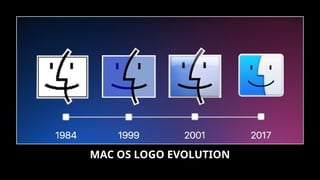
Mac Os
• MacOS was introduced in
1984 to run Macintosh
personal computers
(PCs). The OS helped
make graphical user
interfaces (GUIs) popular,
even inspiring Microsoft
to move away from its
user input method in
favor of using GUIs for
Windows OSes.
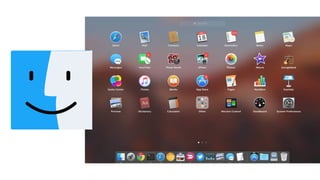
MAC OS LOGO EVOLUTION
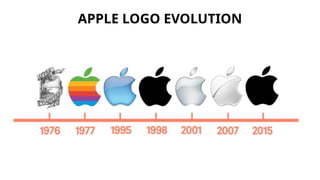
APPLE LOGO EVOLUTION
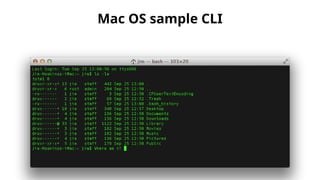
Mac OS sample CLI
PROGRAMMIN
G LANGUAGES
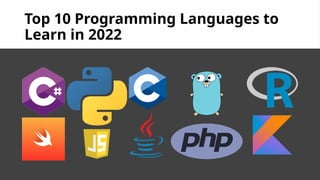
Top 10 Programming Languages to
Learn in 2022
Python
∙ Python can be regarded as the future
of programming languages. As per
the latest statistics, Python is the
main coding language for around
80% of developers. The presence of
extensive libraries in Python
facilitates artificial intelligence, data
science, and machine learning
processes.
Java
∙ Java is one of the most powerful
programming languages that is
currently used in more than 3
billion devices. Java is currently one
of the most trending technology. It
is used in desktop applications,
mobile applications, web
development, Artificial intelligence,
cloud applications, and many more.
Javascript
∙ JavaScript is one of the world’s
most popular programming
languages on the web. As per
the survey, more than 97
percent of the websites use
JavaScript on the client-side
of the webpage.
Kotlin
∙Kotlin is a cross-platform
programming language
designed to develop
apps. It is being used
by more than 60% of
android developers.
R
∙
R is a programming language for
statistical and graphical
programming. It is widely used
among statisticians and data miners
for data analysis. It holds profound
importance in data analysis, financial
domains, and telecom sectors.
PHP
∙ PHP is one of the general-purpose
scripting languages that will
continue to hold its importance in
the upcoming years. It is among
the first server-side language that
can be embedded with HTML to
add functionality to web pages.
GO
∙ Go is one of the most reliable and
efficient programming languages that
stands out from the rest. It was
originally designed at Google in 2007
to manage its rapidly growing
infrastructure. It quickly gained amazing
popularity and has become one of
the top programming languages.
C
∙C is a general-purpose
programming
language that is designed
to work efficiently on
games, graphics, and
enterprise applications.
SWIFT
∙ It is a robust programming
language developed by Apple
Inc. It is used to create apps
for iOS, watchOS, macOS, and
many more. It can be seen as
the future of high-performance
and secured applications.
C#
∙
C# is a programming language
that runs on the .NET framework
and is developed by Microsoft in
2000. It is effective in making
desktop applications and games.
As per the survey, 34% of the top
mobile games are made using C#.
Markup Languages and Data Formats

Lesson 6 Software Operating System and Different Programming Languages.pptx

  • 1.
    Lesson 6 Software, OperatingSystem, and Different Programming Languages
  • 2.
  • 3.
    Software •A program ora set of instructions and applications used to manage and control various functions of a device such as a computer.
  • 4.
    Two Main Categoriesof Computer Software 1. System Software – is a basic requirement for any computer, as it controls all main functions and integrates all parts into a unitary system. An example of a system software is an operating system. 2. Application Software – serves more specific purposes, such as creating databases and spreadsheets or processing images. Application software is available as single programs, software packages or software suites.
  • 5.
  • 6.
    Multi-user • Allows twoor more users to run programs at the same time/simultaneously. Some operating systems permit hundreds or even thousands of concurrent users.
  • 7.
    Multiprocessing • Supports runninga program on more than one CPU. RAM CPU 1 CPU 2 CPU 3
  • 8.
    Two Types ofMultiprocessing • Symmetric Multiprocessing – SMP systems consist of two or more relatively independent processors or core sharing a common bus and memory, each executing their own program or work together on same task. • Asymmetric Multiprocessing – Individual processors are dedicated to particular tasks. It has one MASTER processor and SLAVE processors
  • 9.
    CPU 1 CPU 2 CPU3 P1 P2 P3 SHARED MEMORY Slave Master Slave P1 P2 P3 NO SHARED MEMORY SYMMETRIC ASSYMMETRIC
  • 10.
    Benefits of usinga Multiprocessor •Enhanced performance. •Multiple applications. •Multi-tasking inside an application. •High throughput and responsiveness. •Hardware sharing among CPUs.
  • 11.
    Real time • Respondsto input instantly. General-purpose operating systems, such as DOS and UNIX, are not real- time.
  • 12.
    Advantages of Real-TimeOperating Systems •Priority Based Scheduling •Abstracting Timing Information •Maintainability/Extensibility •Modularity •Promotes Team Development •Easier Testing •Code Reuse •Improved Efficiency •Idle Processing
  • 13.
    Disadvantages of Real-Time OperatingSystems •Limited Tasks •Use Heavy System resources •Complex Algorithms •Device driver and interrupt signals •Thread Priority
  • 14.
  • 15.
    Multithreading • A threadis a path which is followed during a program’s execution. Majority of programs written now a days run as a single thread. • Multithreading is a process of multiple threads executes at same time..
  • 16.
    Multithreading • a multithreadedoperating system may run several background tasks, such as logging file changes, indexing data, and managing windows at the same time.
  • 17.
  • 18.
    Benefits of Multithreading •Improved throughput • Simultaneous and fully symmetric use of multiple processors for computation and I/O • Superior application responsiveness • Improved server responsiveness • Minimized system resource usage • Program structure simplification • Better communication
  • 19.
    GUI (Graphical UserInterface) • a GUI operating system contains graphics and icons and is commonly navigated by using a computer mouse.
  • 20.
    Benefits of GUIOS • User Friendly • Comprehension • Attractiveness • Shortcut Keys • Multitasking
  • 21.
    Disadvantages of GUIOS • Implementation • Cost • Speed • Time Consumption • Memory Usage
  • 22.
  • 23.
    MS-DOS (Microsoft Disk OperatingSystem) • a non-graphical command line operating system derived from 86-DOS that was created for IBM compatible computers. MS-DOS originally written by Tim Paterson and introduced by Microsoft in August 1981 and was last updated in 1994 when MS-DOS 6.22 was released.
  • 25.
    Linux • is afree and open-source operating system developed by Linus Torvalds and friends that was first announced August 25, 1991 . The Linux kernel runs on numerous different platforms including the Intel and Alpha platform and is available under the GNU General Public License.
  • 27.
  • 28.
    UNIX • Coined by BrianKernighan , Unix or UNIX (not an acronym) is an operating system developed by members of the (Multiplexed Information and Computing Service) MULTICS team at the Bell Laboratories starting in the late 1960's, many who also help create C.
  • 30.
  • 31.
    Microsoft Windows • is anoperating environment created by Microsoft that provides an interface, known as a Graphical User Interface ( GUI), for computers. Windows eliminates the need to memorize commands for the command line (MS-DOS) by using a mouse to navigate through menus, dialog boxes, buttons, tabs, and icons.
  • 32.
  • 33.
    Windows 10 –which version is right for you? •Windows 10 Home •Windows 10 S •Windows 10 Pro •Windows 10 Enterprise •Windows 10 Education •Windows IoT
  • 35.
    Mac Os • MacOSwas introduced in 1984 to run Macintosh personal computers (PCs). The OS helped make graphical user interfaces (GUIs) popular, even inspiring Microsoft to move away from its user input method in favor of using GUIs for Windows OSes.
  • 37.
    MAC OS LOGOEVOLUTION
  • 38.
  • 39.
  • 40.
  • 41.
    Top 10 ProgrammingLanguages to Learn in 2022
  • 42.
    Python ∙ Python canbe regarded as the future of programming languages. As per the latest statistics, Python is the main coding language for around 80% of developers. The presence of extensive libraries in Python facilitates artificial intelligence, data science, and machine learning processes.
  • 43.
    Java ∙ Java isone of the most powerful programming languages that is currently used in more than 3 billion devices. Java is currently one of the most trending technology. It is used in desktop applications, mobile applications, web development, Artificial intelligence, cloud applications, and many more.
  • 44.
    Javascript ∙ JavaScript isone of the world’s most popular programming languages on the web. As per the survey, more than 97 percent of the websites use JavaScript on the client-side of the webpage.
  • 45.
    Kotlin ∙Kotlin is across-platform programming language designed to develop apps. It is being used by more than 60% of android developers.
  • 46.
    R ∙ R is aprogramming language for statistical and graphical programming. It is widely used among statisticians and data miners for data analysis. It holds profound importance in data analysis, financial domains, and telecom sectors.
  • 47.
    PHP ∙ PHP isone of the general-purpose scripting languages that will continue to hold its importance in the upcoming years. It is among the first server-side language that can be embedded with HTML to add functionality to web pages.
  • 48.
    GO ∙ Go isone of the most reliable and efficient programming languages that stands out from the rest. It was originally designed at Google in 2007 to manage its rapidly growing infrastructure. It quickly gained amazing popularity and has become one of the top programming languages.
  • 49.
    C ∙C is ageneral-purpose programming language that is designed to work efficiently on games, graphics, and enterprise applications.
  • 50.
    SWIFT ∙ It isa robust programming language developed by Apple Inc. It is used to create apps for iOS, watchOS, macOS, and many more. It can be seen as the future of high-performance and secured applications.
  • 51.
    C# ∙ C# is aprogramming language that runs on the .NET framework and is developed by Microsoft in 2000. It is effective in making desktop applications and games. As per the survey, 34% of the top mobile games are made using C#.
  • 52.

Editor's Notes

  • #9 There are two types of multiprocessors, one is called shared memory multiprocessor (symmetric), and another is distributed memory multiprocessor(asymmetric), . Symmetric – One operating system controls all CPU and ALL CPU have EQUAL RIGHTS Asymmetric –Master executes system programs and SLAVES are used for application execution
  • #11 The more CPU we will complete the given task in less time
  • #13 The more CPU we will complete the given task in less time
  • #16 for example, a program is not capable of reading keystrokes while making drawings. These tasks cannot be executed by the program at the same time. 
  • #18 Example: Playing a video and downloading it at the same time is an example of multithreading.
  • #20 A graphics-based operating system interface that uses icons, menus and a mouse (to click on the icon or pull down the menus) to manage interaction with the system. Developed by Xerox, the GUI was popularized by the Apple Macintosh in the 1980s. 
  • #23 The operating system is the most important program that runs on a computer. Every general-purpose computer must have an operating system to run other programs. It perform basic tasks, such as recognizing input from the keyboard, sending output to the display screen, keeping track of files and directories on the disk, and controlling peripheral devices such as disk drives and printers.
  • #24 MS-DOS allows the user to navigate, open, and otherwise manipulate files on their computer from a command line instead of a GUI like Windows. Today, MS-DOS is no longer used; however, the command shell, more commonly known as the Windows command line is still used by many users.
  • #26 The system can be distributed, used, and expanded free of charge. In this way, developers have access to all the source codes, thus being able to integrate new functions or to find and eliminate programming bugs quickly. Thereby drivers for new adapters (SCSI controller, graphics cards, etc.) can be integrated very rapidly. Tux the penguin
  • #29 Today, Unix is not just the work of a couple of programmers; organizations, institutes, and other individuals have contributed significant additions to Unix and its variants, making it a widely used and popular operating system.
  • #32 Microsoft Windows was first introduced with version 1.0 on November 10, 1983. Since its release, there have been over a dozen versions of Windows.
  • #36 As of January 24, 2022, The Latest Version Is macOS 12.0 Monterey
  • #41 A programming language is a formal computer language or constructed language designed to communicate instructions to a machine, particularly a computer. Programming languages can be used to create programs to control the behavior of a machine or to express algorithms. Windows 10 written in C, C++, C#, Assembly language there are around 700 programming languages
  • #43 Companies working on Python: Intel, Facebook, Spotify, Netflix, etc.
  • #44 Companies working on Java are Amazon, Adobe, Flipkart, Instagram, etc.
  • #45 The top companies using JavaScript are Microsoft, Uber, PayPal, Google, Walmart, etc.
  • #46 Companies working on Kotlin are Pinterest, Uber, Trello, Amazon, etc.
  • #47 The top companies using R are Flipkart, Amazon, Google, LinkedIn.
  • #48 Amazing websites like Facebook, Yahoo, and Wikipedia run on PHP.
  • #49 Companies working on Go are Google, BBC, Medium, Uber. the gopher is the of the mascot
  • #50 The top companies using C are GitHub, Telegram messenger, MasterCard, etc.
  • #51 companies working on Swift are Apple, Instagram, Uber, Slack.
  • #52 Top companies working on C# are Microsoft, Stack Overflow, Accenture, Alibaba Travels.
  • #53 HTML (HyperText Markup Language) – 1991 by Tim Berners-Lee. Based on SGML. XML (eXtensible Markup Language) XML is designed to transport and store data