Continuity Editing 
Definition: A system of 
cutting used to maintain 
continuous and clear 
narrative action by 
following a set of rules. 
The Rules: 
•Establishing shot 
•Shot/ reverse shot 
•180º rule 
•30º rule 
•Crosscutting 
•Match on Action 
•Eyeline Match 
•Re-establishing shot 
The Benefits: 
• The narrative has structure 
• The shot sequences flow 
seamlessly into each other 
• It’s easy to watch the film!
Establishing shot 
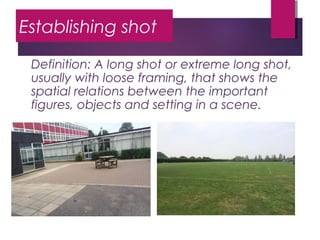
Definition: A long shot or extreme long shot, 
usually with loose framing, that shows the 
spatial relations between the important 
figures, objects and setting in a scene.
Shot / reverse shot 
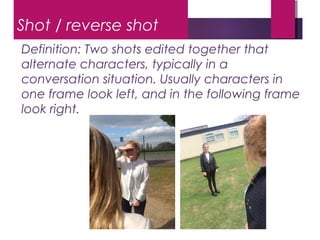
Definition: Two shots edited together that 
alternate characters, typically in a 
conversation situation. Usually characters in 
one frame look left, and in the following frame 
look right.
Shot / reverse shot 
It may not be filmed in the correct 
order but will be edited together 
afterwards. 
Must ensure that the right amount of 
shots are filmed to make the ‘shot-reverse- 
shot’ sequence work. 
 Exampla 
 http://www.youtube.com/watch?v=j0AVL-DPAuc
If you’re shooting two characters talking 
to each other, here’s how to do it. 
Film it once with a ‘master shot’, which 
shows both characters 
Film it again with the camera in closeup 
on one character 
Film it again with the camera in closeup 
on the second character. 
Film individual shots of each character in 
‘big closeup’ when you need to show 
strong emotion. 
You can also include other shots, such as 
mid shots, if you need them. 
http://www.youtube.com/watch?v=j0AVL-DPAuc
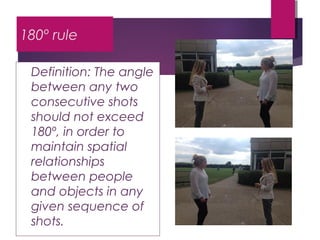
180º rule 
Definition: The angle 
between any two 
consecutive shots 
should not exceed 
180º, in order to 
maintain spatial 
relationships 
between people 
and objects in any 
given sequence of 
shots.
Rules for continuity editing 
180 degree rule 
This is a principle which underpins all TV 
and Film production. 
It’s important not to cross the ‘line of vision’ 
between two characters. 
Otherwise the viewer may not be able to 
make sense of the scene. 
The same rule applies to a moving subject: 
keep to one side of the direction of 
motion. 
http://www.youtube.com/watch?
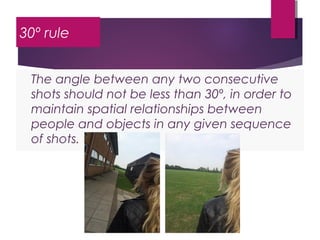
30º rule 
The angle between any two consecutive 
shots should not be less than 30º, in order to 
maintain spatial relationships between 
people and objects in any given sequence 
of shots.
Crosscutting 
Definition: Editing that alternates between shots 
occurring simultaneously in two or more 
different location. 
http://www.youtube.com/watch?v=6GQkUxdDD-8 
Match on Action 
Definition: A cut between two shots that 
places two different framings of the same 
action next to each other, making it seem to 
continue uninterrupted. 
http://www.youtube.com/watch?v=_dgutDMPIMU
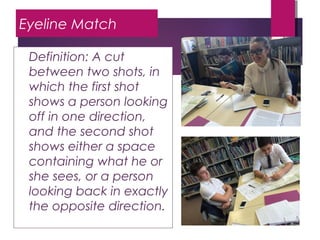
Eyeline Match 
Definition: A cut 
between two shots, in 
which the first shot 
shows a person looking 
off in one direction, 
and the second shot 
shows either a space 
containing what he or 
she sees, or a person 
looking back in exactly 
the opposite direction.
Re-establishing shot

Continuity editing

  • 1.
    Continuity Editing Definition:A system of cutting used to maintain continuous and clear narrative action by following a set of rules. The Rules: •Establishing shot •Shot/ reverse shot •180º rule •30º rule •Crosscutting •Match on Action •Eyeline Match •Re-establishing shot The Benefits: • The narrative has structure • The shot sequences flow seamlessly into each other • It’s easy to watch the film!
  • 2.
    Establishing shot Definition:A long shot or extreme long shot, usually with loose framing, that shows the spatial relations between the important figures, objects and setting in a scene.
  • 3.
    Shot / reverseshot Definition: Two shots edited together that alternate characters, typically in a conversation situation. Usually characters in one frame look left, and in the following frame look right.
  • 4.
    Shot / reverseshot It may not be filmed in the correct order but will be edited together afterwards. Must ensure that the right amount of shots are filmed to make the ‘shot-reverse- shot’ sequence work.  Exampla  http://www.youtube.com/watch?v=j0AVL-DPAuc
  • 5.
    If you’re shootingtwo characters talking to each other, here’s how to do it. Film it once with a ‘master shot’, which shows both characters Film it again with the camera in closeup on one character Film it again with the camera in closeup on the second character. Film individual shots of each character in ‘big closeup’ when you need to show strong emotion. You can also include other shots, such as mid shots, if you need them. http://www.youtube.com/watch?v=j0AVL-DPAuc
  • 6.
    180º rule Definition:The angle between any two consecutive shots should not exceed 180º, in order to maintain spatial relationships between people and objects in any given sequence of shots.
  • 7.
    Rules for continuityediting 180 degree rule This is a principle which underpins all TV and Film production. It’s important not to cross the ‘line of vision’ between two characters. Otherwise the viewer may not be able to make sense of the scene. The same rule applies to a moving subject: keep to one side of the direction of motion. http://www.youtube.com/watch?
  • 8.
    30º rule Theangle between any two consecutive shots should not be less than 30º, in order to maintain spatial relationships between people and objects in any given sequence of shots.
  • 9.
    Crosscutting Definition: Editingthat alternates between shots occurring simultaneously in two or more different location. http://www.youtube.com/watch?v=6GQkUxdDD-8 Match on Action Definition: A cut between two shots that places two different framings of the same action next to each other, making it seem to continue uninterrupted. http://www.youtube.com/watch?v=_dgutDMPIMU
  • 10.
    Eyeline Match Definition:A cut between two shots, in which the first shot shows a person looking off in one direction, and the second shot shows either a space containing what he or she sees, or a person looking back in exactly the opposite direction.
  • 11.