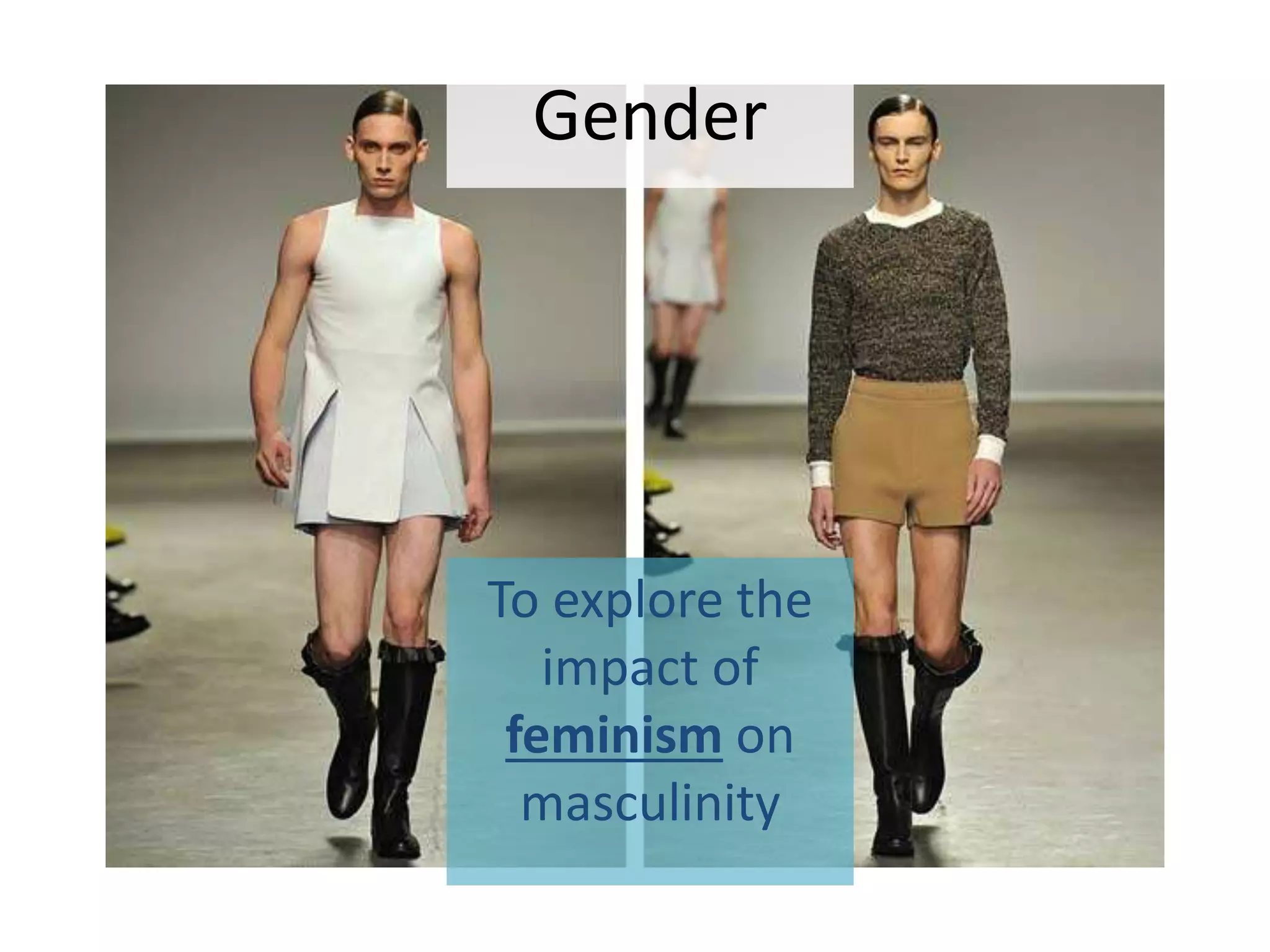
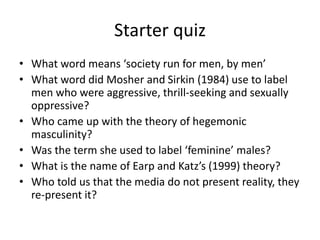
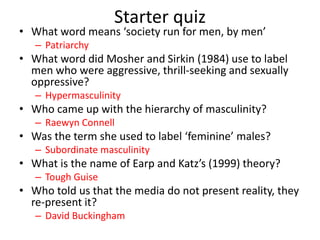
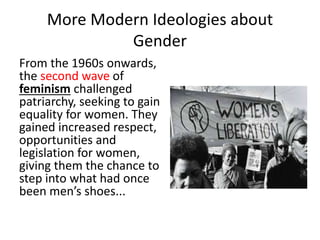
Gender
To explore the
impact of
feminism on
masculinity
Starter quiz
• What word means ‘society run for men, by men’
• What word did Mosher and Sirkin (1984) use to label
men who were aggressive, thrill-seeking and sexually
oppressive?
• Who came up with the theory of hegemonic
masculinity?
• Was the term she used to label ‘feminine’ males?
• What is the name of Earp and Katz’s (1999) theory?
• Who told us that the media do not present reality, they
re-present it?
Starter quiz
• What word means ‘society run for men, by men’
– Patriarchy
• What word did Mosher and Sirkin (1984) use to label
men who were aggressive, thrill-seeking and sexually
oppressive?
– Hypermasculinity
• Who came up with the hierarchy of masculinity?
– Raewyn Connell
• Was the term she used to label ‘feminine’ males?
– Subordinate masculinity
• What is the name of Earp and Katz’s (1999) theory?
– Tough Guise
• Who told us that the media do not present reality, they
re-present it?
– David Buckingham
More Modern Ideologies about
Gender
From the 1960s onwards,
the second wave of
feminism challenged
patriarchy, seeking to gain
equality for women. They
gained increased respect,
opportunities and
legislation for women,
giving them the chance to
step into what had once
been men’s shoes...
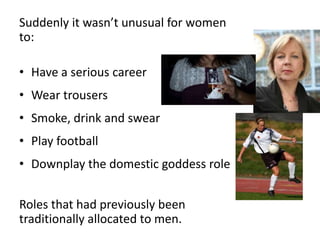
Suddenly it wasn’t unusual for women
to:
• Have a serious career
• Wear trousers
• Smoke, drink and swear
• Play football
• Downplay the domestic goddess role
Roles that had previously been
traditionally allocated to men.
Which of our key theorists
can we apply?
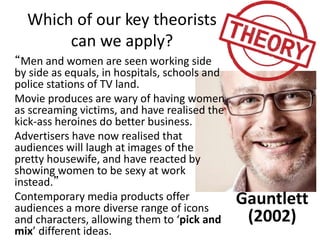
“Men and women are seen working side
by side as equals, in hospitals, schools and
police stations of TV land.
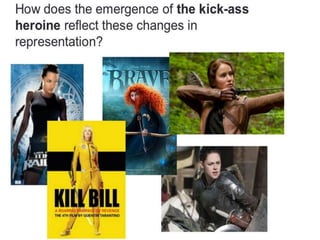
Movie produces are wary of having women
as screaming victims, and have realised the
kick-ass heroines do better business.
Advertisers have now realised that
audiences will laugh at images of the
pretty housewife, and have reacted by
showing women to be sexy at work
instead.”
Contemporary media products offer
audiences a more diverse range of icons
and characters, allowing them to ‘pick and
mix’ different ideas.
Gauntlett
(2002)
The waves of Feminism
• First wave: from the mid 19th to early 20th
century feminist activism was focused on the
fight for social and political equality. (The
Suffragettes)
• Second Wave: the liberation movement of the
1960’s and 70’s – the struggles for equal
pay and rights at work
• Third wave: (early 1990s – present) more
emphasis on the positive nature of ambiguity
and difference (not all women are the same).
They also have links with postmodernism
and question the nature of gender difference
RECAP:
Judith Butler – Gender Trouble
• The idea that identity is
manufactured through a set of
acts.
• The idea that there is no gender
identity behind the expressions of
gender
• The idea that performativity is not
a singular act, but a repetition and
a ritual.
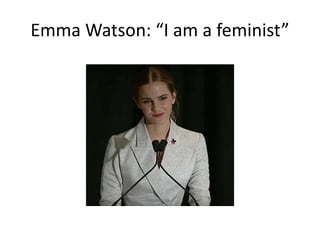
Emma Watson: “I am a feminist”
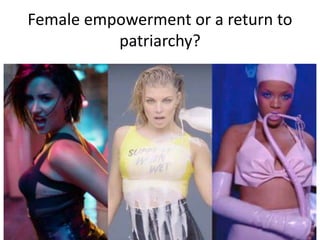
Female empowerment or a return to
patriarchy?

Lesson 4 Feminism

  • 1.
    Gender To explore the impactof feminism on masculinity
  • 2.
    Starter quiz • Whatword means ‘society run for men, by men’ • What word did Mosher and Sirkin (1984) use to label men who were aggressive, thrill-seeking and sexually oppressive? • Who came up with the theory of hegemonic masculinity? • Was the term she used to label ‘feminine’ males? • What is the name of Earp and Katz’s (1999) theory? • Who told us that the media do not present reality, they re-present it?
  • 3.
    Starter quiz • Whatword means ‘society run for men, by men’ – Patriarchy • What word did Mosher and Sirkin (1984) use to label men who were aggressive, thrill-seeking and sexually oppressive? – Hypermasculinity • Who came up with the hierarchy of masculinity? – Raewyn Connell • Was the term she used to label ‘feminine’ males? – Subordinate masculinity • What is the name of Earp and Katz’s (1999) theory? – Tough Guise • Who told us that the media do not present reality, they re-present it? – David Buckingham
  • 4.
    More Modern Ideologiesabout Gender From the 1960s onwards, the second wave of feminism challenged patriarchy, seeking to gain equality for women. They gained increased respect, opportunities and legislation for women, giving them the chance to step into what had once been men’s shoes...
  • 5.
    Suddenly it wasn’tunusual for women to: • Have a serious career • Wear trousers • Smoke, drink and swear • Play football • Downplay the domestic goddess role Roles that had previously been traditionally allocated to men.
  • 6.
    Which of ourkey theorists can we apply? “Men and women are seen working side by side as equals, in hospitals, schools and police stations of TV land. Movie produces are wary of having women as screaming victims, and have realised the kick-ass heroines do better business. Advertisers have now realised that audiences will laugh at images of the pretty housewife, and have reacted by showing women to be sexy at work instead.” Contemporary media products offer audiences a more diverse range of icons and characters, allowing them to ‘pick and mix’ different ideas. Gauntlett (2002)
  • 8.
    The waves ofFeminism • First wave: from the mid 19th to early 20th century feminist activism was focused on the fight for social and political equality. (The Suffragettes) • Second Wave: the liberation movement of the 1960’s and 70’s – the struggles for equal pay and rights at work • Third wave: (early 1990s – present) more emphasis on the positive nature of ambiguity and difference (not all women are the same). They also have links with postmodernism and question the nature of gender difference
  • 9.
    RECAP: Judith Butler –Gender Trouble • The idea that identity is manufactured through a set of acts. • The idea that there is no gender identity behind the expressions of gender • The idea that performativity is not a singular act, but a repetition and a ritual.
  • 10.
    Emma Watson: “Iam a feminist”
  • 15.
    Female empowerment ora return to patriarchy?